ANALYSIS
Video
Highlights: Obama's Address to Congress
Excerpts from President Obama's first major address to a Joint Session of Congress on Tuesday, Feb. 24, 2009.
Not since Franklin Roosevelt delivered his first fireside chat, eight days into his presidency, have Americans been more hungry -- and more desperate -- for economic leadership. And not since FDR has there been an economic agenda as bold or ambitious, or as likely to reshape American capitalism.
Just a month in office, Obama has already pushed through additional fiscal stimulus equal to 5 percent of the country's economic output. His Treasury Department is about to embark on the second phase of a program that will lead to greater government control and ownership of some of the nation's biggest banks. He has assembled a team to pull off what amounts to a bankruptcy reorganization for automakers that will leave taxpayers as one of the industry's biggest creditors. And within months, the president has promised to deliver the blueprint of a new regulatory architecture that will dramatically increase the government's oversight of financial firms.
If all of that weren't enough of a challenge, Obama vowed to move quickly to revamp the health-care system, put the government on a credible path toward a balanced budget, dramatically reduce the country's carbon footprint, rewrite the tax code and reform public schools.
"Action, and action now," is how FDR put it in his time. In Obama's translation, "that day of reckoning has arrived, and the time to take charge of our future is here."
It remains an open question whether by trying to do so much so fast, Obama will be able to create the momentum and sense of urgency necessary to overcome pushback from many Republicans, the inevitable opposition from special interests and the natural tendency of the system to return to the old political equilibrium.
Already there are signs that the demands of the president's ambitious agenda have overwhelmed the economic team that has been assembled at the White House, the Treasury and other federal agencies. And there are some who warn that in asking Congress to consider so many different issues, Obama runs the risk of political gridlock as one initiative is held hostage to another.
But as Obama sees it, his strategy is not to find a way to maneuver a wildly ambitious economic program through the twists and turns of a hostile and byzantine political system, but to use the urgency of the moment and his considerable political capital to reform that system and transform the way politics is done.
Certainly in his speech last night, Obama has reinforced the image of a serious and purposeful leader who aims to rise above partisan sniping and neutralize much of the cynicism that has infected American politics. His critique of the failures of the past were powerful and unassailable. And while his program is certainly open to criticism, he made clear that he would rather engage critics than simply defeat them. He attempted to be the grown-up in the room, willing to accept responsibility and prodding others to do the same.
While the economic challenge facing Obama resembles the one faced by FDR, there is one important difference. By the time Roosevelt became president in March 1933, the stock market had long since collapsed and the economy was already well into depression. He had nowhere to go but up.
Obama, by contrast, arrived in Washington just as the effects of the financial crisis had begun to hit Main Street and the economy was beginning its precipitous decline. Whatever he might do to slow or moderate the downturn, things will inevitably get worse before they get better.
For that reason, his speech was carefully crafted to prepare the country for a deep and nasty recession while reassuring us that we'll pull through it if we pull together behind his program.
It was hardly the only balancing act that the president needed to pull off.
He sought to give voice to the incredible anger that Americans feel toward Wall Street while reminding them of their own culpability and convincing them that the only way to avoid economic calamity may be to commit even more government money to rescue some of Wall Street's biggest players.
He acknowledged the failure of government to balance its accounts, regulate financial markets and spend money wisely, even as he called on Americans to reaffirm their faith in government and expand its scope and powers.
He aimed to satisfy the demands of investors and consumers and business executives for greater clarity and certainty in government policies, even as he was forced to acknowledge that many of the details are still to be worked out.
Last night, Obama tried to walk each of these fine lines, delivering his message with the same sense of confidence in himself, in his ideas and in his country that won him the presidency in the first place.
Thursday, February 26, 2009
US President's Historic Message Balances Urgency, Optimism


SEAPA Alert: Burmese government refuses literary awards event
25 February 2009
Source: Mizzima News
Organizers of the "Tawphayalay Aung Zay Memorial" literary awards
were forced to change its venue on 24 February after Burmese
authorities refused their request to use a local hotel as venue of
the event.
The Township Peace and Development Council (TPDC) Kyauktada
Township in Rangoon did not give the organizers the permission to
use a hotel in the area as venue.
"The hotel asked us to show an official permit for the event. Only
the government's official Literary Organization is exempted from
this requirement," Daw Davies Thant Zin, daughter of the late
Tawphayalay, after whom the award was named, told Mizzima.
The event was instead held in the residence of Davies, with only 30
people in attendance, instead of the 100 who had been invited.
Davies said they staged the awards ceremony last year at Thamada
(President) Hotel last year without asking for a permit. At the
time, the government did not require literary events to ask for
permit for their respective events.
The literary circle said that the government's refusal to issue a
permit might be related to a book launching held in January this
year which was attended by U Win Tin, who had been released from
prison last year after spending 19 years in detention. He is also
one of the leaders of the "National League for Democracy" (NLD).
Burmese authorities have been known to arrest literary writers and
poets who write articles critical of the government. Magazines that
publish these also get censored, if not penalized.
The government arrested in January 2008 a poet, Saw Wai, over his
poem entitled "February 14". When the first letter of each line of
his poem were put together, it said: "Power Crazy Than Shwe". Tan
Shwe is a senior general in the junta.
Contents of publications are also routinely censored. In August
last year, the Censor Board approved only five poems out of 16
submitted by the literary journal, "Cherry Magazine". The censors'
decision was also so delayed that the magazine had to skip an
issue and lose advertising revenue.
The organizers of "Tawphayalay Memorial Literary Prize" this year
invited over 100 persons from the media and literary circles,
including U Win Tin. The award has been given annually since 2007.
Tawphalay is the great grandson of the last Burmese monarch, King
Thibaw and Queen Su Phaya Latt. He wrote some historical books,
including "The New Generation Loved by the People", "Ngamauk Ruby
in London" and "From Yadanbon to Ratnagiri". He died on 18 June
2006.
--------------------------------
Mizzima News ( http://clicks.aweber.com/y/ct/?l=92apN&m=1cjdoSm1sjKXin&b=WkqKFLn0aLRjoKl8cIUi2g ) is a news organization
headquartered in New Delhi, India, run by exiled Burmese
journalists. A SEAPA partner, it aims to promote awareness about
the situation in Burma and promote democracy and freedom of
expression in the country.
------------------------------------------------------------
Southeast Asian Press Alliance.
Bangkok Office: 3B, 3rd floor, Thakolsuk Place, No. 115 Terddumri Road, Dusit, Bangkok 10300. Tel. (662)2435579 Fax.(662)2448749
Thai PTTEP cancels swap of Myanmar stakes with CNOOC
http://sg.news.yahoo.com/rtrs/20090225/tbs-pttep-cnooc-7318940.html
Reuters - Wednesday, February 25BANGKOK, Feb 25 - Thailand's PTT Exploration and Production PCL
The contract for the swap had expired before approval was won from Myanmar's government, so it became invalid, PTTEP said in a statement to the exchange.
PTTEP International, an operator of oil and gas fields in army-ruled Myanmar, will maintain its 100 percent holding in blocks M3 and M4.
The company had signed a deal with CNOOC Myanmar Ltd last April, hoping to swap its 20 percent stake in offshore gas blocks M3 and M4 to the Chinese firm in exchange for a 20 percent share of CNOOC's A4 and C1 blocks.
Blocks M3 and M4 in the Gulf of Martaban off Myanmar have strong gas potential.
Block A4 is a gas field located off the former Burma's Rakhine coast, while C1 is a potential onshore oil field.
PTTEP, a subsidiary of PTT
PTTEP also owns 100 percent of offshore block M9, which is still under exploration in the Gulf of Martaban, south of Yangon, Myanmar's main city.
At the midday break, PTTEP shares were up 1.12 percent at 90 baht while the main index <.SETI> was up 0.57 percent.
North Korea Announces Plans for 'Satellite' Launch
http://www.freevoa.com/2009/02/north-korea-announces-plans-for.html
Feb 24, 2009
North Korea has spelled out in its clearest terms yet its intention to launch what it describes as a "communications satellite."
A South Korean watches television news showing file image of North Korea's missile, at railway station in Seoul, 24 Feb 2009
Official North Korean media broadcast a statement Tuesday from the country's science ministry saying "preparations to launch an experimental communications satellite are now making brisk headway."
North Korea has not specified when it will conduct the launch, which it says will carry a satellite named Kwangmyongsong 2 into orbit. North Korean media says the successful launch will be "another giant stride forward in building an economic power."
It is the clearest confirmation Pyongyang has given of U.S. and South Korean suspicions the North intends to launch a long-range rocket potentially capable of reaching the United States. South Korea's Defense Minister rejected the notion of a satellite launch Tuesday, saying the North was planning a ballistic missile test.
Baek Seung-joo, a senior researcher at the state-backed Korean Institute of Defense Analyses in Seoul, says Tuesday's announcement means a launch is now inevitable.
He says this is just like 2006, when North Korea carried out its nuclear weapons test after announcing it first. Now that they have gone public, he says, Pyongyang cannot help but conduct the launch in order to demonstrate its strong will.
North Korea's last test of its most advanced long-range missile was in 2006, a few months before the nuclear test. It triggered sharp United Nations sanctions in the form of United Nations resolution 1718, which also prohibited future missile launches.
South Korea's Foreign Ministry repeated warnings Tuesday that a North Korean launch would violate that resolution, and trigger more U.N. punishment.
Yang Moo-jin, a professor at Seoul's University of North Korean Studies, says the legality may not be so black and white.
He says labeling this a satellite launch may help Pyongyang skirt the United Nations resolution, which mainly dealt with ballistic missiles.
Joseph Bermudez, a senior analyst with Jane's Defense Weekly, is one of the world's top experts on North Korea's missile programs. He says even if the launch is a satellite, the North's missile program will benefit.
"So anything they could do to develop the Space Launch Vehicle is very much applicable to a ballistic missile program," he said. "Materials and technology for one could help the other."
Bermudez has said satellite imagery indicates the launch could come any day now. Many South Korean experts have a more conservative estimate, saying a launch is unlikely before next month.
Posted by Learner at 10:14
Labels: News
Release all political prisoners in Myanmar: EU
http://www.newkerala.com/topstory-fullnews-99376.html
Release all political prisoners in Myanmar: EU
Brussels, Feb 24 : The European Union has called for 'an immediate and unconditional release' of all political prisoners and detainees in Myanmar, including opposition leader Aung San Suu Kyi.
The EU presidency, held currently by the Czech Republic, urged for an all-inclusive dialogue between the authorities and the democratic forces, including ethnic groups in Myanmar, EuAsiaNews reported.
The statement issued by the presidency pointed to the recent visit by the UN Secretary General's Special Adviser Ibrahim Gambari and noted with regret that there is no tangible outcome of his visit to Burma.
The EU shares the view expressed by Gambari that it is the time to demonstrate the Myanmar's commitment to addressing concretely the issues of concern to the international community.
--- IANS
Yosano wants steps to prop up stocks- JAPAN
http://search.japantimes.co.jp/mail/nb20090225a1.html
Wednesday, Feb. 25, 2009
Kyodo News
The government may work out fresh measures to bolster Tokyo stock prices that have been plunging in step with New York markets, Finance Minister Kaoru Yosano hinted Tuesday.
"The fallout of falling stock prices is greater than we expected. We are witnessing many negative wealth effects with impaired assets held by banks and insurance firms," Yosano said, describing continued declines in stocks as "not desirable at all."
Yosano said he would closely monitor the Tokyo Stock Exchange on Tuesday after New York stocks tumbled Monday to their lowest level in 11 years and nine months, before deciding how the ruling parties and government should respond.
Yosano said the government will consider ways to boost stock prices as proposed Monday by Fujio Mitarai, chairman of the Japan Business Federation (Nippon Keidanren).
The leader of the country's most influential business lobby urged the government to use public funds to buy stocks in a price-maintaining operation.
"A supplementary budget worth about ¥25 trillion to finance rapid-acting measures should be compiled and implemented" after the fiscal 2009 budget is passed, Mitarai said.
He proposed the figure because the gap between the nation's potential and actual growth rates in terms of gross domestic product was estimated at minus 4.3 percent, or ¥20 trillion, in the October-December quarter, with the negative figure indicating excess supply.
The Nikkei average fell 107.60 points, or 1.5 percent, Tuesday, with investor sentiment battered after the Dow Jones index closed Monday at its lowest level since May 1997 on growing pessimism about the future of the U.S. economy.
Chief Cabinet Secretary Takeo Kawamura said a quick recovery in U.S. stock prices is indispensable for boosting Japanese stocks, and pledged that the government will implement stimulus steps by enacting budget bills to remove the sense of uncertainty from the economic outlook.
In a related move, the Bank of Japan resumed Monday its purchase of stocks held by commercial banks as part of its efforts to help strengthen their financial base and encourage them to lend more to businesses amid the global credit turmoil.
Translated Survey on Chinese Multinational Investment in Burma's
http://www.earthrights.org/content/view/624/114/
Extractive and Hydroelectric Industries Now Available
Chinese, Burmese and Spanish versions now available
February 24, 2009, Chiang Mai, Thailand – EarthRights International announces the release this month of the Chinese, Burmese, and Spanish language versions of the most comprehensive survey on Chinese multinational corporate investment in military-ruled Burma. Originally released in English in September 2008, the survey, titled China in Burma: The Increasing Involvement of Chinese Multinational Corporations in Burma’s Hydropower, Oil and Natural Gas, and Mining Sectors, is the most comprehensive survey on Chinese investment in Burma to date and identifies 69 Chinese MNCs involved in 90 completed, current, and planned projects in the hydropower and extractive sectors in Burma.
The release of this survey in Chinese, Burmese, and Spanish languages helps make information about China’s expanding search for energy available to people in Chinese, Burmese, and Spanish speaking communities around the world where Chinese MNCs are operating.
The survey documents projects varying from small hydropower dams completed in the last two decades to planned dual oil and natural gas pipelines across Burma to southwestern China. This research draws upon government statements, English and Chinese language news reports, and company press releases, and builds upon previous ERI research collected between May and August 2007 that identified only 26 Chinese MNCs involved in 62 projects in Burma.
Ka Hsaw Wa, Executive Director of EarthRights International noted the importance of publishing the survey in the Burmese language, stating, “We’ve repeatedly seen foreign companies coming into Burma with disregard for local people and the environment. Given what we know about development projects in Burma and the current situation, we’re concerned about this marked increase in the number of these projects. Now at least some local people can read about information that the companies and the military government are failing to provide.”
“We’re concerned about the lack of information available in the public domain about these projects and others like them,” said ERI Researcher Alek Nomi, principal author of the research. “We hope the release of this research in multiple languages spoken by communities affected by China’s global search for natural resources provides a resource for communities, NGOs, journalists, policymakers, and governments around the world.”
According to the junta’s own statistics, foreign investment in Burma nearly doubled in the first nine months of 2008 compared to the same period in 2007, with the mining sector accounting for almost 90 percent of the total foreign investment – investment from January to September 2008 increased to $974.9 million dollars from $502.5 million. China is leading foreign investment in Burma, accounting for $855 million of the $860.9 million invested in the mining sector alone.
The intensifying battle over Internet freedom
http://www.csmonitor.com/2009/0224/p09s01-coop.html
From China to Syria, repressive nations are cracking down hard on digital dissidents.
By Joanne Leedom-Ackerman
from the February 24, 2009 edition
E-mail a friend Print this Letter to the Editor Republish ShareThisE-mail newsletters RSS
Washington - Eleanor Roosevelt never imagined the Internet.
Neither did the other framers of the Universal Declaration of Human Rights 60 years ago when they enshrined the right to freedom of expression. Yet they wisely left room for just such a development by declaring in Article 19: "Everyone has the right to freedom of opinion and expression; this right includes freedom to hold opinions without interference and to seek, receive and impart information and ideas through any media and regardless of frontiers."
Today, the Internet is both the vehicle and the battleground for freedom of expression around the world. The struggle between writers and governments over this free flow of information has escalated this past year and promises to intensify. Those supporting open frontiers for ideas and information need to be on high alert and take steps necessary to protect those silenced and to keep the Internet unencumbered.
Last year became the first time that more Web journalists were jailed than those working in any other medium, according to the Committee to Protect Journalists.
China, Burma, Vietnam, Iran, Syria, and Zimbabwe have led the clampdown. They have arrested writers, blocked websites and Internet access, set strict rules on cyber cafes, and tracked writers' work. In response, some writers have used proxy search engines, encryption, and other methods to try to get around censorship and detection.
"As in the cold war [when] you had an Iron Curtain, there is concern that authoritarian governments, led by China, are developing a Virtual Curtain," says Arvind Ganesan, director of the Business and Human Rights Program at Human Rights Watch. "There will be a free Internet on one side and a controlled Internet on the other. This will impede the free flow of information worldwide."
In the past year, writers in general have been arrested and imprisoned for such alleged charges as "inciting subversion of state power" (China), "insulting religion" (Iran), "threatening state security" (Burma), "defaming the President of the Republic" (Egypt), "storing cultural products with contents against the Socialist Republic" (Vietnam), and "spreading false news" (Syria).
"The Internet is reshaping society from the ground up," notes Larry Siems, the director of the Freedom to Write program at PEN American Center. "For instance there are two new novels from girls who are housebound in Saudi Arabia, but these were published on the Internet." The question remains whether the writers can maintain their freedom in cyberspace, which they do not have in their physical space.
International PEN's Writers in Prison Committee regularly tracks approximately 900 cases of writers around the world who are under threat, arrested, attacked, or killed, with roughly 150 new cases each year. "There has definitely been a rise in the numbers of Internet writers, editors, and bloggers attacked," notes Sara Whyatt, director of International PEN's Writers in Prison Committee. "The Internet has caused an explosion of free speech. Governments of all sorts are finding this a challenge."
China, which is particularly adept at blocking Internet use, leads the list of countries with long prison terms and the highest number of writers in prison. China's crackdown on writers before the Olympics and the arrest in December of leading dissident writer Liu Xiaobo, one of the authors of Charter 08, which advocates democratic reform in China, contradicts the government's claim that it is easing up on restrictions. In spite of Liu's detention, Charter 08 has circled the globe via the Internet, gathering signatures of Chinese from the mainland and the diaspora.
Because the Internet operates outside the structures of government, it challenges hierarchies of power and empowers the individual voice as never before. As many as 40 countries are engaged in some kind of Internet filtering and censorship, according to OpenNet Initiative. To counter these restrictions, human rights organizations and private companies, including Google, Microsoft, and Yahoo launched the Global Network Initiative (GNI) this fall. GNI, which sets voluntary standards to safeguard privacy and curtail censorship, is worthy of support.
The US Congress is watching its implementation closely and will also be considering legislation (the Global Online Freedom Act) to prevent Internet companies from assisting foreign governments in censoring content and revealing user information.
There are legitimate concerns about those who misuse the Internet, but a balance is possible between privacy and a government's ability to track criminal and terrorist networks. Authoritarian governments should not use law enforcement needs as an excuse to shut down opposition and muzzle free expression. Keeping the digital highway open for the hundreds of millions of legitimate users is vital to freedom of expression and the free flow of information worldwide. It will take vigilance, agreed standards, and technological innovations to protect the Internet's open structure.
One can imagine Eleanor Roosevelt today sitting at her computer sending out protests, even blogging as she and others frame the principles to keep this corridor of communication unfettered and free.
• Joanne Leedom-Ackerman, a former Monitor reporter, is a vice president of International PEN and a board member of Human Rights Watch.
National Reconciliation in Myanmar.
http://cplash.com/post/National-Reconciliation-in-Myanmar973.html
Published on Tue, 24 Feb 2009 11:08
Posted by SatbirSinghBedi
According to Times of India dated 24.2.2009, declaring his willingness to visit Myanmar again, Secretary-General Ban Ki-moon urged the country's military government to follow up its recent prisoner release by freeing all political detainees and quickly resuming talks with the opposition without preconditions.
While Ban said there should not be any preconditions to a return visit, he made clear that the international community wants to see significant steps by Myanmar's military junta toward national reconciliation and "full democratisation."
"This is the time for Myanmar to seize the opportunity before it to send positive signals," he said. The secretary-general has come under mounting pressure to go back to Myanmar following visits by his top envoy, Ibrahim Gambari, in August and early February which produced no movement on key issues.
These include UN recommendations to open a serious political dialogue between detained pro-democracy leader Aung San Suu Kyi and the government, release Suu Kyi and some 2,200 other political prisoners, promote national reconciliation, and ensure that elections in 2010 will include all opposition and minority groups. Ban noted that following Gambari's latest visit Myanmar's junta announced an amnesty for more than 6,300 prisoners which reportedly includes some 23 political prisoners "as of now," including "individuals whose names Mr. Gambari discussed with the authorities during his visit."
According to Free Burma Coalition, "Over the decades, the Burmese government has subjected its citizens to epic misrule, systematically destroying every institution of society except the Army, whose leaders have made staying in power their overriding goal. The streets of Rangoon and Mandalay are monitored by the secret police and by a group of armed thugs known as Swan Arr Shin—the Masters of Force. Dissidents are routinely tortured. The generals' irrational economic policies have reduced one of Asia's richest countries, once the world's leading exporter of rice, to penury. Burma's gross domestic product per capita is now less than half that of its neighbor Cambodia. Economic sanctions—a form of protest against the government's human-rights abuses—have made the
country even poorer."
At this period of time, the Myanmar is really facing tough times and national reconciliation is necessary. Govt. of India should also do its bit to forge national
reconciliation in Myanmar so that ordinary person in Myanmar enjoys human rights and the abject poverty of Myanmar is reduced.
Satbir Singh Bedi
Myanmar releases detainees, but not political prisoners
http://www.smartbrief.com/news/un_wire/storyDetails.jsp?issueid=05B5B0E9-A1FF-4993-A742-918E9773A5E3©id=04747417-D7FA-4305-B1E4-077629A17AF4
UN Wire | 02/23/2009
The government of Myanmar released some 6,300 prisoners, though political prisoners were few among them. Only 20 were released -- some of them members of the opposition National League for Democracy group. Aung San Suu Kyi, Myanmar's most famous political prisoner, still is living under house arrest. Tomás Ojea Quintana, a UN special envoy, recently visited Myanmar and gave a bleak report on its human rights record -- which has included lately a crackdown on journalists, bloggers and even comedians. UN Secretary General Ban Ki-moon is under increasing pressure to make a trip there to press for reconciliation and reforms. Washington Post, The (02/23) Google (02/21)
ASEAN under spotlight during crises
http://www.inquirer.net/specialfeatures/thefinancialcrunch/view.php?db=1&article=20090224-190711
February 24, 2009 10:04:00
Martin Abbugao
Agence France-Presse
SINGAPORE -- Southeast Asia's regional bloc will come under close scrutiny once more as its leaders meet in Thailand this week for a summit watered down by the absence of big guns China, India and Japan.
Political woes in key member states and a global economic slump are putting new pressure on the Association of Southeast Asian Nations (ASEAN) to show its relevance despite persistent criticisms it is a talking shop, analysts said.
Host and current ASEAN chair Thailand is struggling against an impending recession, riven by political turmoil and locked in a border dispute with Cambodia, while Malaysia's ruling party is fighting off a resurgent opposition.
Singapore, ASEAN's wealthiest member per capita, is meanwhile facing its worst recession since independence.
Myanmar's junta continues to defy an international outcry to release democracy icon Aung San Suu Kyi and to carry out democratic reforms.
And months after a US housing problem erupted into the worst global economic crisis since the Great Depression of the 1930s, ASEAN has yet to come up with a coordinated response, analysts said.
"Within ASEAN, the key challenge is a lack of leadership, which has contributed to fragmentation," said Bridget Welsh, a Southeast Asia specialist at Johns Hopkins University in the United States.
"The meeting has no focus, and it is likely not to have one as a result of internal pressures on regimes," she told AFP.
ASEAN officials said a key agenda item for the summit, which runs from Friday until Sunday, will be how the region will deal with the economic crisis.
On Sunday, ASEAN finance ministers and their counterparts from China, Japan and South Korea agreed to a 120-billion-dollar fund to help regional states cope with financial stress.
ASEAN is to contribute 20 percent while its bigger neighbors would chip in 80 percent, mirroring the lopsided power balance -- although there is no timeframe yet for when it will be operational.
"There's nothing much they (ASEAN states) can do," said Song Seng Wun, a Singapore-based regional economist with CIMB-GK Research.
"The global recession has affected everyone, and to a different degree those with much larger domestic markets will be looking at their domestic economies to cushion the slowdown."
Originally planned as a celebration of a landmark charter that ASEAN hopes will strengthen the 10-nation regional bloc, the summit became a victim of Thailand's political upheaval.
It was deferred from December after protesters opposed to the previous government seized Bangkok's two airports.
Traditional back-to-back meetings with the leaders of China, Japan and South Korea, as well as Australia, India and New Zealand were provisionally postponed to April, leaving the meeting an all-ASEAN affair.
The absence of the big powers "takes the momentum out of the summit," Welsh said. Even the international media is scaling down its coverage.
While ASEAN chief Surin Pitsuwan is working to strengthen the bloc, any changes will be gradual because "the regional political context and economic contractions are not conducive to these ambitions," Welsh said.
ASEAN remains relevant as a discussion forum and to articulate the region's interests opposite bigger countries, she said.
But "expectations of substantive outcomes have usually been unmet and this pattern is likely to continue," she added.
Debbie Stothard, coordinator of the Alternative ASEAN Network on Burma, a human rights group, said ASEAN needs to further engage with civil society organizations.
Burma is the former name of Myanmar, where the ruling junta is accused of committing massive human rights abuses.
Activists have expressed fears that an ASEAN human rights body will be powerless to punish rights violators in countries like Myanmar.
"ASEAN will always be a hostage to one or more of its members," Stothard told AFP. "Its effectiveness and relevance is in jeopardy."
Former ASEAN chief Rodolfo Severino defended the grouping, saying it has overcome more serious problems in the past.
ASEAN continues to be the main driver for wider regional engagement and needs to be strengthened, said Severino, who heads the ASEAN Studies Centre at the Institute of Southeast Asian Studies in Singapore.
"This means that ASEAN has a great responsibility and it should exert greater leadership," he said.
Copyright 2009 INQUIRER.net and content partners. All rights reserved. This material may not be published, broadcast, rewritten or redistributed.
Democracy plan fuels war in Myanmar
http://www.atimes.com/atimes/Southeast_Asia/KB25Ae02.html
By Brian McCartan
MAE SOT, Thailand - At a November meeting of ethnic minority and pro-democracy groups in the northern Thai town of Chiang Mai, a representative of the Danish government development agency DANIDA called on the dissident participants to take part in the political process inside Myanmar, including support for the upcoming 2010 elections, or face funding cuts.
Those behind-closed-door remarks were followed in January by a visit to Myanmar of Danish Development Minister Ulla Toraes and Norwegian minister Erik Solheim. While officially presented as a visit to observe Cyclone Nargis relief efforts, several Myanmar watchers questioned whether the delegation breached a European
Union prohibition on high-level visits to Myanmar.
Meanwhile, the United Nations has been wishy-washy on its stance towards the elections, with Secretary General Ban Ki-moon and Special Envoy to Myanmar Ibrahim Gambari simply requesting that the ruling generals ensure that the elections are free and fair. Amid growing calls for Ban to make another visit to Myanmar, the UN has said little concerning what would make the elections internationally acceptable or what actions the international community should take if they are not.
Behind the silence is a growing notion among certain Western governments and international aid agencies that the junta's controversial planned elections will usher in a new era of stability to Myanmar. The reality is that the junta's push to legitimize its electoral process is already causing greater instability, especially along Myanmar's borders with Thailand and China. Myanmar's various ethnic-based ceasefire organizations are making moves to secure their power bases and territory in order to either maintain their bargaining positions whatever government results from the elections or, if push comes to shove, go back to war.
The elections represent the fifth step on the military regime's seven-step "roadmap to democracy". The generals have said that before the elections can take place the various ethnic insurgent ceasefire groups along the country's border areas must disarm and become legal political parties. Only once a "discipline flourishing democracy" has been established, says the government, will the concerns of the various ethnic groups be addressed.
With a year to go before the polls, ethnic insurgent organizations are being forced to decide whether to carry on the struggle or become state-controlled militias. Although Gambari was able to meet with certain ethnic Shan politicians on his visit in early February, and UN Human Rights Envoy Tomas Ojea Quintana met last week with members of the Democratic Karen Buddhist Army (DKBA), it is unlikely that these staged meetings would have given either envoy a real sense of the dilemma facing many of the ethnic organizations.
For many Myanmar analysts and ethnic leaders there is a real worry that a military showdown is brewing between the generals and the ethnic groups that could tilt the region towards fighting on a scale not seen in over 20 years. Increased government pressure to disarm has already resulted in increased fighting along the Thai-Myanmar border as a Karen insurgent group allied with the junta tries to create more space for itself.
With little faith in the central government and its post-election promises, many other ceasefire groups say they will retain rather than give up their arms. Since the first ceasefires were signed in 1989, ethnic armies have resisted handing over their arms because they believe without them it would be impossible to negotiate a final settlement on equal terms or protect their people from a regime renowned for its gross human rights abuses.
The junta's disregard for ethnic group representatives at the National Convention to draft a new constitution, which was completed in 2007, and the forced disarmament of several smaller groups has only intensified ethnic distrust of the generals. Initial pressure to disarm, or at least to become militias or border guards under the control of Myanmar's armed forces, began prior to the completion of the National Convention.
That pressure intensified after the controversial national referendum held in May that approved a new constitution, which paved the way for next year's elections. The generals contend that under democracy there will be no need for ethnic organizations to retain their arms and instead that they should form political parties to represent their minority interests.
Electoral dilemma
Ethnic political organizations are caught on the horns of an electoral dilemma: if they boycott the polls, their grounds for criticizing the results will be weakened; by contesting, they will seemingly condone a process which most observers, including several ethnic leaders, view as a sham. Different groups are taking different approaches, though all have a common thread: the retention of arms.
The largest ceasefire groups are based in northern Myanmar, along the border with China. They include the United Wa State Army (UWSA) with an estimated 15,000-20,000 fighters, the National Democratic Alliance Army-Eastern Shan State (NDAA-ESS) with around 2,500 and the Shan State Army-North (SSA-N) with up to 10,000 men, and the Kachin Independence Organization/Army (KIO/A) with between 3,000 and 5,000 soldiers in Kachin State. The UWSA, NDAA and SSA-N all agreed to ceasefires in 1989, while the KIO signed on in 1994.
With a large and well-equipped army, wealth derived through legitimate business as well as drug trafficking, and support from China, the UWSA has historically played hard ball with the junta. In a move which observers see as a test of the generals' commitment to their new constitution, the UWSA has recently started stamping official documents as "Government of Wa State, Special Autonomous Region, Union of Myanmar" and changed its official office signs to read the same.
The constitution sets out a "Self-Administered Division" for the Wa and the UWSA is in effect declaring its rule over the area. The move comes amid increased tensions following a December meeting between UWSA officers and Major General Kyaw Pyoe from the Golden Triangle Command based in eastern Shan State. The general ordered the UWSA to disarm and reform into a government-controlled militia, a request that was rejected out-of-hand by the UWSA.
Underscoring that authority, a 30-man government delegation led by Lieutenant General Ye Myint, chief of Military Affairs Security, or Myanmar's military intelligence agency, was forced on January 19 to disarm when it crossed into Wa-controlled territory. Ye Myint's main mission, to discuss the upcoming elections, was instead limited to economic matters. The UWSA has yet to comment on whether it will participate in the polls, but recent moves to establish a factory for the production of small arms and ammunition, suggest that the UWSA is instead readying for a fight.
The NDAA, which is closely allied with the UWSA, has also resisted government calls to disarm and tensions have since grown with the Myanmar army. Meanwhile, the arrest in February 2005 and continued detention of SSA-N chairman Major General Hso Ten, along with several other Shan leaders, has soured relations and SSA-N troops have since joined the non-ceasefire Shan State Army-South along the border with Thailand. Both groups are expected to resist rather than allow themselves to be disarmed and become government-led militias.
In Kachin State, the KIO has declared it will not participate in the elections, but recently gave its approval to civilians who wish to set up a Kachin political party to contest the polls. The group has said that it hopes to enter into a dialogue with a new democratic government. And in the southern Myanmar areas of Mon State and Tenasserim Division, the New Mon State Party (NMSP) declared after a recent congress that it will not participate in the elections and would not disarm. The NMSP has been a consistent thorn in the regime's election plans, including its move to walk out of the National Convention in protest over lack of consideration of ethnic issues and a March 2008 statement stating its opposition to the national referendum.
Several ceasefire group leaders have remained coy about their preparations for possible hostilities. On the ground, observers describe military preparations including trainings and increased recruitment, as well as growing apprehension among the civilian populace. The junta, too, appears to be preparing for armed showdowns. It has for years increased troop numbers in areas
Continued 1 2
Page 2 of 2
Democracy plan fuels war in Myanmar
By Brian McCartan
near ceasefire groups and recent reports suggest that these troops are being reinforced with heavy weapons, including 76mm and 105mm artillery and with specialized troops, including Light Infantry Divisions 66 and 88.
With those movements, reports are spreading along border areas that the regime may move to rehabilitate various middle and senior ranking members of the now defunct Directorate of Defense Services Intelligence (DDSI), including former prime minister and DDSI head General Khin Nyunt. The DDSI was responsible for brokering many of the ceasefires, but was dismantled amid corruption allegations in 2004 which most observers saw as an intra-junta purge against the increasingly powerful Khin Nyunt and
his followers. The former top-ranking junta member is has been sentenced to 44 years and is now under house arrest.
Insurgent officers say Khin Nyunt's rapport with the ethnic groups has not been equaled by the Military Affairs Security, which replaced DDSI. According to one insurgent official, Myanmar army commanders have realized that Khin Nyunt's men knew how to handle the ceasefire groups and have even recently begun seeking out their opinions on how to bring ethnic groups into the election process.
Their inclusion is necessary to give the elections legitimacy among the international community and more importantly to bring all of the country's territories under the generals' nominal control. Yet the only major group which has so far agreed to the border guard arrangement is the government-aligned Democratic Karen Buddhist Army (DKBA), which controls territories in Myanmar's eastern Karen and Mon States.
Economic lures
Viewed by some as a test case for how ceasefire groups may evolve under Myanmar's new democracy, the outlook so far is not good for stability. The DKBA was told at a meeting in the capital Naypyidaw in December that under the new constitution they were to become a border guard force. Under the terms of the agreement, which has so far not been made public, the DKBA was promised control over border tax checkpoints and continued concessions for transportation, logging and other businesses.
Sources close to the DKBA say the move was unpopular because it means handing over political power over to a Myanmar-dominated regime - a concession which goes against the founding principles of the Karen's long struggle - and several officers threatened to resign as a result.
Rather than release statements or make a show of force, the group has instead concentrated on seizing new territories particularly former Karen National Union-controlled areas near Myawaddy and Kayin Seikgyi townships across from Tak Province in Thailand, to gain administrative control over lucrative border trades, including mining operations and cross-border agribusiness projects, in the new democratic era.
For all its statements of representing the cause of self determination and equality for the ethnic Karen people, the armed group is believed by many to be motivated more by business opportunities, including drug trafficking, it needs guns to maintain. The DKBA has so far not made any statements about whether or how it will contest the 2010 elections. Three Karen political parties currently exist, but none have any connection with the DKBA and only one, the Karen State National Organization, won any seats in the 1990 election. The election itself, according to rival KNU vice president Saw David Thakabaw, may split the DKBA into competitive, business-driven factions.
By playing ceasefire groups-cum-militias against other insurgent groups, the junta could bid to keep ethnic groups weak and divided while building its new nominally democratic power structure through elections. Concessions such as the tax checkpoints promised to the DKBA provide some incentive for joining the border guard scheme as opposed to renewed fighting. These could yet be strong economic lures for some of the ceasefire groups, particularly in relation to tentative deals with neighboring and considerably wealthier Thailand.
Thai Army commander General Anupong Paochinda paid a two day visit to Myanmar in mid-February where he met with junta leader Senior General Than Shwe, Defense Minister Thura Shwe Mann and Foreign Minster Nyan Win. It is perhaps significant that Anupong, rather than Thai Foreign Minster Kasit Piromya, handled the meeting where border issues were on the agenda.
Several cross-border business schemes are in the works, but have not been completed due to instability. For instance, an agreement was reached in May 2007 for Thai agribusinesses to cultivate tax-free over seven million hectares of land in Myanmar border areas. The agreement includes four areas of Mon and Karen States designated for contract farming, totaling some 300,000 hectares. Myanmar farmers were to grow under contract cassava, rubber, oil palm, sugarcane, beans and corn for export to Thailand.
The project appears to have stalled however due to complaints by Thai investors over taxes levied by Myanmar government officials, as well as the DKBA and KNU. Conflict over taxes on the corn harvest resulted in fighting between the KNU and DKBA south of Mae Sot in October and November, sources say. The fighting spilled over into Thailand on several occasions resulting in the shooting up of villages, burning of food storage barns, and at least one shootout between DKBA and Thai soldiers. One Thai soldier was injured by a landmine in the skirmish.
Still the DKBA has been working on new roads leading north and south of Myawaddy to service the plantations and commercial agriculture projects along the border. Other cross-border projects envisioned include a border trade zone at the border town of Myawaddy and industrial zones in Pa'an and Moulmein. The projects, financed though loans and grants from Bangkok, are designed to curb the mounting influx of Myanmar migrant workers into Thailand, now estimated at over 2 million people.
But while the DKBA is angling for business opportunities, the rival KNU has resisted Thai incentives to end fighting against the Myanmar army. That's inhibited the group's armed wing, the Karen National Liberation Army, ability to fight along the border and allowed the DKBA to seize several of the areas it formerly controlled. A KNU official told Asia Times Online his group had no plans for ceasefire talks and that it would not participate in the 2010 elections. That means democracy is just as likely to bring more, not less, instability to Myanmar's contested border areas.
Brian McCartan is a Chiang Mai-based freelance journalist. He may be reached at brianpm@comcast.net.
(Copyright 2009 Asia Times Online (Holdings) Ltd. All rights reserved. Please contact us about sales, syndication and republishing.)
Myanmar Plans Full Coverage of Public Access Centers in Whole Country
http://english.cri.cn/6966/2009/02/24/1821s457543.htm
2009-02-24 20:30:56 Xinhua Web Editor: Xu Leiying
Myanmar has planned full coverage of public access centers (PAC) in every township in the country to facilitate communication links, according to the Myanmar Info-Tech Tuesday.
Over 400 PAC opened in 44 townships in Myanmar since 2004, the sources said, adding that plans are underway to open more PAC in the remaining townships especially in the rural areas.
According to the telecommunications authorities, the number of internet users in Myanmar has reached over 300,000, up from merely dozens in four years ago.
Myanmar has been striving for the development of ICT to contribute its part to the national economic development. In December 2007, Myanmar's first largest ICT park, also known as the Yadanabon Myothit Cyber City, was introduced in Pyin Oo Lwin, a northern city of Myanmar in Mandalay division.
The cyber city, which covers an overall area of 10,000 acres (4, 050 hectares), is located in the hilly Pyin Oo Lwin near a highway, 67 km east of the second largest city of Mandalay in the north, and 20 percent of the cyber city area produce software and hardware.
The internet of the cyber city not only links with the whole country but also connect neighboring China, Thailand and India.
With the establishment of the cyber city, more and more local and foreign information technology (IT) companies have sought investment in the cyber city for the development of IT business undertakings.
Ban welcomes amnesty in Myanmar as ‘first step’ toward democratization
http://www.un.org/apps/news/story.asp?NewsID=29991&Cr=myanmar&Cr1=
Secretary-General Ban Ki-moon briefs media after participating in meeting of the Friends of Myanmar
23 February 2009 – Secretary-General Ban Ki-moon today welcomed an amnesty announced by the Government of Myanmar, which reportedly includes some 23 political prisoners, as a “first step” toward release of all such detainees and further progress on democratization.
“This is the time for Myanmar to seize the opportunity before it to send positive signals,” he said following a meeting with his Group of Friends on Myanmar, which includes neighbouring countries of the Association of South East Asian Nations (ASEAN) and other concerned States.
Citing further steps to be taken, Mr. Ban reiterated his call for the release of the hundreds of political prisoners still in detention, including opposition leader and Nobel Peace Prize laureate Daw Aung San Suu Kyi, and the resumption of dialogue between the Government and the opposition “without delay and without preconditions.”
Today’s meeting follows a briefing last week in which Mr. Ban’s Special Advisor, Ibrahim Gambari, told the Security Council that there was some movement toward “tangible outcomes” from his 31 January to 3 February visit to Myanmar as part of the Secretary-General’s good offices mandate.
After being updated Mr. Gambari, the Group of Friends expressed its unified support for the continuation of the good offices efforts, Mr. Ban said, adding that “our Myanmar interlocutors have also indicated the importance they attach to the good offices’ work.”
The Special Adviser is prepared to extend the UN’s political facilitation with both the Government and the opposition to build on previous efforts, he noted.
Asked by correspondents whether he himself is considering another visit to the South-East Asian nation, the Secretary-General replied that he will try to go, but nothing yet has been discussed in terms of timing and agendas.
“As a matter of principle, I am telling you that I am willing to make a return visit to build upon what I had discussed last May, including political issues,” he said, adding that there would not have to be preconditions for his visit.
“This is a part of ongoing consultation and negotiations and efforts by the international community, and also entrusted to me by the General Assembly,” Mr. Ban explained.
In regard to further discussions with the Group of Friends, he added: “We have a unity of support. But at the same time I would like to see some unity of approaches among members. This is what we are now continuing to consult with the countries concerned.”
The ASEAN Inter-Parliamentary Myanmar Caucus (AIPMC) will be hosting the “Renewed ASEAN Leadership towards Social Justice in Myanmar” seminar on 26 Fe
The ASEAN Inter-Parliamentary Myanmar Caucus (AIPMC) will be hosting the “Renewed ASEAN Leadership towards Social Justice in Myanmar” seminar on 26 February 2009 at the JW Marriot Hotel in Bangkok from 9am onwards.
February 24, 2009 · No Comments
Bangkok, 24 February, (Asiantribune.com): The ASEAN Inter-Parliamentary Myanmar Caucus (AIPMC) will be hosting the “Renewed ASEAN Leadership towards Social Justice in Myanmar” seminar on 26 February 2009 at the JW Marriot Hotel in Bangkok from 9am onwards.
The aims of the seminar to highlight the key issues of current concern in Myanmar/Burma in advance of the ASEAN Summit meeting in Hua Hin, Thailand.
The seminar is expected to bring together politicians, members of parliament from some ASEAN countries, leaders of the Burma democracy movement, Thai civil society and academics.
Presentations and discussions will look at the current social, political and economic problems the country faces as well as the role of ASEAN in the country’s crisis.
The seminar will conclude with the opening of a photo exhibit on political prisoners in
Myanmar.
- Asian Tribune -
Tuesday, February 24, 2009
Hillary Kissinger
http://slate.msn.com/blogs/blogs/xxfactor/archive/2009/02/23/hillary-kissinger.aspx
Posted Monday, February 23, 2009 12:16 PM | By Hanna Rosin
A little shout-out for our new secretary of state, who, this past week, has been carving out her own brand of so-practical-it's-just-short-of-cynical diplomacy in China and elsewhere. Clinton was criticized for not publicly sticking it to Chinese leaders, like her husband did when he declared they were on the "wrong side of history." But what she's doing is much more interesting, and potentially effective. Clinton is giving up on the grandstanding because she knows it doesn't work. She didn't lecture Chinese leaders about human rights because "we pretty much know what they're going to say," Clinton said (candidly), causing all manner of diplomat to spill his scotch and soda in alarm. Chinese leaders have never responded to public scolding, so it's no use trying again. What she did instead is meet with a group of women involved in grass-roots and mildly subversive activism. This is strategic scolding of the kind Chinese leaders are sure to notice. And it gives a boost to the people who can actually make something happen in China. Clinton also spoke freely about Burma and North Korea in a way American diplomats never do. This is exactly why Obama chose her. She is the muscle behind his "negotiate with anyone" strategy. Sure, we'll negotiate, but only if it will work.
Thai government urging gem traders to follow rules
http://www.nationaljewelernetwork.com/njn/content_display/colored-stones/color-market-reports/e3icba15d3dbc5504b388b928300196070b
February 23, 2009
Bangkok--Given the recent U.S. ban on Burmese rubies, Thailand's Ministry of Commerce is joining forces with state agencies and industry bodies to urge rough-gem traders to adhere to stricter standards.
According to a news release, the effort specifically emphasizes the need for traders from small and mid-sized companies to comply with U.S. Customs procedures in declaring their imports from the outset.
In September 2008, the United States banned the import of rubies and jadeite from Myanmar (formerly Burma), including gemstones that originated in Myanmar but were processed, treated or manufactured into jewelry in third-party countries such as Thailand, a main manufacturer of Burmese gemstones.
In January, the U.S. Customs Department issued a set of more specific regulations for ruby and jadeite importers, including requirements that the companies obtain exporter certification and evidence of tracking to prove that the stones are not from Myanmar.
In addition, the Ministry of Commerce, the Ministry of Finance and the Thai Gem and Jewelry Traders Association are involved in the effort to ensure that Thai traders are following the rules, according to the release.
The cooperation of both the public and private sector, "will help the jewelry sector to weather any uncertainties in the world economy while keeping Thailand on the forefront in the global marketplace," the release states.
According to the release, Thailand's gems and jewelry industry ranks as the country's fourth-largest export in terms of value, with 289.45 billion baht (about $8.27 billion) in exports in 2008.
The industry also provides 1 million jobs, the release states.
Fw: [burmainfo] 「国民民主連盟(NLD)、ガンバリ・中曽根共同声明を批判」(イラワディ誌、2月20日)
━━━━━━━━━━━━━━━━━━━━━━━━━━━━━━
ビルマ市民フォーラム メールマガジン 2009/2/24
People's Forum on Burma
━━━━━━━━━━━━━━━━━━━━━━━━━━━━━━
ビルマ情報ネットワーク(BurmaInfo)からのメールを転送させていただき
ます。
(重複の際は何卒ご容赦ください。)
PFB事務局
http://www1.jca.apc.org/pfb/
━━━━━━━━━━━━━━━━━━━━━━━━━━━━━━
「国民民主連盟(NLD)、ガンバリ・中曽根共同声明を批判」
(イラワディ誌、2月20日)をご紹介します。
ガンバリ特使と中曽根外務大臣は2月12日に会談し、外務省
によれば「2010年の総選挙が国際社会に祝福されるものと
なるようミャンマー政府に対し働きかけていくことで意見が一致」
したとのことです。これについてNLDは、「1990年総選挙の結果
を尊重するとしたこれまでの国連総会決議だけでなく、同党の
要求にも反する」として懸念しています。
ビルマ情報ネットワーク(BurmaInfo)のウェブサイトでもご覧になれます。
http://www.burmainfo.org/NLD/irrawaddy20090220.html
原文(英語)はこちら。
http://www.irrawaddy.org/article.php?art_id=15161
中曽根大臣とガンバリ特使との会談についての外務省プレスリリースはこちら。
http://www.mofa.go.jp/mofaj/press/release/21/2/1187917_1092.html
ビルマ情報ネットワーク (www.burmainfo.org)
秋元由紀
========================================
国民民主連盟(NLD)、ガンバリ・中曽根共同声明を批判
ウェイモー
2009年2月20日
「イラワディ」誌
========================================
20日に開かれる国連安全保障理事会のビルマに関する非公開会合に先だって、ビルマ
の最大反対政党・国民民主連盟(NLD)は、イブラヒム・ガンバリ国連事務総長特別
顧問(ビルマ担当)と日本の中曽根弘文外務大臣が12日に発表した共同声明に異議を
唱えた。
NLDのニャンウィン氏は「イラワディ」誌の取材に対し、次のように述べた。「わが
党は昨日(19日)に2つの声明を発表した。これは、2月12日に東京で日本国外相とガ
ンバリ特使が発表した共同声明に意見を述べる必要を感じたためだ。」
「また同時に、わが党が、国連事務総長のわが国への訪問を歓迎する意志を示すと共
に、無条件の対話に関する党としての立場を明らかにする必要を感じたためでもあ
る。」
ガンバリ・中曽根共同声明によれば、両氏は、2010年の総選挙が国際社会に祝福され
るものとなるようミャンマー政府に対し働きかけていくことで意見が一致した。
NLD側は、今回の共同声明が、1990年総選挙の結果を尊重するとしたこれまでの国連
総会決議だけでなく、同党の要求にも反するものであることに懸念していると述べ
た。
この共同声明で中曽根外相は次のように述べている。「たとえミャンマー(ビルマ)
政府からの前向きな動きがほとんどなかったとしても、民主化プロセスに関する過去
20年の沈黙と比べれば、かれらが2010年に総選挙を開くと発表したことは大きな前進
である。」
「かれら(=ビルマ軍事政権)の前向きな動きには、国際社会としてより前向きな対
応を引き出す形で、前向きに対応していくべきである。」
日本はビルマの主要な援助国である。日本は2007年9月の民主化運動弾圧を受けて、
援助額を削減した(訳注:一時中断したがその後は再開している)。弾圧の過程で、
日本人のビデオ・ジャーナリスト長井健司氏がビルマ治安部隊によって殺害された。
日本は、欧米諸国とは異なり、ビルマ軍政への経済制裁を実施してこなかった。
2006 年前半に日本は、中国とロシアとともに、ビルマ問題を国連安全保障理事会で
議題化する提案に反対した。専門家筋によれば、日本政府は、軍政に対する中国の影
響力の強化に対抗する目的で、国連内でのビルマ批判を弱める方向で動くことがあ
る。
NLDは声明の中で、ガンバリ氏が今回のビルマ訪問で、NLD指導者のアウンサンスー
チー氏ら同党幹部と会見した際、NLD側が氏に提示したとする三原則を挙げている。
第1点は、すべての政治囚の無条件釈放だ。人権団体によれば、ビルマの刑務所には
2,100人以上の政治囚が存在する。
第2点は、国内の政治問題の解決のために、スーチー氏と軍事政権最高指導者タン
シュエ上級将軍との直接会談を行うことだ。第3点は、2008年に軍政主導で制定され
た憲法の見直しである。
NLD側は、これらの要求が満たされない限り、2010年の総選挙には参加しないとして
いる。
NLD幹部によれば、ガンバリ氏から最も重視する課題は何かとの質問があった際に、
NLD側は全政治囚の釈放だと述べた。
NLD筋によれば、ガンバリ特使が2008年8月にビルマを訪問した際に、同党は氏と2度
会談している。最初の会談では、ガンバリ氏はNLDに対して2010年の総選挙に参加す
るよう強く要請した。NLDは、調停役という氏の役割を越えるものだとして、この要
請を批判した。
ビルマ国内の民族政党を代表する統一諸民族連盟(UNA)は20日、NLDを支持すると発
表した。そして、政治囚の釈放、政治対話の実現、2010年総選挙への反対を呼びかけ
た。
同連盟は、国連と国際社会に対し、「軍政の一方的な(民主化)ロードマップと、軍
政が予定する総選挙への支持を行わないよう」求めた。
ガンバリ氏は今回ビルマを4日間訪問したが、カレン民族同盟(KNU)は訪問終了後の
19日に発表した声明で次のように述べた。
「わたしたちは、国連特使のビルマ訪問が、今回もまた、カレン民族同盟など、ビル
マ諸民族の真の代表との会見抜きで終了したことを憂慮している。」
KNUは、ビルマ国内の国民和解プロセスに関する今後の議論に関して、非ビルマ民族
が蚊帳の外に置かれるようなことがあってはならないとした。
出典:
‘NLD criticizes Gambari-Japan joint-statement,’ Irrawaddy, February 20,
2009, at http://www.irrawaddy.org/article.php?art_id=15161.
(日本語訳 ビルマ情報ネットワーク)
━━━━━━━━━━━━━━━━━━━━━━━━━━━━━━━━━━━━━━
配布元: BurmaInfo(ビルマ情報ネットワーク)
http://www.burmainfo.org
連絡先: listmaster@burmainfo.org
バックナンバー: http://groups.yahoo.co.jp/group/burmainfo/
※BurmaInfoでは、ビルマ(ミャンマー)に関する最新ニュースやイベント情報、
参考資料を週に数本配信しています。
━━━━━━━━━━━━━━━━━━━━━━━━━━━━━━━━━━━━━━
UN chief to Myanmar: Free political prisoners
Secretary-General Ban Ki-moon is urging Myanmar's military government to follow up its recent prisoner release by freeing all political detainees and quickly resuming talks with the opposition without preconditions.
Ban said he is willing to return to Myanmar for talks with the government, including on political issues, but he said he must first discuss the timing and agenda with the government.
He said there should not be any preconditions to his visit, but he made clear that the international community wants to see significant steps by Myanmar's military junta toward national reconciliation and "full democratization."
The secretary-general told reporters on Monday that a recent government amnesty for more than 6,300 prisoners reportedly included at least 23 political prisoners. But there are some 2,200 political prisoners and he called for all of them to be freed including detained pro-democracy leader Aung San Suu Kyi.
Two Japanese films bag Oscars
http://search.japantimes.co.jp/mail/nn20090224a1.html
Tuesday, Feb. 24, 2009
'Okuribito' wins in best foreign language category, 'Tsumiki no Ie' for short animation
LOS ANGELES (Kyodo) Japanese film "Okuribito" ("Departures") won the Oscar for best foreign-language film, while Japanese entry "Tsumiki no Ie" was chosen as best animated short film at the 81st Annual Academy Awards ceremony Sunday.
Directed by Yojiro Takita, "Okuribito" depicts the dignity of life and death through the eyes of its protagonist, who makes his living placing bodies into coffins.
Nailing it: Director Yojiro Takita holds up an Oscar at the 81st Annual Academy Awards ceremony Sunday in Los Angeles after his "Okuribito" ("Departures") won for best foreign-language film as actors (from left) Masahiro Motoki, Kimiko Yo and Ryoko Hirosue look on. AP PHOTO
The film, which won the grand prix at the Montreal World Film Festival last summer, has received critical acclaim both within and outside of Japan.
It is the first time since 1956 that a Japanese film won the Oscar in this specific category.
Born in Toyama Prefecture in 1955, Takita started his career by making adult films. His 2002 sword action film "Mibu Gishi Den" ("When the Last Sword is Drawn") was chosen the best picture of the Japan Academy Prize.
At the Oscars ceremony, Takita expressed gratitude to those who were involved in creating the award-winning film.
The animated film "Tsumiki no Ie" ("The House of Small Cubes"), directed by Kunio Kato, is a 12-minute film that portrays the life of an old man who tries to keep rising water caused by global warming out of his house.
Kato commented on his award, "I am happy that I could receive such a grand award."
RELATED STORIES
'Okuribito' scoops 10 local awards
Funereal flick out to reap Japan an Oscar
Departing for the Oscars
Bliss found in death despite traumas Born in 1977 in Kagoshima Prefecture, Kato started creating animation films while he was a student at Tama Art University in Tokyo and has released several works via the Internet and TV.
The film has already won a number awards, including the top prize at the Annecy International Animated Film Festival last year in France.
Winners of the Academy Awards are annually selected in a vote by the roughly 5,800 members of the Academy of Motion Picture Arts and Sciences, the host organization of the awards.
Burmese Prisoner Release a ‘Positive Step’: Japan
http://www.irrawaddy.org/article.php?art_id=15179
By WAI MOE Tuesday, February 24, 2009
--------------------------------------------------------------------------------
Japan’s Ministry of Foreign Affairs described the release of 6,313 prisoners in Burma over the weekend as “a positive step,” although it added that it would “take some time to get the whole picture of the release.”
In a brief statement in English, the ministry said that Tokyo expects the Burmese junta “to further promote its movement of releasing political prisoners in the future and promote the democratization process in a way that involves all parties concerned.”
A slightly longer version of the statement in Japanese added that, according to Burma’s state-run media, the prisoners were released for humanitarian reasons and to enable them “to participate in fair elections to be held in 2010.”
The Japanese-language version also included information about the party affiliation or other political involvement of 13 prisoners of conscience who were freed as part of the amnesty.
According to the latest figures from the Thailand-based Assistance Association for Political Prisoners (Burma), so far 24 of the released detainees have been identified as political prisoners.
A Japanese researcher, speaking on condition of anonymity, said that it was significant that the Japanese government quoted Burma’s state-run media without any qualification.
Tokyo is widely seen as less critical of the Burmese regime than most Western governments.
Last week, Burma’s main opposition party, the National League for Democracy (NLD), reacted angrily to a joint statement by Japanese Foreign Minister Hirofumi Nakasone and UN Special Envoy to Burma Ibrahim Gambari that appeared to endorse the Burmese junta’s plans for an election in 2010.
“Even though there are few positive moves by the Myanmar [Burmese] government, it’s a huge step for them to have announced that they would hold a general election in 2010, compared with two past decades of silence about its democratization process,” Nakasone said in the statement.
“If they take favorable action, the international community should react in a manner that encourages more positive actions,” Nakasone added.
The NLD said that the statement departed from resolutions by the UN General Assembly which honor the result of a 1990 election that the NLD won by a landslide. The NLD captured more than 80 percent of seats, but the ruling junta refused to respect its victory.
Japan has been one of Burma’s main aid donors for many years. By 2006, Burma’s debt to Japan had reached approximately US $2.5 billion.
Japan temporarily cut aid after a brutal attack by junta-backed thugs on pro-democracy leader Aung San Suu Kyi and her supporters in May 2003. It also suspended aid following a crackdown on demonstrators in September 2007, but resumed loans after just two months.
Unlike the US and other major developed nations, Japan has sought to promote democratization in Burma through engagement and dialogue with the regime, according to Jürgen Haacke, an expert in international relations.
“Given its less vocal and punitive position regarding Myanmar, Tokyo has thus, in theory, represented for the military an easier target [for aid requests] than its Western counterparts,” Haacke writes in his paper, “Myanmar's Foreign Policy: Domestic Influences and International Implications.”
UDP Leader Involved in Drugs, Money Laundering, Says Ex-agent
http://www.irrawaddy.org/article.php?art_id=15174
--------------------------------------------------------------------------------
By WAI MOE Monday, February 23, 2009
--------------------------------------------------------------------------------
The leader of a Burmese political party has again been tied to drug dealing and money laundering by a former official in Burma’s military intelligence, in a Voice of America (VOA) Burmese program on Sunday.
Maj Aung Linn Htut, a former intelligence officer who currently lives in the United States, said during a VOA interview that Kyaw Myint, also known as Michael Hua Hu, the executive vice chairman of the United Democratic Party of Myanmar (UDP), that the allegations took place when Kyaw Myint was a leader of the United Wa State Army’s (UWSA) treasury department in the 1990s. Kyaw Myint now lives in Canada.
He said Kyaw Myint ran a company, Myanmar Kyone Yeom, which was involved in money laundering in the 1990s. The former agent said the Wa political faction backed at least four commercial banks in Burma at the time.
Asiaweek magazine reported in January 1998 that Myanmar Kyone Yeom was accused of acting as a “money-washing machine” for the UWSA.
The company was blacklisted by the Burmese regime because “Michael Hua Hu (a.k.a. Col Kyaw Myint), who claimed to be a deputy minister of finance for the UWSA, openly and brazenly flouted Burmese business laws and regulations,” Jane’s Intelligence Review reported in November 1998.
After the ouster of Burmese intelligence chief Gen Khin Nyunt in October 2004, Aung Linn Htut sought political asylum in the US while he served at the Burmese embassy in Washington DC.
The former agent said complaints leveled by Brig-Gen Maung Maung, the secretary of the Myanmar Investment Commission, led to a 10-year prison sentence in Burma against Kyaw Myint.
“Actually, he is a fugitive [in Burma] because he broke jail when he was serving his prison term at a labor camp and escaped to Thailand,” Aung Linn Htut said in the radio interview.
Kyaw Myint came into the spotlight in Canada recently when trading in Future Canada China Environment Inc. was halted by the US Securities and Exchange Commission in late January, when the value of the company’s stock rose rapidly to more than US $1 billion.
The price jumped on the strength of a proposed merger with a company that appears to be connected to Michael Hua Hu [Kyaw Myint], according to a report in The Vancouver Sun newspaper.
“The commission temporarily suspended trading in the securities of Future Canada China Environment Inc. because questions have arisen concerning recent trading activities in the company’s stock during which its share price increased from US $ 0.92 to US $ 28.50,” the US Securities and Exchange Commission announced on January 28.
The commission cautioned brokers, dealers, shareholders and prospective purchasers that they should carefully consider the foregoing information along with all other currently available information and any information subsequently issued by the company.
“The company has negligible assets and no operating business. Its stock price ostensibly jumped on strength of a proposed merger with a company that appears to be connected to Michael Hua Hu, a former Burmese businessman now living in Vancouver,” The Vancouver Sun reported on February 4.
It said that with 38 million shares outstanding, the company had a total stock market value of US $1.1 billion.
“That's quite a premium to the company's book value, which was negative $55,000 at last count,” the newspaper said.
According to The Vancouver Sun, Kyaw Myint is also involved in NAH Development Group Inc., a company based in Canada.
Kyaw Myint denied allegations of drug dealing and money laundering in a statement responding to an article published in The Irrawaddy in late December. “I, U Kyaw Myint, have never conducted or been involved in the illegal drug business or money laundering business in my life,” said the statement, published on his Web site.
Kyaw Myint said in the statement, “All my businesses in North America and Asia are legal.”
Recently, Kyaw Myint has sought to play a role in the 2010 Burmese elections by forming the UDP in Burma.
In late January, a party statement said that Thu Wai, a veteran politician, and Ye Tun, a well-known businessman, in Rangoon, were named chairman and vice chairman.
Burmese exiles say Kyaw Myint is the financial backer of the party, and he wants to attract prominent politicians to the party.
The UDP stirred up a minor controversy when Cho Cho Kyaw Nyein, the daughter of former minister Kyaw Nyein, publicly denied she had any role in the party.
Htun Aung Gyaw, a former Burmese student leader, also denied reports he was involved in the party.
Aung Linn Htut told VOA that he believed Kyaw Myint wanted to play a significant role in politics in the 2010 election and perhaps gain an amnesty from the Burmese military government.
Gas Discovery Reported Near Rangoon
http://www.irrawaddy.org/article.php?art_id=15181
By MIN LWIN Tuesday, February 24, 2009
--------------------------------------------------------------------------------
The Myanmar Oil and Gas Enterprise (MOGE) has located an inland gas deposit in Dagon Myothit Eastern Township near Rangoon, according to residents in the exploration area.
MOGE started drilling a test well on February 12 on land owned by a local farmer, Than Tun, near Laydaungkan Village, said a local farmer.
“The exploration group came into the bean fields to conduct seismic surveys in search of gas,” he said. He said drilling tests proved successful on February 14.
Another farmer from Laydaungkan Village said, “They destroyed the crops planted by Than Tun without compensation.” Than Tun was hospitalized because of stress associated with the drilling, he said.
MOGE, which operates under the Ministry of Energy, would not respond to queries from The Irrawaddy about the reported gas discovery. MOGE is the government’s exploration and production department for oil and gas in Burma.
At least 21 multinational oil and gas companies from China, Singapore, South Korea, India, Russia, Malaysia, Thailand, the United States, France, Japan and Australia have long-term contracts with MOGE. The Burmese military government began to allow foreign investments in energy production in 1988.
The military government has signed gas and oil contracts with multinationals such as Total of France; CNOOC and SNPC of China; Daewoo of South Korea; onGC of India; Danford Equities of Australia and PTTEP of Thailand.
According to the Rangoon-based Myanmar Times weekly journal, the Burmese energy sector, including hydropower, oil and gas, comprises 65 percent of Foreign Direct Investment, which is made up of 12 economic sectors that include power, energy, mining, manufacturing, hotels and tourism, livestock and fisheries, transportation and telecommunications.
Burmese Media Gather in Chiang Mai
http://www.irrawaddy.org/article.php?art_id=15173
By WAI MOE Monday, February 23, 2009
--------------------------------------------------------------------------------
Burmese journalists have gathered in Chiang Mai, Thailand, to discuss issues at the Burma Media Conference’s 6th anniversary.
The conference, organized by the Burma Media Association (BMA), was held from February 21 to 23. About 150 Burmese journalists, writers, poets and bloggers from various countries attended the conference.
The three-day conference included recorded video messages from Burma by well-known writer Dagon Tayar and veteran journalists Win Tin and Ludu Sein Win.
“Accuracy is important for us,” Ludu Sein Win told the conference. “The Burmese media in exile must report truthfully. There is no substitution for the truth.
“In Burma, the media should be biased on behalf of the oppressed. In the Burmese conflict, there is only a choice between two—the people who bully and those who are bullied,” he said, adding: “Good journalism means being biased toward the truth.”
During the first day of the conference, Eint Khaing Oo, a young female journalist who is in prison in Burma, was presented in absence with the “Kenji Nagai Award," in memory of the Japanese video journalist who was killed by Burmese troops during a crackdown on demonstrators in Rangoon on September 27, 2007.
Shawn W Crispin, of the Committee to Protect Journalists, told the conference on Sunday that military-ruled Burma is one of the worst places in the world for journalists.
On the second day of the conference, Soe Myint, the editor-in-chief of exiled news agency Mizzima, spoke about his organization’s experiences of virus attacks over the last two years.
Later, the managing editor of The Irrawaddy, Kyaw Zwa Moe, spoke on the ethical dilemmas inherent in journalism.
Larry Jagan, a British journalist who specializes on Burma, said that the Burmese media in exile plays a significant role. He said he had learned from military families in Burma that the ruling generals regularly read the exiled media.
A Burmese blogger, Mr Thinker, shared the history and role of Burmese bloggers in recent years. “The military junta sees bloggers as enemies,” he said. “That’s why they arrested Nay Phone Latt.”
The conference was originally due to be held in late 2008, but had to be postponed until February because of the unstable political situation in Thailand.
WHO helps Myanmar treat leprosy disease in N division
http://english.people.com.cn/90001/90777/90856/6598606.html
February 23, 2009
The World Health Organization (WHO) of the United Nations is helping Myanmar cure nearly 600 leprosy patients in the country's northern Mandalay division annually, sources with the anti-leprosy authorities said on Sunday.
Mandalay division is a tropical region where infectious leprosy virus Myeo Bacterium can spread easily, medical experts were quoted by the weekly Voice as saying.
Myanmar has implemented anti-leprosy campaign for over half a century since 1952, introducing Multi Drug Therapy (MDT) in 1986 for treatment recommended by the WHO and paving way for the eradication of leprosy with integrated services expanding to more areas in the country.
Myanmar was once regarded as one of the countries where leprosy prevalence was high.
Due to decades' efforts in leprosy eradication, especially some measures taken by the government after the Third Meeting of Global Alliance for Elimination of Leprosy in 2003, the prevalent rate in Myanmar declined to 0.47 patient per 10,000 population at the end of 2006 from 0.6 per 10,000 population in 2003, according to official figures.
The figures also showed that over 260,000 cases were treated and cured between 1988 and 2005.
Source:Xinhua
記事紹介【日刊ベリタ】「これは日本の問題でもある!」 在日ビルマ人労組が窮状と長期的支援策を訴える
━━━━━━━━━━━━━━━━━━━━━━━━━━━━━━
ビルマ市民フォーラム メールマガジン 2009/2/23
People's Forum on Burma
━━━━━━━━━━━━━━━━━━━━━━━━━━━━━━
先週末2月21日に実施した第55回PFB例会「外国人労働者は今・・・ 在日
ビルマ人・外国人労働者のおかれている状況について」の内容の一部が、
インターネット新聞『日刊ベリタ』に掲載されました。
以下、ご紹介いたします。
ぜひご一読ください。
PFB事務局
http://www1.jca.apc.org/pfb/
━━━━━━━━━━━━━━━━━━━━━━━━━━━━━━
【日刊ベリタ】 外国人労働者
2009年02月23日11時21分掲載
http://www.nikkanberita.com/read.cgi?id=200902231121571
------------------------------------------------------- 「これは日本の問題でもある!」
在日ビルマ人労組が窮状と長期的支援策を訴える
━━━━━━━━━━━━━━━━━━━━━━━━━━━━━━
昨秋から始まった未曾有の経済危機により、日本国内でも派遣
社員や期間工の雇い止めが大きな問題となっている。なかでも、
ほとんど報道されることのない外国人労働者の“クビ切り”は深刻で、
雇用保険にも加入できず、低賃金で働かされたうえ、真っ先に切り
捨てられているのが外国人労働者の現状だ。「私たち外国人労働者の
置かれた状況や想いを、多くの方々に知ってもらいたい」と、「在日
ビルマ市民労働組合」(FWUBC)会長のティンウィンさん(55歳)は
2月21日、東京・池袋のECO豊島で開かれたビルマ市民フォーラム
例会で窮状を訴えた。(和田秀子)
▼記事全文・つづきはこちらから
http://www.nikkanberita.com/read.cgi?id=200902231121571
Breaking News – AAPP (B) immediate release -BDD
22 February 2009
The Assistance Association for Political Prisoners (Burma) can confirm that 19 political prisoners have been released from various prisons in Burma today.Yesterday the ruling military regime announced that it would release 6,313 prisoners from 21 February.
The list of released:Myintkyina prison
1. Dr. Zaw Myint Maung, Member of Parliament from the National League for Democracy party, was released from Myitkyina Prison. He has been in jail since 1991.
2. U Pe Sein, Township organizer, Mohnyin, Kachin State.
3. U Naw Naw Insein prison
4. U Kaythara (a) U Kyaw Min Thet
5. U Ingura (a) U Aye Tun Thar
6. U Thireina (a) U Kyaw Moe
7. U Marlaina (a) U Min Zaw Aung
8. U Ardatesa (a) U Aung Ko
9. U Takekanateya (a) U Maung Zaw
10. U Damitika (a) U Tun Tun
11. U Tun Zaw Htay (a) Tun Tun
12. U Khaing Ba Myint
13. U Soe
14. U Nandathiri (a) U Htay Ye Tun
15. U Sandima (a) U Zaw Min Htet
16. Ma Hmwe (a) Ma Kyin Haw
17. Ma Khin Khin Leah
18. U Tin Hlaing
19. U Thet Wai
-ENDS-
AAPP For more information,
please contact: Tate Naing at +66-(0)81-2878751
Bo Kyi at +66-(0)81-3248935
Posted by BURMA DEMOCRACY & DEVELOPMENT at 2/23/2009
Burma: “Kenji Nagai Award” or an Encouragement towards journalists under junta's oppression
http://www.asiantribune.com/?q=node/15729
Mon, 2009-02-23 02:35
By Zin Linn
Burma Media Association will have to launch its sixth annual conference (from 21 to 23 February 2009) in Chiang Mai. The association was formed in 2001by exile Burmese journalists and writers based in various countries. This year there will be a special event of delivering "Kenji Nagai Award" to an imprisoned female journalist in Burma.
The first award commemorating slain Japanese video journalist Kenji Nagai will be presented in the Burma Media Conference to a female reporter who reported about an area of the country that was devastated by Nargis cyclone last year. Last October, the media association made a proposal to set up the memorial award to Nagai's parents through APF News in Japan -- with which the Japanese journalist had a contract -- and the parents gave their consent to the idea.
Eint Khaing Oo, a 24 year old female journalist from Eco-vision journal, was arrested on 10 June 2008, while covering about a peaceful rally initiated by Nargis victims. Police accused her of taking photos of the victims with an intention of sending those pictures to foreign-media. She was charged under the Criminal Code section 505 (b) and 124 (a) of crime against public tranquility and sentenced to 2 years imprisonment. According to her lawyer Khin Maung Shein, she didn't commit any crime under this section. Eint Khaing is a reporter and she was doing her job. And the news was not based on untrustworthy data and she didn't send fictitious news to other news agencies. She is now in the notorious Insein Prison.
Burma was at the forefront of press freedom in Southeast Asia before 1962 military coup. The country enjoyed free press without censorship. As many as three dozen newspapers, including English and Chinese dailies, existed between 1948 and 1962 under civilian government. Even the prime minister’s office never closed for the journalists in those days. There were also freedom to set up relation with international press agencies.
The situation changed in 1962, when the military seized power. All newspapers were nationalized by the junta led by Gen. Ne Win. It established a Press Scrutiny Board (PSB) to enforce strict censorship on all forms of printed matter including advertisements and obituaries. Since then, military junta's censorship and self-censorship are commonplace in Burma and these have severely restricted political rights and civil liberties.
Press Scrutiny and Registration Division (PSRD) is a major oppressive tool of the incumbent military regime. Not surprisingly, Burma stands downgraded from a free state to a prison state. All news media in Burma are strictly censored and tightly controlled by the military -- all daily newspapers, radio and television stations are under supervision of the junta. Whatever some privately-owned journals and magazines are there, they are strictly under the PSRD scanner. No printed matter can bring out without PSRD permission.
The stratocracy took control of the censorship bureau after the purge of Prime Minister Khin Nyunt and his military intelligence office in October 2004. The Ministry of Information takes charge of censorship job and a new Press Scrutiny and Registration Division (PSRD) was established in April 2005. All publications were subjected to reregister with the PSRD. All periodicals have to follow providing detailed information about editorial-staff, ownership, and financial sponsorship.
Moreover, the junta also dominates the media industries through alternate publication companies owned by generals and their cronies. Photos, cassette tapes, movies and video footage also need the censor's stamp before reaching the people. At the same time, the military concentrates to stop the flow of uncensored radio news in Burmese version available from international broadcasting stations.
The radio, television and other media outlets are monopolized for propaganda warfare by the military regime and opposition views are never allowed. The regime even does not allow the religious discourse. The media is special tool for the military regime and no space for the opposition party. The political debates are not allowed even at the National Convention. That's why the National Convention lost its credibility and regarded as a sham.
The foreign periodicals with news reports on Burma have not been seen in the news-stands since September 2007. The owners of the Internet Cafes have been forced to sign an agreement to follow restrictions by the authorities and dare not allowing users to get out of the regime's filters. Moreover, the owners have to inform the details of their customers to the authorities. Currently, freedom of press situation in Burma is getting worse and worse. Media related people are feeling defenseless. Voices of peoples are constantly blocked.
Despite salvos of international condemnation over the lack of improvement on human rights abuses, especially freedom of expression and freedom of association, and talks with Aung San Suu Kyi, the junta envisaged to soften the pressure by allowing the United Nations special rapporteur for human rights, Tomas Ojea Quintana, to visit Yangon's notorious Insein prison on 16 February 2009.
U Win Tin, famous journalist of Burma who spent 19 years in junta’s jail, dismissed the special invitation of Mr. Quintana as he thinks it’s an agenda of the junta making a show-case to soften down the international pressure.
The International News Safety Institute (INSI) organized a regional conference on ‘Creating a Culture of Safety in the Media in Asia-Pacific’ (Dec. 15-16, 2008), which assembled participants from 11 countries. A member of Protection Committee for Burmese Journalists who wishes to remain anonymous said the junta had set up rules under a 2006 law on electronic media and 1996 law on film and computers that restricted how journalists could work.
Under the laws, journalists are not allowed to take pictures that might "pose a threat" to the regime, with wrongdoers facing up to 59 years in prison. Internet users are also under strict surveillance by the regime, which requires service providers to check every five minutes websites visited by users and to immediately report suspicious or dangerous activities.
In 2008, 12 journalists and bloggers were arrested in Burma, the Burmese Journalists Protection Committee says. Several popular websites, including yahoo.com and hotmail.com, have also been blocked as the junta further isolates its people from the outside world. Nay Phone Latt (age 28), who was arrested in January 2008, was sentenced to 20 years and 6 months in prison in November 2008 under video law and electronic acts. He was moved to Pa-an prison in Karen state of Burma in November 2008 from Insein prison in Rangoon.
Kyaw Ko Ko and Nyan Linn Aung from All Burmese Federation of Student Unions, were sentenced to 3-year imprisonment each by a Rangoon-township court on 9 February 2009 under the infamous ‘1996 Television and Video Law’.
However, on this 21 February 2009, Eint Khaing Oo becomes the first winner of "Kenji Nagai Award" which commemorating slain Japanese video journalist during Burma’s Saffron Revolution in September 2007. The Burma Media Association founded the award in honor of Mr. Nagai, who was shot dead while videotaping anti-junta demonstrations in Burma in 2007, to recognize those who have reported the truth about the junta-ruled country.
To give confidence and courage to the new blood of journalists in the military ruled country, Burma Media Association and Tokyo-based APF News Agency jointly founded the award in honor of the late "Kenji Nagai" who bravely made an effort to cover the Saffron Revolution of Burma in September 2007.
- Asian Tribune -
Political prisoners among 6,000 freed in Myanmar
http://nz.news.yahoo.com/a/-/world/5337062/political-prisoners-among-6000-freed-in-myanmar/
February 22, 2009, 9:25 pm
YANGON (Reuters) - Nineteen political prisoners, including allies of pro-democracy icon Aung San Suu Kyi and five Buddhist monks, have been freed in military-ruled Myanmar as part of a general amnesty, an exile group said on Sunday.
The regime announced the release of over 6,000 inmates on Friday after United Nations human rights rapporteur Tomas Ojea Quintana ended a five-day visit during which he called for the progressive release of "prisoners of conscience."
On Saturday, 16 political detainees were freed from Yangon's Insein prison and three from a prison in northern Kachin state, the Assistance Association for Political Prisoners ( Burma ) said on its website www.aappb.org
The Insein group included five Buddhist monks arrested in 2003 and members of Suu Kyi's opposition National League for Democracy (NLD) and other political groups.
Nobel laureate Suu Kyi, who began her latest detention in May 2003, is among more than 2,000 people jailed in Myanmar for their political or religious beliefs, rights groups say.
The military junta, which has ruled unchecked since 1962, denies the existence of any political prisoners, saying all detainees have committed crimes.
State-owned MRTV said on Friday the prisoners were being released for the "social consideration of their families" and to take part in elections promised for 2010, part of a seven-step "roadmap to democracy."
Western governments dismiss the roadmap as a charade, and human rights groups accuse the regime of seeking to eliminate all political opposition ahead of the election.
Special courts have sentenced scores of dissidents to lengthy prison terms of up to 65 years in recent months.
The most prominent activists have been sent to the furthest corners of the country, making it almost impossible for relatives to deliver food and medicine to them, raising the possibility of the prisoners dying behind bars.
Among those released on Saturday was Thet Wai, an NLD official in Yangon who was sentenced to two years in jail in 2008 for reporting incidents of forced labour to the International Labour Organisation (ILO), an NLD spokesman said.
Three other NLD members were freed from Myitkyina Prison in northern Kachin state.
They included Dr. Zaw Myint Maung, an NLD MP elected in the 1990 election that his party won only to see the military ignore the results. He had been in prison since 1991.
(Editing by Darren Schuettler and Sanjeev Miglani)


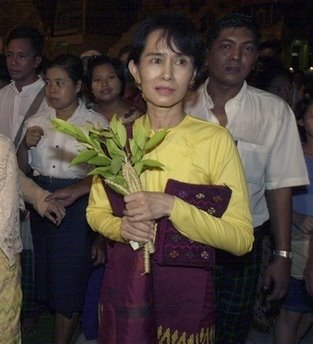


 Posts
Posts


