June 4, 2014 9:44am 1028 35 1 1294 (Updated 5:37 p.m.) A United Nations-backed international arbitral tribunal has ordered China to respond to the Philippines' claim that Beijing illegally occupied certain areas in the South China Sea. The Hague-based Permanent Court of Arbitration issued its second Procedural Order after the second meeting of the Arbitral Tribunal's members last May 14 and 15. However, in an statement later Wednesday, China reiterated its refusal to take part in the arbitration proceedings and rejected the ruling. ‘Open and friendly resolution mechanism’ In a memorial submitted to the tribunal on March 30, 2014, the Philippines argued that China illegally occupied at least eight South China Sea shoals, reefs and similar features belonging to the Philippines. It also said China's claims that it owns the disputed territory did not conform with the United Nations Convention on the Law of the Sea (UNCLOS). Beijing has continuously ignored the arbitration process, even saying in its May 21, 2014 note verbale that it will not participate in the proceedings. Earlier Wednesday, the Philippines asked China to reconsider its rejection of the legal challenge to its territorial claims and join the arbitration case. "We wish to reiterate that arbitration is a peaceful, open and friendly resolution mechanism that offers a durable solution to the disputes in the South China Sea," Foreign Affairs Spokesman Charles Jose told a press briefing. "We continue to urge China to reconsider its decision not to participate in the arbitration proceedings." At a press conference, presidential spokesperson Edwin Lacierda said they leave it to China whether or not it will comply with the order. "This is a process that all parties are abiding by. So, whether China responds or not... we leave it with them," he said. And while the country is waiting for the decision of the tribunal, the Palace official assured the public that authorities are securing the country's territories. "I think that’s where we have made measures both by the BFAR (Bureau of Fisheries and Aquatic Resources) and also by our coast watch to strengthen and to ensure our maritime resources," he said. Until December 15, 2014 The arbitral tribunal in its Procedural Order No. 2 has given China until December 15, 2014 to submit a counter memorial to the Philippine complaint that seeks to denigrate Beijing's massive claim, which Manila calls illegal and excessive. Chairing the five-member Arbitral Tribunal is Judge Thomas Mensah of Ghana. The other members include: - Judge Jean-Pierre Cot of France - Judge Stanislaw Pawlak of Poland - Professor Alfred Soons of the Netherlands - Judge Rüdiger Wolfrum of Germany Last May 21, the Permanent Court of Arbitration received a note verbale from China where Beijing reiterated it "does not accept the arbitration initiated by the Philippines.” China added the note verbale “shall not be regarded as China’s acceptance of, or participation in the proceedings.” On the other hand, the tribunal said it allowed both sides a chance to comment on scheduling, with the Philippines submitting its comments last May 29. The arbitration procedure started on Jan. 22, 2013, when the Philippines served China a notification and statement of claim. China rejected the Philippines' notification. Foreign Affairs Secretary Albert del Rosario said the memorial submitted March 30, 2014 to the Permanent Court of Arbitration “contains the Philippine analysis of the applicable law and the relevant evidence, and demonstrates that the tribunal has jurisdiction over all the claims made by the Philippines.” Representing the Philippines are: - Solicitor General Francis Jardeleza - counsels Paul Reichler and Lawrence Martin, Foley Hoag LLP, Washington DC - Professor Bernard Oxman, University of Miami School of Law, Miami - Professor Philippe Sands, London - Professor Alan Boyle, Essex Court Chambers, London Meanwhile, China has not appointed an agent as it does not accept the arbitration process. Tensions in Ayungin Shoal included Earlier, Solicitor General Francis Jardeleza said the incidents in Ayungin Shoal were included in the Philippine case. “The Philippines amended its statement of claim including Ayungin as part of the arbitration,” he said. Tensions over Ayungin Shoal (also called Ren’ai Reef by China but internationally known as Second Thomas Shoal) intensified on March 9 when Chinese coast guard ships blocked two Philippine civilian vessels which were sailing toward the disputed rocky outcrop. Also in March, Military officials reported an incident of harassment as they launched another attempt to transport supplies and fresh Filipino troops to a grounded Philippine Navy ship manned by more than a dozen Marines and sailors, which has become a symbol of Philippine sovereignty in the offshore territory. Pressure from China Under the arbitration procedure, the filing of a counter-memorial should be made by China. Upon submission, the tribunal will decide on the next steps and advise the parties involved in the case on its next course of action. Since the Philippines filed the case in January 2013, Beijing has attempted to pressure Manila into withdrawing from the legal process. China has also put diplomatic pressure on other claimant states not to support the Philippines. China maintains "historical and indisputable claim" nearly over the entire sea and its features, even as it overlaps with the territorial jurisdiction of its neighbors like the Philippines. West Philippine Sea Manila adopted the name West Philippine Sea for parts of the waters that are within its territorial boundaries. Vietnam, Malaysia, Brunei, and Taiwan are also claimants to the South China Sea – a major trading route where undersea oil and gas deposits have been discovered. An expert said Manila’s filing of the memorial would step up pressure on China in defending its nine-dash line claim – a tongue-shaped encirclement that covers a huge swath of the South China Sea. “It will add moral pressure on China to make its claims to ‘historic rights’ and ‘indisputable sovereignty’ clearer in terms of international law,” Professor Carl Thayer of the Australian Defense Force Academy told GMA News Online. The arbitral process could take up to a year or longer and during this period, China is expected to further reinforce its claims, said Thayer. On the other hand, the United States, European Union and many Asian governments have supported the Philippines' decision to seek a solution to the dispute through peaceful means "in accordance with international law" instead of military aggression. A decision in favor of the Philippines would strengthen the rule of international law, Thayer said. “Using international law may be the ‘weapon of the weak’ but the valiant attempt by the Philippines to employ legal means to create a stable regional order will be viewed positively by most regional states, including those in the Association of South East Asian Nations,” Thayer said. UNCLOS has no provisions for enforcement, but a favorable ruling will be seen as a moral victory for the Philippines. — Joel Locsin, Michaela del Callar and Kimberly Jane Tan, with a report from Reuters/LBG/KG/BM, GMA News
Thursday, June 5, 2014


Friday, May 23, 2014
Connectivity is a challenge to ASEAN integration – Singaporean minister
By DANESSA O. RIVERA, GMA NewsMay 22, 2014 6:40pm 22 23 0 69 Connectivity is key to equitable development under the ASEAN Economic Community (AEC) starting 2015, a Singaporean official told business and political leaders at the World Economic Forum in Makati City on Thursday. The region should not just focus on forming an single-market because it is only one pillar of the AEC, Josephine Teo, Senior Minister of State at the Ministry of Finance and Transport in Singapore, said during the discussions on "Connect on Trade: Lifting Barriers to Growth." To have equitable development across the region and to be competitive globally, "you need connectivity," which remains a challenge, she said. "We need connectivity to make sure there is free flow of goods and services, equitable development, and increased competitiveness," she said. By 2015, the AEC sets in motion the creation of single market for the 10-nation bloc which include Brunei, Cambodia, Indonesia, Laos, Malaysia, Myanmar, Philippines, Singapore, Thailand and Vietnam. Air, cyrber, land connectivity ASEAN connectivity has three key areas: air, cyber space, and land and rail. Air travel is expected to grow significantly in the region due to a growing middle class, Teo said. "The demand for air travel in our part of the world will grow tremendously, because the growing middle class will exceed North America and Europe combined," she noted. The International Air Transport Association (IATA) expects air passengers to grow by 800 million this year, of which half would originate from the ASEAN region. The ASEAN open skies policy can be patterned after the European single aviation market, Teo said, noting the region can expect a multi-fold increase in number of flights, including direct city links, as well as reduced cost in air transport for passengers and freight. A challenge to regional connectivity is the capacity of airports. "There's a lot of need and opportunity to invest in airport capacity," Teo said. To unleash the full growth capacity of the region, the AEC should also sign air transport agreements with other big economies. Teo said the region currently has an air transport agreement with China and in the works are Japan, Korea and India. – VS, GMA News
Tuesday, November 2, 2010
Clinton warns of 'dependency' (ON CHINA)

Clinton warns of 'dependency'
US Secretary of State Hillary Clinton urged Cambodians not to become 'too dependent' on China. -- PHOTO: AFP
PHNOM PENH - US SECRETARY of State Hillary Clinton urged Cambodians on Monday not to become 'too dependent' on China, during a visit to the capital in which she was expected to call for respect for human rights.
'You look for balance. You don't want to get too dependent on any one country,' Mrs Clinton told young Cambodians when asked about China's growing influence in the impoverished southeast Asian nation.
China - a former patron of the Khmer Rouge regime, which oversaw the deaths of up to two million people in the 1970s - is the country's top donor, according to Cambodia.
Nearly 400 Chinese companies have invested billions of dollars in Cambodia, including key infrastructure projects such as hydropower dams and coal power plants.
'China is a great country and China has a very exciting future,' Mrs Clinton said at the town hall-style meeting in Phnom Penh. 'There are certainly many reasons for Cambodia to have good relationships with China.
'I think there are also important issues that Cambodia must raise with China,' she added. -- AFP
Monday, May 31, 2010
ASEAN'S NEW DILEMMA: Burma's nuclear ambitions
http://www.nationmultimedia.com/home/2010/05/31/opinion/ASEANS-NEW-DILEMMA-Burmas-nuclear-ambitions-30130505.html
By Kavi Chongkittavorn
The Nation
Published on May 31, 2010
THE US ACTION was swift following confirmation of a North Korean ship with suspicious arms cargoes docking in Burma last month in violation of the UN Security Council Resolution 1874. A few days later, in the third week of April, the US State Department dispatched an urgent message to the Asean capitals recommending the scheduled Asean-US Economic Ministers' roadshow in Seattle and Washington DC, from May 3-5, proceed without the Burmese representation at "all levels." The drastic move surprised the Asean leaders.
The American ultimatum was not a bluff but a genuine show of frustration. This time Washington wanted to send a strong signal to Burma and the rest of Asean that unless something was done about Burma's compliance with the relevant UN resolutions on North Korean sanctions, there would be dire consequences. Political issues aside, Burma's nuclear ambition can further dampen Asean-US relations in the future. Already, there was the first casualty when the US downgraded the high-powered economic roadshow which was meticulously planned months ahead between the Office of US Trade Representatives and Asean economic ministers through the US-Asean Business Council.
Since nearly all Asean countries, except Singapore, decided to dispatch their trade or industry ministers to join the campaign, they agreed the roadshow should continue without the Burmese delegation as requested by the US. After some bargaining, the US softened its position agreeing to accept a representation at the charge d'affaires level from the Burmese Embassy in Washington DC. But Rangoon chose to opt out as it wanted diplomats directly dispatched from Rangoon. Without a consensus in Asean, a new name - absurd as it seemed - was in place, as the Southeast Asia Economic Community Road Show. It would be a one-time only designation.
When Kurt Campbell, Assistant State Secretary for East Asian and Pacific Affairs returned to Burma for the second time recently, he was blunt telling the junta leaders to abide and fully comply with the UN Security Council Resolution 1874. That has been Washington's serious concern due to the growing link between North Korea and Burma and their existing transfer of nuclear-related technology. Last June, a North Korean ship, Kang Nam, was diverted from going to Burma after being trailed by the US navy.
Since 2000, Western intelligence sources have been gathering evidence of North Korea providing assistance to Burma to build a nuclear reactor that can produce graded plutonium used in assembling future weapons of mass destruction. Last year, reports were released using data collected from two defecting Burmese military officers, intercepted calls and messages as well as human intelligence along Thai-Burmese border, all finger-pointing to Burma's nuclear ambitions.
When they came out last fall, scepticism was high among military experts and strategists on the junta's nuclear intentions. Most said there was insufficient evidence. Some viewed them as attempts to further discredit the regime's international standing. As additional interviews were conducted, especially with a former major in the Burmese Army, Sai Thein Win, who was directly involved with the recent secret nuclear programme, it has become clearer that Burma is investigating nuclear technology. This week, a special report on a huge new body of information, with expert comment from a former official working for the International Atomic Energy Agency, will be released.
As such, it will have far-reaching implications on Asean and its members, who signed the 1995 Southeast Asian Nuclear Weapons Free Zone (SEANWFZ) and Non-proliferation Treaty. Asean is currently working hard to persuade all major nuclear powers to sign the protocol to the SEANWFZ. The grouping has even delayed China's eagerness to accede to the protocol.
Further complicating the issue, Asean has not reached a consensus on how its members would move forward with a common approach on nuclear energy and security. In general, Asean backs nuclear disarmament, which the Philippines has played a leading role as chair of the just concluded Review Conference of State Parties to the Treaty on the Non-Proliferation on Nuclear Weapons. Asean also backs the ongoing efforts of US and Russia over non-proliferation.
One sticky problem is that Thailand, Brunei Darussalam, Burma, and Indonesia have yet to ratify the Comprehensive Test Ban Treaty. In the case of Indonesia, it is on the Annex 2 list of the treaty which, to enter into force, must be reatified by all 44 states on this list. At the upcoming Asean summit in Hanoi (October), Asean leaders will study a matrix of common positions that have been or could be taken up by Asean. It remains to be seen how Asean would approach some of the sensitive issues such as the South China Sea, climate change and issues related to nuclear technology.
At the recent Nuclear Summit in Washington DC, leaders from Vietnam, Indonesia, Malaysia and Thailand were invited by US President Barack Obama to share their views on non-proliferation and peaceful use of nuclear energy. They supported the summit's plan of action to prevent nuclear terrorism. All these Asean members have long-term plans to build nuclear power plants for peaceful use as energy sources. Vietnam has long decided on building two, while Thailand is planning one in the next ten years. Indonesia has serious parliamentary support to explore a nuclear option. Even the Singapore Economic Strategies Committee has recommended nuclear energy should be considered as a possible long-term solution to the island's energy security. Obama will certainly raise the issue again when he visits Indonesia in the second week of this month.
What is most intriguing has been the lack of serious attention from the Thai security apparatus regarding the nuclearisation of Burma. Apart from the two informal meetings convened by the Defence Council at the end of last year, the topic has been discussed only among a handful of military intelligence officials who have worked closely with their Australian counterparts. The National Security Council still does not believe Burma has that kind of ambition, not to mention the overall nuclear capacity to embark on the controversial programme. Concerned officials argued that domestic problems still have precedence.
Friday, December 4, 2009
Asean breaks bread with rebellious Myanmar
Asean breaks bread with rebellious Myanmar
2009 December 4
tags: 2010 Election, Asean, Burma, Human Rights, Junta, Myanmar, world focus on Burmaby peacerunningIT is hard to find anything redeeming about the Myanmar junta after decades of repression and misrule.
The generals of Naypyidaw, which the North Koreans helped build, only have those peers left in the world whose villainy is measured not just in prison camps but by their disdain for the mass suffering of innocents — as was shown when cyclone Nargis struck the Irrawaddy Delta in May last year and killed far upwards of 100,000 people.
Yet the international climate is thawing for this regime. The United States is switching from a policy of isolation and opprobrium to one of direct engagement plus sanctions, and Europe looks likely to follow suit.
In the dilemma of its rogue member, Asean has honed a sophisticated realpolitik worthy of Kissinger.
Here is what Singapore Prime Minister Lee Hsien Loong told the BBC at the start of the Asia-Pacific Economic Conference meeting on Nov 13 regarding Asean’s soft approach:
“You can inflict personal indignities on a leader, but is that the way to change and influence a country’s policies?
“They are in it for regime survival and for personal survival. Unless those concerns can somehow be managed in a transition forward, they are not going to be persuaded by sweet talk.” Lee and his fellow pragmatists have won the day, with their prize being President Barack Obama’s presence at the first-ever US-Asean summit during the Apec weekend in Singapore after George W. Bush had declined to do so in 2007.
No American president had come so close to a Myanmar prime minister in more than 40 years.
Bush’s painting of countries in black and white following the Sept 11, 2001, terrorist attacks had risked tarring the 10-member association with the same brush as applied to Myanmar. His secretary of state Condoleezza Rice had made a point of not turning up for two of the four annual Asean Regional Forums during her time in office.
Apart from wanting a diametrical change from the Bush era, the Obama administration also saw Chinese pieces advancing on the Southeast Asia chessboard and moved to reconnect with a region that had mostly been well disposed to Uncle Sam.
With or without the geopolitics, the US shift is welcomed by Myanmar’s widespread and far-reaching dissident community.
“The new US policy of high-level engagement while maintaining sanctions is in line with our movement’s position,” said Khin Ohmar of the Network for Democracy and Development, based in Mae Sot on the Thai side of the border with Myanmar.
“But when it comes to implementation, that’s where it’s still too early to say.”
Except for the civil-society bleeding hearts who treat Aung San Suu Kyi like a fetish object and the junta like anthrax, the Asean strategy of “constructive engagement” had always been accepted as the only way to go.
Local pressure groups like the Asean Inter-Parliamentary Myanmar Caucus do not dispute the usefulness of breaking bread with the military leaders but complain about how little has been gained. Western pro-Myanmar non-governmental organisations have found it easy to accuse Singapore, Thailand and others of “profiteering” — seeking payback from dealing with the regime not in Myanmar’s democratisation but in profit for their investors and businesses.
(The Thais can plead for extenuation. They shelter some four million Myanmar economic migrants and about 150,000 refugees.)
There is concern that the US game plan could provoke a rush to at least partial normalisation by countries that had previously kept Myanmar at arm’s length.
“The problem is that some countries are interpreting this in their own way. It’s meant to be a carrot-and-stick approach, but they are dropping the stick and offering only the carrot,” Khin said in a telephone interview.
The carrot is being dangled because of a single, all-encompassing prospect: the junta has announced that elections will be held next year, which, if even half-way decent, could herald forgiveness for past sins.
Despite her scepticism, Khin saw it as the only hope. “It’s just their own ploy to legitimise military power. If you look at the constitution, you will see how military power and privilege will be institutionalised.
“But for us, an election is something that has to happen in Burma. The last one in 1990 was never honoured.”
For those who have tired of inflexibility against such a mulishly totalitarian state, a Parliament with a portion of seats reserved for the brass hats may be no bad thing. It has happened before in the rites of passage to democracy of nations like Thailand and Indonesia.
Khin said: “For the election to be credible and for it to resolve the crisis in the country, there are key benchmarks which must be met.
“That includes the release of Suu Kyi and political prisoners, stopping hostilities against ethnic minorities, creating the right atmosphere for every stakeholder to participate in the political process.”
A test of the junta’s pluralist stripes will be how it responds to Suu Kyi’s plaintive request to Senior Gen Than Shwe to be allowed to meet her party colleagues in the National League for Democracy, and to act as go-between in talks to lift sanctions.
“No, we haven’t heard anything yet,” Khin said. “This can be an indicator of a genuine openness by the regime. They can start by accommodating that little thing. But right now, there is no response.”
US officials have stressed the conditional aspects of their new stance. Whether or not the corner has been turned on Myanmar, its emigres have the patience of saints praying for lost causes.
Khin, then a protest organiser, fled the country during the crackdown following student demonstrations in 1988.
She does relief work for the sizable population of displaced Myanmar in the border areas.
Fearful of reprisal, she is rarely in touch with friends and family in Myanmar. Khin no longer misses home; she does not expect to return in the foreseeable future.
kamrul@nst.com.my
Tuesday, October 27, 2009
Civil Society Unwelcome at Asean Summit
Civil Society Unwelcome at Asean Summit
--------------------------------------------------------------------------------
By MARWAAN MACAN-MARKAR / IPS WRITER Monday, October 19, 2009
--------------------------------------------------------------------------------
BANGKOK — A summit of regional leaders due to begin in Thailand on Oct. 23 has brought into relief a rift within the 10-member bloc about the space that should be given to civil society voices at such a gathering.
This political faultline comes at a time when the Association of Southeast Asian Nations moves ahead to reinvent itself as a rules-based, people-centered regional body by 2015. An Asean charter came into force in December last year in this effort to create a body that closely resembles the European Union (EU) in some ways.
Asean, whose members include Brunei, Burma (or Myanmar), Cambodia, Indonesia, Laos, Malaysia, Philippines, Singapore, Thailand and Vietnam, was initially established in 1967 at the height of the Cold War to serve as a bulwark against the spread of communism.
Thailand, as the host of the 15th Asean summit in Cha-am, a resort town south of Bangkok, was hoping to cement a permanent place for an encounter between government leaders and representatives of the region’s non- governmental organizations, said a diplomatic source.
For now, the summit’s agenda still says so. A meeting between the two groups is still on the cards from 11:50 a.m. to 12:20 p.m. On the opening day of the Cha-am meeting.
Yet the reality is otherwise, the diplomatic source from a Southeast Asian country revealed to IPS. "Objections have been raised by Laos, echoing the concerns already expressed by Myanmar and Cambodia," the diplomat added. "The relevance of this engagement between Asean leaders and civil society is to be downgraded."
A well-informed Thai columnist on Southeast Asian affairs has shed more light on what appears to be a move by countries that have no semblance of a democracy—or ones that come down strongly on critical voices at home—to convert this NGO-Asean leaders engagement into an informal exchange.
"Thailand’s long-standing plan to institutionalize the interface between Asean leaders and representatives of the more than 70 Asean civil society organizations (CSO) are crumbling," wrote Kavi Chongkittavorn in a commentary this week in The Nation, an English-language daily.
"Last week, at the Asean Joint Coordinating Meeting in Bangkok, a landlocked member proposed any such meeting in the future, including the forthcoming Cha-am summit, should be optional," he wrote. "Asean senior officials quickly took up Vientiane’s idea, which reflected the high anxiety held by their leaders since the historic event last February during the 14th Asean summit."
When pressed if this move did signify a "downgrading" of this meeting at future summits, a senior Thai foreign ministry official offered a diplomatic response. "We would like to see civil society participation at the Asean summit as a permanent pillar," said Vitavas Srivihok, director general of the Asean affairs department. "But we have to take a realistic approach, respecting the political development and internal process of each Asean country."
"Next year this meeting may come in the form of a seminar, a dinner or a reception," he adds, referring to the 16th summit to be hosted by Vietnam, one of the two Asean countries governed by communist parties. Laos, the region’s poorest country, is the other.
But that is not all that exposes a reluctance by Asean leaders to meet NGO representatives at the summit. A selection criteria of who speaks on behalf of civil society has been introduced, giving authority to the foreign ministry from, say, military-ruled Burma to approve who makes up the NGO delegation from its country.
"All the names of civil society representatives have to be sent through foreign ministries. Our colleagues from Myanmar, in particular, wanted this," Vitavas confirmed. "But this is not true with all countries. Thailand will give our civil society the full freedom to nominate their names."
Little wonder why NGO leaders are alarmed at this turn of events, marking a slide backwards from the benchmark that was set in February, when Thailand hosted the 14th Asean summit in Cha-am.
Using deft diplomacy, the hosts succeeded in holding for the first time in Asean’s 42-year-history a formal, face-to-face meeting between government leaders and NGO representatives that lasted 20 minutes. Strong protests by Burmese Prime Minister Gen. Thein Sein and his Cambodian counterpart, Hun Sen—both of whom threatened to walk out of that meeting—had to be accommodated, denying the presence of the Burmese and Cambodian NGO delegates at this interface.
"We were hopeful that the success of the last Asean summit would be repeated. We wanted the interface to be institutionalized," said Yuyun Wahyuningrum, the East Asia program manager of the Asia Forum for Human Rights and Development, a regional lobby group. "But we are disappointed at what we are hearing. Making this meeting optional will be downgrading its importance."
"The new selection criteria is also a problem," she said in an interview. "It is creating a climate of fear among civil society activists coming from countries like Burma and Laos."
"Why are the Asean leaders afraid of us?" she asked. "We are trying to build a dialogue. This interface is important to make civil society visible as our commitment to the people-centered Asean mentioned in the charter."
A watered-down civil society encounter with the region’s leader will expose the credibility of Asean, added Thitinan Pongsudhirak, a political scientist at Bangkok’s Chulalongkorn University, who moderated the dialogue between government leaders and NGO representative at the last summit. "It comes at a critical moment when Asean is trying to make itself an inclusive, people-friendly body, than a club for government leaders and bureaucrats."
"The Asean charter is being violated by this effort to ignore the importance of civil society," he told IPS. "It will end up bankrupt if it keeps doing more of this."
Copyright © 2008 Irrawaddy Publishing Group | www.irrawaddy.org
Wednesday, October 21, 2009
Asean appeal blocked-(BY BURMA JUNTA)
Oct 20, 2009
SINGAPORE - MYANMAR has scuttled a plan by fellow Asean members to issue a public appeal seeking amnesty for detained pro-democracy icon Aung San Suu Kyi, a diplomatic source said Tuesday.
'They rejected it two months ago. They rejected the idea,' the South-east Asian diplomat told AFP just days before the Association of Southeast Asian Nations (Asean) leaders hold their annual summit in Thailand this weekend.
The source, who asked not to be named, said that while Ms Suu Kyi's plight could not be put on the formal Asean agenda, Myanmar could still be discussed during a closed-door 'retreat' in which some of the leaders could call for her release.
They could also ask that her party be allowed to contest elections planned for next year, the diplomat added.
The diplomat said he understood that a number of other countries backed Myanmar's position that a public appeal for amnesty for Ms Suu Kyi would amount to interference in its domestic affairs. Myanmar had vetoed previous efforts to use Asean meetings to openly discuss Suu Kyi's fate.
Asean senior officials who met in Jakarta in August had agreed to work on an amnesty call for the Nobel Peace laureate convicted in August for allowing an American man stay in her lakeside home after he swam uninvited to the compound. -- AFP http://www.straitst imes.com/ Breaking% 2BNews/SE% 2BAsia/Story/ STIStory_ 444407.html
Tuesday, September 8, 2009
Danger of border skirmishes escalating
Danger of border skirmishes escalating
Editorial Desk
The Nation (Thailand)
Publication Date: 08-09-2009
It has always been said that China is Burma's closest ally. Given the fact that the junta doesn't have many friends, one like China will always stand out. But the not-so-honorific label of "closest ally" should be understood in its proper context. For the Burmese, Chinese friendship doesn't mean the world.
Nonetheless, such a friend could very well come in handy, especially when the international community and the United Nations are constantly looking to clobber the generals with sanctions and criticism.
For the Burmese regime, survival is everything. Where it positions its troops and weapons, and the type of legislation and reconciliation process that it proposes, reinforce the very idea that it is here to stay whether the world likes it or not.
For as long as anybody can remember, China has been a factor whenever a Burma policy and strategy is drafted by the international community. Over a decade ago, when Rangoon's membership of Asean was on the table, members of the regional grouping whispered among themselves about the Chinese factor. Keeping the Burmese out of the regional loop would push the junta further into the arms of the Chinese, they said.
But for the Burmese, Asean membership was not seen as a privilege but a right - simply because the country happens to be in the same geographical region. There was no "thank you" to Asean for letting the country become a member.
A handful of Thai diplomats thought a free ride for Burma in Asean would deny the regional grouping the only card it had to play against the junta. Their concerns were largely ignored by most of the other Asean members, who really didn't give a hoot about the atrocities committed by the junta, or the political baggage that comes with Burma's membership. And when Asean came under an unwanted spotlight or was at loggerheads with the international community, such as the European Union, over Burma's participation, all the Burmese generals could do was shrug their shoulders. They just couldn't care less.
And so when the Burmese unleashed their troops against one of the minority cease-fire groups within the country, namely the Kokang, forcing tens of thousands people - including Yunnanese Chinese who have more or less seized northern Burma over the last few years - to flee for China, Beijing was jolted.
Thai military officials with direct experience of the Chinese often called them "masters of two-track diplomacy". They pointed to China's relations with the bloody Khmer Rouge in Cambodia, up until that regime's dying days, and its historical ties with the ethnic armies that operate independently along Burma's northern border.
Attacking the Kokang and turning their guns towards the 20,000-strong United Wa State Army (UWSA) afterwards was a rude awakening for the Chinese. If anything, the junta was telling its so-called "closest ally" that it is charting its own course. One could say that the Chinese finally got a taste of their own medicine.
For decades, Burma has given China access to its ample natural resources, and the Indian Ocean, in exchange for political support. Moreover, Chinese companies are set to start construction on a US$2.5 billion oil-and-natural- gas pipeline project that will run from the Indian Ocean to Yunnan's capital of Kunming. But if one thinks that Burma is a Chinese lackey, think again.
It is clear that the two-decade-old ceasefire with the ethnic armies no longer serves Burmese purposes. From the generals' perspective, a normal country shouldn't have small armies operating independently on its soil, especially if those armies are proxies of a powerful neighbour.
Beijing expressed its concern back in June, and the ruling Burmese State Peace and Development Council (SPDC) said that it did not want to see disturbances along the Sino-Burmese border. But in the end, for the junta, domestic matters overtook any diplomatic concerns.
For too long Beijing turned a blind eye to the atrocities committed inside Burma, telling the world to stay out of Burma's domestic matters. Self-serving interest has always been China's political attitude towards Burma.
It's different now, however, as China is directly affected by this so-called domestic matter.
If Beijing thinks it has a big headache with the 30,000 refugees fleeing the Burmese attack against the Kokang, then wait until the junta turns its guns on the UWSA. It could very well have a ripple effect, turning Burma's entire northern border into a full-blown war zone if other cease-fire groups like the Chin, Kachin and Shan join the fight to keep their patches of real estate given to them two decades ago.
http://www.asianews net.net/news. php?id=7678&sec=3
Thursday, August 6, 2009
Philippines mourns democracy icon Corazon Aquino
MANILA, Philippines – Thousands of Filipinos lined up for hours Sunday to see the body of former President Corazon Aquino — the beloved democracy icon who swept away a dictator and inspired nonviolent resistance to autocratic rule.
Aquino, 76, died early Saturday in a Manila hospital after a yearlong battle with colon cancer.
Thousands trooped to a suburban Manila university stadium where Aquino's coffin, teeming with yellow roses and orchids, was displayed on a platform.
Some mourners openly wept and carried yellow ribbons — the color that symbolized her democratic advocacy. One held an old poster of Ferdinand Marcos, the strongman she helped depose in 1986.
Aquino rose to prominence after the assassination in 1983 of her husband, opposition leader Benigno "Ninoy" Aquino Jr. The uprising she led in 1986 brought down Marcos' repressive 20-year regime and served as an inspiration to nonviolent resistance across the globe, including those that ended communist rule in eastern Europe.
Chinese President Hu Jintao sent condolences to Philippine President Gloria Macapagal Arroyo, Chinese Foreign Ministry spokeswoman Jiang Yu said in a statement Sunday.
"Mrs. Aquino is an outstanding leader of the Philippines and she is also a good friend of the Chinese people," Jiang said. "The Chinese government and the Chinese people deeply lament her death."
President Barack Obama was deeply saddened by Aquino's death, White House press secretary Robert Gibbs said Saturday.
Aquino's supporters had been holding daily prayers for her in churches around the country since she was rushed to intensive care after she stopped eating in late June.
Arroyo, who is on an official visit to the United States, remembered Aquino as a "national treasure" who helped lead "a revolution to restore democracy and the rule of law to our nation at a time of great peril.
Arroyo declared a 10-day national mourning period Saturday.
Maria Corazon Cojuangco was born on Jan. 25, 1933, into a wealthy, politically powerful family in Paniqui, about 75 miles (120 kilometers) north of Manila.
Her unlikely rise began in 1983 after her husband was gunned down at Manila's international airport moments after soldiers escorted him from a plane on his arrival from exile in the United States to challenge Marcos, his longtime adversary. Investigations showed one of his military escorts was the assassin.
After the murder, Aquino returned to the Philippines and led the largest funeral procession Manila had ever seen, with crowd estimates as high as 2 million.
The killing enraged many Filipinos and unleashed a broad-based opposition movement that thrust Aquino into the role of national leader.
"I don't know anything about the presidency," she declared in 1985, a year before she agreed to run against Marcos, uniting the fractious opposition, the business community, and later the armed forces to drive the dictator out.
In the wake of that election, the Marcos regime — which declared martial law in 1972 and had jailed Aquino's husband — started to unravel.
But Marcos claimed victory in those polls — widely seen as fraudulent — leading a group of military officers to mutiny against him on Feb. 22 and holed up with a small force in a military camp in Manila, leading to three days of protests by hundreds of thousands that finally toppled him.
On Feb. 25, Aquino was sworn in as the Philippines' first female leader and Marcos flew to exile in Hawaii, where he died three years later.
She stepped down in 1992 after serving for six years.
http://news.yahoo.com/s/ap/as_obit_corazon_aquino
___
Friday, July 24, 2009
Hillary calls on Asean to expel Myanmar
Web posted at: 7/23/2009 1:31:40
Source ::: AFP
PHUKET: The Association of Southeast Asian Nations (ASEAN) should consider expelling Myanmar if it does not release imprisoned Aung San Suu Kyi, US Secretary of State Hillary Clinton said yesterday.
Asked on Thai television whether ASEAN should kick out the military-ruled member state if it does not free the pro-democracy leader, Clinton replied: 的t would be an appropriate policy change to consider.・
Myanmar輸SEAN痴 problem child since it joined the bloc in 1997 -- recently sparked outrage by putting the Nobel peace laureate on trial over an incident in which an American man, John Yettaw, swam to her lakeside house. 的 regret deeply this unfortunate incident, which she had nothing to do with, and which served as an excuse for them to put her on trial,・Clinton said, referring to Yettaw痴 uninvited intrusion.
The ruling junta snubbed United Nations Secretary General Ban Ki-moon by refusing to let him visit Aung San Suu Kyi in Yangon痴 notorious Insein prison, deepening concerns in the international community.
US President Barack Obama has described the court proceedings as a 都how trial・and Myanmar has already been slapped with US sanctions for its detention of political prisoners.
On Tuesday Clinton also said she was 電eeply concerned・by reports of human rights in Myanmar, 菟articularly by actions that are attributed to the Burmese military concerning the mistreatment and abuse of young girls.・Concerns over Myanmar痴 possible military cooperation with North Korea are set to dominate discussions at Asia痴 biggest security forum in the Thai resort island of Phuket, where Clinton arrived yesterday from Bangkok.
Responding to Clinton, Malaysian Prime Minister Najib Razak said his country, an ASEAN member, opposed expelling Myanmar from the bloc.
展e are still in favour of discussing with Myanmar so that they will be serious in implementing the roadmap towards democratisation,・Najib told reporters in Kuala Lumpur.
Myanmar Foreign Minister Nyan Win met his Japanese counterpart Hirofumi Nakasone in Phuket on Wednesday, and the issue of Aung San Suu Kyi came up, a spokesman for the Japanese minister said.
Nakasone urged Myanmar to release all political prisoners, resume dialogue with the opposition and prepare a 菟ositive environment・for elections promised by the ruling generals in 2010, the spokesman said.
Nyan Win 斗istened very carefully・and explained that Myanmar 電id its best to assist・Ban when he visited the country earlier this month, added the spokesman.
Nyan Win said Myanmar痴 government 途esponded as they believed appropriate・to Ban痴 request to visit her, the Japanese spokesman said.
Clinton also urged Myanmar to free democracy leader Aung San Suu Kyi, saying such a move could pave the way for investments from the United States.
http://www.thepeninsulaqatar.com/Display_news.asp?section=World_News&subsection=Philippines+%26+South+Asia&month=July2009&file=World_News2009072313140.xml
Wednesday, July 22, 2009
Clinton urges Myanmar to free Suu Kyi
PHUKET, Thailand (AFP) – US Secretary of State Hillary Clinton on Wednesday urged Myanmar to free democracy leader Aung San Suu Kyi, saying such a move could pave the way for investments from the United States.
"If she were released that would open up opportunities at least for my country to expand our relationship withBurma, including investments in Burma," she said, referring to Myanmar by its former name.
Speaking after meetings in Phuket on the eve of Asia's biggest annual security forum, she said such opportunities were "up to the Burmese leadership".
Military-ruled Myanmar recently sparked outrage by putting Aung San Suu Kyi on trial in prison over an incident in which an American man swam to her lakeside house.
US President Barack Obama has described the court proceedings as a "show trial" and Myanmar has already been slapped with US sanctions for its detention of thousands of political prisoners.
Clinton said that while countries from the Association of Southeast Asian Nations (ASEAN) were moving "in a very positive direction", Myanmar was "moving in the opposite direction".
"We have been very clear in stating that the United States would like to see changes in the behaviour of the regime in Burma" she said, adding that the release of Aung San Suu Kyi was "critical".
Earlier Wednesday she said ASEAN should consider expelling Myanmar -- the bloc's problem child since it joined in 1997 -- if it does not release the imprisoned Nobel Peace Laureate.
Referring to US man John Yettaw's uninvited visit to Aung San Suu Kyi, Clinton said: "I regret deeply this unfortunate incident, which she had nothing to do with, and which served as an excuse for them to put her on trial."
The pro-democracy leader has spent 13 of the last 19 years in detention since the junta refused to recognise her National League for Democracy's landslide victory in elections in 1990.
Critics of Myanmar's regime believe the trial is a ploy to keep her locked up for elections scheduled for next year.
Clinton reiterated concerns about possible cooperation over nuclear weaponry between Myanmar and fellow pariah state North Korea, one of the issues that is dominating the talks in Phuket.
On Tuesday Clinton also said she was "deeply concerned" by reports of human rights abuses in Myanmar, "particularly by actions that are attributed to the Burmese military concerning the mistreatment and abuse of young girls."
http://news.yahoo.com/s/afp/20090722/wl_asia_afp/aseanarfusmyanmarsuukyi
Thursday, July 2, 2009
ASEAN – toothless but with a “sharp tongue”?
http://theonlinecitizen.com/2009/07/asean-toothless-but-with-a-sharp-tongue/
Wednesday, 1 July 2009, 4:47 pm | 190 views
ASEAN ministers are expected to endorse the setting up of an ASEAN Human Rights Commission in July when they meet for the 42nd ASEAN Ministerial Meeting. Civil society groups in the region, however, have expressed concerns that the commission would be all form and no substance, without any power to intervene if a member country violated these rights.
Singapore’s Minister for Foreign Affairs, Mr George Yeo, was reported by the local media in July 2008 as having said:
“Whether or not the human rights body we establish will have teeth I don’t know. But it will certainly have a tongue, and I hope it will have a sharp tongue.” (MFA)
The following is a report, headlined “Toothless rights body would hurt ASEAN group”, from the Philippine Daily Inquirer:
Leila Salaverria
BANGKOK—As the target date for launching the ASEAN human rights body (AHRB) nears, civil society groups have warned depriving it of watchdog powers would erode the credibility of the regional organization.
The warning came amid concerns over Burma’s (Myanmar’s) renewed crackdown on democracy fighter Aung San Suu Kyi and Thailand’s refusal to accept thousands of Burmese refugees fleeing from military rule.
About 200 civil society groups and individuals have endorsed a letter urging the Association of Southeast Asian Nations (ASEAN) to give the AHRB the power to investigate complaints of abuses, conduct country visits and review the human rights situation in the region.
The letter, addressed to a panel drafting the AHRB’s terms of reference (TOR), also calls for the appointment of independent experts to the body.
The terms of reference, which detail the AHRB’s powers and duties, are expected to be adopted in July at the 42nd ASEAN Ministerial Meeting. The AHRB itself is to be formally launched in October.
The draft TOR has not been made public but journalists who have seen it say that while it focuses on promoting human rights, it gives no power to the AHRB to investigate and prosecute.
The TOR is expected to maintain ASEAN’s adherence to its noninterference policy, which some members have invoked to ward off criticisms of their rights records.
The civil society groups warned that a human rights body with no protection powers or independent experts would not fulfill its pledge to respect fundamental freedoms, protect human rights, and promote social justice.
“This would reflect badly on ASEAN as being unable to live up to the spirit of its own Charter and further dent the credibility of ASEAN in the eyes of the international community for setting up a substandard regional human rights mechanism as compared to those in the African, Inter-American and European systems,” the June 22 letter said.
The letter was cosigned by the Solidarity for Asian People’s Advocacy Task Force on ASEAN and Human Rights and the Asian Forum for Human Rights and Development (Forum-Asia).
Indonesia’s example
Forum-Asia underscored the importance of having competent experts in the AHRB, saying they could make the body relevant to beleaguered peoples.
They could also help the AHRB initiate actions to reduce human rights problems even with a limited mandate, Forum-Asia’s Yuyun Wahyuningrum, program manager for East Asia, told the Inquirer.
Wahyuningrum said it was vital that the people manning the AHRB would not be afraid to contradict the government line, if necessary.
She said this was the case with Indonesia’s National Human Rights Commission which, although created by then President Suharto, did not become a government mouthpiece but criticized abuses and tried to curb them.
First time
Former ASEAN Secretary General Rodolfo Severino of the Philippines said the establishment of the body was a step forward.
“For the first time, ASEAN will have a body concerned with human rights. This is an advance. It certainly will not have powers of ’enforcement’ in an association of sovereign states, but it can bring opinion to bear on egregious violations of human rights,” Severino said in an email interview.
He pointed out there was no transnational human rights body anywhere with the power to punish or protect.
Dr. Termsak Chalermpalanupap, ASEAN’s director of Political and Security Directorate, said in an article the AHRB mandate includes protection and promotion of human rights but would focus on protection first.
He said its functions could evolve over time and the body “is merely the new beginning.”
No biting
Responding to claims that the AHRB would be toothless, Chalermpalanupap said the body was not intended to have teeth or to function as an independent watchdog.
“The AHRB shall operate through consultation and consensus, with firm respect for sovereign equality of all Member States. Good points can be made and constructive actions can be agreed upon in friendly discussion and persuasion. No ‘biting’ is ever required,” Chalermpalanupap said.
As for concerns that the noninterference principle would hamper AHRB’s functions, he said the ASEAN charter also speaks of collective responsibility in enhancing peace, security and prosperity in the region, and of enhanced consultation on common concerns.
Wahyuningrum said noninterference could not be invoked when it came to crimes against humanity, genocide and humanitarian cases.
She said ASEAN members were signatories to the Universal Declaration of Human Rights, and in signing such conventions, they gave up part of their sovereignty.
(This article was written under the 2009 Southeast Asian Press Alliance fellowship)
—–
Friday, June 12, 2009
Goh’s Comments Significant

http://www.irrawaddy.org/article.php?art_id=15920
--------------------------------------------------------------------------------
By WAI MOE Wednesday, June 10, 2009
--------------------------------------------------------------------------------
Former Singaporean Prime Minister Goh Chok Tong told junta leader Snr-Gen Than Shwe that Suu Kyi’s trial had “an international dimension to the matter, which Myanmar [Burma] should not ignore.”
According to Channel News Asia, Goh’s comments came during a meeting with Than Shwe in Naypyidaw on Tuesday, adding to the diplomatic pressure on the Burmese junta over pro-democracy leader Aung San Suu Kyi’s trial.
Goh Chok Tong had a frank discussion with Snr-Gen Than Shwe at their meeting in the capital Naypyidaw. (Source: Straits Times)
Win Tin, one of the leaders of Burma’s main opposition party, the National League for Democracy (NLD), said he welcomed the Senior Minister of Singapore’s comments on Burma’s political crisis.
“I want to say that Mr Goh Chok Tong’s trip is a good diplomatic approach. I appreciate his trip and his comments on Burmese politics,” he told The Irrawaddy on Wednesday.
He said Goh’s trip is significant because Singapore is the country that has attempted to drag the isolated Burmese regime into the international community through its “constructive engagement policy.”
Singapore is also one of biggest investors in Burma and supported Burma’s membership with the Association of Southeast Asian Nations (Asean) in 1997.
Win Tin said he hopes Goh noted the wrongdoings of the junta in Burma and suggested ways to alleviate the suffering in the country.
Commenting on the potential for an all-inclusive process in Burmese politics, Win Tin said he believes that the term “all-inclusive” should mean not only in respect of elections, but also an all-inclusive process in all political issues in Burma.
He also said that elections are important in the democratization process, but that the regime must review the constitution alongside opposition parties.
According to Channel News Asia, the Burmese leadership responded to Goh’s comments by noting that “the opposition [in Burma] needs to recognize that the military plays a pivotal role in the reconciliation process.”
Win Tin told The Irrawaddy that the junta’s comments were untrue, as the NLD has always stated that it recognizes the military’s role.
Goh, one of Asia’s most prominent statesmen and currently Senior Member of the Singaporean government, is in Burma at the invite of Burmese Prime Minister Gen Thein Sein who visited the city-state in March 2009.
However, Burma analysts said Goh would use Singapore’s strong position in Asean to push concerns about the political situation in Burma.
Larry Jagan, a British journalist in Bangkok who specializes in Burmese issues, told The Irrawaddy on Wednesday that although Goh visited Burma as the Singaporean Senior Minister, he could informally act as an envoy on behalf of Asean to tell Than Shwe face-to-face what Asean members think about the criminal trial of Suu Kyi and the Burmese political situation.
“Goh Chok Tong is a senior politician within Asean. He is someone that Than Shwe has high regard for. So, he has the kind of stature that is needed as someone who can go to talk with Than Shwe frankly,” Jagan said.
“What he told Than Shwe is more his personal view than Asean’s view,” he added. “But his concerns [about the trial and the political crisis in Burma] are shared by most Asean leaders.”
Singapore is one of the Burmese regime’s most important diplomatic relatives and trading partners. Burma experts suspect millions of dollars of the generals’ and their cronies’ money are in Singaporean banks.
The Burmese junta, who is under sanctions from the United States and the European Union, has attempted to trade with the world through Singapore, experts say.
The former British island colony also serves as a hospice and retreat for Burma’s ruling generals, including Than Shwe, the late Gen Soe Win and the late Lt-Gen Maung Bo.
Military affairs also play a role in the two countries’ relationship. Burmese military experts have claimed that the Burmese junta has bought warfare material from the Singaporean government in the past.
Analysts have said Goh’s trip is quite significant as a diplomatic approach, because he was able to meet with Than Shwe who earlier this year rebuffed Ibrahim Gambari, the UN special envoy to Burma.
Debbie Stothard of Alternative Asean Network on Burma said Asean leaders are now showing their concerns over the ongoing political process in the country.
“But just one trip is nothing as far as diplomatic efforts for change in Burma are concerned,” she said, adding, “Asean should push continuously. Burma issues are now a problem for Asean.”
Copyright © 2008 Irrawaddy Publishing Group | www.irrawaddy.org
Saturday, May 30, 2009
Asean Body Calls for Burma to be Kicked Out
http://thejakartaglobe.com/national/asean-body-calls-for-burma-to-be-kicked-out/278163
May 29, 2009
Nurfika Osman
Indonesia and other Southeast Asian nations want Burma suspended from Asean for repeatedly failing to ignore requests to reform its appalling human rights record.
Marzuki Darusman, an Indonesian delegate from the Asean Inter-Parliamentary Myanmar Caucus, or AIPMC, an organization of parliamentarians from Asean countries, said Asean had been pressing Burma to reform since 2004 but it had failed to make any progress, citing political prisoners, the Rohingyas issue and its human rights record.
He said the recommendations to suspend Burma would be brought to the Asean Inter-Parliamentary Assembly (AIPA) meeting in Bangkok this August, where a decision would be made.
Since its inaugural meeting in Kuala Lumpur from Nov. 26-28 2004, the AIPMC has been calling on the military government in Burma to bring about changes and democratic reforms.
The group consists of legislators from Malaysia, Indonesia, Singapore, Thailand, Philippines, Vietnam, Laos and Cambodia. One of AIPMC’s initial campaigns was to urge Asean to deny Burma its turn at chairing the regional bloc in 2006.
“We now further call on Asean and the UN via the UN Security Council to take concrete and binding actions on the military regime of Burma as it continues to show a lack of regard for human rights and fails to adopt concrete democratic reforms in the country,” he said. “Our heart is with Burma.”
Khin Ohmar, an activist from Burma Partnership, applauded AIPMC’s recommendation to suspend Burma from Asean.
“We really support this sanction as this is the only way to fight this regime,” Khin said. “We have to cut off the financial flow to the regime, so they will come to the table with us, talk, release [Burma’s 2,100 political] prisoners and create democracy.”
Movement to Suspend Burma from Asean Grows
http://www.irrawaddy.org/article.php?art_id=15782
--------------------------------------------------------------------------------
Friday, May 29, 2009
--------------------------------------------------------------------------------
The Irrawaddy has conducted a random, unscientific opinion poll on its magazine Web site, asking readers if they would vote “Yes” or “No” to the question: Should Burma be suspended from Asean?
More than 90 percent of the respondents answered “Yes,” based on the results at 6:30 pm on Friday. Ten percent voted “No.” The vote is on-going and the results are immediately displayed.
Meanwhile, a number of Southeast Asian politicians have urged the Association of Southeast Asian Nations (Asean) to suspend Burma's membership in the regional grouping if the military government does not release pro-democracy icon Aung San Suu Kyi.
Asean diplomatic sources told The Irrawaddy on Friday that leading members of the regional bloc such as Thailand, Indonesia, Singapore and the Philippines are considering suspending Burma’s membership if the junta extends Suu Kyi’s detention or sentences her to prison on trumped-up charges.
The Asean Inter-Parliamentary Myanmar Caucus (AIPMC), a watchdog group based in Malaysia, this week called for tough action against Burma, including suspending its membership in the regional organization. Only three Asean member countries—Brunei, Vietnam and Laos—have yet to join the caucus.
Charles Chong, a Singaporean lawmaker, said, "More and more parliamentarians within Asean are beginning to lose their patience with Burma. And, we are calling upon our governments to do more than just expressions of dismay, regret, grave concern and so on, and seriously look at suspending Burma's membership in Asean."
Kavi Chongkittavorn, an editorial columnist on The Nation in Bangkok, said some Cambodian lawmakers have joined AIPMC, increasing the pressure on Burma to open up. Cambodian Prime Minister Hun Sen, who has been a strong supporter of the Burmese junta, told AIPMC delegates that Burma needs to implement political reforms.
Kavi Chongkittavorn wrote that Asean's experience with Burma allows pro-reform members to argue strongly in favor of greater flexibility in exercising its non-interference principle.
Debbie Stothard, coordinator of the Alternative Asean Network (Altsean), said, “It is pretty clear that SPDC has been consistently undermining Asean.”
“Asean should consider some type of action against the regime. AIPMC demands that Asean should suspend Burma. It is quite reasonable,” she said.
Copyright © 2008 Irrawaddy Publishing Group | www.irrawaddy.org
Asean Parliamentarians Turn Heat on Burma
http://www.irrawaddy.org/article.php?art_id=15759
--------------------------------------------------------------------------------
By MARWAAN MACAN-MARKAR / IPS WRITER Thursday, May 28, 2009
--------------------------------------------------------------------------------
BANGKOK — In a move reflecting growing anger towards Burma, parliamentarians from across Southeast Asia want the military-ruled country suspended from a 10-member regional bloc for the unjust treatment of Aung San Suu Kyi, Burma’s pro-democracy leader.
The comments made in Singapore’s legislature during the current parliamentary session offers a window onto the growing pressure that Burma is up against from the countries that belong to the Association of Southeast Asian Nations.
"There have been calls in Singapore’s parliament for Myanmar’s [Burma's] membership [in Asean] to be suspended," says Charles Chong, who has been a legislator for 21 years in the ruling People’s Action Party. "This reflects a growing frustration with Myanmar."
Chong personally feels that the 42-year-old regional bloc, which has just transformed itself into a rules-based entity, should even consider more punitive measures. "Asean should also consider doing more. We should not rule out targeted sanctions," he said during a press conference this week in the Thai capital.
A fellow legislator from neighbouring Malaysia echoes Chong’s sentiments. "Asean should seriously consider the issue of sanctions," says Lim Kit Siang, of Malaysia’s opposition Democratic Action Party.
Both lawmakers are members of a regional caucus of parliamentarians created in 2004 to lobby for political reform and democracy in military-ruled Burma. And the Asean Inter-Parliamentary Myanmar Caucus (AIPMC) has not shied away from strong language as a means of applying pressure on the region’s governments to achieve concrete change within the pariah in their midst.
"AIPMC parliamentarians strongly call on Asean to stop protecting Myanmar’s regime and instead remove them from the grouping until and unless Aung San Suu Kyi is free and genuine efforts to begin national reconciliation are underway," the caucus declared this week in a statement.
"The AIPMC further urges Asean member states to consider imposing targeted sanctions on the military regime generals, and its administration, should they still fail to respect the Asean Charter and continue to oppress its people," it added.
AIPMC’s members come from parliaments in six Asean countries: Cambodia, Indonesia, Malaysia, Philippines, Singapore and Thailand. The other countries in the regional bloc are Brunei, under an absolute monarchy; Laos and Vietnam, ruled by communist regimes; and Burma.
The parliamentarians’ call to suspend Burma from Asean stems from the on-going trial that Nobel Peace laureate Suu Kyi has been subject to since May 18 in Rangoon’s notorious Insein prison.
The regime has accused the 63-year-old opposition leader of violating the terms of her house arrest - now in its 13th year. If found guilty in this largely secret trial, Suu Kyi could be sentenced to a further five-year jail term.
The junta’s charge followed revelations of a bizarre tale involving a U.S. citizen who had entered Suu Kyi’s house on the banks of a lake in Burma’s former capital and stayed there for a few days as an uninvited guest earlier this month. John William Yettaw, the 53-year-old former Vietnam War veteran, had crept in by swimming across the lake.
Yettaw, a Mormon who had gone on this mission reportedly out of religious zeal, is also facing charges in the on-going trial. So are two female housekeepers of Suu Kyi.
The junta’s latest effort to oppress Suu Kyi is viewed by Burma watchers as an attempt to keep the widely popular pro-democracy icon from playing a pivotal role in a planned general election in 2010.
The junta has billed next year’s poll as a part of its "roadmap to democracy," even though restrictive measures have already been put into place through a new constitution approved last year under questionable circumstances, including blatant reports of fraud.
It is of little wonder why such an attempt at political reform has failed to convince a growing number of concerned countries in the international community. Foreign ministers from Asia and Europe gathered Tuesday in Hanoi for the Asia-Europe Meeting (Asem) issued a statement that gave the Burmese junta little room to maneuver.
A joint press statement by Asem members - which happen to include Burma - appealed to the junta to lift all restrictions placed on political parties, free Suu Kyi, and release the over 2,100 political prisoners languishing in the many jails that dot the country.
For its part, the US government announced that it would extend the harsh economic sanctions Washington has imposed on Burma for another year. UN Secretary-General Ban Ki-moon has also stepped into the fray, announcing plans to visit Burma, which has been under successive military regimes since a 1962 coup.
"The military regime is aware of the growing pressure and it is feeling the heat," says Soe Aung, spokesman for the Forum for Democracy in Burma, a group of Burmese political activists living in exile. "And it is pressure of the regime’s own making, nobody else."
"[This] has happened when the US government was talking of reviewing its sanctions policy towards Burma," Soe Aung added during an interview. "There is also a debate in the European Union about the sanctions… the European Union may strengthen its sanctions on Burma."
Tuesday, May 19, 2009
China, India and ASEAN silent over Suu Kyi’s trial
by Salai Pi Pi
Monday, 18 May 2009 23:13
New Delhi (Mizzima) – In the wake of the charges leveled by the Burmese military junta against the country’s pro-democracy leader Aung San Suu Kyi and a trial in Insein prison, there has been mounting international outcry condemning the regime.
But surprisingly, Burma’s neighbours China, India and the Association of Southeast Asian Nations, are conspicuous by their silence.
Nobel Peace Laureate Aung San Suu Kyi was charged for breaching her detention law after an American, John William Yettaw, allegedly swam across Rangoon’s Innya Lake and entered her house.
Regime authorities on Friday formally announced her trial and on Monday held the first hearing.
The junta’s move, however, sparked outrage among the Burmese as well as the international community ranging from intellectuals, campaigners, activists, writers, artists, human rights group, and world leaders.
The United Nations, United States and European Union (EU) lambasted Burma’s ruling junta and demanded the immediate release of Aung San Suu Kyi and other political prisoners. Asian countries including Japan, the Philippines, Indonesia, Malaysia, and Singapore also joined the call.
Foreign Ministers of EU on Monday called for review of fresh sanctions against the junta and urged China and other regional countries to pressurize the Burmese regime to release the opposition leader.
But China, the junta’s closest ally, India and the ASEAN as a group, has so far remained silent over the events unfolding in Burma.
Debbie Stothard, coordinator of Alternative ASEAN network on Burma (Altsean Burma), a group working to promote human rights and democracy in Burma, on Monday said the ASEAN, of which Burma is a member, has the responsibility to pressurize the Burmese regime over its actions as part of enforcing the group’s charter that was ratified last year.
“I am very shocked to see how quite ASEAN’s General Secretary has been, especially since they are supposed to be the main body promoting implementation of the ASEAN charter,” Stothard said.
“We don’t know where he [the Secretary General] is? We don’t hear his voice in this matter,” she added.
Debbie said ASEAN’s silence over the injustice done to Aung San Suu Kyi would encourage the Burmese regime to be more aggressive against her and commit more human rights violations in the country, which will become a threat to regional countries.
“The quieter the ASEAN remains the worse things the SPDC will commit, not just to Aung San Suu Kyi but also to the regional countries,” she said, referring to the junta by its official name – the State Peace and Development Council.
“All these are creating problems for ASEAN,” she added.
Following China is its main rival, India.
India the world’s largest democracy, which is currently busy in the aftermath of the Parliamentary elections, has officially made no statements on Aung San Suu Kyi’s trial.
Tint Swe, Information minister of the Burmese government - National Coalition Government of Union of Burma (NCGUB) in exile - said avoiding criticism of Burma’s military regime is not unusual but has been a tradition for the two regional powers - India and China.
When it comes to human rights and democracy in Burma, both China and India choose to remain silent as they look forward to maintaining a good relationship with the junta, he said.
“It is strange that the two regional powers, India and China, are silent regarding Aung San Suu Kyi but it doesn’t make any difference to us since these two countries have vested interest in Burma,” Tint Swe told Mizzima.
“It has become a tradition for these two countries to keep quite as much as they can when it comes to Burma’s issues,” he added.
Tint Swe said, the recently concluded Parliamentary elections, might be a good excuse for India to remain silent.
“We also don’t expect too much criticism from India of Burma since India has a foreign policy that doesn’t care which government rules Burma. It will try to better relations with it for its own national interest,” Tint Swe added.
India, since 1994 introduced the ‘Look East Policy’ and chose to appease Burma’s military regime rather than condemn its human rights records as it cosies up and looks forward to a warm relationship with the country.
Aung Kyaw Zaw, a Sino-Burma border based observer said, China’s reluctance to criticize the Burmese regime for their injustice against Aung San Suu Kyi could be because of its policy of non-interference in other country’s domestic affairs.
“Simply, they [China] will say Aung San Suu Kyi’s case is Burma’s internal affair,” Aung Kyaw Zaw said.
China is one of the few countries that have maintained friendly relations with Burma’s military rulers. China along with Russia had vetoed a United Nations Security Council Resolution on Burma in January 2007.
Aung Kyaw Zaw said, China’s current interest is to immediately implement the construction of the gas pipeline that will connect Burma’s Arakan state and China’s Yunnan province.
The junta’s move against Aung San Suu Kyi is possibly a kind of amusement for China as it needs a stable regime in power so it can exploit and extract mineral resources from Burma, he added.
Monday, May 18, 2009
Burma's jailing of Suu Kyi is a test for both Asean and Surin
http://nationmultimedia.com/2009/05/18/opinion/opinion_30102894.php
By Kavi Chongkittavorn
The Nation
Published on May 18, 2009
IN THE PAST FEW DAYS, world leaders after leaders, governments after governments, as well as Thailand, Indonesia and Singapore have expressed concern over the plight of opposition party leader, Aung San Suu Kyi. They have done that several times since the 1990's, in response to Burma's frequently used tactics. One question remains: What is the next course of action?
The Burmese junta understands well its latest scheme - adding charges against her for breaking house-arrest terms for allowing an American intruder to stay - would anger the international community and further harden their positions. That was exactly what Rangoon would like to see happening. The harder the position is outside the country, the better the regime is able to garner support from its rank and file. All members of Burma's military, the Tatmadaw, must stay united to ward off foreign threats.
Furthermore, the frustration helps highlight the prevailing hypocrisy deeply rooted in the overall approaches taken by various players on Burma. Despite strong and sustained condemnation by the international community, the UN Security Council's permanent members have not yet intervened in the Burmese situation. Thus far China and Russia have vetoed any move in that direction. The Rangoon regime continues quite effectively to hold the council hostage, playing off one power against the other.
For China more than for other council members, Burma matters the most. Its rich mineral and energy resources with unique strategic land-bridge to the Indian Ocean have placed the country on Beijing's premium list. Unlike its highly visible collaborative spirit in the North Korean nuclear crisis, Beijing has not yet shown any willingness to persuade Burma to become more resilient. One contributing factor is the absence of common threats in the case of Burma. The perceived nuclear threat brought by Pyongyang's military ambition is equally shared by all council members. That was not the case for Burma at this juncture. Any change of status quo there could bring political uncertainty and further undermine Beijing's preeminent position.
From September 2005 onward, former world leaders and Nobel laureates have repeatedly urged the council's members to intervene, arguing that the situation in Burma affects international peace and security. Somehow, it has not been recognised as such by UN members, even though similar arguments worked very well in the situations in Sierra Leone or Afghanistan or Sudan.
Asean has to take the blame for harbouring such an attitude. The grouping has suffered internal bleeding after Burma gained admission in 1997 without conditions. For the past 12 years, this pariah state has failed to contribute to the collective well-being and reputation of the Asean family. The absence of responsibility to protect its citizens and minorities has caused widespread regional problems, for instance in cross-border human trafficking and internal displacements. Rangoon's constant denials regarding the Rohingya asylum seekers are just one example.
Indifference by Asean of Burma's intransigence cannot continue forever because the Asean Charter came into force last December. Obviously, the principle of non-interference is still very much alive in framing member's behaviour and collective responses. But the charter does give room for the Asean leaders to act with discretion regarding sanctions against their own peers' non-compliance and collective irresponsibility. The question is being asked today: who will take the lead?
As the Asean chair in 2007, Singapore went extra miles to express "revulsion" against the regime's violent repression. Last week, Thailand, the current chair, called for an end of Suu Kyi's detention after the current term expires later this month. That was Bangkok's strongest position on Burma since the Thaksin government's pro-Rangoon policy set in early 2001. Both Prime Minister Abhisit Vejjajiva and Foreign Minister Kasit Piromya have expressed deep concern over Suu Kyi's situation. Thailand, as the grouping's frontline state, wanted and needed to do more. The Abhisit- government was supposed to take a fresh lead on Burma but political turmoil and the aborted Pattaya summit prematurely weakened such endeavour. In days ahead, Thailand would require extraordinary moral courage together with Abhisit's leadership to take up this challenge. Does he have what it takes to tackle Burma head-on as his predecessor, former prime minister Chuan Leekpai, did in 1997-2000? We will find out sooner than later.
Within hours after the Cyclone Nargis hit the Irrawaddy Delta last May, Asean Secretary-General Surin Pitsuwan initiated the leading role of Asean in relief and rescue missions there. He took extraordinary steps, using the grouping's and his influence and networks to assist Burma's recovery.
Now with an expanded mandate and responsibility under the Asean Charter and the Cha-am chairman's statement, will Surin be able to duplicate this effort to the current political crisis and garner Burma's cooperation? The international community has very high, perhaps unrealistic, expectations of Surin's authority and leadership to help free Suu Kyi. Can he push the envelope? Certainly, he can, but at his own peril unless he receives backing from the rest of Asean's leaders. One more time international and regional players have to face the same dilemma - which course of action to take on Burma. Last week, the Obama Administration renewed for another year the 1997 law banning US investments in Burma. Washington's review of policy on Burma would take several more weeks as appointments of key officials related to East Asia remain incomplete. The EU has continued with its current sanction regime and pledged to ease it in response to genuine progress inside Burma, such as the release of political prisoners, including Suu Kyi.
For over two decades, the Burmese people have risen to the occasion defending their democratic dream, however distant it might be today. The Saffron Revolution in September 2007 demonstrated their courage to continue fighting the dictators. In their hearts, they know the case against Suu Kyi is unjust.
The trial and subsequent decision could spark off fresh protests and disturbances once again in days ahead, especially in time of economic difficulties. High commodity and gasoline prices caused public outcries that eventually led to street demonstrations in 2007. Perhaps, as the international community ponders various options, the Burmese people could show the way.
Friday, May 15, 2009
Remarks With Malaysian Foreign Minister Y.B. Datuk Anifah bin Haji Aman After Their Meeting by Secretary Clinton: May 2009

SECRETARY CLINTON: Good afternoon. I want to thank Foreign Minister Anifah for being here today. He has traveled a far distance from Malaysia to participate in meetings both here at the State Department and at the United States Senate. And President Obama and I look forward to working with the new Malaysian Government, and we see many opportunities for engagement between our two countries.
I am especially delighted because I think that the role that Malaysia is playing and can play, regionally and even globally, on a number of important issues is significant, and therefore we want to broaden and deepen our strategic cooperation.
Before providing a readout of our meeting, however, I wanted to speak to the case of Aung San Suu Kyi. I am deeply troubled by the Burmese Government’s decision to charge Aung San Suu Kyi for a baseless crime. It comes just before the six-year anniversary of her house arrest, and it is not in keeping with the rule of law, the ASEAN charter, or efforts to promote national reconciliation and progress in Burma.
We oppose the regime’s efforts to use this incident as a pretext to place further unjustified restrictions on her, and therefore we call on the Burmese authorities to release her immediately and unconditionally, along with her doctor and the more than 2,100 political prisoners currently being held.
I have a great admiration for Aung San Suu Kyi, for her sacrifices and her love of her country. There are certainly political differences that exist in any society. The minister and I understand that. But we all should be striving to enhance the rule of law. And the ASEAN charter, which the minister and I spoke about in our meeting, sets a very clear direction for all the countries in the region to be headed.
FOREIGN MINISTER ANIFAH:we are also very concerned as to what’s happening in Burma, in Myanmar, and we hope to use the ASEAN Forum to put forward and to – also to discuss further, and if it’s necessary, upon my arrival in Malaysia I will immediately contact the secretary general of ASEAN if it is possible to have a meeting immediately to address the issues which is also of concern to ASEAN members.


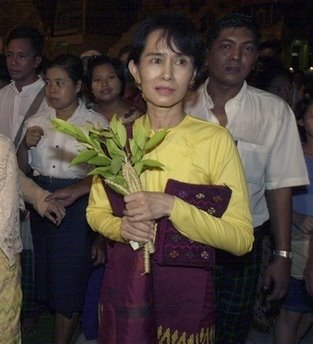


 Posts
Posts


