【バンコク西尾英之】ミャンマー東部カイン(カレン)州の少数民族カレン族武装組織「カレン民族同盟」(KNU)は8日、政府軍が占拠するかつての本拠地マナプロウを攻撃し、ほぼ16年ぶりに奪還した。戦闘で少なくとも政府軍兵士5人が死亡、KNUは政府軍陣地に残された大量の武器を入手した模様だ。タイ情報筋が毎日新聞に明らかにした。
KNUはマナプロウに司令部を置いていたが、95年1月に政府軍の攻撃を受けて同地から撤退、その後急速に弱体化した。最近になり軍事政権寄りだった別の武装組織「民主カレン仏教徒軍」の一部が、政権が求める国境警備隊への編入に反発して政府軍への攻撃を開始。11月以降タイ国境沿いの各地で戦闘が続いている。
Showing posts with label WAR. Show all posts
Showing posts with label WAR. Show all posts
Friday, December 10, 2010
ミャンマー:カレン民族同盟、旧本拠地を奪還


Tuesday, November 9, 2010
20,000 Myanmar refugees start heading home
20,000 Myanmar refugees start heading home
Buzz up!1 vote ShareretweetEmailPrint AP – Young Myanmar Buddhist monks wait for food at a Thai border police base where Myanmar refugees have taken …
Slideshow:Myanmar refugees flee post-election fighting Play Video Video:Myanmar refugees start heading home AP Play Video Video:Thousands flee Myanmar seeking refuge in Thailand AFP – 1 hr 51 mins ago
YANGON, Myanmar – About 20,000 refugees from Myanmar headed home Tuesday after fleeing to Thailand because of violence in the wake of a general election that is certain to keep Myanmar's military and its allies in power.
The incident underlined Myanmar's vulnerability to unrest following the country's first election in two decades on Sunday, which was billed by the ruling junta as a key stage in its self-proclaimed road to democracy.
Its political opponents and Western nations have decried the vote as unfair and repressive.
Thai authorities said Tuesday that Myanmar officials assured them the situation had stabilized in Myawaddy, a border town that came under attack by ethnic Karen guerrillas Sunday. The refugees who fled to Mae Sot, in Thailand's Tak province, were all expected to be sent home by late Tuesday, said provincial governor Samard Loyfar.
However, fighting continued at Three Pagoda Pass, another Myanmar border town 100 miles (160 kilometers) south of Myawaddy, said Thai officials.
"The heavy shooting in Myanmar stopped a few hours ago but sporadic gunshots still can be heard," said Chamras Kungnoi, a district chief on the Thai side.
About 3,000 refugees were still in Thailand. "We want them to return at some point, but if the fighting continues, they might have to stay here another night," Chamras said.
A 9-year-old girl from Myanmar died of shrapnel wounds, Chamras said. Five people were wounded by stray gunfire in Mae Sot on Monday, and another five were hurt in Myawaddy.
Myanmar has been ruled by the military near-continuously since 1962, and rebellions by its ethnic minorities predate its independence from Britain in 1948. Ethnic guerrilla armies chafe at the prospect of further tightening of control by the army.
Anti-government parties claim the polls were blatantly rigged. Khin Maung Swe, chief of the anti-government National Democratic Force, accused the junta's proxy party, the Union Solidarity and Development Party, of using every possible method to steal the vote, and said it was "sure to win 90 percent if they continue to cheat in such manner."
Though most election results had not yet been released, there was little doubt the junta-backed USDP would emerge with an enormous share of the seats, despite widespread popular opposition to 48 years of military rule. It fielded 1,112 candidates for the 1,159 seats in the two-house national parliament and 14 regional parliaments. The largest anti-government party, the NDF, contested just 164 spots.
A coalition of dozens of Myanmar media and human rights organizations that set up a poll-monitoring website said the vote was rigged.
"The reports that we have gathered demonstrate that these elections are deeply flawed, and are fundamentally illegitimate ... unfair and undemocratic," the groups said.
President Barack Obama said Monday it was unacceptable for Myanmar's government to "steal an election" and hold the people's aspirations hostage to the regime's greed and paranoia. U.N. Secretary-General Ban Kimono said the voting was not inclusive enough and lacked transparency.
The West and the U.N. have long been critical of Myanmar's military regime, especially for its poor human rights record.
But not everyone was so critical of the election.
"This is a critical step for Myanmar in implementing the seven step roadmap to transitioning to an elected government and thus is welcome and affirmed," Chinese Foreign Ministry spokesman Hong Lei said Tuesday. Beijing is the junta's staunchest ally.
The Association of Southeast Asian Nations, of which Myanmar belongs, welcomed the vote as a "significant step forward," Vietnamese Foreign Minister Ham Gina Khi said in a statement as the group's chair.
Sunday's election was the first in Myanmar, also known as Burma, since a 1990 vote won by pro-democracy leader Aung San Suu Kyi's party, which was barred from taking power and boycotted the new polls.
Suu Kyi's term of house arrest is supposed to expire Saturday, though the junta has kept silent over whether it will grant her freedom.
Several human rights groups warned of possible civil war as ethnic groups are pressured by the government to accept a new constitution that offers them little autonomy. Several groups that field potent guerrilla armies refused to take part in the election.
"If the dictatorship goes ahead with plans to attack all armed groups refusing to surrender, today's fighting will be the equivalent of a first small skirmish," the group Burma Campaign UK said Monday in a statement.
The U.N. and human rights groups have detailed killings, rape, torture, forced labor and burning of villages in Myanmar as the regime campaigns to deny the rebels support from the civilian population. Thailand already shelters a quarter-million ethnic minority refugees from brutal campaigns by the Myanmar army.
15,000 refugees flee Myanmar post-vote fighting
15,000 refugees flee Myanmar post-vote fighting
Reuters – A group of Myanmar refugees, who crossed over from Myanmar to Thailand when a battle erupted between …
YANGON, Myanmar – Mothers carrying babies and grown men hoisting elders on their backs fled Myanmar with 15,000 countrymen Monday as ethnic rebels clashed with government troops a day after an election widely considered a sham to cement military power.
Fighting raged at key points on the Thai border, wounding at least 10 people on both sides of the frontier as stray shots fell into Thai territory.The clashes underlined Myanmar's vulnerability to unrest even as it passes through a key stage of the ruling junta's self-proclaimed "road map to democracy." The country has been ruled by the military near-continuously since 1962, and rebellions by its ethnic minorities predate its independence from Britain in 1948.
In the heaviest clashes, Karen rebels reportedly seized a police station and post office Sunday in the Myanmar border town of Myawaddy. Sporadic gun and mortar fire continued into Monday afternoon. More fighting broke out further south for one hour Monday at the Three Pagodas Pass, said local Thai official Chamras Jungnoi, but there was no word on any casualties.
Thai officials said late Monday that fighting had quieted and government troops had regained control of Myawaddy.
Groups representing ethnic minorities who make up some 40 percent of Myanmar's population had warned in recent days that civil war could erupt if the military tried to impose its highly centralized constitution and deprive them of rights.
Refugee camps in Thailand already house tens of thousands of ethnic Karen who have fled decades of fighting in the border regions, but Monday marked the biggest one-day tide of refugees to flee into Thailand in recent years.
Refugees marched, shepherded by Thai security personnel, through the streets of the Thai town of Mae Sot, which is just across a river from Myawaddy. Those few carrying belongings toted them on top of their heads, while several lucky ones got rides on pickup trucks.
"At least 15,000 refugees have crossed from eastern Myanmar into northern Thailand since this morning," said Andrej Mahecic, spokesman for the U.N.'s refugee agency, which was providing tents and other materials to shelter the refugees. Non-governmental groups also were offering aid, he said from the agency's headquarters in Geneva.
Refugees continued to arrive into the evening, and some independent estimates put their number closer to 20,000.
They were being sheltered near the Mae Sot airport at a location that was becoming overcrowded, Mahecic said.
Col. Wannatip Wongwai, commander of Thailand's Third Army Region responsible for security in the area, said Myanmar government troops appeared to have retaken control of Myawaddy, and the Karen rebels held just a few positions on the town's outskirts.
"As soon as the situation is under control, we will start sending the refugees back to Myawaddy," he told The Associated Press.
The fighting threatened to overshadow electoral developments, which include mounting chagrin on the part of anti-government parties over what they charge was blatant cheating on behalf of the military's chosen candidates.
Visiting New Delhi, President Barack Obama said it was unacceptable for Myanmar's government to "steal an election" and hold its people's aspirations hostage to the regime's greed and paranoia.
Obama says leaders in countries like the U.S. and India have a responsibility to condemn such gross violations of human rights. He was speaking before India's parliament.
U.N. Secretary-General Ban Ki-moon said "the voting was held in conditions that were insufficiently inclusive, participatory and transparent," and expressed concern about the reports of fighting, urging all sides to refrain from actions that could raise tensions further, U.N. spokesman Martin Nesirky said Monday from the United Nations.
State media and the Election Commission reported Monday that 40 junta-backed candidates won their races, but a day after the polls closed, virtually no other official results — even on voter turnout — were available, and there was no timetable for releasing them. The junta-backed Union Solidarity and Development Party was certain to win an overwhelming number of seats. It fielded 1,112 candidates for the 1,159 seats in the two-house national parliament and 14 regional parliaments. The largest anti-government party, the National Democratic Force, contested just 164 spots.
And the constitution sets aside 25 percent of parliamentary seats for military appointees.
The NDF said provisional returns it had collected showed it winning 15 seats.
NDF chief Khin Maung Swe accused the USDP of using every possible method to steal the vote, and said it was "sure to win 90 percent if they continue to cheat in such manner."
He described a case in the central city of Mandalay, where one NDF candidate ran against Health Minister Kyaw Myint, the USDP candidate. An initial count at polling booths Sunday evening showed the NDF candidate in front, but later that night, a bag of 3,376 ballots from advance voting arrived, which included 2,500 in favor of the USDP, enough to make it the winner.
Khin Maung Swe said there were many cases where lagging USDP candidates received a boost from the arrival of such ballots. Exile Myanmar media had reported that people casting advance ballots were often pressured to vote for the pro-government party.
The NDF is led by breakaway members of the former National League for Democracy of detained Nobel Peace Prize laureate Aung San Suu Kyi, whose party won a landslide victory in the last elections in 1990 but was barred from taking office. It was disbanded this year after declining to register.
Suu Kyi's term of house arrest is supposed to expire Saturday, and her lawyer Nyan Win said Monday he was certain she would be released. "We are making plans for a welcoming ceremony," he said.
Ban's statement from U.N. headquarters repeated a call for lifting restrictions on Suu Kyi, who has been locked up in her Yangon villa on and off since 1989 and is one of some 2,200 political prisoners in Myanmar.
One of her two sons, 33-year-old Kim Aris, applied for a visa Monday in Bangkok in hopes of seeing his mother for the first time in 10 years. He lives in Britain and repeatedly has been denied visas to enter Myanmar.
Asked if he was optimistic, Aris told reporters he had "not too much hope. But there's always a little bit of hope. We'll see." He called the elections "a load of rubbish."
Associated Press photographer Apichart Weerawong in Mae Sot, Thailand, and writers Thanyarat Doksone in Bangkok, Edith M. Lederer at the United Nations and Frank Jordans in Geneva contributed to this report.
Wednesday, June 23, 2010
Armada of U.S. and Israeli Warships Head for Iran
Armada of U.S. and Israeli Warships Head for Iran
Kurt Nimmo
Infowars.com
June 19, 2010
More than twelve U.S. and Israeli warships, including an aircraft carrier, passed through the Suez Canal on Friday and are headed for the Red Sea. “According to eyewitnesses, the U.S. battleships were the largest to have crossed the Canal in many years,” reported the London-based newspaper al-Quds al-Arabi on Saturday.
Egyptians report the armada includes a U.S. aircraft carrier.
The Israeli newspaper Haaretz reported Egyptian opposition members criticized the government for cooperating with the U.S. and Israeli forces and allowing the passage of the ships through Egyptian territorial waters. The Red Sea is the most direct route to the Persian Gulf from the Mediterranean.
Retired Egyptian General Amin Radi, chairman of the national security affairs committee, told the paper that “the decision to declare war on Iran is not easy, and Israel, due to its wild nature, may start a war just to remain the sole nuclear power in the region,” according to Yedioth Internet, an Israeli news site.
The passage of a warship armada through the Suez Canal and headed for the Persian Gulf and Iran is apparently not deemed important enough to be reported by the corporate media in the United States.
Egypt recently rejected an Israeli request to prevent Gaza aid ships from passing through the Suez Canal. According to a report by al-Jazeera, Israel appealed to Egyptians asking them to prevent the passage of Iranian ships through the Suez Canal. The Egyptians responded that due to international agreements on movement through the Suez Canal, Egypt cannot prevent ships from passing through the canal unless a ship belongs to a state that is at war with Egypt. Iran and Egypt are not at war.
The United States and Israel, the sole nuclear-armed power in the Middle East, have not ruled out a military strike to destroy Iran’s nuclear program.
A number of Israeli politicians and scholars have admitted Israel has used its nuclear weapons for “compellent purposes,” in short forcing others to accept Israeli political demands.
Israel’s threats to use nuclear weapons have increased significantly since it was discovered in 2002 that Iran was building uranium enrichment facilities. Israel’s former Prime Minister Ariel Sharon “called on the international community to target Iran as soon as the imminent conflict with Iraq is complete,” the Sunday Times reported on November 5, 2002. The United States invaded Iraq on March 20, 2003.
A d v e r t i s e m e n t
Earlier this month Israel leaked to the press that they had permission from Saudi Arabia to use their air space to attack Iran. “In the week that the UN Security Council imposed a new round of sanctions on Tehran, defence sources in the Gulf say that Riyadh has agreed to allow Israel to use a narrow corridor of its airspace in the north of the country to shorten the distance for a bombing run on Iran,” the Sunday Times reported on June 12. On June 14, the ambassador of Saudi Arabia to UK Prince Mohammed bin Nawaf issued a categorical denial of the report.
On June 17, Iran’s parliament warned it will respond in kind to inspection of its ships under a fourth round of sanctions imposed on the country by the UN Security Council. “Even if one Iranian ship is stopped for security-check, we will act likewise and thoroughly inspect any (western) ship passing through the Persian Gulf and the Strait of Hormuz,” member of the Iranian parliament’s National Security and Foreign Policy Commission Hossein Ebrahimi said.
Also on Saturday, Iran accused the United States of “deception” and insisted its missile program is for self-defense after a top U.S. official claimed that Iran had the capacity to attack Europe. “The Islamic Republic’s missile capability has been designed and implemented to defend against any military aggression and it does not threaten any nation,” Defense Minister Ahmad Vahidi said in a statement carried by state media.
Vahidi announced on April 10 that Iran will use all available options to defend itself if the country comes under a military attack. “Americans have said they will use all options against Iran, we announce that we will use all options to defend ourselves,” Vahidi told the Tehran Times.
Saturday, May 29, 2010
Message from the Prime Minister-"Security of Japan and East Asia"
===================================================================
Hatoyama Cabinet E-mail Magazine No. 32 (May 28, 2010)
===================================================================
Yukio Hatoyama's "Yu-Ai"
-- Message from the Prime Minister (provisional translation of the
Japanese version, which is delivered on Thursdays)
"Security of Japan and East Asia"
Regarding the sinking of the ROK Naval patrol vessel "Cheonan,"
I express my heartfelt condolences and sympathies to the 46 victims
of the incident, the members of their bereaved families, and the
people of the Republic of Korea (ROK). On May 20, as a result of
the joint investigation with experts from the United States, United
Kingdom, Sweden, and Australia, the ROK government announced that
it had concluded that the incident had been caused by a torpedo
fired by North Korea.
On May 24, President Lee Myung-bak of the ROK gave an extremely
passionate and powerful speech toward the people of the ROK saying,
"I will continue to take stern measures to hold the North
accountable," and announced the ROK's intent to refer this matter
to the United Nations (UN) Security Council, among other measures.
I immediately spoke with President Lee by telephone, expressing my
respect for the resolute and calm manner in which the ROK
government has responded to the incident. I also reaffirmed Japan's
position to strongly support the ROK.
In the afternoon of May 24, I convened a Security Council meeting.
North Korea's action cannot be condoned by any means, and Japan
strongly condemns it together with the international community. As
a non-permanent member of the UN Security Council, Japan firmly
supports the ROK, and will strengthen coordination with the
international community, especially with the ROK and the United
States, both bilaterally and trilaterally, including response by
the UN Security Council. We will urgently consider anew our own
measures against North Korea and make the utmost effort for the
early enactment of the bill to establish a special measures law for
cargo inspections. Moreover, given this unpredictable situation, we
will enhance intelligence gathering and take all possible measures
to secure the safety and sense of security of the people of Japan.
This weekend, on Jeju Island in the ROK, a Japan-China-ROK
Trilateral Summit Meeting will be held. I would like to strongly
emphasize the need for Japan, China, and the ROK to coordinate and
cooperate even more closely for the peace and stability of East
Asia.
The government will make concerted efforts to further consolidate
the security of Japan and East Asia.
Sunday, October 11, 2009
Golden Triangle 'clearance sale'
Traffickers rush to convert stocks into cash to buy arms
Thai anti-narcotic officials are seeing a flood of heroin and methamphetamine as traffickers slash their inventories in a panicked sell-off to convert their drug stocks into cash to buy weapons. - ST PHOTO: FRANCIS ONG
DOI CHANG MOOB (THAILAND) - A MILITARY crackdown by Myanmar's government on armed ethnic groups along the borders with Thailand, Laos and China has led to a 'clearance sale' of drugs in the area.
UNPRECEDENTED
'There was nothing on that scale last year. This year has been quite unusual.'
Mr Leik Boonwaat, the representative of the UN Office on Drugs and Crime, on recent drug busts in Thailand and Myanmar
... More
Thai anti-narcotic officials are seeing a flood of heroin and methamphetamine as traffickers slash their inventories in a panicked sell-off to convert their drug stocks into cash to buy weapons.
'Some dealers at the border are buying on credit. They don't even need to pay in cash,' said Mr Pornthep Eamprapai, director of the northern branch of the Thai Office of Narcotics Control.
This new development has also led to more heroin seizures by the police in northern Thailand - up by more than twentyfold. From October last year to August this year, the authorities seized 1,270 kg of heroin, up from 57kg a year earlier, according to the Office of Narcotics Control.
On the other side of the border, Myanmar has reported enormous drug seizures in recent months, including one in August of more than 725kg, anti-narcotic officials said. Several million methamphetamine pills were also seized in the Myanmar border town of Tachilek.
'There was nothing on that scale last year,' said Mr Leik Boonwaat, the representative of the United Nations Office on Drugs and Crime based in Laos. 'This year has been quite unusual.'
ASSOCIATED PRESS-NEW YORK TIMES
Read the full story in Thursday's edition of The Straits Times.
http://www.straitst imes.com / Breaking% 2BNews/SE% 2BAsia/Story / STIStory_ 439630.html
Sunday, October 4, 2009
ENC wants ethnic groups to contest 2010 elections
Please read the difference between U Aye Tha Aung and ENC. The question is
who are the representatives for non-Burman ethinics ?
CRPP or ENC or what ?
ENC wants ethnic groups to contest 2010 elections
by Mungpi
Friday, 02 October 2009 23:31
New Delhi (Mizzima) - A group of Burma’s ethnic political organizations in exile – the Ethnic Nationalities Council (ENC) - has urged US Senator James Webb not to condemn the junta’s 2010 election before it takes place but to call for more inclusiveness and for it to be free and fair.
In a letter to Sen. Webb, a strong advocate of engagement with the Burmese regime, two days before he hosted a Congressional hearing on Burma, the ENC urged the Virginian Senator that the US can best help by “Not condemning the 2010 elections before they are held.”
“But instead call for a more inclusive election process that will be free and fair. Electoral assistance can be offered either directly or indirectly through neighbouring countries,” said the letter dated September 28, 2009.
The le tter, a copy of which is in Mizzima’s possession, was sent to Senator Webb in appreciation for his interest in the Burma issue and as an explanation on the nature of the complex problems of Burma’s diverse ethnic minorities.
Webb on Wednesday hosted a Congressional hearing on Burma where four experts gave their testimony on what should be the policy of the US towards Burma and the potential role that the US can play in bringing change in the military-ruled Southeast Asian nation.
The letter signed by Saw David Thaw, General Secretary of the ENC, states that ‘in principle’ ethnic nationalities in Burma cannot accept the junta’s 2008 constitution and does not believe that the 2010 elections will lead to democracy.
But the ENC argues that since the ethnics are left with little or no choice, they will have to participate in the elections, because “If there are no opposition parties, the military’s candidates will win by default. The military (and the majority ethnic ‘Burman’) candidates will then become the “elected representatives” of the seven ethnic states.”
Besides, the ENC said, if the ethnic armed ceasefire groups refuse to participate, they will be forced to revert to armed struggle, which will then cause further complications.
Burma under the current administration has seven states, which are home to seven major ethnic groups, and seven divisions, which have no particular attachment to any et hnic groups but are mostly known as habitats of the majority Burmans.
In view of the ENC’s policy of ethnic groups having a voice in Burma’s national politics, participating in governance and development of their homelands, the letter urged Senator Webb not to condemn the 2010 elections until it takes place but to urge the Burmese junta to make it more inclusive and free and fair.
The letter also states that the US can best help the people of Burma by providing assistance in civic education on elections and helping civil organizations that are educating potential political candidates on how to run for office and on democratic governance. And also to support groups that are educating the people about their rights and preparing local organizations on how to monitor the forthcoming elections.
The letter, which for the first time reveals ENC’s policy, states that ENC’s short-term policy is to support eligible ethnic groups in running for office in the 2010 elections.
It also said the ENC’s long-term policy is to develop a robust civil society that will be capable of holding an elected government accountable to the people.
“While the Burmese military will remain in control after the 2010 elections, it is our hope that representatives elected by the people will be able to help hold the military accountable to their own constitution,” said the letter.
“It is also our hope that the new government will be=2 0more open to negotiating a political solution with the ethnic groups that are still engaged in armed struggle,” added the letter.
In contrast to the ENC’s policy, the Committee Representing Peoples’ Parliament (CRPP), a group formed with 1990 election winning parties, said unless the regime amends the 2008 constitution, the elections would be meaningless and the CRPP would not contest.
Aye Thar Aung, Secretary of the CRPP, told Mizzima on Friday, “Without amending the 2008 constitution, the ethnics can do nothing even if they participate and are elected. They would just end up as puppets of the junta.”
He said the CRPP as well as Aung San Suu Kyi’s party – the National League for Democracy – have both demanded that the junta release political prisoners, amend the 2008 constitution, and recognize the 1990 election results.
“Unless these demands are met, we the CRPP and the ALD, will not participate in the elections,” Aye Thar Aung, who is also secretary for the Arakan League for Democracy, said.
“And without the junta fulfilling these demands, I would like to urge ethnic groups and others not to participate in the elections,” he added.
The CRPP, formed in September 1998, is an alliance of ethnic political parties that won elections in 1990, which the junta refused to honour. Its members include the NLD, ALD, Shan National League for Democracy (SNLD), Mon National Democratic Front (M NDF) and Zomi National Congress (ZNC).
Burma’s military rulers, as the fifth step of its seven-step roadmap to democracy, said it will hold general elections in 2010, that will elect a semi-civilian government based on the 2008 constitution, which according to the junta was approved by over 90 per cent of voters in May last year.
Critics said the junta’s roadmap is to buy-time and to cement the role of military in Burma’s future politics.
Tuesday, September 22, 2009
AQ Khan nails Pakistan's nuke lies
Pakistan's Dr. Strangelove tells all: Nuke mastermind A.Q. Khan says the government ordered him to pass on nuke secrets to China, Iran, North Korea, LibyaBreaking News:
AQ Khan nails Pakistan's nuke lies
CHIDANAND RAJGHATTA, TNN 21 September 2009, 12:00am IST
WASHINGTON: An angry, humiliated, and wounded A.Q.Khan has finally made public and official what has long been suspected: his nuclear proliferation activities that included exchanging and passing blue-prints and equipment to China, Iran, North Korea, and Libya was done at the behest of the Pakistani government and military, and he was forced to take the rap for it. ( Watch Video )
''The bastards first used us and are now playing dirty games with us,'' Khan writes about the Pakistani leadership in a December 2003 letter to his wife Henny that has finally been made public by an interlocutor. ''Darling, if the government plays any mischief with me take a tough stand,'' he tells his wife, adding, ''They might try to get rid of me to cover up all the things they got done by me.''
But Henny was unable to play hardball because Khan had also sent copies of that letter to his daughter Dina in London, and to his niece Kausar Khan in Amsterdam through his brother, a Pakistan Airlines executive. Pakistani intelligence agencies got wind of it and threatened the well-being of the family, forcing him to recant and publicly take the blame for the proliferation activities in a humiliating television spectacle engineered by then military ruler Pervez Musharraf.
However, a copy of the four-page letter reached Khan窶冱 long-time journalistic contact Simon Henderson in 2007. In fact, in the letter, Khan tells his wife, ''Get in touch with Simon Henderson and give him all the details.'' Henderson says when he acquired the copy of the letter, he was shocked. His acquaintance with Khan goes back to the late 1970s, but it was never intimate, and consisted of an occasional interviews and conversations, and seasonal greetings.
Describing the four-page letter as ''extraordinary,'' Henderson says in numbered paragraphs, it outlines Pakistan窶冱 nuclear co-operation with China, Iran and North Korea, and also mentions Libya. Some of the disclosures are stunning , and in one para that is bound to embarrass Beijing, besides implicating it, Khan writes about how Pakistan helped China in enrichment technology in return for bomb blueprints.
''We put up a centrifuge plant at Hanzhong (250km southwest of Xian),窶・Khan writes. 窶弋he Chinese gave us drawings of the nuclear weapon, gave us 50kg of enriched uranium, gave us 10 tons of UF6 (natural) and 5 tons of UF6 (3%).'' UF6 is uranium hexafluoride, the gaseous feedstock for an enrichment plan.
On Iran, the letter says: ''Probably with the blessings of BB [Benazir Bhutto]...General Imtiaz [Benazir窶冱 defence adviser, now dead] asked me to give a set of drawings and some components to the Iranians. The names and addresses of suppliers were also given to the Iranians.''
On North Korea: ''[A now-retired general] took $3million through me from the N. Koreans and asked me to give some drawings and machines.''
Henderson does not explain why he waited nearly two years since he got hold of the letter to make it public. But he writes sympathetically about Khan窶冱 travails in Pakistan, where he is held largely incommunicado under house arrest. The Pakistani government and the military have repeatedly rejected and challenged court orders to free him, and an episode last month, where Khan was freed just for a day on court orders before Islamabad locked him up again under pressure from Washington, appears to have precipitated the leak of the explosive letter.
Henderson窶冱 Sunday Times expose also implicates the U.S and other western powers, who he says, basically shoved Islamabad窶冱 rampant proliferation (while blaming it solely on Khan) under the carpet in order to get Pakistan窶冱 cooperation in the war on terror. The move also saved Washington from huge embarrassment since it was basically asleep on the watch when Pakistan began its nuclear proliferation and then winked at it when it was discovered, all the while lavishing billions in military supplies on its unstable client state.
PAK GOVT RESCUED BROKE A.Q.KHAN WITH $ 2500 PER MONTH PENSION
Henderson also implicitly defends Khan from charges that he profited from proliferation activities, as alleged by deposed military ruler Pervez Musharraf. Khan, he says, is adamant that he never sold nuclear secrets for personal gain. So what about the millions of dollars he reportedly made?
''Nothing was confiscated from him and no reported investigation turned up hidden accounts. Having planted rumours about Khan窶冱 greed, Pakistani officials were curiously indifferent to following them through,'' Henderson writes.
According to Henderson, much was made of a ''hotel'', named after Khan窶冱 wife, Henny, built by a local tour guide with the help of money from Khan and a group of friends in Timbuktu. But it is a modest structure at best, more of a guesthouse, he says. A weekend home at Bani Gala, outside Islamabad, where Khan went to relax, is hardly the palace that some reports have made it.
In fact, says Henderson, Khan was close to being broke by the summer 2007, when he was finding it difficult to make ends meet on his pension of 12,200 (Pakistani) rupees per month. After pleading with General Khalid Kidwai, the officer supervising both Pakistan窶冱 nuclear weapons and Khan, the pension was increased to $2,500 per month and there was a one-off lump-sum payment of the equivalent of $50,000. Hendersen says he has copies of the agreement and cheques.
Henderson窶冱 3000-word expose also reveals a couple of intriguing tid-bits that should interest the world窶冱 strategic community, including New Delhi. Besides details of the Pakistan-China nexus, he says Pakistan tested only two devices in its 1998 tit-for-tat nuclear tests that followed India.
While Pakistan claims it conducted six tests to be one-up on India窶冱 five tests, Western experts and seismologists have long said they recorded only two signals for devices that measured between two and four kilotons. Khan also states clearly that China gave Pakistan designs for the nuclear bombs.
In fact, in one colorful passage in his article, Henderson describes how Khan was warned by a Chinese counterpart about the Pakistani Army. On a visit to Kahuta, Li Chew, the senior minister who ran China窶冱 nuclear-weapons programme, tells Khan, ''As long as they need the bomb, they will lick your balls. As soon as you have delivered the bomb, they will kick your balls.''
Henderson himself seems deeply conscious of any perception that he is close to Khan or that he is a cat窶冱 paw for any country. ''Any relationship with a source is fraught with potential difficulties. One doesn窶冲 want to be blind to the chance of being used. Government officials and politicians in any country are seldom interested in the simple truth. They all have their particular story to tell. In this context, I am frankly amazed that Khan has chosen me to be his interlocutor with the world,'' he writes.
But Pakistani authorities were clearly aware that he and Khan had been in touch and Khan may have managed to smuggle a copy of the letter implicating Islamabad to him. Henderson says in a court document that Khan was asked to sign when he was promised freedom, there is a line that read 窶弋hat in case Mr Simon Henderson or anyone else proceeds with the publication of any information or material anywhere in the world, I affirm that it would not be based on any input from me and I disown it.窶・ That line was eventually deleted and replaced with a more general prohibition about unnamed ''specific media personnel.''
In other words, stand by for a flurry of denials.
Saturday, September 19, 2009
Myanmar official media stresses existence of single armed forces in country
Myanmar official media stresses existence of single armed forces in country
www.chinaview. cn 2009-09-18 11:43:14
YANGON, Sept. 18 (Xinhua) -- Myanmar official media stressed on Friday that there shall be a single Tatmadaw (armed forces) in the country to stand in accordance with the new state constitution approved in May last year.
The 2008 new state constitution prescribes that all the armed forces in the union shall be under the command of the Defense Services.
"If standing in rivalry that is against the constitution, doing illegal livelihood, poppy farming, production of narcotic drugs and illegal import and export of goods are rife, that will greatly harm the interest of the whole country and the people," said a Friday's report on the New Light of Myanmar newspaper.
"The Tatmadaw government is pursuing its strategies with the sharp determination that the nation's economy must be strong by the time when it hands over power to the civilian government to be formed under the constitution, " said the report.
It said "when these strategies are all realized, the Union of Myanmar will become a land bridge country where not only local people but also a large number of people from the neighboring countries engage trade activities."
It also urged the people to do their bit in the process of building the "land bridge" to make sure that all the pillars of the bridge are strong.
Noting that Myanmar is home to over 100 ethnic minorities, the report said "it gives first priority to consolidated unity among national brethren in the national interest according to the geopolitics, " adding that the government focuses on equitable improvement of the socio-economic life of all the national brethren.
The government has initiated a program for ethnic armed groups, which have cease fired and returned to the legal fold, to be formed into frontier forces under the control of the Commander-in- chief of the Defense Services.
However, the report said although many ethnic peace groups have returned to the legal fold, they have not surrendered their arms due to various reasons.
The leaders of the peace groups are urged to form political parties and stand for 2010 election.
After the present government took over the power of state on Sept. 18, 1988, 17 anti-government ethnic armed groups and over 20small ones returned to the legal fold one after another.
Of the 17 peace groups which cease fired with the government, some were allowed to retain arms, conditionally enjoying self-administration with special regions designated for them since then.
Under the government's fifth step of its seven-step roadmap announced in 2003, a multi-party democracy general election is to be held in 2010 in accordance with the 2008 new state constitution to produce parliament representatives and form a new civilian government to which the state power is to be handed over.
Friday, September 11, 2009
Deadline for Chinese to leave ceasefire areas over
Deadline for Chinese to leave ceasefire areas over
News - Shan Herald Agency for News
Friday, 11 September 2009 10:35
The deadline set by Chinese authorities for all Chinese citizens to leave ceasefire areas in Burma ended yesterday.
In the aftermath of the armed conflict between the Burmese Army and the Kokan Army in northern Shan State at the end of August, Chinese authorities fixed a deadline for September 8 for all Chinese to leave the UWSA and NDAA controlled areas.
In terms of topography, the armed conflict area was in territories controlled by these two ceasefire groups.
A source close to Chinese authorities said that "China had set a deadline for September 8 for all Chinese citizens to leave Wa and Mongla areas. The deadline is over but we have to wait and see what happens in this area."
On September 5, UWSA released a statement relating to the people who live in their controlled areas. The statement declared that they would continue to allow people on duty from international organizations to stay. But Chinese people, who had set up business ventures in their areas, would have to go back to China.
"Chinese businessmen and state employees have left Pang Sang, controlled by UWSA, Mongla, and NDAA," a source close to ceasefire groups said.
"Chinese businessmen left Mongla and Pang Sang. They took their belongings in cars. Casinos have been closed in Mongla."
Some Chinese people have gone to the Sino-Burma town of Ruili, an eyewitness said.
"The Chinese from Wa and Mongla arrived in Ruili. Some of them have bought and rented shops for starting business afresh. They said they had moved to carry on their business because the situation had worsened on the Burma border."
According to analysts, the main reason behind the Chinese people leaving the area was that the Burmese Army could launch military offensives against the remaining ceasefire groups.
In a contradiction junta’s puppet media said that people, who fled the area following clashes in the Kokang area, have been coming back home and the situation in the area had normalized but Chinese businessmen have left UWSA and NDAA controlled areas. http://www.bnionlin e.net/news/ shan/7016- deadline- for-chinese- to-leave- ceasefire- areas-over. html
>
Tuesday, September 8, 2009
War Is Not Answer: Wa Leader
War Is Not Answer: Wa Leader
--------------------------------------------------------------------------------
By WAI MOE Monday, September 7, 2009
--------------------------------------------------------------------------------
Speaking in an interview on China’s Phoenix TV broadcast on Monday, Bao You-Xiang, the leader of the United Wa State Army (UWSA), said, “We absolutely do not want fighting to break out in Wa State [Wa Special Region]. Only peaceful negotiations can defuse the tension.
“The Wa State hopes to become a democratic self-ruled autonomous region within a Burmese federal republic. Only peaceful means can solve the problem, not the use of force,” he said.
United Wa State Army leader Bao You-Xiang appears on China's Phoenix TV.
Phoenix TV pictures clearly showed pictures of Gen Aung San, the founder of the Burmese army, and Snr-Gen Than Shwe, the leader of the Burmese junta on the wall of the Wa leader’s office.
Tension has risen dramatically on the Sino-Burmese border after the UWSA, the Kachin Independence Army, the Kokang armed group known as the Myanmar National Democratic Alliance Army (MNDDA) and the Mongla-based National Democratic Alliance Army(NDAA) refused to transform their militias into border guard forces as ordered by the Burmese junta in April.
The armed ethnic groups rejected the plan saying it ignores ethnic minority rights. By transforming their troops into border guard forces, the armed ethnic ceasefire groups would effectively put their troops under control of the Burmese army. The junta has set October as the deadline to begin training and forming the border guard force.
Lt-Gen Ye Myint, the head of Military Affairs Security [Burmese military intelligence] and the secretary of the Transformation Committee for the Border Guard Force repeatedly said in a letter to the UWSA that the Tatmadaw [Burmese armed forces] would not attack Wa troops.
With an estimated 25,000 soldiers, the UWSA is the biggest ethnic ceasefire group in military-ruled Burma. It signed a ceasefire agreement with the Burmese junta in 1989 after the MNDDA agreed to a ceasefire with the Burmese army.
The US Congressional Research Service describes the UWSA as “the largest of the organized criminal groups in the region,” due to its involvement in the drug trade.
The status of the Burmese military junta’s ceasefire agreements with 17 ethnic armed groups has been uncertain after Burmese government troops seized the Kokang capital, Laogai, on August 24.
After the fall of Laogai, there were skirmishes between government forces and MNDDA troops. At least 30 people, including Chinese citizens, were killed and more than 30,000 people fled to China.
The Kokang’s resistance to the junta’s troops ended abruptly after more than 1,500 Kokang fighters crossed the Sino-Burmese border and surrendered their arms to Chinese officials on August 29.
After the collapse of the MNDAA, observers have been openly wondering who the next target for the Burmese army will be. Many say the UWSA is the Burma army’s main target among the ceasefire groups because it is the leading group resisting junta plans to neutralize the armed militias.
Observers on the ongoing ethnic conflict in Shan State said Beijing would play an important role in maintaining stability along the Sino-Burmese border through negotiations with both sides as the Sino-Burmese overland oil and gas pipelines are scheduled to start this month.
The Chinese government is a close ally of the Burmese regime and is influential with the ethnic armed groups along the border.
During a meeting with Vice Snr-Gen Maung Aye in June, Chinese Premier Wen Jiabao made it clear that the Chinese favor pushing forward the democratic process in Burma to achieve national reconciliation, safeguard national stability and promote economic development.
“What the Chinese do is paramount,” said Aung Kyaw Zaw, a former Communist fighter who is monitoring the situation from the Chinese border town of Ruili.
“However, the junta’s No1 Snr-Gen Than Shwe, No 2 Maung Aye and Secretary 1 Gen Tin Aung Myint Oo have paranoia over Beijing’s relationship with the ethnic groups along the Sino-Burmese border,” he said. “They fought against communist troops backed by the Chinese People’s Liberation Army. These troops became the militias of the UWSA, MNDAA and NDAA.”
On Sunday, a report about Burmese politics in a popular Chinese language news website, news.qq.com, said: “The Burmese people have been promised an improvement in their lives after the elections [in 2010]. However, analysts believe that if the new government fails to meet peoples’ needs, then this could lead to popular discontent.”
Copyright © 2008 Irrawaddy Publishing Group | www.irrawaddy.org
Prelude to a Civil War?
CONTRIBUTOR
Prelude to a Civil War?
--------------------------------------------------------------------------------
By HARN YAWNGHWE Monday, September 7, 2009
--------------------------------------------------------------------------------
Many were surprised by the State Peace and Development Council (SPDC) attack against the Kokang forces.
Some had been so preoccupied with the trial of Aung San Suu Kyi that they were not even aware of the impending crisis. Others could not understand why the Burmese military would turn against their allies who have had a cease-fire agreement for more than 20 years.
Yet others thought that the Burma Army would never dare to incur the wrath of China. After all, had the Chinese not, in June, requested Vice-Snr-Gen Maung Aye to maintain stability on the border? This development was especially surprising to those who were convinced that Burma is a client state of China.
This failure to anticipate events underscores the weakness of the Burmese democracy movement, in particular, and the international community, in general.
We have often failed to understand the strategy and plans of the ruling military government. We have looked at their actions through our own prisms and misinterpreted their intentions. We have tended to see SPDC pronouncements as propaganda and have not paid enough attention to what it is planning to do.
Nobody is happy with military rule in Burma so we dismiss the SPDC “road map” to democracy and its constitution. But how many of us have actually studied the constitution in detail, not to criticize it, but to see how the military actually plans to implement its “road map” policies and how we can use its plans to our advantage?
In 2004, the SPDC announced the “road map,” and last year it announced plans for an election in 2010. We were outraged when the referendum was held two weeks after Cyclone Nargis had devastated the delta and Rangoon. We would not have been surprised had we realized that Snr-Gen Than Shwe takes the “road map” seriously.
He will not allow anything to stand in its way. A series of recent events has also taken some of us unaware—he release of U Win Tin; the first ever post-1990 congress of the National League for Democracy (NLD); Aung San Suu Kyi’s trial, the unseasonable attack on the Karen National Union; the attack on Kokang and now possibly an attack on the Wa.
These seem to be the random acts of a paranoid and unpredictable leader—he image we like to portray of Snr-Gen Than Shwe. But in reality, all these events have a common goal: the success of the 2010 elections. They are the rational outworking of a well-calculated and orchestrated operation plan of the SPDC.
The proposal to the ethnic cease-fire groups to transform themselves into Border Guard Forces (BGF) under the control of the Burma army is also an attempt to clear the decks before the 2010 elections. It was meant to either provoke the cease-fire groups to reject the proposal and be destroyed or frighten them into submission and acceptance of the SPDC road map.
It is clear that the BGF proposal was a provocation. This is because during the past 20 years, nothing of this matter was ever discussed with the cease-fire groups. They were told they could keep their arms and could negotiate with the newly elected government on the political terms they wanted.
Suddenly, in April they were told they had until October 2009 to decide. Analyzing the ceasefires, it is clear that the SPDC never meant to negotiate. The plan was to stop hostile action, provide incentives to entice individual commanders to split from the main groups and slowly weaken the ethnic groups to the point where they could be easily eliminated.
The cease-fire groups cannot accept the BGF because it is actually a plan to destroy the groups by attrition. But if they refuse to accept the proposal, they will be destroyed now, before the elections. The Kokang (MNDAA), the Wa (UWSA) and the Mongla (NDAA) groups rejected the BGF proposal and also refused to accept the SPDC’s road map and constitution. They do not want any changes. Therefore, if nothing changes, the SPDC will move against the UWSA and the NDAA. Which group will be attacked first will depend on the tactical advantage.
What about China? Is the SPDC not beholden to China? The short answer is—no. Whatever we may think about the SPDC, the Burma Army is very proud of the fact that it is “patriotic.” The SPDC has never danced to the tune of a foreign power. It has, rather, made foreign powers big and small dance to its tune. Since the SPDC has been largely ostracized internationally, it has had to depend on China.
But it was never happy about it. When Burma was discussed at the UN Security Council and it had to depend even more on China, the SPDC began to cultivate Russia, so that it would not be at China’s mercy. But Snr-Gen Than Shwe’s problem was solved when John Yettaw decided to take a swim. He enabled the SPDC to ensure that Aung San Suu Kyi would have no role in the election, and he also enabled Than Shwe to raise the stakes and create a direct link with the Obama administration.
This in turn gave Than Shwe the card he needed to ignore China’s wishes and move against the Kokang and Wa.
If Snr-Gen Than Shwe’s calculations are correct, the SPDC will be able to wipe out the Wa and Mongla groups, and the 2010 elections can be held on a less contentious playing field according to schedule.
The unpredictable factor, of course, is how much resistance the Wa army will offer. And what the reaction of the other cease-fire groups will be. Some like the Kachin Independence Organization (KIO) and the New Mon State Party (NMSP) are in the process of negotiating with the SPDC over the BGF issue.
Other groups like the KNU and the Shan State Army (South) are watching closely to see how the battle develops. If Than Shwe’s calculations are wrong, Burma could face a period of serious instability and the 2010 elections will be jeopardized.
But on the other hand, the SPDC may have decided that the elections could actually lead to democratization, and it is trying to create a pretext to postpone the elections indefinitely.
Harn Yawnghwe is executive director of the Brussels-based Euro-Burma Office.
Copyright © 2008 Irrawaddy Publishing Group | www.irrawaddy.org
Danger of border skirmishes escalating
Danger of border skirmishes escalating
Editorial Desk
The Nation (Thailand)
Publication Date: 08-09-2009
It has always been said that China is Burma's closest ally. Given the fact that the junta doesn't have many friends, one like China will always stand out. But the not-so-honorific label of "closest ally" should be understood in its proper context. For the Burmese, Chinese friendship doesn't mean the world.
Nonetheless, such a friend could very well come in handy, especially when the international community and the United Nations are constantly looking to clobber the generals with sanctions and criticism.
For the Burmese regime, survival is everything. Where it positions its troops and weapons, and the type of legislation and reconciliation process that it proposes, reinforce the very idea that it is here to stay whether the world likes it or not.
For as long as anybody can remember, China has been a factor whenever a Burma policy and strategy is drafted by the international community. Over a decade ago, when Rangoon's membership of Asean was on the table, members of the regional grouping whispered among themselves about the Chinese factor. Keeping the Burmese out of the regional loop would push the junta further into the arms of the Chinese, they said.
But for the Burmese, Asean membership was not seen as a privilege but a right - simply because the country happens to be in the same geographical region. There was no "thank you" to Asean for letting the country become a member.
A handful of Thai diplomats thought a free ride for Burma in Asean would deny the regional grouping the only card it had to play against the junta. Their concerns were largely ignored by most of the other Asean members, who really didn't give a hoot about the atrocities committed by the junta, or the political baggage that comes with Burma's membership. And when Asean came under an unwanted spotlight or was at loggerheads with the international community, such as the European Union, over Burma's participation, all the Burmese generals could do was shrug their shoulders. They just couldn't care less.
And so when the Burmese unleashed their troops against one of the minority cease-fire groups within the country, namely the Kokang, forcing tens of thousands people - including Yunnanese Chinese who have more or less seized northern Burma over the last few years - to flee for China, Beijing was jolted.
Thai military officials with direct experience of the Chinese often called them "masters of two-track diplomacy". They pointed to China's relations with the bloody Khmer Rouge in Cambodia, up until that regime's dying days, and its historical ties with the ethnic armies that operate independently along Burma's northern border.
Attacking the Kokang and turning their guns towards the 20,000-strong United Wa State Army (UWSA) afterwards was a rude awakening for the Chinese. If anything, the junta was telling its so-called "closest ally" that it is charting its own course. One could say that the Chinese finally got a taste of their own medicine.
For decades, Burma has given China access to its ample natural resources, and the Indian Ocean, in exchange for political support. Moreover, Chinese companies are set to start construction on a US$2.5 billion oil-and-natural- gas pipeline project that will run from the Indian Ocean to Yunnan's capital of Kunming. But if one thinks that Burma is a Chinese lackey, think again.
It is clear that the two-decade-old ceasefire with the ethnic armies no longer serves Burmese purposes. From the generals' perspective, a normal country shouldn't have small armies operating independently on its soil, especially if those armies are proxies of a powerful neighbour.
Beijing expressed its concern back in June, and the ruling Burmese State Peace and Development Council (SPDC) said that it did not want to see disturbances along the Sino-Burmese border. But in the end, for the junta, domestic matters overtook any diplomatic concerns.
For too long Beijing turned a blind eye to the atrocities committed inside Burma, telling the world to stay out of Burma's domestic matters. Self-serving interest has always been China's political attitude towards Burma.
It's different now, however, as China is directly affected by this so-called domestic matter.
If Beijing thinks it has a big headache with the 30,000 refugees fleeing the Burmese attack against the Kokang, then wait until the junta turns its guns on the UWSA. It could very well have a ripple effect, turning Burma's entire northern border into a full-blown war zone if other cease-fire groups like the Chin, Kachin and Shan join the fight to keep their patches of real estate given to them two decades ago.
http://www.asianews net.net/news. php?id=7678&sec=3
Monday, September 7, 2009
Ethnic challenge for Myanmar
========= =====
Sep 6, 2009
Ethnic challenge for Myanmar
BANGKOK - MYANMAR'S military junta may have taken Aung San Suu Kyi out of the picture ahead of elections next year, but it could face an even greater challenge from rising ethnic unrest, analysts said.
The regime has recently stepped up its decades-long campaign against minority groups, with offensives against ethnic Chinese rebels in the northeast in August and Christian Karen insurgents near the Thai border in June.
Civil war has wracked the country since independence in 1948, and while most rebel groups have reached ceasefire deals with the junta, analysts say the army is determined to crush the rest before the 2010 polls.
The offensives have mirrored the ruling generals' efforts to take Ms Suu Kyi off the political stage by sentencing her to another 18 months' house arrest after a bizarre incident in which an American man swam to her lakeside home.
The Nobel Laureate's lawyers launched an appeal against her conviction last week, but with the country's pliant courts likely to do the junta's bidding, the ethnic problem is the next real hurdle for the regime, analysts said.
'This is a very complicated issue. After Aung San Suu Kyi's case, the next big issue is the issue of ethnic minorities,' Aung Naing Oo, an independent Myanmar analyst based in Thailand, told AFP.
Military ruler Than Shwe has long made the struggle for the 'stability of the state' the main justification for the army's continued dominance over the Southeast Asian nation.
In recent years the regime has been able to reach peace pacts with key ethnic groups, co-opting some to become junta-backed border forces that have taken on their former rebel brothers-in- arms.
But August's outbreak of fighting in Kokang, a mainly ethnic Chinese region of Myanmar's Shan state, showed the tensions near the surface and earned a rare rebuke from Beijing, usually Myanmar's closest ally.
The offensive was a warning to other minority groups thinking of causing disruption before the polls, said Win Min, a Myanmar expert at Payap University in the northern Thai city of Chaing Mai. -- AFP
Critics have denounced the elections as a sham aimed at legitimising the junta's grip on power, but the influential International Crisis Group (ICG) think-tank said recently that the polls could be an opportunity for change.
'These things are happening in the context of the 2010 elections. The Burmese military are showing ceasefire groups that if they don't agree with their plans they are going to fight,' Win Min said, using the country's former name.
The new constitution - pushed through in a referendum in 2008 just days after a cyclone ravaged southern Myanmar - does not provide the autonomy many groups had hoped for, Mr Win Min added.
'The groups signed ceasefires but in the hope that they would get greater autonomy. But they have been mostly rejected. They would like to wait until after there is a new government to negotiate greater autonomy,' he said.
Compounding the problem is the fact that many of the groups, especially the powerful Wa in northern Myanmar, are heavily involved in the drugs trade, often with the tacit assent of the government, analysts said.
'But now the government is using it (the narcotics issue) as a pretext to put pressure on the ethnic groups who don't want to join Burmese security forces,' Mr Win Min said.
The ethnic problems could end up with the effective 'Balkanisation' of Myanmar, a European diplomat in the region said on condition of anonymity.
'We've never been closer to this than we are now,' the diplomat said. 'If no political solution is found for these ethnic groups the whole situation is going to implode.' The diplomat said it was 'not at all the case' that Myanmar's political problems are just about the situation between Ms Suu Kyi and the regime.
'There are so many questions before 2010, so much that's to be done. I'm sure Than Shwe has no clue how to tie up loose ends.' But the Brussels-based ICG said in a report last month that some ethnic groups which had made ceasefire deals were endorsing political parties that would take part in the polls.
'These groups take a negative view of the constitution but feel that there may be some limited opening of political space, particularly at the regional level, and that they should position themselves to take advantage of this,' it said.
'There are increased tensions, however, as the regime is pushing these groups to transform into border guard forces partially under the command of the national army.' -- AFP http://www.straitst imes.com/ Breaking% 2BNews/SE% 2BAsia/Story/ STIStory_ 426174.html
============ ========= ========
Friday, September 4, 2009
The Nation - The false and dangerous Allure of Nuclear Weapons
The Nation - The false and dangerous Allure of Nuclear Weapons
By Bernard F. W. Loo
Published on September 3, 2009
If Burma intends to acquire nuclear weapons, as reports suggest, this reflects a widely-held and terrible attraction that nuclear weapons maintain over military planners. This fascination stems from a misunderstanding about what nuclear weapons can do for a country's national security.
The recent allegations that Burma has started to develop a nuclear weapons programme appear to have surprised no one; in a similar vein, no one was surprised when the first news of a nuclear weapons programme in North Korea emerged. If a country is led by a paranoid government eternally suspicious of just about every other state in the international system, then nuclear weapons must surely be the ultimate guarantor of that country's national security.
Two arguments have traditionally been made in favour of nuclear weapons. First, the eminent nuclear strategist Bernard Brodie in 1946 called them the "ultimate weapon". There is something viscerally certain, even iconic, about the nuclear mushroom cloud. More recently, there was the 21st century re-imagining of the classic 1970s television series "Battlestar Galactica", which revolved around a simple premise: Two civilisations, both capable of faster-than- light travel (which Einsteinian physics maintains is impossible) seeking to destroy the other with nuclear weapons. This premise reflects the emotive power that nuclear weapons exercise over the human imagination.
Second, nuclear weapons offer an apparent cost-effective alternative to the otherwise expensive business of acquiring and maintaining armed forces. Defence budgets typically go mostly to manpower costs. A nuclear weapons programme offers the prospect of significant downsizing of the armed forces and, consequently, significant cuts in defence spending; it can also have civilian energy spin-offs. For states with nuclear ambitions - the so-called nuclear wannabes - these arguments appear to be very persuasive.
There are two key arguments that relate nuclear weapons to national security. The first posits a scenario in which a nuclear state faces potential aggression from a non-nuclear state. In this scenario, it is possible to argue that the mere possession of a nuclear weapon should be sufficient to act as a deterrent against external aggression. It would be tempting to ascribe this state of affairs to the case of Israel - long suspected of having an opaque nuclear weapons programme - in its relations with its Arab neighbours.
This scenario is, however, problematic. Any nuclear retaliation against a conventional military offensive crosses a threshold that has remained intact since 1945. This renders the nuclear state as a pariah, likely to then face a variety of very severe sanctions imposed by the international community.
The second argument involves threats to the nuclear wannabe's existence from an existing nuclear state. The argument is that for the nuclear wannabe, the possession of nuclear weapons will deter any aggression from other nuclear states, and therefore provide the country with a measure of national security. After all, as one Indian general was alleged to have remarked, the signal lesson of Operation Iraqi Freedom is that if one wishes to go up against the United States, make sure you already have a nuclear weapon.
What deters aggression between two nuclear powers, what keeps the nuclear peace, in other words, is not the fact that both are nuclear powers. If that were the case, all nuclear powers should only need to maintain only one nuclear weapon in each arsenal. The fact that this is not the case suggests that nuclear deterrence and nuclear peace may be rather more complicated.
If a nuclear wannabe genuinely believes that nuclear weapons will enhance its security, it needs to keep in mind two considerations. One is retaliation. What maintains the peace between two adversarial nuclear states is the fear that one may attack first. But the victim will still have nuclear weapons that survive this first attack. The nuclear weapons that have survived will then be sufficient for the victim to launch a retaliatory attack against the aggressor, and inflict on the aggressor levels of damage that are politically unacceptable.
This means the nuclear wannabe will need either a very extensive nuclear arsenal, or it will need to ensure that its nuclear arsenal is survivable, either by hardening nuclear silos or by deploying their nuclear weapons on mobile, difficult-to- detect platforms such as missile submarines. Neither option is cheap; both subvert the myth of nuclear weapons as a low-cost solution to national security challenges.
The second critical element in nuclear deterrence is that of sufficient warning. This typically - but not exclusively - applies in the case of states with very small nuclear arsenals that are not likely to survive a nuclear first strike. In this instance, one state has the capacity to react quickly enough in the event of a nuclear attack, to launch its own nuclear weapons against the aggressor before its arsenal is destroyed. In this instance, because both adversaries know the other has sufficient early warning of impending nuclear attack, any nuclear aggression by one will almost certainly be counter-productive, inasmuch as it will lead to the state's own nuclear demise.
The nuclear wannabe will have to undertake serious investments in geo-stationary satellites that can monitor the nuclear weapons facilities of its putative adversaries, and advanced command and control facilities that allow for quick launch of its nuclear weapons. Again, this is not a cheap option, and it demands of such states very high levels of technological expertise that most will in fact lack.
It therefore means that if any state, genuinely worried about its survival and security, seeks to acquire nuclear weapons, the mere possession of even a handful of nuclear weapons - assuming the country then has the systems that can deliver these weapons against its putative adversary - is not enough. Secondly, nuclear weapons will not constitute a cheap, cost-effective security for the country. The great irony is that if any state genuinely desires to acquire nuclear weapons, it has made itself more vulnerable to external attack than ever before.
Bernard F. W. Loo, educated at the University of Wales in Aberystwyth, is associate professor of war and military strategy at the Institute of Defence and Strategic Studies, S. Rajaratnam School of International Studies, Nanyang Technological University.
Burmese Army might be targeting UWSA: Observer
Burmese Army might be targeting UWSA: Observer
by Mungpi
Thursday, 03 September 2009 23:03
New Delhi (Mizzima) - After having overrun and occupied the Kokang area in north-eastern Shan State and driving away its leader, the Burmese military junta might have initiated its move against one of the largest ceasefire groups, the United Wa State Army, an observer said..
Khuensai Jaiyen, editor of the Thailand-based Shan Herald Agency for News (SHAN), who is close to UWSA, said Wa leaders in Panghsang in eastern Shan state have received a letter from the Burmese Army demanding the extradition of Kokang leader Peng Jiasheng and three others. The junta had issued arrest warrants against them.
“Nobody is sure where Peng and his group are staying right now. It is absurd that the Burmese Army has demanded that the Wa hand over Peng. It seems to me that the junta is starting to pick on the Wa,” Khuensai said.
The letter dated September 1, 2009 was received by Wa leaders in Panghsang on September 2. Worried over the issue, the Wa leaders sat at a meeting on Thursday morning and decided not to respond to the letter, he added.
“The Wa leaders believe that the demand could be a point to pick by the junta and so decided to remain silent without replying to it,” said Khuensai.
He said, whichever way the Wa replies, the junta could find fault. Even by remaining silent, the junta could still find fault and find reasons to launch an attack.
Peng Jiasheng, the once supreme leader of the Myanmar Nationalities Democratic Alliance Army (MNDAA), also known as the Kokang Army, was forced to flee Loa Kai, capital of Kokang region, after the Burmese junta issued an arrest warrant for him along with three others including his brother on charges of running an arms and ammunition factory and trafficking.
Peng’s flight left his deputy Bai Suoqing and a few other MNDAA soldiers, who support the junta. The MNDAA was later reformed with the help of the Burmese Army and Bai was appointed the new leader.
“When I asked Wa leaders about the whereabouts of Peng, they told me that he would most probably be with his son-in-law but did not deny or agree that Peng might be in Wa controlled area,” Khuensai said.
According to the Wa leader’s response, Peng and his troops are most likely to be with the Nationalities Democratic Alliance Army (NDAA) or Mongla, whose leader Sai Leun is Peng’s son-in-law.
While the information on the junta’s demand to the Wa to extradite Peng cannot be independently verified, a Sino-Burma border based military analyst Aung Kyaw Zaw said, he does not believe any such demand has been made..
“I have not heard of the demand but I think it is unlikely and Brig Gen Win Maung commander of the Regional Operations Command (ROC) in Lao Kai has no such power to make the demand as the case is to be handled by the Ministry of Home Affairs,” he added.
But he said, in connection with the conflicts last week in Kokang region, Burmese Deputy Home Minister Phone Shwe and a team of delegates, earlier this week, visited Kun Ming, capital of China’s North-western province of Yunnan, and met regional Chinese officials.
Aung Kyaw Zaw said, while the junta is determined to neutralise ethnic armed groups, particularly the ceasefire groups, in eastern Shan State, the UWSA might not be the first target to choose.
Observers agreed that the junta is unlikely to declare war on the UWSA, which is believed to have up to 20,000 soldiers, but use different tactics including ‘divide and conquer’ by exploiting the differences between the leaders, Wei Hsueh-kang and Bao You-Xiang.
Wednesday, September 2, 2009
New York Times: Myanmar forces overwhelm rebels – Thomas Fuller
New York Times: Myanmar forces overwhelm rebels – Thomas Fuller
Mon 31 Aug 2009
Filed under: On The Border
BANGKOK — The Myanmar military has overwhelmed rebels from an ethnic Chinese minority in the northern reaches of the country, the junta’s second victory over armed opponents in three months.
The routing over the weekend of the forces of the small, Chinese-speaking Kokang ethnic group gives Myanmar’s governing generals momentum in their campaign to quell armed opposition before elections and the adoption of a new Constitution next year.
Several well-armed groups, notably the Wa and Kachin, still stand in the way of the junta’s goal of complete control over the country. But a recently announced agreement of solidarity among the rebel groups, which had the potential to slow the central government’s advance against the Kokang, may be fraying.
The Myanmar government’s strategy, analysts say, appears to be to challenge the groups one by one and to try to capitalize on the many factions within each group.
In June, the military defeated ethnic Karen insurgents along the border with Thailand, aided by a local militia of Karen Buddhists who led an attack on forces that were largely made up of Karen Christians.
To defeat the Kokang, the small ethnic group in the north, the junta allied itself with a defector and chased out troops loyal to the Kokang’s chairman, Peng Jiasheng.
A force of 2,000 Wa soldiers had initially come to the assistance of the Kokang, but they retreated Friday, according to Aung Kyaw Zaw, a former rebel based on the Chinese side of the border. This appeared to undercut a mutual-assistance agreement that the rebel groups reached several weeks ago.
Late on Sunday, Myanmar’s official media broke their silence on the fighting with a television broadcast announcing that clashes had ended and providing what appeared to be a preliminary death toll of 26 members of government security forces and 8 Kokang militiamen, The Associated Press reported. “The region has now regained peace,” the official announcement said.
Chinese state media said that two Chinese citizens had also been killed in the fighting.
News services reported from southern China that Kokang forces were continuing to flee across the border into China on Sunday on the heels of what United Nations and Chinese officials estimated were as many as 30,000 civilian refugees. Nearly half the estimated 1,500 members of the Kokang militia have crossed the border and handed their weapons to the Chinese authorities, according to Mr. Aung Kyaw Zaw.
The central government’s assaults on the Kokang, which began last week, have put other ethnic groups on alert, according to Brang Lai, a local official in the Kachin headquarters in Laiza, along the Chinese border.
“People are very concerned,” Mr. Brang Lai said in a telephone interview. On the Chinese side of Laiza, residents have put Chinese flags on their roofs in the hope that they will be able to avoid any additional fighting. Officers from the Myanmar military’s Northern Division were in Laiza over the weekend to call for calm, Mr. Brang Lai said.
Followers of Mr. Peng, the Kokang’s chairman, were spotted by reporters on the Chinese side of the border buying civilian clothes to replace their militia uniforms.
“There was no way we would win,” Ri Chenchuan, a Kokang rebel, said as he shopped for new clothes, The A.P. reported.
The Myanmar government has signed more than a dozen cease-fire agreements with ethnic groups over the past two decades, but the fighting with the Kokang raised questions about the military’s intentions.
Aung Din, executive director of the United States Campaign for Burma, an advocacy group that opposes the junta, said the generals apparently had adopted a more aggressive posture, partly influenced by the Sri Lankan government’s military victory over Tamil rebels in May.
Sri Lanka’s president, Mahinda Rajapaksa, met with Myanmar’s generals in June in what was his first overseas trip after the defeat of the Tamil Tigers. The visit might have inspired Myanmar’s senior general, Than Shwe, who has spent much of his military career battling ethnic groups, Mr. Aung Din said.
“It was an encouragement to the regime to do away with the insurgency once and for all,” Mr. Aung Din said. “Their thinking has changed.”
The motives and strategies of Myanmar’s leaders have long been difficult to divine. General Than Shwe is a very secretive man and the state-run media are highly selective in their reporting. The report on Sunday evening was the first time they had mentioned the campaign against the Kokang.
The fighting appears to have strained Myanmar’s relations with China, especially since the Kokang are ethnically Chinese. The Chinese Foreign Ministry warned Myanmar on Friday to “properly handle domestic problems and maintain stability in the China-Myanmar border region.”
Analysts said that the Chinese government had asked Myanmar’s generals to refrain from initiating military campaigns before the celebration of the 60th anniversary of the founding of the People’s Republic on Oct. 1.
In that light, China could view Myanmar’s campaign as provocative, especially since China is a large investor in Myanmar and plays the role of the junta’s protective big brother in the United Nations and other international forums.
Mr. Aung Kyaw Zaw said he suspected that the Myanmar generals wanted to demonstrate their independence to Chinese leaders. Their message, he said, is that “if we want to fight along the border, we can fight.”
“This is a political game,” he added.
China Silent on Burmese Refugees
China Silent on Burmese Refugees
By MICHAEL WINES
Published: September 1, 2009
BEIJING — Chinese officials imposed an information blackout Tuesday on the situation along its border with Myanmar and began taking down tents that had sheltered some of the estimated 30,000 people who fled into China to escape the recent fighting between Myanmar’s military and ethnic rebels.
But news reports stated that many thousands of refugees remained in China, unwilling or unable to return to Myanmar, formerly called Burma, and it was not clear how the Chinese government intended to address their plight.
The Chinese authorities withheld comment on the border situation Tuesday, aside from saying, in a Foreign Ministry briefing, that “necessary humanitarian assistance” was being provided. And they began ordering foreign journalists to leave the area around Nansan and Genma, Chinese towns on the mountainous border where the refugees have been housed in seven separate camps.
While about 4,000 refugees had returned to Myanmar on Monday, the day after the fighting ended, the pace has since slowed dramatically. Only about 30 people crossed the border into Myanmar in a half-hour period on Tuesday morning, The Associated Press reported.
“It seems to be slowing down,” one foreigner near Nansan said in a telephone interview on Tuesday. “There’s still a large number of refugees in and around Nansan, both in the camps and hanging around.” The foreigner, who refused to be identified, said Chinese Army troops had stepped up patrols in the area.
An unknown number of those who fled to China during the fighting are Chinese citizens who have been conducting business in Myanmar, where China is building dams and other projects and has extensive mining ventures. They are unlikely to return soon.
China has insisted that northern Myanmar’s Kokang region is safe and stable after the fighting last week, in which hundreds of government troops overwhelmed an armed ethnic group, breaking a cease-fire that had prevailed for two decades. Human rights groups and others have warned that the junta’s actions could ignite a wider conflict in the area, where other, better armed ethnic groups also are resisting government control.
Both Thai newspapers and The Irrawaddy, an independent magazine that focuses on Myanmar, have reported that the government is sending fresh troops into the northern state of Shan in an attempt to consolidate its control there. The army wants the rebels to disarm and join a government border patrol force, as required under a new constitution. Most of the rebels have resisted the order, which would effectively place them under government control.
Myanmar’s military junta apparently seeks to take control of the region before elections, the first in almost 20 years, that are scheduled for next year. Outside monitors accuse the military junta of brutal human rights violations as part of its effort to stay in power. The Myanmar government has said that 26 of its soldiers and at least 8 rebels died in three days of battles.
The Myanmar conflict has thrust the Chinese government, one of the government’s only staunch backers, into an awkward situation. China has provided diplomatic support to the junta in exchange for access to its considerable mineral wealth and cooperation in efforts to suppress a growing cross-border trade in heroin and other illicit drugs. The flood of refugees prompted the Chinese to issue muted criticism of the junta, calling on Friday for it to secure Myanmar’s borders.
China, Myanmar share responsibility to maintain border stability: FM
China, Myanmar share responsibility to maintain border stability: FM
www.chinaview. cn 2009-09-01 19:13:52 Print
BEIJING, Sept. 1 (Xinhua) -- The Foreign Ministry Tuesday said it was the common responsibility of China and Myanmar to safeguard the stability of their common border.
"Safeguarding the stability of the China-Myanmar border is in line with the vital interests of both people and is the shared responsibility of both governments, " said Chinese Foreign Ministry spokeswoman Jiang Yu.
Referring to recent unrest in Myanmar's Shan province, Jiang said: "We hope the situation will calm down as soon as possible and Myanmar border inhabitants who fled to China can return to their homeland at an early date," Jiang said. She said some of those who had crossed the border into China's Yunnan Province had already returned to their homes in Myanmar.
About 37,000 border inhabitants crossed the border into China after armed conflict broke out last week in Myanmar.
Jiang said China and Myanmar were friendly neighbors and China hoped Myanmar would maintain peace and stability.
"Based on humanitarian principles, China took active rescue and relief measures to help Myanmar border inhabitants settle down," Jiang said,
"We hope Myanmar can resolve its domestic issues and take all necessary measures to restore order and stability in the border area," she said.
The situation originated from a standoff between Myanmar army troops stationed in Laukkai, the capital of the Kokang region, and ethnic minority forces in the area, on Aug. 8. Armed conflicts triggered a large outflow of border inhabitants into neighboring Yunnan Province's Nansan area.
Editor: Li Xianzhi http://news. xinhuanet. com/english/ 2009-09/01/ content_11979578 .htm
Rangoon Opinions Differ on Kokang Assault
Rangoon Opinions Differ on Kokang Assault
By LAWI WENG Tuesday, September 1, 2009
Rangoon residents are expressing different opinions on the reasons for the recent government attack on the Kokang militia known as the Myanmar National Democratic Alliance Army (MNDAA) in Shan State, according to sources in Rangoon.
A Mandalay-based journalist said he believes the government troops attacked the MNDAA so that senior generals could postpone the planned 2010 election because they do not want to share power with civilians.
He believes the military will stage a coup in the future and Vice Snr-Gen Maung Aye will order his troops to attack before the election.
Many Journalists in Rangoon disagree with the attack, saying the government should negotiate instead of fight, according to sources.
However, a military retiree said he supported the attack because the MNDAA trafficked drugs and weapons.
“They broke the law and threatened peace and stability. This government has to fight them just as a new one would have to as well,” he said.
A law student in Rangoon University said the government would not postpone the election because of the conflict, saying they attacked the MNDAA as a warning to other ethnic armed ceasefire groups refusing to transform their troops into border guard forces.
“They attacked to make an example of them,” he said.
A Rangoon-based business analyst said continued fighting would damage Rangoon’s economy because many ethnic Kokang and Wa run businesses there.
“They will have to return home if the fighting continues. A lot of businesses would close,” he said.
Another Rangoon resident said many have mixed feelings. They worry about a civil war and wonder whether the Chinese government will change its policy toward the Burmese government after the recent influx of refugees from the Kokang area.
“China never supported sanctions against the junta at the UN, but they might act differently now,” he said.
Another Rangoon-based journalist said, “China might change its policy toward the Burmese government. They could even support the democracy movement in Burma, pressuring the junta to release Daw Aung San Suu Kyi and open dialogue with the opposition.”
Some Burmese democracy activists say the government took over the Kokang area to clear the way for the construction of an agreed gas pipeline starting in September.
Over 30,000 civilians fled to the Chinese border town of Nansan in Yunnan Province during the three days of clashes between junta troops and the Kokang militia.
Burma’s state-run media said government troops defeated the MNDAA forces, saying 26 Burmese policemen and at least eight rebels were killed.
Some civilians have said government troops looted their homes after they abandoned them.
The Burmese government recently announced the area is stable after about 700 MNDAA troops surrendered their arms to Chinese authorities.
The Burmese government is allowing Kokang residents to return, meanwhile. 4,000 have re-crossed the border, according to Chinese authorities, who said many others remain at the makeshift camp in Nansan.
Aung Thet Wine contributed to this article.
Copyright © 2008 Irrawaddy Publishing Group | www.irrawaddy. org
http://www.irrawadd y.org/article. php?art_id= 16698
Subscribe to:
Posts (Atom)


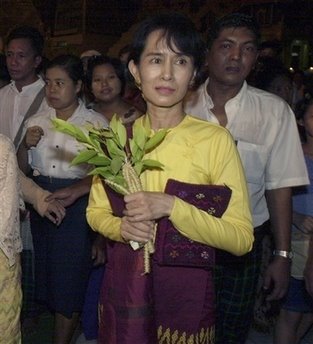


 Posts


