Japan may set a two-stage approval process for the Cabinet before lifting the self-imposed ban on exercising the right to collective self-defense, ruling party sources said Thursday, as the outlook remains uncertain for the ruling bloc to reach an early agreement over the controversial issue. The New Komeito party has proposed to the Liberal Democratic Party of Prime Minister Shinzo Abe that the Cabinet first approve a roadmap of legal challenges that need to be tackled, and then what steps Japan will take, including reinterpreting the Constitution to allow the exercise of the right to collective self-defense, the sources added. The two-stage process would enable the government to make necessary preparations to draft legislation after the first stage, while New Komeito can buy time and put off what could be the most contentious issue of deciding whether Japan should defend allies under armed attack in collective self-defense. The plan has been floated as a compromise for the ruling parties to avoid a rift and some LDP lawmakers have expressed their support, although the government has yet to give the nod, according to the sources. Tokyo is seeking early approval in time for the planned revision to Japan-U.S. defense cooperation guidelines by the end of the year, and hopes to revise relevant laws from an extraordinary Diet session in the fall. In the first round of approval, the Cabinet would recognize a set of domestic legal challenges in three major areas -- how to handle "gray zone" incidents that are not considered full-fledged military attacks on Japan, U.N. peacekeeping and collective security operations, and whether to exercise the right to collective self-defense, the sources said. The LDP and the junior coalition partner New Komeito started their debate earlier this week on reworking Japan's legal framework amid security threats from an assertive China and North Korea's nuclear and missile development programs. The parties have already decided to focus on "gray zone" incidents first, rather than tackling the controversial issue of collective self-defense from the start. Some New Komeito lawmakers have suggested the ruling bloc should not wait until they can agree on all of the three areas to start drafting legislation, but the LDP has insisted that the three should be a package. Prime Minister Abe is seeking to secure the support of the ruling parties for lifting the self-imposed ban by a Cabinet decision, but New Komeito remains cautious about reinterpreting the war-renouncing Article 9 of the Constitution that has never been amended since 1947. Japan has maintained it has the right to collective self-defense but cannot exercise it due to the constraints of Article 9. In a report submitted to Abe last week, a panel of security experts argued that collective self-defense falls under "the minimum" level of defense allowed under the supreme law and called for changing the current interpretation. ==Kyodo Copyright 2014 Kyodo News International. All rights reserved. This material may not be published, broadcast, rewritten, or redistributed. http://www.globalpost.com/dispatch/news/kyodo-news-international/140522/japan-may-set-2-stage-approval-cabinet-over-collective
Saturday, May 24, 2014


Thai Military Consolidates Coup
Deposed prime minister Yingluck Shinawatra appeared before Thailand's governing junta council on Friday, one day after the military announced it had taken power in a coup. She is among the 155 political figures summoned by the National Peace and Order Maintaining Council who have been prohibited from leaving the country without permission (Bangkok Post). Army chief General Prayuth Chan-ocha addressed the civil service, calling on their help in implementing reforms before "return[ing] power to the people." Meanwhile, a nationwide curfew was in force as protestors were dispersed, though some dissent was seen in Bangkok, and television stations have had their programming replaced by the military's (Reuters). The United States declared the takeover a coup, which could prompt curtailed aid and military relations (WSJ). Analysis "In the nation's capital, troops and police officers appear to be exercising restraint. Let us hope this continues, for there is a long history of rights violations under martial law in Thailand. In some 30 of Thailand's 76 provinces, martial law was already in place before Tuesday, in some cases for years. Extrajudicial executions, deaths in custody, enforced disappearances and torture have been documented under military jurisdiction. There has been almost no accountability for these violations," writes Sam Zarifi in the New York Times. "Whatever appointed government is put into place by the military likely will launch reforms that, in theory, could help cleanse Thailand's political system of graft and vote buying but that, in reality, will be designed to try to ensure the Shinawatras and their political base are disempowered once and for all. This will not be an easy task; in fact, it is probably impossible. The supporters of Puea Thai include both the majority of Thais and a small, hardened minority of activists who will be willing to fight the Thai military in Bangkok or in upcountry towns," writes CFR's Joshua Kurlantzick. "If the coup results in the military's unilateral appointment of a new prime minister who is unacceptable to the Thaksin side a further escalation is bound to occur. Yet such bleak predictions belie the potential for progressive change that lies at the heart of all crises. Rather than seeing Thailand's troubles as a decline one might equally interpret them as a negotiation of a new social contract ahead of a sea change in the structure of the Thai state," writes Serhat Ünaldi in the Diplomat.
Friday, May 23, 2014
China's Xi Warns Asian Countries on Military Alliances
May 21, 2014 2:54 AM Chinese President Xi Jinping warned Asian countries against building what he sees as unhelpful military alliances, in what is seen as a swipe at nations that have developed closer defense ties with the United States. The comments came Wednesday in Shanghai at the Conference on Interaction and Confidence-building Measures in Asia (CICA), a regional grouping China hopes to use to offset U.S. influence. "We should stick to the basic norms in international relations such as the respect for the independence of sovereignty and integrity of territory, mutual non-interference into internal affairs. We should respect the political systems and development methods different countries choose willingly. We should respect and look after the reasonable security concerns of every country. It is disadvantageous to the common security of the region if military alliances with third parties are strengthened,” said Xi. Many of China's neighbors have boosted their military cooperation with the U.S. in response to what they see as China's increasing use of force and intimidation in its many territorial disputes. In particular, Beijing's maritime spats with Vietnam and the Philippines in the South China Sea and Japan in the East China Sea have worsened in recent months. During a visit to Asia last month, President Barack Obama sought to reassure allies such as Japan and the Philippines that his long-promised strategic shift towards Asia and the Pacific, widely seen as aimed at countering China's rising influence, was real. The CICA grouping includes Vietnam, while the Philippines and Japan are not members but had representatives at the meeting. The group also excludes the U.S., while including nations such as Iran and Russia. Anti-Chinese violence flared in Vietnam last week after Chinese state oil company CNOOC deployed an oil rig 150 miles off the coast of Vietnam in waters also claimed by Hanoi. The rig was towed there just days after Obama left the region. The move was the latest in a series of confrontations between China and some of its neighbors over the potentially oil-and-gas rich South China Sea. Washington has responded with sharpened rhetoric toward Beijing, describing a pattern of “provocative” actions by China. The CICA is relatively obscure in comparison to other Asian regional groupings, such as the Asia-Pacific Economic Cooperation (APEC) or the Association of Southeast Asian Nations (ASEAN), but Beijing, which took over as chair of the CICA from Turkey this week, hopes to use the group and others like it to help expand Chinese influence across the region. President Xi said the grouping should help create a "new regional security cooperation architecture." Although he provided few details, he said this could include a "defense consultation mechanism" and a "security response center" in case of regional emergencies. Addressing China's territorial feuds, he said Beijing is "committed to seeking peaceful settlement of disputes with other countries over territorial sovereignty, and maritime rights and interests." State broadcaster China Central Television aired the arrival of various leaders for the meeting live, but, underscoring the sensitivity of China's territorial disputes, it cut away from images of Xi shaking hands with the representatives from Vietnam, the Philippines and Japan. Chinese President Xi Jinping warned Asian countries against building what he sees as unhelpful military alliances, in what is seen as a swipe at nations that have developed closer defense ties with the United States. The comments came Wednesday in Shanghai at the Conference on Interaction and Confidence-building Measures in Asia (CICA), a regional grouping China hopes to use to offset U.S. influence. "We should stick to the basic norms in international relations such as the respect for the independence of sovereignty and integrity of territory, mutual non-interference into internal affairs. We should respect the political systems and development methods different countries choose willingly. We should respect and look after the reasonable security concerns of every country. It is disadvantageous to the common security of the region if military alliances with third parties are strengthened,” said Xi. Many of China's neighbors have boosted their military cooperation with the U.S. in response to what they see as China's increasing use of force and intimidation in its many territorial disputes. In particular, Beijing's maritime spats with Vietnam and the Philippines in the South China Sea and Japan in the East China Sea have worsened in recent months. During a visit to Asia last month, President Barack Obama sought to reassure allies such as Japan and the Philippines that his long-promised strategic shift towards Asia and the Pacific, widely seen as aimed at countering China's rising influence, was real. The CICA grouping includes Vietnam, while the Philippines and Japan are not members but had representatives at the meeting. The group also excludes the U.S., while including nations such as Iran and Russia. Anti-Chinese violence flared in Vietnam last week after Chinese state oil company CNOOC deployed an oil rig 150 miles off the coast of Vietnam in waters also claimed by Hanoi. The rig was towed there just days after Obama left the region. The move was the latest in a series of confrontations between China and some of its neighbors over the potentially oil-and-gas rich South China Sea. Washington has responded with sharpened rhetoric toward Beijing, describing a pattern of “provocative” actions by China. The CICA is relatively obscure in comparison to other Asian regional groupings, such as the Asia-Pacific Economic Cooperation (APEC) or the Association of Southeast Asian Nations (ASEAN), but Beijing, which took over as chair of the CICA from Turkey this week, hopes to use the group and others like it to help expand Chinese influence across the region. President Xi said the grouping should help create a "new regional security cooperation architecture." Although he provided few details, he said this could include a "defense consultation mechanism" and a "security response center" in case of regional emergencies. Addressing China's territorial feuds, he said Beijing is "committed to seeking peaceful settlement of disputes with other countries over territorial sovereignty, and maritime rights and interests." State broadcaster China Central Television aired the arrival of various leaders for the meeting live, but, underscoring the sensitivity of China's territorial disputes, it cut away from images of Xi shaking hands with the representatives from Vietnam, the Philippines and Japan. Some information in this report was contributed by Reuters.
Is Collective Self-Defense in Japan's Future?
The environment in which Japan exists is changing. Tokyo must change along with it, or live at the mercy of others. Michael Mazza, May 20, 2014 inShare.1On Thursday, May 15, Japanese Prime Minister Shinzo Abe announced that his government was officially launching discussions on revising the constitution’s interpretation to allow for collective self-defense. That it was clear this was coming does not make the announcement any less momentous. For sure, Abe does not have a smooth path to updating the government’s interpretation of the Japanese constitution. The Liberal Democratic Party’s coalition partners are not keen on the change, there is resistance within the LDP itself, and Japanese voters remain skeptical. At the end of the day, however, the arguments for allowing collective self-defense are persuasive, and if Abe can continue delivering on his promise to revitalize the economy—first quarter GDP growth reached 5.9 percent, and a major fiscal stimulus is planned for the second quarter—he just may get his way. A primary argument from the opposition is that permitting collective self-defense will inevitably lead to Japanese involvement in overseas conflicts in which the country has little at stake. The argument is both alarmist and assumes an exceedingly narrow definition of the national interest. It has become clear that a broadened interpretation of the constitution would put well-defined limits on when Japanese forces could act to defend others. Opening the door to collective self-defense does not constitute a blank check for armed intervention abroad. According to the Japan Times, a government panel that studied the issue concluded that Japan should aid another under attack “if such an attack could lead to a direct attack to Japan, critically damage the Japan-U.S. military alliance, considerably affect the international order, or remarkably damage the life and rights of the Japanese people.” None of these is a peripheral interest. Rather, Abe and his advisers see the right to exercise collective self-defense as necessary to ensure the security and prosperity of Japan as well as regional peace. Regional peace, meanwhile, increasingly appears to hang in the balance. China is antagonizing its neighbors and testing the United States at a troubling clip. Pyongyang is testing missiles and threatening to detonate a nuclear device while the two Koreas exchange artillery fire in the Yellow Sea. Tens of thousands of Taiwan’s citizens recently took to the streets to protest closer ties to mainland China. And right now, ships are firing water cannons at and ramming each other off the Vietnamese coast, while Chinese vessels attempt to starve out Philippine marines on Second Thomas Shoal. An incident leading to escalation—either unwanted or intentional—is no distant possibility. Japan’s current leadership knows that Japanese interests extend far beyond the southern Ryukyu islands. That Abe should want tools to defend Japanese interests further afield—whether it be to ensure continued freedom of navigation or protect an Asian order in which states do not resort to aggression to achieve their ends—should come as little surprise. Still, although pursuing a revised interpretation of the constitution is both natural and rational, it is also revolutionary. Even if applied in only a very narrow range of scenarios, exercising the right to collective self-defense will be a monumental change for a country that has more or less outsourced its own self-defense since the end of World War II. There are implications for defense spending and for the types of forces Japan fields—for how they train, how they operate, and how they interact with foreign militaries. There are implications for Japan’s foreign policy—for the types of relationships it pursues and the defense agreements it forges. Finally, there are even implications for Japan’s identity. Japan’s people have defined their country as a pacifist one for decades. But should the Maritime Self-Defense Forces one day lawfully come to the defense of a U.S. warship under attack or of a Korean freighter beset by Somali pirates, there will naturally be questions about just what it means for Japan to be “pacifist.” None of this is to say that Abe is acting rashly or impulsively. Rather, he has recognized that the environment in which Japan lives is changing. Japan must change along with it or live at the mercy of others less hesitant to shape the world to their own desires. Michael Mazza is a research fellow at the American Enterprise Institute. Follow him on Twitter: @Mike_Mazza.
Tuesday, April 5, 2011
Tuesday, November 30, 2010
News & Articles on Burma-Monday, 29 November, 2010-ZIN LIN
News & Articles on Burma
Monday, 29 November, 2010
-----------------------------------------------------
Local Journalists Barred from UN Envoy's Press Conference
Only Than Shwe Can Get West to Lift Sanctions
Myanmar forges new trade highway
UN envoy Nambiar asks Myanmar junta to address global concerns
Suu Kyi hopes for UN dialogue
Top junta officers tour front line bases
Security tightened in Kachin capital
MYANMAR: Border guard plan could fuel ethnic conflict
Suu Kyi seeks to review sanctions
Border traders hope for reopening
Refugees Again Pour Into Thailand after Fighting Resumes
Tycoon Zaw Zaw Reportedly Gets Dawei Port Contract
---------------------------------------------------
Local Journalists Barred from UN Envoy's Press Conference
By THE IRRAWADDY Monday, November 29, 2010
Journalists from private media groups in Burma were not allowed to attend a press conference of a United Nation's special envy to Burma held before his departure on Sunday evening, according to sources.
Vijay Nambiar, the chief of staff for UN Secretary-General Ban Ki-Moon, spoke to foreign reporters inside the international airport in Rangoon about 5 pm, as he was ending a two-day visit in which he met with both government officials and recently released pro-democracy leader Aung San Suu Kyi.
Sources said about 20 domestic reporters with official press credentials were not allowed to enter the airport by security personnel. Members of the Rangoon-based foreign correspondents club, however, were permitted to attend the press conference, they said.
On Sunday, the military regime's Press Scrutiny and Registration Division (PSRD) reportedly informed news journals that the UN special envoy would hold a press conference and the time and place would be announced later.
“Of course reporters were very interested in such an event and hopeful that they would be able to attend,” said a Rangoon-based reporter.
He said the PSRD never informed them, but they were able to learn the location and time. However, security personnel blocked their access to the press conference.
“Security was just an excuse. Reporters should be allowed to get in if they can identify themselves. Reporters from foreign media were allowed, but those from domestic media weren't. That's intentional and mean,” said an editor from a Rangoon-based news journal.
Reporters who were denied access included staff from The Myanmar Times, 7 Day, Venus, The Voice, True News, Weekly Eleven and other news journals.
“We face difficulties in collecting news because the army, police and local authorities all restrict us from doing so. Even if we have news, we have to go through the PSRD before we publish it. We are working under very tight control. The situation may become worse when the new government lead by the Union Solidarity and Development Party (USDP) takes office,” said a reporter, who asked to remain anonymous.
The PSRD suspended nine private journals last week for publishing news about Aung San Suu Kyi that did not follow its guidelines. http://www.irrawaddy.org/article.php?art_id=20206
--------------------------------------------------
EDITORIAL
Only Than Shwe Can Get West to Lift Sanctions
Monday, November 29, 2010
Recently, The Irrawaddy published a news piece under the headline “West Waits for Suu Kyi Sanctions Signals.”
“American and European business organizations are reconsidering their position on Burma following the freeing of Aung San Suu Kyi,” the article said, reporting on the growing sense of anticipation that the Nov. 13 release of the Burmese pro-democracy icon might bring an end to a decades-old ban on doing business with the country's military rulers.
“It’s fairly clear that the sanctions haven’t brought political change, but instead have outsourced jobs from US firms to their competitors in other countries that trade freely with Myanmar [Burma],” the article quotes Tami Overby, the US Chamber of Commerce's vice president for Asia, as telling The Wall Street Journal.
“American firms would urge Congress and the [Obama] administration to consider easing the sanctions if Ms. Suu Kyi and the opposition signal an openness to revisions in the sanctions regime,” Overby added.
These remarks betray once again the misguided view held by many in the West that Suu Kyi holds the keys to removing the sanctions against the Burmese junta. Instead of putting this burden on the shoulders of Burma's democratic opposition leader, critics of sanctions should be asking what the regime itself has done to give Western countries a reason to shift their policy.
The answer, of course, is precious little. Suu Kyi has been freed, but that still leaves more than 2,000 other political prisoners languishing in Burma's gulag. If the regime had any interest in getting the West to drop its sanctions, it would, at the very least, unconditionally release all of these detainees.
Sanctions-bashers occasionally pay lip service to the plight of Burma's prisoners of conscience, but their real concern is clearly that they are losing investment opportunities to China and the junta's other greedy regional “partners”.
While sanctions critics often insist that an influx of foreign capital would raise Burma's standard of living, the evidence suggests otherwise. The massive flow of cash coming into the country from around Asia has done nothing to alleviate the desperate poverty of ordinary Burmese, and there's no reason to believe that Western cash would have a more beneficial impact.
Increasingly, however, Western corporations are feeling that they are missing the boat in Burma, and so they are reviving tired old arguments about how their presence in the country would somehow enlighten the generals by introducing them to the ways of the West.
From a purely profit-driven perspective, it's hard to blame them for wanting a piece of the action. China, Thailand, India, Singapore and South Korea have all heavily invested in Burma's primary industries, and new opportunities are opening up in other sectors, including manufacturing.
Chinese companies alone invested US $8 billion in Burma in the first six months of this year, mostly in gas, oil and hydroelectric development projects, according to a Reuters report based on official Burmese statistics.
And neighboring Thailand has even bigger ambitions, with plans to develop a deep-sea port and 64,000-hectare industrial zone in Tavoy, in southern Burma's Tenasserim Division.
The framework concession agreement on the project, signed between Bangkok-based Italian-Thai Development and the Burmese Port Authority, is worth $13.4 billion and is expected to transform the area into a major transport and manufacturing hub.
“We need tons of workers,” said Italian-Thai's president, Premchai Karnasuta, in a recent article by The New York Times. “We will mobilize millions of Burmese.”
What's missing from this, however, is any discussion of how such investment will improve lives in a country that was once one of the most developed in the region, but has since been reduced to a shambles by its inept and avaricious rulers.
Just as they think nothing of locking people up for expressing their opinions, Burma's rulers don't seem too concerned about most citizens' lack of access to basic health care and education. As long as this remains the case, there is no reason to believe that lifting sanctions will serve any purpose other than to enrich Western corporations and, of course, the generals.
So why hold Suu Kyi responsible for the sanctions policy? Although she widely seen as the voice of her people, she is not the conscience of the West, which is obliged by its own professed values, and not the views of one woman, to insist that Burma's rulers respect the rights of its people.
http://www.irrawaddy.org/opinion_story.php?art_id=20203
------------------------------------------------
ASIA TIMES ONLINE: Nov 30, 2010
Myanmar forges new trade highway
By Clifford McCoy
A multi-billion dollar port and infrastructure deal signed days before Myanmar's general election early this month could signal sweeping changes to the country and the wider region, while also serving as a pointer of how business may prosper under the new "civilian" but still military dominated regime.
The Dawei Development Project agreement between Myanmar and Italian-Thai Development, Thailand's largest construction company, will lead to construction of a deep-sea port and highway linking the two countries, and looks likely to bring to fruition a plan that has been around for more than a decade.
In May 2008, the idea gained new traction when a memorandum of understanding (MOU) was signed by then-Thai foreign minister Noppadon Pattama and Myanmar Foreign Minister Nyan Win on the sidelines of an Association of Southeast Asian Nations (ASEAN) foreign ministers' meeting in Singapore.
This was followed on October 11 this year by an agreement between Thai Prime Minister Abhisit Vejjajiva and Myanmar Prime Minister Thein Sein in the Myanmar capital of Naypyidaw following talks on the development of the port as a special economic zone.
On November 2 - five days before the Myanmar elections - a deal was signed for the port and infrastructure project between Premchai Kratasuta, chairman of Italian-Thai Development, and Myanmar Port Authority managing director Thein Htay in Naypyidaw.
Italian-Thai in 2008 won a contract from the Myanmar government to survey and build a road linking Dawei with the central Thai city of Kanchanaburi.
Myanmar state media announced at the same time as the signing of the latest deal that a 40,000 hectare plot around Dawei would become Myanmar's first special economic zone (SEZ). In exchange for developing the project, the Myanmar government has granted Italian-Thai import duty exemptions, a 75-year concession to build and operate the heavy industrial portion of the project and a 40-year concession for the light industry part. The concessions can later be extended or revert to Myanmar control. Some observers say the entire project could be worth more than US$58 billion, making it Myanmar's largest singe investment project.
The Dawei Development Project consists of three phases: the construction of a transportation corridor to Thailand as well as roads linking the public utilities and facilities in the industrial zone; the port; and the industrial estate. The first stage is expected to take five years and the final two stages are expected to take another five years with total project completion expected in 2020.
Construction on an eight-lane highway linking the port to the central Thai city of Kanchanaburi is already underway and work is expected to begin on the port in Myanmar in January. Italian-Thai has said the first phase of the project will cost $8 billion with financing already secured from an unnamed private bank. The Thai government is also contributing $60 million toward the highway. The highway from the port will lead 130 kilometers to the Thai border, then on to Kanchanaburi. A rail line will be built parallel to the new road.
Construction plans for Dawei port, the second phase of the project, allow for 22 wharves capable of handling up to 25 vessels at a time of from 20,000 to 50,000 tonnes. Other sources say the port will be capable of handling vessels as large as 300,000 tonnes.
The third phase of the project is the construction of a 40,500-hectare industrial estate. Once completed, the estate will have seven zones; port and heavy industry, petroleum and chemical complex, upstream and downstream petrochemical complex, medium industry, light industry, and a town with homes, public facilities and a commercial complex.
The new port will be offer a shortcut between Europe and the Middle East and Asia. Cargo unloaded at Dawei will avoid the necessity of transiting the Malacca Strait. Several thousand kilometers and up to 10 days could be cut from transit times, lowering transportation costs.
The new port connects with the three economic corridors of the Asian Development Bank's Greater Mekong Sub-Region development project, which aims to create links between the economies of mainland Southeast Asia and China.
Through Myanmar's road network, goods can be shipped north to Moulmein where it intersects the East-West Economic Corridor (EWEC) through Moulmein, the Myanmar border town of Myawaddy and its Thai counterpart, Mae Sot, through Thailand to Savanakhet in Laos and finally the Vietnamese port of Danang.
To the east, the new transport corridor connects through Bangkok with both the Southern Economic Corridor (SEC) and the North-South Economic Corridor (NSEC). The SEC connects Bangkok with Phnom Penh and the port of Sihanoukville in Cambodia and Ho Chi Minh City and Vung Tau port in Vietnam. The NSEC links southwestern China and Thailand by routes passing through northern Myanmar and Laos. China is currently funding and facilitating the construction of a railway from Kunming through Laos to the Thai railhead at Nong Khai.
These links represent important trade routes for Chinese goods from its landlocked southwest. They also provide a more rapid route for Vietnamese, Cambodia and Thai goods to Europe by avoiding the journey around Singapore. Plans have also been proposed for a Chinese funded railway linking the new port with China directly through Myanmar.
Support for the project was given a boost by the five members of the Ayeyawady-Chao Phraya-Mekong Economic Cooperation Strategy (ACMECS) which met for their fourth summit on November 17 in Phnom Penh. ACMECS is a working framework covering Cambodia, Laos, Myanmar, Thailand and Vietnam aimed at bridging economic gaps between the countries. The group agreed to support the development of a so-called South-South Economic Corridor linking Dawei port with southern Thailand and Malaysia. The route would be linked by rail to the China-Laos railway and a $6.6 billion Chinese-funded railway project from Nong Khai through Bangkok to Padang Besar in northern Malaysia.
Thailand seems to have the most to gain from the Dawei project. Bangkok has aspirations of becoming a regional transportation hub. Thailand remains as Myanmar's top investor as of mid-2010 with some $10.3 billion in projects.
Several Thai companies are involved as sub-contractors or have expressed interest in becoming involved in the project. Amata Corporation has been named as the developer of the industrial estate for which, together with Italian-Thai, the company has carried out a two-year feasibility study. A subsidiary of state-owned PTT Chemical, Thai Tank Terminal, has also expressed interested in operating a storage terminal near the port. Siam Cement Group, Thailand's third-largest company by market value, is also interested in setting up a cement plant at the port. Bangkok Bank is reportedly interested in offering loans for the project.
Contributing reasons for such interest in developing the port are cheap labor and the lax or non-existent environmental laws in Myanmar. Recent environmental laws in Thailand sparked by public concern have slowed expansion of the country's Map Ta Phut petrochemical complex.
A proposal for a project to expand Pak Bara port in Satun province on Thailand's west coast and link via a land bridge to the port of Songkhla on the eastern coast failed to win approval from the office of the National Economic and Social Development Board after protests against the plan in July.
Italian-Thai is seeking investment partners for the Myanmar project and investors from Japan, Taiwan, China, India and South Korea have all reportedly shown interest. The Bangkok Post reported on November 14 that Abhisit sought support for the project on the sidelines of the Group of 20 meeting in Toronto in June. He reportedly encouraged Chinese companies to invest in projects in Amata's planned industrial estate.
For Myanmar, the benefits will come in the form of tens of thousands of jobs that will become available for construction of the project as well as later in the factories and refineries. Myanmar's government will benefit directly from a profit-sharing agreement with Italian-Thai, although the exact terms have not yet been made public.
Not all predictions for the Dawei port project are rosy. Proving the efficiency of these links will be important. Singapore port's proven efficiency could be a problem for the new port. In order to convince shippers that they will truly be saving time and money through the use of Dawei, goods will have to be processed and transshipped to truck and rail carriers speedily. Much also depends on the quality of the rail and road links slated to connect to the port.
Myanmar's road networks are notoriously bad. The portion of the EWEC from the Thai border, funded by Thailand and under construction by Thai companies, is still far from complete after several years of construction.
The routes also run through territory where guerrillas from the Karen National Union operate. They have been largely quiet in the past few years, but renewed pressure on the ethnic groups after the recent elections could result in renewed fighting. The New Mon State Party (NMSP) also has troops in the area. The NMSP's relationship with the government is tenuous after it rejected the regime's plan earlier this year to convert its armed wing into a Border Guard Force under army control before the November 7 elections.
In an example of what could happen, rebel soldiers took over the major border crossing at Myawaddy and a lesser one at Three Pagodas Pass on November 7. The road linking Myawaddy with Moulmein, part of the EWEC, has been the scene of insurgent ambushes in the past and a new route from Dawei could be equally as dangerous as it passes through territory where both the insurgent Karen National Union and the NMSP operate.
There are also concerns about possible human rights violations associated with the project. Numerous human rights reports in the early and mid-1990s detailed the use of tens of thousands of villagers as forced labor on an extension of the Myanmar rail network from the town of Ye to Dawei. Human rights groups allege villagers, including women and children, were forced to work without pay, denied medical attention and beaten and raped by soldiers.
The construction of the Yadana gas pipeline to Thailand by oil and gas companies Total of France and Unocal the United States in the same area drew even more criticism. Extensive documentation of human rights abuses linked to the project during its construction between 1995 and 1998 was produced by rights organizations. A court case in the United States against Unocal was settled out of court for an undisclosed amount of money. Unocal was later bought by Chevron.
Rights groups allege civilians were forcibly relocated to make way for the project and a security corridor around it without compensation. They were also conscripted for forced labor supporting the numerous battalions brought into the area to provided security for the oil companies and the pipeline. According to environmental and human rights organization EarthRights International, some 36,000 villagers were relocated to secure a corridor for the pipeline.
The Independent Mon News Agency, an exile media group, has already reported that its sources indicate the Dawei port project will be constructed where five villages are currently located. Although the inhabitants of the villages have yet to receive orders to relocate, in Myanmar where the government has a history of relocating people for "development" projects with little to no compensation, there is much worry.
The Dawei Development Project, if managed correctly, could be a boon for Myanmar as well as the region. However, as it seems to be shaping up, the project appears based on motives of exploiting Myanmar's cheap labor and environmental laws. While the jobs may be welcome, in the long run it may only be regional companies and Myanmar's generals who profit
Clifford McCoy is a freelance journalist. http://www.atimes.com/atimes/Southeast_Asia/LK30Ae01.html
-----------------------------------------------
UN envoy Nambiar asks Myanmar junta to address global concerns
Press Trust Of India
Yangon, November 29, 2010
First Published: 16:42 IST(29/11/2010)
Last Updated: 16:46 IST(29/11/2010)
The UN special envoy to Myanmar, Vijay Nambiar, has pressed the country's ruling military junta to address global concerns over the recent elections here to lay the foundation for a "credible transition" to democracy and national reconciliation. Wrapping up his two-day visit here, Nambiar, who is
also UN Secretary General Ban Ki-moon's chief of staff, told reporters that he has urged the Myanmar government and the Union Election Commission to address as transparently as possible the concerns about the process and outcome of November 7 elections.
"Strong concerns are expressed by many parties about the process and outcome of the recent elections which I have urged the government and the Union Election Commission to address as transparently as possible," Nambiar said yesterday. "This is important for laying the foundation for a credible transition (to democracy)," he said.
The military has ruled Myanmar since 1962 and the recent elections were widely criticised as sham, with alleged vote-rigging in favour of the military-backed Union Solidarity and Development Party, which received a sweeping majority in both houses of Parliament.
Nambiar, a former Indian diplomat who was appointed UN special envoy to Myanmar earlier this year, also called for the government to release "some of the political prisoners who remain in detention." He said he listened to as many parties as possible about their "hopes, expectations and concerns at this critical juncture" following the polls and the release of opposition leader Aung San Suu Kyi from house arrest.
"In order to succeed, any political transition should be broad-based and inclusive and involve not only those who participated in the elections but also those who could not or did not.
In this connection, I also call for the release of some of the political prisoners who remain in detention," Nambiar was quoted as saying by Kyodo news agency. Nambiar, who arrived in Myanmar on Saturday, met Suu Kyi for about 90 minutes, exchanging views on the current political situation.
He termed the meeting as "very valuable" but emphasised that many such meetings would be required to sort out all the problems facing the country. http://www.hindustantimes.com/News-Feed/myanmar/UN-envoy-Nambiar-asks-Myanmar-junta-to-address-global-concerns/Article1-632267.aspx
-------------------------------------------
Suu Kyi hopes for UN dialogue
By AGENCE FRANCE-PRESSE
Published: 29 November 2010
A senior UN official said yesterday that he had urged the Burmese government to address concerns over the country’s recent elections, which were widely dismissed as a sham.
Vijay Nambiar, the UN Secretary General Ban Ki-moon’s chief of staff, said at the end of his two-day Burma visit that “strong concerns were expressed by many parties about the process and outcome of the recent elections”.
He said he had urged the government and the election commission to address these “as transparently as possible”.
“This is important for laying the foundation of a credible transition” to democracy, he added, saying he had also called for the release of Burma’s political prisoners, believed to number more than 2,000.
The junta’s political proxy has claimed an overwhelming victory in the controversial 7 November poll – Burma’s first in two decades – amid opposition complaints of cheating and voter intimidation.
Critics say the vote was a charade aimed at preserving the rule of the military junta, and Ban has said the poll was “insufficiently inclusive, participatory and transparent”.
During his visit, Nambiar also met members of the opposition movement including Aung San Suu Kyi, who was released from seven years of house arrest on 13 November, less than a week after the election.
The democracy icon, detained for much of the past 20 years and sidelined during the poll, said on Saturday that the discussion had been enlightening but hoped it was the first of many.
“I think we may need many and frequent meetings to sort out all the problems that… the United Nations is dealing with at the moment in Burma,” she said.
Suu Kyi’s National League for Democracy (NLD) party boycotted the vote because of rules that appeared to exclude the dissident from participating and was subsequently disbanded by the junta. The party won the previous vote in 1990 but was never allowed to take power.
http://www.dvb.no/news/suu-kyi-hopes-for-un-dialogue/13125
---------------------------------------------------
Top junta officers tour front line bases
Monday, 29 November 2010 15:52 Hseng Khio Fah
Top military officers had made a trip to areas on the Sino-Burma border facing ceasefire groups, Shan State Army (SSA) ‘North’, the United Wa State Army (UWSA) and National Democratic Alliance Army (NDAA) aka Mongla group, according to local sources.
They included Joint Chief of Staff, Lt-Gen Min Aung Hlaing, former Commander of Shan and Kayah states, Maj-Gen Aung Than Htut, Commander of No.2 Bureau of Special Operations, former Northeastern Region Command Commander and Maj-Gen Kyaw Swe, Chief of Military Affairs Security (MAS) and former commander of Southwest Region Command who made a 3 day inspection of front line bases in Shan State East and North from 24 to 26 November.
Lt-Gen Min Aung Hlaing
“Altogether there were four of them. But the 4th officer was not unidentified. Some said he was Tin Aung Myint Oo, State Peace and Development Council (SPDC) Secretary 1,” a source said.
The four traveled by helicopter and landed at Monglai, southwest of Mongyawng Township, opposite the National Democratic Alliance Army (NDAA)’s 911th Brigade base, on 24 November.
On the next day, they went through Mawfa (now known as Markmang)to Tangyan, 115 miles west of UWSA’s Headquarters Panghsang and reportedly met Tangyan Area Commander and all battalion commanders in the township, a local source said.
Afterwards, the team continued the trip to Kunlong, north of the Wa-controlled territory and turned back to Shan State North’s capital Lashio on 26 November. “They held a meeting with Laogai Regional Operations Command (ROC), Military Operations Command (MOC) #16 of Hsenwi and Northeastern Region Command commander Aung Kyaw Zaw,” a source close to the junta said.
Details of the discussion were unknown, but it was believed to be in connection with the ceasefire groups that had refused to become Border Guard Forces (BGFs) and later to surrender.
Over 50 military trucks from Lashio carrying weapons and supplies were seen heading to Kunlong on the next day, a source said. “It is not certain whether the move was connected to the 26th November meeting or not,” he added.
According to an unconfirmed report, the military junta is planning to invite the UWSA to another meeting. “General Khin Nyunt (who was ousted in 2004) could be the negotiator,” a Thai source speculated. Khin Nyunt had in 1989 successfully negotiated ceasefire pacts with the groups.
The ruling military junta had severed relations with the UWSA, NDAA, Shan State Army (SSA) ‘North’ and Kachin Independence Army (KIA) since 1September, when the groups refused to disarm. http://shanland.org/index.php?option=com_content&view=article&id=3340:top-junta-officers-tour-front-line-bases&catid=86:war&Itemid=284
---------------------------------------------
Security tightened in Kachin capital
By DVB
Published: 29 November 2010
Privately-owned shops are being forced to close and visitors restricted from moving around Kachin state capital Myitkyina as the Burmese army ups pressure on a ceasefire group there.
Around 30 shops were forced to close over the weekend, a Myitkyina resident told DVB. The majority of these were near to a Burmese army outpost and military training school.
“Apparently [it was done] for internal security in the army – to prevent being [sabotaged] whilst waging war at the frontline,” the man said. Tension is high between the ruling junta and the Kachin Independence Army (KIA), which has refused to transform into a pro-government border militia.
He added that commander-level army officials were not allowed to bring visitors to the outpost, while all civilians were banned from entering.
It follows heavy fighting earlier this month in Karen state, when forces from a breakway faction of the Democratic Karen Buddhist Army (DKBA) captured key government positions in Myawaddy.
Last week an order was sent from Naypyidaw to the headquarters of the Kachin Independence Organisation (KIO), the political wing of the KIA, ordering it to close down all but three of its offices in the northern Burmese state. A key trade route that serviced KIA territory with goods from China was also blocked by the military.
That followed the death of two Burmese army troops, who were killed on 22 November after stepping on a landmine allegedly laid by the KIA. The incident has ratcheted up animosity between KIA and the junta, who agreed a ceasefire in the mid-1990s that now appears tenuous.
http://www.dvb.no/news/security-tightened-in-kachin-capital/13119
------------------------------------------------
MYANMAR: Border guard plan could fuel ethnic conflict
Photo: Chandler Vandergrift/IRIN
Some 20,000 Burmese fled to Thailand earlier this month
BANGKOK, 29 November 2010 (IRIN) - Efforts by Myanmar’s military government to incorporate that country’s numerous armed ethnic groups into a single border guard force will probably lead to further conflict and spawn an influx of refugees into neighbouring countries, analysts and aid workers warn.
Myanmar, with an estimated population of 57.6 million, is one of the most ethnically diverse countries in Southeast Asia.
“Tensions are building as SPDC [government] troops are trying to control border crossings and incorporate the ethnic groups into a border guard force,” K’Nyaw Paw, an advocacy team leader of the Forum of Burma’s Community-Based Organizations, said. “We are preparing for more refugees as fighting can happen at any time.”
Under Myanmar’s military-drafted 2008 Constitution, all armed forces in the country must be placed under central military command - an ambitious undertaking in a country which has over a dozen armed ethnic groups (all but a handful of which have ceasefire agreements with the military government).
To achieve this, the regime has demanded that all of the ceasefire groups be incorporated into a Border Guard Force (BGF), which would entail disarming them, re-supplying them with government-issued weapons and making their troops subordinate to regional Myanmar military commanders.
To date, however, only two groups have agreed: the Democratic Karen Buddhist Army (DKBA) and the National Democratic Army-Kachin.
In August 2009, the refusal to join the BGF by one of the smallest ethnic factions in the country - the Myanmar National Democratic Alliance Army operating in the Kokang region of northern Shan State - resulted in a military offensive launched by government troops which led to more than 30,000 refugees fleeing over the border to China.
“The BGF is an indirect order [by the regime] for the ethnic groups to surrender their weapons,” said Zin Linn, a Burma analyst who lives in exile in Thailand.
“But without guns, the groups cannot defend their rights and their people so they will hold on to their guns until they gain autonomy and self-determination,” he said, adding that armed conflict will almost certainly break out and that refugees fleeing Burma will be “unavoidable”.
On 7 November, the day of Myanmar’s general elections, DKBA troops of Brigade 5 stormed the town of Myawaddy on the Burmese-Thai border and took over several key positions. Fighting for control of the town the next day led to some 20,000 people fleeing into Thailand, while clashes further south resulted in some 5,000 more refugees.
Although most of these refugees were repatriated to Myanmar within days, some 2,000 remain in hiding on the Myanmar side of the frontier, according to K’Nyaw Paw. “It is very difficult to access and get supplies to these people,” she said.
Renewed fighting on 27-28 November between DBKA Brigade 5 troops and government forces has sent some 1,200 more refugees into Thailand, according to reports.
Fear of government offensives
Meanwhile, other groups such as the Kachin Independence Army and the United Wa State Army are preparing for possible military retaliation by the government for refusing to join the BGF, say analysts.
“Fearing that [government troops] may launch another offensive similar to that in Kokang, the major ceasefire groups along the border have been building up their forces,” states a recent report by the International Crisis Group, a Brussels-based think-tank. “These groups see their weapons as the last source of leverage in their long-running battle for autonomy with the military government.”
“Both the Kachin and Wa are recruiting troops, training, and collecting arms and ammunition,” said Linn. “They are preparing for war.”
nr/ds/cb
----------------------------------------------
Suu Kyi seeks to review sanctions
By Ashish Kumar Sen
The Washington Times
6:50 p.m., Sunday, November 28, 2010
Democracy icon Aung San Suu Kyi wants to review the consequences of sanctions on her country, Myanmar, before she can determine whether these curbs need to be lifted or focused more sharply.
In a phone interview with The Washington Times from Yangon on Friday, Mrs. Suu Kyi said her National League for Democracy (NLD) party is "prepared to review the situation to find out if our people had really been hurt by the sanctions, and if they had been, in what way."
"We want to know if it's really time for sanctions to be lifted, or it's time for sanctions to be adapted," she said.
Mrs. Suu Kyi, who spent 15 of the past 21 years in detention, was released from house arrest on Nov. 13.
Last year, she sent a letter to Myanmar's ruling military generals suggesting that the NLD, the country's largest opposition party, may cooperate with them to bring about an end to sanctions.
The NLD periodically reviews the effectiveness of sanctions.
"If we find that the sanctions are only hurting the people and that there is no positive outcome as a result of the sanctions, then certainly we would consider calling on those who have imposed sanctions to think whether it is not time to stop them," Mrs. Suu Kyi said.
"But it is not as simple as all that," she said. "There are many, many aspects of sanctions undertaken by our supporters because they wanted to help us achieve the democratic process. So it is not as easy as saying, 'Well, we think that it's time for sanctions to be lifted.' "
While the Obama administration has initiated a senior-level diplomatic dialogue with Myanmar's authorities, sanctions continue to be an important tool of U.S. policy.
In July, a measure to extend sanctions on Myanmar sailed through Congress: The House passed the Burmese Freedom and Democracy Act of 2003 in a voice vote, and it garnered the support of 99 of the Senate's 100 members.
A congressional source, who spoke on the condition of anonymity citing the sensitive nature of the matter, said several members of Congress are looking to Mrs. Suu Kyi for guidance.
"If they see her taking a more pragmatic and conciliatory approach, it would create a lot more space for a more flexible position" in Congress on sanctions, the congressional source said.
Mrs. Suu Kyi doesn't think there is anything wrong with the two-pronged U.S. approach toward Myanmar, which also is known as Burma.
"I think engagement is a good thing. Whether or not it has an effect on the generals is something that you must ask [U.S. officials]," she said.
A U.S. official, who spoke on background citing the sensitive nature of the matter, said the sanctions provide an important source of leverage for influencing the regime's behavior.
The Obama administration intends to keep the sanctions in place until Myanmar's regime releases all political prisoners, ends attacks against ethnic groups and establishes a meaningful dialogue with opposition groups, the U.S. official said.
Human rights groups estimate that Myanmar is holding 2,100 political prisoners.
Mrs. Suu Kyi said the international community must work in coordination to be effective in dealing with Myanmar's military rulers. "That would help a great deal. I think at the moment there are different policies with regard to Myanmar and it does detract from the eventual effectiveness of various initiatives," she said.
China, India and Thailand and other countries have engaged Myanmar's military rulers with an eye on the country's vast natural resources.
This engagement raises the question whether the U.S. has diminished its influence in Myanmar and made its people more dependent on their neighbors, particularly China, the congressional source said.
In an address to India's Parliament in New Delhi this month, President Obama urged India to condemn the violation of human rights and suppression of peaceful democratic movements in Myanmar.
The junta barred the NLD from participating in the Nov. 7 elections, which the U.S. declared a sham.
The party won the last election in 1990 by a landslide, but the military prevented it from ruling.
Ahead of this year's election, the military imposed laws that forced political parties to expel members with criminal records, including political prisoners such as Mrs. Suu Kyi. The NLD was dissolved after it refused to abide by these laws.
Mrs. Suu Kyi, a Nobel peace laureate, said her party did not take part in the elections because it didn't think the rules and regulations were fair.
The NLD has since set up a committee to look into allegations of irregularities and vote-rigging.
Last week, Myanmar's supreme court refused to hear Mrs. Suu Kyi's lawsuit challenging the decision to dissolve the NLD.
Mrs. Suu Kyi said she intends to appeal the court's decision but is not confident that she will get justice.
"We have had much experience in the past to indicate that we don't get free and fair hearings. But still, since we believe in the rule of law, we will pursue this case as far as possible," she said. "At the same time, the survival of the NLD does not depend on any court of law; it depends on the will of the people."
Mrs. Suu Kyi expects the NLD will continue to play the role of a "very, very strong opposition force" and wants the party to broaden its engagement with pro-democracy forces within Myanmar.
"What people don't seem to realize is that we have had restrictions placed on the party for the last 20 years. That is nothing new for us," she said. "What is new is that we have a far larger circle of supporters than we used to have in the past."
As for the role of the army in politics, Mrs. Suu Kyi said she was open to the idea of a "transition period in which we would have to think of ways of bridging over our differences in gradual stages."
"We know that transition will take time and it will have to go in stages," she said.
She said it was too early to tell whether her release is a sign that the regime of Senior Gen. Than Shwe is having a change of heart.
"I have been released from house arrest before and then put back in. So I think it is a little too early to say whether there has been real a softening," she said.
Although she has expressed her readiness for reconciliation talks with the junta, the generals have not reciprocated.
"If they had reached out to us, we would have grasped their hands," Mrs. Suu Kyi said.
Mrs. Suu Kyi said her life has turned "very, very hectic" since her release. Despite being freed from the confines of her home, she hasn't had time to venture out of Yangon. Her days have been packed with meetings and interviews.
On Saturday, U.N. Secretary-General Ban Ki-moon's chief of staff, Vijay Nambiar, met her at her home in Yangon.
She also had an emotional reunion with her younger son, Kim.
"Seeing my son again was very, very nice and happy and lovely and all the nice words I can think of," Mrs. Suu Kyi said.
She said she has been struck by the large number of young NLD supporters.
"The proportion of young people among our supporters was not this high and they were not this enthusiastic" before she was put under house arrest, Mrs. Suu Kyi said.
She attributed the trend to the fact that "more and more people [in Myanmar] have come to realize that there is a need for change." http://www.washingtontimes.com/news/2010/nov/28/suu-kyi-seeks-to-review-sanctions/
---------------------------------------
Border traders hope for reopening
Recent ethnic skirmishes have failed to dampen rising Thailand-Burma commercial sentiment, as no serious strife has occurred for more than a decade and most area residents are business-focused.
* Published: 29/11/2010 at 12:00 AM
* Newspaper section: Business
Border trade between Thailand and Burma will likely continue to remain strong despite the small skirmishes of recent weeks as demand for goods and services from both sides of the border is resilient.
Burmese traders wait at the border gate at Tachilek to do business in Mae Sai district in Chiang Rai.
Wiroon Khampilo, the president of the Chiang Rai Chamber of Commerce, said border trade and tourism between Thailand and Burma were positive, particularly at the Mae Sai-Tachilek checkpoint. There have been no serious border skirmishes there between ethnic rebels and Burmese government troops for over 10 years.
Goods exported to Burma from Chiang Rai include oil, petrol, whisky, coffee and equipment. Imports are logs, beans and cashew nuts.
Mr Wiroon said Burma wanted to maintain peace and build a stronger economy.
"Most people focus on trading and business, so the border situation does not really affect their lives," he said. "Reconciliation would create a bright outlook for trade."
The volume of trade through Mae Sai-Tachilek rose by 56% from January to September over the same period last year. Thailand exported as much as seven billion baht worth of goods, consumer products and necessities to Burma, while imports at the checkpoint only totalled 100 million baht.
"We want to improve business by extending the checkpoints' hours of operation," he said.
The chamber initiated the proposal and it will be officially announced on Jan 1.
Arun Jargota, the owner of Mae Sai-based Laksamee stores, said overall trade and tourism were improving.
"More goods are coming from Mae Sot in Tak to Mae Sai in Chiang Rai due to the Mae Sot-Myawaddy checkpoint closure," he said.
"We will likely lose the Thai markets in Burma to China. We have been trading with Burma for a long time, but Thai exports to Burma will likely drop due to southern China's interference."
Burma closed the Mae Sot-Myawaddy crossing on July 18 after accusing Thailand of building an embankment on the Moei River to alter the common border line. Clashes between Burmese troops and Karen rebels earlier this month further increased security concerns and curbed trading.
Tak Chamber of Commerce president Banphot Korkiartcharoen does not know when the checkpoint there will reopen.
He said he did not believe the general election and the release of opposition leader Aung San Suu Kyi would do much for Thailand-Burma border trade one way of the other and called for help from others to reopen the border.
Local jewellers and restaurant owners said business was sluggish.
Mahataya Kasem, the owner of Angel Gems jewellery shop, said businesses at the Mae Sot shopping centre on the Moei river banks were suffering.
However, she still believes her business will improve because the area is renowned for quality gems.
"New Year is a good time for jewellery sales, and we hope that the Thai and Burmese governments will reopen the border crossing in time for festivities," she said.
Exports include oil, palm oil, used motorcycles, construction materials, fuel, diesel, petrol and consumer products, while imports involve furniture, wood, red onions, cows, clothes and seafood.
"Local people near the Tak border are conducting business through personal contacts despite the closure," she said.
Prasobsuk Puangsakorn, the director of the Bank of Thailand's Northern Regional Office, said the region's border exports grew fast in the third quarter.
Import values in the North fell by 2.4% following a sharp decline in imports of vegetables, fruits and capital goods. http://www.bangkokpost.com/business/economics/208619/border-traders-hope-for-reopening
-----------------------------------------------------
Refugees Again Pour Into Thailand after Fighting Resumes
By LAWI WENG Monday, November 29, 2010
Fighting broke out again at the weekend between government troops and a faction of the Democratic Karen Buddhist Army (DKBA), causing more than 1,000 refugees to flee into neighboring Thailand.
Karen refugees fled to the Thai border on Sunday after fighting broke out over the weekend in Phaluu village in Kawkareik Township between Burmese government forces and troops from Brigade 5 of DKBA, according to humanitarian organizations who are helping the refugees on the Thai border.
Speaking to The Irrawaddy on Monday, Naw Iris, the coordinator of the Thailand-based Committee for Internally Displaced Karen People said the refugees began coming on Saturday with many arriving on Sunday.
Many of the refugees are from Phaluu village about 40 kilometers south of the Mae Sot-Myawaddy border crossing on the Thai-Burmese border. They are currently taking shelter at a Buddhist temple and Thai school in Pop Phra District in Thailand's Tak Province.
The fighting started at 8:30 p.m. On Friday and lasted through the night and all Saturday after DKBA troops ambushed junta troops, said a Phaluu villager who fled to Thailand.
“The fighting was not close but we could hear explosions, which is why we ran away,” the woman said, adding that all the villagers had abandoned Phaluu.
Humanitarian organizations including the Thailand Burma Border Consortium and International Red Cross and the Thai authorities are helping the refugees, who will return home as soon as fighting in the village has stopped as it is harvest time, Naw Iris said.
The fighting began when DKBA troops led by Lt Col Kyaw Thet ambushed junta troops attempting to send rations to troops that seized former DKBA Brigade 5 headquarters at Waw Lay village on Nov. 10, burning the homes of DKBA members.
Prevented from getting through with supplies, the junta force had to remain in Phaluu village, according to local sources.
At least one villager from Phaluu village was injured in the attacks according to the Karen Human Rights Group, which is active in the area. Casualties in the DKBA and Burmese army forces are unknown.
Local sources said the Burmese army sent reinforcements to Phaluu village on Saturday night, but the situation is confused. Groups of villagers sent back by the Thai army each day have had to return as fighting on the Burmese side of the border continues.
Fighting between the Burmese army and DKBA Brigade 5 began when Col Saw Lah Pwe, who refused to put his troops under Burmese army command as a border guard force, attacked Myawaddy and Three Pagodas Pass townships on Nov. 8, the day after the Burmese election.
http://www.irrawaddy.org/highlight.php?art_id=20205
--------------------------------------------------
Tycoon Zaw Zaw Reportedly Gets Dawei Port Contract
By WAI MOE Monday, November 29, 2010
A US-sanctioned crony of the Burmese junta, Zaw Zaw, has reportedly been granted major construction work on the Dawei deep-sea port, a US $8.6 billion project mainly financed by neighboring Thailand.
Business sources in Rangoon said Zaw Zaw’s Max Myanmar Group of Companies got a green light from the military junta for building Burma’s largest port and industrial area because he is a favored business associate of junta head Snr-Gen Than Shwe and a handful of other top generals.
“Even the top tycoon, Tay Za, has said that Zaw Zaw could be richer than him,” said a source, adding that Zaw Zaw has became very close to Than Shwe and other top generals, and the junta head warmly calls him “Phoe Zaw,” a nickname used for a near family member.
Zaw Zaw (standing) and Tay Za (seated) at a party in Rangoon in 2009. (Photo: The Irrawaddy)
Photographs in the Burmese state media showed that Zaw Zaw accompanied Than Shwe on his recent state visit to China in September along with Than Shwe’s family members and senior officials of the junta.
During the trip Than Shwe visited the Shenzhen economic zone. Than Shwe said that he wanted the Dawei port project to be like the Shenzhen economic zone, the International Herald Tribune quoted the president of the Italian-Thai Development conglomerate as saying.
The Dawei Port project was approved by the junta on Nov. 2 in Naypyidaw. The junta's Secretary-1 ex-Gen Tin Aung Myint Oo witnessed the signing ceremony between Thailand’s Italian-Thai Development Co Ltd and the Myanma Port Authority.
However, The New Light of Myanmar reported at the time that the two country's agreed on the Dawei deep seaport, industrial estate and road and rail link to Thailand during a meeting of foreign ministers of the Association of Southeast Asian Nations on May 19, 2008, shortly after the Cyclone Nargis disaster.
The project, which will cover 250-square kilometers, is to be implemented in three phases over a 10-year period and is “the first-ever special economic zone in Myanmar,” according to Burmese media reports.
Reports in the international press have expressed concern that the port project would damage the environment and lead to forced relocation in the project area. The International Herald Tribune on Friday quoted Thai Prime Minister Abhisit Vejjajiva as saying, “Some industries are not suitable to be located in Thailand. That is why they decided to set it up there.”
Reporters in Rangoon tried to write articles on the naming of the Max Myanmar Group of Companies, but the Burmese censorship board, the Press Scrutiny and Registration Division (PSRD), rejected the articles, according to Rangoon journalists.
Zaw Zaw and the Max Myanmar Group of Companies were also involved in the construction of the junta’s new capital of Naypyidaw in the mid-2000s.
Zaw Zaw is also close to ex-Gen Tin Aung Myint Oo. Zaw Zaw and his so-called “business adopted son,” Zaw Win Shine, were with Tin Aung Myint Oo when he arrived at Singapore's Changi International Airport in April on a medical trip, said a Burmese national in Singapore, who witnessed Tin Aung Myint Oo's arrival.
Zaw Zaw and his business networks were added to the US targeted sanctions list in January 2009 along with other junta business associates.
“Zaw Zaw is the managing director of the Max Myanmar Group of Companies, a Burmese entity with interests in the gem, timber, construction, and tourism industries,” the US Department of Treasury described Zaw Zaw in a statement. “Max Myanmar has provided important services in support of the Burmese junta, particularly in the form construction projects.” http://www.irrawaddy.org/article.php?art_id=20211
Sunday, November 28, 2010
An Industrial Project That Could Change Myanmar
An Industrial Project That Could Change Myanmar
Friday, November 26, 2010
By THE INTERNATIONAL HERALD TRIBUNE, The New York Times
DAWEI, MYANMAR -- The vast, pristine stretch of coastline here is almost deserted, save for fishermen hauling their bountiful catches onto white-sand beaches. But a deal signed this month would transform these placid waters into a seaport for massive cargo ships. Cashew nut groves and rice fields would be plowed under and replaced with a warren of factories, refineries and a massive coal-burning power plant.
Myanmar, which is run by a repressive military regime that controls both economic and political life, recently captured the world's attention with its first elections in two decades and the release of Daw Aung San Suu Kyi, the country's leading dissident, from house arrest.
But the Dawei Development Project, as it is known, could have as much of an impact on Myanmar's future as the decades-old political chess games between the military and its opponents -- and perhaps more.
The deal, signed Nov. 2, calls for what would be by far the largest industrial area in Myanmar, which is also known as Burma. In an impoverished, relatively cloistered country where malnourishment is widespread, the factories and refineries could provide jobs on an unprecedented scale, not unlike the special economic zones that China and Vietnam set up in recent decades.
"We need tons of workers," said Premchai Karnasuta, the president of Italian-Thai Development, a conglomerate based in Bangkok that was awarded the contract after years of negotiations and surveys of the area. "We will mobilize millions of Burmese."
A work force on that scale seems years away; engineers at the company speak of hiring tens of thousands of people over the first five years of construction. But analysts see the project as a landmark development for the region in many other ways.
Foreign companies building plants here would be freed from the restraints of increasingly strict antipollution laws elsewhere in the region. For Thailand, the project would be a cheap and convenient way to export its dirty refineries across the border.
"Some industries are not suitable to be located in Thailand," Abhisit Vejjajiva, the Thai prime minister, said in explaining the project to viewers of his weekly television address recently. "This is why they decided to set up there," he said, referring to Dawei.
The project is also crucial for geo-strategic reasons: Construction of a deep-sea port would create a shortcut between Europe and Indochina. Companies in Thailand and the fast-growing economies of Vietnam and Cambodia could save fuel and time by bypassing the long journey through the Strait of Malacca, a detour of several thousand kilometers.
The project has backing at the highest levels of both the Thai and Myanmar governments, including Myanmar's dictator, Senior Gen. Than Shwe, who appears to be treating it as an experiment in opening the largely state-controlled economy.
"Than Shwe said he wanted this project to be like the Shenzhen economic zone," Mr. Premchai said at a news conference this month, referring to the city where southern China's industrial transformation began three decades ago.
Virgin territory
Italian-Thai has been awarded a huge chunk of territory for the project -- 250 square kilometers, or about 97 square miles, more than four times the size of Manhattan. There are also plans to develop hotels and resorts further down Myanmar's wild and sparsely populated southern coast, which extends 500 kilometers, or about 300 miles, south.
The coastline here is a rare blank slate in an otherwise crowded part of the world. In addition to the power plant, the company is planning a steel mill, an oil refinery, a petrochemical complex, a shipbuilding yard, a fertilizer factory and many other facilities.
Workers have already broken ground -- construction on the road to Thailand is under way -- but there remains the possibility that the project will founder. Ethnic rebels inhabit the hills around the site, though they have been relatively quiet in recent years.
Sean Turnell, an expert on the Burmese economy at Macquarie University in Sydney, said he was optimistic about the project's prospects, provided that Italian-Thai can follow through with financing and that the Myanmar government does not interfere.
"Will the government really leave this alone? In the past they haven't been able to resist the temptation," Mr. Turnell said.
Italian-Thai -- which gets its name from a partnership formed five decades ago between an Italian engineer and a Thai medical doctor -- has been given exemptions from import duties and a 75-year concession to build and operate the heavy-industrial part of the project, as well as a 40-year concession for light industry, like garment factories. After that, according to the deal, the concession can be extended, or control can revert to the Myanmar government.
The company estimates that infrastructure for the project will cost $8 billion; it says it has secured the financing, from a private bank that it would not name. Other companies, including the Thai petrochemical giant PTT, have expressed interest but have been ultimately noncommittal.
One of the largest Thai banks, Kasikorn, said it would not offer financing for projects in Myanmar because of "political risk."
Anan Amarapala, vice president of the marine division of Italian-Thai, said Chinese companies had no such fears. "Japanese, Korean and Chinese companies have been flying in nonstop to meet us," he said in an interview.
The Thai government, for its part, is highly supportive of the project. It has been under consideration since the late 1990s, and all Thai governments, before and after the 2006 military coup, have supported it -- a rare example of unanimity across Thailand's fractured political landscape.
In that sense, the Dawei project highlights the ineffectiveness of economic sanctions imposed by the United States and European Union on Myanmar's junta. Myanmar's neighbors, especially Thailand, China and India, have been rushing to do business with the country.
Mr. Premchai, the president of Italian-Thai, said there was so much interest from other nations that when the military government asked him for a decision, he could not hesitate. "They asked me, 'Are you interested in doing this project?' I thought if we didn't take it, the foreigners would definitely get it. So I said, 'I'll take it,"' Mr. Premchai said.
Chinese businesses are already dominant in many parts of Myanmar. A state-owned Chinese firm has begun construction of a pipeline that will carry gas and oil from another port in Myanmar, near the city of Sittwe, to southern China. The purpose of that project is much the same as Dawei's: bypassing the transportation chokehold of the Strait of Malacca and speeding up oil shipments from the Middle East for China's energy-hungry economy.
A free hand
For Thai companies, the business environment in Myanmar could hardly be more different from that at home -- or more convenient for them. In Thailand, new private development requires environmental impact reports and hearings with local residents, obstacles that have snarled a number of high-profile projects.
In Dawei, the government simply told local residents to leave.
A group of farmers interviewed in their fields said they had not been consulted about the project but were told by a local leader that they would have to move. They were offered land elsewhere, they said, but it was not suitable for grazing cattle or cultivating rice. The idea of working on the project itself did not seem to entice them, and no representatives from Italian-Thai had made any offers yet, they said.
"Maybe there will be opportunities," said one farmer. "But right now, we are in trouble."
Local residents said the residents of 19 villages, each home to about 5,000 people, would be forced to leave. That number could not be confirmed. Italian-Thai said it calculated that 3,800 households would have to move.
"We are still in the process of negotiating with the villagers," said Mr. Anan of Italian-Thai. As in most parts of Myanmar, which underwent a massive nationalization of assets in the 1960s, the land belongs to the state.
"It is totally different from Thailand," Mr. Anan said in an interview. "Thais would argue about compensation and go to court. That's not the case with this project."
For foreign companies, the project also means less environmental oversight. In the case of Thailand, new laws that require more environmental safeguards have slowed the expansion of the industrial complex at Map Ta Phut, the country's largest petrochemical facility.
Local residents at Map Ta Phut have pointed to data indicating higher cancer rates and polluted air and groundwater -- and government studies have backed them up. A group of residents filed a lawsuit that last year led to a court injunction on future development; the injunction was later lifted, after protracted negotiations.
By contrast, Italian-Thai officials said that there were no laws in Myanmar covering environmental protection but that they had conducted their own assessment of the likely impact in Dawei.
"You have to think of Myanmar as Thailand 50 years ago," said Surin Vichian, the project manager in charge of engineering. "There's nothing in the country but wilderness and cheap labor."
The Dawei project would help Thailand meet its energy needs while avoiding the brunt of the pollution from the power's generation. A massive 6,000-megawatt, coal-fired power plant planned for Dawei would transmit power to Thailand.
Thailand already relies heavily on Myanmar for energy; the Dawei project is only a few dozen kilometers south of a pipeline to Thailand built more than a decade ago by the U.S. oil company Chevron and the French oil company Total, and which supplies electricity for greater Bangkok. The sale of gas to Thailand, worth $4 billion last year alone, has been crucial in helping buttress the power of the military leadership in Myanmar.
The Dawei project includes a profit-sharing agreement with the Myanmar government, but executives from Italian-Thai said they could not divulge details.
A PowerPoint presentation prepared by Italian-Thai and obtained by the International Herald Tribune described the site, known as northern Maungmagan, as ideal. The water is deep enough to accommodate ships and oil-carrying supertankers with loads of up to 300,000 tons, it said. A number of islands help form a barrier for the port. The adjacent area is largely flat and has plentiful water supplies, making it suitable for factories and refineries that will manufacture plastics and other petrochemical products.
The city of Dawei does not seem entirely prepared for what is coming. It has four traffic lights, dilapidated British colonial villas and horse-drawn carts that clip-clop along potholed streets. The region's poverty and its decrepit infrastructure have left it isolated from central Myanmar, let alone the rest of the world.
The mountainous jungle along the Thai border to the east is so thick that smugglers bring in motorcycles from Thailand on bamboo poles, because there are no paths on which to ride them. But once the planned highway is completed, it is conceivable that Bangkok will be just a few hours' drive away.
The company said the first phase of construction -- the road to Thailand, a water reservoir, and the coal-fired power plant, among other projects -- would be completed within five years, while finishing the whole project would take a decade.
The Thais are drawing on their experience in building Map Ta Phut, the massive petrochemical complex linked to pollution and higher cancer rates. Somchet Thinaphong, who helped devise the master plan for Map Ta Phut, is the managing director of Dawei Development, which is to oversee the project.
"This will be exactly 10 times bigger than Map Ta Phut," Mr. Somchet said.
U.N. official to visit
A senior U.N. official was to visit Myanmar over the weekend to meet the country's military rulers and the recently released democracy activist Daw Aung San Suu Kyi, diplomats said Friday, The Associated Press reported from Yangon.
Vijay Nambiar, chief of staff for the U.N. secretary general, Ban Ki-moon, was probably coming to "feel the temperature" in the country following the first election in 20 years and the democracy leader's release from house arrest, one diplomat said on condition of anonymity, citing protocol.
This article originally appeared in The New York Times.
Thursday, July 29, 2010
Why India is Embracing Burma’s Junta
http://thefastertimes.com/india/2010/07/28/why-india-is-embracing-burmas-junta/
Why India is Embracing Burma’s Junta July 28, 2010 -Jeremy Kahn
Jeremy Kahn is an independent journalist based in New Delhi, India, where he covers everything from politics and foreign affairs to business and the arts. In addition to The Faster Times, his work has recently appeared in Newsweek International, The International Herald Tribune ...
Read more about Jeremy Kahn ->
The leader of Myanmar’s repressive military junta, General Than Shwe, is in India this week for his fourth state visit. I have a story in this week’s issue of Newsweek in which I explain why India, which once sheltered Burmese refugees and saw itself as a champion of democracy in South Asia, has in recent years been cuddling up to one of the world’s worst regimes. In short, it is all about securing energy — in the form of Burmese natural gas — that India desperately needs to continue its torrid rate of economic growth, and about checking the growing influence of China in India’s own backyard. In the Newsweek piece, which is very short, I also argue that India’s increasing ties — including military sales — to Myanmar, along with China’s continuing warm relations with Yangoon, highlight how ineffective Western sanctions policy against Myanmar is. Those sanctions only apply to certain key Burmese generals and industrialists — and to Western companies doing business in Myanmar in certain key industries. But Western trade with Burma was never very great. To create a sanctions policy that works, the U.S. and EU will either need universally applied multilateral sanctions — or they will need sanctions that punish third countries (like India and China) for doing business with the junta. The U.S. just imposed these kind of sanctions on Iran. But if the U.S. is unwilling to do the same against Burma then it might be better off simply scrapping the sanctions policy and trying something else. The sanctions are clearly not working.
On a related note, The Wall Street Journal today has a good item on the fact that not only is Than Shwe visiting India right now, but so is British Prime Minister David Cameron, who has brought with him a huge delegation of Cabinet ministers and British business leaders. The Journal points out how the two contemporaneous visits of these very different leaders to India tells one a lot about the dual nature of India’s foreign policy and position in the world. I would quibble only in the sense that the dualism in Indian foreign policy that the Journal highlights is actually less contradictory than the Journal makes out. The whole reason that India needs Burmese natural gas is because its economy is booming — and that booming economy is one of the prime reasons the British Prime Minister is so interested in forging a new “special relationship” with India. India is also interested in Burma because it wants to check Chinese influence, and this too is sort of the flip-side of India’s own growing military strength and world profile. As it becomes a more important world player, it is bumping up against the other global player and emerging economic superpower in the region: China. Places like Burma become zones where China and India compete for influence. But India’s emerging military and strategic importance are also a reason for Britain’s desire to refresh its historically-close ties to New Delhi.
Burma's Than Shwe Visits India to Talk Energy, Security
http://news.yahoo.com/s/time/20100728/wl_time/08599200701200
Burma's Than Shwe Visits India to Talk Energy, Security
Buzz up!3 votes ShareretweetEmailPrintBy JYOTI THOTTAM / NEW DELHI Jyoti Thottam / New Delhi – Wed Jul 28, 6:55 am ET
In Amitav Ghosh's novel The Glass Palace, the connection between India and Burma, two countries with a long shared colonial history, is romantic: a resourceful Indian orphan braves war and treachery to find the exiled Burmese princess he loves. In real life, the bond between India and Burma is all business. General Than Shwe, leader of the junta that has ruled Burma since 1988, arrived in New Delhi on Tuesday as part of a five-day state visit. He traveled there to talk about trade and security - and to not talk about free elections or the imprisoned pro-democracy icon Aung San Suu Kyi.
India's official policy on Burma remains unchanged: it supports democracy. The large Burmese refugee community in India is a product of that support; most arrived during the 1988 military crackdown. But since 1993, New Delhi has cultivated closer ties with the ruling junta in the hopes of getting Burma's help in cracking down on insurgent groups on their shared border and striking deals for Burma's rich reserves of natural gas. "It's a pragmatic kind of policy," says Sreeradha Datta, a research fellow at the Institute for Defence Studies and Analyses in New Delhi. "There is a consensus, even among the left, that we need to engage with the junta." (See pictures of the race for Burma's natural resources.)
Than Shwe, who has led the military regime since 1992, got the full state-visit treatment this week. He met with Prime Minister Manmohan Singh and other top officials, and was the guest of honor at a banquet at the President's mansion. While Singh is not expected to make any personal statement, the warm welcome signals the implicit support of the world's largest democracy to Burma's military dictatorship.
This irony has not been lost on the handful of dissenters in the Indian Parliament. Thirteen MPs (all but one from the ceremonial upper house) signed a letter criticizing the government for "lending legitimacy" to the junta, which will be holding elections later this year. The elections have been widely criticized as a sham, the letter notes, but not by India. "We should not send [the] wrong message to the world by focusing primarily on military and economic cooperation with the military dictatorship in Burma." (See pictures of Burma's decades-long battle for democracy.)
And yet that's exactly what this visit is about. Indian state-owned energy companies recently announced a new $1.3 billion investment in gas-field development and pipeline projects in Burma - an unusual deal in which India will have a stake in a pipeline that is majority-owned by China, its regional rival. The joint statement issued on July 27 by India and Burma singled out oil and gas as a particularly ripe field of cooperation, pledging to encourage more investment by public and private Indian companies.
The two countries also signed five agreements, the most important of which is the Treaty on Mutual Assistance on Criminal Matters, a cross-border anti-insurgency pact. They "resolved not to allow their respective territory to be used for training, sanctuary and other operations by terrorist and insurgent organizations and their operatives."
India is hoping that this treaty, similar to earlier efforts with Bhutan and Bangladesh, will help end the persistent ethnic insurgencies in the seven small states of India's northeast, a region that also abuts Burma's western border. The strategy has had some effect. Terrorism-related fatalities in the northeast have fallen from 1,051 in 2008 to 207 so far in 2010, according to figures compiled by the South Asia Terrorism Portal. Security experts believe there are some groups in Burma but that they are operating in regions where the junta's control is weakest.
India, on the other hand, has already proven itself an ally in Burma's fight against the Karen and Arakan separatist groups. India has detained 34 rebels for 12 years on gun-running charges, which were dropped earlier this month. How they got to India is a murky story: the rebels allege they crossed into India at the behest of Indian intelligence operatives but were then arrested. They will eventually be eligible for repatriation to a third country, but in the meantime they remain in Indian custody. "We always cooperated with Indian military intelligence but they betrayed us," Arakan separatist leader Khin Maung told the BBC. India's romance with the junta, on the other hand, is still going strong.
Wednesday, July 28, 2010
The choices facing Burma's military
http://news.bbc.co.uk/2/hi/asia-pacific/8177328.stm
The choices facing Burma's military
By Kate McGeown
BBC News
Despite the junta's best efforts, Aung San Suu Kyi is still an iconic figure
Burma's Senior General Than Shwe faces a dilemma.
He desperately wants to keep his most influential opponent away from the Burmese public, yet he fears the uproar that will ensue if he keeps her locked up.
Than Shwe and his ruling generals have already procrastinated over Aung San Suu Kyi's latest trial. Most court hearings in Burma last a few days at most, but this one has been going on for more than two months.
Now they've stalled again, postponing the verdict until 11 August.
Unlike the other 2,000 political prisoners - whom the Burmese military seem to keep in jail without much thought for public opinion - it is evident that Burma's officials do not know what to do with this demure 64-year-old woman.
Revered and respected
Aung San Suu Kyi is not an ordinary prisoner. As the daughter of Burma's independence hero General Aung San, she was always going to command people's respect.
But as the rightful winner of the country's last democratic elections in 1990 - which the military refused to recognise - she gained credibility in her own right.
John Yettaw's nocturnal swim gave the junta the pretext they wanted
By imprisoning her for so long, the junta has unwittingly given her even more symbolic significance in the eyes of Burmese people.
"An aura has built up around her," said Maung Zarni, a research fellow at the London School of Economics. "The public view her as the conscience of Burmese society."
It is especially important for the military generals that Aung San Suu Kyi is out of the way ahead of the next elections, which they plan to hold in early 2010.
The polls are widely seen as an attempt to legitimise the regime by increasing its democratic credentials.
But in order for this to work to its favour, the generals need to make sure their allies win.
In the 1990 elections, the military miscalculated in a big way - they were trounced by Ms Suu Kyi's party, the National League for Democracy. This time they don't want to take any chances.
When an eccentric American swam to Ms Suu Kyi's lakeside house in his homemade flippers in May, he gave the generals the excuse they were looking for.
By accusing her of breaking the terms of her house arrest because she let her uninvited well-wisher stay the night, they finally had a reason to extend her detention and keep her safely locked away throughout the election process.
Risky strategy
But even if the junta find some tenuous legal reason to jail Ms Suu Kyi, or extend the terms of her house arrest, they know they will stoke intense public outrage.
The public view her as the conscience of Burmese society.
Maung Zarni, Research fellow on Burma, London School of Economics
Keeping behind bars a woman who is not only a Nobel Peace Prize laureate but also the world's most famous political detainee is a high-risk strategy.
Burmese people will be angry and upset if she is found guilty, but according to Mung Pi, who runs a blog site for Burmese exiles, the government knows there is not much that people inside the country can actually do to change things.
"A guilty verdict probably won't lead to large street protests, because people are still suffering from 2007," he said.
In September 2007 large-scale demonstrations led by monks - the most revered sector of society - were brutally quashed by the military, and the opposition movement is still said to be recovering. The generals know that, right now, their opponents do not have the strength to fight back.
Than Shwe did not let Ban Ki-Moon meet Ms Suu Kyi on his trip to Burma
"The opposition movement has the moral backing of the people, but it's whoever controls the streets, not the moral high ground, who matters," said Maung Zarni.
Coping with the indignation of the international community, though, is a different matter.
On the surface, it seems that the Burmese generals are completely intransigent when it comes to the demands of the rest of the world.
They have ignored recent incentives from US Secretary of State Hillary Clinton and refused to let UN Secretary General Ban Ki-Moon meet Aung San Suu Kyi on a recent visit.
They also remain resolutely unswayed by the constant pleas from celebrities and protest marches.
But there are times when the junta does listen to the outside world.
It belatedly reacted to criticism of its handling of the devastating cyclone last year, letting in foreign aid after initially saying it could manage alone.
And if the military really was oblivious to international reaction, it would surely not have bothered to plan elections - no matter how flawed those elections might be.
Chinese influence
The lengthy delays in Aung San Suu Kyi's trial are another indication that the recalcitrant generals can sometimes be swayed by foreign influence.
"The regime wants to take its time because of the mounting pressure it's under," a diplomat in Rangoon told reporters.
The regime wants to take its time because of the mounting pressure it's under
Western diplomat in Rangoon
It is still doubtful the military will take much notice of the West, though. The long years of EU and US sanctions mean that Burma has been thrown into the arms of China and Russia, as well as neighbouring Asian nations.
"When push comes to shove, they can afford to just ignore... what the West thinks. They're backed by China," said Justin Wintel, the author of a book on Aung San Suu Kyi.
And as long as they can rely on China and Russia to veto any major action by the UN Security Council, and their neighbours at the Asean regional forum to do little more than voice occasional disapproval, the generals probably feel there will be no serious ramifications to keeping Aung San Suu Kyi behind bars.
Which is ultimately why most analysts believe that Ms Suu Kyi will be found guilty; the negatives of having her free outweigh the positives.
But even if he does send her to jail, Than Shwe already knows that she is likely to remain his most potent opponent.
She may be out of sight, but someone as iconic as Aung San Suu Kyi will never be out of Burmese minds.


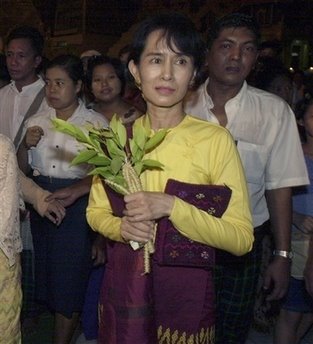


 Posts


