L T S E N
B U R M A
A L T E R N A T I V E A S E A N N E T W O R K O N B U R M A
c amp a i g n s , a d v o c a c y & c a p a c i t y - b u i l d i n g f o r h uma n r i g h t s & d emo c r a c y
P O B O X 2 9 6 , L A R D P R A O P O S T O F F I C E , B A N G K O K 1 0 3 1 0 , T H A I L A N D
TEL 081 850 9008 [6681] 850 9008 EMAIL publications@altsean.org WEB www.altsean.org
BN 2010/1077: November 26, 2010
BURMA 2010 ELECTION RECAP
Election Day
Widespread evidence of electoral fraud, irregularities, threats, harassment, and lack of independent
monitoring characterized Election Day and the days leading up to it:
• In the days before the election, local SPDC officials, polling station officials, and Union Solidarity
and Development (USDP) members throughout the country solicited advance and proxy votes, in the
overwhelming majority of cases specifically for the USDP.
• In many races, the addition of large numbers of advance votes for the USDP tipped the balance in
favor of its candidates.
• Local SPDC officials, Election Sub-commission members, polling station officials, and USDP
members harassed, detained, and discriminated against members and supporters of “opposition”
parties and prevented them from monitoring the vote.
• SPDC officials and members of local Election Sub-commissions actively campaigned for USDP
candidates. USDP members campaigned in the vicinity of - and sometimes inside - polling stations, in
direct violation of the SPDC election laws.
• Polling station officials failed to act in a professional, transparent, and impartial manner. In many
cases, polling station officials denied voters the right to vote and invalidated votes for “opposition”
parties.
• Booths at polling stations did not allow voters sufficient privacy to cast their votes. Ballot boxes at
polling stations were not adequately secured.
• Large numbers of voters in ethnic nationality areas found that their names were not on the voter rolls
when they went to the polling station.
• SPDC officials and USDP supporters threatened and harassed journalists and reporters trying to cover
the vote. Police in Myawaddy, Karen State, detained a Japanese journalist.
• The SPDC refused to allow international and domestic observers to monitor all polling activities.
• At least six political parties filed complaints with the SPDC Election Commission. Various party
leaders said that they would not recognize the election results due to alleged fraud and irregularities.
Reactions
The election process was met by widespread condemnation inside and outside Burma, with the
significant exception of ASEAN and China:
• Democratic Party (Myanmar) Executive Secretary Cho Cho Kyaw Nyein said the “ugliest and most
extreme level of vote-stealing took place.”
• National Democratic Force (NDF) Chairman Than Nyein said the party “never expected” the polls to
be free and fair but that the restrictions were “far more than we anticipated.”
• NDF leader Khin Maung Swe said that with the large scale advance voting by the USDP “possibly,
there will be a boycott of the poll results due to these incidents.”
• Rakhine Nationals Progressive Party Chairman Aye Maung said that if the USDP won, “ethnic and
other pro-democracy parties will boycott the election results.”
• All Mon Region Democracy Party spokesperson Nai Nwe said that if they lost the election, than “it
means the government has cheated.”
2
• UN Sec-Gen Ban Ki-moon said the “voting was held in conditions that were insufficiently inclusive,
participatory and transparent.”
• Japan’s FM Seiji Maehara said the elections “cannot be said to be complete and fair.”
• US President Barack Obama said it was “unacceptable to steal elections, as the regime in Burma has
done again for all the world to see.”
• Canada’s FM Lawrence Cannon said “Canada is deeply disappointed that the regime did not live up
to its own commitment to hold a free and fair election.”
• EU High Representative for Foreign Affairs and Security Policy Catherine Ashton said the SPDC
“did not take the necessary steps to ensure a free, fair and inclusive electoral process,” and that they
were “not compatible with internationally accepted standards.”
• ASEAN Chair Vietnam hailed the election as “a significant step forward” and encouraged the country
“to continue to accelerate the process of national reconciliation and democratization.”
• China’s Foreign Ministry spokesperson Hong Lei called the elections a “critical step” and said they
were carried out in a “steady and smooth manner.”
Results
• In total, the Union Solidarity and Development Party (USDP) won 883 (or 76.52%) of the 1,154 seats
at stake in the election.
• In the People’s Assembly (Lower House), the USDP won 259 (79.69%) of the 325 seats. The USDP
dominated in the ethnic Burman-dominated Divisions. It won all seats in Mandalay and Tenasserim
Divisions, and over 90% of the seats in Irrawaddy, Magwe, Pegu, and Sagaing Divisions. In ethnic
States, the USDP won about 63% of the seats, with performances ranging from a low 46% in Shan
State to 100% in Karenni State.
• In the National Assembly (Upper House), the USDP won 129 (76.79%) of the 168 seats. The USDP
dominated in the ethnic Burman-dominated Divisions. It won all seats in Irrawaddy, Magwe,
Mandalay, Pegu, and Tenasserim Division and over 90% of the seats in Sagaing Division. In ethnic
States, the USDP won about 60% of the seats, with performances ranging from a low 41.6% in
Arakan State to 100% in Karenni State.
• In the Division and State Parliaments, the USDP won 495 (74.89%) of the 661 seats. Again, the
USDP dominated in the ethnic Burman-dominated Divisions. It won over 90% of the seats in Magwe,
Mandalay, Pegu, and Tenasserim Divisions, and over 80% of the seats in Irrawaddy, Rangoon, and
Sagaing Divisions. In ethnic areas, the USDP won about 55% of the seats, with performances ranging
from a low 40% in Arakan State to 100% in Karenni State.
• The USDP’s overwhelming majority in both houses of Parliament, coupled with the 25% of the seats
occupied by the military, means that the USDP/military bloc can unilaterally amend the 2008
constitution (which, for ordinary matters, requires the approval of over 75% of the representatives of
both houses of Parliament). In addition, the USDP/military bloc can unilaterally elect Burma’s next
President.1
• Out of the 37 political parties that contested the polls, 15 parties did not win any seats. Of the 22
parties that took at least one seat, 15 of them won less than 1% of the seats.
• Seventeen of the 24 ethnic-based parties that participated in the polls won at least one seat. In total,
they accounted for 15.69% of the seats.
• The second largest vote winner, the pro-junta National Unity Party (NUP), won only 63 seats (or
5.46%) although it fielded 975 candidates.
• The largest “opposition” party, the National Democratic Force (NDF), won 16 seats (or 1.39%).
• The SPDC Election Commission claimed that the overall turnout was 73.8% and even reached over
102% [sic] in some areas.2 To date the Election Commission has failed to publish any official
statistics on voter turnout. In some areas it was reported that the turnout was as low as 35%.3
1 The Presidency consists of one President and two Vice-Presidents, elected by the Presidential Electoral College. The
Presidential Electoral College is composed of three groups from the National Parliament: a) The 330 elected representatives from
the People’s Assembly; b) The 168 elected representatives from the National Assembly; and
c) The 166 appointed Defense Services personnel from both Assemblies. Each group elects a Vice-President. Then the entire
National Parliament elects the President from among the three Vice-Presidents.
2 DPA (09 Nov 10) Pro-junta party heads for victory in Burma's election; Irrawaddy (19 Nov 10) Election Results a Joke
3 WSJ (08 Nov 10) Burma’s hollow election; IPS (10 Nov 10) Few Surprises in First Poll in 20 Years
Tuesday, November 30, 2010
BURMA 2010 ELECTION RECAP by ALTSEAN-BN 2010/1077: November 26, 2010


Sunday, November 28, 2010
Myanmar restricts speech of new parliament members
Nov 27, 3:36 AM EST
Myanmar restricts speech of new parliament members
YANGON, Myanmar (AP) -- Freedom of speech for members of parliament in military-controlled Myanmar will be restricted under laws that dictate the functioning of the newly elected government.
The curbs announced Friday in an official gazette also set a two-year prison term for any protest staged within the parliament compound.
They come after elections this month that were swept by the military-backed Union Solidarity and Development Party. Final results have yet to be announced, but a tabulation based on state media reports shows the party garnered nearly 80 percent of the seats in the two-house Union Parliament.
The laws, signed by junta chief Gen. Than Shwe, stipulate that parliamentarians will be allowed freedom of expression unless their speeches endanger national security, the unity of the country or violate the constitution. They also provide a two-year prison term for those who stage protests in the parliament compound or physically assault a lawmaker on its premises.
Also, anyone other than lawmakers who enters the parliament hall when the body is in session faces a one-year prison term and a fine.
The military has ruled Myanmar since 1962 and the Nov. 7 vote was widely criticized as unfairly designed and fraudulently executed.
The Union Election Commission has repeatedly corrected announced results that showed turnout exceeding 100 percent in some constituencies and when two pro-junta candidates were declared winners in constituencies in Kachin State where elections had been canceled.
The results ensure the military retains power behind the scenes as well as overtly in parliament, which will become a powerful body. The president, who will come from the ranks of the victorious party, will appoint Cabinet ministers and can call the military to step in case of a national emergency.
The previously elections in 1990 were overwhelmingly won by the National League for Democracy, led by Aung San Suu Kyi, but the military did not recognize the results.
Suu Kyi, a Nobel Peace Prize laureate, was recently released from her latest period of house arrest. She has been in detention for more than 15 of the last 21 years.
Monday, November 22, 2010
Myanmar elections aside, few see change
Associated Press / November 21, 2010
YANGON, Myanmar — The shopkeeper, a thin, jittery man who has spent nearly half his life in prison, wishes change were coming to Myanmar.
But the recent elections were a sham, he says, and the promises of democratic reform are empty words. He celebrated the release of prodemocracy leader Aung San Suu Kyi from house arrest, but dismissed the idea it heralds a change in this secretive military-ruled nation.
“This is not a new era,’’ said Bo Bo Oo, 46, in sentiments echoed around the country, which is also known as Burma. “The generals will not change.’’
Globalization reached the long-isolated nation while Bo Bo Oo was in prison, serving 20 years for helping organize prodemocracy protests in 1988. Amid Myanmar’s withering poverty, you can now buy knockoff iPhones at the Mobile World shop in Mandalay and browse for lingerie at the Sexy Girl store in Yangon. You can live in a high-rise condo and watch CNN on satellite TV.
But belief in political change is much harder to find. This is a country battered by its own government, its pessimism shaped by decades of experience. In conversations with dozens of people, little was heard but anguish.
“The government has the power, and it does not want to give it up,’’ an elderly Buddhist monk said.
He remembers the days of British colonialism, and the Japanese occupation during World War II. He can talk about fleeing into the forests when Allied bombs began falling around the town, and the first military coup, in 1958. In 2007, he watched as monks were arrested and even killed during antigovernment protests dominated by the Buddhist clergy.
He sees modern Myanmar as the darkest time.
Like most people in Myanmar, he spoke on condition he not be identified, fearing retribution from the ruling junta’s agents and the Tatmadaw, as the army is called.
A few analysts do see signs of change. At the very least, they say, the elections will create new clusters of power in Naypyidaw, the capital city.
In Mandalay, a young businessman also sees a sliver of possibility in the elections.
“I don’t believe in these generals. I cannot see them giving up any power,’’ he said. “But maybe some new people [in the government] will change something. I hope so.’’
Bo Bo Oo, though, sees no hope. “All this is just about publicity,’’ he said of the Nov. 7 elections and Suu Kyi’s release.
Like many, he notes that Suu Kyi’s release came just a week after the first elections in 20 years, giving the junta a desperately needed publicity boost. While the military claims the vote will usher in a democratic government, much of the international community decried it as political burlesque that will entrench the generals behind proxy politicians.
“They want the world to think that this is becoming a democracy. But the Burmese people know the truth,’’ he said.
Myanmar holds nearly 2,200 political prisoners. Some of the country’s minority ethnic groups, who have faced brutal repression, back militias that have fought the generals for decades.
The government’s political agenda is seldom clear. Little is known about Than Shwe, the general who heads the junta, beyond rumors and gossip. International officials can go years without meeting him, and new ambassadors, who get a few minutes with him when they present their credentials, are grilled.
© Copyright 2010 Globe Newspaper Company.
http://www.boston.com/news/world/asia/articles/2010/11/21/myanmar_elections_aside_few_see_change/
-----------------------------------------
The Associated Press November 20, 2010, 2:37AM ET text size: TT
Tuesday, November 16, 2010
Sunday, November 14, 2010
Myanmar democracy leader Aung San Suu Kyi released
Myanmar democracy leader Aung San Suu Kyi released

Buzz up!205 votes ShareretweetEmailPrint Play Video Reuters – Suu Kyi released from house arrest
Slideshow:Myanmar's Aung San Suu Kyi Freed AP – Myanmar's pro-democracy leader Aung San Suu Kyi talks to the supporters as she stands at the gate of … – 25 mins ago
YANGON, Myanmar – Pro-democracy hero Aung San Suu Kyi walked free Saturday after more than seven years under house arrest, welcomed by thousands of cheering supporters outside the decaying lakefront villa that has been her prison.
Her guards effectively announced the end of her detention, pulling back the barbed-wire barriers that sealed off her potholed street and suddenly allowing thousands of expectant supporters to surge toward the house. Many chanted her name as they ran. Some wept.
A few minutes later, with the soldiers and police having evaporated into the Yangon twilight, she climbed atop a stepladder behind the gate as the crowd began singing the national anthem.
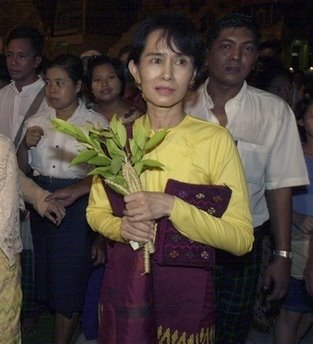
"I haven't seen you for a long time," the 65-year-old Nobel Peace Prize Laureate said to laughter, smiling deeply as she held the metal spikes that top the gate. When a supporter handed up a bouquet, she pulled out a flower and wove it into her hair.
Speaking briefly in Burmese, she told the crowd, which quickly swelled to as many as 5,000 people: "If we work in unity, we will achieve our goal."
"We have a lot of things to do," said Suu Kyi, the charismatic and relentlessly outspoken woman who has come to symbolize the struggle for democracy in the isolated and secretive nation once known as Burma. The country has been ruled by the military since 1962.
But while her release thrilled her supporters — and also clearly thrilled her — it came just days after an election that was swept by the ruling junta's proxy political party and decried by Western nations as a sham designed to perpetuate authoritarian control.
Many observers have questioned whether it was timed by the junta to distract the world's attention from the election. It is also unlikely the ruling generals will allow Suu Kyi, who drew huge crowds of supporters during her few periods of freedom, to actively and publicly pursue her goal of bringing democracy to Myanmar.
While welcoming the release, European Commissioner Jose Manuel Barroso urged that no restrictions be placed on her.
"It is now crucial that Aung San Suu Kyi has unrestricted freedom of movement and speech and can participate fully in her country's political process," he said.
Click image to see photos of Aung San Suu Kyi's release
REUTERS/Soe Zeya Tun
Other international leaders also welcomed the end to her detention.
President Barack Obama called Suu Kyi "a hero of mine."
"Whether Aung San Suu Kyi is living in the prison of her house, or the prison of her country, does not change the fact that she, and the political opposition she represents, has been systematically silenced, incarcerated, and deprived of any opportunity to engage in political processes," he said in a statement.
While the government had not announced the date of the release, Suu Kyi's lawyer had said the detention would end Saturday. Her supporters began to gather near the house starting Friday.
Their reactions reflected Suu Kyi's widespread popularity.
"She's our country's hero," said Tin Tin Yu, a 20-year-old university student, standing near the house later Saturday night. "Our election was a sham. Everyone knows it, but they have guns so what can we do? She's the only one who can make our country a democracy. I strongly believe it."
Critics say the Nov. 7 elections were manipulated to give the pro-military party a sweeping victory. Results have been released piecemeal and already have given the junta-backed Union Solidarity and Development Party a majority in both houses of Parliament.
The new government is unlikely to win the international legitimacy that it craves simply by releasing Suu Kyi because the recent elections were so obviously skewed, according Trevor Wilson, former Australian ambassador to Myanmar.
What happens next will depend on what kind of restrictions the regime puts on Suu Kyi — and what she says if she is allowed to speak, said Wilson.
"We will have to wait and see. It could be a little bit of a cat-and-mouse game," Wilson said. "The regime may wait for her to make a tactical error and crack down on her again."
Suu Kyi — who was barred from running in the elections — has said she would help probe allegations of voting fraud, according to Nyan Win, who is a spokesman for her party, which was officially disbanded for refusing to register for the polls.
Such actions pose the sort of challenge the military has reacted to in the past by detaining Suu Kyi.
Myanmar's last elections in 1990 were won overwhelmingly by her National League for Democracy, but the military refused to hand over power and instead clamped down on opponents.
Suu Kyi's release gives the junta some ammunition against critics of the election and the government's human rights record, which includes the continued detention of some 2,200 political prisoners and brutal military campaigns against ethnic minorities.
Despite that, it was hard not to see some hope in her release.
"There is no formal opposition (in Myanmar) so her release is going to represent an opportunity to re-energize and reorganize this opposition," said Maung Zarni, an exiled dissident and Myanmar research fellow at the London School of Economics.
But he also said the release was "a tactical move by the regime. It is not out of compassion or as an act of adherence to any legal norms."
The Thailand-based Assistance Association for Political Prisoners, which tracks political detainees in Myanmar, drew attention to continuing abuses.
"In the absence of rule of law, with the lack of an impartial judiciary and with laws that criminalize basic civil and political rights, Daw Aung San Suu Kyi will continue to face the threat of re-arrest," said the group's Joint Secretary, Bo Kyi. "Daw" is a Burmese term of respect for an older woman.
Suu Kyi was convicted last year of violating the terms of her previous detention by briefly sheltering an American man who swam uninvited to her lakeside home, extending a period of continuous detention that began in 2003 after her motorcade was ambushed in northern Myanmar by a government-backed mob.
Suu Kyi, something of an accidental political leader, took up the democracy struggle in 1988.
Having spent much of her life abroad, she returned home to take care of her ailing mother just as mass demonstrations were breaking out against 25 years of military rule. She was quickly thrust into a leadership role, mainly because she was the daughter of Aung San, who led Myanmar to independence from Britain before his assassination by political rivals.
She rode out the military's bloody suppression of street demonstrations to help found the NLD. Her defiance gained her fame and honor, most notably the 1991 Nobel Peace Prize.
Her popularity threatened the country's new military rulers. In 1989, she was detained on trumped-up national security charges and put under house arrest. She was not released until 1995. Out of the last 21 years, she has been jailed or under house arrest for more than 15.
Suu Kyi's freedom had been a key demand of Western nations and groups critical of the military regime's poor human rights record. The military government, seeking to burnish its international image, had responded previously by offering to talk with her, only to later shy away from serious negotiations.
Awaiting her release in neighboring Thailand was the younger of her two sons, Kim Aris, who is seeking the chance to see his mother for the first time in 10 years. Aris lives in Britain and has been repeatedly denied visas.
Her late husband, the British scholar Michael Aris, raised their sons in England. Their eldest son, Alexander Aris, accepted the Nobel Peace Prize on his mother's behalf in 1991 and reportedly lives in the United States.
Michael Aris died of cancer in 1999 at age 53 after having been denied visas to see his wife for the three years before his death. Suu Kyi could have left Myanmar to see her family but decided not to, fearing the junta would not allow her to return.
___
Associated Press writers Kay Johnson and Grant Peck in Bangkok contributed to this report.
Tuesday, November 9, 2010
20,000 Myanmar refugees start heading home
20,000 Myanmar refugees start heading home
Buzz up!1 vote ShareretweetEmailPrint AP – Young Myanmar Buddhist monks wait for food at a Thai border police base where Myanmar refugees have taken …
Slideshow:Myanmar refugees flee post-election fighting Play Video Video:Myanmar refugees start heading home AP Play Video Video:Thousands flee Myanmar seeking refuge in Thailand AFP – 1 hr 51 mins ago
YANGON, Myanmar – About 20,000 refugees from Myanmar headed home Tuesday after fleeing to Thailand because of violence in the wake of a general election that is certain to keep Myanmar's military and its allies in power.
The incident underlined Myanmar's vulnerability to unrest following the country's first election in two decades on Sunday, which was billed by the ruling junta as a key stage in its self-proclaimed road to democracy.
Its political opponents and Western nations have decried the vote as unfair and repressive.
Thai authorities said Tuesday that Myanmar officials assured them the situation had stabilized in Myawaddy, a border town that came under attack by ethnic Karen guerrillas Sunday. The refugees who fled to Mae Sot, in Thailand's Tak province, were all expected to be sent home by late Tuesday, said provincial governor Samard Loyfar.
However, fighting continued at Three Pagoda Pass, another Myanmar border town 100 miles (160 kilometers) south of Myawaddy, said Thai officials.
"The heavy shooting in Myanmar stopped a few hours ago but sporadic gunshots still can be heard," said Chamras Kungnoi, a district chief on the Thai side.
About 3,000 refugees were still in Thailand. "We want them to return at some point, but if the fighting continues, they might have to stay here another night," Chamras said.
A 9-year-old girl from Myanmar died of shrapnel wounds, Chamras said. Five people were wounded by stray gunfire in Mae Sot on Monday, and another five were hurt in Myawaddy.
Myanmar has been ruled by the military near-continuously since 1962, and rebellions by its ethnic minorities predate its independence from Britain in 1948. Ethnic guerrilla armies chafe at the prospect of further tightening of control by the army.
Anti-government parties claim the polls were blatantly rigged. Khin Maung Swe, chief of the anti-government National Democratic Force, accused the junta's proxy party, the Union Solidarity and Development Party, of using every possible method to steal the vote, and said it was "sure to win 90 percent if they continue to cheat in such manner."
Though most election results had not yet been released, there was little doubt the junta-backed USDP would emerge with an enormous share of the seats, despite widespread popular opposition to 48 years of military rule. It fielded 1,112 candidates for the 1,159 seats in the two-house national parliament and 14 regional parliaments. The largest anti-government party, the NDF, contested just 164 spots.
A coalition of dozens of Myanmar media and human rights organizations that set up a poll-monitoring website said the vote was rigged.
"The reports that we have gathered demonstrate that these elections are deeply flawed, and are fundamentally illegitimate ... unfair and undemocratic," the groups said.
President Barack Obama said Monday it was unacceptable for Myanmar's government to "steal an election" and hold the people's aspirations hostage to the regime's greed and paranoia. U.N. Secretary-General Ban Kimono said the voting was not inclusive enough and lacked transparency.
The West and the U.N. have long been critical of Myanmar's military regime, especially for its poor human rights record.
But not everyone was so critical of the election.
"This is a critical step for Myanmar in implementing the seven step roadmap to transitioning to an elected government and thus is welcome and affirmed," Chinese Foreign Ministry spokesman Hong Lei said Tuesday. Beijing is the junta's staunchest ally.
The Association of Southeast Asian Nations, of which Myanmar belongs, welcomed the vote as a "significant step forward," Vietnamese Foreign Minister Ham Gina Khi said in a statement as the group's chair.
Sunday's election was the first in Myanmar, also known as Burma, since a 1990 vote won by pro-democracy leader Aung San Suu Kyi's party, which was barred from taking power and boycotted the new polls.
Suu Kyi's term of house arrest is supposed to expire Saturday, though the junta has kept silent over whether it will grant her freedom.
Several human rights groups warned of possible civil war as ethnic groups are pressured by the government to accept a new constitution that offers them little autonomy. Several groups that field potent guerrilla armies refused to take part in the election.
"If the dictatorship goes ahead with plans to attack all armed groups refusing to surrender, today's fighting will be the equivalent of a first small skirmish," the group Burma Campaign UK said Monday in a statement.
The U.N. and human rights groups have detailed killings, rape, torture, forced labor and burning of villages in Myanmar as the regime campaigns to deny the rebels support from the civilian population. Thailand already shelters a quarter-million ethnic minority refugees from brutal campaigns by the Myanmar army.
Myanmar army-backed party sweeps election(by vote rigging)
Myanmar army-backed party sweeps election
Buzz up!2 votes ShareretweetEmailPrint Play Video AP – Rebels clash with Myanmar troops after election
Play Video Video:Clashes on Thai-Myanmar border Reuters Play Video Video:Asia protests Myanmar election Reuters Reuters – Election officials work at a vote counting centre in Yangon November 7, 2010. Myanmar's main pro-democracy … By Aung Hla Tun Aung Hla Tun – 2 hrs 48 mins ago
YANGON (Reuters) – Myanmar's biggest military-backed party won the country's first election in 20 years by a landslide on Tuesday after a carefully choreographed vote denounced by pro-democracy parties as rigged to preserve authoritarian rule.
Opposition parties conceded defeat but accused the military junta of fraud and said many state workers had been forced to support the army-backed Union Solidarity and Development Party (USDP) in advance balloting ahead of Sunday's vote.
A day after U.S. President Barack Obama dismissed it as stolen, China's Ministry of Foreign Affairs lauded the election as "peaceful and successful," illustrating strengthening ties between energy-hungry China and its resource-rich neighbor.
As the votes were counted, government soldiers cleared ethnic minority rebels from an eastern border town after two days of sporadic clashes that killed at least 10 people and sent about 17,000 civilians fleeing into neighboring Thailand.
By afternoon, many refugees had returned to Myanmar as the military pushed back the ethnic minority Karen rebels who have passed their war against the government down the generations since what was then Burma won independence in 1948 from Britain.
The fighters say the election and the military's continued dominance threaten any chance of achieving a degree of autonomy.
Stacked with recently retired generals and closely aligned with 77-year-old paramount leader Senior General Than Shwe, the USDP took as many as 80 percent of the available seats for parliament, a senior USDP official told Reuters.
But Khin Maung Swe, leader of the National Democratic Force, the largest opposition party, told Reuters: "We took the lead at the beginning but the USDP later came up with so-called advance votes and that changed the results completely, so we lost."
The second-largest pro-democracy party, the Democratic Party (Myanmar), also conceded defeat.
"I admit defeat but it was not fair play. It was full of malpractice and fraud and we will try to expose them and tell the people," said Democratic Party leader Thu Wai.
At least six parties have lodged complaints with the election commission, accusing the USDP of fraud -- a charge that is unlikely to gain traction in a country where more than 2,100 political activists are behind bars.
FOCUS ON SUU KYI
The vote was held with Nobel laureate and pro-democracy leader Aung San Suu Kyi in detention and her party disbanded for refusing to take part in an election it said was unfair. She had urged supporters to boycott the poll.
With the election over, the spotlight will return to Suu Kyi, who has spent 15 of the past 21 years in detention but is due to be freed when her latest house arrest term expires on Saturday.
The United States, Britain, the European Union and Japan repeated calls this week to free the 65-year-old pro-democracy leader whose National League for Democracy beat an army-backed party by a landslide in 1990, a result ignored by the junta.
Myanmar's neighbors and partners in ASEAN have been hoping the election would end Myanmar's isolation and remove hurdles it poses to greater cooperation with the West.
China has built up close political and business links with Myanmar while the West has for years shunned its leaders and imposed sanctions over the suppression of democracy and a poor human rights record.
Russia also welcomed the vote.
"We see the elections as a step in the democratization of Myanmar society in accordance with the political reforms taken by the country's leadership," Russia's Ministry of Foreign Affairs said in a statement.
(Additional reporting by Vorasit Satienlerk, Panarat Thepgumpanant and Sonjit Rungjumratrussamee; Writing by Robert Birsel and Jason Szep; Editing by Alan Raybould)
15,000 refugees flee Myanmar post-vote fighting
15,000 refugees flee Myanmar post-vote fighting
Reuters – A group of Myanmar refugees, who crossed over from Myanmar to Thailand when a battle erupted between …
YANGON, Myanmar – Mothers carrying babies and grown men hoisting elders on their backs fled Myanmar with 15,000 countrymen Monday as ethnic rebels clashed with government troops a day after an election widely considered a sham to cement military power.
Fighting raged at key points on the Thai border, wounding at least 10 people on both sides of the frontier as stray shots fell into Thai territory.The clashes underlined Myanmar's vulnerability to unrest even as it passes through a key stage of the ruling junta's self-proclaimed "road map to democracy." The country has been ruled by the military near-continuously since 1962, and rebellions by its ethnic minorities predate its independence from Britain in 1948.
In the heaviest clashes, Karen rebels reportedly seized a police station and post office Sunday in the Myanmar border town of Myawaddy. Sporadic gun and mortar fire continued into Monday afternoon. More fighting broke out further south for one hour Monday at the Three Pagodas Pass, said local Thai official Chamras Jungnoi, but there was no word on any casualties.
Thai officials said late Monday that fighting had quieted and government troops had regained control of Myawaddy.
Groups representing ethnic minorities who make up some 40 percent of Myanmar's population had warned in recent days that civil war could erupt if the military tried to impose its highly centralized constitution and deprive them of rights.
Refugee camps in Thailand already house tens of thousands of ethnic Karen who have fled decades of fighting in the border regions, but Monday marked the biggest one-day tide of refugees to flee into Thailand in recent years.
Refugees marched, shepherded by Thai security personnel, through the streets of the Thai town of Mae Sot, which is just across a river from Myawaddy. Those few carrying belongings toted them on top of their heads, while several lucky ones got rides on pickup trucks.
"At least 15,000 refugees have crossed from eastern Myanmar into northern Thailand since this morning," said Andrej Mahecic, spokesman for the U.N.'s refugee agency, which was providing tents and other materials to shelter the refugees. Non-governmental groups also were offering aid, he said from the agency's headquarters in Geneva.
Refugees continued to arrive into the evening, and some independent estimates put their number closer to 20,000.
They were being sheltered near the Mae Sot airport at a location that was becoming overcrowded, Mahecic said.
Col. Wannatip Wongwai, commander of Thailand's Third Army Region responsible for security in the area, said Myanmar government troops appeared to have retaken control of Myawaddy, and the Karen rebels held just a few positions on the town's outskirts.
"As soon as the situation is under control, we will start sending the refugees back to Myawaddy," he told The Associated Press.
The fighting threatened to overshadow electoral developments, which include mounting chagrin on the part of anti-government parties over what they charge was blatant cheating on behalf of the military's chosen candidates.
Visiting New Delhi, President Barack Obama said it was unacceptable for Myanmar's government to "steal an election" and hold its people's aspirations hostage to the regime's greed and paranoia.
Obama says leaders in countries like the U.S. and India have a responsibility to condemn such gross violations of human rights. He was speaking before India's parliament.
U.N. Secretary-General Ban Ki-moon said "the voting was held in conditions that were insufficiently inclusive, participatory and transparent," and expressed concern about the reports of fighting, urging all sides to refrain from actions that could raise tensions further, U.N. spokesman Martin Nesirky said Monday from the United Nations.
State media and the Election Commission reported Monday that 40 junta-backed candidates won their races, but a day after the polls closed, virtually no other official results — even on voter turnout — were available, and there was no timetable for releasing them. The junta-backed Union Solidarity and Development Party was certain to win an overwhelming number of seats. It fielded 1,112 candidates for the 1,159 seats in the two-house national parliament and 14 regional parliaments. The largest anti-government party, the National Democratic Force, contested just 164 spots.
And the constitution sets aside 25 percent of parliamentary seats for military appointees.
The NDF said provisional returns it had collected showed it winning 15 seats.
NDF chief Khin Maung Swe accused the USDP of using every possible method to steal the vote, and said it was "sure to win 90 percent if they continue to cheat in such manner."
He described a case in the central city of Mandalay, where one NDF candidate ran against Health Minister Kyaw Myint, the USDP candidate. An initial count at polling booths Sunday evening showed the NDF candidate in front, but later that night, a bag of 3,376 ballots from advance voting arrived, which included 2,500 in favor of the USDP, enough to make it the winner.
Khin Maung Swe said there were many cases where lagging USDP candidates received a boost from the arrival of such ballots. Exile Myanmar media had reported that people casting advance ballots were often pressured to vote for the pro-government party.
The NDF is led by breakaway members of the former National League for Democracy of detained Nobel Peace Prize laureate Aung San Suu Kyi, whose party won a landslide victory in the last elections in 1990 but was barred from taking office. It was disbanded this year after declining to register.
Suu Kyi's term of house arrest is supposed to expire Saturday, and her lawyer Nyan Win said Monday he was certain she would be released. "We are making plans for a welcoming ceremony," he said.
Ban's statement from U.N. headquarters repeated a call for lifting restrictions on Suu Kyi, who has been locked up in her Yangon villa on and off since 1989 and is one of some 2,200 political prisoners in Myanmar.
One of her two sons, 33-year-old Kim Aris, applied for a visa Monday in Bangkok in hopes of seeing his mother for the first time in 10 years. He lives in Britain and repeatedly has been denied visas to enter Myanmar.
Asked if he was optimistic, Aris told reporters he had "not too much hope. But there's always a little bit of hope. We'll see." He called the elections "a load of rubbish."
Associated Press photographer Apichart Weerawong in Mae Sot, Thailand, and writers Thanyarat Doksone in Bangkok, Edith M. Lederer at the United Nations and Frank Jordans in Geneva contributed to this report.
Sunday, November 7, 2010
Saturday, November 6, 2010
(JTUC-RENGO)နွင့္ ျမန္မာ့ဒီမိုကေရစီေရး အင္အားစုမ်ား ဂ်ပန္နိုင္ငံ ဒုတိယနိုင္ငံျခားေရးဝန္ႀကီး နွင့္ေတြ ့ဆုံေဆြးေႏြး
Friday, November 5, 2010
(JTUC-RENGO)နွင့္ ျမန္မာ့ဒီမိုကေရစီေရး အင္အားစုမ်ား ဂ်ပန္နိုင္ငံ ဒုတိယနိုင္ငံျခားေရးဝန္ႀကီး နွင့္ေတြ ့ဆုံေဆြးေႏြး

၂၀၁၀ ခုႏွစ္ ႏို၀င္ဘာလ(၅)ရက္ေန႔ ညေန (၅)နာရီ (၁၅)မိနစ္တြင္ တိုက်ိဳျမိဳ ့ ဂ်ပန္နိုင္ငံ နိုင္ငံျခားေရး ဝန္ႀကီးဌာန ဒုတိယ နိုင္ငံျခားေရးဝန္ႀကီး မစၥတာ ယုတက ဘန္နို နွင့္ JTUC-RENGO ကိုယ္စားလွယ္မ်ား ဂ်ပန္နိုင္ငံအေျခစိုက္ ျမန္မာ့ဒီမိုကေရစီေရး အင္းအားစုမ်ား အႀကား လာမည့္(၀၇-၁၁-၂၀၁၀)ေန ့တြင္ ျမန္မာ စစ္အုပ္စုမွ ျမန္မာနိုင္ငံ၌ က်င္းပျပဳလုပ္မည့္ ေရြးေကာက္ပဲြနွင့္ ပတ္သက္၍ ေဆြးေႏြးပဲြကို က်င္းပျပဳလုပ္ ခဲ့ပါသည္။

အထက္ပါ ေဆြးေႏြးပဲြကို မႀကာခင္ကာလက ေဟာ္လန္နိုင္ငံ ဘရတ္ဆယ္ျမိဳ႔တြင္ က်င္းပ ျပီးစီးခဲ့ေသာ အျပည္ျပည္ဆိုင္ရာ လြတ္လပ္ေသာ အလုပ္သမား သမဂၢမ်ားအဖဲြ ့ခ်ဳပ္ (ITUC)၏ ဆုံးျဖတ္ခ်က္ နွင့္အညီ ျပဳလုပ္ခဲ့ျခင္း ျဖစ္ၿပီး ျမန္မာနိုင္ငံသား အလုပ္သမား သမဂၢမ်ားအဖဲြ႔ခ်ဳပ္(FTUB)၏တင္ျပ အကူအညီ ေတာင္းခံခ်က္အရ တကမၻာလုံးရိွ ITUC မွမိမိတို႔ သက္ဆိုင္ရာ နိုင္ငံအလုိက္ နအဖ၏ ၂၀၁၀ ေရြးေကာက္ပဲြ ကိုဆန္႔က်င္ ကန္႔ကြက္ျခင္းျဖစ္သည္။ ဂ်ပန္နိုင္ငံ အလုပ္သမား သမဂၢမ်ားအဖဲြ႔ခ်ဳပ္ (JTUC-RENGO)၊ျမန္မာ့ေရးရာရုံး-ဂ်ပန္ ႏွင့္ ၂၀၁၀ေရြးေကာက္ပဲြ ဆန္႔က်င္ေရးေကာ္မတီ (EBC-JAPAN)တို႔နွင့္ ညိွနိႈင္း၍ ဤေဆြးေႏြးပဲြကို က်င္းပျပဳလုပ္ခဲ့ျခင္ ျဖစ္ပါသည္။

အဆိုပါေဆြးေႏြးပဲြသို ့ ဂ်ပန္နိုင္ငံအစုိးရဘက္မွ ဒုတိယနိုင္ငံျခားေရးဝန္ႀကီး မစၥတာ ယုတခ ဘန္နို နွင့္ ဂ်ပန္နိုင္ငံျခားေရး ဝန္ႀကီးဌာနတာဝန္ခံမ်ား တက္ေရာက္ခဲ့ျပီး JTUC-RENGO ကိုယ္စား အေထြေထြအတြင္းေရးမႉး မစၥတာ ဟီရိုယုခိ နဂမို နွင့္ နိုင္ငံျခားေရးရာ ညႊန္ႀကားေရးမႉး မစၥတာ မာစယုခိ ရီွယိုတာ တို ့ကဦးေဆာင္၍ ျမန္မာ့ေရးရာရုံး ဒါရိုက္တာ ေဒါက္တာမင္းညို၊ ေဒၚခင္ေဆြေအး (FTUB JAPAN REP.) ၊ ဦးထင္ေက်ာ္(ဒု-ဥကၠဌ-NLD-LA-JAPAN)၊ ဦးမိုင္ေက်ာ္ဦး (NDF-Japan/AUN)၊ ဦးျမင့္ေမာင္(အေထြေထြအတြင္းေရးမႉး-LDB)၊ ဦးမင္းမ်ိဳးခ်စ္(ဥကၠဌ-PMNS-Japan/AUN)တို႔ တက္ေရာက္ ခဲ့ႀကျပီး ၂၀၁၀ ေရြးေကာက္ပဲြဆန္ ့က်င္ေရးေကာ္မတီ(EBC-JAPAN)ကိုယ္စား ဦးျမတ္သူ(DPNS-JAPAN) နွင့္ ဦးဘုန္းလိႈင္(ဒု-ဥကၠဌ-FWUBC) တို႔ တက္ေရာက္ခဲ့ႀကသည္။
ေဆြးေႏြးပဲြမွာ JTUC-RENGO အေထြေထြအတြင္းေရးမႉးမွ ျမန္မာ့အေရး ေဆြးေႏြးရန္ လာေရာက္ျခင္း ျဖစ္ေႀကာင္း မိတ္ဆက္ျပီး ျမန္မာ့ေရးရာရုံး ဒါရိုက္တာ ေဒါက္တာမင္းညိုမွ နအဖ က်င္းပျပဳလုပ္မည့္ ေရြးေကာက္ပဲြသည္ စစ္အာဏာရွင္စနစ္ကို တရားဝင္ေအာင္ျပဳလုပ္မည့္ ၂၀၀၈ အေျခခံ ဥပေဒ အေပၚအေျခခံသည္ ့ေရြးေကာက္ပဲြျဖစ္၍ မိမိတို႔ အေနနွင့္ ဆန္႔က်င္ေႀကာင္း နွင့္လက္မခံနိုင္ေႀကာင္း ေျပာႀကားခဲ့သည္။ ဖိအားမေပးပါက နအဖ အေနျဖင့္ ေတြ႔ ဆုံေဆြးေႏြးပဲြ ျပဳလုပ္ရန္ စိတ္ဝင္စားမည္ မထင္ေႀကာင္း လုံေလာက္ေသာ ဖိအားေပးမွသာ စစ္မွန္ေသာေတြ႔ ဆုံေဆြးေႏြးပဲြ ျဖစ္ေျမာက္ရန္အတြက္ ဖိအား မ်ားမ်ားေပးေစလိုေႀကာင္း-ဥပမာ-Selected Sanction – အကန္႔ အသတ္နွင့္ စီးပြားေရးပိတ္ဆို ့မႈျပဳလုပ္ျခင္းမ်ိဳးကို ျပဳလုပ္ေစလိုေႀကာင္း ဥပမာေပး ေျပာႀကားသြားသည္။
NDF-JAPAN ကိုယ္စားလွယ္ ဦးမိုင္ေက်ာ္ဦးမွ- မႀကာမီ က်င္းပမည့္ ေရြးေကာက္ပဲြကို တိုင္းရင္းသားမ်ား အေနျဖင့္လည္း လက္မခံနိုင္ေႀကာင္း အဆိုပါ ေရြးေကာက္ပဲြအျပီးတြင္ ဆက္လက္က်င့္သုံးမည့္ ၂၀၀၈ အေျခခံ ဥပေဒသည္ တိုင္းရင္းသားမ်ား၏ အခြင့္အေရးမ်ားကို အာမခံ ထားျခင္းမရိွေႀကာင္းနွင့္ အဆိုပါ ေရြးေကာက္ပဲြ အျပီးတြင္ တိုင္းရင္းသား လက္နက္ကိုင္ အဖဲြ႔အစည္းမ်ာတို႔ကို နအဖ စစ္တပ္မွ စစ္ေရးျဖစ္ ေျဖရွင္းနိုင္သည့္ အလားအလာ အလြန္မ်ားေႀကာင္း နအဖ တို႔က လက္နက္ႀကီးမ်ားကို တိုင္းရင္းသား လက္နက္ကိုင္ အဖဲြ႔အစည္းမ်ား၏ တပ္စခန္းမ်ား အနီးသို႔ ေရႊ႔ေျပာင္း ေနရာခ်ထား လွ်က္ရိွေႀကာင္း နွင့္ အဆိုပါစစ္ပဲြ မျဖစ္ပြားေစရန္ ဂ်ပန္နိုင္ငံအစိုးရမွ အကူအညီ ေပးပါရန္ ေမတၱာရပ္ခံခဲ့သည္။
၂၀၁၀ ေရြးေကာက္ပဲြဆန္႔က်င္ေရး ေကာ္မတီကိုယ္စား ဦးျမတ္သူမွ ေျပာႀကားရာတြင္ ေဒၚေအာင္ဆန္းစုႀကည္နွင့္ ဗိုလ္ခ်ဳပ္သန္းေရႊ တို႔အႀကားေဆြးေႏြးပဲြ ျဖစ္ေျမာက္ရန္ ေရြးေကာက္ပဲြ မတိုင္ခင္ေရာ ေနာက္ပိုင္းတြင္ ပါ ဂ်ပန္နိုင္ငံအစိုးရမွ နအဖ အားဖိအား အဆက္မျပတ္ ေပးေစ ခ်င္ေႀကာင္းနွင့္ ေရြးေကာက္ပဲြဆန္႔ က်င္ေရးကာလာမွ ျပီးဆုံးသြားျပီဟု မိမိအေနျဖင့္ ယူဆေႀကာင္း နွင့္ ေရြးေကာက္ပဲြ ကာလ ေနာက္ပိုင္းတြင္ ျမန္မာနိုင္္ငံအတြင္း မတရားဖမ္းဆီး အေရးယူ ေထာင္ခ်မႈမ်ား ညွင္းပမ္း နိွပ္စက္မႈမ်ား ပိုမိုတိုးပြားလာမည့္ အလားအလာမ်ား အလြန္မ်ားလွ်က္ ရိွေသာေႀကာင့္ ထိုသို႔ မျဖစ္လာေစရန္ ဂ်ပန္နိုင္ငံ အစိုးရအေနျဖင့္ နအဖ အား ဖိအားေပးရန္ ျမန္မာနိုင္ငံ အတြင္းမွ ေမတၱာရပ္ခံ လာပါေႀကာင္း ေျပာႀကားသြားပါသည္။
ဂ်ပန္ ဒုတိယနိုင္ငံျခားေရးဝန္ႀကီးမွ ျပန္လည္ ေဆြးေႏြးရာတြင္ မိမိအေနျဖင့္ ယခု လႊတ္ေတာ္ အစည္းအေဝး က်င္းပေနခ်ိန္ အတြင္းလာေရာက္ ေတြ႔ဆုံျခင္းျဖစ္ျပီး မိမိအားတကူးတက ေစာင့္ ေပးသည့္အတြက္ ေက်းဇူး အထူးတင္ပါေႀကာင္ ေျပာႀကားျပီး ျမန္မာနိုင္ငံနွင့္ ဂ်ပန္နိုင္ငံတို႔သည္ အာရွ တိုက္တြင္ အလြန္ရင္းနီွးေသာ နိုင္ငံမ်ားျဖစ္ေႀကာင္း ယေန႔ ႀကြေရာက္လာေသာ ေခါင္းေဆာင္မ်ား အေနျဖင့္ ေရွ႔မတိုး ေနာက္မဆုတ္နိုင္ ျဖစ္ေနေသာ ျမန္မာနိုင္ငံ အေျခအေနအတြက္ အလြန္စိုးရိမ္ ပူပန္လွ်က္ရိွသည္ကို မိမိအေနျဖင့္ သေဘာေပါက္ပါေႀကာင္း ျမန္မာနိုင္ငံအေရးကို ဝန္ႀကီးခ်ဳပ္ ခန္ နွင့္ နိုင္ငံျခားေရးဝန္ႀကီး မိုင္းဟာရ တို႔နွင့္ တိုင္ပင္၍ ေဆာင္ရြက္လွ်က္ ရိွပါေႀကာင္း ျပီးခဲ့ေသာ (၃၀-၁၀-၂၀၁၀) ေအပက္ ညီလာခံတြင္ ျမန္မာနိုင္ငံျခားေရး ဝန္ႀကီးနွင့္ ေတြ ့ဆုံျပီး ဂ်ပန္နိုင္ငံ၏ သေဘာထားကို ေျပာႀကားခဲ့ျပီး ျဖစ္ေႀကာင္း ေဒၚေအာင္ဆန္းစုႀကည္အား အျမန္ဆုံး ျပန္လႊတ္ေပးရန္လည္း ဖိအားေပး ေနပါေႀကာင္း ကုလသမဂၢတြင္ မစၥတာကင္တားနားမွ တင္ျပထားေသာ ျမန္မာျပည္ဆိုင္ရာ လူ ့အခြင့္အေရး စုံစမ္းစစ္ေဆးေရးေကာ္မရွင္ ဖဲြ႔ရန္ကိစၥကို အေလးထား ေဆြးေႏြးေနပါေႀကာင္း အခုအခ်ိန္အထိ တံခါးဖြင့္ထားဆဲ ျဖစ္ပါေႀကာင္း မိမိအေနျဖင့္ ျမန္မာနိုင္ငံသားမ်ားနွင့္ ထပ္တူထပ္မွ် ခံစားခ်က္ရိွပါေႀကာင္း ကိုယ္ခ်င္းစာပါေႀကာင္း ေျပာႀကားသြားပါသည္။
သတင္းမွတ္တမ္း ။ ဘုန္းလိႈိင္-FWUBC
Friday, November 5, 2010
Myanmar: Government attacks on freedoms compromises elections
From
杉山透子 Toko Sugiyama(AI-JAPAN)
The Myanmar government’s attacks on the freedoms of expression, peaceful
assembly, and association compromises the country’s first elections in
20 years, Amnesty International said today.
The Myanmar authorities have introduced several new laws and directives
in the run up to the 7 November elections, restricting free speech and
criticism of the government, prohibiting political parties from
boycotting the elections, and cracking down on internal calls for the
release of the estimated 2,200 political prisoners in the country.
“These elections presented an opportunity for Myanmar to make meaningful
human rights changes on its own term-and with the world watching,” said
Salil Shetty, Amnesty International’s Secretary General. “Instead,
throughout the run up to the polls, the government has attacked the
rights necessary for holding meaningful elections.”
Since March this year, when the government enacted restrictive and
repressive Electoral Laws, it has routinely violated the freedoms of
expression, peaceful assembly, and association. Recent violations include:
・On 14 September, the Election Commission issued a notice outlining
strict restrictions on campaign speeches to be broadcast on state media,
including vaguely worded provisions that effectively ban criticism of
the government or any mention of the country’s problems, particularly
ethnic issues.
・On 18 September, the government warned Daw Aung San Suu Kyi and her
National League for Democracy party-winners of the 1990 elections-of
penalties for encouraging an election boycott.
・On 27 September, authorities sentenced Ashin Okkanta, an ethnic Mon
monk, to 15 years’ imprisonment for possessing leaflets calling for the
release all political prisoners in Myanmar.
・In the final two weeks of September, the authorities arrested 11
students, at least nine of whom remain in detention, in Yangon for
handing out leaflets urging people not to vote.
“That Myanmar continues to hold more than 2,200 political prisoners
exposes the government’s contempt for human rights in these elections,”
said Salil Shetty. “Their self-described ‘Roadmap to Democracy’, of
which these elections are meant to be a significant part, seems to lead
only to continuing political repression.”
The Myanmar government maintains that it is not holding any political
prisoners, despite the highly critical report of the UN Special
Rapporteur on the situation of human rights in Myanmar released on 15
September 2010.
Daw Aung San Suu Kyi, whose National League for Democracy party won
Myanmar’s last polls in 1990 has spent nearly 15 of the past 21 years in
detention.
The Myanmar government has also recently denied allegations of serious
human rights violations in the country’s ethnic minority regions in the
run-up to the polls, including attacks targeting civilians in the army’s
ongoing counter-insurgency efforts. In 2008 Amnesty International found
that such attacks amounted to crimes against humanity. Amnesty
International has called on the UN to establish a Commission of Inquiry
into the serious human rights violations in Myanmar.
“Myanmar’s record of human rights violations has threatened the
stability of the country and the region, and it’s time for the UN, as
well as Myanmar’s neighbours in the Association of Southeast Asian
Nations (ASEAN), to say enough is enough,” said Salil Shetty. “The sham
nature of these elections should convince even China and India-which
have been supportive of Myanmar’s military government-to side with the
people of the country instead.”
The elections are being held against a backdrop of political repression
and systematic violence that has continued since tens of thousands of
protesters-led by Buddhist monk-took to the streets in August and
September 2007, demanding economic and political reforms. The peaceful
country-wide demonstrations were violently put down by the authorities,
resulting in at least 31 (and possibly more than a hundred) people
killed and many more injured, and at least 74 people disappeared and
thousands detained.
“Denying the existence of political prisoners and the occurrence of
serious international crimes will not make them disappear,” said Salil
Shetty. “Only by releasing the prisoners and holding perpetrators of
such crimes accountable can the government begin to adequately address
these persistent human rights challenges. Holding elections is not enough.”
Regardless of the election results, Amnesty International calls on
ASEAN, and Myanmar’s other Asian neighbours, to demand the release of
political prisoners and to make a Commission of Inquiry a reality in
Myanmar.
--
+---------------------------------------------+
杉山透子 Toko Sugiyama
社団法人アムネスティ・インターナショナル日本(個人会員/ビルマチーム)
Amnesty International Japan(Burma Team)
http://www.amnesty.or.jp/
NGO共同声明 : 国連での調査委員会設立を求めるNGO共同要請
http://www.amnesty.or.jp/modules/news/article.php?storyid=850
日本支部声明: 死刑執行に抗議する
http://www.amnesty.or.jp/modules/news/article.php?storyid=824
日本 : 「立川テント村事件」の最高裁判決を懸念
http://www.amnesty.or.jp/modules/news/article.php?storyid=467
ဂ်ပန္ေရာက္ ျမန္မာ့ဒီမိုကေရစီ အင္အားစုမ်ားမွ ၂၀၁၀ ေရြးေကာက္ပြဲအေပၚ သေဘာထား သတင္းစာရွင္းလင္းပြဲ
၂၀၁၀ ခုႏွစ္ ႏို၀င္ဘာလ (၄)ရက္။
ဂ်ပန္ေရာက္ ျမန္မာ့ဒီမိုကေရစီ အင္အားစုမ်ားမွ ၂ဝ၁ဝ ေရြးေကာက္ပြဲ ႏွင့္ပတ္သက္၍ သေဘာထား တင္ျပသည့္ သတင္းစာ ရွင္းလင္းပြဲ အခမ္းအနားကို ဂ်ပန္အလုပ္သမား သမဂၢအဖြဲ႔ခ်ုဳပ္မ်ား ဌာနခ်ဳပ္ (JTUC-RENGO)ႏွင့္ ျမန္မာ့ေရးရာရုံး BOJ တို႔မွ ဦးစီး၍ တိုက်ိဳၿမိဳ႔ရွိ ဂ်ပန္ အလုပ္သမား သမဂၢအဖြဲ႔ခ်ုဳပ္မ်ား ဌာနခ်ဳပ္ (RENGO)ရုံးတြင္ ၃း၀၀ နာရီ မွ ၄း၃၀ အထိ က်င္းပျပဳလုပ္ခဲ့ပါသည္။
၂ဝ၁ဝ ေရြးေကာက္ပြဲ ဆန္႔က်င္ေရး ေကာ္မတီ(ဂ်ပန္)၏ ရပ္တည္ခ်က္ သေဘာထားကို မိုင္ေက်ာ္ဦးႏွင့္ ဦးလွေအးေမာင္တို႔မွ ရွင္းလင္း တင္ျပသြားၿပီး NLD ရပ္တည္ခ်က္ သေဘာထားကို ဦးလွဟန္မွ တင္ျပသြားပါသည္။ဦးေက်ာ္ေက်ာ္စိုးမွ ႏိုင္ငံတကာ စံႏႈန္းမ်ားႏွင့္ ကိုက္ညီျခင္းမရွိေသာ ၂၀၁၀ ေရြးေကာက္ပြဲ ကိစၥရပ္မ်ားတို႔ကို ရွင္းလင္းတင္ျပသြားၿပီး Dr.မင္းညိွမွ ျပည္တြင္း အေျခအေနမ်ားႏွင့္ တိုင္းရင္းသားေဒသ အေျခအေနမ်ားကို ရွင္းလင္းတင္ျပသြားပါသည္။
၂၀၁၀ေရြးေကာက္ပြဲသည္ စစ္အာဏာရွင္စနစ္ကို ပိုမိုသက္စိုးရွည္ေစၿပီး တရား၀င္ အတည္ျပဳမည့္ ေရြးေကာက္ပြဲ ျဖစ္သည့္အတြက္ လုံ၀ဆန္႔က်င္ ကန္႔ကြက္ေၾကာင္း ႏွင့္ လက္မခံနိုင္ေႀကာင္း ဂ်ပန္နိုင္ငံေရာက္ ဒီမိုကေရစီေရး အင္အားစုမ်ားက တညီတညြတ္တည္း အတည္ျပဳ ရွင္းျပသြားႀကသည္။ ထိုသို႔ရွင္းျပရာတြင္ အဓိကျပႆနာမွာ ၂၀၀၈ဖဲြ ့စည္းပုံ အေျခခံဥပေဒ ျဖစ္ျပီး အဆိုပါ ၂၀၀၈ ဖဲြ ့စည္းပုံ အေျခခံဥပေဒကို လက္ရိွအေျခအေနအတိုင္း လက္မခံနိုင္ေႀကာင္း ၊ အဆိုပါ ၂၀၀၈ အေျခခံဥပေဒပါ
(၁)စစ္တပ္အား တရားဝင္ အာဏာသိမ္းခြင့္ေပးထားျခင္း
(၂)စစ္တပ္မွ ျမန္မာ့နိုင္ငံေရးတြင္ ဦးေဆာင္ ပါဝင္မည္ျဖစ္ေႀကာင္း ေဖာ္ျပထားျခင္း မ်ားကို မည္သို႔မွ် လက္မခံနိုင္ေႀကာင္း နွင့္ အဆိုပါဖဲြ ့စည္းပုံအေျခခံဥပေဒကို လူထုကိုယ္စားျပဳ နိုင္ငံေရး အဖဲြ႔အစည္းမ်ားနွင့္ ေတြ႔ဆုံ ညိွနိႈင္း၍ ျပန္လည္ျပင္ဆင္ျပီး ေနာက္ပိုင္းတြင္ ျပဳလုပ္ေသာ လြတ္လပ္၍ တရားမွ်တသည့္ ေရြးေကာက္ပဲြကို ပါဝင္ေထာက္ခံသြားမည္ျဖစ္ေႀကာင္း အမ်ိဳးသားဒီမိုကေရစီအဖဲြ႔ခ်ဳပ္ အပါအဝင္ ျပည္တြင္းျပည္ပ ျမန္မာ့နိုင္္ငံေရး အင္အားစုမ်ား အားလုံးက ေႀကျငာထား ျပီးျဖစ္ေႀကာင္း ရွင္းလင္း ေျပာႀကားသြားခဲ့သည္။
ယေန ့ျပဳလုပ္ေသာသတင္းစာရွင္းလင္းပဲြကို
NHK ၊ TBS ၊ DVB သတင္းဌာနမ်ားမွ လာေရာက္၍ဗီြဒီယိုမွတ္တမ္းတင္ခဲ့ျပီး အျခားေသာဂ်ပန္သတင္းဌာန (၅)ခုမွလည္းလာေရာက္သတင္းယူသြားခဲ့ေႀကာင္း သိရိွရပါသည္။
သတင္းမွတ္တမ္း။ Mai Kyaw Oo (PNS-Japan)
http://news.tbs.co.jp/newseye/tbs_newseye4568503.html
今月7日、20年ぶりにミャンマー軍事政権が行う総選挙について、日本に滞在するミャンマー人の民主活動家の団体などが4日、共同で会見し、「選挙は不公正」だと改めて強調しました。
ミャンマー総選挙への統一見解を発表したのは、在日ミャンマー人の民主活動家らの30団体で、選挙は「不公正で非民主的だ」とあらためて主張しました。
今回の選挙には、自宅軟禁中の民主化運動指導者アウン・サン・スー・チーさんをはじめ、2100人の政治犯が排除されているほか、多くの少数民族政党が除外されています。また、軍政が治安の悪さを理由に、ミャンマーにある村の全体のおよそ24パーセント、3000以上の村で投票中止を決めているとして、選挙に対する抗議活動を続けています。
「(選挙が実施されれば)ミャンマーで内戦が起きる可能性が高いということを日本政府に理解してもらいたい」(国民民主連盟解放地域 日本支部 ラー・ハン氏)
また、主にタイや中国の国境沿いに住む少数民族には選挙への不満が高まっていて、軍政側との武力衝突に発展する可能性もあると話しました。会見に集まった団体では、日本政府に対し、選挙結果を受け入れず、軍事政権に圧力をかけるよう求めています。(04日22:08)
Tuesday, November 2, 2010
Junta could stay

Junta could stay
Pedestrians walk past a campaign billboard of Myanmar's military government backed Union and Solidarity Development party in Yangon, Myanmar. -- PHOTO: AP
YANGON - MYANMAR'S military rulers threatened on Monday to cling to power if the public abstained from voting in Sunday's long-awaited election and blamed foreign media for trying to derail the poll.
The military, which has run the country since a 1962 coup, said 13 foreign news organisations had colluded with opposition movements to discourage people from voting and create 'great troubles' for the country.
'If the election is aborted (by voters) there will not be a government that's elected by vote of the people,' all state-controlled newspapers, which serve as mouthpieces for the reclusive regime, said in a commentary.
'The ruling government would have no choice but to remain in charge of state security until it holds another election. If so, this will take a long time,' it said, adding that Myanmar's plan to become a democracy took more than a decade to draft.
It was the first time the junta has made such a threat, or mentioned the possibility of a no-vote campaign ahead of the election, which critics say is a sham to cement the military's iron-fisted grip on power.
In the absence of any real opposition to two big parties backed by the military, activists and analysts say a significant boycott by voters would be the only means of expressing public opposition to the election. -- REUTERS
Monday, November 1, 2010
၂ဝ၁ဝ ေရြးေကာက္ပြဲ ဆိုင္ရာႏိုင္ငံေရး ေဆြးေႏြးပြဲ - (တိုက်ဳိ၊ ဂ်ပန္)-၂၀၁၀ ခုႏွစ္ ေအာက္တိုဘာလ(၃၁)ရက္။


၂ဝ၁ဝ ေရြးေကာက္ပြဲ ဆိုင္ရာႏိုင္ငံေရး ေဆြးေႏြးပြဲ - (တိုက်ဳိ၊ ဂ်ပန္)
၂၀၁၀ ခုႏွစ္ ေအာက္တိုဘာလ(၃၁)ရက္။
ဂ်ပန္ႏိုင္ငံေရာက္ ျမန္မာ့ဒီမိုကေရစီ အင္အားစုမ်ား၏ ၂ဝ၁ဝ ေရြးေကာက္ပြဲ ဆန္႔က်င္ေရးေကာ္မတီ (ဂ်ပန္)မွ ဦးစီး က်င္းပျပဳလုပ္သည့္ တရားမွ်တမူမရွိသည့္ အတုအေယာင္ ၂ဝ၁ဝ ေရြးေကာက္ပြဲ ဆန္႔က်င္ေရး၊ ျမန္မာ့ႏိုင္ငံေရး ေဆြးေႏြးပြဲကို တိုက်ဳိ Takadanobaba, Recycle Center 4 F, မွာ နံနက္ ၉ နာရီ ၃ဝ မိနစ္မွ မြန္းတည့္ ၁၂ နာရီအထိ က်င္းပ ျပဳလုပ္ခဲ့ပါသည္။
နအဖ စစ္အုပ္စုမွ က်င္းပမည္ဆိုေသာ၂ဝ၁ဝ ေရြးေကာက္ပြဲအား ဘာေၾကာင့္ လက္မခံ ဆန႔္က်င္ ကန္႔ကြက္ရသည့္အေၾကာင္းကို၂ဝ၁ဝ ေရြးေကာက္ပြဲ ဆန္႔က်င္ေရး ေကာ္မတီ (ဂ်ပန္)၀င္ ကိုယ္စားလွယ္ မ်ားႏွင့္အတူ ဂ်ပန္ႏိုင္ငံေရာက္ ၂၀၀၇ ေရႊ၀ါေရာင္ ေတာ္လွန္ေရး ဦးေဆာင္ ဆရာေတာ္ အရွင္ထာ၀ရ မွလည္းပါ၀င္ တက္ေရာက္ ေဆြးေႏြးခဲ့ေၾကာင္းသိရွိရပါသည္။
ယေန႔ ေဆြးေႏြးပြဲမွာ တိုင္းျပည္နဲ႔ လူမ်ိဳးကို ထာ၀ရစစ္ကြ်န္ျပဳမည့္ စစ္အာဏာရွင္ စနစ္ကို တရား၀င္ အုပ္ခ်ဳပ္ပိုင္ခြင့္ ေပးရေတာ့မည့္ အတုအေယာင္ ေရြးေကာက္ပြဲကို ဆန္႔က်င္ရန္ လူတိုင္းမွာ တာ၀န္ရွိပါတယ္ မဲ႐ုံသုိ႔ မသြားဖို႔ မဲမေပးဖို႔ စည္းရုံးလုပ္ေဆာင္သြားမွာ ျဖစ္ၿပီး မဲမေပးျခင္းဟာလည္း မိမိတို႔ရဲ႔ အခြင့္အေရးကို အသုံးခ်ၿပီး ဒီမုိကေရစီေရးႏွင့္ အမ်ဳိးသားေရး တာ၀န္ကုိ ထမ္းေဆာင္ၾကဖို႔ အခ်ိန္က်ေရာက္ၿပီ ျဖစ္တယ္ ၊အေၾကာင္း အမ်ိဳးမ်ိဳးေၾကာင့္ အေနအထားအရ မဲမေပးပဲ ေနလို႔မရတဲ့ လူေတြအတြက္ေတာ့ ပယ္မဲျဖစ္ေအာင္ ျပဳလုပ္ၾကဖို႔ကို ေဆြးေႏြးသြားခဲ့ၾကပါသည္။ ေရြးေကာက္ပြဲ အလြန္မွာ ႏိုင္ငံေရးေမွ်ာ္မွန္းခ်က္ျဖစ္တဲ့ ကေလးၿမိဳ႔ ေၾကျငာစာတမ္း ဒုတိယ ပင္လုံေခၚယူဖို႔ ႀကိဳးပမ္းခ်က္ေတြမွာ ျပည္ပမွာရွိတဲ့ ဒီမိုကေရစီ အင္အားစုေတြ ၀ိုင္း၀န္း ပူးေပါင္း ပါ၀င္ၾကရန္ တိုက္တြန္းသြား မည္ျဖစ္ပါသည္။ ေဆြးေႏြးပံု အေသးစိတ္ကို ဗီဒီယိုျဖင့္ မွတ္တမ္းတင္ကာ YouTube, Internet TV အစရွိသည့္ ဆက္သြယ္ေရး နည္းလမ္းမ်ားျဖင့္ ျမန္မာႏိုင္ငံ ျပည္တြင္းသို႔၎၊ အျခားႏိုင္ငံ အရပ္ရပ္သို႔၎ ျဖန္႔ခ်ိၿပီး ေဆာင္ရြက္သြားမည္ ျဖစ္ေၾကာင္း သိရွိရပါသည္။
သတင္းမွတ္တမ္း ။ Mai Kyaw Oo (PNS-Japan)
မွတ္တမ္းဓါတ္ပုံ ။ Lian Khan Sum (CNC-Japan)
Friday, October 29, 2010
ビルマ(ミャンマー)総選挙への抗議 400名がデモ行進
みなさま、
昨日10月27日、PFBは在日ビルマ人のみなさんとビルマの
民主化を支援する各団体のみなさん約400人とともに、
非民主的なビルマ総選挙に対する抗議集会およびデモ行進を行い、
共同アピールを発表いたしました。
▼アピール文・写真
http://pfbkatsudo.blogspot.com/2010/10/4001027.html
ご参加くださったみなさま、遠くから応援してくださった皆様に
心より感謝申し上げます。
PFB事務局 宮澤
ツイッター:https://twitter.com/home
ホームページ:http://www1.jca.apc.org/pfb/
****************************************************
非民主的なビルマ総選挙に対する抗議集会のアピール
ビルマ(ミャンマー)の軍事政権は、今年11月7日に、
一方的で不当な総選挙を実施し、「民主化へのロードマップ」を
進める、と国際社会に対してアピールしています。
しかし、こうした見せかけの「民主化プロセス」の一方で、
国内には表現、結社、報道の自由など基本的人権がほとんど
存在せず、アウンサンス-チーさんを含む2,100名以上の
政治囚は未だ囚われの身となっています。少数民族居住
地域では、国軍による凄惨な人権侵害が続発し、これは
「人道に対する罪」であると指摘されています。
在日ビルマ人2010年総選挙ボイコット委員会(EBC)を
はじめとする在日ビルマ人たちは、①今回の選挙の根拠と
なる2008年憲法や選挙関連法があまりにも非民主的な
内容であること、②表現、結社、報道など基本的な人権が
守られていないこと、③多数の政治囚が釈放されていないこと、
④アウンサンスーチーさんを含む民主化勢力、少数民族代表、
軍政間の実質的対話が全くなされていないことなどの理由から、
この選挙のボイコットを決意し、呼び掛けています。
私たち、ビルマの人権状況の改善や民主化を願う日本の
各団体は、こうした在日ビルマ人たちの呼びかけを深く理解しつつ、
在日ビルマ人団体と連帯して、非民主的なビルマ総選挙に
対して抗議すると共に、日本政府に対して、以下の三点を
強く要請します。
(1)一連の選挙プロセスが、不当で、国際基準に合致しない
ものであり、日本政府としてこの選挙結果をそのまま受け
入れることはできない旨をビルマ軍事政権に確実に伝えること。
(2)2,100名以上にも及ぶ政治囚を即時・無条件に釈放するよう、
重ねて軍事政権に求めること。
(3)「人道に対する罪」に該当する、といわれる少数民族
居住地域での過酷な人権侵害を調査する国連調査団派遣への
支持を国際社会に対してただちに表明すること。
私たちは、重ねて強く訴えます。11月7日の総選挙を通じた
「見せかけの民主化プロセス」を、あたかも真の民主化で
あるかのように受け入れ、これを歓迎するかのようなメッセージを
日本政府が発することは、逆にビルマの民主化をさらに
遠のかせるに違いありません。
2010年10月27日
ビルマ人2010年総選挙ボイコット委員会 ビルマ日本事務所
連合
ビルマ市民フォーラム
社団法人アムネスティ・インターナショナル日本
ヒューマン・ライツ・ウォッチ
ビルマ情報ネットワーク
(特活)ヒューマンライツ・ナウ




 Posts
Posts


