http://www.mizzima.com/news/election-2010/1891-thailand-supports-democratization-of-burma-abhisit.html
by Usa Pichai
Wednesday, 25 March 2009 20:08
Chiang Mai (Mizzima) - The Prime Minister of Thailand has said talks with ethnic rebels, the Karen National Union, depends on the Burmese military junta and the United Nations, reiterating that Thailand supports democratization and national reconciliation in the country.
Abhisit Vejjajiva, Thailand’s Prime Minister on Tuesday was commenting on the Burmese government’s desire that Thailand persuade the KNU to begin a process of reconciliation with the junta and contest the 2010 general elections.
“The issue depends on the Burmese regime and the UN to make the discussion operational. Thailand would help as a neighbouring country. However, the negotiation should be held to solve the problem because some ethnic group members migrated to live in Thailand,” Abhisit said, according to a report in a Thai government website.
The Thai PM also added that he has not yet been informed that the Thai Foreign Minister agreed to hold talks with the ethnic group, which does not see eye to eye, with the junta’s constitution.
“At the moment, the Burmese junta has worked mainly with the UN rather than with the ASEAN,” he said.
He said the Thai government supported efforts by the Burmese government regarding national reconciliation and the restoration of democracy in the country.
In addition, he added the position of the Association of Southeast Asian Nations was clear. It wanted to see all parties take part in Burmese general elections in the coming year.
However, numerous voices from among the international community have expressed doubts whether the 2010 election will allow fair participation by all parties.
Abhisit’s comment came after Thailand’s Foreign Minister Kasit Piromya said, during his visit to Burma that he was asked by the military junta to meet representatives of ethnic rebels and to persuade the KNU to join the junta’s road map to democracy.
Kasit made his introductory two-day visit to Burma on Sunday and Monday, discussing bilateral issues and laying the groundwork for an official visit by Thai Prime Minister Abhisit Vejjajiva.
The Karen Nation Union and the Shan State Army, which rejected the junta-backed seven-step road map to democracy, are two major armed factions continuing to wage war against the regime.
On Tuesday David Takapaw, Vice-President of the KNU, reacted saying that they will not yield to any form of pressure to partake in the 2010 general election unless Burma’s generals implement changes in their roadmap.
However, Takapaw said the KNU is ready to hold talks with the Burmese regime if it is aimed at addressing the ongoing conflict in Burma.
Wednesday, April 1, 2009
Thailand supports democratization of Burma: Abhisit


China's grand bargain
http://www.boston.com/bostonglobe/editorial_opinion/oped/articles/2009/03/26/chinas_grand_bargain/?page=full
By Robert I. Rotberg
March 26, 2009
AS THE G20 group of nations prepares to meet next week to discuss the world economy, a grand bargain with geostrategic significance is implicitly being crafted between Washington and Beijing. Secretary of State Hillary Clinton hinted as much when she said in February that the United States would not hammer China about its human rights violations.
China and the United States need each other. China wants the United States to keep its trillions of dollars in Treasury securities safe and valuable. It would like Washington to stop beating the hollow drum of foreign-exchange policy and yuan deflation. China also wants the United States to help reinflate the global economy so that it can grow back from 6 percent per annum GDP to 8 percent or more. Otherwise unrest may escalate.
China also does not want the United States to press human rights issues for fear of further encouraging dissent. That posture obviously goes for Tibet, for the Uighur claims on Xinjiang, for labor violations in the Guangdong area, and, possibly, for attacks on China's abysmal food security record.
House Speaker Nancy Pelosi and other members of Congress are rightly appalled at any backtracking. Criticism of China's record at home and abroad is well-merited.But, as Secretary Clinton and President Obama know, Washington needs China's help on global climate change and on such key security issues as North Korea, Burma, Iran, Sudan, and Zimbabwe.
Restraining the nuclear ambitions and capacity for mischief of the odious regime in Pyongyang is unlikely without China's support for a negotiated dismantling of fissile enrichment and missile launching facilities. Only China has the necessary leverage and influence with Kim Jong-il and his regime.
On Burma, Clinton has admitted that US and European sanctions have accomplished little, and that the ruling military junta pays little attention to what the UN, the Association of Southeastern Nations, or the West wants by way of ameliorations and respect for internal human and political rights. It only responds to Beijing, its funder, main supplier of arms, commercial and strategic partner, and a key economic mainstay.
On Iran, the Obama administration will also need China (and Russia) in finding diplomatic or economic means to deter Iran's rush toward nuclear capability. Absent such support, the task of constraining or preventing Iran from becoming a bomb maker is difficult, if not impossible. (China is Iran's largest trading partner.)
In Africa, China is a major investor. China imports more than 10 percent of its oil from Angola, Equatorial Guinea, Nigeria, and Sudan, and obtains minerals such as copper from Zambia and Congo, platinum and chrome from Zimbabwe and South Africa, and much more. It also purchases large forests of African timber. None of that mercantile activity is objectionable to Africa or the United States, nor should Washington worry about Chinese infrastructural construction of ports, railways, and roads in Africa.
But China also supplies arms to Africa. It backs President Robert Mugabe in Zimbabwe, gives him aircraft and armored cars, and takes land and minerals in exchange. Oppression in Sudan is heavily facilitated by China, which trains the pilots who bomb Darfuri refugee camps and provides the weapons with which the janjaweed and others kill innocent civilians. More so, China pumps Sudan's oil, guards the oil wells and pipeline, runs the refinery, and funds President Omar al-Bashir, recently indicted by the International Criminal Court for war crimes. If the Obama administration is going to reduce the killing fields in Darfur and remove Mugabe from power in Zimbabwe, it will need China's help.
As the global economy continues to fray, there is a crucial need for collective action on fiscal matters, monetary policy, antagonism against protectionism, and on help for the developing world. The United States and Europe cannot create or fulfill such an agenda without China's cooperation. Only with China can they craft policies to create increased domestic consumption everywhere (especially in China and other surplus-rich Asian economies) and thus avert the collapse of global prosperity.
Any such grand bargain is messy, but necessary and compelling.
Robert I. Rotberg is director of the Program on Instrastate Conflict at Harvard's Kennedy School and President of the World Peace Foundation. He recently published "China into Africa: Trade, Aid, and Influence."
Are You Funding Forced Abortions in China?
http://newsblaze.com/story/20090325074631zzzz.nb/topstory.html
Not only elective abortions. Forced abortions.
It doesn't matter whether you are pro-life or pro-choice on this issue. No one can support forced abortion, because it is not a choice.
What do I mean by "forced abortions"? Here are a couple of examples from the U.S. Department of State China Report, just released on February 25, 2009: "In March [2008] family planning officials in Henan Province reportedly forcibly detained a 23-year-old unmarried woman who was seven months pregnant. Officials reportedly tied her to a bed, induced labor, and killed the newborn upon delivery. In April [2008] population-planning officials in Shandong provinces reportedly detained and beat the sister of a woman who had illegally conceived a second child in an attempt to compel the woman to undergo an abortion."
According to the Congressional-Executive Commission on China report, released on October 31, 2008, "Violators of the [one-child] policy are routinely punished with exorbitant fines, and in some cases, subjected to forced sterilization, forced abortion, arbitrary detention, and torture."
In my opinion, systematic use of forced abortion is a crime against humanity. And now, you and I will be footing the bill.
Just this month, Congress quietly passed $50 million in funding for UNFPA, the United Nations Family Planning Fund. The bill includes language that voids Kemp-Kasten, which for 23 years has stood to prevent US dollars from funding coercive family planning.
The US cut off funding UNFPA in 2001 because an investigation, headed by then Secretary of State Colin Powell, found that UNFPA was complicit with the Chinese Family Planning officials in coercive implementation of China' One-Child Policy. According to our own State Department, as well as Amnesty International, China Aid and others, the implementation of China's One-Child Policy remains coercive.
Why must we fund forced abortion with our tax dollars?
Not only are women dragged out of their homes screaming and pleading in "family planning raids," but the One-Child Policy has also led to many other serious human rights violations. I'll name just three:
1. Gendercide. Because of the traditional preference for boys, most of the aborted babies are girls. There are 120 boys born for every 100 girls born in China, and in some areas the number is as high as 130 boys born for every 100 girls. Since the One-Child Policy was instituted in 1978, 400 million births - greater than the entire population of the United States - have been "prevented." You could say that an entire nation of women is not living in China today because they were selectively aborted before they were born. This is gendercide.
2. Human Trafficking and Sexual Slavery. Because of abortion, abandonment, and infanticide of baby girls, there are an estimated 30 million Chinese men who will never marry because they cannot find wives. This gender imbalance is a powerful, driving force behind trafficking in women and sexual slavery from nations surrounding China. According to the February, 2009 State Department China Report, "Over the past five years, there reportedly was an increase in cross-border trafficking cases, with most trafficked women and girls coming from North Korea, Mongolia and Vietnam. Others came from Burma, Laos, Russia and Ukraine."
3. Female suicide. According to the World Health Organization, China has the highest female suicide rate of any country in the world. Approximately 500 Chinese women commit suicide each day. Forced abortion traumatizes women. Could this high suicide rate be related to forced abortion?
And now, our taxpayer dollars will subsidize forced abortion in China. Think about that when you write your check to Uncle Sam on April 16. Then let President Obama and your Congressional Representatives know what you think. If there's enough of an outcry, Congress can pass an amendment blocking our UNFPA funding from going to nations that practice coercive family planning. China should be excluded from UNFPA funding.
The great 19th century admirer of American democracy, Alexis de Tocqueville once observed, "America is great because she is good, and if America ever ceases to be good, she will cease to be great." May we not lose our goodness, and hence our greatness as a nation by funding forced abortions in China.
EU eyes extending Myanmar sanctions - officials
http://in.reuters.com/article/southAsiaNews/idINIndia-38696420090325
Wed Mar 25, 2009 4:25pm IST
JAKARTA (Reuters) - The European Union will wait until next month before deciding whether to extend sanctions against Myanmar, a special envoy said on Tuesday, although another EU official saw little prospect of them being lifted.
There has been an emerging debate in the international community over policies towards Myanmar after Washington said it was reviewing its policy and conceded that sanctions had not influenced the junta on human rights and democracy.
The EU's special envoy to Myanmar, Piero Fassino, said there had been no decision yet on new sanctions, which expire at the end of April.
"Our attitude about this is in relation with the evolution of the situation. If there will be some positive new steps, we take note," said Fassino, who is on a trip to the region before reporting back to Brussels.
"The European Council many times declared we are ready to change the sanctions if there are some positive steps in (the) direction to obtain our goals," he said, without elaborating.
But another EU official was pessimistic there could be progress within a month to justify lifting sanctions.
"The chances that (the junta) will move in the next month, there is only one month's time, I don't think they're very big," the official told Reuters, asking not to be identified.
The sanctions apply to a long list of Myanmar officials and firms associated with its military rulers.
The EU has been pushing Myanmar to open a dialogue with the opposition, release political prisoners and guarantee elections due in 2010 are free and fair.
The junta, which has ruled the former Burma since 1962, has refused to recognise a 1990 landslide election victory of the opposition National League for Democracy. Its leader Aung San Suu Kyi has been under house arrest for most of the past two decades.
Myanmar has been pursuing its own "roadmap" to democracy, which includes a referendum on an army-drafted constitution.
Western governments have criticised the poll as a sham aimed at entrenching military rule. The 10-member Association of South East Asian Nations (ASEAN), of which Myanmar is a member, has sought to address democratic reforms and human rights issues in the former Burma under a policy of "constructive engagement".
But the EU and Washington have urged ASEAN to put more pressure on their neighbour.
U.S. Secretary of State Hillary Clinton said last month on a trip to the region that the sanctions had not influenced the junta, but also said that trying to engage them had failed.
© Thomson Reuters 2009. All rights reserved. Users may download and print extracts of content from this website for their own personal and non-commercial use only. Republication or redistribution of Thomson Reuters content, including by framing or similar means, is expressly prohibited without the prior written consent of Thomson Reuters. Thomson Reuters and its logo are registered trademarks or trademarks of the Thomson Reuters group of companies around the world.
Thomson Reuters journalists are subject to an Editorial Handbook which requires fair presentation and disclosure of relevant interests.
Burma key to war on drugs
http://www.bangkokpost.com/opinion/opinion/13930/burma-key-to-war-on-drugs
Published: 25/03/2009 at 12:00 AM
Newspaper section: NewsPrime Minister Abhisit Vejjajiva is to kick off a new campaign against illegal drugs next week. And there is good reason for the new impetus on the "war on drugs".
In announcing the new campaign, Mr Abhisit cited frightening new evidence that the rate of addiction is rising once again. His figures appear to confirm the general feeling throughout the country that neither drug suppression nor treatment have been adequate. The government must lead the fresh campaign against illicit drugs while keeping in mind that the public will not accept either legal abuses or official violence of the past.
The serious drug problem in today's world has several faces. One of the most important is that the drugs which debase and imperil the country come almost exclusively from outside. Thailand of the past was a drug producer, home to traffickers selling out their country and exporting their illegal products. Today, the country imports virtually all illegal drugs. Chiefly, they come from Burma, where the government appears to do little against one of the world's richest and most prolific trafficking rings. So-called recreational drugs also come from South America and Europe, frequently carried through neighbouring countries along the way.
Mr Abhisit has promised to increase border security as part of the six-month anti-drug programme he will kick off on April 1. Of all the ways to fight drug trafficking, this may be the most difficult and prone to failure. The long and difficult Burmese and Lao borders in particular are virtually impossible to seal. Smugglers detect an effort to guard one portion of border and move to another.
The premier and his anti-drug security forces of the military and police should put more emphasis on gaining information about the drug gangs. Last week, a joint US-Thai operation dealt a significant blow to the narcotics trade when agents arrested some top traffickers and hit them where it really hurts - in their pocketbooks.
Authorities seized more than 117 million baht in cash and goods. The three arrested men, former associates of the late heroin warlord Khun Sa, admitted to having sold 750kg of heroin and methamphetamines in the past year.
The arrested men pinpointed a large drugs laboratory. Close to the Thai border of Tak province, it is reportedly owned by the United Wa State Army, Southeast Asia's biggest and most influential drug cartel. The UWSA thrives in what seems to be the absence of any action against the group by the generals in Burma.
The public backs increased government action against drugs. Weekly surveys by Abac Poll show that drugs have been the top overall concern of viewers of the premier's weekly talk on TV. Mr Abhisit was correct to equate drugs with terrorism and international crime as the chief threats to the country. The prime minister correctly ordered that the war on drugs must adhere to civil and human rights.
Two additional steps are vital to defeat the drug traffickers. The first is to make good on Mr Abhisit's pledge to redirect some anti-drug resources to help addicts and victims. It is as necessary to reduce the demand for drugs as the supply. But the key to reducing supply rests with the military dictators of Burma. Foreign Minister Kasit Piromya was in Burma and agreed to talk about the Burmese concern over the Karen resistance, but without gaining any concessions from the junta on the UWSA. So long as Burma allows drug trafficking to flourish, Thailand and other neighbours will remain at a disadvantage.
Myanmar opposition urges US to talk to junta
http://www.google.com/hostednews/ap/article/ALeqM5gtK-SdwRWf4Gw5Om2FeG2vaMYKRwD9754CJO1
Hosted by Back to Google News
YANGON, Myanmar (AP) — Myanmar's opposition party urged the U.S. to open talks with the country's junta, a spokesman said Wednesday, the last day of an American diplomat's visit amid signs of a shifting U.S. approach to the military rulers.
The U.S. is Myanmar's strongest critic and applies political and economic sanctions against the junta for its poor human rights record and failure to hand over power to a democratically elected government.
But President Barack Obama's administration has said it is reviewing its Myanmar policy, which thus far has done little to nudge the junta toward reforms.
U.S. Secretary of State Hillary Rodham Clinton has said Washington is "looking at what steps we might take that might influence the current Burmese government and we're also looking for ways that we could more effectively help the Burmese people." Burma is another name for Myanmar.
During a four-day visit, Stephen Blake, director of the State Department's Mainland Southeast Asia office, held talks with senior members of the opposition National League for Democracy, led by Nobel Peace laureate Ang San Suu Kyi.
He told the party that "no decision has been made" about future U.S. policy toward Myanmar, party spokesman Nyan Win said, adding that the party urged the U.S. to initiate talks with the junta.
Blake also met with Myanmar Foreign Minister Nyan Win at the administrative capital of Naypyitaw during the trip, U.S. Embassy spokesman Richard Mei said.
The state-controlled New Light of Myanmar newspaper said Wednesday that Blake and the foreign minister, who is not related to the opposition party spokesman, "discussed issues of mutual interest and promotion of bilateral relations."
Myanmar was Blake's last stop on a tour of Southeast Asia that also took him to Cambodia, Laos, Vietnam and Thailand, Mei said. He called Blake's Myanmar trip "a fairly routine visit by the person in charge of these countries."
Blake also met other government officials, representatives of the United Nations and private groups, Mei said.
Myanmar has been under military rule since 1962. The current junta came to power in 1988 after crushing pro-democracy demonstrations and killing as many as 3,000 people. It called elections in 1990 but refused to honor the results when Suu Kyi's party won overwhelmingly. Suu Kyi has spent 13 of the last 19 years under house arrest.
Copyright © 2009 The Associated Press. All rights reserved.
Related articles
US official in rare talks with Myanmar regime
AFP - Mar 25, 2009
Burmese opposition leader's detention violates laws: UN panel
CBC.ca - Mar 24, 2009
Myanmar opposition asks for Suu Kyi meeting
AFP - Mar 23, 2009
More coverage (34) »
Add News to your iGoogle Homepage
Map
©2009 Google - About Google News - Blog - Help Center - Help for Publishers - Terms of Use - Privacy Policy - Google Home
NDF welcomes mediator role by Thailand to end conflict in Burma
http://www.asiantri bune.com/ oldsite/show_ news.php? id=3089
Asian Tribune - Date : 2003-03-16
The Central executive Committee of the National Democratic Front (NDF) has expressed warm welcome to the Prime Minister of Thailand and his government for the offer to participate in the process of seeking a peaceful solution to the longstanding conflict in Burma as a good neighboring gesture.
In a statement has clearly stated its position on the offer of the Prime Minister of Thailand to play a mediator role between the State Peace and Development Council (SPDC) and the armed ethnic groups for the national reconciliation of Burma.
The statement further announced: “The NDF, which is a political alliance and was formed by armed-resistance ethnic groups in 1976, has attempted several times with great efforts in order to solve the problems by political means, but without success. Therefore, the NDF would like to request and encourage to the Prime Minister of Thailand to play mediation and state its willingness to cooperate in such a peaceful process as necessary.”
The full text of the NDF is given below:
(1) It is learned through the Thai newspapers and news agencies after having visited Burma that Thai Prime Minister Thaksin Shinawatra offered to play mediator between the State Peace and Development Council ( SPDC ) and the armed ethnic groups of Burma.
(2) The NDF warmly welcomes the Prime Minister of Thailand and his government for the offer to participate in the process of seeking a peaceful solution to the longstanding conflict in Burma as a good neighboring gesture.
(3) The NDF, which is a political alliance and was formed by armed-resistance ethnic groups in 1976, has attempted several times with great efforts in order to solve the problems by political means, but without success. Therefore, the NDF would like to request and encourage to the Prime Minister of Thailand to play mediation and state its willingness to cooperate in such a peaceful process as necessary.
(4) However, the NDF believes it is necessary to study and discuss the basic guidelines that the Thai government will employ in these diplomatic negotiations. We also believe that the NDF should be allowed to meet and discuss with the body that will lead negotiations.
(5) Owing to the fate of every ethnic group in Burma depends on achieving real peace and democracy, the NDF welcomes political dialogue leading to the cessation of war and violence in Burma. As the dialogues have been one of the main political objectives of the NDF, this position statement is released in order to work out in accordance with the NDF policy.
http://www.asiantri bune.com/ oldsite/show_ news.php? id=3089
IMF warns global crisis could lead to war
http://www.moneymarketing.co.uk/cgi-bin/item.cgi?id=183168&d=340&h=341&f=342
Leah Milner - 24-Mar-2009
The managing director of the International Monetary Fund has warned that the global financial crisis can exacerbate social unrest in emerging economies and even lead to war.
Speaking at a meeting of the International Labour Organization yesterday, Dominique Strauss-Kahn called for increased co-operation between the IMF and ILO, warning of the dire consequences of allowing the crisis to develop into a "wasteland of unemployment".
He said the international economy could start to recover in 2010, but this is dependent on bold policy decisions, reiterating his call for a global fiscal stimulus of 2 per cent of international GDP.
Strauss-Kahn warned that there are particular dangers in emerging economies, that have been dependent on the international community for capital.
He said:“IMF support in this case is not enough.
"These countries need to rebuild their model and learn to live with less capital inflow. Financial help alone without a change of policy is not useful."
He said that poor countries not only face the risk of unemployment and social unrest, but also threats to democracy and even war.
US State Department official visits Myanmar
http://www.earthtimes.org/articles/show/261400,usstate-department-official-visits-myanmar.html
Posted : Wed, 25 Mar 2009 04:12:08 GMT
Author : DPA
Category : Asia (World)
Asia World News | Home
Yangon - A US State Department official has met with Myanmar's foreign minister to promote bilateral relations with the pariah regime, state media reports said Wednesday. Stephen Blake, director of the State Department's Mainland Southeast Asia Office, met Tuesday with Myanmar Foreign Minister Nyan Win in Naypyitaw, Myanmar TV reported. "He met with Nyan Win and discussed about promoting bilateral relation between Myanmar and America," the state-run channel said.
Blake also met with high officials from other ministries during his visit in Naypyitaw, situated about 350 kilometres north of Yangon, government sources said.
"I was surprised when I heard the news broadcasted on TV," said a retired Myanmar diplomat who asked to remain anonymous.
"Even though he is just a director from State Department, his trip seemed to be significant one because no high-ranking officials from [the] United States have visited here for a long time," the source said.
The US has imposed sanctions on Myanmar in 1988 after the regime launched a brutal crackdown on pro-democracy demonstrators that left an estimated 3,000 people dead.
It has not posted a full ambassador to Myanmar for years.
There have been signs that US President Barack Obama may reexamine US policy towards Myanmar in light of the failure of sanctions and tough talk to significantly influence the ruling junta's policies over the past two decades.
US Secretary of State Hillary Rodham Clinton during her visit to Indonesia last month that the US was conducting a review on its foreign policy towards Myanmar.
Copyright, respective author or news agency
EU could ease Myanmar sanctions
http://www.eubusiness.com/news-eu/1237969023.15
25 March 2009, 11:53 CET
(JAKARTA) - The European Union could consider easing sanctions on Myanmar at a top meeting next month if it sees democratic progress in the military-ruled nation, the EU's senior Myanmar envoy said Wednesday.
The European Council, the EU's principal decision-making body, could vote for an easing of sanctions if Myanmar's military junta eases restrictions on opponents ahead of elections slated for 2010, Piero Fassino told reporters.
"The European Council many times declared we are ready to change the sanctions, suspend the sanctions, if there are some positive steps in the direction of our goal," Fassino said.
"If in the next month, there is some positive evolution, for example putting in place real democratic guarantees, we'll consider this, we'll reflect how to handle these measures," he said.
The European Council's external relations council is slated to discuss sanctions against Myanmar at the end of April.
Fassino said the EU would only consider the 2010 elections to be free and fair if the government passes fair electoral rules and frees political prisoners, including opposition leader Aung San Suu Kyi.
"It is impossible to achieve a free and fair election if the leader of the opposition is in prison," he said.
Fassino's comments were made at the end of his visit to Indonesia, following meetings with Indonesian Foreign Minister Hassan Wirajuda and Association of Southeast Asian Nations secretary general Surin Pitsuwan.
Asian nations including Indonesia, which underwent a turbulent transition from military-led rule to democracy a decade ago, could play a key role in ensuring the fairness of 2010 elections, Fassino said.
Text and Picture Copyright 2009 AFP. All other Copyright 2009 EUbusiness Ltd. All rights reserved. This material is intended solely for personal use. Any other reproduction, publication or redistribution of this material without the written agreement of the copyright owner is strictly forbidden and any breach of copyright will be considered actionable.
Tuesday, March 31, 2009
Campaign for Democracy and Workers’ Rights
http://www.scoop.co.nz/stories/WO0903/S00486.htm
Wednesday, 25 March 2009, 2:02 pm
Press Release: International Trade Union Confederation
Burma: Historic Trade Union Congress Reaffirms Campaign for Democracy and Workers’ Rights
Brussels, 24 March 2009 (ITUC OnLine): An historic three-day Congress of the Federation of Trade Unions of Burma (FTUB) concluded on the Thai-Burma border today, with the adoption of the organisation’s new Constitution, and the re-election of U Hla Oo as President and Maung Maung as General Secretary. The FTUB, which was founded in 1999, has been at the forefront of the struggle for democracy and human rights since its inception. The Constitution confirms the status of the FTUB as an independent, democratic trade union organization, committed to bringing about respect for labour rights, in particular the standards of the International Labour Organisation, for all Burmese workers.
SEARCH NZ JOBS
Congress delegates expressed their thanks to the international trade union movement for the strong solidarity shown by trade unions across the globe in support of their Burmese colleagues, and pledged to strengthen cooperation with trade unions around the world.
A key feature of the Congress was the re-affirmation of the FTUB’s commitment to and end to military rule and the introduction of democracy. The Congress called for a boycott of the military’s sham “elections” in 2010, which are intended to bring a measure of credibility to the regime without it having to concede the absolute power that it currently holds. The Congress also pledged to carry on the fight against the systematic use of forced labour by the military, with evidence that the regime has been using forced labour on reconstruction projects following the devastating Cyclone Nargis of May 2008.
The FTUB also maintained its call for economic sanctions against the military junta, noting that 90% of the people of Burma have to live on less than 1US$ per day, and that the only people gaining any real benefit from Burma’s trade and economic relations with other countries are the small minority of the population who run the regime and their closest supporters.
“The FTUB comes out of this Congress strong, unified and determined to work for a better future for Burmese workers and the entire population of the country. The Federation clearly has extremely strong support within the country, despite the ongoing harassment and brutality of the regime towards anyone who they suspect of supporting genuine trade unionism. The ITUC and its international partners will continue and strengthen our support to the FTUB in its struggle for democracy, justice and workers’ rights,” said ITUC Deputy General Secretary Jaap Wienen, who represented the Confederation at the Congress.
The ITUC represents 170 million workers in 312 affiliated national organisations from 157 countries. http://www.ituc-csi.org http://www.youtube.com/ITUCCSI
ENDS
The Scramble For A Piece of Burma
http://kaylatt.blogspot.com/2009/03/scramble-for-piece-of-burma.html
By Hannah Beech / Arakan and Kachin States Thursday, Mar. 19, 2009
Last year, the Chinese came. The villagers living in western Burma's remote Arakan state couldn't quite fathom what the Chinese told them, that below their rice fields might lie a vast reserve of oil. For three months the Chinese drilled the earth near the muddy Kaladan River in search of black gold. Then, just as suddenly, they left.
In December, the Indians arrived. Through Burmese intermediaries, they took the village's paddies as their own, depriving locals of their main source of income. Compensation was promised, villagers tell me, but none has been paid so far. So the impoverished residents of Mee Laung Yaw village, who lack electricity and eat eggplant curry as a poor substitute for meat, spend their days gazing at their expropriated fields, now fenced in and dominated by an oil-exploration tower that dwarfs their bamboo shacks. Several villagers took lowly construction jobs on the site but they were never paid so they've stopped showing up for work. "I hope they don't find any oil," says village chief Aye Thein Tun. "Because even if they do, none of it will come to us. It will just go to other countries."
The Western dialogue over what to do about Burma's repressive military regime is often framed as a single dilemma: whether or not to impose international sanctions. The debate is polarizing. The pro-sanctions crowd claims the moral high ground, deploring the enrichment of a clutch of ethnocentric Burmese generals whose impulses are most brutal against the roughly 40% of the population that, like the villages of Arakan state, is composed of ethnic minorities. The engagement side preaches practicality, arguing that some investment will trickle down to the populace and that cultural exchange is better than imposed isolationism. When U.S. Secretary of State Hillary Clinton visited Asia on her inaugural foreign trip last month, she weighed in on the Burma question, acknowledging: "Clearly the path we have taken in imposing sanctions hasn't influenced the Burmese junta ... [which is] impervious to influence from anyone." (See pictures of Burma's discontent.)
The truth about Burma, renamed as Myanmar by its generals, is that the sanctions debate is immaterial. While American and European foreign policy thinkers ponder how to financially strangle an army government that has ruled since 1962, Burma's regional neighbors are embarking on a new Great Game, scrambling to outdo each other for access to this resource-rich land. "Sanctions don't work if most countries ignore them," says Naw La, an exiled environmentalist with the Kachin Development Networking Group in Thailand. "The military is selling our natural heritage without any concern for our people."
The Mosquito Coast
In return for oil, natural gas, timber, hydropower, gemstones, cash crops and a periodic table's worth of minerals, countries like China, India, Thailand, Malaysia and South Korea are propping up — and massively enriching — Burma's top brass. In the first nine months of 2008, foreign investment in Burma almost doubled year on year to nearly $1 billion, according to government figures that don't even take into account significant underground economic activity. Burma today is estimated to produce 90% of the world's rubies by value, 80% of its teak, and is home to one of Asia's biggest oil and natural-gas reserves. The country's jade is the world's finest, and its largely untouched rivers promise plentiful hydropower for its neighbors. "Multinationals are getting rich off Burma, and so is the military regime," says Ka Hsaw Wa, co-founder of EarthRights International, an NGO that sued U.S. energy giant Unocal, which eventually provided out-of-court compensation to villagers who are believed to have toiled as slave labor for the Yadana gas pipeline from southern Burma to Thailand. "It is the local people who are suffering and dying," says Ka Hsaw Wa.
But as resource-hungry countries cozy up to the junta, they are discovering that Burma's natural wealth is most bountiful in areas where ethnic minorities simmer under the rule of the ethnic Burmese generals. Officially, the Burmese junta recognizes that the country is a union of at least 135 distinct groups. Yet the top ranks of the military are practically devoid of any non-Burmese presence. Army persecution of Burma's diverse tribes has festered for decades, and the proliferation of junta-controlled mines and concessions in the minority regions only exacerbates the tensions. Hundreds of thousands of ethnic villagers have been forced to relocate or have been conscripted into chain gangs, according to human-rights groups like Amnesty International and Human Rights Watch. Even when operations begin, paid jobs land disproportionately in the hands of ethnic Burmese migrants, not those of local minorities. A new report by the Geneva-based International Displacement Monitoring Center estimates that in eastern Burma alone nearly half a million minority people have been displaced.
The British, trying to hold together an ethnic patchwork of a colony, knew too well the perils of Burma's tribal politics. They resorted to divide-and-conquer schemes, much as the current military regime has done. Intense negotiations by the junta led to many ethnic insurgencies laying down their guns in the 1980s and '90s — and opened up a vast territory for resource exploitation. But as the inequities between the Burmese majority and the tribal groups — the Arakanese, the Shan, the Kachin, the Karen, the Mon, the Wa and the Chin, to name a few — yawns ever wider, the chance of renewed armed conflict grows stronger. "To the military, we [ethnic minorities] are like mosquitoes," says a young Arakanese Buddhist monk, who participated in the crushed antigovernment uprising of September 2007 and chafes at Burmese discrimination against his people. "We buzz in their ear, and they slap at us and don't care if they kill us." But, he adds, "there are many mosquitoes." In the end, it may be the foreign participants in this new Great Game, unschooled in how to navigate ethnic complexities, who will get bitten.
Minority Report
Arakan's capital, Sittwe, is a sleepy port near the Bay of Bengal where the pace of life inches along at the speed of a pedicab. But nearby, the rush for oil and gas is intense; last year, Russian, Thai and Vietnamese companies signed exploration deals with the junta. In late December, a consortium of four foreign companies, led by South Korea's Daewoo, inked an agreement with the junta and China National Petroleum Corp. to extract natural gas from Arakan's offshore Shwe fields and pipe it northeast through Burma to China's Yunnan province. The pipeline, along with a plan for a new deepwater port in Arakan where ships laden with Middle Eastern oil can dock and disgorge their valuable cargo, gives China an alternative to the expensive and sometimes dangerous Strait of Malacca by directly supplying energy to its landlocked west. The Shwe project is Burma's largest ever foreign-investment commitment. (The second largest is the Yadana pipeline to Thailand.) Though Arakan sits on the country's biggest oil and natural-gas fields, Sittwe only gets three hours of electricity a day. The town boasts an "e-library" located in a government building, but all the computers sit unused because there is no power during office hours.
When I flew on a wheezing Myanma Airways plane to Sittwe, a squad of military officers with pistols on their hips boarded the flight. As the plane climbed into the air, two men in uniform stood in the aisle and unrolled a large, laminated map that showed the Shwe pipeline route in red. Yet the general public in Arakan has not been told what many suspected and what the map I saw indicated: that the pipeline, on which construction is scheduled to begin this year, will travel through populous areas and will likely result in extensive village relocations. (Both Daewoo and the Indian company exploring for oil in Arakan did not respond to Time's requests for comment.) For locals, reporting what I had seen on the plane could land them in a labor camp for compromising national security. The week before I arrived, several Arakanese with vaguely political backgrounds were rounded up by the police and haven't been seen since. "They close our ears and they close our mouths," says an Arakanese political dissident, noting the heavy Burmese security presence that can make even casual conversation at a teahouse fraught. "And now, they are taking our treasures, our oil and gas. What do we get in return? Nothing."
The inequity is straining the network of fragile cease-fires in tribal areas. "We have sent many letters registering our complaints to the government, but we haven't heard back," says Colonel Gun Maw. Not hearing back from the Burmese junta is something to which the spokesman for the Kachin Independence Organization (KIO) is accustomed. An ethnically based movement in northern Burma's Kachin state, the KIO waged a long insurgency against the Burmese regime before signing a peace treaty in 1994. Most Kachin are Christian, and they believe their faith makes them particularly vulnerable to persecution by the exclusively Buddhist junta. In a complicated arrangement, the KIO controls some territory on Kachin's border with China. Chinese trucks that rumble through KIO turf pay taxes on the jade, gold and timber they're carrying, and KIO officials say the Chinese generally pay up, lest instability infect the area. "China wants Burma as a buffer state," says Gun Maw. "It wants Burma to be secure — so China will be secure."
Today, the KIO is waging an information campaign on a series of seven planned dams in Kachin, which will flood hundreds of villages and could threaten many others because the region's frequent seismic activity could trigger reservoir floods. (Two previously built dams in Kachin were rendered useless after breaking, and nearby villagers, who never received any electricity, were killed by the rush of water.) The dams, which are slated to generate seven times Burma's entire current electricity capacity, are being jointly developed by state-owned Chinese companies and a Burmese firm, Asia World, whose managing director was the target of U.S. sanctions last year. China will receive most — if not all — the generated power, leaving the Kachin people literally in the dark. The largest dam will be at Myitsone, where two rivers meet to become the mighty Irrawaddy. Chinese engineers and ethnic Burmese workers are already on-site. "All we can do is pray that the dam doesn't get built," says Nlam Brang Nu, the Baptist pastor of Tang Hpre village, which will be inundated when Myitsone is completed. "It is in God's hands."
Cycle of Depression
The Chinese are learning that the Kachin, like other ethnic groups in Burma, may not be willing to turn the other cheek much longer. Last year, armed KIO soldiers showed up at a pair of dam sites staffed by Chinese workers and demanded work cease until the Chinese paid them taxes. The projects are located in an area nominally under KIO control, but the former rebels were angry that the dam deal was negotiated directly between the Burmese government and Chinese hydropower firms without their input. (Eventually, the Chinese paid up.) More foreigners could get caught in the cross fire. Next year, Burma's generals will oversee nationwide elections, two decades after they ignored the results of the last polls. But for the cease-fire groups to participate in the balloting, the junta requires them to give up their guns. For many ethnic organizations, the KIO included, that's not acceptable. Between sips of whiskey chased by Red Bull, a gun runner in the Kachin capital Myitkyina tells me that he's fielding more orders for Chinese-made arms from various ethnic insurgent groups. "We have to defend ourselves," he says. "Otherwise the government will keep taking from us until we have nothing left."
That's the plight of most everyone in Burma, even the ethnic Burmese. Balancing on a narrow bamboo raft in the middle of the Irrawaddy River, ethnic Burmese migrant Aung Tun sifts for specks of gold. Over the past decade, Chinese demand for gold has skyrocketed, and thousands of ethnic Burmese have moved to Kachin to pan for the mineral, as well as mine jade. But for the right to float his raft on the river, Aung Tun must pay fees to the Burmese government, the Burmese police and the KIO. If the specks of gold add up, he can make the payments. Otherwise, Aung Tun goes into debt. If he survives, that is. During the five years that Aung Tun has panned the Irrawaddy, 25 people have died in his work group, which numbers no more than 40 laborers at one time. Some drowned during storms, while others succumbed to malaria or never came up after diving deep into the river. "The foreigners want gold," he says, squinting for yellow dust in the brown silt. "So we look for it." The equation in Asia's new Great Game is simple — and deadly.
Posted by Kay Latt at 11:11 AM
Coalition group will not contest 2010 election
http://democracyforburma.wordpress.com/2009/03/24/burmese-political-coalition-group-the-forum-for-democracy-in-burma-has-stated-that-it-opposes-the-planned-2010-elections-and-will-educate-burmese-people-about-the-problems-with-the-election/
Burmese political coalition group the Forum for Democracy in Burma has stated that it opposes the planned 2010 elections and will educate Burmese people about the problems with the election.
2009 March 24
tags: 2010 Election, Burma, Human Rights, Junta, world focus on Burmaby peacerunningCoalition group will not contest 2010 election
Mar 24, 2009 (DVB)–Burmese political coalition group the Forum for Democracy in Burma has stated that it opposes the planned 2010 elections and will educate Burmese people about the problems with the election.
The statement was made at the end of a five-day seminar, which took place from 18 to 22 March, held at an unspecified place along the Thai-Burma border.
The FDB is a coalition of exiled organisations and activists. The seminar was attended by 32 coalition group members and five observers.
Dr Naing Aung, leader of the FDB, said the coalition had chosen to stand strong against the ruling State Peace and Development Council’s plan to hold elections in 2010, and vowed that the group would cooperate with the public for their campaign.
“We will be educating our people more about the election,” he said.
“The aim of the election is to bring the 2008 constitution to life which would lead us to remain as slaves of the military the same as 20 years ago,” said Naing Aung.
The 1990 elections were won by the opposition National League for Democracy in a landslide victory but the military government ignored the results and has continued to rule.
“We will be looking for various methods to fight for our rights,” he added.
“It is unlikely that we would be on safe ground when calling for our rights since Burma is ruled by an oppressive government.”
Myanmar builds over 8,000 more basic education schools for past 20 years
http://english.people.com.cn/90001/90781/90879/6620444.html
Myanmar built 8,748 basic education schools for the past 20 years, bringing the total to 38,162 as of 2008 since 1988, according to the latest official progress-indicating figures published in Monday's New Light of Myanmar newspaper.
These basic education schools include primary, middle and high schools, of which the primary schools stood the most with 31,329 and schools with multi-media classrooms being 1,829.
A total of 20 teacher ship education colleges were introduced over the two decades.
Relating to higher education, 17 university colleges were built over the period, bringing the total to 44 in 2008.
Other figures revealed that the number of teachers and students went to over 260,000 and 8.83 million respectively as of 2008.
With regard to science and technology education, 30 technological universities, 4 such colleges and 26 universities of computer studies were constructed with one each of Aerospace Engineering University and maritime university added over the period.
Meanwhile, Myanmar has been striving for the increase of the country's adult literacy rate annually with the figures attaining 94.83 percent in 2008, up from 83 percent in 1996.
The Ministry of Education, international agencies, governmental and non-governmental organizations, regional and local authorities and the communities reportedly made the efforts.
In the formal education sector, endeavors for 100 percent enrollment for all school age children and all students to complete basic education were exerted as a mass movement.
The education authorities urged more active participation in the literacy campaign to improve the education and socio-economic life of the people.
Moreover, Myanmar is also striving for the rural schools to keep pace with urban ones to reduce the development gap of education between the two areas.
Source: Xinhua
Number of Internet cafes jumps in Myanmar
http://www.istockanalyst.com/article/viewiStockNews/articleid/3141685
Tuesday, March 24, 2009 11:37 AM
YANGON, Mar. 24, 2009 (Kyodo News International) -- Number of Internet cafes in Myanmar has jumped 11 percent in less than three months, a local weekly paper reported in its latest issue.
The number of cybercafes increased from 409 in January to 455 in mid-March, the Weekly Eleven newspaper reported, quoting figures from state-run Myanmar Infotech, the only provider authorized to issue Internet cafe licenses in Myanmar.
Of the total, 353 are located in the country's largest city Yangon and in nearby areas, while 13 are in the country's second largest city Mandalay, the report said.
Myanmar started allowing Internet cafes, which are officially called Public Access Centers, in 2004.
The number of such centers stood at only around 20 in Yangon in 2006 but has grown significantly as Myanmar Infotech began more generously issuing licenses to promote education.
Myanmar is one of the 12 countries listed as ''Internet Enemies'' by Paris-based Reporters Without Borders in its latest annual report on Internet freedom, issued March 12.
The country not only has one of the lowest Internet penetration rates in the world but its users are among the most threatened, the press freedom organization said.
''Going on line is itself seen as a dissident act,'' it says, adding that laws relating to electronic communications and the dissemination of news online ''are among the most dissuasive in the world, exposing Internet-users to very harsh prison sentences.''
The other countries on the list are Saudi Arabia, China, Cuba, Egypt, Iran, North Korea, Syria, Tunisia, Turkmenistan, Uzbekistan and Vietnam.
(Source: iStockAnalyst )
Five African soccer players agree with Myanmar private professional club
http://news.xinhuanet.com/english/2009-03/24/content_11065468.htm
www.chinaview.cn 2009-03-24 19:24:07 Print
YANGON, March 24 (Xinhua) -- A local private professional soccer club, the Yadanarpon FC, which will enter the Myanmar National League Cup in May, has agreed with five African players to be included in its squad, local media reported on Tuesday.
The Yadanarpon FC has already agreed with three Cote d'Ivoire players and two Senegal players to play for the club, the First Eleven sports journal said.
The club not only has called goalkeeper Yin Min Aung from the premier club, Yangon City Development Committee, with a transfer fee of 1.5 million kyats (about 1,500 US dollars) and a salary of 500,000 kyats (about 500 dollars) but also is trying to call some local famous soccer players for the team, it added.
The Yadanarpon FC has already hired French coach Rohan and the Belgium technical director Robert for the club since early this month and the calling of all the local players essential for the club is targeted to complete in March and the camping of the players will start on April 1, the club's owner Sai Sam Tun said earlier.
He allocated a fund of 500 million kyats (about 500,000 dollars) for the expenditure of the club for one year.
The Yadanarpon FC will give a salary of 1.5 million kyats (about 1,500 dollars) for a foreign player and 500,000 kyats (about 500 dollars) for a local player, Sai Sam Tun said at a press conference on transformation of Myanmar football to professional one earlier this month.
Myanmar to hold National League Cup soccer tournament in May this year, participated by eight local professional clubs, as its first introduction of professional soccer in the country.
It will be the first tournament of transformation of Myanmar football to a professional one, in which up to five foreign professional players will be allowed for the first time to include in each squad.
The Myanmar National League Cup soccer tournament will be held in two zones, upper Myanmar and lower Myanmar, with four local professional clubs each in one zone. The matches for the upper Myanmar zone will feature in central Mandalay and those for the lower Myanmar zone in the former capital of Yangon with home and away system.
Kanbawza FC, Yadanarpon FC, Magway FC and Zeya Shwe Myay FC will be included in the upper Myanmar zone, while Yangon United FC, Southern Myanmar FC, Okkthar United FC and Delta United FC in lower Myanmar zone.
The top two teams each from the two zones will appear in the semifinals of the Myanmar National League Cup, which will have to play home and away basis in Yangon and Mandalay, while the champion of the League Cup will be decided with only one match in Yangon.
Meanwhile, the points-system Myanmar National League soccer tournament will be introduced in January 2010, participated by the eight local professional clubs.
Initially invested by local entrepreneurs, the eight professional clubs will make preparation for the next-year Myanmar National League from March to December this year and the professional clubs will be increased up to 12 in 2011.
Editor: Fang Yang
Threats in Indian Ocean
http://www.koreatimes.co.kr/www/news/opinon/2009/03/137_41852.html
By Lakhvinder Singh
Recently, many conventional and unconventional threats have begun emerging in the Indian Ocean. Recent incidents of piracy and hijacking have once again highlighted the growing dangers to the sea-lanes of communication there.
Today, piracy is the No. 1 threat to security in the region with the Strait of Malacca and the South China Sea the main areas of pirate activity.
Though there could be many reasons for the growing phenomena, it's mainly attributed to regional economic conditions and the mindset of the coastal people. Piracy is invading the Bay of Bengal and the Arabian Sea, and the area seems to be more dangerous and lethal.
Earlier piracy often involved the mere stealing of valuables from ships with very few cases of associated violence. However, lately, it has evolved into a deadly and destructive force, as many crewmembers have lost their lives and ships have been destroyed in recent incidents.
Piracy, though important, is not the only serious threat to the safety of the sea-lanes of communication in the region. Many other factors of transnational nature have also begun to pose serious threats to peace and security.
Foremost is the growing threat of maritime terrorism in the Indian Ocean. As trade by sea has increased substantially, so has the threat of maritime terrorism.
The sealed containers used to transit goods from one port to another often pass through ports without undergoing thorough inspections and may hide anything from a small nuclear devise to dirty radiological bombs to human suicide bombers.
The growing use of sea routes by drug traffickers is also a serious threat to the safety and security of the sea-lanes in the region. Illegal drug trade and maritime terrorism are often intertwined. Funds and profits made from drugs often fuel terrorist activities and insurgencies.
Terrorist groups have been sighted working in tandem with drug cartels active in this region.
The emerging centers of the drug trade, namely the Golden Crescent (Iran and Pakistan) and the Golden Triangle (Myanmar and Thailand), are heavily dependent upon the sea routes to supply their products to drug cartels around the word.
This nexus between drug traffickers and maritime terrorist organizations poses one of the greatest threats to prosperity, peace and stability to counties in the Indian Ocean region.
The growing menace of gunrunning is another major problem. It, too, is deeply intermingled with drug trafficking and maritime terrorism in the region.
The link between the three is so deeply rooted and widespread that one cannot be eliminated without affecting the other two.
The sea is the least risky and fastest means for gunrunning and the most lucrative for gunrunning. Nearly every insurgent group in the region relies extensively on drug profits to continue their movement and equip their cadres with the latest weapons.
The Taliban movement in Afghanistan, which heavily depends on drug money, is a case in point. Until and unless this drug money is halted, the hope of wining the war against the Taliban might remain a mere dream for American and European forces.
Apart from these major transnational threats, other looming causes of serious security threats include oil-related disasters at sea, sea pollution and sea mining.
In addition to creating ecological havoc and affecting maritime security, oil related disasters seriously hinder economic activity in the region.
The extensive use of sea mining by many regional countries to deter illegal ships from docking on their shores threatens to disrupt sea traffic.
In some recent cases, even a mere threat or a well-calculated disinformation campaign about the laying of a minefield has deterred many merchant ships from entering certain areas.
The increasing threat to the safety of the sea-lanes of communications, mitigated by the economic and political interdependence of regional countries, has forced many to work together in the management and protection of sea-lanes.
These emerging transnational threats are making the nations think with inter-regional perspectives to tackle this growing menace. Many now feel the urgency for a concrete security regime that can establish security arrangements and prevent future problems and tensions in the region.
India and Korea have great potential for cooperation in this regard. Already two of the largest economies in Asia, they are poised to play important and leading roles in the economic growth of the region.
While most trade and other economic activities are done through the troubled sea-lanes of the Indian Ocean, it is the smooth flow of ship movement that creates economic and industrial stability for both countries.
India-Korean cooperation in the Indian Ocean can go a long way in securing the sea-lanes.
India, trying to control growing terrorism, must act together with other regional countries to deny free access of the Indian Ocean to rogue elements. Korea, with its own high stakes in the security of sea-lanes, can help.
Lakhvinder Singh, senior research fellow at the Institute for Far Eastern Studies in Seoul, is president of the Indo-Korean Business and Policy Forum. He can be reached at www.ikbforum.com.
Singapore to launch tougher public order law
http://in.reuters.com/article/lifestyleMolt/idINTRE52N25920090324
Tue Mar 24, 2009 4:03pm IST
By Nopporn Wong-Anan
SINGAPORE (Reuters) - Singapore, which already has tough restrictions on freedom of assembly, plans to tighten them further ahead of a major Asia-Pacific summit in the city-state.
The Public Order Bill, introduced in parliament on Monday before the Asia-Pacific Economic Cooperation (APEC) summit in November, was needed to "squarely address gaps in the current framework to enhance the ability of the police to ensure security during major events," the Ministry of Home Affairs said.
Under the proposed law, police could prevent activists from leaving home if they knew they were going to a political rally. It would also allow police to order a person to leave an area if they determine he is about to break the law.
All outdoor activities that are cause-related will need a police permit, no matter how many people are involved. That is a change from the current law requiring a permit for gatherings of five or more people.
Opposition politicians and activists were quick to criticize the proposed law. "Even in communist China, peaceful protests are tolerated," said Chee Siok Chin of the opposition Singapore Democratic Party.
The bill allows police to stop people from filming law enforcement if it could put officers in danger. The bill cited live media coverage of Indian police trying to rescue hostages in the Mumbai attacks last November as posing risks to the officers.
Police could stop small peaceful protests against unpopular visiting government leaders, such as from Myanmar, if the law was introduced, activists said.
Last week, three Singaporeans tried to present a bouquet of orchids to visiting Myanmar Prime Minister Thein Sein for him to give to detained Myanmar opposition leader Aung Sann Suu Kyi.
Thein Sein was having an orchid named after him at the Botanical Gardens, a Singapore tradition for visiting heads of government.
The law is certain to pass, since the ruling People's Action Party (PAP) has an overwhelming majority in parliament.
It also passed an amended law on Monday to ease a decade-long ban on political party documentary-like films, but introduced restrictions on dramatized political videos.
"These two sets of amendments should be viewed as part of the longstanding periodic adjustments the PAP has made to limit politics to tightly controlled electoral contests conducted in the absence of a meaningful civil society," said Garry Rodan of Murdoch University in Western Australia.
Others said the two laws were pre-emptive measures for the government to prevent a repeat at the APEC meeting of confrontation between police and protesters that took place during the World Bank/IMF meeting in 2006, and also to deal with potential social unrest during Singapore's worst-ever recession.
"As long as the government feels a threat, it needs greater measures to deal with greater problems," said Terence Chong at the Institute of Southeast Asian Studies in Singapore.
(Editing by Neil Chatterjee and Bill Tarrant)
© Thomson Reuters 2009. All rights reserved. Users may download and print extracts of content from this website for their own personal and non-commercial use only. Republication or redistribution of Thomson Reuters content, including by framing or similar means, is expressly prohibited without the prior written consent of Thomson Reuters. Thomson Reuters and its logo are registered trademarks or trademarks of the Thomson Reuters group of companies around the world.
Thomson Reuters journalists are subject to an Editorial Handbook which requires fair presentation and disclosure of relevant interests.
From Stalin to Burma, a history lesson
http://www.mizzima.com/edop/commentary/1880-from-stalin-to-burma-a-history-lesson.html
by Harry Poppkick
Monday, 23 March 2009 19:28
They may wear different cloaks, but under the surface all dictators are similar. As the memory of dictators like Joseph Stalin fades, mistakes of the past repeat themselves with a vengeance in forgotten places like Burma.
One writer said of Stalin: “He had found Russia working with wooden ploughs and left it equipped with atomic [stock]piles.” But perhaps the true question doesn’t regard Stalin’s undisputable impact on humanity, but whether the legacy justified all the human sacrifice. To Stalin, the millions killed as a consequence of his ambitious drive were simply stepping stones along the road to national prosperity. However, such a Machiavellian frame of mind can neither be justifiable nor ethical.
Stalin utilized numerous harsh methods in attempting to meet his ‘utopian’ goals. Collective farms were prevalent, while each Five Year Plan sought to leapfrog Russia ahead of competing nations and systems. Toward this end, virtually every industry fell under the direct control of the government and its de facto and shackled workforce. And the sad truth, more often than not, was results never met by an increasingly impoverished population.
Stalin’s principle instrument for maintaining control over his country was his secret police. Through this institution, fear was instilled in the hearts of the people. The final death toll from Stalin’s regime is indeed staggering, with estimates ranging from 10 to 20 million people having perished.
Stalin was under the belief that all his actions, extreme or otherwise, were necessary in order to pull Russia into the industrial age. Yet, ultimately, the major flaw in Stalin’s reasoning was that he claimed all sacrifices were necessary and for the future of Russia. “Life has improved, comrades. Life has become more joyous,” he once remarked. And while he was thinking about the future of the country and the generations to come, the standard of living within Russia had plummeted.
Today, forgetting that dictatorship is a self inflicted wound, some intellectuals and humanitarians reason that simply sending more aid and increasing engagement are starting points to improving the political situation in Burma. But when they begin to regard the active opposition, as symbolized by Aung San Suu Kyi, as increasingly irrelevant, the time has come to refresh their memory about Joseph Stalin and the enormous price of dictatorship. It is one thing to want to bring Burma into the international community, but it is another to coddle and nurture tyrants without speaking out against their inhumane acts.
So far, newly elected U.S. President Barack Obama and Foreign Secretary Hillary Clinton have taken a cautious and slow approach toward Burma. But in a world of competing interests and ideology, it will be a great tragedy if they fail to take a firm stand against the dictators in Burma.
After all, the United States and its allies helped reform the militaries in Indonesia and Turkey within democratic transitions and transformations. Now, the U.S., United Nations, ASEAN and the European Union need decisive and effective leadership to help Burma. Obama and Clinton have a great chance to seize this mantle…if they are willing to seriously take on the leadership role.
Today, even as Burma’s generals tragically act more and more like Stalin, could it not be that the army as an institution in Burma was originally inspired by similar beliefs to those of countries such as Indonesia and Turkey? This should offer an important clue as to where to begin with Burma.
(Harry Poppick is a student in the United States and his mother is from Burma. This paper was written for a history class project.)
KNU Willing to Talk, but not on Burmese Territory
http://www.irrawaddy.org/highlight.php?art_id=15358
--------------------------------------------------------------------------------
By LAWI WENG Tuesday, March 24, 2009
--------------------------------------------------------------------------------
The Karen National Union’s deputy chairman, David Takapaw, has welcomed Thailand’s offer to mediate talks between the KNU and the Burmese regime, but said they would have to be held outside Burma.
“We are always ready for peace talks,” he told The Irrawaddy on Tuesday. “But we will not attend any talks in Burma at this time. Talks must be held in another country.”
Thai Foreign Minister Kasit Piromya, who met Burmese government leaders in Naypyidaw at the weekend, said he would approach the KNU in the hope of getting talks started. It was in Thailand’s interest for peace to reign in Burma, he said.
Thai army officials recently asked Karen rebel leaders living in the Thai border town of Mae Sot to return to KNU-controlled areas of Karen State. The rebels belong to the KNU’s armed wing, the Karen National Liberation Army (KNLA).
Burmese researcher Aung Thu Nyein said the Thai government’s efforts to help bring about peace talks between the Burmese regime and the KNU would increase pressure on KNU leaders who live in Thailand.
“Thailand needs border stability for trade with the Burmese regime,” he said. “From an economic point of view, this might put more pressure on the KNU leaders to talk to the regime.”
The KNU has engaged in peace talks with the Burmese regime four times since the present regime took power in 1988.
The late chairman of the KNU, Gen Saw Bo Mya, held peace talks with regime leaders in Rangoon in 2005, two years before his death. Contacts have been at a standstill since then.
Takapaw said whenever the KNU talked to the regime “they always insist that we give up our arms and return to the ‘legal fold.’ But how we can agree to live under a regime that isn’t the official government?”
Takapaw said that if the KNU agreed to talks on Burmese territory the Burmese negotiators would have the upper hand. “Such a meeting wouldn’t be on equal terms,” he said.
The KNU has been in conflict with the Burmese army for more than 50 years. It turned to guerrilla tactics after regime forces overran its headquarters in 1995.
Burmese army offensives have been accompanied by the destruction of Karen villages, displacement of local populations, the killing of civilians and other serious human rights abuses. More than 100,000 Karen villagers have sought refuge in camps along the Thai-Burmese border.
Copyright © 2008 Irrawaddy Publishing Group | www.irrawaddy.org
Myanmar opposition asks for Suu Kyi meeting
http://nz.news.yahoo.com/a/-/world/5427452/myanmar-opposition-asks-for-suu-kyi-meeting/
March 24, 2009, 8:42 pm
YANGON (AFP) - Myanmar's opposition Tuesday issued a fresh appeal for permission to see Aung San Suu Kyi and other detained leaders, after a UN panel said the ruling junta broke the country's own law by holding her.
The Nobel laureate's National League for Democracy (NLD) issued a statement asserting its right to meet with all its central executive committee members, including those in detention, to discuss the party's future plans.
The party had sent a request to the leader of the military regime, Senior General Than Shwe, last Thursday but had not yet received a reply, it said.
"As the NLD is a legally operating political party according to political party registration law, it is essential that we draw up party policies, regulations, aims and future plans," the statement said.
"The time has come to make decisions by holding discussions with all central executive commmittee members... including vice-chairman U Tin Oo and general secretary Daw Aung San Suu Kyi ," it said, using honorific forms of their names.
Aung San Suu Kyi and Tin Oo have been detained at their homes since being arrested together in May 2003, after a pro-government mob attacked their convoy during a political visit to central Myanmar .
The 62-year-old Aung San Suu Kyi has spent most of the past 19 years under house arrest because of her political activities, while Tin Oo has undergone several periods of incarceration since the 1970s.
A United Nations rights panel on Monday released documents saying that the junta's continued detention of Aung San Suu Kyi violated Myanmar's own law, in addition to international law.
The UN Working Group on Arbitrary Detention said that Myanmar was breaking its own 1975 State Protection Law, which only allows detention without charge for those who pose a risk to state security or public peace.
Aung San Suu Kyi's party won a landslide victory in elections in 1990 but the junta never allowed it to take office.
Myanmar has been ruled by the military since 1962.
Authorities plan to hold elections in 2010 but the NLD has refused to take part as Aung San Suu Kyi is barred from standing.
Rights groups have accused the junta of trying to suppress dissenting voices ahead of the elections, which have been derided as a sham by activists.
Monday, March 30, 2009
Suu Kyi detention breaks Myanmar law - UN body
http://www.reuters.com/article/latestCrisis/idUSN23295737
Myanmar law
* U.N. Secretary-General Ban urged to visit country
WASHINGTON, March 23 (Reuters) - A United Nations body has ruled the detention of Myanmar democracy activist Aung San Suu Kyi is illegal under the domestic laws of her own country, the former Burma, her lawyer said on Monday.
It was the first time the U.N. Working Group on Arbitrary Detention found that the confinement of Suu Kyi, who has spent more than 13 of the last 19 years under house arrest, illegal under Myanmar law, said her lead attorney, Jared Genser.
"The Working Group requests the government to immediately release, without any condition, Ms. Aung San Suu Kyi from her continued placement under house arrest," said the ruling, issued in November but made public only this week.
The latest decision was the fifth time since 1992 that Suu Kyi's detention was declared arbitrary and illegal under the Universal Declaration of Human Rights, said Genser, president of Freedom Now, an advocacy group for political prisoners.
Genser said it was unlikely the military junta that has ruled Myanmar since 1962 and has refused to recognize a 1990 landslide election victory of the Suu Kyi's opposition National League for Democracy would release her.
"At the same time, there has been increasing pressure being placed not only on the junta from the international community but also on the U.N. to deliver," he told Reuters.
"I would call on U.N. Secretary-General (Ban Ki-moon) to go to Burma and directly engage with the junta."
It is not clear whether Ban has plans to visit the Southeast Asian country.
Last week, Tomas Ojea Quintana, U.N. special rapporteur on human rights in Myanmar, called on the junta to release more than 2,100 political prisoners. (Reporting by Paul Eckert; Editing by John O'Callaghan)
Burma's generals are afraid of telephones and the internet
http://www.nationmultimedia.com/2009/03/24/opinion/opinion_30098633.php
By HTET AUNG KYAW
Published on March 24, 2009
LAST WEEKEND, the Paris-based media watchdog, Reporters Without Borders (RSF) published a report entitled "Enemies of the Internet", which named Burma as one of 12 countries that actively practices censorship and restricts freedom of speech on the Internet.
"The 12 enemies of the Internet … have all transformed their internet into an intranet in order to prevent their populations from accessing 'undesirable' online information," the RSF report said.
As I work for a daily news service, this report is nothing surprising for me. But I was surprised when I learned that a group of hackers from the jungle capital of the low-speed intranet country attacked high-speed websites in the world's richest country.
"Yes, this cyber attack was made by Russian technicians. However, they are not in Moscow but in Burma's West Point cyber city", claimed Aung Lin Htut, the former deputy ambassador to Washington and a former spy for ousted Burmese prime minister Gen Khin Nyunt. (Many Burmese observers compare the country's Maymyo Academy of Defence Services to the US Army's West Pont academy).
Last September, which was the anniversary of the "saffron revolution" led by Buddhist monks, the Oslo-based Democratic Voice of Burma (DVB) website and two others leading websites (of the Chiang Mai-based Irrawaddy magazine and Delhi-based Mizzima) were attacked by unknown hackers.
"We can easily say that the Burmese government is behind this attack," said a DVB statement. They used DdoS, or distributed denial-of-service, which overloads websites with an unmanageable amount of traffic."
But the DVB technicians doubt that the attackers are government-backed hackers who are based in Russia. "Technically, it is of course difficult to say who is behind the attack," the statement said.
According to Aung Lin Htut, thousands of Burmese army officers are studying Defence Electronic Technology at the Moscow Aviation Institute (MAI), and hundreds of them return to Burma each year to work in Maymyo after they receive the four-year Masters Degrees. The subjects for Burmese officers studying there are computer software programs, nuclear technology, short range and long range missiles, and aeronautics and engineering.
"There is full-scale electricity supply and hi-speed Internet connections at Napyidaw (the country's official capital city) and the West Point cyber city. The cyber attack is just the beginning of their plan to attack the democracy movement," the former spy told this correspondent in an electronic conversation from Washington.
I asked how these officers would be able to apply their knowledge in Burma, where the electricity supply is intermittent.
Although the two VIP locations are very advanced in IT, the rest of the country is still in the dark. There is not enough electricity, telephone lines, or hi-speed Internet connections for the general population.
"Our office telephone line has been cut for over two years. There is no response from the authority whenever we ask the reason," said Nyan Win, a spokesman for the opposition National League for Democracy.
"To open an e-mail address for the NLD may lead me to Insein (prison)" he added.
The junta recently arrested dozens of students and activists, including Min Ko Naing's 88 Generation students' group, which took part in the September 2007 uprising and who were involved in distributing relief after Cyclone Nargis ripped through the country last year. A number of the students and activists were sentenced to 65 years in prison for violations of the electronic law, meaning that they had used cellphones, cameras, e-mail and the internet without permission from the authorities.
"I'm very interested in IT and so I learned something about it on the Internet. This is only my guilt that will send me to Insein," said one activist named Zagana as a judge sentenced him to jail.
A recent UN report says that 6 out of every 10 people in the world use a mobile phone.
"But I think the NLD is the only political party in the world that has no telephone, no Internet or website in the 21st century," Nyan Win lamented to me during a cellphone (which he rents from friends) conversation from Rangoon. The NLD members and activists have no permission to buy a cellphone, and are not permitted to own or even use an Internet line or a laptop computer in Burma. If you live in Burma, you need permission from the authorities to buy a cell or land phone, a fax machine, an Internet line, computer, camera, satellite TV, or short-wave radio.
"This is an unacceptable condition for the party that won the 1990 election, while the junta allows everything for the USDA - the pro-government Union Solidarity Development Association - for the 2010 election campaign," said Soe Aung, a spokesman for exiled 88 Generation students and the Forum for Democracy in Burma.
"Cellphones and the Internet are daily basic necessities for politicians and the party," he said to this correspondent in a text message from his Blackberry. "This is very useful and you will see how US President Obama does his daily job using this phone," he added from Bangkok.
But in Burma, the ageing NLD leadership in Rangoon and the army generals in Napyidaw have no Blackberry or cellphone. The generals have banned cellphones in the capital for security reasons, while the NLD leaders have not been able to get either a land phone, a cellphone or an e-mail account.
"This is not just the nature of a generation gap between Obama and Than Shwe. Burma's politics is wrong indeed," Soe Aung added.
Htet Aung Kyaw is a senior journalist for the Oslo-based Democratic Voice of Burma.
A victim who escaped sexual abuse says Burmese migrant women should not work as domestic workers in Thailand
http://www.ghre.org/en/index.php?option=com_content&view=article&id=193:a-victim-who-escaped-sexual-abuse-says-burmese-migrant-women-should-not-work-as-domestic-workers-in-thailand&catid=1:latest-news&Itemid=70
Monday, 23 March 2009 10:06
A Burmese domestic worker who ran away from sexual abuse by her employer said Burmese Migrant Women should not work as domestic workers in Thailand.
The girl, who is 20 years old and from the Pago Division of Burma, was working as a domestic worker in Thailand when she finally escaped from her employers who had been making many sexual advances towards her. She arrived at the Burmese Association in Thailand yesterday.
“I had been about 3 months in Bangkok. My employer’s wife is bisexual and she showed me sex movies all the time. When I took a bath she touched my body and sometimes they had sex in front of me. That made me really embarrassed and I was ashamed. They asked me to make another wife of him. I wanted to make money from my work, I did not want to be someone else’s wife” said the girl.
The employer is over 60 years old and his wife is about 30 years old. The girl had to stay in the same room as them so she was not safe. She was waiting to find the right opportunity to run away from the house. Now she and another Burmese maid have managed to run away from the house.
“I heard that he has since called the broker who sent me to Bangkok and asked him to send me back to him again. The two brokers who are Karen women are looking for me everywhere in Bangkok. I’m so sad that Burmese brokers are making profit from Burmese workers. Especially as I was not even happy for one day at that house. I had to work day and night, the food was not good and we did not have enough to eat” said the girl.
Daw Thet Thet Oo who is an organizer and women’s program coordinator said “We have come across many cases like this. However we try to help them in any way we can, even though we are also migrant workers. They can live and eat with us together. Our organization has no money to help the workers. For their health needs we have had to ask other organizations. We explained to the workers that what we have is knowledge. In Bangkok we need effective organization to help migrant workers. This is a very large area and many of the factory and house owners do not even allow the workers to go outside. I would like to urge the women not to work as domestic workers as it gives them no security, they could endanger their lives.
If victims of exploitation have no work permit or legal status in Thailand they are still held in detention or “safe houses” to be deported back to Burma, even if those migrant workers have been abused by their employer. Moreover, during the court case the female victims must stay at the government-run women’s shelter for about a year without any income. It also takes a long time for even NGOs and other labor agencies to help get justice for the victim.
House Of Peace
Summer Camps
Cyclone Nargis Report
InSIGHT Out!
Save The Migrants
Migrant News
[ANM/MMN Open Letter] THAILAND: CALL FOR AN OPEN INDEPENDENT INQUIRY INTO ALLEGATIONS OF ABUSE AND KILLING OF ROHINGYA BY THAI AUTHORITIES
January 20, 2009
Locked Outside The System
January 11, 2009
Road Safety Project
December 18, 2008
Link to the pictures the kids took
September 08, 2008
(from MAP Foundation)
DOE opens for national verification of migrant workers from Lao PDR and Myanmar from 1 September 2008 – 28 February 2009
Grassroots HREDC
P.O Box 13, Takuapa Office, Takuapa, Phang Nga 82110, Tel (076) 420-351
Thinking Big in Crisis Time-JAPAN
http://www.ips-dc.org/articles/1162
Op-Ed by John Feffer.
Published March 12, 2009 12:00AM
--------------------------------------------------------------------------------
Japan has entered a season of grand strategising. Government commissions, business associations, leading foundations, and academic working groups are all developing blueprints for a new, 21st-century Japanese role in the world.
It might seem like the worst possible time for Tokyo to think big. The global economic crisis is hitting Japan hard. The current government of Taro Aso is scraping the bottom of public opinion polls.
And with the ruling Liberal Democratic Party poised to suffer a game-changing defeat in the upcoming elections, the domestic political environment is chaotic to say the least.
Michael Green, the Japan chair at the Centre for Strategic and International Studies, counter-intuitively believes the time is ripe for such grand strategising on Tokyo’s part.
Citing Thucydides, Machiavelli, and Nixon — who all produced grand strategy in the midst of political turmoil — Green told a panel organised by the Sasakawa Peace Foundation in Washington, DC on Tuesday: "I am encouraged by Japanese domestic crisis. I think that a good grand strategy will come out of it."
One of Japan’s leading grand strategists of the liberal internationalist variety is Takashi Inoguchi, a professor at Chuo University in Tokyo who also believes that in crisis lies the opportunity for governments to craft grand strategies.
"I like to argue that at a time of great uncertainty and prevailing chaos, you have to have a certain strategy to solidify your strengths and alleviate your weaknesses," Inoguchi says. "Japan has many strengths but has not taken advantage of them. Japan also has many weaknesses, but these are getting worse."
To guide the Japanese government in its strategising, Inoguchi has issued six commandments.
Because of China’s rise, the potential for a modest decline in U.S. capabilities, and unpredictability on the Korean peninsula, he argues that "it is essential to enhance Japan’s self-defense capabilities."
This enhancement, Inoguchi hastens to add, should take place within a strengthened U.S.-Japan alliance and according to Japan’s constitution, but it should also include support of U.N.-sanctioned military operations.
Further, Tokyo should focus on bolstering its peaceful engagement with the world through participation in peacekeeping operations, humanitarian missions, and development programs.
This active engagement should be accompanied, Inoguchi argues, by an "aggressive legalism" in which Japan plays a strong role in the development and promulgation of rules in multilateral settings.
Finally, Inoguchi maintains, Japan should be an idea leader in the world. And, as a non-member of the nuclear club, it should work toward the abolition of nuclear weapons.
Tsuyoshi Kawasaki, an associate professor at Canada’s Simon Fraser University, offers a realist counterpoint to Inoguchi’s six commandments. Instead of focusing on how to supply international public goods, Japan should instead evaluate its position according to the global distribution of power.
Looking toward 2025, Kawasaki imagines a multipolar system divided into two major blocs. In the status quo bloc are the United States, the European Union, and Japan. In the bloc of rising powers are China, Russia, and India.
"Japan’s overall objective," Kawasaki argues, "is to help maintain the global balance of power in favor of the status quo and avoid war with rising powers like China." In this context, Japan should resist any divisions in the status quo camp, particularly in the alliance with the United States, and simultaneously cultivate better relations with India and Russia.
Finding merit in both camps, Green endorses Japan’s quest for greater soft power. Japan routinely tops the surveys of countries most respected in the world - for its global engagement on diplomacy and development as well as for its commitment to multilateralism.
"Japan is a leading nation on environmental technology and improving energy efficiency, and it can leverage that technology," Green said citing as example cutting-edge soft power.
However, Green adds, "Japan is most influential when it has money and good people behind its ideas. Japan was influential in the Cambodian peace process because it put money behind it and deployed people to implement policy."
At the same time, Green urges Japan to strengthen its security policy. But instead of focusing on new military capacities, such as a unilateral counterstrike capability, he prefers that Tokyo team up with neighbors such as Australia to address China’s rising military power.
Green was uncomfortable with Japan resigning itself to middle-power status. "I want an ambitious Japan internationally," he says. Japan’s grand strategy should be a "marriage of an external balance-of-power view with progressive social policy at home."
Such progressive social policy — more liberal immigration laws, greater empowerment of women — would begin to address Japan’s significant demographic problems. Japan’s population is expected to drop by 20 percent by 2050.
Not everyone puts a strengthened alliance with the U.S. at the heart of Japan’s grand strategy. Gavan McCormack, emeritus professor at Australian National University and author of ‘Client State: Japan in the American Embrace’, believes that Japan should respond to the current economic and environmental crisis in a fundamentally different way.
"I am convinced that the door to serious grappling with these issues will not be opened till Japan gains independence, grows out of its dependent subservience on the United States, renegotiates that relationship, and attains ‘popular sovereignty’ (shuken zaimin, as the constitution puts it)," McCormack says. "Only then will Japan be able to look seriously at its past, its neighbors, and the world."
Japan’s grand strategy depends a great deal on leadership. "The leadership doesn’t worry about the long term. They worry about corruption and making mishaps in their statements," Inoguchi observes. "It is very hard to raise the standard of leadership."
Many Japanese await the next Junichiro Koizumi, the charismatic prime minister from 2001 to 2006. "In terms of leadership styles, Japan has had strong leaders who haven’t talked at all," Green notes. "There are many younger politicians on both sides of the aisle who are impressive. Their time will come. But no one will be able to do anything without a mandate and more time in office than one year."
"It won’t necessarily be a Koizumi," Green concluded. "And remember, Koizumi in the 1990s was not considered a very serious candidate."
Material published and distributed by the Institute for Policy Studies represents the views of the author(s) and does not necessarily represent the views of the board members or staff of IPS or its projects. IPS is committed to sponsoring a broad public dialogue about U.S. domestic and foreign policy and the role of the United States in the world.
1112 16th St. NW, Suite 600, Washington DC 20036 [map]. 202-234-9382 . info@ips-dc.org
Except where otherwise noted, content on this site is licensed under a Creative Commons Attribution 3.0 License.
In Russia, criminal ties to government fuel impunity
http://cpj.org/blog/2009/03/in-russia-criminal-ties-to-government-fuel-impunit.php
By Sergei Sokolov/Deputy Editor, Novaya Gazeta
In Russia, even official statistics present a depressing picture: Contract-style murders of journalists, more often than not, remain unsolved. Even the rare investigations that result in trials do not answer the main question: Who ordered the killing?
Such was the case of Larisa Yudina, editor-in-chief of the newspaper Sovetskaya Kalmykiya Segondnya who was killed in 1998; such, too, was the case of Igor Domnikov, the slain Novaya Gazeta editor.
One can draw several conclusions from this. The main one criminals can draw themselves: Killing journalists is allowed, no one will be punished for it, and no one will seriously investigate the crime. Journalists in Russia can be beaten, they can be threatened, and none of the law enforcement structures will look into their appeals or follow up on their reports. All this creates an atmosphere of impunity, which nourishes only one thing--the continued growth of crimes against journalists.
Why are we in this predicament? How is it that journalists who investigate corruption and wrongdoing by government officials are being killed or beaten? Why is it so dangerous for those who study the criminal underworld, which is fully controlled by Russian law enforcement agencies and secret services? It is so because "servants of the law" represent the main criminal powers in our society and country. And they won't ever capture themselves.
The investigation of any crime or corruption charge can expose the entire pyramid of the criminal underworld--of which officials of various levels and law enforcement agents from various structures constitute an integral part. Journalists are the main enemies of the criminal state in Russia. And this criminal state not only does not want to guarantee journalists their right to press freedom. And it does not want to guarantee them their right to life.
Editor's note: Four Novaya Gazeta journalists have been murdered since 2000.
Wrong man for the wrong flower
http://www.mizzima.com/edop/letters/1876-wrong-man-for-the-wrong-flower.html
by John Moe
Monday, 23 March 2009 11:24
Dear Editor
Burmese and Singaporean pro-democracy activists should be outraged over the Singaporean government’s latest act of adulation shown toward Burma’s military rulers, the christening of a new orchid at the National Orchid Garden named after Burma’s unelected Prime Minister, General Thein Sein.
Singapore’s People’s Action Party (PAP) leaders have failed to contemplate whether the hypocritical Burmese general deserves to have an orchid, the "Dendrobium Thein Sein", named after him. Instead, the government of Singapore continues to direct its relations with Burma’s military junta according to the principle of economic self-interest – utterly ignoring the desires of ordinary Burmese.
Singapore's bilateral trade with Burma reached 1.2 billion dollars in fiscal year 2007-08, with Singapore standing as Burma's third largest trading partner. The total amount of Singaporean exports to Burma accounted for 816.3 million dollars, while imports from Burma amounted to 401.8 million dollars.
Yet, amidst a vibrant trade relation, leaders of the Lion City seldom have a critical word for Burma’s men in green. The Singaporean government rarely mentions the situation of either the democratic process or human rights in Burma. Nonetheless, true-hearted Singaporean activists continue to show their concern for Burma and detained Nobel Peace laureate Aung San Suu Kyi.
Recently, Singaporean activists dedicated a bouquet of eight orchids in honor of the 8-8-88 uprising of August 8, 1988. On that day, student protests spread throughout Burma. Hundreds of thousands of people from all walks of life – monks, children, university students, housewives and professionals – demonstrated against the then government. However, the military violently suppressed the aspirations of the people. Do PAP leaders know of the role of Prime Minister General Thein Sein during the 8-8-88 uprising and subsequent crackdown?
Actually, as opposed to their naming of a flower after a general of the Burmese junta, leaders of a first world country – such as Singapore – should honor a world class democracy icon such as Aung San Suu Kyi with a garden and street dedicated to her.
It should be remembered that just as Singapore has a founding father in Senior Minister Lee Kuan Yew, Burma has its own in Aung San, the father of the now embattled opposition leader Aung San Suu Kyi.
In fact, Singapore government is well aware of the corruption within Burma’s military and their mismanagement of the economy. Commenting on the extravagant nature of the wedding of Senior General Than Shwe’s daughter, Lee Kuan Yew said, "Flaunting these excesses must push a hungry and impoverished people to revolt," and that the ruler's daughter looked "like a Christmas tree" in the video.
Lee further once commented that Burma's ruling generals “are rather dumb generals when it comes to the economy. How could they so mismanage the economy and reach this stage when the country has so many natural resources?"
Current Prime Minister Lee Hsien Loong should be aware that according to the 1990 general election result, Aung San Suu Kyi earned the right to be Prime Minister, as leader of the National League for Democracy, but that the military to this day continues to deny her this right.
As a matter of fact, the PAP government very much hesitates to appreciate a democracy icon such as Aung San Suu Kyi. Instead, thousands of Burmese nationals who are working in Singapore find a flower-naming ceremony in recognition of Burma’s current military Prime Minister hugely demoralizing.
While Burmese are overwhelmed with the solidarity and support they receive from Singaporean activists, such as the gift of the eight orchids, these actions should not be misunderstood as in any way coming from PAP – which instead insists on standing alongside Burma’s military leaders.


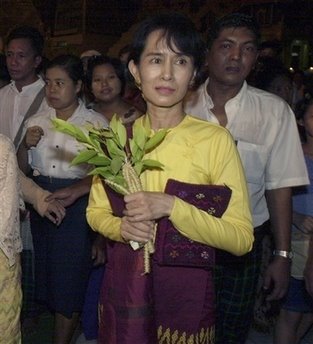


 Posts


