http://www.shanghaidaily.com/sp/article/2009/200902/20090211/article_390679.htm
By Li Xinran | 2009-2-11 | ONLINE EDITION
MORE than 5,000 Chinese citizens left Maijayang yesterday after the Chinese and Myanmar governments cracked down on casinos in the border city.
Several Chinese teenagers have been abducted recently in Maijayang.
To stop gambling Myanmar has shut down the casinos in Maijayang and China has cut off power, water, telecommunications and even paths to the town which sits on the Sino-Burma border, Beijing News reported.
Maijayang authorities have declared gambling illegal and local police raided dozens of casinos on January 28.
Cao Chuan, a Chinese employee at a local casino, told the newspaper he lost his job because of the raids.
The frontier inspection authority from the neighboring Yunnan Province of China said Myanmar closed casinos in Maijayang after Chinese media reported teenagers from Yuncheng City, Shanxi Province, had been kidnapped in the city by casino operators or loan sharks and held for ransom.
China switched off some of its transmission towers from January 28 in Yunnan's Dehong Prefecture, which borders Maijayang. Authorities in Dehong said they would introduce measures to block finance, power and telecommunication services to casinos in Myanmar.
Chinese frontier troops are patroling more frequently than before and have closed 11 passages to Maijayang to ban illegal crossings, the report said.
At least 50 youngsters from Shanxi in northern China have been kidnapped and reportedly tortured by gangs in Myanmar since August to extort ransoms.
All of them returned home at the end of last month after their parents had paid ransoms or they were rescued by the police.
Most of those kidnapped were between 16 and 22 years old, police said.
The kidnappers tricked their victims into going to Myanmar for work. After arriving there the teens were imprisoned and the kidnappers phoned their families demanding ransoms.
Most of the boys were freed after their families paid ransoms that ranged between 20,000 and 100,000 yuan.
They were told by the kidnappers in Myanmar to gamble so they could run up debts that could be used to extort money from their worried parents.
Families later received phone calls from Myanmar demanding ransoms for their children who were heard crying and saying they had been tortured.
The callers told the parents to pay the ransom into designated bank accounts otherwise their boys would be skinned or the parents would be sent their fingers.
One victim told his mother on October 8 that he would be beaten to death if she could not transfer money that day.
Thursday, February 12, 2009
Seamy border casino town closed down


My views on Rohingya (Burmese)
http://burmadigest.info/2009/02/11/my-views-on-rohingya-burmese/
FROM BURMA DIGEST
A new tone as Clinton comes calling
By NEHGINPAO KIPGEN
Asia Times – February 11, 2009
Hillary Clinton is soon to begin her maiden overseas trip to East Asia as the 67th secretary of state of the United States of America . The week-long trip starting on February 15 includes stops in Indonesia , Japan , South Korea and China .
Four fundamental issues are expected to dominate the visit. First, reshaping America 's image in the Muslim world; second, the ongoing global financial crisis; third, global warming; and fourth, tensions surrounding the two Koreas and Pyongyang 's nuclear program.
A trip to the world's largest Muslim-majority nation appears to be high on the agenda. Indonesia is "an important country for the United States ... and the secretary feels it's important that we need to reach out and reach out early to Indonesia ", said US State Department spokesperson Robert Wood on February 5.
Clinton 's predecessor, Condoleezza Rice, began her tenure with a trip to Europe and the Middle East. Rice's predecessor, Colin Powell, first visited the Middle East, while Madeleine Albright made her inaugural trip to Europe and East Asia .
The selection of destinations in Southeast and East Asia carries a significant message. It is a sign of renewed US interest in strengthening ties between East and West. Clinton was a widely known figure in that part of the world even before she accepted the job and will not require a lengthy introduction.
The visit to Indonesia is an implementation of President Barack Obama's vision for a new way forward with the Muslim world. After his election, the first African-American president promised to deliver a major speech in a Muslim capital. Clinton 's visit is largely viewed as laying the groundwork for an Obama visit to Jakarta .
Five days after his inauguration, Obama sat down with Dubai-based al-Arabiya television network and said, "I have Muslim members of my family. I have lived in Muslim countries. My job to the Muslim world is to communicate that the Americans are not your enemy."
The choice of Indonesia was made not only because it is the world's largest Muslim-majority nation, but also due to Obama's personal connections. He lived in Indonesia and attended schools there between the ages of six and 10. During this time, his mother remarried to an Indonesian. When he was inaugurated, Obama's former classmates gathered at his old school to celebrate the triumph of the student they once called "Barry".
Although the US and Japan fought during the World War II, their bilateral relationship is now cordial. Japan is a good regional ally of Washington both economically and in the fight against terrorism. Japan also plays an important role in the six-party talks on North Korea 's nuclear program.
South Korea is also a long-time US ally in the region. Like Japan , South Korea is a good partner in trade and politics and plays a key role in the six-party nuclear talks. Clinton 's stops in Seoul and Tokyo will serve to reaffirm these friendships and to explore areas of further cooperation. Besides the global financial crisis, Clinton is expected to discuss the US 's new strategy in Afghanistan with both countries.
The Sino-US relationship is dominated by economic issues, and has been noticeably closer in recent years. China , now the third-largest economy in the world, has forced the US to acknowledge its growing influence in the region and the world.
The two opposing ideologies - capitalist and communist - have conflicting interests and differing approaches to many international conflicts. This divergence has often surfaced in the United Nations Security Council. Yet despite their differences, China and the US have worked together on North Korea and other issues.
The Obama administration is apparently interested in moving beyond just economic talks with China . During her confirmation hearing, Clinton envisioned a new "comprehensive" China policy that will incorporate a broad non-economic agenda.
Both Obama and Clinton have emphasized the need to use diplomacy and engagement in dealing with the troubled regions of the world. The secretary of state's first overseas visit to East Asia will indicate where US foreign policy is headed under Obama - and may shed light on the new administration' s ability to deliver on its message of change.
Although many regional analysts are already clamoring for Clinton to bring up some of the region's troubling political problems, such as Myanmar and Tibet , it is unlikely such controversial subjects will be discussed on her visit.
Nehginpao Kipgen is general secretary of US-based Kuki International Forum (www.kukiforum. com) and author of several analytical articles on the politics of Asia published in different leading newspapers.
(Copyright 2009 Nehginpao Kipgen.)
Burmese Cargo Boats Stop Entering Bangladesh Due to Naval Patrols
http://www.narinjara.com/details.asp?id=2065
2/11/2009
Teknaf: Burmese cargo boats, both legal and illegal, have stopped entering Bangladesh ports on the border recently due to increased Burmese naval patrols in the sea of Arakan, said a rice trader from the border.
"Recently, Burmese cargoes have almost halted entering into Teknaf Port in order to avoid arrest by the Burmese navy, which is patrolling on the Arakan Sea," he said.
According to local sources, the Burmese navy ships are now patrolling at five locations of the coast of Arakan, including nearby the Mayu Lighthouse, Sandaw Shin Pagoda Island, Manaung Island, the mouth of the Kaladan River, and Kyaukpru Channel.
The witness said the patrolling ships are Burma's largest, and are not from Arakan's naval bases. The ships are coming from naval bases in Rangoon and Hal Gyi Island.
"Many smuggling cargo boats in Burma are able to come to Bangladesh by giving bribes to local navy forces, but this time the cargo boats are unable to make it with bribes because the naval ships are now under a mission," the trader added.
Burmese businessmen export many goods from Burma, including rice, timber, and cane, via sea to Bangladesh, but most of these exports are smuggled illegally.
A Burmese businessman from Sittwe confirmed that some Burmese navy ships, including Inn Ma Navy from the delta region of Burma have arrived at the Arakan Coast and are patrolling.
It is reported that the Burmese ships are closely watching the maritime border with Bangladesh on instructions from the high authority in Naypyidaw, who claimed foreign invaders could enter Burmese territory at anytime.
Troop Movements Reported Along Bangladesh-Burma Border
http://www.irrawaddy.org/article.php?art_id=15096
--------------------------------------------------------------------------------
By MIN LWIN Wednesday, February 11, 2009
--------------------------------------------------------------------------------
Bangladesh and Burma have reportedly deployed troops along their border and naval vessels offshore as tensions increase between the two countries over oil and gas exploration rights and the Rohingya refugees issue.
The deployments were reported by Khine Mrat Kyaw in the Bangladesh-based Narinjara news agency on Wednesday.
Khine Mrat Kyaw also reported that aircraft landing strips had been constructed in Buthidaung Township, near the border of Burma’s Arakan State and Bangladesh.
Tension first arose between the two countries in November 2008 after Burma sent naval vessels to escort a Korean company exploring for oil and gas about 50 kilometers (30 miles) south of Bangladesh's Saint Martin Island.
Differences have also arisen between Burma and Bangladesh over the hundreds of Rohingya refugees from Burma’s Arakan State who have taken to the Bay of Bengal in open boats in search of a new home.
Burma’s Consul General in Hong Kong, Ye Myint Aung, wrote to heads of foreign missions there and local newspapers insisting the Muslim Rohingyas should not be described as being from Burma, the South China Morning Post reported.
The agency AFP said the South China Morning Post reported on Wednesday that Ye Myint Aung had described the Rohingya boat people as "ugly as ogres."
The Burmese diplomat was quoted as saying: "In reality, Rohingya are neither Myanmar people nor Myanmar's ethnic group."
The envoy contrasted the "dark brown" Rohingya complexion with the "fair and soft" skin of people from Burma, according to the newspaper.
Meanwhile, the US has assured Bangladesh of its support in patrolling its sea borders.
The assurance was given by US Assistant Secretary of State for South and Central Asia Richard Boucher at the close of a two-day visit to Bangladesh, according to the Qatar- based Gulf Times.
Burmese to Celebrate Union Day
http://www.irrawaddy.org/article.php?art_id=15095
--------------------------------------------------------------------------------
By SAW YAN NAING Wednesday, February 11, 2009
--------------------------------------------------------------------------------
The 62nd anniversary of Union Day will be celebrated on Thursday by many Burmese inside and outside the country, even though many youth are not familiar with the history of the Panglong Agreement, which had the aim of achieving a federal system of government.
A Karen teacher, Tabora, who works in the Thailand-based Karen Education Department, said very few Karen students in refugee camps on the Thailand-Burma border know about the history of the Panglong Agreement.
The Panglong Agreement was signed between the Burmese central government and several ethnic groups with the aim of achieving a federal democratic system of government in Burma after the country gained independence from Britain in 1947.
The Panglong Agreement was singed by the government led by Burma’s independence hero, Gen Aung San, father of detained democracy leader Aung San Suu Kyi, and the signatories included ethnic Shan, Chin and Kachin groups in Panglong town in Shan State on February 12, 1947. The event is recognized annually as Union Day of Burma.
According to many ethnic group leaders, sixty years after the Panglong Agreement, the true spirit of Union Day has never been honored by the central government, in terms of its guarantees of ethno-political equality and self-determination of ethnic nationalities.
The ethnic groups involved in the Panglong Agreement say the constitution, written in 1948, failed to guarantee equal rights, autonomy and self-determination as agreed upon at the conference. It was one of the factors that led many ethnic groups to launch military operations against the central government.
Since then, some groups have reached ceasefire agreements with the Burmese military government while others have fought for autonomy for decades.
As long as the leaders of Burma fail to recognize the principles of the Panglong Agreement, the true spirit of Union Day will never be realized, say ethnic politicians.
Eh Ku Paw, a former Karen teacher in the Mae La Oo refugee camp, said she learned about the history of the Panglong Agreement, but it was a superficial understanding of the event.
She said the average Karen refugee camp student doesn’t know about the agreement.
Naw La, a Kachin youth in Chiang Mai, said only Burmese youth with an interest in politics have an understanding of the agreement.
MYANMAR: NGOs cut smoother path in the delta, but challenges remain
http://www.irinnews.org/Report.aspx?ReportId=82865
YANGON, 11 February 2009 (IRIN) - Last year's Cyclone Nargis dramatically altered the humanitarian landscape in Myanmar, with almost double the number of NGOs now operating in the Ayeyarwady Delta.
In the weeks and months following the 2 and 3 May disaster, about 40 international NGOs were given permission to operate in the Nargis-affected areas.
“That almost doubled the number of NGOs here, in a short space of time,” said Kerren Hedlund, the NGO liaison officer in Yangon, Myanmar’s commercial capital.
Much of this is credited to the Tripartite Core Group (TCG) comprising the government, Association of Southeast Asian Nations (ASEAN) and the UN, which has helped build trust between the various parties working to help those in need.
The experience of the Norwegian Refugee Council (NRC), which runs a US$10 million programme building schools and shelters in Labutta Township, is typical.
"We came here after Nargis in June and made an assessment, came back in July and followed up, and then back in August and signed an agreement with the minister [of Social Welfare], ” NRC country director Joern Kristensen told IRIN. "It was a very smooth process," he said.
While most of the NGOs operating in Myanmar before the cyclone did so under agreements with the Ministry of Health, the new NGOs working in the delta liaise with the Ministry of Social Welfare, which has coordinated post-Nargis rehabilitation.
"We have been very impressed with the cooperation and support from the government," said Kristensen. "No stumbling blocks - it's been like this ever since we started."
Better access
Photo: Contributor/IRIN
Save the Children workers in front of a water catchment container, Ayeyarwady Delta (file photo)
Existing NGOs have also seen an easing of restrictions in the delta, the result of new arrangements negotiated within the TCG.
"The TCG has been critical in improving access," said Andrew Kirkwood, country director for Save the Children, which runs a recovery programme in the delta as well as health and education programmes across Myanmar, where it has operated for 14 years.
"International staff can travel alone to the delta, without a government liaison officer, and permission takes one week. In the rest of the country permission to travel takes four weeks and we still travel with a liaison officer," Kirkwood said.
In addition, some agencies without official permission to operate in Myanmar have channelled funds to a growing number of local NGOs that have been given greater freedom to operate under agreements reached by the TCG, say aid workers.
Challenges
"The infrastructure is poor. It is an aquatic environment and difficult to move goods and materials around there," said Kristensen. In addition, agencies often struggle to recruit qualified staff.
However, the number of people employed in the humanitarian sector has probably doubled since the cyclone struck, say aid workers.
Save the Children's staff numbers increased to 1,600 from 500 and dozens of international staff were relocated to Myanmar, both on long and short-term contracts.
"Most of our new staff had never worked for NGOs or done humanitarian work so there was a huge amount of learning and training," Kirkwood explained.
“One of the legacies of Nargis is a much broader base of humanitarian workers in the country," he added.
Outside the delta
One of the legacies of Nargis is a much broader base of humanitarian workers in the country.
The issue for many humanitarians is whether positive aspects of the Nargis response can bring a permanent improvement to the operating environment across Myanmar.
Expected donor funding for a three-year $691 million recovery plan for cyclone-affected communities, launched on 9 February, will be largely contingent on the extension of the TCG mechanism beyond June 2009 and possibly to other areas of the country.
"Donors will be concerned that the freedom to operate will shrink without the TCG, and they won't have the confidence that their donation would have the same impact," Hedlund noted.
Yet access is not the only factor marking out the delta from the rest of the Myanmar.
Other needy regions receive little development aid. "In money terms, a little over $100 per person per year is now being spent in the delta. That compares to $2.50 per head in the rest of the country," Kirkwood noted.
"While it's right and proper that we spend that money in the delta we also need to focus on increasing that $2.50 figure. The needs are overwhelming," he said.
rr/ds/mw
Theme(s): (IRIN) Aid Policy, (IRIN) Natural Disasters
[ENDS]
[This report does not necessarily reflect the views of the United Nations]
Myanmar steps up cracking down on smuggling through containers
http://news.xinhuanet.com/english/2009-02/11/content_10800098.htm
www.chinaview.cn 2009-02-11 10:53:17 Print
YANGON, Feb. 11 (Xinhua) -- Myanmar authorities are stepping up cracking down on smuggling of banned goods out of the country through containers by conducting strict and thorough check on exporting goods, especially forest products, carried in the containers, the local Weekly Eleven News reported Wednesday, quoting exporters.
Applying complicated process, the one-by-one detailed check on exporting items by having them unloaded from container before it is granted for shipping is being carried out or with X-ray at the Yangon Port to expose hidden banned goods, the report said.
The tight measures was introduced after there was unconfirmed report that smuggling of narcotic drugs through exporting wood carried in one container was foiled recently only minutes after it was given green light, alerting the authorities to take such tightened measure in the aftermath.
According to the anti-drug authorities, Myanmar punished 277 people, including 67 women, for drug offense in December last year.
During the month, the authorities seized 50 kilograms (kg) of opium, 2.32 kg heroin as well as 120,000 stimulant tablets, the figures of the Central Committee for Drug Abuse Control show.
In the previous month, the country exposed a total of 207 narcotic-drug-related cases punishing 308 people including 58 women.
That month's seizure included seized 71.18 kilograms (kg) of opium, 7.6 kg of heroin, 7 kg of ephedrine, 9 kg of marijuana, 2.5kg of Ice and 5.9 kg of Caffeine as well as 221,406 stimulant tablets.
Due to anti-drug efforts, the number of drug users in Myanmar decreased from 61,455 in 2005 to 54,709 in January 2008.
Myanmar has been implementing a 15-year plan (1999-2014) to totally eradicate poppy in three phases, each running for five years.
Editor: Yang Lina
Gem Museum In Myanmar Capital To Boost Tourism
http://www.bernama.com/bernama/v5/newsworld.php?id=389003
February 11, 2009 12:04 PM
YANGON, Feb 11 (Bernama) -- A gem museum will soon emerge in Myanmar's new capital of Nay Pyi Taw after a year's construction and the emergence will help boost the country's tourism, China's Xinhua news agency quoted a local daily as reporting Wednesday.
With an area of 12.5 acres (5.06 hectares), the three-storey museum will display Myanmar's world famous gems, jade, pearl and jewelry, the local weekly journal Pyi Myanmar said.
The new gem museum stands the second of its kind next to Yangon's.
In Yangon, there is a gem mart attached with the first gem museum as well as a convention center where Myanmar holds its gem sale all year round on different occasions, displaying a variety of the quality items for sale on the basis of competitive bidding and tender systems.
Myanmar started to hold gem shows annually in 1964, introducing the mid-year one in 1992 and the special one in 2004.
The gem traders mostly came from China, China's Hong Kong Special Administrative Region (SAR) and Thailand.
There are six mining areas in Myanmar under gem and jade exploration, namely, Mogok, Mongshu, Lonkin/Phakant, Khamhti, Moenyin and Namyar.
Myanmar, a well-known producer of gems in the world, boasts ruby, diamond, cat's eye, emerald, topaz, pearl, sapphire, coral and a variety of garnet tinged with yellow.
The authorities designated the proceeds from the sale of gems at these emporiums as legal export earning to encourage the private sector in the development of the gem industry.
Of Myanmar's US$6.043 billion exports in 2007-08, gem products stood the third after natural gas and agricultural produces with US$647.53 million, according to official statistics.
The government's Central Statistical Organization also revealed that in the fiscal year 2007-08, Myanmar produced 20,235 tons of jade and 22.668 million carats of gems which include ruby, sapphire, spinel and peridot, as well as 225,611 mommis (846 kg) of pearl.
-- BERNAMA
ICT exhibition to open in Yangon, Myanmar
http://news.xinhuanet.com/english/2009-02/11/content_10800452.htm
www.chinaview.cn 2009-02-11 12:46:58 Print
YANGON, Feb. 11 (Xinhua) -- An information and communication technology (ICT) exhibition will open at the Myanmar Infotech in Yangon's Hlaing University Thursday, according to the sponsor on Wednesday.
Sponsored by the Myanmar ICT Corporation, the four-day ICT show-2009 will run until this weekend.
A total of 120 showrooms of 50 companies will display computer accessories, communication accessories, electronics, software and documents related to computer technology training, the sponsor said.
Dota and counter strike game competitions will also be launched at the exhibition, it added.
In March and October last year, two other ICT exhibitions respectively took place in Yangon which were co-sponsored by the Myanmar Computer Federation (MCF), Myanmar Computer Professionals Association and the Myanmar Computer Entrepreneurs Association.
In those exhibitions, nearly 100 companies showcased accessories of computers, new technology for networking, software solutions, computer courses and books.
Myanmar has been striving for the development of ICT. In December 2007, Myanmar's first largest ICT park, also known as the Yadanabon Cyber City, was introduced in Pyin Oo Lwin.
As part of the project in the development of the cyber city, Myanmar authorities have allotted 372 acres (150 hectares) of landin the soft-base factory area of the Yadanabon cyber city for 35 more local and foreign IT companies to develop their business undertakings.
To encourage and help employees settle in the cyber city, Myanmar is also implementing new private housing projects there, offering land lease grant for 30 years for the establishment.
The cyber city, which covers an overall area of 10,000 acres (4,050 hectares), located in the hilly Pyin Oo Lwin near a highway, 67 km east of the second largest city of Mandalay in the north, and 20 percent of the cyber city area produce software and hardware.
The internet of the cyber city not only links with the whole country but also connect neighboring China, Thailand and India.
With the establishment of the cyber city, more and more local and foreign information technology (IT) companies have sought investment in the cyber city for the development of IT business undertakings.
Editor: An
Take the money and run in Myanmar
http://www.atimes.com/atimes/Southeast_Asia/KB12Ae02.html
Feb 12, 2009
By Norman Robespierre
YANGON - Recent media reports indicate at least eight ministers and the mayor of the old capital of Yangon will resign their posts as a presage to Myanmar's general elections scheduled for 2010. The list is a veritable who's who of the ruling State Peace and Development Council's (SPDC) top lieutenants and signals the regime's intention to keep its members prominent in the transition towards an elected civilian-led administration.
Several of the outgoing ministers have served especially long tenures for Myanmar's cut-and-thrust politics and are expected to run for office at the upcoming polls under a military-supported political party. The regime has promoted the elections as part of its seven-step road map to democracy; opponents see the
promised political transition as a sham to give a veneer of legitimacy to continued military rule. It's unclear where the departing ministers fit into that political future.
Minister of Construction Major General Saw Tun, for instance, has maintained control over the lucrative construction portfolio since 1995, predating the formation of the SPDC. While allegations of rampant corruption have tarnished the reputations of many Myanmar ministers and ministries, Saw Tun's name is usually not mentioned among them. According to a Myanmar businessman who knows the minister, Saw Tun often says that it is better to make a little bit of money over a long time than to make a lot of money quickly. Apart from that temperance, his longevity in the position can also be attributed to his hometown ties to junta leader Senior General Than Shwe, who likewise hails from the Kyaukse township of the country's central Mandalay division.
Another long-serving minister is U Aung Thaung, who has served as Minister of Industry No 1 since the SPDC's formation in 1997. According to businessmen who know both ministers, U Aung Thaung is not as inhibited as Saw Tun. Many Myanmar ministers who have bid to maximize short-term profits from their positions have had their careers ended prematurely on corruption charges. Some say U Aung Thaung has survived in his post because of his close connections to the senior leadership: He is a known favorite of Than Shwe and his son is married to the daughter of Vice Senior General Maung Aye, the junta's second top-ranking official.
Other officials apparently set to trade their military khakis for civilian garb include Minister of Forestry Brigadier General Thein Aung, Minister of Immigration and Population Major General Saw Lwin, Minister of Livestock Breeding and Fisheries Brigadier General Maung Maung Thein, Minister of Transport Major General Thein Swe, Minister of Agriculture and Irrigation Major-General Htay Oo and Minister of Communications, Posts and Telegraphs Brigadier General Thein Zaw. Also mentioned is Yangon mayor Brigadier General Aung Thein Lin.
Some of the departing ministers are believed to be building up financial war chests for the elections or securing preferential deals and concessions for their families' businesses. It's a sometimes predatory process that has increased competition for resources among the ministers and exerted pressure on the country's private business community.
Ministers and their associates have in particular targeted foreign investors, pressuring many of them to renegotiate their existing contracts and business arrangements. Officials have through the discretionary power of their ministries reviewed the documentation of various joint foreign-local ventures for legal loopholes to pressure companies into forfeiting assets, accepting new business partners or receiving lower profit percentages than originally agreed, according to people familiar with the situation.
One of the higher profile victims is Woodlands Travel, a tourism company founded in 1995 by U Win Aung and which lists company addresses both in Yangon and New Jersey in the United States. The company's website lists its investment in two boutique hotels, the Kandawgyi Lodge and Popa Mountain Resort, in line with the government's eco-tourism campaign.
Unstated on the company website, however, is the source of those investments' funding, though local businessmen note that several Singaporeans hold senior company positions. Speculation recently intensified around the Woodlands Travel when its two boutique hotels - among the country's finest upscale resorts - were purchased last November by Htoo Trading Co. The controversial company is headed by Tay Za, a businessman known for his close SPDC connections and who was individually targeted by the US government's new "smart" financial sanctions.
It's not clear whether Tay Za purchased the properties independently or as a nominee in league with junta officials or their family members, despite speculation that the Ministry of Forestry had earlier exerted pressure on the company. According to a source intimately familiar with the deal, Minister of Forestry Thein Aung had previously sought to have Woodlands Travel modify its concession terms to include another local company, which apparently offered little in terms of expertise or capital.
Company officials instead decided to sell the properties outright at below market value rather than face a protracted legal battle over being forced to take on the new business partner and retaining their original contractual rights. That, the source said, would have put the company up against "influential people" and made future business difficult.
Woodlands Travel had originally brokered its deal under the auspices of former intelligence chief and prime minister Khin Nyunt, who was ousted from power on corruption charges in October 2004 and is currently under house arrest. Thein Aung's ministry office declined an Asia Times Online request for a telephone interview to address the allegations.
Expansive family empire
Minister for Industry No 1 U Aung Thaung has come under similar criticism. The controversial minister was paraphrased in a recent media report saying that he would retire only after providing for a comfortable future for his children. Accounts from one well-placed source indicate the long-serving minister has followed up those words with actions.
In recent months, the source says several businesses and hotels in the popular Bagan Nyaung U tourist area have been approached by ministry officials to grant concessions and contracts to U Aung Thaung's family businesses, including the Aung Yee Phyo Co Ltd and IGE Co Ltd companies. Both companies are run by his sons, Nay Aung and Pyi Aung. Given the influence of ministers and ministries in Myanmar's political and economic systems, such approaches would be difficult to reject without fear of repercussions.
A senior advisor to both companies, contacted at their Yangon-based offices, told Asia Times Online that he had "never heard anything" about the allegations and didn't know if they were true. Initially involved in industrial equipment and supplies trading, U Aung Thaung's family businesses have recently expanded into the energy, information technology and tourism sectors, which the senior advisor acknowledged.
The company's bid to move into the tourism sector, currently in a lull but expected to accelerate after the 2010 elections, has been viewed by some in Yangon as an attempt to further diversify the family's business holdings before relinquishing his ministerial post. The ministry's head of office, U Myint Swe, said by telephone that he had "no comment" on whether the ministry was trying to wrest concessions from private businesses in the Bagan area. He said that the minister was away from his office and unavailable to speak by telephone.
There are several allegations of top government officials using their positions to ramp up personal business activities before the 2010 transition towards democracy. One recent Kachin News Group report suggested that the planned move towards civilian rule has served as catalyst for SPDC officials to cash in on their positions in the northern Kachin State, including through the recent establishment of road closures to tax passing motorists.
Corruption is so endemic in Myanmar, which consistently ranks among the global worst in international country graft ratings, that it's difficult to tie any given incident specifically to the 2010 elections. Yet if the reported ministerial changes come to fruition, the departure of some of the junta's longest-serving members will open up to a new generation of soldiers and regime loyalists some of the most lucrative ministerial positions in government.
Ministerial positions are normally given to flag officers and occasionally deputy ministers promoted to the ministerial level. Considering the personal profits that could be accrued in the portfolios reportedly set to be vacated, it is possible that incumbent ministers from less lucrative ministries, such as the Ministry of Culture or Ministry of Social Welfare, Relief and Resettlement, could be transferred laterally, as has happened in previous shake-ups.
Their current positions could in turn be filled with flag officers currently serving in operational positions within the Tatmadaw, as the Myanmar armed forces are known. Cabinet reshuffles are common inside the SPDC, an outgrowth of the regime's need to provide cushy advancement opportunities to officers who occupy critical field-grade positions, including command over areas fighting against ethnic insurgent groups.
Often the cabinet reorganizations are timed to ensure a number of brigadier positions open up for colonels graduating from the National Defense College. The frequent ministerial musical chairs among generals and ministers has the psychological effect of promoting loyalty while ensuring that nobody gets too comfortable in their position. Officers often feel a sense of relief and renewed loyalty to the top decision-makers if they still have a job when the music stops.
In private conversations, some senior SPDC officers suggest that the 2010 election date is not etched in stone. Knowing that the 76-year-old Than Shwe intends to hold onto supreme power for as long as possible, they anticipate the democratic transition could be postponed for any number of reasons, including, according to one officer, the simple top-down determination that "the country isn't ready". The prognostications of the junta leader's astrologer, E Thi, could also offer cosmic cause for delay, he suggests.
Until then, Myanmar's citizenry and businesses will likely come under increasing pressure from ministers and other officials preparing for either elections or life outside of public office. All in all, the mounting money grab augurs ill for the political change Than Shwe and his junta has promised democracy will hold.
Norman Robespierre, a pseudonym, is a freelance journalist specializing in Southeast Asian affairs. Asia Times Online's Southeast Asia Editor Shawn W Crispin contributed reporting from Bangkok.
(Copyright 2009 Asia Times Online (Holdings) Ltd. All rights reserved. Please contact us about sales, syndication and republishing.)
British Legislators Condemn “Massive Church Closures” In Burma
http://waynebrownministries.com/b2evolution/blogs/index.php/2009/02/10/british-legislators-condemn-massive-chur?blog=2
British Legislators Condemn “Massive Church Closures” In Burma
by WayneBrownMinistries
RANGOON, BURMA (Worthy News) – Dozens of British legislators expressed concern Tuesday, February 10, over reports of massive church closures in Burma, seen as “the most significant crackdown” on Christian activity in the military-ruled Asian nation in years, an advocacy group told Worthy News.
Christian Solidarity Worldwide said 33 British parliamentarians signed a motion urging the United Nations Special Rapporteur for Freedom of Religion and Belief, Asma Jilani Jahangir, to investigate violations of religious freedom in Burma, as “at least 100 churches” were closed in the capital Rangoon last month.
The Early Day Motion was proposed by John Bercow, who co-chairs of the All Parliamentary Group for Democracy in Burma, also known as Myanmar, CSW said. “The church closures mark the most significant crackdown on Christian activity in Burma in recent years, affecting as many as 80 per cent of churches in Rangoon,” said CSW, which has investigated the situation in Burma.
The group said some 50 pastors were forced to sign documents promising to stop holding church services, “under threat of prison for non-compliance.”
CHURCH AID
Some local Christians have linked the reported crackdown to church involvement in aid to victims of last year’s devastating Cyclone Nargis, which killed at least 140,000 people and displaced 800,000 more.
Aid workers have warned that the UN’s $482 million appeal to cover cyclone relief and recovery up to April 2009 remains unfunded.
Burma is categorized as a ‘Country of Particular Concern’ by the United States State Department for its apparent violations of religious freedom.
In 2007, CSW published a report, ‘Carrying the Cross: The military regime’s campaign of restriction, discrimination and persecution against Christians in Burma’ which revealed a 17-point document allegedly from an organization affiliated to the Ministry of Religious Affairs, titled “Program to Destroy the Christian religion in Burma". The first point states: “There shall be no home where the Christian religion is practiced.”
BURMESE GENERALS
Burma’s ruling State Peace and Development Council, a group of generals, has consistently denied human rights abuses, describing reports to the contrary as “Western propaganda” and part of “American imperialism.”
However CSW Advocacy Director, Tina Lambert, told Worthy News that the “recent crackdown on Christian activity in Rangoon is a worrying development and a serious violation of religious freedom.”
Lambert said she was “delighted that John Bercow and other parliamentarians…call for respect for religious freedom in Burma, and for the regime to stop its policies of discrimination and persecution of religious minorities, particularly Christians and Muslims.”
CSW also welcomes their call to U.N. Special Rapporteur for Freedom of Religion and Belief, Asma Jahangir, to investigate and “hold Burma’s military regime accountable for their many human rights abuses".
WHERE'S THE STATE DEPARTMENT NUCLEAR REPORT ON BURMA?
DICTATOR WATCH
(www.dictatorwatch. org)
Contact: Roland Watson, roland@dictatorwatc h.org
February 11, 2009
I am unable to post this to the Dictator Watch site at the moment. Please forward it to all your journalist contacts.
Unbeknownst to the Burma pro-democracy movement, and the journalist and diplomatic communities, there are events unfolding now in Washington, D.C., that will shape the Obama Administration' s Burma policy for years to come. These events specifically relate to the position the Administration will take on the military junta of Burma - the SPDC's - nuclear and missile proliferation programs: whether to acknowledge them or not.
Under Section 10 of the Tom Lantos Block Burmese JADE (Junta's Anti-Democratic Efforts) Act of 2008, the Secretary of State is required to prepare a report, not later than 180 days after the enactment of the Act, and annually thereafter, on Military and Intelligence Aid to Burma from foreign countries, companies and other entities. Subsection 3 specifies that the report must include information on "the provision of weapons of mass destruction and related materials, capabilities, and technology, including nuclear, chemical, and dual use capabilities."
The report is to be submitted to the Foreign Affairs and Foreign Relations Committees of the House and Senate, respectively. An unclassified version "shall be placed on the Department of State's website."
President Bust signed the JADE Act into law last July 29th. This means the 180 day preparation period has expired. We assume that the report has been completed and submitted to the committees. Indirect evidence of this is that on January 15th, Senator Richard Lugar, as part of Susan Rice's confirmation hearing as Ambassador to the United Nations, asked Ms. Rice her position on Burma, including "its growing relationship with North Korea." She declined to answer this element of the question.
We believe Senator Lugar and now Ambassador Rice had read the report, and that it confirms that the SPDC has active nuclear and missile proliferation programs, with the involvement of Russia, North Korea and Iran. This would be consistent with information from our own sources, and which intelligence we have published for the last two years.
The report has not yet been posted on the State Department website. If, when it is made public, its contents support our intelligence, this will trigger a political and media firestorm. The State Department, and by default, the U.S. intelligence community, will have confirmed that the SPDC is a nuclear weapons aspirant. (We have previously reported radio intercepts, in the summer of last year, by the pro-democracy resistance in Eastern Burma of Burma Army communications discussing unsuccessful attempts to shoot down unmanned drones. The U.S. is the logical source for such drones, and if so they likely originated from the base on Diego Garcia.)
The State Department report will elevate Burma in the international discourse to shared status with North Korea and Iran as a threat of the most severe magnitude. It will instantly change the Security Council debate on Burma and the ability of Russia and China to sustain their vetoes on Council action.
We were heartened by President Obama's election campaign statements promising real change, and want to give him the benefit of the doubt. We also understand that Secretary Clinton has just assumed her position, and that there are many grave issues confronting both the United States and the world. Still, the Burma question cannot be put off indefinitely. The SPDC ruthlessly attacked peaceful monks and other pro-democracy demonstrators during the 2007 Saffron Revolution. It denied humanitarian relief to the survivors of the Cyclone Nargis catastrophe. Now, a report has been prepared, under the terms of a law that both President Obama and Secretary Clinton signed, as senators, which we are confident will reveal the SPDC to be a developing nuclear threat, and also a partner with North Korea and Iran.
This issue is forcing the Administration' s hand on Burma, in its first few weeks in office. If the report appears shortly, and is not censored regarding the findings of Subsection 3, it will signal that the Obama Administration, unlike President Bush, intends to be open and firm on the SPDC. The campaign promises of honesty and integrity will have been satisfied.
If, on the other hand, the report is not released anytime soon, or it is heavily censored, this implies (1) that the U.S. knows that Burma has a proliferation program; and (2) that the Administration does not want to deal with this new and pressing policy issue (perhaps because of how it would complicate diplomacy with North Korea, Iran and Russia), and that Burma and the threat the SPDC poses to international security and peace will remain on the back burner. Moreover, notwithstanding comforting statements about democracy that will inevitably be forthcoming, including during Secretary Clinton's upcoming trip to Asia, the Obama Administration, like Bush, will not initiate or even support the types of steps that are needed to pressure the SPDC and ultimately to dethrone the junta's supreme leader, Burma's dictator Senior General Than Shwe.
We call upon the journalist community to ask their government contacts: Where's the State Department nuclear report on Burma?
UN's Ban Prepares for a "No" from Obama, Dialogue Except in Sri Lanka
http://www.innercitypress.com/ban2obama021009.html
Byline: Matthew Russell Lee of Inner City Press at the UN: News Analysis
UNITED NATIONS, February 10 -- When Ban Ki-moon returned to New York from Gaza earlier this year, he said he'd lost his voice. This month when he came back from travels he briefed the Security Council and then the press. Fourteen media questions were allowed. Gaza and the prospective indictment of Sudan's president Omar al-Bashir came up again and again, while Congo and Somalia, for example, were not asked about. (Inner City Press asked about Ban's failure to call for a ceasefire in Sri Lanka.)
Only once did Ban veer from the questions to unilaterally clarify something, and this concerned his reported invitation for Barack Obama to visit the UN on climate change in March. Ban said he would understand if Obama is busy, he is "just settling in," Ban said. To many, it sounded defensive and craven, as if saying in advance, "if I get dissed, it is no loss of face."
The press conference's first question was about Obama and Iran: has Ban told Obama to start peace dialogue now? Apparently not. Ban was seen Monday night at Iran's celebration in the UN's Delegates' Dining Room of the 30th Anniversary of the Islamic Revolution. Tuesday he said that all problems should be resolved by dialogue and not military force -- a principle he did not apply, however, to Sri Lanka.
Next Ban was asked if the foreseen rightward shift after Israel's elections will make peace more difficult. A supporter of Hezbollah, interviewed by Inner City Press at the Iranian celebration, said he hoped "Bibi or the further right wing guy wins," apparently in order to bring the Apocalypse on more quickly.
Ban was asked about the Gaza crossing, then about Myanmar. A UN staffer who works on the issue later told Inner City Press that Ban's envoy Ibrahim Gambari's recent visit was a success, even though Senior General Than Shwe didn't deign to meet with him. "Where is the leverage?" the staffer asked.
Ban had called his meeting with Zimbabwe's Robert Mugabe a success. He was pressed on this, and said that Mugabe is happy to work with UNICEF and the World Health Organization, and that the UN's Catherine Bragg will soon visit the country.
UN's Ban and Robert Mugabe, no call for ceasefire in Sri Lanka called for
The sixth question concerned the so-called Hariri tribunal, investigating the assassination five years ago. The timeline calls into question what the new Bhutto panel can do. Ban said he will be sending his top lawyer, Patricia O'Brien, to The Hague for the formal opening of the tribunal.
Ban was asked if he listens to Obama's speeches, and in response he read out the statement reducing expectations for his mini-climate summit in March. He was asked, in French, about Libya and the financial crisis. Ban's answer, also in French and leading to applause, contained references to "son leadership" and "mon leadership."
Al Arabiya asked about the Hariri tribunal, can justice be expected. Would Ban meet with Sudan's al-Bashir if he gets indicted? The question was not answered; Ban would seek Ms. O'Brien's advice. But clearly the scenario's been thought through. So what is the answer?
Ban was asked about Pakistan and about Kashmir, in response to which he said all problems should be solved by dialogue and not military force. Then Inner City Press asked why this doesn't apply to Sri Lanka. "Because Sri Lanka is not on the Security Council's agenda," Ban replied. This interpretation of the UN Charter was openly rejected, later in the day, by the president of the Security Council, Japan's Yukio Takasu. Video here.
Ban was asked about the Gaza inquiry, and whether Israel should pay for damage to UNRWA. The final question was whether Ban would support suspending the International Criminal Court's process against al-Bashir. Ban appeared to say, if Sudan implements the type of legal proceedings the ICC requires. But would a country put its own sitting head of state on trial?
For the record, the Somalia question if allowed would have been that last week the UN's top envoy for Somalia, Amedou Ould Abdallah said that the press should not have reported on an incident in which African Union troops fired into a crowd in Mogadishu, killing between 25 (according to Bloomberg News) and 39 (according to local sources). He said there should be a moratorium on reporting from Somalia, and compared those who did report to the Mille Colline radio station which stoked genocide in Rwanda. The UN Secretariat has been asked to respond to the comments, but so far there's been no change or retraction. What is your position?
This question was put to the Committee to Protect Journalists' Joel Simon earlier on Tuesday by Inner City Press, and he expressed concern, mostly at the Rwanda analogy. Video here. But what about the UN calling for censorship?
Footnote: The US Mission to the UN, moving en masse to a meeting of the so-called Friends of Georgia on the UN's second floor, could or would not yet speak for Obama. Surprise was expressed that Hillary Clinton didn't immediately appoint her personal spokesman to the same job for the State Department. The talk is of the new Mission spokeman, Mark Kornblau, now set to begin on February 23. And when, as seemed to be Ban's focus on Tuesday, will Obama decide when he's coming to the UN? Watch this site.
and this October 17 debate, on Security Council and Obama and the UN.
These reports are usually also available through Google News and on Lexis-Nexis.
Click here for a Reuters AlertNet piece by this correspondent about Uganda's Lord's Resistance Army. Click here for an earlier Reuters AlertNet piece about the Somali National Reconciliation Congress, and the UN's $200,000 contribution from an undefined trust fund. Video Analysis here
Feedback: Editorial [at] innercitypress.com
UN Office: S-453A, UN, NY 10017 USA Tel: 212-963-1439
Reporter's mobile (and weekends): 718-716-3540
Search innercitypress.com Search WWW (censored?)
Other, earlier Inner City Press are listed here, and some are available in the ProQuest service, and now on Lexis-Nexis.
Copyright 2006-08 Inner City Press, Inc. To request reprint or other permission, e-contact Editorial [at] innercitypress.com -
UN chief says envoy had good talks in Myanmar
http://www.google.com/hostednews/ap/article/ALeqM5hTLKeb1OEmTBx0wCiSeGVbwOkZyAD9690O8G0
By EDITH M. LEDERER – 16 hours ago
UNITED NATIONS (AP) — U.N. Secretary-General Ban Ki-moon said Tuesday his envoy to Myanmar had good talks in the military-ruled Southeast Asian country, and the world body's chief again urged the government and opposition to quickly resume talks.
Ban said at a news conference that he looks forward to building on special envoy Ibrahim Gambari's recent visit "with a view to further promoting national dialogue and reconciliation."
Gambari met with Myanmar's prime minister, Gen. Thein Sein, as well as detained opposition leader Aung San Suu Kyi during a four-day trip that ended earlier this month. But he did not meet with the junta's chief, Senior Gen. Than Shwe, as he did on three previous visits.
Gambari "had good discussions there even though one may not be totally satisfied," Ban said.
"I would again call on government and opposition to resume substantive dialogue without preconditions and without further delay," the secretary-general added.
Myanmar's current military leadership came to power in 1988, when the country was known as Burma, after crushing a nationwide pro-democracy movement. It held elections in 1990 but refused to honor the results after Suu Kyi's party won a landslide victory. It tolerates virtually no dissent.
State television reported after Gambari's visit that the prime minister gave the U.N. envoy a cold reception, telling him the world body should lift economic sanctions and visa bans if it wants to see political stability.
Western nations, including the United States, impose economic and political sanctions on Myanmar because of its poor human rights record and failure to restore democracy.
Hosted by Copyright © 2009 The Associated Press. All rights reserved.
China in the 21st Century: China's Strategic Role in Crises of International Concern at Stanford University
Thursday, February 19, 2009 – Friday, February 20, 2009
Bechtel Conference Center, Encina Hall
Stanford University, Palo Alto, CA
This one and a half day conference will explore China’s motivations and policy with regard to its role in Chad, Myanmar (Burma), Sudan, and Zimbabwe as well as begin an academic discussion of the strategic role China could play in the context of cooperative efforts to resolve these crises. The experts invited to speak at this conference will span a broad spectrum of topics, including foreign policy, investment, international law, human rights, from government, academia, civil society, and the private sector.
For more information and the conference proceedings, please visit china21.stanford.edu. Or, for more information, please email speakers@campusprogress.org
Sponsored by Campus Progress, Stanford STAND, the Forum on American Chinese Exchange at Stanford (FACES), Stanford Six Degrees, and Stanford in Government and numerous other groups.
Who is Kyaw Thu?
http://www.irrawaddy.org/article.php?art_id=15088
Former Deputy Foreign Minister Kyaw Thu. (Photo: AP)
February 10, 2009 · No Comments
By MIN LWIN
Amid a series of as-yet unannounced reassignments in the top ranks of Burma’s military government, many political observers are paying close attention to the fate of former Deputy Foreign Minister Kyaw Thu, who gained prominence last year as the ruling junta’s liaison with the international community in the Cyclone Nargis relief effort.
Since last May, when Cyclone Nargis devastated much of the Irrawaddy delta, Kyaw Thu has served as the chairman of the Tripartite Core Group (TCG), consisting of representatives of the Burmese regime, the United Nations and the Association of Southeast Asian Nations.
Kyaw Thu, who is in his late 50s, is said to be close to Vice Snr-Gen Maung Aye, the junta’s second-most powerful figure. Like Maung Aye, he is a graduate of the elite Defense Services Academy (DSA).
His father, the noted scholar Dr Maung Maung, who briefly assumed the position of president at the height of the 1988 pro-democracy uprising, published a book entitled “To my Soldier Son” in 1974, soon after Kyaw Thu graduated as a member of the DSA’s 13th Intake.
Former Deputy Foreign Minister Kyaw Thu. (Photo: AP)
Former military intelligence sources said that Kyaw Thu had a reputation for being forthright with his superiors.
In 1997, when he was commander of Light Infantry Division (LID) 22, based in Pa-an Township, Karen State, he got into an physical altercation with his boss Maj-Gen Myint Aung, then commander of the Southeast Regional Command.
According to the intelligence sources, Kyaw Thu’s straightforward manner made him a favorite of Maung Aye. Instead of being disciplined for insubordination for fighting with a superior officer, he was assigned to the foreign ministry.
His first overseas posting was as ambassador to South Africa. According to some former Rangoon-based Burmese diplomats, Kyaw Thu was suspected of corruption during his time in Pretoria from 1999 to 2002.
He was later assigned to head the Burmese embassy in Paris, but the French government refused to recognize his credentials because of his connection to LID 22, which has been linked to human rights abuses.
LID 22 was notorious for its role in the crackdown on peaceful protests in 1988, and has been accused of press-ganging civilians to construct roads used in the Burmese army’s campaign against ethnic Karen rebels.
Kyaw Thu became ambassador to India in 2003, but was called back to Rangoon in late 2004 to become deputy foreign minister following the purge of Prime Minister Gen Khin Nyunt.
Last year he gained an even higher profile when he was named chairman of the TCG, coordinating international relief operations in the cyclone-stricken Irrawaddy delta. Aid workers who met him described him as down-to-earth and cooperative.
Kyaw Thu continued to act as deputy foreign minister until last week, when he was named chairman of the Civil Service Selection and Training Board, an inactive post.
The move came as a surprise to many who had worked with him on Nargis-related projects.
“As far as I could tell, he was very effective in his foreign ministry role, serving in a professional and friendly manner,” said one aid worker.
Although Kyaw Thu attended a TCG meeting in Bangkok on Monday, he is expected to be replaced as chairman of the group in the near future.
Hundreds of Burmese soldiers are reported to have arrived along the border with the United Wa State Army (UWSA)-held territory
http://democracyforburma.wordpress.com/2009/02/10/hundreds-of-burmese-soldiers-are-reported-to-have-arrived-along-the-border-with-the-united-wa-state-army-uwsa-held-territory-following-several-disputes-that-had-developed-between-them-according-to/
Hundreds of Burmese soldiers are reported to have arrived along the border with the United Wa State Army (UWSA)-held territory following several disputes that had developed between them, according to reliable sources from the Sino-Burma border.
February 10, 2009 · No Comments
By Hseng Khio Fah
10 February 2009
Over 1,000 of Burmese soldiers from Lashio, Tangyan and Monghsu were sent to Kunlong-Hopang, Takawng-Et and Tawansom, said a source.
In mid January, the Burma Army and the UWSA had disputed over the territory boundary between Panglong and Hopang, northern Shan State.
The Burma Army accused UWSA that its troops had trespassed over their operative sector and told them to withdraw from the area.
There is a motor road between Panglong and Hopang administered by the Burma Army in the west and the UWSA in the east.
Both sides keep sending their forces to the area as the dispute between them became more strained.
Another was the dispute over the planned bridge construction at Taweungieng, east of Monghsu township, where the Shan State Army-North (SSA-N) has been using to cross into the Wa region, said a source.
Last week, over 200 Burmese soldiers from Tangyan along with a truck carrying construction materials arrived Taweungieng near the Salween River.
The Burmese soldiers started to build a bridge over the crossing to the Wa region. But Wa officials warned them that there could be a fight between them if the Burma Army refused to stop, said a source.
Concerning to the Burma Army’s containment policy on the UWSA, some border watchers analyzed that there could be three reasons:
The Burma Army was not satisfied with the UWSA when it designated its territory as the “Wa State Government Special Region” without its prior agreement.
The 89 kg heroin seizure in Rangoon on 25 January was reportedly owned by a Chinese businessman, close to the UWSA. Since then he was said to be hiding in the UWSA territory.
The last is to cut off geographical links between the Shan State Army-North (SSA-N) and the Wa.
In the meantime, the Wa side has also been instructing their checkpoints along its border to be stricter.
“Now the Namteuk bridge on the Namting cannot be crossed at will as in the past,” said a trader. “Its closed between 6pm and 6am. The measure may be good for security but bad for business.” http://www.shanland.org/
Categories: Burma
Tagged: Human Rights, world focus on Burma, Junta, Burma, SHAN, Thugs and Thieves
ASEAN Members to Discuss Economy, Human Rights
http://www.voanews.com/english/2009-02-10-voa21.cfm
By Daniel Schearf
Bangkok
10 February 2009
Thailand is set to host the annual summit of the Association of Southeast Asian Nations. The focus, as always, is on economic integration, but human rights and the fate of Burmese boat people are also to be discussed.
Thailand has literally given a drum roll for this year's ASEAN summit.
The meeting of countries in Southeast Asia will be held at the end of the month in Thailand's Hua Hin beach resort.
Member countries are expected to discuss how to strengthen their economies in the face of the global economic slowdown.
Thai Prime Minister Abhisit Vejjajiva
Thailand's Prime Minister, Abhisit Vejjajiva, says they also want to build a stronger sense of community in Southeast Asia.
"The summit will be a good opportunity for ASEAN to show to the rest of the world that ASEAN is still very much relevant," said Vejjajiva. "The 10 member countries of ASEAN are integral parts of a wider integrated East Asia community, which has been and will continue to be the engine of the world's economic growth."
Southeast Asia, like most of the world, has to some degree suffered from tightening credit-mainly from lower demand for its exports.
Mr. Vejjajiva says the ASEAN summit will also discuss human rights issues.
He says an ASEAN human rights body, that he says will be credible and realistic, will be established by the end of the year.
Southeast Asian governments are routinely criticized for human rights violations. Burma's military-run government is most often in the spotlight.
But, even Thailand, one of the more democratic of the nations, has had to defend its military from accusations of abusing Burmese boat refugees.
Thailand's Foreign Minister Kasit Piromya
Thailand's foreign minister, Kasit Piromya, says ASEAN nations will discuss how to deal with the Burmese boat people-the Rohingya. But despite concerns that they face persecution in Burma, he says they are not refugees.
"Definitely there will be some sort of a side meeting and to discuss the possibility of furthering the cooperation on the Rohingya question," he said. "At this point in time, I think all of us, the affected country deem the issue as the question of economic migrants, pure and simple."
Human rights groups say the Rohingya are perhaps the most persecuted ethnic minority in Burma.
In recent months hundreds of Rohingya have washed up in Thailand, India, and Indonesia, many with stories of abuse at the hands of the Burmese and Thai militaries.
Thailand has denied the accusations. Both Thailand and Indonesia have indicated they will deport all Rohingya who enter their countries illegally.
Wednesday, February 11, 2009
TCG work not to be affected by Kyaw Thu's transfer: UN
http://www.mizzima.com/news/inside-burma/1677-tcg-work-not-to-be-affected-by-kyaw-thus-transfer-un.html
by Mizzima News
Tuesday, 10 February 2009 14:14
New Delhi (Mizzima) - The Burmese military junta's reshuffle of its ministry last week that saw Deputy Foreign Minister Kyaw Thu dumped to an inactive minister level portfolio will have no impact on the chairmanship and the work of the Tripartite Core Group, which he heads now, the United Nations humanitarian coordinator in Burma said on Monday.
Bishow Parajuli, during a press conference in Bangkok on Monday, said the transfer of Kyaw Thu, who leads the UN, Association of Southeast Asian Nations and the Burmese government's Tripartite Core Group, will make no differences to the work of the TCG.
"I don't think this will seriously affect the work of TCG," Parajuli told Mizzima.
Last week, Burma's military regime secretly transferred Kyaw Thu from his post of Deputy Foreign Minister to the Civil Service Selection and Training Board, which is a minister level post with little to do.
While the junta made no official announcement regarding the reshuffle, its official mouthpiece the New Light of Myanmar on Thursday mentioned Kyaw Thu as the chairman of the Civil Service Selection and Training Board.
The New Light of Myanmar report showed photographs of Kyaw Thu at Wednesday's 61st anniversary of Sri Lanka's Independence Day in Rangoon.
Parajuli, however, believes that the changes will not impact TCG's work. Rather he believes it will help Kyaw Thu to be more dedicated to his responsibilities as the Chairman of the group.
"I hope he can put in more effort for TCG as he's been transfered to another position which will makes him less busy," Parajuli told Mizzima on the sidelines of a Press Conference held after the TCG's review meeting in Bangkok.
The TCG said it will require nearly US $ 700 million to reconstruct the damage caused by Cyclone Nargis that left about 140,000 dead or missing and 2.4 million lives devastated.
Kyaw Thu, on Monday was seen attending the TCG's work review but failed to make an appearance at the Press Conference held after the meeting.
Reporting by Zarni, writing by Mungpi
Tension Mounts between Wa and Burmese Army
http://www.irrawaddy.org/highlight.php?art_id=15085
--------------------------------------------------------------------------------
By SAW YAN NAING Tuesday, February 10, 2009
--------------------------------------------------------------------------------
Rising tension between the United Wa State Army (UWSA) and Burmese government forces is reported by sources in Shan State and along the Sino-Burmese border.
Saeng Juen, assistant editor of the Thailand-based Shan Herald Agency for News, said the Burmese army had deployed an estimated 2,000 reinforcements since the middle of January in Mong Ping, Mong Hsnu, Tang Yan and Kunlong.
The reinforcements included troops under Military Operation Command 16, he said.
Soldiers of the United Wa State Army on patrol in Shan State. (Photo: AFP)
The sound of weapons fire was reported from around Hopang and Panlong, regions close to the Sino-Burmese border where the tension between Burmese army and Wa troops is mounting. Border-based analyst Aung Kyaw Zaw said a Wa unit based in Hopang had tested its weapons two days ago.
Aung Kyaw Zaw said that although the Burmese army was on the alert there was no military activity involving government forces or Wa troops at the moment.
Saeng Juen said Burmese authorities had halted the construction of a bridge on the upper Salween River in Shan State after the UWSA prohibited further work.
Aung Kyaw Zaw said tension between the UWSA and Burmese forces had been increasing for several reasons, including a Wa announcement in January describing Wa-controlled areas as a special autonomous region known as the “Government of Wa State, Special Autonomous Region, Union of Myanmar.”
Tensions also reportedly rose after the Wa ignored a Burmese government demand for drug dealer Aik Hawk to be handed over.
In a recent raid in Rangoon, a Burmese special drugs force arrested several associates of Aik Hawk, also known as Hsiao Haw, following the seizure of a quantity of heroin. Aik Hawk is the son-in-law of UWSA chairman Bao Youxiang.
The Burmese government believes Aik Hawk is being protected by Wa forces in Panghsang, headquarters of the UWSA, which is heavily involved in the drugs trade.
Another cause of rising tension was an incident on January 19, when a 30-member Burmese delegation led by Lt-Gen Ye Myint, chief of Military Affairs Security, was forced to disarm during a visit to Wa-held territory in Shan State.
An estimated force of 20,000 UWSA soldiers is currently deployed along Burma’s borders with Thailand and China, while an estimated 60,000 to 120,000 Wa villagers inhabit areas of lower Shan State.
Myanmar: UN Launches Post-Cyclone Recovery Plan
Tuesday, 10 February 2009, 9:52 am
Press Release: United Nations
Myanmar: UN Launches Post-Cyclone Recovery Plan
Speaking at the launch of a plan to rebuild the lives of millions in Myanmar affected by last year’s Cyclone Nargis, the top United Nations official to the region today stressed that strong foundations need to be in place to move beyond emergency relief to restoring economies and social services.
The three-year Post-Nargis Response and Preparedness Plan (PONREPP) provides the blue-print for the reconstruction of communities devastated by the cyclone, which battered the country in early May, leaving around 140,000 dead or missing and displacing 800,000 from their homes.
SEARCH NZ JOBS
Massey Enrolments close Feb 15
Search New Zealand Business
“Strong institutions, effective mechanisms and accountable processes are needed to plan and orchestrate the various components of the recovery effort,” said Noeleen Heyzer, Executive Secretary of the UN Economic and Social Commission for Asia and the Pacific.
Noting that the process of recovery, from humanitarian relief to economic development, would take several years, Ms. Heyzer said the importance of the right “architecture” could not be overemphasized.
“The PONREPP provides us with a framework for the medium- and long-term post-Nargis recovery effort, including the priorities of supporting food security and livelihood recovery, improving public health, restoring economic and social infrastructure, and integrating disaster risk reduction into the recovery process,” she said.
The recovery plan was developed by the Tripartite Core Group (TCG) which consists of the Association of Southeast Asian Nations (ASEAN), the Government of Myanmar and the UN.
To ensure that the Plan translates into real support for the survivors of Cyclone Nargis, “the continued engagement of the international community is essential,” Ms. Heyzer stressed in her message delivered at ESCAP headquarters in Bangkok.
ENDS
Campaigners urge EU to tighten sanctions on junta
http://www.mizzima.com/news/world/1676-campaigners-urge-eu-to-tighten-sanctions-on-junta.html
by Salai Pi Pi
Monday, 09 February 2009 21:32
New Delhi (Mizzima) – Burma campaign groups from 13 European countries have urged the European Union to strengthen its policy of sanctions on Burma and to pressure the junta to release all political prisoners.
Zoya Phan, International Coordinator of Burma Campaign UK, who attended the Burma Campaign Meeting in Barcelona during the weekend, told Mizzima that the meeting of campaigners has called on the EU to strengthen its Common Position on Burma, which will be renewed in April.
"We will call on the EU to impose sanctions against the regime by initiating a global arms embargo, financial transaction and in gas and oil sectors," Zoya Phan said on Monday.
The campaigners also urged the EU to exert more pressure on the Burmese military junta to release political prisoners including Nobel Peace Laureate Aung San Suu Kyi and to expedite political reforms and to improve the human rights situation in the country.
The Burma campaign groups from 13 European countries, under the banner of 'European Burma Network', held a meeting on February 7 and 8 in Barcelona, Spain.
"As long as the regime commits human right abuses in the country, EU should tighten the pressure on the Burmese junta," Phan said.
The EU in 1996 adopted a 'Common Position' on Burma which imposed restrictive measures towards Burmese military rulers.
The Common Position, which banned member countries from investing in Burma, was further tightened in areas of logging, mining and gemstone industries and the import of related items, following the Burmese junta's brutal crackdown on protestors in September 2007.
Despite the sanction, Phan said some companies from EU countries are still investing in Burma and are contributing to the military's human rights abuses.
"French company Total and other companies still remain in gas and oil sectors" said Phan, adding that the campaigners called on the EU to immediately tighten sanctions so as to force such companies to stop doing business in Burma.
Despite the sanctions, the EU donated €22 million in December 2008 for relief and recovery programmes after the deadly Cyclone Nargis lashed Burma. The EU also said it will provide another €18.5 million in 2009 for programmes targeting for the relief of highly vulnerable populations inside Burma and Burmese refugees in Thailand.
However, Phan said, EU's direct relief aid provided to Burmese refugees in Thailand is insufficient saying, "EU should also provide more cross-border aid for the refugees in eastern Burma."
Indian civil society endorse democracy in Myanmar
http://www.merinews.com/catFull.jsp?articleID=15710132&catID=1&category=World
India and Myanmar (Burma) go for wider diplomatic and strategic relationship in the recent days, but the civil societies of the largest democracy prefer a democratic regime at Nay Pie Taw. The Indian vice president’s visit has been welcomed..
CJ: Nava Thakuria , 3 days ago Views:352 Comments:1
INDIA AND Myanmar (Burma) may go for wider diplomatic and strategic relationship in the recent days, but the civil societies of the largest democracy prefer a democratic regime at Nay Pie Taw. The endorsement of Indian civil society groups has come more visible at the time of vice president M Hamid Ansari’s visit to Myanmar.
As Ansari has arrived in Yangon (Rangoon), the former capital of Myanmar with a four-day official visit to the military-ruled country, civil society groups of India come forward for the cause of democracy in the Southeast Asian country. A memorandum has been prepared for submission to the Indian Prime Minister Dr Manmohan Singh, where it is observed that India being the largest democracy “Needs to look beyond the bilateral relations and ’bring in the values of peace, justice and human rights in Myanmar.”
Mentionable that Ansari left for Myanmar, on February 5, with a delegation representing Indian diplomats and businessmen. The first Indian high-level official to visit Myanmar in 2009, Ansari had already gone for wide range of discussion with his counterpart Senior General Maung Aye in the context of increasing engagement between two neighboring countries.
Various Indian civil society groups welcome the goodwill trip of Ansari in the context of the long standing historic and cultural relationship between the two countries. The role of India in promoting and restoring peace, harmony, fraternity and stability in the region is also appreciated by the groups in the memorandum.
"We are aware that Myanmar is one of India’s critical strategic partner and biggest neighbour, which shares 1650 kms border. And we appreciate the present relations of the two governments which have reached to the utmost level since a Treaty of Friendship was signed in 1951," said in the memorandum.
New Delhi’s decision to promote Myanmarese people’s capacity, knowledge, and experience and technology know-how by signing series of bilateral MoUs was meant for the development of bilateral and regional relations, it added. Forwarded by Myanmar Centre Delhi, the memorandum is supposed to be submitted to the president and the External Affairs minister of India too.
Other Articles by Nava Thakuria
Sri Lankan hospital faces shelling
Grim crisis brewing in northern Sri Lanka
Guwahatians defy militant’s diktat: Celebrate R-Day
Northeast: Time to give media persons their due
Indo-Pak signature campaign against terrorism
more >>
Meanwhile, in an official statement during a banquet hosted by the Myanmarese Senior General Maung Aye in Rangoon on February 5, Ansari had declared that the economic engagement between the two countries had expanded to embrace both the public and private sectors. Several positive developments had taken place recently in the areas of trade, investment, power, oil and natural gas, manufacturing, IT and the vocational training sectors, he added.
The memorandum stated that the people of India feel disturbed that New Delhi ’being the world’s largest democracy and a country that continually believes in the virtue of ethics, democracy, equality and human rights’ had ignored its initiative ’to promote its own ideologies to the Myanmarese people’, who had been desperately yearning for their goal for more than two decades.
The memorandum concluded urging New Delhi to bring in Indian humanism and democracy system to the people of Myanmar and assist them in their struggle for restoration of peace, human rights and democracy. It also appealed the union government to review the foreign policy in favor of peaceful transition of Myanmar in to a democratic state.
Rate this article: Rating 4.5 out of 2 votes cast
၆၂ ႀကိမ္ေျမာက္ျပည္ေထာင္စုေန ့အခမ္းအနားနွင့္နိုင္ငံေရးအက်ဥ္းသားမ်ားလြတ္ေျမာက္ေရးဆႏၵျပပဲြ-TOKYO-JAPAN
PHOTOS BY U THAN WIN
Freedom for Daw Aung San Suu Kyi & political prisoners demo in Tapan Tokyo
 |
| Freedom for Daw Aung Su Kyi & politicals of prisoners demo in Tapan Tokyo |
62th.Anniversary of Union Day in Tokyo Japan
 |
| 62th.Anniversary of Union Day in Tokyo Japan |
Tuesday, February 10, 2009
ミャンマー・タイ国境に暮らす子供たちへの支援のお願い(国民民主連盟(NLD)日本支部)
━━━━━━━━━━━━━━━━━━━━━━━━━━━━━━
ビルマ市民フォーラム メールマガジン 2009/2/9
People's Forum on Burma
━━━━━━━━━━━━━━━━━━━━━━━━━━━━━━
在日ビルマ人国民民主連盟(NLD)日本支部のみなさんより、
以下、「ミャンマー・タイ国境に暮らす子供たちへの支援のお願い」を
頂きましたので転送させていただきます。
皆様のご理解とご協力をどうぞ宜しくお願いいたします。
PFB事務局
http://www1.jca.apc.org/pfb/
━━━━━━━━━━━━━━━━━━━━━━━━━━━━━━
**********************************
ミャンマー・タイ国境に暮らす子供たちへの支援のお願い
私たち「国民民主連盟(NLD)日本支部」は、今年から、ミャンマーとタイとの国境
付近に住んでいる子供たちへの支援活動を始めました。今回、皆様にこのようなお知
らせを送らせていただくことにしたのは、この活動にご理解をいただくとともに、ぜ
ひともご協力をお願いしたいと考えたからです。
現地からの情報によりますと、2007年の時点で、国境付近のメソット、メラマ、ポッ
ト・プラなどに、7500人を超すミャンマー人の子供たちが暮らしているということで
す。ミャンマー政府と少数民族との内戦や、経済的な理由から両親に捨てられた子供
も少なくありません。その数は、2008年6月時点で2580人、乳児や幼児も含まれてい
るそうです。両親がいない子供たちは、同じミャンマー人がボランティアとして運営
する学校併設の孤児院等で生活しています。しかし、衣類等の生活物資は不十分で、
履物すら持たない子供もいるそうです。食事も栄養が偏っていて、衛生状態もよくな
いことから、健康についても懸念されています。
今回、私たちは、少しでもこのような子供たちの力になりたいと考え、彼らの生活の
場ともなっている学校への支援活動をスタートさせました。すでに、NGOなどからサ
ポートを受けているところもあります。しかし、すべての学校にいきわたっているわ
けではありません。私たちは、現地からの情報をもとに、依然として支援を受けるこ
とができていない学校を探し、サポートしていくつもりです。
どうか、私たちの活動にご賛同いただき、少しでもご協力いただけますことをお願い
申し上げます。
なお、昨年10月、私たちがメソットの「アガペ」という名の学校を訪問し、撮影した
写真を一部添付しておきます。こちらの学校は、NGOの支援をほとんど受けていない
と聞きました。子供たちは、同じ敷地内にある建物に住み、勉強していました。ご覧
になっていただければ幸いです。さらにご関心のある方は、私たちのホームページ
(http://homepage3.nifty.com/htunktt/index.htm)に多数掲載していますので、見て
いただければうれしく思います。
国民民主連盟日本支部
議長:タン・ゼン・ウー
社会福祉部部長:ケイ・ティ・ティン(日本語で大丈夫です)
E-mail: nrk39484@nifty.com
携帯電話:080-6676-4987(午前8時から午後5時まで)
★ 【子供たちへの支援金 振込先】★
振込口座:Thaung Myint Oo
みずほ銀行普通預金:2584987
Monday, February 9, 2009
Last call for forests in Northern Burma -MIZZIMA
http://www.mizzima.com/edop/commentary/1671-last-call-for-forests-in-northern-burma.html
by Phyusin Linn
Sunday, 08 February 2009 05:39
Forests in Northern Burma, some of the last frontiers of Asia's rain forests, are facing a chronic threat.
Logging is back in Kachin State under a new mask. Logging no longer will be the illegal business in one of the world's biggest green regions that houses most of the teaks left on earth. Logging this time has returned into the region with bigger ambition and the safer shield under the title of agro-forestry development projects.
For decades, deforestation in Kachin State was traditionally carried out by agricultural farming industry of the local people and Asia's one of the longest civil wars in the nation. High speed massive illegal logging was introduced to the region only by logging companies from neighbouring Yunnan Province only after China's economy started roaring in 1990s. And it remarkably escalated in 1998 when China banned logging in its nation after facing serious floods in their home land. Forests in northern Burma were dwindling quickly in early 2000 and Kachin State became a hottest target for all the international watchdogs. But, finally, loggers have found a new and safest way to continue their business with a higher speed.
Everything started in 2006 when the government began promoting a nation wide bio fuel campaign to grow a castor oil across the nation as a state crop. Although state sponsored project of growing castor oil plants only kept the people busy in other areas, but in Kachin State, it killed the forests that once survived from the hands of the loggers in early 2000. Companies cleaned the forests to grow the castor oil in a massive scale. As a result, logs and other forest products, as usual, were brought and sold to the Chinese logging companies.
Companies got enlightenment, copying the model of castor oil projects, to expand the logging business in the region on a massive scale. They said castor oil should not only be the state crop, there are several other important crops that the state should focus on in a large scale in the region. And the companies said they will dutifully serve those noble endeavours to develop the region.
Under the forest regulations issued in May, 2008, companies who want to run an agro-forestry project can rent the forest areas from the Ministry of Forests with a 30-year deed.
Companies borrowed the loans from the banks in Yunnan Province. Banks and logging people in Yunnan were enthusiastic to help their neighbouring friends' decision to develop the massive farming industries.
More tractors, dozers of cars and other machineries were ambitiously brought to the region. The roads between Kachin State and Yunnan were reconstructed again. Roads became even much better than the Yangon-Mandalay highway.
A Kachin local remarked, "the better road we have the more trees we lose".
And finally companies take their share dividing the forest areas in Kachin state. There are four major crops that the companies are growing in Northern Burma such as sugar cane, rubber, tapioca and castor oil. Each company takes an average of 200,000 acres of forest land in the region.
Needless to say, they all cut the trees, again, to clean the forests before they started growing the state crops. But this time the scale is larger and lethal to the trees left in the region. A forest official said that the major reason of deforestation in northern Myanmar is expanding the agricultural projects. He concluded that the best way to maintain the forests is to conserve the present forests rather than reforestation. Because to see the success of reforestation in the future is not so certain, he continued.
How good are the reforestation projects in Kachin State?
There are some reforestation projects in the region where forestry officials are trying to grow teak and other trees to re-green the land. But unfortunately the scale and the timing is no match to counter the loggers' projects.
Forests in northern Myanmar were registered by the British government as the Permanent Forests Estates (PFE) for the first time since 1895. But after independence, the first time the Burmese government registered one forest as PFE was only in 2005.
The speed of logging is far beyond the speed of reforestation.
Trucks loaded with Burmese logs are still passing the border to China.
Trees are dwindling in the region.
And the impact on environment has been escalated.
This is a call not only to the people in Burma but to everyone in Asia.
Bangladesh to build road, railway links with Myanmar
http://news.xinhuanet.com/english/2009-02/08/content_10781961.htm
www.chinaview.cn 2009-02-08 13:28:27 Print
DHAKA, Feb. 8 (Xinhua) -- Bangladesh's communications minister said the government will build connecting road and railway from the country's southeastern bordering part to Myanmar, leading English newspaper The Daily Star reported on Sunday.
Communications Minister Syed Abul Hossain said this on Saturday in the country's southeast Cox's Bazar district after visiting the location of the proposed China-Myanmar-Bangladesh friendship road and railway at Myanmar border close to Myanmar's Ghum Dhum town.
Hossain told reporters there his government has sent proposals to Myanmar government to this effect and is awaiting a response to start planning and other physical mobilization.
The project to build the road and railway connecting Bangladesh's Ukhia to Myanmar's Ghum Dhum point was initiated some 10 years ago, the newspaper said.
The minister said the Bangladeshi government is looking forward to opening a new horizon in the area of trade, people to people connectivity and economic development of the southeastern region that will extend up to China after the construction of the road and railway.
The country's southeast region will become a new economic zone to benefit all three countries, Hossain said.
Editor: Du Guodong
First optical fibre link between India, Myanmar opened
http://www.ptinews.com/pti%5Cptisite.nsf/0/C47D35850D80B56D652575570044E807?OpenDocument
Pallab Bhattacharya
Mandalay (Myanmar), Feb 9 (PTI) India and Myanmar today operationalised their first optical fibre telephone link, a USD seven million state-of-the-art network that will bring the two countries closer and give a boost to bilateral economic cooperation.
Watched by Vice President Hamid Ansari, Myanmar's Communication Minister Brig Gen Thein Zaw made the first call to Indian Telecom Minister A Raja in New Delhi, applauding the quality of the project funded by India and executed by public sector Telecommunications Consultants India Limited (TCIL).
The high-speed broadband link for voice and data transmission connects Mandalay, Myanmar's second most important commercial hub after Yangon, and the border town of Moreh in Manipur.
The two towns are separated by a distance of 500 km.
TCIL Chairman-cum-Managing Director Rakesh K Upadhyay later told PTI that the call rates between India and Myanmar are bound to fall sharply with the installation of the optical fibre link between Mandalay and Moreh.
Myanmar announced it was planning to construct optical fibre network in the entire area along its border with India which could then have another direct link also with China, Laos and Thailand. PTI
Myanmar rebels refuse to join 2010 polls
http://www.monstersandcritics.com/news/asiapacific/news/article_1458185.php/Myanmar_rebels_refuse_to_join_2010_polls_
Asia-Pacific News
Feb 8, 2009, 2:36 GMT
Bangkok - The Shan State Army - an insurgent group in north-east Myanmar - has opposed the junta's planned general election in 2010, joining a growing number of ethnic minority groups determined to upset the polls, media reports and analysts said Sunday.
Shan State Army leader Colonel Yod Serk said the SSA was one of at least ten ethnic minority rebel groups that have come out against the 2010 general election, the Bangkok Post reported.
'The junta announced the upcoming election, but never let the opposing parties run in the race,' Yod Serk told the newspaper.
The rebel leader claimed even the United Wa State Army, a close ally of the Myanmar junta, was opposed to the upcoming election.
Growing opposition to the planned general election may force Myanmar's ruling junta to delay the polls, analysts said Sunday.
'Besides the SSA, the New Mon State Party and Kachin Independence Organization have also come out against the polls,' said Aung Din, executive director for the US Campaign for Burma.
Myanmar's military regime has fought more than a dozen ethnic minority-based insurgencies in its hinterlands for decades, although cease-fire agreements have been signed with most of them.
The ruling junta included representatives of the ethnic minorities, representing almost half the population, in its constitution-drafting process, which took 14 years, but ignored their demands to establish a federation in a post-election period that would have granted states such as the Karen, Kachin, Shan, Arakan and Chin a measure of autonomy.
Instead, under the new constitution, all rebels groups will be required to give up their arms and submit to the central government.
'This is their last chance,' Aung Din said. 'If they allow the election to be held there will not be another chance for them to claim autonomy.'
'Without satisfying the ethnic groups I don't think the junta will be able to hold the election,' he said.
Besides the ethnic minority groups, Myanmar's chief opposition party - the National League for Democracy (NLD) led by imprisoned Nobel laureate Aung San Suu Kyi - has demanded amendments to the constitution before it considers contesting the 2010 polls.
The NLD won the 1990 polls by a landslide, but was denied power by the junta on the claim that a new constitution was needed before civilian rule was possible. NLD leader Suu Ski has spent 13 of the past 19 years under house arrest.
The new constitution of 2008 has been written in such a way as to cement the military's control over a post-election government.
Myanmar has been under military rule since 1962, when a coup led by General Ne Win ended the country's first post-independence elected government under Prime Minister U Nu.
Anxiety haunts a Burmese family left in official limbo
http://search.japantimes.co.jp/cgi-bin/fl20090208x2.html
Living in fear: Hla Aye with his wife and daughter in their central Tokyo apartment where he constantly lives in fear of forcible deportation. JEFF KINGSTON
By JEFF KINGSTON
Special to The Japan Times
"All my Burmese friends are getting humanitarian visas, but not me," laments Hla Aye Maung, who has lived in Japan for the past 12 years.
Living in fear: Hla Aye with his wife and daughter in their central Tokyo apartment where he constantly lives in fear of forcible deportation. JEFF KINGSTON
At one time, Hla Aye, 40, worked on a cargo boat that plied the Pacific, but his life suddenly changed in 1996 when he jumped ship in Yokohama and came to Tokyo. In 2003, when he was out shopping, he was picked up by a police patrol and spent the next 18 months in detention after requesting asylum and receiving legal assistance in his bid for refugee status.
When he was released in 2005, Hla Aye was granted a provisional resident's visa that he still renews every three months — despite a series of legal setbacks. Among these, his request for asylum was denied by the Justice Ministry, so he filed suit in district court, but it ruled against him in 2007. His subsequent appeal to the high court was rejected in 2008, and since then he has been living on borrowed time.
Meanwhile, Hla Aye's debts have piled up due to his legal battles and an expensive hospitalization of his daughter, but he has not requested any assistance or relief. He has provided for his family, and they live in a well-kept apartment in Nishi-Nippori, Tokyo, where his daughter is in kindergarten. Another baby is on the way.
Understandably, Hla Aye constantly worries about the future, fearing he might be forcibly repatriated. He is active in the Arakan League for Democracy, regularly demonstrates outside the Burmese Embassy in Tokyo and is a high-profile opponent in Japan of the military junta.
His contention that if he returned to Burma he would face political persecution is certainly valid in a country where a widely despised government relies on fear and intimidation.
Ironically, when his case was being reviewed, he was told that his application was rejected because the U.S. State Department did not list the people of Arakan (officially known as Rakhine) as being targeted for political persecution.
However, having visited Sittwe, Hla Aye's home town and the capital of Arakan, at the end of 2007, I can report that signs of political oppression there are hard to miss. The Saffron Revolution actually started in Sittwe in August 2007 with a mass demonstration led by monks, their ranks swelled by tens of thousands of sympathizers. Then, following the brutal suppression of the monk-led demonstrations in the capital, Yangon, the military clamped down on monasteries known to have been involved.
Indeed, one monastery I visited in Yangon with strong links to Arakan was virtually occupied by the military, some of whom, despite their tattoos, I saw disguised as monks. In Sittwe, I visited ground zero of the local demonstrations, a cluster of ramshackle monasteries where the population of monks had dwindled as the military forced many to leave. In one of the temples, soldiers guarded the entrance with automatic rifles, scowling at visitors, and inside they had turned the main hall into a bivouac.
Meanwhile, at a distance, monks furtively whispered their complaints and voiced their anger at a government that has spread misery among the people.
Elsewhere in Sittwe, people were less circumspect, openly denouncing Senior Gen. Than Shwe's military junta, while several monks predicted their reincarnation as "shit-eating mangy dogs," and called on the United States to mount airstrikes targeting them.
The people of Arakan have a reputation as hotheads. Nowhere else on my travels in Burma did I encounter quite the same degree of edgy, outspoken anger — and the large military presence in this province indicates the government also knows what it is up against.
RELATED LINKS
Japan charts a new course on refugees
Burmese junta fuels influx It is thus bizarre to split hairs about who is subject to political persecution in Burma, since — quite simply — everyone is vulnerable to the abuse of power, and the rule of law is only a rumor. Persecution is so routine that it has become the norm. The courts recently handed down incredibly long prison sentences — think 65 years — to monks, comedians, singers, relief workers, intellectuals, journalists and others for engaging in peaceful protests or allegedly making the government look bad.
It was as if the judges were vying with each other to impress their masters with the excessiveness of their zealotry, an incarceration madness that will cut lives short and ensure they end behind bars.
It can therefore only be hoped that Japan will grant Hla Aye, and others like him, a humanitarian visa and spare him deportation to a country that so recently gunned down and tortured monks who were peacefully demonstrating — and executed a Japanese news photographer for just doing his job.


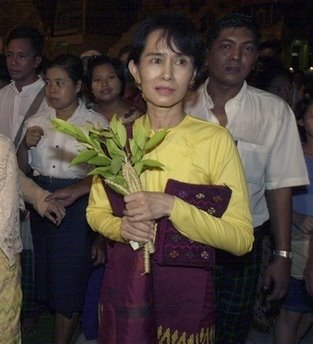


 Posts
Posts


