New America Media, News Analysis, Xujun Eberlein, Published: Jan 07, 2009
(Note: the following text is the original draft, slightly longer than the NAM published version, with more complete links. Posted with NAM's permission. - Xujun)
During the final month of 2008, there was a heated debate among Chinese bloggers and commentators outside of China. The cause of it was "Charter 08," a democracy manifesto originally signed by over 300 Chinese citizens and published on the internet on December 10. Times Online said Sunday that since then it "has been signed by more than 7,000 prominent citizens," but the number is difficult to verify.
Two versions of the English translation for this manifesto can be found online, one at nybooks.com (by professor Perry Link), and one at Human Rights in China. While the former is widely linked and reprinted, the latter is a more accurate translation of the Chinese original. A detailed recounting of the birth of the Charter can be found on Fool’s Mountain.
By now the hubbub around "Charter 08" has largely died down, however the issues raised in the dispute continue to beckon for attention. There are unanswered questions as to why the Chinese government and the US media reacted the way they did, and whether the Charter has achieved its intended effect. As such it might be a good time to look back at the reactions the event has provoked, and make a few observations.
The official reaction from the Chinese government was both harsh and overdone. Liu Xiaobo, a primary drafter and signatory of "Charter 08," was arrested in Beijing two days before its publication. No explanation was given by the government. Twenty three days later, Liu was allowed to see his wife for New Year’s Day, but police still did not say why he was detained. Many other signatories were summoned and threatened, according to a post on Fool’s Mountain.
Any discussion of "Charter 08" likely has been banned in China; a Google search using the Chinese keywords turned up no mainland links on the subject.
A well-known dissident writer and journalist in Beijing, Dai Qing, also one of the signatories, said in an interview with Voice of Germany that "the [Chinese] government's reaction is too irrational, a total surprise to us."
On December 11, The US State Department's spokesman Sean McCormack said in a statement that "We are particularly concerned about the well being of Liu Xiaobo, a prominent dissident writer, who remains in the custody of authorities."
According to Time Magazine, Chinese Foreign Ministry spokesman Liu Jianchao told journalists on Dec. 16 that the U.S. position was another example of the unwelcome "interference of other nations in China's internal affairs."
Curiously, major US media outlets, CNN including, have been unusually quiet, despite the fact that the Charter is hailed as a major breakthrough by its supporters. Time Magazine and the Christian Science Monitor were pretty much alone in reporting on the Charter, with the latter commenting in a somewhat upbeat tone that "the Communist Party's hesitancy to crack down harshly on the scholars, lawyers, engineers, and others who issued the so-called 'Charter 08' document sends a subtle signal of hope."
More curious, and changing, reactions, came from Falun Gong, or FLG, a religious and political group that has been banned in mainland China. A search on the FLG website Sunday came up with 100 links cheering "Charter 08," with titles such as "Reform Is Dead, Long Live Revolution!" However a click on any of those links gave only a blank page. Remnants of posts here and there indicate that FLG originally found "Charter 08" an exciting sign of the coming revolution and supported it whole-heartedly. Later, though, they made a 180 degree turn after the FLG leader deemed the manifesto not revolutionary enough, but rather a "ghost shadow" of the communist party.
Understandably however, revolution is favored by few Chinese, whether supporters or contenders of Charter 08. In contrast, many pointed out the legitimacy of Charter 08 in accordance with China's constitution.
Among the well-known signatories, Dai Qing calls the Charter a mild appeal. "If the government can't even accept such a mild appeal, I think the government is too frail," she says in the aforementioned interview. A scholar of Western philosophy, Xu Youyu says the Charter is totally constitutional, and his signing was a citizen's "rational and responsible decision." Bao Tong, a high-ranking official imprisoned after the June 4th movement in 1989 and still under house-arrest, angrily inquired of the government "What crime has Charter 08 committed?"
On nearly every website I visited that discusses Charter 08, in English or Chinese, there are not only voices advocating and opposing, but also supporters raising constructive criticism and contenders issuing moral support (plus the usual white noises and meaningless vituperates). The issues that are at the center of argument include – by no means a exhaustive list – whether the ideas are too "Western," or the proposed democracy model suits China; whether the proposal for a "Federal Republic of China" makes sense, or it has gone too far; whether the wording in the Foreword is needlessly inflammatory; whether Taiwan's democracy is a good model for the mainland; whether the aim of the Charter is to agitate the government or have a practical impact.
There are also a few one-of-a-kind remarks worth noting:
-- A blogger on dwnews.com is unhappy that the signatories include a well-known advocate for Tibet independence. He says he is against the Charter because it supports the Dalai Lama's "republic of greater Tibet". (On a related note, On December 12, the Daila Lama issued a statement saying “I am greatly encouraged by the launching of Charter 08.")
- Taiwan News published an editorial on Dec. 25 to praise Charter 08 but also criticize it as "unable to transcend 'great Chinese nationalism' as its implied commitment to eventual unification seems to share the CCP`s rejection of the free right of choice of Taiwan`s 23 million people, not to mention the people of Tibet or even Hong Kong and Macau."
- A religious blogger claims that she does not support the Charter because it doesn't address how to reform the Chinese people's faith.
As a Chinese adage goes, "What bewilders the players, spectators see clearly." A European expat blog in China, Chinayouren blog, which was the first to note the inconsistency between the Chinese original of Charter 08 and Prof. Link's translation of it, published a post on December 26 titled "Charter 08 and political change in China." It assesses positively the Charter's significance and provides several constructive criticisms. The author points that, "A document of this kind should try to seek the maximum consensus in mainland China. This is, in my understanding, the main weakness of the Charter 08." The post ends with:
"… Most importantly, from a theoretical point of view, figures like Mao or KMT should have no place in a Charter that wants to unite the Chinese. The recent History of China is an amazing tale of cruel failures and unequaled successes. Events that need to be openly discussed at some point, certainly, and compensation given to the victims. But direct accusations are altogether at a different level and unworthy of sharing the same document with the generous ideals stated in the Charter. These things do not only weaken the Charter 08 from a practical point of view, but also reduce its soundness as a Universal Statement."
If nothing else, "Charter 08" has stimulated a great discussion on China's future direction. #
Posted by Xujun Eberlein at 11:10 AM
Labels: China and Chinese, media and journalism
0 comments:
Thursday, January 8, 2009
China: Revolution or Reform? - A Summary of the "Charter 08" Dispute


BURMA: Home to 50 million forgotten consumers
http://www.nationmultimedia.com/2009/01/08/opinion/opinion_30092673.php
By ERIC ROSENKRANZ
SPECIAL TO THE NATION
Published on January 8, 2009
I was having dinner with an old friend recently. As we were going through our usual casual conversation about everything in general and nothing in particular, he asked me, "Eric, what is the largest untapped market for consumer goods in the world?"
I scratched my head, mentally browsing all the continents and made a few (wrong) guesses.
My friend told me: Burma.
With an estimated population of 50 million, squeezed between the two fastest-growing economies in the world (China and India) and kept artificially poor by 50 years of debilitating government policies, Burma's consumer goods market is ready to explode.
As we read news about Burma we always hear the same sad but true story: a fairy tale democratic icon set in deadlock with a horrible dictatorship ... and with no solution in sight.
Here is some other news about Burma: this is a country where live not only 200 generals and one Lady, but also 50 million ordinary people, 50 million consumers who have developed very similar consumption habits to their neighbours in Thailand.
A quick visit to Mingalar Zay, the main wholesaler's market in Rangoon, will make you wonder whether you are in Burma or in Thailand. Many brands - local as well as international - familiar to Thai consumers are part of the Burmese people's everyday life.
My friend, who started the Burma operation of a UK-based multinational company in 1993, witnessed firsthand the positive impact of an investment by a large company: creation of quality jobs, improving the life of local people, and setting up of new standards that in turn positively influenced the government's behaviour.
"Our employees," he remembers, "were all paid in the top quartile, had performance bonuses, medical insurance, extensive training, and career development opportunities including overseas secondment and financial support to study for further qualifications."
When, under the pressure of pro-sanction campaigners, this company pulled out of Burma in 2003, "life changed again for my local colleagues, but this time not for the better".
It is not the intention of this article to engage in a debate of the effectiveness of sanctions, nor is it appropriate to suggest that anyone act against the laws of any country. However, for a business inclined to consider a new marketplace, there are plenty of opportunities for regional and international companies to develop or strengthen their business in Burma.
Who are these consumers?
There are about 10 million households in Burma and this number is increasing fast as the number of persons per household (currently slightly above 5) is decreasing rapidly as lifestyles modernise.
Thirty per cent of the population is urban and 50 per cent of the non-rural population lives in Rangoon and Mandalay.
The population of Burma is very young, with 45 per cent below the age of 19.
The average disposable income per household in Rangoon and Mandalay is between US$150 (Bt5,230) and $200 per month.
A recent ranking on brand awareness shows that only two foreign brands made it into the top 20.
Modern trade is emerging and growing fast: Rangoon and Mandalay count no less than 30 well supplied supermarkets.
"The conclusion is simple," says Luc de Waegh, founder of West Indochina (WIC), a consultancy dedicated to increasing the consumer-goods businesses in Thailand and Burma.
"There is enormous potential for growth. It is still affordable to build up brands and establish a position for the long run in this market, which is bound to catch up with its Thai neighbour. Total media spend is estimated at less than US$20 million per year (less than 1 per cent of media spend in Thailand)."
Depending on product categories, current consumption per person is 10 to 30 times lower than Thailand today.
"Year on year growth rates of 25 - 40 per cent are common," adds de Waegh.
What is a company to do, if it is interested in expanding into Burma but wants to do so by following legally and ethically appropriate standards? Here are some tips from WIC:
1. Identify the right partner. Stories of partnerships that went horribly wrong are legion but there are outstanding exceptions. A low profile is a key to success in Burma and the best partners are not always the loudest
2. Choose the most appropriate legal structure. It is possible to operate a business to international standards - you just need to know how.
3. Select the best manufacturing option. The less you import, the better off you are - Burma is rich in local resources.
4. Hire an efficient distributor. A stable supply chain is a key to success; some distributors have established reliable logistics systems, some are even investing in good-standard trade marketing/merchandising.
5. Get the best advice regarding your communication campaign. The cheapest option is not always the best - but the best option is still very cheap.
Doing business in Burma is certainly not plain sailing but in these difficult economic times, what company can afford to ignore the potential of 50 million untapped consumers?
____________________
Eric Rosenkranz is the CEO of e.three, a Singapore-based consulting firm. For more information about doing business in Burma, visit www.westindochina.com.
The world looks away as Burma mocks democracy
http://network.nationalpost.com/np/blogs/fullcomment/archive/2009/01/06/david-scott-mathieson-the-world-looks-away-as-burma-mocks-democracy.aspx
David Scott Mathieson:
Posted: January 06, 2009, 9:30 AM by Kelly McParland
Dictatorships are not known for their sense of humour, nor do they appreciate being laughed at. It came as no surprise then when the ruling military regime in Burma recently sentenced the country’s best known comedian, named Zarganar, to 45 years in prison.
Zarganar (which means pliers in Burmese — he was a practising dentist) was arrested in June for staging private relief operations for survivors of Burma’s devastating cyclone in May, and for speaking out about the poor response by the authorities. These efforts, and his unique blend of sardonic wit and absurd reflections about the crushing repression of the military government, landed him in prison for his third stretch in the past 15 years.
Zarganar’s sentencing is part of an astonishingly brutal campaign by the ruling State Peace and Development Council (SPDC) in Burma to eradicate all political opposition in the country ahead of planned elections in 2010. In recent months, hundreds of prominent activists, Buddhist monks and nuns, journalists, labour activists, bloggers and hip-hop artists have been sentenced to lengthy jail terms. Some of them are facing between 100 and 150 years back in prison, many for their third or fourth times. Even some of the lawyers representing these activists have been imprisoned, for speaking out about the grossly unfair secret trials held in jail or in closed courthouses.
The activists include a brave labour rights representative named Ma Su Su Nyay, who was handed more than 12 years, and Min Ko Naing, the leader of Burma’s 1988 student-led uprising who has already received more than 65 years just on a few charges; his sentencing will probably land him 150 years back in jail, where he spent most of the time between 1988 to 2004 in solitary confinement. Both of them have been past recipients of Canada’s John Humphrey Freedom Award.
The past several months have constituted Phase Two of the SPDC’s crackdown on peaceful dissent, following on from August and September, 2007, when many of the activists were arrested for their parts in protests against military rule, which saw thousands of Buddhist monks march through the streets to carve out space for larger demonstrations. When the SPDC finally cracked down, dozens of people were killed and thousands were arrested, Zarganar included. He was held in a tiny cell, and when finally released cracked jokes about police dogs and which parts of his anatomy they tried to bite off. Grim humour.
The SPDC has been sentencing these activists for two reasons. The first is to decapitate any possibility of challenge to a tightly scripted and controlled political reform process, by locking away the leadership and spiritual and artistic supporters of resistance to military rule. The second is to instill fear in an already fearful and beaten down population; by targeting a cross-section of Burma’s resurgent civil society, the regime is stating clearly that resistance is futile.
Future military rule with a civilian façade is the end goal, and Burma’s recently released constitution ensures just that. The planned elections had their prelude in a ruthlessly orchestrated referendum just a week after the cyclone, conducted while the SPDC was blocking urgently needed international assistance. The result? A 98% voter turnout and 92% approval, laughably improbable even by Burma’s low standards.
As this despicable process proceeds, the world has shrugged its shoulders in exasperation. The United Nations’ muted response to the sentencing rounds is in contrast to the outrage the world expressed after the 2007 demonstrations were met with violence. The UN’s efforts at mediation inside Burma are, unfortunately, in tatters. That diplomatic solutions have been elusive is clear: The West and Asia have been at loggerheads over divergent approaches to Burma for years; both quiet persuasion and business investments, over loud human rights moralizing and sanctions, have been equally ineffective in shifting this implacable and shady regime. As China’s heavy investments show, especially recently announced plans to build two massive oil and gas pipelines through Burma into Yunnan, the SPDC is content to maintain control over a resentful population as long as they can survive on the proceeds of natural resource sales and the diplomatic cover provided by China, Russia, India and Burma’s Southeast Asian neighbours.
The world must speak out, now more than ever, to deny legitimacy to a military reform process that mocks the very idea of democracy and fundamental freedoms. The regime thrives on frustration and lack of attention, happily repressing its people in quiet. If we do not loudly and strongly condemn this draconian process, hundreds of Burma’s leading thinkers and performers will disappear into the country’s squalid gulag, and the ephemeral promise of a liberal and free Burma could well be lost to another generation.
National Post
David Scott Mathieson is Burma consultant for Human Rights Watch.
New Delhi and Boeing ink sub hunter deal

http://www.itexaminer.com/new-delhi-and-boeing-ink-sub-hunter-deal.aspx
Will replace aging Tupolev-142M fleet
By Aharon Etengoff in San Francisco @ Tuesday, January 06, 2009 5:26 AM
New Delhi and Boeing have inked a lucrative, $2.1 billion contract for the delivery of eight P-8 Poseidon sub hunters.
The new aircraft will replace a fleet of outdated Russian-manufactured Tupolev-142M planes.
The P-8 is is based on Boeing's popular 737-800 commercial jet, but features the wings of the 737-900ER (extended range). The plane is equipped with a sophisticated radar system used to facilitate advanced reconnaissance missions over an area of 600 nautical miles.
The long-range maritime reconnaissance (LRMR) aircraft is expected to be armed with Harpoon missiles, depth bombers and torpedoes. The Poseidon, which is capable of carrying 120 sonobuoys, has two pylons under each wing for weapons and can be refueled in mid-air.
C Uday Bhaskar, former head of India's Institute of Defence Studies and Analyses, told the Financial Times that the government should have purchased the planes years ago.
"It was very long required for India as far as maritime surveillance. But the general mood in the country post-Mumbai has allowed this to go ahead," said Bhaskar.
Indeed, chief of naval staff admiral Sureesh Mehta recently acknowledged significant gaps in coastal surveillance and admitted that the "systemic failure brought about by Mumbai terror attacks needs to be taken stock of".
It should be noted that the Indian navy has already taken several significant steps to bolster its blue-water capabilities, including the acquistion of a Russian aicraft carrier and a 16,900-tonne Jalashwa transport ship. The 173-metre-long Landing Pontoon Dock (LPD), currrently the second largest Indian warship in service, is capable of transporting four landing craft, six helicopters and a battalion of 900 soldiers.
New Delhi has also made a salient effort to increase its role in various multinational naval campaigns. For example, the Indian navy participated in evacuating 2,280 civilians during the 2006 Israel-Lebanon war. It was also the first to send relief supplies to Myanmar in May, which had suffered extensive casualties from a devastating cyclone. Nevertheless, India has steadfastly refused to join a formidable anti-terror naval task force led by the US and Britain because it does not fall under the auspices of the UN.
"Power projection today every nation is doing. India is now in a position to project its power and earn goodwill. Though this event is not related to any entry into the Security Council yet, it's part of a larger scheme of things," explained lieutenant general (retired) Raj Kadyan. X
အမ်ဳိးသား ဒီမိုကေရစီ အဖြဲ႔ခ်ဳပ္အတြက္ ႏွစ္သစ္သံႏၷိဌာန္
Tuesday, 06 January 2009 19:14 မင္းဇင္
http://www.irrawadd y.org/bur/ index.php? option=com_ content&view=article&id=563:2009- 01-06-12- 16-18&catid=14:2008- 10-21-07- 40-03&Itemid=25
အကယ္၍ သမိုင္းတေက်ာ့ ျပန္လည္ခဲ့ပါလွ်င္ အေပ်ာ္ရႊင္ ဆံုးသူမွာ ျမန္မာ စစ္အစိုးရသာ ျဖစ္ေပလိမ့္မည္။ ဗိုလ္ခ်ဳပ္မႉးႀကီး သန္းေရႊ၏ ဦးေဆာင္မႈ ေအာက္တြင္ ကာလ ၾကာရွည္စြာ အလုပ္ျဖစ္၊ ေအာင္ပြဲရခဲ့ေသာ စစ္အစိုးရက ကစားနည္းေဟာင္း၊ ဗ်ဴဟာအေဟာင္းမ်ားကိုသာ ျပန္လည္ အသံုးခ်လိမ့္မည္ ျဖစ္သည္။
စစ္အစိုးရ၏ ကစားပြဲ အစီအစဥ္တြင္ ျမင္သာသည့္နည္းတခုမွာ ရက္စက္ၾကမ္းၾကဳတ္သည့္ အင္အားအသံုးျပဳမႈႏွင့္ ျပင္းျပင္း ထန္ထန္ႏွိပ္ကြပ္ျခင္းကို ေျပာင္အသံုးခ်ေနသည့္ တခ်ိန္တည္း၌ အျခားတဖက္တြင္ ႏိုင္ငံေရးထိုးစစ္ဆင္ကာ အတိုက္ အခံမ်ားကို အင္အားခ်ိနဲ႔ေစရန္ ျပဳလုပ္ျခင္း၊ ႏိုင္ငံတကာဖိအားကို ေလ်ာ့က်ေစရန္ ႀကိဳးပမ္းေနျခင္းတို႔ ျဖစ္သည္။
စစ္အစိုးရ၏ မူ၀ါဒခ်မွတ္သူမ်ားက ဤသို႔ေအာင္ပြဲရရန္ေသခ်ာသည့္ နည္းနာမ်ဳိးကုိ တဖန္ျပန္လည္ အသံုးျပဳမည္ဟုေသခ်ာ ေနသည့္ကာလ၌ မလြဲမေသြ ေမးရမည့္ ေမးခြန္းမ်ားရွိေနသည္။ ပထမေမးခြန္းမွာ ၎တို႔၏ အႀကံအစည္ကို ဆန္႔က်င္တုန္႔ျပန္ရန္ မည္သို႔လုပ္ေဆာင္ၾကမည္နည္း ဆိုသည့္ ေမးခြန္းျဖစ္ၿပီး ေနာက္ေမးခြန္းမွာ အေရးအႀကီးဆံုး အခ်က္ျဖစ္သည့္ ႏိုင္ငံေရး အသြင္ေျပာင္းလဲေရး၊ ဖြဲ႔စည္းပံု အေျခခံဥပေဒ ျပန္လည္ျပဳျပင္ေရးဆြဲေရးႏွင့္ ႏိုင္ငံေရး အက်ဥ္းသားမ်ား လြတ္ေျမာက္ေရး စသည့္ ရလဒ္မ်ား ရရွိေစရန္ မည္သို႔ ဆက္လက္ ေဆာင္ရြက္ၾကမည္နည္း ဟူသည့္ ေမးခြန္းျဖစ္သည္။
ျမန္မာစစ္အစိုးရ၏ အက်ဥ္းေထာင္မ်ားအတြင္း ဘ၀ဆံုးပါးရမည့္ ႏိုင္ငံေရးအက်ဥ္းသား ၂၁၀၀ ၏ အေရးကို မည္သို႔ ေဆာင္ရြက္ၾကမည္နည္း။ ၎တို႔အနက္မွ ၂၃၄ ဦးသည္ ၂၀၀၇ ခုႏွစ္ စက္တင္ဘာလ ဆႏၵျပပြဲမ်ား အၿပီးတြင္မွ ဖမ္းဆီးအက်ဥ္းခ်ခံခဲ့ရျခင္းျဖစ္ၿပီး အမ်ားစုမွာ ၂၀၀၈ ခုႏွစ္ ႏို၀င္ဘာလတြင္ ၆၈ ႏွစ္စီ အသီသီး ေထာင္ဒဏ္မ်ား ခ်မွတ္ခံခဲ့ရသူမ်ား ျဖစ္သည္။
ယခုကဲ့သို႔ ျပင္းထန္သည့္ ႏွစ္ရွည္ေထာင္ဒဏ္မ်ား ခ်မွတ္ခံရျခင္းမွာလည္း စစ္အစိုးရက အားစိုက္ႀကိဳးပမ္းေနသည့္ “ဒီမို ကေရစီလမ္းျပေျမပံု” အဆင့္ ၇ ဆင့္၏ ပဥၥမအဆင့္ျဖစ္ေသာ လာမည့္ ၂၀၁၀ ျပည့္ႏွစ္ ေရြးေကာက္ပြဲတြင္ ေပၚေပါက္လာႏိုင္ သည့္ အတိုက္အခံ အင္အားစုမ်ားကို ႀကိဳတင္ရွင္းလင္းထားျခင္းသာ ျဖစ္သည္။
ရက္စက္ၾကမ္းၾကဳတ္မႈ၏ ရည္ရြယ္ခ်က္မွာ ထိတ္လန္႔ တုန္လႈပ္သြားေစရန္ စစ္ဆင္ေရးတခု ဆင္ႏႊဲျခင္းသာျဖစ္ၿပီး လူထုမ်ားအၾကား အေၾကာက္တရား လႊမ္းမိုးေနေစရန္ႏွင့္ ေရြးေကာက္ပြဲမတိုင္မီကာလတြင္ အေၾကာက္တရား ႀကီးစိုးေန သည့္ ၀န္းက်င္တခု ဖန္တီးထားေရးသာ ျဖစ္သည္။ စစ္အစိုးရက ေမွ်ာ္လင့္ခ်က္ထားသည္မွာ ျမန္မာႏိုင္ငံရွိ ျပည္သူလူထု အဖို႔ ႏိုင္ငံေရးႏွင့္ ကင္းကင္းေနေစေရးျဖစ္ၿပီး လာမည့္ ေရြးေကာက္ပြဲတြင္ သူတို႔ စစ္အစိုးရ စိတ္ႀကိဳက္ မဲခိုး၊ မဲလိမ္ ခ်ယ္ လွယ္ႏိုင္ေစရန္ ျဖစ္သည္။
ႏိုင္ငံတကာမွ ျပစ္တင္ရႈံ႕ခ်မႈမ်ားမွာလည္း အခ်ိန္မွန္မွန္ ထြက္ေပၚေနခဲ့ၿပီး ယခုတခါ ေနာက္ထပ္တႀကိမ္ ျပစ္တင္ေျပာဆိုေန ျပန္ၿပီ ျဖစ္သည္။ ကုလသမဂၢအတြင္းရွိ သတင္းအရင္းအျမစ္မ်ား အဆိုအရ အေထြေထြအတြင္းေရးမႉးခ်ဳပ္ မစၥတာ ဘန္ကီ မြန္းက ျမန္မာႏိုင္ငံအေရး ေဆာင္ရြက္ေနသည့္ သူ၏ သံတမန္ေရး လုပ္ငန္းမ်ားကိုပင္ ဆိုင္းငံ့ထားရန္ စဥ္းစားေနသည္ဟု ဆိုလာသည္။ ႏိုင္ငံျခားေရး၀န္ႀကီးဌာနႏွင့္ နီးစပ္သည့္ သတင္းရင္းျမစ္မ်ား၏ အဆိုအရ တ႐ုတ္ႏွင့္ ႐ုရွား ႏိုင္ငံတို႔ကလည္း ေနျပည္ေတာ္ရွိ ျမန္မာဗိုလ္ခ်ဳပ္ႀကီးမ်ားကို ကုလ အေထြေထြအတြင္းေရးမႉးခ်ဳပ္၏ ကိုယ္စားလွယ္အဖြဲ႔ႏွင့္ ပူးေပါင္း ဆက္ဆံရန္ ဖိအားမ်ား ေပးေနၾကသည္ဟု အတည္ျပဳ ေျပာၾကားၾကသည္။ ထို႔အျပင္ လာမည့္ ၂၀၁၀ ျပည့္ႏွစ္ ေရြး ေကာက္ပြဲမတိုင္မီ ျပင္းထန္လာမည့္ ႏိုင္ငံတကာ ျပစ္တင္ေ၀ဖန္မႈမ်ားကို ေလ်ာ့က်သြားေစရန္အတြက္ အျပဳသေဘာ ေဆာင္သည့္ လိုက္ေလ်ာမႈမ်ား ျပဳရန္လည္း တိုက္တြန္းနားခ်ေနၾကသည္။
သမိုင္းက တေက်ာ့ျပန္လည္လာၿပီဟု ဆိုရမည္ျဖစ္သည္။ ယခုအခ်ိန္သည္ ဗိုလ္ခ်ဳပ္မႉးႀကီးအေနႏွင့္ ၎ကိုေထာက္ခံေန ၾကသည့္ ႏိုင္ငံတကာ အင္အားစုမ်ား ေက်နပ္ေစရန္ ၀ွက္ဖဲတခ်ပ္ ထုတ္သံုးရေတာ့မည့္ အခ်ိန္ ျဖစ္ေနေပၿပီ။ ျဖစ္ႏိုင္ေျခ တခုမွာ အတိုက္အခံေခါင္းေဆာင္ႏွင့္ ၿငိမ္းခ်မ္းေရးႏိုဗဲလ္ဆုရွင္ ေဒၚေအာင္ဆန္းစုၾကည္ကို ျပန္လႊတ္ေပးႏိုင္ေျခ ရွိေနသည္။ အနီးစပ္ဆံုး ေမလ၊ သို႔မဟုတ္ ေနာက္အက်ဆံုး ၂၀၀၉ ခုႏွစ္ ႏို၀င္ဘာလတြင္ ျပန္လႊတ္ေပးလာဖြယ္ ရွိသည္။ ဤသို႔ လႊတ္ေပးျခင္းျဖင့္ စစ္အစိုးရအဖို႔ မ်က္ႏွာသာရလာစရာ အေၾကာင္း ရွိေနပါသည္။
ပထမအခ်က္မွာ ေဒၚေအာင္ဆန္းစုၾကည္ကို ျပန္လႊတ္ေပးျခင္းျဖင့္ တ႐ုတ္၊ ႐ုရွား၊ အာဆီယံႏိုင္ငံမ်ားႏွင့္ စစ္အစိုးရ ဘက္ေတာ္သား ေထာက္ခံေနသူမ်ားအၾကား ျဖစ္ေပၚေနသည့္ စိုးရိမ္ပူပန္မႈမ်ား ေလ်ာ့က်သြားလိမ့္မည္ကို သူသိေနသည္။ မၾကာေသးမီက ဖိႏွိပ္ေခ်မႈန္းေနမႈမ်ားေၾကာင့္ ႏိုင္ငံတကာ အသိုင္းအ၀ိုင္းတြင္ပင္ ေထာက္ခံေျပာဆိုေပးရန္ ခပ္ခက္ခက္ ျဖစ္ေနၾကရသည္ မဟုတ္ပါလား။
အကယ္၍ စစ္အစိုးရကသာ ပါးနပ္လိမၼာပါက ကုလသမဂၢ၏ အထူးကိုယ္စားလွယ္ မစၥတာ အီဗရာဟင္ ဂန္ဘာရီ သို႔မဟုတ္ အေထြေထြအတြင္းေရးမႉးခ်ဳပ္ ကိုယ္တိုင္ကို သူတို႔ဘက္ ပါလာေအာင္ ဆြဲေဆာင္စည္း႐ံုး ႏိုင္ပါေသးသည္။ ကုလသမဂၢ၏ ျမန္မာ့အေရးေဆာင္ရြက္ေနသည့္ သံလုပ္ငန္းအေနျဖင့္လည္း ေဒၚေအာင္ဆန္းစုၾကည္လြတ္ေျမာက္ လာမႈအေပၚ ေအာင္ျမင္မႈတခုသဖြယ္ ဂုဏ္ယူေနရန္ ရွိပါသည္။
ဤသို႔ ေဒၚေအာင္ဆန္းစုၾကည္ကို ျပန္လႊတ္ေပးျခင္းျဖင့္ စနစ္တက် ဖိႏွိပ္ၿဖိဳခြဲေခ်မႈန္းေရး လုပ္ေနသည့္အေပၚ ႏိုင္ငံတကာက ျပစ္တင္ေ၀ဖန္မႈမ်ားကို ပါးနပ္စြာ ေရွာင္လႊဲႏိုင္ၿပီး ဖြဲ႔စည္းပံု အေျခခံဥပေဒႏွင့္ ၂၀၁၀ ေရြးေကာက္ပြဲကို မလႊဲမေရွာင္သာ ေထာက္ခံ အသိအမွတ္ျပဳရမည့္ အေျခအေနမ်ဳိးလည္း ဆိုက္ေစႏိုင္သည္။
စစ္အစိုးရ ဗိုလ္ခ်ဳပ္မ်ားက ေဒၚေအာင္ဆန္းစုၾကည္ႏွင့္ နည္းနည္းမွ် အေပးအယူမလုပ္ဘဲ လႊတ္ေပးလိုက္လွ်င္လည္း ျဖစ္ႏိုင္သည္ကို သိၾကသည္။ အကယ္၍ စစ္အစိုးရက ေဒၚေအာင္ဆန္းစုၾကည္ကို လႊတ္ေပးလိုက္လွ်င္ေသာ္မွ ေဒၚစုက ေရြးခ်ယ္ရခက္လွသည့္ အေျခအေနမ်ဳိး ႀကံဳရႏိုင္သည္။ စစ္အစိုးရကို ထပ္၍ ေ၀ဖန္မည္ဆိုလွ်င္လည္း ေနာက္တႀကိမ္ အခ်ဳပ္ထဲ ျပန္၍ထည့္ထားခံရမည့္ တ၀ဲလည္လည္ သံသရာထဲ ျပန္က်ေရာက္သြားလိမ့္မည္။
လက္ရွိ ဖြဲ႔စည္းပံု အေျခခံဥပေဒအရဆိုလွ်င္ မည္သို႔ေသာ ႏိုင္ငံေရး ျပဳျပင္ေျပာင္းလဲမႈမ်ဳိးမွ ဆက္လက္ျဖစ္ထြန္းလာရန္ မရွိ ပါ။ ဖြဲ႔စည္းပံု အေျခခံ ဥပေဒကို ျပင္ဆင္ေျပာင္းလဲမႈမ်ား လုပ္ႏိုင္သည္ ဆိုဦးေတာ့ စစ္တပ္က လႊမ္းမိုးထားေသာ လႊတ္ေတာ္ႏွင့္ ၂၀၁၀ ေနာက္ပိုင္း စစ္အစိုးရဆင္ထားသည့္ ဖြဲ႔စည္းပံု အေနအထားတြင္ တျဖည္းျဖည္း ျပဳျပင္ ေျပာင္းလဲ မႈမ်ား လုပ္ေဆာင္သြားရန္ပင္ ျဖစ္ႏိုင္ေျခ မရွိပါ။
ထို႔ေၾကာင့္ ေမးခြန္းမ်ား ထပ္မံေပၚေပါက္လာျပန္သည္။ စစ္အစိုးရ၏ မဟာဗ်ဴဟာကို အတိုက္အခံမ်ားက မည္သို႔ တန္ျပန္ၾကမည္နည္း၊ အေရးအပါဆံုး ရလဒ္ ၂ ခုျဖစ္သည့္ "ႏိုင္ငံေရး အသြင္ေျပာင္းလဲေရး၊ ဖြဲ႔စည္းပံု အေျခခံဥပေဒ ျပန္လည္ျပဳျပင္ေရးဆြဲေရးႏွင့္ ႏိုင္ငံေရးအက်ဥ္းသားမ်ား လြတ္ေျမာက္ေရး" ရည္မွန္းခ်က္မ်ား ရရွိေစရန္ မည္သို႔ ဆက္လက္ေဆာင္ရြက္ၾကမည္နည္း ဟူသည့္ ေမးခြန္းမ်ား ျဖစ္သည္။
လြန္ခဲ့သည့္ ႏွစ္ ၂၀ ကာလအတြင္း ျမန္မာႏိုင္ငံရွိ အတိုက္အခံႏိုင္ငံေရးပါတီမ်ားက မူအေပၚခိုင္က်ည္စြာ ရပ္တည္၍ ဤ ရပ္တည္ခ်က္ေၾကာင့္ ျဖစ္လာသည့္ အစြမ္းခြန္အားကို ျပသခဲ့ၾကသည္။ ယခုတႀကိမ္တြင္လည္း မူအေပၚရပ္တည္မႈေၾကာင့္ ျဖစ္လာသည့္ ခြန္အားအစြမ္းကို တဖန္ျပန္၍ ျပသရေတာ့မည့္ အခ်ိန္ ျဖစ္ေနေပၿပီ။
သို႔ေသာ္ အနည္းငယ္ ကသိကေအာင့္္ႏိုင္လွသည့္ အခ်က္ရွိေနသည္။ ၎အခ်က္မွာ အတိုက္အခံအင္အားစုမ်ားက ခြန္အားအာဏာအျဖစ္ က်င့္၀တ္ပိုင္းဆိုင္ရာကိစၥကို အဓိကထားအေျခခံကာ မဟာဗ်ဴဟာ ခ်မွတ္ေရး ျဖစ္သည္။ အကယ္၍ စစ္အစိုးရက အတိုက္အခံ အင္အားစုမ်ားႏွင့္ ႏိုင္ငံေရးအရ ေတြ႔ဆံုေဆြးေႏြးမႈ မေဆာင္ရြက္လွ်င္၊ အတိုက္အခံမ်ားက ဖြဲ႔စည္းပံု အေျခခံဥပေဒအေပၚ ျပန္လည္သံုးသပ္ႏိုင္ေရး၊ ႏိုင္ငံေရးအက်ဥ္းသားမ်ား လြတ္ေျမာက္ေရးအတြက္ ေဆြးေႏြးမႈ မျပဳႏိုင္လွ်င္ ၂၀၁၀ ေရြးေကာက္ပြဲတြင္ အမ်ဳိးသား ဒီမိုကေရစီအဖြဲ႔ခ်ဳပ္ႏွင့္ တျခား အတိုက္အခံ ႏိုင္ငံေရးပါတီမ်ား ပါ၀င္လိမ့္မည္ မဟုတ္ေၾကာင္း မူအရ တိတိလင္းလင္း ထုတ္ျပန္ေၾကညာရန္ လိုအပ္ေနသည္။
ဤမဟာဗ်ဴဟာမွာ အတိုက္အခံအင္အားစုမ်ားအၾကား မိမိက မွန္သည့္ဘက္မွ ရပ္တည္သည္ဟု ရဲရဲယံုၾကည္၍ စင္ေပၚက ေနႏိုင္ေသာ ဗ်ဴဟာတရပ္ ျဖစ္ရံုမွ်မက အေကာင္အထည္ရွိသည့္ ႏိုင္ငံေရး ရလဒ္ ၃ ခု ရႏိုင္ရန္အတြက္ ကစားစရာ ၀ွက္ဖဲတခ်ပ္လည္း ျဖစ္ေနသည္။
ပထမတခ်က္မွာ တႏိုင္ငံလံုး အႏွံ႔အျပားရွိေနသည့္ အမ်ဳိးသားဒီမိုကေရစီအဖြဲ႔ခ်ဳပ္၏ ေအာက္ေျခအင္အားစုမ်ား၊ ေထာက္ခံသူမ်ားကို ျပန္လည္တက္ႂကြလာေအာင္ ႏိႈးေဆာ္ႏိုင္႐ံုမွ်မက အမ်ဳိးသားဒီမိုကေရစီ အဖြဲ႔ခ်ဳပ္က ေနာက္ဆုတ္၍ ခုခံစစ္ဆင္ေနကာ စစ္အစိုးရေနာက္က လိုက္၍ တုံ႔ျပန္ေန႐ံုသာ လုပ္ေနေသာေၾကာင့္ ေဘးဖယ္၍ ၾကည့္ေနၾကသည့္ တရား၀င္ တိုင္းရင္းသား ႏိုင္ငံေရးပါတီမ်ားကိုပါ ႏိုင္ငံေရးေဆြးေႏြးျငင္းခုန္မႈမ်ားအတြင္း ျပန္၀င္လာေအာင္ ဆြဲေဆာင္ ႏိုင္ေစလိမ့္မည္ ျဖစ္သည္။
လူအမ်ားႏွင့္ ဆက္ဆံစကားေျပာရန္ အစဥ္သျဖင့္ ေရွာင္ဖယ္ေနခဲ့သည့္ NLD ပါတီ ဥကၠ႒ ဦးေအာင္ေရႊအေနႏွင့္လည္း ကိုယ္တိုင္ကိုယ္က်ထြက္၍ ျမန္မာဘာသာျဖင့္ အသံလႊင့္ေနသည့္ ျပည္ပအေျခစိုက္ ေရဒီယိုဌာနမ်ားတြင္ ဤရပ္တည္ခ်က္ မူ၀ါဒႏွင့္ ပတ္သက္၍ ေျပာဆိုသင့္ေနၿပီ ျဖစ္သည္။ NLD ပါတီအေနႏွင့္ ၂၀၁၀ ေရြးေကာက္ပြဲတြင္ မပါ၀င္ရန္ ဆံုးျဖတ္ထား ေၾကာင္းႏွင့္ ပါတီ၏ ေတာင္းဆိုခ်က္မ်ားက မည္သို႔ ျဖစ္ေၾကာင္း ျပည္သူလူထုကို ပြင့္ပြင့္လင္းလင္း အသိေပးေျပာၾကား သင့္ၿပီ ျဖစ္သည္။
ပါတီေခါင္းေဆာင္မႈ အေနႏွင့္လည္း မိမိတို႔၏လႈပ္ရွားမႈသည္ အေရးပါ အရာေရာက္သည့္ေနရာတြင္ ရွိေနၿပီးသားဟု အလြယ္ ယူဆမထားသင့္ပါ။ သူတို႔၏ ရည္မွန္းခ်က္မ်ားကို လူအမ်ားသိေအာင္ ေဆာင္ရြက္ရန္ လိုအပ္ၿပီး က်င့္၀တ္ ေရးရာအရ (မူအရ) ထုိးစစ္ဆင္ျခင္းအျဖစ္ ရွင္းလင္းေသခ်ာစြာ ေဆာင္ရြက္သင့္သည္။ ျမႇင့္တင္သင့္သည္။
ဒုတိယအခ်က္မွာ ေရြးေကာက္ပြဲကို သပိတ္ေမွာက္ျခင္းအားျဖင့္ စစ္အစိုးရ၏ အင္အား အေျခခံမ်ားကို ေလ်ာ့နည္းသြားေစ လိမ့္မည္။ အထူးသျဖင့္ လြန္ခဲ့သည့္ ႏွစ္ ၂၀ ကာလအတြင္း စစ္အစိုးရႏွင့္ အပစ္အခတ္ရပ္စဲေရး ျပဳထားၾကသည့္ တိုင္းရင္း သား အင္အားစုမ်ားက ေရြးေကာက္ပြဲတြင္ ပူးေပါင္းေဆာင္ရြက္မည့္ အေရးကို ျပန္၍ စဥ္းစားလာၾကပါလိမ့္မည္။
စစ္အစိုးရ၏ ဖြဲ႔စည္းပံုအေျခခံဥပေဒသည္ သူတို႔လိုလားသည့္ အခြင့္အေရးမ်ားထက္ မ်ားစြာနိမ့္ေနေၾကာင္း တိုင္းရင္းသား အုပ္စုမ်ားကလည္း ေကာင္းစြာ သေဘာေပါက္ထားၾကပါသည္။
ကခ်င္ လြတ္လပ္ေရးအဖြဲ႔ (KIO) ႏွင့္ ၀ျပည္ေသြးစည္းညီညြတ္ေရးတပ္မေတာ္ (UWSA) စသျဖင့္ေသာ အဖြဲ႔မ်ားက သူတို႔ ၏ အဆြယ္အပြားႏိုင္ငံေရးပါတီမ်ားမွတဆင့္ ၂၀၁၀ ေရြးေကာက္ပြဲတြင္ ပါ၀င္ၾကရန္ ျပင္ဆင္မႈ ရွိေကာင္းရွိေနႏိုင္ေသာ္ လည္း စစ္အစိုးရ အလိုက် သူတို႔က ေထာက္ခံပံ့ပိုးေပးလိုက္ရသည့္ အျဖစ္မ်ဳိး မျဖစ္ရေလေအာင္ ႀကိဳးပမ္းႏိုင္ေစ ပါလိမ့္မည္။ အထူးသျဖင့္ သူတို႔၏လက္နက္ကိုင္တပ္မ်ား လက္နက္ျဖဳတ္ေရးကိစၥမ်ားႏွင့္ ပတ္သက္လာသည့္အခါ စဥ္းစားစရာ အခ်က္ အမ်ားအျပား ရွိေနပါလိမ့္မည္။
အတိုက္အခံ အဖြဲ႔မ်ားက ၂၀၁၀ ေရြးေကာက္ပြဲကို ျငင္းပယ္ျခင္းအားျဖင့္ တိုင္းရင္းသား အပစ္အခတ္ရပ္စဲေရး အဖြဲ႔မ်ားက လည္း ဤအခ်က္ေၾကာင့္ ႏိုင္ငံေရးအရ အေၾကာင္းျပခ်က္ ရေစႏိုင္ၿပီး မဟာဗ်ဴဟာေျမာက္ ကစားႏိုင္မည့္ အခြင့္ အေရးတရပ္လည္း ေပၚေပါက္လာႏိုင္သည္။ စစ္အစိုးရက NLD ကိစၥႏွင့္ လံုးပန္းေနရင္း အခ်ိန္ကုန္ေစမည္ျဖစ္ေသာ ေၾကာင့္ စစ္အစိုးရက ေဆာင္ရြက္လာမည့္ လက္နက္ျဖဳတ္သိမ္းေရး အစီအစဥ္ကို အံတုဆန္႔က်င္ခြင့္ ႀကံဳေစမည္ ျဖစ္သည္။
ထိုအေျခအေန ႀကံဳရပါက စစ္အစိုးရ၏ ႏိုင္ငံေရး ကစားကြက္ကို ပိုမို ရႈပ္ေထြးခက္ခဲလာေစမည္ ျဖစ္သည္။ အဆိုးဆံုး အေနအထားအရ ဆိုလွ်င္ တခ်ဳိ႕ေဒသမ်ား၌ တိုင္းရင္းသားအဖြဲ႔မ်ား၏ လက္နက္ကိုင္တိုက္ပြဲမ်ား ျပန္လည္ ျဖစ္ ေပၚလာႏိုင္ဖြယ္ပင္ ရွိေနသည္။ သို႔ဆိုလွ်င္ အင္အားေကာင္းသည့္ ၀၊ ကခ်င္အဖြဲ႔အစည္းမ်ား အေျခခ်ေနၾကသည့္ တ႐ုတ္ -ျမန္မာ နယ္စပ္၏ ျပန္လည္ေပါက္ကြဲလုနီး အေျခအေနအေပၚ မူတည္၍ တ႐ုတ္ႏိုင္ငံကလည္း ျမန္မာ့အေရးကို ပိုမို သတိႀကီးႀကီးထား ကိုင္တြယ္လာလိမ့္မည္ ျဖစ္သည္။
ဤသို႔ က်င့္၀တ္ေရးရာအရ အေပၚစီးယူ၍ သပိတ္ေမွာက္သည့္ ဗ်ဴဟာေၾကာင့္ အတိုက္အခံအင္အားစုမ်ား ရလာႏိုင္သည့္ ႏိုင္ငံေရးအက်ဳိးအျမတ္တခုမွာ ႏိုင္ငံတကာ အင္အားစုမ်ားအေပၚတြင္ သိသိသာသာ ဖိအားျဖစ္ေပၚလာေစႏိုင္ျခင္း ျဖစ္သည္။ အထူးသျဖင့္ စစ္အစိုးရ၏ "လမ္းျပေျမပံု" ကို ျမန္ျမန္အဆံုးသတ္ေစလိုေသာေၾကာင့္ အတိုက္အခံအဖြဲ႔မ်ားကို သင့္ေလ်ာ္သည့္ ေတာင္းဆိုမႈမ်ားသာ လုပ္ေစခ်င္ေနုေသာ ႏိုင္ငံတကာ အဖြဲ႔အစည္းမ်ား အေနႏွင့္လည္း စဥ္းစား ခ်င့္ခ်ိန္ဖြယ္ ရလာေစမည္ ျဖစ္သည္။
သို႔ေသာ္ ဤအေျခအေနမ်ားအားလံုး သက္၀င္ ျဖစ္ေပၚမလာမီ အတိုက္အခံ ႏိုင္ငံေရးပါတီမ်ားအေနႏွင့္ ေပ်ာ့ေျပာင္း ညင္သာမႈျပသရန္ လိုေနပါေသးသည္။ စစ္အစိုးရ၏ လမ္းျပေျမပံုတခုလံုးကို လံုး၀ျငင္းပယ္ေနျခင္း မဟုတ္ေၾကာင္းကို လည္း ေသခ်ာရွင္းလင္း ေျပာျပထားသင့္ပါသည္။
အကယ္၍ စစ္အစိုးရက ဖြဲ႔စည္းပံု အေျခခံဥပေဒ ျပဳျပင္ေျပာင္းလဲေရးႏွင့္ ႏိုင္ငံေရး အက်ဥ္းသားမ်ား လႊတ္ေပးေရးအတြက္ သေဘာတူလာခဲ့ပါလွ်င္ အတိုက္အခံအဖြဲ႔အစည္းမ်ား အေနႏွင့္ စစ္အစိုးရ၏ လမ္းျပေျမပံုကို ေထာက္ခံရန္ စဥ္းစားႏိုင္ပါ သည္။ ထိုမွ်မက အတိုက္အခံ အင္အားစုမ်ားက ႏိုင္ငံတကာ၏ စာနာမႈဆိုင္ရာ အကူအညီမ်ားကို မကန္႔ကြက္ေၾကာင္း၊ ႀကိဳဆိုေၾကာင္းလည္း ႀကိဳတင္ရွင္းလင္းစြာ ေျပာထားသင့္သည္။ ျမန္မာႏိုင္ငံ၏ အေျခအေနမွာ ဆင္းရဲတြင္း နက္သထက္ နက္လာေနၿပီး ပိုမို ခက္ခဲၾကပ္တည္းသည့္ ကပ္ေဘးဆိုက္ေနရၿပီ ျဖစ္ေသာေၾကာင့္လည္း ဤသို႔ အကူအညီမ်ား ရရွိရန္ လိုအပ္ေနျခင္း ျဖစ္သည္။
ထိုအခ်က္မ်ား အားလံုးကိုၿခံဳလွ်င္ ယခုအေျခအေနသည္ အတိုက္အခံ အင္အားစုမ်ားအေနႏွင့္ က်င့္၀တ္ေရးရာအရ အျမင့္ ဆံုးေနရာကို ယူ၍ သိမ္းပိုက္ရေတာ့မည့္ အခ်ိန္ ျဖစ္သည္။ ဤသို႔ က်င့္၀တ္ပိုင္းဆိုင္ရာအရ အသာစီးရေနမႈကို ခြန္အားအာဏာႏွင့္ အခြင့္ေကာင္းအျဖစ္ ေျပာင္းလဲ အသံုးခ်ရမည္ ျဖစ္သည္။ သို႔ေသာ္လည္း ဤေရြးခ်ယ္လမ္းကို ေလွ်ာက္လွမ္းၾကရမည့္ အေရးမွာ မလြယ္ကူလွပါ။ စစ္အစိုးရက နည္းမ်ဳိးစံုသံုး ညစ္ပတ္၍ အတိုက္အခံအင္အားစု မ်ားကို ၿဖိဳခြင္းေခ်မႈန္းမႈႏွင့္ ႀကံဳရႏိုင္ပါေသးသည္။
တခ်ဳိ႕ေသာေ၀ဖန္သူမ်ားက ဤနည္းဗ်ဴဟာသည္ ျမန္မာအတိုက္အခံမ်ားအတြက္ အသစ္မဟုတ္လွေၾကာင္း၊ အမွန္တရားဖက္က ရပ္သည့္မူကို ကိုင္ၿပီး ကစားခဲ့သည့္ ကစားပြဲတြင္ ယခုတိုင္ ရႈံးနိမ့္ေနရေသးေၾကာင္း ဆိုလာႏိုင္ပါေသးသည္။
သို႔ေသာ္ အမ်ဳိးသားဒီမိုကေရစီအဖြဲ႔ခ်ဳပ္ အေနႏွင့္ ေပ်ာ့ေျပာင္းသည့္ သေဘာထား ရပ္တည္ခ်က္မ်ား အႀကိမ္ႀကိမ္ ျပသခဲ့ၿပီး အက်ဳိးမျဖစ္ခဲ့သည္မွာ အထင္အရွားပင္ ျဖစ္သည္။ ယခုအခ်ိန္တြင္ အတိုက္အခံမ်ားက ေဆာင္ရြက္ရန္ လိုအပ္ေနသည့္ အခ်က္မွာ က်င့္၀တ္ပိုင္းဆိုင္ရာအရ မွန္ကန္သည့္၊ မူအရမွန္သည့္ အေပၚစီးအေနအထားကို ယူ၍ ပါးနပ္စြာ လူ အမ်ား လက္ခံလာေအာင္ ေဆာင္ရြက္ေရးပင္ ျဖစ္သည္။ ဤမူကို မဟာဗ်ဴဟာအျဖစ္ အသြင္ေျပာင္း၍ အခ်ိန္ကိုက္ ေသခ်ာ သတ္မွတ္ထားသည့္ ႏိုင္ငံေရးရလဒ္မ်ား ရရွိေရးအတြက္ ပူးေပါင္းဆက္စပ္မႈရွိစြာ ေဆာင္ရြက္ေရးပင္ ျဖစ္သည္။
ဤအခ်က္သည္ပင္ အတိုက္အခံမ်ားအတြက္ ပထမဦးဆံုး ပင္မ ခြန္အားအာဏာျဖစ္ၿပီး ဤလမ္းအတိုင္း ဆက္ေလွ်ာက္ မည္ဟု ၂၀၀၉ ခုႏွစ္အတြက္ သံႏၷိဌာန္ခ်မွတ္ ေဆာင္ရြက္သင့္ေပသည္။
မင္းဇင္ေရးသားသည့္ New Year’s Resolutions for the NLD ကို ဆီေလ်ာ္ေအာင္ ျပန္ဆိုေဖာ္ျပပါသည္။
ကိုမင္းဇင္သည္ ျပည္ပအေျခစိုက္ ျမန္မာသတင္းေထာက္ တဦးျဖစ္ၿပီး ကယ္လီဖိုးနီးယား တကၠသိုလ္ (ဘာ့ကေလ) သတင္းစာပညာ ေက်ာင္းတြင္ စာသင္ၾကား ပို႔ခ်ေနသည့္ဆရာ ျဖစ္ပါသည္။
ေဒၚစု လြတ္လပ္ေရး သီခ်င္းမ်ားဖြင့္ -IRRAWADDY
http://www.irrawaddy.org/bur/index.php?option=com_content&view=article&id=562:2009-01-05-12-52-09&catid=1:news&Itemid=2
ေဒၚစု လြတ္လပ္ေရး သီခ်င္းမ်ားဖြင့္
Monday, 05 January 2009 19:50 ကိုစိုး
အက်ယ္ခ်ဳပ္ က်ခံေနရဆဲ ျဖစ္သည့္ ျမန္မာ့ ဒီမိုကေရစီ ေခါင္းေဆာင္ ေဒၚေအာင္ဆန္း စုၾကည္သည္ ယမန္ေန႔က က်ေရာက္သည့္ ၆၁ ႏွစ္ေျမာက္ လြတ္လပ္ေရး ေန႔တြင္ ၎၏ ေနအိမ္၌ လြတ္လပ္ေရးႏွင့္သက္ဆိုင္သည့္ သီခ်င္း မ်ားကို ဖြင့္ခဲ့သည္ဟု အမ်ိဳးသား ဒီမိုကေရစီအဖြဲ႕ခ်ဳပ္ (အန္အယ္လ္ဒီ) ေျပာခြင့္ရပုဂၢိဳလ္ ဦးဥာဏ္၀င္းက ေျပာျပသည္။
ေနအိမ္အက်ယ္ခ်ဳပ္ က်ခံေနရဆဲ ေဒၚေအာင္ဆန္းစုၾကည္ (ဓာတ္ပံု - Pornchai Kittiwongsakul/EPA)
ေဒၚေအာင္ဆန္းစုၾကည္က ၿခံတခါး၀ နဖူးစည္းတြင္ အ၀တ္အနီေပၚ၌ စာလုံးအ၀ါေရာင္ျဖင့္“တိုင္းျပည္နဲ႔ လူမ်ိဳး အက်ိဳးကို ေရွး႐ႈၿပီး ျပတ္ျပတ္သားသား ေဆာင္႐ြက္ၾက။ ဗိုလ္ခ်ဳပ္ ေအာင္ဆန္း ”ဟု လြတ္လပ္ေရး ဖခင္ ဗိုလ္ခ်ဳပ္ ေအာင္ဆန္း၏ ေျပာစကား ေရးသားထားသည့္ ဆိုင္းဘုတ္တခုကို ခ်ိတ္ဆြဲထားေၾကာင္းလည္း ဦးဥာဏ္၀င္း က ေျပာသည္။
“ေဒၚေအာင္ဆန္းစုၾကည္ကိုယ္တိုင္ ေဆာင္႐ြက္တာလို႔ သိရတယ္၊ အဲဒါ ပတ္၀န္းက်င္က လူေတြက လြတ္လပ္ ေရးနဲ႔ ဆိုင္တဲ့သီခ်င္းေတြ ဖြင့္တာၾကားရတယ္လို႔ အဲဒီလိုလည္း ေျပာပါတယ္”ဟု ၎က ဆိုသည္။
ေဒၚေအာင္ဆန္းစုၾကည္၏ က်န္းမာေရးႏွင့္ ပတ္သက္၍ ၿပီးခဲ့သည့္ ၾကာသပေတးေန႔က မိသားစု ဆရာ၀န္ ေတြ႕ရွိ ခ်က္အရ ေကာင္းမြန္သည္ဟုၾကားသိရေၾကာင္း၊ ေဒၚေအာင္ဆန္းစုၾကည္ အိမ္အနီး၀န္းက်င္တြင္ လုံၿခံဳေရးမ်ား ပုံမွန္ ရွိေနဆဲျဖစ္ေၾကာင္းလည္း သိရသည္။
ယမန္ေန႔က ရန္ကုန္ၿမိဳ႕ရွိ အန္အယ္လ္ဒီ ႐ုံးခ်ဳပ္တြင္ ၆၁ ႏွစ္ေျမာက္ လြတ္လပ္ေရးေန႔ အခမ္းအနားက်င္းပ၍ ေၾကညာခ်က္တေစာင္ ထုတ္ျပန္ခဲ့သည္ဟု ဦးဥာဏ္၀င္းက ဆက္လက္ ေျပာဆိုသည္။
ယင္းေၾကညာခ်က္တြင္ ျပည္သူ႔လႊတ္ေတာ္ ေခၚယူေပးရန္၊ ဖြဲ႕စည္းပုံအေျခခံ ဥပေဒသုံးသပ္ေရးေကာ္မတီ ဖြဲ႕စည္းေပးရန္၊ ယင္းေကာ္မတီက ၆ လအတြင္း အၿပီးအျပတ္ ေဆာင္႐ြက္ရန္စသည့္ အခ်က္မ်ား အဓိကပါ၀င္ သည္ဟု ၎က ဆုိသည္။
အန္အယ္လ္ဒီေနႏွင့္၂၀၁၀ ေ႐ြးေကာက္ပြဲႏွင့္ ပတ္သက္ၿပီးမည္ကဲ့သို႔ ေဆာင္႐ြက္မည္ကို ေျပာဆုိမထားေသာ္ လည္း ၁၉၉၀ ျပည့္ႏွစ္ေ႐ြး ေကာက္ပြဲ ရလာဒ္ကို ေကာင္အထည္ မေဖာ္ဘဲႏွင့္ ေနာင္ျပဳလုပ္မည့္ ေ႐ြးေကာက္ပြဲ မ်ားႏွင့္ ပတ္သက္၍ ထည့္သြင္း စဥ္းစားရန္မရွိဟူေသာ အဓိပၸာယ္ရသည့္ ေဒၚေအာင္ဆန္းစုၾကည္၏ မိန္႔ခြန္း ေကာက္ႏုတ္ခ်က္ကို စာမ်က္ႏွာ ၆ မ်က္ႏွာရွိ အဆိုပါ လြတ္လပ္ေရးေန႔ ေၾကညာခ်က္တြင္ထည့္သြင္း ေဖာ္ျပထား ေၾကာင္းလည္း သိရသည္။
ယင္း ၆၁ ႏွစ္ေျမာက္ လြတ္လပ္ေရးေန႔ကို ဂုဏ္ျပဳ၍ အေမရိကန္ႏိုင္ငံျခားေရးဌာနကလည္း စစ္အာဏာရွင္ လက္ေအာက္မွ လြတ္ေျမာက္ေရးႏွင ့္ဒီမိုကေရစီ ေဖာ္ေဆာင္ ေရးတို႔အတြက္ႀကိဳးပမ္းအားထုတ္ေနၾကသည့္ ျမန္မာႏိုင္ငံသားမ်ား၏ ၿငိမ္းခ်မ္းစြာလႈပ္ရွား ေဆာင္႐ြက္မႈမ်ားကို အေမရိကန္ႏိုင္ငံက ဆက္လက္ေထာက္ခံ အားေပးသြားမည္ျဖစ္ေၾကာင္း ဇန္န၀ါရီ ၂ ရက္ေန႔က ထုတ္ျပန္ေၾကညာခဲ့သည္။
စစ္အစိုးရ ဗိုလ္ခ်ဳပ္မႉးႀကီးသန္းေ႐ႊကမူ ၎၏ ၆၁ ႏွစ္ေျမာက္ လြတ္လပ္ေရးေန႔ သ၀ဏ္လႊာတြင္ လမ္းျပေျမပုံ (၇) ဆင့္အတိုင္း ဆက္လက္အေကာင္အထည္ေဖာ္ေဆာင္သြားမည္ ျဖစ္ေၾကာင္း၊ ၎တို႔၏ ဖြဲ႕စည္းပုံအေျခခံဥပေဒ ကို လည္း ျပည္သူတရပ္လုံးက တခဲနက္ေထာက္ခံထားၿပီးျဖစ္ေၾကာင္း၊ ထုိ႔ေၾကာင့္ ဖြဲ႕စည္းပုံသစ္ႏွင့္အညီ ဒီမို ကေရစီ ႏိုင္ငံေတာ္သစ္ႀကီး ေပၚထြန္းရန္အတြက္ ေဆာင္႐ြက္သြားရန္ တိုက္တြန္း ေျပာၾကားထားေၾကာင္းကို အစိုးရ သတင္းစာမ်ားတြင္ ေဖာ္ျပထားသည္။
တခ်ိန္တည္းတြင္ပင္ ၎ ဗိုလ္ခ်ဳပ္မႉးႀကီး၏ စစ္အစိုးရကို စာတေစာင္ေရး၍ ေဒၚေအာင္ဆန္းစုၾကည္ ေနအိမ္ အက်ယ္ခ်ဳပ္အယူခံလႊာႏွင့္ ပတ္သက္ၿပီး ေဒၚေအာင္ဆန္းစုၾကည္အား ေတြ႕ခြင့္ေပးရန္ ထပ္မံ ေတာင္းဆို ထားေၾကာင္း ေရွ႕ေနႀကီး ဦးၾကည္၀င္းက ေျပာသည္။
ေဒၚေအာင္ဆန္းစုၾကည္၏ အယူခံလႊာကို ကုိင္တြယ္ ေဆာင္႐ြက္မည့္ အစိုးရ အဖြဲ႕မွ ၀န္ႀကီးခ်ဳပ္ ဗိုလ္ခ်ဳပ္ႀကီး သိန္းစိန္သို႔ လိပ္မူ၍ အယူခံလႊာႏွင့္ပတ္သက္ၿပီး ေဒၚေအာင္ဆန္းစုၾကည္ႏွင့္ ေတြ႕ဆုံရန္လိုအပ္ေၾကာင္း ၿပီးခဲ့ သည့္ ဒီဇင္ဘာ ၃၀ ရက္ေန႔က စာေရးသား ေတာင္းဆိုလိုက္ျခင္းျဖစ္သည္ဟု ဦးၾကည္၀င္းက ေျပာျပသည္။
“စာတင္တာ အဓိက က အယူခံလႊာတင္ၿပီးၿပီဆိုတာကို ေဒၚစုကို သတင္းပို႔ဖို႔ နဲ႔ အယူခံလႊာရဲ႕ ေနာက္တဆင့္ ေလွ်ာက္လွဲခ်က္ ေပးတာ၊ အဲဒီအခါမွာ က်ေနာ္တို႔ ေရွ႕ေနေတြရဲ႕သေဘာနဲ႔ ေျပာတာမ်ိဳး မျဖစ္သင့္ဘူး၊ ကာယကံ ရွင္ရဲ႕ ညႊန္ၾကားခ်က္ ရယူဖို႔ ၊ ညႊန္ၾကားခ်က္ ရယူၿပီးေျပာမွ စစ္မွန္တဲ့ ေလ်ွာက္လွဲခ်က္ျဖစ္မွာေပါ့၊ အဲဒီ ၂ ခ်က္ အတြက္ ေဒၚစုနဲ႔ ေတြ႕ဆုံဖို႔ လိုပါတယ္၊ ေတြ႕ဆုံခ်င္ပါတယ္ မဟုတ္ဘူး၊ အဲဒီအတြက္ ထပ္တင္တာပါ”ဟု ၎က ဧရာ၀တီသို႔ ေျပာဆိုသည္။
၂၀၀၈ ခု ဒီဇင္ဘာလအေစာပိုင္းက ေဒၚေအာင္ဆန္းစုၾကည္ႏွင့္ ေတြ႕ခြင့္ ေတာင္းခဲ့သည္ကို သက္ဆိုင္ရာ အာဏာပိုင္မ်ားက အယူခံလႊာကိစၥႏွင့္ပတ္သက္ၿပီး အစိုးရအဖြဲ႕က ေဆာင္႐ြက္ေနသည့္အတြက္ ေတြ႕ဆုံရန္ မလိုေၾကာင္း ေျပာဆို၍ ခြင့္ျပဳခ်က္မေပးခဲ့ေသာေၾကာင့္ ယခုကဲ့သို႔ ထပ္မံ ေတာင္းဆိုရျခင္းျဖစ္သည္ဟုလည္း ဦးၾကည္၀င္းက ေျပာသည္။
အယူခံလႊာတြင္ ေဒၚေအာင္ဆန္းစုၾကည္က သူ႔ကို ပုဒ္မ ၁၀(ခ) အရ အေရးယူထားသည္မွာ ဥပေဒ ႏွင့္ ညီမညီ၊ အေရးယူထားသည့္ကာလမွာ ဥပေဒႏွင့္ ညီမညီ၊ အတူေန ေဒၚခင္ခင္၀င္း သားအမိ အေနႏွင့္ တားဆီးမိန္႔ အက်ဳံး ၀င္ မ၀င္၊ က်န္းမာေရးႏွင့္ ပတ္သက္၍ မိသားစု ဆရာ၀န္ႏွင့္ ပုံမွန္ေဆးစစ္ခြင့္၊ ေရွ႕ေန ဦးၾကည္၀င္း အတြက္ လက္ေထာက္ေရွ႕ေန ထပ္မံငွားရမ္းျခင္း စသည့္ အခ်က္မ်ား ပါ၀င္ေၾကာင္း သိရသည္။
ဦးၾကည္၀င္းက ဆက္လက္ၿပီး ေဒၚေအာင္ဆန္းစုၾကည္သည္ လာမည့္ ၂၀၀၉ ေမလ တြင္ အက်ယ္ခ်ဳပ္သက္တမ္း ကုန္ဆုံးမည္ ျဖစ္ေသာေၾကာင့္ ၎အား ယခုလတ္တေလာ ျပန္လႊတ္ေပးမည္ဆိုပါလွ်င္ အစိုးရအပါအ၀င္အားလုံး အတြက္ ေကာင္းမြန္သည့္ လုပ္ရပ္တခုျဖစ္ေၾကာင္း ေျပာဆုိသည္။
“ေဒၚစုကို ျပန္လႊတ္မယ္လိုလိုလည္း ၾကားတယ္၊ ျဖစ္ႏိုင္တာက အခုအေရးယူထားတဲ့ ႏိုင္ငံေတာ္အား ေႏွာင့္ ယွက္ ဖ်က္ဆီးလိုသူမ်ား ေဘးအႏၲရာယ္မွ ကာကြယ္ေစာင့္ေရွာက္သည့္ ဥပေဒနဲ႔ပတ္သက္ ၿပီး ပုဒ္မ ၁၆ မွာ ျပဌာန္းထားတာကေတာ့ ရက္ေပါင္း ၆၀ မွာ အနည္းဆုံးတႀကိမ္ ျပန္လည္ၿပီးေတာ့ တားဆီးထားတာတို႔ကန္႔သတ္ ထားတာတို႔ကို ျပန္သုံးသပ္တာ၊ သုံးသပ္ၿပီးေတာ့ အခ်ဳပ္အခ်ာ အာဏာ၊ ႏိုင္ငံေတာ္ရဲ႕လုံၿခံဳ ေရး၊ ဒါေတြေပၚမွာ ဘာမွအႏၲရာယ္ မရွိေတာ့ဘူးဆိုရင္၊ လႊတ္ေပးမယ္၊ သူတို႔ အဲဒီ ပုဒ္မကို က်င့္သုံးၿပီးလႊတ္လိုက္ ရင္ က်ေနာ္တို႔ ေတာင္ ေလွ်ာက္လွဲခ်က္ေတြ ဘာေတြ လုပ္စရာ မလိုဘူး”ဟု ၎က ဆိုသည္။
ေဒၚေအာင္ဆန္းစုၾကည္ သည္ ၂၀၀၃ ခုႏွစ္ ေမလ တြင္ ျဖစ္ပြားခဲ့ေသာ ဒီပဲယင္းအၾကမ္းဖက္တိုက္ခိုက္မႈအၿပီးမွ စတင္၍ ေနအိမ္ အက်ယ္ခ်ဳပ္ျဖင့္ အထိန္းသိမ္းခံေနရသည္မွာ ၅ ႏွစ္ျပည့္ၿပီ ျဖစ္ေသာ္လည္း စစ္အစိုးရက ၂၀၀၈ ခု ႏွစ္ ေမလတြင္ အက်ယ္ခ်ဳပ္သက္တမ္း ထပ္မံတိုးခဲ့သည္။ ၁၉၈၉ ခုႏွစ္မွစ၍ ေနအိမ္အက်ယ္ခ်ဳပ္ဘ၀ျဖင့္ေနရ ခ်ိန္ စုစုေပါင္း ၁၃ ႏွစ္ ရွိၿပီ ျဖစ္သည္။
The Great Dragon Awakens: China Challenges American Hegemony
by José Miguel Alonso Trabanco
Nowadays, most International Relations analysts acknowledge China’s potential to achieve superpower status over the course of the next decades due to its impressive economic growth, which was triggered by Deng Xiaoping’s economic reforms program (inspired by theorists like Friedrich List).
Chinese power has also increased considerably in military, geopolitical, trade and financial affairs. Some experts have even contemplated the possibility of China becoming the world’s greatest power, overtaking the US. For instance, Goldman Sachs has predicted that China’s GDP will surpass America’s sometime circa 2050.
However, one must always bear in mind that if Beijing indeed succeeds in becoming the ‘first among equals’, it would not be the first time such event takes place. The ‘Middle Kingdom’ was already a mighty empire thousands of years before the US was even founded. Thus, China (both as a State and as a civilization) has flourished for centuries and has outlived the Roman, Persian, Arabian, Turkish, Mongol, and British empires, which is by no means an easy accomplishment.
Needless to say, Washington feels its position might be seriously threatened in the long run. The Project for a New American Century stipulates that the US must prevent any power(s) or coalition thereof (read China and Russia) from effectively challenging American power. Therefore, America’s top policy makers are well aware that China is certainly a serious contender and, for that reason, have been implementing a strategy specifically designed to check Chinese mounting power. Below we will dissect and explore American efforts meant to curb China as well as Chinese countermoves.
The US plans toward China comprises the following components:
Number one: An updated version of classical containment which was an American strategy conceived by US geoestrategist George Kennan during the early years of the Cold War to limit the Soviet Union’s power projection capabilities. This was clearly reflected in the creation of NATO (North Atlantic Treaty Organization), an alliance whose purpose was to keep "the Americans in, the Russians out, and the Germans down".
In order to achieve Great Power status, one must ensure regional security in one’s neighboring areas. This can be done by attracting potential allies, establishing a patronage over weak States and by excluding hostile powers from one’s own immediate periphery. The US Monroe Doctrine, formulated at a time when America was an emerging power, is an enlightening example because it expresses American determination to enthrone Washington’s exclusive primacy in the American hemisphere.
In the present day, there is not a formal structure akin to an Asian version of NATO. Nevertheless, the US has been continuously seeking to establish military bases close to Chinese borders. Washington has established a meaningful military presence in Mindanao (the Philippines), Okinawa (Japan), the Korean Peninsula, Kyrgyzstan and Afghanistan (which is in fact NATO-occupied). Moreover, some of China’s neighbors are staunch allies of the West: Japan, Australia, Taiwan and the Philippines. All of them have forged an important degree of military cooperation with Washington and have also purchased a great deal of American-made arms.
So far, Washington has not tried to encircle China’s borders as aggressively and in the case of Russia (expansion of NATO, missile defense facilities in Eastern Europe and so on). This is not because America is somehow friendlier towards China but because Beijing’s military capabilities are not as threatening as those of Moscow, whose military power and huge nuclear arsenal possess the ability to challenge the US in the case of war, to say the least.
Moreover, the American ‘cordon sanitaire’ around China is far from being complete. Beijing has developed a strong partnership with Moscow through the SCO (Shanghai Cooperation Organization) which also encompasses Kazakhstan, Uzbekistan, Tajikistan Kyrgyzstan. The SCO, curiously referred to as the ‘Shanghai Pact’ by former Chinese President Jiang Zemin, is not yet a full-fledged military alliance but it definitely has the potential to reach that point provided Sino-Russian strategic cooperation continues to thrive in the coming years. It is interesting to highlight that the US membership application was rejected by SCO members.
It would be a severe mistake to underestimate the SCO. If its level of strategic coordination deepens, the SCO’s combined power would turn to be outright frightening for NATO. SCO member States (not including observers):
Control a vast portion of the Eurasian landmass.
Contain huge population centers.
Command large armies equipped with state-of-the-art weaponry (ICBMs, fighter jets, satellites, strategic bombers and fleets of tanks).
Possess massive reserves of natural resources (oil, gas, uranium, metals and fresh water).
Own important industrial plants.
Have accumulated some of the largest amounts of foreign currency reserves.
Can convince other countries to join their organization as full members like India, Pakistan, Mongolia, Iran, Turkmenistan, Belarus, a post-Yuschchenko Ukraine, Armenia, Syria, etc.
Not long ago, US forces were expelled by fellow SCO member Uzbekistan from the Karshi-Khanabd air base (a.k.a. K2), located in its territory. Tashkent strengthened its links with both Beijing and Moscow after a presumably US-masterminded ‘Color Revolution’ backfired and ultimately failed to produce regime change in that Central Asian republic.
China has also tried to court other neighboring States through an intensification of trade flows. For example, South Korea, although it still hosts a large number of American troops, has implemented a foreign policy carefully crafted not to irritate China. Seoul knows that Beijing, through its leverage and influence on Pyongyang, holds one of the most important keys to an eventual Korean reunification and that China is a force that can contribute to (geo)political stability and offer interesting business opportunities in East Asia.
The ‘Middle Kingdom’ has successfully attracted Myanmar as an ally. Myanmar (a.k.a. Burma) borders the Southern part of the Peoples’ Republic of China and it contains important raw materials like natural gas, marble, gems, precious stones and exotic woods. Myanmar’s government has sided with Asia’s rising powers such as China, India and, to a lesser degree, Russia through closer trade, diplomatic and military relations. Beijing has plans to establish intelligence facilities in Myanmar’s territory and, taking into account a growing Chinese military presence there, it is clear that China intends to intensify its alliance with Myanmar.
In 2007, the world witnessed the ‘Saffron Revolution’ (please note the term, where have we heard something similar before?), a series of protests led by Buddhist monks and political elements prone to adopt pro-Western positions. This unrest was most likely orchestrated by American intelligence personnel, eager to overthrow Myanmar’s current government and replace it with pro-Western rulers. Myanmar’s governmental forces, despite Western isolation and attempts to impose sanctions and backed by full Chinese and Russian support, ultimately prevailed.
This methodology is not new at all and it seems to be almost a carbon copy of other ‘Color Revolutions’ instigated in the post-Soviet space. However, the latest attempts to apply this recipe have failed in Belarus, Uzbekistan and Myanmar. It can also be added that some of the first governments which took over thanks to ‘Color Revolutions’ are already facing a considerable deal of trouble. For instance, Georgia was defeated by Russia when its government decided to invade South Ossetia; furthermore, Mikheil Saakashvili’s impudence was further punished by Moscow’s diplomatic recognition of both Abkhazia and South Osettia. Plus, Ukraine (along with Georgia) was denied NATO Membership Action Plans because of old Europe’s fear of irresponsibly antagonizing Moscow. Serbia has just signed a deal to increase energy cooperation with Russia’s Gazprom.
Number two: The implicit threat of using American sea power to enforce a naval blockade against China to interrupt both its shipment of goods overseas as well as the flow of critical raw materials.
Chinese economic growth fuels an ever-increasing demand of energy and raw materials. However, domestic supplies are not enough to meet those needs. For example the People’s Republic of China is currently the second largest importer of oil. Therefore, the aforementioned means that China’s manufacturers must resort to foreign sources to provide the necessary resources for their production activities. Many of these foreign providers are located in areas far away from China’s borders, namely the Middle East and Africa. That implies that a considerable part of Chinese critical supplies have to be seaborne.
Moreover, the Middle Kingdom’s major industrial production centers are to be found in zones close to China’s Pacific seaboard. Thus, the overwhelming majority of Chinese export products have to be transported by ship as well.
As far as the Chinese flow of imports and exports is concerned, it is significant to highlight the importance of the Malacca Strait, a tight waterway positioned between Peninsular Malaysia and the Indonesian island called Sumatra. Such shipping lane is indeed a chokepoint because, if the United Stated decided to enforce a naval blockade around it, the flow of Chinese imports and exports would suffer a lethal blow.
The US, much like its British predecessor, is the world’s leading sea power and that, combined with all of the above, represents a serious strategic vulnerability to China who obviously does not want to depend on American goodwill to conduct its commercial exchange overseas.
The ‘Middle Kingdom’ is aware of this military gap between American forces and its own. Beijing also acknowledges that developing a competitive sea power is a task which demands a colossal sum of resources in terms of time, manpower, materials, R & D and money. Therefore, China knows that it will not have the ability to directly challenge American naval primacy in one generation or two. Yet, that does not mean that there are not powerful asymmetric equalizers that can be used to counter the US apparently unrivaled sea power.
Beijing’s military doctrine is quite flexible and methodologically creative. If the ‘Middle Kingdom’ perceives an imminent military threat from America, it can make use of its foreign currency reserves (currently the largest in the world), which are denominated in US dollars, as a strategic weapon. If China decides to get rid of its dollars reserves, the consequences will be devastating for the US, perhaps triggering its economic, social, military and political collapse.
Some analysts dismiss this scenario as far-fetched; they argue that China would hesitate to unleash financial hell upon the US because Chinese exporters would also suffer considerably from the dollar’s fall. Nevertheless, they seem to forget that, historically, States are indeed willing to sacrifice some of their meaningful economic interests when their very survival is at stake. One just needs to remember that Germany and Britain were important trading partners right before World War One broke out…
Furthermore, China has been studying American over-reliance on real-time information feed collected through spy satellites in order to wage war. Thus, the ‘Middle Kingdom’ has discovered that US ground, sea and air forces would be left almost blind if deprived of data provided by its satellite network. Not surprisingly, Beijing’s military-industrial complex has been busy designing and testing a variety of anti-satellite weapons. In 2006 a Chinese land-based laser illuminated an American satellite. A year later, China destroyed one of its own weather satellites by using a modified version of ballistic missile technology.
The Chinese government has actively engaged in diplomatic talks in order to foster land-based oil and gas pipeline projects in order to secure its energy security and to diminish its dependence on seaborne supplies of oil. Beijing has succeeded in establishing an oil pipeline which provides China with both Russian and Kazakh petroleum. Likewise, the ‘Middle Kingdom’ plans to build pipelines connecting oil and/or gas producing-countries (like Iran, Myanmar and the Russian Far East) with Chinese territory.
It is worth mentioning that there have been many rumors in strategic circles concerning Chinese plans to open a military base in Iran and to set a naval outpost in Gwadar, Pakistan. It is way too early to confirm authoritatively weather these projects will indeed materialize. At least, one can confidently assert that the motivation is clear, i.e. to enhance Chinese power projection capabilities beyond its borders and to protect its uninterrupted energy supply.
Number three: Divide and rule, i.e. American efforts to dismantle Chinese territorial integrity and dissolve China’s internal political uniformity. The US and the West know that China is a lot harder to balkanize than Serbia; nevertheless, they have used their intelligence agencies in order to create a persistent irritant that can distract Beijing and force it to divert its resources.
The People’s Republic of China, like most other nation-States on Earth, is not a country which is ethnically or geographically homogenous. The ‘Middle Kingdom’
is home to different ethnicities, cultures and religions.
China’s largest ethnic group is the Han people. They comprise the majority of the country’s population. Both China’s Eastern seaboard (the area where the wealthiest cities are located) and its (more agricultural) heartland are inhabited by Han Chinese.
However, there are regions of the Chinese territory whose main population are not Han Chinese. The most important cases are the Xinjiang-Uyghur Autonomous Region and the Tibet Autonomous Region.
Xinjiang-Uyghur, located in the Northwestern part of China, is strategically important because it borders Russia, Mongolia, Kazakhstan, Kyrgyzstan, Tajikistan, Pakistan and Afghanistan. Thus, this piece of land represents China’s territorial contact with Central Asia. It is essential to indicate that this autonomous region contains large deposits of minerals and oil. Xinjiang-Uyhgur is populated by people who profess the Islamic religion and who belong to the Turkic ethnicity, which is why this zone is also called ‘Eastern Turkestan’.
Western intelligence agencies have predictably provided covert support for both Islamic and separatist forces inside Xinjiang-Uyghur. In fact, these forces have already demonstrated both their political willingness as well as their operational capability to carry out terrorist attacks.
On the other hand, Tibet is an issue Washington and Brussels have exploited in order to fracture Chinese internal unity. It is vital to take into consideration that even open source intelligence material confirm that the Dalai Lama himself was working undercover along the CIA in order to undermine Chinese control over Tibet during the early decades of the Cold War. One can only wonder if such collaboration continues today. Natural resources play an important part as well: Tibet might have some the world’s largest reserves of uranium. Moreover, this autonomous region is rich in gold, copper, drinking water and could even possess valuable deposits of both oil and gas.
In March 2008 a series of riots broke out all over Tibet and especially in its capital Lhasa. Beijing accused the ‘Dalai Lama gang’ of inciting unrest which was eventually restrained by Chinese law enforcement. The Dalai Lama’s Western supporters took political advantage of this situation and launched a PR attack against China’s government. Some Western leaders even threatened to boycott the Beijing Olympics. The somewhat naïve ‘Free Tibet’ crowds even held protests in some Western capitals. During these events, it is critical to take into account that Moscow expressed a strong diplomatic and political support for Beijing.
The Han Chinese themselves are not immune to foreign geoestrategists prone to balkanize their rivals. For example, the Falun Gong movement (described by some as a ‘cult’) has been outlawed by the Chinese government. In strategic circles, it has been argued that Beijing regards Falun Gong as a CIA front whose task is to provoke instability and induce turmoil in the Chinese mainland.
Moreover, China’s rural population who live in the country’s heartland can also become an attractive target to someone willing to spread political discontent because they have not yet caught up with the wealth and prosperity experienced by the coastal industrial cities.
Conclusion
It seems that China is continuously advancing toward a greater role in the international system’s distribution of power. The ‘Middle Kingdom’ is increasingly assertive in defending its interests. The West (North America plus Europe) along with its followers (Japan, Australia, et al.) are willing to counter China’s rise. Nevertheless, Beijing is more determined than ever to recover its great power position and has forged strategic alliances (with Moscow and the Central Asian Republics) as well as partnerships in East Asia, the Middle East and elsewhere. Additionally, China and its allies have been perfecting a strategy to challenge Western plans to contain Eurasia’s rising powers. We can therefore anticipate that such rivalry will intensify as the stakes become higher and higher.
Global Research Articles by José Miguel Alonso Trabanco
--------------------------------------------------------------------------------
Please support Global Research
Global Research relies on the financial support of its readers.
Your endorsement is greatly appreciated
Subscribe to the Global Research E-Newsletter
Spread the word! Forward to a friend!
--------------------------------------------------------------------------------
Disclaimer: The views expressed in this article are the sole responsibility of the author and do not necessarily reflect those of the Centre for Research on Globalization. The contents of this article are of sole responsibility of the author(s). The Centre for Research on Globalization will not be responsible or liable for any inaccurate or incorrect statements contained in this article.
To become a Member of Global Research
The CRG grants permission to cross-post original Global Research articles on community internet sites as long as the text & title are not modified. The source and the author's copyright must be displayed. For publication of Global Research articles in print or other forms including commercial internet sites, contact: crgeditor@yahoo.com
www.globalresearch.ca contains copyrighted material the use of which has not always been specifically authorized by the copyright owner. We are making such material available to our readers under the provisions of "fair use" in an effort to advance a better understanding of political, economic and social issues. The material on this site is distributed without profit to those who have expressed a prior interest in receiving it for research and educational purposes. If you wish to use copyrighted material for purposes other than "fair use" you must request permission from the copyright owner.
For media inquiries: crgeditor@yahoo.com
© Copyright José Miguel Alonso Trabanco, Global Research, 2009
The url address of this article is: www.globalresearch.ca/index.php?context=va&aid=11638
--------------------------------------------------------------------------------
Privacy Policy
© Copyright 2005-2008 GlobalResearch.ca
Web site engine by Polygraphx Multimedia © Copyright 2005-2008
Wednesday, January 7, 2009
Bush to Discuss Burma with Ban at White House
http://theirrawaddy.blogspot.com/2009/01/bush-to-discuss-burma-with-ban-at-white.html
Posted by The Irrawaddy Magazine | Monday, January 05, 2009 | News | 0 comments »
By LALIT K JHA
WASHINGTON — US President George W Bush will discuss the current situation in Burma along with other issues when he meets with UN Secretary-General Ban Ki-moon on Tuesday in the White House.
It will probably be Bush's last meeting with Ban as the US President, the White House said.
Before handing over the presidency to Barack Obama on January 20, Bush has invited Ban and his wife, Ban Soon-taek, to the White House for lunch.
"This meeting will be an opportunity for the President to thank Secretary-General Ban for his leadership of the United Nations and his cooperation on key issues over the past two years," said White House spokesperson Gordon Johndroe.
"They will discuss the future of the United Nations and the challenges that remain, such as UN reform, the Middle East, Burma, Somalia and peacekeeping in Darfur," Johndroe said.
However, the meeting is unlikely to yield any result for the people of Burma, given that Bush is leaving office and Ban has been unable to make any headway towards restoration of democracy in Burma.
Ban was scheduled to visit Burma in December, but he has postponed his trip until a time when it would yield tangible results.
Johndroe said during the meeting the US President will stress the need for a United Nations that can act effectively to promote freedom, democratic governance, human rights and a world free from terror.
Meanwhile, in a statement issued Friday, one day before the 61st anniversary of Burma's Independence Day, the State Department wished the people of Burma well on the occasion of the 61st anniversary of its independence from the British rule.
"We wish to express our warmest wishes to the people of Burma on this occasion. As we reflect on Burma's independence struggle, led by Gen Aung San, we are reminded of our own history," said the brief statement.
The State Department said the US stands with the Burmese people on in honoring Aung San's vision for an independent, peaceful, and democratic Burma.
The US also looks forward to the day when Burma's citizens will be able to enjoy the fruits of freedom and democracy. "We earnestly hope that day will come soon," the statement said.
NCUB Plans to Form Parallel Government in 2009
By WAI MOE Tuesday, January 6, 2009
The National Council of the Union of Burma (NCUB), an umbrella organization of Burmese opposition groups, announced on January 1 that it will found a parallel government as part of its action plan for 2009.
In a special New Year statement, the NCUB said that it would establish a “National Unity Government” and “National Unity Parliament” to counter plans by Burma’s ruling military regime to hold an undemocratic election in 2010.
“As a tactic to challenge the junta’s legitimacy, we will form a parallel government,” Nyo Ohn Myint, a member of the NCUB’s Foreign Affairs Committee, told The Irrawaddy on Monday.
He added that plans to create a new government would go into effect after a forthcoming conference of the Members of Parliament Union (MPU), a group consisting of MPs elected in Burma’s last election in 1990. The MPU’s annual conference is scheduled to take place on January 19 in Dublin, Ireland.
Nyo Ohn Myint added that the parallel government will include both elected MPs and representatives of ethnic groups who have their own territories and armies.
The NCUB statement has excited controversy among Burmese exiles, many of whom question the value of forming a new parallel government when the democratic opposition already has a government in exile, the National Coalition Government of the Union of Burma (NCGUB).
The NCGUB was formed by exiled MPs elected in 1990 and is led by Dr Sein Win, the cousin of Burma’s detained democracy leader Aung San Suu Kyi. Founded in December 1990 in Manerplaw, the former headquarters of the Karen National Union, the NCGUB now operates out of Washington, DC.
Nyo Ohn Myint denied that the new National Unity Government would function in the same manner as the NCGUB, saying that it would not merely consist of a prime minister and five cabinet ministers like the NCGUB.
He also questioned the NCGUB’s leadership because of its failure to cooperate with the NCUB’s efforts to challenge the Burmese junta’s seat at the United Nations.
Responding to criticism about its effectiveness, the NCGUB accused the NCUB leadership of embarking on a meaningless campaign without any attempt to form a consensus among members of the umbrella group.
Khun Marko Ban, the NCGUB’s federal affairs minister and a member of the MPU, said that the NCUB’s secretary-general, Maung Maung, did not even inform all concerned parties before issuing the New Year statement.
“Even though I am an executive member of the NCUB, I knew nothing about the statement until after it was released,” said Khun Marko Ban, who is also President 3 of the NCUB.
“We need to respect the organization’s consensus principle and ensure that this does not happen again,” he added.
The NCUB was formed in September 1992 by four organizations: the MPU, the ethnic-based Democratic Alliance of Burma, the National Democratic Front, and the National League for Democracy (Liberated Area).
Khun Marko Ban said that at its last conference in February 2008, the MPU initiated reforms that would make the NCGUB more proactive in the future. The MPU, which elects the NCGUB’s cabinet, will choose a new lineup at the conference in Dublin, he added.
Myanmar trade surplus shrinks as gas exports fall
http://www.google.com/hostednews/ap/article/ALeqM5hm87QEPw1RniKyB-OGHz2QBzip-wD95HJU880
YANGON, Myanmar (AP) — Myanmar's trade surplus shrank in the first nine months of last year on lower exports of gas, according to official statistics.
Figures from the Ministry of National Planning and Development, seen Tuesday, show the surplus dived more than 39 percent to $1.72 billion from $2.83 billion in the same period of 2007.
Imports rose 28.1 percent to $2.97 billion from $2.32 billion, while exports dropped 8.9 percent to $4.69 billion from $5.15 billion for January to September 2007.
The report says that natural gas exports, which account for about 40 percent of all export revenues, dropped 28.5 percent in value to $1.69 billion from $2.36 billion.
Myanmar's gas exports go to neighboring Thailand.
The United States and the European Union have imposed economic sanctions against Myanmar to pressure the military government to improve human rights and release detained pro-democracy leader Aung San Suu Kyi.
Army forcibly relocates village in Tennasserim Division; boy beaten, girl raped
http://rehmonnya.org/archives/568
January 6, 2009
HURFOM: Burmese Army troops in northern Tenesserim Division forced all residents of Amae village to abandon their homes and plantations in November. On the same day, the troops also raped a seventeen-year-old girl and severely beat a young boy.
Captain Pan Zar and 80 troops from Infantry Battalion (IB) No. 107 entered the village on November 11th. After accusing the residents of supporting an armed Mon rebel group in the area, the troops ordered the villagers to relocate. Each household was also ordered to pay the soldiers 50,000 kyat, and the residents are prohibited from visiting farms and plantations in the area.
The villagers were given virtually no time to prepare for their departure. Local sources said they left the next day, bringing only what they could carry and leaving behind the majority of their belongings, as well the timber and other valuable construction materials in their homes.
The soldiers assaulted at least one villager as they ordered the villagers to relocate. “One young man from the village asked the captain, ‘if you do like this, where will we go to live?’ said an eyewitness from Amae. “The captain replied, ‘you can go and live anywhere, but not in this area. After that he grabbed the young man and hit him in the head with the butt of his rifle. Once the young man had fallen down, the captain hit the young man’s leg and it broke.”
According to another source, soldiers also raped a seventeen-year-old girl as she worked on a betel-nut plantation nearby. The resident, who spoke with the victim’s mother and then quoted her to HURFOM, said that she was crying the whole time she told the story. “My daughter is only seventeen-years-old. She was raped by seven soldiers,” the source quoted the mother. “Those soldiers are not human. They are like animals. They are the same evil, both the captain and his solders. My daughter nearly died, and now she has tried to kill herself many times.”
The 60 households now find themselves in extra-ordinarily difficult circumstances. “Now we are in a very bad situation because we could not take much food or household things. And we have not much money. We also have to find land to live on and all new materials for building a home. It is so expensive we cannot afford it,” said a former resident. “Now I am staying at my friend’s house, but I cannot stay there for a long time. I have to find a way to solve the problem – I want to migrate to Thailand to find job, but I have no money even for transportation. My wife, my two sons and I have no idea where we will go.”
UNICEF to continue polio vaccination program in Myanmar this year
http://english.people.com.cn/90001/90777/90856/6568127.html
The United Nations Children's Fund (UNICEF) will continue its program of vaccination against polio in Myanmar in 2009, the local Weekly Eleven journal reported Tuesday.
The polio vaccination campaign for this year will be launched for two rounds -- the first from Jan. 10 to 12, and the second from Feb. 7 to 9, the report said.
The UNICEF polio vaccination campaign will also be launched in areas hit by the last May storm, the report added.
The UNICEF has carried out the polio vaccination campaign since1996 which also includes vaccination against measles, tetanus, diphtheria, whooping cough and ARI (Acute Respiratory Infection) diseases.
In 2007, A total of 2.5 million children under the age of five in Myanmar were vaccinated against polio during the country's polio vaccination campaign under a specially expanded program on immunization following the detection of fresh wild polio virus in a two-and-a-half-year-old boy in Maungtaw township, western coastal Rakhine state on April 19.
The wild polio virus was then spread from neighboring countries, earlier reports said.
Long-term cooperation has been made between Myanmar and Bangladesh, one of the neighboring countries bordering Myanmar's Maungtaw.
Meanwhile, the World Health Organization has also been cooperating with Myanmar's health ministry over the prevention measures.
The Myanmar health authorities have stressed the importance to continue working towards a polio-free country despite enjoying the status since 2003.
Source:Xinhua
Disaster-heavy 2008 raises pressure for climate pact, insurance
http://www.alertnet.org/db/an_art/20316/2009/00/5-174834-1.htm
05 Jan 2009 17:48:00 GMT
Written by: Megan Rowling
Cyclone Nargis survivors sit outside their shelter in Mawlamyinegyun, Myanmar, June 2008.
IFRC/John Sparrow
After December's uninspiring U.N. climate change talks in Poland, the process that's meant to lead to a new global pact in Copenhagen at the end of this year could do with a shot in the arm.
While the world waits impatiently to see how U.S. President-elect Barack Obama will tackle climate change once his administration gets up and running in late January, perhaps a few disaster statistics will help fill the gap.
At the end of December, Munich Re - one of the world's biggest reinsurance companies - said a large number of tropical cyclones, combined with May's earthquake in Sichuan, China, made 2008 one of the most devastating years on record.
Although there was a drop in the number of events that resulted in financial losses - from 960 in 2007 to 750 - the number of people affected and the scale of the losses jumped.
More than 220,000 people died as a result of natural catastrophes - including around 135,000 after Cyclone Nargis hit Myanmar in May (this figure includes those still missing) and 88,000 in the China quake. The high death toll makes 2008 the deadliest year since 2004, the year of the Indian Ocean tsunami.
And costly weather-related disasters helped push the total of economic losses to $200 billion (up from $82 billion in 2007). Adjusting figures for inflation, 2008 was the third most expensive year on record, exceeded only by 2005, which was the year Hurricane Katrina battered America's Gulf Coast, and 1995, when an earthquake devastated the Japanese city of Kobe.
Of course, the Sichuan earthquake was not caused by climate change, and it's difficult to finger global warming as the main culprit behind one-off events like Cyclone Nargis.
But Munich Re also pointed out that 2008 was a particularly heavy year for storms, which brought sea surges, flooding and high winds to the U.S. mainland. And the company stated that 2008 added to the evidence that climate change is boosting the risks of, and losses from, natural disasters.
"This continues the long-term trend we have been observing. Climate change has already started and is very probably contributing to increasingly frequent weather extremes and ensuing natural catastrophes," said Munich Re board member Torsten Jeworrek.
"These, in turn, generate greater and greater losses because the concentration of values in exposed areas, like regions on the coast, is also increasing further throughout the world."
Delving into some of the details on storms and temperatures provides a little more insight:
2008 was the fourth most severe hurricane season since reliable data have been available.
The number of tropical cyclones in the North Atlantic - at 16 - was much higher than the long-term average, and above the average of 14.7 during a warm phase that started in 1995.
Half of the windstorms in 2008 reached hurricane strength, with five classified as major hurricanes.
2008 was the tenth warmest year since the beginning of routine temperature records, and the eighth warmest in the northern hemisphere, according to provisional estimates from the World Meteorological Organisation.
This means the 10 warmest years ever recorded all occurred in the past 12 years.
Munich Re said it was "very probable" that the warming of the earth's atmosphere is due to the greenhouse gases emitted by human activity.
"The logic is clear: when temperatures increase, there is more evaporation and the atmosphere has a greater capacity to absorb water vapour, with the result that its energy content is higher. The weather machine runs in top gear, bringing more intense severe weather events with corresponding effects in terms of losses," said Peter Höppe, who heads Munich Re's research on geo risks.
"This relationship is already visible today in the increasing heavy precipitation events in many regions of the earth, the heatwaves, and the hurricanes in the North Atlantic," he added.
At the same time, Munich Re stressed the importance of sealing a new global pact this year to reduce greenhouse gas emissions, which is due to replace or extend the Kyoto Protocol from 2013.
"The next climate summit in Copenhagen must quite clearly fix the route for reducing greenhouse gases by at least 50 percent by 2050 with corresponding milestones," said Jeworrek. "If we delay too long, it will be very costly for future generations."
Yet even if governments do find the political will to agree on new emissions targets, experts agree that the global warming already in the pipeline will lead to more extreme weather in the coming decades.
That's why finding ways to protect vulnerable people - particularly the world's poorest - from potential disasters, and helping them adapt to a changing climate is judged to be an essential part of a new global deal by many developing countries.
INSURANCE FOR THE POOREST
The negotiations which inched along in Poland included significant discussions on how to insure developing countries against disasters and help them put in place prevention measures.
A proposal from the Munich Climate Insurance Initiative - a coalition of insurers, non-governmental organisations and climate change experts - outlines a mechanism to manage climate risk that could be part of the new global pact.
The proposal says premiums for insuring property and infrastructure in developing countries from large-scale extreme events would be between $3 billion and $5 billion per year. Adding insurance for medium-scale losses and prevention measures would raise the annual cost to around $10 billion.
It sounds like a lot, but if you compare it to the scale of losses in 2008 - $200 billion - the cost starts to look a little more reasonable.
What's more, although the amount of losses covered by insurance rose by 50 percent last year to $45 billion, people, companies and other entities without insurance still had to swallow massive damage worth around $155 billion.
And if you look at who bore the brunt of uninsured losses in 2008, it's quite clear the people left high and not-so-dry were those least able to cope in developing countries.
According to Munich Re's breakdown, overall losses for the Myanmar cyclone reached $4 billion, but the column showing the proportion covered by insurance is blank. The Sichuan earthquake caused losses of $85 billion, but only $300 million of that was insured.
In comparison, half of the losses from Hurricanes Ike and Gustav which hit the United States - totalling $30 billion and $10 billion respectively - were covered by insurance, as was $1.3 billion of $1.6 billion in damages caused by tornadoes there.
Three-quarters of the $2 billion losses from winter storm Emma, which brought high winds, thunderstorms and hail to large parts of Central Europe in March, were also insured.
These statistics highlight how a lack of insurance in poor countries greatly increases the risks from climate-related disasters.
A few aid agencies are already trying out medium-sized schemes that cover small farmers from the effects of droughts and floods. In November, for example, the U.N. World Food Programme and the International Fund for Agricultural Development launched a $1 million initiative with the Bill and Melinda Gates Foundation that aims to shield poor rural farmers from the impact of natural disasters and climate change.
And the Munich Re Foundation has teamed up with the German government's development agency, GTZ, to offer micro-insurance to small businesses and labourers in Jakarta who are regularly affected by river flooding. The annual premium is 4 euros and there's a payout of 25 euros if the river rises above a certain level.
"We have to make sure there is a payout for smaller losses that occur more frequently, and we need partnerships to balance out the good and bad years," Thomas Loster, chair of the Munich Re Foundation, told AlertNet at the U.N. climate talks in Poland. "We have to make (insurance) understandable to poor people."
Koko Warner from the United Nations University, who presented the Munich Climate Insurance Initiative to climate negotiators, said the international scheme could encourage more investment in micro-insurance.
"There is a lot going on but in some ways it needs a push," she said. "Governments find this (initiative) really attractive because it will help develop markets and pay for climate change adaptation."
If an international insurance facility with a focus on protecting developing countries were to be included in a global climate deal, it should at least go some way towards reducing today's stark financial inequality in disasters.
Reuters AlertNet is not responsible for the content of external websites.
Japanese PM rejects calls for resignation
http://sg.news.yahoo.com/ap/20090105/tap-as-japan-politics-4cec4ac.html
AP - Tuesday, January 6TOKYO - Increasingly unpopular Japanese Prime Minister Taro Aso rejected calls Tuesday for his resignation, insisting he needs to steer the world's second-largest economy out of recession.
Aso's support now stands at just 20 percent amid growing public frustration over his handling of the sluggish economy, but he said the nation must be patient.
"I am confident that the ruling party and I can implement effective measures to boost the economy," said Aso, who is president of the ruling Liberal Democratic Party.
Opposition lawmaker Yukio Hatoyama, meanwhile, demanded that Aso resign and call for snap elections, which must by law take place by September this year.
Hatoyama, a leader of the Democratic Party of Japan, demanded Aso scrap a plan to give a cash payout to every household, calling it "a great folly." The government hopes the cash payout, worth 2 trillion yen ($22 billion) _ or 64,000 yen ($700) per household of four _ will spur consumer spending.
Aso included the cash payment measure in a supplemental budget submitted Monday to parliament.
"The measure will have no economic impact. What is more, people don't even want it in the first place," Hatoyama said. "This is nothing but a waste of public money. If we can spend 2 trillion yen, we should use that money to help the unemployed and the elderly, and support medical expenses."
But Aso said the cash payment _ which he called "emergency assistance" _ will generate much-needed spending in the economy, which is expected to post no growth over the next year.
"By distributing money to households, we can see demand being stimulated and can expect economic effects," Aso said.
Along with a 4.8 trillion yen ($52 billion) supplementary budget that includes the 2 trillion yen cash payment, Aso's government is expected to submit a record 88.5 trillion yen ($962 billion) budget for the next fiscal year starting in April 2009 to the parliament later in the month.
Opinion: We mustn’t forget Burma
http://www.libdemvoice.org/burma-9824.html
Written by Jonathan Fryer on 5th January 2009 – 12:21 pm
With the world’s attention focussed (rightly) on Gaza, the ongoing tragedy of Burma/Myanmar remains almost unseen. Just as the Israelis are keeping foreign journalists out of Gaza, so the Burmese junta stops reporters getting in there to see what is happening. Moreover, now that last year’s cyclone has been forgotten by the outside world and the monks’ protests have been quashed, Burma just isn’t ‘news’ as far as the global media is concerned, with a few noble exceptions such as the BBC World Service.
Nonetheless, the bloody repression there continues, including the torture of political prisoners. On 30 December, nine members of the National League for Democracy (NLD) were arrested in Rangoon (Yangon) for demonstrating in favour of the release from house arrest of their leader, Aung San Suu Kyi. Suu Kyi (who was awarded the Nobel Peace Prize in 1991) has spent more than 12 of the past 18 years in detention, her ‘crime’ being that her party won Burma’s last democratic election in 1990 – a result which the junta simply refused to accept.
As a sop mainly to its fellow members of ASEAN, the Burmese government has announced that fresh elections will be held next year, but democratic activists are convinced these will be nothing but a sham. The military chiefs, meanwhile, being aware of how much they are hated by the Burmese people, have built an almost surreal new capital for themselves at Naypyidaw, 300 miles away in the jungle. There the 75-year-old General Than Shwe and his cronies live in luxurious seclusion, while overseeing the army that keeps the ordinary people subjuugated.
Forced labour – a modern form of slavery – is still common practice in Burma. That’s how the regime gets infrastructure such as roads built on the cheap. In a sickening echo of the wartime Japanese supervision of the building of the Burma railway, they don’t care how many of the workers die in the process. Or that the Burmese people as a whole – especially the ethnic minorities, such as the Karen – are often desperately short of food and medical care.
Yet Burma is a rich country. It has abundant natural resources, not to mention some of the most spectacular tourist attractions in South East Asia, such as the Shwedagon Pagoda in Rangoon, and the Buddhist pilgrimage city of Mandalay. The country’s energy resources are vast. Although Western countries are largely boycotting energy deals with Burma because of its appalling human rights record, others, such as China, India and Thailand, are not so fussy.
Indeed, on 24 December, the junta signed a new deal with South Korea’s Daewoo and Korea Gas Corporation, as well as India’s ONGC Videsh and GAIL, to pipe gas from fields in north-west Burma to China. The South Korean government in Seoul rebuffed complaints from Korean and Burmese human rights and environmental campaigners that the Korean companies concerned had breached corporate responsibility guidelines laid down by the Paris-based Organisation for Economic Cooperation and Development (OECD).
Many thousands of Burmese have fled the poverty and repression, the majority seeking sanctuary in Thailand. But Thailand has been so overwhelmed by the influx that it routinely returns Burmese illegal immigrants. Others fester in refugee camps near the border. Delegates from sixteen member parties belonging to Liberal International recently visited one of the these camps, Mae La, about 40 miles from the town of Mae Sot, where they met exiled leaders from Burmese political parties, who confirmed the ongoing crackdowns in Burma on student leaders, democracy activists and monks who took part in the so-called ‘Saffron Revolution’.
We have a moral duty to publicise this state of affairs and to increase the pressure for change.
Jonathan Fryer, Chairman of Liberal International British Group and No. 2 on the London list for the European Parliamentary elections, recently returned from South East Asia.
China's chance to come cleanMichael Pascoe
http://business.smh.com.au/business/chinas-chance-to-come-clean-20090105-7a35.html?page=-1
January 5, 2009
There's a common belief that the Chinese word for "chaos" also means "opportunity". Unfortunately it's just a popular myth - unfortunate because it's such a good line and because the present financial crisis does indeed contain plenty of opportunity.
That's especially the case for China which now has a great opportunity to come clean on two highly problematic fronts: the Middle Kingdom's opportunistic support for the world's worst thugs and criminals; and its domestic mishmash of dirty factories and export licences.
Think of the world's worst regimes, its most bloody and ruthless tyrants, the blood-sucking murders and thieves who routinely rape and pillage their own people and you'll compile a list of tin-pot dictators and juntas propped up by Beijing.
Wherever there are Western sanctions and pressure being applied on despots, you'll find China happily undermining those international efforts. Zimbabwe, Burma (with plenty of Indian help for the military kleptocracy there as well), Sudan et al all depend on China's willingness to fence what the criminal ruling classes steal.
The big surprise about China sending war ships to the Gulf of Aden is that they're allegedly going to fight Somali pirates - it would be more in keeping with Beijing's record if they intended to trade with them.
So focused has China been on securing natural resources, it would happily deal with the devil himself - Lucifer apparently has access to plenty of heat energy for a start.
The popping of the commodities bubble provides the opportunity for China to abandon its criminal associates. With the mania taken out of the resources scramble, China has the capital and the presence to start trading a little ethically.
And that could reasonably become one of the conditions for allowing more direct Chinese investment in Australian resources projects. After all, would you want to jump into bed with someone who also sleeps with Sudan's Omar al-Bashir or Zimbabwe's Robert Mugabe?
(And whether you care for cricket or not, Peter Roebuck's excellent piece on one aspect of South African-supported Zimbabwean corruption is a most educational read.)
Then there's China's internal dirty business - its literally dirty business.
During the boom times of 12% growth, countless inefficient and filthy factories continued to pump out pollutants of every type. They still are, but with the slowdown reducing production, Beijing has the opportunity to see that it's the worst polluters that close down as demand lessens.
It's axiomatic that the most inefficient steel mills, for example, are also the worst polluters. Good riddance to them - and the cleaner and more efficient mills will benefit from their absence.
Rather than causing the abandoning or delaying of Beijing's five-year plan to reduce pollution, a period of slower growth has the potential to speed it up. (There's an echo here somewhere about Australia and greenhouse pollution, but let's stick to China for now.)
China has made the best of mass dislocation before and can do so again.
To mark the 30th anniversary of Deng Xiaoping's opening up of the economy, China's official media listed the "top ten catch phrases" of the three decades.
Right up there as the No. 2 catch phrase, two places ahead of "It doesn't matter if the cat is black or white, so long as it catches mice", is "Be laid off and get re-employed", as Xinhua reports:
"To adapt to the market economy and improve competitiveness of state-owned enterprises (SOEs) in the 1990s, China began restructuring.
"Encouraging mergers, standardising bankruptcy, laying off and reassigning redundant workers, streamlining for higher efficiency was a guideline in the SOEs reforms.
"No official statistics show how many workers were laid off during that period, but experts estimate the number could be tens of millions.
"To avoid social unrest and help most of those workers find new jobs, the Chinese central government offered occupational trainings, small loans and preferential tax policies."
And that's just Xinhua's version of events. The cadres once again have their work cut out to "avoid social unrest" as the economy adjusts and some of that adjustment needs to be in their own red tape.
Just as various surveys have shown that Australia's best companies tend to be exporters and our exporters tend to be our best companies, China's export-oriented factories are generally of a higher order than those dedicated to the domestic market.
Unlike Australia, many of China's exporters are not licensed to supply their domestic market.
There's been plenty of coverage of export orders slowing and factories shutting, but not of the challenge for the bureaucracy to reform its licensing system and unleash its full export capabilities on domestic consumers.
Of course none of this is the stuff of magic bullets, but they are another dose of "Reform and opening up" that can help towards a reprise of "Rise abruptly" - which is just what Australia needs China to do.
Michael Pascoe is a BusinessDay contributing editor
China leads surge in foreign investment in Myanmar during first 9 months
http://www.startribune.com/business/37080584.html?elr=KArks:DCiU1OiP:DiiUiD3aPc:_Yyc:aUU
Associated Press
Last update: January 5, 2009 - 3:10 AM
YANGON, Myanmar - Foreign investment in Myanmar — much of it from China — nearly doubled in the first nine months of 2008 compared to the same period last year, according to government statistics seen Monday.
Mining accounted for more than 88 percent of the total foreign investment — a record for that sector.
Investment from January to September last year jumped to $974.9 million dollars from $502.5 million in the same period the previous year, said the Ministry of National Planning and Development in its latest statistical survey.
That was the second-highest amount for this nine-month span after 2006, when Thailand built a hydroelectric plant.
China accounted for $855 million of the $860.9 million invested in mining while Russia and Vietnam added $114 million in the oil and gas sector. China has signed a number of agreements with the resource-rich country to mine gems, gold and nickel.
The U.S. and European Union have imposed economic sanctions on Myanmar to pressure the military government to improve human rights and release detained pro-democracy leader Aung San Suu Kyi.
Since Myanmar liberalized its investment code in late 1988, it has attracted large investments in the hydro-electric power and oil and gas sectors.
''Act decisively in the interest of the nation and the people." -GENERAL AUNG SAN
Suu Kyi Celebrates Independence Day with Music
--------------------------------------------------------------------------------
By THE IRRAWADDY Monday, January 5, 2009
--------------------------------------------------------------------------------
E-MAIL
PRINT
TEXT SIZE
On Independence Day this year, Burma's detained democracy leader, Aung San Suu Kyi, has chosen not to stay quiet behind the locked gates of her home where she is under house arrest.
Members of the opposition National League for Democracy (NLD) said they heard old songs, popular in the pre-independence era, playing in her home.
On Sunday, Burma marked the 61st anniversary of its independence from Britain in 1948.
Suu Kyi has also put up a new red banner, which can be viewed from the street, with words in yellow quoting her father, independence hero Gen Aung San: ''Act decisively in the interest of the nation and the people."
The NLD, in a ceremony at its headquarter in Rangoon attended by 300 people, including veteran politicians and diplomats, called for the release of Suu Kyi, who has been detained for more than 13 of the past 19 years.
On December 30, nine NLD members were arrested when they staged a protest in Rangoon calling for her release. A commentary in the recent issue of the Weekly Eleven journal says the junta will charge those arrested "according to the law."
Speaking to The Irrawaddy on Monday, Suu Kyi’s lawyer, Kyi Win, said Burmese authorities still have not replied to his request to meet with the detained opposition leader to discuss her appeal against her continued detention. But Suu Kyi was allowed a visit by her personal doctor, Tin Myo Win, on January 1 and she was in good health.
Suu Kyi’s latest five-year term of house arrest was extended in May for a further year—illegally, according to Kyi Win, because Article 10 (b) of the Burmese State Protection Law 1975 stipulates that a person judged to be a "threat to the sovereignty and security of the State and the peace of the people" can only be detained for up to five years.
Meanwhile, junta ministers, and about 3,000 government employees and senior officials, attended the official Independence Day ceremony and military parade in Naypyidaw. Junta leader Snr-Gen Than Shwe did not attend.
However, in his official speech, read at the gathering, Than Shwe accused "neo-colonialists"—normally a reference to the Western countries led by the US—of interfering in Burma’s affairs.
"They are using some international organizations to gain support for their schemes and driving a wedge among national people and inciting riots to undermine national unity, peace and the stability of the nation," he said.
In December, the UN General Assembly adopted a resolution calling on Burma to free all political prisoners, including Suu Kyi.
The resolution also voiced concern over the junta’s so-called "seven-step roadmap" to democracy, including the planned general election in 2010, noting the failure of the regime to include other political parties, members of Burma’s main opposition party, the National League for Democracy, and representatives of ethnic political organizations in the process.


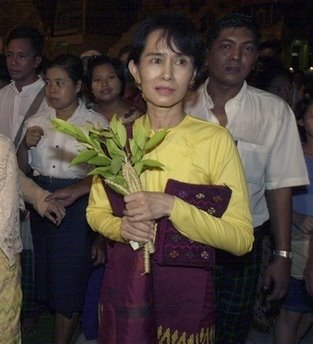


 Posts
Posts


