Author: Christopher W. Tatlock
Updated: September 18, 2008
Ban Ki-moon, Korea
Kofi Annan, Ghana
Boutros Boutros-Ghali, Egypt
Javier Perez de Cuellar, Peru
Kurt Waldheim, Austria
U Thant, Myanmar (formerly known as Burma)
Dag Hammarskjöld, Sweden
Trygve Lie, Norway
--------------------------------------------------------------------------------
Ban Ki-moon, Korea
(2007 – Present) Ban Ki-moon's tenure has featured a new emphasis on climate change policy, efforts to mitigate the surging prices of both energy and food in the developing world, and an inherited portfolio of issues including nuclear nonproliferation negotiations with Iran and continued efforts to solidify the United Nations' role in Sudan's Darfur conflict. Prior to serving as secretary-general, Ban was Korea's Minister of Foreign Affairs and Trade. He joined the Korean Ministry of Foreign Affairs in 1970, and served in a variety of diplomatic roles inside and outside of Korea during the next twenty-five years, including posts at embassies in the United States, Austria, and India. In 2001, Ban started work at the United Nations as chief of staff to Han Seung-soo, the president of the General Assembly. Ban returned to Korea after his term and served as Minister of Foreign Affairs and Trade from 2004 until 2006. He has been actively involved in issues relating to inter-Korean relations. In September of 2005, he helped bring about a landmark agreement aimed at promoting peace and stability between North and South Korea through Six-Party Talks. Since becoming Secretary-General, Ban has spoken out on several issues including the North Korean and Iranian nuclear threats, the humanitarian crisis in the Darfur region, and administrative reform of UN operations.
Kofi Annan, Ghana
(1997-2006) Kofi Annan began his career as a budget officer with the World Health Organization (WHO) and rose through the ranks to become UN under-secretary-general at a time of record increases in peacekeeping operations. In 1995 he was appointed the secretary-general's special representative to the former Yugoslavia. Since his election in 1997, Annan's goals as secretary-general have included implementing management and budget reforms, addressing ever-growing costs and demands for UN peacekeeping operations, and better meeting the needs of poorer nations. Under his leadership, the United Nations executed contemporary platforms aimed at sustainable development in Africa and the utilization of global capitalism to benefit socioeconomic needs. His "Millennium Report" advocates initiatives to eradicate poverty, combat HIV/AIDS, and protect the environment.
Boutros Boutros-Ghali, Egypt
(1992-1996) Boutros-Ghali served one term as secretary-general, suspending his candidacy for a second term after conflicts with U.S. foreign-policy leaders. He has an extensive international relations background as a scholar, diplomat, and jurist. Boutros-Ghali's term in office was marked by increased operating costs and ineffective peacekeeping efforts that proved burdensome to the UN. Unsuccessful U.S. participation in Somali peacekeeping operations, inability to curb fighting in Bosnia and Croatia, and subsequent reluctance from the international community to act against genocide in Rwanda, all precipitated U.S. support to transition the leadership position of secretary-general.
Javier Perez de Cuellar, Peru
(1982-1991) Before assuming office, Perez de Cuellar was Peru's ambassador to Switzerland, the Soviet Union, Poland, and Venezuela; served as his nation's permanent representative to the United Nations; and represented Peru on the Security Council, even serving as the Council's president. In 1979, he was appointed under-secretary-general for special political affairs. While in office, the UN leader oversaw negotiations for the release of American hostages in Lebanon, facilitated the withdrawal of Soviet troops from Afghanistan, negotiated the ceasefire ending the Iran-Iraq War, and developed the 1991 UN-backed peace pact in Cambodia.
Kurt Waldheim, Austria
(1971-1982) Before he was elected secretary-general, Waldheim was the permanent representative of Austria to the United Nations. During his two-term leadership of the UN, Waldheim participated in the Paris International Conference on Vietnam and presided over the first phase of the Geneva Peace Conference on the Middle East. Five years after his second term ended, Waldheim was elected President of Austria, a post he held until 1992; however, during the campaign his service in the German Army came to light. Though he declared no personal involvement, Waldheim was implicated in Nazi atrocities in the Balkans during World War II and was subsequently barred from entering the United States by the Justice Department.
U Thant, Myanmar (formerly known as Burma)
(1961-1971) U Thant served as acting secretary-general after Dag Hammarskjöld's death. Just over a year later, the General Assembly voted unanimously to make him secretary-general. At the time of his appointment, U Thant was the permanent representative of Burma to the United Nations, and had previously chaired the UN Congo Conciliation Commission and the Committee on a UN Capital Development Fund. Under his leadership, the United Nations facilitated the end of the Cuban missile crisis and allayed civil war in the Congo.
Dag Hammarskjöld, Sweden
(1953-1961) Dag Hammarskjöld was unanimously elected to two terms as secretary-general and served until September 18, 1961, when he died in a plane crash en route to a peace mission in the Congo. Mr. Hammarskjöld's most significant contributions to the United Nations' mission include promotion of Armistice Agreements between Israel and the Arab States; the 1956 establishment of the UN Emergency Force (UNEF); and multiple visits to countries in Africa, Asia, Europe, the Americas, and the Middle East to acquaint himself with officials of member governments and problems in specific areas.
Trygve Lie, Norway
(1946-1952) Prior to his election as the first secretary-general of the United Nations, Lie led the Norwegian delegation to the UN Conference on International Organization in San Francisco, April 1945; chaired Commission III, which drafted the Security Council provisions of the UN charter; and in 1946 he led the Norwegian delegation to the UN General Assembly in London. While in office, Lie supported UN intervention in the Korean War and the foundation of Israel and Indonesia. He also advocated UN recognition of People's Republic of China upon the exile of the Nationalist government.
Weigh in on this issue by emailing CFR.org.
Friday, September 19, 2008
Timeline: UN Secretary-Generals


India's bitter brew
18 Sep 2008
Tea workers in India
While India flaunts its benevolence overseas, little charity is being shown to native tea laborers struggling with poverty, hunger and disease.
By Charles Bara for ISN Security Watch
--------------------------------------------------------------------------------
India has successfully positioned itself as a benevolent neighbor to countries in need. Not only was it one of the first countries to provide relief to disaster-struck China and Burma, it also offered US$450 million infrastructure development aid to Afghanistan in August.
But India has failed to help the most vulnerable members of its own society, among them the tea laborers of Assam and North Bengal. Since 1998 up to 4,000 tea laborers and their families have starved to death, losing their only source of income after the closure of the tea gardens. Little is being done to alleviate this problem.
The closure of the tea gardens can be attributed to a fall in tea prices, the declining productivity of the land, and hence a decline in the quality of the tea. There is also tough competition from growers Sri Lanka and Kenya. High loans and minimal investment from the landowners have also contributed to the closures.
Nevertheless, India remains the largest tea producer in the world, accounting for 31 percent of global production. According to a recent Reuters report, tea production in 2008 is expected to rise 4.79 percent to 985 million kgs.
However, according to a report on the website iGoverment, the West Bengal Trade Union Minister Aloke Chokraborty said, "The tea garden owners do not invest the profit they earn from the tea gardens into the same business or ancillary business. They take the profit and invest it in some other business at some other places."
The misery of the tea garden workers, meanwhile, is a known phenomenon. However, the majority of these laborers are easily ignored due to their Central Indian tribal affiliations. A marginal group in every respect, these workers are not a priority for anyone, including their union, which refuses to support their call for the reopening of the gardens.
These laborers were aggressively recruited to the tea gardens in the 1840s when the British sought to break China's market domination by growing tea in Assam and the Himalayan foothills in the Darjeeling area. Lured by the promise of a better life in the tea estates, the workers were forced to clear the jungles, succumbing en masse to epidemics such as malaria and kala-ajar (or "black fever"). Some were victims of tiger attacks. Between 1863 and 1966 alone, some 32,000 tea workers died.
The migration has proved devastating to the tribes as their identity is strongly tied to the ancestral lands they can no longer return to. The culture they have sought to preserve in the tea gardens is being eroded as their numbers dwindle.
Until a few years ago, there were approximately 340 tea estates in North Bengal employing some 300,000 workers. Of these, some 55 percent were women with an average of five to six people dependent on the wages of a single tea worker. The situation started to worsen in 2002. Today, the number of unemployed tea workers ranges from a very conservative 10,000 to as high as 21,000 according to a recent survey by the farm workers union, Paschim Banga Khet Mazdoor Samiti.
The union found that workers are trying to sustain themselves on surrounding forest products and insects. In some areas, the entire population of rats and snakes has been eaten by desperate workers.
The government refuses to admit that the tally of dead tea laborers is due to starvation. Father Cherian Padiyara, who campaigns on behalf of the tea laborers said in a Businessworld article recently: "In early June the government admitted that 571 people had died in the past 15 months. It was a stunning disclosure, the first time that West Bengal had admitted there had indeed been tea garden deaths without, of course, admitting that these were due to starvation.
"It cited coronary disease, TB, high fever, septicemia, meningitis, cancer, malaria, hepatitis and cirrhosis of the liver as causes of death. It is, of course, common sense that a lack of food and malnutrition lowers the body's immunity and leaves people vulnerable to a host of infections and diseases."
The same article quoted Anuradha Talwar, the West Bengal adviser to the Supreme Court, as saying that, although the state may choose to portray the deaths as disease-related, "the fact remains the workers have starved to death and many are waiting to die."
When the Chandmuni Tea Estate in West Bengal closed in 2002 to make way for urban expansion, more than 2,000 workers lost their livelihoods. Half traded their existence for token compensation. The other (noncompliant) half joined the equally miserable pavement dwellers in the city.
As they have few skills except those required to grow tea, even the best intentions are proving inadequate in helping them find an alternative source of income. In the gardens, they lived a secluded life away from towns and other villages. This remoteness made them dependent on tea estate management for everything from food and water to medicine, electricity and education.
The tribes in North Bengal have never been a high priority for the West Bengal governments. It is not that government officials ignore the issue, but funds for the victims are often siphoned off.
The percentage of aid that reaches the people affected by the closure of the tea gardens remains unknown. The lot of the tea laborers gets worse every day. As Suman Talukdar, a manager at the Child Rights and Youth (CRY) group puts it: "There is many a slip between cup and lip in the lives of those people."
--------------------------------------------------------------------------------
Charles Bara is a master's student at the Center for Comparative and International Studies, Zurich.
--------------------------------------------------------------------------------
The views and opinions expressed herein are those of the author only, not the International Relations and Security Network (ISN).
--------------------------------------------------------------------------------
Publisher
International Relations and Security Network (ISN)
Haul Generals before the ICC: rights groups
Mizzima News
Thursday, 18 September 2008 20:48
The first anniversary of the commencement of monk-led mass protests in Burma sees the launch of the latest campaign direct at rallying international support and awareness around the continued rights violations in Burma perpetrated by the ruling junta against its own people.
An initiative co-sponsored by Christian Solidarity Worldwide and Partners Relief and Development UK, Change for Burma! seeks to bring the Burmese regime's leaders before the International Criminal Court (ICC) on a wide range of charges related to crimes against humanity.
Urging those in the UK, Europe and throughout the world in support of the mission's goals to contact their local parliamentary representative, Change for Burma! also calls for a universal arms embargo against the Burmese armed forces.
Speaking in support of this most recent attempt to further bring pressure upon Naypyitaw, British MP John Bercow, Co-Chair of the All Party Parliamentary Group for Democracy in Burma, said, "We've got to have a mass popular demonstration of discontent. We've got a personal and collective responsibility to do something".
Though chronicling and raising awareness of rights abuses throughout Burma and its varied communities, the project gives considerable attention to the plight of Chin State in Northwestern Burma, where an estimated 90 percent of the population is Christian – the highest figure in Burma.
Chin State is currently facing a famine which is said to affect 100,000 people.
"Virtually unseen by the world, thousands of farmers have been reduced to starvation in Chin State, the poorest part of Burma," laments the movements founders.
"The regime won't permit food aid or aid workers into the devastated areas. Villagers are too weak Burma is one of the poorest countries in the world," continues the organization's onslaught against the junta. "It is ruled by one of the world's most brutal regimes, guilty of every possible human rights violation."
Change for Burma! further accuses the Burmese regime of systematic religious persecution, including the desecration of crosses and churches, the forceful display of Buddhist propaganda during Christian services and the denial of promotion within the government and armed forces to members of the Christian community.
In contrast to Chin State, in the whole of Burma the Christian population is estimated to be less than five percent, with nearly 90 percent of Burmese being Buddhist.
Reasons To Be Gloomy
Four things to worry about.
By Ian Bremmer
Posted Thursday, Sept. 18, 2008, at 12:31 PM ET
An oil platform off the coast of Nigeria
In July, I spoke at a London conference with the gloomy title "Darkest Before the Dawn." That darkness hung over the meeting, as economists and strategists, both behind the podium and in the audience, detailed the growing international anxiety over America's financial crisis and its potential impact on global markets. Nevertheless, most of them seemed convinced that better days are coming.
As a political scientist, I fear the dawn may be farther behind the horizon than some expect, as four emerging trends pose broader and deeper challenges to the international order than we've seen in several decades.
The first of these drivers of long-term change involves energy. In 1990, the world consumed about 66 million barrels of crude oil per day. By 2007, that number had climbed to 86 million. The U.S. Energy Information Administration projects that by 2030, daily demand will soar to 118 million barrels. As energy consumption soars in developing countries like China and India, supply is struggling to keep pace.
The problem is not that the world is running out of oil. It's that future supplies will come increasingly from politically less stable parts of the world—the broader Middle East, the Caspian Sea basin, and West Africa. These regions are especially vulnerable to political turmoil, terrorist and insurgent attacks, war, government collapse, and other serious threats.
And, of course, the sixfold increase in oil prices since 2002 has empowered the governments of some oil- and gas-exporting states to use their newfound market leverage as a political weapon. Political leaders in Russia, Iran, Venezuela, and others already use their hydrocarbon wealth to pick political fights. High prices allow even marginal energy exporters like Sudan and Burma to resist international pressure for political reform.
Finally, as energy becomes an ever more precious commodity, the governments of developing states are micromanaging their energy policies by investing in national energy champions, state-owned companies that give government officials near-complete control of the country's most valuable natural resources.
The largest energy companies in the world today are state-owned firms like Saudi Aramco, Gazprom (Russia), CNPC (China), NIOC (Iran), PDVSA (Venezuela), Petrobras (Brazil), and Petronas (Malaysia). The leading multinationals—Exxon Mobil, Chevron, BP, and Royal Dutch Shell—produce about 10 percent of the world's oil and gas and hold just 3 percent of its reserves.
Collectively, national oil companies now own more than three-quarters of all crude oil reserves. The men who run them answer to political bureaucrats, not shareholders. That's a big problem for supply growth, because some of these state officials divert profits toward political projects (or line their own pockets) instead of reinvesting them in efforts to find new reserves and to build the pipelines needed to bring them to market.
The effects of all these risks can increase the prices that consumers pay for energy, weighing on growth in America, Europe, and Japan. They can embolden governments like Iran's to pursue high-risk political strategies—like aggressive development of a nuclear program—secure in the knowledge that energy exports will generate plenty of cash and help the country resist international pressure for change. Few governments around the world want a nuclear Iran. But the country's energy customers won't support sanctions that might cost them access to badly needed oil and gas supplies.
The second shift in the international balance of power is a related one. The growth of state capitalism, particularly in China and the Middle East, gives authoritarian governments with opaque political systems and large amounts of cash unprecedented levels of political and economic influence.
With the end of the Cold War, the dynamism and market power of the United States, Western Europe, and Japan—fueled by private wealth, private investment, and private enterprise—seemed to have established the dominance of the liberal economic model. But public wealth, public investment, and public enterprise have returned with a vengeance. An era of state capitalism has dawned, one in which governments are again directing huge flows of capital—even across the borders of capitalist democracies. The trend has important implications for free markets and international politics. Best recent estimates are that sovereign wealth funds, state-controlled pools of capital fueled by large reserves of foreign currencies, already account for about 12 percent of international investment—double their share of five years ago. Some credible forecasts suggest their assets could grow 500 percent by 2015. Twelve new funds have been established since 2005. More than 20 countries now have sovereign wealth funds, and several more have indicated an interest in creating them.
Yet despite the fast-growing market power of these sovereign wealth funds, we still don't know much about them. "Very few of them publish information about their assets, liabilities, or investment strategies," warns the International Monetary Fund. Some fear the states that control them will use these funds to gain political leverage inside other states.
This shift in the international balance of market power is generating considerable anxiety among U.S. and European policymakers, who fear that emerging-market-based national oil companies, state-owned enterprises, and sovereign wealth funds threaten the economic stability and national security of other countries. Whatever the political motivations for creating them, state-run companies and investment funds are burdened with the same bureaucracy, waste, and political cronyism that plague the (often authoritarian) governments that control them.
The third important geopolitical shift flows from technological advances that arm ambitious and aggressive governments, organizations, and even individuals with powerful new weapons. The tools of the information age help citizens connect and collaborate with one another and with the world outside. In recent years, we've witnessed the birth of a truly global talent pool—and have seen what it can do to generate prosperity in several countries at once. At the same time, weapons technologies—missile-guidance systems, chemical and biological agents, and nuclear know-how—are also cheaper and more widely available than at any time in history. In the past 10 years, India, Pakistan, and North Korea have officially joined the nuclear club, and the trend toward proliferation will likely intensify over the next decade.
The fourth and broadest shift in the international order flows from the transition from a U.S.-dominated system toward a nonpolar world, one in which the leading political and economic institutions no longer reflect the true balance of global power.
As U.S. hegemony gradually fades, the international leadership vacuum will grow. Other states, profiting from America's troubles or at least not wanting to share in them, will resist taking on new international responsibilities that come with costs and risks. All this comes at a historical moment in which the usefulness and legitimacy of the United Nations, World Bank, and International Monetary Fund are already open to question. On a variety of transnational issues—nuclear nonproliferation, counterterrorism, and public health and environmental worries—this trend means that problems can easily become crises.
So much for the darkness; where's the dawn? As rising energy prices create political problems for the governments of countries that depend on oil-supply growth, we'll see a surge in investment in new energy technologies and infrastructure. That process, still in its infancy, is already moving forward.
State capitalism will threaten the performance of global markets until the demands of the marketplace push a range of authoritarian states toward the fundamental political reforms that bring greater transparency. Addressing the diffusion of dangerous technologies will require, among other things, a new and more effective nonproliferation regime. But as more countries develop an interest in preserving a profitable status quo, we're likely to see more movement in that direction.
None of these transformations is right around the corner. Lifting the darkness will take more than a new business cycle, a new oil find, or a new American president. Without fundamental changes in the global system, none of these challenges can be met. The good news is that necessity remains the mother of invention, and that almost everyone appreciates a beautiful sunrise. As a greater number of governments and citizens own a stake in global economic growth, more people than ever will be looking for ways to coax the sun from behind the horizon.
Can he last?
Web www.bangkokpost.com
A former judge and a former permanent secretary, new Prime Minister Somchai Wongsawat is a first-time MP with only seven months under his belt. He may run into a fog in terms of priorities and how to deal with the slew of problems for the ruling party.
--------------------------------------------------------------------------------
By Nattaya Chetchotiros
President of the Thai Journalists Association and Assistant News Editor, Bangkok Post
The days of uncertainty are finally over, with Somchai Wongsawat, the People Power party's (PPP) deputy leader, emerging from political obscurity to succeed Samak Sundaravej, who exited the premiership in disgrace. But the ship of state with Mr Somchai at the helm could be headed for a violent vortex, whipped up by growing sentiment against another "nominee" prime minister.
It's no secret that one reason why Mr Samak did not last very long in the prime minister's seat was in part due to his openness about his alignment with the coup-ousted prime minister, Thaksin Shinawatra. Mr Samak went on record as Mr Thaksin's proxy and with such a label his opponents kept hounding him with criticism, which chiselled awayat his credibility.
The force of the "proxy" criticism will hit Mr Somchai a lot harder, as he is Mr Thaksin's brother-in-law. The husband of Mr Thaksin's younger sister, Yaowapa, has put himself on a collision course with the People's Alliance for Democracy (PAD), which has staged a marathon protest against what it calls a puppet government controlled by remote from London, where Mr Thaksin is now in exile after jumping bail in a corruption trial.
The PAD will be on Mr Somchai's back and will have a field day digging into his past, his every track record, and exposing any and every piece of dirty linen there might be.
Mr Somchai has been on the receiving end from party factions since Mr Samak's departure. He has reportedly been forced to bow to conditions from the camp in the PPP controlled by the influential former Thai Rak Thai party executive, Newin Chidchob, in return for the faction's support for him to secure the premiership.
Seventy-three MPs answer to the Newin-linked faction, which explains why Mr Somchai could not afford to let the group switch its backing to another candidate when it came to voting for prime minister in parliament.
Mr Somchai has agreed to allocate two ministerial posts to the faction, in addition to four deputy minister portfolios promised earlier.
Once Mr Somchai is sworn in as the country's 26th prime minister and the celebrations are over, the faction will come forth with its demand that he honour his word by handing them the cabinet seats.
Mr Samak and Mr Somchai appear to share a goal. Near the end of Mr Samak's days in office, he organised continuous commemorative events to be held between Her Majesty the Queen's birthday on Aug 12, and His Majesty the King's birthday on Dec 5. It would seem Mr Samak had envisioned his stint at least stretching past Dec 5, when a prime minister leads a delegation of officials in celebrating His Majesty's birthday, a duty of the highest esteem. But his hopes have been dashed.
By comparison, Mr Samak possessed far more political clout than Mr Somchai does, and many have begun to wonder whether the latter will even survive the next few months as prime minister.
Mr Somchai is not an abrasive character, nor is he adept at mobilising crowds, such as the United Front for Democracy against Dictatorship (UDD), whose members clashed with the PAD at the height of the recent political tensions.
Mr Somchai displayed his concern for the PAD and, in doing so, has shown he is a non-confrontational figure who would never adopt a violent approach in solving problems. However, his efforts to express a compromising disposition may not be enough to win over the PAD, which has vowed a protracted rally against any prime minister picked from the PPP basket.
A former judge and a former permanent secretary, Mr Somchai has only been an MP for the last seven months, after his first election. Despite advice and coaching from many of the 111 former Thai Rak Thai executives now deprived of election rights as a result of that party having committed electoral fraud, Mr Somchai may well be running into a fog in terms of priorities and how he can deal with the slew of problems for the party.
It is not clear whether he intends to stay in office long enough for Her Royal Highness Princess Galyani Vadhana's funeral in November, or whether he plans to keep his government intact till Dec 5.
Then, there is the nagging question as to when - not if - he thinks he should dissolve parliament: before or after the Constitution Court passes its judgement on the PPP, which is accused of poll fraud in the Dec 23 general election. The case is being investigated by the prosecution and it may not be too long before it is forwarded to the court.
The Somchai government's lifeline may hinge on the length of the court's deliberation, which could take up to four months, although many experts feel it would be a lot shorter. The court may not dwell much on the case since the Election Commission has, with a unanimous vote, ruled that the PPP should be disbanded. A dissolution of the party could come sooner rather than later.
Mr Somchai's first test of leadership will be selecting the people to be in his cabinet. Some critics are dismissive of his ability to cherry-pick capable individuals for the new line-up, which they remarked could be far less presentable than those under the Samak administration. With his limited bargaining power with the various factions, Mr Somchai has even less choice and freedom than Mr Samak did in shopping around for potential ministers.
Mr Somchai also has to convince parliament on the day he divulges his government's policies, about his plan to reconcile differences in this bitterly-divided society. Unless he can make the pro-government movement listen to him, he cannot guarantee to keep civil unrest under the lid.
On the economic front, Mr Somchai needs to soothe investors' nerves and assure them of the strength of the Thai economy in the face of the massive financial crunch in the United States.
Mr Somchai has been compared to the other two S's - Finance Minister Surapong Suebwonglee and Justice Minister Sompong Amornwiwat - who were also favourites to replace Mr Samak. While some regard him as the best fit for the top job, there is no one better to comment on his confidence in the new role than Mr Somchai himself.
Thaksin 'still boss'
Web www.bangkokpost.com
A People Power party envoy is believed to be on his way to London to submit the potential line-up of the Somchai Wongsawat cabinet for the perusal of former prime minister Thaksin Shinawatra.
Yongyuth Tiyapairat, a former deputy leader of the People Power party, has been ordered to Britain by new prime minister Somchai Wongsawat to update Mr Thaksin on the political situation and seek his advice on allotment of cabinet seats, a source in the PPP said.
Some changes could be made to the proposed line-up based on his advice.
The report of the list being delivered to London came after His Majesty the King on Thursday endorsed the nomination of deputy PPP leader Somchai Wongsawat as the new prime minister.
The royal command appointing Mr Somchai was accepted by Parliament President Chai Chidchob who was granted an audience with the King to nominate Mr Somchai at Klai Kangwon Palace in Hua Hin.
The source said the line-up has yet to be finalised. It is being prepared by core party members, including Mr Yongyuth and deputy PPP leader Sompong Amornwiwat and is expected to be finalised on Sunday, before being readied for royal endorsement.
The source said attempts are under way to weaken the political clout of former Thai Rak Thai executive Newin Chidchob who commands the rebellious Friends of Newin faction in the PPP.
The faction, which has 73 MPs under its wing, opposed Mr Somchai's nomination but then had a change of heart.
The source said Mr Sompong is likely to be moved from the Justice Ministry to the Interior Ministry, where he is expected to challenge Mr Newin's clout.
It is also reported that the Friends of Newin faction will lose the seat being held by Supol Fongngam, deputy interior minister.
The post is not in the quota held by the Friends of Newin group as claimed, said the source.
Rifts over the allocation of cabinet seats in the faction are also emerging.
Chaiya Promma, a member of the Friends of Newin group, said the four ministers in the group's quota should be changed. The group should meet to discuss candidates for the cabinet posts.
"If the four ministers retain the seats, there will be problems. I call for changes so that we can compare their performance," he said, adding some MPs have been lobbying others to support them for cabinet portfolios.
A group of 40 PPP MPs, meanwhile, signed a petition to block Puea Pandin leader Suvit Khunkitti from joining the cabinet. Their move follows speculation he will be named industry minister.
PPP MP for Lop Buri Suchart Lainamngern, said the party MPs question Mr Suvit's loyalty, citing the Puea Pandin leader's pullout from the Samak Sundaravej government in late July.
Chaiyos Jiramethakarn, spokesman for the Puea Pandin party, shrugged off the campaign, saying the move did not create conflict, although it might have spoiled the atmosphere.
He also criticised the PPP for meddling in Puea Pandin's affairs.
PAD core leader Chamlong Srimuang said Thursday that the PAD would continue its protest and would not negotiate with Mr Somchai.
Sondhi Limthongkul, another PAD core leader, said he would unveil the PAD's proposal for a new political order on Monday, and clear any questions over the issue.
PAD coordinator Suriyasai Katasila said the group has agreed on three points — the protest will continue without any negotiations with the government, it will oppose constitution amendments and it will push for a new political order.
Following royal endorsement, Mr Somchai promised to work to achieve national reconciliation and unity.
Quoting Mr Chai, he said the King urged the quick formation of a new cabinet to tackle the country's problems.
He said the government expects to deliver its policy statement on Sept 25.
WALL STREET FALLOUT
Supachai: The worst is yet to come
Strong Asian growth slowed by US crash
``If regulators allow banks like Lehman Brothers to leverage debt 35 to 40 times, then there must be something wrong,'' says Dr Supachai.
Asian economies should brace for more impact from the global credit crisis and also prepare for a prolonged global economic recession, warns Supachai Panitchpakdi, secretary-general of the United Nations Conference on Trade and Development (Unctad). The insolvency of Lehman Brothers and the bailout of the insurer AIG have shed new light on the depth of the meltdown of financial institutions in the United States, the former Thai deputy prime minister said yesterday.
The breakdown of the US financial system could result in a decline in world economic growth this year and next, and complicate efforts to forge a new global trade agreement under the World Trade Organisation, which Dr Supachai headed from 2002-05.
''We had predicted a global economic slowdown by 1% this year. But watching the situation in the financial market as it has unfolded over the last few days, my fear was that it would be higher than that,'' he said at the Thailand Focus investors' conference yesterday in Bangkok.
''People mostly think of the word recession in a technical aspect, which means two quarters of economic contraction. It is a recession nevertheless. We must prepare for a longer period of recession.''
The anticipated decline in US financial market asset prices, recognition of losses, deleveraging of the private sector and the need to recapitalise the financial system would be a prolonged process, Dr Supachai said.
Asia economies are expected to post strong 6% growth this year due to growing incomes in China and India which will be buoyed by agricultural product prices.
But Asian economic policymakers should avoid repeating stagflation which occurred in the 1970s when global economies were hit with high inflation pushed by fuel prices against a backdrop of weaker international trade than today.
Asian countries should continue to improve labour productivity and strengthen trade liberalisation to cushion the impact of the world slowdown, he said.
Meanwhile, central banks must avoid adopting overly restrictive monetary policy that could depress economic growth, he added.
With the threat of stagflation, the trend in policy is to keep interest rate increases on hold.
Dr Supachai said financial institutions' unwinding of futures contracts in the wake of the credit crisis could contribute to a further decline in oil prices. But Asian economies should avoid subsidies which increase dependence on fossil fuel and thus pressure their current accounts.
He said the global credit crisis highlighted loopholes in regulations of world financial systems.
''The combination of the financial system awash with liquidity and the unfettered market mechanism is the cause of the problem. When there is an upturn in the economy, people become more complacent and are willing to take more risks,'' he said.
''If regulators allow banks like Lehman Brothers to leverage debt 35 to 40 times, then there must be something wrong.''
THAILAND IN TURMOIL
On the brink of becoming a failed state
PAVIN CHACHAVALPONGPUN
Is Thailand at risk of turning into a ''failed state''? The current political crisis suggests the existence of certain indicators of the state's vulnerability to collapse amid unending conflict. The People's Alliance for Democracy has pledged to oppose any members of the ruling People Power party from leading a new government, including new Prime Minister Somchai Wongsawat, the brother-in-law of Thaksin Shinawatra; the latter was ousted in a military coup two years ago today, and is at present a fugitive from Thai law residing in London.
The PAD accuses the PPP executives of working as agents of Mr Thaksin and is continuing its crusade to uproot his political legacy. But getting rid of Mr Thaksin's political influence seems to be a ''mission impossible'', considering his strong support at the grassroots level.
This political zero-sum game led to a serious confrontation between the PAD and the pro-government camp, the United Front for Democracy against Dictatorship (UDD), which is believed to be backed by some factions of the PPP.
The military, despite possessing absolute control under the state of emergency decree (which was announced on Sept 2 and lifted on Sept 14), has declined to use force against the protesters.
But a fresh coup d'etat should not be discounted if the crisis deteriorates and the country slips into a political coma.
The Democrat party's proposal of a ''national unity'' government failed to make itself attractive. The PPP has no reason to hand over its majority rule to the opposition.
Meanwhile, the Thai economy has been badly affected by the political unrest, with the tourism industry being hit hardest. Some foreign investors have cast doubts over the country's long-term political stability and threatened to curb manufacturing orders, which could have a devastating impact on the export sector.
These are the symptoms that insinuate Thailand is experiencing conditions of a state collapse.
What is a failed state? Noam Chomsky defines it as a state whose central government is so weak or ineffective that it has little practical control over much of its territory. According to Max Weber, a state could be said to succeed if it maintains a monopoly on the legitimate use of physical force within its borders. When this is broken, such as through the domination of warlords and terrorists, the very existence of the state becomes dubious; and the state could become a failure.
A failed state also implies the conditions in which a state has been rendered ineffective and is unable to enforce its laws uniformly because of many reasons, including extreme political corruption, military interference in politics and grave political situations in which non-state actors wield more power than the state.
Since 2005, the US-based Fund for Peace and the magazine Foreign Affairs have jointly published an annual ''Failed State Index'' based on a number of social, economic and political indicators of state vulnerability. The indicators are not designed to forecast when states may experience violence or collapse. They are instead meant to measure a state's vulnerability to collapse and conflict.
In the Thai case, certain conditions indicate that the country may be on the brink of collapse. The current political struggle appears to have derived from a legacy of vengeance-seeking group grievances. The PAD, while presenting itself as a defender of democracy, accused the Thaksin regime of committing power abuse, corruption and leaning towards authoritarianism. But the PAD is also acting on behalf of the Bangkok elite, who have embarked upon a vengeance mission against Mr Thaksin, simply because he was considered a threat to their power.
Although Thailand is not experiencing sharp or severe economic decline, the ongoing political wrangle has already badly impacted the economy.
The Thai Tourism Services Association revealed that the number of international arrivals in recent weeks has fallen by 70%. Hotel room occupancy has dropped by 30-40%, evidently in the aftermath of the closure of airports in Phuket, Krabi and Hat Yai late last month. Tourism accounts for 6.5% of the country's gross domestic product. The estimated loss to tourism and related service industries has been more than 42 billion baht.
Other symptoms of a failed state are also seen in the Thai case. The country has suffered endemic corruption by the ruling elite and their resistance to transparency and accountability. Court cases against the Shinawatra family reaffirm the deep-rooted corrupt practices, leading to a widespread loss of public confidence in state institutions and due process.
The governments under the Thai Rak Thai party and the PPP, despite winning landslide elections, adopted certain authoritarian characteristics in which constitutional and democratic institutions and processes were manipulated. There were attempts to use nationalistic political rhetoric by the ruling elite, often in terms of forcing communal solidarity, to serve its own legitimacy. On top of this, the media was often silenced for its critical comments on the governments.
Meanwhile, the emergence of the PAD which has operated with impunity also contributes to the possibility of Thailand becoming a failed state. A large portion of civilians is seen to be sympathetic to the PAD, even endorsing its ''New Politics'' that could take Thai democracy back a few decades to the time when despots thrived.
The PAD supported the unions' strike to disrupt essential services, such as public transportation, electricity and water supplies. The aim was to put the blame on the government for being unable to maintain basic state functions that serve the people.
Certain Asian countries are listed as failed states in this year's index, including Afghanistan, Pakistan, Bangladesh, Burma, North Korea and Sri Lanka.
Although Thailand has not yet got itself onto the list even when there seems to be no solution in sight to the crisis, the country is likely to be put under a ''warning'' status that suggests a likelihood of it turning into a failed state.
It is really up to the ruling leaders and the opposition to work their way out of this political deadlock. The final destination is indeed not so much about getting away from the Failed State Index, but about getting our lives back on track and living like civilised citizens of the world.
Dr Pavin Chachavalpongpun is a Visiting Research Fellow at the Institute of Southeast Asian Studies, Singapore.
DPM Wong confirms true intent behind non-renewal of visas/work permits of Burmese residents in Singapore

http://www.sgpolitics.net/?p=697
Posted by admin on September 19, 2008
Written by Ng E-Jay
19 Sept 2008
Deputy Prime Minister and Home Affairs Minister Wong Kan Seng has confirmed the true intent behind the non-renewal of visas and work permits of some Burmese patriots in Singapore who were involved in peaceful assemblies and demonstrations.
As expected, DPM Wong has affirmed that “persistent defiance of the laws” was the real reason why a number of Burmese nationals working or studying here were asked to leave when their immigration passes expired. (ST, “Myanmar activists ‘defied our laws’”, 18 Sept 2008)
DPM Wong was responding to a question raised in Parliament by Nominated MP Eunice Olsen who had asked if Burma’s military rulers had pressured or requested the Government to clamp down on anti-junta activists and deny them residence in Singapore.
DPM Wong’s statement does not come as a surprise to any of us. The question is, why has the Government taken so long to confirm what we had known all along?
When 6 Burmese patriots were denied renewals of their PR re-entry permits, employment passes, work permits, or social visit passes by the Immigration and Checkpoint Authority (ICA) and the Ministry of Manpower (MOM) in July/Aug this year, no reason was provided by the authorities. Even on appeal, no reason was given for the rejections. Why has the Government taken so long to come clean as to the real reason for all this?
DPM Wong said the Burmese nationals disregarded Singapore laws by staging illegal activities, like outdoor protests, to pursue their political agenda.
The purpose of this article is not to judge whether the laws against public assembly of 5 or more persons are just or unjust, or to provide reasons whether this particular law has been selectively applied to suppress dissent. Long time readers know my stand on this.
Rather, I would like to put forward the point that the authorities have displayed a distinct lack of compassion towards the Burmese patriots.
The Overseas Burmese Patriots protested against the murderous actions of the junta against monks and civilians, as well as the sham referendum on the new military-drafted Constitution for Burma. These are just causes that deserve a voice, and these issues affect the lives and families of all Burmese. Why has the Government displayed such insensitivity and lack of compassion by castigating the Burmese who participated in these peaceful demonstrations? These Burmese patriots conducted all their activities peacefully and did not cause any public disturbance or inconvenience, so why are they being judged on the same level as petty criminals?
DPM Wong said that these Burmese “chose to break the law and yet defiantly demand the right to stay in Singapore as an entitlement“.
This statement is loaded and biased. The Burmese patriots never claimed, explicitly or implicitly, that they felt their stay in Singapore was an entitlement. During a press conference on 22 Aug at Peninsula Excelsior Hotel, the host, Mr Myo Myint Maung Marc, emphasized that the Burmese were not seeking special favours, but only the right to be treated fairly.
DPM Wong also said, “They have tried to politicize the issue through the media and through uninformed foreign groups, in the process distorting the actions to remove them from Singapore as being politically motivated.”
In my opinion, it is DPM Wong who is politicizing the issue, not the Burmese patriots. When lives and families are at stake, is it so wrong to go public with the issue so as to make known their plight? If it were a group of Singaporeans who was being victimized in another foreign country, perhaps DPM Wong would also prefer them to remain silent about their plight?
UNITED NATIONS POWER BALANCE SHIFTING TO CHINA, INDIA, RUSSIA - EUROPEAN AND U.S. HUMAN RIGHTS, LIBERTIES, MULTILATERALISM EFFORTS DIMINISHED

China, India, Russia emissaries tripartite meetings
began in 2005 after decades of competition
18 September 2008
The West’s efforts to use the United Nations to promote its values and shape the global agenda are failing, according to a detailed study published Wednesday.
A sea change in the balance of power in favor of China, India, Russia and other emerging states is wrecking European and U.S. efforts to entrench human rights, liberties and multilateralism. Western policies in crisis regions as diverse as Georgia, Zimbabwe, Burma or the Balkans are suffering serial defeats in what the study identifies as a protracted trend.
The hemorrhaging of western power, as reflected in longer-term voting patterns in key U.N. bodies, is mirrored by the increasing clout of China, Russia and the Islamic world, according to an audit of European influence at the U.N. by the European Council on Foreign Relations.
“The E.U. is suffering a slow-motion crisis at the U.N.,” says the report, noting that the west is now being regularly outwitted in global diplomatic poker by the Chinese and Russians.
“The problem is fading power to set the rules. The U.N. is increasingly being shaped by China, Russia and their allies … The west is in disarray. The E.U.’s rifts with the U.S. on many human rights issues at the U.N. in the Bush era have weakened both.”
U.S. and European failure to win the day at the U.N. Security Council in recent votes on Zimbabwe and Burma as well as defeats last year on Kosovo or Darfur and the constant struggle to muster support for global action against Iran because of its nuclear ambitions are traced as part of a broader decline over the past decade.
Using a program designed to analyze voting patterns and statistics, the thinktank found that European policies on human rights enjoyed the support of 72% of U.N. members a decade ago but only 48% by last year, while the U.S. suffered a steeper collapse from 77% to 30%.
“The pattern of votes in the general assembly shows that opposition to the E.U. is growing, spurred by a common resistance to European efforts at promoting human rights,” said the study.
The beneficiaries of this disaffection with the west have been China and Russia, which defend national sovereignty and non-intervention in sovereign countries no matter how grievous the atrocities and human rights violations blamed on national governments. Over the past decade support for Chinese and Russian stances on human rights issues has soared from less than 50% to 74% in the U.N. general assembly.
The assembly kicked off this week in New York with the west bracing itself for another debacle. Serbia is to use the session to demand a vote on the “illegality” of the secession last February of Kosovo, whose breakaway was strongly backed by the U.S. and most of the E.U., and to refer the dispute to the U.N.’s international court of justice. Despite strenuous lobbying by the Europeans to prevent the vote, they have conceded defeat. Only 46 of the 192 U.N. states have recognized Kosovo’s independence. And western attempts to rally support for Georgia in the Caucasus crisis will be rebuffed by the Russians.
“The E.U. has collectively failed to adapt to new power trends,” said Martti Ahtisaari, the former Finnish president and a chairman of the thinktank.
The setbacks for the west at the U.N. in New York are compounded by a worse record in winning the battles for rights and freedoms at the Geneva-based U.N. Human Rights Council. In March the Islamic bloc changed the mandate for the council’s rapporteur on freedom of expression, charging him, in the wake of the Danish cartoons crisis, with the obligation to record blasphemy. Critics said the post was supposed to function as an agent of liberty, but became an instrument of repression.
“The head of steam building up in the Islamic world for worldwide defamation legislation is huge,” said Keith Porteous-Wood, director of Britain’s National Secular Society. “The Human Rights Council can no longer serve a useful purpose.”
In the council’s two-year existence, the 19 European countries on the 47-strong body have been marginalized, mired in despair and a sense of futility after losing more than half the votes conducted.
The poor European record on winning the world’s hearts and minds contrasts with Brussels’ habit of talking up the merits of its “soft power” attractiveness, and indicates that the E.U.’s huge financial investment in being the world’s biggest aid donor and the U.N.’s biggest funder is not translating into political gains.
See Related: WORLD POLITICS
A civil past and a political future?

COURTESY PHOTO
Pánek has traveled to an estimated 55 countries, including war-torn Afghanistan, where People in Need continues operations.
NGO chief mulls a move into government work, but sticks with global relief for now
By Markéta Hulpachová
Staff Writer, The Prague Post
September 17th, 2008 issue
MICHAEL HEITMANN/The Prague Post
After years on the road, Pánek plays an increasingly managerial role at People in Need.
The Pánek File
Age: 40
Birthplace: Prague
Family: Partner, daughter
Estimated number of countries visited: 55
Web site: www.peopleinneed.cz
Days after returning from a covert visit to a cyclone-stricken delta in south Burma, Šimon Pánek sits in his Prague office, awkwardly sipping coffee from a pint glass. His forehead is stamped with bruises, and a thick cast envelopes most of his right arm. “I fell from the attic,” he explains hastily, pre-empting wild conjectures about life-and-death scenarios in inundated villages and hostile encounters with the country’s repressive military junta. The quick confession marks a scarce moment during the 90-minute interview when Pánek voluntarily talks about himself. At 40, Pánek possesses the clout of a future president. His life is starred with all the distinctions of local greatness: a student leader during the Velvet Revolution, adviser to former President Václav Havel and the first Czech to receive the European of the Year award in 2003.
But, for Pánek, all these personal achievements take a back seat to his real drive: managing the global humanitarian efforts of the nongovernmental organization People in Need, where he has worked, on and off, since 1988. That year, a handful of local students, including Pánek, decided to organize a relief mission for an area in the Soviet south Caucasus (today’s Armenia) that had been devastated by an earthquake. By then, the perestroika had loosened the iron fist of the Czechoslovak communist regime, so obtaining permission for the project proved relatively simple. “First, we went to the Soviet Embassy. They told us that if we put together a relief package, they would send a plane,” Pánek recalls. “At the time, that was enough of a mandate to get started.”The team’s next steps led to the Kotva department store to negotiate storage space, then on to Czech Television, where they announced a public collection. In the end, the group amassed about 50 tons of sleeping bags, clothes and other donations, which were transported to the afflicted region by plane and train. Though regarded as the embryo of People in Need, the Armenia project was followed by a two-year hiatus, as certain political developments at home compelled Pánek and his friends to put humanitarian efforts on hold.As one of the organizers of the Stuha student movement, Pánek played an active role in the events leading up to the Velvet Revolution. It is therefore paradoxical that during the fateful Nov. 17, 1989, demonstration that launched the final cannonball at the crumbling regime, he was out of town. “I’d just returned from abroad and needed to make some money, so I was working,” he says. “To be honest, I never imagined that things were going to escalate so quickly — I had attended five protests before that, so I didn’t feel like I would be missing anything by not going to this particular one.” In retrospect, Pánek seems less irked by his absence at the Nov. 17 protest than his inability to link contemporaneous events abroad — particularly the fall of the Berlin Wall and the uprisings in Poland, Hungary and Romania. “We were preparing for years of dissent, which proves just how naive we were,” he says. “We completely failed to read the world trends.”A noble nicheUnlike the fall from the attic, two decades of leapfrogging to some of the earth’s most imperiled places have not left any physical scars. Pánek’s spirited speech, magnetic eyes and amiable smile are the same as that of the impassioned biology student whose infectious ideals and organizational ability earned him an election to the post-revolutionary National Assembly — an involuntary post from which he instantly abdicated. “I was 21 and a half,” he shrugs. “I felt energized by our newfound freedoms, and I wanted to travel.” Pánek would never complete his studies at Charles University. In 1992, he received a phone call from his mentor Jaromír Štětina, then a Russia correspondent for daily Lidové noviny. Now an independent senator, Štětina is described by Pánek as the “founding father” of People in Need. “I met Šimon Pánek more than 20 years ago, back when he was a skinny high-school student,” he says. “He came to see me and said he wanted to travel.” When ethnic violence erupted in Nagorno-Karabakh — a breakaway region in Azerbaijan — in December 1991, Štětina was dispatched to cover the conflict. “It was my first time in a war zone. It seemed the world had thrown this small, predominantly Armenian enclave overboard. People were dying and medicine was missing,” he says. “When I came back to Prague, I called Šimon and said, ‘We have to do something.’ ”After organizing a relief mission to the Karabakh, the group collaborated with Lidové noviny to establish a permanent foundation that would later evolve into People in Need. In the beginning, many of the students in charge of the fledgling organization regarded it as a temporary project. “We all had completely different career plans,” Pánek says. “Most of us thought we would return to our studies in one or three years. That never happened.” Instead of pursuing degrees in medicine, biology or philosophy, Pánek and his peers discovered a vital social service slighted by decades of communism. “It was an untapped niche in our society,” Pánek says. “The places that needed aid were many, and we felt there was a need to build up the civil sector.”Totalitarian legacyAs Štetina remarked, People in Need today is no longer that club of students collecting loose change from sympathizing locals. With operations in 41 countries focusing on emergency relief, humanitarian and developmental aid and human rights promotion, the NGO has matured into “an internationally respected organization the Czech Republic can be proud of,” Štetina says.After years of taking aid to global crisis zones — including wartorn Bosnia and Chechnya — Pánek’s ballooning managerial role now compels him to spend more time in the office. “It’s the tax we pay for expansion,” he says. “Instead of spending 50 percent of my time in the terrain in Africa or Afghanistan the way it was five or 10 years ago, I’m simply the director of a relatively large NGO.”He therefore regards his latest incognito “control visit” to the Irawaddi Delta in south Burma — whose stilted villages were deluged when May’s Cyclone Nargis ruptured a nearby dam — as “a bit of a reward.” “If you don’t waste too much time respecting the pointless laws of the illegitimate regime and get right to it by administering aid to the people who need it most, a lot can be done with relatively small resources from the Czech Republic to help tens of thousands of people in the most obscure and afflicted regions of the delta,” he says. Before Nargis hit, People in Need’s main objective in Burma was to advance human rights. Through long-term cooperation with exiled communities, the organization provides systematic aid to politically persecuted individuals in regions like Burma, Belarus, the Middle East and Cuba.Pánek regards these activities — which range from smuggling soap and computers to Cuban dissidents to arranging local internships for young Burmese journalists — as People in Need’s legacy. For an NGO sprouted in post-communist Czechoslovakia, fostering human rights in today’s totalitarian states is a moral obligation, he says.He recalls the international efforts behind the Charter 77, a 1977 human rights document that galvanized a wave of local dissent. “The people supporting the charter abroad could have also said, ‘what do we care about Czechoslovakia,’ ” Pánek says. “Back [in 1977], it seemed like complete naivety, and it would take another 12 years before the change came.”It is this communist experience that fortifies People in Need’s links to the persecuted inhabitants of remote totalitarian states. “Usually, we find common ground very quickly,” Pánek says. “The nuances are different for us than they are for someone from Britain. Our own experience allows us to orient faster in political systems that are based on lies.”What the world needs Listening to Pánek ponder solutions for global quagmires like the “quasi-communist” government of North Korea, poverty in sub-Saharan Africa or Russia’s recent aggression in Georgia evokes the visionary musings of Havel, another reluctant leader.After the post-Cold War breakdown of a bipolar global dynamic, the relatively staid 1990s depleted Europe of politicians with strong, principled visions, he says. “The world ceased being confrontational, and politicians morphed into administrators. In this emptied European world, there is Václav Havel, and maybe [former British Prime Minister] Tony Blair. Perplexity and self-consciousness rack Central Europe. But maybe, new leaders will appear as tensions rise, because there will be more at stake.”While today’s petty, partisan political scene is not yet ripe enough for him, Pánek does not rule out the possibility of stepping up to the plate in future decades. “Of course, I consider it from time to time,” he says, and alludes to his former colleague and predecessor Tomáš Pojar, now deputy foreign affairs minister. “Although it’s not as common as in America, it is possible to cross over from the civil sector into politics.”“Never say never.”
Markéta Hulpachová can be reached at mhulpachova@praguepost.com
The Chinese Absence
19/09/2008
By Amir Taheri
Amir Taheri
was born in Iran and educated in Tehran, London and Paris. Between 1980 and 1984 he was Middle East editor for the London Sunday Times. Taheri has been a contributor to the International Herald Tribune since 1980. He has also written for The Wall Street Journal, The New York Times, and The Washington Post. Taheri has published nine books some of which have been translated into 20 languages, and In 1988 Publishers'' Weekly in New York chose his study of Islamist terrorism, "Holy Terror", as one of The Best Books of The Year. He has been a columnist Asharq Alawsat since 1987 .
With the United States gripped by its election fever and unlikely to be back in a state of normalcy until next year after a new administration is installed, the need for leadership on a number of international issues is felt more strongly than before.
Ranging from the current financial crisis to curbing Tehran's nuclear ambitions and nipping a new round of proliferation in the bud, these issues cannot be put on the backburner for another year or two before the Americans sort out their internal feuds. Even then, it is not at all clear what policies the next US administration might pursue on any of the key issues the world faces.
The Democrat hopeful, Senator Barack Obama, has offered no clear policies on those issues apart from hinting that he would do the opposite of what George W Bush has been doing, something that, if elected, he may find is easier said than done.
The usual Democrat attack theme against Republican candidate, Senator John McCain, is that he represents a" third Bush term." However, that is not at all certain. McCain has distanced himself from Bush on several crucial issues and a look at his team of advisors shows that none of Bush's key collaborators is included. So keen is McCain to mark himself from the incumbent that he has not invited Bush to appear at any campaign venues. For the time being at least, there is, of course, no substitute for the United States as the key player on the international stage, a position that is unlikely to be challenged seriously for at least another decade or so.
Thus, the hiatus created by the American election represents a moment of uncertainty for the global system.
However, this does not mean that the rest of the world should simply take to the fiddle as Rome burns. Other actors, from the European Union to China and Japan, and passing by Russia, Brazil and India could and should help smooth the rough ride ahead wherever they can.
To be sure, all those actors are limited by the reality of economic and military power and political mobility.
The European Union can act only on based on the least common denominator. This means that it often ends up effectively endorsing a status quo it cannot challenge, as we saw in its latest initiative regarding the Russian invasion and annexation of Georgian territory.
Russia has all but squandered whatever leadership claim it might have had by becoming embroiled in a banal irredentist conflict with one of its tiniest neighbors, Georgia. The annexation of South Ossetia and Abkhazia was a big mistake in terms of Russia's strategic interests as a leading global power. It has now become a big bully embroiled in a local brawl with a midget.
Brazil, though the "regional superpower" in Latin America, still lacks a global profile. Thebes it could do is to try to contain the excesses of a new group of radical leasers, from Venezuela's Hugo Chavez to Bolivia's Evo Morales, who may be pushing their respective nations towards civil war.
India, for its part, has not sought a leadership role since the heady days of the nonaligned movement and, with a few exceptions such as Afghanistan, does not appear interested in getting involved beyond its own national interests.
Although still the world's second biggest economic power, Japan has never been able to punch at its weight in the political arena. An ageing nation, it is still haunted by ambiguous sentiments about its militarist past and hampered by more than a decade of semi-recession.
That leaves us China, regarded by many as the major rising power in Asia. Although I do not see China's long-term prospects, that is to say in the next three to four decades, as totally serene, China already has enough muscle to claim a greater role in the international arena.
It is projected to become the world's second largest economic power within the next four or five years. It has developed close, often intimate, relations with more than 60 nations across the globe, mostly in Africa. As the biggest importer of crude oil, China weighs in heavily on the global energy market. China is also one of he top three suppliers of weapons to the world, a position that bestows great political influence. When it comes to the current financial crisis, China, as the biggest foreign holder of US dollars and one of the top five investors in the global economy enjoys a position of influence second only to that of the United States. As a veto-wielding permanent member of the United Nations' Security Council, China could both initiate and scupper any major international initiative.
China's role is decisive on a number of issues.
Were it to stop backing the weird system in North Korea, the Kim il-Jung gang would find it hard to cling to power, let alone seeking nuclear weapons. A change of policy by China could favor the reunification of the Korean peninsula under a pluralist system.
China is in a similar position on Burma (Myanmar). Were it to withdraw its support from the ruling generals, they would stand little chance against the surging democratic movement in that unhappy land.
Although a neighbor of Afghanistan, China has adopted a low profile there, a fact that has encouraged the Pakistanis to pursue a duplicitous policy towards the new regime in Kabul. Of all the big powers, and for reasons of history and geography, China is the best placed for helping Afghanistan achieve greater stability.
China's role is also crucial in persuading the Khomeinist regime in Tehran to modify its adventurous foreign policy and its pursuit of nuclear weapons. A strong message from Beijing that a nuclear-armed Islamic Republic would not be acceptable could sway the debate in Tehran in favor of those who oppose President Mahmoud Ahmadinejad's radical policies.
Equally important is the role that China could play in helping India and Pakistan settle the thorny Kashmir dispute once and for all. It is no secret that Chinese support over the past four decades has been a key element in encouraging Pakistan's often-defiant posture on the issue.
For more than a decade, however, China has studiously stayed on the sidelines of international arena. The reason was that the leadership in Beijing wished to focus on holding the Olympics as a successful re-launch of the new China brand. To hat end, they developed a foreign policy code-named "no enemies". This meant that China would shun taking any position that might upset anyone, even such bankrupt tyrannies as that of Robert Mugabe in Zimbabwe.
The Chinese absence is bad for China and bad for the world. The Olympics are over and the new China band has been launched. It is time for China to assume responsibilities incumbent on any major power in the service of conflict resolution and peace.
China Widens Milk Probe as 3rd Baby Dies, Cases Mount
By Ariana Eunjung Cha
Washington Post Foreign Service
Thursday, September 18, 2008; A13
SHANGHAI, Sept. 17 -- A third infant died and the number of sick grew fivefold to more than 6,200 as China's investigation into contaminated baby formula widened to include other dairy products made by two dozen companies and sold around the world.
Supermarkets in Hong Kong pulled ice cream imported from the mainland that had traces of the chemical melamine off their shelves. Taiwan issued an across-the-board ban on dairy products from Chinese companies involved in the scandal. Chinese exporters scrambled to test samples of milk powder sent to Bangladesh, Yemen and Burma.
An inspection this week of dairy companies found that milk powder from at least 22, or one-fifth of all producers, contained melamine, renewing fears that the overhaul of the food safety system last year after a string of recalls was inadequate.
Health Minister Chen Zhu said Wednesday that the government has dispatched 5,000 inspectors to the country's dairy producers and that it would for the first time mandate checks for toxic substances.
The delayed disclosure of the discovery of melamine in the milk powder highlights the weaknesses of China's two-tiered product safety regulatory system, one that is designed to protect and nurture a handful of privileged, mostly state-owned companies such as Sanlu Group, whose products were first found to be contaminated.
Even as inspections at other food-producing companies have grown more strict over the past year, Sanlu was exempt from these checks through a controversial program that is based on the idea that companies that had done well on quality tests in the past could be trusted to regulate themselves.
At least nine of the 22 dairy companies found to have problems were exempt from government inspections for their milk powder or baby formula, according to a Washington Post analysis.
Melamine, a white crystalline powder used in making plastics and tanning leather that was found in the infant formula, was at the heart of China's troubles last year, too.
Unscrupulous dealers had mixed the substance into a key ingredient in pet food because it would boost readings on nutrition tests for protein content. The chemical was linked to the deaths of thousands of dogs and cats, triggering an international inquiry into the safety of Chinese products.
Angry parents of the sick babies in China who consumed the milk powder are now asking: How could a substance that was already known to kill pets have made its way into the food chain and now be killing babies?
"We have aching hearts that our babies are suffering like this at such a young age, and we are hateful to those ones trying to make illegal money out of this," said Fan Xiangjun, 23, a construction worker whose 9-month-old son drank Sanlu baby formula and has been in the hospital in the northwestern city of Lanzhou for 20 days with kidney stones.
As of Wednesday, 158 of the 6,244 babies that have fallen ill are in serious condition and are suffering from acute kidney failure.
Luo Yunbo, a professor of food science at China Agricultural University and vice president of the Beijing Food Association, thinks the milk powder contamination was the result of "negligence."
"We missed the chance," Luo said. "We should have thought of similar food products that also use nitrogen content as the main test indicator for protein, and we should have thought about how to deal with the problem of fake protein content."
For most of China's food producers, the months since March 2007 -- when the investigation into contaminated pet food from China began -- have been marked by turmoil. Their profits have been cut by inflation and their markets wiped out by import bans from countries concerned about food safety.
As part of an overhaul that included the government-ordered execution of the former head of the State Food and Drug Administration and several of his deputies, China last year began random spot-checks of key exports such as wheat and other grain products and seafood.
Sanlu, however, is one of 2,152 companies that make products that have been awarded a special three-year "mianjian," or inspection-exempt status. In the eyes of Chinese authorities, Sanlu, which received its milk powder exemption in December 2005, had proved that its internal controls were so good that the government no longer needed to monitor its production and shipping process.
"The mianjian system is wrong. . . . You cannot exempt inspections simply because it has been good in the past," said He Bing, a professor at the China University of Political Science and Law in Beijing, who has been pushing to abolish the program.
In a notice posted early Thursday, China's General Administration for Quality Supervision, Inspection and Quarantine said it would revoke mianjian licenses -- the pride of the companies that had them and used them on advertisements -- for all food producers effective immediately. "The national exemption marks on their products and printed packages are no longer valid," the watchdog agency said.
Dairy products produced by Mengniu, Yashili and Shanghai Yili AB Foods that were recalled on Wednesday were also part of this inspection-exempt program.
Mengniu, China's largest dairy company, announced that it had stopped production of its milk powder and was recalling it from stores. The company said it was "deeply sorry" and promised to compensate victims.
The delay from March, when Sanlu first started hearing complaints from parents, and June 28, when the first kidney stone case was reported, and then Sept. 11, when a public warning was issued and the milk powder recalled, speaks to the shortcomings that remain in China's food safety system.
Zhang Wei, a doctor, said he knew there was something wrong with the milk powder three months ago, when 14 babies in a row were brought to his hospital with the same nightmarish symptoms.
The infants, ranging from newborn to 11 months, were feverish, vomiting and could not urinate. Zhang, chief urologist at the People's Liberation Army No. 1 Hospital in Lanzhou, knew they had kidney stones, which occur when urine has too much of a substance that can form small crystals.
"At the start, we were thinking it could be water, but after asking the parents, we found out they all drink different waters. Some take well water; some, tap water. So it could not be water contamination. Plus the babies don't smoke, eat. The only thing is they all drink Sanlu milk," Zhang said in a phone interview Wednesday.
Chinese milk powder is banned in the United States, but the U.S. Food and Drug Administration has said it is concerned that some may have made its way into the country illegally and warned consumers to avoid milk powder from China.
Researchers Liu Songjie, Wu Meng and Crissie Ding contributed to this report.
Burma Watchers To Burmese Junta: Democratize Or Face More Protests
http://www.mindanaoexaminer.com/news.php?news_id=20080919032553
MANILA, Philippines (September 19, 2008) - "There is no way the military regime can hide the continuing denial of human rights in Burma and its deplorable management of the country. It is therefore urgent for the international community to take stronger and more comprehensive action against the kind of government that turned its country into a garrison state".
Thus said Free Burma Coalition-Philippines spokesperson Egoy Bans on the 20th anniversary of the bloody coup d'etat staged by the State Law and Order Restoration Council (SLORC), now known as State Peace and Development Council (SPDC), the official name of Burma's military junta.
FBC-Phils and other pro-democracy groups around the world, hold the SLORC responsible for the 1988 arrest and murder of thousands of peaceful activists and civilians calling for democratic reforms in Burma. Year 1988 also saw the rise to popularity of Daw Aung San Suu Kyi as she assumed leadership of the main opposition party, the National League for Democracy.
Bans said, "Twenty years have passed but nothing has significantly changed in Burma. In the guise of restoring peace and order, SLORC was founded and later changed its name to SPDC in another attempt to fool the people into believing empty promises of political change and economic development.
Except for the junta's name, nothing has changed at all. Peace, development, democracy and even the rule of law are nowhere to be found."
FBC-Phils also challenged the military regime of Burma to democratize or else the junta faces more international condemnation. "This is a show of force between the junta and the international community. The world is closely watching Burma and we will not stop staging protest actions, particularly infront of the junta's embassies wherever they are stationed," Bans stressed.
CHALLENGE TO CHINA
FBC-Philippines likewise criticized China for cuddling the junta saying that it "has contributed so much to the suffering of the peoples of Burma" through continued supply of arms and ammunition to SPDC's armed forces.
In 2006, China and Russia vetoed a United Nations Security Council (UNSC) resolution on Burma saying that Burma does not pose a threat to regional peace and security.
FBC-Phils explained that China "acts like the popular Big Brother" and blocks any UN effort to address growing global concern for human rights and democracy in Burma. The international community has constantly asked China to play a crucial role in Burma's democratization but the Chinese regime has refused citing the principle of non-interference or respect for a country's sovereignty by not meddling with its "internal affairs."
"Although China is not the only country engaged in Burma, it is imperative for the Chinese government to break its silence on the issues of human rights violations of the SPDC. Before quickly defending the junta, China should first offer viable alternatives for democratic reforms in Burma," Bans concluded.
Burma-Thailand Gas Pipeline Construction Set to Begin
Posted on: Thursday, 18 September 2008, 12:00 CDT
Text of report in English by Burmese newspaper The Myanmar Times on 25 August
Construction of the third Thai-Myanmar gas pipeline to carry natural gas from newly discovered offshore deposits in Myanmar is expected to begin at the end of the rainy season, said an official from the pipeline survey company said on August 19.
"The third gas pipeline connecting the M9 block to Thailand is expected to begin early next season," said U Thein Shwe, managing director of Geocomp Myanmar, which won a contract to conduct a survey for a gas pipeline route.
He said the company had submitted a feasibility report on the selection of pipeline routes in third week of July, and Thai oil company PTTEP was satisfied with the report.
According to U Thein Shwe, the proposed pipelines are on each side of the existing two gas pipelines, whose combined capacity is 1000 million cubic feet of gas a day (mmcfd).
However, he declined to disclose which route the Thai company has selected.
PTTEP announced at the end of July that it expected to seal a deal with Myanmar government to buy natural gas from the M9 block.
The proposed natural gas pipeline will carry 300 mmcdf, of which 240 mmcdf will be transported to Thailand and the remaining 60 mmcdf will be used for domestic consumption, the company said.
The M9 block is located about 300 kilometres south of Yangon, and was discovered by PTTEP in early 2007. The company is expected to spend about US$1 billion to develop the M9 field, with production starting in 2011 or 2112.
PTTEP is also the operator and sole share-holder of five potential offshore oil and gas blocks in Myanmar M3, M4, M7, M9 and M11, all located in the Gulf of Mottama.
PTTEP is currently buying about 1000 million cubic feet of gas a day (mmcfd) from Myanmar's Yadana and Yedagun gas fields via pipeline.
Originally published by The Myanmar Times, Rangoon, in English 25 Aug 08.
(c) 2008 BBC Monitoring Asia Pacific. Provided by ProQuest LLC. All rights Reserved.
Source: BBC Monitoring Asia Pacific
Irrawaddy: A day of shame and a day of hope – Editorial
Thu 18 Sep 2008
Filed under: News, Opinion, Other
Today, September 18, is the anniversary of two important events in Burma’s political history. The first is the bloody coup that installed the current regime in power 20 years ago, and the second is the start of last year’s uprising by Buddhist monks who took to the streets to seek a peaceful end to decades of brutal military rule.
The coincidence of these two anniversaries serves as a sad reminder of Burma’s plight as a nation struggling for survival under rulers hell-bent on holding onto power. In the 19 years that separate these two events, Burma moved not one step closer to peace and political reconciliation. It is as if the country’s history simply collapsed on this day.
As if to underline the futility of the Burmese people’s desire for freedom, this September, too, has been a month of arrests, torture, intimidation and trials that make a mockery of the law.
The streets of Rangoon are now monitored by soldiers, police and armed thugs known as Swan Arr Shin, the Masters of Force, who are constantly on the alert against any signs of potential unrest. In recent weeks, they have arrested a number of prominent activists, including Nilar Thein, a mother who has not seen her infant daughter since she was forced to go into hiding after last year’s protests. She is now in prison and at risk of torture, according to Amnesty International.
The regime has also apprehended at least 14 other activists in recent weeks. One of the detained activists is the younger brother of the prominent activist-monk U Gambira, who is also in prison for his leading role in last year’s “Saffron Revolution.”
There is also growing concern over the fate of Aung San Suu Kyi, Burma’s most famous torchbearer for the democratic cause. For four weeks from the middle of August, she refused to accept food deliveries to her home, where she has been under house arrest for 13 of the past 19 years. This prompted fears that she had gone on a hunger strike—something she hasn’t done since 1989, when she was first refused permission to leave her home. These fears have been confirmed by reports that she is now malnourished and receiving intravenous fluid to help her recover her strength.
Despite claims that it is moving towards democracy, the Burmese regime continues to hold more than 2,000 political prisoners. And even after signing numerous ceasefire agreements with ethnic insurgent groups, forced labor, rape and mass killings are still commonplace in border regions.
Burma’s rulers have succeeded only in placing the country near the bottom of every human development index. Burma is now among the worst countries in the world in terms of poverty, education, healthcare and corruption. The result of decades of economic mismanagement has been dire: more than a third of children in Burma are malnourished, the average household spends up to 70 percent of its budget on food, and more than 30 percent of the population lives under the poverty line, according to United Nations estimates.
It is difficult to believe that Burma’s economy was once regarded as one of the strongest and most promising in the region. But now the country’s immense natural wealth serves only to enrich the junta and a handful of cronies.
The regime is quick to blame its Western critics for Burma’s precipitous economic decline, but it refuses to acknowledge that the US and the EU have imposed sanctions for a reason. Burma’s human rights record is appalling, and the junta’s refusal to engage in meaningful reconciliation talks with the democratic opposition has sent a strong signal to the West that the ruling generals have no interest in moving the country forward.
All of this has earned Burma a place among the world’s pariah states. But the junta doesn’t seem to mind that Burma now stands alongside North Korea, Zimbabwe and Sudan as a country that routinely brutalizes its own population.
Burmese people, however, are keenly aware that their country has been dragged down to this shameful state. More than anything else, the two anniversaries that we mark today show that Burma is a nation divided between those who have no shame, and those who, despite their fear and their past failures to liberate their country, still nurture some hope for the future.
Christian Science Monitor: Monks with guns? Burma’s younger activists get bolder – Anand Gopal
Thu 18 Sep 2008
Filed under: News, Inside Burma
If Ashin Zawta has his way, the next time the government of Burma (Myanmar) clamps down on dissent it will have to deal with a new force: monks with guns.
“Last September the Army proved too powerful for us and defeated our nonviolent tactics,” says the young monk, whose real name, like those of other activists in this story, has been changed for security reasons. “We need weapons. That is the only way we can bring down this regime.”
One year after monks led thousands in Burma’s largest antigovernment protests in 19 years, many activists say they are losing patience with the slow pace of change. Up against a powerful regime, they are calling for fresh tactics, from teaching human rights theory to stockpiling arms.
“The younger activists’ frustrations are growing. They want to take up arms because they were so brutally suppressed last September. They have gone their whole lives without seeing change,” says Win Min, an expert on Burmese political affairs at Thailand’s Chiang Mai University.
While the activists turning toward violence still form a minority, young monks have never before openly advocated violence, and this may signal a new phase in the evolution of the political opposition, says Mr. Win.
Burma’s military government killed dozens of protesters and detained at least 800 in August and September 2007 when a surge in fuel prices sparked large demonstrations, led by Burma’s widely respected monks. The stark defeat of the uprising – which became known as the Saffron Revolution, for the monks’ deep-red robes – left many younger activists questioning the prevailing political wisdom.
Though Buddhism is traditionally associated with nonviolence, Mr. Zawta says the junta does not respect life or Buddhism, forcing some monks to take this extreme position.
“The regime is like a rabid dog,” Mr. Zawta says. “It bit us and infected us with militancy. The old ways aren’t working – the only solution is to arm the people.
“Some of the old monks preach caution and tell us to focus on patience and the Buddhist way,” he continues. “But many of us are realizing that we have to go out there and do something.”
New tactics: teach rights, deliver aid
The younger monks are more active, Zawta says, adding that more are learning English so they can communicate with international media and expose conditions inside the country.
As with many young monks, last year’s protests politicized Zawta. He forged links with the All Burmese Monks Alliance (ABMA), an underground network of activist monks that formed in the wake of last September’s crackdown. The Alliance, which has become a leading underground opposition group, gives political sermons and organizes aid delivery to Burma’s south, which was devastated by cyclone Nargis in May.
Most monasteries in Burma provide free education to the community’s poor, including lessons in English, math, and Buddhism. But Zawta and other Alliance-affiliated monks have supplemented the curriculum with a dose of human rights theory and political history. “Most young people don’t even know about 1988,” he says, referring to the failed uprising of that year.
Years ago such overt anti-regime talk in monasteries would have been unthinkable. But members of the post-September generation say monks can no longer play a secondary role in Burmese politics.
This new focus comes with a price, however. Authorities have cracked down on the monk movement, arresting many of the leaders of last year’s protests. Earlier this month, intelligence agents raided a monastery in Rangoon, Burma’s main city, and arrested a senior monk. The government also recently derobed ABMA leader U Ashin Gambira and plans to try him on sedition charges.
Some leading monks have fled for Thailand, while others remain in country and work underground, surreptitiously distributing leaflets and facilitating other activists’ work. The Monks Alliance has housed activists being hunted by the government in their monasteries.
Older activists: too cautious?
The security dragnet is forcing some groups, such as the semi-legal National League for Democracy (NLD), led by Nobel Peace Prize laureate Aung San Suu Kyi, to operate with caution. During the September demonstrations, NLD’s central committee urged party members to avoid the protests, though it verbally supported the monks.
“But the youth[s] started helping the monks anyway, and they defied party orders and marched,” says Nay Shi Shwe, a leader of the NLD’s youth wing.
“There is definitely frustration with the leadership,” he continues. Young people “think that this is a good opportunity to fight the dictatorship, but the old men are taking too much time. They want to wait until 2010″ – the year of scheduled elections – “but we want action now.”
Older activists of the NLD, whose election win in 1990 was ignored by the ruling junta, say that too open an association with proscribed groups and illegal demonstrations may jeopardize the party’s hard-fought semi-legal status and disqualify them from the 2010 elections.
But to some, the party seems to be caught in suspension, without a coherent policy to address the current political climate. “The NLD is slowly losing relevancy,” says a member of the underground group, the 88 Generation Students.
Still a unifier: Aung San Suu Kyi
But while the NLD stagnates, youths, monks, and underground activists agree that Ms. Suu Kyi, who has been under house arrest for 12 of the past 18 years, is the only figure who can unite the opposition and revitalize the party.
When Suu Kyi reportedly refused to meet the United Nations envoy to Burma, Ibrahim Gambari, a few weeks ago, the hopes of many activists who are frustrated with the UN and NLD jumped.
“The UN is no good. All they do is talk, and when they come here they are focused on dealing with the regime [rather] than with fighting for democracy,” says Thaw Htun, an opposition sympathizer.
Mr. Gambari is mandated to help facilitate the release of Suu Kyi and the reopening of NLD offices, but in six visits he has only met mid-level government officials and no one from the junta leadership.
Suu Kyi’s lawyer, U Kyi Win, suggests that her refusal may be a strategy to convince authorities to alleviate the conditions of her detention rather than a principled opposition to the UN’s role in Burma. She’d also refused food deliveries for almost a month until the government agreed this week to some of her requests, including the right to receive mail regularly and certain foreign publications.
Activists with the underground groups say they are not banking on legal strategies or UN visits. Instead, many are looking for new opportunities in the current political climate.
“My vision is that through the development of local NGOs after Nargis, we can start building community-based activist groups,” says Hein Thein, a longtime opposition member.
Mr. Thein says these groups can function like “urban guerrillas,” rising to protest when needed and blending back into society during times of repression. If the whole community is involved in such work, he says, it becomes very hard for authorities to crack down effectively.
Other sections of the underground, like some young monks, think armed insurrection is the key. “We can’t make the mistakes our predecessors did,” says Tha Kay, one such advocate. “We have to develop new leaders and a new vision. For example, we are stockpiling arms. It’s too early to use them, but the time will definitely come.”


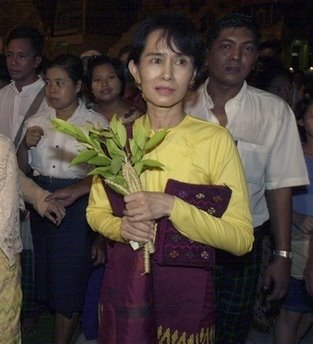


 Posts
Posts


