News & Articles on Burma
Thursday, 02 December, 2010
--------------------------------------------------
Wikileaks Says Burma Passes Asean News to Beijing
Democracy comes first, says Suu Kyi
KNU Calls on Burma Army to Withdraw
Kachin Border Post Closes Amid Rising Tension
Junta to set up more artillery units around Shan, Wa bases
Suu Kyi sees role as facilitator of network for Myanmar democracy
In Myanmar, house arrest looks good
Troops Reinforced on the Western Front as Tensions Flare in Eastern Burma
WHO says HIV/AIDS public health problem
Myanmar, Thailand work for building major deep seaport
Dam projects inked as cronies prosper
NDP seeks to honour Myanmar’s pro-democracy leader
Burmese Regime Continues Brutal Campaign Against Ethnic Civilians
Airtime scrapped for ‘political’ artists
108 Shops for Burma
Than Shwe Praises 'Successful' Elections
Burma's Exports Drop after Election
NZ Government ditches Myanamar for Burma
-------------------------------------------------------
Wikileaks Says Burma Passes Asean News to Beijing
By BA KAUNG Thursday, December 2, 2010
Burma, along with Laos and Cambodia, might be working for Beijing as spies within the Association of Southeast Asian Nations (Asean), according to a US cable leak attributed to Singapore's Minister Mentor, Lee Kuan Yew.
“Within hours, everything that is discussed in Asean meetings is known in Beijing, given China's close ties with Laos, Cambodia, and Burma,” a secret cable stated, quoting Lee Kuan Yew in a conversation with US Deputy Secretary of State James B. Steinberg on May 30, 2009.
According to a leaked text posted on the Wikileaks website, the cable was sent from the US Charge d’Affaires in Singapore, Daniel L. Shields, to US Secretary of State Hillary Clinton in June. The conversation, which was aimed at “eliciting MM Lee’s views on China and North Korea,” took place in Singapore's Presidential Palace.
Lee Kuan Yew was also quoted as saying in the same conversation that “Beijing is worried about its dependence on the Strait of Malacca and is moving to ease the dependence by means like a pipeline through Burma,” referring to China's major oil pipeline construction from Burma's Arakan coast to China's Yunnan province.
As China's strategic ally, Burma often seeks China's support in the United Nations whenever its human rights record is raised. And China is widely assumed to wield influence on the Burmese regime.
The leaked cable also referred to an earlier discussion between MM Lee and China's Deputy Chief of the People’s Liberation Army (PLA) General Staff, Ma Xiaotian. Lee was quoted as recalling that when he asked Ma Xiaotian what China could do about North Korea, the Chinese official replied: “they [North Korea] can survive on their own.”
“MM Lee said he interpreted this as meaning that even if China cut off aid, the DPRK (North Korea) leadership would survive. This is a leadership that has already taken actions like killing ROK (South Korean) Cabinet Members in Burma,” the cable stated, referring to an incident in which North Korean commandos attempted to assassinate South Korean President Chun Doo-hwan during an official visit he made to Rangoon in October 1983.
The attempt to kill the South Korean president with a bomb was widely believed to have been masterminded by North Korean leader Kim Jong II before he succeeded his father Kim II Sung.
Among the hundreds of thousands of US diplomatic cables leaked by the Wikileaks website, there is little mention of Burmese issues. But in its website, it stated that there are over 3,000 records related to Burma. The documents remain inaccessible to the public but are expected to be released soon.
While the Wikileaks website lists US embassies around the world as sources for much of leaked information, the US Embassy in Rangoon is not included.
In another leaked memo released on Nov. 28 but dated July 31 2009 with its original source being US Secretary of State Hillary Clinton, Burma was mentioned as one of the priority issues in US foreign policy.
The memo mentioned a request for reporting of biographic information relating to the United Nations, including information about “credit card account numbers; frequent flyer account numbers; and work schedules.”
Regarding Burma, the memo asked for information on “Views of UNSC (United Nations Security Council) and member states on Burma” and also plans and intentions of the UN Secretary General on Burma and level of trust in his Special Adviser, who was then Nigerian national Ibraham Gambari. Also, views were sought from Burmese officials on the UN Chief and his special adviser; the development and democratization activities of UNDP in Burma; and details of the UNDP Resident Coordinator's relationship with Burmese officials.
http://www.irrawaddy.org/article.php?art_id=20242
-----------------------------------------------
Democracy comes first, says Suu Kyi
2 December 2010
Shefali Rekhi
SINGAPORE, 2 DEC: Sounding much like the firebrand of the past, Burmese opposition leader Ms Aung San Suu Kyi said yesterday that she will work to convince fellow citizens that power lies in their hands, and that they must use it properly to achieve change.
In her first interview with a regional publication since her 13 November release after seven years of house arrest, she told The Straits Times that modern methods of communication have made her task much easier. Despite the ever-present threat of arrest, the democracy icon hopes to facilitate democracy in Burma by building a global network and engaging the country's military regime at the same time.
"What I am interested in is creating a wide network of people not just for Burma, but people all over the world to encourage the democratic process in our country," she said in the phone interview. "That's what I want to do at the moment. I see that as my role ~ as a facilitator of such a network."
That network could include the USA, the European Union, and countries in the region.
"I would like them to work in concert. Not just the EU and the US...but also Asean and other Asian countries. If they could coordinate their efforts, I think it would help the process of democratisation in Burma greatly," she said. "(I hope) that they will talk more to each other and try to find a common ground on which to approach the problems of Burma."
The 65-year-old made it clear, however, that she does not aspire to become the country's president or prime minister, saying her only goal was to "establish a strong and lasting democratic system". "I don't think it is important who is president if the democratic institutions are genuine and strong and in place. There will be presidents and presidents after that."
Speaking in her trademark soft yet forceful voice and with a slight British accent, Ms Suu Kyi did not sidestep any questions during the interview ~ including the fear of arrest.
"It is always a possibility," she acknowledged. "Not just with me but with many of my colleagues as well. They have been in jail and have been kept in jail for many, many years as well. And they are aware of the fact that they could be re-arrested. But I don't think we live in fear."
Indeed, the threat of another clampdown by the reclusive regime has not stopped Ms Suu Kyi from striving to bring about a return of power to Burmese people ~ a key message that she sought to emphasise during the interview.
From the moment she was released, she has been reaching out to supporters within the country, addressing thousands of cheering people at public gatherings.
The speed at which she returned to work appears to suggest that Ms Suu Kyi is trying to get as much done as possible while her freedom lasts. "Change has to come from the people and there is nothing more important than a change in which people think," she said.
"Our people need to understand that they are empowered; that they are not powerless and I am trying to instil the idea of the power of the powerless into them; and that they can use this power in the right way to make the changes that we want."
Elaborating, she said she hoped to help people see that "their power lies in unity and their ability to communicate with each other". Only then, she added, would "they be able to make their hopes and aspirations felt" by the authorities.
Ms Suu Kyi's National League for Democracy had won the national elections in 1990, sweeping 392 of the 492 seats in Parliament, but was never allowed to rule. Instead, what followed were long periods of detention for its leader ~ 15 years in all ~ with intermittent periods of release.
Yet, she still believes in continuing to try to engage the military regime. "We haven't made much progress in the sense we haven't heard anything from them. It's always been like that. We have always had to ask for dialogue continuously," she said. She added that she would keep trying: "We will have to make them understand that there is a need for change."
Ms Suu Kyi also spoke about her personal life. Her husband, Michael Aris, died in London in 1999. The younger of their two sons, Kim, finally managed to visit her in Burma after being denied permission for 10 years. It is unclear if the elder son, Alexander, is also seeking to visit Rangoon.
Ms Suu Kyi has not left the country for many years, fearing she would not be allowed to re-enter. She told The Straits Times she had no intention of leaving Burma any time soon, though she hopes to visit her sons one day.
Asked if the suffering she faced in putting duty before family was worth it, she replied humbly that others had done it too. "I am not the only one who has put duty above family," she said. "I don't think I want to make a big issue out of whether or not I suffered." The Straits Times/ANN http://www.thestatesman.net/index.php?option=com_content&view=article&id=350616&catid=37
-------------------------------------------------------
KNU Calls on Burma Army to Withdraw
By LAWI WENG Thursday, December 2, 2010
The vice chairman of the Karen National Union (KNU), David Takapaw, has called on the Burmese army to withdraw its forces from KNU-controlled areas and to halt the fighting that has prompted hundreds of Karen refugees to flee to Thailand in recent weeks.
Speaking to The Irrawaddy on Wednesday, David Takapaw said, “The regime troops should pull back to Kawkareik and Myawaddy townships and stay away from rebel-held areas in order to stop this bloodshed.”
The KNU is one of the oldest surviving rebel groups in Southeast Asia, and has been fighting the Burmese government for autonomy since 1948.
“We will not stop fighting if they insist on trying to deploy in our area,” he added.
The most recent hostilities broke out on Friday evening when Brigade 5, a renegade faction of the Democratic Karen Buddhist Army (DKBA) led by Lt-Col Kyaw Thet, ambushed government troops on a supply route to Waw Lay, which is the site of the former Brigade 5 headquarters that was captured by Burmese government forces on Nov. 10.
The Burmese government troops have since been forced to retreat to Phaluu village in Kawkareik Township, and sources say they are unable to complete a move to Waw Lay.
The retreating government troops are reported to be short of supplies and food rations after a series of attacks by Brigade 5 and a unit from the Karen National Liberation Army (KNLA), which is the military arm of the KNU.
Phaluu is about one hour's march from Waw Lay, and is located some 40 km south of the Mae Sot-Myawaddy border crossing on the Thai-Burmese border.
With regard to the joint attack on government troops in Phaluu, David Takapaw said, “The KNLA did not join forces with Brigade 5 to launch this assault. They took up different positions, but coordinated the ambush with them.”
One officer from the Burmese army was reportedly killed in the four days of fighting in and around Phaluu. Karen military sources were, however, unable to estimate other casualties.
A unit of Burmese soldiers from the Light Infantry Battalion No 230 reportedly opened fire on another Karen cease-fire group, the KNU/ KNLA Peace Council, which is also based in Phaluu, and which, like DKBA Brigade 5, has rejected the Burmese military government's proposal of incorporating their units into border guard forces (BGFs) under Burmese army command.
The skirmish with the KNU/ KNLA Peace Council was the first time the group has been attacked since it signed a government cease-fire agreement in 2007. One of its soldiers was killed and six were taken prisoner, according to Saw Timothy, a spokesperson for the group.
“The Burmese army told our commanders last week that they had no problem with us,” he said. “Then, they suddenly attacked our troops when their backs were turned.”
Karen sources said that hostilities resumed in Phaluu sporadically on Tuesday and Wednesday between government forces and coordinated units of the DKBA Brigade 5 and the KNLA.
About 50 villagers crossed into Thailand on Wednesday reporting that they had fled the fighting, said Blooming Night Zan, the joint secretary 1 of the Karen Women's Organization (KWO), which is working with the refugees.
More than 800 Karen refugees have taken shelter at a Buddhist temple and Thai school in Pop Phra-District in Thailand's Tak Province in the past week.
“I think the regime should sit down with the armed ethnic groups and discuss ways to stop this civil war,” said Blooming Night Zan. “Otherwise, the refugees' suffering will go on and on.”
Sources at the border said the refugees want to go back to their villages as soon as possible as it is currently harvest time and they are worried they will lose their rice harvest.
Adding to their fears, news has come through that Burmese troops are recruiting villagers in the area to work as porters and in other forms of forced labor, Blooming Night Zan said.
The recent flurry of more than 20,000 villagers to Thailand is the highest influx of refugees at the Thai-Burmese border in 21 years, according to refugee agencies. Hostilities broke out the day after Burma's Nov. 7 general election when Col Saw Lah Pwe's Brigade 5 attacked Burmese army posts in Myawaddy and Three Pagodas Pass townships.
A combined total of about 500 government troops from Military Operations Command 8, Infantry Battalion 97 and Light Infantry Battalions 404, 230 and 409 are currently deployed in the Myawaddy area.
More than 1,000 Burmese army troops from seven battalions under the Southeast Military Regional Command based in Moulmein in Mon State and the Military Operations Command in Tavoy are currently deployed in the KNLA's Brigade 6 area, near Three Pagodas Pass.
Government commanders in Three Pagodas Pass have set up a new battalion about 20 km from Three Pagodas Pass in Maethasa village, which is traditionally a stronghold of KNLA Brigade 6.
Copyright © 2008 Irrawaddy Publishing Group | www.irrawaddy.org
http://www.irrawaddy.org/article.php?art_id=20237
-----------------------------------------------------------
Kachin Border Post Closes Amid Rising Tension
By KO HTWE Thursday, December 2, 2010
A vital trade link between China and Kachin State has been closed in a further move in the Burmese regime's campaign to pressure ceasefire groups to join the border guard force (BGF).
Awng Wa, leader of the Kachin Development Networking Group (KDNG), told The Irrawaddy on Thursday that the Kachin Independence Organization (KIO) was the target of the regime's closure of the Lajayawng border crossing, about two miles from the KIO headquarters at Laiza.
In this April 17, 2010 photo, a Kachin Independence Army soldier gets a push on his motorbike on the Burmese side overlooking the border towns of Laiza. (Photo: AP)
The regime has already closed the Myawaddy-Mae Sot border crossing between Thailand and Burma's Karen State in a move to bring pressure on the Democratic Karen Buddhist Army (DKBA).
Awng Wa said that as part of closing the Lajayawng border crossing, government authorities were erecting check points on highways in the area.
The interruption of trade is resulting in shortages of many essentials and in price rises. One Myitkyina home owner said the price of the cement he needed for repair work had doubled.
Freight handlers have also been badly hit by the border closure and some transport operators are reportedly considering closing down.
Awng Wa said tension was high in the region. “Both sides are on alert, and if one starts firing it will result in war,” he said.
The KIO and its armed wing, the Kachin Independence Army (KIA), signed a cease-fire agreement with the junta in 1994 and now control substantial areas of Kachin State. Tension between the two sides has increased since the KIO/KIA refused to join the BGF.
The tension reached a peak recently when the KIA reportedly shot at a Burmese military helicopter which flew close to the KIO headquarters in Laiza, Kachin State.
The junta has also forbidden KIO/KIA members from carrying weapons or appearing in uniform when traveling in townships. http://www.irrawaddy.org/article.php?art_id=20238
------------------------------------------------
Junta to set up more artillery units around Shan, Wa bases
Thursday, 02 December 2010 14:02 Hseng Khio Fah
The military junta is reportedly going to set up two more artillery units in Shan State South between the Shan State Army (SSA) North bases in the west and United Wa State Army (UWSA) bases in the east, according to informed sources from Shan State South.
One is to be located in Mongzang, Monghsu township, southeast of the SSA First Brigade’s Headquarters Wanhai and another further south where the former SSA North’s 7th Brigade headquarters at Kali, Kunhing township, is located.
The director of the Burma Army Artillery (unidentified) accompanied by Commander of Taunggyi based Eastern Region Command Brig-Gen San Oo, were reported to have arrived at Kunhing on Tuesday evening, 30 November and continued to Mongzang.
The commander was escorted by some 100 Burma Army troops plus 3 squads of local militia men from Loipha, former headquarters of SSA’s 7th Brigade that transformed itself into Nyapyitaw’s Home Guard Force (HGF) in April.
“They returned on the next day after finished inspecting in Mongzang and went to inspect the site near Kunghing-Takaw motorroad for setting up another artillery base,” a source said.
A border watcher commented that although military junta is beefing up forces there has yet to be any sign of a major operation. “But it is certain they [ruling military] are preparing to launch military operation against the ceasefire groups after a new government is installed,” he said.
Currently, the number of reports of Burma Army movements to the Shan State has increased. Last month alone, at least a hundred Dongfeng six-wheel trucks from Shan State North’s Lashio carrying supplies went through to Kunlong-Panglong, north of the United Wa State Army (UWSA) controlled territory.
“We don’t really know what they carried because all were covered with black-tarpaulin,” an eye witness said.
At the same time, the liaison office of the SSA’s First Brigade based in Tangyan was reportedly closed by military junta, giving no reason for the closure, according to a local source. “They are now preparing to collect the list of people who used to have relations with the SSA,” he said. http://www.shanland.org/index.php?option=com_content&view=article&id=3343:junta-to-set-up-more-artillery-units-around-shan-wa-bases&catid=86:war&Itemid=284
-------------------------------------------------------------
Suu Kyi sees role as facilitator of network for Myanmar democracy
Dec 2, 2010, 5:17 GMT
Singapore - Myanmar democracy icon Aung San Suu Kyi said she wanted to act as a facilitator for an international network to promote democracy in her military-ruled country, a Singapore news report said Thursday.
The 65-year-old Nobel Peace laureate, who spent 15 of the past 20 years in detention, was released from her latest house arrest on November 13.
The international community should cooperate more closely to support democracy in Myanmar, Suu Kyi said in a telephone interview with the Straits Times.
'That's what I want to do at the moment. I see that as my role - as a facilitator of such a network,' she said, adding that it could include the United States, the European Union, the Association of South-East Asian Nations and other Asian countries.
'If they could coordinate their efforts, I think it would help the process of democratisation in Burma greatly,' she told the newspaper, using the old name for Myanmar.
She said she still believed in continuing a peaceful dialogue to engage Myanmar's military junta, who staged and won the country's first elections in two decades a few days before her release.
However, there had not been much progress 'in the sense we haven't heard anything from them,' Suu Kyi said. 'We will have to make them understand that there is a need for change,' she was quoted as saying.
Suu Kyi reiterated that she did not aspire to political office. 'What I aspire to is to establish a strong and lasting democratic system in Burma,' she said. 'I don't think it is important who is president if the democratic institutions are genuine and strong and in place,' she said.
'Change has to come from the people and there is nothing more important than a change in which people think,' the opposition leader said.
'First of all, we have to make them understand that their power lies in unity, that it lies in their ability to communicate with each other and to be able to make their hopes and aspirations felt by (the authorities),' Suu Kyi said. http://www.monstersandcritics.com/news/asiapacific/news/article_1602854.php/Suu-Kyi-sees-role-as-facilitator-of-network-for-Myanmar-democracy
-----------------------------------------------------
In Myanmar, house arrest looks good
A Times Staff Writer
December 2, 2010
Reporting from Yangon, Myanmar —
The release of Aung San Suu Kyi is a breakthrough, but about 2,200 people — activists, writers, musicians and comedians — remain in prison on political charges, facing torture, inadequate medical care and years in solitary confinement.
Aung San Suu Kyi
In the decaying lakeside mansion where Aung San Suu Kyi spent much of the last two decades under house arrest, the Myanmar opposition leader and Nobel laureate was forbidden to use the Internet or the telephone or to watch satellite TV.
She did, however, have two maids, was free to read newspapers and listen to radio, and had access to a doctor.
For the other 2,200 or so political prisoners in Myanmar, conditions are quite different.
Sentenced to impossibly long prison terms for speaking out against the repressive military government, they face torture, barely edible food, little or no medical care and years in solitary confinement. Some are forbidden to speak for years.
Chicago Shopping: Your home for personalized holiday shopping deals >>
"There's a great difference between prison and house arrest," said Phyo Min Thein, an opposition politician and brother-in-law of a political prisoner serving a 65-year sentence. "Aung San Suu Kyi was treated well, while those in prison are treated with extreme oppression. Is it fair? Everything isn't fair. We live under an unfair system."
Before and after her release, Suu Kyi vowed to spotlight the plight and press for the release of other political prisoners in Myanmar, also known as Burma.
For hundreds of activists who have openly challenged military rule, there's little hope of fair treatment at the hands of a clique of generals that has remained largely impervious to international condemnation, pressure or sanctions.
The "crimes" prosecuted by the regime include demonstrating, passing on rumors, "undermining the state" and possessing uncensored videotapes. Those who have been jailed include comedians, musicians, artists and a writer convicted of inserting a message in a Valentine's Day poem.
For many, the decades-long sentences are abstract numbers, their release dependent more on a political deal or a hoped-for change in government than in serving out their time.
"There's a signboard inside with the length of your sentence," said Phyo Min Thein, who served 15 years for opposing the regime, including five during which he wasn't allowed to talk. "My first five years, I hoped for freedom. After that, you just have to live."
One of the toughest challenges is staying mentally fit. The lack of news, human contact or contact with loved ones eats away at you, former prisoners and family members said, deepening your isolation.
"You become more hungry for information than for food," Min Ko Naing, a leader of the student movement that rose up against the regime in 1988 who is serving a 65-year sentence, one said.
Some described small acts of defiance: hiding a banned book by Suu Kyi in a hole carved out of the floor under a chamber pot, smuggling out appeals to the United Nations or singing protest songs, even if it meant severe punishment or years added to their sentence.
In 2008, the regime transferred many prisoners to remote sites, making family visits more difficult.
"Before 2008, I visited him twice," said a relative of prisoner Ko Ko Gyi, who is serving a 65-year sentence for, among other charges, illegal use of the telephone system. "But since then I haven't. It's a long way."
Former prisoners said they tried to stay sharp by singing, reciting Buddhist verses, playing mental games and meditating. Suu Kyi, who was released from house arrest Nov. 14, said she drew strength from dawn meditation sessions.
"Some people go mad talking to themselves," Phyo Min Thein said. "You start imagining you see your mother in front of you."
Family visits, when they're permitted, may be limited to an hour or two a month, with guards hovering.
Some of the detainees are sentenced to more than century in prison, and in Myanmar, political prisoners are rarely released for good behavior. U Khun Htun Oo, 67, a political representative of the Shan ethnic minority in failing health, received 93 years in 2005 for a private discussion about political transition.
Human rights groups say their estimate of 2,200 political detainees in Myanmar is probably conservative, because many in rural areas go uncounted. Periodically the government declares an amnesty, although criminals are the main beneficiaries. In 2008, it released 9,000 people; eight were political activists.
"And they know they can re-arrest you any time; they play games," said Bo Kyi, joint secretary of the Assistance Assn. for Political Prisoners (Burma), a Thailand-based activist group. "Aung San Suu Kyi can definitely be arrested again soon. Now the military regime is trying to find an accusation against her."
In fact, many believe it's a matter of time before the defiant leader is detained again by generals threatened by her popularity and vocal appeals for democracy.
Some former prisoners surmise that her release has served the government's interests by deflecting attention from rigged elections held a week earlier, but that once the inner circle led by Senior Gen. Than Shwe feels threatened anew, it will find a pretext to lock her up again.
The regime maintains the outward appearance of following laws, replete with formal charges, witnesses and legal representation, when in fact many verdicts are decided by a few powerful people, said David Mathieson, Myanmar researcher with the activist group Human Rights Watch.
Myanmar's ambassador to the United Nations, Thant Kyaw, denied last month that politics played a part in the convictions. "There are no political prisoners in Myanmar, and no individual has been incarcerated simply for his or her political beliefs," he told a U.N. committee.
Families disagree, saying that the food in Myanmar's 44 prisons and at least 50 labor camps is often bad because corrupt officials pocket the budget, with rice gruel at breakfast, rice and watery bean soup at lunch and a thin vegetable soup at dinner.
And prisoners deemed "troublemakers" face years in solitary confinement, they say, and torture sessions that include kneeling for hours, severe beatings for moving, being suspended by the wrists and water torture.
Conditions varied depending on the prison. A former inmate of Insein Prison said he spent five years in an 8-by-12-foot room that housed up to seven people. Prisoners were given 15 minutes a day to clean out their waste and wash themselves, using a plate, not a bowl.
"It's very difficult to bathe with a plate," he said.
Family members say their relatives eventually become inured.
During Htay Kywe's first prison sentence, his father died, leaving him quite depressed. During his second sentence, during which his mother died, he took personal setbacks in stride, relatives said.
"They never tell us about torture, they don't want us to worry," said a relative of husband-and-wife student protesters Ko Jimmy and Nilar Thein. "Frankly, we don't want to know either. It would only make things harder."
Many relatives said that though they're happy for Suu Kyi, they hope political change will ease their family's plight.
"I hope Ko Ko Gyi gets pardoned," said a relative. "His two nieces are growing up without knowing him. We all really miss him."
http://www.chicagotribune.com/news/nationworld/la-fg-myanmar-prison-20101202,0,2921731,full.story
--------------------------------------------------
Troops Reinforced on the Western Front as Tensions Flare in Eastern Burma
3 December 2010: The number of Burmese troops stationed at army camps along the Chin State-India border has nearly tripled since November 12, according to a border source.
A source quoting a Burmese soldier in the area said that the reinforcement is in anticipation of possible fresh hostilities on the western front as part of a larger armed fightings with other ethnic resistance groups on the eastern border.
A significant increase in Burmese troops is being reported in three townships in northern Chin State, Falam, Tedim and Tonzang.
Five different army camps located along the India-Burma border are identified as the place where the Burmese soldiers have tripled in size in the last three weeks. They include Tio, Rih Khawdar, Tibual (Falam Township), Darkhai (Tedim Township) and Bukphir camps (Tonzang Township).
Around 30 soldiers are normally stationed at each camp.
But the source said no new army battalions are being deployed in Chin State. The soldiers get sent from existing army battalions in Chin State.
Sparodic armed fightings continue to be reported in eastern Burma since Burma's national election in early November.
In anticipation of an all-out assault from the Burmese army in the post election period, several ethnic armed resistance groups, including those maintaining a cease-fire agreement, have recently come together and agreed to assist each other in the event of new attacks from the Burmese army.
The Chin National Front (CNF), active in the western border, is part of the newly established multi-ethnic military alliance Committee for the Emergence of a Federal Union (CEFU). http://www.chinlandguardian.com/news-2009/1134-troops-reinforced-on-the-western-front-as-tensions-flare-in-eastern-burma.html
----------------------------------------------------
WHO says HIV/AIDS public health problem
Added At: 2010-12-01 11:46 PM
Himalayan News Service
Kathmandu, December 1
Although new HIV infections have come down in South-East Asia (SEA) region, particularly India, Thailand, Nepal and Myanmar, HIV/AIDS is still a serious public health problem.
Perhaps the most vulnerable group are children living with HIV/AIDS, whose number has increased by 46 per cent between 2001 and 2009 in this region, mentioned a press statement issued by World Health Organisation today.
WHO said the member country would be able to eliminate mother-to-child transmission of HIV by 2015. Speakers at a programme today urged stakeholders to show serious concern and address the problem faced by children living with HIV/AIDS.
Constituent Assembly Chairperson Subash Nembang said the government was committed to addressing problems and difficulties faced by the infected children. He said he was serious towards the issues of HIV/AIDS that have been raised in the parliament.
According to National Centre for AIDS and STD Control, the estimated number of people living with HIV in Nepal is about 64,000 and the estimated adult HIV prevalence rate was 0.39 per cent. As of June 2010, a total of 15,945 HIV cases of AIDS had been reported and about 31 per cent of reported HIV cases were women aged 15-49. Infections are rising in the general population and nearly 13 new infections are being reported every day.
Health Minister Umakanta Chaudhary asked the concern bodies to develop a special mechanism to establish cooperation and collaboration among various NGOs and INGOs working for the welfare of people living with HIV.
At present, the government is distributing antiretroviral drugs to 3,500 patients but the number will reach 6,000, according to a new guideline developed by WHO. As per the new guideline, WHO recommends providing ARV drugs to the patients with CD4 cell count below 350. Earlier the parameter was for those with CD4 cell count 200.
The statement mentioned that about 33.3 million people live with the virus across the world, and 2.6 million were newly infected in 2009.
In SEA region, 3.5 million people are living with HIV/AIDS, largely in India, Indonesia, Myanmar, Nepal and Thailand. In 2009,
there were an estimated 220,000 new HIV infections in the region and 230,000 people died of AIDS related illnesses.
At the programme, people living with HIV/AIDS demanded that the government fulfill its commitment to provide ARV to them. http://www.thehimalayantimes.com/fullNews.php?headline=WHO+says+HIV%2FAIDS+public+health+problem&NewsID=267876
-----------------------------------------------
Myanmar, Thailand work for building major deep seaport
16:29, December 02, 2010
Myanmar and Thailand are cooperating in building a deep seaport, industrial zone and road and rail link to Thailand in southern Tanintharyi region following the signing of a framework agreement on the Dawei deep seaport and its related infrastructure.
The framework agreement between the Myanmar Port Authority and the Italian-Thai Development Public Company, endorsed in Nay Pyi Taw last month, is targeted to complete in 10 years in three phases and the project is to be carried out under a build-operate- transfer (BOT) system for 60 years which is extendable.
The Italian-Thai Development Public Company, which won the contract for the project is seeking appropriate partners for the implementation of the giant project according to the Weekly Eleven News Thursday.
Meanwhile, the Thai oil company of PTT is reportedly showing interest in the move and is making study with its engagement.
The Dawei deep seaport, industrial zone and road and rail link to Thailand construction project represents the first ever special economic zone in Myanmar.
The project, which costs 13 billion U.S. dollars, includes construction of Dawei Deep Seaport, buildings for shipyard and maintenance work, establishment of zone, petrochemical industries, oil refinery, steel plant, power stations and Dawei-Bangkok motor road and railroad and laying of oil pipeline along the motorway and railroad, according to the framework agreement. http://english.people.com.cn/90001/90778/90858/90863/7219120.html
--------------------------------------------------
Dam projects inked as cronies prosper
By JOSEPH ALLCHIN
Published: 2 December 2010
Three agreements on future dam construction in Burma were signed on Friday last week at a ceremony in Rangoon, with plans inked for a second dam in the Shweli region of Shan state.
A Memorandum of Understanding (MoU) on the Bilin Creek dam in the country’s eastern Mon state was also signed off, as well as the transfer of running the Thaukyegat dam in Karen state to the government. All three ventures were done through Build Operate Transfer (BOT) systems, a form of public-private financing.
China-based Huaneng Lancang River Hydropower Co. Ltd will construct the Shweli 2 dam in collaboration with Asia World, which is owned by junta crony Lo Hsing Han and his son Steven Law. The capacity of the dam is expected to be around 460 megawatts (MW).
It comes as further evidence of increased muscle power of junta cronies in the post-election economy, after Yangon Airways, the only private airline not close to the regime, was forced to suspend operations.
Rumours are also circulating that Max Myanmar, which is owned by junta crony Zaw Zaw, will be rewarded contracts for the Tavoy port project in southern Tennasserim division.
While Asia World will likely construct and run the Bilin Creek dam on their own, they look set to play second fiddle to Huaneng Lancang in the Shweli project. The Yunnan-based company is already operational in the region on the Salween basin hydropower project, and contractors there include the Htoo Group, which is owned by powerful tycoon, Tay Za, and has on its board Aung Thet Mann, son of senior government minister Shwe Mann.
Construction of the first Shweli dam began in 2007 near the village of Man Tat, and came under considerable condemnation at the time from activist groups and local Paulaung villagers displaced by the project.
According to Sai Sai, from the Burma Rivers Network organisation, “Shweli 1 is already complete and most of the electricity goes to China so none of the community have been benefitting from this project. Instead the community has been suffering from forced labour, [displacement], and has been restricted from walking on their own farmland”.
Whilst few details of the BOT agreement were made public, Ren Peng, from the Chinese environmental group, Global Environmental Institute, said they had urged Chinese developers to abide by Chinese standards.
“In terms of environmental standards, it’s low [in Burma]. As a Chinese NGO we encourage them to adopt higher standards”, he said, adding that the BOT system in their experience gave developers greater scope to insist on environmental measures than if the project was undertaken by just a contractor. “To be a developer they have more space to adopt higher environmental standards.”
However, Sai Sai disagrees. “There are no bodies monitoring the standards. Under this [Burmese] government there are no institutions that make sure these companies make impact or environmental assessments, and none consult the local people.
“I think right now if you compare it to Thailand or China and what they do in their countries, the affected communities there are consulted, so that’s why they avoid these places and come to Burma and do whatever they want.”
Distribution of the benefits, namely the use of the electricity generated, will be one of the most controversial issues. Ren Peng said: “The fact is that the people, the local communities, do not benefit anything from these electricity projects.”
Burma has long been beset by severe power shortages, including in the major cities of Rangoon and Mandalay where lack of investment in electrification is woeful. As a result, the streets of Rangoon host private generators that run on imported diesel – a sight that is almost as ubiquitous as the beggars.
But not so in the new capital, Naypyidaw, which was built with the help of Asia World and Htoo Group. The latter is also set to act as a contractor in the first thermal hydropower project for turbines in the secretive city. The deal for this project was signed in August and will be built by Huaneng Lancang, making it the first such power plant developed with foreign capital.
http://www.dvb.no/news/dam-projects-inked-as-cronies-prosper/13172
------------------------------------------------
NDP seeks to honour Myanmar’s pro-democracy leader
By Norma Greenaway, Postmedia News December 1, 2010
OTTAWA — Prime Minister Stephen Harper should invite Myanmar’s pro-democracy heroine, Aung San Suu Kyi, to Canada so she can personally receive the honourary Canadian citizenship awarded to her in 2007, NDP leader Jack Layton says.
Layton and Paul Dewar, the party’s foreign-affairs critic, made the appeal in a letter sent Tuesday to Harper, telling him Canadians shared in the celebratory mood that swept much of the world after the 65-year-old icon was released from seven years of house arrest.
Harper hasn’t responded yet to the letter, but NDP officials say they are optimistic he will endorse the idea of inviting the winner of the 1991 Nobel Peace Prize to Canada.
“Aung San Suu Kyi has often called on the international community to ‘use your liberty to promote ours,’” the NDP letter said. “In 2007, as she lived in captivity, Canada’s Parliament stood unanimously to honour Aung San Suu Kyi by bestowing upon her an honourary Canadian citizenship.”
Layton and Dewar told Harper the treatment of pro-democracy leaders over two decades in Myanmar — formerly known as Burma — and that government’s refusal to acknowledge the election victory of the National League for Democracy is an affront to to democracy.
“We must act on our commitment to support the democratic ambitions of the people of Burma. Forced labour, torture, arbitrary arrests and imprisonment, denial of freedoms of expression and association should no longer be a daily reality for the Burmese people,” the letter said.
Norway has already invited Aung San Suu Kyi to visit Norway to accept her Nobel Prize in person.
Read more: http://www.canada.com/news/seeks+honour+Myanmar+democracy+leader/3911990/story.html#ixzz16wikHv00
------------------------------------------
Burmese Regime Continues Brutal Campaign Against Ethnic Civilians
Thu, 2010-12-02 04:28 — editor
* News
London, 02 December, (Asiantribune.com):
Christian Solidarity Worldwide (CSW) is concerned by reports that despite the welcome release of Burma’s democracy leader Aung San Suu Kyi, and a high-level visit by UN Burma envoy Vijay Nambiar, the regime continues to perpetrate grave violations of human rights against ethnic civilians, including military attacks and forced labour.
During Burma’s sham elections on 7 November, fighting broke out between the Burma Army and a faction of the pro-junta Democratic Karen Buddhist Army (DKBA), which had refused to become part of the Burma Army, as required under the Generals’ new constitution for Burma. The violence resulted in more than ten thousand civilians fleeing across the Burmese border into Thailand.
CSW has learned that in the last two weeks, thousands more ethnic Karen are have fled to the Thai border following a new Burma Army military offensive in Karen State, thought to be targeting villages in areas under the control of the DKBA faction.
As part of this offensive the Burma Army fired mortars into Palu village in Kawt K'Rate Township, Doo Pla Ya district, without warning on 27 November, wounding one man and forcing more than 200 villagers to seek refuge in Thailand. The mortar attack on the civilian village, which is in breach of the Geneva Convention and constitutes a war crime, took place on the same day that UN Burma envoy Vijay Nambiar visited Rangoon.
CSW has also received reports of attacks within days of the election, in which a 17 year old girl was killed when the Burma Army shelled Kya Inn Sikkyi village, central Karen State. A Bible School dining room was hit by mortar bombs in the same village, and a school was bombed in Ta Ka Klo village. In Noe Neh village, a 60 year-old man was arrested and shot dead. At least 400 villagers in Dooplaya District were forced to flee, several were wounded from mortar attacks and some were forced to become porters for the soldiers, carrying their food and supplies.
CSW’s East Asia Team Leader Benedict Rogers said, “For decades, Burma’s military regime has been conducting a campaign against ethnic civilians which involves severe human rights violations amounting to war crimes and crimes against humanity. This campaign has continued and in some areas intensified in the last month, even during the sham elections. By these attacks, the regime is showing that there is no meaningful change in Burma. The release of Aung San Suu Kyi, while welcome, is by itself no sign of progress. Unless and until the regime ends its attacks on ethnic civilians, stops its policies of forced labour, rape and torture, declares a nationwide ceasefire and enters into meaningful dialogue with the democracy movement and the ethnic nationalities, international pressure must be maintained. There is an urgent need for the UN Secretary-General Ban Ki-moon to facilitate a dialogue process, to secure a permanent peace and an end to these attacks.”
- Asian Tribune - http://www.asiantribune.com/news/2010/12/02/burmese-regime-continues-brutal-campaign-against-ethnic-civilians
----------------------------------------------------------------------
Airtime scrapped for ‘political’ artists
By SHWE AUNG
Published: 2 December 2010
Around a dozen entertainment artists were yesterday blacklisted by Burma’s information ministry and will no longer be given airtime on television and radio stations.
The list of those banned includes singers, actors, directors and writers, as well as the former actor Kyaw Thu, who now runs the acclaimed Free Funeral Service Society, an official at Yangon [Rangoon] City FM radio station told DVB. The majority had visited the care home for HIV patients in Rangoon that was initially ordered to close following a visit by Aung San Suu Kyi last week.
It remains unclear whether material produced by the writers included in the list will be banned from print publications, a tabloid journal editor in Rangoon said. Likewise, performance artists are yet to find out whether the ban extends to live shows.
The MoI oversees Burma’s notorious censor board, which blocks all politically sensitive material from being distributed and orders that any printed worked is vetted by the board prior to publication.
“We are artists and not political activists,” said Kyaw Thu. “However, what matters for our country matters for us. We were just doing humanitarian work as it’s the right thing to do for human beings.
“The artists are contributing what they can and it’s quite a disgraceful act to ban and blacklist them for it.”
He added that the ruling junta should make the distinction between humanitarian work and political activity. This it famously failed to do following 2008’s devastating cyclone Nargis, when numbers of Burmese aid workers and teams of people who buried corpses were given lengthy jail terms.
Mainstream artists in Burma tend to steer clear of including political commentary in their work. The country’s most famous performer, the comedian Zarganar, is serving a 35-year prison sentence after he gave interviews to foreign media critical of the junta’s response to the cyclone.
Kyaw Thu’s wife, Shwe Zeegwat, is also included in the ban, along with writer Than Myint Aung, who is in the FFSS. Joining them are singers Saung Oo Hlaing and Than Thar Win, rapper Anegga, punk-rock musician Kyar Pauk and film directors Maung Myo Myin, Min Htin Ko Ko Gyi and Cho Tu Zaw.
http://www.dvb.no/news/airtime-scrapped-for-%E2%80%98political%E2%80%99-artists/13166
-------------------------------------------------
108 Shops for Burma
By THE NATION
Published on December 2, 2010
Sun 108, a subsidiary of Saha Group that operates 108 Shop convenience stores, plans to establish 25 stores in Burma in 2012 after the first two pilot branches are set up next month.
Ads by Google
Looking For Vietnam Tour?Luxury Tour Vietnam By Local Expert Great Rates & Satisfaction, Book!www.LUXURYTRAVELVIETNAM.Com
Korea Winter PackageHotels from THB2,062+ with Discount At Duty Free, Theme Park & More!AccorHotels.com/Korea-Hotels
French Restaurant BangkokSet Lunch 180.00 Baht, Live Lobster Christmas & New Year Menu, Silomwww.parisbangkok.com
Managing director Vathit Chokwatana said the company recently appointed Myanmar Convenience Store Co as its franchisee in Burma.
Myanmar Convenience Store is a joint venture between City Mart Holding, a major retailer in Burma, and Today Group, a media firm in that country.
The two 108 Shop convenience stores will be opened in Rangoon in January.
Vathit said the company wants to build on its success by expanding the business into foreign countries. It is beginning in Burma because it sees room to grow in that market.
He said Sun 108 would support the Burma operation with warehouse management, online computer systems, sales data recording, product delivery and logistics.
The company will adjust operations to suit the situation in each area, including a system of payment that can calculate the currency exchange.
http://www.nationmultimedia.com/home/2010/12/02/business/108-Shops-for-Burma-30143603.html
-----------------------------------------------
Than Shwe Praises 'Successful' Elections
By THE ASSOCIATED PRESS Thursday, December 2, 2010
RANGOON — Burma's ruling strongman said Wednesday that the country's recent elections—condemned by the international community as rigged—were “free and fair” and a step “toward handing power to the people.”
Junta chief Snr-Gen Than Shwe made the assessment about the country's first elections in two decades in a speech marking National Day, which celebrates a 1920 student strike against British colonialism.
According to the state-run New Light of Myanmar newspaper, Than Shwe said the successful completion of "free and fair elections" left just two steps to complete in the junta's self-styled 'roadmap to democracy:' convening Parliament and building a modern developed democratic nation with a Head of State elected by Parliament.
Government opponents and outside observers were critical of the Nov. 7 polls, saying they were held under unfair conditions and that the results were manipulated to allow the military-backed party to win.
The UN special envoy to Burma said Sunday that he told the military government that it must address concerns about the polls. Vijay Nambiar, speaking after a two-day visit, said concerns about the elections have to be addressed "as transparently as possible."
"This is important for laying the foundation of a credible transition" to democratic rule, he said.
Than Shwe in his speech said that plans were now under way "to hand over state power to the public."
Although final official results have yet to be announced, a tabulation based on reports in state media shows the military-backed Union Solidarity and Development Party garnered nearly 80 percent of the seats in the two-house Union Parliament.
The election results assure that the military, which has ruled Burma since 1962, will continue to wield decisive power.
The disbanded party of pro-democracy leader Aung San Suu Kyi also marked National Day, with the 65-year old Nobel Peace laureate, recently released from 7 1/2 years of detention, calling for unity, courage and perseverance to achieve peace, security and prosperity. She called on the junta to release all political prisoners.
http://www.irrawaddy.org/highlight.php?art_id=20232
-----------------------------------------
Burma's Exports Drop after Election
By NA YEE LIN LATT Thursday, December 2, 2010
The export of rice, beans and fishery products in Burma has dropped sharply in the aftermath of the country's November election, according to business sources.
“We have to send samples of rice, beans and sesame to foreign countries before we can actually export them. But, since late November we haven't been able to send as much as before—the order has dropped by half,” the manager of an export business told The Irrawaddy.
He said that the steady fall in the value of the US dollar has impacted earnings from exports and some businessmen have chosen to temporarily stop or reduced the amount of exports while waiting for a better opportunity to engage in trade.
Field workers hoe rows of beans on a farm near Naypyidaw, Burma's capital. (Photo: Zin Min Maung)
Samples of rice, beans and sesame have reportedly been sent to Singapore, Malaysia, Indonesia, India and the UAE.
According to statistics from the military regime's Ministry of Commerce, Burma exported 270,180 tonnes of rice in the first six months of this year, compared to 750,100 tonnes in the first six months of 2009.
A sales manager at a beans and sesame export business told The Irrawaddy that the export of beans has declined since September because India, a major beans buyer from Burma, lowered its orders.
“We don't have year-long contracts with foreign companies anymore, so the fewer orders we receive the smaller amount we export. Since the domestic market is not even steady, some are keeping their goods,” he said.
An MOC source said Burma exported 290,000 tonnes of green-grams in 2009-2010 but the projected export for 2010-2011 has been lowered to 250,000 tonnes.
Meanwhile, the export of Burma's fishery products also has reportedly fallen.
“Our exports have dropped by two-thirds of what we used to export,” said Kyaw Naing, the director of Annawa Trade Park Marine Products Ltd.
He said that his company has mainly exported fish and shrimp to England, Saudi Arabia, the UAE, Kuwait and Italy, but the amount has dropped since the exchange rate of one US dollar fell to less than 900 kyat.
According to Burmese economist Khin Maung Nyo, the value of the US dollar depreciates because of some amount of foreign currency flow into the country.
“Burma has earned foreign money through gems exhibitions and Cyclone Giri-related programs, so the amount of foreign currency currently circulating in the country has increased. As a consequence, the value of Burmese currency kyat is getting stronger. So export businesses have to struggle under this pressure,” said Khin Maung Nyo.
http://www.irrawaddy.org/article.php?art_id=20233
-------------------------------------------------------
NZ Government ditches Myanamar for Burma
NZPA December 2, 2010, 12:41 pm
The Government is to change its position on Myanmar and return to calling it Burma.
The Asian nation was known as Burma until 1989 when the military government officially changed it to Myanmar.
The Government has accepted a recommendation from Foreign Affairs Minister Murray McCully to use Burma, Radio New Zealand reported.
Mr McCully said the change signalled that New Zealand refused to recognise the legitimacy of the ruling military regime.
The Government's position allows for the use of Myanmar where the country is recognised as such, including at the United Nations.
Australia, France and the United Kingdom prefer to use Burma while the Association of Southeast Asian Nations, of which Burma is a member, use Myanmar.
http://nz.news.yahoo.com/a/-/top-stories/8435819/nz-government-ditches-myanamar-for-burma/
__._,_.___
Friday, December 3, 2010
News & Articles on Burma-Thursday, 02 December, 2010


Thursday, December 2, 2010
国連高官 ミャンマーで会見
11月29日 5時42分
ミャンマー問題を担当する国連の高官が、2日間のミャンマー訪問を終えて28日に現地で記者会見し、今月行われた総選挙について、民主化運動のリーダー、アウン・サン・スー・チーさんを排除して強行したなどの批判に対して軍事政権は誠実に答えるべきだと述べました。
国連でミャンマー問題を担当するナンビアール官房長は、27日から2日間にわたって現地を訪問し、今月中旬に自宅軟禁を解除されたアウン・サン・スー・チーさんや、さきの総選挙で圧勝した軍事政権側の政党の代表などと会談しました。訪問を終えて28日に現地で記者会見したナンビアール官房長は、スー・チーさんの自宅軟禁を軍事政権が解除したことについては、一定の進歩だという認識を示しました。その一方で、20年ぶりに行われた総選挙については「多くの関係者が選挙の過程や結果について強い懸念を示している」と述べたうえで、民主化運動のリーダーのスー・チーさんを排除したなどの批判に対し、軍事政権側がしんしに耳を傾け、誠実に答えるべきだという考えを示しました。また、ナンビアール官房長は、総選挙で圧勝した軍事政権側の政党が新政権を主導することが確実ななか、軍事政権がスー・チーさんらを排除せずに新しい国作りを進めていくことを強く求めました。
[関連ニュース]
自動検索 ・スー・チーさん 国連幹部と会談
スー・チーさんの発言要旨
【バンコク共同】ミャンマーの民主化運動指導者アウン・サン・スー・チーさんが30日、共同通信との電話インタビューで発言した内容の要旨は次の通り。
一、7年半ぶりに自宅軟禁から解放されて感じた最大の変化は、より多くの人が政治に関心を払うようになったことだ。特に若い人たちがより関心を強めていることはとても良い変化だ。
一、日本政府に対しては民主化プロセスを支援するすべての国と協調し、協力を続けてほしい。日本は大切な国で、政府や支援者の皆さんに心から感謝したい。日本政府との接触はまだない。誰と協議するかは日本側が決めることだ。
一、クリントン米国務長官ともまだ話していないが、常に支持してくれている。話さなければならないことはたくさんあり、どの問題に真っ先に取り組むのか知る必要がある。
一、(旧最大野党、国民民主連盟=NLD=から分派した)国民民主勢力(NDF)と他の政党のメンバーを分け隔てしない。すべての民主化勢力を一つにまとめるのは簡単ではないが、最善を尽くす。団結は力になり、力は早期の民主化実現につながる。
一、対話の呼び掛けに軍事政権からまだ返答はない。過去にも接触はあった。将来、さらなる接触がないとは思わない。
一、NLDが委員会を設置し総選挙(の不正)に関する調査をしている。新政府発足を前に、どう協力するかを述べるのは時期尚早だ。
一、(欧米による経済制裁が)人々の生活にどのような影響があるのか見直しているところだ。
一、短文投稿サイト、ツイッターなどを通じて世界中の若者と交流したいが、軍政が認めてくれるか分からない。暗殺される恐れもあるが、いつも心配しているわけではない。
「国民の日」で団結訴え スー・チーさん タン・シュエ氏も
「国民の日」で団結訴え スー・チーさん タン・シュエ氏も
2010.12.1 20:36
ミャンマー・ヤンゴンで開かれた集会であいさつするアウン・サン・スー・チーさん(ロイター) ミャンマーの民主化運動指導者アウン・サン・スー・チーさんは、今年で90回目を迎える「国民の日」の1日、ヤンゴン市内の旧野党、国民民主連盟(NLD)本部で演説し、「われわれには不安や貧困のない生活、安全と自由が必要だ。勇気を持って勝利を手にする努力を続けねばならない」と述べ、国民に団結を呼びかけた。
これに対し、軍事政権トップのタン・シュエ国家平和発展評議会(SPDC)議長も同日、国営紙に掲載したメッセージのなかで、先の総選挙は「自由で公正な選挙だった」とたたえたうえで、「全国民は、強い愛国心を持って働くように」と指摘、国軍主導の新政権への支持を求めた。 (シンガポール 宮野弘之)
Prime Minister KAN's TV" E-mail Service (December 1, 2010)
-------------------------------------------------------------------
Prime Minister KAN's TV
-------------------------------------------------------------------
The following are the messages contained in the videos:
"North Korea Shelling Incident...Actions Taken by the Prime
Minister's Office"
1. First actions taken
Narration: At 2:34 pm on November 23, North Korea began firing
artillery shells onto Yeonpyeong Island in the Republic of Korea
(ROK). Shortly after 3:10 pm, upon learning of the incident, the
Government of Japan began gathering information in ROK, China, the
U.S., and Russia. By 3:20 pm, an Information Liaison Office was
established at the Prime Minister's Office. Around 3:30 pm, when
the information was deemed accurate to a reasonable degree, an aide
notified Prime Minister Kan, who was then at the Prime Minister's
Official Residence.
Narration: The Prime Minister's Residence which is on the same site
as the Prime Minister's Office, serves as an office. There, the
Prime Minister received reports while he carried out his other
tasks. At the same time, at the adjacent Prime Minister's Office,
the crisis management officers on duty who received instructions
from the Prime Minister, as well as members from relevant
departments, rushed to their posts and responded to the incident.
Narration: Due to the extremely complicated and non-transparent
nature of the situation in North Korea, it was naturally unwise for
Japan to decide on its policy or announce its position based on
inaccurate information. It was decided that a meeting with all
relevant officials would commence approximately an hour later at
4:45 pm, upon obtaining sufficient information from the ROK.
Narration: However, the nature of the job of Prime Minister is such
that his other works cannot simply be abandoned in the meantime.
Finding time in between, the Prime Minister continued to gather
information, in parallel with conducting his scheduled activities,
including meetings with Diet members.
2. Instruction and announcement
Narration: At 4:45 pm, as scheduled, Prime Minister Kan headed over
to the Prime Minister's Office -- a one-minute walk from the
Residence. Senior officials, including Chief Cabinet Secretary
Sengoku and Deputy Chief Cabinet Secretary Furukawa, were also
present at the meeting. After receiving a comprehensive briefing of
the situation from the Deputy Chief Cabinet Secretary for Crisis
Management, members of the Ministry of Foreign Affairs and the
Ministry of Defense, among others, Prime Minister Kan formally
directed that "efforts be fully devoted to information gathering"
and "that appropriate measures be taken in preparation for
contingencies."
Narration: Immediately after the meeting concluded, the Prime
Minister answered reporters' questions from around 5:10 pm and
explained to the people what instructions he had given. Prime
Minister Kan was the first leader of governments to speak on the
matter.
Narration: Afterwards, the Prime Minister attended the Harvest
Festival, an important court function the prime minister attends
every year. Arrangements were made to ensure that the Prime
Minister at all times would be able to receive information and give
out necessary instructions through his aide who accompanied him.
Narration: In the meantime, senior officials assembled at the Prime
Minister's Office, including Chief Cabinet Secretary Sengoku and
three of the deputy chief cabinet secretaries. The analysis
continued, with a wide range of government officials including the
Minister of Defense entering and exiting the Prime Minister's
Office. By 7:10 pm, the ROK Ambassador was invited to the Prime
Minister's Office, and about an hour later, the Japanese Ambassador
to the ROK met with the ROK Minister of Foreign Affairs and Trade
in Seoul. Around the same time in Washington, information was being
collected from the White House and the Department of State. Japan
was thus in close contact with the ROK and the U.S.
3. The position of the Government
Narration: At 8:30 pm, the Prime Minister returned to the Prime
Minister's Office from the Imperial Palace. Fifteen minutes later,
the Prime Minister held a ministerial meeting at the Prime
Minister's Office and agreed on the position of the Government.
At the meeting, the Prime Minister instructed the ministers to:
1) undertake information gathering concerning future movements by
North Korea; 2) address the situation through close coordination
with the ROK, the U.S., and others; and 3) undertake all possible
measures to ensure the safety and the peace of mind of the Japanese
people, including by preparing for contingencies.
Narration: At 9:48 pm, Chief Cabinet Secretary Sengoku announced
the Government's stance.
Chief Cabinet Secretary:
"Japan strongly condemns North Korea."
"Japan supports the position of the Government of the ROK."
"Japan demands an immediate cessation of all such acts."
"Japan will respond in close coordination with relevant countries."
Narration: On the next day, November 24, Prime Minister Kan spoke
by telephone to the ROK President for 20 minutes. During the
conversation, President Lee Myung-bak expressed his "appreciation
for Japan's swift and decisive response." Additionally, Minister
for Foreign Affairs Maehara spoke by telephone to the ROK Foreign
and Trade Minister on the 24th, followed by U.S. Secretary of State
Clinton on the 25th, and others. Secretary of State Clinton stated
that she "highly commends the response of the Japanese Government".
It was confirmed that Japan, the U.S., and the ROK will continue to
address future developments in close coordination with each other.
Narration: At the same time, in Japan, Prime Minister Kan
established the Headquarters for Response to the Shelling Incident
by North Korea comprised of all Cabinet members.
Prime Minister: "North Korea's artillery attack against the ROK is
a belligerent act and cannot be tolerated."
Narration: Over the coming days, the Government will continue to
hold information sharing meetings, ministerial meetings, and other
relevant meetings on a daily basis. Furthermore, until the U.S.-ROK
joint military exercise in the Yellow Sea ends on December 1, all
Cabinet ministers will in principle stay in Tokyo in preparation
for contingencies. The Government will continue to take appropriate
measures.
===================================================================
Publication : Cabinet Public Relations Office
1-6-1 Nagata-cho, Chiyoda-ku, Tokyo 100-8968, Japan
News & Articles on Burma-Wednesday, 01 December, 2010
News & Articles on Burma
Wednesday, 01 December, 2010
-----------------------------------------------------
Suu Kyi urges people to be courageous on National Day
Suu Kyi calls on Thailand
A Visit with Suu Kyi in Her NLD Office
Thai army ‘obstructing refugees’
NLD to release report on junta electoral fraud
Clashes continue between DKBA faction and junta troops
Ghost election
Suu Kyi calls for Japan's continued support for democracy in Myanmar
In Burma only one in five people with HIV are treated
Canada Supports Families Impacted by Cyclone Giri in Burma
Funds for cyclone-hit Myanmar: UN
Burma's junta pays no heed to Freedom of Expression
------------------------------------------------
Suu Kyi urges people to be courageous on National Day
Dec 1, 2010, 9:16 GMT
Yangon - Myanmar's pro-democracy icon Aung San Suu Kyi urged people to be courageous on the 90th anniversary of National Day Wednesday.
The December 1 holiday celebrates protests by Rangoon University students in 1920 which started the independence movement.
'We need to be united, to persevere and be courageous,' opposition leader Suu Kyi told about 200 supporters who gathered at the National League for Democracy (NLD) party compound in Yangon.
To mark the day, military strongman and leader of the current ruling junta, Senior General Than Shwe, emphasized 'sustained efforts to achieve greater development of the nation,' the state-run New Light of Myanmar reported Wednesday.
Than Shwe praised the recent 'free and fair elections' and urged Burmese people to 'keep working with a strong sense of nationalistic spirit.'
The November 7 polls where the first in Myanmar in 20 years, but most foreign observers said they were neither free or fair.
Suu Kyi, whose NLD was banned when they boycotted the polls, on Wednesday said national affairs are the concern of all people and not just 'one party's agenda.'
The Nobel Peace Prize laureate was released from house arrest about a week after the election.
Meanwhile, the NLD is seeking a judicial order to reinstate it as a legal political party after losing its status in May when it refused to register for the general election.
The party boycotted the election to protest a law that would have required it to drop Suu Kyi as a member if the NLD were to be put on the ballot.
http://www.monstersandcritics.com/news/asiapacific/news/article_1602648.php/Suu-Kyi-urges-people-to-be-courageous-on-National-Day
--------------------------------------------------------
THAI-BURMA RELATIONS
Suu Kyi calls on Thailand
By THE NATION
Published on December 1, 2010
Burma's pro-democracy leader Aung San Suu Kyi yesterday called on Thais to be kind to migrants and refugees from her country.
Thailand has been sheltering more than 100,000 Burmese refugees for over two decades, and about 2 million migrants from the country currently have jobs in the Kingdom. Recently, more Burmese people have fled to Thailand as troops fight with armed ethnic groups along the border.
Suu Kyi, who was released from house arrest early this month, expressed her gratitude to Thais for helping the Burmese people.
"We would like you to know that we wish to be your good friend and good neighbour," she said.
She also spoke to fellow citizens in Thailand and promised they would not be forgotten, and that she would do what she could to bring them back home as soon as possible.
Suu Kyi also called on the government to not just engage with her country's ruling junta, but also the opposition, which is working to bring democracy into the country.
"We would very much like all governments to engage with not just the government of Burma, but also with us," she said.
The Burmese opposition leader, who won the Nobel prize for her dedication to democracy in a military-ruled country, is now trying to get her National League for Democracy (NLD) party to play a significant role in the country's politics.
The immediate task, though, was for the party to re-register because officials dissolved it for failing to comply with the new political party law and refusing to take part in the November 7 election, she said.
Another task would be for the party to reach out to the younger generation and encourage them to play a bigger role in the struggle for democracy, Suu Kyi said.
The political atmosphere in Burma changed a lot while she was in detention and one of the most important changes was that the new generation was paying more attention to politics and joining the NLD, she said. The party plans to build a network of young people across the country and encourage them to work for democracy, she said.
http://www.nationmultimedia.com/2010/12/01/politics/Suu-Kyi-calls-on-Thailand-30143547.html
---------------------------------------------------
A Visit with Suu Kyi in Her NLD Office
By ALEX ELLGEE Wednesday, December 1, 2010
RANGOON—Following the announcement of the rigged election results, the mood across Burma was lifted by the release of democracy leader Aung San Suu Kyi. But despite the temporary buzz, life has gone back to normal with little change, and the future remains bleak for many Burmese citizens.
One place in Rangoon, which has come alive again, is the National League for Democracy’s crowded headquarters. Following the release of “The Lady”—as many of her adoring supporters refer to her—the wooden office building has seen a steady flow of supporters and members come to see and meet with the democracy icon and be part of a potential NLD revival.
Having just arrived from an appointment with the US ambassador and before attending a meeting with the Committee Representing the People’s Parliament (CRPP), Aung San Suu Kyi squeezed in an interview with this reporter. She’s only five minutes late but apologizes profusely.
We sat in her office on teak furniture, located on the second floor of the headquarters. It wasn't an ideal interview location. The buzz of conversation from downstairs came up through the floor and the roar of cars as they whizzed by on the main road outside.
Asked what it is like to finally be free, Suu Kyi said, “Well, it is very hectic.” Her punishing schedule backs this up. In between meeting with a long line of foreign journalists eager to ask her the same questions, she is keen to consult with as many people as possible— this includes diplomats, ethnic leaders, NGO workers, politicians and many more—before making any decisions about how to move forward, .
In between all this, she attempts to catch up with her son, Kim Aris, now 33, who she hasn’t seen in nearly 10 years. “Yes, it was very nice,” she said, commenting on the moment they met in Rangoon. “He’s changed a bit physically obviously over the last 10 years, but I don’t feel he is a stranger or I don’t feel he has become distant from me, we just picked up where we left off.”
In the office, the workers are ecstatic that their leader has finally been released and is once again visiting the office.
“We are all so happy she is able to come to the office again,” said Htun Htun, an NLD member, while running around helping to organize Suu Kyi’s hectic schedule and do crowd control in the office. “When she is around, the office comes alive, and we all have so much courage and hope. Even if we are tired, we don’t feel it.”
Downstairs NLD members sat on wooden benches drinking tea and discussing national politics under walls decorated with images of their leader and her father, Gen Aung San. Foreign journalists waited around, photographers had their cameras in hand to get any shots they could, and writers stood waiting for the all-important one-on-one interview.
Outside, a stream of well wishers waited, hoping to catch a glimpse of her walking into the office. “I don’t have any involvement with the NLD, but I love Aung San Suu Kyi and heard she was released so I just wanted to see her,” said one man who had traveled from Rangoon’s suburbs. To cater to the crowd, small shops dot the area outside. “Her release has been good business with all these people coming,” said a middle-aged man who sat on the pavement selling ice creams.
On the opposite side of the road, military intelligence personnel were also busy observing who comes and goes.
Sitting in a small teashop, with their orange motorbikes parked outside, the ‘SB’ or ‘Special Branch,’ as locals call them, keep a close eye on activities. Some men take photos with digital cameras while others scribbled notes. Even when NLD youth moved a desk outside to a clear room for a meeting, four men jumped to their feet to record the event.
Despite Big Brother's presence, few NLD members seemed to care. Least to mind was Suu Kyi, who said she will continue her work despite any harassment from the authorities.
Asked if the government’s threats to close Phyu Phyu Thin’s shelter for HIV/AIDS patents will prevent her from visiting other places, she quickly replied, “No, not at all.” It wasn’t the first time it had happened so it might not have been completely because of her visit. She then said she was sorry the place is overcrowded and said they “would be very very happy to co-ordinate with the authorities on that front, but to refuse registration is illegal, and it’s also of course highly hostile as an act.”
Suu Kyi has long said she would be willing to work with the authorities on political matters too. Asked what she felt was the biggest obstacle for the democracy movement, she said it was “not being able to get to the negotiating table. If only we could all talk to each other, and when I say all, I mean with the military and the democratic forces, and the ethnic nationalities. Burma has not been able to cultivate a precedence of talking over problems across the negotiation table. If you don’t agree with somebody, you take up arms.
“Differences are best settled through political means, that means through dialogue and negotiation and finding a solution acceptable to all parties and so on and so on, until we can establish this kind of political culture, I think there will always be the problem of armed conflict,” she said.
National reconciliation has long been her answer but the generals have shown they are quite happy on their “road map to democracy” without her, and critics have in the past suggested her inflexibility may have pushed the generals even further a way.
Asked if she felt her lack of compromise had hindered the negotiating process, Suu Kyi sharply responded, “I always ask people for an example of when I have been inflexible and no one can give me an answer. This is part of the propaganda against the NLD.
“For example with regard to sanctions, I wrote a letter officially offering to cooperate with the authorities in order to have sanctions removed, but if you study what went on then you will see that they were not that keen for cooperation.”
Around Rangoon, views are divided about how much Suu Kyi can realistically achieve, now that she is free. One student said that he felt empowered by her release.
“After the Saffron Revolution many of us were scared to do politics,” he said sipping Chinese tea. “Now that she has been released so many of us have courage to do politics. When she is free, anything can happen. She can unite everyone to topple the government.”
The opposition is somewhat divided, including Suu Kyi’s party, because of the formation of the National Democratic Front, a group of former NLD members. Asked if she felt the elections had weakened the NLD, she said, “No not in the least. I think the NLD has become stronger in the past seven years. I think it's basically because there is more public support from the people.
“There is more unity, a greater desire to coordinate efforts rather than for one to just go their own way,” she said.
Over the past week, she said she has met many independent candidates who had contested in the elections and lost and who had political agendas that she felt would benefit the country.
“We are very willing to work with all those who share our goals and work in a larger network for democracy,” she said.
Asked if she would consider working within the general’s framework and at their pace towards democracy, she said, “I think we need to work in a pace which is acceptable to all those concerned. How can we move forward, how can we come to a solution, if only one party calls the tune?”
A civil society leader told The Irrawaddy that he felt Suu Kyi could unite some of the opposition groups, but not all.
“A lot has changed since she was put under house arrest, many groups have discovered new ways of doing things,” he said, wishing to remain anonymous due to the sensitivity of the issue. “It might be difficult for her to lead people who see the election boycott as a mistake. They have committed to working within the regime’s framework which I expect she will not fully agree with.”
A young phone saleswoman in downtown Rangoon also stressed some reservations about Suu Kyi’s ability to bring change.
“We all love her but cannot see how she can do anything to help the country,” she said. “The generals have too firm a grip on power and will only exploit her release for their benefit like getting her to remove sanctions.”
On the subject of sanctions, Suu Kyi said that they would be reviewed but added they have two purposes. “They can affect things economically and politically,” she said. “The effect of sanctions on the political front has not been inconsiderable, it has been considerable.”
In a meeting the morning before this reporter’s interview, Suu Kyi met with Rangoon-based INGO workers. She said she was shocked to hear they felt that sanctions had prevented aid from coming into the country as fast as it should.
“I completely disagree with this because we have never ever said anything which would minimize humanitarian aid coming into the country. We have always said we welcome humanitarian aid as long as it is done with transparency,” she said.
At Ginky Kids Bar, a weekend hangout for the children of the military and business elite, one young man ventured to say that Suu Kyi served only one purpose now. “To remove sanctions and let the country fully develop.”
While Suu Kyi perhaps has yet to appreciate fully how much Rangoon has changed over the past seven years—saying, “I don’t see that much change in the city”—there has been substantial development.
The roads in Rangoon are increasingly filling up with modern, imported cars, fancy shopping centers and coffee shops and a growing number of business-class youth spend their weekends dancing in expensive nightclubs to Justin Bieber remixes. They may be a tiny minority compared to this country of widespread poverty, but they will also be the next movers and shakers of the country. With functioning businesses, fewer people may be willing to toe any radical line, which could set back the country's growing trade links.
Among the poor of Burma, there appears to be an overwhelming support for Suu Kyi. As she herself acknowledged, most of the supporters who turned up at her first rally “appeared not to be well off.”
Several taxi drivers this reporter traveled with openly showed their support for her. A young lady selling flowers in the market said she believed she was the only person who could help the poor. “Now my living standard is so bad, only she can help to make our life better.”
Commenting on the state of the country, Suu Kyi said from studying the statistics one can see that Burma is doing much worse than other countries in terms of education and health.
“Countries like Ethiopia are doing much better, which some might find confusing,” she said.
Despite varied hopes for Suu Kyi, few disagree that the elections were a sham and that change will be a slow and painful process. One of the few things which has visibly changed, is the country's newly designed flag, which can bee seen on the streets of Rangoon on many buildings and cars.
Some observers have expressed a hope that Suu Kyi will distant herself from the NLD and become a national leader for all the opposition. Asked if she would consider creating a new party, she quickly rejected the idea.
“For any political party, its more important if we have the support of the people,” she said firmly. “It doesn’t matter if we have a piece of paper saying we are a political party or not.” Asked if she could see herself competing in the 2015 elections, she said, “We’re not even quite sure where the 2010 elections have taken us, so keep that question for later.”
In the interview, she answered every question quickly and clearly, demonstrating that her political ability is still intact despite her time isolated under house arrest. However, it will take new steps and flexibility to reconnect with all the new elements of Burmese society.
It also shouldn’t be underestimated how unwilling the generals are in relinquishing power and what measures they would use to hold on. Every move Suu Kyi makes now will be crucial for the future of her political career, and she will need to tread carefully to avoid another house arrest.
It is clear, though, that the vast majority of the country still supports Suu Kyi and has the utmost faith that she is the one who can improve their lives, but they are cautious and do not hope for too much.
“We know she is the only one who can save Burma, so we keep dreaming of that,” said Bo Bo, an advertising trainee.
“But we also know the generals and how they continue to destroy the country despite her best efforts.”
Copyright © 2008 Irrawaddy Publishing Group | www.irrawaddy.org
http://www.irrawaddy.org/highlight.php?art_id=20227
---------------------------------------------
Thai army ‘obstructing refugees’
By FRANCIS WADE
Published: 1 December 2010
Reports are emerging that suggest the Thai army is blocking refugees from escaping conflict in eastern Burma and ordering those that had fled across the border to return.
Fighting has intensified in recent days close to the border, as the Burmese army continues to hound a breakaway Democratic Karen Buddhist Army (DKBA) faction. Heavy artillery fire was heard towards the end of last week and sporadic bursts of fighting have continued.
Of the 1,200-odd refugees that crossed into Thailand over the weekend, the majority have returned. But aid workers claim groups are continuing to move back and forth across the border as stability in the area south of Myawaddy remains fragile.
Moreover, refugees interviewed by the Karen Human Rights Group (KHRG), which has been closely monitoring the situation, claim the Thai army is obstructing their escape from Karen state.
“The Thais did not allow us to flee before the guns fired,” said a 38-year-old woman from Wawlay village, which has seen heavy fighting in the past four weeks. She added that “when it [the fighting] became quiet, the Thais asked [the refugees] to go back and so they had to go back.”
The KHRG said it was a case of the Thai army, which in many instances had allowed free movement of refugees, “viewing threats to civilians in the narrowest manner possible”.
“When fighting is audible or visible from Thailand, refugees report being able to enter Thailand. When individual clashes end – sometimes just hours after the sound of gunfire has subsided – refugees report being told it is safe for them to return, and that they must do so.”
Another man from Hpalu village, which was the scene of fighting over the weekend, said that he had had similar experiences with the Thai army.
“The Thai soldiers said [to villagers] ‘If you go back, go back and stay there [in your villages]. Don’t travel [back and forth]. You can stay here [in Thailand] for one or two days. But you can go back and stay there [in your villages], and come back when the fighting happens again.’”
The latest round of conflict follows a precarious period along the border which began on 8 November when the DKBA faction took key government positions in Myawaddy. In the days after, heavy fighting pushed up to 20,000 refugees into Thailand’s Tak province.
Thai policy towards refugees has come under fire several times in the past year. In February, following an exodus of up to 5000 Karen into Thailand, the Thai government said it would force them back across the border. That was suspended at the last minute following heavy pressure from rights groups, and the refugees were allowed to remain.
In December last year, however, Thailand successfully deported 4,500 ethnic Hmong back to Laos in a move that drew scathing international condemnation, given the likely persecution the minority group would face upon their return.
The movement of refugees across the Thailand-Burma has angered the Thai government, as well as catching the attention of the regional Association of Southeast Asian Nations (ASEAN) bloc. ASEAN chief Surin Pitsuwan said last year in a rare rebuke to Burma that instability along the shared border was a blight on the region’s image.
http://www.dvb.no/news/thai-army-%E2%80%98obstructing-refugees%E2%80%99/13155
-------------------------------------------------------
NLD to release report on junta electoral fraud
Wednesday, 01 December 2010 02:22 Mizzima News
New Delhi (Mizzima) – National League for Democracy leaders say the party led by Aung San Suu Kyi has completed a draft report on the various incidents of junta electoral fraud in the run-up to and during the national elections early last month.
USDP-free-Clinic
The junta-backed Union Solidarity and Development Party opened its free Phyo Saydanar clinic in Bahan Township, Rangoon, on Wednesday, October 20, 2010, ahead of Burma’s first elections in 20 years. The party had a rich campaign war chest and was accused of unethical practices including nationwide unmonitored advance voting and having a grossly unfair advantage over rivals with its lavish spending on public projects and offers of cheap loans to farmers for votes. Photo: Mizzima
The report was based on detailed accounts from electoral candidates across the country, NLD member Kyi Win, who was involved in compiling the draft, said.
“It presents a critical review of the junta’s election and comprises nearly 20 pages. We have completed the draft but senior members will modify it,” Kyi Win said.
The draft contains chapters such as “The Emergence of the Election”, “The Electoral Laws”, “The Constitution”, and “Electoral Fraud at Polling Stations”.
Documented were the authorities’ forced collections of advance votes for the junta-backed Union Solidarity and Development Party (USDP) and further accounts of the reportedly abundant evidence regarding the junta’s electoral fraud.
“Most USDP candidates won with the help of advance votes. For instance, at first, independent candidate Dr. Saw Naing defeated the USDP candidate in South Okkalapa Township, and on November 7, the Township Election Commission told him to sign the form declaring that he was the winner. But on November 9, the state-run radio announced that the USDP candidate had defeated him … The draft report also contains a brief account of the events by Dr. Saw Naing,” Suu Kyi lawyer Kyi Win, an NLD central executive committee member, said.
The report is likely to be published in the first week of this month.
In a summary of its own extensive report titled Burma 2010 Election Recap, rights think tank Altsean-Burma (Alternative Asean Network on Burma) said “widespread evidence of electoral fraud, irregularities, threats, harassment and lack of independent monitoring characterised election day and the days leading up to it”.
The USDP won 76.52 per cent of the 1,154 seats at stake in the election, Altsean said. http://www.mizzima.com/news/election-2010-/4628-nld-to-release-report-on-junta-electoral-fraud-.html
-----------------------------------------------
Clashes continue between DKBA faction and junta troops
Wednesday, 01 December 2010 01:09 Kyaw Kha
Chiang Mai (Mizzima) – Fighting between junta troops and units from a breakaway brigade of the Democratic Karen Buddhist Army continued after days of clashes in border areas, yesterday near Myawaddy, on the Burmese side of the border with Thailand, and at Kawkareik, further west, according to DKBA sources.
At least 1,000 refugees fled the fresh battles over the weekend, escaping to the south of the Thai frontier town of Mae Sot and joining about 200 who had left late on Saturday when the clashes began, some of many such battles in Dooplaya District this month, ethnic armed groups and Reuters reported.
DKBA battalion 902 led by Colonel Kyaw Thet and a junta battalion under Military Operations Command (MOC) 12, fought for about three hours near Phalu village from 8 a.m. yesterday morning.
“Junta troops fired 81 and 120 millimetre mortar shells against us so we fired back … There are some casualties,” a DKBA central battalion officer told Mizzima.
On Saturday and Sunday, DKBA battalion 902 ambushed junta troops from Infantry Battalions (IB) 61, 547 and 230 as they were being sent to reinforce comrades in IB 907, 404, and 549 in Myawaddy Township.
The DKBA said 20 junta soldiers had died and 30 were wounded in the past three days, figures Mizzima was unable to confirm.
Meanwhile, DKBA troops led by Colonel Kyaw Boo and junta troops from IB 907, 404 and 549 engaged near Wawlay and Sagawhak villages in Kawkareik Township yesterday morning, Major Kyi Aung from Karen National Liberation Army (KNLA) battalion 102 told Mizzima.
A Myawaddy resident said yesterday: “We could hear the sounds of heavy weapons coming from the direction of Phalu this morning. So we are worried that the fighting would break out in Myawaddy, too. Today, when my son went to school, my wife waited for him in front of the school as we were very worried.”
A bus-ticket seller also in Myawaddy said fears about the proximity of the fighting were widespread, as shown by the few passengers using public transport.
“We dared not go out after we heard the heavy gunfire … So, trishaw (three-wheeled bicycle taxi) drivers could not get customers. Me, too! … there were no customers today. The fighting badly affected our businesses,” he said.
Although the 1,200-odd refugees who had fled to Mae Sot over the weekend were sent back to Myawaddy by Thai authorities early yesterday, many had returned to the Thai side of the border, fearing further violence. The number of refugees was still unknown.
As the junta was sending more troops to Karen State, more fighting could break out in Burma’s eastern Karen State, DKBA and Karen National Union (KNU) spokesmen said.
Fighting broke out in a few locations within Dooplaya District, Burma on November 8 as DKBA splinter battalions seized parts of Myawaddy, across the Moei River from Mae Sot. At least 20,000 villagers crossed into Mae Sot and five Thais were wounded when rocket-propelled grenades landed on the Thai side. At the same time, other breakaway DKBA units took over Payathonsu, a town about 333 miles (535 kilometres) south of Myawaddy near Three Pagodas Pass, sending at least 2,500 refugees into Sangkhlaburi, Thailand.
DKBA Brigade 5 under Colonel Saw Lah Pwe, aka Bo Moustache, has refused junta orders to bring his troops into the government’s Border Guard Force (BGF) under Burmese Army command. Ten days ago, 38 of the splinter group’s members rejoined the Karen National Liberation Army (KNLA), the armed wing of the KNU, long-time foes of the DKBA, which broke from the KNU and signed a ceasefire deal with the junta in 1994. The KNU refused to sign. http://www.mizzima.com/news/inside-burma/4626-clashes-continue-between-dkba-faction-junta-troops.html
--------------------------------------------------
Himal
Ghost election
December 2010
As Burma’s first election in twenty years approached, the streets of Rangoon and other cities were awash with images of a golden lion. This was the insignia of the Union Solidarity and Development Party (USDP), an entity spawned out of a military proxy ‘civilian association’ called the Union Solidarity Development Association (USDA). Following its 21 October introduction, the streets also began to be lined with the country’s new red, green and gold flag; the old red flags, which the junta had decried for their association with Burma’s previous socialist government, were duly burned. By the time voting day rolled around, the new flag was seen on every polling booth, even as many of the booths themselves lay empty for much of the appointed day. Instead, squadrons of policemen were seen hiding behind rusting barbed-wire barriers bearing equally aged guns.
All quiet: An unidentified man walks past a sign promoting the USDP ahead of the recent elections, near the Sule Pagoda in Rangoon
In the event, the USDP was duly awarded some 80 percent of the vote. Of course, everyone knew that the elections would be rigged to a certain extent. As one leader of the opposition National Democratic Force (NDF), U Khin Maung Swe, said prior to the elections, ‘From the very beginning we felt that the election laws were not fair.’ Aside from the fact that junta officials had barred all foreign observers and journalists from monitoring the proceedings, the 2008 Constitution, ratified in the immediate aftermath of the devastation of Cyclone Nargis, guaranteed that 25 percent of parliamentary seats would be reserved for military appointees. As a result, a debate raged for months among most voters and parties as to whether to take part in the polls in the first place. This caused a split in the largest civilian political grouping, the National League for Democracy (NLD), the party of Aung San Suu Kyi that won the 1990 elections hands down but was kept from forming the government. The NDF was one of the new splinter groups that decided to go ahead with putting candidates up for election.
In the office of the NDF – really just a small suburban flat – there is a small picture of a graffiti by the guerrilla artist Banksy. It depicts a forlorn chimp wearing a sandwich board saying, Laugh now, but someday we will be in power. In the hours after the polls closed, that sentiment was oddly palpable; indeed, hope was in the air. NDF Chairman Than Nyein told this writer confidently that turnout had been high – 60 percent by three in the afternoon, dubbing the NLD’s boycott of the polls a ‘useless effort’. For the NDF, a high turnout was assumed positive due to its linkages to the NLD; there is a tacit understanding that, as took place during the 1990 election, people would again vote to be rid of the military. ‘There is a lot of hatred for the USDP,’ said U Khin Maung Swe, the NDP leader. ‘But we trust our people – they know who is who in the political arena.’
By the time the results emerged two days later, however, it was clear that the chimp’s promise remained as distant as ever. It became clear that fraud had taken place on a vast scale, with thousands of ‘advance votes’ in seemingly every constituency that democratic parties had contested. Further, as one diplomat put it, the polls had been ‘tragic’ for those parties who had taken part, with friends were divided and reputations destroyed.
Complaints had started to mount prior to the elections. Days earlier, Nay Ba Swe, from the Democratic Party of Myanmar (DPM), another NLD splinter group, told this writer that advance balloting – ‘or signing the ballot papers early’ – had been happening all over the country. ‘All the civil servants, including the military men and police, have been forced to do so; if they don’t, they’re afraid they will lose their jobs,’ she said from her Rangoon home. ‘Even factory owners and businessmen have to give [the government-backed party] their votes or they will lose their licences. In the rural areas it’s the worst – people are simple and are so scared. Even farmers are forced to sign away their vote in advance.’
A local journalist noted that even the names of some people who had passed away were included on the voting register. ‘The USDP will be the first party to be voted in by ghosts,’ he said. ‘They will be the party of the dead.’
Remember the opposition
Still, in some places this advance voting did not have the desired effect. One of the 16 seats won by the NDF was a victory for Tin Nway Oo, from Rangoon’s North Dagon township. Days after the polling, despite wearing a smile of relief in contrast to most of her colleagues, she said she was still not satisfied with the results. She said over 7500 constituents had been mysteriously dropped from the voter register, which had been unveiled only the week before the vote. Monitoring had also been a significant problem for opposition parties. In her own race, she did not have the personnel needed to monitor all 53 polling stations in North Dagon, and she and her supporters had been denied entrance to some
polling stations.
Nway Oo experienced a similar monitoring problem during the subsequent vote-counting, which lasted most of two days. She raced around the township with her colleagues trying to scrutinise the counting process in the stations, but many were inevitably left unattended. She estimated that the USDP received over 2000 advance votes in her constituency alone, but in her case these were not enough to subvert the popular vote. While confirming that the election was ‘not fair’, Nway Oo promised that, having now been elected, the public ‘will remember me – I will be the loudest voice
in Parliament!’
There appear to be few options open to the majority of opposition parties. One Western diplomat notes that opposition parties could face jail time if their members lodge complaints and lose a subsequent court case – assuming that they could find the money to lodge such a complaint in the first place. Complaints would have to be made regarding specific seats, rather than brought as a whole. In the case of the NDF, the party fielded 163 candidates and won less than 10 percent of these, despite believing on polling day to be leading in many places – until the advance votes were counted. As each complaint submission would cost around USD 1000, going forward with a full challenge would offer the daunting possibility of coming up with USD 100,000, while the highly fraught complaint process could take some three to four years to resolve. Nonetheless, as Himal goes to press, the Democratic Party of Myanmar and the NDF have agreed to cooperate on the complaints process, though a joint strategy is yet to be unveiled.
The matter of money and finance is one that all democratic forces in Burma complain about. In the three levels of Parliament there were over a thousand seats up for grabs, yet most parties were able to contest only a fraction of these. As Maung Swe, the NDF leader, told this writer, ‘We are a poor party, and could not afford the USD 500 to field a candidate in most constituencies.’ In certain places, this led to seats being contested solely by military-backed parties, or even just by USDP. As a result, there is a deep cynicism among the Burmese public. ‘This is not my election,’ said one cab driver, ‘it is the military’s.’ He said he would not even consider voting, a sentiment echoed by many throughout the country in the run-up to the polls.
Buddhist fatalism
This cynicism set in years ago. The country has been under military rule since 1962, and by today few can remember life as it existed outside of the junta’s iron fist. There are some who fear that this fatalism might have become fused with the dominant religion, Theravada Buddhism. Perhaps, goes the theory, people have already written off this life, and instead have started to look forward to the next. As senior Rangoon-based economist U Myint, former head of the Rangoon Institute of Economics, notes, this premise is also reflected in statistics. Charity and ceremonials today constitute the third-largest non-food expenditure for the average Burmese household, a figure that has steadily risen over the years. ‘It could be that the family is performing more meritorious deeds because its members have become more interested in the next life than in the present one,’ U Myint suggested. Or, as the newly released Suu Kyi put it to a crowd in Rangoon on 14 November, ‘We Burmese tend to believe in fate. But if we want change, we have to do it ourselves.’
Prior to the polls, there was some scattered anticipation in Burma that what was about to take place could indeed prove to be an historic occasion. As Ba Swe put it, ‘The door is ajar; we must slip through it somehow.’ Yet this was not a widely held perception; if anything, it appears to have been mostly confined to the educated elite and spurred on by foreign influence. The average person, it seems, long ago abandoned hope in the political process. For the most part, they have been simply trying to keep their head down and out of the political winds, focusing instead on the same concerns as always: price hikes, inflation and lack of jobs, food, education and health care.
If anything, ideal Burmese elections would probably have revolved to a great extent around the dismal state of the economy. Unfortunately, as the military-backed government remains largely unchanged in the halls of power in Naypyidaw and Rangoon, so too will continue what has by now become decades’ worth of economic mismanagement. The NDF’s vice-chair in upper Burma, U Tin Aung Aung, highlighted this point in Mandalay just before the elections took place. It is because of the export of valuable raw materials, primarily natural gas, that the junta has been able to survive without the democratic mandate, he says. Exports of some USD 2.5 billion annually are likely to soar further in coming years, and Aung Aung suggests that the only way that the November 2010 elections could have made a difference to the people of Burma is if a significant portion of that revenue gets used for the good of the people.
Anger related to livelihood remains the single most important populist motivating factor in Burma today – the last two major insurrections, in 1988 and 2007, started because of economic woes. Against this backdrop, Suu Kyi’s release after seven years of house arrest has embodied the change on which the Burmese people will now hang their hopes – not a staged Parliament.
http://www.himalmag.com/Ghost-election_nw4800.html
--------------------------------------------------
Suu Kyi calls for Japan's continued support for democracy in Myanmar
Wednesday 01st December, 04:07 AM JST
YANGON —
Myanmar’s pro-democracy leader Aung San Suu Kyi said Tuesday she wants continued support from the Japanese government to bring democracy to the military-ruled country. Suu Kyi, in a telephone interview with Kyodo News, also said she will make every effort to unite the pro-democracy forces in the country.
‘‘We would like the Japanese government to work in coordination with all the other governments who are trying to help along the process of democracy,’’ she said.
Suu Kyi, 65, who was released from house arrest Nov 13 after more than seven years of detention, said she has noticed the people of Myanmar, especially the younger generation, have become ‘‘a lot more politically invigorated.’‘
When asked whether there has been any response from the military junta to her repeated calls for dialogue, she said, ‘‘No, not yet,’’ but added she will continue to call for talks.
‘‘One has to persevere. The junta has never been particularly enthusiastic about dialogue, but we have had contacts in the past and I don’t see why we should not have more in the future,’’ she said.
Commenting on Western sanctions imposed on Myanmar, Suu Kyi said she is reviewing the issue.
‘‘We are at the moment prepared to review the whole sanctions business, because we want to find out what are the effects of the sanctions…politically, economically, and we need to assess how that has affected the lives of our people,’’ she said.
Asked about her plans to cooperate with other democratic forces such as the political parties that took part in the recent parliamentary elections, she said would focus on unity among all the forces in order to bring democracy to Myanmar.
‘‘It is never easy to unite all political parties in any situation but we have to try our best, because unity means strength and strength means speedier transition to democracy,’’ Suu Kyi said.
When asked whether she has a message for the Japanese people, Suu Kyi said, ‘‘I’d like to say to the Japanese people that I’ve always found them supportive of our movement for democracy and I’m really very, very grateful and I hope that there will be closer ties between the two people because I think we do have warm feelings for each other.’’
© 2010 Kyodo News. All rights reserved. No reproduction or republication without written permission. http://www.japantoday.com/category/politics/view/suu-kyi-calls-for-japans-continued-support-for-democracy-in-myanmar
------------------------------------------------
In Burma only one in five people with HIV are treated
By Phoebe Kennedy in Rangoon
Wednesday, 1 December 2010
The first formal visit the Burmese democracy leader Aung San Suu Kyi made on her release from house arrest last month was not to an ambassador's residence or a smart United Nations office, but to a tin-roofed HIV/Aids shelter in one of Rangoon's poorest districts.
Choosing to highlight the plight of one of the most neglected groups in Burmese society was characteristic of Ms Suu Kyi; her eagerness to listen to the voices of the poor and sick stood in sharp contrast to the style of Burma's ruling generals, who prefer to remain aloof in the palaces of their remote, newly-built capital.
Ms Suu Kyi chatted with many of the 80 residents of the shelter, which is funded by her National League for Democracy Party and through her own personal donations. Gaunt faces gazed up at her she clasped hands and listened, her warmth evocative of Princess Diana's visit to an HIV/Aids centre in London two decades ago.
In the Rangoon shelter, residents receive food, reed mats to sleep on, HIV/Aids education and help in accessing treatment. It is a rare haven in a country where attitudes towards HIV are firmly rooted in the past. People infected with HIV are often considered deviant, and most don't come forward for testing. For a long time, government officials claimed that Burma's sexual conservatism and strong moral code of abstinence before marriage and fidelity after could protect the country from the epidemic. Instead, it has one of the worst HIV/Aids problems in Asia.
The visit of 65-year-old Ms Suu Kyi just days after her 13 November release threw the spotlight on an issue that Burma's military leaders have for a long time tried to keep hidden. It was attention the junta did not enjoy.
The next day, local government officials came to the refuge to order the eviction of the residents, saying they would no longer approve requests for overnight guests that are legally required for anyone in Burma if they wish to stay the night away from their home. A week later, after a mass of negative publicity, the order was reversed.
"I am greatly relieved and so are the patients," said Ko Yarzar, the shelter's manager. He said health authorities had offered to relocate the patients to a state-run HIV centre but the patients refused to move, saying their shelter not only offers medical care, food and accommodation but "warmth and affection that no other centre can provide".
Phyu Phyu Thin, a well-known HIV/Aids activist and NLD supporter who founded the shelter in 2002, told The Irrawaddy magazine that the authorities apologised when extending the permit. "In my opinion, the authorities retreated because media inside and outside of Burma, as well as other organisations, focused on the issue," she said.
An estimated 240,000 people in Burma are infected with HIV virus, a figure that comes nowhere close to the numbers infected in parts of Africa. But it is the yawning gap between those who need treatment and those who receive it that marks the country's HIV tragedy. Just a fifth of those in need of anti-retroviral treatment actually get it. The remainder are dying, or waiting to die.
The priorities of the regime lie elsewhere. The government spends nearly half of its budget on defence, but just 0.3 per cent of GDP on healthcare. Of that, only a tiny amount goes towards HIV/Aids.
A key donor in the health sector, the Global Fund to Fight Aids, Tuberculosis and Malaria, pulled out of the country in 2005 citing political interference, but earlier last year approved a new grant of around £100m to fund HIV/Aids treatment in Burma over five years. http://www.independent.co.uk/news/world/asia/in-burma-only-one-in-five-people-with-hiv-are-treated-2148037.html
-------------------------------------------------
Canadian International Development Agency - CIDA
Nov 30, 2010 10:35 ET
Canada Supports Families Impacted by Cyclone Giri in Burma
OTTAWA, ONTARIO--(Marketwire - Nov. 30, 2010) - The Honourable Beverley J. Oda, Minister of International Cooperation, today announced Canada's humanitarian support to help the Burmese people affected by Cyclone Giri.
"The Government of Canada is responding to humanitarian emergencies caused by Cyclone Giri in Burma. Many families are now vulnerable and without access to essential services," said Minister Oda. "Canada's assistance will provide emergency shelter and health services, as well as access to drinkable water."
On October 22, this cyclone destroyed tens of thousands of homes, including roads and bridges, leaving 100,000 people homeless and at least 260,000 people in need of humanitarian assistance.
Canada is responding with $500,000 in humanitarian aid, through the Canadian International Development Agency (CIDA). Save the Children Canada and Médecins Sans Frontières Canada (MSF) will administer this aid. MSF will receive $250,000 to provide basic health care services to the disaster-affected population in the two hardest hit areas, Minbya and Myebon, while Save the Children Canada will receive $250,000 to distribute emergency shelter material and essential non-food items to families who have lost their homes in the cyclone, including essential supplies to prevent malaria and water-borne illnesses.
http://www.marketwire.com/press-release/Canada-Supports-Families-Impacted-by-Cyclone-Giri-in-Burma-1361201.htm
-------------------------------------------------
Funds for cyclone-hit Myanmar: UN
New York, Dec 1 : Humanitarian agencies in Myanmar require an estimated 53 million dollars to respond to the needs of at least 260,000 people who were affected by Cyclone Giri that battered the western coast of the South-east Asian country last month, destroying thousands of homes, infrastructure and farms, the United Nations reported on Tuesday.
The cyclone left at least 45 people dead or missing and nearly 102,000 people remain homeless, according to the UN Office for the Coordination of Humanitarian Affairs (OCHA). Approximately 17,500 acres of farmland and nearly 50,000 acres of aquaculture ponds were also destroyed.
The storm also washed away roads and bridges, leaving some parts of the affected area only accessible by boat, OCHA said in an update.
The UN Emergency Relief Coordinator, Valerie Amos, has approved the allocation of approximately USD 6 million from the OCHA-managed Central Emergency Response Fund (CERF) to finance projects to assist those affected. The projects include education, emergency shelter, food aid, health services, livelihood assistance, nutrition, water and sanitation and logistics.
The UN World Food Programme (WFP) and its partners are finalising preparations for a food distribution in Dec. An estimated 3,300 tonnes of mixed food items will be distributed to some 200,000 beneficiaries.
As of the end of last week, over 9,300 tarpaulins had been distributed. In addition, 6,037 emergency shelter kits are in the final stage of distribution to beneficiaries in the affected area. The cyclone response effort has so far cost USD 18 million, according to OCHA.
Cyclone Giri, a category-four storm, made landfall in Rakhine State on 22 October, close to the town of Kyaukpyu. The townships of Kyaukpyu, Myebon, Minbya and Pauktaw were badly hit by the storm.
--IBNS http://www.newkerala.com/news/world/fullnews-95659.html
--------------------------------------------
Burma's junta pays no heed to Freedom of Expression
By Zin Linn
opednews.com
Reporters from private journals and periodicals in Burma were inadmissible to be present at a press conference of a United Nation's special envy to Burma held before his departure on 28 November evening, according to sources in Rangoon.
The UN special envoy to Burma, Vijay Nambiar, spoke to foreign reporters inside the international airport in Rangoon at 5 pm. Mr. Nambiar was at closing stage of his two-day visit in which he met with both junta's officials and recently released democracy icon Aung San Suu Kyi.
According to media sources, security personnel did not allow almost two dozens domestic correspondents with official press identifications to go into the airport. However, members of the Rangoon foreign correspondents club were allowed to be present at the press conference.
Reporters who were denied access included staff from The Myanmar Times, 7 Day, Venus, The Voice, True News, Weekly Eleven and other news journals.
As said by sources, the military junta's Press Scrutiny and Registration Division (PSRD) informed the journalists about the press conference and it will announce time and place later. But, it was likely a trick for PSRD never gave information on that press conference.
Finally, on the last minute, the matter leaked out and some journalists reached at the airport. Even though, security staff stopped the reporters at the doorway of the press conference. Actually, it is nonsensical action of the authorities as the journalists have their IDs with them. Attending a press conference must be a basic right for the media personnel.
In Burma, not only the political oppositions but also journalists and media personnel are under the junta's strictest set of laws. Journalism is hazardous work. People still bear in mind that Japanese journalist Kenji Nagai was killed in the 2007 Saffron Revolution. Several citizen journalists are still in prison.
Looking back into the near past, The Committee to Protect Journalists (CPJ) condemns the 13-year prison sentence handed down on October 13 by a Burmese regime's arbitrary court to Nyi Nyi Tun, editor of the Kandarawaddy news journal.
On October 13, a township court attached to Rangoon's notorious Insein Prison found the journalist guilty of "crimes against the state". He was convicted of violating the Unlawful Associations, Immigration Emergency Provisions and Wireless Acts and other laws, according to a source in Rangoon.
"The bogus charges and harsh sentencing of Nyi Nyi Tun make a mockery of the ruling junta's professed transition towards democracy," said Shawn Crispin, CPJ's senior Southeast Asia representative. "A free press is essential to a functioning democracy -- a reality Burma's journalist-jailing junta still hasn't grasped."
Burma's junta deems journalists as its harmful enemy after the dissident politicians. Media is often targeted during periodic crackdowns on opposition. Further arrests of journalists cannot be excluded. Journalists based in Rangoon say the detentions were part of a continued crackdown by the military authorities on those involved in the mass anti-government protests in September 2007.
Win Maw, a 47-year-old activist and rock musician, has been serving a 17-year sentence for his journalistic activities since November 2008.
A military-controlled township court in Burma has handed down a 20-year jail term to freelance reporter Hla Hla Win, a young video journalist who worked with the Burma exile broadcaster "Democratic Voice of Burma" based in Norway, as the ruling junta continues its crackdown on the free press. She was arrested in September 2009 after taking a video interview at a Buddhist monastery in Pakokku, a town in Magwe Division, the Paris-based Reporters Sans Frontieres and the Burma Media Association said in a joint statement. For that she was given a seven-year prison sentence in October.
In an additional case, the Special Court in Insein prison sentenced reporter Ngwe Soe Lin to a 13-year sentence in prison under section 33(a) of the Electronic Act and section 13(1) of the Immigration Emergency Provisions Act on Jan. 27, 2010 for allegedly attempting to smuggle information to exiled media, according to prominent Rangoon lawyer U Aung Thein. Ngwe Soe Lin was detained in a Rangoon Internet café on June 26, 2009 and accused of working for the Norway-based opposition radio station Democratic Voice of Burma.
Burma has sentenced severe prison terms to scores of activists, monks, student leaders and journalists for their suspected responsibilities in the 2007 September protests and for helping victims of Cyclone Nargis in May 2008. Burma has been ruled by the military since 1962, and its aggressively controlled state media often accuses foreign news organizations of stirring trouble the country's internal affairs.
It was remarkable that an announcement dated 18 October was made by the chairman of Burma's Union Election Commission (UEC). It says no media or photography will be permitted inside or around ballot stations on Election Day. As a result, it was unavoidably to see vote-rigging and various frauds in the daylight on last November 7, 2010.
A former Major General and Judge Advocate General in Burma's armed forces, Thein Soe later became the Deputy Chief Justice and then was appointed as chairman of the UEC. In last October, Thein Soe made the UEC announcement at a press conference in Naypyidaw. According to Rangoon-based journalists who attended the press conference, Thein Soe declined to respond questions candidly related to press freedom.
Burma has more than 150 privately-owned newspapers and magazines but they are all subject to pre-publication censorship by the Press Scrutiny and Registration Division. PSRD is run by military officers. This kind of censorship is virtually unique in the world and prevents the emergence of any editorial independence.
Paris based Reporters Sans Frontières (RSF) ranks Burma 174 out of 178 countries in its 2010 press freedom index.
Burma was at the vanguard of press freedom in Southeast Asia before the 1962 military coup. The country then enjoyed a free press; censorship was something unheard of. As many as three dozen newspapers, including English, Chinese and Hindi dailies, existed between 1948 and 1962.
On the contrary, Burma stands downgraded from a free state to a prison state. All news media in Burma is strictly censored and tightly controlled by the military - all daily newspapers, radio and television stations are under supervision of the junta.
Some media related people and some politician have a dream prior of the recently held 7-November election that there may be a space for them in the upcoming parliaments. But, Freedom of speech for potential members of parliament in Burma has been restricted under laws made by the incumbent military junta.
The forbidden laws announced on 26 November in an official gazette also set a two-year prison term for any protest staged within the parliament compound. The laws, signed by junta Chief Senior-General Than Shwe, stipulate that parliamentarians will not be allowed freedom of expression even in their respective chambers.
Hence, there will not be a space for not only parliamentarians but also for journalists to practice freedom of expression under the upcoming so-called elected regime. http://www.opednews.com/articles/Burma-s-junta-pays-no-heed-by-Zin-Linn-101130-247.html


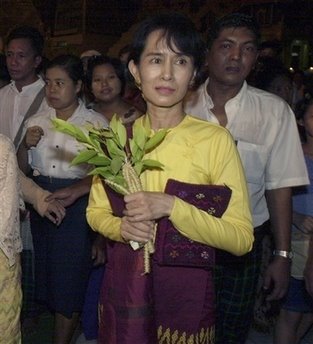


 Posts


