http://www.bloomber g.com/apps/ news?pid= 20601072&sid=amAfQGI2bCqo
By Shinhye Kang
March 10 (Bloomberg) -- China, the world’s second-biggest energy consumer, may start receiving natural gas from Myanmar’s Shwe project through a cross-border pipeline in April 2013.
China will import 400 million cubic feet of gas a day from Myanmar’s offshore fields, U Aung Htoo, director of planning at state-run Myanmar Oil and Gas Enterprise, said in an interview in Seoul today.
A group led by Daewoo International Corp. signed an agreement in December to sell gas from Myanmar to China National Petroleum Corp. The group -- which includes Myanmar Oil & Gas Enterprise, India’s Oil & Natural Gas Corp., GAIL India (Ltd.) and Korea Gas Corp. -- will supply the fuel to China’s biggest oil company for 30 years.
China and Myanmar are still in talks on how the gas link is to be built and how construction costs may be split, Aung Htoo said. China shares with Myanmar a mountainous land border of 2,185 kilometers (1,355 miles).
Gas will account for 8 percent of China’s overall energy consumption by 2015 compared with 3.3 percent in 2007, Cui Yingkai, a director at PetroChina Co.’s gas and pipeline unit, said on Nov. 27.
Prices will be negotiated with China on a quarterly basis to reflect global market conditions, Daewoo International said in December. The Shwe, Shwe-Phyu, and Mya areas in the A-1 and A-3 blocks are estimated to hold between 4.5 trillion and 7.7 trillion cubic feet of gas in total, according to the Seoul- based company.
Daewoo International has a 51 percent stake in the fields while Myanmar Oil and Gas Enterprise has a 15 percent share. Oil & National Gas owns 17 percent, GAIL India 8.5 percent and Korea Gas 8.5 percent.
Zawtika Project
Commercial output at M-9 gas block in Myanmar will begin in 2015 or earlier, Aung Htoo said. The project in Zawtika field is developed by PTT Exploration & Production Pcl, Thailand’s only publicly traded oil and gas explorer, and Myanmar Oil and Gas Enterprise, he said. As much as 250 million cubic feet of gas will be exported to Thailand, Aung Htoo said.
PTT Exploration will postpone output at the M-9 block to 2013 from 2012, Krungthep Turakij newspaper reported last month. The block is estimated to have at least 1.5 trillion cubic feet of gas reserves, which can be supplied over 20 years. Thailand, which buys about 30 percent of its gas from neighboring Myanmar, uses gas to generate about two-thirds of its electricity.
Proven gas reserves in Myanmar, formerly known as Burma, jumped 39 times to 21.19 trillion cubic feet at the end of 2007, equivalent to almost a quarter of Australia’s proven reserves, according to the BP Statistical Review.
Myanmar’s daily gas production will almost double to 2.235 billion cubic feet by 2015 from 1.215 billion cubic feet currently, Aung Htoo said.
To contact the reporter on this story: Shinhye Kang in Seoul at skang24@bloomberg. net.
Last Updated: March 10, 2009 01:50 EDT
Tuesday, March 17, 2009
China May Start Receiving Myanmar Gas Through Pipeline in 2013


Failures of International Law and The Security Council’s Tyranny
http://www.daily.pk/world/americas/9651-failures-of-international-law-and-the-security-councils-tyranny.html
Written by www.daily.pk
Wednesday, 11 March 2009 01:57
In relation to recent global events; wars, invasions of lands, conflicts between states, political scandals, recognitions of new states, there is one phrase that everybody likes to use, that phrase is called international law.
INTERNATIONAL LAW
International law is the term commonly used for referring to the system of implicit and explicit agreements that connect together nation-states in commitment to recognized values and standards, differing from other legal systems in that it concerns nations rather than private citizens.
International law can be referred to tree different legal disciplines, these include: public international law, private international law and supranational law.
The most interesting is the public international law or “Law of Nations”, since it involves the United Nations (International Court of Justice and Security Council), International Criminal Law, Geneva Conventions, Vienna Conventions, World Health Organization, International Labour Organization, International Monetary Fund, among others.
Public international law concerns the structure and conduct of states and intergovernmental organizations. In its most general sense, international public law consists of rules and principles of general application dealing with the conduct of states and of intergovernmental organizations and with their relations among themselves, as well as with some of their relations with persons, whether natural or juridical. Public international law establishes the framework and the criteria for identifying states as the principal actors in the international legal system.
In relation to the devastating international political scene, some main bodies of the public international law came to question, these include: the United Nations (International Court of Justice and Security Council) and the International Criminal Law.
Going back to the evolution and practice of these human organizations, it is pertinent to remind ourselves of the manual guide for the conduct of modern day international law.
THE UNITED NATIONS
The United Nations (UN) is an international organization whose stated aims are to facilitate cooperation in international law, international security, economic development, social progress, human rights, and achieving world peace. The organization is divided into administrative bodies, primarily: the General Assembly, The Security Council, The Economic and Social Council, The Secretariat, The International Court of Justice. There are currently 192 member states, including nearly every recognized independent state in the world.
The United Nations Charter is the treaty that forms and establishes the international organization called the United Nations. As a Charter, it is a constituent treaty, and all members are bound by its articles. The Charter consists of a preamble and a series of articles grouped into chapters.
A preamble to the UN Charter:
WE THE PEOPLES OF THE UNITED NATIONS DETERMINED
· to save succeeding generations from the scourge of war, which twice in our lifetime has brought untold sorrow to mankind, and
· to reaffirm faith in fundamental human rights, in the dignity and worth of the human person, in the equal rights of men and women and of nations, large and small, and
· to establish conditions under which justice and respect for the obligations arising from treaties and other sources of international law can be maintained, and
· to promote social progress and better standards of life in larger freedom,
AND FOR THESE ENDS
· to practice tolerance and live together in peace with one another as good neighbours, and
· to unite our strength to maintain international peace and security, and
· to ensure, by the acceptance of principles and the institution of methods, that armed force shall not be used, save in the common interest, and
· to employ international machinery for the promotion of the economic and social advancement of all peoples.
Charter I of the United Nations Charter lays out the purposes and principles of the United Nations organization.
Article 1:
The Purposes of the United Nations are:
To maintain international peace and security, and to that end: to take effective collective measures for the prevention and removal of threats to the peace, and for the suppression of acts of aggression or other breaches of the peace, and to bring about by peaceful means, and in conformity with the principles of justice and international law, adjustment or settlement of international disputes or situations which might lead to a breach of the peace;
To develop friendly relations among nations based on respect for the principle of equal rights and self-determination of peoples, and to take other appropriate measures to strengthen universal peace;
To achieve international co-operation in solving international problems of an economic, social, cultural, or humanitarian character, and in promoting and encouraging respect for human rights and for fundamental freedoms for all without distinction as to race, sex, language, or religion; and
To be a centre for harmonizing the actions of nations in the attainment of these common ends.
Article 2, clauses 3-4 essentially prohibit war (except in self-defence) by stating:
3. All Members shall settle their international disputes by peaceful means in such a manner that international peace and security, and justice, is not endangered.
4. All Members shall refrain in their international relations from the threat or use of force against the territorial integrity or political independence of any state, or in any other manner inconsistent with the Purposes of the United Nations.
Article 2, clause 7 of this chapter reemphasizes the fact that only the UN Security Council has the power to force any country to do anything by stating:
7. Nothing contained in the present Charter shall authorize the United Nations to intervene in matters which are essentially within the domestic jurisdiction of any state or shall require the Members to submit such matters to settlement under the present Charter; but this principle shall not prejudice the application of enforcement measures under Chapter VII. (Only the Security Council can institute Chapter VII enforcement measures.)
Chapter VII of the United Nations Charter sets out the UN Security Council's powers to maintain peace. It allows the Council to determine the existence of any threat to the peace, breach of the peace, or act of aggression, and to take military and non-military action to restore international peace and security.
The UN Charter's prohibition of member states of the UN attacking other UN member states is central to the purpose for which the UN was founded in the wake of the destruction of World War II: to prevent war.
According to Charter VII, article 51 of the United Nations Charter, countries can engage into military action only in self-defence, including collective self-defence:
51. Nothing in the present Charter shall impair the inherent right of individual or collective self-defence if an armed attack occurs against a Member of the United Nations, until the Security Council has taken measures necessary to maintain international peace and security. Measures taken by Members in the exercise of this right of self-defence shall be immediately reported to the Security Council and shall not in any way affect the authority and responsibility of the Security Council under the present Charter to take at any time such action as it deems necessary in order to maintain or restore international peace and security.
The Security Council was consequently granted broad powers through Chapter VII as a reaction to the failure of the League of Nations in the years between World War I and II.
THE INTERNATIONAL COURT OF JUSTICE – WORLD COURT
The International Court of Justice (ICJ) was established by the UN Charter, Charter XIV, and is the primary judicial organ of the United Nations. The ICJ is established to settle disputes between nations. Chapter XIV of the United Nations Charter authorizes the UN Security Council to enforce the ICJ rulings, but such enforcement is subject to the veto power of the five permanent members of the Council.
Charter XIV, Article 93, clause 1:
1. All Members of the United Nations are “ipso facto” parties to the Statute of the International Court of Justice.
Article 94, clause 1 and 2 establishes the duty of all UN members to comply with decisions of the Court involving them. If parties do not comply, the issue may be taken before the Security Council for enforcement action:
1. Each Member of the United Nations undertakes to comply with the decision of the International Court of Justice in any case to which it is a party.
2. If any party to a case fails to perform the obligations incumbent upon it under a judgment rendered by the Court, the other party may have recourse to the Security Council, which may, if it deems necessary, make recommendations or decide upon measures to be taken to give effect to the judgment.
Only states may be parties in contentious cases, on the other side individuals, corporations, parts of a federal state, NGOs, the UN organs and self-determination groups are excluded from direct participation in cases. The United States withdrew from compulsory jurisdiction in 1986, and so accepts the court's jurisdiction only on a case to case basis.
Since the International Court of Justice deals only with states, there is an autonomous branch of law called International Criminal Law (ICL).
THE INTERNATIONAL CRIMINAL LAW
The International Criminal Law (ICL) deals with international crimes, the courts and tribunals are set up to arbitrate cases in which persons have incurred international criminal responsibility. It represents a significant departure from classical international law which was mainly considered law created by states for the benefit of states, but tended to ignore the individual as a subject of the law.
However, the precise parameters of this body of law are often unclear, perhaps due to the rapid and complex developments of our global society. In its widest context, the source of international criminal law might be derived from the general principles of international law recognized by civilized nations; and therefore, found in the customary law accepted by states, the general criminal law recognized by nations, and the treaties which govern particular conduct.
Today, the most important institution of the International Criminal Law is the International Criminal Court (ICC) as well as several “ad hoc” tribunals, such as: the International Criminal Tribunal for the former Yugoslavia (ICTY), and the International Criminal Tribunal for Rwanda (ICTR).
THE INTERNATIONAL CRIMINAL COURT
The International Criminal Court (ICC) is an independent, permanent court that tries persons accused of the most serious crimes of international concern, namely genocide, crimes against humanity, war crimes, and the crime of aggression, although it cannot currently exercise jurisdiction over the crime of aggression. Unlike the International Court of Justice, the ICC is legally and functionally independent from the United Nations. However, the Rome Statute grants certain powers to the United Nations Security Council.
Court came into being on 1 July, 2002 when the Rome Statute of the International Criminal Court entered into force, and it can only prosecute crimes committed on or after that date. The ICC only tries those accused of the gravest crimes. The ICC is joined by 108 countries; however, a number of states, including China, India, Israel, Iraq, Libya, Qatar, Yemen, and the United States are critical of the Court and have not joined. The Court is projected as a court of last resort, investigating and prosecuting only where national courts have failed.
During the negotiations that led to the Rome Statute, a large number of states argued that the Court should be allowed to exercise universal jurisdiction. However, this proposal was defeated due in large part to opposition from the United States. A compromise was reached, allowing the Court to exercise jurisdiction only under the following limited circumstances:
where the person accused of committing a crime is a national of a state party (or where the person's state has accepted the jurisdiction of the Court);
where the alleged crime was committed on the territory of a state party (or where the state on whose territory the crime was committed has accepted the jurisdiction of the Court); or
where a situation is referred to the Court by the UN Security Council.
FAILURES OF INTERNATIONAL LAW AND ITS LEGAL SYSTEM
The United Nations
Multilateral diplomacy, as practiced at the United Nations provides the forum for exchange of experiences, conducting negotiations, exchange of thoughts in a culturally-diversified arena. Unfortunately, however, the United Nations has not lived up to the expectations of its founding fathers.
It appears that the United Nations is doing all kind of things, but not the most important ones, like: uniting people, maintaining international peace and security, developing friendly relations between nations, among others.
Since the formation of the UN in 1945, almost every Charter of the UN has been breached. There have been approximately 182 wars around the world since 1945, including most recent South Ossetia War. Currently, in contemporary days there are 32 ongoing wars which are being fought, these include: Sri Lanka Civil War, Second Chechen War, War in Afghanistan, War in Darfur, Iraq War, War in Somalia, age-old Arab-Israel/Israel-Palestine (including al-Aqsa Intifada) conflict, among others.
In addition, the UN became a war combatant itself. There have been two major wars authorized by the Security Council; the 1950 Korean War, and the 1991 Gulf War. States that breach resolutions have different fates. The Korean War was the first war in which the UN participated. Iraq was swiftly attacked after failing to comply with a Security Council resolution by withdrawing from Kuwait.
However, the US, the United Kingdom, Russia, Indonesia, Morocco, Turkey, among others have been in breach of several resolutions, sometimes for decades, without having had any action taken against them.
The United States as a member state, permanent member of Security Council and founder of the UN was involved in over 100 international military conflicts since 1945, some of which were: Vietnam War, Korean War, Gulf War, and ongoing wars: Iraq War (Second Persian Gulf War), War in Somalia, War on Terrorism (Operation Enduring Freedom); Afghanistan, Philippines, Trans Sahara, among others. If we look through world history for the last fifty years, we can see that no country has been involved in as many military conflicts as the United States has.
Similarly, under the United Nations Charter, Charter I, ratified by the US and therefore binding on it, all the UN member states, including the US are prohibited from using force against fellow member states, except to defend against an imminent attack or pursuant to explicit Security Council authorization.
However, some member states of the UN were attacked by other UN members, these include: Iraq (the US invasion of Iraq), Afghanistan (the US invasion of Afghanistan), Former Yugoslavia (the US led NATO bombing of Yugoslavia), Georgia (South Ossetia War and Russian interference), Panama (the US invasion of Panama), Kuwait (Invasion of Kuwait by Iraq), Somalia (invasion of Somalia by Ethiopia), among others.
The UN and its Charters were established “to save succeeding generations from the scourge of war”; however, since its formation, around 38 million people lost their lives in various wars around the globe. Unfortunately, the final number of the war victims will never be known. The UN failed to maintain peace.
The UN Charters was also breached by some member states with their recognition of Kosovo, as well as with recognition of South Ossetia and Abkhazia. There is no such thing called “special case” or “precedent” in the international law. International law, Charters of the UN and sovereignty and territorial integrity of a member state has to be respected by all member states equally and without any exemptions.
The Security Council and Power of Veto
The United Nations Security Council power of veto is frequently cited as a major problem with the UN. Key arguments include that the five permanent members (the US, the UK, Russia, China and France) no longer represent the most stable and responsible member states in the United Nations and that their veto power slows down and even prevents important decisions being made on matters of international peace and security.
For example, the Security Council passed no resolutions on most major Cold War conflicts, including the Soviet invasion of Czechoslovakia and Afghanistan, and the Vietnam War, among others. Resolutions addressing more current problems, failed also, such as the conflict between Israel and the Palestinians, the US invasion of Iraq and Afghanistan, South Ossetia War. There has been a constant cause of friction between the General Assembly and the Security Council, as almost all of the wars was not endorsed by the UN.
Nonetheless, the current Security Council power of veto is irrelevant. With the General Assembly's adoption of the Uniting for Peace resolution 337A in 1950, it was made clear by the UN Member states that:
Resolves that if the Security Council, because of lack of unanimity of the permanent members, fails to exercise its primary responsibility for the maintenance of international peace and security in any case where there appears to be a threat to the peace, breach of the peace, or act of aggression, the General Assembly shall consider the matter immediately with a view to making appropriate recommendations to Members for collective measures, including in the case of a breach of the peace or act of aggression the use of armed force when necessary, to maintain or restore international peace and security.
In fact, on the other hand, this resolution looks irrelevant, since it was not used to maintain international peace and security when Security Council failed.
The United Nations was set to be a democratic organization, to represent all nations equally, however, today, after 63 years of existence, the UN has not changed, and continues to represents the interests of the governments of the nations who form it and not the individuals within those nations.
Knowing that the five permanent members of the Security Council, who are all nuclear powers, have created an exclusive nuclear club whose powers are unchecked, the General Assembly (which has true international representation) with all its members can easily withdraw from the UN.
It is very straightforward, why should members of the General Assembly or better to say members of the UN pay annual fees of millions of Dollars to the UN when they have no rights, they are not even protected from any military aggression by another member state, as was seen in the past. It was, also, reported that the US, a permanent member of the Security Council seriously thinking to withdraw from the UN. In addition to withdrawal, there were some proposals to expel the United Nations Headquarters from the US territory and the City of New York.
The International Court of Justice
If we look at the International Court of Justice (ICJ), there is not much to say. The Court decides in accordance with international treaties and conventions in force, international custom, and the general principles of law and, as subsidiary means, judicial decisions and the teachings of the most highly qualified publicists.
Generally, the Court has been most successful resolving border delineation and the use of oceans and waterways. While the Court has, in some instances, resolved claims by one State espoused on behalf of its nationals, the Court has generally refrained from hearing contentious cases that are political in nature, due in part to its lack of enforcement mechanism and its lack of compulsory jurisdiction. The Court has generally found it did not have jurisdiction to hear cases involving the use of force.
In relation to the UN Charter XIV, Article 94 of the UN Charter, there are some obvious problems; if the judgment is against one of the five permanent members of the Security Council or its allies, any resolution on enforcement would then be vetoed. This occurred, for example, after the Nicaragua case (Case Concerning Military and Paramilitary Activities in and against Nicaragua (Nicaragua vs. the US)), when Nicaragua brought the issue of the US's non-compliance with the Court's decision before the Security Council. Furthermore, if the Security Council refuses to enforce a judgment against any other state, there is no method of forcing the state to comply.
In practice, the Court's powers have been limited by the unwillingness of the losing party to abide by the Court's ruling, and by the Security Council's unwillingness to impose consequences. Simply, the ICJ does not enjoy a full separation of force, with permanent members of the Security Council being able to veto enforcement of even cases to which they consented in advance to be bound.
The International Criminal Court
Relating to the International Criminal Court (ICC), as of 2002, the Office of the Prosecutor had received around 2800 so called “communications” about alleged crimes in at least 139 countries. After initial review, however, the vast majority of these communications were dismissed as obviously outside the jurisdiction of the Court. As of August 2008, the International Criminal Court has launched investigations into just four situations: Northern Uganda, the Democratic Republic of the Congo, the Central African Republic and Darfur (Sudan). Several other situations have been subject to intensive analysis, including Afghanistan, Chad, Colombia, Cote d'Ivoire, Georgia and Kenya.
The Office of the Prosecutor had received around 240 communications in connection with the US led invasion of Iraq in 2003, which alleged that various war crimes had been committed; none of these allegations had survived.
The UK, Australia, and Poland (countries that invaded Iraq with the US) are all state parties to the Rome Statute which established the International Criminal Court (ICC) and therefore their nationals are liable to prosecution by the court for the violation of any relevant international criminal laws. Because the United States is not a state party, the US nationals cannot be prosecuted by the court (except for crimes that take place in the territory of a state that has accepted the court's jurisdiction, or situations that are referred to the court by the United Nations Security Council, where the US has a power of veto).
In July 2002, the United States threatened to use its Security Council veto to block renewal of the mandates of several United Nations peacekeeping operations, unless the Security Council agreed to permanently exempt US nationals from the Court's jurisdiction.
A resolution to exempt citizens of the United States from jurisdiction of the ICC was renewed in 2003 by the Security Council Resolution 1487. However, the Security Council refused to renew the exemption again in 2004, after pictures emerged of US troops torturing and abusing Iraqi prisoners in Abu Ghraib. Shortly, the US withdrew its demand.
As part of the US campaign to exclude its citizens and military personnel from extradition to the ICC, the President Bush administration has been approaching countries around the world seeking to conclude Bilateral Immunity Agreements, or “Article 98” agreements. So far hundred countries have ratified this agreement. Countries that have ratified the Rome Statute and signed Article 98 breached their obligations under international law.
In 2008, the US President George W. Bush signed into law an amendment to the American Service-members Protection Act (ASPA), to eliminate restrictions on Foreign Military Financing (FMF) to nations unwilling to enter into Bilateral Immunity Agreements (BIAs) shielding the US nationals from the jurisdiction of the ICC. This Act authorizes use of military force to free US nationals from the custody of the ICC.
Some of the communications received by the Prosecutor alleged that crimes had been committed on the territory of states parties to the Court, or by nationals of states parties: in such cases, the Court may automatically exercise jurisdiction. Other communications concerned conduct outside the jurisdiction of states parties: in these cases, the Court can only act if it has received a referral by the United Nations Security Council or a declaration by the relevant state allowing the Court to exercise jurisdiction.
We have not seen the Security Council referring to the court regarding genocide, crimes against humanity, and war crimes, except in situations such as Darfur, and non-state country Cote d’Ivoire.
However, the Security Council established two ad hoc tribunals: The International Criminal Tribunal for the former Yugoslavia (ICTY) and the International Criminal Tribunal for Rwanda (ICTR).
The ICTY has been established by the Security Council, acting under Chapter VII of the Charter of the United Nations, but, it is not clear how a tribunal could be considered a measure to maintain or restore international peace and security. Also, the ICTY budget is not entirely financed by the UN, but also by private entities; some 14% is being privately funded and the remainder is being provided by the UN. This private co-financing might prove a problem concerning the Tribunal's independence and fairness.
The International Criminal Tribunal for Rwanda (ICTR) is an international court established by the United Nations Security Council in order to judge those people responsible for the Rwandan genocide and other serious violations of the international law performed in the territory of Rwanda, or by Rwandan citizens in nearby states. So far, this tribunal is proven to be the most efficient.
On the other side, we have not seen ad hoc International Tribunals for Iraq, Afghanistan, Vietnam, Chechnya, among others. This is because of the permanent five power of veto, or maybe, there are no funds available for new ones, since these two costs too much.
In this story we have seen just a fraction of the devastating situation in international law, and if this trend continues there will be no mechanism to prevent and discipline any crimes committed by anyone.
Maybe, the hope is in the General Assembly, but only if;
the General Assembly, as apparent last resort for international law, acts and establishes serious mechanism which will carry out grave verdicts against countries and individuals who had breached Charters of the UN and international law.
If necessary, these shall include actions to be taken against countries such as: the United States, the United Kingdom, Russia, China, France, among others. As well as, against individuals/Heads of States, such as: the US President George W. Bush, former US President William Bill Clinton, Russia’s President Dmitry Medvedev, former Prime Minister of the UK Tony Blair, President of Eritrea Isaias Afewerki, former Prime Minister of Australia John Howard, among many others. Ivan Simic
Time for a new approach to Myanmar?
http://csr-asia.com/weekly_detail.php?id=11628
by Richard Welford rwelford@csr-asia.com
Last week, around the ASEAN Summit, the organisation was attacked by numerous NGOs and journalists for its lack of action in Myanmar. Many civil society groups criticized ASEAN over its abysmal human rights record. It stands accused of protecting a military dictatorship in Myanmar and failing to address rampant disease and poverty. But it is not only the ASEAN countries that are being blamed for a deteriorating situation in Myanmar. Human rights abuses are worsening and activists have also highlighted the role of China, India and Russia, powerful nations, who are said to support the stability of the military junta.
In a recent report, Human Rights Watch (HRW) points out that the forced return at sea of boats containing ethnic Rohingya refugees from Myanmar, leading to hundreds of deaths, was proof of the need for a regional solution to Myanmar.
HRW says a significant step to ensure binding commitment of the entire region would be for all ASEAN member states to ratify the 1951 Refugees Convention and its 1967 Protocol without delay. The plight of the Rohingya was exacerbated by Thailand's actions in pushing them back out to sea, should be a wake-up call for ASEAN to change its approach in dealing with refugees and migrants, according to HRW.
In many cases, bilateral cooperation between ASEAN countries has failed to establish adequate protection for vulnerable migrant populations. Regional cooperation and leadership from ASEAN can help to ensure minimum standards across the region that will avoid an unhealthy race to the bottom, as countries compete for jobs in a volatile economic climate. Both Malaysia and Thailand have failed to investigate allegations of collusion between government officials and Myanmar-linked trafficking gangs. In 2008, Myanmar migrants told HRW of being sold to criminal gangs.
In the meantime, Myamar's military government continues to deny its citizens basic freedoms, including freedom of expression, association, and assembly. The Myanmar military continues to violate the rights of civilians in ethnic conflict areas by committing extrajudicial killings, using forced labour, and through land confiscation without due process, often in preparation for mega-infrastructure projects of foreign companies. But are those companies part of the problem or part of the solution? If there is a need for a new approach to Myanmar, to what extent should it include the businesses already operating there?
Interestingly, the new administration in the United States has signaled that it wants Southeast Asian countries to press for reform, openness and political progress in Myanmar. It is calling for a new approach toward the military-ruled country because nothing much has worked to date. But at least the US now recognizes that whatever the solution, it needs to be a regional one and it has called on Myanmar’s neighbours to present ideas on how they can cooperate to bring about change and to use their contacts and access that they have in the country to encourage new thinking and reform, increased openness and political progress. Should that new thinking include the private sector?
The US has gradually tightened sanctions on the generals who have ruled the Myanmar for more than four decades to little avail. There is consensus amongst many that sanctions have had a negative impact on the country’s population in general, whilst actually having rather little impact on the governing elite. There is now an acknowledgement in the US administration that neither sanctions nor ASEAN's non-interference approach has worked and there is now a need for new thinking on Myanmar policy. For some time, we at CSR Asia have been advocating that whatever solutions are considered in Myanmar must include some consideration of the international business community.
The new US stance certainly does not mean it can or will walk away from the Myanmar issue, however. Within Asia, there is also some recognition that if there is going to be any change in international policy which will make a difference, it's going to have to involve the US. In part, for the Myanmar government, the U.S. holds out what they want which is international acceptability and respect, and an end to its pariah status. But the US will be encouraging ASEAN to flex its muscle more. ASEAN should be in the forefront of the struggle for human rights in Myanmar although there is also a role for the US and the EU. But the US will also have to get some leverage from India and China if it is to make a real difference.
In the past, the US has tried to exert some pressure through the United Nations as well as ASEAN nations. But China, Russia and India, all with economic and strategic interests in Myanmar, have blocked such moves while ASEAN's policy of noninterference has hindered reform in Myanmar. Much of those strategic interests relate to a whole range of resources that Myanmar has in abundance and which, through illegal trade, has kept the elite in a lavish lifestyle.
Analysts foresee more carefully crafted US sanctions, greater cooperation with the United Nations and other agencies to forge a common front on Myanmar, and trying to convince China to exert influence on its neighbour. But there is still inadequate debate about the role of businesses within Myanmar and the potential leverage that new investment (ethically targeted) might create within the country.
Many would like to see much swifter and much more direct action within Myanmar and a greater role for ASEAN in dealing with the consequences of human rights abuses there. ASEAN needs to address the dire human rights situation in Myanmar, improve treatment of refugees and asylum seekers from the country, and strengthen protection for migrants. HRW has said that these issues must be a priority for the new ASEAN human rights body, which was to be discussed at the ASEAN Summit in Thailand last weekend. Human Rights Watch said that ASEAN's human rights body should independently investigate and report on human rights conditions in member countries.
But that may still not be enough and with the US now calling for some new thinking and reform, perhaps now is the time to forget the politics of sanctions and actually leverage change though engagement rather than isolation. Little has worked yet, so surely there is a need for some thinking about a new approach.
So what of business? Should it be forced to stay away, encouraged to stay away or encouraged to offer the Myanmar government new investment opportunities in exchange for human rights improvements? Would any business trust the promises that the military rulers might make in such circumstances however? Promises to end forced labour, for example, have been made in the past, but the practice continues.
So many of us end up asking what the solution might be and what needs to change. There is no doubt that Myanmar’s neighbours have a role to play but have not done so to date preferring to uphold their policy of non-interference in other countries’ internal affairs. There seems little end to this in sight. The bottom line is that there seems little incentive for many of Myanmar’s border countries to intervene.
So are there economic incentives and good business reasons for thinking that the business sector might provide some solutions? I think yes. However, it seems to me that governments still have a strong role to play in encouraging companies investing in Myanmar to be more transparent and accountable. Why is it that some countries have tough company laws to ensure that local laws are obeyed but seem to turn a blind eye to abuses in Myanmar and elsewhere?
In the case of Myanmar there is a strong case for China and ASEAN countries to be doing more. If they could agree on regional codes of conduct governing the ethical behaviour of companies investing overseas we might start to see the beginnings of some solutions.
I have long been of the view, that divestment in Myanmar is not going to be the long term solution but that those businesses now in Myanmar and those considering investing in the future have a role to play through policies and systems that demonstrate transparency and accountability.
Some may argue that mixing politics with economics is not the nature of the Asian region or the normal behaviour of its governments. Well, so be it. But there are very good economic reasons to ensure that investments are ethical and abide by international best practices.
Firstly, honest business is always the best business. I am always reminded that the best business deals need no contracts because everyone benefits. But doing business in an environment that is uncertain and corrupt is never going to produce high quality investments or the best returns. Certainty leads to security and long term profitability, not dodgy deals behind closed doors. Honest business is accountable and transparent.
Secondly, increasing numbers of the relatively unknown (often Chinese ad India) companies now in Myanmar are going to be the new brand names of the future. Histories of companies that include the abuse of human rights and complicity in a despot junta do have the tendency to pop up and embarrass you when you least expect it.
Thirdly, ASEAN countries and China would do well to remind themselves that they expect foreign investors into their countries to obey local laws and lead to economic benefits for the country. So why should the same not apply in other countries such as Myanmar? Are we seeing a degree of double standards from countries that expect ethics at home but allow exploitation abroad?
I see no option but to work with companies now in Myanmar and to remind them of their ethical and moral responsibilities. Sanctions and boycotts have not worked. I realize that that a new ethical agenda for the region is a huge task and it will require will on the part of regional governments. But a starting point is to demand more accountability from the companies already operating in Myanmar and for governments to put pressure on then to ensure that they are not complicit in human rights abuses. In addition to this, any (much needed) new investment from companies should also be transparent and based on deals that deliver human rights improvements.
The private sector des have a role to play and that has to be part of any new solution in Myanmar. ■
Myanmar's military as a Ponzi scheme
http://www.atimes.com/atimes/Southeast_Asia/KC12Ae01.html
By Norman Robespierre
YANGON - Rank inflation and an ever-expanding flag officer corps are unable to provide sufficient promotion opportunities within Myanmar's military, known as the Tatmadaw. The civil government structure is at risk of further militarization as the country slowly moves towards the State Peace and Development Council (SPDC) military regime's unique interpretation of democracy.
On September 17, 1988, the day before the Myanmar military staged a coup and formed the State Law and Order Restoration Council (SLORC), there were only two officers above the rank of major general in the entire Tatmadaw. They were General Saw Maung, the defense forces chief of staff, and then-Lieutenant General Than Shwe, the army's vice chief of staff.
In current nomenclature, these positions would be referred to as CINC (defense forces) and CINC (army). Today, the Tatmadaw has no less than 24 senior flag officers serving in lieutenant-general or above billets on active service (See Table).
The 1,200% increase in senior flag ranks far outpaces the approximate 250% increase of the entire Tatmadaw over that same period. This expansion of the upper tier has been central to Senior General Than Shwe's ability to stay firmly in control.
By expanding promotion opportunities within the Tatmadaw, Than Shwe has successfully ensured continued loyalty of the officer corps. The expansion of the flag ranks provides more opportunities for advancement, allowing Than Shwe to dangle the carrot of self-interest that often entices officers' to continue to support the system.
Expansive reorganizing
Illustrative of Than Shwe's efforts to expand promotion opportunities was the reorganization of the Tatmadaw in November 2001. According to a senior Myanmar military official intimately familiar with the Ministry of Defense's planning process at the time, the major reorganization of the Tatmadaw was done to expand promotion opportunities for the officer corps and reduce the power of regional commanders.
The morale in the Tatmadaw had been particularly poor in the late 1990s. A 500% raise for the military granted on Armed Forces Day in 2000 improved the situation somewhat. However, according to the source, there remained an undercurrent of dissatisfaction among field-grade officers over the scarce opportunities for advancement.
That was caused in part by the long tenures of regional commanders, who used their positions to consolidate significant powers. They were essentially warlords and controlled virtually all of the weaponry and manpower of Myanmar's ground forces, which were engaged in combat with ethnic insurgent groups. Than Shwe could not risk taking action against any one regional commander as the others might band together and stage a mutiny against him.
At the time, the regional commanders were also members of the SPDC, a designation which made them technically higher than ministers. As a result, ministerial decrees were difficult to implement, with regional commanders deciding on which decrees to enforce or ignore. The dilemma was resolved then by luring the SPDC-member regional commanders from their fiefdoms to accept promotions within the War Office. In a policy shift, new regional commanders were not made SPDC members.
To ensure allegiance of the new regional commanders, they were not selected from the corps of officers next in seniority. Instead, Than Shwe promoted officers from several rungs down the ladder. The rationale apparently was that an officer next in line by seniority would have assumed the position with the attitude he had earned it through his own hard work. Conversely, one promoted early would recognize the value of his mentor's assistance and be indebted with a sense of loyalty.
The plan required considerable expansion of the lieutenant-general positions to accommodate the regional commanders. A number of lieutenant-general positions were opened up by a variety of means: two lieutenant-generals were terminated for corruption just before the 2001 re-organization. The Bureau of Special Operations (BSO), which co-ordinates operations across regional commands, was separated into four entities.
Additional billets also were created with the new position chief of staff (army, navy and air force) and by forming Offices for Defense Industries, Air Defense and Training. In the Myanmar military, offices are headed by lieutenant-generals and directorates by major generals. The creation of offices to justify a third star was done previously.
In August 1993, the Office of Special Studies (OSS) was created to justify the promotion of the former head of intelligence, Khin Nyunt, to the rank of lieutenant-general. The OSS's function and personnel were not readily distinguishable from headquarters staff of Khin Nyunt's Directorate of Defense Services Intelligence (DDSI).
A former military intelligence officer said in an interview that outsiders and Western analysts attached too much significance to the formation of the OSS, as it was essentially a paper shuffle to justify Khin Nyunt's third star.
Rank inflation
The November 2001 reorganization is just one factor in the subsequent expansion of the Tatmadaw's flag officer corps. Creation of new ranks, development of new positions, and military infiltration of the civil service has fostered rank inflation and growth of the flag officer corps.
The trend toward a larger flag officer corps was established just 18 months after the SLORC seized control of the country, when mass promotion of generals and some colonels took place in March 1990. To maintain a pyramid structure to military command, Than Shwe's predecessor, Saw Maung, elevated himself to the newly created rank of senior general.
The creation of a new rank was repeated in September 2002 when the regime's No 2 man, Maung Aye, was knighted with the rank of vice-senior general, equating to 4.5 stars. The new rank allowed him to maintain rank superiority when his rival Khin Nyunt put on his fourth star.
Khin Nyunt's promotion to general required a paper shuffle similar to that associated with his previous promotion. To justify his fourth star, Khin Nyunt was designated special advisor to the senior general. Later, his appointment as prime minister justified the rank. Khin Nyunt fell from power in a 2004 internal purge and is currently being held in house arrest.
While justification of Khin Nyunt's promotions may have been an exercise in paperwork, operational positions have been created to expand the flag ranks. Following the precedent of the November 2001 reorganization, two more BSOs were activated: BSO-5 covering Yangon Division and BSO-6 with responsibility for Rakhine State and Magwe Division.
The most recent lieutenant-general position to be created is that of Defense Services Inspection and Auditor General. While there may be some operational utility to the creation of the BSOs, the latest created position appears to do little more than add an additional layer of bureaucracy.
The military bureaucracy has likewise expanded below the lieutenant-general grade. The formation of new regional commands, an increase in the number of operational control commands, and inception of division-level control commands for artillery units and armor, has significantly contributed to the expansion of the flag-level officer corps.
Bloated civil service
Parallel to the regime's expansion of the military bureaucracy is an ever-expanding civil bureaucracy. Shortly after the SLORC took over in 1988, the government consisted of the Office of the Prime Minister and 18 ministries led by nine ministers. Of the nine, eight were military officers serving in positions under the Ministry of Defense.
Since then, the civil bureaucracy has grown to provide additional opportunities for Than Shwe to reward kleptocrats for their support of the system. Today, in addition to the Prime Minister's Office, there are 32 other ministries, each headed by its own minister. Only seven ministers are "civilians" and most have prior military service, including a few ex-generals.
According to a Myanmar source with close connections to senior military officials, during a 2004 meeting of senior officers discussing manpower issues, Than Shwe directed an end to the practice of ministers holding multiple portfolios in order to provide additional promotion opportunities.
The practice came to an end last June when Major-General Maung Maung Swe relinquished the Ministry of Immigration and Population portfolio. While U Aung Kyi is Minister for Labor and Minister for Relations, the latter is purely titular with no actual brick-and-mortar ministry. With the exception of the Minister of Defense, no minister holds an MOD operational position.
While the creation of new ministries has broadened the avenues for advancement to military personnel, it threatens to saddle the country with an even more bloated and inefficient bureaucracy. If the reins of power do some day pass to a democratically elected government, as envisaged in the upcoming 2010 elections, it will likely find its ability to govern handicapped by a dysfunctional ministerial structure developed under military rule.
Moreover, the infiltration of the civil bureaucracy by military members is likely to increase in both depth and breadth. The appointment of four brigadier generals to the Civil Service Selection Board in 2006 foreshadowed the expected increased military involvement in the civil service sector.
According to a recent Internet report, students of the National Defense College (NDC) were reportedly warned by an instructor that due to increased class size, graduates can no longer count on being rewarded with postings at regional or division commands. Instead, they may have to accept postings at the director-general level in ministries outside the MOD.
Fractures in the pyramid
In some respects, Than Shwe has run the Tatmadaw like a typical pyramid or Ponzi scheme.
Early investors in a pyramid scheme are paid with the investments of newcomers and everyone benefits as long as the pyramid continues to expand. When the pyramid ceases to expand, the early investors have reaped huge rewards and the latecomers have little or nothing to show for their investment.
The current regime leadership invested their loyalty in the system early and has been rewarded with lucrative positions and concessions. As the recent NDC graduates have discovered, individual rewards become smaller as the upper tiers of the pyramid become more crowded.
The Ponzi-like nature of the system has maintained pressure for the Tatamadaw to expand. In some units, soldiers are not allowed to retire until they have recruited two replacements from training. This pressure has increased unsavory practices of shanghaiing bystanders and recruiting child soldiers. A new directorate of recruitment was added to the Tatmadaw in 2007, either to address these issues or to focus on achieving recruitment goals.
Further manipulation of the military and government structure to provide more promotion opportunities for military officers is likely as the regime moves the country toward its own version of democracy. Past methods could be repeated to create more billets. Several of the current BSOs could be split to provide additional three-star positions.
New regional commands could be sprouted in Magwe Division, in Karrenni State or in Karen State, boosting the number of two-star and one-star positions. Eventually rank inflation may see BSO chiefs move up to the position of general and the regional commanders become lieutenant-generals.
The further infiltration of military officers into the civilian government structure, and the creation of new branches of the bureaucratic tree, threaten to saddle Myanmar with an ineffective government structure under continued military domination in the name of democracy. From where the resources to sustain this bloated system will arise is another important question for Myanmar's political future.
Norman Robespierre, a pseudonym, is a freelance journalist specializing in Southeast Asian affairs. He may be reached at normanrobespierre@gmail.com
(Copyright 2009 Asia Times Online (Holdings) Ltd. All rights reserved. Please contact us about sales, syndication and republishing.)
Monday, March 16, 2009
Norway NGO plans to build 6,000 houses in Myanmar cyclone-hit areas
http://english.people.com.cn/90001/90777/90856/6610945.html
A non-governmental social organization of Norway has planned to build 6,000 houses for cyclone victims in Laputta township, Myanmar's Ayeyawaddy division,the local Weekly Eleven News reported Tuesday.
The organization will start to build 300 houses as well as 10 basic education schools in the first phase as agreed with the government, the report said.
The report also quoted a post-Nargis joint assessment report of Myanmar, ASEAN and the United Nations as saying that the Myanmar government has arranged to build 20,847 houses in cyclone-hit regions.
Meanwhile, the Japanese government will provide 3 million U.S. dollars more of aid through the International Organization for Migration (IOM) to rebuild the remaining damaged houses in the cyclone-hit regions following its aid of 2 million dollars throughthe Food and Agriculture Organization (FAO) earlier to help in agricultural restoration work in the Ayeyawaddy delta after storm,according to the Japanese embassy.
Besides, the European Union (EU) will also give Myanmar humanitarian assistance of 40.5 million euros (52 million USD) this year, earlier report said.
Moreover, another Malaysian humanitarian organization, the Mercy Malaysia, will also provide help to rebuild a dozen healthcare facilities in Dedaye in the same Ayeyawaddy delta.
Statisitcs show that cyclone Nargis, which swept Myanmar in Maylast year, destroyed a total of nearly 800,000 houses in Ayeyawaddy and Yangon divisions worth of 686 million U.S. dollars.
Deadly tropical cyclone Nargis hit five divisions and states - Ayeyawaddy, Yangon, Bago, Mon and Kayin on May 2 and 3 last year, of which Ayeyawaddy and Yangon inflicted the heaviest casualties and massive infrastructural damage.
The storm has killed 84,537 people, leaving 53,836 missing and 19,359 injured according to official death toll.
Source:Xinhua
Rivalry in the Indian Ocean
http://www.livemint.com/2009/03/10220404/Rivalry-in-the-Indian-Ocean.html?h=B
Few geographical passageways are as important to India as the Indian Ocean and if the country wants to dominate this major trade passage, it must ramp up its naval presence
font size Dominating the Indian Ocean has emerged as a central point of contention in the competition between India and China. In a recent Foreign Affairs article, Robert D. Kaplan, a security expert, argues that the Indian Ocean will take centre stage in the 21st century as India and China compete in a “great-power rivalry” over the waters.
If India wants to dominate this central trade interstate, it must ramp up its naval presence in the Indian Ocean. Meanwhile, China is escalating its role in the waters, hoping for a stronger geostrategic footing and the economic clout that comes with it.
Illustration: Jayachandran / MintKaplan notes the fairly obvious: that the Indian Ocean is —and has been historically—a major trade passage. Presently, 90% of global commerce is conducted on the sea, and half the world’s container traffic is in the Indian Ocean. He notes that 70% of petroleum-related products pass through the Indian Ocean.
Even in a world of bustling air traffic and cross-country pipelines, few geographical passageways are as important to India as the Indian Ocean.
He writes, “Like a microcosm of the world at large, the greater Indian Ocean region is developing into an area of both ferociously guarded sovereignty (with fast-growing economies and militaries) and astonishing interdependence (with its pipelines and land and sea routes).”
India must reckon with an antagonistic China in its waters. As Kaplan notes, China is opening naval bases in neighbours’ backyards, notably a base in Gwadar, Pakistan. It has plans for other facilities in Bangladesh, Sri Lanka and Myanmar.
While India’s military capability is certainly within the top 10 of the world, much of its capacity, it seems, is geared toward confronting or checking Pakistan. This is certainly important but it’s just not enough to deter China.
Greater naval capacity, careful strategic thinking and spending is needed. China has already decided that it will play its cards aggressively in Asian waters, generally. On Monday, US officials issued a stern rebuke to China, saying that its vessels harassed an American surveillance ship in the South China Sea.
India cannot afford to let China dominate the Indian Ocean. India’s navy is expanding, expecting to add three nuclear-powered submarines and three aircraft carriers by 2015, Kaplan says. This is welcome news, but India must ramp up its naval capabilities further—otherwise China will secure its own interests, and foothold, in the Indian Ocean.
Is a new great game afoot in the Indian Ocean? Tell us at views@livemint.com
MYANMAR: HIV awareness key among injecting drug users
http://www.irinnews.org/Report.aspx?ReportId=83379
There are 70,000 registered drug users in Myanmar today, the government reports
YANGON, 9 March 2009 (IRIN) - Maung Maung (not his real name) never knew he could contract HIV by sharing needles.
"I was too late," the 37-year-old, who routinely exchanged needles with drug addicts over a 10-year period, told IRIN/PlusNews.
"When I took a blood test six months ago, I was told I was HIV-positive,” he said. Maung Maung has yet to receive ART treatment, despite being registered at the Waibagi Hospital, one of the few in Myanmar with the capacity to treat people infected with HIV.
"Whenever I think of my plight, I blame myself for not knowing more at the time,” Maung Maung said.
There are thousands of injecting drug users like Maung Maung, with little or no awareness of the risks.
Government figures suggest there are around 70,000 registered drug users in the country, with the vast majority of newly registered addicts using heroin.
But with most addicts reluctant to register with the authorities (a requirement when seeking treatment) out of fear of persecution, numbers are likely to be much higher. The UN Office on Drugs and Crime estimates up to 300,000 people may be addicts.
HIV prevalence stands at about 35 percent among injecting drug users, according to government figures, in some areas topping 80 percent.
"HIV prevalence among injecting drug users is pretty high in this country,” Sun Gang, country coordinator with the Joint UN Programme on HIV/AIDS (UNAIDS), [see IRIN report] told IRIN/PlusNews in Yangon. “One in three injecting drug users is infected with HIV/AIDS,” he said.
An estimated 240,000 people are thought to be living with HIV/AIDS in Myanmar, the agency says.
In Myanmar - the world's second-largest producer of illicit opium and one of the largest producers of amphetamine type stimulants (ATS) - injecting drug use is the main mode of transmission after heterosexual sex – accounting for approximately 30 percent of all new infections.
Behaviour change key
"You cannot get behaviour change unless you have the correct knowledge," Willy de Maere, country coordinator with Asian Harm Reduction Network (AHRN), told IRIN/PlusNews in Yangon, emphasising the importance of awareness among this high-risk group, although in some areas that is already happening.
Nelly Thein, project coordinator with the Myanmar Anti-Narcotics Association (MANA), a local NGO, said: “They [injecting drug users] should really understand how HIV could be transmitted to them, and how it can be prevented."
Other areas of additional help needed include the provision of clean needles. At present, given the prevalence of injecting drug use, existing treatment and rehabilitation services are inadequate, specialists said.
In an effort to reduce the risks of HIV among high drug using populations, UNODC and partners such as AHRN and MANA are providing HIV/AIDS knowledge, needles and syringes, and distributing condoms through drop-in-centres and outreach programmes.
The organisations also provide vital medical care for opportunistic infections, skin infections, general healthcare, and offer referral services for access to voluntary and confidential counselling and testing, prevention of mother to child transmission, treatment for HIV/TB, sexually transmitted infections and anti-retroviral treatment, detox and methadone (a heroin substitute) maintenance treatment.
Imprisonment "not a solution"
In Myanmar, drug use is illegal, and offenders face between one and three years’ imprisonment.
However, according to one doctor, who wished to remain anonymous: "Imprisonment of drug users is not a solution. It can make the situation worse in terms of HIV/AIDS transmission."
He added that police crackdowns and arrest of drug users affected the continuation of outreach and prevention activities as well as interrupting symptomatic drug treatment and other necessary treatment interventions such as anti-TB, antiretroviral and methadone treatment.
"In prison, it's hard to access clean needles and syringes, which could fuel HIV/AIDS transmission [as drugs are readily available]," the expert warned.
lm/ds/mw
Hundreds of Thousands Still Displaced in Burma: Watchdog
http://www.irrawaddy.org/article.php?art_id=15258
--------------------------------------------------------------------------------
By WAI MOE Friday, March 6, 2009
--------------------------------------------------------------------------------
Burma’s problem of internal displacement continued in 2008 due to ongoing conflict and human rights violations, according to a report released by a Geneva-based watchdog, the Internal Displacement Monitoring Center (IDMC), on Thursday.
The IDMC said in its 2008 country report on Burma that the number of displaced persons in the eastern part of the country had increased by an estimated 66,000 people over the past year, bringing the total for the region to at least 451,000.
The group noted that in eastern Burma’s Karen State alone, there are more than 100,000 internally displaced persons (IDPs). Meanwhile, in Chin State, in western Burma, a new IDP crisis has emerged because of human rights violations and a lack of food security.
According to the report, people in many parts of the country continue to be displaced by forced labor and land confiscation “in the context of state-sponsored development initiatives.” The report added that information about IDPs in some parts of the country was not available.
Since 1996, over 3,200 villages in eastern Burma have been destroyed and forcibly relocated or abandoned, the report said.
From the 1980s onwards, several hundred thousand people have been forced to flee their homes and live under difficult conditions in zones of armed conflict, it added.
The report said the internal displacement in eastern Burma reflects the Burmese army’s expansion of its counter-insurgency strategy into new territories after a series of strategic gains.
Internal displacement is also occurring in ceasefire areas, caused by land confiscation and other abuses by the Burmese army, according to the report.
The group said that even in urban areas, large numbers of people have been displaced by government development projects.
A report released last year by the leading human rights watchdog, Amnesty International, also examined the problem of internal displacement in Burma.
The report, Crimes against Humanity in Eastern Myanmar, released in June 2008, details the effects of Burma’s ongoing military offensive in the area.
The report cites “widespread and systematic violations of international human rights and humanitarian law” in eastern Burma as evidence of crimes against humanity in the country.
“The weight of evidence therefore suggests that some of these violations constitute crimes against humanity and that the impunity prevailing in the country for such crimes has contributed to further human rights crises, notably the government crackdown on demonstrators in September 2007,” the report said.
Under Article 7 of the Rome Statute of the International Criminal Court (ICC), crimes against humanity are defined as certain illegal acts “committed as part of a widespread or systematic attack directed against any civilian population, with knowledge of the attack.”
The ICC identifies 11 crimes, including murder, enslavement and “deportation or forcible transfer of population,” as acts that could constitute crimes against humanity.
“Although Myanmar [Burma] is not a party to the Rome Statute, the definition in this Statute of crimes against humanity reflects rules of customary international law binding on all states, regardless of whether or not they are parties to the Statute,” according to the AI report.
On March 4, the ICC issued a warrant for the arrest of Sudanese President Omar Hassan al-Bashir, who is accused of committing genocide in Sudan’s western Darfur region. It was the first time in history that a warrant had been issued for the arrest of a current head of state facing charges of crime against humanity.
SEAPA Alert: Burmese censors go digital, journalists alarmed
SEAPA Alert: Burmese censors go digital, journalists alarmed
10 March 2009
Source: Mizzima News
The media in Burma are alarmed at the plan of the junta's Press
Scrutiny and Registration Board--better known as the Censors'
Board--to censor the digital copies of articles to be published in
Burmese journals and magazines.
Burmese journalists said they see this new system as impractical as
the Internet speed in the country is too slow for downloading and
uploading of such a big amount of files.
Also, an editor who usually deals with the Censors' Board said this
new system which uses digital and electronic media to censor
articles will enable the censors to manipulate the contents of each
article as they can easily insert the text they themselves have
written.
The editors and publishers of literary journals, newspapers and
magazines currently submit hard copies of their forthcoming
articles to the Censors' Board. The board will soon require them to
submit soft copies stored in either CD or memory stick.
This new system will be introduced first to weekly journals and
will be later expanded to other print media, according to one of
the censors.
The board will read and evaluate the articles through a computer
system linked together with LAN.
In the first stage, printed copies of the censored articles and
layouts will be sent back to the print media concerned, followed by
their corresponding soft copies. After the publication has
incorporated the revisions made by the censors, the edited soft
copies will be sent back for final approval.
A staff from this department said that a trial run is being
conducted.
Another Censors' Board official said that the current system of
requiring print media outlets to submit two thirds of the total
pages one week before the publication date, with the rest to be
submitted 2-3 days prior to publication, will remain unchanged.
Aside from revising and deleting certain pictures, illustrations
and texts of the publications, the Censors' Board also asks the
various government ministries and departments whether to delete or
not news and articles written about them.
------------------------------------------------
Mizzima News (http://clicks.aweber.com/y/ct/?l=92apN&m=1e4Oe8NI2jKXin&b=7ERePGMwSyBAuz0prYAk3A) is a news organization
headquartered in New Delhi, India, run by exiled Burmese
journalists. A SEAPA partner, it aims to promote awareness about
the situation in Burma and promote democracy and freedom of
expression in the country.
ビルマ人権の日特別講演会(3/19)ビルマ(ミャンマー)― 牢獄からの生還~国際ロビイストになった元政治囚 アウンディンが語るビルマの真実~
━━━━━━━━━━━━━━━━━━━━━━━━━━━━━━
ビルマ市民フォーラム メールマガジン 2009/3/10
People's Forum on Burma
━━━━━━━━━━━━━━━━━━━━━━━━━━━━━━
3月13日「ビルマ人権の日」にあたり、PFBでは、ビルマ情報ネットワーク、
(社)アムネスティ・インターナショナル日本と共に、以下の講演会を
実施いたします。
はじめての方でもわかりやすい内容です。
ぜひお誘い合わせの上、ぜひお越しください。
PFB事務局
http://www1.jca.apc.org/pfb/
━━━━━━━━━━━━━━━━━━━━━━━━━━━━━━
ビルマ人権の日特別講演会 【3月19日(木)18時30分~】
-------------------------------------------------------
ビルマ(ミャンマー)― 牢獄からの生還
~国際ロビイストになった元政治囚 アウンディンが語るビルマの真実~
━━━━━━━━━━━━━━━━━━━━━━━━━━━━━━
なぜ僕が刑務所に? 僕にあるはずの自由と権利をただ求めただけなのに...
自分の意見を自由に述べる、行きたいところへ行き、会いたい友人に
いつでも会える----そんな「自由」や「権利」がビルマにはありません。
「微笑みの国」と称されるビルマですが、黄金に輝くパゴダ(仏塔)や
色鮮やかな民族衣装、眩しすぎる人びとの笑顔の影で、軍事政権の下、
多くの人が自由を奪われ、囚人同様の生活を強いられています。そして
軍政を批判したり、民主化を求める活動を行ったり、サイクロン被災者の
救援活動をしたことを理由に、現在も2,100人以上の僧侶や市民が政治囚
として投獄されているのです。獄内での拷問や過酷な尋問、劣悪な処遇など
も伝えられています。国連特使や人権団体などは軍事政権に対し、何度も
全政治囚の即時釈放を求めていますが、釈放のペースは鈍化しており、
その一方で多数の市民や活動家の逮捕が続いています。
3月13日は「ビルマ人権の日」です。
自らのいのち、家族、生活を犠牲にし、闘い続ける政治囚。「民主化の進展
には、まず全ての政治囚を釈放し、民主化を求める側と軍事政権とが対話を
することが最も重要」と語るアウンディン氏。「なぜ僕はビルマの民主化を
求めるのか?自らの体験をもとに、現在も獄中で闘いつづける仲間の声を、
日本のみなさんに届けたい。」
--------------------------------------------------
●日時:2009年3月19日(木)18時30分~20時30分(開場18時15分)
●場所:総評会館 4階 402会議室
東京都千代田区神田駿河台3-2-11TEL: 03-3253-1771
【交通機関】
● 地下鉄
丸ノ内線/新宿線をご利用の方は地下道を通り、千代田線方面へ
東京メトロ千代田線 新御茶ノ水駅 B3出口 (徒歩0分)
東京メトロ丸ノ内線 淡路町駅 B3出口 ※ (B3出口まで徒歩5分)
都営地下鉄新宿線 小川町駅 B3出口 ※ (B3出口まで徒歩3分)
※B3a出口は、違う方向へ出ますのでご注意ください。
● JR中央線・総武線 御茶ノ水駅 聖橋口 (徒歩5分)
●地図:http://www.sohyokaikan.or.jp/access/index.html
●参加費:500円
●定員:50名(申込み不要/先着順)
●主催:ビルマ市民フォーラム、ビルマ情報ネットワーク(BurmaInfo)、
(社)アムネスティ・インターナショナル日本
●問合先:ビルマ市民フォーラム事務局 (宮沢)
03-5312-4817, pfb@izumibashi-law.net
--------------------------------------------------
【アウンディン氏 プロフィール】
米国ビルマ・キャンペーン共同設立者・事務局長
ビルマ政治囚支援協会(AAPP)米国代表
アウンディン氏は1988年にビルマ(ミャンマー)で起きた全国的な民主化
運動に関与したことが理由でつかまり、政治囚として4年間、獄中で過ごした。
1989年にはアムネスティ・インターナショナルの「良心の囚人」になり、
同団体の支部による手紙書きキャンペーンの対象となった。現在は獄中に
残る仲間たちや家族を支えるビルマ政治囚支援協会の一員でもある。
2003年に民主化支援団体、米国ビルマ・キャンペーンを設立(本部:ワシン
トンDC)。米国ビルマ・キャンペーンは米国議会や政府に積極的に働きかけ、
ビルマに民主化をもたらすために日々努力している。米国議会などの公聴会で
ビルマの状況について証言するほか、各種メディアにも頻繁に登場する著名な活動
家。
アメリカン大学(修士)。
アウンディンは1989年4月23日に逮捕された(一部メディアは
24日に逮捕と報道)。逮捕の数時間前にAFPのインタビューに応じ、
「武力闘争ではなく、平和的な活動を通じて民主化を目指したい」
と語っていた。
逮捕直後の1か月間、ビルマ軍情報部の尋問センターに収容された
後、容疑も確定しないままインセイン刑務所に1年収容された。
独房に収容され、家族との面会も認められなかった。総選挙の4日
前の1990年5月23日に軍事裁判所で4年間の懲役刑を宣告される。
1993年7月、4年3か月ぶりに釈放される。
アムネスティ・インターナショナルの良心の囚人だったことは、
2001年に米国に渡って初めて知った。
--------------------------------------------------
【ビルマとは?】
ビルマ(ミャンマー)では2007年秋、燃料費の大幅値上げをきっかけに
全国で数十万の仏教僧、学生、市民が民主化を求め立ち上がりました。
これに対して軍事政権はデモの武力弾圧に踏み切り、数百人ともいわ
れる死者をだしました。これ以降、約1,000人が新たに拘束され、ビルマ
全土の政治囚は2009年2月現在,2100人にも上っています。
彼らは拷問を受け、その政治信条と政治活動ゆえに長期の禁固刑を言い
渡されました。政治囚の中には昨年5月巨大サイクロンの支援活動を
行ったこと理由に拘束された人もいます。
また、昨年5月には、巨大サイクロン「ナルギス」がビルマ史上最悪と
なる被害をもたらした直後、ビルマ軍政は、被災者の救援よりも自らの
権力維持を最優先課題とし、一方的に起案した新憲法の是非を問う国民
投票を強行しました(投票から数日後、賛成率92.4%で新憲法が承認
されたと発表)。
アウンサンスーチー氏を始めとした民主化勢力との対話もないまま
進められたこうした手続きは国際社会から厳しく批判されましたが、
軍政は新憲法に基づいて来年2010年に総選挙を実施しようとしています。
軍政はさらに、総選挙にむけて政治弾圧を強めており、2007年8月以降
約1,000人が新たに拘束され、政治囚の数は2100人にも上るなど、自由
で公正な選挙を行なうことは到底無理な状況となっています。
アウンサンスーチー氏率いる国民民主連盟(NLD)などの民主化勢力は、
各国政府に対して、軍政がすべての政治囚を解放し、民主化勢力や少数
民族の代表との対話に基づいて2008年憲法の内容を見直す作業をしない
限り、2010年に予定されている総選挙を正当な選挙とは認められない
ことを明らかに表明してほしいと要請しています。
--------------------------------------------------
【ビルマ人権の日とは?】
1988年3月ラングーン工科大(RIT)の学生と地元有力者の息子とが茶店で
口論となり、この喧嘩を発端に学生によるデモ隊と治安警察が対立、警官は銃を
持って学生らを弾圧しようとした。そして、この弾圧により銃撃された学生ポウ
ンモー氏が命を落とし、その二日後にもう一人が死亡した。
そのため、この事件をきっかけにこれまで溜め込んでいた政府への怒りが爆発、
学生や大勢の市民によるデモが連日行われ、1988年8月8日(8888)の大暴動へと
つながった。
それ以来、民主化勢力は民主化運動の引き金となるこの象徴的な日を記念日と
して、「ビルマ人権の日」と呼んでいる。
--------------------------------------------------
参考:
◆米国ビルマ・キャンペーン
http://uscampaignforburma.org/
◆ビルマ政治囚支援協会
http://www.aappb.org/
ビルマの政治囚や彼らの家族への支援を目的に設立された。政治囚へ食料や物品を
届けるほか、国際社会と協力してビルマの政治囚の早期釈放を訴える活動を行ってい
る。
◇ビルマ市民フォーラム
http://www1.jca.apc.org/pfb/
◇ビルマ情報ネットワーク
http://www.burmainfo.org/
◇(社)アムネスティ・インターナショナル日本
http://www.amnesty.or.jp/
▽ビルマのページはこちら
http://www.amnesty.or.jp/modules/wfsection/article.php?articleid=1506
━━━━━━━━━━━━━━━━━━━━━━━━━━━━━━
Eight people arrested after signature campaign
http://english.dvb.no/news.php?id=2310
Mar 9, 2009 (DVB)–Eight people were arrested in Rangoon’s Twantay township on charges of not having valid guest passes after they carried out a signature campaign calling for the release of all political prisoners.
Khin Zaw, a seafood dealer and owner of a teashop in Zaythit ward, was arrested on 3 March along with seven of his employees and released two days later.
Seventy people, including Zaythit ward authority chairman, Than Oo, and the local police force, raided his house, according to Khin Zaw.
They were accompanied by Union Solidarity and Development Association members and immigration department staff.
"The immigration officer confirmed that my census list was correct but the ward chair said that my guest list was not valid,” he said.
“But the police deputy and immigration officer said that I was right and returned the list and told me to go to bed."
Ten minutes later, however, the authorities returned again and arrested his employees and detained them for two days before they were released on bail.
They are scheduled to appear in court on 9 March.
"I collected signatures for the release of all political prisoners, including Daw Aung San Suu Kyi and the monks," Khin Zaw said.
"They bear grudges against me for doing that and carried out the arrests even though I did register my guests."
The authorities also came to check whether any NLD members were staying in his house a week before the raid and arrests, Khin Zaw said.
Twantay township NLD youth member Yeh Htut said that party members will continue to carry out the signature campaign despite harassments from local authorities.
Reporting by Khin Hnin Htet
Eight people arrested after signature campaign
http://english.dvb.no/news.php?id=2310
Mar 9, 2009 (DVB)–Eight people were arrested in Rangoon’s Twantay township on charges of not having valid guest passes after they carried out a signature campaign calling for the release of all political prisoners.
Khin Zaw, a seafood dealer and owner of a teashop in Zaythit ward, was arrested on 3 March along with seven of his employees and released two days later.
Seventy people, including Zaythit ward authority chairman, Than Oo, and the local police force, raided his house, according to Khin Zaw.
They were accompanied by Union Solidarity and Development Association members and immigration department staff.
"The immigration officer confirmed that my census list was correct but the ward chair said that my guest list was not valid,” he said.
“But the police deputy and immigration officer said that I was right and returned the list and told me to go to bed."
Ten minutes later, however, the authorities returned again and arrested his employees and detained them for two days before they were released on bail.
They are scheduled to appear in court on 9 March.
"I collected signatures for the release of all political prisoners, including Daw Aung San Suu Kyi and the monks," Khin Zaw said.
"They bear grudges against me for doing that and carried out the arrests even though I did register my guests."
The authorities also came to check whether any NLD members were staying in his house a week before the raid and arrests, Khin Zaw said.
Twantay township NLD youth member Yeh Htut said that party members will continue to carry out the signature campaign despite harassments from local authorities.
Reporting by Khin Hnin Htet
Saturday, March 14, 2009
Flag this messageFw: 「ビルマの現状と課題」国際会議・リックフォーラムBRACIF2009(3月14日・15日のプログラム紹介)
━━━━━━━━━━━━━━━━━━━━━━━━━━━━━━
ビルマ市民フォーラム メールマガジン 2009/3/13
People's Forum on Burma
━━━━━━━━━━━━━━━━━━━━━━━━━━━━━━
本日から3日間の日程で名古屋大学にてスタートしました「ビルマの現状と
課題」国際会議・パブリックフォーラムBRACIF2009」につき、以下、明日、明後日の
プログラムをいただきましたので、転送させていただきます。
PFB事務局
http://www1.jca.apc.org/pfb/
━━━━━━━━━━━━━━━━━━━━━━━━━━━━━━
BRACIF2009 国際会議・パブリックフォーラム
地球市民社会とビルマ/ミャンマーの平和的変革 -現状と課題-
━━━━━━━━━━━━━━━━━━━━━━━━━━━━━━
━━━━━━━━━━━━━━━━━━━━━━━━━━━━━━
▼3月14日のプログラム
━━━━━━━━━━━━━━━━━━━━━━━━━━━━━━
------
みなさま
本日3月13日(金)より、名古屋大学にて「ビルマの現状と課題」国際会議・パブ
リックフォーラムBRACIF2009が始まりました。
本日は「人間の安全保障」をめぐる3つのセッション が催され、ドナルド M.シー
キンス、ウォラウィット・スワンワニットキット、秋元由紀、ショーン・ターネ
ル、バーティル・リントナーなどの報告がありました。
明日3月14日(土)は、3月13日のビルマ人権デーを記念し、「人権」をめぐる
4セッションを開催します。
使用言語は英語のみですが、研究者ばかりでなく一般の方のご参加も歓迎いたし
ます。入場は無料です。
これだけの数のビルマ関係の研究者や活動家が一同に介し、それぞれの専門分野
の報告をしあう機会は日本ではあまりありません。お時間のある限り、ぜひご参
加ください。
下に、明日のプログラムを添付します。
ビルマの現状と課題国際フォーラム実行委員会
http://www.bracif.org/
-----------------
-----------------
BRACIF2009 国際会議・パブリックフォーラム
地球市民社会とビルマ/ミャンマーの平和的変革 -現状と課題-
日程:平成21年3月13日(金)~15日(日)
会場:名古屋大学IB電子情報館2階大講義室
入場料: 無料(よろしければ賛同金をお願いいたします)
定員: 250名(申込み不要・先着順)
使用言語: 13日・14日-英語 15日-日本語および英語(同時通訳有)
主催:ビルマの現状と課題国際フォーラム実行委員会
詳細:http://www.bracif.org/conf09/index_jp.html
3月14日プログラム
0950-1000: メッセージ
・グスタフ・ホウトマン(ブリティッシュ・コロンビア大学)
1000-1200: 第4セッション - 人権、ガバナンス、諸機関
・ショーン・ターネル(マッコーリー大学)*
・土井香苗(ヒューマン・ライツ・ウォッチ)
・ウー・ウッタラ師(ササナ・ラムシ僧院)
・ベネディクト・ロジャーズ(クリスチャン・ソリダリティ・ワールドワイド)
・エイチャンナイン(ビルマ民主の声)**
・ウォラウィット・スワンワニットキット(ジョンホプキンス大学)**
1200-1300: 昼食
1305-1505: 第5セッション - 国内避難民、難民、地域の対応
・ジェーン・ファーガソン(オーストラリア国立大学)*
・マーク・ファーマナー(英国ビルマ・キャンペーン)
・ナンシー・スペンサー(バーマ・ボーダー・プロジェクト)
・ノリユキ・ムラカミ(アメリカ国立衛生研究所)
・ディビット M. ポッター(南山大学)**
・西山敦士(広島大学)**
1505-1520: 休憩
1520-1720: 第6セッション - 独立、軍、民族関係
・タイリン・マース(作家)*
・根本敬(上智大学)
・カニッター・カンタウィチャイ(チュラロンコン大学)
・ジェーン・ファーガソン(オーストラリア国立大学)
・ムー・ライン・テイン(ビルマ・ニュース・インターナショナル)**
・ドナルド M. シーキンス(名桜大学)**
1725-1905: 特別セッション - アウンサンスーチー -ノーベル平和賞受賞者-
・バーティル・リントナー(アジア太平洋メディアサービス)*
・アウンディン(米国ビルマキャンペーン;政治囚支援協会AAPP)
・ドナルド M. シーキンス(名桜大学)
・山旗張星允(愛知学院大学)**
* 司会者
** 討論者
無印は発表者
以上
━━━━━━━━━━━━━━━━━━━━━━━━━━━━━━
▼3月15日のプログラム
━━━━━━━━━━━━━━━━━━━━━━━━━━━━━━
3月15日(日)は、名古屋大学にて開催されている国際会議・パブリック
フォーラムBRACIF2009の最終日です。
3つのセッションと総合パネルディスカッションを、日英同時通訳で聞いて
いただけます。
これだけの数のビルマ関係の研究者や活動家が一同に介し、それぞれの
専門分野の報告をしあい公開討論を行う機会は日本ではあまりありません。
お時間のある限り、ぜひご参加ください。
下に、15日のパブリック・フォーラムのプログラムを添付 します。
ビルマの現状と課題国際フォーラム実行委員会
http://www.bracif.org/
-----------------
-----------------
BRACIF2009 国際会議・パブリックフォーラム
地球市民社会とビルマ/ミャンマーの平和的変革 -現状と課題-
日程:平成21年3月13日(金)~15日(日)
会場:名古屋大学IB電子情報館2階大講義室
入場料: 無料(よろしければ賛同金をお願いいたします)
定員: 250名(申込み不要・先着順)
使用言語: 13日・14日-英語; 15日-日本語および英語(同時通訳有)
主催:ビルマの現状と課題国際フォーラム実行委員会
詳細:http://www.bracif.org/conf09/index_jp.html
---------------------
3月15日プログラム
0920-0930: 開会の辞
・林良嗣(名古屋大学)
0930-1000: 基調講演
・根本敬(上智大学)
1005-1205: 第7セッション - 報道機関から見たビルマ/ミャンマー
・田辺寿夫(ジャーナリスト)*
・ムーラインテイン(ビルマ・ニュース・インターナショナル)
・エイチャンナイン(ビルマ民主の声)
・伊奈久喜(日本経済新聞社)
・タン L. トゥン(ヴォイス・オブ・アメリカ)**
1205-1305: 昼食
1310-1510: 第8セッション - 市民組織から見たビルマ/ミャンマー
・村井吉敬(早稲田大学)*
・マーンマーン(バックパック医療支援チーム)
・中尾恵子(日本ビルマ救援センター)
・三宅隆史(シャンティ国際ボランティア会)
・ナンシー・スペンサー(バーマ・ボーダー・プロジェクト)
・西嶋洋一(愛知学院大学)**
1515-1715: 第9セッション - 日本の役割、国際協力、地球市民社会
・山旗張星允(愛知学院大学)*
・津守滋(桐蔭横浜大学)
・トレバー・ウィルソン(オーストラリア国立大学)
・ドナルド M. シーキンス(名桜大学)
・ベネディクト・ロジャーズ(クリスチャン・ソリダリティ・ワールドワイド)
・ディビット M. ポッター(南山大学)**
1715-1730: 休憩
1730-1900: パネルディスカッション 援助を越えて -現状の打破-
・第一・第二・第三日の発表者より10名
1900-2030: 閉会の辞・謝恩夕食会
* 司会者;
** 討論者
無印は発表者
以上
━━━━━━━━━━━━━━━━━━━━━━━━━━━━━━
Wednesday, March 11, 2009
Myanmar drawing private-companies-involved reforestation plan
http://news.xinhuanet.com/english/2009-03/08/content_10971778.htm
www.chinaview.cn 2009-03-08 22:41:56 Print
YANGON, March 8 (Xinhua) -- Myanmar is drawing a 30-year plan involving the participation of private companies in a bid to prevent forest from depletion and preserve natural environment.
Under the plan, a private company of Kaungmyat is projected to grow 200,000 teak plantations in the country, the local Flower News said Sunday, adding that as part of the plan, the company will also grow 405 hectares of wood plantations including teak and hardwood in the first five years.
According to other local report, the private Htoo Foundation has started an initial three-year project (2008-2010) of planting 8,100 hectares of teak in Myitkyina and Bhamo, northernmost Kachinstate of the country.
More companies such as ATSO Green, Yeedagon, NRTC and Honda plan to grow 48,600 hectares and 7,493 hectares in Bago division and Kachin state respectively.
Since 2005, the Myanmar government has granted private companies for cultivation of teak and allotted land for them for the purpose and such allotted land has now reached up to 80,000 hectares in two divisions or states in the country.
Meanwhile, foreign agencies are also helping Myanmar green the country's dry zone in the central part. Of them, the Korean International Cooperation Agency (KOICA) has introduced a project worth of 1.5 million U.S. dollars to improve rehabilitation capacity of the deforested Nyaung U region.
Besides, a Japanese company, the Kokusai Kogyo Co., has also offered to provide consultant services for an a forestation project in the same dry zone under a grant aid assistance worth 61million yens (nearly 500,000 U.S. dollars), according to earlier official report.
There are 155,340 square-kilometers of reserve forests and protected public forests in Myanmar with 52,650 hectares of forest plantations, statistics show.
Myanmar is rich in forest resources with forests covering about50 percent of its total land area.
Editor: Yan
Myanmar's military capital gets new pagoda
http://www.earthtimes.org/articles/show/258914,myanmars-military-capital-gets-new-pagoda.html
Yangon - In a ceremony presided over by Myanmar's military supremo Senior General Than Shwe and attended by the junta hierarchy, a new pagoda for the capital of Naypyitaw was inaugurated this weekend, media reports said Sunday. Than Shwe and his wife Kyaing Kyaing presided over the hoisting of the umbrella on top of the Uppatasanti Pagoda on Saturday in Naypyitaw, Myanmar's capital since 2004 that is situated about about 350 kilometres north of Yangon, the former capital.
Posted : Sun, 08 Mar 2009 06:30:00 GMT
Author : DPA
The couple also donated a Buddha tooth relic, provided by China, to be placed inside the pagoda, the first to be opened in Naypyitaw since it became the country's new capital, The New Light of Myanmar reported.
A pagoda is not complete until the nine-tier umbrella is hoistyed on its top, in olden days a task reserved for Burmese kings.
Attending the ceremony were 583 Buddhist monks, the junta's second most powerful man Army Commander-in-Chief Vice-Senior General Maung Aye and other members of the military and government hierarchy including Defence Minister General Thura Shwe Mann, Prime Minister General Thein Sein and others.
The attending generals all provided gifts to the new pagoda and attending Buddhist monks, making merit for the entire junta.
Myanmar, also known as Burma, has been under military rule since 1962 when General Ne Win seized power from the country's first post-independence elected prime minister U Nu.
Although Ne Win launched the country along its disastrous "Burmese Road to Socialism," he kept Buddhism as the state religion.
Ne Win, a strong believer in numerology and astrology, built his own pagoda in Yangon, previously called Rangoon, across from the famed Shwedagon Pagoda.
Tuesday, March 10, 2009
Reports of UN election monitors leave primary Mon political parties unmoved; boycott remains
http://democracyforburma.wordpress.com/2009/03/07/reports-of-un-election-monitors-leave-primary-mon-political-parties-unmoved-boycott-remains/
2009 March 7
tags: 2010 Election, Burma, Human Rights, Junta, Mon, world focus on Burmaby peacerunningThe two primary political parties representing Mon people say they will not participate in Burma’s 2010 elections, in spite of recent reports indicating that international observers will be invited to monitor the process.
Monitoring is not likely to make the elections free and fair, spokesmen for the New Mon State Party (NMSP) and the Mon National Democratic Front (MNDF) told IMNA, nor will it resolve underlying problems with country’s constitution.
Few details on the monitoring have been publicized, raising questions about the extent of any monitors’ mandate. To date, Burma’s State Peace and Development Council (SPDC) government has made no official public statement; save for a few paragraphs in the Bangkok Post on March 1st and a follow-up story by the Irrawaddy the next day, the story has received little to no international coverage.
According to the Bangkok Post, Burmese Prime Minister Thein Sein recently told Thailand’s Prime Minister Abhisit Vejjajiva that Burma would welcome observation by UN special envoy Ibrahim Gambari, UN staff and other western observers. The Post based its story on a statement by Thailand’s deputy government spokesman Suphachai Jaisamut.
Nai Ong Mange, NMSP party spokesman, cautioned that the UN has made no official announcement regarding monitoring, let alone provided details about how, where and what monitors would be allowed to observe. “The UN has not officially announced how they will observe the 2010 election,” Nai Ong Mange told IMNA. The NMSP is the largest Mon political party and has officially controlled a small amount of territory in Mon State since agreeing to a ceasefire with the SPDC in 1995.
“If the UN monitors, it will only be able to do and see what the SPDC says to do and see,” continued Nai Ong Mange. “They will not come to the ethnic areas – they will not make the election free and fair.”
Media, human rights and democracy groups have widely reported poll tampering during a constitutional referendum held in May 2008. Reported abuses – particularly in primarily ethnic rural areas – include voter intimidation, pre-filled ballots and result fabrication. Official figures, meanwhile, say the country’s new constitution was confirmed by a vote of more than 90%.
“Although UN Monitors might join the election now… they can do nothing,” agreed MNDF spokesman Nai Hong Dein. The MNDF is another respected Mon political party, which won 5 seats in Burma’s later-annulled 1990 elections.
“The SPDC will not change, they will not review the constitution,” explained Nai Hong Dein. “The constitution is not for the ethnic nationalities; it is for strengthening the SPDC. Although there may be monitors, we will not participate. Even if they monitor, Burma will not become a democratic country. It will not become a federal country.
Both the NMSP and MNDF have announced that their refusal to participate in the 2010 election is primarily predicated on opposition to Burma’s constitution. According to the groups, the constitution provides insufficient protection for ethnic minorities and is too difficult to amend.
Nai Ong Mange also highlighted the SPDC’s continued failure to provide details on how the election will be conducted. Details explaining how political parties can be officially formed have not been released, he said, nor have rules explaining how poll stations and voting areas will be allocated. Indeed, though rumors indicate that the election is tentatively scheduled for March 2010, there has been no official SPDC statement.
In the past, at least one Mon politician interviewed by IMNA has criticized the lack of clarity regarding election rules as a deliberate strategy to weaken opposition parties.
But though both the MNDF and NMSP appear firm in their refusal to join the election, both spokesmen said their parties would not oppose the formation of political parties by other Mon groups. “If the NMSP and MNDF don’t join, a Mon political party will appear,” said Nai Hong Dein. “I won’t say that this political party is good or bad.”
“If a 3rd party appears… the NMSP will not bother this party. They can do what they want to do. If the people and monks support them, it is good and they have a right to participate,” agreed Nai Ong Mange.
The NMSP stance appears to mirror that of the Kachin Independence Organization (KIO), which will require KIO members to leave the party if they contest the election. “If an NMSP member wants to form a political party, they can go – it is their choice,” said Nai Ong Mange. “But the NMSP will not back these members. We will not support them and we will not bother them. But they will have to leave the party – they cannot use the NMSP name.”
Imna Mon News
from → Burma
Burmese Writers Offered Asylum in Maldives
http://www.irrawaddy.org/article.php?art_id=15251
By MIN LWIN Friday, March 6, 2009
--------------------------------------------------------------------------------
The president of the Republic of Maldives, Mohamed Nasheed, has offered asylum for Burmese writers and opposition journalists from other countries, in an effort to promote freedom of expression.
A press release from the President’s Office of the Republic of Maldives issued on Thursday said the offer was made during a meeting with Frank La Rue, the UN Special Rapporteur on Opinion and Freedom of Expression.
President Nasheed said that he is promoting freedom of expression in the Maldives and wants to support freedom of expression in all countries.
The exiled-based Burmese Media Association (BMA) welcomed the move.
“It seems that as he is a writer. He has sympathy for the plight of the Burmese media,” said Zin Linn, a vice chairman of the BMA. “I believe he wants to encourage Burmese writers.”
Nasheed also called for the release of Burma’s opposition leader, Aung San Suu Kyi, and an estimated 2,000 other Burmese political prisoners.
Nasheed sent a letter to UN special Burma envoy Ibrahim Gambari last month in which he expressed concern for the political situation in Burma.
“As a former political prisoner myself, it is especially distressing to see so many political prisoners languishing in Burma’s jails without hope of freedom,” Nasheed said in the letter.
Nasheed was named an Amnesty International Prisoner of Conscience in 1991, when he was being held in prison for writing articles calling for political change in his country.
He left the Maldives in 2003 and co-founded the Maldivian Democratic Party (MDP). In exile, he stayed in Sri Lanka and Britain. He returned to the Maldives in 2005 and was elected president in 2008.
US and British diplomats frequent visitors to Myanmar opposition
http://www.earthtimes.org/articles/show/258830,us-and-british-diplomats-frequent-visitors-to-myanmar-opposition.html
Posted : Sat, 07 Mar 2009 05:23:52 GMT
Author : DPA
Yangon - Myanmar's state-run media on Saturday accused the opposition National League for Democracy (NLD) of taking instructions from the United States and Britain, noting that the countries' embassy officials had visited the party's Yangon headquarters 21 times last month. "During their visits, they met with central executive committee members of the party and gave large and small envelops and parcels to the latter," said The New Light of Myanmar newspaper, a mouthpiece of Myanmar's military-run government.
Washington and London have made no secret of their support for the NLD, which won the 1990 general election by a landslide but has been blocked by the military junta from taking power for the past 19 years.
The two governments have also been among the most outspoken in calling for the release of NLD leader Aung San Suu Kyi, who has been under house arrest since May 2003 and has spent 13 of the past 19 years in detention.
Western diplomats based in Yangon, Myanmar's former capital and largest city, have difficulty obtaining permission to visit Myanmar government officials, most of whom are now based in Naypyitaw, the military's new capital, 350 kilometres north of Yangon.
To date, no embassies have moved to Naypyitaw.
Access to NLD headquarters, is considerably easier.
Nobel Peace Prize laureate Suu Kyi is kept under house arrest in Yangon in her family compound a few kilometres from from the US embassy.
She has been detained in near-complete isolation for nearly six years with occasional visits from her private doctor.
On Thursday, Suu Kyi was allowed a visit by her regular doctor, Tin Myo Win, and an eye specialist, who declared her in good health, officials said.
Tin Myo Win was last permitted to visit Suu Kyi on January 1.
Copyright, respective author or news agency


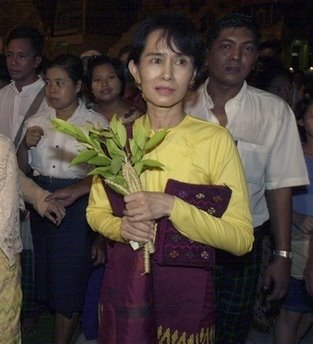


 Posts
Posts


