News & Articles on Burma
Wednesday, 05 January, 2011
-------------------------------------------------
Karen New Year Celebrated Across the World
Suu Kyi, SNLD Call for Ethnic Unity
NLD Outlines Four Principles for Foreign Investment
Armed Fighting Erupts in Southern Chin State
Japanese businesses face dilemma with Myanmar
Burma army expands in Kachin, Shan states
Burmese Journalists Don't Fear Oppression
Slow down the rush to Dawei
Sanctions Aren't the Problem
------------------------------------------------
Karen New Year Celebrated Across the World
By SAW YAN NAING Wednesday, January 5, 2011
They may live in countries on the other side of world, their families may have been torn apart, they may be living in refugee camps in Thailand, but when it comes to their New Year's Day, the ethnic Karen people join together as one in wishing each other a Happy New Year.
Thousands of Karen gathered on Wednesday in Insein Township in Rangoon to celebrate the start of the 2,750th year on the Karen calendar.
Sources in Rangoon said an estimated 10,000 Karen people in Insein dressed in traditional dress to celebrate the event with traditional dances and ceremonies. They raised the Karen national flag at 6 a.m on Wednesday.
Speakers at the ceremony called for the unity of the Karen people, said one attendee.
One of the major ethnic groups of Burma, the Karen have been indigenous to the land for more than two millennia. Nevertheless, hundreds of thousands of Karen people still live in fear in their homeland, some hiding in the jungle while others are forced to flee to third countries. Decades of repression by the Burmese regime has resulted in more than 150,000 Karen living in refugee camps in Thailand. Some 60,000 Karen refugees have been resettled to Western countries.
Karen refugees in Thailand also celebrated their New Year on Jan. 5. Thousands of Karen in Mae La refugee camp gathered and held a festival, said a refugee at the camp. Mae La is the largest of nine refugee camps in Thailand with more than 40,000 Burmese refugees, most of whom are ethnic Karen.
Several Karen people told The Irrawaddy that they were praying for peace in Karen State where armed conflict has been a way of life for villagers for more than six decades.
Naw Barso Ghay, a Karen girl in India, said, “I wish for all the people in Karen State to have peaceful lives. I wish for there to be no more war, no more homelessness and no more families torn apart.”
Saw Gregory, a Karen university student who is studying in Thailand, said, “I miss Karen New Year in Rangoon. I hope to see all Karen people unified and celebrating Karen New Year together in Burma, one day.”
Straddling the mountains that separate Thailand and Burma, the people of Karen State have been victims of human rights abuses by Burmese government forces since the country gained independence from Britain in 1948. The Rangoon government’s broken promise of ethnic autonomy and true federalism resulted in a civil war that has continued to this day.
Founded in 1947, the Karen National Union has led the fight for freedom and self-determination.
In a statement to commemorate the 2,750th Karen New Year, KNU Chairman Saw Tamla Baw said it is necessary for every Karen, wherever they live in the world, to uphold the Karen people’s cultural heritage and language, and hand it down to posterity.
“I would like to urge all Karen nationals to work in a spirit of unity and in cooperation in this year of 2750 until the Karen people gain the right to live in freedom as a nationality, while resisting the enemy endangering our Karen people,” said Tamla Baw.
Zipporah Sein, the general secretary of the KNU, said, “I believe there will be a day when all Karen people gather freely together to celebrate our New Year under the Karen flag.
“Every single Karen person is responsible for this. We have to maintain the struggle for the liberation of the Karen people,” she said.
http://www.irrawaddy.org/article.php?art_id=20467
-----------------------------------------------
Suu Kyi, SNLD Call for Ethnic Unity
By KO HTWE Wednesday, January 5, 2011
Burma's pro-democracy leader Aung San Suu Kyi met with six executive members of the Shan Nationalities League for Democracy (SNLD) on Sunday to discuss the importance of ethnic unity in the face of the emergence of the Shan Nationalities Development Party (SNDP) and other parties formed to contest last year's election.
The meeting with the leaders of the SNLD, which did not take part in the election but came second only to Suu Kyi's National League for Democracy (NLD) when Burma went to the polls in 1990, lasted nearly an hour and a half, according to a party spokesperson.
“We said that the SNDP doesn’t represent all ethnic Shan and that if she [Suu Kyi] could guarantee ethnic equality and self-determination, we will organize people from all walks of life in Shan State,” said SNLD spokesman Sai Leik.
Ethnic parties which won seats in the Nov. 7 election have shown no interest in joining other ethnic parties and the NLD in their calls for a second Panglong conference, modeled on the historic meeting between Suu Kyi's father, Gen Aung San, and ethnic leaders that laid the foundations for Burma's independence from British colonial rule.
“She emphasized the need to hold a second Panglong conference because many ethnic leaders are united in their desire for such talks. However, she said that it would be difficult to move forward with this plan without the cooperation of all ethnic minority parties,” said Sai Leik.
In radio interviews, the leaders of two major ethnic parties, the SNDP and the Rakhine Nationalities Development Party (RNDP), have said that they don't want to participate in a Panglong-type conference, he added.
Under the original agreement reached in Panglong, Shan State, in 1947, ethnic nationalities were guaranteed the right to self-determination within the framework of a federal union. The agreement was later scrapped by Burma's military when it seized power in 1962.
In the 1990 election, the SNLD won the largest number of seats in Shan State, but the party's leaders were subsequently arrested and are now serving long prison sentences in remote prisons across Burma.
The SNDP is now Burma's largest ethnic party. It won 57 of the 156 seats it contested in November, mostly in constituencies in Shan and Kachin states. The RNDP won in 35 of the 44 constituencies it contested in Arakan State. http://www.irrawaddy.org/article.php?art_id=20466
-----------------------------------------------
NLD Outlines Four Principles for Foreign Investment
By HTET AUNG Wednesday, January 5, 2011
Burma's leading democratic opposition party, the National League for Democracy (NLD), has outlined four principles for foreign investment in the country and reaffirmed its stand on the need to review existing economic sanctions for the benefit of the people, according to a party policy statement.
“Consideration of environmental and social impacts on the people, respect for labor rights, the creation of job opportunities and technically advanced investments” are the four main priorities of the party's foreign investment policy, said the statement, which was titled “Economic Analysis” and released on Jan. 4, Burma's Independence Day.
Fireworks burst above Rangoon's landmark Shwedagon pagoda as Burmese gather to welcome the New Year 2011 at Kandawgyi park in Rangoon late on December 31, 2010. (Photo: Getty Images)
The statement also highlighted the need to address rising commodity prices and increasing joblessness due to the unequal distribution of wealth in the country.
Asked whether the party has begun to consider welcoming foreign direct investment to the country based on these principles, Win Tin, the secretary of the NLD, told The Irrawaddy: “First we want to review the impact of the sanctions on ordinary citizens. We have already said that if we find that they negatively impact the people, we will consider calling for an end to sanctions.”
He added that if the sanctions are lifted, “These four principles will be our guideline to decide whether which investments we should accept.”
He further explained that the NLD set these four principles not only to reduce the negative impacts of foreign investments on the environment of the country but also to protect the people's social and economic life.
“An example is Chinese investment in the construction of the Myitsone dam at the confluence of the N'mai and Mali rivers, where the Irrawaddy River begins,” said Win Tin. “The Irrawaddy is our country's main river and building such a dam could have negative environmental and social consequences for the country and the people.”
Win Tin also expressed concern that China's investment in Burma did little to alleviate unemployment because Chinese companies often brought their own laborers to work on their projects. Another problem, he said, was that local people are often forced to relocate because of these projects, affecting their livelihoods.
The NLD's policy statement criticized most current investment in Burma for prioritizing short-term profit and failing to consider the sustainable development of the country.
The statement pointed out that building a lot of dams, reservoirs and river bridges without considering the environment and the livelihoods of local people often did more harm than good. In many cases, cultivated lands have been damaged by these projects and farmers have lost their capital because they are forced to grow crops that are not suitable in the land and weather.
The statement also highlighted the need to establish the rule of law and transparent, accountable governance in Burma. It said that the economy must be equally open to all citizens if Burma is to develop economically.
“To build an industrialized country, there must be investments which encourage a transfer of advanced technologies, but we get nothing from China's investments,” said Win Tin.
http://www.irrawaddy.org/article.php?art_id=20465
--------------------------------------------
Armed Fighting Erupts in Southern Chin State
SPDC Camp
05 January 2011: The Burmese Army stationed in Paletwa Township, Chin State, and the Arakan Liberation Army (ALA) fought at Lapahwa Camp on 3 January 2011, ending up with four Burmese and one Arakanese soldiers dead.
Joint-Secretary 2 of the Arakan Liberation Party (ALP), Khaing Thu Ka, was quoted by the Narinjara news as saying that Lapahwa Camp of Burma Army Light Infantry Battalion No. 55 was attacked during the day and all the movements could be seen clearly.
The Arakan Liberation Army is set to carry out an increasing attack against the Burmese army on the western border in the new year, according to Khaing Thu Kha.
It is said that the Burmese army strengthened, after the attack, its military force along the border to conduct offensive operations against ALA soldiers.
"We can expect an increase in the use of forced porters and other type of human rights violations against villagers with the increase of Burmese troops," said Field Director of Chin Human Rights Organisation, Pu Terah Thantluang. According to CHRO, the Burma Army has trippled its presence in some parts of Chin State since November last year.
There are at least 20 Burma Army camps in Paletwa Township.
The Arakan Liberation Army, ALP's armed wing, was formed on the Thai border in 1973. It is one of the biggest ethnic revolutionary armies on the western Burmese border. http://www.chinlandguardian.com/news-2009/1151-armed-fighting-erupts-in-southern-chin-state.html
------------------------------------------------------
Japanese businesses face dilemma with Myanmar
BY TAKESHI KAMIYA STAFF WRITER
2011/01/05
Japanese businesses face a tough decision of whether to invest in a country ruled by a military junta or sit back and let China and South Korea surge ahead in a key area.
That area, Myanmar (Burma), has not seen new direct investment from Japanese companies for almost a decade.
Entering the Myanmar market could raise criticism from the United States and Europe, which maintain economic sanctions against Myanmar's oppressive military regime.
However, the government-affiliated Japan External Trade Organization (JETRO) says it has received three inquiries from businesses about setting up shop in Myanmar since the country's first national elections in 20 years in November. The elections were described as a farce.
The inquiries were "remarkable in that no increase had been seen in the past several years in the number of businesses operating here," said an official of JETRO's office in Yangon (Rangoon).
JETRO figures show foreign direct investment in Myanmar jumped to $16 billion (1.3 trillion yen) between April and August 2010, almost matching the overall total between 1988 and 2009.
The heavy investors were from China, Hong Kong, South Korea and Thailand. Their targets include natural resources, such as natural gas and rare metals.
Despite international criticism against the Myanmar government for restricting freedom of speech and causing other human rights problems, the country attracts business attention for its location, surrounded by fast-growing China and India as well as other members of the Association of Southeast Asian Nations (ASEAN).
China and India are reportedly developing deep-water ports for large vessels in Myanmar to use as their gateways to the sea.
About 50 Japanese companies are operating in Myanmar, the last entering in 2001. They are expanding production in such areas as clothes and footwear as orders increased from businesses trying to disperse the risks from excessive dependence on China.
Although Tokyo did not impose sanctions against Myanmar, Japanese companies have shunned new investments to protect their images. They are also wary of the unstable power supply and unpredictable policy changes.
An investment "boom" in Myanmar did occur in the latter half of the 1990s, when Mitsui & Co. developed an industrial park and former Fuji Bank agreed on setting up a joint venture bank. But the boom was short-lived.
Eitaro Kojima, head of JETRO's Yangon office, expects economic deregulation in Myanmar before ASEAN's economic integration slated for 2015.
"The Myanmar government appears to be seriously concerned that its industry will suffer a major blow when the ASEAN integration makes progress," Kojima said. "I think it will move to liberalize its economy to promote development of its industry."
http://www.asahi.com/english/TKY201101040230.html
-----------------------------------------------
Burma army expands in Kachin, Shan states
By HTET AUNG KYAW
Published: 4 January 2011
Two additional military command zones are being created for the Burmese army in regions bordering China as tensions with ethnic armies grow.
Several major rebel groups have refused demands by the Burmese junta to transform into Border Guard Forces, a move that would see their lower-ranking troops assimilated into the Burmese army.
Aung Kyaw Zaw, a military analyst on the China-Burma border, said that two more Regional Military Commands (RMCs) may be added later in the year, on top of the two already set in place.
One has been designated for Tanaing in Kachin state, which is home to the Kachin Independence Army (KIA). Another will be formed in Wanhseng in the south of Shan state, close to territory controlled by the Shan State Army.
“Traditionally [the Burmese Army] never kept any troops in Wanhseng,” said Aung Kyaw Zaw. “I think the intention might be to keep full control over both Shan State Armies [South and North] as well as for security for the gas pipeline running between Mandalay and Lashio.”
The Burmese government will be keen to bolster its military presence along the planned Shwe oil and gas pipeline route, which begins in Kyaukphyu on the western coast and ends in southern China. The project will prove lucrative to the junta, and is likely to tighten relations with its northern neighbour.
China has warned the junta that it must maintain stability along the shared border following fears that fighting could erupt over the refusal by ethnic armies to transform into Border Guard Forces.
Sporadic bursts of fighting have occurred in both Kachin and Shan state in recent months, although it remains unclear whether or not this will intensify.
http://www.dvb.no/news/burma-army-expands-in-kachin-shan-states-2/13600
----------------------------------------------
Burmese Journalists Don't Fear Oppression
2011-01-04 05:42
In a Studio in Oslo, Norway a group of journalist work day and night to produce news stories sent from Burma by their colleagues inside. This is The Democratic Voice of Burma, an independent media outlet. These reporters are at great risk and recently a reporter was sentenced to 8 years in prison by the Burmese military regime.
“He was filming a bomb explosion, a deadly explosion in April 2010 in Rangoon. The Security guards arrive and he was arrested. Now he was given eight years prison time but we don’t know whether there is more charges coming. That is very usual that the Burmese’s Regime add up more charges to make your prison time longer.”
During the 2007 protests in Burma, the Democratic Voice of Burma got a lot of attention after releasing footage of the fatal shooting of a Japanese journalist. The cameraman involved in filming the event also paid a high price.
“This Japanese journalist was shot dead during the 2007 Saffron Revolution and again our cameraman captured that image and we circulated it worldwide. APF in Japan set up a Memorial and award to honor the journalist to take the risk like that journalist. So this female journalist won the award. She was given 27 years in Prison and five different charges.”
An award-winning documentary has been made about the lives of these reporters who work under great pressure.
“No matter if you are a journalist or not there are many of innocent Burmese people, maybe millions of innocent Burmese people suffering. So for the journalist they believe and they know the power and impact of media.”
The launch of a TV satellite has boosted its audience and angered the Burmese Regime.
“According to the latest survey up to 33 percent of the population of 53 million people in Burma are watching our television and listening to our radio. So that’s about let say 20, 25 million people watching.”
The journalists don’t fear the oppression from the Junta, and lack of fear may be their strongest weapon.
NTD News, Oslo, Norwayhttp://english.ntdtv.com/ntdtv_en/ns_europe/2011-01-04/700198975549.html
-------------------------------------------------
Bangkok Post:EDITORIAL
Slow down the rush to Dawei
* Published: 5/01/2011 at 12:00 AM
* Newspaper section: News
It may be too late, but the government should listen carefully to the reasonable voices warning against throwing great Thai resources at plans to build a new industrial complex in Burma. The push to back the project at Dawei has won powerful allies. For one, there is Prime Minister Abhisit Vejjajiva, who returned from his first official trip to Burma three months ago, enthusiastic about the chance to build a port, virtually from scratch. For another, Thailand's biggest and most influential companies are determined to move into Burma to work on the Indian Ocean scheme.
But there are increasing voices questioning the rush to Dawei - the regime's name for the town of Tavoy. For one, Burma is still a despotic, brutal military dictatorship. It held elections of a sort late last year but even the United Nations saw through the sham of a vote that only sought to legitimise military rule. The regime released No.1 political prisoner Aung San Suu Kyi, but continues to keep thousands of others under lock and key for the "crime" of criticising the regime. As a member of the United Nations Human Rights Council, the government should question doing such big business with Burma, not enthusiastically supporting it.
But clearly, Burmese and Thai officials at lower levels have done their work carefully. Within days of Mr Abhisit's return from Burma, the military regime awarded a huge construction contract to Italian-Thai Development Plc. Under the 10-year, 400-billion-baht agreement, Ital-Thai will virtually take up residence in Burma. From almost nothing, the Thai firm will oversee the transformation of Dawei into a thriving industrial zone and international port with all the necessary infrastructure.
This is the 21st century version of the only major government-sanctioned project of this kind in Thailand, the Eastern Seaboard. It is clear that some of the growing pains of the Rayong-centred seaboard programme are now driving some big Thai companies out of Thailand. By moving to Burma they can leave behind the environmental problems of Map Ta Phut and Rayong courts.
This is the second major reason to slow the stampede to Dawei. Environmental activists have questioned whether the Thai firms are fleeing the Eastern Seaboard exactly because they intend to make no effort to set up clean industry in Burma. Buntoon Siethasirote, director of the Good Governance for Social Development and the Environment Foundation, pointed out that Burma has no decent laws on protecting the environment. The Burmese military leaders have a history of cooperation in shady business deals. There is grave doubt whether the generals would even make an attempt to enforce any sort of acceptable standards if that interfered with profits.
And now, senior officials of the bureaucracy have questioned the government's all-out support for an Andaman Sea project at Dawei. They note correctly that this has turned into a zero-sum contest between Dawei and a formerly planned port project further to the south at Pak Bara, in Satun province.
In short, what Dawei and Burma gain, Pak Bara and Thailand lose.
Private businesses have their own agenda, but there are legitimate and pressing questions about the Thai government's strong backing for the Dawei port plans. The government should slow its rush to Burma, until important political and economic questions have clearer answers. http://www.bangkokpost.com/opinion/opinion/214463/slow-down-the-rush-to-dawei
---------------------------------------------
CONTRIBUTOR
Sanctions Aren't the Problem
By DR ZARNI Tuesday, January 4, 2011
Following the release of Daw Aung San Suu Kyi from house arrest this past November, a chorus of vociferous calls for the end to sanctions against the military-ruled Burma has been reverberating internationally. Business lobbies and the global development industry have jumped at the public relations opportunity that came with the generals’ decision to release the world’s best-known political dissident.
One immediately senses the seductive nature of the anti-sanctions narrative, designed to convey a mixture of moral and strategic concerns in the same breath. Let’s consider the promise of this new policy narrative against the empirical realities on the ground.
Dr Zarni (m.zarni@lse.ac.uk) is research fellow on Burma at the London School of Economics and Political Economics.
I was one of the foot soldiers among the Burmese dissidents who helped build the international campaign for sanctions against the Burmese regime in the 1990s. A decade later, I publicly challenged what was then known as the (pro-)sanctions orthodoxy, particularly when it became apparent that Washington’s blanket sanctions enacted in 2003 were about to kill off the fledgling garment industry, which employed a fair number of ordinary Burmese.
Seven years on, here I am speaking out against the new anti-sanctions orthodoxy. This orthodoxy opts to overlook the elephant in the room, namely the excessively predatory and callous ruling military elite and the state organs which are used as an instrument of rent-seeking and repression.
Meanwhile, Western punitive measures including sanctions and denial of loans and development aid are scapegoated in this orthodoxy. Sanctions and associated policy measures are held responsible for the economic woes and miserable human conditions that envelop communities throughout Burma.
The new anti-sanctions advocates are promoting, either naively or self-servingly, foreign aid, trade and investment as the panacea for the country’s ills, while pinning hope on the emergence of a Burmese “middle class.” Being the parasites of autocratic or feudal political systems, Southeast Asia’s middle classes lack the progressive potential for democratization and meaningful development, unlike the original bourgeois of the old Europe, which brought down the feudal ruling elites and helped democratize institutions of power and wealth. Bangkok’s Thai middle class, which greeted the Red Shirts with scorn and disdain, and autocratic Singapore’s well-fed and -housed middle class immediately spring to mind.
The new anti-sanctions orthodoxy is pervasive among players with ties to foreign and local business interests, the global development industry and free-market ideologues dressed up as Burma experts, media personnel, diplomats and academics. In promoting this new policy discourse, they are joined by experts in international affairs and strategic studies, especially from countries which have most to gain from re-normalizing Burma’s half-century-old dictatorship.
Be that as it may, who in their right mind would object to genuinely progressive social and economic evolution, which will in due course benefit the locals while serving external commercial and strategic interests, without conflict, confrontation, upheaval, and bloodshed?
This school of evolutionary social change counsels the opposition to be more patient and the oppressed masses to offer their unconditional collaboration with their oppressors.
There is one major problem with this new orthodoxy, however. Its logic of gradual change through engagement, trade and development aid and loans has no empirical basis in the history of meaningful social change in dictatorships, East or West, where States and ruling elites were both criminally negligent towards citizens’ well-being and violently repressive to the population. In fact, the current anti-sanctions lobby is dangerously ill-informed about the concrete realities on the ground in today’s Burma.
Specifically, the abstract idea of evolutionary change in Burma ignores the particular characteristics of the country’s dictatorship that prevent investment from benefiting the masses. These include the troubling feudal personality traits of the ruling senior and junior generals, the deeply structural nature of political and ethnic conflicts, the lack of any real—as opposed to anticipated—potential for change through the emerging move towards “civilianized” military rule post-election, the complete absence of any viable efforts on the part of the regime to seek lasting peace in the country, the non-existence of policy space for both existing and emerging political processes and institutions, and last but not least, the utter lack of technocratic competence and genuine concerns for public welfare among decision makers.
Some have argued that the post-election Burma carries seeds of evolutionary change with it.
First, these same advocates have also held up the military’s unmistakably regressive Constitution as “something better than outright dictatorship” (without any written formal guidelines), even when there is absolutely no change in the balance of institutional power in the post-election set up. Burma’s “Constitutional Military Rule” betrays both the letter and spirit of constitutionalism. For it legalizes, legitimizes, enshrines, ring-fences and delimits the de facto military rule—providing a sharp contrast to the essence of constitutionalism, which is to curb the arbitrary power of any ruling institution or class.
Second, the military’s ideological and institutional orientation has taken an unmistakably feudal turn, which makes it inconceivable for any reform potential arising from this very institution of power. It also structurally prevents trade or investment reaching beyond the hands of the feudal lords in modern soldier's uniforms and their cronies. Over the past two decades, promoting the three dead warrior-kings of the long-collapsed Burmese empires as the military’s role models, the regime has subjected the military and the country’s officialdom to a regressive process of re-feudalization in terms of values, norms and worldviews.
Third, much has been made of the fact that the military is creating the trappings of a functioning democracy, namely political parties, a parliamentary system with different houses and nominal division of power. Realistically speaking, however, it is impossible to imagine a scenario where any serious reform initiatives or policies can be tabled, much less debated within the military’s parliament, which is bound to be the military’s rubber-stamp. These are obstacles to the democratization of political and economic spheres.
To begin with, the regime has permitted the largest pro-democracy political party, namely the National Democratic Front, made up of NLD renegades, a token inclusion in its official politics with only 1.5 percent of the total parliamentary seats, while declaring its own Union Solidarity and Development Party (USDP) a landslide winner with almost 80 percent of the contested seats, ensuring that it has near total control of what goes on in the parliamentary houses.
The ardent believers in the potential for parliamentary and policy space inherent in the form of a parliamentary system have chosen to overlook the type of anti-intellectual, anti-democratic professional practices and political culture in which the regime’s MPs, both “civilianized” soldiers and their brethren still in service, have been steeped. These men have spent decades learning the art of climbing the military and bureaucratic ladders solely through their unquestioning loyalty and utter obedience to their superior officers, executing orders, right or wrong. Therefore, the chances of the rubber-stamp parliament and its legislative processes influencing regime’s MP-elects (including ex-military officers, their cronies and other regime supporters) to think and act in a democratic manner that befit parliamentarians are absolutely non-existent.
Fourth, the issue of leadership transition has often been cited as an impetus for unconditional engagement with the military regime in hopes that the junior generals, in their late 50s and 60s, will be more open-minded, reform-oriented and forward-thinking. It is inconceivable that senior generals who are self-inflicted with militarist, feudal and (internally) ethno-imperialist worldviews will leave the reins of power in the hands of the juniors who think, feel and act significantly different from themselves.
To be sure, the regime is not a monolith and individual generals do have their differences in ideas, approaches, and interests. However, empirically and historically speaking, when it comes to liberalizing politics and redistributing wealth, Burmese military officers by and large have acted as a corporate entity, that is, a soldiering class with class views and interests.
Sixth, anti-sanctions advocates commonly place responsibility on Western sanctions—specifically, the denial of development aid and low level of humanitarian assistance—for the sorry state of human conditions in the military-ruled Burma. Usually, they point out that upwardly mobile Cambodia and Laos receive as much as 10 times more than Burma in foreign aid per capita, and make the case for increased aid for Burma.
And yet the same aid and trade advocates conveniently overlook the fact that the generals purchased from Russia a second squadron of state-of-the-art MiG-29 fighter-jets at a cost of nearly US $600 million within days after Joseph Stiglitz delivered his world-class economic advice to a group of junior generals in the regime’s capital of Naypyidaw, the “Abode of Kings,” that their country’s agricultural sector needs massive state investment. As the Burmese economist Dr U Myint has observed, Burma’s agri-based economic structure has remained virtually unchanged since the 1930s.
Seventh, these advocates of ending sanctions point out contemporary “developmental states” such as China and Vietnam as development models for Burma to emulate, de-linking freedoms from economic development. “Noble obligation” is a notion that has come to be associated with paternalistic ruling classes. Even if one disdains its inherent arrogance and usurpation of state power as a ruling ideology, it at least has some redeeming qualities. One-party autocracies in Beijing and Hanoi do make serious efforts to improve the material lot of the peoples under their respective rules, even when they deprive the latter of any meaningful voice in the country’s political and policy matters.
No such sentiment has been detected among the military leadership of Burma, either in “normal” or in catastrophic times (for instance, during Cyclone Nargis). It is difficult to swallow the painful truth that public well-being is not a policy priority as far as the ruling generals in Burma are concerned. The fact that less than 2 percent of the country’s national budget is allocated to the combined fields of public health and education speaks volume.
The latest Economic Intelligence Unit’s report on Burma for January 2011 observes thus: “In terms of fiscal policy, the government is likely to continue to focus on spending heavily on the military, and it will do little in the way of implementing policies to support households and businesses.” The regime—and the predatory and increasingly feudalist state institutions—will, in reality, remain the insurmountable obstacle to the trickle-down economic logic of the anti-sanctions lobby.
Still, in place of any concerted pressure on the regime towards putting public welfare on its policy radar, these anti-sanctions advocates from the business lobby and aid industry, both from the West and from Asia, offer unconditional engagement with the “stupid and dense” generals, to borrow Lee Kuan Yew’s adjectives in his specific reference to the Burmese business partners of his city-state.
The anti-sanctions lobby does get one thing right, however.
The unwavering backing of the Burmese dictatorship by its Asian neighbors—China, India and the Association of South East Asian Nations (Asean)—has rendered Western sanctions and grassroots boycotts ineffectual and prevented them from playing the kind of strategically impactful role which they played in the successful fight against apartheid in South Africa. As Timothy Garton Ash, professor of European Studies at Oxford University, pointed out in a recent live dialogue with Aung San Suu Kyi at the London School of Economics, the efforts at democratization across Eastern Europe succeeded partly because the external geopolitical and ideological environment was conducive to internal struggles for democratization across the region.
The unfolding tragedy in Burma is that no such favorable external environment exists. Quite to the contrary, Burma’s economically predatory neighbors treat the country as merely a brothel where they can gratify their need for cheap labor and natural resources and as a strategic asset. They find it against their interests for the military regime to be replaced with a democratic government responsive to citizens’ livelihood needs. For instance, only a dictatorship with absolute disregard for public well-being would have signed a multi-billion dollar deal such as the Dawei Development Project, which allows a Thai-Italian conglomerate to set up, among other things, socially and ecologically harmful refineries which will emit massive pollutants into the sky above Burma’s southern coast line. According to an article in The International Herald Tribune (“An Industrial Project That Could Change Myanmar,” Nov. 26, 2010), Thailand’s Prime Minister, Abhisit Vejjajiva, assured his fellow Thais in his weekly television address two months ago that dirty industries are moving to Burma: “Some industries are not suitable to be located in Thailand. This is why they decided to set up there [in Dawei].” How lovely!
There is little wonder, then, that the future for the peoples of Burma looks rather grim. They are not simply up against their country's “stupid” generals and their repressive security forces, but also at the mercy of unscrupulous foreign interests.
The anti-sanctions orthodoxy should be understood for what it is—the promotion of the West’s strategic national and corporate interests, which will further entrench military rule, in whatever guise, by giving it a veneer of normalcy and acceptability. Ending the sanctions now will not prove to be an effective move towards political and economic development for the people.
Copyright © 2008 Irrawaddy Publishing Group | www.irrawaddy.org
http://www.irrawaddy.org/opinion_story.php?art_id=20459&page=4
Thursday, January 6, 2011
News & Articles on Burma-Wednesday, 05 January, 2011


Wednesday, January 5, 2011
News & Articles on Burma-Tuesday, 04 January, 2011
News & Articles on Burma
Tuesday, 04 January, 2011
-------------------------------------------------
Big Brother is Listening: Junta to Target 3,000 Cell Phones
NLD Raises 20 Million Kyat for Social Projects
Junta warns of "covetous" countries, Suu Kyi thanks foreigners
Burma: The World’s Next North Korea
Anti-sanctions chorus out of tune
DKBA soldier holds a Thai hostage
Karen Solider Nabbed after Hostage Drama
Myanmar says 'aggressive countries' seeking influence
Yawdserk: Junta targeting Thai border Wa
---------------------------------------------------
Big Brother is Listening: Junta to Target 3,000 Cell Phones
By HSET LINN Tuesday, January 4, 2011
RANGOON — Burma's military regime is preparing to intercept more than 3,000 GSM and CDMA phones belonging to politicians, businessmen, social activists, artists and media personnel, according to an official from the state-run Myanmar Posts and Telecommunications (MPT).
The official, who is involved in the implementation process, told The Irrawaddy that Military Affairs Security (MAS), the regime's intelligence agency, arranged the phone interception plan and will implement it with technical assistance from MPT. A team consisting of more than 20 MAS members and an MPT engineer will be responsible for maintaining constant surveillance of the designated cell phones, but an operation base has not yet been chosen, the official said on condition of anonymity.
Apart from executive members of Aung San Suu Kyi's National League for Democracy (NLD), the list of those whose calls will be listened in on reportedly includes some independent candidates and leaders from political parties that were newly formed to contest last year's election in November.
Others on the list include some of the junta's leading business cronies, such as Tay Za, Zaw Zaw, Htun Myint Naing, Chit Khaing and Nay Aung, along with more than 60 other businessmen, including MPs-elect Khin Shwe, Htay Myit, Win Myint and Ko Ko Gyi, all of whom contested the election as members of the regime's proxy party, the Union Solidarity and Development Party (USDP).
Social activists and artists are also targeted, according to the official. HIV/AIDS activist Phyu Phyu Thin, writer Than Myint Aung and actor Kyaw Thu and his wife are reportedly on the list under the category of “social activists,” while movie directors Maung Myo Min, Min Htin Ko Ko Gyi and Cho Too Zaw and singers Anaga, Yan Yan Chan and Kyar Pauk, along with some other hip hop performers, are placed under the “artists” category.
High-profile media personnel are also on the MAS list, including Dr Than Htut Aung, the CEO of the Eleven Media Group; Dr. Nay Win Maung, the CEO of the Voice Weekly journal; Thaung Su Nyein, the editor-in-chief of the 7 Days news journal; Ko Ko, the editor-in-chief of the Yangon Times news journal; and foreign correspondents Aye Aye Win and Aung Hla Htun.
The MPT official said he thinks junta chief Snr-Gen Than Shwe directly ordered the MAS to carry out this plan, because a number of USDP MPs-elect are included on the list.
He said a similar program existed when Gen Khin Nyunt was the junta's military intelligence chief, but it was shut down after Khin Nyunt was purged in 2004 and his intelligence unit was dismantled.
“There were not many cell phones in Burma when the former intelligence unit was active, so they were easy to intercept. These days, however, there are so many phones in use, and people keep changing them all the time, so I doubt the interception plan will be successful,” said the MPT official.
The regime, which always keeps a close eye on the country's political opposition, often traces the telephone records of politicians and activists to find evidence to try and imprison them.
Soon after the monk-led protests in Burma in September 2007, also known as the Saffron Revolution, about 200 mobile phones belonging to politicians, journalists and students were blocked without explanation.
http://www.irrawaddy.org/article.php?art_id=20457
---------------------------------------------------
NLD Raises 20 Million Kyat for Social Projects
By SAI ZOM HSENG Tuesday, January 4, 2011
With the support of thousands of people, Burma's main democratic opposition party, the National League for Democracy (NLD), raised about 20 million kyat (US $235,294) at a three-day fund-raising event for political prisoners and others in need, according to party sources.
The event, which took place at the NLD's Rangoon headquarters from Jan. 2 to 4, was the biggest the party has held in more than 20 years.
“We got about 10 million kyat ($117,647) in the first two days, and today, we sold another 10 million kyat or so worth of goods,” Yar Zar, a youth member of the NLD, told The Irrawaddy on Tuesday. “The party leaders will coordinate how best to use this money for social programs.”
The main items for sale at the event, which was billed as a trade fair, were postcards of pictures drawn by NLD leader Aung San Suu Kyi, calendars and pictures of Suu Kyi and her father, independence hero Gen Aung San, ethnic costumes and key chains made by NLD members.
“It was more like a donation event for political prisoners and the NLD's social programs than a trade fair,” said Yar Zar.
Aye Thar Aung, the secretary of the Committee Representing the People’s Parliament (CRPP), said the NLD held the same sort of fund-raising event before the 1990 election and used the proceeds to assist the needy.
“This time, Daw Suu and other senior NLD leaders like U Win Tin sold the presents they got from the people to help raise funds,” he said.
The event involved members from different NLD branches and groups, each of which set up separate stalls to sell different items.
“There was an NLD youth stall, NLD women's stall and the No. 54 stall led by Daw Suu,” said Yar Zar, referring to the number of Suu Kyi's home on University Avenue, where she recently ended seven years under house arrest.
A local resident who went to the event said, “There were thousands of people there, and almost all of them bought something. The most popular items were those with Aung San Suu Kyi’s pictures on them.”
“They sold everything for a fair price, so everybody could afford to buy something,” said a Rangoon-based journalist. “Pictures or photos of Aung San Suu Kyi and Gen Aung San are hard to find these days, so they sold very well.”
The proceeds from the event will be used to assist the families of political prisoners, people affected by natural disasters and HIV/AIDS patients.
The NLD is currently running three shelters for HIV/AIDS patients in Rangoon. http://www.irrawaddy.org/article.php?art_id=20461
--------------------------------------------------
Junta warns of "covetous" countries, Suu Kyi thanks foreigners
Jan 4, 2011, 7:55 GMT
Yangon - Myanmar's junta on Tuesday used the independence day anniversary to warn of 'covetous' countries bent on controlling the nation while opposition leader Aung San Suu Kyi took the occasion to thank her foreign supporters.
'It is not strange (that) certain covetous, aggressive countries are anxious to gain political control over a geographically strategic country like Myanmar,' military supremo Senior General Than Shwe said in a speech marking the 63rd anniversary of independence from Britain.
Meanwhile, recently freed democracy icon Suu Kyi used the same occasion to thank her supporters, including 'national leaders, political leaders, Nobel peace laureates, United Nations, European Union, international amnesty organizations, people from America and Europe and our nationals from home and abroad.'
Suu Kyi, the winner of the 1990 Nobel Peace Prize, was released from a seven and a half years of house detention on November 13, six days after the country held it first general election in two decades.
'Successful victory for democracy is a must,' Suu Kyi said in a New Year's message. 'Political freedom, economy freedom and social freedom are linked together,' she said. 'We need to unite together to achieve those freedoms.'
Than Shwe, junta chief since 1992, made no mention of political freedoms in his independence anniversary day speech.
Instead he argued that Myanmar, also called Burma, fell to Britain in three wars between 1824 to 1885 'due to a lack of a strong army.'
Now Myanmar has a strong army but a weak everything else.
Ranked as South-East Asia's biggest economy in the pre-World-War II era, Myanmar is now on the list of the United Nations' least developed countries.
The country has been under military rule since 1962, when former strongman General Ne Win launched his disastrous 'Burmese Way to Socialism.'
Mass anti-military protests in 1988 put an end to the socialist system, but failed to install democracy.
The military cracked down on the demonstrators, killing an estimated 3,000 protestors.
It allowed an election in 1990, but then refused to pass over power to the victor - the National League for Democracy party, headed by Suu Kyi.
Although the junta staged a new general election on November 7, international observers criticized it for being unfree, unfair and non-inclusive.
The polls were won by the pro-junta Union Solitary and Development Party, which is packed with ex-military men and current government ministers.
Than Shwe said the successful election was 'the pride of the nation and the people.'
http://www.monstersandcritics.com/news/asiapacific/news/article_1609253.php/Junta-warns-of-covetous-countries-Suu-Kyi-thanks-foreigners
-------------------------------------------------------
Burma: The World’s Next North Korea
Wikileaks reveals the junta's quest for nukes.
January 4, 2011 - by Ryan Mauro
You can add another rogue state to the North Korean-Iranian-Syrian nuclear Axis of Evil: Burma. Cables released by WikiLeaks support the claims of Burmese defectors and opposition groups that the military junta is working hard to become a nuclear weapons state.
According to a November 2004 document, a senior Indian diplomat said that top Burmese officials had “wondered whether they would have to ‘go nuclear’ to get U.S. attention.” Other documents state that informants are reporting the movement of suspicious cargo. In 2009, a source in the government told the Australian ambassador that Burma cooperates with Russia for “software” training and North Korea for “hardware.”
One August 2004 cable, from the U.S. embassy in Rangoon, reports that a Burmese officer in an engineering unit mentioned an underground site about 300 miles northwest of the capitol, measuring about 500 feet from the bottom of its cave to the top of the hill above. He claims that about 300 North Korean technicians work at the site. The cable’s author doubts the truth of this number, and there are other reasons to doubt the officer’s testimony. He claims the North Koreans cannot leave the site and outsiders like him cannot enter — raising the question of how he saw the personnel.
But there is near-smoking gun evidence to substantiate reports of a Burmese nuke project. A major in the army, Sai Thein Win, has defected to the Democratic Voice of Burma, delivering into its hands hundreds of secret documents and photos. The materials reveal the construction of a huge network of underground facilities dating back to 1996 and costing at least $3.5 billion since 2001. This evidence is enough to convince Robert Kelley, a former director of the International Atomic Energy Agency, that Burma’s junta is working on uranium enrichment and plutonium reprocessing capabilities with North Korean assistance.
The Strategic and Defence Studies Centre of Australia has published a study reaching the same conclusion. The authors interviewed two defectors who independently confirmed the building of a secret nuclear site, nearby the public site constructed with Russian aid. One defector testified to the presence of about 60 North Koreans at a secret site, which the authors describe as similar in design to the Syrian nuclear reactor destroyed by Israel in 2007.
The materials obtained by the Democratic Voice of Burma also show that a series of meetings took place in North Korea from the 22nd to the 29th of November in 2008 — meetings that included the Burmese military chief. One cable released by Wikileaks notes that a Burmese official mentioned the chief’s 2008 visit to North Korea in a slip of the tongue.
The organization has put together all the intelligence it has on Burma’s secret nuclear weapons program in the form of a documentary available to the public. For now, the junta is able only to mine uranium and produce yellowcake. One defector says that the regime hopes to be nuclear-capable by 2020. But the authors of the Australian study say Burma could go nuclear by 2014 in the absence of major problems. Rudimentary though it may be, the West should not dismiss Burma’s role in the nuclear Axis of Evil. The junta is in a position to fill one of the gaps in Iran’s nuclear effort. According to one defector, in February 2004 he met with an Iranian intelligence officer and nuclear scientist and received a sample of yellowcake. If this testimony is true, then Iran has already turned to Burma to help relieve its critical shortage of raw uranium.
Moreover, the UN has already confirmed that North Korea is shipping nuclear materials to Burma and using “links with overseas criminal networks to carry out these activities.” Next, corrupt Burmese officials might sell nuclear materials to criminals or terrorists. A September 2008 cable describes a Burmese civilian’s threat to U.S. diplomats to sell uranium-238 to Thailand, China, or other countries if the Americans themselves declined to buy. Claiming he already had 50 kg of Burmese uranium in a barrel, the civilian boasted that he could sell up to 2,000 kg. Another cable from January 2007 describes a suspected shipment of 112 metric tons of uranium ore to China by the Burmese government.
The West has no shortage of reasons to act against Burma’s nuclear program. Aside from the obvious danger of a nuclear-armed junta, the program could set off a regional arms race. Plus, Burma’s nuclear program can help other rogue states’ efforts. North Korea profits from its work for the junta. And corrupt Burmese officials can always sell off the nuclear technology they’ve acquired.
Burma has yet to sign the Nuclear Non-Proliferation Treaty’s “Additional Protocol” allowing more intrusive inspections. Former IAEA director Robert Kelley says that this activity exempts Burma from the IAEA’s Small Quantities Protocol, which permits countries with minimal nuclear material and no nuclear facilities to work without inspections. Shockingly, Kelley says the IAEA as allowed under the Protocol is actually training Burmese nuclear technicians.
Tackling Burmese proliferation is no small task. As a start, the U.S. and its allies should make the case that Burma does not qualify for the Small Quantities Protocol and begin applying pressure to force the junta to sign the Additional Protocol. If the junta’s members want U.S. attention, we should give it to them and make them regret asking for it.
http://pajamasmedia.com/blog/burma-the-worlds-next-north-korea/
--------------------------------------------------
Anti-sanctions chorus out of tune
By Maung Zarni
BANGKOK - A chorus of international calls is on the rise to end the economic and financial sanctions Western countries led by the United States have maintained against Myanmar's military regime. Business lobbies and the global aid industry have jumped at November's rigged elections and the release of pro-democracy icon Aung San Suu Kyi from house arrest as a public relations opportunity to push their narrow objectives in Myanmar, also known as Burma.
I was once among the Burmese dissidents who in the 1990s helped to build an international campaign for sanctions against Myanmar's rights-abusing regime. A decade later, I publicly challenged what was then known as the pro-sanctions orthodoxy, particularly when it became apparent that Washington's blanket sanctions were about to kill off the country's fledging garment industry that employed a large number of ordinary workers.
Seven years on, I am speaking out against the new anti-sanctions lobby. The called-for policy shift overlooks the elephant in the room, namely the predatory and callous ruling military elite and the state organs they use as instruments for rent-seeking and repression. Western punitive measures, including economic sanctions and the denial of loans and development aid, are often held responsible for the economic misery and woe that envelop communities throughout Myanmar.
But the economic promise of the growing anti-sanctions lobby doesn't match the empirical realities on the ground. Like the sanctions regime of the previous decade, the lobby is waxing about morality and long-term strategy. Anti-sanctions advocates are promoting, either naively or self-servingly, foreign aid, trade and investment as a panacea for the country's ills while pinning hope on the emergence of a Burmese middle class who with economic clout will demand more political rights.
Arising mainly from autocratic or feudal political systems, Southeast Asia's middle classes lack the progressive potential for democratization and meaningful development, unlike the original bourgeois of the old Europe which brought down the feudal ruling elites and helped to democratize institutions of power and wealth. Bangkok's Thai middle class that greeted the "red shirt" grassroots movement with scorn and disdain and autocratic Singapore's well-fed and apolitical middle class spring to mind as apathetic examples.
The new anti-sanctions orthodoxy is pervasive among players with ties to foreign and local business interests and the global aid industry. This policy departure is also gaining resonance among free-market ideologues dressed up as Myanmar experts, Western media, diplomats and certain academics. They are joined by a growing contingent of experts in international affairs and strategic studies, especially in countries which have much to gain economically and strategically from normalizing relations with Myanmar's dictatorship.
However there is one major problem with the new anti-sanctions orthodoxy: its logic of gradual change through engagement, development aid and trade has no empirical basis in the history of meaningful social change from dictatorships in either the East or West. In fact, the emerging anti-sanctions consensus is dangerously ill-informed about the hard realities on the ground in today's Myanmar.
Specifically, the abstract idea of evolutionary change in Myanmar ignores the particular characteristics of the country's dictatorship that prevent investment from benefiting the masses. These traits include the feudal mindsets of the ruling senior and junior generals, the deeply structural nature of political and ethnic conflicts, an utter deficit of technocratic competence and concern for public welfare, and the lack of any real - as opposed to anticipated - potential for change through the emerging move towards "civilianized" military rule after November's rigged elections. (The new parliament is expected to be functioning by February.)
Some have argued that November's elections, which were won overwhelmingly by military-backed candidates, carry the seeds of evolutionary political change. These same advocates have also held up the military's unmistakably regressive constitution as something better than outright dictatorship, even though it brought about no change in the balance of institutional power in the post-election set up.
While the military has allowed for the trappings of a functioning democracy, including the creation of political parties, a parliamentary system with different houses and a nominal division of power, realistically there will be no room for serious reform initiatives or policies to be tabled, much less debated, within the new military-controlled parliament. Instead it will likely act as a pliant rubber stamp, as seen in Asia's other military-influenced "democracies".
Wishful thinking
The regime has permitted the country's largest pro-democracy political party, namely the National Democratic Front, made up of former National League for Democracy renegades, only token inclusion in its democratic politics through a mere 1.5% of seats in parliament. Its own Union Solidarity and Development Party (USDP), a landslide winner with almost 80% of the contested seats, on the other hand will have near total control of regional and national parliamentary houses.
It is important to understand that most of the regime's "civilianized" parliamentarians have spent decades as soldiers learning the art of climbing the military and bureaucratic ladders solely through their unquestioning loyalty and obedience to their superior officers by executing their orders, right or wrong. It is highly unlikely that these MP-elects (including ex-military officers, their cronies and other regime supporters) will think and act in a democratic and independent manner.
Some analysts have stated hopes that more junior generals, including those in their late 50s and early 60s, will be more open-minded and reform-oriented with the transition towards civilian rule. Yet it seems just as unlikely that senior ruling generals would willingly hand the reins of power to junior officers who think, feel and act significantly different from themselves.
To be sure, Myanmar's regime is not monolithic and individual generals have differences in ideas, approaches, and interests. But historic and empirical evidence shows that Myanmar's military officers have tended to act as a corporate entity in promoting its own interests, particularly in matters related to wealth distribution and political liberalization.
Anti-sanctions advocates also place too much responsibility on Western sanctions, specifically the denial of development aid and low levels of humanitarian assistance, for the sorry state of Myanmar's beleaguered and impoverished population. They often point to now upwardly mobile Cambodia and Laos, which both receive as much as 10 times more in foreign aid per capita than Myanmar, as a case for the benefits of bolstered aid flows.
And yet the same aid and trade advocates conveniently overlook the fact that Myanmar's ruling generals recently purchased from Russia a second squadron of state-of-the-art MiG-29 fighter-jets at the cost of nearly US$600 million. The purchase came just days after economist Joseph Stiglitz delivered his world-class economic advice to a group of junior generals in the regime's capital Naypyidaw, or the Abode of Kings, that their country's agricultural sector requires massive state investment. As the Burmese economist U Myint has observed, Myanmar's agri-based economic structure remains virtually unchanged since the 1930s - despite the fact the regime now earns billions of dollars annually in energy sales.
Others have pointed to China and Vietnam, where political freedoms and economic development are delinked, as possible development models for Myanmar to emulate. "Noble obligation" is a notion that has come to be associated with paternalistic ruling classes. The one-party autocracies in Beijing and Hanoi have made serious efforts to improve the material lot of their populations, even when they deprive them of any meaningful voice in the country's political and policy matters.
No such public obligation has yet been detected among Myanmar's military rulers, neither in normal times nor in times of crisis as witnessed in the regime's callous and incompetent response to the Cyclone Nargis disaster in 2008. The fact that less than 2% of the country's national budget is allocated to the combined fields of public health and education speaks to this lack of concern.
The latest Economist Intelligence Unit report on Myanmar observes, "In terms of fiscal policy, the government is likely to continue to focus on spending heavily on the military, and it will do little in the way of implementing policies to support households and businesses." The regime - and its predatory and increasingly feudalist state institutions - will thus remain the insurmountable obstacle to the trickle-down economic logic of the anti-sanctions lobby.
The anti-sanctions lobby does get one thing right, however. The unwavering backing of Myanmar's dictatorship by its Asian neighbors, including China, India and economically advanced members of the Association of South East Asian Nations, has rendered Western sanctions and boycotts ineffectual. That's prevented the punitive measures from having the impact they had in the successful fight against apartheid in South Africa.
As Timothy Garton Ash, professor of European Studies at Oxford University, pointed out in a recent live dialogue with pro-democracy icon Suu Kyi at the London School of Economics, the post-Cold War efforts at democratization across Eastern Europe succeeded partly because the external geopolitical and ideological environment was at the time conducive to internal struggles for democratization. Suu Kyi has until now backed the West's sanctions. But the unfolding tragedy in Myanmar is that the favorable external environment for organic democratization no longer exists.
To the contrary, Myanmar's opportunistic neighbors continue to treat the country as a brothel of cheap labor and source of natural resources. Indeed, several of these countries would find it against their interests for the military regime to be replaced with a truly democratic government, one that was responsive to its citizens' basic needs and livelihoods.
The emerging anti-sanctions lobby should be understood for what it is - the bald promotion of Western strategic and corporate interests. Ending sanctions now will only further entrench military rule, giving it a veneer of normalcy and acceptability, at the expense of Myanmar's long-suffering people and the country's equitable economic development.
Maung Zarni is a visiting senior fellow at Chulalongkorn University's Institute of Security and International Studies and a research fellow on Myanmar/Burma at the London School of Economics and Political Science. He may be reached at m.zarni@lse.ac.uk .
http://atimes.com/atimes/Southeast_Asia/MA05Ae01.html
-------------------------------------------------
THAI-BURMA BORDER
DKBA soldier holds a Thai hostage
By The Nation
A soldier of Burma's breakaway faction, armed with hand grenades, held a Thai hostage in Tak's Mae Sot district on Monday morning, demanding that Burma returned to Democracy.
The soldier was identified as Sorta Mini, of Democratic Karen Buddhist Army (DKBA and based in Poppra district of Tak province.
He seized Rote Laowan, a motorcycle taxi driver on Mae Sot-Mae Tao road in front of a UN High Commission for Refugees branch. He held two hand grenades whose pins were already removed.
He told police who rushed to the scene that he wanted to meet foreign journalists and UNHCR officials.
The Burmese demanded that Burmese military junta allow the country to return to democracy.
After a brief negotiation with police, he surrendered. He then wrote a note in English and gave it to reporters. It claimed that he was forced to be border protection soldier and that he did not recognise the result of the national election in 2010. The note also called for the United Nations to help Burma resume democratic system.
After the surrender, Sor Ta reportedly asked the UNHCR to give him refugee status. http://www.nationmultimedia.com/2011/01/04/national/DKBA-soldier-holds-a-Thai-hostage-30145666.html
------------------------------------------
Karen Solider Nabbed after Hostage Drama
UPDATE : 4 January 2011
An ethnic Karen fighter held a Thai motorcycle taxi driver in Tak province hostage to call for democracy in Myanmar before releasing him and getting arrested.
A soldier of the Democratic Karen Buddhist Army, later identified as Lance Corporal Tor Ma Nae, held a driver of a motorcycle taxi, Roj Laowan, in handcuffs outside the office of the United Nations High Commissioner for Human Rights in Tak's Mae Sod district. The perpetrator had two unlatched grenades in his hand.
The incident prompted police officers to close down the road outside the building.
Tor Ma Nae urged the United Nations and the Association of Southeast Asian Nations to help push for democracy in Myanmar, given the severe abuse the Burmese government hands down on its people. He also cited the military regime's coercion of Karen ethnic militia to join its Border Guard Force.
Chief of Mae Sod district Kittisak Tomornsak, along with police and security agency officers, spent more than three hours convincing Tor Ma Nae to give up. He then handed over his grenades to authorities after a foreign corespondent wrote an article about his request.
The Karen solider also asked not to be repatriated back to Myanmar fearing he could face capital punishment there. He then was brought to the Mae Sod Police Station to face legal charges. http://www.thailandoutlook.tv/tan/ViewData.aspx?DataID=1039193
------------------------------------------
Myanmar says 'aggressive countries' seeking influence
Agence France-Presse
Posted at 01/04/2011 6:47 PM | Updated as of 01/04/2011 6:47 PM
NAYPYIDAW, Myanmar - Myanmar on Tuesday urged its people to be on guard for efforts by "aggressive countries" to win political control of the nation, in a message to mark the 63rd anniversary of its independence.
"It is not strange certain covetous, aggressive countries are anxious to gain political control over a geographically strategic country like Myanmar," junta chief Senior General Than Shwe said in a statement read on his behalf.
"I would like to urge the entire people to guard the nation with political awareness against any forms of disruptions in order that the mother country's independence and sovereignty will never be under alien influence."
Military-ruled Myanmar held a widely criticised election in November, in which an army-backed party claimed an overwhelming victory.
The new parliament, which will elect a president, is expected to convene in late January. It is unclear what role Than Shwe plans for himself.
The regime typically uses the anniversary of the country's independence from Britain in 1948 to warn its people to remain vigilant against the dangers posed by other nations -- usually seen as a reference to the United States.
Washington last week called on the junta to free political prisoners and engage in dialogue to promote democracy.
The regime released opposition leader Aung San Suu Kyi from house arrest shortly after the November election, but about 2,200 other political prisoners remain imprisoned.
Suu Kyi, the daughter of Myanmar's assassinated independence hero General Aung San, has spent most of the past 20 years locked up. Her party won a landslide election victory in 1990 but it was never recognised by the regime.
http://www.abs-cbnnews.com/global-filipino/world/01/04/11/myanmar-says-aggressive-countries-seeking-influence
--------------------------------------------------
Yawdserk: Junta targeting Thai border Wa
Tuesday, 04 January 2011 11:21 S.H.A.N.
Lt-Gen Yawdserk, leader of the non-ceasefire Shan State Army (SSA) ‘South’, told SHAN yesterday the Burma Army is gearing up for a showdown with the United Wa State Army (UWSA)’s 171st Military Region on the Thai-Burma border.
“The recent setting up of a new command in Kholam is part of the ongoing preparations,” he said.
Kholam is located 105 miles (168km) east of Shan State capital Taunggyi, halfway between Namzang and Kunhing.
Until late last year, it was part of Namzang township. However, following the visit by Deputy Senior Gen Maung Aye late November, it and its surrounding areas had been carved out to become a new sub-township.
Irrawaddy reported earlier that a “Middle East Region Command”,with headquarters in Kholam, has been set up. “It is certainly a new military command,” said Yawdserk. “But there is as yet no confirmation that it’ll be a regional command separate from Taunggyi (where the Eastern Region Command is based).”
The Burma Army has so far established 3 regional commands in Shan State: the Northeastern with HQ in Lashio, the Eastern with HQ in Taunggyi and the Triangle with HQ in Kengtung.
While other Burma observers think the Burma Army’s latest move is aimed at the SSA North that has refused to become part and parcel of the Tatmadaw (National Armed Forces), Yawdserk thinks Maung Aye’s immediate objective is the UWSA’s 171st Military Region, which is some 200 miles (320km) apart from its main base in Panghsang on the Sino-Burma border. The Burma Army and its people’s militia units are active in between.
Maung Aye, the ruling junta’s #2 man, is long reported to have held a grudge against Kokang and Wa. The attack on Kokang last year was said to have been personally engineered by him.
“The offensive,” says Yawdserk, “may start anytime, even before a new government is formed.”
The 171st Military Region, with 5 under strength brigades, is nominally commanded by Wei Xuegang, wanted in both Thailand and the United States on drug charges. Border watchers earlier reported his archrival Wei Hsaitang, an experienced military commander, was down in the 171st, but the UWSA sources have rejected them. “If he went south, it was only a temporary visit.” said one late last month. “His permanent posting is with the 318th Brigade (guarding the border with Burma Army occupied Kokang).”
The 171st is already hemmed in by the Burma Army’s Triangle Region Command and Military Operations Commands #14 and 17, altogether some 50 infantry battalions.
Apart from the UWSA, the SSA South is also active along the Thai-Burma border areas, opposite Maehongson, Chiangmai and Chiangrai provinces.
China was reported to have warned Burma against waging war along the mutual border. Thailand, on the other hand, has no such agreement with Naypyitaw. http://www.shanland.org/index.php?option=com_content&view=article&id=3392:yawdserk-junta-targeting-thai-border-wa&catid=86:war&Itemid=284
__._,_.___
Tuesday, January 4, 2011
News & Articles on Burma-Monay, 03 January, 2011
News & Articles on Burma
Monay, 03 January, 2011
-------------------------------------------------
Wa to cooperate with ceasefire, non-ceasefire groups
More power plant projects in Myanmar
Interethnic Agreement in Burma Long Overdue
Myanmar's drug 'exports' to China test ties
Chinese cars make inroads in Myanmar's market (Feature)
Burma: Bad government, great people
--------------------------------------------
Wa to cooperate with ceasefire, non-ceasefire groups
Monday, 03 January 2011 16:43 Hseng Khio Fah
The United Wa State Party (UWSP), the political wing of the United Wa State Army (UWSA) has decided in its 10 day-long party conference, 20-29 December 2010, that it will cooperate with every ethnic organizations both from inside and outside the country and to work together until Burma achieves a genuine democracy.
A Wa officer said the UWSP will be working together with all ethnic groups inclusive of ceasefire groups and non-ceasefire groups due to one of its policies “Have few enemies but many friends.”
“We will form alliance with all the armed groups whether they are recognized as rebels and such to others, but we [the Wa] don’t see them that way because they all are the people of Burma,” the officer said.
“We cannot consider these people who hold guns are either being rebellious or pig headed, but only that they are holding guns to struggle for what they believe.”
According to him, the UWSP has decided to solve the current political, social and economic problems together with its allies and other ethnic organizations until Burma gains a genuine democracy.
In addition, the party has also agreed to invite more foreign investors to help develop its controlled areas.
Regarding the UWSP’s recent reached agreement, Khuensai Jaiyen, editor in chief of Shan Herald Agency for News (SHAN) commented, “It is interesting that the group has decided to work with all armed groups and to invite foreign investors because it has never done before.”
Nevertheless, the group also confirmed that it would never surrender to any government and never transform itself into a border guard force (BGF), but it would try to negotiate with the new government about its problems according to its six point policies.
The said 6 points to be presented to the new government are the following:
* The Wa stands for the Wa State’s peace and development
* The Wa State shall have its own armed force. Wa weapons will remain in Wa hands. The Wa armed force will also remain in Wa State.
* The Wa will not secede from the Union
* The Wa will never demand or declare independence under any (Union) government
* The Wa will steadfastly demand for a state with the Right of Self Determination from every (Union) government until it is achieved
* The Wa are ready to discuss Wa affairs with the upcoming government, upholding a policy of non-alignment and neutrality.
http://www.shanland.org/index.php?option=com_content&view=article&id=3390:wa-to-cooperate-with-ceasefire-non-ceasefire-groups&catid=85:politics&Itemid=266
-----------------------------------------------------
More power plant projects in Myanmar
Xinhua
A total of 61 power plants with an installed capacity of 41,206 megawatts (MW) are under implementation in Myanmar which will generate 2,45,203 kilowatt-hours (kWh) per year on completion. This will be in addition to the capacity of existing power plants, an official daily reported on January 2.
There are already 32 power plants with an installed capacity of 3,045 MW and yielding 2,45,203 kWh per year, the official daily New Light of Myanmar has said. With one more 25 MW power plant planned in the future, there will be a total of 94 power plants with an installed capacity of 44,276 MW and generating 2,65,389 kWh per year upon completion of all the plants. The 61 ongoing power plant projects are scattered in Kachin, Kayah, Kayin, Shan and Rakhine states, and in the Sagaing, Tanintharyi, Bago, Mandalay and Magway regions.
On December 15, 2010, Myanmar launched its largest hydropower plant at Yeywa in the northern Mandalay region.
Located on the Myitnge river, 50 km southeast of Mandalay city, the 790 MW Yeywa hydropower plant was installed with four 197.5 MW generators that will generate 3.55 billion kWh of electricity annually.
The RCC embankment and the Yeywa hydropower plant project were implemented by the Ministry of Electric Power-1 and the project involved a contract by the CGGC International of the Gezhouba Group and China's Sinohydro Corporation. The completion of the project adds nearly 50 per cent more to the power generating capacity in the country. A key aspect in the successful construction of the Yeywa RCC dam was comprehensive training of the local staff during preparative for and initial stages of the construction.
The project is expected to ease the country's electricity shortage and help develop central Myanmar. http://www.thehindu.com/opinion/op-ed/article1025345.ece
---------------------------------------------------------
Interethnic Agreement in Burma Long Overdue
Nehginpao Kipgen | January 02, 2011
On Tuesday, Burma will celebrate its 63rd independence day. It was on this day in 1948, the Union of Burma was granted independence by the British. Over six decades have passed since independence, but the crux of the conflicts within the country still remains unresolved.
The 2011 independence day celebration will differ from the previous years for two important reasons. First, pro-military legislators prepare to dominate a parliamentary government. Second, Aung San Suu Kyi will celebrate the occasion with her National League for Democracy party members, free from house arrest.
The continued conflicts are primarily due to the denial of autonomy or federalism to the non-Burmese ethnicities by the successive Burmese-led central governments. Autonomy has been the core demand of the non-Burmese ethnic groups since independence.
The 1947 Panglong agreement was a turning point in the history of Burma’s modern politics. It established the conditions for independence and shaped the foundation for the Union of Burma.
The ethnic Burmese were aware that a unified Burma would not be possible without the cooperation of the non-Burmese Frontier Areas. And there was a lingering fear, suspicion and doubts in the minds of the Frontier peoples about possible domination by ethnic Burmese in the post-independence era.
To clarify the lingering concerns, Gen. Aung San, Suu Kyi’s father, made a historically significant statement: “If Burma receives one kyat, you will also get one kyat.” This was an assurance that every ethnic group within the Union of Burma would receive equal treatment.
Such assuring remarks from a prominent Burmese leader persuaded representatives from the Chin Hills, Kachin Hills and Shan states to cooperate with the interim Burmese government. Subsequently, 22 representatives from the Frontier Areas (three from Chin Hills, six from Kachin Hills and 13 from Shan states) and Burma proper represented by Aung San signed the Panglong agreement on Feb. 12, 1947.
However, with the assassination of Aung San on July 19, 1947, the Burmese nationalists and ultranationalists interpreted the ethnic minorities’ demand for autonomy as an attempt to disintegrate the Union of Burma.
Because of its failure to implement the Panglong agreement, a decade of Prime Minister U Nu’s government was threatened by insurgency problems. The hope for political autonomy or federalism was then shattered when military leader Gen. Ne Win staged a coup d’etat on March 2, 1962.
Historical facts have demonstrated that the present-day conflicts in Burma are primarily rooted in the failure to implement the Panglong agreement, especially on the question of autonomy for ethnic minorities.
The question now is whether the present leadership of ethnic Burmese groups is ready for another Panglong-type conference to address the concerns of ethnic minorities. Will the new pro-military civilian government or other moderate leaders led by Suu Kyi be willing to revisit the Panglong agreement? In this regard, Suu Kyi has publicly voiced her support for holding a second Panglong conference. A few days after her release from house arrest in November, Suu Kyi said: “A second Panglong conference addressing the concerns of the 21st century is needed for national reconciliation.”
Because of her being the daughter of Aung San, who himself signed the Panglong agreement on behalf of the Burmese government, ethnic minorities trust and support Suu Kyi more than any other Burmese leader in the country.
Suu Kyi’s comment was later cautiously, or more realistically, restated by the NLD leadership during its meeting with Joseph Yun, the US deputy assistant secretary of state for East Asia and Pacific affairs, on Dec. 10 in Rangoon.
According to Ohn Kyaing, spokesman for the NLD: “The second Panglong conference is intended to give people a strong sense of unity. It does not intend to oppose any person or any organization. Practically, it will be fruitful only if the military participates in it. So, we want the military to participate in it. It’s an affair we need to do in unison.”
But the idea of a second Panglong conference apparently does not interest Burma’s military leaders. In the Burmese-language Myanmar Ahlin newspaper on Dec. 8, the military downplayed the revival of the Panglong spirit. The article said: “If they [the opposition] choose to follow this idealistic way while ignoring the best way [parliament], they should be aware that it will bring more harm than good to the country.”
The military’s lukewarm approach to a second Panglong conference is not surprising. It shows that the mentality of the present military leadership does not differ much from Gen. Ne Win’s era when the military construed federalism as an attempt to disintegrate the country.
Forty-eight years of military rule is a long time, but no military dictatorship in world history has survived. It is only a matter of time as to how and when the Burmese junta will become a footnote in the nation’s history.
As Burma prepares to celebrate its 63rd birthday, ethnic minorities have yet to fully enjoy the spirit of independence day. What matters most is finding amicable solutions to over 60-year-old conflicts. Holding a second Panglong conference will be a promising start for both Burmese and non-Burmese ethnicities alike.
Nehginpao Kipgen is a researcher on politics in modern Burma and general secretary of the US-based Kuki International Forum ( www.kukiforum.com). He can be reached at nkipgen@niu.edu . http://www.thejakartaglobe.com/opinion/interethnic-agreement-in-burma-long-overdue/414612
--------------------------------------------------------
ASIA TIMES: 04 Jan 2011
Myanmar's drug 'exports' to China test ties
By Marwaan Macan-Markar
BANGKOK - As military-ruled Myanmar prepares to unveil its new political cast, an enduring link between the junta and the country's notorious drug lords is poised to come under the spotlight.
Among the candidates who won in the Southeast Asian nation's first election in 20 years on November 7 are six suspected drug barons. They represented the Union Solidarity and Development Party, the junta's political front, which triumphed comfortably in the poll.
The bespectacled Kyaw Myint is among this group of six who emerged victorious in a poll - clouded with questions of fraud - for
the estimated 1,163 seats in the national parliament and regional assemblies that were up for grabs.
The elected national and regional legislators are to begin their new role in Myanmar by the first week in February. The opening of the new parliament 90 days after the November poll is the sixth step in the junta's seven-step political roadmap to create a "discipline-flourishing democracy" in Myanmar.
Prior to slipping into his role as a legislator, the 51-year-old Kyaw Myint was better known as a junta-backed militia chief "notorious among local people as a drug dealer in the Shan State North’s Namkham township", reveals the Shan Herald Agency for News (SHAN), a media organization run by journalists from Myanmar’s Shan ethnic minority.
"Many ferry crossings on the Ruli River that serve as a boundary between China and Myanmar are guarded by Kyaw Htwe [also known as Li Yonping], younger brother of Kyaw Myint," adds SHAN.
Yet this political identity for Kyaw Myint, with the junta's blessings, will test the growing economic bonds between Myanmar and its giant northeastern neighbor China. According to official figures released by Myanmese officials, China has pumped in over US$8 billion in foreign direct investment this year to tap Myanmar's resource-rich environment.
The investments by Chinese state-run companies in the oil and gas, hydropower and mining sectors mark a dramatic increase from what Chinese investments were five years ago - some $194 million.
"Myanmar and China have grown closer over the past four years and Beijing is on the verge of displacing Thailand as the country that tops investment in Myanmar," says a Southeast Asian diplomat who spoke on condition of anonymity.
But one Burmese "export" to China has Beijing concerned, the diplomat added. "Beijing is worried at the increase in drugs flowing from Myanmar to its southwestern Yunnan province."
United Nations officials confirm this. "Yes they [Beijing] are concerned not only with ATS [amphetamine-type stimulants] but also with heroin," says Gary Lewis, East Asia and Pacific regional representative for the United Nations Office on Drugs and Crime (UNODC).
The spike in the number of methamphetamine pills seized in China in 2009 underscores such worries. "In 2009, China reported total seizures of more than 40 million pills. This represented as almost six-fold increase from 6.25 million pills seized in 2008," UNODC says in a December 2010 report on the ATS trade in Myanmar, whose northeastern part comes within the narcotics-producing Golden Triangle region.
"The Chinese government has been reporting a sharp increase of drug trafficking into China from the Golden Triangle region by means of constantly changing drug trafficking routes and methods," states the 45-page report, “Myanmar - Situation Assessment on Amphetamine-Type Stimulants”. "Reports have pointed to transnational drug syndicates attempting to sell stored drugs, with a resulting sharp increase of drug smuggled into China."
"The seizure of 3.2 tons of heroine and approximately the same quantity of methamphetamine in Yunnan province accounted for half of the total quantity of illicit drugs seized in China in 2009," the report adds. "Three of the self-administered regions in Myanmar are located on the border with Yunnan province. Methamphetamine pills seized in Yunnan province are - at the very least - trafficked through these special regions."
Myanmar's rise as a major production center of methamphetamine pills, with the drug factories located in the northeastern Shan State, adds to its previous notoriety as a supplier of opium and heroin.
Myanmar's emergence as an ATS producer followed a decision by the junta to launch a 15-year drug elimination program in 1999. The Drug Elimination Plan (DEP) targeted the poppy fields in the northern and eastern regions of the country, which accounted for 163,000 hectares under opium cultivation in the mid-1990s.
Before the DEP, Myanmar was known as the world's largest producer of illicit opium, "accounting for approximately 700 tons annually between 1981 and 1987," according to UNODC. "[That dropped] to 21,600 hectares in 2006, the lowest ever recorded."
However, this 83% decline in poppy cultivation under the DEP has not seen a change in the cross-border trade of ATS, which follows the routes once frequented by drug caravans that moved heroin from Myanmar into China.
"The border is very porous and there are no markers to say where the Burmese border ends and the Chinese border begins," says an official from Thailand's Central Narcotics Control Agency. "It is easy to move drugs from Burma's [Shan State into China's Yunnan province in remote areas where there are no checkpoints."
"The caravans move at night. They take the drugs in backpacks," the official tells Inter Press Service on condition of anonymity. "The Chinese government is faced with a problem because the domestic market is large."
(Inter Press Service) http://atimes.com/atimes/Southeast_Asia/MA04Ae01.html
------------------------------------------------------------------
Chinese cars make inroads in Myanmar's market (Feature)
Jan 3, 2011, 2:21 GMT
Yangon - Min Min yawned as he gazed at the compound of his second-hand cars dealership in Yangon.
'I come here every day as usual but go back home without a single kyat in sales,' Min Min, 45, said.
Myanmar's market for second-hand cars shifted into low gear last year due to an influx of new Chinese vehicles imported in bits by Chinese-Myanmar joint ventures and assembled locally.
Chinese models are now cutting into what was once one of the world's most lucrative markets for Japan's used-car exports.
Myanmar's domestic vehicle market has been dominated by imported second-hand Japanese models for more than three decades.
With the country under military rule since 1962, automobile import licenses were only given to ministries, military-owned corporations such as Myanmar Economic Holdings and Myanmar Economic Corporation, and business tycoons close to the ruling generals.
These monopolies pushed second-hand car prices in Myanmar to among the world's highest.
Typically, a 20-year-old Japanese saloon sold for about 30 million kyats (30,000 dollars) in the golden years of the used car business.
Things turned in 2009, when the government allowed joint ventures between Myanmar and Chinese companies to be set up to import dismantled automobiles for assembly in Myanmar.
Last year these locally assembled Chinese models started to hit the market in a big way.
'We used to sell a 1988 Toyota Sprinter for 45 million kyats in 2008. Now, it's hard to sell it for even 17 million kyats,' one Yangon second-hand car dealer said. 'Chinese cars are now dominating the market because of their cheaper prices.'
'Before Chinese cars came into the market, we sold Japanese-made High Ace cars at 60 million kyats,' the dealer told the German Press Agency dpa. Equivalent Chinese models were now available for half that, he said, 'so we need to cut down our price to 55 million kyats.'
Even prices for Chinese cars are still steep in the country where where the minium wage is less than 50 dollars a month.
The newest Chinese sports utility vehicles, for instance, sell for 50,000 dollars. Even so, the new competition has been welcomed by those few who can afford cars.
'I just bought this new Chinese car with Japanese technology at a very reasonable price,' said Aung Thaw, a businessman in his thirties. 'If I wanted a similar car two years ago, I could only buy quite an old Japanese one for the same amount of money.'
Some privately owned companies such as Ramma and SSS have also started selling new Chinese models at Yangon trade fairs.
Before 2009, the ruling junta only allowed local companies to establish car assembly plants in the country's 18 industry zones.
These cars, assembled without Chinese help, were of poor quality, industry sources said. Some manufacturers cheated by importing whole cars from neighbouring Thailand and China and selling them as locally assembled, the sources added.
With the new regulations allowing some international joint ventures, there are at least five plants assembling Chinese brand cars.
Some local firms are also preparing establishing joint ventures with Japanese automobile firms, sources said.
'I saw some Japanese joint-venture cars in the market selling at a price of between 30 to 40 millions kyats,' Min Min said. 'It will change the trend of local car market again,' he added. 'Maybe I should change my job.'
http://www.monstersandcritics.com/news/business/features/article_1609012.php/Chinese-cars-make-inroads-in-Myanmar-s-market-Feature
---------------------------------------------
Burma: Bad government, great people
By BOB WINSETT
SPECIAL TO THE DAILY
It's not quite 5 a.m. as I push through the doors of the hotel and into the pre-dawn darkness of Yangon, formerly known as Rangoon. I am reminded by the nativity scene on the lawn in front of the hotel that it is almost Christmas. Though Burma (the ruling military junta would prefer it be called Myanmar) is 90 percent Buddhist there are still signs of Christianity and, therefore, Christmas as part of the legacy left behind by the British occupation before Burma's independence in 1948.
Though it is winter in Burma, the daytime temps in Yangon will still push into the high 80's or 90's. At this hour, however, it is still relatively cool and I am surprised by the number of people out jogging, stretching, doing Tai Chi or, like me, headed to nearby Shwedagon Pagoda, one of the most spectacular sites in the Buddhist world.
Over 12 acres in size, Shwedagon itself is a complex of temples and pavilions arranged around one central temple that is 322 feet in height and covered with gold. It is said that this central temple is covered with more gold than is in all of the vaults of the Bank of England. Images and statues of Buddhas and other religious figures number into the thousands. Nearly half of all visitors to Burma visit Shwedagon at least once during their stay in the country. To the Burmese, it is a place of great religious significance which most Burmese will hope to visit at least once in their lifetime.
As I wait for the sun to rise, Shwedagon is a calm, serene place. Monks, nuns and lay people alike recite prayers, light candles or just sit in reverence in front of whichever Buddha or religious figure holds the most significance to them. Shwegadon is one of the first places where recently released pro-democracy advocate and Nobel Prize winner Aung San Suu Kyi was seen in public for the first time in seven years.
As I walk around Yangon it seems to me that Burma may be to Asia what Cuba is to Latin America and for many of the same reasons. One of the most corrupt and oppressive governments on earth and the economic sanctions against it by the U.S. and most countries in the West has retarded Burma's economic growth.
Dilapidated buildings and vehicles are just some of the signs of British colonialism throughout Yangon and many other parts of Burma that create a feeling of melancholy in this otherwise lively city. Despite the brutality of its leaders, the Burmese people still exude a spirit that is largely rooted in their heritage as Buddhists.
Burma was first exposed to Buddhism in the 3rd century and its history is told even today by the incredible number of ancient and modern temples and monasteries found throughout this country comprised of over 60 cultural groups and sub-groups.
Nowhere in Burma is this history more evident than Bagan, which is home to more than 4,000 temples dating as far back as 1,000 years…all within an area just 25-square miles in size.
If you were to combine Tibet (monks and temples) with Hawaii (palm trees and papayas) and Moab (sandstone and red dirt) you would have a pretty good idea what Bagan is like.
Some temples and statues have been renovated. It is not, however, uncommon to come across statues and a few old wall frescoes that date back to the 11th, 12th or 13th centuries.
Some of the temples are massive and tower as much as 200 feet above the plains through which the Irrawadday River makes its way to the Andaman Sea. Many are much more modest. A variety of layouts and designs reflect different design influences that took place over approximately 300-400 years.
Around Bagan, horse carts and bicycle taxis transport locals and tourists alike. Most of the population resides in rudimentary structures made of thatched bamboo. Agriculture is the main livelihood.
Life is hard, yet the people exhibit a civility and modesty that is found in few other places.
Monks and nuns walk the streets and pathways in the early morning hours collecting alms. A newly opened meditation research center is testament to the spirituality and ethics that permeates daily life. Women and even some men wear a skin treatment made form the thanaka tree that is both decorative and a skin conditioner. Many men still wear longyi, a skirt-like garment.
Unfortunately, when speaking of Burma you cannot omit the element of fear and oppression that is also part of daily life. It may not be readily visible, yet it is there.
One business owner told me of a tour guide who was “taken away” for having been overheard speaking negatively about the ruling junta. His whereabouts is still unknown two years later.
Many say that encouragement by the government for people to openly participate in the democratic process is simply a way for the generals to more easily identify its foes.
The one institution that most Burmese put the most faith in is the monastic body of monks and nuns, of which there are over 500,000 residing in over 50,000 monasteries throughout the country.
It was monks that initiated the peaceful demonstrations in 2007 over a sudden doubling of gas prices by the government. The government responded with brutality by killing 31 and imprisoning nearly 3,000.
Paradoxically, Burma is also home to some of the most renown meditation schools in the world. At one time, the government even issued a special visa for meditation students.
As one author wrote about Tibet, the supreme irony for a culture in which compassion and kindness are valued above everything else is that it should be so easily dominated by brute force.
I hope that Burma finds a way to realize its true potential economically and spiritually. It is an incredible place to visit and one I hope to return to again.http://www.summitdaily.com/article/20110102/NEWS/110109993/1078&ParentProfile=1055
မဂၤလာရွိတဲ့ တစ္ေလးလံုးေန႔(MAILED BY LAY LAY TOKYO)
မဂၤလာရွိတဲ့ တစ္ေလးလံုးေန႔
၁.၁.၂၀၁၁ (စေနေန႔) သည္ ကၽြန္ေတာ္အတြက္ အဖိုးမျဖတ္ႏိုင္ေသာ မဂၤလာတရားႏွင့္ ျပည့္စံုေသာ ေန႔ရက္တစ္ရက္ပင္ ျဖစ္ေတာ့သည္။
ထိုေန႔ရက္သည္ ကၽြန္ေတာ္၏ဘ၀၊ ကၽြန္ေတာ္၏ ေလွ်ာက္လွမ္းေနေသာ လူသားအက်ိဳးျပဳ လမ္းမေပၚသို႔ ဆြဲေခၚလမ္းျပေပးခဲ့ေသာ ကၽြန္ေတာ္၏ ဓူ၀ံၾကယ္၊ ကၽြန္ေတာ္၏ မေဟသီ ေဒၚျမင့္ျမင့္ခင္ေဖ (ခ) ေရႊဇီးကြက္၏ ကမာၻေျမျပင္ေပၚသို႔ စတင္ေရာက္ရွိလာေသာ ေန႔တစ္ေန႔လည္း ျဖစ္သည္။ ႏွစ္သစ္မဂၤလာေန႔ရက္တြင္ ေမြးဖြားခဲ့ေသာ ကၽြန္ေတာ္ဘ၀ရဲ႕ ေကာင္းက်ိဳးအသစ္ အသစ္ေတြကို ဖန္တီးေပးခဲ့ေသာ ေရႊဇီးကြက္တည္းဟူေသာ လူမႈအက်ိဳးေဆာင္ အမ်ိဳးသမီးတစ္ဦး ေမြးဖြားသန္႔စင္လာေသာ ေန႔ရက္တစ္ရက္လည္း ျဖစ္သည္။
နံနက္ေစာေစာပိုင္း (၄း၀၀) နာရီတြင္ အိပ္ယာမွထၿပီးေနာက္ ေမတၱာပို႔သ၊ ဘုရားရွစ္ခိုး၊ ပုတီးစိပ္အၿပီး ကၽြန္ေတာ္ရဲ႕ အိမ္ျပင္သုိ႔ထြက္ကာ ပတ္၀န္းက်င္ကို ေလ့လာလိုက္သည့္အခါ အလြန္ကို သာယာလွပစိုေျပ ေအးခ်မ္းမႈကို ခံစားလိုက္မိသည္။ ေက်းငွက္မ်ားရဲ႕ ေတးသီသံကို ၾကားလိုက္သည္။ မဂၤလာရွိေသာ အတိတ္နိမိတ္ပင္ ျဖစ္ေတာ့သည္။ နံနက္ (၇း၃၀) နာရီအခ်ိန္မွစ၍ တဖြဲဖြဲႏွင့္ ၾကြေရာက္လာၾကေသာ ဧည့္ပရိသတ္မ်ား၊ အသင္းသူ/သားမ်ားႏွင့္ စိုေျပလာသည္။
ေမြးေန႔ပြဲ အခမ္းအနားစခ်ိန္မွာ နံနက္ (၉း၀၀) နာရီ မွ ညေန (၅း၀၀) နာရီထိ သတ္မွတ္ ထားေသာ္လည္း နံနက္ (၇း၀၀) နာရီ / (၇း၃၀) နာရီအခ်ိန္မွစ၍ ဧည့္ပရိသတ္မ်ား စည္ကား လာမႈသည္ ထူးျခားလွေတာ့သည္။ စာေပ၊ ဂီတ၊ ရုပ္ရွင္၊ လူမႈေရးသမားမ်ားႏွင့္ စည္ကားလွ ေတာ့သည္။
နံနက္ (၈း၃၅) နာရီတြင္ ကၽြန္ေတာ္ဆီ တယ္လီဖုန္းသံ ျမည္လာေတာ့သည္။ “ေဒၚေအာင္ဆန္း စုၾကည္ လာေနၿပီတဲ့” အလြန္အံ့ၾသမိသည္။ ၀မ္းသာမိသည္။ ပရိသတ္အားလံုးလည္း အၿပံဳးမ်က္ႏွာ မ်ား၊ ၀မ္းသာမႈမ်ား၊ ေႏြးေထြးမႈ မဟာအင္အားမ်ား တိုးပြားလာခဲ့ေတာ့သည္။
ဟုတ္သည္ … အေမ ေဒၚစု (၈း၅၀) နာရီတြင္ ေရာက္ရွိလာေတာ့သည္။ အေမစုကို ေမြးေန႔ရွင္ ေဒၚျမင့္ျမင့္ခင္ေဖ (ခ) ေရႊဇီးကြက္ႏွင့္ ကၽြန္ေတာ္ရဲ႕ မိခင္ ဖခင္၊ မိတ္ေဆြသဂၤဟမ်ား၊ အေမစုကို ေလးစားၾကည္ညိဳသူအားလံုး ၀မ္းေျမာက္စြာ ႀကိဳဆိုဂါရ၀ျပဳၾကသည္။
အေမစုသည္ ကၽြန္ေတာ္ရဲ႕ ပိတ္ပင္ထားခံရေသာ အႏုပညာလုပ္ငန္းရပ္မ်ား၊ ဖန္တီးရိုက္ကူး ထားမႈမ်ား၊ ေရးဆြဲထားခ်က္မ်ားကို စိတ္ပါ၀င္စားစြာ လိုက္လံၾကည့္ရႈအားေပးခဲ့သည္။
အေမစုသည္ ကၽြန္ေတာ္ဖန္တီး ျပသထားေသာ “တရံေရာအခါက” ဟူေသာရုပ္ရွင္ႏွင့္ ပတ္သက္သည့္ ပါေဖာ္မန္႔ သရုပ္ျပအခန္းကိုလည္း စိတ္၀င္တစား ၾကည့္ရႈအားေပးခဲ့သည္။
ကၽြန္ေတာ္ရဲ႕ ၿငိမ္သက္ေနေသာ အႏုပညာလုပ္ငန္းမ်ား ျပန္လည္အသက္၀င္ လႈပ္ရွားမႈကို ခံစားမိေတာ့သည္။ ဒါ . . . အေမ့ရဲ႕ ပါ၀ါ
အေမ့ရဲ႕ စြမ္းအား
အေမ့ရဲ႕ ေႏြးေထြးမႈ
အေမ့ရဲ႕ ၾကင္နာမႈ
အေမ့ရဲ႕ အားေပးမႈတို႔ေၾကာင့္ပင္ ျဖစ္ေတာ့သည္။
ၾကြေရာက္လာၾကေသာ အႏုပညာႏွင့္ ပါတ္သက္ေသာ သင္ဆရာ၊ ျမင္ဆရာ၊ ၾကားဆရာမ်ားႏွင့္ ကၽြန္ေတာ္အား အားေပးသူ၊ ၾကင္နာသူ၊ ဂရုျပဳၾကသူမ်ား၊ ပရိသတ္မ်ား၊ နာေရးကူညီမႈအသင္း(ရန္ကုန္) အသင္းသူ/သားမ်ား၊ လူမႈေရးသမားမ်ား၊ ဂီတပညာရွင္ႀကီးမ်ားႏွင့္ စာေပပညာရွင္မ်ား အပါအ၀င္ အသက္ (၉၀) ေက်ာ္ၿပီျဖစ္ေသာ္လည္း Kyaw Thu’s Art Zone ရွိ ေလွကားအတက္အဆင္းမ်ားတြင္ ဖန္တီးျပသထားေသာ အႏုပညာျပခ်က္မ်ားကို စိတ္ပါ၀င္စားစြာ တက္ၾကြစြာျဖင့္ လာေရာက္အားေပးေသာ ဆရာႀကီး ပါရဂူ၊ ပန္းခ်ီပညာရွင္မ်ားႏွင့္ ဆရာႀကီး ေမာင္ဒီ၊ ရုပ္ရွင္ပညာရွင္ႀကီးမ်ားျဖစ္ေသာ ဒါရိုက္တာႀကီး ဦးေအာင္ျမင့္ျမတ္ႏွင့္တကြ ကၽြန္ေတာ္၏ အႏုပညာ ဖန္တီးမႈ၊ ကၽြန္ေတာ္ရဲ႕ လူမႈေရးစြမ္းေဆာင္မႈတို႔ကို ေလးစားအားေပးမႈမ်ားကို ထပ္ဆင့္ ထပ္ဆင့္ အားေပးခ်ီးျမွင့္ အသိအမွတ္ျပဳေသာ အေမ ေဒၚေအာင္ဆန္းစုၾကည္ႏွင့္ အဖြဲ႔သားမ်ား၊ လူငယ္ မ်ိဳးဆက္သစ္မ်ား၊ အနာဂတ္ေခါင္းေဆာင္ လူငယ္ လူရြယ္မ်ားအားလံုးကို အထူးေလးစား ဂါရ၀ျဖင့္ ႏွလံုးသားထက္တြင္ မွတ္တမ္းတင္လိုက္ရေသာ “တစ္ေလးလံုး” မဂၤလာရွိေသာေန႔ျမတ္ တစ္ရက္ပင္ ျဖစ္ပါေတာ့သည္။
ေက်ာ္သူ
Monday, January 3, 2011
Japan population shrinks by record in 2010
Sat Jan 1, 1:45 am ET
TOKYO – Japan's population fell by a record amount last year as the number of deaths climbed to an all-time high in the quickly aging country, the government said Saturday.
Japan faces a looming demographic squeeze. Baby boomers are moving toward retirement, with fewer workers and taxpayers to replace them. The Japanese boast among the highest life expectancies in the world but have extremely low birth rates.
Japan logged 1.19 million deaths in 2010 — the biggest number since 1947 when the health ministry's annual records began. The number of births was nearly flat at 1.07 million.
As a result, Japan contracted by 123,000 people, which was the most ever and represents the fourth consecutive year of population decline. The top causes of death were cancer, heart disease and stroke, the ministry said.
Japanese aged 65 and older make up about a quarter of Japan's current population. The government projects that by 2050, that figure will climb to 40 percent.
Like in other advanced countries, young people are waiting to get married and choosing to have fewer children because of careers and lifestyle issues.
Saturday's report showed 706,000 marriages registered last year — the fewest since 1954 and a sign that birth rates are unlikely to jump dramatically anytime soon.
Japan's total population stood at 125.77 million as of October, according to the ministry.
Saturday, January 1, 2011
スーチーさん 毎日新聞に「ビルマからの手紙」を寄稿
毎日新聞 1月1日(土)3時0分配信
拡大写真
自宅玄関で、息子から贈られた愛犬タイチートウを抱くアウンサンスーチーさん=ヤンゴンで2010年12月30日、取材班撮影
ミャンマーの民主化運動指導者でノーベル平和賞受賞者のアウンサンスーチーさん(65)が、昨年11月に7年半に及んだ軍事政権による自宅軟禁を解除されたのを受け、毎日新聞に「ビルマからの手紙」を寄稿した。1日から連載が13年ぶりに再開される。スーチーさんは「手紙」再開に当たり、「毎日新聞の読者とともに、平和と幸せ、繁栄に満ちた新年を迎えたい」との直筆メッセージと、日本語で新年のあいさつをする動画メッセージを寄せた。
スーチーさんは、約20年ぶりに実施された昨年11月の総選挙への立候補を禁じられ、自身がトップを務める政党「国民民主連盟」(NLD)が選挙を棄権して解党処分となり、軍事政権側が大勝した。スーチーさんは政治勢力としての基盤を初めて失う一方で、軍政主導の民政移管が進められている。
「手紙」は、スーチーさんが軟禁解除後に記す初めての長期エッセーで、大きな試練に直面した民主化運動をどう進めていくのかを示唆する記録にもなる。1回目では、軟禁中の1年ほど前から始まった自宅の補修を引き合いに、思うように進まない当局側とのやりとりや、今日を懸命に生きることの大切さなどにも触れた。
毎日新聞は1995年11月~96年12月に「ビルマからの手紙」(52回)、97年1月~98年6月に「新・ビルマからの手紙」(16回)を連載。毎日新聞は96年の日本新聞協会賞を受賞した。手紙は世界の多くの国々で翻訳されたほか、国外に住むミャンマー人社会で「祖国の文化と伝統を子供に教える教材」としても利用された。
1日に始まった「手紙」は、軟禁解除後に本紙特派員がスーチーさんを直接インタビューした際、執筆再開の快諾を得たもの。昨年12月下旬にも別の記者とカメラマンがヤンゴンの自宅で会い、手紙や読者へのメッセージなどを託された。【「ビルマからの手紙」取材班】
民主化勢力再構築へ一歩 スー・チーさん、NDF幹部と会談
民主化勢力再構築へ一歩 スー・チーさん、NDF幹部と会談
産経新聞 2010年12月31日(金)7時56分配信
【シンガポール=宮野弘之】ミャンマーの民主化運動指導者、アウン・サン・スー・チーさんは30日、先の総選挙にあたってスー・チーさん率いる旧野党国民民主連盟(NLD)から分かれて選挙に参加、16議席を獲得した国民民主勢力(NDF)の幹部と、解放後、初めて会談した。軍政主導の選挙への対応をめぐって分裂した民主化勢力の再構築に向けた第一歩になることが期待される。
会談はNDF側からの呼びかけを受け、NLDのティンウー副議長宅で、約1時間行われた。出席したNDF幹部のキン・マウン・スエ氏は「個人的な会談で、政治については話していない。また会うだろう」と語った。
NDFのタン・ニェイン議長は会談後、フランス通信(AFP)に対し、「(スー・チーさんは)われわれNDFの立場を理解している。そうでなければわれわれと会うことはなかった」と語り、会談が良い雰囲気で終わったことを強調した。同議長は、先の産経新聞とのインタビューで、同国の民主化実現のため、スー・チーさんに党の枠組みを超えて一緒に活動するよう働きかける考えを示していた。
တကယ္ေပ်ာ္စရာေကာင္းရဲ ့လား … ႏွစ္သစ္
အခ်ိန္က မေရာက္ေသးဘူး
လူေတြက တေယာက္ၿပီး တေယာက္
ေရာက္လာၾကတယ္ …
စကား၀ိုင္းေတြရဲ ့
ေရခ်ိန္က ျမင့္တက္လာၿပီ …..။
တိုင္းေရး ျပည္ေရး
ေတာ္လွန္ေရး ေ၀ဖန္ေရး
အသံမ်ား အဆံမ်ား
စကားလံုးျဖင့္
ေသြးေခ်ာင္းစီး သတ္ျဖတ္မႈမ်ား
ဘီယာဗူးခြံမ်ား
အရက္ပုလင္းမ်ား
အဆီျပန္မ်က္ႏွာမ်ား
အခ်ိန္က နီးလာၿပီ ……..။
ဘယ္သူ ဘယ္၀ါ
ေရာက္မလာေသးဘူးလား
အေသအခ်ာ ေျပာထားရက္နဲ ့
ဒီမွာ လူစံုေနၿပီ
တဖ်စ္ေတာက္ေတာက္ ေရရြတ္ပူပန္(ပင္)
အခ်ိန္က နီးလာၿပီ …….။
ေရ(ရည္)တြက္သံမ်ား ဆူညံလာ
ေဟး သံၿပိဳင္ေအာ္သံ
ဟက္ပီးနယူးရီးယား
ဖန္ခြက္ခ်င္းတိုက္ၾက
လူခ်င္းေပြ ့ဖက္ၾက
ေပ်ာ္ရႊင္မႈ အဆိုင္အခဲေတြနဲ ့ ျပစ္ေပါက္ၾက
အခ်ိန္ေရာက္ၿပီ …..။
ေပ်ာ္ရႊင္စရာ ျမင္ကြင္းဟာ
ေၾကကြဲစရာေတြနဲ ့ ျပည့္ႏွက္ေနတယ္
ေကာင္းကင္ကို ေမာ့ၾကည့္တဲ့အခါ
ၾကယ္ေႂကြေတြက
ငါ့ကို … ႏႈတ္ဆက္သြားၾက …..
သံတိုင္ေတြေနာက္က
အုတ္နံရံေတြအေနာက္က
ေနာင္ေတာ္ အမေတာ္တို ့
ညီငယ္ ညီမငယ္ ရဲေဘာ္တို ့
ႏွစ္သစ္ရဲ ့ညမွာ … သင္တို ့ကို
ဘယ္သူမွ သတိတယမရွိၾကလည္း
အသင္တို ့ကေတာ့
ယံုၾကည္ခ်က္နဲ ့ ႏွစ္ေတြကို
သစ္ၿမဲသစ္ေနၾကမယ္ဆိုတာ
ငါ …ယံုတယ္။
သင္တို ့မလြတ္ေျမာက္သေရြ ့
ေရာက္ေရာက္လာတဲ့ ႏွစ္သစ္ေတြဟာ
ငါတို ့အတြက္
ေပ်ာ္ရႊင္စရာ မဟုတ္ပါ ….
မိတ္ေဆြတို ့ ေရ
ႏွစ္သစ္ဟာ ငါတို ့အတြက္
ေပ်ာ္ရႊင္စရာမဟုတ္ပါဘူး …….။
(မိတ္ေဆြမ်ားခင္ဗ်ား လြတ္လပ္စြာကြဲလြဲခြင့္ရွိပါသည္)
ရဲရင့္သက္ဇြဲ ၃၁ ၁၂ ၂၀၁၀
လူထုေခါင္းေဆာင္ ေဒၚေအာင္ဆန္းစုၾကည္၏ ႏွစ္သစ္ကူး ႏွစ္သစ္ကူး ႏွဳတ္ခြန္းဆက္ သဝဏ္လႊာ
(ဒီမိုေဝယံထံမွ ကူးယူတင္ျပပါသည္)
ႏွစ္သစ္ကူး ႏွဳတ္ခြန္းဆက္ သဝဏ္လႊာ
ႏွစ္ေဟာင္းလြန္ေျမာက္ ႏွစ္သစ္ေရာက္ခ်ိန္တြင္ ကၽြန္မ၏ ႏိုင္ငံေရးဘဝ ျဖတ္သန္းမွဳကို ျပန္လည္ သံုးသပ္ၾကည္႔ေသာအခါ.. ျပည္သူလူထု၏ ဒီမိုကေရစီႏွင့္ လူအခြင့္အေရးအတြက္ ၾကိဳးပမ္းသည္႔ကာလ၊ ေနအိမ္အက်ယ္ခ်ဳပ္ က်ခံသည္႔ကာလ၊ ျပန္လည္ လြတ္ေျမာက္လာသည္႔ကာလ ဟူ၍ ကာလသံုးပါးကို ေတြ႔ျမင္ရပါသည္.။
ယင္းကာလသံုးပါးစလံုးတြင္ ကၽြန္မအတြက္လည္းေကာင္း၊ ကၽြန္မ၏ ရည္မွန္းခ်က္အတြက္ လည္းေကာင္း.၊ က်မ၏ ၾကိဳးပမ္း ေဆာင္ရြက္မွဳမ်ား အတြက္လည္းေကာင္း၊ ေထာက္ခံသူ အားေပးသူ ကူညီသူ အေျမာက္အမ်ားရွိပါသည္။ ႏိုင္င့ံေခါင္းေဆာင္မ်ား၊ ဘာသာေရးေခါင္းေဆာင္ၾကီးမ်ား၊ ျငိမ္းခ်မ္းေရး ႏိုဘယ္ ဆုရွင္မ်ား အပါအဝင္..ပုဂၢိဳလ္မ်ား၊ ကုလသမဂၢ၊ ဥေရာပသမဂၢ၊ အျပည္ျပည္ဆိုင္ရာ လြတ္ျငိမ္းခ်မ္းသာခြင့္ အဖြဲ႕ စသည္စသည္ပါဝင္ေသာ အဖြဲ႔အစည္းမ်ား၊ အေမရိကန္ႏွင့္ ဥေရာပႏိုင္ငံအမ်ားအျပားမွ ႏိုင္ငံသူ ႏိုင္ငံသားမ်ား၊ ျပည္တြင္းျပည္ပမွ ကၽြန္မတို႔ တိုင္းရင္းသား ျပည္သူမ်ား ပါဝင္ၾကပါတယ္..။
ထိုသူမ်ား၏ ကာယကံအားျဖင့္၊ ဝစီကံအားျဖင့္၊ မေနာကံအားျဖင့္ ရိုင္းပင္း ကူညီခဲ့သူမ်ားအတြက္ ကၽြန္မက အထူးတလည္ ေက်းဇူးဥပကာရ တင္ရွိပါေၾကာင္း အထူးတလည္ ေဖာ္ျပအပ္ပါတယ္..။
အထူးသျဖင့္ ယခုတစ္ၾကိမ္ ျပန္လြတ္ရာတြင္ ပိုမို တက္ၾကြေနေသာ လူငယ္မ်ားအပါအဝင္ ျပည္သူမ်ားမွ အင္တိုက္အားတိုက္ ေထာက္ခံ အားေပးမွဳေၾကာင့္ ကၽြန္မအလြန္ ဝမ္းေျမာက္ ၾကည္ႏွဴးရပါသည္။ အမ်ိဳးသားျပန္လည္ သင့္ျမတ္မွဳရရွိေရး စစ္မွန္ေသာ ျပည္ေထာင္စုစိတ္ဓာတ္ တဖန္ႏိုးထ ရွင္သန္လာေရးတို႔ အတြက္ ျပည္သူ႔ႏိုင္ငံေရး လူမွဳကြန္ယက္ၾကီး တစ္ရပ္ ထူေထာင္ျခင္းျဖင့္ ကၽြန္မတို႔ မျဖစ္မေန ၾကိဳးပမ္းရပါဦးမယ္။ မဂၤလာႏွစ္သစ္တြင္ ခြန္သစ္အားသစ္ လုပ္ငန္းပံုစံသစ္ျဖင့္ တိုင္းရင္းသားျပည္သူအားလံုး လက္တြဲၾကိဳးပမ္းၾကပါစို႔ဟု ႏွဳိးေဆာ္ရင္း ႏွဳတ္ခြန္း ဆက္သလိုက္ပါသည္.။
ရက္စြဲ ၁-၁-၂၀၁၁
မိုကေရစီေရး မုခ်ေအာင္ရမည္.
ေအာင္ဆန္းစုၾကည္


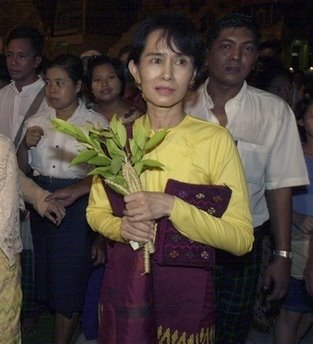


 Posts
Posts


