http://birdsongslaw.wordpress.com/2009/02/16/child-soldiers-and-their-refugee-problems/
Posted by: birdsongslaw | February 16, 2009 Child Soldiers and Their Refugee Problems
Birdsong has only lately come to learn that there have been about 300,000 child soldiers who have fought in wars and rebellions across the world since the 1990’s. Birdsong’s student, Shelya Nieves, has researched the problems of child soldiers and the problems they present in the context of refugee law. She has written an outstanding paper on the subject that she has allowed me to post on the blog. You will find this information very enlighting.
CHILD SOLDIERS:
What to do with a never-ending pool of soldiers?
Shelya Nieves
Introduction
About 300,000 children fought as combatants in armed conflicts in more than 30 countries during the late 1990s.[1] Government and non-government forces conscripted these children voluntarily or by force.[2] Children operated as spies, laborers, or sexual slaves, but an increase in their use specifically for combat purposes was particularly noticed by international organizations.[3] Oftentimes, the children were forced into service by threats, and sometimes drugged in order for them to carry out their combat duties.[4] Some children committed human rights abuses after being conscripted as fighters.[5]
In response to these occurrences, the international community responded in part by creating criminal measures designed to penalize and prevent the conscription of children in armed conflict. The Rome Statute made it a war crime to use children under the age of 15 in hostilities.[6] The United Nations added the Optional Protocol on the involvement of children in armed conflict (Child Soldiers Protocol) to the Convention on the Rights of the Child. The Child Soldiers Protocol created guidelines for voluntary conscription of children under the age of 18 and the means to denounce violators who conscript children younger than the age of 15.[7] More than 100 states have ratified the Child Soldiers Protocol since its inception.[8] As a result, several leaders of organizations that recruited children have been charged and convicted of war crimes.[9] In 2008, the U.S. enacted the Child Soldiers Accountability Act which corresponds with the standards laid out in the Rome Statute.[10]
Despite these advances in international law and a decrease in armed conflicts, children continue to be used in hostilities. Current estimates place the range from 200,000 to 300,000 in 17 armed conflicts worldwide.[11] This estimate remains relatively unchanged from that of more than a decade ago. The decrease in children used in hostilities suggests that the drop is more a result of armed conflicts ending then a decrease in recruitment or conscription.[12] The roles of children in hostilities has also shifted and shown increased involvement in terrorist activities.[13] This trend is one that should be of particular interest to the United States given the position terrorism has claimed in the discourse of national security.
In the refugee and asylum law context, the combination of the persecutor bar and terrorism related legislation has the potential to bar children from receiving protection.[14] Children are not always treated as victims of armed conflicts when applying for asylum. Instead, some nations do not recognize former child soldiers as victims who themselves may have suffered persecution.[15] In other circumstances, government authorities’ detained children solely on suspicions that they belonged to armed groups, or treated in an adversarial manners.[16]
The continued use of children as combatants suggests the pattern is unlikely to end despite multi-faceted efforts to criminalize recruiters, arrange peace settlements, and demobilize and reintegrate children into their communities. In addition, scores of other children exist as available replacements when other children demobilize or when armed conflicts reignite.[17] The question arises how will the U.S. address claims for asylum or withholding of removal from children who may have fought against the U.S. as minors.
Part I of this paper will examine how asylum and withholding of removal claims of former child soldiers has been addressed up to the present, and the application of the “persecutor bar”. Negusie v. Mukasey, under review by the Supreme Court, will also be examined and its implications to former child soldiers assessed. Part II will address terrorism related legislation, its impact on asylum and withholding of removal claims, and its potential affect on former child soldier claims. Part III discusses the need for duress and infancy to function as mitigating factors in claims by former child soldiers — regardless of whether the child volunteered or was forced into combat.
I. Protection Available to Former Child Soldiers & their Applications
A. Protection Available under Immigration Law
An applicant seeking asylum in the United States must establish that he or she is a refugee.[18] A refugee is a person outside his or her country of origin, or country of habitual residence if the person has no nationality.[19] The person must be unable or unwilling to return to the country, and is unable or unwilling to avail himself or herself of that country’s protection because of persecution or a well-founded fear of persecution.[20] The persecution must be based on one of five protected grounds: (1) race; (2) religion; (3) nationality; (4) membership in a particular social group; (5) or political opinion.[21] An applicant’s testimony alone can satisfy the burden of proof if the trier of fact deems the person’s testimony credible.[22]
A person who does not meet the definition of refugee or is denied asylum may nonetheless receive an alternate form of relief via withholding of removal.[23] Withholding of removal is granted when a person’s life or freedom would be threatened if returned to the destination country.[24] The person’s claim must be based on the applicant’s race, religion, nationality, membership in a particular social group, or political opinion.[25] As with an asylum claim, an applicant’s testimony alone can satisfy the burden of proof if it is credible.[26]
Withholding of removal may also be granted under CAT. However, the standard is different under CAT. A person seeking protection under CAT must establish that it is more probable than not that he or she will be tortured if returned to the proposed country of removal.[27] The immigration judge may choose to grant withholding of removal or deferral of removal.[28]
The applicant must meet the standards of torture as defined by CAT. The act defines torture as any act that causes severe pain or suffering.[29] The actor must inflict the pain with the intent to acquire information, punish, or intimidate the subject or a third person.[30] The actor must also act with the instigation, consent, or acquiescence of a public official or a person acting in official capacity[31]. The pain can be mental or physical.[32] Mental pain, however, must be prolonged.[33] The mental pain must also be the result of at least one of the following: (1) severe physical pain inflicted intentionally; (2) use or threatened use of mind-altering substances or procedures; (3) threats of imminent death; (4) or threats to do any of the aforementioned to another person.[34]
Provisions exist that bar relief outright. Asylum is not granted if the applicant was firmly resettled in a country prior to arriving to the U.S.[35] The remaining exclusions to relief apply to asylum and withholding of removal, but not CAT claims. A person is ineligible for relief if he or she has committed any one of the following: (1) ordered, incited, assisted or otherwise participated in persecution; (2) convicted of a serious crime while in the U.S.; (3) convicted of a serious nonpolitical crime outside the U.S.;
(4) or reasonable grounds exist to believe the person would be a danger to the security of the United States.[36] Persons ineligible for asylum or withholding of removal because of one of the mandatory bars may only receive deferral of removal under CAT.[37]
B. Grounds for Establishing Asylum or Withholding of Removal
As previously discussed, a grant of asylum or withholding of removal under title 8, section 1231 must be based on one of the five protected grounds. At first glance, former child soldiers do not fit into one of these categories neatly. A minor is not by itself a protected class. Nor is it always found that child soldiers fight because of the same reasons as adults.[38] Thus, it is not apparent if a child soldier suffered persecution because of political opinion simply because he or she was a member of a rebel group. However, some courts have successfully devised a classification that makes relief for former child soldiers more accessible.
In Lukwago v. Ashcroft, the Third Circuit held that a former child soldier could qualify as a member of a particular social group.[39] Lukwago, a Ugandan, was 15-year-when the Lord’s Resistance Army (LRA) forcibly conscripted him in 1997.[40] Lukwago was kidnapped by the LRA after the rebels attacked his home and killed his parents.[41] The LRA initially made him perform manual labor like collecting firewood and water.[42] He was trained to shoot a gun and made to fight against government soldiers about 10 times.[43] He also witnessed the LRA attack villages where rebels would injure civilians by cutting their lips and fingers.[44] Rebels threatened to shoot him for performing poorly in combat or if he tried to escape.[45]
The rebels’ threats proved to be true. Lukwago saw the LRA kill two children who had tried, but failed to escape.[46] At another point, Lukwago and a child he befriended were carrying guns and weapons they had stripped off of dead government soldiers.[47] Lukwago’s friend became tired.[48] LRA rebels beat the boy.[49] Then, they made Lukwago place a rock on the boy’s chest and sit on it until the boy stopped breathing from the pressure.[50] Lukwago escaped after being held by the LRA for about four months.[51]
The immigration judge (IJ) denied Lukwago’s asylum and withholding of removal claims.[52] However, the IJ granted withholding of removal under CAT based on evidence that the Ugandan government tortured former child soldiers.[53] Lukwago and the government appealed.[54]
The Board of Immigration Appeals (BIA) denied Lukwago protection under any provision. The BIA determined that Lukwago failed to establish he had suffered past persecution, or had a well-founded fear of future persecution by either the LRA or the Ugandan government.[55] It also reversed the IJ’s prior grant of protection under CAT. The BIA determined Lukwago failed to establish that he would suffer torture by the Ugandan government in light of an amnesty agreement it developed for former rebels, and he provided no evidence that the LRA tortured former rebels or captives who escaped from the group.[56]
On review, the Third Circuit determined Lukwago could indeed qualify for asylum.[57] As a former child soldier, Lukwago had a shared past experience with other former child soldiers of forced recruitment, torture and escape.[58] This shared experience equated to a common immutable characteristic that was sufficient to establish membership in a particular social group.[59] It stated the experience of abduction and being a former soldier was not a characteristic he could change, but one that became fundamental to his identity.”[60] Thus, the Court remanded Lukwago’s asylum and withholding of removal claims. As for the CAT claim, the Court determined that the BIA’s denial of protection was reasonable given the amnesty policy established by the Ugandan government.[61]
Under Lukwago, former child soldiers may receive asylum using the protected ground of membership in a particular social group. However, the definition of a “particular social group” varies as noted by the Third Circuit.[62] As such, an IJ may conclude that former child soldiers are not to a social group and deny asylum. The difference in definitional standards of what constitutes a particular social group leaves some former child soldiers with a higher burden and a greater probability that asylum will not be granted.[63]
C. The Persecutor Bar
Asylum or withholding of removal is denied under the persecutor bar if the alien ordered, incited, assisted, or otherwise participated in the persecution of another person on account of any of the protected classes. The persecution bar has particular implications for claims by former child soldiers.[64] Children used as combatants are just as likely as their adult counterparts to have committed acts that could be construed as the persecution of others. The circuits have differed on how to apply the bar in the context of former child soldiers.
Sackie requested withholding of removal under CAT after the government sought his deportation for his criminal convictions.[65] Sackie, a Liberian, was forcibly recruited in 1990 at the age of 14.[66] The group that took Sackie, the National Patriotic Front of Liberia (NPFL), gave him cocaine regularly and made him kill others under threat of death.[67] In 1990, the NPFL split and a faction fought against its former leader.[68] The faction, Independent National Patriotic Front of Liberia (INPFA), continued the practice of making Sackie consume drugs.[69] He was also branded with the group’s markings.[70] He saw others killed who did not comply with the rebels’ orders.[71] He killed women and children two or three times.[72]
Despite these occurrences, the initial immigration judge did not conclude that Sackie was barred for assisting in the persecution of others and granted him asylum.[73] The BIA disagreed with the IJ. It concluded that Sackie did not meet his burden of establishing past persecution or a well-founded fear of future persecution.[74] The BIA also concluded that Sackie’s convictions required the IJ to deny asylum.[75] The IJ’s grant of asylum was vacated, and the BIA remanded for relief to be evaluated under CAT.[76]
A different IJ reviewed Sackie’s CAT claim and denied protection.[77] The BIA affirmed the decision.[78] On appeal, the district court affirmed the denial of asylum, but concluded that the BIA and the second IJ erred in denying Sackie relief under CAT.[79] The district court concluded that sufficient evidence in the record existed to show that Sackie had suffered torture as a former child soldier in the form of prolonged mental suffering.[80] Sackie’s markings identifying him as a former member of INPFL also increased the probability that he would be tortured if returned to Liberia.[81] Thus, the district court granted Sackie withholding of removal under CAT.[82]
Lukwago and Sackie demonstrate that former child soldiers are capable of receiving protection despite past conduct that might be considered as persecution of others. Other circuits have been less favorable in assessing child soldiers conduct when granting relief.
In Bah v. Ashcroft, the Fifth Circuit held that the subjective motivations of an applicant who sought asylum were irrelevant when assessing whether the person’s actions amounted to the persecution of others.[83] Bah lived in Sierra Leone with his father and sister.[84] The Revolutionary United Front (RUF) attacked his town and made Bah and his family march 10 miles.[85] The RUF then set his father on fire, and raped and killed his sister.[86] Bah was kept alive.[87] Bah joined the group after a RUF member told him the group would kill him otherwise.[88]
Like Lukwago, Bah was given cocaine by the rebel leaders.[89] Bah shot a prisoner and cut off the limbs of civilians when ordered to do so.[90] He tried to escape several times but was unsuccessful. Government forces caught him during his first escape attempt, but he was subsequently freed by RUF forces that fought the government troops.[91] Bah escaped a second time but was captured by Nigerian peacekeepers who tortured him during his captivity[92] Again, RUF forces overtook those holding Bah.[93] He succeeded in his third escape fleeing to Guinea and eventually to the U.S.[94]
The IJ determined that Bah’s actions made him ineligible for asylum and withholding of removal because his conduct amounted to participation in the persecution of others.[95] Bah also could not receive protection under CAT because he failed to establish that he would more likely than not be tortured if removed to Sierra Leone.[96] The BIA affirmed the decision.[97]
The Fifth Circuit supported the BIA’s and IJ’s assessments. The court rejected Bah’s argument that he did not share RUF’s intent in persecuting others, but was forced to join the group against his will.[98] The court reasoned that the language of the statute implied a person’s motivations were irrelevant.[99] An objective standard was to be used when assessing whether the alien’s conduct resulted in the persecution of others.[100]
The Fifth Circuit also upheld the denial of protection under CAT because Bah failed to meet his burden. Evidence of disarmament, demobilization and reintegration of RUF members in Sierra Leone existed.[101] The court believed it enough to counter Bah’s evidence that RUF members were maimed and murdered, and that Bah’s own desertion was published in a newspaper advertising a reward for his capture.[102] Thus, there was insufficient evidence to determine that Bah would more likely than not be tortured if removed to Sierra Leone.[103]
The divergent approaches taken by the circuits in addressing claims highlights the dilemma these applicants face. The result in Bah indicates that a disparity between circuits will develop given the already existing different standards for membership in a social group and duress. Applicant’s ability to establish their case will be eroded since a claim’s success will be partly dependent upon which circuit a claim is filed.
D. Possible Duress Exception to Persecutor Bar
A possibility exists that former child soldiers may have their actions construed through the filter of duress. Negusie v. Mukasey, under Supreme Court review, questions whether asylum or withholding of removal can be granted to a person forced against their will and under threat of death or torture to engage in persecution.[104] The determination of this case would no doubt have a direct impact on the ability of former child soldiers to receive protection.
Negusie v. Keisler revolves around the decades’ long conflict between Eritrea and Ethiopia. The Eritrean government was known to commit abuses against its own people during the conflicts.[105] The Eritrean government conscripted minors.[106] Resisters or deserters of national service were imprisoned, sometimes along with family members, and tortured.[107] The Eritrean government also banned all but four religions that were government approved.[108] The government was also suspected of particularly disfavoring Protestants.[109]
Negusie lived in Eritrea in 1994.[110] The Eritrean government forcibly conscripted him in 1994 via an arrest.[111] Negusie performed hard labor and received military training for about a month.[112] In 1998, Negusie was conscripted for the second time into the Eritrean army after the country renewed fighting with Ethiopia.[113]
Negusie resisted orders deploying him to the front.[114] He was subsequently imprisoned for six months in solitary confinement.[115] After his release from solitary confinement, prison officials made Negusie perform hard labor.[116] He converted to Protestantism while imprisoned.[117] Negusie alleges prison personnel beat him and threatened him with death if he practiced his religion.[118]
Negusie eventually became a guard at the same facility.[119] Despite this change from prisoner to guard, he was not allowed to leave the building.[120] He complied with orders not to give water to prisoners and to prevent them from taking showers.[121] He also saw prisoners tortured by other guards who applied palm oil to the prisoners and left them exposed to the sun.[122] Negusie managed to escape after having spent two years as a guard at the facility.[123]
The IJ denied Negusie’s asylum and withholding of removal claims because of he was ineligible under the persecution bar.[124] The IJ’s decision was based on Negusie’s action of keeping prisoners imprisoned when he knew that persecution occurred in the facility.[125] Thus, the IJ used the same objective standard enunciated by the Fifth Circuit in Bah. The IJ did grant deferral of removal under CAT for Negusie.[126] The IJ determined that as a deserter Negusie would be more likely than not be tortured if removed to Eritrea.[127] Negusie appealed to the BIA.[128]
The BIA dismissed Negusie’s appeal.[129] The BIA reasserted that an objective standard was to be used when examining whether an alien assisted in persecution.
It stated that “[t]he fact that [Negusie] was compelled to participate as a prison guard, and may not have actively tortured or mistreated anyone, is immaterial. . . . [A]n alien’s motivation and intent are irrelevant to the issue of whether he ‘assisted’ in persecution … [I]t is the objective effect of an alien’s actions which is controlling.”[130] The BIA affirmed the IJ’s CAT decision for deferral of removal. Negusie appealed.[131] The Fifth Circuit reiterated its objective analysis enunciated in Bah that whether the applicant shared the persecutor’s intentions was irrelevant.[132]
The Supreme Court granted certiorari.[133] The government’s main argument focuses on the plain-language of the persecutor bar.[134] Congress wrote the statute without words referring to motive, intent, or acquiescence.[135] Rather, the statute is comprised of verbs indicating that the mere completion of the act establishes persecution.[136]
Such a standard would be harsh – particularly if applied to children. A child is simply not as capable of resisting an adult– especially if that adult is armed or has threatened the child. Negusie does not differ greatly in facts from what former child soldiers who have received protection experienced during their time as soldiers. Excluding duress as a defense or as a mitigating factor for the IJ to consider would effectively erode the advancements made by former child soldiers who have received relief.
Such a rigid position regarding the persecution bar is unnecessary. The Supreme Court should follow the lead of other nations that recognize duress as a defense in immigration law.[137] Additionally, it would run counter to decisions by the Department of Homeland Security that allows for a duress defense when an alien is charged with aiding a terrorist organization with material support.[138] The Supreme Court should implement a reading of the persecution bar that assesses whether the person acted under coercion or duress.
II. Terrorism-Related Legislation and Its Possible Affect on Child Soldiers
Terrorism has taken center stage in the discourse of national security and in the international realm. Children have encountered first-hand the effect of terrorism related legislation. Authorities have arrested minors suspected of terrorist involvement over seemingly minor offenses.[139] Some detentions were triggered by stone throwing or for participation in demonstrations.[140] In some instances, children were held in custody for extended periods and reportedly beaten.[141]
The United States has already encountered this conundrum with some its detainees held in Guantanamo Bay. Three prisoners in Guantanamo were teenagers when detained in Afghanistan.[142] One of these former teenagers, Mohammed Jawad, claims he was drugged to make him sleepy and disorientated the day he allegedly threw a grenade that injured two U.S. soldiers.[143] This allegation makes his categorization as volunteer in an armed group less believable. Jawad’s situation illustrates the difficulty in labeling a child’s decision to join an armed as voluntary.
Even for those children who are not physically coerced by force or drugs to engage in combat, the manner in which modern armed conflicts occurs casts doubt on children labeled as volunteers in any armed group. Wars once waged away from civilians have transferred to populated or urban areas.[144] In this scenario, war undoubtedly has a direct impact on a child’s life influencing their perspectives on armed groups or government forces.[145] Children may not volunteer to further an armed group’s goals, but feel it to be a necessity for protection, food, or as a mechanism to avenge abuses committed against them and their families.[146]
A. Terrorism-Related Legislation
Former child soldiers also may be barred from asylum or withholding of removal if they are deemed a danger to the country.[147] This bar was not applied to Lukwago, Sackie or Bah. However, none of these men volunteered in the rebel groups or fought against the United States.
Anti-terrorism legislation enacted made persons ineligible for asylum or withholding of removal if they fell within the definition of terrorist activities.[148] Most noticeably, terrorism enacted legislation has been criticized for being overly broad and causing the denial of asylum or withholding of removal claims on minor issues.[149] These laws are likely to impinge asylum claims from former child soldiers considering the type of activities the armed groups carried out while using children.[150]
Terrorist activities have been defined in the statutes beyond generally recognized methods such as hijacking, kidnapping, or assassinations.[151] The definition is broadened for the modern context of terrorist groups by including the use of biological, chemical, or nuclear materials.[152] Some of the other provisions include activities that are not usually associated with terrorism. The use of explosives, firearms, or other dangerous weapons is declared a terrorist activity when done with the intent to endanger people or to cause substantial damage to property.[153] Damage to property or possession of a weapon are broad concepts that can be applied to large amounts of people.[154]
Another anti-terrorism related measure that is criticized for its effect on immigration law is the material support bar. Under the material support bar, an alien is ineligible for asylum or withholding of removal if he or she provided material support to an individual or group which the alien knew or should have known was a terrorist.[155] Material support has been provided if a person offers a “safe house, transportation, communications, funds, transfer of funds or other material financial benefit, false documentation or identification, weapons (including chemical, biological, or radiological weapons), explosives, or training.”[156] The concerns over the material support bar is that it can be construed and enforced against those who provided de minimis support in the form of food or shelter.[157]
Aliens facing the material support have but one defense—that the person did not know or should not have reasonably known that the organization was a terrorist group.[158] The person must establish this burden with clear and convincing evidence.[159] A person may seek a waiver but the process requires the Attorney General to first consult with the Secretaries of State and Homeland Security, which can be burdensome process.[160]
B. Current Application of Terrorism Legislation
In Matter of S- K-, the applicant was a native of Burma.[161] The Burmese military has been suspected of conscripting children under the age of 15 and using them in combat against militant ethnic groups for many years.[162] The applicant in Matter of S-K- was an ethnic Chin and a Christian.[163] Both statuses made her a minority.[164] Burmese authorities detained her brother and her fiancé.[165] The fiancé was eventually killed by the Burmese military.[166]
The applicant became a supporter of the Chin National Front (CNF), which sought independence for ethnic Chins. According to the applicant, the Burmese government was known to torture CNF members and sympathizers.[167] The applicant worked in Singapore and gave $1000 Singapore dollars in one year to CNF.[168] She also tried to supply the CNF with binoculars and a camera. A CNF member told the applicant that the Burmese government knew of her monetary contributions to CNF, and warned her not to return to Burma when her Singapore visa expired.[169] She instead fled to the U.S.[170]
The IJ determined that the applicant had established a well-founded fear of persecution if returned to Burma.[171] However, her asylum claim was barred because she knew or had reason to know that CNF used firearms and explosives, and thus endangered the safety of others or helped CNF acquire the ability to cause substantial property damage.[172]
On appeal, the BIA rejected the applicant’s argument that the IJ had erred in concluding that the CNF was a terrorist organization.[173] Once the government raises the applicability of the material support bar, the burden shifts to the applicant to establish by preponderance of the evidence that the bar does not apply.[174] Thus, the BIA specifically noted the broad wording and implications of intended by the legislation.
[T]he fact that Congress included exceptions elsewhere in the Act for serious nonpolitical offenses and aliens who have persecuted others, even where persecuted themselves, and that it has not done so in section 212(a)(3)(B), indicates that the omission of an exception for justifiable force was intentional. . . . [W]e find that Congress intentionally drafted the terrorist bars to relief very broadly, to include even those people described as “freedom fighters,” and it did not intend to give us discretion to create exceptions for members of organizations to which our Government might be sympathetic.[175]
The BIA also rejected the applicant’s argument that her financial support was not material.[176] Her contribution was sufficient to help CNF acquire materials and supplies.[177] The BIA affirmed the denial of asylum and withholding of removal.[178]
Another case involving the material support bar is Singh-Kaur v. Ashcroft.[179] Some of criticisms of the material support and the concern over the application to seemingly de minimis support were raised in Singh-Kaur.
Singh entered the United States in 1989.[180] He filed for asylum upon his arrival.[181] However, no immigration proceeding occurred for almost four years, and then government sought Singh’s removal.[182] Singh applied for an adjustment of status based on his skill worker visa.[183]
Singh disclosed his membership in the Babbar Khalsa (BK) group, which he described as an organization promoting and protecting the Sikh religion.[184] He also had belonged to the Sant Jarnail Sing Bhindrawala (SJ), which Singh described an organization that fought for Sikh religious and political goals.[185] BK was the militant arm of SJ.[186] Singh demonstrated with both groups.[187] He aided BK further after a bombing occurred at a Sikh holy site.[188] Singh helped transport weapons through his village by providing shelter to those who were transporting the weapons.[189]
He argued to the IJ that he never supported nor was involved in violent acts against the Indian government.[190] Singh also disclosed in his asylum application that he was on an Indian military and government watch list.[191] However, Singh argued that the Indian police believed he opposed the government solely because he was a Sikh.[192] The IJ granted his asylum claim.[193]
The government appealed, and the BIA vacated the IJ’s grant of asylum and ordered Singh removed from the country.[194] The BIA determined that Singh was ineligible for adjustment of status because of the material support bar.[195] The BIA stated that Singh knew BK and SJ fought against the Indian government.[196] This knowledge along with his support barred him from the adjustment of status.[197]
On appeal, the Third Circuit affirmed the BIA’s decisions. It stated that setting up tents and providing food fell within the definition of material support and the objective of the legislation.[198] Singh’s belief that his involvement was minimal was irrelevant under the material support bar.[199]
C. Material Support Bar and Its Implications for Former Child Soldiers
It appears that the “material support” provisions will continue to be strictly read without further input from Congress or intervention from the Attorney General. It is highly unlikely former child soldiers would qualify for asylum or withholding of removal if challenged with the material support bar. The statue’s strict interpretations provide no wiggle room for a subjective analysis of duress or an actor’s age. Thus, the trier of fact will not consider these factors when determining if the person’s conduct constituted material support.
A possible opportunity may exist in that children of a certain age may not have the required mental ability to know or reasonably know if they are providing material support to a terrorist organization. The child may not even understand the concept or definition of a terrorist group. Here, a former child soldier may be able to assert a defense. However, the defense would also be dependent upon the child not being classified as a terrorist based on his or her conduct.
Again the broad wording of the statute is felt. Any group with a weapon for non-monetary purposes can be labeled a terrorist group under the language of the statute.[200] Armed street gangs could meet this definition. An organization’s motives for resistance to a government or the inability of political change also become irrelevant under the material support bar.[201] The government undoubtedly has an interest in preventing former enemies from entering the country. However, this interest should become less rigid when the threat comes in the form of a child.
III. Why “Duress” and “Infancy” are Needed as Defenses or Mitigating Factors
A. Mental & Physical Vulnerability
Children are targeted precisely because their minds are moldable.[202] Adults who recruited children in the 1990s did so on the belief that children did not question orders, were more obedient and easier to manipulate than adults.[203] Unstable environments create a situation where children are at a higher risk of “joining” an armed group. Children who are internally displaced, living in refugee camps, in poverty, or lack adult protection are particularly vulnerable.[204] Armed groups that can supply meals and shelter become an attractive option to a hungry child.
Regions that suffer continuous armed conflict also create strains on society that lead to the recruitment of children in hostilities.[205] This scenario played out in Afghanistan in the 1990s during which it was estimated that child participation as combatants rose from 30 percent to 45 percent.[206] A decrease in the age of recruitment as a conflict continues is also a noted trend.[207] Civil wars in certain regions have lasted decades exposing generation after generations of children to violence. These children may join groups not to further the armed groups’ goals, but in response to the negative experiences they or their families encountered with the government or other armed groups.[208]
Children face cultural, economic, political and societal pressures that they cannot assess on the same level as an adult.[209] Ideology can be a particularly strong influence in a child’s decision to join an armed group. Children in early adolescence undergo mental development that includes the formation of personal identity and their roles within society.[210] Armed groups have used this critical time in a child’s mental development to espouse political and religious beliefs that encourage children to join armed groups voluntarily. For example, the Machel Report stated that ideological indoctrination resulted in the large number of children in the Rwandan conflict and the use of minors in suicide bombings in Sri Lanka and Lebanon in the 1990s.[211]
The practice of using minors as suicide bombers has not disappeared. Instead, it appears to be an increasingly favored tactic used by terrorist groups.[212] Children appear less suspicious than adults making them a more favorable choice for suicide bombings.[213] Unfortunately, education has been a conduit through which children have been encouraged to commit suicide bombings. A lack of an educational system is a recognized risk that radical groups exploit.[214] Armed groups are known to use madrasas (Islamic religious schools) and summer camps to recruit children.[215] Some schools encouraged the children to “volunteer” in militant groups and while other schools emphasized martyrdom.[216] Underage suicide bombers have been used by the Taliban in Afghanistan and by militants in Pakistan.[217] Various militant groups in Iraq have used children, and there are reports that a terrorist cell comprised exclusively of children existed or was being formed in late 2008.[218]
Mohammed Jawad, one of the Guantanamo detainees who was a teenager when caught, was exposed to many of elements characterized as risk factors. His father died when he was young during the civil war in Afghanistan against the Soviet Union.[219] His family moved to a refugee camp in Pakistan.[220] His stepfather kicked him out at the age of 13.[221] About a year later, Jawad met a man at a mosque who offered him employment by clearing landmines in Afghanistan.[222] According to Jawad’s version, he did not join an Islamic militant group to fight against the U.S. troops in Afghanistan. Rather, adults lulled him to the camps with offers of employment. Such an offer to a child can easily equate to food and shelter.
The circumstances under which children “join” an armed group differ greatly than that of adults. Clearly, children are mostly not seeking to overthrow the government. Instead, their decisions stem from a combination of factors that are reactions to events in their lives. Some may label the child’s decision as voluntary. However, this is somewhat of a hasty conclusion. Children and pre-teens are not as capable as adults of analyzing the consequences of fighting in an armed conflict.[223] The facts and motives behind the recruitment of children illustrate why their age and circumstance regarding conscription should be a factor in any claim for protection.
B. Applicable Criminal and Policy Principles
Principles regarding the criminal responsibility of children can be a basis on which to advocate for duress and infancy in the context of child soldiers.[224] Children should not per se receive automatic relief because of their age. However, international standards suggest that children should not be held criminally responsible when at the time of the offense they were unable to understand the consequences.[225] The setting of an international standard for child participation in hostilities at the age 15 suggests that children below that age are incapable of making such a decision.[226] It seems counter-intuitive that recruiting children under the age of 15 is considered a war crime, yet the very child would be denied protection for an act they could not assent to.[227] For instance, children may not have the requisite mens rea of a war crime if they were forced to consume drugs prior to any attacks.[228] Therefore, a child’s age and manner of recruitment should factor into the analysis and remain an individualized process.[229] Otherwise, children would be barred from asylum or withholding of removal because of conduct for which they had no ultimate understanding of its consequences.
Age may simply not be a pragmatic standard to use when determining whether to grant asylum or withholding of removal for former “voluntary” child soldiers. Nor should the child automatically be denied relief because he or she meets the age of criminal responsibility in the U.S.[230] Any set standard or analysis for protection should consider that children mature at different times in different cultures.[231] Some cultures do not recognize maturity on the basis of age but instead focus on certain skill sets, financial independence or gender.[232]
Another conflict in setting a concrete age standard would be that it ignores the reality of conflict. Many children participate in armed groups as young children or teenagers but reach the age of 18 as members of the armed group.[233] If a certain age were set for an infancy defense or as mitigating factor, these former children would be exempt from protection simply based on the timing of when they escaped or the conflict ended. Again, such a rigid standard is unnecessary.
Conclusion
About 200,000 to 300,000 children under the age of 18 are believed to be participating in armed conflicts throughout the world in 2008.[234] Despite the decrease of use of child soldiers from a decade ago, these figures are partially due to a drop in armed conflicts rather than avoidance of using children as soldiers.[235] The changing nature of armed conflict throughout the world suggests that immigration judges will encounter with greater frequency claims colliding with the persecutor or material support bar.
Without adequate development in demobilization and reintegration efforts for former child soldiers, these former combatants will no doubt spread outside their countries and may end up on the shores of the U.S. [236] Even more troublesome is evidence that suggests former child soldiers in past decades have re-engaged in combat after demobilization or upon returning to their communities.[237] Immigration law must assess how to treat these applicants who may have been indoctrinated into fighting for an armed group as a child, but have since become repentant. Children who participated with terrorist or armed groups may face harm if returned to their country of origin.[238] For instance, adults may believe the child aided the U.S. and seek retribution believing the child is a U.S. spy.[239]
Solutions balancing the interest of the applicant and those of the nation must be reached. For those applicants who specifically fought against the U.S., asylum may still be granted via a safe third country.[240] Such a solution seems feasible and advancing within the international community. Portugal offered to resettle some of the Guantanamo detainees and encouraged other European Union nations to do the same.[241]
Duress and infancy principles provide the best means for assessing a child’s circumstances and the pressures he or she faced as a child soldier. Children encounter greater emotional, physical and mental pressures than adults during times of war.[242] Their protection claims should address this critical and distinguishing factor. Duress and infancy principles are measures already familiar within the legal community. Standards can be borrowed from criminal law making it easier and quicker to apply then relying upon a Congressional mandate. Duress and infancy provide the most efficient mechanism to provide former child soldiers a truly equitable evaluation of their claims for protection.
--------------------------------------------------------------------------------
[1] Coalition to Stop the Use of Child Soldiers, Child Soldiers Global Report 2001, at 10 (2001) http://www.child-soldiers.org/library/global-reports (follow “Child Soldiers Global Report 2001” hyperlink; then follow “Child Soldiers Global Report 2001” PDF hyperlink) [hereinafter Global Report 2001]. Six non-governmental organizations, including Amnesty International and Human Rights Watch, founded the Coalition to Stop the Use of Child Soldiers in 1998 to end the use of persons under the age of 18 in armed conflict.
[2] Report of the Expert of the Secretary-General, Graça Machel, Impact of Armed Conflict on Children, at 16, delivered to the General Assembly, U.N. Doc. A/51/306 (Aug. 26, 1996) [hereinafter Machel Report].
[3] Id. at 18. See also Global Report 2001, supra note 1, at 10.
[4] Machel Report, supra note 2, at 19. See also Global Report 2001, supra note 1, at 10.
[5] Global Report 2001, supra note 1, at 15.
[6] Rome Statute of the International Criminal Court, art. 8. ¶ 2(b)(xxvi), U.N. Doc. A/CONF. 183/9* (July 17, 1998) [hereinafter Rome Statute].
[7] Optional Protocol to the Convention on the Rights of the Child on the involvement of children in armed conflict, G.A. Res. 54/263, U.N. Doc. A/RES/54/263 (Feb. 12, 2002) [hereinafter Child Soldiers Protocol].
[8] Coalition to Stop the Use of Children, Child Soldiers Global Report 2008, at 2 (2008), http://www.child-soldiers.org/library/global-reports (follow “Child Soldiers Global Report 2008” hyperlink; then follow “COMPLETE REPORT (PDF) hyperlink) [hereinafter Global Report 2008].
[9] Id. at 22 (citing charges by the International Criminal Court against Ugandan and Congolese rebel leaders, and convictions by the Special Court for Sierra Leone against leaders of armed groups and Charles Taylor, the former Liberian president).
[10] 18 U.S.C.S. § 2442 (LexisNexis 2006) (effective Oct. 3, 2008) (criminalizing the recruitment of children under the age 15, barring entry into the U.S., and making the crime a deportable offense).
[11] Id. ¶ 1.
[12] See Global Report 2008, supra note 8, at 12.
[13] Id. at 22 (using children as suicide bombers in Afghanistan, Iraq, Occupied Palestinian Territory, and Pakistan); See also Report of the Special Representative of the Secretary-General for Children and Armed Conflict, at 8-9, delivered to the Human Rights Council and the General Assembly, U.N. Doc. A/63/227 (Aug. 6, 2008) [hereinafter Children and Armed Conflict Report] (describing anti-terrorism measures that resulted in arrests of children, extended detention and physical abuse).
[14] Benjamin Ruesch, Comment, Open the Golden Door: Practical Solutions for Child-Soldiers Seeking Asylum in the United States, 29 U. La Verne L. Rev. 184, 198-204, (2008).
[15] Global Report 2008, supra note 8, at 21.
[16] Id. at 18 (citing the Philippines for detaining children beyond government time limits and Burma for charging and imprisoning children for desertion).
[17] Cris R. Revaz & Jonathan Todres, The Optional Protocols to the Convention on the Rights of the Child and the Impact of U.S. Ratification, in The U.N. Convention on the Rights of the Child: An Analysis of Treaty Provisions and Implications of U.S. Ratification, 293 -309, at 303, Jonathon Todres, Mark E. Wojcik, & Cris R. Revaz eds., 2006).
[18] 8 U.S.C. § 1158(b)(1)(A) (2006).
[19] 8 U.S.C. § 1101(A)(42)(A) (2006).
[20] Id.
[21] Id.
[22] 8 U.S.C. § 1158 (b)(1)(B)(i)-(iii).
[23] 8 U.S.C. § 1231 (b)(3) (2006).
[24] Id. § 1231 (b)(3)(A).
[25] Id.
[26] Id. § 1231(b)(3)(C).
[27] 8 C.F.R. § 208.16(c)(4) (2007).
[28] Id.
[29] 8 C.F.R. § 208.18 (a)(1) (2007).
[30] Id.
[31] Id.
[32] Id.
[33] Id. § 208.18 (a)(4).
[34] Id. § 208.18 (a)(4)(i)-(iv).
[35] 8 U.S.C. § 1158(b)(2)(vi).
[36] Id. § 1158(b)(2)(A). See § 1231(b)(3); see also 8 C.F.R. § 208.16(d)(2).
[37] 8 C.F.R. § 208.17 (2007).
[38] Machel Report, supra note 2, at 17 (describing reasons child soldiers “join” armed groups including family poverty, hunger, or safety concerns).
[39] Lukwago v. Ashcroft, 329 F.3d 157, 178 (3d Cir. 2003).
[40] Id.
[41] Id.
[42] Id.
[43] Id.
[44] Id.
[45] Id.
[46] Id.
[47] Id.
[48] Id.
[49] Id.
[50] Id.
[51] Id.
[52] Id. at 165 (deciding Lukwago’s testimony was not credible because of inconsistencies in his testimony and mannerisms).
[53] Id.
[54] Id.
[55] Id. at 166.
[56] Id.
[57] Id. at 178.
[58] Id.
[59] Id. (citing Matter of Acosta, 19 I & N Dec. 211, 233 (1985)).
[60] Id. at 178.
[61] Id. at 183.
[62] Id. at170 (citing the Ninth Circuit’s use of “a voluntary associational relationship” under Sanchez-Trujillo v. INS, 801 F.2d 1571, 1576 (9th Cir. 1986), and the Second Circuit’s definition of individuals who possess a fundamental characteristic that distinguishes them in the eyes of the persecutor under Gomez v. INS, 947 F.2d 660, 664 (2d Cir. 1991)).
[63] Ruesch, supra note 14, at 197-98 (advocating Third Circuit standard to protect children from being denied relief under Second or Ninth Circuit standards).
[64] 8 U.S.C. § 1158(b)(2)(A)(i).
[65] Sackie v. Ashcroft, 270 F. Supp. 2d 596, 597 (E.D. Penn. 2003). The government argued for Sackie’s deportation based on his convictions of providing false information to police, receiving stolen property, and access device fraud stating were crimes of moral turpitude and the crimes amounted to aggravated felony.
[66] Id. at 601.
[67] Id. at 597-98.
[68] Id. at 598
[69] Id.
[70] Id. at 601.
[71] Id.
[72] Id.
[73] Id. at 600.
[74] Id.
[75] Id.
[76] Id. at 600-01.
[77] Id.
[78] Id. at 601.
[79] Id.
[80] Id. at 601-02.
[81] Id. at 602.
[82] Id. at 602-03.
[83] Bah v. Ashcroft, 341 F.3d 348, 351 (5th Cir. 2003) (per curiam).
[84] Id. at 349.
[85] Id.
[86] Id.
[87] Id.
[88] Id.
[89] Id. at,350.
[90] Id.
[91] Id.
[92] Id.
[93] Id
[94] Id.
[95] Id.
[96] Id.
[97] Id.
[98] Id. at 351.
[99] Id.
[100] Id.
[101] Id. at 352.
[102] Id.
[103] Id.
[104] Negusie v. Keisler, 2007 WL 3022792, at *6 (Oct. 15, 2007) (Pet’r’s Br.), cert. granted, 128 S. Ct.1695 (2007).
[105] Id.
[106] Id.
[107] Id.
[108] Id. at *7
[109] Id.
[110] Id.
[111] Id.
[112] Id.
[113] Id.
[114] Id.
[115] Id. at *7-*8.
[116] Id.
[117] Id. at *8.
[118] Id.
[119] Id.
[120] Id.
[121] Id.
[122] Id.
[123] Id.
[124] Id. at *9.
[125] Id.
[126] Id.
[127] Id.
[128] Id.
[129] Id. at *9.
[130] Id. at *9-*10 (citing the unreported BIA opinion).
[131] Id. at *10.
[132] Id. (citing Negusie v. Gonzales, 231 Fed. App’x 325, 326 (5th Cir. 2007)).
[133] Negusie v. Mukasey, 128 S. Ct. 1695 (2008).
[134] Negusie v. Mukasey, 2008 WL 3851621, at *11-*13 (Aug. 15, 2008) (Resp’t’s Br.).
[135] Id.
[136] Id.
[137] Mary-Hunter Morris, Note, Babies and Bathwater: Seeking an Appropriate Standard of Review for Asylum Applications of Former Child Soldiers, 21 Harv. Hum. Rts. J. 281, 293 (Summer 2008) (citing Australia, Canada, the United Kingdom and the European Union as states that explicitly or impliedly allow a duress defense).
[138] Id. at 294-95 (citing Exercise of Authority under Sec. 212(d)(3)(B)(i) of the Immigration and Nationality Act, 72 Fed. Reg. 9958 (Mar. 6, 2007)).
[139] Children and Armed Conflict Report, supra note 13, at 9.
[140] Id.
[141] Id.
[142] Amnesty International, Omar Khadr is ‘salvageable’, military commissions are not, at 1(June 5, 2008) http://www.amnesty.org/en/library/info/AMR51/055/2008/en. See also Amnesty International, From ill-treatment to unfair trial: The case of Mohammed Jawad, child ‘enemy combatant’, at 55-56 (Aug. 13, 2008) http://www.amnesty.org/en/library/info/AMR51/091/2008/en [hereinafter Jawad].
[143] Jawad, supra note 138, at 55-56.
[144] Wendy Perlmutter, An Application of Refugee Law to Child Soldiers, 6 Geo. Pub. Pol’y Rev. 137, 140 (Spring 2001).
[145] Id.
[146] Id. at 145-46.
[147] 8 U.S.C. § 1158(b)(2)(A); see also 8 U.S.C. § 1231(b)(3).
[148] § 1158 (b)(2)(A)(v)(adding as a mandatory bar aliens who meet the statutory definition of terrorist or terrorist-related activities). See also 8 U.S.C. § 1231(b)(3) (defining persons engaged in terrorist activities as a danger to the country).
[149] Morris, supra note 137, 289. See also Ruesch, supra note 14, 201-02.
[150] Morris, supra note 137, 287-291.
[151] 8 U.S.C. § 1182 (a)(3)(B)(iii) (2007).
[152] Id. § 1182 (a)(3)(B)(iii)(a).
[153] Id. § 1182 (a)(3)(B)(iii)(b).
[154] See Matter of S- K-, 23 I & N Dec. 936, 947 (2006) (Osuna, acting vice chairman, concurring).
[155] § 1182 (a)(3)(B)(iv)(VI)(aa)-(dd).
[156] § 1182(a)(3)(B)(iv)(VI) (aa)-(dd).
[157] Morris, supra note 137, at 289.
[158] § 1182(a)(3)(B)(iv)(VI)(dd).
[159] Id.
[160] Morris, supra note 137, at 290.
[161] Matter of S- K-, 23 I & N Dec. at 936.
[162] Global Report 2008, at 15 (stating that Burmese military was believed to contain thousands of children and use them in counter-insurgency operations).
[163] Id.
[164] Id. at 937.
[165] Id.
[166] Id.
[167] Id.
[168] Id.
[169] Id.
[170] Id.
[171] Id. at 938.
[172] Id.
[173] Id. at 941-42.
[174] Id. at 939.
[175] Id. at 941.
[176] Id. at 942.
[177] Id. at 945-46. The court also stated in footnote 13 that the applicant’s donation was almost three times the annual income in Burma.
[178] Id.
[179] 385 F.3d 293 (3d. 2004).
[180] Id. at 294.
[181] Id.
[182] Id. at 295.
[183] Id.
[184] Id. at 294.
[185] Id.
[186] Id. at 295.
[187] Id. at 294.
[188] Id .at 294-95.
[189] Id. at 295.
[190] Id. at 294.
[191] Id.
[192] Id. at 295.
[193] Id. at 296.
[194] Id.
[195] Id.
[196] Id.
[197] Id.
[198] Id. at 299.
[199] Id. at 300.
[200] Matter of S- K-, 23 I & N Dec. at 948 (Osuna, acting vice chairman, concurring).
[201] Id. (explaining groups that share U.S. goals would fall under the definition of a terrorist organization despite the government making no similar declaration).
[202] Children and Armed Conflict Report, supra note 13, at 11.
[203] Machel Report, supra note 2, at 13.
[204] Global Report 2008, supra note 8, at 26.
[205] Machel Report, supra note 2, at 13.
[206] Id.
[207] Id.
[208] Perlmutter, supra note 144, at 145-46.
[209] Machel Report, supra note 2, at 17 (stating that voluntary military service is influenced by factors such as a family’s need for money or abuse suffered by an ethnic group).
[210] Id.
[211] Id.
[212] Children and Armed Conflict Report, supra note 13, at 9.
[213] Id. See also Martin Chulov, Raid Uncovers al-Qaida Network of Child Suicide Bombers in Iraq, The guardian, Dec. 4, 2008, at 30. A 10-year-old boy followed a sheikh for three days posing as a flower seller before committing the suicide bombing.
[214] Global Report 2008, supra note 8, at 26-27.
[215] Id. at 26 (mentioning Afghanistan, Bangladesh and Pakistan).
[216] Id. (discussing schools in Thailand that encourage minors to volunteer). See also Machel Report, supra note 2, at 17 (blaming ideology for underage suicide bombers Sri Lanka and Lebanon).
[217] Global Report 2008, supra note 8, at 26.
[218] Chulov, supra note 213 (detailing how an Al-Qaeda leader was found dead with a computer memory stick containing training and recruitment methods for children).
[219] Jawad, supra note 138, at 55-56.
[220] Id. at 55.
[221] Id.
[222] Id. at 55-56.
[223] Nienke Grossman, Rehabilitation or Revenge: Prosecuting Child Soldiers for Human Rights Violations, 38 Geo. J. Int’l L. 323, 341. (Winter 2007) (arguing that because children lack the ability to consent to combat under the age of 15 , it is implied that they lack the mental capacity to make the decision).
[224] Id. at 339-343.
[225] Id. at 340-42. (arguing that the Rome Statute and Child Soldiers Protocol children from ages 15 to 18 should also be protected from criminal responsibility).
[226] Id. at 341-42.
[227] Matthew Happold, Excluding Children from Refugee Status: Child Soldiers and Article 1F of the Refugee Convention, 17 Am. U. Int’l L. Rev. 1131, 1171-72 (2002).
[228] Grossman, supra note 223, at 344-345.
[229] Ruesch, supra note 14, at 191.
[230] Happold, supra note 227, at 1155-56.
[231] Angela Veale, The Criminal Responsibility of Former Child Soldiers: Contributions from Psychology, in International Criminal Accountability and The Rights of Children 97-108, 104 (Karin Arts & Vesselin Popovski eds., 2006).
[232] Id. at 97.
[233] Id.
[234] U.S. Department of State, supra note 11, ¶ 1.
[235] Global Report 2008, supra note 8, at12.
[236] Children and Armed Conflict Report, supra note 13, at 12 (reporting that 67% percent of United Nations donor nations stated in a survey reluctance in funding reintegration programs for former child soldiers that focus on the development of communities).
[237] Morris, supra note 137, at 298.
[238] Melissa A. Jamison, Detention of Juvenile Enemy Combatants at Guantanamo Bay: The Special Concerns of Children, 9 U.C. Davis J. Juv. L. & Pol’y 127, 166-67 (Winter 2005) (noting U.S. officials refusal to release name of boys held in Guantanamo Bay for fear of attacks from al-Qaeda and Taliban against the youths).
[239] Ruesch, supra note 14, at 184 (citing, Taliban hang teen for having dollars, Newsday, Oct. 2, 2007 at A08; A. Barton Hinkle, Fight Against Darkness Takes U.S. Into Gray Territory, Richmond-Times Dispatch, Oct. 5, 2007 at A13) (boy’s killers claimed the teen was a spy because he had U.S. money).
[240] Jamison, supra note 238, at 166-67.
[241] William Glaberson, Move May Help Shut Guantanamo Camp, N.Y. Times, Dec. 12, 2008, at A10.
[242] Jamison, supra note 238, at 153-155.
Posted in Immigration Law, Politics | Tags: Birdsong's student Shelya Nieves writes on child soldiers, child soldiers, child soldiers as refugees, Nieves writes about child soldiers
« GOP, O Wither Goest Thou?Krystal Birdsong’s Writing 8 »Leave a responseClick here to cancel reply.
Name*
Email*
Website
Your response:
Notify me of follow-up comments via email.
CategoriesAll About Krystal Birdsong Constitutional Law Criminal Law Diversity News Evidence Law General Commentary Immigration Law Politics Uncategorized Weird Criminal Law Stories Browse Monthly Archives February 2009 January 2009 December 2008 November 2008 October 2008 September 2008 August 2008 July 2008 June 2008 April 2008
Linksblackamericaweb.com
carmelocampos@yahoo.com
Gideon Roberts’ Media Visas
Jeff City Law
National Society of Black Attorneys and Law Students
Simple Justice
The Legal Satyricon
SubscribeEntries (RSS)
Comments (RSS)
Blog at WordPress.com. | Theme: Ocean Mist by Ed Merritt
Thursday, February 19, 2009
Child Soldiers and Their Refugee Problems


62th. Anniversary MonNational day- TOKYO. JAPAN-(PLEASE CLICK THIS HEADING TO WATCH PHOTOS
From: "KAY THI"
KNU Denies Shelling Border Town
http://democracyforburma.wordpress.com/2009/02/16/knu-denies-shelling-border-town/
February 16, 2009 · No Comments
File photo shows Karen National Union soldiers near the Thailand-Burmese border. (Photo: AFP)
The Karen National Union (KNU) has rejected claims by Burma’s state-run media that it shelled a number of sites near a town on the country’s border with Thailand, suggesting the attacks were staged by the Burmese army to portray its enemies as terrorists.
According to The New Light of Myanmar, a Burmese junta mouthpiece, the incident took place early Saturday morning near Myawaddy, a town in Karen State located opposite Thailand’s Tak Province.
The newspaper reported that two shells landed about 10 km southwest of the town, one near a lodging house and another in the compound of a Buddhist monastery. No casualties were reported.
The attacks occurred on the same day that the UN’s special rapporteur on human rights in Burma, Tomas Ojea Quintana, arrived in the country for a six-day visit, and a day before he was scheduled to traveled to Pa-an, the capital of Karen State.
The KNU, Burma’s oldest ethnic insurgent group, immediately denied any involvement in the incident, and suggested that it was carried out by the Burmese military to coincide with the UN envoy’s visit.
“They want to accuse the KNU of being a terrorist group while Quintana is visiting Burma,” said David Takapaw, vice chairman of the KNU, speaking to The Irrawaddy on Monday.
Indeed, The New Light of Myanmar report seemed to suggest that the purpose of the attacks was to terrorize the local population. It said that the KNU was guilty of “firing from the distance into the towns and villages in a cowardly way with heavy weapons.”
However, Takapaw denied the charges, saying that since the KNU doesn’t possess the kind of heavy artillery allegedly used in the attacks, they could only have been carried out by the better-armed Burmese military.
The Burmese newspaper also accused the KNU of “bullying the innocent people with the use of arms, murdering, planting mines, looting, robbing people of their possessions, demanding extortion money [and] burning down the houses of people.”
Similar charges have been leveled against the Burmese army by human rights groups, which have extensively documented the targeting of civilians by government forces during the regime’s decades-old war with ethnic insurgents. http://www.irrawaddy.org/article.php?art_id=15121
Categories: Burma
Tagged: Human Rights, world focus on Burma, Junta, Burma, FREE BURMA, Karen, KNU
Burmese activist exiled from Singapore recieves UN refugee status
http://seelanpalay.blogspot.com/2009/02/burmese-activist-exiled-from-singapore.html
Published by Seelan Palay on Tuesday, February 17, 2009
From Moe Kyaw Thu, one of the 2 Burmese activists that we protested for recently:
Dear All,
I would like to update my situation as a Burmese activist who departed from Singapore.
1) I had applied UNHCR refugee on the 24th Nov 2008 once I know that non-renewable of my work pass.
2) I had interviewed by a protection officer on the Dec 5th Jan in Singapore. I left from Singapore 27th Jan 2009 after expired date of my work-permit.
3) I had reported to UNHCR Jakarta office on the 28th Jan 09 and I had received "Asylum Seeker Certificate" on the 30th Jan 2009. [According to official from UNHCR-Jakarta presently, Asylum seeker from Singapore is regionally covered by Malaysia and Thailand] so that my profile has to transferred to Jakarta accordingly.
4) On the 9th of Feb I've received phone call from UNHCR for notification of my asylum decision and given appoint date on 16th Feb 2009.
5) 16th Feb 2009 I met up with Protection officer and I had received recognition of "UNHCR REFUGEE CERTIFICATE".
That is my update for all of you, presently; I'm living here with under UNHCR protection and code of conduct.
I'm strongly committed to freedom and democracy of Burma and Singapore.
I'm greatly appreciates all Burmese and Singaporean pro-democracy activists whose sacrificing their lives for freedom and democracy.
We shall overcome someday!
Sincerely
J Moe
Categories News, Noteworthy Opinions
3 comments:
Anonymous said... February 17, 2009 9:54 AM
cool!
that's a big SLAP on singaporeans.
thanks, 66.6%, for voting in these pple.
Anonymous said... February 17, 2009 10:13 AM
The PAP gahmen in cohort with the Burmese dictators, tries to silent and push individuals to the wall.
One day, the PAP gahmen leaders and the Burmese dictators will get a retribution.
I wish that the 66% of those who put the PAP gahmen in power.
Wake up ! The PAP has lost it already.
Anonymous said... February 17, 2009 11:05 AM
I feel sorry that he had to resort to this just because our country chose to stand on the side of the junta. Speaks volumes about our values and Yes, I hope the 66.6% can see what thier stupdity has led to. A simple act of protest against unhumane actions to his own people doesn't warrant him to deserve having to become a refugee.
Blood is on your hands voters.
Chose with your Hearts or Lose with your Soul.
Camera Rules in Myanmar
http://www.myanmar2day.com/myanmar-travel-advice/2009/02/camera-rules-in-myanmar/
Unlike other countries in South East Asia, Myanmar is quite sensitive with cameras. Many a time, foreign visitors are requested not to take photos of sensitive buildings and places. Sometimes, it might even result in occasional inconveniences, as described by one of the visitors to Yangon.
“This is a great Edwardian brick pile in a hospital complex surrounded by other British buildings of similar vintage. Imagine my excitement as I cruised the grounds snapping away at the architecture.
After about 5 minutes I became aware of a few men near me who seemed to be following me. Pretending to ignore them I continued to shoot - although I was very aware of the Burmese junta’s reputation and had read about the profusion of informants everywhere. Sure enough, I was later arrested by plainclothes informants (mind-dead goons to be precise). I was taken into an office and could not leave until I had seen a senior official (a very pleasant female) and had deleted the photos taken of the hospital and surrounding buildings. When asked why I had to delete the photos, I was told ‘for security’.
This was my parting shot as I left the hospital gates.”
To avoid any such inconveniences, we would like to give our readers a few advice in taking photos while you are visiting Myanmar (off course unless you are a reporter). As a rule of thumb, avoid taking photos of the followings.
Security personals (e.g. soldiers, police)
Government offices, police stations and military bases
Insides of government offices
Insides of hospitals, hospital wards and hospital patients
Government service men in action during their work
Offices of political parties
Any kind of political activities
If you are stopped or detained while taking photo, don’t run away as it will cause you more trouble. Also don’t argue or try to reason. Politely apologize the one who detains/stopped you and tell him you don’t know you should not take photos. Offer to show him the photos you took (with care, if you are sure you didn’t take anything illegal or suspicious). If you are requested to delete your photos, don’t argue. Simply delete as you are instructed.
If you really intend to take government offices or government service men in action, don’t hide your camera. Just bring a small snapshot camera instead of a professional looking camera, take a few snap shots on the way, and just keep on walking. Don’t linger around trying to get the best shot. Act casual. In most cases, you will be able to get away with this strategy without drawing any attention.
Bearing in mind these few advices, we hope your stay in Myanmar will be trouble free.
Related posts:
Myanmar Etiquette - General Rules Myanmar is a country of people with deep rooted custom...
Yangon Travel Guide - Colonial Buildings High Court of Rangoon Under British rule, Rangoon (Yangon)...
Shoe Advice Unlike westerners, Burmese don’t wear shoes or slippers indoor. They...
Shwedagon donation box rumours denied
http://www.mmtimes.com/no458/n005.htm
By Cherry Thein
THE Shwedagon Pagoda board of trustees last week denied rumours that donation boxes at the pagoda had been contracted to a private company for K500 million a year.
According to the rumour, which has been circulating on the internet via forwarded emails, the boxes were contracted about three weeks ago, with a private company paying K500 million a year to the board of trustees in exchange for the right to keep all the money placed in the donation boxes.
Board member U Win Kyaing said the rumour was untrue and that the donation boxes were still managed by the board.
“I don’t even know exactly what the forward email messages said about the pagoda because I’m not familiar with the internet, but I do know that we did not make any such contract,” he said.
U Win Kyaing said donations are collected from the boxes every day at 10pm by a team of monks, auxiliary firemen, pagoda security and other officials. The money is calculated and deposited in the bank the following day.
U Win Kyaing said that many services on the pagoda precincts are run by contract – including car parking, restrooms, shops and restaurants – but the main processes, such as security and donation boxes, are run by the board of trustees.
Myanmar plays key role in ASEAN-India relations
http://www.mmtimes.com/no458/n007.htm
By Thet Khaing
MYANMAR plays a key role in plans by New Delhi and the Association of Southeast Asian Nations to strengthen economic ties because it is the only ASEAN member to share a border with India, a conference in the Indian capital was told last month.
Myanmar also has the potential to benefit from a forthcoming free trade agreement between ASEAN and India, which will create a market of more than 1.5 billion people, the “Delhi Dialogue I” conference was told on January 21.
The ASEAN secretary general, Mr Surin Pitsuwan, told the conference that the free trade agreement would be ready for signing by the two sides at a summit due to be held in Thailand in April.
He said every ASEAN member would benefit from the agreement, which has been under negotiation since 2004.
This was because ASEAN exported “more to India than India to us,” Mr Surin said, adding that trade volume between India and ASEAN last fiscal year was US$37 billion, of which ASEAN exports accounted for more than $24 billion.
ASEAN hoped that trade volume would reach $50 billion by 2010, Mr Surin said, adding that he believed the figure was “not too ambitious, taking into consideration the positive impact of the FTA and the economic downturn everywhere else except us; we are better prepared.”
Another factor was the size of the market, he said, noting that India and ASEAN had a total population of 1.7 billion and a combined GDP of $2.4 trillion.
India has been placing emphasis on increasing economic ties with ASEAN for developing infrastructure and to meet its energy needs.
India and Myanmar are working to establish a new trading route across the Kaladan River, under the terms of an agreement reached last April.
The $132 million deal provides for upgrading port facilities at the Rakhine State capital, Sittwe, where the Kaladan River enters the Bay of Bengal, as well as building a 117-kilometre highway from Kalewa in Sagaing Division to the Indian border.
The Indian government is funding the project, which is expected to take five years to complete.
“The Kaladan project, the trilateral India-Myanmar-Thailand transport link and the Delhi-Hanoi rail link are three very important projects which will facilitate inter-connectivity between Southeast Asia and onward to West Asia and beyond,” India’s External Affairs Minister Mr Pranab Mukherjee told the conference.
Mr Mukherjee said India’s energy needs and ASEAN’s energy reserves were factors that could help to promote closer ties.
“Simultaneous attainment of energy security, market rationalisation and environmental preservation in Asia requires the best ‘energy mix’ for each country,” Mr Mukherjee said
“India’s own energy linkages with the ASEAN member states have enormous potential for our relationship to get even deeper,” he said.
However, business experts say more time and interaction between the two sides are needed to reap the full potential of the economic and political ties between India and ASEAN.
The chairman of the Federation of Indian Chambers of Commerce and Industry, Mr Rajeev Chandrasekhar, welcomed the FTA, saying it was a good arrangement by the two sides in light of the global economic slowdown.
“The agreement will strengthen the market, exports and investment flows, in a sense you create an island which has lesser dependence on the volatility in the West,” Mr Chandrasekhar said.
However, Mr Krishan Kumar Modi, the chairman of Modi Enterprises, a big Indian conglomerate, said the FTA might not meet expectations for an increase in trade between India and ASEAN because New Delhi had little influence over where exporters should be doing business.
The conference was jointly organised by the FICCI and the Singapore-based Institute of Southeast Asian Studies.
UN human rights envoy visits Myanmar prisons
http://www.monstersandcritics.com/news/asiapacific/news/article_1459778.php/UN_human_rights_envoy_visits_Myanmar_prisons_
Asia-Pacific News
Feb 16, 2009, 12:16 GMT
Yangon - United Nations special rapporteur for human rights, Tomas Ojea Quintana, was allowed to visit Yangon's notorious Insein prison Monday, security sources confirmed.
Quintana, who arrived in Myanmar Saturday, travelled to the Karen State on Sunday where he visited Hpa-An prison, where a 28 year-old Burmese blogger named Nay Phone Latt is serving a 20-year prison term, according to sources who asked for anonymity.
Upon his return to Yangon on Monday, Quintana met with foreign diplomats and then went to Insein prison, where hundreds of political prisoners of the military-ruled state are being held.
On the eve of Quintana's arrival in Yangon on Saturday, Myanmar's junta sentenced two well-known political activists to 15 years in jail.
The opposition National League for Democracy said Saturday that two of its members, Nyi Bu and Tin Min Htut, had been punished by a closed court session Friday for sending an open letter to the UN in August that was critical of the military's plans to set up a civilian government.
Quintana wants to meet arrested opposition leader Aung San Suu Kyi and other political prisoners following a series of lengthy jail terms against scores of critics of the military and ahead of a general election scheduled for next year.
The UN envoy Ibrahim Gambari - who most recently visited Myanmar a week ago - has notably failed to induce the ruling generals to bend even slightly in the direction of compromise. Suu Kyi even refused to see Gambari on an earlier visit because she was so dissatisfied with his efforts.
Quintana will attempt during his five-day visit to persuade the regime to improve core human rights. Among the steps he will encourage are progressively releasing 'prisoners of conscience,' giving independence to the judiciary, bringing laws into line with international human rights standards and training officials to respect these rights, according to a statement released by the UN in Geneva.
After his visit to the Karen State, home to one of the world's oldest insurgencies and countless documented reports human rights abuses by the government, Quintana is scheduled to visit the Rakhine (Arakan) and Kachin states, where local opposition movements have complained of repeated harassment by the authorities.
Tuesday, February 17, 2009
UK tour operators flout Burma trade ban
http://www.travelweekly.co.uk/Articles/2009/02/16/30263/uk-tour-operators-flout-burma-trade-ban.html
(16 February 2009)
UK tour operators are sending clients to hotels and resorts in Burma that fund the country's military dictatorship and are blacklisted by the European Commission, says campaign group Tourism Concern.
More than 20 tour operators continue to arrange travel to Burma, renamed Myanmar by its military junta, despite EC trade sanctions in place since 2000. These were last updated a year ago and restrict trade with enterprises owned or controlled by the regime or by persons associated with it.
Burma is ruled by generals who suppressed an elected government two decades ago and broke up pro-democracy demonstrations last September. The regime has reportedly displaced more than one million people to make way for tourism projects and used forced labour, including child labour, in their construction
Tourism Concern is pressing the UK government to tighten and enforce the restrictions. Director Tricia Barnett said: "It is the responsibility of tour operators to ensure they abide by European legislation and do not provide financial benefits to the military dictatorship." She added: "Tour operators should not provide misleading information to the public about their ethical credentials."
Among the tour operators Tourism Concern accuses of supporting the regime through tourism are Audley Travel, Trans Indus, Abercrombie and Kent, and Bales Worldwide. The tour operators maintain that travel does not benefit the regime, but helps its people.
by Ian Taylor
Clinton Should Speak Out on Burma
http://www.irrawaddy.org/opinion_story.php?art_id=15119
--------------------------------------------------------------------------------
Monday, February 16, 2009
--------------------------------------------------------------------------------
It is welcome news that Hillary Clinton has chosen Asia for her maiden voyage as US secretary of state. There is no doubt that the time is ripe for the US to refocus on Asia and talk candidly about the hot issues in the region.
She will visit four countries in Asia—Japan, South Korea, China and Indonesia. This is a departure from a previous administration that was preoccupied with Iraq, Afghanistan and its disastrous “War on Terror.”
“Clinton's decision to go to Asia for her first overseas trip underscores the growing geopolitical significance of the region and a strong desire to rebalance American engagement,” wrote Nirav Patel, a fellow at the Center for a New American Security.
To North Korea, Clinton has offered a peace treaty and asked the Communist regime to eliminate its nuclear program in exchange for aid and normalized relations with Washington.
On China, she said that she won’t shy away from voicing her concerns about human rights.
As we are all familiar with the fact that for more than 20 years Beijing has played a leading role in preserving the military junta and its repressive regime in Burma, we hope that Mrs Clinton finds a voice of concern for the people of Burma as well.
Clinton hasn’t spoken out on the Burma issue yet. However, it was recently reported that President Barack Obama, in a phone conversation with Chinese President Hu Jintao, outlined broad areas for international cooperation, including the world economy, climate change, Iran and non-proliferation, Darfur, North Korea and Burma.
A signal has been made that the US, after entrenching itself in the Middle East for years, will turn its eyes to the peaceful and quiet rise of China.
“On a more straightforward strategic level, because Southeast Asia has become an area of intensive Chinese commercial expansion, the best way for the new administration to subtly and responsibly counter China’s growing influence is by regularly visiting this region, which Indonesia dominates geographically in a maritime sense,” Robert Kaplan wrote in the Atlantic.
“Indonesia, Thailand, Singapore and the other countries of the region all quietly appreciate America’s military and diplomatic presence, for it serves as a power buffer against China, while in no way threatening their own sovereignty, since the United States has no territorial claims here,” he added.
Analysts noted that the Bush strategy was to leverage Japan and India militarily and diplomatically against a rising China, even as it sought good relations with Beijing. The Obama team will more than likely apply the same pressure. But, as Kaplan wrote: “The difference will be in the energy applied to the task. ‘Half of life is showing up,’ as the cliché goes, and Secretary Clinton has signaled with her first trip that she plans to show up often in Asia.”
It is also vitally important that Clinton visits and addresses Indonesia. Not only because Indonesia represents a bridge toward the Muslim world, but because it is a leading member of the Association of Southeast Asian Nations (Asean).
In a few weeks, Thailand will host its delayed Asean summit. It is essential that the US pass on a strong message the regional body take stronger action on Burma’s military dictators.
The US have already committed themselves by announcing the appointment of an envoy to Burma; now they must spell out their policy.
Clinton also has an opportunity while visiting Indonesia to address the issue of the Rohingya, as several boatpeople have landed or have washed up on Indonesian shores in recent weeks.
Over all, she should call for the regional powers to play a key united role in facilitating genuine transition in Burma.
The current head of Asean, Surin Pitsuwan, has become deeply involved in Burma since deadly Cyclone Nargis slammed the Irrawaddy delta last May. However, he appears shy to mention the arrest of aid workers and the ongoing crackdown in Burma.
Clinton should encourage Asean to engage more on Burma to influence political change, as well as helping the US’s targeted sanctions be more effective.
After the “Saffron Revolution,” the Bush administration further tightened sanctions on Burma’s generals and their cronies. However, it is highly assumed that the targeted individuals are able to hide their money by spreading it around banks in the region—most notably in Singapore, Thailand, Taiwan and China.
On a political and humanitarian level, Clinton has a duty to raise the issue of political prisoners in Burma, including the detention of Aung San Suu Kyi and other prominent activists. She should tie in the issue of human rights with the democratization process, spelling out US expectations for the 2010 elections as well as for humanitarian aid in Burma.
As with North Korea, the US has an opportunity to set fresh conditions for normalizing ties with the regime.
(Page 2 of 2)
Whatever Clinton says or fails to say about Burma while she’s in Asia will be carefully noted by the junta in Naypyidaw. We’ll keep our fingers crossed that the new US policy on Burma does not play into the hands of the regime.
Call to relax rules for Burmese hands
http://www.bangkokpost.com/news/local/11715/call-to-relax-rules-for-burmese-hands
By: ANUCHA CHAROENPO
Published: 16/02/2009 at 12:00 AM
Newspaper section: NewsThe government should relax regulations governing the registration of ethnic workers from Burma, particularly the nationality verification process, say rights activists.
The call comes as work permits for Burmese migrant workers expire at the end of the month.
An agreement signed in June 2003 to allow Burmese to work in Thailand required all ethnic minority migrants to verify their nationality before obtaining a work permit.
However, Thai authorities have failed to implement this verification process. Only a small number of workers have applied to have their nationality verified and in recent years none have managed to get a work permit.
Thet Khaing, chairman of Migrant Affairs Associate, yesterday said he had monitored the process closely from the beginning and found there were many challenges and obstacles which led to its failure.
Thet Khaing was speaking at a Consultation on Verification of Migrants' Nationalities Agenda seminar at the Christian Students Centre in Bangkok.
He said many Burmese migrants were from ethnic minorities such as the Karen, Mon and Shan, who were escaping persecution by the military.
"There are no guarantees that in enduring such a process [having their nationality verified] they will not face maltreatment and retaliation from the junta," Thet Khaing said.
Also, the Burmese government has only three checkpoints - at Kawthaung (also known as Victoria Point, opposite Ranong), Myawaddy (opposite Mae Sot in Tak) and Tachilek (opposite Mae Sai in Chiang Rai) - for Burmese migrants to verify their nationality.
The lack and location of the checkpoints means that many Burmese migrants working far away, such as in Bangkok, do not go to verify their nationality as it is too costly.
Khun Win, coordinator of the Pa-O Foundation, said Bangkok and Rangoon had to cooperate and provide the necessary documents to explain the process to applicants so they are confident they and their family members will be safe.
He said the Thai government had to adopt a process similar to that used with Lao and Cambodian migrants, who are allowed to verify their nationality in Thailand.
"We risk our lives if we go back to verify our nationality in Burma. We fear persecution by the junta," Khun Win said.
Satita Norpo, coordinator of the Action Network for Migrants, said she wanted Bangkok to register all Burmese migrant workers, considering the need for them in the labour market.
This would help them secure work permits and give them easy access to the nationality verification process.
There are about 2 million Burmese workers in Thailand with only 30% of them working legally.
Meanwhile, Wichai Sonklang, 38, and Boonsri Thongsaisorn, 32, were arrested in Kanchanaburi yesterday on charges of smuggling 71 Burmese into the country.
The police said the Burmese had entered Thailand in Sangkhla Buri district in the hope of finding work at factories in Samut Sakhon province.
They each paid from 6,000 to 10,000 baht to a Mon agent in exchange for assistance to come to Thailand.
Keep this page into your personal bookmark:
Tri Nation Gas Pipeline: Untold Story
http://www.energybangla.com/index.php?mod=article&cat=SomethingtoSay&article=1517
Engr. Khondkar Abdus Saleque*
Sunday, 02.15.2009, 08:16pm (GMT)
Cross border energy trading is a well-practiced phenomenon. Countries of many regions of the world share their national resources – natural gas, oil and power through inter country pipelines or power transmission grid. These are now a days treated as tradable commodity in international trade. Canada–US Alliance pipeline, Mexico-US Pipeline, West European Gas and power grid, Bolivia - Brazil Pipeline. Trans Siberian Natural Gas Pipeline from Russia to western Europe, Transmission Pipeline from Netherlands to Belgium–France–Germany, Malaysia- Singapore Gas and Power lines, Malaysia – Indonesia pipeline. Myanmar- Thailand pipeline are some examples. But very intelligent people of SAARC region could not have any inter country or multination energy grid for variety of reasons ranging from lack of political commitment to lack of mutual trust and respect. People talk about Iran –Pakistan –India pipeline, Turkmenistan –Afghanistan-Pakistan pipeline, Myanmar-Bangladesh-India pipeline. But none of this has taken shape till now.
Let us talk about Myanmar-Bangladesh –India Tri-nation Gas Pipeline.
Background:
The growing energy needs of India prompted it to explore newer sources of supply. It looked at various options
Controversial agreement with USA to setup several nuclear power plants.
Long Distance Gas transmission Pipeline from Iran to India through Pakistan (IPI)
Gas Pipeline from Qatar to India
Gas Pipeline from Turkmenistan- Afghanistan- Pakistan- India
Gas Pipeline from Myanmar to India across Bangladesh
Considering the huge demand of energy to fuel massive GDP growth about 8% for a population of more than billion India requires access to massive and manifold energy resource. Of the above options only the nuclear power initiative partnering USA achieved some milestones. The other options are almost abandoned. It is highly unlikely that any pipeline to India through Pakistan territory will take off in near future. These make the last one the gas pipeline from Myanmar to India across Bangladesh a stronger possibility as Bangladesh also is suffering from serious gas crisis and in the recent past approached Myanmar to explore possibility of pipeline import of gas for Chittagong region. Bangladesh even expressed eagerness to set up a fertilizer plant in Chittagong utilizing Myanmar gas and export fertilizer to Myanmar.
Bangladesh, India and Myanmar are locked in dispute over Maritime boundary disputes and all of them are approaching UN for resolving the disputes. In recent times there had been few rounds of bilateral discussions without any meaningful outcome. Countries are preparing their individual cases to present to UN. In this scenario it is considered pertinent to have a fresh look at the prospect of Tri Nation pipeline. The author was one of the two-member Bangladesh Technical delegations to negotiate the various aspects of pipeline in a meeting held in Yangoon in February 2005.
The tri-nation pipeline project was initiated by a Bangladeshi private company, the Mohona Holdings Limited way back in 1997. The pipeline was to run through Arakan State in Myanmar and the Indian states of Mizoram and Tripura before crossing Bangladesh to reach India's West Bengal capital Kolkata. The governments of India and Myanmar approved the Mohona's proposal for the cross-border pipeline. But Bangladesh did not approve it. The laying of this 900-km tri-nation pipeline was agreed to in principle by the energy ministers of the three countries in Yangon in January 2005. A tri-nation joint declaration (unsigned) was let out to media which had provision to discuss the various techno commercial aspects of the pipeline towards formulation of a draft MOU by a technical committee. It was also decided that two members of each country would meet to discuss, deliberate the issues and prepare draft MOU.
If you read Indian side of the story it will give you impression that it is Bangladesh which created impediment to make this project happen. For the sake of clarity let me quote from an Indian media report.
"In this quest of India, Myanmar has now emerged as an important partner. Huge reserves of oil and gas have been found in that country. Most importantly, India has a stake in these findings and wants to bring these resources home in a cost-effective manner. With this objective, it has been now pursuing a tri-nation pipeline project for nearly a decade. This issue has also become important as all the leading consumers of energy in world are trying to secure their supplies and the struggle to acquire stakes in overseas energy resources is intensifying."
Before we discuss the chronological development of technical committee negotiation let us try to see what the project is.
The Shwe Project
In August 2000, Daewoo International signed a production sharing contract with the Myanmar Oil and Gas Enterprise (MOGE), a wholly owned subsidiary of the Burmese military government.
In early 2004, Daewoo announced that they had struck a "world class commercial scale gas deposit" in the A-1 block. A month later, Daewoo acquired the neighbouring A-3 block and since then a series of well have proven reserves large enough to develop.
The blocks were evaluated by a US firm, which determined the available reserves at 5.4 - 9.1 trillion cubic feet (tcf). Daewoo International has since stated that "4.5 - 7.7 tfc of gas may be commercialized from the reserves."(4)
Using the estimated sales price of US$ 4.41 per million BTU, the sale of 9.1 tfc would be worth US$ 40.1 billion.
Corporate stake holders in the Shwe fields:
Particular
Block A-1 and A-3
Daewoo International, South Korea
51%
Oil and Natural Gas Corporation, ONGC Videsh, India
17.5%
Myanman Oil and Gas Enterprise, Burma
15%
Korean Gas Corporation, KOGAS, South Korea
8.5%
Gas Authority of India Limited, GAIL, India
8.5%
Corporations deal with The Myanmar Oil and Gas Enterprise (MOGE) which is 100% owned and run by the military regime. Details of oil and gas contracts in military ruled Burma are well-guarded secrets.
Daewoo International purchased exploration rights through a Production Sharing Contract (PSC) with the military MOGE. In addition to the PSC fees, a standard signing bonus of undisclosed was also provided
In June 2008, the China National Petroleum Corporation (CNPC) signed an MOU with the Burma regime to purchase the gas and build a 1,800 Km pipeline from Kyauk Phyu in Arakan to Kunming, China. An estimated 990-Km of this pipeline would traverse Burmese soil. CNPC's subsidiary Petro China has gained the distribution rights of the gas in Yunnan province of China.
The Experience of the Author in Cross Border Energy Trading:
The author represented a high level Bangladesh delegation to USA and Canada in 2003 on a USAID sponsored trip to learn about Cross Border Energy Trading, Energy Regulation, and Large Gas Infrastructure project financing modalities. The team was led by the then Chairman Petrobangla Syed Sajedul Karim, DG Finance Ministry Dr. Saleh Ahmed and Joint Secretary, Ministry of Law & Parliamentary Affairs Mr.Shahidul Huq were other members of the team. Mr.Bruce McMullen, Senior Energy Specialist USAID Dhaka mission also accompanied us. During this trip we have extensive interactions with BERC, USDOE, USAID, World Bank, USEXIM Bank, IFC, Duke Energy, Williams Gas transmission Company one leading law a firm and one energy Accountant firm in Washington DC.USA. We also had meeting with NEB, Bank of Canada, CERI, Nova Gas and Alberta Energy Minstry in Calgary. We also visited Compressor stations and SCADA Control centre at Washington as well as Calgary. Later in several instalments the author of this wrote about the lessons learnt in the Energy & Power magazine as Bangladesh Government at that time appeared not at all interested to utilize our knowledge.
Tri Nation Pipeline Negotiation:
However possibly my earlier experience prompted Government of Khaleda Zia to nominate me to represent Bangladesh in the technical committee meeting. Originally present Director (PSC) Petrobangla Major (Retd) Muktadir Ali and MD GTCL Engr. Manjur Morshed Talukdar were nominated as Bangladesh representatives. I was asked to prepare a position paper for Bangladesh which was meticulously done within the shortest possible time. But at the very last minute composition of Bangladesh team was changed. Chairman Petrobangla S.R. Osmany and myself were nominated. I was not much willing to go as I started sensing at that time that a vested energy mafia group who always considered me as a stumbling block on their way for fee scale looting and grabbing in Gas sector was conspiring with Mr.Khondkar Shaidul Alam, Secretary to PM and Hawa bhaban to knock me out of the sector. Still call of the nation made me take up the challenge of confronting a hostile Indian delegation in the meeting. Believe me no official guidance was given to us either by minister or the secretary .So Bangladesh strategy was virtually unknown to us when we landed in Yangon via Bangkok. Mr. KB Ahmed and Major General (Rtd) Ruhul Alam Chowdhury of Mohona Holdings also travelled to Yangon in the same flight and were put up in the same hotel. The author from own knowledge prepared a Bangladesh position paper after getting some project details from KB Ahmed.
In the evening of the night preceding the commencement of the meeting concerned Myanmar General met us in the hotel and we informally discussed about some salient objectives of the meeting. Next morning after reaching the meeting we found India had brought a large team of 9 members – two senior Government officials, one lady from Indian High Commission, several senior executives of GAIL & ONGC. Our team leader logically objected as this was a clear violation of the agreement reached in the mistrial meeting of three countries which was the basis of the subject meeting. After some arguments it was decided that basically two official members would participate in the discussion. However representatives of Indian and Bangladesh High Commission may also form part of the delegation for future constitution of agreement reached and follow up actions. To tell you frankly the author was ready to take on entire Indian delegation as we were confident as far as technical matters of cross border Transmission pipeline issues were concerned we were better equipped to handle any situation.
Myanmar Delegation Chief who was also in the Chair opened discussion giving background of the project and informing the status of discussion and development. Then our team leader Chairman PB made his opening remarks. He then introduced me and asked me to present Bangladesh paper. The author made a multimedia presentation of the proposed pipeline. The concept of the pipeline its objective was discussed in brief. Then from extensive field experience of constructing cross county high pressure Pipelines in the region the author clearly sated that constructing such an important pipeline traversing through clay hills of Naga land, Mizoram, Tripura will not be feasible in the context of technical and safety issues. Clay hills once disturbed can not be properly reinstated or retaliated optimally and the pipeline becomes exposed after rain causing maintenance nightmare. Moreover the pipeline in the trouble-toned states may become easy target of Indian and Myanmar rebels. Initially Indian delegates did not agree, But the author presented personal experience of operational problems of Chittagong ring main and North –South Pipeline. Then author made an alternate proposal of routing the pipeline from Shwe gas field to Tekhnaf then proceed to Chittagong, follow Bakhrabad Chittagong and Ashuhanj- Bakhrabad, Brahmaputra Basin Pipeline, Cross Jamuna and Padma River and traverse to Kolkata entering through Darshana or Beanpole. A spur line from Tripura Gas fields could meet the pipeline at Ashuganj. A comparative analyses of costs was also produced. Indian delegation readily accepted the concept. The author then proposed that the pipeline should be open access nature with provision for injection and siphoning of gas by Bangladesh and India at designated intake and off take points along the line. These were well taken by the Indian delegation.
Indian delegation then made its presentation. General Manager (Operation) GAIL presented their case. They talked about funding for detail feasibility study, negotiation of tariff, toll, construction of the pipeline, custody transfer of gas. Indian team suggested that GAIL or ONGC might provide the initial fund. But we objected. We thought that an international consortium with representation of third party countries and financial institution should be owner and operator of the pipeline and the Bangladesh section will be operated by GTCL on behalf of the owner for a given wheeling charge. We also said that Bangladesh will be charging transit fee for every MMCFD of gas transported across to the owner of the pipeline who will but y gas from Myanmar based producer and sale to end user. Bangladesh and India will also provide wheeling charge to the owner of the pipeline for their gas to be transported for their own use. All our points were accepted after through discussions.
With technical issues discussed and agreed the post lunch session was marked for discussing other issues. In the morning while making country presentation the author briefly touched upon few issues which we considered to be resolved along side of developing the project.
These were:
India to allow Bangladesh a corridor to import Hydro electricity from Nepal and Bhutan.
India must ensure unhindered access of Nepalese and Bhutanese merchandise to travel through chicken neck to Bangladesh.
India must remove tariff and non-tariff barriers on Bangladeshi export commodities in efforts to reduce huge trade deficits.
Indian delegation reacted very sharply. Especially Monica Jain, the lady from Indian High Commission in Yangoon very strongly protested discussion of bilateral issues in a trilateral meeting. In the post lunch session our team leader tried to pacify the situation stating that Bangladesh will carry out feasibility of power import from Nepal and Bhutan. India will be obviously in the picture as the present Hydro power Generation in both the Countries are funded by India and they have long term power purchase agreement. So in the good spirit India should accept the importance of Bangladeshi point.
Regarding trade with Nepal and Bhutan our position was the Present trade route does not permit any Nepalese or Bhutanese or Bangladeshi trucks to travel through chicken neck. The commodities need to transship several times. These add costs, time and agony. Allowing trucks of Nepal, Bhutan and Bangladesh through Indian Territory will cost nothing to India.
Indian goods enter Bangladesh through formal and informal routes but export of Bangladeshi commodities loose competitive edge as various non-tariffs and tariff barriers are imposed. India is huge economy. Removal of tariff barriers will only help 7 sisters around Bangladesh to get more and more Bangladeshi goods at cheaper price. This will help reduce trade deficit.
Indians made their own interpretations and strongly opposed all Bangladeshi points. The meeting prorogued at this stage on the first day for continuation on the following day, which was incidentally Friday.
In the evening we got back to hotel and tried desperately to reach Bangladesh State Minster of Energy & Mineral Resources Mr A.K.M Mushrraf Hussein. It is extremely difficult to reach outside world from Junta dominated Myanmar. After great difficulty we reached the minister. We gave him a run down of day’s progress. He categorically advised not to agree on anything short of what we put across. Chairman PB asked me to prepare draft minutes, which I did.
Meeting Day Two:
The second day was incidentally Friday our Jumma prayer day. Chairman of the Meeting initiated discussion expecting that Bangladesh and India would try to bridge their difference of opinion facilitating meeting of minds of all parties by the end of the day on an agreed draft MOU. Bangladesh team leader again reiterated Bangladesh position. Getting permission from the team leader the author sated
The proposed pipeline will help Myanmar monitor its gas or in other worlds Korean, Indian and Myanmar companies will sell Gas to India. Part of India’s Gas requirement will be fulfilled. Bangladeshi farmers will have to sacrifice their land to comfort India and Myanmar. The issues Bangladesh put across to be considered concurrently will not any additional burden to India. The present attitude to India may not allow Bangladesh to proceed with this project at this stage unfortunately. Allowing corridor for a pipeline to India can not be a tri lateral issue .It is definitely a bilateral matter. On the other hand allowing unhindered trade route for Nepal and Bhutan through Indian Chicken neck is also not bilateral. If India do not consider Bangladeshi points raised as valid then the pipeline may never find route through Bangladesh.
This appeared to melt the ice. Ms Monica Jain Indian Lady from Indian High Commission then asked how these points could be articulated. Our draft MOU was ready. We proposed to read out which Myanmar Minister allowed. Our issues was articulated this way
The pipeline project to proceed will require the following bilateral; issues between India and Bangladesh to resolve through mutual discussion within an agreed timeframe.
Bangladesh will explore the possibility to import Hydroelectricity from Nepal and Bhutan through Indian Territory.
India will allow unhindered trading among Nepal, Bhutan and Bangladesh through Indian Territory.
India will take appropriate action to reduce trade gap between India and Bangladesh.
About an hour was lost disputing the word-agreed time frame. We had to leave the meeting for attending Jumma prayer keeping the draft MOU pending. We knew that Indian delegation was due to fly back late afternoon. So the ball was pushed on their court. After lunch team leader of three countries signed the draft MOU.
On return to Bangladesh the author wrote extensive report of the visit which Chairman Petrobangla submitted to EMRD along with the draft MOU. The complacent Bangladeshi short sighted energy management at that time did not realise why the author planned to route the pipeline through Technaf, Coxsbazar, and Chittagong. As Director (Operation) GTCL the author knew that Shangu was showing ominous sign of depletion .The Tri-nation pipeline may become a d source of gas security to Chittagong region.
Bangladeshi Energy Sector Management appeared reluctant. Indian bureaucracy was also complacent. They thought that they could put pressure on Bangladesh with a threat to bypass Bangladesh. The author lost interest and became extremely occupied in operation of National gas grid and policing national condensate Pipeline to protect it from deliberate pilferage of a politically blessed Mafia group. Could feel a conspiracy was being hatched to knock me out. Still kept working with full commitment and assist GTCL project managers in implementing few critical projects on top of assigned responsibilities. In May 2005 was invited to attend an inter ministerial meeting to discuss the Tri Nation Pipeline issues. But that meeting was suspended. After that in August 2005 Government terminated my contract on flimsy ground. Since 2005 till 2009 nothing positive has happened which could progress the tri-nation pipeline?
The typical big brotherly attitude of take all and give nothing can be assessed from the following media report. This report appeared sometime in 2005 .The author did not consider it useful to respond to this earlier as Bangladesh Government at that time was really very reluctant to let India build the pipeline. But in four years things have changed. Bangladesh itself is in deficit. The present government of Bangladesh is also pro active. It is now in better position to bargain with India.
Quote,
"Dhaka now wants India to first address issues like reduction of trade imbalance, providing a corridor for Nepalese goods to Bangladeshi ports and access to hydropower from Bhutan before moving ahead on the pipeline. India has been opposed to making bilateral issues part of a trilateral agreement. It is difficult for India to accept any of these demands, as it would mean seriously compromising with its strategic interests. Allowing Bangladesh a corridor to trade with Nepal is just not possible in present situation, as it would worsen the problem of illegal immigration and insurgency. The vulnerability of the region to foreign agencies like ISI and DGFI would increase. Allowing this facility to Bangladesh would seriously threaten the internal security of India.
Bangladesh claims that its adverse trade balance with India is due to various tariff and non-tariff barriers. But, the truth lies elsewhere. Bangladesh has a negative trade balance with most of its trading partners. This is due to a very small export basket of the country. Moreover, its infrastructure is also underdeveloped. Instead of taking steps to improve its economy, Bangladesh always expects unreasonable concessions from other countries. Recently, it urged the US to allow duty free access to Bangladeshi products. The US has also advised Bangladesh to take steps to improve its economy and infrastructure like facilities at Chittagong port. Bangladesh also wants India to allow it to access hydropower from Bhutan through Indian territory.
India on the other hand thinks that pipeline should be considered as a standalone project, and Bangladesh is adequately compensated by the $125m that will be getting as transit fee. At the same time, Bangladesh would be able to transfer gas supplies from the east to the western region of the country. Besides, Bangladesh will also benefit as the construction of pipeline would create new jobs in the country.
New Delhi is opposed to new conditions, which are completely unrelated to project. Indias Ministry of External Affairs (MEA) has noted that "under no circumstances should India accept any of the (Bangladesh's) conditions... That will encourage Dhaka to tie up unrelated conditionalities in future negotiations on other issues, as it is always prone to do. India will always consider bonafide demands from Bangladesh but they cannot start unfair bargaining."
The new conditions imposed by Bangladesh have made the future of gas pipeline completely uncertain. But a gas pipeline from Myanmar is in India’s economic and strategic interests. The economic cooperation between India and Myanmar has brought both these countries close to each other. India also needs the cooperation of Myanmar to successfully handle the insurgency problem in the northeast. A greater Indian interaction with Myanmar has reduced the influence of other powers in that country. Most importantly, Myanmar could act as a gateway for India to ASEAN countries.
The growing relationship with India is also useful for Myanmar. As the country is facing economic sanction from certain quarters, it needs economic partners. And its most easily available exportable product with great demand is the newfound gas and oil resources. Myanmar quickly wants to monetize this. India's state-run Oil and Natural Gas Corporation has a 20 per cent stake in Myanmar's A-1 and A-3 Blocks, while GAIL has a 10 per cent stake in the two sites. The proposed pipeline was one of several options India has been considering to bring gas reserves from the Shwe Field's Block A-1 site in Myanmar.
India is now at a juncture where it has to take a decision on how it wants to transport the gas purchased from Myanmar. It is possible either through a gas pipeline or through ship in LNG form. The gas pipeline is the most cost-effective way and India has been trying for this. The shortest and convenient route of this gas pipeline passes through Bangladesh. But unfortunately, Bangladesh wants to take unreasonable advantage for allowing the gas pipeline pass through its territory.
It has forced India and Myanmar to rethink about the route of the gas pipeline. It has also forced them to explore other possible alternatives to bring gas to India. To sort out some of these problems India and Myanmar decided to hold a meeting between their energy ministers in New Delhi on July 6. Both sides have now started considering a proposal to redesign the gas pipeline so that it runs entirely through Indian Territory skipping Bangladesh altogether. According to the new plan, the pipeline coming from Myanmar will run through Mizoram and Assam before culminating in West Bengal. Its revised length would be 1400 km. After his meeting with Brigadier General Lun Thi, Minister of Energy, Myanmar, Mani Shankar Aiyar, Minister for Petroleum and Natural Gas, said that the techno-commercial group would examine the possibility of laying the pipeline bypassing Bangladesh and importing natural gas through ships in its liquefied (LNG) or compressed (CNG) form.
If the pipeline is constructed through Bangladesh, its length would be 900 km long and cost around Rs 4,500 crore. On the other hand, if it is laid through the Northeast bypassing Bangladesh, the pipeline will have to cover an additional 500 km. The cost would also go up by about Rs 2,500 crore.
Although laying the pipeline through Bangladesh will be cheaper, bringing it through the Indian territory also has its merit. Part of this additional cost will be offset by the transit fee that Bangladesh will charge for allowing the pipeline to pass through its territory.
If the pipeline enters India directly from Myanmar through the northeastern states, it would be a boon, as the gas produced in these states cannot be evacuated to the more lucrative markets at present. The region as well as oil exploration companies would gain from higher prices, if the gas can be evacuated. A pipeline is like a road, it benefits the entire territory that it passes through.
Since the gas from Myanmar is expected to flow over a period of 15 to 20 years or even more, the security cover of laying the pipeline entirely through the Indian Territory could well be worth the additional cost.
However, if the pipeline is laid through Bangladesh, it will be an example of regional cooperation. The success of this project might encourage the partner countries to contemplate cooperation in other areas. It may also act as a confidence-building measure between India and Bangladesh as their relationship has deteriorated in recent times. But, India should not loose too much time either in bringing Bangladesh onboard. It should make very clear to Bangladesh that it would not entertain bilateral matters when a tri-nation project is being considered for the benefit of all the involved parties.
Bangladeshs dealing with India regarding gas and its transportation through its territory has never been entirely above board. Whenever, India showed its interest to buy gas from Bangladesh, it has not been very keen to sell. In fact, due to reluctance of Bangladesh to export gas many foreign companies left the country, as the domestic market is not fully developed. The export of gas to India would have also allowed the country to tackle the adverse balance of trade."
Unquote
Now the situation as it stands now is China is potential buyer of Myanmar Gas. But many humanitarian groups are also active in Myanmar Thailand border to stop the pipeline going from Myanmar to China. The Chinese economy is also in recessation.It may not be in apposition to buy Gas at higher price. Bangladesh gas situation is also in serious crisis. A very positive Bangladesh government has taken over. The so called largest democracy India should rather try to mend fences with Bangladesh and other SAARC neighbours for peaceful coexistence abandoning its take all and give nothing attitude. If India is worried about ISI and DGFI existence in their territory the countries of the region must be doubly worried about RAW activities. If India wants gas from Myanmar at all it should come with open mind and open negotiation with Bangladesh in good neighbourly attitude respecting its sovereign equality.
The author feels Gas from Myanmar can be available for India and Bangladesh only if the political government of India and Bangladesh can resolve many other bi lateral issues with good neighborly attitude. India has to realize that people of Bangladesh have several reasons to feel sour. They should try to realize why people of Bangladesh could not trust them as reliable friend. People both countries still have high respect for each other but they blame the power hungry politicians. Can head of the government of both countries can have a summit to settle several outstanding issues- Border disputes, maritime boundary disputes, trade imbalance, transit – transshipment issues and above all water sharing issues?
* Ex Director (Operation) GTCL
Maldives' new president rebukes Burmese junta in letter to UN
http://www.gnn.tv/headlines/19656/Maldives_new_president_rebukes_Burmese_junta_in_letter_to_UN
Fri, 13 Feb 2009 10:50:22 -0600Summary:
On November 11, 2008, Mohamed Nasheed inherited power peacefully from Maumoon Abdul Gayoom, who had been running Maldives as a dictatorship since 1978. Gayoom apologized for “any actions on my part … (that) led to unfair treatment, difficulty or injustice for any Maldivian.”
Now, President Nasheed is setting an example more world leaders should follow by writing a strongly worded letter to Ibrahim Gambari, the UN special envoy to Burma. In it, he wrote: “It is extremely frustrating to watch the constant abuse of human rights by the leaders of Burma.” He called the Burmese junta’s “Roadmap to Democracy” a sham, and said the people of the Maldives were with those “struggling to establish democracy in Burma.”
Monday, February 16, 2009
Forum of Burmese in Europe
Myanmar woman to get Nagai award
http://search.japantimes.co.jp/cgi-bin/nn20090215a9.html
Sunday, Feb. 15, 2009
Kyodo News
The first award commemorating slain Japanese video journalist Kenji Nagai will be presented later this month to a female reporter from Myanmar who reported on an area of the country that was devastated by a cyclone last year, the Burma Media Association has said.
Eint Khaing Oo, 24, was detained while interviewing the victims of the disaster last year and is now serving a two-year prison term with hard labor after being found guilty of allegedly causing confusion by reporting or passing on rumors, according to the Oslo-based association and Tokyo-based news agency APF News Inc.
The association of Myanmar journalists founded the award in honor of Nagai, who was shot dead while videotaping antigovernment demonstrations in Myanmar in October 2007, to recognize those who have reported the truth about the junta-ruled country.
A friend of the journalist will attend the award ceremony on her behalf in Chiang Mai, Thailand, on Feb. 21 and deliver the cash prize and commemorative gift to her family.
Are You Wasting Money on Multivitamins?
http://health.yahoo.com/experts/healthnews/15053/are-you-wasting-money-on-multivitamins/
PST
Behind the Headlines
by Simeon Margolis, M.D., Ph.D. a Yahoo! Health Expert for Nutrition
Visit Nutrition Home »
More By This Expert
Are You Wasting Money on Multivitamins?Exercise Protects Your Brain and MemorySupplements Don't Work for Osteoarthritis
All Blog Posts
Did you find this helpful?
Rate this blog entry:
Thumbs up Thumbs down
thumbs up thumbs down
57% of users found this article helpful.
Advertisements with tantalizing promises of improved health, prevention of cancer and heart disease, and greater energy have lured millions of Americans to spend billions of dollars on the purchase of multivitamins.
An article in the February 9 issue of Archives of Internal Medicine reported that multivitamin use did not protect the 161,808 postmenopausal women enrolled in the Women's Health Initiative Study from common forms of cancer, heart attacks, or strokes. And the numbers of deaths during the 8 years of the study were the same in vitamin users as in non-users. Still, it is important to recognize that this was an observational study, not a more meaningful clinical trial. Although these findings apply only to women, other studies have failed to show benefits of multivitamins in older men.
These results are not at all surprising for several reasons. No large study has shown that multivitamins significantly benefit healthy men and women. In addition, for some years physicians prescribed folic acid and vitamins B12 and B6 in the hopes of preventing heart attacks and strokes by lowering blood levels of homocysteine. (High blood levels of homocysteine are associated with an increased risk of coronary and other vascular diseases.) A number of recent studies, however, have shown that, while these vitamins do lower homocysteine levels, they do not prevent heart attacks or strokes.
Many doctors have also prescribed the antioxidants vitamin E and beta-carotene to reduce the risk of cardiovascular diseases and cancer. Alas, studies have now proven that these supplements are not protective--and may even be harmful.
No one denies that an adequate intake of vitamins is essential; however, vitamins can and should be obtained from eating enough healthy foods rather than from swallowing vitamin supplements.
Then what about vitamins being a great source of energy? Some multivitamin ads do indeed claim that their supplements boost energy; and some professional athletes gobble handfuls of vitamin pills to increase their energy and strength. But researchers proved long ago that energy comes from calories, not vitamins. The highly touted cholesterol-lowering effects of substances added to some multivitamin supplements? Still unproven.
All this is not to say that specific vitamins supplements are never desirable. Vitamins can be valuable in certain situations:
Folic acid supplements in women who are pregnant or plan to become pregnant can help to prevent serious neural-tube defects that affect the baby's brain and spine.
Supplements that contain more vitamin D and calcium than is present in regular multivitamin pills can help older men, and especially women, avoid osteoporosis and bone fractures.
Supplements of vitamins C and E, beta-carotene, zinc, and copper may slow the progression of vision loss in people with early macular degeneration.
And multivitamins are beneficial for some entire groups of people:
those on a very-low-calorie weight-loss diet
strict vegetarians
heavy alcohol drinkers
individuals who are not getting an adequate diet because they are too sick or too poor--or live by themselves and are unable to prepare proper meals for themselves
I also agree with a comment made by one of the coauthors of the Archives of Internal Medicine article about postmenopausal women mentioned above. An 8-year follow-up period may not be long enough to show that multivitamins protect against cancers that take many years to develop.
All the same, the results of the studies on vitamins so far point to one conclusion: Healthy people who eat enough calories from a varied diet do not benefit from multivitamin supplements.
More from Simeon Margolis, M.D., Ph.D.Nutrition HOME » Recent Posts
Are You Wasting Money on Multivitamins?Exercise Protects Your Brain and MemorySupplements Don't Work for OsteoarthritisUpdated Treatment Priorities for Type 2 Diabetes
ALL RECENT BLOG POSTS »Most Popular
America's Worst Mall Foods!
America's Best and Worst Burgers
Dating After a Breakup: 4 Things You Must Know
Don't Cut Nutrition from Your Grocery Budget
America's Worst Lunches - And What You Should Eat Instead
Related Topics
Aging
Nutrition
Heart & Vascular Health
Sunday, February 15, 2009
ျမန္မာျပည္ေျမပံုဟာ သူျဖစ္တယ္ ၊ ခေလးမ်ားျဖစ္တယ္။
ျမန္မာျပည္ေျမပံုဟာ သူျဖစ္တယ္ ၊ ခေလးမ်ားျဖစ္တယ္။
ေၾကကြဲမႈဆိုတာ
အလ်ား အနံ ထုထည္
တိုင္းထြာလို ့ရေကာင္းစရာလား
သံုးဆယ့္ႏွစ္ႏွစ္ဆိုတဲ့
သက္တမ္းေလးတခုအတြင္းမွာ
တာ၀န္ေက်ခဲ့ပံုမ်ား
ျမန္မာျပည္ေျမပံုဟာ သူျဖစ္တယ္ ။
သံုးဆယ္ႏွစ္ႏွစ္ဆိုတဲ့
လူ ့ဘံုမွာ
သူယံုၾကည္တဲ့ အလုပ္
တိုင္းျပည္ကို နယ္ခ်ဲ့ ဖက္ဆစ္ လက္ထဲက
ဆြဲထုတ္ခဲ့ပံုမ်ား
ၾကားရ ဖတ္ရ မွတ္ရတဲ့အခါ
ငါတို ့မွာ ရင္သတ္ရႈ ့ေမာ
အံ့ၾသ မွင္သက္ အားက်လ်က္ပါ
ျမန္မာျပည္ေျမပံုဟာ သူျဖစ္တယ္ ။
ငါတို ့ဗမာျပည္မွာကြယ္
မိဘတိုင္းကကြယ္ ဗိုလ္ေအာင္ဆန္းလို
သူရဲေကာင္းေမြးရမယ္
အဲဒီလို သူရဲေကာင္းရဲ ့ေန ့ဟာ
ဗမာျပည္ရဲ့ ခေလးမ်ားေန ့တဲ့ေလ
အနာဂတ္ကိုဆုပ္ကိုင္မယ့္ လက္မ်ားရဲ ့ေန ့
ျမန္မာျပည္ေျမပံုဟာ သူျဖစ္တယ္ ။
သူရဲေဘာေၾကာင္တဲ့အာဏာရူးတို ့ရဲ ့ အေတြးမွာ
အနာဂတ္ဘာဆိုတာ မသိရွာဘူး
အနာဂတ္ မသိသူမ်ားရဲ ့ အၾကည့္ဟာ
မ်က္ေစ့တဆံုး မျမင္ႏိုင္ဘူး
မ်က္ေစ့တဆံုးမျမင္ႏိုင္သူေတြရဲ ့ လုပ္ရပ္ဟာ
တိုင္းျပည္အတြက္ အက်ိဳးမရွိႏိုင္ဘူး
တိုင္းျပည္အတြက္ အက်ိဳးမရွိမွေတာ့
အနာဂတ္ရဲ ့ဥေသွ်ာင္
တိုင္းျပည္ကို ဦးေဆာင္မယ့္
ခေလးသူငယ္တို ့ရဲ ့ေခါင္းေဆာင္မႈ ့အခန္း
ႏံြနစ္ရတဲ့လမ္းမွာ
တမလြန္တဘက္ကမ္းက
ဗိုလ္ေအာင္ဆန္းခမ်ာ ရင္၀ယ္မခ်ိရွာဘူး ။
ျမန္မာျပည္ေျမပံုဟာ သူျဖစ္တယ္ ။
မည္သို ့ပင္ျဖစ္ေစ ခ်စ္ေနေသးသည ္
စူးနစ္ရဲရဲ ဘ၀ထဲမွ
ခေလးမ်ားေန ့ ထိုတေန ့မွာ
ျမန္မာျပည္ေျမပံုဟာ သူျဖစ္တယ္
ျမန္မာျပည္ေျမပံုဟာ ခေလးမ်ားျဖစ္တယ္
ကမၻာကုန္က်ယ္သေရြ ့သူ ့ရဲ ့ေမြးေန ့ဟာ
ေတာက္ပတဲ့ ေမွ်ာ္လင့္ခ်က္ေတြနဲ ့
ေခတ္သစ္ဗမာႏိုင္င ံကို တည္ေဆာက္မယ့္
ခေလးမ်ားရဲ ့ေန ့ျဖစ္တယ္ ။
ခေလးမ်ားရဲ ့ေန ့ဟာ
အာဏာရွင္ေတြကို ဇီ၀ိန္ခ်ဳပ္ေစဘို ့
အားသစ္ေလာင္းတဲ့ ေန ့လည္းျဖစ္တယ္
ျမန္မာျပည္ေျမပံုဟာ သူျဖစ္တယ္
ျမန္မာျပည္ေျမပံုဟာ ခေလးမ်ားျဖစ္တယ္ ။
--
Posted By Ye Yint Thet Zwe to Ye Yint Thet Zwe at 2/13/2009 02:42:00 PM
UN rights expert arrive Burma, but oppositions hopes grim
http://www.mizzima.com/news/inside-burma/1712-un-rights-expert-arrive-burma-but-oppositions-hopes-grim.html
by Solomon
Saturday, 14 February 2009 19:38
New Delhi (Mizzima) - As the United Nations Human Rights envoy Tomas Ojea Quintana arrives Rangoon on Saturday for a second visit, Burma's opposition party and rights activists said they do not expect significant changes from the trip.
Quintana, the UN special Rapporteur on the situation of Human Rights in Burma, is on his second visit to the country to see if there had been any developments since his last visit in August 2008, the UN said.
During his trip, February 14 – 19, Quintana will meet a number of political prisoners and travel to Kachin, Karen and Arakan states, the UN said in its press release on Friday.
The envoy, who had proposed the Burmese junta to implement four core Human Rights elements during his last trip, will also see if there had been any developments since his first trip.
During his earlier mission, Quintana had suggested to the Burmese ruling junta to implement four core human rights elements including the revision of domestic laws that limit fundamental rights of the people and to implement a progressive release of an estimated 2,000 prisoners of conscience still in detention in the country.
The other two are - to reform and train the military so that it conforms to human rights, and make changes in the judiciary so that it is fully independent.
Quintana, following his first trip to Burma told Mizzima in November that, "One of my goals for the next mission is to establish with the government for implementation of this four core human rights elements."
He proposed four core human rights elements to junta on his first mission a review of national legislation in accordance with the new constitution and international obligations, the release of political prisoners, and a review of the authority and power of the armed forces and judicial system review.
"Human rights situation [in Burma] is a challenging task for me and for other human rights agencies," said Quintana.
Meanwhile, Nyan Win spokesperson of Burma's main opposition party – National League for Democracy - said, they are ready to meet the visiting UN rights envoy and are willing to talk about the Burmese judiciary system and the situation of Human Rights.
But Nyan Win said they have no much expectation on the visiting envoy saying, "Because we have been suffering for 20 years and there is no sign of any reformation, but we welcome his [Quintana] visit."
The Rapporteur, according to the UN, will also seek meetings with various organizations, and political parties but the NLD said it is so far unaware of any meeting scheduled with them.
"We are frustrated with his first visit because he gave us only a short time to talk and we did not have enough time to tell him everything that we know," Nyan Win said.
"And after his trip, we see that there are no changes. Everything remains same," he added.
Quintana, during his earlier visit, August 3-7 2008, he met with the NLD, pro-junta group National Unity Party and also with several religious leaders, and traveled to the Irrawaddy Division to see the devastations caused by Cyclone Nargis.
Meanwhile, a Burmese human rights activist Aung Myo Min said, with Burma's ruling junta refusing to follow his recommendations, the mission could be termed unsuccessful but would be watching the present trip's effectiveness.
"The Military junta have not implement any of the points he [Quintana] had recommended and are continuing with their random repressions by arresting and sentencing unlawfully," said Aung Myo Min, the director of Thailand based Human Rights Education Institute of Burma (HREIB).
Following his visit in August, the Burmese junta released a few political prisoners including veteran journalist and NLD leader Win Tin along with four other NLD leaders in September.
But the junta on the other hand arrested several activists and sentenced at least 250 activists to long prison terms.
"With the given political scenario there is nothing much to hope on his trip," he added.
But Aung Myo Min said it is crucial that the junta do not control the UN rights expert's schedules but allow him full access to places and people whom he considers he should met during his visit.
"If he is allowed to meet with who ever he wants to meet including political prisoners and other various organizations then we can only hope for some positive result," Aung Myo Min said.
The Burmese rights activist stressed that Quintana should keep the meeting with political prisoners as his priority during his trip, as several of the political prisoners are reportedly suffering from ill-health with lack of proper support.
"He should meet with political prisoners including 88 generation student leaders, Gambira [monk], and with female political prisoners who are facing extreme difficulties under the lack of proper health care," he added.
But he said, Quintana should not look for reasons to prove if there had been any rights abuses but rather think of how best to approach for a solution.
"There is no need for investigation on whether human rights have been abused, since it is already known to everyone. Rather, he should focus on finding a solution to the abuses," Aung Myo Min said.
Suu Kyi's party calls on UN to take action
http://www.hindustantimes.com/StoryPage/StoryPage.aspx?sectionName=HomePage&id=0e12841e-f52c-406b-87aa-64c8e79c7a0d&&Headline=Suu+Kyi's+party+calls+on+UN+to+take+action
Associated Press
Yangon, February 14, 2009
Aung San Suu Kyi's opposition party urged the United Nations on Saturday to take action against human rights abuses in military-ruled Myanmar, voicing hope and frustration over the visit of another UN envoy.
UN human rights investigator Tomas Ojea Quintana was scheduled to arrive late on Saturday for a six-day stay that comes less than two weeks after a visit by UN special envoy Ibrahim Gambari and in the wake of a judicial crackdown on pro-democracy activists. There have been no signs of progress since Gambari's visit, which was aimed at promoting democracy and political reconciliation and trying to secure Suu Kyi's freedom. The Nobel laureate has been under house arrest for more than 13 years.
"There are numerous human rights abuses in Myanmar but human rights missions ought to be followed by action to address such violations," Nyan Win, spokesman for Suu Kyi's National League for Democracy, said when asked to comment on Quintana's visit. In recent months the junta has locked away pro-democracy activists in an apparent attempt to clear away dissent prior to general elections promised for 2010. Military courts sentenced hundreds of pro-democracy activists to harsh prison terms of up to 104 years behind bars.
The UN said in a statement that Quintana will evaluate progress on human rights issues since his visit last summer. It said Quintana has asked to meet government officials and privately with prisoners of conscience and leaders of political parties, a clear reference to Suu Kyi, whom he was not allowed to see on his last trip.
On Friday, the government extended the house arrest of 82-year-old Tin Oo, the deputy leader of Suu Kyi's party, for another year. Tin Oo was arrested with Suu Kyi in May 2003. The timing was a blatant snub to the United Nations, which has persistently called for the release of political prisoners. Myanmar has been under military rule since 1962. The current junta came to power in 1988 after crushing a pro-democracy movement and killing as many as 3,000 people. It called elections in 1990 but refused to honor the results when Suu Kyi's party won overwhelmingly.
Clinton reaches out to North Korea
http://english.aljazeera.net/news/americas/2009/02/2009213201226576871.html
The US government would normalise diplomatic relations with North Korea if the isolated nation were to "completely and verifiably eliminate" their nuclear weapons programme, the US secretary of state has said.
Hillary Clinton expressed hope that North Korea would not take any "provocative action" that could further hamper relations with the US.
"The Obama administration will be willing to normalise bilateral relations, replace the peninsula's long-standing armistice agreements with a permanent peace treaty, and assist in meeting the energy and other economic needs of the North Korean people," Clinton said.
She also said she would meet the families of Japanese citizens kidnapped by North Korea in the 1970s and 1980s, cases which sparked global controversy.
Six party talks between North and South Korea, China, Japan, Russia and the US aimed at restricting North Korea's atomic programmes in exchange for economic and diplomatic incentives began in August 2003 but stalled in December 2008.
Rights concerns
Clinton, who will visit Japan, Indonesia, South Korea and China on her visit to Asia, also said that she wished to work with China despite US concerns about its human rights record.
"It is in our interest to work harder to build on areas of common concern and shared opportunities," she said.
Later this month, she added, the United States and China would resume military talks that Beijing suspended last year following US arms sales to Taiwan.
Clinton said she would be using her Asia trip to press improved human rights in China, Tibet, North Korea and Myanmar, formerly known as Burma.
"We will hold ourselves and others accountable as we work to expand human rights
and create a world that respects those rights," she said.
"[This includes a world] where Nobel Prize-winner Aung San Suu Kyi can live freely in her own country, Where the people of North Korea can freely choose their own leaders, and where Tibetans and all Chinese people can enjoy religious freedom without fear of prosecution," she said.
Aung San Suu Kyi, Myanmar's opposition leader has been held under house arrest for more than a decade by the nation's military government despite her party winning national elections in 1990.
Clinton also vowed to help combat the global economic crisis and push for more human rights in Asia on the eve of her first trip to the continent as secretary of state.
Clinton warned that the economic crisis "threatens the Pacific as much as any other region".
Source: Agencies
UN human rights expert to visit Myanmar
13 February 2009 – The independent United Nations expert on the situation of human rights in Myanmar will begin a six-day visit beginning tomorrow to assess developments in the South-East Asian nation since his previous mission last year.
Special Rapporteur Tomás Ojea Quintana, who was appointed to his post in May 2008 by the Geneva-based UN Human Rights Council, made his first visit to Myanmar last August.
In a report issued following that visit, Mr. Quintana proposed that four core human rights elements be implemented: the revision of domestic laws that limit fundamental rights, the progressive release of the estimated 2,000 prisoners of conscience still in detention, the reform and training of the military so that it conforms with human rights, and changes to the judiciary so that it is fully independent.
These four elements must be completed before national elections are held in 2010, he added.
The Special Rapporteur will discuss the implementation of these four elements with relevant officials during his 14-19 February mission.
He has requested to meet in private with a number of prisoners of conscience as well as leaders of political parties, and also intends to travel to Rakhine, Kayin and Kachin states.
News Tracker: past stories on this issue
Full democracy in Myanmar will take generations to achieve – UN expert
Military Operation Planning Bureau Expands to Indo-Burma Border
http://www.narinjara.com/details.asp?id=2071
2/13/2009
Pelatwa: A new Military Operation Planning Bureau has been opened near the Indo-Burma border and will oversee several army battalions being based in Arakan State, said a source close to the army.
The Military Operation Planning Bureau will be called Sabaka 1 in Burmese and it has been set up at Tha Raw Ai Village on the upper Kaladan River in Paletwa Township of southern Chin State.
According to the army source, three battalions - Sittwe-based LB 20, Rathidaung-based LIB 538, and Buthidaung-based 263 - are now arriving in the area to establish the bureau.
Major Thin Lin is now sector commander at the bureau and is staying at Tha Raw Ai Village. There are no details regarding why the new Military Operation Planning Bureau is being stationed on the frontlines of the western Burmese border, but Burmese military authorities have been reinforcing troops along the western border recently.
Previously, there were four battalions deployed along the western border, but that number has been increased to seven. The original four battalions based in the area are LIB 289 based in Paletwa, LB 55 based in Thandwe, LIB 344 based in Sittwe, and LIB 234 based in Buthidaung.
It was learned that the new bureau is controlled by the western command commander based in Ann Town.
Burma extends detention of oppn leader
February 13, 2009 - 10:54PM
Burma's military government has extended the house arrest of the deputy leader of Aung San Suu Kyi's pro-democracy party, despite recent calls from the United Nations for the release of political prisoners.
Several policemen were seen visiting Tin Oo's house to inform him that the restrictions had been extended, according to a neighbour who asked not to be named for fear of government reprisal.
The extension was for one year, said a government official, who spoke on condition of anonymity because he is not authorised to release such information. Burma's junta tightly controls the release of all news.
Tin Oo, 82, the vice chairman of the National League for Democracy, was arrested with Suu Kyi in May 2003, when a pro-government mob attacked their motorcade as they were making a political tour of northern Burma. Both party leaders have been in either prison or under house arrest since then.
The extension came less than two weeks after an official visit by the UN's visiting envoy earlier this month in an effort to promote political reform in the military-ruled country.
Special envoy Ibrahim Gambari, who met with Prime Minister General Thein Sein, reportedly asked Burma's junta to release more political prisoners, to consider a dialogue with Suu Kyi and to make the military-guided political process inclusive for all. But since the visit, there have been no signs of progress on promoting democracy and political reconciliation.
© 2009 AP


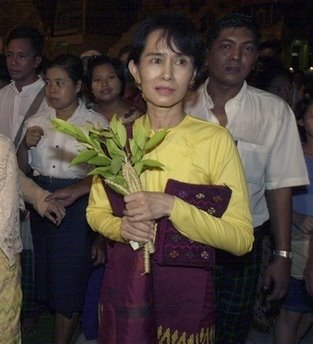


 Posts
Posts


