http://www.mizzima.com/news/regional/1445-thailands-new-pm-likely-to-be-more-pro-active-on-burma-activist.html
by Mungpi
Monday, 15 December 2008 20:49
New Delhi (Mizzima) - Thailand's opposition leader, Abhisit Vejjajiva, has been elected as the country's new Prime Minister after winning a special vote in Parliament on Monday.
Abhisit, on Monday, won 235 votes, edging out Pracha Promnok who received 198 votes, to become Thailand's 27th Prime Minister.
The 44-year old Abhisit, who was born in Britain, will also become the fifth Prime Minister of Thailand within a period of less than two-and-a-half years.
The election came after Thailand's constitutional court in early December forced former Prime Minister Somchai Wongsawat to resign. Somchai and his Peoples Power Party, along with two other parties, were charged for election fraud related to polls convened over a year previously.
While electing Abhisit as the new Prime Minister seems to provide at least a momentary end to the political deadlock that has dragged on in Thailand for months, supporters of the ousted government, known as the red-shirts, on Monday reacted furiously – rampaging through barricades and preventing MPs from leaving Parliament.
While the election of Abhisit as the new Prime Minister signals an end to the immediate political crisis, Burmese pro-democracy activists based in Thailand said Abhisit's new government is more likely to take a pro-active role regarding Burma's politics.
According to Nyo Ohn Myint, in-charge of the Foreign Affairs Committee of the exiled National League for Democracy-Liberated Area (NLD-LA), with his fair knowledge and understanding of political situation in Burma, Abhisit is likely to be more pro-active than other earlier Thai governments.
Abhisit, during a conference on 'Safeguarding Democracy – Role of Opposition,' held in Bangkok on Saturday, acknowledged that Thailand's former Prime Minister, Thaksin Shinawatra, had used Thailand's foreign policy to make personal deals with Burma's military junta.
Nyo Ohn Myint, who was also a participant in the conference, said Abhisit, during an informal discussion, had promised to be more 'pro-active' towards Burma's political crisis if elected as the new head of state.
"I also made a point to him that, as a neighbor, Burma's political problems impact on Thailand," Nyo Ohn Myint added.
Nyo Ohn Myint said that while it is still too early to predict what will be Thailand's foreign policy under the newly elected Premier, it would look more positive if the leaders do not have any personal business connections with Burma's military rulers.
Thaksin, Thailand's former Prime Minister, now in exile, during his tenure conducted lucrative business deals with Burma's military junta. Critics said Thaksin used Thailand's foreign policy to deal with Burma's military junta for personal gain.
"I believe that if the new elected leaders of Thailand do not have personal business ties with Burma's military rulers, Thailand could take a better position on Burma," Nyo Ohn Myint speculated.
Thailand, with its ongoing political crisis, is unlikely to have Burma as a major focus of its any new foreign policy, but Nyo Ohn Myint said the Thai government is likely to more sympathetic towards Burmese refugees and migrants.
Thailand currently hosts over two million Burmese migrant workers, who are employed in varied fields of work, including the sex industry. Additionally, there are some 140,000 Burmese refugees eking out a survival in nine camps along the Thai-Burmese border.
Wednesday, December 17, 2008
Thailand's new PM likely to be more 'pro-Active' on Burma: Activist


Different View: Singapore's law and order
http://burmadd.blogspot.com/2008/12/different-view-singapores-law-and-order.html
BDD
Singaporean government authorities arrested opposition leader John Tan, joint secretary of Singapore Democrat Party because of wearing T-Shirt has picture of Kangaroo head and human body. He is now serving 14 days in jail for violation the law.
In fact, Singaporean government's suppression against the opposition, political and social activists in a different way. John said that he has faced more than three dozens of cases against him and he was supposed to serve his T-Shirt jail term today in Singapore.
He is posting his facing jail term T-Shirt with a former Burmese political prisoner and NLD LA Foreign Affairs Committee secretary Moe Zaw Oo, who faced 10 years in jail. John might face 14 years in Burma if he were a Burmese political activist, who knows?
'Momentous' day for ASEAN as charter comes into force
http://www.google.com/hostednews/afp/article/ALeqM5jaCndX1mbdxcrjpbN7_ygho93ELQ
JAKARTA (AFP) — The Association of Southeast Asian Nations took a major step towards becoming an EU-style community Monday with the passing into force of a new charter setting benchmarks for democracy.
The charter sets out rules of membership, transforms ASEAN into a legal entity and envisages a single free trade area by 2015 for the region of 500 million people.
It came into force with a meeting of ASEAN foreign ministers at the bloc's Jakarta secretariat, 30 days after Thailand became the last member to deposit its ratifying documents.
"This is a momentous development when ASEAN is consolidating, integrating and transforming itself into a community," Indonesian President Susilo Bambang Yudhoyono said.
"It is achieved while ASEAN seeks a more vigorous role in Asian and global affairs at a time when the international system is experiencing a seismic shift," he added, referring to climate change and economic upheaval.
"Southeast Asia is no longer the bitterly divided, war-torn region it was in the 1960s and 1970s."
ASEAN consists of Brunei, Cambodia, Indonesia, Laos, Malaysia, Myanmar, the Philippines, Singapore, Thailand and Vietnam.
The charter was supposed to have been activated at a summit in Thailand this month but that meeting was postponed by a domestic political crisis which has underscored the fragility of democracy and human rights across the region.
Thai Information Minister Mun Patanotai presided over the presentation ceremony as representative of the bloc's current chair, as the country lacks a foreign minister to do the job.
Thai lawmakers on Monday elected opposition leader Abhisit Vejjajiva as the country's third prime minister in four months after half a year of crippling protests.
"Democracy -- it's a yo-yo in the system, it's a yo-yo in the region," ASEAN Secretary-General Surin Pitsuwan told reporters.
"Some countries used to be ahead of others, now they are behind. They're all in the process of transforming themselves to become more open, more participatory, more democratic...
"In spite of the political setback in Thailand, which is now the ASEAN chair country, I believe ASEAN will not and cannot be slowed down."
He said that despite some calls for a new round of protectionism in the face of the global economic meltdown, the bloc agreed that closer economic integration was the best way out of the crisis.
"We also realise that the best way out of this -- and the best protection, best buffer, best shield -- would be to continue ... to bring down our tariffs and non-tariff barriers," he said.
The charter will give ASEAN, often dismissed as a talking shop, greater clout in international negotiations but critics argue that some member states will continue to get away with gross human rights abuses.
The bloc's proposed new rights body has no teeth and the charter has no provision to sanction members like Myanmar , where the junta has kept democracy leader Aung San Suu Kyi under house arrest for most of the past 18 years.
The country's secretive junta is under European Union and United States sanctions over its human rights record.
No date has been set for the creation of the planned rights body but a first draft of its terms of reference will be handed over to a meeting of foreign ministers in Thailand in July, officials said.
U.N. to commemorate former Secretary General U Thant -MIZZIMA
http://www.mizzima.com/news/world/1444-un-to-commemorate-former-secretary-general-u-thant.html
by Salai Pi Pi
Monday, 15 December 2008 20:46
New Delhi (Mizzima) - The United Nation's Postal Administration (UNPA) will early next year release three postal stamps in commemoration of the 100th anniversary of the birth of former U.N. Secretary General, and Burmese national, U Thant.
In February, 2009, the UNPA will issue three commemorative postal stamps in denominations of US$ 0.94, CHF 1.30 and EUR 1.15 in conjunction with the theme, "100th anniversary U Thant".
Burma's U Thant, who was unanimously appointed to the position by the General Assembly, served as the third Secretary General of the United Nations from 1961 to 1971.
U Thant was the first Asian to hold the post in the world body, followed only by current Secretary Genearl Ban Ki-moon of South Korea.
U Thant was born at Pantanaw of the Irrawaddy Division in Burma, on January 22nd, 1909, and passed away on November 25th, 1974, with lung cancer.
During his tenure as the Secretary General, U Thant had done many successful mediation efforts in preventing the possibly war in Yemen in 1962 and Bahrain in 1968 that could have provoked a wider regional conflict.
Despite of his popularity, Burma's military dictator General Newin, who took power in a bloodless coup in 1962, refused to honor him with a state funeral, after his body was flown in from New York.
Newin's act immediately provoked the Rangoon university students, who then took the body of U Thant to the university campus in order to organize a grand funeral. But Newin sent troops to the campus and begun opening fire on students.
The event, which started off as a demand to hold a state funeral for U Thant, was later known as the "U Thant uprising' in modern Burma's history, as students and civilians following the bloody crackdown marched the streets of Rangoon in protest against Newin and his Burma Socialist Program Party (BSPP).
The United Nations is the only organization in the world which is neither a country nor a territory that is permitted to issue postage stamps, according to the UNPA.
The UNPA is also the only postal authority to issue stamps in three different currencies, namely U.S. dollars, Swiss francs and the Euro.
Tuesday, December 16, 2008
ICT exhibitions mark Myanmar rapid development in advanced technology
http://news.xinhuanet.com/english/2008-12/16/content_10512270.htm
By Feng Yingqiu
YANGON, Dec. 16 (Xinhua) -- A current five-day information and communication technology (ICT) week exhibition in Myanmar's northern city of Pyin Oo Lwin has unprecedented drawn a large number of visitors since its inauguration on last Friday.
In the 7th ICT week exhibition 2008 being held at the Yadanabon Teleport from Dec. 12 to 16, modern technology and IT products of IT companies from Yangon and Mandalay are introduced.
Attached with related seminars and workshops, the scale of the exhibition is so grand that it could prove the rapid development of the country in the advanced technology, experts said.
In March and October this year, two other ICT exhibitions respectively took place in Yangon which were co-sponsored by the Myanmar Computer Federation (MCF), Myanmar Computer Professionals Association and the Myanmar Computer Entrepreneurs Association.
In these exhibitions, nearly 100 companies showcased accessories of computers, new technology for networking, software solutions, computer courses and books.
Myanmar has been striving for the development of ICT. In December last year, Myanmar's first largest ICT park, also known as the Yadanabon Cyber City, was introduced in Pyin Oo Lwin. The launching of the cyber city was for the first time attached with such ICT week exhibition activities joined by over 100 local and foreign ICT companies.
As part of the project in the development of the cyber city, Myanmar authorities have allotted 372 acres (150 hectares) of land in the soft-base factory area of the Yadanabon cyber city for 35 more local and foreign IT companies to develop their business undertakings.
To encourage and help employees settle in the cyber city, Myanmar is also implementing new private housing projects there, offering land lease grant for 30 years for the establishment which is not allowed for re-sale or transferred within 10 years.
Under the projects, school, market, fire station, police station, clinic, sports ground and park are to be built.
Private entrepreneurs, who win the land lease grant, are set to start construction within three months and complete in a year after being allotted with the land plot, according to the city development committee which also prescribed that the allotted land plot will be confiscated in case the construction work could not start in a duration period of up to a year.
The cyber city, which covers an overall area of 10,000 acres (4,050 hectares), located in the hilly Pyin Oo Lwin near a highway, 67 km east of the second largest city of Mandalay in the north, and 20 percent of the cyber city area produce software and hardware.
The internet of the cyber city not only links with the whole country but also connect neighboring China, Thailand and India.
Meanwhile, Myanmar is also striving to introduce a wireless internet system of WiFi by early next year. Arranged by the local IT company of Exotic Wing, the system will be in service starting with the coverage of 16 main townships in the former capital city of Yangon, the company sources said.
By then, laptops with the WiFi system can enter the world from any corner of the city, experts said.
Besides, Myanmar has also planned full coverage of public access centers (PAC) in every township in the country by next March to facilitate communication links.
There are so far 240 PAC in Myanmar, according to the Myanmar Info-Tech.
The telecommunications authorities also revealed that the number of Internet users in Myanmar has also reached nearly 300,000, up from merely dozens in four years ago.
Myanmar has been implementing an ICT development master plan under the Initiative for ASEAN Integration (IAI) and detailed programs to link international networks are also being carried out in accordance with the master plan drafted by the Myanmar Computer Federation.
Being a signatory to the e-ASEAN Framework Agreement initiated at 2000 Singapore summit, Myanmar has formed the e-National Task Force to support the IT development.
Besides, the country has also signed a series of memorandums of understanding since 2003 with such companies as from Malaysia, Thailand, China and South Korea on ICT development.
On the occasion, Myanmar official media called on youths in the country, who take interest in IT, to apply advanced IT technology extensively in their striving for the national economic development.
Editor: Bi Mingxin
AK-47s—Made in Wa State-IRRAWADDY
http://www.irrawaddy.org/article.php?art_id=14804
--------------------------------------------------------------------------------
By LAWI WENG Tuesday, December 16, 2008
--------------------------------------------------------------------------------
The United Wa State Army (UWSA), an armed ethnic ceasefire group based in Shan State, northern Burma, is manufacturing arms and ammunition for use by their own battalions and to sell to other armed groups in the region, according to sources close to armed groups in Shan State.
Speaking to The Irrawaddy on Tuesday, Sai Sheng Murng, the deputy spokesman of the rival Shan State Army-South (SSA) said, “For more than one year now, the UWSA has been manufacturing AK-47 rifles similar to those made in China.”
Another source close to the UWSA said, “They (the UWSA) learned how to make arms from the Chinese.
“The arms and bullets the Wa produce are not only for their own battalions. They sell the arms to their ethnic allies in Shan State,” he added.
There are several armed ethnic groups in the northern region, including the Shan State Army, the Kokang, Mongla and Kachin.
Currently, the munitions factory is situated in Kunma, the hometown of UWSA Chairman Bao You-xiang, in the Wa hills 125 kilometers (78 miles) north of the group’s headquarters at Panghsang on the Chinese border, said the source.
According to a Jane’s security report on December 12, the UWSA has turned to arms production to supplement their income from arms and drugs trafficking. The report said that the UWSA facility marks the first time an insurgent group in the region has succeeded in setting up a small-arms production line.
In May, Jane’s Intelligence Review reported that the UWSA were acting as traffickers and middlemen, buying from Chinese arms manufacturers, then reselling the weapons to Indian insurgent groups and the Kachin Independence Army, which has also signed a ceasefire agreement with the Burmese military government.
The UWSA has an estimated 20,000 soldiers deployed along Burma’s borders with Thailand and China, according to Burmese military analyst Aung Kyaw Zaw, while an estimated 60,000 to 120,000 Wa villagers inhabit areas of lower Shan State.
The UWSA signed a ceasefire agreement with the Burmese military in the early 1990s. Leaders of the group, including its commander Wei Hsueh Kang, are wanted by the US government for their roles in the region’s drug trade.
Copyright © 2008 Irrawaddy Publishing Group | www.irrawaddy.org
Gwynne Dyer: Democracy fails in Thailand
http://www.straight.com/article-176158/gwynne-dyer-democracy-fails-thailand
By Gwynne Dyer
The political crisis in Thailand is over, and so is the ten-year experiment with democracy. The rich and the comfortably off have risen in outraged revolt against equal treatment for the poor, and it's back to the bad old days of shaky coalitions and bought-and-paid-for politicians. The misleadingly named People's Alliance for Democracy (PAD) has won.
It was the PAD's yellow-clad protesters and street-fighters who occupied government offices, and eventually both of Bangkok's airports, in a non-stop campaign to oust the People Power Party (PPP) from power. (The yellow was to signify their allegiance to the revered 81-year-old king of Thailand, Bhumibol Adulyadej, although it was never clear if he shared their goal.)
The government had to be overthrown by street demonstrations, not by a legitimate vote in parliament, because the People Power Party actually had a majority in parliament. The PPP's crime, in the view of the PAD, the army, the police, the Bangkok middle class, and perhaps even the royal palace, was that the wrong people had voted for it: the rural poor.
The PPP was the descendant of Thai Rak Thai (Thais Love Thais), the creation of Thaksin Shinawatra, the telecommunications billionaire who turned to politics in 1998. It was a new style of party for Thailand, appealing directly to the urban poor and the rural majority of Thai voters over the heads of the political bosses who had traditionally bought up their votes.
Thai Rak Thai won the 2001 election, delivering Thaksin to the prime minister's office, and he actually kept many of his promises. Development funds flowed into the rural areas, his "30-baht" scheme for universal health care brought medical aid to remote villages for the first time, and farmers got cheap loans. It alienated the urban elite who had previously got the biggest share of state spending, but Thaksin's popularity soared even higher in rural areas.
He was the first prime minister ever to complete a four-year term, and in the 2005 election his party won an absolute majority of the seats in parliament—another first. Even more importantly, the political godfathers who used to buy and sell the rural vote flocked to his banner, giving him a virtually impregnable political position.
For a moment there, it looked as though Thaksin had succeeded in transforming Thai politics. He was quite autocratic in power, seeking to punish media outlets that criticised him and authorising an anti-drugs campaign that resulted in many illegal killings, but his popularity was unquestionable. And then it all fell apart.
The counter-attack by the old guard came in the form of street demonstrations against Thaksin's new government that were used as the excuse for a military coup in 2006. The courts, which have not been exactly impartial in this affair, then ordered Thai Rak Thai disbanded because of alleged election irregularities (doubtless true, but equally true for all the other parties).
Thaksin's party was immediately re-founded as the People Power Party, but he was not so easily able to evade a court judgement finding him guilty of conflict of interest over the purchase of land in Bangkok. The amount of money involved was paltry for a man of Thaksin's wealth, and other Thai politicians have gone unpunished for far graver offences, but he ended up fleeing from Thailand in order to avoid a jail sentence.
The military then reckoned that it was safe to hold another election, but Thaksin's renamed PPP won again last year: the poor knew who was on their side. Thaksin stayed in exile, but his close ally Samak Sundaravej became prime minister in his stead—and immediately faced the same legal vendetta. Early this year the courts got him for conflict of interest. The charge? He was moonlighting as the host of a television cooking show. In this struggle, no pretext is too petty.
Samak was replaced as prime minister in late September by Thaksin's brother-in-law Somchai Wongsawat. The PAD then launched non-stop demonstrations that gradually paralysed the government. Three weeks ago they seized control of both Bangkok's airports, shutting down the tourist trade that accounts for six percent of Thailand's economy. And last week the courts came through for them again, ordering the disbanding of the PPP and two allied parties for electoral fraud.
That was the final blow. The regional godfathers, recognising that Thaksin is finished, have begun selling their services to the old-line Democratic Party again. It won't even be necessary to carry out the PAD's project to take the vote away from the rural population—they were proposing a parliament that was 70 percent appointed and only 30 percent elected—because the regional bosses will go back to brokering the rural vote in the good old-fashioned way.
It is a sad outcome, but not a surprising one. Relatively few Asian countries are openly run as dictatorships nowadays—China, Vietnam and Burma are the main exceptions—but the urban elites and the big land-owners really still call the tune in most of the so-called democracies. Thaksin had his faults, but he was trying to break Thailand free from that model. Unfortunately, he failed.
Gwynne Dyer's new book, Climate Wars, was published recently in Canada by Random House.
60 years on, UN rights declaration faces new challenges
http://www.mmorning.com/ArticleC.asp?Article=6439&CategoryID=7
The declaration was adopted in Paris on December 10, 1948, breaking new ground by encoding basic principles that would serve as the template for future rights conventions.
The 30-point document, based on France’s 1789 Declaration of the Rights of Man and the 1776 US Declaration of Independence, was adopted by 58 countries at a meeting of the UN General Assembly.
The Soviet Union, its East bloc allies, and South Africa abstained after a tortuous debate in which communist countries held up “real” economic and social rights against the “bourgeois” cultural and social principles defended by the West.
With the atrocities of World War II and the Holocaust fresh in their minds, the countries adopted the non-binding declaration at the Palais de Chaillot.
“This was the first manifesto adopted by organised humanity”, said René Cassin, a French legal expert who took part in drafting the ground-breaking document.
Article 1 of the Universal Declaration proclaims: “All human beings are born free and equal in dignity and rights. They are endowed with reason and conscience and should act towards one another in a spirit of brotherhood”.
On Wednesday, representatives from the United Nations, the European Commission and non-governmental organizations gathered at the Palais de Chaillot to take stock.
The declaration did not prevent a new genocide from occurring, in Rwanda in 1994, and basic human rights continue to be violated on a daily basis around the globe.
Human rights remains an ideology challenged by states which see it as a ploy by the West to impose its ideas on the rest of the world, said French former Justice Minister Robert Badinter.
“There are opposing trends from nationalists who say they are masters in their own house in China, Venezuela, Cuba or Burma, and from Islamists who say human rights stem from religious concepts”.
The rise of Russia and China as economic powers that strongly reject Western criticism of their rights record has reshaped the debate as has Washington’s “war on terror” launched after the September 11, 2001 attacks.
“Who cares about Chechnya these days?” asks Reed Brody, of the US-based Human Rights Watch.
Russia fought two brutal wars in the Caucasus republic of Chechnya that human rights groups say have left more than 100,000 civilians dead. In poor countries, campaigners say development is a top priority and that the biggest threat to basic rights is economic and environmental degradation.
“For billions of people, food and shelter are basic human rights”, said Brody. “Since the September 11 attacks, human rights often take a back seat to security concerns”.
Despite the shortcomings, rights champions tip their hats to the UN declaration as a landmark document that changed international diplomacy.
Amnesty International secretary general Irene Khan said the declaration “put human rights on the international agenda.
“Today no government denies that human rights are a valid concern of the international community. They may fail to respect human rights but they can’t deny the validity of these rights”, said Khan.
The world would look to President-elect Barack Obama to restore the United States’ human rights reputation after it was tarnished by the war on terrorism, Khan said.
In an interview to mark the 60th anniversary of the declaration, Irene Khan said that in the wake of the September 11, 2001 attacks, Western countries resorted to the tactics they once condemned.
“What the 9/11 attacks did was expose the hypocrisy of Western democracies that until then had been champions of human rights abroad”, Khan said. “Suddenly they were caught with problems in their own territory. And then facing that problem, they chose to take the easy path out of it, eroding human rights rather than standing up for them. “I think that sent a very bad message across the world to others”.
While the “war on terror” was conceived by the US Administration of President George W. Bush, “those who followed it were not just powerless innocents”, Khan said, singling out European governments which cooperated in the renditions of terrorist suspects.
The ‘renditions’ -- transferring terrorist suspects to third countries for interrogation, often passing through European airports or airspace -- became one of the most contentious elements of the war on terrorism.
Photographs of naked and hooded Iraqi prisoners being subjected to humiliation and made to simulate homosexual sex in the notorious US-run Abu Ghraib prison also became potent symbols of abuses by American forces.
But Khan is optimistic that the inauguration of the first black US president in January will see human rights move back to the top of Washington’s agenda. “I hope very much that the US really takes a strong stand on human rights in the future”, Khan said.
The Universal Declaration milestone was marked just days after the attacks in Mumbai (Bombay) and amid fears in the West over the spread of religious extremism, but Khan said the impact of the document remains profound.
“Today no government denies that human rights are a valid concern of the international community”, she said.
She admitted however that the outlook was gloomy as the global economic slowdown posed new challenges for human rights -- and she said governments had a duty to protect their citizens.
2009: World economy in big trouble
http://biz.thestar.com.my/news/story.asp?file=/2008/12/16/business/20081216114059&sec=business
Published: Tuesday December 16, 2008 MYT 11:48:00 AM
Updated: Tuesday December 16, 2008 MYT 12:16:46 PM
2009: World economy in big trouble
By VIOREL URMA
NEW YORK: Battling the worst financial crisis in nearly 70 years, the world economy will brake sharply in 2009, with the United States, Western Europe and Japan in recession.
Developing economies in Asia, Africa and the Middle East will experience curtailed growth due to plunging commodity prices and a world trade contraction, but likely will escape the red ink.
Evidence of the global slide is still mounting.
Manufacturers around the world are under severe strain and laying off hundreds of thousands of workers; banks are failing, triggering a severe credit crunch; home foreclosures are skyrocketing; and auto sales are plummeting, which could push some carmakers into bankruptcy.
As a result, consumer confidence and spending have slumped, and business investment is drying up.
"Looking at where we are today, the good news, if any, is that we have probably stepped back from the brink of financial catastrophe,'' said Olivier Blanchard, chief economist for the International Monetary Fund.
Conditions have deteriorated so much since the IMF's semiannual World Economic Outlook was released in October that it issued an update last month cutting its 2009 forecast for developed countries' economies to a drop of 0.3 percent, from 0.5 percent growth in the previous estimate.
Such a decline would mark the first contraction in any year since World War II.
Overall, the IMF now expects the world economy to grow at a 2.2 percent pace in 2009, down from its October projection of 3 percent.
Developing economies are projected to see GDP growth rate at 5 percent, despite diving commodity prices that have hit oil exporters especially hard.
Meanwhile, the World Bank's Global Economic Prospects report issued last week predicts that global GDP growth will slip from 2.5 percent in 2008 to 0.9 percent in 2009.
Developing countries' growth is expected to decline from 7.9 percent in 2008 to 4.5 percent in 2009.
It said the global economy is shifting from "a long period of strong growth'' led by developing countries to a time of "great uncertainty.''
"The slowdown in developing countries is very significant because the credit squeeze directly hits investments, which were a key pillar supporting the strong performance of the developing world during the past five years,'' said Hans Timmer, a senior World Bank economist.
The bank now predicts that world trade, an engine of growth for many developing economies, will contract by 2.1 percent in 2009, marking the first time since 1982 that trade will shrink.
The report also said the commodities boom of the past five years, which drove up prices 130 percent, has come to an end. Oil prices are likely to average about $75 a barrel in 2009.
The price of crude has fallen about 70 percent due to the sharp economic downturn since it peaked at $147.27 a barrel in July.
In its latest economic outlook, the Organization for Economic Cooperation and Development said economic output will shrink by 0.3 percent in 2009 for the 30 market democracies that make up its membership, against the 1.4 percent growth prediction for 2008.
The Paris-based organization said the United States was expected to contract by 0.9 percent in 2009 following a 1.4 percent expansion in 2008.
Japanese output is projected to contract by 0.1 percent next year, following 0.5 percent growth this year, while the 15-nation euro-zone will likely shrink by 0.6 percent in 2009, after 1.0 percent growth this year.
"Many OECD economies are in, or are on the verge of, a protracted recession of a magnitude not experienced since the early 1980s,'' OECD Chief Economist Klaus Schmidt-Hebbel warned.
"As a result, the number of unemployed in the OECD area could rise by 8 million over the next two years.''
But few things are definite.
"Uncertainties surrounding the projections are exceptionally large,'' Schmidt-Hebbel said .
"Much will depend on how quickly the financial crisis - the main driver of the downturn - is overcome.''
Among the risks are financial institutions suffering further failures and emerging market economies being hit harder by the downturn in global trade.
Positive developments would include central banks shoring up their finances and governments adopting more substantial fiscal stimulus measures, such as higher spending and lower taxes, economists said.
In the United States, a huge decline in wholesale inventories of durable and nondurable goods and in sales provided further evidence that the economy is in a steep recession.
In November, American shoppers handed retail stores their worst results in at least 39 years.
Many analysts believe the current recession, which has already lasted 12 months, will drag until at least the middle of next year.
If it lasts past April, it will become the longest recession in the post World War II period, surpassing recessions in the mid-1970s and early 1980s that each lasted 16 months.
As the U.S. is sinking deeper into economic despair, analysts predict more grim news in the months ahead.
Employers cut payrolls in November at the fastest pace in 34 years as the unemployment rate rose to 6.7 percent, the highest level since 1993.
The month's 553,000 drop in jobs brought cumulative losses in 2008 to nearly 2 million, the Labor Department said, and the total number of unemployed Americans increased to 10.3 million.
Some analysts predict that 3 million more jobs will be lost before spring 2010 and that the once-humming US economy could stagger backward at a shocking 6 percent rate in 2008's fourth quarter.
"It's a mess,'' said Mark Zandi, chief economist at Moody's Economy.com.
"Businesses, battening down the hatches, are concerned about their survival and are cutting workers.''
"The economy is in a free fall,'' said Richard Yamarone of Argus Research.
"It is as if someone flicked off the switch on hiring.''
U.S. automakers have been particularly hard hit, with sales dropping to the lowest level in 26 years.
The top executives of General Motors Corp., Ford Motor Co. and Chrysler LLC have appealed to Congress for as much as $34 billion in government assistance, saying the alternative was bankruptcy that could lead to the loss of about 3 million jobs.
The White House is exploring new ways to help Detroit's big three after the Senate last week rejected a $14 billion bailout.
To battle the worst financial crisis since the 1930s, President-elect Barack Obama is working on a fiscal stimulus package of at least $500 billion.
Obama has promised to make the "single largest new investment'' in big public works projects as part of his plan to save or create 2.5 million jobs.
As uncertainties on bank solvency and credit supply persist, the federal government has committed more than $7 trillion in its efforts to contain the deepening financial crisis - although there is widespread agreement it won't really spend anything close to that figure.
In other economic predictions for 2009:
_The Paris-based International Energy Agency said last week that global oil demand will shrink this year for the first time since 1983.
The IEA cut its global demand forecast for 2008 by 350,000 barrels a day to 85.8 million barrels a day, down 0.2 percent from 2007.
The IEA also cut its forecast for global oil demand in 2009, saying it would increase by just 0.5 percent to 86.3 million barrels a day.
The OPEC cartel, which accounts for about 40 percent of global crude supply, has signaled it plans to cut output quotas at a meeting Dec. 17 in Algeria.
_The Middle East and North Africa region appears to have held up well in 2008, growing at 5.8 percent, but the aggregate number hides big swings in trade, current account positions and external financing requirements, according to the World Bank.
With oil exporters facing diminished revenues in 2009, regional growth is expected to be just 3.9 percent in 2009. - AP
World economy in crisis: Any hope for price swing?
http://www.businessdayonline.com/index.php?option=com_content&view=article&id=1906:world-economy-in-crisis-any-hope-for-price-swing-&catid=67:oil&Itemid=193
Tuesday, 16 December 2008 00:15 Anonymous
User Rating: / 0
PoorBest
Following the sudden drop in the crude oil prices in the international market last month, many countries should now be counting their losses. After reaching a world record of $147per barrel in July, there were high expectations among producing nations that the skyrocketed prices would be sustained till the end of the year. unfortunately, this has not been the case, against the predictions and projections of international analysts.
Rise and fall oil prices
Throughout the first half of 2008, oil regularly reached record high prices. On February 29, 2008 , specifically, oil prices peaked at $103.05/bbl, and reached $110.20/bbl on March 12, 2008 , the sixth record in seven trading days. Prices on June 27, 2008 touched $141.71/bbl for August delivery in the New York Mercantile Exchange (after the recent $140.56/bbl), amid Libya ’s threat to cut output, and OPEC’s predicted prices may reach $170 by the Northern summer. The most recent price per barrel maximum of $147.02 was reached on July 11, 2008 . After falling below $100 in the late summer of 2008, prices rose again in late September.
On September 22, oil rose over $25 to $130/bbl before settling again to $120.92/bbl, marking a record one-day gain of $16.37/bbl. Electronic crude oil trading was temporarily halted by NYMEX when the daily price rise limit of $10 was reached, but the limit was reset seconds later and trading resumed. By October 16, prices had fallen again below $70/bbl. Incidentally, as the cost of producing petroleum did not rise significantly, the price increases have coincided with a period of record profits for the oil industry.
Between 2004 and 2007, the profits of the six super majors – ExsonMobil, Total, Shell, BP, Chevron, and ConcoPhillips, totaled $494.8 billion.
Why rise and fall?
According to the US –based Energy Information Administration, the reasons for the surge ranged from the relentless growth for the economies of China and India to widespread instability in oil-producing regions, including Iraq and Nigeria ’s Delta region. Triple-digit oil prices have redrawn the economic and political map of the world, challenging some old notions of power. Oil-rich nations are now enjoying historic gains and opportunities, while major importers including China and India , home to a third of the world’s population confront rising economic and social costs.
From the mid- 1980s to September 2003, the inflation adjusted price of a barrel of crude oil on NYMEX was generally under $25/barrel. In 2004, the price rose above $40, and then $50. a series of events led the price to exceed $60 by August 11, 2005 and then briefly exceed $75 in the middle of 2006. prices then dropped back to $60/barrel by the early part of 2007 before rising steeply again to $92/barrel by October 200, and $99.29/barrel for December futures in New York on November 21, 2007 .
Higher oil production in Saudi Arabia during summer 2008 combined with demand response to extremely high prices and recent credit market problems that point to a lower trajectory for the world economy and oil consumption growth are currently reinforcing the sentiment of a loosening in the global oil balance. As a result, the recent supply disruptions in the Gulf of Mexico have not resulted in the kind of price increases that would have been expected had they occurred earlier in the year.
However, unless the global economy is weaker than anticipated, EIA expects that the call on organisation of the Petroleum Exporting Countries’ (OPEC) crude oil will exceed OPEC crude oil production over the next six months. This market balance and the relatively low level of organisation for Economic Cooperation and Development (OECD) commercial oil inventories suggest some upward pressure on prices. Meanwhile, if non-OPWEC oil production increases as expected during 2009, it is anticipated that oil price pressures would then moderate.
EIA reviews export earnings
As the economic crunch persists, the Energy Information Administration has revised downward its forecast of OPEC oil export revenues by $32 billion this year to $1.084 trillion from the $1.116 trillion forecast in September.
The EIA has also lowered its forecast of OPEC’s 2009 oil export earnings to $1.226 trillion, a downward revision of $142 billion. The EIA bases its earnings estimates on projections from its Short Term Energy Outlook. The October projection, it said, sees the price of US West Texas Intermediate crude averaging $111.57/barrel this year, $34/bbl lower than its September forecast.
Author of this article: Anonymous
Monday, December 15, 2008
Isolation or Engagement? It’s Than Shwe’s Choice -IRRAWADDY
http://www.irrawaddy.org/opinion_story.php?art_id=14796
COMMENTARY
Isolation or Engagement? It’s Than Shwe’s Choice
--------------------------------------------------------------------------------
By AUNG ZAW Monday, December 15, 2008
--------------------------------------------------------------------------------
Since Gen Ne Win seized power in 1962, Burma has proudly proclaimed its neutrality in international affairs. Under Snr-Gen Than Shwe, the country’s “active and neutral” foreign policy remains in place, although many question whether this accurately describes the way Burma now relates to the rest of the world.
Than Shwe’s regime has long been a target of Western sanctions, which include a visa ban that prohibits the paramount leader himself from traveling to the West. Relations with neighboring countries are, however, more cordial. This has produced a foreign policy that is more selective than neutral.
Last week, the general who routinely snubs visiting UN envoys welcomed Chinese Foreign Minister Yang Jiechi, who received Than Shwe’s special envoy, Foreign Minister Nyan Win, in September 2007 amid the brutal crackdown on monk-led protests.
State-run papers reported that Than Shwe briefed the Chinese minister on Burma’s domestic situation, including the progress of reconstruction work in the cyclone-hit Irrawaddy delta. More importantly, the general reported on the country’s “democratic process and economic development, based on the principles of independence and self-determination,” according to China’s Xinhua news agency.
The junta chief also reassured his visitor that Burma continued to value its paukphaw (fraternal) friendship with China.
Burmese leaders have traditionally used the term “paukphaw” to refer to relations with China. This special relationship has, however, been subject to numerous strains over the years. This was especially true in the 1960s and 70s, when China aided the Communist Party of Burma (CPB).
Although the “big brothers” in Beijing dubbed Ne Win a “fascist,” the Burmese strongman was pragmatic and visited China several times to repair ties. He held high-level talks with Chinese leaders and maintained a good relationship. In return, leaders from China also paid several state-level visits to Burma.
But as Ne Win dined with leaders in Beijing, Than Shwe and other mid-ranking officers posted in the northern frontier region in the 1970s and 80s continued the fight against Chinese-backed communists. They would never forget China’s efforts to overthrow the government in Rangoon.
Today the CPB is gone, and its troops never did march down to Rangoon. China has been the regime’s major ally since the military coup of September 1988, supplying the regime with military and economic aid. Border trade between the two countries has also expanded, to an estimated annual level of US $1.5 billion.
Now China is planning to build a gas pipeline in 2009, linking Sittwe on the Arakanese coast with China’s landlocked province of Yunnan. China National Petroleum Corporation (CNPC) will head the $2.5 billion pipeline project with a 50.9 percent stake, while Burma’s state-run Myanmar Oil and Gas Enterprise (MOGE) will hold the rest.
Besides the MOGE’s stake in the project, Beijing will also be counting on the regime to keep armed groups along the China-Burma border under control.
Although military leaders in Burma have expressed dissatisfaction with the quality of some of the military hardware and jet fighters they have purchased from China, they still appreciate Beijing’s unwavering support, including exercising its veto at the UN Security Council.
However, it is important not to overestimate China’s influence over Burma. China could also be looking for an alternative to Than Shwe, and like everyone else, Chinese officials are looking at the post-Than Shwe era and beyond the planned 2010 election.
Chinese know that the aid policy and economic cooperation over the past 20 years has not paid off much.
Chinese remain skeptical that the aid, economic cooperation and investment in Burma will translate into meaningful economic development. It is obvious that Burma is descending into a failed state. China is only helping to preserve the regime.
It is unfortunate that China, which once sought to overthrow the Ne Win regime, is now backing one of the most repressive regimes in the world. Than Shwe often tells his generals that as long as he can count on three countries—China, India and Russia—for backing, his regime will survive. Of these three, China is obviously the most crucial.
Increasingly, however, the junta has been looking beyond China for new friends, new markets and economic cooperation.
This month, Burma confirmed that it will open an embassy in Kuwait. Tomorrow marks the tenth anniversary of the establishment of diplomatic ties between Burma and Kuwait.
Kuwaiti Prime Minister Sheikh Nasser al-Mohammed al-Ahmed al-Jaber al-Sabah visited Burma in August and signed an agreement on economic and technical cooperation between the two countries.
During a meeting with the visiting prime minister, Than Shwe informed him of his “road map” to “disciplined democracy” and explained the need for the army to safeguard Burma’s unity and stability. Deputy Foreign Minister Maung Myint visited Kuwait recently looking to expand Burma’s trade and business activities there.
This is not the first time the regime has looked to the Middle East to expand its diplomatic relationships. In 2006, Iran’s deputy minister for oil paid a visit to Burma to express his country’s interest in cooperating with the junta.
In April of last year, we also saw Burma formally restore its ties with North Korea. Relations between the two countries had been severed for more than two decades after North Korean state-sponsored terrorists launched a deadly bomb attack on a high-ranking South Korean delegation of politicians who were visiting Rangoon.
However, a clandestine diplomatic relationship had been restored as early as the 1990s. In recent years, North Korean technicians have been seen in Rangoon and in the newly built capital. Well-informed sources reported that North Korean agents usually stay at state-owned guesthouses on the outskirts of Rangoon. The lack of transparency surrounding the North Korean agents’ frequent visits to Burma has fueled rumors about the nature of the cooperation between these two “outposts of tyranny.”
But even as Than Shwe looks to broaden Burma’s diplomatic horizons, it is clear that he remains very selective when choosing potential allies. In May, Cyclone Nargis offered an opportunity to forge friendlier ties with the US and the West, but Than Shwe opted to spurn their offers of assistance because they came in warships.
The paramount leader doesn’t really count the Association of Southeast Asian Nations (Asean) as an ally, but maintains a normal relationship with the regional grouping. His regime’s recent decision to send prominent dissidents to jail demonstrated his disregard for the principles laid out in the Asean charter.
With regard to Burma’s closest neighbor, Thailand, we have seen many ups and downs in the relationship over the past two decades. Thaksin Shinawatra, the billionaire Thai prime minister who was ousted in 2006, cultivated close business ties to the Burmese junta. But even during the relatively amicable period of Thaksin’s rule, Burma felt compelled to buy state-of-the-art MiG 29 jet fighters from Russia to counter the Thailand’s F16 jet fighters.
When looking for new friends, Than Shwe steers clear of countries that take are likely to take issue with his regime’s human rights record. His treatment of the democratic opposition and detention of Aung San Suu Kyi and 2,000 other political prisoners are also taboo topics.
To return to Ne Win—the charismatic leader frequently visited Western countries for medical treatment or annual vacations. Ne Win and the ministers and generals who served under him acquired a taste for the finer things the West had to offer, even if they had no appetite for Western democratic values.
Ne Win had bank accounts in Switzerland and liked to stay in London. He and top leaders had TVs and video players long before Burma officially introduced these marvels of technology in the late 1980s. Top leaders and their wives were encouraged to go to hospitals in Europe when they needed to have check-ups—not to Singapore, where Than Shwe regularly visits for medical examinations.
Ne Win and his senior ministers often visited Europe to get aid and loans. The former Federal Republic Germany, or West Germany, was a favorite destination. Germany’s Fritz Werner Company helped Burma to build an arms industry as early as the 1950s to suppress ethnic insurgency.
Thanks to his “engagement” with the West, Ne Win even received military assistance from the US to suppress narcotics in the 1970s. US-made helicopters were also used to attack ethnic civilians and insurgents, but there was no protest from Washington.
Under Ne Win, Burmese army officers were not only sent to Asian nations but also to the US and UK for military education. Under former spy chief Gen Khin Nyunt, dozens of army officers were CIA or UK-trained. Ne Win and Than Shwe all benefited from this sort of engagement and cooperation from the West.
Until 2004, Burma’s feared secret police agency ran a ruthless and efficient spy network inside and outside of the country. Ironically, this would not have been possible without the contributions of countries that now regard Burma’s current rulers as international pariahs.
Every time Than Shwe shakes hands with a visiting state leader or foreign diplomat, critics of his regime shake their heads in dismay at the willingness of many in the world to ignore his egregious crimes against the people of Burma. Than Shwe’s occasional forays into international diplomacy may help him to stay in power, but they will do nothing to improve the plight of Burma’s oppressed people.
Copyright © 2008 Irrawaddy Publishing Group | www.irrawaddy.org
Asean's charter has to negotiate uncharted waters
http://www.bangkokpost.com/151208_News/15Dec2008_news19.php
THANIDA TANSUBHAPOL
After more than 40 years the Association of Southeast Asian Nations today effects the Asean charter, which makes this regional grouping a legally cognizant organisation. Foreign ministers of the 10 member countries will celebrate this milestone at the Asean Secretariat in Jakarta.
Drawing up the charter has been a perplexing topic in the Asean community for more than five years. That it is reaching fruition belies the fact that Asean has been in existence for almost two generations without any actual fully legal status.
For sure, Asean as a group has made many binding agreements, but this is in the absence of any mechanism to enforce its members to comply. That has given Asean poor credibility in the international negotiation arena.
The Asean charter is intended to make the 10 members in Southeast Asia a cohesive community with three strategic pillars - politics and security, economic, and socio-cultural - by 2015.
The formation of the Asean "community" has the aim of making the members part of the same family and giving them the capacity to facilitate trade together as well as having more bargaining power and more capability to compete in the international stage in all fields.
The formalising of the charter will create a lot of changes to how Asean works. For example, Asean's human rights body can now be set up to protect and promote human rights issues among member countries. Plus, more active participation by civil societies will see more active engagement with Asean's policies and its work.
In addition, the charter has increased the Asean chairman's role in order to respond quickly to emergencies.The Asean leaders will meet twice a year as opposed to once a year. Urgent issues or crises that affect Asean can be discussed and tackled immediately.
A dispute settlement has also been established under the charter allowing Asean member states to resolve their disputes through dialogue, consultation and negotiation. If any dispute remains unresolved, it will be referred to the Asean summit for a decision.
It also means the Asean Secretariat will have more power to monitor and report on the members' compliance to the leaders' forum. If any nation does not comply with agreements, the secretariat will report to the leaders.
As for the secretariat itself, it will have four deputy secretaries-general compared to the current two. Each will take responsibility for one of the four community pillars as well as administrative work, civil society issues and human rights.
To be more active, each Asean country will have a permanent representative to Jakarta to coordinate and facilitate the more than 700 meetings around the world annually. The permanent representative with the rank of an ambassador can call for an urgent meeting and implement any agreement. This will facilitate Asean's work.
Thailand, as the host of the 14th Asean summit, which has been postponed for a few months, has set a theme for the meeting entitled "Asean Charter for the Asean People". This is intended to encourage Asean to reach out to the citizens of the 10 member states and try to promote more harmony within the body.
But this will be no easy task as the 10 member countries encompass a wide development gap and the people of each country tend to be competitive towards one another rather than share a common interest in harmony.
Vitavas Sivihok, Thailand's Asean director-general, concedes Asean still has a long way to go. Asean as yet cannot be called a "community", although some productive progress can be expected in the next seven years.
"The charter will give Asean legal authority. It's like a man has reached the legal age of maturity, so he can do things on a legal level," Mr Vitavas said.
It is hoped that problems affecting Asean countries, such as those related to the environment, labour, food, health, human resource development and education, which were not addressed much in the past, will be tackled step by step through the Asean coordinating council chaired by the foreign ministers. The council will take care of three Asean community councils in each pillar before forwarding particular cases to the leaders.
Mr Vitavas said cooperation under the economic pillar has the clearest objectives as the group has free trade agreements (FTA) among members and other countries. The Asean charter, therefore, will give other countries that much more confidence to make further agreements with Asean.
"In terms of signing FTAs with other countries, if Asean is in total agreement then it will show that each member country will have considered the pros and cons at a level in which Asean will not be at a disadvantage with other partners," he said.
As for the political and security pillars, Mr Vitavas believed the policy of non-interference will become more relaxed. If two member states are in dispute over an issue, Asean will not interfere in internal matters, but the leaders now will have more licence to raise questions for discussion than before.
Dealing with the non-compliant members, he said, will still be a challenge, even though the charter will give the secretariat more enforcement authority.
"If an issue is brought up at a leaders' meeting, we will be able to seek measures to deal with the situation."
Asean's panel on human rights is now working hard to complete the task of establishing the terms of reference for the Asean office which is expected to be up and working on issues by next year.
He acknowledged the socio-culture pillar is Asean's weakest point. "We know little about our neighbours and Asean members. We have no mechanisms to link our peoples together and we have no shared language. A strong community must have a people working in harmony. There must be more kinds of activities that involve the participation of all peoples," Mr Vitavas said.
Bringing the concept of Asean to the people is the big challenge. Thailand will try to reposition Asean so it is seen less as a state-administered body by promoting the role of civil society and academia.
"We have to build a people's forum in parallel with the state forum. We should not be afraid that civil society will pose a challenge to the organisation. We ultimately just have to bring a convergence to what are parallel tracks."
Prapat Thepchatree, the director of Asean studies at Thammasat University, backs the Asean charter as it will create a more complete entity. But he questions why it has taken so long.
In contrast, he said, the United Nations established its charter in 1945, while Asean has lain neglected as an authoritative body for more than 40 years.
Mr Prapat has carefully studied the Asean charter and believes it will not do much to help improve Asean. Charter or not, he says, Asean will be little different as there are still many weak points.
"The charter is not a guideline for Asean in the long run, just until 2015. It still adheres to the non-interference policy as it remains unclear as to how this will actually change. Although the charter signifies the setting up of a human rights body, ultimately there might be complete paralysis as those officials who are drafting the [terms of reference] come from member countries such as Burma who might not want to see their countries being affected by it," Mr Prapat said.
Another weak point is that there is no clear mechanism for civil society to take part in Asean. "Asean was set up long after the UN was founded, yet it is more outdated than the UN in many aspects. Asean therefore should look to the UN or European Union models which let non-government organisations register as consultative counsel."
That is no surprise as many Asean members such as Burma, Laos and Vietnam are under dictatorial rule. They do not want the people's participation.
The objective of Asean as a community, he said, still lacks sincerity. "If we want Asean to be compared with the EU, then there is little hope.
Junta rejects Aung San Suu Kyi's petition: NLD-LA
http://www.mizzima.com/news/inside-burma/1434-junta-rejects-aung-san-suu-kyis-petition-nld-la.html
by Solomon
Friday, 12 December 2008 22:20
New Delhi (Mizzima) – The Burmese military junta has rejected outright a petition by the lawyer of detained Burmese pro-democracy leader Daw Aung San Suu Kyi, to review the extension of her house arrest period, an official of her party in exile said.
Nyo Ohn Myint, in-charge of the Foreign Affairs Committee of the Thailand-based National League for Democracy-Liberated Area (NLD-LA) said, the junta last week rejected the petition by Aung San Suu Kyi's lawyer Kyi Win to review her detention which has gone beyond five years in the last term.
"The appeal was rejected and at the same time they [junta] have forbidden Kyi Win to meet Aung San Suu Kyi to explain about the appeal to her," said Nyo Ohn Myint.
Nobel Peace Laureate Aung San Suu Kyi, who completed her last five years in detention in May 2008, is having to contend with an extension for another year. But the NLD-LA in their statement said, according to the law she has the right to appeal.
But lawyer Kyi Win, said he had not been informed of the rejection of the appeal by the regime and that he was told that authorities are working on the case, and that he no longer requires to meet Aung San Suu Kyi.
"They [authorities] told me that they are now working on the case and so they said I no longer need to meet Aung San Suu Kyi," Kyi Win told Mizzima.
But he, however, added that "I will try to meet Aung San Suu Kyi again."
Meanwhile, a source close to the NLD said, Kyi Win had also been threatened by the authorities not to reveal the rejection of the petition in Aung San Suu Kyi's case.
While the information cannot be independently verified, Nyo Ohn Myint said, the junta's action is likely to be related to their planned 2010 general election, for which they fear the release of Aung San Suu Kyi might foil their determination to successfully conduct the polls.
"This shows that the ensuing 2010 election will be not be fair and just, and it also means denial of Aung San Suu Kyi from participating in political activities and rejection of the international call to conduct free and fair elections," Nyo Ohn Myint said.
Aung San Suu Kyi had been detained for the past 13 of 19 years.
UN chief visit would help Myanmar: EU envoy
http://news.yahoo.com/s/afp/20081215/wl_asia_afp/japanmyanmarunrightsdiplomacy_081215075259
TOKYO (AFP) – The European Union's special envoy on Myanmar said Monday a visit by UN Secretary General Ban Ki-moon to the military-ruled nation would have a positive impact and trigger dialogue with the opposition.
Ban, who in May made the first visit by a UN chief to Myanmar in almost 45 years, said Friday that the atmosphere was not right for a return trip.
EU envoy Piero Fassino, a former Italian foreign minister, said that a visit by Ban must be "carefully prepared."
"We believe that a personal initiative by Ban Ki-moon could prove positive in establishing a serious dialogue between the junta, democratic opposition and ethnic minorities, which has not yet taken place," Fassino told reporters on a visit to Tokyo.
Last week more than 100 former leaders wrote to the UN chief urging him to travel to Myanmar to secure the release of political prisoners including democracy leader Aung San Suu Kyi, who has spent years under house arrest.
Leaders who signed the letter included ex-US presidents George H.W. Bush and Jimmy Carter, former Soviet leader Mikhail Gorbachev, ex-Australian premier John Howard, former Japanese prime minister Junichiro Koizumi and ex-Philippine leaders Fidel Ramos and Corazon Aquino.
Fassino, who has not travelled to Myanmar in the year since his appointment, was in Japan as part of a tour of Asian nations.
He called for the world to act now to ensure the fairness of elections that Myanmar's military regime says it will hold in 2010.
"We cannot afford to stay still. We have to act now to obtain democratic guarantees," Fassino said.
"We want Myanmar's society and citizens to decide their own future. We want the 2010 general elections to be held in a fair and free environment," he added.
Ban said on Friday that he was frustrated at the failure of Myanmar's military to restore democracy.
"At this time I do not think that the atmosphere is ripe for me to undertake my own visit there," he said.
But he added: "I am committed, and I am ready to visit any time, whenever I can have reasonable expectations of my visit, to be productive and meaningful."
The European Union and United States have both slapped sanctions on Myanmar, but most Asian countries have focused instead on dialogue. China is Myanmar's main ally, while Japan -- in a rare break with Western allies -- is a major donor to the country.
Fassino said he was visiting Asia in hopes of finding a united front on Myanmar.
"The main concern for Asian countries is to avoid the destabilisation of the region," Fassino said.
"The EU and the US have implemented sanctions to force the opening of dialogue. The assessment of the tools to obtain this objective can differ but the goal is the same," he said.
Fassino said Japan, with its historical ties to Myanmar, had a "very important role to play," especially from next month when it becomes a member of the UN Security Council.
Climate change, food security affecting Asian countries - Healthcare Minister
http://www.dailynews.lk/2008/12/15/news21.asp
“Every minute, a woman dies during pregnancy and childbirth because she did not receive adequate care and prompt treatment.
“By increasing interventions for safe motherhood, we can save the lives of half a million women and seven million infants each year, and at the same time prevent millions of women from suffering from infections, injury and disability,” said Minister of Healthcare and Nutrition Nimal Siripala de Silva at the International Conference of Parliamentarians of South East Asian Region countries. The conference was held in Hanoi, Vietnam on December 12.
The Minister said: Since its inception in 1981 in Beijing, the AFPPD has come a long way taking up many burning and vital issues in order to support the formulation of multi sectoral policies related to population and development in the countries of our regions.”
“These meetings have brought greater understanding and cooperation among the parliamentarians of our countries and they have helped us learn from the experiences of one another and on the whole to steer our policies in complimentary ways.”
“You have selected an important and extremely relevant theme for deliberations this year - “The climate and food security challenges in the light of population growth”, Minister de Silva said.
“I wish to emphasize that climate change and food security are two of the most significant issues that threaten the lives of the people of our countries, and in some instances they could threaten even our very survival as nations. Therefore we appreciate the work of the Asian Forum of Parliamentarians to make us well aware of these issues and help to prepare ourselves well in advance to meet the challenges that are upon us.”
“Perhaps nowhere is the need for reproductive health services more urgent than in the fight against HIV/AIDS and in family planning. Reproductive health services that empower women and young people with life-saving information and skills will help prevent HIV from spreading and further reduce suffering and social and economic setbacks.
The UNFPA reminds us very rightly that directing more resources to all these issues is critical in attaining the Millennium Development Goals, the internationally agreed framework to halve poverty by the year 2015,” he said.
“We are living in very uncertain times. Obviously, recent information on the meltdown in the American banking industry drew everyone’s attention, but the actual literal meltdown of ice in the North and South poles and of the Himalayas do not get sufficient attention but if the risks to humankind will be far greater than any bank collapse.”
“Countries of South East Asia are at different stages of development of their national food and nutrition policies. UN information indicates that countries like Bangladesh, India, Indonesia, Sri Lanka, Nepal and Myanmar have already established their national policies and work plans.
Bhutan has included food security as a part of its primary healthcare programme. In Thailand we know that their food security policy is a major part of the health development plan and the healthy lifestyles strategy while DPR Korea and Timor Leste have concentrated on nutrition management in crisis situations,” the Minister said.
He said however the most critical issue in the Region right now is the increase in food prices and food insecurity. Rising food prices have been transmitted to the South East Asian countries but still the increases are slightly less than that seen internationally. A quick comparison indicates that the rise in Bangladesh has been the sharpest, while being moderate in Nepal with the lowest rise being in Indonesia.
The onset of the price increases have also varied, with some affected as early as 2006 and others not until mid 2008. The effect depends partly on the price but also on other factors such as recent natural disasters. Consumers in the countries with the highest national per capita incomes such as Indonesia, Thailand and Sri Lanka had been less responsive to the change in prices than countries with lower GNPs.”
South East Asia to launch charter
http://news.bbc.co.uk/2/hi/asia-pacific/7783073.stm
By Lucy Williamson
BBC News, Jakarta
Asean's charter enshrines non-interference alongside human rights
Ten South East Asian countries are launching a regional charter setting out their shared aims and methods of working together.
The Association of South East Asian Nations, or Asean, has existed for more than 40 years, but until now has had no written constitution.
Today's launch is seen as a milestone in the group's history.
However, the charter has little power to force change on the group's most pressing issues.
Run a finger down the list of principles in the new Asean charter and its priorities are clear.
Number one calls for "respect for the independence, sovereignty and territorial integrity of member states".
Number two, for "peaceful settlement of disputes".
Number three calls for "non-interference in member states internal affairs", and number four sets out again their right to live without external interference.
Non-interference
The issue of how much leverage Asean has over its members' behaviour has been a political hot potato throughout the writing of this charter.
When it was finally signed a year ago, one of its members - Burma - had just made headlines by brutally suppressing pro-democracy demonstrations.
The new charter calls for member countries to respect fundamental freedoms and protect human rights, and it sets up the creation of a human rights court.
But the details of how that court will operate have yet to be worked out.
Any disputes over member states' behaviour will be dealt with on the basis of "consultation and consensus" - principles that Asean holds dear.
The group likes to project a family image, preferring inclusion and compromise to isolation and judgement.
This charter is a key point along the road for Asean.
It makes the group into a legal entity, and formally sets out its joint vision economically as well as politically.
But many are waiting to see how much the new agreement will do to bring that vision closer to reality.
The agreement was signed in November 2007 and was scheduled to have been launched at a summit in Thailand this month.
But political unrest in Bangkok forced the postponement of the summit, until late February.
Thai opposition leader elected new PM
http://asia.news.yahoo.com/081215/afp/081215073031asiapacificnews.html
BANGKOK (AFP) - Thai opposition leader Abhisit Vejjajiva was elected Monday as the nation's third prime minister in four months, triggering protests from supporters of the old government who tried to block parliament.
British-born Democrat Party leader Abhisit will head up a weak coalition government after winning a parliamentary vote, nearly two weeks after a court dissolved the ruling party linked to ousted premier Thaksin Shinawatra.
At least 100 angry Thaksin supporters clad in red shirts scuffled with police and threw traffic barriers outside the gates of parliament to try to prevent lawmakers from leaving after the session.
"Abhisit gained more than half of the vote, therefore I declare that Abhisit has been voted as the new prime minister," House Speaker Chai Chidchob announced.
He said Abhisit, 44, had won votes from 235 lawmakers to 198 votes for ex-police chief Pracha Promnog, who had been proposed by the former ruling party and its allies.
Oxford-educated Abhisit gave no immediate indication of his policies but has previously said his priority would be to restore the economy after months of protests against the previous government.
ADVERTISEMENT
"I thanked all members of parliament who voted for me," said Abhisit, who becomes Thailand's 27th prime minister and the first from the Democrat Party in eight years.
"But I will not be speaking about my political stance before the royal command is issued," he said.
Officials said the decree from the king officially installing Abhisit as premier was likely to be given on Tuesday.
Democrat Party secretary general Suthep Tuangsuban said the cabinet list was expected in about a week, adding that he was "confident" the government would be stable despite its thin majority.
The vote follows six months of increasingly disruptive protests by the anti-Thaksin People's Alliance for Democracy (PAD), which peaked with a week-long blockade of Bangkok's airports beginning in late November.
The turmoil left 350,000 passengers stranded and has badly hit both Thailand's international image and its economy, with GDP growth forecast at just two percent next year.
PAD supporters said the previous government was running the nation on behalf of Thaksin, and had already occupied the prime minister's offices since August and forced the suspension of parliament on one occasion.
Twice-elected Thaksin, a telecoms tycoon and former policeman, was overthrown in a coup in 2006 and remains in exile abroad to avoid corruption charges.
Thaksin alienated elements of the old elite in the palace, military and bureaucracy, who saw his immense popularity among the urban and rural poor as a drain on some of their power.
Since elections restored democracy in Thailand in December 2007, the Constitutional Court has removed two Thaksin-linked prime ministers.
In September this year, the court ruled that elected premier Samak Sundaravej must be stripped of office over his hosting of TV cooking shows.
On December 2, the court dissolved the PPP and handed a five-year political ban to then-premier Somchai Wongsawat, who is Thaksin's brother-in-law, over vote fraud charges dating back to last December's polls.
Several members of the PPP defected to the Democrat Party in recent days, along with several smaller parties that were part of the previous coalition government.
Abhisit failed to win over Thaksin's rural supporters in the elections, but is believed to have the backing of the kingdom's old establishment and the military.
Thawee Suraritikul, a political science professor at Sukhothai University, said Abhisit's Democrats will face a shaky coalition and a slim majority.
"Their first three months will be a crucial period. They have many problems waiting for them -- economics, and the sharing of power among coalition partners," he told AFP.
Thirty more firms financing Burmese junta
http://www.mizzima.com/news/global-financial-crisis-a-burma/1436-thirty-more-firms-financing-burmese-junta.html
by Mizzima News
Saturday, 13 December 2008 15:29
New Delhi (Mizzima) - The lack of effective sanctions on Burma's military rulers has allowed business firms to invest in the Southeast Asian nation providing millions in revenue to the regime, which faces international condemnation given its appalling human rights record, a campaign group said on Thursday.
Burma Campaign UK, in its new 'Dirty List' of companies which have business operations or links to Burma and provide direct or indirect financial support to the ruling regime, said it found 30 more companies financing the Burmese generals, making up the new list of 170 companies.
Mark Farmaner, Director of the BCUK said the list of companies proves that the international community has not imposed proper sanctions on Burma's military rulers to stop these companies from financing the junta.
According to the BCUK, these companies, which have business operations in Burma or has links, are providing billions of dollars to the military regime, which faces condemnation for its appalling human rights record.
While the European Union and the United States have imposed economic sanctions on Burma's military rulers, the lack of sanctions from other countries including Asian countries and the absence of concrete action by the United Nations has allowed business firms to continue dealing with Burma's rulers and providing the much needed revenue to it, the BCUK said.
"If there were sanctions, from the UN, from Asian countries and from the EU, these companies would not be able to operate in Burma," said Farmaner, adding the international community despite its rhetorical condemnation has seen to "No action".
"… and what you had from the UN is nothing, there are no UN sanctions at all," said Farmaner.
He added that although the UN has accused the Burmese military regime of committing crime against humanity by using slave labour, and for flouting the Geneva Convention by targeting civilians, "the UN has not implemented one single sanction against the regime, not even an arms embargo."
Human rights activists have accused business companies operating in Burma of not only aiding the military regime financially but also accused that their involvement has escalated rights abuses in areas where they operate.
Oil giants Total of France and UNOCAL of the US, which had deals with Burma's military government to explore and develop the Yadana and Yetagun gas fields in Southern Burma, were accused of indirectly being involved in human rights abuses perpetrated by the Burmese Army while guarding the gas pipelines connected to Thailand.
Johny Chatterton, Campaigns Officer at the BCUK, in a press release on Thursday said, "To those that claim investment aids the people of Burma, the evidence shows the opposite is true. As investment has increased, the human rights situation has deteriorated."
Chatterton added that new targeted sanctions against the Burmese regime should be implemented if the international community is serious about cutting the regime's financial lifeline.
Some of the companies that are named in the list include Toyota, Qantas, TOTAL Oil, Orient Express, Kuoni, TUI, Schlumberger, BBC Worldwide, Lonely Planet Daewoo, China National Offshore Oil Corp, and Hutchison Whampoa, owner of 3 Mobile.
The BCUK said the new companies added to the list are the result of new information and an inflow of new investment in Burma's gas and hydroelectricity sector. The list according to the group includes 34 companies in the oil and gas sector, 28 companies in the hydroelectricity sector and 57 companies in the tourism sector.
Farmaner, however, said, the list, which is based on research, fails to include all business firms financing the military regime, and is not a comprehensive list as information from the military-ruled country remains limited and difficult to obtain.
But he said, "These are the ones that we have concrete evidence that their involvement in Burma is directly or indirectly funding the SPDC," referring to the Burmese military regime by its official name – State Peace and Development Council.
Reporting by Solomon, writing by Mungpi
Saturday, December 13, 2008
Child trafficking continues between Burma and Thailand
http://www.humanrights-geneva.info/Child-trafficking-continues,3909
12 December 08 - When Cyclone Nargis hit Myanmar in May, leaving close to 140,000 people dead or missing, aid workers feared an increase in child trafficking from the region.
IRIN, Mae Sot - Burmese children have long been trafficked into Bangkok and other urban areas of Thailand where they are forced to sell flowers, beg or work in domestic service, according to World Vision. Others work in agriculture, fishing, construction and the sex industry, the NGO said.
Today they make up the largest proportion of foreign child labour, Thailand’s immigration detention centres report.
However, despite the risks, no increases have been reported, although specialists caution that accurate figures are not available. "We’ve had no reports of an increase in trafficking numbers," Mark Thomas, chief of communications for the UN Children’s Fund (UNICEF) Thailand, told IRIN.
"If there were such report[s] I would be cautious about using [them] since there are no accurate figures on the numbers of people who are trafficked on a regular basis prior to the cyclone," he said – a sentiment echoed by aid workers in the Thai border town of Mae Sot, from where so many Burmese enter the country.
"Trafficking happens here every day," said Aye Aye Mar, founder of Social Action for Women, a local NGO providing shelter and training for Burmese women and children.
"We saw one group of about 100 women from the cyclone region brought to Mae Sot by smugglers, but we haven’t seen any cases involving children," said Aye Aye Mar.
While most evidence of Nargis-related trafficking has been anecdotal, one NGO working in Myanmar intervened in seven trafficking cases in June, some involving children.
"Children are at increased risk of being trafficked when they’re separated from their parents or primary caregivers, as was the case with some children during Cyclone Nargis," said one field officer, speaking on condition of anonymity.
Those risks are exacerbated when families are impoverished and children are forced to undertake more exploitative work to contribute to family livelihood, the aid worker said.
Job seekers
Mae Sot lies on the principal land route into Myanmar through the border town of Myawaddy. It is also a key point on migration and trafficking routes between the two countries, with many Burmese coming to work in the town’s factories and farms.
It has Thailand’s largest Burmese population, estimated at 80,000-plus, nine refugee camps, and probably the largest concentration of Myanmar-focused international and local NGOs in the country.
Aid workers say trafficking works in several ways. Some involves highly visible activities where job brokers in Myanmar distribute posters, fliers and T-shirts advertising overseas work with free flights and high salaries – the average Burmese annual wage is about US$240.
A more usual story is people wanting work contact the brokers.
But with child trafficking, brokers approach poor families directly - offering cash to take their child to a city such as Bangkok to earn money by selling flowers or begging.
Children vulnerable
Many economic migrants fall into the trafficking trap upon arrival in Mae Sot, according to one local NGO.
"Once migrant families arrive here [Mae Sot], their children become increasingly vulnerable to trafficking," a local aid worker, who did not want to be named, said.
"This happens for a couple of reasons. First, their parents work all day and can’t look after them, so they become more visible to the traffickers. Second, the family needs money," she said.
"In poor families it is normal for children to work. So when a broker offers them 1,500 baht [$42.80] per month to take the child to Bangkok to sell flowers, they don’t see it as human trafficking."
But many families see only the first one or two payments from the traffickers, who quickly break off contact. Many never see their children again.
"The children who are trafficked are very young," explained Aye Aye Mar. "They often can’t remember where they come from, and don’t know how to contact their family or village if they manage to run away from the brokers."
Educating migrant families and vulnerable communities within Myanmar about the risk of trafficking, and the tricks and promises employed by brokers, is key to fighting the trade.
This needs to be backed up with capacity-building at an institutional level, noted Ashley Clements, an advocacy officer with World Vision Myanmar.
"Some of the most effective ways that World Vision has been working on trafficking has been the capacity-building of government officials, upgrading their skills to make them more aware of the associated issues and how to address them," he said.
"But if we don’t find solutions to help vulnerable people rebuild their livelihoods and start earning a living, then they will remain much more vulnerable to trafficking," he warned.
The UN must not admit defeat under the military dictators of Burma
http://www.asiantribune.com/?q=node/14671
Sat, 2008-12-13 02:22
By Zin Linn
The Article 9 of International Covenant on Civil and Political Rights (ICCPR) says:"Everyone has the right to liberty: any detention must be lawful and should be used only as a last resort". But the article seems strange to people of Burma. In this country under the military rule, even possessing of a UDHR booklet may send a citizen into jail for several years. To people’s disappointment, it still lacks of human rights education and practices in Burma although the Universal Declaration of Human Rights (UDHR) was adopted by the member countries 60 years ago on December 10, 1948.
Thet Zin and Sein Win Maung, respectively, Editor and Manager of the privately-owned Myanmar Nation Journal, were sentenced by a summary court on 28 November in Rangoon under the Printers and Publishers Registration Act for being in possession of dissenting documents, including a UN Special Rapporteur’s Human Rights report on Burma.
A young female journalist who made an effort to cover a protest by a group of victims of Cyclone Nargis and aeach of them in the group was sentenced to 2 years in prison on 14 November. Eint Khaing Oo, 21, was arrested on June 10 when she tried to cover a rare protest in front of the head office of United Nations Development Programme (UNDP) in Rangoon by a group of victims affected by Nargis from South Dagon Township, a new satellite town for the poor. A Rangoon Summary Court made a decree on Eint Khaing Oo of damaging the importance of national security.
Burma’s best-known comedian, Zarganar, and two journalist friends were given additional prison terms by a special court in Rangoon’s Insein Prison on 27 November. His journalist friend and associate in a mission to deliver aid to cyclone victims, Zaw Thet Htwe, who had earlier been sentenced to 15 years imprisonment, received a further four years and video-journalist Thant Zin Aung, who had also been sentenced earlier to 15 years imprisonment, received an additional three years and video-journalist Thant Zin Aung, who had also been sentenced earlier to 15 years imprisonment, received an additional three years sentencing.
No one is under any hallucination over how ruthlessly Burma’s military regime is prepared to take action against its challengers who are disenchanted with the military dictatorship. Nonetheless, the sentences handed down on 14 protesters on 11 November 2008 were shockingly harsh. The 14 protesters were found guilty of four counts of using electronic media without permission and were sentenced to 15 years on each count, plus five years for forming an unlawful organization – in total 65 years of imprisonment. The sentences were handed down in delivered long term sentences of imprisonment on several dissidents for their participation in 2007 August-September protest.
The sentences were typical of Burma's military regime which has been ignoring calls by the international community to correct its human rights record. Sentences of imprisonments delivered on the political dissidents also contradict the junta’s claims that its new constitution and procedure for elections in 2010 are proper efforts toward political change.
The release of all political prisoners is a vital step in the process of national reconciliation, but the regime’s stance is backward-looking move. The regime continues to defy the Presidential statement made by the UN Security Council on 11 October 2007, calling for the release of all political prisoners in Burma. The UN Security Council needs to take concrete action to secure their release, without further delay. These recent sentences are some of the harshest punishments handed out by the regime ever since 1988.
At least 215 Burmese political activists have been sentenced in the month of November, according to a report released on 1st December 2008 by the Assistance Association for Political Prisoners (Burma). The first trial of activists arrested in connection with last year’s uprising in August and September began on 8 October 2007. Since then at least 384 protesters have been sentenced, over half of them in last November, confirming recent reports that the regime plans to speed up the trials of political dissenters.
The ugliest abuse of power is that the junta has been cracking up the existence of justice. The sentences recently handed down ranging from 4 months on charges of ‘contempt of court’ for National League for Democracy (NLD) lawyers U Khin Maung Shein and U Aung Thein, to life imprisonment plus 8 years for Human Rights Defenders and Promoters network founding member U Myint Aye on explosives charges.
Former political prisoner and well-known comedian Zarganar, arrested in connection with his efforts to co-ordinate voluntary relief efforts after May 2-3 Cyclone Nargis, received sentences totaling 59 years. All Burma Monks’ Alliance leader U Gambira, who played a leading role in last year’s Saffron Revolution, was given sentences totaling 68 years. Twenty-three members of the 88 Generation Students Group, who led the protests against fuel price hikes in August last year, were handed sentences totaling 65 years each.
Meanwhile, on 3rd December 2008, a letter signed by 112 former presidents and prime ministers – including former US Presidents George H.W. Bush and Jimmy Carter, former British prime ministers Tony Blair, Margaret Thatcher and John Major, former Soviet leader Mikhail Gorbachev, former Japanese prime minister Junichiro Koizumi and former Polish president Lech Walesa - urged U.N. Secretary-General Ban Ki-moon on Wednesday to return to Myanmar and press its military junta to free all political prisoners. The letter, an effort led by former prime minister Kjell Magne Bondevik of Norway, said Ban should make good on the Security Council's call in October 2007 for Myanmar's government to release the prisoners, including Nobel Peace Prize winner Aung San Suu Kyi.
Subsequently, on 5th December 2008, a total of 241 parliamentarians from 8 Asian countries have sent a letter to the UN Secretary General Ban Ki-Moon urging him to obtain the release of all political prisoners from Myanmar / Burma by 31 December 2008. The letter comes just after a group of 112 former Presidents and Prime Ministers from 50 countries wrote appealing to the Secretary General. Members of Parliament from Korea, Thailand, Cambodia, Japan, Malaysia, Philippines, Singapore and Indonesia joined the effort by parliamentarians from Asia who are extremely concerned about the lack of progress in Myanmar’s human rights situation.
“It is important that Secretary-General Ban Ki-moon travel to the country himself and engage in serious dialogue with the military regime and impress on them the calls by leaders and lawmakers from Asia and around the world for the release of all political prisoners,” said Kraisak Choonhavan, President of the ASEAN Inter-Parliamentary Myanmar Caucus, who hosted the petition.
“The suffering of the people must not be allowed to continue and the world can no longer sit idly by and only assist them when there is a devastating natural disaster,” he added, in a separate cover letter to the UN Secretary General.
Despite the fact that Burma has intensified the tempo of its imprisonment of political opponents, human rights defenders, bloggers and journalists, the UN Secretary General Ban Ki-moon met with his “Group of Friends on Myanmar” on 5th December. Afterwards he told the media that he will only go to Burma (Myanmar) if there are some positive growths by the Than Shwe regime, including release of political prisoners.
In direct non-cooperation with the UN, the military regime has not only shown disregard to release political prisoners and take part in meaningful dialogue, but increased twofold the number of political prisoners in excess of 2,100. Although the Article 9 of the Universal Declaration of Human Rights (UDHR) says that no one shall be subjected to arbitrary arrest, detention or exile, Burma’s military dictators have never taken in consideration of it.
On this 60th Anniversary of the UDHR, the world body should seek concerted efforts from the prestigious organizations and governments to carry out the true meaning of the significant charter. Burma’s human rights problem should be the first task for the UN as an extraordinary example. The UN must not admit defeat under the military dictators of Burma.
Zin Linn: The author, a freelance Burmese journalist, lives in exile. Now he's working at the NCGUB East Office as an information director and is vice-president of Burma Media Association, which is affiliated with the Paris-based Reporters Sans Frontiers.
- Asian Tribune -
Aso's latest stimulus worth ¥23 trillion
http://search.japantimes.co.jp/mail/nn20081213a1.html
Focus of second package is employment issues, corporate finance amid financial crisis
By MASAMI ITO
Staff writer
Prime Minister Taro Aso unveiled a ¥23 trillion stimulus package Friday that will allow up to ¥12 trillion in public funds to be injected into financial institutions, far more than the ¥2 trillion initially planned.
During a news conference Friday evening, Aso added that the next ordinary Diet session will convene Jan. 5, an unusually early date, in order to pass the second extra budget for fiscal 2008 and the budget for fiscal 2009 as soon as possible. The stimulus package will be financed by these budgets.
"The financial crisis triggered by the United States is beginning to affect the actual economy with unusual speed," Aso said. The government "has taken measures to prioritize the security of people's lives and financial stability, but the recession has worsened beyond our imagination."
The focus of the latest stimulus package is on employment issues and corporate financing, Aso said.
The additional measures are aimed at helping protect people's livelihoods amid the global financial crisis and deteriorating job market.
The ¥23 trillion package includes a ¥6 trillion measure for people's livelihoods that Aso had announced in October, an additional ¥1 trillion to help people find or keep jobs, and another ¥1 trillion for local governments so they can provide employment subsidies. Further elaboration was not provided.
Aso also said the government will set aside ¥1 trillion for a new reserve fund for financial emergencies. The Cabinet has agreed "to take bold action with mobility and flexibility in the face of a drastic change in the global economic and financial situation," he said. "I would like to create a new reserve fund to prepare for the unexpected in the future."
The package also includes ¥3 trillion for government-affiliated financial institutions like the state-backed Japan Finance Corporation to buy corporate short-term debt to assist companies in raising capital.
"This great international depression is said to be one in 100 years, and Japan cannot escape this tsunami" phenomenon, Aso said. "But with appropriate measures taken without delay, I think it is possible to keep the damage at a minimum."
Former Myanmar dictator's daughter released from house arrest
http://asia.news.yahoo.com/081213/afp/081213075744asiapacificnews.html
YANGON (AFP) - Officials in Myanmar have released the daughter of the country's former dictator Ne Win after six years under house arrest, police said Saturday.
A senior police official told AFP that Ne Win's favoured daughter Sandar Win, who is now in her 50s, was released late Friday.
"She was released yesterday evening as her detention period was completed," he said, under condition of anonymity.
Sandar Win had been under house arrest at her lakeside home in Myanmar's main city Yangon since 2002 after being convicted on treason charges for plotting a coup.
Her husband Aye Zaw Win and three sons were sentenced to death for the same crime, but remain locked up in Yangon's notorious Insein prison.
Ne Win ruled the country from 1962-88 after ousting Myanmar's first elected post-independence leader U Nu in a coup.
His socialist programme sent the country, once one of Southeast Asia's wealthiest nations, spiralling into poverty. It remains one of the world's poorest nations.
Ne Win resigned in 1988 after a mass uprising against the country's junta, which was crushed in a brutal crackdown that left an estimated 3,000 dead.
He died in December 2002, aged 92, while under house arrest with his daughter.


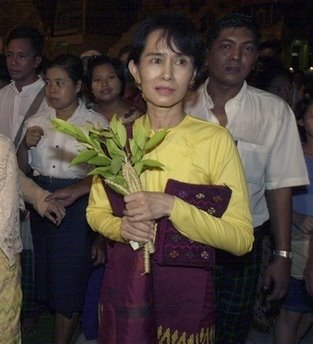


 Posts
Posts


