News & Articles on Burma
Tuesday, 01 February, 2011
-------------------------------------------------------------
DKBA Attacks Junta's Strategic 'Three Mountain' Outpost
International Reaction to Opening of Parliament Muted
Myanmar junta boss not nominated for presidency
Burma Picks Candidates for President; Junta Leader Not on List
Burma plans to choose a military old-hand president
USDP takes top spots in Rangoon parliament
Myanmar parliament begins choosing government
Myanmar parliament elects military men as house speakers
Fighting in Burma, Tak village evacuated
'How Free is Burma's Suu Kyi?'
Editorials RSS Feeds RSS Feed
Burma (Myanmar) opens parliament but junta retains strong grip
-------------------------------------------------
DKBA Attacks Junta's Strategic 'Three Mountain' Outpost
By SAI ZOM HSENG Tuesday, February 1, 2011
Democratic Karen Buddhist Army (DKBA) Brigade 5, a splinter group of the DKBA, attacked the Burmese army's strategic “Three Mountain” military outpost in Karen State on Tuesday in an effort to limit support for government troops stationed in Myawaddy.
“We attacked the outposts of Infantry Battalions No. 356 and 357, which are controlled by Military Operation Command (MOC) No. 9. We don’t know the results our attack yet. I knew that they [the Burmese Army] were not expecting our attacks and we showed that we can beat them anytime and anywhere,” said Maj Saw San Aung, an operational commander for DKBA Brigade 5. He could not confirm the number of dead and injured in the attack.
Royal Thai Army Chief of Staff Gen Prayuth Jan-ocha, left, and Thai Deputy Prime Minister Suthep Tuegsuban, right, inspect the Thai-Burma border at a location overlooking the Moei River in Mae Sot on February 1, 2010. (Photo: The Irrawaddy)
Three Mountain military outpost, located 5 kilometers from Kawkareik Township in Karen State, is the main outpost on the road to the border town of Myawaddy. Saw San Aung said that Brigade 5 attacked this outpost in order to cut Burmese military support for its troops in Myawaddy. By 1 p.m. today, he said, his forces had already withdrawn from the location.
On Monday, heavy-artillery shells fired by the Burmese troops exploded near a Thai military truck which was patrolling in Pho Pra Township, Tak Province. Two Thai soldiers who were in the truck were seriously injured and the truck was destroyed.
The injured Thai soldiers were brought to Mae Sot hospital, according to a local source. The 120 mm shells were apparently fired at the DKBA by Burmese troops at 1 a.m. On Monday morning.
Thai Deputy Prime Minister Suthep Tuegsuban and Royal Thai Army Chief of Staff Gen Prayuth Jan-ocha went to Mae Sot yesterday to inspect the situation on the Thai-Burma border.
“The border issues must be solved step by step, although there are few ways to solve the problem. The first way is by discussions through the Foreign Affairs Department, the second way is by coercion and the last way is by force. The last way will affect both sides, so the best way is to solve the problem by discussing and negotiating,” Jan-ocha said when he met reporters in Mae Sot on Monday evening.
Jan-ocha also stated that Thailand will shelter the refugees who fled to Thai soil for a while, but will send them back when the situation calms down.
Though the Chief of Staff of the Thai Army answered reporters questions, the Thai Deputy Prime Minister didn’t comment.
Meanwhile, the Commander of the Royal Thai Army’s No. 3 Regional Command went to the Mae Sot hospital and met with the injured soldiers. According to a Mae Sot resident, the commander said that Thailand will investigate the incident and if necessary make a complaint to the Burmese junta.
Two Burmese refugees were also injured by 120 mm shells that exploded near Moe Kae village in Pho Pra Township on Sunday morning.
A DKBA source said that the regime’s troops are firing at least 40-50 of the 120 mm shells every day, some of which are exploding on Thai soil, but he couldn’t confirm the report of the unjured Thai soldiers. The Burmese regime routinely claims that any shells landing on Thai soil are accidental.
The skirmishes between the DKBA and the Burmese troops are still taking place mainly in the area of Kyauk Khet in Myawaddy Township. A DKBA Brigade 5 officer said that his forces only use guerilla warfare tactics to attack the regime’s troops because they don’t want to become a stable target for the Burmese troops.
“We attacked the Waw Lay outpost with mines last Sunday,” Saw San Aung said. “A Burmese army major was injured and lost his sight. Another one or two Burmese army officers were also injured by our attack.”
Two Burmese military trucks were also hit by mines in the Thin Gan Nyi Naung area in Myawaddy Township on Sunday and several soldiers were injured, according to a DKBA source.
In Thailand, about 1,000 residents of Ban Mo Ker Thai village in the Phop Phra District of Tak Province were evacuated this morning as stray mortar shells again fell on Thai soil during fighting between DKBA Brigade 5 and Burmese government troops, but no injuries were reported, according to the Bangkok Post newspaper.
Col Saw Kyaw Thet from DKBA Brigade 5 and representatives from the Karen National Union (KNU) traveled to Loi Tai Leng, where the the Shan State Army-South (SSA- South) headquarters are located. According to a DKBA source, the SSA-South has agreed to give military support to the DKBA.
The skirmishes between the regime’s troops and DKBA Brigade 5 began on November 7, 2010, the day the junta held Burma's first election in 20 years.
The Irrawaddy’s Mae Sot correspondent contributed this article.
Copyright © 2008 Irrawaddy Publishing Group | www.irrawaddy.org
http://www.irrawaddy.org/article.php?art_id=20650
-----------------------------------------------------
International Reaction to Opening of Parliament Muted
By SIMON ROUGHNEEN AND LALIT K. JHA Tuesday, February 1, 2011
While international media headlines focused on the “historic” opening of Parliament in Burma, international diplomatic reaction has been somewhat muted.
Since Monday's first sitting of Burma's Upper and Lower Houses of Parliament, little has been said by countries or international organizations that either have strong trade or diplomatic links with Burma, or by those that have been critical of the ruling junta.
Among the few to make any comment, a foreign ministry statement from Tokyo said, “The Government of Japan will closely observe the future direction of the National Assembly, including its administration, debates to be taken, as well as activities of pro-democracy movement and ethnic minority parties.”
A US statement ahead of Monday's opening sessions was less optimistic. “The Nov. 7 parliamentary elections were neither free nor fair, so unsurprisingly it has yielded a parliament dominated by the pro-junta Union Solidarity and Development Party, so-called USDP, and military officials,” said State Department spokesman P J Crowley.
We're not surprised by this,” he told reporters at his daily news conference. “As we have long said, we want to see political prisoners released; we want to see an inclusive, open political process.
“We were disappointed last week that the Burmese Supreme Court had the opportunity to authorize the recognition of the National League of Democracy, as well as other democratic and ethnic opposition parties,” he said. “This would have been a good step to enter a genuine inclusive dialogue, and unfortunately, as we've seen recently in Burma, it was another lost opportunity.”
British Foreign Secretary William Hague also preferred to comment prior to the opening of Burma's parliament. “There will be nothing to celebrate when Burma’s military-dominated Parliament meets for the first time on 31 January,” he said bluntly.
A more upbeat American comment came from Daniel Baer, the US Deputy Assistant Secretary of State for Democracy, Human Rights and Labor.
“There's an opportunity here to chart a more positive path and we will continue to engage to try to encourage and offer support for that,” he said. “Part of engagement is making clear our perspective that political prisoners need to be released, that the National League for Democracy needs to be allowed to register, and Aung San Suu Kyi needs to be given the space to operate.”
Baer added that the US's recent engagement with Burma has been in the context of the Obama administration's broader policy of principled engagement around the world. “I would put an emphasis on the principled part of that engagement which is to say yes, we're making attempts to reach out and to try to encourage positive forward action in Burma and in other places with the understanding that things will be difficult,” he said.
“I expect that our policy of engagement will not change, but obviously times change and the topics on which we engage can change and we'll continue to do everything we can in our engagement to pursue speedy movement toward progress,” Baer concluded.
The European Union High Representative on Foreign Policy and Security, Catherine Ashton, has not issued a statement on Burma since the release of Aung San Suu Kyi. However, in a release after the Nov. 7 elections, she said, “The EU will observe closely how accountable the new Parliament and government will be vis-à-vis the electorate; whether the new institutions will ensure respect for human rights and fundamental freedoms and contribute to a process leading towards reconciliation and democracy; and whether they will deliver better policies to improve the economic and social situation of citizens.”
This should mean that the EU will keep a close watch on how the parliament functions and how effective it will be. The EU has a Special Envoy for Burma/Myanmar, Italian Piero Fossini. However he has not spoken about Burma since March 2010. As an appointee of the previous EU foreign representative, Javier Solana, it is not clear what Fossini's role is under the new system since the implementation of the EU Lisbon Reform Treaty.
Fossini's job-spec includes providing support to the United Nations Secretary-General's envoy to Burma, currently Ban Ki-moon's Chief of Staff Vijay Nambiar. However, like the United States, the UN does not at present have a full-time Burma envoy.
Other European countries that are from time to time outspoken on Burma, such as Ireland, Czech Republic, Denmark and France, did not comment on the parliament opening. Closer to Burma, there were no statements by Singapore, Thailand, Indonesia by or the Association of Southeast Asian Nations (Asean) or Secretary-General Surin Pitsuwan.
Burma is a member-state of Asean, currently headed by Indonesia, and Asean governments have called for Western sanctions on Burma to be dropped now that elections have facilitated to formation of a parliament.
Copyright © 2008 Irrawaddy Publishing Group | www.irrawaddy.org
http://www.irrawaddy.org/article.php?art_id=20648
------------------------------------------------
Tuesday February 1, 2011
Myanmar junta boss not nominated for presidency
By Aung Hla Tun
NAYPYITAW, Myanmar (Reuters) - Myanmar's reclusive paramount leader Than Shwe is not among a list of presidential candidates to be nominated by parliament, lawmakers said on Tuesday, signalling an end to his 18 years of direct rule.
Myanmar's new parliament is expected to vote on Thursday to elect the country's first civilian president after nearly half a century of military rule.
Assembly members told Reuters that the 78-year-old military strongman's name was not among five candidates for the post. His decision not to run will come as a surprise to many within the armed forces, who are rarely privy to the general's thinking.
But the junta chief is unlikely to fade away and is likely to have chosen the president himself by ensuring his own preferred candidate was among those picked by legislators on Tuesday.
Than Shwe is expected to either remain in charge of the military or to take a significant behind-the-scenes political role in the resource-rich country formerly known as Burma.
Most expect the presidency to go to the current prime minister, Thein Sein, the military junta's fourth in command, indicating a continuation of the status quo.
"In reality, as long as Than Shwe remains commander-in-chief, he will still be more powerful than the president," said Aung Naing Oo, a Burmese academic and deputy director of the Thailand-based advocacy group, the Vahu Development Institute.
"He's always had a clear strategy, a choreographed, well-orchestrated plan and he won't slip up now. He'll ensure the security of himself and his family and he has chosen a 'yes' man for president whom he has 100 percent confidence in."
The election of a president is a priority for Myanmar's first elected parliament in half a century as it convenes this week in the capital, Naypyitaw, following the first polls in two decades on Nov. 7, a poll widely criticised as a sham.
WEAK OPPOSITION
The names of candidates were given to Reuters by members of the senate, lower house and from among military-appointed parliamentarians on condition their names be withheld because they could faced jail if found to have spoken to the media.
Pro-democracy forces have little voice in the process. Both the lower and upper houses are dominated by the Union Solidarity and Development Party (USDP), a proxy for the military government which swept the election.
A lower house representative said a committee comprised of its members had agreed to nominate Thein Sein, or an ethnic Karen politician, Saw Thein Aung.
An army-appointed assembly member said the junta's fifth-in-command, Tin Aung Myint Oo, would be nominated.
A senate legislator said members of the house had agreed on two presidential candidates -- either Aye Maung, leader of the Rakhine Nationalities Development Party, or Sai Mo Kham, a member of the army-backed USDP.
It was not known whether Than Shwe's long-time deputy, Maung Aye, would play a future role. The junta's third-in-command, Thura Shwe Mann, was elected lower house speaker on Monday.
The candidate with most votes from three special legislative committees will become president for a five-year term and the two unsuccessful nominees will serve as vice-presidents.
The Vahu Development Institute's Aung Naing Oo tipped Thein Sein for the presidency because he would be agreeable to all parties within the military.
He has a clean image, is not from a particular faction and has no significant business interests, he added.
"Thein Sein is the safest bet for Than Shwe and for the military's hold on power," he said. "Than Shwe has picked a horse he knows will win."
(Writing and additional reporting by Martin Petty; Editing by Jason Szep)
Copyright © 2011 Reuters http://thestar.com.my/news/story.asp?file=/2011/2/1/worldupdates/2011-02-01T172226Z_01_NOOTR_RTRMDNC_0_-545623-1&sec=Worldupdates
----------------------------------------------------
Burma Picks Candidates for President; Junta Leader Not on List
VOA News February 01, 2011
Image taken from video shows the inaugural session of the Burma parliament in Naypyitaw, February 1, 2011
Burma's new parliament has settled on a list of five candidates to become the country's first civilian president in more than half a century, with a final vote expected Thursday.
Delegates say the most prominent of the five candidates is Thein Sein, who heads the dominant military-backed party in parliament and served as prime minister in the outgoing military government. The full list of names is not available because reporters are barred from the parliamentary session, Burma's first in 20 years.
Only members of the parliament were eligible for the post, meaning longtime junta leader Than Shwe is not among the candidates. However he is expected to remain in a position of power, either as head of the military or as a behind-the scenes power broker.
The selection of a president is the most important piece of business for the parliamentary session, which is hailed by the government as a return to democracy and democratic rule. But critics denounced last year's elections as a sham and note that the most popular opposition party, headed by Aung San Suu Kyi, was unable to participate.
More than 80 percent of the seats in the two chambers have gone to supporters of the military government. The military has held power in Burma since a coup in 1962. http://www.voanews.com/english/news/asia/Burma-Picks-Candidates-for-President-Junta-Leader-Not-on-List-115001404.html
-----------------------------------------------
Burma plans to choose a military old-hand president
By Zin Linn Feb 01, 2011 9:32PM UTC
Burma or Myanmar’s new parliament elected two military men as speakers of the Upper and Lower Houses on Monday in its first session as a consequence of the November elections. The choosing of the speakers of the Upper and Lower Houses looked like a theatrical scène following a rehearsal. It was exactly the same performance under Dictator Ne Win’s totalitarian parliament during 1974-88.
Shwe Mann, the third most powerful general in the country’s junta, was voted speaker of the lower house while Khin Aung Myint, the current culture minister, was voted upper house speaker, junta’s media said.
The two houses are occupied by the military through the pro-junta Union Solidarity and Development Party (USDP), which won 77 percent of the parliamentary seats, and 166 military-appointed Members of Parliament, who represent for 25 percent of the military quota under 2008 constitution.
Prearranged by the State Peace and Development Council, the first regular session of the People’s Parliament (Pyithu Hluttaw) was convened at the Pyithu Hluttaw Building in Naypyitaw Monday.
According to the agenda 10 of the session, the elected representatives for the People’s Parliament or Lower House took out the proposal forms from the Master of Ceremony to choose the candidate for the Speaker of the People’s Parliament (Lower House), filled in the forms and presented them to the chairman of the first regular session.
Current Prime Minister Thein Sein, an elected representative from the Zabuthiri Constituency, proposed Thura Shwe Mann of Zeyathiri Constituency for the Speaker and the current industry minister Aung Thaung of the Taungtha Constituency seconded the nomination.
Afterwards, the chairman announced the names of the candidates for the Speaker. As there were two candidates for the Speaker, the elected representatives cast secret ballots for the Speaker. Then, votes cast by the elected representatives for the two candidates were counted and declared.
Thura Shwe Mann won 376 votes while Mahn Maung Maung Nyan obtained 30 votes, and the chairman announced that Thura Shwe Mann was elected as the Speaker of the Lower House (Pyithu Hluttaw). No one was amazing as all the parliamentarians hoped the result before the secret ballot.
Thura Shwe Mann was former joint chief of staff of the Burmese Armed Forces, and third-highest ranking member of the State Peace and Development Council, after Than Shwe and Maung Aye. Shwe Mann graduated in 1969 from the Defence Services Academy, Intake 11.
According the agenda 11, the Deputy Speaker job was also put to vote in line with the rules and regulations for choosing the Speaker, said the state media
Current information minister Kyaw Hsan, a representative-elect from the Pale Constituency proposed Nanda Kyaw Swar, a representative-elect from the Dagon Constituency, for the Deputy Speaker and current science and technical minister U Thaung, an elected representative from the Kyaukse Constituency seconded the candidacy. A usual act produced by the same script-writer.
As there were three candidates for the Deputy Speaker, the elected representatives cast secrete ballots for the Deputy Speaker. Afterwards, votes cast by the representatives-elect for the three candidates were counted.
Nanda Kyaw Swar won 368 votes while Nelson (a) Hsaung Hsi obtained 45 votes and Mahn Maung Maung Nyan got 15 votes. Therefore, the chairperson of the first session of the Lower House announced that Nanda Kyaw Swar was elected as the Deputy Speaker.
Nanda Kyaw Swar is the son of Brigadier General Tin Pe, a member of the revolutionary council led by General Ne Win in 1962. Tin Pe was known as close associate of former dictator Ne Win.
Afterwards, Thura Shwe Mann and Nanda Kyaw Swar sworn in by the chairman as the Speaker and Deputy Speaker and signed the statement of allegiance in front of the elected representatives.
Current agricultural minister Htay Oo, the chairperson of the first regular session of the Lower House handed over the duty to Speaker Thura Shwe Mann. Speaker Thura U Shwe Mann received the duty and extended a greeting address likely to be a ready-made wording.
According to the military’s mouthpiece New Light of Myanmar, the electing of the Speaker and the Deputy Speaker of the Lower House was elected in accordance with the provisions in the Chapter-V of the Lower House Bylaws.
Meanwhile, military’s supreme boss Than Shwe is not among a list of presidential candidates to be nominated by parliament, lawmakers said on Tuesday. As said by the parliamentarians, the new parliament is predictable to vote on Thursday to select the country’s president by secret ballot following half a century of military rule.
But it is uncertain to predict Than Shwe’s role. He is likely to stay in charge of the commanding military or to stay behind-the-scenes unbending strongman.
Most analysts and observers guess the presidency nearly certain to go to the current Prime Minister, Thein Sein, the military junta’s fourth in command. The 65-year-old career soldier retired from the army in April 2010 to lead of the army-backed USDP, which claimed landslide in the poll. Thein Sein was appointed in April 2007 by the nation’s ruling military junta as interim prime minister, replacing Soe Win undertaking medical treatment. Thein Sein succeeded Soe Win on 24 October 2007 after Soe Win’s death in October 2007.
According to one analyst, it’s the same wine in the old bottle, or the military controlled government not changing fundamental policy.
http://asiancorrespondent.com/47509/burma-plans-to-choose-a-military-old-hand-president/
------------------------------------------------
USDP takes top spots in Rangoon parliament
By AHUNT PHONE MYAT
Published: 1 February 2011
The leadership of the key Rangoon regional parliament has been awarded to representatives of the junta-backed election winners, the Union Solidarity and Development Party (USDP).
Taking the position of chairman is Maung Maung Win, who was elected yesterday after only a one-hour session. It is the first time parliament has met in Burma for more than 20 years.
The former army colonel will be joined by newly-elected speaker, Sein Tin Win, also a retired military man, and vice-speaker is Tin Aung, chairman of the Rangoon wing of the Government Cooperatives Association.
They are all members of the USDP, which won around 80 percent of seats in the 7 November 2010 vote and, with the likely backing of pre-appointed military officials, looks set to dominate parliament.
U Kyaw, a regional parliamentary representative of the opposition National Democratic Force (NDF), which won 16 seats in the elections, said that the USDP’s dominance of the decision-making process meant its leadership was inevitable.
Of the 123 election-winning representatives in the Rangoon parliament, 75 are USDP members, 31 are pre-appointed military officials, and 17 from other parties. Rangoon’s is one of 15 regional parliaments around the country which were formed in lieu of elections last year for the first time in Burma’s history.
Yesterday’s Rangoon session was held in tandem with the opening of the Union Parliament in Naypyidaw, which is comprised of the lower house, or People’s Parliament, and the upper house, or Nationalities Parliament. The junta’s former third-in-command, Shwe Mann, will be speaker of the lower house, while his counterpart in the upper house is current culture minister, Khin Aung Myint.
Critics claims that the chances of any major shift in Burma’s political landscape is unlikely, given the dominance of the military and its proxy party in parliament. NDF representative for the Rangoon legislature, San San Myint, said that however that if pro-junta forces “propose something positive for the people, then we will support their proposition; otherwise we will contest it”.
http://www.dvb.no/news/usdp-takes-top-spots-in-rangoon-parliament/13991
---------------------------------------------
Myanmar parliament begins choosing government
Added At: 2011-02-01 1:17 PM,Last Updated At: 2011-02-01 1:24 PM
ASSOCIATED PRESS
NAYPYITAW: Myanmar's first parliament in more than two decades nominated five vice-presidential candidates Tuesday, one of whom will become president and lead the new military-dominated government.
The army has held power in Myanmar since 1962 and thanks to an 80 percent majority it holds with its proxies in the new legislature it is certain the president will be a top member of the outgoing junta.
The most prominent nominee vying for the three vice president's seats is Thein Sein, who served as prime minister in the outgoing junta and also heads the military-backed Union Solidarity and Development Party, which won a huge majority in last November's general election.
Parliament is now adjourned until Thursday while the speakers and their deputies from the lower and upper houses scrutinize the candidates' qualifications to become president. The 2008 constitution drafted under the junta's guidance says the president shall be acquainted with political, administrative, economic and military affairs.
Thein Sein's seniority makes him the most likely pick.
The selection of the president is the last step in the junta's so-called road map to democracy. It has manipulated the process to ensure that the military will continue to have a dominant role in running the country.
Although there appears to be little popular interest in parliament's opening — the widespread perception that the military cheated in last November's general election dashed many hopes for true change — the general public is curious as to who may become head of state.
"I am not interested in the opening of parliament but I am a little curious to know who will be the country's first president. It could be one of the military leaders, but I am still curious if it will be Senior Gen. Than Shwe or Prime Minister Thein Sein," said a worker at a hotel in Naypyitaw. He spoke on condition of anonymity to avoid unwanted official attention for speaking to a journalist.
Than Shwe is the head of the junta and no matter who becomes president he is expected to remain a dominant force in the country.
The 440-seat lower house and 224-seat upper house opened Monday, and their first order of business was to elect legislative officers.
Thura Shwe Mann, who had been the junta's third-ranking member before retiring from the military to run for election with the USDP, was picked to be speaker of the lower house. Khin Aung Myint, the junta's culture minister, was named speaker of the upper house.
The military has been in power since a 1962 coup deposed the last legitimately elected legislature. A single-party parliament under the late dictator Gen. Ne Win was abolished in 1988 after the army crushed a pro-democracy uprising.
The party of Nobel laureate Aung San Suu Kyi, which won elections in 1990 that the junta refused to honor, boycotted last November's vote and is without representation in the new legislature. http://thehimalayantimes.com/fullNews.php?headline=Myanmar+parliament+begins+choosing+government&NewsID=274799
-----------------------------------------------
Myanmar parliament elects military men as house speakers
Naypyitaw (Myanmar), Jan 31 : Myanmar's new parliament Monday elected two military men as speakers of the upper and lower chambers in its first session since the Nov 7 general election.
Shwe Mann, the third most powerful general in the country's junta, was voted speaker of the lower house while Khin Aung Myint, the current culture minister, was voted upper house speaker, sources said.
The two houses are dominated by the military through the pro-junta Union Solidarity and Development Party (USDP), which won 77 percent of the contested seats, and 166 military-appointed legislators, who account for 25 percent of the votes.
Civilians were elected as vice speakers.
"On Tuesday, we will nominate three presidential candidates," one legislator said. It is unclear when the parliament will vote on the president.
Journalists, except those working for state media, were barred from attending the parliamentary session.
The session was held amid tight security. Barricades were in place on roads leading to the massive 100-million-dollar parliament compound in Naypyitaw, 350 km north of Yangon.
Legislators were escorted to the site by plainclothes policemen.
Senior General Than Shwe, who has ruled Myanmar since 1992, who in past speeches vowed to steer the country towards "discipline-flourishing democracy", is keeping true to his word.
The stage-managed November general elections were condemned by Western democracies for being neither free nor fair.
Military appointees make up 25 percent of lawmakers in the three chambers, giving the military bloc veto power over any future legislation.
Only the upper and lower houses meet in Naypyitaw this week. The regional and state parliaments will meet separately in their own capitals.
Than Shwe, who turns 78 Wednesday, although a possible candidate for the presidency, seems more likely to chose a protege for the powerful post and control him from "behind the curtain", government sources said.
The likeliest candidate now is Thein Sein, the current prime minister, since Shwe Mann has been named lower house speaker.
"I think Than Shwe may feel that Thein Sein is more malleable than Shwe Mann," said Win Min, a US-based Myanmar researcher. "He may also feel that Thein Sein may be more credible as president since Thein Sein's family is much less corrupt than Shwe Mann's family."
The new president will select a cabinet, which is expected to be packed with USDP members and military appointees.
"It seems that Than Shwe will try to maintain the status quo," Win Min said. "So, same wine in the old bottle, or just some name changes in the military dominated government, not a change in the government."
--IANS http://www.newkerala.com/news/world/fullnews-136834.html
----------------------------------------------------
BANGKOK POST
Fighting in Burma, Tak village evacuated
* Published: 1/02/2011 at 11:53 AM
* Online news:
About one thousand residents of Ban Mo Ker Thai in Tak’s Phop Phra district were evacuated this morning as stray mortar shells again fell on Thai soil during fighting across the border between Burmese government troops and ethnic forces.
Chamroen Khiewja, the village headman, said he heard continuous firing on the Burmese side of the border from about 8am onward, including about 20 mortar shells exploding. Four mortar shells had landed in the village damaging several houses.
Mr Chamroen said the Burmese government forces opened fire on Democratic Karen Buddhist Army (DKBA) positions.
No injuries were reported in the village but the incident prompted the evacuation of the about 1,000 residents, including some Buddhist monks.
They had taken refuge at a border checkpoint about 3km from the village, said Mr Chamroen. http://www.bangkokpost.com/news/local/219293/fresh-mortar-shooting-prompts-evacuation
---------------------------------------
'How Free is Burma's Suu Kyi?'
Ask Former White House Drug Spokesman Robert Weiner and James Lewis
Burma's Elected Leader Can't Run for or Win Office or Speak Freely
WASHINGTON, Jan. 31 /PRNewswire-USNewswire/ -- Former White House National Drug Policy Spokesman, Robert Weiner, and National Security Analyst, James Lewis, in the Honolulu Star Advertiser, assert that the media in the U.S. and around the world have misinterpreted the "release" of Burma's Aung San Suu Kyi. Weiner and Lewis contend that she is not "free" because she cannot run for or win office despite her earlier election (which the junta blocked) as the country's national leader -- and that real change in Burma is only possible if the drug-funded junta is ousted and drug transportation, with Hawaii as a main port, is eliminated.
Weiner and Lewis ask, "How free is Suu Kyi? Is she free to run for office in non-rigged elections and assume the prime minister role she was denied? Free to call for a civilian government, a legal product-based economy, and a halt to the drug trade funding the junta and killing thousands in Burma and around the globe?"
Weiner and Lewis point out, "She still can't run for office or speak freely. Arresting and releasing her is a drama the regime continues to play time and again. She has been under detention in recurring waves for over 15 years."
"Suu Kyi has been careful not to verbally challenge the military leadership of Burma. Yet she has said, 'Real freedom is freedom from fear.' Is she really free if she is living in fear?"
Weiner and Lewis encourage Suu Kyi to "take a page from other historic leaders and enter exile – maybe as Burma's Political Dalai Lama."
"Laundered money – paid with drugs that go through Hawaii – cements the junta's power. With worldwide drug money filling the sanctions gap, the junta leaders live quite a luxurious lifestyle." Citing government reports, the authors explain that, "Hawaii is a major transshipment port for ice methamphetamine."
"Burma is a tale of drugs, ransom, and sanctions -- and Hawaii is at the center of it."
"To achieve real change in Burma, Suu Kyi and other opposition leaders must be allowed to campaign and run for office, and the drugs funding the junta and transiting through Hawaii must be eliminated."
Looking for solutions, and as a gesture for the junta's providing Suu Kyi some freedom, Weiner and Lewis assert that, "The U.S. should respond by filling the empty special envoy post in Burma and providing anti-narcotics targeted and monitored aid, but not providing other assistance. The former U.S. Political and Economic Chief in Rangoon, Leslie Hayden, reported that providing anti-narcotics aid to Burma would pressure the regime into 'concrete results' and would slow the flow of drugs. Full commercial sanctions lifting, however, would be an undeserved boon to the junta."
"The U.S. can exert pressure to keep Suu Kyi unincarcerated and help keep Burmese methamphetamine and heroin off America's and Europe's streets. The U.S. can support training, crop substitution, and intelligence sharing, including an opium crop survey disbanded since 2005. Knowledge is power," the authors state.
Link to article: http://www.staradvertiser.com/editorials/20110131_Laundered_money_from_drugs_that_go_through_Hawaii_helps_keep_Burmas_junta_in_power.html
Contact: Bob Weiner/James Lewis 301-283-0821 begin_of_the_skype_highlighting 301-283-0821 end_of_the_skype_highlighting or 202-329-1700 begin_of_the_skype_highlighting 202-329-1700 end_of_the_skype_highlighting
SOURCE Robert Weiner Associates
--------------------------------------
Editorials RSS Feeds RSS Feed
Burma Still Far From a Democracy
Burma's leaders said the election was part of their plan to move the country to democracy and civilian rule, but the legislature is hardly democratic.
Members of the Union Solidarity and Development Party drive a campaign vehicle with posters of the party's candidates who ran in the November 7, 2010 general elections.
Burma's national and regional parliaments, which were elected last November in a deeply flawed process, will hold their first session January 31st. This will be first time that a legislative body has convened in Burma since 1988. Voted in under the disputed 2008 constitution, which was drafted by Burma's military rulers without input from democratic opposition groups, government officials and supporters will hold about 80 percent of the elected seats. Tightening their grip on power further, regime leaders recently named the lawmakers who will serve as the designated military appointees, who will account for one fourth of the parliament's members.
Burma's leaders said the election was part of their plan to move the country to democracy and civilian rule, but the legislature is hardly democratic. Not only did the military leadership guarantee itself a strong hand in Parliament with the large number of military appointees, it limited the ability of opposition candidates to campaign for the elected seats. Many, including democracy advocate Aung San Suu Kyi who remained under house arrest during the elections, were barred from running at all. The election was neither free nor fair.
The United States is among a handful of countries that have imposed targeted economic sanctions on those most responsible for denying democracy and disregarding human rights in Burma. As the time approaches for the parliaments to convene, some of Burma's neighbors have called on the West to lift sanctions. They say U.S. policy hampers important areas of trade, prevents investment and technology from helping to develop Burma's hard-pressed ethnic regions, and hurts the Burmese people.
The United States is deeply concerned about the plight of ordinary citizens of Burma. But it is the regime that is responsible for the country's dire economic situation. The record is clear on how the military regime has mismanaged the economy, institutionalized corruption and plundered valuable national resources for private gain.
Our two nations have been in talks about improving relations since 2009 and we will continue to engage the government on our mutual concerns. Until the government undertakes fundamental change in Burma, including releasing the more than 2,100 political prisoners and beginning a meaningful and time-bound dialogue with the democratic opposition and ethnic minorities, U.S. sanctions will remain in place.
http://www.voanews.com/policy/editorials/Burma-Still-Far-From-A-Democracy-114916829.html
---------------------------------------------
Burma (Myanmar) opens parliament but junta retains strong grip
The Christian Science Monitor
By Simon Montlake Simon Montlake – Mon Jan 31, 9:17 am ET
Bangkok, Thailand – Burma (Myanmar) took another step Monday toward civilian rule after nearly five decades of military dictatorship with the convening of its new, semielected parliament. But the military seems set to retain its grip on the process, to the frustration of regime critics.
Monday’s joint parliamentary session in the regime’s purpose-built capital, Nyapyidaw, was the first since multiparty elections held in November. The US and other Western governments panned the poll, which were won overwhelmingly by a regime-backed party, as deeply flawed. A quarter of seats in the upper and lower houses are military appointees.
Some 600 legislators were bussed to the parliament complex under tight security, and reporters and other observers were kept away. Exiled Burmese news media reported that lawmakers were unable to bring cameras, mobile phones, and any recording devices to the parliament. Such secrecy has become a hallmark of Burmese politics.
The parliament does not have representation from the National League for Democracy, which refused to participate in the elections. The NLD's leader, democracy icon Aung San Suu Kyi, was released from house arrest a week after the poll and has since been rebuilding her political base in Rangoon, the former capital. The NLD won a previous election in 1990 but the military annulled the results.
Under Burma’s 2008 constitution, the joint parliament is tasked with selecting a president and two vice presidents, though a timetable on that remains unclear. The current junta that seized power in 1988 is supposed to then formally hand over power to the new executive, which is likely to be stuffed with former generals.
Exiled opposition groups have speculated that General Than Shwe, the outgoing junta chief, would seek the presidency. The military bloc in parliament has the right to nominate their own candidate and is allied to the United Solidarity and Development Party (USDP), which won 80 percent of contested seats.
Richard Horsey, an independent analyst of Burmese politics, says that Than Shwe is more likely to back another candidate as president. He argues that the junta chief has designed a political system in which the president, as head of state, must share power with the military commander in order to prevent another strongman emerging.
“He’s set the whole machine up so he can step back and take his hand off the lever without it blowing up in his face,” says Mr. Horsey, who is currently in Bangkok.
Opposition parties who contested November’s elections have faced criticism from the NLD and exiled Burmese groups who want to deny legitimacy to Burma’s transition of power. These groups have called on Western governments not to relax sanctions on the regime until there is more substantial democratic change.
Khin Maung Shwe, an official in the National Democratic Force, a breakaway NLD group that won 16 parliamentary seats, admitted that the gains were small but said that an election boycott served no purpose. He said his party would propose new laws and try to build alliances with like-minded lawmakers. “We have to be patient,” he says by phone from Rangoon. http://news.yahoo.com/s/csm/20110131/wl_csm/359900
Wednesday, February 2, 2011
News & Articles on Burma-Tuesday, 01 February, 2011


Tuesday, February 1, 2011
News & Articles on Burma-Monday, 31 January, 2011
News & Articles on Burma
Monday, 31 January, 2011
-------------------------------------------------------------
Thein Sein Set to Be New President
Next Myanmar president to be elected parliamentarian
Journalists barred from parliament
Shwe Mann elected as speaker
Suu Kyi's NLD party remains defiant
NLD Website Launched
Security Tight as Burmese Parliament Convenes
Rangoon Residents Made Homeless
Burmese to Get Just One Percent of Energy from Dams
Myanmar to Open Parliament for First Time Since the ’80s
Burma's parliament opens new session
Myanmar opens junta-dominated parliament
Security tight for Burma’s sham parliament
Suu Kyi launches website
New Myanmar Parliament Convenes For 1st Time In 22 Years
-------------------------------------------------
Thein Sein Set to Be New President
By WAI MOE Monday, January 31, 2011
Leaked information from Naypyidaw on Monday evening suggested that junta chief Snr-Gen Than Shwe had chosen Prime Minister ex-Gen Thein Sein to be the new president of Burma.
Thein Sein, who retired from the army in April to lead the junta’s proxy party, the Union Solidarity and Development Party, is Than Shwe’s longterm friend and close aide.
Military sources in Naypyidaw said Thein Sein is described among military officials as “Mr. Clean,” as he is much less corrupt than other generals, such as Shwe Mann and ex-Gen Tin Aung Myint Oo.
Thein Sein, 65, graduated from the elite military school, Defense Services Academy (DSA) Intake 9 in 1968 along with another top junta official, ex Lt-Gen Tin Aye, who many predict could also be in a high-ranking position in the incoming government.
In 1991, Thein Sein served in the War Office as the Colonel General Staff Officer Rank-1 under Than Shwe when the latter was the commander-in-chief of the armed forces. Before being Colonel General Staff Officer at the War Office, he was commander of Infantry Battalion 84 in Kalay Township, Sagaing Division.
Later Thein Sein was promoted to Brigadier-General, but still served as the General Staff Officer of the War Office, which was the first time that a Brigadier General had been promoted to General Staff Officer.
In early 1995 he became the commander of Military Operations Command -4 in Hmawbi, Rangoon Division. Following brief service as the commander of MOC-4, Thein Sein was appointed to lead the newly formed Triangle Regional Military Command in Kengtung, eastern Shan State, in 1996.
He later returned to the War Office as Adjutant General during a military reshuffle following a fatal helicopter accident which took the lives of Lt-Gen Tin Oo and other generals in 2001.
He became the junta’s Secretary-1 after former spy chief Gen Khin Nyunt’s downfall in Oct 2004 while Gen Soe Win became Prime Minister.
In April 2007, while Soe Win was suffering from leukemia, Thein Sein was appointed acting prime minister. In October 2007, he became the permanent prime minister after Soe Win passed away.
Appointing Thein Sein as the President of the Republic of Union of Myanmar is thought to be a major part of Than Shwe's hidden agenda in dealing with the Association of Southeast Asian Nations (Asean), as well as China and India.
Than Shwe has reportedly given much thought to how his new line-up will look in the eyes of the international community ahead of Burma chairing Asean for the first time in 2014, and hosting the Southeast Asian Games in 2013, Asean diplomatic sources hinted.
Although Thein Sein is known to be the quietest Head of Government among the Asean leaders at regional summits, he is renowned for being confident and persuasive in international dealings.
However, one serious worry for Thein Sein in the coming five-year presidential term is his long-suffering heart disease. Reportedly, he repeatedly asked Than Shwe for permission to retire in 2010 for heath reasons.
There are suggestions, therefore, that Thein Sein might in fact be unhappy with his appointment as President of Burma.
Related Story: Thein Sein to Head Political Party?
http://irrawaddy.org/article.php?art_id=20643
---------------------------------------------
Next Myanmar president to be elected parliamentarian (2nd Roundup)
Jan 31, 2011, 13:48 GMT
Naypyitaw, Myanmar - Myanmar's next president will be an elected member of parliament, ruling out the country's current military supremo as a candidate, state media announced Monday.
The announcement was made on Myanmar television by General Shwe Mann - the third most powerful person in the country's ruling junta - who was voted speaker of the lower house earlier in the day at the first session of parliament since the November 7 polls.
'The president, vice president and all cabinet members in the coming government will be elected members of parliament,' Shwe Mann said.
Earlier Monday, Shwe Mann was elected lower house speaker while Khin Aung Myint, another general and the current culture minister, was voted upper house speaker.
Voting by the two chambers was dominated by the military through the pro-junta Union Solidarity and Development Party (USDP), which won 77 per cent of the contested seats, and 166 military-appointed legislators, who account for 25 per cent of the votes.
Civilians were elected as vice speakers.
'On Tuesday, we will nominate three presidential candidates,' one legislator said. It is unclear when the parliament will vote on the president.
It was previously widely speculated that Senior General Than Shwe, Myanmar's junta chief since 1992, aspired to the presidency.
But Shwe Mann's announcement excluded him as a candidate, since Than Shwe, who turns 78 on Wednesday, did not contest the general election.
It is still believed that Than Shwe will attempt to control the next government by staying on as army commander-in-chief, analysts said.
Monday's parliamentary session was indicative of the 'discipline-flourishing democracy' Than Shwe has promised to bring about in past speeches.
The session was held amid tight security. Barricades were in place on roads leading to the massive 100-million-dollar parliament compound in Naypyitaw, 350 kilometres north of Yangon.
Legislators were escorted to the site by plainclothes policemen.
Military appointees make up 25 per cent of lawmakers in the three chambers, giving the military bloc veto power over any future legislation.
The stage-managed November general elections, part of Than Shwe's seven-step road to democracy, were condemned by Western democracies for being neither free nor fair.
Only the upper and lower houses meet in Naypyitaw this week. The regional and state parliaments will meet separately in their own capitals.
The likeliest candidate for president is now believed to Thein Sein, the current prime minister, since Shwe Mann has been named lower house speaker. Both Thein Shwe and Shwe Mann ran under the USDP banner.
'I think Than Shwe may feel that Thein Sein is more malleable than Shwe Mann,' said Win Min, a US-based Myanmar researcher.'He may also feel that Thein Sein may be more credible as president since Thein Sein's family is much less corrupt than Shwe Mann's family.'
The new president will select the next cabinet, which is expected to be packed with USDP members, and sit on the National Defence and Security Council, which will control the military.
The commander-in-chief will also sit on the council, a new entity in Myanmar's political scene.
'This council is more powerful than the president on security issues and the commander-in-chief is more powerful in this council than the president, having more active military votes,' Win Min said. 'The council can declare state of emergency, suspend cabinet/parliament and appoint a new commander-in-chief.'
http://www.monstersandcritics.com/news/asiapacific/news/article_1615936.php/Next-Myanmar-president-to-be-elected-parliamentarian-2nd-Roundup
--------------------------------------------------
Journalists barred from parliament
By SHWE AUNG
Published: 31 January 2011
Journalists will not be allowed to enter parliament today to cover the first session in more than two decades, despite reported pledges to the contrary.
It also remains unclear whether media will be allowed to report on any future sittings, the chairman of the Committee for Professional Conduct (CPC), Ko Ko, told DVB.
“The CPC previously checked with the MoI [Ministry of Information] and was told that there was no plan to invite journalists to Naypyidaw for the parliament opening,” he said. This comes despite an announcement by Burma’s information minister, Kyaw Hsan, on 17 January that reporters would be permitted.
Some 18 foreign news correspondents arrived in Naypyidaw yesterday to cover the event, but a photojournalist said today it would be impossible even to take a photo of the parliament building because the road leading to it was barricaded with barbed wire.
An elected MP today said on condition of anonymity that two reporters from a domestic Burmese news journal were visited by government authorities at their guest house in the capital and had their names taken.
Burma has some of the world’s strictest media laws, and bans filming of so-called sensitive material that would include parliamentary debates unless expressly permitted to do so. Under the Electronics Act, journalists caught filming without permission face a 10-year prison sentence.
The CPC, which is ostensibly tasked with protecting the interests of journalists and issuing guidelines for media practice, was set up recently by the government’s censor board, which also enforces Burma’s draconian press laws.
Analysts have sought to dampen expectations about the first parliamentary session since elections in November last year. Both chambers are dominated by the pro-junta Union Solidarity and Development Party (USDP), which won 80 percent of the vote, while a quarter of seats have already been reserved for pre-appointed military officials who effectively carry power of veto.
A parliament did meet in 1988 prior to the ousting of Burma’s first dictator, Ne Win, but one has to go back to March 1962 for the last time it met under civilian rule.
http://www.dvb.no/news/journalists-barred-from-parliament/13962
-------------------------------------------------
Shwe Mann elected as speaker
By AHUNT PHONE MYAT
Published: 31 January 2011
The Burmese junta’s former third-in-command Shwe Mann has become chairman of the lower house of parliament, which today held its first session in more than 20 years.
He was elected towards the end of today’s sitting, which was attended by more than 1000 MPs who won seats in the 7 November 2010 elections.
Taking the top position in the upper house will be current culture minister, Khin Aung Myint. Both are recently retired members of the military-led government that has ruled Burma in various guises since 1962.
Vice-chairperson of the lower house, or People’s Parliament, will be Nanda Kyaw Swa, a member of the Union Solidarity and Development Party (USDP), which won 80 percent of seats and is set to dominate parliament. Myat Nyein, director of the Attorney General’s office, will take this position in the upper house, or Nationalities Parliament.
According to the 2008 constitution, the head of the Nationalities Parliament will reside of Union Parliament – the upper and lower house combined – for 30 months.
“The parliament announced that [three] vice-presidents will be appointed tomorrow,” said Khin Shwe, a USDP representative for the Nationalities Parliament, who was present at today’s session.
“One of them will be directly appointed by the Commander-in-Chief of the Defence Services and the two others will be appointed respectively from the People’s and the Nationalities Parliaments. One of the three vice-presidents will be elected by the Union Parliament as the president, and the other two will remain as vice-presidents.”
Security around the parliament building in Naypyidaw was tight, and eye-witnesses said that barbed wire blocked the main road leading to the building. Journalists were banned from entering, while MPs were given strict directions on dress code and banned items, which included cameras and mobile phones.
Khin Shwe added that each representative were given 300,000 kyat ($US300) to cover their food expenses for one month, while they in turn handed over an affidavit in order for them to become official MPs.
http://www.dvb.no/news/shwe-mann-elected-as-speaker/13970
------------------------------------------------
Suu Kyi's NLD party remains defiant
Published: Jan. 31, 2011 at 6:37 AM
YANGON, Myanmar, Jan. 31 (UPI) -- Despite losing a legal appeal in Myanmar for recognition as an official political party, the National League for Democracy said it will continue to support the people.
Myanmar's highest court upheld the legal ruling the that the dissolution of the NLD late last year was correct according to law.
NLD party officials refused to register their organization with the electoral commission because their leader, democracy advocate and 1991 Nobel Peace Prize Laureate Aung San Suu Kyi, was under house arrest.
Even if Suu Kyi would have been released prior to the vote laws enacted last summer made her ineligible to run in the election because she had a criminal record.
Only registered parties had official status and could run in the Nov. 7 elections, the first in 20 years, but considered fraudulent by many Western nations.
The junta reserved one-quarter of the seats in the new Parliament that will sit for the first time this week. Critics of the junta and pro-democracy groups said this means the military will remain in power in all but name.
Many of the junta's ruling elite resigned their military positions to swell the ranks of the Union Solidarity and Development Party that claimed to have won 80 percent of the votes.
The NLD took the case concerning its legal standing to courts four times.
"Our existence and our legality does not change because of this court decision," Nyan Win, Suu Kyi's lawyer and member of the NLD, said. "Our party still exists. As Aung San Suu Kyi said, what really matters is the support of the people."
Many Western countries had urged the junta to release Suu Kyi as well as other political prisoners as a sign the military was sincere about moving toward democracy.
However, Suu Kyi, who had spent most the past 20 years under some form of incarceration, ranging from prison terms to lengthy house arrests, remained under house arrest at her lakeside home near the old capital of Yangon, formerly called Rangoon.
Democracy advocates decried the military's obstinacy over the release of Suu Kyi as a sign the junta was taking no chances of her and the NLD gaining another victory. She won the previous election in 1991 but the military refused to hand over power.
Suu Kyi was released shortly after the election and greeted by an emotional crowd.
News of the court ruling came as Suu Kyi was addressing the World Economic Forum in Davos, Switzerland, calling for more investment in Myanmar, formerly called Burma, as a way of helping the 55 million people.
She said that Myanmar had "already missed so many opportunities because of political conflicts," but she said investors should "put a premium on respect for the law" and a national reconciliation.
"Economic policies linked to human development and capacity building are the best path to the achievement of stability in a democratic transition," Suu Kyi said. "I would like to appeal to all those present ... to promote national reconciliation, genuine democratization, human development and economic growth in Burma."
During her last house detention, which lasted seven years, she often had talks with senior junta officials about the economic progress of Myanmar and said she would work toward reconciliation and ending EU and U.S. trade embargoes.
This week, Myanmar's elected members of Parliament meet for the first time in a recently finished building in Nay Pyi Taw, the new capital created out in the jungle by the ruling generals in 2005.
Read more: http://www.upi.com/Top_News/Special/2011/01/31/Suu-Kyis-NLD-party-remains-defiant/UPI-42311296473820/#ixzz1Cc8mZcI6
---------------------------------------------------
NLD Website Launched
By KO HTWE Monday, January 31, 2011
Burma’s pro-democracy leader Aung San Suu Kyi showed this weekend that—despite many years in detention—her resolve to keep apace with an ever-changing world is as dynamic as ever when she presided over the launch of her party, the National League for Democracy's (NLD's) first website.
“A good communication system is essential to our endeavor to set up a people's network for democracy that will span the whole world,” said Suu Kyi in a statement on the site's home page.
“I am very pleased indeed that there is now a web page that will make the policies and activities of the National League for Democracy known across the globe,” she added.
On Jan. 20, the Nobel Peace Prize winner finally received Internet access at her Inya Lake home from the Myanmar Post and Telecommunications Enterprise.
Speaking to The Irrawaddy on Monday, Moe Zaw Oo, the secretary of the exile National League for Democracy (Liberated Area) Foreign Affairs Committee, said the NLD can voice polices and information through its website.
“This website can be a place to make contact with the NLD,” he said.
However, the NLD in Rangoon denied that the website, http://www.nldburma.org was designed and created by party members in Burma.
“The website was created by NLD members abroad,” said Tin Oo, the NLD vice chairman. “It would have been very difficult to create it inside Burma. It is hard enough just to get a telephone line in this country.”
Some observers said the NLD is denying involvement in the website because of the Burmese military junta's infamous Electronics Act, which carries sentences of between seven and 15 years imprisonment.
The law, which forbids unauthorized use of electronic media, has been used against many pro-democracy dissidents in trials held at Insein Prison, resulting in lengthy prison sentences for critics of the ruling regime’s crackdown on monks in 2007 and its response to Cyclone Nargis in 2008.
In 2009, the state-run media in Burma issued warnings aimed toward members of the NLD, saying they could be charged with violating the Electronics Act for posting a party statement about Suu Kyi’s trial on the Internet.
The website also carried a “greeting” from Tin Oo. Like the message from Suu Kyi, he made no mention of the website being NLD-controlled, but congratulated the creators of the site.
“We welcome the opening of a web page dedicated to the promoting of the interest[s] of the NLD,” he said in a signed statement.
The NLD won a landslide victory in the 1990 general election. However, the results were never recognized by the junta. Instead, many leading members of the party were arrested and are now serving lengthy prison terms.
The NLD executive committee decided unanimously not to register the party for the Nov. 7 election. The decision not to register was prompted by the election laws, which members described as “unjust” and unlikely to result in a fair and inclusive election.
The laws excluded anyone serving a criminal sentence from participating in the election—a provision that bars NLD leader Suu Kyi and other political prisoners. In order to participate in the election, the NLD would have had to expel Suu Kyi from the party.
The NLD was dissolved by Burma’s Election Commission for not re-registering ahead of November's election. The party submitted an appeal against its dissolution but the High Court in Naypyidaw rejected it on Friday.
http://www.irrawaddy.org/article.php?art_id=20641
----------------------------------------------
Security Tight as Burmese Parliament Convenes
By BA KAUNG Thursday, March 3, 2011
At 8:55 am on Monday, the first session of Burma's new Parliament convened in a highly scripted manner and amid tight security in the country's remote capital of Naypyidaw, although the event went largely unnoticed among the majority of the public.
Since early morning, more than 600 legislators elected in last November's elections proceeded to the new Parliament building in the capital—a majority of them representing the junta's proxy Union Solidarity and Development Party (USDP) or appointed by the military according to the country's 2008 Constitution.
While many legislators from opposition parties were taken to the Parliament in government-arranged buses from state-run guesthouse in Naypyidaw, businessmen elected as USDP legislators were seen arriving there in luxury cars, according to a Reuters report.
Myo Zaw Aung, a member of the National Democratic Force (NDF) who is acting as an assistant to one of the party's MPs, said there were no signs of excitement on the faces of the opposition MPs as they got onto the buses, as most were not even sure of the procedures they would have to go through during the day.
“MPs were told that today they were to elect the Speaker of the House and that they would be notified of the day when the Pyidaungsu Hluttaw, a combination of lower and upper houses, would start. Except for that, they weren't told anything about what was going to take place inside the building,” he said.
“The only thing they knew for sure is it that once they entered, it wouldn't be easy to leave. There are many things to pass through on the way leading into and out of the Parliament.”
As Burma's Parliament met for the first time in more than two decades, security in Naypyidaw and the former capital Rangoon was tight. The media has been granted no access to the Parliament building, and reporters covering the event in Naypyidaw were not even allowed to go inside the state-run guesthouse where the MPs were staying.
The latest photos coming out of Burma today showed security agents searching for explosives in the buses which carried the MPs. The main road leading to the Parliament building was closed and some MPs going there in their own cars were required to obtain security passes beforehand.
Meanwhile, state and regional legislative assemblies across the country also convened today amid tight security, with the authorities even banning this week's Chinese lunar New Year's festivities as a measure to prevent large gatherings.
Despite being the first time that Burma's Parliament has convened since the collapse of former dictator Ne Win's regime in 1988, the public response to today's events has been muted, as few seem to regard it as anything more than a continuation of the military rule that has been in place since 1962.
“Nobody here cares what's going on in Naypyidaw. It's just another day,” said a magazine editor in Rangoon. “Many saw the blatant cheating during the election, so they know there's nothing to be excited about now.”
Despite the scripted parliamentary sessions and public indifference, speculation is still swirling about who will be the president of the new government. Although recent reports indicated that junta chief Snr-Gen Than Shwe has appointed himself to the top spot in the new government, the latest rumors in the country suggest that the position could go to the junta's prime minister, former Gen Thein Sein.
http://www.irrawaddy.org/highlight.php?art_id=20640
--------------------------------------------
Rangoon Residents Made Homeless
By KO HTWE Monday, January 31, 2011
Dozens of residents on 33rd Street in Kyauktada Township are being forced to move from their homes because the Yangon City Development Committee (YCDC) has ordered their apartments demolished as it paves the way for new condominiums in downtown Rangoon, according to local sources.
In December, YCDC officials issued notice to the owners or residents of 27 apartments in the Rangoon area, including apartment blocks on 33rd Street, telling them that as the blocks of apartments were hazardous and dangerous, the residents must move within the coming weeks.
Night scene on 33rd Street in downtown Rangoon (PHOTO: Paul Ark)
Some construction companies, most notably the Naing Group, have negotiated with YCDC to take over projects to build new condominiums in their place across the city.
Family members of a small neighborhood enterprise, Shwe Glass Shop, on 33rd Street, said they have not received any compensation from the Naing Group and the YCDC.
“Although we have not settled on an agreement with the company and YCDC, they have already begun demolishing the building,” said Kyaw Soe, a neighbor of the Shwe Glass Shop.
Residents said that before demolition began, the construction company agreed to pay compensation to all those affected by the rebuilding.
“Some of the residents have already accepted compensation and have moved to another place, but company didn’t agree to pay for Shwe Glass's first-floor apartment so they didn’t move,” said Kyaw Soe.
YCDC should ensure that there are no people living in the buildings before they destroy them, he added.
In August, YCDC listed as dangerous 15 other buildings in downtown Rangoon, according to Eleven media group.
On Jan. 18, 11 households at No. 184/ 185 33rd Street, an apartment block named “Umbrella House,” were removed from their apartments under the orders of No. 1 Industry Ministry officials, local residents said.
YCDC sent a letter on Jan. 13 warning Umbrella House residents to move out by Jan.18, but most were unable to make plans given the time limit.
“On that day, the police came and tried to break down the doors of some second-floor residents who refused to leave,” said one of the residents.
Umbrella House is a government-funded project. However, many of the residents have lived in the apartment block for 30 years and are reportedly unable to afford another apartment.
http://www.irrawaddy.org/article.php?art_id=20639
---------------------------------------------
Burmese to Get Just One Percent of Energy from Dams
By SAI ZOM HSENG Monday, January 31, 2011
Almost all of the electricity expected to be generated by hydropower dams now under construction in Burma will be sold to China and Thailand, with just one percent going to domestic consumers, according to environmental watchdog groups.
During a recent seminar on the Thai-Burmese border, groups researching the impact of the dams on rivers in Burma and neighboring countries noted that Chinese companies are involved in all but one of 21 major dam projects currently underway in Burma.
“Since China is the main investor in the dam projects, it will receive most of the electricity. China will get 48 percent, while 38 percent will go to Thailand and 3 percent to India. Only one percent will be available for domestic consumption,” said Sai Sai, the coordinator of Burma Rivers Network (BRN), one of the groups that took part in the seminar.
The remaining 10 percent, he added, will be used by the Burmese military and on large-scale development projects such as the construction of a natural gas pipeline from western Burma's Arakan State to China.
According to BRN, the 21 dams being built in Kachin, Shan, and Karenni states and Mandalay and Sagaing divisions will produce a total of 35,640 megawatts (MW) of electricity.
Following visits to Burma by Chinese officials late last year, Chinese investment in the Tasang dam, located on the Salween River in Shan State, is set to increase from US $6 billion to $10 billion, said Sai Sai, who added that the dam will be the largest in the state when it is completed.
While China is laying claim to most of the electricity being generated by the dams, India is also investing heavily in other projects designed to meet its own needs.
The Kaladan Multi-Modal Transit Transport Project, which aims increase India's trade with Southeast Asian countries and give it better access to its isolated northeastern state of Mizoram, was also criticized at the seminar for failing to take into account its impact on local people and the environment.
“We're not saying the project should never be implemented, but it should be put on hold until there is a more accountable government in Burma that will think about the impact and the effects of the project,” said Aung Marm Oo, the director of the Arakan Rivers Network.
The project, which will involve the development of the Sittwe seaport in Arakan State and the dredging of the Kaladan waterway to Paletwa in Chin State, will be carried out by Indian state-owned and private companies in cooperation with the Burmese regime, which will be responsible for constructing a highway from Paletwa to the Burma-India border.
According to Indian media reports, the $110 million Indian-funded project will be completed in 2014-5.
Meanwhile, Bangladesh has also staked a claim to a portion of Burma's growing hydropower capacity. It plans to buy most of the electricity that will be generated by four projects now under construction in Arakan State, including the Laymro dam, which will become the largest in western Burma with a capacity of 500 MW.
Some of the remaining electricity will be used to construct pipelines to send natural gas from Burma's Shwe gas fields to China, according to ARN's Aung Marm Oo.
ARN says that its research shows that the projects will deprive local people of their land and livelihoods. Even in the preliminary stages of the projects, there have been many cases of land confiscation and forced labor, the group said.
http://www.irrawaddy.org/article.php?art_id=20638
-------------------------------------------------
Myanmar to Open Parliament for First Time Since the ’80s
By THOMAS FULLER
Published: January 30, 2011
BANGKOK — Myanmar’s ruling generals on Monday convened the first meeting of Parliament in more than two decades, a move they say completes the impoverished country’s transition to a multiparty democracy.
Reporters were barred from the Parliament building when the session was convened Monday morning under tight security in the capital, Naypyidaw, the Associated Press reported.
Officially the opening of the two-chamber Parliament will mean the dissolution of the junta that has ruled Myanmar since 1988, when the country was known as Burma.
But it does not appear to be the dawn of unfettered democracy. A quarter of the seats are reserved for the military, and a military-backed party controls more than 80 percent of the rest, allowing the generals to effectively retain their power, albeit in a less hierarchical system.
“The military is staying in control, but some of them are taking off their uniforms,” said Win Min, a professor at Payap University in Thailand who is on leave in the United States.
One key question is whether Myanmar’s top general, Than Shwe, will become president, the most powerful job under the new Constitution, but one that would require him to resign as commander in chief.
Gen. Than Shwe, who has successfully crushed uprisings and purged potential rivals inside the military during his nearly two decades in power, turns 78 on Wednesday, according to a government booklet published three decades ago. (The military government has been so secretive that even the birthday of the country’s top leader is not known with certainty.)
Myanmar’s new system will resemble a democracy more in form than in substance, analysts say, but with the possibility of more debate and inclusiveness than under the junta’s top-down rule. Myanmar’s news media in exile has reported that questions in Parliament must be submitted by members 10 days in advance and pass a vetting process.
“I don’t think there’s going to be a lot of open, democratic governance during these first five years,” said Priscilla A. Clapp, who was the chief of mission at the United States Embassy in Myanmar from 1999 to 2002. “But with a system that is so much more complex, inevitably competing centers of power will develop.”
The opening of Parliament, which follows elections in November, is only one of a number of changes inside Myanmar.
Daw Aung San Suu Kyi, a winner of the Nobel Peace Prize and the country’s leading dissident, was freed from house arrest a week after the elections and is now seeking to rebuild her pro-democracy movement. The military government, meanwhile, is aggressively selling off buildings, factories and state-run companies, mostly to allies and family members of the country’s military leaders. The rush to privatization vaguely resembles the vast sell-off in Russia after the Soviet Union collapsed.
Neighboring countries have responded by pushing harder to end Myanmar’s international isolation, including an effort to lift the economic sanctions imposed by the United States, the European Union and other Western countries.
The two chambers of Parliament and representatives from the military will nominate three vice presidents, one of whom will be elected president and choose a cabinet. Names of potential cabinet members circulating in Myanmar in recent days included many of the people who held positions of power under the military government.
Parliament last met in Myanmar under the one-party rule of Gen. Ne Win, who formally retired from politics in 1988 during a time of unrest, but the country has not had a genuine multiparty system since 1962, when the military took power in a coup.
A version of this article appeared in print on January 31, 2011, on page A5 of the New York edition.
http://www.nytimes.com/2011/01/31/world/asia/31myanmar.html?ref=asia
-------------------------------------------------
31 January 2011 Last updated at 02:56 GMT
Burma's parliament opens new session
By Rachel Harvey BBC South East Asia Correspondent
Parliament building in Naypyitaw More than 1,000 deputies will gather for the session
The new parliament in Burma has convened for the first time since elections were held last November.
The poll was widely criticised by western governments and by democracy activists within Burma.
The first sitting of the bicameral national parliament brings into effect a new constitution and officially ends nearly 50 years of military rule.
But critics say the real power in Burma will still be in the hands of a few key generals.
A quarter of seats in parliament are reserved for serving members of the armed forces.
In Burma's remote jungle capital, Naypyitaw, newly-elected politicians and their newly-appointed military equivalents opened their session in a newly-built parliament at 0855 (0225 GMT), a time chosen for its auspiciousness.
The vast majority of the seats are occupied by members of the Union Solidarity and Development Party (USDP) which is backed by the current military government.
Aung San Suu Kyi speaks to young people at the headquarters of the disbanded NLD party in Rangoon Aung San Suu Kyi and her party will not be in the new parliament
The USDP won almost 77% of the vote in November's election. Critics say this thumping majority was achieved partly through intimidation and fraud, and partly because the pro-democracy party led by Aung San Sui Kyi decided to boycott.
Although there are some independent politicians in parliament, the USDP's dominance, backed by the military caucus, appears to tilt it in favour of the status quo.
One of the first duties of the new parliament is to form an electoral college to nominate candidates for president and vice president.
Only then will it become clear who will hold the reigns of power in the new-look Burma.
http://www.bbc.co.uk/news/world-asia-pacific-12321085
--------------------------------------------
Myanmar opens junta-dominated parliament
January 31, 2011 - 2:19PM
Myanmar's new junta-dominated parliament opened on Monday as lawmakers assembled in secrecy for their first legislative session since the late 1980s following a widely panned election.
No foreign media representatives were allowed to witness the event or even take photographs of the new parliament building where elected and designated lawmakers convened in the military regime's purpose-built capital, Naypyidaw.
"Parliament started at 8:55 (am, 0225 GMT). All members attended," a Myanmar official told AFP on condition of anonymity.
Advertisement: Story continues below
The timing -- almost certainly a product of the regime's penchant for astrology -- was just one aspect of this new parliament peculiar to a nation that has withered under the iron grip of military rule since 1962.
After a rare election in November, marred by the absence of democracy icon Aung San Suu Kyi and claims of cheating and intimidation, the junta was set to easily dominate Myanmar's first parliamentary session in two decades.
The formation of the national parliament in Naypyidaw and 14 regional assemblies takes the country towards the final stage of the junta's so-called "roadmap" to a "disciplined democracy", conceived in 2003.
But a quarter of the seats were kept aside for the military even before the vote, and the army-backed Union Solidarity and Development Party claimed an overwhelming victory, winning 882 out of 1,154 seats.
While the regime may have been planning for years, the lawmakers themselves were in the dark about their roles in the parliament, where proceedings may remain secret and rules ban recording devices, computers and mobile phones.
"No one really knows how the parliaments will be organised. We will know when we get there," said Soe Win, a National Democratic Force (NDF) legislator.
"My feeling is that we are moving one step forward."
Suu Kyi, released from house arrest a few days after the polls, was less optimistic in a Financial Times interview published this weekend, downplaying the impact of political changes.
"I don't think the elections mean there is going to be any kind of real change in the political process," she was quoted as saying. "I was released because my term was up. There is nothing strange about it."
The crucial question of who will be the country's next president has yet to be discussed openly, although Thura Shwe Mann, the former army number three, has recently been linked with the top spot.
Senior General Than Shwe, who has dominated the country since taking power in 1992, is now 77 but analysts say the strongman is reluctant to relinquish his hold completely.
Once appointed, the president will select a government, and can be confident of little resistance from a parliament dominated by the military and its cronies.
Suu Kyi's National League for Democracy (NLD) will not have a voice after it was disbanded for opting to boycott the election, while the two main opposition parties that decided to participate and won seats are political minnows.
The NDF, which split from the NLD in order to contest the vote, will take 16 seats in national and regional legislatures and the Democratic Party (Myanmar) has just three.
Parties from the country's diverse ethnic minority regions have a little more clout than the democracy parties and want to speak up for their areas, which many feel have long been neglected.
© 2011 AFP http://news.brisbanetimes.com.au/breaking-news-world/myanmar-opens-juntadominated-parliament-20110131-1aaq4.html
-------------------------------------------------
Security tight for Burma’s sham parliament
By Zin Linn Jan 31, 2011 12:08AM UTC
Security measures were tightened Sunday around Burma’s newly-built grandiose parliamentary buildings, which will be used for the first time this week by lawmakers elected in the country’s first polls in two decades in November.
Barbwire barricades were in place on the way to the huge parliament complex in Naypyitaw, Burma’s new capital since 2005, situated 350 kilometres north of the old capital Rangoon or Yangon.
Plain-clothed security personnel were posted at municipal guest houses where hundreds of legislators were lodged ahead of the first session of the upper and lower houses of parliament starting at 8.55am on Monday.
As the trustworthiness of the junta’s 2008 constitution and 2010 polls was dismissed by opposition leader Aung San Suu Kyi and her National League for Democracy party, the up-to-date parliamentary meetings seem unlikely to change the political environment of the country.
According to Mizzima News Agency, the Foreign Correspondents’ Club of Myanmar (FCCM) held a meeting in Rangoon on January 18 and decided to submit an application to the Ministry of Information for right of entry into parliamentary sessions to cover the events.
“We applied via the Press Scrutiny and Registration Division. But, we haven’t got any reply. We are still waiting,” a Rangoon-based correspondent from a foreign news agency told the Mizzima News.
However, on January 17, during an opening ceremony for a library in one Township in Rangoon, Information Minister Kyaw Hsan told local correspondents from a foreign news agency that tje Information Ministry has been planning to invite journalists from foreign news agencies to cover parliamentary sessions. However, it seems this is unlikely to happen.
The parliamentary buildings are new; as are the members of parliament. Incoming lawmakers have to obey strict instructions provided in 17 booklets covering everything from legislation and how to vote to dress code. All lawmakers are to wear traditional outfits, with ethnic representatives putting on the costume of their respective ethnic groups.
Although there are 388 military-appointed members of parliament for three chambers, only the upper and lower houses, with 166 military appointees, will assemble in Naypyitaw on Monday. The regional and state parliaments will convene separately in their own regional capitals.
Parliament’s primary mission will be to nominate three presidential candidates to be chosen by a junta-backed electoral college, as hinted by the observers. No other bills will be allowed putting forward for discussion. No media personnel were invited to cover the opening ceremony of the parliament as yet. It will be a premeditated performance or fake assembly.
A report – Burma’s 2010 Elections: a comprehensive report – released by Burma Fund UN Office today for the opening of Burma’s first Parliament, documents the widespread political repression and human rights abuses marring the electoral process. It found that none of the fundamental requirements for free and fair elections exist in Burma, and instead the human rights crisis deepened, as a consequence of the elections.
The Burma Fund UN Office Director, Dr Thaung Htun evaluated the recent November polls as a political deception mixed with human rights abuses.
“The parliament sitting today, is little more than a calculated ruse. The actors are the same; it is only the stage that has been newly decorated. However, we must not lose hope, the election is far from an end in itself and cannot divert the aspirations of the people for a genuine democratic transition. The agents of change in Burma are the people and their true representatives, who were cruelly excluded from the election process.”
“Even though a lot of challenges lie ahead on the path to freedom, the genuine pro-democracy and ethnic leaders and activists will continue to stand with the people, fearlessly facing down the military regime, and eventually, the will of the people will prevail in shaping the future of Burma.”
http://asiancorrespondent.com/47335/burmas-parliament-sitting-today-is-little-more-than-a-calculated-ruse/?utm_source=Asian+Correspondent&utm_campaign=1eee242d67-DAILY_RSS_EMAIL_CAMPAIGN&utm_medium=email
--------------------------------------------
Suu Kyi launches website
Rangoon - Burma's opposition leader Aung San Suu Kyi this weekend launched a website to consolidate international links and speed up "democratic union" in her military-led country.
"A good communication system is essential to our endeavour to set up a people's network for democracy that will span the whole world," Suu Kyi said in a statement posted online Monday.
By moving the message of her National League for Democracy (NLD) opposition party online, "I believe we shall be able to achieve our goal of a democratic union at a faster pace," she said.
The statement was co-signed by NLD vice chairman Tin Oo.
The website, http://www.nldburma.org, was made possible when authorities allowed Suu Kyi internet access on November 21.
The NLD is Burma's main opposition party. It won the 1990 general election by a landslide, but has been blocked from power by the ruling junta for the past 20 years, with most of its leadership thrown in jail.
The NLD boycotted the November election in response to new regulations that would have required it to drop its leader Suu Kyi as a member. As a consequence of the boycott, it lost its party status.
The Nation http://www.nationmultimedia.com/home/Suu-Kyi-launches-website-30147566.html
--------------------------------------
January 31, 2011 19:45 PM
New Myanmar Parliament Convenes For 1st Time In 22 Years
NAY PYI TAW, Jan 31 (Bernama) -- Myanmar started its first three-chamber parliament sessions simultaneously on Monday, with the sessions of the house of representatives (lower house) and house of nationalities (upper house) taking place at the newly- built parliament buildings in the new capital of Nay Pyi Taw.
While, the sessions of region or state parliament also began separately in 14 respective regions or states on the same day, reports China's Xinhua news agency reported Monday.
This sitting is a historic moment for Myanmar since the last time Parliament had a sitting in this conflicted country was more than 20 years ago.
The summon for the first sessions of the three-level parliaments in two decades by the ruling State Peace and Development Council (SPDC) came nearly three months after the end of the multi-party general election on Nov 7, 2010.
The union parliament, made up of the house of representatives and the house of nationalities, will elect the country's president and vice presidents and the president will form a new government according to the new state constitution.
The parliamentary sessions are expected to continue for days.
A total of 1,537 parliament representatives including 1,154 elected through the Nov 7, 2010 general election and 388 or 25 percent through direct nomination by the military are expected to attend the first three-level parliamentary sessions.
The 659 union parliament representatives (house of representatives and house of nationalities) are made up of 493 elected ones and 166 or 25 percent directly nominated military ones.
Of the 493 elected parliamentary house of representatives and house of nationalities, 388 come mainly from the majority winning Union Solidarity and Development Party (USDP), led by Prime Minister U Thein Sein, 17 from the National Unity Party (NUP), 21 from The Shan Nationalities Democratic Party (SNDP), 16 from the Rakhine Nationalities Development Party (RNDP) and 12 from the National Democratic Force (NDF).
In the 2010 general election, 1,154 candidates out of over 3, 000 representing political parties in contesting were elected as parliamentary representatives at three levels, in which 325 as representatives to the house of representatives, 168 as representatives to the house of nationalities and 661 as representatives to the region or state parliament.
Thirty-seven political parties including 82 independents took part in the parliamentary election held across the country's seven regions and seven ethnic states in November last year.
-- BERNAMA http://www.bernama.com/bernama/v5/newsworld.php?id=560882
ミャンマー 「タンシュエ大統領」強まる 軍政は継続へ
毎日新聞 2月1日(火)1時1分配信
拡大写真
タンシュエ氏=AP
【バンコク西尾英之】ミャンマーの首都ネピドーで31日開会した国会下院は、議長に現政権ナンバー3のシュエマン前軍総参謀長(63)を選出した。シュエマン氏は最高指導者、タンシュエ国家平和発展評議会議長(77)の後継者と目され、2月にも選出される大統領の有力候補の一人だった。シュエマン氏の議長就任で、大統領にはタンシュエ氏が選出される可能性が強まった。
現地からの情報によると、上下院は1日午前、副大統領3人の選出手続きに入る。このうち1人が大統領に選ばれるが、タンシュエ氏が副大統領に選出されれば大統領就任は確定的になる。
ミャンマー国内では最近になって、タンシュエ氏自身が大統領就任に意欲を示しているとの観測が広がっていたが、本命とみられていたシュエマン氏の下院議長選出は、現地でも驚きをもって迎えられている。現地情報筋は、氏が議長を辞任して改めて副大統領に選ばれることも不可能ではないが現実的ではなく、タンシュエ氏の大統領就任の可能性が強まったとの見方だ。
これまで独裁的権限を振るってきたタンシュエ氏が民政移管後の国家元首である大統領に横滑りすれば、民政移管が見せかけに過ぎないことがより鮮明になり、ミャンマーと米欧など国際社会との関係修復は極めて困難になる。
一方、高齢で健康に不安を抱えるタンシュエ氏が海外での国際会議出席など大統領の職務をこなすのは困難との見方から、氏は軍を統括する国防治安評議会議長に就任して院政を敷くとの観測もある。このほかの大統領候補には現政権ナンバー4のテインセイン首相(65)らの名前が挙がっている。
国会上院は31日、議長にキンアウンミン文化相を選出した。
◇多勢に無勢、論戦も困難…民主化勢力、少数民族政党
選挙結果に基づく複数政党参加の議会としては1962年以来49年ぶりという歴史的な国会では、民主化勢力や少数民族政党が、民主化や民族自治拡大、国民経済の改善などで政権に論争を挑む構えだ。しかし軍部寄り議員が圧倒的多数を占める国会で、実りある議論が交わされる望みは薄い。
「議会ではガソリンなど燃料費の高騰や、携帯電話などの高額な通信費について議論したい」。31日、初登院を前に民族衣装で正装した民主化勢力「国民民主勢力」(NDF)のミャニャナスエ議員は毎日新聞に語った。
上下院で少数民族系政党として最も多い計21議席を獲得した「シャン民族民主党」の議員は毎日新聞に「副大統領には少数民族議員を擁立する。我々は国会議員として自身の信じる行動を取る権利がある」と話す。
だが議会は圧倒的に軍部寄り議員が優勢だ。11月の総選挙は民主化運動のシンボルとして国民の人気が高いアウンサンスーチーさん(65)を排除して実施され、軍事政権翼賛政党「連邦団結発展党」(USDP)と、政権に近いとされる旧ネウィン政権系の「国民統一党」が、合わせて上下院とも民選枠のほぼ8割を獲得した。さらに憲法の規定で両院とも定数の25%の軍推薦枠議員が加わる。
これに対しNDFは両院合わせて12議席。地盤とする選挙区では比較的善戦した各少数民族系政党も、全体ではわずかな議席しか獲得できなかった。
少数野党のNDFや少数民族系政党が議会で自身の要求を訴えても実現は極めて困難だ。
Monday, January 31, 2011
News & Articles on Burma-Sunday, 30 January, 2011
News & Articles on Burma
-------------------------------------------------
Burma’s parliament sitting today, is little more than a calculated ruse
Burma prepares to open military dominated Parliament
Myanmar opposition group launches website
Myanmar prepares to open first session of parliament in over 20 years
Myanmar Parliament Looks Set to Meet
Tight security for Myanmar's first session of parliament
Egyptian troubles paralleled in Burma
-------------------------------------------------------
Burma’s parliament sitting today, is little more than a calculated ruse
By Zin Linn Jan 31, 2011 12:08AM UTC
Security measures were tightened up Sunday around Burma or Myanmar’s newly made grandiose parliamentary buildings, which will be used for the first time this week by lawmakers elected in the country’s first polls in two decades in November.
Barbwire-barricades were in place on the ways to the huge parliament complex in the locality of Naypyitaw, Myanmar’s new capital since 2005, situated 350 kilometres north of the old capital Rangoon or Yangon.
Plain-clothed security personnel were posted at municipal guest houses where hundreds of legislators were lodged ahead of the first session of the upper and lower houses of parliament starting at 8:55 am on Monday.
As the trustworthiness of the junta’s 2008 constitution and 2010 polls was dismissed by opposition leader Aung San Suu Kyi and her National League for Democracy party, the up-to-date parliamentary meetings seem little hope to change the political environment of the country.
According to Mizzima News Agency, the Foreign Correspondents’ Club of Myanmar (FCCM) held a meeting in Rangoon on January 18 and made a decision submitting an application to the Ministry of Information for right of entry into parliamentary sessions to cover the events.
“We applied via the Press Scrutiny and Registration Division. But, we haven’t got any reply. We are still waiting’, a Rangoon-based correspondent from a foreign news agency told the Mizzima News.
However, on January 17, during an opening ceremony for a library in one Township in Rangoon, Information Minister Kyaw Hsan told local correspondents from a foreign news agency that Information Ministry has been planning to invite journalists from foreign news agencies to cover parliamentary sessions. But, it is unlikely to be happened.
Any authentic question is improbable to discuss. The speeches that jeopardize national security or the unison of the nation are forbidden and any complaint or objection within the parliament is liable to be punished by up to two years prison-term. According to ‘Section 52’ of New Parliamentary Laws, anyone (except legislators) who penetrates the parliament buildings without authorization of the Parliamentary chairman could be sentenced to a minimum of one year in prison or fined 100,000 kyat roughly equal to USD 100 or both.
Parliamentary buildings are new; members of parliament are also news but incoming lawmakers have to obey the instructions prescribed in 17 booklets on legislative nuts and bolts, including instructions on how to use green, yellow and red buttons to make their opinion poll. The instructions are so comprehensive that they can find there even their dress design as well. All lawmakers are to wear traditional outfits, with ethnic representatives putting on the costume of their respective ethnic groups.
Although there are 388 military-appointed members of parliament for 3 chambers, only the upper and lower houses, with 166 military appointees, will assemble in Naypyitaw on Monday. The regional and state parliaments will convene separately in their own region-wise capitals.
Parliament’s primary and significant mission will be to play nominating of three presidential candidates to be chosen by a junta-backed electoral college, as hinted by the observers. No other bills will be allowed putting forward for discussion. No media personnel were invited to cover the opening ceremony of the parliament as yet. It will be a premeditated performance or fake assembly.
A report – Burma’s 2010 Elections: a comprehensive report – released by Burma Fund UN Office today for the opening of Burma’s first Parliament, documents the widespread political repression and human rights abuses marring the electoral process in the country’s first elections in more than 20 years. It found that none of the fundamental requirements for free and fair elections exist in Burma, and instead the human rights crisis deepened, as a consequence of the elections.
The Burma Fund UN Office Director, Dr Thaung Htun evaluated the recent November polls as a political deception mixed with human rights abuses.
“The parliament sitting today, is little more than a calculated ruse. The actors are the same; it is only the stage that has been newly decorated. However, we must not lose hope, the election is far from an end in itself and cannot divert the aspirations of the people for a genuine democratic transition. The agents of change in Burma are the people and their true representatives, who were cruelly excluded from the election process,” the Burma Fund UN Office Director said.
“Even though a lot of challenges lie ahead on the path to freedom, the genuine pro-democracy and ethnic leaders and activists will continue to stand with the people, fearlessly facing down the military regime, and eventually, the will of the people will prevail in shaping the future of Burma”, Dr Thaung Htun also cricitized.
http://asiancorrespondent.com/47335/burmas-parliament-sitting-today-is-little-more-than-a-calculated-ruse/
--------------------------------------------------
Burma prepares to open military dominated Parliament
AYE AYE WIN | RANGOON, BURMA - Jan 30 2011 05:46
Burma is preparing to open its first session of Parliament in more than two decades, a major step in the ruling military's self-styled transition to democracy but one being carried out with little fanfare or public enthusiasm.
There is muted hope that Monday's convening of the new legislature will be a step, however small, in the right direction for a country that has seen the army rule with impunity since a 1962 coup ended the last legitimate parliamentary democracy. Still, with a quarter of the seats in the upper and lower houses reserved for the military and the remainder dominated by political parties loyal to the outgoing junta, there is little chance for an actual return of power to the people.
The junta for years has been touting the convening of Parliament as the penultimate step in its so-called roadmap to democracy, leaving only the task of having it elect a president. Current junta chief Senior General Than Shwe, however, is expected to remain the country's guiding force, no matter what position he holds in the new regime.
While the general public is curious who may become head of state -- even though it is certain to be a prominent member of the junta -- there appears to be little popular interest in Parliament's opening. Last November's election and the widespread perception the junta cheated to ensure a victory by its proxies has done little to quell criticism that the road map is nothing more than army rule by a different name.
Even the military has done little to highlight the simultaneous opening of the 440-seat lower house and 224-seat upper house in a massive new building in Naypyitaw, the remote city to which the capital was moved from Yangon in 2005.
There are few if any of the propaganda billboards that normally trumpet momentous state occasions. Neither the press nor the foreign diplomatic community has been invited to attend, which is tantamount to saying "stay away".
While the credibility of the road map was long ago dismissed by opposition leader Aung San Suu Kyi and her National League for Democracy party -- which boycotted the polls and consequently was dissolved under a new election law -- some anti-military parties prefer to look at the bright side.
They expressed optimism that despite being a minority, they will be able to make proposals and work for democratic changes within a legal framework that was previously absent.
"Our experience of 20 years trying to make our voices heard from the streets hasn't yielded any result. But this time I am optimistic that we can achieve something as we are going to talk in the parliament," said Thein Nyunt, an elected representative and former leader of the National Democratic Force, a party formed by breakaway members of Suu Kyi's NLD.
Others, however, note that the combination of military and pro-military lawmakers can push through or block any legislation and constitutional amendments on their own. The pro-junta Union Solidarity and Development Party combined with military appointees will account for 85% of seats in the lower house and 83% in the upper house.
Lacking independence
"Generally speaking, having a Parliament is better than not having a Parliament. However, this Parliament is a military-dominated Parliament that will lack independence," said 90-year old Thakin Chan Tun, a former ambassador and veteran politician.
He said there is little doubt that Than Shwe will be the one pulling parliamentary strings.
"The Parliament will only perpetuate military rule. ... Do not expect democratic changes to come," he said.
Parliamentary democracy is an unfamiliar concept in Burma. A single-party Parliament under late dictator Ne Win last met in 1988, when a crackdown on pro-democracy demonstrations tossed out the old constitution and installed the current junta.
Suu Kyi's party won elections in 1990, but the military refused to hand over power and did not allow Parliament to convene. They locked Suu Kyi away for most of the past 21 years, freeing her a week after November's elections.
With the legislative process being new to most, incoming lawmakers have been given a booklet on legislative basics, including instructions on how to use green, yellow and red buttons to vote. There is a dress code as well. All lawmakers are to wear traditional attire -- women must wear long-sleeved jackets -- with representatives of ethnic minorities donning the garb of their respective groups.
Any real debate is unlikely, though. Words that endanger national security or the unity of the country are banned and any protest staged within Parliament is punishable by up to two years in prison. - Sapa-AP http://mg.co.za/article/2011-01-30-burma-prepares-to-open-military-dominated-parliament/
---------------------------------------------------------
Jan 30, 10:18 AM EST
Myanmar opposition group launches website
BANGKOK (AP) -- The Myanmar opposition group led by Nobel laureate Aung San Suu Kyi has launched its first official website.
Suu Kyi says she believes the National League for Democracy's site will help achieve the group's goal of democracy for Myanmar at a faster pace.
The website, in English and Burmese, was launched Sunday, a day before the opening of Myanmar's first parliament in 22 years. The NLD boycotted last year's general elections, saying they were held under unfair conditions to perpetuate military rule.
It was not immediately clear if the government, which exercises tight control over the Internet and other media, would try to block the site, which is meant for party members at home as well as supporters abroad.
--------------------------------------------------
Myanmar prepares to open first session of parliament in over 20 years
Aye Aye Win
Yangon, Myanmar— The Associated Press
Published Saturday, Jan. 29, 2011 10:37PM EST
Last updated Saturday, Jan. 29, 2011 10:41PM EST
Myanmar is preparing to open its first session of parliament in more than two decades, a major step in the ruling military's self-styled transition to democracy but one being carried out with little fanfare or public enthusiasm.
There is muted hope that Monday's convening of the new legislature will be a step, however small, in the right direction for a country that has seen the army rule with impunity since a 1962 coup ended the last legitimate parliamentary democracy. Still, with a quarter of the seats in the upper and lower houses reserved for the military and the remainder dominated by political parties loyal to the outgoing junta, there is little chance for an actual return of power to the people.
The junta for years has been touting the convening of parliament as the penultimate step in its so-called roadmap to democracy, leaving only the task of having it elect a president. Current junta chief Senior Gen. Than Shwe, however, is expected to remain the country's guiding force, no matter what position he holds in the new regime.
While the general public is curious who may become head of state — even though it is certain to be a prominent member of the junta — there appears to be little popular interest in parliament's opening. Last November's election and the widespread perception the junta cheated to ensure a victory by its proxies has done little to quell criticism that the road map is nothing more than army rule by a different name.
Even the military has done little to highlight the simultaneous opening of the 440-seat lower house and 224-seat upper house in a massive new building in Naypyitaw, the remote city to which the capital was moved from Yangon in 2005.
There are few if any of the propaganda billboards that normally trumpet momentous state occasions. Neither the press nor the foreign diplomatic community has been invited to attend, which is tantamount to saying “stay away.”
While the credibility of the road map was long ago dismissed by opposition leader Aung San Suu Kyi and her National League for Democracy party — which boycotted the polls and consequently was dissolved under a new election law — some antimilitary parties prefer to look at the bright side.
They expressed optimism that despite being a minority, they will be able to make proposals and work for democratic changes within a legal framework that was previously absent.
“Our experience of 20 years trying to make our voices heard from the streets hasn't yielded any result. But this time I am optimistic that we can achieve something as we are going to talk in the parliament,” said Thein Nyunt, an elected representative and former leader of the National Democratic Force, a party formed by breakaway members of Suu Kyi's NLD.
Others, however, note that the combination of military and pro-military lawmakers can push through or block any legislation and constitutional amendments on their own. The pro-junta Union Solidarity and Development Party combined with military appointees will account for 85 per cent of seats in the lower house and 83 per cent in the upper house.
“Generally speaking, having a parliament is better than not having a parliament. However, this parliament is a military-dominated parliament that will lack independence,” said 90-year old Thakin Chan Tun, a former ambassador and veteran politician.
He said there is little doubt that Than Shwe will be the one pulling parliamentary strings.
“The parliament will only perpetuate military rule. ... Do not expect democratic changes to come,” he said.
Parliamentary democracy is an unfamiliar concept in Myanmar. A single-party parliament under late dictator Ne Win last met in 1988, when a crackdown on pro-democracy demonstrations tossed out the old constitution and installed the current junta.
Suu Kyi's party won elections in 1990, but the military refused to hand over power and did not allow parliament to convene. They locked Suu Kyi away for most of the past 21 years, freeing her a week after November's elections.
With the legislative process being new to most, incoming lawmakers have been given a booklet on legislative basics, including instructions on how to use green, yellow and red buttons to vote. There is a dress code as well. All lawmakers are to wear traditional attire — women must wear long-sleeved jackets — with representatives of ethnic minorities donning the garb of their respective groups.
Any real debate is unlikely, though. Words that endanger national security or the unity of the country are banned and any protest staged within parliament is punishable by up to two years in prison.
http://www.theglobeandmail.com/news/world/asia-pacific/myanmar-prepares-to-open-first-session-of-parliament-in-over-20-years/article1887772/
-----------------------------------------------
Myanmar Parliament Looks Set to Meet
By A WSJ REPORTER
Myanmar is expected to convene its first parliament in more than two decades Monday, setting the stage for the selection of a new president to head one of Asia's most secretive states.
Although analysts and residents say they doubt much will change in the near term in Myanmar, a resource-rich state controlled by the military since the early 1960s, the latest steps are being watched closely by foreign diplomats and investors for any sign the country is becoming more open to reform—an outcome investors hope could lead to a softening of Western economic sanctions.
The first order of business on Monday will be the formal opening of the massive new parliament building in the capital of Naypyitaw, a remote redoubt in central Myanmar far from major population centers and the prying eyes of most international and local observers. The parliament will be composed almost entirely of military allies, junta-backed candidates having dominated last November's national election, Myanmar's first in 20 years—widely condemned by dissidents and Western governments amid reports of fraud.
A quarter of the more than 600 parliamentary seats were already reserved for military nominees before the vote, and the government-backed Union Solidarity and Development Party won nearly 80% of the remainder. The main opposition party in the vote, the National Democratic Force, ended up with just 12.
Anyone other than lawmakers found wandering into the parliament while it is in session will be subject to a one-year prison term, according to laws released by the government late last year. Attempts to reach the Myanmar government, which rarely speaks to foreign journalists, were unsuccessful.
The next step after the formal opening will be the selection of a new president by the parliament. The decision-making process has been shrouded in mystery, typical for Myanmar. Many analysts have long expected the country's current leader, 77-year-old Gen. Than Shwe, to retire or at least drift into the background, controlling the new government from behind the scenes. But a growing number of analysts and dissidents have said in recent weeks that the strongman may choose to have himself declared president to ensure he is not sidelined by ambitious younger generals.
Others cited as possible presidents include Shwe Mann, until recently the junta's third-ranking general, and Thein Sein, Myanmar's prime minister and head of the Union Solidarity and Development Party.
"I'm a bit surprised at how unclear it all still is—we have no idea who is going to be president," said Sean Turnell, a Myanmar expert at Macquarie University in Australia.
Those who see Myanmar's recent path as a slow road to democracy say they are still hopeful the launch of a new parliament could lead to positive changes in in the long term, especially if the military decides it wants to improve relations with Western governments in a bid to lift the economic sanctions.
Leaders of the 10-country Association of Southeast Asian Nations, which includes Myanmar, said earlier this year they believe Myanmar is making progress and that the U.S. and Europe should reward its government by loosening the sanctions.
Pro-democracry dissident and Nobel laureate Aung San Suu Kyi has indicated since her release from seven years of house arrest in November—just days after the vote—that she may be open to rethinking her longtime support for sanctions. In a taped address to the World Economic Forum in Davos on Friday, Ms. Suu Kyi said she "looks forward" to the day when more foreign investors can operate in the country, though people familiar with her thinking say she first wants to see more meaningful concessions, such as the release of more than 2,000 political prisoners.
Other opposition leaders say they intend to use the new parliament to see how far they can push the new government. Khin Maung Swe, a former political prisoner and a leader of the National Democratic Force, said in an interview with The Wall Street Journal last week that his party intends to introduce two motions: one an antitrust bill to encourage more competition at a time when the government is selling off many state assets to politically connected businessmen; and the other a call for the release of political prisoners.
"We have to be patient," he said. "We want to build up political confidence and build trust among our national groupings."
Other possible legislation could seek to give residents greater legal rights in buying and selling land—a reform backed by many economists who believe better land laws are needed to encourage more investment in the country's beleaguered agricultural sector.
If the parliament agrees to hear such bills, it could be a sign the regime intends to allow at least some measure of debate on sensitive issues—a step forward in the mind of some analysts.
Other analysts are more pessimistic.
"If the NDF thinks proposing a few bills on land tenure and competition in the economy are going to constitute what they consider a small but significant policy progress, they are delusional," said Maung Zarni, a Myanmar research fellow at the London School of Economics. "Introducing a few bills in the rubber-stamp parliament is not going to make a dent—it would be like applying first-aid tactics to a patient with advanced cancer."
—Celine Fernandez contributed to this article. http://online.wsj.com/article/SB10001424052748703833204576113633778618242.html
-------------------------------------------------
Tight security for Myanmar's first session of parliament
Jan 30, 2011, 9:53 GMT
Naypyitaw, Myanmar - Security was tight Sunday around Myanmar's newly built parliament compound, which will be used for the first time this week by legislators elected in the country's first polls in two decades in November.
Barricades were in place on roads leading to the massive parliament compound in the suburb of Naypyitaw, Myanmar's new capital since 2005, situated 350 kilometres north of the old capital of Yangon.
Plain-clothed security personnel were posted at municipal guest houses where hundreds of legislators were lodged ahead of the first session of the upper and lower houses of parliament starting at 8:55 am on Monday.
The odd start time is attributed to Myanmar's military supremo Senior General Than Shwe, who is known to be a believer in numerology.
But members of parliament were in the dark about what was on the agenda for the first session.
'We haven't been told what meetings are on the agenda for tomorrow yet,' said Khin Maung Yi, a member of National Democratic Force (NDF), an opposition party.
The NDF, a breakaway faction from the main opposition National League for Democracy (NLD) party, won only 1.5 per cent of the contested seats in the November 7 polls.
The pro-junta Union Solidarity and Development Party (USDP) won 77 per cent of the seats in Myanmar's three chambers of parliament - upper, lower and regional.
The polls were condemned by Western democracies for being neither free nor fair nor inclusive.
Myanmar's parliament also includes military appointees accounting for 25 per cent of the three chambers.
Only the upper and lower houses, along with 166 military appointees, will meet in Naypyitaw this week. The regional and state parliaments will meet separately in their own capitals.
Parliament's first important task will be to nominate three presidential candidates to be voted on by an electoral college.
The president is expected to be selected before mid-February.
Than Shwe, who turns 78 on Wednesday, is a likely candidate, although he may chose to push a protege into the presidency and control him from 'behind the curtain,' government sources said.
Than Shwe has ruled Myanmar under a junta since 1992, but the country has been under military dictatorships since 1962.
http://www.monstersandcritics.com/news/asiapacific/news/article_1615646.php/Tight-security-for-Myanmar-s-first-session-of-parliament
---------------------------------------------
EDITORIAL
Egyptian troubles paralleled in Burma
* Published: 30/01/2011 at 12:00 AM
* Newspaper section: News
For the second week in a row the big news story is a crumbling dictatorship in the Middle East. While it's still to soon to say if Egypt's Hosni Mubarak will share the same fate as Tunisian strongman Zine el-Abidine Ben Ali, yesterday protesters controlled many parts of Cairo. Mr Mubarak has vowed he will not be removed, and as long as the military stands with him, he is probably right.
The situation is similar to one much closer to home, in Burma, where the chances of regime change seem much more remote. If anything, the political situation in Burma is more dismal. In Burma, of course, it is the military leadership who actually have the ruling power, despite the pretence of transferring power to a civilian government through the sham elections of last November.
The parliament elected then will begin its duties in the new capital of Naypyidaw tomorrow, but the military leaders have made sure it will act as a rubber stamp to all they propose.
In Burma, as perhaps in Egypt, there would probably have to be a mass defection in the lower ranks of the military along with a popular revolt to bring about a change in government. But as revealed in the story on page 10 of this week's Spectrum, ''Film offers glimpse of dissent in army'', this might not be as far-fetched many people might think.
There are other parallels between the situations in Burma and Egypt. Before Nobel laureate and pro-democracy leader Mohamed ElBaradei returned to his native Egypt to take part in the protests there and was put under house arrest _ much like Nobel laureate and pro-democracy leader Aung San Suu Kyi _ he gave an interview in Austria. Mr Baradei noted that Egypt had parliamentary elections only two months ago, and ''they were completely rigged. The party of President Hosni Mubarak left the opposition with only 3%. Imagine that. And the American government said that it was dismayed. Well, frankly, I was dismayed that all it could say is that it was dismayed. The word was hardly adequate to express the way the Egyptian people felt.''
If we substitute Egypt for Burma and America for Asean, the story looks familiar.
Like the US and other Western nations, Thailand in particular has long found it politically and financially expedient to do business with a repressive regime while periodically offering mild reproaches.
When Prime Minister Abhisit Vejjajiva went to Naypyidaw and was photographed shaking hands with Senior General Than Shwe last October, it was clear from the look on the PM's face that he wouldn't be framing the photo and hanging it over his mantle.
But Mr Abhisit put whatever misgivings he may have had aside and thought instead of the benefits that greater trade and investment in Burma would bring to Thai companies, one of which has the contract to develop the deep-sea port in Dawei, on Burma's stretch of the Andaman Sea. Mr Abhisit is no different than previous Thai premiers who have made similar economic calculations, just as Barack Obama is no different from his predecessors who compromised themselves over Egypt, although in the case of the US, the considerations have been driven as much by security as economics.
The point is not that Thailand should cut off relations with Burma entirely. It is likely better to try to effect change through engagement, and particularly to insist on high environmental and human rights standards for any projects with Thai investment.
Mrs Suu Kyi herself has not condemned foreign investment in Burma outright. In fact, in an audio message to the affluent crowd at the World Economic Forum in Davos, Switzerland last week, she encouraged it, if it is done with a conscience.
''I would like to request those who have invested or who are thinking of investing in Burma to put a premium on respect for the law, on environmental and social factors, on the rights of workers, on job creation and on the promotion of technological skills,'' she said.
The Thai government says it does regard these areas as a priority, but it's not clear that this has been expressed in any formal agreements or contracts involving Burma. http://www.bangkokpost.com/opinion/opinion/218907/egyptian-troubles-paralleled-in-burma
__._,_.___


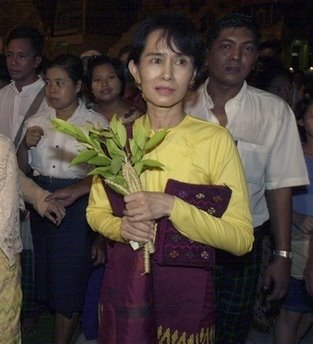


 Posts
Posts


