News & Articles on Burma
Monday, 17 January, 2011
-------------------------------------------------------------
Keep Targeted Sanctions in Place, Says NLD
Heavy Artillery Fire Continues in Karen State
DKBA landmine injures 10
Censor board launches new body
Asean says Burma sanctions should be dropped
Time to lift sanctions on Myanmar, ASEAN says
Burma ethnics, Asean call for sanctions lift
Asean Calls Lifting of Sanctions on Burma
Steel body proposes complex in Burma or Koh Kong
Looking to build hope in a troubled Burma
East Timor and Asean: new strategic imperatives
Burma moves to finish legendary supply route
ASEAN highlights Suu Kyi’s role in a democratic Burma
Imprisoned Poet Found Solace as a Librarian
-------------------------------------------------------
Keep Targeted Sanctions in Place, Says NLD
By THE IRRAWADDY Monday, January 17, 2011
Burma's opposition party, the National League for Democracy (NLD), said it would continue to support targeted sanctions against the country's ruling regime while the party is reviewing other trade sanctions, according to a senior party official.
“We have consistently supported the targeted sanctions against the regime leadership and its cronies, and we will continue to do so. But as we have said, we will review trade sanctions to find out if they are hurting the people,” said Win Tin, a senior NLD leader.
His comment followed calls by the foreign ministers of the Association of Southeast Asian Nations (Asean) and also by an alliance of five ethnic political parties in Burma for an end to Western economic sanctions against Burma.
“Such calls are dishonest and those who made them are merely toeing the line of the military regime,” said Win Tin, adding that the sanctions have hurt the junta and its cronies and helped the opposition in its struggle for democracy.
On Sunday, the Asean rotating chair, Indonesian Foreign Minister Marty Natalegawa, said that the international community should respond to recent developments in Burma, such as last year's general election and the release of NLD leader Aung San Suu Kyi, by removing or easing sanctions against the country's ruling regime.
The calls from the regional body came a day after an alliance of five ethnic minorities parties that participated in the controversial Nov. 7 election issued a joint statement urging an end to the sanctions, saying that they “are causing many difficulties in the important areas of trade, investment and modern technologies for the development of ethnic regions.”
“We want to see the end of sanctions against economic investments in our country because they are hurting the people,” said Sai Saung Si, the deputy chairman of the Shan Nationalities for Democracy Party, one of the five ethnic political parties which issued the declaration on Saturday.
Since her release from house arrest late last year, Suu Kyi has expressed a desire to review the sanctions, saying she was prepared to work together with Burma's military rulers to remove sanctions that were hurtful to the people.
While the Obama administration has initiated a senior-level diplomatic dialogue with the Burmese military leadership, sanctions continue to be an important tool of US policy.
The Washington Times recently quoted a US Congressional source as saying that the Obama administration would not lift sanctions until the Burmese regime releases all political prisoners, ends attacks against ethnic groups and establishes a meaningful dialogue with opposition groups.
More than 2,000 political prisoners remain behind bars in Burma as the country prepares to convene its first session of Parliament in 22 years at the end of this month. The Parliament will be dominated by pro-military lawmakers who won in last year's polls.
Meanwhile, the National Democratic Force, a party that broke away from the NLD last year to take part in the election, said that it plans to submit a bill to the Parliament that would grant a general amnesty to all political prisoners and exiled dissidents.
http://irrawaddy.org/article.php?art_id=20539
-----------------------------------------------------------
Heavy Artillery Fire Continues in Karen State
By SAI ZOM HSENG Monday, January 17, 2011
The Burmese army is continuing to use heavy artillery fire against a breakaway faction of the Democratic Karen Buddhist Army (DKBA) and its allies after more than a week of intensifying clashes near the Thai border, according to DKBA and Karen National Union (KNU) sources.
Speaking on condition of anonymity, a DKBA officer told The Irrawaddy on Monday that skirmishes between the armed group's renegade Brigade 5 and Burmese troops have continued amid the shelling in Manerplaw, Kasawah Lay, Nuday, Waw Lay and Phaluu.
Manerplaw is the former headquarters of the KNU, whose armed wing, the Karen National Liberation Army (KNLA) has joined DKBA Brigade 5 in the fighting, along with troops from the All Burma Students' Democratic Front.
“Refugees in the Mae La Oo refugee camp [in Thailand] could hear the heavy artillery exploding very close to the border between 9:30 and 10:30 last night, but I heard that nobody was injured,” a Karen source said.
“The refugees from the camp are so frightened that they have started to collect their belongings in case they have to flee,” he added.
According to a KNU source, DKBA Brigade 5 has requested reinforcements from the KNLA, which has agreed to send its Brigade 5 to the area.
The source also said that the number of dead or wounded in the latest fighting is still not known, but added that there were reports of injured Burmese troops being carried from the combat zone through the Thai border town of Mae Sot to Myawaddy in Karen State.
Meanwhile, a resident of Phaluu in Karen State's Kawkareik Township told The Irrawaddy that the DKBA ambushed a Burmese military convoy in the area on Sunday. The attack targeted two trucks carrying ammunition and equipment to Burmese troops on the front line, the source said.
According to a source close to the Burmese army's Southeast Regional Command, troop reinforcements have been traveling to the front line since late last week.
“About 50 army trucks were sent to Kawkareik Township last Thursday from battalions based in Arakan State. They are under the command of the 44th Infantry Division,” the Burmese military source said.
A KNU officer said that it was unclear if the Burmese army is increasing its troop strength in the area or just sending in replacements.
“We will have to wait and see if they are sending in extra troops to try to wipe us out, or if they're just rotating their troops. Either way, the fighting will continue,” he said.
Fighting started in the area on Nov. 7, when DKBA Brigade 5, led by Col Saw Lah Pwe, clashed with Burmese troops in Myawaddy on the day of Burma's first election in 20 years.
The rest of the DKBA, which has long been a key ally of the Burmese junta, has joined a border guard force (BGF) under Burmese military command. According to an unconfirmed report, the regime’s troops have taken control of the Manerplaw area with support from the BGF.
http://irrawaddy.org/article.php?art_id=20538
--------------------------------------------
DKBA landmine injures 10
Monday, 17 January 2011 14:07 Kyaw Kha
Chiang Mai (Mizzima) – A landmine planted by Democratic Karen Buddhist Army (DKBA) troops injured five Burmese Border Guard Force (BGF) soldiers and five civilians near Myawaddy on Friday.
DKBA troops detonated the mine while BGF Battalion No. 1022 second-in-command Bo Cameraman was traveling in a truck on the Myawaddy-Kawkereik highway between positions taken up by the junta’s infantry Battalions 355 and 356 near Thingannyinaung village in Myawaddy Township in Karen State, according to DKBA Major Saw San Aung, head of the Kolohtupaw Strategic Command.
BGF troops and eyewitnesses said that Bo Cameraman, his wife, four BGF troops and four passengers were injured in the blast.
“No one was killed, but they received shrapnel and splinter injuries in their legs, hands and shoulders”, a BGF force member told Mizzima.
All of the wounded were treated at Myawaddy hospital. The blast created chaos among nearby junta troops who opened fire into the woods, eyewitnesses said. Whoever detonated the mine escaped.
Major Saw San Aung said that his troops attacked the BGF vehicle because the junta is reinforcing its troops and supplies in collaboration with the BGF in Myawaddy Township.
“The enemy is invading our area with heavy manpower so we showed them we could hit them in their back at any time”, he told Mizzima.
“Our intention is to show them that we can do what we want at any time in the towns. If we didn’t care about civilian casualties, we could do bigger assaults in either the daytime or nighttime. We refrain from doing because we don’t want to see civilians become cannon fodder”, said Major Saw San Aung.
Junta troops closed the Myawaddy-Kawkereik highway after the blast, but it again opens on Monday afternoon.
In a similar ambush, a tripwire mine planted by the DKBA on the Myawaddy-Kawkereik highway injured at least eight people on January 7.
The Myawaddy-Kawkereik highway is controlled by the BGF and is a major import route for cars, motorcycles, electrical appliances, foodstuffs and textiles from Thailand into Burma.
When the DKBA converted their army into the regime’s BGF, a small faction refused to accept the junta’s offer and reunited with the KNU to take up arms against the regime.
The DKBA-KNU and junta forces have been fighting each other since November 8 in Myawaddy and Kawkereik townships. http://www.mizzima.com/news/inside-burma/4757-dkba-landmine-injures-10.html
--------------------------------------------------------
Censor board launches new body
By MOE AYE
Published: 17 January 2011
A new unit ostensibly charged with protecting the interests of journalists and issuing guidelines for media practice has been formed by Burma’s draconoian censor board.
Media freedom in the Southeast Asian pariah is amongst the world’s lowest – all material in the various domestic news journals and magazines in circulation has to be vetted by the Press Scrutiny and Registration Division (PSRD) prior to publication.
The PSRD’s role in establishing the new body, the Committe for Professional Conduct (CPC), has thus worried interested parties. It was the PSRD that last year forced newspapers to report that the pentalty for calling for a boycott of the 7 November elections was 5 to 30 years’ imprisonment.
”We really want the sort of committe which can protect and promote us,” said one Rangoon-based journalist, speaking on condition of anonymity. ”But we are disappointed because the committe is established by the PSRD.”
The PRSD has however said that it will not interfere with the workings of the 25-strong CPC, which includes 15 journal editors and two members of the censor board. Some, however, are not so sure.
”We hoped that the CPC would be independent from the PSRD and that censorship may also be loosened,” said another journal editor. ”It is now obvious that everything we had thought is totally wrong. The PSRD will be taking a leadership role in the CPC, and it is questionable if free press will emerge in the near future, despite a new government being formed.”
Another journalist likened the new body to the elections last year, which have been shrouded in controversy.
”Some politicians said the election was a big chance and that they will fight for changes in the parliament,” said a veteran Rangoon journalist. ”Some say they will boycott it because the election will not bring any changes. Indeed, we do need such a committe but it should not be like this.”
Burma was recently ranked as the world’s fourth biggest jail for journalists by the New York-based Committee for the Protection of Journalists (CPJ). It also came 171 out of 175 countries in Reporters sans frontieres’ Press Freedom Index last year.
http://www.dvb.no/news/censor-board-launches-new-body/13727
---------------------------------------------------------
BBC NEWS ASIA-PACIFIC
17 January 2011 Last updated at 04:25 GMT
Asean says Burma sanctions should be dropped
Indonesian foreign ministry foto of Asean foreign ministers, Lombok, Indonesia 16 Jan 2011 Asean foreign ministers gathered for an informal retreat on Lombok, Indonesia
Asean foreign ministers have said that sanctions against military-ruled Burma should be dropped.
They echoed the call from five ethnic minority political groups in Burma who had earlier urged an end to sanctions.
Ministers from the Association of South East Asian Nations said Burma's recent election warranted a positive international response.
Analysts have described the November elections as a sham, but Asean welcomed the voting exercise as a step forward.
The Indonesian Foreign Minister, Marty Natalegawa, described the elections as "conducive and transparent" in remarks at the informal meeting of Asean ministers, held on the Indonesian island of Lombok.
Asean, which includes Burma, would like to see "the immediate or early removal or easing of sanctions that have been applied against Myanmar by some countries," Mr Natalegawa told reporters.
He described the pro-democracy leader Aung San Suu Kyi as "some part of the solution not the problem," in Burma.
"Asean leaders again urge, especially after the release of Aung San Suu Kyi and the elections, that the policy on sanctions against Myanmar be reviewed as they have an impact on development in Myanmar," Mr Natalegawa said.
Time to act?
"Aung San Suu Kyi's release and the elections weren't enough. We encourage an open and conducive dialogue in Myanmar," he said, using the military rulers' name for Burma.
"Developments must not be allowed to dissipate," he added.
Indonesia is the current chair of Asean.
The ethnic groups said in a statement issued from inside Burma that sanctions "are causing many difficulties in the important areas of trade, investment and modern technologies for the development of ethnic regions.
"We ethnic parties together request that the United States and European countries lift sanctions," the parties said.
The five groups, which all won seats in Burma's recent elections, include: the Shan Nationalities Democratic Party (SNDP), the Rakhine Nationalities Development Party, the Chin National Party, the All Mon Region Democracy Party and the Phalon-Sawaw Democratic Party.
The US, Europe, Australia, New Zealand and other nations impose a variety of sanctions on dealing with the military rulers of Burma.
These include bans on trade with companies tied to the ruling generals in Burma, freezes on some firms' assets and barriers to loans and some aid.
http://www.bbc.co.uk/news/world-asia-pacific-12203719
--------------------------------------------------------
The Jakarta Post
Time to lift sanctions on Myanmar, ASEAN says
Abdul Khalik and Andi Haswidi, The Jakarta Post, Lombok | Mon, 01/17/2011 10:55 AM | Headlines
ASEAN urged an easing of the sanctions against Myanmar, but urged the country’s military junta to continue efforts to reconcile with the opposition, especially with Nobel Peace Prize laureate Aung San Suu Kyi.
During their retreat meeting here Sunday, ASEAN foreign ministers spoke about the need for countries such as the US, the European Union (EU) and Canada — all ASEAN dialogue partners — to consider lifting their sanctions because the country had successfully conducted general elections and released Suu Kyi from house arrest late last year.
Foreign Minister Marty Natalegawa said there was an external dimension to the Myanmar issue, namely a belief by ASEAN countries for the early removal or easing of sanctions applied against Myanmar by several countries.
“We believe that recent developments need to be responded to the international community, especially to ensure that economic development in Myanmar can take place.
However, it should be remembered that lifting the bans and reconciliation go hand in hand,” Marty said after the meeting.
Myanmar joined ASEAN in 1997 despite strong opposition from Western nations.
The US and a number of other countries imposed sanctions — both diplomatic and economic — on Myanmar for its poor human rights record and slow move toward democracy.
ASEAN member states, Marty said, reinforced the importance of having dialogue that was inclusive to ensure that all parties concerned could contribute to Myanmar’s future development.
ASEAN Secretary-General Surin Pitsuwan said Myanmar “should cease to be a problem” this year.
“We still want them to form an inclusive government and continue to adhere to democratic principles,” he said.
ASEAN will continue to assist Myanmar if the country requested it, Surin said.
Thai Foreign Minister Kasit Piromya said that after elections last year, Myanmar would convene its parliament to elect a president.
“There is a return to democracy. So some countries [that continue to place] sanctions against Myanmar should wake up and nurture the democratization process, provide trade assistance and so on, to improve the quality of life of Myanmar’s people,” he said.
Marty said the sanctions hit the people of Myanmar hard, and urged that assistance to the country would help develop the country and its people.
Surin said a number of ASEAN countries looked for the opportunity to help Myanmar while businesspeople eyed the country as an investment opportunity.
“There are huge opportunities in the country,” he said.
http://www.thejakartapost.com/news/2011/01/17/time-lift-sanctions-myanmar-asean-says.html
---------------------------------------------------
Bangkok Post
Burma ethnics, Asean call for sanctions lift
* Published: 17/01/2011 at 06:30 AM
* Online news: Asia
Politicians within and outside Burma Sunday called on Western nations to lift sanctions against the country, whose new parliament is preparing to convene for the first time this month.
Association of Southeast Asian Nation (ASEAN) foreign ministers pose for a group photo during the ASEAN Foreign Ministerial Meeting (AMM) retreat on Indonesia's Lombok island. Politicians within and outside Myanmar Sunday called on Western nations to lift sanctions against the country, whose new parliament is preparing to convene for the first time this month.
The Association of Southeast Asian Nations (Asean) called for the lifting of the punitive measures enforced by the United States and European countries, echoing a joint declaration by major ethnic political parties in Burma.
The ethnic groups' statement said sanctions "are causing many difficulties in the important areas of trade, investment and modern technologies for the development of ethnic regions".
"We ethnic parties together request that the United States and European countries lift sanctions," the parties said of the measures imposed by the West in response to the junta's poor human rights record.
The declaration was signed by the Shan Nationalities Democratic Party (SNDP), the Rakhine Nationalities Development Party, the Chin National Party, the All Mon Region Democracy Party and the Phalon-Sawaw Democratic Party.
All five groups won seats in Burma's controversial elections in November, with the largest ethnic winner being the SNDP, which will take a total of 57 seats when parliament and regional legislatures convene on January 31.
The government-backed Union Solidarity and Development Party claimed an overwhelming majority in the polls, winning 882 out of around 1,160 seats amid allegations of fraud and intimidation, plus the exclusion of opposition leader Aung San Suu Kyi.
Despite major Western criticism of Burma's first poll in 20 years, Asean had welcomed November's "conducive and transparent" elections, Indonesia's Foreign Minister Marty Natalegawa said at a retreat hosted for the bloc on the island of Lombok.
Asean also welcomed the release of Nobel laureate Suu Kyi from more than seven years under house arrest in Rangoon shortly after the vote. She had spent 15 of the past 21 years in detention.
"Asean leaders again urge, especially after the release of Aung San Suu Kyi and the elections, that the policy on sanctions against Burma be reviewed as they have an impact on development in Burma," Natalegawa said.
Burma is a member of Asean, which has a policy of non-interference in members' domestic affairs and has engaged with Burma's government rather than imposing sanctions.
Burma remains one of the world's poorest nations following decades of mismanagement by successive military regimes, and some areas have also been wracked by decades of civil conflict between the junta and ethnic rebels.
The United States bans trade with companies tied to the junta in Burma, also known as Burma. It also freezes such firms' assets and blocks international loans for the state.
US President Barack Obama's administration launched a dialogue with Burma's military rulers in 2009, but it has said it will lift sanctions only in return for progress on democracy and other concerns.
After years of espousing punitive steps against the junta, Suu Kyi has shown signs of softening her stance, writing to junta chief Than Shwe in September 2009 to offer suggestions on getting sanctions against the country lifted.
Since her release, Suu Kyi has told AFP that she does not see sanctions as a "bargaining chip" to secure concessions from the regime, but she has not publicly spoken on the issue in detail.
In December, during the first high-level visit to Burma by a Washington envoy since her release, she discussed the economic measures with Joseph Yun, US deputy assistant secretary of state for East Asian and Pacific affairs. http://www.bangkokpost.com/news/asia/216764/burma-ethnics-asean-call-for-sanctions-lift
---------------------------------------------
Asean Calls Lifting of Sanctions on Burma
By NIVELL RAYDA / JAKARTA GLOBE Monday, January 17, 2011
LOMBOK ISLAND, Indonesia — The Association of Southeast Asian Nations on Sunday appealed to the international community to lift the sanctions and embargoes imposed on Burma in light of “significant developments” that point toward a more democratic system.
At the first Asean foreign ministers’ retreat under Indonesia’s leadership, Indonesian Foreign Minister Marty Natalegawa said: “Asean is keen on playing a leading role in ensuring that the sanctions are lifted or at least eased.”
The United States and other Western nations have imposed political and economic sanctions on Burma to punish the junta for its poor human rights record and slow move toward democracy.
But the release of Burma’s opposition leader Aung San Suu Kyi and the election in 2010 “are sure signs that the country is heading toward a more democratic system,” Marty said.
The election in November — the first for 20 years — was won by the military-backed Union Solidarity and Development Party and was fraught with allegations of fraud. It has also been dismissed as a sham by many nations, including Indonesia.
As had been widely predicted, Suu Kyi was released one week after the elections, thus making her unable to contest them.
Burma’s main ethnic political parties on Sunday also called for the lifting of economic sanctions as the country’s new parliament prepares to convene for the first time.
They said the sanctions “are causing many difficulties in the important areas of trade, investment and modern technologies for the development of ethnic regions.”
The declaration was signed by the Shan Nationalities Democratic Party (SNDP), the Rakhine Nationalities Development Party, the Chin National Party, the All Mon Region Democracy Party and the Phalon-Sawaw Democratic Party.
All five groups won seats in Burma’s controversial elections in November, with the largest ethnic winner being the SNDP, which will take a total of 57 seats when parliament and regional legislatures convene on January 31.
The government-backed Union Solidarity and Development Party claimed an overwhelming majority in the polls, winning 882 out of around 1,160 seats amid allegations of fraud and intimidation, plus the exclusion of opposition leader Aung San Suu Kyi.
Meanwhile, Marty also said that Asean would like to mediate talks between Burma’s junta and the opposition.
Asean Secretary General Surin Pitsuwan said other state leaders would like to have more access to Burma, particularly to its opposition parties.
“We are encouraging the evolution of the political reconciliation inside,” he said. “I think we should have at least equal access to visit, to listen and to give encouragement to all parties.”
Burma’s Foreign Minister U Nyan Win said his country welcomed Asean’s decision to help ease the political pressure against Burma, but declined to comment on the group’s plan to mediate talks with opposition leaders.
Additional reporting from AFP http://www.irrawaddy.org/article.php?art_id=20533
----------------------------------------------
Bangkok Post
Steel body proposes complex in Burma or Koh Kong
* Published: 17/01/2011 at 12:00 AM
* Newspaper section: Business
The government should consider establishing a steel industrial estate in neighbouring countries at a cost of up to 100 billion baht for infrastructure including a deep-sea port, says the Iron and Steel Institute of Thailand.
The institute would recommend Burma and Cambodia as potential locations for a complex covering 15,000 rai, said president Wikrom Vajragupta.
Koh Kong is considered the most appropriate location in Cambodia for the estate, which will house integrated steel manufacturing including upstream smelting facility, while Dawei is recommended in Burma, as it is the site of a planned industrial and port complex worth tens of billions of dollars.
The institute hopes to propose the plan to the National Industrial Development Committee chaired by Deputy Prime Minister Trairong Suwannakhiri within the first quarter for submission to the cabinet later.
"The development of a steel estate in a neighbouring country will help strengthen Thailand's capacity as the centre of Asean Economic Community (AEC)," said Mr Wikrom.
"The Thai steel industry, meanwhile, will be able to tap an abundant workforce as well as growing steel demand in the neighbouring countries if the steel estate is operated."
The master plan for the industry also envisages another option of developing the steel estate with an eco-town concept in Thailand, with five recommended locations including Songkhla, Pattani and Prachuap Khiri Khan.
The institute has pushed for Thailand to establish a steel smelting plant to lower the cost of existing mid- and downstream steel manufacturers but the plan has faced heavy opposition from environmentalists.
Mr Wikrom said Thailand last year overtook Vietnam to regain its position as the largest steel market in Southeast Asia. Consumption totalled 14 million tonnes, up 40% from 2009.
This year, conservative demand growth is projected at about 6-8% to 15 million tonnes.
The automotive industry, which is expected to produce nearly 2 million cars and pickup trucks, will lead the demand growth in the manufacturing sectors along with electrical appliance and machinery makers.
The construction industry is also forecast to have strong demand for steel, thanks to planned government infrastructure projects and more private-sector work, he said.
"Steel prices are projected to surge sharply and be volatile in the first half of this year, mainly pushed by rising coal prices due to the severe floods in Australia," said Mr Wikrom. http://www.bangkokpost.com/business/economics/216722/steel-body-proposes-complex-in-burma-or-koh-kong
-------------------------------------------
Looking to build hope in a troubled Burma
By Simon Scott
5:30 AM Monday Jan 17, 2011
Political leaders much talked about in their own time are, with a few notable exceptions, largely forgotten by history.
Their influence and fame begin to expire as soon as their hold on power does and often their lives never seem to live up to their words.
They frequently become just a name in a book on a library shelf, a paragraph, perhaps, in a student's history notes or the answer to a tricky question at a pub quiz night.
Aung San Suu Kyi, on the other hand, seems destined to outlive her time.
More than just a spokeswoman for Burma's struggle for democracy, "The Lady", as her people affectionately call her, is the embodiment of that struggle itself.
Like a modern Gandhi, she lives those timeless and universal notions which have always appealed to humans - freedom, sacrifice, endurance, peace, courage, forgiveness and most of all, hope, when there is little reason for it.
At 65 years of age, she has spent 15 of the past 21 years under house arrest in Rangoon for speaking out against the country's repressive ruling regime and yet still remains fearless.
Released from house arrest only two months ago, she is already risking her freedom by speaking publicly about the troubles in Burma.
Although Suu Kyi has been released, more than 2000 political prisoners remain behind bars in Burma.
The daughter of Burma's famous independence leader General Aung San and a Nobel Peace Prize recipient, Suu Kyi became involved in politics in Burma in 1988 and led the National League for Democracy (NLD) to victory in the 1990 elections - a victory that was denied her by the ruling military regime which refused to give up power.
She is a mother of two and recently met her youngest son Kim Aris for the first time in 10 years after he was finally granted a visa to visit her in Burma.
Herald: Looking ahead in 2011, what is your vision for the future of Burma and what kind of a role do see yourself playing in that future?
Suu Kyi: Well, what I see for 2011 is the need to try to make the people understand that we have the capacity to bring about change. What I want most of all is to empower the people and make them understand 'we are the ones who can bring about change in this country'.
Herald: It seems that the Burmese people have pinned their hopes on you. Do you feel that it is realistic for them to see you as the saviour of Burma?
Suu Kyi: I think they should pin their hopes on themselves. I always tell people, that they can't hope without endeavour. If they have any hopes, they have got to work towards the realisation of their hopes. I'll do everything I can to help bring about the realisation of the hopes of our country, but they also have to do their part.
Herald: At the end of 2010 two key events occurred in Burma, the November elections and your own release from house arrest. Do you think these events can be seen as being a sign of positive change?
Suu Kyi: My release from house arrest had to do with the fact that my term of detention was over anyway and they could not legally have kept me under dentition anymore. Of course, if they wanted to they could have done anything at all, but I think that they decided that it was much better to be legalistic. So I don't think that this was anything out of the ordinary. As for the elections, it was part of the road map that they had written out - that they had blueprinted some years ago. So, I don't think it was a new development. It was just another step in the road map they had marked out.
Herald: Critics say the November vote was a charade aimed at preserving the current rule in Burma and giving it legitimacy in the eyes of the international community. Do you agree? Can you think of one positive thing that came out of the election?
Suu Kyi: I think it did make some people understand what elections should not be about, or how elections should not be conducted. I think that is positive, if people can start to get an understanding of what should not be done if elections are supposed to be democratic.
Herald: It seems that the ruling generals are in a bind of sorts. Even if they really do decide they want to move the country towards democracy, they will no doubt be fearful that by handing more power to the people they will be putting themselves at risk for retribution, such as being put on trial for crimes against humanity. Is there any way to get out of this bind?
Suu Kyi: I think that we need a new kind of thinking on both sides. The people need to be more confident of their ability to change things, and at the same time, I think those in authority have to learn to think that they should not see the people as the enemy.
Herald: Many people in New Zealand support you and your struggle for democracy in Burma. Do you have anything you would like to say to them? Is it really possible for the average New Zealander to make a difference in Burma?
Suu Kyi: Oh, yes, of course. Anybody who supports our movement gives us some strength, helps us in some way however small it may be. And I'm immensely grateful to the people of New Zealand for the interest they have taken in our movement. After all, New Zealand is far removed from us and it is a completely different sort of society and yet, the fact that they care enough, about the rights of the people in Burma, is a great boost to our morale, it does strengthen us. I have been trying to build up a network for Democracy in Burma and would like to think the people of New Zealand would be a strong and very active part of the movement.
Herald: In January 2010 the Australia and New Zealand Free Trade Area was established. This was a trade agreement between Australia and New Zealand and Asean member countries, including Burma. Do you think countries like New Zealand should sign these kinds of agreements which facilitate economic co-operation and trade with Burma?
Suu Kyi: We would very much like to be certain that whatever business activities [or] economic activities New Zealand undertakes with regard to Burma, [that they] keep in sight very, very clearly the need for certain policies in this country with regards to the rights of workers and with regards to accountability and transparency and other necessary democratic values.
Herald: What is your current advice to New Zealand tourists wanting to visit Burma and why?
Suu Kyi: We are going to work out a policy on tourism as to what kind of tourists and what way we would welcome tourists to come. How they should come and how they should go about the country. What kind of hotels they should use and what kind of facilities they should use and what they should look out for.
Herald: Do you mean doing things in such a way so that money gets directed towards the people rather than the regime?
Suu Kyi: That's right. In such a way that tourism would benefit the people rather than the powers that be.
Herald: Your youngest son Kim was recently able to come to Burma to visit you for the first time in a decade. What was it like seeing him after all that time?
Suu Kyi: Oh, it was lovely. I think the loveliest thing of all was that we didn't feel we had been apart for 10 years. It was very nice. We felt very close to each other, as close as we have ever been.
Herald: Was there any one moment or time during your son's visit that was especially memorable?
Suu Kyi: Just being together, I think, and he cooked breakfast for me one day which was very nice. I didn't have time to cook for him at all.
Herald: What did he cook?
Suu Kyi: He made me a mushroom omelette. [It was] very tasty. He is a good cook.
Herald: What are your hopes in terms of seeing him again? Do you think he will be able to visit you again?
Suu Kyi: We hope so - both of us hope very much that he will be able to come again soon. But it depends on many, many things, because he has other commitments as well.
Herald: Now that you have been released from house arrest, are you concerned about your own safety and security? Are you fearful your life is at risk or that you may be re-arrested?
Suu Kyi: Actually, I have to admit, I don't think about it very much. People keep speaking about my security, but I believe it is the duty of the Government to look after the security of all its citizens including myself. http://www.nzherald.co.nz/world/news/article.cfm?c_id=2&objectid=10700075
--------------------------------------------------
East Timor and Asean: new strategic imperatives
Kavi Chongkittavorn
The Nation (Thailand)
Publication Date : 17-01-2011
When Burma was admitted to Asean on a fast track in 1997, it was done with one objective in mind - to manage China's southward influence into the continental Southeast Asia and beyond. The decision was made two years earlier in Bangkok albeit all the problems and uncertainties the pariah state inherited which remains the problems until today. For Asean, the unseen danger of leaving Burma alone, however, would be far greater.
Will the same criteria on Burma be used again when the Asean leaders ponder whether to admit East Timor as the 11th member of Asean sometimes soon? This frequently asked question among the Asean senior officials has no clear answer at the moment. But it does manifest a similar dilemma. President Jose Ramos Horta has reiterated that East Timor wants to join Asean by 2012 and the application will be ready this month when Indonesia takes up the Asean chairmanship. But the real admission would take a longer timeframe, which could be beyond 2015. After all, it was Horta who first asked Asean to consider its membership in Asean in November 2001 when it was still under UN East Timor Public Administration.
The timeframe has been further delayed partly because of the country's lack of human resources in Asean affairs and English-language speakers. The Jakarta-based Asean Secretariat has provided assistance and capacity-building training for the East Timorese officials for sometimes now. But truth be told, as time goes by, it is clear that beyond the often cited personnel and resource limitations, the Asean leaders have other serious concerns about East Timor.
Obviously, to compare Burma with East Timor is to compare an apple with an orange. Unlike Burma's current undemocratic status, East Timor is a young democracy despite all internecine domestic problems since independence in 2000. The country has never been isolated by international community. Foreign aids keep pouring in and their leaders are news headlines makers throughout the world. Horta received the Nobel Peace Prize in 1996. However, when it comes to strategic matters, Burma and East Timor share one commonality—initmate ties with China. Both nations are rich in energy resources.
Since the country's May political turmoil in 2006, other foreign investors, uncertain of their future prospects and local political conditions, chose to leave the country. But the Chinese business community not only chose to stay but continued to increase their investment and overall presence. For the past four years, China has tripled its investment as well as foreign aids. This trend is also accelerating.
To fully understand China-East Timor relations, one has to appreciate the overall Beijing's diplomatic approach to the so-called the Community of Portuguese Language Nations (CPLN), which includes Brazil, Angola, Cape Verde, Mozambique, Guinea Bisseau. Another Portuguese speaking country, South Tome and Principles, has a diplomatic tie with Taiwan. This network allows China to penetrate East Timor's society and market through its Portuguese speaking personnel.
On the surface, China's symbol of growing interest and presence could be seen through huge infrastructure constructions - common features of China's foreign development assistance - whether they are highways, stadiums, bridges, dams, etc. In Dili alone, Bejing has offered the gifts in the form of construction of the Presidential Palace, ministry of foreign affairs and a new defence headquarters.
One question that begs an answer is whether East Timor's membership in Asean will become a new flash point between China and Asean as was the case of Burma. After the Burma's admission, both sides consistently avoided to discuss the situation due to differences and strict observance of non-interference principle. For the first ten years after Burma's membership, the Asean members remained divided and could not muster a common approach to Burma. China also played a low profile role following Asean's views and positions on Burma.
It was not until the Asean summit in Singapore 2008 that China and Asean broke ranks and displayed their first diplomatic disagreement on Burma overtly. Beijing objected to the host's recommendation upfront that the former UN special envoy for Burma, Ismail Gambari, should brief the East Asian leaders after his visit to Burma due to the sensitivity of the issue at the time. Since then, Asean realised that if the Burma's political crisis continued, the divide between Asean and China would also be widened. After the November's poll, both sides expressed support for the Burmese military junta.
With such precedence, the Asean leaders have to think hard on East Timor's application. When Asean accepted Burma as member, the grouping was quick to achieve consensus due to pressing China's influence. In the case of East Timor, Asean has to consider vital strategic factors as well as pros and cons of additional member. In the past, Asean chose to expand quantitatively while engaging with other intra-regional organizations. For a while, number matters in the regional power politic. Now further consolidation within Asean is needed.
Beyond verbal supports, new concerns among Asean have emerged with East Timor's s ability to integrate with the grouping's overall scheme of things. Singapore, for instance, views the inclusion of a new member that is poor - in this case the poorest in Asean--and fragile could widen development gap and drag down Asean as whole as it continues to integrate new members since 1995 and implement the Asean community blueprints of 2015. Indonesia wants Asean to include East Timor as soon as possible to counter growing China's influence there. Thailand and the Philippines strongly support Dili membership as it can offer fresh views on nation-building and democracy. However, other Asean members are less sanguine.
To help East Timor, Asean would soon dispatch an assessment team to Dili to evaluate the preparation and readiness. It is interesting to note that the future expansion of Asean does not confine to East Timor as Papua New Guinea, an observer since 1986, continues to push for the grouping's membership. President Susilo Bambang Yudhoyono expressed support of the PNG's long standing desire during his visit there last March. Officially, the grouping has stated that PNG is not in a Southeast Asian nation. But that does not stop Prime Minister Sir Michael Somare from coming back. Whatever decision Asean is taking in the near future will impact on the grouping's own strategic imperatives. http://www.asianewsnet.net/home/news.php?id=16794&sec=3
---------------------------------------------
Burma moves to finish legendary supply route
Chinese company awarded contract to complete Stilwell Road, built during the Second World War
By JONATHAN MANTHORPE, Vancouver Sun January 16, 2011 10:27 PM
For most of the last 65 years the legendary Stilwell Road linking India and China through northern Burma has been swallowed by the jungle, passable only on foot, or too dangerous a route to contemplate because of local insurrections.
But now the "Great Snake" linking India's northeastern Assam province to China's far western Yunnan is being rebuilt in a project that will reinforce Burma's prospects as a hub for southeast Asian trade.
Burma's new government, a thinly-veiled front for the military junta, has awarded a contract to the Chinese company, Yunnan Construction Engineering Group, to rebuild a 312-km stretch of the road from Myitkyina in the country's northern Kachin state, to Pangsau Pass - nicknamed Hell Pass by the original builders - on the border with India's Changlang district of Arunachal Pradesh state.
This contract will largely complete the work, which started with surveys in 2005, to rebuild the road constructed between 1942 and late 1944 to ferry military supplies to the armies of Chinese leader General Chiang Kai-shek battling the invading Japanese.
Then the road, named for the American commander in the region Gen. (Vinegar Joe) Stilwell, was seen as an essential lifeline in the war against Japan.
Now it is figured the Stilwell Road could cut 30 per cent off the cost of transporting goods between China and India as well as facilitating the trade between both those countries and Southeast Asia.
There's some disgruntlement in India it's a Chinese company that has the contract to rebuild this final link in the road chain. It's hard to escape the fact that in the last few years China has taken on the reconstruction of Burma's almost non-existent infrastructure as a high priority project.
This is not simply an act of generosity toward towards Burma's ruling generals, who call the country Myanmar. It is aimed at giving China every advantage in extracting and exporting Burma's large reserves of natural resources.
There's bountiful supplies of petroleum and natural gas, timber, copper, coal, precious stones, and fish and other foods from the sea.
Beijing figures say China invested the equivalent of nearly $9 billion in Burma in the first five months of last year, much of it in infrastructure schemes.
These include a 2,000-km rail link between Burma's commercial capital Rangoon and Kunming, the capital of China's Yunnan province; a $5-billion hydroelectric plant; and a $100-million airport for the country's new capital, Naypyidaw, which the generals built in 2004 to give themselves some security in the event of an American invasion.
This feverish Chinese activity has included reconstruction and paving of the old Burma Road, which linked Rangoon to Kunming in the days when Burma was part of the British Empire and which was the supply route for Generalissimo Chiang and Chinese armies in the early part of the Second World War.
But when the Japanese over-ran Burma in 1942, this route was cut. The allies continued to supply Chiang by an airlift from India "over the Hump" of mountains in northern Burma and western Yunnan.
The Stilwell Road from the railhead at Ledo in India's Assam to the junction with the northern reaches of the Burma Road at Mong-Yu in Burma's Shan province was intended to take about 65,000 tonnes of supplies a month to Chiang.
This was far more than the airlift was able to move at the time.
However, though disease and the perils of construction in terrible terrain took 1,133 American lives - one for every mile of road built - and those of many more local labourers, the Stilwell Road never came close to matching the tonnage moved by the airlift.
Indeed, it had only just made it into full swing as a transportation route when the war ended in August 1945.
The road fell rapidly into disrepair after the war and the last clearly documented occasion on which anyone drove its full length was in 1955.
More recently, the physical problems of travelling on what has become no more than a footpath in many places and which in others has disappeared entirely was compounded by the almost continuous warfare between the military regime and the guerrillas of the ethnic minorities in the border regions.
The junta has until now been reluctant to agree to rebuilding the Stilwell Road for fear in would play into the hands of the ethnic militias in the region, especially the Kachin.
Those fears seem to have subsided and the Stilwell Road may at last have the chance to fulfil the role for which it was designed almost 70 years ago.
jmanthorpe@vancouversun.com
© Copyright (c) The Vancouver Sun
Read more: http://www.vancouversun.com/news/Burma+moves+finish+legendary+supply+route/4117139/story.html#ixzz1BGxe2zQb
--------------------------------------------------------
ASEAN highlights Suu Kyi’s role in a democratic Burma
By Zin Linn Jan 16, 2011 9:43PM UTC
Burma’s major ethnic political parties called on Sunday for Western nations to lift economic sanctions on the country as its new parliament prepares to convene for the first time, according to AFP.
A joint declaration said that sanctions put into effect by the United States and European countries are reason for countless troubles in the important areas of trade, investment and modern technologies for the progress of ethnic regions.
The declaration was signed by the Shan Nationalities Democratic Party (SNDP), the Rakhine Nationalities Development Party (RNDP), the Chin National Party (CNP), the All Mon Region Democracy Party (AMRDP) and the Phalon-Sawaw Democratic Party (PSDP).
The said ethnic parties collectively requested that the United States and European countries lift sanctions.
All five parties won seats in Burma’s controversial elections last November. The SNDP achieved unexpected success among ethnic parties, as it won 57 seats in parliament and regional legislatures to convene on Jan 31.
The Association of Southeast Asian Nations (ASEAN) also wishes to lift sanctions imposed by the U.S. and Europe against its member Burma/Myanmar after th elections and the release of pro-democracy leader Aung San Suu Kyi, it said Sunday.
As reported by Reuters, ASEAN will keep pushing Burma to build on the release of Suu Kyi by including her in the political system, but countries which uphold sanctions against the country should recognize progress made so far, said Marty Natalegawa, foreign minister of Indonesia and ASEAN chair this year.
Many foreign governments have used sanctions on Burma to transform the regime’s unacceptable behavior in the areas of human rights. The sanctions aim to stop the junta obstructing the aspirations of its own people, and force the junta to seek a peaceful solution through dialogue to reconcile the political stalemate in Burma.
The sanctions provide effective tools to advance the dialogue process. All foreign investments help finance the Burmese junta, which spent over 40 percent of national budget to develop and modernize the armed forces. Obviously, using those armed forces, the military regime has been mistreating its own citizens.
According to democratic dissidents, the impact of sanctions on the population is small because foreign investments in Burma focus on the extraction of natural resources, especially gas and oil. Investment in natural resources extraction cannot cause severe effects in terms of creating employment and small business opportunities within the country’s general economy.
Anyhow, people inside and outside of Burma are interested in Mr. Marty Natalegawa’s goodwill message by including Aung San Suu Kyi in the incoming political system in this military-run nation. Putting her in the contemporary political structure will also pave the way to lifting the sanctions. However, it may depend upon the Union Solidarity and Development Party (USDP), led by Prime Minister Thein Sein
The USDP won the majority of 882 parliamentary seats amid allegations of fraud and intimidation in November, plus the exclusion of opposition leader Suu Kyi. The USDP is followed by the National Unity Party (NUP) with 64 seats, Shan Nationalities Democratic Party (SNDP) with 57 seats, Rakhine Nationalities Development Party with 35 seats, National Democratic Force (NDF) and the All Mon Region Democracy Party (AMRDP) each with 16 at three levels of parliament.
So, all the parties that will participate in the new parliament ought to consider the suggestion of Natalegawa if they really want to move the economic sanctions on Burma. Indonesia, chair of ASEAN in 2011, wants progress this year after the topic was among the first to be discussed at the three-day meeting, Natalegawa told Reuters.
Regional ASEAN summits, designed at building an economic community by 2015 that would include some 500 million people and some of the world’s fastest growing economies, have often been put in the shadow by controversy over the Burmese military junta.
http://asiancorrespondent.com/46289/marty-natalegawa-raises-suu-kyi%E2%80%99s-role-to-ease-sanction-on-burma/
-----------------------------------
Imprisoned Poet Found Solace as a Librarian
By KO HTWE Monday, January 17, 2011
Imprisoned politicians and activists in Burma who smuggle books into their cells to read have always faced severe punishments if caught by the prison guards, but that deadlock was broken by an imprisoned poet who founded two libraries where prisoners can now help themselves to literature, novels and other publications.
“This was the most meaningful thing I could possible have done in prison,” said Saw Wai who was released in May. “By setting up these libraries, I discovered the only pleasure that existed in that world of pain.”
Rangoon poet Saw Wai, 50, was imprisoned for 28 months after mocking regime chief Snr-Gen Than Shwe with his poem “14th February,” which was published in Love Journal in 2008. The poem contained seven lines in which the first word from each line formed a vertical message reading “Than Shwe is foolish with power” in Burmese language.
Saw Wai was originally sentenced to two years in prison for harming “Public Tranquility.” Last year, he was presented in absentia with a Hellman/ Mammett Award by the US-based Human Rights Watch for his courage.
“After I had been in prison for seven months, I told the prison authorities that I wanted to open a library,” he told The Irrawaddy. “After I got permission, I managed to set up a library with about 1,000 books in Insein Prison hospital.”
Some months later, he went on to found a similar library in Yamethin Prison in Mandalay Division. Now, he said, the prison libraries continue to receive donations of books, magazines and publications from private donors and organizations.
Before the International Committee of the Red Cross began monitoring abuses and conditions in Burmese prisons in 1999, prisoners risked severe penalties, such as solitary confinement, if they attempted to read books.
“Years ago, when we were banned from reading, we used to collect the filters of our cheroots [many Burmese cheroots are made from newspaper] and try to find other pieces that were from the same article or were related topics,” said U Javana, the coordinator of Sasanamoli, a Burmese Buddhist monks' organization based in Mae Sot, Thailand.
U Javana was arrested for meeting in December 1992 with the then UN Special Rapporteur on Human Rights in Burma Prof. Yozo Yokota, and telling him about human rights violations in the country. U Javana was sentenced to 19 years imprisonment in 1993. He served his sentence at Insein, Tharyawaddy and Taungoo prisons.
But although prisoners are now permitted to read in their cells, some publications, especially those with political content, are strictly forbidden.
“Most of the criminals who are assigned positions as librarians are not interested in politics anyway, so they tear the books up and use them as toilet paper,” U Javana added.
The prohibition against political prisoners reading was originally introduced in the era of the Burma Socialist Programme Party under Gen. Ne Win, said Bo Kyi, the joint-secretary of Thailand-based Assistance Association for Political Prisoners—Burma.
“They [the military junta] are switching the rules by allowing certain reading activities, then banning them,” he said. “By law, prisoners should have the chance to read and write. They can read certain books and magazines, but they still don't have the right to sit an exam in prison.”
Of the more than 2,000 political prisoners in Burma, at least 42 are poets, writers, journalists, bloggers and musicians, according to the Association of Assistance for Political Prisoners—Burma.
http://irrawaddy.org/article.php?art_id=20537
Wednesday, January 19, 2011
News & Articles on Burma-Monday, 17 January, 2011


News & Articles on Burma-Sunday, 16 January, 2011
News & Articles on Burma
Sunday, 16 January, 2011
-------------------------------------------------------------
Southeast Asian nations call for Europe, US to lift Myanmar sanctions
Indonesia Urges Lifting of Sanctions on Burma
Myanmar ethnic parties call for sanctions lift
ASEAN to push Myanmar on democracy, wants sanctions lifted
ASEAN to keep pushing Myanmar for democracy progress
--------------------------------------------------
International Relations | 16.01.2011
Southeast Asian nations call for Europe, US to lift Myanmar sanctions
Member of the Guard of Honor blows a horn with the Myanmar flag in the background
Großansicht des Bildes mit der Bildunterschrift: Politicians in and outside Myanmar want sanctions lifted
A group of southeast Asian nations say they hope the release of Nobel laureate Aung San Suu Kyi will act as springboard for democracy, and have called on the West to lift economic sanctions against Myanmar.
The 10 members of the Association of Southeast Asian Nations (ASEAN) have called for the European Union and the United States to lift economic sanctions after the release of Aung San Suu Kyi, an opposition leader held in Myanmar under house arrest for most of the last two decades.
A joint declaration released Sunday said sanctions imposed by the United States and European countries "are causing many difficulties in the important areas of trade, investment and modern technologies for the development of ethnic regions."
"ASEAN leaders again urge, especially after the release of Aung San Suu Kyi and the elections, that the policy on sanctions against Myanmar be reviewed as they have an impact on development in Myanmar," Indonesia's Foreign Minister Marty Natalegawa said.
Aung San Suu Kyi Bildunterschrift: Großansicht des Bildes mit der Bildunterschrift: Suu Kyi was released from house arrest in November
Myanmar, also known as Burma, is an ASEAN member. The group maintains policy of non-interference in members' domestic affairs and has engaged with Myanmar's government rather than imposing sanctions.
The association's call followed a statement by Myanmar's main ethnic minority political parties Sunday, urging that the economic sanctions be lifted as ahead of the first meeting of the country's new parliament at the end of January.
Contested election
All five ethnic groups that won seats in Myanmar's controversial elections in November signed the statement. The largest of the groups, the SNDP, will have 57 seats when parliament and regional legislatures convene on January 31.
Myanmar's November election resulted in a landslide win for government-backed Union Solidarity and Development Party, which won 882 of 1,160 seats amid allegations of fraud and voter intimidation.
US President Barack Obama's administration began a dialogue with Myanmar's military rulers in 2009, but has said sanctions will only be lifted in return for progress on democracy and other concerns.
One of the poorest countries in the world, Myanmar has been ruled by the military since 1962 and has been subject to Western sanctions because of the junta's human rights abuses.
Author: Sarah Harman (AP, AFP)
Editor: Sean Sinico http://www.dw-world.de/dw/article/0,,14769760,00.html?maca=en-rss-en-eu-2092-rdf
------------------------------------------------
Indonesia Urges Lifting of Sanctions on Burma
January 16, 2011
Indonesian Foreign Minister Marty Natalegawa, pictured, says ASEAN is appealing for the lifting of international sanctions against Myanmar and will push for reconciliation between Burma’s military-controlled government and recently released democracy icon Aung San Suu Kyi. Indonesian Foreign Minister Marty Natalegawa, pictured, says ASEAN is appealing for the lifting of international sanctions against Myanmar and will push for reconciliation between Burma’s military-controlled government and recently released democracy icon Aung San Suu Kyi.
Lombok, Indonesia. Foreign ministers from the Association of Southeast Asian Nations are appealing for the lifting of international sanctions against Burma, which held its first elections in two decades in November.
Indonesian Foreign Minister Marty Natalegawa also said Sunday that ASEAN will push for reconciliation between Burma’s military-controlled government and recently released democracy icon Aung San Suu Kyi.
He was speaking on the sidelines of a meeting of ASEAN foreign ministers on Indonesia’s resort island of Lombok.
The United States and some other Western nations have imposed political and economic sanctions to punish Burma’s junta for its poor human rights record and slow move toward democracy.
Associated Presshttp://www.thejakartaglobe.com/home/indonesia-urges-lifting-of-sanctions-on-burma/417288
------------------------------------------------
Jan 16, 2011
Myanmar ethnic parties call for sanctions lift
YANGON - MYANMAR'S main ethnic political parties called on Sunday for Western nations to lift economic sanctions on the country as its new parliament prepares to convene for the first time.
A joint declaration said sanctions imposed by the United States and European countries 'are causing many difficulties in the important areas of trade, investment and modern technologies for the development of ethnic regions'.
'We ethnic parties together request that the United States and European countries lift sanctions,' the minority parties said.
The declaration was signed by the Shan Nationalities Democratic Party (SNDP), the Rakhine Nationalities Development Party, the Chin National Party, the All Mon Region Democracy Party and the Phalon-Sawaw Democratic Party.
All five groups won seats in Myanmar's controversial elections last year, with the largest ethnic winner being the SNDP, which will take a total of 57 seats when parliament and regional legislatures convene on Jan 31.
The government-backed Union Solidarity and Development Party claimed an overwhelming majority in the polls, winning 882 seats amid allegations of fraud and intimidation, plus the exclusion of opposition leader Aung San Suu Kyi. -- AFP http://www.straitstimes.com/BreakingNews/SEAsia/Story/STIStory_624793.html
----------------------------------------
ASEAN to push Myanmar on democracy, wants sanctions lifted
Credit: Reuters/Foreign Ministry Documentation/Rudi Hartanto/Handout
SENGGIGI, Indonesia | Sun Jan 16, 2011 4:18am EST
SENGGIGI, Indonesia (Reuters) - The Association of Southeast Asian Nations (ASEAN) wants the U.S. and Europe to lift sanctions against member Myanmar after its recent elections and release of pro-democracy leader Aung San Suu Kyi, it said on Sunday.
The moves by Myanmar, a politically isolated state that has often been an international embarrassment to the region, have given it a veneer of democracy but have not loosened its military rulers' firm grip on power.
ASEAN will keep pushing Myanmar to build on the release of Suu Kyi by including her in the political system, but countries which uphold sanctions against the country should recognize progress made so far, said Marty Natalegawa, foreign minister of Indonesia and ASEAN chair this year.
ASEAN advocates "the immediate or early removal or easing of sanctions that have been applied against Myanmar by some countries," Natalegawa told reporters on the sidelines of a meeting of ASEAN foreign ministers on Lombok island in Indonesia.
The release of Suu Kyi should act as springboard for greater progress toward democracy, Natalegawa told Reuters.
"She is some part of the solution not the problem," Natalegawa told Reuters during a meeting of Southeast Asian foreign ministers on Lombok island in Indonesia. "Developments must not be allowed to dissipate."
The Association of South East Asian Nations (ASEAN), whose 10 members include Myanmar, has a policy of non-interference in member's domestic affairs and has tried engaging with Myanmar rather than imposing sanctions as the West has done.
Myanmar's November election, resulting in a landslide win for an army-backed party after allegations of fraud, left Suu Kyi with no political role, though analysts say she may now be more of an asset for the generals in efforts to ease international sanctions.
Indonesia, chair of ASEAN in 2011, wants progress this year, Natalegawa said, after the topic was among the first to be discussed at the three-day meet.
Regional ASEAN summits, aimed at building an economic community by 2015 that would encompass some 500 million people and some of the world's fastest growing economies, have often been overshadowed by controversy over the Myanmar junta.
"We have been promised that Myanmar will cease to be a problem for ASEAN in its engagement with the international community," said ASEAN Secretary General Surin Pitsuwan, after talks between ministers. He said ASEAN was seeking greater access to Myanmar's leaders.
Pitsuwan said Myanmar would like to take the chairmanship of ASEAN in 2014, though for that to happen there would need to be international confidence in its stability.
Greater integration with Myanmar would also lead to investment, he said, with the group eyeing areas such as a road link to India, food production, energy generation, and tourism.
(Reporting by Neil Chatterjee; Editing by Daniel Magnowski) http://www.reuters.com/article/idUSTRE70F0D320110116?rpc=401
----------------------------------------------
ASEAN to keep pushing Myanmar for democracy progress
Reuters
Southeast Asian nations want to push Myanmar this year to build on its recent election and release of pro-democracy leader Aung San Suu Kyi by including her in the political system, they said on Sunday. Skip related content
Related photos / videos
ASEAN foreign ministers pose during a group photo before the opening of the ASEAN Foreign …More Enlarge photo
The moves by Myanmar, a politically isolated state that has often been an international embarrassment the region, have given it a veneer of democracy but have not loosened its military rulers' firm grip on power.
The release of Suu Kyi should be a precursor for moves towards greater democracy, said Indonesia's Foreign Minister Marty Natalegawa.
"She is some part of the solution not the problem," Natalegawa told Reuters during a meeting of Southeast Asian foreign ministers on Lombok island in Indonesia. "Developments must not be allowed to dissipate."
The Association of South East Asian Nations (ASEAN), whose 10 members include Myanmar, has a policy of non-interference in member's domestic affairs and has tried engaging with Myanmar rather than imposing sanctions as the West has done.
Myanmar's November election, resulting in a landslide win for an army-backed party after allegations of fraud, left Suu Kyi with no political role, though analysts say she may now be more of an asset for the generals in efforts to ease international sanctions.
Indonesia, chair of ASEAN in 2011, wants progress this year, Natalegawa said, after the topic was among the first to be discussed at the three-day meet.
Regional ASEAN summits, aimed at building an economic community by 2015 that would encompass some 500 million people and some of the world's fastest growing economies, have often been overshadowed by controversy over the Myanmar junta.
"We have been promised that Myanmar will cease to be a problem for ASEAN in its engagement with the international community," said ASEAN Secretary General Surin Pitsuwan, after talks between ministers. He said ASEAN was seeking greater access to Myanmar's leaders.
Pitsuwan said Myanmar would like to take the chairmanship of ASEAN in 2014, though for that to happen there would need to be international confidence in its stability.
Greater integration with Myanmar would also lead to investment, he said, with the group eying areas such as a road link to India, food production, energy generation, and tourism. http://uk.news.yahoo.com/22/20110116/tpl-uk-asean-43a8d4f.html
Sunday, January 16, 2011
New Cabinet points to fiscal reform push
Share |
Saturday, Jan. 15, 2011
Kan hopes to find spark, keep opposition off back
Kyodo News
Prime Minister Naoto Kan on Friday reshuffled his Cabinet, recruiting veteran lawmakers known to be advocates of fiscal consolidation and trade liberalization in hopes of boosting his poll ratings and improving ties with the opposition camp.
The shakeup, resulting in four newcomers to the Cabinet, took place ahead of the 150-day regular Diet session due to begin Jan. 24, in which opposition parties are expected to give the Democratic Party of Japan-led government a rough ride over the passage of the fiscal 2011 budget and related bills.
The highlights of the reshuffle were the appointments of Yukio Edano, 46, who became the youngest-ever chief Cabinet secretary, and Kaoru Yosano, 72, a longtime architect of economic policy in the rival Liberal Democratic Party, as the minister responsible for addressing the tattered public finances and ballooning social security costs.
The other newcomers to the Cabinet are Satsuki Eda, a former Upper House president who was named justice minister, and Kansei Nakano, a former Upper House vice president, who became National Public Safety Commission chief.
"I wanted a Cabinet and party lineup with the greatest power to overcome the present crises," Kan said in an evening news conference, referring to the slumping economy and unsustainable social welfare system.
This is Kan's second Cabinet reshuffle, with the first one having taken place in September. It is uncertain if the shakeup will boost approval ratings, which have fallen to less than half their peak of about 60 percent, and avoid gridlock in the divided Diet, in which the opposition controls the Upper House.
The reshuffle, as well as changes in the DPJ executive lineup, came as a power struggle between the leadership and lawmakers backing kingpin Ichiro Ozawa, who faces indictment possibly this month over a political funds scandal, deeply divide the party.
Kan, who has vowed to eradicate money scandals in the party, did not offer any key posts to lawmakers closely affiliated to Ozawa, who lost to the prime minister in September's DPJ presidential election.
Edano was acting secretary general of the DPJ before being given his new post. He is a vocal critic of Ozawa, as was his predecessor, Yoshito Sengoku, who was axed from the Cabinet after the opposition camp trained its fire on him. He will, however, become the DPJ's acting leader.
Sengoku, who was censured last year by the opposition in the Upper House over the handling of the Senkaku Islands row with China, is still expected to wield influence over vital government issues through Edano, to whom he has been a mentor.
Yosano, a fiscal conservative who Thursday left Tachiagare Nippon (Sunrise Party of Japan), a small opposition party, was tapped as minister in charge of economic and fiscal policy, as well as social security reform.
A staunch advocate of raising the consumption tax, Yosano was LDP finance minister and chief Cabinet secretary before the DPJ seized power in September 2009.
He was for many years one of the architects of the LDP's economic policies.
--------------------------------------------------------------------------------
Little interest on street for reshuffle
Saturday, Jan. 15, 2011
Public expresses impatience with frequent ministerial changes
By ALEX MARTIN and MIZUHO AOKI
Staff writers
Prime Minister Naoto Kan's Cabinet reshuffle Friday was greeted with indifference on the streets of Tokyo, with many expressing hope that the administration will settle down and pursue policies to revive the economy.
Showtime: New Justice Minister Satsuki Eda walks into the prime minister's office Friday after being appointed earlier in the day. Below: Kansei Nakano, new chairman of the National Public Safety Commission, heads from the office to the attestation ceremony with the Emperor. KYODO PHOTOS
Friday's reshuffle included several key changes, including the replacement of Chief Cabinet Secretary Yoshito Sengoku with Democratic Party of Japan Deputy Secretary General Yukio Edano, as well as the appointment of ex-Tachiagare Nippon (Sunrise Party of Japan) member Kaoru Yosano as economic and fiscal policy minister. Yosano, a former finance minister, will also be in charge of social welfare and tax reform.
The appointment of Yosano — an expert on financial affairs and an advocate of drastic tax reform — was seen by some on the street as an indication that Kan plans to raise the 5 percent consumption tax.
A 75-year-old man from Saitama, who gave only his surname, Yanagida, said that while Yosano's sudden appointment came as a surprise, he believed Kan gave careful consideration to selecting the experienced lawmaker.
"I could say I was pleasantly surprised with Yosano's appointment," Yanagida said in Tokyo's Shinbashi district.
He was less impressed by Edano's appointment, however, believing him too inexperienced in spite of his earnestness.
Yanagida, who said he once worked as a secretary to a Diet lawmaker, added that while he personally disliked the idea of a consumption tax hike, he believed it was inevitable considering the nation's poor financial condition.
"It's a sacrifice we need to make in order to achieve fiscal health," he said.
Koichi Kishimoto, a 27-year-old designer, agreed that Yosano's experience and ability would be a plus for the administration, but said he hoped Kan focuses on solving long-standing problems.
"We can't afford switching prime ministers so often like it was when the Liberal Democratic Party was in power," he said, expressing hope that the government initiates reforms, including opening up the nation's market by joining the U.S.-backed Trans-Pacific Partnership trade pact.
Kishimoto shared Yanagida's opinion that a tax hike may be unavoidable, but said the government should pursue all possible waste-cutting measures before reforming the tax system.
"The administration should do what it promised to do, including banning 'amakudari' (the practice of giving retiring bureaucrats lucrative private-sector jobs in industries they previously oversaw), reviewing the allowances of public servants and cutting the number of Diet lawmakers," he said.
Hiroko Tanji, a 32-year-old civil servant and mother of a 2-year-old boy, agreed that a tax hike could not be avoided in light of the burden the younger generations are faced with.
"I think a consumption tax hike or other tax increases are inevitable if we consider our children's future. I don't want our country to leave a huge debt to our children's generation," she said at the Roppongi Hills commercial complex in Tokyo.
Tanji added that while she appreciated the monthly child allowances she receives from the government — one of the DPJ's key pledges pursued when it swept into power in 2009 — she believed the administration should focus more on increasing the number of child care facilities and other family-related support measures.
Miyako Kimura, a 34-year-old housewife from Yokohama and mother of a newborn who was also visiting Roppongi Hills, said she has been saving up all the child allowances to help cover the costs of child-rearing.
"But I do think I will need more money when the child enters kindergarten and elementary school. That's why I'm saving it for the future," she said.
In Tokyo's Yurakucho district, a 37-year-old engineer working for a large electronics maker said he believed doling out money or following such policies as eliminating highway tolls "only created confusion."
The engineer, who also supported Japan's joining the TPP, said Kan should concentrate on long-term strategies to improve the economy, not on quick fixes, and also said he believed a tax hike was necessary if Japan were to avoid a Greece-like financial meltdown.
Some foreigners interviewed seemed especially alarmed by Japan's frequent leadership changes.
An Indian businessman at Roppongi Hills who wished to remain anonymous, citing company rules, said that although he had little knowledge of individual ministers, after living in Japan for over 14 years he believed one problem with politics here was the relatively short tenures of prime ministers.
"Prime ministers should not change so quickly — they come to the post wanting to do something, but they are replaced every three to six months, accomplishing nothing," he said.
"Japan is already a great country. But if you want to sustain your economy at the same level as it was before, you've got to accomplish some strict reforms," he said.
Tanay Sape, a 29-year-old Indian banker, also believed Japan's rapid replacement of leaders was "ridiculous," and said that while politicians were prone to making mistakes, this should not immediately trigger a resignation.
"They should try harder rather than simply quitting, leaving everything up to a new leader," he said.
"All I wish for the new Cabinet is that they do more for the job sectors and to immigration services."
Sape, who has been living in Tokyo for six years, said that when his parents visited from India, they had to apply for visas several months in advance, an inconvenience he felt should be corrected.
News & Articles on Burma-Saturday, 15 January, 2011
News & Articles on Burma
Saturday, 15 January, 2011
-------------------------------------------------------------
China strikes deal with Burma to guarantee oil supply
FMs address South China Sea, Myanmar issues
Will Tavoy be Burma’s Shenzhen?
Myanmar aims to privatize most state-owned businesses
Conscription and Parliament, the new weapons of the military junta
-----------------------------------------
China strikes deal with Burma to guarantee oil supply
China has put the final piece of its energy supply jigsaw in place, signing a deal with Burma that will make it impossible to choke off Beijing's oil supply.
By Malcolm Moore, Shanghai 9:00PM GMT 14 Jan 2011
In a move that was described as a "golden bridge of friendship", Burma's ruling junta has given Beijing permission to build and operate a wharf on Burma's west coast to receive tankers arriving from Africa and the Middle East and then pump their cargo overland to southern China.
The new facility, at the deep sea port at Kyauk Phyu, is the culmination of decades of planning by Beijing to safeguard its energy supply.
Currently, as much as 80 per cent of China's imported oil and gas is forced to pass through the Strait of Malacca, a narrow bottleneck between Malaysia and Indonesia.
With an Indian naval base on the Andaman and Nicobar islands at the mouth of the straits, and with a large US Navy presence in the region, China has fretted for years that its trade and energy routes are vulnerable to a blockade.
Hu Jintao, the Chinese president, warned in 2003 that some "big countries" were attempting to "control the transportation channel at Malacca".
In response, China has crafted a strategy known as the "string of pearls", a chain of naval bases across the Indian Ocean that could protect its tankers in case of emergency. These bases include Gwadar in Pakistan, Chittagong in Bangladesh and Hambantota in Sri Lanka.
In addition, China has patiently courted the Burmese junta, sending an estimated £800 million worth of tanks, fighter jets and weapons to its southern neighbour during the 1990s to prop up the regime.
After signing a trade agreement in 1988, China has also helped to rebuild Burma's roads and railways and even sent People's Liberation Army advisers to provide guidance and expertise.
Last year, Hu Jintao pledged unconditional support to the Burmese regime, telling Than Shwe, one of Burma's most senior generals, that China's policy "will remain unchanged regardless of changes of the international situation".
In return, the Burmese junta has granted access to its rich natural resources and is now allowing China to make use of Burma's key geographical position on the Indian Ocean.
After China's tankers reach the deep sea port at Kyauk Phyu, oil and gas will be pumped through twin 500-mile pipelines to the province of Yunnan. The station will be operated by China National Petroleum Corporation, the country's largest oil company, and Qingdao Port, the ninth-largest port operator in the world.
The pipelines, which are already under construction, should be able to carry a daily maximum of 440,000 barrels of oil and 400 billion cubic feet of gas when they are completed in 2013.
In addition, China plans to build thousands of miles of new railways to connect the southern Chinese city of Kunming with ports across Burma and South East Asia, including Yangon, the former Burmese capital. Not only will China's partnership with Burma help safeguard its own energy supply, but it will also give Beijing a key strategic advantage over Japan and South Korea, who also rely on the Strait of Malacca for part of their energy supplies.
http://www.telegraph.co.uk/news/worldnews/asia/china/8259551/China-strikes-deal-with-Burma-to-guarantee-oil-supply.html
-----------------------------------------
FMs address South China Sea, Myanmar issues
Abdul Khalik and Andi Haswidi, The Jakarta Post, Lombok | Sat, 01/15/2011 4:18 PM | Headlines
A | A | A |
Indonesia is attempting to lead ASEAN to solve the region’s two most high-profile political and security issues — democracy in Myanmar and the overlapping sovereignty claims in the South China Sea — during its chairmanship this year.
As foreign ministers of the 10-member grouping kick off their three-day retreat here Saturday, the dispute around the Spratly and Paracel Islands in the South China Sea and democracy in Myanmar will draw most of their attention.
Foreign Ministry’s director general for ASEAN affairs Djauhari Oratmangun said Indonesia was also keen to play a role as a broker in finding solutions to disputes in the South China Sea, one of the world’s key hotspot that has become a stage for China and the US to showcase their power in the Asia-Pacific region.
During the Lombok meeting, the ASEAN working group on the South China Sea would report to ASEAN senior officials on the results of its meeting with the Chinese delegation in Kunming, China, last December. China, Vietnam, Taiwan, Brunei, Malaysia and the Philippines have sovereignty claims in the resource-rich territory, while Indonesia does not.
While many expected the China-ASEAN meeting on the South China Sea to settle the problems, officials expressed pessimism about the mid-level meeting, which they said did not have the capacity to solve such a big issue.
The working group, in fact, only worked to clarify guidelines within the so-called declaration of codes of conduct (DOC) on the South China Sea that has existed for years.
“We haven’t agreed on the guidelines as there are still differences between China and ASEAN on the perceptions of the goals of the meeting. Actually, we are still trying to close that gap and creating
guidelines, which can evolve into codes of conduct that can be used to keep the area peaceful,” Djauhari said Friday.
Foreign Minister Marty Natalegawa said earlier that under Indonesia’s chairmanship, dialogue between ASEAN and China on the dispute would continue, with the hope that all parties could develop codes of conduct on how to jointly manage the area and settle the problem of claims to the sea.
“However, in the final analysis, it is the claimant states themselves that have to solve the claims problem bilaterally in accordance with international law,” Marty said.
Meanwhile, Myanmar Foreign Minister U Nyan Win is scheduled to brief ASEAN counterparts on the country’s progress in executing its roadmap to democracy after it completed its general elections to elect members of parliament late last year.
Indonesian diplomats said the Myanmar issue was nearly resolved as no matter how deficient the process, the country had conducted a general election and Indonesia hoped the issue could be resolved during its chairmanship this year.
“ASEAN wants to declare the Myanmar issue settled once and for all this year. But first Myanmar must form a government that is inclusive based on their own constitution, which specifies that anyone
can hold a position within the government, including those that did not join the election,” the ministry’s director for ASEAN political and security affairs Ade Padmo Sarwano said Friday.
http://www.thejakartapost.com/news/2011/01/15/fms-address-south-china-sea-myanmar-issues.html
----------------------------------------------------
NEWS ANALYSIS
Will Tavoy be Burma’s Shenzhen?
By HTET AUNG Saturday, January 15, 2011
Looking to the example of its northern neighbor, Burma is seeking to become Asia's next miracle economy by establishing a special economic zone (SEZ) in the southern port city of Tavoy. The plan, which will see an estimated US $8 billion pumped into the project by Thai investors, is to revive Burma's moribund economy by following the model of Shenzhen, the first SEZ created as part of Chinese paramount leader Deng Xiaoping's sweeping economic reforms in the late 1970s.
Interest in the project has grown steadily since May 2008, when the foreign ministers of Thailand and Burma signed a memorandum of understanding on the sidelines of a regional gathering in Singapore. It took another step forward in November of last year, when Burma's ruling military regime reached a final agreement with Italian-Thai Development PCL, the Bangkok-based company that was awarded the contract to carry out the project.
“Than Shwe said he wanted this project to be like the Shenzhen economic zone,” Italian-Thai president Premchai Karnasuta said at the time, referring to the Burmese junta's top general, Snr-Gen Than Shwe.
But despite speculation that this could finally be the first step toward real prosperity in Burma, questions remain about the viability and likely long-term impact of the Dawei Development Project, as the Tavoy SEZ is officially known.
Although it is impossible at this stage to say whether Tavoy stands any real chance of matching Shenzhen's success, we can at least ask if the Burmese project meets the same conditions that helped turn Shenzhen into a platform for transforming China's economy.
As Hongyi Harry Lai, a research fellow at the National University of Singapore's East Asian Institute, has noted, Shenzhen's development was far from smooth. But it ultimately overcame its many problems through a combination of factors, not the least of which was radical change within China's government.
By looking at Lai's 2006 paper, “SEZs and Foreign Investment in China: Experience and Lessons for North Korean Development,” and other academic studies of China's SEZs, we can get a better sense of the challenges that lie ahead for the Tavoy SEZ and determine whether it is indeed set to become the answer to Burma's economic woes.
Administrative Reform
The first hurdle facing China's SEZs was the country's command economy, which was built on a system of centralized political control. To attract foreign investment, the administrative mechanism had to be radically reformed to reduce red tape in the SEZs, as well as fight corruption and provide strong incentives to foreign investors.
As steps toward improving Shenzhen's administration, the local government was downsized and the number of officials was cut by 65 percent, including a reduction in the number of vice-mayors from seven to three. Three different departments responsible for economic policies became accountable to the mayor, who became the most authoritative person in the SEZ.
Following last year's election, Burma will also undergo changes in its administrative structure, introducing a new bicameral Parliament and a civilian government headed by a president. However, it will be interesting to see whether the new government will initiate the radical changes needed to fight the deep-rooted corruption and incompetent bureaucratic governance that have resulted in decades of economic stagnation despite huge revenues from the sale of offshore natural gas to Thailand.
As Italian-Thai's Premchai said, if Burma's generals want to see a China-like economic success at home, they will have to take bold step to change the current economic management of the country, which at present only benefits a handful of senior military leaders, their families and their cronies.
The Importance of Geography
Geography was obviously a major consideration when Tavoy was selected as the site of Burma's first SEZ. As a deep-sea port on the Andaman Sea coast, it is well-suited to serving as a regional transport and industrial hub, linking the rest of mainland Southeast Asia with the oil wells of the Middle East and the markets of the European Union.
In this respect, Tavoy clearly follows the example of the SEZs of China, which were also carefully chosen to exploit geographic advantages. As Lai observed of China's four SEZs: “Shenzhen is adjacent to Hong Kong, Zhuhai is connected to Macao by land, and Xiamen is close to Taiwan. … Shantou is located between Hong Kong and Taiwan. All of them are coastal cities and have access to seaports. They were in advantageous positions to expand trade with developed economies.”
Unlike the Chinese SEZs, however, Tavoy has only one strong economy in close proximity—that of Thailand. But even though it is far ahead of Burma in terms of economic development, Thailand is still behind many other countries in the region. Hong Kong, Taiwan, Singapore and Malaysia all have stronger economies, and their interest in the Tavoy SEZ is still uncertain. Japan and South Korea, meanwhile, have yet to show any interest at all.
It seems, in fact, that the chief beneficiary of the Tavoy SEZ could end up being Thailand itself. A dual railway and highway link between Bangkok and Tavoy would increase the importance of the Thai capital in facilitating trade in the Mekong region, while plans to build an oil refinery and coal-powered electricity generating plant in Tavoy would ease environmental pressures on Thailand's heavily industrialized Eastern Seaboard.
To be of any real advantage to Burma's economy, the Tavoy SEZ would need to be connected to the rest of the country. However, as it stands, the only link between Tavoy and Rangoon, Burma's former capital and still its main commercial center, is a poorly maintained highway with very limited transport capacity.
Sociocultural Bonds
The success of the Chinese SEZs was partly due to their social and cultural ties with their neighbors. Businessmen based in Hong Kong, Taiwan and Macao were able to successfully navigate many of the problems they faced when they set up operations in the SEZs because they could communicate in their own language and in many cases had personal ties to the regions where they were doing business. As Lai noted: “Many overseas Chinese came from Guangdong and Fujian (the two provinces within which the SEZs are located) ... had become successful entrepreneurs, yet had strong sentimental bonds with their Chinese home towns.”
In Tavoy, however, it is a very different story. Thais and Burmese have historically regarded each other with mistrust. And although there are an estimated two million Burmese living in Thailand, they are unlikely to play any role in easing tensions that could easily arise. The vast majority belong to an exploited underclass of economic migrant workers eking out a living in industries shunned by Thais, with no capacity to invest in their homeland.
One potentially positive effect of the Tavoy SEZ, however, is that it could lower cross-border tensions by drawing many of these migrants back to Burma, just as the SEZs reduced the need for Chinese migrants to illegally enter Hong Kong. But for this to happen, workers would need to be given wages at least equivalent to what they could earn in Thailand.
Infrastructure Building
At the outset, China faced another challenging task: building modern infrastructure, including transportation, communications and a world-standard banking system. The recruitment of human resources was crucial to running the SEZs, demanding many energetic, innovative and educated young Chinese.
Recalling Shenzhen's past situation, Lai wrote: “The city also desperately needed talent, capital, infrastructure, and office buildings. ... From 1979 to 1983, the number of engineers grew from two to 732.” In such a short time, the Chinese government was able to overcome all these challenges.
The creation of the Tavoy SEZ will present the same problems, but on a far greater scale. Burma lacks not only decent infrastructure but also the human resources it will need to build it. Most skilled professional positions will likely be filled by Thais or other foreigners, while Burmese will do most of the unskilled work. Indeed, the abundance of cheap Burmese labor is one of the main attractions for Italian-Thai, which has said it will need “tons of workers” to complete the project, which will be carried out over the next 10 years in three overlapping five-year phases.
Although it is possible that many Burmese skilled laborers will be nurtured by the SEZ over the next 60 years that Italian-Thai holds the lease over the 250 square kilometer project area, the current shortage of properly educated Burmese—a legacy of the regime's past long-term closures of universities and continuing failure to raise educational standards—will hamper Burmese companies looking to get in on the action. This could easily translate into a permanent disadvantage for local businesses and force Burmese workers to remain in low-tier positions.
Political Stability
Another significant factor contributing to the success of the Chinese SEZs is the political stability not only of the SEZ areas but also of the whole country. Unlike China, however, Burma has encountered political instability both in major cities and in the frontier areas over the past 20 years.
Ethnic Mon and Karen armed resistance groups are still active in the area around the transnational railway and highway link that will be set up between Thailand and Burma. Despite the regime's success in reaching cease-fire agreements with more than a dozen ethnic armed groups over the past two decades, many of these are now in doubt due to the junta's pressure to transform the groups into Border Guard Forces under Burmese military command.
Apart from this instability, Burma is also currently facing economic sanctions imposed by the United States and the European Union which are not likely to be lifted in the near future. In this situation, potential investors will have to carefully weigh the risks of investing in the Tavoy SEZ.
The Disadvantages of the SEZs
The factories that Italian-Thai will build in Tavoy SEZ include a steel mill, a fertilizer factory, a 4,000 MW coal-fired power plant and a petrochemical complex, including oil and gas storage facilities, an oil refinery, a gas separation plant and a combined cycle power plant.
In Thailand, there has been significant resistance to the construction of such factories on the grounds that they are known to cause a wide variety of serious environmental and health problems. Rather than address these concerns, however, Thai companies now see the Tavoy SEZ as way of avoiding them.
“By moving to Burma, [Thai companies] can leave behind the environmental problems of Map Ta Phut and Rayong courts,” said a recent editorial in The Bangkok Post.
Even Thai Prime Minister Abhisit Vejjajiva has acknowledged this as a major consideration behind the decision to move to Tavoy. “Some industries are not suitable to be located in Thailand. This is why they decided to set up there,” he said in a recent television address.
Apart from the environmental issue, another major concern is the impact on local people. Land confiscation, forced relocation of residents from the SEZ area and the loss of farmers' livelihoods due to the transformation of arable land into a massive industrial zone are just some of the issues that will result from the establishment of the Tavoy SEZ.
These problems also exist in China's SEZs, with predictable consequences: “In 2004, the [Chinese] government admitted to 74,000 riots in the countryside, a seven-fold jump in ten years,” wrote Bhaskar Goswami in his paper, “Special Economic Zones: Lessons From China.”
According to Italian-Thai, 3,800 households will have to move to make way for the Tavoy SEZ. It has not said how this mass relocation will be carried out, but in Burma, forced relocation and land confiscations without compensation are considered the norm.
Like other major overseas business partners of the Burmese regime, Italian-Thai will be exposed to international condemnation if it does not act to ensure that such abuses do not take place in Tavoy. However, given its motives for pursuing the project in the first place, it may be unrealistic to expect that it will take its responsibilities in this area seriously.
Copyright © 2008 Irrawaddy Publishing Group | www.irrawaddy.org
http://www.irrawaddy.org/article.php?art_id=20531
--------------------------
Myanmar aims to privatize most state-owned businesses
Skeptics think the privatization effort is designed to make sure that most of the nation's business assets will be sold cheaply to people closely associated with government officials.
Source: AHN Reporter: Linda Young
Location: Yangon, Myanmar Published: January 14, 2011 12:04 p.m. EST
Topics: Government, Privatization, Politics, Business, Economy, Business And Finance, Parties And Movements
Myanmar, formerly known as Burma, plans to privatize 90 percent of state-owned industrial businesses, according to local news outlets.
However, it is not known if the percentage refers to the number of businesses or to revenue figures.
The secretive military junta government began selling off some state-owned businesses last year, shortly after the nation's first elections in 20 years. It sold about 250 state-owned businesses including movie theaters, warehouses, gas stations and port facilities on the Yangon River. The buyers were reportedly close associates of government officials.
Many observers think government officials want to sell as many state-owned businesses as possible before a new parliament is formed. Although the elections were not viewed as free and fair, civilians won a significant amount of power.
Deputy minister of industry Khin Maung Kyaw was quoted in local media as saying the sell-off was in order to put Myanmar in line with other democratic nations.
However, skeptics think the privatization effort is designed to make sure that most of the nation's business assets will be sold cheaply to people closely associated with government officials in the current regime in order to ensure the assets and wealth remain in their hands.
Read more: http://www.allheadlinenews.com/articles/7021713678?Myanmar%20aims%20to%20privatize%20most%20state-owned%20businesses#ixzz1B7GxPSW5
------------------------------------------------
Myanmar: India: Burmese dissident:
Conscription and Parliament, the new weapons of the military junta
The dictatorship has introduced military service for adult males and females. A law drawn up before the elections on Nov. 7, but only made public in recent days. On January 31 the first sitting of the Chambers, the new "armed wing" of the junta in power for over 20 years. The institutional ...
Friday, January 14, 2011
New Delhi - The Burmese military junta has recently drafted a law providing for compulsory military service for men and women, without distinction. It was also fixed the date of the first session of Parliament - the result of the November 7 elections - scheduled for Jan. 31. The political framework is evolving in Myanmar, but power remains in the hands of the military junta, which represses all forms of democratic change. Little hope for change remains, for those who want to peacefully defeat the regime "from within".
On these latest events we have sought the opinion of Tint Swe, a member of the Council of Ministers of the National Coalition Government of the Union of Burma (NCGUB), composed of refugees from Myanmar who fled after the 1990 elections won by the National League for Democracy, and never recognized by the junta. He fled to India in 1990 and since December 21, 1991 Tint Swe has lived in New Delhi, he is responsible for information on Asia South and East Timor in the Council.
The Burmese military regime has recently made a couple of important pronouncements. One of them was the so-called law which could draft all males between over men and women into military service. Nobody knows exactly why such a law was kept away from public eyes for two months and it is also bizarre that it was signed before the election held in 2010 because the Parliament is just about to convene.
The Union Solidarity and Development Party (USDP) got 259 out of 330 seats i.e. 78.48% in the Pyithu Hluttaw (House of Representatives) and 129 out of 168 seats i.e. 76.79% in the Amyotha Hluttaw (House of Nationalities). Those numbers are to be added by 25% selected army parliamentarians. So there is no question of possible rejection to any new law in the forthcoming parliament.
Before the National Service in Military (NSM) has been in practice but applied only for medical doctors. Out of the fresh MBBS and BDS degree holders some of them were inducted into military service for exact three years. They had to undergo a month-long basic military training at the Medical Corps Center. Regrettably it was found that majority of recruited doctors showed no signs of interest in army and 90% of them left after the term. Moreover the Tatmadaw (Army) had been short of physicians and dental surgeons because all Universities and schools were repeatedly shut down following after the 8888 student-led uprising. Then the military regime invented the Defense Services Medical Academy in 1992 providing early stipends and exclusive facilities only for them.
According to the Human Rights Watch, Burma has the largest number of child soldiers in the world. In 2002 there was a report named "My Gun was as Tall as Me: Child Soldiers in Burma" and in 2007 a new report was titled "Sold to be Soldiers: The Recruitment and Use of Child Soldiers in Burma."
In October 2006 the State Peace and Development Council (SPDC) handed over a list of 17 complaints of child recruitment to the International Committee of the Red Cross (ICRC). In March 2007 the UN General Assembly adopted a resolution on Burma, expressing grave concern at the continuing recruitment and use of child soldiers and strongly urging the regime to put an immediate end to the practice. In April 2007 the UN Security Council working group on children and armed conflict placed the situation of children affected by armed conflict in Myanmar on its agenda.
In February 2007 a Supplementary Understanding was signed by the SPDC and the International Labor Organization (ILO), which has been monitoring rampant forced labor practice in Burma. It provides for a complaint mechanism which allows the citizens to bring cases of forced labor under ILO Convention 29 Concerning Forced Labor to the ILO liaison office in Yangon. Since then ILO office in Rangoon is busy.
The public become aware of three military related laws, which were signed by SPDC chairman on 4th November 2010 and printed in the government gazette on 17th December 2010. According to the Peoples Military Service Act (SPDC Law # 27/2010) all males from 18 to 35 and all females between 18 and 27 years of age can be drafted into military service for two years. The ages for professionals are up to 45 for men and 35 for women for three years service. This new scheme is not only meant for emergency situation because they all could be called again when emergency arises.
So the new law will help to recruit soldiers at will. But for what purpose! The observers predict that more young Burmese will be leaving the country to escape from three years imprisonment if they fail to serve in the armed forces. They will do so because they dislike military service as the regime has severely damaged the integrity of once reputed Burma Army. They also do not think it is right while no possible foreign aggression is perceived and only ethnic armed groups are under attack and being escalated after the recent election.
So far there have been five million Burmese living or working in other countries. Twenty years ago before this military junta seized the power, for Burmese citizens going abroad was a luxury item and only political dissidents crossed the borders with Thailand, India, Bangladesh and China to seek shelter. The prediction that the election held on 7th November 2010 would not halt or stop refugee and migrant workers outflow is proved correct and an inventive category of Burmese in exile is coming up that is to evade military service made by law. As the junta foresees such an eviction the Act says that the order will be delivered either into the parson’s hand or his or her relatives’ hands.
The more controversial one is the new Reserved Forces Act (SPDC Law # 28/2010) signed three days before the election in 2010. The retired army personals have to serve in the reserved armed forces for next five years and they can retain the same military titles and uniforms and promotions and demotions are possible. The Commander-in-Chief of the Defense Services can also extend that officer’s additional military service more years. So those who are loyal to C-i-C can be the permanent soldiers and the generals from the SPDC will be there forever.
The date for parliaments which will be met at 8:55 AM on 31st January 2011 was also broadcast on 10th January. Next morning 17 manual booklets for parliaments were also sold at government shops but an elected representative failed to buy a copy after 45 minutes in a long queue. Although the official price of a set is 2300 Kyat but it needs to pay 8500 Kyat (US$10) at road-side shops.
Apart from the USDP, other parties do not receive any official information on the date for parliaments. In three different levels of Assemblies there will be 1046 elected legislators added by a quarter of that number appointed by Chief of Army will be meeting then. But the list of military representatives is yet to be announced.
Those who will be in the Pyithu Hluttaw (House of Representatives) and in the Amyotha Hluttaw (House of Nationalities) can correctly guess that they will have to go Naypyitaw. But Region and State parliament representatives have no idea where they have to make debates and laws.
One parliamentarian who was also elected in 1990 election said, "We have waited for two decades to make our demands through the parliament. Now that the parliament is going to be convened, I hope I will be able to work for the good of the people and the country from within the system." He is from the National Democratic Force (NDF).
Many observers continue making mistake that NDF which won only 8 seats in the Pyithu Hluttaw, 4 seats in the Amyotha Hluttaw and 4 seats in the Regions and States Parliament is the sister party of the National League for Democracy (NLD) which did not contest in the election held in 2010. The NDF is totally different from the Party for National Democracy (PND) which was purposely formed before 1990 election for fearing of dissolution of the NLD. When Aung San Suu Kyi received the leaders of NDF on 30th December, it was mere social or personal and no politics was discussed during an hour long meeting.
If not euphoria there are optimistic viewers who hoped for better life and condition after the election. However those optimists have seen no release of prisoners, no relaxation at all and more censorship instead since after the much-criticized election. So they have to look forward to convening the parliament and formation of the new government. Will they be lucky?
The restrictions for parliamentary conducts have been made known. Any protest staged within parliament is liable to two years of imprisonment. It is meant particularly for non-USDP representatives: 66 in the Pyithu Hluttaw, 107 in the Amyotha Hluttaw, 886 in the Regions and State Parliaments and 29 ethnic representatives.
Some distant observers think that USDP is a pro-junta party. In fact it is more than a sister party but the identical twins. So all policies and practices will be exactly the same as those of the SPDC era. The Burmese people cannot expect any improved livelihood and the neighbors cannot hope for enhanced cross-border relations. Yes there will be civilians and ethnic peoples in sitting. But …
The epic Ramayana, “Life and journey of Rama” is the most read and repeatedly performed elegantly not only in the Hindu majority countries such as India and Nepal but also in the Buddhist countries like Burma, Thailand and Sri Lanka as well as in Muslim Indonesia.
Though the play performed in different countries and on different theatres, all characters Rama, Sita, Ravana and Hanuman and etc. have to act the same. Yes on a larger stage more followers of Hanuman and those of Ravana can be seen. But all have to act accordingly. So a new stage has been set in Burma to perform the old drama. http://www.speroforum.com/a/46727/Myanmar--India---Burmese-dissident-conscription-and-Parliament-the-new-weapons-of-the-military-junta?utm_source=feedburner&utm_medium=feed&utm_campaign=Feed%3A+speroforum%2Fnroq+%28Spero+News%29


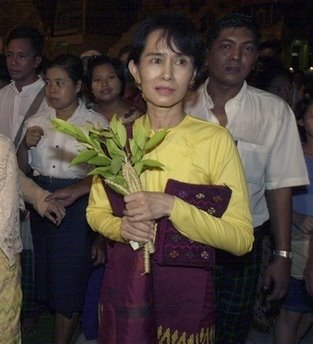


 Posts
Posts


