http://www.myjoyonline.com/tools/print/printnews.asp?contentid=25303
The Martin Luther King, Jr. that most Americans know is the man who said, "I have a dream" at a massive rally 250,000 strong in Washington, D.C., on August 28, 1963, while standing on the steps of the Lincoln Memorial during a March on Washington for Jobs and Freedom. That speech is about racial justice and ultimate reconciliation in the United States, and with the changes wrought in American law and practice by the Civil Rights movement, it is a speech that Americans can still feel hopeful about, even if we have not, as Dr. King would have said, "gotten there yet."
But there was another King, the critic of the whole history of European colonialism in the global South, who celebrated the independence movements that led to decolonization in the decades after World War II. The anti-imperial King is the exact opposite of the Neoconservatives who set US policy in the early twenty-first century. Barack Obama, who inherits King’s Civil Rights legacy and is also burdened with the neo-imperialism of the W. era, has some crucial choices to make about whether he will heed the other King, or whether he will get roped into the previous administration’s neocolonial project simply because it is the status quo from which he will begin his tenure as commander in chief.
Cont’d (click below or on "comments")
The US so neglects its educational system that relatively few Americans are exposed to world history in school. Few of them know that roughly from 1757 to 1971 the great European powers systematically subjugated most of the peoples of the world. tiny Britain ruled gargantuan India, along with Burma (Myanmar), what is now Malaysia, Australia, some part of China, and large swaths of Africa (Egypt, Sudan, Gambia, Rhodesia/ Zimbabwe, South Africa, Tanzania, Ghana, etc., etc.) The colonial system was one of brutal exploitation of "natives" by Europeans, who derived economic, strategic and political benefits from this domination.
Dr. King frankly saw this imperial system as unadulterated evil. In his "The Birth of a New Nation," a sermon delivered at Dexter Avenue Baptist Church, Montgomery, Alabama on 7 April 1957, King, just back from Africa, lays out his vision of the liberation of the oppressed from the failing empires.
He begins by celebrating the independence of Ghana (formerly the Gold Coast) on March 6, 1957, and praising the man who led his country to sovereignty, Kwame Nkrumah. King and his wife, Coretta Scott King, had traveled to Ghana to attend the independence ceremonies. He saw the victory of Ghana over the British imperialists as exemplifying a yearning in human beings in all times and places for liberty: "Men realize that freedom is something basic, and to rob a man of his freedom is to take from him the essential basis of his manhood. To take from him his freedom is to rob him of something of God’s image."
The state of being colonized, of being under the thumb of another nation, another people, is from King’s point of view an existential disfigurement, robbing human beings of their status as theomorphic or created in the image of the divine.
King recalled the ceremonials that he had witnessed with his own eyes on African soil:
'’ The thing that impressed me more than anything else that night was the fact that when Nkrumah walked in, and his other ministers who had been in prison with him, they didn’t come in with the crowns and all of the garments of kings, but they walked in with prison caps and the coats that they had lived with for all of the months that they had been in prison . . . at twelve o’clock that night we saw a little flag coming down, and another flag went up. The old Union Jack flag came down, and the new flag of Ghana went up. This was a new nation now, a new nation being born. . . And when Prime Minister Nkrumah stood up before his people out in the polo ground and said, "We are no longer a British colony. We are a free, sovereign people," all over that vast throng of people we could see tears. And I stood there thinking about so many things. Before I knew it, I started weeping. I was crying for joy. And I knew about all of the struggles, and all of the pain, and all of the agony that these people had gone through for this moment.
After Nkrumah had made that final speech, it was about twelve-thirty now. And we walked away. And we could hear little children six years old and old people eighty and ninety years old walking the streets of Accra crying, "Freedom! Freedom!" They couldn’t say it in the sense that we’d say it-many of them don’t speak English too well-but they had their accents and it could ring out, "Free-doom!" They were crying it in a sense that they had never heard it before, and I could hear that old Negro spiritual once more crying out:
Free at last! Free at last!
Great God Almighty, I’m free at last!’
It was as he stood in the square at Accra after midnight on the first day of the independence of a former African colony that he remembered those lines, to which he referred again in his "I have a Dream" speech some six years later at the Lincoln Memorial. For King, Kwame Nkrumah was the Great Emancipator as much as Lincoln, and the achievement of civil rights for African Americans was a sort of decolonization, replicating the miracle of Ghana.
King recalled, in his 1957 sermon, how the new parliament was opened on a Wednesday and "here Nkrumah made his new speech. And now the prime minister of the Gold Coast with no superior, with all of the power that MacMillan of England has, with all of the power that Nehru of India has-now a free nation, now the prime minister of a sovereign nation." That phrase, "with no superior" was central to King’s thinking, both about decolonization and about civil rights in the US. Colonized Ghanaians had had a superior in the form of the British high commissioner, who set policy for them by fiat. African-Americans under Jim Crow had a superior. But Nkrumah, as of March 6, "had no superior."
King took away from his experience in Africa the lesson that social mobilization was necessary to gain freedom. It would not be gifted from on high, since colonial officials had no interest in abolishing their own power. But King also said he admired Nkrumah’s deployment of Gandhian techniques of nonviolent noncooperation to win independence.
He said he learned from the experience of Ghana that the quest for liberation would always be resisted, and that freedom workers should expect to go to jail, and to face fierce oppostion. He recalled of his return journey through London,
'’ remember we passed by Ten Downing Street. That’s the place where the prime minister of England lives. And I remember that a few years ago a man lived there by the name of Winston Churchill. One day he stood up before the world and said, "I did not become his Majesty’s First Minister to preside over the liquidation of the British Empire."
And I thought about the fact that a few weeks ago a man by the name of Anthony Eden [then British Prime Minister] lived there. And out of all of his knowledge of the Middle East, he decided to rise up and march his armies with the forces of Israel and France into Egypt, and there they confronted their doom, because they were revolting against world opinion. Egypt, a little country; Egypt, a country with no military power. They could have easily defeated Egypt, but they did not realize that they were fighting more than Egypt. They were attacking world opinion; they were fighting the whole Asian-African bloc, which is the bloc that now thinks and moves and determines the course of the history of the world.’
King was referring to the Suez War of 1956, in which Israel, the United Kingdom and France conspired against Egyptian leader Gamal Abdel Nasser, who had nationalized the Suez Canal that July. France feared Abdel Nasser because he gave hope and aid to the Algerian revolutionaries trying to end France’s empire there. Eden caricatured Abdel Nasser as a Mussolini figure needing to be taken down a notch lest the colonized countries get uppity in imitation of him. Israel, always expansionist and land hungry, sought to take and keep the Sinai Peninsula right up to the Suez Canal.
Although King attributed the failure of the tripartite plot to the "Afro-Asian bloc," it was actually President Dwight D. Eisenhower who intervened to push the three miscreants back out of Egypt. Ike was afraid that the Arab nationalists would go Communist if the colonial powers and Israel insisted on humiliating them or refusing to let go of Arab land under foreign occupation. Eisenhower pressured Israel to give up the Sinai, which it did sullenly.
It should be remembered that in 1956-57, Britain, France and many in the US viewed Egyptian leader Abdel Nasser as a fascist, a tyrant, a supporter of terrorism who encouraged Palestinians in Gaza to attack Israel. King was not taken in by the propaganda, which covered for neo-imperial acquisitiveness on the part of the aggressors.
We celebrate today the birth of a man who supported anticolonial trouble-makers such as Nkrumah and Abdel Nasser against the global forces of empire. I think we may deduce from this stance exactly how he would feel about Israeli Prime Minister Ehud Olmert’s war on the people of Gaza.
King saw attaining civil rights in the US and decolonization in Africa and Asia as parallel processes. It could be argued that Nkrumah’s victory in 1957 was among the events that gave African-Americans hope in the Deep South.
Barack Obama told an anecdote about his father that reversed this causality. At the Brown Chapel A.M.E. church in Selma, Alabama, in March, 2007, 50 years after King saw Nkrumah become the ruler of a sovereign African country, Obama told the congregation:
’You see, my Grandfather was a cook to the British in Kenya. Grew up in a small village and all his life, that’s all he was — a cook and a house boy. And that’s what they called him, even when he was 60 years old. They called him a house boy. They wouldn’t call him by his last name.
Sound familiar?
He had to carry a passbook around because Africans in their own land, in their own country, at that time, because it was a British colony, could not move about freely. They could only go where they were told to go. They could only work where they were told to work.
Yet something happened back here in Selma, Alabama. Something happened in Birmingham that sent out what Bobby Kennedy called, “Ripples of hope all around the world.” Something happened when a bunch of women decided they were going to walk instead of ride the bus after a long day of doing somebody else’s laundry, looking after somebody else’s children. When men who had PhD’s decided that’s enough and we’re going to stand up for our dignity. That sent a shout across oceans so that my grandfather began to imagine something different for his son. His son, who grew up herding goats in a small village in Africa could suddenly set his sights a little higher and believe that maybe a black man in this world had a chance.
What happened in Selma, Alabama and Birmingham also stirred the conscience of the nation. It worried folks in the White House who said, “You know, we’re battling Communism. How are we going to win hearts and minds all across the world? If right here in our own country, John, we’re not observing the ideals set fort in our Constitution, we might be accused of being hypocrites. So the Kennedy’s decided we’re going to do an air lift. We’re going to go to Africa and start bringing young Africans over to this country and give them scholarships to study so they can learn what a wonderful country America is.
This young man named Barack Obama got one of those tickets and came over to this country. He met this woman whose great great-great-great-grandfather had owned slaves; but she had a good idea there was some craziness going on because they looked at each other and they decided that we know that the world as it has been it might not be possible for us to get together and have a child. There was something stirring across the country because of what happened in Selma, Alabama, because some folks are willing to march across a bridge. So they got together and Barack Obama Jr. was born. So don’t tell me I don’t have a claim on Selma, Alabama. Don’t tell me I’m not coming home to Selma, Alabama.’
Obama’s speech was also about the blessed estate of having "no superior," of not being a colonial subject, of not being called "boy" by one’s alleged social and racial "superiors."
Obama’s speech was an anticolonial one, which reversed the causation implicit in King’s description of the independence celebration in Ghana. Barack Obama, Sr., was the recipient of a scholarship from the Kennedy administration that was offered in part under the influence of the US Civil Rights Movement.
The Neoconservatives, like Winston Churchill himself as long as he lived, never gave up the imperial dream. They approved of the 1956 attack on Egypt by Israel, France and Britain. They approved of Western dominance of the countries of the global South. And Bush and his think tanks wanted to revive empire, to pretend it was 1920, and that the common people lacked the skills to mobilize to stop their project of domination.
Obama’s plan to order the beginning of a withdrawal from Iraq on day one of his administration is consistent with the anticolonialism of the King tradition and of Obama’s own autobiography.
But the dark clouds over the Obama administration are Afghanistan and Palestine. What Obama accomplishes on those two issues will powerfully shape his presidency. Only if he can avoid perpetuating colonial abuses in both can he hope to claim the mantle of anticolonialism from King and from his own father. For the Bush administration assiduously robbed other human beings of their status as images of the divine, and the US will not be whole until Afghans and Palestinians can say in the words of the old Negro spiritual, "Free at Last, Free at Last, Great God Almighty, I’m Free at Last."
Credit: Juan Cole
Source: agoravox.com
Story from Myjoyonline.Com News:
http://news.myjoyonline.com/features/200901/25303.asp
Published: 1/20/2009
© Myjoyonline.com
Wednesday, January 21, 2009
King’s Anti-Imperialism and the Challenge for Obama


Opposition Leaders Expect Obama to Stick to Burma Policy
http://www.irrawaddy.org/article.php?art_id=14958
--------------------------------------------------------------------------------
By SAW YAN NAING Tuesday, January 20, 2009
--------------------------------------------------------------------------------
Burmese opposition leaders expect US support for the pro-democracy movement to remain strong after President-elect Barack Obama takes office on Tuesday. Some said, however, the Burmese people themselves remained the most potent force for political change.
Nyan Win, spokesman for the National League for Democracy (NLD), told The Irrawaddy: “We believe that the US will keep up its support for human rights and the democracy movement in Burma.”
An ethnic Arakanese leader in Rangoon, Aye Tha Aung, chairman of the Arakan League for Democracy, said he didn’t expect greater support for political change in Burma. “The most important force for change in Burma are the Burmese people, opposition groups and ethnic leaders,” he said.
International pressure on the Burmese regime was still needed, however, he added.
Ludu Sein Win, a veteran Burmese journalist in Rangoon, said nothing more than condemnation of the regime could be expected from the Obama administration.
“I want to urge the Burmese people: Don’t rely on Obama and [UN Secretary-General] Ban Ki-moon,” Sein Win said. “We must rely on ourselves.”
Sanctions alone were not enough to bring about political change in Burma, Sein Win said. He thought that sanctions had only a small impact and were insufficient to bring down the regime.
Bo Kyi, joint secretary of the Thailand-based Assistance Association for Political Prisoners (Burma), said the Obama administration should maintain sanctions against the Burmese junta and its cronies.
Burma would not be a priority issue, however, in view of such immediate challenges as the conflict between Israel and Hamas and the US economic crisis.
Bo Kyi said Obama should try and persuade China and leaders of the Association of South East Asian Nations to work on a solution of the Burma question. “We also want him to try to find out common ground in cooperation with the UN Security Council’s five permanent members and 10 non-permanent members.”
Bo Kyi said he would also like to see the new US administration continue to pressure the Burmese junta to release all political prisoners, including democracy leader Aung San Suu Kyi, to enter into a tripartite dialogue with ethnic leaders and opposition and agree to a constitutional review.
European Commission provides 40.5 million euros in aid to Myanmar
http://www.monstersandcritics.com/news/asiapacific/news/article_1454582.php/European_Commission_provides_40.5_million_euros_in_aid_to_Myanmar_
Yangon - The European Commission has agreed to provide 40.5 million euros (52.4 million dollars) in humanitarian aid to Myanmar this year, with some of it aimed at assisting the Rohingya Muslims who are living 'in terrible conditions,' officials said Tuesday.
Of the 40.5 million euros allocated, some 22 million will go to assisting communities hard hit by Cyclone Nargis, which left 140,000 people dead and affected 2.4 million others in March 2008.
The remaining 18.5 million will target 'other highly vulnerable populations inside Myanmar, and Burmese refugees in Thailand,' said a statement issued by the European Commission.
'I am particularly concerned about the forgotten crisis in Northern Rakhine State, where some 800,000 Muslim Rohingya live in terrible conditions,' said European Commissioner for Development and Humanitarian Aid Louis Michel.
'Despite all our efforts, the situation there remains tragically static,' Michel said of the Rohingyas, a Muslim minority group that has been denied citizenship by the ruling Myanmar junta.
The Rohingyas have been denied citizenship and the right to own land or work in the Rhakine State, also called Arakan, despite having lived in the area for generations.
Myanmar government persecution forced at least 250,000 Rohingyas to flee to neighbouring Bangladesh in 1991 and 1992, where many remain refugees.
The plight of the stateless Rohingyas recently came to light after the Thai navy was accused last month of pushing back to sea about 1,000 Rohingya boat people, leaving at least 500 missing on the high seas.
The European Commission has been providing humanitarian aid to Myanmar since 1994.
The aid is strictly limited to humanitarian efforts, as Myanmar's ruling military regime is the target of European Union economic sanctions because of its atrocious human rights record.
Humanitarian aid increased substantially last year in the aftermath of the Cyclone Nargis disaster that hit Myanmar's Irrawaddy delta.
'The objective of our activities in Myanmar is solely humanitarian,' said Michel.
Pres. Bush Uses Authority to Alter Burmese JADE Act
http://www.diamonds.net/news/NewsItem.aspx?ArticleID=24978
By Jeff Miller Posted: 01/19/09 16:21
Submit Comment
RAPAPORT... President George W. Bush waived some provisions in the Tom Lantos Block Burmese JADE Act against Myanmar on January 15, less than one week before leaving office. The bill, which was supported by many in the U.S. diamond and jewelry trade, was signed into law in July 2008 and was intended to prevent rubies and jade from entering the U.S. from Myanmar either directly or through third party countries.
The Tom Lantos Block Burmese JADE Act of 2008 also froze the finances of Myanmar's military leaders and their families in all U.S.-owned banks. It also froze the assets of all parties, whether named explicitly or not, who support Myanmar's government, and made provisions for sanctions against those who choose to do so in the future. President Bush's waiver released those unnamed and future supporters, limiting sanctions to those already listed on the U.S. Treasury Department's list of blocked persons. "Because the imposition of effective and meaningful blocking sanctions requires the identification of those individuals and entities targeted for sanction and the authorization of certain limited exceptions to the prohibitions and restrictions that would otherwise apply, I hereby determine and certify that such a limited waiver is in the national interest of the United States," the president wrote in a memorandum to the secretary of state and the secretary of the treasury.
According to the orginal bill, the president was granted the authority to authorize changing provisions without congressional approval. Representative Howard Berman (Democrat-California), chairman of the House Foreign Affairs Committee, however, was not pleased. "I am disappointed at the decision to waive sanctions against all unnamed persons subject to the JADE Act, and believe it is contrary to the law." Berman said. "Now those who are supporting the Burmese military clique and who have not yet been publicly identified by the Treasury Department will get a free pass -- just what Congress was trying to prevent. It is puzzling that a president who has professed support for Burmese advocates for freedom has made a decision in his final days in office that was both unnecessary and so contrary to his past actions."
As a reminder to the U.S. trade: U.S. Customs & Border Protection is enforcing requirements for the import and export of rubies and jadeite from Myanmar, neither of which are permitted to enter the U.S. Customs has issued new Harmonized Tariff System codes for use for all non-Burmese rubies and jadeite, and jewelry containing these gemstones, imported into the U.S. Shipments of rubies and jadeite from non-Burmese sources must use these codes when entering the U.S. Importers are required to maintain full records related to purchase, manufacture and shipment of non-Burmese goods for five years, and to provide these records to customs upon request.
The importation ban does not apply to jadeite or rubies that are imported for personal use, meaning for personal wear by the importer. Furthermore, the bill does not address U.S. sales of any inventory of jadeite or rubies currently in the U.S. Importers and exporters can send questions to customs at jade.act@cbp.dhs.gov or read more at www.cbp.gov.
Full Text of President Bush's Order:
Title 3 -- The President -- Limited Waiver of Certain Sanctions Imposed by, and Delegation of Certain Authorities Pursuant to, the Tom Lantos Block Burmese JADE (Junta's Anti-Democratic Efforts) Act of 2008 -- Memorandum for the Secretary of State and the Secretary of the Treasury
Document Number: Presidential Determination No. 2009-11 of January 15, 2009/Page Number: 3957
By the authority vested in me as President by the Constitution and laws of the United States, including the Tom Lantos Block Burmese JADE (Junta's Anti-Democratic Efforts) Act of 2008 (Public Law 110-286) (JADE Act) and section 301 of title 3, United States Code, in order to ensure that the United States Government's sanctions against the Burmese leadership and its supporters continue to be implemented effectively, to allow the reconciliation of measures applicable to persons sanctioned under the JADE Act with measures applicable to the same persons sanctioned under the International Emergency Economic Powers Act (50 U.S.C. 1701 et seq.), and to allow for the implementation of additional appropriate sanctions:
(1) I hereby waive, pursuant to section 5(i) of the JADE Act, the provisions of section 5(b) of the JADE Act with respect to those persons described in section 5(a)(1) of the JADE Act who are not included on the Department of the Treasury's List of Specially Designated Nationals and Blocked Persons. Because the imposition of effective and meaningful blocking sanctions requires the identification of those individuals and entities targeted for sanction and the authorization of certain limited exceptions to the prohibitions and restrictions that would otherwise apply, I hereby determine and certify that such a limited waiver is in the national interest of the United States.
(2) I hereby delegate to the Secretary of the Treasury the waiver authority set forth in section 5(i) of the JADE Act, including the authority to invoke or revoke the waiver with respect to any person or persons or any transaction or category of transactions or prohibitions by making the necessary determination and certification regarding the national interest of the United States set forth in that section. I hereby direct the Secretary of the Treasury, after consultation with the Secretary of State and with necessary support from the Intelligence Community, as defined in section 3(4) of the National Security Act of 1947, as amended (50 U.S.C. 401a(4)), to continue to target aggressively the Burmese regime and its lines of support. I further delegate to the Secretary of the Treasury the authority to take such actions as may be necessary to carry out the purposes of section 5(b) of the JADE Act. The Secretary of the Treasury may redelegate any of these functions to other officers and agencies of the United States Government consistent with applicable law. The authorities delegated to the Secretary of the Treasury under this memorandum shall be exercised after consultation with the Secretary of State.
(3) I authorize the Secretary of State, after consultation with the Secretary of the Treasury, to take such actions as may be necessary to make the submissions to the appropriate congressional committees pursuant to section 5(d) of the JADE Act.
I hereby authorize and direct the Secretary of the Treasury to report this determination to the appropriate congressional committees and to publish it in the Federal Register .
/S/ George W. Bush
THE WHITE HOUSE,
Washington, January 15, 2009
the obama vision for world international relations

http://www.streeteditors.com/archives/4884
Published by Sean Burkeon January 20, 2009in Opinion & Review.
Tags: climate-change, Hillary, International Relations, obama, USA.
SPREAD STREET EDITORS - SEND TO A FRIEND
A 79-page sneak preview is available into the minds of the two new US (and effectively world leaders) (elect) Obama and Hillary and how they plan on designing and implementing new US international policy initiatives. The Questions for the Record by Senator John Kerry to Hillary Rodham Clinton can be found here. As we have seen over the last several years, international policy directions by the US can have an umbrella effect on the policies and directions of many other countries, for good and bad. Therefore it is a worthwhile read to get a brief insight into how our lives and communities over the next several years may benefit (or not) from the incoming Administration of Obama.
Essentially, the 79-pages are broken down by questions and answers per country and general topic. Following is a brief summary of some of the responses. Direct answers from the report have been placed in quotation marks “”.
Climate Change - “Climate change is one of the most pressing challenges facing the United States and the global community. The United States will take a leadership role in combating the threat of global climate change from the beginning of the new Administration. The President-Elect has specifically pledged to set a goal of an 80% reduction in global emissions by 2050…”
Additionally, in response to a question regarding impacts of climate change on US national security, Obama “called (the) dependance on foreign oil and gas a national security crisis”. We can only hope that this might lead to stronger support of alternative fuel sources.
Also, in response to a question regarding the Climate Change Conferences in Bali and Poznan, where “one of the greatest points of disagreement between industrialized and developing countries (were the funding mechanisms) to support mitigation, adaptation and technology transfer”, Obama “believes (they) are key components of a global climate change deal… (and that they) will pursue mechanisms to achieve these goals…”.
Nuclear Weapons - “The Obama Administration will seek deep, verifiable reductions in all US and Russian nuclear weapons”. Additionally, the “Obama Administration plans to set a new direction in nuclear weapons policy, one that reflects the changed security conditions of the 21st century and that shows the world that the US takes seriously its existing commitment under the Nonproliferation Treaty”.
India and Pakistan - Obama and Hilary are both strongly committed to Senate approval of the Comprehensive Nuclear Test-Ban Treaty, and will launch diplomatic efforts to bring other states on board including India and Pakistan.
Iraq - Indication of continued support of the two Iraq withdraw timelines: all US combat forces shall withdraw from Iraqi cities and towns by June 30, 2009; and that all US forces shall withdraw from Iraq by December 31, 2011.
Iran - “The new Administration will present the Iranian regime with a clear choice” ; “refuse, and we will ratchet up the pressure, with stronger unilateral sanctions; stronger multilateral sanctions in the Security Council; and sustained action outside the UN to isolate the Iranian regime. A nuclear-armed Iran is unacceptable…” However to put this in the context of the new Obama regime, Hilary has also highlighted the need for better preparations for negotiations. “The President-Elect has said that he is willing to engage in diplomacy with any leader”.
Syria - We “believe that engaging (in direct dialogue with Syria rather than through Turkish intermediaries as has been the case with the Bush Administration) increases the possibility of making progress”. Again highlighting Obama’s desire to be open to discussions with any leaders.
Israel - Palestine - Obama has “pledged to work actively from the beginning of his Administration to help Israel and the Palestinians achieve peace and security through a two-state solution”. Hilary also indicated that commitment has been pledged by both Israel and Palestine to the peace process as per the 2008 Annapolis conference, where both states indicating continued commitment even in the face of the recent and ongoing events in Gaza and southern Israel. (Let us hope this is the case.)
ICC - “Whether we work toward joining or not, we will end hostility towards the ICC, and look for opportunities to encourage effective ICC action in ways that promote US interests by bringing war criminals to justice.”
Asia
US - China (Taiwan + Tibet) - Hilary indicated that the US will maintain its “one China” policy; however that the “Obama Administration will speak out for the human rights and religious freedom of the people of Tibet.”
North Korea - Obama has “made clear his view that North Korea is not entitled to international support. He said that if North Korea did not live up to its obligations we may in fact reinstate some sanctions.” However, the Administration “will continue to address North Korea’s human rights abuses” as well as food aid through the World Food Program and US NGOs.
Burma - “The Obama Administration will support US trade and investment sanctions against Burma” however they must be “crafted, as in the Lantos Bill, to bring pressure on the regime itself, and seek … to spare the people of Burma further suffering.” Hilary believes they should “more fully explore possible modalities for humanitarian assistance that will reach the …people”.
Africa
Sudan (Darfur) - The “President-Elect and I have been very clear and forceful in our condemnation of the genocide in Sudan and in our commitment to far more robust actions to end the genocide and maximise protection for civilians”.
Zimbabwe - Responses to questions regarding Zimbabwe were more neutral, where the following quote can perhaps summarize the tone set as being diplomatically encouraging of the end of the Mugabe government. “The US and the World must take steps to address this growing crisis.”
South America
US - Latin / South American relations (including Cuba) - Obama “believes it makes both moral and strategic sense to restrict the restrictions on family visits and family cash remittances to Cuba.” Existing policy restricts Cuban Americas to sending home only $100 / month, and visiting family in Cuba only once every 3-year period.
Europe
A range of European issues was also responded to including democracy in Ukraine, democracy and relations with Russia, sovereignty integrity of Georgia, as well as advancing progress of the Dayton Agreement regarding Bosnia-Herzegovina. Hilary pledged enhanced support to overcoming divisions that have remained throughout the last 10 years, in order to allow Bosnia-Herzegovina to progress further.
Overall, the answers certainly suggest a lean toward more positiveness in the future. But as author Van Jones in his book “The Green Collar Economy” stated, “Barack Obama helped us take America back. Now we have to help him take America forward.” I think this applies to all people and all governments world-wide.
A challenge to power
http://english.dvb.no/news.php?id=2110
Jan 19, 2009 (DVB)–Professor Josef Silverstein called on the Burmese democracy movement to unite and take action to challenge the military government’s right to rule, in an interview with DVB.
Professor Silverstein is professor emeritus at Rutgers University in the United States and the author of two books on Burma.
DVB: What do you think of the National Council of the Union of Burma’s plan to found a new government in exile even though they already have the National Coalition Government of the Union of Burma?
JS: “My point of view is I don’t see any need to change the government if there is nothing that that government could possibly do. For one thing, amongst the people living outside of the government of Burma, the military government, they are not really well organised, they have no authority, and as a result it seems to me to be a waste of time. If you’re going to look to form a new government amongst the Burmese people who are outside of Burma and do not come under the military, the question is: what will they do? How will they act? Are they going to try to pull all the people together? All the minorities, all the Burmans, everyone who is opposed to the military and is able to take some kind of political action?
“I think that might be a good idea, but it’s the second step, not the first step. The first step I was waiting to hear you say is that the NCGUB was reorganising itself or that the people who formerly supported the NCGUB now want to form a new government to replace that government and if that is what you’re asking me about, I don’t see any purpose of wasting time and wasting energy if a new government isn’t going to be able to do any more than what the present government is doing in the opposition.
“I think it’s a very important thing that for all these years since the military has been in power in – now Naypyidaw but before in Rangoon – that they have done whatever they wish without considering what the people want. There is no way for the people to express themselves. So I favour the idea of the opposition coming together and forming a genuine movement that speaks for the millions of Burmese people who reject the military and have no voice in the government. But unless you are talking about a genuine movement in which there will be an effort to bring all the people who are outside of the control of the military together, to organise and to begin to challenge the military’s right to rule and what they say, I don’t see that it’s worth the effort at this point.”
DVB: Some people are worry about the lack of unity in the exile community after this statement. Do you think unity in exile is stronger now?
JS: “I think that any effort to unite the people against the military and to have a spokesman and a spokesgroup that speaks for them that the people will listen to and follow would be a good thing, an important thing. But is has to be a change that will reflect a shift in power. There will be no shift in power if you just form a new government with the same people doing the same things. There has to be a shift in power to the people.
“If there is a movement in that direction and there is a real effort to unite the people, the Burmans, the minorities, the refugees and everyone else, then I think that would be important and a useful effort. But if that happens it’s going to cost a lot of bloodshed because the military will not allow them to organise but instead will try to put them down by force. So are you saying that there may be a group in Burma today in the opposition who believe it’s time to revolt against the military and challenge the military’s right to rule? Unless that is what they’re going to do, I think they’re going to by wasting their time, as they have been for the last several years.”
DVB: What are your views on the 2010 election?
JS: “If we’re talking about the elections proposed to be held in 2010 and if it’s going to be held under the constitution that the military wrote and put into place, that is not going to bring about any kind of shift in power. It’s just going to be another example of the military dictating how they are going to remain in power and what they are going to stand for. They’re not in any way looking to bring the people in and give them a voice in power or the right to challenge power. If my understanding is correct, then it is going to make no difference if the election is held in 2010, except it will legitimise the military in the eyes of many of the foreign countries which don’t really understand what’s going on in Burma, and as long as there is a government that seems to be able to exercise power and there’s no visible opposition they will go along with it. Now if that’s what the military is looking for, how they can get world attention and support for their movement, then I think they probably will.
“But what about the Burmese people? What about giving the Burmese people the right to govern themselves because that’s what the [Universal Declaration on Human Rights] says: people have the right to self-government. There is no self-government in Burma today; there is a military dictatorship which rules by force and violence. So if you’re talking about how we get change in Burma, there has to be a change in the opposition, the opposition has to first organise, get leaders who are ready to take action that will ultimately bring about change. Unless that happens, it is not a very useful activity.”
Reporting by Htet Aung Kyaw
Aung San Suu Kyi receives Trumpet of Conscience Award
http://www.hindu.com/thehindu/holnus/001200901191231.htm
Washington (PTI): Burmese democratic icon Aung San Suu Kyi has been presented with the prestigious Trumpet of Conscience Award for leading the people of her country in the fight against the military junta.
The annual award is given by Realizing the Dream, a non-profit organization set up by Martin Luther King III in honour of his father great Martin Luther King Jr. The award is given on the occasion of birth anniversary of the great American leader. Monday happens to be his 80th birthday.
At a glittering function held last evening, a few blocks away from the US capitol, the award was presented by Queen Noor of Jordan to Aung Ding, executive director of US Campaign for Burma, on behalf of Aung San Suu Kyi.
"Daw Aung San Suu Kyi epitomizes the ideals of this award," Queen Noor said in her speech. "She is a freedom fighter and passionate advocate for the use of non-violent action against repression and military force," she said.
"A dedicated practicnor of Buddhism, a dedicated student of Gandhian principles and a follower of King's teachings, Aung San Suu Kyi has led her followers in Burma to engage the repressor with calm, passion and collective conviction," Queen Noor said.
In his speech, Aung Din hoped that President-elect Barack Obama will uphold existing economic sanctions and lead a strong diplomatic effort to organize international community to put collective pressure on Myanmar's military regime.
Among other awardees at the yesterday function were Rev Claude William Black Jr (Testament of Hope), Rep. John Lewis (Drum Major) and Senator Edward M Kennedy (Realizing the Dream). Last year, former US President Bill Clinton had received Realizing the Dream Award.
Toward the Union of a Divided Burma
http://www.irrawaddy.org/article.php?art_id=14943
--------------------------------------------------------------------------------
By SHWE YOE Monday, January 19, 2009
--------------------------------------------------------------------------------
The barber stood at the door of his shop, waiting for customers. He didn’t have to wait long—a Tibetan-looking man in a traditional ethnic shirt, carrying a shoulder bag, stopped in front of him. “Good morning, sir,” he said in a strong ethnic accent.
"Good morning," the barber replied with a warm smile. “Please, come in and sit down.”
As he set to work on the man’s hair, the barber attempted to break the ice. "Unless I’m mistaken,” he said. “You’re from up north? Maybe from Kachin State?”
“Yes, I am,” replied the man.
“Your first time to the capital … I mean … to the ex-capital?” asked the barber.
“Oh, no, no, no,” the Kachin said. “I come here regularly.”
The barber nodded and continued cutting the man’s short black hair.
“This used to be such a beautiful city,” the Kachin said after a moment. “It seems so dirty and downtrodden now.”
The barber smiled and snipped lightly behind the man’s ears.
“No electricity, no sanitation. It seems that everything is broken in Yangon nowadays,” the Kachin whispered. “Not like the towns in China—they’re clean and well-organized.”
“Well, maybe things will change after the election in 2010 when we are demo-cratic,” replied the barber, purposely mispronouncing "democratic." He looked directly at the Kachin in the mirror and raised his eyebrow.
There was a minute’s silence. The Kachin man stared back at the barber in the mirror and then sighed. “I wouldn’t bet on it, my friend,” he said. “I’ve just come from a meeting at the offices of Myanmar Economic Holdings. They were asking about the jade and comparing the collateral from the mines to the budget just to run the election.”
“I see,” the barber said, innocently. “But what about all that money we’re supposed to be making by selling natural gas? I heard that the government had banked upward of US $3 billion in gas sales alone.”
The Kachin didn’t answer. He looked at the barber in the mirror again and shrugged. The barber nodded in response.
“Would you like it any shorter?” the barber asked.
“What?” the Kachin said with surprise.
“Your hair, sir,” said the barber with a smile, holding a hand-mirror behind the man’s head.
“Oh! Yes, of course. I mean, no. No. That’s fine. Very good, in fact,” the Kachin man said. “Just a shave, if you will.”
“Certainly, sir,” the barber said and went to fetch some water.
When he returned he asked: “Excuse me, my friend. Forgive me for asking. But are you, by any chance, a member of the Kachin Independence Organization?”
“Is it so obvious?” smiled the Kachin.
The barber chuckled. “I heard that the KIO had announced it wouldn’t contest the elections next year,” the barber said. “Apparently they changed their minds.”
He turned away casually, frothing up some foam in a cup with a shaving brush.
The Kachin looked around at the door and checked no one was there. Then he turned back to the barber and said, “The problem, old boy, is the pyidaungsu hluttaw [Union Parliament], the pyithu hluttaw [People's Parliament] and the amyotha hluttaw [National Parliament]. Every cabinet will be laced with 25 percent military officers. Nothing will ever change! There is too much centralized authority.”
“Not enough space for a federal government?” asked the barber.
“Indeed!” said the Kachin firmly.
The barber waited a minute and then asked: “And what about the disarmament? I heard that all the ceasefire groups would lay down their weapons. In fact, I read in the newspaper that the DKBA would act as a border patrol. Will the KIO do the same thing?”
“Well,” the customer said. “I don’t think we’ll settle for anything as pathetic as the DKBA did. Instead, I personally like the way the Wa are going about things.
“The UWSA are now issuing documents stamped ‘Government of Wa State, Special Autonomous Region, Union of Myanmar.’ That’s a pretty sure sign they’re getting ready to establish their own authority.”
“What is the junta saying about that?” the barber whispered.
“I don’t think the generals can say too much at present,” the Kachin muttered. “They need as many ethnic groups on board as they can get. Too much loose talk about ceasefire groups following Maung Maung and his plan to form a parallel government after 2010.”
“Maybe the Karen, Mon, and Shan leaders will follow if Maung Maung promises a power-sharing deal with the ethnic opposition,” the barber suggested with an innocent shrug, laying his scissors on the table.
“My friend, that’s why we’ve changed our minds and don’t want to bet on the junta’s road map,” the Kachin whispered, sitting up and looking directly at the barber.
Just then, another customer entered the store and the two men fell silent.
“I’ll be with you in one minute,” called the barber with a smile. The customer sat down just as the Kachin stood up.
He looked at the barber and smiled carefully.
He rummaged in his pocket and suddenly looked shocked. “Oh my!” he exclaimed. “I don’t have any money. How stupid!”
He leaned closer to the barber and whispered: “Myanmar Economic Holdings couldn’t afford to pay us for the jade this month. They asked us for credit. I wonder, my friend, if you could do the same. Could I pay you next month when I’m back in Rangoon?”
“Don’t worry about it,” shrugged the barber. “Save your money. Let’s call it my contribution to a federal union.”
Burmese Lawyer Detained
http://www.irrawaddy.org/article.php?art_id=14949
--------------------------------------------------------------------------------
By THE IRRAWADDY Monday, January 19, 2009
--------------------------------------------------------------------------------
As the Burmese regime intensifies its crackdown on dissidents, Poe Phyu, a young Burmese lawyer, who has represented farmers and labor rights activists, was arrested and detained by authorities on Friday.
Thirty-year-old Poe Phyu was arrested by police officers in Aunglan Township in Magwe Division in central Burma soon after defending a group of Aunglan farmers whose lands had been confiscated by Burmese authorities, according to Bo Kyi, joint secretary of the Thailand-based Assistance Association for Political Prisoners (Burma).
Poe Phyu, who lives in Rangoon, was arrested while boarding a bus in Aunglan to return home, he said.
Meanwhile, the two labor rights activists Hla Soe and Zaw Htay he defended were also detained after they collectively sent a letter of complaint about their land confiscation to the International Labor Organization, he added.
In October 2008, four defense lawyers—Saw Kyaw Kyaw Min, Nyi Nyi Htwe, Aung Thein and Khin Maung Shein—were sentenced to prison terms of between four and six months for contempt of court after complaining of unfair treatment.
The lawyers had represented political activists, such as members of the 88 Generation Students group, and members of the opposition National League for Democracy.
Recently, one of the four, Saw Kyaw Kyaw Min, 29, who was sentenced in absentia, fled to Thailand.
Speaking to The Irrawaddy, Saw Kyaw Kyaw Min condemned the Burmese court for its lack of justice. There are no fair trials in Burma as defense lawyers are denied the right to defend their clients, he said.
The regime has been using the court to put pressure on activists and dissidents by pronouncing long terms of imprisonment, said Saw Kyaw Kyaw Min.
Burmese Lacquerware Loses Its Shine

http://www.irrawaddy.org/highlight.php?art_id=14946
--------------------------------------------------------------------------------
By KYI WAI / RANGOON Monday, January 19, 2009
Burma’s famous lacquerware is losing its shine. Less than one third of the more than 200 lacquerware factories and small workshops operating in the early 1990s in Pagan, one of the country’s major tourist destinations, are still in business.
Chan Aye’s family-run lacquerware business is the latest to go to the wall. The small factory, in Myin Kabar village, outside Pagan, was doing well when Chan Aye took it over from his father in 2000.
Since 2005, however, rising production costs and falling numbers of visiting tourists took their toll. Chan Aye finally gave up the struggle to keep afloat the business that had supported at least two generations of his family since colonial times. “It’s a hard blow,” he said.
The closure of Chan Aye’s factory adds one more statistic to the rising number of business failures in Pagan. Last year, the city and nearby villages had just 11 lacquerware factories and 60 smaller plants, compared to the more than 200 manufacturers supported by a buoyant tourist trade in the early 1990s.
About 70 percent of the city’s workforce is employed in the industry. Virtually every family in Chan Aye’s village depends on the trade in lacquerware.
More than 90 percent of the lacquerware produced in Pagan is sold to visiting tourists and the slump in tourism to Burma in recent years has dealt a crippling blow to the industry. Exports to China and Japan have plummeted.
Rising prices of raw materials, particularly resin, have also taken their toll.
"A tin of resin (approximately 15.3 kilograms) that sold 15 years ago for 5,000 kyat now costs 200,000 kyat,” said lacquerware manufacturer Sein Win. “Small businesses are being forced out of the market or are becoming sub-contractors to big industry."
Lacquerware has been produced in Pagan for centuries, perhaps as far back as at the time of the city’s foundation 1,000 years ago. Techniques were passed from one generation to the next, and the family manufacturing tradition is still carried on today.
Foreign interest in Pagan lacquerware grew rapidly over the past 45 years and contributed to a steady growth in the size and success of the industry—until the recent tourism crisis, which saw the numbers of foreign visitors arriving at Rangoon and Mandalay airports drop from 260,000 in 2006 to 177,000 in 2008.
Closures of lacquerware factories increase in direct proportion to the fall in tourist arrivals. As factories and workshops close, young people are turning their backs on the age-old craft and looking for alternative work in Pagan and other cities—and some are predicting that Burmese lacquerware may eventually be consigned to museum showcases.
SEAPA Alert: Australian author gets 3-year jail term in Thailand
19 January 2009
A Thai court sentenced an Australian author to three years'
imprisonment for insulting a member of the royal family, media
reports said.
"The Nation" online said Harry Nicolaides, 41, pleaded guilty to
lese majeste charges, prompting the court to reduce what was
originally a six-year jail term into three years instead.
Nicolaides' novel "Verisimilitude", allegedly made critical remarks
on Thailand's crown prince.
Lese majeste is a criminal offense in Thailand.
He was arrested on August 31, 2008 in Suvarnabhumi International
Airport, shortly before he was to board a flight back to his
country.
In an interview shortly after his arrest, Nicolaides issued a
public apology.
------------------------------------------------------------
Southeast Asian Press Alliance.
538/1 Samsen Rd., Dusit, Bangkok 10300.
Tel: 66-2-2435579, 66-2-2435373, Fax: 66-2-2448749
To unsubscribe or change subscriber options visit:
http://www.aweber.com/z/r/?LIwcjIyMtCzMDBysTJzstEa0LEzszIys7A==
LDP pledges to unite behind Aso
http://search.japantimes.co.jp/mail/nn20090119a1.html
Monday, Jan. 19, 2009
Party to put economy front and center in upcoming election
By MASAMI ITO
Staff writer
The ruling Liberal Democratic Party held its annual convention Sunday to gear up for the upcoming Lower House general election, vowing to unite under Prime Minister Taro Aso and win one of the toughest battles it has ever faced.
Aso, who is president of the LDP, expressed his determination to lead the party to victory in the election that must be held this year because the terms of Lower House members end in September.
"Out of all of the political parties, the LDP is the only party that can come up with measures to tackle" the current economic crisis, Aso told the convention in Tokyo.
Convention participants were keenly conscious of the opposition parties led by the LDP's main rival, the Democratic Party of Japan, which pundits say could win the election and seize power from the LDP-New Komeito coalition.
"Let's appeal to the public with the unwavering belief that the DPJ's intention to seize government power is only an illusion," the LDP's 2009 campaign platform adopted Sunday says.
LDP Secretary General Hiroyuki Hosoda harshly criticized the DPJ, saying it is placing priority on its own interests and stonewalling Diet business.
"We cannot yield government power to such an irresponsible party," Hosoda said. "Let us be confident and proud of the 50 years of the party's history during which we moved forward together with the public — and let's unite and win the election."
Aso and Hosoda made no reference to U.S. President-elect Barack Obama, who will take office this week. But in a written statement, the LDP promised to deepen relations with the United States.
"In the U.S., the new Obama administration will be formed," the statement adopted at the convention says. "We will strengthen Japan-U.S. relations even more, and cooperate on various issues, including the economy, finance and defense."
New Komeito leader Akihiro Ota made an appearance and stressed the strong ties between the two parties, promising to fight the election together.
"We must win the Lower House general election at any cost and we must send out a message that only the LDP-New Komeito coalition can lead (Japan) to overcome this difficult time," Ota said. "The ruling coalition shall win a majority . . . and that will be a victory for the public as well."
The coalition was formed in 1999, but recent relations have been rocky because of various disagreements, including the timing of the election, a consumption tax hike and the ¥2 trillion cash handout program.
With Aso and his Cabinet wallowing amid plunging public support — below 20 percent in a recent Kyodo News survey — the cooperation of New Komeito, which is backed by Japan's largest lay Buddhist organization, in the Lower House election is a must.
Over 1,000 Chinese workers in Burma’s Chibwe hydropower project
http://mqvu.wordpress.com/2009/01/18/over-1000-chinese-workers-in-burmas-chibwe-hydropower-project/
International Rivers has picked up this article, written by KNG and dated 13 January, from the Kachin News website.
To expedite the hydropower project in N’Mai River at Chibwe city in
Burma’s northern Kachin state, about 1,000 Chinese workers have been inducted in the project site since late December, 2008, said local sources. (…) The Chinese workers are employed by China’s
China Power Investment Corporation (CPI) and they are working together with about 300 Burmese workers of the Burma-Asia World Company which is owned by Burma’s former drug king Lo Hsing Han, residents of Chibwe said. (…)
Mr. Awng Wa, an anti-dam activist and chairman of Kachin Development Networking Group (KDNG) based on the Sino-Burma border told KNG today, “Chinese companies working under CPI in Chibwe hydropower project are also taking out valuable minerals from the project areas to China while working for the hydropower project.” (…)
Owners of restaurants in Chibwe are also seriously suffering and are
about to close their shops because the workers in Asia World Company eat daily at their restaurants without paying for the past six months to a year. On the other hand, owners of house construction stores have to provide the materials demanded by the company without getting payment for a long time.
The shop owners are unable to complain to the CPI and Asia World
Company because they are strongly backed by the Burmese ruling junta, added local residents.
Chibwe hydropower project is one of a total seven hydropower projects in Mali and N’Mai Rivers in Kachin state which is being built by the CPI and Asia World Company of the junta since 2006. The Chibwe hydropower project will generate a total of 2,000 MW of electricity.
According to sources from the two companies, the Chibwe hydropower project is being implemented under a 20-year project.
What surprised me about this article is that there are anti-dam groups operating on the Burma-China border. What, NGOs in Burma? I have imagined that border region to be ultramilitarized and ultrapoor, not the sort of place you’d have lots of space for dissidence or “civil society” (though Chinese merchants in Boten, who had come over from there, say that the environment was more “modern” than in Laos). So I am very curious about this “anti-dam group.” This would be a great place to check what a people who have (or so it is said in Western accounts) been pressganged and terrorised by various armies and drug lords for long actually think about development imported from China. This article certainly suggests that military-style requisitioning is still in fashion, to the benefit of the Chinese managers now.
Another point to note is that Lo Hsing Han, by the sound of his name, is probably Chinese; but is he a former KMT or a former Red Guard/BCP? Guo Xiaolin in her work on Burma-China relations (see Bibliography, Working Paper 1) does point out that a number of former Red Guards went over the border to aid the Burmese Communist Party and then became major drug players.
This entry was posted on January 18, 2009 at 10:14 am and is filed under Southeast Asia. Tagged: Burma, hydropower. You can follow any responses to this entry through the RSS 2.0 feed. You can leave a response, or trackback from your own site.
Leave a Reply
Myanmar provides 10,000 fishing boats for fishery recovery work
http://news.xinhuanet.com/english/2009-01/18/content_10677325.htm
www.chinaview.cn 2009-01-18 12:25:02 Print
YANGON, Jan. 18 (Xinhua) -- The Myanmar government has provided 10,000 fishing boats to fishermen in cyclone-hit areas in country's southwestern Ayeyawaddy delta to help fishery recovery work, according to the Fisheries Federation Sunday.
In addition to those supplied by the Myanmar government, the Singapore government and the country's well wishers have also donated 200 fishing boats and 200 fishing nets to survived fishermen in two cyclone-hit areas in the delta area to reinforce the fishery undertakings after storm, the sources said.
According to an earlier local report, a total of 9,500 fishing boats, spoiled in the May storm, have been rebuilt for fishermen to revive their fishery undertakings in areas such as Laputta, Ngaputaw, Mawlamyinegyun, Phyapon, Bogalay, Dedaye and some other storm-hit areas in Yangon division.
Meanwhile, under an agreement signed late last year between a Britain-based international non-governmental organization, the Action Aid, and the Myanmar Fisheries Federation, the Action Aid provided a total of 10 million U.S. dollars for the recovery of the fishery sector in the Hainggyi Kyun in the Ayeyawaddy delta for a period of four years.
An additional 2 million dollars in aid for the fishery sector was also sought from another INGO of Oxfam, then report said.
Deadly tropical cyclone Nargis hit five divisions and states - Ayeyawaddy, Yangon, Bago, Mon and Kayin on May 2 and 3 last year, of which Ayeyawaddy and Yangon inflicted the heaviest casualties and massive infrastructural damage.
The storm has killed 84,537 people, leaving 53,836 missing and 19,359 injured according to official death toll.
Editor: Wang Guanqun
Myanmar fruit export through border trade increases in 2008
http://news.xinhuanet.com/english/2009-01/18/content_10677114.htm
www.chinaview.cn 2009-01-18 10:58:07 Print
YANGON, Jan. 18 (Xinhua) -- Myanmar's fruit export to neighboring countries through border trade in 2008 amounted to 120,000 tons, up from 2007, the local Biweekly Eleven reported in this week's issue.
Of Myanmar's neighboring countries, China imported Myanmar fruits most compared with others such as Thailand and India, the report said.
Tropical fruits such as pine-apple, musk melon, pomelo, avocado pear, asparagus and chilli are mainly exported by Myanmar.
Myanmar has been placing emphasis on production of high-yield fruits and vegetables to boost export, taking advantage of the country's fair climatic conditions and geographic superiority.
The expanded production of quality fruits and vegetables will not only satisfy domestic demand but also generate foreign exchange earnings, thereby contributing to enhancing the socio-economic life of the entire people, agricultural experts said.
There are 100 kinds of kitchen crops including over 70 kinds of fruits produced by Myanmar along with vegetables.
Sown areas of fruit trees have reached 729,000 hectares in Myanmar, while that of vegetable 405,000 hectares and that of kitchen crops such as chilli, onion and potato 263,250 hectares, official report said.
Myanmar is also rich with other tropical fruit resources such as banana, strawberry, durian, mangos teen, papaya, coconut and so on.
According to a latest statistics of the Ministry of Commerce, Myanmar exported 80,000 tons of various items of fruits through border trade in the first nine months (April-December) of the fiscal year 2008-09, gaining over 17 millions U.S. dollars, while it imported over 50,000 tons of other fruits worth of 10 million dollars from the neighboring countries.
Editor: Wang Guanqun
Anger Myanmar's rulers, and lose all
http://www.heraldtribune.com/article/20090118/article/901180366&tc=yahoo
By THOMAS FULLER THE NEW YORK TIMES
Published: Sunday, January 18, 2009 at 1:00 a.m.
Last Modified: Sunday, January 18, 2009 at 8:21 a.m.
MAE SOT, Thailand - By the time he contracted tuberculosis, U Htay Aung, a dissident jailed for seven years in Myanmar, was incapable of telling prison guards about his condition. He had already lost his voice from years of exposure to the cold concrete floor that prisoners slept on.
Click to enlarge
INTERNATIONAL HERALD TRIBUNE / THOMAS FULLER U Kyaw Kyaw Min, a lawyer for dissidents, fled to Thailand last year under the threat of prosecution by Myanmar's government. So Htay Aung decided to announce his illness in a more graphic form. He coughed up enough blood to fill a small cup. "When the guard came around, I showed him," said Htay Aung, who has now recuperated but whose voice remains raspy. "They transferred me to the leprosy ward."
Htay Aung recently told the story to a reporter and a handful of former political prisoners who have settled in this small Thai city on the border with Myanmar, formerly known as Burma. Many of them work at the Assistance Association for Political Prisoners, a group that tracks the plights of the more than 2,100 jailed dissidents in Myanmar and organizes aid for them and their families.
Founded nine years ago, the association has never been busier.
Last year, the Burmese military government sentenced 410 dissidents to prison terms ranging from a few years to six decades or more. The association lists details of the convictions in its online database, which is widely consulted by diplomats, U.N. officials and human rights workers. U Bo Kyi, the co-founder of the association, says that an additional 600 dissidents are in detention and have yet to be tried.
Among those convicted last year was an 80-year-old Buddhist nun, Daw Ponnami, who was given four years of hard labor for her involvement in street demonstrations led by Buddhist monks in September 2007. She has been spared the hard labor, the association says, but in what may be the final humiliation of her twilight years, her conviction was for insulting Buddhism.
A well-known comedian known as Zarganar was sentenced to 59 years in prison after criticizing the government for neglecting the victims of the cyclone that swept through lower Myanmar in May, killing more than 130,000 people.
U Gambira, a monk who helped lead the 2007 protests, was sentenced to 68 years.
Other political prisoners are listed in the database as farmers, a blogger, an ice cream seller, a bus conductor and a hip-hop singer in a band called Acid. All angered the government in one way or another.
In U.N. reports and diplomatic cables, Burmese political prisoners are often just a statistic, a measurement of the many human rights abuses carried out by Myanmar's generals.
But to members of the association, the prisoners are part of a fraternity of fellow dissidents who have many needs. The association helps family members smuggle medicine, reading materials, blankets, clothing and food to the prisoners.
Occasionally guards are sympathetic, Bo Kyi said. Often they help just because they are poor and need the small bribes that prisoners and family members pay them.
Even the most basic necessities can require payment.
"If you want to get more water for a shower you have to pay money," Bo Kyi said.
Some prisons are so crowded that prisoners can sleep only on their sides. But guards reserve "VIP" corners where prisoners can lie flat on their backs -- for a fee.
The association's annual budget of $200,000 is financed by the U.S. government's National Endowment for Democracy, the Dutch government and private donors.
The budget also helps pay to whisk out of the country dissidents in danger of arrest.
Two years ago the association sent $100 to U Aung Kyaw Oo, a former student activist who spent 14 years in prison, to help him escape Myanmar. He made it to Thailand.
"It feels better than inside," he said. "They can't arrest me here."
Myanmar's most famous political prisoner, the Nobel laureate and pro-democracy leader Daw Aung San Suu Kyi, is barred by the military government from leaving her lakeside house in a plush neighborhood of Yangon, the commercial capital, formerly known as Rangoon. Her cause is championed by a wide variety of people across the globe, including foreign leaders and college students in the United States.
But most political prisoners in Myanmar live much more anonymously and in much more rudimentary conditions.
To be a political prisoner in Myanmar, Bo Kyi said, is to truly experience darkness. Prisoners are often let out of their cells only 20 minutes a day, he said.
"We gave up our best years," Bo Kyi said, as he scanned the wall of photographs. But he does not want revenge on the government, he said. "What we want is very simple," he said. "Just freedom of speech."
Singapore to toughen protest laws ahead of APEC meet
http://yoursdp.org/index.php/news/singapore/1768-singapore-to-toughen-protest-laws-ahead-of-apec-meet
Saturday, 17 January 2009
Reuters
Singapore will toughen its protest laws ahead of this year's Asia-Pacific Economic Cooperation (APEC) summit to reduce the number of civil disobedience acts, state media reported on Saturday.
Wong Kan Seng, Singapore's interior minister, told the pro-government Straits Times newspaper the city-state will look to enact regulations in the coming months giving police greater power to prevent protesters from gathering.
Singapore will host an APEC ministerial meeting in July and the annual summit in mid-November.
It hopes to avoid a controversy like the one in 2006 when an opposition politician was prevented from holding a march during the World Bank and International Monetary Fund meetings, resulting in a long standoff with police and criticism from the meeting organisers.
APEC's 21 members include the United States, China and Japan.
"For cause-related or ideologically-related activities, including those pertaining to race and religion, we should address them squarely as higher risk," Wong told the newspaper.
"We must empower the police to deal with public-order problems more effectively, especially when mega-events are held," he said.
Protests in tightly-controlled Singapore were only made legal last year in a designated zone, "Speakers' Corner", modelled after the one in London's Hyde park.
Any public gathering of five or more people is illegal in Singapore without a police permit.
Singapore defends the need for tough protest laws, citing concerns over public safety and order. But several international human right groups such as Amnesty International have said Singapore uses these laws to stifle dissent.
http://in.reuters.com/article/worldNews/idINIndia-37501620090117
Singapore govt to tighten laws against protests
AFP
Singapore's deputy prime minister said the island state, which is hosting a summit of Asia Pacific leaders this year, may further tighten laws against public protests, according to reports.
Wong Kan Seng, who is also Home Affairs minister, said the government is reviewing public order laws and may pass legislation to deal more effectively with illegal protests and other acts of civil disobedience, the Straits Times said.
The legislation is expected to be passed in time for the Asia Pacific Economic Cooperation (APEC) forum in November which could attract both local and overseas protesters, he said.
US president-elect Barack Obama, due to take office next week, is among the 21 leaders scheduled to attend the summit.
Public order laws are already tight in Singapore, where protests require a police permit if held outside a designated free-speech zone and gatherings of five or more people are illegal.
Nevertheless Wong said fresh legislation is needed to deal more effectively with political activities, while relaxing regulations on people gathering for social and recreational purposes.
He said police could be granted power to take action before protesters could gather at specific areas such as parliament, and cited protests by the political opposition, and by Myanmar nationals against their country's ruling junta.
"They make a show of breaking the law," Wong said of the protesters.
"The police watch and do nothing and can only follow up with investigation after the show is over when they pack up and leave. This cannot go on," he said.
http://news.yahoo.com/s/afp/20090117/wl_asia_afp/singaporepoliticsprotest
Comments Search RSS
Casting Light on Plight of Burmese Dissidents
http://www.nytimes.com/2009/01/18/world/asia/18prisoner.html?pagewanted=2
By THOMAS FULLER
Published: January 17, 2009
MAE SOT, Thailand — By the time he contracted tuberculosis, U Htay Aung, a dissident jailed for seven years in Myanmar, was incapable of telling prison guards about his condition. He had already lost his voice from years of exposure to the cold concrete floor that prisoners slept on.
Thomas Fuller/The International Herald Tribune
U Kyaw Kyaw Min, a lawyer for dissidents, fled to Thailand last year under the threat of prosecution. Myanmar’s government recently cracked down on lawyers defending political prisoners.
Thomas Fuller/The International Herald Tribune
U Htay Aung caught TB amid the harsh conditions of a seven-year imprisonment.
So Mr. Htay Aung decided to announce his illness in a more graphic form. He coughed up enough blood to fill a small cup. “When the guard came around, I showed him,” said Mr. Htay Aung, who has now recuperated but whose voice remains raspy. “They transferred me to the leprosy ward.”
Mr. Htay Aung recently told the story to a reporter and a handful of former political prisoners who have settled in this small Thai city on the border with Myanmar, formerly known as Burma. Many of them work at the Assistance Association for Political Prisoners, a group that tracks the plights of the more than 2,100 jailed dissidents in Myanmar and organizes aid for them and their families.
Founded nine years ago, the association has never been busier.
Last year, the Burmese military government sentenced 410 dissidents to prison terms ranging from a few years to six decades or more. The association lists details of the convictions in its online database, which is widely consulted by diplomats, United Nations officials and human rights workers. U Bo Kyi, the co-founder of the association, says that an additional 600 dissidents are in detention and have yet to be tried.
Among those convicted last year was an 80-year-old Buddhist nun, Daw Ponnami, who was given four years of hard labor for her involvement in street demonstrations led by Buddhist monks in September 2007. She has been spared the hard labor, the association says, but in what may be the final humiliation of her twilight years, her conviction was for insulting Buddhism.
A well-known comedian known as Zarganar was sentenced to 59 years in prison after criticizing the government for neglecting the victims of the cyclone that swept through lower Myanmar in May, killing more than 130,000 people.
U Gambira, a monk who helped lead the 2007 protests, was sentenced to 68 years.
Other political prisoners are listed in the database as farmers, a blogger, an ice cream seller, a bus conductor and a hip-hop singer in a band called Acid. All angered the government in one way or another.
In United Nations reports and diplomatic cables, Burmese political prisoners are often just a statistic, a measurement of the many human rights abuses carried out by Myanmar’s ruling generals.
But to members of the association here, the prisoners are part of a fraternity of fellow dissidents who have many needs. The association helps family members smuggle medicine, reading materials, blankets, clothing and food to the prisoners.
Occasionally guards are sympathetic, Mr. Bo Kyi said. Often they help just because they are poor and need the small bribes that prisoners and family members pay them.
Even the most basic necessities can require payment. “If you want to get more water for a shower you have to pay money,” Mr. Bo Kyi said.
Some prisons are so crowded that prisoners can sleep only on their sides. But guards reserve “V.I.P.” corners where prisoners can lie flat on their backs — for a fee.
The association’s annual budget of $200,000 is financed by the United States government’s National Endowment for Democracy, the Dutch government and private donors.
The budget also helps pay to whisk out of the country dissidents in danger of arrest.
Two years ago the association sent $100 to U Aung Kyaw Oo, a former student activist who spent 14 years in prison, to help him escape Myanmar. He made it to Thailand, and he said he would remain here. “It feels better than inside,” he said. “They can’t arrest me here.”
Myanmar’s most famous political prisoner, the Nobel laureate and pro-democracy leader Daw Aung San Suu Kyi, is barred by the military government from leaving her lakeside house in a plush neighborhood of Yangon, the commercial capital, formerly known as Rangoon. Her cause is championed by a wide variety of people across the globe, including foreign leaders and college students in the United States.
But most political prisoners in Myanmar live much more anonymously and in much more rudimentary conditions.
To be a political prisoner in Myanmar, Mr. Bo Kyi said, is to truly experience darkness. Prisoners are often let out of their cells only 20 minutes a day, he said. They are lorded over by the criminal prisoners, who are encouraged by the guards to discipline and intimidate them. And they are routinely transferred hundreds of miles from their families to remote prisons that have no clinics or medical staff.
As punishment, guards sometimes make prisoners crawl through an interrogation room where the floor is made of bricks with sharp edges. During interrogation they require male inmates to answer them using words in the Burmese language that are usually reserved for women.
Mr. Bo Kyi and his colleagues say they want to cast light on the plights of the lesser-known prisoners. His group’s logo shows a beam of light shining into a prison cell.
As a former political prisoner himself, Mr. Bo Kyi is fluent in the notion of deprivation and cruelty: the crowded cells, the inadequate food and the stinking bucket that inmates shared as a toilet.
But 10 years after his release he says he now also sees more clearly the pain that lingers outside prison walls, among the extended families who are ostracized and harassed by Myanmar’s authorities. In October, he heard about the wife of an imprisoned dissident who, desperate for cash, cut her long hair, a treasured symbol of beauty in Myanmar, and sold it for the equivalent of $20.
Thomas Fuller/The International Herald Tribune
U Bo Kyi co-founded an association that tracks and helps Myanmar’s political prisoners.
“When I got that information I felt very sad,” Mr. Bo Kyi said in English, which he learned from a fellow inmate who had memorized the Burmese-English dictionary to pass the time. The association sent the woman cash to help her start a small grocery store.
The association tracks prisoners through its networks of sympathetic, or bribed, prison guards, former political prisoners and family members.
Perhaps more than any other organization, the group has succeeded in cutting through the extreme secrecy of Myanmar’s military government. Recent trials have taken place inside a prison in Yangon without lawyers or family members present. The government recently cracked down on lawyers who tried to defend political prisoners, sentencing at least two to jail terms for contempt of court. One lawyer threatened with prosecution, U Kyaw Kyaw Min, 29, fled to Thailand and is now being helped by the association.
The Red Cross has been barred from visiting prisoners for the past three years, and a United Nations envoy for human rights is given a highly circumscribed tour of prisons during now-and-again visits.
David Mathieson, Myanmar consultant for Human Rights Watch, the New York-based advocacy group, said Mr. Bo Kyi and the association had won the respect of diplomats and human rights workers because of their just-the-facts approach.
“They are keeping their efforts very disciplined and very directed,” Mr. Mathieson said. “In terms of the Burmese opposition in exile, it’s the most effective.”
In September, Human Rights Watch awarded Mr. Bo Kyi a Human Rights Defender Award.
The association for prisoners works out of a small house, shaded by a coconut tree and located in the backyard of a Thai family’s home. Mr. Bo Kyi, who shuffles around in cheap plastic sandals, is paid 8,000 baht a month, about $232.
The staff members surround themselves with reminders of their years in prison. There are authentic leg irons smuggled out by an escaped prisoner, a scale model of Insein prison outside Yangon and a wall with hundreds of photographs of political prisoners.
“We gave up our best years,” Mr. Bo Kyi said, as he scanned the wall of photographs. But he does not want revenge on the government, he said. “What we want is very simple,” he said. “Just freedom of speech.”
North Korea Says It Has ‘Weaponized’ Plutonium
http://bipartisanalliance.blogspot.com/2009/01/north-korea-says-it-has-weaponized.html
Saturday, January 17, 2009
by Choe Sang-Hun
TNYT, January 18, 2009
SEOUL, South Korea — The North Korean military declared an “all-out confrontational posture” against South Korea on Saturday as an American scholar said he had been told by North Korean officials that the North had “weaponized” 30.8 kilograms of plutonium, enough for four to six nuclear bombs.
That claim would confirm American intelligence estimates, which suggest that the North has harvested the fuel for six or more bombs.
South Korea ordered its military to heighten vigilance along the heavily fortified border with North Korea, said a spokesman of the South Korean military joint chiefs of staff.
North Korea’s saber-rattling rhetoric against the South has increased in intensity since President Lee Myung-bak came to office in Seoul a year ago, vowing to take a tougher stance on North Korea, reversing 10 years of his liberal predecessors’ efforts to engage the North with economic aid. But what made the threat on Saturday unusual — and more worrisome to some South Korean analysts — was the way it was delivered: in a statement read on North Korean television by a uniformed spokesman for the North Korean military joint chiefs of staff.
“Strong military measures will follow from our revolutionary armed force,” the spokesman, a colonel, said, according to Yonhap, South Korea’s national news agency, which monitors North Korean broadcasts.
Usually the North Korean government issues written statements that are delivered by North Korean media; sometimes the statements are read by press officers, not by a uniformed member of the military.
The spokesman he warned of a clash along a disputed western sea border between the Koreas. The two navies fought skirmishes there in 1999 and 2002. It is always difficult to decipher the messages that North Korea’s reclusive government is trying to send with its often bombastic missives. In times of crucial bargaining, North Korea often tries to drive a wedge between Washington and South Korea to sow discord between the allies, and raises the stakes by increasing demands and issuing dire threats.
With President-elect Barack Obama about to take office in the United States and negotiations over the North’s nuclear program expected to resume, it is possible that the North is merely setting up its negotiating position. But analysts said it could also be an indication that North Korea was intending to hold on to its arms despite an agreement it signed with five countries, including the United States, in 2005, in which it committed to eventually giving up those weapons. The exact conditions under which it would do so were unclear.
Questions over the health of the country’s quixotic leader, Kim Jong-il, also complicate any attempts to understand the country, where few Westerners have access. In August, there were reports that Mr. Kim suffered a stroke, and since then rumors have swirled about who might succeed him.
The news about the possible weaponization of North Korea’s stores of plutonium were delivered Saturday by the American scholar, Selig S. Harrison, the director of the Asia program at the Center for International Policy, who was in Beijing after returning from the North Korean capital, Pyongyang.
Mr. Harrison, said that when pressed, the North Korean officials did not explicitly say what “weaponization” of the plutonium meant, but that the implication was that North Korea had created nuclear bombs with the plutonium.
Mr. Harrison, a former journalist, often travels to North Korea to meet with senior officials there.
“They’ve raised the bar and said, ‘We are a nuclear weapons state and deal with us on that basis,’ ” said Mr. Harrison at a news conference in the St. Regis Hotel in Beijing.
Mr. Harrison acknowledged that North Korea could be bluffing in order to use the claim of having nuclear weapons as a negotiating tactic.
He added that all the officials he met with seemed eager to open discussions with the incoming Obama administration. “All the statements about Obama were very helpful, very respectful,” he said.
Thirty kilograms of plutonium, about 66 pounds, which would account for most of the 37 kilograms North Korea declared that it possessed to the United States last year, is enough for it to make four to six bombs, according to nuclear experts.
South Korea had no immediate reaction to Mr. Harrison’s report.
Earlier Saturday, North Korea also toughened its stance toward Washington, saying that reopening diplomatic ties would not be enough to persuade it to give up its nuclear weapons. It said it would maintain its “status as a nuclear weapons state” as long as there was a nuclear threat from the United States.
“We can live without normalizing ties with the United States, but we cannot live without a nuclear deterrent,” a spokesman for North Korea’s Foreign Ministry told its official news agency, KCNA.
In the past, the North had said it would not dismantle the weapons until the United States changed what it termed its “hostile attitude.”
In the spokesman’s comments, and his similar statement last Tuesday, North Korea laid out its demands as it prepared for a new series of negotiations with Mr. Obama, who will be inaugurated on Tuesday.
Its stance posed the hard question to the new Obama administration of what it would take to remove North Korea’s nuclear weapons assets.
In its Tuesday statement, North Korea indicated that the removal of an American nuclear threat meant the removal of South Korea from the American nuclear umbrella, the introduction of a verification mechanism to ensure that no American atomic weapons are deployed in or pass through South Korea, and even simultaneous nuclear disarmament talks among “all nuclear states,” including itself.
Six-nation talks on ending North Korea’s nuclear programs, which include the United States, stalled in the last months of the Bush administration as the United States and North Korea bickered over how much nuclear inspection the North should accept.
Edward Wong contributed reporting from Beijing.
Posted by Bipartisan Alliance/DC at 10:41 AM
Myanmar: A Fragile Peace
http://pulitzercenter.typepad.com/untold_stories/2009/01/myanmar-a-fragile-peace.html
On a blustery afternoon last December, senior officers in the Kachin Independence Army gathered for lunch in the Himalayan foothills of northern Myanmar, just a stone’s throw from the Chinese border, at a wartime military base called Pajau.
Lunch was a classy affair, served outside on a picnic table next to the liaison office. The officers ate and drank with the mountain sun on their faces. They were in their 50s and 60s, and had fought the Burmese military in these mountains since their teenage years.
Ever since a ceasefire agreement was signed in 1994, there has been peace in Kachin land. On this December day, the officers attended a graduation ceremony for Kachin army clerks, followed by lunch in the sun with two American journalists.
The food was rich and fatty, and attentive young soldiers stood by with Merlot and Johnny Walker Black. The officers leaned back in their chairs, loosened their belts and soaked it all in.
Zeng Haw, a 61-year-old colonel wearing a U.S. Army jacket with BATMAN on the name badge, commented happily on the scene...
Continue Reading This Post
Posted by Tim Patterson on January 17, 2009 at 04:22 PM in Myanmar: Kachin Struggle for Freedom | Permalink
100 churches ordered closed in Rangoon, Burma
http://www.novascotiascott.com/2009/01/16/100-churches-ordered-closed-in-rangoon-burma/
by Scott Gilbreath ~ January 16th, 2009
Christian Solidarity Worldwide has received reports from Burma (Myanmar) that local authorities in Rangoon (Yangon), the country’s former capital, are ordering churches to stop holding worship services and threatening to jail disobedient pastors. As many as 80 percent of the city’s churches could be affected.
The campaign appears to be particularly targeted at churches meeting in apartment buildings, rather than churches that own their own building and land.
According to a report by the Democratic Voice of Burma (DVB), officials from the local branch of the Ministry of Religious Affairs summoned the owners of buildings in which churches were meeting, and issued them with an order prohibiting the use of private property for religious purposes.
“Christians are worried that they will not be allowed to worship anymore, even in their own house,” said one pastor in a report received by CSW.
One pastor in Rangoon, who cannot be named for security reasons, claimed in a report received by CSW that several churches have now been locked and sealed, including three churches in South Dagon Township: the Evangelical Baptist Church, the Karen Baptist Church and the Dagon Joshua Church.
Authorities have not given any reason for the crackdown.
In 2007, a document said to originate in the Ministry of Religious Affairs outlined a programme to eradicate Christianity in Burma.
Thai shift on Burma human rights?
http://jotman.blogspot.com/2009/01/thai-shift-on-burma-issue.html
Friday, January 16, 2009
Irrawaddy reports that Thailand's new PM Abhisit said it is time for "change" in regards to Thailand's policy with regards to Burma. Abhisit elaborated:
The Thai government will use a “flexible engagement” policy in relation to Burma under the Democrat administration, he said. The “flexible engagement” policy was outlined by Surin Pitsuwan, the former Thai foreign minister and current secretary-general of Asean in 1999. He said Asean should move from a “constructive engagement” approach to the "flexible engagement" policy.
“Flexible engagement” was about open and frank discussion on issues such as human rights, leading to cooperative solutions — a pooling of sovereignty rather than its dilution, so as to make Southeast Asia a secure and prosperous region, according to analysts.
What this could mean in practice remains unclear, but considering that Thailand has been one of the junta's staunchest defenders, it is a hopeful sign that a Thai PM would acknowledge this much.
In November Myanmar's junta sentenced numerous critics, including a poet and blogger, to long prison terms. See here for background on Burma.
Posted by Jotman on 16.1.09
Japanese Defense Ministry eyes developing early warning satellite
Japanese Defense Ministry eyes developing early warning satellite for missile shield
Ministry eyes developing early warning satellite for missile shield
Kyodo News, Saturday, Jan 17, 2009 @ 06:28 AM JST
TOKYO — The Defense Ministry is considering developing an early warning satellite to detect a ballistic missile in its boost phase to better deal with threats under Japan’s missile shield, according to the ministry’s basic policy on space development and use released Friday. The development of a man-made orbiter, if realized, would be the first step toward Japan having a satellite-based missile detection system of its own.
Japan currently relies on the United States for information on ballistic missile launches, such as those undertaken by North Korea. The early warning satellite would be designed to detect the heat released by a ballistic missile during its boost phase using infrared sensors, providing Tokyo with more time to respond. The development of such a satellite is likely to face many hurdles, however, not only due to technical problems and the huge costs involved but also because of the potential reaction of the United States, Japan’s closest ally.
Memo to Obama: Don't forget about Asia
http://shadow.foreignpolicy.com/posts/2009/01/16/obama_foreign_policy_in_asia
Fri, 01/16/2009 - 5:44pm
By Aaron Friedberg
Henry Kissinger once described his time in government this way:
Sometimes it feels as if you were in one of those movies, sitting on the track in front of an express train. The train is bearing down on you. You know what to do if you did not have ten other things that needed doing first. You are praying that the train somehow will miss and you will not get hit.
When he takes office next Tuesday, Barack Obama is going to find trains bearing down on him from all sides: conflict in Gaza, unfinished wars in Iraq and Afghanistan, terrorist threats, a brewing confrontation between India and Pakistan, Iran on the brink of acquiring nuclear weapons, and an unresolved global economic crisis of unprecedented proportions.
With so many urgent problems to contend with, the new administration will have precious little time to devote to a more distant, but fast-approaching challenge that may yet turn out to be the biggest of them all: the ongoing shift in world wealth and power towards Asia and, in particular, the rise of China. Here’s a report, released this week, that’s designed to help. In it, my co-author Dan Blumenthal of the American Enterprise Institute and I (drawing on the conversations of an outstanding working group) describe the key features of “An American Strategy for Asia.”
As regards China, we argue that, even as it continues its long-standing policy of economic and diplomatic engagement, the United States is going to have to step up its efforts to maintain a favorable balance of power in East Asia. Towards this end we advocate the further strengthening of our existing bilateral alliance and quasi-alliance relationships, the creation of new multi-lateral mechanisms for promoting strategic cooperation among Asia’s democracies, and some significant improvements in U.S. capabilities to offset China’s ongoing military buildup. We conclude that: “The United States and its regional friends and allies have among them more than ample resources to ensure their security. But if they fail to deploy them in an effective and purposeful way, they will find themselves on the wrong end of a rapidly shifting balance of power.”
While it struggles to meet other, more immediate challenges, the Obama administration must find the time, energy and, hardest of all, the resources, to deal with this one as well.
BDD witnessed what they said about Burma in 2008
"Without helping the victims but only meditate in front of the Buddha stature is not a pure Buddhism and Buddhist monk, I must get out and help the victims whom they have still hope to live"
Dr. Ashin Nyanissara, Sitagu Abbot
"ASEAN Human Rights Charter is appropriate tool to bring Burmese generals to the international community"
- Mr. Abhisit V. Prime Minister of Thailand
"NCGUB's working capacity might be very limited but I always consider the best solution for the rest"
- Dr. Sein Win, exile Prime Minister (NCGUB)
"All exile community should provide their energy and their support for NLD and Daw Aung San Suu Kyi, instead of debating each other."
-NLD secretary and former political prisoner U Win Tin
"Shall we fight to gain more ground or just to wait for the regime's mercy?"
- General Tarmalarbaw, Chairman of the NCUB
"When we'd form the Democrat led coalition government, we can't follow what former PM Thaksin had been doing business dealing with Burmese regime, I promised you that our future government will never allow personal contact with regime"
- Mr. Kasit Piromya , a former ambassador and current Foreign Minister of Thailand
"Credentials Challenge is not a dream because regime has limited defensive mechanism at the UN"
-U Maung Maung, general secretary of NCUB
"Most of the political activists see me as an activist and they ignored my journalistic profession, but I saw things and wrote them, this is nothing personal, I do my job as journalist."
-Aung Zaw- Editor Irrawaddy Magazine
"We are now 20 years of struggle, elders should listen to us, and we are now political adult."
-Ma Khin Ohmar, NDD chairwoman and BP coordinator
"I am worried that exile community is wasting a time for fighting each other and nowhere to go. Regime has full opportunity and good chance for this. Who will get a benefit?"
-Ma Thin Thin Aung, presidium member of WLB
"If democratic forces do not change their attitude, they will be a history in a near future."
-Derik Tonkin, UK former ambassador to Thailand
"I might not be that lucky this time, unlike Saffron Revolution, I did walk out from their detention"
-Ko Zarganar, a social activist and comedian
"Myanmar needs to look at other countries, as long as government prevents any development of civil society, Myanmar position is far away from democratic transition"
-Juwono SUDARSONO, Defense minister of Republic of Indonesia
"China doesn't want to see its neighbors to gain freedom and democracy, like Taiwan and Burma"
-Chen Shui-bian, a former President of Taiwan
Rumors were everywhere but I heard late U Ne Win said to his family and followers around him that "do not response any negative to a young girl (Daw Aung San Suu Kyi), she is my boss daughter and I forgive her."
-(Name withhold) Former general, SPDC
"China wishes Myanmar generals would listen to all Chinese suggestions, but they didn't"
-A Chinese scholar
"All of us in Delta seemed living in hell, not only one day but for a few months"
-A victim, from cyclone effective area
"I did complaint to the voting station because they said 100% were yes votes, because my four family members did cast 'NO' there"
-A voter at the referendum day, 24 May 2008
Posted by BURMA DEMOCRACY & DEVELOPMENT at 1/17/2009 05:18:00 PM
Links to this post
Navy denies ill-treatment of Rohingya migrants from Burma and Bangladesh
Navy chief Admiral Kamthorn Phumhiran on Friday dismissed a BBC report claiming Thai military had ill-treated the Rohingyas from Burma and Bangladesh who sought work or asylum by pushing them out to sea and setting them adrift.
"The Royal Thai Navy did not badly treated the Rohingyas. There was no setting them adrift as alleged," he said.
Under the military convention, the navy is obligated to rescue enemies from a sunken ship, he said, arguing there is no reason to mistreat the migrants landing on the Thai shore.
In the incident in question, the navy was notified by marine park rangers about the Rohingyas at Kon Sai Daeng, Ranong, he said.
A group of 20 navymen were dispatched to investigate and they found more than 100 Rohingyas, prompting the order for the migrants to lie down for safety reason, he said.
The Nation


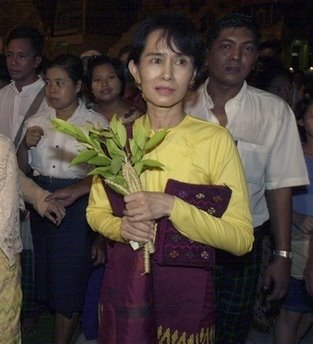


 Posts
Posts


