http://www.mizzima.com/news/inside-burma/1277-suu-suu-nwe-jailed-for-over-12-years.html
by Zar Ni
Tuesday, 11 November 2008 20:23
Chiang Mai – Suu Suu Nwe, National League for Democracy party leader and human rights activist was sentenced to 12 and-a-half years in prison by a court in session inside Insein prison.
A friend of Nwe, on condition of anonymity, revealed that the information relating to her sentence by the court in session inside Insein prison was given by a prison official.
"We could not meet her today. We sent what she asked for with other people who could meet family members today during regular prison visits. We learnt of the news from the prison staff," he said.
She is in good health though she suffers from heart disease. She is being held in Insein prison at present. But the details of her case are still being inquired.
The police arrested Suu Suu Nwe on November 14, 2007 while she was pasting anti-junta posters in front of 'Mya Yeik Nyo' Hotel.
She was charged under the Unlawful Assembly Act and inducing crime against public tranquility and disaffection towards State and Government.
During the trial, she staged a hunger strike in September this year after she was refused permission to meet her family members in prison.
Similarly her co-defendant Bo Bo Win Hlaing was sentenced to eight years in prison by the same court today. He had joined her in pasting anti-regime posters.
Human right activist Suu Suu Nwe, hailing from Htanmanaing village in Kawhmu Township, was awarded the '2006 John Humphrey Award' by the Canada based 'Human Right and Democracy Organization'. Along with 88 Gen woman student Ma Nilar Thein, who helped HIV/AIDS victims, she was also awarded the 'Homo Homini Award' by Czech based 'The People-in-Need' while she was in detention.
Tuesday, November 11, 2008
Suu Suu Nwe jailed for over 12 years -MIZZIMA


Bangladesh said tension with Burma defused -MIZZIMA
http://www.mizzima.com/news/regional/1270-bangladesh-said-tension-with-burma-defused.html
by Siddique Islam
Monday, 10 November 2008 23:58
Dhaka – The scaling down of tension between Bangladesh and Burma after the withdrawal of the hydrocarbon-exploration rig by Daewoo from the disputed waters in the Bay of Bengal is a win-win situation for both countries, Foreign Affairs Advisor of Bangladesh Dr. Iftekhar Ahmed Chowdhury said in Dhaka on Monday.
"This happy conclusion in the Bay is a win-win situation for both Bangladesh and Myanmar [Burma]. Peace benefits everyone," the Foreign Advisor told the media at the Foreign Ministry in the capital, Dhaka on Monday evening.
The South Korean Company, Daewoo, was involved in hydrocarbon explorations under a contract with Burma in block AD-7 in the Bay of Bengal; a location Bangladesh claims is in its territorial waters.
Tension mounted further when Burma sent naval warships last week to guard Daewoo's drilling about 50 kilometers south of Bangladesh's St. Martin's Island in the Bay of Bengal.
Bangladesh's Foreign Advisor said Bangladesh always wants a close neighbourly relation with Burma and "our policy will be directed towards that end".
The development came a day after the Foreign Secretary of Bangladesh Mohammad Touhid Hossain returned home after his three-day trip to Rangoon along with two other officials where he held talks with Burma's Deputy Minister for Foreign Affairs Maung Myint.
Bangladesh earlier explored diplomatic channels to engage South Korea and China, a close ally of military-ruled Burma, while Daewoo two days ago said they had already initiated the process of withdrawal of their rig from the area in the sea.
Bangladesh and Burma have so far held three rounds of talks to resolve the maritime boundary dispute while the fourth round is expected to be held in Dhaka next week when the Burmese Deputy Minister is due to visit, foreign ministry sources said.
Burma Sentences Activists to 65 Years in Prison
http://www.voanews.com/english/2008-11-11-voa11.cfm
By VOA News
11 November 2008
A court in Burma has sentenced at least 14 members of a well-known pro-democracy group to 65 years in prison.
Relatives and opposition political officials say the activists were sentenced Tuesday, during a closed hearing inside Rangoon's notorious Insein prison.
The dissidents are members of the 88 Generation Students, a group that organized anti-government demonstrations in August of last year to protest economic hardships and demand democratic reforms.
Those demonstrations led up to last year's pro-democracy protests that were later crushed by the country's military-ruled government.
The 88 Generation Students first began political activism 20 years ago when the group organized mass demonstrations to challenge the rule of Burma's military.
Some information for this report was provided by AFP, AP and Reuters.
Myanmar blogger jailed for 20 years: opposition
http://news.yahoo.com/s/afp/20081111/wl_asia_afp/myanmarpoliticsdemocracymedia_081111051148
Tue Nov 11, 12:11 am ET AFP/File – A crowd in front of Yangon's Insein Prison. A popular Myanmar blogger arrested after massive anti-junta … YANGON (AFP) – A popular Myanmar blogger arrested after massive anti-junta protests last year has been jailed for 20 years at Yangon's notorious Insein Prison, an opposition spokesman said Tuesday.
Nay Phone Latt, 28, a former member of detained democracy leader Aung San Suu Kyi's opposition party, was sentenced on Monday along with five other activists and members of the National League for Democracy (NLD).
"Nay Phone Latt was once an NLD youth member, but he left the party when he was arrested. He was sentenced to twenty years imprisonment," NLD spokesman Nyan Win told AFP.
"The authorities are punishing the activists by investigating the cases hurriedly. There was not enough time for a defence with lawyers."
Nyan Win said the poet Saw Wai was sentenced to two years in prison for defaming the state in a poem that referred to junta head Than Shwe. He did not have any information on the four NLD members sentenced Monday.
Nay Phone Latt's blog was written in the Myanmar language and in the style of a novel. He used it as a forum to discuss the difficulties of daily life, such as the regular power outages and the rising cost of living.
The blog was banned by Myanmar's military regime, and Nay Phone Latt was arrested in January this year during a round-up of activists linked to the massive anti-junta protests in September 2007.
About 200 NLD members and activists were arrested during and after the September protests, when up to 100,000 people spilled onto Yangon's streets.
The United Nations has said that at least 31 people were killed and 74 remain missing after the military finally cracked down on the movement.
The military was outraged by the bloggers during the September protests, when they provided running accounts of state violence.
The junta cut off the nation's Internet links at the height of the protests, choking off the flow of information about the crackdown.
Myanmar's regime exerts tight controls over the Internet, banning access to news sites and even to web-based e-mail services such as Yahoo or Hotmail.
Aung San Suu Kyi's NLD won a landslide victory in 1990 elections but the junta never allowed the party to take office. Myanmar has been ruled by the military since 1962.
Bush names special aide for Myanmar
http://news.yahoo.com/s/afp/20081110/pl_afp/usmyanmardiplomacygreen_081110221733
Mon Nov 10, 5:17 pm ET
Featured Topics: Barack Obama Presidential Transition AFP/File – US President George W. Bush has decided to nominate a former top adviser on Asian affairs, Michael Green, … WASHINGTON (AFP) – US President George W. Bush has decided to nominate a former top adviser on Asian affairs, Michael Green, to be his special envoy and policy chief for Myanmar, the White House announced Monday.
If confirmed by the US Senate, Green "will serve as our main interlocutor with other countries and organizations as we attempt to help the Burmese people," said US National Security Council spokesman Gordon Johndroe.
Green, who has served as senior director for Asian Affairs on Bush's national security council, is currently an associate professor at Georgetown University and holds the Japan chair at the Center for Strategic and International Studies think tank in Washington.
The post was created by the US Congress with an eye on increasing pressure on the military junta that rules Myanmar. Washington does not recognize the country's name change.
The legislation said the special representative will work with democracy advocates in Myanmar, non-governmental organizations there and in neighboring countries with an eye on bringing democratic rule to the country.
The representative is also meant to consult with the governments of China, India, Thailand and Japan, Myanmar's ASEAN partners, and the European Union to coordinate international strategy towards the country.
Obama-Clinton soap opera takes new turn
http://news.yahoo.com/s/politico/20081111/pl_politico/15498;_ylt=Ak1AQRGDPQATh6FRFh.tQA6tOrgF
Amie Parnes, Glenn Thrush Amie Parnes, Glenn Thrush – Tue Nov 11, 4:27 am ET
Featured Topics: Barack Obama Presidential Transition Reuters – Michelle Obama with daughters Sasha (R) and Malia (L) leave the stage at the 2008 Democratic National …
Play Video Video: AP Top Stories AP Play Video Video: Michelle Obama tours DC schools for her kids AP Play Video Video: Sarah Palin takes on 'rogue' criticism, 2012 AP Michelle Obama wasn’t always an admirer of Hillary Clinton, but last Wednesday the soon-to-be first lady dialed up the former first lady for pointers on protecting her two young daughters from the media maelstrom of the White House.
“Michelle may not have loved the senator, but she always respected how the Clintons raised Chelsea,” said a person familiar with Clinton’s end of the call. “They need to talk. There just aren’t too many people who have shared that kind of experience.”
An aide briefed on Obama’s side of the chat said she was “grateful” for Clinton’s “pointers” on “raising children in the public eye.”
It’s the latest phase in the ruling-class soap opera that is the Obama-Clinton alliance, where the two first families negotiate new personal relationships as Hillary Clinton wrestles with her own ambivalence about Michelle Obama’s husband, a man she once ridiculed as too callow to govern, and then worked tirelessly to elect.
These tensions have created a somewhat schizoid relationship between Clinton and the Obamas – warm on personal matters, warier on political ones, and downright frosty on the still-unresolved issue of Clinton’s mountainous campaign debt, which Barack Obama had pledged to help reduce.
“Senator Clinton did not just check the box for Obama - she went all out for him, which says an awful lot about how important she felt this election was, what kind of character she has, and the positive state of their relationship,” said Chris Lehane, an aide to both John Kerry and Al Gore during their presidential bids.
Since the Democratic National Convention, Hillary Clinton headlined about three dozen rallies and fundraisers – working rope-lines where well-wishers often lamented her exit from the race.
Bill Clinton, who once called Obama’s Iraq policy “a fairy tale,” hosted about 20 events for Obama after the Illinois senator paid homage to him with a mid-September visit to his Harlem office.
Obama responded by lavishing praise on the pair – after months of questioning the legacy of the Clinton White House. More importantly, he embraced much of Hillary Rodham Clinton’s domestic agenda, especially her health care and green jobs proposals.
Yet a half-dozen Clinton insiders told Politico they are disappointed that Obama’s vaunted fundraising operation hasn’t reciprocated by planning new events or an Internet campaign to help Clinton pay off the $7.9 million she owes to vendors. (Clinton has already written off the $13 million she loaned the campaign during the primaries, aides say).
“I don’t think there’s a whole lot of hard feelings, it’s more like mild annoyance,” said a former Clinton aide on condition of anonymity. “There’s just not a lot of expectation they are going to lift a finger for us.”
Added another longtime Clinton adviser: “She killed herself for them, did a hundred events, went anywhere they pointed – so it’s disappointing they aren’t helping… But it’s not a big deal at this point.”
One former Clinton fundraiser took a more cold-blooded view. “In a few months, when he’s really struggling, he’ll come to her for support,” he said. “That’s when she should ask him for money.”
An Obama spokesman didn’t comment but didn’t rule out a debt retirement effort down the road.
Clinton is expecting a warmer reception from Obama on legislative issues.
People close to the New York senator say she is still struggling to define her role in the Senate following a jarring and unexpected loss. But she’s sure of one thing: she desperately wants to play a major role in crafting the health care reform Obama has pledged to introduce.
Still, she is unlikely to make immediate demands of Obama and is committed to giving the president-elect a wide berth on how and when he introduces reforms, given the economic crisis. And she’s reportedly leery of getting between Sen. Ted Kennedy (D-Mass.), the ailing chairman of the health committee and finance committee chairman Sen. Max Baucus, who are both staking claims on the plan.
The Obama-Clinton relationship is less fraught on the personal front, where Clinton seems surprisingly eager to mentor Michelle Obama.
The incoming First Lady, who had been privately critical of Clinton during the primaries, first reached out to the former First Lady six weeks ago for advice on how to provide some semblance of normality for her young daughters Sasha and Malia.
“They talked for 30 minutes the first time,” said a Clinton insider. “It wasn’t just for show – it was a real conversation.”
Last week, on election night, it was Hillary Clinton making the call, congratulating Barack Obama on his victory and consoling him after the death of his grandmother, according to a Clinton spokesman.
It won’t be their last conversation. During that chat, the president-elect vowed to schedule a sit-down meeting with the Clintons in the not-too-distant future, sources say.
Monday, November 10, 2008
စာနယ္ဇင္းက်င့္ဝတ္(၁)-လူထုဦးစိန္ဝင္း
ဒီေန ့ေခတ္က ပဂၢလိကလြတ္လပ္ခြင့္ ကို အထူးအေလးထား ေျပာႀကားေနတဲ့ ေခတ္ျဖစ္တယ္။ လူတစ္ဦးတစ္ေယာက္ရဲ့ ပဂၢလိက
လြတ္လပ္ခြင့္က တျခားလူတစ္ဦးတစ္ေယာက္ရဲ့ ပဂၢလိကလြတ္လပ္ခြင့္ကို ထိပါးနစ္နာေစတဲ့ အျဖစ္မ်ိဳး ႀကံဳေတြ ့ရတဲ့အခါ
က်ေတာ့လည္း ပုဂၢလိကလြတ္လပ္ခြင့္က ဘယ္အတိုင္းအတာအထိ ရိွသင့္သလဲဆိုတာ ေဆြးေႏြးျငင္းခုန္ ေဝဖန္ႀကတာေတြ
လုပ္ႀကရျပန္တယ္။
ပုဂၢလိက လြတ္လပ္ခြင့္နဲ ့အတူ စာနယ္ဇင္း လြတ္လပ္ခြင့္ကိုလည္း အထူး အေလးထားခဲ့ႀကတယ္။ ဒါေပမယ့္ ထိုစာနယ္ဇင္း
လြတ္လပ္ခြင့္က လူတစ္ဦးတစ္ေယာက္ရဲ့ ပုဂၢလိကလြတ္လပ္ခြင့္ကို ထိပါးနစ္နာေစတဲ့ အျဖစ္မ်ိဳးႀကံဳေတြ ့ရတဲ့အခါမ်ိဳး
က်ေတာ့လည္း စာနယ္ဇင္းသမားေတြကိုယ္တိုင္က ေဆြးေႏြးျငင္းခုံေဝဖန္တာေတြ လုပ္လာခဲ့ႀကတယ္။
၁၉၇၀ ခုနွစ္မ်ားအတြင္းက အေမရိကန္စာနယ္ဇင္းေလာက တစ္ခုလုံး အုံးအုံးႀကြက္ႀကြက္ျဖစ္သြားေစတဲ့ အျငင္းပြားမႈႀကီး
တစ္ခု ေပၚထြက္လာခဲ့တယ္။ အဲဒါကေတာ့ ဒီမိုကရက္တစ္ပါတီ သမၼတေလာင္းေရြးပဲြမွာ ေရွ ့တန္းကေျပးေနသူ Hart ရဲ့
ကိုယ္ေရးကိုယ္တာ ကိစၥမ်ားကို The Miami Herald သတင္းစာႀကီးက သတ္ငးေထာက္ေတြဟာ ခ်ံဳေတြထဲ ပုန္းေအာင္း
ျပီး အေဝးဆဲြတယ္လီတပ္ ကင္မရာေတြနဲ ့ Hart နဲ ့ အေဖာ္တစ္သိုက္ မိန္းမေခ်ာေလးေတြနဲ ့ သြားလာေနႀကတာ၊ ရြက္ေလွ
ေပၚမွာ ဘီကီနီဝတ္ မိန္းမေခ်ာေလးတစ္ေယာက္က ဟာတ္ရဲ့ ေပါင္ေပၚထိုင္ေနတာ စတဲ့ပုံေတြကို ရိုက္ကူးေဖာ္ျပ
ခဲ့ႀကတယ္။
အက်ိဳးဆက္အျဖစ္ သမၼတေလာင္းျဖစ္ဖို ့ ေရပန္းစားေနသူ Hart ျပိဳင္ပဲြက ႏႈတ္ထြက္သြားခဲ့ရတယ္။ စာနယ္ဇင္းဆိုတာ
သတင္းကို ေဖာ္ျပဖို ့ တာဝန္ရိွတာမွန္တယ္။ ဒါေပမဲ့ သတင္းကို ဘယ္လိုနည္းနဲ ့ ရယူခဲ့သလဲ ဆိုတာ မစဥ္းစားသင့္ဘူးလား
လို ့ စာနယ္ဇင္း ဆရာတခ်ိဳ ့က ေမးခြန္းထုတ္ခဲ့ႀကတယ္။
အဲဒီေနာက္ အေမရိကန္နိုင္ငံသာမက ကမၻာတစ္ခုလုံး တုန္လႈတ္ေျခာက္ျခားေစတဲ့ ဒိုင္ယာနာမင္းသမီး ေသဆုံးခဲ့ရတဲ့ကိစၥ
ႀကီး ျဖစ္ေပၚလာတဲ့အခါက်ေတာ့ စာနယ္ဇင္းဆရာေတြက ေမးခြန္းထုတ္ရံုသာ မကေတာ့ဘဲ၊ ေနာက္က တစ္ေကာက္ေကာက္
လိုက္ႀကတဲ့ ဓာတ္ပုံသမားေတြကို အျပင္းအထန္ရႈတ္ခ်ခဲ့ႀကတယ္။ ျဗိတိသၽွ် ပါလီမန္က စာနယ္ဇင္း လြတ္လပ္ခြင့္ကို
ကန္ ့သတ္ဖို ့အထိေတာင္ စဥ္းစားခဲ့ႀကတယ္။ စိတ္လႈပ္ရွားမႈေတြ ျငိမ္သက္သြားတဲ့အခါ က်ေတာ့ ဆင္ျခင္တုံတရား ျပန္လည္
လႊမ္းမိုးျပီး တကယ္လက္ေတြ ့ ကန္ ့သတ္ဥပေဒေတြ မျပဠာန္းခဲ့လို ့သာ ေတာ္ေတာ့တယ္။
ပုဂၢလိကလြတ္လပ္ခြင့္ကို ေရွ ့တန္းတင္လြန္းတဲ့ လူ ့အဖဲြ ့အစည္းမွာ လူသားတို ့ရဲ့ က်င့္ဝတ္သီလေတြ ေလ်ာ့ပါးက်ဆင္း
လာရတာ ဓမၼတာ ျဖစ္တယ္။ စာနယ္ဇင္းသမားေတြထဲမွာလည္း စာနယ္ဇင္းက်င့္ဝတ္ ေဖာက္ဖ်က္သူေတြ မ်ားလာတာ
ေႀကာင့္ စာနယ္ဇင္းေတြအေပၚ ျပည္သူ လူထုရဲ့ယုံႀကည္ကိုးစားမႈ တစ္ေန ့တျခား က်ဆင္းသထက္ က်ဆင္းလာခဲ့ရတယ္။
အေမရိကန္နိုင္ငံရိွ The National Opinion Research Center ဆိုတဲ့ သုေတသနအဖဲြ ့ ႀကီးက ေကာက္ယူခဲ့တဲ့ စစ္တမ္္း
တစ္ခုအရ၊ အေမရိကန္ျပည္သူလူထုရဲ့ စာနယ္ဇင္းမ်ားအေပၚ ယုံႀကည္ကိုးစားမႈ ႏႈန္းဟာ ၁၉၇၆ မွာ ၂၈ ရာႏႈန္း ရိွရာက
၁၉၈၃ မွာ ၁၃.၄ သာ ရိွေတာ့ေႀကာင္း သိရိွခဲ့ရတယ္။
လူထုရဲ့ ယုံႀကည္မႈေလ်ာ့ပါးက်ဆင္းလာခဲ့ရတာဟာ စာနယ္ဇင္းသမားတို ့ရဲ့ စာနယ္ဇင္းက်င့္ဝတ္နဲ ့ လူ ့က်င့္ဝတ္
ခ်ိဳးေဖာက္မႈမ်ားေႀကာင့္ ျဖစ္ရတယလို ့ သုံးသပ္ႀကတယ္။ ကယ္လီဖိုးနီးယားက Blade-Tribune သတင္းစာရဲ့
သတင္းေထာက္တစ္ဦးဟာ အျခားသူတစ္ဦး ေရးခဲ့တဲ့ သတင္းေဆာင္းပါးတစ္ပုဒ္ကို “၏သည္” မလဲြ ကူးယူေဖာ္ျပ
ခဲ့တာေႀကာင့္ အလုပ္က ႏႈတ္ထြက္ေစခဲ့ရတယ္။ ၁၉၈၁ ခုနွစ္က အေကာင္းဆုံးသတင္းအျဖစ္ ပူလစ္ဇာဆုရရိွခဲ့တဲ့
ဝါရွင္တန္ပို ့စ္က သတင္းေထာက္ အမ်ိဳးသမီးတစ္ဦးဟာလည္း ၈ နွစ္သား ကေလးတစ္ေယာက္ မူးယစ္ေဆးစဲြေန
တဲ့ သတင္းဟာ အမွန္မဟုတ္ဘဲ လုပ္ႀကံဖန္တီးျပီးေရးခဲ့ေႀကာင္း ေပၚသြားတဲ့အတြက္ အလုပ္က ထုတ္ပစ္ခဲ့ရတယ္။
ပူလစ္ဇာဆုကိုလည္း ျပန္အပ္ခဲ့ရတယ္။ CBS ကနာမည္ႀကီး မီဒီယာသမား Walter Cronkite ဟာ CBS က
အနားယူလိုက္တဲ့အခါ Pan American World Hirwa ရဲ့ ဒါရိုက္တာအဖဲြ ့ဝင္တစ္ဦးအျဖစ္ ခန္ ့ထားခံခဲ့ရတယ္။
သူဟာ CBS ကအနားယူလိုက္ေပမယ့္ ေလေႀကာင္းလုပ္ငန္းမ်ားနဲ ့ပတ္သက္တဲ့ CBS ရဲ့ အထူးသတင္းေထာက္
အျဖစ္ တာဝန္ယူခဲ့တယ္။ ဒီကိစၥမွာ Conflict of Interest ျဖစ္ေစတယ္လို ့ ဝိုင္းျပီး ေဝဖန္ႀကတာေႀကာင့္ ခရြန္ကိုက္
ဟာ ရာထူးလက္ခံျပီး ၆ လ အႀကာမွာ Pan American က ႏႈတ္ထြက္သြားခဲ့ရတယ္။
စာနယ္ဇင္းက်င့္ဝတ္နဲ ့ပတ္သက္ျပီး The Des Moines Register သတင္းစာက သူ ့တိုက္တြန္းခ်မွတ္ထားတဲ့ က်င့္ဝတ္
မ်ားကို ေလ့လာနိုင္ေအာင္ တင္ျပခ်င္ပါတယ္။
“ကၽြႏ္ုပ္တို ့ သတင္းစာ၏ အုပ္ခ်ဳပ္ေရးပိုင္းနွင့္ တျခားဝန္ထမ္းမ်ား အားလုံးသည္ အထူးအက်ိဳးစီးပြားအတြက္ ေဆာင္ရြက္
ေနႀကသည့္ အသင္းအဖဲြ ့မ်ားနွင့္ ကင္းကင္းရွင္းရွင္း ရိွေစရမည္။ အက်ိဳးစီးပြားခ်င္း ထိပ္တိုက္ျဖစ္ေစမည့္ကိစၥမ်ား၊
ယုံမွားသံသယျဖစ္ေစနိုင္သည့္ ကိစၥမ်ားကိုလည္း ေရွာင္ရွားရမည္” သတင္းကစၥေဆာင္ရြက္ရင္း ထမင္းစားပဲြမ်ား၊
အျခားဧည့္ခံပဲြမ်ားတက္ေရာက္ရသည့္အခါတြင္ ကိုယ့္စားရိတ္ကို ကိုယ့္ဟာကိုယ္ေပးရမည္။ ခ်က္ခ်င္းေပးခြင့္ မႀကံဳ
ခဲ့လ်ွင္ ေနာင္တစ္ခ်ိန္ခ်ိန္မွာစားစရိတ္ကို ျပန္ေပးရမည္။
နိုင္ငံေရးေဟာေျပာပဲြမ်ားအတြက္ျဖစ္ေစ၊ အားကစားအသင္းအဖဲြ ့မ်ားနွင့္ ျဖစ္ေစ၊ အတူလိုက္ပါ ခရီးသြားရသည့္အခါ
တြင္လည္း ကိုယ့္စရိတ္ကိုယ္ေပးျပီး လိုက္ပါရမည္။
မည္သည့္ဝန္ထမ္းမွ မည္သို ့ေသာ အခမဲ့လက္မွတ္၊ ေမတၱာလက္ေဆာင္ လက္မွတ္ စသည္မ်ား လက္မခံရ။
သတင္းစာတိုက္ဝန္ထမ္းမ်ားသည္ ျပင္ပလုပ္ငန္းမ်ား အသင္းအဖဲြ ့မ်ားတြင္ ဒါရိုက္တာအဖဲြ ့စသည့္ ရာထူးတာဝန္မ်ား
ယူျပီး၊ ယင္း လုပ္ငန္းမ်ားအတြက္ သတင္းေဆာင္းပါးေရးေပးရသ္ည့ တာဝန္မ်ား မယူရ။
ဒါဟာ သတင္းစာတစ္ေစာင္ရဲ့ တိုက္တြန္းက်င့္ဝတ္ စည္းကမ္းမွ်သာျဖစ္ပါတယ္။ နမူနာအျဖစ္တင္ျပလိုက္တာပါ။
ေနာက္အပတ္မ်ားမွာ “စာနယ္ဇင္းက်င့္ဝတ္” မ်ားနဲ ့ ပတ္သက္ျပီး ဆက္လက္ေရးသားတင္ျပပါဦးမယ္။
Ref: 1. Basic News Writing by Melvin Mencher.
2. Committed Journalism by Edmund B. Lambelk.
3. News Values by Jack Fuller.
Gain an Insight into the Japanese Broadband Market with This Focus on Major Broadband Markets, Key Statistics and the Current Market
http://www.marketwatch.com/news/story/Gain-Insight-Japanese-Broadband-Market/story.aspx?guid=%7B4EE60D51-D502-4D7C-AFF5-31C5046F2C75%7D
Last update: 9:00 p.m. EST Nov. 9, 2008
DUBLIN, Ireland, Nov 09, 2008 (BUSINESS WIRE) -- Research and Markets ( http://www.researchandmarkets.com/research/5402a9/japan_broadband) has announced the addition of the "Japan - Broadband Market - Overview & Statistics" report to their offering.
By September 2007, Japan had more than 27.7 million broadband lines in place, making it the third largest broadband country in the world after the US and China (China surpassed Japan earlier in 2004). Much of the success of broadband in Japan is owed to the stunning growth surge that occurred back in 2003; the growth took place on the back of DSL broadband technology. Other broadband services such as FttH have since attracted even greater interest in the Japanese market. This report looks at the nature of the broadband market, the major broadband providers and the available access methods - including cable modem, DSL, FttH, broadband over powerline and wireless broadband.
Key Topics Covered:
- Synopsis
- Broadband market
- Cable modems
- Digital Subscriber Line (DSL)
- Fibre-to-the-Home (FttH)
- Broadband over powerline (BPL) / powerline communications (PLC)
- Wireless broadband
- Global LAN Ethernet
Thai firm to give Ledo Road in northern Burma new look
http://teakdoor.com/thailand-and-asia-news/38878-thai-firm-give-ledo-road-northern.html
Written by KNG
Friday, 07 November 2008 20:50
The historical Ledo Road also called Stilwell Road is being reconstructed. An 80 mile stretch between Myitkyina and Danai (Tanai) in Kachin State of northern Burma is being reinstructed by a Thai company, a subsidiary of the Yuzana Company since early this week, said locals.
Thai road construction workers with their families are living in car-houses and are reconstructing the road with the help of construction equipment from Namti city on the Myitkyina-Mandalay railway heading towards Danai city, said residents of Namti.
According to local eyewitnesses, the Thai company is repaving a 'Stony Road' on the damaged Ledo Road. The road is being rebuilt for summer transportation only.
U Htay Myint, chairman of the Rangoon-based Yuzana Company, is close to Burmese ruling junta's Vice-senior general Maung Aye. The company as such was given the contract to rebuild Ledo Road on the western part of Kachin State by the junta last year.
Before Yuzana Company was given the contract to reconstruct the road, the company bought over 200,000 acres of land in Hukawng (Hugawng) Valley, the world's largest tiger sanctuary from the ruling junta in 2006, an area where Ledo Road crosses.
Since late 2006, the company has started to clear forests in the areas 10 miles beyond the left and right of Ledo Road for crop plantation.
The company transports timber from the forest for foreign export and the newly ploughed fields have been planted mainly with sugarcane, cassava plants and rubber plants, said residents of Hukawng Valley.
Deforestation has become a daily affair and is severely extending into Hukawng Valley for two reasons--- heavy gold mining by the junta-backed Chinese gold companies and clearing of forests for crop plantation by the junta-backed Yuzana Company, said Awng Wa, chairman of Kachin Development Networking Group (KDNG) which recently published the report "Valley of Darkness" on gold mining and militarization in Hukawng Valley.
The man-made rapid deforestation will impact the survival of natives and threaten the extinction of tigers in the Hukawng Tiger Sanctuary. The ecology of the region is doomed, he added.
kachinnews.com
__________________
"Keeping quiet while monks and other peaceful protesters are murdered and jailed is not evidence of constructive engagement." - Arvind Ganesan, Human Rights Watch.
"I think...I think it's in my basement. Let me go upstairs and check" - M.C. Escher
Trip to Mae Sot and Mae La Refugee Camp
http://asacreynolds.blogspot.com/2008/11/trip-to-mae-sot-and-mae-la-refugee-camp.html
Sunday, November 9, 2008
Last weekend was one of the most moving I have ever experience. We went to a city called Mae Sot in Tak Province, which is near the Burma-Thai border, and learned a lot about contemporary issues with Burma. We went and visited a lot of NGO groups, such as one that helps establish energy projects with water and solar energy in small villages, one that worked to help former political prisoners in Burma (who then came to Thailand), and one that helped with doing research and giving medical aid to Karen refugees. We always spent a few mornings in a Burmese tea shop eating nan bread and some kind of bean sauce which the most delicious breakfasts in my life. The weekend was not a whole lot of fun, but it wasn't meant to be. It was meant to show the effects of the oppressive regime in Burma on people in Burma and Thailand. We went to a medical clinic, which had welcomed Laura Bush a few months earlier (on the way to the Olympics in Beijing the Bush's went to Thailand) and saw the how people had to live that had been forced out of their own country for fear of their lives.
We saw a lot of good things, such as many western doctors coming to help people with degenerative eye conditions, and cleft lips. I was amazed to see how big it was, apparently the group (run by a woman known as the Mother Theresa of Thailand) is very well recognized and funded internationally. It was good to see that it was well funded, and that people were getting the help they needed, but one thing stood out in my mind. We went to the prosthetics section of the camp, were they made plastic limbs for people. Out of 17 people on a board of patients, 14 were victims of land mines. Land Mines. These are supposed to be outlawed, banned by the international community. But the Burmese government still uses them. It tries to prevent villagers who have run from the military to return by placing landmines around the village among other things. One man told a story about a man who had died from a landmine explosion. He had walked up to read a note posted by the Burmese military on a tree, but that tree had a landmine right in front of it. Also, a lot of people notice the land mines, but do not know how to cut the wires properly and are killed or severely wounded. Still, it was amazing to see first hand the work that is being done to help the people who are driven away from their country.
The next day we went to the Mae La refugee camp. Most refugees were Karen people. We went up on stage and were introduced to the students there. We told them our names and where we came from, and their president talked for a short time. They then stood up and sung two songs. I do not know what they sang about, but its was incredibly beautiful. While we were listening, I though about all the things the refugees must go through, leaving their country, their families, and the hardships of the camp, the fact that even if they do really well with their education they may never get a chance to leave the camp and work in Thailand. I didn't cry, but I was pretty close, it was really overwhelming. I could not imagine what would make a person or a regime do this to people. I could not image even the most power hungry general being able to see what he was doing and accepting it. We did not see too much else of the camp, but it was great to see most of the people there quite happy. Even though they lived in pretty bad conditions (although the conditions there were much better than I thought they would be), they still lived with pride and hope that they could one day return. After learning so much about Burma through lectures and readings, it was great to see some of the effects of the military regime on actual people. It made everything I have read a lot more real.
Posted by Asa Reynolds at 6:37 AM
RIGHTS-BURMA: Military Accused of Crimes Against Humanity
http://www.ipsnews.net/news.asp?idnews=44631
Marwaan Macan-Markar
BANGKOK, Nov 9 (IPS) - An onslaught by Burmese troops in the eastern part of the military-ruled country, running for three years now, is laying the junta open to charge of ‘crimes against humanity’.
This new charge adds to a growing list of human rights violations that the South-east Asian nation’s ruling military regime is being slammed for, including the use of rape as a weapon of war in military campaigns in areas that are home to the country’s ethnic minorities. The country has been under the grip of successive juntas since a 1962 military coup.
Eyewitness accounts from civilians fleeing the territory under attack reveal a grim picture of the ‘tatmadaw’, as the Burmese military is called, targeting unarmed men, women and children in a ‘’widespread and systematic way,’’ say human rights and humanitarian groups.
An increasing number of refugees have been crossing over to northern Thailand from among the Karen ethnic community, the second largest ethnic group in Burma, or Myanmar. Many of them live in the mountainous Karen State, the territory where South-east Asia’s longest --and largely ignored -- separatist conflict is being waged between Burmese troops and the armed wing of the Karen National Union (KNU).
‘’Myanmar’s troops are overtly targeting civilians; they are actively avoiding KNU military installations. That is why we are describing the attacks as ‘crimes against humanity’,’’ says Benjamin Zawacki, South-east Asia researcher for Amnesty International (AI), the global rights lobby. ‘’The violations are widespread and systematic.’’
‘’This campaign started in November 2005 and has escalated. They did not even stop during the annual monsoon period (from May to October), which was not the case before,’’ he explained during an IPS interview. ‘’There has been a shift in strategy and intensity. It is no more a dry season offensive.’’
The military campaign is the largest and the longest sustained drive in a decade. ‘’The Burmese army is rotating soldiers every six months and they have penetrated areas deep in the Karen area,’’ David Tharckabaw, vice president of the KNU, said in a telephone interview from an undisclosed location. ‘’Nothing is being spared. They are even destroying fruit plantations like mangosteen.’’
The list of abuse document by AI, and corroborated by other humanitarian groups, include villagers being beaten and stabbed to death, being shot by the ‘tatmadaw’ ‘’without any warning’’ and being tortured and subsequently killed. Karen civilians have also reportedly been subjected to forced labour, disappearances and their rice harvest being burned down.
‘’Before the soldiers left the village, they planted landmines, one of them in front of the church. An old man, maybe 70 years-old, stepped on a landmine and was killed,’’ a female rice farmer told an AI researcher of an incident in early 2006, when the ‘tatmadaw’ burned 20 of the 30 houses in her village.
‘’I lost everything -- kitchen, furniture, rice stocks -- not a single piece of paper was left,’’ she added. ‘’The same happened to the other 19 families whose houses were burned.’’
The unrelenting campaign, which has included the Burmese infantry and heavy use of 120 mm and 81mm mortar shells, has shrunk an already limited space for Karen civilians and internally displaced people (IDPs) to escape to. ‘’The more the Burmese military occupies areas in a worsening situation, the less space there is for civilians to escape to,’’ says Duncan McArthur, emergency relief coordinator of the Thailand Burma Border Consortium (TBBC), an alliance of 11 humanitarian groups helping refugees from Burma along the Thai-Burmese border.
‘’Nearly 66,000 people from 38 townships have been forced to flee their homes due to the armed conflict and human rights abuses,’’ he told IPS. ‘’They had to because the violations are being committed in a climate of impunity.’’
Some of the victims have poured into north-west Thailand, where there are already nine camps that house 120,000 refugees who fled intense phases of the conflict going back over a decade. ‘’There are about 20,000 unregistered new arrivals and the natural growth in the camps,’’ added McArthur. ‘’There is no avenue for redress if they were to stay back.’’
That is reflected in Burma’s over half a million IDPs, nearly 451,000 of which live in the rural ethnic areas, according to TBBC. It places Burma in the same league as countries such as Afghanistan, Sri Lanka and Bangladesh, which have internally displaced running into the hundreds of thousands.
But what sets Burma apart is the lack of any international agencies to help the victims and serve as neutral observers in the conflict zone.
Even the International Committee of the Red Cross (ICRC), which was helping to provide artificial limbs for landmine victims, was hampered by new restrictions to its operations in 2006. In mid-2007, the Geneva-based humanitarian agency broke its famed silence in an unprecedented attack on the junta to explain why it had to end its operations in Burma, including the Karen areas.
The ICRC’s denunciation of major and repeated violations in the conflict zones in eastern Burma confirmed what many analysts had said of a region that is cut away from international scrutiny and media exposure. ‘’The repeated abuses committed against men, women and children living along the Thai-Myanmar border violate many provisions of international humanitarian law,’’ the organisation said.
The Karens, who account for nearly seven million of Burma’s 57 million people, have their own distinctive culture and language and have Buddhists, Christians and animists among them. The Burmans, who are the majority, are predominantly Buddhist by faith, speak Burmese, and have a culture and history shaped by kings before being subjugated by British colonisation.
The Karen fight for independence began in 1949, a year after Burma got independence. And the KNU has refused to sign peace deals with the Burmese regime unlike some of the other separatist rebels from ethnic groups. The latter settled for ceasefire deals over the past two decades, only to learn, subsequently, that the junta’s promises of more political autonomy were hollow.
‘’The Burmese military’s latest strategy is to keep attacking the KNU and Karen civilians in order to drive them to the Thai-Burma border,’’ says Tharekabaw, of the KNU. ‘’Their goal is to control all the land and all the people, which has never been the case before.’’
‘’If they cannot control, they have to kill the people or to wipe them out,’’ he added. ‘’The regime is a fascist regime. Their ideology is extremism, racism and militarism.’’
(END/2008)
Fw: 連続セミナー「外国籍の家族と子どもの今」(11月23日)
━━━━━━━━━━━━━━━━━━━━━━━━━━━━━━
ビルマ市民フォーラム メールマガジン 2008/11/10
People's Forum on Burma
━━━━━━━━━━━━━━━━━━━━━━━━━━━━━━
以下、アムネスティ・インターナショナル日本(難民チーム)と
日本キリスト教協議会主催のセミナーを紹介させていただきます。
トークショー2部では、ビルマ難民Mさんも参加されます。
(重複の際は何卒ご容赦ください。)
PFB事務局
http://www1.jca.apc.org/pfb/
━━━━━━━━━━━━━━━━━━━━━━━━━━━━━━
2008年 11月 23日 (日) 14:00 ~ 17:30
連続セミナー「外国籍の家族と子どもの今」
第5回 日本の難民・移民の現在と未来
http://www.amnesty.or.jp/modules/piCal/index.php?action=View&event_id=0000001914
日本で暮らす外国人は200万人を超え、社会はすでに多様化が
始まっています。
さまざまな国から人々が来日する一方、日本で家族を形成し、
日本社会に溶けこんで暮らしている人も増えています。
連続セミナー第5回(最終回)では、「日本の難民・移民の現在
と未来」について、当事者の声を聞き、支援者の活動を知り、
また、これからの政策について国会議員をお招きして考えます。
【日時】11月23日 14:00-17:30
【場所】日本キリスト教会館4F(早稲田奉仕園内)
→地図http://www.hoshien.or.jp/map/map.html
【参加費】500円(資料代) *予約不要
【内容】
・ トークショー第1部 『移民の子どもたち』
「マルチカルチャーチルドレン」宮ヶ迫ナンシー理沙さん
「CCS 世界の子どもたちと手をつなぐ学生の会」代表 中西久恵さん
・ トークショー第2部 『難民の家族』
ビルマ難民Mさん家族
港町診療所 山村淳平医師
・ 特別講演 今野東参議院議員
・ 質疑応答
・ 交流会
【講演者プロフィール】
■宮ヶ迫ナンシー理沙さん
マルチカルチャーチルドレンの会所属。日系ブラジル人2世。9歳で来日。
外国人ルーツで日本育ちの仲間によるライフヒストリービデオを制作。
■ビルマ難民M さん
カチン族出身。夫と共に日本で難民申請を行う。
現在は3人の子どもを育てながら、在日カチン女性協会の
代表としても活動。
■中西久恵 さん
世界の子どもと手をつなぐ学生の会(CCS)代表。
CCSでは学生による学習教室の運営を通じて、在住外国人の子ども
たちの学習支援とエンパワーメントを行っている。
■山村淳平 医師
港町診療所勤務。
海外での医療救援活動に従事。在日難民および入管収容施設での
面会活動を行っている。
■今野東 参議院議員
法務委員会所属。国際・地球温暖化問題に関する調査会理事、
民主党参院国対副委員長。「難民・外国人の人権問題検討チーム」主査。
【主催・問い合わせ先】
アムネスティ・インターナショナル日本(難民チーム)
東京都千代田区神田錦町2-2 共同ビル4F
Tel: 03-3518-6777
Fax: 03-3518-6778
E-Mail: refugee_team@amnesty.or.jp
http://www.amnesty.or.jp/modules/wfsection/article.php?articleid=1915
日本キリスト教協議会
東京都新宿区西早稲田2-3-18-24
Tel:(03)3203-0372
Fax:(03)3204-9495
E-Mail: kitani@ncc-j.org
http://ncc-j.org/
【賛助団体】
移住労働者と連帯する全国ネットワーク
カトリック東京国際センター
難民・移住労働者問題キリスト教連絡会
※予約は不要です。
━━━━━━━━━━━━━━━━━━━━━━━━━━━━━━
View: Out of control within junta
http://burmadd.blogspot.com/
BDD
Source close to regime said that expansion of SPDC internal conflict is larger and super hardliners are total control in power. Many incidents were occurred; border conflicts, killing ceasefire groups' officials, accusations of bombing to the non-violent leaders, and sentencing defense lawyers of the pro-democracy activists seemed totally out of control in the SPDC day to day political development.
"Brutal battle against the pro-democracy movement is priority agenda for the current SPDC hardliners", source said. The hardliners have no excuse for the defense lawyers. They are nothing to do with the defendants; they do their profession and living.
But hardliners do not care the fundamental rights of citizens; they felt that why these lawyers are defending the activists and hence they are guilty. Senior General Than Shwe backs group of hardliners decided hush reaction against all if they felt that things were not right.
Recent confrontation with Bangladesh is a clear case; less than two weeks after junta second man general Maung Aye's official visit to Bangladesh, then they have a problem with it. "This is meant to discredit general Maung Aye's role in the regime", said source close to Maung Aye with suspicions.
"Next possible target is the prison doctors; if doctor would dare to treat the sick detained pro-democracy defendants, they might face a jail term for treating the activists. Professionalism is missed out in junta's handbook", Rangoon base journalist gaily noted.
Posted by BURMA DEMOCRACY & DEVELOPMENT at 11/10/2008 04:15:00 PM
Links to this post
The one thing that will help you drink more water
http://shine.yahoo.com/channel/health/the-one-thing-that-will-help-you-drink-more-water-304953/
by Jessica Ashley, Shine staff, on Fri Nov 7, 2008 11:16am PST Read More from This Author » 159 Comments Post a Comment Report Abuse
Despite the back and forth about how much water we should be drinking, I know that I feel better when I get my 8 to 10 glasses in each day. I feel less tired, less hungry in between meals and my skin looks much better when I am on a water kick.
As a person currently struggling with getting enough sleep, however, I can easily let a glass of water sit untouched on my desk while I drink cup after cup of coffee. I was pouring my third cup of ambition last week began thinking about creative ways to entice myself into drinking more water. I'm not going to worry about cutting back the coffee just yet (that will come) but I can put a bit more effort into the beverage that makes me feel good (for more than an hour caffeine burst).
And then the thought hit my like some radical hydration revolution. No, it wasn't flavored water. Not even vitamin-infused, calorie-laden water. Not cranberry juice or lemon or cucumber slices. My brainstorm felt brilliant in its simplicity.
Yes, my solution to sipping more water is (get ready for this, it's a stunner) is a straw.
If you're thinking that I am giving myself way too much credit, know that I tried my straw trick and it really did help me power through my water day after day. OK, so it isn't exactly scientific research, but using a straw is upping my water consumption by three or four cups a day. Maybe it can work for you, too.
Of course, you can make it fun with silly, sassy, sophisticated, glass or geeked-out DIY straws. You can even opt for a straw that taps into your slurping, bubble-blowing inner child.
If using a straw in a glass isn't your thing, I've found that Camelbak bite and sip water bottles are a great alternative. My car research -- a to-go cup or regular water bottle versus the Camelbak with the built-in straw -- yields the same findings. While the Camelbak might seem expensive at $12 a bottle, it is reusable and worth the price to me if I'm well-hydrated.
What do you think? Will a straw help you be better hydrated too?
Asian stock markets gain on China stimulus plan
http://news.yahoo.com/s/ap/20081110/ap_on_bi_ge/world_markets
By JEREMIAH MARQUEZ, AP Business Writer Jeremiah Marquez, Ap Business Writer – 23 mins ago Play Video ABC News – Stock Market Psychology
AP – Pedestrians look up at an electric market board in Tokyo, Monday, Nov. 10, 2008. Japan's key stock index … HONG KONG – Asian stock markets gained strongly Monday, with Shanghai's index spiking more than 7 percent, as investors welcomed China's $586 billion stimulus plan aimed at countering the effects of a global slowdown on its economy. European markets opened higher.
Tokyo's Nikkei 225 stock average surged 498.43 points, or 5.8 percent, to 9,081.43, buoyed also by a weakening yen. Hong Kong's Hang Seng Index gained 501.20 points, or 3.5 percent, to 14,744.63, though traded well off its highs.
In mainland China, where the benchmark Shanghai Composite Index has fallen by more than two-thirds since peaking last October, the index soared 7.3 percent to 1,874.80. Markets in India, Australia, Singapore and South Korea joined the region's advance.
On Sunday, China unveiled a massive 4 trillion yuan ($586 billion) stimulus package in hopes of keeping economic growth from falling too fast. Demand from the U.S. and the country's other vital export markets has been waning as the global financial crisis takes an economic toll.
China's economic growth slowed to 9 percent in the third quarter, the lowest level in five years and a sharp decline from 11.9 percent the year before — perilously low for a government that needs to create jobs for millions of new workers and for other Asian countries that have come to depend heavily on Chinese demand.
"The global economy is in trouble and Chinese authorities understand that they can't wait anymore ... They're aware that exports next year will be terrible given the weakening economies in the U.S. and Europe," said Winson Fong, a Hong Kong-based managing director at SG Asset Management, which oversees about $3 billion in equities in Asia.
"This has been overdue," he said. "Investors in mainland China have been waiting for a complete rescue package since the beginning of the year."
Early in Europe, Britain's FTSE 100, Germany's DAX and France's CAC-40 were each about 3 percent higher. Russian shares also gained.
China's announcement came as economic officials from 20 leading nations called Sunday for increased government spending to boost the troubled global economy.
At a meeting in Brazil, finance ministers and central bank presidents from the Group of 20, which includes major wealthy and developing nations, also said emerging economies deserve a prominent role in talks to overhaul the world financial system.
The markets got an added boost from Wall Street, where the major indexes gained Friday despite news that U.S. employers cut 240,000 jobs in October, pushing the jobless rate to a 14-year high of 6.5 percent. The Dow Jones industrial average rose 248.02, or 2.85 percent, to 8,943.81.
U.S. stock index futures were up, suggesting New York trading would open higher. Dow futures were up 139 points, or 1.6 percent, to 9,136.
China's stimulus plan — a mix of spending, subsidies, looser credit policies and tax cuts that will benefit low-cost housing, rural infrastructure, power grids, social welfare programs and other areas — lifted shares across most sectors.
"You can imagine how excited investors are after seeing their long-term expectations become reality," said Gao Lingzhi, a strategist at Great Wall Securities in Shenzhen.
Property, resource and financial plays were among the biggest gainers, although energy firms also advanced. Top cement maker Anhui Conch and leading steel producer Baoshan Iron & Steel both spiked the daily maximum of 10 percent in mainland trade on expectations of new construction spending.
In Hong Kong, No. 2 steel maker Angang Steel exploded 28 percent and China Railway climbed almost 22 percent.
Commodity firms helped lead Australia's market higher on hopes a wave of Chinese building as a result of the stimulus measures would underpin demand for resources. BHP Billiton, the world's largest mining company, added 7 percent, and Rio Tinto advanced almost 8 percent.
Australian shares also were helped by speculation that the country's central bank would cut interest rates further after it lowered its forecasts for economic growth over the next two years.
In Japan, Sony Corp. rose 7.6 percent and fellow electronics heavyweight Sharp Corp. was up 7.3 percent. Mitsubish Heavy Industries gained 6.3 percent to 391 yen.
Investors shrugged off bad news about capital investment in Japan, where core machinery orders dropped a record-tying 10.4 percent in the third quarter.
The dollar strengthened to 99.02 yen, up from 98.21 late Friday in New York.
Oil prices rose in tandem with the region's markets, with a barrel of light, sweet crude for December delivery gaining $2.87 to $63.91 in Asian trade. The contract settled at $61.04, up 27 cents, in Friday trade on the New York Mercantile Exchange.
___
AP reporters Elaine Kurtenbach in Shanghai and Shino Yuasa in Tokyo contributed to this report.
Japan's stressed princess welcomes Spanish royals

Japanese Crown Prince Naruhito and Crown Princess Masako greet guests during a welcoming ceremony for Spanish King Juan Carlos and Queen Sofia at the Imperial Palace in Tokyo.
(AFP)
Mon Nov 10, 12:41 am ET AFP – Japanese Crown Prince Naruhito and Crown Princess Masako greet guests during a welcoming ceremony for …
Slideshow: Japan's Royal Family TOKYO (AFP) – Japan's Crown Princess Masako, who suffers from a stress-induced illness, joined an official welcome ceremony for the first time in five years Monday to greet Spanish King Juan Carlos and Queen Sofia.
Masako, a 44-year-old former diplomat educated at Harvard and Oxford, has in recent years skipped official events and trips overseas due to her illness.
She was seen smiling as she accompanied Crown Prince Naruhito at the welcome ceremony at the imperial palace, which was also attended by Japanese Emperor Akihito and Empress Michiko and included an honour guard.
The princess, who has struggled to adjust to life inside the world's oldest monarchy, did not accompany the crown prince on a trip to Spain in July.
The emperor and empress were to hold a state banquet for the Spanish king and queen on Monday evening.
The Spanish royals, who will stay in Japan until November 14, will visit various areas outside Tokyo, including the ancient capital of Kyoto.
Life in Burma: an expatriate's point of view
http://search.japantimes.co.jp/rss/fb20081109a1.html
By JEFF KINGSTON
BURMA CHRONICLES by Guy Delisle. Quebec, Canada: Drawn and Quarterly, 2008, 208 pp., $19.95 (cloth)
Over the past 20 years Burma has sunk ever further into an abyss of political oppression and economic malaise under a brutal military junta that shot monks on the streets of Yangon during the Saffron Revolution in September 2007, and then exacerbated the natural tragedy of cyclone Nargis this past May by hampering international relief efforts. Under this regime, Nobel Peace Prize laureate Aung San Suu Kyi has been under house arrest for 13 of the past 19 years and her party, the National League for Democracy (NLD), has not been allowed to take control of the government despite winning a landslide victory in the 1990 elections.
The new constitution, "approved" in a rigged referendum held in May, disqualifies Aung San Suu Kyi, the nation's most prominent and popular political leader, from running for office and also institutionalizes a continuing political role for the military by reserving seats for it in Parliament. New elections are scheduled for 2010, but the junta is loading the dice so the people won't have a chance to give the "wrong" verdict again.
This witty and incisive graphic novel draws on the 14 months in 2005-06 when Guy Delisle accompanied his wife on a posting in Burma with Doctors Without Borders. Delisle, who has also published graphic novels about North Korea and China, mines the everyday life and experiences of an expatriate, often shared with his infant Louis. Even from within a relatively comfortable cocoon, Delisle helps readers understand what it means to live under an incompetent but scary dictatorship.
He muses about magazines with missing pages in the land of "censo-rama" and also makes resolutions . . . to get up and give alms to the monks every morning and to keep visiting the sentry post blocking Aung San Suu Kyi's street until he is allowed to pass . . . but lassitude prevails.
The author also draws our attention to the Buddhist doctrine of earning merit and how Burma's generals make lavish offerings and build new pagodas. Why do evil men try to earn merit? Delisle writes, "After spending one whole lifetime oppressing a nation, he wanted to avoid coming back as a rat or a frog in the next." These animals are mischievously rendered in dress uniform replete with medals.
International medical organizations have a difficult time getting access to the areas in Burma where their services are most in need because these are politically sensitive zones where armed conflict persists or is only in abeyance. Delisle has a wonderful graphic depicting the long line of uniformed ministers that need to sign off on travel permits and work permits, a tangle of red tape that constrains humanitarian initiatives and ensures that people's access to health care remains grossly inadequate.
One of the funnier segments focuses on the official newspaper, The New Light of Myanmar. He writes, "The propaganda is laid on so thick that you wonder whether a single person in the entire country believes it." We learn that the people's professed desires include, "Crush all internal and external destructive elements as the common enemy," heady words that are printed everywhere, even at park entrances and on DVDs. With portraits of Kim Jong Il in the background, he notes that this is "the xenophobic, paranoid and hawkish rhetoric that all dictatorships use." The news is heavily skewed to reporting the glorious contributions of the military while focusing on just how miserable conditions are in other countries.
However, with the advent of the Internet and vernacular radio broadcasts from Thailand, the people know well the grim realities of the gulag they live in.
They might not know so much about Golden Valley, an upscale neighborhood in Yangon for the generals and their cronies where access to electricity and water is steady year-round, an impossible dream for most citizens. Walking past the massive McMansions with their high fences and elaborate security, Delisle comments, "Barbed wire looks a bit nouveau riche, huh?"
In contrast, the troops travel in vintage trucks and rely on antiquated communication systems, causing the author to ask a friend, "With such a dilapidated army, you wonder how the junta holds onto power?" His friend responds, "Maybe it's the torture and imprisonment that do it?"
Delisle recounts various rumors and conspiracy theories about disappearances, bombings and bizarre government policies. He also ponders the new $50 million U.S. Embassy in Yangon, asking, "Why build a gigantic embassy in a country you don't recognize and that you've put under embargo?" Especially now that the capital has been moved from Yangon to distant Nay Pyi Taw.
Beyond having a laugh at the expat world and detailing the daily drudgery of life in Burma, the author reminds us that there is much to despair in the raging epidemics of AIDS, drug addiction, malaria and TB, a growing public health crisis that the junta has ignored to the peril of a people who have suffered indignities and incompetence for far too long. Deceptively innocent, this illustrated book is a searing indictment, brimming with shrewd insights and inspiring examples of resilience.
Japan General Election Won't Come in January, LDP's Hosoda Says
http://www.bloomberg.com/apps/news?pid=20601101&sid=aktpZdrY.qHY
By Takashi Hirokawa and Aya Takada
Nov. 9 (Bloomberg) -- Japan's prime minister won't dissolve parliament around Christmas and call a general election in January, the ruling party's No. 2 official said today, rejecting an opposition leader's call for an early vote.
``The timing is delayed a little further,'' Hiroyuki Hosoda, secretary-general of the Liberal Democratic Party, said when asked on Fuji TV if the lower house may disband around Dec. 25. Yukio Hatoyama, secretary-general of the opposition Democratic Party of Japan, earlier on the same program said the ruling coalition could dissolve the house in late December after submitting its budget for next year.
Prime Minister Taro Aso indicated on Oct. 30 he would delay an election until the global financial crisis subsides, promising to pump 5 trillion yen ($51 billion) into the economy to help households and small businesses.
An LDP internal poll predicted the party would lose a lower house election, the Nikkei newspaper reported Oct. 30. The DPJ would take more than 240 of 480 seats, the newspaper said, without saying how it obtained the poll data. The LDP has ruled Japan for all but 10 months since it was founded in 1955.
Aso's disapproval rating exceeded his support for the first time since he took office in September, the Yomiuri newspaper said last week, citing its own survey. A Mainichi newspaper poll on Oct. 20 showed 48 percent of respondents wanted the DPJ to win the next election, compared with 36 percent for the LDP.
Aso succeeded Yasuo Fukuda, who resigned less than a year after his predecessor Shintaro Abe quit. The prime minister must call an election by next September, when the five-year term of the current lower house expires.
To contact the reporter on this story: Takashi Hirokawa in Tokyo thirokawa@bloomberg.netAya Takada in Tokyo atakada2@bloomberg.net
Last Updated: November 9, 2008 00:48 EST
Sunday, November 9, 2008
Myanmar moves gas exploration work to another offshore block
http://english.people.com.cn/90001/90778/90858/90863/6529993.html
Myanmar has moved its natural gas exploration work from an offshore block AD-7 to another offshore block A-3 after claiming that successful survey was conducted at AD-7, according to a report of the official newspaper New Light of Myanmar Sunday.
The report came after Myanmar rejected on Thursday Bangladesh's demand for stopping natural gas drilling at block AD-7, which Myanmar claimed that it falls on its exclusive economic zone and the Daewoo International Corporation of South Korea has started test drilling there since September this year.
According to the report, drilling machines were moved to Thanda-1 exploration well in block A-3 on Nov. 6-8 after completing drilling in block AD-7 up to Nov. 5.
"Continued tasks will be undertaken according to the work program, " the report added.
According to the report, Myanmar opened up to tender for gas exploration in some offshore blocks in its exclusive economic zone in Rakhine state in 2000. Daewoo won the tender for three blocks A-1, A-3 and AD-7 in 2004 and 2005 respectively. Of them, the block A-1 has been discovered with gas which can produce on a commercial scale.
On Thursday, Myanmar reacted on Bangladesh's protest by rejecting the latter's demand for stopping natural gas drilling at block AD-7, which Myanmar said it falls within its territorial waters.
Claiming that the country is acting in accordance with international laws with regard to boundary ownership, the Thursday statement turned down Bangladesh's demand which it described as an unlawful and mistaken one.
"To protect the interest of our own country in accordance with the international laws," the statement insisted that the drilling will carry on up to the end.
"When the test drilling was being conducted, neighboring Bangladesh claimed that the AD-7 block falls within its territorial waters and unlawfully demanded that the drilling shall be suspended immediately," the statement added.
Source: Xnhua
Myanmar troop build-up on Bangladesh's border
http://www.asianewsnet.net/news.php?id=2528&sec=1
The Daily Star
Publication Date: 09-11-2008
Tension between Bangladesh and Myanmar intensified Friday as Myanmar started reinforcing border troops after talks in Myanmar over disputed waters in the Bay of Bengal failed.
This also prompted Bangladesh Rifles (BDR) to be on alert at strategic points in Bandarban and Cox's Bazar districts.
According to sources in BDR, the paramilitary forces have been put on alert in Rezu, Chakdhala, Asadtali, Fultali, Lebuchhari, Dhumdhum, Amtali, Tamru and Ukhia borders in the two districts.
Bangladesh Navy intelligence gathered information Thursday that Myanmar had begun mobilising ground troops near the Naf river but the mobilisation was not visible. Then the Navy alerted the BDR.
BDR sources yesterday said since Myanmar continued reinforcing troops along its border with Bangladesh, Bangladesh has also taken appropriate steps as a precautionary measure.
Local sources said BDR also alerted people living in the border areas apprehending untoward incidents. A number of schools in the areas were vacated and BDR troops took position there.
The dispute emerged after Myanmar started oil and gas exploration last week in a stretch of sea claimed by Bangladesh. Bangladesh deployed naval ships to the area and simultaneously sent a diplomatic team to Myanmar seeking to resolve the issue through negotiations.
Officials claimed that the meeting ended without any resolution but Bangladesh notified Myanmar authorities its claim on the territory. Bangladesh was in good terms with the Myanmar authorities until this dispute emerged.
In 1991, Myanmar had driven more than 250,000 Rohingyas into Bangladesh creating a war-like situation between the two countries. Bangladesh gave shelter to the Rohingyas and through diplomatic moves made Myanmar agree to take them back.
But repatriation of them remains slow and Bangladesh still has several thousand refugees on its soil.
Our Bandarban correspondent quoting Naikkhangchhari UNO Nowab Aslam Habib reports: Tension built up as Myanmar forces mobilised along the border. No untoward incident in Naikkhangchhari was reported, he said.
A defence source said BDR is unable to keep a close watch on 173km-long remote and hilly border area. BDR has only five watchtowers in that long stretch of border. Following the 1991 incident with Myanmar, BDR recommended increasing the number of towers there but there was no follow up.
Locals alleged that the Nasaka, border force of Myanmar, shot four Bangladeshis dead near the border last Sunday. Agitated people on Friday captured two Myanmar citizens, Mohammad and Azizul Haq, at Rezu-Amtali border areas. They are now under BDR's custody.
To review the situation, an eight-member high-level BDR team led by Chittagong Sector Commander Colonel Akhtar visited Lembuchhari and Chakdhala border areas of Naikkhangchhari.
Meanwhile, sources said the situation in the Bay of Bengal remains unchanged. There was no exploration activities for the second day yesterday but the Myanmar ships remain anchored 55km southwest at 227 degrees from St Martin's Island.
The Myanmar ships started exploration activities on November 1 ignoring Bangladesh Navy warnings of trespassing on Bangladesh waters. The area is well within Bangladesh's territory and marked as deep-sea blocks 8-13. Bangladesh officially lodged protest before Myanmar ambassador last Sunday. Myanmar also protested before the Bangladeshi ambassador in Myanmar the same day.
Bangladesh later on requested North Korean government to ask Daewoo, which is conducting the exploration for Myanmar, to stop its activities in the Bay. Bangladesh also requested Myanmar's closest ally China to ask Myanmar to quit Bangladeshi waters till the maritime boundary is marked as per the UN guideline.
On Thursday, China suggested that Bangladesh and Myanmar settle their dispute through friendly negotiations, apparently stepping back from taking any measure.
"We hope the countries will settle it through equal and friendly negotiations and maintain a stable bilateral relationship. As their friend, China will contribute in an appropriate manner," said Chinese foreign ministry spokesman Qin Gang at a press conference, reports Xinhua.
Children in Burma: Money for molasses
http://washingtontimes.com/news/2008/nov/09/burma-sugar-babies-children-molasses/
By 8 a.m., the Mandalay Tourist Jetty is already bustling with activity. Boats docked offshore bring all kinds of supplies, including peanuts, charcoal and molasses, which local people unload. Children use plastic bowls and old paint cans to collect molasses, which is brought in in large metal drums. (Barbara L. Salisbury/The Washington Times)
Picture 1 of 11 [Close]
Photo Gallery: Burma's sugar babies
http://washingtontimes.com/news/2008/nov/09/burma-sugar-babies-children-molasses/
Barbara L. Salisbury and Betsy Pisik
Sunday, November 9, 2008
Buzz up!MANDALAY, Burma | As the sun breaks over the horizon on Mandalay Bay, a little boy with bulging ribs pulls on a pair of too-large shorts and grabs a plastic bowl.
A young mother collects 2,200 kyat (a little more than two U.S. dollars) for the molasses that her children have spent all day on the beach collecting. This money can make a big difference for the families who live along the water's edge next to the Mandalay Tourist Jetty. This money will help feed and clothe the entire family. (Barbara L. Salisbury/The Washington Times)
The child, who is 9 but looks younger, scampers with other boys and girls across the beach, scraping up puddles of molasses spilled onto the sand, salty wooden ramps and ship holds as cargo is loaded and unloaded at the busy Mandalay Bay Tourist Jetty.
The children will refill their bowls all day, racing back and forth between the heavy drums of sloshing molasses and their rickety homes to fill larger metal containers. When the sun is about to set and the day's molasses has been painstakingly collected from drippings, droppings and splashes, the little boy in the billowing red shorts finally will return home, possibly to supper.
His mother will lift the larger can onto her head, and walk to a collection center where it will be processed into brown sugar to make candy. The family's take for a day's labor: between 1,000 and 2,000 kyat - about $1 to $2.
"It breaks my heart to see them doing this," said a Burmese physicist walking past the jetty who spoke on condition that he not be named. "I'm sure their parents don't want to have to ask them to do it."
click image to view gallery
In the Mandalay Bay, children scamper across the beach, scraping up puddles of molasses spilled onto the sand, salty wooden ramps and ship holds as cargo is loaded and unloaded at the busy Mandalay Bay Tourist Jetty. When the sun is about to set and the day's molasses has been painstakingly collected from drippings, droppings and splashes, the mothers will take a large can to receive the family's take for a day's labor: between 1,000 and 2,000 kyat - about $1 to $2.
Burma - or Myanmar, as it is now known - is achingly poor.
Although rich in natural gas, oil and sapphires, the Southeast Asian nation is among the least-developed countries on the continent. The annual U.N. Human Development Index rated Burma at 132 out of 177 - behind Laos and Cambodia but ahead of East Timor.
Most of the country's vast resources are controlled by the government, a repressive military regime that is isolated from the West and even its own people. But visitors, and there are a few, don't need statistics to tell them what kind of country Burma has become. So many people are living a hand-to-mouth existence with barely adequate food, clothing or shelter. Most of the little education, health care and sanitation available to the ordinary Burmese people is supplied or supplemented by the few relief agencies permitted to work by the military government.
"Aid alone will not bring sustainable human development, never mind peace and democracy," said Robert Templer, the International Crisis Group's Asia program director. "Yet, due to the limited links between Myanmar and the outside world, aid has unusual importance as an arena of interaction among the government, society and the international community."
One-third of Burma's 51 million people live on less than $2 a day, most of them in the rural areas. The situation has only gotten worse since May 2, when Cyclone Nargis slammed into the Irrawaddy Delta, killing up to 140,000 and displacing or fracturing hundreds of thousands of families.
Just as painful, the storm flooded much of the country's most arable land, destroying desperately needed rice, cereal and other food crops.
The government - a conclave of generals that recently moved the country's capital from Yangon to inaccessible Nay Pi Taw in the country's jungle-thick interior - has spent about 5 percent of its annual budget on health care and 15 percent on education, according to the most recent World Bank statistics available.
One brave and defiant young boy sneaks a quick handful of molasses from an open container while the foreman's back is turned. (Barbara L. Salisbury/The Washington Times)
In a land this poor, the privileges of childhood are few: Tiny hands pull weeds in the tobacco fields. Slender arms carry firewood for cooking. Bony backs sway atop donkey carts laden with trash pickings.
One-third of the children under age 5 are underweight or stunted. Ten percent of them will never learn to read. One in five Burmese children born last year will not survive to 40 years of age.
Children as young as 5 become novices in the hundreds of monasteries and nunneries in this deeply Buddhist country, a life of prayer and discipline but also protection. Within these walls are free education, food and shelter from the dangers of a society eroded by chronic poverty.
Without education or skills, "increasing numbers of children work in the informal economy or in the streets, where they are exposed to petty crime, risk of arrest, abuse and exploitation," warned a recent UNICEF country report.
Another U.N. evaluation notes that children well below the age of 18 are forced into armed gangs or recruited into militias and even Burma's national army. This is in violation of the country's own national legislation that prohibits the recruitment of children and international norms that reject their forcible conscription. Forced labor continues to feed the need for workers in mining, construction and timber industries.
By comparison, the children who work the Mandalay Bay Tourist Jetty are relatively well off. They race barefoot over sand and splinters and dodge men straining under the 350-pound drums of molasses to collect the spillage in old metal paint cans. But they are surrounded by friends and tolerated by the stevedores who unload the daily cargo.
Families perch in their makeshift homes along the shore all the way down to the horizon - a community at the water's edge.
It is hard to overestimate the importance of sugar cane in the Burmese economy. It grows on the fertile plains in the north around Takaung and is transported by rickety wooden ships down the Irrawaddy River to Mandalay, where it will be processed into brown sugar and rum.
Five to 10 boats arrive at the Mandalay jetty each day, along with ships carrying charcoal, peanuts and rice. It is impossible to know how many families support themselves by scraping molasses off the boat and truck decks into paint cans or plastic bowls, wading through a fetid surf that is filled with cooking refuse, human waste and washing.
While other 9-year-olds in Mandalay and Yangon dress in green-and-white uniforms and go to school, the keen-eyed boy in the baggy red shorts is engaged in the lowest labor, unskilled and unpaid.
His family may never live in a better home than the jerry-rigged platform with tarpaulin "walls" that offer no protection against monsoons or even animals.
"I was in school," said another molasses-spattered boy who decided to work on the beach instead. "I left because you can't make money when you're in school."
Outside her house, a mother uses a small plastic bowl to strain the molasses her children have collected, removing any bugs or debris that may have fallen into it during transport on the boat or when the children collected it from the beach. (Barbara L. Salisbury/The Washington Times)
The activity on the molasses boats is nonstop. While two men carry a drum of molasses down the wooden planks to the shore, a third plank is used as a return for men who have dropped off other containers. This process starts at daybreak and only ends when the sun goes down. (Barbara L. Salisbury/The Washington Times)
A mother from the village along the Mandalay Tourist Jetty carries a full container of molasses on her head to a small warehouse a few blocks away. Because the large containers, once full, are too heavy for the children to wield, it is the mothers who carry it to market to be sold. (Barbara L. Salisbury/The Washington Times)
While her mother sleeps in their home behind her, a young girl empties a full paint can of molasses into her family's larger bucket. At the end of the day, her mother will take this bucket and sell it to a local businessman, who will turn it into brown sugar. (Barbara L. Salisbury/The Washington Times)
A young girl places her hand underneath the tail pipe of a truck to catch a few small drops of molasses. Burmese children spend all day, from dawn until dusk, collecting small drips and puddles wherever they may fall. (Barbara L. Salisbury/The Washington Times)
A small child reaches his hand up to collect molasses as it drips down the side of a metal container in a stack that is higher than he is. This scenario continues day after day at the Mandalay Tourist Jetty, where the young children diligently collect small puddles, splashes and drips of molasses to fill their buckets and bowls in order to earn money for their families. Many cannot afford to go to school, while others opt not to go because they cannot earn money in school. (Barbara L. Salisbury/The Washington Times)
A small plastic bowl is nearly full with molasses collected from the dirty, muck-filled sand along the Irrawaddy River, which is used as a bathing area, washing area and toilet by the families who live at the water's edge. The small children who collect the molasses can earn about $1 to $2 a day for their families. (Barbara L. Salisbury/The Washington Times)
By 8 a.m., the Mandalay Tourist Jetty is already bustling with activity. Boats docked offshore bring all kinds of supplies, including peanuts, charcoal and molasses, which local people unload. Children use plastic bowls and old paint cans to collect molasses, which is brought in in large metal drums. (Barbara L. Salisbury/The Washington Times)
• Betsy Pisik wrote from the United Nations.
Stop underwriting the Burmese military junta
http://windrosehotel.blogspot.com/2008/11/stop-underwriting-burmese-military.html
I've just heard—thanks to my Swedish friend Eva—about a campaign to pressure Lloyd’s of London to stop insuring the military dictators of Burma. I thought that it was more than well worth a post, so here we go again with the issue of Burma.
First of all, let’s summarize the situation. Burma's military junta has been hanging on to power for years using repressive tactics, such as jailing monks and opposition leaders such as Aung San Suu Kyi. Recently the military junta has also been denying their citizens relief after last year’s devastating cyclone. Up till now Burma’s military dictators remain entrenched, propped up by dealings with Western companies. Well, one way the Burmese democracy movement has found to push for change is to cut off the businesses that prop them up by shaming those companies themselves—exposing them one by one, and forcing big companies to pull out—especially the insurers who underwrite the generals’ economic stranglehold.
Lloyd’s of London, the worlds foremost insurance market, is precisely one of the generals’ lifelines—Lloyd’s chairman Lord Levene also sits on the board of the junta-linked Total, which pays Rangoon $2m a day for oil. That is why the campaigners—Burma Campaign-UK and the Avaaz group—are urging to join them now by mass emailing the huge company, while the media furore is growing, to push Lloyd’s to terminate its Burmese contracts to save face.
“The Burmese people’s struggle is long and tough,” say the campaigners, “but as in South Africa, international pressure on the regime’s exploitative ventures could tip the balance. Because it’s hard or impossible for them to continue without insurance, this is an effective and wide-reaching approach for citizens everywhere to have a real impact.”
So far, as a result, the British government has begun to ask Lloyd's to cease its business with the Burmese military junta. Meanwhile, tens of thousands of emails and telephone calls have been bombarding key staff at Lloyd’s of London.
I think it's a very worthwhile cause. Please follow this link to take action.
Bangladesh boosts presence on Myanmar border
http://afp.google.com/article/ALeqM5gZBDpBMg_nz3QBWcAEZjg03UkIFA
DHAKA (AFP) — Bangladesh has deployed more troops along its border with Myanmar, a military official said late Saturday, as tensions between the two countries simmer over a disputed stretch of water.
Colonel Mohammad Anisuzzaman, of the border Bangladesh Rifles, told AFP that extra troops had been deployed in the past two days along the 271-kilometre (168-mile) border it shares with military-ruled Myanmar.
"Because of what is happening in the Bay of Bengal we have taken precautionary measures along the border. We have intensified the presence of our troops there and they are on high alert," he said.
Myanmar has also sent soldiers to the border, a senior Bangladeshi border official told AFP.
Talks between the two countries have failed to resolve the dispute, which began six days ago when Myanmar instructed the Korean company Daewoo to begin drilling in a disputed mineral-rich area.
Bangladesh says it has had assurances from the firm and the South Korean government that work is winding up, but Myanmar, which has discovered huge reserves of natural gas in the Bay of Bengal, insists its exploration work is legal.
More talks between the two nations are due to be held in Dhaka on November 16 and 17.
Tensions flared when Myanmar sent warships to support Daewoo drilling some 50 kilometres south of Bangladesh's Saint Martin Island.
Bangladesh immediately deployed four warships to the area.
OBAMA TO ENGAGE IN MYANMAR- MANIPUR'S HISTORICAL NEIGHBOUR
http://nsanajaoba.blogspot.com/2008/11/obama-to-engage-in-myanmar-manipurs.html
Guwahati
9 November,2008
_____________
Barack Hussein Obama,the US president-elect might change his predecessor's apathy to Myanmar[Burma] by pro-actively engaging in the Asean that Condolizza Rice marginalised.Asean is ten ,and the new administration could not peripheralise ten Asian states- the Asean entity in terms of economic and security relationship.Could it be bilateral or multilateral is a choice of the new dispensation- a choice has to be there.Burma's neighbours- Manipur et.al. are unquiet for more than half a century.Obama would know gradually, where Manipur does exist in proximity of Burma,yet try to overlook it as an Intra-Indian imbroglio.
For political reasons,both the SPDC military junta as well as the NLD leadership have greeted the president-elect.The junta doubts if Obama would change Bush's indifference ,and the opposition desires a multilateral approach to Myanmar.The NLD states," we want the US to work with the international community and the United Nations[on Burma]."
In retrospect,both Obama and his VP- mate Biden had supported US sanctions against Burma.In September 2007, Obama denounced the military junta for the latter's attack on peaceful demonstrators in Burma.
His adviros Samantha,P has proposed multilateral approach to the country's political and economic unrest. He cannot afford to take on a hardline stance against the present Burmese dispensation,once on the shaddle of power, for he would require- sooner or later - an engagement with the Asean.
Bush administration and Condolizza Rice skipped annual Asean forum indicating lack of concern ,that really is one for the US.The US would, as in the past, voluntarily by default leave the entire Burmese political and security space to either Russia or China or both, in the changing political equations. Obma advisor Robert Gelbard has already hinted at the imminent Russian and Chinese move towards re-enforcing a'regional architecture'.
The 'axis of evil ' -the pet forteign policy theory of Bush administration might not remain a tag to the new dispensation, particularly in a situation, which the US strtegists, would look forward to a possible 'change from within' in Myanmar.Had Myanmar been restive, her next door neighbour- Manipur had been relatively unquiet in Indian political architecture.Obama would have a concern on Burma and evade a feeble concern on Burma's next door neighbour.
Posted by Naorem Sanajaoba,Professor of Law,Assam,India at 2:38 AM
လြတ္လပ္မႈ-(၇)-ဆရာေတာ္ဦးေဇာတိက
ငါဟာ လြတ္လပ္တဲ့သူ ျဖစ္ရမယ္။ အဲဒီလို လြတ္လပ္တဲ့သူျဖစ္ဖို ့တာဝန္ကို ငါယူတယ္။ လြတ္လပ္တဲ့သူျဖစ္ဖို ့
လိုအပ္တဲ့ စိတ္ဓာတ္အင္အား ငါ့မွာ ရိွတယ္၊ သတိၱ ငါ့မွာ ရိွတယ္၊ စည္းကမ္း ငါ့မွာ ရိွတယ္၊ ဇဲြ ငါ့မွာ ရိွတယ္ လို ့ ရဲရဲဝံ့ဝံ့
ေျပာနိုင္တဲ့သူ ျဖစ္ရမယ္။ အဲ့ဒီလိုေျပာနုိင္တာကိုက လြတ္လပ္မႈတာဝန္ကို ယူတာပဲ။ ငါ့မွာ အရည္အခ်င္းရိွဖို ့၊ သတိၱရိွဖို ့၊
စည္းကမ္းရွိဖို ့၊ ဇဲြရိွဖို ့ ပညာတတ္ ျဖစ္ဖို ့ ငါတာဝန္ယူတယ္ လို ့ ေျပာနိုင္တဲ့စိတ္ဟာ လြတ္လပ္တဲ့စိတ္ျဖစ္တယ္။
ကိုယ့္ကိုယ္ကိုကိုယ္ လြတ္လပ္တဲ့သူျဖစ္ဖို ့ တာဝန္ကို ယူထားတဲ့သူဟာ ကိုယ့္အရည္အခ်င္းေတြကိုကိုယ္ အျမဲတန္း
ျမွင့္တင္ေနရမယ္။ ကိုယ့္ရဲ့ေတြးေခၚပုံ၊စဥ္းစားပုံကို ပိုျပီးသဘာဝက်ေအာင္ တိက်ေအာင္ ေလ့က်င့္ေနရမယ္။ ကုိယ့္
စိတ္ဓာတ္ကို ခိုင္မာေအာင္ ရင့္က်က္ေအာင္ ေလ့က်င့္ေနရမယ္။ ငါဟာ ဥာဏ္ရိွတဲ့သူ၊ သတိၱရိွတဲ့သူ၊ “အမွားအမွန္”
“အေကာင္း အဆိုး”၊ “တရားတယ္ မတရားဘူး”၊ ဆိုတာကို ခဲြျခားျပီး သိတဲ့သူ ဆိုတာကို ေဖၚျပနုိင္ရမယ္။
ကိုယ့္ဘဝမွာ က်န္းမာေရးခ်ိဳ ့တဲ့တာတုိ ့ တျခားလည္းပဲ လူမႈေရးနဲ ့ ဆက္ဆံေရးတို ့ ဘာတို ့မွာ အခက္အခဲေတြ
ျပႆနာေတြ အဆင္မေျပမႈေတြ ျဖစ္လာတဲ့အခါမွာ ဒီလိုကိစၥေတြ၊ ဒီလိုအဆိုးေတြ မျဖစ္ခင္မွာ ကိုယ့္ကိုယ္ကိုကိုယ္ ျမင္ပုံ၊
ကိုယ့္ဘဝကိုကုိယ္ ျမင္ပုံ၊ ေလာကိုက ျမင္ပုံ၊ လူေတြကို ျမင္ပုံ၊ ဘာေတြမ်ား လဲြေနသလဲ ဆိုတာကို ေသေသခ်ာခ်ာ
ႀကည့္ျပီးေတာ့ သိျပီးေတာ့ ရိုးရိုးသားသားေလး လက္ခံျပီးေတာ့ အတတ္နိုင္ဆုံး ျပဳျပင္သြားရမယ္။ အဲသလုိ လုပ္လိုက္လို ့
ရိွရင္ ကိုယ့္ဘဝကိုကိုယ္ တာဝန္ယူရာ ေရာက္တယ္။ အဲသလုိ တာဝန္ယူတာဟာ အမွန္ေတာ့ လြတ္လပ္မႈ တစ္မ်ိဳးပဲ။
ကိုယ့္ဘဝကို ကိုယ္ တာဝန္ မယူနိုင္တဲ့သူဟာ လြတ္လပ္တဲ့သူ မဟုတ္လို ့ ေမတၱာရဲ့ နက္နဲတဲ့သဘာဝကို သူ
မသိနို္င္ဘူး။
Burma lifts post-cyclone rice export ban
http://www.usatoday.com/news/world/2008-11-08-burma-cyclone_N.htm
Rangoon, Burma (AP) — A Burma newspaper says the military government has lifted a rice export ban it imposed after Cyclone Nargis devastated the country's main rice-growing areas in the Irrawaddy Delta and south of Rangoon in May.
The Voice weekly said rice exports will resume with 60,000 tons being sold by private companies, although it gave no further details.
The newspaper is privately owned but subject to state censorship like all Burma media.
In the 1950s, Burma was the world's top rice exporter, selling more than 1 million tons a year, but exports have dropped significantly since then.
Burma exported 107,600 tons of rice in April before the May 2-3 cyclone.
Mekong river nations consider Asian rice cartel
http://www.radioaustralia.net.au/news/stories/200811/s2414143.htm?tab=latest
Updated November 8, 2008 11:06:28
Southeast Asia's five Mekong river countries are actively studying a plan to set up an association of rice-exporting nations.
Vietnam's prime minister made the announcement after a regional summit of the Mekong River nations with Thailand, Cambodia, Laos and Burma.
He says these nations are the rice bowl of the Asian region and their exports account for about 50 percent of the world market so they have an important role to play in ensuring food security.
Thailand proposed a rice exporters' cartel last April, as world grain prices reached record levels.
It backed away from the plan after the Asian Development Bank and rice importing nations criticised it, saying it would exacerbate hunger and poverty
Saturday, November 8, 2008
Burma positions four warships on western coast-MIZZIMA
http://www.mizzima.com/news/inside-burma/1264-burma-positions-four-warships-on-western-coast.html
by Mizzima News
Friday, 07 November 2008 21:02
New Delhi – Following a standoff between Burma and Bangladesh over disputed waters, the Burmese military junta to order four of its warships to be positioned near the western coast of Sittwe, an eyewitness said.
The four warships bearing the Nos. 772, 57, 555 and 554 were seen taking up position near the coast of No. (1) Seikkhan port of Sittwe following the standoff between Burma and Bangladesh over disputed waters in the Bay of Bengal on Sunday.
The eye witness, a local resident of Sittwe town, capital of Arakan state, said the first warship, No. 772, arrived on the coast on Monday, while two others followed on Tuesday. The last warship arrived on Friday morning, he said.
"I have never seen such warships on the coast. This is the first time I have seen them," the eyewitness said.
While the eyewitness said he was not aware of the reasons for the arrival of the warships, he said he saw officials of the Sittwe based Navy battalion No. (18) visiting the warships.
A military source, who wished not to be identified, told Mizzima that the Burmese military government has directed the warships to be positioned at the coast following the standoff between Bangladesh and Burma over the disputed maritime boundary in the Bay of Bengal.
The face off between the two neighbouring countries surfaced on Sunday when the Bangladesh's chief advisor summoned the Burmese ambassador to the country and protested against Burma's gas exploration activities in the Bay of Bengal.
Bangladesh said the area where the exploration is being carried out falls under Bangladesh territorial waters. But Burma denied the accusation and said it is "Well within its economic zone."
On Thursday, a Bangladeshi delegation led by Foreign secretary Touhid Hossain held discussions with Burmese officials to resolve the dispute but later in the evening Burma's state television announced that Burma will continue drilling oil from the disputed area as it is in its waters.
The Burmese junta's announcement, whih was also published in the state-owned newspaper on Friday said Bangladesh's claim that the drillings were in its territorial waters was 'mistaken and unlawful' and that it will continue drilling despite the dispute.
Bangladesh's foreign adviser Dr. Iftekhar Chowdhury, earlier, on Tuesday said, "it will be our endeavor to settle the issue diplomatically, for Bangladesh is a peace-loving country. But let it also be understood that we will do all that it takes to protect our sovereignty."
Both countries have had a long standing dispute over its maritime boundary but the latest row came on Sunday when Bangladesh protested over the deployment of warships by Burma in support of the Daewoo International Corporation, that is carrying out test drilling in the Bay of Bengal, about 50 kilometers south of Bangladesh's Saint Martin Island.
On Thursday, reports citing Bangladesh's naval sources said Burma had withdrawn two of its warships, but the information cannot be independently verified with the Bangladesh Navy.
On Friday, a naval officer in Bangladesh's Chittagong Navy base told Mizzima that the Bangladesh Navy is continuing with its normal exercises. He added that so far the Navy has not received any orders to prepare for any kind of confrontation.
An editor of the Bangladesh Today newspaper in Dhaka said, the current standoff could not lead to confrontation that would severe ties between the two friendly countries.
"Bangladesh is avoiding any confrontational approach and will likely resolve it through diplomatic channels," he said, adding that the Bangladesh government has approached China to help defuse the tension.
China on Thursday said it noted the dispute between Bangladesh and Burma and urged the two to resolve the dispute through peaceful negotiations.
"We encourage the two to work together to properly settle their disputes through friendly negotiations. As a friend of both of them, China would like to play its role in an appropriate way," Chinese Foreign Ministry spokesman Qin Gang told reporters in Beijing on Thursday.
But a Burmese journalist based in Dhaka, observed that the tension between the two countries could grow severe in the coming days as there are no signs that the two sides are willing to back-off.
He said, Bangladesh's Navy is also secretly preparing by reinforcing its naval troops, but he failed to elaborate on details of the preparation.
The office of the Bangladesh's Defence Joint-Secretary, when contacted by Mizzima on Friday, declined to comment.
Reporting by Than Htike Oo & Salai Pi Pi. Written by Mungpi
No Decision Yet on Gambari Visit: UN -IRRAWADDY
http://www.irrawaddy.org/article.php?art_id=14591
By LALIT K JHA / UNITED NATIONS Friday, November 7, 2008
NEW YORK — No decision has been taken yet on the Burmese military junta’s invitation to Ibrahim Gambari, the UN special envoy on Burma, to visit the country, a UN spokeswoman said on Thursday.
UN Secretary-General spokesperson Michèle Montas told reporters at the UN headquarters in New York that an invitation from the Burmese junta was received a few weeks ago.
"Gambari has not yet made a decision on whether he is going," Montas said in response to a question.
She said the decision would be taken by UN Secretary-General Ban Ki-moon in consultation with Gambari. "They decide together," she said.
It is understood that the delay in taking a decision is mainly because the UN envoy wants to ensure his next visit to Burma does not end in humiliation as happened in August.
Before accepting the invitation and announcing the exact date of his trip, the UN wants assurance from the Burmese regime on certain issues, which if taken, would be considered a step in the right direction.
Meanwhile, two prominent pro-democracy groups in Burma, the All Burma Monks’ Alliance and the 88 Generation Students, issued a joint statement calling on the UN Security Council to reinforce Ban’s mandate for realizing democratic change in Burma.
"We fully agree with the conclusion made by the Secretary-General [submitted to the General Assembly on October 20, 2008] that 'there is no alternative to dialogue to ensure that all stakeholders can contribute to the future of their country,'" the groups said.
However, the statement added: “Without strong enforcement from the Security Council, the military junta that rules our country of Burma will continue to undermine the Secretary-General’s good offices mandate and the United Nations, and more and more people of Burma will die unnecessarily."
The statement was backed by the United Nationalities Alliance (UNA), a coalition of 12 ethnic political parties that won 67 seats in the 1990 election. In a statement released on Friday, the UNA said it “strongly welcomes and supports the report of the UN Secretary-General on Burma … on Oct 20, 2008.”
The UNA called on the UN Security Council to “take effective action against the Burmese regime if it fails to release all political prisoners, including Daw Aung San Suu Kyi, and start a meaningful and time-bound dialogue by the end of December 2008.”
ေက်ာင္းသားႏွင့္ ႏိုင္ငံေရး-ေနအဂၢ-FROM "Tom Brown"
ေက်ာင္းသားႏွင့္ ႏိုင္ငံေရး
ေနအဂၢ
ယေန႔ ကြၽႏု္ပ္တို႔ မ်ိဳးဆက္သစ္ ေက်ာင္းသားလူငယ္မ်ားၾကားတြင္
ႏိုင္ငံေရးႏွင့္ ပတ္သက္၍ အသိအျမင္နည္း မႈ၊ ႏိုင္ငံေရး၏ သေဘာသဘာ၀ကို
နားလည္မႈ နည္းပါးေနၾကသည္ကို အားမလုိအားမရ ျဖစ္မိသည္။ ဤသည္ မွာ
ဆန္းေတာ့မဆန္းပါ။ ယေန႔အခါကာလတြင္ အုပ္စိုးသူ အာဏာရွင္တို႔အေနျဖင့္
၄င္းတို႔၏ မတရားသျဖင့္ ႏိုင္ လိုမင္းထက္ ျပဳမူမႈမ်ားကို ဖံုးဖိႏိုင္ရန္၊
၄င္းတို႔၏ မတရားအုပ္စိုးမႈ သက္ဆိုးရွည္ရန္အတြက္ ကြၽႏု္ပ္တို႔အား စဥ္း
စားဆင္ျခင္ ေတြးေခၚတတ္လာေစႏိုင္ေသာ ပညာေရးမ်ိဳးကို ဖန္တီးေပးမထားေပ။
မ်ားျပားလွေသာ ေက်ာင္းစရိတ္ ကုန္က်ေငြမ်ားအတြက္ ေက်ာင္းျမန္ျမန္ၿပီးေရး၊
ဘြဲ႔ျမန္ျမန္ရေရးကိုသာ ဦးတည္သြားေစေသာ အလြတ္က်က္ ပညာေရးမ်ိဳးသာ
ေပးထားျခင္းသည္ အမ်ိဳးသားေရး၊ ႏိုင္ငံေရးအေတြးအေခၚ နည္းပါးရျခင္း၏
အေၾကာင္းတရပ္ ျဖစ္သည္။
အုပ္ထိန္းသူ မိဘမ်ားအေနျဖင့္လည္း မိမိတို႔၏ သားသမီးမ်ား ႏိုင္ငံေရး၌
စိတ္၀င္စားသြားမည္ကို လြန္စြာ စိုးရိမ္ပူပန္ၾကသည္။ ဤအတြက္ အုပ္ထိန္းသူ
မိဘမ်ားအားလည္း အျပစ္မတင္လို။ မိမိတို႔၏ သားသမီးက ႏိုင္ငံေရး
စိတ္ပါ၀င္စားေနလွ်င္ သြားၿပီ။ ထို႔ထက္ကဲ၍ ႏိုင္ငံေရးလႈပ္ရွားမႈမ်ားတြင္
တက္ႂကြစြာပါ၀င္ေနလွ်င္ ဘ၀ပါပ်က္ၿပီ။ အဘယ့္ေၾကာင့္ ကြၽႏု္ပ္ ဤသို႔
ဆိုရပါသနည္း။ ရွင္းပါမည္။
ယေန႔အုပ္စိုးသူ အာဏာရွင္တို႔သည္ ၄င္းတို႔အား ေတာ္လွန္ေသာ ႏိုင္ငံေရး
လႈပ္ရွားမႈမ်ားတြင္ ပါ၀င္သူမ်ား (အထူးသျဖင့္ ေက်ာင္းသားလူငယ္မ်ား) အား
မတရားသျဖင့္ ဖိႏွိပ္မည္၊ ဖမ္းဆီးမည္၊ အစစ္အေဆး၊ အေမးအ ျမန္းမရွိ
ေထာင္ခ်မည္။ ေက်ာင္းသားျဖစ္ေနလွ်င္ ေက်ာင္းမွ ရာသက္ပန္ ထုတ္ပယ္မည္။
ေထာင္ခ်မည္။ ဘယ္ ဆီ ဘယ္၀ယ္မွန္းမသိေသာ တေနရာရာသို႔ ပို႔လိုက္ၾကမည္။
အခ်ိန္တန္၍မွ အိမ္ျပန္မလာလွ်င္ က်န္ရစ္သူ မိ သားစုအေနျဖင့္ မွန္းဆ၍သာ
သပိတ္သြပ္ အမွ်ေ၀လိုက္ၾကေပေတာ့။ ဤမွ်ဆိုး၀ါးလွေသာ ျဖစ္ရပ္အတြက္ အ
ဘယ္ကဲ့သို႔ေသာ မိဘမ်ားက မိမိတို႔ သားသမီးအေပၚ အျဖစ္ခံၾကမည္နည္း။
ခက္ခဲလွေသာ စား၀တ္ေနေရးၾကားမွ ထားေပးရေသာ ေက်ာင္းအတြက္ မိမိတို႔၏
သားသမီးပညာေရးကို ဘယ္ မိဘက ဆံုးရႈံးေစခ်င္ၾကမည္နည္း။
အႏွစ္သာရကင္းမဲ့ေသာ္လည္း ရရွိလာမည့္ ဘြဲ႕တံဆိပ္အတြက္ ဂုဏ္ယူ
ခ်င္ၾကေပလိမ့္မည္။ ဤသို႔ ဤသို႔ေသာ အေၾကာင္းတရားမ်ားကို ေထာက္၍
ကြၽႏု္ပ္တို႔၏ မိဘမ်ား အမွန္တ ကယ္ ျဖစ္ပ်က္ေနေသာ အရွိ၊ အသိမ်ားကို
မ်က္ကြယ္ျပဳလိုက္ၾကသည္။ အုပ္စိုးသူ အာဏာရွင္တို႔ အလိုက်ဖို႔ မိမိတို႔
သားသမီးမ်ားကို ႏိုင္ငံေရး မလုပ္ၾကနဲ႔ တားမည္။ အထပ္ထပ္ သတိေပးမည္။
"ေက်ာင္းသားႏွင့္ ႏိုင္ငံ ေရး ဘာဆိုင္သနည္း။ ေက်ာင္းသားပဲ ကိုယ့္စာ
ကိုယ္ဖတ္၊ ကိုယ့္အလုပ္ ကိုယ္လုပ္၊ ႏိုင္ငံေရးဆိုတာ မင္းတို႔နဲ႔ မဆိုင္၊
အုပ္ခ်ဳပ္သူ (ယခုမူ စစ္ဗိုလ္) တို႔ႏွင့္သာ ဆိုင္သည္" ဟု ေလသံေတြ
ပစ္ၾကမည္။ ဒီလိုႏွင့္ မိဘမ်ားမွာ မိ မိတို႔ သားသမီးမ်ား ေဆးသမားျဖစ္မွာ
မပူ၊ ႏိုင္ငံေရးသမား ျဖစ္မွာ ပူပန္ေနၾကရသည္။ ေတာ္ပါေပတယ္ ... ကို
ေ႐ႊနအဖတို႔ရယ္။
ကြၽႏ္ုပ္အဘယ့္ေၾကာင့္ ဤမွ် ေလရွည္ေနရသနည္း ဟုဆိုေသာ္ "ေက်ာင္းသားႏွင့္
ႏိုင္ငံေရး ဘာဆိုင္သနည္း" ဟု အေျပာခံရတိုင္း အခံရခက္လွ၍ျဖစ္သည္။
ကြၽႏု္ပ္တို႔အား ဦးေႏွာက္မရွိ၊ အေတြးအေခၚမရွိ၊ ဥမမည္ စာမ ေျမာက္၊
ႏွပ္ေခ်းတြဲေလာင္း အဆင့္ေလာက္ ေအာက္ေမ့ေနျခင္းကို ရင္ဘတ္ထဲ အပ္နဲ႔ဆြသလို
နာလွသည္။ ထိုစကားေျပာေသာ ပညာရွိ သုခမိန္ႀကီးမ်ားကို "က်ေနာ္တို႔မ်ား အ
တယ္မွတ္ေနသလား" ဟုပင္ ျပန္ေနာ့ လိုက္ခ်င္သည္။
ကြၽႏု္ပ္တို႔ မ အ ၾကပါ။ ကြၽႏု္ပ္တို႔ မေၾကာက္တတ္ၾကပါ။ ထို႔ေၾကာင့္
ရွင္းရွင္းပဲ ေျဖပါမည္။ ကြၽႏ္ုပ္တို႔သည္ ေက်ာင္းသားဟု ေခၚေ၀ၚေနရေသာ္လည္း
ကြၽႏု္ပ္တို႔အားလံုး လူသားမ်ား စင္စစ္ျဖစ္ၾကပါသည္။ သို႔အတြက္ လူ
အဖြဲ႕အစည္းႏွင့္ဆိုင္ေသာ အေရးအားလံုး (ႏိုင္ငံေရး အပါအ၀င္)
ကြၽႏု္ပ္တို႔ႏွင့္ ဆိုင္ပါသည္။ အဘယ္အ ေၾကာင္းေၾကာင့္ ကြၽႏု္ပ္တို႔၏
လူ႕အခြင့္အေရးကို အဆံုးရႈံး ခံၾကရမည္နည္း။
ႏိုင္ငံေရးႏွင့္ ဆိုင္ပံုအေၾကာင္း ထပ္မံ ရွင္းျပပါဦးမည္။ ႏိုင္ငံေရးဟု
ဆိုလိုက္သည္ႏွင့္ အမ်ားစုမွာ ပါတီမ်ား၊ အာ ဏာမ်ား၊ အစိုးရအဖြဲ႕မ်ားကိုသာ
ေျပး၍ ျမင္လိုက္ၾကသည္။ ဤသို႔ေသာ ပါတီႏိုင္ငံေရးမ်ိဳးကို ကြၽႏု္ပ္မဆိုလို။
မိမိႏိုင္ငံ၊ မိမိလူမ်ိဳး တိုးတက္ေကာင္းစားေရးအတြက္ လုပ္ေဆာင္မႈမ်ားကို
ေဖာ္ေဆာင္ေသာ အမ်ိဳးသားႏိုင္ငံ ေရးမွသည္ လူႏွင့္ လူ႕အဖြဲ႕အစည္းတရပ္လံုး
တိုးတက္ေကာင္းစားေရးအတြက္ လုပ္ေဆာင္ေသာ ကမၻာ့ႏိုင္ငံ ေရးမ်ားကို
ဆိုလိုေပသည္။ ႏိုင္ငံေရးဟူသည္ မိမိကိုယ္တိုင္ႏွင့္ သူတပါး
တိုးတက္ေကာင္းစားေရးအတြက္ ကူ ညီေသာ လုပ္ေဆာင္မႈပင္ျဖစ္သည္။ တစံုတခုအတြက္
ခက္ခဲေနသူအား ကူညီလိုက္ျခင္း(၀ါ) ထမင္းစားစရာ မ ရွိသူအား ထမင္းစားရေအာင္
ၾကံေဆာင္ေပးျခင္းသည္ပင္ ႏိုင္ငံေရးျဖစ္သည္။ ထို႔ေၾကာင့္ ႏိုင္ငံေရးဟူသည္
႐ိုး စင္းပါသည္။ ျဖဴစင္ပါသည္။ ျမင့္ျမတ္ပါသည္။ သို႔ေသာ္ မတရားသျဖင့္
အုပ္စိုးလိုသူ အာဏာ႐ူး (ဥပမာ- လက္ ရွိ ျမန္မာျပည္ စစ္အစိုးရ) တို႔ေၾကာင့္
ႏိုင္ငံေရးသည္ ညစ္ေထးလာရသည္။ မာယာပရိယာယ္ ႂကြယ္လာရျခင္း ျဖစ္သည္။
လူႏွင့္ လူ႕အဖြဲ႕အစည္း တိုးတက္ ေကာင္းစားေရးအတြက္ လုပ္ေဆာင္မႈကို
ႏိုင္ငံေရးဟု ကြၽႏု္ပ္ဆိုခဲ့ၿပီ။ ယေန႔ ကြၽႏု္ပ္တို႔ အပါအ၀င္ အမ်ားျပည္သူ
ေကာင္းစားေရးအတြက္ ႀကီးစြာေသာ အေႏွာက္အယွက္ အဟန္႔အတား ျဖစ္ေနေသာ
ကိုယ္က်ိဳးရွာ လက္နက္ကိုင္ အာဏာရွင္တို႔ကို ေတာ္လွန္ရမည္။ အာဏာရွင္
အုပ္ခ်ဳပ္မႈကို ဖ်က္ သိမ္း၍ လူ႕အဖြဲ႕အစည္းကို အမွန္တကယ္ကိုယ္စားျပဳေသာ
အုပ္ခ်ဳပ္ေရးအဖြဲ႕အစည္းမ်ိဳး၊ တရားဥပေဒ ႀကီးစိုးေသာ (မတရားဥပေဒ မဟုတ္)
လူ႕အဖြဲ႕အစည္းမ်ိဳးကို ထူေထာင္ႏိုင္မွသာလွ်င္ ကြၽႏု္ပ္ဆိုခဲ့ေသာ လူႏွင့္
လူ႔အဖြဲ႔အစည္း တိုးတက္ေကာင္းစားေရးဟူေသာ ႏိုင္ငံေရးပန္းတိုင္ကို
ခ်ီတက္ႏိုင္ေပလိမ့္မည္။
ထိုအခါ ကြၽႏု္ပ္တို႔ ေက်ာင္းသားလူငယ္မ်ား မည္သည့္ အခန္းက႑မွ
ပါ၀င္ၾကမည္နည္း။ က်ရာမွ တက္ႂကြစြာ ပါ၀င္ၾကရပါလိမ့္မည္။ ကြၽႏု္ပ္၏
ေရာင္းရင္းမ်ား၊ ညီအစ္ကို ေမာင္ႏွမမ်ား ... ေသြးေၾကာင္ေနၾကပါသလား။ အ
ႏွစ္သာရကင္းမဲ့ေသာ ဘြဲ႕တံဆိပ္အတြက္ လက္ရွိပညာေရးကို ဖက္တြယ္ေနၾကလွ်င္
ကြၽႏု္ပ္တို႔၏ ေနာက္မ်ိဳး ဆက္ (New Generation) မ်ားလည္း ဆက္လက္၍
အႏွစ္သာရ ကင္းမဲ့ေသာ ဘြဲ႕တံဆိပ္မ်ားကို ဆက္လက္ တပ္ဆင္ေနၾကရေပလိမ့္မည္။
ေခတ္ဆိုး၊ စနစ္ဆိုး၊ အာဏာရွင္ဆိုးတို႔ အုပ္စိုးမႈေအာက္၌ ဆက္လက္၍ ဘ၀ ေတြ
ပ်က္ေနၾကရေပလိမ့္မည္။ ထို႔ေၾကာင့္ လက္ရွိ ကြၽႏု္ပ္တို႔ တိုက္ပြဲ၀င္ရမည္။
ကြၽႏု္ပ္တို႔ စြန္႔လႊတ္ခဲ့ရေသာ္ လည္း ေနာက္မ်ိဳးဆက္တို႔
ေကာင္းစားပါလိမ့္မည္။ ဤအတြက္ ကြၽႏု္ပ္တို႔ ေက်နပ္ႏိုင္ပါလိမ့္မည္။
ေရာင္းရင္းတို႔ ...
ကြၽႏု္ပ္တို႔ တိုက္ပြဲအတြက္ ဓားေတြ၊ က်ည္ဆံေတြ၊ ေသနတ္ေတြ မလိုပါ။
တခုတည္းေသာ လိုအပ္ခ်က္မွာ ခိုင္ မာဇြဲသန္သည့္ စိတ္ဓာတ္တည္းဟူေသာ လက္နက္သာ
လိုအပ္ပါသည္။ ကြၽႏ္ုပ္အထက္တြင္ ေမးခဲ့ေသာ ေမး ခြန္းမ်ားကို ဆင္ျခင္ၿပီး
စိတ္အားေတြေမြး၍ စိတ္ဓားေတြ ေသြးၾကပါေလာ့ ...။
ေနအဂၢ
(ညိဳႀကီး ဘေလာ့ဂ္မွ ကူးယူေဖာ္ျပပါသည္)
"ႏိုင္ငံေရးဆိုသည္မွာ ကၽြႏု္ပ္တို ့ေန ့စဥ္ႏွင့္အမွ် လူ ့ေလာကတြင္ ေတြ
့ႀကံဳေနၾကရေသာ ကိစၥပင္ျဖစ္ေပသည္။ တနည္းအားျဖင့္ဆိုေသာ္
ႏိုင္ငံေရးဆိုသည္မွာ လူ ့ကိစၥဟု ဆိုရေပမည္။ ကၽြႏ္ုပ္တို ့စားမႈ၊ ေသာက္မႈ၊
ေနမႈ၊ ထိုင္မႈ၊ သြားမႈ၊ လာမႈ အစုစုသည္ ႏိုင္ငံေရးပင္ျဖစ္၏။ ကၽြႏု္ပ္တို
့သည္ ႏိုင္ငံေရးကို မဆင္ျခင္ မေတြးေတာမိေစကာမူ ႏိုင္ငံေရးသည္ ကၽြႏ္ုပ္တို
့ႏွင့္အၿမဲတေစ ဆက္သြယ္ေန၏" (ဗိုလ္ခ်ဳပ္ေအာင္ဆန္း)
"မတရားမႈတခုမွာ သင္ဟာ ၾကားေနတယ္ဆုိရင္...
သင္ဟာ ဖိႏွိပ္သူဘက္က လုိက္ဖုိ႔ ေရြးခ်ယ္လုိက္တာနဲ႔ အတူတူဘဲ"
"If you are neutral in a situation of injustice,
you have chosen to side with the oppressor."


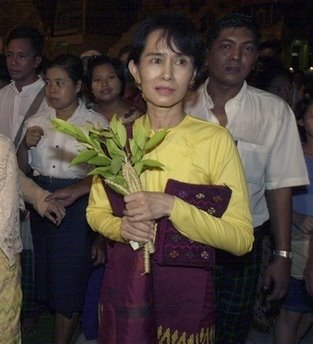


 Posts
Posts


