News & Articles on Burma Monday, 17 October, 2011 --------------------------------------- Burmese Army Mounts Multi-front Offensive Against KIA Ethnic Parties Back Suu Kyi to Contest Election NLD still undecided on registration Three DVB journalists freed from jail India and Burma focus on energy and security Burma, Once Isolated, Seeks Global Investment Activists welcome release of prisoners of conscience In Burma: a fake out -- or real reform? Myanmar to allow unions Malaysia, Myanmar Eye Swapping Immigration Detainees Arakanese join Karen rebel ambush ------------------------------------------- Burmese Army Mounts Multi-front Offensive Against KIA By BA KAUNG Monday, October 17, 2011 Deadly armed clashes between Burmese government troops and the Kachin Independence Army (KIA) continued in Kachin and Shan states on Monday, according to KIA officials who said they believe the latest military offensives by the government side are aimed at taking control of their major strongholds. Since Thursday, fighting has been reported at a number of locations considered to be key defensive positions en route to Pajau and Laiza, the KIA's two most important bases of operations. One focal point has been Lung Zep Kong, a hill near Waimaw Township in Kachin State that lies along the way to Pajau, while sporadic fighting has also been reported in the village of Nam Sen Yang in Kachin State and in Tamonye, near Kutkai Township in Shan State. Government troops have mounted three major assaults on this hill since Friday, the latest one this morning, when it sent a strong force of around 600 men in an effort to occupy it, said KIA Col Zau Raw, speaking to The Irrawaddy on Monday. We believe that these military operations show they intend to occupy Pajau. he added. According to KIA spokesman La Nan, fighting continued today at all three locations, with heavy casualties reported at Lung Zep Kong, most of them on the Burmese side, as the KIA mowed down soldiers ordered to take the hill. The government soldiers simply charged up the hill, leaving our soldiers with no option but to shoot them down, said La Nan, adding that there were at least 30 bodies scattered around the area following fighting over the weekend. The KIA spokesman said that at least 82 armed clashes have taken place since June, when fighting broke out near Chinese-built hydropower plants in Bhamo Township, Kachin State, ending a 17-year-old ceasefire agreement between the two sides. Of these, 17 have occurred so far this month, he said. Even before this incident, however, tension had been growing over the government's insistence that the 10,000-strong KIA join a Border Guard Force (BGF) under Burmese military commanda demand the KIA did not reject outright until the fighting started in June. During two subsequent rounds of peace talks, the government offered the KIA a chance to renew the 1994 ceasefire agreement, but rejected the group's demands for a political dialogue between all ethnic armed groups and Naypyidaw. The government has since then apparently shelved the controversial BGF plan, recently renewing temporary ceasefire agreements with the 20,000-strong United Wa State Army, the largest ethnic armed group in Burma, and another its much smaller ally, the Mongla group, based near the Chinese border. Asked if the KIA would accept a ceasefire if government dropped the BGF demand, as it did with the UWSA, La Nan said the group would not accept another temporary ceasefire without achieving its political rights. With much of the recent fighting taking place near the Sino-Burmese border, there have been reports that hundreds of Chinese army troops have been stationed along the border to prevent an influx of refugees and to maintain control over Chinese territory. http://www.irrawaddy.org/article.php?art_id=22275 -------------------------------------------------- Ethnic Parties Back Suu Kyi to Contest Election By KO HTWE Monday, October 17, 2011 The Nationalities Brotherhood which represents five ethnic parties has urged pro-democracy leader Aung San Suu Kyi to form a legitimate political party to contest the 2015 general election. The joint statement was issued on Saturday by the Rakhine Nationalities Development Party, the All Mon Regions Democracy Party (AMRDP), the Phalon Sawaw Democratic Party, the Shan Nationalities Development Party (SNDP) and the Chin National Party. Speaking to The Irrawaddy on Monday, Nai Ngwe Thein of the AMRDP said the group wanted to get behind Suu Kyi because she was best placed to exploit the common ground between different interest groups to challenge the government. [Daw Aung San Suu Kyi] is currently involved in politics outside Parliament, but is not politically recognized. So I want her to register and to contest the election. To do this legally is better, said Nai Ngwe Thein. If Suu Kyi's National League for Democracy (NLD) register and return to political work it can be more effective in trying to achieve peace and national reconciliation, he added. The Upper House will discuss a bill to amend the Political Parties Registration Law which currently stipulates that those convicted by a court and serving a jail term are not eligible to form a political party. In March 2010, the NLD decided against registering for the general election and Suu Kyi has rejected her party's participation in future polls without amendments to the 2008 Constitution. However, she said the final decision will be left to her party. NLD spokesman Nyan Win said he thought the statement by the five ethnic parties urging Suu Kyi to contest coming elections strengthens the democratic opposition. But he declined to comment further on the issue as his party has not yet decided whether they will officially register. Sao Hseng Merng of the SNDP told The Irrawaddy that Suu Kyi contesting the election would help Burma internationally and within Association of Southeast Asian Nations, but it is very important that she should not be taken advantage of by the government. All the ethnic peoples both inside and outside Burma support her so the conflict would stop inside the country. I think she will never misuse the faith of the ethnic people, he added. The Nationalities Brotherhood statement also welcomed the release of 6,359 prisoners including prisoners of conscience and urged the government to immediate release Hkun Htun Oo, Min Ko Naing, other ethnic and student leaders, plus all political prisoners without conditions. The five ethnic parties also called for the government to form a peace committee with representatives from the five ethnic parties as well as experts and reputable persons to form a workshop focusing on peace and resolving ongoing armed conflicts in ethnic areas in eastern and northern Burma. http://www.irrawaddy.org/article.php?art_id=22273 -------------------------------------------- NLD still undecided on registration By Sann Oo October 17 - 23, 2011 The National League for Democracy is yet to decide whether it will re-register as a political party, Daw Aung San Suu Kyi said last week. I heard that amendments to the [Political] Party Registration Law have been discussed in the hluttaw. So we will have a discussion about NLD registration after that [amendment is approved], Daw Aung San Suu Kyi told reporters in Yangon on October 8 after meeting Norwegian Deputy Foreign Minister Mr Espen Barth Eide. How can we decide whether to register if we dont know yet about the law? We will act according to the situation. Our party always works according to the situation, she said. The Union Election Commission (UEC) on October 5 proposed three amendments to the Political Parties Registration Law, including one that would allow those serving prison terms to be party members. Parties would also be required to respect and observe the 2008 constitution under another amendment rather than preserve and safeguard the document as the original law stipulates. The commission said the latter change was being made so that the law would correspond with a clause in the constitution that states: This constitution and the existing laws shall be respected and observed. The second revision, to remove the clause that convicts, being those serving a prison term, are not allowed to be party members, was proposed because at present the state respects the rights of citizens, a UEC member told parliament. The third would require political parties to field candidates in at least three constituencies for by-elections as well as general elections, as long as there were at least three constituencies being contested in the by-elections. The commission member said this clarification was required to make it fair for both newly formed parties and those that existed before last years general election. Some observers said the changes are intended to persuade the NLD to formally register, possibly before by-elections later this year. But Daw Aung San Suu Kyi did not comment when asked about that by reporters. She said only the partys central executive committee could decide whether it would re-register. The NLD was founded on September 27, 1988, with Daw Aung San Suu Kyi as its general secretary. On May 6, 2010 the party was declared illegal after failing to register for the November election. http://www.mmtimes.com/2011/news/597/news59708.html ------------------------------------------- Three DVB journalists freed from jail By JOSEPH ALLCHIN Published: 17 October 2011 Three video journalists working for the Democratic Voice of Burma were among the 6,539 prisoners released in an amnesty last week. The Oslo-based exiled media outlet now has 14 staff behind bars but for security reasons is unable to divulge the identity of its released journalists, some of whom may return to a working environment where laws criminalising freedom of speech are still in force. Geraldine May, who coordinates a DVB-run campaign to free its journalists, said: "We are deeply concerned about those still behind bars, and all journalists who are criminalised by the government's laws and whom, as a result, are threatened with unacceptable harassment and detention for doing an essential job within a democracy." The general prisoner amnesty coincided with Thidangyut Buddhist full moon and was described as a meritorious deed by the government of Thein Sein, rather than a policy change. The government and its newly-appointed National Human Rights Commission (NHRC) refuses to acknowledge the jailed activists, journalists, MPs and so on as political. The NHRC describes them as "what are referred to as prisoners of conscience". In a statement put out by the group prior to the amnesty, it only called for prisoners "who do not pose a threat to the stability of state and public tranquillity" to be released, rather than recognising the right of individuals to challenge the state in a democracy. This has caused critics to label the amnesty as similar to those carried out by the military regime, marking no break in policy and asking questions of the self-avowed commitments of the new government. Critics such as the Paris-based media watchdog, Reporters Without Borders, were swift to condemn the release as superficial, stating that all journalists behind bars should be freed if widely-heralded reforms were to be taken seriously. Amnesty International called for laws used to silence journalists, such as the Electronics Act, to be repealed. The New York-based Human Rights Watch said in a statement that, "The laws that put them behind bars are still on the books and can be used again at any time. If the government wants to show it is really different from its predecessors, it should convene parliament and repeal laws criminalising peaceful political speech." Indeed the prominent comedian, Zarganar, who was included in the amnesty, told DVB that he "began to have doubts about the so-called reform because I don't understand why everyone in prison wasn't released." President Thein Sein had appeared to acknowledge the necessity of a free media and rights for all, including journalists, by unblocking previously banned news websites, including the BBC, Reuters and DVB. http://www.dvb.no/news/three-dvb-journalists-freed-from-jail/18224 ----------------------------------------- India and Burma focus on energy and security By (FINN) Frontier India News Network | October 16th, 2011 | Category: Editorial Burma (also called Myanmar) is the other South East Asian country after Vietnam that engaged India last week. Burma's President Thein Sein called on Indian prime Minister in New Delhi on Friday, 14 Oct. Among other topics, Security and Energy topped the table. The two countries underscored the need to strengthen institutional mechanisms for sharing of intelligence to combat the menace of insurgency, arms smuggling and drug trafficking. They agreed on further strengthening of border management mechanisms and reiterated not to allow their respective territory to be used for training, sanctuary and other operations by terrorist and insurgent organizations and their operatives. Expansion of of air connectivity, feasibility of establishing railway links, ferry and bus services between the two countries were discussed. Early implementation of the Rhi-Tiddim Road Development Project with grant assistance from India will be expedited. The officials agreed to examine commencement of ferry services on the Kolkata-Yangon and Chennai-Yangon routes. There was a review on the progress in establishing trilateral connectivity from Moreh in India to Mae Sot in Thailand via Myanmar. The meeting noted that substantial progress had been achieved in the preparation of a DPR for roads and causeways in Myanmar. On communication, the countries have decided for an early upgradation of the microwave link between Moreh and Mandalay or other necessary link under the Indian line of Credit. A new Optical Fibre link between Monywa to Rhi-Zawkhatar with Indian assistance will be established. India assisted Industrial Training Centre in Pakokku, has been completed and another Industrial Training Centre at Myingyan with technical support from HMTI is in progress. As a part of renewal of Science and Technology Agreement in 2010, the Programme of Cooperation in Science and Technology for the period of 2012-15 was signed. Prime Minister Manmohan Singh has announced support for training of Myanmar researchers under India-Myanmar Programme of Cooperation in Science and Technology. The countries agreed for the need to strengthen and broaden the multifaceted relationship based civilizational ties and close religious, and cultural affinities. The meet emphasized the need to intensify economic, social and developmental engagement in order to bring about overall socio-economic betterment and inclusive growth. The External Affairs Minister's of the two countries will hold further consultation in New Delhi in early 2012 and the next round of Foreign Office consultations would be held in India at mutually convenient dates in 2012. http://frontierindia.net/india-and-burma-focus-on-energy-and-security ---------------------------------------- Burma, Once Isolated, Seeks Global Investment Aung Hla Tun & Jason Szep | October 16, 2011 Rangoon. Reforms in Burma, the former British colony, that gathered speed this year are likely to continue and possibly accelerate, even if this week's release of prisoners was disappointingly small. Recent overtures by the government have included calls for peace with ethnic minority groups, some tolerance of criticism, an easing of media controls and more communication with Nobel Peace Prize laureate Aung San Suu Kyi, who was released last year from 15 years of house arrest. Southeast Asian diplomats expect the 10-member Association of South East Asian Nations to approve at their summit next month in Bali Burma's bid to take its rotating presidency in 2014, two years ahead of schedule, giving the new government some long-sought international recognition. Reasons behind the wave of reforms are varied. A local currency crisis is forcing the government to seek urgent help from multilateral institutions. Populist anger is rising over neighbor and historic rival China's expanding economic influence. And Western sanctions are no longer merely a nuisance. They have begun to bite. The government, say those familiar with its thinking, has begun to covet US and European investments as a counterweight to billions of dollars of Chinese money flowing into its energy industry -- from natural gas to hydro-power and pipeline projects that cater almost exclusively to energy-thirsty China. Sanctions, they add, also keep some of the Burmese elite's children out of American schools -- a frustration that has grown more acute among a new generation. And, crucially, since the army nominally handed over of power to a civilian parliament in the first elections in two decades, President Thein Sein has defied sceptics by reaching out to pro-democracy leader Suu Kyi, daughter of assassinated independence hero General Aung San. Thein Sein, a retired general and first civilian head of state in half a century, surprised Suu Kyi's supporters by appointing one of her friends, U Myint, as chief economic adviser, a step that more than any other could yield reforms in months ahead, say economists who track the country. U Myint is a dramatic break from decades of staid autocrats and policy blunders by military juntas since a 1962 coup. The 73-year-old former senior UN economist has been openly critical of the former junta but is well regarded on both sides of the political divide, a bridge between pro-democracy forces and conservative former generals who dominate parliament. Recently he called for a crackdown on graft, a bold step in a country ranked second on Transparency International's 2010 list of most corrupt nations, worse than Afghanistan. His views on Burma's currency, the kyat, offer a glimpse into a nation desperate for help. They alone form perhaps the strongest argument for why more reforms are likely. While the currency is pegged at six kyat to a dollar, it changes hands unofficially at about 850, up about 15 percent this year on sales of natural gas, jade and gems, a surge of foreign investment from China and swelling private capital from neighboring countries and the Middle East. U Myint sees trouble ahead if the largely Chinese-investment fueled black-market rate keeps rising. In a paper presented to the government in June, he warned that it could destabilize Burma and urged the government to reach out to the International Monetary Fund for help. "If the exchange rate continues to appreciate unchecked, a stage will be reached when earnings from exports in local currency are no longer able to cover costs of production, huge losses are incurred, and enterprises have to close down," he wrote, according to a translation of his paper. Workers could lose jobs, farmers and fishermen will struggle to sell produce, he said, adding that "the economic, social and political consequences of this chain of events can be serious." But more reforms -- economic and social -- are likely to be the price of their full support. "The key event will be the re-engagement of the World Bank and the multilateral organizations," said Douglas Clayton, a former hedge fund manager who is now chief executive and managing partner of Leopard Capital, a private-equity fund focused on emerging Asian markets and backed by overseas investors. "At some point it will be very hard for the West to justify continuing economic sanctions against a country that is undergoing reform." He sees opportunities "in almost every sector" if sanctions come down -- from manufacturing to infrastructure and agriculture in a country that just over 50 years ago was one of Asia's rising stars, the world's top rice exporter and a major energy producer with a well-educated workforce. Government sources say U Myint is set to roll out more financial reforms, including allowing some private and semi-government banks to handle foreign currencies, reviewing foreign investment laws and clearing the way for three state-owned banks to open overseas branches. The pricier currency also points to deeper changes Mynamar's wealthy converted dollars into kyat last year during a wave of privatization as the junta strengthened control over major assets before ceding power to the civilian government. About 300 state assets -- from real estate, gas stations and toll roads to ports, shipping companies and an airline -- were privatized in opaque sales. That put valuable assets under the control of former generals through holding companies, or in the hands of their allies, turning the ex-military elite into financial power-brokers who stand to benefit from increased trade if sanctions are brought down -- another reason why reforms are under way. "These moves are about the regime's survival," said Bertil Lintner Thailand-based author and expert on Burma. The country, as big as France and Britain combined, sits strategically between booming India and China with ports on the Indian Ocean and Andaman Sea, all of which have made it a vital energy security asset for Beijing's landlocked western provinces. Backed by Chinese money, Burma is building a new, multi-billion-dollar port through which oil can reach a 790-km pipeline now under construction -- with Chinese investments and Chinese workers - that will be cut across Burma and link refineries in western China. Another parallel pipeline will pump Burma's offshore natural gas to China. Total foreign direct investment promises to soar to $20 billion from just $300 million a year before, official data showed. India and Southeast Asia have sought to ramp up engagement, largely to counterbalance China's influence and to gain a toehold in a country whose proven gas reserves have tripled in the past decade to around 800 billion cubic meters, equivalent to more than a quarter of Australia's, BP Statistical Review figures show. Even if the reforms continue, Burma faces a daunting public relations exercise to end its image as a backwater run by autocratic former generals and drug lords, blighted by conflicts and years of brutal suppression of pro-democracy uprisings. http://www.thejakartaglobe.com/business/burma-once-isolated-seeks-global-investment/472016 ------------------------------------------- Activists welcome release of prisoners of conscience By Sann Oo October 17 - 23, 2011 DAW Aung San Suu Kyi last week welcomed an amnesty that saw 6359 prisoners go free but said more prisoners of conscience should be freed. As far as I heard, about 100 [political] detainees have been released from various prisons. I hope more will be released soon, she told reporters at a respect-paying ceremony held on October 12, the full moon of Thadingyut. I want to say thanks even for the release of one prisoner of conscience. The freedom of one person is invaluable and the freedom of many people is more invaluable. The more that are freed, the better it is for the country. But I want and hope that all detainees will be released soon, Daw Aung San Suu Kyi said. Thadingyut marks the end of Buddhist Lent and is traditionally a day when people pay homage to their elders. About 1000 people attended the ceremony, which took place at Royal Rose Hall on Shwegonedaing Road in Bahan township, to pay respect to Daw Aung San Suu Kyi, unregistered National League for Democracy (NLD) vice chairman U Tin Oo and senior party member U Win Tin. It was the first time the ceremony had been conducted. U Win Tin, a veteran journalist, said he welcomed the amnesty and urged the audience to help the released detainees. Some detainees have been released and there are more to be released. I am happy about that. I also want to say I welcome their release. And I also want to thank the government and respective persons for the release, U Win Tin said. But just the welcoming is not enough. We have to hold their hands, we have to support them. We have to help them to rebuild their lives. Before their time in prison, they had family, business and political lives. But since they have been put into the prison, in many cases their lives have been destroyed, he said. The audience included many younger political activists and U Win Tin urged them to do more for the development of democracy. http://www.mmtimes.com/2011/news/597/news59706.html ------------------------------------------ In Burma: a fake out -- or real reform? Longtime Burma (Myanmar) watchers say recent reforms may amount to a genuine democratic opening for the authoritarian regime, but critics dismiss the moves as a propaganda offensive. Bangkok, Thailand After nearly a half century of brutal military rule, Burma's government, which formally made the transition to a civilian government in March, has made a series of reforms that could signal more than superficial reform. Burma (Myanmar) is no stranger to public relations efforts. It periodically releases large numbers of prisoners out of "goodwill." In May, military rulers released some 14,000 prisoners. In 2009, the country released around the same number, but in both instances, only a tiny percentage were considered "political." Still, the amnesty of thousands of prisoners, the induction of a parliament, the scrapping of a major dam project, and a number of other more minor actions -- such as allowing a picture of Aung San Suu Kyi, Burma's main opposition leader, to appear in government-censored publications -- seem to indicate a noticeable shift. Is Burma, a country that has been in virtual isolation for the past 50 years and is often compared with North Korea, taking steps to embrace democracy? Burma's location, nestled between China, India, and Thailand, puts it in a key position to be a major regional player. When the military seized control in 1962, the country was considered more developed than Thailand. Now sheer poverty pushes millions to leave the country in search of work. The military held on to power by crushing any sign of dissent through detention and torture. But in late September, Burma's new government turned heads when it announced that a massive $3.6 billion Chinese dam project would be "suspended" after years of planning because of public pressure. And on Oct. 12, the government freed iconic comedian Zarganar and announced that more than 6,350 other prisoners would also walk free in amnesty. Think you know Asia? Take our geography quiz. Zarganar was arrested twice for poking fun at the military and inciting violence, and served three years of an initial 59-year sentence. He told the Burma Today journal that the amnesty "was like putting lots of makeup on an old lady's face." Out of an estimated 2,000 political prisoners in jail, Human Rights Watch estimates that the current amnesty applied to only 200. Indeed, according to the state-run newspaper, only prisoners "who do not pose a threat to the stability of state and public tranquility" would be released on humanitarian grounds. It was a step, but a small one, says Human Rights Watch's Burma researcher David Mathieson, and it was "disappointing, given the limited number of political prisoners released." Critics such as Bo Kyi of the Assistance Association for Political Prisoners Burma point out that criminal records of released political prisoners are not erased, and that there was no indication of wrongdoing from the government or a change in the laws that put them there. Key players such as Min Ko Naing, a leader of the 1988 student protests, will remain in jail. "Leaders like these guys ... have a lot of cachet and the government knows they can't control them. They challenge its legitimacy," Mr. Mathieson says. Still, he adds, "the recent wider reforms have been uncharacteristic of previous regimes." For example, until a new law was passed on Oct. 11, workers were banned from forming or joining unions under an autocratic 1962 law passed soon after military rule began. Now, workers will potentially see "massive" benefits, according to the head of the International Labor Organization in the country, Steve Marshall. This law would guarantee not only the right to join unions but also to strike, making it illegal for employers to breach that right. The government has also begun unblocking news websites such as those of Reuters and the BBC. Press has been heavily censored in the country; dozens of journalists have been sent to jail. Another possible reason for Burma's concessions is the dire state of the economy. Economist Zaw Oo recently noted that "many officials became quite dependent on the artificial exchange rate," but have since realized the magnitude of Burma's economic problems. Some fear the recent reforms are all part of a propaganda offensive. "Based on my current experiences, I dare not think changes are real and big this time either ... the release of prisoners was just a sprinkle -- way too little," said Zarganar to the local news after his release. Still, expressing that sentiment would most probably not have passed the censors a year ago. http://www.csmonitor.com/World/Asia-Pacific/2011/1016/In-Burma-a-fake-out-or-real-reform/%28page%29/2 ----------------------------------------- Special Reports Myanmar to allow unions Published: Oct. 17, 2011 at 6:05 AM YANGON, Myanmar, Oct. 17 (UPI) -- Myanmar will allow unions to be formed and workers to strike when a new law kicks in this month. Deputy Labor Minister Myint Thein told the Democratic Voice of Burma, which operates out of Norway, that President Thein Sein signed the bill into law last week. The labor organization bill cancels a nearly 60-year-old anti-labor union decree, the 1962 Trade Unions Act, which effectively banned trade unions. Myint said the law, which takes effect at the end of the month, will allow more transparency in the labor market and also boost the country's ability to attract foreign investment. "It will help us get more benefits for the economy because our labor organization law means workers can organize according to their will," Myint told DVB. "Our government transparency will attract foreign countries and foreign direct investment can flow freely." Private sector workers will have to give at least three days notice and public sector employees must allow 14 days notice. Striking workers won't be allowed to block transport routes or security infrastructure. Workers in officially designated essential services won't be allowed to strike. An employer who dismisses workers because of union affiliation or because they have gone on strike faces a fine of up to $120 and a year in jail, Myint said. To be an official union, the organization must have at least 30 members who can leave whenever they wish. Unions will have to register with a government-appointed agency. Steve Marshall, the International Labor Organization's representative in Myanmar called the law "a massive move for the country" in terms of social and economic development. "You don't join unions to simply be in a club. You join unions for collective bargaining and proper economic management of the labor market," Marshall told DVB. The ILO has had a representative in Myanmar, formally known as Burma, since 2002 when it signed an agreement with the ruling military government, many of whose members are now civilians in the military-backed government that took office in March after being elected in November. The main job of the ILO's representative in Myanmar is to help victims of forced labor seek redress. The ILO condemned the junta in 1998 for its "systematic and widespread" use of forced labor. The military leaders were treating civilians as an unlimited pool of unpaid laborers and servants, it said. In June, Aung San Suu Kyi, the pro democracy advocate who has spent many of the past 20 years under some form of arrest and incarceration, urged the ILO to increase its activities in Myanmar. In a video message to the ILO's 100th International Labor Conference in Geneva, Suu Kyi made "a special appeal for my own country, Burma," to improve working conditions. She said Myanmar was once considered the nation most likely to succeed in Southeast Asia. "But now it has fallen behind almost all the other nations in this region," she said. "The work of the ILO in our country has highlighted the indivisibility of social, political and economic concerns. In its attempt to eliminate forced labor and the recruitment of child soldiers, the ILO has inevitably been drawn into work related to rule of law, prisoners of conscience and freedom of association." Nyan Win, a spokesman for Suu Kyi's National League for Democracy party, told the BBC the move to allow unions was in the right direction. Labor rights had "improved from nothing to something," he said. The establishment of the union law is another apparent move toward a more democratic society for a country ruled by juntas for most of the past 50 years. But critics of the new government regard it as a civilian veneer on an ostensibly military administration -- one-quarter of the seats in Parliament are reserved for military appointments. Most of the government leaders are former senior military figures from the previous junta who retired to run as civilians. A test of the government's tolerance of unions will be how the union-in-exile Federation of Trade Unions of Burma is treated if the organization decides to come in from its shadowy existence. It has been holding annual "conferences" at "a certain place in the Thai-Burma border area," the FTUB Web site says. It was formed in 1991 after the junta clamped down on unions. In 1998 Myo Aung Thant, a senior FTUB member, was sentenced to life in prison for labor organization activities inside Myanmar. As late as 2003, two FTUB members reportedly were sentenced to death. The ILO-affiliated International Committee for Trade Union Rights said they were sentenced for attending an FTUB meeting on the Thai border where they were relaying information on forced labor to the ILO. Read more: http://www.upi.com/Top_News/Special/2011/10/17/Myanmar-to-allow-unions/UPI-74471318845900/#ixzz1ajXTPO13 ---------------------------------------------- October 17, 2011 17:10 PM Malaysia, Myanmar Eye Swapping Immigration Detainees KUALA LUMPUR, Oct 17 (Bernama) -- Malaysia and Myanmar are mulling over the possibility of implementing an exchange programme for immigration detainees, said Home Minister Datuk Seri Hishammuddin Tun Hussein. He said there were currently around 1,000 Myanmar nationals at detention centres in this country. However, the number of Malaysian immigration detainees in Myanmar was not made available. "It'll help reduce the numbers in our detention camps and show a good relationship between Malaysia and Myanmar in relation to immigration and movement of workers in the region," he told reporters after receiving Myanmar's Deputy Foreign Minister U Maung Myint (HE) here, today. About 257,000 Myanmar nationals had registered under the "6P" programme, of which 144,098 were illegals immigrants. The programme is a massive legalisation and amnesty exercise for illegal immigrants conducted by Malaysian authorities. "Since not all of them (Myanmar illegal immigants) will be employed, cooperation between both countries is important to ensure that the repatriation process runs smoothly," Hishammuddin said. Hishammuddin said Malaysia and Myanmar would establish a joint working committee to address immigration as well as crime-related issues involving the two countries. It is expected to hold its first meeting next week. Elaborating, the minister said Kuala Lumpur would cooperate closely with Myanmar to tackle cross-border crimes involving drugs, weapons and human trafficking. "The issue of fraudulent travel documents is also in our focus, with 46 cases involving Myanmar nationals detected last year as well as 13 cases up till August this year," Hishammuddin said. -- BERNAMA http://www.bernama.com/bernama/v5/newsgeneral.php?id=620444 ------------------------------------------ Arakanese join Karen rebel ambush By NAW NOREEN Published: 17 October 2011 Troops from the Arakan Liberation Army (ALA) based out of the western Burmese state are said to have been involved in an ambush on two Burmese army columns last week passing through territory claimed by Karen rebels. One Burmese soldier died in the attack, according to the Democratic Karen Buddhist Army (DKBA), which was joined by the All Burma Students' Democratic Front (ABSDF) and Arakanese rebels. Ties between Karen and Arakanese ethnic armies stretch back several decades to 1968, when the ALA's founding was aided by the Karen National Union, which over the subsequent decades trained its troops. But the involvement of Arakanese rebels in the recent fighting in Karen state has been kept quiet. The ambush took place on 15 October, according to Saw Three Two, a captain in the DKBA. "We launched the attack jointly with the students' army [ABSDF] and the Arakanese group. We didn't suffer any casualty. We stay inside our own territory and we have to shoot [Burmese troops] when they enter ours." The fighting comes despite a pledge by the government to begin peace talks with a number of ethnic armies in the country's border regions. Saw Three Two said that rather than President Thein Sein, the problem may lie with the army chief. "General Min Aung Hlaing is continuing with the offenses and we don't know who to trust so we might as well not trust them at all," he said. "We decided not to accept their proposal -- they said they would withdraw their forces on 15 October but instead they sent in more troops." Several armed groups, including the Karen National Liberation Army (KNLA) and the Shan State Army (SSA), put their names to the creation of a United Nationalities Federal Council (UNFC), effectively an attempt to build a cohesive ethnic front against the Burmese military. Although the ALA is not part of the alliance, its forces are deployed along the Thai-Burma border and the length of the Arakan state border with Bangladesh and India. http://www.dvb.no/news/arakanese-join-karen-rebel-ambush/18217 __._,_.___ Reply to sender | Reply to group | Reply via web post | Start a New Topic Messages in this topic (441)
Tuesday, October 18, 2011


Monday, October 17, 2011
News & Articles on Burma-Sunday, 16 October, 2011-UZL
News & Articles on Burma Sunday, 16 October, 2011 ------------------------------------- India fetes Myanmar leader on state visit India to help Myanmar in rice cultivation Myanmar trying to balance relations with India and China Myanmar agrees to take back refugees from Bangladesh Japan to restart development assistance to Myanmar Learning from Myanmar Building bridges across Irrawaddy to Myanmar Burmese change aplenty but it's only skin deep 'They were screaming: Die, die, die!': ------------------------------------ ENERGY TECH India fetes Myanmar leader on state visit by Staff Writers: New Delhi (AFP) Oct 14, 2011 India rolled out the red carpet Friday for Myanmar President Thein Sein, on a visit that followed his government's release of 200 political detainees -- the latest in a series of reformist moves. The former general, who arrived in India on Wednesday and spent two days touring Buddhist pilgrimage sites, was given a full state welcome in New Delhi for the official leg of his three-day trip. He then began a round of extensive talks with Prime Minister Manmohan Singh. The visit coincided with Myanmar's release on Wednesday of nearly 200 political prisoners, in another tentative sign of change in the authoritarian state after decades of military rule and repression. Thein Sein has surprised critics by signalling a series of political reforms since taking power in a controversial election last November, and has held direct talks with pro-democracy leader Aung San Suu Kyi. In a rare concession to public opinion, his nominally civilian government last month suspended construction of a controversial mega-dam, risking the anger of traditional ally China, which is backing the project. The prisoner release was welcomed by the United States and UN Secretary General Ban Ki-moon, although both called on the government to release all the roughly 2,000 political detainees still behind bars. "We see it as an important step that responds to the aspirations of the Burmese people," State Department spokeswoman Victoria Nuland said. "We have not yet seen a complete list. We do believe that there is still a large number of political prisoners in prison, and we call for all of them to be released," she added. Observers say the releases and the overtures to Suu Kyi signal Myanmar's desire to end its long international isolation, backed by trade and financial sanctions. India began engaging the Myanmar junta in the mid-1990s on security and energy issues and as a counter to China's growing strategic influence in the Southeast Asian nation, formerly called Burma. The policy drew international criticism, with US President Barack Obama chiding New Delhi during a visit to India last year for not speaking out over human rights abuses in Myanmar. New Delhi feels vindicated by Thein Sein's recent inititatives and, during their talks, the Indian premier welcomed his "ongoing efforts at political, economic and social reform," according to a joint statement. India also sees the stand on the dam project as a sign that Myanmar is making room for other allies apart from China -- India's main regional rival. "What remains to be seen is whether these recent signs of opening signal a greater degree of economic liberalisation," said G. Parthasarathy, a former Indian ambassador to Myanmar. An Indian foreign ministry official insisted there was room for both China and India to play a role in Myanmar's future development. "Relationships between countries are not a zero-sum-game," the official argued. Beijing has long helped shield Myanmar from international opprobrium and the impact of western sanctions with trade ties, arms sales and through its position as a veto-wielding permanent member of the UN Security Council. Indian trade with Myanmar stood at $1.2 billion last year, far short of the $4.4 billion between Myanmar and China. http://www.energy-daily.com/reports/India_fetes_Myanmar_leader_on_state_visit_999.html ----------------------------------------- India to help Myanmar in rice cultivation Zia Haq, Hindustan Times New Delhi , October 16, 2011 Myanmar president Thein Sein on Saturday said he looked to India for his country’s food security, a comment that signals a big opening for India in a neighbour that has long relied on Beijing. Myanmar’s civilian government, to which the powerful junta handed charge after elections in February, is gingerly walking down a road of political reform to help end the nation’s pariah status. Balancing relations with India is inevitably a part of this course correction. In the past, Myanmar has offered China a direct path to the Indian Ocean, apart from a steady source of raw materials for its voracious economy. The visit of Sein, a retired general, comes barely two weeks after he stunned Beijing by cancelling a $3.6-billion (Rs 20,000 crore) dam project that would have almost entirely served China. India has reciprocated the warmth generously, from a $500 million (Rs 2,500 crore) credit line to border-trade pacts. But the way to Myanmar’s heart is through its stomach. “With growing population, we can no longer rely on traditional farming,” Sein told HT, as he toured the farms of Pusa on Saturday. India will set up an Advanced Centre for Agriculture and Research in Myanmar’s Yezin to help improve rice-eating Myanmar’s paddy yields. The job has been outsourced to the premier Indian Agricultural Research Institute (IARI), whose director HS Gupta made a closed-door presentation before the visiting president. IARI’s scientists will also help Myanmar grow basmati. Myanmar’s national planning minister U Tin Naing Thein asked IARI chief Gupta to brief him on per hectare production costs. But before it can suit the Burmese palate, basmati has to be acceptable to Myanmar’s climate. That will take a little genetic tweaking by IARI scientists. The two countries have set a target of $3 billion in trade by 2015. http://www.hindustantimes.com/india-news/newdelhi/India-to-help-Myanmar-in-rice-cultivation/Article1-757830.aspx ------------------------------------- Myanmar trying to balance relations with India and China Sunday, 16 October 2011 03:25 NEW DELHI: Traditional dress for men in Myanmar combines an Indian-influenced sarong with a Chinese-style coat — fitting, perhaps, for a nation trying to balance ties with two giant neighbours as it looks outwards and relaxes decades of tightly buttoned rule. Wedged between India to its west and China to its east, Myanmar will need to work hard on that balancing act as its military-backed government heads down the path of political reform to end the nation’s pariah status and revive its economy. Throttled by Western sanctions, Myanmar has long relied on Beijing to keep it afloat with weapons, loans and infrastructure projects. But it is now courting India, too, to reduce its dependence on China, which many in the country see as a semi-colonial power. Myanmar is hoping competition between the two Asian rivals will earn it a better deal for resources such as gas and access to the Indian Ocean from its shores, for which China has so far paid bottom-dollar. “There is an awareness they have a lot in common with two great nations, China and India, and they must learn to cooperate with both to derive the maximum benefit for themselves,” said Lalit Mansingh, who was India’s foreign secretary when relations with Myanmar began to warm in the late 1990s. Broadly speaking, that seems to be the plan. Two weeks ago, Thein Sein, a retired general who in February became Myanmar’s first nominally civilian president in nearly 50 years, shocked Beijing by shelving a $3.6bn dam project that would have supplied almost no domestic electricity and had come to epitomise the army’s habit of kowtowing to China. This week he visited India, the world’s largest democracy, for a state visit that began with a pilgrimage to Bodh Gaya, the spot where the Buddha is said to have found enlightenment after meditating under a tree for three days and three nights. “When Myanmar’s government suspended the dam and went to India, it showed that it should not be underestimated,” said Christopher Roberts, an Asia expert at Australia’s National Security College. REUTERS http://www.thepeninsulaqatar.com/s.-asia/philippines/169298-myanmar-trying-to-balance-relations-with-india-and-china.html ------------------------------------ Myanmar agrees to take back refugees from Bangladesh Sunday, 16 October 2011 03:25 Dhaka: Myanmar has agreed to take back all its citizens lodged in two refugee camps in eastern Bangladesh, Foreign Secretary Mijarul Quayes said here yesterday. Currently, 28,000 Myanmar refugees, belonging to the Rohingya tribe, are staying in Nayapara and Kutupalong camps in Cox’s Bazar district, about 390km from here, since 1991. Quayes said that apart from the registered refugees, a large number of undocumented Myanmar nationals have also entered the country without having a refugee status. “Although they have no refugee status, we are not forcing them out of the country on humanitarian ground,” Xinhua reported quoting Quayes as saying at a press conference. He said Bangladesh and Myanmar are in talks to launch patrol on the border to stop fresh influx of Myanmar citizens into the country. IANS http://www.thepeninsulaqatar.com/s.-asia/philippines/169299-myanmar-agrees-to-take-back-refugees-from-bangladesh.html ---------------------------------------- Japan to restart development assistance to Myanmar 2011/10/16 Share Article このエントリをはてなブックマークに追加 Yahoo!ブックマークに登録 このエントリをdel.icio.usに登録 このエントリをlivedoorクリップに登録 このエントリをBuzzurlに登録 Foreign Minister Koichiro Genba plans to announce the resumption of official development assistance (ODA) to Myanmar (Burma), which has been mostly suspended until now in response to the regime's anti-democratic actions, when he holds talks with his Myanmarese counterpart in Tokyo on Oct. 21. Genba said on Oct. 14 he will meet with Myanmar Foreign Minister Wunna Maung Lwin, which will mark the first time since 1995 that either a leader or a foreign minister of Myanmar will come to Japan on an official visit for a bilateral discussion.The ministry plans to resume mutual visits by key government figures and make it clear that it wants to strengthen bilateral ties. "It is essential to support Myanmar's reforms," a senior ministry official said. The Myanmarese government began granting amnesty to thousands of inmates on Oct. 12, including hundreds of political prisoners, but the international community is yet to decide its response to the move. Japan's foreign ministry released a statement on Oct. 14 saying, "We appreciate the move as a concrete step toward democratization and national reconciliation." During the upcoming talks, Japan plans to propose reinforced cooperation in four fields: exchanges of personnel, ODA, economic relations and cultural exchange. With regard to ODA, Japan is to announce the resumption of both the rehabilitation of the Baluchaung No. 2 hydro power plant, which was suspended after democracy movement leader Aung San Suu Kyi was detained in 2003, as well as the construction of the Myanmar-Japan Center for Human Resources Development, which was suspended after anti-government demonstrations were suppressed in 2007. Japan plans to begin on-site surveys by the end of this fiscal year. However, several pro-democracy groups in both Japan and overseas have argued that Japan should act more cautiously and confirm whether democratization is truly under way before taking action. http://www.asahi.com/english/TKY201110150266.html -------------------------------------- Learning from Myanmar By Jyoti Malhotra Published: October 16, 2011 Who says Delhi doesn’t like dictators? Watching the Indian government romance the president of Myanmar U Thein Sein over the last few days has been fascinating. To be sure, Mr Sein is now the head of an elected, civilian government, even if the electoral process itself was suspect because of democratic leader Aung San Suu Kyi’s celebrated refusal to participate in the vote. Be that as it may, as the cliché goes. Mr Sein is here to stay for a few years and as Delhi’s eastern-most neighbour, the Myanmarese chief got a red-carpet welcome that began with the perambulation in Bodh Gaya on full moon night, considered by Buddhists to be inordinately auspicious. This was followed by a $500 million credit bouquet in the capital. Of course, this is tied aid. Meaning, Myanmar will get $500 million to spend, but all the goods have to be bought in India. It’s unclear, so far, how the money will be spent, because Myanmar is still under US-European Union-led sanctions, which means that Singapore makes a killing (in dollars, of course). That tiny city-country behaves like a clearinghouse, you see, much like Dubai does for Pakistan. That’s what the economic reform has enabled India to do, loosen its purse strings. Never mind how things are falling apart at home right now, and how everyone is in election mode already (state elections in Uttar Pradesh are expected anytime in the next six months, and with 80 seats, UP is widely believed to be a dry run for Delhi). For the moment, though, Myanmar is the flavour. Last week Delhi feted Hamid Karzai — this, after India signed a cheque for another $500 million when Manmohan Singh went to Kabul a couple of months ago. Last year, when Bangladesh Prime Minister Sheikh Hasina came to town, she was handed over another $1 billion. Clearly, this isn’t about dictatorship or democracy, but about India’s national interest. After all, when General Pervez Musharraf was coming to Delhi-Agra in July 2001 and then prime minister Atal Behari Vajpayee called to invite him, he began his telephone conversation with what was then considered both obsequious and controversial: “President sahib…” Vajpayee had dearly hoped that he could get Musharraf to promise the end of terrorism against India, so nothing was too big, including flattery. Musharraf’s conceit, of course, got the better of him in Agra and he proceeded to wreck the summit with his grandiose statements. The same applies to Myanmar. An exciting concatenation of circumstance is underway : In the wake of the elections, Suu Kyi has been allowed to get out of her house, even though her visits are tightly controlled (she has even come to the Indian embassy once); and Myanmar has announced that it will slowly move towards a market economy. Over the last few years, the Myanmarese have also been especially sensitive to shutting down insurgent camps that use Myanmar’s territory to target Indian civilian and military installations in India’s northeastern states. Get the drift? Stop the insurgency and watch India open its heart and its wallet. There’s a growing constituency inside India for greater linkages with its neighbourhood, but peace is a pre-requisite. Perhaps Pakistan’s generals could learn from their Myanmarese counterparts — who are also great friends of China — in giving peace a chance. The writer is a New Delhi-based journalist who has worked as senior editor at The Indian Express from 1997-2004 and since then has been writing for Khaleej Times, Business Standard and Wall Street Journal jyoti.malhotra@tribune.com.pk Published in The Express Tribune, October 17th, 2011. http://tribune.com.pk/story/275287/learning-from-myanmar/ ---------------------------------------- Building bridges across Irrawaddy to Myanmar Ranjit Gupta, TNN | Oct 16, 2011, 07.06AM IST For India few visits are more important than that of President Thein Sein. After decades, Myanmar is receiving very positive coverage in the global media in strong contrast to the past. A great deal of the credit for that goes to the president who is spearheading a remarkable and courageous process of political transformation in Myanmar . This is an appropriate time to consider why Myanmar is so important to India and to think about ways to substantially enhance India-Myanmar relations. India has a more security threatening and unfriendly neighbourhood than any other major country in the world. One contributory factor has been the nature of the regimes that our neighbours have had. China has consciously exploited domestic political equations in these countries for strategic advantage vis-a-vis India. In the process, China has spun a web of very strong economic, military, political and strategic relationships with Bangladesh, Myanmar, Nepal and Pakistan. Though India is widely regarded as an emerging great power also, the reality is that for India to be taken seriously in Asia, let alone in the wider world, an essential prerequisite is that it should command influence and respect in its neighbourhood. How can India resolve this conundrum? India cannot do much in respect of inducing change in the policy orientations of China or Pakistan. Things are looking up in Bangladesh but domestic political uncertainties remain an issue. Nepal will be in flux for some time and, in fact, is likely to pose increasing challenges. India's best prospects are in Myanmar simply because amongst all of India's neighbours, only Myanmar shares very deep strategic concerns vis-a-vis China. The two overriding objectives of India's relationship with Myanmar, beyond the self-evident need for good bilateral ties, should be: to ensure the economic development of the northeastern states and, second, to ensure that Myanmar does not become a pawn of China's strategic ambitions visa-vis India. The strategic factors underlying why Myanmar is imperatively important may be summarized as follows: in the context of India's territorial integrity; the security, stability and economic development of our northeastern states; India's strategic interests in the Indian Ocean; our energy requirements ; our 'Look East' policy with Myanmar being the geographical bridge between India and Asean; and China's ambitions in Asia. India's lack of focused interest has enabled China's footprint in Myanmar to become the largest amongst all of India's neighbours. If China were to acquire full sway over Myanmar, then, for all practical purposes, China would surround India's northeastern states and China's de facto border would also extend to the shores of the Bay of Bengal. The extensive dual use transport and economic connectivity infrastructure and other strategic assets that China is creating in Myanmar could then acquire rather sinister dimensions, particularly as Myanmar's economy is headed towards becoming a part of the Chinese economy. Such a China - Myanmar relationship would ensure that India's national security, well-being and potential role in Asia in the future could become hostage to China's strategic plans. The fact is that India cannot and should not compete with China in Myanmar. But remedial action is possible and needs to be initiated. As a first step, India has to ensure that no potentially inimically inclined foreign country, let alone China , is granted huge projects or permitted a large presence of its citizens west of the Irrawaddy River. This should be considered a strategic red-line which Myanmar should be encouraged not to breach. This would be achievable only by providing Myanmar sufficient stakes in complying. India is upgrading the Sittwe port and making 225 km of the Kaladan river from Sittwe to Setpyitpyin navigable. It would be connected to Mizoram by a 62-km road. The Kolkata-Sittwe sea route is 539 km. These projects are designed to provide connectivity between mainland India and its northeastern states. But we should think big and the setting up of a multi-purpose Special Economic Zone around Sittwe should be considered on a priority basis. Indian private sector companies should be involved. The SEZ would provide an avenue for the utilization of the gas from the exploration blocks currently with ONGC Videsh and Essar. Power for downstream industries in the SEZ could be supplied from captive power plants but also from the two hydropower projects that India is involved in Tamanthi and Shwezaye. Rites is involved in the development of rail transportation. The SEZ would synergise the objectives of these projects and become the symbol of India's presence in and commitment to Myanmar's economic development in a non-exploitative fashion, in strong contrast to what other major foreign investors are doing. An Indian consulate should also be set up in Sittwe. The president's visit could be used to signal such an Indian interest at the highest levels. A special high-level multi-disciplinary team should be constituted as a matter of high priority to study relevant data and initiate discussions with the concerned agencies of the Myanmar government at the earliest . All this would fit in well with the achievement of Myanmar's ambition for the early lifting of sanctions. The writer is a former diplomat. http://timesofindia.indiatimes.com/india/Building-bridges-across-Irrawaddy-to-Myanmar/articleshow/10372950.cms -------------------------------------- Burmese change aplenty but it's only skin deep by: Bertil Lintner From: The Australian October 17, 2011 12:00AM IF most Western pundits are to be believed, fundamental change is taking place in Burma. After holding a seriously flawed referendum in May 2008 on a new constitution that gives the country's military controlling powers, and holding an election last November condemned by the West as rigged, Burma's new government has stunned the world by taking steps towards what appears to be more openness. Pro-democracy leader Aung San Suu Kyi has been freed from house arrest; she and new President Thein Sein have been meeting; strict censorship rules have been relaxed; and on Tuesday the release of thousands of prisoners began. More importantly, Burma suspended a $US3.6 billion mega-dam joint project with China in the north of the country. According to the view of the same Western observers, recent developments may also reflect a power struggle between "hardliners" and "reform-minded liberals" within the government and the military that controls it. But reality is far more complicated. Firstly, the new constitution and elections were not intended to change the basic power structure but to institutionalise it. Once the new parliament and other institutions were in place, and the military-backed Union Solidarity and Development Party had secured an absolute parliamentary majority and formed a new, seemingly legitimate, government, concessions were expected. Suu Kyi's release had been announced before the election, and there had been talks about prisoner releases and an amnesty for Burmese exiles. The concessions went much further than that when the military discovered that Suu Kyi, despite her long house arrest, was as popular as ever. Nor had her party, the National League for Democracy, disappeared despite being dissolved in May last year. At the same time, a powerful, popular movement was growing against the controversial dam project at Myitsone in the northern Kachin State. The dam would have flooded an area bigger than Singapore and 90 per cent of the electricity was to be exported to China. And it would have seriously harmed the Irrawaddy River, the nation's economic as well as cultural artery. There was a potential for an upheaval that could have threatened the unity of the armed forces. The government had to act to prevent the public and elements of the military joining forces. China has been Burma's closest economic, political and military ally since the pro-democracy uprising of 1988. But it has been an uneasy alliance, as many Burmese army officers have not forgotten that China for decades supported the insurgent Communist Party of Burma. Even today, China maintains cordial relations with the United Wa State Army, a successor to the CPB, which in 1989 made a ceasefire agreement with the Burmese government. Chinese duplicity was bad enough; robbing the country of its natural resources was seen as even worse. By suspending the controversial dam project, Thein Sein has taken the wind out of the sails of this movement and weathered the storm many were waiting for - at the same time as the suspension, not cancellation, of Myitsone leaves open the door for negotiations with China. Thein Sein has skilfully played "the China Card" with the West. In Washington, on September 29, Burmese Foreign Minister Wunna Maung Lwin met Derek Mitchell, the newly appointed US co-ordinator on Burma; Kurt Campbell, assistant secretary of state for East Asian and Pacific Affairs; and Michael Posner, a specialist in human rights. The next day, the government decided to suspend the dam until 2015. At the same time, ongoing talks with Suu Kyi are meant to "tame" the NLD and persuade it to "return to the legal fold", as the government always terms it. Some Rangoon-based sources even suggest the aim of the government could be to form a USDP-NLD coalition after the next, 2015 election. Consequently, the US is showing signs of softening its hard stance against Burma. The US position will be eroded totally once the NLD is re-registered and all political prisoners are released. Then, sanctions are likely to be eased if not completely lifted. The EU will give in even earlier. Apart from trying to neutralise the NLD, releasing prisoners and inviting emigres to return, the government is also attempting to revitalise the economy. Economic progress is seen as vital for regime survival, and to have US and EU sanctions lifted will serve that purpose. In order to be "re-admitted" into the global community, and break its diplomatic and economic isolation from the West, Thein Sein's government is said to have set three other high-profile goals which would improve its international reputation: to host the Southeast Asian Games, which are scheduled to be held in Naypyidaw, Burma's new capital, in 2013; to assume the chairmanship of ASEAN in 2014; and the 2015 election. It is likely to succeed in these endeavours, and the economy will most probably benefit as well from more interaction with and acceptance by the West. Some economic liberalisation could also follow, but major political reforms are unlikely. The new constitution has enough safeguards to protect the military and its ultimate grip on power. Despite the new honeymoon with the West, Burma is unlikely to shake off its dependence on China. And recent changes are unlikely to alter the country's fundamental power structure with the military effectively in command. The sad truth is that there is no "step-by-step" process in motion that would lead to real democracy in Burma. Bertil Lintner is a Thailand-based correspondent for the Swedish daily Svenska Dagbladet and author of several books on Burma, -------------------------------------- 'They were screaming: Die, die, die!': The dramatic inside story of Aung San Suu Kyi's darkest hour It was Aung San Suu Kyi's darkest hour – and it very nearly ended in her murder. Here, in an exclusive extract from a major new biography of the Burma democracy leader, Peter Popham uncovers the truth about the terrible events of 30 May 2003 Sunday, 16 October 2011 Almost a year after Aung San Suu Kyi's release from house arrest, Burma finally seems to be on the path of reform. A series of highly symbolic moves, starting in August with an invitation to the democracy leader and Nobel Peace Prizewinner to meet the new president, culminated this week with a significant release of political prisoners – one of the opposition's key demands. But if both Suu herself and the outside world react with caution, it is understandable. Burma has been down this road before, and has been bitterly disappointed. The elections which brought the present, notionally civilian government to power were widely condemned as fraudulent; the president himself is a former top general; and standing behind him are the monstrously corrupt generals, headed by former Senior General Than Shwe, who ransacked the country while amassing vast wealth. The first time Suu was released from house arrest, in July 1995, after nearly six years, she was barred from leaving Rangoon. She was detained again in September 2000, but when she was freed in May 2002, the UN's Special Envoy, Razali Ismail, persuaded Burma's military junta to agree not merely to let her leave her home but to go wherever she chose. It was widely believed that the regime was keen to open negotiations with her party, the National League for Democracy (NLD): her release, granting her full freedom to travel, was seen as the first step. She wasted no time putting the agreement to the test. She took her democracy show, which had galvanised the country in 1989 at the start of her political career, back on the road, travelling to every corner of the country. But the epic journeys very nearly ended in her death. When Suu started travelling again in 2002, it was as if she had never been away, as if nothing had happened in the 13 years since her last election campaign trip in May 1989. If anyone supposed that the Burmese masses had forgotten all about their heroine in the intervening years, it was a rude awakening. As videos shot during her meetings prove, everywhere she went the crowds were again vast, and vastly good-humoured. Her tours in 1989 had been the most dramatic political manifestations in Burma's independent history, the most vivid demonstrations, nationwide, of the strength of opposition to the junta and the strength of support for her. The re-runs in 2002 and 2003, despite the passing of the years, were no less so. But this time around there was a sinister new element. One of the initiatives taken by Senior General Than Shwe after taking power in 1992 was the creation of a mass organisation to counter the influence of Suu's NLD. The Union Solidarity and Development Association (USDA) was the military's civilian proxy: its means of securing the allegiance of millions of ordinary Burmese at every level of society by giving them favourable access to services and facilities, ranging from paved roads to courses in computing, from which the masses of those who don't belong are excluded. Last year the organisation mutated into the Union Solidarity and Development Party (USDP), which is now Burma's notional ruling party. Both the USDA and USDP have their respectable faces, but there is another side that is not respectable at all. When occasion demands, the USDA provides hoodlums, thieves, drunks, drug addicts and other men with nothing to lose with the weapons and training to do the dirty jobs which k the regime does not care to entrust to regular soldiers. The USDA can rapidly mutate into a force of mercenary vigilantes, given a vicious edge by opening the gates of the jails, offering drink, drugs, crude weapons and meagre bribes to the inmates, then sitting back and watching the mayhem. Suu had long experience of their tactics. "The USDA has become a very dangerous organisation," she said back in 1996. "It is now being used in the way Hitler used his Brownshirts... [it] is being used to crush the democratic movement." The same year, when Suu and her colleagues were driving from her house in University Avenue to address a meeting nearby, a USDA gang attacked the car and smashed the windows; two years later, other thugs from the organisation forced her car off the road. And during her new tours of the country, this shadowy militia dogged Suu and her colleagues every step of the way. The trips had begun in June 2002. Suu travelled in a new Toyota Land Cruiser, and to counter the USDA threat, her team included a significantly larger number of student bodyguards than previously. They criss-crossed the country, visiting 95 cities, towns and villages. Then, on 29 May 2003, she left the northern city of Mandalay, heading west to the town of Monywa. The journey was planned as carefully as a military manoeuvre – which in a sense it resembled, despite the authorities' formal approval of the itinerary. Suu had warned her companions that if they were attacked by the USDA, they were not to retaliate. So their only hope of safety was in careful planning, and in numbers. Wunna Maung, one of her bodyguards, said later in testimony to the US Congress: "Before our journey we heard many rumours that local officials of the military regime were training their troops with blunt weapons, including clubs, spears and iron spikes. For this reason, Daw Suu [literally, Aunt Suu, an honorific title] advised us absolutely to avoid any words or behaviour that might lead to confrontation with any members of the military. She told us that if we were attacked we must not fight back. Even if we are struck or killed, she said, we should absolutely not fight back." Suu was well aware of the potential danger they faced. During one of the most tense periods of her previous spell of freedom, in November 1996, the secretary of the USDA, U Win Sein, who was also Minister of Transport, had told a meeting of villagers near Mandalay that killing Aung San Suu Kyi was their duty. Daw Aung San Suu Kyi, "the creator of internal political disturbances" must be "eradicated", he said. "Do you understand what is meant by eradicated?" he asked them. "Eradicated means to kill. Dare you kill Daw Suu Kyi?" Villagers within earshot later testified that he repeated the question five or six times but received no reply. Given this high-level interest in her elimination, Suu was taking no chances. At 9am on 29 May, seven NLD cars and 20 motorcycles rolled out of Mandalay on the road west. In the lead, a few hundred yards ahead of the rest, was a scout car; next came Suu's dark-green Toyota, driven by a law student and party member called Kyaw Soe Lin, followed by two other cars filled with senior NLD figures, including party vice-chairman U Tin Oo, then the cars of local supporters. The group consisted of about 100 people in all. The trouble that awaited them had been carefully prepared. Starting six days earlier, the military authorities in the area, under the command of plump, pasty-faced Lieutenant Colonel Than Han, had mustered local USDA members from townships around the town of Shwebo, 100km north of Mandalay, a total it is claimed of about 5,000 men, and brought them to the grounds of Depayin High School along with more than 50 lorries and 10 pick-up trucks, to train them for the assault. On the day of the attack they were issued with their weapons: bamboo staves, baseball bats, sharpened iron rods, and similar crude implements, many of them specially made by a local blacksmith. After spending the night at a supporter's home and making a speech in the centre of Monywa, Suu did as she had been doing up and down the country and re-opened the local NLD office. Then she and her party set off again, bound for Shwebo district, 50km to the north-east. As usual, they had obtained full authorisation for this journey in advance. But as the jabs and taunts of their enemies intensified, they must have felt like an army patrol travelling through hostile guerrilla country: never sure when the next attack would come or what form it would take. And now, as they approached Depayin township, the army joined in the harassment. "When Daw Aung San Suu Kyi arrived near Zeedaw village," an eyewitness later testified, "military authorities from the Northern Command headquarters stopped the convoy, including the cars of the people of Monywa who had come to see them off." Suu and her party were permitted to proceed, but when her supporters returned later to the same village on their way back to Monywa, "the police waiting in readiness beat them up and put them under arrest". Unaware of this, Suu and her team drove on to the town of Butalin, where she once again performed the ceremonial re-opening of the local party office. They were now deep into the flat paddy fields of the countryside, far from any sizeable town and even further from the gaze of foreign diplomats and journalists. They stopped at the little town of Saing-pyin, where Suu had an emotional encounter with the family of the local NLD MP-elect, who was still serving a jail sentence. Meanwhile, her minders sent a car on to scout the road ahead. Ominously, it failed to return. Motorcycles were sent to find out what had happened to it. But they, too, disappeared. Still miles from their destination, with darkness closing in, Suu and her team were driving blind into terra incognita, with a hostile army presence behind them and no way of knowing what lay ahead. By the time they arrived at the little village of Kyi, it was pitch-dark. They had not planned to stop here, but a little way beyond the village the headlights of Suu's car picked up two elderly monks sitting on the roadside, who hailed them as they approached. "They asked if Suu could address a gathering," Kyaw Soe Lin, her driver, recalled. "I told Daw Daw Suu that we shouldn't stop, as we usually get harassed around dusk. But the monks said they had been waiting for Suu Kyi since the evening before and requested that she give a speech and greet them." To turn down such a request from two old monks would be the height of bad manners, whatever the circumstances. Suu fell into the trap. According to Kyaw Soe Lin, "Daw Daw said we should stop for them." The old men were not monks at all, but imposters from the USDA. And as the convoy halted on the road while Suu decided how best to accede to their request, the full fury of the USDA fell upon them. Four vehicles which had been tailing them, two lorries and two pick-up trucks, now roared up alongside the convoy and armed men poured out, shouting anti-Suu slogans. When the local villagers, who had come out of their houses to see what was going on, started shouting back at them, the USDA thugs attacked them with iron rods, bamboo staves and baseball bats. One of the USDA lorries took a run at the villagers in its headlights, and the villagers scattered in terror – whereupon a much larger USDA force – 4,000, according to some eye-witnesses, though the figure is impossible to verify – who had been waiting to ambush the convoy poured from the sides of the road and attacked the NLD cars and their motorcycle outriders and local supporters. "We watched helplessly and tried to show courage," said Wunna Maung, the bodyguard. "Because we had been told to never use violence, we tried to protect Suu's car by surrounding [it] with our bodies in two layers. As we waited, all the cars behind us were being attacked, and the USDA members beat the NLD members mercilessly. The attackers appeared to be either on drugs or drunk. "The USDA members struck down everyone, including youths and women. They used the iron rods to strike inside the cars. I saw the attackers beat [NLD vice-chairman] U Tin Oo and hit him on the head before they dragged him away. He had a wound on his head and was bleeding. "The attackers beat women and pulled off their longyi [skirts] and their blouses. When victims, covered in blood, fell to the ground, the attackers grabbed their hair and pounded their heads on the pavement until their bodies stopped moving. The whole time, the attackers were screaming the words, 'Die, die, die...' There was so much blood. I still cannot get rid of the sight of people, covered in blood, being beaten mercilessly to death." What saved Suu's life, according to Aung Lynn Htut, a senior military intelligence officer who later defected to the United States, was that the officers in charge of the attack had not expected her car to be at the front – which was why the initial attack was concentrated on the cars in the middle and the rear. But it was not long before they realised their mistake. "As the USDA members approached Daw Suu's car, we braced ourselves for the attacks," Wunna Maung recalled. "The attackers first beat the outer ring of my colleagues on the left side of Daw Suu's car, and smashed the window... As my colleagues collapsed one by one, the attackers then started beating the inner ring of security. The attackers hit my colleagues ferociously, because they knew we would not fight back." Wunna Maung was saved only because he was on the right side of the car, while the attacks were concentrated on the left. Inside the car, Suu's driver pleaded with the attackers, telling them who exactly he was carrying in the back – but that only inflamed them further. "My anger exploded," he admitted, "I wanted to run them over." He put the vehicle into reverse, stamped on the accelerator and the car hurtled back; the assailants reacted by raining blows on the car, breaking the windows both in the front and the back, where Suu was travelling, as well as the wing mirrors and the headlights, and battering the car's bodywork. Over his shoulder as he roared backwards, Kyaw Soe Lin saw wounded colleagues sprawled across the road, in his path; frightened that he might run them over, he again reversed direction – but now the road ahead was blocked by trucks. Pulling over to the verge he succeeded in squeezing past them, but then found himself faced by dozens more trucks, their lights illuminating more attackers – 200 to 300 was his estimate, some holding banners with anti-NLD slogans. The USDA men looked on "in surprise", he said, as he hurtled towards them. Some of his party's bodyguards were clinging to the outside of the vehicle, hanging on for dear life. "I was worried that the attackers might pull them off if we got too close," he said, "so I drove straight at them, pretending I was going to run into them, and they scattered. Then I pulled the car back on to the road and kept driving." In the murk ahead he saw more roadblocks, but resolved to get through them without stopping. "I realised that all of us, including Daw Daw, would die if we didn't get out of this place, so I kept on driving." As he roared through the hostile mob they threw objects at the car, smashing the remaining windows, and one of them striking him. "Daw Daw asked me if I was OK. I said I was fine and kept on driving. I knew that if I stopped at the road blocks they would beat us to death." He wove through another barricade of trucks and past a line of police with their guns pointed at the road, and other figures with guns who looked like soldiers. "I drove through them but didn't hit anyone, as they jumped out of the way," he recalled. "Daw Daw said we should stop only when we reached Depayin." But they didn't make it that far. As they entered the town of Yea-U, armed guards forced them to stop, demanded to know who was in the car, and made them wait. Half-an-hour later a large contingent of soldiers turned up. "One officer, apparently a battalion commander, arrived and put a gun to my temple and ordered us to go with them," Kyaw Soe Lin said. "Daw Daw nodded at me, so I did as they said. We were taken to Yea-U jail." Suu's year of freedom – her year of living more dangerously than ever before – was over. WHAT HAPPENED NEXT Suu survived the Depayin massacre without serious injury, thanks to the courage and skill of her driver, but it cost the lives of about 70 of her supporters. She herself was first put in jail and then, after protests from the UN Envoy Razali Ismail, sent back to house arrest. For the outside world, and for most people in Burma, too, Depayin was a major setback. The hopes for a negotiated return to democracy that had been raised with her release from detention in May 2002 were dashed. But the true story was not that simple. Soon after the attack, Senior General Than Shwe admitted having ordered it: in a letter to Asian governments he justified it by claiming that Suu and her party were "conspiring to create an anarchic situation... with a view to attaining power". But when the US tightened sanctions and Japan, the regime's most reliable friend, suspended aid, it became clear that the assault had been a colossal mistake, and its failure a personal humiliation. To recoup some ground he promoted military intelligence chief Lieutenant General Khin Nyunt, the third man in the ruling triumvirate and the man who had pushed for talks with Suu, to prime minister. Khin Nyunt announced a "seven-point road map to democracy", intended to produce a constitution and elections. He then launched the regime's first-ever serious negotiations with Suu, so secret that their existence emerged only after Suu's release last year After a number of meetings, the two sides were close to agreement: "We were almost there," Suu revealed last November. But when Khin Nyunt presented Than Shwe with the deal, the Senior General took fright. Both Khin Nyunt and the brigadier who had led the negotiations were purged and jailed, and Burmese politics went back into the deep freeze. Another six years were to pass before Suu was released. This extract is adapted from 'The Lady and the Peacock: the Life of Aung San Suu Kyi' by Peter Popham, published by Rider on 3 November
Sunday, October 16, 2011
News & Articles on Burma-Saturday, 15 October, 2011
News & Articles on Burma Saturday, 15 October, 2011 --------------------------------------- Political prisoner release should prompt continued pressure on Myanmar Burma rides the winds of rapid change India offers loan to Myanmar amid tentative reforms India promises assistance to Myanmar in agri sector Indo-Myanmar pact to tackle insurgency in north-east: Gogoi Burma workers win right to strike All eyes on change in Burma India scents opportunity in Burma leader visit A shift in Myanmar Myanmar Relaxes Media Grip ------------------------------------------ October 14, 2011 Political prisoner release should prompt continued pressure on Myanmar Prisoners of conscience Zarganar, Su Su Nway and Zaw Htet Ko Ko have been released in Myanmar’s latest mass prisoner amnesty, after sustained campaigning by human rights organisations including Amnesty International. Amnesty International’s membership across the world has been campaigning for the release of the three political prisoners by writing letters, signing petitions and lobbying governments. “We are celebrating the freedom of people for whom we have campaigned for years,” said Sam Zarifi, Amnesty International’s Asia-Pacific Director. “The now confirmed release of more than 200 political prisoners this month shows that all those letters and petitions can have a real impact in individual cases.” “But the work is far from over while many more political prisoners remain behind bars. This amnesty should inspire the international community to keep pressuring Myanmar to release all political prisoners immediately.” The Myanmar government announced that the latest prisoner amnesty was on humanitarian grounds for the elderly, sick and disabled. “This is ironic, considering that political prisoners are routinely placed in remote jails far from hospitals and support networks, and intentionally mistreated and denied medical treatment in order to ruin their health and break their spirits,” said Sam Zarifi. Zarganar, Su Su Nway and Zaw Htet Ko Ko were no exceptions. Zarganar, Myanmar’s best-known comedian, had been serving a 35-year prison sentence in a prison in Kachin state at the time of his release. Aged 50, he had reportedly been suffering health problems in prison. He was jailed in 2007 for leading a private donor movement in response to the government’s blocking of foreign aid in the aftermath of Cyclone Nargis. He gave regular interviews to foreign media criticising the government and exposing the unfolding humanitarian crisis, marshalling over 400 volunteers to deliver emergency aid. In the 2010 documentary ‘This Prison Where I Live’, he described the mistreatment he suffered during a previous detention: “They beat and they kick and sometimes they use some rubber pipe. They use a rubber pipe to beat my back and my belly…Some of my friends in that jail tried to kill themselves…” Labour rights activist Su Su Nway, 39, had been serving a seven and a half-year sentence for treason and other vaguely defined security offences at the time of her release this October. Her acts of political protest even while in prison saw her despatched to a jail near the border with India’s Nagaland, far from her family and medical treatment, despite her heart problem. There was later a reported tuberculosis outbreak in that prison. She had been arrested in November 2007 in the wake of the ‘Saffron Revolution’, after putting up an anti-government banner near a hotel where the UN Special Rapporteur on the situation of human rights in Myanmar was staying. Su Su Nway was the first person in Myanmar to sue the government successfully for subjecting her and her village to forced labour. The government imprisoned her for eight months in retaliation. Upon being released in 2006 from that first imprisonment, she said to the Democratic Voice of Burma, a dissident media outlet based outside the country: “I take my prison uniform with me because I know that I will have to come back to jail until Burma gets democracy." Despite being 30 years old at the time of his release, Zaw Htet Ko Ko was also known to be suffering health problems while in prison in Rakhine state, over 660km away from his family in Yangon. Shortly after his arrest in October 2007, his father told Amnesty International that he feared his son was being tortured in detention. At the time of his release, Zaw Htet Ko Ko had been serving a 10 year sentence for ‘inciting offences against public tranquility’ due to his involvement in the ‘Saffron Revolution’ protests of 2007. As a young member and official photographer of the 88 Generation Students Group, Zaw Htet Ko Ko was of the internet-savvy generation who had embraced new technology to circumvent censorship and communicate with the world outside Myanmar. During August and September 2007, the authorities reportedly raided his home up to five times and repeatedly threatened and harassed his family in Yangon. His father U Aung Myint, a political exile living in the Netherlands, told Amnesty International that he had asked his son in the past if he understood the risks of political activism. His son replied: “Yes, I've considered everything, about dangers. If I don't do what I'm doing, who will do it for the Burmese people?" http://www.amnestyusa.org/our-work/latest-victories/political-prisoner-release-should-prompt-continued-pressure-on-myanmar -------------------------------------- Burma rides the winds of rapid change Myo Thein, Dean Nelson October 16, 2011 FROM a shelf on a roadside news-stand, the gentle, smiling face of Burma's long-suffering freedom movement leader, Aung San Suu Kyi, beams down from a magazine, flanked by her son and the family dog. A few magazines along, there she is again, the West's poster girl of democratic defiance. Yet this is not London or New York, but Rangoon. Today, for the first time in more than 20 years, Ms Suu Kyi is the cover story in her own country. This would have been unthinkable just a few weeks ago, said one Western diplomat, amazed at the speed of change in one of the world's hitherto most repressive states. Then, no publisher would have dared print her picture, let along distribute it to vendors. Advertisement: Story continues below But since the Nobel peace prize winner met President Thein Sein, a former general, in August, a series of symbolic and tangible reforms has been rolled out with such speed that a nation resigned to repression is daring to talk freely about politics for the first time in decades. The past eight weeks have witnessed the government cancel the China-backed Myitsone Dam on the Irrawaddy River, apparently after public protest, end restrictions on the internet, allow opposition voices in the media and, on Friday, lift a ban on free trade unions. Last week, more than 200 political prisoners were released, including the country's most celebrated film star and comedian, Zarganar, who had been sentenced to 59 years in jail for criticising the government's response to cyclone Nargis; Zaw Htet Ko Ko, one of the leaders of the 1988 student uprising; and Sai Say Htan, who was serving a 104-year sentence for rejecting the country's new constitution. On the streets of Rangoon on Friday, normally cautious middle-class youths gathered in tea shops and internet cafes to take advantage of their new-found freedom. ''My family now talks more openly about politics,'' said one young man. At the Cafe Parisian on Sule Pyay Road, a civil servant spoke of how he believed that the former military ruler General Than Shwe continued to wield influence, before stopping to marvel at being able to make such a comment. Another said the government's dash for democracy had won over relations who were fierce opponents. ''My mother did not like [President] U Thein Sein but she is now saying that yes, she thinks he is doing good things. She likes now U Thein Sein and also Aung San Suu Kyi,'' he added. Other government moves to build confidence have included appointing a former liaison officer to Ms Suu Kyi to run the Ministry of Social Welfare, Relief and Resettlement. U Myint, a close friend of the Nobel laureate, has become the President's economic adviser. Mr Myint's appointment offered a clue not only to the direction in which the new civilian government was heading, but also to the cause. Mr Thein Sein wants foreign investment to develop the economy, but knows its growth potential will always be restricted by United States and European Union sanctions until Burma returns to democracy. The country has much to offer: vast unexploited oil and gas reserves, great expanses of coveted farmland for food production and an unused gateway to China, until now its only meaningful friend and patron. On Friday the President met India's Prime Minister, Dr Manmohan Singh, in New Delhi as part of a campaign to boost external trade and persuade the West to drop its sanctions. India announced a $US500 million loan and one of Dr Singh's most influential advisers suggested that New Delhi could play a key role in ''encouraging the US and Europe to begin dismantling their long-standing policy of isolating and sanctioning Burma''. Hillary Clinton, the US Secretary of State, and William Hague, Britain's Foreign Secretary, welcomed the recent reforms and the release of political prisoners but stressed that they would ''wait and see'' how far Mr Thein Sein goes in his talks with Ms Suu Kyi before weighing their response. The Nobel laureate, they indicated, holds the key to Burma's return to polite society. On the streets of the former capital, the euphoria is checked by a concern that it may not last. Plainclothes security agents and youth apparatchiks remain fixtures at events and in areas deemed politically sensitive. Zarganar, the actor-comedian, is unhappy that more than 1000 political prisoners remain in detention. ''They are releasing political prisoners little by little; so we are like the victims in the hands of Somali pirates. What are their ransom demands? The situation is like that,'' he said. Hours earlier he had been in his cell in Myitkyina Prison, where he had spent every day in solitary confinement since he was jailed in June 2008. When he first emerged from jail, he voiced resentment that Ms Suu Kyi's dialogue with the government had yielded so few prisoner releases, but on Friday he told the Burmese free news website Mizzama that he supported the talks. ''Some people worry Suu Kyi is being used by the government … I don't think this is the case. If you give gold to a monkey, how will it be used properly? But if you give gold to a goldsmith, it is different. Aung San Suu Kyi is a goldsmith. I think these meetings will not hamper our drive for true democracy. We can look at it as something positive.'' The Telegraph Read more: http://www.smh.com.au/world/burma-rides-the-winds-of-rapid-change-20111015-1lqe7.html#ixzz1afFNTigf ------------------------------------------- Saturday, October 15, 2011 India offers loan to Myanmar amid tentative reforms NEW DELHI: India promised Myanmar a $500 million credit line to improve infrastructure on Friday and praised steps towards democracy by its reclusive neighbour, which is tentatively opening up after half a century of harsh military rule. The money and warm words came as Myanmar campaigns to shed its pariah status. It freed about 200 political prisoners this week, the latest sign of reforms in the poor and tightly controlled Southeast Asian country of 50 million people. The former British colony also known as Burma has large undeveloped gas reserves and straddles busy Bay of Bengal shipping lanes, making it strategically important for energy-hungry emerging power neighbours India and China. Myanmar President Thein Sein met Indian Prime Minister Manmohan Singh in New Delhi during a four-day state trip, spending two days visiting religious sites. About 100,000 refugees and migrants from Myanmar live in India. A few dozen protested during Sein’s visit to call for a faster pace of reform and the release of prisoners. “Kick-start genuine political dialogue,” read one placard held by a supporter of Myanmar pro-democracy leader Aung San Suu Kyi, who was freed from seven years of house arrest last November. “We all have come here to support Aung San Suu Kyi and to demand a democracy,” said a 16-year-old protester. Hours after the prisoners’ release, Myanmar’s first civilian president in nearly 50 years flew to India’s Bihar state to pay homage at the site where the Buddha is said to have reached enlightenment. “The prime minister of India congratulated the president of Myanmar on the transition towards democratic government and offered all necessary assistance in further strengthening this democratic transition,” they said in a joint statement. India has long weathered criticism from international partners for its accommodating stance to Myanmar’s junta, which was dissolved in April. New Delhi feels the signs of reform vindicate its policy of engagement. Reuters http://www.dailytimes.com.pk/default.asp?page=2011\10\15\story_15-10-2011_pg5_28 --------------------------------------- India promises assistance to Myanmar in agri sector New Delhi, Oct 15, (PTI): India today assured technical assistance to Myanmar in the field of agriculture particularly for key crops like rice and pulses. The assurance was given by Minister of State for Agriculture Harish Rawat to a visiting Myanmar team led by its president U Thein Sein here. The team comprised Agriculture minister U Myint Maung and entrepreneurs, who interacted with scientists at the Indian Agricultural Research Institute (IARI). Myanmar sought Indian help in increasing yield of its key crops of rice and pulses to which Rawat reacted positively, IARI sources said. The team also sought India's technical assistance in the livestock sector to boost milk productivity. India is the world's largest milk producer. The sources said the Myanmar President appreciated the fact that IARI has signed an MOU with a group of private seed producing companies, and sought details to repeat the experiment of sectoral convergence in the important area of seed production in his country, the sources added. He requested New Delhi to send a team of scientists to train his men at Advanced Centre for Agriculture Research and Education set up there with the help of India. Mayanmar evinced interest in buying Tractors from India. Later, the team visited IARI's biotechnology centre and an exhibition in genetics division. http://www.deccanherald.com/content/198066/india-promises-assistance-myanmar-agri.html ---------------------------------------- Indo-Myanmar pact to tackle insurgency in north-east: Gogoi Published on Sat, Oct 15, 2011 at 17:35 | Source : PTI Guwahati, Oct 15 (PTI) Assam Chief Minister Tarun Gogoi today said the Indo-Myanmar agreement would benefit the security of the north-eastern region by tackling the menace of insurgency in the area. "The accord between visiting Myanmar president Thein Sein and Indian Prime Minister Manmohan Singh is good news for the north-east region from the security point of view", Gogoi told reporters here. "Insurgent outfits like ULFA, NSCN and other groups from the region have set up camps in Myanmar. Like Bangladesh did, we are now hopeful after the accord that Myanmar will also oust them from their territory for peace, security and stability in the region", Gogoi said. "Assam's uppermost tip Sadiya, adjacent Arunachal Pradesh and Myanmar are the bastion of the militants. This will be tackled by the agreement to enhance effective cooperation and coordination between the security forces of the two countries," he added. The opening of the Stilwell Road, built during World War II in 1942 and passing through Burma would benefit Centre's Look East Policy by intensifying trading activities with South Asia to bring about overall socio-economic betterment in the area, the CM said. http://www.moneycontrol.com/news/wire-news/indo-myanmar-pact-to-tackle-insurgencynorth-east-gogoi_599989.html ------------------------------------------ Burma workers win right to strike BANGKOK POST: Published: 15/10/2011 at 12:58 AM Workers in military-dominated Burma will be allowed to unionise and go on strike for the first time in decades, officials said Friday, under landmark new legislation welcomed by the United Nations. Workers in military-dominated Myanmar will be allowed to unionise and go on strike for the first time in decades, officials said Friday, under landmark new legislation welcomed by the United Nations. The law was signed into effect by President Thein Sein on Tuesday, government sources said, and replaces the repressive 1962 Trade Unions Act, in the latest sign of tentative reform by the authoritarian regime. "Workers will have the right to form unions and to strike under the law," a government official told AFP on condition of anonymity. The legislation stipulates that workers, with the exception of military and police personnel, may set up a union with a minimum of 30 members and come up with their own name and logo. Employers must be given up to 14 days notice of industrial action and unions must specify in advance how many people will take part in the strike, it said. Providers of essential services, such as healthcare, firefighting, telecommunications, the supply of water and electricity, do not have the right to strike. The text also states that employers in breach of the new rules risk a 100,000 kyat fine ($125) or one year in prison, while employees face a fine of 30,000 kyat ($38). "Although we can't say that everything about the new labour law is good, we have to welcome it," Nyan Win, a lawyer and spokesman for Aung San Suu Kyi's opposition National League for Democracy party, told AFP. The International Labour Organisation also cheered the new measure, although Steve Marshall, the UN agency's liaison officer in Burma, cautioned that he had not yet read the full text of the legislation. "But in principle there is no question that the law is a major step for the government of Burma," he told AFP. "It is a very important factor in terms of the development both socially and economically of the country." A well-respected Rangoon businessman who did not wish to be named said he applauded the new law because he believed workers had a right to organise. "Trade unions must exist in a democratic nation," he told AFP. But the ILO's Marshall said that in a country where labour activists have frequently ended up behind bars, it would take a while before workers felt brave enough to take action under the newly-passed law. "It is a new approach and a new culture," he said. "It will take some time. We will not see immediate change overnight." The labour law is the latest evidence of a modest wind of change blowing through Burma in recent months, as the new nominally-civilian government tries to show it is serious about embracing change after decades of repression. On Wednesday, the regime pardoned about 200 political prisoners in a much-anticipated amnesty though critics said the gesture did not go far enough as most of the country's roughly 2,000 political detainees are still locked up -- including many labour rights advocates. "There remain quite a number of labour activists still in prison," Marshall said. Burma expert Sean Turnell from Australia's Macquarie University said the authorities would have to reassure a sceptical public that they would let the unions operate in peace. "The real test will come with implementation -- will people really be able to strike?" he asked, adding that it would take "a huge leap" of faith for workers to suddenly start protesting. "People have to feel that they can trust those laws, so it is going to take some time I think before people are convinced." http://www.bangkokpost.com/news/asia/261413/burma-workers-win-right-to-strike ------------------------------------------ All eyes on change in Burma By Andrew Buncombe 10:03 AM Saturday Oct 15, 2011 Residents await the arrival of prisoners being released from Insein Prison in Yangon. Photo / AP Expand Residents await the arrival of prisoners being released from Insein Prison in Yangon. Photo / AP It had long turned dark by the time Thein Sein reached the Mahabodhi temple complex in northeast India, the silhouettes of his security guards mingling with those of robed Buddhist monks standing among the scented grounds as the Burmese President knelt to pray. It would be tempting, if a little presumptuous, to assume the Burmese leader was seeking insight and wisdom as he prostrated himself beneath the sprawling tree where Prince Siddhartha Gautama the Buddha achieved enlightenment in 623BC. But whether or not he was successful remains unclear. The world is watching every move the President makes. It wants to know whether he represents a genuinely new chapter in Burma's history, a step on the path to real democracy and plurality, or whether his strategy is simply more of what has gone before, albeit packaged with slicker PR. On the face of it, supporters of the President, appointed earlier this year after a supposedly civilian government took over from the junta which had run the country for decades, could argue there is already sufficient evidence to suggest he represents real change. The former general and his entourage of 69, including his chef, arrived for a three-day official visit in India on the morning it emerged that the first of what is expected to be several thousand prisoners were set free from Burma's jails. Among them were up to 200 political prisoners, including a popular comedian and activist, Zarganar, who was jailed in 2008 after criticising the government's response to the devastating Cyclone Nargis. The comedian and actor was certainly pleased to be out of Myitkyina prison in northern Kachin state, released along with a sick rebel commander, but he did not mince his words: "I will be happy and I will thank the Government only when all of my friends are freed." His sentiments matched those of the democracy leader Aung San Suu Kyi, who herself was released after seven years of house arrest late last year. "The freedom of each individual is invaluable, but I wish that all political prisoners would be released," she said, even as, across the country, relatives and inmates enjoyed emotional reunions outside the jails where they had been held. While thousands of prisoners may eventually be released, it is clear that those political prisoners considered the most dangerous will not receive an amnesty from Thein Sein. Among the notable figures not released were Min Ko Naing, the "conqueror of kings", a leader of the 88 Generation Students' group who is serving a 65-year sentence, and Shin Gambira, a young monk who was among the leaders of the September 2007 Saffron Revolution, when hundreds of thousands of monks and ordinary citizens took to the streets to protest over price hikes and in support of Suu Kyi's democracy campaign. "Everybody is happy," claimed Ashin Watnawa, a monk from Burma who has lived in India for 20 years and who was visiting Mahabodhi yesterday with a colleague. "[Thein Sein] is listening to people. He is different to what went before." Asked about the brutal crackdown by the Burmese authorities in 2007, when a number of monks were among those killed and injured, he added: "You have to let some things stay in the past." It would certainly have been insightful to hear Thein Sein's views on the prisoner releases he ordered and what they represented, as well as about his plans for the months ahead in Burma. Later, as Thein Sein left Mahabodhi, strolling with his entourage past the 19 footsteps that Buddha had taken after that moment of enlightenment and now marked by a stone plinth topped with lotus flowers, his security guards stepped in to block an attempted question. "This is not the place," said one. However - in a move that highlighted the wilier, PR-savvy side of Thein Sein - it was certainly the place for media coverage that the Burmese approved of. Among the President's entourage were three cameramen from state-controlled Myanmar International Television, as well as an Indian Government photographer. They were joined later by several Indian cameramen from private channels. It certainly created a more positive image of the President than that given four years ago when monks in Burma turned their alms bowls upside down and "excommunicated" the military government of which he was part, just weeks before the Saffron Revolution. Thein Sein is going to Delhi for talks with India's Prime Minister, Manmohan Singh, and other officials. Despite Burma's record on human rights, India considers its eastern neighbour increasingly important as a source of natural gas and oil and is trying to cement a relationship which matches the one Burma enjoys with China. An Indian official said recently, ahead of this visit, that the Government in Delhi believed Thein Sein was genuine in his purported desire for change. For most, the jury is still out. - INDEPENDENT http://www.nzherald.co.nz/world/news/article.cfm?c_id=2&objectid=10759235 ------------------------------------------ BANGKOK POST India scents opportunity in Burma leader visit Published: 14/10/2011 at 01:32 PM Online news: Asia India rolled out the red carpet for visiting Burma President Thein Sein on Friday, sensing a chance to deepen relations with a neighbour traditionally allied to New Delhi's regional rival Beijing. President of the Republic of Myanmar U Thein Sein (C) and first lady Daw Khin Khin Win (R) visit the Mahabodhi Temple Complex in Gaya district, Indian state of Bihar on October 13, 2011. The Mahabodhi temple is famous for being the place where the founder of Buddhism Gautama Buddha allegedly obtained enlightenment. The former general, who arrived in India on Wednesday and spent two days touring Buddhist pilgrimage sites, was given a full state welcome in New Delhi for the official leg of his three-day visit. He was scheduled to hold extensive talks later in the day with Prime Minister Manmohan Singh. The visit follows Burma's decision late last month to suspend construction of a $3.6-billion Chinese-backed dam project, triggering a rare public rebuke from Beijing. Some saw the move as signalling a desire by Thein Sein's new nominally civilian government to shed Burma's image as a client state of China and open other doors, including to Western nations who maintain sanctions imposed on the former military regime. For energy-hungry India, resource-rich Burma with its large oil and natural gas reserves is an inviting prospect. India began engaging the Burma junta in the mid-1990s on security and energy issues and as a counter to China's growing strategic influence in the Southeast Asian nation, formerly called Burma. The policy drew international criticism, with US President Barack Obama chiding New Delhi during a visit to India last year for not speaking out over human rights abuses in Burma. India however feels its approach has been vindicated by a series of reformist moves initiated by Thein Sein since he took power last year. He held direct talks with opposition leader Aung San Suu Kyi and, on the eve of his India visit, Burma announced a mass prisoner amnesty, including a number of of political detainees. Indian trade with Burma stood at $1.2 billion last year, far short of the $4.4 billion between Burma and China. New Delhi clearly scents new opportunities under Thein Sein's leadership, and G. Parthasarathy, a former Indian ambassador to Burma, said the new government appeared to be seeking greater "diplomatic elbow room" that would leave more space for India. "What remains to be seen is whether these recent signs of opening signal a greater degree of economic liberalisation," he said. But Parthasarathy also stressed that Burma would always look to maintain a close relationship with an emerging superpower such as China. An Indian foreign ministry official insisted there was room for both China and India to play a role in Burma's future development. "Relationships between countries are not a zero-sum-game," the official argued. Beijing has long helped shield Burma from international opprobrium and the impact of western sanctions with trade ties, arms sales and through its position as a veto-wielding permanent member of the UN Security Council. http://www.bangkokpost.com/news/asia/261346/india-fetes-burma-leader-on-state-visit ------------------------------------------ THE JAPAN TIMES: Saturday, Oct. 15, 2011 A shift in Myanmar Something is happening in Myanmar. The government in that reclusive country has recently taken a number of steps that suggest change may be afoot. It is too soon to tell how substantial and enduring the changes will be, but they must be acknowledged and encouraged. It is time to engage the government in Naypyidaw and test its commitment to real reform. Military governments have ruled Myanmar since 1962. Their systemic violation of the people's will earned them international censure and isolation. (To be fair, the rulers of Myanmar have never been inclined to engage the world, either.) The first suggestions that change might be afoot came a few years ago when the government wrote a new constitution that would pave the way to civilian rule. Most observers considered that a sham, especially when most of the country's new leaders had only recently donned mufti. Elections were held last November and, as predicted, military-backed parties and individuals dominated the new parliament. Yet since taking office in March, the government of President Thein Sein has taken steps that suggest that the change is more than just cosmetic. In August, Nobel Peace Prize winner and head of the National League for Democracy Aung San Suu Kyi was invited to the capital to talk to the president; this followed her release from seven years of house arrest 11 months ago. Exiles have been invited home to rejoin the political process; the NLD, which refused to contest last year's elections because it believed they were rigged — and was subsequently delisted as a legal political party — was invited to reregister. A new national human rights commission, made up of retired bureaucrats and academics, has been set up. This was followed by the visit of the United Nations special rapporteur on human rights in Myanmar, the first time he has been allowed to visit in over a year. Censorship of some foreign media has stopped. Earlier this month, the state-run New Light of Myanmar newspaper reprinted an open letter from the Myanmar National Human Rights Commission that called for the release of "prisoners of conscience" who pose no threat to "public tranquility." The government followed that with the start on Wednesday of the release of nearly 6,400 prisoners. In the first batch of released prisoners were 198 of the country's estimated 2,000 political prisoners. Even Ms. Suu Kyi has conceded that "We are beginning to see the beginning of change." Finally, and among the most surprising developments, is the decision in September by the Myanmar government to suspend construction of a $3.6 billion dam being built with China. The dam was a controversial project because its location on the Irrawaddy River was seen as defacing the birthplace of the Burmese nation and because it signaled China's growing influence in the country. The rest of the world should reciprocate the signs of change in Myanmar. Much of the West has kept its distance from the new government, believing that it is just the redressing of the old order in new clothes. Sanctions remain in place and the prevailing tone is one of skepticism. But the door is open. The West is talking to senior Myanmar officials — who were left off the list of individuals subject to sanctions in Europe. The United States has created a new special envoy for Myanmar and Myanmar's foreign minister visited Washington last month. Speaking in Bangkok days ago, Mr. Kurt Campbell, assistant U.S. secretary of state for Asia, said that Myanmar is witnessing "dramatic developments" and the U.S. is ready to revamp ties — "match their steps" — with the country. But real progress, said Mr. Campbell, depends on the release of political prisoners, the end of human rights abuses, dialogue with democracy supporters and ethnic groups, and answering questions about the country's nuclear program. The West has leverage. Sanctions have taken a bite and while it is too early to lift them, those governments could take a neutral stand on (or even encourage) international lending institutions resuming their aid to Myanmar. (This would also have the benefit of reducing the country's dependence on China.) The U.N. human rights representative has called for the establishment of an international commission of inquiry into suspected crimes against humanity and war crimes in the country. That vote will come before the United Nations this year and while the West should not be seen as being cynical about such issues, if the NLD supports abstention in the name of domestic political dialogue, then Western governments can heed its wishes. Of course, the most important question is whether there is real change in Myanmar or this is mere window dressing to exploit a moment of opportunity. It is difficult, if not impossible, to tell. Decision making in Naypyidaw remains opaque and it is hard to tell who is in charge. But the signs are promising and friends of Myanmar's long-suffering 60 million people, the poorest in Asia, deserve the benefit of the doubt. The key is a step-by-step process that matches Myanmar's moves with those of its critics. This moment must not be wasted. http://search.japantimes.co.jp/cgi-bin/ed20111015a1.html ------------------------------------------ ASIA NEWS: OCTOBER 15, 2011 Myanmar Relaxes Media Grip By a WSJ Staff Reporter YANGON—Myanmar residents knew something unusual was afoot this August when state-run newspapers suddenly dropped their regular slogans denouncing the BBC and the Voice of America for "sowing hatred among the people," followed by moves to unblock their websites in the country. Pictures and articles about famed dissident Aung San Suu Kyi began showing up in the press for the first time in years. Journalists have started posting articles online without the approval of government censors—previously a no-no—and even dared to criticize government policies in print. While still tightly controlled, Myanmar's media landscape is cracking open in significant ways, local journalists and residents say, as authorities loosen restrictions in a country long seen as one of the most repressive in the world. In recent years, Myanmar residents have been able to use the Internet and have had access to some foreign media, including CNN in hotels and some foreign news publications online. But the websites for many foreign news sources deemed overly critical of the government, including the BBC and Reuters, were customarily blocked, along with YouTube as well as dissident publications that reported closely on Myanmar affairs from outside the country. With the latest steps to unblock sites, Myanmar residents now have access to a wide array of foreign news sources, as well as dissident publications such as the Irrawaddy, which is based in Thailand and regularly publishes scathing criticisms of Myanmar's government. Myanmar's Political History Myanmar, the Southeast-Asian country formerly known as Burma, has faced political turbulence since its oppressive military regime gained power in 1962. See some key events in the country's history. Myanmar ranked next-to-last out of 196 countries in press freedom last year, ahead only of North Korea, according to U.S.-based advocacy group Freedom House—which put China in 181st place—and journalists are routinely imprisoned there, human-rights groups say. Daily coverage is dominated by a small handful of government mouthpieces, while articles in most of the country's 350 or so independent news publications—typically weeklies and monthly journals—must be approved in advance by a censorship board. For years that left essentially all critical reporting to be done by exile publications working with undercover reporters inside the country. But in recent weeks, reporters inside the country are openly writing about controversial topics—including a mass amnesty of an estimated 200 political prisoners that occurred earlier this week. The changes are among a host of recent developments that have boosted hopes Myanmar's government is looking to turn the page on decades of harsh rule since the military took over there in 1962. Soldiers handed over power to a civilian government this year after an election that was widely decried by Western observers as a fraud. But since then, authorities have rolled out a slew of conciliatory gestures, including the prisoner release and numerous economic reforms, that have caught many Western diplomats off-guard. A more robust press is already helping shape public debate in unforeseen ways in the resource-rich country between China and India. Last month, the government suspended construction of a $3.6 billion China-backed hydroelectric dam in a rare concession to environmental activists after weeks of unexpectedly critical coverage in Yangon papers, which galvanized local opposition and added pressure on the authorities to act, people familiar with the government's thinking said. The dam suspension "reflects that the government pays attention to the voice of the people and the media" now, said Than Htut Aung, chairman of the Eleven Media Group, which publishes the Weekly Eleven news journal and several other publications in Myanmar. Six months ago, he said, he wouldn't have agreed to be interviewed by a foreign reporter—saying there might have been "a lot of complications and repercussions." But "now the situation is good," he said. There are crucial limits to the media opening, which highlights why some residents remain wary of the government's recent changes. Many topics—including criticism of the military or former strongman Senior Gen. Than Shwe, who stepped down earlier this year—remain off limits, and Western-style investigative journalism into issues such as corruption is out of the question, local reporters say. Many fear the latest easing could be rolled back at any time, putting today's more outspoken journalists at risk. Even with the loosened restrictions, journalists fear they remain subject to punishments, including prison terms, if they publish something deemed later to be detrimental to the state. "Compared to what we had a few years ago, we are much freer," said Thiha Saw, editor of Myanma Dana, a monthly business magazine. But "it's not a full opening," he said. "They may be opening up, but we know they are still afraid of many things." Government officials and advisors have said authorities are serious about creating a more open media, and are contemplating a new media law that would potentially eliminate Myanmar's censorship board entirely. "What the government would like to see is a free and responsible media, not a restricted media," said Ko Ko Hlaing, an adviser to Myanmar President Thein Sein. For now, editors and journalists are trying to see how far the boundaries can be pushed. Numerous publications have splashed pictures of Ms. Suu Kyi, a Nobel laureate who was released from seven years of house arrest last year, on their front pages—an act that was unheard-of until recently. The Weekly Eleven newspaper this month published an interview with Aung Zaw, a known critic of the Myanmar government who edits the Irrawaddy news journal. "I had to pinch myself" to believe it was all happening, Mr. Aung Zaw said. Even so, "the openness is very limited—it's a baby step.""I don't know exactly why they are doing it," he said. Perhaps "they want to show a good face to the international community," he said, adding, "we cannot see behind the curtain." Myint Kyaw, a local freelance journalist, said several reporters have even started posting news stories online via Facebook and some newspaper websites in real time rather than waiting for censors' approval—and no one has complained, he said. He described covering a recent small protest rally to mark the four-year anniversary of the so-called "Saffron Revolution" in 2007, when thousands of monks marched on Yangon streets before the rallies were stopped in a bloody crackdown by government soldiers, killing at least 30 people. Not only were people allowed to gather on the anniversary—an unlikely occurrence in past years—but he and the other journalists were allowed to interview rally leaders and even take pictures of riot police nearby, which wouldn't have been possible before, he said. "Clearly they were instructed not to arrest" people, he said. Daily news in Myanmar is still dominated by state media, whose coverage in a handful of papers and TV news programs continues to focus on topics such as state meetings or government tours of infrastructure projects, while downplaying or ignoring controversial topics. Editions of the government mouthpiece New Light of Myanmar published Thursday, for instance, focused on a presidential visit to India and a "Full Moon Day" holiday, with scant reference to the massive prisoner amnesty a day earlier that also included thousands of everyday criminals. Gone, though, are the paper's well-known rants against the Western media, such as one bold-faced warning published last year calling on citizens to "not allow ourselves to be swayed by killer broadcasts designed to cause troubles," such as those by BBC or the Voice of America. Absent, too, are once-common front-page headlines such as "Myanmar citizens must be for Myanmar and not be a stooge of any alien." —Celine Fernandez in Kuala Lumpur contributed to this article. http://online.wsj.com/article/SB10001424052970204774604576628721876661248.html __._,_.___


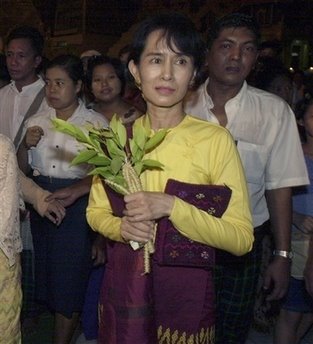


 Posts


