News & Articles on Burma
Friday, 23 September, 2011
----------------------------------------
Myanmar's Suu Kyi wins international relations prize
KIA bans cement imports from China
Burma tells IMF of economic optimism
Irrawaddy Events Held around Rangoon
Mon State Chief Seeks Peace Talks
Suu Kyi Attends 'Save the Irrawaddy' Art Event
Burma's Economic Growth Rate Projected at 8.8 Percent: Minister
Myanmar stands firm on Myitsone dam
For Burma, An Asean Solution
Burma seeing ‘rapid’ reform: think tank
Seven Burmese soldiers killed, two injured in Mongkoe
SSPP/SSA wishes to have peace with regime
------------------------------------------------
Myanmar's Suu Kyi wins international relations prize
Published on Sep 23, 2011
LONDON (AFP) - Myanmar democracy campaigner Aung San Suu Kyi has won this year's Chatham House prize for her contribution to the improvement of international relations, the British think-tank said on Friday.
The 66-year-old's fight to bring political change to Myanmar, for which she has had to spend most of the last two decades under house arrest, had made her an international symbol of democracy and peaceful resistance, it said.
'Her consistently measured and non-violent approach towards ending military rule in Burma has served as a powerful example to all those struggling to bring about democratic and accountable systems of governance in their countries,' said Chatham House director Robin Niblett.
Ms Suu Kyi was freed in November but her movements are still restricted by the ruling military junta in Myanmar, also known as Burma. http://www.straitstimes.com/BreakingNews/SEAsia/Story/STIStory_715830.html
-----------------------------------------
KIA bans cement imports from China
Created on Tuesday, 20 September 2011 10:03
Published on Tuesday, 20 September 2011 17:09 , Written by KNG
Chinese trucks on Myitkyina-Kambaiti road in eastern Kachin State, Northern Burma.
The Kachin Independence Army (KIA) has banned the transporting of cement from the China border to Kachin State, Northern Burma, KIA officials said.
The ban is aimed to stop construction of a huge dam at Mali-N’Mai Zup (Myitsone in Burmese), the Confluence of the Irrawaddy River (Mali Hka Nu in Kachin). The dam site is also one of the historic birthplaces of Kachin civilization, said KIA officials at its Laiza headquarters.
A KIA officer told the Kachin News Group, “The Myitsone dam construction is a threat to the public. Chinese workers transport construction materials from the border. We mainly banned cement.”
Other construction materials including metal, pipe and limestone powder are also banned by the KIA, according to border traders.
lam 4 engHowever, passenger travel and food imports from China are not banned, added the traders.
A resident of Waingmaw on the Myitkyina-Kambaiti border trade route said, “It is no problem for travelers and food imports and exports. But, cement imports are completely banned.”
There are four major border trade routes with China in Kachin State--- Myitkyina to Laiza (KIA), Myitkyina to Kambaiti, Manmaw (Bhamo) to Loije and Manmaw to Nam Hkam.
Chinese cement has been banned from those routes since June 9th, the day the Burmese government started its offensive against the KIA at Sang Gang, near Taping (Dapein) Dam, in N’Mawk Township, in Manmaw district.
The state-owned China Power Investment Corporation (CPI) and the military-backed Burmese government have been constructing the dam at Myitsone since December, 2009, neglecting the people of Kachin State.
On March 16, the Kachin Independence Organization (KIO), the political wing of the KIA, sent an open letter to Chinese President Hu Jintao, requesting him to stop construction of the Irrawaddy Myitsone dam because it will lead to civil in Burma.
Despite the KIA’s cement ban and the ongoing civil war in Kachin State, China is continuing construction of the Myitsone Dam as well as transporting construction equipment, according to the Kachin Development Networking Group (KDNG). http://kachinnews.com/news/2059-kia-bans-cement-imports-from-china.html
---------------------------------------------
Burma tells IMF of economic optimism
By JOSEPH ALLCHIN, DVB: Published: 23 September 2011
Burma’s economy expects growth rates of more than eight percent over the coming year, Finance Minister Hla Tun said in an optimistic address to the International Monetary Fund (IMF) in Washington DC.
The rise would largely be attributed to “growths in the agricultural sector and services sector”, he told the gathering, and were projected at 8.8 percent despite Burma’s ongoing currency crisis.
The IMF is expected to send a technical team to the country next month with a view to helping Burma with its “immediate needs for redesigning the prevailing exchange rate system,” which has cursed the economy for decades.
The comments made by Hla Tun were published on the website of the IMF.
Burma’s agriculture sector, which employs some 70 percent of the workforce, has however taken a big hit in recent months as exports dried up due to the nearly 25 percent appreciation of the kyat against the US dollar. This led to the dumping of agricultural commodities on the domestic market, which has reportedly pushed farmer to accrue huge debts.
But services have benefited from the strengthening of the currency, given that they cannot be traded outside the country.
Hla Tun further stated that the “policy focus of the elected government is based on the twin objectives of economic management and poverty alleviation.”
Economic management has recently seen the government reduce export taxes on key agricultural sectors in an attempt to offset the kyat’s rise and to lower slightly the country’s high interest rates. This it hopes will increase liquidity and decrease the value of the local currency.
However the finance minister only made vague reference to the country’s burgeoning debt, stating that it “has taken measures both in terms of revenue and expenditure consistent with the fiscal consolidation plans.”
This has, according to the Economist Intelligence Unit (EIU), seen the value of the government’s bonds grow by almost a third in the last financial year, although that figure was not released by the government despite Hla Tun stating that “the major thrust of these measures is to establish transparency”.
The EIU said that Burma has seen a “389% year-on-year rise in revenue from commodity, services and commercial taxes,” which formed part of a 260 percent rise in general tax revenue to some $US100 million.
No indication of where the government would consolidate spending was made – while tax revenues have risen to $US100 million, government spending on the military continues to eat up about a quarter of expenditure, costing the country some $US2 billion each year, slightly less than the country’s entire gas profits.
According to senior government adviser U Myint, the rampant corruption in tax collecting is responsible for incongruous export taxes.
U Myint has in the past questioned government growth figures, claiming in 2009 that “these growth rates have become highly politicised, and in the process, credibility and good sense have fallen by the wayside.” http://www.dvb.no/news/burma-tells-imf-of-economic-optimism/17803
------------------------------------------
Irrawaddy Events Held around Rangoon
By SAI ZOM HSENG Friday, September 23, 2011
Several ‘Save the Irrawaddy’ events took place around Rangoon on Friday with well-known singers and poets entertaining crowds while environmentalists and NGOs conducted workshops and seminars to promote the issue.
The Free Funeral Service Society (FFSS) and the self-named “Group that wants the Irrawaddy to Live Forever” held an event titled “Irrawaddy of Youth” at the FFSS headquarters in North Dagon Township, which was attended by writers, poets and musicians.
Speaking to The Irrawaddy on Friday, FFSS founder Kyaw Thu said, “Famous singers such as Ye Lwin, Saung Oo Hlaing, Zeya Thaw, Anaga, Yan Yan Chan and Yatha sang about the Irrawaddy River. Several people, including myself, read out poems and essays. All 500 people in attendance were very enthusiastic and united.”
Formerly a well-known actor, Kyaw Thu went on to say: “If we the people are the Mali River, the government is the N’Mai River. The Irrawaddy is what appears through the combination of those two rivers. I mean that the government and the people have to be united. When the government makes its decision in parliament on the future of the Irrawaddy and the Myitsone project, they must listen to the voice of the
At the Royal Rose Restaurant in Bahan Township, a group of environmentalists and activists held an open discussion about the Irrawaddy River, which is Burma's main artery and the provider of livelihoods for millions of people.
An increasing momentum has gathered across the country in recent weeks on the issue of the Chinese-financed megadam project in Kachin State and its subsequent impact on people and the environment. Many are calling for a permanent halt to the project.
An art exhibition promoting the “Save the Irrawaddy” theme was held on Thursday, attracting about 1,000 people including pro-democracy icon Aung San Suu Kyi.
http://www.irrawaddy.org/article.php?art_id=22133
---------------------------------------
Mon State Chief Seeks Peace Talks
By LAWI WENG Friday, September 23, 2011
The chief minister of Mon State, Ohn Myint, has formed a peace mission and requested permission from Naypyidaw to engage in talks with the New Mon State Party (NMSP), according to Mon sources.
“We heard that he (Ohn Myint) sent a proposal to Naypyidaw six days ago saying that he had formed a peace mission. He is waiting to get approval from Naypyidaw to have peace talks,” said Nai Tin Aung, a former executive member of the NMSP.
“It is good to talk each other, because the Mon could not move the government from power and the government could not destroy the Mon,” he added.
Nai Tin Aung said that because of the conflict between government forces and the NMSP, the people in Mon State are getting poorer and many are being forced by the circumstances to find work in Thailand.
He said that the peace mission consists of six persons, but declined to give their names since the group did not yet have approval from Naypyidaw.
“The six people include members of Ohn Myint’s government and members of Mon political parties,” Nai Tin Aung said.
Sources from the All Mon Regions Democracy Party in Moulmein, the capital of Mon State, said that the peace mission is led by Nai Lawi Oung, the minister of electric power and industry in Mon State, who was also a former NMSP central committee member.
Nai Hang Thar, the secretary of the NMSP and also the secretary of an umbrella group of ethnic parties called the United Nationalities Federation Council (UNFC), said, “The NMSP’s policy is we will not hold peace talks alone. The UNFC will lead the peace talks. But the UNFC members have agreed to talk individually to each state government to explain the policy.”
“If we didn’t agree to do this, it would be the same as blocking peace talks,” he added.
Although Burma’s pro-democracy leader Aung San Suu Kyi said she hopes to see signs of real change very soon in Burma, Nai Hang Thar said that every new government speaks about peace at the beginning their new term.
“We cannot believe everything the new government says. We need to continue to wait and see what they do,” he said.
Nai Tin Aung said that the current government could be compared to the story of a powerful king who stood in the middle of a ladder and asked the people whether he was stepping up or down.
“It depends on the king whether to step up or down, as he has power. This is similar to the current situation of the government. There can be a good or bad situations. It depends on them,” he said. http://www.irrawaddy.org/article.php?art_id=22132
----------------------------------------
Suu Kyi Attends 'Save the Irrawaddy' Art Event
By SAI ZOM HSENG Thursday, September 22, 2011
An art exhibition held in Rangoon on Thursday morning to promote a public campaign to save the Irrawaddy River attracted about 1,000 people including well-known writers, actors, politicians, environmentalists and pro-democracy leader Aung San Suu Kyi.
More than 100 photographs, paintings, drawings and cartoons were exhibited at Gallery 65 on Yawmingyi Road in central Rangoon.
Ye Naing Moe, one of the organizers, said that the event also featured the launch of a book about the Irrawaddy River.
Speaking to The Irrawaddy on Thursday, Ye Naing Moe said. “The name of the exhibition was ‘Save Ayeyarwady—The Sketch of a River’ and the name of the book is ‘An Image of a River’—it contains more than 200 photos.”
“When we travelled to the region we decided to document the scenes because we thought that people might never get a chance to see them in the future because of the Myitsone Dam, which is under construction. The public needs more information and knowledge about the Irrawaddy,” he said. “The government also needs to make the right decision with regard to the river and the dam.”
The Myitsone Dam project should not be allowed to continue without public participation in the decision-making process, said Ye Naing Moe, who is also a journalist.
If allowed to continue, the project when completed will be Burma’s second largest dam. Located in Kachin State at the source of the Irrawaddy River, the project was contracted by the Ministry of Electric Power-1 to AsiaWorld, a private Burmese company owned by Stephen Law who is blacklisted by US sanctions. The state-run China Power Investment Corporation is the main investor with rights to export all the electricity generated by the dam to China.
The dam's reservoir is expected to be completed by 2019, but thousands of people in Kachin State have already been forced to relocate.
During the exhibition, pro-democracy leader and Nobel Peace Prize laureate Suu Kyi addressed assembled reporters. “People need to unite if they are to achieve what they want,” she said.
All photographs and artwork were passed to the government's Press Scrutiny and Registration Division on Wednesday for approval, and three cartoons were prohibited from exhibition.
One of the cartoons belonged to Soe Thaw Tar, a well-known cartoonist in Burma. He said that his cartoon was removed from the show because it offended the government. He said its title was “Among the culprits, the historical culprit is the worst.”
Popular singer Anaga said that there are a lot of examples of civilians suffering from the consequences of dams, such as at the Mekong River and the Yangtze River. He said that people are more important than those projects.
“This exhibition is an expression via the arts,” said Anaga. “But the people who were forced to relocate, who were forced to leave their homes and who are suffering the consequences of the project also need to be able to express themselves.” http://www.irrawaddy.org/article.php?art_id=22124
-----------------------------------------
Burma's Economic Growth Rate Projected at 8.8 Percent: Minister
By LALIT K JHA Friday, September 23, 2011
WASINGTON—Burma’s economic growth is expected to be 8.8 percent this year, the country’s finance minister, Hla Tun, told the annual meeting of the International Monetary Fund (IMF) and the World Bank on Friday as he thanked the IMF for technical assistance in the area of exchange rate management and said that reforms are forthcoming.
“We are grateful for the technical assistance that we have received from the Fund especially in the area of exchange rate management,” Hla Tun said, adding that this assistance will provide Burma with valuable policy advice and training for unifying its multiple exchange rate capability to address immediate needs for redesigning the prevailing exchange rate system.
“We consider that the availability of technical and financial cooperation from the Bretton Woods institutions will support our economic development programmes and we believe that they can provide a parallel role in our future prosperity,” he said.
The Burmese finance minister said his country expects an economic growth rate of 8.8 percent in the first year a five-year plan. “This growth will be attributed mainly by the growths of the agricultural sector and services sector,” he said.
Referring to the formation of the new government after last year’s general elections, Hla Tun said the government aims at achieving sustainable developments on all fronts through a number of reforms.
“The major thrust of these measures is to establish transparency and accountability at all levels of government. The policy focus of the elected government is based on the twin objectives of economic management and poverty alleviation,” he said.
Hla Tun said efforts are being made toward further banking and financial sector modernization by implementing an Electronic Banking Network and Payment System. Measures have been taken to strengthen the Central Bank’s supervisory and regulatory powers. Necessary instructions and guidelines have been issued in order to maintain the stability of the banking sector.
Meanwhile in Geneva, US Ambassador Eileen Donahoe told the Human Rights Council that the Burmese government continues to denies its citizens basic rights, including freedom of speech, movement and association.
“There are roughly 2,000 political prisoners, and ongoing attacks against ethnic minority populations have resulted in the displacement of millions of people, both internally and in the region, over the past five decades,” Donahoe said.
“The newly formed National Human Rights Commission should work closely with the HRC and other bodies to investigate human rights abuses and take concrete steps to begin a national reconciliation process,” Donahoe said, adding that the US urges the Burmese government to follow its words and commitments with concrete actions that lead to genuine reform, national reconciliation and respect for human rights. http://www.irrawaddy.org/article.php?art_id=22129
--------------------------------------
Myanmar stands firm on Myitsone dam
By Staff Writers
Yangon, Myanmar (UPI) Sep 22, 2011
Work continues on a $3.6 billion hydropower dam project in Myanmar on the Irrawaddy River despite widespread objections.
The Myitsone Dam, a joint effort by Myanmar's military government and the China Power Investment Corp., is expected to produce 6,000 megawatts of electricity, about 90 percent of it to be exported to China. Under an agreement signed by Chinese and Myanmar officials, CPI will receive 70 percent of the project's profits.
CPI is planning to build and operate six additional dams on the Irrawaddy and its tributaries.
Environmentalists have said the dam in Myanmar's northern Kachin state will wreck the ecology of the Irrawaddy and now a growing list of activists, intellectuals, parliamentarians as well as former military officers are voicing opposition to the project, Asia Times Online reports.
The Kachin Development and Networking Group warns that more than 15,000 people in 60 villages are being forced to relocate without proper resettlement plans and millions more downstream would be affected.
Creation of the Myitsone Dam's reservoir will flood an area larger than Singapore KDNG says.
In an open letter last month, Myanmar's noted dissident, Nobel Peace Prize laureate Aung San Suu Kyi urged that the project be reassessed.
The Irrawaddy River is "the most significant geographical feature of our country," she wrote, and "the grand natural highway, a prolific source of food, the home of varied water flora and fauna" supporting traditional modes of life.
Even an environmental impact assessment of the project, fully funded by CPI, stated: "The fragmentation of the Irrawaddy River by a series of dams will have serious social and environmental problems not only at upstream of dams but also far downstream in the coastal area.
"There is no need for such a big dam to be constructed at the confluence of the Irrawaddy River."
The report also warned that the Myitsone site is less than 62 miles from the earthquake-prone Sagaing fault line.
While environmental activists and political groups have launched campaigns to urge the government to reconsider the project, Myanmar's Minister for Electric Power Zaw Min insists Myitsone will proceed as planned and that it is in the country's national interest.
Construction, which began in 2009, is to be completed in 2018.
"We'll keep working on the Myitsone Project. We'll never back down," Min said. "We won't halt this project in spite of objections from environmental groups." http://www.terradaily.com/reports/Myanmar_stands_firm_on_Myitsone_dam_999.html
---------------------------------------------
For Burma, An Asean Solution
A. Lin Neumann | September 23, 2011
When I first visited Burma, on Sept. 17, 1988, it was to report on a massive popular uprising and what I thought would be the advent of democracy in a country that even then had been under the heel of the military for 26 years.
Instead of democracy, the next day a faction of the military brutally seized power and ushered in a period of even greater isolation that has lasted for 23 years.
But it now looks as if Burma has learned its lesson. Having installed a military-approved government through controlled elections in 2010, Burma is coming out of its cocoon and the international community is getting ready to accept one of its most errant members back into the fold. The process will get a big boost next month when Indonesian Foreign Minister Marty Natalegawa visits to assess whether the country is ready to take its turn in 2014 as the chair of the Association of Southeast Asian Nations.
Almost certainly the answer will be yes.
Opposition icon Aung San Suu Kyi, who was under house arrest for most of the last two decades before being released by the new government, has been in talks with President Thein Sein and has said she is cautiously optimistic.
“I think there have been positive developments,” the Nobel Peace Prize laureate said in an interview with Agence France-Presse this week.
Burmese exiles have been invited home and some are beginning to accept.
“We are getting ready to go home,” a Burmese journalist who fled Rangoon in 1988 told me recently. “We do not know what to expect but the time is coming.”
So what can we expect of a semi-free Burma ruled by former generals in civilian attire?
I suspect it will be just a classier form of political repression, minus the military boot openly on the neck of the nation. The country already has a freer press than it did even a year ago by most accounts, and Facebook and Twitter are growing. There is less fear of being snatched off the street and thrown into prison just for voicing a contrary opinion, recent visitors say. It is repressive, but “better.”
In short, Burma seems ready to adopt Asean-style authoritarianism.
For all the world’s insistence that Burma become democratic, that was never in the cards. The generals have spilled too much blood and have had their hands on too much money to allow for a free-wheeling democracy.
Given the current setup, where the military’s ruling party is guaranteed to win any election and can pass any law it wishes, the country is moving rather quickly toward the kind of non-democracy found in most Asean countries. Cambodia, Vietnam and Laos are under the firm control of one party. Brunei is a sultanate. Malaysia and Singapore, despite recent gains by the opposition, have been virtual one-party states since their founding. Only Thailand, the Philippines and Indonesia buck the trend.
Burma’s mistake has been its inability, until recently, to recognize that unapologetically shooting people in the streets or using truncheons on peacefully protesting monks, as it did in 2007, is too much even by Asean’s mild standards of human rights.
Telling outrageous lies in government-controlled newspapers in a tone reminiscent of the Stalin era in the Soviet Union is laughably counterproductive. China, India and a handful of other countries have ignored the outrages and pressed ahead with investment in Burma, but a somewhat more open climate is necessary if the enormous untapped potential of what was once the wealthiest economy in Southeast Asia is to be realized.
And perhaps the Burmese people understand that they will only get so much.
Suu Kyi spoke this week of reconciliation, saying “both sides have to be prepared to compromise and give and take.” My Burmese exile friend said there was no need for retribution and that he and his allies just wanted to be part of their country again.
In short, Burma has to allow its people enough freedom that it will no longer be an embarrassment to its neighbors, while remaining repressive enough to keep the generals secure.
It is not a perfect arrangement, but it is a start and probably the best anyone can hope for.
A. Lin Neumann is a senior adviser to the Jakarta Globe. http://www.thejakartaglobe.com/opinion/for-burma-an-asean-solution/467109
____________________________
Burma seeing ‘rapid’ reform: think tank
By FRANCIS WADE, DVB:Published: 23 September 2011
Burma seeing ‘rapid’ reform: think tank thumbnail
ICG report pointed to Suu Kyi's meeting with Thein Sein as a sign of progress (Reuters)
Major political reform has occurred in Burma since the appointment of the “ambitious” and “refreshingly honest” President Thein Sein in March, according to think tank International Crisis Group in a report that suggests Burma is heading toward genuine democracy.
The report characterises Thein Sein, who was prime minister under the former junta, as eager to reach out to the political opposition and settle seemingly intractable conflicts between the central government and ethnic minority groups.
Jim Della-Giacoma, International Crisis Group’s Southeast Asia Project Director, told DVB that the pace of reform there has picked up since mid-July, three months into Thein Sein’s tenure, “in a way that has surprised observers”.
He pointed to “concrete, albeit small” signals that the new administration was breaking with the nearly half century of military that drew a cloak over Burma and pushed the economy to near ruin.
“Aung San Suu Kyi’s trip to Pegu [in May], for example, allowed to engage in political activity and exercise her political right”, he said. Other positive signs he pointed to were the lifting of a ban on foreign news websites and Thein Sein’s first meeting with Suu Kyi in August, who has spent years on the sidelines of Burma’s political arena.
That view was echoed by long time Burma analyst Larry Jagan, who claimed there was “little doubt” that Thein Sein is “an honest man who wants to push democratic change forward”.
However he cautioned against the conflicts of interest within the government that pit hardliners against “liberal-minded ministers” like Thein Sein. “There is a real possibility of change, and the international community should try and support it. To dismiss it is foolish.”
Asked whether the signs of reform may be duplicitous, as a number of observers have argued, and that they intend to only give a cosmetic lift to the nominally civilian government, Della-Giacomo said that any sort of reform inevitably begins at the rhetorical level.
“This is going to start with words, and words are important. They have to start talking at the highest level, and continue the dialogue they’ve been having in parliament.
“But the way these discussions have been happening, and that they are reported in the local media, shows that there is a new commitment to discussion, and that in itself is a small but significant step.”
While agreeing with the overall sentiment of the report, David Mathieson, Burma researcher at Human Rights Watch, said that areas of the analysis were perhaps too optimistic.
For a start, he said, Thein Sein “is a product of the system”, referring to his high position in the former junta and close relationship with retired dictator Than Shwe, and was a key player in creating many of the crises that have enveloped the country. Therefore his actual commitment to change must be closely scrutinised.
He also questioned the apparent faith the report places in the newly-formed National Human Rights Council, which should be strengthened by the international community in light of what it sees as a highly unlikely possibility that the mooted UN probe into human rights abuses would ever take shape.
“Could the Human Rights Council handle war crimes enquiries? I don’t think so. Something created by the government couldn’t really look at the serious culture of abuse in the Burmese military that continues despite pledges of reform,” Mathieson said.
The report further suggests that ASEAN should hand the 2014 chair to Burma, something Della-Giacomo said would spur the government to faster reform.
Mathieson said that while Burma does not deserve the chairmanship, “neither do half of the ASEAN governments”. An offer however would challenge the government to meet core benchmarks. “It would be embarrassing for Thein Sein if other countries boycotted the [2014] summit because Burma still had political prisoners,” he said. http://www.dvb.no/news/burma-seeing-%E2%80%98rapid%E2%80%99-reform-think-tank/17799
----------------------------
Seven Burmese soldiers killed, two injured in Mongkoe
Created on Monday, 19 September 2011 17:00
Published on Monday, 19 September 2011 17:00 ; Written by KNG
mong koeSeven Burmese soldiers were killed and two injured on Sunday, Sept. 18, during fighting with the Kachin Independence Army (KIA) in Munggu, also Mongkoe, Northern Shan State, witnesses said.
The 20-minute battle happened between KIA troops under the Mongkoe-based Battalion 36 and government troops from the Mongsi (Mungji)-based Infantry Battalion No. 290, between Mandat and Panghuk, about seven miles south of Mongkoe, a witness from Mongkoe said.
A KIA officer confirmed the number of dead and injured to the Kachin News Group.
The officer said there were no KIA casualties.
The Burmese Army is sending fresh reinforcements to the area according to local people.
Fighting has been occurring between government troops and the KIA in Kachin State and Northern Shan State since the government started an offensive against the KIA at Sang Gang on June 9. http://www.kachinnews.com/news/2058-seven-burmese-soldiers-killed-two-injured-in-mongkoe.html
--------------------------------------------
SSPP/SSA wishes to have peace with regime
Friday, 23 September 2011 16:53 Hseng Khio Fah
The Shan State Progress Party/Shan State Army (SSPP/SSA) that has been fighting against the regime since March says it is ready to stop fighting because it is just innocent civilians who have to suffer, therefore it is better to meet and talk for peace instead, according SSPP/SSA spokesperson Major Sai La.
“We are concerned about the civilians. Because wherever the fighting takes place, villages that are located nearby are always being abused and killed by the Burma army soldiers. We therefore want them to withdraw and to stop killing and abusing the civilians,” Sai La said.
According to an unconfirmed report, SSPP/SSA representatives were in Taunggyi, capital of Shan State, to meet Sao Aung Myat, Chief Minister of the Shan State last week for peace talks.
“I have not received any information from our central committee yet,” Sai La replied. “So I can’t confirm your information.”
Despite its readiness for the conclusion of fighting, the group is depending on its alliance the 12-member United Nationalities Federal Council (UNFC) to negotiate the political agreement with Naypyitaw.
“But we will never surrender. And we will also never transform ourselves into a militia force,” Sai La added.
Following the invitation for peace talks by Naypyitaw on 18 August to negotiate at the state/region level “groupwise”, the UNFC made an announcement demanding direct negotiations between Naypyitaw and itself. Its 23-25 August meeting also appointed an 8 member negotiating team headed by grouping’s Secretary General nai Hongsa.
To date, reports of fighting between the Burma Army and the SSPP/SSA are still coming in.
Yesterday, a clash was taken place between a 50 strong Burma Army unit from Light Infantry Battalion (LIB) #506 led by Major Zaw Win Naing and some dozens of SSA fighters led by Captain Sai Yone in Shan State North’s Hsipaw township, Natung village tract, near Wan Park village when one was killed and 7 wounded on the Burma Army side while no casualties were reported from the SSA side, according to SSA.
The Burmese military started military operations against its [the SSPP/SSA] on 13 March, effectively ending the almost 22 year ceasefire pact between the two. The regime also attacked another ceasefire group, Kachin Independence Army (KIA) on 9 June. http://shanland.org/index.php?option=com_content&view=article&id=4056:ssppssa-wishes-to-have-peace-with-regime&catid=85:politics&Itemid=266
Saturday, September 24, 2011
News & Articles on Burma-Friday, 23 September, 2011-uzl


Friday, September 23, 2011
News & Articles on Burma-Thursday, 22 September, 2011-uzl
News & Articles on Burma
Thursday, 22 September, 2011
----------------------------------------
Aung San Suu Kyi foresees change in Myanmar
Anti dam protests erupt in Myanmar
Controversy Over Dam Fuels Rare Public Outcry in Myanmar
West 'should respond to Burma change', says think-tank
Myanmar's forgotten bourse eyes long-awaited expansion
Burma ‘not ready for unions’: minister
Suu Kyi urges world to keep eye on Burma
UN told Burma has no nuclear weapons
--------------------------------------
Aung San Suu Kyi foresees change in Myanmar
News DeskSeptember 21, 2011 19:02
Aung San Suu Kyi, foresees "signs of real change very soon" in Myanmar but has urged the world not to take its eye off her country.
Suu Kyi, speaking via fuzzy satellite linkup to a gathering of former and current world leaders in New York led by former U.S. President Bill Clinton, sections of which were broadcast on the BBC, said:
"I've had talks with some of the representatives of the government and we hope that we are going to see signs of real change very soon.
"There has been a lot of talk about change, but people always want to see something concrete. And they're right, too. Talk is never enough. But at least it's a beginning. And I think we're beginning to see the beginning of change."
Aung San Suu Kyi, 66, is head of the National League for Democracy, which won a landslide victory in 1990 elections but was unable to wrest power from the military junta.
A Burmese opposition icon, Suu Kyi has herself has been either imprisoned or under house arrest for a combined 15 years since she returned to Myanmar, formerly known as Burma, from England in 1988, according to Bloomberg. She was released last November and has since held talks with the country's nominally civilian government, she said.
According to AFP, Suu Kyi downplayed comparisons with so-called Arab Spring revolts in North Africa and the Middle East that brought down decades-old dictatorships and were facilitated by social networking sites.
"I don't think the [social] media has quite the position here that it had in the Arab countries," she said, referring to Myanmar's tightly controlled Internet use. "In Burma, we do not have such a developed communications system."
However, she said, all people around the world "can understand 'life, liberty and the pursuit of happiness.'"
India and Pakistan are the powerhouses of South Asia as well as historic enemies. How do their military forces stack up today?
Last week's winner compares the military might of two continually feuding countries. Check the membership site in late-September for a link to completed piece.
"The idea of freedom and security, beautifully balanced, is a concept that is acceptable to human beings across the world. This is what we know: people want to be free and they want to feel secure as well," she said, Bloomberg reports.
Fellow Nobel Peace Prize recipient Archbishop Desmond Tutu of South Africa, also speaking at the Clinton Global Initiative forum in New York, told Suu Kyi that seeing and hearing her left him "like a smitten young man."
"I love you!" Tutu, who turns 80 next month, told Suu Kyi.
Suu Kyi told him the feeling was mutual.
"I must return the compliment and say: 'I love you,'" she replied, News24 reports.
Tutu added, "quite seriously," that he was looking forward to visiting Myanmar upon her inauguration as "head of government there."
Suu Kyi also said that she hadn’t expected her struggle to take so long:
"All journeys are made step by step. To be quite honest, I didn't think when I first started out in the movement for democracy... I'd have to devote my whole life to it." http://www.globalpost.com/dispatch/news/regions/asia-pacific/110921/aung-san-suu-kyi-new-hope-myanmar-burma-democracy
---------------------------------
ONE-WORLD NET
Anti dam protests erupt in Myanmar
22 September 2011
Myanmar’s activists have launched a series of nation wide campaigns to oppose construction of a hydroelectric dam at Ayeyarwady River in Kachin. Dam construction has forcefully displaced over 15,000 people across sixty villages without resettlement plans from the State.
Yangon: Resistance is growing to a hydroelectric dam being built at the beginning of the Ayeyarwady River in Myanmar's northern Kachin State, with several campaigns to halt construction under way.
Opponents to the Myitsone Dam have been collecting signatures, circulating posters, organizing meetings, and speaking out to foreign media. Some residents affected by the dam project have remained in their villages as a form of silent resistance.
myanmar.jpg
More than 15,000 people could be displaced/ Photo credit: Contributor/IRIN
"The government should listen to the voice of the people, if they really practise a democratic system," Bauk Char, a Kachin activist, who has been calling for a halt to the dam's construction, told IRIN.
Environmentalists say the dam, with a flooding area larger than Singapore, will have a devastating impact on the environment and livelihoods. More than 15,000 people in 60 villages are being forced to relocate without proper resettlement plans, according to the Kachin Development Networking Group (KDNG).
"This kind of undemocratic resource exploitation by the Burma [Myanmar] military government can never be sustainable and never lead to peace and reconciliation in Burma," Ah Nan, a KDNG spokeswoman, said. "War has already started in Kachin State and will only get worse if this exploitation continues."
Fighting broke out in June between government forces and the Kachin Independence Army (KIA), the military wing of the Kachin Independence Organization (KIO), ending a 17-year ceasefire and displacing more than 25,000 people.
The dam - a joint effort by Myanmar's military government and the China Power Investment Corporation - is expected to produce 6,000MW of electricity that the government will sell to China, bringing in more than US$500 million annually. Construction began in 2009, just 1.6km below the confluence of Mali and N'Mai rivers - the natural heritage and cultural heartland of the Kachin people, locally known as Myitsone.
"We'll never back down"
Resistance to the project has escalated in response to a recent announcement by Zaw Min, Minister of Electric Power, who said at a press conference in Naypyidaw, the capital, that the government would proceed with the project despite objections. Government officials maintain the dam will not affect water levels on the Ayeyarwady River, nor have any adverse environmental effects, saying it will utilize only 7 percent of the water flow.
"We'll keep working on the Myitsone Project. We'll never back down," Zaw Min said. "We won't halt this project in spite of objections from environmental groups."
Zaw Min is also being criticized for saying the government is providing as much as 1,500MW for domestic use - way beyond current demand. That is why the government, he said, can sell surplus electricity to other countries in the future.
"This is not true," said Myat Thu, an organizer for one of the campaigns to save the Ayeyarwady, Myanmar's longest river, which provides millions of people with a livelihood. "A large part of the country has seen severe power shortages."
According to government figures, only 2,000 out of about 60,000 villages across the nation have access to electricity. Some parts of Yangon, the country's largest city and commercial capital, experience frequent blackouts.
Aung San Suu Kyi, a Nobel laureate, has joined the growing appeals to save the Ayeyarwady and called for a reassessment of the Myitsone Dam, which would be 152m high when it is completed in 2017.
"We'll keep raising the public awareness [on the dam issue] by holding talks, by delivering stickers, etc.," said Win Cho, a politician and activist calling for a halt to the dam project. "We will keep inviting more people to join with us."
Source : IRIN http://southasia.oneworld.net/todaysheadlines/anti-dam-protests-erupt-in-myanmar
----------------------------------
Controversy Over Dam Fuels Rare Public Outcry in Myanmar
The International Herald Tribune
The Myitsone dam under construction on the Irrawaddy River in northern Myanmar.
By THE INTERNATIONAL HERALD TRIBUNE
Published: September 21, 2011
MYITSONE, MYANMAR — The massive dam under construction in this remote corner of Myanmar is generating a litany of concerns that are not uncommon to such projects: about the risks of tampering with nature, about damage to wildlife, about the displacement of villagers.
But for many people in Myanmar, also known as Burma, the fears surrounding the Myitsone dam go much deeper. It will be the first dam across the Irrawaddy River, the iconic, even mythic waterway that has given life to centuries of Burmese civilization.
Passions are high. A government minister broke down in tears at a news conference last month when asked about the dam. High-ranking officials are said to be sharply divided over the wisdom of the project.
And in an authoritarian country that has begun to experiment with looser controls on the news media, the controversy has raised the prospect of something exceedingly unusual: that public outrage might actually force the government to reconsider its plans.
The Myitsone dam will flood an area four times the size of Manhattan. Government officials who support the project say it will be an invaluable source of electricity and cash, a milestone in Myanmar’s development. Critics say it will cause irreparable damage to the Irrawaddy, the lifeline of millions of Burmese downstream.
“The people are demanding to stop the project,” said U Ludu Sein Win, a dissident writer who is one of the most outspoken critics of the dam. “If the righteous demands of the people are ignored and they continue the dam project,” he wrote in Weekly Eleven, a popular Yangon-based newspaper, “the people will defend the Irrawaddy with whatever means possible.”
Such strident criticism of a government project in the domestic media, which would have been unheard of just months ago, reflects both the passions surrounding the project and the easing of some restrictions on expression by Myanmar’s new, at least nominally civilian government, which took office in March after decades of overt military dictatorship.
The Myitsone dam, which is being built and financed by a Chinese company, has also become a lightning rod for criticism about China’s power and influence in Myanmar.
Here at the dam site, Chinese workers in orange hard hats have been tunneling, blasting and shoring up riverbanks. The site is a few kilometers downstream from what is considered the “birthplace” of the Irrawaddy — the confluence of two smaller rivers — a place that has mystical value for the Kachin ethnic group that populates the hills of northern Myanmar. (The Kachin have a substantial army that has battled with troops from the central government in recent months, underscoring the instability in the area surrounding the dam site.)
Criticism of the project has been allowed to spread through Facebook, blogs and even local newspapers, suggesting that the government itself may be divided on the issue. Last month the country’s most famous dissident, the Nobel Peace Prize laureate Daw Aung San Suu Kyi, who has otherwise been cautious in her criticisms of the government since her release from house arrest last November, penned an open letter calling for the project to be reassessed.
Critics’ reasons for opposing the Myitsone project vary. Some say they are angry because the decision to begin such a huge project was made without public consultation. Others channel their frustration toward China, which plans to import 90 percent of the electricity the project generates, under financial conditions that have not been fully explained to the public.
“China has colonized Burma without shooting a gun and has sucked the life of the people of Burma with the help of the Burmese regime and its cronies,” wrote U Aung Din , a former democracy advocate who is now in exile in the United States. “Now, they are killing the Irrawaddy River as well.”
In April, four small blasts were reported at the camp in Myitsone where Chinese workers have their sleeping quarters. No one was seriously hurt.
But perhaps the greatest concern among critics of the dam is that it will further degrade a river that has played such a crucial role in Burmese history.
The Irrawaddy draws on glacial waters from the eastern extremities of the Himalayas. As it travels south, the river carries nutrients into Myanmar’s arid central region and ultimately fans out in the Irrawaddy Delta, an area of rice paddies so fertile that it once fed large parts of the British empire in Asia. Like the Mekong or the Mississippi, the river carries enormous symbolism.
“It is the most significant geographical feature of our country,” wrote Ms. Aung San Suu Kyi in her letter, which also aired concerns about the dam being near an earthquake fault zone. The Irrawaddy, she wrote, is “the grand natural highway, a prolific source of food, the home of varied water flora and fauna, the supporter of traditional modes of life, the muse that has inspired countless works of prose and poetry.”
Indeed, leading poets have chimed in on the controversy, including U Maung Sein Win, who wrote a short poem called “Dead River,” which includes this passage:
Whole forests are cleared and
mountains laid bare
Sand bars emerge at the narrows
Not so far in the future, Myanmar’s people may disappear
Did we drink our own blood?
This is the frightening thought
That one day the river might be dead.
Unaccustomed to such a barrage of criticism, the government is on the defensive. The information minister, U Kyaw Hsan, wept when questioned about the project at a news conference in August. “We love the Irrawaddy,” said Mr. Kyaw Hsan, who is a retired brigadier general.
“We will protect the Irrawaddy just like other citizens would.”
The government official responsible for the dam, U Zaw Min, was adamant at a meeting this month that it would be completed. “We will never rescind it,” he said at one of the occasional news conferences that appear to be gestures by the government toward openness.
But his staunch defense of the project led to further anger.
On Saturday, at a government-sponsored seminar, Mr. Zaw Min seemed ready to offer concessions to minimize the impact of the dam and “ensure the project poses no danger.” Those words were highlighted in bold in an account of the seminar that appeared in the state-owned newspaper The New Light of Myanmar. The dam would be built to resist a thousand-year flood and an earthquake of magnitude 8, the article said.
That was the official account of the meeting. In the Burmese-exile news media, reports said a “heated argument” over the dam had broken out between officials. Myanmar’s president, U Thein Sein, considered by many to be a moderate force in the government, was said to be against the project, according to The Irrawaddy , an online news service based in Thailand. Hard-liners were said to be pushing ahead. The accounts could not be confirmed.
Critics of the dam say it is significant that skepticism of the project extends even to the scientists who were hired by the Chinese project managers to assess it.
China Power Investment , a state-run Chinese company, signed a deal in 2007 with the Burmese government to build seven dams in northern Myanmar, including the one at Myitsone. Although not required to do so under Myanmar’s laws, China Power Investment hired scientists from China and Myanmar to assess how the dam would affect the environment. In 2009, the scientists submitted a report of nearly 900 pages that seemed to question the dam’s very premise.
“If Myanmar and Chinese sides were really concerned about environmental issues and aimed at sustainable development of the country there is no need for such a big dam,” said the report, which was written in choppy English.
Rather than build the massive Myitsone dam, the scientists’ report suggests constructing two smaller dams farther upstream. It warns ominously that the Myitsone site is “less than 100 kilometers from Myanmar’s earthquake-prone Sagaing fault line,” a distance of a bit more than 60 miles.
The report also predicts “substantial losses” in fish populations downstream, and says that more time is needed to understand how wildlife in the area would be affected. Scientists who fanned out into the nearby jungles found sun bears, leopards, elephants, many types of monkeys and red pandas, an endangered auburn-colored animal that resembles a cross between a raccoon and a bear.
The report also recommends that more research be done on the potential effects on other inhabitants of the region: people. The dam is still several years from completion, but thousands of villagers have already been resettled from their rice paddies and fishing villages into prefabricated homes. They were given, among other compensation, 21-inch television sets.
“We can’t make a living in our new place,” Aung San Myint, a father of three who now mines the riverbanks for flecks of gold, told a reporter. “There’s nothing for us there.” http://www.nytimes.com/2011/09/22/world/asia/controversy-over-dam-fuels-rare-public-outcry-in-myanmar.html?_r=1&ref=global-home
-----------------------------------
BBC News
22 September 2011 Last updated at 12:00 GMT
West 'should respond to Burma change', says think-tank
By Rachel Harvey BBC South East Asia Correspondent
An influential think-tank has urged Western nations to acknowledge and support what it calls the major changes taking place in Burma.
The International Crisis Group (ICG) says there is now a unique opportunity to engage with the country's relatively new civilian-led government.
But some pro-democracy campaigners remain wary of easing the pressure on the Burmese leadership.
They say they want to see concrete signs of genuine reform.
'Not assured'
The ICG says there is growing evidence that the new administration in Burma is serious about reform and Western powers should adapt their policies to reflect the new reality.
The group is calling for a proactive and engaged approach to grasp what it calls this unique opportunity.
The group has long taken the view that sanctions have failed. But there is a new urgency in the tone of its argument now.
The Burmese government has made a number of conciliatory gestures in recent weeks - easing restrictions on the media, allowing a visit by the United Nations human rights envoy and holding meetings with pro-democracy leader Aung San Suu Kyi.
But opinion is divided as to how the outside world should respond.
Some pro-democracy campaigners are urging caution, saying the steps taken by the Burmese government thus far are merely superficial.
Until or unless all political prisoners are released and a process of genuine national reconciliation is under way, they say, Western pressure and sanctions should be maintained.
Perhaps the most influential voice in this debate is that of Aung San Suu Kyi.
In her view there are signs that change is now possible in Burma, but she says "it is not yet assured". Few would disagree with that. http://www.bbc.co.uk/news/world-asia-pacific-15018276
----------------------------------------
Myanmar's forgotten bourse eyes long-awaited expansion
22/09/2011 - 3:36 - By Aung Hla Tun
YANGON (Reuters) - In a quiet room in an ageing office block of Myanmar's commercial capital Yangon, a worker scribbles on a whiteboard beneath a row of out-of-sync clocks, updating prices in what could be the world's smallest stock market.
Welcome to the Myanmar Securities Exchange, among the best-kept secrets of a repressive country hamstrung by Western sanctions and blighted by 49 years of military rule.
There's no trading floor, no flashing screens and no televisions showing financial news channels. Just eight employees who handle over-the-counter transactions and manually update share prices, using a whiteboard, a marker pen and a stencil. Every so often, a customer drops by.
Set up 15 years ago as a joint venture with Japanese broker Daiwa Securities Co, Myanmar's stock market has attracted just two companies -- an echo of broader problems in the resource-rich country that half a century ago was among Asia's wealthiest and today is among its poorest.
But as Myanmar's new civilian government presses ahead with reforms that could lead to greater political and economic freedom, and as China pumps in billions of dollars to develop its vast energy reserves, plans are a afoot to expand the exchange.
Daiwa is working with the Tokyo Stock Exchange to establish rules and computer systems for a bigger stock market, a Daiwa spokesman said. The plan expands on Daiwa's 50-50 joint venture established in 1996 to set up the current exchange with Myanmar's Finance and Revenue Ministry.
"With the new administration, there has been growing interest in developing a financial system, so we, Daiwa and the Tokyo Stock Exchange are now in cooperation to contribute to the development of Stock Exchange system," Daiwa said in an e-mailed response to questions from Reuters.
Mainland Southeast Asia's biggest country has been one of the world's most difficult for foreign investors, restricted by sanctions, starved of capital and marred by mismanagement.
But its eight-month-old parliament is stirring hopes of reforms that could slowly open the country of 50 million people that just over 50 years ago was one of Asia's most promising, the world's biggest rice exporter and a major energy producer.
A senior official from the Ministry of National Planning and Economic Development said the government wanted to expand the number of listed companies as part of efforts by the 10-nation Association of South East Asian Nations (ASEAN) of which Myanmar is a member, to form an interlinked stock market by 2015.
"The emergence of a stock exchange is very important for us in bringing the country in line with the rest of ASEAN," said the official, who asked not to be identified.
"Some important laws have already been drafted. After enacting these laws, the Securities and Exchange Committee will be formed. Then there will be rapid progress," he predicted.
That ambition is one of many signs of change since the army nominally handed power to civilians after the first elections in two decades last year, a process ridiculed at the time as a sham to cement authoritarian rule under a democratic facade.
Recent overtures by the government hint at possibly deeper changes at work -- from calls for peace with ethnic minority guerrilla groups to some tolerance of criticism and more communication with Nobel peace prize laureate Aung San Suu Kyi, who was freed last year from 15 years of house arrest.
The push to expand the bourse also underlines how competition is heating up among regional exchanges in Asia's so-called frontier markets following recent South Korean forays to help build stock exchanges in Cambodia and Laos.
TRICKLE OF CUSTOMERS
Myanmar's first stock exchange was closed in the 1960s after a military takeover. Its successor, the Myanmar Securities Exchange Centre (MSEC), is a modest operation. A trickle of customers each week buy and sell shares in two listed companies on a bourse few Burmese or foreign investors know exists.
No new companies have signed up beyond the first two: Forest Products Joint Venture Corp (FPJVC) and Myanmar Citizens Bank. Both are jointly owned by the government and private investors.
For those who got in early, returns have been generous. FPJVC sold shares between 1993 and 1996 -- mainly to well-connected bureaucrats -- and has delivered dividends of about 25 percent a year, more than double local bank interest rates.
"If possible, we'd like to buy some more shares of FPJVC," said Zaw Win, 76, a retired officer from the Ministry of Forests whose 15 shares bought in 1993 have more than doubled in value.
Daiwa signed a deal on April 5, 1996, to start the exchange but within a month the pact was cast into uncertainty, as the military junta began rounding up hundreds of pro-democracy supporters in a crackdown on Suu Kyi.
That sparked outcry in the West. Thousands of pro-democracy supporters rallied in Yangon. U.S. soft drink giant PepsiCo Inc sold its stake in a Burma venture. U.S. apparel firms cancelled contracts with Burmese suppliers. The White House urged Burma to halt its "pressure tactics."
A year later, in response to widening human rights abuses, the United States imposed sanctions. The junta tightened its grip on power. Economic reforms withered.
The exchange's executive director, Soe Thein, a former official in the Finance and Revenue Ministry, assembled a small team of staff to draft laws and regulations, raise public awareness and set up a securities exchange commission to achieve his dream of a capital market within five or six years.
"But it failed to come up to our expectations," he said.
Much like neighbouring Thailand and India, which both have thriving capital markets, Myanmar has enormous potential for tourism and development, boasting rich natural resources -- from gas to teakwood and gemstones.
Its new government has promised sweeping reforms -- from tax reductions for exporters to micro loans for farmers, interest rate cuts on bank loans and higher returns on savings. In recent weeks it has sought input from the International Monetary Fund about unifying its official and unofficial exchange rates.
The recent gestures followed expansion of fledgling banking and telecommunications sectors and the privatisation of hundreds of state assets from late 2009, including mining firms, an airline, gas stations, cinemas, shipping companies and factories, albeit mostly to cronies of the former army regime.
But its banking system is crippled by sanctions, which most expect to stay in place until the government releases an estimated 2,100 political prisoners.
Soe Thein, however, remains optimistic.
"It takes time to set up public companies," he said.
And his little bourse may even soon face competition. South Korean bourse operator Korea Exchange said in January it had sent a delegation to Myanmar to hold preliminary talks with the government about the possibility of opening a separate exchange.
The firm is already involved in running the new Laos Securities Exchange and is setting up a long-delayed stock market in Cambodia. Both are joint ventures with the respective governments.
(Additional reporting by Timothy Kelly in Tokyo; Writing by Martin Petty; Editing by Jason Szep and Robert Birsel) http://www.eleconomista.es/empresas-finanzas/noticias/3393146/09/11/Myanmars-forgotten-bourse-eyes-longawaited-expansion.html
------------------------------------------------
Burma ‘not ready for unions’: minister
By AHUNT PHONE MYAT
Published: 22 September 2011
The current political situation in Burma makes the formation of labour, farmers’ and student unions untenable, and future efforts at organizing will be tightly monitored by the government, Information Minister Kyaw Hsan told MPs yesterday.
Unions have in the past existed in Burma, but were gradually stamped out following the start of military rule in 1962. Although not illegal, a clause in the 2008 constitution states that their formation is conditioned on not being “contrary to the laws enacted for [Burma’s] security, prevalence of law and order, community peace and tranquillity, or public order and morality”. The subsequent definitions for these criteria are vague.
Kyaw Hsan said the government was concerned that unionizing would see a recurrence of the problems that occurred during Burma’s brief spell of democracy following the end of British rule in 1948, when many were formed as proxies for parties vying for political clout.
He cited the use of farmers’ unions by Burma Communist Party leaders in the 1950s to impose their control over the agriculture sector and to confiscate farmland, an issue strikingly familiar to government practice today.
As such, he suggested, Burma would have to wait until the political landscape became more stable before they could be reintroduced.
The government is also notoriously intolerant of perceived dissent, something that it fears the formation of unions could encourage. More than 30 labour activists, including eight female members of the Federation of Trade Unions Burma (FTUB), are imprisoned in Burma out of a total of nearly 2000 political prisoners.
When the time is right for their reintroduction, Kyaw Hsan said, they would need to operate under the government, and according to as yet unwritten government guidelines. An MP who wished to remain anonymous said there would likely be widespread antipathy towards this from workers.
“Limitations like this should not exist in the democratic era, and instead the government should allow the existence of independent associations,” he said, adding however that certain regulations must exist, although unions should be able to operate independently.
Other MPs have said that it begs the question of how committed the government is to following its own promises of democratic reform. http://www.dvb.no/news/burma-%E2%80%98not-ready-for-unions%E2%80%99-minister/17778
-----------------------------------------
BANGKOK POST
Suu Kyi urges world to keep eye on Burma
Published: 22/09/2011 at 12:32 AM
Online news: Asia
Burma's pro-democracy hero Aung San Suu Kyi urged the world Wednesday not to take its eye off her country as it enters what she said were the first small steps to freedom.
This picture taken on September 13, shows Myanmar democracy icon Aung San Suu Kyi speaking to AFP during an interview at her National League for Democracy (NLD) headquarters in Yangon. Suu Kyi urged the world Wednesday not to take its eye off her country as it enters what she said were the first small steps to freedom.
In a rare appearance via videolink from Burma -- also known as Burma -- to an international conference in New York, Suu Kyi said the political thaw needs close scrutiny by the outside world.
"What we really need is awareness of what is going on in our country," she told the audience of political and business leaders at the Clinton Global Initiative.
"If the world wants to help Burma, the world needs to know what's going on in Burma. You really have to follow what is going on there."
Suu Kyi, who was released by Burma's military rulers last November after years of house arrest, said the status quo was changing.
But "change is not always for the better and even if it is for the better, it's not always sustained," she warned. "We would like the world to keep an eye on what's happening."
Suu Kyi also had a message for India and China, the growing regional powers that she said should focus on their relations with Burma's people as much as its controversial government.
"We've always been good neighbors," she said, without elaborating, "but times have changed and circumstances have changed, and to continue to be good neighbors, certain policies have to change."
Smiling but looking tired, the 66-year-old Nobel peace laureate was given a standing ovation by the New York forum.
In fluent English and a quiet voice, she said that change in her country had a long way to go.
"All journeys are made step by step," she said. "To be quite honest, I didn't think when I first started out in the movement for democracy... I'd have to devote my whole life to it."
She said her participation in the videolink, as well as recent meetings with foreign journalists and talks with the government, showed an improvement.
"This is the kind of thing I could never have done," she said, "so we are making progress. But we need more."
But she downplayed comparisons with so-called Arab Spring revolts in North Africa and the Middle East, where youth-led protesters organized through social networking sites have brought down, or continue to challenge, decades-old dictatorships.
"I don't think the (social) media has quite the position here that it had in the Arab countries," she said, referring to Burma's tightly controlled Internet use. "In Burma, we do not have such a developed communications system."
Hardest of all, she said, would be overcoming years of enmity.
"The reconciliation bit is sometimes the most difficult of all because both sides have to be prepared to compromise and give and take."
After meeting with President Thein Sein last month, Suu Kyi said she was cautiously hopeful -- but looking for results.
"We hope that we are going to see signs of real change very soon. There had been a lot of talk about change but people want to see concrete signs," she said. "I think we are beginning to see the beginning."
Suu Kyi's party won a 1990 election but was never allowed to take office. It boycotted an election held last year, the first in two decades, and was delisted as a political party by the regime as a result.
Recently, however, the regime has adopted a more conciliatory stance toward its opponents and relaxed its grip on access to independent information, such as previously blocked news sites, including the Burmese-language service of the BBC. http://www.bangkokpost.com/news/asia/257689/suu-kyi-urges-world-to-keep-eye-on-burma
-----------------------------------------
ABC Radio Australia News
UN told Burma has no nuclear weapons
US Secretary of State Hillary Clinton said she was concerned about Burma gaining nuclear weapons.
A senior diplomat from Burma has told the United Nations atomic agency the south east nation doesn't have enough economic strength to develop nuclear weapons.
Last year, a United Nations report suggested North Korea might have supplied Burma as well as Iran and Syria with banned atomic technology.
The US Secretary of State Hillary Clinton said in 2009 she was concerned about the possible transfer of such technology to Burma from North Korea.
Burma's ambassador to the International Atomic Energy Agency Tin Win attended the agency's annual state meeting on Wednesday.
He says Burma would like to restate it's in no position to consider the production and use of nuclear weapons.
He says it also doesn't have enough economic strength to do so. http://www.radioaustralianews.net.au/stories/201109/3323755.htm?desktop
__._,_.___
Friday, September 9, 2011
News & Articles on Burma -Thursday, 08 September, 2011-UZL
News & Articles on Burma
Thursday, 08 September, 2011
-----------------------------
Nearly 30 Burmese soldiers killed in six days in Kachin State
Mongla satisfied with Kengtung meet
Govt Talks with Wa, Mongla Group Conclude
DKBA to Accelerate Military Tactics
Toys for the boys in Myanmar
Big Sucking Sound in Burma (Myanmar) is China's Resource Grab
Myanmar weighs change in exchange rate
UN should not wait and see Burma’s reform without time-bound
Nobel Laureates Urge Clinton to Support Burma CoI
Media Are Like Red Ants, Says Kyaw Hsan
------------------------------------
Kachin News Group
Nearly 30 Burmese soldiers killed in six days in Kachin State
Nearly 30 Burmese government soldiers were killed during six days of fighting with the Kachin Independence Army (KIA) in Kachin State, according to KIA officers.
The death toll was counted from Sept. 1 to 6, a KIA officer in 3rd Brigade, Manmaw (Bhamo) District, told the Kachin News Group.
The skirmishes between government troops and the KIA happened mainly n the region east of the Irrawaddy River, in N’Mawk Township, Dawhpumyang sub-township, Waingmaw Township.
There were no KIA casualties, KIA officers said.
The ceasefire negotiation between the two delegates has been stopped since the new Burmese government led by Ex-general Thein Sein publicly denounced the KIA and its political wing Kachin Independence Organization (KIO) as “insurgent or terrorist” at its first press conference in Naypyitaw on August 12. http://kachinnews.com/news/2046-nearly-30-burmese-soldiers-killed-in-six-days-in-kachin-state.html
---------------------------------------
Mongla satisfied with Kengtung meet
Thursday, 08 September 2011 19:06 Hseng Khio Fah
National Democratic Alliance Army (NDAA) aka Mongla group says the meeting held between its delegates and the government’s representatives yesterday is promising, according to sources from the group.
The two sides met in the capital of Shan State East, Kengtung, from 9:00 a.m. to 10:30 a.m. following Naypyitaw’s 28 August invitation letter to Mongla for peace talks, said a source close to Mongla.
Mongla sent over 10 members led by Vice Chairman Hsan Per and its general secretary Sao Hsengla while the Burmese side was led by Union Solidarity Development Party (USDP) general secretary U Aung Thaung and U Thein Zaw, Chairman of the Lower House National Races and Internal Peacekeeping Committee
A new 5 point proposal was presented by the government representatives. They are:
No hostilities between the two sides
To reopen liaison offices on both side
To maintain Mongla’s autonomous status
To inform each other in advance if one side is entering the other side’s territory carrying arms
To form a joint liaison committee as soon as possible
“No response has been given to them [the government] yet as we still have to discuss among us,” a source said. “Nevertheless, U Thein zaw suggested forming a joint liaison committee as soon as possible to fulfill each other’s need.”
Mongla’s counter proposal to the government was for the Burma Army to pull out from its controlled area. “Like us, U Thein Zaw said he also has to inform Naypyitaw about our request,” said an officer from the group. “However, their proposal looks acceptable this time. So we think the prospects are good.”
Mongla is reportedly holding a central committee meeting today to consider the 5 point proposal.
Mongla’s ally the United Wa State Army (UWSA) that met the same delegation from the government on the previous day at the same location, reportedly received a similar proposal.
These are the first formal meetings between Naypyitaw and the Wa-Mongla alliance since April 2010. http://shanland.org/index.php?option=com_content&view=article&id=4021:mongla-satisfied-with-kengtung-meet&catid=85:politics&Itemid=266
---------------------------------------
Govt Talks with Wa, Mongla Group Conclude
By WAI MOE Thursday, September 8, 2011
Two prominent members of Burma's ruling Union Solidarity and Development Party (USDP) completed talks this week with officials of the United Wa State Army (UWSA) and an allied group aimed at preventing a breakdown of decades-old ceasefire agreements.
Acting as liaisons for President Thein Sein, the two USDP leaders—ex-Col Aung Thaung and ex Brig-Gen Thein Zaw—urged the UWSA and its ally, the National Democratic Alliance Army (NDAA), to avoid raising any subjects that could lead to disagreement with the government.
Representatives of the UWSA and the NDAA (also known as the Mongla group) met with the government liaisons in Kengtung, Shan State, on Tuesday and Wednesday, respectively, for the first talks between the government and the two pro-China ceasefire groups since another ceasefire with the Kachin Independence Army (KIA) broke down in June.
According to sources close to the two groups, Aung Thaung and Thein Zaw made four proposals: reopening liaison offices for both sides; maintaining ceasefire agreements signed in 1989; reporting in advance if ethnic troops cross into government-controlled areas; and avoiding topics likely to lead to disagreement, while focusing on issues where agreement is possible.
They also offered to resend government health workers and teachers to areas under the control of the UWSA and NDAA, after these workers were called back by Naypyidaw in July 2010 amid rising tensions.
Former key minister Aung Thaung is currently the chairman of the Lower House’s banking and financial development sub-committee, while Thein Zaw is the chairman of the Lower House’s ethnic affairs and peace task force sub-committee.
“During the meeting, U Aung Thaung spoke before U Thein Zaw,” said a UWSA source, speaking on condition of anonymity. “Neither the UWSA nor the NDAA responded immediately to their proposals. Both groups have to discuss them with their leadership.”
The source added that even the issue of allowing government staffers to return to ethnic-controlled areas has to be considered carefully, as it was the government's unilateral decision to withdraw them after the ethnic groups refused to accede to Naypyidaw's Border Guard Force (BGF) scheme, which would have put the two armed groups under Burmese military command.
The UWSA delegation was led by Bao You Liang, brother of Wa leader Bao Youxiang, and also included other senior members of the group, such as Zhou Guang, of the UWSA's foreign relations department, and Le Zuliang, of the group's information center.
The NDAA delegation was led by Htain Linn, son of the group's leader, Sai Linn.
According to ethnic sources, before their meetings with Aung Thaung and Thein Zaw in Kengtung, Wa and Mongla officials met with Chinese officials in Panghsang and Mongla to discuss the ongoing tension between the ethnic armed groups and the Burmese regime over the BGF.
Chinese leaders have repeatedly raised their concerns over instability in Burma’s ethnic areas along the Sino-Burmese border during meetings with their Burmese counterparts, most recently during Thein Sein’s trip to Beijing in late May.
At the time, Chinese President Hu Jintao reportedly told Thein Sein to resolve Burma’s ethnic affairs peacefully, particularly with the Wa and the Mongla.
Meanwhile, the situation in Kachin State, where government troops have been clashing with the KIA since June, remains tense.
Earlier this month, Ohn Myint, the minister of cooperation, traveled to Myitkyina for talks with the Kachin Independence Organization (KIO), the political wing of the KIA. However, sources in the Kachin State capital said Ohn Myint, who formerly served as the commander of the Northern Regional Command, failed to meet the KIO leaders.
The source added that there was also some disagreement between Ohn Myint and Maj-Gen Zeyar Aung, the current regional commander, over how to deal with the KIO.
As efforts to broker a new ceasefire agreement continue, state-run newspapers are carrying daily reports attacking the KIA. On Tuesday, the state media reported that one person was killed and another injured in Waingmaw Township, allegedly by a landmine planted by the KIA. http://www.irrawaddy.org/article.php?art_id=22040
---------------------------------------
DKBA to Accelerate Military Tactics
By SAW YAN NAING Thursday, September 8, 2011
The Democratic Karen Buddhist Army (DKBA), an ethnic Karen armed militia, has reorganized its military strategy to speed up future activities, said DKBA sources.
“We held a planning meeting to organize our troops for more effective military tactics. We established two military groups, named Klo Htoo Wah and Klo Htoo Lah—one in the south and one in the north of our area,” said Maj San Aung of the DKBA.
Col Kyaw Thet is assigned to lead the Klo Htoo Wah tactical group and Col Kyaw Bi Koh is assigned to lead Klo Htoo Lah, said San Aung. The DKBA also named Klo Htoo Baw as their headquarters in southern Karen State.
Brig-Gen Saw Lah Pwe will be the commander of the entire DKBA, according to San Aung. On Nov. 8, one day after Burma's election, Saw Lah Pwe led DKBA Brigade 5 in resisting attacks by government troops after Brigade 5 briefly took control of some government buildings in Myawaddy.
The DKBA intends to cooperate on military matters with the Karen National Union (KNU) and it's military wing, the Karen National Liberation Army (KNLA), another ethnic armed group that the DKBA broke away from in 1995. At the time, the DKBA signed a ceasefire agreement with the government, but the KNU/KNLA did not.
Htee Moo, a Karen social worker who is close to the DKBA, said that the DKBA top commanders reorganized their military tactics because more troops from the government's Karen Border Guard Force have deserted to join the DKBA.
“The DKBA will increase fighting alongside its mother organization, the KNU, against the Burmese government troops,” said Htee Moo.
The DKBA is estimated to have more than 1,000 fighters and the KNLA is estimated to have about 4,000 troops.
Currently, fighting occurs almost every day in Karen State, said Htee Moo. Karen observers said that fighting in Karen State between government troops and Karen rebel groups will intensify in the future.
The DKBA earlier changed its military tactics to target urban areas where government offices and buildings are located, rather than fighting in the jungle. http://www.irrawaddy.org/article.php?art_id=22039
-----------------------------------
FORBES: 9/08/2011 @ 3:00AM
Big Sucking Sound in Burma (Myanmar) is China's Resource Grab
Simon Montlake, Forbes Staff
Foreigners have long coveted Burma’s ample energy resources. Under British colonial rule, the Glasgow-based Burmah Oil Company (BOC) drilled in central Burma, built an oil refinery in Rangoon and reinvested its profits in Persia via the Anglo-Persian Oil Company, the forerunner to British Petroleum. The BOC was forced to divest its assets in Burma (Myanmar) after a coup in 1962 by General Ne Win.
Today it is Chinese companies that are building pipelines across Burma to funnel natural gas from Burmese waters, and imported crude oil arriving in tankers, to southwest China. The oil pipeline, due for completion by 2013, could eventually supply as much as 10% of China’s oil imports, according to the Economist Intelligence Unit. South Korea’s Daewoo International is developing the offshore gas field, with China National Petroleum Company as the sole buyer. China also plans to build a $20 billion railway along the same route, Burma’s government said on Aug 29.
While the pipelines have drawn complaints from land-right activists, a far bigger row is brewing at a Chinese-owned hydropower dam in northern Burma. Under a 2007 agreement, China Power Investment Corp. wants to build seven large dams in Kachin State that can supply power to neighboring Yunnan Province. The main contractor is China Gezhouba Group Corp. The largest dam is under construction at Myitsone, where two rivers meet and spawn the Irrawaddy River, Burma’s main waterway that empties into the Indian Ocean. When completed, say anti-dam campaigners, it would create a reservoir the size of New York City capable of generating up to 6,000MW of power. Transmission lines will supply electricity to energy-hungry Yunnan Province.
Taken as a whole, the seven dams represent a $20 billion bet on stability in Kachin State, which is wedged between China and India. Since June, the area has seen an upsurge in fighting between Burmese troops and the armed wing of the Kachin Independence Organization (KIO). The fighting has forced a halt to some Chinese-funded infrastructure projects, including smaller dams, though engineering work has since resumed at Myitsone, according to exiled Burmese media reports.
The Chinese dams are deeply unpopular with ethnic Kachin, who cite environmental, cultural and safety concerns. In April 2010, a series of bombs were detonated at the project site of Myitsone. In March, the KIO wrote to Beijing to register its objections and warn of the consequences of increased militarization on its turf. “The KIO would not be responsible for the Civil War if the War broke out because of this Hydro Power Plant Project and the Dam construction,” the letter said.
Aung San Suu Kyi recently added her voice to the debate, calling on all parties to review the project and to prioritize the conservation of the Irrawaddy. She highlighted the risk of building a reservoir near an earthquake fault line and said that over 12,000 people had already been displaced. Her intervention has galvanized opponents to the project, who also seized on a leaked copy of a 2009 assessment by Chinese and Burmese experts commissioned by CPI Corp. The report, which wasn’t made public at the time, warned of “serious social and environmental problems” along the Irrawaddy, which irrigates Burma’s main rice-growing areas. Its authors advised that it would be better to build the dam further upstream than at the confluence site.
The controversy has stung Burma’s new, semi-civilian government. On Aug 12, in a rare press conference, Information Minister Kyaw Hsan, a retired general and notorious hardliner, teared up when asked about the future of the project. In a rambling reply, he complained that the previous junta had tried its best under difficult conditions and was pressured by U.S. sanctions. The room went silent, said a Burmese reporter. “They were real tears, his nose was red,” he says.
A legal challenge could be next. Pawk Ja, a Kachin activist who unsuccessfully ran for parliament last November, says she wants to sue CPI Corp on behalf of villagers displaced by the dam. A former goldmine owner, she became an activist after Yuzana Company seized 200,000 acres of land in her township for a tapioca plantation. Last year, a local court accepted her class-action lawsuit against the company for failing to pay adequate compensation, but the case was later thrown out. She says CIP will be next. “This is our national heritage,” she says. http://www.forbes.com/sites/simonmontlake/2011/09/08/big-sucking-sound-in-burma-is-chinas-resource-grab/
--------------------------------------
Myanmar weighs change in exchange rate
Plan prompted by rise in kyat's value against the US dollar, which is threatening exports and hitting farmers.
The government of Myanmar is planning to change the country's official exchange rate for the first time in almost four decades.
The country's currency, the kyat, is soaring in value against the US dollar, threatening exports.
Economists believe that huge inflows of foreign cash for infrastructure projects, high oil and gas prices, and a mass sell-off of government assets are combining to drive the kyat up.
Farmers, who constitute almost 70 per cent of the country’s economy, are being hit very hard.
Al Jazeera's special correspondent reports from Yangon. Because of Myanmar's restrictions on media, we are not naming her. http://english.aljazeera.net/news/asia-pacific/2011/09/20119885754421184.html?
------------------------------------------
Nobel Laureates Urge Clinton to Support Burma CoI
By LALIT K JHA Thursday, September 8, 2011
WASHINGTON — Five prominent women Nobel laureates urged US Secretary of State Hillary Rodham Clinton on Wednesday to support the establishment of a United Nations Commission of Inquiry (CoI) into possible war crimes and crimes against humanity in Burma.
In an open letter, the five Nobel laureates—Mairead Maguire, Rigoberta Menchú Tum, Jody Williams, Shirin Ebadi and Wangari Maathai—called on Clinton to “publicly and unequivocally support” the establishment of a CoI during the upcoming UN General Assembly (UNGA) meeting in September.
The letter also urged the US to work with “all relevant governments” to include language in a UNGA resolution calling on UN Secretary-General Ban Ki-moon to establish a CoI into “possible war crimes, crimes against humanity and serious human rights abuses and report back to the General Assembly at its next session.”
There was no immediate reaction from the State Department, but it is understood that the Obama administration is working closely with its international partners in this regard in New York. So far, as many as 16 countries have signed on in support of the CoI, first recommended by UN rights envoy to Burma Tomás Ojea Quintana last year.
“Your favorable vote—and leadership in gaining support—is needed to reach majority,” the Nobel laureates said, adding that they hoped Clinton would take a stand that could put Burma's rulers on the long road to accountability and demonstrate that crimes against humanity and war crimes are not tolerated.
“A resolution calling for a Commission of Inquiry would lend tremendous support to the people of Burma who have been toiling for so long for an end to the injustice in their country, and be a most powerful deterrent against such acts being repeated by others, elsewhere, time and again,” they said.
In their letter, they also noted that despite elections last year and promises by Naypyidaw to institute democratic reforms, the newly installed government continues to perpetrate mass human rights abuses.
“Women have been particularly affected, with the state breaking a ceasefire and launching military offensives in northern Shan and Kachin [states],” they wrote.
“The military regime commits serious crimes against the ethnic populations with complete impunity. Dozens of women have been raped since January 2011, and refugees noted that government soldiers declared they were ordered to do so, adding to previous evidence of sexual violence as a weapon of war within Burma,” they said.
http://irrawaddy.org/article.php?art_id=22038
------------------------------------------
UN should not wait and see Burma’s reform without time-bound
By Zin Linn Sep 08, 2011 1:51AM UTC
UN Secretary General Ban Ki-moon said the emergence of new so-called civilian government through controversial November elections and the release of democracy icon Aung San Suu Kyi in Burma gave the country a chance to “embark on the path of progress”, according to AFP News.
In the report, dated August 5 but released Wednesday by the United Nations office in Yangon, Ban said promises from new President Thein Sein, a former general, to carry out political and economic reforms were constructive. But he urged “timely implementation”, stressing that the country continued to suffer from “serious, deep-seated and long-standing” human rights, political and economic problems.
“Whether the new government has the capacity, willingness and support to deliver on its reform agenda remains to be seen,” he said.
Ban said the continued detention of political prisoners, who are estimated to number over 2,000 in the country, “remains of deepest concern” to the United Nations.
An essential primary step in a national reconciliation procedure is to free unconditionally all 2,000 political prisoners. Government’s denial of their existence means it has no real aim towards democracy.
Release of political prisoners is an important part of trust-building between the military-backed government, democratic forces, and ethnic societies.
With the aim of improvement towards true and proper national reconciliation and democratic transition, people throughout Burma must trust in the course of action. As long as prisoners of conscience continue in prison or continue detention for articulation of their political beliefs, the people will have no confidence in any political practice performed by the Thein Sein government.
“The detention of all remaining political prisoners will continue to overshadow and undermine any confidence in the government’s efforts,” UN Secretary General said.
According to Ban, Burma’s Nobel laureate Aung San Suu Kyi, who has recently met with President Thein Sein and done her first political tour outside of Yangon, should be allowed to carry on her activities without hindrance.
“Any restrictions on her movements or threats to her security would cause serious concern and send the wrong signal,” Ban warned.
The junta-made 2008 Constitution is a barrier to national reconciliation and democratic transition since it fortifies military ruling, denies ethnic nationalities’ basic rights, and ignores human rights. It also prohibits existing political prisoners from involvement in elections by reason of their arbitrary imprisonment.
In state-run media, the Thein Sein government repeatedly condemns the offer of National Reconciliation forum raised by Nobel laureate Aung San Suu Kyi and some prominent ethnic leaders as an unnecessary approach.
The worst is that Burmese government stubbornly used to say there are no political prisoners in their prisons. The nation risks a return of nationwide armed conflict due to denial of a true federal union in the 2008 Constitution drawn by the previous military junta. The military seems to be at the helm as usual in the new nominal civil government. Although the governmental composition has been transformed, all the top jobs are in the hands of the former military generals. In such a situation, most observers believe that civil war with the ethnic armed groups will not be stopped easily.
Burma government representatives to various UN meetings continue to turn down any human rights abuses, in direct challenge to the information reported by the international human rights watch groups.
Even the newly formed government commission has been under skepticism and many dare not advocate that it has ability to address human rights abuses in line with the laws. With ongoing bad human rights records, the country will not have a chance to “embark on the path of progress”.
A United Nations commission of inquiry should be set up to address Burma’s human rights violence. The UN Secretary General should not give more time to the Burmese government which repeatedly promises to start reforms in line with the UN’s successive annual decisions for two decades. It will be unwise for Mr. Ban to wait and see Thein Sein government’s reform agenda without timeframe. http://asiancorrespondent.com/64443/un-should-not-wait-and-see-burma%E2%80%99s-reform-without-time-bound/
----------------------------------------
ASIA TIMES: Sep 8, 2011
Toys for the boys in Myanmar
By Bertil Lintner
CHIANG MAI - The isolated light-brown spots can be seen even on Google Earth. They are indicative of big, new buildings that have been carved out of densely forested jungle areas across the Myanmar heartland, with some dots seen in the hills east of the central city of Mandalay.
Most of them are for security reasons located in sparsely populated areas, but in the modern digital world not even Myanmar can keep the location of its new military installations secret.
Myanmar has embarked on a massive expansion of its military and military capabilities since the country was shaken by a nationwide pro-democracy uprising that almost toppled the regime in 1988. But this expansion appears to have been haphazard, with an emphasis on creating a loyal officer corps that the regime can depend on for its survival rather than building a professional fighting force.
Recent defectors from the Myanmar military say that the number of infantry battalions and other military units have been increased dramatically since 1988, but most of these are understaffed and the foot soldiers are often forcibly recruited, poorly paid and badly motivated.
Several sources with access to information from inside the Myanmar military say that the stated strength of the country's armed forces, often given by Western analysts as between 300,000-400,000 men, is grossly exaggerated. Some sources put the actual figure at less than half that number and because the central authorities have had ceasefire agreements with almost all of the country's ethnic rebel armies for two decades or more, the troops, and even most of the officers, lack combat experience.
Prior to the 1988 uprising and the ceasefire agreements with the rebels, the Myanmar military was known as a poorly equipped but ruthlessly efficient light-infantry force. Soldiers fought in yearly operations against insurgents in extremely difficult terrain, making it a tough, battle-hardened army with few equivalents in modern Asia.
"Now, the soldiers are doing nothing. They have new uniforms and better guns, the officers have more money to spend than anyone could dream of in the old days. They have new cars, new golf clubs, mistresses, everything - except professionalism," says a disgruntled former Myanmar army officer who requested anonymity. Meanwhile, the morale among the rank-and-file is reported to be low while desertion rates are high.
Consequently, recent military campaigns against ethnic Kachin and Shan rebels in the country's north and northeast have been disasters. Even after months of fighting, the government's troops have failed to occupy a single major camp run by the Shan State Army (SSA) in the heart of Shan State, while in the north the Kachin Independence Army (KIA) recently gave the military a bloody nose when it tried to dislodge the rebels from their strongholds near the Chinese border.
To make up for the lack of combat experience - and to keep the officers happy with new equipment - the Myanmar government first embarked on a massive procurement campaign in 1989. Throughout the 1990s, an estimated US$1.4 billion of military and military-related equipment was bought from China, including anti-aircraft guns, surface-to-air missiles, aircraft, naval vessels, armored personnel carriers, trucks and other military vehicles, artillery pieces and rocket launchers. Additional weaponry and military hardware were procured from other military partners such as Russia, Singapore, Ukraine, North Korea, and, at one stage, Pakistan, Portugal, Poland and the former Yugoslavia.
Homegrown defense
Recent years, however, have seen a rapid expansion of the number of homegrown defense industries, witnessed in the new clearings in the jungles throughout the country. Before the 1988 uprising, the country had no more than half a dozen such factories.
Today, there are more than 20 military factories apart from the research facilities where new weaponry, including missiles, are being developed. The Myanmar military is also known to be carrying out nuclear research, although even former Myanmar army major Sai Thein Win, the whistleblower who fled the country last year, says that the project is unlikely to produce a usable atomic weapon.
"When the German-made machinery arrived from Singapore, I asked my commander who was going to operate it. 'You are,' he said. He had never before worked in a defense factory, and I - and I was trained in Russia - could see that this equipment was not suitable for the purpose for which it had been obtained. The nuclear program is nothing but a pipedream," Sai Thein Win told Asia Times Online in a recent interview.
Known by the acronym ka pa sa after the initials of the Myanmar name for "the Directorate of Defense Industries", the early factories were located exclusively around the old capital Yangon, on the western bank of the Irrawaddy River near the town of Pyay, or Prome, and near Magwe further to the north. According to analyst Andrew Selth, an Australian expert on the Myanmar military: "Before 1988 these factories could produce automatic rifles and light machine-guns, light mortars, grenades, anti-personnel mines and ammunition."
Myanmar's attempts to develop its own defense industries began in the early 1950s when a small factory was set up to produce bullets and copies of an Italian 9mm TZ45 submachine gun, known as the "Ne Win Sten" after the army commander at that time and later the country's first military ruler.
Selth states in a monograph about Myanmar's arms industries, published in 1997 by the Australian National University: "The Burmese [Myanmar] arms industry was given a major boost in 1957, when the state-owned West German company Fritz Werner GmbH agreed to build a factory in Rangoon [Yangon] with Heckler and Koch to produce Gewehr 3 [G3] automatic rifles. Finance was provided on favorable terms by the West German government."
All such West German assistance was supposed to be halted after the 1988 uprising was drenched in blood, resulting in international condemnation of Myanmar's military regime. But an internal audit report for the West German company, dated March 31, 1990, reveals that "raw materials imported from abroad are recorded in the stock ledger, but delivered directly to Myanma Heavy Industries for custody and use by them in production of goods on the JVC's [Joint Venture Company] behalf." The report, compiled by Fritz Werner's accountants from the U Hla Tun Group, goes on to mention Ministry of Heavy Industries production sites at Yangon, Sinde and Nyaungchitauk at Padaung near Pyay, and Malun near Minhla - or exactly the locations of Myanmar's then most important defense industries.
Fritz Werner is still active in Myanmar, but, according to Sai Thein Win and other sources, it is doubtful whether it is still actively involved in producing military equipment, although in 1984 it became the first foreign company to enter into a joint-venture agreement with Myanmar's Heavy Industries Corporation, which produces weapons for the country's armed forces.
The old Gewehr series - G2, G3 and G4 - has been replaced by other, indigenously produced infantry weapons which are lighter and more suitable for Myanmar's tropical climate. Called MA 1, 2, 3, 4 and 5 - after "Myanmar Army" - they are based on Chinese designs and resemble modern versions of the Soviet-era Kalashnikov and the old Makarov pistol. The new MA series is produced at ka pa sa 1 near Yangon's Inya Lake, while the more advanced ka pa sa 2 in Malun produces mortars and artillery pieces and also has a shooting range built by Singapore to test the effectiveness of the weapons.
Brothers in arms
Missile research and development is carried out at the newly built ka pa sa 10 at Konegyi village in Minhla, where experts from North Korea and possibly also China and Russia are reportedly active. Myanmar is said to be interested in producing a North Korean-designed, Scud-type Hwasong 6 missile. But it is still an open question how close Myanmar is to producing a functioning missile. North Korean ships, however, continue to arrive frequently in Myanmar's ports, carrying what is described as "general goods" that are often destined for Myanmar's defense industries.
The production capability of the old mortar and shell factory ka pa sa 3 at Sinde, Padaung, has been surpassed by the new ka pa sa 12, set up in 1996. It now produces 60mm, 81mm, 105mm and 120mm mortar shells in a complex that sprawls over more than 16,000 acres (6,500 hectares) south of Sakhangyi village in Thayetmyo township, Magway Region.
According to Myanmar military insiders, machinery for ka pa sa 12 was imported from the Czech Republic and installed with help of experts from that country. Ka pa sa 12 uses modern electronic control equipment and is now considered one of the most advanced in Myanmar.
The most reliable factory for the production of small arms is ka pa sa 11 in Taikkyi township, Bago Region. It manufactures parts for the new MA-series of light infantry weapons, and machinery for the facility was reportedly obtained from South Korea's Daewoo company.
A more mysterious industrial complex is at Sidoktaya near Magway Region's border with Rakhine State. Designated as ka pa sa 20, 100,000 acres have been cleared for the facility and Google Earth imagery shows a helicopter landing pad and unusually long buildings.
It is staffed by 400 soldiers, military engineers and officers, many of them Russian-trained in nuclear physics, leading to speculation that it could be one of several locations in Myanmar where nuclear-related research is being carried out. Close to ka pa sa 20 is a new hydroelectric power station to provide a steady source of electricity to the top-secret facility.
Ka pa sa 8 in Sinbaungweh township, Magway Region, produces parts for tanks, ka pa sa 9 in Padaung, Bago Region, makes bullets for the MA-series of weapons, and ka pa sa 7 in Pyay makes sea mines and produces and repairs armored vehicles. Ka pa sa 6, also near Padaung, produces various kinds of ammunition and was reportedly built by Chinese experts. Ka pa sa 13 near Letpan village in Magway Region makes mines and parts for artillery.
Defectors such as Sai Thein Win, the only one willing to be interviewed by name by Asia Times Online, question the efficacy of these new arms factories. According to him, the fact that they are scattered all over the country and are, as he puts it, situated "in the middle of nowhere" (they can be seen with a even cursory look at Google Earth), makes it extremely difficult to coordinate production.
"Raw materials and parts have to be sent across the country, from one facility to another, and one factory doesn't know what another is doing. The outcome is that many of these new weapons are basically useless," claims Sai Thein Win.
Myanmar's newly recruited infantry may lack combat experience, and the quality of the weapons produced in its defense industries may be of poor quality due to bad coordination between the various ka pa sas. But it is clear that the Myanmar regime is in no hurry to change its priorities, as defense spending still accounts for as much as 50% of the central government's budget.
Regime survival has always been the main prerogative of Myanmar's generals and thus a loyal and well-supplied officer corps is still of utmost importance, regardless of their weakness on the battlefield.
Bertil Lintner is a former correspondent with the Far Eastern Economic Review and author of several books on Burma/Myanmar. He is currently a writer with Asia-Pacific Media Services. http://www.atimes.com/atimes/Southeast_Asia/MI08Ae01.html?
------------------------------
Media Are Like Red Ants, Says Kyaw Hsan
By KO HTWE Thursday, September 8, 2011
In response to a parliamentary proposal regarding freedom of the media, Minister of Information Kyaw Hsan said on Wednesday it would bring “more disadvantages than advantages,” before he went on to astonish MPs with a half-hour recital from the Buddhist tales of the Jataka.
Speaking at the second session of the Lower House in Naypyidaw in response to a proposal by MP Thein Nyunt of Thingangyun Constituency in Rangoon that laws be enacted to protect the right of freely expressing and publishing opinions in the media, Kyaw Hsan said, “If press freedom is to be granted with a set of rules protecting the rights of freedom, there would be more disadvantages than advantages.”
According to state-run newspaper The New Light of Myanmar, he continued: “But if opinions are allowed to be expressed within a necessary framework, it would bring advantages to the nation.”
In a speech that observers said rambled on uninterrupted for nearly half an hour, Kyaw Hsan eulogized and patronized MPs, and recounted long passages from the ancient Hindic text of “550 Jataka Tales” and, in particular, the fable of the elephant king Saddan.
In the tale, the king offered flowers to his queen, but the flowers attracted red ants, which bit the queen, Kyaw Hsan told parliamentarians.
“What this means is that although the king wished to give flowers—representing media freedom—to his queen, the red ants, which are like the media, came down from the tree and bit her, causing much instability in the kingdom,” a Lower House MP explained to The Irrawaddy.
Eventually, the speaker of the Lower House Shwe Mann intervened, stating that Kyaw Hsan had exceeded his time limit, and that there were more matters to discuss.
Kyaw Hsan caused a stir in Burma last month when he broke down in tears at a press conference when talking about the danger to the Irrawaddy River caused by the Myitsone dam project.
Supposedly close to hardline Vice-president Tin Aung Myint Oo, Kyaw Hsan has allegedly used his position as minister of information to previously censor Shwe Mann's speeches in state publications. He also stands accused of altering the remarks made in parliament by MPs when issuing parliamentary press releases for publication in the state media.
The fact that parliamentary rules require MPs' proposals to be submitted to the house speaker at least 15 days in advance of the session is a hindrance to the parliamentarians' ability to raise sensitive issues, said an observer.
While state media reports on the machinations of parliament, such as questions raised and answered, proposals discussed and bills submitted and approved, it does not report on sensitive or controversial issues such as the fact that Burma will run a deficit of about 2.2 trillion kyat (US $3.2 billion) in the 2011-2012 fiscal year, he said.
In addition, the state censorship board does not allow these types of issues to be reported in private journals, he added.
Burma's second parliamentary session convened in Naypyidaw on Aug. 22. Under Burma's 2008 Constitution, 110 seats in the Lower House of the Union Parliament, 56 in the Upper House and 222 in the State and Regional Parliaments are reserved for military appointees selected by the country's armed forces chief. http://www.irrawaddy.org/article.php?art_id=22041
__._,_.___


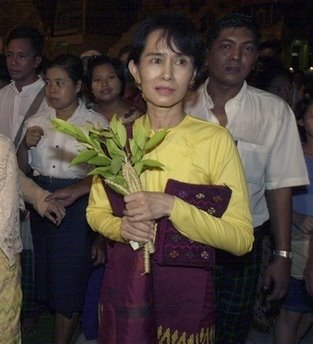


 Posts
Posts


