News & Articles on Burma
Saturday, 03 September, 2011
-----------------------------
Burma government puts up posters to disparage KIA leader
Kachin IDPs reach over 40,000 due to civil war in Northern Burma
Buddhist Karen army no more, Myanmar media says
Amnesty urges Europe to back Myanmar crimes inquiry
Regime adopts alternative approach to Wa, Mongla
----------------------------------------
Burma government puts up posters to disparage KIA leader
Created on Saturday, 03 September 2011 07:01/ Published on Saturday, 03
The military-controlled Burma government put up posters aimed to disparage a Kachin Independence Army (KIA) leader this morning in Manmaw (Bhamo) town, in Kachin State, local eyewitnesses said.
The hand-written poster said, “Brig-Gen Gun Maw has been assassinated”, said residents of Manmaw.
However, KIA officials said that is a false statement. Brig-Gen Gun Maw, the Vice Chief of Staff of the KIA, is alive at the Laiza Headquarters, in eastern Kachin State.
A KIA official in Laiza told the Kachin News Group, “The government’s posters aimed to disparage the KIA, which was not surprising.”
Hand-written posters with 9 facts denouncing the KIA were put up around Manmaw, the second largest town in Kachin State, on August 20. Those posters alleged the KIA was responsible for destroying the peace in Kachin State.
All posters were put up in the name of “a resident of Manmaw district”.
The previous 17-year ceasefire ended in Kachin State when the Burma Army started an offensive against the KIA at Sang Gang, in N’Mawk Township, in eastern Manmaw district, on June 9. http://kachinnews.com/news/2042-burma-government-puts-up-posters-to-disparage-kia-leader.html
------------------------------------
Kachin IDPs reach over 40,000 due to civil war in Northern Burma
The number of Kachin Internally Displaced Persons (IDPs) has reached over 40,000 due to renewed civil war in Kachin State, northern Burma since June, between the Burmese government and the Kachin Independence Army (KIA), which demands self-determination, according to IDP assistance organizations.
Most IDPs are being sheltered in temporary camps in the territories of the KIA near the China border and the rest have fled to major towns in government-controlled areas in Kachin State.
14,470 IDPs have arrived in Bhamo, the second largest town in Kachin State, as of August 10 according to the figures reported by Cathnews India in an interview with Bishop Raymond Sumlut, of Bhamo Township.
In Bhamo, most IDPs are received by Kachin churches, said local church sources.
According to figures provided by IDPs assistance groups up to August 22, 5,276 IDPs have been sheltered in churches in the two main towns in the government-controlled areas of Waingmaw and Myitkyina.
Moreover, there are hundreds of IDPs in Mogaung township, Mohnyin township, Hopin township and Sumprabum township but an exact number is not available, according to KIA officials in the Laiza headquarters.
The Relief Action Network for IDPs and Refugees (RANIR), based in Laiza, said 21,201 IDPs are in shelters in its territories, near the China border.
Currently, Kachin IDPs are helped by churches and local non-governmental organizations like the Metta Development Foundation and the Shalom Foundation. No United Nations’ refugee agency or INGO is supporting Kachin IDPs. http://www.kachinnews.com/news/2040-kachin-idps-reach-over-40000-due-to-civil-war-in-northern-burma.html
---------------------------------------
Buddhist Karen army no more, Myanmar media says
Sep 3, 2011, 4:02 GMT
Yangon - An offshoot of the six-decades old Karen insurgency has been dissolved and turned into a border guard force under government control, Myanmar's state-run media claimed Saturday.
The Democratic Karen Buddhist Army (DKBA) was dissolved on August 18 and transformed into a border guard force with 12 battalions under the command of the military, The New Light of Myanmar reported, citing the Karen State Democracy and Development Party.
'There is no DKBA any more,' said the party, which was set up to contest the November 7 general election.
Under the 2008 constitution, all ethnic minority groups were required to dissolve their armies and become border guard forces prior to last year's polls to join the political process.
At least six rebel groups, including elements of the DKBA, refused to do so.
One DKBA battalion led by Commander Saw Lerbwe attacked Myawaddy town, across the border from the Thai town of Mae Sot, on the day of the election and seized it for two days before retreating.
According to sources on the border, Saw Lerbwe's battalion continues to fight the Myanmar military.
'The majority of the DKBA have become border guard forces but Saw Lerbwe's battalion is still active,' Karen National Union (KNU) spokesman David Thakabaw said by phone.
'And many of the border force troops are defecting to his battalion,' he said.
The KNU has been fighting for the autonomy of the Karen State in eastern Myanmar since 1948. The DKBA broke away from the predominantly Christian Karen National Army in the late 1980s.
http://www.monstersandcritics.com/news/asiapacific/news/article_1660696.php/Buddhist-Karen-army-no-more-Myanmar-media-says
---------------------------------------
Amnesty urges Europe to back Myanmar crimes inquiry
Published on Sep 3, 2011
BANGKOK (AFP) - Europe's 'wait and see' approach to army-dominated Myanmar is 'irresponsible', Amnesty International has said, urging the European Union (EU) to back an inquiry into crimes against humanity in the country.
The Myanmar government 'has continued to violate human rights on a massive scale', four years after the brutal suppression of a monk-led protest, known as the Saffron Revolution, said Amnesty's Myanmar researcher Benjamin Zawacki.
He said reports from ethnic minority areas suggest 50,000 people may be internally displaced by conflict, while abuses have continued under a new regime, which came to power after controversial November elections.
In an article on Friday for the online exile news magazine Irrawaddy, Amnesty urged the EU and its member states to lend their support to the establishment of a UN commission of inquiry into crimes against humanity. http://www.straitstimes.com/BreakingNews/SEAsia/Story/STIStory_709073.html
---------------------------
Regime adopts alternative approach to Wa, Mongla
Thursday, 01 September 2011 11:29 S.H.A.N.
Naypyitaw recently sent two letters to specified areas under the United Wa State Army (UWSA) and the National Democratic Alliance Army (NDAA) inviting them for peace talks, according to sources on the Sino-Burma border.
The letters were reportedly forwarded to Mongla and Panghsang on 29 August and 30 August respectively. “The letter that reached Hsaleu told officials there to contact Mongyang authorities for peace talks and for any problems they would like to address,” said a high official in Mongla, the NDAA’s main base opposite China’s Daluo. “I believe the letter to (the Wa’s) Mongpawk is essentially saying the same thing.”
The local source in Panghsang, confirming the arrival of the letter, however was unable to describe the content. “My friend (in the Wa leadership) just told me the letter was a big disappointment,” he recounted. “And that it would only serve to widen the gap between the two sides.”
Both sources say it is highly unlikely Panghsang and Mongla would be giving up Mongpawk and Hsaleu, not only because the two areas have been under their control for so long, but also because giving them up would mean geographical separation between the two allies which would only make it easier for Naypyitaw to destroy them one after the other.
Radio Free Asia reported earlier that Khun Tun Lu, Naypyitaw-appointed Chairman of the newly formed Wa Self Administered Division’s Leading Body, based in Hopang, had contacted the UWSA by phone on 20 August. (Hopang, Pangwai, Mongmai aka Mongmau, Napharn, Panghsang and Markmang aka Metman have been collectively designated as Wa Self Administered Division by the regime’s 2008 constitution. Only Hopang and Markmang are under the Burma Army control.)
“He told Wa authorities that he had been appointed as head of the Wa region,” the source close to the leadership told SHAN. “But he would like to visit them just as a friend and as a brother.”
According to RFA, Panghsang had not bothered to reply because there was no official letter to back up Khun Tun Lu’s request.
As to the latest letters that have reached their hands, there would be no replies either, according to the Mongla official. “The regime is trying to divide us,” he said. “But we know our people in Hsaleu will do nothing until we ask them to.”
Since the November elections, the semi-civilain government in Naypyitaw has opened three new fronts in Kachin, Shan and Karen states against the Kachin Independence Army (KIA), State State Army (SSA) “North” and Democratic Karen Buddhist Army (DKBA), all groups that had concluded ceasefire pacts with the Burma Army. Earlier, it was fighting mostly against the Karen National Union, Karenni National Progressive Party and the Shan State Army (SSA) “South”. http://shanland.org/index.php?option=com_content&view=article&id=3998:regime-adopts-alternative-approach-to-wa-mongla&catid=85:politics&Itemid=266
__._,_.___
Sunday, September 4, 2011
News & Articles on Burma-Saturday, 03 September, 2011-UZL


Saturday, September 3, 2011
News & Articles on Burma -Friday, 02 September, 2011-UZL
News & Articles on Burma
Friday, 02 September, 2011
-----------------------------
China speeding up the dam in Burma
What Is the EU Waiting For In Burma?
US band to visit Burma
The U.N. Should Document Burma's Abuses
Ethnic Leaders Say Suu Kyi Should Be on 'Peace Committee'
Pyongyang Dining Comes to Rangoon
'Save The Irrawaddy' Campaign Gains Momentum
Bullies Across Borders?
-----------------------------
Amid armed conflict in Kachin state, China speeding up the dam in Burma
By Zin Linn Sep 02, 2011 8:17PM UTC
Today state-owned New Light of Myanmar newspaper accused KIO/KIA of forcibly recruiting villagers in Dawphonyan Sub-Township into their armed forces.
It said that KIO/KIA forced local people to join them, and otherwise they are not allowed to live in the villages. The ethnic armed group proclaims that one man from each household in lower Tarsai Village, upper Tarsai Village, Teinmakyaing Village and Mongma Village in Dawphonyan Sub-Township must join KIO/KIA.
Such act of KIO/KIA shows that they prove a total disregard for the wishes of the local people wishing for peace and undermined the stability of Kachin State, and security and socio-economy of the rural people, the government media said.
However, Salang Kaba Lar Nan, Joint General Secretary-2 of the KIO, dismissed the government newspaper’s accusation as baseless since those villages are under the government’s administration. Moreover, members of the KIO/KIA join up the group at their will, he said.
Meanwhile, China is speeding up the construction of the Irrawaddy dam although the armed conflict still going on in Kachin State, quoting an urgent August-31-dated statement released by the Kachin Development Networking Group (KDNG), the Kachin News Group said.
The Myitsone dam is being constructed by workers of the state-owned China Power Investment Corporation (CPI) and the Burma-Asia World Company, plus 700 additional construction workers from the Chinese state-owned Sino-hydro Corporation, Ms. Ah Nan, spokesperson for the KDNG said.
In October 2009, the Thailand-based Kachin Development Networking Group (KDNG) published a report – “Resisting the flood” – highlighting the implementation of the Myitsone dam project on the Irrawaddy River. The report demanded to stop the project sponsored by the China Power Investment Corporation (CPI), the main investor and contractor.
The dam project creates unwelcome impacts like social, environmental, livelihood, cultural and security problems for tens of thousands of people around the dam location and downstream of the dam. The report states that more than 15,000 people in 60 villages around the dam sites are being forcibly relocated without proper resettlement plans being drawn up by the Burmese military regime. They lost their means of livelihood such as farming, fishing and collection of non-timber forest products.
Besides, over 150,000 people in Kachin’s capital Myitkyina, 27 miles downstream of the dam, will have to live under the constant threat of floods from the dam if there is an earthquake. The dam is less than 100 kilometers from a major fault line in an earthquake-prone area, warned the KDNG report.
More Chinese construction machinery and materials are being transported to the Myitsone Dam site by 12-wheel trucks on the Myitkyina-Kambaiti Road, referring local eyewitnesses of border town Kambaiti, KNG reported.
After a new military conflict started between the Burmese Army and the KIA in June, in Kachin State, the KIA post along the Myitkyina-Kambaiti route banned trucks loaded with construction materials and equipment, according to truck drivers on that road. The KIA also damaged the key bridges on the road using mines. Part of the Stilwell Road (also called Ledo) was reconstructed in 2006, at a cost of 97 million Yuan (US$15.2) by Chinese companies from Yunnan province.
The Kachin Independence Organization (KIO), the political wing of the KIA, sent an open letter to Chinese President, Hu Jintao, in March, urging a halt to the Irrawaddy Myitson Dam construction because it will lead civil war in the country.
According to the KDNG statement, the Chinese communist government has refused the KIO request.
With the help of the KDNG, Kachin ethnic people around the world have protested by sending an appeal letter with many signatures via the Chinese Embassies in five cities such as Bangkok, London, New Delhi, Singapore and Wellington addressed to Premier Wen Jiabao. They made a fervent appeal in March 2010 to stop the Myitsone Hydropower project in Kachin State.
The 500 foot dam has been under construction at the confluence (Myitsone) of the Mali Hka River and N’Mai Hka River, 27 miles north of the Kachin capital, Myitkyina, beginning in December, 2009, and it will cost 3.6 billion dollars.
Most of the 6000 MW of electricity produced will be sold to China.
In a statement issued on 11 August, Burma’s Nobel laureate Aung San Suu Kyi said the dam endangers the flow of the Irrawaddy River, which she described as “the most significant geographical feature of the country.”
“We believe that, taking into account the interests of both countries, both governments would hope to avoid consequences which might jeopardize lives and homes,” Suu Kyi emphasized. “To safeguard the Irrawaddy is to save from harm our economy and our environment, as well as to protect our cultural heritage,” she added. http://asiancorrespondent.com/64052/amid-armed-conflict-in-kachin-state-china-speeding-up-the-dam-in-burma/
-------------------------------------
CONTRIBUTOR
What Is the EU Waiting For In Burma?
By BENJAMIN ZAWACKI Friday, September 2, 2011
It is time the EU work to establish a UN-led Commission of Inquiry into crimes against humanity and other crimes under international law in Burma.
Four years ago this month, the people of Burma rose up in what became known as the “Saffron Revolution,” named after the Buddhist monks who eventually led the demonstrations. While the world initially condemned the security forces’ violent crackdown that followed, several months later the Burmese authorities managed to deflect international criticism by announcing it would hold national elections and form a civilian government.
The international community, including the European Union (EU), has been distracted ever since, despite an abundance of information that Burma’s government has continued to violate human rights on a massive scale. “Wait and see”—what the government will do before the elections, how the elections will be conducted, whether the new government will make any changes—has been the prevailing and irresponsible approach.
Meanwhile, the human rights situation in Burma has gone from bad to worse, with no justice for the victims. By the time the election announcement was made, the number of political prisoners in Burma had nearly doubled from its pre-Saffron Revolution number to over 2,100—where it remains today. Several months afterwards, the government denied, obstructed and/or confiscated international aid in the wake of Cyclone Nargis, turning the humanitarian disaster into a human rights crisis. And a year later, authorities arrested, tried, and unlawfully extended the house arrest of opposition leader Daw Aung San Suu Kyi.
Among the situations calling out loudest for justice and accountability is Burma’s ethnic minority regions. Ten months before the November 2010 elections, Amnesty International released a report on the repression of ethnic minority political activists in Burma, which showed that optimism in relation to the polls was being contradicted in the ethnic minority areas.
It followed a mid-2008 publication, Crimes against humanity in eastern Burma, whose relevance has only increased since then. The report focused on the Burmese army’s human rights violations against ethnic minority Karen civilians on a widespread and systematic basis, which amounted to crimes against humanity. Violations included extrajudicial executions, torture, arbitrary detention, forced labor, confiscation of land and food and forced displacement of the civilian population on a large scale, starting in late 2005.
While this was the first time Amnesty had characterized such violations as crimes against humanity, the report’s findings were consistent with our research on the country for two decades. The testimonies, collected in several countries since 1987, documented the very same crimes against civilians. They were told to us not only by the Karen, but by many other ethnic minorities as well, including the Rohingya, the Karenni, the Shan and the Mon.
Likewise, accounts since mid-2008, especially since the day of Burma’s national elections last November, when hostilities were accelerated or renewed between the Burmese army and armed groups fighting on behalf of several ethnic minorities, recall our report’s findings: serious human rights violations—some of which may amount to crimes against humanity and/or war crimes—against ethnic minority Karen, Kachin, and Shan civilians.
These include recent accounts of the army using prison convicts as porters in the fighting in Kayin (Karen) State, forcing them to act as human shields and mine-sweepers and of rape and other sexual violence, primarily in Shan State. Reliable reports indicate that the number of displaced persons there has reached 30,000, while in or near Kachin State 20,000 internally displaced persons were reported at the end of July.
We have waited for years, even decades, and seen quite enough: these violations call for accountability. However, Article 445 of Burma’s 2008 Constitution—which codifies immunity from prosecution for officials for past violations—indicates that without international action, this is most unlikely.
In October 2011, the UN special rapporteur will be presenting a report to the UN General Assembly, which will likely adopt a resolution on Burma. The EU will again lead in the drafting of this resolution.
In each of his reports or statements to the UN Human Rights Council and the General Assembly, the special rapporteur has called for greater accountability for grave international crimes in Burma or expressly recommended that the UN establish a Commission of Inquiry into such crimes.
While the question remains as to whether such a Commission would have access to Burma, a similar 1997 Commission by the International Labour Organization compensated for its denial of access partly through expert testimony, which Amnesty among others provided. Two years later, Burma passed a law prohibiting forced labor. Accountability must begin somewhere.
Moreover, accountability need not exclude increased humanitarian assistance and efforts to engage the new government.
Amnesty International welcomes the fact that 12 of the 16 nations that have publicly stated their support for a Commission of Inquiry in Burma are EU members, but regrets that neither the EU as a bloc nor several of its influential members—including Germany, Italy, Spain and Sweden—have not done so.
After more than three years of “wait and see,” it is time the EU and its member states translate their concern about Burma’s human rights situation into public support for the establishment of a UN-led Commission of Inquiry into crimes against humanity and other crimes under international law in Burma.
Benjamin Zawacki is Amnesty International’s Burma researcher and a member of the US Council on Foreign Relations. http://www.irrawaddy.org/opinion_story.php?art_id=22006&page=2
-------------------------------
THE NATION
Music to calm the savage diplomatic beast? US band to visit Burma
Published on September 2, 2011
Rangoon - A US band is to make a rare appearance in Burma this month in the latest sign of a possible diplomatic thaw between the military-dominated country and the West, officials said Friday.
Earth String is to be in Burma September 21-25, a US embassy official said without providing details.
The band's visit, sponsored by the embassy, was seen as the latest sign of slight improvements in Burma's relations with Western democracies after its November general election, the first in 20 years.
"I think all relations usually start with the cultural sector," one Asian diplomat in Rangoon said. "This is a positive sign for American-Myanmar [Burmese] relations."
"I hope it is a positive sign for American-Myanmar relations because we haven't seen these kinds of musical bands here for sometime," said Nay Zin Latt, a political adviser to the new government.//DPA
.
------------------------------------
THE WALL STREET JOURNAL
The U.N. Should Document Burma's Abuses
It's time to set up a commission of inquiry. Asean cannot stand by.
Today European foreign ministers are meeting in Brussels to discuss, among other issues, a resolution on Burma to be tabled at the United Nations General Assembly. Later this month, members of parliament from Southeast Asia will gather for the Asean Inter-Parliamentary Association meeting in Phnom Penh, Cambodia. Both are opportunities to build momentum for a United Nations-led commission of inquiry into possible crimes against humanity and war crimes in Burma.
To date, 16 countries, including the United States, Canada, the United Kingdom, Australia and the Czech Republic, have called for a commission. Yet Burma's Asean neighbors have remained silent. Perhaps some consider such a move gratuitous and meddlesome. But if Asean is to assert itself as a leading organization on the global stage, its members need to send a clear message that crimes against humanity affect the entire region and will not be tolerated.
An inquiry would not be a political tool for assigning criminal liability; rather, it would be a mechanism to document atrocities committed in Burma over the years and help prevent future atrocities by encouraging policy reforms in Burma's judicial system. It would also provide victims of Burma's protracted civil war an opportunity to seek justice for their grievances, and so contribute to building a lasting peace.
Human rights monitors have documented abuses in Burma for more than two decades, and the U.N. General Assembly has passed 20 resolutions describing possible crimes. In March 2010, Tomás Ojea Quintana, the U.N.'s Special Rapporteur on the Situation of Human Rights in Myanmar, recommended establishing a commission of inquiry. Leaving Burma after a five-day mission last week, Mr. Quintana reiterated his position.
An international investigation is urgently needed because the Burmese government has failed to respond to appeals from its people. In 2007, deep-seated discontent spurred tens of thousands of Buddhist monks to take to the streets to demand change. Instead of engaging the monks in constructive discussions, the military junta opened fire on the religious leaders. Today more than 2,000 prisoners of conscience remain in prison.
The Burmese government is trying to head off pressure for a commission of inquiry by raising hopes it will now pursue reforms. In 2008 it held a referendum on a new constitution to restore civilian rule. However, this constitution is severely flawed, since it protects those who committed abuses in the past.
The Association of Southeast Asian Nations has nevertheless hailed the new government as a step forward, calling on the European Union and the United States to lift sanctions. However, Asean states did not consider the ramifications the elections would have on Burma's armed conflict. In the aftermath of the elections a number of ceasefire agreements between the government and non-state armed groups broke down.
In June 2011 renewed hostilities between government forces and the Kachin Independence Army led to widespread abuses against civilians in Kachin State provoking over 20,000 people to flee their homes. Thousands of refugees spilled across the borders to Thailand and China. Asean was slow to respond and has yet to develop a mechanism to protect refugees and ensure civilians protection from human rights abuses.
In contested areas of Shan State, where government troops continue to battle ethnic Shan armed groups, there have been credible reports of systematic rape. In a statement released on July 22, Eva Kusuma Sundari, a member of the Indonesian Parliament and President of the Asean Inter-Parliamentary Myanmar Caucus declared "We [AIPMC] call on the Myanmar Army to immediately end rights abuses, particularly the systematic use of rape as a weapon to suppress ethnic women and to urgently engage in peace talks with ethnic armed groups."
Burmese President Thein Sein recently made overtures to the political opposition, meeting with Aung San Suu Kyi and offering peace talks with some of the armed groups. Genuine multiparty dialogue is welcome, but progress toward political reconciliation is not a substitute for seeking truth and justice. An independent U.N.-led investigation that examines reports of human rights violations committed by both the government and non-state actors would complement talks.
President Thein Sein also recently announced that Burma is ready and committed to take a stronger leadership role in the region. On Aug. 21, he declared in Parliament that his government intends to assume the Asean chairmanship in 2014. The government should demonstrate its readiness to chair the regional body in action as well as words. Cooperating with a potential international investigation would be a step in the right direction.
All those who care about the rights and dignity of the citizens of Burma should support the call for a commission of inquiry. Without accountability, allegations of grave human rights violations will continue to poison the development of Burma and Asean.
Mr. Tanada is a member of the Philippines Congress and the vice president of the Asean Inter-Parliamentary Myanmar Caucus. http://online.wsj.com/article/SB10001424053111904583204576544222636274718.html
-----------------------------------------
Ethnic Leaders Say Suu Kyi Should Be on 'Peace Committee'
By SAW YAN NAING Friday, September 2, 2011
Leaders of a number of Burma's ethnic armed groups welcomed the approval of a “Peace Committee” by the country's Upper House of Parliament on Wednesday, but said they want opposition leader Aung San Suu Kyi to be a member of the committee.
The mission of the Peace Committee will be to mediate between the Burmese goevernment and the ethnic armed groups, some of which are engaged in armed conflict with the Burmese military.
Arakanese MP Aye Maung, who is the chairman of the Rakhine National Development Party, proposed that Suu Kyi become a member of the Peace Committe, but it is unclear whether his proposal will be adopted.
Naw Zipporah Sein, the general-secretary of the Karen National Union (KNU), an ethnic armed group that has been fighting the government for more than six decades in an effort to achieve autonomy for the Karen people, said, “If the government honestly forms a Peace Committee to hold talks with us, it would be a good sign. But we have to wait and see the condition and rule of the committee. We also prefer to hold talks in a neutral country, not inside Burma.”
Suu Kyi’s participation would be helpful, as she is sincerely working for democracy for the country, Zipporah Sein added.
In an open letter sent by Suu Kyi to President Thein Sein and the ethnic groups last month, Suu Kyi said that she is ready to become involved and use her influence to help end the conflicts and build peace in the nation.
Maj Sai Lao Hseng, the spokesperson for the Shan State Army-South, also welcomed the formation of a Peace Committee to mediate with ethnic groups. He said the committee should include Suu Kyi because the ethnic conflicts are a national issue and Suu Kyi is widely respected by the people of Burma.
A veteran politician, Chan Tun, also welcomed a Peace Committee, which he said should include a number of prominent and widely respected politicians.
Aye Thar Aung, another prominent Arakanese politician who is based in Rangoon, said that the government must declare a nationwide ceasefire first, and then talk to the ethnic armed groups.
“The talks should be held directly by the authorized government officials, not the chief ministers of states because they don’t have the authority for making decisions.”
“We can only say there is a possibility of peace if the government committee reaches a bilateral agreement with the ethnic delegation,” he added.
On August 18, state-run newspaper The New Light of Myanmar reported that the government had offered an “olive branch” to the ethnic armed groups, encouraging them to contact their respective state or division governments as a first step toward meeting with a union government delegation.
After the offer, the United Nationalities Federal Council (UNFC), an alliance of ethnic armed groups, rejected the idea of one-on-one talks and called for talks between the government and the alliance of ethnic armed groups. In late August, the UNFC also formed a peace talks group in preparation for future negotiations with the Burmese government.
La Nan, the secretary of the Kachin Independence Organization (KIO), the political wing of the Kachin Independence Army (KIA), doesn’t expect much from the government’s Peace Committee. He said that there will be no possibility of peace with ethnic armed groups if the committee holds talks based on the 2008 constitution.
There are a dozen ethnic armed groups that have been fighting for autonomy since Burma gained independence from Britain in 1948. Tensions have boiled over into bloody clashes in recent months, most notably between the Burmese army and the KIA, the KNU and the Democratic Karen Buddhist Army.
The Peace Committee has been officially named the “Committee for Eternal Stability and Peace in the Union of Burma,” according to Aye Maung. http://www.irrawaddy.org/article.php?art_id=22008
--------------------------------
Pyongyang Dining Comes to Rangoon
By WAI MOE Friday, September 2, 2011
North Korean technicians have been coming to Burma since 1993 to help the county's military junta improve its weapons systems. During that time, the North Koreans, invariably men, rented houses from military cronies in the most prestigious areas of Rangoon.
The Burmese regime had previously suspended its relationship with Pyongyang following the assassination in Rangoon of South Korean delegates by North Korean agents in 1983.
However, relations began warming when both countries found themselves increasingly isolated in the region. In April 2007, the two pariah states re-establish diplomatic ties, and the North Koreans reopened their embassy in Rangoon.
Now Pyongyang has taken another footstep into Burma— the opening in July of the first North Korean restaurant in the former capital.
Named “Pyongyang Koryo Restaurant,” the diner is located on Sayar San Road in Bahan Township, and has already established a regular clientele of customers, including North Korean diplomats and South Korean businessmen.
The Pyongyang Koryo serves Korean dishes for lunch and dinner, and hosts traditional Korean entertainment in the evenings. Options include soups, hot pots and curries with prices generally from 10,000 to 35,000 kyat (US $13 to $47) per dish.
“In my opinion, this could be a place where Koreans hold informal business talks on North Korean related matters,” a diplomatic source in Rangoon said. “You know how paranoid the North Koreans are—maybe they are too cautious to invite guests to the embassy.”
When The Irrawaddy called the restaurant, the receptionist answered “Koryo,” but was unable to converse in Burmese or English.
Hein Latt, a well-known Burmese author who wrote the biography, “Kim Jong Il: North Korea’s Dear Leader,” said that in recent days he had met North Korean ambassador Kim Sok Chol at a party in Rangoon, and the ambassador invited him to dine at the North Korean restaurant.
“The new North Korean restaurant has been opened with the backing of the North Korean embassy,” he said. “Without the embassy’s support, this kind of restaurant would not exist.
“I expect they [North Korean diplomats] use it as a venue to gather intelligence,” he said.
Ex-Maj Aung Lynn Htut, a former counter intelligence officer, said that in the day to day work of an intelligence officer, “a friendly restaurant is a good cover.”
“Previously, [former premier] Gen Khin Nyunt refused the North Koreans permission to open a restaurant because of international concerns,” he said, adding that nowadays there are more North Koreans in Burma since allegations surfaced over North Korea and Burma’s ties to nuclear missiles and underground military technology.
According to Southeast Asia-based journalist Bertil Lintner, the first North Korean restaurant in the region opened in 2002 in the popular Cambodian tourist destination of Siem Reap.
It was so successful that Pyongyang decided to open a second restaurant in Phnom Penh in 2003, he said, adding that the North Korean government then financed in 2006 the opening of a large restaurant in Bangkok’s Pattanakarn suburb near the North Korean embassy.
“It [the Pyongyang Koryo] sounds like all the other North Korean restaurants in the region,” Lintner said. “I guess it's to make money for the North Korean embassy in Rangoon.” http://www.irrawaddy.org/article.php?art_id=22007
-------------------------------
'Save The Irrawaddy' Campaign Gains Momentum
By THE IRRAWADDY Friday, September 2, 2011
A petition signed by nearly 1,600 influential Burmese persons, including politicians, journalists, writers, artists and film directors, has been sent to President Thein Sein on Thursday with a campaign message titled “From Those who Wish the Irrawaddy to Flow Forever.”
The signatories included: Win Tin, a prominent member of the opposition National League for Democracy; veteran journalists Sein Win and Maung Wun Tha; Kyaw Thu, the founder of the Free Funeral Services Society; writer Than Myint Aung; social activist Aung Thin; the acclaimed writer Zaw Zaw Aung; and film director Cho Tu Zal.
The campaign was organized by Myat Thu, a prominent member of the 88 Generation Students group.
Speaking to The Irrawaddy on Thursday, Myat Thu said, “Along with the petition we sent a letter that outlined our anxieties.”
The Irrawaddy River is considered the main artery of Burma and million sof people depend on it for their livelihoods. It has its source in Kachin State in northern Burma at the confluence of the N’mai and Mali rivers, and flows 2,170 km (1,348 mi) through many of the country's main cities, including Myitkyina, Bhamo, Mandalay, Sagaing, Bagan, Magwe and Pyay, before emptying in the fertile Irrawaddy delta.
But today the river is faced with an unprecedented threat in the form of ongoing dam projects in Kachin State.
Burma's previous ruling military regime and China’s state-owned Chinese Power Investment Corporation (CPI) agreed to built a megadam at Myitsone, the confluence that acts as the source of the Irrawaddy. If completed, the hydropower dam project will be the 15th largest hydroelectric power station in the world, and will cost an estimated US $3.6 billion.
The length of the dam is to be about 499 ft (152 m), and its height about 499 ft, equivalent to a 50-story building. The surface area of the reservoir is to be 295.8 sq mi (766 sq km), larger than the city state of Singapore.
Environmentalists, activists and politicians have given voice to growing concerns about the fate of this mighty river, but the government is reluctant to take action to stop construction.
Meanwhile, political parties and independent candidates have called on the Supreme Court to take action to save the Irrawaddy River.
“We send an open letter today,” said Win Cho, an independent candidate. “We are calling for an official response into the issue of the Irrawaddy River and the Myitsone dam project.”
Win Cho said other signatories included: Bauk Ja from the National Democratic Force; Soe Kyi from Thanlyin Township; Aung Myo Oo from Kyeemyindaing Township; and Min Aung from Botahtaung Township, all in Kachin State. http://www.irrawaddy.org/article.php?art_id=22010
---------------------------------------
CONTRIBUTOR
Bullies Across Borders?
By DAVID I. STEINBERG Thursday, September 1, 2011
The new, still fragile reform activities of the recently installed government in Burma have excited an outburst of vituperation from across international frontiers. As internal positive change is something external analysts have long sought, why is this so?
Military regimes inherently bully—orders are given and are expected to be obeyed. Orthodoxy is required and diverse views are eschewed. Line up and obey. So bullies inside Burma are a distressful but expected outcome of the nature of that military- dominated government. The deeply flawed elections were, in a sense, the outcome of such bullying.
But outside Burma? Developments within the country by the new government, with its probes toward positive change, have prompted an outburst of advocacy of heightened sanctions and renewed pressures for a UN Commission of Inquiry into human rights abuses at the very time when there is at least the possibility of reforms within the new “disciplined-flourishing democracy”. Even the possibility of positive change, still very much in process, has prompted a bullying type of orthodoxy from outside Burma by members of organizations devoted to liberty, democracy and human rights. This is quite disturbing.
Throughout the long rule of the military since 1988, voices in opposition abroad have often countered nuanced consideration of the problems of Burma with cries, reminiscent of President George W Bush, that if you are not with us you are against us. The new tone, with its more frenetic stridency, seems borne out of the fear that the internal changes at least advocated by the head of state may indeed have some positive results, thus perhaps prolonging the life of the new administration and making it more acceptable to the Western world, and threatening the sanctions regimen that had been serially imposed on Burma and its rulers. In effect, this new approach to internal change may postpone or prevent the “Arab Spring” from reaching Burma.
These attacks have become personalized against some individuals who have studied that country and who have advocated the well-being of the diverse Burmese peoples. Democracy requires diversity of views and intelligent debate over alternatives, none of which may have simple answers. Policies based on dichotomies rarely are successful. The goals of those new bullies on the policy block are indeed admirable—human rights and improved freedoms and lives—and ones that can be widely shared and with which most of us would identify. Yet their tactics undercut the very goals they seek to reach.
It is a sad, bordering tragic, condition that those of us physically, but not emotionally, removed from the Burma scene do not seem to be able to negotiate with amicable, respectful, and dignified personal relations the necessary and desirable policy differences among us that are reflective of the democracy we would like to see in that country. Dissent is essential, but so is amity.
For years, some observers of the Burmese scene have said that some of the incessantly articulated goals of the military government—national unity, sovereignty, better health, education, agriculture, etc.—are ones that could conceptually prompt widespread approval, but the means by which those goals have been approached, the tactics used to attempt to enforce them on the people, subvert the very aims toward which they purportedly work. In other words, one cannot get there from here on that route.
But what about this new stridency? Can one get to democracy, however defined in some non-adjectivally modified form, in this manner? It would seem highly unlikely. One does not question the motivation of those organizations advocating liberalization and change in Burma, nor the intent of their members, but one must question some ill-advised temperamental actions because—as across the frontier—you cannot get there from here.
David I. Steinberg is Distinguished Professor of Asian Studies, School of Foreign Service, Georgetown University. His latest volume is“Burma/Myanmar: What Everyone Needs to Know” (Oxford). http://www.irrawaddy.org/opinion_story.php?art_id=21999
__._,_.___
Reply to sender | Reply to group | Reply via web post | Start a New Topic
Messages in this topic (402)
Friday, September 2, 2011
News & Articles on Burma-Thursday, 01 September, 2011-UZL
News & Articles on Burma
Thursday, 01 September, 2011
------------------------------------------------
Husbands at the front, women guard rear bases
Regime adopts alternative approach to Wa, Mongla
KNU still investigating Karen leader’s mysterious disappearance
Myanmar parliament approves "peace committee" for ethnic conflicts
Parliament Approves 'Peace Committee'
Parliament Gets Down to Details
Burma to Lease State-Run Industries
Bluegrass Band to Tour Burma
------------------------------------------
Husbands at the front, women guard rear bases
Thursday, 01 September 2011 16:58 Hseng Khio Fah
Since clashes broke out between Burma Army and armed groups in northern Shan State and Kachin State, almost all of the Burmese soldiers were deployed to the frontline leaving behind their wives and family members who were assigned to provide security of the rear bases, according to local sources.
The Burma Army has been since March launching military offensives on the ceasefire armed groups: Shan State Progress Party (SSPP) and Kachin Independence Army (KIA) following their rejection of Naypyitaw’s Border Guard Force (BGF) program. Thousands of Burma Army soldiers, local militia men and prisoners were regularly deployed to the frontline since the fighting began.
“There are few soldiers to provide security of the rear base. So their wives were assigned to guard the base. In some places, they [the women] were assigned to guard together with local militia units, ’said a local woman who was a friend of a solider family in Kyaukme township, State State North.
The incidents took place in bases located in Kyaukme and Mongmit townships where fighting between the SSPP/SSA and the Burma Army often breaks out. Units based in Kyaukme township are Light Infantry Battalion (LIB) # 501 and 502 and in Mongmit are LIB # 348, Infantry Battalion (IB) # 223 and IB # 276.
‘How can we protect the base even if they [the rebels] come to attack the base since we are not used to handling guns and have no military training,’ complained a housewife of the Burma Army soldier from Kyaukme base.
Some bases in Mongmit are empty during the night time because the Burma Army’s family members are afraid to stay at the base and go to stay outside the base instead, said a source from Mongmit.
‘They [the family members] often go to sleep at the monastery at night and come back to take guard duty at the base in the day time. Some go to stay at their relative’s homes,” she said.
In addition, in some bases, some soldiers including high ranking officers had committed suicide as they were certain most of them would not be returning from the frontline.
For instance, a major from LIB 348 recently committed a suicide. “Before his death, he [the major] said he did not want to die at a place where his family could not see him,” the source added.
“Therefore some family hold farewell parties for their husbands before going to the frontline. They [the family] would go along until half way to the frontline because they believed that most of them would not come back,” she said.
Soldiers from Mongmit bases were sent to war zones opposite KIA controlled areas while soldiers from Kyaukme were deployed to SSPP/SSA areas. Fighting between the Burma Army and the armed groups are still reported everyday since March, leaving hundreds of soldiers and local people dead and injured. http://www.shanland.org/index.php?option=com_content&view=article&id=4003:husbands-at-the-front-women-guard-rear-bases&catid=86:war&Itemid=284
-----------------------------------------------
Regime adopts alternative approach to Wa, Mongla
Thursday, 01 September 2011 11:29 S.H.A.N.
Naypyitaw recently sent two letters to specified areas under the United Wa State Army (UWSA) and the National Democratic Alliance Army (NDAA) inviting them for peace talks, according to sources on the Sino-Burma border.
One letter was addressed to Hsaleu, headquarters of the NDAA’s 369th Brigade and the other to Mongpawk, headquarters of the UWSA’s 468th Brigade. Hsaleu and Mongpawk are part of Mongyang township, according to regime set-up.
The letters were reportedly forwarded to Mongla and Panghsang on 29 August and 30 August respectively. “The letter that reached Hsaleu told officials there to contact Mongyang authorities for peace talks and for any problems they would like to address,” said a high official in Mongla, the NDAA’s main base opposite China’s Daluo. “I believe the letter to (the Wa’s) Mongpawk is essentially saying the same thing.”
The local source in Panghsang, confirming the arrival of the letter, however was unable to describe the content. “My friend (in the Wa leadership) just told me the letter was a big disappointment,” he recounted. “And that it would only serve to widen the gap between the two sides.”
Both sources say it is highly unlikely Panghsang and Mongla would be giving up Mongpawk and Hsaleu, not only because the two areas have been under their control for so long, but also because giving them up would mean geographical separation between the two allies which would only make it easier for Naypyitaw to destroy them one after the other.
Radio Free Asia reported earlier that Khun Tun Lu, Naypyitaw-appointed Chairman of the newly formed Wa Self Administered Division’s Leading Body, based in Hopang, had contacted the UWSA by phone on 20 August. (Hopang, Pangwai, Mongmai aka Mongmau, Napharn, Panghsang and Markmang aka Metman have been collectively designated as Wa Self Administered Division by the regime’s 2008 constitution. Only Hopang and Markmang are under the Burma Army control.)
“He told Wa authorities that he had been appointed as head of the Wa region,” the source close to the leadership told SHAN. “But he would like to visit them just as a friend and as a brother.”
According to RFA, Panghsang had not bothered to reply because there was no official letter to back up Khun Tun Lu’s request.
As to the latest letters that have reached their hands, there would be no replies either, according to the Mongla official. “The regime is trying to divide us,” he said. “But we know our people in Hsaleu will do nothing until we ask them to.”
Since the November elections, the semi-civilain government in Naypyitaw has opened three new fronts in Kachin, Shan and Karen states against the Kachin Independence Army (KIA), State State Army (SSA) “North” and Democratic Karen Buddhist Army (DKBA), all groups that had concluded ceasefire pacts with the Burma Army. Earlier, it was fighting mostly against the Karen National Union, Karenni National Progressive Party and the Shan State Army (SSA) “South”. http://www.shanland.org/index.php?option=com_content&view=article&id=3998:regime-adopts-alternative-approach-to-wa-mongla&catid=85:politics&Itemid=266
----------------------------------------------
KNU still investigating Karen leader’s mysterious disappearance
Thursday, 01 September 2011 21:23 Ko Pauk
New Delhi (Mizzima) – KNU leader Mahn Nyein Maung’s one-month disappearance is still under investigation by the Karen National Union (KNU), officials said, and the cause of his absence since late July is was still unknown.
KNU officials said Mahn Nyein Maung’s visas for both Thailand and China had expired and after he was denied entry to both countries, he vanished from the Kunming Airport.
“Thailand deported him back to China because his visa for Thailand had expired,” said KNU Major Saw La Ngwe. “He was denied entry at Kunming Airport to China too. He then disappeared from Kunming Airport without a trace. The airline company said they didn’t know anything.
“We don’t have any reliable information about his disappearance, and we don’t know where he is. We're still investigating,” said Saw La Ngwe.
Meanwhile, word has spread that Mahn Nyein Maung may have been deported to Burma by Chinese authorities. However, the KNU said that information couldn’t be confirmed.
Mahn Nyein Maung had taken leave from the KNU on a personal matter more than eight months ago, and he had lost connections with the KNU. The trip to China was a private trip and had nothing to do with the KNU, officials said.
While some rumours said Mahn Nyein Maung had been arrested by the Burmese government, others said he was still in China, said Saw La Ngwe.
“The situation is still unclear,” he said. “We think he may be in China but if we report about that, he may encounter problems. On the other hand, if the Burmese government has arrested him and we do not report that, he could be severely tortured and leave no trace. We need to be balanced between the two possibilities.”
Mahn Nyein Maung was arrested by former dictator Ne Win’s government in 1967 as a Karen youth leader and was sent to a prison camp on Koko Island. He and two prison mates tried to flee by boat, but were captured. Later, under the pen name “Yebaw Shaung,” he wrote about his adventures in the book “Against the storm, Across the Sea.” http://www.mizzima.com/news/inside-burma/5872-knu-still-investigating-karen-leaders-mysterious-disappearance.html
---------------------------------------
Myanmar parliament approves "peace committee" for ethnic conflicts
Sep 1, 2011, 9:41 GMT
Yangon - Myanmar's parliament approved the establishment of a 'peace committee' to deal with the country's ongoing conflicts with its ethnic minority groups, some of whom have been fighting the government for six decades, sources said Thursday.
The upper house, meeting in the capital, Naypyitaw, approved the committee Wednesday and was asked to consider including opposition leader Aung San Suu Kyi as one of the peacemakers, sources said. 'Aye Maung from the Rakhine State Party suggested that Aung San Suu Kyi should be considered as a member of the peace committee,' a member of parliament who requested anonymity said.
The upper house, which is dominated by the pro-military Union Solidarity and Development Party, did not decide on whether to include Suu Kyi.
'Parliament just approved the principle of the formation of the peace committee, but it was not clear whether Suu Kyi will be allowed to participate in the committee or even whether Suu Kyi herself wanted to join or not,' the legislator said.
One of the key threats to Myanmar's stability is its ethnic minority problems.
The government has faced a dozen insurgencies as minorities fight for the autonomy of their traditional territories since independence from Britain in 1949.
Suu Kyi has made known her interest in participating in the reconciliation process with the ethnic groups.
'On my part, I am prepared and pledge to do everything in my power towards the cessation of armed conflicts and building peace in the union,' Suu Kyi said in an open letter to President Thein Sein and ethnic groups last month.
The suggestion to include Suu Kyi, the 1991 Nobel Peace Prize laureate, in the reconciliation process with minority groups came at a time of seeming rapprochement between the democracy icon and the new government.
Suu Kyi met with Thein Sein for the first time August 19 at his personal invitation.
The two leaders reportedly discussed the need to cooperate. Suu Kyi later described the meeting as a 'positive step.'
Suu Kyi, the daughter of independence leader Aung San, had spent 15 of the past 21 years under house arrest. She was released from her latest period of detention in November, six days after polls that brought the current pro-military government to power.
http://www.monstersandcritics.com/news/asiapacific/news/article_1660367.php/Myanmar-parliament-approves-peace-committee-for-ethnic-conflicts
-----------------------------------
Parliament Approves 'Peace Committee'
By SAW YAN NAING Thursday, September 1, 2011
Burma's parliament on Thursday approved the formation of a “peace committee” to mediate with the ethnic groups which are engaged in armed conflict against government forces, according to Arakan MP Aye Maung.
He said the committee has been named the “Committee for Forever Stability and Peace in the Union of Burma.”
Aye Maung, who is the chairman of the Rakhine National Development Party, told The Irrawaddy on Thursday that the plan to form such a committee was approved by the Upper House at a parliamentary meeting in Naypyidaw on Wednesday.
It is unknown when the committee will be formed and whether it will include opposition leader Aung San Suu Kyi who was proposed by Aye Maung at the parliamentary session.
In an open letter sent by Suu Kyi to President Thein Sein and the ethnic groups last month, Suu Kyi said that she is ready to become involved and use her influence to help end the conflicts and build peace in the nation.
There are a dozen groups of ethnic insurgents that have been fighting for autonomy since Burma gained independence from Britain in 1949. Tensions have boiled over into bloody clashes in recent months, most notably between the Burmese army and the Kachin Independence Army, the Karen National Union and the Democratic Karen Buddhist Army. http://www.irrawaddy.org/article.php?art_id=22003
---------------------------------------------------
Parliament Gets Down to Details
By KO HTWE Thursday, September 1, 2011
While national parliaments are typically meant to be the place where issues and policies of national importance are introduced, discussed and debated, since reconvening on August 22, much of the current session of Burma's new Parliament has been taken up by the introduction of local matters.
“The issues they are raising are not important. MPs should know which issues should be raised in Parliament. If they don't know, then Parliament can become a comedy show,” said Phyo Min Thein, a Rangoon based politician.
For example, issues raised by MPs during the current session include such local matters as whether there is a plan for the Rangoon-Bagan Express train to stop over at Taikkyi Station for 2 minutes and whether there is a plan to place new lamp posts in Rangoon's Thakayta Township. They also included matters such as whether there is a plan to hire experienced international coaches to train Burma's athletes for the SEA Games in 2013.
Some MPs, however, argue that they are forced to raise such minor issues at the national level because they cannot get any cooperation from government officials at the local level.
“The lack of cooperation from ward, township and district level authorities force MPs to raise such small issues in the Parliament. They don't respect MPs. The State and Region minsters themselves don't settle the regional issues so we raise them in Parliament,” said Pe Than, a Lower House MP from the Rakhine Nationalities Development Party.
In the Lower House, most proposals by opposition MPs have been opposed by MPs from the majority Union Solidarity and Development Party, and much of the discussion has been prohibited by Shwe Mann, the speaker of the Lower House, because it has related to personal attacks on MPs.
“I don't wish to waste time with unnecessary words that can ruin respect and confidence between us. The cost for convening Parliament comes from the public. And I don't wish to waste public money,” said Shwe Mann.
However, there have been issues of national concern raised in Parliament.
Lower House MP Nan Wah Nu of the Kunhein Constituency in Shan State raised the questions of national reconciliation and talks between the new government and ethnic armed groups.
Thein Nyunt, from the Thingangyun Constituency, proposed that Parliament request the president to issue general amnesty orders, requested that the Emergency Act of 1950 be revoked and introduced a bill for a Prisons Act which is in keeping with 21st century prison standards and guarantees human dignity.
The request for general amnesty received support from two delegations of military MPs, which gave the matter a significant chance of being raised at the level of the National Defense and Security Council. But the proposal to revoke the Emergency Act of 1950, which is used to imprison democracy activists, was shot down.
In response to the proposal for the adoption of a humane Prisons Act, Union Minister for Home Affairs Lt-Gen Ko Ko said that conditions for prisoners are already good, because by being assigned to labor camps such as agricultural and livestock breeding, the prisoners' energy is not wasted in a cell and they are able to earn wages that are given to them when they are released. In addition, he said that prisoners are also treated well inside the prisons.
“Family members are allowed to visit and stay with them and hospitals, clinics and schools are set up for them. Besides, if they wish to live in the new life camps when they are released, the ministry provides them with homes, land for farming, farming equipment, free loans and help so they can live with dignity in society,” said Ko Ko.
Bo Kyi, the joint secretary of the Thailand-based Assistance Association for Political Prisoners, said that some of the facts in Ko Ko's reply may be true in places such as the three Bawa Thit labor camps, which are for prisoners from the military and rich families who can bribe authorities to allow them to live separately from normal prisoners, but not in most prisons.
“Prisons are not good living places like they mentioned. The condition of prisons is still like a human hell. Prisoners who have no wish to work are also forced to work.
Wages for prisoners are just policy and the wages they earn are not enough,” he added, saying many prisoners who have been sent to labor camps have died.
There were also proposals by Upper House MP Tun Lwin of Kachin State Constituency No.9 to form a standing committee for ensuring eternal peace and stability in Burma and by Thein Win of Sagaing Region Constituency to reset the amount of kyat equivalent to US $1, which are appealing to many people.
“The discussion in Parliament and approval should take place immediately or support will weaken,”said Phyo Min Thein.
The suggestion by Aye Maung, an Upper House MP, that pro democracy leader Aung San Suu Kyi be member of the committee for ensuring eternal peace and stability in Burma was not published in the state media.
While state media reports on the machinations of Parliament, such as questions raised and answered, proposals discussed and bills submitted and approved, it does not report on sensitive or controversial issues such as the fact that Burma will run a deficit of about 2.2 trillion kyat (US $3.2 billion) in the 2011-2012 fiscal year. In addition, the state censorship board does not allow these types of facts to be reported in private journals.
Burma's second parliamentary session convened in Naypyidaw on Monday.
The fact that parliamentary rules require MP proposals to be submitted to the house speaker at least 15 days in advance of the session is a hindrance to MPs's ability to raise sensitive issues, said an observer.
Under Burma's 2008 Constitution, 110 seats in the Lower House of the Union Parliament, 56 in the Upper House and 222 in the State and Regional Parliaments are reserved for military appointees selected by the country's armed forces chief.
http://www.irrawaddy.org/article.php?art_id=22002
-------------------------------------
Burma to Lease State-Run Industries
By THE IRRAWADDY Thursday, September 1, 2011
Naypyidaw—The Burmese government is to allow private companies to lease and run for profit a number of state-run industries on long-term contracts, according to Minister for Industry No 1 and Industry No 2 Soe Thein.
“We will lease a large number of state-run industries within 10 years,” Soe Thein said at an economic forum held at Myanmar Convention Centre in Naypyidaw on Aug. 19.
According to the Soe Thein, the Ministry of Agriculture and Irrigation has already agreed to rent five state-owned factories—four sugarcane refineries and a whisky distillery—for a total of 1,050 million kyat (US $1.4 million) per annum to private enterprises on 30-year contracts.
According to a source within the industry ministry, several well-known Burmese private sector companies, including Yuzana Co. Ltd, International Gate Ways Co. Ltd, and Delicious Food Co. Ltd, have consolidated long-term contracts to lease seven state-owned factories—all sugarcane refineries and whisky distilleries—in Pyinmana and Mandalay in central Burma.
But according to a businessman in Rangoon, none of the state-ownded enterprises will be sold to the private sector as they are too expensive and the risk of loss too high.
“In fact, private businessmen don’t want to buy companies like these,” he said. “They would prefer to lease them on a long-term basis.”
The privatization plan was announced by Soe Thein during an economic development workshop in Naypyidaw with Burmese opposition leader Aung San Suu Kyi in attendance. http://www.irrawaddy.org/article.php?art_id=22001
-------------------------------------------
Bluegrass Band to Tour Burma
By LALIT K JHA Thursday, September 1, 2011
WASHINGTON—The US State Department has announced it will send a popular American bluegrass band on a multi-city five-day tour of Burma, along with several other countries in the region, as part of its effort to generate interaction.
Bluegrass is a genre of American country music that has roots in Scots/ Irish folk music, but has been influenced more recently by jazz.
Even though the Burmese authorities are yet to grant visas to the members of popular Earth Stringband for their tour of the country from September 21 to 25, officials of the US State Department are encouraged by the two successful prior tours of other bands.
“Next month, the bluegrass group Earth String Band, will travel to Asia for a five-country tour that includes stops in Laos, Thailand, Timor-Leste, and South Korea,” the State Department said in a written response to a question asked at its daily news conference on Tuesday. “Pending the Burmese government’s approval of visas, the band will also stop in Burma.”
This is the third time the State Department has sent Rhythm Road musicians to Burma—The Student Loan visited Burma in 2009, and the Maya Azucena Band visited in 2008, it said.
The Rhythm Road: American Music Abroad program uses music and culture as diplomatic tools to bring people together and foster mutual understanding, the State Department added.
To date, 155 musicians from 40 ensembles have toured with The Rhythm Road: American Music Abroad program visiting more than 100 countries on five continents. While on tour, these Rhythm Road musicians conduct public concerts, master classes, workshops, jam sessions, and collaborate with local musicians and communities.
Meanwhile, Andy Reiner from the Earth Stringband said its members are excited to travel to Burma and other Southeast Asian countries. “We’re all beyond excited to travel to Southeast Asia,” he said. http://www.irrawaddy.org/article.php?art_id=21998
__._,_.___
Thursday, September 1, 2011
News & Articles on Burma -Wednesday, 31 August, 2011-UZL
News & Articles on Burma
Wednesday, 31 August, 2011
------------------------------------------------
Behind Burma’s Rising FDI
Parliament rejects reform of emergency act
UNFC Forms Peace Group for Govt. Talks
Burma should review its war-game with ethnic groups
Seize opportunities to regain Burma
China Hands KNU Leader over to Burma
Burmese Parliament rejects motion to repeal Emergency Provisions Act
Burma must consider favorably ethnic people’s proposals for peace-talks
Burma jails man for 10 years for web article
Burma's Tortured Prisoners Can't Wait
Govt Officials Implicated in Car Smuggling Ring
Russian gas giant eyeing Burma
-------------------------------------
THE DIPLOMAT
Behind Burma’s Rising FDI
By Jared Bissinger
August 31, 2011
If the headlines are any indication, Burma had a banner year for foreign direct investment (FDI) in 2010-11. It approved investments of almost $20 billion – more than the previous two decades combined, and even more than Southeast Asia’s latest investment darling, Vietnam, approved the same year. Investment came exclusively from Asia, not a surprise given that sanctions and a strong social stigma effectively prevent Western companies from investing. But while the headlines tell a story that seems wholly positive, the details should give rise to a more cautious optimism.
The first thing to note is that the figure of $20 billion is for approved investments – in other words, investors have gotten the OK, but almost none of these projects have actually invested any money yet. Real investment inflows from last year, according to the United Nations Conference on Trade and Development (UNCTAD), were a more modest $756 million, on par with Cambodia’s $783 million and not even a tenth of Vietnam’s $8.2 billion. The figure was also largely in line with Burma’s FDI inflows in the last few years.
In addition, Burma’s approved investments came from a very small number of host countries – seven to be precise. The biggest of these, China, has seen its investment in Burma grow markedly. In the 1990s, Chinese investment was a modest $8.3 million, but the country became the largest investor in the late 2000s, with almost $350 million per year in the last two years with data available, FY2007-08 and FY2008-09 (Burma’s fiscal year runs from April 1 to March 31). The other major sources of investment were South Korea, Thailand and Hong Kong, though most companies investing from Hong Kong are owned by mainlanders. For comparisons sake, Vietnam attracted almost as much approved investment as Burma last year (about $19.5 billion for Vietnam and $20 billion for Burma) but it came from 51 different countries as opposed to seven.
Notably absent from the list of investors was India. As much as New Delhi is vaunted as being China’s strategic rival in Burma, the investment numbers tell a different story – through September 2009, India’s cumulative investment came to just $200,000. While India seems to finally be ramping up its flagship project in the country, the $137 million Kaladan Project, it is, at least in terms of FDI, nowhere near China’s investment in Burma.
So, while approved investment can’t tell us much about FDI in the past, it’s very useful in indicating trends in future investment. If Burma’s approvals from this year are any indication, the country is slated for a number of large, high-profile investments in the extractive and power sector. Of the $20 billion, almost all of it was devoted to projects in these sectors – 58 percent for the extractive industries and 41 percent to power, mostly for a few large dams. The remaining 1 percent was in agriculture and manufacturing. Neither real estate nor hotels and tourism – nor any other sector for that matter – received any approved investments. And while the total amount of approved investments from last year was an aberration, their sectoral distribution wasn’t – over the last decade, 98.7 percent of the FDI went to the extractive and power sectors.
While last year’s heavy concentration of investment in the extractive and power sectors is normal for modern Burma, it’s significantly different from FDI worldwide. Figures from UNCTAD show that last year, only 9.6 percent of FDI was in the extractive sector and only 4.1 percent in power, yet these two sectors practically monopolized Burma’s investment approvals. Manufacturing, which accounts for almost one out of every four dollars of FDI worldwide, was only 0.3 percent of Burma’s totals, while finance, which takes one in five dollars of worldwide investment, received nothing in Burma.
What does this tell us about Burma? Well, the extractive and power sectors (at least the dams) share an important and telling attribute – they’re both ‘globally scarce and geographically concentrated’ resources, according to Prof. Andreea Mihalache-O’Keef. To build a copper mine or a dam, you must go where there is a copper deposit or a suitable river valley. It is, in essence, a seller’s market.
Manufacturers, on the other hand, can invest almost anywhere they’d like, normally choosing a location that offers the lowest costs and greatest benefits – they search for comparative advantage. Countries often compete for manufacturing FDI by trying to offer the most competitive business environment, including reasonable tax and export regimes, efficient infrastructure, and a general ease of doing business. So why aren’t investors in these industries, especially those from Asian countries who don’t have investment sanctions, investing in Burma?
The answer is that Burma isn’t a competitive destination for most kinds of FDI. There are a number of problems, including poor infrastructure, high port costs, intermittent power supplies, currency convertibility issues, and a number of political obstacles to doing business. These challenges are only complicated by the recent and significant appreciation of the kyat, which has gone from around 1000k/USD to less than 700k/USD in the last year, exacerbating an already tough investment climate.
It’s fairly unlikely, then, that investment sanctions by Western countries have significantly hindered Burma’s economic development. Asian countries don’t restrict investment in Burma, yet there are almost no investments from these countries in manufacturing, real estate, or any other sector that is internationally competitive. Instead, investors in these sectors look elsewhere in Southeast Asia, to places like Vietnam, and only venture to Burma for resources and dams. There’s no reason that Western investors would act differently, and, therefore, even without investment sanctions, it’s unlikely that many Western companies would choose to do business there.
Yet the new government gives rise to cautious optimism, with its acknowledgement of economic distresses and very real talk of reforms. With improved accountability and governance, there’s at least the chance that some of the revenue from the looming resource boom will be used for much needed infrastructure and other public investments. These investments could pay important dividends if they improve the country’s ability to attract other types of FDI, especially in labour intensive industries. But a long history of the ‘resource curse’ elsewhere has shown that it may be better to be cautious than optimistic about Burma’s chances of using new resource revenues to promote real economic development.
Jared Bissinger is a PhD candidate at Macquarie University and former fellow at the National Bureau of Asian Research http://the-diplomat.com/asean-beat/2011/08/31/behind-burmas-rising-fdi/?utm_source=feedburner&utm_medium=feed&utm_campaign=Feed%3A+the-diplomat+%28The+Diplomat+RSS%29
------------------------------------
Parliament rejects reform of emergency act
By AHUNT PHONE MYAT
Published: 31 August 2011
A proposal in the People’s Parliament made by Thingangyun township’s representative Thein Nyunt to revoke the 1950 Emergency Provisions Act has been rejected by a vote in parliament yesterday.
Independent MP Thein Nyint submitted a proposal to the People’s Parliament to abolish the 1950 Emergency Provisions Act, that was adopted under the pretext of an on-going civil war at the time, along with criminal laws relating to it.
His proposal was discussed by four Union Solidarity and Development Party (USDP) representatives and the parliament voted on whether to accept it or not – the results showed there were 336 votes against, 8 in favour and 41 abstaining votes, said representative Pe Than of Myebon township in Arakan State.
“All parliament representatives who discussed about the proposal spoke out against it and the Union Minister Ko Ko insisted that it should be rejected,” said Pe Than.
When the parliament’s speaker asked for U Thein Nyunt’s opinion, he called to parliament to go for a vote ‘democratically’ so the parliament conducting a voting by headcount.
“All 336 representatives from the military and the USDP stood against the proposal,” said Pe Than.
Thein Nyunt said he; “happily accepted the loss.”
He said he understood the rejection of his proposal showed that the situation with the civil war back in 1950 is still continuing, citing discussions by two USDP representatives from Karen State’s Myawaddy and Kachin State.
“According to their discussion, the country is not yet at peace – there are still external and internal destructive elements – so it is necessary to have the [emergency act] under security concerns,” said Thein Nyunt.
The parliament is overwhelmingly dominated by the military either serving or retired, with 25% of seats reserved automatically for the military and alleged widespread vote rigging in favour of the military proxy party the USDP.
The 1950 Emergency Provisions Act and relating criminal laws were passed by a parliament while the country was wracked by civil war as communists and Karen secessionists fought with the Burmese state. Critics allege that it is widely used by the Burmese government to persecute political activists and journalists.
Article 5 of the law makes it illegal to; “spread false news” or to “to rally people” or “to make the public lose trust in the State’s economy.” http://www.dvb.no/news/parliament-rejects-reform-of-emergency-act/17366
----------------------------------
UNFC Forms Peace Group for Govt. Talks
By LAWI WENG Wednesday, August 31, 2011
Leaders of an umbrella organization of ethnic parties, the United Nationalities Federal Council (UNFC), formed a peace talk group last week in preparation for future negotiations with the Burmese government.
Speaking to The Irrawaddy on Wednesday, UNFC secretary Nai Hang Tha said, “There are eight representatives within the group which includes Mon, Shan, Karenni, Chin, Arakanese, Karen, Kachin and Pa-O people.
Nai Hang Tha explained that he will head the group with Colonel Lapai Hla, from the Kachin Independent Army (KIA), acting as deputy.
“We are prepared to talk about equal rights for ethnic people in the country. We will also talk about reforming the new constitution so that a genuine federal union will exist [in Burma],” he said.
“We will ask [the government] to stop their military offensives launched in ethnic areas and announce a nationwide ceasefire. If possible, we will ask them to have tripartite dialogue,” he added.
Leaders of the UNFC said that they want to hold peace talks with the government on the Burmese border or at a location within a neighboring country.
“It is best to talk within neighboring countries if those nations allow us to do so,” said Nai Hang Tha. Or we can talk at the border where there is security for us, like Kachin people have done in the past as they control their area.”
UNFC leaders decided to invite neutral persons who are well respected in the country—including pro-democracy icon Aung San Suu Kyi—to witness talks, and aim to sign an agreement on paper as evidence of their commitment.
The leaders do not want the government to offer peace talks on a group-by-group basis, as they do not believe this can solve problems in the country.
State-run newspaper The New Light of Myanmar reported on Aug. 18 that the government offered an “olive branch” to the armed groups, encouraging them to contact their respective state or division authorities as a first step toward meeting with a union government delegation.
“The government should not divide groups to have peace talks individually because our country's problems are not down to only one group. They need to talk with the UNFC as we represent all the ethnic groups,” said Nai Hang Tha.
The UNFC was formed in February at a meeting in northern Thailand attended by a dozen ethnic groups. These included the Kachin Independence Organization, Karen National Union, Karenni National Progressive Party, Chin National Front, New Mon State Party, Shan State Progress Party, Pa-O National Liberation Organization, Palaung State Liberation Front, Arakan National Council, Lahu Democratic Union, Wa National Organization and Kachin National Organization. http://www.irrawaddy.org/article.php?art_id=21992
-------------------------------------
Burma should review its war-game with ethnic groups
By Zin Linn Aug 31, 2011 9:06PM UTC
A 20-minute armed clash occurred on Tuesday between Burmese Army soldiers and the Kachin Independence Army (KIA) at Yinglung Village, near Mungli Hka stream, in Daw-hpum-Yang sub-township, Manmaw (Bhamo) District, in Kachin State, Northern Burma, referring local witnesses Kachin News Group said. Three Burmese soldiers, from the Dawh-pum-Yang-based Infantry Battalion No. 142, were killed in action.
The government soldiers were ambushed by a KIA unit under Brigade 5, said KIA officials.
Also on August 28 and 29, there was a heavy fighting at Lungja Bum Kadawng (Lungja hillside) in N’Mawk (Momauk) Township in Manmaw (Bhamo) Township, in Northern Kachin State, between KIA and government troops. Not less than seven Burma Army soldiers were killed in the battle and more than three injured, quoting local sources Kachin News Group said.
No political dialogue happened in more than 16-year ceasefire time and the KIO was intimidated to remove weapons and transform into the Burmese Army-controlled Border Guard Force (BGF) before the November 7 election in 2010.
The KIO dismissed the BGF plan, saying it cannot accept transformation of its armed wing. KIA officials constantly said the civil war will spread across Kachin and Shan states if the government did not stop fighting upon the KIO.
During the latest series of armed clashes in Kachin state, Burmese armed forces have suffered heavy casualties.
It was biggest defeat of Burmese troops in fighting with the KIA in Kachin State earlier this week, according to KIA officials at the Laiza headquarters in eastern Kachin State.
The August-28/29 skirmishing happened between over 200 government troops, combined with local battalions and the Sagaing-based Light Infantry Division No. 33 and the KIA fighters under Battalion 15 command, KIA officials said.
On 24 June, Union Parliament Speaker Shwe Mann said to parliament representatives in Yangon Region that the battles between the Burmese soldiers and KIA caused fear among the local people as well as in the nation. In that case, Thein Zaw, a member of parliament in Myitkyina, coordinated with authorities concerned and was able to put the situation under control.
He also said, “As a result, the region has restored peace and stability to nearly a full extent. Duty-conscious people and responsible and dutiful representatives of the people are required to act so in their regions. People’s representatives are to take precautionary measures if there is a likelihood of an attempt to harm peace and stability and to try to solve such problems without fail if they occur.”
However, people all over the country do not agree with his words because they have been listening to update news on the armed conflict in Kachin State aired by foreign radio stations – BBC, VOA, RFA and DVB.
Battles are going on constantly and several Burmese soldiers were killed in various clashes with Kachin Independence Army (KIA) troops in northern Kachin State.
The KIA officials said the recent heavy fighting took place when the government armed forces march into the area adjoining locations entrenched by KIA Battalions 1 and 15, under Brigade 3 command. The fighting has intensified near KIA military bases in Kachin State and Northern Shan State after different ceasefire proposals from each side failed to result in an agreement during two-party talks in early August.
Some analysts deem armed conflicts in Burma possibly will become wider since more ethnic armed groups refuse to accept the junta’s new constitution which says Burma Army is the only military institution in the country.
The armed ethnic groups also consider the incoming nominally civilian government which loyal to the 2008 constitution will not let their basic rights or self-determination in accordance with the 1947 Panglong Agreement.
A July-28-open-letter offered by Burma’s pro-democracy leader, Aung San Suu Kyi, strongly called for a ceasefire between the Burmese government, led by President Thein Sein, and ethnic armed groups, including the KIO, Karen National Union (KNU), New Mon State Party (NMSP) and the Shan State Army (SSA).
Thus, several ethnic armed groups including the KIA have already decided to defend their basic rights by holding their guns. If the new President Thein Sein government took no notice of addressing this delicate political issue by way of genuine political dialogue, the ongoing civil war may not be put out. http://asiancorrespondent.com/63881/burma-should-review-its-war-game-with-ethnic-groups/
---------------------------------------
Seize opportunities to regain Burma
By Nalin Viboonchart
The Nation
Published on September 1, 2011
China has become Burma's biggest business partner in terms of trading value, replacing Thailand, and is likely to benefit from the open-market policy the most, said Burmese and Thai businesspeople as well as the Thai Board of Investment (BoI).
Thai investors should penetrate potential markets such as Burma more, while the government must facilitate Thai companies wishing to expand their business not only in Burma but in other countries, including India and China, a seminar heard.
Vasana Mututanont, director of the BoI's International Affairs Bureau, said during the seminar titled "Thai Investors Move Forward in India and Burma" that the Kingdom had been Burma's largest business partner from 1988 to 2008, but it had lost this position to China over the past few years. China is expanding aggressively into Burma and now markets many consumer products there.
"Thai investors and the government cannot ignore Burma and should think about playing a greater role in the country," she said. "The government of Burma has set a target to transform it from an agricultural-oriented to an industrial country by 2030. It needs more investment and trade. Thailand has an opportunity from this policy."
The seminar was held by the Office of Industrial Economics and the Centre for International Trade Studies of the University of the Thai Chamber of Commerce to disclose research on the opportunities for Thai enterprises to invest in India and Burma.
Moe Myint Kyaw, president of the Myanmar Fishery Products Processors and Exporters Association, said Burma imported US$4.53 billion (Bt136 billion) worth of goods last year, with China, Thailand and Singapore the top three suppliers, in that order. China's trade value was the largest at about $9.5 billion, followed by Thailand with a little bit lower value.
He said Thai businesspeople had many opportunities to invest in various sectors in Burma, particularly fishery, agriculture, food, wood, cement and infrastructure. However, Thai investors do not benefit as much as they could. Collaboration between the two countries is needed.
"The two governments should have a good relationship. I think the relationship today is so far so good.??? Good cooperation will prevent investors conducting hit-and-run-style business in Burma," he said.
Thai businesses should think beyond how to sell their products in the Burmese market and plan to invest there, he said. Burma has limitations for exporting goods to other markets, lacking facilities such as ports. It needs Thailand as an export centre, as the cost may be lower than exporting directly from Burma. Hence Thai companies could use raw materials from Burma for production, while Burmese firms could undertake reprocessing and packaging in Thailand and use this country as their distribution centre.
Vichai Kemtongkum, managing director of Oriental Unique, a Thai trading company that has done business in Burma since 1994, said Thailand had lost market share in the neighbouring country to China even though it should have a trade value of many billions of baht with Burma. One obstacle may be concern about the security and stability of doing business with Burmese investors.
"As far as I'm concerned, Burma is safer than Thailand. Burmese investors are reliable. I have done business in Burma for many years and never experienced cheating by Burmese partners," he said.
Surasak Chuasuknothip, deputy director-general of the Foreign Ministry's Department of International Economic Affairs, said India needed to invest more than $1 trillion in infrastructure, and there was an opportunity for Thai contractors to take part in the investment. http://www.nationmultimedia.com/home/2011/09/01/business/Seize-opportunities-to-regain-Burma-30164191.html
----------------------------------------
China Hands KNU Leader over to Burma
By SAW YAN NAING Wednesday, August 31, 2011
Mahn Nyein Maung, a leading member of the Karen National Union (KNU) who once escaped from Burma's most notorious penal colony, is again in the hands of the Burmese authorities after being sent to Rangoon by Chinese officials, according to family members.
“The latest information we have is that our father was handed over to Burmese intelligence agents by officials in Kunming,” said his eldest son, who asked not to be identified by name.
The family said that Mahn Nyein Maung was arrested in the capital of China's Yunnan Province in July after being sent back from Bangkok, where he was denied entry by Thai immigration officials.
Mahn Nyein Maung had earlier traveled to Yunnan from Thailand, where he lived, to observe the armed conflict between the Kachin Independence Army (KIA) and government troops near the Sino-Burmese border.
Mahn Nyein Maung made the trip in his capacity as a central committee member of the United Nationalities Federal Council (UNFC), an alliance of ethnic armed groups, said Nai Hang Thar, the UNFC secretary.
Aung Kyaw Zaw, a Burmese observer on the Sino-Burmese border, said he heard that Mahn Nyein Maung had been put on a passenger flight to Rangoon in late July.
However, KNU central committee member Saw Ah Toe said he could not confirm that Mahn Nyein Maung had been sent to Burma.
“If he has been sent back, there's no doubt that he is being punished very severely,” said Saw Ah Toe.
Mahn Nyein Maung was a former underground activist inside Burma. In 1960, he was arrested and sent to the Coco Islands, an infamous detention center for political prisoners located about 300 km off the Burmese mainland in the Indian Ocean.
Mahn Nyein Maung and two other political prisoners, Mahn Aung Kyi and Aung Ngwe, managed to escape from the island by floating across the Indian Ocean clutching driftwood. However, they were rearrested when they reached the Burmese mainland.
It was the only known escape from the prison, known as “Burma's Devils Island”. http://www.irrawaddy.org/article.php?art_id=21991
-----------------------------------
Burmese Parliament rejects motion to repeal Emergency Provisions Act
Wednesday, 31 August 2011 11:23 Myo Thant
Chiang Mai (Mizzima) – A motion in the Burmese Lower House to repeal the 1950 Emergency Provisions Act, which is used to imprison democracy activists has been overwhelmingly rejected by the majority opposition dominated by the Union Solidarity and Development Party.
Only 7 MPs supported the motion made by New Democracy Party MP Thein Nyunt. The motion was voted down by 220 USDP MPs; 99 military-appointed MPs; 16 MPs from the National Unity Party (NUP) and other smaller-party MPs. Forty-one MPs abstained.
Voting in favour on Monday were Dr. Than Win and Khaing Khing Maung Yee from the National Democratic Force; Nan Wah Nu from the Shan Nationalities Development Party; Thein Nyunt and Kyi Myint from the New Democracy Party, Zar Telem from the Chin National Party and Myint Than from the All Mon Region Democracy Party.
MPs who rose to speak against the motion were USDP members Than Oo from the Myawaddy constituency; Aung Kyaw Soe from the Natmauk constituency; Soe Paing from the Wuntho constituency; and Zaung Khaung from the Hsawlaw constituency.
In speaking against the motion, Thein Oo argued that the law should be in force because insurgency was still taking place, referring to recent fighting between the Democratic Karen Buddhist Army (DKBA) and government troops.
USDP MP Zaung Khaung said the Emergency Provisions Act was essential to the country, citing recent fighting between the Kachin Independence Organization (KIO) and government troops.
The late Prime Minister U Nu enacted the emergency act two years after Burma regained independence in 1948, to be used for suppression of the civil war. The law says that those who obstruct or delay the performance of duty by the armed forces or police force or those who intend or act to undermine the stability in the government can receive up to life in prison term or capital punishment.
“We are not in a state of emergency. So this law is irrelevant in the current time,” said Khaing Khin Maung Yee, who supported the motion.
According to the figures released by the exile-based Assistance Association of Political Prisoners-Burma (AAPP-B), out of a total of 1,995 political prisoners 500 prisoners were charged and imprisoned under the Emergency Provisions Act.
According to parliamentary procedures, a motion must be seconded and moved by at least one MP for deliberation in the house.
In other Lower House business:
––USDP MP Soe Thar moved a motion to explore ways to help business enterprises which have been struggling as a result of the falling US dollar. MP Nyi Nyi seconded the motion and it will be brought up for deliberation at a later date.
––Former Minister of National Planning and Economic Development Soe Thar told MPs that there was an increase of import volume by 78 per cent in the 2010-11 fiscal year and there was a trade deficit of 796 million kyat (US$1.1 million), decreasing export values and volume of rice, pulses and beans, and fish in moving his motion.
––USDP MP Maung Maung Thein from the Kayan constituency made a motion to exempt income tax on interest earned by treasury bills issued by the government. The motion was seconded by MP Nan Wah Nu from the Kunhing constituency and the motion will be deliberated at a later date. House Speaker Thura Shwe Mahn urged the lawmakers to consult with the Finance and Revenue Ministry and Parliament Bills Committee regarding their motion.
The sessions of the lower and upper houses concluded at 3 p.m. There will be a joint session of Parliament on September 5. http://www.mizzima.com/news/inside-burma/5858-burmese-parliament-rejects-motion-to-repeal-emergency-provisions-act.html
----------------------------------------
Burma must consider favorably ethnic people’s proposals for peace-talks
Wed, 2011-08-31 00:37 — editor
Article
By - Zin Linn
Burma’s President Thein Sein government broadcasted a statement on 18 August concerning peace talks; it urged all rebel groups to get in touch with regional governments to initiate dialogue. According to the government, it would be forming a body to deal with ethnic armed-groups in quest of peace talks.
The statement is one of several fresh indications of the current controversial civilian government. It is currently attempting to transform its uncompromising portrait. Several ethnic armed groups have been fighting the military-backed government for decades to gain autonomy of groups, such as the Shan, Kachin, Karen and Mon.
Col Sai Htoo, Assistant Secretary General of the Shan State Progress Party / Shan State Army (SSPP/SSA), said the government’s 18-August peace talks call did not reveal any information concerning any preliminary programs at all. At least, he said, it should be focused on clearing the political atmosphere before any meaningful talks set off, according to Shan Herald Agency for News (S.H.A.N.).
“President Thein Sein should first create an environment conducive to friendly negotiations,” he told SHAN on Tuesday morning. According to him, it is important to release political prisoners, to start pulling out troops from the conflict zones and to declare a nationwide ceasefire announcement which will greatly brighten up the atmosphere.
However, at the meeting with Union Chief Justice Tun Tun Oo, Mr Quintana (UN’s Human Rights Envoy) put some questions on prisoners serving terms for their beliefs, amending existing laws to meet international norms, and formation and functions of the Constitutional Tribunal. The Union chief justice said that in Myanmar (Burma) there is no prisoner serving a term for his belief, and prisoners are all serving their terms for crimes they have committed. He also added that courts have powers to hand down sentences in the framework of the prescribed laws, and the accused have the right to argue in line with the law under the current 2008 constitution, revealed New Light of Myanmar newspaper.
Col Sai Htoo believes the 1947 Panglong Agreement that guarantees total autonomy, democracy and human rights for the states should be common ground on which peace talks should be conducted, and not the 2008 constitution, drafted and ratified and forcibly adopted by the previous military junta.
According to Col Sai Htoo, there are reasons for the government offering the peace talks. His rationales are as follow. (1) There is a conflict between Thein Sein government and the armed forces. (2) There is another conflict inside Thein Sein cabinet notably between President Thein Sein and his first-vice president Tin Aung Myint Oo. (3) Disciplinary problems are arising out of the Army’s inability to provide food, clothes and supplies for its troops and their families. (4) The government armed forces have suffered heavy casualties in the war in Kachin, Karen and Shan states. (5) The government hopes to break sanctions imposed by the Western bloc. (6) The government has an ambitious plan to chair the 10 member ASEAN in 2014.
Even though, the government’s “Invitation to peace talks” says that any armed group wishing to hold negotiations, it must contact the state government first individually in order to start preliminary discussion. After completion of which, the government will form a team for peace talks.
On the other hand, the Kachin Independence Organization (KIO) also dismissed the government’s 18-August peace-talk offer. It was sacked by the KIO and the United Nationalities Federal Council (UNFC) since the government uses just two-pronged meeting which in fact is a divide-and rule policy towards ethnic groups devoid of the Panglong Agreement. Talks between the KIO and the Burmese government were also failed in 1963, 1972, and 1980 respectively; they all botched to address the political face-off between the two sides.
Currently, KIO declared that it will talk through the ethnic alliance, the United Nationalities Federal Council (UNFC), maintaining the values of the Panglong Agreement.
The SSA has been combating against the Burma armed forces to gain self-determination for decades. Burma Army and SSA reached a ceasefire deal in 1989.
However, after 22 year of armistice, the ceasefire broken down due to Burma Army’s offensive on 13 March this year. The Shan State Progress Party/Shan State Army (SSPP/SSA) is a member of the newly formed United Nationalities Federal Council (UNFC) as well and it holds that any meaningful negotiations with Burmese government must be with the UNFC and not on the basis of one bilateral talk with individual groups - a provision set by President Thein Sein’s government.
If the government failed honoring the political aspirations of the ethnic groups, it will be pointless to end political and civil conflict all over the ethnic states. As a result, if the Burmese authorities neglected the opinion of the ethnic rebel-alliance, the critics may say that the current government is not heading toward a democratic system; instead it is challenging to pay no attention to the ethnic groups’ self-determination.
Hence, it is time for the government to review its strategy on peace-talks in comparison with the rebel-alliance’s proposal. In such an important time, government should not obstinately take hold of its own ‘modus operandi’ on peace-deal. If the government focused on reconstructing a democratic Myanmar or Burma, it must also respect the proposals of the ethnic people.
- Asian Tribune - http://www.asiantribune.com/news/2011/08/30/burma-must-consider-favourably-ethnic-people%E2%80%99s-proposals-peace-talks
------------------------------------
Bangkok Post
Burma jails man for 10 years for web article
Published: 31/08/2011 at 12:32 AM
Online news: Asia
A court in military-dominated Burma has sentenced a retired major to a decade in prison for writing an article deemed subversive and distributing it to overseas media, his lawyer said Tuesday.
A woman works online in her office in Beijing 2010. A court in military-dominated Myanmar has sentenced a retired major to a decade in prison for writing an article deemed subversive and distributing it to overseas media, his lawyer said Tuesday.
Nay Myo Zin, 36, was arrested in April, accused of harming national security, the rule of law, peace and stability and national unity with his article on reforming Burma's military and dictatorship.
He was accused of sending the article by email to pro-democracy activists and media-in-exile, such as the Norway-based Democratic Voice of Burma (DVB). The article is believed to have been published on the Internet.
"He was sentenced to 10 years imprisonment last Friday under the electronic act at a closed-door special court in Insein prison," one of his lawyers, Hla Myo Myint, told AFP.
"After his sentence, he said he didn't do anything to harm the country, the people and the military. He said he was sentenced unfairly."
Hla Myo Myint said the defence planned to appeal on behalf of the defendant.
A civilian administration has been nominally in charge of Burma since March, following a controversial election last year, but its ranks are dominated by former generals.
Media watchdog Reporters Without Borders describes Burma's legislation on Internet use, the Electronic Act, as "one of the most liberticidal laws in the world", with online dissidents facing lengthy prison terms.
Courts in Burma have a record of handing long prison sentences to journalists found working for overseas media critical of the regime.
In May, the DVB launched an appeal for worldwide pressure to secure the release of its 17 video journalists in jail in Burma.
The lawyer said Nay Myo Zin cannot walk after an accident in prison and his family was unable to attend the trial.
He said the defendant retired from the military in 2005 and went to work as a driver in Singapore before returning in 2007 and opening an Internet cafe. http://www.bangkokpost.com/news/asia/254233/burma-jails-man-for-10-years-for-web-article
-----------------------------------------
Burma's Tortured Prisoners Can't Wait
Posted: 31/8/11 00:00 GMT
The recent meeting between Aung San Suu Kyi and President Thein Sein, the new dictator of Burma, has given many in Burma some hope that there may be a chance of political progress at last. The UN Special Rapporteur on Human Rights in Burma also reflected this hope in comments after his visit to Burma at the end of August. But he was also cautious, talking about the potential for change, not actual change, and the fact that serious human rights abuses continue to be committed.
Those of us from Burma will remember similar hopeful statements from UN Envoys in the past, and also that Aung San Suu Kyi meeting the President has happened before, as long ago as 1994,and led nowhere. We know to judge the dictatorship by its actions, not its words.
In Burma, as in other countries ruled by dictatorship, the release of political prisoners has always been seen as a key benchmark for judging progress towards political reform. By that benchmark it's clear that Burma's new dictator, Thein Sein, isn't bringing change to my country. His government denies the 1,995 political prisoners even exist. The international community must now try something new to finally push the dictatorship to go beyond words.
A rare opportunity to try something new is fast approaching, with European Union diplomats currently discussing what will go into the next UN General Assembly resolution on Burma.
It will be the 21st Resolution on Burma, and it always calls for the release of political prisoners, a call which is always ignored.
Yet despite the critical benchmark of the release of political prisoners not being met, some European governments are arguing that before taking any new action in the Resolution, we must still wait and see if there will be change in Burma.
They would not see it like this if they looked at the situation from inside a prison cell, as I have. Every day is a crisis, a living hell. To survive with your mental and physical health intact is literally a life and death struggle.
Political prisoners face what amounts to two kinds of torture. The first is the torture more widely known about, which often takes place during interrogation. This includes beatings, electric shocks, stress positions, and many many other horrific acts.
The other form of torture inflicted upon prisoners is just as serious, but gets little attention.
The Rome Statute, which has legal definitions of crimes against humanity, describes torture as: 'the intentional infliction of severe pain or suffering, whether physical or mental, upon a person in the custody or under the control of the accused.'
Physical and mental suffering is deliberately inflicted upon political prisoners as a matter of government policy. Prisoners suffer from grossly inadequate medical care for small and serious illnesses and from untreated injuries from torture. They are subjected to mental suffering, being transferred to remote prisons away from families whose visits would lift their spirit, and who can bring them decent food and vital medicine. They are forced to live in horrific prison conditions, and threats and actual violence are routine.
On December 8th Buddhist monk U Naymeinda died in prison. His death was due to malnutrition, maltreatment and inadequate medical care. He was the 146th documented political prisoner to die in prison in Burma since 1988. The true number is believed to be much higher.
Ko Min Aung, a member of the National League for Democracy, has been denied urgent medical treatment for heart disease for over 11 months. In addition he is serving a sentence in Kale prison, Sagaing division, 800 miles from his home. Min Ko Naing, a member of the 88 generation students' group, is suffering from heart disease, gout, and is often very dizzy. He is being held in a remote prison, making it very difficult for his family to provide him with essential medicine.
Failure to provide prisoners with the basics, such as adequate food and clothing, appropriate medical treatment, and a cell that is clean, is in breach of a number of international laws and standards.
At the upcoming UN General Assembly this September, the 21st Resolution on Burma will call again for the release of political prisoners, and again, it will be ignored.
So this year, we are asking European governments, which draft the Resolution, to try something new. We want them to include the establishment of a Commission of Inquiry into possible war crimes and crimes against humanity in the resolution. It is only a small step, but it would be a significant one. It is a step already recommended by the UN's own Special Rapporteur on human rights in Burma.
An official UN Inquiry, shining a spotlight onto the abuses taking place against political prisoners in Burma's jails, and the abuses taking place against civilians in ethnic areas, could have a real impact in reducing the scale of some of these abuses. The dictatorship craves international acceptance. It does not want the world to know what they are doing in the remote jungles of Burma, and behind the high prison walls.
A UN Inquiry, which can expose the truth and make recommendations for practical action, won't stop Thein Sein from making reforms if he really wants to. But it could help improve the situation for political prisoners in Burma, something which the past 20 General Assembly resolutions have failed to do. Political prisoners can't afford more wait and see. The EU must act now. http://www.huffingtonpost.co.uk/bo-kyi/burmas-tortured-prisoners_b_941896.html
--------------------------------------
Govt Officials Implicated in Car Smuggling Ring
By THE IRRAWADDY Wednesday, August 31, 2011
RANGOON — A number of high-ranking Burmese government officials, including cabinet ministers and military generals, are involved in smuggling cars into Burma and illegally registering them in the country, according to sources within the government.
An official from Naypyidaw who spoke to The Irrawaddy on condition of anonymity said that the ministers and other officials receive bribes from smugglers and in some cases sign documents enabling licenses to be printed for illegal vehicles.
Minister of Finance and Revenue Hla Tun and Minister of Industry No. 2 Soe Thein are allegedly among those involved in these practices.
Government sources said that corruption within the Customs Department, which is overseen by the Ministry of Finance and Revenue, has worsened since Tun Thein, a close associate of Hla Tun, was appointed as its director-in-chief, although corruption was also rife under Tun Thein's predecessor, San Thaung, who now serves as the director of the Burmese Economic Bank.
The Ministry of Industry No. 2 has also been accused of playing a key role in facilitating the illegal import of foreign vehicles. According to a Rangoon-based businessman involved in Burma's vehicle manufacturing industry, the ministry issues certificates registering foreign cars as domestically produced, even though it does not have the authority to do this.
According to ministry sources, the ministry imposes a fine of US $13,000-20,000 for every Toyota Hi-Ace illegally imported into the country, although this is enforced only occasionally, as a cover for the more widespread practice of accepting bribes.
While Burma does have some vehicle factories—all owned by generals or their families—they don't have the capacity to produce international models.
The Ministry of Industry No. 2 officially registered 98,884 cars in 2010 and 9,577 so far this year. http://www.irrawaddy.org/article.php?art_id=21994
---------------------------------
Russian gas giant eyeing Burma
By Joseph Allchin
Published: 31 August 2011
Officials from Russian state run gas company, Gazprom visited Burma’s capital Naypyidaw earlier this month, according to the International Oil Daily.
The company is interested in becoming involved in gas projects in Burma as it looks to expand its Asian presence.
Russia has the largest proven reserves of gas in the world and as result the company is the largest extractor of natural gas in the world as well as the largest Russian company.
Its revenues in 2010 alone were in the region of US$ 17.2 billion, which is equivalent to roughly a third of Burma’s total estimated GDP.
The officials who visited however were from Gazprom’s international up stream branch, Gazprom EP International, which is registered in the Netherlands, an EU member state which is party to EU sanctions on the country. The German company E.ON also has a small stake in Gazprom.
The Burmese government for their part are interested in the expertise that the company can offer in terms of equipment, storage facilities, pipelines and fior the company to conduct geological surveys.
The company is reportedly looking to diversify its market away from the sluggish EU economies, as China’s growing appetite for energy looks set to over take demand from the European block in 2030. China however is busy acquiring sources of gas in its neighbourhood in both central Asia and Burma.
The Burmese government has also been looking to acquire more domestic know how in the oil & gas sector. They have been insisting that Burmese companies form joint ventures with foreign companies in the on shore gas sector.
Investment in the gas & oil sector has remained buoyant, so much so that it has caused a massive appreciation of the Burmese kyat as it has increased in value by over 20% over the last year. http://www.dvb.no/news/russian-gas-giant-eyeing-burma/17369
__._,_.___


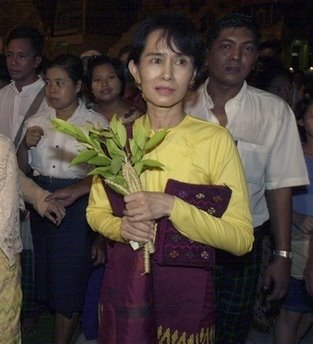


 Posts
Posts


