News & Articles on Burma
Wednesday, 31 August, 2011
------------------------------------------------
Behind Burma’s Rising FDI
Parliament rejects reform of emergency act
UNFC Forms Peace Group for Govt. Talks
Burma should review its war-game with ethnic groups
Seize opportunities to regain Burma
China Hands KNU Leader over to Burma
Burmese Parliament rejects motion to repeal Emergency Provisions Act
Burma must consider favorably ethnic people’s proposals for peace-talks
Burma jails man for 10 years for web article
Burma's Tortured Prisoners Can't Wait
Govt Officials Implicated in Car Smuggling Ring
Russian gas giant eyeing Burma
-------------------------------------
THE DIPLOMAT
Behind Burma’s Rising FDI
By Jared Bissinger
August 31, 2011
If the headlines are any indication, Burma had a banner year for foreign direct investment (FDI) in 2010-11. It approved investments of almost $20 billion – more than the previous two decades combined, and even more than Southeast Asia’s latest investment darling, Vietnam, approved the same year. Investment came exclusively from Asia, not a surprise given that sanctions and a strong social stigma effectively prevent Western companies from investing. But while the headlines tell a story that seems wholly positive, the details should give rise to a more cautious optimism.
The first thing to note is that the figure of $20 billion is for approved investments – in other words, investors have gotten the OK, but almost none of these projects have actually invested any money yet. Real investment inflows from last year, according to the United Nations Conference on Trade and Development (UNCTAD), were a more modest $756 million, on par with Cambodia’s $783 million and not even a tenth of Vietnam’s $8.2 billion. The figure was also largely in line with Burma’s FDI inflows in the last few years.
In addition, Burma’s approved investments came from a very small number of host countries – seven to be precise. The biggest of these, China, has seen its investment in Burma grow markedly. In the 1990s, Chinese investment was a modest $8.3 million, but the country became the largest investor in the late 2000s, with almost $350 million per year in the last two years with data available, FY2007-08 and FY2008-09 (Burma’s fiscal year runs from April 1 to March 31). The other major sources of investment were South Korea, Thailand and Hong Kong, though most companies investing from Hong Kong are owned by mainlanders. For comparisons sake, Vietnam attracted almost as much approved investment as Burma last year (about $19.5 billion for Vietnam and $20 billion for Burma) but it came from 51 different countries as opposed to seven.
Notably absent from the list of investors was India. As much as New Delhi is vaunted as being China’s strategic rival in Burma, the investment numbers tell a different story – through September 2009, India’s cumulative investment came to just $200,000. While India seems to finally be ramping up its flagship project in the country, the $137 million Kaladan Project, it is, at least in terms of FDI, nowhere near China’s investment in Burma.
So, while approved investment can’t tell us much about FDI in the past, it’s very useful in indicating trends in future investment. If Burma’s approvals from this year are any indication, the country is slated for a number of large, high-profile investments in the extractive and power sector. Of the $20 billion, almost all of it was devoted to projects in these sectors – 58 percent for the extractive industries and 41 percent to power, mostly for a few large dams. The remaining 1 percent was in agriculture and manufacturing. Neither real estate nor hotels and tourism – nor any other sector for that matter – received any approved investments. And while the total amount of approved investments from last year was an aberration, their sectoral distribution wasn’t – over the last decade, 98.7 percent of the FDI went to the extractive and power sectors.
While last year’s heavy concentration of investment in the extractive and power sectors is normal for modern Burma, it’s significantly different from FDI worldwide. Figures from UNCTAD show that last year, only 9.6 percent of FDI was in the extractive sector and only 4.1 percent in power, yet these two sectors practically monopolized Burma’s investment approvals. Manufacturing, which accounts for almost one out of every four dollars of FDI worldwide, was only 0.3 percent of Burma’s totals, while finance, which takes one in five dollars of worldwide investment, received nothing in Burma.
What does this tell us about Burma? Well, the extractive and power sectors (at least the dams) share an important and telling attribute – they’re both ‘globally scarce and geographically concentrated’ resources, according to Prof. Andreea Mihalache-O’Keef. To build a copper mine or a dam, you must go where there is a copper deposit or a suitable river valley. It is, in essence, a seller’s market.
Manufacturers, on the other hand, can invest almost anywhere they’d like, normally choosing a location that offers the lowest costs and greatest benefits – they search for comparative advantage. Countries often compete for manufacturing FDI by trying to offer the most competitive business environment, including reasonable tax and export regimes, efficient infrastructure, and a general ease of doing business. So why aren’t investors in these industries, especially those from Asian countries who don’t have investment sanctions, investing in Burma?
The answer is that Burma isn’t a competitive destination for most kinds of FDI. There are a number of problems, including poor infrastructure, high port costs, intermittent power supplies, currency convertibility issues, and a number of political obstacles to doing business. These challenges are only complicated by the recent and significant appreciation of the kyat, which has gone from around 1000k/USD to less than 700k/USD in the last year, exacerbating an already tough investment climate.
It’s fairly unlikely, then, that investment sanctions by Western countries have significantly hindered Burma’s economic development. Asian countries don’t restrict investment in Burma, yet there are almost no investments from these countries in manufacturing, real estate, or any other sector that is internationally competitive. Instead, investors in these sectors look elsewhere in Southeast Asia, to places like Vietnam, and only venture to Burma for resources and dams. There’s no reason that Western investors would act differently, and, therefore, even without investment sanctions, it’s unlikely that many Western companies would choose to do business there.
Yet the new government gives rise to cautious optimism, with its acknowledgement of economic distresses and very real talk of reforms. With improved accountability and governance, there’s at least the chance that some of the revenue from the looming resource boom will be used for much needed infrastructure and other public investments. These investments could pay important dividends if they improve the country’s ability to attract other types of FDI, especially in labour intensive industries. But a long history of the ‘resource curse’ elsewhere has shown that it may be better to be cautious than optimistic about Burma’s chances of using new resource revenues to promote real economic development.
Jared Bissinger is a PhD candidate at Macquarie University and former fellow at the National Bureau of Asian Research http://the-diplomat.com/asean-beat/2011/08/31/behind-burmas-rising-fdi/?utm_source=feedburner&utm_medium=feed&utm_campaign=Feed%3A+the-diplomat+%28The+Diplomat+RSS%29
------------------------------------
Parliament rejects reform of emergency act
By AHUNT PHONE MYAT
Published: 31 August 2011
A proposal in the People’s Parliament made by Thingangyun township’s representative Thein Nyunt to revoke the 1950 Emergency Provisions Act has been rejected by a vote in parliament yesterday.
Independent MP Thein Nyint submitted a proposal to the People’s Parliament to abolish the 1950 Emergency Provisions Act, that was adopted under the pretext of an on-going civil war at the time, along with criminal laws relating to it.
His proposal was discussed by four Union Solidarity and Development Party (USDP) representatives and the parliament voted on whether to accept it or not – the results showed there were 336 votes against, 8 in favour and 41 abstaining votes, said representative Pe Than of Myebon township in Arakan State.
“All parliament representatives who discussed about the proposal spoke out against it and the Union Minister Ko Ko insisted that it should be rejected,” said Pe Than.
When the parliament’s speaker asked for U Thein Nyunt’s opinion, he called to parliament to go for a vote ‘democratically’ so the parliament conducting a voting by headcount.
“All 336 representatives from the military and the USDP stood against the proposal,” said Pe Than.
Thein Nyunt said he; “happily accepted the loss.”
He said he understood the rejection of his proposal showed that the situation with the civil war back in 1950 is still continuing, citing discussions by two USDP representatives from Karen State’s Myawaddy and Kachin State.
“According to their discussion, the country is not yet at peace – there are still external and internal destructive elements – so it is necessary to have the [emergency act] under security concerns,” said Thein Nyunt.
The parliament is overwhelmingly dominated by the military either serving or retired, with 25% of seats reserved automatically for the military and alleged widespread vote rigging in favour of the military proxy party the USDP.
The 1950 Emergency Provisions Act and relating criminal laws were passed by a parliament while the country was wracked by civil war as communists and Karen secessionists fought with the Burmese state. Critics allege that it is widely used by the Burmese government to persecute political activists and journalists.
Article 5 of the law makes it illegal to; “spread false news” or to “to rally people” or “to make the public lose trust in the State’s economy.” http://www.dvb.no/news/parliament-rejects-reform-of-emergency-act/17366
----------------------------------
UNFC Forms Peace Group for Govt. Talks
By LAWI WENG Wednesday, August 31, 2011
Leaders of an umbrella organization of ethnic parties, the United Nationalities Federal Council (UNFC), formed a peace talk group last week in preparation for future negotiations with the Burmese government.
Speaking to The Irrawaddy on Wednesday, UNFC secretary Nai Hang Tha said, “There are eight representatives within the group which includes Mon, Shan, Karenni, Chin, Arakanese, Karen, Kachin and Pa-O people.
Nai Hang Tha explained that he will head the group with Colonel Lapai Hla, from the Kachin Independent Army (KIA), acting as deputy.
“We are prepared to talk about equal rights for ethnic people in the country. We will also talk about reforming the new constitution so that a genuine federal union will exist [in Burma],” he said.
“We will ask [the government] to stop their military offensives launched in ethnic areas and announce a nationwide ceasefire. If possible, we will ask them to have tripartite dialogue,” he added.
Leaders of the UNFC said that they want to hold peace talks with the government on the Burmese border or at a location within a neighboring country.
“It is best to talk within neighboring countries if those nations allow us to do so,” said Nai Hang Tha. Or we can talk at the border where there is security for us, like Kachin people have done in the past as they control their area.”
UNFC leaders decided to invite neutral persons who are well respected in the country—including pro-democracy icon Aung San Suu Kyi—to witness talks, and aim to sign an agreement on paper as evidence of their commitment.
The leaders do not want the government to offer peace talks on a group-by-group basis, as they do not believe this can solve problems in the country.
State-run newspaper The New Light of Myanmar reported on Aug. 18 that the government offered an “olive branch” to the armed groups, encouraging them to contact their respective state or division authorities as a first step toward meeting with a union government delegation.
“The government should not divide groups to have peace talks individually because our country's problems are not down to only one group. They need to talk with the UNFC as we represent all the ethnic groups,” said Nai Hang Tha.
The UNFC was formed in February at a meeting in northern Thailand attended by a dozen ethnic groups. These included the Kachin Independence Organization, Karen National Union, Karenni National Progressive Party, Chin National Front, New Mon State Party, Shan State Progress Party, Pa-O National Liberation Organization, Palaung State Liberation Front, Arakan National Council, Lahu Democratic Union, Wa National Organization and Kachin National Organization. http://www.irrawaddy.org/article.php?art_id=21992
-------------------------------------
Burma should review its war-game with ethnic groups
By Zin Linn Aug 31, 2011 9:06PM UTC
A 20-minute armed clash occurred on Tuesday between Burmese Army soldiers and the Kachin Independence Army (KIA) at Yinglung Village, near Mungli Hka stream, in Daw-hpum-Yang sub-township, Manmaw (Bhamo) District, in Kachin State, Northern Burma, referring local witnesses Kachin News Group said. Three Burmese soldiers, from the Dawh-pum-Yang-based Infantry Battalion No. 142, were killed in action.
The government soldiers were ambushed by a KIA unit under Brigade 5, said KIA officials.
Also on August 28 and 29, there was a heavy fighting at Lungja Bum Kadawng (Lungja hillside) in N’Mawk (Momauk) Township in Manmaw (Bhamo) Township, in Northern Kachin State, between KIA and government troops. Not less than seven Burma Army soldiers were killed in the battle and more than three injured, quoting local sources Kachin News Group said.
No political dialogue happened in more than 16-year ceasefire time and the KIO was intimidated to remove weapons and transform into the Burmese Army-controlled Border Guard Force (BGF) before the November 7 election in 2010.
The KIO dismissed the BGF plan, saying it cannot accept transformation of its armed wing. KIA officials constantly said the civil war will spread across Kachin and Shan states if the government did not stop fighting upon the KIO.
During the latest series of armed clashes in Kachin state, Burmese armed forces have suffered heavy casualties.
It was biggest defeat of Burmese troops in fighting with the KIA in Kachin State earlier this week, according to KIA officials at the Laiza headquarters in eastern Kachin State.
The August-28/29 skirmishing happened between over 200 government troops, combined with local battalions and the Sagaing-based Light Infantry Division No. 33 and the KIA fighters under Battalion 15 command, KIA officials said.
On 24 June, Union Parliament Speaker Shwe Mann said to parliament representatives in Yangon Region that the battles between the Burmese soldiers and KIA caused fear among the local people as well as in the nation. In that case, Thein Zaw, a member of parliament in Myitkyina, coordinated with authorities concerned and was able to put the situation under control.
He also said, “As a result, the region has restored peace and stability to nearly a full extent. Duty-conscious people and responsible and dutiful representatives of the people are required to act so in their regions. People’s representatives are to take precautionary measures if there is a likelihood of an attempt to harm peace and stability and to try to solve such problems without fail if they occur.”
However, people all over the country do not agree with his words because they have been listening to update news on the armed conflict in Kachin State aired by foreign radio stations – BBC, VOA, RFA and DVB.
Battles are going on constantly and several Burmese soldiers were killed in various clashes with Kachin Independence Army (KIA) troops in northern Kachin State.
The KIA officials said the recent heavy fighting took place when the government armed forces march into the area adjoining locations entrenched by KIA Battalions 1 and 15, under Brigade 3 command. The fighting has intensified near KIA military bases in Kachin State and Northern Shan State after different ceasefire proposals from each side failed to result in an agreement during two-party talks in early August.
Some analysts deem armed conflicts in Burma possibly will become wider since more ethnic armed groups refuse to accept the junta’s new constitution which says Burma Army is the only military institution in the country.
The armed ethnic groups also consider the incoming nominally civilian government which loyal to the 2008 constitution will not let their basic rights or self-determination in accordance with the 1947 Panglong Agreement.
A July-28-open-letter offered by Burma’s pro-democracy leader, Aung San Suu Kyi, strongly called for a ceasefire between the Burmese government, led by President Thein Sein, and ethnic armed groups, including the KIO, Karen National Union (KNU), New Mon State Party (NMSP) and the Shan State Army (SSA).
Thus, several ethnic armed groups including the KIA have already decided to defend their basic rights by holding their guns. If the new President Thein Sein government took no notice of addressing this delicate political issue by way of genuine political dialogue, the ongoing civil war may not be put out. http://asiancorrespondent.com/63881/burma-should-review-its-war-game-with-ethnic-groups/
---------------------------------------
Seize opportunities to regain Burma
By Nalin Viboonchart
The Nation
Published on September 1, 2011
China has become Burma's biggest business partner in terms of trading value, replacing Thailand, and is likely to benefit from the open-market policy the most, said Burmese and Thai businesspeople as well as the Thai Board of Investment (BoI).
Thai investors should penetrate potential markets such as Burma more, while the government must facilitate Thai companies wishing to expand their business not only in Burma but in other countries, including India and China, a seminar heard.
Vasana Mututanont, director of the BoI's International Affairs Bureau, said during the seminar titled "Thai Investors Move Forward in India and Burma" that the Kingdom had been Burma's largest business partner from 1988 to 2008, but it had lost this position to China over the past few years. China is expanding aggressively into Burma and now markets many consumer products there.
"Thai investors and the government cannot ignore Burma and should think about playing a greater role in the country," she said. "The government of Burma has set a target to transform it from an agricultural-oriented to an industrial country by 2030. It needs more investment and trade. Thailand has an opportunity from this policy."
The seminar was held by the Office of Industrial Economics and the Centre for International Trade Studies of the University of the Thai Chamber of Commerce to disclose research on the opportunities for Thai enterprises to invest in India and Burma.
Moe Myint Kyaw, president of the Myanmar Fishery Products Processors and Exporters Association, said Burma imported US$4.53 billion (Bt136 billion) worth of goods last year, with China, Thailand and Singapore the top three suppliers, in that order. China's trade value was the largest at about $9.5 billion, followed by Thailand with a little bit lower value.
He said Thai businesspeople had many opportunities to invest in various sectors in Burma, particularly fishery, agriculture, food, wood, cement and infrastructure. However, Thai investors do not benefit as much as they could. Collaboration between the two countries is needed.
"The two governments should have a good relationship. I think the relationship today is so far so good.??? Good cooperation will prevent investors conducting hit-and-run-style business in Burma," he said.
Thai businesses should think beyond how to sell their products in the Burmese market and plan to invest there, he said. Burma has limitations for exporting goods to other markets, lacking facilities such as ports. It needs Thailand as an export centre, as the cost may be lower than exporting directly from Burma. Hence Thai companies could use raw materials from Burma for production, while Burmese firms could undertake reprocessing and packaging in Thailand and use this country as their distribution centre.
Vichai Kemtongkum, managing director of Oriental Unique, a Thai trading company that has done business in Burma since 1994, said Thailand had lost market share in the neighbouring country to China even though it should have a trade value of many billions of baht with Burma. One obstacle may be concern about the security and stability of doing business with Burmese investors.
"As far as I'm concerned, Burma is safer than Thailand. Burmese investors are reliable. I have done business in Burma for many years and never experienced cheating by Burmese partners," he said.
Surasak Chuasuknothip, deputy director-general of the Foreign Ministry's Department of International Economic Affairs, said India needed to invest more than $1 trillion in infrastructure, and there was an opportunity for Thai contractors to take part in the investment. http://www.nationmultimedia.com/home/2011/09/01/business/Seize-opportunities-to-regain-Burma-30164191.html
----------------------------------------
China Hands KNU Leader over to Burma
By SAW YAN NAING Wednesday, August 31, 2011
Mahn Nyein Maung, a leading member of the Karen National Union (KNU) who once escaped from Burma's most notorious penal colony, is again in the hands of the Burmese authorities after being sent to Rangoon by Chinese officials, according to family members.
“The latest information we have is that our father was handed over to Burmese intelligence agents by officials in Kunming,” said his eldest son, who asked not to be identified by name.
The family said that Mahn Nyein Maung was arrested in the capital of China's Yunnan Province in July after being sent back from Bangkok, where he was denied entry by Thai immigration officials.
Mahn Nyein Maung had earlier traveled to Yunnan from Thailand, where he lived, to observe the armed conflict between the Kachin Independence Army (KIA) and government troops near the Sino-Burmese border.
Mahn Nyein Maung made the trip in his capacity as a central committee member of the United Nationalities Federal Council (UNFC), an alliance of ethnic armed groups, said Nai Hang Thar, the UNFC secretary.
Aung Kyaw Zaw, a Burmese observer on the Sino-Burmese border, said he heard that Mahn Nyein Maung had been put on a passenger flight to Rangoon in late July.
However, KNU central committee member Saw Ah Toe said he could not confirm that Mahn Nyein Maung had been sent to Burma.
“If he has been sent back, there's no doubt that he is being punished very severely,” said Saw Ah Toe.
Mahn Nyein Maung was a former underground activist inside Burma. In 1960, he was arrested and sent to the Coco Islands, an infamous detention center for political prisoners located about 300 km off the Burmese mainland in the Indian Ocean.
Mahn Nyein Maung and two other political prisoners, Mahn Aung Kyi and Aung Ngwe, managed to escape from the island by floating across the Indian Ocean clutching driftwood. However, they were rearrested when they reached the Burmese mainland.
It was the only known escape from the prison, known as “Burma's Devils Island”. http://www.irrawaddy.org/article.php?art_id=21991
-----------------------------------
Burmese Parliament rejects motion to repeal Emergency Provisions Act
Wednesday, 31 August 2011 11:23 Myo Thant
Chiang Mai (Mizzima) – A motion in the Burmese Lower House to repeal the 1950 Emergency Provisions Act, which is used to imprison democracy activists has been overwhelmingly rejected by the majority opposition dominated by the Union Solidarity and Development Party.
Only 7 MPs supported the motion made by New Democracy Party MP Thein Nyunt. The motion was voted down by 220 USDP MPs; 99 military-appointed MPs; 16 MPs from the National Unity Party (NUP) and other smaller-party MPs. Forty-one MPs abstained.
Voting in favour on Monday were Dr. Than Win and Khaing Khing Maung Yee from the National Democratic Force; Nan Wah Nu from the Shan Nationalities Development Party; Thein Nyunt and Kyi Myint from the New Democracy Party, Zar Telem from the Chin National Party and Myint Than from the All Mon Region Democracy Party.
MPs who rose to speak against the motion were USDP members Than Oo from the Myawaddy constituency; Aung Kyaw Soe from the Natmauk constituency; Soe Paing from the Wuntho constituency; and Zaung Khaung from the Hsawlaw constituency.
In speaking against the motion, Thein Oo argued that the law should be in force because insurgency was still taking place, referring to recent fighting between the Democratic Karen Buddhist Army (DKBA) and government troops.
USDP MP Zaung Khaung said the Emergency Provisions Act was essential to the country, citing recent fighting between the Kachin Independence Organization (KIO) and government troops.
The late Prime Minister U Nu enacted the emergency act two years after Burma regained independence in 1948, to be used for suppression of the civil war. The law says that those who obstruct or delay the performance of duty by the armed forces or police force or those who intend or act to undermine the stability in the government can receive up to life in prison term or capital punishment.
“We are not in a state of emergency. So this law is irrelevant in the current time,” said Khaing Khin Maung Yee, who supported the motion.
According to the figures released by the exile-based Assistance Association of Political Prisoners-Burma (AAPP-B), out of a total of 1,995 political prisoners 500 prisoners were charged and imprisoned under the Emergency Provisions Act.
According to parliamentary procedures, a motion must be seconded and moved by at least one MP for deliberation in the house.
In other Lower House business:
––USDP MP Soe Thar moved a motion to explore ways to help business enterprises which have been struggling as a result of the falling US dollar. MP Nyi Nyi seconded the motion and it will be brought up for deliberation at a later date.
––Former Minister of National Planning and Economic Development Soe Thar told MPs that there was an increase of import volume by 78 per cent in the 2010-11 fiscal year and there was a trade deficit of 796 million kyat (US$1.1 million), decreasing export values and volume of rice, pulses and beans, and fish in moving his motion.
––USDP MP Maung Maung Thein from the Kayan constituency made a motion to exempt income tax on interest earned by treasury bills issued by the government. The motion was seconded by MP Nan Wah Nu from the Kunhing constituency and the motion will be deliberated at a later date. House Speaker Thura Shwe Mahn urged the lawmakers to consult with the Finance and Revenue Ministry and Parliament Bills Committee regarding their motion.
The sessions of the lower and upper houses concluded at 3 p.m. There will be a joint session of Parliament on September 5. http://www.mizzima.com/news/inside-burma/5858-burmese-parliament-rejects-motion-to-repeal-emergency-provisions-act.html
----------------------------------------
Burma must consider favorably ethnic people’s proposals for peace-talks
Wed, 2011-08-31 00:37 — editor
Article
By - Zin Linn
Burma’s President Thein Sein government broadcasted a statement on 18 August concerning peace talks; it urged all rebel groups to get in touch with regional governments to initiate dialogue. According to the government, it would be forming a body to deal with ethnic armed-groups in quest of peace talks.
The statement is one of several fresh indications of the current controversial civilian government. It is currently attempting to transform its uncompromising portrait. Several ethnic armed groups have been fighting the military-backed government for decades to gain autonomy of groups, such as the Shan, Kachin, Karen and Mon.
Col Sai Htoo, Assistant Secretary General of the Shan State Progress Party / Shan State Army (SSPP/SSA), said the government’s 18-August peace talks call did not reveal any information concerning any preliminary programs at all. At least, he said, it should be focused on clearing the political atmosphere before any meaningful talks set off, according to Shan Herald Agency for News (S.H.A.N.).
“President Thein Sein should first create an environment conducive to friendly negotiations,” he told SHAN on Tuesday morning. According to him, it is important to release political prisoners, to start pulling out troops from the conflict zones and to declare a nationwide ceasefire announcement which will greatly brighten up the atmosphere.
However, at the meeting with Union Chief Justice Tun Tun Oo, Mr Quintana (UN’s Human Rights Envoy) put some questions on prisoners serving terms for their beliefs, amending existing laws to meet international norms, and formation and functions of the Constitutional Tribunal. The Union chief justice said that in Myanmar (Burma) there is no prisoner serving a term for his belief, and prisoners are all serving their terms for crimes they have committed. He also added that courts have powers to hand down sentences in the framework of the prescribed laws, and the accused have the right to argue in line with the law under the current 2008 constitution, revealed New Light of Myanmar newspaper.
Col Sai Htoo believes the 1947 Panglong Agreement that guarantees total autonomy, democracy and human rights for the states should be common ground on which peace talks should be conducted, and not the 2008 constitution, drafted and ratified and forcibly adopted by the previous military junta.
According to Col Sai Htoo, there are reasons for the government offering the peace talks. His rationales are as follow. (1) There is a conflict between Thein Sein government and the armed forces. (2) There is another conflict inside Thein Sein cabinet notably between President Thein Sein and his first-vice president Tin Aung Myint Oo. (3) Disciplinary problems are arising out of the Army’s inability to provide food, clothes and supplies for its troops and their families. (4) The government armed forces have suffered heavy casualties in the war in Kachin, Karen and Shan states. (5) The government hopes to break sanctions imposed by the Western bloc. (6) The government has an ambitious plan to chair the 10 member ASEAN in 2014.
Even though, the government’s “Invitation to peace talks” says that any armed group wishing to hold negotiations, it must contact the state government first individually in order to start preliminary discussion. After completion of which, the government will form a team for peace talks.
On the other hand, the Kachin Independence Organization (KIO) also dismissed the government’s 18-August peace-talk offer. It was sacked by the KIO and the United Nationalities Federal Council (UNFC) since the government uses just two-pronged meeting which in fact is a divide-and rule policy towards ethnic groups devoid of the Panglong Agreement. Talks between the KIO and the Burmese government were also failed in 1963, 1972, and 1980 respectively; they all botched to address the political face-off between the two sides.
Currently, KIO declared that it will talk through the ethnic alliance, the United Nationalities Federal Council (UNFC), maintaining the values of the Panglong Agreement.
The SSA has been combating against the Burma armed forces to gain self-determination for decades. Burma Army and SSA reached a ceasefire deal in 1989.
However, after 22 year of armistice, the ceasefire broken down due to Burma Army’s offensive on 13 March this year. The Shan State Progress Party/Shan State Army (SSPP/SSA) is a member of the newly formed United Nationalities Federal Council (UNFC) as well and it holds that any meaningful negotiations with Burmese government must be with the UNFC and not on the basis of one bilateral talk with individual groups - a provision set by President Thein Sein’s government.
If the government failed honoring the political aspirations of the ethnic groups, it will be pointless to end political and civil conflict all over the ethnic states. As a result, if the Burmese authorities neglected the opinion of the ethnic rebel-alliance, the critics may say that the current government is not heading toward a democratic system; instead it is challenging to pay no attention to the ethnic groups’ self-determination.
Hence, it is time for the government to review its strategy on peace-talks in comparison with the rebel-alliance’s proposal. In such an important time, government should not obstinately take hold of its own ‘modus operandi’ on peace-deal. If the government focused on reconstructing a democratic Myanmar or Burma, it must also respect the proposals of the ethnic people.
- Asian Tribune - http://www.asiantribune.com/news/2011/08/30/burma-must-consider-favourably-ethnic-people%E2%80%99s-proposals-peace-talks
------------------------------------
Bangkok Post
Burma jails man for 10 years for web article
Published: 31/08/2011 at 12:32 AM
Online news: Asia
A court in military-dominated Burma has sentenced a retired major to a decade in prison for writing an article deemed subversive and distributing it to overseas media, his lawyer said Tuesday.
A woman works online in her office in Beijing 2010. A court in military-dominated Myanmar has sentenced a retired major to a decade in prison for writing an article deemed subversive and distributing it to overseas media, his lawyer said Tuesday.
Nay Myo Zin, 36, was arrested in April, accused of harming national security, the rule of law, peace and stability and national unity with his article on reforming Burma's military and dictatorship.
He was accused of sending the article by email to pro-democracy activists and media-in-exile, such as the Norway-based Democratic Voice of Burma (DVB). The article is believed to have been published on the Internet.
"He was sentenced to 10 years imprisonment last Friday under the electronic act at a closed-door special court in Insein prison," one of his lawyers, Hla Myo Myint, told AFP.
"After his sentence, he said he didn't do anything to harm the country, the people and the military. He said he was sentenced unfairly."
Hla Myo Myint said the defence planned to appeal on behalf of the defendant.
A civilian administration has been nominally in charge of Burma since March, following a controversial election last year, but its ranks are dominated by former generals.
Media watchdog Reporters Without Borders describes Burma's legislation on Internet use, the Electronic Act, as "one of the most liberticidal laws in the world", with online dissidents facing lengthy prison terms.
Courts in Burma have a record of handing long prison sentences to journalists found working for overseas media critical of the regime.
In May, the DVB launched an appeal for worldwide pressure to secure the release of its 17 video journalists in jail in Burma.
The lawyer said Nay Myo Zin cannot walk after an accident in prison and his family was unable to attend the trial.
He said the defendant retired from the military in 2005 and went to work as a driver in Singapore before returning in 2007 and opening an Internet cafe. http://www.bangkokpost.com/news/asia/254233/burma-jails-man-for-10-years-for-web-article
-----------------------------------------
Burma's Tortured Prisoners Can't Wait
Posted: 31/8/11 00:00 GMT
The recent meeting between Aung San Suu Kyi and President Thein Sein, the new dictator of Burma, has given many in Burma some hope that there may be a chance of political progress at last. The UN Special Rapporteur on Human Rights in Burma also reflected this hope in comments after his visit to Burma at the end of August. But he was also cautious, talking about the potential for change, not actual change, and the fact that serious human rights abuses continue to be committed.
Those of us from Burma will remember similar hopeful statements from UN Envoys in the past, and also that Aung San Suu Kyi meeting the President has happened before, as long ago as 1994,and led nowhere. We know to judge the dictatorship by its actions, not its words.
In Burma, as in other countries ruled by dictatorship, the release of political prisoners has always been seen as a key benchmark for judging progress towards political reform. By that benchmark it's clear that Burma's new dictator, Thein Sein, isn't bringing change to my country. His government denies the 1,995 political prisoners even exist. The international community must now try something new to finally push the dictatorship to go beyond words.
A rare opportunity to try something new is fast approaching, with European Union diplomats currently discussing what will go into the next UN General Assembly resolution on Burma.
It will be the 21st Resolution on Burma, and it always calls for the release of political prisoners, a call which is always ignored.
Yet despite the critical benchmark of the release of political prisoners not being met, some European governments are arguing that before taking any new action in the Resolution, we must still wait and see if there will be change in Burma.
They would not see it like this if they looked at the situation from inside a prison cell, as I have. Every day is a crisis, a living hell. To survive with your mental and physical health intact is literally a life and death struggle.
Political prisoners face what amounts to two kinds of torture. The first is the torture more widely known about, which often takes place during interrogation. This includes beatings, electric shocks, stress positions, and many many other horrific acts.
The other form of torture inflicted upon prisoners is just as serious, but gets little attention.
The Rome Statute, which has legal definitions of crimes against humanity, describes torture as: 'the intentional infliction of severe pain or suffering, whether physical or mental, upon a person in the custody or under the control of the accused.'
Physical and mental suffering is deliberately inflicted upon political prisoners as a matter of government policy. Prisoners suffer from grossly inadequate medical care for small and serious illnesses and from untreated injuries from torture. They are subjected to mental suffering, being transferred to remote prisons away from families whose visits would lift their spirit, and who can bring them decent food and vital medicine. They are forced to live in horrific prison conditions, and threats and actual violence are routine.
On December 8th Buddhist monk U Naymeinda died in prison. His death was due to malnutrition, maltreatment and inadequate medical care. He was the 146th documented political prisoner to die in prison in Burma since 1988. The true number is believed to be much higher.
Ko Min Aung, a member of the National League for Democracy, has been denied urgent medical treatment for heart disease for over 11 months. In addition he is serving a sentence in Kale prison, Sagaing division, 800 miles from his home. Min Ko Naing, a member of the 88 generation students' group, is suffering from heart disease, gout, and is often very dizzy. He is being held in a remote prison, making it very difficult for his family to provide him with essential medicine.
Failure to provide prisoners with the basics, such as adequate food and clothing, appropriate medical treatment, and a cell that is clean, is in breach of a number of international laws and standards.
At the upcoming UN General Assembly this September, the 21st Resolution on Burma will call again for the release of political prisoners, and again, it will be ignored.
So this year, we are asking European governments, which draft the Resolution, to try something new. We want them to include the establishment of a Commission of Inquiry into possible war crimes and crimes against humanity in the resolution. It is only a small step, but it would be a significant one. It is a step already recommended by the UN's own Special Rapporteur on human rights in Burma.
An official UN Inquiry, shining a spotlight onto the abuses taking place against political prisoners in Burma's jails, and the abuses taking place against civilians in ethnic areas, could have a real impact in reducing the scale of some of these abuses. The dictatorship craves international acceptance. It does not want the world to know what they are doing in the remote jungles of Burma, and behind the high prison walls.
A UN Inquiry, which can expose the truth and make recommendations for practical action, won't stop Thein Sein from making reforms if he really wants to. But it could help improve the situation for political prisoners in Burma, something which the past 20 General Assembly resolutions have failed to do. Political prisoners can't afford more wait and see. The EU must act now. http://www.huffingtonpost.co.uk/bo-kyi/burmas-tortured-prisoners_b_941896.html
--------------------------------------
Govt Officials Implicated in Car Smuggling Ring
By THE IRRAWADDY Wednesday, August 31, 2011
RANGOON — A number of high-ranking Burmese government officials, including cabinet ministers and military generals, are involved in smuggling cars into Burma and illegally registering them in the country, according to sources within the government.
An official from Naypyidaw who spoke to The Irrawaddy on condition of anonymity said that the ministers and other officials receive bribes from smugglers and in some cases sign documents enabling licenses to be printed for illegal vehicles.
Minister of Finance and Revenue Hla Tun and Minister of Industry No. 2 Soe Thein are allegedly among those involved in these practices.
Government sources said that corruption within the Customs Department, which is overseen by the Ministry of Finance and Revenue, has worsened since Tun Thein, a close associate of Hla Tun, was appointed as its director-in-chief, although corruption was also rife under Tun Thein's predecessor, San Thaung, who now serves as the director of the Burmese Economic Bank.
The Ministry of Industry No. 2 has also been accused of playing a key role in facilitating the illegal import of foreign vehicles. According to a Rangoon-based businessman involved in Burma's vehicle manufacturing industry, the ministry issues certificates registering foreign cars as domestically produced, even though it does not have the authority to do this.
According to ministry sources, the ministry imposes a fine of US $13,000-20,000 for every Toyota Hi-Ace illegally imported into the country, although this is enforced only occasionally, as a cover for the more widespread practice of accepting bribes.
While Burma does have some vehicle factories—all owned by generals or their families—they don't have the capacity to produce international models.
The Ministry of Industry No. 2 officially registered 98,884 cars in 2010 and 9,577 so far this year. http://www.irrawaddy.org/article.php?art_id=21994
---------------------------------
Russian gas giant eyeing Burma
By Joseph Allchin
Published: 31 August 2011
Officials from Russian state run gas company, Gazprom visited Burma’s capital Naypyidaw earlier this month, according to the International Oil Daily.
The company is interested in becoming involved in gas projects in Burma as it looks to expand its Asian presence.
Russia has the largest proven reserves of gas in the world and as result the company is the largest extractor of natural gas in the world as well as the largest Russian company.
Its revenues in 2010 alone were in the region of US$ 17.2 billion, which is equivalent to roughly a third of Burma’s total estimated GDP.
The officials who visited however were from Gazprom’s international up stream branch, Gazprom EP International, which is registered in the Netherlands, an EU member state which is party to EU sanctions on the country. The German company E.ON also has a small stake in Gazprom.
The Burmese government for their part are interested in the expertise that the company can offer in terms of equipment, storage facilities, pipelines and fior the company to conduct geological surveys.
The company is reportedly looking to diversify its market away from the sluggish EU economies, as China’s growing appetite for energy looks set to over take demand from the European block in 2030. China however is busy acquiring sources of gas in its neighbourhood in both central Asia and Burma.
The Burmese government has also been looking to acquire more domestic know how in the oil & gas sector. They have been insisting that Burmese companies form joint ventures with foreign companies in the on shore gas sector.
Investment in the gas & oil sector has remained buoyant, so much so that it has caused a massive appreciation of the Burmese kyat as it has increased in value by over 20% over the last year. http://www.dvb.no/news/russian-gas-giant-eyeing-burma/17369
__._,_.___
Thursday, September 1, 2011
News & Articles on Burma -Wednesday, 31 August, 2011-UZL


Wednesday, August 31, 2011
News & Articles on Burma -Tuesday, 30 August, 2011-UZL
News & Articles on Burma
Tuesday, 30 August, 2011
------------------------------------------------
Prisons act reform proposal rejected by Home Minister
Burmese expanding in Kachin state
Myanmar folk wary of 'democracy' pledges
Naypyidaw to Host Political Forum
Burma at a crossroad: to ponder ethnic proposal for peace-talks
Farmers Take Land Seizure Cases to Parliament Don’t Leave Ethnics Out of 'Win-Win' Deal
Myanmar sentences ex-army captain to 10 years for sending information
Myanmar jails man for 10 years for web article
Timor-Leste Weighs Up Asean Membership
------------------------------------
Prisons act reform proposal rejected by Home Minister
By AHUNT PHONE MYAT
Published: 30 August 2011
A proposal submitted to the People’s Parliament by Thingangyun township MP, Thein Nyunt, to reform the Prison’s act, has been rejected by the speaker of the house because the speaker said the Home Ministry was already drafting a revised Prisons Act.
While no discussion of an amnesty has taken place, despite reports to the contrary in the state mouth piece the New Light of Myanmar.
The Prisons Act proposal by Thein Nyunt intended; “to provide necessary arrangements for drafting a bill of the Prisons Act, which is agreeable to the 21st century and guarantee human dignity and to introduce the bill to the third regular session of the first Pyithu Hluttaw”.
Pe Than, People’s Parliament representative of Arakan State’s Myebon township told DVB that;
“There were six non-USDP representatives who discussed in favour of [Thein Nyunt’s proposal] and three USDP representatives argued against it. The Home Affairs minister said his ministry was already preparing to submit the bill in the parliament and the [parliament] speaker decided to only keep a record of U Thein Nyunt’s proposal without giving him a chance to argue back,” said Pe Than.
Whilst on Home Affairs Minister, Lieutenant General Ko Ko’s discussion on the bill, Pe Than added that;
“It is not yet revealed which sections [of the prisons act] will be changed – he just spoke generally and said that there have been preparations to change some, if not all, sections in the law regarding the worst situations such as issues with food, accommodation, solitary confinement, transferring of inmates to remote prisons, inmates not being allowed to get medical assistance or to read books and newspapers, non-judicial punishment by prison officials.”
There will be concern that the Prisons Act revision by the Home Ministry will therefore not carry the necessary legislation that prevents torture and inhuman treatment of prisoners as critics and former inmates allege is routine in Burma’s prison system.
Thein Nyunt said: “We have to shine a spotlight and ensure, when the parliament discusses this new prisons act, that it is in accordance with the article 44 of the constitution, that; No penalty shall be prescribed that violates human dignity and also the United Nations’ Declaration of Human Rights, that states that; No one shall be subjected to torture or to cruel, inhuman or degrading treatment or punishment.”
A question regarding prison laws was also raised in the National Parliament yesterday where regional judges are to continue to submit prison reports to the Union Supreme Court as provided in the 1962 Prisons Act.
Upholding any law, debated in parliament or not, will continue to be problematic with the rule of law seemingly ignored as trials take place behind closed doors and with judges like the vast majority of MPs are appointees of the military, and seriously lacking in autonomy. http://www.dvb.no/news/17351/17351
------------------------------------------
Burmese expanding in Kachin state
By NAY THWIN
Published: 30 August 2011
The Kachin Independence Army (KIA) have claimed that the Burmese Army are sending new units into Kachin State’s Bhamo district while small clashes continue to occur throughout the region, said the KIA’s joint-secretary La Nan.
“The Burmese Army are increasing movements in the region with more troops being shipped from the lower-Burma region. Our soldiers at the frontline couldn’t identify which army units they were from but apparently they have sunflower insignia on their badges. That insignia doesn’t belong to the [Burmese Army] Northern Regional Military Command,” said La Nan.
“They were shipped into the region through the rivers and are becoming increasingly active in Bhamo District’s Momauk township.”
The sun flower insignia is believed to belong to the Eastern Regional Command based in Southern Shan State. It reportedly contains around 42 infantry battalions. While the Bhamo District is situated in southern Kachin state and is traversed by the main Mandalay-Myitkina highway, NH 31.
La Nan added that a clash took place between the KIA’s troops and a Burmese Army column in Momauk last Sunday;
“The fight took place when a Burmese Army column ran into our troops – they were about 100-200 strong, increased from usual troop number of around 50-60 in the past.”
Fighting between the KIA and the Burmese Army began in June this year after the KIA refused to assimilate into a Border Guard Force unit under the Burmese army. Clashes have been almost daily ever since, forcing thousands to flee their homes.
A local in Myitkyina said Kachin State’s Minister Lajun Ngum Sai in an public assembly on 27 August blamed the KIA for the armed conflict with the Burmese Army in the region;
“He said the KIA burnt down houses and that it was inappropriate – he seemed to want to imply that the KIA is not willing to negotiate despite the government giving them chances and favours to do so,” said the Myitkyina resident.
La Nan said the 20 houses burnt down mentioned by the minister were actually barracks in a Burmese Army camp and that the KIA were examining the relevant details.
In a press conference in Naypyidaw on 12 August, government spokesperson Kyaw Hsan blamed the KIA for breaking ceasefire agreements.
In response to this, the KIA accused the government of not holding a wish to solve political problems via political means.
The KIA and the Burmese had a cease fire in existence since 1994, which came to an end in June. The cease fire was smoothed over by the KIO ceding control of the lucrative jade mines in towns like Hpakant; reputedly home to the finest jade on earth. http://www.dvb.no/news/burmese-expanding-in-kachin-state/17341
-----------------------------------------
Myanmar folk wary of 'democracy' pledges
2011/08/30
FIVE months after a nominally civilian government took power in Myanmar, the country is awash in uncertainty about who is really in charge.
Workers have taken down the once-ubiquitous portraits of Senior Gen Than Shwe, the dictator who ran the country for nearly two decades, from the walls of government offices. But rumours circulate in Yangon that Than Shwe, who stepped down in March, still has the final word on important decisions.
An impoverished population, downtrodden by years of military rule, is parsing a raft of initiatives by the new government and trying to understand whether the country's transition from military dictatorship to what the state news media describe as "discipline flourishing democracy" is real.
Like the biblical Thomas, they seem to want more proof.
"As far as I can see, there has been no change," said U San Shwe, a retired civil servant whose comments typify the scepticism heard frequently in Myanmar.
"The new government consists of former generals who have habits that they can't break. They are accustomed to taking bribes, mistreating people and making a lot of money from their positions. They confiscate things, and no one can complain."
Trying to guess the direction of this country has, in the past, been a fool's errand. Myanmar has zigzagged from paranoid isolation under decades of military rule to flirtations with openness. The country seems propelled by the competing impulses of conservatives and reformers within the military.
In recent weeks there have been signs that reformers, led by Thein Sein, a former general who was elected president in February, have the upper hand.
The government has proposed peace talks with armed rebel groups that are battling the military for control over resources and for more autonomy. Officials have met three times in the last month with Aung San Suu Kyi, the country's leading dissident, who was released from house arrest in November.
Other changes have been more symbolic. The state-run newspapers are taking a lighter approach in their propaganda, refraining from publishing slogans like "Riots beget riots, not democracy". The government has also allowed publications that do not deal with politics or history to publish without prior censorship. (Any newspaper articles that touch on politics must still be submitted to a censorship board, which routinely slashes writing deemed negative about the government.)
The bar for freedom of expression is set so low here that journalists rejoiced when it was announced that they would be allowed into Parliament for its current session, which began on Monday.
Amid the tumult of transition, some economic changes have been very substantive. But their benefits to ordinary citizens remain unclear. A major privatisation programme initiated last year is transforming an economy that was so heavily controlled by the state that it could have been designed by Lenin himself.
Scores of state-owned factories, government buildings and companies have been sold off. The local currency, the kyat, has soared in value against the dollar -- in part, analysts believe, because money has poured into the country to pay for assets in the government's fire sale. The transactions were done without public tender, and most assets were sold to a handful of government favourites.
"There are great opportunities -- but only for the cronies. It's like Russia," said U Soe Than, the owner of a shop for cellphones and digital music players imported from China.
Whether an economy controlled by an oligopoly of cronies is better than the state-run system is a point of debate among analysts of the country. Similarly tainted privatisation campaigns in the Middle East created deep resentments that a decade or so later helped fuel revolts this year in Tunisia, Egypt and Syria. Yet poor economic prospects have been as debilitating for the citizens of Myanmar as political repression -- if not more.
There have been some signs of economic revival: the number of tourists visiting the country was up 23 per cent in the first half of this year, and hotels in Yangon brim with business travellers, many of them from China, Japan and South Korea.
Last week, The New Light of Myanmar, a state-owned newspaper, highlighted a meeting between government officials and executives from Caterpillar, the giant producer of construction and mining equipment that is based in the United States.
US and European sanctions have made it difficult for many multinational companies to operate in Myanmar, but the government appears to be working vigorously to get the measures lifted. Officials from the International Monetary Fund have been invited for meetings in October to discuss further economic liberalisation.
And the government has started a charm offensive with Suu Kyi, who has great leverage on the issue of sanctions. Recently, the government invited her for the first time to the capital, where she met with Thein Sein, the president.
As an Oxford-educated 1991 Nobel Peace laureate and the daughter of Myanmar's independence hero, Aung San, she is perhaps the premier interlocutor between Myanmar and the outside world.
She has not fully enunciated her goals since her release from house arrest, but those who have watched her closely believe that she has aspirations well beyond being a mere symbol of national unity.
"I always thought that her ambitions were higher than a 'mother' figure," said Josef Silverstein, a Myanmar specialist and professor emeritus at Rutgers University in New Jersey.
Whether a long-elusive reconciliation between Suu Kyi and the former generals is possible remains a question hanging over the country's future.
Yet, the political situation is only one part of the enormous challenge facing Myanmar's 55 million people.
The decades of military rule and the generals' single-minded obsession with political survival have left the country's health and education systems a shambles.
A generation of students had been forgotten, said U Thiha, who runs a computer programming school in Yangon. He has been frustrated in his search for the best young minds for courses on web programming.
"My students were not well trained at university," he said. "They don't have enough knowledge. They are not eager. And over the past 20 years, there have been no activities to test and challenge them." -- NYT
Read more: Myanmar folk wary of 'democracy' pledges http://www.nst.com.my/nst/articles/24democ/Article/#ixzz1WX03wDQe
-----------------------------------------------
Naypyidaw to Host Political Forum
By WAI MOE Tuesday, August 30, 2011
The Burmese government is to hold a political forum in Naypyidaw in the coming months following the media success of its economic development workshop in August which was attended by pro-democracy leader Aung San Suu Kyi.
Nay Zin Latt, a political advisor to President Thein Sein, told The Irrawaddy on Tuesday that the presidential office is planning a political forum, though he declined to say if a specific dated had been fixed for the event.
“Plans to organize national level fora are on our agenda,” he said. “A political forum is likely in the near future. But I don’t know when it will take place nor how it will be comprised.”
Political parties and politicians including Suu Kyi, as well as activists and scholars in exile, are expected to be invited to the forum, which political sources in Rangoon said could be in November.
“If Daw Aung San Suu Kyi is invited to the political forum, I think that she should return to Naypyidaw and cooperate with the government for the sake of the people of Burma,” said Win Tin, one of Suu Kyi’s aides and a prominent member of her party, the National League for Democracy.
However, it is uncertain whether representatives of ethnic armed groups will be invited to Naypyidaw nor whether any political prisoners will be released and allowed to participate in the forum.
“There must be an environment for a meaningful political forum—2,000-plus political prisoners must be released and a ceasefire has to enacted across the country,” said Naing Aung, a political figure in exile and the general secretary of the Forum for Democracy in Burma.
“The government must avoid suppressing and arresting people under state emergency acts such as 5-J,” he added. “In addition, [88 Generation Students group leaders] Ko Min Ko Naing and Ko Ko Gyi should have the right to participate at the forum.”
On August 19-21, the regime held an economic development forum in Naypyidaw’s International Convention Center. Suu Kyi was invited as a special guest by Thein Sein, and she made her first visit to the new capital where she had talks with the president and other government ministers.
The Irrawaddy's Lin Thant contributed to this report. http://www.irrawaddy.org/article.php?art_id=21987
-------------------------------------------
Burma at a crossroad: to ponder ethnic proposal for peace-talks
By Zin Linn Aug 30, 2011 10:51PM UTC
Col Sai Htoo, Assistant Secretary General of the Shan State Progress Party / Shan State Army (SSPP/SSA), said the government’s 18-August peace talks call did not reveal any information concerning preliminary programs at all. At least, he said, it should be focused on clearing the political atmosphere before any meaningful talks set off, according to Shan Herald Agency for News (S.H.A.N.).
“President Thein Sein should first create an environment conducive to friendly negotiations,” he told SHAN on Tuesday morning. According to him, it is important to release of political prisoners, to start pulling out of troops from the conflict zones and to declare a nationwide ceasefire announcement which will greatly brighten up the atmosphere.
However, at the meeting with Union Chief Justice Tun Tun Oo, Mr Quintana ( UN Human Envoy) put some questions on prisoners serving terms for their beliefs, amending existing laws to meet international norms, and formation and functions of the Constitutional Tribunal. The Union chief justice said that in Myanmar (Burma) there is no prisoner serving a term for his belief, and prisoners are all serving their terms for the crimes they have committed. He also added that courts have powers to hand down sentences in the framework of the prescribed laws, and the accused have the right to argue in line with the law under the current 2008 constitution, as said by the New Light of Myanmar newspaper.
Col Sai Htoo believes the 1947 Panglong Agreement that guarantees total autonomy, democracy and human rights for the states should be common ground on which peace talks should be conducted, and not the 2008 constitution “forcibly” drafted and ratified by the previous military junta.
According to Col Sai Htoo, there are reasons with the government offering the peace talks. His rationales are as follow. (1) There is a conflict between Thein Sein government and the armed forces. (2) There is another conflict inside Thein Sein cabinet notably between President Thein Sein and his first-vice president Tin Aung Myint Oo. (3) Disciplinary problems are arising out of the Army’s inability to provide food, clothes and supplies for its troops and their families. (4) The government armed forces have suffered heavy casualties in the war in Kachin, Karen and Shan states. (5) The government hopes to break sanctions imposed by the Western bloc. (6) The government has an ambitious plan to chair the 10 member ASEAN in 2014.
Even though, the government’s “Invitation to peace talks” says that any armed group wishing to hold negotiations must contact the state government first individually in order to start preliminary discussion. After completion of which, the government will form a team for peace talks.
On the other hand, the Kachin Independence Organization (KIO) also dismissed the government’s 18-August peace-talk offer. It was sacked by the KIO and the United Nationalities Federal Council (UNFC) since the government uses just two-pronged meeting which in fact is a divide-and rule policy towards ethnic groups devoid of the Panglong Agreement. Talks between the KIO and the Burmese government were also failed in 1963, 1972, and 1980 respectively; they all botched to address the political face-off between the two sides.
Currently, KIO declared that it will talk through the ethnic alliance, the United Nationalities Federal Council (UNFC), maintaining the values of the Panglong Agreement.
The SSA has been combating against the Burma armed forces to gain self-determination for decades. Burma Army and SSA reached a ceasefire deal in 1989. However, after 22 year of armistice promise, the ceasefire broken down due to Burma Army’s offensive on 13 March this year. The Shan State Progress Party/Shan State Army (SSPP/SSA) is a member of the newly formed United Nationalities Federal Council (UNFC) as well and it holds that any meaningful negotiations with Burmese government must be with the UNFC and not one by one bilateral -talk, a provision set by President Thein Sein’s government.
If the government failed honoring the political ambition of ethnic people, it will be pointless to end political and civil conflict all over ethnic states. As a result, if the Burmese authorities neglected the opinion of the ethnic rebel-alliance, the critics may say that the current government is not heading toward a democratic system; instead it is challenging to pay no attention to the ethnic people’s self-determination.
Hence, the government has to review its policy on peace-talks vis-à-vis the rebel-alliance’s proposal. http://asiancorrespondent.com/63804/burma-at-a-crossroad-to-ponder-ethnic-proposal-for-peace-talks/
-------------------------------------------------
Farmers Take Land Seizure Cases to Parliament
By KO HTWE Tuesday, August 30, 2011
“I feel sad when our fields have been changed into a lake for the purpose of breeding fish. Since that happened, I became a worker in another field,” said Aye Thein. The 64-year-old was forced to abandon his eight acres of land in 1999 after it was confiscated by the Myanmar Billion Group company in Audsu village of Nyaungdon Township, Irrawaddy Division.
Aye Thein is one of many victims in Burma where land seizures take place commonly through three different ways: seizures by the military commander-in-chief of the region, by private companies or by financiers who are allegedly backed by the Burmese Army.
Aye Thein, and others in the area who lost nearly 63 acres of land between them, fruitlessly complained to the township and district authorities three times about their land confiscation.
Confiscated land taken by the Burmese authorities and distributed to private companies includes approximately 10,000 acres in Rangoon Division, nearly 5,000 acres in Irrawaddy Division, 1,338 acres in Kachin State, 600 acres in Mon State and 500 acres in Maymyo in Mandalay Division. The affected farmers have filed lawsuits but no action has been taken.
The Human Rights Foundation of Monland (HURFOM) recently released a report that claimed around 20,000 acres have been seized over the past 10 years by the Burmese military in Mon and Karen states as well as Tenasserim Division.
The Yuzana Company was granted 200,000 acres in the Hugawng Valley Tiger Reserve in 2006 to establish tapioca and sugarcane plantations, and some 600 farmers were evicted from their lands without full compensation. They were eventually displaced to areas far from their original homes.
After cultivating the area for nearly two years, the company left the land and had it transferred back to a financier backed by the Burmese authorities. The area is now being changed into a lake for producing fish.
According to the local-based Activity for Free Developing Society Community organization, the rightful owners of 63 out of a total of 200 acres in Nyaungdon Township sent letters on Thursday to the chief minister of Irrawaddy Division and President Thein Sein demanding the end of land confiscation.
“Tax receipts and sending [rice crops] to the government are our evidence that proves that we are the rightful owners of the land. Now the government has announced that we can complain about unfair cases so I brought up our land seizure case with the help of the group,” said Aye Thein.
In his inaugural address to the Union Parliament, President Thein Sein said they are determined to improve the living conditions of farmers and workers and would update laws to safeguard the rights of peasants.
“By changing the law, the lives of farmers will be secure and they will have the chance to cultivate their own land. Farmers are not currently covered by peasant law. The 1963 Safeguarding Peasants' Rights Law is not up-to-date with the current time,” said Pho Phyu, a lawyer who has previously represented Rangoon and Irrawaddy farmers in land seizure cases.
On Monday, accompanied with 22 farmers from Rangoon, Pho Phyu went to the Naypidaw offices of Burma's president and Parliament with letters that drew attention to land confiscation cases, fishermen affairs and social issues. They urged the government to amend laws that can secure the livelihoods of farmers and workers.
“The [president and Parliament office] accepted out letters and will send our proposals to the respective officials,” said Phyo Phyu. He added that they were representing farmers from seven villages who have been lost 10,000 acres around Rangoon.
Due to corruption of the judiciary and slow management practices, much farmland has fallen into the hands of financiers, and village authorities have forced farmers to change their names which were written on proposals, added Phyo Phyu.
“I can't stand these confiscation cases and we are hoping that the government will reply. President Thein Sein once instructed a company to cooperate with farmers, but on the ground these companies give very little compensation and just 'shoo' the farmer away,” said Myint Aung from Naypyidaw, whose land has been confiscated in Dagon Seikkan Township of Rangoon.
Even today, farmers in Burma have no right to form a peasants' union to protect against government land confiscation and other intrusions on their rights.
“Our lives depend on the field so I became a porter after my land was seized. When I saw our paddy fields being happily worked by others it made me feel sad because we have no place to earn,” said San Win, who lost eight acres in Nyaungdon Township. http://www.irrawaddy.org/article.php?art_id=21984
-------------------------------------
NEWS ANALYSIS
Don’t Leave Ethnics Out of 'Win-Win' Deal
By SAW YAN NAING Tuesday, August 30, 2011
Change is said to be underway in Burma, as the country's rulers appear to be relaxing their grip on the democratic opposition and taking a more conciliatory approach to their international critics. President Thein Sein has met pro-democracy leader Aung San Suu Kyi in Naypyidaw, and the UN human rights envoy to Burma, Tomás Ojea Quintana, recently concluded a rare visit to the country. Thein Sein has also reached out to exiles, urging them to return home, and Burma's state-run media has stopped its ritual denunciation of the BBC, VOA and RFA.
So far, much of the discussion about these developments has focused on whether they really amount to anything. Clearly, in themselves, they are a far cry from the breakthrough that the people of Burma, and the world, have been waiting decades to witness. But already, there are some in the country who worry that they are in danger of being written out of this “history in the making”—if that's what it is.
For Burma's ethnic peoples, recent hints of a possible detente between the Naypyidaw-centered, military-backed government and the Rangoon-centered democratic opposition are cause for concern. Historically, ethnic minorities, who make up about a third of the population, have been marginalized by Burmese politics. Still struggling for their survival and their right to self-determination, they now worry that any “peace” achieved in the Burmese heartland may never extend as far as their own homelands.
While some prominent exiles consider returning to test the waters and people speak hopefully of a new era of cooperation between the government and opposition groups in the fields of social and economic development, the outlook for Burma's ethnic minorities remains utterly devoid of optimism.
Since Thein Sein assumed power earlier this year, tensions that have been mounting since last year over the refusal of armed ceasefire groups to form “border guard forces” under Burmese military command have come to a head in Shan and Kachin states. Burmese offensives in areas under the control of Kachin Independence Army (KIA) and the Shan State Army (SSA) have forced thousands of civilians to flee.
This depressingly familiar situation—for the past two decades, more than 140,000 war refugees have huddled in crowded camps on the Thai-Burmese border, and tens of thousands more have been forced to hide in the jungles inside Burma—has attracted remarkably little international attention, as all eyes now focus on events in the country's centers of power.
Over the years, ethnic civilians have suffered countless atrocities at the hands of Burmese troops, including forced labor, rape, torture and murder. To some extent, this situation was mitigated by the ceasefire agreements that were reached in the 1990s between the Burmese army and an array of armed groups—the KIA, the SSA-North, the United Wa State Army, the Democratic Karen Buddhist Army, the New Mon State Party, and others—but at no point have Burma's ethnic peoples enjoyed real peace and security.
Now that most of these ceasefire agreements have collapsed, the ethnic armies have demanded a withdrawal of government troops from their areas and new talks, this time involving an alliance of ethnic forces and leading to a nationwide ceasefire. Preferring to stick to the “divide and rule” tactics of the past, however, the government continues to push for one-on-one negotiations with individual groups.
It is deeply distressing for Burma's ethnic peoples to think that their future may look very much like their past, no matter what happens as the country's rulers move to co-opt the opposition.
As Moo Kay Paw, a Karen girl living in hiding in the jungle, put it with tears in her eyes: “I don’t understand my life sometimes. I ask myself why I was born to live in fear like this. We can be killed at any time, like animals. Why can’t we live with dignity, like human beings?” http://www.irrawaddy.org/article.php?art_id=21988
-------------------------------------
The Straits Times
Myanmar jails man for 10 years for web article
Published on Aug 30, 2011
YANGON (AFP) - A court in military-dominated Myanmar has sentenced a retired major to a decade in prison for writing an article deemed subversive and distributing it to overseas media, his lawyer said on Tuesday.
Nay Myo Zin, 36, was arrested in April, accused of harming national security, the rule of law, peace and stability and national unity with his article on reforming Myanmar's military and dictatorship.
He was accused of sending the article by email to pro-democracy activists and media-in-exile, such as the Norway-based Democratic Voice of Burma (DVB).
The article is believed to have been published on the Internet. http://www.straitstimes.com/BreakingNews/SEAsia/Story/STIStory_707553.html
-----------------------------------------
The Washington Post
Myanmar sentences ex-army captain to 10 years for sending information to dissident groups
By Associated Press, Updated: Tuesday, August 30, 1:13 PM
YANGON, Myanmar — A special court inside Myanmar’s Insein prison has sentenced an ex-army captain to 10 years imprisonment for writing and sending critical articles to the Democratic Voice of Burma and other dissident groups.
Lawyer Hla Myo Myint says 35-year-old Nay Myo Zin was sentenced last Friday in a closed-door trial. He was found guilty of violating the Electronics Act and tarnishing the army’s image.
Zin was arrested last April at his Yangon internet cafe.
Hla Myo Myint said Monday the arrest without a warrant and mental torture of his client were violations of his human rights.
He says Myanmar’s judiciary is still not independent and there is no rule of law although the nominally civilian government that took office in March claims to be reforming the system.
Copyright 2011 The Associated Press. All rights reserved. This material may not be published, broadcast, rewritten or redistributed. http://www.washingtonpost.com/world/asia-pacific/myanmar-sentences-ex-army-captain-to-10-years-for-sending-information-to-dissident-groups/2011/08/30/gIQAhwPuoJ_story.html
-------------------------------------
Timor-Leste Weighs Up Asean Membership
By SIMON ROUGHNEEN Tuesday, August 30, 2011
DILI —Across the city, banners and posters signal the new country's increasing integration with the world outside, heralding events such as Timor-Leste's hosting of the EITI (Extractive Industries Transparency Initiative) regional conference on Aug. 25-27.
Timor-Leste was designated the first Asian country to match up to EITI standards on accountability in and management of its energy resources. According to World Bank Managing Director and former Indonesian Finance Minister Sri Mulyani, speaking at the EITI event, “Timor-Leste, as a nation, is building strength and economic resilience and has demonstrated how much can be won in a short space of time.”
The EITI is a voluntary mechanism, usually backed by member countries passing relevant laws. It claims it “supports improved governance in resource-rich countries through the verification and full publication of company payments and government revenues from oil, gas and mining.”
The plaudits from EITI and the World Bank are a notable achievement for East Timor, which as recently as 2006 teetered on the brink of civil war. However, concerns remain about corruption among the country's politicians and officials, with public displays of ostentation such as newly acquired expensive cars and big houses seemingly stoking resentment among ordinary Timorese, for whom the country's energy-based economy is almost an abstraction.
“People ask, how can a civil servant who earns US $500 a month afford to buy his son or daughter a brand new SUV?” said Rogerio Lobato, a former Interior Minister convicted of gun-running during Timor-Leste's 2006 crisis, when 10 percent of the population was driven from their homes as security force factions fought on the streets. Lobato says he intends to run for president in the 2012 elections in Timor-Leste.
For the country's political leaders membership of the Association of Southeast Asian Nations (Asean) is a key foreign policy goal, superseding membership of or achievements within other international or regional organisations such as EITI.
President Jose Ramos-Horta banged the drum for his country's accession in an article published in May as the the most recent Asean summit in Jakarta, the capital of Timor-Leste's former occupier Indonesia, weighed-up Dili's request to join the bloc.
Ramos-Horta pointed out that his country outranks Asean members Burma, Cambodia and Laos in the latest United Nations Development Programme's (UNDP) Human Development Index (HDI), a league table that lists countries by what the UNDP deems as “a development paradigm that is about much more than the rise or fall of national incomes.”
The president said that Timor-Leste's GNP per capita “increased 228 per cent” over 2005-10 “to more than $5,000.” The country's economy is growing rapidly, as recent 10 percent per annum expansion figures show, but this is down to energy revenues coming online and government spending on the back of the largesse.
However, non-oil/gas income per head is thought to be less than $400 per person, and is a much more accurate reflection of poverty levels in Timor-Leste, where unemployment is high—reaching 40 percent among among urban youth. Migration to Dili threatens to see Port Moresby-type slums emerge on the city's edges, where a deeply rooted gang culture lives on, and a controversial and tricky land law could see many of Dili's residents be deemed squatters—and therefore vulnerable to eviction at any time—by the government.
However, similar challenges are present—to greater or lesser degrees—in some Asean member states, and to Timor-Leste's allies inside the bloc, this should not automatically disqualify the aspiring new member. In May, current Asean chair Indonesia recommended that Dili's accession request be given “urgent attention” by the nine other Asean members. Singapore has been the sole Asean member to publicly question Timor-Leste's accession, saying that the former Portuguese colony, host to a long-standing UN mission and international peacekeeping force, is not yet ready to take on the bureaucratic workload that Asean membership requires.
There is broad agreement between the current Government in Dili—a multi-party coalition led by former anti-Indonesian resistance leader Xanana Gusmao—and the main opposition party Fretilin. Party spokesman and Fretilin MP Jose Teixeira told The Irrawaddy his party sought membership of Asean as far back as 1974, when Portugal ended its colonial rule.“We want everyone to know it is a bipartisan policy,” he said.
However, some in Timor-Leste agree with the Singapore line that it is too soon for Timor-Leste to join the 10-member Southeast Asian bloc, which aims to establish an 'Asean Economic Community' by 2015.
Lao Hamutuk, a Dili-based NGO that monitors political and economic developments in Timor-Leste, said it believes that Asean membership would swamp the import-dependent Timorese economy and hinder the development of the non-oil/gas economy. The sector employs only a handful of Timorese but accounts for over 90 percent of the state budget, amid ongoing mass joblessness and what LH researcher Juvinal Dias describes as “almost no local production.”
He adds: “We cannot yet compete with other countries in economy or agriculture.”
Part of Singapore's argument against Timor-Leste joining Asean sooner rather than later is historical—with some misgivings lingering over the accession of Burma, Cambodia, Laos and Vietnam in 1997. Timor-Leste argues that it is in better shape to join than any of this four were at that time, pointing not only to the UNDP data, but to its far better democratic credentials.
However, Timor-Leste's eventual accession to Asean may not be as productive as supporters of the move hope, or as damaging as opponents fear, if precedent elsewhere is anything to go by.
Sean Turnell, an academic at Macquarie University in Australia, and founder of Burma Economic Watch, said, “Asean has had very little effect, I would say, on Burma's economy—i.e., in the sense of changing any patterns in investment, trade, etc. These are all driven by much more fundamental forces than bureaucratic structures, but instead on the availability of resources, at the right price, and so on. In other words, Thailand does not buy Burma's gas just because they are both members of Asean.” http://www.irrawaddy.org/article.php?art_id=21983
__._,_.___
Sunday, August 28, 2011
News & Articles on Burma -Saturday, 27 August, 2011-UZL
News & Articles on Burma
Saturday, 27 August, 2011
--------------------------------
Burma MPs propose prisoner amnesty: state media
Will Burma really listen to the UN Rights Envoy?
Survival instinct steers Myanmar generals towards reform
Myanmar MPs propose prisoner amnesty: state media
Myanmar MPs propose prisoner amnesty: State media
Myanmar OKS Setting Up Of New Political Party
Burmese military agents plant a powerful bomb in Kachin quarter
--------------------------------------
Bangkok Post
Burma MPs propose prisoner amnesty: state media
Published: 27/08/2011 at 03:32 PM
Online news: Asia
Members of Burma's army-dominated parliament have called for a sweeping jail amnesty, state media reported Saturday, after a UN envoy called for the release of prisoners of conscience.
A general view of Myanmar's parliament in Naypyidaw. Members of Myanmar's army-dominated parliament have called for a sweeping jail amnesty, state media reported Saturday, after a UN envoy called for the release of prisoners of conscience.
A proposal for a general amnesty was raised in the lower house on Friday, the New Light of Burma reported.
"They firmly hope that the president would make (an) assessment and release an order of amnesty," the newspaper said, without giving further details on who would be included.
The plight of around 2,000 political prisoners, many of whom are serving double-digit jail terms, is a key concern of the international community, along with other human rights abuses and democratic reforms.
It is the first time that serving military members of parliament have taken part in a discussion of a general amnesty since a nominally civilian government took over in March. A quarter of seats are reserved for the army.
The regime, which came to power after controversial November elections, appears keen to improve its image and recently held the first talks between democracy icon Aung San Suu Kyi and President Thein Sein, a former general.
But the UN special rapporteur on human rights in Burma, Tomas Ojea Quintana, said serious concerns remained as he concluded a visit to the country on Thursday.
The UN envoy, who visited Rangoon's notorious Insein jail during his five day trip, voiced fears over allegations of torture during detention and the use of prisoners as porters for the military.
"Of key concern to me and the international community is the continuing detention of a large number of prisoners of conscience," Quintana said.
In a move that rights groups said was woefully insufficient, Burma reduced all current jail sentences by one year in May and commuted the death penalty to life imprisonment.
Amnesty International said that political detainees are imprisoned using vague laws that criminalise peaceful political activists. They are held in poor conditions and moved to jails far from their homes and families.
Opposition leader Suu Kyi was freed from seven years of house arrest in November shortly after the election, Burma's first in 20 years.
Quintana, who also held talks with the Nobel laureate last week, urged Burma's parliamentarians, many of whom shed military uniforms to contest the election, to hold "open and inclusive debates on issues of national importance".
--------------------------------------
Will Burma really listen to the UN Rights Envoy?
By Zin Linn Aug 27, 2011 8:12PM UTC
Human Rights Special Rapporteur Mr Thomas Ojea Quintana on his Burma tour from 21 to 25 August separately met Union Parliament Speaker Thura Shwe Mann, National Parliament Speaker Khin Aung Myint, Union Chief Justice Tun Tun Oo, Chairman of the Union Election Commission Tin Aye, Union Minister for Home Affairs Lt-Gen Ko Ko, Union Minister for Defence Maj-Gen Hla Min, Union Minister for Foreign Affairs Wunna Maung Lwin, Union Minister for Labour and for Social Welfare, Relief and Resettlement Aung Kyi, Union Attorney-General Dr Tun Shin and Deputy Chief of the Police Force Police Brig-Gen Zaw Win.
The explanation of Union Parliament Speaker Thura Shwe Mann to the UN Envoy was published in the New Light of Myanmar on Thursday.
“As Myanmar (Burma) is a member of the international community, it has embraced the opportunities to address democracy and human rights cases like the global community. Though, every country has different processes from other countries based on own culture, custom and historical background. As the Human Rights Special Rapporteur reviewed, Myanmar is on the correct path to democracy and will continue to march along the correct path,” Thura Shwe Mann said.
He also said, “Necessary laws will be ratified to make sure that Parliament representatives serve the public interest or bring about the people’s fundamental rights, democracy and human rights without party attachment, localism, racism and regionalism. So, the existing laws will be under review to abrogate and amend inconsistent ones and endorse new ones. Only then will multiparty democracy rights will do well in future. The power to issue writs has been grant to bring democracy and rights to the people. The government, judicial bodies, service personnel and the people will abide by the enacted laws through the check and balance.”
He also said that Parliament representatives know that armed conflicts due to misunderstanding among national races do not bring any benefits to the nation. Hence Parliament committees include the Committee for National Races Affairs and Internal Peace in addition to the Committee of Fundamental Rights, Democratic Rights and Human Rights of Citizens.
He said that the Judicial and Legal Affairs Committee has been formed to handle legal affairs in an effective way. The Parliament committees carry out tasks inside Parliaments, so it is safe to say that the tasks are carried out by the public. The report on progress in addressing land confiscation cases will be submitted to the Parliament session, and the government’s Guarantees, Pledges and Undertakings Vetting Committee will watch and see, he explained.
Union Parliament Speaker wants the Human Rights Special Rapporteur to prevent the acts of certain countries and organizations that trouble Myanmar (Burma) and the people at a time when Myanmar and the people are working together for democracy and human rights.
Finally, Thura Shwe Mann said, Myanmar (Burma) will accept and appreciate Special Rapporteur’s suggestions, people’s stances and international community’s suggestions. Moreover, the Human Rights Special Rapporteur can watch what Myanmar is working for democratization, Speaker Thura Shwe Mann said.
Even though, the UN envoy called on Burma Thursday to immediately probe human rights abuses, saying serious concerns remained regardless of signs of progress under the new questionable civilian government.
He also expressed concern about the condition in ethnic conflict areas, including attacks against civilians, extrajudicial killings, sexual violence, arbitrary arrest, the recruitment of child soldiers and forced labor.
Mr. Quintana’s visit followed key opposition figure Aung San Suu Kyi met with President Thein Sein last week. It was a top-level talk with the government’s chief since her release in November, after a controversial election. Quintana also held talks with Suu Kyi during his most up-to-date trip.
Quintana has not been issued a visa to visit Burma since March 2010, when he suggested forming of a commission of inquiry. Quintana last visited Burma in February 2010 but was not allowed to see opposition leader Aung San Suu Kyi, who was under house arrest at the time. His consequential requests to revisit Burma have been refused.
In yesterday AFP News, Mr. Quintana, the UN special rapporteur on human rights in Burma said, “This is a key moment in Burma’s history and there are real opportunities for positive and meaningful developments to improve the human rights situation and bring about a genuine transition to democracy,”
According to him, the new government has taken a number of steps towards transition to democracy. However, many serious human rights questions are still to be addressed. He has been repetitively calling for the release of Burma’s estimated 2,000 political prisoners.
http://asiancorrespondent.com/63590/will-burma-really-listen-to-the-un-rights-envoy/
----------------------------------------
Survival instinct steers Myanmar generals towards reform
Saturday, 27 August 2011 02:22
By Martin Petty
Rare overtures by Myanmar’s reclusive, authoritarian rulers towards liberalisation and reform suggest change could be afoot in the isolated nation.
The sudden stream of conciliatory gestures by Myanmar’s new civilian government has raised questions about the motives of the generals who only five months ago controlled one of the world’s most secretive, corrupt and oppressive regimes.
Diplomats, political analysts and many Burmese interviewed inside Myanmar say the retired generals brought back to power after a controversial election last year now appear to realise some moves towards reform could be the key to their survival.
Last week, President Thein Sein held an official meeting with and Aung San Suu Kyi, the Nobel Peace Prize winning democracy advocate who was detained for 15 years until released from house arrest last year.
The meeting was welcomed by the international community, but widely regarded as theatre.
Western sanctions in place since the military crushed a 1988 student uprising have isolated Myanmar’s army dictatorships and continue to frustrate the new government, but there are no signs these will be lifted until there are concrete reforms, in particular, the release of an estimated 2,100 political prisoners.
“What seems to be happening is that the regime is seeking to make itself appear legitimate, a genuine and emerging democracy,” said Michael Charney, a Myanmar expert at London’s School of Oriental and Africa Studies.
“I don’t see any of this as a positive step forward for democracy, but instead as a means of cementing in place the positions of the families who currently hold power over the country with a view towards long-term control.”
The process of consolidating political power began long ago but accelerated in late 2009 when hundreds of state assets were auctioned off as part of an opaque privatisation boom in which cronies of the then-military junta snapped up lucrative contracts, business monopolies and property.
The sell-off preceded a carefully choreographed election in November that was won by a military-backed party. Thein Sein, the fourth in command of the former ruling military body, was chosen by parliament to become head of state. He hand-picked his own ministers.
PARIAH STATUS
The election and privatisation created a veneer of democracy and liberalisation in the former British colony also known as Burma, ensuring power, wealth and patronage was concentrated in the hands of a military-linked establishment, as previously seen in Indonesia and as now entrenched in neighbouring Thailand, where politics, business and the army are closely intertwined.
But despite those changes, Myanmar remains an international pariah, entangled in Western sanctions that restrict and stigmatise the country’s elite.
Experts suggest those tycoons may have leaned on the government to talk up reforms, engage with Suu Kyi and to try to appear more transparent and tolerant.
Western governments are watching, along with multinational companies, some of which have privately lobbied for an end to sanctions on the impoverished country of 50 million.
Recent overtures include calls for peace with armed ethnic separatists, presidential meetings with technocrats and foreign delegations, some tolerance of criticism, and the involvement of Suu Kyi in consultations about reconciliation and reform.
Yangon-based diplomats have expressed surprise at the government’s apparent change in tone but want to see more substantial progress.
“So far, so good,” said one Western diplomat. “I’m guardedly optimistic about further progress, but let’s wait and see.”
The mood is similar among parliamentarians. “Lawmakers, regardless of their party or background, have become more optimistic about the situation than before,” said Aye Maung, a senator and leader of the Rakhine Nationalities Development Party.
It is unclear whether Thein Sein is making the changes on his own or doing so at the request of Than Shwe, his political master and the country’s much-feared former strongman, whose orders are rarely defied.
David Steinberg, a veteran Myanmar analyst at Georgetown University in Washington said the lack of substantive concessions, especially political prisoners, meant real reforms or any undoing of sanctions would not come soon.
But he said the gestures were important indicators, and the government should be given the chance to prove itself.
“We’re seeing the possibility of change, things we’ve not seen before,” he said. “There’s a lot of disagreement from those who think this is phony change. It might be phony, but we should at least be open to the possibility some of it could be real.”
REUTERS http://www.thepeninsulaqatar.com/views/162796-survival-instinct-steers-myanmar-generals-towards-reform.html
-------------------------------------
Myanmar MPs propose prisoner amnesty: State media
Published on Aug 27, 2011
YANGON (AFP) - Members of Myanmar's army-dominated parliament have called for a sweeping jail amnesty, state media reported on Saturday, after a UN envoy called for the release of prisoners of conscience.
A proposal for a general amnesty was raised in the lower house on Friday, the New Light of Myanmar reported. 'They firmly hope that the president would make (an) assessment and release an order of amnesty,' the newspaper said, without giving further details on who would be included.
The plight of around 2,000 political prisoners, many of whom are serving double-digit jail terms, is a key concern of the international community, along with other human rights abuses and democratic reforms. It is the first time that serving military members of parliament have taken part in a discussion of a general amnesty since a nominally civilian government took over in March. A quarter of seats are reserved for the army. The regime, which came to power after controversial November elections, appears keen to improve its image and recently held the first talks between democracy icon Aung San Suu Kyi and President Thein Sein, a former general.
But the UN special rapporteur on human rights in Myanmar, Tomas Ojea Quintana, said serious concerns remained as he concluded a visit to the country on Thursday. http://www.straitstimes.com/BreakingNews/SEAsia/Story/STIStory_706571.html
---------------------------------------------
Radio Netherland Worldwide
Myanmar MPs propose prisoner amnesty: state media
Published on 27 August 2011 - 7:43am
Members of Myanmar's army-dominated parliament have called for a sweeping jail amnesty, state media reported Saturday, after a UN envoy called for the release of prisoners of conscience.
A proposal for a general amnesty was raised in the lower house on Friday, the New Light of Myanmar reported. "They firmly hope that the president would make (an) assessment and release an order of amnesty," the newspaper said, without giving further details on who would be included.
The plight of around 2,000 political prisoners, many of whom are serving double-digit jail terms, is a key concern of the international community, along with other human rights abuses and democratic reforms.
It is the first time that serving military members of parliament have taken part in a discussion of a general amnesty since a nominally civilian government took over in March. A quarter of seats are reserved for the army.
The regime, which came to power after controversial November elections, appears keen to improve its image and recently held the first talks between democracy icon Aung San Suu Kyi and President Thein Sein, a former general.
But the UN special rapporteur on human rights in Myanmar, Tomas Ojea Quintana, said serious concerns remained as he concluded a visit to the country on Thursday.
The UN envoy, who visited Yangon's notorious Insein jail during his five day trip, voiced fears over allegations of torture during detention and the use of prisoners as porters for the military.
"Of key concern to me and the international community is the continuing detention of a large number of prisoners of conscience," Quintana said.
In a move that rights groups said was woefully insufficient, Myanmar reduced all current jail sentences by one year in May and commuted the death penalty to life imprisonment.
Amnesty International said that political detainees are imprisoned using vague laws that criminalise peaceful political activists. They are held in poor conditions and moved to jails far from their homes and families.
Opposition leader Suu Kyi was freed from seven years of house arrest in November shortly after the election, Myanmar's first in 20 years.
Quintana, who also held talks with the Nobel laureate last week, urged Myanmar's parliamentarians, many of whom shed military uniforms to contest the election, to hold "open and inclusive debates on issues of national importance".
http://www.rnw.nl/english/bulletin/myanmar-mps-propose-prisoner-amnesty-state-media-0
----------------------------------------------------
August 27, 2011 10:57 AM
Myanmar OKS Setting Up Of New Political Party
YANGON, Aug 27 (Bernama) -- A new political party, Democratic Alliance Party (DAP), has been granted for establishment in Myanmar, according to the Union Election Commission on Saturday.
The establishment of the 17-member political party, inclusive of Dr. Soe Lin, has brought the number of political parties set up in the country in the post-election period to three, adding up to a total of 40 since last year's general election, reports Xinhua news agency.
In the multi-party general election held across Myanmar's seven regions and seven ethnic states on Nov 7 last year, 37 political parties including 82 independents took part and 1,154 candidates out of over 3,000 in the contest were elected as parliamentary representatives at three levels.
Besides the 1,154 elected parliamentary representatives, 388 or 25 percent were directly nominated by the military, bringing the total of the parliamentary representatives to 1,542.
The 659 union parliament representatives (house of representatives and house of nationalities) were made up of 493 elected ones and 166 or 25 percent directly nominated military ones.
Of the 493 elected parliamentary house of representatives and house of nationalities, 388 came from the Union Solidarity and Development Party (USDP), led by then Prime Minister U Thein Sein.
In the presidential election held at the first session of the union parliament on Feb 4 as a follow-up of the general election, U Thein Sein won the presidency and U Tin Aung Myint Oo and Dr. Sai Mauk Kham as vice presidents. All of the three represent the USDP.
The new government, led by President U Thein Sein, assumed office on March 30, 2011.-- BERNAMA http://www.bernama.com/bernama/v5/newsworld.php?id=610726
-----------------------------------------------------
Burmese military agents plant a powerful bomb in Kachin quarter
Published on Friday, 26 August 2011 07:50
du-kahtawng-EngA powerful TNT bomb planted by Burmese military agents in Myitkyina, in Kachin State, Northern Burma, was removed on Thursday (Aug. 25) before it exploded, according to witnesses.
The mine was put on the main electrical transformer near the Kachin Baptist Church, Quarter Administrative Office and Quarter Market, which is a crowded area, residents said.
According to night security guards in the area, they found the mine planted on the transformer after they checked a man with a motorcycle stopped in front of the quarter office about 1:30 a.m.
While they were questioning the man, two other men suddenly appeared on the road, one from transformer and another from quarter office. Then, the three men quickly drove away on one motorcycle, said sources from the guards.
Before the three military agents left, the man on the bike told the guards that he stopped there to refuel. The guards rejected his story and forced him to leave because there was no fuel shop, the sources added.
A piece of wire and a TNT mine was soon discovered at the transformer.
The Quarter Administrative Office confirmed to the Kachin News Group the mine was removed by a bomb squad from the Burmese Army’s Northern Regional Command, based in Myitkyina on Thursday.
The Myitkyina Police Station No. 1 declined to answer questions from the Kachin News Group concerning the event and suggested people can go and ask questions at the police station, not by phone.
The nominally civilian government, formed in March, keeps denying the KIO is a political armed group and officially labeled it as an insurgent (or a terrorist group), at its first press conference in Naypyidaw, on August 12.
The new civil war between the government and KIO started in Kachin State and Northern Shan State when the Burmese Army attacked the Kachin Independence Army (KIA) at Sang Gang on June 9 under the pretence of protecting the Taping (Dapein) dams in N’mawk (Momauk) Township, Manmaw (Bhamo) district, in eastern Kachin State.


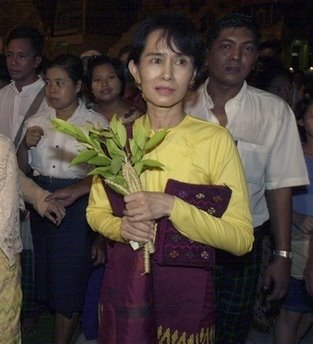


 Posts
Posts


