News & Articles on Burma
Tuesday, 26 July, 2011
----------------------------------------
EU Must Act to End Crimes in Burma
Burmese Army Begin Major Offensive in Shan State
Suu Kyi-Aung Kyi Meeting Viewed as 'Positive'
Ban Calls for Early Action on Release of Political Prisoners
Environment Working Group criticizes Burma on environment policy
UN chief welcomes political dialogue in Myanmar
First dialogue between Myanmar new gov't and Aung San Suu Kyi paves way for future co-op
Burma Democracy Leader Aung San Suu Kyi Meets Government Official
Rubber Plantations Seized in Mon State
---------------------------------------------
COMMENTARY
EU Must Act to End Crimes in Burma
By ZOYA PHAN Tuesday, July 26, 2011
As many people in Europe prepare for their summer holidays, behind the scenes discussions will soon start between European governments about the contents of the next UN General Assembly Resolution on Burma, even though it probably will not be voted on until December.
The reason for starting so early, and why they are so important this year, is that the EU, which drafts the resolution, has to decide whether or not to include the establishment of a Commission of Inquiry into possible war crimes and crimes against humanity in the Southeast Asian nation.
Given the situation in Burma, past and present, and the fact that the dictatorship has ignored 20 previous resolutions calling for an end to abuses, to simply set up an inquiry to establish the truth about what is taking place should not be controversial.
But it is. Countries like Germany and Italy are opposing the EU including an inquiry in the resolution. They don’t do so publicly, how could they? It’s a shameful position for them to hold, and indefensible.
There have been 20 General Assembly Resolutions on Burma calling for human rights to be respected, all of them ignored by the regime. For 19 years the General Assembly has called on the junta to respect international law, yet violations are increasing, not decreasing.
There have been 18 requests for the administration to investigate abuses. The regime has not only ignored these, it added a clause to the constitution granting all members of the military immunity for crimes committed.
UN General Assembly Resolutions on Burma have described at least 15 different kinds of human rights violations which could be classified as war crimes or crimes against humanity.
In 2010 it looked as if, after 20 years, the patience of the General Assembly was finally wearing out. The Resolution on Burma, passed on Dec. 24, stated that UN members: “Expresses grave concern at the continuing practice of arbitrary detentions, enforced disappearances, rape and other forms of sexual violence, torture and cruel, inhuman or degrading treatment or punishment, and urges the government of [Burma] to undertake without further delay a full, transparent, effective, impartial and independent investigation into all reports of human rights violations, and to bring to justice those responsible in order to end impunity for violations of human rights, and, regretting that previous calls to that effect have not been heeded, calls on the government to do so as a matter of priority and, if necessary, drawing on the assistance of the United Nations.”
Given this clear acknowledgement that past resolutions have been ignored, and serious abuses were taking place, surely it would be inconceivable for the General Assembly to pass yet another resolution on Burma which it knows will be ignored, and not take practical action in response.
In addition, with the dictatorship breaking ceasefire agreements and a massive increase in abuses such as gang-rape, arbitrary executions, slave labour and mortar-bombing of civilian villages, the case for an inquiry is stronger than ever before.
But the willingness of countries like Germany to overlook the seriousness of human rights abuses when there are profits to be made for their companies, and the willingness of other EU members such as Sweden to delude themselves that Burma’s new president might be a secret moderate, despite all evidence pointing to the opposite being true, should not be underestimated.
This is what is happening in the EU today. Despite ethnic women and children being gang-raped in Burma on a daily basis, the EU acts like the three wise monkeys. They see no evil, hear no evil, and don’t talk about the evil.
Despite abuses taking place on a scale and of equal seriousness as occurred in some countries in the Middle East, the EU has stayed silent. This is unacceptable. Their silence is not neutral, it is interpreted by the Burmese regime as acceptance of their acts, a green light to continue their abuses. Their silence is complicity.
Twenty UN General Assembly Resolutions on Burma have not led to any improvement in human rights in my country. However, a Resolution that sets up a Commission of Inquiry would have an impact. The mere establishment of an investigation, and the scrutiny and attention it would bring, would very likely result in a reduction in human rights abuses. The regime does not want the world to know what it is doing to the people, this is why it bans foreign journalists.
I have met with governments across Europe to ask them to take action to help my people. Over and over again I have been told how they are powerless to make a difference, that they have done all that they can. But now they have a chance to act, and in a way which could save lives.
They can include a Commission of Inquiry in the next General Assembly Resolution on Burma.
An Inquiry will not stop all abuses, or even most abuses, but it will stop some abuses, and if that means one less 12-year-old girl being raped in front of her mother, and one more child who does not have to watch his father being shot by a soldier, then it is an action worth taking.
By early September the EU is likely to have made what will, for some people in Burma, literally be a life or death decision. I hope European diplomats and politicians will remember that it is real lives and real people we are talking about. If they decide to “wait and see” again, what we will see is more death and more rapes.
Zoya Phan is campaigns manager at Burma Campaign UK. Her autobiography is published as Undaunted in the USA, and Little Daughter across the rest of the world.
http://www.irrawaddy.org/opinion_story.php?art_id=21763
---------------------------------------------
Burmese Army Begin Major Offensive in Shan State
By KO HTWE Tuesday, July 26, 2011
Burmese government troops have launched a major offensive against the headquarters of the Shan State Army (SSA) in Wan Hai in a bid to dominate a strategically important junction connecting northern and southern Shan State, according to Shan sources.
“They are attacking us in order to militarily dominate the area. They want to use our camp as a base from which they can launch an offensive against the United Wa State Army (UWSA) in the future,” said Maj Sai Hla, a spokesman for the SSA and its political wing, the Shan State Progressive Party.
Wan Hai, located between Kyethi, Monghsu and Mongnaung townships, is an important transport hub in central Shan State. The SSA—a former ceasefire group known until recently as the SSA-North—controls territory in Kyethi and Monghsu townships in southern Shan State and Mongyai and Tangyan townships in the northern part of the state.
According to local residents, the motive for the recent attacks may be commercial as well as military: there are coal mines in Kyethi and the SSA extracts antimony near Wan Hai—both of which the government would like to control.
However, some observers said it was unlikely that the fighting was directly linked to a struggle for control of natural resources.
“It is possible that the government wants to extract natural resources from the area, but I haven't heard that they have discovered any precious metal there,” said Khuensai Jaiyen, the editor of the Thailand-based Shan Herald Agency for News (SHAN).
The situation in Shan State contrasts with that in Kachin State, where the government is seeking to negotiate an end to hostilities with the Kachin Independence Army (KIA).
“I asked officials why the government has launched continuous attacks on the SSA rather than negotiating, as it is doing with the KIA, and I was told that the government thinks it can easily break the SSA because Wan Hai is not near the border, and because some of the SSA's brigades have already joined the Border Guard Force (BGF),” said a member of the Shan Nationalities Development Party from Kyethi Township.
Two brigades of the former SSA-North have joined the BGF, which puts troops belonging to former ceasefire militias under Burmese military command, but the strongest, the 3,000-strong Brigade 1, led by Col Pang Fa, refused.
The Burmese regime began pushing 17 different ceasefire groups to join the BGF ahead of last year's Nov. 7 election, but most refused, including the UWSA, with 30,000 troops, and the 10,000-strong KIA.
The UWSA and the Shan State Army-South, a non-ceasefire armed group, have offered support to the SSA since it resumed hostilities with the Burmese Army.
Htay Aung, a Burmese military researcher, said that the government army would likely concentrate its attacks on the SSA and KIA Brigade 4, which occupy areas between the Burmese Army's positions and the UWSA, while continuing to negotiate with stronger groups.
“The negotiations will only last for a while, but I don't think they will bring an end to this civil war. The government cannot attack the UWSA right now because of its strength, so they are going after their weaker allies. But ultimately, these attacks threaten the UWSA, too,” he said. http://www.irrawaddy.org/article.php?art_id=21770
----------------------------------------------
Suu Kyi-Aung Kyi Meeting Viewed as 'Positive'
By SAI ZOM HSENG Tuesday, July 26, 2011
Three leading Burmese politicians have said that they see a positive outcome from Monday's meeting between pro-democracy leader Aung San Suu Kyi and a senior government official.
Aye Thar Aung, the secretary of the Committee Representing the People’s Parliament (CRPP), Khin Maung Swe, a leading member of the National Democratic Force (NDF), and Hla Soe, the secretary of the Rakhine Nationalities Development Party, all agreed that similar meetings should take place in the near future, that details of an agenda and a timeframe should be laid out, and that both the government and the opposition should be able to work toward achieving positive results.
On Monday, the government and Suu Kyi's party, the National League for Democracy (NLD), issued a joint statement at a press briefing in Rangoon stating that both sides are optimistic about and satisfied with the dialogue.
CRPP's Aye Thar Aung said both sides must be honest and do what is best for the country.
“The release of a statement is the difference between past negotiations and this meeting,” he said. “However, we would not look favorably upon this meeting if it transpires that Naypyidaw is only doing it as a maneuver to win backing for the Asean chairmanship.”
Nobel Peace Prize laureate Suu Kyi, who was released in November from seven continuous years of house arrest, met Aung Kyi, the minister of Social Welfare, Relief and Resettlement Minister on Monday afternoon at a state guest house in Rangoon. Aung Kyi had previously met Suu Kyi for talks after he was appointed as “liaison minister” in October 2007.
Khin Maung Swe, who was formerly a leading figure in the NLD, said that his party, the NDF, welcomes anyone who works for national reconciliation which, he said, is essential for Burma.
Speaking to The Irrawaddy on Tuesday, Khin Maung Swe said, “We heard that Aung San Suu Kyi and Aung Kyi discussed the rule of law and ways to benefit the population. We are really happy with that message.”
Khin Maung Swe said that although the previous talks did not bear fruit, this meeting could lead to the resumption of cooperation between the government and opposition groups.
“They should seek trust-building between each other by holding a series of meetings aimed at cooperating and fulfilling the needs of the country,” he said.
Burma's state-owned media carried news of the meeting, quoting Aung Kyi as saying, “I don't think there has not been any tangible result [sic]. We held talks for nine times [sic] and that produced results to some extent. I hope this meeting will produce better results.”
However, in Thailand, Khin Ohmar, the chairperson of the Network for Democracy and Development, said that the government planned this meeting solely because they desire the Asean chairman position.
“I don’t think the government is honest about this meeting,” she said. “It is just window dressing. They want the international community to know that they have started a dialogue toward national reconciliation. They are using Aung San Suu Kyi.”
She said that Asean member states should not ignore the human rights abuses in Burma, nor the political prisoners, nor the ongoing armed conflicts in ethnic regions when it takes the decision whether or not to hand over the chairmanship to Naypyidaw.
Arakan leader Hla Soe said that there have been no major changes in the country despite the move to a civilian government.
“Even the most basic needs of the people have not been met,” he said. “The country is not stable yet, and clashes are breaking out everywhere. If the government truly wants to assume the chair at Asean, they must first change the political situation in their own country.”
Burma is scheduled to take over the chairmanship of Asean in 2014. However, Surin Pitsuwan, the bloc's secretary-general, said in May that the group will listen to the opinions of member states before handing the position to Burma.
Burmese opposition groups have demanded that the Southeast Asian grouping withhold the chairmanship from the Burmese government until it realizes several key conditions, such as steps toward national reconciliation with the political opposition and armed ethnic groups, and the release of political prisoners.
A Rangoon-based veteran foreign journalist who spoke on condition of anonymity said that this meeting is essentially different from prior talks because at this meeting Suu Kyi was not under house arrest.
The journalist said that many of those within the Rangoon media community welcomed Mondays' meeting, and did not view the event as a public relations exercise on behalf of the Burmese government.
“I assumed that they talked about the existence of the NLD under the issue of ‘Rule of Law,’ butas we all knowthe appearance of Aung San Suu Kyi’s serious demeanor and body language suggested she was not satisfied with the outcome of their meeting.”
The meeting was agreed after Burmese authorities had urged the NLD earlier this month to stop engaging in unlawful activities in opposition to the new parliament.
The NLD was dissolved on Sept. 14, 2010, for not refusing to participate in November's general election. The opposition party claimed it was not entering the election race because of an “undemocratic” military-drafted constitution and “unfair” election laws.
http://www.irrawaddy.org/article.php?art_id=21772
--------------------------------------------
Ban Calls for Early Action on Release of Political Prisoners
By LALIT K JHA Tuesday, July 26, 2011
WASHINGTON — UN Secretary-General Ban Ki-moon on Tuesday welcomed a meeting between Burmese pro-democracy leader Aung San Suu Kyi and a senior government official on Monday, and renewed calls for the new Burmese government to release the country's nearly 2,000 political prisoners.
“[Ban] also calls upon the government of Myanmar [Burma] to consider early action on the release of political prisoners in that country,” UN spokesman Martin Nesirky told reporters at his daily briefing at the UN headquarters in New York.
In response to a question on the meeting, Nesirky said Ban noted that “the parties have expressed satisfaction at their positive talks and their intention to cooperate further on matters beneficial to the people of Myanmar.”
Nesirky noted that Ban's special adviser on Burma, Vijay Nambiar, recently traveled to the country and met Suu Kyi and Aung Kyi, the official who met with Suu Kyi on Monday, as well as other government officials and representatives from political parties.
“In line with the international community's expectations and Myanmar's national interest, the secretary-general hopes such efforts will continue with a view to building mutual understanding through genuine dialogue,” the UN spokesman said.
Meanwhile in Washington, the Obama administration said it wants the new Burmese government to take more steps toward democratic reform.
“We want to see them take more democratic steps, more reformed steps,” said State Department spokesperson Victoria Nuland. “We call on them to meet with Aung San Suu Kyi in an environment where she feels safe and secure, where she can have an influence on the future of her country.”
However, she refrained from making any comment on Monday’s meetings.
“I can’t speak to this specific meeting, but those are the steps that we want to see, and we want to make sure also that the Burmese government is taking great care with her security,” said Nuland. http://www.irrawaddy.org/article.php?art_id=21765
-----------------------------------------
Environment Working Group criticizes Burma on environment policy
By Zin Linn Jul 26, 2011 2:03AM UTC
The Burma Environment Working Group made a press conference on Burma’s serious environmental issues at Foreign Correspondents Club of Thailand in Bangkok on Monday. The group released a press statement about Burmese regime’s negligence of environmental protection in the country.
Burma has extensive biodiversity and abundant natural resources, which have in recent years been threatened by militarization, large-scale resource extraction and infrastructure development, the group said. According to group’ 100-page report – Burma’s Environment: People, Problems, Policies – the regime does not allow its citizens to take part in decision-making on development sector that always neglects the livelihoods of the respective populace in the project areas.
While foreign direct investment for last year reached up to $ 20 billion, for example through large dams financed by neighbouring China, India and Thailand, there are no respectable frameworks to protect Burma’s environment and communities, the group said.
“Foreign Direct Investment in Burma’s natural environment is skyrocketing, but there is no corresponding attention to environmental protection, multi-ethnic participation and sustainable development,” said Sein Twa of the Burma Environment Working Group.
“Control over natural resources is a major cause of conflict in ethnic areas, where the majority of Burma’s resources remain,” the report said.
Heavy fighting between the rebel ethnic Kachin and government armed forces took place last month in the far north of the country around a dam financed by China, with authorities saying they acted to defend the plant from attacks.
“The renewed war in Kachin state is an example of what Burma can continue to expect as foreign direct investment increases,” said Paul Sein Twa, referring to the conflict that resumed on 9 June between Kachin Independence Army and the Burma Army around Chinese-led hydropower dams in Kachin State.
“Without genuine multi-ethnic participation and sound regulatory framework, Burma’s environment will continue to be a source of conflict,” he said.
Burma does not have domestic laws and policies to protect people and environment, the report says. The report also points out that Burma is currently facing many threats to natural environment and sustainable livelihoods, such as construction of large dams, oil and gas extraction, mining, deforestation, large-scale agricultural concessions, illegal wildlife trade and climate change.
The group’s report said an estimated 48 hydropower projects were currently being planned, constructed or already existed on country’s rivers.
More than 90 percent of the hydropower they produce is bound for China and neighbouring countries, instead of providing domicile populations who face serious ongoing energy shortages.
The new government under President Thein Sein “is failing to make progress on that front,” said Paul Sein Twa during the press conference at FCCT.
Burma is a state party to several international treaties relating to the environment, but it is unclear whether the contents of those treaties have been ratified in practice and incorporated into domestic law, according to the BEWG’s report.
The environment activists called for new and existing investors to stop immediately all project-related works – especially in responsive states all over Burma – until satisfactory safeguards are in place to ensure investment does not lead to unnecessary destruction of the n`tural environment and local livelihoods. The new measures are brought in to ensure sustainable development and multi-ethnic participation, the activists of the group say publicly.
http://asiancorrespondent.com/60915/environment-working-group-criticizes-burma-on-environment-policy/
-------------------------------------------
UN chief welcomes political dialogue in Myanmar
13:31, July 26, 2011
UN Secretary-General Ban Ki- moon has welcomed a dialogue between the Myanmar government and the country's political figure Aung San Suu Kyi, according to a statement released here Monday.
"The secretary-general welcomes the meeting today in Yangon between Daw Aung San Suu Kyi and Minister for Social Welfare U Aung Kyi," Nesirky said. "He notes that the parties have expressed satisfaction at their positive talks and their intention to cooperate further on matters beneficial to the people of Myanmar."
Aung San Suu Kyi, 66, was released from house arrest on November 13, 2010, days after Myanmar elected a new government.
In her first-ever meeting with the new government on Monday, according to U Aung Kyi, law enforcement, eradication of disunity, and the interests of Myanmar's people were discussed.
Nesirky said that Ban "encourages such contacts and dialogue."
"In line with the international community's expectations and Myanmar's national interest, the secretary-general hopes such efforts will continue with a view to building mutual understanding through genuine dialogue," Nesirky said.
Source:Xinhua http://english.people.com.cn/90001/90777/90856/7451933.html
------------------------------------
First dialogue between Myanmar new gov't and Aung San Suu Kyi paves way for future co-op
Xinhua, July 26, 2011
By Feng Yingqiu
At the invitation of the Myanmar new government, noted political figure Aung San Suu Kyi met with Union Minister of Labor U Aung Kyi at the Sein Lei Kan Tha State Guest House in Yangon Monday, representing the first dialogue between the two sides after the new government came into being.
After the meeting, U Aung Kyi and Aung San Suu Kyi issued a joint press release, saying that the two sides are optimistic about and satisfied with the dialogue.
They held talks about opportunities for both sides to work together for the well being of the public, the statement said.
The statement disclosed that their discussions included matters for the rule of law, elimination of disagreement and serving national interest.
The pair agreed that they will meet again at a mutually convenient time, the statement added.
U Aung Kyi further told the press that the present meeting will produce better result as compared with the last nine occasions which produced results to some extent, adding that the two sides agreed to keep holding talks and describing the present meeting as the first step to working together in the future.
Aung San Suu Kyi maintained that she was in favor of beneficial results to the country. "Whatever acts we do, whatever talks we hold, and whoever we work with, our goal is to serve the interest of the nation and the people. This is what we hope," she spoke to the press when interviewed and was published by the state and local media. http://english.peopledaily.com.cn/90001/90777/90851/7451917.html
-----------------------------------
July 25, 2011
Burma Democracy Leader Aung San Suu Kyi Meets Government Official
Daniel Schearf | Bangkok
Burma's Labor and Social Welfare Minister Aung Kyi, right, reads statement to the media after meeting with Aung San Suu Kyi, left, at Seinlekhanthar government guest house in Yangon, July 25, 2011
Photo: AP
Burma's Labor and Social Welfare Minister Aung Kyi, right, reads a statement to the media after meeting with Aung San Suu Kyi, left, at Seinlekhanthar government guest house in Yangon, July 25, 2011
Burma’s democracy leader Aung San Suu Kyi has met with an official of the new government, the first such meeting since her release from house arrest. The meeting raises hopes for a regular dialogue between her and the military-dominated government. But, there is skepticism that the talks will lead to genuine reforms.
Burma’s Labor and Social Welfare Minister Aung Kyi says he and opposition leader Aung San Suu Kyi talked about the rule of law and cooperating in the interests of the country and people. Reading a statement to journalists after their meeting Monday, he said they both viewed the discussion positively and that they would meet again.
It was the first time a government official met with the Aung San Suu Kyi since she was released from house arrest after last year’s election.
She has sought a dialogue with the government on improving the country’s poor human rights record and efforts at democracy.
Zin Linn, a spokesman for the Burma government in exile in Thailand, says there are worries that the meeting, like past ones, is just for show. He points out the two met nine times while Aung San Suu Kyi was under house arrest, with little to show for it.
"If they are really going along to the democracy path, they should release the political prisoners," said Zin Linn. "So, they should release these political prisoners and stop fighting against the ethnic peoples. And also, they should first of all reform their law and order system. There is no law at all in Burma."
The meeting came just days after U.S. Secretary of State Hillary Clinton called for dialogue between the two sides at a meeting of the Association of Southeast Asian Nations in Indonesia.
Burma hopes hold ASEAN’s rotating chair in 2014. Zin Linn says the government may want to deflect international opposition to the idea.
"So, that's why this time also I think due to the U.S. pressure and also they have a proposal to the ASEAN to have their chair in 2014, to pass such difficulties, I think they show this talk as a softened stance," said Zin Linn.
Despite the skepticism, there are signs of improved relations between the government and Aung San Suu Kyi.
Earlier this month, officials invited her to a ceremony honoring her late father, a hero of Burma’s struggle for independence.
Burma’s nominally civilian government took office in March after decades of direct military rule.
But the election in November was widely condemned as a sham designed to disguise continued military rule.
Aung San Suu Kyi was banned from participating and the government disbanded her National League for Democracy, the largest opposition, for boycotting the polls.
A military-backed party won the controversial elections amid reports of widespread fraud and intimidation.
The NLD won Burma’s previous election in 1990 by a landslide but the military refused to let it take power.
The military government arrested opposition leaders, and many were forced to flee the country. http://www.voanews.com/english/news/asia/Burma-Democracy-Leader-Aung-San-Suu-Kyi-Meets-Government-Official-126115583.html
---------------------------------------
Rubber Plantations Seized in Mon State
By KHIN OO THAR Tuesday, July 26, 2011
Local army and navy units in Mon State have seized over the past two months more than 3,000 acres of rubber tree plantations from local farmers on Kywekonnyima Island near Ye Township, displacing more than 20 families without offering any compensation, according to local sources.
Nai Au Mon, the head of the Thailand-based Human Rights Foundation of Monland, told The Irrawaddy on Friday that Naval Infantry Battalion 43 had confiscated rubber tree plots in eastern Kywekonnyima, western Kywekonnyima and Minthar villages, resulting in a severe job scarcity in the areas. Consequently, he said, the more than 20 families directly affected have already moved to Thailand, he said.
He said 70 percent of the people in Mon State depend on rubber plantations for their livelihoods, but over time, the government, acting through the army and navy, has continuously seized their lands.
He added that most local people do not understand about labor laws and human rights, and that because of poor infrastructure and roads they have little access to other areas.
Local sources in Moulmein, the capital of Mon state, told The Irrawaddy that more than 10,000 acres of rubber tree plantations in Moulmein, Thanpyuzayat, Mudon, Kyaikmayaw and Ye townships were confiscated during 2010.
“Boards reading 'Army Area, No Trespassing!' have been placed inside our plantations,” said a plot owner in Mudon. “We are physically threatened any time we try to extract latex.”
He said friends and family members of army and navy personnel are been allocated the plots that were previously owned by local farmers, or are being offered jobs in the rubber plantations.
The farmer added that he and other rubber growers plan to report the matter to the prime minister of Mon State and to local political parties.
Nai Ngwe Thein, the chairman of the All Mon Region Democracy Party (AMRDP), told The Irrawaddy that such violations were common under the previous ruling junta and no one could stop them. However, since the country now has a new civilian government, he said he hopes the plight of the people in Mon State will be recognized.
“About 13,000 acres of rubber plantations are located on both sides of the Moulmein-Ye highway, enclosed by fences, with signs stating that it is the property of the army,” said the AMRDP chairman. “I heard that those lands were confiscated for the construction of army bases.”
He said that additional battalions had been deployed and stationed in Mon State; consequently, in recent years, farmland and rubber plantations had been confiscated from farmers and allocated to the army and navy.
“I don't think we will be able to stop the land confiscations,” said Nai Ngwe Thein. “But, I expect appropriate compensation will be offered to the farmers under this new government.”
Local sources said people living in eight of the 10 townships in Mon State exist primarily on income from rubber plantations. Many said that the land seizures had been committed by both the army and the local land records departments.
According to the Independent Mon News Agency, a standard plot comprises 200 or more rubber tress, each of which is valued at between 10,000 kyat [US $13] and 50,000 kyat [$64]. http://www.irrawaddy.org/article.php?art_id=21766
__._,_.___
Wednesday, July 27, 2011
News & Articles on Burma-Tuesday, 26 July, 2011


Tuesday, July 26, 2011
News & Articles on Burma-Monday, 25 July, 2011
News & Articles on Burma
Monday, 25 July, 2011
----------------------------------------
Aung San Suu Kyi meets government minister Aung Kyi
Activists warn against foreign investors in Myanmar
Suu Kyi Sends Condolences to Norway
Activists protest Indian arms sales to Burma during ethnic wars
More Refugees Flee to Border Fearing War
Burma: A true dialogue or a trick to ease international pressure?
Suu Kyi first talk with new Burma govt
AFP to question for Brisbane man over 'death squad' claims
Blood donation group volunteer unable to appear at court hearing
Murder suspect claims Burma police links
---------------------------------------------
Aung San Suu Kyi meets government minister Aung Kyi
25th July 2011
Burmese pro-democracy leader Aung San Suu Kyi is holding her first meeting with a minister of the army-backed government
Just days after the US called for 'concrete' progress towards democracy, Suu Kyi began talks with the government's Labour minister, Aung Kyi.
The official talks are taking place in a state guest-house in Burma's capital city Ragoon, however no agenda has been made public.
The meeting comes a month after Aung San Suu Kyi was warned to stop all political activity and cautioned not to leave Ragoon. However, Ms Suu Kyi recently went ahead with a trip to the town of Bagen and has continued interviews with international media.
Suu Kyi's party was disbanded by the military regime last year, after she was released from house arrest, because it boycotted the latest vote.
Opposition groups and Western nations are sceptical as to whether anything substantial will come out of the talks or whether it, “turns out to be another carefully choreographed piece of window-dressing much in the manner of the Burma of old.” said BBC South East Asia correspondent, Rachel Harvey.
“The mere fact that the government has renewed direct contact, using a minister who performed the same role under the previous military government, has raised hopes that perhaps the door to negotiation has been reopened,” she added. http://www.wanderlust.co.uk/magazine/news/aung-san-suu-kyi-meets-government-minister-aung-kyi
---------------------------------------
Activists warn against foreign investors in Myanmar
AFP
BANGKOK (AFP) – Environmental groups called on Monday for an end to foreign investment in projects exploiting Myanmar's natural resources, accusing such activities of sparking conflict in ethnic minority areas.
While foreign direct investment has "skyrocketed", for example through large dams financed by neighbouring China, India and Thailand, there are no decent frameworks to protect Myanmar's environment and communities, they said.
This investment is "concentrated in energy and extractive sectors and often results in militarization and displacement," said a new report from the Burma Environmental Working Group (BEWG), a network of activist organisations.
"Control over natural resources is a major cause of conflict in ethnic areas, where the majority of Burma's resources remain," the report said, using the former name of Myanmar.
Heavy fighting between the rebel ethnic Kachin and Myanmar's state army took place last month in the far north of the country around a dam financed by China, with authorities saying they acted to defend the plant from attacks.
"The renewed war in Kachin state is an example of what Burma can continue to expect as foreign direct investment increases," said Paul Sein Twa of the BEWG.
The group's report said an estimated 48 hydropower projects were currently being planned, constructed or already existed on Myanmar's rivers.
But up to 90 percent of the power they generate is destined for other countries, "instead of supplying local populations who face serious ongoing energy shortages".
The activists called for new and existing investment in sectors that exploit the environment to cease, until the new measures are brought in to ensure sustainable development and multi-ethnic participation.
The new government under President Thein Sein "is failing to make progress on that front," said Paul Sein Twa.
Myanmar's military junta handed power to a nominally-civilian administration earlier this year after elections in November, which the army's political proxies won by a landslide amid allegations of cheating.
The country has been plagued by decades of civil war with armed ethnic minority militias since independence in 1948. http://old.news.yahoo.com/s/afp/20110725/wl_sthasia_afp/myanmarenvironmentethniceconomy
-----------------------------------------------
Suu Kyi Sends Condolences to Norway
By THE IRRAWADDY Monday, July 25, 2011
Burma's pro-democracy leader Aung San Suu Kyi and other opposition leaders have sent letters of condolence to Norway in mourning the deaths of more than 90 people in the wake of a deadly bombing and a massacre in the capital Oslo on Friday.
Suu Kyi, the 1991 recipient of the Noble Peace Prize from Norway, on Saturday sent a letter of condolence to the Norwegian ambassador in Bangkok and expressed her deep sorrow for the victims.
Norway has been active in its support of Burma's democracy movement; the only exiled Burmese television station, Democratic Voice of Burma (DVB), is based in Oslo.
DVB director Khin Maung Win said that like many other foreigners in Norway he was initially alarmed by the fact that Friday's atrocities were committed by a right-wing Norwegian national with professed anti-immigrant sentiment.
However, he said that the vast majority of Norwegian nationals do not share this kind of sentiment and that he is not fearful for the security of immigrants in Norway which includes many Burmese exiles and refugees.
Aung Moe Zaw, the chairman of the exiled Democratic Party for a New of the Union of Burma party, said that Friday's victims included youth members of the ruling Labor Party which has long supported his party based in Thailand.
“We have sent a letter of condolence to Norway,” he said. “This kind of terrorism is totally unacceptable. The rise of right-wing extremists in Europe bodes ill for Europe and the world as a whole.”
Anders Behring Breivik, 32, who has admitted carrying out Friday's twin terror attacks in Norway, is due to make his first appearance in court on Monday afternoon. Breivik reportedly described his actions as “cruel but necessary” during the weekend police interrogation.
Breivik expressed his desire for a public hearing, but a judge ruled the hearing should be behind closed doors. http://www.irrawaddy.org/article.php?art_id=21759
----------------------------------------------------
Activists protest Indian arms sales to Burma during ethnic wars
Monday, 25 July 2011 12:55 Tun Tun
New Delhi (Mizzima) – Indian and Burmese pro-democracy forces have urged the Indian government not to sell arms and ammunitions to the Burmese government because of its widespread offensives against ethnic groups in eastern Burma.
Protestors in New Delhi on Friday urged he government not to sell arms and ammunitions to Burma. Photo: BCD
Protestors in New Delhi on Friday urged he government not to sell arms and ammunitions to Burma. Photo: BCD
More than 100 people representing 46 Indian civil society organizations, and 24 Burmese organizations staged a demonstration in downtown New Delhi on Friday.
“We don’t want the Indian government to supply arms to Burma because they are killing innocent people,” Burma Centre Delhi coordinator Alana Golmei told Mizzima.
“[India is] supplying weapons and conducting joint military exercises leading to systematic human rights abuses and criminal hostilities against ethnic groups, political activists, journalists and civilians,” said a joint statement issued at the demonstration.
“You see that they are still willing to give or sell everything that the Burmese government wants in consideration of their national interests. They will continue to give political support and diplomatic protection to the Burmese government as they have done continually in the past,” National Coalition Government of Union of Burma (NCGUB) exile government Information Minister Dr. Tint Swe told Mizzima.
Fifty-two Burmese military trucks carrying weapons from India reportedly crossed the border in Moreh, Manipur State, into Tamu in Burma on July 7 this year, according to the Burmese activists. However, Mizzima was unable to independently verify it.
“If India really sent arms supplies to Burma, it is wrong because the Burmese army is launching military offensives against ethnic organizations in at least three states.” Tint Swe said.
He said India, which is the largest democracy in the world, is a country that upholds the non-violence principle, and a country where Buddhism flourished and it should approach Burma with these values and principles.
“They can sell arms anywhere but they should uphold their own values of non-violence and religious teachings in relations with other countries. I mean Indian should use its own value system and principles in their foreign relations to fulfill their national interests,” he said.
In the past, the Indian government has sold arms and ammunitions to the Burmese government to fight against Indian separatist rebels based on Burmese soil. At that time, Burmese pro-democracy forces protested against the arms sale. Indian Foreign Minister Pranab Mukerjee denied the arms sale to Burma at the press conference held in Washington D.C. in March 2008 during his tour of the US.
According to researcher Siemon Wezeman of the Sweden- based SIPRI, the Indian government has supplied 75 mm and 105 mm artillery pieces, T55 tanks, armoured personnel carriers, trucks and helicopters to Burma. The sale was also mentioned in Wikileak cables but independent verification is not available.
0digg
Last Updated ( Monday, 25 July 2011 14:55 ) http://www.mizzima.com/news/regional/5659-activists-protest-indian-arms-sales-to-burma-during-ethnic-wars.html
----------------------------------------
More Refugees Flee to Border Fearing War
By SAW YAN NAING Monday, July 25, 2011
Hundreds of Kachin people have fled to the Sino-Burmese border by Laiza and Majayang villages fearing that the current Kachin State conflict will escalate further as three military ships arrived in Bhamo Township, northern Burma.
Around 2,000 residents from at least seven villages in Bhamo Township have fled since mid-July, after three ships carrying plain clothes men were spotted approaching the settlement. Local people are worried that fighting between government troops and ethnic armed group the Kachin Independence Army (KIA) will intensify, said relief worker Mai Ja.
La Nan, joint-secretary of the KIA’s political wing the Kachin Independence Organization (KIO), said that the Burmese authorities ordered villagers from some 1,000 households in Kala Yang, Kazue and Tapant villages to flee their homes by July 25.
He also said that the KIO is worried that the government might launch a full-scale offensive against the KIA base in Laiza, northern Burma.
Residents of Bhamo Township dare not remain in their villages any longer and have joined more than 16,000 refugees on the Sino-Burmese border. Aid groups in Laiza estimate the number of refugees may now have reached 20,000.
Last week, the KIO said that more Burmese Army trucks and military river vessels were headed toward its bases following rumors that government troops would attack the KIO’s headquarters in Laiza.
On the night of July 21, Burmese government troops from Infantry Battalion 142 fired 20 mortars, including 81 mm shells, at the KIA’s Battalion 24 which operates under Brigade 5.
La Nan also said that the government sent a letter to the KIA on July 23 suggesting a ceasefire in Kachin State, but not in all ethnic regions. The KIA recently called for ceasefire talks which involved representatives of all ethnic armed groups.
“It seems [the government] has moved away from our proposed aim of a nationwide ceasefire agreement. They want to make peace in Kachin State first and think about ceasefires in other parts of other ethnic regions later,” said La Nan.
Humanitarian groups have also said that aid supplies are needed for the growing refugee crisis on the Sino-Burmese border.
“Food is not sufficient for refugees now. We haven't receive aid from international aid agencies. Only local religious community groups currently contribute aid to the refugees,” said Mai Ja.
In early July, local humanitarian groups and relief agencies appealed to international aid groups regarding the rising need for emergency food, shelter and medical care, as well as schooling for children on the Sino-Burmese border. http://irrawaddy.org/article.php?art_id=21758
----------------------------------------
Burma: A true dialogue or a trick to ease international pressure?
Mon, 2011-07-25 01:21 — editor
News Comments
By - Zin Lin
Pro-democracy leader Aung San Suu Kyi will meet with Labour Minister Aung Kyi, the first rare meeting between the Nobel laureate and the new army-backed government, quoting an official Reuters News said on Sunday.
Aung San Suu Kyi has time and again called for dialogue with the government since her release from house arrest a week ahead of November election, which was tarnished by alleged of vote-rigging and the exclusion of her party.
"Aung San Suu Kyi and Aung Kyi will meet at Sein Lei Kan Tha state guest house on Monday afternoon. It will be the first meeting between them after the new government was formed," a Burma government official told AFP, without elaborating.
Ohn Kying, the NLD’s Central Executive Committee member confirmed the meeting arranged by the government to engage with Aung San Suu Kyi at 1 pm Monday.
At the offer of the army-backed Burmese civilian government, Burma’s Nobel laureate would meet on Monday with Labour Minister Aung Kyi, who stands for the ruling generals in earlier talks with the democracy icon.
On the other hand, the Burmese government has warned pro-democracy leader Aung San Suu Kyi and her National League for Democracy (NLD) to end "illegal activities", including its agitation and opposition to the newly elected legislative body.
A letter signed by the Home Minister and send to Suu Kyi’s party in June said the NLD had been officially dissolved in September last year. Because, the NLD preferred to boycott election held in last November, while Suu Kyi and two thousands political prisoners were in prison.
The 30 June state-owned newspaper raised the issue in a commentary under the caption of “Right to make choice still in the hand” by a ghost-writer.
In one paragraph, the commentary says, “From the point of law, NLD is defunct. The Union Election Commission issued Announcement (18/2010) dated 9-4-2010 reminding the 10 political parties that still met Article 25 of Political Parties Registration Law at that time that they could apply within 60 days for continued existence as political parties. However, only five of them did so. It is common knowledge that the five political parties did not include NLD.”
It also underscored that the NLD has been removed from the list of political parties and has been dissolved according to Announcement 97/2010 dated 14-9-2010 by the Union Election Commission.
The home minister’s letter also spotlighted that the government was deeply worried that if Aung San Suu Kyi makes political tours to rural parts of the country, there may be anarchy and unrest, as experienced by prior incidents in 2003.
It is not known whether the meeting will be a flexible gesture in stance by the latest government, which is led by members of the junta that controlled the country for decades. The ex-generals in this government were strongly opposed to Suu Kyi and her party, the National League for Democracy (NLD).
A government official, who asked not to be named, told Reuters the meeting would take place early Monday afternoon at a state guesthouse close to Suu Kyi's residence. In his former part as liaison officer for the junta, Aung Kyi met Suu Kyi 10 times while she was under house arrest.
In frequent media interviews, Suu Kyi expressed her aspiration to hold talk with the new government to press for some changes to help people of Burma. The government did not respond.
In its Martyrs’ Day statement, the NLD says, “We have repeatedly said that the NLD is ready to negotiate flexibly for the beneficial results of the people of Burma. But the dialogue should not aim for the benefit of the NLD nor the benefit of the authorities, but for the benefit of the Burmese people. Therefore the authorities should create the fair political conditions by holding meaningful political dialogue towards national reconciliation and releasing unconditionally all the political prisoners.”
Meanwhile, U.S. Secretary of State Hillary Clinton on Friday called on Thein Sein government to free political prisoners, address non-proliferation concerns and start a dialogue with pro-democracy leader Aung San Suu Kyi. Clinton, speaking at a regional security forum of the Association of South East Asian Nations (ASEAN) in Bali, said Burma (Myanmar) was a major challenge to the regional group and would have to be addressed.
Aung Kyi is regarded as a moderate minister in military-dominated government, and this will be his first meeting with the democracy icon as labor minister in the new government.
Analysts say it is expected Burma's rulers are aware of Suu Kyi's influence on the international community and realize her involvement as a necessity to do away with Western sanctions since 1988.
Some analysts also concerns about the meeting on Monday as they have experienced in the past that the consecutive military regimes typically arrange such show to mislead the international community.
Many people supporting political changes in Burma dare not believe on the reported meeting whether the nominally civilian government is attempting to alleviate tensions with the Western governments.
- Asian Tribune - http://www.asiantribune.com/news/2011/07/24/burma-true-dialogue-or-trick-ease-international-pressure
---------------------------------------
BANGKOK POST:
Suu Kyi first talk with new Burma govt
Published: 25/07/2011 at 02:32 PM
Online news:
Aung San Suu Kyi met with a minister of Burma's new government for the first time on Monday, raising tentative hopes of sustained dialogue between the opposition icon and authorities.
Myanmar democracy icon Aung San Suu Kyi (C) is greeted by a supporter in the country's ancient temple city of Bagan. Aung San Suu Kyi has met a minister of Myanmar's new government for the first time Monday, raising tentative hopes of sustained dialogue between the opposition icon and authorities.
Just days after the US called for "concrete" progress towards democracy, Suu Kyi -- who was released from house arrest soon after a controversial election in November -- began talks with labour minister Aung Kyi in Rangoon.
"They are meeting now," a government official told AFP without offering further details, as reporters waited outside the venue -- a state guesthouse in Burma's main city.
Suu Kyi has frequently urged dialogue with the government since her release, but the authorities' decision to hold talks met with a mixed reaction from observers, with some seeing it as aimed at gaining concessions from the international community.
Details of the meeting's agenda were not clear, Suu Kyi's National League for Democracy (NLD) party spokesman Nyan Win told AFP on Sunday, but he earlier said a meeting between the two sides would be "good".
Aung Kyi was in charge of relations between the military junta and Suu Kyi under Burma's previous regime, but this was to be the first meeting between them since the new government was formed, an official told AFP at the weekend.
The dialogue is due to take place in the early afternoon at a state guesthouse. The pair have met before on several occasions, including in late 2009 while Suu Kyi was still under a seven-year period of house arrest.
The 66-year-old democracy champion was freed shortly after elections that were won overwhelmingly by the military's political proxies. The polls were marred by claims of cheating and the exclusion of Suu Kyi from the process.
The government has since warned her to stay out of politics.
News of the planned meeting with Aung Kyi emerged on Saturday, the same day that US Secretary of State Hillary Clinton urged Burma's rulers to have "meaningful and inclusive dialogue" with the opposition.
A US official travelling with Clinton also said the Burma government's bid for the chairmanship of the Association of Southeast Asian Nations (Asean) in 2014 would be in doubt unless it reformed its ways.
The timing of the meeting was therefore significant, said political analyst Pavin Chachavalpongpun of Singapore's Institute of Southeast Asian Studies.
"They could have done it any week, so why this week?" he said, adding that the talks had "symbolism" and showed "both sides are trying to do some kind of constructive engagement".
Suu Kyi has spent much of the last 20 years as a prisoner in her Rangoon home, and some observers believe the government would be quick to limit her freedom again if she is perceived as a threat to their rule.
Renaud Egreteau, a Burma expert at Hong Kong university, said it was likely the talks were happening because "the regime wants to get something from the international community".
The US House of Representatives on Wednesday approved a renewal of sanctions that ban the import of goods from Burma, including lucrative gems, and restrict visas issued to government officials.
Suu Kyi has said international sanctions should be maintained, at least until Burma's more than 2,000 political prisoners are released.
She has tested the boundaries of her freedom this month, in particular with her first visit outside Rangoon since her release, when she refrained from any overt political activities that might have antagonised the government.
Suu Kyi's party, which won a landslide election victory two decades ago that was never recognised by the junta, was disbanded by the military regime last year because it boycotted the latest vote, saying the rules were unfair. http://www.bangkokpost.com/news/world/248721/suu-kyi-holds-first-talks-with-new-burma-govt
--------------------------------------------
AFP to question for Brisbane man over 'death squad' claims
Dan Oakes and Jessica Marszalek
July 25, 2011
Criminal Clearance within 72 hours Remove of old SA Criminal Records
Htoo Htoo Han, a Burmese refugee, holds up a 1988 photo which he say shows him (right) posing as a student leader while working as a lieutenant in Burma's military intelligence.
Htoo Htoo Han, a Burmese refugee, holds up a 1988 photo which he say shows him (right) posing as a student leader while working as a lieutenant in Burma's military intelligence. Photo: AAP Image/Patrick Hamilton
Federal police will question a Burmese-born Brisbane man who claims to have murdered dozens of political activists while working undercover for the military regime.
Htoo Htoo Han used the media last week to confess to the killing of at least 24 people in the wake of a pro-democracy uprising in Burma in 1988. He posed as a student activist, but was in fact the commander of a military intelligence death squad.
He subsequently claimed that eight other members of his squad — responsible for killing up to 150 people in total — are also living in various states around Australia after successfully requesting political asylum.
Advertisement: Story continues below
Mr Han, a 44-year-old Australian citizen and father of three, confirmed to Fairfax yesterday that the federal police had contacted him last week and suggested he retain a lawyer, as they would be questioning him this week over the claims.
Meanwhile, a second Burmese man has come forward to confess to a secret military past, saying he caused the deaths of up to 50 people in Burma.
Moon Hsar, 44, says he worked as a secret agent for the Burmese military from within the Karen revolutionary army between 1984 and 1987, having been seduced by its power and wealth.
He claims it was his job to incite conflict between his own Karen people and other ethnic groups by rumour-mongering and blaming innocent parties for others' deeds.
He would also pass intelligence back to the junta via the animal trade.
"There was a lot of fighting. Three years is a long time," he said through an interpreter.
"Forty to 50 people (died) because of me, because of order from military government.
"I feel guilty, very guilty. I feel like they use[d] me as a knife to kill my own people."
Mr Hsar, a father of five, said while his own situation was unrelated to that of Mr Han, he too wanted to get the secrets plaguing him off his chest.
The low-ranking sergeant said he stopped working for the military when he saw soldiers punishing a Karen-controlled village in about 1987.
"The army come in, they rape[d] the women, everything, I see this woman being raped . . . I very, very angry so I cut it off," Mr Hsar said.
"They kill[ed] really all woman, children, they kill[ed] them all."
An Australian citizen, Mr Hsar came to Australia five years ago after leaving the Karen army in 1998 and staying at a refugee camp on the Thai-Burma border.
He indicated there may be more like him living in Australia, now willing to confess their pasts after reading Mr Han's story.
Attorney-General Robert McClelland last week ordered the federal police to investigate Mr Han's claims.
Read more: http://www.brisbanetimes.com.au/queensland/afp-to-question-for-brisbane-man-over-death-squad-claims-20110725-1hw2b.html#ixzz1T70EI5Mj
-------------------------------------
Blood donation group volunteer unable to appear at court hearing
Monday, 25 July 2011 13:14 Te Te
New Delhi (Mizzima) – Nay Myo Zin, a leading volunteer of a blood donation group and a former military officer, who is being tried in a special court inside Insein Prison in Rangoon, has not appeared at hearings because of a lower back injury, according to his wife and lawyer. He was charged under the Electronics Act for sending an e-mail to a friend that discussed national reconciliation.
Nay Myo Zin, a former Burmese captain and an active volunteer in a blood- donor group, has been unable to attend his trial in Insein Prison because of a bone injury. Photo: Youth Network For People
Nay Myo Zin, a former Burmese captain and an active volunteer in a blood- donor group, has been unable to attend his trial in Insein Prison because of a bone injury. Photo: Youth Network For People
Because of a back injury sustained when he fell, he was unable to appear at hearings on July 14 and July 21.
“The last time we saw him was July 7 at a hearing. At lunchtime, he was not able to sit so he lay on his back. Although he was receiving medical treatment, there’s been no improvement,” his wife, Zin Myo Maw, told Mizzima.
“If he does not receive good medical treatment, he could suffer from paraplegia so we are very worried,” Zin Myo Maw said. She said that the last time she visited the prison her husband was not able to meet with her because of the injury.
According to an X-Ray, one of his lumbar vertabrae bones was cracked and the doctor said that he needed to have a CT scan and medical treatment from a specialist, Nay Myo Zin told his family on July 7.
Nay Myo Zin applied for bail to get medical treatment at a special clinic outside the prison, but the court refused the request on July 14. Hla Myint, his lawyer, said that the prison hospital refused to give the medical records to Nay Myo Wai, and the court cited that in not granting him bail.
“We found that non-political prisoners could get their medical records. We did not receive the medical records, so we asked for the prison doctor to testify at court but the court rejected our plan. It is unjust,” Hla Myint said.
He sent an appeal letter to the Directorate of Prison on July 21, saying Nay Myo Zin needed to receive medical treatment outside the prison.
Nay Myo Zin was arrested on April 2 under the Burmese Electronics Act for sending an e-mail to a friend in a foreign country about “national reconciliation,” according to family members. In Burma, the Electronics Act does not allow the defendant to be granted bail.
Nay Myo Zin, 35, resigned from the army as a captain in 2005, after serving nearly 10 years. He was an active volunteer in a blood donation group affiliated with the National League for Democracy and a social group that gives help to storm victims. http://www.mizzima.com/news/prisoner-watch/5660-blood-donation-group-volunteer-unable-to-appear-at-court-hearing.html
----------------------------------------
Murder suspect claims Burma police links
By SHWE AUNG
Published: 25 July 2011
A man who stabbed to death a woman last week in Mandalay city claims he was paid a fee by a senior-ranking drugs enforcement officer to kill the victim, allegedly a wife of the police commander.
The incident took place around 6.30pm on 19 July in the city’s Thirimalar ward. The suspect was apprehended by locals after hearing the woman scream.
Police in Mandalay have refused to comment on the matter, but eye-witnesses claim the man confessed in court to being paid one million kyat ($US1,250) by Than Soe, a commander in the northern Mandalay district’s narcotics bureau, to carry out the hit.
Than Soe is currently being held by police in Mandalay pending investigation. One source said that the commander had fathered a child with the woman, but refused to pay child support fees.
Another source has claimed the woman had also been a police officer but was sacked after she became pregnant with Than Soe’s child.
The woman had reportedly travelled from Bhamo, in Kachin state, to Mandalay to confront Than Soe, and demanded 20 million kyat from him. He offered to pay only five million kyat, which she refused.
It was then that he hired a hitman to carry out the killing.
The murder suspect has also being detained at a police station in Mandalay.
http://www.dvb.no/news/murder-suspect-claims-burma-police-links/16707
Monday, July 25, 2011
News & Articles on Burma-Sunday, 24 July, 2011-UZL
News & Articles on Burma
Sunday, 24 July, 2011
----------------------------------------
Burma must start a true talk, not a ploy
SSA Ethical Stand against Burma Army Barbarian Acts
Myanmar opposition leader to meet government liaison officer
Refugee admits to secret military past
Second Myanmar refugee admits to killings
Refugee admits to secret military past
Clinton urges Indonesia to be role model for democratic transition in Myanmar
---------------------------------------
Burma must start a true talk, not a ploy
By Zin Linn Jul 24, 2011 10:30PM UTC
Pro-democracy leader Aung San Suu Kyi will meet with Labour Minister Aung Kyi, the first rare meeting between the Nobel laureate and the new army-backed government, quoting an official Reuters News said on Sunday.
At the behest of namesake Burma civilian government, Burma’s Nobel laureate would meet on Monday with Labour Minister Aung Kyi, who stands for the ruling generals in earlier talks with the democracy icon.
However, the Burmese government has warned pro-democracy leader Aung San Suu Kyi and her National League for Democracy (NLD) to end “illegal activities”, including its agitation and opposition to the newly elected legislative body.
A letter signed by the Home Minister and send to Suu Kyi’s party in June said the NLD had been officially dissolved in September last year. Because, the NLD preferred to boycott election held in last November while Suu Kyi and two thousands political prisoners were in prison.
The 30 June state-owned newspaper raised the issue in a commentary under the caption of “Right to make choice still in the hand” by a ghost-writer.
In one paragraph, the commentary says, “From the point of law, NLD is defunct. The Union Election Commission issued Announcement (18/2010) dated 9-4-2010 reminding the 10 political parties that still met Article 25 of Political Parties Registration Law at that time that they could apply within 60 days for continued existence as political parties. However, only five of them did so. It is common knowledge that the five political parties did not include NLD.”
It also underscored that the NLD has been removed from the list of political parties and has been dissolved according to Announcement 97/2010 dated 14-9-2010 by the Union Election Commission.
The home minister’s letter also spotlighted that the government was deeply worried that if Aung San Suu Kyi makes political tours to rural parts of the country, there may be anarchy and unrest, as experienced by prior incidents in 2003.
It is not known whether the meeting will be a flexible gesture in stance by the latest government, which is led by members of the junta that controlled the country for decades. The ex-generals in this government were strongly opposed to Suu Kyi and her party, the National League for Democracy (NLD).
A government official, who asked not to be named, told Reuters the meeting would take place early Monday afternoon at a state guesthouse close to Suu Kyi’s residence. In his former part as liaison officer for the junta, Aung Kyi met Suu Kyi 10 times while she was under house arrest.
According to one NLD spokesman, the party has had no knowledge of the meeting, but welcomed the government’s move to engage with Aung San Suu Kyi.
In frequent media interviews, Suu Kyi expressed her aspiration to hold talk with the new government to press for some changes to help people of Burma. The government did not act in response.
Meanwhile, U.S. Secretary of State Hillary Clinton on Friday called on Thein Sein government to free political prisoners, address non-proliferation concerns and start a dialogue with pro-democracy leader Aung San Suu Kyi. Clinton, speaking at a regional security forum of the Association of South East Asian Nations (ASEAN) in Bali, said Burma (Myanmar) was a major challenge to the regional group and would have to be addressed.
Aung Kyi is regarded as a moderate minister in military-dominated government, and this will be his first meeting with the democracy icon as labour minister in the new government.
Analysts say it is expected Burma’s rulers are aware of Suu Kyi’s influence on the international community and realize her involvement as a necessity to do away with Western sanctions since 1988.
Some analysts also concerns about the meeting on Monday as they have experienced in the past that the consecutive military regimes typically arrange such show to mislead the international community. http://asiancorrespondent.com/60777/burma-must-start-a-true-talk-not-a-ploy/
------------------------------------------
SSA Ethical Stand against Burma Army Barbarian Acts
Sunday, 24 July 2011 18:00
By: Sai Wansai
Maj Gen Pang Fa, general secretary of the Shan State Progress Party (SSPP) and Commander of the Shan State Army (SSA) “North”, issued a directive on 19 July prohibiting his troops from emulating the Burma Army which he said was ordered on 14 July “to kill every man and rape every woman in the war zone.” On the contrary, Shan troops were told:
Not to kill people from any nationality
Not to commit human rights abuse on people from any nationality
Not to take any property belonging to the people without payment
To avoid becoming a burden for the people
Brigade 1, led by Maj Gen Pang Fa, is the strongest of the SSA-North's three brigades, with an estimated 3,000 troops. The former cease-fire group's other two brigades, 3 and 7, have joined a Border Guard Force (BGF) under Burmese military command, but Brigade 1 refused to accede to the plan and have been fighting a defensive war since last four months.
By doling out such orders, Maj Gen Pang Fa is literally trying to show the people in general that the Shan resistance fighters are on a much higher moral or ethical ground than the intruding Burma Army.
While the Burma Army has been trying to portray the recent ethnic conflict as being horizontal or wider racial conflict of one ethnic group going all out to eliminate the other, similar to Rwanda, the real nature of conflict is a top-down, vertical one, which means that the Burmese government military apparatus is ruthlessly oppressing a chosen ethnic group, through genocide and using rape as a weapon of war.
In other words, the non-Burman ethnic groups are not against the Burman or Bama and there have been no racial hatred or conflict, but are only fighting a defensive war against the Burma Army onslaught, to restore their rights of self-determination, human rights, equality and democracy.
In contrast, the troopers of Burma Army have been indoctrinated to believe that the non-Burman ethnic groups are sworn enemies and they are allowed to lay waste in their areas of operation, which could be translated “to kill, rape, loot and burn”.
According to Myo Myint, in the documentary video titled “Burma Soldiers”, released early this year, commanders were said to have “brainwashed” the soldiers into committing gruesome attacks like torching homes to the ground and using unarmed villagers as human shields. On top of that the soldiers were told that “the ethnic armies and the democracy protestors are enemies of the state [and] killing them is your duty,”
In the same vein, as the recent SSA directive, one could read the civilized treatment of the Kachin Independence Army fighters on Burma Army’s prisoners of war in Kachin State, where the Burma Army offensive is in full swing.
To sum up, the Burma Army’s calculation of igniting a full fledge racial conflict like in Rwanda is not working for the ethnic resistance armies are not walking into the trap to fuel the tension. As the saying goes, “One couldn’t make noise by clapping with one hand.” Instead they are revealing the real nature of Burma Army’s top brass evil intention by making an ethically, correct moral stand for all to see.
But whether the Burma Army will become humane and refrain from using this ancient doctrine of incentive to benefit from the spoils of war is the question only the Burmese generals can answer.
The author is General Secretary of the exiled Shan Democratic Union.
http://www.shanland.org/index.php?option=com_content&view=article&id=3874:ssa-ethical-stand-against-burma-army-barbarian-acts&catid=opinions&Itemid=308
-------------------------------------------
Myanmar opposition leader to meet government liaison officer
Jul 24, 2011, 4:26 GMT
Yangon - Myanmar opposition leader Aung San Suu Kyi was scheduled to meet this week with the government's chief liaison officer for the first time since it took power, sources said Sunday.
Labour Minister Aung Kyi, who was the chief liaison officer between Suu Kyi and the previous military junta that ruled Myanmar, was scheduled to meet with the Nobel laureate on Monday, government sources said.
'He continues to carry out the role of liaison minister in the new government' said the official, who requested anonymity.
It would be the first such meeting between Aung Kyi and Suu Kyi since the new government took power in April this year.
Yangon-based local and foreign media were invited by the information ministry to be present at the meeting in Yangon, but Suu Kyi's National League for Democracy (NLD) opposition party said they had not been informed of the pending talks.
'We do not know about this,' said Nyan Win, an NLD executive.
Suu Kyi, who was released from a seven-year house detention term on November 13, met with Aung Kyi at least ten times during her incarceration, but the talks did not lead to any breakthroughs in Myanmar's political impasse.
Western powers have urged the new government to open a dialogue with Suu Kyi to tackle Myanmar's ongoing problems that continue to earn it pariah status among democracies.
Suu Kyi's NLD won an earlier general election in 1990 but was denied power by the military for two decades. The stage-managed November 7 polls has brought to power a pro-military regime that is unlikely to push through democratic and economic reforms, which are deemed crucial to Myanmar's acceptance by the world community.
Among other issues, western leaders have demanded that the new government release an estimated 2,100 political prisoners and open a dialogue with Suu Kyi if they wish to see economic sanctions against the country eased.
http://www.monstersandcritics.com/news/asiapacific/news/article_1652845.php/Myanmar-opposition-leader-to-meet-government-liaison-officer
--------------------------------------------------
Refugee admits to secret military past
Jessica Marszalek
July 24, 2011 - 12:49PM
AAP
A Brisbane refugee has come forward to confess to his secret military past, saying he caused the deaths of up to 50 people in Burma.
Moon Hsar, 44, says he worked as a secret agent for the Burmese military from within the Karen revolutionary army between 1984 and 1987, having been seduced by its power and wealth.
He claims it was his job to incite conflict between his own Karen people and other ethnic groups by rumour-mongering and blaming innocent parties for others' deeds.
Advertisement: Story continues below
He would also pass intelligence back to the junta via the animal trade.
"There was a lot of fighting. Three years is a long time," he told AAP through an interpreter.
"Forty to 50 people (died) because of me, because of order from military government.
"I feel guilty, very guilty. I feel like they use me as a knife to kill my own people."
It is the second time in two weeks a former junta functionary has come forward to clear his conscience.
Australian citizen Htoo Htoo Han last week confessed to executing 24 anti-government protesters and student leaders as an officer in Burmese intelligence from 1988.
Mr Han, who came to Australia as a refugee in 1996 and has since been involved in campaigns aimed at highlighting human rights abuses in Burma, said he was also indirectly involved in at least 100 other murders.
He said nine others from his group were now lived in Australia.
He is now being investigated by the Australian Federal Police and wants to go to jail for his crimes.
Mr Hsar, a father of five, said while his own situation was unrelated to that of Mr Han, he too wanted to get the secrets plaguing him off his chest.
The low-ranking sergeant said he stopped working for the military when he saw soldiers punishing a Karen-controlled village in about 1987.
"The army come in, they rape the women, everything, I see this woman being raped ... I very, very angry so I cut it off," Mr Hsar said through the interpreter.
"They kill really all woman, children, they kill them all."
An Australian citizen, Mr Hsar came to Australia five years ago after leaving the Karen army in 1998 and staying at a refugee camp on the Thai-Burma border.
He indicated there may be more like him living in Australia, now willing to confess their pasts after reading Han's story.
© 2011 AAP http://news.smh.com.au/breaking-news-national/refugee-admits-to-secret-military-past-20110724-1huxh.html
--------------------------------------------------
STRAITS TIMES: Jul 24, 2011
Second Myanmar refugee admits to killings
SYDNEY - A SECOND refugee from Myanmar now living in Australia has admitted to being involved in killings in his homeland, saying he was responsible for the deaths of 40 or 50 people, a report said on Sunday.
The 44-year-old man told Australian news agency AAP through an interpreter that he had acted as an undercover agent for the military between 1984 and 1987, giving them intelligence on ethnic Karen fighters.
'Forty to 50 people (died) because of me, because of orders from military government,' he said.
'I feel guilty, very guilty. I feel like they use me as a knife to kill my own people.'
The admission is the second in a fortnight to the Australian media from someone claiming to be a former Myanmar military operative.
It follows statements from another long-time Australian resident and citizen originally from Myanmar that he shot dead 24 anti-government protesters in his former homeland in the late 1980s. -- AFP
----------------------------------------------
Refugee admits to secret military past
Jessica Marszalek
July 24, 2011 - 12:49PM
AAP
A Brisbane refugee has come forward to confess to his secret military past, saying he caused the deaths of up to 50 people in Burma.
Moon Hsar, 44, says he worked as a secret agent for the Burmese military from within the Karen revolutionary army between 1984 and 1987, having been seduced by its power and wealth.
He claims it was his job to incite conflict between his own Karen people and other ethnic groups by rumour-mongering and blaming innocent parties for others' deeds.
Advertisement: Story continues below
He would also pass intelligence back to the junta via the animal trade.
"There was a lot of fighting. Three years is a long time," he told AAP through an interpreter.
"Forty to 50 people (died) because of me, because of order from military government.
"I feel guilty, very guilty. I feel like they use me as a knife to kill my own people."
It is the second time in two weeks a former junta functionary has come forward to clear his conscience.
Australian citizen Htoo Htoo Han last week confessed to executing 24 anti-government protesters and student leaders as an officer in Burmese intelligence from 1988.
Mr Han, who came to Australia as a refugee in 1996 and has since been involved in campaigns aimed at highlighting human rights abuses in Burma, said he was also indirectly involved in at least 100 other murders.
He said nine others from his group were now lived in Australia.
He is now being investigated by the Australian Federal Police and wants to go to jail for his crimes.
Mr Hsar, a father of five, said while his own situation was unrelated to that of Mr Han, he too wanted to get the secrets plaguing him off his chest.
The low-ranking sergeant said he stopped working for the military when he saw soldiers punishing a Karen-controlled village in about 1987.
"The army come in, they rape the women, everything, I see this woman being raped ... I very, very angry so I cut it off," Mr Hsar said through the interpreter.
"They kill really all woman, children, they kill them all."
An Australian citizen, Mr Hsar came to Australia five years ago after leaving the Karen army in 1998 and staying at a refugee camp on the Thai-Burma border.
He indicated there may be more like him living in Australia, now willing to confess their pasts after reading Han's story.
© 2011 AAP http://news.theage.com.au/breaking-news-national/refugee-admits-to-secret-military-past-20110724-1huxh.html
-----------------------------------
Clinton urges Indonesia to be role model for democratic transition in Myanmar
By Associated Press, Updated: Sunday, July 24, 3:52 PM
BALI, Indonesia — U.S. Secretary of State Hillary Rodham Clinton is urging Indonesia to promote democracy in Myanmar and countries in the Middle East and North Africa in the throes of upheaval. She says its successful transition from dictatorship and status as a vibrant Muslim-majority democracy make it an ideal role model for both Myanmar and the Arab world.
In meetings with senior Indonesian officials on Sunday in Bali, Clinton said the country’s recent history “provides an example for a transition to civilian rule and building strong democratic institutions.” She said Indonesia has made significant strides toward democracy and shown that Islam and democracy can co-exist.
http://www.washingtonpost.com/world/middle-east/clinton-urges-indonesia-to-be-role-model-for-democratic-transition-in-myanmar-middle-east/2011/07/24/gIQA36PPWI_story.html
__._,_.___
Sunday, July 24, 2011
News & Articles on Burma-Saturday, 23 July, 2011
News & Articles on Burma
Saturday, 23 July, 2011
----------------------------------------
'Reforms Needed Soon'
China limits border crossings after Burmese mortar fire on the KIO capital
AIPMC urges ASEAN to review Burma issue cautiously
Suu Kyi to meet Myanmar minister: official
Canada opens relations with Burma, sanctions continue
Canada Begins Engagement With Myanmar: Foreign Affairs Minister John Baird
Suu Kyi to meet Myanmar minister
Academics: Thailand doesn’t need Burma’s coal
Despite gold price rise globally, Burmese traders can not increase price
----------------------------------------------------
'Reforms Needed Soon'
2011-07-21
In her latest weekly conversation with listeners, Aung San Suu Kyi assesses the first 100 days of the new government.
Q: How do you assess the work of U Thein Sein’s government during its first 100 days in office in Burma? Do you see that it is moving toward change in the country?
A: I have not been able to gauge yet whether the government of U Thein Sein has had any intention of moving toward change, based on their first 100 days in office. A hundred days is not a very long period, but if they really want change there are things that can be done to show that they want change. I think that it would be in the best interest of the country if they do the things that need to be done as soon as possible. I would like to urge them to do those things accordingly.
Q: The deputy foreign minister of Japan visited Burma recently and met with the government of U Thein Sein, as well as with yourself. What are your thoughts with regard to the attitude of Japan toward Burma? What do you think the role of Japan should be in the struggle for democracy in Burma?
A: Since Japan’s position in Asia as well as in the world is important, many assume that Japan will have a sense of responsibility when forming its political policies. The National League for Democracy believes that with regard to Burma, Japan should—with a sense of responsibility and a long-term view—support the emergence of a political system that will benefit the people of Burma. When we met with the group from the Japanese foreign ministry, we conducted our discussions based on that belief.
Q: Some groups in France who are working for Burma’s democracy, as well as others who are interested in Burma, have been asking about the NLD’s May 20 statement regarding tourism in Burma. Does that statement rescind the NLD’s previous boycott on tourism? Or does it allow tourism with certain restrictions? And if so, what would these restrictions be? Also, many travel agencies operating abroad are now doing business directly with companies in Burma that are connected to the generals. What effect will this NLD statement have on the sanctions imposed by the U.S. and Europe on the generals and the companies connected with them?
A: The answers to all your questions are included in the NLD report on tourism. The website where you can obtain the report is www.nldburma.org.
Q: How can the monks living in Burma help to support your travels around the country to make speeches and gather support from the people? I would also like to know what you expect and wish for from the people during your travels.
A: We believe that getting in touch with the people is an important part of the National League for Democracy’s political activities. That is why we plan to travel around the country and get in touch with the masses. In our meetings with the people during the last 20 years or so, I have never encountered any riots or disturbances. The only groups that have disturbed the peace and stability of the country are those groups that have systematically planned to disrupt our tours by harshly attacking us in an uncivilized manner. That is why we would like to respectfully submit to the venerable monks that they teach and guide the people so that they may enthusiastically support our efforts.
Q: Some time ago, at a seminar held in Naypyidaw, the economist Professor U Myint submitted a paper on poverty eradication. Could you explain to us your thoughts on that paper?
A: Just as the Internet carries comments on and analyses of Dr. U Myint’s paper, it also carries Dr. U Myint’s responses. There are usually different views on papers dealing with academic thoughts and ideas. Dr. U Myint’s paper is 20 pages long, so it would take a long time for different views concerning it to be discussed. If I were to explain my own view in a simple manner, I would say that we have to examine to what extent such theories can actually be put into practice. It will not be enough to write just one paper to cover all the problems in our country and analyze them, let alone propose the necessary changes. That is why I think there have to be more wide-ranging discussions.
Q: The government of U Thein Sein is soliciting advice from experts for the benefit of the rural population. My opinion is that if advice is taken from real farmers who are actually doing the farmwork, then the farmers will truly benefit. What do you think of my idea?
A: Not long ago, an education program for farmers was held at the headquarters of the National League for Democracy. At that three-day training course, the experts who conducted the course gained a lot of knowledge from the farmers who attended. That is why I can say that what you have said is true, based on our experience.
Program broadcast in Burmese on July 15, 2011.
Copyright © 1998-2011 Radio Free Asia. All rights reserved. http://www.rfa.org/english/women/conversation-aungSanSuuKyi/conversation-07212011163619.html
-----------------------------------------------
Saturday, 23 July 2011 07:00
China limits border crossings after Burmese mortar fire on the KIO capital
Kachin News Group [KNG]
China limited the hours for crossing at its key border gate at Laiza, the capital of the Kachin Independence Organization (KIO), beginning July 22, after the Burmese Army fired mortar rounds at KIO positions in the area, residents said.
Residents of the KIO capital have been prohibited from crossing into the Chinese-controlled area of Laiza by Chinese border authorities between 6 p.m. and 6 a.m., according to Laiza residents.
The Burmese Army’s Dawhpumyang-based Infantry Battalion No. 142 fired about 20 rounds from 120 mm mortars at the Alaw Bum-based Kachin Independence Army (KIA)’s Battalion No. 24, near Laiza, on July 22 between 8 p.m. and 9 p.m.
Laiza residents believe China is trying to block the movement of Burmese refugees into its territories by limiting the hours of crossing at the border gate.
Both Burmese and Chinese citizens in Laiza have been fleeing to Chinese territory after the mortar fire by Burmese troops, said witnesses.
Over 16,000 refugees have fled to KIO areas near the China border in eastern Kachin State because of the escalation of the two-month old civil war.
Currently, China has not accepted Kachin refugees and refugee camps on its soil.
http://www.kachinnews.com/news/1993-china-limits-border-crossings-after-burmese-mortar-fire-on-the-kio-capital.html
-----------------------------------------------
AIPMC urges ASEAN to review Burma issue cautiously
By Zin Linn Jul 23, 2011 9:17PM UTC
The ASEAN Inter-Parliamentary Myanmar Caucus (AIPMC) released a press statement yesterday on Current Military Offensive and Rights Abuse by the Myanmar or Burma Army in Ethnic Areas -Monitor recent rape cases, reject Myanmar’s bid to chair ASEAN and cut financial lifelines for despots, AIPMC urges ASEAN.
The AIPMC highlighted about atrocities against civilians during Burma Army offensives against ethnic armed groups in Shan State and Kachin State. It also denounced Burmese soldiers’ sexual violence against women and girls, including gang-rape by order of high level officials.
The statement continues revealing warfare in North and Eastern Burma which has been worsening since last year’s election. Almost two-decade long ceasefire with the Shan State Army-North (SSA-N) and the Kachin Independence Army (KIA) have already been broken by the Burma Army.
According to Shan community based organizations, the statement says, 65 battles have taken place in Shan State over the last three weeks and now thousands people are displaced inside northern Shan State.
In Kachin State, more than 16,000 refugees fled to China from escalating fighting across ten townships since early June, according to the Kachin Women’s Association Thailand (KWAT). In both areas, Burmese soldiers committed systematic sexual violence against women and girls, quoting local sources AIPMC said.
AIPMC also underlined the main cause of the combating in those ethnic areas. The ongoing battles are closely linked to the Burmese government’s economic interests in the resource rich ethnic areas, including hydropower dams on the Salween and Irrawaddy Rivers and trans-national oil and gas pipelines across northern Shan State, the statement criticizes.
It needs to clear out resistance forces and seize control of these areas to proceed with these projects. AIPMC pointed out that Burma has had no mechanism prepared to watch the impact of such projects for local people. Instead, they have taken control over ethnic areas and get rid of ethnic armed groups, rather than seeking a solution to essential political problems in the country.
Severe human rights violations have already occurred concerning these projects, including forced labor, land confiscations, torture, murder and rapes, causing an influx of refugees to neighboring countries, AIPMC said.
“Only the military rulers of Myanmar and their business cronies will benefit from these projects, which are built on the lives, blood and tear of ordinary civilians”, said Kraisak Choonhavan, AIPMC Senior Advisor in Thailand.
The current civil war comes on top of an already critical political situation in Burma. There has been no meaningful political progress since the elections. Besides, 2,000 political prisoners continue to languish in notorious prisons of Burma.
“We call on the Myanmar Army to immediately end rights abuses, particularly the systematic use of rape as a weapon to suppress ethnic women and to urgently engage in peace talks with ethnic armed groups”, said Eva Kusuma Sundari, Member of Indonesian Parliament and President of the AIPMC.
“The challenge is on ASEAN to live up to its responsibilities to protect the people of Myanmar. A meeting between the ASEAN Foreign Ministerial Meeting and the UN is needed to stop this human rights crisis and its negative impacts on neighboring countries and regional stability. The international community should press upon ASEAN the urgency of such a meeting”, she emphasizes.
AIPMC calls on the ASEAN Intergovernmental Commission on Human Rights (AICHR) to monitor these rape cases closely, and ASEAN and its member states must turn down Burma’s application to be the bloc’s chair in 2014, until and unless the government takes genuine steps towards ending human rights violations in the country.
Hence, AIPMC warns that ASEAN members states need paying attention to the repeated calls by the UN Special Rapporteur on human rights in Burma (Myanmar), Tomas Ojea Quintana, for the creation of a UN-mandated Commission of Inquiry (CoI) in Burma.
It also reminds that prodemocracy icon Aung San Suu Kyi has already supported CoI and altogether sixteen countries have already endorsed the establishment of such a CoI.
Finally, AIPMC calls Thailand and other investors to reassess their investments in Burma and discontinue financial lifelines that keep brutal and self-serving despots in power.
http://asiancorrespondent.com/60739/aipmc-urges-asean-to-review-burma-issue-cautiously/
--------------------------------------
STRAITS TIMES: Jul 23, 2011
Suu Kyi to meet Myanmar minister: official
YANGON - MYANMAR'S democracy leader Aung San Suu Kyi will meet a minister on Monday in her first dialogue with the country's new civilian leadership, a government official told AFP on Saturday.
Ms Suu Kyi has frequently called for dialogue with the government since her release from house arrest just days after last year's November elections, which were marred by claims of cheating and the exclusion of her party.
'Aung San Suu Kyi and Aung Kyi will meet at Sein Lei Kan Tha state guest house on Monday afternoon. It will be the first meeting between them after the new government was formed,' a Myanmar government official told AFP, without elaborating.
Mr Aung Kyi, who is currently Myanmar's labour minister, was in charge of relations between the military junta and Ms Suu Kyi under Myanmar's previous regime.
The pair - who are not related - have met on several occasions, including in late 2009 when the Nobel Peace Prize winner was still under house arrest.
Ms Suu Kyi's National League for Democracy (NLD) were unable to confirm the meeting on Saturday. 'We have not been told anything yet,' spokesman Nyan Win told AFP. – AFP http://www.straitstimes.com/BreakingNews/SEAsia/Story/STIStory_694004.html
----------------------------------------
Canada opens relations with Burma, sanctions continue
The Canadian Press
Date: Saturday Jul. 23, 2011 11:09 AM ET
TORONTO — Canada has begun a strategic engagement with Myanmar that includes an exchange of ambassadors, but Ottawa has no plans to lift the economic sanctions imposed against the country anytime soon, Foreign Affairs Minister John Baird said Saturday.
Baird, speaking from Bali, Indonesia, where he attended a regional security forum this week, said the "limited engagement" was focused exclusively on human rights.
He said he raised the issue during a meeting with Myanmar's foreign minister in Bali and that he had urged the government to release thousands of political prisoners from jail.
Canada imposed economic sanctions against Myanmar, also known as Burma, in 2007 because of its complete disregard for human rights.
Myanmar held elections late last year, officially handing power to a civilian administration after a half-century of military rule.
Pro-democracy leader Aung San Suu Kyi was released from house arrest. But many see the changes as cosmetic and believe the army will continue to hold sway.
"I underlined the significance concern that the government of Canada and Canadians have with Aung San Suu Kyi's ability to be mobile in the country and highlighted the ongoing concerns about her safety and her security," Baird said.
The minister also held talks with his Australian and New Zealand counterparts.
The three foreign ministers reaffirmed the long-standing relations between their countries and committed to enhanced co-operation across the full range of international challenges.
"I raised the human rights situations in Burma and North Korea with my counterparts," Baird said.
"We also looked at human smuggling and illegal migration and reaffirmed that we remain committed to combatting these and other abuses of our respective immigration systems."
http://www.ctv.ca/CTVNews/Politics/20110723/canada-opens-burma-diplomatic-relations-110723/
---------------------------------------
Canada Begins Engagement With Myanmar: Foreign Affairs Minister John Baird
First Posted: 7/23/11 10:48 AM ET Updated: 7/23/11 10:54 AM ET
THE CANADIAN PRESS -- TORONTO - Foreign Affairs Minister John Baird says Canada has begun a strategic engagement with Myanmar that includes an exchange of ambassadors.
He says the "limited engagement" is focused exclusively on human rights and that Ottawa is urging the government to release thousands of political prisoners from jail.
But the minister ruled out an early end to the economic sanctions imposed against Myanmar, also known as Burma, in 2007.
Baird was speaking from Bali, Indonesia, where he attended a regional security forum this week.
The minister says he raised the issue of human rights during a meeting with his counterpart from Myanmar.
Myanmar held elections late last year, officially handing power to a civilian administration after a half-century of military rule.
http://www.huffingtonpost.ca/2011/07/23/canada-begins-engagement-_n_907664.html
-----------------------------------------
Suu Kyi to meet Myanmar minister
AFP – 39 mins ago
Myanmar's democracy leader Aung San Suu Kyi, seen here on July 19, will meet a minister on Monday in her first dialogue with the country's new civilian leadership, a government official told AFP
Myanmar's democracy leader Aung San Suu Kyi, seen here on July 19, will meet a minister …
Myanmar's democracy leader Aung San Suu Kyi will meet a minister on Monday in her first dialogue with the country's new civilian leadership, a government official told AFP on Saturday.
Suu Kyi has frequently called for dialogue with the government since her release from house arrest just days after last year's November elections, which were marred by claims of cheating and the exclusion of her party.
"Aung San Suu Kyi and Aung Kyi will meet at Sein Lei Kan Tha state guest house on Monday afternoon. It will be the first meeting between them after the new government was formed," a Myanmar government official told AFP, without elaborating.
Aung Kyi, who is currently Myanmar's labour minister, was in charge of relations between the military junta and Suu Kyi under Myanmar's previous regime.
The pair -- who are not related -- have met on several occasions, including in late 2009 when the Nobel Peace Prize winner was still under house arrest.
Suu Kyi's National League for Democracy (NLD) were unable to confirm the meeting on Saturday.
"We have not been told anything yet," spokesman Nyan Win told AFP.
Journalists have been invited to cover some parts of the meeting, but will not be present during the talks themselves.
Suu Kyi has this month tested the boundaries of her freedom, with her first visit outside Yangon and, after her return, leading hundreds of supporters in memorials for her father, Myanmar's independence hero General Aung San.
News of the talks comes on the same day that US Secretary of State Hillary Clinton urged Myanmar's rulers to make "concrete, measurable progress" towards meeting the international community's demands for reform.
In an address to foreign ministers at an Asian security forum in Indonesia, Clinton suggested first steps should include "meaningful and inclusive dialogue" with the opposition and the release of more than 2,000 political prisoners.
The US House of Representatives on Wednesday approved a renewal of sanctions on Myanmar, first passed in 2003 in response to alleged rights violations and failure to adopt democratic reforms.
Suu Kyi's party, which won a landslide election victory two decades ago that was never recognised by the junta, was disbanded by the military rulers last year because it boycotted the latest vote, saying the rules were unfair.
http://news.yahoo.com/suu-kyi-meet-myanmar-minister-144435225.html
-------------------------------------
Academics: Thailand doesn’t need Burma’s coal
Friday, 22 July 2011 12:02 S.H.A.N.
Academic activists at yesterday’s public forum in Chiangrai to discuss social and environmental impacts coming from the Mongkok lignite coal mines and a lignite-fired powerplant there across the border said Thailand could do without resorting to coal for its much needed electric power.
Supakij Nantaworakarn from Bangkok-based Healthy Public Policy Foundation argued, “With ample and practical options to use power from the sun, wind and biogas, Thailand doesn’t need Mongkok.”
If the projects were allowed to go on, he said, the people on this side of the border can expect 1,500 tons of dust, 102 kg of mercury, 29 million tons of greenhouse gas and megatons of sulpha dioxide and nitrogen dioxide each year destroying their environment especially the Kok river, which originates in Burma’s Shan State but flows through Thailand’s Mae Ai and Chiangrai’s Mueng districts before draining itself in the Mekong.
“We won’t drink mineral water (from the Kok)” is the slogan of the public campaign led by elected local administrative organizations.
Saraburi Coal, a subsidiary of Thailand’s construction giant Italian-Thai, received a 30 year concession in 2008 from Burma to mine for lignite in Mongkok subtownship of Monghsat township, opposite Chiangrai’s Mae Fa Luang district. It later received approval to develop coal-fired power plant in Mongkok for export of 369 MW of electricity to Thailand.
“Let us not celebrate the 750th anniversary of the founding of Chiangrai (in 2012) by drinking mineral water (from the Kok),” said Montree Chantawong, known environmentalist, after explaining how mercury would seep through the earth to wells used by the communities.
He was supported by Dr Kan Thongkaem na Ayuddhaya from Chiangrai’s Prachanukhroa Hospital.
The public meeting held at Chiangrai’s Wat Jed Yod temple was presided by Ms Tuenjai Deetes, another known environmentalist and politician.
More than a thousand people at the project site have been removed by military authorities after giving them 20,000 kyat ($25) per acre for their land. Villagers say it would take 3 years to develop a new paddy field. “Elections have brought us nothing,” complained a farmer who, like many others, has decided to seek his future in Thailand.
The Thai campaign against the project began in July 2009 when a group of Thai villagers on the border wrote a complaint letter to the Thai National Human Rights Commission and Thai Lawyers’ Council. A year later it was joined up by community leaders across Chiangrai who protested against the project. http://www.shanland.org/index.php?option=com_content&view=article&id=3871:academics-thailand-doesnt-need-burmas-coal&catid=90:environment&Itemid=287
-------------------------------------------------
Despite gold price rise globally, Burmese traders can not increase price
Friday, 22 July 2011 21:59 Te Te
New Delhi (Mizzima) – An order by the Burmese government is preventing gold traders from speculating despite record high prices on the global market, gold merchants in Rangoon said.
Previously, the gold price in Burma depended on the price fluctuations in the global market.
Gold traders in Burma are not able to speculate based on global prices because of an order by the government, according to traders. Photo: Mizzima
Gold traders in Burma are not able to speculate based on global prices because of an order by the government, according to traders. Photo: Mizzima
However, in early July the gold price on the global market was US$1,480 per ounce (1 ounce= 1.76 ticals); on July 19, the price reached a record high of US$1,602. Since then, the Burmese government has forbidden gold merchants from speculating on gold prices.
The current gold price in Burma, 662,500 kyat (about US$ 828) per tical (about 16 grams), is 10,000 kyat lower than the price on the global market. If the Burmese government had not forbidden gold merchants from speculating, the gold price could reach 680,000 kyat per tical, according to estimates by gold merchants in Rangoon. Now, despite the stable price, gold trading is sluggish, according to sources.
“Earlier when the price in the global market was increased, the price in the local market was increased too. Now the merchants can not increase,” said a gold shop owner from Shwebontha Road in Pabedon Township. “To control the price, the authorities do not allow 'laypakkar' [‘Laypakkar’ is a method for speculation in which gold brokers and merchants estimate the possible fluctuation of local gold prices based on the possible fluctuations in the gold price in the global market and then buy gold by making a promise that they will make payment later]. Because Myanmar [Burma] currency is strengthening, people do not want to buy gold.”
On July 21, 7 Day News reported that Rangoon Region gold businessmen’s association secretary Win Myint said that the authorities told gold merchants not to make “laypakkar” and speculate in the local gold market. Mizzima tried to contact the association, but could get no response.
A member of the gold businessmen’s association said on the condition of anonymity:
“If there is ‘lakpakkar,’ there will be considerable fluctuations. If the price in the global market is likely to be increased, the price is usually increased in our trading, too. The speculators often trade about several viss (1 viss = nearly 1.6 kg) of gold and they often pay the following morning,” the member said.
He continued, “The price increase is not just because of 'lakpakkar' (speculation); it is also because of fluctuations in the dollar price and gold price in the global market. If the gold price on the global market is increased, nothing can control the local price not to be increased. Otherwise, people will sell gold (to other countries) via border areas.”
The gold price on the global market was US$1,588 on Friday. In Burma, the high quality gold price is 664,500 kyat per tical; the lower quality gold price is 663,000 kyat per tical.
Now, the exchange rate for one US dollar has fallen to below 800 kyat per dollar, which is another reason that the gold price in the Burmese market did not increase. Because of the relatively low gold price in Burma, it is likely that some people sell gold to neighbouring countries, especially China, through border areas, traders said.
On Friday, the currency exchange rate was 785 kyat per 1 US dollar. http://www.mizzima.com/business/5655-despite-gold-price-rise-globally-burmese-traders-can-not-increase-price.html
__._,_.___


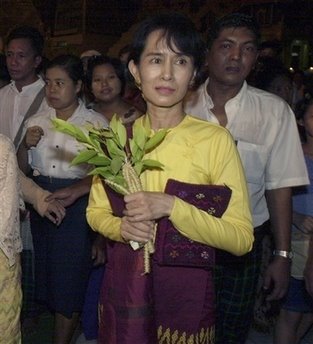


 Posts


