News & Articles on Burma
Tuesday 31 May, 2011
-------------------------------------------------------------
Suu Kyi Plans Tour of Countryside in June
John McCain Will Press for Burmese National Reconciliation
Insein prison rejects strikers’ demands
Swiss-backed dam ‘to displace 8,000’
Danger underfoot in Myanmar war zones
US Dollar Hits Record Low in Burma
Investment Commission Bolstered, as Trade Council Sidelined
Burma's Suu Kyi Announces High Stakes Political Tour
Mass revolt blurs Karen loyalty
Danger underfoot in Burma war zones
The U.S. could get on the right side of history in Burma
The Nation, Bangkok Post to sell in Burma
-----------------------------------------------
Suu Kyi Plans Tour of Countryside in June
By KELVIN CHAN / AP WRITER Tuesday, May 31, 2011
HONG KONG — Burmese pro-democracy leader Aung San Suu Kyi said Monday she plans to tour the country next month in her first trip into the provinces since a 2003 political tour ended in her lengthy house arrest.
"I hope to be able to travel out of Rangoon in the month of June, as soon as I have got rid of all the work that has piled up," she said in a videolink to an audience at Hong Kong University. Rangoon is also known as Yangon, Burma's biggest city.
She said the authorities have not given her any "particular assurances" about security. She did not provide further details.
The Nobel Peace Prize laureate drew large crowds when she last toured northern Burma, and her popularity rattled the military government. Exactly eight years ago Monday, supporters of the ruling junta ambushed her entourage. Several of her followers were killed, but she escaped, only to be arrested.
She was released last November after the country, also known as Myanmar, held general elections in which her party did not participate, calling the vote unfair. Suu Kyi's party won the last elections in 1990 but was not allowed to govern. The junta was officially disbanded after the November elections, but the current government is still military dominated.
Suu Kyi answered dozens of questions from students, alumni and reporters in the videolink with Hong Kong University. She has been jailed or under house arrest for 15 of the last 21 years, and during her brief periods of freedom she has not traveled outside the country, fearing the military would not allow her to return.
She avoided criticizing China, an important backer of Burma's government. Beijing provides the country crucial economic support, military assistance and diplomatic protection at the United Nations.
Burma could maintain neighborly relations with China while having a "friendship based on shared values of democracy" with Western countries, she said.
"I don't think we have to make it either-or. We can be friends with the West and we can be friends with China each in its own special way," Suu Kyi said.
Western nations and groups critical of Burma's poor human rights record had made her freedom a key demand. They estimate the country still has more than 2,000 political prisoners, and a UN envoy said last week Burma has changed little since its stated transition to civilian rule.
Suu Kyi said her party has tried hard to establish a relationship with China's government. But party members aren't even able to break the ice with Chinese diplomats at cocktail receptions, she said.
"Somehow they seem to be able to evade our people quite successfully. I wish they would talk to us," she said.
Suu Kyi ended by answering a question on how she felt about the death of terror mastermind Osama bin Laden, who was killed by US Navy SEALs in a raid on his hide-out in Pakistan.
"With regards to the recent death of bin Laden, it just shows that violence ends with violence, and that there is too much violence already in our world and we've got to try do something about it," she said. http://www.irrawaddy.org/article.php?art_id=21394
------------------------------------------------
John McCain Will Press for Burmese National Reconciliation
By SAW YAN NAING Tuesday, May 31, 2011
Visiting former US presidential candidate Senator John McCain said he will press Burma's new government to initiate national reconciliation, release political prisoners and engage in tripartite dialogue during his trip to the country on Wednesday.
The Republican figurehead was speaking to journalists at Mae Tao clinic by the Thai-Burmese border in Mae Sot. He met with Dr. Cynthia Maung who founded the vital medical centre which provides free healthcare for refugees, migrant workers and others who cross the border from Burma into Thailand.
During his trip to Burma, Sen. McCain is also expected to meet Burmese opposition leader Aung San Suu Kyi on Thursday. Sen. McCain is one of the most powerful Republican voices in the US Senate and was defeated by Barak Obama in the 2008 US presidential election.
Cynthia Maung told The Irrawaddy that Sen. McCain visited the clinic and observed conditions there while pledging continued support for humanitarian assistance at the border.
Bo Kyi, joint secretary of the Assistance Association for Political Prisoners, who met Sen. McCain in the sidelines, told the US senator that the Thein Sein-led government first needed to release the more than 2,100 political prisoners currently held if it sincerely wants political change in Burma. He added that they must stop all human rights violation across Burma, including ethnic areas.
“The change should not be superficial change. It should be a genuine change,” said Bo Kyi.
On Tuesday morning, Sen. McCain also visited Mae La Burmese refugee camp on the Thai border and listened to the views of refugees regarding the shifting Burmese political landscape.
In 2008, Laura Bush also visited Mae Tao clinic in Mae Sot and Mae La camp while her husband, then US President George W Bush, had luncheon meeting with Burmese dissidents in Bangkok and listened to their perspectives regarding politics in Burma.
Mae La is the largest of nine refugee camps located in Thailand’s Tak Province, and currently houses more than 40,000 Burmese refugees, mostly ethnic Karen people who left their homeland due to attacks by Burmese government troops.
Day Day Poe, a camp committee member who met John McCain for 30 minutes, told The Irrawaddy that the senator asked her and other committees about their perspective on the current situation in Burma.
“He asked us if we knew of any change in Burma and if we think there is any change in Burma or not? He wanted to know our opinion. He also asked how many people want to go back Burma and how many of them want to resettle in the US,” said Day Day Poe.
Accompanied by four US officials, including US ambassador to Thailand Kristie Kenney, Sen. McCain toured the camp, visited clinics and several houses belonging to refugees and questioned them about living conditions in the camp. He also questioned refugee families about difficulties of their daily lives in the camp.
Sen. McCain also asked the refugee committees if they want to pass any message to the new Burma government, led by ex-Gen Thein Sein, of the military-backed Union Solidarity and Development Party.
“We told him that we want Burma President U Thein Sein to create national reconciliation as soon as possible. We said that we also support Daw Aung San Suu Kyi for her struggle for a national reconciliation,” said Tun Tun, chairman of the Mae La camp.
The refugee committees also told Sen. McCain that national reconciliation, ethnic minority ceasefires, democratic reform and security are necessary for refugees if Thailand repatriates them to Burma.
Current US President Barak Obama renewed its imposed economic sanctions on Burma in April despite several EU countries wanting to lift the restrictions. Sen. McCain has also expressed pro-economic sanction views on Burma. http://www.irrawaddy.org/article.php?art_id=21399
-------------------------------------------
Insein prison rejects strikers’ demands
By AHUNT PHONE MYAT
Published: 31 May 2011
Demands for an improvement to living conditions inside Burma’s most notorious jail have been rejected by authorities, despite a hunger strike by political prisoners last week gaining international attention.
Nearly 30 inmates had refused food at the Insein jail in Rangoon, a number of whom were sent to solitary confinement as punishment. Although the strike ended on 25 May with authorities pledging to meet various demands, it now appears that a wholesale rejection has been issued.
Several news journals inside Burma were yesterday ordered by the government to publish an article outlining the refusal: calls for mosquito nets and fans for prisoners were deemed too costly, the article said, as were adequately-sized prisoner uniforms that would be replaced every six months.
It also claimed that Insein’s sizeable political prisoner population would not be separated from the common criminals because of a lack of space. Insein prison was built by the British in 1871 to house around 5,000 inmates, but despite some expansion it remains heavily overcrowded, with an estimated population double its stated capacity. Authorities would also continue to record conversations between prisoners and visiting relatives, the article said.
Tate Naing, joint secretary of the Thailand-based Assistance Association for Political Prisoners–Burma (AAPPB), was critical of the response, claiming that authorities had broken prison regulations.
“If they are to keep someone in prison, then they must grant that person the rights accorded in the prison manual. Denying the prisoners these rights with excuses of security and financial issues is very groundless.”
The early phase of the strike, which began on 17 May with five female political prisoners refusing to leave their cells, followed the day after President Thein Sein announced a one-year commutation of all prison sentences that saw nearly 17,000 people released early. Among these however were only around 50 political prisoners.
In the past few days however, inmates in the remote Kale prison in northern Burma have also begun a hunger strike. Rumours suggested that it had also spread to Hkamti prison close to Burma’s border with India.
Four inmates in Kale, including influential monk Ashin Gambira and 1990 MP-elect Nyi Pu, had addressed a letter earlier this month to Burma’s home affairs minister complaining that they were being denied adequate healthcare, food and the freedom to communicate with their families. The strike was prompted by the lack of response form the government.
A Rangoon-based news journal editor who requested anonymity told DVB that publications were still waiting to see whether they could publish independent news on the hunger strikes, but noted that the official article on the demands of the protesters omitted the fact that some had been put in solitary confinement.
http://www.dvb.no/news/insein-prison-rejects-strikers%E2%80%99-demands/15915
----------------------------------------------
Swiss-backed dam ‘to displace 8,000’
By NAW NOREEN
Published: 31 May 2011
More than 20 villages in southwestern Shan state are facing the threat of impending flood and forced relocation due a hydropower project being built with the help of Swiss and British firms.
The Upper Paunglaung dam on the eponymous river that cuts through eastern Burma could submerge the homes of around 8000 people in the planned 61-square kilometre reservoir, according to a new report released by the Kayan New Generation Youth.
“Households will be forced to flatten their homes and abandon their farm fields, receiving in return just $US50 in compensation,” it said. Mu Moe Lay, of the KNGY, told a press conference in Chiang Mai, Thailand, today that no help would be given for the relocation, with the deadline set of October this year.
Aiding the planning and construction of the dam is the Swiss-based AF-Colenco Ltd, which will design and oversee the project, and UK-based Malcolm Dunstan and Associates, which has already been heavily criticised for its involvement in the Tasang dam, the largest of 48 dams in Burma.
“This project shows that whether from Europe or Asia, companies are willing to toss aside proper standards when working in Burma,” said Mu Moe Lay.
Security for the Upper Paunglaung dam has been handed over to the Burmese army, whom the report says has employed the use of forced labour in the seven years since construction began. Mu Moe Lay said that authorities had also moved troops from the ceasefire group, New Kayan State Party, to the dam location.
China’s Exim Bank and the Yunnan Machinery and Export Company have also provided capital and machinery for the project, one of nearly 40 hydropower developments in Burma that Beijing is playing a significant role in.
Sai Sai, from the pressure group Burma Rivers Network, said that most of the electricity generated from these projects are sold to neighbouring countries and are of little benefit for local populations. The Upper Paunglaung dam, which is located only 50 kilometres from the Burmese capital, Naypyidaw, will produce 140 megawatts of electricity.
http://www.dvb.no/news/swiss-backed-dam-%E2%80%98to-displace-8000%E2%80%99/15920
--------------------------------------------
Danger underfoot in Myanmar war zones
AFP
Danger underfoot in Myanmar war zones AFP/File – Myanmar is the only regime in the world that still regularly lays anti-personnel mines, according to …
by Daniel Rook – Tue May 31, 3:21 am ET
MAE SOT, Thailand (AFP) – The last thing Tee Pa Doh remembers before losing his foot is a bright flash. With his leg mangled and bleeding, he knew his best hope was a long journey through the jungle to the Thai border.
Today he counts himself lucky to be alive. But in the conflict zone of eastern Myanmar that he calls home, littered with landmines and with danger lurking at every step, his story is nothing out of the ordinary.
"My foot was blown off but I didn't fall. I stood there, holding my injured leg," said the 52-year-old village headman from Karen State, the scene of one of the world's longest-running civil wars.
"There was blood spurting out. Everyone was afraid to come over to me. I held my leg and hopped," he said, recalling the day in May when a landmine turned his life upside down.
He was taken on a tractor to the frontier several hours away following the incident in his village and crossed over to Thailand where the limb was amputated, following a path taken by many others before him.
"If there was no clinic in Mae Sot I couldn't do anything in Burma," said the victim, whose name AFP has changed for his safety, rubbing the stump of his newly bandaged leg at a clinic in the sleepy Thai border town of Mae Sot.
Myanmar, also known as Burma, is the only regime in the world that still regularly lays anti-personnel mines, according to the International Campaign to Ban Landmines, joint winner of the 1997 Nobel Peace Prize.
"In most of the world landmine use is declining. In Myanmar there's been consistent armed conflict and use of mines by both the ethnic militias and the state forces," said Yeshua Moser-Puangsuwan, a researcher for the pressure group's annual Landmine and Cluster Munition Monitor report.
Nobody knows exactly how many people have been maimed or killed in Myanmar as a result of landmines, because the authorities do not keep count.
About 33 of Myanmar's 325 townships are believed to be contaminated with the controversial weapons.
Over the decade to 2009, the Monitor identified at least 2,587 casualties from landmines or explosive remnants of war, including 183 fatalities, but that might be just the tip of the iceberg.
"We believe it could be exponentially higher than that," Moser-Puangsuwan said.
"In countries like Burma, the fastest path to poverty is to become a mine victim," he added, noting that the injury can rob victims of a livelihood and force them to take out loans to pay for medical costs.
Most victims have no choice but to seek help from Myanmar's crumbling healthcare system, although some international relief groups such as the Red Cross help with rehabilitation.
Many of those living close to Thailand seek treatment there.
At the Mae Tao Clinic, founded by a Myanmar doctor to provide free health care to fellow refugees, Karen landmine amputee Maw Kel runs a workshop that sees about 15-20 patients every month, providing free artificial limbs.
Most patients cross over illegally from Myanmar and must return afterwards.
Tha Gay, who lost his leg in a landmine blast two years ago, returned to the clinic to have his own prosthesis repaired. He is one of eight people in his village to have lost a leg.
"If it weren't for this clinic, I would have died. There was nothing else I could have done," he said.
"I'm very happy to have been given this artificial leg. If I didn't have it, I wouldn't want to live. I would rather kill myself."
Myanmar has endured half a century of military rule and while the junta handed over power to a nominally civilian government in March after a widely criticised election, the armed forces still dominate the nation.
There are documented cases of people being forced to act as "human minesweepers" for army patrols, which regularly force civilians to work as porters carrying ammunition, firewood or other supplies.
"To take ordinary civilians and march them ahead of military units when they're being used for portering, or to order them to clear mines without any appropriate training, is a human rights atrocity," said Moser-Puangsuwan.
It is not just government soldiers who use landmines. At least 17 non-state armed groups are accused of using the weapons since 2009.
Across the border from Mae Sot, ethnic minority Karen rebels who have been fighting the government for six decades appear to have increased their use of landmines, either homemade or seized from the military.
They target not only state soldiers but also rival ethnic factions.
Caught in the middle, civilians in the conflict zones face danger underfoot whenever they leave their homes.
"Anti-personnel landmines and improvised explosive devices are probably the biggest security threat to most people in those areas," said David Mathieson, a Myanmar expert for New York-based Human Rights Watch.
"Villagers tend to anticipate when fighting is going to happen and they flee. But then what most factions do is to go in and landmine the area... booby trapping civilian areas and destroying agriculture and houses," he said.
Thailand's announcement in April that it wants to close its Myanmar refugee camps has raised fears across the exile community that it might be pushed back and landmine victims turned away.
But Maw Kel believes his prosthetic services will be needed for many years to come.
"Look at Cambodia. The war already finished 30 years ago but landmine incidents still happen. It's going to be the same in Burma," he said.
Ironically, the biggest danger may come when the war finishes and people rush to return home, said Moser-Puangsuwan.
"There are no records of these mines. They're not marked in any way. So when the armed conflict ends there's going to be a massive number of casualties and at this point there is virtually nothing anyone can do to stop it," he warned.
http://news.yahoo.com/s/afp/20110531/wl_sthasia_afp/myanmarthailandconflictlandminerights_20110531072109;_ylc=X3oDMTEwaDM1Y3NxBF9TAzIwMjM4Mjc1MjQEZW1haWxJZAMxMzA2ODQzMDQ1
-----------------------------------------------------
US Dollar Hits Record Low in Burma
By AUNG THET WINE Tuesday, May 31, 2011
An influx of US dollars at the border, tensions between the government and ethnic armed groups and heavy domestic investment by Burmese entities has caused the dollar to reach a historic low on the Burmese currency market.
RANGOON — Two months after Burma's new government led by President Thein Sein was sworn in to office, the value of US dollars and gold dropped in an unprecedented manner, with the dollar reaching a historic low, according to business sources.
Some foreign currency dealers in Rangoon said the extensive influx of US dollars from the illegal drug trade at the Sino-Burmese border and the continuous decline in demand on the domestic US dollar market have lowered the value of the dollar. The dealers said that although the value of US dollars has decreased in world markets, the domestic currency market is not directly related to the international market.
“The rate for US dollars in Rangoon lies in the current exchange rate of yuan-dollar-kyat at the Sino-Burmese border. It is not determined in Rangoon. Now, the supplies of US dollars at the border have significantly increased. There are many reasons for the increase. There has always been a heroin and amphetamine market at the border involving US dollars. If dollar supplies there increase in value then the domestic market will decrease,” said a businessman in Rangoon who has been involved in the gold and dollar trade in connection with the China border.
A number of businessmen in Rangoon said they believe that the increase in US dollar supplies at the Burma-China border is related to tensions between the government troops and ethnic armed groups, which could lead to clashes at any time.
“There is news of a reunion of two ethnic Shan armed groups and of tensions between the Kachin and Wa armed groups and the government. Concerns about whether clashes will break out have forced dollar holders to sell off what they have in the market. Everybody predicts that the dollar value will decrease more,” said a gold trader from the Myanmar Gold Entrepreneurs Association.
The value of the US dollar has reportedly sunk as low as 789 kyat per one dollar on Tuesday in Rangoon's street exchange market.
One of the reasons for less demand in US dollars is reported to have been the formation of a joint company for importing palm oil that was permitted by the government.
“Since the government only allows any one person to import 3,000 tons of palm oil, those who want to do business in this area joined hands and formed a company. A joint company comprises at least 10 businessmen and each has to invest a minimum of 70 million kyat [US $ 85,366]. Some businessmen who can afford to do so invest about 100 million kyat [US $ 121,951]. The investment in this business caused a significant decrease in dollar buying,” said a businessman from The Union of Myanmar Federation of Chambers of Commerce and Industry.
On gold markets in Rangoon and Mandalay, the demand for gold has reportedly dropped in an unprecedented manner and daily sales continue to be quiet.
“The gold market is very quiet. There are people who want to sell, but only a few who want to buy. It is not in good in shape at all,” said a gold trader.
Currently, one kyat-thar [0.016 kg] of solid gold is reported to cost 667,000 kyat [US $ 813].
Business sources said although the new government has granted import and export licenses quickly, traders still have to go through many unnecessary steps and the amount of imports and exports have yet to increase under the new trade policy.
“Imports and exports haven't increased very much following the dissolution of the Trade Council. Only the license application process has become quicker. Other steps remain stagnant. Whoever wants to apply for an import/export license has to go to Naypyidaw. If they want to export rice they need recommendations from the Myanmar Rice Industry Association. They need every document required in order to apply for a permit. If something goes wrong they have to start over and go through many steps,” said a Rangoon-based businessman.
An economist inside Burma said that things have not improved in Burma and a down-turn is indicated.
“The prosperity of a country cannot only be measured by its exports, but also by imports. If the economy improves, the import of capital and other goods will also increase. But here in Burma, the import of consumption goods—such as gasoline, diesel and palm oil—is more than that of capital goods. The latter is imported only for the government or its projects. Private businessmen have imported only a small amount of capital goods,” said the economist.
He said that in exporting rice, various types of beans and fishery products, Burma needs to come up with plans to increase the export of high-valued products and the government should relax regulations in the license application process.
According to the Burmese government's official statistics, foreign investment in the country exceeds US $36 billion and China has invested the most in the energy and natural gas sectors. http://irrawaddy.org/article.php?art_id=21395
--------------------------------------------------
Investment Commission Bolstered, as Trade Council Sidelined
By THE IRRAWADDY Tuesday, May 31, 2011
President Thein Sein reportedly instructed members of the MIC to work on improving relations with potential foreign investors, particularly those from neighboring countries like China and India.
The Myanmar Investment Commission (MIC), which has replaced the now defunct Trade Council as Burma's main trade body, has been reinforced in its new role with the recent appointment of senior officials from President Thein Sein's government as key members.
On April 20, just weeks after Thein Sein's new government was sworn in, Burma's state-run media reported that the MIC would take over the Trade Council's responsibilities as the main body in charge of promoting trade and investment.
Since then, it has emerged that key positions in the MIC have all been filled by Thein Sein appointees. Leading the commission as its chairman is former Maj-Gen Tin Naing Thein, who heads both the Ministry of Livestock and Fisheries and the Ministry of National Planning and Economic Development.
A high-ranking official from the Ministry of Finance and Revenue in Naypyidaw told The Irrawaddy that of the remaining 15 positions on the MIC, 11 are occupied by deputy ministers and four by managing directors.
“The chairperson is Minister Tin Naing Thein, the vice chairperson is Deputy Minister of Railway Transport Thura Thaung Lwin, and the secretary is Deputy Minister of National Planning and Economic Development Dr. Kaung Zaw,” the official said.
Thein Sein reportedly instructed members of the commission to work on improving relations with potential foreign investors, particularly those from neighboring countries like China and India.
“The commission was told to adhere to the correct policies and implement them efficiently—not like the Trade Council,” said an official in Naypyidaw. Previously, the MIC scrutinized business proposals and then gave recommendations to the Trade Council and Cabinet.
Although the move was seen by some as an effort to streamline procedures for authorizing foreign investment in Burma, a member of the Union of Myanmar Federation of Chambers of Commerce and Industry said the new government should focus on policy reform initiatives rather than institutional reforms.
Some observers suggested that by sidelining the Trade Council, Thein Sein was also trying to reduce the power of Thiha Thura Tin Aung Myint Oo, who as head of the Trade Council was notorious for favoring companies run by businessmen with whom he had strong personal ties, including Stephen Law (aka Tun Myint Naing) of Asia World Company and Zaw Zaw of Max Myanmar Company.
The Trade Council was a major source of revenue for its chairperson. According to sources close to the council, Tin Aung Myint Oo claimed a five percent commission on any foreign investment he approved.
According to unconfirmed reports, this led to some friction between Tin Aung Myint Oo and Thein Sein over who would be in charge of regulating foreign investment under Burma's new government. http://www.irrawaddy.org/article.php?art_id=21397
--------------------------------------------------------
Burma's Suu Kyi Announces High Stakes Political Tour
Posted by Emily Rauhala Monday, May 30, 2011 at 10:11 am
6 Comments • Related Topics: Asia, China, Conflict, Democracy, Dictatorships, India , Aung San Suu Kyi, aung san suu kyi political tour, Burma, democracy, hong kong university, myanmar, southeast asia
Pro-democracy campaigner Aung San Suu Kyi confirmed Monday that she's planning a visit to Burma's provinces this summer. "I hope to be able to travel out of Rangoon in the month of June, as soon as I have got rid of all the work that has piled up," she said in a video conference hosted by Hong Kong University. The Nobel Laureate has spent almost 15 of the last 21 years under house arrest.
The tour, if it proceeds, would be her first trip since her release last fall and, indeed, her first sojourn since a pro-Junta mob ambushed her entourage as she toured the countryside exactly eight years ago. Several of her supporters were killed in the May 30, 2003 attack; Suu Kyi, who initially fled, was apprehended and detained. "The generals saw her crowds growing larger," a diplomat told TIME after the incident, "and decided they had to stop it."
That, of course, could happen again. But Suu Kyi didn't dwell on the danger, so neither will I. I've attached her keynote speech. And here are some of the most interesting bits from the live chat:
On Sanctions: Suu Kyi reiterated her support for international sanctions on Burma, saying that, as far as she can tell, the policy is hurting the government, not the people.
On China: "China can afford to be daring, to allow for all types of opinion," she told the crowd. "Open your greatness to everybody else." Suu Kyi also voiced support for imprisoned dissidents: "You are not alone," she told them.
On India: The democracy campaigner called out the world's largest democracy for its ambivalence on Burma. "India is not as concerned about our fate as we would like them to be," she said.
On OBL: "With regards to the recent death of bin Laden, it just shows that violence ends with violence, and that there is too much violence already in our world and we've got to try do something about it."
Just as the talk drew to a close, the power went out in Rangoon. It seemed a fitting ending: The Lady, in half-light, looking out at the world.
Read more: http://globalspin.blogs.time.com/2011/05/30/burmas-suu-kyi-announces-high-stakes-political-tour/#ixzz1Nv9ZWnOm
------------------------------------------
Mass revolt blurs Karen loyalty
By NAW NOREEN
Published: 31 May 2011
Hundreds of troops serving under a pro-government Border Guard Force (BGF) in eastern Burma are now refusing demands from their leaders and have donned opposition Karen fatigues.
Stopping short of a wholesale defection, the 500-odd soldiers are yet to commit to either the pro-government BGF or a renegade faction of the Democratic Karen Buddhist Army (DKBA), whose insignia they now wear on their uniforms.
The group, based in Karen state’s Myainggyingu region and led by Colonel Phobi, say they grew tired of the lack of rations and what they claim is discrimination between the ranks of BGF 1012, the same group the last month attacked their own armoury. Growing disquiet prompted them to surround the bases of their commanders and on 27 May, fighting looked imminent.
An intervention by Karen abbot, Ashin Thuzana, who chaired negotiations between Burmese army officials and members of the BGF 1012, has reportedly calmed the situation, although the Burmese army agreed to demands that all BGF forces in the area surrounding Myainggyingu be allowed to wear DKBA uniforms – a symbolic coup for the onetime junta-loyalists who defected to the opposition last year in a rebuttal to the creation of a BGF.
Yet ambiguity still surrounds the allegiance of the 500 men – a lay follower of Ashin Thuzana told DVB that while they can wear DKBA uniforms in Myainggyingu, they will have to switch back to their BGF outfits whenever they leave the region. Moreover, they have reportedly pledged not to attack government-allied forces.
The report paints a confusing portrait of the situation in eastern Burma, where a loose coalition of Karen armies, including the DKBA and the Karen National Liberation Army (KNLA), are battling Burmese forces supported by a number of BGF groups.
The Karen opposition, whose six-decade conflict with the Burmese regime is one of the world’s longest-running, was given a boost in July last year when a faction of the DKBA broke off and turned against the Burmese army. A number of defections have since followed.
The latest revolt follows an attack by troops from the same BGF 1012 on their commanders on 24 May, which left three dead. Reports at the time suggested that Colonel Na Kham Mwe, who led the July 2010 defection of DKBA troops, had aided the assault.
Maj-Gen Johnny of the KNLA’s Brigade 7 said that the BGF 1012 continued to strengthen its forces in Myainggyingu, prompting Burmese troops to block roads around Myaniggyingu that KNLA forces could potentially use as thoroughfares to assist the revolt.
http://www.dvb.no/news/mass-revolt-blurs-karen-loyalty/15906
---------------------------------------------------
Danger underfoot in Burma war zones
By AFP
Published: 31 May 2011
The last thing Tee Pa Doh remembers before losing his foot is a bright flash. With his leg mangled and bleeding, he knew his best hope was a long journey through the jungle to the Thai border.
Today he counts himself lucky to be alive. But in the conflict zone of eastern Burma that he calls home, littered with landmines and with danger lurking at every step, his story is nothing out of the ordinary.
“My foot was blown off but I didn’t fall. I stood there, holding my injured leg,” said the 52-year-old village headman from Karen state, the scene of one of the world’s longest-running civil wars.
“There was blood spurting out. Everyone was afraid to come over to me. I held my leg and hopped,” he said, recalling the day in May when a landmine turned his life upside down.
He was taken on a tractor to the frontier several hours away following the incident in his village and crossed over to Thailand where the limb was amputated, following a path taken by many others before him.
“If there was no clinic in Mae Sot I couldn’t do anything in Burma,” said the victim, whose name AFP has changed for his safety, rubbing the stump of his newly bandaged leg at a clinic in the sleepy Thai border town of Mae Sot.
Burma is the only regime in the world that still regularly lays anti-personnel mines, according to the International Campaign to Ban Landmines, joint winner of the 1997 Nobel Peace Prize.
“In most of the world landmine use is declining. In Myanmar [Burma] there’s been consistent armed conflict and use of mines by both the ethnic militias and the state forces,” said Yeshua Moser-Puangsuwan, a researcher for the pressure group’s annual Landmine and Cluster Munition Monitor report.
Nobody knows exactly how many people have been maimed or killed in Burma as a result of landmines, because the authorities do not keep count.
About 33 of Burma’s 325 townships are believed to be contaminated with the controversial weapons.
Over the decade to 2009, the Monitor identified at least 2,587 casualties from landmines or explosive remnants of war, including 183 fatalities, but that might be just the tip of the iceberg.
“We believe it could be exponentially higher than that,” Moser-Puangsuwan said.
“In countries like Burma, the fastest path to poverty is to become a mine victim,” he added, noting that the injury can rob victims of a livelihood and force them to take out loans to pay for medical costs.
Most victims have no choice but to seek help from Burma’s crumbling healthcare system, although some international relief groups such as the Red Cross help with rehabilitation.
Many of those living close to Thailand seek treatment there.
At the Mae Tao Clinic, founded by a Burmese doctor to provide free health care to fellow refugees, Karen landmine amputee Maw Kel runs a workshop that sees about 15 to 20 patients every month, providing free artificial limbs.
Most patients cross over illegally from Burma and must return afterwards.
Tha Gay, who lost his leg in a landmine blast two years ago, returned to the clinic to have his own prosthesis repaired. He is one of eight people in his village to have lost a leg.
“If it weren’t for this clinic, I would have died. There was nothing else I could have done,” he said.
“I’m very happy to have been given this artificial leg. If I didn’t have it, I wouldn’t want to live. I would rather kill myself.”
Burma has endured half a century of military rule and while the junta handed over power to a nominally civilian government in March after a widely criticised election, the armed forces still dominate the nation.
There are documented cases of people being forced to act as “human minesweepers” for army patrols, which regularly force civilians to work as porters carrying ammunition, firewood or other supplies.
“To take ordinary civilians and march them ahead of military units when they’re being used for portering, or to order them to clear mines without any appropriate training, is a human rights atrocity,” said Moser-Puangsuwan.
It is not just government soldiers who use landmines. At least 17 non-state armed groups are accused of using the weapons since 2009.
Across the border from Mae Sot, ethnic minority Karen rebels who have been fighting the government for six decades appear to have increased their use of landmines, either homemade or seized from the military.
They target not only state soldiers but also rival ethnic factions.
Caught in the middle, civilians in the conflict zones face danger underfoot whenever they leave their homes.
“Anti-personnel landmines and improvised explosive devices are probably the biggest security threat to most people in those areas,” said David Mathieson, a Burma expert for New York-based Human Rights Watch.
“Villagers tend to anticipate when fighting is going to happen and they flee. But then what most factions do is to go in and landmine the area… booby trapping civilian areas and destroying agriculture and houses,” he said.
Thailand’s announcement in April that it wants to close its Burmese refugee camps has raised fears across the exile community that it might be pushed back and landmine victims turned away.
But Maw Kel believes his prosthetic services will be needed for many years to come.
“Look at Cambodia. The war already finished 30 years ago but landmine incidents still happen. It’s going to be the same in Burma,” he said.
Ironically, the biggest danger may come when the war finishes and people rush to return home, said Moser-Puangsuwan.
“There are no records of these mines. They’re not marked in any way. So when the armed conflict ends there’s going to be a massive number of casualties and at this point there is virtually nothing anyone can do to stop it,” he warned.
http://www.dvb.no/news/danger-underfoot-in-burma-war-zones/15902
----------------------------------------------
The U.S. could get on the right side of history in Burma
By Fred Hiatt, Tuesday, May 31, 5:34 AM
Long before Syria’s Bashar al-Assad was ordering the murder of his people, the generals misruling a Southeast Asian nation 4,000 miles distant had shown the way.
In 1988, the regime in Burma, a once-promising nation of 50 million, slaughtered unarmed university students to derail democracy. In 2007 the junta gunned down pacifist Buddhist monks in their robes and sandals.
But outrage fades, people forget, a few generals have traded in their uniforms for civilian suits — and so pressure is building from governments, companies and nonprofit groups to lift sanctions and “engage” with the regime.
Before that happens, it’s worth thinking about some early lessons of the Arab Spring.
The engagement argument comes down to this: Sanctions against Burma haven’t worked. Two decades since the regime threw out the results of an election that it had (in its delusions of popularity) allowed, it is no more popular but no less entrenched. With U.S. companies and diplomats mostly absent, China has become the dominant power. The Burmese people remain poor and isolated from the world.
Why not try something new? Why not jettison self-defeating idealism for something a bit more pragmatic?
A few possible reasons come to mind. One is that engagement with a regime that so suffocates its nation may strengthen the regime. Western Europe has been engaging with Cuba for decades; the Castros pocket the euros at no apparent cost to the stability of their dictatorship.
Nor would engagement do much for the U.S. economy. As long as Burma pursues its peculiar brand of paranoid crony socialism, it won’t offer much of a growth opportunity.
Moreover, it’s a bit unfair to say that sanctions don’t work, because the United States has never fully tried them. It hasn’t targeted the personal finances of Burma’s rulers and their relatives with any focus or intensity. It has never made clear to Burma’s neighbors — some of which are new democracies themselves, uncomfortable rubbing shoulders with brutal generals — that helping democrats inside Burma is a strategic priority. It talks about a United Nations commission of inquiry into the regime’s crimes against humanity — mass rape, child labor, ethnic cleansing — but has never pushed for it, despite support for a U.N. inquiry (though not a tribunal) from Burma’s democratic leader, Aung San Suu Kyi.
Pushing might dilute the perennial charge of hypocrisy (why bomb Moammar Gaddafi but do nothing as Burma’s regime empties village after village?). Pushing also might show Gaddafi, Assad and other Arab dictators that they can’t just wait out the world’s disapproval.
But the strongest argument emerges from a public opinion survey carried out this spring by the Pew Research Center — in Egypt.
There, for decades, the United States followed the entirely pragmatic policy of engagement. Led by U.S. ambassadors in Cairo for whom the Mubarak clan could do no wrong, U.S. governments routinely dismissed as naive and unrealistic the Egyptian people’s desire for a more dignified life. When Egyptians finally took to the streets to demand self-rule, the United States stuck with President Hosni Mubarak until any hope of his survival was gone.
The result? “Only 20 percent of Egyptians hold a favorable opinion of the United States,” Pew found. “The American president gets more negative than positive reviews for how he is handling the political changes sweeping through the Middle East. . . . A plurality of those who disapprove say Obama has shown too little support for those who are calling for change.”
The United States put itself on the wrong side of history, in other words, and now it is paying the price.
Which raises the question of where exactly pragmatism lies.
If you believe that the Burmese junta represents the future, then it makes sense to build ties and mend fences. And it’s true that no one has figured out how to predict precisely when a regime will crumble — or when its soldiers will decide they no longer want to shoot students and monks.
But the junta clearly understands that it is hated. That is why it censors all media, imprisons thousands of dissenters (many of whom have been on a hunger strike this month), bans the only political party with popular support (Aung San Suu Kyi’s National League of Democracy) and squanders billions on an isolated new capital where no ordinary people are allowed to live or even enter. On some level, as the rest of Asia speeds past them, these septuagenarian thieves must understand that they do not, in fact, represent the future.
The United States can affect the date of their demise only at the margins, just as it took the Egyptian people to bring about Mubarak’s fall. But what America does now could affect the results when Pew conducts its first survey in democratic Burma.
fredhiatt@washpost.com http://www.washingtonpost.com/opinions/the-us-can-get-on-the-right-side-of-history-in-burma/2011/05/27/AGXrGzEH_story.html
----------------------------------------
The Nation, Bangkok Post to sell in Burma
By DAN WITHERS
Published: 31 May 2011
Burma’s commerce ministry has given the go-ahead for two leading Thailand-based English-language dailies to be distributed inside the country, but analysts have warned of heavy censorship before they reach the public.
Success International, which distributes Singaporean paper The Straits Times in Burma, announced it received the distribution license for the Bangkok Post and The Nation on Friday, DPA reported. Managing director Nyo Aung said he had been hesitant to request the licenses because of the papers’ stance. “Now the government has changed, so I thought it was a good time to apply for the license,” he told DPA.
Both the Bangkok Post and The Nation have long been critical of the Burmese military’s brutal authoritarian regime. Recent elections, decried by much of the international community as a rigged attempt to paint a democratic veneer on de facto military rule, have failed to blunt that criticism.
In an editorial in April, the Bangkok Post wrote: “The Burmese model of prisons, torture and secret arrests remains government policy; some 2,000 Burmese remain as political prisoners. This is sad, but perhaps not so sad as the way Burma’s neighbours and world opinion has bought into the fake claims that Burma is on the road to democracy.”
The move comes as President Thein Sein’s freshly elected government tries to employ its new “democratic” credentials to expand its role within the Association of South East Asian Nations (ASEAN). Burma even hopes to assume the bloc’s rotating chairmanship in three years’ time.
Last week The Nation poured scorn on such efforts. “Without positive developments in Burma, ASEAN should not even consider allowing it to be chairman of the regional body in 2014,” it wrote. “Since its admission to ASEAN in 1997, Burma has got away with years of brutal atrocities and dubious undertakings.”
But readers inside Burma will almost certainly not be exposed to such content, with both papers facing the scrutiny of Burma’s chief censor, the Press Scrutiny and Registration Division (PSRD).
Zin Linn, the Thailand-based vice chairman of the Burma Media Association, said the PSRD would ban entire issues of the papers if they contained material that displeased the Burmese government. Editions of international news magazines such as Time and Newsweek had recently been banned for featuring coverage of democracy icon Aung San Suu Kyi, he said.
Benjamin Zawacki, Amnesty International’s Burma researcher, said the censors would probably cast a wide net, targeting anything that implicitly criticised or threatened the Burmese government’s position. Stories about Thailand’s forthcoming elections, its red- and yellow-shirted protest movements and its population of Burmese refugees could all face the censor’s knife, he said.
“That being the case, I think it’s very difficult to see this as progress by way of freedom of expression,” he said. “It strikes me more as a business deal than it does a sign of any free press progress.”
With the Thai papers likely to be priced at more than 2000 kyat ($US2.30) each – two or three days’ work for an average Burmese worker – and English-language skills in short supply, few Burmese will be able to read either newspaper.
Nevertheless, said Zin Linn, Burma’s weekly political journals will likely attempt to test the censors’ boundaries by translating the content into Burmese. Few had previously dared to do so because the newspapers had to be smuggled into the country. “They were not officially inside Burma.”
Soon, it seems both papers will be “officially inside Burma”. How often they escape the censors’ attentions remains to be seen.
http://www.dvb.no/news/the-nation-bangkok-post-to-sell-in-burma/15897
Wednesday, June 1, 2011
News & Articles on Burma-Tuesday 31 May, 2011


Tuesday, May 31, 2011
News & Articles on Burma-Monday 30 May, 2011
News & Articles on Burma
Monday 30 May, 2011
-------------------------------------------------------------
Two battalions of Burmese reinforcements deployed near KIA position
Burmese Delegation in Sweden Raises Concerns
Suu Kyi Plans Tour of Myanmar Countryside
Myanmar trial of Australian journalist adjourned until June 14
Myanmar's Suu Kyi calls for China openness amid clampdown
Police file whitewashes Depayin massacre
Eight years after the tour that led to her arrest, Suu Kyi plans rural Myanmar visit
Hunger strike spreads to remote jails
Myanmar opposition figure returns home after medical treatment
Military Cronies Expand into Media
--------------------------------------------
Two battalions of Burmese reinforcements deployed near KIA position
Monday, 30 May 2011 21:15 KNG
The military-controlled Burmese government sent two army battalions to the area near Battalion 9 of the Kachin Independence Army (KIA), in northern Shan State, local residents said.
Battalion 9 connects the KIA headquarters in the north and Loikang-based KIA’s Brigade 4 Command as well as Kokang and the Wa (or United Wa State Army, UWSA) territories in the east.
kia-battalion-9-map-engAccording to local military observers, Burmese troops have been transported from Lashio and stationed at the village of Dima, close to the base of the KIA’s Battalion 9, since Saturday, May 28.
In Dima, about 60 Burmese soldiers had already been deployed before the new military reinforcements arrived in the village, the observers added.
The KIA’s Battalion 9 is now on standby for a military response if government troops enter into its controlled areas, sources close to the battalion said.
Dima is controlled by a pro-government militia group. The village connects with the KIA-controlled Daknai Village, on the east side of Dima Stream.
The road reconstruction intended to cross the area controlled by the KIA’s Brigade 4 was temporarily stopped by the Burmese government after a May 14th warning that it will lead to war.
Military tension and short clashes have gradually increased since the KIA rejected the government’s proposal to disarm and transform into the Burmese Army-controlled Border Guard Force (BGF), in August last year.
Local military analysts said China wants the Burmese government and KIA to avoid renewed civil war between them because it will jeopardize China’s multi-million dollar investment in the country.
The KIA officially demanded on May 19th that the central government withdraw all its troops from the areas close to KIA military bases by May 25. It also warned the government must take responsibility for the consequences of refusing to withdraw. http://www.kachinnews.com/news/1925-two-battalions-of-burmese-reinforcements-deployed-near-kia-position.html
-----------------------------------------
Burmese Delegation in Sweden Raises Concerns
By BA KAUNG Monday, May 30, 2011
The Swedish International Development Cooperation Agency (Sida) has denied having links with the new Burmese government or violating EU economic sanctions in connection with a program in which it is indirectly financing Burmese groups for the purpose of economic development.
The denial was issued following Swedish media reports about a meeting on May 20 in Stockholm between Sida representatives and a Burmese delegation that reportedly included members of Myanmar Egress, a Rangoon-based Burmese NGO, and possibly with individuals connected to the Burmese Chamber of Commerce.
Myanmar Egress is known in Burma for its pro-government stance, including support for the controversial election in November of last year and opposition to Western economic sanctions.
Burma's Chamber of Commerce is technically independent of the government but is known to be government-influenced. For example, the previous chairman of the Chamber of Commerce was Win Myint, who is also the minister of commerce.
The Local, a Swedish news website based in Stockholm, reported last week that the Burmese delegation was invited by the International Council of Swedish Industry (known as the NIR in Sweden), which on its website describes itself as the independent associate of the Confederation of Swedish Enterprise, representing some 60,000 member companies.
The Burmese delegation met with representatives of Sida, Swedish foreign ministry officials and the Royal Institute of Technology in Sweden. News of the meetings has raised the issue of whether Sida and the NIR's relationship with the Burmese government and groups close to it might be in violation of EU policy towards Burma.
In April, the EU lifted its visa ban on certain Burmese senior government officials, including the Burmese foreign minister, but decided to maintain its economic sanctions against Burma, known as the the EU Common Position on Burma.
Speaking with The Irrawaddy on Friday, Johan Akerblom, a senior adviser at Sida who met the Burmese delegation, said that one and a half years ago Sida began providing 12 million Swedish Kroner (US $ 1.9 million) annually to an NIR project involving several countries to promote “market development, human rights and democracy,” and Burma was only a small part of that project.
“This exchange with the Burmese delegation is part of an agreement between Sida and NIR,” said Akerblom, who added that the Burmese individuals he met were not representing the new Burmese civilian government.
In interviews with The Irrawaddy, both Sida and NIR officials declined to comment on the identity of the members of the Burmese delegation, citing policy reasons, and reaffirmed that both Sida and the NIR were in line with the EU Common Position on Burma.
But when asked if they had confirmed that the Burmese individuals in the delegation were not linked to the Burmese government, Akerblom said that Sida has asked the NIR for an explanation about these individuals and expected to get an answer by Tuesday.
“When it comes to Burma, it is very important to underline that Sweden follows EU policy and the NIR has to work in line with that. We are not cooperating with the regime,” he said.
The NIR's director of operations, Sofia Svingby, conceded in a local Swedish report that the Burmese delegation included members of Myanmar Egress. When speaking with The Irrawaddy on Friday, however, she said the NIR does not work with Burmese government and individuals connected to it.
Regarding the NIR's intentions for its programs directed towards Burma, Sofia said that the organization is now investigating what it can do for positive economic development in the country.
Asked whether the NIR is going to implement its programs in Burma regardless of the country's political conditions, she said, “Economic development, that is what we want. We are not into politics. We don't work politically.”
In the report in The Local, NIR CEO Erika Molin was quoted as saying that they [the Burmese delegation] believe that economic growth and a functioning industry is a fundamental prerequisite for the development of the country and the people.
“That's why we have invited these people,” she said.
Despite the EU decision to maintain its economic sanctions against Burma, Burmese opposition groups have expressed concerns that some of the bloc members, such as Germany, are trying to lift sanctions for business interests before any political progress is made.
According to a 2008 diplomatic cable from the US Embassy in Berlin that was disclosed by Wikileaks, German officials had previously expressed skepticism about the effectiveness of the EU's economic sanctions against Burma, and members of the German parliament did not want to see ordinary Burmese people hurt by sanctions,.
The US cable quoted the then German Foreign Minister and current vice-chancellor Frank-Walter Steinmeier as having the impression that the sanctions were “largely counterproductive, had helped to forge solidarity within the military, had increased China's influence and had given the regime excuses for legitimizing its rule.”
Early this month, the Friedrich Naumann Foundation, a German foundation based in Berlin, invited a Burmese delegation, which included a representative from the Myanmar Egress, to come and speak about Burma in the post-election period. The Irrawaddy’s editor Aung Zaw also attended the conference.
Burma analysts have noted that some EU governments are eager to engage the regime and its proxies, such as the Myanmar Egress, who claim to have established civil society groups inside Burma. Government critics also point out that mainstream opposition members inside Burma cannot travel outside of Burma, but some “third force” members, such as the Myanmar Egress representatives, enjoy the freedom to travel internationally and are frequently invited to Western capitals to present their political views and paint the Burmese picture in a positive light.
As a result, critics say, international officials who have the responsibility to determine Burma policy on issues such as sanctions only hear the pro-government arguments while attending international events.
http://www.irrawaddy.org/article.php?art_id=21389
-------------------------------------
Suu Kyi Plans Tour of Myanmar Countryside
Associated Press
HONG KONG—Myanmar pro-democracy leader Aung San Suu Kyi said Monday she plans to tour the country next month in her first trip into the provinces since a 2003 political tour ended in her lengthy house arrest.
"I hope to be able to travel out of Rangoon in the month of June, as soon as I have got rid of all the work that has piled up," she said in a videolink to an audience at Hong Kong University. Rangoon is the old name for Yangon, Myanmar's biggest city.
She said the authorities have not given her any "particular assurances" about security. She didn't provide further details.
The Nobel Peace Prize laureate drew large crowds when she last toured northern Myanmar, and her popularity rattled the military government. Exactly eight years ago Monday, supporters of the ruling junta ambushed her entourage. Several of her followers were killed, but she escaped, only to be arrested.
She was released last November after Myanmar held general elections in which her party didn't participate, calling the vote unfair. Ms. Suu Kyi's party won the last elections in 1990 but wasn't allowed to govern. The junta was officially disbanded after the November elections, but the current government is still military dominated.
Ms. Suu Kyi answered dozens of questions from students, alumni and reporters in the videolink with Hong Kong University. She has been jailed or under house arrest for 15 of the past 21 years, and during her brief periods of freedom she hasn't traveled outside Myanmar, fearing the military wouldn't allow her to return.
She avoided criticizing China, an important backer of Myanmar's government. Beijing provides the country crucial economic support, military assistance and diplomatic protection at the United Nations.
Myanmar could maintain neighborly relations with China while having a "friendship based on shared values of democracy" with Western countries, she said.
"I don't think we have to make it either-or. We can be friends with the West and we can be friends with China each in its own special way," Ms. Suu Kyi said.
Western nations and groups critical of Myanmar's poor human-rights record had made her freedom a key demand. They estimate the country still has more than 2,000 political prisoners, and a U.N. envoy said last week Myanmar has changed little since its stated transition to civilian rule.
Ms. Suu Kyi said her party has tried hard to establish a relationship with China's government. But party members aren't even able to break the ice with Chinese diplomats at cocktail receptions, she said.
"Somehow they seem to be able to evade our people quite successfully. I wish they would talk to us," she said.
Ms. Suu Kyi ended by answering a question on how she felt about the death of terror mastermind Osama bin Laden, who was killed by U.S. Navy Seals in a raid on his hide-out in Pakistan.
"With regards to the recent death of bin Laden, it just shows that violence ends with violence, and that there is too much violence already in our world and we've got to try do something about it," she said. http://online.wsj.com/article/SB10001424052702303745304576355160774891024.html?mod=rss_asia_whats_news
----------------------------------------
Myanmar trial of Australian journalist adjourned until June 14
May 30, 2011, 12:39 GMT
Yangon - The trial of Australian journalist Ross Dunkley, arrested in Myanmar on charges of violating immigration regulations and sexually assaulting a woman, was adjourned at its start on Monday.
Dunkley, a co-founder of the foreign-funded Myanmar Times weekly newspaper, was arrested on February 10.
An hour into the proceedings, the trial was adjourned until June 14, Dunkley's defence lawyer said. Dunkley was questioned, but no more details were available.
Dunkley, 53, was released on bail from Myanmar's Insein Prison on March 29 and, at the time, expressed confidence he would be found not guilty of charges against him.
Insein Prison is notorious for its poor conditions.
The Kamaryut Township Court granted Dunkley bail of 10 million kyats (12,300 dollars), after six previous attempts at gaining his release had failed.
The Myanmar Times was founded in 2000 and is the country's only media outlet with foreign investment. Like all other media in Myanmar, it is subject to government censorship.
Dunkley told the Committee to Protect Journalists in 2008 that about 20 per cent of the stories he submitted for publication were censored.
Myanmar, also called Burma, has been under military dictatorships since 1962 and has one of the world's worst records for press freedom.
Critics say that the advent of a new elected government, packed with ex-military men, appears not to have changed the regime's attitude towards the press.
According to the CPJ there were 13 journalists in jail in Myanmar as of December 1, 'making it one of the five worst jailers of journalists in the world.' http://www.monstersandcritics.com/news/asiapacific/news/article_1642376.php/Myanmar-trial-of-Australian-journalist-adjourned-until-June-14
----------------------------------------------
President Thein Sein declared that the historical paukphaw (fraternity) relationship between Burma and China has reached “a strategic level” during his three-day state visit to China, potentially alienating Asean (Association of Southeast Asian Nations) members in the process.
“Having been designated as partners for multi-strategic cooperation, Myanmar [Burma]—China relations have reached a new chapter and the highest level in China’s foreign relations,” he said while meeting Chinese President Hu Jintao at Bejing's Great Hall of the People on May 28, according to the state-owned New Light of Myanmar. “Both [of the] two countries have to work hard at all levels to maintain multi-strategic cooperation partnership relations.”
The two nations issued a joint statement defining the strategic level as: “The two sides will maintain close high-level contacts, continue to promote strategic mutual trust and further enhance friendly exchanges and cooperation between the parliaments, governments, judicial departments and political parties of the two countries.”
This was Thein Sein's first state visit to China after assuming the presidency and he headed a high-level delegation with more than a dozen cabinet ministers, deputy ministers and senior officials of the new government. He discussed a broad range of bilateral and regional issues with his Chinese counterpart.
During discussions with President Hu, Thein Sein apparently sought China's political support for Burma's relationship with Asean—specifically the issue of taking the bloc's chairmanship in 2014—and financial support for a number of development projects assisted by China.
In return for China's consistent support, Thein Sein pledged to President Hu that his new government maintained support for the “One China Policy” and backed its northern neighbor regarding South China Sea issues.
Thein Sein's vocal backing coincides with rising tensions between China and Vietnam in the South China Sea. Chinese marine surveillance vessels recently approached a ship operated by the state oil and gas firm PetroVietnam and cut its exploration cables, according to AFP.
Asean and China signed the Declaration on the Conduct of Parties in the South China Sea (DOC) on the sidelines of the sixth Asean-China Summit in November 2002, and so Burma has an obligation as a member state to respect the DOC and take a neutral standpoint. Thein Sein, however, decided to side himself with China.
Point five of the DOC stipulates: “The parties undertake to exercise self-restraint in the conduct of activities that would complicate or escalate disputes and affect peace and stability including, among others, refraining from inhabiting the presently uninhabited islands, reefs, shoals, cays, and other features and to handle their differences in a constructive manner.”
Furthermore, Thein Sein's support for China in South China Sea issues could further weaken the unity of Asean and is not consistent with bloc leaders’ Joint Statement on the Asean Community in a Global Community of Nations, which was issued during the Indonesia Asean Summit in May.
According to this statement, Asean is making efforts to have a common platform by 2022 for “a more coordinated, cohesive, and coherent Asean position on global issues of common interest and concern, based on a shared Asean global view, which would further enhance Asean’s common voice in relevant multilateral fora.”
Thein Sein also sought China's assistance to be able to lead Asean in 2014. Referring to China's experiences in hosting international games and conferences, Thein Sein said: “Myanmar will host the SEA [Southeast Asia] Games in 2013 and the Asean Summit in 2014, so Myanmar would like China to offer its assistance.”
Thein Sein needs the support of Asean's dialogue partners in order for Burma to gain the bloc chairmanship, and the Chinese president is a crucial figure in this regard for the influence he wields. Other key partners are the European Union, Japan, United States, South Korea, Australia, New Zealand and Russia.
Kavi Chongkittavorn, senior editor for Bangkok-based newspaper The Nation, said that China's support is key for the Burmese chairmanship bid.
He said: “The scope and extent of China's influence and interest depends on the ability of Thien Sein's administration to gain international recognition as soon as possible. The best way to wrap up the seven-point road map is to chair Asean in 2014.
“China's attendance is important because of the East Asia Summit and other key meetings.
---------------------------------------
Myanmar's Suu Kyi calls for China openness amid clampdown
ReutersBy Robert Birsel | Reuters – 52 minutes ago
HONG KONG (Reuters) - Myanmar pro-democracy leader Aung San Suu Kyi urged China's Communist leaders Monday to be more open and tolerant amidst a heavy clampdown on dissidents and government critics in recent months.
"My message to China's leaders will be very simple," said Suu Kyi who was released after years of house arrest last November by Myanmar's military junta and is widely seen as a voice against political repression worldwide.
"China is a great country, the Chinese people are a great people with a marvellous and long history behind them. They can afford to take more steps, they can afford to be daring, they can afford to allow room for all kinds of opinions," said Suu Kyi during a video conference with an international audience at the University of Hong Kong.
With Myanmar subject to widespread international sanctions, China has remained its biggest economic and political ally and has maintained a no strings investment policy.
Myanmar, a former British colony also known as Burma, is widely considered to have one of the world's most autocratic governments despite releasing Suu Kyi and holding elections last year that were widely criticised as a sham.
Uprisings across the Arab world have made Chinese authorities jittery about any sign of instability and several prominent dissidents have been detained in recent months.
Suu Kyi's comments come days before the 22nd anniversary of a bloody crackdown in and around Beijing's Tiananmen Square in 1989, when Chinese troops were ordered to fire on pro-democracy demonstrators.
The previous year, the military in Myanmar crushed a student-led protest movement.
While any public commemoration of June 4 is banned in mainland China, pro-democracy groups in Hong Kong are gearing up for a candlelight vigil that organisers expect to draw an especially large turnout given the ongoing clampdown.
"I don't think that we should despair," said Suu Kyi. "The Chinese people are so interested in economic progress that they have not quite reached the political side of the matter. I think that will come, and perhaps sooner than people imagine."
As for her own plans, Suu Kyi said she intended to make a trip around Myanmar in the next month or two to meet supporters, but she declined to give details.
On the Middle East uprisings and whether they might hold lessons for Myanmar's long struggle for democracy, Suu Kyi said it was too early to deem such populist uprisings a success, though she said she was against foreign military intervention of the kind seen in Libya.
"This is not something that we particularly want (in Myanmar). What we want to achieve is national reconciliation."
Myanmar's new president Thein Sein, who took office last month, is seen as a stooge for former junta supremo Than Shwe and analysts expect little change.
Western governments are pressing for reforms and the release of hundreds of political prisoners in Myanmar.
(Editing by Robert Birsel) http://uk.news.yahoo.com/myanmars-suu-kyi-calls-china-openness-amid-clampdown-124736186.html
-----------------------------------------------
Police file whitewashes Depayin massacre
By DVB
Published: 30 May 2011
A police report following the infamous Depayin massacre in 2003 in which a convoy carrying Aung San Suu Kyi and her supporters was attacked claims that only four people died, far short of the 70 deaths estimated by observers.
The title of the 11-page internal report, seen by DVB, refers to “the disturbance” that took place on 30 May 2003 in Depayin town in Sagaing division, and comprises “accounts from 117 witnesses”, none of which are identified.
It claims that a number of slingshots and pellets were found in the car Suu Kyi, her driver and bodyguard were travelling in, which came under attack eight years ago today. The discovery of the weapons, it claimed, was proof that Suu Kyi knew her supporters were preparing to “attack the peaceful protesters” that had harassed her convoy over the previous month as it travelled around Burma.
It also refers to the Nobel laureate, who spent the subsequent seven years under house arrest for what the regime said was for her own security, as Daw Suu Kyi – considered a disparaging name among Burma’s pro-democracy movement.
The findings of the report contrast sharply with documentation of the incident over the eight years since it took place. Members of Suu Kyi’s convoy, the majority of whom were National League for Democracy (NLD) members, have recounted how upon arrival in Kyiywar village on the outskirts of Depayin township, hundreds of people armed with sticks and other weapons blocked the road.
Her driver at the time, Kyaw Soe Lin, told DVB in an exclusive interview last year that a mob carrying knives surrounded the vehicle, some of whom were wearing monk robes. A number of young NLD supporters who had tried to act as a shield between the car and the attackers were beaten to death.
Kyi Kyi Myint, who was travelling in the convoy at the time said that two monks had flagged down the car near to Kyiywar village and asked Suu Kyi to make a speech. “Just as this was happening, our car shook violently, and we saw about five or six vehicles coming with their headlights on,” she told DVB.
“The mob started beating up people including villagers from Kyiywar, kids and the elderly indiscriminately, killing two men on the spot.” Kyi Kyi Myint and two women in her car were also beaten. “They kept on with the beating and when the noises died down, one of their leaders shouted: ‘It’s all good men! They are all dead. Get back into the cars’.” People who then began to flee the scene were arrested.
The police report states however that upon seeing the mob blocking the road, the NLD convoy “came charging into the direction of the mob”. One of these was a pickup truck carrying Suu Kyi, it claimed.
The truck “ignored the mob” and “instead came in with increased speed”, forcing “all the people – abbots, monks and commission members – to dive off their chairs to avoid getting hit by the vehicle”. A second vehicle brushed past a motorbike, causing the driver to come off, and “a third vehicle following the second one ran over the motorbike driver. After that, the driver lost control and the vehicle came to stop when it hit a tree”.
A convoy of motorbikes then “aggressively rammed into the mob”, the police report says. Many people scarpered down nearby dirt tracks, “but the motorbikes followed them down there, still trying to hit them”.
“The people [referring to the mob] finally lost their temper and a riot, lasting for about 15 minutes, ensued.” Around 150 NLD supporters from Kyiywar village then arrived with weapons and began smashing the windows of minibuses that had carried the mob, which is referred to as the “anti-DSK mob”, shorthand for Daw Suu Kyi.
The police file quoted an anonymous Abbot who was reportedly witness to events at Depayin. “We were lucky to be alive given that her [Suu Kyi’s] car was driven very fast,” he said. “She is a very vile and rude woman [who is] trying to provoke a problem. Why don’t you just leave given that circumstances are out of control?”
The exact identity of the plain-clothed men who set upon the convoy has never been ascertained, although speculation has rested on members of the junta-backed Union Solidarity and Development Association (USDA), which last year became the now-ruling Union Solidarity and Development Party, or the notorious Swan Arr Shin militia.
The Hong Kong-based Asian Legal Resource Centre (ALRC) said in a follow-up report to the UN Commission on Human Rights (UNCHR) that it was “a well-organised and premeditated attack… planned in advance with the connivance of the highest authorities”, an evaluation supported by the Burma Lawyers’ Council.
Of the four people listed as dead in the police report, two are NLD members – Tin Maung Oo and Myint Soe – and two are “non-NLD members”. Three of these died from “injuries sustained from reckless driving”.
The Ad Hoc Commission formed of the Burma Lawyers’ Council and the National Council of the Union of Burma, said in a report dated 25 June 2003 that at least 70 people were killed by the 5000-strong mob that had gathered outside Kyiywar village.
http://www.dvb.no/news/police-file-whitewashes-depayin-massacre/15890
----------------------------------------
Eight years after the tour that led to her arrest, Suu Kyi plans rural Myanmar visit
KELVIN CHAN
Hong Kong— The Associated Press
Published Monday, May. 30, 2011 8:30AM EDT
Pro-democracy leader Aung San Suu Kyi said Monday she plans to tour rural Myanmar next month in her first trip into the provinces since a 2003 political tour ended in her lengthy house arrest.
“I hope to be able to travel out of Rangoon in the month of June, as soon as I have got rid of all the work that has piled up,” she said.
More related to this story
She said the authorities had not given her any “particular assurances” about security. She did not provide further details.
The Nobel Peace Prize laureate drew large crowds when she toured northern Myanmar, and her popularity rattled the military government. Exactly eight years ago Monday, supporters of the ruling junta ambushed her entourage. Several of her followers were killed, but she escaped, only to be arrested.
She was unconditionally released in November after Myanmar held a general election in which her party did not participate, calling the vote unfair. Ms. Suu Kyi's party won the last election in 1990 but was not allowed to govern. The junta officially disbanded since the November election, but the current government is still military dominated.
Ms. Suu Kyi spoke Monday via videolink to an audience at Hong Kong University, answering dozens of questions from students, alumni and reporters. She has been jailed or under house arrest for 15 of the last 21 years, and during the brief periods of freedom, she has not traveled outside Myanmar, fearing the military would not allow her to return.
She avoided criticizing China, an important backer of Myanmar's military-dominated government. Beijing provides the country crucial economic support, military assistance and diplomatic protection at the United Nations.
Myanmar could maintain neighborly relations with China while having a “friendship based on shared values of democracy” with Western countries, she said.
“I don't think we have to make it either-or. We can be friends with the West and we can be friends with China each in its own special way,” Ms. Suu Kyi said.
Western nations and groups critical of Myanmar's poor human rights record had made her freedom a key demand. They estimate the country still has more than 2,000 political prisoners, and a UN envoy said last week Myanmar has changed little since its stated transition to civilian rule.
Ms. Suu Kyi said her NLD party has tried hard to establish a relationship with China's government. But party members aren't even able to break the ice with Chinese diplomats at cocktail receptions, she said.
“Somehow they seem to be able to evade our people quite successfully. I wish they would talk to us,” she said.
Ms. Suu Kyi ended by answering a question on how she felt about the death of terror mastermind Osama bin Laden, who was killed by U.S. Navy SEALs in a secret raid on his hideout in Pakistan.
“With regards to the recent death of bin Laden, it just shows that violence ends with violence, and that there is too much violence already in our world and we've got to try do something about it.”
http://www.theglobeandmail.com/news/world/asia-pacific/eight-years-after-the-tour-that-led-to-her-arrest-suu-kyi-plans-rural-myanmar-visit/article2039578/
------------------------------------------
Hunger strike spreads to remote jails
By AHUNT PHONE MYAT
Published: 30 May 2011
Influential monk Ashin Gambira is among a group of political prisoners in the remote Kale jail in northern Burma who began a hunger strike last week, only days after a similar protest in Rangoon’s Insein prison ended.
Four inmates there, including Ashin Gambira and 1990 MP-elect Nyi Pu, had addressed a letter earlier this month to Burma’s home affairs minister complaining that they were being denied adequate healthcare, food and the freedom to communicate with their families.
Khin Thu Htay, the sister of the monk, who is serving a 63-year sentence for his pivotal role in the September 2007 uprising, visited the prison over the weekend. She said that the lack of any response to the letter prompted inmates to begin the hunger strike on Friday.
“I inquired with guards at the prison’s gate if the situation has been solved and they said not yet,” said Khin Thu Htay. “Just as I was talking to them, a local police official and a Special Branch official arrived and apparently they were there to collect information about the hunger strike.
“[Ashin Gambira] said all political prisoners would stage a hunger strike together – so I know it wasn’t only him.”
Nearly 30 political prisoners in the notorious Insein prison in Rangoon joined a hunger strike last week, also in protest at conditions there, while reports are circulating today that inmates in Hkamti prison in far northern Burma are also refusing food.
The Insein strike began on 17 May, the day after Burmese President Thein Sein announced a controversial amnesty that saw only 50 political prisoners among nearly 17,000 inmates released in a countrywide commutation.
At least seven of the Insein protesters were placed in solitary confinement for several days before eventually returning to their cells on 26 May.
Ashin Gambira is no stranger to prison protests, which are often met with hefty punishment: previous demands he made for former junta chief Than Shwe to visit him in prison and begin dialogue were quickly dealt with by authorities, who filled his mouth with a cloth, taped him up and repeatedly beat him.
Thein Sein and the UN Human Rights Commission were among the would-be recipients of the letter from Kale jail, which includes requests for prisoners to be allowed reading books, radio and satellite television.
Burma is estimated to have around 200,000 prisoners in 43 jails across the country. Around 2,100 of its prison population are so-called political prisoners, a group that includes monks, journalists, lawyers and doctors. Kale prison lies close to Burma’s border with India, around 680 miles north of Rangoon, and houses more than 40 political prisoners.
http://www.dvb.no/news/hunger-strike-spreads-to-remote-jails/15878
--------------------------------------------
Myanmar opposition figure returns home after medical treatment
May 30, 2011, 12:56 GMT
Yangon - Outspoken Myanmar government critic U Win Tin returned home Monday after five days in hospital, his family said.
Win Tin, who is a senior adviser to opposition leader Aung San Suu Kyi and a founding member of her National League for Democracy, was hospitalized Thursday.
Win Tin served 19 years in prison for publishing anti-government propaganda to instigate civil disobedience.
Since his release in September 2008 he has been in poor health, suffering from both liver and heart problems.
http://www.monstersandcritics.com/news/asiapacific/news/article_1642381.php/Myanmar-opposition-figure-returns-home-after-medical-treatment
-----------------------------------
Military Cronies Expand into Media
By KO HTWE Monday, May 30, 2011
Burma's top cronies are expanding into the media industry by starting new publications.
Nay Aung and Pyi Aung, the sons of the secretary of Union Solidarity and Development Party (USDP) Aung Thaung, and owners of the IGE Group of Companies, are planning to publish a business weekly. On top of controlling large-scale import-export concessions, IGE currently has investments in information technology and the energy sector.
Aung Thaung and his immediate family are on the EU and US visa blacklist and are listed as a target of EU sanctions. Pyi Aung is married to former Deputy Snr-Gen Maung Aye's daughter.
“I heard they will put more investment in the media industry,” said an editor of a Rangoon-based publication on the condition of anonymity. “They have offered journalists twice their current salary.”
IGE offered the editor-in-chief position of the Myanmar Wall Street, the proposed title of the forthcoming publication, to a Burmese economist and is currently filling other positions.
At the same time, the Htoo Group of Companies, owned by influential Burmese tycoon Tay Za, also plans to publish a journal. A source close to the company have outlined some details of the Htoo publication, but issues such as the inaugural issue’s date of publication have yet to be worked out.
“Htoo has already hired reporters,” said the source close to Htoo; however, he refused to give the names of reporters who have been extended offers.
Htoo has not confirmed plans for a new journal.
“By using media, the tycoon Tay Za wants to influence the public,” said Maung Wun Tha, a well-known Burmese writer and journalist. Maung Wun Tha also added that Tay Za is aware of the media’s utility, and plans to capitalize on the media’s advantages.
Meanwhile, US-sanctioned crony Zaw Zaw is reportedly planning to buy Myanmar Times in the near future.
“IGE, Htoo and Zaw Zaw involve ministers’ children, and they also have political intentions,” said the editor of the Rangoon-based publication, “Businessmen associated with the military are preparing to enter the next election, and they believe the media will be an effective force.”
There are an estimated 170 journals in Burma, several of which have close ties to the current regime. Myat Khaing, a close associate of Snapshot publisher and Minister of Information former Brig-Gen Kyaw Hsan, publishes Monitor. Tin Tun Oo, a USDP member, publishes the Myanmar Times, Pyi Myanmar and Thadin Hlwar. Zaw Min Aye, the son of former Lt-Gen Tin Aye, publishes Messenger, and ex-Lt-Gen Win Myint’s family owns Popular. http://www.irrawaddy.org/article.php?art_id=21388
__._,_.___
Saturday, May 28, 2011
News & Articles on Burma-Friday 27 May, 2011
News & Articles on Burma
Friday 27 May, 2011
-------------------------------------------------------------
Government Disrespects the People's Will: Suu Kyi
KIO Doesn't Expect Chinese Pressure
US senator John McCain to visit Myanmar, sources say
Win Tin sends recorded message to 1990 election celebration
'The Character of the Army Has Deteriorated'
ILO conducts forced labour workshops with Burmese gov’t officials
China fetes new Myanmar president on state visit
China's top political advisor meets with Myanmar president
India losing patience with Burma dam
U.S. Engagement With Burma
Govt looks to stem gambling crisis
---------------------------------------
Government Disrespects the People's Will: Suu Kyi
By SAW YAN NAING Friday, May 27, 2011
Ignoring the result of the general election in 1990 was disrespectful to the will of the Burmese people, said pro-democracy icon Aung San Suu Kyi on Friday, calling it “a historically inappropriate policy that damaged the image of the country.”
Suu Kyi made the comment at headquarters of her party, the National League for Democracy (NLD), in Rangoon’s Sanchaung Township where more than 200 people had gathered on the eve of the 21st anniversary of Burma’s 1990 election.
The NLD won a landslide victory in the election in 1990, winning 392 out of 485 parliamentary seats. However, the regime refused to hand over power to the party.
Suu Kyi was quoted by reporters in Rangoon as saying: “We have always opposed the rejection of the 1990 election result. It is not because we want power. It is an inappropriate policy because they [government] broke their promise to the people. They gave the people hope, and then broke that hope.”
She added: “To maintain good image of a country, the government has to respect the will of the people.”
On the anniversary of the 1990 election victory, Suu Kyi also told the recently free political prisoners not to be afraid, and urged them to stay involved in the political movement for the interest of the people of Burma, said sources in Rangoon.
“My father [Gen Aung San] said that those who dare to resist have courage,” she said. “If we are afraid to continue our work, then all the time we have spent in prison is meaningless.”
Suu Kyi spoke at the ceremony before more than 30 political prisoners who had been freed on May 17.
Burma released some 14,600 prisoners on May 17 after announcing an amnesty. However, only 47 political prisoners were among those released.
NLD members, Burmese opposition politicians, ethnic leaders and family members of political prisoners also attended the ceremony. Some police were nearby taking notes and photographs of the gathering, sources said.
Suu Kyi also said that the amnesty granted by the government can be only called “mercy,” according to Win Htein, an NLD member, and personal assistant and close aide to Suu Kyi.
Tin Oo, the deputy chairman of the NLD, also spoke at the ceremony, saying that the government did not offer an honest amnesty as it released very few political prisoners.
Suu Kyi said that a country where democracy prevails has practices such as free elections and the rule of law. Detaining political activists unlawfully is against the spirit of democracy, she added.
Meanwhile, Win Tin, a senior advisor to Suu Kyi who was scheduled to speak at the event, was unable to attend the ceremony as he was hospitalized on Thursday evening suffering from a liver problem and serious skin infection.
The Irrawaddy correspondents in Rangoon contributed to this article. http://www.irrawaddy.org/article.php?art_id=21376
---------------------------------------
KIO Doesn't Expect Chinese Pressure
By SAI ZOM HSENG Friday, May 27, 2011
KIA soldier warms himself over a bonfire (Photo: Ryan Libre).
The Kachin Independence Organization (KIO) said that China will not pressure its organization despite continued tension between the KIO and the Burmese army near the China-Burma border, including small-scale armed flare-ups.
Speaking to The Irrawaddy on Friday, the joint-secretary of the KIO, La Nan, said, “If China is going to pressure us, first of all they will lose what they invested in our area. They invested billions of dollars in the jade, mining and hydro-power sectors. I’m sure that before they pressure us they will take care of their investment.”
La Nan said that the KIO, which controls areas along the China-Burma border, have developed a normal relationship with the Chinese authorities. He also said that the KIO received information that China has urged the Burmese government to maintain stability in the border areas.
However, small-scale skirmishes between the Kachin Independence Army (KIA), the military wing of the KIO, and Burmese government’s troops broke out recently after the vice-chairman of China's Central Military Commission, Gen. Xu Caihou, visited Burma and met the country's new president, Thein Sein.
Some military observers said that the skirmishes were related to the visit by the Chinese general, but La Nan said that, “While the Chinese general visited Burma, I don't think they talked about defeating or attacking the armed groups on the China-Burma border. I heard that they talked about military cooperation between the two countries.”
“The intention of the government forces is to reduce our controlled area and to enforce the four-cuts mission in our controlled area. They want our troops to be weaker than now. So they cut the communication between our troops and the local people, the communication between our own battalions, the support and the food supplies for our troops,” La Nan said.
Although the media reported that the Burmese government had withdrawn their troops from the KIO-controlled area, it was just a strategic shift of the government troops, La Nan said.
As evidence, on Friday morning, KIA Battalion No. 27 fired warning shots after Burmese troops tried to sneak into the KIO controlled area, said La Nan. In addition, small-scale gunfire was exchanged near Laiza, the headquarters of KIA, and in the area in Mohnyin Township, Kachin State controlled by KIA Brigade 5.
Meanwhile, the United Wa State Army (UWSA), which is an ethnic armed group also based on the China-Burma border, is seeking a political discussion with the new Burmese civilian government and their relationship with China is going well, according to a UWSA official.
“We want the new government to hold a political discussion with all of the ethnic armed groups, but there’s no sign from the government side yet,” said the official, who spoke on the condition of anonymity.
Many military observers say that the UWSA, which has 20,000-30,000 troops, is the strongest ethnic armed group. http://www.irrawaddy.org/article.php?art_id=21375
-------------------------------------------
US senator John McCain to visit Myanmar, sources say
May 27, 2011, 12:03 GMT
Yangon - US senator John McCain, the Republican's unsuccessful presidential candidate in 2008, has been granted a visa to visit Myanmar next week, government sources said Friday.
'He will visit here in the first week of June,' said a government official who requested anonymity.
McCain is expected to meet with opposition leader Aung San Suu Kyi, but it was unclear whether he would be granted an audience with President Thein Sein or senior government officials, the source said.
The senator, a decorated Vietnam War veteran, has been one of the foremost critics of Myanmar's military junta that ruled the country from 1988 to 2010, before passing power to an elected government after a general election in November.
The election, labelled a sham by US President Barack Obama, was won by the pro-military Union Solidarity and Development Party.
McCain's visit would follow on other high-profile visits since Myanmar's new government took office on March 30.
US Deputy Assistant Secretary of State Joseph Yun visited Myanmar last week and met with Foreign Minister Wanna Maung Lwin.
Yun, who also met with Suu Kyi, told the Nobel laureate that he 'wanted to see significant development here,' before the US would consider lifting sanctions.
It was Yun's first official visit since the new government was formed, and followed a visit by United Nations special envoy to Myanmar Vijay Nambiar in early April.
Yun last visited in December, shortly after Suu Kyi was released from a seven-year house arrest.
http://www.monstersandcritics.com/news/asiapacific/news/article_1641893.php/US-senator-John-McCain-to-visit-Myanmar-sources-say
--------------------------------------------
Win Tin sends recorded message to 1990 election celebration
Friday, 27 May 2011 17:18 Mizzima News
Chiang Mai (Mizzima) – National League for Democracy (NLD) leader Win Tin, hospitalized on Thursday, sent a recorded message to the1990 election victory anniversary celebration on Friday at party headquarters.
The NLD co-founder was admitted to Asia Tawwin Hospital on Thursday to undergo tests on his liver and lungs. X-ray and blood test have been done and the results will be known soon.
Party General-Secretary Aung San Suu Kyi attended the election victory day celebration which included a welcome home party for political prisoners who were recently released when the government issued a 1-year commutation of all sentences.
A friend said Win Tin took a fall on Thursday evening at his home and doctors who examined him recommended he be hospitalized for a medical checkup.
After the senior NLD leader returned from visiting Aungban in southern Shan State last week by passenger bus to attend writer Dagon Tarya’s birthday party, he appeared to be tired, according to a close friend. Win Tin has a heart condition, has had problems with his lungs, and has undergone surgery for a hernia. A friend said he was in pain when he entered the hospital.
His physician, Dr. Myo Nyunt, was his prison mate in Insein Prison, where Win Tin served a 19-year sentence. http://www.mizzima.com/news/inside-burma/5338-win-tin-sends-recorded-message-to-1990-election-celebration.html
------------------------------------------
'The Character of the Army Has Deteriorated'
By KO HTWE Friday, May 27, 2011
In their hearts, most of the rank and file soldiers in the Burmese army want democracy, but the power-hungry generals lead the soldiers by the nose for their own selfish interests, said former Lt Col Kyaw San, who served in the army for more than 36 years.
Kyaw San, 79, joined the army in 1949 and attended the Defense Service Academy No 18, but he later was a political prisoner for more than 15 of the 21 years that Than Shwe's military regime held power.
Speaking to The Irrawaddy, Kyaw San said that most of the soldiers voted for the main opposition party, the National League for Democracy (NLD), in the 1990 election. He said he doesn't want the army to be the enemy, rather the army should be the referee for the country.
Kyaw San at a ceremony commemorating the 21st anniversary of Burma's 1990 election on May 27, 2011. The election was won by the National League for Democracy, but the results were not honored by the military regime. (Photo: The Irrawaddy).
“The motivation of the soldiers should not to be to become the president. If they want power in their hands, they should abandon weapons and uniform and establish a political party,” said Kyaw San after his release from prison.
He retired from the army in 1986 and went on to participate in the 1988 uprising with Tin Oo, who is the current vice-president of the NLD. In 1990, Kyaw San was elected to be an MP in Parliament, but the election was not honored by the regime. In 1992, he was sentenced to a seven-year, seven-month prison term for praising Aung San Suu Kyi for winning the Nobel Peace Prize.
“The character of the current army has deteriorated as compared to the age of its founder, Gen Aung San,” Kyaw San said, adding that there are many child soldiers who should carry milk in their backpack rather than weapons, but these child soldiers are moved one mile away from the battalion when the head of the army visits.
“It seems that nobody wants to join the army. In my age, 500 soldiers were sent together for military operations, but nowadays only half that number are sent,” said Kyaw San, “Now there are soldiers whose priorities are their own interests.”
He said the origin of the army is the same, but the essence has changed compared with the former army because the essence depends on the commitment and spirit of the leader.
While Kyaw San was serving as battalion commander in the army, Lt-Gen Myint Swe served as his intelligence officer and ex Lt-Gen Tin Aye served as one of his company commanders.
“They are good persons, obedient and faithful while I was with them. I know well about them as parents know their children. But now I don't know whether they have become the victims of power and wealth,” said Kyaw San.
“Now I don't know whether our paths are totally different or not. They consider me an enemy and their regime has sentenced me to 15 years imprisonment,” said Kyaw San. http://www.irrawaddy.org/article.php?art_id=21374
----------------------------------------
ILO conducts forced labour workshops with Burmese gov’t officials
Thursday, 26 May 2011 16:38 Mizzima News
(Interview) – Steve Marshall, the International Labour Organization liaison in Rangoon, recently visited Harka Township in Chin State. Reporter Ko Pauk talked with him about the ILO work in Burma and its campaign to educate government officials and the general public about international labour standards.
Question: How did you come to be in Chin State?
Steve Marshall, centre, at an ILO labour conference meeting. Photo: ILO
Steve Marshall, centre, at an ILO labour conference meeting. Photo: ILO
Answer: Essentially there were two reasons. The first reason is that the government of Myanmar [Burma] and the ILO have agreed that we should undertake joint awareness-raising seminars over all of the country, and Chin was one of the states where we had not undertaken that activity yet. The second was that we have over a period of time received a number of complaints about the use of forced labour from Chin state.
Q: How many complaint letters have you received from Chin State?
A: We’ve received about five formal complaints and a large number of informal complaints. But what we discussed with the government was that we should undertake this training and awareness activity, with a view to seeing whether in fact we were able to start effecting some change in the behavioural patterns in that region. It is no different in fact from any other region in the country. We receive complaints from all over the country, and the awareness raising activity has proven very positive in terms of getting peoples’ understanding and towards some behavioural change.
Q: The ILO will distribute brochures about forced labour in Chin state. How will you distribute this information?
A: We have a brochure which has been developed in agreement with the government, and you should be aware that it has already been distributed to all of the persons that were present at our seminar, and that the senior official at that seminar in fact requested more, so that he would be in a position to distribute them through to other government personnel who were not present at the seminar, which is extremely positive. However, of course it is also important for citizens to understand their rights under the law, which are also covered in the brochure, and so that is normally distributed through a range of different community based organizations and NGOs, people with an interest in their environment and who can brief others in terms of their rights and responsibilities.
Q: Apart from the brochures, are there other activities for the awareness campaign in Chin state?
A: Not specifically in Chin State, but frankly we use every opportunity we can to raise awareness. For example, my talking with you is important, because media is one of the important networks for getting people aware of the situation and more aware of their rights under the law and their responsibilities under the law. So I use the media as much as is possible. We also undertake a whole range of workshop activities for individuals who are concerned, or the staff of community-based organizations, to give them an understanding and a basis on which they can then pass the word to others in the locations where they live and work, and we have undertaken a lot of this kind of workshop activity over the last year.
Q: How many Chin State authorities did you get a chance to meet?
A: Well, it was a state-wide activity, so the state authorities invited in representatives from townships. There were 160-plus persons, they represented almost every government department, from township, district and state levels. It encompassed the military as well, representatives of the army, representatives of the police, the judicial authorities, legal officers and all of the government departments and ministries with operations in Chin state.
Q: Did you meet with any members of Parliament or local people?
A: At that particular meeting there were no members of Parliament, but we have in fact had separate discussions with a number of members of Parliament. They obviously are interested in terms of the issues, and want to see the law applied and development activities result from that application of the law.
Similarly in terms of ordinary citizens, we undertake our educational activity with them through workshops and through community-based operations. This was a specific seminar targeted for local authority personnel, both military and civilian from all levels of the state.
Q: So overall you are satisfied with the visit?
A: Frankly, I am always satisfied with the opportunity of actually meeting people and exchanging information and knowledge. The critical factor now is that we maintain a monitoring activity to measure whether in fact there is any change in approach, in terms of the use of forced labour in Chin state, and that will only be measured over a period of time. I am very hopeful that the outcome will be positive both for the country and for the people of Chin state.
Q: What is your comment on the Physicians for Human Rights report critical of forced labour in the state?
A: That was an important report. We obviously took serious note of the content of that report and elements of that report were discussed with the government towards getting understanding and agreement that we should hold this training activity. However, that report took place previously. It is important, however, what we are now loooking to determine whether a future report would say anything different in terms of changed behaviour and change approaches; it is my hope that it would.
Q: When will you return to Chin State?
A: To be honest, I have no idea; the ILO office in Myanmar is very small, we are not in the position to do regular follow-up missions, and so what we do is we operate through a network of individuals throughout the whole country, voluntary individuals, who keep us informed, who observe, record and report on developments, both positive developments and negative developments. So I am hopeful that through that mechanism we will be able to keep a good eye on how things are developing.
Q: Compared with other states in terms of human rights violations or forced labour, what can you say about Chin State?
A: You are aware that forced labour has been a problem in Myanmar for many years, and it is not an issue which is limited or restricted to particular states; it has been a general problem. There have been a number of areas in the country, because of their geographic location, or their economic situation or their political situation, which have had more serious histories in respect of forced labour. Chin, I would say, is an area that because of its geographic location, and possibly because of some of the political environment, has had serious issues in the past.
I do not see it as necessarily being worse than any other similar part of the country, but again I have to say that we are working towards the future, and we are not concentrating purely on what has happened in the past.
http://www.mizzima.com/edop/interview/5326-ilo-conducts-forced-labour-workshops-with-burmese-govt-officials.html
------------------------------------------------
May 27, 4:31 AM EDT
China fetes new Myanmar president on state visit
BEIJING (AP) -- China is bestowing a pomp-filled welcome on Myanmar's new president, conferring legitimacy on the country's newly elected but still military-backed civilian government and ensuring continued Chinese access to its gas and other resources.
Thein Sein was due to hold talks with Chinese President Hu Jintao on Friday, after a formal welcome ceremony inside the Great Hall of the People. Later the two are expected to preside at the signing of agreements on technical and economic cooperation.
The trip is Thein Sein's first state visit abroad since taking office in February, underscoring the importance of China ties to the Myanmar government.
Critics have dismissed Myanmar's November's general election as rigged in favor of Thein Sein's army-backed party. http://hosted.ap.org/dynamic/stories/A/AS_CHINA_MYANMAR?SECTION=HOME&SITE=AP&TEMPLATE=DEFAULT
---------------------------------------
China's top political advisor meets with Myanmar president
English.news.cn 2011-05-27 19:39:15
Jia Qinglin (1st R), chairman of the National Committee of the Chinese People's Political Consultative Conference, meets with Myanmar President U Thein Sein in Beijing, capital of China, May 27, 2011. (Xinhua/Ma Zhancheng)
BEIJING, May 27 (Xinhua) -- The country's top political advisor Jia Qinglin met with Myanmar President U Thein Sein on Friday to discuss bilateral relations.
Jia, chairman of the National Committee of the Chinese People's Political Consultative Conference, said he appreciated Thein Sein's visit to China shortly after taking office in March.
He said the visit showed the great importance Myanmar attached to the relationship between the two countries.
China and Myanmar have always maintained mutual trust and support since the two countries forged diplomatic relations more than 60 years ago, he said.
China-Myanmar relations have enjoyed rapid development, featuring frequent high-level exchanges, increasing political mutual trust and expanded economic cooperation, he said.
The two countries also have maintained mutual support on issues concerning each other's core interests and kept close coordination in international and regional affairs, he said, adding that bilateral friendly cooperation was developing towards a strategic level.
To increase bilateral cooperation is in accordance with the fundamental interests of both nations and is conducive to regional peace, stability and prosperity, said Jia.
He called on both sides to enhance strategic mutual trust, raise the level of economic and trade cooperation and expand people-to-people and culture exchanges.
China is ready to work Myanmar to deepen traditional friendship and enhance comprehensive cooperation and make the two countries good neighbors, good friends and good partners forever, said Jia.
Thein Sein said he appreciated Jia's visit to Myanmar in April shortly after the new Myanmar administration took office.
He also thanked Jia for his valuable advice on developing bilateral relations during his April visit.
Thein Sein said his visit aimed to maintain the momentum of high-level exchanges between the two nations and show Myanmar's willingness to advance mutually-beneficial cooperation in various fields.
"I am glad to see the bilateral relations developing towards the strategic cooperative level on the basis of traditional brotherly friendship," he said.
Thein Sein arrived in Beijing Thursday afternoon for a three-day state visit to China.
This is the Myanmar president's first state visit to China since taking office.
http://news.xinhuanet.com/english2010/china/2011-05/27/c_13897771.htm
------------------------------------------
India losing patience with Burma dam
By JOSEPH ALLCHIN
Published: 27 May 2011
India should consider withdrawing from a stop-start hydropower project on Burma’s northwestern Chindwin river that despite years of diplomatic manoeuvring has struggled to take shape, Delhi’s ambassador to Burma has said.
The suggestion came in a letter sent recently to Indian Foreign Secretary Nirupama Rao. Ambassador V.S. Sheshdari was quoted in the Times of India as saying that “we should, without further loss of time, exit the project in as smooth a manner as possible rather than expending further diplomatic capital on seeking clearances etc… the delay is affecting our image and is seen as confirming local (mis)perceptions about Indian companies.”
The project, designed in collaboration with India’s National Hydro Power Company (NHPC), was first mooted in a 2004 cooperation agreement. The Tamanthi dam, as it was known, had a projected capacity of 1,200 megawatts.
The Times of India further suggests that the Burmese government’s hydropower planning department was ponderous in communications and had not offered NHPC any high-level government access.
The striking aspect of the delay is the inevitable tussle with China, at a time when Burmese President Thein Sein is in Beijing for his first bilateral visit since taking office.
Whilst India has looked to gain greater connectivity to its restive northeast region through infrastructure projects such as this, the greater imperative that concerning Delhi is its enduring rivalry with China. Frustratingly for India, the Bu’ma’s new autocratic has favoured China over its western neighbour.
The rift in influence between the two nations was highlighted by Burma’s bilateral trade figures last year – around $US4 billion with China compared to $US1 billion with India.
The relationship between Burma and China was cemented with the Shwe gas pipeline, a highly lucrative deal that India lost out on. This has seen not only a huge Chinese investment in the country but also a massive strategic reliance on Burma as China looks to the pipeline to import oil through the country.
The Tamanthi project has struggled to get off the ground, despite concerted efforts by Delhi at strengthening bilateral relations. This even included a trip to India last year by former junta head Than Shwe, during which he controversially paid homage to Indian independence hero and peaceful protester, Mahatma Gandhi.
India’s imperative in its relationship with Burma’s hermetic rulers also hinges on China and its claim to its northeastern Indian state of Arunachal Pradesh. The border is an unclear colonial relic while Arunachal Pradesh is, according to the Chinese, part of Tibet, which was annexed by Beijing in the late 1940?s. The relations have not been helped by both countries’ harbouring of dissidents, with India long the home of Tibetan religious leader, the Dalai Lama, and China the alleged safe haven of Paresh Barua of the northeastern separatist outfit, the United Liberation Front of Assam (ULFA).
This adds to Delhi’s concerns about China’s influence over bitter rival Pakistan, where Beijing’s impressive foreign policy continues apace. This comes at a time when that country’s populace and politicians grow increasingly frustrated with US patronage and the subsequent military actions that the ongoing conflict in Afghanistan has created.
These concerns have been aired by the whistleblower website Wikileaks, with one leaked US cable from 2003 stating that “according to our Indian interlocutors, India intends to seize every opportunity to counter growing Chinese influence in BURMA, even if this requires cozying up to the SPDC,” referring to the former ruling State Peace and Development Council.
http://www.dvb.no/news/india-losing-patience-with-burma-dam/15853
------------------------------------
Voanews.com: Editorials
U.S. Engagement With Burma
05-26-2011
A top U.S. diplomat traveled to Burma recently to meet senior officials in the new government and consult with civil society on the political and human rights situation there.
To maintain pressure for reform, the United States has renewed for another year its targeted economic sanctions against Burma.
A top U.S. diplomat traveled to Burma recently to meet senior officials in the new government and consult with civil society on the political and human rights situation there. Deputy Assistant Secretary of State Joseph Yun met Burma's foreign affairs minister and the deputy speaker of the People's parliament, as well as business leaders and representatives of nongovernmental organizations, ethnic minorities and political parties, including pro-democracy leader Aung San Suu Syi. His visit reflects our nation's continued willingness to engage with the government of Burma, while still pressing its leaders for needed change.
Relations between the U.S. and Burma face serious challenges, but rather than isolate the regime, we aim to air our differences and seek possible common ground. Unfortunately, Burma has still shown little progress in improving human rights overall. We have long called for the release of all political prisoners there, estimated to number more than 2,000. The clemency program recently announced was disappointing, in that it reduced prison sentences by just one year and included only a few political prisoners.
To maintain pressure for reform, the United States has renewed for another year its targeted economic sanctions against Burma. These restrictions are aimed at senior officials of the regime and their key supporters who are responsible for preventing Burma’s transition to genuine democracy. We will continue to sustain pressure on the Burmese regime, while at the same time pursuing engagement, as we strive to promote positive change for the citizens of Burma. http://www.voanews.com/policy/editorials/US-Engagement-With-Burma-122678219.html
---------------------------------
Govt looks to stem gambling crisis
By SHWE AUNG
Published: 27 May 2011
Farmers in the Irrawaddy delta are increasingly turning to gambling as businesses struggle to recover from cyclone Nargis (Reuters)
Education workshops have been held in the Burmese capital aimed at tackling rising rates of gambling among farmers, an issue that threatens to send greater numbers into debt.
Gambling is technically illegal in Burma, although the government turns a blind eye to the burgeoning casino industry in the country’s border regions. Farmers however are taking part in more informal activities, says Htun Lwin a meteorologist who was present at one of the sessions.
“When I was travelling around for public lectures in rural areas, I got to talk with farmers and found out they are spending a lot of money on illegal two and three digit lotteries,” he said, adding that the phenomenon was “driving them deeper and deeper into poverty”.
Those present at the workshop, part of a three-day National Level Workshop on Rural Development and Poverty Alleviation in Naypyidaw, were initially coy, he said, likely a result of the status of the activity and the stigma attached to those involved.
A farmer in Bogalay township in the Irrawaddy delta said that problem was spreading among Burmese, and many low-income workers had lost their businesses. One man he spoke of had lost two-thirds of his farmland to pay off gambling debts.
The majority of buildings in Bogalay were destroyed by cyclone Nargis in May 2008, which killed upwards of 10,000 people in the small town. The slow pace of reconstruction, even three years on, has pushed inhabitants to look for an income in the two-digit lottery games based on Thai stock exchange figures.
The Rangoon-based Seven Day News said that 70 percent of village populations in Rangoon division’s Htantabin township are playing the two-digit lottery.
http://www.dvb.no/news/govt-looks-to-stem-gambling-crisis/15859


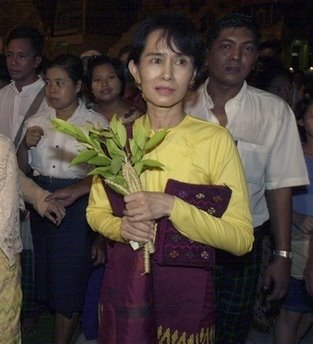


 Posts
Posts


