Sunday, April 17, 2011
က်ေနာ္တို႔တေတြ အေၾကာင္းအမ်ိဳးမ်ိးေၾကာင့္ မိခင္ႏိုင္ငံက ထြက္ခြာလာခဲ့ၾကတယ္။ က်ေနာ္တို႔ရဲ့ စား၀တ္ေနေရးေၾကာင့္ က်ေနာ္တို႔ရဲ့ ပညာေရးေၾကာင့္ က်ေနာ္တို႔ရဲ့ ယံုၾကည္ခ်က္ေတြေၾကာင့္ မိခင္ေျမကို စြန္႔ခြာလာခဲ့တဲ့ က်ေနာ္တို႔ ဒီေနရာကို ေရာက္လာခဲ့ၾကတယ္။ ဒီေနရာေလးက က်ေနာ္တို႔ကို ဆီးၾကိဳ ေထြးေပြ႔ခဲ့တယ္၊ က်ေနာ္တို႔ကို ေနရာ ထိုင္ခင္း ေပးခဲ့ၾကတယ္။ က်ေနာ္တို႔ကို အသက္ရွင္ ေနထိုင္ခြင့္ က်ေနာ္တို႔ယံုၾကည္တဲ့ လမ္းမွာေလွ်ာက္လွမ္းခြင့္ေတြ ေပးခဲ့ၾကတယ္။
ဒီေနရာဟာ က်ေနာတို႔ရဲ့ ဒုတိယ အိမ္ပဲျဖစ္တယ္။ ဒီေနရာေလးဟာ က်ေနာ္တို႔ရဲ့ နားခိုရာပဲျဖစ္တယ္။ဒီေနရာေလးရဲ့ အဆိုးအေကာင္း အက်ိဳးအေၾကာင္း အားလံုး က်ေနာ္တို႔နဲ႔ ဆက္စပ္ ပတ္သက္ေနတယ္၊ က်ေနာ္တို႔ကို ရိုက္ခတ္ေနတယ္၊ က်ေနာ္တုိ႔ ေရာက္ေနတဲ့ ဒီေနရာေလးမွာ လြန္ခဲ့တဲ့ မတ္လ ၁၁ ရက္ေန႔မွာ အင္မတန္ ၾကမ္းတမ္းတဲ့ သဘာ၀ေဘးဒဏ္ တခုက်ေရာက္ခဲ့တယ္။ဒီေဘးဒဏ္ေၾကာင့္ လူေတြ အေျမာက္အမ်ား အသက္ဆံုးရံႈးခဲ့ရတယ္။ အိုးအိမ္စည္းစိမ္ ပတ္၀န္းက်င္ေတြ မယံုၾကည္ ႏိုင္ေလာက္ေအာင္ ပ်က္စီးသြားခဲ့တယ္၊ ဒီလူေတြဟာ က်ေနာ္တို႔ရဲ့ မိသားစုေတြပဲ။ ဒီလူေတြဟာ က်ေနာ္တို႔ရဲ့ ညီအကို ေမာင္နွမေတြပဲ။ က်ေနာ္တို႔တေတြ အားလံုး ေ၀မွ်ခံစားၾကရေအာင္၊ က်ေနာ္တို႔တေတြ တတ္ႏိုင္သမွ် ေမတၲာ တုန္႔ျပန္ၾကရေအာင္ အားလံုးကိုဖိတ္ေခၚပါတယ္။
ဂ်ပန္ငလွ်င္ႏွင့္ ဆူနာမိ ေဘးဒဏ္ခံခဲ့ရေသာ ေနရာေဒသမ်ားသို႔ လုပ္အားေပးႏွင့္ ဂ်ပန္ငလွ်င္ႏွင့္ လုပ္အားေပးႏွင့္ အစား အေသာက္ ခ်က္ျပဳတ္ ေကၽြးေမြး အလွဳျပဳလုပ္မည္ ျဖစ္ပါ တယ္၊ ဒါဟာ က်ေနာ္တို႔ရဲ့ အမိျမန္မာႏိုင္ငံက ယဥ္ေက်းမႈ တခုပဲျဖစ္တယ္။ ဒါဟာ က်ေနာ္တို႔ ႏိုင္ငံသားအားလုံးရဲ့ မြန္ျမတ္တဲ့ ေစတနာ အလွဴပဲျဖစ္ပါတယ္၊
အစီအအစဥ္ (၁)။ ။ ျမန္မာႏိုင္ငံသားမ်ား။ အဖဲြ႔အစည္းမ်ားမွ စုေပါင္းလွဴဒါန္းထားေသာ အလွဴေငြမ်ား ေပးအပ္လွဴဒါန္းမည္၊
အစီအအစဥ္ (၂)။ ။ကယ္ဆယ္ေရး စင္တာမ်ားတြင္ ေနထိုင္ေနရေသာ ဒုကၡသည္မ်ားအတြက္ ေန႔လည္စာ တနပ္ ခ်က္ျပဳတ္ ေကၽြးေမြး လွဴဒါန္းမည္။
အစီအအစဥ္ (၃)။ ။လမ္း အေဆာက္အဦး တခုခုတြင္ သန္႔ရွင္းေရး လုပ္အားေပး ေဆာင္ရြက္မည္၊
သြားေရာက္မည့္ေနရာ။ ။ မီယာဂိခရိုင္၊ အိရွိႏိုမခိ ျမိဳ႔ (Miyagi ken, Ishinomaki town)
သြားေရာက္မည့္ေန႔ရက္။ ။ဧျပီလ ၃၀ ရက္ေန႔(စေနေန႔) ည ဂ နာရီ စတင္ထြက္ခြာမည္၊
တနဂၤေႏြေန႔ မနက္ေရာက္မည္။ တနဂၤေႏြ ေန႔တေန႔လံုး လုပ္အားေပး ေဆာင္ရြက္မည္။ တနဂၤေႏြေန႔ ညေန ၄ နာရီတြင္ လုပ္အားေပး ရပ္နား၍ ညေန ၆ နာရီခန္႔တြင္ ျပန္လည္ထြက္ခြာမည္။ တိုက်ိဳသို႔ ေမလ ၂ ရက္ေန႔တနလာၤေန႔ နံနက္ ၄ နာရီခန္႔တြင္ ျပန္ေရာက္မည္ ျဖစ္ပါသည္။ လိုက္ပါ လုပ္အားေပး လိုသူမ်ား ဆက္သြယ္ စာရင္းေပးၾကပါရန္ ဖိတ္ေခၚအပ္ပါသည္၊
လုပ္အားေပး လိုက္ပါမည့့္သူမ်ားအားလုံး မိမိစားစရိတ္ျ္ဖင့္ လိုက္ပါရမညျဖစ္ပါ၍ တဦးလွ်ွင္ ယန္း၁၀ ၀၀၀ သတ္မွထ္ ထားပါသည္။ အစားအေသာက္ခ်ကျ္ပဳတ္ ေကၽြးေမြးျခင္း အစီအစဥ္အတြက္ ဟင္းလွ်ွာ၊ အစားအေသာက္၊ ေရ၊ ေစ်း၀ယ္ စားရိတ္ စသျဖင့္ ထဲ့၀င္ လွဴဒါန္း ၾကပါရန္ ႏိႈးေဆာ္ တိုက္တြန္း အပ္ပါသည္၊
ဆက္သြယ္ရန္- စုံစမ္းရန္- စာရင္းေပးသြင္းးရန္
ကိုသန္းေဆြ။ ၀၉၀ ၄၉၆၄ ၉၇၁၈ ကိုေက်ာ္ေက်ာ္စိုး။ ၀၉၀ ၆၀၃၁ ၄၈၉၄ ကိုမိုင္ေက်ာ္ဦး။ ၀၉၀ ၉၈၃၁ ၇၁၉၂၊ကိုေဇာ္မင္းခိုင္။ ၀၉၀ ၉၂၀၀၃၈၃၁ ကိုကိုေအာင္။ ၀၉၀ ၁၅၀၆ ၂၈၉၃ ကိုဘုန္းလိႈင္။ ၀၉၀ ၅၃၁၈ ၅၀၅၄ ၊ ကိုျမင့္ေဆြ။ ၀၈၀ ၄၀၀၅ ၇၀၉၈ ကိုေမာင္ေမာင္ဦး။ ၀၉၀ ၆၇၉၈ ၀၁၃၇ ကိုဘုန္းျမင့္ထြန္း။ ၀၉၀ ၄၂၂၁ ၁၉၈၈ ၊ကိုရဲျငိမ္း။ ၀၈၀ ၅၀၇၀ ၀၀၈၀ ကိုလွေအးေမာင္။ ၀၉၀ ၂၅၂၅ ၁၉၆၆ ကိုလိႈင္ေအး။ ၀၉၀ ၂၂၅၈ ၃၃၀၇ ၊ကိုျမတ္သူ ၀၈၀ ၃၄၂၄ ၂၇၅၉
Posted by PNSjapan at 9:11 AM
Labels: ႏႈိးေဆာ္ျခင္း
Monday, April 18, 2011
က်ေနာ္တို႔ ႏိုင္ငံသားအားလုံးရဲ့ မြန္ျမတ္တဲ့ ေစတနာ အလွဴလိုက္ပါ လုပ္အားေပး လိုသူမ်ား ဆက္သြယ္ စာရင္းေပးၾကပါရန္ ဖိတ္ေခၚအပ္ပါသည္၊


Thursday, April 14, 2011
News & Articles on Burma-Wednesday, 13 April, 2011
News & Articles on Burma
Wednesday, 13 April, 2011
-------------------------------------------------------------
EU opens door to diplomacy with Myanmar by easing sanctions
EU will temporarily lifts visa ban on some members of Myanmar government
Human Rights Abuses Reported in Shan State Clashes
Always looking for an excuse to get rid of refugees
---------------------------------------
EU opens door to diplomacy with Myanmar by easing sanctions
Apr 12, 2011, 18:15 GMT
Luxembourg - European Union foreign ministers on Tuesday moved to ease diplomatic sanctions on Myanmar, two months after the southeastern Asian nation's main opposition requested a review of the restrictive measures to encourage democracy.
Although the core sanctions are to be extended for another year, travel bans and asset freezes on some Myanmar officials - most notably the foreign minister - will be lifted during that time.
High-level Western officials will now also be allowed to visit Myanmar, although they are expected to be given 'access to senior levels of the government and to key opposition figures,' the conclusions of the EU ministers' meeting in Luxembourg say.
They also encourage Myanmar to make democratic changes, noting that it is willing to 'respond to improvements in governance and progress.'
'The EU will assess the ... government by its deeds and review the set of restrictive measures accordingly,' the document notes.
Myanmar has been under the rule of a junta since 1988. The international community began implementing sanctions in the wake of an army crackdown on a pro-democracy movement in 1988 that left an estimated 3,000 people dead.
Debate on lifting the sanctions has increased since Myanmar held a general election on November 7, and freed opposition icon and Nobel laureate Aung San Suu Kyi on November 13.
Suu Kyi's influence over Western democracies in persuading them to lift sanctions is deemed one of her few remaining political trump cards in dealing with the regime.
http://www.monstersandcritics.com/news/asiapacific/news/article_1632520.php/EU-opens-door-to-diplomacy-with-Myanmar-by-easing-sanctions
----------------------------------------
EU will temporarily lifts visa ban on some members of Myanmar government
By Associated Press, Tuesday, April 12, 1:41 PM
BRUSSELS — The European Union has eased sanctions on Myanmar’s government, with the lifting of a visa ban on some civilian members of the regime.
EU foreign ministers decided Tuesday to lift the ban on its Myanmar counterpart for a year to maintain diplomatic channels.
Foreign ministers from the Association of Southeast Asian Nations had appealed for the lifting of the sanctions.
Myanmar held its first elections in two decades in November. After the elections, democracy advocate Aung San Suu Kyi was released from house arrest.
Copyright 2011 The Associated Press. All rights reserved. This material may not be published, broadcast, rewritten or redistributed.
http://www.washingtonpost.com/world/eu-will-temporarily-lifts-visa-ban-on-some-members-of-myanmar-government/2011/04/12/AFrMZDRD_story.html
--------------------------------------------
Human Rights Abuses Reported in Shan State Clashes
By SAI ZOM HSENG Tuesday, April 12, 2011
Large-scale human rights abuses occurred during recent fighting between Burmese government troops and the Shan State Army-North (SSA-North), which has left hundreds of thousands of local people in fear for their lives, according to a Shan human rights organization.
The Shan Human Rights Foundation (SHRF), a Thailand-based organization, issued a statement on Tuesday regarding human rights abuses committed by the Tatmadaw (Burmese armed forces) during clashes between the Tatmadaw and the SSA-North.
According to the SHRF statement, villagers are being tortured and killed on suspicion of supporting the Shan resistance. In addition, women are being targeted for sexual violence—three women were gang-raped in separate incidents in the conflict area, the statement said.
SHRF spokesperson Kham Harn Fa said, “Northern Shan State is being plunged into war and new atrocities inflicted on our people. Now is definitely not the time to lift sanctions against the regime.”
The conflicts started on March 13, when the 22-year-old cease fire agreement between the SSA-North and the Tatmadaw was broken. The SHRF statement said that the Tatmadaw mobilized 3,500 troops from over 20 battalions to attack the headquarters of the SSA-North in Mong Hsu Township, which is near the border between northern and southern Shan State.
Namp Lao village, located in the northeastern part of Mong Hsu, is where the first clash broke out. According to the SHRF statement, four novices were killed and two villagers injured by the Tatmadaw in that clash, and fighting then spread to Tang Yan, Kesi, Mong Yai, Hsipaw, Lashio and Kyaukme townships, with 65 battles taking place in the last three weeks.
A source close to the SSA-North from Lashio, the capital of northern Shan State, told The Irrawaddy that the SSA-North is using guerrilla warfare tactics to fight the Tatmadaw.
“When the Burmese Army attacked the Namp Lao and Wan Hai bases, which are the strongest bases of the SSA-North, the troops were spread into different areas. But the SSA-North troops are fighting back against the Burmese troops,” a local source said.
On March 31, SSA-North troops launched a bomb attack on an army convoy from the No 291 Light Infantry Battallion based in Nam Paung village, which is about 25 miles from Lashio. A villager from Nam Poung said that no one was injured in the bomb attack, but the vehicles were destroyed.
Over 100 local people from five to seven villages near Nam Paung were then forced to relocate to an area which has been controlled by Burmese army troops since the end of March.
A villager who formerly lived in Nam Hma Mauk Tong village, where SSA-North troops are also based, said that they were ordered by the No 291 Light Infantry Battalion based in Nam Paung to move to the new location. If they refused to do so, they would be arrested and their village burned, he said.
“About 50 soldiers came into the village after several gun fights occurred. Then they told every villager to get outside of the house and started looking for SSA-North soldiers inside. When they saw a picture of someone in an olive green suit like an SSA uniform, they seized the whole family without asking anything and took the electronics. After that they destroyed the rest,” said a local source who has moved to a new village.
“At that time I just prayed to the Lord Buddha to escape from such a terrible moment,” he continued. “Everything was okay when the SSA-North troops were based in our village. They even solved some problems for us.”
A source close to the SSA-North said that Col Yang, the leader of the SSA-North troops based in Nam Hma Mauk Tong, has fled but is still ordering his troops to fight back against the Tatmadaw.
Military observers said that Tatmadaw attacked the SSA-North, which has at least 3,000 troops, because it refused to transform into a border guard force under Burmese military command.
http://www.irrawaddy.org/article.php?art_id=21119
----------------------------------------------
Always looking for an excuse to get rid of refugees
Editorial Desk
The Nation (Thailand)
Publication Date : 13-04-2011
Something is seriously out of tune here. Thailand's National Security Council (NSC) is calling for the repatriation of refugees along the Thai-Burma border, but the Shan community, in its latest report, denounced the ongoing Burmese offensive against civilians, including the shelling of Buddhist temples, gang-rape and using women as cannon fodder.
At least 65 battles have taken place over three weeks in the central region of Burma's Shan State, where a 22-year-old ceasefire agreement between the Burmese regime and the Shan State Army-North (SSA-N) ended last month when the Burmese military mobilised some 3,500 troops from twenty battalions to attack the ethnic army.
"Over 100,000 civilians in the conflict zone now fear for their lives. The Burmese army has deployed mortars throughout the area and shelled indiscriminately at populated villages. The initial attack on March 13 involved the shelling of a Buddhist temple at Wan Nam Lao, killing four novices and injuring two villagers," the Shan report said.
"Villagers are being tortured and killed on suspicion of supporting the Shan resistance, and women are targeted for sexual violence. Three women were gang-raped in separate incidents in Wan Nam Lao, including a 30-year-old woman who had given birth only one month earlier, and died after being raped by numerous troops," the report said.
The latest wave of assaults has displaced an additional 3,000 villagers from their homes. Although the Burmese government rarely grants visas to journalists, many reporters and aid workers have sneaked across the border to get eye-witness accounts of these incidents. Western governments back these reports by human rights groups as credible.
In the case of "License to Rape", a report compiled by the Shan Human Rights Foundation and the Shan Women's Action Network, the US State Department in 2002 dispatched a team to verify such claims and came up with the same horrific conclusion about the use of rape as a military weapon by the Burmese junta.
Report after report, in a multitude of languages, spells out the appalling conditions in Burma, and the best the Thai government can do is to look for a convenient excuse to send these people back to uncertainty, fear, harassment and the high possibility of death. All the millions of baht spent on educating our officials and diplomats domestically and internationally, and this is the best we can come up with?
NSC Secretary-General Tawin Pleansri told reporters after his meeting with Prime Minister Abhisit Vejjajiva, foreign minister Kasit Piromya, the armed forces chiefs and other security agencies at Government House on Monday (April 11) that the 100,000-plus refugees in Thailand should return to Burma because Burma has just concluded its general election and a new government is in place.
Never mind the validity of the junta's sham election, does the NSC chief and the rest of the Thai security establishment think that such a bogus poll is a cure-all remedy?
Burma's military government officially dissolved the ruling State Peace and Development Council (SPDC) and inaugurated General Thein Sein as the country's new president in Naypyidaw on March 30. It's ironic - or sad, to be more accurate - how we forget the good times we had with Thein Sein when he was leading the "Triangle Command" out of Kengtung between 1997 and 2001. Scores of Burmese raids and the shelling of refugee camps well within the Thai side of the border were carried out during his watch.
If he didn't give a hoot about Thailand's sovereignty back when he was commanding his troops to shell and attack camps inside Thailand, does anyone think he will give a damn about the ethnic people Thailand plans to repatriate back to Burma?
Perhaps this is just something this administration can conveniently point to so it can send the refugees back: technically they are "displaced people" and the places they reside in are not "refugee camps" but "temporary shelters". So let's send them back to the war zone they fled from. We come up with such terminology - displaced people and temporary shelters - so we can distance ourselves when atrocities happen. Do the authorities honestly think the conflict will stop just because of the election? If that's the thinking and logic of the country's top security chief, perhaps he needs to find another job.
But then again, when was the last time the NSC gave the government an independent assessment of anything? If it is going to pay lip service to the government's wishes, perhaps the NSC itself is just a big waste of money. Any Mickey Mouse agency could do that.
http://www.asianewsnet.net/home/news.php?id=18442&sec=3
Wednesday, April 13, 2011
News & Articles on Burma-Tuesday, 12 April, 2011
News & Articles on Burma
Tuesday, 12 April, 2011
-------------------------------------------------------------
US urges Myanmar to free political prisoners
EU Should Support Commission of Inquiry on Burma
Myanmar Could Develop Nukes with N Korea's Help
Shan Farmers to Sue Govt over Land Seizures
Human Rights Abuses Reported in Shan State Clashes
Myanmar ATS drugs on rise, reveal UN report
Burma told to free prisoners
Burma military developing a secret weapon in north
Activists Fight to Stop Dam across Mekong
--------------------------------------------
US urges Myanmar to free political prisoners
MATTHEW PENNINGTON, Associated Press
Updated 05:11 a.m., Tuesday, April 12, 2011
WASHINGTON (AP) — The most important step Myanmar can take to improve its international relations is to free its more than 2,000 political prisoners, a U.S. official said Monday, as Washington prepares to appoint a special envoy to the country.
Joseph Yun, deputy assistant secretary of state for East Asian and Pacific affairs, described the November release of opposition leader Aung San Suu Kyi after years of house arrest as "very significant."
But Yun urged Myanmar to go further. He described the government recently installed after elections that were boycotted by Suu Kyi's party as "much the same people as before," which means they are dominated by the military.
Yun said the United States was continuing its two-track policy of retaining sanctions while seeking to engage Myanmar. That approach was adopted by the Obama administration about 18 months ago after two decades of efforts to isolate the military government failed to force positive change.
Speaking at a conference on Myanmar at Washington's Johns Hopkins School of Advanced International Studies, Yun said the coming appointment of a U.S. envoy to the country, expected to be defense official Derek Mitchell, would give Washington a new interlocutor to speak with government and opposition, coordinate U.S. policy and work with the international community.
"We are looking for the release of political prisoners. I think that would be the single most concrete item Naypyidaw could do for the international community," Yun said, referring to Myanmar's administrative capital.
Yun said the U.S. also wants assurances the security of Suu Kyi and her supporters is not under threat, and the government to legitimize her party and bring it and other democratic and ethnic opposition parties into the political mainstream.
The U.S. offer of engagement was not sustainable forever "unless we get something for it," Yun said.
The Association of Southeast Asian Nations is urging Western nations to lift sanctions against Myanmar, an ASEAN member. They have been imposed for its alleged rights abuses and suppression of democracy. The European Union is likely to ease sanctions slightly on Tuesday by lifting a visa ban for a year on certain civilian members of the military-led regime, an EU official said. The official spoke on condition of anonymity to discuss confidential information.
Any easing would open a gap between the EU and the U.S., which says it is too early to lift sanctions.
Suu Kyi's party won elections 1990 but was barred from taking power. The party was outlawed for refusing to participate in the November vote. Suu Kyi has spent much of the past two decades under house arrest.
Associated Press writer Don Melvin in Brussels contributed to this report.
Read more: http://www.mysanantonio.com/news/article/US-urges-Myanmar-to-free-political-prisoners-1332490.php#ixzz1JJNzqX82
-------------------------------------------
EU Should Support Commission of Inquiry on Burma
Tuesday, 12 April 2011, 10:32 am
Press Release: ITUC
EU Should Support Commission of Inquiry on Burma
Brussels, 11 April 2011 (ITUC OnLine): The ITUC and the ETUC are calling on the European Union to support the holding of a UN Commission of Inquiry into war crimes and crimes against humanity in Burma, when the EU renews its Burma policy on 12 April.
"The Burmese military junta is responsible for appalling crimes over many years. Europe, and the rest of the international community, should support international moves for a UN Inquiry, to ensure that justice is done on behalf of the victims of the regime's reign of oppression and violence," said ITUC General Secretary Sharan Burrow.
"There is already significant support within European governments for a UN Inquiry to be launched, and the EU as a whole now needs to fully support it. Europe needs to take a strong stand and show that the regime cannot continue to act with impunity," said ETUC General Secretary John Monks.
ENDS http://www.scoop.co.nz/stories/WO1104/S00306/eu-should-support-commission-of-inquiry-on-burma.htm
---------------------------------------------
Tuesday, 12 April 2011 13:55
Myanmar Could Develop Nukes with N Korea's Help
WASHINGTON, 12 APRIL, 2011: Myanmar has not yet developed the technology for nuclear weapons, but has a chance of succeeding with help from North Korea, South Korea's Yonhap News Agency reported a scholar as saying Monday.
Speaking to a seminar at the School of Advanced International Studies, Johns Hopkins University, Robert Kelly, a nuclear engineer, said Myanmar has several factories capable of enriching uranium that were built with German technology.
"When the Germans are inspecting, the factories appear to be civilian," said Kelly, a fellow at the Stockholm International Peace Research Institute (SIPRI).
"But when they are gone, the same machine tools are being used by military personnel to make equipment for missiles and the nuclear fuel cycle," Yonhap quoted him as saying.
Citing testimony from several defectors from Myanmar (Burma), some of whom have worked at the factories, and satellite photos, Kelly said that the Southeast Asian nation has made "efforts to develop gas centrifuges."
He dismissed as "poor, especially for high-tech activities such as missile and nuclear facilities" the quality of workmanship at the Myanmar factories, but did not preclude the chance of Myanmar succeeding.
"All experts judge that many of these efforts will be unsuccessful and beyond Burma's reach," he said.
"So the programme is not an immediate military threat, unless there are big changes. These would include support from another country such as DPRK and a shift to more useful technologies such as gas centrifuges. And Burma has a chance of eventually succeeding, still probably only with outside help."
DPRK stands for the Democratic People's Republic of Korea, North Korea's official name.
US officials have repeatedly warned of possible nuclear proliferation to Myanmar from North Korea.
In June last year, a North Korean cargo ship, possibly on its way to Myanmar, returned home after being closely tracked by US Navy vessels.
North Korean Foreign Minister Pak Ui-chun visited Yangon, Myanmar, in July, prompting the US to issue a statement calling on Myanmar to abide by an arms embargo and other UN sanctions imposed on North Korea for its nuclear and missile tests in 2009.
Secretary of State Hillary Clinton also expressed concerns in July about North Korea's alleged proliferation of nuclear technology to Myanmar.
"I've also shared with the minister our concerns about the exporting by North Korea of military materiel and equipment to Burma," Clinton said at the time.
"We know that a ship from North Korea recently delivered military equipment to Burma and we continue to be concerned by the reports that Burma may be seeking assistance from North Korea with regard to a nuclear programme."
-- BERNAMA http://www.malaysiandigest.com/world/20861-myanmar-could-develop-nukes-with-n-koreas-help.html
------------------------------------------
Shan Farmers to Sue Govt over Land Seizures
By KO HTWE Tuesday, April 12, 2011
Five farmers from the Tachilek and Kengtung townships in Shan State are planning to file a lawsuit against local authorities who confiscated their land, according to a lawyer representing the group.
Nearly 100 acres of local farmland was seized by township authorities over the past three years, much of which has been sold to Chinese businessmen who have converted the arable land into rubber plantations.
Speaking to The Irrawaddy on Tuesday, lawyer Myint Thwin said that some of the land had been seized a long time ago, but farmers were unable to file a suit against the local government under the previous administration of the State Peace and Development Council.
“Now we can file a lawsuit by quoting articles from the new constitution,” he said. “The businessmen who took over the land have no legal documents.”
“The local authorities and businessmen have taken advantage of illiterate farmers,” he said.
Myint Thwin said he also received a letter of complaint from the farmers about land in Kachin State being confiscated due to the construction of a railway line.
Across the country, farmers have had land confiscated by Burma's military authorities and distributed to private companies. According to lawyers, who also provided documented evidence to The Irrawaddy, some 8,500 acres of farmland was seized in Rangoon Division, nearly 5,000 acres in Irrawaddy Division, 1,338 acres in Kachin State, and 600 acres in Mon State. Farmers in each of these regions have filed complaints and lawsuits, but no action has been taken.
The head of the Burmese military junta, Snr-Gen Than Shwe, delivered a Peasants' Day message on March 2 assuring the nation that the government is taking measures to improve the agricultural sector.
According to the 2008 constitution, Chapter (VIII) Act 356 states that “the Union shall protect according to law movable and immovable properties of every citizen that are lawfully acquired.”
However, 10 villages in Zayar Thiri Township in Naypyidaw are to be relocated because of a shopping center construction project for the forthcoming 2013 SEA Games, according to local residents.
“The villages must be relocated, each dispossessed villager will receive 500,000 kyat (US $500) per acre and a plot of land,” said a representative of the construction company.
The date for the relocation has not yet been fixed, but nearly 1,000 households have been forced to be relocated.
“500,000 kyat per acre won't last long,” said a dispossessed villager from Popa Kone. “But we can maintain our standard of living with just one acre of land.” http://www.irrawaddy.org/article.php?art_id=21117
-------------------------------------------
Human Rights Abuses Reported in Shan State Clashes
By SAI ZOM HSENG Tuesday, April 12, 2011
Large-scale human rights abuses occurred during recent fighting between Burmese government troops and the Shan State Army-North (SSA-North), which has left hundreds of thousands of local people in fear for their lives, according to a Shan human rights organization.
The Shan Human Rights Foundation (SHRF), a Thailand-based organization, issued a statement on Tuesday regarding human rights abuses committed by the Tatmadaw (Burmese armed forces) during clashes between the Tatmadaw and the SSA-North.
According to the SHRF statement, villagers are being tortured and killed on suspicion of supporting the Shan resistance. In addition, women are being targeted for sexual violence—three women were gang-raped in separate incidents in the conflict area, the statement said.
SHRF spokesperson Kham Harn Fa said, “Northern Shan State is being plunged into war and new atrocities inflicted on our people. Now is definitely not the time to lift sanctions against the regime.”
The conflicts started on March 13, when the 22-year-old cease fire agreement between the SSA-North and the Tatmadaw was broken. The SHRF statement said that the Tatmadaw mobilized 3,500 troops from over 20 battalions to attack the headquarters of the SSA-North in Mong Hsu Township, which is near the border between northern and southern Shan State.
Namp Lao village, located in the northeastern part of Mong Hsu, is where the first clash broke out. According to the SHRF statement, four novices were killed and two villagers injured by the Tatmadaw in that clash, and fighting then spread to Tang Yan, Kesi, Mong Yai, Hsipaw, Lashio and Kyaukme townships, with 65 battles taking place in the last three weeks.
A source close to the SSA-North from Lashio, the capital of northern Shan State, told The Irrawaddy that the SSA-North is using guerrilla warfare tactics to fight the Tatmadaw.
“When the Burmese Army attacked the Namp Lao and Wan Hai bases, which are the strongest bases of the SSA-North, the troops were spread into different areas. But the SSA-North troops are fighting back against the Burmese troops,” a local source said.
On March 31, SSA-North troops launched a bomb attack on an army convoy from the No 291 Light Infantry Battallion based in Nam Paung village, which is about 25 miles from Lashio. A villager from Nam Poung said that no one was injured in the bomb attack, but the vehicles were destroyed.
Over 100 local people from five to seven villages near Nam Paung were then forced to relocate to an area which has been controlled by Burmese army troops since the end of March.
A villager who formerly lived in Nam Hma Mauk Tong village, where SSA-North troops are also based, said that they were ordered by the No 291 Light Infantry Battalion based in Nam Paung to move to the new location. If they refused to do so, they would be arrested and their village burned, he said.
“About 50 soldiers came into the village after several gun fights occurred. Then they told every villager to get outside of the house and started looking for SSA-North soldiers inside. When they saw a picture of someone in an olive green suit like an SSA uniform, they seized the whole family without asking anything and took the electronics. After that they destroyed the rest,” said a local source who has moved to a new village.
“At that time I just prayed to the Lord Buddha to escape from such a terrible moment,” he continued. “Everything was okay when the SSA-North troops were based in our village. They even solved some problems for us.”
A source close to the SSA-North said that Col Yang, the leader of the SSA-North troops based in Nam Hma Mauk Tong, has fled but is still ordering his troops to fight back against the Tatmadaw.
Military observers said that Tatmadaw attacked the SSA-North, which has at least 3,000 troops, because it refused to transform into a border guard force under Burmese military command. http://www.irrawaddy.org/article.php?art_id=21119
---------------------------------------
Myanmar ATS drugs on rise, reveal UN report
12 April 2011
Political instability in Thailand's border areas is abetting Myanmar's infamous narcotics trade. A new UNODC report highlights a surge in the production of amphetamine-type stimulants and a new increase in its domestic demand.
drug-production-in-Myanmar.jpg
A police lab technician in Bangkok examines a shipment of siezed yaba/ Photo credit: Steve Sandford/IRIN
Chiang Rai: The young man sits on the railing of the long tail boat, explaining how he smuggles amphetamines into Thailand from Myanmar.
"When I transport 'Ya Ba' [crazy drug], I come down this way," says the ex-Wa army soldier, pointing across the River Kok on the Thai-Myanmar border, as the wooden vessel glides by a Thai checkpoint on the shoreline.
A sprawling border region, largely controlled by ethnic armies within Myanmar and corruption within the Thai security forces, has aided a thriving narcotics trade along the 1,800km border.
In 2009, seizures of pills in Myanmar and the countries immediately bordering Shan State tripled from the previous year, a trend that has continued in 2010, a recent report by the UN Office on Drugs and Crime (UNODC) states.
Between January and September 2010, more than 44 million pills were seized in Thailand alone, while over 22 million pills were confiscated in Lao PDR, it added.
Most amphetamines are produced in small, mobile labs near Myanmar's borders with China and Thailand, primarily in territories controlled by active or former ethnic insurgent groups, many of which now operate as criminal syndicates rather than politically motivated insurgents, according to the 2011 International Narcotics Control Strategy (INCS) report released in March.
"Burma's drug enforcement authorities have not suppressed drug production and trafficking from the ceasefire enclaves of certain ethnic minorities, primarily the region controlled by the United Wa State Army [UWSA]," it stated.
But while the UWSA is considered a prime player in the drug trade, there is also a surge in production - of both amphetamine tablets and heroin - by militia groups aligned with Myanmar's military-led government.
This is attributed to the army's reliance on taxation of opium, and its policy to allow proxy militia groups to deal in drugs in exchange for policing resistance activity, maintains Shan expert Kuen Sai.
Despite promises by the UWSA to eradicate poppy fields in its Northern Myanmar region, the policy has led to a rise in opium production in other areas of the country, he said.
"As the drug trade goes, it has a balloon effect. When it was suppressed in the Wa area it went to other areas. The production began to build up in other areas of Shan state," explains Kuen Sai.
"But not all of the drugs are produced by the Wa," he adds. "Along the Thai-Burma border there are many areas not under control of the Wa. They are mostly under the control of the Burma army and militia groups. These militia groups are the main competitors for the Wa right now."
Thai challenge
Drug eradication has been a constant challenge for Region 4 Special Forces Colonel Peeranate Ketthem, who overseas the northern borders of Thailand.
"The drug organizations have set up the factories in the ethnic groups' community, where they can control production.
"For example, in northern Shan state they've built up factories in four or five places and also built a factory in the area between Ko Kang ethnic group and Wa state."
The colonel estimates that less than 30 percent of the total amount of drugs being smuggled in is actually intercepted by Thai forces.
Indeed, the vast stretches of land between the two borders provide ample room for crossing undetected.
Smuggling experience
On the Kok River, the former Wa soldier tells of the smuggling he once undertook just to survive.
Often going without proper food and supplies, the former soldier would get just over US$300 for each delivery down the river. The parcels, containing 10,000-20,000 tablets, were usually wrapped in watertight packets.
"The people who would order me to do the deliveries were usually army commanders. We couldn't really refuse."
And with no signs of the conflict easing up, most observers expect the drug problem to continue.
According to the INCS report, in 2010, Myanmar was categorized by US President Barack Obama as one of three countries to have "failed demonstrably" to meet its international counter-narcotics obligations and all indications suggest the country's production of amphetamine type stimulants continued to rise.
Myanmar, Venezuela and Bolivia are among 20 countries - including Afghanistan, Colombia and Mexico - that have been identified as "major illicit drug producing and/or drug transit countries", according to the report sent to the US Congress.
Source : IRIN http://southasia.oneworld.net/todaysheadlines/myanmar-ats-drugs-on-rise-reveal-un-report
--------------------------------------
Burma told to free prisoners
WalesOnline
Apr 12 2011
The most important step Burma could take to improve its international relations was to free its 2,000-plus political prisoners, a top US official said.
Joseph Yun, deputy assistant secretary of state for east Asian and Pacific affairs, said the US also wanted Burma to legitimise the opposition party of Aung San Suu Kyi, which was outlawed before November elections that were swept by pro-military parties.
Mr Yun said the US was continuing its two-track policy of retaining sanctions while engaging Burma, but said engagement was not sustainable forever “unless we get something for it”.
Read More http://www.walesonline.co.uk/news/latest-world-news/2011/04/12/burma-told-to-free-prisoners-91466-28503912/#ixzz1JJJR237t
---------------------------------------
Burma military developing a secret weapon in north
Tuesday, 12 April 2011 17:19 KNG
An unknown chemical weapon is being developed in highly-secured areas in the country’s north, by workers wearing protective suits and guarded by Burmese military personnel, according to witnesses.
The secret site where the weapon is being developed is situated in Mabein Township, in southern Shan State, close to the border with Kachin State, according to locals and timber loggers.
Sources at the weapon site told the Kachin News Group (KNG), workers at the site have to wear NBC (Nuclear, Biological and Chemical) protective suits and the guards have also been alerted that people who breathe the gas from the site will die.
However, the secret weapon has not been identified yet, the sources added.
mabein-burmaNo one except workers are authorized to approach or enter the secret weapon project site by Burmese soldiers, who have guarded the site since the project started early last year, locals said.
Since last year, Chinese timber loggers and trucks have been banned from entering logging sites in the Mabein area, where teak is logged and transported to the Chinese border.
The site is isolated from villages in the township and it is also not accessible by local ethnic armies like the Kachin Independence Army (KIA) and Shan State Army-North (SSA-N), local observers said.
The military-controlled Burmese government is cooperating with North Korea and Russia for the development of modern weapons and a nuclear bomb. http://www.kachinnews.com/news/1886-burma-military-developing-a-secret-weapon-in-north.html
-----------------------------------------------
Activists Fight to Stop Dam across Mekong
By DENIS D. GRAY / AP WRITER Tuesday, April 12, 2011
BANGKOK — A plan for the first dam across the Mekong River anywhere in its meandering path through Burma, Laos, Thailand, Cambodia and Vietnam has set off a major environmental battle in Southeast Asia.
The $3.5 billion Xayaburi dam is slated for the wilds of northern Laos and would generate power mostly for sale to Thailand. The project pits villagers, activists and the Vietnamese media against Thai interests and the Laotian government in its hopes of earning foreign exchange in one of the world's poorest countries.
In this 2010 photo released from the NGO International Rivers, a fisherman works near the site of the proposed Xayaburi Dam in Paksey, northern Laos. (Photo: AP)
A decision on whether the dam gets the green light, is axed or deferred for further studies is expected April 19 during a meeting in the Laotian capital among Laos, Thailand, Vietnam and Cambodia.
Opponents warn it could open the way for 10 more dams being considered along the lower Mekong.
"Our lives and livelihoods depend on the health of the Mekong River," said Kamol Konpin, mayor of the Thai riverside town of Chiang Khan.
"As local people have already suffered from dams built upstream in China and watched the ecosystem change, we are afraid that the Xayaburi dam will bring more suffering."
China has placed three dams across the upper reaches of the Mekong, but otherwise its 3,000-mile (4,900-kilometer) mainstream flows free.
The Xayaburi would cut across a stretch of the river flanked by forested hills, cliffs and hamlets where ethnic minority groups reside, forcing the resettlement of up 2,100 villagers and impacting tens of thousands of others.
Environmentalists say such a dam would disrupt fish migrations, block nutrients for downstream farming and even foul Vietnam's rice bowl by slowing the river's speed and allowing saltwater to creep into the Mekong River Delta.
A Thai firm would build the 1,260 megawatt hydroelectric project. However, Thai villagers along the river are staging protests and planning to deliver letters to Thai Prime Minister Abhisit Vejjajiva and the Lao Embassy in Bangkok, where the Thai government has maintained an official silence on the issue.
Pianporn Deetes, of the US-based International Rivers, said environmentalists are ready to take their case to court if Abhisit doesn't deliver a positive response.
Last month, 263 non-governmental organizations from 51 countries sent letters to the governments of Laos and Thailand urging that the project be shelved.
Laos said in February that the Xayaburi would be the "first environmentally friendly hydroelectric project on the Mekong" and that will "not have any significant impact on the Mekong mainstream."
"We are excited about this project," the statement said.
Vietnam's official media, in a rare disagreement with its communist neighbor, has blasted the dam, while scientists and environmental groups have called for its construction to be delayed for 10 years until more research is conducted.
"It seems that countries of the lower Mekong still haven't learned lessons from the impact of the Chinese dams," Pianporn said. "Xayaburi is so important because it could set off the destruction of the lower Mekong."
Since 2007, there have been proposals to put up 11 mainstream dams in Cambodia and Laos.
The Mekong River Commission, set up by the four Southeast Asian neighbors in 1995 to manage the river, has expressed serious reservations about Xayaburi. A study by the group recommended a 10-year moratorium on all mainstream dams, a stand supported by US Secretary of State Hillary Clinton during a Southeast Asian trip earlier this year.
The commission cited feared damage to migrations of between 23 and 100 fish species, among a host of other environmental problems.
Another MRC document showed nobody spoke in favor of the dam during public consultations this year in Vietnam, Cambodia and Thailand, while many officials, academics and residents cited problems or lack of information about the project. No consultation was held in Laos.
"If this project goes ahead it would be unimaginably irresponsible," said Ame Trandem of Rivers International.
Somkiat Khuengchiangsa, who has spent his life along the river and heads The Mekong-Lanna Natural Resources and Culture Conservation Network, said governments are more interested in the economics of the project than its effect on residents.
"Rivers are not the property of nations or groups of people.
They belong to all mankind," he said.
http://www.irrawaddy.org/article.php?art_id=21115
News & Articles on Burma-Monday, 11 April, 2011
News & Articles on Burma
Monday, 11 April, 2011
-------------------------------------------------------------
US set to appoint envoy to revive Myanmar policy
Refugees fearful of Thai warning
Myanmar has lots to do on rights: US
US lawmakers demand probe into Burma-North Korea ties
Burma Has a 'Long Way to Go': US
Obama Urged to Report on Burma, N Korea Relationship
US envoy to Myanmar is expected to foster regional diplomacy
Thailand wants to close Myanmar refugee camps
Military Plays a Civilian-Looking Game
RNDP calls for decentralization in states, regions
---------------------------------------------
Apr 11, 2011
US set to appoint envoy to revive Myanmar policy
WASHINGTON - PRESIDENT Barack Obama plans to name a defence official as special envoy to Myanmar who is expected to seek more help from the repressive government's neighbours in pressing for democratic reform.
But building agreement on the best way to proceed will be tricky.
Southeast Asian nations have called for lifting sanctions, which the US still opposes, while regional powers India and China have their own strategic relationships with Myanmar and have shown little appetite for meddling in its internal affairs.
To be confirmed by the Senate, Derek Mitchell, who is now the deputy assistant secretary of defense for Asian and Pacific security affairs, will likely have to voice support for sanctions and opposition leader Aung San Suu Kyi. That could make it tougher for the envoy to negotiate with Myanmar's dominant military once he is in the job, said David Steinberg, a Myanmar expert at Washington's Georgetown University.
Mr Mitchell, a China scholar with long experience in Asia, declined to comment on his nomination, which is expected within a week and would require him to give up his current job.
But a 2007 article he co-authored in Foreign Policy magazine when he was director for Asia strategy at the Centre for Strategic and International Studies think tank, offers clues on how he'd like to operate as envoy. -- AP http://www.dvb.no/news/refugees-fearful-of-thai-warning/15263
----------------------------------------------
Refugees fearful of Thai warning
By NAW NOREEN
Published: 11 April 2011
Refugees fearful of Thai warning thumbnail
A Thai soldier escorts Karen refugees who fled across the border in November last year (Reuters)
A Thai governor’s recent suggestion that thousands of refugees housed in camps along its northwestern border may have to return to Burma has sparked concern among the refugee community.
More than 145,000 men, women and children have lived in nine camps in Thailand for the past 30 years but that may soon end, Tak governor Samart Loifah told media last week, adding that the Thai government should consider asking them to return voluntarily.
He also reportedly said that foreign assistance to the camps should be cut to encourage them to leave, while Thailand had ditched plans to screen those without legal status to see if they qualified as genuine refugees, and not economic migrants.
Unsurprisingly, this has not gone down well among the refugees, the majority of whom have fled decades of conflict in Burma’s eastern Karen state.
“I won’t go back even if the government says so,” said Saw Tapeseh, who lives in Nobo camp in Phop Phra district. “I have no home to go back to – the villages I used to live as a child have disappeared. I don’t know where to return to. There is no security for me to return next year; the border area is currently littered with landmines and clashes.”
Fighting continues along the Karen state border as Burmese troops battle an ethnic alliance of the Democratic Karen Buddhist Army (DKBA) and the Karen National Union (KNU).
Saw Tun Tun, chairman of Mae La camp, the largest in Thailand with a population of nearly 46,000, said he had little optimism that things would change in Burma.
“I don’t think they [new Burmese government] will be able to solve armed conflicts in the border region. That’s why we harbour no hope of returning yet… The international organisations concerned must provide us with the minimum level [of assistance].”
Refugees have continued to move back and forth across the border since a fresh wave of fighting broke out in November last year. The border area remains heavily landmined, and civilians are often forced to porter for the Burmese army.
There have also been rumours that the Burmese army has threatened to confiscate property belonging to the refugees unless they return this month.
Saw Albert from the Thailand-based Karen Human Rights Group (KHRG) said that the refugees could face problems obtaining food and accommodation if they are sent back soon, particularly those who fled years ago.
http://www.dvb.no/news/refugees-fearful-of-thai-warning/15263
---------------------------------------------
Myanmar has lots to do on rights: US
Monday, 11 April 2011 02:19
WASHINGTON: The United States has said that Myanmar had far more to do to improve human rights after freeing Aung San Suu Kyi, in a report that also aired concern over Vietnam, Cambodia and
the Philippines.
In an annual survey on human rights, the State Department pointed to “severe” abuses in Myanmar including frequent killings, rapes and forced labour of ethnic minorities at the hands of the country’s powerful army.
Myanmar, also known as Burma, freed pro-democracy icon Suu Kyi in November. The military leaders have officially ceded to civilians as part of a political transition, although outside observers consider the
step cosmetic.
“We continue to be very concerned about the situation in Burma, especially, I would say, the continued detention of more than 2,000 political prisoners,” US official Michael Posner said as he presented an annual human rights report.
“We continue to call for their release, but also (to end) the very harsh and unreasonable restrictions on Aung San Suu Kyi and her party. So we have a long way to go,” said Posner, the assistant secretary of state for democracy, human rights and labour.
President Barack Obama’s administration is expected shortly to name a special coordinator on Myanmar policy, an appointment which Posner said would help the United States engage on issues including human rights.
The report also pointed to human rights concerns elsewhere in Southeast Asia — particularly Vietnam, where it said that at least 25 political activists
were arrested.
“The government increased its suppression of dissent,” the report said. “Police commonly mistreated suspects during arrest or detention.”
The report said that historic discrimination persisted against ethnic minorities, although it also pointed to efforts by Vietnam to address grievances in the Central Highlands by improving education and infrastructure.
Human Rights Watch, a private US watchdog, in a recent report said Vietnam was stepping up repression of the Montagnard people, forcing hundreds to renounce their religion.
The State Department report also raised concerns about Cambodia, saying that security forces “committed arbitrary killings and acted with impunity,” often abusing detainees to extract confessions.
The survey said that Cambodia restricted freedom of speech and press and pointed to efforts seen as weakening non-governmental organizations, which have been active in the country since its recovery from war.
Posner said the push against NGOs was part of a worldwide trend by governments to make life difficult for critics.
“The law makes it very hard for NGOs to register, especially small ones, and I think it does not do a service to the Government of Cambodia to keep pursuing this law,” Posner told reporters.
In the Philippines, the State Department report said that extrajudicial killings were “serious problems” and also pointed to harassment of leftist and human rights activists and arbitrary arrests.
“Members of the security services physically and psychologically abused suspects and detainees, and there were instances of torture,” it said. On Laos, the State Department said that the one-party state restricted freedom of speech and at times freedom
of religion. AFP http://www.thepeninsulaqatar.com/s.-asia/philippines/148540-myanmar-has-lots-to-do-on-rights-us-.html
---------------------------------------------
US lawmakers demand probe into Burma-North Korea ties
Monday, 11 April 2011 15:51 Thomas Maung Shwe
Chiang Mai (Mizzima) – Citing reports that Burma’s military regime has obtained North Korean missile technology and nuclear programme assistance, three US Republican senators sponsored a resolution last Friday calling on President Obama’s administration to investigate the ‘growing relationship between the governments of Burma and North Korea’.
The April 8 resolution was sponsored by Indiana Republican Senator Richard Lugar, who is a ranking member of the Senate Foreign Relations Committee and one of the most senior members of his party in Washington, and was cosponsored by Republican senators Mitch McConnell and Jim Inhofe.
It called on the Obama administration to make public ‘an unclassified report as to the volume of ships and planes from North Korea visiting Burma, via China and elsewhere, in 2009, 2010, and through March 2011’.
Reports of Burmese-North Korean cooperation gained credibility last year following the Burmese exile broadcaster Democratic Voice of Burma’s special report featuring the testimony of an escaped Burmese military scientist, Major Sai Thein Win. The defector’s allegations were further strengthened by the disclosure of top secret US diplomatic cables which detailed American suspicions that Burma is working to develop both rocket and nuclear programs with the assistance of North Korea. The cables were disclosed by Wikileaks and the Guardian newspaper at the end of 2010.
Lugar’s Burma resolution calls on President Obama to ‘provide leadership by calling for an international investigation into allegations of international crimes against civilians in Burma, including ethnic minorities, by the Government of Burma’ and the release of all political prisoners.
While the US government has endorsed the idea of such an inquiry, the US State Department has not been very active in encouraging other nations around the world to do so. The commission of inquiry was first proposed in March last year by Tomas Ojea Quintana, the UN special rapporteur on the human rights situation in Burma.
Burma democracy activists have complained that lack of American interest in the commission of inquiry was one of the reasons that UN Secretary-General Ban Ki Moon failed to mention the potential for an inquiry in his report on the situation of human rights in Burma issued to the UN General Assembly last September.
The Lugar resolution also noted that two years into his four year term, President Obama is still yet to appoint a Special Representative and Policy Coordinator for Burma as mandated under the 2008 JADE Act. According to recent press reports, Obama will soon appoint the current principal deputy assistant secretary of defense for Asian and Pacific affairs Derek Mitchell.
At a press conference on Friday afternoon in Washington, Michael H. Posner, Assistant Secretary of State for Democracy, Human Rights and Labor, told reporters that the Obama administration is still concerned by the situation in Burma.
Posner said that Burmese democracy activist ‘Aung San Suu Kyi is now free, but it's a limited freedom, and she doesn't, certainly, have the ability or her party to operate in any sense in a way that allows her to really oppose what the government's doing’.
Posner also criticized Burma’s new military-dominated legislature saying, ‘We now have a new parliament in place, but it is not clear that it is going to make any difference in terms of opening up the space’. http://www.mizzima.com/news/world/5135-us-lawmakers-demand-probe-into-burma-north-korea-ties.html
----------------------------------------
Burma Has a 'Long Way to Go': US
By LALIT K JHA Monday, April 11, 2011
WASHINGTON—Expressing concern over deteriorating human rights conditions, a top Obama administration official has said that Burma has a long way to go with regard to the rights situation in the country.
“We continue to be very concerned about the situation in Burma, especially, the continued detention of more than 2,000 political prisoners—we continue to call for their release—but also the very harsh and unreasonable restrictions on Aung San Suu Kyi and her party,” said the Assistant Secretary for State for Democracy, Human Rights and Labor Michael Posner.
“So we have a long way to go there,” Posner told reporters on the occasion of the release of the 2010 Country Reports on Human Rights Practices.
“Under the JADE Act, we are supposed to be appointing a special representative, and I think that’s about to happen, although it hasn’t been formally announced. But that, I think, will be a signal of a kind of renewed effort on our part to revisit some of these questions and figure out where to go from here,” he said.
Former US President George Bush in July 2008 signed into law the Burma Jade Act, restricting the import of precious Burmese gems and stones and extended existing import sanctions on Burma.
In his interaction with foreign journalists at the Washington Foreign Press Center, Posner said that even though Suu Kyi is now free, she doesn't have the ability to really oppose what the Burmese government is doing.
“That's a concern, but also the continued detention of over 2,000 political prisoners is something we continually raise, will continue to raise. We now have a new parliament in place [in Burma], but it is not clear that that's going to make any difference in terms of opening up the space,” Posner said.
Earlier, US Secretary of State Hillary Clinton accused the junta of curtailing Internet freedom. “In Burma and in Cuba, government policies preempted online dissent by keeping most ordinary people from accessing the Internet at all,” she said.
In its report, the US State Department alleges that the Burmese regime continued to abridge the right of citizens to change their government and committed other severe human rights abuses in the year 2010. While the government security forces were responsible for extrajudicial killings, custodial deaths, disappearances, rape, and torture, it detained civic activists indefinitely and without charges.
“In addition, regime-sponsored mass-member organizations engaged in harassment and abuse of human rights and prodemocracy activists,” the report said. “The government abused prisoners and detainees, held persons in harsh and life-threatening conditions, routinely used incommunicado detention, and imprisoned citizens arbitrarily for political motives.”
The army continued its attacks on ethnic minority villagers, resulting in deaths, forced relocation, and other serious abuses, it said, adding that the government routinely infringed on citizens' privacy and restricted freedom of speech, press, assembly, association, religion, and movement.
“The [Burmese] government did not allow domestic human rights nongovernmental organizations [NGOs] to function independently, and international NGOs encountered a difficult environment. Violence and societal discrimination against women continued, as did recruitment of child soldiers, discrimination against ethnic minorities, and trafficking in persons, particularly of women and girls,” it said.
“Workers' rights remained restricted. Forced labor, including that of children, also persisted. The government took no significant actions to prosecute or punish those responsible for human rights abuses,” the report said, adding that ethnic armed groups and some cease-fire groups also allegedly committed human rights abuses, including forced labor and recruitment of child soldiers. http://irrawaddy.org/article.php?art_id=21109
---------------------------------------------------
Obama Urged to Report on Burma, N Korea Relationship
By LALIT K JHA Monday, April 11, 2011
WASHINGTON—A top US senator has introduced a resolution in congress urging the country's president, Barack Obama, to report on the growing military relationship between North Korea and Burma.
“Greater attention should be focused on the details and scope of military equipment and technology transferred from North Korea to Burma,” said Senator Richard Lugar, ranking Republican in the powerful Senate Foreign Relations Committee.
The resolution introduced by Lugar, and co-sponsored by senators Mitch McConnell and James Inhofe, also urges the US president to call for an international investigation into allegations of international crimes by the Burmese junta; and to encourage countries neighboring Burma to establish safe havens for children forced into military service by Burma’s government.
It also calls on the US president to actively work with other countries for a release of all remaining political prisoners. “Events in other parts of the world should not detract from obtaining a reality check regarding the elevated military and strategic collaboration between North Korea and Burma,” Lugar said.
Noting that the Burmese military junta continues to: coerce children, including ethnic minorities, into participating in combat and other military roles; and continues to coerce civilians, including ethnic minorities, to serve as human minesweepers, the resolution says the Burmese government continues to coerce civilians, including ethnic minorities, to serve as porters and assist military personnel.
Alleging that North Korea and Burma are expanding their bilateral military relationship, the resolution says military and other personnel from North Korea have reportedly been in Burma providing technical and other assistance toward the development of the military capabilities of the Burmese junta.
The congressional resolution says that North Korea has reportedly provided radar systems and capabilities, missiles and missile technology, underground tunneling technology, and multiple rocket launchers to Burma. The two countries are also collaborating on matters related to the development of Burma’s nuclear program, it said.
The resolution also refers to alleged collaboration between Russia and Burma on nuclear technology, noting that hundreds of persons from Burma have gone to Russia for specialized training, including in the area of nuclear technology. Burma is acquiring additional MIG aircraft from Russia, it says.
“Given the growing relationship between the Governments of Burma and North Korea, the President should provide the Congress with an unclassified report as to the volume of ships and planes from North Korea visiting Burma, via China and elsewhere, in 2009, 2010, and through March 2011,” the resolution demands.
“The President should provide leadership by calling for an international investigation into allegations of international crimes against civilians in Burma, including ethnic minorities, by the Government of Burma,” it says.
Stating that the US president should seek the assistance of friends and allies of the United States who actively engage with the government of Burma and have diplomatic missions in Burma, including Singapore, Japan and South Korea, to encourage the release of all remaining political prisoners, the resolution says the US president should encourage countries neighboring Burma to establish safe havens for Burmese child soldiers fleeing from forced military service by the junta.http://www.irrawaddy.org/article.php?art_id=21108
-----------------------------------------------
US envoy to Myanmar is expected to foster regional diplomacy
Likely new US envoy to Myanmar is expected to foster regional diplomacy to press for reforms
MATTHEW PENNINGTON Associated Press
6:33 a.m. EDT, April 11, 2011
WASHINGTON (AP) — President Barack Obama plans to name a special envoy to Myanmar who is expected to seek more help from the repressive government's neighbors in pressing for democratic reform. Building agreement on the best way to proceed will be tricky.
Southeast Asian nations have called for lifting sanctions, which the U.S. still opposes, while regional powers India and China have their own strategic relationships with Myanmar and have shown little appetite for meddling in its internal affairs.
To be confirmed by the Senate, Derek Mitchell, deputy assistant secretary of defense for Asian and Pacific security affairs, probably will have to voice support for sanctions and opposition leader Aung San Suu Kyi. That could make it tougher for the envoy to negotiate with Myanmar's dominant military once he is in the job, said David Steinberg, a Myanmar expert at Georgetown University.
» Northampton area community updates delivered to your mobile phone. Text NORTHAMPTON to 52270! Message and data rates apply. Text STOP NORTHAMPTON to quit, text HELP for info
Mitchell, a China scholar with long experience in Asia, would not comment on his nomination, which is expected within a week and would require him to give up his job at the Pentagon.
An article he co-authored in Foreign Policy magazine in 2007, when he was director for Asia strategy at the Center for Strategic and International Studies think tank, offers clues on how he'd like to operate as envoy.
The article suggested bringing the Association of Southeast Asian Nations, China, India, Japan and the United States together in developing a road map that would lay out benefits if Myanmar pursued true political reform and national reconciliation, and the costs it would suffer if it continued to be intransigent.
In the years since the article was written, Myanmar has launched another bloody crackdown on democracy protesters, continued brutal military campaigns against ethnic minorities and seen thousands flee across its borders. U.S. officials also suspect Myanmar has nuclear ambitions and imported some Scud missiles from North Korea, which Myanmar's neighbors would be worried about, too.
The Obama administration has retained sanctions but opened the door to dialogue. But in its foreign policy, Myanmar has been eclipsed by the wars in Iraq and Afghanistan, Iran's nuclear program and turmoil in the Middle East, among other issues.
Lawmakers and human-rights advocates have long pressed for an envoy for Myanmar to give it greater attention. After abandoning America's two-decade-long policy of isolating Myanmar, the administration has periodically sent senior officials to meet with Suu Kyi and the government, without making headway. Washington says it remains open to dialogue.
Agreeing to talk has at least removed an obstacle to U.S. engagement with the Association of Southeast Asian Nations, or ASEAN, which has become a focus for deepening American trade and security ties in the region, countering the rising power of China. In a shift, ASEAN also has voiced some criticism of recalcitrant member Myanmar and urged reform.
T. Kumar of Amnesty International USA said that regional diplomacy was the best way forward, although Myanmar has so far proved deft in balancing its ties with China and India and resisting international pressure.
Steinberg said Myanmar's chief ally China in particular would view U.S. involvement with suspicion and probably would only weigh in and ask for modest reform if Myanmar faced a mass uprising or border fighting that threatened stability.
"Working with ASEAN is the only route right now," he said.
There is a glimmer of an opening. After five decades of military rule, Myanmar recently has seen some political changes, albeit superficial ones. Having rejected an election victory by Suu Kyi's party in 1990, the military organized polls last year that were viewed by most of the international community as unfair. They ushered in what they called a civilian government, but it still is dominated by the military.
It has freed Suu Kyi from years of house arrest, although it outlawed her party.
Some European nations have now joined ASEAN in calling for lifting sanctions, even as rights groups, exiled Myanmar activists and some U.S. lawmakers seek to toughen them.
http://www.mcall.com/news/nationworld/sns-ap-us-us-myanmar,0,2964498.story
-------------------------------------------------
STARITS TIMES: Apr 11, 2011
Thailand wants to close Myanmar refugee camps
BANGKOK - THAILAND wants to close its Myanmar refugee camps and repatriate the more than 100,000 residents following their country's first election in 20 years, a government official said on Monday.
'They have been in Thailand for more than 20 years and it became our burden to take care of them,' National Security Council chief Tawin Pleansri said after a meeting of the government body chaired by Prime Minister Abhisit Vejjajiva.
'I cannot say when we will close down the camps but we intend to do it,' he said. 'We are now in the process of discussion with the Myanmar government.'
Most of the refugees in the camps along the border fled civil war-torn villages in the east of Myanmar, where power was recently handed to a nominally civilian government after almost five decades of military rule. -- AFP http://www.straitstimes.com/BreakingNews/SEAsia/Story/STIStory_655524.html
--------------------------------------------
BURMA
Military Plays a Civilian-Looking Game
Analysis by Larry Jagan
BANGKOK, Apr 11, 2011 (IPS) - A new quasi-civilian government has taken over in Burma, but diplomats, analysts and pro-democracy activists are dismissing it as nothing more than "old wine in a new bottle".
Burma analysts believe that strongman Than Shwe has only retreated to the backroom. Than Shwe recently stepped down as commander-in-chief of the Burmese army and relinquished day-to-day control of the country after nearly two decades as head of the military junta.
"He is likely to be pulling the strings from behind the curtain," said the Burmese academic Win Min, now based in the U.S. "He will use his influence behind the scenes, relying on personal patronage and connections."
"If anyone thinks this new government is a step towards democracy they are sadly mistaken," said Maung Zarni, researcher at the London School of Economics.
Yet there are those who see change coming to Burma, though not the sort that most Burmese people are yearning for.
A new system of government has been unveiled, in which parliament will play a subsidiary part, and the executive, headed by newly elected president Thein Sein, will play the leading role.
The new government was formed after elections last November, in which the pro-junta Union Solidarity and Development Party (USDP) won by a landslide. Most western countries, and the pro-democracy movement led by Nobel Peace Laureate Aung San Suu Kyi, have rejected the results as a sham.
But there has been a clear transfer of power to a new generation. Although mainly military men or former soldiers, most of Burma’s new leaders are under the age of 60 and have a technocratic background. Even the military officers turned politicians, who occupy part of the 25 percent of parliament seats reserved for serving soldiers, have a different outlook.
The new army chief, 55-year-old General Min Aung Hlaing, is reported to be a professional soldier keen on restoring the prestigious image of the army tainted by the repression after the uprising of 1988, and the 22 years of authoritarian rule that followed.
There are other signs of change. On his recent visit, senior Chinese leader Jia Qinglin, the fourth most important man in the Communist Party’s political bureau, did not meet Than Shwe. Jia was instead hosted by Thura Shwe Mann, speaker of the Lower House and vice-president of the ruling party USDP.
But there are other signs that those who have resigned or retired from the army no longer have their military stripes. Soldiers no longer guard the homes of former top military officers, including Than Shwe and the former No. 2 leader Maung Aye, either in the capital Naypyidaw or Rangoon, according to residents in these cities. The police have taken over that duty, as they do in most countries that are regarded as civilian democracies.
This is a sign that Burma is moving, albeit tentatively, towards becoming a civilian-governed society. Of course, what Burma is experiencing now is a transition; it is not yet democracy and it may not yet be significant change. It is something akin to Indonesia under Suharto’s Golkar-led government.
This may not be the sort of democracy that most Burmese people want, but it could be a significant step towards an Asian-style democracy. Even in Thailand the military continues to play a significant political role behind the scenes, and in the recent past shown it was not averse to intervening with force as it did in September 2006, the last time the military staged a coup.
This is the critical hope for Burma - a transition similar to what has happened in Bangladesh, Indonesia and Thailand in the last 20 years.
Of course, worrying signs still remain that Burma’s form of "disciplined democracy" as the military prefer to call it, may not match the minimum standards of civilian-military regimes in the rest of Asia. Too many military men and former soldiers dominate the country’s emerging political scene. Change is impossible as the military mind remains entrenched even in the new political system which pretends to be a civilian administration, according to Maung Zarni of the London School of Economics.
Even if the top generals have retired to the back room, the new crop of officers are effectively clones. "The officer corps are a sub-class of society that has come to view themselves as the ruling class, feeling they are eternally entitled to rule," Zarni said in an interview with IPS.
"Whoever takes their places (Than Shwe and Maung Aye) will not be more enlightened or more progressive, simply because they have all been inculcated with thuggish, racist, sexist and neo-totalitarian leadership values, and only junior generals who are their mirror image have been promoted," said Zarni.
As yet there is still little room for discussion and dialogue - crucial elements of a democracy or an emerging civilian form of government. Parliament is yet to be a fully functioning legislature, though some questions that had been taboo before - ethnic education issues, land confiscation, the release of political prisoners - were put to the president.
The parliament is now in recess and may not meet again for another year, the minimum set by the constitution. But above all there is no role as yet for Burma’s real opposition - Aung San Suu Kyi and the National League for Democracy (NLD) - though the opposition leader has asked to meet the new president and government, according to senior sources in the NLD.
But there is good reason to remain skeptical. Change will not happen quickly. "The train has left the station, but we don’t know where it going or how long the journey will be," said a Burmese academic on condition of anonymity. (END) http://www.ipsnews.net/news.asp?idnews=55200
-------------------------------------------
RNDP calls for decentralization in states, regions
Saturday, 09 April 2011 16:18 Te Te
New Delhi (Mizzima) – Members of the Rakhine Nationalities Development Party (RNDP) say more decentralisation of authority by the central government is needed to give regions more autonomy and control of their local affairs.
A meeting of the Rakhine Nationalities Development Party. Photo : Narinjara
A meeting of the Rakhine Nationalities Development Party. Photo : Narinjara
The RNDP was given three ministerial posts in state government, ‘but we still don’t know yet how much power and authority we will get. Fulfilling the election promises given to our people depends on this. If central government officials control all power despite the existence of state governments, there will be no difference’, RNDP general secretary Oo Oo Hla Saw told Mizzima.
The nine-minister Rakhine State Government is led by Rakhine Chief Minister Hla Maung Tin (a former colonel); three ministers are from the RNDP’ five ministers are from the USDP and one minister was a defence services appointment.
The RNDP party ministers are Kyaw Thein (fishery, livestock, mining and energy) from Mrauk-U No. 2 constituency; Thar Lu Chay (Industry, Labour, Sports) from Sittwe constituency 1; and Aung Than Tin (Culture, Social Welfare and Relief) from Ponnagyun constituency 1.
One of the biggest challenges facing the region is a regular supply of electricity in Rakhine State at an affordable price, said Oo Oo Hla Saw.
‘Rakhine State does not get electricity from the national power grid and it has to rely on fuel-fired turbines, distributing at the rate of 500 kyat (US $0.58 cents) per kilowatt hour (KWh) in comparison with normal rates of 25 kyat ($0.30 cents) from the national power grid. Building a hydropower plant is time consuming and needs heavy investment. A bran-fired power plant makes pollution. The state government has difficulty in supplying electricity because we don’t get cheap gas’, Oo Oo Hla Saw said.
He said that the central government should allow states full authority in the economy of the state and in production of livestock, fisheries and agriculture.
Since the formation of the new government, there has been some loosening of control transporting farm produce from state to state in the agriculture sector, he said. Also, the RNDP believes that pointing out corruption in governance is a sign of progress and a benefit to the state, he said.
He said that one area of corruption in Rakhine State involves the illegal sale of fishing rights in the sea by authorities with the collusion of businessmen.
The newly installed state government may stall one auction of fishing rights by amending some regulations, he said.
Rakhine State is the only state with three ministers from a single ethnic political party in the state government.
Region or state governments are made up of a chief minister, ministers and an advocate general. The central government has the authority to intervene and to make decisions in administrative disputes in the states.
The Rakhine Cabinet:
1. Colonel Htein Lin (appointed defence service legislator), Border Affairs
2. Kyaw Khin (USDA), Agriculture, Forest and Irrigation
3. Hla Han (USDA), Religion and Immigration
4. Dr. Aung Kyaw Min (USDA), Health and Education
5. Mya Aung (USDA). Economics
6. Soe Aye (USDA). Transport and Communication
7. Aung Than Tin (RNDP). Culture and Social Welfare, Relief
8. Kyaw Thein (RNDP), Fishery and Livestock, Mining, Energy
9. Thar Lu Chay (RNDP). Industry, Labour and Sports http://www.mizzima.com/news/inside-burma/5134-rndp-calls-for-decentralization-in-states-regions.html
Saturday, April 9, 2011
News & Articles on Burma-Friday, 08 April, 2011
News & Articles on Burma
Friday, 08 April, 2011
-------------------------------------------------------------
Thein Sein Urges 'Decentralization'
Conflict in Shan State Spreading
Suu Kyi wins global women’s award
Wise man on the hill
Home News Burma seeking membership in ASEAN parliament
Suu Kyi Named 'Voice of the Decade'
Inside the KIA—Ramping-Up and Staying Alert
ASEAN battles ‘hot money’ inflows
Myanmar likely to deport detained Canadian
Time to close Burma camps, says Thai governor
19 'Taliban' Appear in Arakan Court
---------------------------------------------------
Thein Sein Urges 'Decentralization'
By KO HTWE Friday, April 8, 2011
In an address to his union-level, region and state ministers on Wednesday, Burma's new president, ex-Gen Thein Sein, seemed to urge greater government decentralization while at the same time admonishing lower-level organizations to stay within the policy framework set by the central government.
“Now, a new system and new era have emerged. So it is required to make changes in ideas and procedures,” said Thein Sein, according to a report of his speech by The New Light of Myanmar, a state-run newspaper.
“Duties and responsibilities have been assigned to the respective ministers of states and regions,” The New Light of Myanmar reported that Thein Sein said. “The centralization has been reduced and states and regions have been entrusted with rights and powers. They will have to take charge of their own duties.”
The president said that ministers need to work with “initiative, dynamism and conviction without waiting for exhortation.”
Thein Sein acknowledged that there would be initial difficulties in distinguishing between the tasks to be carried out at the union level versus the state/regional level, but said that “experience would solve the problem.”
No specific areas of decentralization were mentioned. Thein Sein said that that local ministers should encourage the development of private businesses in their region, and urged both union and state/regional level ministers to perform their respective duties to ensure the country's transportation system was in good condition.
And while speaking in general terms about decentralization, Thein Sein admonished the ministers to toe the national party line in carrying out their local responsibilities.
“Ministries should know the national policy, objectives and goals and should always work within their framework,” Thein Sein said, while warning the ministers that they can be held accountable for what they have done. “Moreover, they should be aware of the acts that may harm the interest of the people and tarnish the reputation of the country and undermine the nation's sovereignty.”
Thein Sein also included people outside of government in his decentralization policy. He urged the people to work on a self-reliant basis for their socioeconomic development instead of relying solely on the government, saying that the only duty of the people is to work and the government on its part should create job opportunities and levy taxes.
For many politicians and observers, Thein Sein's words about decentralization have little hope of becoming a reality because, they say, he himself cannot do anything without the consent of the commander-in-chief.
All Mon Regions Democracy Party chairman Naing Ngwe Thein said, “They [the government officials] have been using a word like that [decentralization] for a long time. Every important thing is controlled by the central government under the new Constitution, but they don’t mention details on decentralization.”
“The new minister of Arakan State calls all the business from the state. After the discussion, he [the Arakan State minister] said that he has to inform the central government and has no right to decide on his own,” said a businessman from Arakan State.
The president must make all important decisions with the agreement of the National Defense and Security Council, so Thein Sein's speech will be remain just talk, said Aye Thar Aung, an Arakanese leader.
“The authorities of the state and regional governments and legislatures are centralized and have little chance to change. If they want to change freely they will face threats under the Constitution, so state and regional governments do not dare to do this,” said Aye Thar Aung.
“It is not likely he can build a decentralized system. He [Thein Sein] always capitulates to the commander-in-chief,” said Sai Leik, the spokesperson of the Shan Nationalities League for Democracy.
“He [Thein Sein] can do nothing without the knowledge of Snr-Gen Than Shwe. It is not easy for his words to take shape because they have many changes to make in the ministries,” said Phyo Min Thein, a politician based in Rangoon. http://www.irrawaddy.org/article.php?art_id=21107
---------------------------------------------
Conflict in Shan State Spreading
By KO HTWE Friday, April 8, 2011
The ongoing conflict between Burmese government troops and Shan State Army-North (SSA-North) Brigade 1 has spread to additional townships in southern and northern Shan State, according to sources.
Speaking to The Irrawaddy on Thursday, Saengjuen Sarawin, an editor with the Shan Herald Agency for News, said that clashes between government troops and SSA-North Brigade 1 are taking place every day.
“The military operation is named 'Zwe Man Hein.' At first the clashes were limited to 5 townships, but now they have spread to nearly 10 townships,” said Saengjuen Sarawin.
There has been continuous fighting since February between Burmese government forces and SSA-North Brigade 1 in Mongshu, Tangyan and Kyathi townships, causing many residents to flee the area.
Military sources said that the SSA-North may be receiving support from the Shan State Army-South (SSA-South). However, SSA- South spokesman Sai Lao Hseng denied these reports, saying that he had no information about clashes between the SSA-South and government troops.
“If the SSA-North enters our territory, we support them in ways such as sharing information,” said Lao Hseng.
The Burmese army ordered SSA-North Brigade 1 to evacuate its headquarters in Kyethi Township by the end of March.
“The Burmese army placed troops near the headquarters of the SSA-North, so they moved outside their territory and the clashes spread to more townships,” said Saengjuen Sarawin.
Brigade 1 controls territory in Kyethi and Monghsu townships in southern Shan State, as well as Mongyai and Tangyan townships in the northern part of the state.
There are reports that the Burmese government offered to negotiate with the SSA-North, but officials from the SSA-North deny these reports.
Meanwhile, unnamed armed groups fought with government troops in the area of the Golden Triangle on Wednesday, resulting in many Burmese army casualties, said Saengjuen Sarawin.
In addition, one resident was killed and three injured on Monday when an explosion took place in the worker accommodation building for a battalion based in Kali in Kunhing Township, according to residents.
“Unknown people threw hand-grenades into the house of a contractor.
Residents don’t want to talk about the event. The culprit has not yet been arrested. They [officials] say that the perpetrator is from the Shan army because of dissatisfaction among them,” said a resident from Kali.
A breakaway faction of SSA-North Brigade 1 is led by Col Pang Fa and is estimated to be the strongest of the SSA-North's three brigades with some 3,000 troops. Unlike the SSA-North's other two factions—Brigades 3 and 7—Pang Fa's unit refused to join the regime's Border Guard Force (BGF) plan under Burmese army command.
Since last year, the Burmese regime has pressured 17 cease-fire armies to accept the BGF plan, but only a few have joined. The others, including the United Wa State Army (UWSA) and the Karen Independence Army, have refused.
The UWSA and the SSA-South, which never signed a cease-fire with the junta, have offered support to SSA-North Brigade 1 since it resumed hostilities with the Burmese army. http://www.irrawaddy.org/article.php?art_id=21101
------------------------------------------
Suu Kyi wins global women’s award
By DVB
Published: 8 April 2011
Burmese democracy icon Aung San Suu Kyi will follow in the footsteps of international dignitaries such as Hillary Clinton and Melinda Gates next week when she is honoured with the prestigious Global Trailblazer Award.
The honour comes as part of the Global Leadership Awards given annually by the US-based women’s empowerment group, Vital Voices.
The 65-year-old Nobel laureate will also be named Voice of the Decade when she receives the award from Clinton, who was last year’s winner, at a ceremony in Washington on 12 April.
Suu Kyi of course will not be present at the ceremony – the Burmese government, which released her from house arrest in November last year, has said she is free to leave the country, but the chances of her being allowed to return are slim.
Vital Voices says that potential honourees include “social entrepreneurs, political representatives, businesswomen, human rights defenders and civil society advocate.
“From remote villages and wired cities, they promote equality, peace and prosperity as innovators who transcend barriers to move whole communities forward.”
The democracy icon is no stranger to awards, having been honoured with the Rafto Prize and the Sakharov Prize for Freedom of Thought in 1990, and the Nobel Peace Prize the following year. The Indian government has also honoured her with the Jawaharlal Nehru Award for International Understanding, and Venezuela with the International Simón Bolívar Prize.
http://www.dvb.no/news/suu-kyi-wins-global-women%E2%80%99s-award/15240
----------------------------------------------
Southeast Asia
Apr 8, 2011
Wise man on the hill
By Bertil Lintner
CHIANG MAI - There was hardly a vacant seat in the Protestant church by the Ping River in the northern Thai city of Chiang Mai for the funeral. American veterans of the Indochina war mixed with Thai and foreign residents, missionaries and intelligence officers, Lahu and Wa tribesmen, and even some wildlife conservationists.
Wreaths came from a group of people who fought in the secret war in Laos in the 1960s and call themselves the "Unknown Warriors Association 333", former United States Agency for International Development (USAID) workers, the US Drug Enforcement Administration (DEA), and across the border in Myanmar the rebel Shan State Army.
All of them had come to say farewell to former US Central Intelligence Agency (CIA) officer William Young, who on April 1 ended his own life after suffering from severe emphysema and other ailments, aged 76. He was found dead in is home in Chiang Mai with a handgun in one hand and a crucifix in the other. Young was a warrior but also a devout Christian. As the turnout at the funeral showed, Young was a legend long before he died.
His life and that of his family reflected the ups and downs of more than a century of American engagement with Southeast Asia, its most glorious days as well as its most controversial. At the turn of the last century, William Young's namesake, his grandfather William Young, opened a Baptist mission in Kengtung in the eastern Shan states of Myanmar, then known as Burma.
While the staunchly Buddhist plainspeople ignored the Christian gospel he proselytized, Lahu hill-tribesmen flocked to him by the thousands. Like many other hill peoples, the Lahu had a tale about a "white God" with a book who was destined to save them.
The older William Young was indeed white and carried a Bible under his arm. The prophecy seemed to be fulfilled and a record number of baptisms were carried out in the Kengtung hills. His sons carried on his work, Harold among the Lahu and Vincent among the Wa, who were still headhunters when the Youngs first ventured into their area which straddled the border between Burma and China. They founded churches, missionary schools and devised the Roman script for both the Lahu and Wa languages.
Harold's son, William Young, was born during a family visit to California in 1934 but he grew up in the Shan states and became fluent in several local languages, including Lahu and Shan. He later learned Wa, Thai and the northern Thai dialect as well as some Hindi and Chinese. Hindi was added after the Young family was evacuated to India when the Japanese invaded Burma in 1942, and young William attended the Woodstock school in Mussoorie in the hills above Dehra Dun.
When the war was over the Youngs returned to Burma, and Harold, although an American, was appointed as administrator of the Wa Hills by the British colonial power. That lasted until Burma's independence was achieved in 1948. The Youngs moved to northern Thailand where the father, Harold, founded the Chiang Mai zoo and the mother, Ruth, built up the American University Alumni (AUA), which is still one of the most popular places in the city to learn English.
By then, however, Harold Young was already closely connected with US intelligence, during the war with the Office of Strategic Services (OSS) and later the CIA. The recruitment of missionaries into America's spy agencies was not a coincidence. Britain and France had intelligence agencies which were well established in different parts of the world due to their status as global colonial powers.
The US, in comparison, had no coordinated external intelligence agency until World War II, but after the Japanese attack on Pearl Harbor in December 1941 Washington realized that it was of utmost importance to develop one. The need became even more pressing after the end of World War II and the beginning of the Cold War, where espionage was given the highest strategic priority.
The OSS was formed in 1942 and the CIA in 1947. But unlike the colonial powers at the time, the US had no old network of operatives and local intelligence assets from which to draw. There was one exception, though: the Christian missionaries. They had over the years acquired in-depth knowledge of local cultures and languages, and some - among them the Youngs - enjoyed a near-godlike status in their respective communities of Christian converts.
Like father, like son
From their base in Chiang Mai, Harold Young and his eldest son Gordon trained Lahu paramilitary units for intelligence work inside Burma and, more importantly, China, where the communists had seized power in 1949. The younger son, William, was recruited by the CIA shortly after he had finished service with the US army in Germany in the mid-1950s.
When the Indochina war escalated in the early 1960s, William, with his unique linguistic capabilities, was ideally placed to help organize the "secret war" in Laos, which had to be clandestine because Laos's neutrality was guaranteed under the 1962 Geneva Agreement.
No foreign troops were supposed to be in Laos but North Vietnamese forces supported the communist Pathet Lao in the north and northeast, and in other parts of the country CIA operatives were active working alongside Thai special forces known as the Border Patrol Police Aerial Reinforcement Unit (PARU).
The head of the operation, William Lair, was equally legendary and Young became one of his most trusted officers. Alfred McCoy, the author of the classic The Politics of Heroin in Southeast Asia, wrote that "since Young had grown up in Lahu and Shan villages in Burma, he actually enjoyed the long months of solitary work among the hill tribes, which might have strained the nerves of less acculturated agents". Author Francis Belanger referred to Young as "perhaps one of the most effective agents ever".
Young built up a pan-tribal army and recruited a remarkable team of 16 Lahu and Shan operatives he called "the Sixteen Musketeers". He also worked with Vang Pao's ethnic Hmong army - and a little-known unit of Nationalist Chinese soldiers called by its French name, Bataillon Special 111. Manned mainly by ex-prisoners of war (POWs) from the Korean War who chose to go to Taiwan rather than being repatriated to China, they were given special training by the nationalists.
The most trustworthy had been chosen for special operations in the mainland, but to prevent defection they had slogans like "Death to Communism!" tattooed on their arms. A group of them was sent to Laos, where they remained for years as the most secretive of all the mercenary units that were deployed there during the so-called "secret war". Young worked with Bataillon Special 111 in the Phatang area on the Thai-Lao border, from where they were sent north into China to wiretap telephones and collect intelligence.
What had begun as a relatively small but highly effective operation turned into a massive war effort when Theodore Shackley, a new brash CIA station chief, arrived on the scene in 1966. Fresh from the Cuban missile crisis and Germany, Shackley had little or no understanding of local sensitivities in countries such as Laos. Vang Pao's Hmong army was built up into a massive force of tens of thousands of men - and, as Young once told this writer, "People like me became thumbtacks on the map on his wall in his Vientiane office."
Within a year of Shackley's arrival, Young soon fell out with the CIA and the inevitable happened: he left the agency, accused by some of "insubordination". He returned to his family's farm north of Chiang Mai a bitter man and felt that the US government had dealt its hand extremely clumsily in Laos.
Years later he often talked about how "my country", as he always said, should be more understanding of local conditions and cultures. He came across the same problem when in the 1980s he trained security personnel for the Chevron Oil Corporation in Sudan. While Young spent most of his time in the company of Sudanese officers, his colleagues drank and played cards together with little or no interaction with anyone from the host country.
But Young's life was not confined to war and training security personnel. After leaving the CIA in the late 1960s he served as an assistant and interpreter for the American archeologist Chester Gorman, with whom he excavated ancient spirit caves in the backwoods areas of Mae Hong Son and Kanchanaburi provinces in Thailand.
Their findings provided a breakthrough in Thai archeology and Young was proud to have helped fill in the gaps of work previously done by the French in Indochina and the British in Burma. He also ran a guesthouse in Chiang Rai and in later years worked as a consultant for the US DEA.
Many locals in Chiang Mai and elsewhere would argue that Young's passing marked the end of an era. Today's intelligence operatives come from entirely different backgrounds and generally don't have the same experience and local knowledge as Young provided - as the US's many misadventures across the globe are clear and glaring testament.
Bertil Lintner is a former correspondent with the Far Eastern Economic Review and the author of Burma in Revolt: Opium and Insurgency Since 1948 and several other books on Myanmar. He is currently a writer with Asia Pacific Media Services.
(Michael Black and David Lawitts, who conducted and compiled several hours of interviews with William Young, contributed to this story.)
(Copyright 2011 Asia Times Online (Holdings) Ltd. All rights reserved. Please contact us about sales, syndication and republishing.) http://www.atimes.com/atimes/Southeast_Asia/MD08Ae01.html
----------------------------------------------------
Home News Burma seeking membership in ASEAN parliament
Burma seeking membership in ASEAN parliament
Thursday, 07 April 2011 22:19 KNG
The new government of Burma is trying to become a member of the Association of South East Asian Nations (ASEAN) Inter-Parliamentary Assembly (AIPA), by sending its representatives to the AIPA’s conference in Cambodia, according to a member of the Constitutional Drafting Department of the Burmese Pyitu Hluttaw (People’s Parliament).
He said the representatives attended the conference from April 2 to 5 as part of Burma’s efforts to become a long term member of the AIPA.
The representative group was led by former ambassador and mayor of Rangoon, Hla Myint (also an ex-Brigadier General) and included Immigration Office Director, Khin Maung Than, as well as Amyotha Hluttaw Constitutional Drafting Department Vice President, Mya Nyein and Amyotha Hluttaw Constitutional Drafting Committee Member, Hkyet Hting Nan.
The General Assembly (Pyi Htaung-Su Hluttaw) announced on March 28th it agreed to seek long term membership in the AIPA.
Burma will become the ninth member in the AIPA if approved by the assembly. The present members include Cambodia, Indonesia, Laos, Malaysia, Philippines, Singapore, Thailand and Vietnam.
That would leave Brunei as the last of the 10 ASEAN member countries without membership in the AIPA. http://www.kachinnews.com/news/1883-burma-seeking-membership-in-asean-parliament.html
--------------------------------------------
Suu Kyi Named 'Voice of the Decade'
By LALIT K JHA Friday, April 8, 2011
WASHINGTON — US Secretary of State Hillary Clinton will honor Aung San Suu Kyi, the pro-democracy icon of Burma, with the Global Trailblazer Award and named “Voice of the Decade” at a glittering ceremony in Washington on April 12.
Aung San Suu Kyi will not be attending the ceremony, said organizers of the event, Vital Voices, the international NGO dedicated to empowering women leaders around the world. The awards honor and celebrate women leaders on the front lines of positive political, social and economic change who are strengthening democracy, increasing economic opportunity, and preserving human rights.
Nobel Peace Prize winner and leader of the Burmese democracy movement, Suu Kyi will be honored with the Global Trailblazer Award. The gala will feature a special on-camera interview with Suu Kyi conducted last month by Vital Voices in Rangoon.
Suu Kyi, released from years of house arrest last November, is not guaranteed entry back in to Burma if she leaves the country.
“Vital Voices Global Leadership Awards are unique,” said Vital Voices board of directors chair Susan Ann Davis.
“The awards provide additional credibility and often additional security for courageous women leaders, helping to strengthen their leadership and accelerate progress in their communities,” Davis said.
Among other honorees are: Sunitha Krishnan of India, an anti-human trafficking pioneer and co-founder of the NGO, Prajwala; Liron Peleg-Hadomi and Noha Khatieb of Israel, who have defied the Zionist regime by reaching across the cultural barriers dividing Jewish and Arab Israelis; Kah Walla of Cameroon, a businesswoman and elected official working to advance the economic status of the women in her country; and Fatema Akbari of Afghanistan, an entrepreneur who uses her carpentry business to promote economic independence for the women in her community.
“It is humbling to share a stage each year with these incredible women,” said Vital Voices president and CEO Alyse Nelson.
“They are social entrepreneurs, political representatives, businesswomen, human rights defenders and civil society advocates. From remote villages and wired cities, they are innovators who transcend barriers to move whole communities forward.” Nelson said. http://www.irrawaddy.org/article.php?art_id=21102
--------------------------------------------
Inside the KIA—Ramping-Up and Staying Alert
By ALEX ELLGEE Thursday, April 7, 2011
LAIZA, Kachin State—Sitting in an airy hall at a Kachin Independence Army (KIA) training camp, young cadets take turns explaining to their commander why they joined the ethnic militia. “I joined to follow the revolutionary principles of our leaders and will fight for independence from Burma,” one cadet bellows in a hoarse voice.
The fact that the KIA signed a ceasefire agreement with the Burmese regime 16 years ago appears to have had little effect on the young cadet’s fighting spirit, and the rest of the group express similar revolutionary sentiments— all saying they yearn for independence.
The forty-odd young cadets have just completed a two-month-long heavy artillery course. “It’s the first one in six years,” says one of the KIA trainers. “We need to be ready for anything.”
For most of the six-year period since the last artillery training took place, the KIA was reaping the benefits of the ceasefire. In the absence of any raging conflict, a variety of Chinese companies set up business in KIA territory to profit from the resource-rich region.
“We didn’t feel the need for artillery school then, it was a peaceful time,” says the KIA trainer.
During the time of relative peace and quiet, investors in jade mines, logging operations and hydro-dams helped build an infrastructure in parts of the KIA-controlled areas of Kachin State equivalent to that of towns in China. Laiza, where the KIA headquarters is located, has well-built roads, good communications and a string of hotels.
However, in the last year things have taken a turn for the worse and the extended time of relative peace and stability in Kachin State may soon come to an end.
Due to the KIA’s rejection of the regime’s Border Guard Force (BGF) proposal, under which their militia would be placed under the command of the Burmese military, tensions have increasingly escalated with the Burmese generals. In recent months, over twenty KIA liaison offices have closed their doors and all official communication with the regime has ceased.
Now both sides are preparing for war—while the Burmese military reinforces its troops, the KIA is crafting plans to defend against a looming regime offensive
Standing over a trench on “Prostitute Hill”—a title inherited from colonial times when decadent British soldiers allegedly flew in local sex workers by helicopter for the weekend—Maj Aung Myat says the hill would be the first point of attack by the Burmese military.
“They really want this hill, it’s the closest to our headquarters,” he says.
Despite the tensions, life is currently normal on top of the windy hill—but may not remain that way. “This can change at any time,” says the KIA base commander. “We are prepared though, and have reinforcements at the ready.”
At another training camp located down a dusty windy road, men in green boiler suits cram into a one-story lecture hall. The topic is military leadership, and the 150 students furiously scribble down notes—they have come from villages and towns across Kachin State to get leadership training for the purpose of defending their villages in case war breaks out.
Their training commander is Kyaw Pan, an unshaven middle-aged man. While sitting at a bamboo table and sipping tea in what used to be a medical school before tensions escalated, he says the group is being taught combat fighting, Chinese language, first-aid and leadership skills with the intention of organizing thousands of militia troops spread out across Kachin State.
“The purpose of militia training is so in a time of need, manpower across the whole of Kachin State can fight back for our cause,” says Kyaw Pan. “Depending on garrison and guerilla tactics, each of the militia officers can defend their village from a Burmese military attack.”
The renewed KIA training has caught the attention of the junta, which has already issued arrest warrants for anyone suspected of attending the course. In addition, according to Kyaw Pan, searches at checkpoints going in and out of KIA territory have become more vigorous, as has the level of questioning. As a result, none of the students can have their photos taken.
Another long windy drive from the militia training up into the mountains leads to Laison, the former headquarters of the KIA where the cold air and mountainous terrain make for a Himalayan ambiance. Residents wear several layers to protect against the chill and the high cold winds have turned their exposed cheeks dark red.
The KIO’s central committee made the decision to move from this highland stronghold to Laiza in 2003 for commercial reasons. Laison is on the border with China, but on the Sino side there is little for miles, while down in Laiza there is more commercial opportunity as the town has roads leading directly to major trading cities.
Yet for many KIA officers, the near ghost town of Laison remains vitally important because they view it as their last line of defense. “It’s the heart of the KIA,” says Major Aung Myat, while looking admiringly over the town. “Even if we lose Laiza, we could stay here forever, it’s our stronghold. The KIA will never lose this place.”
In fact, the last time there was all out fighting between the KIA and the regime—which occurred before the ceasefire agreement was signed—the hills above Laison were indeed the last line of defense. For months, the KIA defended against advances by junta forces without budging an inch.
Before the move to Laiza, all the ethnic Kachin government and military headquarters were stationed in Laison. Now all the buildings are empty apart from a few soldiers left behind as caretakers. However, things have been busy here this year. In preparation for renewed war, the KIA has built over 40 new buildings in case an emergency evacuation of Laiza becomes necessary.
The Burmese army has also been making preparations. In recent months, reinforcements have been sent to front-line posts and supply shipments have increased. In addition, the KIA reports increased pressure on their troops by the Burmese army.
Sitting in his command post at the KIA's Brigade 5 headquarters, Maj La Din says the main source of recent conflict has been the drug eradication programs the KIA has been attempting to carry out.
“We try to do the drug eradication in our area, but the Burmese junta always disturbs us by telling us not to go there, or going to the area first,” he says. “They want to label us as drug producers in the eyes of the international community.”
According to Naw Bu, who heads up the Kachin anti-drug program, they tried working with the junta before, but it failed.
“They kept taking bribes and not doing the job,” he says while sitting in the drug rehabilitation centre in Laiza, where they are currently treating over 150 patients. “If we let the regime take tax, the drug problem will get out of control and we will lose our Kachin youth and identity.”
The disagreement over drug eradication is not the only dispute igniting conflict. In February, a Burmese military commander was killed when fighting broke out in an area near the Myitsone Dam—which the KIA say the junta has not officially asked permission to build.
Since the incident, armed conflict has nearly flared several times when Burmese troops entered KIA territory.
While the Burmese soldiers used to come freely in and out of Kachin State, this is no longer the case. Strict warnings have been made, and both sides have been arresting soldiers who “trespass.”
In addition, the regime has been utilizing political as well as military means to pressure the KIA. Following a land mine explosion near a dam, state-run The New Light of Myanmar referred to the KIA as ‘insurgents” for the first time since the ceasefire.
Lama Gum Hpan, the secretary of the Kachin Independence Council (KIC), called the renewed labeling of the KIA as “insurgents” by the junta mouthpiece “unacceptable.”
“In the Burmese editions they don’t even use the correct terminology, they just call us a mob, or terrorists,” he says while sitting in a meeting room at the KIO headquarters that overlooks the Laiza valley. “Whatever they call us, we consider ourselves to be a government, with typical governmental structures.”
“We will never sign the BGF,” Lama Gum Hpan says. “It gives us no political power to help our people, it only limits us to the border area and it will mean all our people will lose their Kachin identity and ethnic rights.”
“If we accept it, then the whole struggle by the people for our Kachin land will be in vain,” he adds.
Lama Gum Hpan says that if the new Burmese government were willing to work with the Kachin people to “form a real and authentic federal union,” then the KIO would help them to do so and join the army. The Kachin people, he says, have always been committed to this under the conditions of the Panglong Agreement.
“When our leaders signed the Panglong Agreement,” he says, pointing to a black and white photo of the signed document and another of the signing ceremony, “we agreed to support the union, to join in a whole army and work together to improve the union. We did not agree to become a BGF.”
Despite the high hopes which the KIO and other ethnic groups had for the Panglong Agreement when it was signed, Major Soe Win, the commander of the Burmese army’s Northern Regional Command, was reported to have said, “The age of Panglong has been canceled and it is gone now.”
Lama Gam Hpan completely dismisses Soe Win’s viewpoint, but says that this attitude by the junta was one of the reasons why the KIA decided to work with other ethnic groups to form the United Nationalities Federal Council—Union of Burma (UNFC).
“We are still in the process of preparing the UNFC constitution, but if all goes to plan, all the ethnic groups involved will have to abide by a series of principles to help and support each other,” he says.
If the various ethnic groups are able to come to an agreement on the conditions for working together, the resulting alliance could have a significant impact. For example, the KIA or the United Wa State Army (UWSA) could be bound to provide military support to the Shan State Army-North or any other ethnic group who becomes engaged in conflict with the Burmese army.
At present, however, there are disagreements between “state-based organizations” and “nation-based organizations.” The UWSA is also reported to be reluctant to agree to provide military support to other ethnic groups.
“The idea for the UNFC came about after everyone rejected the BGF—it is a collective effort by the ethnics to find a political situation to Burma’s ethnic problems,” says Lama Gam Hpan.
He says that the KIO hopes that the new Burmese government will work with and seek dialogue with the new coalition “to bring peace and stability in Burma.” However, he wants the UN and other members of the international community to act as mediators in the dialogue.
“If there are no international observers, then Burma will never get peace,” he says.
At a basic training camp down the hill from the KIO headquarters, a rag tag bunch of new recruits, once again in plain green boiler suits, undergo drill training as the sun fades behind a mountain. They are comprised of a mixture of scrawny women and men—some old—and from a variety of ethnicities.
Half the group has wooden guns. “We had to send the others to the front-line in this tense time,” explains a Major.
Owing to the increase in recent tensions, the trainers at the cadet school say there has been an increase in “public interest” in joining the KIA. Another reason for a recent surge in recruits is the announcement by the Burmese government of a military draft.
Aw Pang, a skinny young man from northern Kachin State, says his parents sent him to the camp when they heard about the draft.
“They told me I will either have to fight for the junta or for the Kachin,” he says, before scoffing down a big bowl of rice. “I obviously want to be fighting for my Kachin people when fighting does break out.”
While Aw Pang and other recruits anticipate battle, few are certain when the call to fight will come.
One leader of the officer-training academy—who while ethnically Kachin is a former Burmese military commander who defected to the KIA after a 26-year career fighting ethnic rebels—doesn’t see the regime launching an attack in the next two years.
“They will not be in a political situation to do so—they are trying gain legitimacy from the neighbors,” he says. “Instead they will just try to place more political pressure and economic restrictions on us, they will try to break us down with divide and rule tactics.”
It seems that many in the KIA are under the same impression, as the mood is relatively relaxed around Laiza. Civilians continue to come and go and business is busy as usual. The KIA is even eyeing a plot of land opposite the city to develop a new commercial zone.
But Aung Kyaw Zaw, a military analyst on the Sino Burma border, believes fighting will start after the rainy season is finished in June.
“The Generals are very uncomfortable with this situation,” he says while sitting outside a teashop in the border town of Jiegao. “They can’t deal with the fact there is more than one army, they will take out the Kachin next.”
Aw Pang, the slender cadet from the basic training academy, seems unconcerned about when the fighting will start, but expresses his commitment to the Kachin cause.
“I’m ready to die for my people, and for my land,” he says before marching off to his next drill.
Copyright © 2008 Irrawaddy Publishing Group | www.irrawaddy.org
http://www.irrawaddy.org/article.php?art_id=21090
------------------------------------------------
ASEAN battles ‘hot money’ inflows
By AFP
ASEAN Secretary-General Surin Pitsuwan delivers his address during the recent ASEAN Finance Ministers? Investor Seminar in Kuala Lumpur (Reuters)
Southeast Asian finance ministers meet Friday for talks expected to focus on capital controls to shield the region’s booming economies from destabilising “hot money” inflows.
With Europe’s sovereign debt crisis spreading to Portugal and much of the developing world’s economies still in the doldrums after the global financial crisis, Asia has become a magnet for capital seeking better returns.
But much of the foreign capital has been in the form of volatile portfolio investments which can be withdrawn just as quickly as they were injected, raising fears for stability in economies that are leading the global recovery.
“We can intervene but we don’t know exactly how to do so. In the past few days the inflows have been huge,” Indonesian central bank Deputy Governor Hartadi Sarwono told reporters on Thursday.
“The capital inflows are so massive, and they don’t just flow to Indonesia but in the region.”
Indonesia’s rupiah hit four-year highs against the greenback earlier this week and inflation is running at more than 6.5 percent, underlining concerns that the region’s more successful economies may be close to boiling point.
Indonesian President Susilo Bambang Yudhoyono is expected to open the meeting of finance ministers from the 10-member Association of Southeast Asian Nations (ASEAN) on the resort island of Bali.
ASEAN chief Surin Pitsuwan will attend, as will World Bank managing director Sri Mulyani Indrawati – a former Indonesian finance minister – and officials from the International Monetary Fund and Asian Development Bank.
Indonesia, which holds the current chair of ASEAN, has said the ministers will also discuss food security and progress toward a planned common market in the region of more than 500 million people by 2015.
The ASEAN region grew at around five percent last year, up from 1.5 percent in 2009 in the aftermath of the global credit crunch.
The block includes Brunei, Burma, Cambodia, Laos, Malaysia, the Philippines, Singapore, Thailand and Vietnam.
Analysts say Asia’s emerging economies are poised for another year of solid growth in 2011 even if the impact of the catastrophic earthquake and tsunami in Japan remains unclear.
But inflation is a key concern for the region, which faces tighter monetary policies as authorities seek to temper price rises including in food staples such as rice.
The ADB warned this week that some developing economies were showing signs of “potential overheating” and said more flexible exchange rates and capital controls could help curb soaring prices.
Governments have tried a range of responses to hot money but capital controls, such as transaction taxes and currency restrictions, have until recently been scorned by economists as unnecessary interference.
In February the IMF recognised that such controls were justified in the face of destabilising imbalances in the global economy.
In a recent report on Asian economies, Standard and Poor’s ratings agency said regional central banks might consider further capital controls and other actions to prevent risky asset bubbles.
Within Southeast Asia, it said Singapore’s growth would moderate sharply to 4.5-5.0 percent from 14.5 percent last year, Malaysia would expand 4.8-5.3 percent and Indonesia would grow 5.9-6.4 percent from 6.1 percent.
The Philippines was forecast to grow 5.1-5.6 percent from 7.3 percent and Thailand’s growth would ease to 4.0-4.5 percent from 7.8 percent.
http://www.dvb.no/news/asean-battles-%E2%80%98hot-money%E2%80%99-inflows/15231
-------------------------------------------
Myanmar likely to deport detained Canadian
Friday, 08 April 2011 05:13
YANGON: A Canadian man who was arrested in Myanmar after illegally crossing the border from Thailand will probably be deported, Myanmar officials said yesterday.
Ron Zakreski, 61, was detained on March 24, apparently while taking photos of the scene of an earlier battle between Myanmar government troops and Karen ethnic minority rebels. He is being held in the border town of Myawaddy.
He was brought before a court on March 30 and charged with violating Myanmar’s immigration law. “After he’s sentenced, he is likely to be deported,” said a Myanmar official who declined to be named.
A second official said: “He crossed the border illegally so he will be charged as he broke immigration law. The authorities will take him to Yangon.”
Zakreski, a retired psychologist, is described by his family in Canada as a veteran traveller and part-time photojournalist. Canada, which has no diplomatic mission in Myanmar, has said it is aware of the detention of one of its nationals and is gathering information through its embassy in Bangkok.
Australia is also assisting in the matter. Myanmar, where power was recently handed from the long-ruling junta to a military-backed government, usually deports foreigners who enter the country illegally instead of imprisoning them.
In November, a Japanese video journalist was arrested after crossing the porous border from Thailand to cover Myanmar’s first election in 20 years.
He was deported days later, after fighting erupted between government forces and ethnic insurgents near the place he was being held in Myawaddy. AFP http://www.thepeninsulaqatar.com/s.-asia/philippines/148247-myanmar-likely-to-deport-detained-canadian.html
-------------------------------------
Time to close Burma camps, says Thai governor
Refugees of the Karen peoole - mainly from southern Burma - at the Mae La refugee camp in northern Thailand. [AFP]
Last Updated: 7 hours 1 minute ago
The governor of Thailand's Tak Province says it is time to consider repatriating voluntarily Burmese refugees along the Thai-Burmese border.
Tak Province hosts thousands of Burmese refugees and many more migrants live and work in the province's main town, Mae Sot.
The comments from governor Samart Loifah came after Burmese dictator Than Shwe announced the dissolution of the State Peace and Development Council - the ruling regime in Burma since it seized power in a military coup in 1988.
AlertNet reported that Samart Loifah said Burma is no longer violent, and Thais should start considering asking the refugees to return voluntarily.
He also urged international donors to reduce funding to the refugee camps to encourage people to leave Thailand, said the report.
There are around 145,000 people in nine Burmese camps along the Thai-Burmese border. http://australianetworknews.com/stories/201104/3185973.htm?desktop
--------------------------------------
19 'Taliban' Appear in Arakan Court
By KHIN OO THAR Friday, April 8, 2011
Nineteen Muslim men, who were arrested last month in western Burma for alleged ties with the Taliban, appeared before a court in Maungdaw on Wednesday for a preliminary hearing, according to sources in Arakan State.
Burma's Border Security Forces—a combination of army, police, immigration and customs, known commonly in Burmese as the Nasaka—arrested nearly 100 Muslim men in Maungdaw Township, Arakan State, in early March, and accused them of belonging to a terrorist ring linked to the Taliban.
A lawyer in Maungdaw told The Irrawaddy that the Nasaka had filed a case against the men under Articles 17 (A) and (B) of the Unlawful Association Act and, on April 6, a jury led by Maungdaw District judge Soe Lwin started questioning 19 of them.
“Three lawyers … are preparing to defend the case of the 19 Muslims,” said the lawyer. “The next court hearing will be around the 23rd of this month.”
He said he heard the Nasaka will also bring its own prosecutors to the court. Although the trial is being presided over by the local court, the Nasaka is taking a leading role in the case, he said.
Maungdaw residents told The Irrawaddy that the suspects were arrested in Kamaungseik Village in Arakan State. The authorities immediately accused them of plotting terrorist activities. They were also accused of organizing secret training in combat and bomb-making, and a seal and documents related to the Taliban were allegedly seized at the time of their arrest, residents said.
However, not everyone is convinced as to the Nasaka's claims that there is a Taliban connection.
“Violence often takes place in this area,” said a Maungdaw resident. “Bombs and other explosives are frequently seized.”
He said the authorities have imposed frequent security checks on travelers and taken other measures aimed at preventing people from coming or going freely from predominantly Muslim areas. The Nasaka is still stopping and searching many Muslims they suspect of having connections with the arrestees.
The Maungdaw lawyer said a Nasaka official told him that there were about 400 people suspected of having political ties with the arrested men, some of whom have fled across the border to Bangladesh. The group had planned to attack religious festivals, government offices and officials, he said.
According to statistics from local organizations, over 95 percent of the population in Buthidaung and Maungdaw areas are Muslims, while the rest comprises Arakan, Burman, Mro, Khami, Chin and other ethnic groups. http://www.irrawaddy.org/article.php?art_id=21106


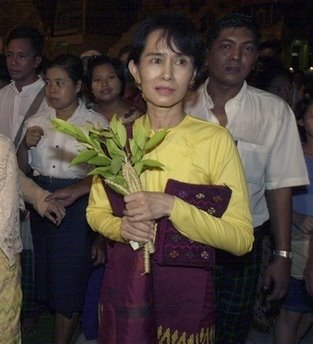


 Posts
Posts


