News & Articles on Burma
Thursday, 13 January, 2011
-------------------------------------------------
Hydropower attracts big investment in Myanmar
Freed Myanmar democracy icon seeks to revive party
Conscription Law Likely to Drive More Youths out of Burma
Armed conflict threat looms large in Burma
Industrial projects boon to real estate in Burma
Myanmar To Privatise 90 Per Cent Of State-Owned Industries This Year
Can Indonesia turn Asean into a global player?
NLD to donate rice, water pipes to famine victims
Myanmar enacts military draft law for men, women
Thais Barred From Entering Into Myanmar For Safety
------------------------------------------------------
Myanmar Times: January 10 - 16, 2011
Hydropower attracts big investment in Myanmar
By Juliet Shwe Gaung
ONE-THIRD of the total foreign investment in Myanmar went into the hydropower sector during the first seven months of the 2010-2011 fiscal year, and hydropower represented the second-largest investment sector, according to official figures.
Figures from the government’s Central Statistical Organisation show that from April to October 2010, foreign investment in the power sector reached US$5.03 billion. Total foreign investment in all sectors during the period was $15.9 billion.
Investment in hydropower was second only to oil and gas, which amounted to $9.8 billion, while the mining sector stood in third place with investment totalling $990 million during the period.
In 2010 a total of seven memoranda of understanding (MOU) and memoranda of agreement (MOA) were signed between investors and the Department of Hydropower Planning under the Ministry of Electric Power (1).
In February, the government signed an MOA with China for implementation of a 1400 megawatt (MW) hydropower project on the upper Thanlwin (Kunlong) River in Shan State. An MOU was also signed between China and the Htoo Group of Companies for construction of a coal-fired thermal power plant in Yangon.
In April, an MOA was signed with Thailand and China for implementation of the 1360MW Hutgyi hydropower project in Kayin State, and the following month an MOU was signed with China for construction of the 520MW Mawlite hydropower project and a Kalewa coal-fired power plant, both in Sagaing Region.
July saw the signing of an MOA with China for a 1055MW Ngaw Chan Hka hydropower project in Kachin State.
China and Thailand signed another MOU with the government in November for the 1400MW upper Thanlwin (Ming Long) project in Shan state. Other agreements were signed in the same month for the 520MW Shwe Li (2) and 280MW Belin hydropower projects in Shan state.
There are currently 16 hydropower stations and one coal-fired power plant operating in Myanmar. The most recent to open was the Yeywa hydropower project in Mandalay Region, the first dam built in the country using roller compacted concrete construction techniques. Opened on December 15, it has the capacity to generate 790MW of power.
The 75MW Shwegyin hydropower project is about 80 percent complete and is one of 10 projects due to be completed in 2012. Altogether these projects will generate 1656MW, in addition to the 2100MW currently generated for the entire country though hydropower.
A former official from the Ministry of Electric Power (1) said Myanmar was unable to exploit all the identified hydropower resources on its own, so it had signed joint-venture agreements with neighbouring countries like Thailand, China and Bangladesh for implementation and export of power.
The joint-venture projects not only generate foreign exchange revenue during the concession period, but also increase the country’s overall power generation, because the agreements entitle Myanmar to 10-15pc of the annual electricity generated from the power stations free of charge, he said.
http://www.mmtimes.com/2011/business/557/biz55702.html
----------------------------------------------------
Freed Myanmar democracy icon seeks to revive party
AP
YANGON, Myanmar – Pro-democracy leader Aung San Suu Kyi is seeking to revive her political party in military-run Myanmar by launching an appeal to the Supreme Court of a ruling that upheld its banning, her lawyers said Thursday.
Suu Kyi, who freed from house arrest in November, has sent her team of lawyers to the capital of Naypyitaw to submit the appeal, said one of the lawyers, Nyan Win.
The legal move appears to be largely symbolic, since Myanmar's courts invariably adhere to the junta's policies, especially on political matters. Previous appeals by Suu Kyi to the courts, on matters such as her detention, have been shunted aside or dismissed.
A similar appeal in November to restore the National League for Democracy was dismissed. The party lost its legal status because it failed to reregister in order to take part in general elections that month, claiming the balloting would be neither free nor fair.
The elections were swept by a party close to the ruling military junta, and the opening session of the new Parliament is scheduled for Jan. 31.
Nyan Win told earlier told reporters that the state Election Commission does not have the authority to dissolve the NLD, which was registered under a previous party registration law. Suu Kyi's party won a landslide victory in the last election in 1990, but was not allowed to take power by the military.
The 65-year old Nobel prize laureate has spent 14 of the past 20 years under house arrest. Her last period of detention lasted seven years. http://news.yahoo.com/s/ap/20110113/ap_on_re_as/as_myanmar_suu_kyi
-------------------------------------------------------
Conscription Law Likely to Drive More Youths out of Burma
13 January 2011: The new decree recently issued by Burma's ruling military junta obligating every citizen over the age of 18 years to enter military service will likely cause more young people to flee the country, the Chin Human Rights Organization (CHRO) has warned.
According to a new law enacted by the ruling State Peace and Development Council (SPDC) on November 4, and entered into the official gazette on December 17 last year, young men and women between the ages of 18 and 35 are required to serve in the Burmese military for at least two years. Failure to perform military service is punishable by imprisonment of up to three years.
But the new decree is likely to cause more youths to flee the country to avoid being forcibly called to serve in the military.
Salai Bawi Lian Mang, Executive Director of Chin Human Rights Organization (CHRO) said, "When enforced, this new measure will almost certainly cause an exodus of more youths out of Burma as we have seen in the pre-election period, in which dozens of young people fled to India from Chin State to avoid conscription into the militia forces."
According to CHRO, several dozen youths from southern Chin State's Paletwa Township fled to India in January of 2010 when the Burmese army tried to forcibly enlist them for the militia service.
Other incidents of forcible conscription involving minors and high school students were reported by CHRO from Matupi Township.Two army deserters recently interviewed by the CHRO said that they were drafted in 2007 before they were only 16 and 17 respectively by troops from Burma Army Light Infantry Battalion (304) stationed at Belkong village of Maupti Township. CHRO also reported that since June 2009 as many as 1,160 youths were conscripted into the militia service in the Matupi Township area.
Young people are more likely to be called to perform mandatory and unpaid work, as well as, targeted for conscription into the army and militia services. In Chin State, these measures have caused the forced migration of people, especially the youths, out of Chin State. More refugees in neighboring countries are young people under the age of 35. http://chinlandguardian.com/news-2009/1160-conscription-law-likely-to-drive-more-youths-out-of-burma.html
---------------------------------------------------
Armed conflict threat looms large in Burma
By Zin Linn Jan 12, 2011 8:49PM UTC
The inauguration of the Pathein-Monywa road built by Public Works of the Ministry of Construction took place at the pavilion near Kankalay Junction in Kyaunggon Township on January 11, with an address by Burma’s Prime Minister Thein Sein.
Thein Sein underscored peace, stability, national unity and national development as key necessities for democratization.
In his speech, he said, “Before long, Hluttaw (Parliament) sessions will be held to form Union government, R e g i o n / S t a t e governments, self-administered zone leading bodies along with a check and balance system for three pillars, namely legislative, executive and judicial sectors. Community peace, stability, national unity and national development are requirements of democratization. So, these requirements are to be fulfilled all the more in such a transitory period.”
Meanwhile, conflicts between the junta’s armed forces and ethnic Karen armed units have been continuing along the Thai-Burma border near Mae Sot in Tak Province of northwestern Thailand. As 11 shells have struck into the Thai side, the Thai head of the Thai-Burma Border Committee (TBC) in Mae Sot has sent a letter to the TBC office in Burma’s Myawaddy district urging the Burmese soldiers to cautiously seek their targets in order to avoid firing into Thailand.
Although Thein Sein highlighted the importance of peace and stability, the military junta has enacted a law that could draft men and women into its army and mete out prison sentences of up to five years for draft dodgers, according to an official document.
The law, dated Nov. 4, 2010, but yet to be made public, will come into force when proclaimed by the ruling military council, said an official gazette with limited circulation. The law says that every male between the age of 18 and 45 and females between 18 and 35 may be drafted to serve for two years, which could be increased to five years in times of national emergencies.
Without any external threats, the Burmese army has been expending its strength over 400,000 soldiers and is one of the strongest in the region. Its armed forces have been engaging in ongoing conflicts with several ethnic rebel groups seeking self-determination since 1948.
According to Irrawaddy News, the Burmese regime has been reinforcing its troops in several areas where ethnic armed groups that did not follow the border guard force (BGF) plan are based, according to ethnic sources. Armed reinforcements have been reported in southern Karen State and in central and southern Shan State in eastern Burma since early December last.
Sporadic armed clashes has been going on in recent weeks between the junta’s troops and armed ethnic groups such as the Karen National Union (KNU), the Democratic Karen Buddhist Army (DKBA) Brigade 5, the Shan State Army–North (SSA-North) and Shan State Army-South (SSA-South).
According to a report by the Thailand-based Kachin News Group (KNG), the junta also began dispatching fresh troops and munitions in Kachin State in late November.
KNG said eye witnesses had confirmed that a number of vehicles carrying military supplies arrived in Bhamo Township in Kachin State on November 30 from Mandalay. They said that the military trucks continued to Laiza, close to the Kachin Independence Organization (KIO) headquarters which is on the Sino-Burmese border. The KIO is the second largest ethnic armed group in Burma with some 10,000 fighters. It is also one of the ethnic rebels that denied the junta’s BGF policy.
Several analysts believe conflicts could rise as more ethnic armed groups refuse to abide by the junta’s new constitution. Also, the ethnic groups think the incoming namesake civilian government will leave them even without basic rights that they currently have.
In state-run media, the junta also condemned the Second Panglong Initiative or National Reconciliation forum raised by democracy icon Aung San Suu Kyi and some prominent ethnic leaders as an unnecessary approach.
The nation risks a return of armed conflict as a result of denial of a true federal system in the 2008 Constitution drawn by the incumbent military junta.
http://asiancorrespondent.com/46003/armed-conflict-will-return-after-new-government-shaped-in-burma/
-------------------------------------------------
Industrial projects boon to real estate in Burma
PRSEA | Jan 13, 2011 |
Foreign-invested cooperation projects in Rakhine state Sittway, Tanintharyi region’ s Dawei and Sagaing region’s Monywa have raised Burmese real estate prices as the market anticipates localised socio-economic booms, the Xinhua News Agency has reported.
In Sittway, a project on construction and operation of a 120- million-USD multi-modal transit and transport facility, covering the port, waterways and road infrastructure, connecting the Sittway Port in Myanmar with the Indian state of Mizoram is under construction following a framework agreement signed between India and Myanmar in 2009.
In Dawei, a deep seaport, industrial zone and road and rail link to Thailand in southern Tanintharyi region is in the initial stages of implementation under a framework agreement signed between Thailand and Myanmar in November 2010.
The project represents the first ever special economic zone in Myanmar and completion is targeted for 10 years in three phases.
The project, which costs 13 billion U.S dollars, specifically includes construction of Dawei Deep Seaport, buildings for shipyard and maintenance work, establishment of zone, petrochemical industries, oil refinery, steel plant, power stations and Dawei-Bangkok motor road and railroad and laying of oil pipeline along the motorway and railroad.
A total of 25 vessels ranging from 20,000 to 50,000 tons will be able to berth at 22 wharves simultaneously and 100 million tons of goods will be handled a year with the deep seaport made up of the south port and the north port.
An area of 250 square kilometers has been designated to build a zone comprising two heavy industrial zones, one medium heavy industrial zone and one light industrial zone.
A power station that can generate 4,000 megawatts will also be built for the whole project.
Moreover, the 170 kilometers each long motor road and railroad that will link Dawei deep seaport to Myanmar-Thai border will be built phase by phase.
The road will reach the Greater Mekong Sub-region Southern Corridor that leads to Vung Tau and Quy Nhon of Vietnam through Sisiphon of Cambodia via Bangkok, Thailand, according to the port authorities.
On completion the port and its road and rail links will facilitate the movement of trade along the South East Asia east-west corridor and south from China’s eastern provinces along a high-speed rail link through Lao PDR; the construction of which is currently being negotiated by the Thai and Chinese governments.
Foreign investors in Thailand have already expressed interest in the Burmese port as an alternative to Thailand given pressures on the existing eastern seaboard infrastructure, more stringent environmental regulations and uncertain political risks. http://www.property-report.com/site/industrial-projects-boon-to-real-estate-in-burma-11067
--------------------------------------------
January 13, 2011 12:52 PM
Myanmar To Privatise 90 Per Cent Of State-Owned Industries This Year
YANGON, Jan 13 (Bernama) -- Myanmar has planned to privatise 90 percent of state-owned industries during the year, leaving the remaining 10 percent to be held back by the government, China's Xinhua news agency cited the local Biweekly Eleven News' report Thursday.
The move is to be made in line with the coming change of government after the general election, Deputy Minister of Industry-2 U Khin Maung Kyaw was quoted as saying.
In addition to the state-owned industries, other state-owned properties such as motor vehicles, enterprises, fuel-filling stations, buildings, land plots, recreation places, roads, bridges and ports are being privatised, said private companies.
According to the report, during 2010, 110 state-owned economic enterprises, 32 buildings, 246 fuel-filling stations, eight wharves along the Yangon Port and port areas have been sold under competitive bidding system.
During this year, other state-owned industries, economic enterprises and properties in regions and states will also follow suit, the report added.
-- BERNAMA http://www.bernama.com/bernama/v5/newsworld.php?id=556319
-------------------------------------------
REGIONAL PERSPECTIVE
Can Indonesia turn Asean into a global player?
By Kavi Chongkittavorn
The Nation: Published on January 10, 2011
For the record, 2011 will be an exciting year for Asean - based on the must-do list the new Asean chair has vowed to accomplish at regional and international levels. In its second week, Indonesia has taken the chair with a confidence and relish rarely witnessed in Asean's over four-decade history, coupled with a blueprint to push the grouping into the global limelight. Jakarta's enthusiasm has already drawn praise from the secretary-general of Asean, Dr Surin Pitsuwan, who complimented the chair's preparedness to be "engaged, proactive, using the Asean platform to enhance Asean's profile in the global arena".
Last week, Indonesian Foreign Minister Marty Natalegawa outlined three major tasks the Asean chair will tackle - to make tangible progress towards the Asean Community, to establish "dynamic equilibrium" between Asean and the major powers and, finally, to ensure Asean can be a peacemaker in a complex world. Indeed, it will be a tall order as the chair has to overcome existing divergent views and entrenched positions held by Asean members. That is easier said than done. For instance, the previous chair, Vietnam, faced great difficulty in garnering the grouping' s common position on global issues. Indonesia's Permanent Representative to Asean, Ambassador I Gede Ngurah Swajaya, understood the dilemma well and was succinct in saying the efforts of promoting a united Asean in a community will require Asean's collective voice, assets, diplomatic networks and constructive solution-oriented mindset.
Inevitably, the most tangible progress in achieving the Asean Community remains the promotion and protection of human rights in Asean. Under its chair, Indonesia hopes the Asean Intergovernmental Commission on Human Rights (AICHR) will be more effective in fulfilling its mandate, reflecting the members' commitment to respect human rights. One immediate task is to agree on the guidelines of modality, which is a euphemism for terms of procedure - the term turned down by AICHR's conservative members last year.
Dr Sriprapha Petcharamesree, Thai representative of AICHR, said it was time that AICHR deliver after more than a year of preparation and meetings. She reiterated that the new chair can provide the much-needed impetus and direction on human rights protection. This year, AICHR plans to deliberate on the draft Asean Human Rights Declaration. However, without the guidelines, AICHR activities and the utilisation of its US$200,000 fund, it cannot begin. The protection of migrant workers' rights, on which the Philippines and Indonesia are very keen, will also be high on the agenda. At this juncture, it is hard to say if Asean can agree on the legally binding documents on this sensitive issue as some members oppose the idea.
Truth be told, all Asean members have problems with human rights records, including the chair. But the way each nation chooses to handle them will mark the grouping's departure from the past. So far, Thailand, the Philippines and Indonesia remain open and tolerant to international enquiries, which continue unabated to pressure for more transparency and access. On its own, AICHR does not have the mandate to investigate alleged human rights abuses or write-up annual reports on individual member countries.
But the best practice from these three countries and others could in the long-run serve as role models and subsequently impact on the culture of non-interference and result in better human rights cooperation and protection. The continued appeal from academics and civil-society organisations to end the non-interference principle and opt for collective responsibility is unattainable at the moment.
In addition, what Jakarta can do to make Asean more people-centred is to promote the stakeholders' participation. Indonesia is well-positioned to do so due to its active civil-society sector with more than 25,000 organisations of myriad interests and purposes. As a moderate and secular Muslim country, Indonesia continues to be the fulcrum of inter-faith dialogue forums, essential not only to Asean but the broader global community as well. For instance, the interface between the Asean leaders and civil society groups could be brought back to fit into the slogan of people-centred community-building in Asean. In 2008, Thailand did its fair share by encouraging the Asean-based civil groups to contribute their input. However, lack of mutual trust and uncompromised views and less-than friendly encounters from both sides derailed long-term engagements.
Beyond the region, a more consolidated and unified Asean is a prerequisite to engage major powers of the world. This year will witness how Asean tackles its multiple relations with the US, Russia, China, Japan and India. The first expanded East Asia Summit scheduled at the end this year and will set forth the tone and level of their engagements. Indonesia has already come forward pushing the EAS as the forum for discussion of strategic issues at both global and regional levels, similar to the US position. Other Asean members prefer a more encompassing forum, involving pertinent global issues including economics and science and technology. Key security and political issues such as nuclear non-proliferation, maritime cooperation and safety navigation, human trafficking, climate change and the Korean Peninsula will definitely top the EAS agenda.
The future of Asean's role in the global community as envisaged by Natalegawa is intricately linked to the outcome of the association's effective engagement with these dialogue partners and the broader community. He believes the role would serve as the vanguard for the promotion of democratic values, human rights and tolerance at the global level. Interestingly, both Indonesia and the US share similar concerns and agenda. They are the core to trans-Asia Pacific cooperation for the time being, due to their respective chairing of economic groupings. Washington will host the Asia Pacific Economic Cooperation leaders meeting in Hawaii later this year.
The two nations must work in tandem to ensure that healthy cooperation will continue at all levels. The Indonesia-US relations, further boosted by President Barack Obama's brief visit last November, will play a pivotal role in defining the parameter of future cooperation in the region and the overall US policy. Among the Asean membership, Indonesia has the most extensive diplomatic relations with the global community. This year, Jakarta will establish new diplomatic relations with 21 countries, reaching all UN members, except for Israel.
Despite all the above-mentioned strengths, Indonesia inherits a weakness: its reservations about economic integration with Asean. It has asked for a one-year delay in the Asean-China free-trade agreement through emergency exit clauses related to general commitment. Obviously, domestic adjustments and improved competitiveness of local industries are essential to improve Indonesia's economic profile and respect within Asean. To ensure its sustainability, the newly found intellectual leadership within the grouping must be rooted in all areas. Otherwise, its ambitious plan to shape Asean's future well beyond the Asean Community in 1,451 days would be hampered. http://www.nationmultimedia.com/2011/01/10/opinion/Can-Indonesia-turn-Asean-into-a-global-player-30146030.html
---------------------------------------
NLD to donate rice, water pipes to famine victims
Source: Mizzima News
Date: 12 Jan 2011
Chiang Mai (Mizzima)––The National League for Democracy (NLD) will donate rice and water pipes to famine victims in villages in four townships in Chin State.
Rat infestations in August 2010 lead to widespread crop destruction and a severe food shortage in about 120 villages in Mindat, Matupi, Paletwa and Kanpetlet townships in southern Chin State.
NLD General-Secretary Aung San Suu Kyi met with Pu Van Lian, the chairman of the NLD (in Chin State), on January 10, and she promised to donate rice to famine victims in Paletwa and Kanpetlet townships.
In the meeting, Pu Van Lian told Suu Kyi that some people in Mindat and Thantlang townships also did not have enough food. NLD leaders are now discussing how much they can help those townships, said Ohn Kyaing, an NLD information committee member.
'They said there was a water shortage in Falam Township. There is a stream on the mountain about five miles from Falam. So, to get water, they need to lay water pipelines. That's why they asked us to donate water pipelines', said Ohn Kyaing.
Pu Van Lian said that water pipes with a diameter of two inches (about 5.08 centimeters) cost about 6 million kyat (about US$ 6,000), according to Ohn Kyaing.
Chin National Party's chairman Pu Zozam said, 'I'm very glad to hear that Aung San Suu Kyi will donate rice to the victims. I would like to urge her to donate to us in the future, too. All villages have suffered water shortages'.
The Chin National Party contested in the 2010 election and won a total of nine parliamentary seats .
Last month, Suu Kyi, members of the Committee Representing the People's Parliament and independent candidates who contested in the recent national elections donated food and shelter valued at 20 million kyat (about US$20,000) to Cyclone Giri victims in Arakan State.
The NLD, with the help of independent donors, businessmen and international organisations, has donated food and money to cyclone Nargis and Giri victims, people living with HIV and political prisoners. In early January, the NLD also organised a trade fair in and the profits will be donated to aid political prisoners and people living with HIV.
"We support many patients who live with HIV, and we will receive more patients in our HIV centre. We have to struggle in order to be able to help people', Ohn Kyaing told Mizzima. ?
There are about 130 HIV patients in the NLD's Thukha Yeikmyone Centre, managed by NLD central committee member Phyu Phyu Thin, in South Dagon Township in Rangoon. http://www.reliefweb.int/rw/rwb.nsf/db900sid/VVOS-8D2NG6?OpenDocument
--------------------------------------------
Associated Press Featured Article
January 12, 2011
Myanmar enacts military draft law for men, women
By Associated Press ,
YANGON, Myanmar (AP) — Military–ruled Myanmar has enacted a law that could draft men and women into the armed forces and mete out prison sentences of up to five years for draft dodgers, according to an official document seen Monday. The country currently has a volunteer army.
The law, dated Nov. 4, 2010, but yet to be made public, will come into force when proclaimed by the ruling military council, said an official gazette with limited circulation.
Myanmar's 400,000–strong military ranks among the largest in the world. Its troops are engaged in continuing conflicts with several ethnic minority groups seeking autonomy from the central government.
Some analysts say conflicts could escalate as more ethnic groups refuse to adhere to a Constitution and government they say will deprive them of even more rights than they currently enjoy. The government is set to replace the junta, possibly toward the end of this month.
The law states every male between the age of 18 and 45 and females between 18 and 35 may be drafted to serve for two years, which could be increased to five years in times of national emergencies. Both sexes are required to register at 18.
Those who fail to report for military service could get three years in prison, a fine or both, and those who deliberately inflict injury upon oneself to avoid conscription could be imprisoned for up to five years, fined or both.
In times of national crisis the government can recruit all or some of those eligible for military service.
Civil servants, students, persons serving prison terms or those taking care of elderly parents will enjoy temporary postponement of military service but could be later called to serve. Totally exempt are members of religious orders, married women or divorcees with children and disabled persons. http://topnews360.tmcnet.com/topics/associated-press/articles/2011/01/12/134225-myanmar-enacts-military-draft-law-men-women.htm
--------------------------------------------
January 12, 2011 16:21 PM
Thais Barred From Entering Into Myanmar For Safety
BANGKOK, Jan 12 (Bernama) -- Thai nationals have been prohibited from any cross-border travel at a checkpoint in Thailand's northwestern Tak Province after a former Thai political candidate was detained by the armed Democratic Karen Buddhist Army (DKBA) while crossing the border into the Myanmar side for his business, Thai News Agency (TNA) reported.
Tak Governor Samart Loyfah said on Wednesday that Thai people have been temporarily barred from travelling out of or into the Thai-Myanmar border in Tak Province for their safety--following the arrest of the former Thai political candidate of the Ruamjai Pattana Party, Kriangsak Bhumrungroj, who is also a Thai Public Health Ministry retiree, by the DKBA militants before the Thai authorities successfully negotiated for his release Tuesday evening.
Samart noted that Thai border police and military forces have intensified security measures in Tak's five districts bordering Myanmar--amid escalating warfare between Myanmar government troops and the breakaway karen forces.
-- BERNAMA http://www.bernama.com/bernama/v5/newsworld.php?id=556085
__._,_.___
Friday, January 14, 2011
News & Articles on Burma-Thursday, 13 January, 2011


Thursday, January 13, 2011
News & Articles on Burma-Wednesday, 12 January, 2011
News & Articles on Burma
Wednesday, 12 January, 2011
-------------------------------------------------
Junta Troops Using Prisoners as Human Minesweepers
China to Operate Oil Wharf in Burma
UN probe must include all armed groups
Artillery shells hit Thailand as fighting rages
Port Project Raises Concerns about Rights, Environment
Karen rebels hold Thai man hostage
University Students Protest Against Rising Bus Fares in Kalay
Parliamentary Books Sell Out on First Day
Minister's Sons to Manage Gas Pipelines
------------------------------------------------
Junta Troops Using Prisoners as Human Minesweepers
By SAI ZOM HSENG Wednesday, January 12, 2011
The Burmese army has been using hundreds of prison inmates as porters and human minesweepers in the recent conflict with a breakaway faction of the Democratic Karen Buddhist Army (DKBA), according to a human rights group based in the Thai border town of Mae Sot.
An estimated 600 prisoners have been sent to the conflict area since fighting broke out between the Burmese army and the DKBA on Nov. 7, said the Assistance Association for Political Prisoners-Burma (AAPP), citing accounts from three recently escaped prisoners.
A civilian porter, center, is forced to carry supplies for Burmese soldiers. (Photo: Free Burma Rangers)
“This shouldn’t happen in any situation,” said Bo Kyi, the joint secretary of the AAPP, speaking to The Irrawaddy on Wednesday. “They are, in effect, executing these prisoners by other means.”
He added that the AAPP would continue to investigate the matter and release a statement when it has gathered further evidence. If the claims were true, he said, “It would definitely constitute a crime against humanity.”
The three porters, who all came from Pakokku Prison in Magway Division and were assigned to the Burmese army's Palaw Tapo camp in Myawaddy, Karen State, escaped to Mae Sot on Tuesday and are receiving help from local groups that support refugees on the border.
The oldest of the escaped prisoners, Thaung Htay Oo, 28, told The Irrawaddy on Wednesday that they were part of a group of 30 inmates from the same prison who had been sent to the area to act as porters.
“We couldn't pay a bribe to the prison officials, so we were sent to the front line,” he said. “We had to carry ammunition, equipment and food for the soldiers. The worst thing is that they used prisoners to clear minefields ahead of their advance.”
He added that he and the two other escaped prisoners—Tin Zaw Min, 21, and Moe Yarzar, 17—fled to Thailand to escape the fate of other porters they had seen.
“There were many prisoners who were injured by the landmines after they were forced to walk ahead of the soldiers. We ran away because we didn’t want the same thing to happen to us,” he said.
Moe Yarzar, the youngest of the three, said that he and the other prisoners from Pakokku Prison were sent to the front line at the end of December, along with other inmates from prisons in Meiktila, Hpa-An and Kawkareik.
“Tin Zaw Min and I were sentenced to five years after we beat up a policeman who slapped my mother. The situation in prison was bad, but on the front line it was much worse. That's why we decided we had to get away, no matter what happens,” he said.
He added that even old men were sent to the conflict area if they couldn't pay a 100,000 kyat (US $120) bribe to prison officials.
Sources on the border say that clashes that took place between DKBA Brigade 5 and Burmese troops on Sunday and Monday were the most intense since fighting started two months ago, suggesting that the Burmese regime is stepping up its efforts to crush the rebel group.
DKBA Brigade 5 is led by Col Saw Lah Pwe, who broke away from the DKBA, a longtime ally of the Burmese regime, late last year.
Other armed groups opposed to the Burmese regime, including the Karen National Liberation Army and the All Burma Students’ Democratic Front, have cooperated with Saw Lah Pwe’s Brigade 5 since fighting started on Nov. 7.
Meanwhile, Thailand's government announced on Wednesday that Thai nationals were prohibited from crossing the border into Burma, after a Thai man was reportedly abducted by members of the DKBA and held for a ransom of 300,000 baht ($9,800).
http://www.irrawaddy.org/article.php?art_id=20513
-------------------------------------------------
China to Operate Oil Wharf in Burma
By THE IRRAWADDY Wednesday, January 12, 2011
China's Qingdao Port has signed an agreement with the China National Petroleum Corporation (CNPC) to build and operate a wharf on Burma's western coastline from which China will send its crude oil brought from Africa and the Middle East via an inland pipeline to Yunnan Province.
On Jan. 7, CNPC Southeast Asia Pipeline Co., Ltd. and Qingdao Port (Group) Co. Ltd. signed a strategic framework agreement in Beijing on operating the oil wharf in the Arakan coastal town of Kyauk Phyu in Burma, according to the CNPC website.
Kyauk Phyu port in Arakan State (PHOTO: vesseltracker.com)
The state-run China Daily quoted Zhang Hongbo, an industry analyst at China International Trust and Investment Corporation (CITIC) as saying: “This agreement is very important for Qingdao Port because this is the first time the port will extend its management expertise overseas.”
CNPC is China's largest oil company. It is the majority shareholder in the joint-venture project which is constructing a dual oil and gas pipeline from Burma's western coast to China's Yunnan Province. Within Burma, the company will build a 793 km-long gas pipeline and a 771 km-long crude pipeline.
The construction of the pipelines officially started on June 3, 2010, after Premier Wen Jiabao, who was then visiting Burma, attended a signing ceremony in Naypyidaw with Burma's Prime Minister Thein Sein, certifying a shareholder agreement between CNPC and Burma's state-owned Myanmar Oil and Gas Enterprise (MOGE).
“The agreements defined CNPC Southeast Asia Co., Ltd. as the controlling party of the joint venture to be in charge of the design, construction, operation, expansion and maintenance of the Myanmar oil and gas pipeline,” said the CNPC website.
But the CNPC gave Qingdao Port, the ninth largest port in the world, the right to construct and manage the wharf in Burma through which China will annually channel 22 million tons of oil and 12 billion cubic meters of gas to Yunnan Province.
China has been expanding its contracts around the world to secure the country's energy security. The cross-border oil and gas pipeline between China and Burma is the fourth after the Kazakhstan-China Crude Pipeline, the Central Asia-China Gas Pipeline, and the Russia-China Crude Pipeline.
Moreover, China has sought the right to operate foreign ports in recent years. The China Ocean Shipping Company (COSCO), the country's largest shipping company, won the right to operate Piraeus Port in Greece in 2009. China has invested heavily in Kyauk Phyu deep seaport project in Arakan State.
http://www.irrawaddy.org/article.php?art_id=20512
----------------------------------------------
---------------------------------------------
UN probe must include all armed groups
By KIRSTY OGILVIE
Published: 12 January 2011
Any UN Commission of Inquiry must be truly objective and should investigate all parties to the conflict in Burma. Practically, the threat of an investigation could do much to discourage violations of international humanitarian and human rights law. Politically, a comprehensive investigation might be less likely to antagonise the regime and could engender the support of more of the international community. Only such an impartial investigation could set the stage for real national reconciliation.
It is clear that the UN should instigate a Commission of Inquiry into international crimes committed in Burma. Failure to do so is evidence of its continued impotence and inertia. Egregious human rights abuses such as torture, extrajudicial killings, internal displacement, sexual violence and the use of child soldiers have been documented for decades. The scale and gravity of these breaches of international criminal law powerfully suggest that they amount to crimes against humanity and war crimes. An objective investigation into the situation in Burma is therefore imperative.
While the actions of the Burmese government in its various guises are thoroughly deplorable, it must also be recognised that international crimes have been perpetrated by non-state armed groups in Burma. Reports of torture, forced labour and murder committed by these groups are less well-documented and must equally be investigated. Additionally, the recruitment of child soldiers and the use of land mines must urgently be examined. The Burma Lawyers’ Council is trying to educate non-state armed groups about humanitarian and human rights law in the hope that this will help them to adhere to international legal standards. The mere threat of an investigation could have immediate preventative effects and catalyse real change in the attitudes of all armed groups.
Additionally, a partisan inquiry could be politically counterproductive. An investigation only into the State Peace and Development Council (SPDC) would be seen, correctly, as a direct attack on the regime. It would be unlikely to engender cooperation from the military and would almost certainly muzzle any steps towards dialogue with the generals. China would be likely to seek to protect the regime in the belief that an international investigation would increase instability in the border regions.
When considering international investigations and judicial processes, we must look beyond the purely legal. Such processes also aim to be anthropologically cathartic. By giving victims of violence the opportunity to confront those held to have wronged them, these processes allow meaningful collective reconciliation and can avoid the perpetuation of enmity. The suggestion that only one party to a conflict is blameworthy denies the victims of other parties a voice. A one-sided investigation could deny the real harm suffered by thousands of civilians at the hands of non-state armed forces. Enmities could remain unresolved, or, as history has demonstrated, deepen. Beware victors’ justice. To be truly beneficial, a Commission of Inquiry must investigate the perpetration of crimes by all parties.
It is understandable that some members of the opposition movement might be uneasy about the investigation of anti-regime armed groups. At this stage, however, concerns about international prosecution are premature. Both the Tutsis and the Hutus were investigated by the Commission of Experts instructed by the UN Security Council to investigate the situation in Rwanda. The Hutu extremists were found to be ultimately responsible for the atrocities committed, and it was only they that were consequently prosecuted in the specially created international tribunal.
There is no established protocol for the creation of a Commission of Inquiry. An inquiry could be instigated by various bodies including the UN Security Council, the Secretary-General, the Human Rights Council or the International Labor Organization. The appeal of the first is that it is the only UN body that could force a referral to the International Criminal Court or set up another international tribunal. It is therefore arguable that only a Security Council mandated Commission of Inquiry would have any real potential bite.
A UN Commission of Inquiry would not be the first in Burma. In response to an ILO Commission of Inquiry, several Tatmadaw Kyi soldiers found guilty of recruiting minors were eventually punished. The Secretary-General’s 2010 report to the UN General Assembly on children and armed conflict states that a tiny number of child soldiers have been released through Burmese Government mechanisms. These commendable, if inadequate, steps demonstrate that objective investigations and recommendations can have some beneficial effect in and of themselves.
Notably, however, Commissions of Inquiry established by the Security Council with regard to the former Yugoslavia, Rwanda and Darfur were all part of a process that ultimately resulted in international criminal trials. We should not be too hasty to leap to criminal proceedings. Lawyers may talk about the integrity of the pursuit of international justice, but we are navigating inherently political waters. Even the ICC retains the right to refuse a case where an investigation may aggravate a conflict or destabilise a reconciliation effort. Highlighting this, some fear that the indictment of Omar al-Bashir has significantly hindered peace-building efforts in Darfur. Thirty years after the fall of the Khmer Rouge, the functioning of the internationalised Extraordinary Chambers in the Courts of Cambodia is threatened by political discontent.
The creation of any international judicial mechanism for Burma is a long way off. Since Burma is not a party to the Rome Statute, the ICC cannot initiate proceedings without the order of the Security Council. More immediate concerns therefore include persuading China and Russia not to veto a Security Council mandated Commission of Inquiry. To that end it is critical that calls for an investigation are cogent, developed and impartial. Though political and economic interests may be difficult to overcome, it is likely that China would at least consider supporting measures with the potential to lay the groundwork for genuine security in the border areas.
Kirsty Ogilvie is a Fellow of International Criminal Law at the Burma Lawyers’ Council, and was called to the Bar of England and Wales in 2010 http://www.dvb.no/analysis/un-probe-must-include-all-armed-groups/13681
----------------------------------------------------
Artillery shells hit Thailand as fighting rages
By DVB
Published: 12 January 2011
A number of stray artillery shells fired during fighting in eastern Burma have landed in Thailand, causing locals to evacuate.
Heavy fighting erupted this week between Burmese troops and the Democratic Karen Buddhist Army (DKBA), who have been battling one another in eastern Karen state since November last year.
The Thai News Service reported today that eleven shells had so far landed on Thai soil close to the border town of Mae Sot. The Thai army has subsequently bolstered security along the shared border, while a number of refugees had fled into Thailand.
The DKBA is joined by the Karen National Liberation Army (KNLA) and the All Burma Students’ Democratic Front (ABSDF). The combined forces are reportedly facing off against six Burmese army battalions in the area around Hpalu village, which has become the focus of clashes.
The Bangkok Post said today that DKBA troops had taken a Thai civilian, identified only as Mr Kriangsak, hostage in Karen state and were demanding a 300,000 baht ($US9,800) ransom.
The man had reportedly crossed over the border to negotiate a financial matter with the DKBA, but upon failing to reach an agreement, was taken hostage.
Fighting first began on 8 November after DKBA troops, led by renegade commander Na Kham Mwe, took key government positions in Myawaddy, across the border from Mae Sot. Clashes have since continued to occur on a regular basis.
Reports have also emerged that a number of child soldiers have deserted the Burmese army in recent days. One 17-year-old told DVB that the army had stopped providing food rations for troops fighting in Karen state, thus forcing them to escape to the Thai border.
Recruitment of child soldiers by the Burmese army and a number of ethnic armies is widespread, despite being illegal under Burmese law.
http://www.dvb.no/news/artillery-shells-hit-thailand-as-fighting-rages/13674
------------------------------------------------
Port Project Raises Concerns about Rights, Environment
By YENI Wednesday, January 12, 2011
A new deep-sea port and special economic zone in Tavoy, southern Burma, will bring much-needed infrastructure to the military-ruled country and be a boon to regional trade, but will also present serious risks to the local population and environment, according to experts.
The multi-billion dollar project, which will be financed by the Bangkok-based Italian-Thai Development Public Company, will cover an area of about 260 square kilometers (100 square miles) and affect more than 30,000 people from 19 villages in Yephyu and Longlon townships, near Tavoy, the capital of Tenasserim Division.
Local sources say that even though preparatory work on some parts of the project has already begun, residents of the area still haven't been told how the plan to build what is expected to become Southeast Asia's biggest special economic zone will affect them.
Villagers in the area say they are worried about where they will be relocated to and how they will be compensated for the loss of their land, but don't expect to have any choice in the matter. “If they order us to move, we can't resist,” a villager from Nabule, in the project area, told The Irrawaddy.
Italian-Thai will reportedly spend US $8.6 billion on the new mega-project, which will combine a deep-sea port, industrial estate and trans-border route with sea, road and rail links with Thailand.
The proposed industrial estate will contain a power plant, a steel mill, an oil refinery, a petrochemical complex, a fertilizer plant, a shipbuilding and maintenance yard and a variety of light- and medium-industry factories, as well as a pipeline linking Tavoy to Pu Nam Ron in Thailand’s Kanchanaburi Province.
There will also be residential and commercial developments, including a tourist resort and a recreation complex, according to a PowerPoint presentation prepared by Italian-Thai that is widely circulating on the Internet.
The 10-year project was signed in Naypyidaw on Nov. 2 of last year, five days before Burma held its first election in 20 years. Now groundwork for the first phase of construction—the road to Thailand, a water reservoir, a water and waste-water treatment plant and the 400 MW coal-fired power plant—have been initiated and are due to be completed within five years.
The idea to create this massive new economic zone first started to gain traction in 2008, when the foreign ministers of Thailand and Burma signed a memorandum of understanding (MOU) on the sidelines of a meeting of Association of Southeast Asian Nations (Asean) foreign ministers in Singapore. It received a further boost late last year during a visit to Naypyidaw by Thai Prime Minister Abhisit Vejjajiva, who signed an agreement on the project with his Burmese counterpart Thein Sein on Oct. 11.
However, there are still hurdles facing the project, largely due to the involvement of Burma's Western-sanctioned military regime. The Asia Development Bank (ADB) has declined to support the project, despite the fact that it will connect with the three economic corridors of the ADB's Greater Mekong Sub-Region development plan, which aims to create links between the economies of mainland Southeast Asia and China. Thailand's Kasikorn Bank has also rejected Italian-Thai's bid for financing, and the support of major shipping companies and manufacturers is also doubtful. However, according to a report by the International Herald Tribune, Italian-Thai has received backing for the project from a private bank that it would not name.
Meanwhile, Thailand's Minister of Industry, Chaiwut Bannawat, will lead a delegation of Thai business representatives on a fact-finding mission to Burma from Jan. 18-22 to seek information on the Burmese regime's investment policy and its framework for development of the Tavoy project, according to reports by The Nation, a Bangkok-based English-language daily.
While the Thai investors seem confident of the project's eventual success, other observers are less sure about its prospects, at least in terms of bringing any real benefit to the local economy.
Sean Turnell, an expert on the Burmese economy at Macquarie University in Sydney, Australia, said he was cautiously optimistic about the project. “Longer term, and come a reasonable government in Burma that was genuinely concerned with economic development, Tavoy could become the sort of infrastructure the country needs. But even such longer-term benefits presuppose such a government will emerge,” he said.
In a properly governed economy, the increased efficiencies from such a facility would pay dividends that would accrue to the country hosting it, the Australian economist also noted. “In Burma such dividends will flow not into the country's economy as such, but to the regime and its business associates,” he added.
The International Herald Tribune reported that the project includes a profit-sharing agreement with the Burmese junta, but executives from Italian-Thai said they could not divulge details. Meanwhile, business sources in Rangoon told The Irrawaddy that some of the regime's closest cronies have already been awarded huge contracts related to the Tavoy project. These include Max Myanmar owner Zaw Zaw, who accompanied Burma's top general on a tour of the Shenzhen Special Economic Zone in China last year, and Stephen Law, who heads Asia World, the country's largest conglomerate, founded by former drug lord Lo Hsing Han in 1992. Both are on US sanctions lists, and both are favored business associates of junta head Snr-Gen Than Shwe and are especially close to former Lt-Gen Thiha Thura Tin Aung Myint Oo, the Secretary 1 of the ruling junta and chairman of the regime's Trade Council.
With some of Burma's top businessmen already on board, the project has also attracted the attention of other local business people hoping to cash in on what looks like a potential goldmine. Residents of villages near the project area, most of whom make a living by farming or fishing, say that there has been a sudden influx of outsiders, including not only Thai employees of Italian-Thai, but also Burmese from other parts of the country trying to snap up properties ahead of the coming rush.
“There are lots of people coming and going all the time, many of them hunting for houses and land to buy,” said one resident of Maungmagan, a village well known for its attractive beach.
He said people are trying to acquire houses and plots of land in his village because it is not located inside the project area. In that area, he said, nobody is interested in buying property because they know that it could soon be taken away from them.
In Tavoy, a city of around 150,000 inhabitants, residents told The Irrawaddy that land and house prices have doubled or tripled in recent months as businessmen, most of them close to the military regime, look for places to open banks, hotels and other businesses. One local business owner said that an acre of land in downtown Tavoy suitable for building a hotel is now worth as much as 1.5 billion kyat ($1.8 million)—three times what it would have cost before.
The Tavoy project is also expected to increase tourism in the region, especially in southern Tenasserim's Mergui archipelago. One proposal that has been put forward is to extend the reach of the project by 300 miles (483 km) to include the archipelago's pristine islands, which are already famous for their white sand beaches, crystal clear water and abundance of marine life.
While foreign investors consider the potential for future spinoffs from the Tavoy project, Burma's domestic media has focused mainly on its possible impact on the country's economy. Most reports have highlighted how Tavoy will become the region's biggest and most modern seaport, providing a shortcut between Europe and mainland Southeast Asia and possibly transforming Burma's economy the way that Shenzhen marked China's first step along the way to becoming an economic superpower.
What Burma's heavily censored domestic media has not mentioned, however, is the cost of this project for those who will be most directly affected by it. This cost, say observers who have been watching this project take shape, will be measured not only in the loss of land by farmers currently working their fields in the area, but also in the long-term environmental degradation it is expected to cause.
Local officials have told The Irrawaddy that many farmers continue to grow seasonal crops in the project area, but others who worked at rubber plantations are already gone, forced to leave to make way for companies that are increasingly moving in to claim land that has sustained local people for generations.
According to locally based researchers, Kaung Myat Co, Ltd, a Burmese logging company, recently seized 2,000 acres of land in the area, while Hein Yadanan Company confiscated 500 acres belonging to villagers living in Myatta, near the region where the deep-sea port project will be built.
Saw Eh Na, one of the researchers, said that the villagers were not compensated for the loss of their land, and most now have no means of making a living. He added that the land confiscation was likely related to the sea-port project. “The companies will plant rubber that they can sell to companies in the industrial zone that will be built in the Dawei port area,” he said.
Sources also said the trade route that will be built from Tavoy to Thailand also crosses several plantations belonging to Myatta village residents, meaning that many more villagers fear they will soon be forced off their land.
Environmentalists are also worried. They say that the planned project will damage the region's coastline and its relatively untouched wilderness areas. Fueling their concerns is the fact that no environmental impact assessment has been carried out and that the project does not include any environmental conservation plan.
“The construction of a deep-sea port and industrial zone on the Tenasserim coast will severely affect the biodiversity along the coastal region,” said a Burmese marine biologist from the Marine Science Association of Myanmar, speaking on condition of anonymity.
Another scientist who has studied the the region's unique, life-supporting ecosystems echoed these concerns: “Mangrove forest and coral reef are very important places for a wide range for aquatic species. They are necessary environments for the life and reproduction of those species. Without them, aquatic animals can no longer exist. As a result, biodiversity will be ruined.”
Especially sensitive, he said, are the 601 species of coral reefs that have reportedly been found in the Mergui archipelago, which comprises over 800 islands.
Referring to the lack of strong regulations and good governance to protect the environment, an official from the Forest Resource Environment Development and Conservation Association (FREDA), a leading Burmese environmental NGO based in Rangoon, also warned of long-term costs.
“Fuel wastes from ships and petrochemical waste from the factories will become an environmental problem that is quite difficult to tackle,” the official said.
None of this is likely to stop the Tavoy project from going ahead, however. As Matthew Smith, a senior consultant at EarthRights International (ERI), an international environmental and human rights group, has noted, “The well-being of the population and the environment simply haven't been prioritized under military rule, especially when business interests come into play.”
This was amply illustrated recently when a court in Kachin state awarded villagers evicted from the Hugawng Valley Tiger Reserve just 80,000 kyat ($96) per acre for land confiscated by the Yuzana Company, which in 2006 was granted 200,000 acres in the reserve to establish sugarcane and tapioca plantations. This was the same amount that was originally offered to them by Yuzana, which is owned by Htay Myint, who is on the US sanctions blacklist and soon to become a sitting member of Burma's Parliament after winning a seat in Tenasserim Division as a candidate for the regime-backed Union Solidarity and Development Party.
Many observers believe, however, that it is precisely this disregard for environmental and human rights protections that makes the Tavoy project so appealing to Thai investors. They note that the shift to Burma comes as Thailand imposes stricter environmental regulations in the wake of findings that residents of Map Ta Phut in Rayong Province had an increased risk of cancer due to air and groundwater pollution from the country's largest industrial port.
However, shifting to Burma carries its own dangers, say activists.
“Investors face serious material and reputational risks, despite the regime's propaganda, and what Asian companies investing in these projects aren't thinking about is the possibility of serious liabilities in courts of law for complicity in abuses in Burma,” said ERI's Matthew Smith.
Ba Thant in Tavoy and Aung Thet Wine in Rangoon contributed to this report.
Copyright © 2008 Irrawaddy Publishing Group | www.irrawaddy.org
http://www.irrawaddy.org/highlight.php?art_id=20508
-------------------------------------------
Karen rebels hold Thai man hostage
* Published: 12/01/2011 at 12:00 AM
* Newspaper section: News
TAK : The Democratic Karen Buddhist Army (DKBA) has taken a Thai man hostage in Burma territory and is demanding a 300,000 baht ransom, police say.
The man, identified as only Kriangsak, was being held opposite Tak's Umphang district, they said. Mr Kriangsak is a resident of Taperpoo village in tambon Mokro of Umphang district.
The police said yesterday Mr Kriangsak crossed the border into Burma to negotiate a financial matter with a group from the DKBA. However, he failed to reach an agreement and the DKBA took him hostage and demanded 300,000 baht in cash in exchange for his freedom.
The DKBA claimed Mr Kriangsak owed them this amount.
Tak governor Samat Loifa has assigned Umphang district chief Chawengsak Jaikham to contact the DKBA about Mr Kriangsak's welfare. It has yet to respond.
Yesterday, a special task force of the 4th Infantry Division in Mae Sot district watched an armed confrontation between the DKBA and the Burmese military near Manao island opposite Mae Konken village in tambon Mahawan.
A number of K-81 grenades exploded in Thai territory, a special task force source said.
The source said Thai members of the Thai-Burmese Border Committee (TBC) sent a memo to their Burmese counterparts in Myawaddy asking them to seek assurances from the Burmese military that explosive projectiles were not fired into Thailand.
A group of Burmese soldiers has been surrounded by DKBA militants. The source said a lot of Burmese troops had been killed or injured. http://www.bangkokpost.com/news/asia/215604/karen-rebels-hold-thai-man-hostage
-------------------------------------------
University Students Protest Against Rising Bus Fares in Kalay
Students walking on foot in Kalay (Photo: CG)
12 January 2011: About 500 university students take to the street in Kalay Myo of Sagaing Division today, protesting against a sharp rise in bus fare introduced in the new year by the military authorities.
The students of three universities including Kalay University, Kalay Computer University and Tehnological University (Kalay) walk on foot from Kalay Train Station towards downtown around 7:30am, demonstrating against an increase of bus fares from 100 to 200 Kyats.
"They [the students] have been walking on foot towards their universities since early morning. They are protesting against the bus fares being increased from 100 to 200 Kyats for a single journey to the university," a local resident of Kalay Myo told Chinland Guardian.
"The students have faced difficulties in waiting for and getting on the buses as the service is so limited. So, they are demanding more bus services from the authorities," said a local witness.
In 2007, a sharp increase in fuel price led to popular protests later known as "Saffron Revolution" led by Buddhist monks, which was brutally put off by the military regime.
There are about 4,000 students studying at Kalay University, 1,000 at Government Tehnological University and 400 at Computer University in Kalay Myo. http://chinlandguardian.com/news-2009/1158-university-students-protest-against-rising-bus-fares-in-kalay.html
------------------------------------------------------
Parliamentary Books Sell Out on First Day
By WAI MOE Tuesday, January 11, 2011
The main government bookstore in Rangoon sold out on Tuesday of a set of 17 legal books detailing new parliamentary laws and bylaws on the first day they were for sale.
The set of books was launched a day following the military government's announcement that it will convene the new Parliament on Jan. 31. Several government bookstores, information offices and the Public Relations Department also put the set of legal books for sale on Tuesday.
The state media announced on Monday that the 17 books detailing new laws and bylaws would be published as a matter of public information. The announcement was made alongside junta chief Snr-Gen Than Shwe’s declaration that the opening sessions of the new parliaments were to take place at 8:55 am on Jan. 31.
An official with the Sarpay Beikman Book House, belonging to the Ministry of Information, told The Irrawaddy on Tuesday that one set of 16 law books costs 2,900 kyat (approx. US $3), and that every set was sold out by early that afternoon. He said that one book was yet to hit the bookstands, but that it would do so later that day.
A Rangoon-based journalist who bought the legal books at Sarpay Beikman Book House in downtown Rangoon on Tuesday morning said she witnessed a crowd of people buying the books. “But the bookstore would only sell one set of books per customer,” she said.
Even though Burma's military junta has ruled the country with an iron fist since 1962—particularly over issues such as press freedom—many Burmese citizens have continued to show their desire for knowledge and awareness of contemporary political, economic and social issues by reading and through foreign broadcasts on shortwave radios.
In additional to the pre-parliamentary opening session, the talk of the town on Tuesday was a report stating that every citizen of Burma should do military service.
International media reported on Monday that all men between 18 and 45 and all women between 18 and 35 will be drafted under a new military conscription law.
Commenting on publishing, Nyan Win, a lawyer and spokesman for the opposition National League for Democracy (NLD), said that he had learned that new laws and bylaws had been issued by the junta in October though they were not publicly announced. He said that the NLD will soon respond to the new laws and bylaws.
Ahead of the Upper and Lower House openings in Naypyidaw on Jan. 31, officials at the administrative capital are busy preparing a reduction in government ministries, cooperating and assimilating similar ministries into one.
“Currently there are 32 ministries in the Cabinet,” said an official source who spoke on condition of anonymity. “Under the coming government, they will be reduced by up to 50 percent.” http://www.irrawaddy.org/article.php?art_id=20503
--------------------------------------------
Minister's Sons to Manage Gas Pipelines
By YAN PAI Wednesday, January 12, 2011
The IGE Group of Companies, which is owned by Nay Aung and Pyi Aung, the sons of the Burmese regime's Minister of Industry 1 Aung Thaung, has obtained an official permit from the Trade Policy Council (TPC) to transport pipelines to the project areas where natural gas will be transferred from offshore rigs in Burma's western Arakan State to China's Yunnan Province, according to business sources in Burma.
A businessman close to the military regime told The Irrawaddy, on condition of anonymity, that the IGE was granted the pipelines permit even though other companies, which are also close to the military regime, such as Asia World and Max Myanmar, also tried to obtain it.
A ceremony is held to mark the start of construction of the China section on the Sino-Burmese oil and gas pipeline project in China's Yunnan province on September, 2010. [Photo:Xinhua]
“It is a special project, so the decision was taken primarily by “Thiha Thura” Tin Aung Myint Oo, the Secretary 1 of the State Peace and Development Council [SPDC],” he said. Tin Aung Myint Oo is also the chair of the TPC overseeing investment and import-export contracts.
He said the pipelines for the project will be imported from China and then transported to the project areas. Two entry points for the pipelines have been arranged—by road through the Sino-Burmese border in Yunnan Province, and by shipment via the port in Rangoon.
In 2008, IGE reportedly signed a contract worth US $30 million with China's state-run Sinohydro Corporation for the construction of a hydro-power plant on the Salween River.
According to Thailand-based NGO Shwe Gas Movement, IGE will also be responsible for road construction and other related infrastructure projects along the route of the pipeline.
In addition, MRT Construction Co., a subsidiary of IGE, has reportedly been granted a construction permit for a safari project in the country's capital, Naypyidaw.
Aung Thaung is believed to be one of junta chief Snr-Gen Than Shwe's most trusted subordinates, and his son, Maj. Pyi Aung, is married to Nandar Aye, the daughter of Vice Snr-Gen Maung Aye, the regime's second-in-command.
According to business sources, Nay Aung is involved in gold mining, oil and gas, importing, and logging businesses under the company names of Aung Yee Phyo, IGE, MRT and the Amara Group, as well as a banking corporation called United Amara.
“Nay Aung can get along well with every ministry,” concluded the businessman. “He has established good relations even with ordinary staff members from the various ministries, so often he knows what a particular ministry needs better than its own ministers.”
Meanwhile, Tin Aung Myint Oo, who reportedly controls personally the movements of construction and other important businesses, has authorized work permits to several of his close business associates.
A businessman close to Asia World, a company owned by his business associate Tun Myint Naing (aka Steven Law), the son of former drug lord Lo Hsing Han, told The Irrawaddy that Tin Aung Myint Oo granted the company permission for the construction of several projects, including hydropower plants, jetties in Rangoon port, airports, and roads and bridges.
He said Tin Aung Myint Oo also gave permission to Max Myanmar, a company owned by his close business associate Zaw Zaw, the chairman of the Myanmar Football Federation, for the construction of several other projects, including the Tavoy deep seaport in southern Burma, football stadia and a children's hospital in Rangoon.
A businessman close to the Htoo Company, which is owned by business tycoon Tay Za, told The Irrawaddy that Tin Aung Myint Oo originally granted the company permission for the construction of Kyauk Phyu deep seaport in western Arakan State, but later ordered that the contract be shared between Htoo Company and his (Tin Aung Myint Oo's) son, former Capt. Tayza Saw Oo, and the Asia World Company.
Political analysts said that Tin Aung Myint Oo has prioritized large-scale projects for prominent businessmen close to him because he may be unsure what his role in the soon-to-be-formed new government will be.
Another of IGE's subsidiaries, the Singapore-registered UNOG, in January 2010 signed a production-sharing contract with Malaysia's Petronas to explore for oil and gas in three blocks in the Gulf of Martaban, south of Rangoon.
http://www.irrawaddy.org/article.php?art_id=20509
Wednesday, January 12, 2011
News & Articles on Burma-Tuesday, 11 January, 2011
News & Articles on Burma
Tuesday, 11 January, 2011
-------------------------------------------------
Following Suu Kyi's Advice, Youth Network Takes Shape
Stilwell Rd to be reborn
Thais Call on Burma to Cease Artillery Fire
Parliamentary Books Sell Out on First Day
Battle continues near the Thai-Myanmar border
CNPC, Qingdao Port ink deal for Myanmar pipeline
Burma’s New Parliament Set to Meet
Burma Enacts Military Draft Law
Student army taken off US terror list
60 Rangoon Monasteries to be Relocated
--------------------------------------------------
Following Suu Kyi's Advice, Youth Network Takes Shape
By KO HTWE Tuesday, January 11, 2011
When Burmese pro-democracy leader Aung San Suu Kyi played host to a large gathering of young people on Dec. 28, she urged them to listen not only to her, but also to each other.
They seem to have got the message.
Since that meeting two weeks ago, many of the attendees have begun sharing information, using email addresses and telephone numbers they exchanged after their meeting with Suu Kyi.
Now a wide cross-section of socially engaged young people—from political parties, civil society organizations and groups representing ethnic minorities—have formed a National Youth Network that continues to grow with each passing day.
“The participants who attended the conference stayed in touch through e-mail and telephone. That's how the network got started. Now we have political parties and social groups contacting us every day,” said Myo Yan Naung Thein, the leader of a team coordinating the network's activities.
Than Min Soe, a youth member from the Union Democratic Party who joined the network along with 32 other members of the party, said the network is open to anyone who wants to join and cooperate with people who share their goals.
“We can explain the policies and opinions of our party to other network members, and they can also share information with us. We can also do social work together,” said Than Min Soe.
He added that another advantage of the network is that members need only take part in discussions that reflect their own concerns.
“We can stay away if the issues others are involved in are different from our own interests,” he said.
Than Zaw Aung, a youth member of the Democratic Party (Myanmar), said he joined the network with 16 other young lawyers because he wants to work together with them to fight injustices such as illegal land confiscation.
“We intend to increase our capacity-building so that other young people can work together for the good of the country in the post-election period. We will also try to expose injustices through the network,” he said.
Kyaw Min Hlaing, who competed in last year's Nov. 7 election as a candidate for the National Democratic Front, said that the network would benefit everybody by enabling them to share their points of view.
“We can extend our social work through the network. And since I belong to a legally registered party, I also look forward to doing political activities through the network,” said Kyaw Min Hlaing, who also belongs to a volunteer group that teaches orphans and students in Rangoon's Thanlyin Township.
“We can contact groups that are scattered all over the place,” said Wai Phyo Aung, a leading member of Mizzima Alin, a civil society organization whose members include doctors and university and technical students engaged in social work.
“We can do more social work and get to know each other better because of the network,” said Thiri, a member of the Development Association for Youth, a group that focuses on teaching orphans, the children of HIV/AIDS patients and the poor. http://www.irrawaddy.org/article.php?art_id=20505
------------------------------------------------------
ASIA TIMES: Jan 12, 2011
Stilwell Rd to be reborn
By Sudha Ramachandran
BANGALORE - Myanmar seems to have finally overcome its longstanding reluctance to reopening the historic Stilwell Road, which crosses the northwest of the country to link India with China.
Mahesh Saharia, chairperson of the Northeastern Initiative of the Indian Chamber of Commerce, describes the gains from the reopening of the Stilwell Road as "unimaginable".
The Myanmar government awarded a contract to rebuild a 312-kilometer stretch of the road running from Myitkyina in Myanmar to Pangsau Pass on the India-Myanmar border to China's Yunnan Construction Engineering Group.
The award of the contract to a Chinese company is a setback to India in its battle with China for influence in Myanmar, but the renovation of the Myitkyina-Tanai-Pangsau Pass section of the road will benefit all three countries, indeed the wider region, immensely.
The reopening of the Stilwell road could cut by 30% the cost of transporting goods between India and China, providing a boost to Sino-Indian overland trade in a few years.
Originally termed the Ledo Road, the 1,736 km Stilwell Road was built during World War II from Ledo in Assam to Kunming so that the Western Allies could supply Chiang Kai-Shek's Kuomintang forces after another route had been cut by the Japanese in 1942. It was renamed after General Vinegar Joe Stilwell of the US Army in 1945.
It winds its way from Ledo in Assam through Jairampur and Nampong in Arunachal Pradesh until it reaches the Pangsau Pass (aka the "Hell Pass") where it crosses into Myanmar. The road then weaves through upper Myanmar to reach Myitkyina before turning eastward to China where it culminates at Kunming, the capital of Yunnan province. Roughly 61 km runs through India, 1,035 km through Myanmar and 640 km in China.
After the war, the road fell into disuse. The Indian northeast and much of the road's route through Myanmar were wracked by insurgencies. Myanmar's inward-looking policy and avoidance of contact with the outside world, as well as poor relations between India, Myanmar and China, meant that none of these countries used the road.
That has now changed. Relations between the three countries have improved significantly, resulting in a revival of interest in reopening the road. However, stretches of the road, especially in Myanmar, were in poor condition or simply no longer exist.
Agreement for the renovation of the Myitkyina-Tanai-Pangsau Pass was signed in November, according to the Indian Express. The project will be undertaken as a joint venture by Yunnan Construction and Myanmar's military-backed Yuzana Group.
Of the three countries, China has been most enthusiastic about reopening the road and Myanmar the least keen. Beijing has already renovated the stretch running through China and linked it the country's superhighway network. It has also been developing other infrastructure in Yunnan, where Kunming is an increasingly important industrial center, in order to maximize gains from trade once the Stilwell Road is reopened.
Since the road runs through the insurgency-wracked Kachin region over which Myanmar's military rulers have limited control, they have been reluctant to allow the road's opening, seeing it as likely to facilitate movement of insurgents.
With the award of the contract for repairing the Myitkyina-Pangsau Pass stretch, the last obstacle on the way to reopening the Stilwell road has been removed.
India was hoping to land the renovation project, particularly as Myanmar's rulers had raised the issue with New Delhi in 2008. The loss of the contract to China has evoked disappointment in Delhi, but India too will reap the benefits of the reopened road.
The two areas that the road will link - India's northeast and China's Yunnan - are both isolated, economically backward and landlocked and the trade the Stilwell road will encourage is likely to bring in its wake economic development to these regions.
Partition of the sub-continent in 1947, severing what is now Bangladesh from India, deprived the northeast of access to its nearest port, Chittagong. Sixty years on, the region's access to the sea is about 1,600 km away - overland via a poor road and rail network and through the narrow Siliguri Corridor to Kolkata port. Goods from India's northeast headed for China or Southeast Asian countries are at present shipped via Kolkata through the Strait of Malacca and on to China.
"It takes seven days for cargo to move by road from the northeast to Kolkata, then around three to four weeks to move by sea to China," said Saharia. Cargo from the northeast transported along the Stilwell Road could reach Yunnan in less than two days.
The Stilwell Road could emerge as a preferred route for transporting goods to China from other parts of India too, given the short distance to Yunnan.
Chinese Premier Wen Jiabao during a visit to India in December said "The world is undergoing major development and changes, we should seize the opportunity and lose no time in deepening our ties."
During his visit, the countries set a new bilateral trade target of $100 billion by 2015 from the 2009-10 level of around $60 billion. At present there is a $19 billion balance in China's favor. Even if a fraction of this trade were to take place through the Stilwell Road it has the potential to improve the economies of regions en route.
Other routes run from the northeast India through Myanmar to Southeast Asia, including the Moreh-Tamu road, which links Manipur with Myanmar. India's National Highway 39, which runs from Numaligarh in Assam through Nagaland links up with this road at Moreh. The expectations of the Moreh-Tamu road have, however, not been realized as this road is closed for at least a third of the year due to strikes and civil unrest.
Construction on the Kaladan Multimodal Transit Transport Project is reported to have begun late last month. The project envisages connecting the northeastern state of Mizoram with the Bay of Bengal and is expected to be completed by 2013, giving goods from India's landlocked northeast access to the sea.
The project involves constructing roads linking Mizoram with Kaletwa in Myanmar, development of the Kaladan River as a waterway and improving the infrastructure of the port at Sittwe, capital of Myanmar's Arakan province and the point where the Kaladan River empties into the Bay of Bengal.
Thus goods from the northeast can be transported by road and river to Sittwe port from where it can be moved by sea to other Southeast Asian countries. Sittwe's importance as a port will also grow as it serves as a center for development of offshore gas fields in the area and terminal for a gas pipeline planned to run north to China.
India had been eyeing Sittwe port for several reasons, sea access for cargo from the northeast being one. Indian interest in Sittwe was also particularly high as relations with Bangladesh have at times been poor and Dhaka was reluctant to give Indian goods access to its Chittagong port.
Relations with Bangladesh have improved substantially over the past two years and Dhaka has expressed interest in allowing India to use Chittagong port as another outlet for its goods.
Access to Chittagong will no doubt reduce the commercial importance of Sittwe to India. But Sittwe has strategic importance for India as well. Besides, access to road, rail and other outlets in more countries is good for trade, Saharia said, pointing out that this “will reduce India's dependence on one country.”
Sudha Ramachandran is an independent journalist/researcher based in Bangalore.
http://www.atimes.com/atimes/South_Asia/MA12Df03.html
------------------------------------------------------
Thais Call on Burma to Cease Artillery Fire
By SAI ZOM HSENG Tuesday, January 11, 2011
The Thai authorities have sent a letter to the Burmese government through the Thai-Burmese Border Committee calling on Burma to control the firing of heavy artillery after several shells landed and exploded on the Thai side of the two countries' mutual border during clashes between Burmese government forces and a splinter group of the Democratic Karen Buddhist Army (DKBA), according to Manager, an online news service belonging to the Thai News Group.
It reported that the commander of the Royal Thai Army's Mae Sot-based No. 4 Regional Command confirmed that during the battles between the Burmese army and the DKBA Brigade 5 troops on Sunday and Monday, “many” artillery shells exploded near Mae Koking village in Thailand's Mae Sot District.
The two-day series of skirmishes involved, on one side, Burmese government forces and their allies, the DKBA, which is now incorporated into a border guard force unit under Burmese command, while on the other side, a coordinated resistance by the Karen National Liberation Army (KNLA), which is the armed wing of the Karen National Union (KNU), is fighting alongside the All Burma Students’ Democratic Front (ABSDF) and the splinter group Brigade 5 of the DKBA, according to Khin Kyaw, the secretary of the ABSDF military commission.
Speaking to The Irrawaddy on Tuesday, Khin Kyaw said, “This two-day battle was the most serious fighting in the past couple of months. They [government] attacked us powerfully with a view to decimating us if they could.”
With regard to the timing of the military operation, Khin Kyaw said, “The government announced that they will convene Parliament on Jan. 31. Before that day, they want to totally secure the situation [at the border]. They don’t want to let the DKBA [Brigade 5] attack them again as they did on Nov. 7 in the middle of the general election.”
According to an officer from DKBA Brigade 5, the two-day clash left more than 50 government troops injured while two Brigade 5 soldiers died last night at Mae Sot hospital. About 200 artillery shells were fired by the Burmese military on Sunday and Monday.
However, artillery fire ceased on Tuesday, with the exception of 11 artillery shells fired by Burmese government forces that morning, the officer said.
The regime’s soldiers carried their seriously injured troops, including one major, to Myawaddy through Mae Sot, a Thai Border Guard officer confirmed.
Clashes broke out in the areas of Waw Lay and Phaluu, forcing hundreds of local people to flee across the border to Thailand. Some of them were housed at the Mae Tao Clinic in Mae Sot while others returned to their villages on Tuesday afternoon, according to a resident from Phaluu in Kawkareik Township, Karen State.
Thousands of local people from Waw Lay and Phaluu were also forced to take refuge in Thailand on Nov. 7 when fighting erupted between Brigade 5 and Burmese government troops.
The Thai Ministry of Foreign Affairs issued a statement on Monday saying that the Thai authorities had not put pressure on the refugees to return home. Those who returned did so by their own choice, wish and desire, it said.
Meanwhile, Khin Kyaw said, the military government has expanded its troop strength in the Manerplaw area, which is the former headquarters of the KNU.
“If the government thinks that they are strong enough to defeat us, they will try to do it, for sure,” he said. “The battle continues because they are unhappy that we [ABSDF, KNLA and DKBA] have cooperated with each other.”
According to DKBA Brigade 5 claims, the Burmese army used prisoners to clear mine fields during the two-day clash.
http://www.irrawaddy.org/article.php?art_id=20504
---------------------------------------------------
Parliamentary Books Sell Out on First Day
By WAI MOE Tuesday, January 11, 2011
The main government bookstore in Rangoon sold out on Tuesday of a set of 17 legal books detailing new parliamentary laws and bylaws on the first day they were for sale.
The set of books was launched a day following the military government's announcement that it will convene the new Parliament on Jan. 31. Several government bookstores, information offices and the Public Relations Department also put the set of legal books for sale on Tuesday.
The state media announced on Monday that the 17 books detailing new laws and bylaws would be published as a matter of public information. The announcement was made alongside junta chief Snr-Gen Than Shwe’s declaration that the opening sessions of the new parliaments were to take place at 8:55 am on Jan. 31.
An official with the Sarpay Beikman Book House, belonging to the Ministry of Information, told The Irrawaddy on Tuesday that one set of 16 law books costs 2,900 kyat (approx. US $3), and that every set was sold out by early that afternoon. He said that one book was yet to hit the bookstands, but that it would do so later that day.
A Rangoon-based journalist who bought the legal books at Sarpay Beikman Book House in downtown Rangoon on Tuesday morning said she witnessed a crowd of people buying the books. “But the bookstore would only sell one set of books per customer,” she said.
Even though Burma's military junta has ruled the country with an iron fist since 1962—particularly over issues such as press freedom—many Burmese citizens have continued to show their desire for knowledge and awareness of contemporary political, economic and social issues by reading and through foreign broadcasts on shortwave radios.
In additional to the pre-parliamentary opening session, the talk of the town on Tuesday was a report stating that every citizen of Burma should do military service.
International media reported on Monday that all men between 18 and 45 and all women between 18 and 35 will be drafted under a new military conscription law.
Commenting on publishing, Nyan Win, a lawyer and spokesman for the opposition National League for Democracy (NLD), said that he had learned that new laws and bylaws had been issued by the junta in October though they were not publicly announced. He said that the NLD will soon respond to the new laws and bylaws.
Ahead of the Upper and Lower House openings in Naypyidaw on Jan. 31, officials at the administrative capital are busy preparing a reduction in government ministries, cooperating and assimilating similar ministries into one.
“Currently there are 32 ministries in the Cabinet,” said an official source who spoke on condition of anonymity. “Under the coming government, they will be reduced by up to 50 percent.” http://www.irrawaddy.org/article.php?art_id=20503
-----------------------------------------------
Battle continues near the Thai-Myanmar border
Jan 11, 2011 |
Battle between Myanmar government soldiers and ethnic karen forces have continued along the Thai-Myanmar border near Mae Sot District of Thailand's northwestern Tak Province.
The fight between the Myanmar government troops and the Democratic Karen Buddhist Army (DKBA) forces began in Monday, as the DKBA forces were laying siege to and firing shells at a base of the Myanmar government soldiers near Koh Manao area in Mae Sot; while the Myanmar soldiers heavily fired at the DKBA forces for self-defence and could block the DKBA from advancing.
As 11 shells have hit the Thai side, the Thai head of the Thai-Myanmar Border Committee (TBC) in Mae Sot has sent a letter to the TBC office in Myanmar's Myawaddy Province, urging the Myanmar soldiers to carefully aim their targets and not fire into Thailand. Innocent Thai villagers living near the border have asked Thai troops to dispose unexploded shells in their corn and bean plantations in Koh Manao for fear of possible dangers from the shells.
http://www.asianage.com/international/battle-continues-near-thai-myanmar-border-823
-------------------------------------------------
CNPC, Qingdao Port ink deal for Myanmar pipeline
Reuters
Reuters - Wednesday, January 12
BEIJING, Jan 11 - China's top oil and gas firm CNPC and Qingdao Port Group have signed a framework agreement on operating a wharf for the China-Myanmar crude oil pipeline, media said on Tuesday.
The China Petroleum Daily gave no details on the deal, though it said part of the work on the wharf in Myanmar where the oil will be unloaded had been finished in November.
The pipeline was another important energy import means for China, the report said, adding it was a "golden bridge of friendship between China and Myanmar."
The crude oil pipeline will have a total capacity of 22 million tonnes a year, while an accompanying gas pipeline will have a capacity of 12 billion cubic metre , said the newspaper, which is run by CNPC.
Both pipelines will start from the Myanmar port of Kyauk Phyu in the western state of Rakhine , then head in a northeasterly direction towards the city of Mandalay before arriving in the Chinese border town of Ruili in southwestern Yunnan province.
From there the pipelines go to Yunnan provincial capital Kunming and eventually on to the cities of Chongqing and Nanning.
CNPC, the parent of PetroChina , said in September it planned to complete the China section of pipelines from the former Burma and a related refinery by 2013, putting the pipeline a year behind schedule. [ID:nTOE68903P]
The projects will help diversify China's energy import routes, cutting its dependence on shipments via the potentially risky Malacca Strait, through which some 80 percent of the country's oil imports now pass. [ID:nTOE60D08W]
China calls this the "Malacca Strait dilemma", fearing that during a conflict, a hostile power could choke off energy supplies that are taken on supertankers through the narrow strait between Malaysia and Indonesia.
For a factbox on the pipelines, click [ID:nTOE60S06Z]
(Reporting by Judy Hua and Ben Blanchard; Editing by Ed Lane)
http://malaysia.news.yahoo.com/rtrs/20110111/tbs-china-myanmar-pipeline-21231dd.html
--------------------------------------------
Burma’s New Parliament Set to Meet
Ron Corben | Bangkok 10 January 2011
Burma’s new parliament, elected last November, will hold its first session on January 31, according to an announcement by state media made on Monday. The meeting will mark the first time a legislative body has met in the country since 1988.
The military-backed Union Solidarity and Development Party won about 80 percent of the elected parliamentary seats. The 2008 constitution allots 25 percent of the seats automatically to the military.
The military says the election is part of its plan to move to democracy and civilian rule.
But Burma’s opposition groups and the international community denounced the election as unfair because it limited the ability of opposition candidates to campaign. Many, including democracy advocate Aung San Suu Kyi, were barred from running.
Sunai Pasuk, the representative for Human Rights Watch in Bangkok, questions whether these steps by the military will bring any significant change to Burma.
"Will this bring serious improvement to a so-called opening up of the country, more democratic? It is not at all, it is not all; it’s simply formalizing the consolidation of power. It’s just a procedural formalization of the military’s domination in Burma and that’s it," Pasuk said.
Also Monday, the military said it will enact a law to allow for the draft of men and women into the armed forces.
Carl Thayer, a political scientist at Australia’s University of New South Wales, says that could see the armed forces competing for people currently working in the private sector in Burma.
"It gives the government the ability to conscript of appropriate educational or technical background, that are better needed, and women as well, for technical services. Under a volunteer army, private enterprise competes for the best talent in the country," said Thayer.
Rights groups accuse Burma’s army of using child soldiers and forcing civilians to work as human mine sweepers and porters. The army is reported to have trouble maintaining force numbers due to desertions. Under the new law, draft dodgers face prison sentences of up to five years.
The new law would also enable the army to draw conscripts from universities, often seen as a major source of dissent.
Regional analysts say the conscripted army is another method of re-enforcing military power. The military has controlled Burma since 1962. In 1990, the opposition led by Aung San Suu Kyi won elections, but the military refused to hand over power.
Aung San Suu Kyi was freed a week after last year’s election, after spending most of the past two decades under house arrest. Her opposition party, the National League for Democracy was disbanded before the November vote and has no seats in the new parliament. http://www.voanews.com/english/news/asia/Burmas-New-Parliament-Set-to-Meet-on-Jan-31-113195564.html
---------------------------------------------
Burma Enacts Military Draft Law
By AP Monday, Jan. 10, 2011
(Rangoon, Burma) — Military-ruled Burma has enacted a law that could draft men and women into the armed forces and mete out prison sentences of up to five years for draft dodgers, according to an official document seen Monday. The country currently has a volunteer army.
The law, dated Nov. 4, 2010, but yet to be made public, will come into force when proclaimed by the ruling military council, said an official gazette with limited circulation. (See pictures of the next generation of military in Burma.)
Burma's 400,000-strong military ranks among the largest in the world. Its troops are engaged in continuing conflicts with several ethnic minority groups seeking autonomy from the central government.
Some analysts say conflicts could escalate as more ethnic groups refuse to adhere to a Constitution and government they say will deprive them of even more rights than they currently enjoy. The government is set to replace the junta, possibly toward the end of this month.
The law states every male between the age of 18 and 45 and females between 18 and 35 may be drafted to serve for two years, which could be increased to five years in times of national emergencies. Both sexes are required to register at 18.
Those who fail to report for military service could get three years in prison, a fine or both, and those who deliberately inflict injury upon oneself to avoid conscription could be imprisoned for up to five years, fined or both. (See pictures of how young Burmese are trying to change their country.)
In times of national crisis the government can recruit all or some of those eligible for military service.
Civil servants, students, persons serving prison terms or those taking care of elderly parents will enjoy temporary postponement of military service but could be later called to serve. Totally exempt are members of religious orders, married women or divorcees with children and disabled persons.
Read more: http://www.time.com/time/world/article/0,8599,2041470,00.html#ixzz1AjJC8ZlX
Read more: http://www.time.com/time/world/article/0,8599,2041470,00.html#ixzz1AjJ3jSMH
------------------------------------
Student army taken off US terror list
By HTET AUNG KYAW
Published: 10 January 2011
A Burmese student army that rose to prominence following the 1988 uprising has been removed from a list of organisations deemed terrorists by the US government in the wake of the 9/11 attacks.
The All Burma Students’ Democratic Front (ABSDF) had been classed as a terrorist organisation despite the US having granted asylum to some of its members in the 1990s. Its former chairman, Htun Aung Kyaw, resides in the US, while other senior members were granted scholarships at prominent American universities.
Htun Aung Kyaw told DVB that some members, unaware they were being classed as terrorists, had asylum bids turned down, while others who already had green cards were denied citizenship.
He said the group’s name was removed from the list after former ABSDF members in the US petitioned the government.
“About 60 or 70 [former ABSDF members] signed the petition [in December] and we sent it to Human Rights First, an organisation based in Washington who had been providing us with assistance.
A meeting was held on 20 December between HRF and the Department of Homeland Security (DHS) and the group was removed from the list. Htun Aung Kyaw said that an official announcement will be made shortly by the DHS.
“This will give a moral support for our ABSDF comrades who are currently [fighting] as they are no longer seen by the world as terrorists but as freedom fighters making an effort to bring democracy to Burma.”
He added that the petition was pushed as testament to the many ABSDF members residing in refugee camps along the Thai-Burma border whose asylum requests were left pending following 9/11. “Now they will once again be given opportunities to come here to the US.”
The ABSDF has recently been engaged in fighting in eastern Karen state after joining forces with a breakaway faction of the Democratic Karen Buddhist Army (DKBA), which has been battling the Burmese army.
At its peak the student army had some 10,000 troops. It has been linked with the Karen struggle ever since its formation in the late 1980s, when thousands of students fled to the jungle and were sheltered by the Karen National Union (KNU) and its armed wing, the Karen National Liberation Army (KNLA).
The US has nerarly 50 groups on its list of foreign terrorist organisations, the vast majority of which are based in the Middle East. Only six hail from Asia.
http://www.dvb.no/news/student-army-taken-off-us-terror-list/13645
------------------------------------------
60 Rangoon Monasteries to be Relocated
By HSET LINN Tuesday, January 11, 2011
RANGOON — More than 60 Buddhist monasteries situated along the banks of the Pegu River in Thaketa Township in Rangoon are to be relocated to Shwepyithar Township in the northern suburbs of the city, according to several affected monks.
Local residents speculate that the monasteries may have been targeted by the military regime because of the active involvement of many of their monks in the 2007 Saffron Revolution.
Several monks said they believe the monasteries will be destroyed to make way for a port project and road extension financed by the Htoo company owned by Tay Za and the Yuzana company owned by Htay Myint. Both businessmen are known to be close to several military leaders and are blacklisted by Western sanctions.
The monasteries affected are situated on or close to Shukhinthar Road, which runs along the Pegu River just east of central Rangoon. Also due for relocation, according to the monks, are several highly respected religious centers, including Aung Thida, Zaytawun, Myo Ukin, Mingalayama, Thae Inngu Dharma Center and Mogok Aung Nyeinchan Monastery which run a free community clinic, and Kan Zayon Monastery, which runs free English classes.
All the Buddhist monasteries and learning centers have already been informed that they are to relocate to Wahtayar in Shwepyithar Township, according to the monks.
“Ten Buddhist learning centers and around 60 monasteries are on the relocation list,” said affected monk U Agga. “Approximately 1,500 monks reside in those monasteries.”
“Speculation about a relocation began last year, but the first proof we saw was on Dec. 27 when municipal workers, military officials and the Htoo Trading Company staff came here and took photographs and surveyed the area,” said the monk.
“The naval port, the park and the Shwe Hin Thar Hotel will be in the firing line if the project goes ahead,” said a monk from Zaytawun Monastery. “However, I have heard nothing about their relocating. Only monks have been instructed to move out.”
At Aung Thida Monastery, a representative of the more than 200 monks studying Buddhist literature there said the monks are worried about their relocating to the new site as they depend solely on alms offered by members of the public.
“All monasteries rely on donations,” a senior monk said. “But the place where we are being asked to relocate to is practically empty.”
The monks who spoke to The Irrawaddy said they do not know the exact date of the relocation, but said they will defend their religious property as new monasteries are normally devoid of furnishings and any religious paraphernalia.
“The State Sangha Maha Nayaka Committee [the state-sponsored Buddhist monks’ organization] has not called us in yet,” a monk said. “If we are told to relocate, we will contest the decision.”
The monks said they have been informed that each Buddhist learning center will be allocated a 200-foot-wide plot in Wahtayar, while each monastery will be alloted a 90-foot-wide plot at the new site.
The monks told The Irrawaddy that the authorities will not pay any compensation nor pay for any building construction or other costs.
During the 2007 Saffron Revolution, when the military attempted to raid the monasteries on Shukhinthar Road, they were confronted by Thaketa residents, resulting in the death of one local man. Ultimately, the military staged a raid against the monks with the assistance of local navy from the nearby port on the Pegu River.
http://www.irrawaddy.org/article.php?art_id=20502


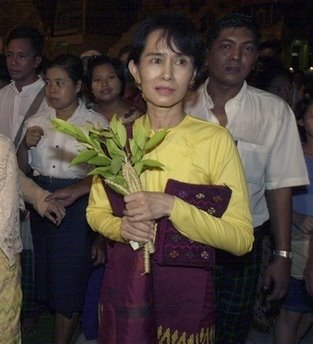


 Posts
Posts


