News & Articles on Burma
Saturday, 27 August, 2011
--------------------------------
Burma MPs propose prisoner amnesty: state media
Will Burma really listen to the UN Rights Envoy?
Survival instinct steers Myanmar generals towards reform
Myanmar MPs propose prisoner amnesty: state media
Myanmar MPs propose prisoner amnesty: State media
Myanmar OKS Setting Up Of New Political Party
Burmese military agents plant a powerful bomb in Kachin quarter
--------------------------------------
Bangkok Post
Burma MPs propose prisoner amnesty: state media
Published: 27/08/2011 at 03:32 PM
Online news: Asia
Members of Burma's army-dominated parliament have called for a sweeping jail amnesty, state media reported Saturday, after a UN envoy called for the release of prisoners of conscience.
A general view of Myanmar's parliament in Naypyidaw. Members of Myanmar's army-dominated parliament have called for a sweeping jail amnesty, state media reported Saturday, after a UN envoy called for the release of prisoners of conscience.
A proposal for a general amnesty was raised in the lower house on Friday, the New Light of Burma reported.
"They firmly hope that the president would make (an) assessment and release an order of amnesty," the newspaper said, without giving further details on who would be included.
The plight of around 2,000 political prisoners, many of whom are serving double-digit jail terms, is a key concern of the international community, along with other human rights abuses and democratic reforms.
It is the first time that serving military members of parliament have taken part in a discussion of a general amnesty since a nominally civilian government took over in March. A quarter of seats are reserved for the army.
The regime, which came to power after controversial November elections, appears keen to improve its image and recently held the first talks between democracy icon Aung San Suu Kyi and President Thein Sein, a former general.
But the UN special rapporteur on human rights in Burma, Tomas Ojea Quintana, said serious concerns remained as he concluded a visit to the country on Thursday.
The UN envoy, who visited Rangoon's notorious Insein jail during his five day trip, voiced fears over allegations of torture during detention and the use of prisoners as porters for the military.
"Of key concern to me and the international community is the continuing detention of a large number of prisoners of conscience," Quintana said.
In a move that rights groups said was woefully insufficient, Burma reduced all current jail sentences by one year in May and commuted the death penalty to life imprisonment.
Amnesty International said that political detainees are imprisoned using vague laws that criminalise peaceful political activists. They are held in poor conditions and moved to jails far from their homes and families.
Opposition leader Suu Kyi was freed from seven years of house arrest in November shortly after the election, Burma's first in 20 years.
Quintana, who also held talks with the Nobel laureate last week, urged Burma's parliamentarians, many of whom shed military uniforms to contest the election, to hold "open and inclusive debates on issues of national importance".
--------------------------------------
Will Burma really listen to the UN Rights Envoy?
By Zin Linn Aug 27, 2011 8:12PM UTC
Human Rights Special Rapporteur Mr Thomas Ojea Quintana on his Burma tour from 21 to 25 August separately met Union Parliament Speaker Thura Shwe Mann, National Parliament Speaker Khin Aung Myint, Union Chief Justice Tun Tun Oo, Chairman of the Union Election Commission Tin Aye, Union Minister for Home Affairs Lt-Gen Ko Ko, Union Minister for Defence Maj-Gen Hla Min, Union Minister for Foreign Affairs Wunna Maung Lwin, Union Minister for Labour and for Social Welfare, Relief and Resettlement Aung Kyi, Union Attorney-General Dr Tun Shin and Deputy Chief of the Police Force Police Brig-Gen Zaw Win.
The explanation of Union Parliament Speaker Thura Shwe Mann to the UN Envoy was published in the New Light of Myanmar on Thursday.
“As Myanmar (Burma) is a member of the international community, it has embraced the opportunities to address democracy and human rights cases like the global community. Though, every country has different processes from other countries based on own culture, custom and historical background. As the Human Rights Special Rapporteur reviewed, Myanmar is on the correct path to democracy and will continue to march along the correct path,” Thura Shwe Mann said.
He also said, “Necessary laws will be ratified to make sure that Parliament representatives serve the public interest or bring about the people’s fundamental rights, democracy and human rights without party attachment, localism, racism and regionalism. So, the existing laws will be under review to abrogate and amend inconsistent ones and endorse new ones. Only then will multiparty democracy rights will do well in future. The power to issue writs has been grant to bring democracy and rights to the people. The government, judicial bodies, service personnel and the people will abide by the enacted laws through the check and balance.”
He also said that Parliament representatives know that armed conflicts due to misunderstanding among national races do not bring any benefits to the nation. Hence Parliament committees include the Committee for National Races Affairs and Internal Peace in addition to the Committee of Fundamental Rights, Democratic Rights and Human Rights of Citizens.
He said that the Judicial and Legal Affairs Committee has been formed to handle legal affairs in an effective way. The Parliament committees carry out tasks inside Parliaments, so it is safe to say that the tasks are carried out by the public. The report on progress in addressing land confiscation cases will be submitted to the Parliament session, and the government’s Guarantees, Pledges and Undertakings Vetting Committee will watch and see, he explained.
Union Parliament Speaker wants the Human Rights Special Rapporteur to prevent the acts of certain countries and organizations that trouble Myanmar (Burma) and the people at a time when Myanmar and the people are working together for democracy and human rights.
Finally, Thura Shwe Mann said, Myanmar (Burma) will accept and appreciate Special Rapporteur’s suggestions, people’s stances and international community’s suggestions. Moreover, the Human Rights Special Rapporteur can watch what Myanmar is working for democratization, Speaker Thura Shwe Mann said.
Even though, the UN envoy called on Burma Thursday to immediately probe human rights abuses, saying serious concerns remained regardless of signs of progress under the new questionable civilian government.
He also expressed concern about the condition in ethnic conflict areas, including attacks against civilians, extrajudicial killings, sexual violence, arbitrary arrest, the recruitment of child soldiers and forced labor.
Mr. Quintana’s visit followed key opposition figure Aung San Suu Kyi met with President Thein Sein last week. It was a top-level talk with the government’s chief since her release in November, after a controversial election. Quintana also held talks with Suu Kyi during his most up-to-date trip.
Quintana has not been issued a visa to visit Burma since March 2010, when he suggested forming of a commission of inquiry. Quintana last visited Burma in February 2010 but was not allowed to see opposition leader Aung San Suu Kyi, who was under house arrest at the time. His consequential requests to revisit Burma have been refused.
In yesterday AFP News, Mr. Quintana, the UN special rapporteur on human rights in Burma said, “This is a key moment in Burma’s history and there are real opportunities for positive and meaningful developments to improve the human rights situation and bring about a genuine transition to democracy,”
According to him, the new government has taken a number of steps towards transition to democracy. However, many serious human rights questions are still to be addressed. He has been repetitively calling for the release of Burma’s estimated 2,000 political prisoners.
http://asiancorrespondent.com/63590/will-burma-really-listen-to-the-un-rights-envoy/
----------------------------------------
Survival instinct steers Myanmar generals towards reform
Saturday, 27 August 2011 02:22
By Martin Petty
Rare overtures by Myanmar’s reclusive, authoritarian rulers towards liberalisation and reform suggest change could be afoot in the isolated nation.
The sudden stream of conciliatory gestures by Myanmar’s new civilian government has raised questions about the motives of the generals who only five months ago controlled one of the world’s most secretive, corrupt and oppressive regimes.
Diplomats, political analysts and many Burmese interviewed inside Myanmar say the retired generals brought back to power after a controversial election last year now appear to realise some moves towards reform could be the key to their survival.
Last week, President Thein Sein held an official meeting with and Aung San Suu Kyi, the Nobel Peace Prize winning democracy advocate who was detained for 15 years until released from house arrest last year.
The meeting was welcomed by the international community, but widely regarded as theatre.
Western sanctions in place since the military crushed a 1988 student uprising have isolated Myanmar’s army dictatorships and continue to frustrate the new government, but there are no signs these will be lifted until there are concrete reforms, in particular, the release of an estimated 2,100 political prisoners.
“What seems to be happening is that the regime is seeking to make itself appear legitimate, a genuine and emerging democracy,” said Michael Charney, a Myanmar expert at London’s School of Oriental and Africa Studies.
“I don’t see any of this as a positive step forward for democracy, but instead as a means of cementing in place the positions of the families who currently hold power over the country with a view towards long-term control.”
The process of consolidating political power began long ago but accelerated in late 2009 when hundreds of state assets were auctioned off as part of an opaque privatisation boom in which cronies of the then-military junta snapped up lucrative contracts, business monopolies and property.
The sell-off preceded a carefully choreographed election in November that was won by a military-backed party. Thein Sein, the fourth in command of the former ruling military body, was chosen by parliament to become head of state. He hand-picked his own ministers.
PARIAH STATUS
The election and privatisation created a veneer of democracy and liberalisation in the former British colony also known as Burma, ensuring power, wealth and patronage was concentrated in the hands of a military-linked establishment, as previously seen in Indonesia and as now entrenched in neighbouring Thailand, where politics, business and the army are closely intertwined.
But despite those changes, Myanmar remains an international pariah, entangled in Western sanctions that restrict and stigmatise the country’s elite.
Experts suggest those tycoons may have leaned on the government to talk up reforms, engage with Suu Kyi and to try to appear more transparent and tolerant.
Western governments are watching, along with multinational companies, some of which have privately lobbied for an end to sanctions on the impoverished country of 50 million.
Recent overtures include calls for peace with armed ethnic separatists, presidential meetings with technocrats and foreign delegations, some tolerance of criticism, and the involvement of Suu Kyi in consultations about reconciliation and reform.
Yangon-based diplomats have expressed surprise at the government’s apparent change in tone but want to see more substantial progress.
“So far, so good,” said one Western diplomat. “I’m guardedly optimistic about further progress, but let’s wait and see.”
The mood is similar among parliamentarians. “Lawmakers, regardless of their party or background, have become more optimistic about the situation than before,” said Aye Maung, a senator and leader of the Rakhine Nationalities Development Party.
It is unclear whether Thein Sein is making the changes on his own or doing so at the request of Than Shwe, his political master and the country’s much-feared former strongman, whose orders are rarely defied.
David Steinberg, a veteran Myanmar analyst at Georgetown University in Washington said the lack of substantive concessions, especially political prisoners, meant real reforms or any undoing of sanctions would not come soon.
But he said the gestures were important indicators, and the government should be given the chance to prove itself.
“We’re seeing the possibility of change, things we’ve not seen before,” he said. “There’s a lot of disagreement from those who think this is phony change. It might be phony, but we should at least be open to the possibility some of it could be real.”
REUTERS http://www.thepeninsulaqatar.com/views/162796-survival-instinct-steers-myanmar-generals-towards-reform.html
-------------------------------------
Myanmar MPs propose prisoner amnesty: State media
Published on Aug 27, 2011
YANGON (AFP) - Members of Myanmar's army-dominated parliament have called for a sweeping jail amnesty, state media reported on Saturday, after a UN envoy called for the release of prisoners of conscience.
A proposal for a general amnesty was raised in the lower house on Friday, the New Light of Myanmar reported. 'They firmly hope that the president would make (an) assessment and release an order of amnesty,' the newspaper said, without giving further details on who would be included.
The plight of around 2,000 political prisoners, many of whom are serving double-digit jail terms, is a key concern of the international community, along with other human rights abuses and democratic reforms. It is the first time that serving military members of parliament have taken part in a discussion of a general amnesty since a nominally civilian government took over in March. A quarter of seats are reserved for the army. The regime, which came to power after controversial November elections, appears keen to improve its image and recently held the first talks between democracy icon Aung San Suu Kyi and President Thein Sein, a former general.
But the UN special rapporteur on human rights in Myanmar, Tomas Ojea Quintana, said serious concerns remained as he concluded a visit to the country on Thursday. http://www.straitstimes.com/BreakingNews/SEAsia/Story/STIStory_706571.html
---------------------------------------------
Radio Netherland Worldwide
Myanmar MPs propose prisoner amnesty: state media
Published on 27 August 2011 - 7:43am
Members of Myanmar's army-dominated parliament have called for a sweeping jail amnesty, state media reported Saturday, after a UN envoy called for the release of prisoners of conscience.
A proposal for a general amnesty was raised in the lower house on Friday, the New Light of Myanmar reported. "They firmly hope that the president would make (an) assessment and release an order of amnesty," the newspaper said, without giving further details on who would be included.
The plight of around 2,000 political prisoners, many of whom are serving double-digit jail terms, is a key concern of the international community, along with other human rights abuses and democratic reforms.
It is the first time that serving military members of parliament have taken part in a discussion of a general amnesty since a nominally civilian government took over in March. A quarter of seats are reserved for the army.
The regime, which came to power after controversial November elections, appears keen to improve its image and recently held the first talks between democracy icon Aung San Suu Kyi and President Thein Sein, a former general.
But the UN special rapporteur on human rights in Myanmar, Tomas Ojea Quintana, said serious concerns remained as he concluded a visit to the country on Thursday.
The UN envoy, who visited Yangon's notorious Insein jail during his five day trip, voiced fears over allegations of torture during detention and the use of prisoners as porters for the military.
"Of key concern to me and the international community is the continuing detention of a large number of prisoners of conscience," Quintana said.
In a move that rights groups said was woefully insufficient, Myanmar reduced all current jail sentences by one year in May and commuted the death penalty to life imprisonment.
Amnesty International said that political detainees are imprisoned using vague laws that criminalise peaceful political activists. They are held in poor conditions and moved to jails far from their homes and families.
Opposition leader Suu Kyi was freed from seven years of house arrest in November shortly after the election, Myanmar's first in 20 years.
Quintana, who also held talks with the Nobel laureate last week, urged Myanmar's parliamentarians, many of whom shed military uniforms to contest the election, to hold "open and inclusive debates on issues of national importance".
http://www.rnw.nl/english/bulletin/myanmar-mps-propose-prisoner-amnesty-state-media-0
----------------------------------------------------
August 27, 2011 10:57 AM
Myanmar OKS Setting Up Of New Political Party
YANGON, Aug 27 (Bernama) -- A new political party, Democratic Alliance Party (DAP), has been granted for establishment in Myanmar, according to the Union Election Commission on Saturday.
The establishment of the 17-member political party, inclusive of Dr. Soe Lin, has brought the number of political parties set up in the country in the post-election period to three, adding up to a total of 40 since last year's general election, reports Xinhua news agency.
In the multi-party general election held across Myanmar's seven regions and seven ethnic states on Nov 7 last year, 37 political parties including 82 independents took part and 1,154 candidates out of over 3,000 in the contest were elected as parliamentary representatives at three levels.
Besides the 1,154 elected parliamentary representatives, 388 or 25 percent were directly nominated by the military, bringing the total of the parliamentary representatives to 1,542.
The 659 union parliament representatives (house of representatives and house of nationalities) were made up of 493 elected ones and 166 or 25 percent directly nominated military ones.
Of the 493 elected parliamentary house of representatives and house of nationalities, 388 came from the Union Solidarity and Development Party (USDP), led by then Prime Minister U Thein Sein.
In the presidential election held at the first session of the union parliament on Feb 4 as a follow-up of the general election, U Thein Sein won the presidency and U Tin Aung Myint Oo and Dr. Sai Mauk Kham as vice presidents. All of the three represent the USDP.
The new government, led by President U Thein Sein, assumed office on March 30, 2011.-- BERNAMA http://www.bernama.com/bernama/v5/newsworld.php?id=610726
-----------------------------------------------------
Burmese military agents plant a powerful bomb in Kachin quarter
Published on Friday, 26 August 2011 07:50
du-kahtawng-EngA powerful TNT bomb planted by Burmese military agents in Myitkyina, in Kachin State, Northern Burma, was removed on Thursday (Aug. 25) before it exploded, according to witnesses.
The mine was put on the main electrical transformer near the Kachin Baptist Church, Quarter Administrative Office and Quarter Market, which is a crowded area, residents said.
According to night security guards in the area, they found the mine planted on the transformer after they checked a man with a motorcycle stopped in front of the quarter office about 1:30 a.m.
While they were questioning the man, two other men suddenly appeared on the road, one from transformer and another from quarter office. Then, the three men quickly drove away on one motorcycle, said sources from the guards.
Before the three military agents left, the man on the bike told the guards that he stopped there to refuel. The guards rejected his story and forced him to leave because there was no fuel shop, the sources added.
A piece of wire and a TNT mine was soon discovered at the transformer.
The Quarter Administrative Office confirmed to the Kachin News Group the mine was removed by a bomb squad from the Burmese Army’s Northern Regional Command, based in Myitkyina on Thursday.
The Myitkyina Police Station No. 1 declined to answer questions from the Kachin News Group concerning the event and suggested people can go and ask questions at the police station, not by phone.
The nominally civilian government, formed in March, keeps denying the KIO is a political armed group and officially labeled it as an insurgent (or a terrorist group), at its first press conference in Naypyidaw, on August 12.
The new civil war between the government and KIO started in Kachin State and Northern Shan State when the Burmese Army attacked the Kachin Independence Army (KIA) at Sang Gang on June 9 under the pretence of protecting the Taping (Dapein) dams in N’mawk (Momauk) Township, Manmaw (Bhamo) district, in eastern Kachin State.
Sunday, August 28, 2011
News & Articles on Burma -Saturday, 27 August, 2011-UZL


Saturday, August 27, 2011
News & Articles on Burma-Friday, 26 August, 2011-UZL
News & Articles on Burma
Friday, 26 August, 2011
--------------------------------
Analysis: Survival steers Myanmar generals towards reform
Change Burma Can't Quite Believe In
Nay Myo Zin Sentenced to 10 Years
Naypyitaw launches “peace” blitz
Political Prisoners' Release Remains Uncertain
Burma needs constitutional rectification to stop civil war
UN envoy urges Burma to probe rights abuses
Advisor: govt to form rights committee
Man with the plan in Myanmar
Will the Kyat Be Floated?
----------------------------------------
Analysis: Survival steers Myanmar generals towards reform
By Martin Petty
BANGKOK | Fri Aug 26, 2011 12:58pm IST
(Reuters) - Rare overtures by Myanmar's reclusive, authoritarian rulers toward liberalization and reform suggest change could be afoot in the isolated nation.
The sudden stream of conciliatory gestures by Myanmar's new civilian government has raised questions about the motives of the generals who only five months ago controlled one of the world's most secretive, corrupt and oppressive regimes.
Diplomats, political analysts and many Burmese interviewed inside Myanmar say the retired generals brought back to power after a controversial election last year now appear to realize some moves toward reform could be the key to their survival.
Last week, President Thein Sein held an official meeting with and Aung San Suu Kyi, the Nobel Peace Prize winning democracy advocate who was detained for 15 years until released from house arrest last year.
The meeting was welcomed by the international community, but widely regarded as theater.
Western sanctions in place since the military crushed a 1988 student uprising have isolated Myanmar's army dictatorships and continue to frustrate the new government, but there are no signs these will be lifted until there are concrete reforms, in particular, the release of an estimated 2,100 political prisoners.
"What seems to be happening is that the regime is seeking to make itself appear legitimate, a genuine and emerging democracy," said Michael Charney, a Myanmar expert at London's School of Oriental and Africa Studies.
"I don't see any of this as a positive step forward for democracy, but instead as a means of cementing in place the positions of the families who currently hold power over the country with a view toward long-term control."
The process of consolidating political power began long ago but accelerated in late 2009 when hundreds of state assets were auctioned off as part of an opaque privatization boom in which cronies of the then-military junta snapped up lucrative contracts, business monopolies and property.
The sell-off preceded a carefully choreographed election in November that was won by a military-backed party. Thein Sein, the fourth in command of the former ruling military body, was chosen by parliament to become head of state. He hand-picked his own ministers.
PARIAH STATUS
The election and privatization created a veneer of democracy and liberalization in the former British colony also known as Burma, ensuring power, wealth and patronage was concentrated in the hands of a military-linked establishment, as previously seen in Indonesia and as now entrenched in neighboring Thailand, where politics, business and the army are closely intertwined.
But despite those changes, Myanmar remains an international pariah, entangled in Western sanctions that restrict and stigmatize the country's elite.
Experts suggest those tycoons may have leaned on the government to talk up reforms, engage with Suu Kyi and to try to appear more transparent and tolerant.
Western governments are watching, along with multinational companies, some of which have privately lobbied for an end to sanctions on the impoverished country of 50 million people, which is rich in natural gas, timber and gemstones and nestled strategically between economic powerhouses India and China.
Recent overtures include calls for peace with armed ethnic separatists, presidential meetings with technocrats and foreign delegations, some tolerance of criticism, and the involvement of Suu Kyi in consultations about reconciliation and reform.
In one gesture, Myanmar's state-run newspapers last week dropped back-page banners attacking Western media. Three official newspapers dropped half-page slogans that had been running daily accusing the Voice of America (VOA) and the British Broadcasting Corp (BBC) of "sowing hatred among the people," and other Western media of "generating public outrage."
Yangon-based diplomats have expressed surprise at the government's apparent change in tone but want to see more substantial progress.
"So far, so good," said one Western diplomat. "I'm guardedly optimistic about further progress, but let's wait and see."
The mood is similar among parliamentarians. "Lawmakers, regardless of their party or background, have become more optimistic about the situation than before," said Aye Maung, a senator and leader of the Rakhine Nationalities Development Party.
It is unclear whether Thein Sein is making the changes on his own or doing so at the request of Than Shwe, his political master and the country's much-feared former strongman, whose orders are rarely defied.
Britain's Foreign Office praised the meeting with Suu Kyi as encouraging. Washington said it supported Suu Kyi's decision to engage in "open and transparent dialogue."
U.N. Secretary-General Ban Ki-moon went further, saying: "it is in the national interest that they seize the opportunity to extend and accept conciliatory gestures."
PUSH FOR ACCEPTANCE
Win Min, a Burmese political scientist at Harvard University, said he believed Myanmar's new government was trying to convince the 10-member Association of South East Asian Nations (ASEAN) to allow it to take its rotating presidency in 2014, two years ahead of schedule and a year before a general election the government does not want to lose.
The government, he said, saw hosting ASEAN as "crucial" because it would represent a degree of international acceptance that could lead to A reduction of sanctions and the possibility of aid from international financial organizations.
Myanmar has invited a delegation from the International Monetary Fund (IMF) to visit in October to advise policymakers on how to tackle problems with the kyat currency, which has appreciated 20 percent in a year, hurting farmers and exporters and bankrupting businesses.
After months of inaction and simmering anger, the government last month cut taxes for exporters and has promised agriculture loans and price guarantees for millions of farmers, suggesting it may be concerned that any mishandling of bread and butter issues could see a repeat of bloody uprisings in 1988 and 2007 that were sparked by soaring inflation and fuel prices.
David Steinberg, a veteran Myanmar analyst at Georgetown University in Washington said the lack of substantive concessions, especially political prisoners, meant real reforms or any undoing of sanctions would not come soon.
But he said the gestures were important indicators, and the government should be given the chance to prove itself.
"We're seeing the possibility of change, things we've not seen before," he said. "There's a lot of disagreement from those who think this is phony change. It might be phony, but we should at least be open to the possibility some of it could be real."
(Additional reporting Aung Hla Tun in Naypyitaw; Editing by Jason Szep and Miral Fahmy) http://in.reuters.com/article/2011/08/26/us-myanmar-politics-idINTRE77P1DM20110826?rpc=401&feedType=RSS&feedName=lifestyleMolt&rpc=401
----------------------------------------
THE WALL STREET JOURNAL: AUGUST 26, 2011
Change Burma Can't Quite Believe In
The country's democrats have higher aspirations than the junta's small moves at poverty alleviation.
By KELLEY CURRIE
"I think the president wants to achieve real positive change." So said Burmese democracy leader Aung San Suu Kyi, in the days after she met President Thein Sein. The event itself was a surprise, her first meeting with a senior regime official since 2002. For his part, Thein Sein has recently called on political exiles to return home, announced a "peace overture" to ethnic nationalities, and supported key macro-economic policy reforms.
These and other hints of change have Burmese and outside observers wondering whether the regime's superficial transition from military junta to civilian dictatorship over the past year might presage something more meaningful. While the history of the Burmese regime warrants skepticism, the excitement this has aroused shows that even an unserious reform effort could pose a serious challenge for Burma's democratic movement.
One plausible explanation for the overtures is that the regime, or at least significant segments of it, has realized that if it opens up and rationalizes the Burmese economy, including creating a more stable regulatory environment, it can make an end run around Ms. Suu Kyi while turning its Western critics into willing investors in Burma's economy. For years the Burmese junta's generals have complained that the West subjects them to a double standard. They look at China, Vietnam and other non-democratic neighbors, and conclude that the West is punishing them for being a dictatorship while virtually ignoring a lack of democracy in other contexts where there is business to be done.
At the same time, Burma's neighbors have expended considerable effort to encourage the regime to open up its economy and adopt less draconian tactics. Even U.S. diplomats occasionally comment that they would like to see a Burma that looked more like China. Having decided that they want Burma to chair the Association of Southeast Asian Nations in 2014, the generals' cosmetic political reforms and newfound interest in poverty alleviation initiatives suggest they are experimenting with this strategy.
There should be no illusions that the regime as a whole is either willing or able to launch serious political and economic reforms of the type that are needed to rebuild Burma. The generals have talked about political and economic reforms before, and launched some during the Khin Nyunt era, only to retreat when senior leaders would not relinquish control.
Thein Sein's overtures come against a backdrop of continued detention of thousands of political prisoners, and fresh reports of Burmese army attacks on civilians in the Kachin, Shan, Mon and Chin states. Rumors of an increasingly bitter power struggle with Vice President Tin Aung Myint Oo raise serious questions about the degree to which Thein Sein can deliver on even preliminary reform plans.
Burma's dictators also face a challenge that their counterparts in other countries generally do not: a well-established democratic opposition in the National League for Democracy, whose 1990 election victory and charismatic leader endow it with high levels of legitimacy at home and abroad. Regime outreach to the NLD and ethnic nationalities is couched in terms of getting the holdouts to come to terms with the deeply flawed 2008 constitution. Doing so would necessitate the NLD disavowing its election victory and the ethnics relinquishing their means of preserving autonomy—clearly non-starters.
Beyond Ms. Suu Kyi's easily revocable freedom and some initial meetings with the regime, the changes to date amount to little more than a new tone. With the regime's credibility starting from such a low base, convincing its most persistent domestic and international critics ultimately will require irreversible steps toward reform. The NLD remains focused on the emergence of a genuine dialogue on national reconciliation. Such a dialogue would necessarily involve significant releases of political prisoners, substantial changes to the 2008 constitution, and a real peace process with ethnic nationalities to be taken seriously.
These would be big challenges for any government, and seem insurmountable for one as insecure and brittle as Burma's regime. If the regime instead began to implement some economic reforms that could benefit Burma's longsuffering citizens even as it failed to engage in serious national reconciliation, there likely would be tremendous pressure on the democratic movement to get on board "for the good of the Burmese people." While Ms. Suu Kyi has always expressed a willingness to work with the regime toward those ends, the democratic movement has insisted that political issues are at the root of Burma's economic problems and must be addressed in order for sustainable economic development to take root.
After years of abysmal economic policy and severe political repression, it is tempting to believe it is sufficient that the Burmese regime is moving toward slightly greater political and economic openness. But Burma's democrats have higher aspirations for their country, and their supporters should too. Those who support human rights and democracy in Burma should avoid pressuring Burma's democrats to pursue well-intentioned poverty alleviation schemes as a substitute for changing political structures designed to enrich and preserve the ruling clique. Instead the pressure should stay focused on political reform.
Ms. Currie is a senior fellow with the Project 2049 Institute, a Washington-based think tank. http://online.wsj.com/article/SB10001424053111904875404576529901338368160.html?
--------------------------------------
Nay Myo Zin Sentenced to 10 Years
By THE IRRAWADDY Friday, August 26, 2011
Nay Myo Zin, who worked as a volunteer for a blood donor group affiliated with the opposition National League for Democracy (NLD), was sentenced to 10 years in prison on Friday by Insein Prison Court in Rangoon, accused of breaking the electronic transactions act, Article 33(a).
Hla Myo Myint, a lawyer for Nay Myo Zin, said that he was arrested by the Special Branch on April 2 for no reason, and that his back was injured during interrogation. Nay Myo Zin was brought to court in a wheel chair, and recently received hospital treatment, his lawyer said.
The imprisonment of the former military officer comes just a day after United Nations Special Envoy Tomás Ojea Quintana discussed the release of prisoners with the Burmese authorities in Naypyidaw.
During Quintana's five-day visit to Burma he discussed with various ministers the torture and ill-treatment of political prisoners in Insein Prison, he said at a press conference to conclude his trip on Thursday.
In a UN statement, Quintana said, “In Insein prison, I heard disturbing testimonies of prolonged sleep and food deprivation during interrogation, beatings, and the burning of bodily parts, including genital organs. I also heard accounts of prisoners being confined in cells normally used for prison dogs as means of punishment.”
Nay Myo Zin graduated from Intake 30 of Defence Services Academy. He retired in 2005, and was arrested two days after the new civilian government led by President Thein Sein was formed in March this year.
Meanwhile, a court in Meikthila Township in Mandalay Division sentenced NLD member Aung Hla Myint to 16 months in prison for breaking a travel restriction that forbids him from leaving his home town of Tatkon. He was arrested after he went to Meikthila to attend a Martyrs’ Day Ceremony at the local NLD office. http://www.irrawaddy.org/article.php?art_id=21970
-------------------------------------
Naypyitaw launches “peace” blitz
Friday, 26 August 2011 12:35 S.H.A.N.
The embattled Shan State Progress Party / Shan State Army (SSPP/SSA), for the third time since the military campaign against it began in March, has been contacted by Burmese authorities to negotiate for peace, according to SSA sources.
“One thing that sets it apart from previous approaches is that this time the offer comes from the Shan State Government, and not Naypyitaw or the Burma Army,” and said Maj Sai La, the SSA spokesman, who added that he was still waiting for further details.
According to other reports, Mon, Karen and Kayah (Karenni) state governments have also sent members of the religious order to get in touch with armed resistance movements in each state.
The latest move followed the 18 August announcement by Naypyitaw inviting “national race armed groups wishing to make peace” to peace talks.
According to Myanmar News Agency, the People’s Assembly has also appointed U Thein Zaw, a former general and a Union Solidarity and Development Party (USDP) MP, as chairman of the National Race and Internal Peacemaking Committee. His counterpart in the National Assembly is U San Tun, another USDP member.
However, according to Khonumthung News, no other committee members have been appointed so far.
Col Sai Htoo, the SSPP’s Assistant Secretary General #2, maintained that the group, as a key member of the newly formed United Nationalities Federal Council (UNFC), is against Naypyitaw’s policy to hold “group-wise” peace parleys. “It is time President Thein Sein talked to the UNFC directly,” he said.
Others pointed out that throughout the 63 years after Independence, successive governments had employed the strategy of negotiating with individual groups instead of their alliance. “If it had worked, we wouldn’t be fighting today,” said a politician, who requested anonymity. “It’s time we gave their alliance a chance.”
One stumbling block to the expected talks however is that while Naypyitaw insists on holding talks on the basis of 2008 constitution, the alliances particularly the UNFC says the basis must be the 1947 Panglong Agreement that had guaranteed autonomy, democracy and human rights for the non-Burman states.
Another snag is the vague wording of the 18 August announcement which urges armed groups “wishing to make peace” to contact State or Region government concerned in order “to launch preliminary programmes” upon completion of which, the government will form a team for peace talks.
So far, no group has been able to explain what the “preliminary programmes” entail. “The regime needs to make itself clear about this,” commented Col Okker, leader of the PaO National Liberation Organization, another UNFC member.
http://shanland.org/index.php?option=com_content&view=article&id=3984:naypyitaw-launches-peace-blitz&catid=85:politics&Itemid=266
---------------------------------------
Political Prisoners' Release Remains Uncertain
By SAI ZOM HSENG Saturday, August 27, 2011
Despite growing expectations that a breakthrough on the issue of political prisoners was imminent, UN envoy to Burma Tomás Ojea Quintana leaves the country with no guarantees for their release.
According to state-run The New Light of Myanmar (NLM), officials in Naypyidaw told the United Nations Special Rapporteur on Thursday that “political prisoners will be released when they are certain not to disrupt the nation's stability and peace.”
The statement was reportedly made by Upper House Speaker Khin Aung Myint in response to a question by Quintana regarding the detention of political prisoners and Shan politicians, land confiscations, and the teaching of ethnic languages at schools.
On Friday, NLM quoted Khin Aung Myint as saying: “The present government is very moderate; that any government [sic] does not want to put its people behind bars, sacrificing the labor of the nation.”
According to NLM, Quintana told government officials during his visit to Naypyidaw that Burma is on the right track toward reforming into a democratic country. He said that the UN secretary-general, the Association of Southeast Asia Nations, and the people who report on the human rights situation in the country are urging the government to release political prisoners because it is the main key in the formation of a democratic country.
However, despite the House Speaker's statement regarding the release of political prisoners, Burma's Chief Justice Tun Tun Oo was quoted in NLM as saying: “There is no prisoner serving a term for his belief. Prisoners are all serving their terms for the crimes they have committed.”
Tun Tun Oo said that the country's judges should stay away from politics and, under the present judicial system, they must handle cases in accordance with the constitution. He also said that the judiciary is one of the three sovereign powers of a nation.
At a press conference on Thursday evening to conclude his five-day visit to the country, UN envoy Quintana said that serious human rights issues remain in Burma despite positive steps by the authorities. He urged the government to intensify its efforts to implement its own commitments and to fulfill its international human rights obligations.
“Another concern is the continuing allegations of torture and ill treatment during interrogation, the use of prisoners as porters for the military, and the transfers of prisoners to prisons in remote areas where they are unable to receive family visits or packages of essential medicine and supplemental food,” Quintana said.
“In Insein prison, I heard disturbing testimonies of prolonged sleep and food deprivation during interrogation, beatings, and the burning of bodily parts, including genital organs. I also heard accounts of prisoners being confined in cells normally used for prison dogs as means of punishment,” he added.
Bo Kyi, the joint-secretary of the Assistance Association for Political Prisoners (AAPP), said that the Burmese government has been lying to the international community for a long time by saying that there are no political prisoners in Burma.
“The use of the words ‘political prisoners’ is included even in prison guards' handbooks,” he said. “Some prison directors still use the expression. When the government says there are no political prisoners, it shows that their activities and their words don't match.”
According to AAPP data, there are more than 2,000 political prisoners in the country.
Burma's opposition National League for Democracy, which is led by Aung San Suu Kyi, already addressed with Quintana issues surrounding the 2003 Depayin Massacre when dozens of party members were killed by a pro-government mob. http://irrawaddy.org/article.php?art_id=21969
---------------------------------------
Burma needs constitutional rectification to stop civil war
Fri, 2011-08-26 00:46 — editor
By - Zin Linn
Recently, Burma’s new government has released a number of statements indicating its willingness to reach settlement with ethnic armed-groups and political opponents, domestic and exile. Regrettably, those offers have been considered inconsistent.
According to the speech delivered by President of the Republic of the Union of Myanmar (Burma) U Thein Sein at the first Pyidaungsu Hluttaw (Union Parliament) second regular session, he and his government has been gearing up to work with the international community.
For instance, the president said, “Our government has inherited traditional foreign policy which has never been harmful to international and regional stability and security and it is maintaining friendly relations with global nations. What’s more, we are trying to stand tall as a dutiful member of the global family in international and regional organizations. For this reason, we have officially proposed to take the ASEAN chairmanship in 2014. We are extending the hand of friendship to all global nations and all international organizations including the ASEAN.”
It is obvious that President Thein Sein’s government has set its sights on being allowed to hold the chairmanship of the Association of Southeast Asian Nations (ASEAN) in 2014, a year before the country’s next scheduled polls.
Although Thein Sein’s government seems to make softer its political stance against its opponents in recent weeks, it fails to do more tangible improvement. For example, the release of political prisoners and approval of settlements with ethnic armed-groups are still delayed as yet.
However, Thein Sein emphasized that his new government was working for “citizen rights.”
“We are ready to co-operate with the international community,” he underlined.
Even though, the Thein Sein government turns a deaf ear to calls for the release of political prisoners. Besides, the government repeatedly declares the National League for Democracy, led by Suu Kyi, an unlawful party.
In addition, Thein Sein told members of parliament that his government will pay attention to oppositions’ suggestions. He said the government has already prepared to talks on peace with armed ethnic groups since the progress of the frontier areas is dependent on stability.
But, the Kachin Independence Organization (KIO) has rejected an offer of new peace talks from the government. On August 18, the government proposed joining in peace talks towards ethnic armed groups. But, it was dumped by the KIO and the United Nationalities Federal Council (UNFC), because the government uses merely bilateral meeting which really is a divide-and rule policy towards ethnic groups without considering the Panglong Agreement.
Lar Nan, Joint-General Secretary-2 of the KIO, said it will not talk bilaterally any more with the government since such negotiation failed in the past. Talks between the KIO and the Burmese government were also abortive in 1963, 1972, and 1980 respectively; they all failed to get to the bottom of the political standoff between the two sides.
Currently, KIO declared that it will talk through the ethnic alliance, the United Nationalities Federal Council (UNFC), keeping on the spirit of the Panglong Agreement.
On the contrary, the military-backed Burmese government announced its rejection of peace talks based on the principles of the 1947 Panglong Treaty to the Kachin Independence Organization (KIO) on the weekend, according to the Kachin News Group. The government sticks to the 2008 controversial constitution as the guideline for the peace talks.
On August 15, in response to charges during August 12 press conference by information minister Kyaw Hsan, the Restoration Council of Shan State / Shan State Army (SSPP/SSA) issued a statement urging all parties concerned to revitalize the 1947 Panglong Agreement signed by the Burmese leader Aung San and leaders of the (then known as) Frontier Areas, Shan Herald Agency for News said.
SSPP/SSA says in its statement, “Instead of regarding ethnic peoples as enemies and accusing them as subversive elements, it’s high time national reconciliation was being forget by the present authorities on the basis of equality, justice and the Panglong Agreement.”
The historic agreement basically guaranteed self-determination of the ethnic minorities and offered a large measure of autonomy, including independent legislature, judiciary and administrative powers. However, the dream of equality and a federal union is far from being realized some six decades after signing the Panglong Agreement.
Burma’s new Constitution, approved in a May 2008 referendum, is inundated with misleading principles. It says the country must be united under one military command. To bring the ethnic groups in line with this proviso, the military regime has ordered all armed rebel groups to become part of Burma’s border guard force ahead of the 2010 election.
Ethnic minorities have been suffering through five decades of brutal military operations in the name of national unity. Attacks on these rural civilians continue on a daily basis. There is a constant demand from Burma’s ethnic groups to enjoy equal political, social and economic rights. The Constitution must guarantee the rights of self-determination and of equal representation for every ethnic group in the Parliament. It must also include provisions against racial discrimination.
At the June-2004 National Convention, 13 ceasefire groups submitted a political proposal demanding equal access to the plenary session. But the convention’s convening committee dismissed the proposal as improper. When the 2008 Constitution came out, none of the political points proposed by the ethnic representatives were included.
There is a big gap between the military junta and the NLD led by Aung San Suu Kyi. To the military autocrats, allowing the ethnic minorities to enjoy equal political, social and economic rights is a hazard to national unity and sovereignty. To the NLD and ethnic alliance parties, granting equal rights to ethnic minorities will guarantee peace, stability and prosperity of the country.
In his latest speech, President Thein Sein said, “We know what happen to people and what people want. And we are striving our best to fulfill their needs to the full extent. To conclude my speech, I promise that our government as a democratically-elected government will do our best for the interests of the people.”
If the president really knows what people want, he should think about amending of the controversial constitution in which none of the political aspirations suggested by the ethnic representatives was integrated. If the current government truly committed to start political reforms, the first thing it should take into consideration is providing access to debate on constitutional flaws in the parliament.
Without a debate on the 2008 Constitution by all stakeholders, Burma will not win through its political catastrophe.
If the president wanted to do his best for the interests of the people, he should not be a dogmatist sticking to the unreasonable bill which will prolong the ongoing civil war.
- Asian Tribune - http://www.asiantribune.com/news/2011/08/25/burma-needs-constitutional-rectification-stop-civil-war
--------------------------------------------
Bangkok Post
UN envoy urges Burma to probe rights abuses
Published: 26/08/2011 at 03:32 AM
Online news: Asia
A UN envoy called on Burma Thursday to urgently investigate human rights abuses, saying serious concerns remained despite signs of an improvement under the new nominally civilian government.
A UN envoy called on Myanmar Thursday to urgently investigate human rights abuses, saying serious concerns remained despite signs of an improvement under the new nominally civilian government.
"This is a key moment in Burma's history and there are real opportunities for positive and meaningful developments to improve the human rights situation and bring about a genuine transition to democracy," said Tomas Ojea Quintana, the UN special rapporteur on human rights in Burma.
"The new government has taken a number of steps towards these ends. Yet many serious human rights issues remain and they need to be addressed," he said, calling for the release of Burma's estimated 2,000 political prisoners.
Quintana said he had "a frank and fruitful exchange of views" with government figures during his five-day visit, which follows recent signs that the regime is softening its stance towards opponents.
A civilian administration is now nominally in charge of Burma following a controversial election last year, but its ranks are dominated by former generals.
Quintana called on the government "to take the necessary measures for investigations of human rights violations to be conducted in an independent, impartial and credible manner, without delay".
The UN envoy, who visited Rangoon's notorious Insein jail earlier this week, voiced concern over allegations of torture during detention and the use of prisoners as porters for the military.
"In Insein prison, I heard disturbing testimonies of prolonged sleep and food deprivation during interrogation, beatings, and the burning of bodily parts, including genital organs," he said.
He also voiced concern about the situation in ethnic conflict zones, including attacks against civilians, extrajudicial killings, sexual violence, arbitrary arrest, the recruitment of child soldiers and forced labour.
His visit comes after opposition leader Aung San Suu Kyi met with President Thein Sein last week in the highest-level discussions with the authorities since her release in November, days after a controversial election.
Quintana also held talks with Suu Kyi during his latest trip.
After his visit to the country last year, the envoy angered Burma's ruling generals by suggesting that human rights violations in the country may amount to crimes against humanity and could warrant a UN inquiry. http://www.bangkokpost.com./news/asia/253554/un-envoy-urges-burma-to-probe-rights-abuses
-----------------------------------
Advisor: govt to form rights committee
By AHUNT PHONE MYAT
Published: 26 August 2011
An advisor to President Thein Sein, Dr Nay Zin Latt has said the government is to form a national-level, independent human rights committee to handle human rights issues in the country, but doubts remain about a future body’s autonomy.
Dr Nay Zin Latt, after meeting with UN Human Rights Rapporteur Thomas Ojea Quintana, told DVB that a constitution is being drawn up for the committee and will likely be announced in the near future;
“The President has told us to work on this since some time ago and we are currently working on it. Actually, we had groups like this in the past but they were not properly organised,” said Nay Zin Latt.
“This time, we are forming a committee that is capable of working on a broad range of human rights issues.”
“You will see an organisation that is free from government’s influence and is capable of working independently,” he claimed.
Despite that Nay Zin Latt refused to disclose who would be on the committee.
The National League for Democracy’s (NLD) spokesperson and lawyer Nyan Win, however, said he was doubtful about the potential committee’s autonomy;
“If the [committee] is to be independent, then the government shouldn’t get involved – otherwise there will be limitations. It sounds like there will be improvements in the new committee than the previous one. But I’m still doubtful whether it would really be independent or not,” said Nyan Win.
“It is not likely that a few independent individuals would be able to protect our human rights. It would be more meaningful if they included more outside individuals to work together with government departments in forming the committee because otherwise these departments could collude – so we have to look at it from both sides.”
“Personally I’d prefer an organisation formed with independent and credible individuals,” he added.
Both Human Rights Watch and Amnesty International are not allowed to work officially inside Burma. Such groups have claimed that a UN commission of inquiry is necessary following years of alleged abuses by the government. Such a suggestion needless to say is rejected out of hand by the government.
Human Rights Watch voiced concerns that practices such as forced portering and using convicts as porters are continuing apace under the new regime. A report they penned indeed alleged that in January of this year alone some 700 convicts had been press ganged into the dangerous job of slave portering in war torn Karen state.
Whilst the issue of autonomy for any institution is problematic in the current political climate, with parliament filled with the ranks of the military. http://www.dvb.no/news/advisor-govt-to-form-rights-committee/17288
---------------------------------------
Man with the plan in Myanmar
By Shawn W Crispin
CHIANG MAI - When Myanmar President Thein Sein made his ground-breaking March 30 inaugural address, where the former military general made an unprecedented call for good governance and counter-corruption reforms, the text of the speech was lifted from an op-ed published a month before in the local The Voice weekly newspaper.
The author of the piece, Nay Win Maung, a policy wonk, journalist and outspoken advocate for reform, is in many ways at the forefront of Myanmar's still uncertain transition from military to democratic rule. People familiar with the copy flow say he has ghostwritten much of Thein Sein's reform script, including cues for his pro-democracy speech to parliament this week, as well as his high-profile conciliatory meeting last week with opposition leader Aung San Suu Kyi.
Nay Win Maung's non-governmental organization (NGO), Egress, has submitted over 200 policy papers to the previous and current governments, including instructional blueprints on how to make the transition from military to civilian rule. Since last year's general election, he says he has sent policy advice through a secret police channel to Thein Sein's "West Wing" at Naypyidaw, Myanmar's newly built reclusive capital.
"Things are getting better," Nay Win Maung said in a recent interview in the northern Thai city of Chiang Mai, where he was delivering a lecture to ethnic minorities about their rights under the 2008 constitution. "We have received a lot of requests for policy papers from the president. We're in a position to shape the new government's policy agenda," he said.
To his proponents, Nay Win Maung represents a hopeful "Third Force" to break the decades-old political impasse between Myanmar's military generals and the Aung San Suu Kyi-led political opposition. He has emerged as the darling of European diplomats, international aid groups and humanitarian dialogue outfits keen to work for change and reconciliation from inside Myanmar, one of Asia's poorest and most isolated countries.
To his critics, he is an apologist for military-led incremental change and front man for plans presented as economic reform to privatize and redistribute the country's riches among a narrow military-linked elite - of which, they say, Nay Win Maung is part and parcel. Others see his Egress as a military-built "Trojan Horse" among unsuspecting European donors who believe they are supporting organic democratic change from within, but in the process are being hoodwinked into abandoning their commitments to pro-democracy groups in exile.
"It's a conditional reform process that comes at the expense of people who should be involved," says David Mathieson, Human Rights Watch's Myanmar researcher, referring to the 2,100 political prisoners still held behind bars. "Myanmar needs more pluralism, more voices and more debate, but in large part Egress has a monopoly on the discussion ... Nay Win Maung is not pushing for more people to be involved, and it is one of his shortcomings."
To Nay Win Maung, Myanmar's malaise is more a problem of economic mismanagement than political participation. Several of his policy proposals, he says, emphasize the need to break from personalized official decision-making and move towards more institutionalized, technocratic policy-making, concepts he honed while studying as a visiting world fellow at Yale University in 2004. His Yale bio says, "Trained as a medical doctor, Maung now sees himself as a policy critic and leading advocate for economic and political reform in Myanmar."
He's also taken academic interest in the country's international affairs. In one recent paper, he claims to have proposed a way ahead for bilateral relations with the United States, which maintains punitive economic and financial sanctions against the military regime and its business associates. As a gesture of goodwill, he suggested that military leaders should have signaled to Washington a week in advance, rather than springing as a surprise, its plan to release Suu Kyi from house arrest after last year's elections.
Slow and gradual
Nay Win Maung's views on the need for gradual rather than big-bang change have won him proponents among certain Western governments. Many of them carp about the slow pace of reform, Suu Kyi's perceived abstinence to compromise, and the ineffectiveness of the opposition in exile. Egress has emerged as the primary channel for their redirected donations, and currently reportedly receives funding and support from the United Kingdom's DFID, Sweden's SIDA and Germany's Freidrich Ebert Stiftung Foundation, among others.
Registered as a non-profit organization, Egress now operates on a US$1 million annual budget, according to Nay Win Maung. The organization is divided into training and research units that often invite foreign academics, including Westerners from the National University of Singapore, to give (somewhat ironically) seminars and training on civil society. The outfit also specializes in journalist training, notably in one of the world's most censored and repressed media environments.
Others wonder whether Nay Win Maung is the free thinker he portrays, or rather a slick, foreign-friendly spokesman for the old military order and its desire to be removed from Western sanctions lists. Egress is backed by the Myanmar Chamber of Commerce (MCC), which helped to first initiate the organization. Until recently the MCC was led by Win Myint, a military-linked businessman blacklisted by the European Union, and is included on the US's sanctions list due to its association with the previous Than Shwe-led junta.
Exile media groups, meanwhile, point suspiciously to the preference and privilege Nay Win Maung and Egress appear to receive from authorities, noting that he is free to travel outside of the country without restriction and is often willingly quoted in the foreign media without fear of government reprisal while their in-country reporters operate from underground or are in prison.
"He's being used by both sides, diplomats and the government," says a Yangon-based journalist who claims to know him well. "He tells the government 'I'll convince the international community the elections were credible.' He tells the diplomats 'I am your connection to the new era opening in the country.' ... I think he's misrepresenting the story to both sides."
Nay Win Maung chalks up his special position - or "safety net", as he puts it - to his family's military pedigree. His father and mother both served as professors at Myanmar's equivalent of the US's West Point Academy and several of his father's students have risen to high military ranks. Nay Win Maung recalls many of them, including current President Thein Sein and Lower House speaker Thura Shwe Mann, visiting his family home when he was young.
Despite that top brass familiarity, Nay Win Maung claims to be walking on a razor's edge in his push for reform. Since 2004, government agents have twice searched his home over articles that appeared in his newspaper, including one that suggested the military should be under civilian government control. Between 2000-2004, he says he tried without success to get a proper newspaper publishing license because he was reportedly on a government "blacklist".
Before that, he helped to establish the Living Color news magazine with Ye Naing Win, son of former intelligence chief and prime minister Gen Khin Nyunt, who was overthrown in a 2004 intra-military purge. His The Voice newspaper has been suspended by government censors on at least 10 occasions, most recently last year for publishing an unsanctioned photo of Suu Kyi on its front page.
While such claims of personal repression give him street credibility with democracy-promoting Western donors, Nay Win Maung believes there is new space for constructive criticism only for those who uphold the 2008 constitution and the legitimacy of regime-led - rather than revolutionary - political change. He speaks openly about the corruption that plagued the outgoing junta, which he attributes to the unchecked discretionary powers of certain wayward military officials.
However, he saves his sharpest criticism for exile media and activists, who he readily portrays as increasingly irrelevant and out of touch with the country's new dynamic. He says those who believe that regime change through social upheaval, as attempted during the 2007 "Saffron" revolution, can instantly achieve democracy have an "overly simplistic" view of how such transitions have worked throughout history.
"They think if you just give power to the Lady [Suu Kyi], everything will be fine," he said. "I label them as naive. You need capacity-building before you can have democracy." Tongue in cheek, he suggests that those dissidents who favor regime change through upheaval could be held in an "air-conditioned prison hotel" on the outskirts of Yangon, where they would be free to meet with foreigners and others operating on the "periphery" of the change underway in Myanmar.
That said, Nay Win Maung is not naive enough to believe recent incremental changes are irreversible. He contends that Thein Sein's reform drive is already being challenged by military hardliners who are loathe to accept reforms that will narrow their past discretionary powers and special privileges. "Thein Sein means change," says Nay Win Maung, "but it's just as likely the situation ends in a military coup."
Shawn W Crispin is Asia Times Online's Southeast Asia Editor.
http://www.atimes.com/atimes/Southeast_Asia/MH26Ae01.html
-----------------------------------
Will the Kyat Be Floated?
By YENI Friday, August 26, 2011
As Burma's president, former general Thein Sein, acknowledges that the country's economy is struggling under the weight of multiple challenges, the question that is foremost on many minds right now is how his government will restructure a foreign-exchange regime that is fast becoming his administration's most pressing problem.
Since the beginning of this year, the Burmese currency, the kyat, has appreciated by more than 25 percent, putting severe pressure on the country's export sector and threatening any effort to restart the economy after decades of stagnation under direct military rule.
Currently sitting at around 750 kyat to the dollar, compared to more than a 1,000 kyat to the US unit a year ago, the exchange rate received a rare mention by a Burmese ruler last week, when Thein Sein, speaking to an audience of economists, businessmen and local aid organizations, said on Wednesday that the strengthening local currency is hurting the economy.
To reduce the burden on exporters, the government has cut export revenue tax on seven items—rice, beans and pulses, sesame, rubber, corn, marine products and animals and animal products—from 7 to 2 percent, and given them an exemption from commercial tax for a period of six months, from Aug 15 to Feb 14, 2012.
“We very much welcome the government's decision to provide a tax cut,” said Hla Maung Shwe, the vice-chairman of the Myanmar Fisheries Federation—adding, however, that with a loss in revenue of around 25 percent, “exporters are still feeling the pinch.”
There are several reasons for the appreciation of the kyat. Besides the declining value of the dollar worldwide, other factors include high oil and gas prices (Burma's biggest export is natural gas) and a spending spree by cronies of the military elite, who in the run up to this year's transition to ostensibly civilian rule used their massive dollar reserves to buy up property, gems and state assets.
The danger now, say experts, is that the exchange rate could reach a point where repatriated earnings from exports are no longer sufficient to cover the costs of production, inflicting huge losses on businesses that could force enterprises to shut down.
Another problem that could emerge is that locally manufactured goods could be squeezed out of the domestic market by cheap imports—something that would have far-reaching effects on an economy that has long been geared to self-sufficiency.
“The economic, social and political consequences of this chain of events could be serious,” wrote U Myint, a leading Burmese economist and the top economic advisor to Thein Sein, in a recent paper addressing the exchange-rate issue.
If any good has come of this situation, it is that Naypyidaw seems to be taking U Myint's warning to heart. The government recently told Burmese business leaders that it was preparing to change the official exchange rate, currently set at around six kyat to the dollar, and would soon terminate its use of Foreign Exchange Certificates (FECs), which are circulated in place of US dollars domestically.
Dumping an unrealistic and grossly inefficient system that has long distorted the country's economy is definitely a step in the right direction, but it is one that will require a degree of expertise that is completely lacking among the country's key decision makers.
That's why the government has turned to the International Monetary Fund (IMF) for advice. This will first of all involve asking Naypyidaw to provide key macroeconomic data, such as foreign exchange reserves, balance of payments, national budget, money supply, and GDP—including its sectoral composition and growth rate—household income and expenditures surveys, foreign direct investment inflows, and foreign trade statistics.
There is little, however, that the IMF can do in practical terms.
Because Burma hasn't paid back its debts to multilateral financial institutions—and because the US wields effective veto power over the IMF—the country is barred from receiving and new financial aid.
That shouldn't matter, however, because Burma is believed to have abundant foreign exchange reserves (thanks to its sales of gas, gems and other natural resources), which it would need if it decided to simply float the kyat, discarding a fixed exchange rate that has long since ceased to have any relation to economic reality.
Floating the kyat “would require quite literally little more than the stroke of a pen,” according to Australian economist Sean Turnell, an expert on Burma's economy at Macquarie University.
In fact, introducing a floating currency would only be a matter of making official the informal system that has long been in place in Burma, where for decades most international transactions have been based on an unofficial exchange rate determined by market forces.
If the Burmese government allowed the kyat to float, it would reduce bureaucracy, increase economic freedom and hinder those elements that use the current exchange-rate arrangements as a vehicle for corruption.
The only danger, however, is that bringing a degree of common sense to Burma's exchange rate system could create the false impression that the country's economic problems can be solved without other, more fundamental changes.
“The exchange rate issue is important, but it's far from the most serious of Burma's economic problems, which have their roots in the lack of property rights, reasonable policy making, a voracious state apparatus, etc,” said Turnell.
According to a 2008 paper by Dr. Tin Soe, a former professor and head of a department at the Rangoon Institute of Economics, Burma's economy since the early 1960s, when the country first came under military control, has been characterized by “inconsistency, instability, interruption and discontinuation, rigidity and limited scope and vision, lack of transparency, unpredictability and uncertainty, quantitative physical targets-orientation, inefficient and ineffective implementation and use and abuse of consultancy and advisory services.”
In other words, if Thein Sein really wants to make a difference, his government will have to break half a century of bad habits. Floating the kyat would be a start, but it will take much more than this to clean out the Augean stables of Burma's economy. http://www.irrawaddy.org/article.php?art_id=21971
__._,_.___
Friday, August 26, 2011
News & Articles on Burma -Thursday, 25 August, 2011-UZL
News & Articles on Burma
Thursday, 25 August, 2011
------------------------------------
Deadly Clashes Continue in Northern Burma
Depayin Massacre, NLD's Status Highlighted in UN Envoy Meeting
Myanmar human rights challenges remain, UN envoy says
Burma Needs to set up IDP camps, Shan MP advised
Time not right for Thai push back
Burma’s Insein prison conditions better: UN envoy Quintana
Large demand for micro-credit in Burma
Suu Kyi says Burma president wants 'real change'
Constitutional Amendment Becomes Key Issue Under New Govt in Burma
---------------------------------------
Deadly Clashes Continue in Northern Burma
By BA KAUNG Thursday, August 25, 2011
Despite Burmese President Thein Sein's recent call for peace talks, deadly clashes continue to flare between government forces and armed ethnic Kachin rebels in the country's troubled north.
On Wednesday, the 10,000-strong Kachin Independent Army (KIA) engaged the Burmese army in hostilities which left three government soldiers dead in an area called Namphatkar, between Kutkai and Muse townships in Shan State.
The KIA seized a number of small arms from the government troops, according to Col. Zau Raw, the Shan State regional commander of the KIA.
He said that the deadly confrontation flared following the government's deployment of troops in the area to protect convoys of military trucks—which Naypyidaw bought from China's Yunnan province in July—travelling from the Sino-Burmese border.
A day earlier, on Tuesday, low-intensity fighting broke out between the two sides in Hpakant Township in Kachin State, said a KIA official who said that further details were not yet known.
Armed clashes have been frequent between the KIA and the Burmese army since early June in Shan and Kachin states, many of the skirmishes erupting near the Tapaing hydropower plant built by China on a tributary of the Irrawaddy River. The hostilities bring to an end a 17-year ceasefire and take the northern Burmese region to the verge of a civil war. Tens of thousands of people have been displaced due to the fighting, and the hydropower plant has been shut down.
In discussions with Naypyidaw, the KIA's political wing, the Kachin Independence Organization (KIO) has demanded that the government open an inclusive political dialogue with all armed ethnic groups based on the pre-independence 1947 Panglong Agreement which guaranteed ethnic minorities basic autonomy in a federal state—a promise that never materialized.
But Naypyidaw has insisted that the KIA joins a border guard force under the central command of the Burmese army, and that the KIO participate in the national political process under the terms of the 2008 Constitution drafted by the previous military regime.
While a renewed ceasefire remains inconclusive, the Burmese president recently referred to the KIA as “a mere insurgent group,” which is not representative of people in Kachin State, a statement that infuriated the Kachin rebel leaders.
Earlier this week, the government asked many of the armed ethnic groups to conduct preliminary peace talks with regional and provincial governments, saying that only after such measures had been taken would further discussions with the central government in Naypyidaw be offered.
On Monday, Thein Sein told parliament that the government will strive to reduce conflicts with armed ethnic groups and opposition forces which have not accepted the Constitution.
The hostilities in northern Burma continue despite Thein Sein's meeting with opposition leader Aung San Suu Kyi last Friday in Naypyidaw, which generated optimism among the opposition groups that the government was moving toward political and economic reforms.
Zau Raw said that ceasefire efforts have become increasingly difficult despite these apparent “olive branches” offered by the government which, in reality, continues to impose the Constitution upon the ethnic groups, including the KIA.
“We want to hold discussions based on the 1947 Panglong Agreement, but they want us to accept the 2008 Constitution,” he said. “Also, we want to hold discussions with the central government, not with a regional assembly.”
The US administration has said that the Burmese government must release all political prisoners in Burma, start a dialogue with opposition groups including Suu Kyi, and end human rights violations and military attacks against ethnic minorities before it considers lifting its punitive economic sanctions against the Southeast Asian nation. http://irrawaddy.org/article.php?art_id=21961
---------------------------------
Depayin Massacre, NLD's Status Highlighted in UN Envoy Meeting
By SAW YAN NAING Thursday, August 25, 2011
Leaders of Burma's opposition National League for Democracy (NLD) urged UN envoy Tomas Ojea Quintana to help them secure their party's existence, and addressed the Depayin Massacre of 2003 during their meeting in Rangoon on Thursday, said party spokesman Nyan Win.
Leading the NLD's legal team, Nyan Win said he submitted a proposal to the UN Special Rapporteur to Burma during their meeting, and that Quintana read all the documents before returning them.
The UN envoy reportedly told Nyan Win that he was not a legal expert but that he will try to find a lawyer at the UN who can offer guidance to the NLD.
“As soon as he [Quintana] arrived at the UN office, he said he will arrange a trip for a legal expert to come to Burma to discuss the case with us,” said Nyan Win.
The Depayin massacre, which left at least 50 people dead, took place in Kyee village, on the outskirts of Depayin Township in Sagaing Division, central Burma in May 2003. It was launched by pro-junta group thugs who blocked the road to attack a convoy of vehicles carrying NLD leader Aung San Suu Kyi and her supporters. Some women were allegedly raped by the attackers during the massacre.
The NLD leaders told Quintana that their party was faced with restrictions until it was dissolved in 2010.
On Thursday, Quintana met with several former political prisoners, including a recently released Zayar Thaw, a hip-hop singer and prominent leader of Generation Wave, at a UN branch office in Rangoon.
Myat Thu, a former political prisoner who also met with Quintana, told The Irrawaddy on Thursday: “I focused on speaking about the need for the release of political prisoners as soon as possible. At the very least, political prisoners who have been detained far from their families should be relocated and detained in prisons close to their family homes.”
After her meeting with the UN envoy on Wednesday, Suu Kyi told reporters that Quintana is a person who knows well the issues of human rights and one who is actively engaged in promoting human rights in Burma.
The envoy will hold a press conference at Rangoon International Airport before he rounds off his five-day trip on Thursday evening.
Quintana sat in on a parliamentary session in Naypyidaw, which was attended by MPs of both the Lower and Upper Houses. He listened to calls by ethnic politicians calling for the release of political prisoners, and for allegations of human rights abuses by the Burmese army in ethnic areas to be investigated.
Quintana has been a vocal critic of the Burmese government and has previously proposed a UN Commission of Inquiry to investigate war crimes and crimes against humanity that have allegedly been committed by the Burmese army. http://irrawaddy.org/article.php?art_id=21962
--------------------------------------
Myanmar human rights challenges remain, UN envoy says
Aug 25, 2011, 13:47 GMT
Yangon - The new Myanmar government's human rights challenges remain despite recent steps towards rapprochement with opposition leader Aung San Suu Kyi, the United Nations human rights envoy for the country said Thursday.
'The new government has made some positive steps but the challenges for human rights remain,' visiting UN human rights envoy for Myanmar Tomas Ojea Quintana said in Yangon after completing a five-day assessment tour of the country, long deemed a pariah state in the West for its poor human rights performance.
Quintana's visit came at a time of an apparent thaw in relations between opposition leader Suu Kyi and the pro-military government.
On Friday, for the first time, Suu Kyi was invited to the capital in Naypyitaw for private talks with the new government's President Thein Sein.
'This is a big moment in Myanmar history, and there are rare opportunities for positive and meaningful developments to improve the human rights situation and bring about a transition to genuine democracy,' Quintana said in a press conference at Yangon Airport before his departure.
He urged the international community to remain engaged with the country, which has been under military rule since 1962, until a general election on November 7 brought a new pro-military government to power.
The special envoy echoed his boss' call for the new government to make further steps towards national reconciliation.
UN Secretary General Ban Ki-moon on Monday welcomed the meeting between Thein Sein and Suu Kyi as a positive step, but called on the government to release some 2,100 political prisoners jailed by the previous junta.
The government is also under scrutiny for its dealings with the ethnic minorities, several of whom have been the target of brutal military campaigns by the former junta.
In a letter to Quintana on Wednesday, a coalition of eight ethnic rebel groups called on the UN envoy to urge that the government restrain its soldiers from rape, burning villages, looting and confiscating properties.
The letter also asked that the envoy 'request tripartite peace talks immediately' between the ethnic groups, the government and Suu Kyi.
Besides meeting with senior government ministers Quintana als met with Suu Kyi, who has spent 15 of the past 21 years under house arrest, on Wednesday.
Quintana was only recently granted a visa after being denied entry to the country since March, 2010, when he angered the then-ruling junta by urging a UN inquiry into Myanmar's human rights record.
Myanmar has been the target of economic sanctions by Western democracies since 1988, when an army crackdown on pro-democracy demonstrators that left an estimated 3,000 dead.
The junta that ran the country between 1988 to 2010 has notched up one of the world's worst human rights records.
Although the current government is an elected one, it is packed with former military men.
The UN and Western nations have demanded clear signs that the new regime is committed to change, such as opening a dialogue with the opposition and ethnic minority groups that have been the target of military offensives.
http://www.monstersandcritics.com/news/asiapacific/news/article_1659103.php/Myanmar-human-rights-challenges-remain-UN-envoy-says
------------------------------------
Burma Needs to set up IDP camps, Shan MP advised
By Zin Linn Aug 25, 2011 5:49PM UTC
Sai Hsawng Hsi, elected representative from Shan Nationalities Democratic Party (SNDP), said Wednesday he had raised the topic of setting up Internally Displaced Persons (IDP) camps near the warzone in central Shan State, during the meeting with UN Rights Rapporteur Tomas Ojea Quintana, according to Shan Herald Agency for News (S.H.A.N.).
Sai Hsawng His said that many inhabitants are either hiding in the jungles or fleeing to the border. It will be appropriate to establish IDP camps around the warzone, he advised.
More than 300 clashes have taken place in Hsipaw, Tangyan, Mongyai, Monghsu and Kehsi townships between the Burma Army and the Shan State Army (SSA) since March, according to resistance sources.
According to Burma Center Prague (BCP)’s studies on IDPs, the constant warfare and conflict in Burma has resulted in a large number of internally displaced persons (IDPs). It mentioned that number of IDPs increased mainly in eastern Burma where Karen and Shan are living. It is estimated that between the years 1996 and 2006, over 1 million people became IDPs in Burma, most of who came from ethnic minorities.
According to a repost by the Internal Displacement Monitoring Centre, dated 19 July 2011, titled “MYANMAR: Displacement continues in context of armed conflicts – A profile of the internal displacement situation” , people displaced due to conflict in Myanmar (Burma) lack access to food, clean water, health care, education and livelihoods. Their security is threatened by ongoing fighting, including where conflict parties reportedly target civilians directly.
UNHCR used an estimate of 451,000 IDPs in Myanmar as its planning figure for 2010, while the Thailand-Burma Border Consortium (TBBC) estimated that in July 2010 at least 446,000 IDPs were living in the 37 surveyed townships (administrative sub-districts) in southern Shan, Kayah/Karenni, Kayin/Karen and Mon States and Bago/Pegu and Tanintharyi/Tenasserim Regions.
Of those IDPs, it was believed that 125,000 were living in relocation villages in government-controlled areas, 115,000 dispersed in hiding areas in the jungle, and 206,000 living in areas administered by ceasefire non-state armed groups NSAGs. The TBBC also reported that an estimated 73,000 of the IDPs in south-eastern Myanmar were newly displaced between August 2009 and July 2010, including some 26,000 people in northern Karen areas and some 8,000 in southern Mon areas (UNHCR, January 2010; TBBC, 28 October 2010, p.20).
To date, the Burma Army side is still reportedly deploying more troops to SSA- HQ Wanhai, according to local eye witnesses from Kehsi Township, Shan Herald Agency News (SHAN) said. Fighting between the two sides have been three months long since 13 March and had killed dozens of civilians including at least 300 casualties on the Burma Army side in the conflict zones. Most of the civilians were reportedly killed and injured by the Burma Army’s heavy shells, claimed the SSA.
It seems that the government is going ahead with its military might to resolve the ethnic armed rebellious problems, rather than political talks. Several political analysts believe that the military-backed Thein Sein government will not revise its oppressive guiding principle which insistently goes against the self-determination of the ethnic people.
However, President Thein Sein told members of parliament on Monday, at the first Union Parliament second regular session, that his government has already prepared for talks on peace with armed ethnic groups since the growth of the ethnic regions reliant on stability.
Then, the president ought to accept the findings of UN Rights Rapporteur Tomas Ojea Quintana and help the UN Envoy’s restoration of human rights values in the country. Besides, government must call for a nationwide ceasefire to all ethnic armed groups in order to start a meaningful political dialogue with all stakeholders.
At the same time, government should form respective missions to tackle the domestic war refugees and IDPs problems, in reference to goodwill advice of Sai Hsawng Hsi (MP of SNDP) who raised the IDP question during the meeting with UN Rights Rapporteur.
Without addressing and honoring the ethnic people’s political desire, the new parliament-based government will be unable to stop political and civil conflict throughout ethnic areas. If so, the country will continue producing more refugees and more IDPs in the years to come. http://asiancorrespondent.com/63393/burma-needs-to-set-up-idp-camps-shan-mp-advised/
--------------------------------------
Time not right for Thai push back
By MAHN SAIMON
Published: 25 August 2011
Surapong Kongchantuk, vice chairman of the Thai National Human Rights Commission’s sub-committee on ethnic minorities, the stateless, migrant workers and displaced persons, has said now is not yet the right time to repatriate refugees from Burma.
Kongchantuk was responding to a remark recently made by the governor of Thailand’s Tak province Samart Loifah. He had issued an order for refugee camps situated along the border in the region to make lists of their population to pre-empt a send back to Burma.
Kongchantuk however told DVB that we have yet to see tangible improvements;
“We sent a list of procedures for the concerned [Thai] government departments regarding the repatriation – that it should be voluntary and that their native country must be in a ready-state to accept them back,” Kongchantuk said.
“To decide whether the native country is ready or not should not be based on claims by the [Burmese government] alone but also needs to be inspected and approved by a UN organisation such as the United Nations’ High Commissioner for Refugees (UNHCR). So far, the UNHCR is yet to make any inspection about the real situation,” he added.
“This is not a case between just two countries but also concerns the international community. The Tak governor’s decision is irrelevantly premature and is causing a panic among the refugees.”
Samart Loifa made the orders after President Thein Sein’s remark on 17 August, that Burmese nationals living abroad in exile were allowed to go back to their home country.
He told the media that he was happy for Burmese refugees, who were forced to flee their homes, that they were allowed to go back to Burma and expressed a belief that this would bring peace to the Thai-Burma border region.
Saw Po Dan, chairman of Nupo refugee camp however said they had not received any order from Loifa as yet;
“There is no official order yet. [Loifa] came around our camp a couple of times in the past but he didn’t come in [the camp] – he just hung around outside and talked with camp officials. There was no clear order as yet,” said Saw Po Dan.
There are nearly 150,000 refugees living in nine refugee camps along the Thai-Burma border. Whilst commentators have welcomed what appears to be a relative softening of rhetoric from Naypyidaw, others have responded to invitations back and supposed offers of dialogue with some scepticism.
Far from a decrease in violence in the ethnic areas of Burma the past year has seen an escalation in fighting as the Burmese military has pursued greater incursions into Shan, Karen and Kachin areas.
The last of which has seen around 10,000 people internally displaced and the World Food Program commence delivering food aid to over 3,000 vulnerable people near Kachin state’s capital, Myitkina last week. http://www.dvb.no/news/time-not-right-for-thai-push-back/17272
--------------------------------------
Burma’s Insein prison conditions better: UN envoy Quintana
Thursday, 25 August 2011 13:13 Te Te
New Delhi (Mizzima) – The UN special rapporteur for human rights in Burma Tomas Ojea Quintana told a meeting of National League for Democracy (NLD) leaders that conditions in the infamous Insein Prison in Rangoon have improved.
NLD central executive committee member Win Tin said on Wednesday, “While we were talking about prisoners, he said that he inspected prisons. The prisoners’ conditions, especially in Insein Prison, are better than before. He said, prisoners told him that conditions had improved considerably.”
UN special envoy on human rights Tomas Ojea Quintana, center, leaves the home of Aung San Suu Kyi in Rangoon on Wednesday, August 24, after meeting with the opposition leader for about one hour. Photo: Mizzima
UN special envoy on human rights Tomas Ojea Quintana, center, leaves the home of Aung San Suu Kyi in Rangoon on Wednesday, August 24, after meeting with the opposition leader for about one hour. Photo: Mizzima
Quintana met with NLD central executive committee members in Aung San Suu Kyi’s home in Rangoon on Wednesday afternoon.
In the meeting, Quintana said that if all political prisoners were released, the government worries that they might stage protests again, and that’s why an amnesty was delayed, according to Win Tin. According to figures compiled by the Assistance Association for Political Prisoners-Burma, there were 400 political prisoners in Insein Prison as of May.
Before the meeting between Quintana and NLD leaders, Quintana met with opposition leader Aung San Suu Kyi for about 30 minutes. No details of that meeting were disclosed.
After the meeting, Suu Kyi told reporters, “He [Quintana] has a genuine willingness to improve Burma’s social conditions, and he has great experience, so I am encouraged. I see that we can rely on him.”
Quintana visited Insein Prison on Wednesday morning. A source close to the prison said that he arrived about 8:30 a.m. and left about 1:30 p.m.
“When he arrived at the prison, the doors of the prison wards were closed. We could not go anywhere. About a week prior to his visit, things [some prison walls] had been painted, and the prison was cleaned. Today, we had slightly good curries [for the inmates],” said a source close to the prison.
Quintana will hold a press conference to discuss his visit on Thursday in Rangoon. http://www.mizzima.com/news/prisoner-watch/5831-burmas-insein-prison-conditions-better-un-envoy-quintana.html
----------------------------------------
Large demand for micro-credit in Burma
Wednesday, 24 August 2011 16:08 Mizzima News
Chiang Mai (Mizzima) – Only about 10 per cent of the demand for small loans in Burma is being met, according to participants at a micro-finance workshop held recently in Rangoon.
The vast majority of those who do borrow are women.
The Microfinance Working Group in Burma held a best-practice workshop on August 16 to work out ways to provide more small loans to people, particularly in rural areas, according to a press statement recently released by the group.
About 70 participants attended the workshop including senior government officials, donors, UN staff, international and local NGOs and representatives from the private sector.
“In Myanmar [Burma], only 10 per cent of the total demand for micro-credit is met and the UNDP Microfinance Project is presently providing about 80 per cent of this micro-credit through PACT Myanmar, a non-profit organization,” said the United Nations Development Programme (UNDP) Resident Representative, Akbar Usmani. “Given the huge demand, the Microfinance Working Group is well placed to help further expand microfinance support services in Myanmar.”
Usmani said he welcomed the government’s latest initiative for rural development and poverty reduction under which micro-finance is one of the major components.
Micro-finance practitioners in Burma including the former deputy governor of the Central Bank, Than Lwin, PACT Myanmar, Groupe de Recherche et d'Echanges Technologiques (GRET), Save the Children, World Vision and UNDP shared their experiences on improving livelihoods through the creation of sustainable micro-finance services for poor rural communities.
As participants at the workshop made clear, the need for credit in the rural economy is substantial. Currently, the demand for micro‐credit in the rural segment of the Burmese economy is estimated at around US$ 470 million. Due to inadequate credit from the private and public banks, the rural poor rely on relatives or friends and money lenders as well as pawn shops for small loans, according to the press release.
Micro-finance loans and services provide a sustainable option for the poor by providing a diverse range of financial services, including savings, loans and some insurance products that support hundreds of thousands of micro-enterprises.
According to the Microfinance Working Group, offering loans with no collateral requirements and at interest rates well below those charged by informal moneylenders, affordable credit has been able to address the needs of more than 400,000 poor clients in a more economical manner.
From its infancy in July 1997, through the end of September 2010, the UNDP’s Microfinance Project has grown to become one of the 23 largest micro-finance projects in the world with more than 400,000 clients and with a loan portfolio of 36 billion kyat (approx. US$ 52 million). Its loan repayment rate has constantly attained a percentage of 98 per cent or higher. Women constitute 97 per cent of its clientele.
The Microfinance Working Group was formed in 2004, by local and international NGOs, in collaboration with the UNDP. http://www.mizzima.com/news/breaking-and-news-brief/5826-large-demand-for-micro-credit-in-burma.html
-------------------------------------
Bangkok Post
Suu Kyi says Burma president wants 'real change'
Published: 24/08/2011 at 09:32 PM
Online news: Asia
Burma's democracy icon Aung San Suu Kyi said Wednesday she believes the country's army-backed president wants "real positive change" amid warmer relations between the regime and its most famous critic.
Myanmar's democracy icon Aung San Suu Kyi speaks to the press after a meeting with UN rights envoy Tomas Ojea Quintana at her house in Yangon. Suu Kyi said she believes the country's army-backed president wants "real positive change" amid warmer relations between the regime and its most famous critic.
Suu Kyi met President Thein Sein on Friday in her highest-level discussions since she was freed from seven years of house arrest soon after a November election that was marred by claims of cheating and the absence of her party.
"From my point of view, I think the president wants to achieve real positive change," she told reporters on Wednesday.
Suu Kyi was warned to keep out of politics in June, but has since engaged in increasing dialogue with the government, which is nominally civilian but remains dominated by former generals.
The Nobel laureate was speaking after a meeting with Tomas Ojea Quintana, the UN special rapporteur on human rights in Burma, and said the pair had covered a variety of subjects including the fate of political prisoners.
It was the first meeting between the envoy and the democracy champion, who was locked up during his last visit in February 2010.
"I am really satisfied. I am encouraged to have seen him as he is an expert in this issue," she said of Quintana.
Burma allowed the UN envoy into the country for the first time in more than a year amid signs that the government wants to improve its international image.
Quintana described his discussions with Suu Kyi as "very important, fruitful and productive", in brief comments after the meeting.
The UN envoy, who has been an outspoken critic of Burma's rulers in the past, is due to hold a press conference on Thursday at the end of a five-day visit that has included a trip to the new parliament in Naypyidaw and talks with senior regime figures.
Earlier on Wednesday, Quintana visited Rangoon's notorious Insein prison, which is believed to hold some of Burma's around 2,000 political prisoners.
After his trip to the country last year, the envoy angered Burma's ruling generals by suggesting that human rights violations in the country may amount to crimes against humanity and could warrant a UN inquiry.
He has since been refused visas to visit several times.
The international community has called for a number of reforms in Burma including the release of political prisoners, improved human rights and dialogue with the opposition. http://www.bangkokpost.com/news/asia/253296/suu-kyi-says-burma-president-wants-real-change
---------------------------------
Constitutional Amendment Becomes Key Issue Under New Govt in Burma
By BA KAUNG Thursday, August 25, 2011
Over the past couple of weeks, the Burmese government led by ex-general President Thein Sein has made a series of moves, including an invitation to Burmese exiles to return home and a one-on-one meeting with pro-democracy leader Aung San Suu Kyi, seen by many as positive signs for the country.
In a speech to the country's new bicameral Parliament on Monday, Thein Sein reiterated his desire to reduce tensions with “forces that have not accepted the Constitution yet,” including Suu Kyi's National League for Democracy (NLD) party and ethnic armed groups.
These gestures have generated a lot of speculation among the Burmese public and other observers as to whether Burma's nominally civilian administration has embarked on a genuine process of gradual reform.
Much of this speculation has centered on last Friday's meeting between Suu Kyi and Thein Sein. While neither side has released any details about the substance of the talks, on Tuesday a government official told The Irrawaddy on condition of anonymity that the two sides discussed how Suu Kyi could help in lifting Western economic sanctions, in exchange for government cooperation with her future political trips.
On Wednesday, Suu Kyi told reporters following a meeting with visiting UN human rights envoy Tomás Ojea Quintana that Thein Sein wants to achieve “real positive change”.
To skeptics, however, these developments are reminiscent of Suu Kyi's meetings with leaders of the previous military junta in early 2000. After a period of confidence-building talks, relations eventually soured as Suu Kyi's travels around the country attracted massive crowds, prompting a violent incident by pro-regime thugs that resulted in Suu Kyi's arrest in 2003.
But for now, the new government seems prepared to deal with Suu Kyi on friendly terms, as it seeks to win greater international recognition of its legitimacy, most notably through its efforts to assume the chairmanship of the Association of Southeast Asian Nations (Asean) in 2014.
The continuing detention of around 2,000 political prisoners will, however, make it difficult for Asean to accede to the Thein Sein government's ambitions for a regional leadership role, and also stands in the way of any bid to lift US sanctions.
Likewise, continuing clashes with ethnic armed groups and well-documented reports of human rights abuses by the Burmese military in conflict zones weaken any case the government may try to make that it is on a serious path to reform.
It is, however, conceivable that the government will make some concessions—releasing a few hundred prisoners and suspending its offensives in ethnic areas—that could suffice to at least win the Asean chairmanship, which would be a major step toward becoming a fully rehabilitated member of the international community.
But such moves would still fall far short of what Burma needs to achieve genuine reconciliation, because once the government has what it wants, there would be nothing to stop it from performing another about-face and turning on its opponents once again.
Only an irreversible commitment to reform on the part of the government will make any difference to Burma's prospects in the long term. And the only form such a commitment can take is a series of amendments to the military-drafted 2008 Constitution that reflect the will of the Burmese people.
“All recent actions taken by the government are merely cosmetic for us. Without the constitutional amendments, we cannot gain genuine political solutions in our country,” said Aye Thar Aung, a veteran opposition politician, voicing a view that is widely held among political players in Burma.
Thein Sein's pledge to ease tensions with “forces that have not accepted the Constitution yet” was an implicit recognition of the fact that this remains the key sticking point in his efforts to end the pariah status that has hung over the Burmese state for the past 23 years.
Thein Sein knows that before he can win international recognition for his government, he must first be able to demonstrate to the world that the Constitution—“approved” in a rigged referendum in May 2008, one week after Cyclone Nargis—is the real law of the land. But this will be impossible as long as the NLD and the ethnic armed groups continue to defy it with their very existence.
Under the Constitution, the ethnic militias have no right to exist except as “border guard forces” under Burmese military command. No longer permitted to retain their status as armed ceasefire groups, they have renewed their calls for a “second Panglong” agreement, modeled on the 1947 pre-independence pact that guaranteed Burma's ethnic minorities a substantial degree of autonomy within a federal state.
Such calls are, however, radically at odds with the provisions of the current Constitution, which aims to consolidate the military's central role in Burmese politics.
The NLD is also living in limbo, officially disbanded because of its refusal to register for last year's election, but still stubbornly clinging to life as the country's de facto main opposition party. Despite government efforts to persuade the party to restore its legal status under existing laws, it continues to insist that it should never have been dissolved in the first place.
Central to this dispute is the party's rejection of undemocratic elements of the 2008 Constitution, such as a provision that sets aside 25 percent of seats in Parliament for the military, and another that allows the army to legally declare a coup in a state of emergency.
When it comes to political topics, the government has repeatedly called on the NLD and all ethnic armed groups to “come and work under the Constitution.” This is the major reason why attempts for a renewed ceasefire with the Kachin Independence Army, Burma's second-largest ethnic armed group, have so far come to nothing.
Therefore, constitutional amendments are the key point of contention between the opposition groups and the new government.
Listening to Thein Sein, however, you would never know that such issues exist. “Today, democratization is in the process for flourishing democratic practices, so each of us are to have a strong sense of democratic spirit for the type of freedom that is in conformity with our culture and society,” he said on Monday.
This is not going to convince anyone in Burma, however, and it may not even do the trick with Asean, which has a history of giving the country's rulers more credit than they deserve. According to the latest analysis by the Economist Intelligence Unit, Thein Sein's efforts to “reach out” to Suu Kyi, without achieving any obvious results, may not be enough to persuade Burma's regional allies that Naypyidaw is sincere about engagement with the opposition.
Thus, despite some recent positive developments, real differences remain beneath the surface. Until they are addressed, superficial “signs” of change should be seen as nothing more than window dressing.
http://irrawaddy.org/article.php?art_id=21960


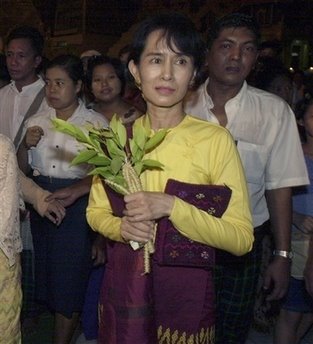


 Posts


