News & Articles on Burma
Monday, 08 August, 2011
----------------------------------------
Suu Kyi Calls for Unity on Anniversary of 88 Uprising
Myanmar's Suu Kyi to make 'political' trip
Aung San Suu Kyi’s first political tour: A test for Burmese government?
Myanmar opposition leader defies military on uprising anniversary
More Progress Needed to Lift US Sanctions: Lawmaker
Myanmar marks 1988 uprising anniversary
US puts a new man in Myanmar
Refugees in Northern Thailand Need Aid to Rebuild Homes
Burmese Baited into Thai Fishing Slavery
------------------------------------------------
Suu Kyi Calls for Unity on Anniversary of 88 Uprising
By BA KAUNG Monday, August 8, 2011
Hundreds of Burmese people led by pro-democracy icon Aung San Suu Kyi gathered at a monastery in Rangoon on Monday to commemorate the anniversary of the failed popular 88 uprising which demanded democratic change.
During the ceremony, Suu Kyi called for unity within opposition groups in the country dominated by the new nominally civilian government under the military-backed Union Solidarity and Development Party.
Popularly known as the 88 uprising as it took place on Aug. 8, 1988, the nationwide student-led protests challenged the ruling Socialist government to bring about economic and political reforms.
From August to September 1988, the country saw three leadership changes but the army staged a coup in the final week of September and responded to peaceful demonstrations by slaughtering at least 3,000 people.
Slide Show (View)
During Monday's anniversary ceremony at a Buddhist monastery in Kyeemyindaing Township in Rangoon, Suu Kyi, who made her first political appearance during the 88 uprising, said that unity and concerted efforts within opposition groups would be crucial in reaching the common goal of democratic reforms in the country.
One of the participants, Cho Cho Kyaw Nyein, a leader of the opposition Democratic Party (Myanmar), agreed: “Without democracy in our country, we will work on together under the leadership of Aung San Suu Kyi.”
Despite meeting with a Burmese government minister last week, Suu Kyi said she is still against the 2008 military-drafted Constitution. However, she also confirmed that she is planning to make her first political tour since her release from house arrest last year to the town of Pegu a few kilometers outside Rangoon on Aug. 14, and received a positive response when she informed the authorities.
Hundreds of democracy activists, including officials from political parties which took part in last year's general elections, joined Suu Kyi for one minute's silence in honor of protesters killed in the 88 uprising. Plainclothes security officers and anti-riot police trucks were seen near the monastery, but participants said that no disturbance was made to the occasion.
“I would like you all to think about what has happened and not forget,” Suu Kyi wrote in a guestbook, according to a report by international news agency AFP.
While it has been more than two decades since this major uprising took place, prominent student leaders of the movement together with over 2,000 political prisoners remain incarcerated throughout Burma.
And the political deadlock remains between the democratic opposition and Burmese military which last year handed power to a nominally civilian government led by former junta generals through a flawed election.
A middle-aged English teacher from Upper Burma, who was a student dentist during the 88 uprising, said that the lack of strong leadership during the protests damaged the success of the movement.
“The 88 gave us opportunities to uproot the dictatorship and establish democracy, but we could not grab those opportunities in time because of some weaknesses in leadership,” he said. “Now the military dictators are leading the [political] game and still in a position to control the opposition.”
May Zin, a resident of Rangoon born in the year 1988, said that although she did not witness the uprising first hand, it is still a significant event for her generation which has not been consigned to the history books for Burma.
“I would have participated in it if I was there at that time,” she said.
Marking the anniversary of the uprising, Burmese exiled groups called for the new government in Naypyidaw to release all political prisoners in a joint statement today. They also demanded an end to military attacks against ethnic minority and opposition groups as well as political dialogue with all stakeholders.
Opposition groups also called for a review of the 2008 military-drafted Constitution, which caused Suu Kyi's National League for Democracy party to boycott last November's parliamentary elections in protest. http://www.irrawaddy.org/article.php?art_id=21854
------------------------------------------
Myanmar's Suu Kyi to make 'political' trip
Posted: 08 August 2011 0238 hrs
YANGON: Myanmar's democracy icon Aung San Suu Kyi is to make her first overtly political trip outside her home city since she was freed from house arrest, her spokesman said on Sunday, defying authorities' warnings.
Suu Kyi will visit the Bago region, about 80 kilometres north of Yangon, on August 14 to attend a library opening and meet members of a youth forum, Nyan Win of her National League for Democracy (NLD) party told AFP.
He described the visit as "political" but only a day-trip out of Yangon.
"She will leave at 6:00am and return in the evening," he said. "After this trip she will try to make another trip," outside Yangon, he added.
In June Myanmar's regime told Suu Kyi, who was released from seven years of house arrest in November, to halt all political activities and warned that a political tour could spark chaos and riots.
In a subsequent tentative test of her freedom, Suu Kyi visited an ancient temple city in central Myanmar with her son for a few days in July, but the trip was describe as private, with politics not officially on the agenda.
She drew large crowds and was trailed by plain clothes police, but they allowed her to travel unhindered as she avoided making public speeches.
The democracy champion was freed shortly after elections that were won overwhelmingly by the military's political proxies, amid claims of cheating and the exclusion of Suu Kyi from the process.
The 66-year-old has spent much of the last two decades in detention, and some observers believe the government would be quick to restrict her freedom again if she is perceived to threaten their rule.
Security is also a major concern because her convoy was attacked in 2003 during a political trip, in an ambush apparently organised by a regime frightened by her popularity.
Late last month she held her first talks with a member of the new government, labour minister Aung Kyi, in contacts that have raised hopes for an ongoing dialogue between the two sides.
Her party, which won a landslide election victory two decades ago that was never recognised by the junta, was disbanded by the military regime last year because it boycotted the latest vote, saying the rules were unfair.
- AFP/de http://www.channelnewsasia.com/stories/afp_asiapacific/view/1145660/1/.html
------------------------------------------
Aung San Suu Kyi’s first political tour: A test for Burmese government?
By Zin Linn Aug 08, 2011 2:09AM UTC
0 Comments and 4 Reactions
Burma’s democracy icon and Nobel laureate, Aung San Suu Ky,i plans to make her first visible political tour outside Rangoon. This trip will be the first political excursion since she was unchained from house arrest, National League for Democracy (NLD)’s spokesperson Nyan Win told the media on Sunday.
Suu Kyi is going to visit the Pegu division which is 50 miles (80 kilometres) away from north of Rangoon on 14 August. She has a plan to attend the opening ceremony of a library at resident of U Myat Hla (MP 1990).She will also attend a youth forum, Nyan Win told AFP.
He explained the Lady’s Pegu-trip has a political intention and it will be just a one-day round-trip, outbound of Rangoon.
“She will leave at 6:00 a.m. in the morning and will come back in the evening,” Nyan Win said.
“After this political outing she will try to make another trip outside Rangoon”, he added.
In June, Burma’s regime told Aung San Suu Kyi, who was released from house arrest in November, not to join all political activities as there were concerns that her political expedition could ignite turmoil and demonstrations.
To test her freedom, Suu Kyi visited Pagan, an ancient temple city of Burma, together with her younger son for a few days in July. However, the Pagan-trip was expressed as private ahead of the journey, stayingy away from politics on the schedule. Anyhow, she had faced large crowds along with plain clothed police. Nevertheless, the security personnel allowed her to travel without interference since she kept from making public speeches.
The democracy defender was released soon after the last November elections that were overpoweringly won by the military-backed parties amid claims of vote-rigging and the exclusion of Aung San Suu Kyi from the procedure.
Recently, Suu Kyi’s National League for Democracy has been calling for meaningful dialogue with the President Thein Sein Government, as it is the party’s longtime policy towards national reconciliation.
“As the NLD mainly works for national reconciliation, we expect to start a dialogue with the new government,” said NLD spokesman Nyan Win.
Suu Kyi made an appeal on 28 July for political talk and an urgent ceasefire between major ethnic rebel groups – Kachin Independence Organization, Karen National Union, New Mon State Party, Shan State Army – and government troops.
In her open letter dispatched to the country’s military-backed new President Thein Sein, Suu Kyi offered to act as a mediator between the government and the ethnic rebels, and said the constant fighting has been damaging the national reconciliation which is so important for the nation that composed mainly of ethnic population.
The open letter pointed out that the prevailing ethnic aggression can be sprawling into the neighboring counties. It said that currently there are armed conflicts between Burma Army and the ethnic armed groups especially in Kachin, Shan, Karen and Mon states.
The 66-year-old democracy icon has spent most of the last twenty years in custody, and several Burma observers suppose the government would limit her freedom again if she became a threat to the new namesake civilian government.
The NLD, led by Suu Kyi, has long been a key opponent of the existing authorities who have run the country since a 1962 coup. Her latest comments are likely to infuriate the new nominally civilian government, despite signs of softening of ties.
In last December, Burmese junta’s two mouthpiece newspapers criticized dissident politicians who believe genuine national reconciliation and support Aung San Suu Kyi. Burma’s military rulers dismissed the actions of democracy icon Aung San Suu Kyi, who tries to revive the spirit of Panglong Agreement providing self-reliance to ethnic nationalities, as a “cheap political stunt”.
Aung San Suu Kyi has met with Burma’s Labor and Social Welfare Minister Aung Kyi of the new government on 25 July, the first such meeting since her release from house arrest.
The meeting raises hopes for a standard dialogue between her and the military-dominated government. But, there is skepticism whether the talks will go ahead to authentic political reforms. http://asiancorrespondent.com/61890/aung-san-suu-kyis-first-political-tour-a-test-for-burmese-government/
------------------------------------------------
Myanmar opposition leader defies military on uprising anniversary
Aug 8, 2011, 7:26 GMT
Yangon - Myanmar's opposition leader Aung San Suu Kyi rejected the military-promulgated constitution Monday, after attending a ceremony marking the country's 1988 uprising.
'We still do not accept the 2008 constitution,' said Suu Kyi, who gave robes and food to over 100 Buddhist monks at Sadu monastery in Yangon, to commemorate the anniversary of the democracy uprising that began on August 8, 1988, which is remembered in Myanmar as 'the 8888 uprising.'
The 2008 charter cemented the military's control over any elected government by reserving a quarter of all seats in parliament to military-appointees, sufficient to veto any legislation.
Yangon's 1988 mass protests led to the resignation of former military strongman Ne Win and put an end to his disastrous 'Burmese Way to Socialism.'
But the uprising did not lead to the end of military rule. The army cracked down on the pro-democracy movement on September 9, 1988, in a bloodbath that left an estimated 3,000 dead.
All Western and multilateral aid to Myanmar, also called Burma, was severed after the crackdown, forcing the military to hold an election in 1990 that was won by Suu Kyi's National League for Democracy (NLD) in a landslide victory.
'We cannot forget the result of the 1990 election,' Suu Kyi said. 'The people's aspirations can never be eliminated,' she told reporters after attending the 8888 anniversary ceremony.
Suu Kyi, the daughter of Myanmar independence leader Aung San, has spent 15 of the past 21 years under house arrest.
She was released from a seven-year house detention term on November 13, days after the November 7 election that brought to power a pro-military government.
Neither Suu Kyi nor her NLD party contested the election, which most Western democracies labelled a sham.
Suu Kyi has threatened to start making political tours of the countryside, an initiative that has spooked the new government.
'Daw (Madam) Aung San Suu Kyi will go to Bago division, 80 kilometres north-east of Yangon on August 14 for a one-day political trip,' opposition spokesman Nyan Win said.
She will attend the opening of two libraries in Bago and meet with 'political network' groups from 30 townships, he said.
Myanmar's state-run media has warned that there might be a repeat of the incident of May 2003, in which Suu Kyi and her followers were attacked in central Myanmar by pro-military thugs while on a politcal tour of the countryside, leaving 19 dead and Suu Kyi slightly injured.
Suu Kyi is seen as the chief threat to the military establishment that has ruled Myanmar since 1962.
http://www.monstersandcritics.com/news/asiapacific/news/article_1655586.php/Myanmar-opposition-leader-defies-military-on-uprising-anniversary
----------------------------------------------
More Progress Needed to Lift US Sanctions: Lawmaker
By LALIT K JHA Monday, August 8, 2011
WASHINGTON — Even after the formation of a new government following last year's general election, further reform in Burma is needed before the US can lift sanctions on the country, a key US lawmaker has said.
“Sadly, Mr. Speaker, the regime in Burma has not made the necessary progress to justify lifting the restriction,” Californian Congresswoman Laura Richardson said in her speech on the floor of the US House of Representatives on Friday.
Speaking in favor of House Resolution No 66, which if passed would extend US sanctions on Burma for another year, Richardson argued that in light of continuing human rights abuses in the country, lifting economic sanctions at this time would send the wrong signal to the Burmese regime, the international community, and, most importantly, to dissidents working to bring real democratic change to their country.
Introduced by Congressman Joseph Crowley, the resolution is co-sponsored by as many as 11 lawmakers. Similar legislation is also being considered in the Senate. “I support this resolution because it is consistent with our humanitarian and democratic values against forced labor,” said Richardson.
“As Americans, we must not only sustain these values in our country, but we must act globally and deter other countries from tolerating or employing practices that have no place in a civilized society, such as forcing innocent men, women, and children to work under harsh and slave-like labor conditions,” she argued.
“For this reason, it is critical that we renew the import restrictions contained in the Burmese Freedom and Democracy Act of 2003,” she said.
Reviewing the reasons for the sanctions, Richardson noted that in 1990, the National League for Democracy (NLD), led by Nobel Peace Prize laureate Aung San Suu Kyi, won the overwhelming number of parliamentary seats (82 percent) in a multiparty election held by the Burmese junta.
However, she said, the military regime refused to honor the election results, and imprisoned both democracy activists and elected members of parliament, including Suu Kyi.
No further elections took place for the next 20 years, until the regime held a vote last year on Nov 7 as part of its “road map to democracy,” said Richardson.
The NLD “refused to participate over concerns that the electoral process was fraudulent, concerns that were confirmed by the United Nations and most Western countries, which noted widespread fraud, voter intimidation and cheating throughout the country,” she said.
Since then, the congresswoman argued, the Burmese regime has continued its campaign of suppression and persecution against political opponents, dissidents and other minority populations.
“This shameful conduct has resulted in the internal displacement of more than 600,000 people and forced more than 130,000 persons to live in refugee camps along the Thai-Burma border. Additionally, during this time the [Burmese] regime has been protecting drug traffickers and forcing residents into slave labor,” she said.
The Office of the United Nations High Commissioner for Refugees recently listed Burma as the fifth largest source country of refugees in 2010, with 415,700 refugees. http://www.irrawaddy.org/article.php?art_id=21851
--------------------------------------------
SA Time: Monday, August 08, 2011 6:06:30 PM
Myanmar marks 1988 uprising anniversary
REUTERS
Myanmar pro-democracy leader Aung San Suu Kyi signs in a guestbook while attending a religious ceremony to mark the 23th anniversary of the "8888" event at a monastery in Yangon.
Yangon, Myanmar - Nobel laureate Aung San Suu Kyi has joined other activists marking the anniversary of the anti-military uprising that inspired their still uncompleted crusade to bring democracy to Myanmar.
Suu Kyi, her colleagues and 350 followers gathered Monday at a monastery in western Yangon to recall how about 1 million people rose up on August 8, 1988 to protest an entrenched military-backed regime that had wiped out the savings of many by a sudden demonetisation of the currency.
An estimated 3 000 people were killed before the demonstrations were crushed the next month.
Suu Kyi, the daughter of Myanmar independence hero Gen Aung San, rose to prominence during the uprising. Myanmar this year installed an elected civilian government but remains under military domination. - Sapa-AP http://www.iol.co.za/news/world/myanmar-marks-1988-uprising-anniversary-1.1113927
---------------------------------------
ASIA TIMES ONLINE: Aug 9, 2011
US puts a new man in Myanmar
By Brian McCartan
CHIANG MAI - The appointment last week of the United States' first special envoy to Myanmar, Derek Mitchell, promises to refocus US policy towards the isolated country after previous engagement overtures failed to gain diplomatic traction. The US has maintained punitive economic sanctions against the military regime for over two decades.
President Barack Obama chose Mitchell to fill the position in April, around 18 months after the State Department announced its new Myanmar policy and almost three years after the position was mandated by the 2008 JADE Act. The new position, which is charged with developing a cohesive international approach to US policy and liaising directly with the Myanmar government, carries ambassadorial rank.
A well-respected Asia hand, Mitchell was formerly the Defense
Department's deputy assistant secretary of defense for Asian and Pacific security and prior to that a policy wonk with different Washington-based think-tanks. He first visited Myanmar in 1995 while with the National Democratic Institute for International Affairs, where he met with both senior government officials and opposition leader Aung San Suu Kyi.
United States policy on Myanmar took a turn in September 2009 after a policy review was concluded by the State Department. The review concluded that a heavy reliance on sanctions and isolation had been counter-productive. Instead of changing the military junta's attitude, the assessment concluded, Washington's public support for Suu Kyi and focus on the regime's human-rights record only fueled the ruling generals' paranoia of a US invasion and further isolated the country.
Under the new policy, Washington opted for a more flexible policy approach that integrated both sanctions and engagement. The new approach was in line with Obama's stated dual-track approach of "principled engagement" to deal with what Washington considers unsavory nations.
In Myanmar's case, benchmarks for the removal of sanctions and normalization of diplomatic and commercial ties have centered on the release of over 2,000 political prisoners, reconciliation with the democratic opposition and ethnic minorities, increased respect for human-rights norms and adherence to United Nations nonproliferation agreements.
The policy has motivated several high-level visits by US statesmen and diplomats but so far has made little if any progress. US deputy assistant secretary of state Joseph Yun met in May with Suu Kyi and senior government officials including foreign minister Wanna Maung Lwin.
This was followed by a visit from prominent senator John McCain at the beginning of June. McCain was able to meet in Naypyidaw with first vice president Tin Aung Myint Oo and speaker of the upper house of parliament Shwe Mann. Both officials are former generals and key junta leaders. In Yangon, McCain met with opposition leaders Suu Kyi and U Tin Oo.
Secretary of State Hillary Clinton reiterated the policy during the Association of Southeast Asian Nations (ASEAN) Regional Forum (ARF) meet held last month in Bali, Indonesia. There, she called for the release of some 2,200 political prisoners, dialogue with the opposition and ethnic minority leaders, and compliance with UN Security Council resolutions, a reference to a suspected nuclear program Myanmar is developing with North Korean assistance.
Clinton also put ASEAN on notice that Washington was not in favor of granting Myanmar the chairmanship of the regional grouping in 2014 unless significant reforms were carried out. Mitchell echoed these concerns during his senate confirmation hearings last week.
Many analysts perceive the US's public concerns about human rights and democracy as cover for a harder security agenda. While human rights and democracy garner popular support domestically and in the international arena, Washington's concerns lie more with a desire to blunt China's influence and impair Naypyidaw's potentially regionally destabilizing relations with North Korea.
Beijing has made huge investments in Myanmar's natural resources to power its burgeoning economy. Additionally, Myanmar's geographic position provides China with a trade route for its landlocked Yunnan province as well as a strategic route for oil and gas imports that avoids the easily blocked Malacca Straits. To this end, China is helping to construct a deep-sea port on Myanmar's western coast and building dual gas and oil pipelines to connect the port with its southwestern city of Kunming.
In recent years, the US has bid to improve relations with various Southeast Asian nations to counterbalance China's rising influence in a region some felt Washington overlooked in its singular pursuit of its global "war on terror". Recent efforts have seen the US improve bilateral ties with Cambodia and Laos, both countries widely viewed as falling into China's regional sphere of influence.
Another major US strategic concern is Myanmar's growing ties with North Korea, especially in regards to missile and nuclear technology. Mitchell said in his hearing that it is "absolutely critical" for Myanmar to abide by UN nonproliferation sanctions banning trade in military hardware with Pyongyang. Last year, American naval units shadowed a North Korean freighter suspected to be carrying weapons en route to Myanmar. The ship was eventually forced to turn around.
New policy momentum
Myanmar watchers believe that Mitchell's confirmation will provide full-time US commitment to Myanmar issues and a momentum behind policy that has been lacking since September 2009. Until now, Myanmar policy has been spearheaded by assistant secretary of state for East Asian and Pacific affairs, Kurt Campbell, who has made strong efforts towards Myanmar but must also deal with the entire region.
Mitchell's position will be decidedly difficult. Initially, he will likely be charged with assessing recent developments in Myanmar, including last year's general elections, this year's formation of a nominally civilian government, the release of Suu Kyi from house arrest, continued detention of political prisoners, human-rights abuses and ongoing military offensives against minority groups.
Mitchell will have to contend with the already substantial support Myanmar receives from China and India at a time the US's economic clout is in doubt. Both China and India covet Myanmar's resources and value its geostrategic position and are engaged in a competition for influence to gain advantage in a struggle more about their own mutual insecurities than Myanmar as a security risk.
In a 2007 article in Foreign Affairs co-written by Asia expert Michael Green, Mitchell expressed the necessity of developing an approach to Myanmar in conjunction with ASEAN, Japan and non-Asian actors such as the European Union in order to produce a multilateral approach that cannot be ignored by China and India. The article argued such an approach would put China and India in a position of choosing to join and perhaps lead rather than be seen as obstructionist in an issue of importance to their regional neighbors.
In line with this thinking, Mitchell said during his senate confirmation hearing that he would seek to coordinate with international partners including ASEAN, China, India and Europe to develop a more coherent approach to Myanmar. He noted that previous efforts were undermined by a lack of effective coordination among key members of the international community.
As Mitchell pursues Washington's engagement policy he will simultaneously have to work on encouraging democratic reform and respect for human rights inside Myanmar's new nominally civilian government. He stated during his confirmation hearing that he will attempt to carry this out through seeking "direct and candid dialogue" with Myanmar's government and responding "flexibly" to evolving conditions.
One stated element of US policy is that Myanmar's rulers must provide proof of progress in reforming its political system and respect for human rights in order for increased engagement. This leaves the ball largely in Naypyidaw's court. So far, the US has voiced almost consistent disappointment in Naypyidaw since the policy shift, including in the November 2010 elections which the US referred to as "fatally flawed".
Myanmar's new government has sent mixed signals since the elections and the formation of the new government at the end of March. President Thein Sein's inaugural address contained promises of reform but it is doubtful much can be carried out while divisions exist between powerful ex-military hardliners such as Shwe Mann and Tin Aung Myint Oo who are dissatisfied with the division of power and more moderate elements in the government.
That said, a July 25 meeting between Suu Kyi and labor and social welfare minister Aung Kyi was described as "productive" and "constructive" and raised hopes for more substantive dialogue between the government and the opposition movement. However, at the same meeting, Suu Kyi was requested to register her party, the National League for Democracy (NLD), a move she and party stalwarts have resisted because they reject the 2008 constitution and its election rules.
Meanwhile, the army has stepped up military campaigns against ethnic minority groups situated in border areas with Thailand and China. Security experts believe the recent breakdown in ceasefire agreements with various ethnic groups has moved the country dangerously close to widespread civil war. Human-rights groups have accused the army of new abuses during its military operations.
During his confirmation hearing before the Senate Foreign Relations Committee in June, Mitchell signaled a willingness to improve ties with Naypyidaw but was also critical of Myanmar's claims of transition to civilian rule, saying "a political system that exhibits anything close to recognizable standards of representative democracy remains to be seen."
With Mitchell in charge, the US may wish to enter a new phase in its engagement overtures towards Myanmar. But its new seasoned envoy will need deep stores of patience and flexibility in dealing with a regime that marches to the beat of its own drummer and demonstrated a concerted effort to resist international pressure for change.
Brian McCartan is a freelance journalist. He may be reached at brianpm@comcast.net. http://www.atimes.com/atimes/Southeast_Asia/MH09Ae01.html
---------------------------------------
Refugees in Northern Thailand Need Aid to Rebuild Homes
By SAW YAN NAING Monday, August 8, 2011
Flooding in northern Thailand has made several hundred Burmese refugees homeless and students unable to attend school as fears of further landslides at makeshift camps increase, claim Karen refugees.
More than 1,000 refugees in Mae Ra Mu Luang refugee camp have lost their homes and are currently seeking shelter in monasteries, churches and several school buildings, according to the Karen Refugee Committee (KRC).
Kyaw Pway, a staffer at the KRC office at Mae Sariang in northern Thailand, said, “The emergency need is for plastic sheets. They need plastic sheets to make their temporary shelters.”
He said that six pick-up trucks traveled to the refugee camp to deliver 100 plastic sheets and some clothes to the affected refugees. The supplies were provided by the Thailand Burma Border Consortium (TBBC) aid agency.
Some of the 2,970 rice sacks that have been destroyed by flooding at refugee camps in northern Thailand. (Photo: KRC)
The flood and landslide damaged 445 houses in Mae Ra Ma Luang and Mae La Oo refugee camps in Mae Hong Son Province, destroyed three food stores with 2,970 bags of rice, damaged wooden bridges, blocked roads and flooded schools and libraries.
All lessons in the refugee camps have been stopped and no one is not sure when the schools will reopen, said Kyaw Pway.
Per Vogel, a program coordinator for worldwide relief agency Malteser International in Thailand, told The Irrawaddy on Monday that his local health workers in the refugee camps help flooding victims by providing medicine and medical care. There has been no outbreak of major disease among flooding victims in the camps so far, said Vogel.
Malteser International is a non-governmental organization which also operates relief and health programs at refugee camps in Thailand.
Mae La Oon and Mae Ra Ma Luang house more than 3,3000 refugees who were forced from their homes in Karen State, eastern Burma, due to Burmese Army attacks. Many have stayed at the camps for over two decades, according to KRC figures. http://www.irrawaddy.org/article.php?art_id=21852
------------------------------------------
Burmese Baited into Thai Fishing Slavery
By SIMON ROUGHNEEN Monday, August 8, 2011
SAMUT SAKHON, Thailand — “The broker took 36,000 baht (US $1,200) from us,” says Ma Than Nwe, a Tavoyan Burmese migrant worker in Thailand. “It was money that should have been paid to my husband,” she laments.
Her spouse *Kyaw spent six months at sea on a Thai-run fishing vessel and the salary, which might seem a pittance to some, is a small fortune for people who earned the equivalent of $1-2 per day in Burma. Or it would be, if it was paid at all. The promised 6,000 baht ($200) per month was paid to a broker, a Burmese woman who cannot be named at this time for legal reasons. She kept the all money as payment for what Ma Than Nwe—with understandable anger—sarcastically describes as the broker's “services” in helping her husband “find work” on the boat.
The broker and alleged trafficker and extortionist has since fled back to Burma. “We were afraid to do anything, as the police and the brokers work together to get money from us,” Ma Than Nwe says. “But we think she has angered some other people as well,” she adds, speculating on the broker's apparent flight from Thailand.
The broker told the couple that Kyaw would only have to work two months on the fishing vessel to clear the broker's fee. Anything else after that, if he chose to stay on board for longer, would be his. However, he was kept on the boat against his will for six months and emerged without being paid a single baht.
“The boat did not come to shore during all that time,” says Ma Than Nwe. “When he got back, he told me how small boats would come to meet them at sea and take the catch to land, so they did not get to come ashore themselves.”
Such tales of deceit, naivete and brutality are legion in Thailand's fishing industry and in the coastal province of Samut Sakhon—perhaps better known by its old name Mahachai—a forty-minute drive west of the Thai capital, Bangkok. Thailand's fishing sector and this particular location have both long been a draw for immigrants from neighboring countries seeking work away from their own sluggish economies.
The United Nations special rapporteur on trafficking in persons, Joy Ngozi Ezeilo, begins an official visit to Thailand today to examine the impact of anti-trafficking measures in the country. She will stay until Aug 19 and visit Bangkok, Chiang Mai, Mae Sot, Samut Sakhon and Songkhla, where she will likely hear stories such as that of Ma Than Nwe and her husband.
“During my mission, I wish to reach out to a wide range of stakeholders and trafficked persons themselves, so that their voices are heard and can be considered in the national laws, policies and measures related to trafficking in persons,” she said.
Ezeilo will have to convince Thai authorities to do more to enforce anti-trafficking laws, as—according to a recent US State Department assessment of global human trafficking—Thailand has “made mixed progress in its anti-trafficking law enforcement efforts.”
According to the US report, the Thai government “reported 18 convictions in trafficking-related cases in 2010—an increase from eight known convictions during the previous year; as of May 2011, only five of the 18 convictions reported by the government could be confirmed to be for trafficking offenses.”
However, as the report later outlines, the fishing industry and its locales remain at the margins of even this relatively small conviction rate. According to the report, “investigations of alleged human trafficking on Thai fishing boats, as well as inspections of these boats, were practically nonexistent, according to surveyed fisherman, NGOs, and government officials.”
Ma Than Nwe herself was trafficked, forced to work at shrimp factory in Samut Sakhon for a 200 baht ($6.70) day rate. Like her husband, she never saw any of this money, as it was given directly by the employer to a second broker she met in Hatyai, in southern Thailand. She agreed to travel to the fishing hub near Bangkok after being promised 500-600 baht ($16.80-20) per day making and selling Burmese food by the broker she met in Hatyai, where she had first headed for after crossing the Thailand-Burma frontier at Ranong in March 2010.
The irony is that she worked in the fishery sector in Burma, where times were tough, prompting her to make the initial risky crossing to Thailand without official papers. “We sold shrimp at Tavoy,” she recalls, “but we could not make a living doing so. The cost of running the business was more than the sales price.”
Life in Samut Sakhon was much tougher than she was led to believe. “We were put in a place with no water or electricity,” she says of her accommodation. “We had to work off the 3,000 baht ($100) fee the broker in Hatyai demanded for setting us up here.”
Her family's debts were accumulating at this stage. The Hatyai broker was the second one she had to pay off, after the first one who brought the group from the Ranong border crossing to Hatyai. Her husband then took the job on the fishing boat to try bring in what they thought would be more money.
Ma Than Nwe's ordeal was not just emotional. Discussing how she lived while Kyaw was away at sea, she reveals another mark, this one physical. “I had an operation,” she says, pointing to her abdomen but refusing to say what the procedure entailed.
“I had no money to pay for the hospital costs,” she says. “So this became extra fees to the broker.”
Perhaps it was fear of incurring more debt, but while her husband was away, she took what might have been a fatal post-operative step. “I took a knife and cut out the stitches myself,” she says, grimacing as she re-enacted her self-administered procedure using hand gestures.
Now working—and finally getting paid—as a cleaner at a factory, Ma Than Nwe takes painkillers every day. Seven months later, she is not sure if she has caused long-term damage to herself. “I don't speak Thai, I can just nod my head when they talk to me. And I don't have money, so I cannot go to the doctor.”
Related article: “Still on the run – trafficked Burmese recount murder at sea”
http://www.irrawaddy.org/article.php?art_id=21850
Tuesday, August 9, 2011
News & Articles on Burma-Monday, 08 August, 2011


Sunday, August 7, 2011
News & Articles on Burma-Saturday, 06 August, 2011
News & Articles on Burma
Saturday, 06 August, 2011
----------------------------------------
Myanmar refugees in Japan find adjusting to new life difficult
Siege of Shan base relaxed but not lifled
Indonesia's FM to Vet Burma for Asean Chair
Burma’s newspaper blames Kachin rebels
Burmese lieutenant and soldier killed by KIA
Myanmar media blames rebels for deaths at dam
Some USDP officials paid ‘stipends’ for work
-----------------------------------------------------
Auggust 6, 2011: Yomiuri Shimbun
Myanmar refugees in Japan find adjusting to new life difficult
Mayumi Oshige / Yomiuri Shimbun Staff Writer
CHIBA--Language barriers and unfamiliar work in a much different environment are making life in Japan very stressful for ethnic Karen refugees from Myanmar who were transferred from a refugee camp in Thailand to Japan last autumn.
These refugees have been accepted on a third-country resettlement program sponsored by the central government on a test basis. Among them, a husband and wife undergoing work training at a farm in Yachimata, Chiba Prefecture, said they doubt coming to Japan was the right decision.
Providing the refugees with support from public and private sectors is expected to promote the program.
The couple was among five families of 27 Karen who lived in a refugee camp in Mera, northwestern Thailand, and the first batch of refugees who came to Japan on the program.
They took a six-month language training program and then moved to Yachimata, or Suzuka, Mie Prefecture, in March, which are their designated settlement places.
Two men and their wives who work at a farm in Yachimata had been absent from work for a month from July 2 and just returned to work Monday. One of the men, 37, had been a rice and corn farmer in Myanmar while the other man, 46, was a carpenter.
After living in the refugee camp for about a decade, they are now assigned to do farmwork from early morning to evening using a mechanical cultivator.
They complained that they could not bear the work conditions with only one day off each week. They agreed to return to work after the conditions were improved by increasing the number of days off from one to two each week and also reducing work hours.
The 37-year-old man's four children, who go to primary or middle schools, said they could not keep up with their classes. Although they are given extra tutoring after school, the children struggle.
His 29-year-old wife sometimes shouts at a mountain behind their house to get rid of the enormous mental stress caused by raising children while doing farmwork.
The farm's 68-year-old operator, who accepted the two families, criticized the central government for leaving these refugees who speak such poor Japanese at the farm.
The operator also stated that the six-month training program is too short to acquire agricultural know-how in machinery operation and developing marketing channels.
Providing support to these refugees is necessary to help them live independently. However, as the Foreign Ministry has not made information about the refugees public, citing safety, the private sector has yet to offer assistance to them.
Under the third-country settlement program, third countries accept refugees who would be persecuted in their home countries and cannot settle in countries they have fled to.
The government decided in December 2008 to introduce the program, believing that the process is smoother than that of accepting refugees based on the international convention on the status of refugees, under which Japan has accepted 577 refugees through last year.
As part of the test program, the government will accept about 30 refugees from the Mera camp each year until 2012.
(Aug. 6, 2011) http://www.yomiuri.co.jp/dy/national/T110805006342.htm
---------------------------------------
Siege of Shan base relaxed but not lifled
Friday, 05 August 2011 13:51 S.H.A.N.
Though the bulk of the besieging Burma Army troops have been withdrawn since 29 July, trucks carrying rice and other supplies have continued to arrive at outposts facing Wanhai, the Shan State Army (SSA) North’s key base in Kehsi township in central Shan State, according to both local and SSA sources.
“At least 200 bags have already gone through during the past two days,” said an informed source to SHAN.
Out of 14 infantry battalions surrounding Wanhai, only three remain, according to the SSA. The supplies were unloaded at Loi Kawngmu Markkieng, between Wan Merd and Kieng Lern, 8 miles and 7 miles respectively west of Wanhai. Both villages are under the control of the Burma Army.
Commenting on this, Lt-Gen Yawdserk, leader of the Shan State Army (SSA) South, said, “There could be two reasons: One, the Burma Army is changing its tactical plan. Two, it is waiting for the Shan State Government to send its delegation to negotiate with Sao Pang Fa (leader of the SSA North), like they are doing in Kachin State.”
According to the SSA North’s latest report, the two sides for the first time, joined forces together and fought against the Burma Army in Mongnawng sub-township of Kehsi township, 28-30 July.
In the Kachin State, Col Than Aung, Kachin State Government’s Minister for Security and Border Affairs, a military appointee, has been negotiating with the SSA North’s ally, Kachin Independence Army (KIA).
In Shan State, Col Than Aung’s counterpart is Col Aung Thu.
Meeting with ex-general U Tin Aye, Chairman of the Union Election Commission, 5 ethnic parties including Shan had broached the subject of forming a peacemaking commission to parley with the ethnic armed groups. Tin Aye reportedly told them it was a matter best handled by the military, which had inevitably irked the parties. “Peace is a matter which concerns all the people in the Union, not just the military,” one of the Shan politicians told SHAN.
The 5 parties expect to broach the subject again in the forthcoming parliamentary sessions due to start on 2 August. http://shanland.org/index.php?option=com_content&view=article&id=3919:siege-of-shan-base-relaxed-but-not-lifled&catid=86:war&Itemid=284
------------------------------------------------
Indonesia's FM to Vet Burma for Asean Chair
By SAW YAN NAING Friday, August 5, 2011
Indonesia's Foreign Minister Marty Natalegawa is set to visit Burma in the near future with observers saying that Naypyidaw's bid to chair the Association of Southeast Asian Nations (Asean) in 2014 may rest on his conclusions.
According to a report on Aug. 3 by Voice of America quoting Indonesian Foreign Ministry spokesperson Michael Tene, the foreign minister has already received an official invitation from Burma and is preparing a mission to evaluate whether the Burmese government has made enough democratic progress to win backing for its Asean chairmanship.
However, speaking to The Irrawaddy on Thursday, Kavi Chongkittavorn, a senior editor and columnist at the Bangkok-based daily The Nation, said, “He [Natalegawa] will go only if Burma has made satisfactory progress. Otherwise, he will not go. That much is clear.”
He said he doubts the visit will happen, because Natalegawa has not confirmed a schedule for the trip. However, he added, if the Indonesian foreign minister does go to Burma, then Naypyidaw can take it for granted that it will chair Asean in 2014.
Kavi said the conditions that Burma has to meet include the release of political prisoners, a ceasefire with ethnic groups, and a dialogue toward national reconciliation.
Burma first voiced the idea of chairing Asean just a month after the new government took office in March. It then launched an official bid for the bloc's chairmanship in Bali at an Asean foreign ministerial meeting in July.
However, several Burma watchers have said that no satisfactory steps have been taken toward resolving the issues, especially with regard to dialogue with pro-democracy leader Aung San Suu Kyi and the ethnic minority groups.
International and opposition groups have roundly urged Burma to make tangible progress. Otherwise, they say, Naypyidaw does not merit the honor of chairing Asean.
In June, the US raised concerns over Burma's bid to chair the bloc, citing the renewed violence in Kachin State and other regions of the country. The US State Department called on Naypyidaw to call a halt to hostilities, and said the conflicts underscore the need for an inclusive dialogue between the Burmese government, opposition parties and ethnic minority groups to begin a process of genuine national reconciliation.
Speaking to The Irrawaddy from Indonesia on Thursday, Rafendi Djamin, the Indonesian representative to the Asean Intergovernmental Commission on Human Rights, said, “My concern is that there is no significant change in Burma in terms of human rights violations in the conflict areas, and that the issue of political prisoners also remains a serious problem.”
In 2006, Burma missed its turn to chair Asean due to international pressure on it to enact democratic reforms.
In recent months, several armed conflicts have flared across Burma, forcing thousands of people from their homes.
Naypyidaw has recently made several “olive branch” gestures to Kachin rebels, a move many Burma watchers say could be related to its bid to assume the 2014 Asean chairmanship.
Observers say the Burmese authorities also want to be seen to be engaging Suu Kyi, and may invite her to attend an upcoming parliamentary workshop on Rural Development and Poverty Alleviation in the capital.
Nay Zin Latt, a member of the Burmese president’s political advisory board, told The Irrawaddy that he heard Suu Kyi may be invited to “cooperate individually as an observer attendee” at the workshop.
Regional activist Debbie Stothard, the coordinator of the Alternative Asean Network, said that Naypyidaw's sudden involvement with Suu Kyi might just be a show for the international community.
She said the Indonesian foreign minister needs to look at the armed conflicts, attacks against ethnic minority people, the rape of ethnic women, and the issue of political prisoners in Burma.
Rangoon-based veteran Arakan politician Aye Tha Aung agreed, saying that internal progress on the issues of human rights abuses, democratic reform and national reconciliation should be met before a decision is taken on Burma's Asean chairmanship.
Win Htein, a close friend of Suu Kyi, told The Irrawaddy that the opposition leader wants internal affairs—essentially economic, social and political issues—to be prioritized by the new government at this current juncture. http://www.irrawaddy.org/article.php?art_id=21845
-------------------------------------------
Burma’s newspaper blames Kachin rebels means little hope for ceasefire?
By Zin Linn Aug 06, 2011
Kachin Independence Army (KIO) opened fire at a vehicle on its return from Tarpein (1) Hydropower Plant (a China-backed hydroelectric project) to Momauk between mile posts No. 19 and 21, leaving seven dead and one injured, state-owned New Light of Myanmar newspaper reported Friday.
On 2 August evening, three mechanics, one Chinese interpreter, two police members and two drivers, totaling 8 left Tarpein by car after repairing airconditioners at the communication room of Tarpein (1) Hydropower Plant, it said.
According to the newspaper, during the incident, Police officer Aung Kyi Tun, drivers U Nan Shaung, U Than Htay Aung, air-conditioner technicians U Nay Myo Thein, U Zaw Htwe, interpreter Maung Khant Min Htet, totaling 6 in the vehicle were killed on the spot due to gun fires.
The attack took place during two days of talks negotiating a new ceasefire between delegates from the Kachin Independence Organization and the Burmese government at the KIO’s Laja Yang Liaison Office.
The remaining a i r – c o n d i t i o n e r technician Maung Thaw Lin Tun was injured at belly seriously and constable Myo Thant Naing Hsan at left arm and right leg not serious.
The two injured reported their incident to the frontline military camp. The military column cleared the place of incident and found five dead persons in the car and one beside the car. Maung Thaw Lin Tun, one of two injured persons who reported to the military column died the next morning due to his wounds.
The state newspapers accused KIA of making a false claim through BBC saying the car hit its landmine; that dead and injuries were due to the mine blast in its prohibited area before ceasefire has reached.
In reality, KIA intentionally opened fire at the vehicle small arms on its return from Tarpein, leaving seven persons dead and one injured out of eight, not by the blast of mine planted by KIA, the state-media blamed.Bullet wounds were found on the dead bodies, the injured person. Bullet holes were also found on the vehicle, New Light of Myanmar said Friday.
KIA could not be reached for comment. But, as reported by the Kachin News Group on 2 August, KIA attacked a military truck in the same area saying unknown number of casualties. KIA launched ambush-attack on a Burmese military truck at around 5 pm (local time) in N’mawk Township, Manmaw District, Northern Kachin State.
Meanwhile, Lower House MPs will submit proposals to accomplish peace in Kachin State during the second regular session of Union Parliament which starts on August 22, Chiang Mai based Mizzima News said.
Lower House MP Dwe Bu of the Unity and Democracy Party of Kachin State (UDPKS) said that she would talk about the armed conflict in Kachin State in Parliament. UDPKS is a Kachin Party that is reportedly backed by the ruling Union Solidarity and Development Party (USDP).
Last week, Members of Parliament of the UDPKS visited Kachin churches to hear their views on the raging war in Kachin State from war refugees taking shelter there. Dwe Bu said most of the refugees wanted peace and she would voice their views in Parliament.
“Without peace, it is difficult for any development to occur,” she told Mizzima..
As said by Dwe Bu, the fresh ceasefire talks between the government and the Kachin Independence Organization (KIO) are mainly focused on a temporary peace. She sought after to propose setting up of a permanent peace. There are 18 Lower House MPs and 12 Upper House MPs representing Kachin State.
Recently, the KIO has proposed an end to the merciless fighting if the government will inaugurate talks for a countrywide ceasefire. But Burmese government authorities did not reveal any obvious positive sign, according to La Nang, a spokesman for the KIO.
The officials of the Kachin State government have no authority to talk about the conflict. People consider that nothing will happen even though the MPs from Kachin state proposed for conciliatory in their State Parliament.
Recently, Burma’s Nobel laureate, Aung San Suu Kyi, released an open letter addressed to President Thein Sein and ethnic armed groups. Suu Kyi made an appeal for political talk and an urgent ceasefire between major ethnic rebel groups – Kachin Independence Organization, Karen National Union, New Mon State Party, Shan State Army – and government troops. http://asiancorrespondent.com/61829/burma%E2%80%99s-newspaper-blames-kachin-rebels-means-little-hope-for-ceasefire/
------------------------------------------------
Burmese lieutenant and soldier killed by KIA
Kachin News Group: 5 August, 2011
A Burmese army lieutenant and a soldier were killed and three more soldiers, including a lieutenant, were wounded in fighting with Kachin Independence Army (KIA) troops on August 4, around 11 a.m., in western Kachin State, witnesses said.
The name of the dead lieutenant was Myo Min Aung and the wounded lieutenant was Zaw Htun Oo, according to a reliable source close to government troops. The wounded were transported to hospital in Mogaung after the fighting, sources added.
Brief fighting between government troops from several battalions and KIA troops of Battalion 6, under Brigade 2, took place between the villages of Labang Kahtawng and Sawng Hkra, situated between Kamaing and Mogaung, according to KIA officials from Brigade 2. KIA Corporal, Layang Brang Nu, was killed by Burmese troops.
Around 45 Burmese soldiers from Infantry Battalion (IB) No. 58, based at Waingmaw, Sarhmaw-based IB No. 105, IB No. 281 from Mong Yang and Mohnyin-based IB No. 15 were involved in the fighting with KIA Battalion 6 troops, KIA officials added.
Thursday’s fighting occurred on the road when government troops were coming back to Mogaung from Kahtang Yang, in Kamaing, witnesses said.
The fighting took place one day after the KIA and Burmese government delegates held meetings to negotiate a ceasefire agreement at the KIO’s Lajayang Liaison Office, in eastern Kachin State, on August 2 and 3. http://www.kachinnews.com/news/2009-burmese-lieutenant-and-soldier-killed-by-kia.html
---------------------------------------------------
Myanmar media blames rebels for deaths at dam
Terra Daily: Yangon (AFP) Aug 5, 2011
By Staff Writers
Myanmar state media on Friday accused ethnic fighters of killing seven people who visited a Chinese-run dam at the centre of an ongoing conflict between the army and rebels.
Six of those killed were workers at the hydropower plant in northern Myanmar, which is owned jointly by the government and China's Datang (Yunan) United Hydropower Developing Company, the New Light of Myanmar newspaper said.
The government mouthpiece said two mechanics, one Chinese-speaking interpreter, two drivers and a policeman died at the scene, while another technician died later of his injuries. Another policeman was wounded. -----------------------------------------------------
It did not appear that any of the victims were Chinese.
Fighting between government troops and Kachin Independence Army rebels was sparked three months ago near the dam project in Kachin State near the Chinese border. The KIA and Myanmar military have since been trying to reach a ceasefire.
Friday's state media report appeared to be a rebuttal of KIA statements blaming a landmine for the deaths.
"The KIA intentionally opened fire at the vehicle," it said. "Bullet wounds were found on the dead bodies, the injured persons. Bullet holes were also found on the vehicle," the paper in an article accompanied by pictures of the bodies.
In June state media said fighting had caused 215 Chinese workers from the project to be sent back to China and accused rebels of launching "heavy weapons fire at the project".
Relations between the army and ceasefire groups have soured over the past year as ethnic minority fighters were pressured to give up their weapons or come under state control in the run-up to a controversial November election.
Democracy campaigner Aung San Suu Kyi, who recently held her first talks with a minister in the new government, last month called on the army and ethnic insurgents to end a decades-long civil conflict.
The Burma Environmental Working Group, a network of activist organisations, last week called for an end to foreign investment in projects exploiting Myanmar's natural resources, accusing such activities of sparking conflict in ethnic minority areas. http://www.terradaily.com/reports/Myanmar_media_blames_rebels_for_deaths_at_dam_999.html
--------------------------------------
Some USDP officials paid ‘stipends’ for work
Friday, 05 August 2011 21:05 Mizzima News
(Mizzima) – Union Solidarity and Development Party (USDP) General-Secretary Htay Oo confirmed reports that some party members receive cash stipends or allowances for their work.
USDP General-Secretary Htay Oo receives Chinese Politburo member Li Yuanchao of the Communist Party of China Central Committee, in this file photo. Photo: Mizzima
USDP General-Secretary Htay Oo receives Chinese Politburo member Li Yuanchao of the Communist Party of China Central Committee, in this file photo. Photo: Mizzima
Htay Oo’s comments on Friday were made in reply to reporters’ questions after reports appeared saying salaries were paid to party leaders in township, region and state branches.
“We cannot give them a salary, we just collect party membership fees from our party members at 1,000 kyat (US$ 1.28). But some of our full-time members who are working for the party are given allowances or a stipend,” he said.
Htay Oo didn’t disclose the amount of the stipends, but a party MP said that the figure varied from 50,000 to 300,000 kyat (US$ 64-385) per month depending on rank in the party. He said the payments started in July.
Htay Oo made his remarks following a meeting at the Union of Myanmar Federation of Chamber of Commerce in Rangoon.
The following are unofficial allowances for USDP party officials in regions, states and township branches:
Allowance for Region/State branch chiefs – 300,000 kyat per month (US$ 385)
Allowance for secretary of Region/States – 120,000 kyat pm (US$ 154)
Allowance for joint secretary of Regions/States – 100,000 kyat pm (US$ 128)
Allowance for EC of Regions/States – 80,000 kyat (US$ 103)
Allowance for district branch secretary – 80,000 kyat (US$ 103)
Allowance for EC of district branches – 70,000 kyat (US$ 90)
Allowance for township branch secretary – 70,000 kyat (US$ 90)
Allowance for township branch EC – 60,000 kyat (US$ 77)
Allowance for sub-township branch EC – 50,000 kyat (US$ 64)
Meanwhile, Htay Oo denied a report that the government-backed USDP party had received a permit to import 5,000 vehicles from Thailand to reward party officials. The report appeared on The Irrawaddy web site.
“We don’t import luxury cars,” he said. “Please ask other parties if they received this permit. We will get this permit only if other parties get it too. Now we are in a multi-party system not a one-party rule system. So we don’t get such privileges. This news of getting a permit for importing vehicles is not true.” Under the Constitution, Burmese political parties can operate as businesses to raise operating funds.
Htay Oo also denied reports that Russia was awarded a contract to building a 50-km long underground rail network in Naypyitaw, which was reported on Voice of Russia.
The Russian news agency said that Russian experts were doing survey and design work and cited an unidentified chief architect.
Earlier, the Democratic Voice of Burma (DVB) also reported on a planned underground rail network in Naypyitaw based on a military master plan. DVB said the underground rail network would be close to a underground military bunker near the War Office.
When contacted by Mizzima, the Rail Ministry in Naypyitaw also denied the report saying it had no plan to build a rail network in Naypyitaw.
Htay Oo has also denied reports that the USDP would take over the water transport service in Rakhine State. Water transport is a major mode of transportation in coastal Rakhine State. USDP party Rangoon Region branch Chief Aung Thein Lin said in July that the USDP party had loaned 1 billion kyat (US$ 1.28 million) in Rangoon Region alone. http://www.mizzima.com/news/inside-burma/5733-some-usdp-officials-paid-stipends-for-work.html
Friday, August 5, 2011
News & Articles on Burma-Thursday, 04 August, 2011
News & Articles on Burma
Thursday, 04 August, 2011
----------------------------------------
War crimes continue in Kachin state as ceasefire urged
Shan party: Time for all to smoke peace pipe
Killing the Irrawaddy
US Urged to Welcome Former Child Soldiers
Why the Hurry to Reach a Ceasefire?
Ethnic Parties Call for Aid to Refugees
Child abuse rife in Burma, despite laws
Myanmar steps up efforts in promoting tourism
'88 Generation Students' Leaders Welcome Suu Kyi, Aung Kyi Talks
Myanmar, India step up cooperation in health sector
Bangladesh, Myanmar agree to increase trade
US confirms key diplomats for Myanmar, Vietnam
--------------------------------------------
War crimes continue in Kachin state as ceasefire urged
By Zin Linn Aug 04, 2011 2:10PM UTC
Five ethnic parties called on the Burmese government to form a peacemaking committee on Wednesday to stop the widespread war in ethnic areas, according to Mizzima News.
“We urged the government to shoulder responsibility to form a peacemaking committee in the form of a workshop to bring about peace,” RNDP vice chairman Ohn Tin, an Upper House MP representing the Man-aung constituency, told Mizzima.
On 3 August, the last day of a two-day inter-party meeting, the Chin National Party, All Mon Region Democracy Party, Phalon-Sawaw Democratic Party, Shan Nationalities Democratic Party and Rakhine Nationalities Development Party (RNDP) urged the government and ethnic armed groups to stop warfare and to declare an end to hostilities. In addition to the 31 representatives of the five political parties, the Kayan National Party also attended the meeting as an observer.
The group also asked the government, local and foreign charitable organizations and other donors to help war refugees who have fled their homes due to the fighting.
The Kachin Independence Organization (KIO) wants to sign a meaningful and strong ceasefire agreement with the Burmese government this time, unlike the agreement in 1994, which deprived a lot of rights and benefits for the Kachin people and the armed group itself, the Kachin News Group quoted a KIO official saying.
“The 1994 ceasefire agreement made us suffer for 17 years. We knew it was politically fruitless and the wrong agreement but we had to follow it. As a result, we have been highly criticized by Kachin people.”
This is in spite of the fact that the KIO had no satisfactory option to review the condition and it signed the ceasefire agreement with the then-Burmese junta devoid of any political discussion.
Recently, the KIO has proposed an end to the merciless fighting if the government will inaugurate talks for a countrywide ceasefire. But Burmese government authorities did not reveal any obvious positive sign, according to La Nang, a spokesman for the KIO.
The KIO has met Burmese mission three times within last two months in an effort to sign a new armistice. Even though, preliminary talks are starting, Burma armed forces do not stop their military movements and the government soldiers are committing various war crimes.
A Kachin villager was brutally killed by Burmese soldiers in Kahtan-Yang village, in Kamaing Township, Burma’s northern Kachin State, said local witnesses, according to the Kachin News Group . Hpukjawng Seng Du, 30, was arrested and buried alive on 31 July in the forest near the village by government soldiers, said the villagers. According to Mizzima News, Seng Du was identified as a telecommunications operator for the KIO.
KIO joint secretary and spokesman, La Nang, confirmed the death of Seng Du and it is under investigation whether he was a KIO member.
According to villagers, the above war crime was committed by the Waingmaw-based Infantry Battalion No. 58, under Northern Regional Military Command (NC), in Myitkyina, and Hlaingbwe-based Light Infantry Battalion No. 338, under Mawlamyine-based South Eastern Regional Military Command (SEC).
The same day about 7 a.m. Burmese government soldiers from the same military columns murdered 17 year old Marip Tang at his home, another war crime in the same village, added villagers.
Kahtan-Yang villagers are fleeing to the town of Kamaing after they learnt brutal murders at their village, fearing more atrocious killings, villagers said. Burmese soldiers from the same unit arrested eight villagers in Kawng Ra, in Kamaing, as porters on 30 July, to bury corpses, quoting local witnesses Kachin News Group said.
On 24 July, KIA ambushed Burmese convoy from Infantry Battalion No. 105 at Nga Pauk Kone in Kamaing. Four soldiers were killed and roughly 10 wounded. The areas around Kamaing on Namti-Hpakant route has become a war zone between the Kachin Independence Army (KIA) and Burmese troops since the renewed skirmishing started on 9 June.
On 2 August, the KIA launched another ambush-attack on a Burmese military truck at around 5 pm (local time) in N’mawk Township, Manmaw District, Northern Kachin State.
The attack took place during two days of talks negotiating a new ceasefire between delegates from the Kachin Independence Organization and the Burmese government at the KIO’s Laja Yang Liaison Office.
The truck carried military personnel, policemen and intelligence agents from the Military Affairs Security (MAS). The ambush took place on the road connecting N’mawk (Momauk) and two Taping (Dapein) dams near the Sino-Burma border. It occurred in the KIA’s Battalion 15 area, quoting local sources at the scene the Kachin News Group said. As revealed by witnesses, there were casualties in the attack but the accurate number is unknown.
Recently, Burma’s Nobel laureate, Aung San Suu Kyi, released an open letter addressed to President Thein Sein and ethnic armed groups. Suu Kyi made an appeal for political talk and an urgent ceasefire between major ethnic rebel groups – Kachin Independence Organization, Karen National Union, New Mon State Party, Shan State Army – and government troops.
She said that she was ready to contribute all her might to end the armed conflicts and to reconstruct Burma as a peaceful developed nation. http://asiancorrespondent.com/61700/burmese-soldiers-continue-war-crimes-in-kachn-state-while-people-urge-for-ceasefire/
-----------------------------------------------
Shan party: Time for all to smoke peace pipe
Thursday, 04 August 2011 13:31 S.H.A.N.
E-mail Print PDF
The Shan Nationalities Democratic Party (SNDP), third largest winning in the November elections, submitted a petition to the lower house speaker on 31 July calling for peace talks and cessation of human rights abuses, according to the party leadership.
“The gist of the letter is that we had been fighting for more than 60 years with no sign of either side giving up,” said Sai Tin, Central Executive Committee member and Laikha township MP for People’s Assembly. “It’s high time we all sat at the negotiating table for sensible consultation.”
The letter also contains a list of human rights abuses allegedly committed by the Burma Army during its 4 month campaign against the Shan State Army (SSA)
Copies of the petition were forwarded to the President, two Vice Presidents, union ministries concerned and to the chief ministers of states, according to Sai Tin.
The announcement by the SNDP coincided with the joint statement released yesterday by Karen, Mon, Chin, Arakan and Shan parties, calling for:
Nationwide ceasefire
The setting up of a peace making commission
Assistance to the war victims, together with permission for the ethnic parties to give assistance
The 5 parties expect their call will be a topic to be discussed at the upcoming parliamentary sessions that will begin on 22 August.
Naypyitaw is currently holding peace talks with the Kachin Independence Army and pulling out its troops from areas surrounding Wanhai, the Shan State Army (SSA)’s headquarters, in Kehsi township. http://shanland.org/index.php?option=com_content&view=article&id=3913:shan-party-time-for-all-to-smoke-peace-pipe&catid=85:politics&Itemid=266
------------------------------------------
Killing the Irrawaddy
By AUNG DIN Thursday, August 4, 2011
Being neighbors with China is not something the people of Burma chose for themselves, but they have to heavily bear the repercussions. For many decades, China’s influence has intruded on their daily lives politically, economically, socially and culturally. However, the relationship has now reached a tipping point, as this dominant neighbor is not only supporting the country’s ruling dictators, and stealing the country’s vast natural resources, but also directly destroying the lives of the people of Burma.
In this land of pagodas, paddy fields and smiles, for centuries the people of Burma have proudly owned seven natural treasures gifted by Mother Nature. They are the three parallel chains of mountain ranges, called the Western Yoma (Rakhine Yoma), the Bago Yoma and the Eastern Yoma (the Shan Yoma), and the four major rivers, called the Irrawaddy (Ayeyawady), the Chindwin, the Sittaung and the Thanlwin. All are national landmarks of the country, and they have grown together with its people for countless generations. The Irrawaddy is the most important river among the four, and it is now under attack by the greedy autocrats, the Burmese regime and the Chinese government. If no efforts are made right now, the Irrawaddy will disappear from the map of Burma in coming decades. It will become a tragic memory of history for future generations in Burma.
Map: http://ngm.nationalgeographic.com/ngm/0605/feature5/map.html)
The Irrawaddy was born at the confluence of the N’mai (Mayhka) and Mali (Malihka) rivers in Kachin State, northern Burma, where snow-capped mountains stand high guarding the country’s border with China. According to Kachin legend, the confluence is where the Father Dragon and his two sons Hkrai Nawng and Hkrai Gam were born and are settled. Traditionally, the Kachin people believe that if the waterway is broken and the dragons are disturbed, they will be angry and create a natural disaster. A famous present-day author created another symbolic metaphor, writing that a young man (N’mai River with strong current) and a young woman (Mali River with steady flow of water) met here secretly, made love, and as a consequence a girl was born. This girl became the mother river of Burma. Her finest waterways, and long journey of 1,348 miles (2,170 Km) from the mountains in the north to the Andaman Sea in the south, effectively and consistently help the livelihoods of millions of people in Burma. Many cities, townships, villages and ports are situated on the riverbanks of the Irrawaddy. It is an essential and vital factor in the nation’s transportation, fishing, weather and, importantly, agriculture, especially rice production.
In May 2007, the Burmese military regime and China’s state-owned “Chinese Power Investment Corporation” (CPI) signed an agreement to build seven large dams in Kachin State within ten years, with the expected date of completion in 2017. One dam will be built on the Mali River, five dams on the N’Mai River and one at the confluence of the Mali and N’Mai, called “Myitsone” (junction of two rivers in Burmese). After completion of the seven dams, about 13,360 Megawatts (MW) of electricity will be produced annually and transported to Yunnan Province to feed China’s expanding energy need. The Myitsone Dam at the confluence of the Mali and N’Mai is the largest among the seven dams, and is expected to produce 3,600 to 6,000 MW of electricity annually. It will become the fifteenth largest hydroelectric power station in the world. 1 | 2 | 3 | 4 next page »
http://www.irrawaddy.org/article.php?art_id=21835
---------------------------------------
US Urged to Welcome Former Child Soldiers
By LALIT K JHA Thursday, August 4, 2011
WASHINGTON—Narrating the painful story of his life as a child soldier and his eventual escape from the clutches of brutal army officials, Hein Min Aung, a former child soldier from Burma, urged the Obama administration at a congressional hearing on Wednesday to help in the resettlement of others like him in the United States.
“It is my hope that by telling my story in the United States, I will be able to raise awareness about 70,000 child soldiers in Burma,” Hein Min Aung said at the hearing, organized by Congresswoman Eddie Bernice Johnson.
Speaking in Burmese with simultaneous interpretation in English, Hein Min Aung, who flew to the US from New Zealand, where he now lives, to attend the hearing, said thousands of child soldiers in Burma need the help of the US government.
The Obama administration also needs to urge the United Nations to pressure the Burmese government to end child conscription, he said, adding that the US government could also talk directly with the Burmese authorities to convince them of the need to protect child from being forced into military service.
“Most of all, [child soldiers] need to know that they are not forgotten, that there are people in the world who care what happens to them, and who are working to end the nightmare of child conscription,” he said.
Now 26, Hein Min was forcibly conscripted into the Burmese Army at the age of 14. He escaped two years later, and was granted refugee status by the UN refugee agency, UNHCR. Now a citizen of New Zealand, he is currently in the US meeting lawmakers, think tanks and US officials to brief them on the condition of child soldiers in Burma.
“Burma has the highest number of child soldiers in the world today. I would like to share with you my experience as a forcibly conscripted child soldier in the Burmese military, the atrocities I witnessed as a soldier and my escape to Thailand at the age of 16,” he said at the congressional hearing, which was attended by Burma-watchers in Washington and legislative aides of lawmakers.
Speaking on the occasion, Dr Thaung Htun, founder of the Burma Fund UN Office, urged the US to address the issue of child soldiers in Burma through the UN mechanism. He said that because of the veto powers of China and Russia, the UN Security Council is not able to take any action against the Burmese government. http://www.irrawaddy.org/article.php?art_id=21833
------------------------------------------------
Why the Hurry to Reach a Ceasefire?
By SAW YAN NAING Thursday, August 4, 2011
Two months after fighting broke out between Burmese government troops and the Kachin Independence Army (KIA), ending a 16-year ceasefire, Naypyidaw is redoubling its efforts to end hostilities in Kachin State, even suggesting that it might be open to nationwide talks aimed at easing ethnic tensions elsewhere in the country.
La Nan, the joint-secretary of the Kachin Independence Organization (KIO), the political wing of the KIA, said that an agreement has not yet been reached, but noted that in the latest round of negotiations, held earlier this week in Lajayang, Kachin State, the government delegation, led by Col Than Aung, seemed uncharacteristically ready to compromise.
Naypyidaw still hasn't agreed to announce a nationwide political dialogue within 15 days of the ceasefire coming into effect, as demanded by the leaders of the KIO, but there has been a notable change in the government's willingness to at least discuss the idea.
In one recent letter, the Burmese government said that it agreed to attempt to reach a temporary ceasefire, to be followed by further dialogue aimed at achieving long-term peace in the country.
“We've never heard this tone from the government before. They've always avoided this sort of thing in the past. But this time, they're not just talking about a ceasefire, but also long-term peace and political dialogue,” said La Nan.
However, it remained unclear why Naypyidaw is suddenly pushing for an early ceasefire with the KIO.
“They seem to be trying to come closer to our position. The way they are speaking now makes us more inclined to accept their call for a ceasefire. But we want to proceed slowly, and they seem to be in a hurry to sign a deal and continue further talks in the future,” said La Nan.
To further encourage the KIO to agree to a ceasefire, Naypyidaw said it would bring 58 witnesses, including Kachin elders from social and religious organizations, to attend the signing of an agreement between the government and the KIO leaders.
However, the sticking point remains the KIO's insistence on a nationwide dialogue that includes other ethnic armies. Under the current agreement proposed by the government, both sides would stop fighting within 48 hours of signing a deal.
Clashes between government and KIA troops first broke out on June 9, after months of tensions over the KIA's refusal to join a proposed Border Guard Force (BGF) established by the Burmese Army.
Almost every other ceasefire ethnic army similarly balked at the BGF proposal, setting the stage for a showdown with the newly installed government formed in March by the winners of last year's heavily rigged election.
Some observers said that Naypyidaw's efforts to avert any worsening of the situation in Kachin State could be related to its bid to assume the chairmanship of the Association of Southeast Asian Nations (Asean) in 2014—a move that would go far toward legitimizing the outcome of the Nov 7 election.
The biggest obstacle to winning the chairmanship is opposition by the regional grouping's Western trade and strategic partners, particularly the US.
In June, the US raised concerns over the renewed violence in Kachin State and other regions of the country and called on Naypyidaw to halt hostilities with ethnic armed groups. It also said the conflicts underscore the need for an inclusive dialogue between the Burmese government and opposition and ethnic minority groups to begin a process of genuine national reconciliation.
Other observers have suggested that the government's sudden eagerness to end the conflict could be a result of its desire to preempt any attempt by the democratic opposition, led by Aung San Suu Kyi, to get involved.
On July 28, three days after a rare meeting with a senior government minister, Suu Kyi sent an open letter to President Thein Sein and leaders of ethnic armed groups calling for a ceasefire and offering to play a role in efforts to achieve a lasting political solution to the country's ethnic divisions.
It was not clear if Suu Kyi and minister Aung Kyi, discussed the situation in Kachin State, but some have suggested that they may have agreed to cooperate on the issue during their talks, adding that Naypyidaw may be prepared to allow Suu Kyi to participate in ceasefire efforts in order to improve its international image.
It seems far more likely, however, that the government is hoping to head off any talk of Suu Kyi's involvement in this highly sensitive matter by resolving it before her offer wins any further support from ethnic armed groups, many of whom say they would welcome her participation.
Zipporah Sein, the general-secretary of the Karen National Union, said that if the government really wanted to achieve ethnic reconciliation with Suu Kyi's help, it would probably succeed. However, she said she doubted that Naypyidaw is interested in achieving genuine peace.
“If they want a ceasefire, all they have to do is stop attacking ethnic people. Ethnic armed groups don't go into the cities to attack them; they come into the ethnic areas to attack us. If they stopped, there would be peace across the country,” she said.
Some, however, believe that Thein Sein's government is sincere about wanting to bring peace to Burma. Nay Zin Latt, a member of the Burmese president’s political advisory board, told The Irrawaddy that Thein Sein has a plan to end conflict with ethnic armed groups, but it would take a long time to achieve lasting results.
Meanwhile, in Kachin State, the government appears to be keen not to waste any more time.
“I don’t know what they will do if we sign the agreement. But they seem to really want it soon,” said La Nan. http://www.irrawaddy.org/article.php?art_id=21836
--------------------------------------------
Ethnic Parties Call for Aid to Refugees
By KO HTWE Thursday, August 4, 2011
Five ethnic parties issued a joint statement on Wednesday urging Burma's new government, as well as NGOs and relief groups both inside and outside the country, to provide aid to war refugees and Internally Displaced People (IDPs) in Kachin, Shan and Karen states and their respective borders.
The statement was issued by the Rakhine Nationalities Development Party (RNDP), the All Mon Regions Democracy Party (AMRDP), the Phalon Sawaw Democratic Party (PSDP), the Shan Nationalities Development Party (SNDP) and the Chin National Party (CNP).
The statement also called for a ceasefire between Burmese government forces and ethnic armed group, and voiced the group's support for the increase in pensions issued to retired services personnel.
“More than 10,000 innocent people are in trouble at the border,” said Salai Ceu Bik Thawng, the general-secretary of the CNP. “Without viewing the refugees from a political point of view, we urge that aid be provided to the refugees on humanitarian grounds.”
State-run newspapers and private media in Burma have to date failed to cover the current crisis facing thousands of ethnic minority people in northern and eastern Burma.
“The refugee situation is not being publicized at all,” said Salai Ceu Bik Thawng. “So people don't know what is happening and don't make donations or apply pressure on relief groups to react.”
At the Sino-Burmese border, in the Maijayang and Magayang areas under the control of the Kachin independence Army, there are 17,521 refugees, most of whom are women and children, said La Rit who heads the Kachin refugee support group.
“Most of the children under the age of five suffer from diarrhea,” he said. “Among postnatal and pregnant women the most urgent requirement is medication and food.”
Asked by The Irrawaddy how he regarded the ethnic parties' call for action, La Rit said he welcomed the statement, but did not expect the government to allow aid through.
According to various news reports, Yunnanese authorities donated a supply of medicine last month, but refugees at the border claim it was never received.
According to the 2010 report by the Thailand Burma Border Consortium, there are 128,750 war refugees in Shan State, and 113,500 in Karen State.
Speaking to The Irrawaddy, Dr. Sai Kyaw Ohn, a Lower House MP representing the SNDP, said he believed that if Burma was able to support the war refugees, they would not be so inclined to seek resettlement in third countries.
The five ethnic parties have also issued a statement calling for the formation of a peace commission to resolve the ongoing armed conflicts in ethnic areas in eastern and northern Burma.
However, a proposal to form a peace commission was outvoted earlier this year at the first session of parliament in the Lower House. http://www.irrawaddy.org/article.php?art_id=21837
------------------------------------------
Child abuse rife in Burma, despite laws
By NAW NOREEN
While child protection laws do exist in Burma, rights groups complain they are poorly enforced (Reuters)
Forced recruitment of child soldiers and sexual assault against minors is commonplace in Burma and must be tackled by the government, a domestic rights group has said.
The Human Rights Defenders and Promoters (HRDP), a nationwide network of rights monitors, said that in June and July it received 10 complaints of rape of underage girls and 18 cases of child soldier recruitment by the Burmese army.
“Society is not doing much to protect children from sexual abuses and courts are dropping these cases without following legal procedures,” said Maung Maung Lay, who called for tougher laws to protect children.
He claimed some of the cases over rape he had seen appeared to be planned. “Often the girls are left with unwanted pregnancies and they are isolated from their families and kept under detention.
“They are also given abortions by illegal practitioners. And so often, these crimes are settled with punishments as light as a year prison term.”
The group released a statement this week calling on the government, UN and civil society organisations in Burma to step up their enforcement efforts, and claimed that despite the presence of groups such as UNICEF and Save the Children in Burma, abuses continue.
“They are international and both financially and figuratively strong,” said Maung Maung Lay. “However, there is little effort being put into raising public awareness on how victims can contact them or to seek help from them.”
A number of groups, including the two mentioned above and the International Labour Organisation (ILO), go to considerable effort publishing leaflets aimed at engendering knowledge among Burmese of their rights, and what measures to take if they feel these are being exploited.
Pressure from the Burmese government, which is notoriously suspicious of foreign-financed groups working in Burma, means however that these methods often fail to reach their intended target.
“We’ve never seen those leaflets being distributed to the public,” Maung Maung Lay said. “They actually do provide legal help for the children but it is hard for them to take preventative measures when the government doesn’t like them doing those things.”
Burma is considered among the world’s leading recruiters of child soldiers, despite groups like the ILO having a mandate in the country to monitor and investigate the problem. http://www.dvb.no/news/child-abuse-rife-in-burma-despite-laws/16884
--------------------------------------------
Myanmar steps up efforts in promoting tourism
English.news.cn 2011-08-03 21:52:06 FeedbackPrintRSS
by Feng Yingqiu
YANGON, Aug. 3 (Xinhua) -- Myanmar's tourism authorities are taking measures and cooperating with private tour operators and travel agencies in the country to improve tourism services in a bid to lure more foreign tourist.
Tour operators were invited by the Ministry of Hotels and Tourism in Nay Pyi Taw Tuesday to the meet for seeking means for improving tourism services using their experiences and knowledge.
"Myanmar is pursuing the objectives of improving Myanmar tourism industry and making Myanmar a tourist's paradise," Minister U Tint Hsan told the meeting.
LIFTING VASA-ON-ARRIVAL SUSPENSION
As one of the measures in promoting tourism, Myanmar has lifted suspension of visa-on-arrival arranged through travel agencies for visitors from regions where no Myanmar embassy is set up.
Myanmar re-granted the visa-on-arrival of its kind, which was halted in last September ahead of then Myanmar's general election in November the same year.
At present, as a special case, Myanmar issues such visa to travelers brought back from Cambodia's Siem Reap and China's Guangzhou after the Myanmar Airways International (MAI) launched its maiden flights to the two destinations in February and March this year.
Meanwhile, Myanmar is deliberating to grant such visa-on- arrival for 10 selected countries phase by phase.
DELIBERATING WITH GSM MEMBERS FOR SINGLE VISA APPLICATION
Myanmar is deliberating with five other member countries of the Greater Mekong Subregion (GMS) -- China, Cambodia, Laos, Thailand and Vietnam to introduce single visa system as part of its economic cooperation in the subregion.
The plan will be raised at the GMS travel show to be held in Myanmar's ancient city of Bagan later this year.
The 4,500-km Mekong river originates from China's Qinghai and runs through Myanmar, Laos, Thailand, Cambodia and Vietnam down to South China Sea near Ho Chi Minh city.
Myanmar, a member of the six-country GMS, has worked for closer economic ties including tourism together with other members of the grouping. http://news.xinhuanet.com/english2010/travel/2011-08/03/c_131027645.htm
---------------------------------------------
'88 Generation Students' Leaders Welcome Suu Kyi, Aung Kyi Talks
By THE IRRAWADDY Thursday, August 4, 2011
Imprisoned dissidents who are leaders of the 88 Generation Students group reportedly welcomed the recent meeting between pro-democracy leader Aung San Suu Kyi and Aung Kyi, Burma's minister of labor as well as minister of social welfare, relief and resettlement, and urged more pro-active dialogue aimed at national reconciliation.
Min Ko Naing, Ko Ko Gyi and Htay Kywe, all of whom are serving 65-year priosn sentences, managed to get their comments to the public one week after the first meeting between Suu Kyi and a member of Burma's new government took office in late March.
Min Ko Naing, who is being held in Keng Tung Prison in eastern Shan State, said through an information channel that he thinks the meeting between Suu Kyi and Aung Kyi was “a good step.”
A message from Ko Ko Gyi, who is in Mong Set Prison in Shan State, said he supports the meeting and calls for more meaningful dialogue. Ko Ko Kyi, who is described by colleagues as a “strategist,” said that the pro-democracy leader should take a wider leading role in the development of democracy and peace in Burma.
Htay Kywe’s brother-in-law, Pyo Min Thein, who is also member of the 88 Generation Students group, told The Irrawaddy on Thursday that Htay Kywe said the meeting between Suu Kyi and Aung Kyi was a positive step. Htay Kywe is serving his sentence in Buthitaung Prison, Arakan State.
“Even though the 88 Generation Students leaders have sacrificed a lot for the country, they are always optimistic. Therefore our party take their concerns seriously,” said Win Htain, one of Suu Kyi’s close aides at the National League for Democracy(NLD), in response to the 88 Generation Students leaders’ messages.
The 88 Generation Students group was formed by former student leaders who led the mass uprising against dictator Ne Win’s Burmese Socialist Programme Party in the summer of 1988, during which at least 3,000 people were killed by government security forces.
Throughout 1988-1991, most of the student leaders were arrested and given long prison sentences. Min Ko Naing was arrested in 1989 and spent 15 years in prison. Ko Ko Gyi was arrested in 1991 and imprisoned and released in 2005.
After their release, the former student leaders formed the 88 Generation Students group, which became a prominent dissident movement while Suu Kyi was under house arrest. The group undertook various political activities until its leaders were once again arrested on August 21, 2007 for their involvement in a protest march against fuel price hikes and given matching 65-year sentences.
The former student leaders reportedly take the same position—that they will not make an appeal to get individual sympathy from the government. http://www.irrawaddy.org/article.php?art_id=21838
-------------------------------------------------
Irish Sun
Myanmar, India step up cooperation in health sector
Wednesday 3rd August, 2011
Myanmar and India are stepping up bilateral cooperation in the health sector, a media report said.
Talks have taken place between the Myanmar Union Health Minister Pe Thet Khin and Indian Ambassador to Myanmar Villur Sundararajan Seshadri in Nay Pyi Taw, Xinhua reported Wednesday.
The negotiation covered upgrading of Yangon's Children's Hospital and Sittway General Hospital, provision of telemedicine for Yangon General Hospital, training specialists and other medical professionals for liver transplantation and other subjects, said the official daily New Light of Myanmar reported Wednesday.
In February, India held a pharmaceuticals exposition in Yangon, showcasing pharmaceutical products and medical equipment of India.
Myanmar imported over 5,000 categories of pharmaceutical products from abroad annually and the import in the fiscal year 2009-10 registered a value of $147.7 million, an increase of 17.4 percent from 2008-09.
According to official statistics, Myanmar-India bilateral trade reached $1.07 billion in 2010-11, standing as Myanmar's fourth largest trading partner after Thailand, Singapore and China.
Of the total, Myanmar's export to India amounted to $876.91 million, while its import from India was valued at $194.92 million. http://story.irishsun.com/index.php/ct/9/cid/2411cd3571b4f088/id/820232/cs/1/
-----------------------------------------
Wednesday, August 3, 2011
Business
Bangladesh, Myanmar agree to increase trade
Refayet Ullah Mirdha
The joint trade commission of Bangladesh and Myanmar agreed to increase bilateral trade by strengthening border transactions, said a commerce ministry official yesterday.
The trade between the two neighboring countries is expected to increase to $500 million from $160 million now, said Syed Mahmudul Huq, chairman of the Bangladesh Myanmar Business Promotion Council, who was present at a meeting of the commission in Myanmar.
The commission held its fifth meeting in Myanmar's city of Nay Pyi Taw on July 21-22. Ghulam Hussain, commerce secretary, led the Bangladesh delegation to the meeting where some other officials and private entrepreneurs discussed ways of increasing the bilateral trade.
At the meeting, both countries agreed to increase the ceiling for transaction value to $50,000 per consignment from $30,000. The decision came into effect from August 1.
Bangladeshi importers now settle their payments for bulk shipments through bank drafts issued by foreign banks to a third country.
“We have discussed border trade, minimising the trade gap between the countries, facilitation and promotion of trade of agricultural products, food grains and other products under private sector initiative,” the commerce ministry official said.
Officials of both countries also discussed how to complete border transactions through the Asian Clearing Union payment system.
They also formed a joint committee on coastal shipping. The shipping committee is scheduled to sit a meeting either in Bangladesh or Myanmar to identify the commercial shipping routes, identify the ports of call and fix the tariff for shipping lines between the two countries.
He said the officials discussed the potential for setting up wholesale border markets at Bangladesh's Teknaf and Myanmar's Maungdaw, a border town.
Myanmar urged Bangladeshi entrepreneurs to invest in agriculture in the Southeast Asian country as it has a lot of land suitable for the purpose.
The Myanmar government also said they are ready to give long-term lease of land to Bangladeshi entrepreneurs for agricultural purposes from which both the countries would benefit.
Bilateral trade balance has been heavily tilting in favour of Myanmar over the years. Bangladesh exported goods worth $9.17million to Myanmar in 2008-09 while it imported goods worth $66.65 million from the country. http://www.thedailystar.net/newDesign/news-details.php?nid=196943
----------------------------------------------
STRAIT TIMES: Aug 4, 2011
US confirms key diplomats for Myanmar, Vietnam
WASHINGTON - VETERAN Asia hand Derek Mitchell has been confirmed as the first US special envoy to Myanmar, who will pursue President Barack Obama's policy of engaging the military-backed regime.
In addition to endorsing Mr Mitchell, the Senate late on Tuesday confirmed the appointment of career foreign service officer David Bruce Shear as the new ambassador to Vietnam, who succeeds Mr Michael Michalak.
Mr Mitchell fills a post that was created when Congress, under then-president George W. Bush, approved a wide-ranging law on Myanmar in 2008 that tightened sanctions.
The position was not filled at the time due to a political dispute.
After Mr Obama took office in January 2009, his administration concluded that the sanctions aimed at isolating Myanmar had been ineffective and initiated a dialogue with the junta while maintaining the sanctions.
The United States has voiced disappointment over developments in Myanmar, including an election in November widely denounced as a sham, but has said that it sees no alternative to engagement at such a fluid time. – AFP http://www.straitstimes.com/BreakingNews/SEAsia/Story/STIStory_698278.html
--------------------------------------------
KIO wants strong and meaningful ceasefire agreement
Print
Email
Details
Created on Saturday, 30 July 2011 07:00
Published on Saturday, 30 July 2011 07:00
Written by KNG
Hits: 105
Lanan KIO 3011
KIO General Secretary No. 2 Salang Kaba La Nan (right) in Laiza HQ in Kachin State, Northern Burma
The Kachin Independence Organization (KIO) wants to sign a meaningful and strong ceasefire agreement with the Burmese government this time, not like the agreement in 1994, which hampered a lot of rights and benefits for the Kachin people and the armed group itself, said a KIO official.
“The 1994 ceasefire agreement made us suffer for 17 years. We knew it was politically fruitless and the wrong agreement but we had to follow it. As a result, we have been highly criticized by Kachin people.”
The KIO signed the ceasefire agreement with the Burmese military regime without any political dialogue.
The KIO’s joint-secretary said the military backed government, which came into power through the 2008 constitution, should take the lead in negotiating a country-wide ceasefire and resolve political problems based on the spirit of the 1947 Panglong Agreement, the historic treaty forming a multi-ethnic Union of Burma by the four major ethnic groups--- the Burman, Shan, Kachin and Chin.
After the Panglong Treaty, a power struggle between the majority Burmans and ethnic minorities led to a war one year after Burma received independence from the British, in 1948.
A July 28 open letter written by Burma’s pro-democracy leader, Aung San Suu Kyi, strongly called for a ceasefire between the Burmese government, led by ex-general, President Thein Sein, and ethnic armed groups, including the KIO, Karen National Union (KNU), New Mon State Party (NMSP) and the Shan State Army (SSA).
The Burmese government started the civil war with the KIO again on June 9, after the failure of their Border Guard Force (BGF) proposal, which was rejected by the KIO several times.
The two sides have met three times within last two months in an attempt to sign a new ceasefire agreement. http://kachinnews.com/news/2004-kio-wants-strong-and-meaningful-ceasefire-agreement.html


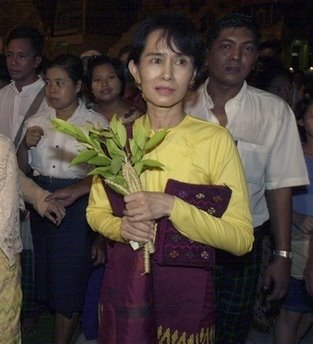


 Posts
Posts


