News & Articles on Burma
Friday, 8 July, 2011
--------------------------------
US civil society urges more Myanmar pressure
Dangerous Anti-Chinese Discontent Growing in Mandalay
Obama Urged to Push for CoI on Burma War Crimes
Ethnic Affairs Ministers Get Cold Shoulder
Politics still 'off limits' for Suu Kyi after tour
Power struggle in 'democratic' Myanmar
Will Burma sincerely cooperate with ICRC once more?
Campaign stalemate, war goes on
Traders hopeful over Thai-Burma bridge
Kachin army ambush leaves 30 dead
Aid tentatively returns to Burma prisons
Lao PM to visit Myanmar
Strike Ends in Three Pagodas Pass
----------------------------------------------
US civil society urges more Myanmar pressure
– Thu Jul 7, 10:46 am ET
WASHINGTON (AFP) – A coalition of US civil society called Thursday on President Barack Obama to tighten sanctions on Myanmar and push for a UN probe on human rights, saying the regime will only respond to pressure.
The letter to the president was signed by senior members from 21 groups ranging from the AFL-CIO, the top US labor union confederation, to the neo-conservative Foreign Policy Initiative and prominent rights organizations.
The groups said the military was still firmly in charge of Myanmar, also known as Burma, pointing to recent deadly clashes in ethnic minority areas. They said that villagers "have been arrested, tortured and killed."
"The Burmese government has given your administration no reason to believe that more diplomacy, absent greater internal and external pressure, will persuade it to change course," the coalition wrote.
"The time has come for the United States to use the levers of pressure at its disposal."
[ For complete coverage of politics and policy, go to Yahoo! Politics ]
The United States has already slapped sanctions on Myanmar's leaders and restricted trade. The letter called on the Treasury Department to expand efforts by targeting banks that hold Myanmar's hard currency reserves.
The pressure groups also urged the Obama administration to "launch a vigorous diplomatic effort" to set up a UN-led Commission of Inquiry into alleged crimes against humanity in the Southeast Asian country.
The Obama administration in 2009 opened dialogue with Myanmar, concluding that the previous Western approach of seeking to isolate the regime had failed.
Myanmar last year released opposition icon Aung San Suu Kyi from house arrest and held elections. But the United States and opposition groups consider the polls a farce and say some 2,000 more political prisoners remain locked up.
US officials have voiced disappointment with the results of engagement but say it is still the best option at a time of potential change. The administration recently named an envoy, Derek Mitchell, to spearhead diplomacy.
The United States has backed a Commission of Inquiry into alleged crimes against humanity but has not made it a priority, believing that the probe does not enjoy support among Asian nations.
Groups whose members signed the letter include Freedom House, Human Rights Watch, the Feminist Majority Foundation and the Save Darfur Coalition. http://old.news.yahoo.com/s/afp/20110707/pl_afp/usmyanmardiplomacyrightslabor
---------------------------------------------
Dangerous Anti-Chinese Discontent Growing in Mandalay
By KYI WAI Friday, July 8, 2011
MANDALAY “It is not news anymore that all good locations in Mandalay belong to the Chinese. But it will be news if Burmese can take them back,” said Sein Hla, a 57-year-old bean trader in Mandalay.
The Chinese have been able to expand their territory in downtown Mandalay because the Burmese are weak economically, Sein Hla said. When the Chinese came to Mandalay with plenty of money at a time when the Burmese were suffering an economic crisis, local land and business owners could not resist selling off their assets.
After Burma’s 1988 nationwide uprising and subsequent military coup, most local businesses in Mandalay were in bad shape and in need of cash. Beginning around 1990, many Chinese from Yunnan Province, as well as other areas of China, began to open businesses in Mandalay, buying up plots of land at high prices. Later, they brought their relatives to work in the new businesses.
In this manner, the Chinese migrants have taken over the central points of the city one after another, pushing out the local Burmese in the process.
“When I sold my land in 1994, I received over 17 million kyat [US $21,250]. Now, the price of that land is 8 billion kyat [$10,000,000]. I have never heard of such prices before,” said Lwin Maung, a 70-year-old Mandalay resident.
Lwin Maung said he sold his land at the time because he needed money. He thought that he would buy it back after working hard for a while, but he certainly cannot afford the current price.
“I think the main factor contributing to the Chinese predominance in our city is our own incompetence. Burmese are poor in terms of money and education. We are under repression, so we are poor in ideas. We are also poor in knowledge, so we lack economic vision,” said Lwin Maung.
Dr Than Htut Aung, the chief executive officer of the country’s leading Eleven Media Group, told persons attending the group’s 11th anniversary celebration in June that without capital strength, there is no way for Burmese to resist Chinese encroachment.
“We can't stand next to a soon-to-be super power country without capital strength. There is no way our poor people can resist the threat of a very rich and powerful country,” said Than Htut Aung.
The current price of a plot of land in Mandalay, which used to cost around 10 million kyat, is reported to be at least a billion kyat.
“The sales of land have been quite good. Chinese are more interested in land plots with high prices. As for Burmese and other ethnic people, they sell out a plot of land in good location and buy two or three plots in the new town area. So the real estate business in Mandalay is always on the upturn,” said Pu Lay, a real estate agent.
In early July, a plot of land located at 53rd and 38th streets in Mandalay was bought by a 40-year-old Chinese businessman, who is married to a Burmese woman, for nearly 8 billion kyat [$10,000,000].
“It is not easy to buy land in Yunnan,” the Chinese businessman said. “It is crowded and there are not many good locations to live. But I can buy land in Rangoon and Mandalay. I have planned to live here, that's why I bought it.”
Maung Maung, a gem trader in Mandalay, told The Irrawaddy that Chinese from the border have entered every business sector in town.
“Chinese from the border do everything. They are involved in the gem trade, gold mining and the bean trade. They are even involved in the construction material market,” said Maung Maung.
He pointed out that Chinese businesses in the city have quickly improved because they are united, economic-minded and share markets between themselves. While the Chinese are focusing on business and prospering, Burmese are wasting their time in teashops and gambling on football and the lottery, he said.
“There are also Burmese businessmen, such as Aung San Win in gold trading, who are smart and really work hard. But most of them are not smart and do not work hard. They just waste their time without making any effort,” said Maung Maung.
Many Burmese businessmen in Mandalay come from wealthy family businesses and prefer their traditional ways of working, some observers said.
Other local observers said that the Burmese people's discontent over Chinese encroachment has broadened because many of the Chinese people entering Burma after 1988 have been able to bribe government officials to obtain identification cards, giving them the ability to buy plots of land and houses.
“The gunpowder of hatred is already there, so it can explode anytime when it is hit by a spark. In my opinion, I don't think we should hate or be against a particular race.
I think what is happening on the ground is not because of races, but of the governments behind them,” Kyaw Yin Myint, a resident journalist in Mandalay, told The Irrawaddy.
In late June, an angry mob gathered and readied to attack a Chinese owned jewelry store after a dispute broke out. Kyaw Yin Myint said that this anger that nearly led to violence is rooted in discontent that has existed for a long time, and warned that unless an appropriate solution is implemented by either the Chinese or Burmese government, any dispute between Burmese and Chinese inside Burma could instigate a situation worse than the anti-Chinese riots of 1967.
“If the current problem [anti-Chinese sentiment] becomes bigger, it may be worse than what happened before and difficult to handle. As a result, relations between Beijing and Naypyidaw could be affected,” said Kyaw Yin Myint.
Soe Htun, a political activist and leader of the 88 Generation Students group, said that the source of growing discontent towards the Chinese lies in Beijing's appeasement of the repressive Burmese government, and urged the general public to beware of the Chinese threat.
“We must be careful about China's threat. It is important. Beijing is not only destroying our natural resources, but also backing and cooperating with the hard-hearted Burmese government,” he told The Irrawaddy.
Activists also said the recent clashes in northern Burma are the consequence of Naypyidaw's protection of Chinese interests in the area.
Than Htut Aung believes the Burmese will be able to avoid threats from China only if their country is embraced by the international community.
“We only have the will to protect and preserve our country and our independence. The thing we have do to prevent potential threats from China is not express hatred, which will affect our bi-lateral relations. We have to re-access the international community,” said Than Htut Aung, in his speech commemorating his group’s anniversary.
The Irrawaddy reporter Lin Thant contributed to this article.
Copyright © 2008 Irrawaddy Publishing Group | www.irrawaddy.org http://www.irrawaddy.org/article.php?art_id=21656
-------------------------------------------
Obama Urged to Push for CoI on Burma War Crimes
By LALIT K JHA Friday, July 8, 2011
WASHINGTON—US President Barack Obama was urged by 22 eminent US organizations on Thursday to push for a United Nations Commission of Inquiry (CoI) into alleged war crimes committed by the Burmese junta, and to fully implement the banking sanctions imposed against cronies of the military rulers.
“The United States should also mobilize support for a UN Commission of Inquiry to investigate war crimes and crimes against humanity in Burma, recommended by UN Special Rapporteur Mr Tomás Ojea Quintana and supported by Burma’s democracy leader Daw Aung San Suu Kyi,� said the letter signed by representatives of 22 different organizations.
Prominent among them are the American Center for International Labor Solidarity, AFL-CIO, American Federation of Teachers, American Jewish World Service, The Carter Center, Citizens for Global Solutions, Democracy Coalition Project, Enough Project, Foreign Policy Initiative, Freedom House, Genocide Intervention Network/Save Darfur Coalition, Human Rights Watch, Institute for Asian Democracy, Open Society Foundations, Orion Strategies, Perseus Strategies, Physicians for Human Rights, Project 2049 Institute, The Burma Fund-UN Office, and the US Campaign for Burma.
An IDP family shelter from the rain in the Karen jungle. (PHOTO: Free Burma Rangers)
The former US Ambassador to the United Nations, Nancy Soderberg, also signed the letter to Obama dated July 7.
“The Burmese government has given your administration no reason to believe that more diplomacy, absent greater internal and external pressure, will persuade it to change course. The time has come for the United States to use the levers of pressure at its disposal, and implement in full the banking sanctions authorized in the JADE ACT,� the letter said.
The statement brings to the US president's notice that it has now been almost two years since his administration launched its new engagement policy with the military government in Burma.
Senior officials from the US State Department have visited the country several times, met with Burma’s leaders, and tried to persuade them to implement positive changes in the country, as demanded by the people of Burma and the international community, the letter said adding that this has not yielded any result so far.
“Since completing the establishment of its new, ostensibly civilian governing structures, the Burmese army continued military offensives against ethnic resistance groups in Karen and Karenni States, and began military operations in Shan and Kachin States,� the letter said.
“These armed groups in opposition to the government have refused to accept Burma’s undemocratic constitution, and to transform their armed forces into border guards under the command of the Burmese army,� the US organizations said.
Meanwhile, in a resolution introduced in the US Senate, Senator Jim Webb urged the Chinese and Burmese governments to improve cooperation with the Mekong River Commission and information sharing on water flows, as well as engaging in the regional decision-making processes on the development and use of the Mekong River.
The resolution calls for the protection of the Mekong River Basin and delaying mainstream dam construction along the river, which flows through China, Burma, Laos, Thailand, Cambodia and Vietnam.
“The United States and the global community have a strategic interest in preserving the health and well-being of the more than 60 million people who depend on the Mekong River,� said Webb. “All countries along the Mekong River should respect the riparian water rights of other river basin countries and take into account proper environmental standards when considering construction projects,� the Senator urged the countries of the region.
To avoid irreversible damage to the region, it is prudent to delay the construction of mainstream dams along the river, including those along the Upper Mekong River, until adequate planning and multilateral coordination can be guaranteed,� he said.
“The recent decision of the Mekong River Commission to delay endorsement of the Xayaburi Dam is a positive step forward in this regard, and I hope that all countries will abide by their commitments to complete a robust assessment of this dam before moving forward on any construction. Absent such a collaborative approach, the ecological and economic stability of Southeast Asia is at risk,� he added.
The resolution calls on US representatives at multilateral development banks to support strict adherence to international environmental standards for any financial assistance to hydropower dam projects on the mainstream of the Mekong River. It calls for the Lower Mekong Initiative to allocate more funding for infrastructure projects and to help identify sustainable alternatives to mainstream hydropower dams.
Copyright © 2008 Irrawaddy Publishing Group | www.irrawaddy.org http://www.irrawaddy.org/article.php?art_id=21654
----------------------------------------------
Ethnic Affairs Ministers Get Cold Shoulder
By KHIN OO THAR Friday, July 8, 2011
Several ministers of ethnic affairs have complained that they have not yet been given mandates, offices or facilities.
An ethnic affairs minister in Mon State who spoke on condition of anonymity said, “We don’t even have offices for the ministers. They issued us one car per minister but we are not yet allowed to drive them. Ministers in other departments have two cars, a house, a personal assistant and sometimes are even provided with domestic staff for their homes.”
Mon State has ethnic affairs ministers representing the Karen, Burman and Pa-O communities.
According to a source, elected ministers in Rangoon Division have been provided with houses, air-conditioned offices, telephones, personal assistants, drivers, security guards and 400,000 kyat [US $500] monthly salaries. However, he said, ethnic affairs ministers in Rangoon have only a small office at the People's Parliament compound, a car provided to the same level of a vice-director at the ministry, and they receive a salary of 350,000 kyat [$437].
“We only occupy a small office in the compound of the People’s Parliament,” said an ethnic affairs minister from Rangoon Division. “If we want a telephone or air-conditioning, we have to buy it ourselves. We get cars, but not as good as the other ministers. We have not attended a single parliamentary session to date.”
According to some ethnic affairs ministers, if they have contact with the media, they are threatened by the authorities. When contacted by The Irrawaddy, all ministers of ethnic affairs would only speak anonymously.
“We were elected by the ethnic people to carry out their affairs, but now we are more like robots with nothing to do,” one said.
The chairman of the All Mon Regions Democracy Party, Naing Ngwe Thein, said that the ethnic affairs ministers were elected under the same conditions as other ministers and should, therefore, receive the same benefits.
According to a source close to the Chin Ethnic Affairs Minister, No Htan Kut, the minister has submitted several proposals but has received no response from the central government.
Ethnic ministers are appointed in almost every state and division. There are five ministers for Burman and Karen ethnic affairs, and three ministers each for Kachin, Chin, Mon, Arakan, Shan and Pa-O affairs.http://www.irrawaddy.org/article.php?art_id=21660
------------------------------------------
STRAITS TIMES
Jul 8, 2011
Politics still 'off limits' for Suu Kyi after tour
Myanmar democracy icon Aung San Suu Kyi (center) is held by her son Kim Aris (back) as she is greeted by supporters during a visit to a market in the ancient temple city of Bagan on July 7, 2011. -- PHOTO: AFP
BAGAN (Myanmar) - DEMOCRACY icon Aung San Suu Kyi drew large crowds on a landmark trip to rural Myanmar that tested her freedom, but experts say the regime will tolerate her activities only up to a point.
The Nobel Peace Prize winner was trailed by plain clothes police but allowed to travel unhindered as she avoided making public speeches on the low-key four-day excursion to the ancient city of Bagan and nearby villages.
Observers warned that a full political tour, if it goes ahead, could still trigger a confrontation with the new army-backed government, which has issued stern warnings for Ms Suu Kyi to stay out of politics.
'The regime playing nice to her this time should not fool anyone into thinking that as soon as she travels the country to in effect reconnect with her base politically the regime is to sit back and watch, undisturbed,' said activist Maung Zarni, a researcher at the London School of Economics.
Ms Suu Kyi refrained from any overtly political activities that might have antagonised the regime during her first trip outside the main city of Yangon since she was freed by the junta from house arrest last November. The democracy hero, who spent most of the past two decades as a prisoner in her own home, made no comments on Friday to a throng of reporters following her every move before she boarded a flight back to Yangon.
'We had a break but did not rest,' her youngest son Kim Aris, a British national who accompanied his mother on the trip, told AFP. 'There were too many people everywhere, but you can't get away from that.' Ms Suu Kyi, 66, signed autographs and posed for pictures as she visited temples, markets and souvenir shops in and around Bagan, one of the top tourist destinations in Myanmar, also known as Burma. -- AFP http://www.straitstimes.com/BreakingNews/SEAsia/Story/STIStory_688505.html
-----------------------------------------------
ASIA TIMES: 9 July 2011
Power struggle in 'democratic' Myanmar
By Larry Jagan
BANGKOK - The trappings of the old military regime that ruled Myanmar are slowly fading from view under new democratically elected president Thein Sein and his promises of reform. At the same time, a budding power struggle between the president and vice president Thin Aung Myint Oo has pitted moderate versus hardline agendas and stalled significantly the new government's economic and political progress.
Thein Sein, who served as prime minister for four years in the outgoing military junta, faces what many view as a pre-ordained challenge to his democratic mandate. According to some government insiders, Thin Aung Myint Oo has deliberately tried to undermine the new president, including by asserting his influence over the new army chief. As a result the president's planned economic reforms and debate over whether to release over 2,200 political prisoners have already been put on hold.
Thin Aung Myint Oo represents the old military guard and their hard-line attitudes towards political change. As former junta leader Than Shwe has withdrawn from the scene, some believe he deliberately left a power vacuum in his wake which Thein Sein and Thin Aung Myint Oo are competing to fill. If the competition escalates into open rifts, some fear the military could step in to suspend the country's nascent democracy.
To complicate matters, the top leaders of the Union Solidarity and Development Party (USDP) - the military-linked ruling party in parliament - are also trying to assert influence. These top party officials, who were persuaded to resign or retire from the army ahead of last November's election, no longer have their military stripes. Many are from the older generation of military ministers who remain suspicious of the country's move from military to democratic rule.
Although Than Shwe may have formally retired from the country's political scene, seen in the removal of his once ubiquitous portraits hung in official buildings, his legacy is playing havoc with Thein Sein's room to maneuver. In an effort to ensure that no strong military leader emerged to take control of the country and endanger his and his family's authority and wealth, Than Shwe is believed to have deliberately left a vacuum in his wake.
Thein Sein is committed to introducing moderate democratic and more ambitious economic reforms, according to sources close to him. "The old military regime has gone," said a former senior Myanmar diplomat who wanted to remain anonymous. "The new government really wants to introduce positive change," he said.
This optimistic view has been echoed by many Myanmar government officials, including diplomats posted in Asia and Europe. Thein Sein's speech in March when he took over as the country's top leader and made calls for a move towards democratic governance is indicative of his vision, they said.
But with a new pluralist power structure, comprised of executive, legislature and army branches, there is substantial scope for spoiling activities. Analysts believe that Thin Aung Myint Oo, the former head of an influential trade council, is playing that role, exploiting opportunities to usurp the president's authority and subvert his agenda.
After cabinet meetings, which usually take place once a week, the ministers are summoned into his room without Then Sein for tea and an ear bashing, according to people familiar with the situation. In particular, he has bid to exert influence over key economic decisions, including authority over potentially lucrative import and export licenses and company registrations.
In one telling episode, Thein Sein ordered that excise duties on exports be reduced to 5%. Later Thin Aung Myint Oo intervened with the support of the finance minister to put the rate at 7%. The vice president also unilaterally cut the budgets of line ministries by between 20% to 40%, apart from the defense portfolio.
Thin Aung Myint Oo has also strained the new government's international credibility by telling visitors to the capital, including a recent European Union delegation and influential US Senator John McCain, that the country holds no political prisoners. International human rights groups contend that the regime holds over 2,200 political prisoners behind bars. Internal debate over the issue has reportedly been stonewalled by the vice president.
New marching orders
The most critical tussle will concern the once dominant military's future role in politics. The 2008 constitution guaranteed military members 25% of the total seats in parliament. New army chief General Min Aung Hlaing has downplayed the military's political role and soldier MPs in both national houses of parliament were virtually silent during discussions in parliament's first session held earlier this year.
Min Aung Hlaing told military MPs before parliament was convened that their political duty was to rebuild the reputation of the army: It's your duty to become seasoned politicians, he reportedly said, as you represent the future Myanmar. He virtually blamed the old guard for the country's current economic and political mess, according to one military MP.
Thin Aung Myint Oo is reportedly unhappy with this limited role for the armed forces and has maintained they should exert pressure on both the executive and legislature. Several weeks ago Thin Aung Myint Oo reportedly summoned the army chief to his office and lectured him on the new power structure, emphasizing that he was his boss as militarily he out-ranked Thein Sein.
Die-hards in the USDP, many forced to resign from the military to contest electoral seats as civilians, are already expressing frustrations about being sidelined by the current government and parliament. They are also now working behind the scenes to reassert their lost influence through connections to the old regime.
In particular, they are reportedly trying to encourage Than Shwe to establish and lead a new State Supreme Council to oversee the new power structure, as outlined and allowed for by the new charter. USDP leaders Aung Thaung and Htay Oo have reportedly urged the former leader to consider a senior advisory role similar to the ones China's Deng Xiaoping and Singapore's Lee Kuan Yew played after they stepped down from their respective countries' formal leadership positions.
Some analysts believe that Than Shwe still runs the country from behind the scenes, evidenced in his frequent meetings with MPs at his personal residence in Naypyidaw. "Than Shwe has no plan to switch state power to the president or parliament," said Aung Lynn Htut, a former Myanmar military intelligence officer and diplomat who defected after he was posted to Washington. "He will continue to control things from behind the curtain," he said.
For the moment, these layers of political intrigue are dogging Myanmar's movement forward as a guided democracy. Thein Sein appears to have at least one strong ally in the parliamentary speaker Thura Shwe Mann, the junta's former No 3. It is in his interest to ensure parliament functions effectively within the new political structure. He is also a known rival of Thin Aung Myint Oo, especially in economic matters.
Myanmar's political future will hang in the balance until this power struggle is resolved. While Thein Sein presents a new way forward, Thin Aung Myint Oo represents the front line of defense for the status quo. While each pushes their conflicting agendas, the military waits in the wings and the potential for a coup in the name of restoring stability and suspending democracy can not for now be ruled out. http://www.atimes.com/atimes/Southeast_Asia/MG09Ae02.html
----------------------------------------------
Will Burma sincerely cooperate with ICRC once more?
Fri, 2011-07-08 00:27 — editor
By - Zin Linn
Many prisoners of conscience have been serving incredibly long prison terms in awfully ruthless conditions in Burma’s notorious prisons. Torture and ill treatment is a well known part of their incarceration and retribution.
The regime’s handling of political prisoners blatantly breaks the 1957 UN standard minimum rules for the treatment of prisoners. The International Committee of the Red Cross (ICRC) carried out its last prison visit in Burma in November 2005. In January 2006 the ICRC suspended prison visits in the country, as it was not allowed to fulfill its independent, impartial mandate.
According to today’s state-run New Light of Myanmar newspaper, the Government of Myanmar (Burma) has been carrying the maintenance of prisons in cooperation with ICRC. Water and habitat Engineer Swiss Mr Eric Weissen from ICRC and two officers were allowed to visit Mawlamyine prison on 1st July. There, they inspected site chosen for sinking tube well, storage of water and construction of toilets and septic tanks.
They were conducted round by Director Soe Soe Zaw from Myanmar Correctional Department (Mon/Kayin), prison officer in-charge and engineer. According to the preliminary survey of ICRC in Myaungmya, Hpa-an and Mawlamyine prisons, solar powered water pumping system is installed by Myanmar Correctional Department under the Ministry of Home Affairs in cooperation with ICRC.
As reported by Assistance Association for Political Prisoners - Burma [AAPP-B], at least 159 political prisoners are in poor health due to the denial of proper medical care, harsh prison conditions, torture and transfers to remote prisons where there are no doctors. Political prisoners’ right to healthcare is principally denied by the successive regimes. The prison healthcare system in Burma is totally poor, especially in far-flung jails. There are 44 prisons across Burma, and at least 50 labor camps. Some of them do not have a prison hospital as well as health assistance personnel.
AAPP-B says in its June 2011 report: “The blatant insincerity and unwillingness of the current regime to address grave human rights violations was underscored in the concluding session of the Universal Periodic Review (UPR). Throughout the dialogue, the regime made false claims as to progress made in the field of human rights while continuing to deny serious broad patterns of abuse. Burma accepts to improve relations with Special Rapporteur Quintana, but has denied him entry into the country since March 2010.”
AAPP-B also criticized the behaviors of the Burmese government in the report that if there are no widespread occurrences of human rights violations committed with impunity, as Burma claimed during the first round of the UPR in January 2011, then it should open its doors to not only the Special Rapporteur Quintana, but also to other INGOs such as the ICRC.
Burma also agreed to stop torture, but refuses to investigate allegations of torture, providing further evidence that they are only interested in providing the bare minimum so as to gain political legitimacy.
Zaw Win, Director General of the Prisons Department, brazenly lied to the international community saying there are no political prisoners in Burma. Besides, there have been no deaths in prison arising from conditions of detention, he said.
AAPP-B has documented 146 deaths as a result of ill-treatment and conditions in prison. Given the wall of secrecy surrounding prisons, the number of cases is most likely much higher. There are a total of 1,994 political prisoners in June, said AAPP Burma.
The ICRC offices were ordered to be closed in 2006. Then, ICRC released a press statement on this issue dated 29 June 2007. The statement denounced the military regime for committing human rights violations against detainees and civilians. ''The repeated abuses committed against men, women and children living along the Thai-Myanmar border violate many provisions of international humanitarian law," said Mr. Jakob Kellenberger, ICRC president.
In addition, ICRC also demanded the Burmese government to end urgently of its abuses: "We urged the government of Myanmar to put a stop to all violations of international humanitarian law and to ensure that they do not recur".
The ICRC launched an office in Rangoon (Yangon) starting a limb-fitting and rehabilitation mission in 1986. Since 1999 it has carried out assistance and protection work in places of detention and in sensitive border areas.
Since 1999, the ICRC has called on detainees in prison; in 2005 alone it met more than 3,000 prisoners in more than fifty locations. It provided kits, including basic needs such as soap and medicine for thousands of prisoners. It has been able to assess conditions even in areas of conflict via its five field offices. Under its own strict rules of engagement, the ICRC keeps its findings confidential.
In December 2005, however, the junta said ICRC staff visiting prisoners had to be accompanied by a member of the pro-junta cadres, the Union Solidarity and Development Association (now transformed into ruling party). The junta’s demand was against the principle of confidentiality that the ICRC holds as a non-negotiable condition for prison visits worldwide. It showed obviously the junta’s dislike of ICRC’s prison visits. On 23 October 2006, the junta told the ICRC to shut its field offices.
Now, observers are amazingly watching whether the Burmese government will sincerely cooperate with ICRC once more. The Burmese regime should not make use of ICRC in order to gain its credibility this time.
- Asian Tribune - http://www.asiantribune.com/news/2011/07/07/will-burma-sincerely-cooperate-icrc-once-more
-----------------------------------------
Campaign stalemate, war goes on
Friday, 08 July 2011 16:02 Hseng Khio Fah
The campaign launched by the Burma Army on the Shan State Progress Party/Shan State Army (SSPP/SSA) seems to be at a standstill since their first meet in April, though reports of small clashes between the two groups are still coming out everyday, according to local sources.
Yesterday, a unit of Burma Army soldiers from Infantry Battalion (LIB) 325 based in Hsawngkae, Shan State North’s Hsipaw township, was attacked by a unit of SSA fighters, leaving two Burma Army soldiers dead and some weapons to the group, said Col Sai Htoo, one of the SSA senior officer.
“They [the Burma army soldiers] were attacked by some of SSA fighters from Brigade No.1, while bathing in a river near their base. A corporal and a private were said to have died instantly while another soldier escaped,” a source said.
No casualties were reported from the SSA side, he added.
Clashes between the two groups were said to have been taking place everyday in Monghsu, Hsipaw, Mongyai and Kehsi townships, said a local source from Monghsu.
Though the Burma Army has made attempts to negotiate with the Kachin Independence Army (KIA), there has been no communication between the SSA and Burma Army. Future relations between the SSA and the Burma Army are indeterminable, said a border analyst from the Thai-Burma border.
The Burma Army has made no more offers of ceasefire to the SSA since they met at Mongkhurh, Hsipaw Township in Shan State North on 11, April 2011.The SSA did not respond to the demand that it surrender.
Another border watcher commented that the Burma Army still seems willing to negotiate with the SSA. “Otherwise, it [the Burma Army] would have attacked Wanhai (the SSA’s HQ),” he said.
The SSA has lost five of its bases including gateways to its ally Untied Wa State Army (UWSA) controlled areas since 13 March, when fighting first erupted. Dozens of civilians in the conflict zones were reportedly killed and injured by the Burma Army’s heavy shells. http://www.shanland.org/index.php?option=com_content&view=article&id=3839:campaign-stalemate-war-goes-on&catid=86:war&Itemid=284
--------------------------------------
Traders hopeful over Thai-Burma bridge
By THUREIN SOE
Published: 8 July 2011
The bridge connecting Thailand' Mae Sot to Myawaddy in eastern Burma has been closed since July 2010 (Wikimedia Commons)
Traders in western Thailand say they are optimistic that a border crossing and lucrative trading point with Burma will reopen within three months, following nearly a year of closure.
Thailand’s overland trade with its neighbour has suffered as a result of the closure by Burmese authorities of the Mae Sot-Myawaddy Friendship Bridge in July last year. Reasons for the decision varied, with some citing anger in Naypyidaw about what it saw as Thai attempts to reroute the Moei river, while speculation also arose about Thailand’s alleged sheltering of anti-Burmese government armed groups.
A trader in the Thai border town of Mae Sot said however that the Tak Province Traders’ Association was optimistic the new Thai government would negotiate the reopening.
“The previous Democrat Party didn’t really get along with the Burmese government,” he told DVB. But following the recent election victory of the Puea Thai party, led by Yingluck Shinawatra, the sister of exiled former prime minister, Thaksin Shinawatra, relations may improve. He added that traders along the border “are already expanding their businesses” in the hope that the crossing will soon open.
The Thai side has consistently lobbied for the bridge to be reopened. In December last year former Burmese Foreign Minister Nyan Win allegedly held secret talks with his Thai counterpart, Kasit Piromya, in a bid to negotiate an end to the stalemate.
Thailand’s countrywide border trade generates around $US4.3 billion each year for the developing economy, nearly a quarter of which goes through Mae Sot. The closure of the crossing is thought to have cost the country around $US2.7 million each day.
http://www.dvb.no/news/traders-hopeful-over-thai-burma-bridge/16488
-------------------------------------
Kachin army ambush leaves 30 dead
By DVB
Published: 8 July 2011
Around 30 Burmese troops are presumed dead after an ambush by the Kachin Independence Army (KIA) on a convoy in Kachin state’s Momauk township yesterday afternoon.
Two trucks carrying government soldiers along the Bhamo-to-Myitkyina highway were damaged in the attack; one of the two carrying more than two dozen troops was blown to pieces, according to the spokesperson of the KIA’s political wing, the Kachin Independence Organisation (KIO).
The attack came as government representatives were holding talks with the KIA at its headquarters in Laiza. The two sides have been engaged in heavy fighting over the past two months in various regions of Kachin state, forcing the displacement of some 20,000 people.
Government newspapers yesterday reported that the KIA had destroyed a number of roads and bridges in Kachin state.
The reasons behind the outbreak in violence focus largely on attempts by Naypyidaw to gain control over swathes of Kachin state and neighbouring Shan state, where the KIA has territory. The campaign has also been taken to Karen and Karenni state bordering Thailand, where various insurgent groups are based.
As well as exacting retribution on ethnic armies who refused to become government-controlled Border Guard Forces, Naypyidaw is also looking to secure areas around lucrative energy projects in Kachin and Shan state, the majority of which are backed by China.
An article in the New Light of Myanmar newspaper said that the Burmese army had fought the KIA “for the sake of project and public security”, a rare admission of a key reason behind its operations in the country’s north.
Despite several attempts at negotiation, skirmishes continue to break out. Colonel Than Aung, Kachin state’s Minister for Border and Security Affairs sent a handwritten letter to the KIO warning that negotiations would take time.
http://www.dvb.no/news/kachin-army-ambush-leaves-30-dead/16494
-----------------------------------------
Aid tentatively returns to Burma prisons
By DVB
Published: 8 July 2011
After a six year ban the International Committee of the Red Cross has taken its first steps towards regaining access to Burmese prisons.
Earlier this month the group made three trips to jails across southern and eastern Burma, although access was restricted.
“We are conducting technical assessments of water facilities and other supplies,” said Christian Cardon, spokesperson for the ICRC’s Asia-Pacific office.
He said that although it was “a positive first step”, its mandate fell short of allowing it to conduct the full extent of its work inside Burma. “We’re not talking here about proper ICRC visits to a place of detention, like we have in many other countries.”
Since a ban was slapped on the group in December 2005 after it refused to bow to government demands to allow Burmese officials to accompany staff inside the prisons, Burma’s 200,000-strong prison population has received no outside assistance.
Conditions inside the 43 jails are notoriously poor, with malaria rife and abuse of prisoners by wardens commonplace. Among the inmate population are 1994 political prisoners, some of whom are serving sentences of more than 100 years.
During a visit to Burma last month, US Senator John McCain urged authorities to allow the ICRC freedom to visit prisons, and called for the unconditional release of the political inmates who include politicians, monks, doctors and journalists.
Tate Naing, joint secretary of the Assistance Association for Political Prisoners Burma (AAPPB), said that the readmission of the ICRC, which from 1999 to 2005 had inspected prison conditions and documented reports from inmates, was a mixed bag.
“It’s a good sign that the [ICRC] are now allowed into the prison, but we see too much restriction by Burmese authorities who are playing political games.
“The ICRC should be allowed to meet with political prisoners, inmates who are receiving hefty punishments and those in poor health. But instead they are only allowed to inspect water and sanitation systems so, if we go step by step from here, it may take about four or five years until they are allow to resume normal procedures as before.”
ICRC officials visited to Karen state’s Hpa-an prison, Mon state’s Moulmein prison and Irrawaddy division’s Myaungmya prison.
http://www.dvb.no/news/aid-tentatively-returns-to-burma-prisons/16484
-------------------------------------------
Lao PM to visit Myanmar
13:43, July 08, 2011
Lao Prime Minister Thongsing Thammavong will pay an official visit to Myanmar soon, an official announcement from Nay Pyi Taw said on Friday without mentioning the specific date of his visit.
At the invitation of Myanmar President U Thein Sein, Thongsing will make the trip after a new government was installed in Myanmar.
In October last year, former Myanmar top leader Senior-General Than Shwe paid a state visit to Vientiane before Myanmar's general election and had discussions with Laotian leaders on mutual friendship and cooperation between the two nations.
The two sides touched on cooperation in economic and social sectors, including construction of the Myanmar-Laos-Vietnam road, building of the Myanmar-Laos Mekong River Friendship Bridge, anti- narcotic drives as well as forming Myanmar-Laos regional border committee in order to address border issues on a timely basis.
Myanmar and Laos, sharing border of over 230 kilometers, established diplomatic relations in 1955.
Source:Xinhua http://english.people.com.cn/90001/90777/90851/7434017.html
----------------------------------------
Strike Ends in Three Pagodas Pass
By LAWI WENG Friday, July 8, 2011
Around 400 striking Burmese migrant workers in the Thai border town of Three Pagodas Pass have agreed to return to work tomorrow after their Thai employers gave in to their demands for a wage hike, according to border sources.
The workers, from a shoe factory owned by the PTK Company, which employs around 3,000 people in three factories, including one on the Burmese side of the border, went on strike at 1 pm yesterday to demand a raise of 20 baht (US $0.66) per day.
“We reached an agreement at 8 o'clock this morning and will pay the workers an extra 15 baht ($0.50) per day,” said company manager Mahn Thean, speaking on behalf of PTK.
The strike began when workers refused to return to work after lunch yesterday to protest the company's rejection of their demands.
“We requested an increase of 20 baht, but they said they could only offer us 10 baht. That's why we went back home,” said Aung Tun, one of the striking workers.
In a further show of dissatisfaction, the workers walked back to the Burmese side of the border instead of returning home in company buses, sources said.
The striking workers were also joined by other Burmese migrants employed in the town. Altogether, around 2,000 workers in Three Pagodas Pass stayed off the job today, vowing to wait until an agreement had been reached before returning to work, according to sources.
“All of our workers will be back on the job tomorrow,” said Mahn Thean.
Workers at the factory were earning between 70 and 115 baht ($2.30-3.80) for a 10-hour workday, depending on experience. This is less than average for Thailand, causing many workers to feel that they were being exploited.
Also driving their demands is the fact that wage increases have not kept pace with rising commodity costs. Many workers said that they have been unable to send money home to their families because of rising food prices.
“Everything is getting more expensive, but wages haven't changed. This is why they went on strike,” said Nai Lyit Rot, a community leader in Three Pagodas Pass.
There are around 5,000 Burmese migrants in Three Pagodas Pass, many of them coming from different parts of Burma. The town has about 30 factories, producing gloves, textile, and shoes.
Factory work is the main source of employment in the town, since border trade has come almost to a standstill due to political instability on the Burmese side of the border.
Sources in the area say that Thai businessmen will no longer trade on the Burmese side of the border because of recent attacks, including one on June 14 targeting a store whose owner was suspected of supporting the Burmese army.
Another factor driving up prices for basic commodities is the weather. Most goods are transported by river, which is more difficult during the rainy season. http://www.irrawaddy.org/article.php?art_id=21659
__._,_.___
Saturday, July 9, 2011
News & Articles on Burma-Friday, 8 July, 2011-UZL


Friday, July 8, 2011
News & Articles on Burma-Thursday, 7 July, 2011-UZL
News & Articles on Burma
Thursday, 7 July, 2011
--------------------------------
Burma's Octopus Strangles Reform
Rangoon Commander Dismissed
Army Negotiator Pushes for Ceasefire, as State Media Blames KIA for Blasts
Karen BGF Talks Break Down; Tensions Remain High
Myanmar To Send Labour Abroad Legally
Suu Kyi in rare visit outside Yangon
The Reith Lectures: Securing Freedom (Radio 4)
Twelve media orgs call on release of Video Journalists
Call for release of jailed Myanmar reporters
ICRC resumes its tough task in unprincipled Burma
Burma says Kachin rebels bombed railway line
White Tiger Party Confronts Dissension
------------------------------------------------
Burma's Octopus Strangles Reform
By LARRY JAGAN Thursday, July 7, 2011
BANGKOK Burma’s new quasi-civilian government is under threat from withinand a military coup may be brewing as inertia has replaced the old junta. The newly elected President Thein Sein is embroiled in a power struggle that is paralysing any progress toward political or economic change.
It has emerged that Vice-president Tin Aung Myint Oo is deliberately trying to undermine the new president and assert his influence over the new army chief, Gen Min Aung Hlaing. “He’s trying to control everything,” a Burmese businessman told The Irrawaddy on condition of anonymity. As a result, the president’s planned economic reforms and the release of thousands of political prisoners have been put on hold.
The vice-president represents the old guardand their hard-line attitudesand he wants to make sure everything stays unchanged. His mentor, the former top junta leader, Snr-Gen Than Shwe has withdrawn from the day-to-day activities of government, leaving a power vacuum which Tin Aung Myint Oo is trying to fill at the expense of the more reform-minded president.
The vice-president (commonly known in Burma as “Shid-lone,” meaning “eight words,” because his full name is Thi Ha Thu Ra Tin Aung Myint Oo) is trying to establish himself as the new dictatoror the most powerful man in the country. Everywhere he turns he tries to establish his authority, according to sources in Naypyidaw who say he uses every opportunity to usurp the president’s authority.
He has been left with few avenues of formal influence now that the trade council he headed has been dissolved, but that has not dampened his efforts to monopolize the economy. “He’s a spoiler,” said a senior government official. And if he comes out on top, the country will be returned to the Dark Ages, he added.
After every Cabinet meeting, which usually takes once a week, the ministers are summoned into his roomwithout Thein Seinfor tea and an ear-bashing. Sources in Naypyidaw say he tries to exert influence on government decisions behind the scenes, especially on economic mattersespecially import and export licences and company registration, which he previously controlled as head of the trade council.
The commerce minister has to report to him twice a day, according to sources in the capital. Ministers were shocked recently when their budgets were arbitrarily cut by 20 to 40 percentexcept Defence, of courseby Tin Aung Myint Oo. Some ministers are reportedly so upset that they are using their own personal funds to pay for new schools and health centres, a Burmese businessman recently told The Irrawaddy.
There is a major battle for control going on between the president and his vice presidentone which will determine whether the government’s plans and vision set out in Thein Sein’s speech to the parliament more than three months ago will be implemented. After the president ordered the export tax to be reduced to 5 percent, the vice president intervenedwith the support of the finance ministerand had it reduced to only 7 percent.
Perhaps the most critical tussle is over the role the army is to play under the new regime. Under the new army chief, it seems clear that the army is no longer involved in politics. They are very much back in the barracks. Interestingly, the military MPs in both the national houses of parliament were virtually silent during the discussions in parliament during its first session earlier this year.
Min Aung Hlaing told the military MPswho occupy 25 percent of parliamentary seatsbefore the parliament started its session that their duty was to rebuild the tarnished reputation of the army through their political work. “It’s your duty to become seasoned politicians,” he reportedly said, “as you represent the future Burma.” He virtually blamed the old guard for the current mess, said one of the military MPs.
But Burma's new “Octopus,” Tin Aung Myint Oo, is unhappy with this current state of affairs. He wants the army to exert pressure on the executive and legislature in his favour. Several weeks ago, the vice-president summoned the army chief to see him and lectured him on the power structure, telling the general that he was the boss, as militarily he outranked Thein Sein. A silent Min Aung Hlaing was then reportedly assaulted with an ashtray.
But for the present, it seems the army chief remains his own man, intent on reforming the military machine, making it more professional. He is after all, according to several military sources, part of the army’s 88 generation. He definitely supports Thein Seinat least for the moment, according to senior military sources.
This new generation of army commanders are close to Vice Snr-Gen Maung Aye, according to a Western intelligence source.
They dislike but respect Than Shwe, said the source, but they completely despise the vice-president.
But the Octopus is marshalling his forces. Information and Culture Minister Kyaw Hsan has emerged as one of his main allies. He recently tried to get him co-opted to the National Security Council, which is emerging as one of the most important institutions in the post-junta framework. This was unconstitutional and resisted, according to military sources in the capital.
For the moment these layers of political intrigue are dogging Burma’s movement forwardalbeit to a unique form of guided democracy. With the Octopus tentacles tightly controlling business in Burma, he is slowly transforming the new hierarchies.
Even trusted old business friends of Than Shwe, such as Tay Za, are finding themselves shut out as control of the economy is being handed over to the new business leaderscriminals such as Stephen Law (aka Tun Myint Naing) of AsiaWorld and Ko Ko Gyi (who now owns Shwe Myin).
They are the new breed of Chinese mafia businessmenand they are currently making vast profits with the Octopus’s blessing and support. After all, Tin Aung Myint Oo is himself reportedly very close to Beijing, and has profited enormously as a result. This is going to have very significant consequences for the future Burma.
But the real danger to Burma’s political futurewhile the power struggle between the two politicians is unresolvedis the possibility of a military coup, led by the army chief, at Than Shwe’s bidding.
Vice-president Shid-lone and his cronies remain the villain of the peace, and seem intent on continuing to paralyse any political and economic reforms that would benefit the country and the people.
http://www.irrawaddy.org/article.php?art_id=21647
-------------------------------------------
Rangoon Commander Dismissed
By WAI MOE Thursday, July 7, 2011
Brig-Gen Tun Than, right, attends a ceremony held by the Myanmar Gold Traders Association. (Photo: The Irrawaddy)
The former commander of the Rangoon Regional Military Command, Brig-Gen Tun Than, has reportedly been sacked for corruption, just one week after being reassigned as commander of the Southern Regional Military Command, military sources said.
Tun Than, who was expected to be promoted to the rank of major general next month, was forced to retire on Tuesday, the sources said. Maj-Gen Hla Min, the chief of the Bureau of Special Operations-3, has reportedly been acting as the commander of the Southern Regional Command since Tun Than's dismissal.
Tun Than was commander of Light Infantry Division 77 based in Pegu before he was promoted to commander of the Rangoon Regional Military Command last August as part of a major military reshuffle.
There has been no official confirmation of Tun Than's dismissal.
Recently, a general staff officer serving under Tun Than was reportedly killed in car accident in Rangoon. Two others were injured.
Tun Than was one of at least half a dozen regional military commanders who were reshuffled last week. http://www.irrawaddy.org/article.php?art_id=21646
------------------------------------------
Army Negotiator Pushes for Ceasefire, as State Media Blames KIA for Blasts
By WAI MOE Thursday, July 7, 2011
As Burma's military continues its calls on the Kachin Independence Army (KIA) to agree to a ceasefire after nearly a month of hostilities, the country's state-run media has accused the group of carrying out a series of bombings targeting roads and bridges in Kachin State.
According to intelligence sources, Col Than Aung, the Burmese army's chief negotiator in the conflict, sent a letter to his Kachin counterpart, KIA vice chief of staff Brig-Gen Gun Maw, earlier this week urging the group to stop its warfare in the state.
“We will continue to discuss this matter until we achieve peace,” Than Aung was quoted by sources as saying in the letter.
The letter also said that both sides should refrain from carrying out attacks, including bombings, and that the KIA should release government soldiers it is holding prisoner and avoid taking up position in government buildings.
In reply, the KIA said that it appreciated the government negotiator’s concerns and agreed to repair a bridge that had been damaged by a recent explosion.
Meanwhile, Burma's state-run newspapers on Thursday accused the KIA of carrying out three bombings between June 30 and July 5 that targeted roads, railways and bridges in Kachin State.
“KIA is committing mine explosions on motor roads, railroads and bridges for killing and wounding the people in Kachin State,” The New Light of Myanmar said.
The KIA has denied that Kachin troops are targeting civilians, but has vowed to defend their “land and Kachin people” from any attack by the government army.
A 16-year-old ceasefire between the government and the KIA broke down on June 9 after Burmese troops attacked the KIA near the Chinese-run hydropower station of Ta Paing, forcing about 200 Chinese technicians and workers at the site to return to China.
http://www.irrawaddy.org/article.php?art_id=21645
--------------------------------------------
Karen BGF Talks Break Down; Tensions Remain High
By SAW YAN NAING Thursday, July 7, 2011
Attempted negotiations aimed at resolving a conflict between a pro-government Border Guard Force (BGF) in Karen State and a faction that broke away from the BGF several months after it was formed last year have failed, according to Karen sources.
The talks were initiated in early July by government loyalist Chit Thu, a leading figure in the Democratic Karen Buddhist Army (DKBA), which was officially disbanded late last year to form the BGF. They were held at the headquarters of the breakaway BGF faction in Myaing Gyi Nyu, in southern Karen State's Hlaing Bwe Township.
The talks were aimed at easing tensions between government forces and former BGF troops led by Lt-Col Po Bi. Around 1,000 soldiers under Po Bi's command broke away from the BGF in May after deciding to remain as members of the DKBA. Po Bi now leads four battalions.
Several days ago, Chit Thu traveled to Myaing Gyi Nyu accompanied by at least 20 pickup trucks carrying BGF troops to meet with Po Bi and attempt to persuade him to rejoin the pro-government force, according to Brig-Gen Johnny, the commander of Karen National Liberation Army (KNLA) Brigade 7.
The talks failed, however, because Po Bi rejected Chit Thu’s offers, said Johnny.
The move came after military officials in Naypyidaw ordered Chit Thu to conduct a meeting with the renegade Karen BGF faction led by Po Bi, said DKBA sources.
Htee Moo, a DKBA source, reported that local villagers in Myaing Gyi Nyu fear the breakdown of the talks could result in major fighting between the two Karen armed groups led by Chit Thu and Po Bi. Some villagers have already moved to villages or towns nearby Myaing Gyi Nyu, he added.
However, Po Bi and his troops have since left Myaing Gyi Nyu and taken up positions near the town, according to Johnny.
“He [Po Bi] doesn’t want to open the front line in Myaing Gyi Nyu as temples and religious halls could be destroyed if major fighting breaks out,” said Johnny.
The KNLA has also vowed to assist the Po Bi-led renegade Karen group if the government and its ally, the Chit Thu-led Karen BGF battalions, launch a major attack against them. Chit Thu still has influence over four remaining Karen BGF Battalions.
“The Burmese government wants Karens to fight against Karens, so they asked Chit Thu to negotiate with Po Bi,” said Johnny.
The DKBA split from its mother organization, the Karen National Union—the political wing of the KNLA—in 1995 and signed a ceasefire agreement with the government. The DKBA was formed into BGF battalions under Burmese army command in 2010. However, a DKBA brigade under the command of Brig-Gen Saw Lah Pwe rejected the move and has since allied itself with the KNLA.
http://www.irrawaddy.org/article.php?art_id=21643
---------------------------------------
July 07, 2011 18:58 PM
Myanmar To Send Labour Abroad Legally Through Government-to-government Channel
YANGON, July 7 (Bernama) -- Myanmar labour authorities are planning to send workers to foreign countries through government- to-government channel, Xinhua news agency quoted the local Biweekly Eleven News' report Thursday.
As part of the move, Minister for Labour and for Social Welfare, Relief and Resettlement U Aung Kyi had discussions with his Qatar counterpart over the labour affairs recently.
Myanmar workers turned to seek jobs mostly in Dubai, Qatar and South Korea when the country stopped dispatching workers to work in Malaysia for six months starting July 1.
At present, Myanmar workers have much interest in working in South Korea especially in the manufacturing sector at a time when South Korean government sends for over 51,000 Myanmar workers this year.
According to official statistics, the number of Myanmar workers, legally employed to work in 15 foreign countries, reached 330,311 as of 2010 since 1990 and such overseas workers had fetched for the country over US$17 million.
Myanmar citizens seeking overseas jobs are mostly destined to such countries as Singapore, Malaysia, South Korea, Libya, Thailand, Cambodia, Japan, Switzerland, Brunei Darussalam, United Arab Emirates, America, France, Germany, Qatar and Kuwait.
As part of its bid to ease domestic employment problem, Myanmar's Ministry of Labour has sought job opportunities for Myanmar workers since 1990.
-- BERNAMA http://www.bernama.com/bernama/v5/newsworld.php?id=599754
----------------------------------------
Asia-Pacific
Suu Kyi in rare visit outside Yangon
Crowds throng as democracy leader visits temple city of Bagan.
ALJAZEERA: Last Modified: 07 Jul 2011 09:46
Myanmar pro-democracy leader Aung San Suu Kyi greeted by supporters in Bagan [EPA]
The Myanmar pro-democracy leader Aung San Suu Kyi is travelling for the first time outside Yangon since her release from house arrest last November.
Her trip to the ancient temple city of Bagan, with one of her sons, Kim Aris was supposed to be a private affair, but crowds of supporters flocked to the temple.
Suu Kyi in theory is free to travel where she wishes in Myanmar as she was released without any conditions. But only last week, the new military-backed government warned her and her party to cease all political activities.
Supporters of Suu Kyi say this visit is just a holiday as she also plans to visit the birthplace of her father, the independence leader Aung San.
Safety fears
The government has warned of chaos if she tries to rally public support during her visit.
Officials of Suu Kyi's party, the National League for Democracy, have told supporters to stay away, as they fear her trip could be jeapordised by clashes between pro-democracy supporters and groups linked to the military-backed government.
In 2003 she was travelling in the north of the country when thugs linked to the then ruling generals attacked her convoy.
The attack took place in Kyee Village, on the outskirts of Depayin Township. After the attack, Suu Kyi was arrested and placed under house arrest, where she remained until her release in 2010.
She will take a flight back to Yangon on Friday.
Suu Kyi has been in and out of detention since 1991, when she led her party to victory in parliamentary elections. The military, however, refused to accept the result. http://english.aljazeera.net/news/asia-pacific/2011/07/20117782826881468.html
--------------------------------------------
The Reith Lectures: Securing Freedom (Radio 4)
Antonia Quirke
Published 04 July 2011
How Aung San Suu Kyi draws lessons from the Gulag.
Aung San Suu Kyi's two Reith Lectures (28 June, and forthcoming on 9 July) are an important coup for the new controller of Radio 4, Gwyneth Williams, who managed to push the request through to all the right people in Burma specifically because of her World Service connections (Williams joined the WS in 1976 as a trainee). Further proof, if it were needed, of the high worth of those with a hands-on background at that miraculous station.
Three weeks after the invitation went in, word came back that, yes, ASSK would do it if she could have access to certain reference books - she has few books even though now officially not under house arrest; she asked in particular for Max Weber's Politics As a Vocation and Nadezhda Mandelstam's Hope Against Hope. The wife of the poet Osip Mandelstam, who died in 1938 in a transit camp in Siberia, Nadezhda has been an inspiration to ASSK, along with the Odessa-born poet Irina Ratushinskaya, who spent four years in a camp before being released on the eve of the 1986 summit between Ronald Reagan and Mikhail Gorbachev.
At a screening of the first lecture at Broadcasting House, it was mesmerising to sit and watch ASSK speaking at length (the footage had been recently smuggled out of Burma). Traditional peach silk top. Blue flowers in her hair. A slash of orange lipstick. She is resolutely not a spin-doctored, slick operator. Two things stood out: her use of the old-fashioned word gallantry, and her repeated use of the word passion.
Though ASSK is clearly unbowed, at one point during the live Q&A down the line from Rangoon she admitted that the lights had been switched off by the authorities and she was sitting at the telephone in the dark. How fitting that she had, just minutes earlier, quoted from Ratushinskaya's prison poem that ends: "It isn't true, I am afraid, my darling!/But make it look as though you haven't noticed."
There is to ASSK an air of unrelenting affection. It reminded me of something the actress Debra Winger - who quit Hollywood before it dried her up completely - said about passion: it is the thing that keeps you soft.
http://www.newstatesman.com/radio/2011/07/suu-kyi-san-quirke-assk-aung
----------------------------------------
Twelve media organizations call on the release of Video Journalists
By Zin Linn Jul 07, 2011 8:32PM UTC
Twelve media organizations fighting for freedom of expression and freedom of the press all around the world cosigned, today, a joint statement calling on the Burmese government to put a stop to its harassment and prosecution of journalists and calling on the release of the Democratic Voice of Burma’s Video Journalists.
An alliance of 12 media organizations on Thursday called on Government of Myanmar (Burma) to end its harsh restrictions upon journalists and to release 17 video journalists serving long prison term in military-controlled country.
The joint statement says: “Despite pledges by Burma’s new government that it has begun the transition to civilian rule, 17 video journalists (VJs) for the Oslo-based exiled media organization, the Democratic Voice of Burma (DVB), remain imprisoned. They are among nearly 2,100 political prisoners in Burma, a testament to the lingering hold of dictatorial rule on the country.”
Twelve media organizations call on the Burmese government to put a stop to its harassment and prosecution of journalists, who are forced to operate under strict control and surveillance. The media alliance points out evidence in the statement that despite government’s promises to freedom of the press and freedom of expression, situations continue to deteriorate in Burma on the contrary. Regulations over the Internet users are more and more rigid and journalists are forced to self-censor with greater intensity. they said in a joint statement.
Twelve media alliance urged the United Nations, the ASEAN regional bloc and the European Union to press on Myanmar to release all journalists in prison.
The DVB was tipped as one of the top nominees for the Nobel Peace Prize last year due to its documentaries secretly made by the courageous video-journalists most of them in prison.
According to Norway-based Democratic Voice of Burma, which has broadcast different news video from Burma for years, its video reporters have been apprehended since 2007, when the military junta launched a bloody crackdown on pro-democracy protesters in Saffron Revolution.
For example, DVB reporter Hla Hla Win, for example, was jailed in 2009 and is serving a 27-year sentence after interviewing Buddhist monks near the anniversary of the 2007 uprising. Two more DVB video-journalists have been jailed. Sithu Zeya, 21, received and eight-year sentence in December last year after police caught him taking photos of grenade attack at a stage during water-throwing festival in April 2010. Later, his father Maung Maung Zeya was also arrested and sentenced 13 years imprisonment.
The joint-statement said a number of the jailed DVB journalists were under various torture techniques during the interrogation phase to extract information about DVB’s operation and its network of undercover reporters.
The signatories of the joint statement are Democratic Voice of Burma (DVB), Reporters Without Borders (RWB), Committee to Protect Journalists (CPJ), Irrawaddy, Mizzima, Southeast Asian Press Alliance (SEAPA), Article 19, International Federation of Journalists (IFJ), Burma Media Association (BMA), Index of Censorship, Canadian Journalists for Free Expression (CJFE) and International Press Institute (IPI).
The Burmese government has been practicing unnecessary restrictions on media and journalists and also extra restrictions on Internet users since the information minister is unmoved from the days of the former junta.
Although the optimistic politicians and media personnel hoped for better free-press environment after the election, the scenario remains unchanged. http://asiancorrespondent.com/59506/twelve-media-organizations-call-on-the-release-of-video-journalists/
------------------------------------------
STRAITS TIMES: Jul 7, 2011
Call for release of jailed Myanmar reporters
BANGKOK - A COALITION of media groups on Thursday called on Myanmar to end the harassment of journalists and to release 17 video reporters serving long prison sentences in the military-dominated country.
A dozen organisations, including the Democratic Voice of Burma and Reporters Without Borders, urged the United Nations, the Asean regional bloc and the European Union to press Myanmar to release all jailed journalists.
'There is evidence that despite pledges to the contrary, freedom of the press and freedom of expression continue to deteriorate in Burma, with regulations over access to the Internet tightened and journalists now forced to self-censor with greater intensity,' they said in a joint statement.
The DVB, which last year was tipped as one of the top contenders for the Nobel Peace Prize, says that since December, two of its video journalists have been jailed for up to 13 years.
They have joined the other 15 DVB reporters in detention including Hla Hla Win, who was sentenced to 27 years in jail in Myanmar, for interviewing a monk during the 2007 'Saffron Revolution' failed uprising.
The statement said some of the jailed DVB journalists may have been tortured during interrogation. -- AFP http://www.straitstimes.com/BreakingNews/SEAsia/Story/STIStory_688168.html
---------------------------------------------
ICRC resumes its tough task in unprincipled Burma
By Zin Linn Jul 07, 2011 4:53PM UTC
The state-run New Light of Myanmar newspaper says today that the Government of Myanmar (Burma) has been carrying the maintenance of prisons in cooperation with ICRC. Water and habitat Engineer Swiss Mr Eric Weissen from ICRC and two officers were allowed to visit Mawlamyine prison on 1 July. There, they inspected site chosen for sinking tube well, tube well, storage of water and construction of toilets and septic tanks.
They were conducted round by Director Soe Soe Zaw from Myanmar Correctional Department (Mon/Kayin), prison officer in-charge and engineers. According to the preliminary survey of ICRC in Myaungmya, Hpa-an and Mawlamyine prisons, solar powered water pumping system is installed by Myanmar Correctional Department under the Ministry of Home Affairs in cooperation with ICRC.
As reported by Assistance Association for Political Prisoners – Burma [AAPP-B], at least 159 political prisoners are in poor health due to the denial of proper medical care, harsh prison conditions, torture and transfers to remote prisons where there are no doctors. Political prisoners’ right to healthcare is principally denied by the successive regimes. The prison healthcare system in Burma is totally poor, especially in far-flung jails. There are 44 prisons across Burma, and at least 50 labour camps. Some of them do not have a prison hospital as well as health assistance personnel.
AAPP-B says in its June 2011 report: “The blatant insincerity and unwillingness of the current regime to address grave human rights violations was underscored in the concluding session of the Universal Periodic Review (UPR). Throughout the dialogue, the regime made false claims as to progress made in the field of human rights while continuing to deny serious broad patterns of abuse. Burma accepts to improve relations with Special Rapporteur Quintana, but has denied him entry into the country since March 2010.”
AAPP-B also criticized the behaviors of the Burmese government in the report that if there are no widespread occurrences of human rights violations committed with impunity, as Burma claimed during the first round of the UPR in January 2011, then it should open its doors to not only the Special Rapporteur Quintana, but also to other INGOs such as the ICRC.
Burma also agreed to stop torture, but refuses to investigate allegations into torture, providing further evidence that they are only interested in providing the bare minimum so as to gain political legitimacy.
Zaw Win, Director General of the Prisons Department, brazenly lied to the international community saying there are no political prisoners in Burma. Besides, there have been no deaths in prison arising from conditions of detention, he said.
AAPP-B has documented 146 deaths as a result of ill-treatment and conditions in prison. Given the wall of secrecy surrounding prisons, the number of cases is most likely much higher. There are a total of 1,994 political prisoners in June, said AAPP Burma.
Many prisoners of conscience have been serving incredibly long prison terms in awfully ruthless conditions. Torture and ill treatment is a well known part of their incarceration and retribution.
The regime’s handling of political prisoners blatantly breaks the 1957 UN standard minimum rules for the treatment of prisoners. The International Committee of the Red Cross (ICRC) carried out its last prison visit in Burma in November 2005. In January 2006 the ICRC suspended prison visits in the country, as it was not allowed to fulfill its independent, impartial mandate.
The ICRC offices were ordered to be closed in 2006. Then, ICRC released a press statement on this issue dated 29 June 2007. The statement denounced the military regime for committing human rights violations against detainees and civilians. ”The repeated abuses committed against men, women and children living along the Thai-Myanmar border violate many provisions of international humanitarian law,” said Mr. Jakob Kellenberger, ICRC president.
In addition, ICRC also demanded the Burmese government to end urgently of its abuses: “We urged the government of Myanmar to put a stop to all violations of international humanitarian law and to ensure that they do not recur”. http://asiancorrespondent.com/59478/icrc-resumes-its-tough-task-in-unprincipled-burma/
------------------------------------------
Burma says Kachin rebels bombed railway line
By AP News Jul 07, 2011 2:18PM UTC
YANGON, Burma (AP) — Burma’s government says ethnic Kachin rebels have bombed a major railway line in the north of the country for the third time in less than a month.
The state-run New Light of Myanmar newspaper says the rebels attacked the train line that runs from the city of Mandalay to the Kachin state capital Myitkyina on Tuesday night.
The paper said in a report Thursday that no casualties were reported and the train track was repaired.
Fighting between the Kachin and government troops erupted last month. It displaced 10,000 people and forced Chinese technicians working at hydropower projects in the region to flee the country.
The fighting was the first recorded since a peace deal in 1994 broke down last year.
http://asiancorrespondent.com/59464/burma-says-kachin-rebels-bombed-railway-line/
----------------------------------------------
White Tiger Party Confronts Dissension
By SAI ZOM HSENG Thursday, July 7, 2011
A Central Executive Committee member of the Shan Nationalities Democratic Party (SNDP), (aka) White Tiger Party, is refuting reports that party leaders are more focused on their own business interests than the party’s political activities, causing many party members to want a change in leadership.
Saw Than Myint told The Irrawaddy on Wednesday that the SNDP is operating normally and its leaders are tending to their political activities regularly; the exception being that the party chairman and vice-chairman can’t participate in party activities because they have been appointed to the state and union government, respectively.
“Our chairman was appointed to the Shan State government and the vice-chairman was appointed to the union government. That’s why they can’t be involved in the party’s activities frequently. We don’t have any plan to replace or change the persons in the position of chairman or vice-chairman yet,” said Saw Than Myint.
The chairman of the SNDP, Sai Aik Pao, is an in-law of Htay Myint, a Burmese crony who has a good relationship with members of the former military regime. Sai Aik Pao owns a salt business, and the party vice-chairman, Sai Saung Si, owns a tea plantation in northern Shan State.
In addition, the White Tiger Party has made an application with government authorities to establish a company having the name “Top White Tiger Co. Ltd,” which will focus on agriculture, mines and trading, especially with China. But Saw Than Myint said that they don’t yet have permission to start a company.
A party source in Rangoon said Sai Aik Pao controls everything that belongs to the party, and almost all of the members want to change this situation. The leadership of the party can’t provide direction and there’s no initiative by party branches, leaving many party members wanting to resign, the source said.
A SNDP party member from its Taunggyi branch said that the leaders of the party, especially the chairman and vice-chairman, are usually busy with their own businesses and their government jobs. He said they should pass the mantle of the party to people who can strongly lead, but added that party members want only a change of leadership, not separation from the party.
Many who voted for the White Tiger Party in Burma’s 2010 election have also voiced their disappointment on social networks such as Facebook and Twitter. For example, one person with the username Nang Hseng Noom said on Facebook that, “the businesses of the party leaders are a slap in the face of the party, so disappointed with the activities of the leaders.”
The White Tiger Party fielded 157 candidates and won 57 seats in the 2010 election. It is recognized as one of the largest ethnic political parties in the country. Currently, it has over 120,000 party members.
According to China's Xinhua news agency, the Union Solidarity and Development Party, which is known as the junta-backed party, won 883 of the 1,154 seats contested in the election. The pro-regime National Unity Party came in second with 63 seats, followed by the White Tiger and the Rakhine (Arakan) Nationalities Development Party, with 57 and 35 seats, respectively. http://www.irrawaddy.org/article.php?art_id=21642
Thursday, July 7, 2011
News & Articles on Burma-Wednesday, 6 July, 2011-UZL
News & Articles on Burma
Wednesday, 6 July, 2011
--------------------------------
Suu Kyi congratulates Yingluck
Thai Election Raises Hope for Resumed Border Trade
Suu Kyi gets emotional reception on Myanmar holiday
High-ranking Myanmar diplomat seeks asylum in U.S.
Myanmar envoy seeks asylum, pressure on rulers
Than Shwe disciple to head Burma’s intelligence
KIA limits military resistance to Burmese government
SSA South wants SSA North to evacuate from its main base
Economic reforms is needed after kyat value increases
------------------------------------------
Suu Kyi congratulates Yingluck and a government democratically elected by the people
By Bangkok Pundit Jul 06, 2011 3:30PM UTC
Comments Off
The Bangkok Post:
Burma’s democracy icon yesterday welcomed Thailand’s election outcome, which has paved the way for Yingluck Shinawatra to become the country’s first female prime minister.
“I like that she’s a woman but the most important thing is the relationship between the two nations and our people,” Mrs Suu Kyi told reporters on the second day of her visit to the ancient temple city of Pagan in central Burma.
“We also have to welcome the government democratically elected by the people,” she said, also expressing hope that ties with neighbouring Thailand would remain strong under 44-year-old Yingluck’s administration.
Reuters:
She praised the general election in neighboring Thailand on Sunday as “free and fair” and welcomed its winners, the opposition Puea Thai Party led by businesswoman Yingluck Shinawatra, sister of ousted Prime Minister Thaksin Shinawatra.
“I expect the ties between Myanmar and Thailand to get better,” she said.
Pic:AP
BP: This takes BP back to some comments by Suu Kyi last year as the excerpt below reads:
A new government coming to power under a constitution drawn up by the military will never be stable,” he cited her as saying. “We do not need to see very far. We just see Thailand,” she said. “Thaksin was an elected person. The military seized the power from an elected person. The constitution was drawn up by the military,” she said.
“After that, what happened with the first (government)? It was not stable,” she said of the short-lived administration that followed the coup. “This was a result of the constitution being written by the military.”
BP: Back then, Panitan said she did not have enough information about Thailand whereas a Thai senator went further and suggested that Suu Kyi should be investigated to see if she had been paid….. Some comments:
1. This does not mean that Suu Kyi is a fan of Thaksin – see 2 for more. BP thinks she more likely dislikes the Thai military and establishment. She is hardly going to be for military coups, committees appointed by the military to write constitutions, and governments formed in a military barrack.
2. Yes, Thaksin was not a fan of the Burmese people, but did things really improve post-Thaksin? In 2007, when the Burmese military started killing protesters and monks, you first had silence by the Thai government and then the Burmese were defended by the Thai coup leader Gen. Sonthi. Even Kavi – who had hoped that Surayud’s government would bring about change – see here, here, here, and here – could only despair.
Then Abhisit’ government started under a cloud with the Rohingya being pushed back to see by the military and his failure to do anything. You also had concern that Thailand would deport Burmese refugees after last year’s election, particularly given the large scale deal to build a deep-water port and essentially export industries in Thailand that pollute too much, to Burma – see here and here. You also have to ask the question, given the support of Burma’s other neighbours for the regime and Thailand’s dependency on Burma for energy, does a Thai government really want to push change? BP doesn’t expect much of a change. Perhaps, Suu Kyi hopes for change, but realizes this too. Nevertheless, couldn’t resist a dig at the Thai military and establishment… http://asiancorrespondent.com/59365/suu-kyi-congratulates-yingluck-and-a-government-democratically-elected-by-the-people/
--------------------------------------------
Thai Election Raises Hope for Resumed Border Trade
By WAI MOE Wednesday, July 6, 2011
Workers load goods on a boat for shipment across the Thai-Burmese border. (Photo: The Irrawaddy)
Yingluck Shinawatra—the youngest sister of Thailand's ousted former Prime Minister Thaksin Shinawatra—is set to become the country's first female prime minister after her Pheu Thai Party won a majority of seats in a national election held on Sunday.
Although domestic issues are likely to be at the top of her agenda when she forms a new government, relations with Burma will also demand some attention. On this front, one of the more pressing problems facing bilateral ties is Naypyidaw's suspension of border trade at Mae Sot-Myawaddy, the main crossing point on the key route connecting the two countries.
It has been nearly a year since the Burmese authorities ordered the closure of the Friendship Bridge linking the Thai town of Mae Sot and Myawaddy, in Burma's fractious Karen State. On July 17, 2010, Burma shut the bridge in protest over Thailand's decision to build an embankment on its side of the Moei River. Later, however, it said it would keep the bridge closed until stability is restored in border areas.
After a year without any progress in talks between the two sides, Thai and Burmese businessmen in Mae Sot say they are now hoping that the change of administration in Bangkok will improve the chances of a return to normal trade in the near future.
“We understand that the border closure is due to a dispute that the two sides have been unable to resolve, but now that elections in Thailand are over, we hope the new government will be able to find a solution,” said Nai Su Chai, a businessman in Mae Sot.
One reason the Thai government hasn't pushed too hard to reopen the bridge is that it doesn't want to derail plans to build a new bridge that will connect Mae Sot with a special economic zone on the Burmese side of the border, according to a Thai reporter based in Mae Sot.
Although Thailand and Burma remain major trading partners, with Burma exporting most of its natural gas to its eastern neighbor, the impact of the border trade shutdown has been significant. Shortly after the border was closed last July, Thai Deputy Commerce Minister Alongkorn Ponlaboot told reporters that in recent years border trade has been worth as much as 140 billion baht (US $4.3 billion) annually.
Despite its importance, however, border trade has often suffered as a result of political disputes. Since the late 1990s, the Burmese regime has repeatedly cut off trade as a means of expressing displeasure with Thailand over a variety of bilateral issues.
“The Burmese authorities have often used border trade to undermine the Thai government in the past. They even banned and destroyed goods such as cola, seasoning and cooking oil from Thailand. And Thailand in turn forced migrant workers back to Burma,” said U Hamat, a Burmese trader based in Mae Sot.
However, Thailand's business stakes in Burma continue to grow significantly. Alongside China and South Korea, Thailand is one of the main investors in Burma, particularly in hydropower projects, petroleum and infrastructure, according to the Economist Intelligence Unit (EIU) in its May 2011 report.
“Natural gas exports (primarily to Thailand) remained Myanmar’s [Burma's] largest single source of export revenue, accounting for 27.4 percent of total export revenue in April-December, the first nine months of the 2010/11 fiscal year,” the EIU said.
Mae Sot is not only a key town for border trade, but also home to many Burmese pro-democracy organizations and NGOs working on Burma issues. Among many working in this field, there is concern that Yingluck could follow her brother's example and become too cozy with Burma's generals, perhaps at the expense of Burmese opposition groups operating in Thailand.
So far, however, that doesn't seem to be the case.
“At the moment, there is no unusual pressure on us. Ms Yingluck’s most urgent work will be on internal issues rather than international or regional issues,” said Aung Moe Zaw, a secretarial member of the National Council of Union of Burma, an umbrella group of ethnic and pro-democracy groups.
“The Pheu Thai Party was in opposition for years, so I hope they can understand the position of Burma’s democracy movement,” he added.
Regarding Yingluck’s victory, Burmese pro-democracy leader Aung San Suu Kyi congratulated her on Tuesday and called on her to support Burma issues and help Burmese refugees who are currently staying in Thailand.
So far, the Burmese regime in Naypyidaw has not responded to the election outcome in Thailand. The state-run media has also been silent on the vote, which is widely seen as a repudiation of the Thai military coup that ousted Thaksin from power in September 2006.
Irrawaddy correspondent Mann Myo Myint contributed reporting from Mae Sot. http://www.irrawaddy.org/article.php?art_id=21638
----------------------------------------
Suu Kyi gets emotional reception on Myanmar holiday
AFPBy Soe Than Win | AFP – 2 hrs 35 mins ago
Myanmar's democracy icon Aung San Suu Kyi poses for a photograph during her visit to Mount Popa near Mandalay on July 6. Suu Kyi attracted dozens of emotional supporters during her visit to an ancient temple city in central Myanmar, proving her enduring popularity after years in detention
Myanmar's democracy icon Aung San Suu Kyi poses for a photograph during her visit …
Democracy champion Aung San Suu Kyi attracted dozens of emotional supporters Wednesday during her visit to an ancient temple city in central Myanmar, proving her enduring popularity after years in detention.
The Nobel Peace Prize winner is on holiday in Bagan, famed for its temple ruins, on her first venture outside her home city of Yangon since being freed by the junta from seven years of house arrest last November.
As the 66-year-old returned to her car after a lunch-time stop with her youngest son and travel companion Kim Aris, she was greeted by a spontaneous crowd of about 150 supporters, some of them openly weeping.
"Thank you very much," a smiling Suu Kyi told her admirers, as she signed autographs, including on some T-shirts, and posed for photographs.
"I will try to come back," she added, before retiring to her hotel. Earlier, she and Aris, 33, who was born in Britain, had been sightseeing in nearby Mount Popa and toured a local museum.
Suu Kyi has refrained from making political comments during her trip, which began Monday, in an apparent attempt not to antagonise government figures, who have warned they can't guarantee her safety on her travels.
Her earlier plan to launch a political tour prompted a demand from the regime for her National League for Democracy (NLD) party to stay out of politics, and a warning that "chaos and riots" could ensue if she went ahead.
That tour has been delayed until the weather conditions are right, Suu Kyi said last week. Plain-clothes police have been following her every move throughout her current trip, although it is described as a private visit.
Security is a major concern after Suu Kyi's convoy was attacked in 2003 during a political tour, in an ambush apparently organised by a regime frightened by her popularity.
Observers said that any activity that puts Suu Kyi in contact with the people of Myanmar could have repercussions.
Her NLD party won a landslide election victory in 1990 that was never recognised by the junta, and the party was disbanded by the military rulers last year because it boycotted a November election, saying rules were unfair.
The junta's political proxies claimed an overwhelming victory in the poll, which was marred by widespread complaints of cheating and intimidation.
http://news.yahoo.com/suu-kyi-gets-emotional-reception-myanmar-holiday-094759560.html
-----------------------------------------
High-ranking Myanmar diplomat seeks asylum in U.S.
From Elise Labott, CNN Senior State Department Producer
July 6, 2011 -- Updated 1048 GMT (1848 HKT)
Washington (CNN) -- The second-highest-ranking diplomat at the embassy of Myanmar in Washington has defected and wants to seek asylum in the United States.
In a letter to Secretary of State Hillary Clinton obtained by CNN, Deputy Chief of Mission Kyaw Win said he had "no choice" but to leave his post in protest over human rights abuses and fraudulent elections. He said he is formally seeking asylum for himself and his family because he is afraid for their lives.
State Department spokeswoman Victoria Nuland confirmed the State Department received a letter but declined to comment further about private diplomatic correspondence.
Win's move is a setback for the regime in Myanmar, which held its first elections in 20 years in November. The vote drew fire from critics who said it was aimed at creating a facade of democracy. The regime had refused to allow international monitors or journalists into Myanmar for the vote but has argued the elections constitute an end to military rule and merit an easing of international sanctions.
Win wrote in the letter he had held out hope for democratic reforms throughout his 31-year career, but lost confidence after last year's widely criticized elections, which largely left the military junta in control. As such, he said, he could not in good conscience continue working for the government.
"The truth is that senior military officials are consolidating their grip on power and seeking to stamp out the voices of those seeking democracy, human rights and individual liberties. Oppression is rising and war against our ethnic cousins is imminent," he wrote.
As a high-ranking diplomat, Win maintained ties with pro-democracy Burmese activists in Washington. In the letter he talked about the balance he had to strike between reaching out to the opposition and answering to his government.
He also urged the United States to set up an international council of inquiry to investigate human rights violations in Myanmar and calls for the U.S. to implement targeted sanctions against the government and its "cronies that serve to keep them in power."
He said he fears returning to the country because his efforts to improve bilateral relations with the United States have been continually rejected and "resulted in my being deemed dangerous by the government."
Win also warned about threats made to pro-democracy leader and Nobel Peace Price laureate Aung San Suu Kyi, who traveled outside Yangon this week for the first time since she was freed from house arrest last November. The government warned her against engaging in political activities and issued a thinly veiled threat in a state-run newspaper that her planned first tour outside the city since her release from house arrest seven months ago could spark riots and chaos, as they did when she traveled the countryside in 2003.
In his letter, Win mentions Suu Kyi's travel, warning the threats against her "must be taken seriously."
The Obama administration has shifted from a longtime policy of isolation of Myanmar in favor of engagement, with little success.
Last week Derek Mitchell, the nominee to be U.S. special envoy to Myanmar, said the United States is prepared to have a positive relationship with the country and would seek better international coordination in encouraging democratic reform there.
Mitchell was critical of the regime's claims to have made a transition to civilian rule after last year's elections, saying at his Senate confirmation hearing that "Burma remains a country at war with itself and distrustful of others."
"Burma is the poorest country in Southeast Asia and a source of great concern and potential instability in the region," he said. http://edition.cnn.com/2011/WORLD/asiapcf/07/05/myanmar.diplomat.defects/index.html
----------------------------------------
Jul 6, 2011
Myanmar envoy seeks asylum, pressure on rulers
MYANMAR - THE No. 2 diplomat in Myanmar's embassy in Washington is seeking asylum in the United States because the reports in which he outlined his government's failures have put him in danger, he said on Tuesday.
Career diplomat Kyaw Win sent Secretary of State Hillary Clinton a letter before dawn July 4 spelling out his disillusionment with the lack of reform in the South-east Asian nation also known as Burma, he told Reuters.
'Sometimes when you report the facts, they don't like it,' Mr Win said in a telephone interview, describing his efforts to persuade the junta that has ruled Myanmar for five decades that their repression and corruption hurt their country's image.
'They would write back: 'why are you doing these kind of things?'' Mr Win said of officials in the capital, Naypyidaw.
Myanmar's ruling military junta handed power to a nominally civilian government in March after elections last November that were widely dismissed as a sham. The elections were intended to create the impression of a democratic transition after 49 years of direct army rule.
Mr Win said he sought 'to tell them that what they are doing is not right and we need work out some way to put our country together.' 'Because of their lack of exposure and education, they have no capacity to understand what's happening in the world,' he said. -- REUTERS http://www.straitstimes.com/BreakingNews/SEAsia/Story/STIStory_687695.html
---------------------------------------
Than Shwe disciple to head Burma’s intelligence
By DVB
Published: 6 July 2011
Former junta chief Than Shwe. The appointment of a close aide to head Burma's intelligence likely to reignite speculation of his lingering grip on the military (Reuters)
A trusted disciple of former Burmese junta chief Than Shwe will now head the country’s intelligence body following a major reshuffle last week of the military’s upper echelons.
Army sources told DVB that Major General Soe Shein, once Than Shwe’s personal security officer, will now take the helm of Burma’s intelligence unit, known as Military Affairs Security (MAS), replacing its former chief, Major General Kyaw Swe.
New regional army commanders have also been appointed in the first major shake-up of the military since the elections in November 2010, which saw the ascent of the powerful new commander in chief, Min Aung Hlaing.
Sources said the reshuffle affected at least six regional military command (RMC) zones around the country, including Rangoon RMC, Southern RMC, Southwestern RMC, Western RMC, Eastern RMC and Triangle RMC, close the conjunction of the Burmese, Thai and Laotian borders.
General San Oo, commander of the Taunggyi-based Eastern RMC will replace his Rangoon counterpart Brig-Gen Htun Than, while Brig-Gen Soe Htut, commander of the Southern RMC, will move to the Taunggyi office.
The appointment of Soe Shein to such a senior position will likely reignite speculation of Than Shwe’s lingering grip on the Burmese military: defence ministry sources told The Irrawaddy Magazine in April that reports from the War Office marked ‘confidential’ were still being sent to the 77-year-old, despite officially retiring as head of the military following the elections.
His position alongside Min Aung Hlaing, another Than Shwe confidante, as one of the country’s most powerful military figures also suggest that Than Shwe is building a trusted network of comrades that will ensure his safety into the future – a pertinent concern for Burma’s leaders given the regime’s history of sometimes vicious power struggles.
The new military commanders are being introduced at a time when internal armed conflict is raging on an almost unprecedented scale, with at least four border states currently hosting fighting between Burmese troops and ethnic armies.
Reasons for the reshuffle remain unclear. It comes only 10 months after a major shake-up that saw more than 50 senior Burmese military officials nudged up the army hierarchy to fill spots made vacant by the mass ‘retirement’ of the country’s leading ringmasters before the polls.
As of last week, many of those men, including Kyaw Swe, have been replaced, but their destinations are not known.
http://www.dvb.no/news/than-shwe-disciple-to-head-burma%E2%80%99s-intelligence/16460
----------------------------------------
KIA limits military resistance to Burmese government
Tuesday, 05 July 2011 15:52 KNG
The Kachin Independence Army (KIA) has limited its military resistance to the central Burmese government since July 1, a day after delegates from the two sides met for peace talks in Kachin State, on June 30, KIA officials said.
The order was given on Friday to all KIA troops at the frontlines in Kachin State and Northern Shan State to temporarily stop attacking military targets on the main roads and governmental infrastructure in major towns, according to the KIA officers.
lanan_laiza
La Nan, Vice General Secretary-2 of KIO.
The order permits Kachin troops to take military action only when Burmese troops intrude on KIA territory, KIA officers added.
A KIA officer at the frontline from 3rd Brigade in Manmaw (Bhamo) District said, “The order means we cannot fight against Burmese troops if they won’t march to our posts.”
Delegates of the Kachin Independence Organization (KIO), the political-wing of KIA, and the military-backed Burmese government met twice to negotiate a new ceasefire on June 17 and 30th. However, no agreement has been reached, according to Kumhtat La Nan, Vice-general Secretary-2 at the KIO headquarters in Laiza.
La Nan told the Kachin News Group after the second talks at Lajayang, “We cannot announce a ceasefire to our KIA troops at the frontlines because the government’s ceasefire offer has not proved to be credible. We are asking for an official ceasefire statement from the government side. We cannot trust a verbal offer without an official document.”
Under the KIO’s defense policy, the KIA took military action in response to aggressive government troop movements, as well as against bridges and railway infrastructure, when the war was started by government forces at Sang Gang, in N’mawk (Momauk) Township, in Manmaw District, on June 9. http://www.kachinnews.com/news/2000-kia-limits-military-resistance-to-burmese-government.html
----------------------------------
SSA South wants SSA North to evacuate from its main base
Tuesday, 05 July 2011 12:34 S.H.A.N.
Shan State Army (SSA) South leaders say the SSA North should abandon its besieged HQ Wanhai as soon as possible before it is too late.
According to reports from both rebel and civilian sources, the Burma Army is tightening its cordon around Wanhai, where the 4 townships, Kehsi, Monghsu, Tangyan and Mongyai meet. “It has however opened up an outlet for its 300 defenders to escape to the south,” said a senior SSA South commander.
Sun Tzu, the ancient Chinese philosopher consults in his classic The Art of War: When you surround an army, leave an outlet free. This does not mean the enemy is to be allowed to escape. The object is to make him believe that there is a road to safety, and thus prevent his fighting with the courage of despair.
He also said: Confront your troops with annihilation, and they will survive; plunge them into a deadly situation and they will then live.
The SSA North has been fighting since it was attacked on 13 March. Its leader Maj Gen Pang Fa has already moved out of Wanhai, but his second-in-command Col Khaymin still remains there.
One disadvantage of the SSA North, according to the SSA South, is that it is fighting in the hinterland, away from the international borders where news, both verbal and visual, could reach the outside world promptly. “We have been fighting for more than 3 months, but few people know what’s happening here,” complained an SSA North officer. “On the other hand, the Kachins have only started to fight (on 8 June), but the whole world is talking about it.”
In this kind of situation, the enemy can do whatever it likes to both the local people and the rebels, according to the SSA South. “They may read the news, but they’ll be still none the wiser to take actions,” said one of its commanders.
The SSA South and the SSA North declared on 21 May to form a merger. “We are still working on it, said Lt-Gen Yawdserk, “In the meantime, we are doing what we can to help them.”
When Yen-an, the Communist Party of Burma (CPC)’s wartime capital, was attacked by the Kuomintang forces, Mao Zedong was quoted as saying: If we are concerned about the territory but not for the people, we will lose both. But, on the contrary, if we are concerned about the people and not for the territory, both will be won back. http://www.shanland.org/index.php?option=com_content&view=article&id=3829:ssa-south-wants-ssa-north-to-evacuate-from-its-main-base&catid=86:war&Itemid=284
----------------------------------
Economic reforms is needed after kyat value increases
July 6, 2011
By Between
Myanmar kyat
Myanmar and president Sein are promising to make economic reforms in response to the sharp increase in value of the Myanmar kyat.
Many economists, including U Khin Maung Nyo, said the government would be making both transitory and permanent changes in expectation of further appreciation of the kyat. The kyat recently hit its highest point in five years with 750 kyat equal to one USD.
The government has called upon the country’s economist for advice pertaining to the issue. Prior to this decision, the government took a very inflexible approach to the currency, preferring to artificially undervalue it. The new government promises to make lasting solutions.
The deflation of the kyat might sound like a good thing to the uninformed, but it hurts exporters. Exchange rates fluctuate independently of international trade and Burmese exporters have lost tremendous profits and the Power Purchasing Parity (PPP) looks to be declining for the export industry of Myanmar.
Even U Win Myint, the former Minister of Commerce who resigned over rigged elections last year, promised that a new monetary policy was going to be put in place soon. Exporters will soon be making even more money than they were before. http://www.burmaonlinecentre.com/news/news-article/economic-reforms-is-needed-after-kyat-value-increases
__._,_.___
Wednesday, July 6, 2011
News & Articles on Burma-Tuesday, 5 July, 2011
News & Articles on Burma
Tuesday, 5 July, 2011
--------------------------------
Suu Kyi Recounts NLD History in BBC Lecture
Myanmar's Suu Kyi keeps low profile on upcountry trip
Myanmar democracy leader Suu Kyi’s private trip draws crowds
Suu Kyi welcomes Thai poll outcome
Suu Kyi travels to Bagan
Suu Kyi confident in new Thai PM
Thein Nyunt calls up veteran politicians
Regional Commanders Reshuffled
Burma's Police Chief Meets Chinese Counterparts
----------------------------------
--------------------------------------
July 05, 2011
Suu Kyi Recounts NLD History in BBC Lecture
VOA News
Myanmar democracy icon Aung San Suu Kyi, left, greets a woman during her visit to a pagoda along with her youngest son Kim Aris, right, in Myanmar's ancient city of Bagan Tuesday, July 5, 2011
Photo: AP
Myanmar democracy icon Aung San Suu Kyi, left, greets a woman during her visit to a pagoda along with her youngest son Kim Aris, right, in Myanmar's ancient city of Bagan Tuesday, July 5, 2011
Burmese pro-democracy leader Aung San Suu Kyi explores the recent history of her National League for Democracy and the what drives people to dissent in a BBC lecture recorded for broadcast Tuesday.
The lecture is the second of two to be secretly recorded in Burma by the British broadcasters and smuggled to London for airing. The broadcast comes as Aung San Suu Kyi is visiting with her son Kim Aris in the Burmese pagoda city of Bagan.
It is her first trip outside Rangoon since she was freed from house arrest in November. While she is not conducting any political activities in Bagan, the trip is seen as a test of the limits to her newfound freedom.
In the BBC broadcast, Aung San Suu Kyi describes the unique nature of the NLD and its struggle to find an appropriate role for itself. The party overwhelmingly won elections in 1990 but was never permitted by the Burmese military to assume power.
In the lecture, the Nobel Peace laureate also discusses what drives a person to dissent even knowing the sacrifices involved. Aung San Suu Kyi has spent most of the time since the 1990 elections under house arrest.
In the first lecture aired a week ago, Aung San Suu Kyi compared development in Burma to the Arab Spring protests in the Middle East.
She called those uprisings an "inspiration" to her people and said the Burmese envy the people of Tunisia and Egypt for their "quick and peaceful" transitions. http://www.voanews.com/english/news/Suu-Kyi-Recounts-NLD-History-in-BBC-Lecture-124999239.html
-----------------------------------------
Myanmar's Suu Kyi keeps low profile on upcountry trip
Reuters // 5:25 a.m. EDT, July 5, 2011
BAGAN, Myanmar (Reuters) - Trailed by undercover police, Myanmar pro-Democracy leader Aung San Suu Kyi kept a low profile on Tuesday as she visited pagodas on the second day of a countryside visit that is testing the patience of the military-backed government.
The visit to Bagan, an ancient city 690 km (430 miles) north of Yangon known for centuries-old Buddhist temples, is the first time the 66-year-old Nobel laureate has left Yangon since her release from house arrest in November.
But she was not rallying big crowds after her National League for Democracy (NLD) urged her followers to stay away, fearing a repeat of a bloody attack on her motorcade in 2003 in which 70 of her supporters were killed. The NLD is banned but remains politically active.
[Sample Our Free Breaking News Alert And 3 P.M. News Newsletters]
That was the last time she left Yangon, where she subsequently spent seven years in detention until her release last November.
She is now allowed to travel where she wants. But the government warned last month of "chaos and riots" if she sought to rally supporters and accused her of trying to exploit the public.
The trip by Suu Kyi and her British-born son, Kim Aris, was described as a pilgrimage by the NLD. She held no political rallies or high-profile public events during the visit.
She visited four pagodas accompanied by plainclothes police and NLD security, appearing calm and relaxed and telling reporters she was enjoying the trip.
She praised the general election in neighboring Thailand on Sunday as "free and fair" and welcomed its winners, the opposition Puea Thai Party led by businesswoman Yingluck Shinawatra, sister of ousted Prime Minister Thaksin Shinawatra.
"I expect the ties between Myanmar and Thailand to get better," she said.
One resident said the authorities had instructed trustees of the pagodas before her arrival "not to give Aung San Suu Kyi any special VIP treatment."
Since her release from house arrest, the daughter of slain independence hero Aung San has been conciliatory in her comments about the country's rulers and has urged dialogue.
The charismatic figurehead of Myanmar's fight against five decades of dictatorship has not been troubled by the new civilian government, which is dominated by members of the previous military regime that long sought to undermine her.
However, she is still frequently criticized in commentaries carried by state-run newspapers, which act as mouthpieces for the country's hardline rulers.
In February, newspapers accused her of provocative acts that could lead to a "tragic end" for her and the NLD.[nSGE71C00L]
The government said last Wednesday it was not responsible for ensuring Suu Kyi's safety, comments that drew sharp rebukes from the United States, Australia and Britain, which said they went against the government's pledge of reconciliation.
(Reporting by Aung Hla Tun; Writing by Jason Szep; Editing by Alan Raybould and Yoko Nishikawa) http://www.courant.com/news/nation-world/sns-rt-us-myanmar-suukyitre7641ag-20110705,0,880612.story
-----------------------------------------
Myanmar democracy leader Suu Kyi’s private trip draws crowds; police do not intervene
By Associated Press, Published: July 4 | Updated: Tuesday, July 5, 5:37 PM
BAGAN, Myanmar — Myanmar’s democracy icon Aung San Suu Kyi was supposed to be on a private tour of the temple city of Bagan, but she drew crowds Tuesday in a test of the government’s tolerance after it warned her against political appearances.
Suu Kyi, in her first trip out of the main city of Yangon since she was released from house arrest in November, was visiting the ancient city with her youngest son.
“I am very happy. This is my first vacation with my son in twenty years,” Suu Kyi told reporters after praying at one of Bagan’s famous temples. “I never have enough sleep at home but now I want to sleep all the time. I have time to rest.”
However, she and son Kim were mobbed by a small crowd of local residents and shadowed by dozens of plainclothes police during the second day of her visit.
The police made no moves to break up the gatherings.
Suu Kyi has said she will soon travel around the country to meet her political supporters, drawing a warning in the state-controlled press that she could cause chaos.
Suu Kyi drew large crowds when she last made a trip to the countryside in 2003, and her popularity badly rattled the then-military government. Supporters of the junta ambushed her entourage as it toured northern Myanmar, killing several of her followers. She escaped but was detained. There were suspicions that the attack was organized by the army, which denied involvement.
Suu Kyi often faced problems in the past when she traveled outside Yangon — where she lives and her National League for Democracy is headquartered — with the government stopping her motorcades.
Although her reception in Bagan was relatively modest, with perhaps 100-200 supporters and the curious turning out to see her at various stops, the area is loosely populated and publicity over Suu Kyi’s plans has been low-key. http://www.washingtonpost.com/world/asia-pacific/myanmars-pro-democracy-leader-suu-ky-makes-private-trip-into-countryside-1st-since-release/2011/07/04/gHQA8xgRxH_story.html?wprss=rss_world
---------------------------------------------
Suu Kyi welcomes Thai poll outcome
Press Trust Of India
Bagan, July 05, 2011
First Published: 13:04 IST(5/7/2011)
Last Updated: 13:21 IST(5/7/2011)
Myanmar's democracy icon Aung San Suu Kyi today welcomed Thailand's election outcome, which paves the way for Yingluck Shinawatra to become the country's first female Prime Minister. "I like that she's a woman but the most important thing is the relationship between the two nations and
our people," Suu Kyi told reporters on the second day of her visit to the ancient temple city of Bagan in central Myanmar.
"We also have to welcome the government democratically elected by the people," she said, also expressing hopes that ties with neighbouring Thailand would remain strong under 44-year-old Yingluck's administration.
Yingluck's Puea Thai party, allied to her brother Thaksin Shinawatra who was ousted in a coup five years ago, stormed to a majority victory in Sunday's vote, taking a majority of the seats in Thailand's lower house.
While Suu Kyi's own opposition party won a landslide election in Myanmar in 1990, the military junta never allowed it to take power, and she has spent much of the last two decades in jail or under house arrest.
The 66-year-old Nobel peace laureate was sidelined in the first election to be held since then, in November last year, and her party was disbanded by the generals for boycotting the vote.
The junta's political proxies claimed an overwhelming victory in the poll, which was marred by widespread complaints of cheating and intimidation. http://www.hindustantimes.com/world-news/myanmar/Suu-Kyi-welcomes-Thai-poll-outcome/Article1-717500.aspx
---------------------------------------------------
Suu Kyi travels to Bagan
July 5 2011 at 09:10am
AP
Myanmar democracy icon Aung San Suu Kyi arrives at Nyaung Oo airport in Bagan, Myanmar.
Bagan - Myanmar democracy icon Aung San Suu Kyi visited an ancient city of temples and met with her youngest son during her first trip into the countryside since her release from house arrest in Yangon in November.
The 66-year-old Nobel Peace Prize laureate planned to spend four days on a private trip to Bagan - also known as Pagan - where her son Kim Aris also was visiting from Britain. She last went there in 1989 for a political appearance that drew thousands of residents.
Suu Kyi plans further trips to meet supporters outside Yangon, the country's largest city, although the state-controlled media warned her last week against political trips, saying they could cause chaos and riots.
Her last political trip to the countryside in 2003 drew huge crowds but also the wrath of the then-ruling military junta, whose supporters ambushed her entourage. She eventually was detained and placed under house arrest.
Suu Kyi arrived in Bagan by plane on Monday and was met at the airport by her son, her pet dog and a host of plainclothes security police and reporters.
Suu Kyi's security aides said she will relax and unwind in Bagan. “One of her pastimes in Bagan will be drawing. One of her close aides has bought canvas and painting paraphernalia,” said one, who asked not to be named because he was not authorized to speak to reporters.
Suu Kyi often faced problems in the past when she traveled outside Yangon, with the government stopping her motorcades.
A trip to Mandalay by train in 1996 was aborted when authorities said her carriage had mechanical problems. During her second attempt to travel there by train in 2001, the government stopped her at the station and placed under house arrest for 18 months. - Sapa-AP
http://www.iol.co.za/news/world/suu-kyi-travels-to-bagan-1.1093422
----------------------------------------------
Suu Kyi confident in new Thai PM
By AFP
Published: 5 July 2011
Burma’s democracy icon Aung San Suu Kyi on Tuesday welcomed Thailand’s election outcome, which paves the way for Yingluck Shinawatra to become the country’s first female prime minister.
“I like that she’s a woman but the most important thing is the relationship between the two nations and our people,” Suu Kyi told reporters on the second day of her visit to the ancient temple city of Bagan in central Burma.
“We also have to welcome the government democratically elected by the people,” she said, also expressing hopes that ties with neighbouring Thailand would remain strong under 44-year-old Yingluck’s administration.
Yingluck’s Puea Thai party, allied to her brother Thaksin Shinawatra who was ousted in a coup five years ago, stormed to a majority victory in Sunday’s vote, taking a majority of the seats in Thailand’s lower house.
While Suu Kyi’s own opposition party won a landslide election in Burma in 1990, the military junta never allowed it to take power, and she has spent much of the last two decades in jail or under house arrest.
The 66-year-old Nobel peace laureate was sidelined in the first election to be held since then, in November last year, and her party was disbanded by the generals for boycotting the vote.
The junta’s political proxies claimed an overwhelming victory in the poll, which was marred by widespread complaints of cheating and intimidation.
Suu Kyi is on her first trip outside Rangoon since being freed from years of house arrest a few days after the election and politics is not on the agenda.
But the high-profile vacation is seen as test of her ability to travel freely around the country, albeit under the watchful eyes of the regime.
http://www.dvb.no/news/suu-kyi-confident-in-new-thai-pm/16442
-----------------------------------------
Thein Nyunt calls up veteran politicians
By AHUNT PHONE MYAT
Published: 5 July 2011
More than 10 politicians who cut their teeth in the National League for Democracy have joined Thein Nyunt, an opposition parliamentarian who defected from the National Democratic Force this year, as he pushes ahead with a bid to set up a new party.
Also included in the party, which if approved by the Union Election Commission will operate under the title of New National Democratic Party, are five serving parliamentarians, one of whom is Thein Nyunt.
His decision to form a new party comes after the one-time senior NLD member was expelled from the NDF, which itself split off from the NLD so that it could compete in the November 2010 elections.
Thein Nyunt was accused by fellow NDF leaders, notably party co-founder Khin Maung Swe, of sharing sensitive policy details with the media and accusing the party of using foreign funding, a practice that is illegal under Burmese law. Thein Nyunt responded that the party had failed to carry out a financial audit it had promised to do.
A request to form the New National Democratic Party was made yesterday in Burma’s capital, Naypyidaw, and listed the names of 20 founding members. Thein Nyunt said that “12 of the 20 founders previously worked with the National League for Democracy for over 20 years – they have experiences in the 1990 elections and also participated in the 2010 elections”.
Also included is the popular Burmese hip hop artist, Yatha, who rose to fame in 2006 and since has appeared on an MTV Exit programme on human trafficking in neighbouring Thailand.
Relations between Thein Nyunt and his former colleagues in the NDF have not improved, and bitterness clearly remains.
“I chose the name National Democratic Force for my former party in the 2010 elections; it was formed by me and those from the NLD who … wanted to participate in the elections,” he said.
“But they expelled me 10 days after we won the elections but that’s their decision. Now I’m forming the New National Democratic Party to get back on the election track. We are forming this party with people who have been loyal for 20 years, not those who are cunning and who will stab politics in the back.”
The party is preparing for the interim elections, Thein Nyunt said, rumours of which have circulated since the appointment of more than 40 MPs to cabinet posts and advisory committees following the first session of parliament in February. Under Burmese parliamentary legislation, those seats must be replaced via a second round of votes.
No details about the interim elections have been released, and it is not yet known whether anything has been finalised. The head of the Union Election Commission, Thein Soe, said in a recent parliamentary session however that they may be held October or November this year.
http://www.dvb.no/news/thein-nyunt-calls-up-veteran-politicians/16446
--------------------------------------
Regional Commanders Reshuffled
By WAI MOE Monday, July 4, 2011
In the first major development within Burma's military since it officially handed over power to a quasi-civilian administration on March 30, the War Office in Naypyidaw has reshuffled the commanders of at least six Regional Military Commands (RMCs) and filled two other important posts.
According to information leaked by military sources on Monday, the War Office, under Commander in Chief of Defense Services Gen Min Aung Hlaing, issued the reshuffle order on Friday, implementing a decision made during a triannual meeting of military commanders held in late May.
The latest reshuffle did not involve any promotions, as most of the regional commanders will simply be changing places, according to a military source.
“Brig-Gen Tin Maung Win, the commander of the Southwest RMC, will take over the Western RMC from Brig-Gen Soe Thein. Brig-Gen Tun Than will move to the Southern RMC headquarters at Taungoo, while Brig-Gen Soe Htut of the Southern RMC has been shifted to Taunggyi, the headquarters of the Eastern RMC, and Brig-Gen San Oo from Taunggyi is now the Rangoon commander,” the source said.
Two other vacant positions were also filled, although no names were available for the new appointees.
One of the positions, chief of the Bureau of Special Operations-6, was formerly held by Lt-Gen Soe Win, who became the deputy commander in chief of the defense services earlier this year. The other, chief of armed forces training, was held by Lt-Gen Hla Htay Win until he was named joint-chief of staff (army, navy, air force) on March 30.
Although Burmese military sources mentioned only half a dozen regional commanders who had changed positions, an official from the Kachin Independence Army (KIA) said on condition of anonymity that the KIA's intelligence indicated that 12 of the Burmese army's 14 RMC commanders had been reshuffled.
The only two exceptions, he said, were Brig-Gen Ye Aung of the Central RMC and Brig-Gen Zayar Aung of the Northern RMC, which has been engaged in sporadic clashes with the KIA since mid-June.
Although all the reshuffled commanders were informed about their new appointments two weeks ago, they did not move to their new posts until this past weekend, sources said.
All of the commanders who were affected by the recent reshuffle were promoted from commanders of light infantry divisions and commandants of military schools during a massive military reshuffle in August 2010. http://www.irrawaddy.org/article.php?art_id=21623
------
__._,_.___


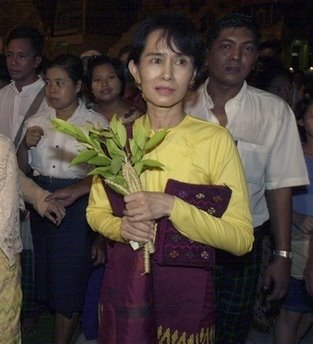


 Posts
Posts


