News & Articles on Burma
Thursday 30 June, 2011
--------------------------------
Bans on Suu Kyi threaten Rudd meeting
Myanmar's Suu Kyi plans first trip since release
Democracy hopes fading in Myanmar
Suu Kyi calls for talks with home minister
Chinese made military trucks arriving at border raises question
Burma's Ethnic Insurgencies Erupt in a Chain Reaction
Suu Kyi to Visit Pagan Next Week
KIA Meet Burma Army Officials
Nominee US Envoy Seeks 'Candid' Talks with Naypyidaw
Migrants saved from Thai ransom round-about
-------------------------------------------
Bans on Suu Kyi threaten Rudd meeting
Dan Oakes
July 1, 2011
KEVIN RUDD could be flying into a diplomatic storm in Burma, with the dictatorial regime banning the opposition leader, Aung San Suu Kyi, from meeting with ''foreign organisations''.
Mr Rudd touched down in Burma last night and is due to meet Ms Suu Kyi, a Nobel peace laureate, tomorrow.
He is also scheduled to meet Burma's President, Thein Sein, the foreign minister and speaker of the parliament.
Advertisement: Story continues below
''A meeting with Aung San Suu Kyi remains part of the minister's schedule,'' a spokeswoman for Mr Rudd said last night from Burma's largest city, Rangoon.
However, reports this week in the regime's Burmese language newspaper suggest Ms Suu Kyi could be stopped from meeting any foreign officials.
Ms Suu Kyi, who has spent 15 of the past 21 years in detention, was released from house arrest in November and immediately called for a ''peaceful revolution'' in Burma, which is ruled by a nominally civilian government that is stacked with members of the former junta.
She recently announced plans to tour the country and meet with supporters of her National League for Democracy party, repressed by the junta since it won elections in 1990, but the regime is tightening the screws on the 66-year-old.
This week the regime told Ms Suu Kyi to halt all political activities and warned the proposed tour could spark riots, for which she would be held responsible. The last time she campaigned outside Rangoon, in 2003, her convoy was set upon by government-backed thugs.
Now the regime, possibly spooked by Ms Suu Kyi's recent meetings with foreign officials such as the Japanese vice-foreign minister and former US presidential candidate John McCain, has threatened to halt the procession of foreign dignitaries trying to meet the democracy icon.
An editorial in the regime's newspaper, translated for the Herald by Burmese activists in Australia, accused the NLD of violating the ban on its activities.
Read more: http://www.brisbanetimes.com.au/national/bans-on-suu-kyi-threaten-rudd-meeting-20110630-1gt3p.html#ixzz1Qm3Vu09U
-------------------------------------------
Thursday June 30, 2011
Myanmar's Suu Kyi plans first trip since release
YANGON (Reuters) - Myanmar's pro-democracy leader Aung San Suu Kyi will next week travel outside her home city for the first time since her release from a seven-year stint of house arrest last November, a spokesman for her former party said.
Suu Kyi plans to join her son, Kim, on a four-day pilgrimage from July 4 to Bagan, an ancient city about 700 km (435 miles) north of Yangon, where she has spent the past eight years.
Pro-democracy leader Aung San Suu Kyi (C) holds her birthday gift as she makes her way through the crowd gathered at her National League for Democracy (NLD) head office in Yangon June 19, 2011. (REUTERS/Soe Zeya Tun)
"The purpose of the trip is purely religious," Han Tha Myint, a spokesmen for Suu Kyi's now defunct National League for Democracy Party (NLD), said on Thursday, adding she would travel by plane.
Suu Kyi, 66, was expected to go on a series of one-day trips outside Yangon next week, prompting concerns by her supporters about her personal safety. Several government-run newspapers carried commentaries on Wednesday warning of "chaos and riots" if Suu Kyi went ahead.
The Nobel laureate's last tour in 2003 was marred by an ambush on her motorcade by thugs believed to be hired by the then ruling military junta.
More than 70 of her supporters were killed in the incident, known as the Depayin Massacre. It was widely seen as an assassination attempt on Suu Kyi, who was put back under house arrest, or what the regime called "protective custody".
The U.S. State Department said on Wednesday the new Myanmar government was responsible for Suu Kyi's safety everywhere in the country.
The charismatic figurehead of Myanmar's fight against five decades of military dictatorships has been given unprecedented freedom by the generals who have long despised her and still control Myanmar behind a new civilian government.
Through its media mouthpieces, the government has warned Suu Kyi not to overstep the mark, saying she would meet a "tragic end" and accusing her of provocative acts.
Since her release on Nov. 13 last year, the daughter of slain independence hero Aung San has be conciliatory in her comments about the country's rulers and has urged dialogue.
She has met regularly with diplomats and envoys and analysts expect her to play a pivotal role in the debate over whether Western sanctions on the former British colony should be lifted.
The government has not responded to her offer but has instead invited the NLD, which was disbanded for boycotting last year's much-criticised election, to register as a social organisation, then run in the next polls in 2015.
"They still have opportunity to participate legally in the next election if they want to," said a commentary published in three newspapers on Thursday.
"We do not want to see street politics, public panic and anarchy again.
"If they want to serve public interests, I would like to request they be considerate towards the public and continue to do politics in the framework of the law," it said.
(Reporting by Aung Hla Tun; Writing by Martin Petty; Editing by Alex Richardson)
Copyright © 2011 Reuters http://thestar.com.my/news/story.asp?file=/2011/6/30/worldupdates/2011-06-30T201533Z_01_NOOTR_RTRMDNC_0_-580140-2&sec=Worldupdates
-------------------------------------------
Democracy hopes fading in Myanmar
Published: June 30, 2011 at 10:00 AM
LONDON, June 30 (UPI) -- The main opposition party in Myanmar vowed to play a role in political life, but one advocate said hopes for democracy in the country are waning.
State-run newspapers in Myanmar ran columns warning pro-democracy leader Aung San Suu Kyi that her travels outside of the commercial capital Naypyitaw could stoke chaos in the country.
Mark Farmaner, an advocate at Burma Campaign UK, told The Independent newspaper in London any hopes of democratic reform in the country were fading quickly.
"Myanmar's new dictator, Thein Sein, has revealed his true colors with these threats," he said. "He is emerging as even less tolerant of dissent than (former leader) Than Shwe."
Suu Kyi, a Nobel Peace prize laureate, led her National League for Democracy to a 1990 election victory that was never recognized. She spent much of the last decade in detention but was freed last year during the country's general elections.
Her NLD decided against taking part in the election. Win Tin, a senior NLD member, was quoted as saying his group's activities would carry on "according to the law."
Myanmar touted last year's elections, the first in nearly two decades, as a path toward civilian leadership, though the election was dubbed a sham by the international community.
Read more: http://www.upi.com/Top_News/Special/2011/06/30/Democracy-hopes-fading-in-Myanmar/UPI-58321309442446/#ixzz1Qm2SMC69
-------------------------------------------
Suu Kyi calls for talks with home minister
By AHUNT PHONE MYAT
Published: 30 June 2011
The National League for Democracy’s (NLD) secretary Aung San Suu Kyi has called for a meeting with the government’s Home Affairs Minister in a response to a letter sent to her and the group’s chairman Aung Shwe on June 28 warning them to stop their political activities.
The exchange of letters came as warnings in the state press were published which seemed to take offence to the continuing activities of the group; “the NLD is found to have kept opening its party headquarters and branches in states and regions and other towns, erecting the signboards and hoisting flags at some offices, issuing statements, publishing periodicals and videos, meeting with other organisations and holding meetings and ceremonies. Such acts are not only against the law but also tantamount to opposing the hluttaws [parliaments] at various levels.”
The NLD, after a Central Executive Committee meeting yesterday afternoon, sent a letter signed by Suu Kyi to the Home Affairs minister and former army Brigadier-General Ko Ko, calling for a meeting with him to ‘negotiate for the rule of law.’
The letter contested the government’s claim; that the NLD is officially defunct, according to the Political Parties Registration Law announced last year, after failing to register for the 2010 elections, citing laws in the 2008 constitution.
“Article 409 of the Constitution of the Republic of the Union of Myanmar (Burma) provided that; the Pyidaungsu Hluttaw (Union Parliament) shall enact necessary laws concerning political parties, so only the [Union Parliament] has the authority to enact the Political Parties Registration Law,” said the NLD letter.
“The NLD is defunct by the Political Parties Registration Law but that was not enacted by the Union Parliament,” read the letter.
The letter also claimed the NLD is still legally standing as a political party as it doesn’t violate articles 407, 409 and 466 of the constitution, adding that the group is abiding by legal procedures and the rule of law but didn’t intend to oppose the parliaments or the government.
“The NLD is not committing acts that can harm peace and stability and the rule of law as well as unity among the people – we are an organisation that genuinely wishes for the rule of law and are constantly striving to achieve national reconciliation.”
The NLD’s spokesperson Nyan Win told DVB that: “We see that our party still exists according to the law but the government sees that we are already dissolved – but this is not to argue.”
“We sent a letter [to Ko Ko] calling him to arrange a meeting to discuss on the rule of law.”
Suu Kyi has been planning to tour the country, the first such trip since 2003?s Depayin Massacre at which her convoy was attacked by thugs believed to have been connected to the Union Solidarity & Development Association, which morphed into the military’s favoured party the Union Soldiarity and Development Party (USDP) for the election. This event lead to her last spell under house arrest.
This plan, which by all accounts remains and Suu Kyi’s recent ‘Reith Lecture‘ which was aired by the BBC have caused the establishment concern. In her widely broadcasted lecture the Nobel Laureate expressed envy for Egypt and Tunisia who had over thrown autocratic leaders relatively quickly. She also refused to rule out violence as an effective means to enact political change.
http://www.dvb.no/news/suu-kyi-calls-for-talks-with-home-minister/16360
-------------------------------------------
Chinese made military trucks arriving at border raises question
Thursday, 30 June 2011 17:53 Hseng Khio Fah
More than a hundred Chinese made military trucks were reported to have arrived in Muse, a bustling border trade town between China and Burma since Sunday, raising question whether they will be used in the war against Kachin Independence Army (KIA), according to local sources.
“Some say they are heading to KIA’s areas while others say they are to be brought to Naypyitaw,” an eyewitness said.
The 6 wheel Sino trucks are produced by Japanese Howo Company in China and exported to Burma by way of Jiegao-Muse.
In addition, hundreds of Burma Army soldiers are also reported to have been sent to the town to receive the trucks, according to a source.
The arrival of both military trucks and troops has fueled fear among the populace whether the war with the KIA may spread to the area, according to sources.
A Sino truck seen Jiegao
Recently, around 50 people in civilian clothes believed to be Burma Army agents are seen crossing the border each day following a report of a recent meeting between the Burma Army and Chinese People’s Liberation Army (PLA) officers, where the former had asked the latter to permit its troops and those of its allies to cross the border to attack and capture Laiza, the headquarters of KIA.
Phoe Than Chaung, spokesman for the Communist Party of Burma (CPB) commented that soldiers crossing to China territory is not likely to be for the purpose to attack the KIA but could be their holiday visit.
“I don’t think China will let its territory to become destabilized. If it does, its investment along the border will be affected and thousands of people will come to take refuge in its soil which is what it fears the most. China therefore will do everything to prevent incidents which can destroy its border stability,” he said.
The move by the Burma Army can only be one of its tactics and psychology warfare to use China and ethnic armed groups against each other. A larger scale offensive against the ethnic armed groups would have been launched a long time ago if the Burma Army really wanted to destroy ethnic armed groups, Phoe Than Chaung said.
“But I don’t think they will destroy them [the ethnic armed groups] as their existence justifies their own stay in power. If there is no civil war, there would not have been any reason to stay in power,” he explained.
According to him, ethnic armed struggles in Burma, which have taken place for over six decades now, were created by the military junta in order to expand and preserve its rule over the people. http://www.shanland.org/index.php?option=com_content&view=article&id=3820:chinese-made-military-trucks-arriving-at-border-raises-question&catid=86:war&Itemid=284
---------------------------------------------
Burma's Ethnic Insurgencies Erupt in a Chain Reaction
By Russ Wellen, June 30, 2011
The respective rebellions of Burma's (or Myanmar, as its government prefers it be called) three largest ethnic minorities are, for once, all aflame at the same time. At Asia Times Online, Brian McCartan writes: "Myanmar moved closer to civil war in recent weeks after fighting broke out in Kachin State," thus breaking its ceasefire with Burma's ruling junta. "Myanmar's newly elected government now faces ethnic insurgencies on three separate fronts," thus putting at risk "Myanmar's development and international confidence in its supposed democratic transition."
"In the southeast," meanwhile, a revolt by "the Democratic Karen Buddhist Army (DKBA) on November 7, 2010, election day, resulted in the temporary seizure of two important border towns." What's significant about this is that, despite the noble sentiments suggested by its name, the DKBA had been allied with the government.
McCartan again: "Although the government was able to retake the towns, fighting continued in the area and the [DKBA] allied itself with the Karen [ethnic group] National Liberation Army." He adds: "The operations of [the] DKBA commander Major General Lah Pweh . . . have added new energy to the Karen insurgency through stepped up ambushes and attacks on army camps both in rural areas and in towns and villages."
Meanwhile, about Shan State, the third large minority, McCartan writes that "increasing government pressure against the 1st Brigade of the Shan State Army-North (SSA-N)," with which the government also had a ceasefire, "resulted in open conflict in early March." The government had been trying to "incorporate the military units of the ethnic ceasefire armies into the Myanmar armed forces ahead of the 2010 elections," but the 1st Brigade, as well as other SSA-N brigades, had refused to join. McCartan again.
Indications are that if the government chooses to continue pushing these conflicts fighting could continue for years. Myanmar army casualties, if insurgent and exile media reports are accurate, have been high while insurgent casualties remain low. . . . Many Myanmar Army units have not seen combat in many years. . . . Low morale is a major problem among government troops. . . . Units are hugely under resourced and desertion is rife.
But
To continue operating, the insurgent groups will require safe havens and access to supplies and ammunition either through the direct or tacit approval of neighboring governments and militaries in China and Thailand. Thailand has increasingly turned its back on the ethnic groups along its border as it has emerged as Myanmar's top trading partner. [Its] relationship [with China], too, may be changing as China's investments in Myanmar expand, including strategically important energy projects such as the Shwe gas project and a vital oil and gas pipeline scheduled to run from the Indian Ocean to China's southern Yunnan province across Myanmar.
Still
A new alliance of 15 insurgent and former ceasefire groups, including the KNU, KIA and the SSA, offers new hope. [But it] remains to be seen whether. . . . the so-called United Nationalities Federal. . . . can coordinate operations on the battlefield or maneuver politically with internal ethnic political parties or internationally.
McCartan concludes that, unless the junta, in its present form as an ostensibly elected government, "can come to a sincere agreement with ethnic insurgents, the country seems poised to spiral into the type of widespread civil war not seen in its ethnic territories for over two decades."
http://www.fpif.org/blog/burmas_ethnic_insurgencies_erupt_in_a_chain_reaction?utm_source=feedburner&utm_medium=feed&utm_campaign=Feed%3A+FPIF+%28Foreign+Policy+In+Focus+%28All+News%29%29
----------------------------------
Suu Kyi to Visit Pagan Next Week
By WAI MOE Thursday, June 30, 2011
Burmese pro-democracy leader Aung San Suu Kyi is scheduled to visit the ancient city of Pagan in Mandalay Region next week on her first trip outside of Rangoon since her release from house arrest in November, according to her party, the National League for Democracy (NLD).
Win Htain, an NLD leader and Suu Kyi’s close aide, told The Irrawaddy on Thursday that Suu Kyi will be traveling to Pagan for sightseeing rather than on party business, saying that her son, Htain Linn, also known as Kim Aris, will join her on the trip.
Although Win Htain did not provide any further details about the trip, an NLD source who spoke on condition of anonymity said it is scheduled to begin on July 4. The source added that Suu Kyi may be planning to fly to Pagan, as she attempted to buy an air ticket on Thursday.
He added that Suu Kyi got a green light for the trip from the authorities after she informed them of her plan earlier this month.
However, Burma's state-run media warned yesterday that Suu Kyi's travels could cause unrest in the country. “We are deeply concerned that if Daw Aung San Suu Kyi makes trips to countryside regions, there may be chaos and riots, as evidenced by previous incidents,” the New Light of Myanmar newspaper said on Wednesday.
Suu Kyi’s last trip outside of Rangoon was in May 2003, when she visited Mandalay and Sagaing regions. Her trip ended when she and her supporters were ambushed by government-backed thugs in Depayin, Sagaing Region. She narrowly escaped the attack, but was later placed in detention, where she remained until her release last November.
News of Suu Kyi’s trip to Pagan comes amid concerns about security in the country, after a series of bomb blasts hit Burma's second largest city of Mandalay, the capital Naypyidaw, and Pyin Oo Lwin, a town near Mandalay region closely associated with the armed forces, last Friday, injuring three people.
It also follows moves by the military-backed government of President Thein Sein to restrict the NLD's political activities, which it described as illegal because of the party's dissolution last year for refusing to take part in an election staged by the former military junta.
On Tuesday, Minister of Home Affairs Lt-Gen Ko Ko sent a letter to Suu Kyi and NLD Chairman Aung Shwe saying that the party should form a social organization if it wants to engage in social affairs.
In a letter of reply sent on Wednesday, Suu Kyi said that the NLD is not doing anything to harm rule of law, stability and unity among monks and government servants. She added that the party also wants rule of law and is always making efforts for national reconciliation.
However, on Thursday, prominent NLD leader Win Tin said that the party doesn’t have any plans at present to register as an nongovernmental organization or political party. He added that he is concerned the government could be gearing up for another crackdown on the party.
“There's a possibility that party leaders could be arrested again, and party offices seized,” he said. http://www.irrawaddy.org/article.php?art_id=21604
--------------------------------------
KIA Meet Burma Army Officials
By BA KAUNG Thursday, June 30, 2011
LAIZA, Kachin State—The Kachin Independence Army (KIA) and Burmese army officials held formal talks in the town of Lagayan this morning—the first time the two sides have sat down together since hostilities in Kachin State restarted three weeks ago. The renewed fighting near the Chinese border effectively ended a 17-year-old ceasefire between the two sides.
KIA officials, led by second-in-command Gen Gun Maw, met with the Burmese military delegation, led by Col Than Aung, minister for border affairs in Kachin State.
During the meeting, representatives of the KIA called on the Burmese government to release any form of documentation, such as a letter from Naypyidaw, to confirm the government's intentions and commitment toward a formal ceasefire, according to Kachin officers.
Slide Show (View)
“This meeting is a prelude,” said Gun Maw after the meeting, adding that he does not know when the next meeting will be held.
Meanwhile, some war refugees fled areas near the recent fighting in Momauk Township and are currently living in relief camps in the KIA’s headquarters of Laiza in Kachin State. Other refugees have tried to enter Chinese territory upon hearing rumors that Burmese troops were entering China’s Yunnan Province to attack KIA troops from the rear.
Sources within the 10,000-member KIA confirmed that nearly 100 Burmese army troops have arrived on the Chinese border near Burma’s Muse Township in civilian dress. http://www.irrawaddy.org/article.php?art_id=21602
----------------------------
Nominee US Envoy Seeks 'Candid' Talks with Naypyidaw
By MATTHEW PENNINGTON / AP WRITER Thursday, June 30, 2011
WASHINGTON — The United States is prepared to have a positive relationship with Burma and seeks better international coordination in encouraging democratic reform in the Asian country, the nominee to be US special envoy said Wednesday.
Derek Mitchell, who is currently a senior defense official for Asia-Pacific affairs, said that the inability of key members of the international community to coordinate their approach had undermined their efforts to press the government of Burma, also known as Myanmar, to free political prisoners and hold dialogue with its opponents.
While signaling willingness to improve US-Burma ties, Mitchell was critical of Burma's claims to have made a transition to civilian rule after elections last year, saying its political system falls far short of representative democracy.
"Burma remains a country at war with itself and distrustful of others," Mitchell said at a confirmation hearing before a Senate panel. "Burma is the poorest country in Southeast Asia and a source of great concern and potential instability in the region."
His comments came as Burmese government warned pro-democracy leader Aung San Suu Kyi against engaging in political activities, and issued a thinly veiled threat ahead of her planned first tour outside the main city Rangoon since her release from house arrest seven months ago. A commentary in state newspapers Wednesday said the trip could trigger riots and chaos.
John Kerry, chairman of the Senate Foreign Relations Committee, said the appointment of the special envoy offers Burma's leaders an opportunity to redefine their relationship with the United States.
"I and others will be watching to see whether Burma's government is interested in a path towards peace and democracy or whether it remains anchored to the failed policies of the past. A critical upcoming test will be Aung San Suu Kyi's ability to speak freely and move about the country," Kerry said in a statement Wednesday.
The State Department expressed concern for Suu Kyi's safety. Spokesman Mark Toner called on Burma to let her travel freely and fully participate in political activities.
In the past year-and-a-half, the Obama administration has shifted from a policy of isolating Burmese generals to engaging them. That has not yielded the desired results: the release of the more than 2,000 political prisoners and a government dialogue with Suu Kyi, whose party has been de-registered after it boycotted the November elections.
Burma came under military rule in 1962 and has brutally suppressed political dissent since then. Suu Kyi's National League for Democracy swept 1990 elections but was barred from taking power.
If confirmed, Mitchell said he would seek a "candid dialogue" with the government and would respond "flexibly" to evolving conditions there. But he said that the government had not yet taken steps to merit lifting sanctions—a step which Burma's neighbors in the Association of Southeast Asian Nations have been calling for since the flawed poll.
Mitchell said he would coordinate with international partners including Asean, India, China, Europe, South Korea and Japan, to see if they can "find ways to come together with a more coherent approach" in dealing with Burma.
Sen. Jim Webb, who met with Burma's then-leader Snr-Gen Than Shwe in 2009, said that given the strategic importance of Burma—located between regional powers India and China—and the critical humanitarian needs in the country, the US should seek a more sustained, direct engagement with the government and civil society.
Mitchell said it was "absolutely critical" that Burma abide by UN nonproliferation sanctions that bar military trade with North Korea. His comments reflected international concern that Pyongyang could have exported missile technology to Burma, and that Burmese rulers may have nuclear ambitions. http://www.irrawaddy.org/article.php?art_id=21600
---------------------------------
Migrants saved from Thai ransom round-about
By AYE NAI
Published: 30 June 2011
Three Burmese migrant workers who were held for ransom by human traffickers after being sold on to them by two Thai policemen were rescued by police from the same station in Thailand’s capital, Bangkok yesterday afternoon.
The three; Byauk Owe, 18, Ko Kyaw, 30 and Maung Owe, 19, who worked at a canned fish factory in Bang Bon district, were arrested by two policemen while having stroll on Sunday evening. They were taken to the police station where they were asked to show identification.
May Thazin Oo, elder sister of Byauk Owe said they were sold by the police to two human traffickers for 8000 Baht [US $260] each after they failed to show legal documents.
“The two policemen came on a bike – one of them was in uniform and the other in civilian clothing. They asked them to show their work permits but [the three] could only show them receipts for a medical check-up [part of the procedure in acquiring the legal migrant work permits] but the police tore them up and took them to Tha Kham police station,” May Thazin Oo told DVB.
“When they arrived at the station, the policemen told them to contact their relatives but the three didn’t have any phone numbers with them. The police then called two Burmese nationals they had connections with, who came and ‘bailed’ them out,”
The two Burmese who turned up were believed to have done police translating work before and have a broad local knowledge and had allegedly acted as middle men or informants for the police. As a result they were able to contact a family member.
Thazin Oo continues; “Then the two Burmese called us and told us to give ransom of 5000 Baht [US $162] for each of them. We went and waited at the place they indicated but they didn’t show up.”
Meanwhile the three detainees were sold again to a Burmese national from the Mon ethnic group, a human trafficker who again contacted the family and asked again for ransom, this time of 16,000 Baht [US $520] for each person. The traffickers threatened to sell them to sea fishing boats if the family failed to give the ransom.
The family then contacted the police who followed with them to the appointment with the Mon traffickers and then arrested them and rescued the three detainees.
It turned out that the policemen who initially handed the three Burmese migrants to the two Burmese nationals were from the same police station who rescued them. May Thazin Oo said the police are showing photos of officials in the station to the three to identify the two policemen.
Such cases are believed to be widespread with the New York based Human Rights Watch recently telling the UN that; “Thai government officials and police, and private employers, enjoy widespread impunity in abusing the rights of Burmese.”
Migrant workers are estimated to make up 5% of the Thai workforce whilst accounting for some 7% of GDP, taking as they do some of the toughest and least desirable jobs. Their subjugation is a boon for employers but the Thai government has been attempting to put in place legislation to regularise migrant labour. This resulted in a proposed plan to force employers to buy private health insurance for migrants whilst Thai nationals enjoy the far superior government care. Rights groups were keen to point out that such discrimination in the work place is illegal under Thailand’s treaty obligations.
http://www.dvb.no/news/migrants-saved-from-thai-ransom-round-about/16365
__._,_.___
Friday, July 1, 2011
News & Articles on Burma-Thursday 30 June, 2011


Wednesday, June 29, 2011
News & Articles on Burma-Tuesday 28 June, 2011
News & Articles on Burma
Tuesday 28 June, 2011
--------------------------------
Aung San Suu Kyi on freedom and the human cost of dissent
Suu Kyi Condemns Burma's 'Tradition' of Violence
KIA Doubts Burmese Army Will Attack Through China
No permission given to Burma Army to attack KIA from Chinese side
US told to cast Burma sanctions net wider
Suu Kyi delivers prestigious BBC annual lecture
Myanmar tilts towards civil war
Burma refuses entry to star of Aung San Suu Kyi film
Burma deports, blacklists Michelle Yeoh
Burma: Mandalay gemstone brawl a sign of increasing anti-Chinese sentiment
_________________________________________
Aung San Suu Kyi on freedom and the human cost of dissent
Posted by Samira Shackle - 28 June 2011 11:29
Burmese democracy leader delivers Reith Lectures.
The freedom to make contact with other human beings with whom you may wish to share your thoughts and your hopes, your laughter and at times even your anger and indignation, is a right that should never be violated.
So said Aung San Suu Kyi, in the first of her Reith Lectures, broadcast on Radio 4 this morning.
In a moving address, she discussed the notion of dissent and her personal experience as a democracy campaigner.
While the Reith Lectures are normally delivered in person in front of a live audience, Suu Kyi's two addresses were recorded in Burma last week. The second was played at a special event at Broadcasting House last night and will be aired on Radio 4 on 5 July.
A team of BBC journalists secretly entered Burma to record Suu Kyi and smuggled the tapes out again. "It's been a tense week," wrote Gwyneth Williams, BBC Radio 4 controller, on her blog.
Her National League for Democracy (NLD) won a landslide victory in the 1990 Burmese election. They were not allowed to take power and she spent 15 of the next 20 years under house arrest. She was released on 13 November 2010 but is unable to leave Burma.
She described the isolation of those who choose resistance and the toll this takes:
Human contact is one of the most basic needs that those who decide to go into, and to persevere in, the business of dissent have to be prepared to live without. In fact, living without is a huge part of the existence of dissidents. What kind of people deliberately choose to walk the path of deprivation?
Max Weber identifies three qualities of decisive importance for politicians as passion, a sense of responsibility, and a sense of proportion. The first -- passion -- he interprets as the passionate dedication to a cause. Such a passion is of crucial importance for those who engage in the most dangerous kind of politics: the politics of dissent. Such a passion has to be at the core of each and every person who makes the decision, declared or undeclared, to live in a world apart from the rest of their fellow citizens; a precarious world with its own unwritten rules and regulations, the world of dissidence.
Suu Kyi also referred to recent events in the Middle East:
In Tunis and in Burma, the deaths of two young men were the mirrors that made the people see how unbearable were the burdens of injustice and oppression they had to endure.
Do we envy the people of Tunisia and Egypt? Yes, we do envy them their quick and peaceful transitions. But more than envy is a sense of solidarity and of renewed commitment to our cause, which is the cause of all women and men who value human dignity and freedom. In our quest for freedom, we learn to be free.
You can listen to the first lecture here . http://www.bbc.co.uk/iplayer/console/b012402s
http://www.newstatesman.com/blogs/the-staggers/2011/06/suu-kyi-burma-democracy-reith
------------------------------------------
Suu Kyi Condemns Burma's 'Tradition' of Violence
By SAI ZOM HSENG Tuesday, June 28, 2011
Burma’s pro-democracy leader Aung San Suu Kyi said on Tuesday that she denounces violence, whatever the motive, and vowed to change the country's “political culture” of using force to secure power.
“In our country, we have to change the style of the political culture, because almost every government in Burma has taken power by force of arms,” said the Nobel Peace Prize laureate during a youth forum at the headquarters of the National League for Democracy (NLD) in Rangoon. “Political violence has became a tradition in our country. Whatever the intentions of violence, it is still violence. That’s why we have to change it.”
Sources at the NLD said that about 100 young people from upper Burma attended the forum, which is scheduled for Tuesday and Wednesday.
Suu Kyi spoke to the group about the necessity for the youths of today in Burma to be accountable, and not to take a back seat while senior persons make all the decisions.
“Our country has suffered for years because of this tradition of sitting down. Young people must consider their accountability, their responsibility and their duty.”
“Youths must realize and understand what their advantages are, and what their weaknesses are. They have to face their weaknesses and try to change them,” Suu Kyi said.http://www.irrawaddy.org/article.php?art_id=21586
--------------------------------------------
KIA Doubts Burmese Army Will Attack Through China
By BA KAUNG Tuesday, June 28, 2011
LAIZA, Kachin State—Kachin Independence Army (KIA) leaders said on Monday that they do not believe the Chinese government would allow the Burmese army to launch offensives against the KIA headquarters in Laiza, Kachin State from Chinese territory.
In an interview with The Irrawaddy in Laiza, the KIA’s deputy military chief, Gen. Gun Maw, said that the Burmese army might have asked the Chinese government for such help during a recent meeting of Chinese and Burmese government officials in Mungshi City, Yunnan Province.
But while not completely ruling out the scenario of China-based attacks by the Burmese army, he did not believe the Chinese government would allow such a move because it would have a substantial negative impact on border stability.
Gun Maw said that one reason he doubts the Chinese government will let the Burmese army use the main trading route between Laiza and Yunnan Province to launch military offensives against the KIA is the fact that an estimated 300,000 Kachin people are living on the Chinese side of the border.
“If the Burmese army wants to attack us from China, they can do so without the Chinese government’s permission. They can use the border pass cards to send commandos,” said Gun Maw. “But I think the Chinese government will not want to have problems with the Kachin community in China.”
Ringed by rugged mountains, Laiza used to serve as one of the main trading points between Burma and China before the KIA and the Burmese army became engaged in deadly clashes more than two weeks ago. The current conflict has been centered mainly on control of Momauk Township, Kachin State, where the Chinese government has built hydropower plants.
Since the fighting began, the previously busy road between Laiza and Yunnan Province has been mostly silent. Gun Maw said that if the Burmese army troops tried to enter Laiza using this road, it would find itself in “a killing field.”
“We have spread out our defenses all over the area,” Gun Maw said, adding that he has received information that the Burmese government is now preparing to launch major offensives against Laiza and the KIA-controlled areas of Momauk Township.
Although the Burmese government claimed that its attacks against the KIA were aimed at establishing the security of China-built dams in Momauk Township, KIA officials, including Gun Maw, viewed the move as having a broader military purpose.
“The Burmese army wants to cut off the logistics line between our troops in Kachin State and Shan State and weaken our position,” Gun Maw said.
Col. Zau Raw is the KIA military commander overseeing the hundreds of KIA troops in Kukai, Thipaw and Theindi townships in Shan State—the townships where China’s strategic oil pipeline will pass through on its way from the Bay of Bengal to Yunnan Province.
Asked what actions the KIA would take if the Burmese army launched attacks against his troops on the pretense of providing security for the pipeline, Zau Raw said, “We will launch guerilla warfare. We have already obtained an abundance of small rockets with which we successfully resisted the Burmese army attacks in Momauk.”
Following the interview with Zau Raw on Monday, the Burmese army sent reinforcement troops to Kukai and Theindi Townships in Shan State.
On Tuesday, Zau Raw said the reinforcement troops were coming in small groups dressed in civilian clothes.
“All indications are that we are in for a major war,” he said.
The recent fighting has effectively ended the 17-year ceasefire between the KIA and the Burmese military. The conflict flared after tension built up over the government’s demand that the KIA join its Border Guard Force, which has the aim of placing the KIA and other ethnic armed groups under the central command of the Burmese army.
The Kachin Independence Organization (KIO), the political wing of the KIA, has rejected a recent ceasefire offer by intermediaries representing the Burmese government, and through those intermediaries has asked the government for formal evidence stating that it wishes to end hostilities.
Although in the aftermath of the fighting the Chinese government called for the Burmese government and the KIA to show restraint, KIA officials described communication between KIA and Chinese government officials as being virtually inactive.
However, they would like the Chinese government to host a dialogue between the Burmese government and the KIA in order to hold the government accountable for any deals reached.
Meanwhile, an armed clash broke out in Hpakant Township, Kachin State at 3 pm Monday between KIA troops and the Burmese army. KIA officials said that their troops did not suffer any casualties, whereas the Burmese army lost three of its soldiers in the fighting. http://www.irrawaddy.org/article.php?art_id=21588
---------------------------------------------
Chinese security:
No permission given to Burma Army to attack KIA from Chinese side
Tuesday, 28 June 2011 17:49 Hseng Khio Fah
Some Chinese security officers, who were reportedly present at a meeting between Burma Army and Chinese officers last weekend over Kachin Independence Army (KIA) issue, denied giving permission to the Burmese Army to launch military operations against KIA from Chinese soil, according to sources from Sino-Burma border.
The denial followed a report by the Kachin News Group released on 25 June- “Chinese-Burmese military officers meet in Mangshi on KIA”- that the Burmese Army officers had asked China to permit its troops and those of its allies to cross the border to attack and capture Laiza, the headquarters of KIA. The two sides were reported to have secretly met on the night of 23 June in Mangshi in China’s southwest Yunnan province, bordering Burma.
A Chinese official confirmed that the meeting was held at the Burma Army’s request.
“But we did not consent to their request as we thought it wasn’t a proper way to solve the problem,” he said.
Laphai Nawdin, editor of the KNG, stood by his agency’s report, and recalled a similar incident taken place in 1987, when the Burmese army reportedly entered Chinese territory to stage a surprise raid on KIA’s former headquarters Pa Jau- Na Hpaw from the rear.
“There has been a precedent. Otherwise, the Burma Army could not have occupied Pajau- Na Hpaw,” Nawdin said.
A similar incident had taken place on the Thai-Burma border on 8 February 2001, when 200 junta soldiers seized Pangnoon, a Thai base, and detained 19 paramilitary troops to attack the Shan State Army (SSA) ‘South’’s base Loi Kawwan, opposite Chiangrai, from the rear. The seizure of the base ignited a military confrontation between the two countries.
However, the KIA said it has not seen any significant movement around its areas yet.
“Dozens of people in civilian clothes believed to be Burma Army agents are seen crossing the border each day,” Nawdin added.
Clashes between the Burma Army and KIA have reportedly halted but tension between the two sides has not eased, according to sources from the border. The two have been fighting since 9 June at Sang Gang in Momauk (Mong Mawk) township in Bhamo district in Kachin State, forcing over 20,000 Kachin civilians to take refuge along the Chinese border.
Latest update (17:00)
Mr La Nan, Joint Secretary and spokesperson for the KIO, said in response to SHAN query:
The Chinese government has always urged Burmese authorities to work for border stability. I don’t think it will say anything that is destructive. We have also heard these reports. But in reality, it will not be as easy. China is a superpower and being so will not readily give in. If the Burmese soldiers want to enter Chinese territory all they have to do is obtain a border pass. However, we don’t think the Chinese government will allow that to happen either. http://www.shanland.org/index.php?option=com_content&view=article&id=3812:chinese-security-no-permission-given-to-burma-army-to-attack-kia-from-chinese-side&catid=85:politics&Itemid=266
----------------------------------------------------
US told to cast Burma sanctions net wider
By FRANCIS WADE
Published: 28 June 2011
The US government should expand its sanctions against the Burmese government to include all businessmen whose industries and capital help to maintain the status quo in the military-dominated country, US campaigners have argued.
Despite a ruling that requires to the US to target anyone perceived to be providing “substantial economic and political support for the regime”, many business cronies remain off Washington’s sanctions list, claims the US Campaign for Burma (USCB).
And although US criticism of the government is amongst the most vitriolic, “the cronies targeted by the Department of Treasury are much fewer in number than those who are sanctioned by the governments of Australia and the European Union”, the group adds.
While the EU has spoken of a “greater civilian character” of the Burmese government, which came to power in March and is dominated by disrobed junta members, the US has trodden a more cautious line.
Last week it announced it would back a UN investigation into rights abuses in Burma after prompting from opposition icon Aung San Suu Kyi, but USCB says it must go further.
The group’s calls are echoed by Australia-based economist Sean Turnell, who has consistently urged more precision targeting of international sanctions on Burma. He says the emphasis of USCB’s call is correct.
“It’s an unchallenged fact that wherever you look democratic transition around the world, people have gone after the cronies,” he told DVB. “These people are so aligned with the Burmese government that they are beyond being a useful influence.”
Instead, he advocates for a sharpening of sanctions that target cronies, but leaves the door open for the “productive economic class” to manoeuvre. “The US should push on this one and identify these groups [cronies] and minimise collateral damage” on other sectors of society that could prove useful in reforming the country and its economy, he says.
The first set of US sanctions were implemented in the mid-1990s but were upgraded with the Tom Lantos Block Burmese JADE Act of 2008, which specifically targets regime, military and judicial figures with financial penalties.
Yet they remain too broad, Turnell says, while US policymakers have suffered from a degree of complacency. “They have the attitude that ‘we’ve covered that problem’”, Turnell says, but are perhaps unaware of the ability of certain officials to deflect punitive measures.
Aung Din, head of USCB, said in a statement yesterday that wealthy regime cronies such as Tay Za, head of the Htoo Trading conglomerate, and Aung Ko Win, who owns Kanbawza Bank, “constitute the second most powerful class in Burma just under the ruling regime.”
Many of them profited from a large-scale privatisation of Burma’s state-owned property last year, prior to the elections, when legitimate competition for lucrative industry appeared absent.
The line between businessman and politician has also been blurred in the new government, with figures like Khin Shwe, who owns the Zay Kabar construction company, a member of the election-winning Union Solidarity and Development Party (USDP), who won a seat in the upper house.
http://www.dvb.no/news/us-told-to-cast-burma-sanctions-net-wider/16336
-----------------------------------------------
Suu Kyi delivers prestigious BBC annual lecture
Associated Press, London | Tue, 06/28/2011 5:19 PM
Myanmar's pro-democracy leader Aung San Suu Kyi has delivered the BBC's annual Reith Lecture, speaking to an international radio audience via recordings smuggled out of the country.
In Tuesday's lecture the Nobel laureate drew parallels between the uprisings shaking the Arab world and her country's failed revolt against its military rulers.
Suu Kyi says that people in Myanmar, also known as Burma, look to the Arab world with envy. Myanmar's own pro-democracy rising was crushed in 1988.
In a question-and-answer session following the broadcast, Suu Kyi said that Myanmar's democracy movement stalled because it didn't benefit from the information revolution and because, unlike in Egypt or Tunisia, the army opened fire on the people.
http://www.thejakartapost.com/news/2011/06/28/suu-kyi-delivers-prestigious-bbc-annual-lecture.html
------------------------------------------
Myanmar tilts towards civil war
By Brian McCartan
Myanmar moved closer to civil war in recent weeks after fighting broke out in Kachin State, a former ceasefire area in the remote northern region. Myanmar's newly elected government now faces ethnic insurgencies on three separate fronts, threatening internal and border security.
There is also the potential for more insurgent groups to take up arms and push their claims against the government. The escalating conflict is not going all the military's way and risks further stunting Myanmar's development and international confidence in its supposed democratic transition.
In the southeast, a revolt by formerly allied troops of the Democratic Karen Buddhist Army (DKBA) on November 7, 2010, election day, resulted in the temporary seizure of two important border towns and the some 20,000 refugees fleeing into Thailand. Although the government was able to retake the towns, fighting continued in the area and the group allied itself with the Karen National Liberation Army (KNLA), the armed wing of the Karen National Union (KNU).
The operations of DKBA commander Major General Lah Pweh, better known as N'Kam Way or "The Mustache", have added new energy to the Karen insurgency through stepped up ambushes and attacks on army camps both in rural areas and in towns and villages.
Hitherto, fighting in Karen State was a largely low-key affair with the occasional skirmish and heavy reliance on landmines to deter army operations. Lah Pwe's forces, together with the KNLA, have attacked towns and army camps, interdicted supply and reinforcement convoys and carried out "urban guerrilla-style" bombings and shootings in towns.
In Shan State, increasing government pressure against the 1st Brigade of the Shan State Army-North (SSA-N) resulted in open conflict in early March. The 1st Brigade was the largest unit of the SSA-N and it refused to join the government's Border Guard Force (BGF) plan to incorporate the military units of the ethnic ceasefire armies into the Myanmar armed forces ahead of the 2010 elections. Other brigades of the SSA-N also opted against joining the government's scheme.
The Myanmar military apparently believed it would be able to crush the 1st Brigade in a few weeks of fighting. However, fighting continues after three months and the 1st Brigade has expanded its area of operations from central Shan State into its pre-ceasefire area in northern Shan State. Much of the Myanmar Army's operations have been geared toward cutting off the SSA-N from support from the neighboring area of control of the United Wa State Army (UWSA) and its connections to China.
On May 21, the SSA-N combined with former adversaries in the still-insurgent Shan State Army-South (SSA-S) to form the Shan State Army (SSA). The move creates a zone of insurgent activity from the Thai border north through central Shan State to just south of the important city of Lashio.
A third front opened up on June 9 when negotiations over the release of several Myanmar Army soldiers captured by the Kachin Independence Army (KIA) in Kachin State broke down amid army moves into KIA territory. The fighting was initially localized near the sites of two hydropower dams being constructed by the China Datang Corporation on the Taping River.
Fighting has since expanded into areas west and south of the dam sites as KIA units carried out attacks and destroyed strategic bridges to prevent army reinforcements reaching the area. On June 22, the conflict spread to northern Kachin State when fighting broke out in the Putao area.
The KIA, like the SSA and the DKBA, have proved resilient and any hopes by Myanmar army officers for a repeat of their swift victory over Kokang insurgents in August 2009 have been dashed. Instead, the conflict has expanded as former ceasefire groups have allied themselves with existing insurgent armies.
In Karen State, meanwhile, the BGF plan appears to be unraveling with several battalions taking over their former headquarters of Myaing Gyi Ngu on May 24 and reverting to their old DKBA uniforms. They have allied themselves with Lah Pwe's fighters and the KNLA.
Indications are that if the government chooses to continue pushing these conflicts fighting could continue for years. Myanmar army casualties, if insurgent and exile media reports are accurate, have been high while insurgent casualties remain low.
Although the KIA's and SSA-N's forces have not fought since their ceasefires 17 years ago, they have clearly used the time to re-equip and stock ammunition and other supplies. Morale reportedly remains high among the Kachin, Karen and Shan, who see themselves as fighting against an outside oppressor.
Popular fighters
They also remain popular among the local civilian populations in the border areas who perceive the new government as simply a new manifestation of the previous military dictatorship.
Those counter-insurgency campaigns were often accompanied by gross human-rights abuses, including burning of villages, forced labor and forced relocations. The Kachin Women's Association Thailand has already accused the army of raping 18 Kachin women in four different townships during the recent fighting. Shan and Karen human-rights monitoring groups have reported similar abuses.
Many Myanmar Army units have not seen combat in many years, especially those from the regional commands responsible for the ceasefire areas. Low morale is a major problem among government troops and the subject of several leaked secret army documents. Units are hugely under resourced and desertion is rife.
Although it has rearmed in recent years, much of the emphasis has been on artillery, tanks and armored personnel carriers that are all but worthless in the mountains and jungles where the insurgents operate. The army will also be stretched thin to fight against three widely geographically distant groups, while keeping up pressure on the UWSA and NDAA and providing security in the towns and cities of central Myanmar against possible civil unrest.
To continue operating, the insurgent groups will require safe havens and access to supplies and ammunition either through the direct or tacit approval of neighboring governments and militaries in China and Thailand. Thailand has increasingly turned its back on the ethnic groups along its border as it has emerged as Myanmar's top trading partner.
Formerly accepted as buffers against an ostensibly socialist Myanmar, since 1988 successive Thai governments have placed more importance on commercial relations with the country, including rising shipments of natural gas. In moves to discourage fighting in Karen State, both the DKBA and the KNLA have been warned by Thailand about fighting near the border. Recently arrived refugees have been quickly repatriated once the shooting in their areas has stopped.
China's involvement is more complicated. It has a historic connection with many of the groups along its border from their days as part of the Burmese Communist Party (BCP). Chinese support for the BCP declined in the 1980s and the group imploded in a mutiny in 1989.
However, Beijing maintained relations with the ethnic mutineers who subsequently formed the UWSA, National Democratic Alliance Army (NDAA) and other groups. The groups were viewed as a way of maintaining leverage against the Myanmar regime and provided a buffer in case of unrest in the country.
This relationship, too, may be changing as China's investments in Myanmar expand, including strategically important energy projects such as the Shwe gas project and a vital oil and gas pipeline scheduled to run from the Indian Ocean to China's southern Yunnan province across Myanmar. Chinese government statistics indicate it has become Myanmar's largest investor with investments totally US$12.3 billion in 2010. Beijing has also become the country's second-largest trading partner after Thailand.
Beijing has played host to several senior Myanmar officials since the formation of the new elected government in March, including a visit by President Thein Sein in late May. During that visit, Thein Sein and Premier Wen Jiabao forged a "comprehensive strategic partnership of cooperation".
However, some analysts see the Kachin conflict as part of a larger plan by Naypyidaw to seize control of areas where there is substantial Chinese investment and influence. Speculation is rife that China may have given its approval to these operations in order to safeguard its investment interests and an unknown number of Chinese working on projects in Kachin areas and elsewhere in Myanmar.
Chinese and Thai attitudes may be influenced by the historic inability of ethnic armies to forge productive alliances or to effectively link up with the opposition in central Myanmar. To Beijing and Bangkok, the government in Naypyidaw offers better guarantees for their rising trade and investments. A succession of ethnic alliances since the 1970s have foundered or become impotent over issues of trust, competition for leadership, and an inability to cooperate across the long distances that separate the groups.
A new alliance of 15 insurgent and former ceasefire groups, including the KNU, KIA and the SSA, offers new hope. Formed in February 2011, the so-called United Nationalities Federal (UNFC) is a military and political alliance. It remains to be whether they can coordinate operations on the battlefield or maneuver politically with internal ethnic political parties or internationally.
Continued military operations, especially if they result in a spread of hostilities, threaten to destabilize Myanmar and the border areas. Army operations threaten large-scale displacement as villagers flee their homes and abandon fields, livestock and personal belongings. The economy of the areas will be severely affected through the destruction of infrastructure, travel restrictions, and the heavy regulation of trade routes to prevent support for the insurgents. The KIA has already destroyed several bridges including a railway bridge connecting Myitkyina with Mandalay.
Should the insurgency spread, diminished border trade could affect central Myanmar's already fragile economy. The country is largely dependent on outside supplies of consumer goods as well as high-tech items for construction and manufacturing. It may also deter investment in ethnic border areas where lucrative natural resource extraction takes place and several multi-million dollar hydropower projects are scheduled for development.
Failed experiment
A spreading civil war also raises the political risk of an early end to the military's experiment with "disciplined democracy" for reasons of national security. It wouldn't be the first time: Ethnic Shan pressure for discussions on instituting a formal federal system were a major factor contributing to the military coup of 1962 and the 48 years of military rule that followed.
Recent calls by several ethnic parties for a second Panglong Conference to discuss a federal system have been supported by opposition leader Aung San Suu Kyi and her National League for Democracy party, but have been derided by the military. Rising hostilities could provide the military with an excuse for reinstating direct military rule, which is allowed for legally through a provision enshrined in the 2008 constitution.
Security risks are fast internationalizing. Kachin sources estimate around 10,000 people have recently fled to internal refugee camps set up by the KIA along the border with China. Beijing has so far been wary of allowing them into China, accepting only some of the elderly and children. China is keen to avoid accepting a large refugee population which could have potentially destabilizing effects on its ethnically mixed Yunnan province.
Around 30,000 refugees fled to China in the wake of the Myanmar army's offensive against the Kokang in 2009. Thailand is also unwilling to allow the expansion of refugee camps on its border which currently hold some 100,000 refugees. Fighting around Myawaddy in November 2010 drove some 20,000 refugees into Thai territory, most of whom were quickly repatriated when the fighting subsided.
Fighting close to the border also brings the risk of stray artillery shells and spillovers of fighting as insurgent and army forces maneuver for advantage. Neither Thailand nor China want to see their border areas morph into battlefields.
Several Thai soldiers have been killed or wounded by mortar shells and landmines along the border since November. During the late 1990s there were repeated incursions into Thailand by army and allied ethnic militias resulting in the looting of shops, deaths of several Thai citizens and the burning of several refugee camps.
Another destabilizing influence could be an increase in narcotics and black market smuggling as insurgent groups attempt to finance their struggles and replenish stocks of weapons and ammunition. The UWSA and NDAA have been blamed for an influx of narcotics into Thailand since last year, flows believed to be inspired by a need to prepare for war.
The United Nations Office on Drugs and Crime in its recently released World Drug Report 2011 noted a 5% increase in poppy cultivation in Myanmar. Jane's Intelligence Review in April reported a large shipment of weapons and ammunition originating in Cambodia to the United Wa State Army (UWSA) and the possibility of the purchase of weapons stolen from Thai army armories in March 2011 and September 2010.
As Myanmar's conflict widens, the stability and development promised by Thein Sein in his post-inauguration speeches in April now seem a far way off from reality. Unless his elected government can come to a sincere agreement with ethnic insurgents, the country seems poised to spiral into the type of widespread civil war not seen in its ethnic territories for over two decades.
Brian McCartan is a freelance journalist. He may be reached at brianpm@comcast.net. http://www.atimes.com/atimes/Southeast_Asia/MF29Ae02.html
-------------------------------------
THE NATION
Burma refuses entry to star of Aung San Suu Kyi film
By Deutsche Presse Agentur
Rangoon - Burmese authorities last week denied entry to Malaysian actress Michelle Yeoh, who stars in an upcoming film about opposition leader Aung San Suu Kyi, after Yeow was put on a blacklist, airport staff said Tuesday.
"She was sent back on the same day she arrived on a Thai Airways International evening flight because she was blacklisted," said a Yangon International Airport official who asked to remain anonymous.
"I don't know why she was on the blacklist," the source said, but the reason she was expelled was apparently because of her film role.
The actress, best known for her roles in the James Bond film Tomorrow Never Dies and the martial arts blockbuster Crouching Tiger, Hidden Dragon, stars in The Lady about Suu Kyi's life and political struggle.
The movie, directed by France's Luc Besson, was scheduled to be released at the end of 2011.
Yeow was last in Myanmar in December when she met with Suu Kyi.
Suu Kyi, the daughter of Burmese independence hero Aung San, received the Nobel Peace Prize in 1991.
She has spent nearly 15 of the past 21 years under house arrest. Her last seven-year detention ended November 13, six days after the country held a general election from which she and her National League for Democracy party were effectively excluded.
Burma was under military rule from 1962 to 2011 and is now governed by a pro-military government, led by the Union Solidarity and Development party, which won November's election. The polls were dubbed a "sham" by most Western democracies.
http://www.nationmultimedia.com/2011/06/28/national/Burma-refuses-entry-to-star-of-Aung-San-Suu-Kyi-fi-30158901.html
---------------------------------------------
Burma deports, blacklists Michelle Yeoh
20:09 AEST Tue Jun 28 2011
Hollywood star Michelle Yeoh, who plays pro-democracy champion Aung San Suu Kyi in an upcoming film, has been deported by army-dominated Burma and blacklisted, an official says.
"She did not have the chance to enter Myanmar (Burma) again. She was deported straight away on the first flight after arriving at Yangon International Airport," an official in Burma told Agence France-Presse on Tuesday.
"She's on the blacklist now," a second official said, declining to say why.
The Malaysian-born former Bond girl met the Nobel Peace Prize winner at her Rangoon home in December after shooting scenes with French director Luc Besson in Thailand for the production, which has been kept under wraps.
The film is expected to be released later this year.
Suu Kyi was freed in November after seven straight years of house arrest, less than a week after an election that critics said was a charade aimed at preserving military rule behind a civilian facade in Burma.
Suu Kyi, who turned 66 this month, has won international acclaim for her peaceful resistance in the face of oppression.
In 1990 she led her National League for Democracy party to a landslide election win that was never recognised by Burma's military rulers. She boycotted last year's vote, saying the rules were unfair.
Yeoh, 48, a former Miss Malaysia, shot to international fame when she co-starred with Pierce Brosnan in the 1997 James Bond film Tomorrow Never Dies as a tough but beautiful Chinese spy.
She then starred in Ang Lee's Crouching Tiger, Hidden Dragon - a Chinese-language martial arts epic that was an international hit - and Memoirs of a Geisha based on the best-selling novel by Arthur Golden. http://news.ninemsn.com.au/article.aspx?id=8266564
--------------------------------------
Burma: Mandalay gemstone brawl a sign of increasing anti-Chinese sentiment
By Zin Linn Jun 28, 2011 1:25AM UTC
A jade-and-gem market in Burma’s second city of Mandalay was shut down Monday morning after a brawl broke out between Chinese and Burmese merchants over a deal that turned sour.
The problem began on Monday morning after Chinese buyers had seemingly settled to purchase a jade-stone from a jewelry shop owned by a Burmese trader in Maha Aung Myay Township. According to a local source, the Chinese buyers had agreed a price of around US$5,000 for the jade-stone. However when they came back to collect the jade piece, the Burmese seller replied to them that the jade had been sold to another client.
The first Chinese buyer was enraged and allegedly quarreled with the Burmese jade dealer. The Chinese buyer bodily battered the Burmese vendor. As reported by the Democratic Voice of Burma, police arrived at the scene and detained five Chinese, including the one who allegedly hit the Burmese gem seller.
An crowd of Burmese inhabitants encircled the Chinese, but the police were on hand to control the situation.
“Other Burmese traders nearby got involved and they surrounded the Chinese merchants’ office for about one hour,” an eye-witness of Mandalay’s Mahaaungmyay township told DVB.
“About 100 police and security forces arrived and took them to the police station.”
There was a similar incident last month at the same market when a Burmese trader punched a Chinese man and he was sentenced to six months in jail.
Burmese people are seriously concerned about Chinese infiltration throughout the country. According to some patriotic Burmese, Mandalay is colonized by China since the city has been economically dominated by Chinese businessmen.
Some estimation said that the ratio of Chinese covered over half of the city’s population. Due to government officials’ corruption, there are thousands of Chinese nationals holding Burmese national identification cards. Even young Burmese people who hunt for jobs are learning Chinese language as a necessity.
Ordinary people are afraid of bigger anti-China demonstrations from such brawls as people are blaming the government for its pro-China policy that supports the regime’s military-based power stronghold. http://asiancorrespondent.com/58546/a-wrangle-in-mandalay-between-burmese-and-chinese-jam-traders/
Tuesday, June 28, 2011
News & Articles on Burma-Monday 27 June, 2011
News & Articles on Burma
Monday 27 June, 2011
--------------------------------
Aung San Suu Kyi's idea of freedom offers a radical message for the west
Landslides Brings Border Trade to a Standstill
Violence Erupts in Mandalay over Jade Deal
Press Censors Issue Warning to Rangoon Editors
Aung San Suu Kyi's revolution of the spirit
Asean Foundation Spurs Human Resource Development
Russia ‘satisfied’ as Shwe Mann visits Moscow
US Urges Burma to Stop Violence in Kachin State
MP bids for stronger anti-drugs policy
Australian foreign minister to visit Burma
PTT wary of Dawei
Burmese, Chinese traders fight in Mandalay
------------------------------------------
Aung San Suu Kyi's idea of freedom offers a radical message for the west
The Burmese heroine's Reith lectures expose our patronising attitudes to Buddhism, and injects fresh meaning into a concept we have abused
On the wall by my desk, there's a spread of photos of Aung San Suu Kyi which appeared in the Guardian a year ago. It's a kind of family photo album with snaps of engagement, babies, university, chilly British family picnics and travels. It's a strikingly poignant illustration of everything Aung San Suu Kyi has sacrificed over 15 years of imprisonment in her struggle for Burmese democracy. Every time it catches my eye, it is both humbling and gives me hope: a reminder of what the human spirit is capable of.
Krauze 27/06/2011 Illustration by Andrzej Krauze
Much has been made of her remarkable biography – catapulted by circumstance from family life in Oxford into the violent repressive politics of Burma in 1988; missing the illness and death of her husband and the raising of her children to pursue the cause. What makes her Reith lectures so fascinating is they represent a statement of the ideals and mindset which have steeled her resolve and inspired her courage. The first lecture addresses the universal human desire for freedom, the second considers her fight in Burma to achieve it. She is taking her stand on an ideal to which the west has a tendency to claim copyright in the Enlightenment. What's more, freedom is an ideal which has been bastardised in recent years by the rhetoric of two disastrous American wars. Deftly, she lays out an understanding of freedom which owes more to Buddhism than western philosophy and, in so doing, injects a radical new meaning into an abused ideal. She is simultaneously quietly challenging western hubris and offering her global audience a new interpretation.
She does this not by expounding on obscure Buddhist philosophy – there is only one explicit mention of Buddhism – but by translating her spiritual tradition into a wide range of western thinkers, poets and writers: Vaclav Havel, the Russian poet Anna Akhmatova, Ratushinskaya, Henley, Kipling and Isaiah Berlin. What is far more important to her than a sales pitch for a much misunderstood religion/philosophy is that her global audience connect to what she is saying and she helps by giving plenty of familiar reference points, slipping the unfamiliar in alongside. She weaves in Christian metaphors and concepts with the Buddhism, Russian poetry and the eastern European dissident tradition. It is a unique synthesis of east and west, only possible in someone deeply versed in both.
Many of her western admirers will immediately grasp the language of human rights. It is the Buddhism which may be less comprehensible; for instance she recounts an anecdote in which people ask how it felt to be free after each period of house arrest, to which she replied "my mind had always been free". Or, in another passage, she says "Buddhism teaches that the ultimate liberation is liberation from all desire". Perhaps these are the points where western minds shift uncomfortably at the proximity of spiritual faith to politics. But the most crucial fact about Aung San Suu Kyi's politics is how it is rooted in her Buddhism.
For her, freedom is not only a set of institutions, laws and political processes, it is also a quest of the individual spirit, the struggle to free oneself from greed, fear and hatred and how they drive one's own behaviour. That is why she always talks of a "revolution of the spirit". You cannot have one without the other, both are part of transformational change; the individual and personal is inextricably bound up with the political, as she made clear in her interviews with the American Buddhist, Alan Clements, in Voice of Hope. Clements shared a Buddhist teacher with her and he told me that the meditational practices she is known to pursue are vital to cultivate the courage and insight for her political battles. When asked by Clements what her greatest struggle was, she replied: "It's always a matter of developing more and more awareness, not only day to day but moment to moment. It's a battle which will go on the whole of my life." Her greatest aim, she told him, was "purity of mind".
It is the awareness which enables her to perceive the fear that lies behind the violence of the Burmese junta and to insist on offering them dialogue. The practice of metta – "loving kindness" – is not passive, she says, and points to the Buddha himself, who went to stand between two warring parties to protect them both at the risk of his own safety.
This is a radical message for western politics steeped in a technocratic managerialism and obsession with presentation: that the personal spiritual struggle cannot be stripped out of politics. But perhaps what gets overlooked is how revolutionary her message also is to her own Buddhist tradition. Not only is she a woman, she is a lay woman in a faith tradition dominated by male monasticism. Across Asia, those monastic institutions have frequently become complicit in state structures – in Burma, spiritual preoccupations have often been an excuse for disengagement. In her Reith lecture she picks her words carefully. "There is certainly a danger that the acceptance of spiritual freedom as a satisfactory substitute for all other freedoms could lead to passivity and resignation.
But an inner sense of freedom can reinforce a practical drive for the more fundamental freedoms in the form of human rights and the rule of law." She points to the monks who led the 2007 saffron revolution as acting out of "loving kindness" for the people suffering from sharp rises in food prices. She is putting herself at the forefront of the reforming movements in Buddhism in Asia, gently insisting on the interrelationship between practical action and private spiritual discipline.
Lastly, Aung San Suu Kyi's Buddhism is challenging one of the most persistent orientalist myths. Just as Islam was characterised as violent by Christian imperialists, Buddhism was scorned for its quietism, and self-absorbed fatalism: both were treated with comparable contempt under colonialism. Theistic Christians found Buddhism incomprehensible. That legacy persists; the current pope has described Buddhism as "self-indulgent eroticism". Bizarrely, Buddha statuary end up as a staple of garden centres, the Buddha as the consumer's symbol of calm and detachment. In a television interview the Beckhams once appeared in their sitting room alongside a near-lifesize gilt Buddha. The popular perception is of Buddhism as a form of calming therapy, much like a massage oil.
That is to emasculate the force of a powerful philosophy with radical political implications. Aung San Suu Kyi knows all too well how Buddhism has played a major political role throughout Asia, both for good and bad. Its adherents are growing fast in both India and China, as well as in the west. Like the Dalai Lama and the Vietnamese monk Thich Nhat Hanh, she is playing a vital role in communicating through her words and her life a Buddhism that speaks to the deepest human needs.
http://www.guardian.co.uk/commentisfree/belief/2011/jun/26/aungsansuukyi-spiritual-struggle-lesson
-------------------------------------------
Landslides Brings Border Trade to a Standstill
By THE IRRAWADDY Monday, June 27, 2011
Trade and transportation across the Thai-Burmese border at Mae Sot-Myawaddy have come to a complete halt over the past three days due to a series of landslides that have closed the Myawaddy-Kawkareik road, the main route connecting eastern Karen State to Rangoon.
Continuous heavy rain has caused at least 10 landslides along the road since Friday, bringing traffic to a standstill and stranding around 400 vehicles, including transport trucks, according local sources.
Burmese traders who import fruits and other perishable goods from Thailand are facing losses due to the disruption. A fruit merchant said that apples, durians, oranges and other fruits destined for Rangoon had to be shipped back to Myawaddy, opposite the Thai border town of Mae Sot.
“If the road remains blocked, the fruit will become overripe and we will lose about 10 million kyat (US $12,500),” said the fruit merchant.
A motorbike taxi driver said that some people who couldn't get through by car were using motorcycles to reach their destinations.
“Just when they nearly finished clearing the road, it started raining again, triggering another mudslide. So motorcycles are the only way to get through now. The trip costs 10,000 kyat ($12.60) per person, or 15,000 kyats ($19) if the passenger has a lot of luggage,” said the motorbike taxi driver.
Seafood exported from Burma to Thailand is also in danger of spoiling, said a trader who sells crabs.
Although official trade at the Mae Sot-Myawaddy border crossing has been suspended since last July for security reasons, the area still has a booming illegal trade between the two countries. Traders estimated that imports from Thailand are worth about 700 million baht ($22.7 million) per month, while Burmese exports are valued at around 400 million baht ($13 million).
A government worker in Myawaddy said that a lack of heavy machinery in Burma meant that it could take days to clear the road. “If this had happened in Mae Sot or anywhere else in Thailand, it would have taken just a few hours to reopen traffic. But this is Burma, so we have to be patient.”
This is the second time this month that the road has been closed due to landslides. On June 11, border trade stopped for two days because of a road closure. http://www.irrawaddy.org/article.php?art_id=21580
-------------------------------------------
Violence Erupts in Mandalay over Jade Deal
By THE IRRAWADDY Monday, June 27, 2011
Police have surrounded an angry mob of dozens of Burmese residents who had gathered to launch an attack on five Chinese gems buyers in Mandalay on Monday after a dispute at a jewelry store.
The trouble started on Monday morning at around 9 am after the Chinese had allegedly agreed to buy a jade gemstone from a jewelry shop owned by a Burmese resident in Maha Aung Myay Township.
The buyers from China reportedly agreed a price of 4 million kyat (US $5,000) for the jade, but when they returned to collect the item, the vendor told them that he had sold it to another customer.
Infuriated, the Chinese allegedly swore at the jade dealer and physically assaulted him.
The Chinese then phoned the police station to lodge a complaint. Hearing about the disturbance, local Burmese residents gathered at the jewelry store and began singing the Burmese national anthem. Police arrived and surrounded the crowd, and a tense standoff ensued.
Police have taken the five Chinese into custody.
By 2 pm it was reported to The Irrawaddy that at least seven police trucks with an estimated 100 policemen have been deployed at the jewelry shop where the dispute began. The jade market has been ordered to close for three days for security reasons. http://www.irrawaddy.org/article.php?art_id=21575
---------------------------------------------
Press Censors Issue Warning to Rangoon Editors
By THE IRRAWADDY Monday, June 27, 2011
Burma’s notoriously draconian censorship board, the Press Scrutiny and Registration Division (PSRD), has issued a warning to several Rangoon-based journals not to try to take advantage of the PSRD's new “post-publishing” censorship regulation.
Editors at several weekly journals have been ordered to sign statements promising not to violate press regulations either in print or in photography.
Several publications were sent warning letters last Wednesday, including Modern Times, Health Care, First Line Up, Soccer, and Mobile Guide.
“At least six journal signed the pledge the first day,” said a Rangoon-based sports journal editor. “The regulations vary from journal to journal, depending on their content.”
Beginning on June 10, publishers were permitted to run stories on sports, entertainment, technology, health and children's literature without PSRD approval. However, they were instructed that they still have to follow rules protecting the “Three National Causes”—the basic principles espoused by Burma's military rulers—and avoid any writing that damages “state instability.”
The news suddenly became that little bit fresher, said Win Nyein, the chief editor of The Ray of Light, an entertainment journal. “We need to be more careful, so now we don't dare to publish international news as we did before.”
“In July, the censorship board did not allow us to publish a photo of Aung San Suu Kyi offering robes to novices,” said Moe Tun, the editor in charge of Dhamma Yeik magazine. “But they didn't give any reason.”
Many Rangoon-based editors and publishers have expressed doubts about any improvements in the freedom of media following the swearing in of a new government in March.
“Things are quite different what they [the PSRD] said at the previous meeting,” said another editor. “They said that they will not take action if there are no complaints. We wee told we would be able to write what we want in accordance with the new regulations.” http://www.irrawaddy.org/article.php?art_id=21579
--------------------------------------
Aung San Suu Kyi's revolution of the spirit
MADELEINE BUNTING
Jun 27 2011 06:18
On the wall by my desk, there's a spread of photos of Aung San Suu Kyi which appeared in the Guardian a year ago. It's a kind of family photo album with snaps of engagement, babies, university, chilly British family picnics and travels. It's a strikingly poignant illustration of everything Aung San Suu Kyi has sacrificed over 15 years of imprisonment in her struggle for Burmese democracy. Every time it catches my eye, it is both humbling and gives me hope: a reminder of what the human spirit is capable of.
Much has been made of her remarkable biography -- catapulted by circumstance from family life in Oxford into the violent repressive politics of Burma in 1988; missing the illness and death of her husband and the raising of her children to pursue the cause. What makes her Reith lectures so fascinating is they represent a statement of the ideals and mindset which have steeled her resolve and inspired her courage. The first lecture addresses the universal human desire for freedom, the second considers her fight in Burma to achieve it. She is taking her stand on an ideal to which the West has a tendency to claim copyright in the Enlightenment. What's more, freedom is an ideal which has been bastardised in recent years by the rhetoric of two disastrous American wars. Deftly, she lays out an understanding of freedom which owes more to Buddhism than Western philosophy and, in so doing, injects a radical new meaning into an abused ideal. She is simultaneously quietly challenging western hubris and offering her global audience a new interpretation.
She does this not by expounding on obscure Buddhist philosophy -- there is only one explicit mention of Buddhism -- but by translating her spiritual tradition into a wide range of Western thinkers, poets and writers: Vaclav Havel, the Russian poet Anna Akhmatova, Ratushinskaya, Henley, Kipling and Isaiah Berlin. What is far more important to her than a sales pitch for a much misunderstood religion/philosophy is that her global audience connect to what she is saying and she helps by giving plenty of familiar reference points, slipping the unfamiliar in alongside. She weaves in Christian metaphors and concepts with the Buddhism, Russian poetry and the Eastern European dissident tradition. It is a unique synthesis of East and West, only possible in someone deeply versed in both.
Many of her Western admirers will immediately grasp the language of human rights. It is the Buddhism which may be less comprehensible; for instance she recounts an anecdote in which people ask how it felt to be free after each period of house arrest, to which she replied "my mind had always been free". Or, in another passage, she says "Buddhism teaches that the ultimate liberation is liberation from all desire". Perhaps these are the points where Western minds shift uncomfortably at the proximity of spiritual faith to politics. But the most crucial fact about Aung San Suu Kyi's politics is how it is rooted in her Buddhism.
Political battles
For her, freedom is not only a set of institutions, laws and political processes, it is also a quest of the individual spirit, the struggle to free oneself from greed, fear and hatred and how they drive one's own behaviour. That is why she always talks of a "revolution of the spirit". You cannot have one without the other, both are part of transformational change; the individual and personal is inextricably bound up with the political, as she made clear in her interviews with the American Buddhist, Alan Clements, in Voice of Hope. Clements shared a Buddhist teacher with her and he told me that the meditational practices she is known to pursue are vital to cultivate the courage and insight for her political battles. When asked by Clements what her greatest struggle was, she replied: "It's always a matter of developing more and more awareness, not only day to day but moment to moment. It's a battle which will go on the whole of my life." Her greatest aim, she told him, was "purity of mind".
It is the awareness which enables her to perceive the fear that lies behind the violence of the Burmese junta and to insist on offering them dialogue. The practice of metta -- "loving kindness" -- is not passive, she says, and points to the Buddha himself, who went to stand between two warring parties to protect them both at the risk of his own safety.
This is a radical message for Western politics steeped in a technocratic managerialism and obsession with presentation: that the personal spiritual struggle cannot be stripped out of politics. But perhaps what gets overlooked is how revolutionary her message also is to her own Buddhist tradition. Not only is she a woman, she is a lay woman in a faith tradition dominated by male monasticism. Across Asia, those monastic institutions have frequently become complicit in state structures -- in Burma, spiritual preoccupations have often been an excuse for disengagement. In her Reith lecture she picks her words carefully. "There is certainly a danger that the acceptance of spiritual freedom as a satisfactory substitute for all other freedoms could lead to passivity and resignation.
But an inner sense of freedom can reinforce a practical drive for the more fundamental freedoms in the form of human rights and the rule of law."
She points to the monks who led the 2007 saffron revolution as acting out of "loving kindness" for the people suffering from sharp rises in food prices. She is putting herself at the forefront of the reforming movements in Buddhism in Asia, gently insisting on the interrelationship between practical action and private spiritual discipline.
http://mg.co.za/article/2011-06-27-aung-san-suu-kyis-revolution-of-the-spirit/
---------------------------------------------
June 27, 2011 12:16 PM
Asean Foundation Spurs Human Resource Development
JAKARTA, June 27 (Bernama) -- The Jakarta-based Asean Foundation is working on the second phase of a scholarship programme for postgraduate studies in Laos Cambodia and Myanmar, Vietnam News Agency (VNA) reported.
The first phase of the programme has been implemented in other member countries of the Association of Southeast Asian Nations (Asean).
Dr Makarim Wibisono, the foundation's Managing Director, said the fund has recently signed a memorandum of understanding with UP Los Ba'os University (UPLB) of the Philippines and worked with Thabaya educational network of Thailand on the improvement of postgraduate education for Asean member countries.
The move is aimed at raising the programme's effectiveness, boosting human resources development in the region and contributing to the region's peace and security, he said.
Dr Wibisono stressed that the cooperation is completely in conformity with Asean Foundation missions - participating and partnering with the private sector to support the development of the Asean community by heightening public awareness of Asean identity, boosting exchanges among people in the bloc and further tightening the cooperation in business, civil society and institutes.
Established in 1909, UPLB is one of leading training centres in Southeast Asia in science, technology, agriculture, forestry, veterinary and other areas of research.
-- BERNAMA http://www.bernama.com/bernama/v5/newsworld.php?id=596933
-----------------------------------------------
Russia ‘satisfied’ as Shwe Mann visits Moscow
By DVB
Published: 27 June 2011
A senior Burmese delegation led by the powerful House speaker Shwe Mann arrived in Moscow on Saturday for what state media billed a ‘fact finding’ mission to assess Russia’s parliamentary model.
The trip prompted the Medvedev administration’s first public acknowledgement of the new Burmese government, which came to power in March. A foreign ministry statement at the weekend noted that Russian officials “expressed satisfaction with the program for political reforms … and transition to civilian rule” in Burma.
Also in the delegation were Foreign Minister Wunna Maung Lwin, Deputy Foreign Minister Maung Myint and Vice President Tin Aung Myint Oo. Shwe Mann said on Friday that the visit was part of an attempt to build the capacity of Burmese government officials through “self-study, discussions and workshops”, that included a trip to Cambodia in April.
It is not the first time Shwe Mann has visited Moscow – in 2006, during his tenure as joint chief of staff of the Burmese army, he made a secretive trip there with then Vice-Senior General Maung Aye to bid for assistance in the development of a nuclear reactor and heavy weaponry.
Russia is known to have provided training programmes for Burmese military technicians and scientists, and is a leading arms supplier to Naypyidaw, having in the past provided surface-to-air missiles.
But it is also a leading proponent of the ‘disciplined democracy’ model that Burmese officials have occasionally used to clarify questions about their so-called transition to civilian rule.
The foreign ministry statement talked of “possibilities of intensifying the political dialogue” between the two countries with suggestions that Russia is looking to develop a stronger security presence in Southeast Asia.
“In the context of discussions on the international agenda special attention was paid to the situation in the Asia-Pacific region and coordination of positions on topical problems of the world, above all – to building there a new security architecture based on multilateral approaches to deepening cooperation between Russia and the Association of South-East Asian Nations,” it said.
http://www.dvb.no/news/russia-%E2%80%98satisfied%E2%80%99-as-shwe-mann-visits-moscow/16303
----------------------------------------------
US Urges Burma to Stop Violence in Kachin State
By LALIT K JHA Monday, June 27, 2011
WASHINGTON — Expressing strong concern at the ongoing violence in Kachin State, the US has urged the new Burmese government to immediately put an end to hostilities in the region.
“We're quite concerned about the ongoing violence in northern Kachin and other regions of the country. We are calling for halts to the hostilities,” State Department spokesperson Victoria Nuland told reporters.
“We urge all appropriate authorities to ensure, in line with international standards, adequate support, safety, and protection for those persons fleeing conflict along Burma’s borders,” Nuland said in a statement later.
This recent violence underscores the need for an inclusive dialogue between the government of Burma and opposition and ethnic minority groups to begin a process of genuine national reconciliation, she said.
Nuland said the Burmese army and the Kachin Independence Army (KIA) began fighting on June 9 and have continued over the past three weeks.
The US is particularly concerned by the reports of human rights abuses in the area, including reports of casualties, rape and displacement of thousands of local residents. “There have also been reports of clashes in Karen and Shan states,” she said.
Last week, Chris Beyrer, the director of the Johns Hopkins Center for Public Health and Human Rights, said at a congressional briefing that after the fighting broke out in the Kachin State after a 17-year ceasefire, some 10,000 civilians are reported to have fled. “Burmese military forces are reported to be using rape as a weapon of war,” he alleged.
“The Kachin Women's Association in Thailand has reported at least 18 Kachin women and girls have been raped by soldiers since June 9. Four were killed after being raped,” he said.
“The news of clashes in Burma's Kachin [State] between government troops and ethnic minorities, which has been the heaviest fighting in 17 years, adds further evidence to the argument that the situation in Burma has not changed,” said Congressman Donald Manzullo.
Meanwhile, the US is consulting its close allies and member countries of the United Nations on the issue of the UN establishing a Commission of Inquiry (CoI) to investigate allegations of crimes against humanity by the Burmese military junta.
“The United States is committed to seeking accountability for the human rights violations that have occurred in Burma by working to establish an international Commission of Inquiry,” Nuland said.
“We are consulting closely with our friends, allies, and other partners at the United Nations,” Nuland said in response to a question over the weekend.
Last week, Burmese pro-democracy leader Aung San Suu Kyi, in a rare video testimony before a congressional committee, urged the US to support in the establishment of investigations by the United Nations into the alleged human rights violations in Burma.
“I would simply like to use this occasion to request that you do whatever you can to help us implement the United Nations Human Rights Council Resolution, because that will open up the real road to democracy for all of us,” she said.
Testifying before the same congressional committee, Beyrer said he also supported calls for a CoI to investigate crimes against humanity in Burma. “The treatment of political prisoners in detention in Burma should be part of this Commission of Inquiry, for that, too, may represent crimes against humanity,” Beyrer said in his appearance before the committee last week.
“The UN Special Rapporteur Quintana has called for that; so has the US ambassador to the UN Human Rights Commission, Eileen Donahoe, and so has Secretary of State [Hillary] Clinton,” he said.
“But the US really needs to exercise vigorous leadership on this effort, and the State Department I think really, really needs to carry the water on this. And this effort could be led by recently appointed special representative and policy coordinator for Burma, Derek Mitchell, and we really look forward to his confirmation and leadership in this effort,” he said.
Mitchell will appear before the Senate Foreign Relations Committee for his confirmation hearing later this week.
It is understood that countries like China have been opposing the move to establish a CoI. The US and several other countries, besides human rights organizations and pro-democracy leaders from Burma, have been urging the world body to establish such a commission.
“I would like to request you to do whatever you can to ensure that the requests and demands of the United Nations Human Rights Council resolution are met as broadly, as sincerely and as quickly as possible by the present government of Burma,” Suu Kyi said in her video message. http://www.irrawaddy.org/article.php?art_id=21571
---------------------------------------------
MP bids for stronger anti-drugs policy
By AHUNT PHONE MYAT
Published: 27 June 2011
A display of seized drugs shortly befire they are destroyed during the 2010 drugs' burning ceremony in Mandalay (DVB)
Recent findings by the UN that production of opium in Burma has increased by 20 percent should prompt the government into taking tougher action against the trade, an MP has said.
As well as a rise in opium, Burmese authorities hauled a record 15.8 tons of methamphetamine pills in 2009, the latest year for available figures, up by more than one third from 2008.
Dr Sai Kyaw Ohn, a parliamentary representative of Shan state’s Namhkam township, labelled it a ‘frontline issue’ for the new government, which has maintained the former junta’s pledge to eliminate Burma’s lucrative drugs industry by 2014. “We will have to discuss in parliament ways to eradicate or cut down [production],” he told DVB.
The government reacted to the UN report in state media by highlighting “concerted efforts” in driving eradication efforts. “Measures are being taken with added momentum to destroy poppy plantations and prevent drug trafficking. In 2010, opium, heroin, opium oil, low-grade opium, marijuana, stimulant pills and various kinds of chemicals were confiscated and legal action was taken against 3465 culprits in 2630 cases,” said an article in the New Light of Myanmar.
Promises of eradication have been met with doubt, however, not least due to evidence of the government’s hand in the trade – a report by the Thailand-based Shan Drug Watch in 2010 claimed that government-backed militias had taken over ethnic armies as Burma’s main drugs’ producers.
Reports emerged last month that army officials were also taking bribes of up to $US90 per acre from farmers in exchange for being allowed to grow poppies for opium. During peak season, a poppy farmer can earn $US12 a day, a huge incentive in a country where average annual wages hover at just over a dollar a day.
Crop substitution has also been an area of concern, with opium production vastly more lucrative, and suited to environmental conditions in the mountainous Shan state where the majority of drugs are growing, than the alternatives offered by the government.
“Business opportunities should be created for civilians, then we should be able to lower [drugs’ production],” said Dr Sai Kyaw Ohn. “But for now, the population in the mountains has nothing else worthwhile to grow.”
US State Department has consistently chastised the government’s anti-drugs efforts, claiming in a report last year that Burma had “failed demonstrably” to eradicate narcotics.
With a decline in Afghanistan’s output, Burma’s share of global opium production has risen from five percent in 2007 to 12 percent last year, the UN report said.
http://www.dvb.no/news/mp-bids-for-stronger-anti-drugs-policy/16307
------------------------------------------------
THE NATION
Australian foreign minister to visit Burma
Australian Foreign Minister, Kevin Rudd is scheduled to visit Burma from 30 June to 2 July.
He will travel to both Rangoon and Nay Phi Daw to meet members of the new Burmese Government and leaders across the political spectrum, including Aung San Suu Kyi.
During the meetings, he will reiterate Australia's long-standing calls for genuine progress towards national reconciliation and democratic reform. His trip will further assist Australia in making informed assessments on how it can best support reform and economic development in Burma.
Australian overseas development assistance to Burma has significantly increased in the past two years - from $29.1 million in 2009-10 to $47.6 million in 2011-12, and is on track to reach $50 million by 2012-13. http://www.nationmultimedia.com/home/Australian-foreign-minister-to-visit-Burma-30158826.html
------------------------------------
PTT wary of Dawei
Incentives, security among concerns
Published: 27/06/2011 at 12:00 AM
Newspaper section: Business
PTT Plc, Thailand's energy flagship, remains reluctant to invest in Burma's Dawei project, citing unclear investment incentives and security concerns in the neighbouring country.
Chainoi Puankosoom, an adviser to PTT, said the Thai government needed to reassure businesses about security before they invest in Dawei.
Italian-Thai Development Plc (ITD), the country's largest contractor, has a 10-year contract to develop infrastructure and an industrial complex in Dawei on the western coast of Burma. The Thai government is encouraging businesses to tap the potential of a new, shorter trade route that will emerge as the huge development progresses.
PTT is among the potential Thai partners ITD hopes to recruit for joint investments.
Mr Chainoi said PTT was still in the very early stages of studying potential investments in Dawei.
"So far Thailand's bilateral relations with Burma have been smooth, but we still have some concerns and remain cautious about the future," he said.
"Investment risks are normal but I think the private sector needs some kind of guarantee that their investments in Dawei are secure," said Mr Chainoi, who is also vice-chairman of the Federation of Thai Industries.
Border conflicts flare up from time to time and force Burmese refugees into Thailand, straining relations between the two countries.
PTT has looked at investing in refineries, petrochemicals and power plants, but there is no clear information about investment incentives, land ownership, labour regulations, and taxes for imported raw materials, he said.
Gas from Burma's Gulf of Martaban is not suitable for using as a feedstock for petrochemical plants, he added.
Mr Chainoi advised the government to look at ways to fully utilise the capacity of Map Ta Phut industrial complex in Rayong, which has been plagued by environmental concerns.
"The planned power plant in Dawei is going to supply Thailand. What will happen if the demand from industries here is not growing?" he asked.
The government should also look at the southern seaboard project, which has the potential to house light industries such as food processing, which are less harmful to the environment, said Mr Chainoi.
PTT recently held an investor roadshow in Los Angeles with other companies such as Siam Cement Group and Bangkok Bank. The executives faced questions about Thai politics and fuel price subsidies.
"Too much market distortion through subsidies is not good," said Mr Chainoi, a former CEO of PTT Aromatics and Refining.
Global oil prices could moderate because of Greek debt concerns, but will certainly rebound with strong demand from China and India, he noted.
Instead of fuel subsidies, he said, the government should focus on improving mass transit and logistics. http://www.bangkokpost.com/business/economics/244142/ptt-wary-of-dawei
----------------------------------
Burmese, Chinese traders fight in Mandalay
By DVB
Published: 27 June 2011
A gem market in Burma’s second city of Mandalay was shut down this morning after fighting broke out between Chinese and Burmese merchants over a deal that turned sour.
Police arrived at the scene and detained five Chinese, one of whom punched a rival Burmese gem seller, an eye-witness told DVB. The argument was sparked by accusations from Chinese merchants that Burmese traders had broken a deal worth $US5,300.
“Other Burmese traders nearby got involved and they surrounded the Chinese merchants’ office for about one hour,” said a resident of Mandalay’s Mahaaungmyay township, where the incident took place. “About 100 police and security forces arrived and took them to the police station.”
A police official at the local station however denied the men were being held there. “Our senior officials are currently informing higher level authorities. We don’t know what the situation is at the moment,” he said.
It mirrors an incident last month at the same market when a Burmese trader punched a Chinese man and was sentenced to six months in jail.
Mandalay is heavily populated with Chinese, who now dominate the town’s hotel and small business sector. Some estimates put the proportion of Chinese at half of the town’s population.
http://www.dvb.no/news/burmese-chinese-traders-fight-in-mandalay/16321


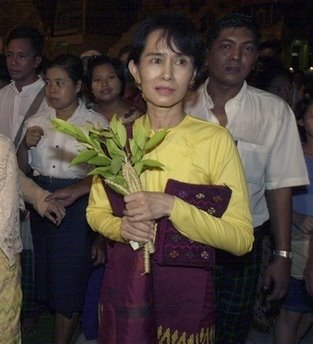


 Posts
Posts


