News & Articles on Burma
Wednesday, 27 April, 2011
-------------------------------------------------------------
7 villages in Shan East burnt down by Burma Army soldiers
Suu Kyi Listens to Needs of Farmers
Peace Must Precede Development: Ethnic Party Reps
Burma’s Health Minister’s dream seems to be unproductive
Thein Sein Appoints Presidential Advisors
Confusion Over Role of New Govt Ministries
Burma Policy 'No or Limited Success': US Official
Trade Council to be Shut Down
Shale gas in Karen State?
Myanmar, India to speed up renovation of Arnanda Pagoda
Beijing’s Burma Embrace
-------------------------------------------------
7 villages in Shan East burnt down by Burma Army soldiers
Wednesday, 27 April 2011 16:39 Hseng Khio Fah
Despite a popularly ‘elected’ government, human rights violations in ethnic states carried out by Burma Army soldiers are still coming out. 7 villages in Shan State East’s Mongpiang township, having an estimated 70 households were razed down to the ground by locally based Burma Army soldiers, alleging people there as agents of Shan State Army (SSA) ‘South’, according to local sources.
Apart from the burning, some male villagers were also arrested and beaten. The actions were taken by Burma Army’s Infantry Battalion (IB) 43, said a local villager from Mongpu, south of the township seat, who just fled to the border.
The said 7 villages, 4 Lahu and 3 Palaung, were located in Mongpu Long village tract of Mongpiang, some parts of which are operated by the SSA ‘South’ and some controlled by the Burma Army. The township is located west of Kengtung, capital of Shan East.
“We got no time to collect our things. They set fire to the houses as soon as they arrived in the village. All houses in the village went down in fire. Men were arrested and beaten up. One of the men, Ai Kha, 41, was taken by the soldiers. There are no reports about him to help us guess whether he is still alive or not,” said a source in a shaking voice.
“The soldiers said we fed and gave supplies to the Shan army and not informing them of its whereabouts. Ai Kha was accused as the person who served as a guide for the Shan army,” she said.
One of them, Ai Jawa, Lahu man, was released later after investigation. But he was seriously wounded on his head, she added.
The incident took place on 19 April. According to sources, villagers are fleeing everyday to other places since then. Violations and abuses were reported to have worsened after the elections. Human rights situation in Shan State are reported monthly by the Shan Human Rights Foundation based in Chiangmai.
From 27-July-1 August 2009, more than 500 houses and 200 granaries in villages in Shan State South’s Mongkeung, Laikha and Kehsi townships, had been razed to the ground and over 10,000 people became homeless after being relocated by the Burma Army’s 5-day scorched earth campaign, also known as Four Cuts - cutting off food, funds, intelligence and recruits by local villagers to the resistance due to similar allegations by the Burma Army. http://www.shanland.org/index.php?option=com_content&view=article&id=3643:7-villages-in-shan-east-burnt-down-by-burma-army-soldiers&catid=87:human-rights&Itemid=285
------------------------------------------------
Suu Kyi Listens to Needs of Farmers
By WAI MOE Wednesday, April 27, 2011
Her meeting with farmers was part of her National League for Democracy (NLD) party’s agriculture workshop at their Rangoon headquarters from April 27-29.
The NLD invited 38 farmers from Irrawaddy Division, Pegu Division, Rangoon Division and Arakan State as part of the workshop, according to party spokesman Ohn Kyaing.
“The workshop was designed to discuss the daily dilemmas of farmers and technical topics including environmental issues,” Ohn Kyaing told The Irrawaddy on Wednesday.
Farmers told Suu Kyi that the main challenges they face include land confiscations, increasing commodity prices and the lack of state support for farms. The NLD is planning more agriculture workshops in May for farmers from other states/divisions, Ohn Kyaing added.
“I was very glad to meet [Suu Kyi] and tell her about our difficulties. And from the workshop, I learned related knowledge which I can share with other people from my village when I go back home,” said Aye San Maung, a farmer from Irrawaddy Division.
He added that farmers from Irrawaddy Division—the biggest rice producer in Burma—are not getting enough subsidized support from the state and so often require loans from moneylenders or businessmen.
Mann Nyunt Thein, another farmer from Irrawaddy Division, explained that due to unusual weather, rice and other agriculture products have been decreased in the division.
The NLD’s agriculture workshop was organized after President Thein Sein brought up development in the sector during a Special Projects Implementation Committee meeting on April 22.
“To secure people's nourishmentt, measures must be taken to improve the agricultural sector first and then to establish a modern industrialized nation and develop other economic sectors,” Thein Sein said at the meeting.
Despite an outcry from the international community for a genuine dialogue between the ruling regime and pro-democracy leader Aung San Suu Kyi, there is no prospect of a potential meeting with the new government.
“We have not got any sign from the regime that they want to engage in dialogue. But we do not see any sign of more suppression of us either at the moment,” Ohn Kyiang said.
http://www.irrawaddy.org/article.php?art_id=21194
--------------------------------------------------
Peace Must Precede Development: Ethnic Party Reps
By SAI ZOM HSENG Wednesday, April 27, 2011
Following a meeting between five ethnic political parties, the participants called for peaceful discussions between Burma's new government and the country's ethnic armed groups, according to a representative from the Rakhine Nationals Development Party (RNDP).
Hla Soe, the secretary and spokesperson of the RNDP, said that peaceful discussions with the ethnic armed groups is a very important and necessary step for the new government.
“If the government really wants development in the ethnic areas where the civil war is still happening, they must seek peace in those areas first,” Hla Soe told The Irrawaddy.
The president, ex-Gen Thein Sein, said during his first speech that the new government will engage in development in every ethnic area and will start building the transportation links necessary to reach those areas.
Aye Maung, an MP and the chairman of the RNDP, said, “We appreciate that the new government will pursue development in the ethnic areas, but they must hold peaceful discussions with the different ethnic armed groups if they intend to do so.”
Speaking to The Irrawaddy on Wednesday, Aye Maung said that “The government should discuss issues with the ethnic armed groups without caring about the weakness or advantages of the groups. The government will also have to guarantee the security of the leaders of the ethnic armed groups if there is to be a real discussion between the government and the armed groups.”
“There will be a peaceful discussion if the armed group leaders are not arrested by the government,” Aye Maung added. “There will be no development in the ethnic areas without peaceful discussions.”
A representative from the Shan Nationalities and Democratic Party (SNDP), also known as the White Tiger Party, said that participants in the meeting also reviewed their experiences in the recently held parliamentary session.
Speaking to The Irrawaddy on Tuesday, a source close to the ethnic party meeting said, “The MPs submitted very important issues to parliament, such as a recommendation to start teaching ethnic literature and languages in schools, but they were rejected. Actually, this is a big issue for the ethnic people. In this meeting, we discussed how we can we submit and gain acceptance for our proposals in parliament.”
The meeting participants also discussed amnesty for political prisoners.
“We will keep urging the government to grant a general amnesty for the political prisoners. By doing this continuously, the international community will express its desire for the prisoners to be released. If the political prisoners are released, they can restart their political movement again in their own way,” said Aye Maung.
However, some Rangoon-based political observers said that the new government is not going to release the political prisoners.
“The major figures such as Minn Ko Naing and Ko Ko Gyi, who can influence the political and democracy movements of Burma, are not likely to be released because the new government still wants to maintain power. We can clearly see that even for basic governance in townships, the government is still using the old people,” said a political observer in Rangoon..
In addition, the parties present at the meeting expressed their confidence that the international community will support efforts to bring increased humanitarian aid to the ethnic regions.
Representatives from the RNDP, the All Mon Region Democracy Party (AMRDP), the Chin National Party (CNP), the Phalon Sawaw Party (PSP) and the Shan Nationalities and Democratic Party (SNDP), met for two days at the Rangoon headquarters of the White Tiger Party since yesterday.
http://www.irrawaddy.org/article.php?art_id=21196
-----------------------------------------------------
Burma’s Health Minister’s dream seems to be unproductive
By Zin Linn Apr 27, 2011 9:30PM UTC
Burma’s Union Minister for Health Dr Pe Thet Khin called on medical superintendents of central level hospitals to give special attention to the public health care services at the meeting hall of New Yangon General Hospital on 24 April, as said by today The New Light of Myanmar. Health Minister also said that weak public healthcare may put people’s lives at risk. He advised superintendents to take effective measures in order to prevent stealing of funds and reduce wastage and to cooperate with anyone or any organizations devoting themselves to health care services.
He continued that it is still needed to give effective treatment to patients and use effective medicines. He also stressed the importance for hospitals to try to become the ones that win public trust and reliance. In the afternoon, the Union Minister visited Specialist Hospital (Thakayta) in Yangon Region.
While he was there, well-wisher U Myo Win and family donated sets of TV, DVD player and speakers for the hospital and Myanmar Writers and Journalists Association, K 200,000 for sinking of a tube well.
Although the minister highlighted the important of giving special attention to the public health care services, healthcare quota of the national budget possibly will not fulfill his desire. Why?
The Government Gazette released by the previous military junta says that 1.8 trillion kyat (about $2 billion at free market rates of exchange), or 23.6 per cent of the budget this year will go to the defense. The health sector, meanwhile, will get 99.5 billion kyat ($110 million), or 1.3 per cent.
The gazette says the budget was enacted on Jan. 27, just a few days before the country’s parliament met for the first time in more than two decades. The timing apparently means the budget will not need parliamentary approval before coming into effect on April 1. The budget totals 7.6 trillion kyat ($8.45 billion).
The document was enacted before the legislature sat on Jan. 31, according to the Government Gazette. The budget was not been publicized in the mass media, a pattern that has held for at least a decade.
That was one of the significant signals that the transfer of power from the ruling junta — many of the former junta’s generals resigned in order to run as “civilians” — may happen in outward show only.
Burma (Myanmar) is one of Asia’s poorest countries, reflected in its health indicators. It had the 44th highest infant mortality rate of the 193 countries listed by the UNICEF in its 2011 State of the World’s Children report.
According to the UN estimation, one child in three under the age of five is already suffering from malnutrition. Burma’s authoritarian military regime is getting in the way of health community’s efforts to control infectious disease threats in Burma, according to an investigation published in Public Library of Science Medicine.
Dr Chris Beyrer (Johns Hopkins Bloomberg School of Public Health) and colleagues carried out field investigations in Burma in 2005 and 2006, and also searched the medical and policy literature on HIV, TB, malaria, and avian flu in Burma. The researchers found that the SPDC’s investment in healthcare is one of the lowest worldwide and that the health sector has been weakened by widespread corruption.
The recent Government’s financial statement allowed the health sector 99.5 billion kyat ($110 million), or 1.3 percent of this budget year 2011-12. That means President Thein Sein’s Union Government will spend less than $2 per head on public healthcare.
So, political opposition and independent observers denounce the Burmese junta for the amounts waste on the defense budget, while key areas such as education and health are ignored.
So, Union Minister for Health Dr Pe Thet Khin’s plan to give special attention to the public healthcare services seems to be with little hope while corruption is common throughout the country.
http://asiancorrespondent.com/53327/burma%e2%80%99s-health-minister%e2%80%99s-dream-seems-to-be-unproductive/
---------------------------------------------
Thein Sein Appoints Presidential Advisors
By BA KAUNG Wednesday, April 27, 2011
Burmese President Thein Sein has appointed a presidential advisory board, which includes a chief economic advisor who is a close friend of opposition leader Aung San Suu Kyi.
According to some of the appointed advisors, the advisory board consists of three committees—political, economic and legal—which will, in turn, be made up of three members each. The economic advisory board will be led by U Myint, a well-known Burmese economist with a close personal relationship with Suu Kyi.
Speaking to The Irrawaddy on Wednesday, U Myint said his appointment came after he was called in by Thein Sein for a personal meeting. He described the appointment as a positive step by the new civilian government.
“I think the president is confident that I wish to do good for our own country,” he said. “I think that we are on the same page. That's why I accepted this responsibility.”
He said his first advice to the president would be related to the country's agricultural sector and tackling poverty, adding that he believes the president shares his desire to carry out economic reforms.
U Myint, 73, was previously a professor of economics at Rangoon University. He also served as the director of the economics department in the Ministry of Foreign Affairs. Later, he headed the Research Department at the United Nations Economic and Social Commission for Asia and the Pacific. He is currently the director of the Tun Foundation Bank in Rangoon.
In a seminar last year, U Myint said that as long as the Burmese government and its cronies were controlling the country's economy, the country would face the same dismal economic situation even in the year 3010.
Asked about his position as an advisor to Thein Sein and as a friend of Suu Kyi, U Myint said, “I very much wish to see reconciliation in Burma. I will try to help bring about that. I will meet with Daw Aung San Suu Kyi with whom I am very friendly. She is a woman who can do a lot for the country, as she continues to do now.”
“Although it is still not clear how much I can do, and how much they [the government] will do at this point, I think this is an unusual but a positive step,” he said. “We have to sit down and discuss what to do. It will take time to change things under the current circumstances.”
During last week's cabinet meetings, President Thein Sein stressed the importance of building the country's infrastructure and boosting agricultural development—echoing policies frequently espoused by the former military junta in which he served as the prime minister.
In the president's new political advisory board, Ko Ko Hlaing, a retired military officer who used to work in the Research Department at the War Office of the Ministry of Defense, was appointed chief advisor. He is currently working on an international news program for the state-run MRTV-4 television channel.
The other two members in the political advisory board are Ye Tint and Dr. Nay Zin Latt, both former military officers—with Ye Tint, the managing director of a government-backed printing and publishing enterprise, and Nay Zin Latt, an executive member of the Burma Hoteliers’ Association.
Ko Ko Hlaing said his role is to advise the president about international political events, but not domestic issues. Commenting on the US' twin policy of economic sanctions and engagement with Burma, he said mutual understanding would be crucial to establishing good relations between the two countries.
“It's difficult to expect solid changes,” he said. “Things have to proceed gradually.”
He said that Burma will continue to build peaceful relations with all countries, including North Korea.
The legal advisory board will be led by Police Col. Sit Aye, the former director of the Home Ministry’s International Relations Department.
http://www.irrawaddy.org/article.php?art_id=21193
----------------------------------------------
Confusion Over Role of New Govt Ministries
By NA YEE LIN LATT Wednesday, April 27, 2011
Burma's new Union Government has encountered difficulties in sharing administrative and financial powers with state and regional governments, according to ministry sources.
An official from the Ministry of National Planning and Economic Development (MNPED) told The Irrawaddy that these issues mean it will take a long time for the new government to run itself efficiently.
“For example, there was only one minister at the Ministry of Education before. He alone decided and took care of education matters for the whole country. Now there are education ministers at regional and state levels, too, so there is a need to share authority with them,” said the MNPED official.
He added that the MNPED is still in the process of working out the roles and responsibilities of the various ministries at different levels of government under the new administrative framework.
Under the new government, there are 34 ministries with 30 ministers at union level and 14 ministries with nine ministers at each of the state and region levels. Each state/region government will be headed by a prime minister.
“We are still working out the details of how authority and financial power will be shared between the governments. Then there will be a period to approve the proposed arrangements, so it is very likely to take a long time to run the new administrative system smoothly,” explained the MNPED official.
“In fact, administrative matters should have been discussed and approved even before the new government was sworn in. Since this was not the case, ministers at the state and region levels still don't have any authority, just titles,” added the MNPED official.
Kyaw Soe, the minister for Rangoon Region's Ministry of Electric Power, Energy, Industry and Construction, told The Irrawaddy that he cannot reveal any details of his role or the particular workings of his ministry.
“We continue doing what we have to do. All [we do] is beneficial to our people,” said Kyaw Soe.
The situation is similar in other parts of the country, where ministers at the state and regional level appear to have no clearly defined roles. In Arakan State, for example, an official from the Rakhine Nationalities Development Party said his party has taken over three state ministries, but the ministers have yet to be given offices from which they can work.
Meanwhile, according to the National Democratic Force (NDF), the breakaway faction of Aung San Suu Kyi's National League for Democracy, parliamentary committees will likely begin their work from the start of next month.
“Various parliamentary committees have just been formed, but I think the actual functions of those committees will commence at the beginning of May,” said NDF Chairman Dr Than Nyein.
The NDF currently has representatives in different committees at the Amyotha Hluttaw (the Upper House of the National Assembly) and the Rangoon Region Parliament.
On Oct. 21, 2010, junta chief Snr-Gen Than Shwe signed and issued the Union Government Law and the Region or State Government Law. Although Chapter 4 of the latter refers to the “duty, authority and administrative power of region or state government,” no specific administrative power has reportedly yet been shared.
“We now have ministers at state and region levels but they still don't have any authority. They can just go around and inspect ongoing projects in their areas but can't give any directives,” said an official from the Ministry of Sports.
“If we want to build a football field in our region, the problem now is we don't know who we should get permission from. We don't know if we should submit our request to the region level or the union level,” continued the official.
In his speech on April 6—a week after the inauguration of the new government—President Thein Sein told prime ministers from different states and regions that there would be difficulties to distinguish tasks between the union level and region/state level.http://204.93.223.218/article.php?art_id=21191
------------------------------------------------
Burma Policy 'No or Limited Success': US Official
By LALIT K JHA Wednesday, April 27, 2011
WASHINGTON — While acknowledging that the its 18-month-long Burma policy of simultaneous engagement and sanctions has had “no or limited success,” a US government official now says it is open to the idea of Burma chairing the Association of Southeast Asian Nations (Asean) in 2014 if progress is made by Naypyidaw toward the restoration of democracy and protection of human rights in the country.
“We have had either no or very limited success,” said Joseph Y. Yun, the deputy assistant secretary of state at the Bureau of East Asian and Pacific Affairs. “We do face the dilemma of when do we engage and when do we not engage, and how far we go in engaging the government, what is the limit, what is the trade off.
"But we do believe ultimately that the system there in Burma is not sustainable and that we will try to improve it, we will try to change it, and we will try to bring democracy there, justice, and respect for human rights,” he said.
Yun’s comment came at a panel discussion on Burma in Washington. Yun told the audience that the Obama administration is trying its best to engage with the Burmese junta, but without any success. However, he said that the United States is grateful for the release of Aung San Suu Kyi, a Nobel Peace Prize laureate and leader of the opposition National League of Democracy.
The US official explained that the "carrots" in the administration’s Burma policy include the prospect of international recognition, a lifting of sanctions, and increased foreign investment for Burma. The new policy of “carrot and sticks,” he said, is a difficult process in putting that engagement track in place. “I would really urge the Burmese government that there will be something in it. In the end, they will have to join the international community,” Yun said.
However, he didn't detail what "sticks" were being threatened. The US, he said, is very mindful of the fact that it cannot do this alone, rather it is the task of the international community. It is in this regard that the United States is soliciting help from both Asian and European nations, he said.
“I think we are making progress,” he said.
Responding to questions that Burma wants to take on the chairmanship of Asean in 2014, Yun said that two years is a long time and no one knows what the ground realities in the region will be at that time.
“Maybe I am an optimist,” he said. “Certainly, if there is tremendous improvement in the situation, I do not see why they (Burma) could not take the chairmanship of Asean.
“But this is an issue that we have not really thought about,” he said, adding that if there is a marked improvement in Burma with regard to democracy and human rights, the Asean chairmanship would not be an issue.
Yun, however, ruled out any change in the Burma policy of the Obama administration with regards to its nomination of a special US representative, a process that currently waits to be confirmed by the US Senate. http://irrawaddy.org/article.php?art_id=21192
------------------------------------------
Trade Council to be Shut Down
By YAN PAI Wednesday, April 27, 2011
A Burmese exhibitor waits for visitors during the 2010 India International Trade Fair in New Delhi last year. (Photo: Getty Images)
Burmese Minister of Commerce Win Myint reportedly said at a ministerial meeting held on April 19 that the Trade Policy Council (TPC), the body that has long been responsible for issuing import and export licenses, has been abolished.
According to a Rangoon-based business source, Win Myint said at the meeting that the TPC has ceased to act as the body overseeing external trade. The Commerce Ministry will take over this role, the source said, adding that further details are expected to be made public soon.
It was not clear who would assume the TPC's role of overseeing the foreign investment sector, although according to the 2008 Constitution, the country's president is directly responsible for dealing with foreign direct investment.
A recent report by the Weekly Eleven Journal said, however, that foreign investors would still be required to obtain permission from the ministries under which their businesses operate, as in the past.
In a 2008 report on Burma's investment climate, the US State Department noted that in 1999, Vice Snr-Gen Maung Aye, the Burmese regime's second-most powerful figure, took direct responsibility for the TPC amid widespread allegations of corruption among ministers.
Since 2007, this position has been held by former Lt-Gen Thiha Thura Tin Aung Myint Oo, who retired from the military last year so he could sit in Burma's new quasi-civilian Parliament, where he is now vice-president.
During his tenure as head of the TPC, Tin Aung Myint Oo was notorious for favoring companies run by businessmen with whom he had strong personal ties, including Stephen Law (aka Tun Myint Naing) of Asia World Company and Zaw Zaw of Max Myanmar Company.
The TPC was a major source of revenue for its chairperson. According to sources close to the TPC, Tin Aung Myint Oo had the right to claim a five percent commission from any foreign investment he approved.
Therefore, according to unconfirmed reports, there has been some friction between Tin Aung Myint Oo and President Thein Sein over who will be in charge of regulating foreign investment under Burma's new government. http://irrawaddy.org/article.php?art_id=21190
--------------------------------------------
Shale gas in Karen State?
By Joseph Allchin
Published: 27 April 2011
A slew of new energy contracts will be signed with foreign energy companies it was announced after a “special projects implementation meeting” attended by President Thein Sein on Friday, most strikingly however it was announced that shale would be sought by two Singaporean companies in co-operation with the Myanmar Oil and Gas Enterprise (MOGE) in Karen state.
The exact location given by the New Light of Myanmar is Mapale, which is a few kilometres north of the main border crossing next to Thailand’s Mae Sot, Myawaddy. Mapale is also on the Moei river that separates the two countries at the ‘friendship bridge’-Thailand’s most westerly point.
The two companies were listed as SNOG pte ltd. and UPR Pte., Ltd both of Singapore. The New Light does not report whether shale oil (oil sands) or shale gas, will be explored for, but Mapale is within 20 miles of the Thai border, and near the Mae Sot shale oil basin, which Apiradee Suwannathong from Thailand’s Shinawatra University notes is the “largest oil shale resource in Thailand”.
Both processes however are seen by opponents as extremely damaging to the environment. The process for shale oil or oil sands differs from the extraction of crude liquid oil because the shale rock is mined as a solid rock, often in open cast pits and then is exposed to extremely high heat, without the presence of oxygen, to extract an exploitable oil from it. Both essential processes are, needless to say energy hungry and considered environmentally damaging, because of emissions, run offs and the topographic effect of open cast mining.
The Mapale area is thought to be under the control of the Democratic Karen Budhhist Army’s 999 brigade and its commander, Chit Htoo. A signatory of the government’s Border Guard Force (BGF) agreement, his soldiers would most likely provide at least some level of security for the process.
The area is, despite the presence of Chit Htoo, extremely volatile after portions of the DKBA rejected the government’s BGF plan and resumed active conflict against the government. Indeed the nearest transport hub, Myawaddy was taken briefly by the forces of rebel commander Saw La Bwe just after last year’s controversial election.
A project of any significant scale would therefore not only require a heightening of security but also considerable transport infrastructure, which could prove a logistical hurdle given the on going conflict. Whilst similar projects in the region, such as the Yetagun pipeline to Thailand were noted for forced relocations, forced labour and other human rights abuses often associated with heightened militarisation in Burma.
The shale rock could potentially however be exported to a site nearer to reliable energy sources and refining facilities, away from the border areas.
Shale gas is also viewed as environmentally damaging, with a report on the BBC alleging a 20% greater carbon footprint from the process, known as ‘fracking’, than coal.
The global rise in energy prices, following turmoil in the middle east, has heightened investment in the industry, with Asian companies alone investing some $20 billion in their North American operations in both shale gas and oil sands in the last two years.
A recent report by the US government’s Energy Information Agency (EIA) however suggests that global deposits of natural gas were increased by 40% if shale gas was taken into account. The majority of these reserves are considered to be in China and the US, but India’s north east that borders Burma is also considered a possibility or an “assessed basin without resource estimate”. Thailand and Burma were not looked into by this recent study, but a 2007 report by Apiradee Suwannathong suggests that the Mae Sot Basin has 952.38 million tons of recoverable shale rock which could produce 182.86 million barrels of oil.
The environmental impact can be assessed from this figure; approximately five tons of rock in the Mae Sot basin is needed to produce a single barrel of oil. A report on the impacts on the industry in Estonia, by Leevi Molder, notes large quantities of “spent shale piles continue to leach toxic substances” into the water. Mitigating the worst of these effects, it is noted is expensive and with little enforcement in Burma, it is unlikely to occur.
http://www.dvb.no/news/shale-gas-in-karen-state/15411
-------------------------------------
Myanmar, India to speed up renovation of Arnanda Pagoda
Yangon, Apr. 27 : Myanmar and India have both agreed to speed up the renovation of the Arnanda Pagoda in Myanmar''s ancient city of Bagan.
A memorandum of understanding on cultural cooperation was signed between the two countries, Xinhua News quoted a Burmese daily, as saying on Wednesday.
The pagoda restoration project was discussed between Myanmar Union Deputy Minister of Culture Daw Sandar Khin and Indian ambassador Dr. Villur Sundararajan Seshadri at the office of the Ministry of Culture in Nay Pyi Taw Tuesday, said the New Light of Myanmar.
The MoU was among the five documents signed during a goodwill visit to India by former Myanmar top leader Senior- General Than Shwe in July 2010.
--ANI http://www.newkerala.com/news/world/fullnews-197630.html
-----------------------------------
Beijing’s Burma Embrace
By James Burke
Epoch Times Staff Created: Apr 25, 2011 Last Updated: Apr 26, 2011
BANGKOK—Off the coast of western Burma, local fishermen are being excluded from their traditional fishing grounds by a large fleet of Chinese trawlers that are supported by the Burmese military authorities.
Arakanese fishermen from the coastal town of Thandwe told exiled-Burmese media Narinjara that thousands of Chinese boats first arrived in October and that Burmese authorities have since restricted local fishing rights. Priority and open access to the sea, they said, has been given to the Chinese fleet and a local firm linked to the Burmese military.
“Now it is like our sea has become part of China, everywhere we look we can see Chinese trawlers fishing freely in the sea while we are being restricted to fishing in our own territory," an unnamed fisherman told Narinjara.
Burmese in exile media sites are peppered with similar stories reporting China’s expanding economic footprint and political influence upon the country.
Anti-Chinese attitudes are high in Burma (renamed Myanmar by the military junta), especially in the country’s north, which in recent years has seen a large influx of cashed-up entrepreneurs crossing its northern border with China’s southern Yunnan Province.
“These are people moving into traditionally Burmese or ethnic areas and towns,” said Maung Zarni, a Burmese academic with the London School of Economics. “They are people with money; they are people who can buy local officials.”
The activities of unaccountable Chinese state-run resource companies—including damaging the environmental and forcing the displacement of communities—have advanced anti-Chinese sentiment in the local population.
“This has created not just resentment, it has created a massive and deepening popular hatred within Burmese society,” Maung says.
Large-scale energy projects involving Chinese state-run companies have also drawn international condemnation from human rights groups.
David Scott Mathieson, a senior researcher on Burma with Human Rights Watch, said that China's energy policies in Burma undoubtedly contribute to human rights abuses, whether they are related to hydropower projects on the Irrawaddy River or the massive gas and crude oil pipelines being built through Burma to southern China.
“Infrastructure projects like this often entail widespread abuses, often because the Burmese military is tasked with securing them, and that translates to forced relocations, which we're already seeing in Kachin State of Burma near the dam sites, and forced labor and other abuses by the army,” says Mathieson.
Beijing’s Support
Earlier this month, senior Chinese Communist Party figure, Jia Qinglin, visited the Burmese capital of Naypyidaw, to formalize a raft of deals with the military-dominated regime, including a soft loan and Chinese involvement in three copper mines.
Talks also reportedly covered security issues along the 2,200 km (about 1,370 miles) Sino-Burmese border.
Jia’s visit also highlighted Beijing’s support for Burma’s new so-called civilian government, which critics have described as a front for the junta following farcical elections held in November last year.
According to the Democratic Voice of Burma, Jia is the highest-ranking Party official to visit Burma following a stopover by Premier Wen Jiabao last June.
For Beijing, a freehand in neighboring Burma is especially important for geo-strategic reasons, said John Lee, a foreign policy expert with the Centre for Independent Studies in Sydney and the Hudson Institute in Washington D.C.
“A trading passage through Burma allows future exports to bypass the Malacca Straits, which is a point of potential vulnerability for China,” said Lee.
Along with the gas and oil pipeline, a Burma-China rail link is in the cards and Chinese companies have won contracts to dredge important rivers through the country to allow better vessel navigation.
Burma is one of two genuine allies that China has, Lee said, adding that the other is North Korea.
“China is much more comfortable dealing with authoritarian regimes than democracies since democracies have to at least pay lip service to political freedom, human rights, rule of law, and transparency,” says Lee.
“It is much easier to use economic largesse to win over autocratic governments since it is simply a matter of using dollar diplomacy to seduce political and military elites in those countries,” he added.
Like other pariah states such as Sudan, North Korea, and Zimbabwe, Chinese Communist Party leaders in Beijing have long supported Burma’s ruling generals internationally, especially at the United Nations.
During the junta’s violent crackdown on Buddhist monks and pro-democracy protesters in September 2007, both China and Russia used their veto power to diminish U.N. efforts to curb the junta’s excesses. Earlier the same year, both countries vetoed a U.S. resolution that urged Burma’s generals to stop persecuting ethnic minorities and opposition groups.
Thai-based Soe Aung, from the Forum for Democracy in Burma, said Beijing’s international support gives Chinese interests the upper hand in doing business with Burma’s generals.
“There’s evidence that Burma’s military regime favors China over India for some important economic concessions,” Soe said while adding that following Beijing’s support in the U.N. during 2007, Burma granted China a huge gas deal over India, despite India being willing to offer more money.
Mathieson said that Beijing's diplomatic cover has been crucial for the military in Burma to maintain power, not just for the support in multilateral forums, but also through extensive trade-investment and arms sales since 1988.
“I don't think Burma can avoid the criticism of its human rights recordthe situation is too bad for that. But what China does is block, time and again, any stronger measures such as U.N. Security Council resolutions, and so far, the formation of a U.N.-led Commission of Inquiry,” said Mathieson.
Mathieson says China, along with Russia, North Korea and others, are why Western sanctions against Burma have been rendered ineffectual. While U.S., the EU, and Australia impose arms embargoes on the regime, those countries ignore them.
“In effect, Burma benefits from an unprincipled benefactor who wants only to preserve its own interests in Burma, not actually see positive change occur,” says Mathieson.
Massive Cash Flows
Maung from the London School of Economics said the massive cash flows coming from China, as well as other Asian nations such as India and Thailand, emboldens the military regime to carry on with a ‘business as usual’ attitude in Burma.
“They [Burmese military] will not see the need to do economic reform, they will see themselves as bringing in money to the countrybut that is not development,” Maung said.
“China is not supporting Burma as a country. The Chinese leadership in Beijing is supporting the Burmese military junta and that needs to be clear. Without the Chinese support this junta would not be able to stay intransigent.”
According to the Financial Times, during the 2010–2011 financial year China invested US$10 billion into Burma, a sum which accounts for two-thirds of all foreign investment in the isolated country.
As well as being an important source of natural resources for China, Burma is an important market for its cheap Chinese products. With virtually no domestic manufacturing industry to speak of, consumer goods inside Burma are predominantly Chinese.
Burma last year was ranked the second most corrupt nation in the world by Berlin-based Transparency International. This year’s national budget again shows that the military remains the regime’s priority.
According to Burmese exile media Mizzima, the military received the largest cut of 2011 budget at around 30 percent, compared to education that got around 4 percent, and health care 1 percent.
The U.S. State Department says that China is the Burmese military’s major supplier of arms and munitions. http://www.theepochtimes.com/n2/world/beijings-burma-embrace-55344.html
Thursday, April 28, 2011
News & Articles on Burma-Wednesday, 27 April, 2011


Wednesday, April 27, 2011
News & Articles on Burma-Tuesday, 26 April, 2011
News & Articles on Burma
Tuesday, 26 April, 2011
-------------------------------------------------------------
Ex-soldier shines light on hidden Burma war
Mon Chief Minister Speaks, Receives Mixed Reviews
Authorities Crack Down on Use of Cash Substitutes
Bangladesh to be Thein Sein's First International Stop
Myanmar urged to engage with US
Border force defects, attacks Burma unit
Thailand begins migrant ‘slave’ probe
Asian Allies Back Burma Uneasily
No sleep lost over a few frozen euros
Asian Allies Back Burma Uneasily
-----------------------------------------
Bangkok Post
Ex-soldier shines light on hidden Burma war
Published: 26/04/2011 at 09:31 AM
Online news: Asia
As protests engulfed Burma in 1988, Myo Myint faced a stark decision. A soldier missing an arm and a leg, he believed he could persuade the army to show mercy if he spoke out. Or he could be shot.
Former Burmese soldier turned pro-democracy activist Myo Myint speaks at the US State Department in Washington, on April 25, during the screening of the award-winning HBO film "Burma Soldier."
Lifting himself by his crutches, Myo Myint took to the podium outside the military base. He wasn't shot and he won over soldiers who demonstrated in uniform. But soon he was tracked down and sentenced to 15 dire years in prison.
Now, however, Myo Myint has an audience as never before. A documentary on his life -- including on his fateful choice to dissent -- will air next month on US cable channel HBO and is being distributed clandestinely in Burma.
"Burma Soldier," using the earlier name for Burma, features smuggled footage as it traces Myo Myint from the front lines of the ethnic war to the confines of prison to his new life as a refugee in the United States.
In an unusual step, the State Department held a public screening of "Burma Soldier." Kurt Campbell, the assistant secretary of state for East Asia who has spearheaded an engagement drive with Burma, called the film "torturous."
"It's one of the most powerful things I have ever seen," Campbell said Monday. "But at the same time it's incredibly inspirational."
Myo Myint was born in 1963, a year after the military seized power in the ethnically diverse former British colony. In the film, he said that he grew up wanting to be treated as a soldier but observed in hindsight, "I didn't know the difference between people acting out of respect and acting out of fear."
At age 17, he was already serving as an army "engineer," which meant laying and clearing land mines. He recalled that the army would burn down homes at will, forcing villagers from ethnic minority groups to haul heavy equipment and to build roads.
In one graphic account, Myo Myint remembered how soldiers seized a young minority woman and raped her throughout the night. Later, he heard several shots and there was no further sign of her among the slave laborers.
After he was hit by a mortar that nearly cost him his life, Myo Myint was transferred to a hospital in the largest city Rangoon and discovered the texts of Buddhism and other religions. With his pension money, he bought banned books on history and politics.
Vowing "I will fight for peace," the soldier sought out Aung San Suu Kyi, the pro-democracy campaigner icon who later won the Nobel Peace Prize.
After his arrest in 1989, Myo Myint said he was forced into a hood stained by someone else's blood and was tortured with water. He said he was not allowed to read or write for 10 of his 15 years in prison, although guards occasionally smuggled him pens or books.
After his release, Myo Myint fled across the border to Mae Sot, Thailand, and in 2008 flew to Fort Wayne in the Midwestern state of Indiana, a US hub for refugees from Burma.
Attending the State Department screening of his film, Myo Myint pleaded for international pressure to free more than 2,000 political prisoners still in Burma and to stop Thailand from closing refugee camps.
"As a former refugee and a former political prisoner, I would like to request you to do whatever you can for the refugees along the Thai-Burma border," he said.
Thailand recently said it would send more than 100,000 refugees back to Burma, saying that they had become a burden and pointing to the military's recent handover to a new post-election government. Critics say that Burma's changes have been purely cosmetic.
Journalist Nic Dunlop started work on "Burma Soldier" after meeting Myo Myint in Thailand. The film was produced by Julie LeBrocquy, a former bond trader who now focuses on making movies on otherwise overlooked subjects.
LeBrocquy said the film was also released in Burma through its network of unofficial distributors and bootleggers and that it "seems to be a blockbuster there in a Burmese way."
"I hope that this film has given a way for his voice not just to be heard in the West but to be heard in Burma, which is where it really matters," she said. http://www.bangkokpost.com/news/asia/233776/ex-soldier-shines-light-on-hidden-burma-war
------------------------------------------------
Mon Chief Minister Speaks, Receives Mixed Reviews
By LAWI WENG Tuesday, April 26, 2011
MUDON, Burma—Speaking on April 17 to hundreds of Mon people at a festival in Mudon Township, Mon State Chief Minister Ohn Myint declared that his new government will work towards bringing peace and development to the state.
“We just formed our new government, which will bring development and build peace and stability in Mon State,” said Ohn Myint, speaking at an event commemorating the placing of the symbolic umbrella on top of the Kyaik Zel Pagoda in Kamarwat village.
The Mon people in attendance wore traditional Mon dress of red and white, and Ohn Myint, a former general in the Burmese army who is an ethnic Mon, said hello in the Mon language and mentioned that he was born in Mudon Township.
But his presence at the ceremony required the monks to chant in both the Mon and Burmese language, eliciting complaints from Mon observers who wished only to hear the chants in Mon.
Two Mon ministers in the new Mon State government who accompanied Ohn Myint were Min Nwe Soe, the social and cultural minister, and Nai Lawi Oung, the energy and electric minister. Both wore traditional Mon wear. Both are members of the All Mon Regions Democracy Party (AMRDP).
Ohn Myint carried the umbrella to the pagoda, while the two Mon ministers carried other equipment for the ceremonial crowning.
Many participants in the celebration expressed happiness at seeing two Mon men appointed as members of the new state government, believing the two representatives will fight for issues important to the Mon people.
They were encouraged by the fact that, after Naypyidaw announced the members of the new Mon State government, Min Nwe Soe met with Mon farmers in different villages and asked about their needs.
The farmers in Kamarwat and Kalawthut villages discussed ways to remedy the fact that a dam in Abisht village in Mudon Township had destroyed over 5,000 acres of farmland and the owners have not been given a chance to request compensation.
“I believe he [Min Nwe Soe] will work to get us new farmland,” said Nai Sein, a community leader in Kamarwat village whose 10 acres of land were destroyed by the dam.
However, Nai Aung Kyi, a farmer from Kalathut village, and other ethnic Mon said that they are worried the new government will be the same as under the military regime.
Some question how the two Mon ministers will be able to help when they still receive orders from old members of the military regime who are now national ministers and members of parliament.
They pointed out that the new government has offered incentives to newly appointed ministers such as cars, homes and good salaries.
Both of the new Mon ministers have received cars since being appointed. In addition, the government is currently building new housing in Moulmein, Mon State where new government ministers will reside.
“They [the two Mon ministers] will only get this opportunity one time if they do not work for the Mon,” said Tun Naing, a member of the All Mon Regions Democracy Party. http://irrawaddy.org/article.php?art_id=21183
--------------------------------------------
Authorities Crack Down on Use of Cash Substitutes
By THE IRRAWADDY Tuesday, April 26, 2011
RANGOON — The Burmese authorities have threatened to take action against businesses that use tokens and other items, such as cheroots and packets of instant coffee, as substitutes for small-denomination banknotes when giving change to customers.
The practice, which is widespread at shopping centers and on public transport buses, is a result of a shortage of 100- and 200-kyat notes, which are worth around 12 and 24 US cents, respectively. Although the government has recently introduced larger denominations, many of the smaller banknotes have been in circulation for years and have become all but unusable.
Businesses that continue using cash substitutes face severe penalties under existing monetary laws, according to the officials.
An official of the Rangoon regional government told The Irrawaddy that shopping centers, retailers and owners of public transportation companies have been warned that legal action will be taken against them if they fail to comply with the orders.
“The tokens are stamped with the logo of the shop that issued them, so they are not usable anywhere else. This is a clear abuse of consumers' rights,” said the official.
Local shop owners expressed concern about the move, which they said would likely add to difficulties facing small businesses that routinely use small notes in transactions.
“Offering tokens is way to deal with the shortage of 100- and 200-kyat notes. Many customers don't want to receive instant coffee mix or shampoo packs as change when they buy something, so they prefer tokens. Now we really don’t know what we're going to do,” said the manager of a shopping center, who estimated that the number of small notes was only about a fifth of what was required.
A housewife in Rangoon's Mayangone Township said that the tokens are “better than nothing,” but the best thing would be for the government to issue more small kyat notes. “The ones in circulation now are so old and dirty you don’t' even want to touch them,” she said.
As is generally the case in Burma, where the shortcomings of the official system often create unique business opportunities for enterprising black marketeers, the lack of 100- and 200-kyat notes has been a boon for some.
The owner of a grocery store at Rangoon's Bayintnaung Market complained that he has to pay 1,000 kyat for 900 kyat worth of small notes. Sometimes, he said, he is lucky to get just 800 kyat for a 1,000 kyat note, and often he can't get all the small bills he needs at any price.
The banknote shortage has also recently given rise to some impromptu gambling, whereby customers are invited to bet the amount of change they are owed for a chance to win a larger, more readily available banknote.
“When I was on the No. 204 bus the other day, the ticket collector asked me to bet my change on the serial number of the banknote I gave him, because he didn't have any small notes to return 100 kyat to me. If I won, I would get 200 kyat. If I lost, I got nothing,” said a resident of Kamaryut Township in Rangoon.
An economist in Rangoon pointed out that the cash substitute system implemented by some businesses brought no benefits to customers, as there was no assurance that the cash substitutes could be reclaimed at the assigned shops. The government, therefore, should produce more new small-denomination notes and coins.
“This problem is directly related to the government's insufficient distribution of 100- and 200-kyat notes. Some businessmen have exploited this situation, which makes matters even worse for ordinary consumers. For the sake of the people's interests, the government should distribute more new small-value notes or replace the old banknotes with new ones,” he said.
The shortage of small banknotes doesn't just affect Rangoon, Burma's major commercial center. In January, authorities in Maungtaw, Arakan State, seized 900,000 kyat (US $1,016) worth of 50-, 100- and 200 kyat notes. http://www.irrawaddy.org/article.php?art_id=21180
-------------------------------------------
Bangladesh to be Thein Sein's First International Stop
By SAI ZOM HSENG Tuesday, April 26, 2011
Bangladesh will be the first international destination for ex-Gen Thein Sein since becoming Burma's new president, according to the country's ambassador to Bangladesh.
“The newly elected Burmese president decided to visit the Asian countries and start in Bangladesh,” Min Lwin, Burma's newly appointed ambassador to Bangladesh, was quoted by Dhaka's The Daily Star News as telling Bangladesh President Zillur Rahman when they met on Thursday.
The Daily Star News article said that the Burmese government is keen to solve all major problems between the two countries, including the Rohingya issue.
After his trip to Bangladesh, President Thein Sein will most likely attend the Association of Southeast Asian Nations summit to be held in Jakarta, Indonesia at early May, according to observers.
Meanwhile, the commander-in-chief of Burma's Air Force, Lt-Gen Myat Hein, and six other high-ranking Air Force officers arrived in Dhaka, the capital of Bangladesh, on Saturday for a six-day visit.
The trip constitutes the first visit of high-ranking Burmese officials to Bangladesh since 2008, when a maritime dispute that included the deployment of naval vessels broke out between the two countries after Burma began gas exploration in the Bay of Bengal.
Speaking to The Irrawaddy on Monday, Dhaka-based Narinjara news group editor Khine Myat Kyaw said, “He [Myat Hein] came as a military representative. So they are going to talk about bilateral military issues.”
According to reports from Dhaka, Myat Hein met and discussed matters of mutual interest with Bangladesh's Chief of Air Staff, Air Marshal, SM Ziaur Rahman and Chief of Naval Staff, Vice Admiral ZU Ahmed.
The Burmese delegation came to Dhaka to discuss bilateral military issues between the two countries, and the Burmese Air Force chief planned to visit some military institutes and bases in Dhaka and other towns during his trip, according to reports from Bangladesh.
In 2008, Vice Snr-Gen Maung Aye led a delegation of more than 50 members to Dhaka and signed deals related to the prevention of double taxation, the establishment of a joint commission and the exchange of cultural cooperation.
Small scale border and maritime disputes are common between Burma and Bangladesh. On April 3, Bangladesh established a new Air Force base on the opposite side of the border from Maungdaw, Arakan State, raising tensions between the two nations.
The maritime disputes are likely to end this year as the International Tribunal for the Law of the Sea will reportedly deliver its verdict on the case before year end.http://204.93.223.218/article.php?art_id=21177
------------------------------------------
Myanmar urged to engage with US
The Associated Press
WASHINGTON --
The United States on Monday urged military-dominated Myanmar to embrace its offer of talks and improve human rights as a path toward international acceptance.
The top U.S. diplomat for East Asia, Kurt Campbell, said Washington's efforts in the past 18 months to engage Myanmar's government had failed.
He said despite the release of democracy leader Aung San Suu Kyi, the United States still is troubled by abuses of ethnic minorities, detention of political prisoners and a lack of democratic reform.
The most recent senior U.S. official to visit Yangon, Joseph Yun, said the rulers of Myanmar, also known as Burma, were wrong in thinking they would not gain from engaging the U.S.
"I really urge the Burmese government that there will be something in it. In the end, they have to join the international community," he said.
Both officials were speaking at the screening at the State Department of "Burma Soldier," a documentary of the life of Myo Myint, who served in Myanmar's military but later became an advocate for peace and democracy, for which he was jailed for 15 years.
President Barack Obama this month nominated a special envoy to Myanmar to push forward a two-track policy of offering dialogue with the regime while maintaining pressure through sanctions, including on trade and investment.
Despite its desire to build an international consensus on Myanmar, Washington's stance remains at odds with the Association of Southeast Asian Nations, or ASEAN, of which Myanmar is a member. ASEAN has called for sanctions to be lifted after Yangon staged elections in November that ushered in a new government said to be civilian but still dominated by the military.
The U.S. says it is looking for Myanmar to first release its more than 2,000 political prisoners and allow a political role of Suu Kyi, whose party won polls in 1990 but was barred from taking power.
Yun claimed there was growing support among ASEAN in pushing for reform. "There's a wide degree of recognition that what happens among them is not just a matter for a single country alone," he said.
He said India and China were less understanding of the U.S.'s firm stance on the need for human rights. Both are powerful neighbors of Myanmar that have expanded investment and retain strong ties with the military.
"In my assessment their strategic considerations come first, and thereafter other issues, and that would include human rights," Yun said.
Read more: http://www.heraldonline.com/2011/04/25/3014300/myanmar-urged-to-engage-with-us.html#ixzz1KcQqk0km
-------------------------------------------
Border force defects, attacks Burma unit
By NAW NOREEN
Published: 26 April 2011
Troops from the Democratic Karen Buddhist Army who last year agreed to become a border force have now reneged and last week destroyed a weapons cache belonging to their former unit.
Twenty-nine troops from Border Guard Force (BGF) 1012, based in Karen state’s Myainggyingu, said they are also preparing to join sides with the Karen National Union, which has been fighting the Burmese regime for more than six decades.
Three soldiers from BGF 1012 died in the Myainggyingu assault on 22 April, in which the 29 set fire to an armoury and destroyed heavy weapons ammunition.
Yesterday, additional troops launched a second attack on a Burmese army battalion in Kamamaung, setting fire to a ration storage and razing an armoury.
Contact has already been made between the BGF 1012 defectors and the Karen National Union (KNU), according to a commander in its armed wing, the Karen National Liberation Army (KNLA).
Colonel Hpaw Do said however that it was unclear why the unit, led by company leader Hpa Mee, defected.
It becomes one of the most prominent defections since the DKBA acceded to demands by the Burmese army last year and became a Border Guard Force.
Following the transformation, a faction led by renegade commander Na Kham Mwe in November last year launched an attack on the Burmese border town of Myawaddy. His unit is also now fighting alongside the KNLA.
Yesterday afternoon a clash broke out between Karen troops, among them Na Kham Mwe’s faction, and the Burmese army in Kyarinnseikgyi township.
“Around 2.30pm, DKBA and KNLA forces launched a joint attack at the police station in Azin [village in Kyarinnseikgyi township] near where [the Burmese army’s] LIB-371 is based. We still don’t know the causalities yet,” said Major San Aung of the DKBA.
He said a civilian was killed and three injured in another fight that took place on Sunday in Kyarinnseikgyi’s Kyeikdon sub-township. San Aung said three Burmese army personnel were also injured.
http://www.dvb.no/news/border-force-defects-attacks-burma-unit/15396
-------------------------------------------
Thailand begins migrant ‘slave’ probe
By MAHN SAIMON
Published: 26 April 2011
Police in Thailand have begun an investigation into the nearly 60 Burmese migrants who were freed last week after being locked up and forced to work for months in a garment factory in Bangkok.
A lawyer from the Lawyer Council of Thailand said the police are looking at a lawsuit filed by the Burmese Association of Thailand (BAT) and are being closely being watched by Thai NGOs.
The factory employers are to face at least three separate charges and if found guilty, could pay compensation to the migrants and serve prison terms of at least 10 years.
“Denying standard wages for the workers is a violation of both the labour and the criminal law, and they are also to be charged under the human trafficking law,” said the lawyer. “There is 10 year jail term for the human trafficking charge alone if found guilty.”
He said it is likely the defendants will do their best to defend themselves given the seriousness of the penalties, and so it is important the migrants are assisted by their home country’s government.
On 19 April Thai authorities raided a factory in Bangkok’s Ding Daeng area and freed nearly 60 undocumented Burmese migrants who had been enslaved in the building for as long as eight months.
Kyaw Thaung of the BAT said the Burmese embassy in Bangkok made a contact with the organisation three days after the migrants were freed to enquire about the situation.
“They phoned us on 22 April around 9pm and asked to help them out getting some details about the case,” said Kyaw Thaung.
The Burmese embassy, which is notoriously ignorant about the plight of migrant workers in Thailand, has been unusually attentive since the new government was sworn in in March. In the past month the embassy donated 10,000THB ($US335) for victims of a car crash in Mahachai area in which five Burmese migrants were killed.
The freed migrants, having no legal work permits in Thailand, are being kept at a temporary [government] guesthouse in Pathum Thani while 15 females are in a security guesthouse in Nonthaburi.
http://www.dvb.no/news/thailand-begins-migrant-%E2%80%98slave%E2%80%99-probe/15401
----------------------------------------
Asian Allies Back Burma Uneasily
Analysis by Larry Jagan
BANGKOK, Apr 26, 2011 (IPS) - Already Burma’s new civilian government poses problems for its Asian allies as it tries to woo the international community. The month-old quasi-civilian administration, led by President Thein Sein has launched a new diplomatic charm offensive in an effort to get international approval for the cosmetic changes that have been introduced under the guise of a new civilian government.
The President’s first priority is to ensure that the region endorses the changes – and in a move to consolidate that, the Thein Sein has already written to the ASEAN (Association of Southeast Asian Nations) secretary-general Surin Pitsuwan, renewing their bid to become chairman of the organisation.
It is the first salvo in a new diplomatic offensive to secure regional and international credibility for the new government and reduce its international isolation.
"The Thein Sein regime is desperate for international recognition," said Win Min, a Burmese academic currently based in the United States. "It’s crucial for them to gain credibility and a measure of respectability for their new so-called civilian government."
But this diplomatic offensive on the part of the Burmese leaders will inevitably increase tension between the West, which still supports sanctions against the regime, and Asia, which is keen to integrate Burma into the region’s economy and strategic structures. Burma’s diplomatic initiatives are only likely to intensify the divisions between Asia and the West – especially the U.S. – on how to cope with the problems posed by Burma’s strategic aims.
While the U.S. appointed a special envoy, Derek Mitchell, and the European Union’s revised visa restrictions on government ministers may signal a new preparedness to deal with the new Burmese government, what Burma wants more than tacit recognition, is approval and support, especially from the region.
Immediately after being sworn in as President, Thein Sein wrote to the ASEAN secretariat asking the organisation to accept Burma’s bid to become chairman in 2014.
In 2004, Burma skipped the chance to become chairman in 2006, amid international pressure on the group to reject Burma’s turn to chair the regional bloc. Now the government is anxious to take its turn again – and wants ASEAN’s approval at the forthcoming ASEAN summit in Indonesia next month.
But some of Burma’s neighbours remain wary of being used as a pawn in Burma’s global mission to prove the new government represents a significant change - from a naked military dictatorship to pluralist power structure.
The bottom line for many countries in the region is that Burma has always been a thorn in ASEAN’s side, ever since it joined in 1997, and has been a major obstacle to smoother and deeper relations with its strategic partners, especially Europe and the United States.
The emergence of a new civilian government under President Thein Sein has only complicated the situation, especially as the new Burmese administration seeks to get the region’s approval and bolster its international credibility as a legitimately elected government.
China has already been very supportive – and a senior Chinese political leader was the first international visitor to Naypyidaw, only days after the new regime was sworn in. But it is ASEAN approval that Burma craves.
At the ASEAN summit in Hanoi last year Thein Sein – then under Than Shwe’s instructions – pushed for Burma to be given the chairmanship in 2011. The top general’s aim was to have ASEAN endorse the new civilian government by giving it the ASEAN chairmanship. But the request was rejected – and Indonesia, Cambodia and Brunei were conferred as the next three chairs – leaving 2014 as the earliest Burma could expect to become the head of the organisation.
This was a clear message to Burma that concrete change was expected before the new government could become the chairman of ASEAN. It was the only way we could communicate our irritation at being kept in the dark over the planned elections and political change, the ASEAN secretary general Surin Pitsuwan told Inter Press Service in an interview in Hanoi immediately after the meeting.
"ASEAN is very much interested in the peaceful national reconciliation in Myanmar and whatever happens there will have implications in ASEAN, positive or negative," he said.
Now the countries of ASEAN have been left in a deepening quandary. They want to pressure the Burmese government to become more democratic and transparent while maintaining whatever influence they have on the regime.
"We have to continue to engage with the Myanmar government," Thailand’s Prime Minister, Abhisit Vejjajiva told correspondents in Bangkok recently. "If we hadn’t that stance, the situation inside the country would be much worse."
Now it seems the issue of Burma’s chairmanship of ASEAN has returned to haunt the organisation – as it did more than ten years ago. But it is the only leverage the countries of the region have over the regime in Naypyidaw.
"Bullying, coaxing and admonishing them has had no effect," an Asia diplomat with long contact with the top Burmese leadership said. "If we push too hard they will simply close the door on us, or worse, leave the organisation unilaterally."
The chairmanship of the organisation may be the only clout ASEAN has with the Burmese regime. But more importantly ASEAN also knows that relations with their main strategic partners – especially Australia, the EU and the U.S. – will almost inevitably be put at risk.
Washington has already chipped into the controversy indicating it would be reluctant to work closely with Burma as its chair. "Obviously, we would have concerns about Burma in any kind of leadership role because of their poor human rights record and domestically," the State Department spokesman, Mark Toner, recently told reporters in Washington.
So Burma’s diplomatic charm offensive may have already further fuelled the furore between the West and Asia over how to handle Burma; and instead of reducing tension between the two spheres, Burma’s so-called civilian government may have only become another bone of contention between them. (END) http://ipsnews.net/news.asp?idnews=55389
----------------------------------
No sleep lost over a few frozen euros
Published: April 26 2011 01:28 | Last updated: April 26 2011 01:28
From Mr Mark Farmaner.
Sir, Derek Tonkin (Letters, April 20) is right to state that we cannot pretend that European Union sanctions on Burma are tough. He provides an example of this by mistakenly referring to regime assets being frozen, but there being none to freeze. In fact, the asset freeze is applied only to regime members who are on a visa ban list, not the regime’s assets. Several hundred thousand euros have been frozen, but nothing significant enough to give the generals sleepless nights. This is just one example of how toothless many EU sanctions are.
Today there are no EU sanctions that would, for example, prevent European oil companies investing in Burma’s gas sector. It has been argued that sanctions have been tried and have failed, but in fact tough-targeted sanctions have not yet been imposed.
For more than 15 years Burma Campaign UK has been one of the organisations leading the call for targeted economic sanctions. We would welcome a genuine independent review of how sanctions could be used more effectively. There can be no doubt that they are a tool that can have an impact on the dictatorship. Why else would they ensure that one of the first motions they pushed through their new parliament was one that condemns sanctions? As the Burmese Army continues to gun down ethnic minority civilians on a daily basis, no one can seriously believe it is out of concern that sanctions have an impact on ordinary people.
Mark Farmaner,
Director,
Burma Campaign UK,
London N1, UK
Copyright The Financial Times Limited 2011. http://www.ft.com/cms/s/0/c23468fe-6f8c-11e0-952c-00144feabdc0.html#axzz1KcNdHMVg
----------------------------------------------
Asian Allies Back Burma Uneasily
By LARRY JAGAN / IPS WRITER Tuesday, April 26, 2011
BANGKOK — Already Burma’s new civilian government poses problems for its Asian allies as it tries to woo the international community. The month-old quasi-civilian administration, led by President Thein Sein has launched a new diplomatic charm offensive in an effort to get international approval for the cosmetic changes that have been introduced under the guise of a new civilian government.
The President’s first priority is to ensure that the region endorses the changes – and in a move to consolidate that, the Thein Sein has already written to the Association of Southeast Asian Nations (Asean) secretary-general Surin Pitsuwan, renewing their bid to become chairman of the organisation.
It is the first salvo in a new diplomatic offensive to secure regional and international credibility for the new government and reduce its international isolation.
"The Thein Sein regime is desperate for international recognition," said Win Min, a Burmese academic currently based in the United States. "It’s crucial for them to gain credibility and a measure of respectability for their new so-called civilian government."
But this diplomatic offensive on the part of the Burmese leaders will inevitably increase tension between the West, which still supports sanctions against the regime, and Asia, which is keen to integrate Burma into the region’s economy and strategic structures. Burma’s diplomatic initiatives are only likely to intensify the divisions between Asia and the West–especially the US– on how to cope with the problems posed by Burma’s strategic aims.
While the US appointed a special envoy, Derek Mitchell, and the European Union’s revised visa restrictions on government ministers may signal a new preparedness to deal with the new Burmese government, what Burma wants more than tacit recognition, is approval and support, especially from the region.
Immediately after being sworn in as President, Thein Sein wrote to the Asean secretariat asking the organisation to accept Burma’s bid to become chairman in 2014.
In 2004, Burma skipped the chance to become chairman in 2006, amid international pressure on the group to reject Burma’s turn to chair the regional bloc. Now the government is anxious to take its turn again—and wants ASEAN’s approval at the forthcoming Asean summit in Indonesia next month.
But some of Burma’s neighbours remain wary of being used as a pawn in Burma’s global mission to prove the new government represents a significant change - from a naked military dictatorship to pluralist power structure.
The bottom line for many countries in the region is that Burma has always been a thorn in Asean’s side, ever since it joined in 1997, and has been a major obstacle to smoother and deeper relations with its strategic partners, especially Europe and the United States.
The emergence of a new civilian government under President Thein Sein has only complicated the situation, especially as the new Burmese administration seeks to get the region’s approval and bolster its international credibility as a legitimately elected government.
China has already been very supportive—and a senior Chinese political leader was the first international visitor to Naypyidaw, only days after the new regime was sworn in. But it is Asean approval that Burma craves.
At the Asean summit in Hanoi last year Thein Sein—then under Than Shwe’s instructions—pushed for Burma to be given the chairmanship in 2011. The top general’s aim was to have Asean endorse the new civilian government by giving it the Asean chairmanship. But the request was rejected—and Indonesia, Cambodia and Brunei were conferred as the next three chairs—leaving 2014 as the earliest Burma could expect to become the head of the organisation.
This was a clear message to Burma that concrete change was expected before the new government could become the chairman of Asean. It was the only way we could communicate our irritation at being kept in the dark over the planned elections and political change, the Asean secretary general Surin Pitsuwan told Inter Press Service in an interview in Hanoi immediately after the meeting.
"Asean is very much interested in the peaceful national reconciliation in Myanmar and whatever happens there will have implications in Asean, positive or negative," he said.
Now the countries of Asean have been left in a deepening quandary. They want to pressure the Burmese government to become more democratic and transparent while maintaining whatever influence they have on the regime.
"We have to continue to engage with the Myanmar government," Thailand’s Prime Minister, Abhisit Vejjajiva told correspondents in Bangkok recently."If we hadn’t that stance, the situation inside the country would be much worse."
Now it seems the issue of Burma’s chairmanship of Asean has returned to haunt the organisationas it did more than ten years ago. But it is the only leverage the countries of the region have over the regime in Naypyidaw.
"Bullying, coaxing and admonishing them has had no effect," an Asia diplomat with long contact with the top Burmese leadership said. "If we push too hard they will simply close the door on us, or worse, leave the organisation unilaterally."
The chairmanship of the organisation may be the only clout Asean has with the Burmese regime. But more importantly Asean also knows that relations with their main strategic partnersespecially Australia, the EU and the USwill almost inevitably be put at risk.
Washington has already chipped into the controversy indicating it would be reluctant to work closely with Burma as its chair. "Obviously, we would have concerns about Burma in any kind of leadership role because of their poor human rights record and domestically," the State Department spokesman, Mark Toner, recently told reporters in Washington.
So Burma’s diplomatic charm offensive may have already further fuelled the furore between the West and Asia over how to handle Burma; and instead of reducing tension between the two spheres, Burma’s so-called civilian government may have only become another bone of contention between them.
http://www.irrawaddy.org/article.php?art_id=21179
Tuesday, April 26, 2011
News & Articles on Burma-Monday, 25 April, 2011
News & Articles on Burma
Monday, 25 April, 2011
-------------------------------------------------------------
Three Reportedly Killed in Internal BGF Clash
Thein Sein: Gov't Must Win Minorities' Trust
Shwe Mann Becomes Acting Chairman of USDP
21 Maynamrese Poachers apprehended from Andaman Sea
Festival welcomes human rights advocate
NUP urges rule of law and prisoner release
Deforestation concerns in the delta
Burma Oil Exploration Deals With Foreign Firms in the Pipeline: Report
Burma Set to Ink Int'l Energy Contracts
European firms seize on Suu Kyi release to hunt profit in Burma
------------------------------------------------
Three Reportedly Killed in Internal BGF Clash
By SAW YAN NAING Monday, April 25, 2011
Armed fighting broke out for reasons unknown between Karen soldiers from Border Guard Force (BGF) unit 1012 and another unidentified BGF unit at their headquarters in southern Karen State on Friday.
Three soldiers were reportedly killed in the clash, according to Karen sources close to the BGF, while an ammunition store and a military barracks were burned down. Ten rifles were sequestered from the ammunition store by unit 1012 during the clash, said Brig-Gen Johnny, the commander of Karen National Liberation Army (KNLA) Brigade 7.
The clash happened at Myaing Gyi Ngu, which is the former headquarters of the Democratic Karen Buddhist Army (DKBA), a Karen rebel group which has mostly allied itself with the Burmese army despite much opposition to the alliance among its rank and file.
But despite widespread reports that many former DKBA soldiers were unhappy to serve under the control of Burmese army officers, Friday's incident marks the first reported bloodshed.
Col Paw Doh, of the main ethnic Karen armed group, the Karen National Union (KNU), told The Irrawaddy on Monday: “The fighting broke out on April 22 at about 3 pm. As far as we know, the fighting was initiated by Pa Mee. The soldiers burned down one ammunition store and one army barracks.”
Pa Mee is a commanding officer in BGF 1012 who was a former member of DKBA Battalion 555.
Another DKBA source close to BGF 1012 confirmed to The Irrawaddy that Pa Mee led his men in an attack against another BGF unit.
BGF unit 1012 is formed by formers members of DKBA Battalion 555 who were transferred last year into the Burmese government-controlled BGF.
Meanwhile, sources from Brigade 7 of the KNLA, the military wing of the KNU, reported that 12 Karen soldiers from BGF unit 1016 deserted the BGF and defected to KNLA Brigade 7 on April 21.
The defecting members of the BGF had been based in Myawaddy, and reportedly brought with them four M-16 rifles, six AK-47s, two carbine rifles and one M-79.
According to the KNLA Brigade 7 report, no less than 67 soldiers from BGF units 1015, 1016 and 1019 defected to the KNLA between January and April, most saying they were unwilling to serve under Burmese army command.
On Saturday, DKBA Brigade 5 attacked Burmese Light Infantry Battalion (LIB) 212 in Ka Ma Kaung in Papun District of northern Karen State, where they burned down a paddy store and an ammunition store, according to Karen media reports.
Led by Brig-Gen Saw Lah Pwe, Brigade 5 is the largest faction of the DKBA to totally reject the BGF plan. In November, a serious clash broke out in Myawaddy between Brigade 5 and Burmese government troops, forcing 20,000 refugees to take temporary shelter in Thailand.
Armed clashes have continued to date between DKBA Brigade 5 and government troops in the southern Karen State area. http://www.irrawaddy.org/article.php?art_id=21172
------------------------------------------
Thein Sein: Gov't Must Win Minorities' Trust
By THE ASSOCIATED PRESS Monday, April 25, 2011
RANGOON — Burma's new president has said his government must convince the country's many ethnic minorities of its good intentions toward them.
The state-run New Light of Myanmar newspaper reported Sunday that President Thein Sein said the government must convince minority groups living in border areas of its goodwill so they will cooperate in development efforts and loosen ties with neighboring countries.
Burma's sizable ethnic minorities have struggled for decades to win more autonomy but their efforts have been met by military suppression. The groups, such as the Karen and the Shan, have support networks in neighboring countries, especially Thailand.
Although Thein Sein's words appeared conciliatory, Burma's army continues to carry out operations against ethnic rebels.
The newspaper, which serves as the government's main outlet for information, said Thein Sein spoke at a "special projects implementation meeting" on Friday in the capital, Naypyitaw.
It quoted him as saying it is important that authorities reach out to people in the border regions because "only then can executive and judicial matters be effectively carried out and the rule of law will reign."
The central government has tenuous control of many parts of the country where minority groups—many of which maintain their own militias—are strongest. It has reached cease-fire agreements with 17 ethnic minority rebel groups since 1989 and most have been allowed to keep their weapons and maintain some autonomy over their areas.
But ahead of last November's elections, Burma's first in 20 years, the then-ruling junta asked the groups to turn their armed forces into a border guard force under the government's military leadership. Some of the major groups such as the Kachin Independence Army, the United Wa State Army and the New Mon State Party have refused, setting off unresolved tensions.
Burma had been under military rule since 1962. The government claims it has made a transition to democracy, but critics say the process was a sham designed to serve as a front for continued army rule.
http://www.irrawaddy.org/article.php?art_id=21166
---------------------------------------------------
Shwe Mann Becomes Acting Chairman of USDP
By THE IRRAWADDY Monday, April 25, 2011
Thura Shwe Mann, the former Burmese military regime's third-ranking official and head of the lower house in the new parliament, has reportedly been elected as vice chairman and current acting chairman of the ruling Union Solidarity and Development Party (USDP).
According to Naypyidaw sources, Shwe Mann is now temporarily holding the military-dominated party's chairmanship after Thein Sein—the incumbent USDP chairman—was constitutionally relieved of the position after becoming Burma's newly-elected president last month.
Military sources claim that the USDP leadership is experiencing a power struggle within itself, with Shwe Mann recently addressing a meeting to advocating 'democracy' within the party. However, other senior members—such as former military chief Than Shwe's close confidant Aung Thaung—instead stressed the importance of military-style unity in the party.
“Aung Thaung told the party to practise the military's motto of 'one blood, one voice, and one command,'” said a party source.
Former powerful ministers Aung Thaung and Thein Zaw, who are now the USDP MPs, have taken the party's new positions of secretary (1) and secretary (2) respectively, according to sources.
After Burma's strongman Than Shwe nominally gave up power as head of the military regime to the civilian government controlled by his close subordinates, speculation remains rife regarding how much power he retains and what role he is playing. Many analysts believe he is still firmly calling shots from behind the scenes.
It is also not clear if Than Shwe remains as the principal patron of the USDP, but rumors emanating from Rangoon suggest President Thein Sein would not fully serve his five-year term—with his position handed over to Shwe Mann in the next few years.
The former junta transformed the Union Solidarity and Development Association (USDA)—which was set up in 1993 as a social organization under the direction of high-ranking military officials—into the USDP last year to participate in elections marred by widespread vote rigging.http://www.irrawaddy.org/article.php?art_id=21171
------------------------------------------------
21 Maynamrese Poachers apprehended from Andaman Sea
Port Blair, Apr 24 : Indian Coast Guard Ship Varad apprehended 21 Myanmarese poachers along with two mechanised boats near the Indo-Myanmar maritime boundary off East Island in two swift and successive operations conducted during Friday night.
ICGS Varad intercepted the poachers as they were attempting to intrude into Indian waters for illegally harvesting sea cucumber from islands waters.
ICGS Varad was on patrol near Indo-Myanmar international maritime border in the north Andaman Sea which is prone to intrusions by Myanmarese poachers. During surveillance the ship observed a suspicious movement of two boats crossing from across the IMBL into Indian waters, Commandant B K Singh, spokesperson forCoast Guard in Andaman told UNI today.
ICGS Varad immediately closed in to the boats and challenged them to identify themselves.
The poachers on sighting the ship tried to evade ICGS Varad by adopting high speed zigzag course and heading into shallow waters.
The Coast Guard Ship had to resort to high speed chase and small arms firing coercing the poachers to surrender. Diving equipment and sufficient stock of provisions to sustain the poachers for long duration in Andaman waters was recovered from both the Myanmarese boats, Commandant Singh added.
Later, apprehended poachers and boats were handed over to police at Diglipur.
ICGS Varad had apprehended 63 Myanmarese poachers along with five boats in 2010. "The apprehension of poachers is a strong deterrence signal to the poachers and indicates continuous vigil and surveillance by Indian coast guard ships off Andaman and Nicobar Islands," Commandant Singh said.
http://www.newkerala.com/news/world/fullnews-195815.html
------------------------------------------------
Festival welcomes human rights advocate
Published on Monday 25 April 2011 15:19
Brighton Festival 2011 welcomes human rights advocate and Nobel Peace laureate Aung San Suu Kyi as guest director for this year’s festival in May.
Aung San Suu Kyi said: “It is especially pleasing for me to see, albeit remotely, Brighton Festival taking shape this year, and to think that so many people will come together in May to celebrate great art and experience the inner peace it brings.
“It is wonderful too to know that there is such support for the effort to bring democracy and freedom to Burma, for which the Burmese people have been diligently working for so long. I wish everyone involved in Brighton Festival this year – the artists and the audience – the happiest of times. And thank you. Please continue to use your liberty to promote ours.”
Andrew Comben, chief executive of Brighton Dome and Festival, said: “It is a great honour to build a festival around Aung San Suu Kyi and to take our inspiration from her. I hope this programme reflects some of her extraordinary spirit.
“I’ve been heartened that an incredible collection of artists have been so eager to come together under the umbrella of Brighton Festival to celebrate this iconic woman who is an inspiration to so many.
“Aung San Suu Kyi has fought passionately for over two decades for democracy and human rights in Burma and taken to the heart of this year’s Brighton Festival is her plea ‘use your liberty to promote ours’, with artists, both local and international, presenting a powerful and wide-ranging programme.
“Brighton, as the UK’s most liberal city, is the ideal place to host a festival celebrating themes of freedom of expression, liberty and the power of the individual voice in society and will come alive in May as we celebrate and champion Aung San Suu Kyi’s cause and world-vision.
“Aung San Suu Kyi is an inspiration to many people around the world and particularly to many within the arts community. Brighton Festival is a unique opportunity for a collection of artists, who are passionate supporters, to respond to her and create headline events.
“Crossing all genres of the programme Brighton Festival 2011 includes events ranging from a new co-commissioned work by Turkish artist Kutlug( Ataman to a revival of the acclaimed site-specific theatre commission The New World Order by theatre company Hydrocracker based on Pinter’s political plays.
“Aung San Suu Kyi’s passion for Western classical music has also been reflected right across the programme, and includes Beethoven’s powerful hymn to freedom Fidelio in a concert performance with the Orchestra of the Age of Enlightenment conducted by Adam Fischer.”
Aung San Suu Kyi’s brother-in-law Adrian Phillips said: “Choosing Aung San Suu Kyi as guest director means Brighton Festival is able to present the very real and concerning issues in Burma to the public in a different way, through the universal language of the arts. Aung San Suu Kyi has often said how important music and the arts have been to her throughout her life and Brighton Festival is a wonderful opportunity to bring her struggle to a wider public, at a time when it is so important for the world to keep remembering what remains to be done in Burma.”http://www.wscountytimes.co.uk/lifestyle/leisure/festival_welcomes_human_rights_advocate_1_2624554
---------------------------------------------------
NUP urges rule of law and prisoner release
By AHUNT PHONE MYAT
Published: 25 April 2011
The new, government led by President Thein Sein should implement the rule of law in the country as opposed to rule by individual discretion, urged the National Unity Party (NUP). The spokesperson also backed calls for the release of political prisoners.
The NUP’s spokesperson, Han Shwe, told DVB that the new government, sworn in to office at the end of March, should focus on practicing the rule of law; “The new government whilst abiding by the constitution should practice a rule of law but not a rule by individual people,” said Han Shwe.
He continued that; “If this was done right, we should be able to get very close to implementing a democratic system in the country.”
The NUP spokesperson also told DVB that he “wished for the release” of political prisoners, with over 2,000 still behind bars. The government usually denies the existence of political prisoners.
“We wish for a dialogue – discussion with one another – as it’s generally a positive approach, an equal ground for everyone [to discuss] should be created when putting this into practice.”
The NUP was usurped at last year’s polls as the favoured party of the military establishment by the Union Solidarity and Development Party (USDP) and divisions have seemingly emerged since campaigning for the polls began.
The NUP, born out of Ne Win’s Burmese Socialist Programme Party as a proxy to the regime in 1990, the party fielded nearly 1000 candidates in last year’s 7 November elections but won just over 60 seats in all parliaments.
In the 1990 elections the NUP was heavily defeated at the ballot box by the National League for Democracy (NLD), with seemingly little or less provision being offered for the rigging of the poll as allegedly occurred in last year’s election.
Many had erroneously predicted that the NUP would play a decisive role in balancing the power of the USDP out but despite performing far better than any so called democratic parties such as the National Democratic Force (NDF), the NUP has so far had little visible impact on Burma’s parliamentary political landscape.
http://www.dvb.no/news/nup-urges-rule-of-law-and-prisoner-release/15379
---------------------------------------------------
Deforestation concerns in the delta
By NAY THWIN
Published: 25 April 2011
Locals in the Irrawaddy Delta’s Bogalay township have expressed concerns about the environment and their livelihoods due to an alleged increase in deforestation in the region.
Retired school teacher Hla Myint, 70, and resident of Bogalay said the growing population in the region had led to a significant deforestation of large trees, leaving locals to cut down smaller palm-type trees for firewood which he said was “not a good sign.”
“[Bogalay] township once flourished with trees but now most forests have turned into farmlands,” said Hla Myint.
“I don’t want to point a finger at this or that person but we are likely to face a serious shortage of firewood – there are so many people cutting down all kinds of trees for firewood including mangrove trees that inhabit the shore areas,” he told DVB.
“Now mangrove is also becoming rare so people are turning to coconut and Areca palm trees. This is not a good sign and is in fact a very dire [situation].”
Hla Myint said the deforestation is triggered by a growing need for firewood, expansion of farmlands due to increased population and rapacious use of timber in the fishing industry.
A local resident, under condition of anonymity claimed the government’s Forestry Department was also contributing to the deforestation by selling permits to cut down trees.
“Now there is no more forest on Mainmahla Island – all trees were cut down for foreign export. Locals have to pay money to the forestry department to cut down trees; from 3000 up to tens of thousands Kyat depending on size of the boat [carrying the load],” said the local.
The government had similarly been accused of profitting from the illegal timber trade from northern forests, whilst rebel armies are also said to fund their war efforts through relentless logging of their remaining jungles.
“There are no more trees decent enough to make firewood so they are turning to palm trees now. If we continue like this, we will run out of trees in the next five years”, said the Bogolay local.
Deforestation of the delta’s mangroves was blamed by some as an exacerbating factor for the scale of damage caused by 2008?s devastating cyclone Nargis.
Bogalay, like many other parts in Burma relies on wood as the main source of energy despite being near to Burma’s lare reserves of natural gas. The area is well-known for being a large distributor of charcoal to across the country.
Burma’s agricultural sector has been accused of being inefficient with its use of land, using more land to meet growing demand instead of intensifying inputs to already used land to increase yields.
Low levels of electrification and poverty mean that roughly 2/3rds of Burma’s population still rely on wood as their main source of energy, according to the NGO Altsean, such a reliance contributes to the rapid rate of deforestation in the country.
http://www.dvb.no/news/deforestation-concerns-in-the-delta/15385
----------------------------------------------------
Burma Oil Exploration Deals With Foreign Firms in the Pipeline: Report
April 24, 2011
Rangoon. Burma’s state oil firm is set to sign contracts with companies from China, Singapore and South Korea for oil and gas exploration, state news media reported.
The New Light of Burma newspaper noted the upcoming deals in a report on a “special projects implementation meeting” headed by President Thein Sein last week in Naypyitaw.
The report on Saturday quoted Energy Minister Than Htay as saying that Burma would cooperate with foreign companies for oil and gas exploration.
The newspaper said Myanmar Oil and Gas Enterprise would sign contracts with China’s North Petro-Chem Corporation for onshore oil and gas exploration.
It will also sign agreements with Korea-Burma Development and Brilliant Oil Corporation of Singapore for exploration offshore in northwestern Rakhine state and the Tanintharyi region in southeastern Burma.
Deals will also be signed with Singapore’s SNOG and UPR for the mining of shale in eastern Karen state, the daily said.
However, the report did not say when the contracts would be signed or when work on any of the projects would start.
Natural gas is Burma’s largest export earner. The country has huge gas reserves and is conducting oil and gas exploration with local and foreign firms in 49 onshore and 26 offshore blocks.
Burma exports natural gas from its two major offshore gas fields in the Gulf of Martaban, with neighboring Thailand being the primary market.
The exploration contracts will be among the first major ones signed with foreign enterprises under the nominally civilian government installed last month.
Ex-military figures and allies dominate the current leadership, and critics say the November election was orchestrated to perpetuate military power in a country ruled by the junta since 1962.
The government says the election was part of the country’s road map to democracy and has urged Western nations to lift long-standing political and economic sanctions imposed because of Burma’s poor human rights record.
Associated Press http://www.thejakartaglobe.com/business/burma-oil-exploration-deals-with-foreign-firms-in-the-pipeline-report/437100
------------------------------------------------------------
Burma Set to Ink Int'l Energy Contracts
By THE ASSOCIATED PRESS Monday, April 25, 2011
RANGOON — Burma's state oil firm is set to sign contracts with companies from China, Singapore and South Korea for oil and gas exploration, state media reported Saturday.
The state-run New Light of Myanmar newspaper noted the upcoming deals in a report on a "special projects implementation meeting" headed by President Thein Sein on Friday in the capital, Naypyidaw. The report cited Energy Minister Than Htay saying Burma, also known as Myanmar, will cooperate with foreign companies for oil and gas exploration.
The newspaper said Myanma Oil and Gas Enterprise will sign contracts with China's North Petro-Chem Corporation Ltd for onshore oil and gas exploration.
It will also sign agreements with Korea-Myanmar Development Co. Ltd and Brilliant Oil Corporation Pte Ltd of Singapore for oil and gas exploration offshore in northwestern Arakan (Rakhine) state and the Tanintharyi region in southeastern Burma.
In addition, agreements will be signed with Singapore's SNOG Pte. Ltd and UPR Pte. Ltd for the mining of shale in eastern Karen state, the report said.
The report did not say when the contracts would be signed or when work on any of the projects would start.
Natural gas is Burma's largest export earner. Burma has huge gas reserves and is conducting oil and gas exploration with local and foreign companies in 49 onshore blocks and 26 offshore blocks.
Burma exports natural gas from its two major offshore gas fields in the Gulf of Martaban, with neighboring Thailand being the primary market. China National Petroleum Corp. is building a 771-kilometer (481 mile) pipeline from northwestern Rakhine state to China's Yunnan province.
The exploration contracts will be among to be the first major ones signed with foreign enterprises under the nominally civilian government installed last month.
Former military figures and allies dominate the current leadership, and critics say the November election was orchestrated to perpetuate military power in the country that's been military ruled since 1962.
The government says the election was part of Burma's roadmap to democracy and has urged Western nations to lift long-standing political and economic sanctions imposed because of the country's poor human rights record. The US has said lifting sanctions would be premature.
http://www.irrawaddy.org/article.php?art_id=21165
------------------------------------
European firms seize on Suu Kyi release to hunt profit in Burma
By Andrew Buncombe and Joseph Allchin
Monday, 25 April 2011
The luxury crystal and jewellery house Swarovski was among two dozen European companies that recently visited Burma on a controversial business trip that activists say broke the spirit, if not the letter, of recently renewed EU sanctions.
The Austrian ambassador to Thailand and Burma, Dr Johannes Peterlik, headed the delegation, which his embassy said was an "economic fact-finding trip" and involved no contact with Burmese government officials. The trip ended with dinner at a luxury golf resort outside Rangoon, hosted by a leading Burmese businessman who has good relations with the country's military rulers.
EU sanctions do not constitute a blanket ban on trade with Burma, which experts say remains controlled by the nation's military, despite a flawed recent election and the release of detained opposition leader Aung San Suu Kyi. But they are designed to tightly restrict trade in certain areas, including arms, gems and timber.
In addition to Swarovski, which described itself in a PowerPoint presentation prepared for its Burmese hosts and obtained by The Independent as "one of the world's leading producers of cut crystal, genuine gemstones and created stones", the Austrian delegation included P & P Consulting, which called itself a defence and security consultant looking for "industry or government customers" and Roxel RMG, which trades in "forest products".
Campaigners accused businesses of seizing on the recent release of Ms Suu Kyi, long a symbol of the Burmese government's oppression, to justify bolstering trade links with the nation, despite continuing human rights abuses.
"European trade delegations may not break the letter of sanctions law but they certainly break the spirit of EU policy," said Mark Farmaner, of the Burma Campaign UK. "Some EU members are trying to spin the release of Ms Suu Kyi and last year's rigged election as an excuse to argue things have changed, and so it's OK to do business now, but the human rights situation is getting worse, not better. Any European companies going into Burma not only risk association with a government committing crimes against humanity, but also high profile boycott campaigns in their own countries."
Last month's visit highlights the weakness of the EU sanctions system. A senior EU official said it was primarily up to individual countries to enforce the rules. Earlier this month, the EU renewed a series of sanctions against the Burmese regime but certain member states, including Italy, Austria and Germany, have reportedly pushed for them to be diluted.
With China, India, South Korea and Thailand already well established in Burma, which has rich energy supplies and natural resources, several Western corporations are pressing to enter the market. Around two dozen EU diplomats last month met Ms Suu Kyi to discuss the issue of sanctions. She and her party, the National League for Democracy (NLD), argue they should remain for now, believing ordinary people are not harmed by them. "Targeted sanctions serve as a warning that acts contrary to basic norms of justice and human rights cannot be committed with impunity," said the NLD.
Asked about the visit, the head of the regional EU delegation, David Lippman, said: "Currently, there are no broad-based EU trade or investment sanctions in place against Burma. However, certain sectoral prohibitions are in place. These restrictive measures comprise inter alia an arms embargo as well as restrictions in the timber, precious stones and mining sectors."
The Austrian embassy in Thailand, insisted it had not broken sanctions, describing the visit as "an economic fact-finding trip" organised by the Austrian Economic Chamber of Commerce. The Austrian foreign ministry said there was no plan to ignore sanctions.
Swarovski failed to respond to several requests for a comment. Thomas Polacek, Asia sales manager for Roxel RMG, said he believed Burma had become a "Chinese colony" with any major projects undertaken by Chinese firms. "If, as Europeans, we want to sit back and watch others do business, that is one way... but there is a big debate within Brussels about this," he said.
Meanwhile, Sred Plattner, of P&P Consulting, said the company's interests were focussed on security rather than defence and that it had been looking at the option of providing security for airports. This in itself could raise further questions: Rangoon's international airport is operated by Pioneer Aerodrome Services, described by local media as an affiliate of Asia World, Burma's largest company, headed by former drug kingpin Lo Hsing Han, who is included in a US travel ban.
The delegation, which was met by the Union of Myanmar Federation Chamber of Commerce, also included a commodity trading company, a manufacturer of firefighting machines, a leading bank and a health care specialist. Campaigners say companies need to be aware of the context in which they may be operating. "The severity and scope of human rights impacts of business activity in Burma vary by sector and location. The military-led extractive industries still present the biggest risks to local communities' human rights and also happen to be the most attractive to western business interests," said Matthew Smith, of EarthRights International. "Most of Burma's lucrative minerals, timber, gas, and precious stones are located in ethnic states or need to be transported through ethnic areas to reach markets, which is still problematic despite any perceived political changes in the country."
The trip, which campaigners believe may be the first of several from EU countries, included a site visit to Rangoon's Hlaing Tharyar industrial zone where delegates toured a pharmaceutical factory and the city's famed Shwedagon pagoda.
The trip concluded with a visit to the luxury Pun Hlaing golf estate owned by Burmese real estate mogul Serge Pen. Mr Pen has a reputation for steering clear of corruption, despite having good relations with the ruling generals. Both he and Mr Peterlik gave a presentation and the visit ended with dinner. A photograph on the website of Mr Pen's company shows him handing a painting of a traditional Burmese pagoda to the smiling ambassador.
History of the sanctions against Burma
1993: Arms sales to Burma are banned by US government. Later this ban is widened to include all investment.
1996: European Union bans member countries from selling arms to Burma and forbids all aid except for humanitarian assistance. Restrictions are imposed on travel by senior Burmese government figures.
2003: The US imposes a ban on all imports from Burma. The legislation is criticised for leaving loopholes for teak and gem exports, both major foreign currency earners for Burma.
2007: Japan cuts aid to Burma.
2008: The US passes legislation which specifically targets the import of precious stones from Burma, even if through a third country.
2009: Barack Obama renews the sanctions against Burma. The EU also tightens its sanctions in response to Aung San Suu Kyi's continued house arrest.
__._,_.___


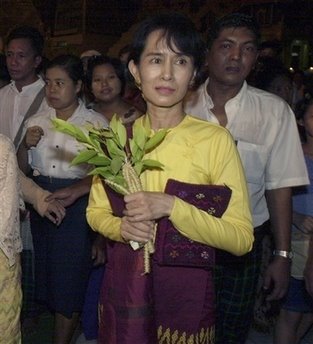


 Posts


