The Universal Declaration of Human Rights at 60
http://www.unhchr.ch/udhr/lang/eng.htm
Whereas recognition of the inherent dignity and of the equal and inalienable rights of all members of the human family is the foundation of freedom, justice and peace in the world,
Whereas disregard and contempt for human rights have resulted in barbarous acts which have outraged the conscience of mankind, and the advent of a world in which human beings shall enjoy freedom of speech and belief and freedom from fear and want has been proclaimed as the highest aspiration of the common people,
Whereas it is essential, if man is not to be compelled to have recourse, as a last resort, to rebellion against tyranny and oppression, that human rights should be protected by the rule of law,
Whereas it is essential to promote the development of friendly relations between nations,
Whereas the peoples of the United Nations have in the Charter reaffirmed their faith in fundamental human rights, in the dignity and worth of the human person and in the equal rights of men and women and have determined to promote social progress and better standards of life in larger freedom,
Whereas Member States have pledged themselves to achieve, in cooperation with the United Nations, the promotion of universal respect for and observance of human rights and fundamental freedoms,
Whereas a common understanding of these rights and freedoms is of the greatest importance for the full realization of this pledge,
Now, therefore,
The General Assembly,
Proclaims this Universal Declaration of Human Rights as a common standard of achievement for all peoples and all nations, to the end that every individual and every organ of society, keeping this Declaration constantly in mind, shall strive by teaching and education to promote respect for these rights and freedoms and by progressive measures, national and international, to secure their universal and effective recognition and observance, both among the peoples of Member States themselves and among the peoples of territories under their jurisdiction.
Article 1
All human beings are born free and equal in dignity and rights. They are endowed with reason and conscience and should act towards one another in a spirit of brotherhood.
Article 2
Everyone is entitled to all the rights and freedoms set forth in this Declaration, without distinction of any kind, such as race, colour, sex, language, religion, political or other opinion, national or social origin, property, birth or other status.
Furthermore, no distinction shall be made on the basis of the political, jurisdictional or international status of the country or territory to which a person belongs, whether it be independent, trust, non-self-governing or under any other limitation of sovereignty.
Article 3
Everyone has the right to life, liberty and security of person.
Article 4
No one shall be held in slavery or servitude; slavery and the slave trade shall be prohibited in all their forms.
Article 5
No one shall be subjected to torture or to cruel, inhuman or degrading treatment or punishment.
Article 6
Everyone has the right to recognition everywhere as a person before the law.
Article 7
All are equal before the law and are entitled without any discrimination to equal protection of the law. All are entitled to equal protection against any discrimination in violation of this Declaration and against any incitement to such discrimination.
Article 8
Everyone has the right to an effective remedy by the competent national tribunals for acts violating the fundamental rights granted him by the constitution or by law.
Article 9
No one shall be subjected to arbitrary arrest, detention or exile.
Article 10
Everyone is entitled in full equality to a fair and public hearing by an independent and impartial tribunal, in the determination of his rights and obligations and of any criminal charge against him.
Article 11
Everyone charged with a penal offence has the right to be presumed innocent until proved guilty according to law in a public trial at which he has had all the guarantees necessary for his defence.
No one shall be held guilty of any penal offence on account of any act or omission which did not constitute a penal offence, under national or international law, at the time when it was committed. Nor shall a heavier penalty be imposed than the one that was applicable at the time the penal offence was committed.
Article 12
No one shall be subjected to arbitrary interference with his privacy, family, home or correspondence, nor to attacks upon his honour and reputation. Everyone has the right to the protection of the law against such interference or attacks.
Article 13
Everyone has the right to freedom of movement and residence within the borders of each State.
Everyone has the right to leave any country, including his own, and to return to his country.
Article 14
Everyone has the right to seek and to enjoy in other countries asylum from persecution.
This right may not be invoked in the case of prosecutions genuinely arising from non-political crimes or from acts contrary to the purposes and principles of the United Nations.
Article 15
Everyone has the right to a nationality.
No one shall be arbitrarily deprived of his nationality nor denied the right to change his nationality.
Article 16
Men and women of full age, without any limitation due to race, nationality or religion, have the right to marry and to found a family. They are entitled to equal rights as to marriage, during marriage and at its dissolution.
Marriage shall be entered into only with the free and full consent of the intending spouses.
The family is the natural and fundamental group unit of society and is entitled to protection by society and the State.
Article 17
Everyone has the right to own property alone as well as in association with others.
No one shall be arbitrarily deprived of his property.
Article 18
Everyone has the right to freedom of thought, conscience and religion; this right includes freedom to change his religion or belief, and freedom, either alone or in community with others and in public or private, to manifest his religion or belief in teaching, practice, worship and observance.
Article 19
Everyone has the right to freedom of opinion and expression; this right includes freedom to hold opinions without interference and to seek, receive and impart information and ideas through any media and regardless of frontiers.
Article 20
Everyone has the right to freedom of peaceful assembly and association.
No one may be compelled to belong to an association.
Article 21
Everyone has the right to take part in the government of his country, directly or through freely chosen representatives.
Everyone has the right to equal access to public service in his country.
The will of the people shall be the basis of the authority of government; this will shall be expressed in periodic and genuine elections which shall be by universal and equal suffrage and shall be held by secret vote or by equivalent free voting procedures.
Article 22
Everyone, as a member of society, has the right to social security and is entitled to realization, through national effort and international co-operation and in accordance with the organization and resources of each State, of the economic, social and cultural rights indispensable for his dignity and the free development of his personality.
Article 23
Everyone has the right to work, to free choice of employment, to just and favourable conditions of work and to protection against unemployment.
Everyone, without any discrimination, has the right to equal pay for equal work.
Everyone who works has the right to just and favourable remuneration ensuring for himself and his family an existence worthy of human dignity, and supplemented, if necessary, by other means of social protection.
Everyone has the right to form and to join trade unions for the protection of his interests.
Article 24
Everyone has the right to rest and leisure, including reasonable limitation of working hours and periodic holidays with pay.
Article 25
Everyone has the right to a standard of living adequate for the health and well-being of himself and of his family, including food, clothing, housing and medical care and necessary social services, and the right to security in the event of unemployment, sickness, disability, widowhood, old age or other lack of livelihood in circumstances beyond his control.
Motherhood and childhood are entitled to special care and assistance. All children, whether born in or out of wedlock, shall enjoy the same social protection.
Article 26
Everyone has the right to education. Education shall be free, at least in the elementary and fundamental stages. Elementary education shall be compulsory. Technical and professional education shall be made generally available and higher education shall be equally accessible to all on the basis of merit.
Education shall be directed to the full development of the human personality and to the strengthening of respect for human rights and fundamental freedoms. It shall promote understanding, tolerance and friendship among all nations, racial or religious groups, and shall further the activities of the United Nations for the maintenance of peace.
Parents have a prior right to choose the kind of education that shall be given to their children.
Article 27
Everyone has the right freely to participate in the cultural life of the community, to enjoy the arts and to share in scientific advancement and its benefits.
Everyone has the right to the protection of the moral and material interests resulting from any scientific, literary or artistic production of which he is the author.
Article 28
Everyone is entitled to a social and international order in which the rights and freedoms set forth in this Declaration can be fully realized.
Article 29
Everyone has duties to the community in which alone the free and full development of his personality is possible.
In the exercise of his rights and freedoms, everyone shall be subject only to such limitations as are determined by law solely for the purpose of securing due recognition and respect for the rights and freedoms of others and of meeting the just requirements of morality, public order and the general welfare in a democratic society.
These rights and freedoms may in no case be exercised contrary to the purposes and principles of the United Nations.
Article 30
Nothing in this Declaration may be interpreted as implying for any State, group or person any right to engage in any activity or to perform any act aimed at the destruction of any of the rights and freedoms set forth herein.
PROFILE
Native Name
English
Total Speakers
322,000,000 (1995)
Usage by Country
Europe -
Official Language: Gibraltar, Ireland, Malta, United Kingdom
Asia -
Official Language: India, Pakistan, Philippines, Singapore
Africa -
Official Language: Botswana, Cameroon, Gambia, Ghana, Kenya, Lesotho, Liberia, Malawi, Mauritius, Namibia, Nigeria, Sierra Leone, South Africa, Swaziland, Tanzania, Uganda, Zambia
Central and South America -
Official Language: Anguilla, Antigua & Barbuda, Bahamas, Barbados, Belize, Bermuda, Br. Virgin Isl.s, Dominica, Falklands, Grenada, Guyana, Jamaica, Montserrat, Puerto Rico, St. Kitts & Nevis, St. Lucia, St. Vincent, Trinidad & Tobago, Turks & Caicos Islands, US Virging Islands
North America -
Official Language: Canada, USA
Oceania -
Official Language: American Samoa, Australia, Belau, Cook Islands, Fiji, Guam, Kiribati, Marshall Islands, Micronesia, Nauru, New Zealand, Niue, Norfolk Islands, Northern Mariannas, Papua New Guinea, Solomon Islands, Tokelau, Tonga, Tuvalu, Vanuatu, Western Samoa.
Background
It belongs to the Indo-European family, Germanic group, West Germanic subgroup and is the official language of over 1.7 billion people. Home speakers are over 330 million. As regards the evolution of the English language, three main phases can be distinguished. From the 6th and 5th centuries B.C., the Celtics are believed to have lived in the place where we now call Britain. Britain first appeared in the historical records as Julius Caesar campaigned there in 55-54 B.C. Britain was conquered in 43 A.D. and remained under the Roman occupation until 410 A.D. Then came from the European Continent the Germanic tribes, who spoke the languages belonging to the West Germanic branch of the Indo-European language family. First the Jutes from Jutland (present-day Denmark) in the 3rd century A.D., then in the 5th century, the Saxons from Friesland, Frisian Islands and north-west Germany, finally the Angles, from present-day Schleswig-Holstein (a German Land) who settled north of the Thames. The words "England" and "English", come from the word, "Angles". During the Old English period of 450-1,100 A.D. (first phase), Britain experienced the spread of Christianity, and, from the 8th century, the invasion and occupation by the Vikings, called the "Danes." The most important event of the second phase, the Middle English period (1100-1500 A.D.) was the Norman Conquest of 1066. The Normans were the North Men, meaning the Vikings from Scandinavia, settled in the Normandy region of France from the 9th century, who had assimilated themselves to the French language and culture. English was much influenced by French during this time. During the third phase, the Modern English period (1500 onwards), English spread to the world as the British Empire colonised many lands. William Shakespeare (1564-1616) lived in this period, and in 1755 Samuel Johnson completed "A Dictionary of the English Language" with about 40,000 entries, which contributed to the standardisation of the English language. The English language which spread to the world created many of its variants, the most prominent of which is American English. The American English writing system is said to owe much to Noah Webster's "An American Dictionary of the English Language" which was completed in 1828. Other important varieties include Indian English, Australian English, and many English-based Creoles and Pidgins.
Received: 19980525
Posted: 19980720
Checked: 19981112
Wednesday, December 10, 2008
Universal Declaration of Human Rights


Tsunami
http://bimbel-padi-bekasi.blogspot.com/2008/12/tsunami.html
A tsunami is a series of waves created when a body of water, such as an ocean, is rapidly displaced. Earthquakes, mass movements above or below water, some volcanic eruptions and other underwater explosions, landslides, underwater earthquakes, large asteroid impacts and detonation of nuclear weapons at sea all have the potential to generate a tsunami. Due to the immense volumes of water and energy involved, the effects of tsunami can be devastating. Since meteorites are small, they will not generate tsunami.
The Greek historian Thucydides was the first to relate tsunami to submarine quakes,but understanding of the nature of tsunami remained slim until the 20th century and is the subject of ongoing research.Many early geological, geographic, oceanographic etc., texts refer to "Seismic sea waves"—these are now referred to as "tsunami".Some meteorological storm conditions—deep depressions causing cyclones, hurricanes—can generate a storm surge which can be several metres above normal tide levels. This is due to the low atmospheric pressure within the centre of the depression. As these storm surges come ashore the surge can resemble a tsunami, inundating vast areas of land. These are not tsunami. Such a storm surge inundated Burma-Myanmar in May 2008.
Tsunami in history
Historically speaking, tsunami are not rare, with at least 25 tsunami occurring in the last century. Of these, many were recorded in the Asia–Pacific region—particularly Japan. The Boxing Day Tsunami in 2004 caused approximately 350,000 deaths and many more injuries.
As early as 426 B.C. the Greek historian Thucydides inquired in his book History of the Peloponnesian War about the causes of tsunami, and argued correctly that it could only be explained as a consequence of ocean earthquakes. He was thus the first in the history of natural science to correlate quakes and waves in terms of cause and effect:
The cause, in my opinion, of this phenomenon must be sought in the earthquake. At the point where its shock has been the most violent the sea is driven back, and suddenly recoiling with redoubled force, causes the inundation. Without an earthquake I do not see how such an accident could happen.
The Roman historian Ammianus Marcellinus (Res Gestae 26.10.15-19) describes the typical sequence of a tsunami including an incipient earthquake, the sudden retreat of the sea and a following gigantic wave on the occasion of the 365 A.D. tsunami devastating Alexandria.
Causes
A tsunami can be generated when converging or destructive plate boundaries abruptly move and vertically displace the overlying water. It is very unlikely that they can form at divergent (constructive) or conservative plate boundaries. This is because constructive or conservative boundaries do not generally disturb the vertical displacement of the water column. Subduction zone related earthquakes generate the majority of all tsunamis.
A tsunami has a much smaller amplitude (wave height) offshore, and a very long wavelength (often hundreds of kilometers long), which is why they generally pass unnoticed at sea, forming only a slight swell usually about 300 mm above the normal sea surface. A tsunami can occur at any state of the tide and even at low tide will still inundate coastal areas if the incoming waves surge high enough.
On April 1, 1946 a Magnitude 7.8 (Richter Scale) earthquake occurred near the Aleutian Islands, Alaska. It generated a tsunami which inundated Hilo on the island of Hawai'i with a 14 m high surge. The area where the earthquake occurred is where the Pacific Ocean floor is subducting (or being pushed downwards) under Alaska.
Examples of tsunami being generated at locations away from convergent boundaries include Storegga during the Neolithic era, Grand Banks 1929, Papua New Guinea 1998 (Tappin, 2001). In the case of the Grand Banks and Papua New Guinea tsunamis an earthquake caused sediments to become unstable and subsequently fail. These slumped and as they flowed down slope a tsunami was generated. These tsunami did not travel transoceanic distances.
It is not known what caused the Storegga sediments to fail. It may have been due to overloading of the sediments causing them to become unstable and they then failed solely as a result of being overloaded. It is also possible that an earthquake caused the sediments to become unstable and then fail. Another theory is that a release of gas hydrates (methane etc.,) caused the slump.The "Great Chilean earthquake" (19:11 hrs UTC) May 22, 1960 (9.5 Mw), the March 27, 1964 "Good Friday earthquake" Alaska 1964 (9.2 Mw), and the "Great Sumatra-Andaman earthquake" (00:58:53 UTC) December 26, 2004 (9.2 Mw), are recent examples of powerful megathrust earthquakes that generated a tsunami that was able to cross oceans. Smaller (4.2 Mw) earthquakes in Japan can trigger tsunami that can devastate nearby coasts within 15 minutes or less.
In the 1950s it was hypothesised that larger tsunamis than had previously been believed possible may be caused by landslides, explosive volcanic action e.g., Santorini, Krakatau, and impact events when they contact water. These phenomena rapidly displace large volumes of water, as energy from falling debris or expansion is transferred to the water into which the debris falls at a rate faster than the ocean water can absorb it. They have been named by the media as "mega-tsunami."Tsunami caused by these mechanisms, unlike the trans-oceanic tsunami caused by some earthquakes, may dissipate quickly and rarely affect coastlines distant from the source due to the small area of sea affected. These events can give rise to much larger local shock waves (solitons), such as the landslide at the head of Lituya Bay 1958, which produced a wave with an initial surge estimated at 524 m. However, an extremely large gravitational landslide might generate a so called "mega-tsunami" that may have the ability to travel trans-oceanic distances. This though is strongly debated and there is no actual geological evidence to support this hypothesis.
Characteristics
While everyday wind waves have a wavelength (from crest to crest) of about 100 m (300 ft) and a height of roughly 2 m (7 ft), a tsunami in the deep ocean has a wavelength of about 200 km (120 miles). This wave travels at well over 800 km/h (500 mph), but due to the enormous wavelength the wave oscillation at any given point takes 20 or 30 minutes to complete a cycle and has an amplitude of only about 1 m (3 ft). This makes tsunamis difficult to detect over deep water. Their passage usually goes unnoticed by ships.
As the tsunami approaches the coast and the waters become shallow, the wave is compressed due to wave shoaling and its forward travel slows below 80 km/h (50 mph). Its wavelength diminishes to less than 20 km (12 miles) and its amplitude grows enormously, producing a distinctly visible wave. Since the wave still has a wavelength on the order of several km (a few miles), the tsunami may take minutes to ramp up to full height, with victims seeing a massive deluge of rising ocean rather than a cataclysmic wall of water. Open bays and coastlines adjacent to very deep water may shape the tsunami further into a step-like wave with a steep breaking front.
Terminology
The term tsunami comes from the Japanese meaning harbor ("tsu", 津) and wave ("nami", 波). [a. Jap. tsunami, tunami, f. tsu harbour + nami waves.—Oxford English Dictionary]. For the plural, one can either follow ordinary English practice and add an s, or use an invariable plural as in Japanese. Tsunami are common throughout Japanese history; approximately 195 events in Japan have been recorded.
Tsunami are sometimes referred to as tidal waves, a term that has fallen out of favor, especially in the scientific community, in recent years because tsunami actually have nothing to do with tides. The once popular term derives from their most common appearance, which is that of an extraordinarily high incoming tide. Tsunami and tides both produce waves of water that move inland, but in the case of tsunami the inland movement of water is much greater and lasts for a longer period, giving the impression of an incredibly high tide. Although the meanings of "tidal" include "resembling" or "having the form or character of" the tides, and the term tsunami is no more accurate because tsumanis are not limited to harbours, use of the term tidal wave is discouraged by geologists and oceanographers.The only other language than Japanese that has a word for this disastrous wave is Tamil language,(dubious – discuss) and the word is "Aazhi Peralai". South Eastern coasts of India have experienced these waves some 700 years before and was a regular event by that time as per the stone carvings (scriptures in stone) read.
Signs of an approaching tsunami
There is often no advance warning of an approaching tsunami. However, since earthquakes are often a cause of tsunami, any earthquake occurring near a body of water may generate a tsunami if it occurs at shallow depth, is of moderate or high magnitude, and the water volume and depth is sufficient.
If the first part of a tsunami to reach land is a trough (draw back) rather than a crest of the wave, the water along the shoreline may recede dramatically, exposing areas that are normally always submerged. This can serve as an advance warning of the approaching tsunami which will rush in faster than it is possible to run. If a person is in a coastal area where the sea suddenly draws back (many survivors report an accompanying sucking sound), their only real chance of survival is to run for high ground or seek the high floors of high rise buildings.In the 2004 tsunami that occurred in the Indian Ocean drawback was not reported on the African coast or any other eastern coasts it inundated, when the tsunami approached from the east. This was because of the nature of the wave—it moved downwards on the eastern side of the fault line and upwards on the western side. It was the western pulse that inundated coastal areas of Africa and other western areas.
About 80% of all tsunamis occur in the Pacific Ocean, but are possible wherever large bodies of water are found, including inland lakes. They may be caused by landslides, volcanic explosions, bolides and seismic activity.Indian Ocean Tsunami According to an article in "Geographical" magazine (April 2008), the Indian Ocean tsunami of December 26, 2004 was not the worst that the region could expect. Professor Costas Synolakis of the Tsunami Research Center at the University of Southern California co-authored a paper in "Geophysical Journal International" which suggests that a future tsunami in the Indian Ocean basin could affect locations such as Madagascar, Singapore, Somalia, Western Australia and many others. The Boxing Day tsunami killed over 300,000 people with many bodies either being lost to the sea or unidentified. Some unofficial estimates have claimed that approximately 1 million people may have died directly or indirectly solely as a result of the tsunami.
Japan's recession worse than thought: official data
http://news.yahoo.com/s/afp/20081209/bs_afp/japaneconomygrowth_081209004130
Mon Dec 8, 7:41 pm ET
TOKYO (AFP) – Japan's economy shrank 0.5 percent in the third quarter of this year, sinking much deeper into recession than previously thought, official figures showed Tuesday.
Asia's largest economy contracted 1.8 percent on an annualised basis in the three months to September, when Japan entered its first recession in seven years with a second straight quarter of negative growth, the government said.
An initial estimate last month had shown the Japanese economy shrank 0.1 percent in the third quarter, and 0.4 percent on an annualised basis.
Weak business investment was the main culprit for the revision as companies slashed investment in new equipment and factories by 2.0 percent, compared with an initial estimate of 1.7 percent.
Japan's export-dependent economy was also hit by sluggish exports as the global financial crisis hit international trade.
The latest snapshot of the Japanese economy was even more gloomier than analyst forecasts for a contraction of about 0.2 percent quarter-on-quarter.
The government said the economy shrank a revised 1.0 percent in the second quarter, which was also slightly worse than previously thought.
Japan has relied on brisk exports of cars, electronics and other goods to drive its recovery from recession in the 1990s.
But it has seen exports weaken in recent months due to worsening demand in recession-hit overseas economies.
Copyright © 2008 Agence France Presse. All rights reserved. The information contained in the AFP News report may not be published, broadcast, rewritten or redistributed without the prior written authority of Agence France Presse.
Copyright © 2008 Yahoo! Inc. All rights reserved.Questions or CommentsPrivacy PolicyTerms of ServiceCopyright/IP Policy
Almost Half Of Journalists In Jail Are Online Reporters
http://www.rferl.org/content/Almost_Half_Of_Journalists_In_Jail_Are_Online_Reporters/1357762.html
Imprisoned Azerbaijani journalist Eynulla Fatullayev in a Baku court in October 2007
December 09, 2008
In its annual survey of journalists in prison, the Committee to Protect Journalists (CPJ) has found that almost half of all media workers in jail are bloggers, web reporters, or online editors.
The CPJ says the findings reflect the rising influence of online reporting and commentary.
The CPJ says it found 125 journalists behind bars as of December 1, a decrease of two from 2007. Fifty-six of those are online journalists.
"The future of journalism is online," says CPJ Executive Director Joel Simon, "and we are now in a battle with the enemies of press freedom who are using imprisonment to define the limits of public discourse."
China is the world's worst jailer of journalists, with 28 in prison, followed by Cuba (21), Burma (14), Eritrea (13), and Uzbekistan (6).
Other countries in RFE/RL's broadcast area that are imprisoning journalists are Azerbaijan (5), Iran (5), Russia (2), Armenia (1), Afghanistan (1), Iraq-in U.S. custody (1), and Iraq-in custody in the Kurdistan region (1).
You can read detailed accounts of each imprisoned journalist on the CPJ's website.
Singapore: dirty money, no questions asked
http://taxjustice.blogspot.com/2008/12/singapore-asias-dirty-casino.html
Tuesday, December 09, 2008
Singapore: dirty money, no questions asked
A fascinating series of three articles has just appeared on a political party web site in Singapore, looking at its emergence into what it is today: a big, dirty Asian tax haven. The series was written by a leading Singapore dissident, Chee Soon Juan, secretary-general of the Singapore Democratic Pary, who has been imprisoned several times for his anti-establishment views.
These well researched and well-written articles are all well, well worth reading - and though we've said that of a fair few reports, we'd highlight these ones in particular. Part I looks at the emergence of Singapore as a tax haven; Part II looks at how tax havens affect the world's economies, and Part III examines whether foreign funds parked there have benefited locals.
So how did Singapore come to be a secrecy jurisdiction (or a tax haven, if you will.)?
"Circa 1998 in the wake of the Asian financial crisis, the Government decided to make Singapore the financial capital of Asia, if not the world. At about that time Switzerland, the Mecca of secretive banking, came under pressure from the European Union to amend its laws to enable greater financial transparency and to provide information to on accounts suspected to belong to tax evaders from other European nations.
The (Singapore) Government saw the opportunity and introduced legislation to tighten up secrecy protections in our financial institutions to attract investors and account holders fleeing Switzerland."
This is it, in a nutshell. As regards Europe, the article is referring to the EU Savings Tax Directive, which is currently in the process of being tightened. Lee Kuan Yew, Singapore's Prime Minister from 1959 to 1990, made some telling remarks in a memoir (which this blogger happens to have on his bookshelf.)
"In the early years from 1968 to 1985, we had the field all to ourselves in the regin. We attracted international financial institutions by abolishing witholding tax on interest income earned by non-resident depositors. All Asian dollar deposits were exempted from statutory liquidity and reserve requirements. By the 1990s, Singapore had become one of the larger financial centres of the world . . . .
Singapore's financial centre was considered over-regulated compared to Hong Kong's. Critics wrote: "in Hong Kong, what is not expressly forbidden is permitted; in Singapore, what is not expressly permitted is forbidden. . . . Only after the MAS (Monetary Authority of Singapore) had demonstrated the strength of its system to weather the financial crisis of 1987 and 1997-98 did I feel confident enough to move closer to a position where what is not expressly forbidden is permitted."
Note two things about this statement. First, his description of a move towards deregulation is expressive of the tax haven mentality. Second, that the reforms happened after the crisis: it was Singapore's "over-regulated" banking system that weathered the crisis.
Back to Chee Soon Juan's article, which continues:
"In 2001 Prime Minister Lee Hsien Loong, then deputy prime minister, finance minister and chairman of the Monetary Authority of Singapore all rolled into one, met with bankers from all over the world to discuss how Singapore could tailor its laws to become a premier banking centre.
Following the consultations, he introduced amendments to the Banking Act to revise secrecy provisions so that "only very few exceptions have been allowed for the disclosure of information relating to a customer's deposit and funds placed for investment" and that "a person who receives customer information will be required by law to keep the information confidential." The penalty for breaking such a law is a fine of up to $125,000 or 3-years' jail or both.
In 2004, trust laws were amended to allow foreigners, especially Europeans, to avoid laws in their home countries that regulate inheritance of an estate by family members."
The article then describes the huge asset growth in Singapore's banking system, rising from $150bn in 1998 to $1.173 trillion by the end of last year, and then looks into a curious website offering offshore services through Singapore, but doesn't reveal anywhere who is running it (though an anonymous commenter under Part 1 seems to have traced the web site to someone in Germany).
"Its front page pictures a gentleman cupping his chin as if in deep contemplation - but doesn't tell us who he is."
So how dirty is Singapore? Well, we only have anecdote (which tends to be the way with tax havens,) but try these:
"Not only have tax evaders found a haven in Singapore, money-launderers are also flocking to the city-state. Former chief economist at Morgan Stanley, Andy Xie, wrote in a private email that was inadvertently leaked to the public, said that Singapore's financial success "came mostly from being the money laundering center for corrupt Indonesian businessmen and government officials.''
In 2006, now bankrupt Merrill Lynch and Capgemini reported that the number of "super-rich" Indonesians living in Singapore is a staggering 18,000 whose wealth amounts to approximately US$87 billion. Much of this wealth, complains the Indonesian Government, came from illegal activities in Indonesia. Xie added that in order to sustain its economy, Singapore was resorting to "building casinos to attract corruption money from China."
Corrupt ruling generals in Burma are also suspected to be stashing their assets in Singapore, leading many to criticise the PAP Government following the Burmese regime's crackdown on monks and civilian protesters in 2007.
Not too long ago, a friend of mine from Cambodia intimated to me a story about four women, all single, from Phnom Penh depositing $80 million between them in Singapore banks. No questions asked. "Four single women? $80 million? From Cambodia which is dirt poor?" she asked with a mixture if rhetoric and incredulity, "And no one here bothers to ask how they got the money?" In case anyone thinks that the remark carried sexist overtones, my friend was female and a hard champion of equal rights for women.""
And you might find the description of the activities of a former chief of an Italian bank curious too. And, as is also usual with the secrecy jurisdictions, the government claims that
"our banking and financial system is open and transparent, and our rules vigorously enforced."
And of course, no protestation from a tax haven would be complete without the "we are not a tax haven" assertion, in Part II:
"Singapore is not a tax haven," Foreign Minister George Yeo insists, "We are a low-tax country but not a tax haven. We're an international financial centre so banking secrecy is very important. It is protected by law."
Of course, of course. And the article note just how very wrong he is.
"Singapore has been adamant in its non-cooperation. Even the chairman of the Swiss Bankers' Association, Mr Urs Roth, is pointing (hypocritical) fingers at Singapore. Comparing his country and ours, Mr Roth noted that Singapore's banking secrecy provisions are even stronger than the ones in Switzerland. . . the Singapore Government has played the role of Switizerland's heir apparent to perfection."
As if all that weren't enough - try Part III. It starts with this question - one of the quintessential tax haven questions:
"Why should Singaporeans care? Isn't it good that we have become fabulously rich from all the money pouring in to our banks? Clean money, dirty money, it's still money. We get to use it and that's all that matters."
And they have an answer. One part of it starts like this:
"For all the hoopla about our economic prowess, we have an income disparity that is akin to those of Third World countries: Our Gini coefficient among employed households, a measure of income inequality, has been rising through the years. Its figure of 48.5 is between developing countries like Argentina (49) and Ecuador (46), and almost double that of European countries like Sweden, Denmark and Germany. It is even higher that those of Japan, South Korea and Taiwan (non tax haven Asian economies) which have Ginis around the mid-30 mark."
And then look at the remarkable graph (click on it to enlarge it): it shows inequality rising sharply, just as the assets under management in Singapore rise sharply. (As an aside, to any academics out there - why not start studying this, on a worldwide basis? More research needed on different countries, and fast.)
Now this stuff about Gini coefficients may sound like dull economist-speak, but for real people with real lives, it can be shattering. But here's another way of talking about it:
"We see the ultra-luxurious property at Sentosa Cove, the Bentleys and Maseratis zooming around on our streets, and immediately think that Singaporeans are more than a fortunate lot. Not quite. Such trappings are built for and owned by overseas financial magnates . . . while these super-rich foreigners live it up here Singaporeans, especially those in the lower income bracket, see their fortunes go in the other direction.
. . .
Between 1998 and 2003, the average household monthly income of the poorest 20 percent of the population decreased by nearly 15 percent while the richest 20 percent increased by 11.7 percent. In that same period, while the average wage dropped for the poorest 40 percent of households, their expenditure continued to outstrip their income
. . .
Does all this money do you any good? Look at our other blogs on this subject - here and here, for example, and see the parallels. Expatriates call Singapore "one of the least stressful places in the region" while
"Locals, on the other hand, find the city one of the most stressful places o live in. As a result, among the various Asian societies, Singaporeans are most likely to have suffered depression, stress, and fatigue. Another study showed that job-related stresses continue to be the biggest problems for working Singaporeans. Because of the system, an increasing number of adult Singaporeans are driven to seek the help of mental professionals due to financial woes. Marriages are also being torn apart because of economic pressures at home."
Reading through this, while chatting on Skype with today's blogger, TJN's director John Christensen exclaimed, after reading this paragraph, that "This sounds just like Jersey."
This whole article is full of more good stuff. We won't reproduce too much more of it here: read it yourself. Look at the section entitled "Ethics-shmethics. Money is money," for example.
But we will highlight one part of this, which is absolutely crucial, and fits exactly with the atmosphere of intimidation that we have encountered in so many parts of the world.
"The Government made the decision to turn Singapore into a tax haven because it was the easy thing to do. All it needed was some skilfull rewriting of the law and a handsome advertising campaign to lure big, and often dirty, money to our banks.
Of course the alternative economic strategy, as discussed below, is not politically viable, at least not for the PAP (Singapore ruling party, which won 82 of 84 seats in the last parliamentary elections). Fostering dynamism and creativity means having to open up the political space which the PAP is loathe to do. The combination of making money on Easy Street while remaining solidly authoritarian was an opportunity too delicious to pass up."
And therein lies the problem. It is true in Britain - until the economic crisis hit, it has been politically very difficult to criticise Britain's tax haven model and be taken seriously.
What should Singapore do to change? The article's authors make many suggestions, but here is a crucial one, we feel:
"We also need to democratise our political economy. This means that Singaporeans must be allowed to become the drivers of economic growth rather than the Government. Private enterprise, and not the GLCs, must lead our economy. If Singapore develops politically and its citizens find their rightful place in society, we will have the foundations of a system that is free and enterprising, one that will stimulate the entrepreneurial mind."
To end this blog, a few general comments.
Part II quotes the chairman of the Swiss Bankers' Association, who pointed out that while Singapore is not getting as much attention at the moment compared to Switzerland "I would guess that it is a question of time." Jeffrey Owens of the OECD (whom we blogged very recently) summed up the matter for Singapore cogently:
"The political climate is changing and I do not think that Singapore is correctly reading the political signs that a change is about to come."
Take a look, too, at the comments underneath these stories. Here are just a few of many.
"Let's wait and see whether LKY and sissy Loong will start suing Any Xei and Dr. Chee."
"fast wealth is a shaky foundation to build on and the social cost is very costly."
"We Singaporeans are fed up with the main stream media propaganda of reporting and sugarcoating the news."
"For the US it is that simple, if any countries that refuse to co-perate with them in combating tax evation, then they would not renew licences for those banks with their head office in those countires to operate in the USA."
"The international community must slap PAP with some financial sanctions"
And several more in this vein, many of them stronger than these.
The kinds of comments above are the voices of ordinary Singaporeans. We agree with them. And we call on the EU and the United States, and a few others who are at last starting to show some activism in this area, to listen to them. And to put Singapore squarely in their sights.
posted by TJN at 1:19 AM
Obama urged to step up efforts in confronting genocide -MIZZIMA
http://www.mizzima.com/news/world/1413-obama-urged-to-step-up-efforts-in-confronting-genocide.html
by Mizzima News
Tuesday, 09 December 2008 16:51
A policy report compiled for the incoming Obama administration appeals for the prioritization in U.S. foreign policy of combating genocide around the globe, although it is uncertain what ramifications the incorporated recommendations may have regarding Burma.
Preventing Genocide, released on Monday in Washington, D.C. and compiled by a distinguished task force, aims to carve out an effective U.S. policy in both preventing and responding to cases of genocide around the world. The report argues that it is imperative for the U.S. to take stronger action in the face of genocide as such a stance corresponds with both American values and interests.
Though the report does not make use of case studies, numerous analysts and organizations label the existing situation in Eastern Burma genocide, as the Burmese Army continues with its attacks and coercive policies against local ethnic minority populations.
According to the Genocide Prevention Network, over 650,000 people have been displaced and some 3,500 villages destroyed in Eastern Burma, an area of the world that the international genocide watchdog identifies as a region of concern.
Confronting genocide is of definitive national interest to the U.S., argues the paper, as genocide is said to fuel instability, creating weaker states which in turn can have a spillover effect across international boundaries in areas such as refugee flows.
The assessment certainly holds true for Burma, which has seen millions flee to neighboring Thailand, China, Bangladesh and India, abetting often insecure border situations and facilitating in the transfer of both illicit goods and infectious disease.
However, the policy study seems to offer little hope for a structurally enhanced U.S. effort in confronting genocide in Eastern Burma, barring a drastic shift in policy adopted by the incoming Obama administration.
Ominously, and pertinently in the case of Burma, the report's authors caution: "Geographically remote countries that are autocratically governed and have limited integration into the global economy are generally harder targets to influence through diplomatic and economic means."
Potential success of the U.S. playing a vital role in rolling back genocide is further said to heavily rely upon the relationship of the state in question with both its neighbors and major powers.
There can be little question that Burma is geographically removed from the traditional U.S. sphere of influence and that the Southeast Asian country is autocratically ruled and largely exists outside the integrated global economy. Additionally, the foreign policy's of regional countries vis-à-vis Burma, including major powers China and India, are well documented to often be at odds with that of the U.S.
Ultimately, in situations such as that in Eastern Burma, the study concludes, "Military options are especially relevant when opportunities for prevention have been lost."
Having already exhausted most coercive tools at its disposal with respect to Burma, including sanctions and legal charges, it would appear that the only outlet remaining for the U.S. is "military options."
Military options are in turn defined as not only those aimed against the perpetrators, but additionally said to include military assistance to opposition forces opposing the guilty party.
However, it is also said to be important to understand the potential limitations of relying too heavily, or even singularly, on coercive measures, as the U.S. "should not dismiss the potential benefits of rewarding 'bad people' for 'good behavior'."
In the end, any decision by a U.S. administration to use military force to intervene in situations of genocide is understood to be a "fundamentally political decision," reflecting national security interests, domestic politics and the international system.
And regarding the international system, the report hints there must first be a change within the United Nations, which as it currently operates is said to stand little chance of authorizing the use of force in cases such as that in Burma. This is a crucial obstacle, as the report's authors also emphasize the need for a multilateral approach if a military option is to be pursued.
The task force that compiled the 174-page report was co-chaired by Madeleine Albright and William Cohen.
Albright, who met with Burmese democracy opposition leader Aung San Suu Kyi in 1997, is an outspoken critic of the situation in Burma and former U.S. Ambassador to the United Nations and Secretary of State, while Cohen previously served as Secretary of Defense.
The report was co-sponsored by the U.S. Institute for Peace, U.S. Holocaust Memorial Museum and The American Academy of Diplomacy. < Prev Next >
Tuesday, December 9, 2008
The Dalai Lama blames “greed” for financial crisis
http://tejindersinghtito.blogspot.com/2008/12/dalai-lama-blames-greed-for-financial.html
Monday, December 8, 2008
Author: Tejinder Singh
8 December 2008 - Issue : 811
A fter addressing an overflowing house of European Parliament December 4, the Dalai Lama, the Tibetan spiritual leader, appeared at a joint press conference with Hans-Gert Poettering, the President of the only directly elected European institution, the European Parliament. Wit, humour, serenity and positive vibes were present in the packed environs of the Anna Politkovskaya European Parliament press room, named after the slain Russian journalist, as the Dalai Lama was at ease with international journalists.
Answering a question about economic crisis, the spiritual leader explained the ongoing market crisis around the world. Saying, “Market itself is a creation of human beings,” the Buddhist leader asked, “What is the real cause of this sort of economic crisis?” Citing answers from his business friends, the Dalai Lama told journalists: “Too much speculation and ultimately greed,” adding, “The pot - ential to help is: reduce greed and (increase) self-discipline. “Economic crisis is something urgent so it will be helpful to reduce some other conflict (that are going on) in the name of faith and nationality.”
Going down memory lane, the Dalai Lama listed the Khmer Rouge genocide in Cambodia, and Burma and North Korea as some of the instances that could not have happened or are still happening without China nodding its approval. Citing the “uncomfortable people of Hong Kong,” “reunification of Taiwan,” and the separatist factions in the southwestern Chinese province of Xinjiang as areas where such a moral authority should be displayed, the Buddhist leader insisted he only wants meaningful autonomy for Tibet under Chinese rule.
The leader from Tibet told journalists, “actually the whole world knows we are not separatists and also many Chinese writers and thinkers and many Chinese students if they have the opportunity to know the reality really support it and are in fact very critical of their government policy. “If Chinese government still accuse us of being splitists, we ourselves are confused. We are not ‘splittists,’ but the Chinese government still accuses us of being ‘splittists,’” he said.
China cancelled the annual EU-China Summit slated for December 1 when French President Nicolas Sarkozy announced he would meet the Dalai Lama in Poland. Sarkozy also represents the EU Presidency as France holds the rotating EU Presidency till the end of the year before handing it over to the Czech Republic for next six months.
When asked to comment on his meeting with Sarkozy, the Dalai Lama, with a cheerful smile said, “I have met the wife (Mrs. Sarkozy) and will be meeting the husband.” Praising the Chinese people for their diligence and perseverance and citing “manpower, economic and military power” as positive desired contributors for China to becomes “a superpower,” the Dalai Lama pointed out, “Now one important factor is moral authority and that is lacking. “Because of its very poor record on human rights and religious freedom and freedom of expression and freedom of the press — too much censorship — the image of China in the field of moral authority is very, very poor,” he said.
“The sensible Chinese realise China should now give more attention to this field to get more respectability in world affairs,” the Nobel peace laureate said, adding, “My faith in Chinese people has never shaken,” while the top echelons of Chinese leadership is divided into hard liners and soft approach advocates.
The Dalai Lama called the Chinese regime a “capitalist totalitarian regime,” and urged the importance of trust and transparency telling journalists, “trust is the key factor and for that transparency (is) really very much needed.” Calling upon the Chinese authorities to “adjust to new reality,” the Buddhist leader suggested that the Chinese authorities also can change to fit into the changing world scenario. Earlier, he addressed the European Parliament during his second day in the Belgian capital, where he was greeted by loud applause and Tibetan flags.
President Poettering, assured that the parliament would “continue to defend the rights of the Tibetan people to their cultural and religious identity.” He called on Chinese leaders to hold meaningful talks with representatives of the exiled Dalai Lama, who lives in exile in India, and has sought “meaningful autonomy” for Tibet since he had to leave his homeland following a failed uprising in 1959 against Chinese rule, nine years after Chinese troops invaded the region. Ruled by China since the 18th Century, Tibet became independent in 1911, but the new Communist regime in China reasserted control in 1951, and installed a Communist government in 1953.
Posted by Tejinder Singh at Monday, December 08, 2008
Labels: Anna Politkovskaya, Burma, Cambodia, China, Dalai Lama, European Parliament, India, Khmer Rouge, Nicolas Sarkozy, NORTH KOREA
China strengthens border with Burma-DVB
http://english.dvb.no/news.php?id=1986
Dec 8, 2008 (DVB)Chinese authorities have begun to erect walls along the border with Burma near the Kachin Independence Organisation-controlled area in Laiza, north-east Burma, according to local residents.
The construction project started in the last week of November as Chinese workers and machines began digging along a border stream.
"In some places, they have already started laying bricks and digging the ground,・a local resident said.
的n some places, it is as high as a person."
The decision to clearly demarcate and strengthen the border had been discussed at coordination meetings, and sources close to the KIO said the Chinese authorities met the Northern Command military security force and KIO executive committee member Dr La Ja on 2 December. Fences and iron posts have also been erected in the Shweli-Kyegaung area, locals said.
Some residents said that the fences had been put up on the orders of the Yunan state narcotics elimination commission, but a resident of Laiza said there appeared to be other motives.
"I think it is about more than the elimination of narcotics,・the resident said.
擢encing like this would not stop that."
Military analyst Aung Kyaw Zaw, who is based on the border, said the construction of the walls could be a precautionary measure in anticipation of activities by armed groups in the area in the run-up to the 2010 election.
"It is a way of putting pressure on the KIO,・Aung Kyaw Zaw said.
典his is clear because they are erecting the walls where the Pan Wa and Kan Paik ethnic armed groups are based."
Aung Kyaw Zaw also speculated that the reinforced borders could be linked to the construction of gas pipelines to China, which is due to start in 2009.
Reporting by DVB
THE GLOBAL FORCE BEHIND MUMBAI’S AGONY IS IN OUR MIDST
http://www.sanfranciscosentinel.com/?p=17858
7 December 2008
Stephen Schwartz and Irfan Al-Alawi say that LET — the Army of the Righteous — is a worldwide Islamist organisation which is well-established in Britain. The Mumbai atrocities are further proof that the march of Islamic extremism is the central fact of our time.
BY STEPHEN SCHWARTZ
The usual suspects are declaring that the ‘cause’ of the Mumbai bombings was Kashmir or some other local grievance. But what happened in Mumbai was no more a local event than the 7 July 2005 attacks in London or the assault in Madrid on 11 March 2004. Pakistani propaganda about its claims in Kashmir is almost entirely phony rhetoric intended to justify the predatory instincts of the Pakistani army and intelligence bureaucrats. Pakistan insists that Kashmiri Muslims are oppressed by India, but in fact Indian Muslims live better than Pakistani Muslims and have demonstrated a better capacity for true Islamic thinking.
The attacks on Mumbai are part of a global problem, which is why a passive Western policy toward the crisis is not acceptable. It may appear comforting to bien-pensant representatives of the ‘progressive’ elite. But in reality it represents an attitude of suicidal and irresponsible disengagement from confrontation with a continuing threat. In Mumbai, as in London, Madrid and New York, but also in the Islamic cities of Iraq, Istanbul and Jakarta, and in places like Peshawar and Quetta in Pakistan, a wide network of Muslim fundamentalists continue their global offensive.
The common enemies of all civilised humanity in the ongoing conflict include Saudi Wahhabism and Pakistani jihadism, the latter inspired by a fundamentalist variant of Islam called Deobandism. What Western appeasers must remember is that Pakistan, like Saudi Arabia before it, is two-faced, professing to oppose terrorism while powerful factions in its leadership espouse it.
There is a wide gap between the ordinary local people in Pakistan and India — whatever their faith — and Islamist radicals in the Pakistani armed forces and clandestine services. This division cannot be spanned by a few ameliorative gestures by Pakistani, American or British leaders. We owe it to these ordinary people to treat Islamism seriously wherever it occurs.
This war is mainly aimed at gaining the loyalties of the world’s Sunni Muslims. Saudi Wahhabis now favour a crisis in Pakistan. King Abdullah of Saudi Arabia has begun a slow and at times almost imperceptible process of anti-Wahhabi actions, and so the main body of Islamist radicals (claiming the mantle of Sunnism) have shifted their attention to Pakistan and its pool of Deobandi foot soldiers. On the subcontinent, the extremists can corrupt, recruit and kill more people, with more impunity, than is now imaginable in the Middle East. Remember that the Wahhabis have failed in Iraq, and the Deobandis, who produced the Taleban, are widely discredited in Afghanistan. Pakistan is now the most obvious choice as a new battleground. Action against India may be the pretext, but the reality is a radical, global strategy.
Saudi Arabia and Pakistan resemble the old Soviet Union and East Germany in their special relationship, but they are different from these states in one key respect: no communist regime ever had a diaspora of two million in Britain, as Pakistan does today. The point that should be impressed on the mind of every Briton is that the Pakistani jihadi militia and the al-Qa’eda collaborators known as Lashkar-e-Taiba (LET — Army of the Righteous) which attacked Mumbai have a significant following in Britain, Europe and the US.
Thanks to Pakistani government blandishments, LET is recruiting in British mosques as you read these words. This is not alarmist language; it is a pragmatic and direct statement of fact. LET was involved in the Heathrow plot of 2006. LET trained 27-year-old Rashid Rauf of Birmingham, planner of the multiple destruction of passenger aircraft, whom the US allegedly killed in November but who some say remains alive and who was, if nothing else, an inspirer of the Mumbai attacks.
LET is active in the US, where it ran an aggressive network headed by an American white man who converted to Islam, Randall Ismail Royer. Royer’s cell was known by the alarmingly anodyne nickname of ‘the Virginia paintball jihad’, because its ten or so wannabe mujahideen engaged in that form of imitation war as practice for the real fighting they would face as LET troops in Kashmir. Royer, a former functionary of the leading legal Islamist group in America, the presumptuously titled Council on American-Islamic Relations (CAIR), had been in Bosnia-Herzegovina and adopted the charming habit of ringing and harassing Bosnian and American Muslims who challenged Wahhabism. Then he was found driving around the American capital with a loaded AK-47 and 219 rounds of ammunition in his car.
Royer joined LET recruits from the US in Kashmir for what is best described as jihad tourism, taking up arms against the Indians. Royer also cleverly produced Islamist internet polemics intended to convey moderation and acceptance of Western values. He and his group were charged with 41 counts of conspiracy to levy war against India, an ally of the United States, as well as arms and related infractions. Royer and a LET comrade pleaded guilty to weapons violations in 2004 and received 20 years in an American prison. Royer’s religious wisdom was succinctly summarised when he commented on his arrest, ‘I really resent the idea that a Muslim with a gun — he’s a threat. A Jew with a gun — he’s not a threat.’
Perhaps a Muslim with a gun is not necessarily a threat; but an Islamist with a gun certainly is. We must not forget that, in taking the Islamist threat in Mumbai seriously, in admitting it to be a global problem we are protecting not just the West but ordinary Muslims too. We must not forget that many Muslims are also committed to civilised values and opposed to this perversion of their faith. The necessity of the struggle against Islamic extremism is the central fact of our time. To try to write recognition of the nature of Islamist violence out of comprehension of Mumbai and crimes like those committed there brings to mind Orwell’s dictum that there are some notions that only the media and intellectuals are stupid enough to believe.
There are few places in the world today without Muslims, and of course wherever there are Muslim communities there is this possibility of radicalisation. But no situation is currently worse than that of Saudi-satellite Pakistan and its British diaspora. So what should be done about it? The British authorities should resolutely quarantine, deport, otherwise expel, and in general combat LET and other Deobandi elements in the British Muslim population. This seems like a sensible and life-saving measure, but nothing remotely like such a policy exists.
Instead the Foreign Office mumbles about the difficulties of determining whether British subjects died as criminal assailants in Mumbai, the US tiptoes around the question of LET’s historically undeniable financing and training by the Pakistani military, and Pakistani representatives whine that they should not be judged until some kind of official inquiry into Mumbai has taken place. But what state other than Pakistan — however failing — would evince an incentive to tolerate LET? Would Sri Lanka have encouraged a gang of murderers to invade a major Indian city? Nepal, which happens to be Maoist? Burma? Hardly. Pakistan’s army is the moral author of the bloodshed in Mumbai; it recruits its cannon fodder in British cities like Birmingham and Bolton as much — or more than — in the slums of Lahore or Karachi, and it represents the main back-up for al-Qa’eda.
Ignoring the ideological and geographical dimension of the world struggle against Islamist violence denies the existential reality of the Mumbai events. The screams of the innocent in Mumbai are the immediately audible evidence of the meaning of the contest. To pretend that such deaths were caused by old complaints in Kashmir is to ignore the real threat and thus to endanger humanity.
So what must be done? Pakistan and India both have nuclear weapons, and the Pakistani ruling clique is excitable about threatening their use. Nonetheless London and Washington appear paralysed. In this situation, the reaction of London may be more relevant than that of Washington. President-elect Obama babbled about bombing the Pakistan-Afghanistan-Iran frontier at about the time his opponent, John McCain, was pilloried for celebrating a proposed bombing of Iran. But in the transition period the new inhabitant of the White House apparently prefers to bemoan the diminishing potential for a Begin-Sadat-style photo op of the kind produced in 1978 by President Jimmy Carter. The thinking goes that getting Pakistan and India to hug one another, even while Pakistan continues to tolerate (if not deliberately assist) LET, will free the Pakistani military brass to make good on their repeated but empty promises to act against the Taleban.
It would be the worst of all mistakes to think that Pakistani complicity with the Taleban, and Islamabad’s support for the Kashmiri killers and their Mumbai militants, can be separated into two issues and handled in isolation from one another. Many individuals, British subjects included, went to Afghanistan and joined al-Qa’eda but ended up in Kashmir in the ranks of LET. The fighting in Afghanistan in some major part exists as a platform for continuing assault on Kashmir. Ending terror in Afghanistan is indivisible from the same task in Kashmir and, indeed, elsewhere around the world.
Obama seems to be living in a cloud-cuckoo land. If Pakistan is to avoid failing as a state, it must desist from harassing its neighbour, accept responsibility for fostering terror groups, and reform its army and intelligence services from top to bottom, rooting out every sympathiser of violent fundamentalism.
But this is unlikely to happen. Pakistan increasingly resembles a bus with no brakes, hurtling towards a cliff, and driven by a man, Asif Ali Zardari, who appears to have been struck blind. The lesson of Mumbai may be that for Pakistan rescue will come too late.
Stephen Schwartz Is Executive Director And Irfan Al-Alawi Is International Director Of The Centre For Islamic Pluralism at islamicpluralism.eu.
See Related: PAKISTAN ARRESTS ALLEGED MASTERMIND OF MUMBAI MASSACRE
See Related: INDIA MOVING IN THE RIGHT DIRECTION - U.S. INVASION OF PAKISTAN CAN’T BE RULED OUT
See Related: SHAME ON THOSE WHO APOLOGIZE FOR JIHADISTS
See Related: WORLD POLITICS
See Related: ISRAEL-MIDEAST
日本の国会議員含むアジア・太平洋地域の議員240名以上、ビルマの民主化求め国連事務総長宛てに書簡
━━━━━━━━━━━━━━━━━━━━━━━━━━━━━━
ビルマ市民フォーラム メールマガジン 2008/12/8
People's Forum on Burma
━━━━━━━━━━━━━━━━━━━━━━━━━━━━━━
日本の国会議員30名を含む、240名以上の議員がビルマの民主化を
求めて国連事務総長宛に書簡を送りました。
以下、ご報告いたします。
ビルマ市民フォーラム
事務局 宮澤
http://www1.jca.apc.org/pfb/
━━━━━━━━━━━━━━━━━━━━━━━━━━━━━━
アジア・太平洋地域の国会議員240名以上がビルマの民主化求め
国連事務総長宛て書簡を送る
― 日本からも国会議員30名が賛同
━━━━━━━━━━━━━━━━━━━━━━━━━━━━━━
12月5日、アジア・太平洋地域の国会議員241名が、播其文国連
事務総長あて書簡を提出しました。この書簡は、年内にすべての
政治囚を解放するよう軍政に働きかけることを、事務総長に要請
するもので、アセアンの国会議員によるミャンマー議連(AIPMC)が
各国の議員へ呼びかけ、日本、韓国、カンボジア、タイ、マレーシア、
フィリピン、インドネシア、シンガポールから計241名が賛同しました。
日本の国会議員30名も賛同。国を超え、これほど多くの国会議員の
賛同はおそらく史上初でしょう。
ビルマ政府は先月11月に200名以上の民主化活動家や僧侶に対し、
長期の禁固刑を下しました。賛同署名を呼びかけたAIPMC議長で
タイの国会議員のクライサック・チュンハワン氏は、「人びとの苦
しみをこれ以上放っておくべきではない。世界は自然災害による
壊滅的な被害時のみ支援するのではなく、こうした苦しみを一刻も
早く止めるべく、行動するべきだ」と述べています。
2008年12月8日
日本の国会議員への呼びかけ
ビルマ情報ネットワーク
ビルマ市民フォーラム
━━━━━━━━━━━━━━━━━━━━━━━━━━━━━━
▼『国連事務総長への書簡』・原文と賛同議員241名のリスト(英語)
http://www.aseanmp.org/news/wp-content/uploads/2008/12/letter-to-un-asian-mps-namelist.pdf
-----------------------------------------------------
【参考】 『国連事務総長への書簡』 日本語訳
私たちアジア諸国の国会議員は、それぞれの国の市民を国政そして
世界の場で代表するために選ばれました。今日、ビルマ(ミャンマー)で
2,100人以上の政治囚が獄中にあるという深く懸念すべき事態について、
この書簡を送ります。
ご存知のとおり、国連安全保障理事会、国連総会、そして国連人権
理事会はビルマ軍事政権に対し、直ちにすべての政治囚を釈放するよう
求めています。
軍政は国際社会の要請を露骨に無視し、政治囚の釈放を行わず、実質的
対話も始めませんでした。それどころか、この1年間で政治囚の数はほぼ
倍に増え、2,100人を超えています。
それだけでなく、ビルマ軍政は政治囚の存在を政治策略に利用して
きました。国連代表者の訪問中や訪問後に数人の政治囚を釈放するのです。
真の国民和解をするにはすべての政治囚を釈放するべきですが、それは
しません。国連の代表者がビルマを去ると必ず、新たに逮捕される者が出ます。
事務総長が今年12月にビルマを訪問する可能性があると理解しています。
是非、予定通り訪問していただきたいと思います。そして訪問の機会を
利用して、2008年末までにすべての政治囚が釈放されるように事務総長が
働きかけを行うことを求めます。
すべての政治囚が釈放されることは(ビルマの政治改革の中で)大きな
前進となり、国民和解プロセスの開始に向けた明確で具体的な第一歩と
なるでしょう。
しかしながら、軍政が(事務総長の訪問を機に)ほんの数人の政治囚を
釈放するようなことがあれば、それは見せかけで、軍政がこの数十年間、
権力を保持するために使ってきた戦術と何も変わりません。
ビルマ国民はもう何十年間も苦しんできました。私たちには、ビルマ
国民が平和で持続可能な政治的解決に至るためにできる限りのことをする
道徳的義務があります。このためには何の努力も惜しむべきではありません。
すべての政治囚の釈放という具体的な結果を出すために、事務総長が
直接、そして特使を通じて努力してくださることを信じています。私たちも
全面的に協力する用意があります。
▼ 日本の賛同議員
(敬称略)
中川正春
糸数慶子
辻元清美
池田元久
今野東
中村哲治
ツルネンマルテイ
江田五月
菅野哲雄
照屋寛徳
阿部知子
岡崎トミ子
山田正彦
金田誠一
藤田幸久
鈴木恒夫
土肥隆一
細川律夫
西博義
羽田孜
浜四津敏子
末松義規
郡 和子
加賀谷 健
武正 公一
松野 信夫
福島みずほ
小宮山洋子
川田龍平
鳩山由紀夫
-----------------------------------------------------
▼アセアンの国会議員によるミャンマー議連 ウェブサイト
ASEAN Inter-Parliamentary Myanmar Caucus (AIPMC)
http://www.aseanmp.org/news/index.php
━━━━━━━━━━━━━━━━━━━━━━━━━━━━━━
【関連】
12月3日、112人の元国家元首(50か国以上)が国連事務総長に
宛てた公開書簡を出し、今年末までにすべての政治囚を解放するよう、
ビルマ軍政に働きかけることを求めた。(日本からは小泉元首相が署名。
その他、ブレア元英首相、カーター元米大統領、ゴルバチョフ元ソ連大統領、
金大中元韓国大統領、アキノ元フィリピン大統領など)。
メディア報道
▼asahi.com(2008年12月5日)
国連総長に「年内にミャンマーへ」 世界の指導者ら書簡
http://www.asahi.com/international/update/1205/TKY200812050280.html
▼時事通信(2008年12月4日)
「国連総長はミャンマー再訪を=小泉氏ら元首脳112人が書簡」
http://www.jiji.com/jc/c?g=int_30&k=2008120400076
▼日経ネット(2008年12月3日)
「ミャンマー政治犯解放を」 世界の元リーダーが署名
http://www.nikkei.co.jp/news/kaigai/20081203AT2M0302K03122008.html
U.N. must be tough on Burma's dictators
http://www.upiasia.com/Politics/2008/12/08/un_must_be_tough_on_burmas_dictators/1785/
By Zin Linn
Column: Burma QuestionPublished: December 08, 2008
Font size:
Bangkok, Thailand — This month marks the 60th anniversary of the adoption of the Universal Declaration of Human Rights. Communities, organizations and governments around the world will celebrate U.N. Human Rights Day on Dec. 10.
Article 9 of the declaration states: “Everyone has the right to liberty; any detention must be lawful and should be used only as a last resort.” This article may seem strange to the people of Burma, however. In the military-ruled country, even possessing a booklet containing the Universal Declaration of Human Rights could send one to jail for several years. To people’s disappointment, Burma is still lacking in human rights education and practices.
No one is under any illusion about the willingness of Burma’s military regime to ruthlessly take action against challengers who are tired of the military dictatorship. Nonetheless, the sentences handed down on 14 protesters on Nov. 11 were shockingly harsh.
The protesters were found guilty of four charges of using electronic media without permission and given 15 years’ imprisonment for each charge, plus five years for forming an unlawful organization, 65 years in total. The sentences were handed down during a closed-door hearing at the infamous Insein prison. On the same day, authorities gave a harsh verdict to several dissidents for their participation in the protests in August and September of last year.
Thet Zin and Sein Win Maung, respectively editor and manager of the privately-owned Myanmar Nation Journal, were sentenced by a summary court in Rangoon on Nov. 28 for being in possession of dissenting documents, including a U.N. Special Rapporteur’s Human Rights report on Burma.
These sentences are typical of Burma's military regime, which has been ignoring calls from the international community to improve its human rights record. These retributions also contradict the junta’s claim that its new Constitution and electoral procedure for 2010 prove the effort it is making toward political change.
The release of all political prisoners is a vital step toward national reconciliation, but the regime’s current stance is still backward-looking. It continues to defy the presidential statement by the U.N. Security Council on Oct. 11, 2007, calling for the release of all political prisoners in Burma. The U.N. Security Council needs to take concrete action to secure their release, without further delay. These recent sentences are some of the harshest punishments handed out by the regime since 1988.
At least 215 Burmese political activists were sentenced in November alone, according to a report released on Dec. 1 by the Assistance Association for Political Prisoners (Burma). The first trial of activists arrested in connection with last year’s uprising in August and September began on Oct. 8, 2007. Since then, at least 384 protesters have been sentenced, over half of them in November, confirming recent reports that the regime plans to speed up trials of political dissenters.
The ugliest abuse of power is the junta’s dissolution of justice. The sentences recently handed down have ranged from four months on charges of “contempt of court” for National League for Democracy lawyers U Khin Maung Shein and U Aung Thein to life imprisonment plus eight years for Human Rights Defenders and Promoters network founding member U Myint Aye, on explosives charges.
Former political prisoner and well-known comedian Zarganar, arrested for his efforts to coordinate volunteer relief efforts after Cyclone Nargis hit in May this year, received sentences totaling 59 years. All Burma Monks’ Alliance leader U Gambira, who played a leading role in last year’s Saffron Revolution, was given sentences totaling 68 years. Twenty-three members of the 88 Generation Students Group, who led the protests against fuel price hikes in August last year, were handed sentences of at least 65 years each.
Meanwhile, on Dec. 3, a letter signed by 112 former presidents and prime ministers – including former U.S. presidents George H.W. Bush and Jimmy Carter, former British prime ministers Tony Blair, Margaret Thatcher and John Major, former Soviet leader Mikhail Gorbachev, former Japanese Prime Minister Junichiro Koizumi and former Polish President Lech Walesa – urged U.N. Secretary-General Ban Ki-moon to return to Myanmar and pressure the military junta to free all political prisoners. The letter, an effort led by former Prime Minister Kjell Magne Bondevik of Norway, said Ban should make good on the Security Council's call in Oct. 2007 for Burma to release the prisoners, including Nobel Peace Prize winner Aung San Suu Kyi.
Two days later, on Dec. 5, another public letter signed by 241 parliamentarians from eight Asian countries – South Korea, Thailand, Cambodia, Japan, Malaysia, the Philippines, Singapore and Indonesia – was sent to Ban, urging him to obtain the release of all political prisoners from Burma by Dec. 31. This letter expressed the parliamentary members’ concerns about the lack of progress in Myanmar’s human rights situation.
“It is important that Secretary General Ban Ki-moon travel to the country himself and engage in serious dialogue with the military regime and impress on them the calls by leaders and lawmakers from Asia and around the world for the release of all political prisoners,” said Kraisak Choonhavan, president of the ASEAN Inter-Parliamentary Myanmar Caucus, who hosted the petition.
“The suffering of the people must not be allowed to continue and the world can no longer sit idly by and only assist them when there is a devastating natural disaster,” he added, in a separate cover letter to the U.N. secretary general.
Despite the fact that Burma has intensified the tempo of imprisoning political opponents, human rights defenders, bloggers and journalists, Ban met with his “Group of Friends on Myanmar” on Dec. 5. Afterwards, he told the media that he will only go to Burma if there are positive steps by the Than Shwe regime, including the release of political prisoners.
In direct non-cooperation with the United Nations, the military regime has not only refused to release political prisoners and take part in meaningful dialogue, but has doubled the number of political prisoners in excess of 2,100. Burma’s military dictators have continued to ignore Article 9 of the UDHR, which says that no one shall be subjected to arbitrary arrest, detention or exile.
On this 60th anniversary of the UDHR, the world body should make concerted efforts, through prestigious organizations and governments, to carry out the true meaning of the significant charter. Burma’s human rights problem should be the first task for the United Nations to deal with, in order to make an extraordinary example. The United Nations must not surrender to the military dictators of Burma. The United Nations must be tough enough to confront military dictatorship.
--
(Zin Linn is a freelance Burmese journalist living in exile. He currently serves as information director of the National Coalition Government of the Union of Burma in Bangkok, Thailand. He is also vice-president of the Burma Media Association, which is affiliated with the Paris-based Reporters Sans Frontiers. He can be contacted at uzinlinn@gmail.com. ©Copyright Zin Linn.)
Ban: 'Growing Frustration’ At Progress In Myanmar
http://www.scoop.co.nz/stories/WO0812/S00186.htm
Ban: 'Growing Frustration’ At Progress In Myanmar
Monday, 8 December 2008, 1:03 pm
Press Release: United Nations
Ban Voices ‘Growing Frustration’ At Lack Of Progress In Myanmar
Secretary-General Ban Ki-moon voiced his growing frustration today that the United Nations’ long-standing efforts to promote national reconciliation and democratization in Myanmar have yet to achieve the desired results and he urged the Government to release all political prisoners immediately and initiate “genuine dialogue” with the opposition.
Speaking to journalists after convening a meeting in New York of the Group of Friends on Myanmar, a gathering of countries supporting greater dialogue in the Asian country, Mr. Ban said there had been little progress since the last meeting, held in late September.
“I sense not only a higher expectation, but also a growing frustration that our efforts have yet to yield the results we all hope for,” Mr. Ban said. “I share this sense of expectation and frustration.”
Mr. Ban said that while he welcomed the Myanmar Government’s declaration that cooperation with the UN is a cornerstone of its foreign policy, he expected “a concrete action by them to implement their commitment.”
The Secretary-General has been pursuing reconciliation and democratization in Myanmar through his good offices role, as mandated by the General Assembly, and his Special Adviser Ibrahim Gambari has visited the country several times and held talks with top Government officials.
“My good offices should not be seen as an end in itself, or as a justification for inaction,” Mr. Ban said today. “In order to be able to pursue this role in an effective manner, it is necessary that all concerned parties across the spectrum step up efforts to help my good offices move forward.
“I have taken note of the Group’s concern that recent actions by the Government of Myanmar that risk undermining the prospects of inclusive national reconciliation, democratic transition, and respect for human rights, and more generally at the lack of sufficient response by the Government of Myanmar to the concerns of the United Nῡtions and the international co῭munity.
Mr. Ban urged the Government to release all political prisoners – including opposition leader and Nobel Peace Prize laureate Daw Aung San Suu Kyi, who has been under house arrest for much of the past two decades – as soon as possible. He also called for the “initiation of a genuine dialogue with the opposition.”
In response to questions, the Secretary-General stressed that he remains committed to continuing his good offices role and is willing to visit Myanmar again to discuss humanitarian issues and political issues.
“I am ready to visit any time, whenever I can have reasonable expectations of my visit, to be productive and meaningful.”
Mr. Ban pressed all countries – particularly those in the Group of Friends, which comprises 14 countries and one regional bloc – to “use whatever available leverage and tools to impress upon the Government of Myanmar to implement their commitment.”
The Group, founded in December, represents a range of views on Myanmar and was established to hold informal discussions and develop shared approaches to supporting UN efforts. The members are Australia, China, the European Union, France, India, Indonesia, Japan, the Republic of Korea, Norway, Russia, Singapore, Thailand, the United Kingdom, the United States and Viet Nam.
ENDS
Ban on cluster bombs - who didn’t agree?
http://mydailyclarity.com/2008/12/ban-on-cluster-bombs-who-didnt-agree/
Ban on cluster bombs - who didn’t agree?
By Clarity Staff Reporter on December 7th, 2008
The world applauded when 111 nations came together and signed a treaty to prohibit the use of cluster bombs. However, it is the countries that didn’t sign that is the real story. These countries include a who’s who of the major cluster bomb producers, users and stockpilers of these awful weapons of war, that kill and maim long after a conflict is over, as many do not detonate on impact. Clusters bombs, due to the way they are packed inside a larger delivery vehicle such as a shell, are often adorned with ribbons. Undetonated cluster munitions gaily adorned as they are, unfortunately, prove highly attractive to children, who often mistaking them for toys, are subsequently killed and maimed. So who notably did not sign the treaty - United States, Russia, Israel, Pakistan, India? That covers most of the major protagonists in current wars, sadly. Not only did these countries not sign the treaty, they were not in attendance at the conference to even discuss the initiative. All had different reasons for non-action, including it being dubbed an “inappropriate forum”, that the forums was attended by their enemies, or other such distractions. While the treaty is indeed to be applauded, without the signatures of the major players, one wonders how effective such a treaty can be.
The Reuters Alert briefing document on cluster munitions gives an excellent backgrounder on the issue.
“WHAT ARE THEY?
– A cluster bomb, or cluster munition, is a weapon containing multiple explosive submunitions. They are dropped from aircraft or fired from the ground and are designed to break open in mid-air, releasing the submunitions which can cover an area the size of several football fields.
– Anyone in that area is very likely to be killed or seriously injured. Many bomblets fail to detonate immediately, and, like land mines, can maim and kill years later.
WHEN AND WHERE HAVE THEY BEEN USED?
– The Soviet Union first used cluster bombs in 1943 against Nazi troops.
– Between 1964 and 1973, the U.S. military dropped an estimated 260 million cluster munitions in Laos. So far, fewer than 400,000 have been cleared, a meagre 0.47 percent and at least 11,000 people have been killed
– At least 15 countries have used cluster bombs, including Eritrea, Ethiopia, France, Israel, Morocco, the Netherlands, Britain, Russia and the United States. A small number of non-state armed groups have used them.
– Cluster bombs were used extensively in the Gulf War, Chechnya, the former Yugoslavia, Afghanistan and Iraq.
– The U.N. estimated that Israel used up to 4 million submunitions in Lebanon during a 2006 war against Hezbollah guerrillas, who also fired more than 100 cluster munition rockets into northern Israel.
– Russia used several types of cluster munitions, both air- and ground-launched, in a number of locations in Georgia’s Gori district in 2008. Also Georgia used cluster munitions in the August 2008 conflict with Russia.
DEADLY LEGACY:
– One third of all recorded cluster munitions casualties are children. Sixty percent of cluster bomb casualties are people injured while undertaking everyday activities.
STOCKPILES:
– Billions of submunitions are stockpiled by some 76 countries. A total of 34 states are known to have produced more than 210 different types.
– In March 2007 Belgium became the first country to make it a crime to invest in companies that make cluster bombs.”
Given the deadly legacy of cluster munitions one would think that a global treaty, similar to the one on landmines signed in 1997, would be desired by all. The landmine initiative was deemed to be successful, only defiant Burma has deployed landmines since that treaty was enacted. However, cluster munitions are still widely spread. Even today, a large arsenal was found secreted in the Afghan mountains, over 290 tonnes of hidden armaments which included a stockpile of the deadly cluster bombs. The US has recently stopped exporting cluster bombs due to international pressure, one of its biggest customers being Israel. However, occurring so late in the game this has limited effect, as Israel has now developed and continues to manufacture its own domestic version. Pressure needs to be kept on the nations that did not sign the treaty. The use of cluster bombs needs to be made illegal. Even today, so many years after the Vietnam war people die or are maimed every month by such munitions, that due to they way they are scattered indiscriminately and cannot be mapped or disarmed without massive trained personnel deployment. Cluster bombs are an indiscriminate killer that remain active long after a war has ended, and it is often children who carry the brunt of death or disability. It is a great shame that such an opportunity was missed, and the major producers should be called to answer for their non-action by the UN and by the populations of their respective countries. That is the story, 111 countries say yes, but the Top 5 producers and users of cluster bombs remain silent and uncommitted to the curtailment of their use.
ShareThis
Sphere: Related Content
Categories: India, Israel, Pakistan, Russia, US Foreign Policy
Tags: America, cluster bombs, Israel, Pakistan, Russia
One Response to “Ban on cluster bombs - who didn’t agree?”
Trouble in the Other Middle East
http://www.nytimes.com/2008/12/08/opinion/08kaplan.html?ref=opinion
December 8, 2008
Op-Ed Contributor
Trouble in the Other Middle East
By ROBERT D. KAPLAN
Washington
THE divisions we split the world into during the cold war have at long last crumbled thanks to the Mumbai terrorist attacks. No longer will we view South Asia as a region distinct from the Middle East. Now there is only one long continuum stretching from the Mediterranean to the jungles of Burma, with every crisis from the Israeli-Palestinian dispute in the west to the Hindu-Muslim dispute in the east interlocked with the one next door.
Yet this elongated Greater Near East does not signify something new but something old.
For significant parts of medieval and early modern history, Delhi was under the same sovereignty as Kabul, yet under a different one from Bangalore. From the 16th to the 18th centuries, the Mughal dynasty, created by Muslims from Central Asia, governed a sprawling empire encompassing northern and central India, almost all of Pakistan and much of Afghanistan — even as Hindu Maratha warriors in India’s south held out against Mughal armies. India’s whole history — what has created its rich syncretic civilization of Turko-Persian gems like the Taj Mahal and the elaborate Hindu temples of Orissa — is a story of waves of Muslim invaders in turn killing, interacting with and ultimately being influenced by indigenous Hindus. There is even a name for the kind of enchanting architecture that punctuates India and blends Islamic and Hindu styles: Indo-Saracenic, a reference to the Saracens, the term by which Arabs were known to Europeans of the Middle Ages.
Hindu-Muslim relations have historically been tense. Remember that the 1947 partition of the subcontinent uprooted at least 15 million people and led to the violent deaths of around half a million. Given this record, the relatively peaceful relations between the majority Hindus and India’s 150 million Muslims has been testimony to India’s successful experiment in democracy. Democracy has so far kept the lid on an ethnic and religious divide that, while its roots run centuries back, has in recent years essentially become a reinvented modern hostility.
The culprit has been globalization. The secular Indian nationalism of Jawaharlal Nehru’s Congress Party, built around a rejection of Western colonialism, is more and more a thing of the past. As the dynamic Indian economy merges with that of the wider world, Hindus and Muslims have begun separate searches for roots to anchor them inside a bland global civilization. Mass communications have produced a uniform and severe Hinduism from a host of local variants, even as the country’s economically disenfranchised Muslims are increasingly part of an Islamic world community.
The Muslim reaction to this Hindu nationalism has been less anger and violence than simple psychological withdrawal: into beards, skull caps and burkas in some cases; self-segregating into Muslim ghettos in others. The terrorist attacks in Mumbai had a number of aims, one of which was to set a fuse to this tense intercommunal standoff. The jihadists not only want to destroy Pakistan, they want to destroy India as well. India in their eyes is everything they hate: Hindu, vibrantly free and democratic, implicitly and increasingly pro-American, and militarily cozy with Israel. For Washington, this is no simple matter of defending Pakistan against chaos by moving troops from Iraq to Afghanistan. It is a whole region we are dealing with. Thus for the jihadists, the concept of a 9/11-scale attack on India was brilliant.
Just as the chaos in Iraq through early 2007 threatened the post-Ottoman state system from Lebanon to Iran, creeping anarchy in Pakistan undermines not only Afghanistan but also the whole Indian subcontinent. The existence of terrorist outfits like Lashkar-e-Taiba that have links with the Pakistani security apparatus but are outside the control of Pakistan’s own civilian authorities is the very definition of chaos.
A collapsing Pakistan, and with it the loss of any real border separating India from Afghanistan, is India’s worst nightmare. It brings us back toward the borders of the Mughal world, but not in a peaceful way. Indeed, the route that intelligence agencies feel was taken by the fishing boat hijacked by the terrorists — from Porbandar in India’s Gujarat State, then north to Karachi in Pakistan, and then south to Mumbai — follows centuries-old Indian Ocean trade routes.
The jihadist attack on India’s financial center not only damages Indian-Pakistani relations, but makes Pakistan’s new civilian government — which has genuinely tried to improve ties with India — look utterly pathetic. Thus, the attack weakens both countries. Any understanding over Kashmir, the disputed Muslim-majority territory claimed by Pakistan, is now further than ever from materializing, with mass violence there a distinct possibility.
This, in turn, reduces the chance of an Indian-Pakistani rapprochement on Afghanistan, whose government Pakistan seeks to undermine and India sends millions of dollars in aid to help prop up. The Pakistani security services want a radical Islamized Afghanistan as a strategic rear base against India, while India wants a moderate, secular Afghanistan as a weapon against Pakistan.
Pakistan is not only chaotic but dangerously lonely. Islam has not proved effective in bringing together its regionally based ethnic groups, and thus a resort to a fierce ideology as a unifying device among fundamentalist Muslims has been the country’s signal tragedy. Meanwhile, Pakistan’s military suspects that Washington will desert their nation the moment the leadership of Al Qaeda is, by any chance, killed or captured.
Making matters worse, every time the United States launches an air attack into Pakistan from Afghanistan, it further destabilizes the Pakistani state. That is why the Mumbai attacks bring true joy to the most dangerous elements of the Pakistani security establishment: the tragedy has caused the world to focus on India’s weaknesses — its lax security, its vulnerability to age-old maritime infiltration and, most of all, the constant threat of caste and tribal violence — that have been obscured by its economic success. See, many Pakistanis are saying, your beloved India is not so stable either.
This is nonsense, of course. India, with all its troubles, is far more stable than Pakistan. In the meantime, every day that goes by without riots in India is a defeat for the Mumbai terrorists. Indeed, India’s own Muslims have demonstrated against the attacks.
But India, not just Pakistan, desperately needs help. Just as solving or at least neutralizing the Israeli-Palestinian dispute is a requirement for reducing radicalism and Iranian influence throughout the Levant, the same is true of the Indian-Pakistani dispute at the other end of the Greater Middle East. Our notion of the “peace process” is antiquated and needs expanding. We need a second special negotiator for the Middle East, a skilled diplomat shuttling regularly among New Delhi, Islamabad and Kabul. (There has been some speculation, in fact, that Barack Obama is considering Richard Holbrooke, the former United Nations ambassador, for just such a job.)
The Middle East is back to where it was centuries ago, not because of ancient hatreds but because of globalization. Instead of bold lines on a map we have a child’s messy finger painting, as the circumvention of borders and the ease of communications allow the brisk movement of ideas and people and terrorists from one place to another. Our best strategy is, as difficult and trite as it sounds, to be at all places at once, Not with troops, necessarily, but with every bit of energy and constant attention that our entire national security apparatus — and those of our allies — can bring to bear.
Robert D. Kaplan is a national correspondent for The Atlantic and a senior fellow at the Center for a New American Security.
Home
World U.S. N.Y. / Region Business Technology Science Health Sports Opinion Arts Style Travel Jobs Real Estate Automobiles Back to Top
Copyright 2008 The New York Times Company
Privacy Policy Search Corrections RSS First Look Help Contact Us Work for Us Site Map
LETTER FROM OVER 200 ASEAN PARLIAMENT MEMBERS TO UN
December 5th 2008
Dear UN Secretary General Ban Ki-moon,
As parliamentarians from across Asia, we are elected to represent our peoples in our
governments and to the world. We are writing to you on a matter of grave concern: the
ongoing imprisonment of over 2,100 political prisoners in Burma/Myanmar.
As you know, the United Nations Security Council, General Assembly, and Human
Rights Council have all called on Burma’s military regime to immediately release all
political prisoners in Burma.
In direct defiance of the international community the military regime has not only failed
to release political prisoners and enter into genuine dialogue, but instead in the past year
almost doubled the number of prisoners to more than 2,100.
Further, Burma’s military regime has used prisoners of conscience as political pawns,
releasing a handful during and after visits by UN envoys while avoiding a complete
release that would allow pave the way for true national reconciliation. After UN envoys
leave from Burma, more arrests always continue.
We understand that you may travel to Burma in December, 2008 and encourage you to
take this trip. We urge you to seize this opportunity to obtain the release of all political
prisoners by the end of 2008.
The release of all political prisoners in Burma would be a significant step forward, and an
obvious and concrete first step to begin a process of national reconciliation in Burma.
However, the release of only a limited number of prisoners would represent a
continuation of the same games the military regime has used to extend its power for
decades.
The suffering of the people have Burma has been going on for decades. We have a moral
duty to do whatever we can to help the people of Burma reach a peaceful and sustainable
political settlement. No effort should be spared in the endeavor.
We trust in you and your good offices to work to achieve this concrete benchmark, and
offer our full support to you in doing so.
Sincerely,
Members of Parliament from:
Thailand
1. Kraisak Choonhavan
2. Buranaj Smutharaks
3. Somkiat Pongpaiboon
4. Pojanart Kaewpaluk
5. Pusadee Tamthai
6. Rosana Tositrakul
7. Varin Thiemcharas
8. Rachada Dhnadirek
9. Rachadaporn Kaewsanit
10. Boonyod Sooktinthai
11. Attaporn Ponlaboot
12. Thanitpol Jayanandana
13. Samart Piriyapanyaporn
14. Kovit Tarana
15. Alongkorn Ponlaboot
16. Korn Chatikavanij
17. Chanin Roongsang
18. Sirichok Sopha
19. Ananong Kanjanachusak
20. Supacharee Tummapetch
21. Wirat Wiriyapong
22. Surachat Masadit
23. Sombat Yasin
Cambodia
24. Son Chhay
25. Sam Rainsy
26. Cheam Channy
27. Kimsour Phirith
28. Mao Munyvann
29. Ke Sovannroth
30. Eng Chhai Eang
31. Tioulong Saumura
32. Nuth Rumduol
33. Khy Vandeth
34. Thak Lany
35. Long Ry
36. Men Sothavarin
37. Mu Sochua
38. Chiv Cata
39. Chea Poch
40. Yim Sovann
41. Kong Bora
42. Ho Vann
43. Kuoy Bunroeun
44. Ly Srey Vyna
45. Tok Vanchan
46. Yont Tharo
47. Kem Sokha
48. Chan Cheng
49. Yem Ponhearith
50. Khim Laky
51. Ou Chanrith
52. Pot Pov
Japan
53. Masaharu Nakagawa
54. Keiko Itokazu
55. Kiyomi Tsujimoto
56. Motohisa Ikeda
57. Azuma Konno
58. Tetsuji Nakamura
59. Tsurunen Marutei
60. Satsuki Eda
61. Tetsuo Kanno
62. Kantoku Teruya
63. Tomoko Abe
64. Tomiko Okazaki
65. Masahiko Yamada
66. Seiichi Kaneda
67. Yukihisa Fujita
68. Tsuneo Suzuki
69. Ryuichi Doi
70. Ritsuo Hosokawa
71. Hiroyoshi Nishi
72. Tsutomu Hata
73. Toshiko Hamayotsu
74. Yoshinori Suematsu
75. Kazuko Kori
76. Ken Kagaya
77. Koichi Takemasa
78. Nobuo Matsuno
79. Mizuho Fukushima
80. Yoko Komiyama
81. Yukio Hatoyama
82. Ryuhei Kawada
Korea
83. Song Young Gil
84. Ahn Min Seok
85. Cho Young Teck
86. Oh Jae Sae
87. Choi In Kee
88. Cho Jeong Sik
89. Shin Hak Yong
90. Ahn Gyu Baek
91. Kim Sang Hee
92. Lee Jong Kul
93. Park Jie Won
94. Park Joo Sun
95. Kang Bong Kyun
96. Kim Boo Kyum
97. Kim Dong Cheol
98. Choi Young Hee
99. Choi Gyu Sung
100. Choo Mi Ae
101. Hong Jae Hyong
102. Yang Seung Jo
103. Kim Hyo Seuk
104. Kang Sung Jong
105. Park Young Sun
106. Kim Sung Gon
107. Jeon Hae Sook
108. Seo Jong Pyo
109. Cho Kyoung Tae
110. Kim Hee Chull
111. Lee Seok Hyun
112. Woo Yoon Keun
113. Noh Young Min
114. Choi Jae Sung
115. Chung Sye-kyun
116. Baek Won Woo
117. Lew Seon Ho
118. Kang Chang Il
119. Kim Woo Nam
120. Jang Se Hwan
121. Kim Jong Yull
122. Park Eun Soo
123. Kim Choon Jin
124. Ooh Che Chang
125. Kim Yoo Jung
126. Song Min Soon
127. Lee Kang Rae
128. Lee Sung Nam
129. Cho Bae Sook
130. Shin Nakyun
131. Jung Jang Seon
132. Joo Seung Yong
133. Choi Chul Kook
134. Byun Jae Il
135. Kim Yung Rok
136. Moon Hak Jin
137. Kim Young Jin
138. Moon Hee Sang
139. Lee Yongsup
140. Kim Jin Pyo
141. Kim Jae Kyun
142. Park Sunsook
143. Kim Jeong Kweon
144. Kim Dong Sung
145. Kim Tae Won
146. Won Hee Ryong
147. Koh Seung Duk
148. Yim Tae Hee
149. Choi Moon Soon
150. Nam Kyung Pil
151. Lee Jung Hyun
152. Shin Young Soo
153. Hur Won Je
154. Lee Jung Hee
155. Kwon Young Ghil
156. Hong Hee Deok
157. Kwak Jung Sook
158. Kang Ki Kab
159. Moon Kook Hyun
160. Lee Yong Hee
161. Lee Kwang Jae
162. Chough Soon Hyung
163. Lee Yoon Seok
164. Kim Se-ung
165. Kim Jae Yun
166. Lee Nak Yon
Malaysia
167. Anwar Ibrahim
168. Teresa Kok
169. Lim Kit Siang
170. Tian Chua
171. Fong Po Kuan
172. Tony Pua
173. Nurul Izzah Anwar
174. Teo Nie Ching
175. Charles Santiago
176. Chow Kon Yeow
177. Er Teck Hwa
178. Lim Lip Eng
179. M. Kula Segaran
180. Johari Abdul
181. Sim Tong Him
182. Sivarasa Rasiah
183. Fong Kui Lun
184. Tan Tee Beng
185. Liew Chin Tong
186. Gobalakrishnan N.
187. Jeyakumar Devaraj
188. M. Manogaran
189. Chong Eng
190. Salahuddin Ayub
191. Abdul Aziz Abdul Kadir
192. Amran Abdul Ghani
193. Hee Loy Sian
194. Gwo Burne Loh
195. Abdullah Sani Abdul Hamid
196. Tan Kok Wai
197. Mohamed Azmin Ali
198. Zuraida Kamaruddin
199. Zahrain Mohamed Hashim
200. Mohsin Fadzli Samsuri
201. Ahmad bin Kasim
202. Saifuddin Nasution Ismail
203. Zainal Abidin Ahmad
204. Azan bin Ismail
205. Rashid bin Din
206. Yusmadi Yusoff
207. William Leong
208. Md. Puad Zarkashi
209. Chong Chieng Jen
Philippines
210. Lorenzo R. Tañada III
211. Eduardo Nonato N. Joson
212. Antonio V. Cuenco
213. Abraham Kahlil B. Mitra
214. Alfonso V. Umali Jr.
215. Proceso J. Alcala
216. Matias V. Defensor Jr
217. Mujiv S. Hataman
218. Liza L. Maza
219. Mar-Len Abigail S. Binay
220. Luzviminda C. Ilagan
221. Cinchona Cruz-Gonzales
222. Del R. de Guzman
223. Ana Theresia Hontiveros
224. Albert Garcia
Singapore
225. Charles Chong
226. Muhammad Faishal Ibrahim
227. Michael Palmer
228. Inderjit Singh
Indonesia
229. Djoko Susilo
230. Nursyahbani Katjasungkana
231. Eva Sundari
232. Marzuki Darusman
233. Yuddy Chrisnandi
234. Anna Muawanah
235. Jeffrey Massie
236. Happy Bone
237. Jacobus Mayong Padang
238. Slamet Effendy Yusuf
239. M. Djunaedi
240. Zulkifli Halim
241. Agung Laksono
Asian Lawmakers Push UN Chief on Burma
http://www.irrawaddy.org/article.php?art_id=14765
Asian Lawmakers Push UN Chief on Burma
--------------------------------------------------------------------------------
By WAI MOE Monday, December 8, 2008
--------------------------------------------------------------------------------
More than 240 Asian lawmakers have called for the UN Secretary-General Ban Ki-moon to press Burma’s junta for the release of all political prisoners in the country.
The Asean Inter-Parliamentary Myanmar Caucus (AIPMC), which organized this campaign, said in a press release on Monday that a total of 241 parliamentarians from Cambodia, Indonesia, Japan, South Korea, Malaysia, the Philippines, Singapore and Thailand have sent a public letter to Ban urging him to ensure the release of all Burma’s political prisoners by December 31.
It is believed to be the first time in history that a large group of Asian lawmakers have sent a public letter to the UN.
Roshan Jason, the executive director of the AIPMC, told The Irrawaddy on Monday that the group of Asian representatives has chosen Burma’s political prisoner issue because it is an essential step in the process of national reconciliation in the country.
“The most important human rights issue is the release of political prisoners [in Burma] now,” he said.
In the letter to the UN secretary-general, the Asian lawmakers said that the Burmese junta has used prisoners of conscience as political pawns, releasing a handful during and after visits by UN envoys while avoiding a complete release that would allow pave the way for true national reconciliation.
“The suffering of the people must not be allowed to continue and the world can no longer sit idly by and only assist them when there is a devastating natural disaster,” said Kraisak Choonhavan, president of the AIPMC and a member of parliament for Thailand’s Democrat Party.
The Asian parliamentarians’ call followed a similar petition on December 3 by 112 former world leaders—including Corazon Aquino, Tony Blair, George H W Bush, Jimmy Carter, Mikhail Gorbachev, John Howard, Chandrika Kumaratunga, John Major, Margaret Thatcher and Lech Walesa—to the head of the UN, calling for the release of all political prisoners in Burma.
However, Ban told reporters on Friday that he will not visit Burma in the near future unless political progress is evident in the country.
“At this time, I do not think that the atmosphere is ripe for me to undertake my own visit there,” he said. "But I am committed, and I am ready to visit any time when I can have reasonable expectations my visit will be productive and meaningful.”
Commenting on Ban Ki-moon’s response, Roshan Jason said that he should reconsider his decision of canceling the trip.
“He should realize that he would perhaps create a greater impact and [bring discussions over the political prisoners to the forefront of negotiations] with leaders of the regime,” the executive director of AIPMC said. “It is better to see them (the Burmese generals) in person—there will be more opportunity to talk about this particular issue and he can show his commitment to making sure prisoners are released.”
Meanwhile, analysts are skeptical of the impact of the international campaigns to free political prisoners in Burma.
“The international community highlighting the Burma crisis, such as issuing statements and petitions, is good,” said Aung Naing Oo, a Burmese commentator based in Thailand. “But the junta will think of this kind of action as just shooting them with flowers.”
Since early November, courts in Burmese prisons have sentenced more than 200 people—from pro-democracy activists to bloggers—with jail terms of up to 65 years imprisonment.
Aung Naing Oo said the junta often uses long-term imprisonment as a tool of “pre-emptive repression” to deter dissident movements.
Copyright © 2008 Irrawaddy Publishing Group | www.irrawaddy.org


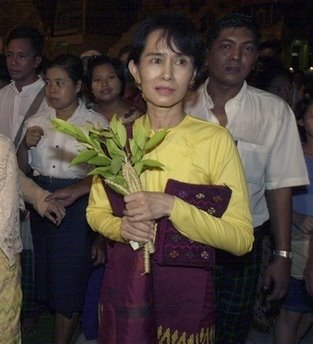


 Posts
Posts


