http://www.taipeitimes.com/News/world/archives/2008/12/21/2003431717
AFP, TOKYO
Sunday, Dec 21, 2008, Page 5
The UN refugee chief on Friday welcomed Tokyo’s decision to accept a handful of Myanmar refugees but called on the Asian economic giant to improve its assistance to asylum seekers.
“Japan is the first Asian country to adopt a resettlement program,” UN High Commissioner for Refugees Antonio Guterres said. “This is indeed a very important symbolic measure.”
Japan said Thursday that it was ready to take about 30 Myanmar refugees who are living in camps on the border with Thailand. The announcement came as Guterres, a former Portuguese prime minister, met Japanese Prime Minister Taro Aso.
While small by global standards, Guterres said he hoped it would pave the way for Japan — which only accepts dozens of refugees each year under strict conditions — to take in more people in future.
“For us what is important is quality,” he told reporters, adding that a successful integration would require helping the refugees learn the language and obtain jobs.
Monday, December 22, 2008
UN refugee chief welcomes Japan shift on Myanmar


Sunday, December 21, 2008
Burma: Cyclone Fact Sheet #2 (FY) 2009
http://www.reliefweb.int/rw/rwb.nsf/db900SID/YSAR-7MGN9Q?OpenDocument
Source: United States Agency for International Development (USAID)
Date: 19 Dec 2008
Full_Report (pdf* format - 101.9 Kbytes)
U.S. AGENCY FOR INTERNATIONAL DEVELOPMENT
BUREAU FOR DEMOCRACY, CONFLICT, AND HUMANITARIAN ASSISTANCE (DCHA)
OFFICE OF U.S. FOREIGN DISASTER ASSISTANCE (OFDA)
Note: The last fact sheet was dated November 17, 2008.
KEY DEVELOPMENTS
The Tripartite Core Group (TCG), composed of representatives from the Association of Southeast Asian Nations (ASEAN), the Government of Burma, and the U.N., is finalizing the first Periodic Review, a quarterly comprehensive assessment of the response to Cyclone Nargis. The Review is scheduled for release in Burma in late December and will focus on progress to date and ongoing humanitarian needs.
The TCG plans to launch the Post Nargis Recovery and Preparedness Plan (PONREPP) in January 2009. The PONREPP is designed to meet medium-term recovery needs in livelihoods, shelter, education and training, disaster risk reduction, environment, protection, health, and water, sanitation, and hygiene sectors.
As of December 12, the U.N. Office for the Coordination of Humanitarian Affairs (OCHA) reported that the U.N. Revised Appeal for $477 million is currently funded at 64 percent, or $304 million.
On December 10, U.S. First Lady Laura Bush announced that the U.S. Government (USG), through USAID, will provide an additional $5 million in disaster assistance to communities devastated by Cyclone Nargis. The funding will support efforts of non-governmental organizations (NGOs) to address clean water, shelter, and other critical needs in affected areas.
In FY 2008 and to date in FY 2009, the USG has provided or committed to provide nearly $74 million in cylone assistance to Burma, including almost $30 million in USAID/OFDA funding to support relief and early recovery activities among cyclone-affected populations.
ESTIMATED NUMBERS AT A GLANCE SOURCE
Total Dead 84,537 GOB – June 24, 2008
Total Missing 53,836 GOB – June 24, 2008
Total Number Affected 2.4 million OCHA – October 24, 2008
TOTAL FY 2008 HUMANITARIAN FUNDING USAID/OFDA
USAID/OFDA Assistance to Burma - $28,596,342
USAID/FFP(1) Assistance to Burma - $28,063,200
DOD(2) Assistance to Burma - $12,273,152
Additional USAID/OFDA Assistance Pledged to Burma - $5,000,000
Total USG Humanitarian Assistance to Burma - $73,932,694
CURRENT SITUATION
Seven months after Cyclone Nargis made landfall in Burma, humanitarian agencies assisted an estimated 2.4 million beneficiaries, primarily within the most-affected areas of Ayeyarwady and Rangoon divisions.
According to OCHA, to reflect the changing needs of the population, donors and NGOs are shifting from emergency activities to recovery efforts, including livelihood promotion interventions.
USAID/OFDA partners continue to implement livelihood recovery programs, including microfinance assistance and agricultural inputs, in Ayeyarwady and Rangoon divisions.
USAID/OFDA deployed an Emergency Disaster Response Coordinator (ERDC) is in Rangoon to conduct humanitarian assessments, monitor USG-funded programs, and coordinate with humanitarian organizations.
Full_Report (pdf* format - 101.9 Kbytes)
(*) Get Adobe Acrobat Viewer (free) With the exception of public UN sources, reproduction or redistribution of the above text, in whole, part or in any form, requires the prior consent of the original source. The opinions expressed in the documents carried by this site are those of the authors and are not necessarily shared by UN OCHA or ReliefWeb.
Burma likely to announce 'Election Law' on Independence Day
http://www.mizzima.com/news/inside-burma/1476-burma-likely-to-announce-election-law-on-independence-day.html
by Mungpi
Friday, 19 December 2008 20:35
New Delhi (Mizzima) - As a step forward along the roadmap to democracy, Burma's military junta will soon announce an Election Law that will set guidelines and criteria for the formation of political parties to contest the upcoming 2010 general election, sources said.
According to Larry Jagan, a journalist based in Bangkok and a Burma affairs expert, the junta is likely to announce the Election Law in early January 2009 and most likely on Burma's Independence Day of January 4th.
Burma's military government had previously announced early this year that it wiould hold a general election in 2010 to elect representatives to a new government which is to include some civilian representatives.
In preparation for the election, sources close to the military said the junta has already prepared a set of rules and regulations for the formation of political parties, the document now pending to be made public as the country's paramount military figure, Senior General Than Shwe, is yet to have given his final approval.
"According to what I know [from my sources] the election law will be announced on January 4th," Jagan, a veteran journalist who has covered Burma for years, told Mizzima.
A source, who wished to remain unnamed, said the junta is likely to make public the Law in late December or early January, but in any scenario it is clear that the junta will only make such an announcement when it is confident they have done all the necessary groundwork to secure electoral victory.
Analysts, including Jagan, believe that the junta, making use of an Election Law, will ensure that it gets an upper hand in the upcoming election and will tie up any possible opposition at the polling booths, including that led of detained Nobel Peace Laureate Aung San Suu Kyi's party – National League for Democracy (NLD).
"It is likely that the NLD will be allowed to partake, if they are willing to contest by the established rules, but that does not mean there would be a free and fair process," said Jagan, adding that the junta will make sure the party is left handicapped.
The NLD, on its part, has so far not reached any decision on whether or not to contest the upcoming election.
"We will decide on it, but as of now we still think it is too early," Nyan Win, the NLD's spokesperson in Rangoon, told Mizzima. He said the NLD would love to see progress in the electoral process, including the announcement of the Election Law, so that an accurate assessment of the NLD's potential involvement could be formulated.
However, according to some, regardless of specifics it would be unwise for the NLD to remain out of the fold, encouraging the party to contest the poll.
Aye Lwin, leader of the 88 generation students (Union of Myanmar), a group backed by the junta, during an interview with Mizzima said it would be wiser for the NLD and other opposition elements to join the election process and accept a new government as a step forward to democratization.
"Democracy cannot be achieved overnight, so we have to build it slowly from the given the space," Aye Lwin said.
Aye Lwin admits that he and his group are now campaigning and intend to form a political party to contest the election, saying he believes that the election will be free and fair and that the result will bring Burma a step closer to democracy.
But unlike Aye Lwin, Jagan said the junta's priority is not to allow a repetition of the 1990 election, in which detained democracy icon Aung San Suu Kyi led the NLD to a landslide victory.
"The NLD might be allowed to run in the election but it does not necessarily mean it is free and fair. It is more likely that they would be harassed and hindered, and the junta would likely arrest those they thought were problems," Jagan elaborated.
Human rights and state power
http://www.boston.com/bostonglobe/editorial_opinion/editorials/articles/2008/12/20/human_rights_and_state_power/
GLOBE EDITORIAL
December 20, 2008
IN A MAJOR turnabout, French Foreign Minister Bernard Kouchner said recently he had been wrong to press for a new post of minister of state for human rights within the foreign ministry. Kouchner co-founded the humanitarian group Doctors Without Borders. But he has come to understand, he explained, that "there is a permanent contradiction between human rights and the foreign policy of a state, even in France."
Kouchner's change of heart originates in a parochial French squabble: President Nicolas Sarkozy has turned against his Senegal-born minister for human rights, Rama Yade, because she declined to leave her post and run for the European Parliament, as Sarkozy requested. But the issue has reverberations in many countries, including the United States.
Successive American administrations have been no less ambivalent than France about the proper role of human rights in government policy. President Gerald Ford and his secretary of state, Henry Kissinger, were initially reluctant to include a so-called human rights basket in the 1975 Helsinki Accords with the Soviet Union. But inclusion of that "soft" provision on human rights helped set off processes that led to the peaceful collapse of communism. This was a case of human rights serving US national interests - perhaps more effectively than the entire arsenal of nuclear warheads.
In the last few years, however, there have been several disturbing examples of the US national interest - as conventionally defined - standing in the way of actions to defend human rights. The ongoing genocide in Darfur is the most blatant example. China, as a major investor in Sudanese oil, protects the genocidal Sudanese regime at the UN Security Council. The United States and its European allies have gone only so far in trying to halt the Darfur genocide - or the current atrocities in eastern Congo, the Sri Lankan government's abuses of civilians in its counter-insurgency war against the Tamil Tigers, or the horrific rights violations by the military dictatorship in Burma.
There is now an assistant secretary of state for democracy, human rights, and labor, and President-elect Barack Obama is also expected to have someone in his National Security Council responsible for human rights. But the problem illuminated by Kouchner's candid remark is not really about bureaucratic posts. It is about how willing the governments of the world are to protect vulnerable populations from their own governments. We hope Obama will stretch the definition of the national interest to include a panoply of actions, short of war, to defend universal human rights.
© Copyright 2008 The New York Times Company
Burma to Try 19 North Korean Defectors
http://www.voanews.com/english/2008-12-20-voa12.cfm
By VOA News
20 December 2008
Authorities in Burma say they have arrested 19 North Korean defectors and will try them on charges of illegally entering the country.
The defectors were trying to make their way to South Korea via China and Southeast Asia when they were captured after entering Burmese territory early this month. There is no information on how long they had been in China.
Burmese immigration authorities have moved the group from a detention center to a prison, where they await a trial expected to open next week.
North Koreans fleeing the impoverished and repressive Stalinist state are increasingly choosing Southeast Asia as a destination after passing through China, in hopes they can eventually resettle in South Korea.
China repatriates North Korean defectors it captures as economic migrants.
Some information for this report was provided by AFP.
Saturday, December 20, 2008
UN Chief Criticizes Burma for Lack of Democratic Progress
http://www.voanews.com/english/2008-12-18-voa1.cfm
By VOA News
18 December 2008
Ban Ki-moon, 12 Dec 2008
United Nations Secretary-General Ban Ki-moon has criticized the Burmese government for not following through on its promises of advancement towards democracy.
At a year-end news conference Wednesday, Mr. Ban said Burma has failed to engage in democratic dialogue and release its political prisoners.
The United Nations has repeatedly called on Burma to release democracy leader Aung San Suu Kyi, who has been detained for 13 of the past 19 years, as well as all other political prisoners.
Also Wednesday, the New York-based rights group Human Rights Watch said testimony from a lawyer who recently fled Burma illustrates how the government locks up and imprisons peaceful activists, and intimidates and jails lawyers.
The group said Saw Kyaw Kyaw Min, a 28-year-old lawyer from Rangoon, fled to Thailand several days ago, after spending weeks in hiding. Saw Kyaw Kyaw Min said he was ordered to jail in October after he failed to intervene when his clients turned their backs on their judge in a protest.
The judge sentenced the lawyer and the clients to prison for contempt of court.
Saw Kyaw Kyaw Min learned of the charges beforehand and went underground. He and several other lawyers were representing 11 members of the opposition National League for Democracy at the trial.
Human Rights Watch says the opposition NLD members were sentenced to four to six months in prison for turning their backs on the judge.
In a crackdown that started in October, human rights groups say Burma has sentenced more than 200 dissidents to prison terms ranging from less than a year to 68 years.
Junta-backed USDA unlikely to contest 2010 election-MIZZIMA
http://www.mizzima.com/news/inside-burma/1469-junta-backed-usda-unlikely-to-contest-2010-election.html
by Mizzima News
Thursday, 18 December 2008 21:02
New Delhi (Mizzima) – In contrast to what many observers expected, Burma’s military junta plans to abolish its proxy organization - Union Solidarity and Development Association (USDA) - opting not to transform it into a political party for the purpose of participating in the upcoming 2010 election, sources close to the military said.
Owing to a poor public perception of the organization, particularly after its role in cracking down on peaceful demonstrators during the monk-led protests last year, the head of the military junta and the main patron of the organization, Senior General Than Shwe, has decided to scratch his original plan of making use of the USDA as a political party - a source said.
“The USDA will not exist in 2009,” said a source in Naypyitaw, adding that members of the junta’s proxy will instead be incorporated into political parties with different names.
“The USDA has such a bad image…and a criminal record internationally…they will not use that name… they decided at this meeting,” he added, referring to the last quarterly meeting held in November.
Echoing a similar view, Burma affairs specialist Larry Jagan, a freelance journalist based in Bangkok, said the USDA is unlikely to be transformed into any political party to contest the upcoming 2010 elections.
“According to my sources, the USDA itself will not become a political party,” said Jagan. But he added that at least three parties are likely to be formed under an umbrella of the discredited USDA and will make use of the former organization’s funding.
However, Jagan added, “But there is a lot of speculation and none of us know for sure.”
The original social organization, with several million members as claimed by the military government, has been a principle tool in attacking protesters and dissidents over recent years.
Further, the organization has established relationships with China and Vietnam through exchanging official visits.
The USDA was initiated on November 15, 1993, by the military regime. According to an official announcement in 2007, the USDA had 24 million members, mostly government servants. However, many of its members admit they enrolled in the organization in fear of any repercussions associated with denying orders from superiors.
An observer in Burma’s former capital, who closely monitors the situation, said, “There is no news about the USDA in state owned newspapers and no USDA uniforms are seen in Yangon [Rangoon].”
The source in Naypyitaw explained that the regime is keen on forming regional political parties rather than a single, nationwide political party.
“All they [junta] want is the National League for Democracy and The Lady [Aung San Suu Kyi] out,” the source emphasized.
According to Jagan, despite the junta’s claim that it will conduct the 2010 general election freely and fairly, it is unlikely that the junta will allow detained Nobel Peace Laureate Aung San Suu Kyi to contest the poll, as they see her as a major threat to their determination to win the election. However, it is possible that her party, the NLD, without her, might be allowed to take part.
“But it does not necessarily mean that it [the election] would be free and fair, and that they [NLD] would be able to run unhindered,” Jagan further elaborated.
The NLD, meanwhile, said they have not decided on whether to participate in the 2010 election and are still in the process of discussing the situation and brainstorming ideas, after which they intend to deliver a clear statement on whether they will join the proceedings or remain on the sidelines.
Meanwhile, some respected intellectual civilians, some of whom have been accused of being apologists for the junta by the mainstream opposition, are preparing to take part in the election. And the regime itself is looking for locally respected dignitaries, such as retired teachers, to partake in the election, sources said.
Similarly, a source in the military establishment said at least nine ministers and two mayors, including Rangoon Mayor Brigadier General Aung Thein Lin, will soon resign from their current positions in preparation to contest in the general election, the military junta’s fifth step of its roadmap to democracy.
Meanwhile, a report on Wednesday by Khitpyaing, a Burmese news agency based in Bangkok, reported that three army commanders have been promoted to the level of minister, but were not assigned to any ministry.
The report argues that the promotion of the Mandalay-based commander of central command, Major General Tin Ngwe, the Bassein-based commander of southwestern command, Major General Kyaw Swe, and the Monywa-based commander of northwestern command, Major General Myint Soe, could be a move to sideline them from assuming active roles in the military before the election.
While the promotion is unprecedented, it could also be a trial by the junta to use military commanders in an administrative capacity, the report suggests.
Meanwhile, a senior official in Naypyitaw told Mizzima that the electoral law, which the military is carefully designing so as to avoid it being used as a stepping stone by the opposition, is expected to be made public by the end of December or in early January 2009.
“We have to wait and see the electoral law but what I can tell you is that they will not repeat the 1990 scenario,” said a senior officer in Naypyitaw.
According to Jagan, the election law would impose restrictions on the NLD and other political parties from freely campaigning.
In 1990, the National Unity Party, a transformed party of former military strongman Ne Win’s Burma Socialist Party, lost decisively to the NLD, which analysts see as an unacceptable result for Burma’s new generation generals.
Writing by Mungpi
Friday, December 19, 2008
Flag this messageミャンマー軍事政権によって不当に拘束されている民主化活動家たちの釈放を求めるお祈り会のご案内
━━━━━━━━━━━━━━━━━━━━━━━━━━━━━━
ビルマ市民フォーラム メールマガジン 2008/12/19
People's Forum on Burma
━━━━━━━━━━━━━━━━━━━━━━━━━━━━━━
在日ビルマ人のみなさんより、以下、「ビルマの政治囚の早期釈放を
求める、祈りの会」の案内をいただきました。
日本のみなさまにもぜひご参加いただきたいとのことです。
直前のご連絡となりますが、ぜひ足をお運びいただければうれしく思います。
宜しくお願いいたします。
PFB事務局 宮澤
http://www1.jca.apc.org/pfb/
*********************************************
独裁ミャンマー軍事政権によって不当に拘束されている
民主化活動家たちの釈放を求めるお祈り会のご案内
*********************************************
現在ビルマでは、民主化を求める運動へ参加したり、軍政を批判する
行動・言動を行ったり、はたまたサイクロン被災者への支援活動
により逮捕・拘束されている人がたくさんいます。
ビルマ政治囚支援協会(本部・タイ)によると、現在、2,150名
以上もの人びとが、政治囚として不当に刑務所へ収容されています。
ビルマの民主化の進展には、まずは、政治囚の釈放が何より
も重要です。
さまざまな宗教を信仰する人びとが暮らすビルマですが、
この度、在日のビル人僧侶、キリスト教、イスラム教から代表者が
集い、宗教・民族を超え、アウンサンスーチー氏を含むすべての
政治囚の早期無条件の釈放を願い、祈りの会を行います。
ぜひ日本のみなさまも、お越しください。
■ 日時:2008年4月21日(日)午後1時集合
(お祈り会は1時30分~2時30分頃)
■ 場所: 乗蓮寺 東京大仏
http://map.yahoo.co.jp/pllat=35.46.42.973&lon=139.38.51.913&la=1&fi=1&sc=3
■ 交通: 東武東上線 下赤塚駅から徒歩18分
■ 主催: 在日ビルマ人の民主化活動家のみなさん
■ 問合先(日本語可):080-3424-2759 、090-4221-1988
*********************************************
【日時訂正】ミャンマー軍事政権によって不当に拘束されている民主化活動家たちの釈放を求めるお祈り会のご案内
━━━━━━━━━━━━━━━━━━━━━━━━━━━━━━
ビルマ市民フォーラム メールマガジン 2008/12/19
People's Forum on Burma
━━━━━━━━━━━━━━━━━━━━━━━━━━━━━━
先ほどの案内に日時の間違いがありました。
訂正し、再送いたします。
誠に申し訳ありませんでした。
正: 2008年12月21日
誤: 2008年4月21日
PFB事務局 宮澤
http://www1.jca.apc.org/pfb/
*********************************************
独裁ミャンマー軍事政権によって不当に拘束されている
民主化活動家たちの釈放を求めるお祈り会のご案内
*********************************************
現在ビルマでは、民主化を求める運動へ参加したり、軍政を批判する
行動・言動を行ったり、はたまたサイクロン被災者への支援活動
により逮捕・拘束されている人がたくさんいます。
ビルマ政治囚支援協会(本部・タイ)によると、現在、2,150名
以上もの人びとが、政治囚として不当に刑務所へ収容されています。
ビルマの民主化の進展には、まずは、政治囚の釈放が何より
も重要です。
さまざまな宗教を信仰する人びとが暮らすビルマですが、
この度、在日のビル人僧侶、キリスト教、イスラム教から代表者が
集い、宗教・民族を超え、アウンサンスーチー氏を含むすべての
政治囚の早期無条件の釈放を願い、祈りの会を行います。
ぜひ日本のみなさまも、お越しください。
■ 日時:2008年12月21日(日)午後1時集合
(お祈り会は1時30分~2時30分頃)
■ 場所: 乗蓮寺 東京大仏
http://map.yahoo.co.jp/pllat=35.46.42.973&lon=139.38.51.913&la=1&fi=1&sc=3
■ 交通: 東武東上線 下赤塚駅から徒歩18分
■ 主催: 在日ビルマ人の民主化活動家のみなさん
■ 問合先(日本語可):080-3424-2759 、090-4221-1988
*********************************************
Risks Seen For Clinton As Husband Lists Donors
http://www.washingtonpost.com/wp-dyn/content/article/2008/12/18/AR2008121802417.html?wpisrc=newsletter
By James V. Grimaldi and Philip Rucker
Washington Post Staff Writers
Friday, December 19, 2008; Page A01
Former president Bill Clinton's disclosure yesterday that foreign governments and state-sponsored agencies have donated between $75 million and $165 million to his foundation highlighted a series of potential conflicts that Hillary Rodham Clinton could face should she become secretary of state.
This Story
Risks Seen For Clinton As Husband Lists Donors
Database: Search Clinton Donor List
Memorandum of Understanding (PDF)
The kingdom of Saudi Arabia made one of the largest contributions, between $10 million and $25 million, as did the Australian government's overseas aid program and a Dominican Republic agency that fights AIDS. The William J. Clinton Foundation also raised more than $1 million each from the governments of Brunei, Kuwait, Oman and Qatar.
The former president had resisted releasing the list of donors during his wife's presidential campaign, but he agreed to do so when it became a possible issue as President-elect Barack Obama was considering whether to make her part of his Cabinet.
The list -- containing more than 200,000 donor names -- shows the extent to which Bill Clinton relied on foreign governments, especially those of Middle Eastern oil states, to establish his foundation over the past decade. In many cases, those governments have national interests that have routinely come before the State Department and other U.S. government agencies.
Obama transition officials believe Clinton's disclosure "goes above and beyond in preventing conflicts," spokesman Tommy Vietor said. "Past donations to the Clinton Foundation have no connection to Senator Clinton's prospective tenure as secretary of state. Going forward, all donors will be disclosed on an annual basis, and new donations from foreign governments will be scrutinized by government ethics officers."
The release of the Clinton donors shows for the first time the scope of his international fundraising and charitable efforts since leaving the White House in 2001. Norway and the national charitable lottery of the Netherlands gave more than $5 million, for example, and the Swedish lottery also donated. The Jamaican and Italian governments each contributed more than $50,000.
"It is going to be complex to disassociate the specialized interests of the foundation of Bill Clinton from certain foreign interests that are represented by the U.S. government," said James Thurber of American University's Center for Congressional and Presidential Studies. "But I think they can do it. I don't think it is a major issue yet, but you never know, when it comes to Bill Clinton, what might come out."
Since it was established in 1997, the Clinton Foundation has raised more than $500 million, which has financed construction of Clinton's presidential library in Little Rock as well as charitable programs in global health, poverty, climate change and education. The donations have gone to an estimated 150 countries and provided medication to some 1.4 million people living with AIDS, according to foundation staff. In partnership with former president George H.W. Bush, the foundation also raised millions of dollars for recovery efforts along the Gulf Coast after Hurricane Katrina.
The list released yesterday includes some controversial figures and companies. Affiliates of the Korean conglomerate Hanwha -- Hanwha L&C, Hanwha Engineering and Construction, and Hanwha Stores -- donated about $1 million after Clinton traveled to Seoul in 2003 and appeared with Hanwha Group Chairman Kim Seung-youn. Kim has been charged and jailed in Korea on public corruption allegations.
Another donation followed Clinton's trip to Kazakhstan in 2005 on the private jet of Frank Giustra, a financier of mining ventures. On the trip, Clinton praised Kazakhstan's authoritarian president, and Giustra later entered into agreements to invest in uranium projects controlled by Kazakhstan's government. Giustra donated $10 million to $25 million, and the Clinton Giustra Sustainable Growth Initiative gave between $1 million and $5 million.
A donation of more than $25,000 came from Andre Agapov, a Russian mining company owner who allegedly worked with the Russian secret police for President Boris Yeltsin.
Other contributors include Friends of Saudi Arabia and the Dubai Foundation, as well as Saudi businessman Nasser Al-Rashid, each giving more than $1 million. Haim Saban, the Egyptian-born media tycoon who funds many Israeli initiatives, gave more than $5 million.
Among the top donors were foundations created by Microsoft founder Bill Gates and his wife, Melinda Gates, and Scottish retail-clothing executive Tom Hunter. Also on the list of the biggest contributors, giving between $10 million and $25 million each, are real estate and Hollywood mogul Stephen L. Bing, New York billionaire B. Thomas Golisano, Gateway computer co-founder Theodore W. Waitt and Chicago media executive Fred Eychaner. Black Entertainment Television founder Robert L. Johnson gave more than $1 million.
This Story
Risks Seen For Clinton As Husband Lists Donors
Database: Search Clinton Donor List
Memorandum of Understanding (PDF)
Billionaire financier and political supporter George Soros and his Open Society Institute each gave major donations, while the Arkansas-based foundations linked to retail giant Wal-Mart each gave at least $1 million.
The list also includes gifts from companies damaged in the current economic meltdown, such as Lehman Brothers, Citigroup, Freddie Mac and General Motors.
Entertainment figures on the list include producer Steven Spielberg, actors Cameron Diaz and the late Paul Newman, and singers Barbra Streisand and Carly Simon. New York Yankees owner George Steinbrenner and Formula One driver Michael Schumacher also donated.
"I want to personally express my deepest appreciation to our many contributors, who remain steadfast partners in our work to impact the lives of so many around the world in measurable and meaningful ways," Bill Clinton said in a statement. "We have just begun -- and it is an honor and privilege to be on this journey alongside each and every person who is committed to our foundation's ongoing charitable mission."
The foundation did not release the exact amounts or dates for donations, but it did include donors who gave very small amounts, going beyond the normal requirements for federal campaign disclosures. The donors were classified by amount of their gifts, within ranges.
Clinton released more detail than that promised by President Bush, who has said he does not plan to release names of donors, or George H.W. Bush, who also received contributions of at least $1 million from Oman, Saudi Arabia and the United Arab Emirates. The elder Bush also collected more than $50,000 from Japan, Hong Kong and Thailand.
Former president Jimmy Carter's center, which was a model for Clinton's, releases the names of $1 million-plus donors, and they include foreign governments as well.
Research editor Alice Crites, database editor Sarah Cohen, and staff writers Matthew Mosk, Dan Morgan, Steven Mufson, Derek Kravitz and Mary Pat Flaherty contributed to this report.
Japan to accept 30 Myanmar refugees residing in Thailand
http://mdn.mainichi.jp/mdnnews/news/20081219p2a00m0na016000c.html
The Japanese government has announced that it will accept 30 refugees from the war-torn nation of Myanmar from fiscal 2010, the first time an Asian country has formally accepted refugees who reside in another nation after fleeing their home country.
The decision was made by an inter-governmental panel on the topic by 11 ministries and agencies at a meeting on Friday. There are plans to possibly increase the number accepted in the future.
The 30 will be selected during the next fiscal year, with cooperation from the Office of the United Nations High Commissioner for Human Rights (UNHCR).
Under the Immigration Control and Refugee Recognition Law, interviews for prospective refugees can usually only be carried out within Japan. When candidates are refugees who are living in another country after fleeing their home nation, however, the law allows government representatives to go to the refugees' country of residence. They are currently living in Thailand.
Japan accepts refugees who have been recommended by the UNHCR as needing protection, and are deemed as families capable of fitting into Japanese society. The government will give them Japanese language lessons and job placement and training.
Some 75,300 refugees who were residing in other countries after fleeing their home countries were relocated to 14 foreign countries during fiscal 2007, according to UNHCR, with 48,300 settling in the United States. The majority were from Myanmar or Somalia.
MYANMAR: Myanmar journalists face intimidation, pressure from junta
http://www.asiamedia.ucla.edu/article-southeastasia.asp?parentid=102313
The military junta arrested 12 journalists and bloggers in 2008, according to the Burmese Journalist Protection Committee
The Jakarta Post
Wednesday, December 17, 2008
By Nugroho and Lilian Budianto
Journalists working in military-ruled Myanmar continue to face intimidation, torture and arrests in reporting on the country's corrupt and brutal regime, despite international calls for more press freedom, a conference on media safety heard Tuesday.
A Myanmar journalist, who asked not to be identified, told the conference that contrary to government claims, journalists in the country were treated as "dangerous enemies".
"There is no freedom for Burmese journalists to write about political and social conflicts," he said while asking that pictures of him and his colleague not be taken, out of safety concerns.
The Regional Conference on Creating a Culture of Safety in the Media in Asia-Pacific was organized by the International News Safety Institute (INSI) from Dec. 15-16, and brought together participants from 11 countries.
Mon Mon Myat, of the Burmese Journalist Protection Committee, said the junta had set up rules under a 2006 law on electronic media and 1996 law on film and computers that restricted how journalists could work.
Under the laws, journalists are not allowed to take pictures that might "pose a threat" to the government, with offenders facing up to 59 years in prison. Internet users are also under strict surveillance by the government, which requires service providers to check every five minutes websites visited by users and to immediately report suspicious or dangerous activities.
In 2008, 12 journalists and bloggers were arrested in Myanmar, the protection committee says. Several popular websites, including yahoo.com and hotmail.com, have also been blocked as the junta further isolates its people from the outside world.
"Eighty percent of Internet sites are banned by the government," said Ronald Aung Naing of the Burmese Journalist Protection Committee.
He added the government also monitored people regularly at checkpoints for cameras or video cameras with "dangerous" content.
Eko Maryadi, of the Indonesian Alliance of Independent Journalists, told the forum that although media freedom in Indonesia had improved since the fall in 1998 of former president Soeharto's 32-year regime, journalists still faced intimidation, harassment and lawsuits in reporting on certain issues.
"We have also seen more business groups filing complaints against journalists, claiming the reports harmed their reputation or business. This was rare in the past," he said.
The latest such case is the complaint filed by the Bakrie Group against Tempo daily over its reports on the financial problems of the group's top subsidiary, PT Bumi Resources.
The alliance recorded 43 cases of violence against journalists in 2005, with 53 in 2006, 75 in 2007 and 52 cases as of September this year.
The conference closed with a declaration calling on all governments in the region to take responsibility for the safety of all journalists working in their countries and to lift impunity for groups that had endangered the lives of journalists.
Date Posted: 12/17/2008
EU to give €40.5 million in humanitarian aid to Burma-MIZZIMA
http://www.mizzima.com/nargis-impact/1475-eu-to-give-405-million-in-humanitarian-aid-to-burma.html
by Solomon
Friday, 19 December 2008 19:41
New Delhi (Mizzima) – The European Commission on Thursday said it will give another €40.5 million (US$ 58 million) of aid to Burma, particularly targeting victims of Cyclone Nargis, which swept through the country's southwestern coastal region in May.
The announcement, made in Brussels on Thursday, said €22 million of the allotted aid will be provided to cyclone victims while the remaining funds will be given to vulnerable populations inside Burma and to Burmese refugees in Thailand.
Louis Michel, EU Development Commissioner, in a press statement, said, "We have progressively developed very good cooperation with the authorities [Burma's ruling junta] on humanitarian access in the Irrawaddy Delta in the wake of the Cyclone Nargis."
The new funds will be distributed through non-governmental organizations, United Nations agencies and the Red Cross and will reach an estimated population of at least two million people.
"The Commission will continue advocating for similar cooperation and access to other parts of the country," said Michel, iterating that the aid package is aimed at more than just the country's storm ravished delta region.
The EU also said it aims to raise funds to help vulnerable sections of the Burmese population, especially the hundreds and thousands of Muslim Rohingya in Arakan state in western Burma who are facing severe oppression by the military junta, including forced relocation, forced labor and denial of citizenship.
"I am particularly concerned about the forgotten crisis in northern Rakhine (Arakan) State, where some 800,000 Muslim Rohingya live in terrible conditions," said Michel.
The EU had earlier provided €17 million in funds for cyclone relief efforts related to shelter, food, water, sanitation, health, nutrition, protection and logistics. With the new funds, EU support for cyclone relief will total some €39 million.
More than seven months after Cyclone Nargis struck the country, victims still continue to lack adequate support according to the Tripartite Core Group (TCG), which performs periodic reviews and constitutes representatives from the Association of Southeast Asian Nations (ASEAN), Burmese government and United Nations.
"The relief stage has not finished and more assistance is still needed, especially in the nutrition, food and shelter sectors," the TCG said in a press statement on Friday.
In its inaugural "Periodic Review" the TCG said that during its fact finding assessment conducted between 29 October to 19 November 2008, it found that 2,376 households in 108 communities in Irrawaddy and Rangoon Divisions are still struggling with temporary shelter and food and water shortages while confronting health obstacles such as fever and diarrhea.
"There was a need for increased support to livelihood recovery, in order for people to regain the level of self-sufficiency that they had prior to Cyclone Nargis," said the TCG.
Despite a United Nations appeal in the immediate months following the deadly storm for US$ 483 million to help survivors, thus far only 64 percent of the figure, or US$ 304 million, has been pledged.
Cyclone Nargis struck the country on May 2nd and 3rd of this year and affected more than 2.4 million people, leaving at least 130,000 people dead or missing.
A villager working in the salt business near the remote village of Wakone in Laputta Township, one of the hardest hit cyclone areas, said aid shipments to the beleaguered community have slowly petered out.
"Aid supplies are no more arriving to our place, the last one came about ten days ago," said the businessman, adding that the aid previously received was about five kilograms of rice per person.
He said it has also become extremely difficult for people to carry on business as workers demand more money – nearly three times the normal price. The situation, he claims, is due to the cyclone killing so many workers and people now experiencing a psychosis of fear in relation to working near the shore.
"We really need more money to be successfully running the business again, otherwise we cannot pay the employees," he said.
He added that before the cyclone workers were paid about 20,000 kyat (US$ 19) in advance, but now demand between four and five times that amount.
He went on to say that though the government has provided loans of 300,000 kyat per acre, businessmen are concerned they might not be able to pay the amount back in three years time, the deadline the government has fixed for reimbursement.
He also said that while a few aid agencies are still providing aid to villages with relatively large populations, small and remote villages no longer see any assistance, if in fact they ever did.
"Here people are living in small, temporary houses and it is very difficult to stay under the sun because it is too hot. We are in need of housing materials and continued food supplies," lamented one local villager.
Next >
Thursday, December 18, 2008
Myanmar-India optical fiber link project to complete next March
http://www.hindu.com/thehindu/holnus/001200812171233.htm
YANGON (Xinhua): A cross-border optical fiber link between Myanmar and India to boost information link is expected to be completed and operational by March next year, the local weekly Yangon Times journal reported Wednesday.
Under the Indian government loan, the project, which worths 7 million U.S. dollars, started in 2006 December.
The 640-kilometer-long Myanmar-India optical fiber link, which connects Indian's northeastern border town of Moreh and Myanmar's second largest city of Mandalay, passes through six cities of Tamu, Kampatwa, Kyi Gone, Shwebo, Monywa and Sagaing.
Along the fiber link, ADSL+2 system with 7,000 lines are being installed in 80 locations including Yangon, Mandalay and Nay Pyi Taw, the report added.
The project was signed between the state-run Myanma Posts and Telecommunications (MPT) and the Telecommunications Consultants India Limited (TCIL) during then President APJ Abdul Kalam's state visit to Myanmar in March 2006.
According to the contract, MPT and TCIL agree to implement SDH/ STM 4 optical fiber link between the two cities and the ADSL system.
Meanwhile, in April this year similar link between Myawaddy ( Myanmar) and Maesot (Thailand) was established as part of the information superhighway network (ISN) project of the six-country Greater Mekong Subregion (GMS)-Economic Cooperation.
The Myanmar-Thai fiber optical link extends as angon-Hmawby- Bago-Kyaikhto-Tahton-Pha an-Kawkareik-Thingan Nyinaung-Myawaddy on the Myanmar side, while Maesot-Bangkok stands on the Thai side.
Those links on the two countries' respective sides have been in place, leaving the cross-border link between Myawaddy and Maesot is to be connected to complete the network.
Also in March this year, fiber link between Myanmar and China, built since April 2007 and involving China Telecom and Yunnan Telecom, was set up in Myanmar's border town of Muse also as part of the regional ISN project.
The Myanmar-China fiber optic link was built across China's Kunming and Myanmar's Muse with its link further extended to reach the commercial city of Yangon.
How the Regime Punishes Political Prisoners’ Families
http://www.irrawaddy.org/highlight.php?art_id=14811
--------------------------------------------------------------------------------
By SAW YAN NAING Wednesday, December 17, 2008
--------------------------------------------------------------------------------
The wife of imprisoned activist Pyone Cho spent about 90,000 kyat (US $75) on a 10-day journey to visit him in jail in Kawthaung, southern Burma. The sister of another political prisoner, the prominent labor rights activist Su Su Nway, spent only slightly less on a six-day journey to visit her in Kale Prison in Sagaing Division, central Burma.
Family members spoke to The Irrawaddy about the huge difficulties they faced as a result of the regime’s decision to consign activists condemned in the recent series of trials to prisons in various remote parts of Burma.
Mandalay prison. (Photo: Nic Dunlop/The Irrawaddy)
The decision is being described by human rights organizations as a form of torture, imposed not only on the abused prisoners themselves but also on their families.
More than 100 of the estimated 215 activists sentenced in the November trials to terms of imprisonment of up to 68 years have been consigned to at least 20 isolated prisons in various parts of Burma, according to the Thailand-based Assistance Association for Political Prisoners (Burma), known as the AAPP.
AAPP Joint-Secretary Bo Kyi said it was international practice elsewhere in the world to confine condemned people in prisons close to where family members lived. “Here [Burma] they were moved to prisons far from their relatives.”
Bo Kyi accused the regime of intentionally creating problems for prisoners and their families, causing mental and physical pain.
Many of the political prisoners were being held under inhumane conditions and were being tortured, Bo Kyi said. Some prisons had no doctors or facilities for treating inmates.
“Some political prisoners are not allowed to walk outside their compounds,” Bo Kyi said. “They even can’t see the sun. It is very dangerous for the health of those detained in cold locations over the next few months.”
Several political prisoners, including Zarganar, Burma’s best-known comedian, are in Myitkyina Prison, Kachin State, where temperatures drop below zero in winter.
One Rangoon source said a youth member of the opposition National League for Democracy, Aung Kyaw Oo, serving a 19-year sentence in Pegu Prison, had been savagely beaten and denied medical treatment.
When Aung Kyaw Oo’s wife visited the prison on December 3 she was denied permission to see him and had to wait until December 13. A prison source said Aung Kyaw Oo had told his wife about the beatings.
A defense lawyer, Saw Kyaw Kyaw Min, who recently fled to Thailand, said one of his clients, Myint Aye, founder of the group called Human Rights Defenders and Promoters, had also been tortured while in prison.
“Prison authorities questioned him continuously for five days. They didn’t let him sit down and sleep. He finally collapsed.”
Myint Aye was convicted of involvement in a bomb attack on an office run by the junta-backed Union Solidarity and Development Association in Rangoon’s Shwepyithar Township on July 1.
The New York-based international rights group Human Rights Watch has also deplored the regime’s decision to send political detainees to remote prisons.
In a statement issued on Tuesday, Elaine Pearson, the group’s deputy Asia director, accused the regime of using the country's legal mechanisms to threaten political prisoners and deny them access to justice.
The statement also urged Asean Secretary-General Surin Pitsuwan to assign an independent legal assessment team to closely watch the treatment of political prisoners in Burmese courts and in Burmese prisons.
It said Asean should address Burma's lack of respect for the rule of law when it holds its rescheduled summit meeting in early 2009.
Pearson said: “The government locks up peaceful activists, sends them to remote prisons, and then intimidates or imprisons the lawyers who try to represent them. This abuse of the legal system shows the sorry state of the rule of law in Burma.”
Copyright © 2008 Irrawaddy Publishing Group | www.irrawaddy.org
UN chief criticizes Myanmar and Zimbabwe
http://news.yahoo.com/s/ap/20081217/ap_on_re_us/un_un_human_rights_1
By EDITH M. LEDERER, Associated Press Writer Edith M. Lederer, Associated Press Writer
Wed Dec 17, 4:57 pm ET
UNITED NATIONS – Secretary-General Ban Ki-moon criticized the governments of Myanmar and Zimbabwe Wednesday and said a year of multiple crises has put human rights on trial.
At a year-end news conference, the U.N. chief said 2009 "promises to be no less difficult" than 2008, with a worsening humanitarian situation in Afghanistan, the danger of anarchy in Somalia, a continuing global financial crisis and the need to reach an Israeli-Palestinian peace agreement.
Ban said he has been frustrated by the failure to protect innocent lives, and the lack of resources and political will to tackle important issues such as poverty, conflicts and climate change.
Though the world came together to confront the global financial crisis, "I fear we are only at the end of the beginning," Ban said, stressing that "global solidarity" will be key to a solution.
Ban said he was pleased at the world's response to natural disasters, including the devastating cyclone in Myanmar and hurricanes that lashed Haiti.
"Yet I am disappointed by the unwillingness of the government of Myanmar to deliver on its promises for democratic dialogue and the release of political prisoners," he said.
In Zimbabwe, Ban said, "the humanitarian situation grows more alarming every day" and the country "stands on the brink of economic, social and political collapse."
The secretary-general said he told President Robert Mugabe "things need to change urgently" during a meeting several weeks ago on the sidelines of a U.N. conference in Doha, Qatar, and Mugabe agreed to receive his envoy, Haile Menkarios.
"Now we are told that the timing is not right," Ban said. "If this is not the time, when is?"
The Southern African Development Community has insisted on leading diplomatic efforts to address the crisis, but eight months of talks have produced few results, Ban said, adding that "a fair and sustainable political solution" must come quickly.
In Congo, Ban said, U.N. forces "have held the line" but have been unable to protect innocent people from violence.
"Our record on human rights is on trial — in many places, in many ways," he said. "In this 60th anniversary year, we must stand strong for the Universal Declaration of Human Rights."
In conflict-wracked Darfur, he urged Sudan's President Omar al-Bashir to fully cooperate with U.N. resolutions and lamented that the joint U.N.-African Union peacekeeping force still needs helicopters and will only be 60 percent deployed by the end of the year.
In Afghanistan, he said "a political surge and a clear change of direction are required" to deal with growing insurgent attacks and the worsening humanitarian situation.
While the U.N. responded well to the world food crisis, tackling the problem on a wide front including nutrition, agricultural production, trade and social protection, "it has not gone away" he said.
Ban said he was pleased with U.N. and international efforts to keep climate change high on the global agenda.
"2009 will be the year of climate change," he said, stressing the importance of reaching a global deal requiring nations to make mandatory cuts in greenhouse gases starting in 2013.
Copyright © 2008 The Associated Press. All rights reserved. The information contained in the AP News report may not be published, broadcast, rewritten or redistributed without the prior written authority of The Associated Press.
Copyright © 2008 Yahoo! Inc. All rights reserved.Questions or CommentsPrivacy PolicyTerms of ServiceCopyright/IP Policy
World Press tells junta to stop repression of media-MIZZIMA
http://www.mizzima.com/news/world/1458-world-press-tells-junta-to-stop-repression-of-media.html
by Solomon
Wednesday, 17 December 2008 20:23
The World Association of Newspapers (WAN) condemned the Burmese military junta for cracking down on freedom of expression, called for the release of all jailed journalists and urged its neighbouring countries to pressure the junta for change.
Larry Kilman, Director of Communications, Public Relations of WAN said, the Board of directors of WAN which represents more than 18,000 publications in five continents, met on December 15, 2008 in Beirut, Lebanon and urged the military junta in Burma to release all detained journalists and to end restriction on freedom of expression.
"The Board of directors from WAN, while issuing the resolution and condemning the lack of press freedom in Burma, urged the military junta to stop arrests and the crackdown on the press," Kilman said.
"There is no press freedom in Burma. It is one of the most repressive regimes and is an embarrassment to the entire region," added Kilman.
The Committee to Protect Journalists (CPJ) said on December 4 that Burma is the third worst country in terms of imprisoning journalists in the world after China and Cuba. Burma has at least 14 journalists behind bars.
"The Burmese regime, one of the most repressive in the world, recently stepped up its attack on freedom of expression," said WAN.
WAN also called on the Association of Southeast Asian Nations (ASEAN) "To abandon their discredited policy of non-interference and mount pressure on Burma's rulers to adopt international norms of free expression."
Despite condemnation and pressure from the international community the Burmese military junta arrested journalists and bloggers and sentenced them to long terms in prison. They were sent to prisons in remote areas where their family members would find it difficult to visit.
The blogger and well know comedian Zargarnar (Maung Thura) were sentenced up to 59 years in prison for disseminating information about the September 2007 protests and in the aftermath of Cyclone Nargis.
Blogger Nay Phone Latt was sentenced to 20 ½ years in jail for posting free writing that fired the feelings of Burmese youth in his blog site. Journalist Ein Khaing Oo from Ecovision weekly Journal was sentenced to two years in prison for covering a story about Cyclone Nargis victims.
"For press freedom in Burma the best solution is democracy and that is not there," said Larry Kilman.
A Rangoon based veteran editor of a privately owned monthly journal said the journal had fallen in quality because of extreme censorship by the junta authorities. It has been reducing its print order every month.
"We are more and more disappointed with the government's censor board. They are rejecting whatever they want without following exact rules," the editor who wished not to be named told Mizzima.
"It is Impossible to publish stories relating to political issues. The junta is also prohibiting news and write ups which are not political in nature," he added.
Now they have reduced the print order. While earlier they published over 10,000 copies monthly now it is well below that figure.
"We have to reduce the number of journals because the demand has fallen and the censor board destroys the quality of journals," he added.
Wednesday, December 17, 2008
EarthRights International Special Commentary:POLITICAL ASYLUM IN JAPAN
http://socialsense.blogspot.com/2008/12/political-asylum-in-japan.html
One of my more enjoyable experiences while serving on active duty was the time I spent in Japan. Altogether, I served at various bases in Japan and Okinawa for a total of seven years. From an intrapersonal standpoint, I found the Japanese people warm, gracious, and always exceedingly polite. But I must also say that the Japanese people are unique in the entire world. As I began to study their history and culture, as I began to study their language, I found that they are really a closed society. My oldest friend George, who continues to live in Japan . . . who raised a family there, can probably attest to the fact that no matter how long a foreign born person lives in Japan, no matter how well one adjusts to their culture, and no matter how well one can speak the language, they are never accepted as “Japanese.” Tolerated, yes . . . accepted as an equal, never. This fact doesn’t suggest that Japanese people are racists . . . it merely illustrates that they are Japanese.
I recall one incident, years ago, in which an inebriated Marine erroneously stumbled into the wrong house in the middle of the night. This is understandable even if he wasn’t drunk because Japanese residences often look identical. In any case, the woman who lived there was quite frightened, and she ended up stabbing the Marine with a kitchen knife killing him immediately. As it turned out, this woman was a second-generation Korean who lived her entire life in Japan; for all intent and purposes, she was Japanese—as we might have regarded her as another American. The next morning, however, the news headlines read, “Korean stabs American Marine.” I cannot say whether the headline reflected Japan’s innate bias towards everyone not Japanese, or whether it was simply a matter of embarrassment because a Japanese woman could possibly be guilty of such a crime.
With the foregoing as a backdrop, I found a recent Article in the Japan Times (online) that informs us about the sharp increase in political asylum immigrants in Japan. As I began to read the article, I fully expected to read something about people from Korea, China, Vietnam, or the Philippine Islands. But according to journalist Setsuko Kamiya, the number of people requesting political asylum has nearly doubled in the past year, and many of these people are from Africa, Sri Lanka, and Myanmar (formerly known as Burma). According to this article:
“The Justice Ministry's Immigration Bureau said it won't provide official figures for applicants or approvals until next year but confirmed the trend identified by JAR. The increase in applicants from Africa has been attributed to the Tokyo International Conference on African Development in Yokohama in May and the Group of Eight summit in Hokkaido in July, said Eri Ishikawa, secretary general of JAR. ‘Through those two events, Japan's commitment to Africa was reported by the media in those countries, and people may have gained a good impression of Japan as a country that gives humanitarian aid, leading many to consider Japan as a place they can escape to,’ Ishikawa said.
This is yet another example of nations attempting to do the right thing, but Japanese officials, in failing to consider the unintended consequences of opening immigration floodgates, now find themselves in an uncomfortable position. The article continues:
“The Foreign Ministry in principle provides financial support to asylum seekers in dire need, including those having no job, money, or a place to live. According to an official at the Foreign Ministry's Human Rights and Humanitarian Affairs Division who handles such support, an adult is provided ¥1,500 [roughly $16.00] and a child ¥750 [roughly $8.00] a day for living expenses. If housing is needed a family receives a maximum of ¥60,000 [roughly $645.00] a month for rent. A single person can get ¥40,000 [roughly $430.00]. In principle, the financial support is given for four months.
Through its affiliated Refugee Assistance Headquarters, the ministry provided support to 235 asylum seekers just in November. Last year, 95 people a month received support, said the government official, who declined to be named. ‘The number of people we support has been rising constantly this year,’ she said. This year, based on past needs, the budget was set at ¥78 million [roughly $839,000], but this has almost been exhausted because of the rapid rise, she admitted."
The numbers of people seeking political asylum are actually modest, as least when compared to the large numbers of immigrants we deal with here on a daily basis, but it is significant for Japan. Traditionally, the Japanese do not encourage “immigration.” In fact, I am amazed they are doing it at all. Learning to live in Japan isn’t easy, true even for those who really do enjoy the culture and who have the knack for learning a difficult language.
I again recall one of the major news issues of the day in 1982. In 1976, the Japanese granted political asylum to a Vietnamese family. In the space of six years, the family’s daughter had mastered the Japanese language well enough to complete her secondary schooling and gain admission to the prestigious Sophia University in Tokyo. This was a major event because no one quite expected a foreigner to speak Japanese as well as . . . well, the Japanese themselves. And, once again, no matter how long these Africans, Sri Lankans, and Burmese live in Japan, no matter how well they learn the language and customs, no matter how well they succeed financially, they will always be outsiders. In Japanese, the word is “Gaikokujin (外国人),” which means a person from a foreign land. It can also mean “long nose barbarian,” so it is not a word many people use today . . . but they surely did when I lived there. Maybe they were trying to tell me something.
Posted by Mustang at 06:00
Comments (16) | Trackback (0)
Social Sense
Ugh. The rest of the post got cut off! he best was the part after I took the client home
Was it too long? Can you recover it?
rocket | 12.17.08 - 5:39 am | #
--------------------------------------------------------------------------------
Hi Mustang
Nice post about the Japanese. As you know I work very closely with them and have been to Japan. As far as never feeling Japanese well, I have lived in France since 1977 but have never acquired nationality and I can say that many immigrants and sons/daughters of immigrants who have acquired French nationality are never accepted as French either especially if they originate from any country in Africa be it north or south. (see Paris riots 2005)
America is unique as everyone comes or family has come from elsewhere and so nationality is not associated subtly with the underlining question of bloodline as it is in older countries with extremely old cultures.
One of the interesting insular aspects of Japanese life is how they consider their rice. (It seems as if American rice farmers are always fighting to get American rice into Japan.) Serve rice to a Japanese and the first question is
Is it Japanese rice?
Basically meaning that no other rice measures up to Japanese rice.
Many of the Japanese that I work with in Paris are on three year expat stints and are happy to return to Japan as they tell me often because they miss Japanese food. Although available in different specialty stores in Paris it is expensive.
As per the matter of Japanese politeness, it can often be overwhelming (the whole business card thing which I have to tell them functions differently in Europe than Japan)for someone living in Paris where things have a hard time getting done and the notion of time is completely different from that perception of time and respect for promptness by Asians. Lest I speak about the grouchiness of the French. For the Japanese living in France this gray zone of time perception can be particularly destabilizing.
I don't think we can fully understand the relation among classes in Japan or age differences unless we speak the Japanese language but many aspects are apparent for the non Japanese.
As my Japanese language studies are reduced to one word a week now because I am extremely busy, I am getting no closer to speaking "decent" Japanese than I was 6 months ago.
I can tell a funny story about a Japanese client I had many years ago in Paris. We went into a private club in the Opera area of Paris a part of it on the Rue St Anne which is a small Japanese area with lots of restaurants and some clubs reserved for Japanese. Women serving the men and intimate conversation with the women working there etc and lots of salarymen and Karokee. You get the gist. Well I being the only westerner found no problem drinking with my client and several of his friends but at one moment he informed me that I would have to leave because now was discussion time between Japanese men. Of course I understood and it had absolutely no effect on future relations which often ended up in drunken stupors. Me scraping the client off the ground and then taking him home. One time after a drinking binge I took him (he was married)home
rocket | 12.17.08 - 5:32 am | #
--------------------------------------------------------------------------------
Mustang, I envy your time there. I find hem to be a fascinating people as I do with most Asians.
Chuck | Homepage | 12.16.08 - 11:15 pm | #
--------------------------------------------------------------------------------
I remember an old advertisement for some condos in Florida that said they were just like France only better. Why were they better? Because they were just like living in Paris without having to put up with the French.
Shoprat | Homepage | 12.16.08 - 7:38 pm | #
--------------------------------------------------------------------------------
Ducky,
Have you been to France? Where and for how long? Defending the French is more than difficult. Think the Milice and who actually rounded up French and other nationality Jews..in France.
Who, indeed, did collaborate with the Nazis?
How riven with communists were elements of the French government and military?
Comparing the French - as a nation/nationality - with Texans?
Who pays taxes in France? Who attempts to avoid it?
Would you trust a French promise?
Tad | 12.16.08 - 7:26 pm | #
--------------------------------------------------------------------------------
Anyone that has been to France knows that most of the French hate most of the other French.
-----------------------
Sort of like New Englanders and the far less refined Texans?
Ducky's here | 12.16.08 - 5:33 pm | #
--------------------------------------------------------------------------------
Their socialism and morals are so awful as to be beyond belief. We have scandals. They conduct themselves scandalously as a matter of routine.
---------------
Well the socialism is no problem. Conservatives aren't an adequate judge of morals and the rest is great.
I don't see the downside.
Ducky's here | 12.16.08 - 5:31 pm | #
--------------------------------------------------------------------------------
Oh, "Ducky's here".
Where?
Why not in France?
Tad | 12.16.08 - 5:02 pm | #
--------------------------------------------------------------------------------
Ducky's Away,
NOTE: What does "Ducky's Away" mean?
I've been to France more times than most Englishmen, most Germans, most Belgians, most Italians, most Spaniards, and most Luxembourgundians...all countries that border France...oh, yes, do not forget the Swiss.
I would hate to be French. Anyone that has been to France knows that most of the French hate most of the other French. Parisians think they are the cats' ass, and they're right. The folks in the provinces hate the Parisians and the government and those from other provinces. Really odd country. It IS quite beautiful and the food is mostly very good. Their socialism and morals are so awful as to be beyond belief. We have scandals. They conduct themselves scandalously as a matter of routinue.
One man's opinion.
Tad | 12.16.08 - 4:46 pm | #
--------------------------------------------------------------------------------
You're from away, eh Jungle Mom?
Ducky's here | 12.16.08 - 4:36 pm | #
--------------------------------------------------------------------------------
A friend who did business in Japan and was interested in the country told me that there is a culture there that a Westerner will never be shown.
I don't know about Japanese, but I sure wouldn't mind being French.
Ducky's here | 12.16.08 - 4:35 pm | #
--------------------------------------------------------------------------------
Sir,
They called you a Long-Nosed Barbarian because, ah,
you're a Long-Nosed Barbarian?
Bye the Bye: As you know, the Japanese are very class oriented amongst themselves also.
Meanwhile, their own actions in Korea, Manchuria, China, Philippines, Burma, Singapore, the Dutch East Indies...all in WW II...were more than awful.
I served with a Marine Sergeant in the very early 60s who'd been a kid on Guam when the Japanese seized it. The stories related were not too good, to say the least.
BTW, don't most Japanese history books play down WW II?
Just asking.
Further, just why are we (USA) doing very much of the heavy lifting in the defense of Japan?
Tad | 12.16.08 - 11:59 am | #
--------------------------------------------------------------------------------
excellent observation. I would still call it racist. Maybe not in the sense that we use racial,being not a good thing, but it is in terms of we and they.....stay well....
tapline | Homepage | 12.16.08 - 10:48 am | #
--------------------------------------------------------------------------------
You NEVER feel FRENCH when you live there, either.
of course, most Americans don't WANT to feel FRENCH!!!
Z | Homepage | 12.16.08 - 10:27 am | #
--------------------------------------------------------------------------------
This is much like New Englanders. I met a man in Maine and asked if he was from that town. He said ,"Yes." but his wife said,"NO.".
The man began to laugh and said,"Well, my grandfather moved here before I was born, but they still don't consider me a local."
Jungle mom | Homepage | 12.16.08 - 7:13 am | #
--------------------------------------------------------------------------------
//As I began to study their history and culture, as I began to study their language, I found that they are really a closed society.//
Not surprising considering the Japanese people lived in almost complete isolation during the Edo period, which lasted over 250 years. That's a long time for a nation to be cut off from the world, especially at a time when European exploration and trade was beginning to flourish. That same spirit and attitude is hard to eliminate, despite the fact that many years have past.
Another example of this is Italy. As many already know, between the last remnants of the Roman Empire and the 19th century, the Italian peninsula was divided into several states controlled by wealthy ruling families. How similar is that mentality today, with the Italian mafia.
Old habits and customs die hard.
LASunsett | Homepage | 12.16.08 - 6:37 am | #
--------------------------------------------------------------------------------
United Nations Secretary General Ban Ki-moon Urges Corporate Interests in Burma to Use Their Influence with Military Junta to Push for Democratic Refo
http://www.earthrights.org/content/view/593/114/
EarthRights International Special Commentary:
Written by Paul Donowitz and Matthew Smith
Monday, 15 December 2008
United Nations Secretary General Ban Ki-moon Urges Corporate Interests in Burma to Use Their Influence with Military Junta to Push for Democratic Reforms and Improvement in Human Rights
When asked what advice he would give to private businesses invested in Burma’s (Myanmar’s) energy sector, the UN Secretary General Ban Ki-moon firmly stated that "they should try to use their cooperation or their relationship to impress upon the Myanmar authorities so that they can commit to their democratization process, and also humanitarian and promotion of human rights..." ERI is heartened that the Secretary General recognizes that corporations choosing to operate in Burma must play a positive role. However, ERI continues to document the negative environmental and social impacts of foreign investments in the country’s oil and gas sector, and questions the current commitment of corporations in this sector to influence positive change in the country.
Read more > >
ERI is particularly concerned about South Korea’s Daewoo International, the operator of a natural gas project set to carry gas from the Bay of Bengal to China through politically and environmentally sensitive regions in Burma. Abuses connected to this project - known as Shwe, meaning “gold” in Burmese - have begun and were documented in a recent Organization for Economic Cooperation and Development (OECD) complaint filed with the Government of South Korea by ERI and the Shwe Gas Movement (SGM). If the project moves ahead, ERI believes that widespread abuses in the project area are unavoidable, including forced labor, forced relocation, and other abuses perpetrated by the Burmese military on behalf of Daewoo and other companies involved in the project.
Moreover, Daewoo International was recently at the center of a maritime border dispute in the Bay of Bengal between Burma and Bangladesh, exploring for natural gas in disputed waters under the cover of Burmese warships. The company participated in activities intended by the Burmese authorities to exacerbate longstanding differences between the two countries; an act inconsistent with Ban Ki-moon’s call to influence positive change.
Like Daewoo, the US oil company Chevron and the French oil company Total are also failing Ban Ki-moon’s call to use their power and influence to facilitate positive changes in Burma. The companies continue to operate a natural gas pipeline that has been associated with longstanding, widespread human rights abuses in the country’s Tenasserim region. Called Yadana, meaning “treasure” in Burmese, the project officially began in the mid-1990s and since its inception has led directly to human rights abuses by the military – abuses continue today. The project has also financed repression as the project is the single largest source of revenue for the military regime (an estimated US$ 969 million to the junta last year alone, according to ERI).
Since 1996, ERI has researched and published five advocacy reports detailing the suffering of local people and the human rights abuses committed on behalf of the companies’ interests; most recently in the ERI report The Human Cost of Energy: Chevron’s Continuing Role in Financing Oppression and Profiting from Human Rights Abuses in Military-Ruled Burma (Myanmar) (April 2008). The report details how human rights impacts directly connected to the project continue to date, such as forced labor, rape, and killings committed by pipeline security battalions. The companies are aware of these abuses, yet they continue unabated – Chevron, for its part, faces significant legal liability in US Courts for these abuses. The companies continue to deny any wrongdoing, and argue they are benefiting the people of Burma.
Chevron and Total should heed the Secretary General’s call and use their influence to effect positive change in Burma. The companies should stop relying on the Burmese military for pipeline security, publish all payments made to the Burmese regime, and use their financial resources to implement a sustainable socio-economic program in their project area.
Major construction on Daewoo International’s project has not yet begun in earnest – the company should recognize that the best way to heed the Secretary General’s call is to postpone the Shwe Project until local people can be included in development decisions, and until the project can proceed without negative human rights impacts. In the mean time, the company should publish all payments made to the Burmese regime.
Read the full transcript of Ban Ki Moon's interview here.
RELATED NEWS:
- Read Matthew Smith's op-ed about Daewoo's involvement in aggravating tensions between Burma and Bangladesh over maritime boundaries.
- Bloomberg News - "Daewoo-Led Group May Conclude Myanmar Gas Agreement with CNPC"
Japan quietly seeks global leadership niches
http://news.yahoo.com/s/csm/20081217/ts_csm/o3japan_1
By Amelia Newcomb Amelia Newcomb – Wed Dec 17, 3:00 am ETTokyo – In the 1980s, the buzz here was about "Japan bashing" – the biting criticism of a country that was eviscerating America's postwar industrial dominance. This is still the world's second-biggest economy. But more recently, Japanese have spoken in bemused terms about "Japan passing" – shorthand for a country feeling overshadowed by a rising China and India.
Japan's meteoric economic rise never led to a parallel surge in diplomatic clout. But today, as a pacesetter in everything from green cars to pop culture, it seeks to carve out a bigger role in world affairs as a "soft power."
The country has had remarkable success in shifting the one-dimensional perception of Japan Inc. to a multifaceted image that many in the industrialized world are now hastening to emulate in key areas like energy innovation. Still, Japan's new emergence is closely tied to its ability to reform its domestic political structure and speak more surely on the international diplomatic stage – something far from certain at this juncture.
"Japan used to be [just] an economic superpower," says Michael Auslin, a resident scholar at the American Enterprise Institute in Washington. "Now it talks about being a social superpower. Japanese say, 'We're First World, but what kind of power are we?' "
Japan's promotion of a changed image was underscored earlier this year by the ascension – a cutesy gesture, perhaps – of a cartoon character, Doraemon, as the country's roving cultural ambassador.
The animated cat's job, said then-Foreign Minister Masahiko Komura at the March announcement, was to "deepen people's understanding of Japan so they will become our friends." For his part, Doraemon – who is as familiar to young people in Asia as Snoopy was to generations of young Americans – promised to share globally "what kind of future [Japanese] want to build."
To Kenjiro Monji, it's one small piece of a diplomacy that is crucial to that future – influencing the public as well as opinion leaders by presenting ideas and policies more effectively. Japan's director general of public diplomacy, he points to polls by the BBC this year that gave Japan the No. 2 slot in terms of positive image among global respondents.
"The image of Japan is very good, and not just in cultural areas. It is seen as contributing to stability as well," he says.
Still, Mr. Monji says Japan could do far more to capitalize on its deft touch with practical and whimsical technology alike as well as popular culture. He is enthusiastic about the startup of an English language TV broadcast – a BBC-like program by Japan International Broadcasting – that aims to reach most corners of the globe by March 2009.
Plans are also in the works to open more than 100 language centers around the world to spread the study of Japanese, an effort funded by the Japan Foundation. Cultural grant aid is another target.
But Japan's cultural dynamism stands in sharp contrast to its domestic political and dip- lomatic profile – one that hampers Japan's ability to wield clout in more traditional spheres of influence.
That's something Ichiro Asahina, an idealistic and animated 30-something official with Japan's Ministry of Economy, Trade, and Industry, hopes to change.
After a stint at Harvard's Kennedy School of Government, Mr. Asahina concluded that Japan's bureaucracy, long the destination for the best and brightest, was failing to help blaze a path out of Japan's domestic economic and political troubles.
He and like-minded colleagues started brainstorming how best to nudge change within Kasumigaseki, Japan's ministerial hub. In 2005, Project K, as the group dubbed itself, ratcheted things up – publishing a book that pitched mission statements, a national strategy office, and other reforms to help ministries become more dynamic and open to frank discussion. They developed an acronym – PEATH, for peace, environment, art, technology, and human resources – to describe where the group, which now claims some 50 members, thought Japan could be most influential.
Their activism proved a magnet for criticism – and plaudits. "Things are moving toward change," Asahina asserts, noting that their tome sold a surprising 10,000 copies. "Many Japanese young people want a stronger role for Japan in the world – we think Japan can do a lot for the world's prosperity."
For this generation, unlike their parents and grandparents, validation does not have to come from the West. They exude an assurance born of Japan's broad cultural reach, its environmental leadership (this is, they note, home of the Kyoto Protocol on climate change and the trendsetting Toyota Prius), and its industrial competitiveness. Their country's World War II history, while an issue, does not encumber them; many observers see them as pragmatic.
"They're practical on security issues," says Steven Vogel, professor of political science at the University of California at Berkeley, noting that young people tend to take for granted the existence of the Self-Defense Forces and are less opposed to a military role overseas than their parents. "[It's] not a shift to the right, but stems from the disappearance of [ideological] splits. They are unraveling old constraints."
The debate over what kind of global leader Japan wants to be is far from settled. But it's clear that its under-the-radar influence – relative to the attention China gets – is strong, and growing in some areas.
Japan is building, of course, on a strong base. It remains a key US security partner in Asia. A study this year by the Chicago Council on Foreign Relations ranked Japan ahead of China and South Korea in cultural, economic, diplomatic, and political influence in Asia.
Japan has fallen from its 1990s perch of top donor of overseas development assistance, but still ranks 5th worldwide. Its manufacturing prowess and energy efficiency are second to none; Toyota now vies with GM's as the world's No. 1 car producer. Millions of people around the world are huge fans of Japanese comics and animation.
In the coming year, a global financial crisis, threats to world shipping lanes, and a growing US focus on Afghanistan will test how Japan chooses to exercise its influence in the world.
Already, in the financial crisis, Japan has expanded its global footprint with the Nomura Group's $2 billion purchase of Lehman Brothers' Asian, European, and Middle Eastern operations, and with Mitsubishi Financial's $9 billion investment in Morgan Stanley, the struggling New York investment firm. The government has also pledged $100 billion to the IMF to aid developing countries, the only country so far to do so. In the first such meeting outside a multilateral forum, Japanese leaders this week hosted Chinese and South Korean counterparts in Fukuoka to discuss how to buffer the Asian region.
Of course, Japan's slow response to its own bubble in the 1990s has offered a cautionary tale to the US and Europe on how to manage the credit crisis.
Japan just passed a law recommitting itself to Afghanistan-linked support operations, despite opposition. It provided 600 noncombat troops in southern Iraq, withdrawing them in 2006. Working with the UN Development Program, the country just invested $92 million to help 21 African countries deal with climate change – part of its $10 billion Cool Earth Partnership. And the rise in piracy off Somalia has prompted discussion of a bill to allow Japan, constitutionally limited to a defensive military, to send destroyers to escort oil tankers and commercial ships.
A world vastly different from the one that shaped Japan's postwar policy is driving a change in outlook, says Kenneth Pyle, an expert at the University of Washington. But it's unfolding gradually: Just as it took 15 years from the arrival of American gunboats in 19th-century Japan until a modern government formed, Japan is now deciding how best to respond to a world where cold wars and a weak China are the stuff of history books.
"Right now, there a kind of interlude, an interregnum where the international system is not clear," he says. "They are assessing, and it's going to take some time."
To some observers, Japan is in need of a leadership that interacts and communicates as easily as its pop culture. "In a globalizing world, Japan needs to be understood," says Sakie Fukushima, a managing director of Korn/Ferry International. "It needs to express opinions more effectively and be part of the world."
But the current prime minister, Taro Aso, has not won his countrymen's confidence. The nation faces political stasis, a rising income gap in a proudly middle-class society, a burgeoning elderly class, and a dropping birthrate. Last month, Japan officially tipped into recession, bringing gloomy reminders of the troubled 1990s.
Mr. Aso now confronts a divided parliament and a devastating 22 percent approval rating – boding ill for his Liberal Democratic Party in national elections, that must be held by next September.
For Aso and Japan, much depends on choices of a rising generation. Critics see some worrying trends: Interest in some foreign countries has waned; for the third consecutive year, the number of Japanese studying in the US has declined, while India, China, and Korea have seen double-digit increases.
Asahina, the government official, is aware of the hurdles even reform-minded officials face. "Most young bureaucrats share [Project K's] feeling," he says. "But to have a feeling and to take action are different. Most people are waiting and seeing."
He argues that Japan can take advantage of its membership in both Western and Asian spheres, with its "ambiguous" position an asset in bridging differences between other countries. "Japan has the potential to be persuasive in the world," Asahina adds. "We have to speak out strongly and differentiate ourselves. We can remodel."
Burma: Lawyer’s Testimony Highlights Distorted Justice
http://www.hrw.org/en/news/2008/12/16/burma-lawyer-s-testimony-highlights-distorted-justice
ASEAN Should Monitor Jailed Activists
December 16, 2008
The government locks up peaceful activists, sends them to remote prisons, and then intimidates or imprisons the lawyers who try to represent them. This abuse of the legal system shows the sorry state of the rule of law in Burma.
Elaine Pearson, deputy Asia director at Human Rights Watch
Related Materials: Burma: Free Activists Sentenced by Unfair Courts
Letter to ASEAN Secretary General Ong Keng Yong
Crackdown(New York, December 16, 2008) - Burma's military government has used the country's legal mechanisms to intimidate political prisoners and to deny them access to justice, Human Rights Watch said today, citing new testimony from a defense lawyer who has just fled the country. In a crackdown that started in October 2008, Burma's courts have sentenced over 200 political and labor activists, internet bloggers, journalists, and Buddhist monks and nuns to lengthy jail terms.
With the Association of Southeast Asian Nations (ASEAN) Charter having entered into force on December 15, Human Rights Watch urged ASEAN to dispatch an eminent independent legal team to monitor the trials and conditions of activists held in isolated prisons.
"The government locks up peaceful activists, sends them to remote prisons, and then intimidates or imprisons the lawyers who try to represent them," said Elaine Pearson, deputy Asia director at Human Rights Watch. "This abuse of the legal system shows the sorry state of the rule of law in Burma."
Saw Kyaw Kyaw Min, a 28-year-old lawyer from Rangoon, fled to Thailand several days ago after weeks in hiding. In late October 2008, a Rangoon court sentenced him to six months in prison under Section 228 of the Burmese Penal Code for contempt of court. He failed to intervene, on the judge's order, after his clients turned their backs on the judge to protest the way they were being questioned.
Saw Kyaw Kyaw Min had been defending 11 clients, all members of the National League for Democracy (NLD). Three other lawyers - Nyi Nyi Htwe, U Aung Thein, and U Khin Maung Shein - were arrested and sentenced to terms of four to six months in prison on the same charges. Saw Kyaw Kyaw Min learned of the charges in advance and went underground.
He described to Human Rights Watch the secretive workings of the Burmese legal system and the way in which political prisoners are denied access to fair trials. He said political activists awaiting sentencing in prison can meet with their defense lawyers only at police custody centers with police and intelligence officers present. Trials are often shrouded in secrecy, with lawyers not informed when their clients are to appear in court. Lawyers representing political prisoners face arbitrary delays when requesting assistance from authorities or documents such as case files, he said.
Human Rights Watch has already documented problems with the current unfair trials, including lack of legal representation for political prisoners. Among the hundreds sentenced in recent months, in late November a Rangoon court sentenced prominent comedian and social activist Zargana to 59 years in jail for disbursing relief aid and talking to the international media about his frustrations in assisting victims of Burma's devastating Cyclone Nargis.
Many political prisoners have recently been transferred to isolated regional prisons where medical assistance is poor or nonexistent and food is scarce. During the past few weeks, authorities sent Zargana to Mytkyina Prison, in the far-north Kachin State; the '88 Generation Students leader, Min Ko Naing, was transferred to the northeast Kentung jail of Shan State; and internet blogger Nay Phone Latt, who was sentenced to 20 years in prison for posting anti-government material on his website, was sent to the far-south prison at Kawthaung, across from Ranong in Thailand.
The newly-in-force ASEAN Charter sets out principles such as adhering to the rule of law and protecting and promoting human rights to which all members states, including Burma, should adhere. But compliance provisions are weak. ASEAN faces a considerable challenge in addressing Burma's lack of respect for human rights in the lead-up to multiparty elections in 2010.
Human Rights Watch urges Secretary-General Surin Pitsuwan of ASEAN to dispatch an independent legal assessment team to monitor the treatment of political prisoners in Burma's courts and prisons. Human Rights Watch said ASEAN should also address Burma's lack of respect for the rule of law when it holds its rescheduled ASEAN summit meeting in early 2009.
"This is a test for ASEAN," said Pearson. "If ASEAN lets Burma get away with this farce of justice, the ASEAN Charter really is worthless."
Saw Kyaw Kyaw Min's account to Human Rights Watch
Saw Kyaw Kyaw Min was admitted to the Burmese Bar earlier in 2008. Since 2007, he has played a lead role in trying to represent activists charged under a raft of spurious laws, and he has been arrested several times for his political activities.
On October 23, he and another lawyer were defending 11 clients, members of the NLD, in Hlaingtharya Court, Rangoon on a range of charges related to peaceful political activities in 2007. Some of the defendants turned their back on the judge, U Thaung Nyunt of the Rangoon Northern District Court, to protest the unfair way defendants were being questioned by the prosecution. The judge instructed the lawyers to stop the defendants' behavior. According to Saw Kyaw Kyaw Min: "We both said to the judge, ‘We don't want to forbid our clients from doing anything, because we are defense lawyers and we act according to our clients' instructions.' The judge stopped the proceedings and set another court hearing date."
The next day, court officials informed Saw Kyaw Kyaw Min that his contempt-of-court hearing was set for October 30. Days later, at the courthouse, he saw and overheard a police officer and an assistant judge conspiring to arrest him. He fled and went into hiding.
Thailand left out as Asean signs trade deals
http://www.bangkokpost.com/breakingnews/135440/thailand-left-out-as-asean-signs-trade-deals
Published: 17/12/2008 at 12:42 AM Singapore - Six southeast Asian nations signed trade agreements on Tuesday paving the way for a single market in the region, pressing on with the pacts despite the postponement of a key summit.
The economic ministers of Brunei, Cambodia, Indonesia, Laos, Singapore and Malaysia signed three separate deals covering trade in goods, investment and services.
Besides the six nations attending Tuesday's signing ceremony, Thailand and three other Asean members - Vietnam, the Philippines and Burma - were due to sign at a later date, officials said.
The six decided to press on with the signing rather than wait for a summit of the Association of Southeast Asian Nations (Asean) that was delayed by recent unrest in Thailand.
"As these agreements are integral to Asean's economic integration, the Asean economic ministers agreed to meet in Singapore to sign and have them enter into force as soon as possible," said Malaysian Trade Minister Muhyiddin Yassin.
The three agreements were originally to be signed at the 10-member Asean's annual summit in Thailand this month, officials said.
Anti-government protests in Thailand, which currently chairs Asean, forced that country's former government to move the summit from Bangkok to the northern city of Chiang Mai, and then to postpone it until March.
After Thailand's opposition leader Abhisit Vejjajiva was elected Monday as the country's new prime minister, the foreign ministry said the summit will be held from Feb 24-26.
"The economic ministers felt that we should proceed" to sign the trade deals without delay before February, Singapore's Minister for Trade and Industry, Lim Hng Kiang, told reporters on Tuesday.
"We felt we should have a meeting, sign and press on because if you postpone everything till end February we lose two months."
The documents signed Tuesday have taken on added importance during a global economic crisis, Lim said.
Asean has made itself more attractive to foreign investment but, with the world in a credit crunch, the level of foreign investment will fall over the next two years, he said.
"And if Asean cannot portray itself as a more attractive venue I think then we lose out."
Indonesia's Trade Minister Mari Pangestu also stressed the need for Asean to forge closer economic ties in light of the global financial crisis.
"I think from the Asean perspective, it was important for us to ensure that we don't experience any delays in the progress that we have achieved in terms of the Asean economic community," she told AFP after the signing ceremony.
Asked if the crisis would affect Asean's integration goals, she said: "One would hope not because I think we have all the interest to make sure that this continues to work."
She added: "If the global situation becomes more uncertain, then making regional cooperation and integration work will make you stronger."
The agreements signed Tuesday liberalise trade in services and grant benefits to investors.
The third covers trade in goods. Tariffs on most goods had already been cut to between zero and five percent as part of Asean's plan to establish a single market and manufacturing base by 2015. (AFP)
Burmese Defense Lawyer Flees to Thailand, Blasts Regime
http://www.irrawaddy.org/article.php?art_id=14795
--------------------------------------------------------------------------------
By SAW YAN NAING Monday, December 15, 2008
--------------------------------------------------------------------------------
A young Burmese lawyer sentenced to six months imprisonment for questioning court proceedings against his dissident clients has fled to Thailand after a hazardous journey from Rangoon.
Saw Kyaw Kyaw Min, 29, was one of four defense lawyers convicted of contempt of court after complaining of unfair treatment by the Rangoon court. The other three—Aung Thein, Khin Maung Shein and Nyi Nyi Htwe—are being detained by Burmese authorities.
Saw Kyaw Kyaw Min, who escaped to Thailand some two weeks ago, gave a press conference in the Thai-Burmese border town of Mae Sot on Monday, accusing the Burmese courts of allowing themselves to become tools of the Burmese regime. He had been engaged to represent more than 20 political activists.
In a telephone interview on Monday with The Irrawaddy, Saw Kyaw Kyaw Min said:
“There are no fair trials in Burma. Defense lawyers are denied the right to defend their clients. The Burmese authority is using the courts to pressure political activists by pronouncing long terms of imprisonment.”
By imprisoning young political activists, the Burmese authorities were trying to silence an entire political generation in the run up to the 2010 general election, Saw Kyaw Kyaw Min said.
Among those defended by Saw Kyaw Kyaw Min was the prominent human rights activist Myint Aye, founder of a rights advocacy group known as the Human Rights Defenders and Promoters.
Myint Aye was sentenced to life imprisonment for his alleged involvement in a bomb attack on an office of the junta-backed Union Solidarity and Development Association in Rangoon’s Shwepyithar Township on July 1.
According to the state-run newspaper New Light of Myanmar, Myint Aye funded the bombing, which it said had been carried out by two members of the opposition National League for Democracy, Zaw Zaw Aung and Yan Shwe. Exiled Burmese dissidents based in Mae Sot had also helped fund the attack, the newspaper alleged.
Saw Kyaw Kyaw Min said Myint Aye was innocent and he accused the Burmese authorities of illegally sentencing him.
About 215 political activists, including members of the 88 Generation Students group, Buddhist monks, cyclone relief workers, journalists and bloggers, were given prison sentences of up to 68 years in a series of trials in November. More than 100 were transferred to prisons in remote areas around Burma, according to the Assistance Association for Political Prisoners (Burma).
According to rights groups, more than 2,100 political prisoners are estimated to be still behind bars in Burma.
Copyright © 2008 Irrawaddy Publishing Group | www.irrawaddy.org


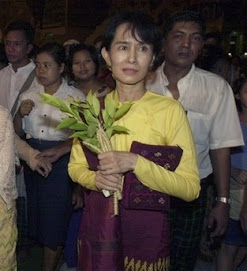


 Posts
Posts


