News & Articles on Burma
Monday, 27 December, 2010
-------------------------------------------------
Wa party to demand for Self Determination
Wa set up brigade on western flank
Burma’s new parliaments will convene in January: USDP MP-elect
Burmese generals ‘hate China’, says India
Suu Kyi Pays Tribute to Her Mother
Refugees Hide After Forced Repatriation
KNPP Troops Ambush Convoy Carrying Dam Technicians
India defies US, Myanmar project on
Unseasonal Rain Damages Crops in Lower Burma
-------------------------------------------------------
Wa party to demand for Self Determination
Monday, 27 December 2010 18:10 Hseng Khio Fah
The United Wa State Army (UWSA)’s political wing United Wa State Party (UWSP) has drawn another counter proposal which includes a point to demand for a state with the Right of Self Determination from the new government, according to UWSP sources.
The new proposal which is to be presented to the new government that is expected to be installed early next year includes the following 6 points:
* The Wa stands for the Wa State’s peace and development
* The Wa State shall have its own armed force. Wa weapons will remain in Wa hands. The Wa armed force will also remain in Wa State.
* The Wa will not secede from the Union
* The Wa will never demand or declare independence under any (Union) government
* The Wa will steadfastly demand for a state with the Right of Self Determination from every (Union) government until it is achieved
* The Wa are ready to discuss Wa affairs with the upcoming government, upholding a policy of non-alignment and neutrality.
“The words that we said that we will uphold non-alignment and neutrality policy means we [the Wa] won’t side either with the new government or with Daw Aung San Suu Kyi’s 21st century Panglong conference,” a Wa officer said. “But we will discuss Wa affairs with any new government until we achieve self-determination.”
The said proposal was drawn at the UWSP’s 5th annual district level party congress which is being held in Mongmai, 170 km north of its main base Panghsang from 20 December to 29 December.
Moreover, the group will not also stay under other countries’ policy, the officer added.
According to him, the UWSP leading party committee will send its delegation after the congress to talk with the new government on the basis of 'Opposition to War' and 'Work for Peace and Development' principle. http://www.shanland.org/index.php?option=com_content&view=article&id=3379:wa-party-to-demand-for-self-determination&catid=85:politics&Itemid=266
----------------------------------------------------
Wa set up brigade on western flank
Friday, 24 December 2010 18:01 Jai Wan Mai
Chiang Mai (Mizzima) – The United Wa State Army has set up a brigade to boost security on its western flank along a route it believes Burmese troops would take to march on UWSA headquarters in Pangsang, a high-ranking UWSA official said.
Brigade 618 commanded by Bao Samrai was stationed at Manghseng-Nawngkhet, bordering Tangyan Township, facing Burmese Army troops at Loi Panglong, in Shan State, the Wa official said.
The base is also adjacent to the area controlled by the Shan State Army North (SSA-N) Brigade 1, which along with the UWSA, is a member of the six-party alliance of armed ethnic minority groups that have refused to transform into Border Guard Force (BGF) under Burmese Army command, and that have signed a deal saying each would come to the other’s aid should they be attacked by junta forces.
The UWSA official said: “We will not exchange our weapons for peace but we will protect ‘peace’ with our weapons. Moreover, we will continue to follow our two main principles: peace and development in our area.”
The UWSA has nine brigades, four of which (318, 418, 468 and 618) were stationed in the north of the Wa-held areas while another five brigades (772, 775, 218, 518 and 778) were positioned along the Thai-Burmese border. The UWSA reportedly claims to have more than 20,000 soldiers and is believed to be the strongest amongst the armed ethnic opposition groups.
Meanwhile, the United Wa State Party (UWSP), the political wing of the UWSA, was holding a congress in Maing Maw (Mong Mai in Shan), in the north of Shan State. The meetings started on Monday and will finish on Wednesday, a source close to the Wa told Mizzima.
Around 2,500 participants were attending, including high-ranking UWSA officials, Xiao Minliang, vice chairman of Wa State; Bo Lai Kham, chairman of the Wa Political Consultative Conference; Bao Youri, political commissar of the Wa’s southern military region 171; and Ai Lon, the UWSA deputy commander-in-chief, the source said.
The congress was discussing party policies, political stance, economics and social welfare, the source said. The party had also reaffirmed its peace and development policy and that it would continue to bear arms and defend its territory.
The UWSP had decided to monitor and judge the approach of the new Burmese government towards the Wa group. It was keen to talk about self-determination for Wa State and the difference between the regime and the UWSA, however, the group affirmed that it would not hand over weapons nor become a BGF, the source added, quoting decisions of the congress.
The UWSP was formed on December 20, 1988 after it overthrew the Communist Party of Burma and before signing a ceasefire agreement with the Burmese regime.
The relationship between the Burmese regime and UWSA started to sour when the group was pressured to transform into a BGF. Both Burmese and Wa troops had reinforced their positions along demarcated territories in the Northern Shan State. http://www.mizzima.com/news/inside-burma/4703-ethnic-wa-army-sets-up-new-brigade-for-security.html
------------------------------------------------------
Burma’s new parliaments will convene in January: USDP MP-elect
By AHUNT PHONE MYAT
Published: 27 December 2010
Burma’s parliaments will be convened with representatives elected in the 7 November election before the end of January, said an elected representative of a pro-military party.
Khin Shwe, owner of Zaykabar company who was elected to the national parliament from a constituency of Rangoon Region, disclosed the information to DVB after his party, the Union Solidarity and Development Party held two days of meeting in the country’s new capital Nay Pyi Taw, from 22 to 23 December.
“The People’s Parliament will be convened first around the middle of next month, then the National Parliament about seven days later, and lastly, the Union Parliament (joint session of the two), seven days following that,” said Khin Shwe.
He also said that representatives also discussed the restructuring and democratisation of the party as it was originally a “social” association which inherited both its strengths and shortcomings.
“The main issues that we discussed were about how we should behave when we become Members of Parliament and about the restructuring of the USDP,” he said. “Previously, township secretaries were appointed by the higher-ups, now they will be elected by blocs.”
But when asked about the possibility of cooperation between his party and the main opposition, the National League for Democracy led by Nobel Laureate Aung San Suu Kyi, which boycotted the elections, Khin Shwe was less forthcoming.
“Policies regarding politics will be up to the leaders but for matters concerning economic development and other issues, there will be assignments which we will have to carry out. We, however, cannot talk about policies that are way beyond our reach.”
Having also expressed his enthusiasm for telling the truth about his party through media, Khin Shwe claimed that things will get better for Burma.
“What I want to say is that things will be much better than before,” he said. “It will be much better because decisions will be made by the majority instead of an individual. Primarily, we will have to work to raise the standard of living of the common people. We, economic entrepreneurs, are part of the system now and my promise to you is that things will be much better than before.”
Most powerful big companies in Burma are controlled or run by cronies and close relatives of top ruling generals.
The USDP, which won close to 80 percent of the votes in the November elections, marred by claims of frauds, intimidation and vote rigging, is believed to have millions of members, many of whom were leftovers from the party’s previous incarnation, the Union Solidarity and Development Association (USDA).
The NLD also won the 1990’s elections by a landslide, but was never allowed to rule by the military.
http://www.dvb.no/elections/burma%E2%80%99s-new-parliaments-will-convene-in-january-usdp-mp-elect/13520
--------------------------------------------------
Burmese generals ‘hate China’, says India
By JOSEPH ALLCHIN
Published: 27 December 2010
Burma’s hermetic military rulers detest their strongest ally, China, according to an Indian official quoted in a leaked US diplomatic cable.
Washington’s Consul General in India, Peter Kaesthner, also explains in the cable that India feels its position on Burma is compromised by persistent US pressure to be more vocal about rights and democracy.
India, which does not want to be castigated for engaging the Burmese generals, has often rued external pressure. Delhi’s position is that engagement will be more productive than the condemnation of the junta expressed by the majority of western democracies.
The cable dates from 2007, and documents a conversation between Kaesthner and Mohan Kumar, the joint secretary of India’s Ministry of External Affairs.
“The more the US presses India to bring Burma before the UN Security Council, [Kumar] said, the more the Burmese tell India to ‘go to hell’,” Kaesthner wrote.
Furthermore, if India engages the generals, then Burma will be able to loosen China’s grip on the country.
“Burmese officials have told Kumar that they ‘hate’ the Chinese and would prefer not to cooperate with China, but do so because they feel Beijing is more reliable than New Delhi”.
No elaboration is given on how India would promote democracy in Burma, were it to be closer to the ruling junta. But, tellingly, the cable reveals that economic objectives in its relations with its eastern neighbour remain key.
While India has sought to increase investments in Burma over the past two decades, particularly in the energy sector, Kumar reportedly told Kaesthner that, “We’re getting screwed on gas”.
“India is not getting any gas contracts from Burma, nor is it getting the transit rights it seeks which would open a bridge to East Asia,” Kaesthner wrote.
This raises an important, but often overlooked, Indian imperative: that whilst China seeks a strategic gateway to the Indian Ocean via Burma, India in turn would seek to use the pariah as its own access point to the growing eastern economies.
It also perhaps alludes to an Indian understanding of US imperatives that look to counter China’s influence in the region.
Moreover, while references to the promotion of democracy arise frequently in the cable, it also makes mention of Bangladesh, Sri Lanka and Pakistan, countries where China’s influence is growing and where both India and the US are keen to stem this.
Since the cable was sent in 2007, India has seemingly moved beyond the unidimensional level of cooperation over counterinsurgency on the troubled border to eye with increasing fervour Burma’s vast natural gas capacity.
Delhi has gained a stake in the Shwe gas project and has come closer to developing some of Burma’s hydropower potential, whilst bilateral trade has also increased significantly.
Tension between India and China has been a recurrent theme since the two nations fought a short war in 1962 over their disputed, ill-defined Himalayan border. The tensions persist to this day with Chinese claims for the Indian state of Arunachal Pradesh.
Despite trade between the two nations expanding rapidly before a recent visit to Delhi by Chinese Premiere Wen Jiabao, Beijing has described the bilateral relationship as “very fragile”.
http://www.dvb.no/news/burmese-generals-%E2%80%98hate-china%E2%80%99-says-india/13531
------------------------------------------------
Suu Kyi Pays Tribute to Her Mother
By THE IRRAWADDY Monday, December 27, 2010
Pro-democracy leader Aung San Suu Kyi held a religious ceremony at home and then paid tribute at her mother's tomb near the southern gate of the country's landmark Shwedagon Pagoda on the 22nd anniversary of her mother's death, which fell on Monday.
“Daw Aung San Suu Kyi held a religious ceremony on the 22nd anniversary of her mother's death at 1 pm at home,” said Ohn Kyaing, a spokesperson for the National League for Democracy. “Buddhist, Christian, Muslim and Hindu religious leaders who were invited to the ceremony then paid tribute to her mother's tomb on Shwedagon Pagoda Road at 4 pm.”
Khin Kyi, wife of Burma's national hero General Aung San, died on Dec. 27, 1988 after suffering a severe stroke.
Hearing of her mother's illness, Suu Kyi immediately flew from London to Rangoon to take care of her mother, but she also unexpectedly witnessed the illness of the society where she was born following a series of the peaceful student demonstrations against the military regime.
When the military government brutally cracked down on the demonstrations, Suu Kyi became involved in politics to seek a peaceful political solution, transforming herself to a lady with an iron will and unwavering commitment to democracy, which she has maintained until this day.
Khin Kyi, who was regarded highly by Burmese society, stepped into politics after Gen Aung San was assassinated by his political rival in 1947, becoming a member of parliament in the first parliament of independent Burma. After that, she became the first woman ambassador to India.
http://www.irrawaddy.org/article.php?art_id=20420
----------------------------------------------
Refugees Hide After Forced Repatriation
By LAWI WENG Monday, December 27, 2010
More than 200 Karen refugees were forcibly sent back into Burma from Thailand on Saturday despite unstable conditions and fighting near their villages, according to border sources.
The Thai army forced refugees sheltering at a Buddhist temple and a Thai school in Pop Phra-District in Thailand's Tak Province back across the border, telling them the situation had become stable.
“They [refugees] are afraid of the Thai army and were forced back even though they dare not return to their villages,” said Blooming Night Zan, the joint secretary of the Karen Women's Organization.
Many of the refugees forced back across the border remained in hiding close to the Moei River on the Burmese side of the border, ready to flee back across the river if fighting breaks out nearby, according to Mahn Mahn, the director of the Back Pack Health Workers Team.
Over 1,000 Karen refugees fled to the Thai border near Mae Sot when fighting between Burmese junta troops and Democratic Karen Buddhist Army (DKBA) brigade 5 troops broke out early in December in Phaluu village, Kawkareik Township, 40 kilometers south of the Mae Sot-Myawaddy border crossing on the Thai-Burmese border.
About 600 Karen refugees still remain in hiding at relatives' homes on the Thai border as they are afraid they will be forced back.
“So many people illegally staying at the homes of their kin may cause problems in the longer term, but the refugees do not want to return as long as fighting frequently takes place near their villages,” said Blooming Night Zan.
More junta troops have deployed along the road from Phaluu to Wah Lay villages in an attempt to control the area and restrict the movement of Karen troops.
Meanwhile, the Karen National Liberation Army (KNLA) Brigade 7, which is active in the Manerplaw area, launched separate attacks on Dec. 22 and 23, according to the Thailand-based Karen Information Center.
During the attack, nine junta soldiers from Light Infantry Battalion No. 106 and four from Infantry Battalion No. 588 were killed by KNLA troops, border sources said.
http://www.irrawaddy.org/article.php?art_id=20419
-----------------------------------------------
KNPP Troops Ambush Convoy Carrying Dam Technicians
By SAI ZOM HSENG Monday, December 27, 2010
Karenni National Progressive Party (KNPP) troops ambushed a Burmese military convoy transporting technicians to a dam construction project on Friday afternoon, according to Khu Oo Reh, the joint secretary of the KNPP.
The KNPP troops attacked 20 government military trucks near Pruhso Township, killing at least three persons including the foreign technicians, according to the KNPP. No information was provided about the number of people injured in the attack.
Speaking to The Irrawaddy on Monday, Khu Oo Reh said, “We attacked the convoy because it brought the persons who can harm local people by building a dam. The convoy came from Loikaw, the capital of Karenni State, and was headed to the dam project in the Ywathit area of Bawlakhe Township, Karenni (Kayeh) State.”
“We are investigating the building of this dam, including what company is investing in the project. We received some information that the regime began conducting secret surveys four years ago. At the beginning, we thought that they were working on the Weigyi dam and didn't expect that they planned to build a new dam in Ywathit,” Khu Oo Reh added.
A member from Karen River Watch confirmed that there was a new dam project in Bawlakhe Township, but the organization is also still investigating the new dam project to obtain detailed information.
Currently, according to the Burma Rivers Network, only five proposed dam projects are on the Salween River.
The KNPP, an armed ethnic armed group, has recently formed an alliance with the Kachin Independence Army, New Mon State Party, Shan State Army-North, Karen National Union and Chin National Front.
In October, KNPP troops attacked government troops based at Pon bridge, which is located between Loi Kaw and Shar Daw, Karenni State. The bridge was destroyed during the attack.
http://www.irrawaddy.org/article.php?art_id=20418
------------------------------------
India defies US, Myanmar project on
27 Dec, 2010, 04.50AM IST, Sachin Parashar,TNN
Read more on »united states|sittwe|myanmar|mizoram|manmohan singh|kaladan river|beijing
NEW DELHI: Despite the pressure from the US to tighten screws on the ruling military junta in Myanmar, India has gone ahead and started work on the crucial Kaladan Multimodal Transit Transport Project, which seeks to augment trade ties between the two countries.
The project — named after the Kaladan River and will enhance connectivity between India’s east coast and northeastern states — comprises construction of a port in Myanmarese town Sittwe, another waterway terminal and a highway.
Expected to cost over Rs 500 crore, the project linking Sittwe with Mizoram is being funded fully by the ministry of external affairs, and is likely to be completed by 2013. The two neighbours envisaged the project more than 12 years ago, but work kept getting delayed as relations between the two countries worsened steadily in the past decade.
Work has commenced more than two years after a final agreement for the project was signed with Myanmar’s military regime. With the government now displaying a renewed commitment to reach out to the military junta — not least because of the growing Chinese influence in the region — sources said the emphasis is going to be on completing the project at the earliest.
Once completed, India will use the Sittwe port to transport goods from its port in Kolkata to the northeastern states. When Senior General Than Shwe visited India in July, the two sides had reiterated their commitment to the project.
Than Shwe and Prime Minister Manmohan Singh had welcomed the expansion of trade and commerce between the two countries “manifest in the increase in the volume of trade to over $1 billion per year” .
They had said it was important to enhance trade at border trade points to boost bilateral trade.It’s a win-win situation for India because of the benefits this initiative is likely to yield to northeast states.
While US President, Barack Obama, came down hard on India during his November visit for not speaking out against the military junta , New Delhi made it clear almost immediately that it is not going to change its Myanmar policy because of strategic and security reasons, keeping in mind not just the Chinese influence but also the insurgency. Officials believe that India has already lost out to China in tapping Myanmar’s rich energy reserves.
http://economictimes.indiatimes.com/news/politics/nation/india-defies-us-myanmar-project-on/articleshow/7170039.cms
------------------------------------------------
Unseasonal Rain Damages Crops in Lower Burma
By KO HTWE Monday, December 27, 2010
An unseasonal three days of continuous rain has caused significant damage to salt fields and rice thrashing grounds in lower Burma.
Speaking to The Irrawaddy on Monday, Tun Lwin, the retired director-general of the Department of Meteorology and Hydrology, said that low pressure weather patterns that occurred over Southern India and Sari Lanka formed storms in early December that passed over Burma.
“The effect of the storms made nearly three continuous days of rain during the second week of December,” Tun Lwin said.
Hundreds of acres of salt fields in Panga village, which is the main salt-producing center in in Thanbyuzayat Township in Mon State, were damaged by the rain, according to a field owner.
Slide Show (View)
Nai Tin Aung, who owns 40 acres of salt fields, said that he lost 4 million kyat (US $4,000) because of the rain.
He said that there are are more than 40 private salt fields in Panga village, the largest occupying 100 acres. All of the salt fields were destroyed.
Farmers who placed harvest paddy on threshing grounds in Pegu Township in Pegu Division lost about 30 percent of their product, according to farmers.
Tin Maung Win, a farmer in Pegu Towship, said, he lost at least 150, 000 kyat (US $150) because of the unexpected rain.
Most farmers in Irrawaddy Division have been affected by the rain.
“Paddy from my farm was soaked, and it cannot be kept. The quality of the rice would be poor and the production would be lower,” said Chit Aung of Dedaye Township.
Most farmers in Dedaye Township, which has about 180,000 acres in crops, have been affected by the rain. Irrawaddy Division is called the “granary of Burma.”
Depending on the soil type, many bean crops in Kayan and Thongwa townships also will be lower because of the rain.
“In this circumstance, many farmers will sustain a big loss this harvest season. But for farmers who planted earlier in the season, the rain could be beneficial,” said Tun Win, a farmer in Khayan Township.
http://www.irrawaddy.org/highlight.php?art_id=20417
Tuesday, December 28, 2010
News & Articles on Burma-Monday, 27 December, 2010


Amnesty Japan no HP no link wo tsukatte kudasai.
Dear all,
itsumo osewa ni natte orimasu.
(We have got 107,271 actions and counting.
http://3freedoms.amnesty.org/index_en.html )
Amnesty Film Festival made ato 1kkagetsu ni narimashita.
Burma no true wo takusannno nihonjin ni shitte morau tameni, hikitsuzuki senden shite kudasai.
minasanno HP ya Blog ya Twitter ya ML ni kaite kudasai.
sonotokini ↓ no link wo tsukatte kudasai.
yoroshiku onegai itashimasu.
Amnesty Film Festival 2011
http://www.amnesty.or.jp/modules/wfsection/article.php?articleid=3287
ビルマ(ミャンマー)はいま・・・
(Burma no seiji to human rights no setsumei no page desu)
http://www.amnesty.or.jp/modules/wfsection/article.php?articleid=3084
アウンサンスーチーさんから若い人へのメッセージ
http://www.amnesty.or.jp/modules/wfsection/article.php?articleid=3547
Thank you!
+--------------------------+
杉山透子 Toko Sugiyama
社団法人アムネスティ・インターナショナル日本(個人会員/ビルマチーム)
Amnesty International Japan(Burma Team)
http://www.amnesty.or.jp/
youtube
http://www.youtube.com/user/hisoka20100710?feature=mhum
アムネスティ・フィルム・フェスティバル、チケット発売中!
http://www.amnesty.or.jp/modules/wfsection/article.php?articleid=3286
日本支部声明: 死刑執行に抗議する
http://www.amnesty.or.jp/modules/news/article.php?storyid=824
日本 : 「立川テント村事件」の最高裁判決を懸念
http://www.amnesty.or.jp/modules/news/article.php?storyid=467
Russian tycoon Khodorkovsky again found guilty
AP – Mikhail Khodorkovsky stands behind bars at a court room in Moscow, Monday, Dec. 27, 2010. A Russian judge …
By LYNN BERRY and NATALIYA VASILYEVA, Associated Press Lynn Berry And Nataliya Vasilyeva, Associated Press – 1 hr 59 mins ago
MOSCOW – Mikhail Khodorkovsky was convicted Monday of stealing oil from his own company and laundering the proceeds, a verdict likely to keep the oil tycoon who once challenged the power of Vladimir Putin behind bars for several more years.
The unrelenting legal attack on Khodorkovsky, once Russia's richest man, has come to define the country's transformation under Putin. The outcome of the second trial exposes how little has changed under President Dmitry Medvedev despite his promises to strengthen the rule of law and make courts an independent branch of government.
Putin, now prime minister, remains the more powerful leader. Any lingering doubt that the verdict would be guilty was dispelled this month when he said Khodorkovsky was a proven criminal who should sit in prison.
Putin, seen as the driving force behind the trial, has not ruled out a return to the presidency in 2012 and appears unwilling to risk the possibility that a freed Khodorkovsky could help unite and lead his political foes.
During his seven years in prison, Khodorkovsky has been transformed into a symbol of the struggle for democracy in Russia. His hair, now gray, is cropped short and his complexion is pasty from lack of sun and exercise, but he appears strong and unbroken.
It was clear from the opening pages of his verdict that the judge had found Khodorkovsky and his business partner Platon Lebedev guilty. Reading the full verdict and announcing the sentence was expected to take several days.
Khodorkovsky, 47, is nearing the end of an eight-year sentence after being convicted of tax fraud in a case seen as punishment for challenging the Kremlin's economic and political power, in part by funding opposition parties in parliament.
The conviction on charges of stealing around $27 billion worth of the oil that his Yukos company produced from 1998 to 2003 and laundering the proceeds could keep him behind bars until at least 2017.
Prosecutors accused Khodorkovsky and Lebedev of stealing the oil from Yukos' own production units and then selling the oil abroad at higher prices. The defense called the charges ridiculous, arguing that prosecutors do not understand the oil business, including the payment of transit fees and export duties.
One of Khodorkovsky's lawyers, Vadim Klyuvgant, said Monday that if this logic were extended to the state oil and gas company Gazprom, the same charges could be brought against Medvedev.
"The court ruled that the difference between the oil price at the production site and at the market represents theft," Klyuvgant said. "Gazprom, where Medvedev served as board chairman, buys oil at the production site at a price 10 times lower than the market price in Rotterdam. Isn't that selective justice? Do they have any shame?"
Numerous witnesses, including current and former government officials, testified during the 20-month trial that the charges against Khodorkovsky and Lebedev were absurd.
Hundreds of Khodorkovsky supporters rallied outside the courthouse, holding up signs saying "Freedom" and "Russia without Putin." Police detained some of them as they chanted "Freedom" and "Down with Putin!"
In the courtroom, Judge Viktor Danilkin read the verdict in a rapid-fire monotone, his low voice drowned out at times by loud chants from outside. Khodorkovsky and Lebedev sat impassively in a glass cage. Khodorkovsky exchanged glances with his elderly mother. His father, Boris, sat next to her, his head bowed.
By mid-afternoon, the judge had read through more than 80 of the verdict's estimated 250-300 pages.
"This is a miserable country with arbitrary rule," said Yekaterina Veselovskaya, 62, a regular at the trial who took part in Monday's protest rally. She is thankful to Khodorkovsky for providing computers to the school where she used to work as a librarian.
When Putin came to power in 2000, Khodorkovsky was among a handful of oligarchs who controlled much of Russia's economy and were used to dictating their terms to the Kremlin.
Putin set out to put them in their place, a task made easier because most Russians reviled the businessmen who had grown fabulously rich in the 1990s at a time when many of their countrymen were thrown into poverty.
Khodorkovsky's arrest in October 2003 and the subsequent state takeover of his Yukos oil company allowed the government to reassert control over the energy sector and tamed the other wealthy businessmen, who have obediently followed Kremlin orders ever since.
The Kremlin also consolidated its hold over political life. Soon after Khodorkovsky's arrest, parties that he had funded were shut out of parliament or sidelined. New controls were imposed on non-governmental organizations, like those once funded by Khodorkovsky, that have worked to help strengthen civil society in Russia.
On Friday, Khodorkovsky published an opinion piece in the daily Nezavisimaya Gazeta containing a scathing criticism of Putin. "I wish Putin kindness and tolerance, I wish him to be loved, not feared. Maybe not by all, but loved sincerely and unselfishly, and not just by dogs," he wrote in a reference to Putin's fondness for animals.
Medvedev, who despite his title remains Putin's junior partner, has promised to strengthen the rule of law as part of his mission to modernize Russia and attract more foreign investment. An acquittal in the Khodorkovsky trial would have been seen as evidence that Medvedev has the power to deliver on his promises.
While the guilty verdict is certain to be condemned by many political figures in the U.S. and Europe, it was expected and is unlikely to cause any lasting damage to relations.
Khodorkovsky's wife Inna said in an interview with the monthly Snob magazine that she expects him to be kept behind bars at least until 2012. She said that her husband wasn't expecting any clemency from the authorities.
"My husband is a strong man," she said. "He has made a decision for himself and has no hope."
____
Vladimir Isachenkov contributed to this report.
Monday, December 27, 2010
<ミャンマー>タイへ移民200万、少数民族大半 自国政治に冷めた目
<ミャンマー>タイへ移民200万、少数民族大半 自国政治に冷めた目
毎日新聞 12月24日(金)8時17分配信
◇スーチーさんへの期待さまざま
タイ国内で200万人以上ともいわれるミャンマー人の移民労働者が働いている。軍事政権の圧政下、経済の混乱や、国軍との戦闘から逃れてきた少数民族が大半だ。民主化運動指導者アウンサンスーチーさんが解放され、民主化への希望も高まっているが、労働者の多くは、日々の生活に追われ、自国の政治に冷めた見方が多い。【サムットサコーン県(タイ中央部)で矢野純一、写真も】
◇「何も変わらない」
バンコク中心部から南西に車で約1時間。タイ湾に面するサムットサコーン県には、約8000軒の水産加工場が建ち並ぶ。従業員の多くは、ミャンマーから逃れてきた少数民族だ。
「スーチーさんは好きだが、彼女が仕事をくれるわけでもない」。水揚げされた魚をトラックに積んでいたオンさん(30)は、タイで生涯を暮らすことに決めている。タイと国境を接する地域で暮らす少数民族モン族出身。政府軍との戦闘のたび、集落を追われる生活に嫌気が差し、10年前にタイへ密入国した。
バンコクなどタイ各地の建設現場などを転々とし、5年前から、モン族が多く住む同県に落ち着いた。日給は300バーツ(約840円)と、タイ人の平均収入の半分以下。それでも、「3度の食事が取れる。故郷の暮らしよりずっとまし」。密入国以来、一度も顔を合わせていない両親には、年に約1万5000バーツ(約4万2000円)を送金している。
「スーチーさんには興味がない」。夜勤明けで自宅で休んでいたトゥモーさん(26)は即答した。親戚を頼り7年前、逃れてきた。エビ加工場で働くが、水揚げによって月収は左右され、2000バーツ(約5600円)しか稼げない月もある。両親への送金も滞りがちだ。
自国の政治には興味があるが、「総選挙は不正だらけで、結果は認めるわけにはいかない。とはいえ、これまで、彼女(スーチーさん)がいても、何も変わらなかった」。
◇「彼女が解決する」
一方、スーチーさんの熱烈な支持者もいる。「スーチーさんだけが人権や少数民族の差別問題を解決してくれる」。アジャヌアさん(31)は、ここで暮らす子供たちにモン語を教えている。
自治を求めるモン族への軍事政権の攻撃のたび、家族でジャングルを転々とした。大学への進学が夢だったが、軍事政権と対立する少数民族の出身者には門戸は閉ざされている。「ミャンマーに残っても将来がない」と、18歳でバンコクで不法就労する叔父を頼り、国を去った。数年間は、食事と住居だけをあてがわれ、無給で建設中のビルにガラスを取り付ける仕事を続けた。4年前にこの地域で移民を支援する財団のメンバーとなった。
政治家の父は国に残り、反軍政を貫いている。夢は、父の後を継いで政治家になり、民族の自治を確立すること。「少数民族の権利を尊重すると話すスーチーさんが、国を動かせば、必ず良くなる」と信じる。
外国からの移民労働者を支援する労働権利促進財団によると、サムットサコーン県には約40万人の外国人労働者がおり、うち30万人が不法就労者だ。全体の7割がミャンマー出身で、モン族の割合が高いという。
移民労働者が働く水産加工場は、どれも小規模で従業員は100人未満だ。そのため、賃金も低く、差別的な状況が生まれている。祖国よりは生活が安定しているうえ、不法に働く労働者も多く、声を上げることができない状況だ。
日本などに輸出するエビの皮むきなどの単純作業で、処理した重さで給与が支払われる。両親と一緒に働く児童の労働も問題になっている。同財団マネジャー、パティマさんは「ここの労働者は経済的な理由で、国を逃げてきた人だ。皆、軍政は嫌いと答えるが、日々の暮らしに追われ、政治どころではない」と話した。
Prime Minister KAN's TV
The following are the messages contained in the videos:
"No. 8 [Healthcare] A Great Leap Forward for the HTLV-1 Task Force
Team"
Narration: Former Governor of Miyagi Prefecture Shiro Asano
continues to struggle with Adult T-cell Leukemia. This cancer is
caused by Human T-Lymphotropic Virus Type 1, also known as HTLV-1,
which is estimated to be carried by more than 1 million people
across Japan. Most of the carriers never develop any diseases, but
on occasion, it develops into leukemia, as with Mr. Asano, or even
causes serious nerve damage. There is yet no effective treatment
for the virus. However, the development of a comprehensive policy
to address HTLV-1 took a great leap forward on December 20.
Prime Minister: I am extremely pleased to have worked with everyone
here, and that together we were able to make definite progress
today.
Narration: The "everyone" referred to by Prime Minister Kan
includes the sufferer of HTLV-1-related diseases who attended the
meeting.
On September 8, this patient group made a direct plea to the Prime
Minister, visiting his office. Having received the patients'
request down on his knees to do something about the virus, the
Prime Minister immediately formed a task force team to tackle this
issue, and only five days later the team's first meeting was held.
Prime Minister: I would like to thank everyone for coming together
so quickly for this meeting and proceeding forward with such
substantive discussion.
Narration: Ms. Kayoko Sugatsuki, who is a member of the patient
group petitioning the government for seven years, initially
believed that things would not change so smoothly.
Ms. Sugatsuki: Of course, there are some humane people working at
the Ministry of Health, Labour and Welfare, and they have been
working with us to make a breakthrough on this issue. It's not that
the Ministry is bad, but that the vertically-oriented
organizational structure of the Ministry means that no matter how
much you say you want something done about a certain disease,
nothing is ever resolved.
Narration: However, as the meetings of the task force team went on,
Ms. Sugatsuki found that her impressions began to change.
Ms. Sugatsuki: There were many opportunities in each meeting for
the patient-side to express its opinions. Over the course of the
meetings, I began to really feel that this task force team is
serious about coming up with countermeasures for the virus.
Narration: Mr. Asano, who was actually an official of the Ministry
of Health, Labour and Welfare before becoming Governor of Miyagi
Prefecture, expressed a similar opinion.
Mr. Asano: The thing I strongly felt this time was the power of
politics. There was no worrying about the status-quo--I really felt
there was strong will to find a solution to this problem.
Narration: The "strong will" referred to by Mr. Asano was not just
aimed at finding countermeasures for HTLV-1.
Prime Minister Kan sees this initiative as the way leading toward
a much more universal goal.
Prime Minister: I believe that we could take a first step forward
to create a model task force team-based approach for finding
breakthrough solutions for those who suffer from various diseases.
Narration: Yesterday's meeting (that was held on December 20)
marked the 99th day since the first meeting of the HTLV-1 Task
Force Team, and saw the completion of a comprehensive policy on the
virus. With more than 60% of the infected receiving the virus via
their mother's milk as infants, it has been decided that systems
for maternity checkups and health guidance will be set up across
the country.
In addition, preparations will be made to create a consultation
system for those with the virus, as well as a seamless medical-care
system for examinations and treatments. The Government will also
start efforts to greatly increase research funding. It was decided
that the national government, regional governments, medical
institutions, as well as patient organizations will strongly
promote this policy in close coordination with each other.
Ms. Sugatsuki: I truly appreciate it.
Mr. Asano: I was surprised; I am grateful; I was moved. I am
currently fighting what is known as ATL (Adult T-cell Leukemia),
and I will overcome this challenge.
Prime Minister: In formulating this comprehensive policy today,
I believe that this significant step forward was realized thanks to
your valuable efforts, though you all went through very difficult
times. I will close my remarks with the promise that I will firmly
implement this policy. Thank you very much.
===================================================================
Publication : Cabinet Public Relations Office
1-6-1 Nagata-cho, Chiyoda-ku, Tokyo 100-8968, Japan
News & Articles on Burma-Sunday, 26 December, 2010
News & Articles on Burma
Sunday, 26 December, 2010
-------------------------------------------------
Ten things we can do about Burma
Does junta use drug as a weapon in Burma’s politics?
India should speak up for Myanmar: Amartya Sen
Burmese refugees sent back home
Weekly Business Roundup (December 25, 2010)
Don't Try to 'Control' New Gov't, Regime Tells Opposition
Burmese Freedom of Press hits a new low
-------------------------------------------------
Ten things we can do about Burma
By Amartya Sen
Cambridge, MA
Published on December 25, 2010
Burma has been under the jackboot of a supremely despotic military junta for almost half a century now, with collapsing institutions, arbitrary imprisonment, widespread torture, organised rapes and killings, and the terrorisation of minority communities including the Chins, the Karen, the Shan and the Rohingyas. The release in November of the opposition leader, Aung San Suu Kyi, from unjust imprisonment was not just a great moment for celebration, it should also make us think more clearly about what the world can do to help Burma achieve reconciliation and build a democratic foundation for the future.
The military generals designed the recent election, the first in twenty years, in a crooked way to ensure that they, or their proxies or cohorts, will stay in power. Most gratuitously, 25 per cent of the seats were reserved for military rulers; strong pro-democracy candidates were barred from participation; opposition leaders and activists were kept in confinement; and criticism of the regime was totally banned in pre-election speeches.
So, what can the world do now? The answer is: A great deal.
First, many analysts of Burmese affairs have called for an international Commission of Enquiry on Burma, possibly led by the United Nations. The case for this is very strong, especially after the manipulated election.
Second, the framework of sanctions and embargos has to be made more effective. General sanctions that hurt the Burmese people (such as restrictions on garment exports from Burma) can be sensibly replaced by those that isolate the military rulers - by targeting their business activities and their financial transactions overseas.
Third, at the top of the list of potentially effective targeted sanctions must be an embargo on the trading of arms and armaments of all kinds.
Fourth, there is a strong political case for considering imposing sanctions on those natural commodities - such as minerals, gems, timber, and oil and gas - that yield huge profits for individuals in the regime.
Fifth, severe financial restrictions and prohibitions imposed on large transactions from Burma can be a well-targeted and effective policy.
Sixth, a ban on foreign travel imposed on the generals at the head of the regime can also be effective.
Seventh, neighbouring countries, particularly China but also Thailand and India - which provide support to the military regime in exchange for their own commercial gains - have a special responsibility. Aside from the doubtful morality of supporting such an oppressive regime, this continued and tacit support may well turn out to be a prudential mistake. The tyrants of Burma will, sooner or later, fall - as all tyrants eventually do. However, the memory of the betrayal of the Burmese people will last a long time, just as the intense anti-Americanism in Latin America today draws on the history of US support for the brutal South and Central American regimes of yesteryear.
Eighth, the Western countries are sharp in rhetoric when denouncing Burma's rulers, but they do not do what is entirely within their power to do - like withdrawing from lucrative Burmese business, and imposing financial sanctions.
This is bad in itself, but it also makes it harder to persuade China, India and Thailand to do the right thing.
Ninth, and most important - there has to be an end to the sense of dejection and hopelessness that is so dominant among the Burmese people. The fight, we have to remember, is for the beginning of democracy in Burma, not for tiny concessions from an entrenched military government.
Finally, in a non-defeatist approach, we have to start thinking about how a post-military government will deal with the culprits of the past. There is a strong case for not threatening bloody revenge but opting instead for the sagacity of offering amnesty in exchange for remorse. Even butchers have to find a "way out" if they are not to go on fighting - and tyrannising - to the bitter end.
With well-targeted policies, carried out with determination and clarity of reasoning, we can make the Burmese leaders withdraw.
The change can come more quickly than most people imagine.
Amartya Sen is an Indian economist who was awarded the 1998 Nobel Prize in Economic Sciences.
http://www.nationmultimedia.com/home/Ten-things-we-can-do-about-Burma-30145136.html
-------------------------------------------------------
Does junta use drug as a weapon in Burma’s politics?
By Zin Linn Dec 26, 2010 11:15PM UTC
The Burmese junta’s mouthpiece newspaper New Light of Myanmar reported yesterday that in 2010-2011 poppy cultivation seasons, a total of 5745.03 acres of poppy plantations were destroyed up to 13 December 2010.
The paper also says that during the period from 14 to 20 December, a total of 1564.9 more acres of poppy plantations were destroyed in States and Regions. Therefore, 7309.93 acres of poppy plantations have been destroyed till 20 December.
Out of 1564.9 acres of poppy plantations, a total of 1270.35 acres of poppy plantations were destroyed in Pekhon, Pinlaung, Hsihseng and Kalaw townships in Shan State (South), 199.1 acres in Monghsat, Mongkhat, Mongping, Kengtung, Tachilek and Mongton townships in Shan State (East), and 1564.9 acres in Lashio, Tangyan, Hsenwi, Namhkam and Kutkai townships in Shan State (North), as said by the New Light of Myanmar.
Burma is the second largest opium producing country after Afghanistan, as indicated by the United Nation. Burma’s Minister for Home Affairs and Chairman of the Central Committee for Drug Abuse Control, Maj-Gen Maung Oo said the drug eradication program had successfully brought down the cultivation of opium in the country. But nearly all observers of the drug question in Burma speak out that there is very little improvement.
According to a report – Poisoned Hills – issued on 26 January 2010 by the Paluang Women’s Organization (PWO), opium poppy cultivation in Burma is swelling all over again in areas controlled by the military regime or the State Peace and Development Council (SPDC). Shockingly, number of drug addicts is rising speedily in Shan state where opium is now being grown. At the same time as the rising of poppy growing is also killing the traditional tea cultivation in northern parts of the country.
PWO says opium cultivation in Burma’s northern Shan State has increased five-fold in recent years. It is much higher than the areas given by the United Nations Office on Drugs and Crime (UNODC). In the “Poisoned Hills”, field assessments were carried out of opium growing over three seasons in two main areas: Mantong and Namkham. The Report says, “It was found that the number of villages growing opium in the targeted survey area of Mantong Township has tripled from 2006 to 2009. PWO surveyed 75 villages in Mantong. During the 2006-7 season only 24 of these villages grew opium. This increased to 35 villages in the following season. By the 2008-9 seasons all of the villages were growing opium.”
It continued that poppy cultivation has increased six fold from 2006 to 2009, from 1,568 acres (635 hectares) to 9,707 acres (3,928 hectares). Most analysts on drug issue pointed out poverty as a major reason for Shan State’s continuing drug problem.
Opium crops only need a short time to grow and promptly generate income for impoverished farmers. To stop growing poppy, an alternative through cash crop substitution programs must be provided. According to some political analysts, poppy growing and opium production in Shan State have increased over the past two years due to political volatility in Burma and growing economic misery caused by cronyism, corruption and unprofessional nature of the military junta.
Six well-known drug lords in Burma represented the junta-backed Union Solidarity and Development Party (USDP). They are among those elected on the 7 November elections, according to Shan Herald Agency for News (S.H.A.N.).
Two of them, Liu Guoxi, candidate of USDP who ran for a seat in Constituency No.11 of upper house in Northern Shan State and Bai Xuoqian, a candidate for state legislature in Laogai Constituency No.2 won their seats automatically as there were no rivals in their areas, a source from the Sino-Burma border said.
Liu Guoxi, 75, was dubbed as a drug kingpin in the Far Eastern Economic Review during the mid 90’s. He is deputy of Bai Xuoqian, who ascended to the leadership of Kokang, following the overthrow of his predecessor Peng Jiasheng by the Burma Army last year. The other four are U Myint Lwin aka Wang Guoda, U Ti Khun Myat, Panhsay U Kyaw Myint and U Keng Mai, the junta-backed local militia chiefs, who are notorious among local people as drug dealers in Shan State North’s Kutkhai, Muse and Namkham townships, Shan Herald News said.
It seems that unless the strategies of militarization of SPDC are challenged, drugs trade will take place ad infinitum, as if the drug is a kind of weapon for SPDC to grab hold of the sovereign power. Thus, a negotiated resolution of the root cause of civil war in Burma is immediately needed so as to tackle the drug question which intertwined with the country’s long-lasting political conundrum.
http://asiancorrespondent.com/44683/does-junta-use-drug-as-a-weapon-in-burma%E2%80%99s-politics/
--------------------------------------------------
IndiaExpress.Com: Sun, 26 Dec 2010
India should speak up for democratic forces in Myanmar: Amartya Sen
Noble laureate Amartya Sen has expressed displeasure over India's silence on the issue of restoring democracy in Myanmar and supported US President Barack Obama's criticism of New Delhi not speaking for Aung San Suu Kyi and democratic forces there.
"India should speak up. It is for India to take action. The US has woken up. I would like it (New Delhi) to take more action. I would like to have speech and action from both (countries)."
Sen was also critical of the reports that India is maintaining silence in return for support to the military junta there, to curb Bodo and Mizo rebels in the Northeast. Asked if India's stand was understandable or a Faustian bargain, he said, "It is not understandable. It is a terrible bargain".
Sen was reminded of his remarks that his heart "broke" to see the Prime Minister of his "democratic country" welcome the "butchers from Myanmar".
Asked if he raised this issue with Prime Minister Manmohan Singh, the renowned economist said, "I told him. He listened to it. He didn't reply. I wasn't saying change the policy right now. It would be something I hope he would consider. He would think about and place it before the Government."
The 77-year-old Nobel Prize winner also expressed confidence that the dictators in Burma would eventually "disappear". But the silence of India and other countries like Thailand and China would "continue to linger for long", he remarked.
http://www.indianexpress.com/news/india-should-speak-up-for-democratic-forces-in-myanmar-amartya-sen/729465/
----------------------------------------------
The Nation:Sun, 26 Dec 2010
Burmese refugees sent back home
Tak -- Two hundred and thirty-three refugees from Burma Saturday agreed to go home after Thai soldiers told them that fighting between Burmese troops and Karen rebels on the other side of the border of Tak's Phop Phra district had ended.
Colonel Supachoke Thawatpeerachai Saturday urged the refugees to return home and said Thai authorities would accommodate them. So the refugees started to pack their belongings and crossed the bridge over to the Burmese side on foot. UNHCR officials and those from other NGOs also observed them.
The move came after an assistant to Ban Valley Neu village headman Boontham Suwansri fell ill from meningococcal infection following his visit to the refugees at an old helipad near the village. However, it wasn't confirmed if the man, who reportedly crossed over to the Burma side often, got the disease after visiting the refugees. Boontham is being treated at Mae Sot Hospital for high fever though his condition is stable. http://www.nationmultimedia.com/home/Burmese-refugees-sent-back-home-30145194.html
----------------------------------------------
Weekly Business Roundup (December 25, 2010)
By WILLIAM BOOT Saturday, December 25, 2010
China Port in Bangladesh Faces Logistics ‘Problems’
China is to go ahead with plans to finance a new port on the Bangladesh coast close to the border with Burma and build a new road linking the port to the Chinese province of Yunnan.
The port, capable of handling the biggest ocean-going container ships, will be constructed at Sonadia, near Cox’s Bazar.
It will be close to the port reconstruction being financed by India at Sittwe on Burma’s west coast.
No development time frame or cost for the project has been disclosed, said ports news magazine Dredging Today, which noted: “[Bangladesh] needs a deep-seaport to handle its ever-increasing external trade and offer port facilities to some other neighboring countries, including India, China and Myanmar [Burma].”
Some observers question why China would back a new port in Bangladesh when Beijing already has great influence in Burma.
“This is a curious development and suggests the Chinese are not putting all their eggs in one basket where Burma is concerned, although to access the Bangladesh coast from Yunnan will mean a road passing through either Burma or India,” said a commercial attaché at a Western embassy in Bangkok.
“From a trade point of view, I suspect this will be fraught with problems,” said the official, speaking to The Irrawaddy this week on condition of anonymity.
Vietnam-Burma Trade Grows over 60 Percent in 2010
Trade between Vietnam and Burma has increased more than 60 percent in 2010 as the Vietnamese push commercial contacts with the Burmese military.
Two-way trade for this year will be above US $160 million, compared with $99 million in 2009, said the official Radio Vietnam.
Vietnam’s links with Burma have intensified this year with an increase in investment and direct flights.
In March, a branch of Vietnam’s state-owned Bank for Investment and Development was opened in Rangoon and the Vietnamese Agricultural Ministry is financing the development of 200,000 hectares of rubber plantations in Burma.
Vietnam Airlines also began a five-days-a-week service between Hanoi and Ho Chi Minh City and Rangoon.
The intensification of Vietnam’s links with Burma has come during Hanoi’s turn as chairman of the Association of Southeast Nations, to which both countries belong.
Synthetic Drugs Production Grows in Burma’s Shan State, Says UN
Production and consumption of synthetic methamphetamine drugs is increasing in Burma, says a United Nations agency.
Most of the manufactured drugs are being exported to neighboring countries such as Thailand, but domestic consumption is also on the rise, said a report by the UN Office on Drugs and Crime (UNODC).
It said much of the production was in Burma’s Shan State.
Seizure of pills tripled in 2009 over 2008, and between January and September of this year, more than 44 million pills were seized in Thailand alone. More than 22 million pills were confiscated in Laos, said UNODC.
“Authorities in both Myanmar [Burma] and Thailand confirm that the manufacture of crystalline methamphetamine is now occurring in the Golden Triangle,” said UNODC coordinator Deepika Naruka.
Vietnam Agency to Target European Tourists for Burma Trips
A Vietnamese travel agency which has opened an office in Rangoon says it will offer “customized holidays” to Europeans wanting to visit Burma.
Ho Chi Minh City-based Vietnam Today Travel said Burma will be added to regional packages it is offering, which include visits to Vietnam, Cambodia, Laos and now Burma.
The firm said it would target English, French, Spanish and Italian speaking customers.
Many travel firms in Europe shun Burma under European Union economic sanctions restraints.
http://www.irrawaddy.org/article.php?art_id=20412
----------------------------------------------
Don't Try to 'Control' New Gov't, Regime Tells Opposition
By BA KAUNG Saturday, December 25, 2010
Burma's democratic opposition should stop calling for national reconciliation and instead ally itself with the country's newly elected government to achieve “national reconsolidation,” according to a commentary published in the state-run New Light of Myanmar on Saturday.
In the Burmese regime's first apparent response to pro-democracy leader Aung San Suu Kyi's repeated calls for dialogue with the country's ruling generals, the commentary urged opposition groups to regard the junta-backed government that will be formed sometime early next year as a “democracy ally.”
Junta chief Snr-Gen Than Shwe, right in foreground, walks to attend the graduation parade of the No. 12 Intake of the Defense Services Medical Academy on Dec. 24 in Naypyidaw. (Photo: AP)
The commentary referred specifically to Suu Kyi's National League for Democracy (NLD) party and ethnic groups which boycotted last month's election. The junta's proxy party claimed a landslide victory in the polls, which were widely dismissed as a sham by international observers.
It also warned the NLD, which has tried in the past to pressure the regime to hold talks with the opposition, not to use similar tactics in the future.
“Any ways to achieve national reconsolidation through non-violent, violent, indirect and direct approaches designed to control the ruling government will never come to fruition,” it said.
Notably absent from the commentary was the phrase “national reconciliation,” which is the stated aim of the NLD and and its ethnic allies. Instead, it refers to “national reconsolidation”—a term more in line with the regime's goal of strengthening central control over the country's many minority groups.
“How can we reconsolidate before we can reconcile with each other?” said Chin Sian Than, a Chin ethnic leader who boycotted last month's election.
“This commentary indicates yet again that the regime will press ahead with its own plans,” he said.
The front page of the New Light of Myanmar also highlighted the theme of national reconsolidation, in a speech given to the graduating class of a military medical academy in the capital Naypyidaw on Friday by junta chief Snr-Gen Than Shwe.
“I would like to urge you to build on the national reconsolidation that has been achieved and avoid all thoughts and notions that might lead to the disintegration of the Union,” he was quoted as saying.
In the speech, Than Shwe also also claimed that Burma's ethnic minorities are now enjoying the fruit of development projects his regime has undertaken since it came into power in 1988. He added that coming governments would continue their efforts for the country based on these foundations.
In January, Burma is expected to hold its first parliament in more than two decades.
http://www.irrawaddy.org/highlight.php?art_id=20413
-----------------------------------------
Burmese Freedom of Press hits a new low after photojournalist Zeya’s sentence
Sun, 2010-12-26 01:09 — editor
By - Zin Linn
26 December, (Asiantribune.com):
Freedom of Press in Burma received another blow as Photojournalist Sithu Zeya has been sentenced to eight years in jail last Tuesday. Zeya was sentenced by the military controlled court system for his photos of the scene of an explosion at a traditional water festival pavilion near a Rangoon lake in early according to his lawyers.
Burma also resumed the detention of journalists from time to time. Journalists based in Rangoon say the detentions were part of a continued crackdown by the military authorities on those involved in the anti-junta activities including covering news in the exile media.
Sithu Zeya was sentenced three years for violating the Immigration Act and five years for violating the 1957 Unlawful Associations Act for links he made with unlawful organizations, according to his lawyer U Aung Thein, At some point in cross-examination by special branch police, Sithu Zeya apparently confessed his former relationship with an official from the exile media organization Democratic Voice of Burma (DVB).
Moreover, he also confessed that he was present at media training in Thailand. The police plaintiff put forward those confessions at the trial. His lawyer said the case will be appealed to a higher court because the evidence shown to the township court was flawed and there were not enough witnesses.
Earlier in November 2008, Win Maw, a 47-year-old activist and rock musician, was sentenced to a 17-year imprisonment by a township court for his journalistic activities for Democratic Voice of Burma (DVB), based in Norway. A military-controlled township court in Burma has handed down a 20-year jail term to freelance reporter Hla Hla Win, a young video journalist who also worked with the Burma exile broadcaster DVB, as the ruling junta continues its crackdown on the free press. She was arrested in September 2009 after taking a video interview at a Buddhist monastery in Pakokku, a town in Magwe Division, the Paris-based Reporters Sans Frontieres and the Burma Media Association said in a joint statement. For that she was given a seven-year prison sentence in October.
In an additional case, the Special Court in Insein prison sentenced reporter Ngwe Soe Lin to a 13-year sentence in prison under section 33(a) of the Electronic Act and section 13(1) of the Immigration Emergency Provisions Act on Jan. 27, 2010 for allegedly attempting to smuggle information to exiled media, according to prominent Rangoon lawyer U Aung Thein. Ngwe Soe Lin was detained in a Rangoon Internet café on June 26, 2009 and accused of working for the DVB.
Burma was at the forefront of press freedom in Southeast Asia before the 1962 military coup. The country then enjoyed a free press; censorship was something unheard of. As many as three dozen newspapers, including English, Chinese and Hindi dailies, existed between 1948 and 1962.
The situation changed in 1962 when the military seized power. All newspapers were nationalized and a Press Scrutiny Board created to enforce strict censorship on all forms of printed matter. Since then, censorship and self-censorship have become commonplace in Burma.
The Press Scrutiny and Registration Division (PSRD) is a major tool or repression of the Than Shwe military regime. Not surprisingly, Burma stands downgraded from a free state to a prison state. All news media in Burma is strictly censored and tightly controlled by the military – all daily newspapers, radio and television stations are under supervision of the junta.
The radio, television and other media outlets are monopolized for propaganda warfare by the regime and opposition views are not allowed.
Currently, PSRD or state censor-board has been stepping up barring on news and interviews with Democracy Icon Aung San Suu Kyi as instruction comes from information ministry based in the junta’s capital Naypyidaw, one editor who wants to remain anonymous said.
Journalists from Venus journal had met Suu Kyi on 14 December and People’s Era journal on 17 December. Both journals put forward the copies of their interview with the Lady and respective photos to the infamous PSRD. The censor-board yet notifies the journos that any issue of the Lady would be postponed due to the instruction from Naypyidaw.
One sports journal and eight news periodicals including 7 Day News, The Voice, People’s Era and Venus journals have been suspended by the junta’s PSRD because of covering news articles of Burma’s Nobel laureate.
The board has also released notice limiting the size of Aung San Suu Kyi’s portrait to a maximum of 2 x 3 inches for publication in journals. In addition, the board also barred the journals not to cover her photos on front or back pages.
If the junta is sincere about democratic reforms, the media must be free at the outset. Access to information is crucial to a healthy democracy. Article 19 of the Universal Declaration of Human Rights says, “Everyone has the right to freedom of opinion and expression; this right includes freedom to hold opinions without interference and to seek, receive and impart information and ideas through any media and regardless of frontiers."
But in Burma, the political opposition as well as journalists and media personnel are under the strictest rules of the stratocracy. In most countries, journalists or media workers can do their jobs and live well. But in military-ruled Burma, it is very thorny and hazardous work.
Japanese journalist Kenji Nagai was killed while covering the 2007 Saffron Revolution, and some citizen journalists are still in prison.
According to the Burma Media Association and Reporters Sans Frontieres, at least 12 journalists and dozens of media workers are still in custody since the aftermath of Cyclone Nargis and the constitutional referendum in May 2008.
Although the optimistic politicians and media personnel hope for better free-press environment after the 7-November polls, the scenario seems depressing. Free speech or free press would not be allowed under the new disguised civilian government which will appear in early 2011. Freedom of Press will remain the status quo under the unchanged military control.
-Asian Tribune- http://www.asiantribune.com/news/2010/12/25/burmese-freedom-press-hits-new-low-after-photojournalist-zeya%E2%80%99s-sentence
__._,_.___
Saturday, December 25, 2010
အေမ့အေပၚ သားတို ့ မတရားမွန္းသိေပမယ့္
၁။
ေ၀ဒနာနဲ ့ စစ္ခင္း
ေသျခင္းတရား ေဒသနာ
ငါ … နာၾကားတုန္း
အေမလြတ္ေျမာက္ျခင္းသတင္း
ငါ့ ျမင္ကြင္းထဲ စီးဆင္းလာတယ္ …..။
၂။
တို ့ျပည္သူ ဟစ္ေၾကြးတဲ့
ခြပ္ေဒါင္းသံ
ကမၻာကိုလႊမ္းၿခံဳ
မိုးေျမသိမ့္သိမ့္ တုန္ေလၿပီ …..။
တည္ၿငိမ္မႈ ရင့္က်က္မႈ
ရဲရင့္မႈတို ့ႏွင့္အတူ
အနာဂတ္ျမန္မာျပည္အတြက္
လြတ္လပ္မယ့္ အလင္းေရာင္
အေမ့မ်က္၀န္းမွာ ေတာက္ေျပာင္လို ့ …..။
၃။
တလွမ္းျခင္း လွမ္းလာတဲ့
ေျခလွမ္းတိုင္းရဲ ့ခြန္အားမွာ
အမွန္တရားဟာ
ဖ၀ါးေျခထပ္မွ်လိုက္ပါ …..
…………………………………..
အမွန္တရားဟာ
ဖ၀ါးေျခထပ္မွ် လိုက္ပါ …..။
၄။
ေ၀ဒနာသည္တေယာက္
တီဗြီဖန္သားျပင္ ေရွ ့ေမွာက္မွာ
႐ိႈက္ႀကီးတငင္ မ်က္ရည္ေတြက်လို ့
အဲဒီႏိုင္ငံံံံံံံံံံံံံံံံံံံံံံံံံံံံံံံံံံသားေတြက အံ့ၾသတႀကီးၾကည့္လို ့
မ်က္ရည္ၾကားက တတြတ္တြတ္ ေရရြတ္သံ
အေမ … သက္ေတာ္ရာေက်ာ္ရွည္ပါေစ
အေမ … သက္ေတာ္ရာေက်ာ္ရွည္ပါေစ
အေမ … သက္ေတာ္ရာေက်ာ္ရွည္ပါေစ
ပတ္၀န္းက်င္မွာ လြင့္ပ်ံ ့ေနခဲ့ …..။
ရဲရင့္သက္ဇြဲ
၁၃ ၁၁ ၂၀၁၀
(အေမလြတ္ေျမာက္ေသာေန ့ ေဆးရံုေပၚမွ ခံစားမႈ)
News & Articles on Burma-Friday, 24 December, 2010
News & Articles on Burma
Friday, 24 December, 2010
-------------------------------------------------
Suu Kyi Meets Russian Ambassador
Parliament Expected to Open in Late Januar
Asean and the Lady
Newly Elected Mon Politicians Prepare for New Parliament
Wa Conference Affirms Political and Military Stand
The Year in Review: Aung San Suu Kyi
Hu appoints new ambasaadors to WTO, Myanmar
A Secret Ballot
Wa Conference Affirms Political and Military Stand
Myanmar, S. Korea meet on energy cooperation in Nay Pyi Taw
Indonesia, Suu Kyi join efforts to push for democratic Myanmar
--------------------------------------------------------
Suu Kyi Meets Russian Ambassador
By BA KAUNG Friday, December 24, 2010
The Russian ambassador to Burma, Mikhail Mgeladze, met with pro-democracy leader Aung San Suu Kyi at her home in Rangoon on Thursday, in a rare encounter between one of the Burmese regime's closest allies and the country's democratic opposition.
The one-hour meeting between the Nobel Peace Prize laureate and Russia's most senior diplomat in Rangoon took place at the ambassador's request, according to officials of Suu Kyi's National League for Democracy (NLD) party.
“The meeting indicated that Russia, like many other countries, recognizes that the NLD continues to play an important role in national reconciliation,” said party official Ohn Kyaing, who provided no further details of the discussions.
Russian ambassador to Burma Mikhail Mgeladze, left, meets with Aung San Suu Kyi in August 2009, when the Burmese pro-democracy leader was on trial for violating the terms of her house arrest.
According to NLD officials, Mgeladze was among the many Rangoon-based ambassadors who went to Suu Kyi's home the day after her release on Nov. 13 to pay their respects.
Although Suu Kyi has met with a number of foreign ambassadors in Rangoon since her release from house arrest last month, this meeting was seen as unusual because Russia, which enjoys a close relationship with the ruling regime, normally keeps its distance from Burma's democratic opposition.
“The meeting was quite remarkable in that Russian and Chinese diplomats have never come to ceremonies organized by the NLD. Also, they have never invited opposition groups to their embassy parties,” said Aye Thar Aung, an Arakanese ethnic political leader close to Suu Kyi.
“But this is just a symbolic diplomatic overture to Daw Aung San Suu Kyi because of her expanded political clout after her latest release,” he said. “I think she probably asked the ambassador to make a positive contribution, instead of just standing idly on the sidelines of our country's political deadlock.”
Like China, Russia has not only been a major provider of weapons—particularly military aircraft—to the Naypyidaw regime, and but also a staunch defender of its human rights record at the United Nations.
On its website, the embassy states that the Russian government sees Burma's political situation as an internal affair which should be solved by the Burmese people through consultation and dialogue.
It also says that a “high level of political relationship and active multilateral diplomacy cooperation” has been restored between the two countries since their bilateral relationship came almost to a full stop in the early 1990s following the collapse of the Soviet Union.
Burma has sent thousands of military officers to Russia in recent years, reportedly to receive training in nuclear and missile technology. About 2,800 Burmese students have studied at 11 institutions in Russia, including 1,000 who have already returned to Burma, according to the Russian embassy website.
In 2007, Russia formally announced plans to build a nuclear research center in central Burma. However, the project, which would have included a 10 MW light-water reactor and facilities for processing and storing nuclear waste, did not materialize, reportedly because the Burmese regime couldn't pay for it.
There are also at least three Russian companies involved in exploratory oil and natural gas projects in Burma.
Last month, China's state-run Xinhua news agency reported that a Russian company, Noble Oil, was exploring crude oil and natural gas in Homalin Township, Sagaing Division, in cooperation with Htoo Trading Company, which is owned by Burmese businessman Tay Za, who reportedly played the role of a major negotiator for the regime in buying arms and military equipment from Russia.
“Russia is no different from China because it only cares about its economic interests in our country,” said a Burmese journalist in Rangoon. “We have even heard about a link between Tay Za and the Russian arms dealer Viktor Bout, who is now detained in the US.”
http://www.irrawaddy.org/article.php?art_id=20408
-------------------------------------------------------
Parliament Expected to Open in Late January
By WAI MOE Friday, December 24, 2010
The opening session of the new Burmese parliament's lower house will take place in late January, according to official sources.
The sources said they had learned that the military junta will announce the date within the next few days as it must be made public one month in advance. “It's likely to be on January 27,” said one official source.
Intelligence officials agreed that January 27 is the most likely day for the opening of parliament as its two numerals add up to the astrologically favorable number of nine and a lucky day of the month in the Burmese calendar—particularly for the superstitious generals.
Elected members of the junta proxy Union Solidarity and Development Party met this week in Naypyidaw to prepare for the parliamentary opening.
Junta leader Snr-Gen Than Shwe has finalized the appointment of military officials who will fill the 25 percent of the upper and lower houses and regional parliaments allotted to the military.
According to the 2008 constitution, the “first session of a term of the Pyithu Hluttaw (the people’s assembly) shall be held within 90 days” after the elections and the first parliament meeting “shall be held by the State Peace and Development Council after the Constitution comes into operation.”
The junta recently summoned military officials and hundreds of USDP elected members to a meeting in Naypyidaw to discuss immediate post-election issues such as parliamentary matters and the selection of a president and two vice-presidents.
At the meeting, the office of the commander in chief (Army) also known as the Ka Ka Kyi, listed a quarter of the Lower House members from the military, or 110 out of 440 representatives, and a quarter of the Upper House members, or 56 out of 168 legislators, as well as 25 percent of the seats in all 14 regional parliaments.
The junta appears to have already chosen the president, two presidents (one will be of ethnic background) and the chairmen of the parliaments. Ex-Gen Shwe Mann is tipped to be the president, while Agriculture and Irrigation Minister ex-Maj-Gen Htay Oo, who is also general secretary of the USDP, is favorite for the post of union parliament head, overseeing the lower and upper houses.
Burma’s last parliament session was in September 1988. Amid the 1988 uprising and just a few days before the coup on Sept 18, 1988, the former one-party system regime of the Burmese Socialist Programme Party (BSPP) held an extraordinary congresses of the ruling party. The last BSPP session was under the BSPP chairman, Yale-educated law expert Maung Maung, who succeed late dictator Ne Win and Sein Lwin.
http://www.irrawaddy.org/article.php?art_id=20409
----------------------------------------------------
GUEST COLUMN
Asean and the Lady
By KAVI CHONGKITTAVORN DECEMBER, 2010 - VOL.18, NO.12
Aung San Suu Kyi’s release from house arrest offers Asean a chance to re-engage with Burma on the issue of democratic reform
In the afternoon of Nov. 22, an official of the Philippines’ ruling Liberal Party received a call from his counterpart in Burma’s outlawed National League for Democracy. Moments later, the phones at both ends changed hands, and soon Philippine President Benigno Aquino III was speaking with Burmese Nobel Peace Prize laureate and pro-democracy icon Aung San Suu Kyi.
During their 15-minute conversation, Suu Kyi thanked Aquino for supporting democracy in Burma, and he responded by saying that he would do whatever he could to promote reform in the military-ruled country. He went on to say that instability in Burma was adversely affecting its neighbors, as seen recently with the influx of refugees into Thailand due to fighting near the two countries’ border. He also reiterated that while other leaders from the Association of Southeast Asian Nations (Asean) were not as vocal in expressing their desire to see real change in Burma, they shared his view that the country must move toward democracy and stabilitynot only for its own sake, but also for that of its neighbors.
A senior aide to Aquino told The Irrawaddy that the president also discussed the limits of his role in dealing with Burma. According to the aide, Aquino informed Suu Kyi that diplomatic and political protocols within Asean made it difficult for him to be more overt in his efforts to help Burma, but added that he would try to play a role within those parameters. At the Hanoi summit in October, Aquino was the only Asean leader calling for Suu Kyi’s freedom.
This sentiment immediately harked back to similar diplomatic maneuvers of more than a decade ago. In July 1999, Thailand’s then foreign minister, Dr Surin Pitsuwan, surprised his Asean colleagues during an informal meeting in Manila by proposing that the time had come to adopt a more proactive “flexible engagement” policy to address issues related to Burma. As he envisaged it, this approach was about open and frank discussion on issues of mutual concern among members that would lead to common solutions.
When it comes to the situation in Burma, Aquino and Surinwho is now the secretary-general of Aseanshare a common vision of how the grouping can deal with problems facing member states and the organization as a whole. This vision is still very much alive, despite the Burmese regime’s recalcitrance. It was most recently in evidence 10 days before Burma’s controversial Nov. 7 election, when Asean leaders appealed to the junta to ensure that the country’s first vote in two decades was free, fair and inclusive. The regime gave its usual assurances that this would be the case, but at the same time spurned offers of help with the election. Despite the consistent refusal of Burma’s ruling generals to accept the so-called Asean peer review and assistance, however, the grouping has never totally given up on the country. The views that Aquino alluded to among his colleagues are the product of long-standing perseverance and engagement with Burma. The attempt to get the regime to accept Asean involvement in the election was just the bloc’s latest effort to push the envelope.
On other occasions, these efforts have clearly paid off. The rehabilitation of the Irrawaddy delta in the aftermath of Cyclone Nargis demonstrated how resilient Asean could be in coping with a stubborn member country. Citing principles and norms enshrined in the Asean Charter and the concept of collective responsibility, the grouping finally managed to persuade the regime to allow outsiders to play a role in dealing with a domestic crisis. Asean successfully spearheaded an international humanitarian assistance effort, working alongside the junta and the United Nations and international relief agencies. This process of re-engagement with Burma despite restrictions will not only continue but will intensify in the post-election period.
At present, Asean leaders are saying very little about the current political transition. They are willing to watch from the sidelines for the time being, waiting for a new government to be formed early next year. They are hoping to forge a concrete proposal to assist Burma in reinforcing future changeswhatever they might be.
Informal discussions have already begun on various plans to work with the new government’s leaders and to help strengthen new institutions that have to be set up following the election.
One concern is that the new Burmese government could end up displaying the same kind of resistance to change that its predecessor did. As the incoming Asean chair, Indonesia will thus face twin challenges in interacting with Burma. First of all, Jakarta will play a pivotal role in further integrating the new government into the Asean scheme of things, to ensure that it will be accepted by the international community, which uniformly condemned the flawed election. To increase its credibility, Burma will certainly assume the Asean chair, which it skipped in 2005, in 2014, after Cambodia and Brunei have taken their turns. Secondly, Indonesia, as the only Southeast Asian member of the G20, will have to walk a tightrope to balance between regional and international expectations. Failure to do so could easily undermine Jakarta’s ambition of raising the Asean community’s international stature.
Seen from this perspective, the release of Aung San Suu Kyi following the election was a source of relief for Asean. Much is at stake in how Suu Kyi—one of Asean’s most prominent citizens—is treated. The Asean Charter and all of the other sacred documents produced by the grouping will be seen as worthless if Suu Kyi’s case is mishandled.
More than the Asean leaders would like to admit, Suu Kyi has a moral authority that far exceeds anything they can claim for themselves. She can challenge them to look at her case and honor their pledge to protect her rights as a citizen of Asean. There is no need to remind them that the Asean Charter begins with the words, “We the peoples,” echoing the preamble of the American Declaration of Independence. During the drafting process of the terms of reference in 2007, this choice of words was approved quickly and without dissension.
Suu Kyi has to capture that high moral ground by reaching out to all stakeholders within Asean, especially its leaders and bureaucrats. Unlike the restrictive situation that prevailed when she was released for the first time in 1995, there are now more Asean citizens living in a democratic environment than ever before. Indonesia, which used to serve as a model of the current Burmese military junta, has transformed itself into a vibrant democracy. All Asean members have also pledged to make the grouping a people-oriented community.
http://www.irrawaddy.org/article.php?art_id=20385
-------------------------------------------------------
Newly Elected Mon Politicians Prepare for New Parliament
By LAWI WENG Friday, December 24, 2010
The All Mon Regions Democracy Party (AMDP), which won 16 seats in Mon State in the election, will hold a two-day meeting to prepare for the opening of the new Burmese parliament, according to party leaders.
“At the meeting, all our candidates will discuss what we can do when they are in parliament,” said Nai Ngwe Thein, the AMDP chairman.
The meeting will be held on Monday and Tuesday, party officials said.
Sixteen AMDP candidates out of a total of 34 who ran in the election won seats. Party leaders said many of their candidates lost due to the use of rigged advance votes.
The AMDP is the main opposition party of the the regime-backed Union Solidarity and Development Party (USDP) in Mon State. The party won seven seats in the State Parliament while the USDP won 14 seats. The National Unity Party won two seats.
Many of the elected AMDP candidates are civil servants, and this is their first foray into politics.
“There are many advantages for them [the junta] in the new Constitution. There are less for us. In the long term, our party needs to work for a federal system in order to have more equality,” said Nai Ngwe Thein.
About 60 committee members of the AMDP held a three-day workshop last week designed to foster party solidarity. Committee members exchanged ideas on how to develop policy for the social development of Mon State, particularly in the areas of education, health care and the economy.
Ethnic Shan and Arakan elected candidates have already held similar meetings which discussed the new parliament and party policies.
The regime-backed USDP won 77 percent of the seats contested. About 30 percent of the remaining seats are held by various pro-democracy political parties.
“All the ethnic groups need to work together around key ideas and be united in the future. If we are united, we can fight for our people's rights,” said Nai Ngwe Thein.
Most ethnic political parties have expressed support for pro-democracy leader Aung San Suu Kyi and the idea of a second Panglong conference. In addition, they have emphasized national reconciliation in the country, human rights and the basic principles of democracy.
Meanwhile, about 400 newly elected USDP candidates on Thursday concluded a special conference in Naypyidaw to prepare for the opening of parliament and the formation of a new government, according to party officials. http://www.irrawaddy.org/article.php?art_id=20403
-----------------------------------------------------------
Wa Conference Affirms Political and Military Stand
By SAI ZOM HSENG Friday, December 24, 2010
Tension with the military junta and forming alliances with other armed ethnic groups are likely to be main topics on the agenda of a conference being held by the United Wa State Party (UWSP) that began on Monday.
Maintaining good relations with the Chinese is thought to be another item on the UWSP's agenda—the UWSP is the political wing of the United Wa State Army (UWSA), the largest ethnic armed group resisting junta demands to integrate their militia into a border guard force (BGF) under the command of the Burmese military.
Sino-Burmese border sources said the UWSP's vice chairman, Xiao Ming Liang, is chairing the conference and more than 1,000 representatives from Wa infantry divisions and battalions are attending.
“The conference began with a message from Wa leader Bao Yu Chang describing the current situation, followed by discussions by UWSP leaders about regional development programs,” said a source close to the UWSP.
“The UWSP leaders explained their intentions for regional development and declared they will not initiate attacks against the Burmese military junta but will staunchly defend their territory if government forces attack them,” he said.
A source in Panghsang, where the UWSA headquarters is located, said though the UWSA is not a part of the ethnic military alliance which formed in November, they are cooperating with other anti-BGF ethnic armed groups such as the Kachin Independence Army, the Shan State Army (North) and the New Mon State Party of the National Democratic Alliance Army.
The second main item of discussion is the anti-drug issue.
A report by the UN Office on Drugs and Crime published in December accuses the UWSA of being the main producer of drugs in Burma and Bao Yu Chang is on the wanted list of the US government's Drug Enforcement Agency.
The conference will also appoint members to the UWSP's new central executive committee, according to a source close to the UWSA.
The conference currently taking place at the headquarters of UWSP is the largest conference held in Burma in 2010.
http://www.irrawaddy.org/article.php?art_id=20399
---------------------------------------------------------
The Year in Review: Aung San Suu Kyi
When freedom is no liberty at all
By Peter Popham
Friday, 24 December 2010
As the deadline for Aung San Suu Kyi's release approached, nobody had a clue whether or not it was going to happen. A rumour that she would be freed a day early proved baseless. That disappointment was followed by new chatter that the junta was trying to put restrictive conditions on her freedom, conditions she was certain to reject.
So when workmen turned up in University Avenue without warning on the afternoon of 13th November and began dismantling the barricades that have prevented access to Suu Kyi's house ever since protesting monks did a peace walk to her gate in September 2007, joy was unbounded. News spreads fast in Burma these days, despite everything the junta can do to stop it – sim cards suddenly became affordable a few months back and now mobile phones are everywhere, central Rangoon is dotted with little internet cafés, the Democratic Voice of Burma, an opposition station based in Norway, beams its satellite TV broadcasts into many Burmese homes – and in no time a large crowd had formed. When the lady herself, an incredibly youthful-looking 65, emerged and clambered up behind the steel gates to greet them, she was met by applause and raucous cheers.
It was more than seven years since she had last come face-to-face with her fellow Burmese. In the interim her party (according to American diplomatic cables released by Wikileaks) had become increasingly smug and sclerotic and a generation of Burmese had grown up for whom the great events of 1988 to 1990, when the democratic forces Suu Kyi led came tantalisingly close to achieving a revolution, were tales whispered by their parents. Yet the crowds that massed to greet her were far larger and more enthusiastic than on her last release back in 2002. Despite everything the regime has done to obliterate her name and achievements, Aung San Suu Kyi still matters. Yet the world-wide euphoria prompted by her release was in a sense misplaced, for her liberation was nothing to do with pressure from activists inside the country or diplomats outside, let alone a sign of the regime giving ground: the generals were merely applying their own rules by the book. In May 2009 the Nobel Peace Prize winner, who had already spent a total of 12 years in detention, was sentenced to three years' additional house arrest for the crime of allowing a cranky American who had swum across Lake Inle to stay in her home for two nights. In a coup de theatre in the courtroom, that sentence was cut in half by the personal order of Than Shwe, the regime's strongman.
http://www.independent.co.uk/news/world/asia/the-year-in-review-aung-san-suu-kyi-2168124.html
-------------------------------------------------
Hu appoints new ambasaadors to WTO, Myanmar
(Xinhua) Updated: 2010-12-24 15:51
BEIJING - Chinese President Hu Jintao appointed a new representative and ambassador to the World Trade Organization(WTO) and a new ambassador to Myanmar, according to a statement from the Standing Committee of the National People's Congress (NPC) on Thursday.
Yi Xiaozhun, 59, previously a vice commerce minister, was appointed representative and ambassador to the global trade body, replacing 64-year-old Sun Zhenyu, who was the country's first WTO representative since China's accession to the WTO in December 2001.
Li Junhua was appointed ambassador to Myanmar, succeeding the 54-year-old Ye Dabo.
Prior to Thursday's appointment, Li was deputy director of the International Organizations and Conferences Department of the Chinese Foreign Ministry.
The appointment was in line with the decision made by the Standing Committee of the NPC, China's top legislature.
http://www.chinadaily.com.cn/china/2010-12/24/content_11752381.htm
----------------------------------------------
A Secret Ballot
THE IRAWADDY: NOVEMBER, 2010 - VOL.18, NO.11
B.D. Prakash is a senior political analyst with the Asian Network for Free Elections (ANFREL), a nongovernmental agency formed in 1997 as Asia’s first regional network of civil society organizations. It strives to promote and support democratization at national and regional levels in Asia.
Question: Did ANFREL contact Burma’s Union Election Commission (EC) to offer its services as an observer during the Nov. 7 general election? If so, what was the EC’s response?
Answer: ANFREL has not contacted the EC. In fact, ANFREL has already stated that the prevailing conditions under which the elections are being held need to be improved, otherwise the elections would not be credible. Factors like transparency, accountability, responsibility, fairness, management and neutrality are essential for ensuring a free and fair process.
Q: What’s your position on the junta not allowing polling station observers in during the Burmese election?
A: The restrictions are not surprising as it is clear that in a country where democracy is suppressed by a military dictatorship, it would be difficult for ANFREL to observe the election. But we will continue to maintain a close watch from the outside on all the developments relating to the election.
Q: Why did ANFREL urge the Association of Southeast Asian Nations (Asean) to review the credibility of the election in a recent statement?
A: We urged Asean to review the credibility of Burma’s election because a formal process can have more impact. Asean has shown great interest in pressuring the Burmese government to make the process more credible. We support any initiative that can allow for free and fair elections.
Q: Can you cite some factors that indicate the election will not be free and fair?
A: In a recent statement we mentioned undue restrictions on campaigns by certain political parties and alliances, which clearly violates the three basic rights—freedom of expression, assembly and association. These are the basic tenets of democracy and have to be upheld at any cost. In any democratic process all parties and candidates should have the right to comment on or criticize other parties on their policies and performance in the past. Opposition parties and new parties must be given sufficient room to fully showcase and introduce themselves to people in public without threat, obstruction or violence. These are among the many factors that are not conducive for a credible process to unfold.
From the way things have shaped up during the run up to the election, it undoubtedly indicates that the EC is not able to work independently or freely, which is a reflection of its composition of 18 commissioners selected by the junta. In addition, the military is too involved in the election and the media is not free and is under total control and censorship. There is also a lack of transparency in absentee voting, advance voting and ballot counting.
Q: What are the main differences between the preparations for the election in Burma and those in other countries in the region?
A: It is less than 30 days to the polling day and the EC has yet to prepare a comprehensive voter education program, no outreach, no equal access for political parties to media and no advance voting has been announced. None ot the political parties—except the Union Solidarity and Development Party (USDP)—have received information about the electoral process or information that would allow them to train their party workers. Many people still do not know which document they can use to show poll officers before voting. They do not even know the location of polling stations or how to check their names. What can be done if their names are not on the list? Many voters have some information about USDP candidates but they have not seen much about new parties or the opposition. Many illiterates do not know how to mark the ballots because there are no sample ballots to show them.
Q: Why is media freedom important for the Burmese election?
A: only a free media can ensure that a democracy is functioning properly. Not only for Burma but for all democracies it is important that the media is free from any sort of control, either by the state or other groups or institutions. If the media is gagged as is the case in Burma, then democracy, even after several elections, will be impossible to sustain.
Q: What is ANFREL’s opinion of the USDP led by Prime Minister Thein Sein?
A: The USDP appears to be clearly enjoying government support. Its formation and dependency on the government are sufficient indication to suggest that this party gets undue preference over other political parties. There are lots of allegations against the USDP and so far neither the government nor the EC has shown any interest in setting up an investigation, much less questioning the USDP leadership. If the USDP can have access to the media and voters, other parties deserve the same treatment.
Copyright © 2008 Irrawaddy Publishing Group | www.irrawaddy.org
http://www.irrawaddy.org/article.php?art_id=19879
---------------------------------------------------
Wa Conference Affirms Political and Military Stand
By SAI ZOM HSENG Friday, December 24, 2010
Tension with the military junta and forming alliances with other armed ethnic groups are likely to be main topics on the agenda of a conference being held by the United Wa State Party (UWSP) that began on Monday.
Maintaining good relations with the Chinese is thought to be another item on the UWSP's agenda—the UWSP is the political wing of the United Wa State Army (UWSA), the largest ethnic armed group resisting junta demands to integrate their militia into a border guard force (BGF) under the command of the Burmese military.
Sino-Burmese border sources said the UWSP's vice chairman, Xiao Ming Liang, is chairing the conference and more than 1,000 representatives from Wa infantry divisions and battalions are attending.
“The conference began with a message from Wa leader Bao Yu Chang describing the current situation, followed by discussions by UWSP leaders about regional development programs,” said a source close to the UWSP.
“The UWSP leaders explained their intentions for regional development and declared they will not initiate attacks against the Burmese military junta but will staunchly defend their territory if government forces attack them,” he said.
A source in Panghsang, where the UWSA headquarters is located, said though the UWSA is not a part of the ethnic military alliance which formed in November, they are cooperating with other anti-BGF ethnic armed groups such as the Kachin Independence Army, the Shan State Army (North) and the New Mon State Party of the National Democratic Alliance Army.
The second main item of discussion is the anti-drug issue.
A report by the UN Office on Drugs and Crime published in December accuses the UWSA of being the main producer of drugs in Burma and Bao Yu Chang is on the wanted list of the US government's Drug Enforcement Agency.
The conference will also appoint members to the UWSP's new central executive committee, according to a source close to the UWSA.
The conference currently taking place at the headquarters of UWSP is the largest conference held in Burma in 2010.
http://www.irrawaddy.org/article.php?art_id=20399
--------------------------------------------------
Myanmar, S. Korea meet on energy cooperation in Nay Pyi Taw
14:18, December 24, 2010
Representatives of Myanmar and South Korea have met in Myanmar's new capital of Nay Pyi Taw, discussing issues on energy and natural resources cooperation, the official daily New Light of Myanmar reported Friday.
The 4th meeting, which took place at the office of the Ministry of Energy on Thursday, was attended by Deputy Minister of Energy U Than Htay from the Myanmar side and Vice-Minister of Knowledge Economy Park Young-June from the Korean side.
The two sides touched upon cooperation in development of block A-1 and A-3, technology development in petroleum and natural gas, exploring natural resources, supplying electricity and conducting work efficiency course for staff and more participation in Myanmar 's energy projects, the report said.
An international consortium, led by a giant South Korean oil company of Daewoo, has been engaged in gas development project in three gas fields -- She, Shwephyu and Mya in western Myanmar's offshore Rakhine state covered by blocks A-1 and A-3.
Natural gas deposits were found at block A-1 (She field and Shwephyu field) and block A-3 (Mya field) in the Rakhine offshore area in January 2004 and April 2005 respectively, explored by the Daewoo-led consortium of oil companies. Other companies go to South Korea Gas Corporation, ONGC Videsh Ltd of India and GAIL.
Myanmar and South Korea have been launching extensive cooperation this year, especially in the fields of technology, trade and investment, and education, bringing its bilateral cooperation to a new high.
The bilateral cooperation includes establishment of an automobile-related technical training school in central part's Magway, joint investment in food production industry with its Myanmar counterparts, trade and investment in Myanmar's mining, agriculture, forestry, marine, pharmaceutical, hotel, construction, electronic and computer sectors.
According to the latest official statistics, Myanmar-S. Korea bilateral trade amounted to 484 million U.S. dollars in 2009 and 332 millions dollars in the first seven months of 2010.
In 2009, Myanmar exported to South Korea 78 million dollars, while importing from the country 406 million dollars.
In the first seven months of 2010, Myanmar exported to South Korea 58 million dollars, while importing from the country 274 million dollars
Meanwhile, South Korea's investment in Myanmar has risen 10 times in the first four months of the fiscal year 2010-11, hitting 2.658 billion U.S. dollars as of August 2010 since 1988.
The sharp increase of South Korea's investment in the sectors of mining and oil and gas has prompted the country to rise up to the position of 5th from 10th in Myanmar's foreign investment line- up.
South Korean investment grew from 239.318 million dollars in March, the end of 2009-10 fiscal year.
The East Asian country's investment accounted for 8.3 percent of Myanmar's total foreign investment of 31.895 billion dollars.
Source: Xinhua http://english.people.com.cn/90001/90777/90851/7241767.html
-------------------------------------------
Indonesia, Suu Kyi join efforts to push for democratic Myanmar
Mustaqim Adamrah, The Jakarta Post, Jakarta | Fri, 12/24/2010 11:04 AM | World
The Indonesian government and Burmese Nobel Peace Prize laureate Aung San Suu Kyi have pledged to work together to urge Myanmar’s government toward democracy.
Foreign Minister Marty Natalegawa said Thursday the Indonesian government and Suu Kyi were determined to make sure there would be open discussions and reconciliation in an attempt to promote a democratic Myanmar.
“We must ensure that there will be conditions conducive for dialogue between Aung San Suu Kyi and the [Myanmar] government, and between her supporters, the government and the other political parties,” Marty told The Jakarta Post following a phone conversation on Wednesday morning with the pro-democracy icon who was visiting the Indonesian Embassy in Yangon.
Marty said Suu Kyi told him she appreciated the role Indonesia had played over the years in promoting democracy in Myanmar.
He said he told her in response that Indonesia had consistently pushed for her early release over
the years.
It was the first communication the Indonesian government has had with Suu Kyi since the latter’s release from house arrest on Nov. 13 — almost a week after Myanmar’s first elections in two decades.
She had been under arrest for 15 of the last 21 years.
The Myanmar elections were won in a landslide by the Union Solidarity and Development Party (USDP), which is backed by the ruling military junta.
Top junta members were among those who won seats. They included Prime Minister Thein Sein, who also heads the USDP.
The election results were slammed by the US and its allies but were welcomed by Myanmar’s major ally China and its neighbors in ASEAN, including Indonesia, as a step toward democracy.
“Of course we are aware that the election was not by any means perfect. It wasn’t perfect. But, it was an important development. And the release of Aung San Suu Kyi is an even more important development,” Marty said.
“When I spoke to Aung San Suu Kyi, what struck me most was her very constructive demeanor, her very constructive attitude, and, as a result, [I was] even more convinced that she is truly part of the solution for Myanmar’s progress in the future.”
Marty said Suu Kyi said she was open to suggestions and input from Indonesia on what kind of contribution she could make to promote democracy in Myanmar.
http://www.thejakartapost.com/news/2010/12/24/indonesia-suu-kyi-join-efforts-push-democratic-myanmar.html
__._,_.___


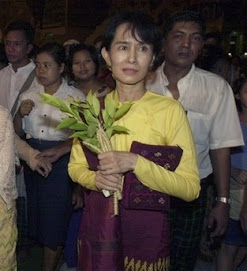


 Posts
Posts


