http://yoursdp.org/index.php/news/singapore/1768-singapore-to-toughen-protest-laws-ahead-of-apec-meet
Saturday, 17 January 2009
Reuters
Singapore will toughen its protest laws ahead of this year's Asia-Pacific Economic Cooperation (APEC) summit to reduce the number of civil disobedience acts, state media reported on Saturday.
Wong Kan Seng, Singapore's interior minister, told the pro-government Straits Times newspaper the city-state will look to enact regulations in the coming months giving police greater power to prevent protesters from gathering.
Singapore will host an APEC ministerial meeting in July and the annual summit in mid-November.
It hopes to avoid a controversy like the one in 2006 when an opposition politician was prevented from holding a march during the World Bank and International Monetary Fund meetings, resulting in a long standoff with police and criticism from the meeting organisers.
APEC's 21 members include the United States, China and Japan.
"For cause-related or ideologically-related activities, including those pertaining to race and religion, we should address them squarely as higher risk," Wong told the newspaper.
"We must empower the police to deal with public-order problems more effectively, especially when mega-events are held," he said.
Protests in tightly-controlled Singapore were only made legal last year in a designated zone, "Speakers' Corner", modelled after the one in London's Hyde park.
Any public gathering of five or more people is illegal in Singapore without a police permit.
Singapore defends the need for tough protest laws, citing concerns over public safety and order. But several international human right groups such as Amnesty International have said Singapore uses these laws to stifle dissent.
http://in.reuters.com/article/worldNews/idINIndia-37501620090117
Singapore govt to tighten laws against protests
AFP
Singapore's deputy prime minister said the island state, which is hosting a summit of Asia Pacific leaders this year, may further tighten laws against public protests, according to reports.
Wong Kan Seng, who is also Home Affairs minister, said the government is reviewing public order laws and may pass legislation to deal more effectively with illegal protests and other acts of civil disobedience, the Straits Times said.
The legislation is expected to be passed in time for the Asia Pacific Economic Cooperation (APEC) forum in November which could attract both local and overseas protesters, he said.
US president-elect Barack Obama, due to take office next week, is among the 21 leaders scheduled to attend the summit.
Public order laws are already tight in Singapore, where protests require a police permit if held outside a designated free-speech zone and gatherings of five or more people are illegal.
Nevertheless Wong said fresh legislation is needed to deal more effectively with political activities, while relaxing regulations on people gathering for social and recreational purposes.
He said police could be granted power to take action before protesters could gather at specific areas such as parliament, and cited protests by the political opposition, and by Myanmar nationals against their country's ruling junta.
"They make a show of breaking the law," Wong said of the protesters.
"The police watch and do nothing and can only follow up with investigation after the show is over when they pack up and leave. This cannot go on," he said.
http://news.yahoo.com/s/afp/20090117/wl_asia_afp/singaporepoliticsprotest
Comments Search RSS
Wednesday, January 21, 2009
Singapore to toughen protest laws ahead of APEC meet


Casting Light on Plight of Burmese Dissidents
http://www.nytimes.com/2009/01/18/world/asia/18prisoner.html?pagewanted=2
By THOMAS FULLER
Published: January 17, 2009
MAE SOT, Thailand — By the time he contracted tuberculosis, U Htay Aung, a dissident jailed for seven years in Myanmar, was incapable of telling prison guards about his condition. He had already lost his voice from years of exposure to the cold concrete floor that prisoners slept on.
Thomas Fuller/The International Herald Tribune
U Kyaw Kyaw Min, a lawyer for dissidents, fled to Thailand last year under the threat of prosecution. Myanmar’s government recently cracked down on lawyers defending political prisoners.
Thomas Fuller/The International Herald Tribune
U Htay Aung caught TB amid the harsh conditions of a seven-year imprisonment.
So Mr. Htay Aung decided to announce his illness in a more graphic form. He coughed up enough blood to fill a small cup. “When the guard came around, I showed him,” said Mr. Htay Aung, who has now recuperated but whose voice remains raspy. “They transferred me to the leprosy ward.”
Mr. Htay Aung recently told the story to a reporter and a handful of former political prisoners who have settled in this small Thai city on the border with Myanmar, formerly known as Burma. Many of them work at the Assistance Association for Political Prisoners, a group that tracks the plights of the more than 2,100 jailed dissidents in Myanmar and organizes aid for them and their families.
Founded nine years ago, the association has never been busier.
Last year, the Burmese military government sentenced 410 dissidents to prison terms ranging from a few years to six decades or more. The association lists details of the convictions in its online database, which is widely consulted by diplomats, United Nations officials and human rights workers. U Bo Kyi, the co-founder of the association, says that an additional 600 dissidents are in detention and have yet to be tried.
Among those convicted last year was an 80-year-old Buddhist nun, Daw Ponnami, who was given four years of hard labor for her involvement in street demonstrations led by Buddhist monks in September 2007. She has been spared the hard labor, the association says, but in what may be the final humiliation of her twilight years, her conviction was for insulting Buddhism.
A well-known comedian known as Zarganar was sentenced to 59 years in prison after criticizing the government for neglecting the victims of the cyclone that swept through lower Myanmar in May, killing more than 130,000 people.
U Gambira, a monk who helped lead the 2007 protests, was sentenced to 68 years.
Other political prisoners are listed in the database as farmers, a blogger, an ice cream seller, a bus conductor and a hip-hop singer in a band called Acid. All angered the government in one way or another.
In United Nations reports and diplomatic cables, Burmese political prisoners are often just a statistic, a measurement of the many human rights abuses carried out by Myanmar’s ruling generals.
But to members of the association here, the prisoners are part of a fraternity of fellow dissidents who have many needs. The association helps family members smuggle medicine, reading materials, blankets, clothing and food to the prisoners.
Occasionally guards are sympathetic, Mr. Bo Kyi said. Often they help just because they are poor and need the small bribes that prisoners and family members pay them.
Even the most basic necessities can require payment. “If you want to get more water for a shower you have to pay money,” Mr. Bo Kyi said.
Some prisons are so crowded that prisoners can sleep only on their sides. But guards reserve “V.I.P.” corners where prisoners can lie flat on their backs — for a fee.
The association’s annual budget of $200,000 is financed by the United States government’s National Endowment for Democracy, the Dutch government and private donors.
The budget also helps pay to whisk out of the country dissidents in danger of arrest.
Two years ago the association sent $100 to U Aung Kyaw Oo, a former student activist who spent 14 years in prison, to help him escape Myanmar. He made it to Thailand, and he said he would remain here. “It feels better than inside,” he said. “They can’t arrest me here.”
Myanmar’s most famous political prisoner, the Nobel laureate and pro-democracy leader Daw Aung San Suu Kyi, is barred by the military government from leaving her lakeside house in a plush neighborhood of Yangon, the commercial capital, formerly known as Rangoon. Her cause is championed by a wide variety of people across the globe, including foreign leaders and college students in the United States.
But most political prisoners in Myanmar live much more anonymously and in much more rudimentary conditions.
To be a political prisoner in Myanmar, Mr. Bo Kyi said, is to truly experience darkness. Prisoners are often let out of their cells only 20 minutes a day, he said. They are lorded over by the criminal prisoners, who are encouraged by the guards to discipline and intimidate them. And they are routinely transferred hundreds of miles from their families to remote prisons that have no clinics or medical staff.
As punishment, guards sometimes make prisoners crawl through an interrogation room where the floor is made of bricks with sharp edges. During interrogation they require male inmates to answer them using words in the Burmese language that are usually reserved for women.
Mr. Bo Kyi and his colleagues say they want to cast light on the plights of the lesser-known prisoners. His group’s logo shows a beam of light shining into a prison cell.
As a former political prisoner himself, Mr. Bo Kyi is fluent in the notion of deprivation and cruelty: the crowded cells, the inadequate food and the stinking bucket that inmates shared as a toilet.
But 10 years after his release he says he now also sees more clearly the pain that lingers outside prison walls, among the extended families who are ostracized and harassed by Myanmar’s authorities. In October, he heard about the wife of an imprisoned dissident who, desperate for cash, cut her long hair, a treasured symbol of beauty in Myanmar, and sold it for the equivalent of $20.
Thomas Fuller/The International Herald Tribune
U Bo Kyi co-founded an association that tracks and helps Myanmar’s political prisoners.
“When I got that information I felt very sad,” Mr. Bo Kyi said in English, which he learned from a fellow inmate who had memorized the Burmese-English dictionary to pass the time. The association sent the woman cash to help her start a small grocery store.
The association tracks prisoners through its networks of sympathetic, or bribed, prison guards, former political prisoners and family members.
Perhaps more than any other organization, the group has succeeded in cutting through the extreme secrecy of Myanmar’s military government. Recent trials have taken place inside a prison in Yangon without lawyers or family members present. The government recently cracked down on lawyers who tried to defend political prisoners, sentencing at least two to jail terms for contempt of court. One lawyer threatened with prosecution, U Kyaw Kyaw Min, 29, fled to Thailand and is now being helped by the association.
The Red Cross has been barred from visiting prisoners for the past three years, and a United Nations envoy for human rights is given a highly circumscribed tour of prisons during now-and-again visits.
David Mathieson, Myanmar consultant for Human Rights Watch, the New York-based advocacy group, said Mr. Bo Kyi and the association had won the respect of diplomats and human rights workers because of their just-the-facts approach.
“They are keeping their efforts very disciplined and very directed,” Mr. Mathieson said. “In terms of the Burmese opposition in exile, it’s the most effective.”
In September, Human Rights Watch awarded Mr. Bo Kyi a Human Rights Defender Award.
The association for prisoners works out of a small house, shaded by a coconut tree and located in the backyard of a Thai family’s home. Mr. Bo Kyi, who shuffles around in cheap plastic sandals, is paid 8,000 baht a month, about $232.
The staff members surround themselves with reminders of their years in prison. There are authentic leg irons smuggled out by an escaped prisoner, a scale model of Insein prison outside Yangon and a wall with hundreds of photographs of political prisoners.
“We gave up our best years,” Mr. Bo Kyi said, as he scanned the wall of photographs. But he does not want revenge on the government, he said. “What we want is very simple,” he said. “Just freedom of speech.”
North Korea Says It Has ‘Weaponized’ Plutonium
http://bipartisanalliance.blogspot.com/2009/01/north-korea-says-it-has-weaponized.html
Saturday, January 17, 2009
by Choe Sang-Hun
TNYT, January 18, 2009
SEOUL, South Korea — The North Korean military declared an “all-out confrontational posture” against South Korea on Saturday as an American scholar said he had been told by North Korean officials that the North had “weaponized” 30.8 kilograms of plutonium, enough for four to six nuclear bombs.
That claim would confirm American intelligence estimates, which suggest that the North has harvested the fuel for six or more bombs.
South Korea ordered its military to heighten vigilance along the heavily fortified border with North Korea, said a spokesman of the South Korean military joint chiefs of staff.
North Korea’s saber-rattling rhetoric against the South has increased in intensity since President Lee Myung-bak came to office in Seoul a year ago, vowing to take a tougher stance on North Korea, reversing 10 years of his liberal predecessors’ efforts to engage the North with economic aid. But what made the threat on Saturday unusual — and more worrisome to some South Korean analysts — was the way it was delivered: in a statement read on North Korean television by a uniformed spokesman for the North Korean military joint chiefs of staff.
“Strong military measures will follow from our revolutionary armed force,” the spokesman, a colonel, said, according to Yonhap, South Korea’s national news agency, which monitors North Korean broadcasts.
Usually the North Korean government issues written statements that are delivered by North Korean media; sometimes the statements are read by press officers, not by a uniformed member of the military.
The spokesman he warned of a clash along a disputed western sea border between the Koreas. The two navies fought skirmishes there in 1999 and 2002. It is always difficult to decipher the messages that North Korea’s reclusive government is trying to send with its often bombastic missives. In times of crucial bargaining, North Korea often tries to drive a wedge between Washington and South Korea to sow discord between the allies, and raises the stakes by increasing demands and issuing dire threats.
With President-elect Barack Obama about to take office in the United States and negotiations over the North’s nuclear program expected to resume, it is possible that the North is merely setting up its negotiating position. But analysts said it could also be an indication that North Korea was intending to hold on to its arms despite an agreement it signed with five countries, including the United States, in 2005, in which it committed to eventually giving up those weapons. The exact conditions under which it would do so were unclear.
Questions over the health of the country’s quixotic leader, Kim Jong-il, also complicate any attempts to understand the country, where few Westerners have access. In August, there were reports that Mr. Kim suffered a stroke, and since then rumors have swirled about who might succeed him.
The news about the possible weaponization of North Korea’s stores of plutonium were delivered Saturday by the American scholar, Selig S. Harrison, the director of the Asia program at the Center for International Policy, who was in Beijing after returning from the North Korean capital, Pyongyang.
Mr. Harrison, said that when pressed, the North Korean officials did not explicitly say what “weaponization” of the plutonium meant, but that the implication was that North Korea had created nuclear bombs with the plutonium.
Mr. Harrison, a former journalist, often travels to North Korea to meet with senior officials there.
“They’ve raised the bar and said, ‘We are a nuclear weapons state and deal with us on that basis,’ ” said Mr. Harrison at a news conference in the St. Regis Hotel in Beijing.
Mr. Harrison acknowledged that North Korea could be bluffing in order to use the claim of having nuclear weapons as a negotiating tactic.
He added that all the officials he met with seemed eager to open discussions with the incoming Obama administration. “All the statements about Obama were very helpful, very respectful,” he said.
Thirty kilograms of plutonium, about 66 pounds, which would account for most of the 37 kilograms North Korea declared that it possessed to the United States last year, is enough for it to make four to six bombs, according to nuclear experts.
South Korea had no immediate reaction to Mr. Harrison’s report.
Earlier Saturday, North Korea also toughened its stance toward Washington, saying that reopening diplomatic ties would not be enough to persuade it to give up its nuclear weapons. It said it would maintain its “status as a nuclear weapons state” as long as there was a nuclear threat from the United States.
“We can live without normalizing ties with the United States, but we cannot live without a nuclear deterrent,” a spokesman for North Korea’s Foreign Ministry told its official news agency, KCNA.
In the past, the North had said it would not dismantle the weapons until the United States changed what it termed its “hostile attitude.”
In the spokesman’s comments, and his similar statement last Tuesday, North Korea laid out its demands as it prepared for a new series of negotiations with Mr. Obama, who will be inaugurated on Tuesday.
Its stance posed the hard question to the new Obama administration of what it would take to remove North Korea’s nuclear weapons assets.
In its Tuesday statement, North Korea indicated that the removal of an American nuclear threat meant the removal of South Korea from the American nuclear umbrella, the introduction of a verification mechanism to ensure that no American atomic weapons are deployed in or pass through South Korea, and even simultaneous nuclear disarmament talks among “all nuclear states,” including itself.
Six-nation talks on ending North Korea’s nuclear programs, which include the United States, stalled in the last months of the Bush administration as the United States and North Korea bickered over how much nuclear inspection the North should accept.
Edward Wong contributed reporting from Beijing.
Posted by Bipartisan Alliance/DC at 10:41 AM
Myanmar: A Fragile Peace
http://pulitzercenter.typepad.com/untold_stories/2009/01/myanmar-a-fragile-peace.html
On a blustery afternoon last December, senior officers in the Kachin Independence Army gathered for lunch in the Himalayan foothills of northern Myanmar, just a stone’s throw from the Chinese border, at a wartime military base called Pajau.
Lunch was a classy affair, served outside on a picnic table next to the liaison office. The officers ate and drank with the mountain sun on their faces. They were in their 50s and 60s, and had fought the Burmese military in these mountains since their teenage years.
Ever since a ceasefire agreement was signed in 1994, there has been peace in Kachin land. On this December day, the officers attended a graduation ceremony for Kachin army clerks, followed by lunch in the sun with two American journalists.
The food was rich and fatty, and attentive young soldiers stood by with Merlot and Johnny Walker Black. The officers leaned back in their chairs, loosened their belts and soaked it all in.
Zeng Haw, a 61-year-old colonel wearing a U.S. Army jacket with BATMAN on the name badge, commented happily on the scene...
Continue Reading This Post
Posted by Tim Patterson on January 17, 2009 at 04:22 PM in Myanmar: Kachin Struggle for Freedom | Permalink
100 churches ordered closed in Rangoon, Burma
http://www.novascotiascott.com/2009/01/16/100-churches-ordered-closed-in-rangoon-burma/
by Scott Gilbreath ~ January 16th, 2009
Christian Solidarity Worldwide has received reports from Burma (Myanmar) that local authorities in Rangoon (Yangon), the country’s former capital, are ordering churches to stop holding worship services and threatening to jail disobedient pastors. As many as 80 percent of the city’s churches could be affected.
The campaign appears to be particularly targeted at churches meeting in apartment buildings, rather than churches that own their own building and land.
According to a report by the Democratic Voice of Burma (DVB), officials from the local branch of the Ministry of Religious Affairs summoned the owners of buildings in which churches were meeting, and issued them with an order prohibiting the use of private property for religious purposes.
“Christians are worried that they will not be allowed to worship anymore, even in their own house,” said one pastor in a report received by CSW.
One pastor in Rangoon, who cannot be named for security reasons, claimed in a report received by CSW that several churches have now been locked and sealed, including three churches in South Dagon Township: the Evangelical Baptist Church, the Karen Baptist Church and the Dagon Joshua Church.
Authorities have not given any reason for the crackdown.
In 2007, a document said to originate in the Ministry of Religious Affairs outlined a programme to eradicate Christianity in Burma.
Thai shift on Burma human rights?
http://jotman.blogspot.com/2009/01/thai-shift-on-burma-issue.html
Friday, January 16, 2009
Irrawaddy reports that Thailand's new PM Abhisit said it is time for "change" in regards to Thailand's policy with regards to Burma. Abhisit elaborated:
The Thai government will use a “flexible engagement” policy in relation to Burma under the Democrat administration, he said. The “flexible engagement” policy was outlined by Surin Pitsuwan, the former Thai foreign minister and current secretary-general of Asean in 1999. He said Asean should move from a “constructive engagement” approach to the "flexible engagement" policy.
“Flexible engagement” was about open and frank discussion on issues such as human rights, leading to cooperative solutions — a pooling of sovereignty rather than its dilution, so as to make Southeast Asia a secure and prosperous region, according to analysts.
What this could mean in practice remains unclear, but considering that Thailand has been one of the junta's staunchest defenders, it is a hopeful sign that a Thai PM would acknowledge this much.
In November Myanmar's junta sentenced numerous critics, including a poet and blogger, to long prison terms. See here for background on Burma.
Posted by Jotman on 16.1.09
Japanese Defense Ministry eyes developing early warning satellite
Japanese Defense Ministry eyes developing early warning satellite for missile shield
Ministry eyes developing early warning satellite for missile shield
Kyodo News, Saturday, Jan 17, 2009 @ 06:28 AM JST
TOKYO — The Defense Ministry is considering developing an early warning satellite to detect a ballistic missile in its boost phase to better deal with threats under Japan’s missile shield, according to the ministry’s basic policy on space development and use released Friday. The development of a man-made orbiter, if realized, would be the first step toward Japan having a satellite-based missile detection system of its own.
Japan currently relies on the United States for information on ballistic missile launches, such as those undertaken by North Korea. The early warning satellite would be designed to detect the heat released by a ballistic missile during its boost phase using infrared sensors, providing Tokyo with more time to respond. The development of such a satellite is likely to face many hurdles, however, not only due to technical problems and the huge costs involved but also because of the potential reaction of the United States, Japan’s closest ally.
Memo to Obama: Don't forget about Asia
http://shadow.foreignpolicy.com/posts/2009/01/16/obama_foreign_policy_in_asia
Fri, 01/16/2009 - 5:44pm
By Aaron Friedberg
Henry Kissinger once described his time in government this way:
Sometimes it feels as if you were in one of those movies, sitting on the track in front of an express train. The train is bearing down on you. You know what to do if you did not have ten other things that needed doing first. You are praying that the train somehow will miss and you will not get hit.
When he takes office next Tuesday, Barack Obama is going to find trains bearing down on him from all sides: conflict in Gaza, unfinished wars in Iraq and Afghanistan, terrorist threats, a brewing confrontation between India and Pakistan, Iran on the brink of acquiring nuclear weapons, and an unresolved global economic crisis of unprecedented proportions.
With so many urgent problems to contend with, the new administration will have precious little time to devote to a more distant, but fast-approaching challenge that may yet turn out to be the biggest of them all: the ongoing shift in world wealth and power towards Asia and, in particular, the rise of China. Here’s a report, released this week, that’s designed to help. In it, my co-author Dan Blumenthal of the American Enterprise Institute and I (drawing on the conversations of an outstanding working group) describe the key features of “An American Strategy for Asia.”
As regards China, we argue that, even as it continues its long-standing policy of economic and diplomatic engagement, the United States is going to have to step up its efforts to maintain a favorable balance of power in East Asia. Towards this end we advocate the further strengthening of our existing bilateral alliance and quasi-alliance relationships, the creation of new multi-lateral mechanisms for promoting strategic cooperation among Asia’s democracies, and some significant improvements in U.S. capabilities to offset China’s ongoing military buildup. We conclude that: “The United States and its regional friends and allies have among them more than ample resources to ensure their security. But if they fail to deploy them in an effective and purposeful way, they will find themselves on the wrong end of a rapidly shifting balance of power.”
While it struggles to meet other, more immediate challenges, the Obama administration must find the time, energy and, hardest of all, the resources, to deal with this one as well.
BDD witnessed what they said about Burma in 2008
"Without helping the victims but only meditate in front of the Buddha stature is not a pure Buddhism and Buddhist monk, I must get out and help the victims whom they have still hope to live"
Dr. Ashin Nyanissara, Sitagu Abbot
"ASEAN Human Rights Charter is appropriate tool to bring Burmese generals to the international community"
- Mr. Abhisit V. Prime Minister of Thailand
"NCGUB's working capacity might be very limited but I always consider the best solution for the rest"
- Dr. Sein Win, exile Prime Minister (NCGUB)
"All exile community should provide their energy and their support for NLD and Daw Aung San Suu Kyi, instead of debating each other."
-NLD secretary and former political prisoner U Win Tin
"Shall we fight to gain more ground or just to wait for the regime's mercy?"
- General Tarmalarbaw, Chairman of the NCUB
"When we'd form the Democrat led coalition government, we can't follow what former PM Thaksin had been doing business dealing with Burmese regime, I promised you that our future government will never allow personal contact with regime"
- Mr. Kasit Piromya , a former ambassador and current Foreign Minister of Thailand
"Credentials Challenge is not a dream because regime has limited defensive mechanism at the UN"
-U Maung Maung, general secretary of NCUB
"Most of the political activists see me as an activist and they ignored my journalistic profession, but I saw things and wrote them, this is nothing personal, I do my job as journalist."
-Aung Zaw- Editor Irrawaddy Magazine
"We are now 20 years of struggle, elders should listen to us, and we are now political adult."
-Ma Khin Ohmar, NDD chairwoman and BP coordinator
"I am worried that exile community is wasting a time for fighting each other and nowhere to go. Regime has full opportunity and good chance for this. Who will get a benefit?"
-Ma Thin Thin Aung, presidium member of WLB
"If democratic forces do not change their attitude, they will be a history in a near future."
-Derik Tonkin, UK former ambassador to Thailand
"I might not be that lucky this time, unlike Saffron Revolution, I did walk out from their detention"
-Ko Zarganar, a social activist and comedian
"Myanmar needs to look at other countries, as long as government prevents any development of civil society, Myanmar position is far away from democratic transition"
-Juwono SUDARSONO, Defense minister of Republic of Indonesia
"China doesn't want to see its neighbors to gain freedom and democracy, like Taiwan and Burma"
-Chen Shui-bian, a former President of Taiwan
Rumors were everywhere but I heard late U Ne Win said to his family and followers around him that "do not response any negative to a young girl (Daw Aung San Suu Kyi), she is my boss daughter and I forgive her."
-(Name withhold) Former general, SPDC
"China wishes Myanmar generals would listen to all Chinese suggestions, but they didn't"
-A Chinese scholar
"All of us in Delta seemed living in hell, not only one day but for a few months"
-A victim, from cyclone effective area
"I did complaint to the voting station because they said 100% were yes votes, because my four family members did cast 'NO' there"
-A voter at the referendum day, 24 May 2008
Posted by BURMA DEMOCRACY & DEVELOPMENT at 1/17/2009 05:18:00 PM
Links to this post
Navy denies ill-treatment of Rohingya migrants from Burma and Bangladesh
Navy chief Admiral Kamthorn Phumhiran on Friday dismissed a BBC report claiming Thai military had ill-treated the Rohingyas from Burma and Bangladesh who sought work or asylum by pushing them out to sea and setting them adrift.
"The Royal Thai Navy did not badly treated the Rohingyas. There was no setting them adrift as alleged," he said.
Under the military convention, the navy is obligated to rescue enemies from a sunken ship, he said, arguing there is no reason to mistreat the migrants landing on the Thai shore.
In the incident in question, the navy was notified by marine park rangers about the Rohingyas at Kon Sai Daeng, Ranong, he said.
A group of 20 navymen were dispatched to investigate and they found more than 100 Rohingyas, prompting the order for the migrants to lie down for safety reason, he said.
The Nation
Tuesday, January 20, 2009
Thailand's deadly treatment of migrants
http://news.bbc.co.uk/2/hi/south_asia/7834075.stm
The migrants tell of secretive, brutal treatment by Thai security services
A shocking story is unfolding in Thailand. Migrants and refugees who turn up on its shores have testified that they are being sent back to sea in boats without engines, their hands tied, left to their fate.
Hundreds are thought to have suffered this treatment - among them many Rohingya people of western Burma - and many have died. The BBC's Jonathan Head in Bangkok has been investigating what has been happening.
--------------------------------------------------------------------------------
The 46 Rohingyas who arrived by boat at Phrathong Island on Friday morning may be lucky.
Like the hundreds of other asylum-seekers from this Burmese Muslim minority who have arrived on Thailand's Andaman Sea coast, they have been handed over to the Internal Security Operations Command (ISOC), a military authority set up under the Cold War and still given sweeping powers to protect national security.
That means they disappear into a black hole. No visits from lawyers or refugee advocates. The military can do what it likes with them.
But after the spotlight now being shone onto the treatment of previous Rohingya groups, this one may be handled more leniently.
Overboard
Harsh treatment of asylum-seekers is nothing new in Thailand. But the allegations made by Rohingyas who have drifted hundreds of kilometres to the Andaman Islands and Indonesia's Aceh province are shocking.
We were put on a desolate island for eight days, beaten [and then] put in a flat and open-bodied boat with no engine
Mohammed, survivor
Survivor's ordeal
According to a local civic group, the Arakan Project, whose staff have done extensive interviews with some of the survivors, they were detained by the Thai security forces in late November and December last year as they arrived by boat.
Instead of being handed over to the police or immigration for processing as illegal immigrants, they were instead taken by military units to an island called Koh Sai Daeng. They were detained there for several days, sleeping out in the open, their hands tied at night.
On 18 December one group of just over 400 was put on a navy boat, which was towing a barge behind it, says Chris Lewa from the Arakan Project.
Their hands were tied. Once out at sea they were ordered to move onto the barge at gunpoint. They refused. The Thai troops then tied the feet of four of them and threw them overboard.
The group then moved onto the barge, and the rope was cut, leaving them with food and water for two days.
They drifted for more than 10. According to the testimony she has obtained, Ms Lewa says they sighted land - the Andaman Islands - on around the 12th day.
Fearful that the current would sweep their barge away, many of the exhausted and dehydrated Rohingyas leapt into the sea to try to make it to land.
Fewer than 100 were found on board by the Indian coastguard, although an unknown number was also picked up from the sea or on beaches.
Briefer telephone interviews with survivors by the BBC have confirmed this account. Survivors who reached Aceh have told the local media the same thing.
In all, more than 800 Rohingyas were expelled in this way in December. Hundreds may have died.
Denial
The local commander of ISOC in Ranong, Col Manas Khongpan, has denied these allegations. He told the BBC that illegal immigrants are never held by his troops.
Some of the lucky survivors were picked up by the Indian coastguard
But that contradicts comments the BBC has been given by other military and police officials, who say all Rohingya boat-people are now being handled by ISOC.
Some of those officials, who did not want to be named, confirmed that Rohingyas had indeed been set adrift at sea, with little food and water.
They explained that Rohingyas are seen as a greater security threat than the tens of thousands of other illegal migrants, because they are Muslim, because they tend to arrive in large numbers at one time, and because they are almost exclusively men.
Immigration officials told us there is no evidence to support the allegation made by some in the military that Rohingyas have gone to Thailand's deep south to join the Islamic insurgency there.
The officials have told us that while most of the Rohingya want to go to Malaysia - where there is already a community 20,000 strong and the prospect of well-paid jobs - increasing numbers are staying in Thailand. The official figure last year was 4,886, and the unofficial figure may be much higher.
Military's power
The Thai government has now issued a statement saying it is investigating all the facts surrounding these allegations.
It has promised to re-assess the situation of all illegal immigrants in Thailand, numbering perhaps three or four million, most of them from Burma, and to treat them in accordance with humanitarian principles.
Whether it can truly hold the military to account though is open to doubt. In many areas of Thailand the army operates with little civilian oversight. It has huge secret budgets, and extensive business interests.
The current Democrat-led coalition was stitched together last month thanks to the intervention of the powerful army commander General Anupong Paochinda - he may well resist any calls for his men to be brought to justice over these allegations, as his predecessors have.
But it is also worth remembering that under the most recent constitution the most senior commander of ISOC is, in fact, the Prime Minister Abhisit Vejjajiva.
He has made the rule of law one of the core principles of his administration. Any crimes committed by ISOC personnel, whether against Thais or illegal migrants, will ultimately lie at his door.
Singapore in Human Rights Watch's Report 2009
http://yoursdp.org/index.php/news/singapore/1763-singapore-in-human-rights-watchs-report-2009
Friday, 16 January 2009
Human Rights Watch
The 19th annual World Report summarizes human rights conditions in more than 90 countries and territories worldwide. It reflects extensive investigative work undertaken in 2008 by Human Rights Watch staff, usually in close partnership with human rights activists in the country in question.
Sixty years after the adoption of the Universal Declaration of Human Rights, the governments demonstrating the clearest vision on international rights protections, sadly, are those seeking to undermine enforcement. In their foreign policies and in international fora, they invoke sovereignty, non-interference, and Southern solidarity to curb criticism of their human rights abuses and those of their allies and friends. Governments that champion human rights need urgently to wrest back the initiative from these human rights spoilers.
Singapore
Event of 2008
Singapore remains an authoritarian state with strict curbs on freedom of expression, assembly, and association; denial of due process rights; draconian defamation laws; and tight controls on independent political activity. Since 1959 the ruling People's Action Party (PAP) has won all elections.
Internal security and criminal laws permit prolonged detention of suspects without trial. Caning is obligatory for certain categories of crimes, as is the death penalty for others. Although reforms have improved employment conditions for some of the country's 180,000 migrant domestic workers, the government still fails to guarantee them basic rights.
Freedom of Expression and Assembly
Singapore's constitution guarantees freedom of assembly and expression, though parliament can and does limit both on security, public order, and morality grounds. Opposition politicians and their supporters are at constant risk of prison and substantial fines for simply expressing their views.
On October 13, 2008, Singapore's High Court ruled that opposition Singapore Democratic Party (SDP) Secretary General Dr. Chee Soon Juan and his sister, Chee Siok Chin, must pay Minister Mentor Lee Kuan Yew and his son, Prime Minister Lee Hsien Loong, US$416,000 in damages for an article in the SDP's newsletter. The article had compared how the government is run to a scandal at a well-known charity. The ruling may bankrupt the SDP and permanently shut it down. Dr. Chee and Ms. Chee are already bankrupt because of previous defamation rulings against them.
In September 2008 the Lees also won a defamation suit against the Far Eastern Economic Review and its editor Hugo Restall for commentary on the same case. Damages had yet to be assessed at this writing. The government is also seeking contempt proceedings against the publisher and two editors of the Asian Wall Street Journal for editorial comments related to the case.
In May Dr. Chee and a colleague were fined for speaking in public without a permit during the 2006 election campaign. They were charged with trying to sell copies of the SDP newsletter on a Singapore street.
Movies, music, and video games are routinely censored in Singapore. The Media Development Authority controls website licensing. In May 2008 the authority interrupted a private screening, sponsored by the SDP, of the video One Nation Under Lee.
The Newspaper and Printing Presses Act requires that locally published newspapers renew their licenses each year, and empowers authorities to limit the circulation of foreign publications deemed to "be engaging in the domestic politics of Singapore."
How far Singapore's leadership will loosen curbs on assembly and expression, as Prime Minister Loong suggested in August 2008, remains to be seen. The only step taken in 2008 was the government's decision in September to rescind the need for police permission for gatherings and rallies of more than four people at a popular park site officially labeled the Speaker's Corner. Race and religion still may not be publicly discussed, police may still intervene on public order grounds, and a permit is still required elsewhere in the city.
In March, on World Consumer Rights Day, police stopped a protest against rising prices outside Parliament House. The organizers, among them Dr. Chee, had been refused a permit; 18 protesters have since been charged with illegal assembly and procession. A day after the attempted rally, the non-political Consumer Association of Singapore was able to hold a public event without incident.
Due Process
Singapore's Internal Security Act (ISA), Criminal Law (Temporary Provisions) Act (CLA), Misuse of Drugs Act (MDA), and Undesirable Publications Act permit arrest and detention of suspects without a warrant or judicial review. Both the ISA and the CLA also authorize preventive detention. The MDA permits the Central Narcotics Bureau chief to send suspected drug users for rehabilitation without recourse to trial.
The ISA is used against suspected Islamist militants, many of whom have been detained for long periods without trial. There is no right to challenge detention on substantive grounds. As of April 2008 some 30 suspected Muslim militants were being held, almost all members of Jemaah Islamiah. Another 25-30 former detainees live under restriction orders.
Caning
Singapore's penal code mandates caning combined with imprisonment for some 30 offenses, including drug and immigration felonies. It is discretionary for other offenses. Courts reportedly sentenced 6,404 men and boys to caning in 2007, some 95 percent of whose sentences were carried out.
Death Penalty
Although death penalty statistics are secret in Singapore, available information indicates that it has one of the world's highest per capita execution rates. In December 2007 Singapore joined with 53 other states in voting against a nonbinding UN General Assembly resolution calling for "a moratorium on executions with a view to abolishing the death penalty." Earlier, Singapore's home affairs minister, referring to the law's deterrent effects, commented that "there is no room to go soft."
Migrant Domestic Workers
Singapore's labor laws exclude some 180,000 migrant domestic workers from key protections guaranteed to other workers, such as a weekly day off, limits on working hours, annual leave, paid holidays, and caps on salary deductions. In May 2008 acting Minister for Manpower Gan Kim Yong said it was unnecessary to mandate a weekly rest day. He instead supported the current standard contract provision that provides for at least one day off a month or compensatory pay. However, many employers forbid domestic workers to take a rest day; their isolation and employers' power to have them deported at will make it difficult if not impossible for them to bargain effectively for their due.
The government has prosecuted some employers who physically abuse domestic workers and imposed penalties on labor recruitment agencies for unethical practices. However it has failed to regulate exploitative recruitment charges that can consume a third or more of workers' two-year wage total.
Privacy
In October 2007 Singapore's parliament rejected a proposal to repeal law 377A, which bans private and consensual sexual relations between men. Although prosecutions are rare, those found in violation can be jailed for up to two years on charges of "gross indecency."
In April 2008 the Media Development Authority fined a local television station for featuring a gay couple and their baby under regulations that prohibit promotion of gay lifestyles. It also fined a cable network for airing a commercial that showed two women kissing.
Human Rights Defenders
State laws and political repression effectively prevent the establishment of human rights organizations and deter individuals from speaking out publicly against government policies.
Unless they are registered as political parties, associations may not engage in any activities the government deems political. Trade unions are under the same restrictions and are banned from contributing to political parties or using their funds for political purposes. Most unions are affiliated with the umbrella National Trade Union Congress, which does not allow members supportive of opposition parties to hold office.
Key International Actors
Singapore is a key member of the Southeast Asia Regional Centre for Counter-Terrorism, along with the US, Malaysia, and others, and is an active participant in regional and sub-regional security issues. It is also an important financial and banking center for Southeast Asia.
In February 2008 Singapore Foreign Minister George Yong-Boon Yeo, then chair of the Association of Southeast Asian Nations (ASEAN), expressed ASEAN's concern about the conditions under which Burma's constitutional referendum took place. Since July 2008, after Singapore's term as chair of ASEAN ended, the government has shown more support for Burma's government, even refusing to renew residency permits for Burmese citizens who appear to have taken part in peaceful activities critical of Burmese government policies.
http://www.hrw.org/en/node/79247
Comments Search RSS
Robox - Sat, 17 Jan 2009 2:42 am
Re: "In their foreign policies and in international fora, they invoke sovereignty, non-interference, and Southern solidarity to curb criticism of their human rights abuses and those of their allies and friends."
They also invoke another argument: our pure and virginal culture/s which imbues us with ears so delicate, that we disintegrate when when we hear words like "human rights", "gay", and ...(gasp) ... "SEX!!!".
This ploy is used like a gun pointing at white people's heads: if you are a Westerner who criticizes human rights abuses in non-white countries, then you are culturally insensitive and indeed racist, something the non-white human wrongs thugs know that whites are terrified of being accused of.
According to the same wisdom, we, the non-white cultures, have a masochistic streak so entrenched in us that we cannot have enough of the government's abuse.
I believe that it was our very own Lee Skunk Yew who devised this most disingenuous of arguments, but it has now spread like a cancer to so many countries - China is particularly notorious for this, and when the ever belligerent China speaks, the entire world is cowed into silence lest they lose their share of the China market.
Well, if that is what my culture is, according to the holder of a doctorate in Cultural Studies (Area of specialization: India/n-bashing) Lee Skunk Yew, then I would be happy to dump my culture.
It is time for those of us who disagree with this ploy to stand up to our own human wrongs thugs and tell them in no uncertain terms that:
1. cultures have always evolved over time to adapt to changing realities; and,
2. there is internal diversity within cultures - many of us from the same pure and virginal culture as Lee Skunk Yew do not agree with him on human wrongs.
tan - Sat, 17 Jan 2009 12:33 am
Singapore is like a garden without flowers.
maxchew - Caning for illegal assemblers? Sat, 17 Jan 2009 12:05 pm
I predicted as much sometime ago in this blog as well as other blogs.
Read today's ST where dwarfman WKS told the media the PAP Govt will introduce very soon new legislation to tackle illegal assemblers like the SDP leaders and their followers have been doing several times. Apparently the short stints in prison and fines are not deterrent enough.....so what could be a deterrent but CANING? I just knew and smell it a mile away. I predict once more that the mandatory caning is only applicable for the 2nd time conviction onwds.
They did it for illegal immigrants as well as money-lenders. What's to stop them to include caning also for the likes of CSJ, JohnTan, Seelan Palay etc etc?
Hope GE will come this year so the citizens can tell the PAP Govt what they think of them and their cruel laws!They are just desperate to stay in power permanently......
Henry Windgates - Sat, 17 Jan 2009 5:37 pm
Quote:
In September 2008 the Lees also won a defamation suit against the Far Eastern Economic Review and its editor Hugo Restall for commentary on the same case. Damages had yet to be assessed at this writing. The government is also seeking contempt proceedings against the publisher and two editors of the Asian Wall Street Journal for editorial comments related to the case.
Quote:
Movies, music, and video games are routinely censored in Singapore. The Media Development Authority controls website licensing. In May 2008 the authority interrupted a private screening, sponsored by the SDP, of the video One Nation Under Lee.
Pure examples of how a country which has draconian censorship laws would be nothing but constant trouble for it's citizens, the state-owned media only portrays unbiased opinions of foreign news but what about local politics? Nay, I'm afraid not, because everything about the PAP and the ruling government are basically sugarcoated, especially films, political or otherwise.
I think kids and adults alike should be allowed exposure to the political world, starting with political films, rather than sugarcoating everything that has got to do with local politics and forcing us to watch Disney films all the time.
And this report also attests to the evils of social conservatism, hiding under the guise of being "clean" and "morally upright" which in fact, under the innocent mask lies a evil face of oppression and brutal stranglehold on dissenting opinions.
Seelan Palay - Sun, 18 Jan 2009 5:09 pm
"Singapore remains an authoritarian state" - that says enough.
AnnA - Singapore 2028 Sun, 18 Jan 2009 6:44 pm
By 2028, there won't be any respect left for people who claim themselves as Singaporean. 85% of us will have a either a police record, a prison record or a caning mark. Fuck PAP!!
AnnA
Henry Windgates - Mon, 19 Jan 2009 4:56 pm
And in Singapore, it's almost nigh impossible to avoid getting a police or prison record because everything you do is literally criminalized by the ruling PAP government! How much does it have to suck to have your life equated to that of a terrorist if you're a homosexual or just a non-conformist?
Quote:
By 2028, there won't be any respect left for people who claim themselves as Singaporean. 85% of us will have a either a police record, a prison record or a caning mark. Fuck PAP!!
AnnA
I doubt we, the human race, would even live to see 2028. December 2012 marks the end of the world, according to the Mayan calender, remember? Just a thought.
S.Africa assures China of political continuity
http://www.google.com/hostednews/afp/article/ALeqM5ghGaIlmdPDWxAPKevGdDsJkp0obA
KLEINMOND, South Africa (AFP) — South Africa's Foreign Minister Nkosazana Dlamini-Zuma on Friday assured her Chinese counterpart that general elections were unlikely to change her country's political scene.
"New parties have emerged but still we think at the end of elections nothing will change much," Dlamini told Chinese Foreign Minister Yang Jiechi speaking of the general elections expected in the second quarter of the year.
The two ministers met outside Cape Town to strengthen ties between their two countries in their fourth encounter in the past 12 months.
Talks between the two nations were to focus on economics and changing global dynamics.
"Both China and South Africa are important developing countries when the international situation is undergoing profound changes and new problems and new challenges keep emerging," said Yang.
He said it was important the two nations meet regularly to deepen the partnership between them.
Yang said the two countries had built up political trust in recent years and thanked South Africa for its cooperation on tricky international issues.
"Our countries conducted close coordination and cooperation in the UN Security Council as regards major international and regional issues and hotspot issues," Yang said before the start of the closed-door meeting.
South Africa has often joined China in blocking the discussion and resolutions around sensitive international issues such as the Zimbabwe crisis and the situation in Myanmar, also known as Burma.
"South Africa gave China valuable support on issues that concern China's core interests including Taiwan and Tibet-related issues."
The two countries also planned further cooperation in dealing with the international financial crisis.
Yang is on the last leg of a four-nation African trip which also took him to Uganda, Rwanda and Malawi.
His visit aims to strengthen relations with African countries, as China seeks to further extend its influence on the resource-rich continent in a relationship that has often drawn criticism from the West.
China has extended billions of dollars in loans towards infrastructure development amongst others to countries such as Sudan which have poor human rights records, obtaining huge oil and gas deals.
South Africa is China's key trading partner in Africa, accounting for 20.8 percent of the total volume of China-Africa trade in 2007 with total trade at some 88 billion rand (8.8 billion US dollars).
North Korean national dies in Meikhtila -DVB
(DVB)–A North Korean who was believed to be a weapon specialist working in a secret research facility in central Burma has died on the way to Meikhtila military hospital after suffering a serious headache.
According to a member of staff at the hospital, speaking on condition of anonymity, the unidentified North Korean was already dead when he arrived at the hospital on 9 January.
A Meikhtila resident said the man’s body was cremated at around 7am on 11 January with the assistance of a local charity called Yan Aung Myin funeral service.
An official from Yan Aung Myin funeral service said the funeral was attended by a group of North Koreans, assumed to be his family, and a few Burmese army officers in civilian clothing.
"We were informed of his death by Meikhtila military hospital who told us to arrange a funeral service for him," the official said.
"The funeral was held early in the morning and it was rumoured that the
authorities wanted to keep it a secret from the public as he was a foreigner who was involved with government work."
Sources close to the military in Meikhtila said the dead foreigner was working on a secret weapons project for the government.
Military analyst and researcher Htay Aung of the Thailand-based Burmese exile group Network for Democracy and Development said the group had received reports on secret facilities being built by the government around Meikhtila.
"We have obtained some information on the government building some secret facilities around Meikhtila, particularly on the one being built near Taung Thar township," said Htay Aung.
"No one from the outside world knows what they have been doing in that facility but foreigners have often been seen around the area," he said.
"I assume that if he was not just a regular tourist, then he must have been some sort of specialist working on a secret government project or in a research facility."
Htay Aung said residents of nearby Taungdwingyi and Myo Thit townships had often spotted foreigners, assumed to be North Koreans, in the area.
Last year there were reports on a Russian national who had gone missing in Shan state but that case was also given a low profile by the government.
Reporting by Ahunt Phone Myat
Activists Welcome New Thai Government's Policy Stance on Burma

Thai Prime Minister Abhisit Vejjajiva at Foreign Press Club in Bangkok, 14 Jan 2009
By Ron Corben
Bangkok
16 January 2009
Burmese pro-democracy activists have welcomed the stated policy approach by the new Thai government and its call for political change in Burma ahead of Burma's general elections, scheduled for 2010. The Thai Government is also looking to other South East Asian nations to be more active in calling for reform in the military ruled country.
Thai Prime Minister Abhisit Vejjajiva at Foreign Press Club in Bangkok, 14 Jan 2009
The new Thai Government's policy stance on Burma was set out in a key address by the prime minister, Abhisit Vejjajiva, this week and his warnings about the political situation in Burma have wider ramifications for the whole region.
Mr Abhisit, in an address to foreign correspondents this week, said the government would look to encourage reform in Burma, also known as Myanmar, through a process of "flexible engagement".
The flexible engagement policy, adopted by the then-foreign minister Surin Pitsuwan, now secretary-general of the Association of South East Asian Nations (ASEAN), called for more open dialogue on issues such as human rights.
"ASEAN to be strong it has to have the credibility and respect from the international community," he said. "So what's happening in Myanmar clearly affects the rest of the region - and I would just point out that it's time for change. As far as we are concerned we need to get ASEAN to become more proactive - it's not easy but I've seen changes and I've seen progress. "
Under the former Thai governments led by Prime Minister Thaksin Shinawatra, from 2001 until 2006, priority was given to Thailand's economic and business ties with Burma. Under a policy of "constructive engagement" Thailand and ASEAN had adopted a more low key diplomatic approach in its dealing with Burma.
Naing Aung, a former Burmese student leader and a civic group, the Network for Democracy and Development, welcomed the current Thai government's new move to place greater emphasis on human rights issues and political reform.
"Thailand's new government will be standing on the human rights and then more on the democratic principal," he said. "But in terms of making pressure if they are going through ASEAN it will still be difficult because ASEAN as a whole, they still have a policy of non-interference."
Debbie Stothardt
Debbie Stothardt, spokeswoman for the Alternative ASEAN network on Burma, said the Thai government policy also needed to be backed by calls for the release of political prisoners. Stothardt said Thailand, as the current chair of ASEAN, had a role to play to promote political reform. An ASEAN leaders summit is due to take place in late February in Thailand.
"What we need to see really from the other ASEAN governments - including the new Thai government - is sufficient political will to deal with this problem once and for all," she said. "ASEAN needs to realize that this regime has no respect for polite diplomacy - this regime will only respect ASEAN when ASEAN shows that it is determined."
Burma's military government has said its road map to democracy and general elections in 2010 needs the political steps the government is taking. But many analysts expect the military to still retain considerable influence in the new parliament, backed by a constitution seen as favoring the military.
Burma's military has been in power since 1962, with the current government ruling the country since 1988. It ignored the last election result in 1990, won in a landslide by the party spearheaded by pro-democracy leader Aung San Suu Kyi, who remains under house arrest.
Indian Vice President to visit Burma to strengthen bilateral relations -MIZZIMA
http://www.mizzima.com/news/inside-burma/1567-indian-vice-president-to-visit-burma-to-strengthen-bilateral-relations.html
by Salai Pi Pi
Friday, 16 January 2009 21:33
New Delhi (Mizzima) - India's Vice President Hamid Ansari is set to visit neighbouring military-ruled Burma, in a bid to further strengthen bilateral cooperation between both countries, according to reports.
Ansari's trip will focus on consolidating India's energy interests in Burma and cooperation in infrastructure development, an official source was quoted as saying by the Indo-Asian News Service.
"Ansari will go on a goodwill visit to Myanmar [Burma] early next month. Preparations are under way," the report said.
Ansari's visit to Burma, which is a first for Indian leaders in 2009, is seen as a part of India's growing efforts to strengthen bilateral relationship with the gas-rich Southeast Asian nation.
Dr. Tint Swe, a minister of the Burmese government in exile – the National Coalition Government of the Union of Burma – said Ansari's visit is part of India's efforts to appease the Burmese military government in order to gain wider foothold in the country.
However, he said, "It has been about 15 years now, but India's Look East Policy has still not been a success," adding that it was time for India to reconsider its policy on Burma.
India, which is Burma's 4th largest trading partner after Thailand, China and Singapore, is competing with China, Thailand, South Korea and Japan to tap natural gas from offshore gas reserves on Burma's western coast.
However, in December 2008, Daewoo International Corporation along with it's four other partners - Myanmar Oil & Gas Enterprise (MOGE), ONGC, GAIL and Korea Gas Corporation (KOGAS) signed a deal with the China National Petroleum Corporation, to supply Burma's offshore gas to China for 30 years from 2012.
India's ONGC and GAIL both held 20 % and 10 % respectively in Burma's offshore A1 and A3 gas fields, and has been appeasing the junta so that it awards the right to import gas.
The Shwe gas fields on Burma's western coast are estimated to hold a reserve of 4.53 tcf (trillion cubic feet) of gas.
India, which lost out to China in its race to buy gas from Burma, however, is also looking for other energy cooperation options, with Burma including the building of hydro-electric projects.
The two countries recently signed a pact on the development of Tamanthi and Shwezay hydropower projects on the Chindwin River, in Burma's northwestern Sagaing division.
But Dr. Tint Swe, who is based in New Delhi and monitors Indo-Burmese relationship said, "The two countries' bilateral relations does not help the Burmese peoples' aspiration for democratic change."
"But it helps the junta in strengthening their rule," he added.
Indo-Burmese bilateral trade reached a record of 995 million US dollars in the fiscal year 2007-08, while Burma's exports to India accounted for 810 million US dollars and its imports from India touched 185 million US dollars, according to Burma's official statistics.
Dhaka wants to demarcate maritime boundaries in Bay of Bengal
http://story.chinanationalnews.com/index.php/ct/9/cid/b8de8e630faf3631/id/454323/cs/1/
China National News
Friday 16th January, 2009
(IANS)
The new Bangladesh government wants to engage neighbours India and Myanmar to demarcate maritime boundaries in the Bay of Bengal to be able to file its claim before the United Nations by 2011, a media report said Friday.
Prime Minister Sheikh Hasina, who convened a meeting of energy ministry officials Thursday, said she would coordinate with the foreign office in contacting Delhi and Yangon, but did not indicate when.
She would also confer with the Bangladesh Navy and Geological Survey of Bangladesh.
Hasina's deputy press secretary Sarwar Alam said that she raised the maritime boundary issue at her first meeting with the officials and wanted to know the latest situation and what surveys the ministry had conducted to demarcate the boundary.
Energy secretary Mohammad Mohsin told the prime minister that India and Myanmar were claiming maritime areas beyond their jurisdiction and often intruded into Bangladesh's territorial waters and that the foreign ministry was handling the issue, New Age newspaper said Friday quoting sources present at the meeting.
Mohsin also informed her that Bangladesh would have to lodge its claim over the maritime boundary with the United Nations by 2011 after completing necessary surveys for strengthening the claims.
Maritime boundaries' delineation became crucial after the finding of hydrocarbon reserves in the bay by India in recent years. Dhaka thinks it has missed the bus with poor response from international oil and gas companies.
Bangladesh is sandwiched between India and Myanmar in the upper reaches of the bay and says survey ships and even naval ships of the two countries cross into what it considers to be its own territory.
There had been stand-offs with the two neighbours in the bay in recent months and the erstwhile caretaker government had deployed naval ships and applied diplomatic pressures to get the neighbours' vessels out, pending resolution of the dispute.
Dhaka did not hold talks with India on the issue after 1982 and resumed it only last year. The parleys with both Delhi and Yangon have remained preliminary with each side insisting on its own standpoint.
US Senate Committee To Release Reports Of Myanmar Migrants
http://www.bernama.com/bernama/v5/newsgeneral.php?id=384195
January 16, 2009 17:43 PM
By Salmy Hashim
WASHINGTON, Jan 16 (Bernama) -- The United States Senate Foreign Relations Committee is working on two reports containing details of allegations by Myanmar migrants of extortions and threats of being turned over to human traffickers in southern Thailand, if ransom demands were not met.
A Committee staffer, who spoke on condition of anonymity, told Bernama here Thursday, that while the first report contained detailed allegations about the extortions and threats by Malaysian officials, the second report contained specific allegations by victims on who were paid and the recipients' bank account numbers.
Information from the second report would be conveyed to the United States law enforcement officials at the Treasury department and the Justice department who would determine what information would be shared with law enforcement officials in Southeast Asia, he added.
He said the timetable for release of the two reports had not been finalised.
Prime Minister Datuk Seri Abdullah Ahmad Badawi, in commenting on a foreign wire service report, wants the United States to pass on information pertaining to allegations that Malaysian officials extorted money from migrants in the country.
Stating that the government did not tolerate such practice, he said so far, the authorities had not received any report on the matter.
"If the US authority has it, we would be very thankful if they can pass the information to us, so that we can investigate and take appropriate action," he told reporters in Kuala Terengganu yesterday.
The Committee staffer told Bernama here that staffers had met with senior officials in Malaysia in August 2008 to make the Malaysian government aware of the allegations so that they could look into the matter.
The staffers also met with senior officials in southern Thailand (Sungai Golok). Last month, they went to Bangkok to meet with anti-trafficking police.
The staffer said the committee had received several signed statements by individuals (former Myanmar migrants) who typically alleged that once they reached Malaysian soil, they were arrested by Rela (People's Volunteer Corps) and then placed in government detention facilities.
They were then removed from these facilities and transported to the Malaysia-Thai border where they were later approached by agents of traffickers who demanded that they pay money to an established system, before they were allowed to return to Malaysia.
If these migrants refused to pay, they would often be turned over to human traffickers in southern Thailand.
"It's this same pattern of allegations that the committee received over the past year that caused us to investigate the matter," the staffer said.
There are more than 5,000 Myanmar refugees settled in Indiana where they had been giving first-person accounts of what had happened to them. About 40,000 Myanmar migrants have resettled in the United States since 1995.
-- BERNAMA
The war on Myanmar's border-Unequal struggle
http://www.economist.com/world/asia/displaystory.cfm?story_id=12941078
Jan 15th 2009 | MAE SOT
From The Economist print edition
Less for freedom than survival
ONE of Asia’s longest-running wars gets no less vicious as it gets older. For six decades the Karen National Union (KNU) has resisted the government in Yangon—inaptly known, these days, as the State Peace and Development Council or SPDC, a brutal junta. The biggest of Myanmar’s myriad insurgent groups not to have reached a truce with the SPDC, the KNU’s armed wing is now fighting desperately for survival in the mountainous Thai border region around the town of Umphang.
This month SPDC soldiers razed the base camp of one of its seven brigades: a newish settlement equipped with solar power, piped water, fish-holding tanks and medical facilities. Soldiers are now sleeping rough in dense jungle. Several hundred civilians, their homes in ashes, huddle under makeshift shelters.
Fighting alongside the SPDC are soldiers ostensibly belonging to a rival Karen militia, the Democratic Karen Buddhist Army (DKBA)—a loose coalition of KNU defectors, drug-runners and freelance thugs. The armies often mount attacks from Thai soil. That side of the border is more navigable, and is not strewn with landmines. The KNU’s David Thackrabaw accuses the SPDC of pursuing a scorched-earth policy against both fighters and the civilian population. Another KNU commander, Nerdah Mya, his base in cinders, says his army has no “location” any more and is “always on the move”. But he denies the war is in a critical stage. The KNU has been coping with such hardships for years.
Umphang was once home to one of Thailand’s finest teak forests, logged by the KNU, in the days when Thailand tolerated it as a useful buffer to Myanmar. The region is also rich in antimony, gold, zinc and tin. The latest phase of the war began last June, with a concerted battle for control of the area. At times the Thai army has resorted to lobbing mortars at SPDC battalions, whose stray shells have forced the evacuation of Thai villages. Local farmers are “taxed” by both sides to get their produce to market.
Of some 140,000 refugees from Myanmar in camps in Thailand, more than 60% come from Karen state. They may be the lucky ones. Reports from western Karen state say that villages and crops there are often torched. The DKBA is much loathed, and many of its soldiers might join the KNU if it had any scent of victory. But at the moment, it has none.
Political Prisoners Dying in Labour Camps in Burma
http://burmadigest.wordpress.com/2009/01/15/political-prisoners-dying-in-labour-camps-in-burma/
Posted by burmadigest under News
- report from Assistance Association for Political Prisoners (Burma)
15 January 2009
Political prisoner Zaw Naing Htwe is in danger of losing his life at Four Mile Labor Camp near Taungoo Town in Pegu Division, according to the Assistance Association for Political Prisoners (Burma). He is currently being held in iron shackles whilst being forced to perform hard labor by the authorities. He is not being given enough food and water.
On December 15 2008 he was sentenced to 9 years in prison, charged under sections 41/b and 42 of the prisons procedural code, related to exchanging correspondence in prison. He received a letter from his elder brother, 88 Generation Students Group member Kyaw Kyaw Htwe aka Marky, on 2 February 2008 during a prison visit.
In the first week of January 2009 Zaw Naing Htwe was transferred to Four Mile Labor Camp, 175 miles from Taungoo Town in Pegu Division.
Tate Naing, Secretary of the Assistance Association for Political Prisoners (Burma), said, “When the regime transfers political prisoners to labor camps, they are intentionally trying to kill them. There is little chance that political prisoners will return home after being in the labor camps.”
In 2008, at least 17 political prisoners were transferred to labor camps around Burma.
In October 1990, many monks participated in the boycott, pattam nikkujjana kamma or “overturning the bowl”, refusing to accept alms from members of the armed forces and their families. As punishment some were transferred to labor camps, and 19 monks died there.
UN agencies team up on family planning for refugees in Thailand
http://www.alertnet.org/thenews/newsdesk/UNHCR/ccabb97317d6e9588586df6ecd3e2a30.htm
15 Jan 2009 17:08:45 GMT
Source: UNHCR
Reuters and AlertNet are not responsible for the content of this article or for any external internet sites. The views expressed are the author's alone.
BANGKOK, Thailand, January 15 (UNHCR) – Refugees along Thailand's border with Myanmar will be able to continue to plan their families thanks to cooperation between UNHCR and the United Nations Population Fund (UNFPA).
The two UN agencies are collaborating to fill gaps in reproductive health care for the 111,000 refugees from Myanmar living in nine camps. A quarter of the refugees are women of reproductive age.
As an initial step, UNFPA on Wednesday handed over contraceptives to meet the needs of 8,500 current users and 400 new users for six months to one year. The UN refugee agency's private aid agency partners will distribute the supplies and provide related counselling, education and hospital referrals in four camps: Umpium, Mae La, Mae Ra Ma Luang and Mae La Oon.
"People's needs for voluntary family planning information and services do not end when they become refugees," said UNHCR Deputy Regional Representative Giuseppe de Vincentis. "We consider family planning and reproductive health a basic human right and UNHCR is committed to ensuring that all refugee needs are met."
The two agencies are also talking with the Thai government about long-term cooperation to address the needs of adolescents, whose access to information and services has been limited by cultural taboos.
"It is our hope that further collaboration with UNHCR will improve the predictability, timeliness and effectiveness of reproductive health information and service provision for refugees here in Thailand," said Garimella Giridhar, UNFPA's representative in Thailand.
By Kitty McKinsey
in Bangkok, Thailand
Myanmar Junta Jails Activist For 104 Years
http://www.nasdaq.com/aspxcontent/NewsStory.aspx?cpath=20090115/ACQDJON200901150022DOWJONESDJONLINE000006.htm&&mypage=newsheadlines&title=Myanmar%20Junta%20Jails%20Activist%20For%20104%20Years
YANGON (AFP)--A Myanmar court has jailed a student activist for 104 years, while the ruling junta freed six people who campaigned for the release of pro- democracy icon Aung San Suu Kyi, officials said Thursday.
Student activist Bo Min Yu Ko, who is in his 20s, was sentenced at a court in the central city of Mandalay in the past week, the latest in a wave of stiff prison terms handed down in the military-ruled nation in recent months.
"He was sentenced for his political activities as he went to the border (with Thailand) to contact an exile group," a Myanmar official said on condition of anonymity.
"He was also charged with some other cases related to his political movement," the official added, without giving further details on Bo Min Yu Ko or the cases against him.
Separately, authorities Wednesday freed six out of nine members of Aung San Suu Kyi's National League for Democracy, or NLD, who were arrested last month near the people's parliament in Yangon during a march calling for her freedom.
Myanmar's military rulers have kept 63-year-old Nobel Peace Laureate Aung San Suu Kyi under house arrest in Yangon for most of the past 19 years. She currently has an appeal pending against her detention.
"Six people out of nine were released from the detention center yesterday. But the only woman, Htet Htet Oo Wai, and two men are still in detention," said another official who did not want to be named.
Another official said the three might face legal charges for their activities.
Htet Htet Oo Wai, in her 40s, wrote a letter in December to junta leader Gen. Than Shwe and the home affairs minister asking for permission to march to Aung San Suu Kyi's lakeside house to pay her respects.
She never received a reply but authorities have been watching her group's activities since then, NLD sources said.
"I have not met the released people yet, but I also heard the information. Htet Htet Oo Wai was not among those released," Nyan Win, an NLD spokesman, said.
About 270 activists including monks, student leaders and NLD members have been handed long jail terms in recent weeks for their roles in anti-junta protests last year and for helping victims of Cyclone Nargis in May.
Myanmar has been ruled by the military since 1962.
Aung San Suu Kyi's party won a landslide victory in 1990 elections but the junta never allowed them to take office.
(END) Dow Jones Newswires
01-15-090022ET
Copyright (c) 2009 Dow Jones & Company, Inc.
US slaps more sanctions on Myanmar regime backers
http://www.google.com/hostednews/afp/article/ALeqM5j7u1JEIhYotZELisAekEDanrbc9A
WASHINGTON (AFP) — The United States slapped additional sanctions against alleged key financial backers of the Myanmar military regime Thursday, citing the country's imprisonment of democracy advocates.
The US Treasury Department announced its Office of Foreign Assets Control (OFAC) had added two people and 14 companies to its lists of sanctions targets for Myanmar, which the US government identifies by its pre-junta name of Burma.
"Congress and the administration have made clear the need to apply vigorous sanctions against the Burmese junta as long as it continues to suppress democratic dissent," said OFAC director Adam Szubin in a statement.
"The junta's imprisonment of prominent democracy advocates confirms Burma's unwillingness to abide by international commitments and underscores the need to maintain pressure against one of the world's worst violators of human rights."
OFAC has now imposed sanctions on 100 people and entities, "targeting key state-owned enterprises, senior junta officials, regime cronies and their business networks," the Treasury said.
The action freezes any assets the designees have under US jurisdiction and bars any US citizen from having any financial and commercial transactions with the sanction targets.
The latest move targets "regime cronies" Zaw Zaw and Win Aung and their business networks, as well as the business networks of two already-designated cronies of the Burmese junta, Tay Za and Steven Law, the department said.
Zaw Zaw was identified as the managing director of the Max Myanmar Group of Companies, a Burmese entity with interests in the gem, timber, construction, and tourism industries.
The Treasury targeted eight companies of the group and Zaw Zaw's Singapore-based company, Max Singapore International.
Win Aung allegedly made large financial donations to the Myanmar junta and has been a major support on construction projects. He was designated along with two of his companies, Dagon International Limited and Dagon Timber Limited.
The financial network of Tay Za, "a notorious regime henchman and arms dealer," was hit with a third round of sanctions.
Thursday's action targeted Espace Avenir, a Rangoon hotel owned or controlled by Tay Za, the Treasury said.
Also targeted were Sentosa Treasure Pte. Ltd., a Singaporean firm owned by Cecilia Ng, who was designated on February 25, 2008, along with her husband, Steven Law.
Nine firms that previously had been identified as being owned by Ng were also designated.
OFAC targeted Myanmar Ivanhoe Copper Company Limited (MICCL), a joint venture owned or controlled by the state-owned No. 1 Mining Enterprise, which was designated on July 29, 2008.
MICCL controls the Monywa copper project, the biggest of its kind in the country, located in Myanmar's northwestern Sagaing division, the department said.
The action came in the waning days of President George W. Bush's administration. President-elect Barack Obama is to be sworn into office Tuesday as the 44th US president.
The military-ruled Myanmar has been under international fire for years over human rights abuses and many citizens had fled the impoverished nation to neighboring countries, where they mostly stay illegally or apply for refugee status and seek resettlement in the West.
Friday, January 16, 2009
Burmese Schoolteacher and Family Repatriated
http://www.irrawaddy.org/article.php?art_id=14929
--------------------------------------------------------------------------------
By SAW YAN NAING Thursday, January 15, 2009
--------------------------------------------------------------------------------
A Burmese schoolteacher in Ranong in southern Thailand was arrested by Burmese police in Kawthaung after he and his family were repatriated by Thai officials on January 11, according to sources at the Thai-Burmese border.
Ko Gyi, who had been living in Ranong since 1995, was reportedly sent back to Burma with his wife, daughter and son-in-law, and is currently being detained in a police station in the Burmese border town of Kawthaung.
Sources said Ko Gyi had become a target for Burma’s military authorities because of his supposed links with Burmese opposition groups, as well as allegedly providing information to exiled Burmese news organizations.
Ko Gyi has previously been interviewed by BBC Burmese Service and The Irrawaddy.
Thai authorities also raided his home and school in Ranong and seized some computers and his car.
Ko Gyi founded a primary school in Ranong with the help of Jesuit Refugee Service, an international Catholic organization that provides assistance to refugees, forcibly displaced persons and Burmese migrant workers.
Ko Gyi and his wife worked at the school, which has provided free education to the children of Burmese migrant workers since 2003.
Copyright © 2008 Irrawaddy Publishing Group | www.irrawaddy.org
Human Rights in Burma Deteriorating: Report
http://www.irrawaddy.org/article.php?art_id=14930
--------------------------------------------------------------------------------
By LALIT K JHA Thursday, January 15, 2009
--------------------------------------------------------------------------------
WASHINGTON — The human rights situation has worsened in Burma in the months since a large-scale international relief operation began in the wake of Cyclone Nargis, according to a report released on Wednesday by Washington-based Human Rights Watch (HRW).
In its annual report, HRW highlighted both the Burmese regime’s poor handling of the relief and rescue mission in the cyclone-stricken Irrawaddy delta and its continuing crackdown on political dissidents.
The report alleged that the ruling military junta in Burma has systematically denied its citizens basic freedoms, including freedom of expression, association and assembly.
Referring to the series of long-term prison sentences imposed on pro-democracy activists late last year, the report said that the number of political prisoners in the country now stands at more than 2,150.
“In October and November, more than 70 political activists, monks, nuns, labor activists, and journalists were tried in secret proceedings in prison or closed sessions in court,” the report said.
Many of the harshest sentences were handed down to people who participated in the 2007 demonstrations; 14 of them were sentenced to 65 years each. Members of the 88 Generation Students group faced 22 charges, including contact with exiled political groups and unlawfully publishing documents, and faced sentences of 150 years.
Four lawyers representing activists were also jailed for contempt of court after they attempted to withdraw from legal representation to protest the unfair proceedings.
The Burmese military continues to violate the rights of civilians in ethnic conflict areas, the report said. Extrajudicial killings, forced labor, land confiscation without due process and other rights violations continued in these areas in 2008, according to HRW’s annual World Report 2009, which documents human rights abuses and violations across the globe.
The international community in general and the US and European countries in particular continued to oppose the junta in Burma, but its big neighbors, including India, China and Thailand, remained the military’s key supporters.
China, Russia, India and Thailand continue to provide diplomatic support for the Burmese junta and are major trade and investment partners, the report said.
Foreign investment in Burma’s oil and natural gas sector increased in 2008, particularly in connection with a major offshore gas project led by a Korean consortium and a planned overland pipeline to the Burma-China border.
HRW alleged the junta continued widespread and systematic forced recruitment of child soldiers. The non-state armed groups also recruited and deployed children in conflict-prone areas.
Copyright © 2008 Irrawaddy Publishing Group | www.irrawaddy.org
Burma Situation Affects Region: Thai PM
http://www.irrawaddy.org/article.php?art_id=14932
--------------------------------------------------------------------------------
By WAI MOE Thursday, January 15, 2009
--------------------------------------------------------------------------------
Thailand’s Prime Minister Abhisit Vejjajiva said on Wednesday that because the situation in Burma could affect other countries in the region, it is time for change.
Abhisit spoke to journalists at a dinner at the Foreign Correspondent Club of Thailand in Bangkok.
Thailand shares more than 1,800 km with military-ruled Burma. Nongovernment organizations that work with Burmese migrant workers estimate there are 4 million Burmese, legal and illegal, currently living in Thailand.
Abhisit said that the regional bloc, the Association of Southeast Asian Nations (Asean), should be more proactive on Burma issues, although the situation is difficult.
The Thai government will use a “flexible engagement” policy in relation to Burma under the Democrat administration, he said. The “flexible engagement” policy was outlined by Surin Pitsuwan, the former Thai foreign minister and current secretary-general of Asean in 1999. He proposed the regional bloc use a “constructive engagement” policy.
“Flexible engagement” was about open and frank discussion on issues such as human rights, leading to cooperative solutions—a pooling of sovereignty rather than its dilution, so as to make Southeast Asia a secure and prosperous region, according to analysts.
Abhisit said the sanction policy of Western nations on Burma was counterproductive.
Commenting on Abhisit’s Burma policy, Kavi Chongkittavorn, an assistant group editor of Thailand’s The Nation, told The Irrawaddy on Thursday that whether using “constructive engagement” or “flexible engagement,” Asean has to continue pressure on Burma.
He said the current Democrat administration can do a lot on Burma policy, and Abhisit’s approach will be different from the previous government of Thai Primer Thaksin Shinawatra.
“This government will be more transparent in its Burma policy,” he said.
Analysts say the Thaksin administration Burma policy was based on business interests and the government provided a 4 billion baht loan to Burma’s telecommunication sector—some of which was used to buy satellite services from a company owned by Thaksin.
Meanwhile, in a separate event, Abhisit told members of the diplomatic corps at Government House on Wednesday that Thailand will continue to play a constructive role in the sub-regional, regional and international community.
“We also continue to honor our international obligations and commitments at all levels and across all sectors,” he said. “Strengthening relations with neighboring countries remains at the heart of our foreign policy.”
Thai Foreign Minister Kasit Piromya held a meeting with Burmese Deputy Foreign Minister Kyaw Thu in Bangkok on Monday to discuss bilateral relations.
After the meeting, Abhisit told reporters the goals of Western countries and the countries of this region are on common ground on Burma issues.
“But our methods may differ because of two main reasons: cultural differences and the distance of the countries,” he said, indicating that neighboring countries have a more delicate situation when there are policy differences.
Copyright © 2008 Irrawaddy Publishing Group | www.irrawaddy.org
Chuo professor dies in campus stabbing-(JAPAN)
http://search.japantimes.co.jp/mail/nn20090115a1.html
Thursday, Jan. 15, 2009
University shuts gates, cancels day's classes
Kyodo News
A Chuo University electronics professor died of stab wounds Wednesday after he was attacked by a man in a building on the Korakuen campus in Bunkyo Ward, Tokyo, police and other sources said.
The culprit, dressed in black clothing and a black knit cap, fled the scene, according to the student who found the professor. The man appeared to be in his 30s, the police said.
Hajime Takakubo, 45, of the Faculty of Science and Engineering, was found bleeding from multiple wounds in a bathroom on the fourth floor of the university's No. 1 building. He was stabbed at least 10 times in the chest, back and hands.
A security guard called authorities at around 10:30 a.m., but Takakubo died an hour later, the police said.
The attacker was seen fleeing the building. No weapon has been found so far, the police said.
Takakubo, whose office is on the same floor as the attack, was scheduled to give a lecture at 10:40 a.m. He was an expert on electronic circuits for TVs and mobile phones.
"He was a gentle person and not the kind who has arguments with others," an acquaintance said.
A sophomore in one of Takakubo's classes said the slaying was a complete shock.
"He was always smiling and I have never heard that he was involved in trouble," the student said.
The university closed all three of its gates after the stabbing, and students appeared worried. A school official later announced to a crowd of more than 200 students that afternoon classes were canceled and the campus would temporarily close.
The Metropolitan Police Department set up an investigation headquarters at Tomisaka Police Station.
Takakubo was a member of the Institute of Electronics, Information and Communication Engineers, and the Institute of Electrical Engineers of Japan. He leaves behind a wife, who is also a university professor, and a son and two daughters. His late father, Toshikazu, was a legal scholar, according to a source close to the family.
In July 1991, Hitoshi Igarashi, an associate professor at Tsukuba University in Ibaraki Prefecture who translated "The Satanic Verses," the controversial book by Salman Rushdie, was murdered on campus.
In November 2000, an economics professor at Meiji University was attacked by four men on a street. He suffered a broken bone but survived.
Myanmar activist gets 104 years in jail
http://www.google.com/hostednews/ap/article/ALeqM5i8lQ5IvvKZaO86E_vFfi83VRYauwD95MUI9G5
YANGON, Myanmar (AP) — Military-ruled Myanmar has freed six people who recently called for the release of detained democracy leader Aung San Suu Kyi, but sentenced another activist to 104 years in prison, relatives and an activist group said Wednesday.
Six members of Suu Kyi's National League for Democracy party who marched for her release on Dec. 30 in the country's biggest city, Yangon, were freed without charge Wednesday, said the detainees' relatives. They spoke on condition of anonymity for fear of harassment by the authorities.
Three others activists remained in detention, according to the relatives.
Nobel peace laureate Suu Kyi, the face of Myanmar's beleaguered opposition, has been detained without trial for about 13 of the past 19 years, despite a worldwide campaign calling on the country's military rulers to release her.
Meanwhile, a member of a student protest group who was arrested last September was sentenced on Jan. 3 to 104 years in jail on a variety of charges, including six violations of immigration law, said the Assistance Association for Political Prisoners, a Thailand-based group of Myanmar activists.
It said Bo Min Yu Ko of the All Burma Federation of Students Unions was not allowed a defense lawyer at his trial. It did not give details of his offenses.
"The courts are not independent and simply follow orders from the regime," said the group's statement. "Criminals sentenced on drug charges are often given relatively light sentences, but political activists are given very long terms of imprisonment."
It said that at least 280 political activists have been sentenced in a flurry of hurried and often closed court cases since October last year.
Myanmar has been under military rule since 1962. The current junta came to power in 1988 after crushing a nationwide pro-democracy uprising. It held elections in 1990 but refused to honor the results after Suu Kyi's party won a landslide victory.
Hosted by Copyright © 2009 The Associated Press. All rights reserved.


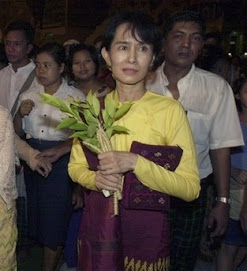


 Posts
Posts


