(ေပၚေပါက္လာမည့္အစိုးရကိုဂ်ပန္ေရာက္ၿမန္မာ့ဒီမိုအင္အားစုမ်ားမွအသိအမွတ္မၿပဳေႀကာင္းႏွင့္
ဂ်ပန္အစိုးရမွလည္းအသိအမွတ္မၿပဳရန္တိုက္တြန္းေတာင္းဆိုပြဲ
26/27/28-1-2011 pm3 to pm4) ...
Thursday, January 27, 2011
Demo infront of the National Diet of Japan,tokyo/26-1-2011


News & Articles on Burma-Wednesday, 26 January, 2011
News & Articles on Burma
Wednesday, 26 January, 2011
-------------------------------------------------------------
US Says 'No' to Lifting Sanctions on Junta
Burma: UN Should Tackle Rights Crisis as New Parliament Convenes
Relocation deadline in Myitsone Tang Hpre village creates quandary
Cabinet Members to Resign Before Parliament Opens
Burma’s Path to Privatization Keeps Armed Forces in Economic Control
Japanese auto-makers eye local opportunities
Myanmar, Thailand touch on employment issue
US says ASEAN has role to play in Myanmar and Koreas
------------------------------------------
US Says 'No' to Lifting Sanctions on Junta
By THE IRRAWADDY Wednesday, January 26, 2011
The United States will not consider lifting economic sanctions against Burma unless the country's military rulers recognize opposition leader Aung San Suu Kyi's National League for Democracy (NLD) party and release political prisoners, according to a senior US diplomat.
Deputy Assistant Secretary of State for East Asian and Pacific Affairs Joseph Y. Yun told The Jakarta Post on Tuesday that the Burmese regime should hold a dialogue with Suu Kyi, and release the more than 2,000 political prisoners held around the country—preconditions for the US to consider lifting economic sanctions imposed against the Burmese regime for its human rights violations.
His comment came more than a week after the foreign ministers of the Association of Southeast Asian Nations (Asean) and an alliance of five ethnic political parties in Burma called for an end to Western economic sanctions against Burma.
During their recent meeting in Lombok, Indonesia, the Asean ministers referred to Burma's controversial parliamentary elections and the release of Suu Kyi as “developments,” which they said the international community should positively respond to.
In their call for the lifting of Western economic sanctions, Asean foreign ministers voiced all the same requests to the Burmese regime as the US demands, Yun was quoted as saying.
“These are excellent demands from the Asean ministers, and I think the Myanmar authorities should really take them to heart and make them a reality,” Yun said, adding that a positive US response would follow when the Burmese regime complies with the requests from the international community.
Last Friday in Washington, the State Department spokesman, P J Crowley, said that the Obama administration has no plan to lift sanctions as of now, and that its sanctions are specifically targeted against the leaders of the Burmese military junta, its cronies and business groups that support them—and not against the people of Burma.
“At this point, no,” Crowley told reporters when asked if there is any move to lift the sanctions.
“This is an issue that we regularly discuss with stakeholders—the effectiveness and the impact of our sanctions. Our sanctions are specifically targeted against those most responsible for denying democracy and disregarding human rights in Burma,” Crowley said.
“We have concerns about the people of Burma, but it is the Burmese regime that is fully responsible for the country’s dire economic situation. They are the ones who have institutionalized corruption and they are the ones who have plundered natural resources,” he said.
“We maintain sanctions in order to press authorities to take concrete actions on issues of core concern to the international community, including democratic reform, release of political prisoners, and initiating a genuine dialogue with the democratic opposition and ethnic minority leaders,” Crowley said.
Yun's call to the regime for the recognition of Suu Kyi's NLD came amid her lawyers proceeding with an appeal against last year's dissolution of the party following its decision not to run in parliamentary elections held on Nov. 7.
On Monday, the lawyers presented their arguments to the Supreme Court in Naypyidaw, but no decision was made by the court about whether it would hear Suu Kyi's latest appeal against the disbanding of the party.
In December, Suu Kyi met with Yun in Rangoon and discussed economic sanctions against Burma.
Since 2009, the Obama administration has initiated a senior-level diplomatic dialogue with the Burmese military leadership while continuing to keep sanctions as an important tool of US policy.
However, the Burmese regime has made no tangible positive response. As the country prepares to convene its first session of Parliament in 22 years at the end of this month, more than 2,000 political prisoners remain behind bars in Burma. The Parliament will be dominated by pro-military lawmakers who won in last year's controversial polls.
The Irrawaddy correspondent Lalit K. Jha contributed to this article from Washington.
http://irrawaddy.org/article.php?art_id=20610
--------------------------------------------------
Burma: UN Should Tackle Rights Crisis as New Parliament Convenes
Source: Human Rights Watch (HRW)
Date: 26 Jan 2011
Junta Window Dressing Ahead of First UN Rights ReviewJunta Window Dressing Ahead of First UN Rights Review
(New York, January 26, 2011) – The review of Burma's human rights record at the United Nations this week should reflect reality and not the false promises of the military, Human Rights Watch said today.
Burma will face its first-ever Universal Periodic Review (UPR) in the Human Rights Council in Geneva on January 27, a process all member states must undergo every four years to ascertain each country's progress on human rights. The ruling State Peace and Development Council (SPDC) will face the UPR, just days before the new 2010 elected parliament convenes on January 31 in the nation's capital, Naypyidaw, to select a president and form a new government already dominated by serving and recently retired military officers.
"The UPR process is an opportunity to put one of the most brutal and intransigent authoritarian systems in the world under the spotlight," said Elaine Pearson, deputy Asia director at Human Rights Watch. "Burma's human rights record remains deplorable, and forming a new parliament after sham elections in 2010 shouldn't fool anyone."
Human Rights Watch urged member states to question the Burmese military government on the gravity, extent, and systematic nature of violations taking place in Burma and the need for more effective tools to address the situation.The Human Rights Council has adopted several resolutions strongly condemning the systematic nature of the violations committed against the people of Burma, as has the UN General Assembly. Yet the lack of implementation by Burmese authorities of almost all provisions contained in these resolutions is a matter of serious concern and should be raised during the UPR.
The Burmese government's national report to the UPR process contains numerous assertions that progress has been made on legal reform, that provisions in the 2008 constitution on fundamental rights and duties of citizens is in line with international conventions, that education on human rights has increased in the military, bureaucracy, and school system, and that the fledgling Human Rights Body will soon become a fully fledged Human Rights Commission in line with the Paris Principles on the Status of National Institutions.
The military government also cites its cooperation with the UN on demobilizing child soldiers, and working with the UN Country Team as evidence of progress, despite more comprehensive measures being all but suspended in 2010 as the military stage-managed the elections.The SPDC created the Committee to Prevent the Recruitment of Child Soldiers in 2004, yet this body has failed to take effective action to curtail child recruitment and has not adequately punished military officials involved in predatory recruitment practices. A UN Action Plan on ending child soldier recruitment that meets international standards has yet to be finalized with the Burmese government. The government has also severely limited efforts by the UN country team to monitor the recruitment and use of child soldiers by non-state armed groups.
"UN member states must not mistake rhetoric for improvement," said Pearson. "Burmese authorities only demonstrate perfunctory cooperation, doing the bare minimum to deter international criticism, not genuine efforts to provide for the rights of their citizens."
Human Rights Watch said despite new window dressing, the same grim reality for Burma's people continues to be reported. Serious human rights issues in Burma that have shown no improvement in the past several years and in many cases have continued to deteriorate are mentioned in Human Rights Watch's UPR submission, and include:
Freedom of Expression and Association
Systematic restrictions on basic freedoms in Burma remain, including on the rights to freedom of expression, peaceful assembly, and association. For example, despite Burma having ratified International Labor Organization (ILO) Convention No. 87 on freedom of association, the SPDC continues to refuse to register independent trade unions in the country. The 2010 elections were conducted in a climate of intimidation and tight control of freedom of expression, assembly, and association, for political candidates and citizens.
Arbitrary Detention and Ill-Treatment
Despite democracy leader Aung San Suu Kyi's release in mid-November 2010, the government of Burma currently incarcerates more than 2,200 political prisoners including political activists, journalists, trade unionists and labor rights advocates, artists, Buddhist monks and nuns, and vocal opponents of the SPDC. Many of these prisoners have received harsh sentences – including up to 65 years in prison – on trumped up criminal charges in unfair trials that seek to curtail peaceful political dissent and free expression. Conditions in Burmese prisons do not meet international standards: prisoners are not given adequate health care, face routine ill-treatment and at times torture, and may be transferred to remote facilities in the hinterlands that make visits by family members and UN officials difficult. The government has not granted the International Committee of the Red Cross (ICRC) access to Burmese prisons in accordance with the ICRC's standard procedures since 2006.
Respect for the Rule of Law
The culture of impunity in Burma for government officials and military personnel for serious abuses is supported by a judicial system that is neither impartial nor independent. There has been little if any accountability for serious crimes committed by government security forces in conflict zones in eastern and western Burma, including attacks on civilians, routine use of forced labor, sexual violence against women and girls, recruitment and use of child soldiers, extrajudicial killings of civilians, and other violations of international humanitarian law. Some non-state armed groups have also been implicated in serious abuses, including forced labor and the use of child soldiers.
Protection of Civilians
Civilians in conflict areas face abuses by government and non-state armed groups. In some conflict areas, the Tatmadaw(Burmese army)maintains a "shoot on sight" practice that targets civilians. The Tatmadaw forcibly displaces and evicts communities, confiscates land for security purposes or commercial activities, and in some places forces communities to live in specially constructed relocation sites close to military camps as a counter-insurgency measure. Fighting in Eastern Burma has intensified in the past three months, driving more refugees into Thailand.
Forced Labor
Forced labor remains rampant in ethnic conflict areas, despite cooperation with the ILO for several years and the continuation of an ILO and Burmese government mechanism on investigating cases of forced labor. Civilians in conflict zones continue to report being forced to carry supplies for Burma army units, and civilians also said they feared being used to guide troops through terrain, often acting as human minesweepers, a practice the Burmese army has used in past military operations.
Minorities
Conditions for ethnic Rohingya Muslims in western Burma are extremely dire. The Rohingya are denied citizenship in Burma, and Rohingya communities face sharp restrictions on freedom of movement, access to basic health care, livelihoods, and education, and suffer routine abuses at the hands of Tatmadaw units and paramilitary border security forces called Na Sa Ka. Thousands of Rohingya have fled Burma into Bangladesh and by sea to Malaysia and Thailand.
"Burma's rights record is a source of deep concern for the UN, but principled pressure instead of wishful thinking is needed to improve it," Pearson said. "The UPR review must galvanize the UN to take further measures to end the culture of impunity and the distortion of the legal system to ensure military rule, in or out of the new parliament."
© Copyright, Human Rights Watch 350 Fifth Avenue, 34th Floor New York, NY 10118-3299 USA http://www.reliefweb.int/rw/rwb.nsf/db900sid/MUMA-8DG24B?OpenDocument
-----------------------------------------------------
Relocation deadline in Myitsone Tang Hpre village creates quandary
Wednesday, 26 January 2011 00:00 KNG
Residents of Tang Hpre village located near the Irrawaddy Myitsone dam construction site in Northern Burma, Kachin State are reeling under the dual burden of drugs and pressure from the ruling Burmese junta to relocate the whole village by March, which is the deadline.
“It is akin to hell now. More and more people are addicted to drugs in the village, which is being destroyed due to digging for gold,” said Bawk Naw, a villager from Tang Hpre.
He told Thailand-based Kachin News Group whole paddy fields are being destroyed because of gold mining and no one is even attempting to plant paddy, due to the uncertain conditions. On top of which there is mounting pressure to relocate.
With the gold mining business, drug addiction has increased among the youth but the regime had not acted on it, said the villager.
The Burmese military government Ma-Ya-Ka, police and the Asia World Company had come to the village on January 23 and 24 to talk about compensation and told villagers to relocate to other places by March.
“They are giving compensation of 135 Kyats for one orange tree in Mazup village located between Mali and N’mai rivers,” said Bawk Naw.
Tang Hpre villagers are to be compensated but the authorities have told them that the amount of financial aid will depend on plant count and food stored in every house. There will be no payment for house and land.
“We villagers have decided not to shift from our village whatever comes our way,” said Bawk Naw.
Most young men from the village are still running away from the village because they are being arrested for investigations relating to the April 17, 2010 bomb blasts near the dam construction site.
There are more security check points now and more soldiers around the dam construction site after the explosions.
The National League for Party (NLD) led by Aung San Suu Kyi, pro-democracy icon of Burma, has criticized the construction of the 152 meter high Myitsone Dam, which is being built without taking into account the impact on thousands of people and the ecology.
According to Thailand-based Burma Rivers Network (BRN) the Myitsone dam located over 20 miles from Myitkyina the capital of Kachin State, will displace about 15,000 people living around the site and threatens thousands of people downstream because of flooding and water shortage.
The construction began last year led by China Power Investment Corporation (CPI) and power generated will be sold to China, said Thailand-based Burma Rivers Network (BRN).
The impact of limited water will affect farmers and fisher folk, who depend on the river for their livelihood, said BRN in a statement on January 17.
Myitsone dam is a part of seven dams on headwaters of Irrawaddy River, also Mali Hka in Kachin and is estimated to produce a major part of 17,160 MW of electricity, which is to be exported to China, according to BRN.
Till now, at least six villages have been relocated to new sites, where there is no hope of eking out a livelihood by the villagers with no farmland and agricultural plots.
http://www.kachinnews.com/news/1844-relocation-deadline-in-myitsone-tang-hpre-village-creates-quandary.html
---------------------------------------------------
Cabinet Members to Resign Before Parliament Opens
By WAI MOE Tuesday, January 25, 2011
Government ministers serving under Burma's ruling junta, the State Peace and Development Council (SPDC), will likely resign from their posts before the opening session of Parliament on Jan. 31, according to official sources in the administrative capital of Naypyidaw.
Sources said that up to 40 ministers and deputy ministers are expected to resign sometime in the coming days. Many are key members of the junta-backed Union Solidarity and Development Party (USDP), which claimed victory in last year's Nov. 7 election.
After the ministers resign, an interim cabinet will be formed by the SPDC, which is chaired by Snr-Gen Than Shwe. The new cabinet will remain in place until a new government is formed by a new president—a position widely expected to go to Than Shwe.
Ahead of the first session of Parliament, the USDP plans to hold a three-day special meeting beginning on Jan. 27. The party will discuss final preparations for the convening of Parliament and the process of choosing the president and two vice presidents and forming a new government.
Unlike the post-election process in other countries, most significant shifts are likely to be decided by the junta supremo Than Shwe, whose orders will be administered through the War Office.
Sources said Than Shwe and other high-ranking officials in Naypyidaw have been busy for the past month discussing arrangements for the Parliament and new government.
The current situation in the capital is every complicated, as the junta is selecting ministers for key posts in the national Parliament, as well as chief ministers, or governors, for the country's 14 states and regions.
Although sources close to the regime said that several issues remain to be resolved, none are likely to threaten Than Shwe's absolute hold on power. “They are just teething problems,” said one source in Naypyidaw.
Among the issues that need to be addressed are changes in the ruling hierarchy. According to military sources, several leading figures in the current regime will be sidelined as part of the transition to quasi-civilian rule.
The sources said that ex-Gen Tin Aung Myint Oo, the junta's Secretary 1, and the regime's prime minister, ex-Gen Thein Sein, will not be given major positions because they are reportedly not fit for “heavy duty.” However, USDP sources said Thein Sein will be keep one key position.
Meanwhile, the Norway-based Democratic Voice of Burma reported on Tuesday that 1,700 low-ranking officials have been transferred to ministries since the November elections.
“Actually, the numbers are still uncertain,” said the editor of a Rangoon-based journal, commenting on the reports. “But we will soon know which numbers won in the lottery of Burma’s new order.”
http://www.irrawaddy.org./article.php?art_id=20604
----------------------------------------------
Burma’s Path to Privatization Keeps Armed Forces in Economic Control
Ron Corben | Bangkok 25 January 2011
Burma’s military is pressing on with the privatization of state assets as part of economic reforms. Many critics say the program simply transfers assets to the military government’s allies and maintains its economic control.
Burma’s is one of Asia’s poorest countries, and the military government dominates the economy.
But the government is moving forward with economic reforms, including the sale of up to 90 percent of state assets.
While details are sketchy, media reports in Rangoon say more than 400 state-owned assets, including airports, buildings, gasoline stations and land close to the main port have been sold.
Douglas Clayton, managing director of the investment fund Leopard Capital, based in Cambodia, says privatization is a step toward greater efficiency.
"Putting an economy into private assets is likely to lead to a better-managed economy,” Clayton said. “It’s a step toward modernizing Burma and no matter how it is done the outcome is likely to be no worse than it is now and possibly much better. There will be many beneficiaries of a liberalized economy, so there will be more impetus for further reform."
But some Burma experts say privatization is part of the military’s effort to maintain its hold on power. They say most of the assets have gone to business people tied to the military, in an effort to build support before last year’s elections.
Parties close to the military won about 80 percent of the elected seats in November’s elections, the first in 20 years. The constitution additionally sets aside 25 percent of the total seats for the military. The parliament opens next week.
"That whole fire sale of assets that they had prior to the election was to shore up support of some of the big entrepreneurs,” says Alison Vicary, an economist from Australia’s Macquarie University. “The airport, for example, was given to those entrepreneurs that have been aligned with the regime for years. So obviously the regime has some idea that these guys need to be kept onside. How to manage that into the future is another issue."
Some Burma experts note that the buyers of state assets include military-run corporations such as Union of Myanmar Economic Holdings, which controls the army’s pension fund, and the Myanmar Economic Corporation, which oversees funds from the sale of state-owned enterprises.
"The wave of privatization that has taken place – has been a move to transform public assets into personal property of the military regime and their cronies including the leaders of the Union Solidarity and Development Party which is the biggest party backing the regime," said Debbie Stothardt, the spokeswoman for rights group Alternative ASEAN Network.
Bertil Lintner, an author and commentator on Burma, agrees the sell-off leaves much of the economy under military control. But he says it may open the way for private investment.
"People will say look at all these new opportunities here,” said Lintner. “Privately owned companies and organizations – a restructured economy and so on; but also the economy is so bad that they have to do something."
Peter Gallo, who is with the anti-money laundering consulting firm Pacific Risk in Hong, warns that foreign investors must proceed carefully in Burma, despite the privatization. The United States, the European Union and other governments have imposed economic sanctions against the government to push for political reform.
"The big practical issues really are the rule of law and human rights situation,” Gallo said. “You can have any kind of government you like; doesn’t matter whether it’s allegedly democratically elected or not but if there is flagrant abuse of human rights in the country and that is well known – the international condemnation is going to continue."
Several large Burmese corporations, such as the Union of Myanmar Economic Holdings, are on the U.S. sanctions blacklist.
Rights activist Stothardt says the reforms do little to improve life for most Burmese.
"Most people in Burma lack access to clean water basic electricity, to basic health and education,” Stothardt said. “So this whole move to privatize all the assets of the country is mainly to turn public assets into the personal property of military leaders and their cronies, and it’s still not going to improve the situation for the ordinary Burmese person."
Burmese officials and some regional political analysts say that Western sanctions are responsible for the country’s poverty. The Association of Southeast Asian Nations, of which Burma is a member, wants the sanctions lifted.
ASEAN leaders say the elections and the release of opposition leader Aung San Suu Kyi from detention show Burma is making progress on political reforms. As a result, ASEAN says, the sanctions should go.
But rights groups say the changes fall far short for true reform, especially since Burma’s military holds more than 2,000 political prisoners and maintains a tight grip on the economy. http://www.voanews.com/english/news/Burmas-Path-to-Privatization-Keeps-Armed-Forces-in-Economic-Control-114568884.html
----------------------------------------------
Japanese auto-makers eye local opportunities
By JOSEPH ALLCHIN
Published: 26 January 2011
Seventeen Japanese vehicle companies, including Honda, are reportedly eyeing manufacturing opportunities in Burma for sales in local and international markets.
A delegation from the Japanese Suzuka Chamber of Commerce representing automobile manufacturers on 18 January met with Union of Myanmar Federation of Chambers of Commerce and Industry (UMFCCI) officials to discuss the plan.
Burma’s domestic Weekly Eleven journal quoted Suzuka chief Tokushige Shimoda as saying that the company has “been preparing to produce and sell cars in cooperation with other countries, including Myanmar [Burma], Bangladesh and Indonesia.
“Cars manufactured in Myanmar will be sold in the local market as well as in foreign markets, including China,” he added. The delegation had met with 73 Burmese car manufacturers.
Burma is seen as fertile ground for growth in manufacturing, given its low wages and flimsy workers’ rights legislation which sees millions of Burmese travel to neighbouring countries such as Thailand and Malaysia to support their families.
This has prompted positive signs from the country’s garments sector as wages have risen in neighbouring countries like China and Bangladesh. In both cases labour rights and demands have made headlines, with workers in both nations demanding a minimum wage scheme; something that is not seen in Burma.
The Japanese economy has been sluggish of late and as a result the country’s industry giants have been looking at new markets. As Shimoda told local press, “it is getting more and more difficult to manufacture and sell cars in Japan as the population of the country has stopped growing.”
This will come as a welcome boost for Burma’s manufacturing sector, especially given that Japan’s largest car manufacturer, Toyota, recently divested from the country, supposedly over disquiet about the junta’s human rights record.
Concerns also abound however about the poor local infrastructure in Burma. Transport and electricity are considered unreliable or non-existent, pushing business people on the border to relocate to Thailand and utilise desperate, mobile Burmese labour.
The Japanese manufactures will join Indian industry giant Tata, which is due to set up operations in Magwe division to produce heavy trucks.
The majority of the automobiles in Burma had previously been imported from other nations, with the government only handing out a limited number of permits to import vehicles. This has kept the country’s vehicle stock aged and prices high.
This combines with cheap labour and an ASEAN free trade agreement, both within the regional bloc and with China, which would enable tariff-free exports. Overall it points to serious potential for growth in the sector, but more importantly, badly needed jobs in the urban centres.
http://www.dvb.no/news/japanese-auto-makers-eye-local-opportunities/13898
-----------------------------------------
Myanmar, Thailand touch on employment issue
17:17, January 26, 2011
Delegations of Myanmar and Thailand have met in Pyin Oo Lwin in northern Myanmar, touching on issue of Myanmar workers being employed in Thailand, the official newspaper New Light of Myanmar reported Wednesday.
At the 9th meeting between the two countries on employment of Myanmar workers in Thailand, Myanmar was represented by Deputy Foreign Minister U Maung Myint, while Thailand was headed by Minister of Labor Chalermchai Sri-On.
Fruitful discussions were claimed to have been made on matters related to nationality verification of Myanmar and Thailand, enjoying of equal rights with Thai workers in safe and happy working atmosphere without any mistreatment and unfairness, getting opportunity to have all Myanmar workers in Thailand registered and get temporary Myanmar passport and dispatching fresh Myanmar workers to Thailand.
Myanmar proposed dispatching fresh migrant workers to work legally in Thailand and a process of verification of Myanmar nationality has been underway to issue temporary passports to them.
There are three centers for issuing the passports on the Myanmar-Thai border, namely Kawthoung, Tachilek and Myawaddy.
According to earlier report, a total of over 90,000 temporary Myanmar passports had been issued to Myanmar migrant workers at the three centers up to May last year.
Myanmar and Thailand once met for the issue in the ancient city of Bagan in February 2010 during which Thailand said it will recruit about 15,000 Myanmar workers along its border with the country through negotiation of the two governments.
Under the agreement, Myanmar migrant workers are allowed to cross border and take up jobs in Thailand via three border towns with enjoyment of same rights that Thai workers have.
Moreover, a Myanmar Association for Employee Protection was formed in Thailand to help solve labor problems and give protection to Myanmar workers in that country, earlier report also said.
The association, headed by Myanmar ambassador to Thailand, is supported by diplomatic circle, traders and authority concerned.
According to earlier Thai statistics, there are 500,000 to 600, 000 Myanmar migrant workers staying in Thailand.
Source: Xinhua http://english.people.com.cn/90001/90777/90851/7273414.html
------------------------------------------
Corruption charges hit police chiefs
Share
Comments (1)
Corruption charges hit police chiefs thumbnail
A police van is seen driving through the streets of Rangoon (Reuters)
By AYE NAI
Published: 26 January 2011
Five police commanders in states and divisions around Burma have been sacked after corruption charges were levelled by a police intelligence unit.
The five, all the most senior-ranking police officials in their respective regions, had multiple charges brought against them. One of them, Ba Kyi from Magwe division, “was accused of around 100 charges”, some by his subordinates, a source close to the Burmese police told DVB.
“[Ba Kyi] was investigated by the Special Branch [Burmese intelligence] in Minbu town and later given early retirement,” said the source. “However, [authorities] decided to give him an army pension as he was originally an army major.”
It is believed that their status as former army personnel, and not experienced police, angered lower-ranking officers who then brought them up on the allegations.
The remaining four headed police units in Mon state, Pegu division and Kachin and Shan states. It is rumoured that Kachin state’s police commander was laid off without being granted a pension.
Poor salaries among public service workers has led to rampant, almost institutionalised, corruption in Burma. The meagre wages given to lower-ranking government officials, military and police often means they cannot survive without backhanders or some sort of side business, which is technically illegal but widely tolerated.
Indictments such as these against high-ranking officials are thus rare.
The international watchdog Transparency International awarded Burma the penultimate spot on its recent Corruption Perceptions Index, shared with Afghanistan.
http://www.dvb.no/news/corruption-charges-hit-police-chiefs/13894
-------------------------------------------
US says ASEAN has role to play in Myanmar and Koreas
Abdul Khalik, The Jakarta Post, Jakarta | Wed, 01/26/2011 11:46 AM | World
A | A | A |
Myanmar should dialogue with opposition leader Aung San Suu Kyi, release its political prisoners and recognize Suu Kyi’s National League for Democracy (NLD) before the US will consider lifting sanctions, a US diplomat says.
The US also welcomes ASEAN and Indonesia taking an active role in helping to resolve the problems on the Korean Peninsula, he said.
The US secretary of state’s deputy assistant Joseph Y. Yun told The Jakarta Post on Tuesday that ASEAN’s foreign ministers had voiced all the same requests during their meeting in Lombok, West Nusa Tenggara, last week.
“These are excellent demands from the ASEAN ministers, and I think the Myanmar authorities should really take them to heart and make them a reality,” Yun said.
Yun, who oversees affairs in East Asia and the Pacific, said if Myanmar’s government had complied with all the requests from the international community, then there would be a positive response.
“And clearly, as the reconciliation process makes progress, I think the international community can ensure a response,” he said.
During their meeting in Lombok last week, ASEAN’s foreign ministers spoke about the need for the US, the European Union and Canada — all ASEAN dialogue partners — to consider lifting their sanctions against Myanmar because the country had successfully conducted general elections and released Suu Kyi from house arrest late last year
Foreign Minister Marty Natalegawa said after the meeting that ASEAN believed in the early lifting or easing of sanctions against Myanmar by several countries, but said that the lifting of sanctions and reconciliation should go hand in hand.
ASEAN member states reinforced the importance of inclusive dialogue to ensure that all concerned parties could contribute to Myanmar’s future development, Marty said.
On North Korea, Yun welcomed ASEAN’s intention to help on the Korean Peninsula. He said stability on the peninsula would be connected to the denuclearization of North Korea.
“I think the international community, including ASEAN, should be quite clear in requesting that North Korea be denuclearized and come join the IAEA [International Atomic Energy Agency] again. And if ASEAN wants to help in that process, that’s a very good thing.”
At the Lombok meeting, ASEAN ministers agreed to be more active in finding a solution to the conflict between South Korea and North Korea, affirming that ASEAN will play its part to support the efforts of the six-party talks, which include the US, China, Japan and the two Koreas.
“We have real concerns about the ramifications throughout the region. We consider it a fault line. If we neglect this fault line, it can easily be imposed throughout East Asia — like an us versus them scenario. For us, inaction is not an option,” Marty said.
He said that under Indonesian chairmanship, ASEAN will try to make a greater contribution to help solve the problem, adding that there was an ambitious plan to coordinate with the six-party talks countries.
“Through communication with the six-party talks countries, ASEAN will explore how it can contribute to creating conditions to help resume the six-party talks.”
http://www.thejakartapost.com/news/2011/01/26/us-says-asean-has-role-play-myanmar-and-koreas.html
-------------------------------------
Wednesday, January 26, 2011
News & Articles on Burma-Tuesday, 25 January, 2011
News & Articles on Burma
Tuesday, 25 January, 2011
-------------------------------------------------------------
‘We must speak in one voice’
Mon Party to introduce farm ownership bill
Burma Army’s camp construction causing migration
Army officials moved to govt ministries
Two journalists freed in Thailand
Thailand cancels reporters’ deportation
Myanmar to launch new private airline
Exiled print press goes quiet
A New Government for Myanmar (Not)
Speaking Truth to Burma
Hydropower plant opens in Kachin State
-----------------------------------------------
‘We must speak in one voice’
Tuesday, 25 January 2011 14:49 Mizzima News
(Mizzima) - Recently, the Committee for the Emergence of a Federal Union (CEFU) was formed after a joint meeting of the Kachin Independence Organisation (KIO), the Karen National Union (KNU), the Karenni National Progressive Party (KNPP), the Chin National Front (CNF), the New Mon State Party (NMSP) and the Shan State Progressive Party (SSPP) in November 2010.
The committee plans to convene a broad ethnic conference, but one that its leaders describe as different from the proposed second Panglong-type conference that has been proposed by the National League for Democracy and ethnic political parties.
Mizzima reporter Ko Wild interviewed NMSP General-Secretary Nai Han Thar on what type of conference is planned and the issues involved.
Q: The CEFU is comprised of six ethnic organisations, and you’re now in an organizing stage, correct?
A: Yes, we plan to implement our work by coordinating with ethnic alliances such as the National Democratic Front (NDF), the Ethnic Nationalities Council (ENC) and the United Nationalities League for Democracy – Liberated Area (UNLD-LA). These alliance groups will send representatives to the conference. An organising committee will be formed first and it will do the preparatory work.
Q: What are the differences between your conference and the conference being initiated by domestic ethnic political parties and the NLD, which has been described as a second Panglong Conference?
A: The conference being initiated in Burma is like the 1947 conference [Panglong Conference], where Burmese representatives and ethnic representatives met and reached an agreement. Their intention is to implement an agreement similar to the one reached at that time between Burman and ethnic people.
Our conference is different. Most of the ethnic people on the border are waging an armed struggle against the government for our self-defence. Now the military regime is preparing to wage war against cease-fire and other groups. So these ethnic groups have to defend themselves in an coordinated effort.
On the other hand, all ethnic people must be united in trying to achieve a federal union. We must speak in one voice. In this way, we can resist the regime’s offensive in unity. We will be stronger if we can all unite on the same political platform.
Then we can represent ethnic people in a tripartite dialogue, which we are calling for. So our conference will work on all these issues.
Q: Previously, you formed the NDF and ENC for these purposes too.
A: Yes, we have had similar intentions before, but these two organisations diverged and became different entities over time. Their principles are now different from each other, and it is difficult to reconcile them. Under the circumstances, we need to consolidate ourselves as we resist a military offensive.
Q: In trying to consolidate all ethnic groups, some argue that Burman (Burmese groups) should participate as one of the ethnic groups. Do you agree and can you accept Burman groups as an ethnic group? How do you see the role of the ethnic Burman?
A: We can accept it if an organisation representing ethnic Burmese comes and join us. But there are no such organisations representing ethnic Burmese. Also there are no ethnic Burmese organisations fighting for the cause of ethnic Burmese. They are fighting only for democracy and human rights. This is because of their situation.
They are not suffering from national oppression and facing assimilation issue. They fight against military dictatorship only. Unlike us, they don’t need to fight for national liberation and national rights. You don’t have ethnic Burmese organisations fighting for the cause of ethnic Burmese.
Q: Ethnic groups had the Mae Tha Raw Tha Agreement in 1997-98. Is your current plan related to this agreement or different from it?
A: Yes, they are interrelated. Ethnic people held a seminar in Mae Tha Raw Tha in 1997. At that time, we held the meeting as a seminar. Now we intend to hold a conference. But the objective of a federal state will be the same.
Q: Will you include domestic non-armed ethnic political parties in the conference?
A: I think the domestic ethnic political parties cannot come and join us. According to their situation, their political movement works only inside the country. They are calling for a second Panglong conference. They are conducting their movement in this fashion. So their movement is different from ours.
Q: Even so, among the many armed ethnic groups, you now have only six groups in your organization, the CEFU. How will you attract more groups?
A: We will invite all political and armed ethnic organisations when we can convene this conference by integrating both the NDF and the ENC. Our plan is to unite all the ethnic organisations on the border into a strong, single organisation.
Q: Is Mae Tha Raw Tha the only effort by ethnic people in consolidating themselves? Are there others?
A: As far as I can remember, there was one such meeting in 1976 held in Manerpalaw. At this meeting, 13 organisations attended and formed the NDF. Since then, our sole goal and objective is the emergence of a federal union, not secession.
Q: Can you describe the ethnic conference held in Taunggyi in 1961?
A: The 1961 Taunggyi conference was mainly for the implementation of the federal principle. The ethnic people were joined in an independence struggle. The Panglong agreement was achieved by the ethnic Chin, Kachin and Shan just before regaining independence from Britain. But this agreement could never be implemented and the ethnic people became, in effect, a colony under the Burmese people. So the Taunggyi conference was held to look for ways forward and to maintain a unity among all ethnic people. The conference was held to implement an agreement in building unity and to live as brethren on the basis of equality when we regained independence. This is also the federal principle.
Q: Your NMSP is a cease-fire group. Now you plan to join with non-ceasefire ethnic armed groups who are waging war against the regime. Is there more military tension in your control area because of this?
A: Our cease-fire agreement with the regime has been void since September 1, 2010. They do not recognise it anymore. We have to stand our own now, and we have to join with allied forces.
Q: How do you see the future?
A: Ethnic people will continue to call for a federal system of government. The regime cannot resolve the ethnic issues through military means. Military means have been used for more than 60 years and it cannot destroy even one armed group. In 1947, Bogyoke Aung San tried to resolve the ethnic issues based on national equality and self-determination as the basic principle of the Panglong Conference. Everybody would be happy if the same attitude and the same approach could actually be implemented in coordination with the new government. http://www.mizzima.com/edop/interview/4795-we-must-speak-in-one-voice.html
----------------------------------------
Mon Party to introduce farm ownership bill
Tuesday, 25 January 2011 13:23 Kun Chan
Chiang Mai (Mizzima) – The All Mon Region Democracy Party (AMRDP) will introduce a Parliamentary bill to allow farmers to own their farms.
Party leader Nai Ngwe Thein said: ‘We heard recently about the land confiscation cases in Kyaikmaraw to build a cement factory. We discussed that case in our party’s central committee meeting. We want farmers to own their own farms, and we will propose it’.
Last week, Mon MPs-elect traveled to Ye, Thanbyuzayat, Mudon, Chaungzon and Kyaikmaraw to conduct an informal survey of people’s opinions about private ownership of farms.
Many residents in Kyaikmaraw, Mudon and Ye said that their land had been confiscated including some farm land for dam projects, according to the party. Residents in Kyaikmaraw said that the Zaygabar Company Limited had seized more than 800 acres of farm land during the previous months, said party officials.
During 2002-03, the army confiscated land in Ye and Thanbyuzayat in Mon State and Yephyu in Taninsarim Division. More than 12,000 acres of farmland have been confiscated since 2010, according to a report compiled by the Human Rights Foundation of Monland, which is based in Thailand.
The proposal is likely to fail in Parliament, but Nai Ngwe Thein said it was important to introduce the issue for discussion.
The USDP party, which won a majority of seats in Parliament, supports the current law which gives ultimate ownership of farm land to the state.
During mid-January, five ethnic parties including the AMRDP held a meeting in Rangoon and issued a joint statement to urge the junta to release all political prisoners and to give them their full rights.
The statement also urged the international community to lift economic sanctions against Burma and urged the Parliament to select ethnic representatives to be appointed as vice president and ministers in relevant states.
Sixteen out of the 34 AMRDP candidates won parliamentary seats in the recent elections.
http://www.mizzima.com/news/election-2010-/4794-mon-party-to-introduce-farm-ownership-bill.html
----------------------------------------
Burma Army’s camp construction causing migration
Tuesday, 25 January 2011 16:17 Hseng Khio Fah
Burma Army’s new camp constructions, which are under its military expansion project in Shan State South, especially in areas near the territory of rebel armed groups, have reported to have caused more local residents to migrate to other areas as the constructions are demanding forced labor, according to sources from the Thai-Burma border.
The constructions have been conducted in Kali of Kunhing township and Mongzang of Monghsu township where the SSA North’s First Brigade that has spurned the ruling junta’s demand to go along with the Border Guard Force (BGF) program is active.
“All their camps were built by concrete including their bunkers and trenches,” a villager in Monghsu who just fled to Tachilek, opposite Thailand’s Maesai. “They were reportedly ordered to finish all the camps within three months since Deputy Senior General Maung Aye visited in November. Therefore, they [military junta] are working day and night to complete by the deadline.”
One of the camps under the constructions is located at Loi Zeun of Monghsu and another at Mongzarng, southeast of the SSA’s First Brigade.
According to informed sources, the military junta will place heavy artillery in Monghsu, Mongyai, Mongzang and Kali.
Meanwhile, the Burma Army’s Northeastern Region Command,with its headquarters Lashio, Northern Shan State, have also been breaking up units under its command for the newly installed “Middle East” regional command. All balkanized troops will reportedly be deployed to the area by the end of the month.
The expansion is believed to cut communications between armed groups that have been transformed into BGFs and those that had refused to. Its other purpose is also to prepare for a major operation against non-BGFs after the new government has been formed.
On the other hand, the SSA’s First Brigade has also re-formed the SSA North, with 5 new brigades, commanded by Sao Pangfa: 1st, 27th, 36th, 72nd and 74th with 3 battalions each.
The new expansion drive has alarmed people that military operations between the Burma Army and armed groups can break out at anytime and it will also require more recruitment then. http://www.shanland.org/index.php?option=com_content&view=article&id=3426:burma-armys-camp-construction-causing-migration&catid=86:war&Itemid=284
---------------------------------------------
Army officials moved to govt ministries
By MIN LWIN
Published: 25 January 2011
Around 1700 low-ranking army officials have been transferred to government ministries since elections last year.
A source in the Burmese government said that military officials were effectively replacing thousands of civilian workers in offices such as the Ministry of Communication. They have been given positions from departmental head down to administrators.
It appears to be a near continuation of the major governmental shake-up that occurred prior to the November 2010 elections, when hundreds of top-ranking military officials ostensibly retired so that they could compete in the polls.
The move sparked serious doubt about the Burmese junta’s pledge to form a civilian government, particularly so given that a quarter of the new parliament is made up of pre-appointed military men still in their uniforms.
The source said that the recent appointment of army officials to government departments has created procedural difficulties for civilian workers, with the military unfamiliar with the inner-workings of ministries yet being automatically elevated to senior positions.
Parliament is due to hold its first session on 31 January, with the junta-backed Union Solidarity and Development Party (USDP) dominating seats. It won 80 percent of the vote, while the National Unity Party, also with close ties to the regime, came in second.
The 388 army representatives for parliament were named by state media last week, and rank from brigadier-general down to captain. They will hold significant sway over the decision-making process – under the 2008 constitution, they can appoint 25 percent of all legislators, enabling them the power of veto.
A source close to the army said last week that the 388 include Burmese graduates from military schools in Russia, as well as army doctors, but that no personnel from combat and infantry troops were appointed.
http://www.dvb.no/news/army-officials-moved-to-govt-ministries/13874
------------------------------------------------
STRAITS TIMES: Jan 25, 2011
Two journalists freed in Thailand
BANGKOK - THAI authorities have released two photojournalists who had been facing deportation after re-entering the country from neighbouring Myanmar, police said on Tuesday.
Belgian Pascal Schatteman and John Sanlin, a Myanmar passport holder, were detained on Thursday in the border town of Mae Sot after returning to Thailand from eastern Myanmar, where they reported on clashes between rebels and troops.
'The two journalists were released on Sunday, and they can stay in Thailand until their tourist visas expire,' said Lieutenant Colonel Peuan Duangjina at the immigration office in Tak province, where the men were arrested.
The men's passports were returned to them on Tuesday, he added.
Thailand had initially said they would be deported, drawing criticism from a media rights group as Sanlin faced returning to Myanmar, which is known for giving lengthy prison sentences to reporters working for unofficial media.
Thailand should 'take into consideration the prospect that Sanlin will suffer severe reprisals if he is forcibly returned' to his country, said the New York-based Committee to Protect Journalists (CPJ). -- AFP http://www.straitstimes.com/BreakingNews/SEAsia/Story/STIStory_628073.html
-----------------------------------------------
Thailand cancels reporters’ deportation
By AGENCE FRANCE-PRESSE
Published: 25 January 2011
Thai authorities have released two photojournalists who had been facing deportation after re-entering the country from neighbouring Burma said Tuesday.
Belgian Pascal Schatteman and John Sanlin, a Burmese passport holder, were detained Thursday in the border town of Mae Sot after returning to Thailand from eastern Burma, where they reported on clashes between rebels and troops.
“The two journalists were released on Sunday, and they can stay in Thailand until their tourist visas expire,” said Lieutenant Colonel Peuan Duangjina at the immigration office in Tak province, where the men were arrested.
The men’s passports were returned to them Tuesday, he added. Thailand had initially said they would be deported, drawing criticism from a media rights group as Sanlin faced returning to Burma, which is known for giving lengthy prison sentences to reporters working for unofficial media.
Thailand should “take into consideration the prospect that Sanlin will suffer severe reprisals if he is forcibly returned” to his country, said the New York-based Committee to Protect Journalists (CPJ).
Sanlin, who according to CPJ has previously provided video footage to Al Jazeera and France 24, told the group he feared reprisals if he was deported to Burma.
CPJ lists Burma as the world’s fourth-worst jailer of journalists, with at least 13 in prison.
http://www.dvb.no/news/thailand-cancels-reporters-deportation/13883
------------------------------------------
Myanmar to launch new private airline
Yangon, Jan 25 : Asian Wings, a new private airline in Myanmar will be launched Thursday that will provide domestic and chartered services.
Two 70-seat TR 72-500 aircraft have arrived in Yangon for use in domestic flight services that would to cover 11 destinations, Xinhua reported citing the local Weekly Eleven News.
The Asian Wings airline is also planning international flights.
At present, there are three domestic airlines in Myanmar - state-owned Myanmar Airways (MA), private-run Air Mandalay and Air Bagan - and one international airline, Myanmar Airways International (MAI).
There are also 13 foreign airlines flying to Yangon, which includes Air China, China Southern Airline, Thai Airways International, Indian Airlines, Qatar Airways, Silk Air, Malaysian Airlines, Bangkok Airways, Mandarin, Jetstar Asia, Phuket Airline, Thai Air Asia and Vietnam Airlines.
--IANS http://www.newkerala.com/news/world/fullnews-132060.html
------------------------------------------
Exiled print press goes quiet
By JOSEPH ALLCHIN
Published: 25 January 2011
Major funding cuts of some $US300,000 a year have forced leading exiled Burmese news organisation, The Irrawaddy, to cease printing its influential magazine.
The magazine’s informative news and analysis of political and humanitarian affairs was often critical of the Burmese regime, and thus like other independent Burmese media outlets, was banned inside Burma.
Although it was able to generate between six and eight percent of its revenue from subscriptions and commercial funding, editor-in-chief Aung Zaw tells DVB however that the problems were both economic and political.
The main donor agency to cease funding was Denmark’s Danida. Some saw their cessation of funding as policy-driven, in that The Irrawaddy was viewed by some as too belligerent towards the ruling military and the elections in November last year.
Aung Zaw said however that “we will never ever compromise our editorial independence”. He believes the donors’ decisions may have been swayed by civil society groups in Burma who do not share the Irrawaddy’s commitment to free media and expression.
Indeed a number of exiled Burmese groups were said to be suffering from funding cuts due to what Aung Zaw calls “donor fatigue”, which has forced them, as he says, to “suspend printing indefinitely”. The magazine had been forced to reduce printing volume in 2008 after similar cuts.
There is also a perception, Aung Zaw says, that following the widely-doubted elections, the necessity to fund external groups is no longer there. In any case most individuals returning to the country would face the same punitive measures from the government, and Burma’s draconian press censorship shows no sign of abating.
There had also been calls for the publication to achieve a more commercial, or sustainable, business model. However, “name a single exiled media outlet that turns profit,” Aung Zaw says.
Indeed The Irrawaddy’s economic woes reflect a wider malaise in media funding, with few turning a profit. International broadcasters that are publicly funded, such as the BBC, are also facing budget cuts due to the global economic downturn.
The Irrawaddy will still remain active however. Perhaps in a sign of the times, “we will focus on our website and the multimedia” aspect, said Aung Zaw, noting that the organisation will produce a radio show for Radio Free Asia (RFA) and a TV show aired on DVB that “will reach millions” of viewers inside the country.
The Irrawaddy is also confident that the slow yet steady penetration of the internet into Burma will allow more readers to access their content.
Author: JOSEPH ALLCHIN Category: Media, News
http://www.dvb.no/news/exiled-print-press-goes-quiet/13870
--------------------------------------
A New Government for Myanmar (Not)
Jan. 24 2011 - 7:55 pm |
By TIM FERGUSON
YANGON, BURMA - NOVEMBER 13:
Burmese democrats still need to watch their back
Burma is back in the news, with the looming opening on Monday of a kangaroo legislature in the isolated capital of Naypyitaw. This is the poisoned fruit of a manipulated election by which the ruling junta of what calls itself Myanmar aimed to buy some rare legitimacy.
The generals followed on their opposition-light vote by granting a relaxation of strictures on Nobel winner Aung San Suu Kyi, the prime symbol of dissent in a sad land. But any real popular resistance seems destined to be crushed anew.
The New York Times Sunday described the latest video evidence of repression, a documentary about a lapsed member of the 400,000-strong military that tightly rules the country. This follows on an earlier work, Burma VJ, which was nominated for an Oscar award last year. That production used smuggled footage to capture the 2007 Saffron uprising led by Burmese monks. I viewed the film after meeting at a New York reception three of the monks who helped lead that revolt. The trio, who escaped from Burma and reached the U.S., now live in Brooklyn and are trying to maintain their vows while pressing for reforms in their homeland. (An article about them, in the January 2011 issue of First Things magazine, is behind a paywall.)
It is through diligent monitoring and campaigning, mostly by outside non-governmental organizations that furtively keep tabs, that the predations of Burma’s military rulers are kept in the public eye. Certainly officials organizations ranging from the United Nations to the ASEAN group of Southeast Asia nations (which admitted Burma to membership in 1997) have been of limp use in supporting Burmese democrats and ethnic minorities at odds with the generals. Cyclone Nargis in 2008 was a reminder of how useless these bodies have been rendered.
Burma has suffered through nearly 50 years of this brand of dictatorship. An earlier military group seized power in 1962, and resisters have been outflanked or beaten down ever since, particularly in a 1988 uprising and the one followed it (also beginning on Sept. 18) in 2007. In reining in an admittedly splintered populace–with resistance movements that themselves can be violent–the Burmese regime has mixed ruthless muscle with the pretense of democracy.
It held the bogus elections Nov. 7 to set up the next stage of the tyranny (rumor is that ruling Gen. Than Shwe will appear Monday as president before the new legislature) and, having done that, let Aung San See Kyi free of house arrest in Rangoon. (Her surprise victory in a 1990 vote was what triggered the latest 20 years of harsh order.) How many of her fellow Burmese she can now reach in a society where electronic communication is stifled is anyone’s guess–probably few.
The general case for continued despair over both the plight of the Burmese and the unhelpful actions of outside parties is made in this recent posting by veteran Southeast Asia journalist Bertil Lindner, and buttressed by the latest country report from Human Rights Watch.
For now, the civilized world will simply watch how this ruse plays out, and what part international entities, especially the governments of China and India, play in it. http://blogs.forbes.com/timferguson/2011/01/24/a-new-government-for-myanmar-not/
------------------------------------------
The Wall Street Journal: OPINION ASIA
JANUARY 25, 2011
Speaking Truth to Burma
The junta cannot be allowed to win its war against the journalists who resist its tide of lies.
By AUNG ZAW
It's a sad thing to watch your country die a slow death. This is what is happening in Burma today, and like millions of other Burmese living in exile, I am alternately depressed, disgusted and outraged by what I see. It is as if the blood that was spilled when the current military junta seized power in 1988 has never stopped flowing.
Elections held late last year—Burma's first in more than 20 years—were an attempt to staunch this hemorrhaging with a flimsy gauze of lies. It was no coincidence that the country's ruling generals announced their plans to hold these elections soon after brutally cracking down on the "Saffron Revolution," the monk-led mass demonstrations of September 2007. Something had to be done to erase the unsightly images of blood-soaked bodies.
Although a handful of overseas "Burma experts," junta apologists and well-meaning but uninformed humanitarian aid workers will tell you otherwise, Burma is not on the road to recovery after the beating it received over the past two decades. Any impartial Burmese will tell you that the country is still in the throes of social and economic decline. The junta's new era of "disciplined democracy" only forestalls the next political crisis or outbreak of ethnic-based civil war.
As painful as it is to know all this, however, there is no sense averting our eyes or burying our heads in the sand. Indeed, the evidence that Burma is bleeding to death is all around us, in the faces of the estimated two million Burmese who have fled to Thailand to escape persecution or poverty.
Luckily, millions of Burmese both within Burma and around the world are fighting back. As the editor of The Irrawaddy, a magazine that is named for a river that is symbolic of Burma's long and often tortured history, I have tried to fight back in my own way, by joining forces with other exiled journalists to resist a tide of lies with a river of information about what is really happening inside the country.
We make no apologies for believing that journalists must tell the truth, and not simply present different versions of the facts put out by various interested parties. We don't take sides on the basis of political affiliation—we have found fault with Burma's pro-democracy icon, Aung San Suu Kyi, and her party, the National League of Democracy, as well as with the junta and a host of other stakeholders—but we will always come out on the side of those with the courage to speak the simple, honest truth.
It hasn't always been easy. Recently we came to the difficult decision to end publication of our print magazine—our signature product since our founding in 1993—to commit more of our limited resources to reaching wider audiences both inside Burma and abroad. In addition to our Burmese- and English-language websites and blog, we are producing a television program for the Democratic Voice of Burma and a radio program for the Washington-based Radio Free Asia.
For all these efforts, The Irrawaddy depends on support from international donors. This means that we have always had more than our fair share of financial ups and downs. Overall, though, we have continued to grow, from two or three reporters barely getting by on a couple thousand dollars in 1993 to a staff of around five dozen now, with reporters both inside and outside Burma working on a budget last year of nearly $1 million. While we acknowledge that we are far from financially self-sufficient, we have always guarded our editorial autonomy, and most of our donors have respected this.
Recently, however, we have seen disturbing signs that some in the donor community are abandoning our side amid the junta's war of attrition against its critics and opponents. Last year one of our donors circulated an email to fellow donors, without our knowledge, announcing that it had decided we were no longer worthy of its support. The email accused us of being a "donor stooge"—language that echoes that of the regime's official mouthpieces, which were quick to pick up this "news" and declare our imminent demise.
We are not alone in feeling the chill from some donors who have decided their money would be better spent within Burma. While we continue to enjoy solid support from most of our long-time donors, there is a dangerous trend among some others to buy into the junta's line that assisting exiled civil society groups and refugee organizations is merely prolonging Burma's conflict. The elections, they say, point the way forward.
Do they really believe this? It's difficult to imagine any intelligent observer of the situation inside Burma today actually accepting the notion that the election was anything other than a complete farce. And yet, incredibly, some in the West are now criticizing us for our "negative" take on the elections and our efforts to expose some of the shady junta-affiliated organizations now posing as potential "partners" for international donors. It is perhaps the ultimate irony of Burmese journalism that some of my colleagues inside Burma—where draconian censorship is the norm and reporters are routinely locked up—commiserate with me for having to be a bearer of bad news that some in the "free" world simply don't want to hear.
Journalists inside Burma know, but can't report, that the recent wave of "privatization" inside Burma is nothing more than the formal transfer of the country's wealth to a few dozen junta cronies or relatives of top generals, and not a sign of economic reform. And so it falls to us to reveal, for instance, that for every major investment these self-styled entrepreneurs make, hundreds or even thousands of people are summarily evicted from their homes. No inside media will report that the generals' sons and daughters confiscate state-owned prime spots and buildings in Rangoon, for instance, or that junta cronies are stashing millions of dollars in Singaporean banks and buying expensive condominiums overseas.
The generals would like to think that our days are numbered, but they are wrong. It is not funding from the West that sustains us, but the desperate desire of the people of Burma to hear the truth told about their country. As long as the regime continues to deny them their right to know, our own struggle will continue.
Mr. Aung Zaw is founder and editor of The Irrawaddy magazine. He received the Prince Claus Award for Journalism in 2010. http://online.wsj.com/article_email/SB10001424052748703398504576101013572919394-lMyQjAxMTAxMDIwNDEyNDQyWj.html
-----------------------------------------
Hydropower plant opens in Kachin State
Tuesday, 25 January 2011 13:21 Myo Thant
Chiang Mai (Mizzima) – The Tarpein-1 Hydropower Plant, one of 18 hydropower projects built or under construction in Kachin State, opened on Sunday, according to state-run newspapers.
Work on the Tarpein-1 Hydropower Plant in Momauk was begun in December 2007 in partnership with a Chinese company, Datang (Yunnan) United Hydropower Developing Co., Ltd. and the Ministry of Electric Power No. 1.
The plant can generate 1,065 million KW hours a year. According to the development index of Burma that was compiled by the World Bank in 2010, the average Burmese uses 94 kilowatts of electricity per year. Burma is ranked ninth among southeast Asian countries.
Burma has a total of 31 power plants. Fifteen are hydropower plants, one is a coal-fired power plant and 15 are gas-fired power plants. They can generate a total of 3,045 Megawatts a year, according to Burmese officials.
The 18 hydropower projects in Kachin State are Myitsone, Chiphwe, Wusauk, Khaunglanphu, Yeenan, Phizaw, Lazar, Chipwenge, Htarkh, Gawlan, Wukyonejie, Khankan, Htoneshinchaung, Laungdin, Tarpein (1), Tarpein(2), Namtabet (1) and Namtabet (2), with a total capacity of 20,760 Megawatts.
The projects have been implemented in partnership of the Ministry of Electric Power No. 1 and three Chinese companies: Datang (Yunnan) United Hydropower Developing Co., Ltd., China Power Investment Corporation and Yunnan Power Investment Corporation.
The amount of electricity demand in Burma is 1,555.25 Megawatts, according to the Ministry of Energy. http://www.mizzima.com/news/inside-burma/4793-hydropower-plant-opens-in-kachin-state.html
--------------------------------------
Letter to His Excellency Mr. Seiji Maehara on the Eve of Burmese military junta’s sham parliament From Network for Democracy in Burma
Letter to His Excellency Mr. Seiji Maehara on the Eve of Burmese military junta’s sham parliament
From Network for Democracy in Burma
His Excellency Mr. Seiji Maehara,
Ministry of Foreign Affairs,
Date January (25), 2011
Dear H.E Mr. Seiji Maehara,
On 31st January, the Burmese military junta will convene their sham parliament to cement their rule. The unequivocal denial of Senior General Than Shwe to review the Constitution before the election, as demanded by the NLD, has finally ended the NLD’s long quest to achieve a political dialogue between the junta leader and Daw Aung San Suu Kyi, the leader of the party which won a landslide victory in the 1990 election but the results of which were never recognized by the junta.
There is no doubt that the Nov. 7 elections were not only flawed, but also rigged and thoroughly fraudulent and the military’s grip on Burma is as iron-fisted as ever. This election is a means to institutionalize the military’s grip on power under the 2008 Constitution, rather than establishing a democratic system in the country.
U.S. President Barack Obama had accused Burma’s military rulers of “stealing” the country’s first election in 20 years as part of a ploy to remain in power and also U.N. Secretary-General Ban Ki-moon said Burma held the vote in conditions that were “insufficiently inclusive, participatory and transparent.”
We have to understand that the recent election and Daw Aung San Suu Kyi’s release were not the beginning of the end of repression, or the first, tangible step toward national reconciliation.
It is essential to remember that the recent elections will only produce yet another military government under a different guise, which has also happened before. In 1962, a Revolutionary Council seized power, organized a “referendum” on a new constitution in 1973, then in 1974 the military-controlled Burma Socialist Programme Party formed a “civilian” government made up of “retired army officers.”
For those reasons mentioned above, we, the member organizations of newly founded “Network for Democracy in Burma” like to appeal to Your Excellency not to acknowledge or recognize the sham parliament and the so-called constitutional government that in actual fact is the new wine in the old bottle.
We would also like to urge Your Excellency to pressure the military junta to release all the political prisoners unconditionally and immediately and start the dialogue process with democratic leader Daw Aung San Suu Kyi.
Moreover, we would like to appeal to Your Excellency to give unwavering support both politically and materially to Daw Aung San Suu Kyi even well beyond her political party National League for Democracy was eventually disbanded by the military junta.
Sincerely yours,
Network for Democracy in Burma (in Japan),
軍事政権による偽りのビルマ国会開会にあたっての要請
軍事政権による偽りのビルマ国会開会にあたっての要請
前原誠司外務大臣閣下
2011年1月25日
親愛なる前原誠司閣下
ビルマ軍事政権はその支配を強固なものにすべく、今年1月31日、偽りの国会を開会するとしています。国民民主連盟(NLD)の求めていた、総選挙前に制定された憲法の見直しを、タン・シュエ上将が全面否定したことにより、NLDが長く追求してきた、軍事政権指導者とアウン・サン・スー・チー女史、および、軍事政権は決して認めませんでしたが、1990年の総選挙で地滑り的勝利を収めた政党指導者との政治対話の実現に終止符が打たれました。
昨年11月7日に実施された総選挙は、欠陥があっただけでなく、全面的に不正に操作されたことに疑問の余地はなく、ビルマにおける軍事支配の冷酷さはこれまでと変わりありません。今回の総選挙は、ビルマにおける民主的システムを確立するよりもむしろ、2008年憲法の下、軍による政権掌握を制度化する手段として実施されまた。
バラク・オバマ米大統領は、ビルマ軍支配者が政権の座にとどまるための策略として、20年ぶりに実施された総選挙を「盗んでいる」と非難しました。また、潘基文国連事務総長は、「包括性、人々の参加、透明性のいずれも不十分」という状況下で投票が行われたと述べました。
私たちは、過日の総選挙とアウン・サン・スー・チー女史の解放が、抑圧の終わりのはじまり、あるいは、国民和解に向けた具体的な第一歩ではなかったということを理解する必要があります。過日の総選挙は、かつて起きたように、別の装いをした、もう1つの軍事政府をさらにつくりだすだけであろうということを思い出すことが重要です。1962年、革命評議会が政権を握り、1973年には新憲法に関する「国民投票」を組織しました。そして、1974年、軍事支配的な社会主義計画党が、「退役将校」からなる「文民」政府を樹立したのです。
これらの理由から、私たち、新たに結成された「ビルマ民主化ネットワーク」の構成組織は、閣下に、偽りの国会、および、実態は古い革袋に入れた新しいワインである、いわゆる立憲政府を承認あるいは理解されることのないよう要請します。
加えて、軍事政権に対し、すべての政治犯を即時に無条件解放し、民主化指導者アウン・サン・スー・チー女史との対話プロセスを開始するよう、強く働きかけていただくようお願いいたします。
さらに、政治および物資の両面から揺るぎないご支援を、軍事政権によって解散を余儀なくされた国民民主連盟以上に、アウン・サン・スー・チー女史に賜りますようお願い申し上げます。
ビルマ民主化ネットワーク日本
အစည္းအေဝးဖိတ္ႀကားျခင္း-၃၀-ဇန္နဝါရီ-၂၀၁၁
Network for Democracy in Burma ( Japan )-NDB ( JAPAN )
ျမန္မာနိုင္ငံ ဒီမိုကေရစီကြန္ယက္(ဂ်ပန္)
ビルマ民主化ネットワーク日本
အစည္းအေဝးဖိတ္ႀကားျခင္း
ေန ့ရက္-၃၀-၀၁-၂၀၁၁
ေနရာ-ရွင္ဂ်ဳကုရီဆိုင္ကယ္စင္တာ(တာကာဒါနိုဘဘ)
အခ်ိန္-နံနက္(၉း၃၀)မွ ေန ့လည္(၁၂း၀၀)နာရီအထိ
အထက္ပါအစီအစဥ္အတိုင္း အစည္းအေဝးက်င္းပမည္
ျဖစ္ပါေသာေႀကာင့္ ေလးစားစြာဖိတ္ႀကားအပ္ပါသည္၊
(NDB OFFICE) (NDB INFORMATION)
PHONE HLAING (PEACEFUL BURMA ) AYE NANDAR AUNG(BDA)
(26-JANUARY-2011)
NOTE-
NEXT MEETING DATE-(13-FEBRUARY-2011)
Tuesday, January 25, 2011
News & Articles on Burma-Monday, 24 January, 2011
News & Articles on Burma
Monday, 24 January, 2011
-------------------------------------------------------------
Daw Aung San Suu Kyi Feeling Better, Says NLD Official
Than Shwe Threatens Coup d'Etat
Free all political prisoners first, to lift sanctions in Burma
Watchdog spotlights Myanmar rights abuse
Porters treated as cannon fodder
Dipping Dollar Hits Burmese Refugees
Farce follows tragedy in Myanmar
Thai police to deport 91 Rohingya to Myanmar
Burma's migrant workers: caught between a tyrant and a tiger
Myanmar's tourism industry at a crossroads (Feature)
Burma sanctions stay - for now
Experts differ on sanctions debate
Pressure mounts on West to end Myanmar sanctions
Political prisoners ‘given amphetamine’
Burmese Army Casualties Reported After Artillery Gun Misfires
--------------------------------------------------
Daw Aung San Suu Kyi Feeling Better, Says NLD Official
By THE IRRAWADDY Monday, January 24, 2011
Burmese pro-democracy leader Aung San Suu Kyi is recovering well from a slight illness after taking a short break from her regular activities over the weekend, according to a senior member of her party, the National League for Democracy (NLD).
“She has had a cough since last Friday, but she is feeling better today,” said Ohn Kyaing, an NLD official, speaking to The Irrawaddy on Monday.
Since her release from house arrest on Nov. 13 of last year, the 65-year-old Suu Kyi has kept a busy schedule, meeting with members of her party and other political opposition groups, as well as foreign diplomats.
On Friday, she had a one-hour meeting in Rangoon with Thai Foreign Minister Kasit Piromya, who pledged Thai government support for her efforts to promote democracy and national reconciliation in Burma.
According to sources cited in a report by Thailand's official MCOT news agency on Sunday, Suu Kyi said she was prepared to discuss Burma's political situation with the country's military rulers, but would have to wait until a new government is formed before talks could proceed.
Meanwhile, Suu Kyi's lawyers proceeded with a legal appeal against last year's dissolution of the NLD following its decision not to run in parliamentary elections held on Nov. 7.
According to Ohn Kyaing, the lawyers presented their arguments to the Supreme Court in Naypyidaw on Monday, but no decision was made by the court about whether it would hear Suu Kyi's latest appeal against the disbanding of the party.
Although the party is no longer legally recognized, its head office in Rangoon remains open and has been a center of party of activity since Suu Kyi's release after seven years of house arrest.
http://www.irrawaddy.org/highlight.php?art_id=20596
----------------------------------------------
Than Shwe Threatens Coup d'Etat
By WAI MOE Monday, January 24, 2011
Snr-Gen Than Shwe reportedly reminded military commanders that they must be prepared to launch a coup d'etat if the incoming Union Solidarity and Development Party (USDP) fails to meet the country's needs.
Military sources told The Irrawaddy that the junta strongman made the remark while chairing the last of his four-monthly meetings with military commanders and government ministers ahead of the opening of Burma's parliament.
The sources said that the series of meetings began last week and are continuing. Like previous meetings, Than Shwe and the leading generals from the State Peace and Development Council (SPDC) were scheduled to sit with members of the military council and key military commanders of the Tatmadaw (Burmese armed forces) before a separate meeting with government ministers.
Sources speculate that since these four-monthly meetings are used by Than Shwe to define the power structure within Burma's military hierarchy, he is expected to take this opportunity to outline the division of power between the two “backbones” of future military rule—the Tatmadaw and the incoming USDP, a proxy political party backed by the junta.
During the meeting with military commanders, Than Shwe reportedly talked about imminent issues such as the new government and parliament, security, state development projects, the responsibilities of the new commanders, tensions with ethnic armed groups, as well as the status of the dissident movement in the wake of the release of pro-democracy leader Aung San Suu Kyi.
A notable comment by Than Shwe at the meeting was to define the Tatmadaw’s role in the coming years within the new parliament, military sources said.
Than Shwe reportedly told his commanders that the Tatmadaw must only work for “the sake of the nation and people,” and not for a particular political party. He reportedly added that the Tatmadaw must be ready to launch a coup d'etat if the USDP “fails to fulfill the nation and the people's needs.”
“He [Than Shwe] is playing at divide and rule between the lion and the army,” said a source who spoke on condition of anonymity, referring to the USDP as the lion due to its logo.
Although not represented in such high numbers in parliament as the military and the USDP, the other factor that Than Shwe is counting on is his network of business cronies who have secured and will continue to dominate the country's economic resources.
Observers said that through the three arms of his power— the military, the USDP and business cronies—Than Shwe believes he can reign indefinitely.
The sources said that ahead of the opening session of parliament on Jan. 31, the talk of the town in the military-ruled nation is who will be chosen as president.
“Some businessmen are betting each other on who will be the president,” said a Rangoon-based businessman. “The money is on either Than Shwe or his close aide, Shwe Mann.”
http://www.irrawaddy.org/article.php?art_id=20595
------------------------------------------------
Free all political prisoners first, to lift sanctions in Burma
By Zin Linn Jan 24, 2011 9:30PM UTC
Political prisoners in Burma are being given amphetamine during cross-examination in order to dig out more confession, according to a Thailand-based Assistance Association for Political Prisoners Burma (AAPP). The watch-group had received several complaints of prisoners that the military police use drugs during questioning in torture centers in Rangoon.
One of those believed to have been given amphetamine is Sithu Zeya, the DVB reporter recently sentenced to eight years in prison after being caught photographing the aftermath of the Rangoon bombings in April last year, as broadcast by the Democratic Voice of Burma.
There are a total of 2189 political prisoners in Burma, a decrease in comparison to last month’s figure of 2203. In December, 16 political prisoners were released, Assistance Association for Political Prisoners (Burma) says in its latest January report.
December brought the continued mistreatment of numerous political prisoners across Burma, with at least 142 in poor health due to the harsh prison conditions, transfers to remote prisons where there are no doctors, and the denial of proper medical care.
For instance, a member of Labor Union, Naing Lin, was transferred from Insein prison to Kale prison in Sagaing Division, 680 Miles from his home. He suffers from Leukemia and requires a monthly blood transfusion; yet there are no doctors in Kale prison. Without monthly blood transfusions he could die.
The human rights watch groups urge the United Nation to launch a probe into whether war crimes and crimes against humanity are going on in Burma, mainly in the ethnic regions along the border where decades-long civil-conflicts have been taking place.
But the issue of Burma’s political prisoners languishing in jails and labour camps across the country has become a focus for rights campaigners, particularly prior to November last year when opposition leader Aung San Suu Kyi was still under house arrest.
Torture is widespread purposely in common with political prisoners. Most political prisoners spend several years in solitary confinement or are sent to remote jails where a chance for family members’ visiting is difficult.
Present sorrowful affairs in Burma confirm that the military junta is firmly going along its anti-democracy route. The junta continues to detain and incarcerate approximately 2,200 political prisoners, including Ethnic Shan political leader Hkun Htun Oo, 12 members of parliament from 1990 election and prominent comedian Zarganar are still in prison despite their medical conditions.
Many leaders of the ’88 Generation Students, who led a pro-democracy movement in 1988, remain imprisoned with sentences up to 65 years.
Su Su Nway, a member of the National League for Democracy, has been in custody in the notorious Insein Jail since November 2007, following a peaceful demonstration. She received the 2006 Humphrey Freedom Award from the Canada-based group Rights and Democracy for her human rights activities. She was arrested in 2005 and 2007.
Many political prisoners are reportedly seriously ailing and receiving no regular healthcare. The International Committee of the Red Cross has been denied free access to conduct confidential prison visits since December 2005. Arrests and intimidation of political activists and journalists in Burma have been going on for two decades.
Peoples from all walks of life in Burma have suffered for five decades under various repressions by the military regime. The consequences of this reign of violence are producing spillover effects in neighboring countries as well.
Most of Burma’s 2,200 political prisoners were intentionally transferred to remote prisons with deplorable healthcare. Most prisoners of conscience have to face terrible torture and a lack of nutritious food and medicine. The outcome is that more than 100 political prisoners, including members of Parliament, writers and journalists, have passed away in the regime’s jails.
All political prisoners were detained for their activities related to democracy and human rights. Unless the generals release these prisoners of conscience, there can be no real hope for democracy and national reconciliation in Burma.
In such a situation with human rights record, the Association of Southeast Asian Nations, in which Burma/Myanmar is a member, and a group of the country’s key ethnic political parties have also urged an end to the economic sanctions, ahead of the introduction of the new parliament on January 31.
Nonetheless, professionals say a swing in guiding principle on sanction is implausible. Unless the military regime has made progress on human rights as well as cooperation with Nobel laureate and Democracy Icon Aung San Suu Kyi.
So, to lift sanctions, the junta must first free all political prisoners to show sincerity and then should go straight toward the dialogue table.
http://asiancorrespondent.com/46894/free-all-political-prisoners-first-to-lift-sanctions-in-burma/
------------------------------------------------
Watchdog spotlights Myanmar rights abuse
Posted: 24 January 2011 2101 hrs
BANGKOK: About half a million people are internally displaced by conflict in eastern Myanmar, where both the state army and rebels continue to recruit child soldiers, a top rights group said Monday.
Human Rights Watch (HRW), in its annual report, said the state army was responsible for direct attacks and abuses against civilians in conflict areas, some of which have been wracked by civil war since independence in 1948.
Among the abuses listed were widespread forced labour, extrajudicial killings, forced expulsion of the population, the widespread use of anti-personnel landmines and sexual violence against women and girls.
The group also listed torture, beatings and the targeting of food production as well as confiscation of land and property in the ethnic areas where fighting continues.
The report comes as Myanmar, military ruled since 1962, prepares to open a new parliament this month following an election in November, which was slammed by the West as a sham aimed at shoring up military power.
"The Burmese military continues to direct attacks on civilians in ethnic areas, particularly in Karen, Karenni, and Shan states of eastern Burma, and parts of western Burma in China and Arakan states," the report said.
It said about 500,000 were internally displaced owing to conflict in the east, while more than 140,000 refugees are in camps in Thailand.
While 28,000 minority Rohingya are in official refugee camps in Bangladesh, another 200,000 live in border areas, the report added. Millions more migrant workers from Myanmar live in neighbouring Asian countries.
"All parties" in the country's conflicts continue to actively recruit and use child solders, even though the government has been co-operating with the International Labour Organisation to demobilize these youngsters.
"Non-state armed ethnic groups have also been implicated in serious abuses such as recruitment of child soldiers, execution of Burmese prisoners of war, and indiscriminate use of anti-personnel landmines around civilian areas," said the report.
Most insurgent groups -- who seek more autonomy and rights -- have agreed to truces with the junta, but HRW said tensions had increased owing to the regime's plans to transform ceasefire groups into "border guard forces".
Ahead of the election -- the country's first in 20 years -- the government pressured these armed movements to give up their weapons or come under state control -- a move most resisted, sparking fears of renewed conflict.
-AFP/jl http://www.channelnewsasia.com/stories/afp_asiapacific/view/1106631/1/.html
----------------------------------------------------
Porters treated as cannon fodder
By MAUNG TOO
Published: 24 January 2011
Civilian porters are being made to sweep for mines and several have been executed by the Burmese army as they attempted to flee during fighting in the Karen border region.
Army officials are alleged to have recruited porters from prisons in southern Burma and taken them to the frontline in Karen state, where fighting against the Democratic Karen Buddhist Army (DKBA) continues.
“They ordered us porters to take the middle of the road while soldiers walk along the side of the road,” said Pho Aye, who managed to escape after being sent to Karen state from Pathein prison in Irrawaddy division. “A porter named Pho Thar Aung died when he stepped on a landmine and two soldiers were slightly injured from shrapnel.”
He added that porters were being forced to carry equipment and food weighing up to 65 kilograms and risked being shot if they were unable to take the load.
“We get exhausted after carrying [equipment] for days and night and get beaten by soldiers with their rifles when we’re tired. They said we will die if we can’t follow them anymore. I saw them shoot someone in front of us for trying to escape,” said Pho Aye.
A group of porters who managed to escape to Thailand told DVB two weeks ago that around 800 inmates from across southern and eastern Burma had been sent to Karen state.
Reports that firefighters in Karenni state had been given weapons and told to look after security in villages while troops went to the frontline have also emerged.
The already volatile situation in eastern Karen state has worsened in recent weeks as fighting between the DKBA and the Burmese army intensifies. Numbers of stray artillery shells have landed across the border close to the Thai town of Mae Sot, while one Thai civilian has been taken hostage by the DKBA.
Fighting first began on 8 November last year after DKBA troops, led by renegade commander Na Kham Mwe, took key government positions in Myawaddy, across the border from Mae Sot. Clashes have since continued to occur on a regular basis.
http://www.dvb.no/news/porters-treated-as-cannon-fodder/13853
-----------------------------------------------------
Dipping Dollar Hits Burmese Refugees
By Marwaan Macan-Markar
BANGKOK, Jan 24, 2011 (IPS) - Tracking gun battles along the Thai-Burma border and preparing for another wave of refugees are not the only things that concern British humanitarian Sally Thompson.
She also spends her days immersed in the fluid world of global currencies, worried about the steadily weakening U.S. dollar.
"We monitor the currency all the time. We have to constantly adjust our budgets," says 52-year-old Thompson in her office in Bangkok’s busy financial district. "It comes down to our buying power with the baht."
Thompson and her colleagues at the Thai-Burma Border Consortium (TBBC) are trying to come to grips with the downward slide of the dollar against the Thai baht, which has appreciated in recent days by 10 percent, emerging as the strongest currency in Southeast Asia.
A strong baht means huge losses for aid groups like TBBC whose funds are dollar-denominated. Its annual budget for 2011 is 40 million dollars, and a drop from 30 to 29 baht to a dollar, which is where the exchange rate stood when the year began, could mean a shortfall of 14 million baht, equivalent to nearly one million kilos of rice.
And TBBC, which has been caring for Burmese refugees for the past 25 years, is unlikely to get more baht for its dollars this year, given the direction foreign and local speculators are driving the bond market here.
It is a similar reality that haunts much smaller organizations doing humanitarian and political work along the border Thailand shares with Burma, or Myanmar.
The border is home to over 500,000 internally displaced Burmese who have fled military oppression as well as the conflict between government troops and separatist rebels that has been raging since the early 1980s. The majority of these refugees are in eastern Burma, near the Thai border.
Since last year, foreign currency speculators have eyed Thailand’s bond market as fertile ground for quick profits, helping to push the short-term bond market to 320 billion baht (10.4 billion U.S. dollars), up from the 270 billion baht (8.8 billion baht) at the same time last year.
"In the first week (of 2011), we have seen net foreign buying of 50 billion baht, about 80 percent of which was for short-term investment in debt- instruments of less than one year in maturity," Ariya Tiranaprakij, vice- president of the Thai Bond Market Association, was recently quoted as saying in a local daily.
But such capital flows coming into this region are taking a bite from the vulnerable, among them humanitarian workers at TBBC.
Nagesh Kumar, chief economist of the Bangkok-based United Nations Economic and Social Commission for Asia and the Pacific (ESCAP), observes that the situation will cause a lot of problems. "The weakening of the U.S. dollar and exchange volatility will continue," Kumar said.
The impact a weakening dollar has on humanitarian programs is also felt in other parts of Asia, where the U.N. food relief agency World Food Programme (WFP) supplies emergency needs.
"WFP buys most of its food in U.S. dollars, so any depreciation in its value is likely to have an impact on our ability to provide food assistance to the world’s hungry poor," Marcus Prior, WFP spokesman for its Asia office, told IPS.
For the likes of TBBC, which currently cares for some 145,000 refugees in camps along the 2,000-km Thai-Burma border, the prolonged downward spiral of the dollar comes at a trying time: it is expecting to feed more mouths.
A new round of fighting between Burmese troops and ethnic Karen rebels had erupted along the border in early November, forcing tens of thousands of Karen civilians to flee to Thailand for safety.
"This instability along the border will continue. We expect more new arrivals to come because of this uncertain political situation," says Thompson, the deputy director of TBBC.
It is a view echoed by other Burmese activists operating in Mae Sot, a Thai town close to the Burma border. They, like TBBC, are also grappling with a weakening dollar.
"We have been forced to downsize all our democracy and empowerment training programmes for people from Burma," says Naing Aung, the secretary general of the Forum for Democracy in Burma (FDB), a coalition of Burmese political exiles.
In 2009, the FDB budgeted its 2010 costs at one dollar to nearly 35 baht. By the end of last year the exchange rate saw a dollar valued at only 29 baht. "Nearly 20 percent of our budget was affected," he said in an interview from the Burmese border.
"This trend began with the financial crisis and has worsened since," says Debbie Stothard of ALTSEAN, a South-east Asian human rights lobby. "Pro- democracy and humanitarian work has been affected."
For now, the ripples of the global financial crisis that began in the U.S. in late 2008 and still impacting remote corners of western Thailand has not prompted a change of heart among the western donor countries.
"We are giving the same amount as we gave before to the Thai-Burma border," a diplomat from a donor country told IPS. "There is no talk in policy circles to change that because of the financial crisis." (END) http://www.ipsnews.net/news.asp?idnews=54208
-------------------------------------------------
Farce follows tragedy in Myanmar
By Bertil Lintner
BANGKOK - If Karl Marx was right that history repeats itself first as tragedy and then as farce, Myanmar may have just entered the farcical phase of its long-running military rule. The first general election held in over 20 years last November and announcement that a new elected National Assembly will be convened on January 31 have not excited many ordinary Myanmar citizens, but have led to wild speculation among foreign pundits about what it all means for the country's political future.
Many seem to have forgotten that a similar "transition" to "civilian rule" occurred in 1974, following a rigged referendum on a new constitution in 1973. The then ruling junta, the Revolutionary Council, gave way to the military-controlled Burma Socialist Program Party, which formed a government made up of retired army officers. The transition in retrospect was a tragedy as it solidified the one-party system that Myanmar, then known as Burma, already had in place and precipitated economic decline in what was previously one of Southeast Asia's most prosperous countries.
The 1974 constitution guaranteed the military's grip on power and made its original 1962 military putsch legal. That military-dominated political arrangement lasted until a nationwide uprising for democracy erupted in 1988, which the military crushed through lethal force and in the aftermath reintroduced direct military rule through the State Law and Order Restoration Council (SLORC) junta. The SLORC later changed the country's name from Burma to Myanmar and rebranded itself as the State Peace and Development Council in 1997.
Now under a new constitution that was adopted after a similarly well-orchestrated referendum in 2008, more than one political party is officially allowed in Myanmar. But the dominance of the military's new Union Solidarity and Development Party (USDP) proxy, which swept over 80% of the seats in last November's rigged polls, is complete. The new charter also reserves 25% of the National Assembly's seats for the military.
The military is nonetheless taking no chances. On the campaign trail and after the election, candidates and MPs elect have had their freedom of speech severely restricted. Any speech deemed by authorities as a threat to "national security, the unity of the country and the constitution" threaten to land the speaker in prison for up to two years.
In late December, the state-run daily New Light of Myanmar newspaper spelled out the military's intentions more clearly: the opposition should stop calling for "national reconciliation" and instead support the government to achieve "national reconsolidation". "Indirect and direct approaches designed to control the ruling government will never come to fruition," the paper stated.
Despite these restrictions, some foreign analysts are holding out hope for democratic change. Derek Tonkin, a former British ambassador to Thailand, suggested farcically in his newsletter that "the elections, flawed as they are, could provide a catalyst." For exactly what, however, the former envoy did not make clear.
Priscilla Clapp, a senior American analyst and former Yangon-based US diplomat, seems convinced that an army reshuffle a few months before the election, in which more than 70 senior and many more junior officers retired to have the constitutional right to "contest" the polls will pave the way for a new, presumably more reform-minded, generation of army officers. And with new "civilians" in government, she suggests, change is in the air.
Whether military officers were in or out of uniform made no difference in 1974 - and is even less likely to do so today considering the military's ironclad grip on power. Nor will a few muted opposition voices in the National Assembly be of any democratic significance. In the old, pre-1988 National Assembly, the official media routinely reported that delegates always "discussed in support of proposals" submitted by the real military rulers of the country.
If any of the handful of non-USDP assemblymen dare to challenge military orders, the authorities have constitutional means to deal with such dissent, including through legal military takeovers. In case of a "national emergency", clause 413 of the new charter gives the president the right to hand executive as well as judicial power to the commander-in-chief of the defense services, who "may exercise the said powers and duties himself or empower on any suitable military authority" to do the job for him.
The new National Assembly will consist of an Upper House with 168 elected seats and 56 reserved for the military, and a Lower House with 330 elected and 110 military seats. With solid majorities of 129 seats in the Upper House and 259 in the Lower House that the USDP achieved through the rigged November elections, plus the 25% of seats reserved for the military, the new system will ensure in a new legal way the continuation of the old military-ruled order.
Negligent neighbors
Myanmar's partners in the Association of Southeast Asian Nations (ASEAN) have hailed the election as progress and called on Western nations, including the US, to drop their economic and financial sanctions. At an ASEAN meeting on the Indonesian island of Lombok on January 17, the host country's foreign minister Marty Natalegawa described the elections as "conducive and transparent" and said that the 10-member bloc would like to see "the immediate or early removal or easing of sanctions that have been applied against Myanmar by some countries."
Many ASEAN countries have vested economic interests in Myanmar and through economic engagement policies have over the years undermined the West's sanctions regime.
Meanwhile, there is little indication that Myanmar's military leadership is in much of a democratic mood. At a passing out parade at the Defense Services Technological Academy on December 17, military chief General Than Shwe told the graduates that "you can confront anything and win if you avoid the opponents' strong points, exploit their shortcomings and strike at their weaknesses."
The military rank and file has clearly taken that advice to heart. The opposition's strong point is pro-democracy leader Aung San Suu Kyi, who was detained and barred from participating in the election and released a week after the polls. The weakness of the opposition was its lack of unity: Suu Kyi's party, the National League for Democracy, split in half over whether or not it should take part in the election.
Those who favored participation probably now regret it; the new National Democratic Front, set up by former NLD members, won a paltry 16 seats in both houses. Predictably, NDF candidates competed on an unequal playing field. According to several eyewitness reports in several constituencies in Yangon and elsewhere, where a candidate other than the one from the USDP appeared to be winning, boxes of "advance votes" were brought in to prevent such a result. In other places where the USDP seemed to be faring poorly, the vote counting was conducted in secret.
Opinion is also divided in countries traditionally critical of Myanmar's rights-abusing regime. In the US, Virginia Senator Jim Webb, once one of Myanmar's staunchest critics, has flip-flopped to become a staunch advocate of lifting sanctions and engaging the regime. In the European Union, several countries are already doing business with Myanmar despite the sanctions. In its December 14 edition, The Myanmar Times quoted Myint Soe from the Union of Myanmar Federation of Chambers of Commerce and Industry as saying: "Among the European nations, Germany is one of our largest trading partners, even considering the sanctions." And sanctions do not cover pre-existing investments in the lucrative oil and gas industry, where France's Total is a major investor.
Voices are now being heard in other EU countries, especially among their Bangkok-based envoys, advocating for engagement with the regime based on perceptions that decades of sanctions have failed to achieve democratic change. This argument, or course, fails to take into account that other countries' engagement policies have similarly failed to achieve positive political change.
ASEAN has long engaged Myanmar through trade and investment initiatives. However, in a confidential US diplomatic cable made public by WikiLeaks in December, Singapore's senior statesman Lee Kuan Yew described Myanmar's generals as "stupid" and "difficult to deal with". Dealing with the regime, Lee said, was like "talking to dead people" - a damning assessment of ASEAN's "constructive engagement" policy from one of the region's most business-minded leaders.
Viewed in this light, Myanmar's initial tragedy of 1974 has turned into the farce of 2010. In effect, the old repressive one-party system has been reintroduced in everything but name. As the new rules guarantee, a few opposition voices will make little difference under the new military dominated dispensation. Even authoritarian-run China and North Korea are formally multi-party states under the leadership of their de facto ruling communists - China has eight parties other than the dominant Communist Party while North Korea allows for three. Such comparisons are more apt than hopeful speculation that Myanmar's elections and new parliament represent genuine democratic change.
Bertil Lintner is a former correspondent with the Far Eastern Economic Review and the author of several books on Myanmar. He is currently a writer with Asia Pacific Media Services. http://www.atimes.com/atimes/Southeast_Asia/MA25Ae02.html
------------------------------------------------
Thai police to deport 91 Rohingya to Myanmar
AFP
Thai police to deport 91 Rohingya to Myanmar AFP/File – File photo shows a Rohingya refugee child standing in the doorway of a shelter in Bangladesh. Police …
– 32 mins ago
BANGKOK (AFP) – Police in Thailand have arrested 91 Rohingya boat people after they landed on the country's southern coast and are planning to deport them to Myanmar, they said Monday.
The Muslim, Bengali-speaking Rohingya of Myanmar are described by the United Nations as one of the world's most persecuted minorities.
The group, all men of different ages, were detained after coming to shore on Saturday evening with boat engine problems, according to Visit Tangpong, police chief in Trang province's Kantang district.
He said he thought the group were on their way from Myanmar to Malaysia.
"We are providing basic humanitarian assistance with food and water, but they were illegal immigrants. We have to follow our laws," he said.
Police Colonel Putthipong Musikul, of the immigration office in Songkhla province where the group are being held, said they would be sent back, probably within one or two days.
Mainly Buddhist Myanmar effectively denies citizenship and property rights to the Rohingya, leading to their abuse and exploitation and prompting many to flee the country, often to refugee camps in Bangladesh.
In the past the Thai navy has been accused of sending desperate asylum-seekers back to sea and casting them adrift, drawing fire from human rights activists. http://news.yahoo.com/s/afp/20110124/wl_asia_afp/thailandmyanmarrohingyaimmigrationrights
---------------------------------------------------
guardian.co.uk
Burma's migrant workers: caught between a tyrant and a tiger
Malaysia's economic boom has been driven by the exploitation of cheap migrant labour, from Burma and Thailand. Underpaid and with no rights, this is their story
MDG : Foreign workers in Malaysia Malaysia's economic boom has been fuelled by cheap foreign labour. Photograph: Saeed Khan/AFP/Getty Images
They were not illegal, nor criminals, not protesting nor agitating. For 900 Malaysian ringgits (around $290) a month they had travelled, through a broker, to the southern Malaysian town of Johor. There to bend the metal, mould the bars and solder the nuts that will bolt together the terrific rise in Asia's economies.
However the 35 Burmese workers found that, after two months, instead of the promised amount, they were to receive 640 a month, with no overtime pay, as promised.
So the workers organised, led by five individuals. They initially complained to their employers.
The employers immediately called the police, all 35 were detained on 12 January. No charges were brought, and 30 were released that day.
"Whenever workers do actually complain to their employers or against [them], employers tend to discriminate against them or even terminate [their contracts]," says pioneering Malaysian human rights lawyer, Charles Hector.
Before any legal rationale could be brought, or advocates or government bodies mobilised, the five leaders were whisked away to the airport for deportation, because, as Hector notes, "the employer wins by default if they are deported", they cannot compete in a labour dispute, and migrant workers are not allowed to be members of a union or stay in Malaysia without employment.
Out of the five leaders who complained, three have been forced back to Burma despite signing a three-year contract, two, however are missing.
Malaysia's growing "tiger economy", is driven by a workforce of around 20% migrant labour, with an estimated 500,000 from Burma, many of them illegal, taking their place at the bottom of Malaysia's semi-apartheid ethnic mix.
With GDP per capita hard to record in Burma, the IMF estimated in January 2009 that it was around $250. This compares with the IMF's 2010 estimate for Malaysia of $7,775.
Despite a constitution and laws pertaining to universal rights in Malaysia, law enforcement and other political precedence places migrant workers at immediate disadvantage. All companies in Malaysia that hire foreign labour are required to pay a levy. This is very often deducted from workers' pay, even though the practice was made illegal in April 2009.
Tun Tun, head of Burma Campaign Malaysia, notes that the overwhelming ethos is for employers to take responsibility for their workers as opposed to the workers having rights as individuals. He points out that when you arrive in Malaysia as a tourist, you need no visa and can rapidly leave the airport. However, migrant workers have to wait for their employer to pick them up and take them, in custodial fashion, to wherever they please.
Not all Burmese are just economic migrants. Many of those who eke out a living between the concrete apartment buildings and highways of Kuala Lumpur have fled political oppression in their homeland.
Kyaw Hsan was jailed in Burma at the age of 15. His "crime" was distributing pamphlets about democracy, with news and information that circumvented Burma's draconian military censors. He would leave pamphlets on the roof of a bus, so as it drove through the streets of Rangoon they would flutter down, as innocently as freshly falling rain. He was picked up outside a meeting of Aung San Suu Kyi's National League for Democracy on 16 September 2000.
His confinement was marked with weeks of torture, including night-long beatings by teams of guards. This was followed, in 2003, by periods of up to 32 days chained to a wet floor with dozens of other prisoners for protesting the rearrest of Aung San Suu Kyi.
He contracted tuberculosis, which quarantined him for a further year after his release from Rangoon's colonial-era Insein jail.
Beyond the scars marking his body, and despite his affable nature, the psychological toll is unmistakable. At the time of writing, a combination of dislocation, alcohol and the breakdown of a relationship had led to angry outbursts, which saw him lose his job as a waiter.
In exile
The isolation is palpable in divided Kuala Lumpur. On a busy rush hour Kyaw Hsan intervenes to protect a young Burmese who has been set upon by up to a dozen Malays. They beat him and take his phone, but he mistrusts the police so much that a foreign escort to the station to report it is deemed necessary.
Ko Harun, meanwhile, has weathered exile for longer. He fled his native Burma because of thediscrimination faced by the Rohingya minority. The Rohingya, he estimates along with many observers, are the most oppressed minority in Burma; despite having been in the country for about 1,000 years, they are denied citizenship rights.
Since he left Burma he has been arrested four times in Thailand and five times in Malaysia. In Thailand he says he was caged up with gang members who would violently steal his rations.
He has been "sold" to traffickers by Thai officials, after being handed over by Malaysian authorities. He was lucky enough to be able to borrow the fee to remove himself from bondage.
Conditions in Malaysian jails are horrendous, causing what the Malaysian press call riots but are actually hunger strikes or peaceful protests, complaining about the overcrowding, the constant outbreaks of leptospirosis, a disease caused spread through urine-contaminated water, or simply the length of detention.
The two missing worker leaders have not been heard from. Like an estimated 190,000 other Burmese in Malaysia, they are at the mercy of a divided, hungry nation.
• Joseph Allchin is a journalist with the exiled Burmese news network the Democratic Voice of Burma.
http://www.guardian.co.uk/global-development/poverty-matters/2011/jan/24/burma-migrant-workers-malaysia-exploitation
-----------------------------------------------------
Myanmar's tourism industry at a crossroads (Feature)
By Ko Ko and Peter Janssen Jan 24, 2011, 4:23 GMT
Yangon - By Myanmar standards, 2010 was a golden year for tourism. Those working in the sector said they hoped recent political developments might make it easier to attract still more foreigners although there was not much faith in the military regime's appetite for change.
An estimated 300,000 foreign tourists visited the country last year, government sources said, a 30-per-cent increase over 2009 and better than the previous record from 2006, the official Visit Myanmar Year.
But even the recent increase does not do justice to the potential of the country, whose abundant natural and cultural charms should make it one of the top tourist destinations in South-East Asia.
'The amount of 300,000 tourists is not too big compared with neighbouring countries like Thailand, Malaysia, even Laos,' said Tin Tun Aung, general secretary of the Myanmar Travel Association.
Last year, an estimated 15 million tourists visited Thailand, 17 million went to Malaysia and 1 million travelled to Laos.
Myanmar's tourism sector has had its fair share of hard knocks in recent years.
It has been hit by the same phenomena as the rest of the world: the outbreak of severe acute respiratory syndrome, or SARS, in 2003; the tsunami of 2004; high oil prices in 2008; and the global financial meltdown in 2009.
But Myanmar, also called Burma, has also had its own special hiccups.
There was the brutal military crackdown on protests led by Buddhist monks in September 2007, and then in May 2008, Cyclone Nargis killed an estimated 138,000 people and left much of the Irrawaddy Delta in shambles.
A political stigma is also attached to visiting Myanmar, which has been under military dictatorships since 1962.
Aung San Suu Kyi, Myanmar's democracy icon, previously opposed foreign tourists visiting her country as she threw support behind economic sanctions imposed on her country by Western democracies.
She has since mellowed her stance on sanctions, saying they should be limited to those that have a minimal negative impact on Myanmar's people.
Suu Kyi was freed from seven years of house detention November 13, six days after Myanmar held its first general election in two decades, but it remained unclear how the recent political developments would impact tourism.
'I don't think that tourist movements have much to do with politics, really,' said Luzi Matzig, director of the Bangkok-based Asian Trails company, which specializes in tours to Laos, Cambodia, Myanmar and Thailand.
'If a tourist wants to go to Mandalay or Pagan, it's good to hear that 'The Lady' [Suu Kyi] has been freed, but will that influence his decision to visit Myanmar? I don't think so,' Matzig said.
Myanmar tour operators attributed last year's good performance more to a relaxation in visa regulations than political developments.
'One of the reasons why the tourism industry had a good year in 2010 was because of the introducing of arrival visas,' said Nay Zin Latt, vice chairman of the Myanmar Hoteliers Association.
The visa on arrival was introduced early last year but suspended in September, apparently in preparation for the military's well-staged general election on November 7.
Reintroducing the measure would make the country a more appealing travel destination.
Another welcome change would be to stop requiring tourists to buy foreign exchange certificates, which force visitors and tour operators to buy the local currency, the kyat, at an inflated exchange rate.
'We did not get profits as expected last year,' Lin Oo, a Myanmar tour operator, said, citing a weak dollar and the gap between the official and actual exchange rate between the kyat and dollar.
The tourism industry is awaiting the establishment of a new government, perhaps by late February, to see if it could look forward to any positive changes.
'Overall, there should be much relaxation of regulations for the development of this sector,' Lin Oo said. 'We also need good infrastructure, better road transport, telecommunications, internet facilities and easy access to the country.'
Most were skeptical that Myanmar's incoming government, packed as it is with ex-military men, would share the tourism sector's priorities.
'The members of the warrior feudal class that rules the country have never been tourists in their entire lives,' said Maung Zarni, a Britain-based Burmese political activist and academic.
The country's leaders 'have absolutely no clue as to what tourism is all about,' said Zarni, who once worked for the state-run agency Tourist Burma.
'The country does need regulated mass tourism if it is going to bring substantial revenues, create jobs and have a liberalizing impact,' he said.
'All this needs serious vision, planning and an attitude change on the part of the state's leaders, but that's not on the horizon,' Zarni said.
http://www.monstersandcritics.com/news/business/features/article_1613952.php/Myanmar-s-tourism-industry-at-a-crossroads-Feature
--------------------------------------------------
Burma sanctions stay - for now
* Published: 23/01/2011 at 01:58 PM
* Online news:
Calls are growing for an end to Western sanctions against Burma, but experts say a shift in policy is unlikely without progress on human rights and the support of democracy icon Aung San Suu Kyi.
Suu Kyi's release in November following Burma's first election in 20 years has reignited debate over the effectiveness of the punitive measures, enforced by the United States and the European Union in response to the junta's human rights abuses.
"There's a lot of internal debate going on among policymakers and a previously established and longstanding consensus is increasingly seeming brittle," a Bangkok-based Western diplomat said.
Critics of the policy say sanctions, which have largely kept Western companies out of a resource-rich corner of Asia, are hindering development in what is one of the world's poorest nations.
But the iron-fisted regime must still provide "something that is considered substantial, a step in the right direction", before the West -- highly critical of the election -- will remove them, said Burma analyst Aung Naing Oo.
Two of the main pro-democracy parties which took part in the November election have called for the lifting of all sanctions on the grounds that they do not benefit the wider population.
The Association of Southeast Asian Nations, which includes Burma, and a group of the country's main ethnic political parties have also urged an end to the measures, ahead of the new parliament's opening on January 31.
"It will be difficult to ignore all these calls for a change of policy," said the diplomat, who did not want to be named.
Even Suu Kyi appears to have softened her stance and her party is reviewing its position on sanctions after years of firmly supporting them.
Suu Kyi told AFP in an interview last month that she wanted dialogue with the junta on sanctions.
"I don't look at sanctions as a bargaining chip but as a way of trying to improve the situation," she said.
Experts say the backing of Suu Kyi, easily Burma's most influential figure in the West, would probably be crucial for an end to the measures.
"I am not sure if the EU and United States will be able to lift the sanctions without the input from Aung San Suu Kyi," said Maung Zarni, a Burma research fellow at the London School of Economics.
"Her views are considered reflective of public opinion."
Suu Kyi was freed from house arrest on November 13 after spending 15 of the past 21 years in detention.
Sanctions advocates say that five decades of economic mismanagement under military rule are to blame for the hardships in Burma -- also known as Burma -- rather than the measures themselves, which are designed to weaken the regime and its cronies.
The United States bans trade with companies tied to the junta in Burma and also freezes such firms' assets and blocks international loans to the state.
The European Union also has sanctions freezing assets and businesses of junta figures as well as blacklisting their travel, but it has continued some trade and investment such as oil.
A spokeswoman for EU foreign policy chief Catherine Ashton said the European Union was "following the situation in Burma very closely...(but) wants to see what the government will do," notably in terms of human rights.
Despite the restrictions on Western businesses, Asian companies, especially from China, India, Thailand and South Korea, have overlooked the political situation and human rights abuses to invest in Burma's ample natural treasures.
Zarni said the real push for lifting sanctions was coming from Western investors who "feel sanctions have deprived them", and whose arguments are "couched in the language of (the) public well-being of Burmese people".
"Many investors, especially in natural resource exploitation such as oil, gas, mining, and timber, know that they will make fortunes once they are able to rush in and compete," he said.
Critics of the measures say the willingness of other Asian countries to invest without conditions is precisely why sanctions are not working.
Burma economics expert Sean Turnell said the West was likely to face pressure to reduce broad economic sanctions -- the import and investment bans -- while maintaining targeted financial restrictions.
He said the United States, which launched a dialogue with Burma's rulers in 2009, would want progress on human rights, particularly the release of Burma's 2,200 political prisoners.
The West would also want to see more concrete reform on both political and economic fronts, suggested Turnell, of Macquarie University in Australia.
"Many people did seriously expect a raft of more liberal economic policies right after the election but that hasn't happened yet," he said. http://www.bangkokpost.com/news/asia/217743/pressure-grows-for-end-to-burma-sanctions
-----------------------------------------------
Experts differ on sanctions debate
By AGENCE FRANCE-PRESSE
Published: 24 January 2011
Calls are growing for an end to Western sanctions against Burma, but experts say a shift in policy is unlikely without progress on human rights and the support of democracy icon Aung San Suu Kyi.
Suu Kyi’s release in November following Burma’s first election in 20 years has reignited debate over the effectiveness of the punitive measures, enforced by the United States and the European Union in response to the junta’s human rights abuses.
“There’s a lot of internal debate going on among policymakers and a previously established and longstanding consensus is increasingly seeming brittle,” a Bangkok-based Western diplomat said.
Critics of the policy say sanctions, which have largely kept Western companies out of a resource-rich corner of Asia, are hindering development in what is one of the world’s poorest nations.
But the iron-fisted regime must still provide “something that is considered substantial, a step in the right direction”, before the West – highly critical of the election – will remove them, said Burmese analyst Aung Naing Oo.
Two of the main pro-democracy parties which took part in the November election have called for the lifting of all sanctions on the grounds that they do not benefit the wider population. The Association of Southeast Asian Nations, which includes Burma, and a group of the country’s main ethnic political parties have also urged an end to the measures, ahead of the new parliament’s opening on 31 January.
“It will be difficult to ignore all these calls for a change of policy,” said the diplomat, who did not want to be named.
Even Suu Kyi appears to have softened her stance and her party is reviewing its position on sanctions after years of firmly supporting them.
Suu Kyi said in an interview last month that she wanted dialogue with the junta on sanctions. “I don’t look at sanctions as a bargaining chip but as a way of trying to improve the situation,” she said.
Experts say the backing of Suu Kyi, easily Burma’s most influential figure in the West, would probably be crucial for an end to the measures.
“I am not sure if the EU and United States will be able to lift the sanctions without the input from Aung San Suu Kyi,” said Maung Zarni, a Burma research fellow at the London School of Economics. “Her views are considered reflective of public opinion.”
Suu Kyi was freed from house arrest on 13 November after spending 15 of the past 21 years in detention.
Sanctions advocates say that five decades of economic mismanagement under military rule are to blame for the hardships in Burma rather than the measures themselves, which are designed to weaken the regime and its cronies.
The United States bans trade with companies tied to the junta in Burma and also freezes such firms’ assets and blocks international loans to the state. The European Union also has sanctions freezing assets and businesses of junta figures as well as blacklisting their travel, but it has continued some trade and investment such as oil.
A spokeswoman for EU foreign policy chief Catherine Ashton said the European Union was “following the situation in Myanmar [Burma] very closely…(but) wants to see what the government will do,” notably in terms of human rights.
Despite the restrictions on Western businesses, Asian companies, especially from China, India, Thailand and South Korea, have overlooked the political situation and human rights abuses to invest in Burma’s ample natural treasures. Zarni said the real push for lifting sanctions was coming from Western investors who “feel sanctions have deprived them”, and whose arguments are “couched in the language of [the] public well-being of Burmese people”.
“Many investors, especially in natural resource exploitation such as oil, gas, mining, and timber, know that they will make fortunes once they are able to rush in and compete,” he said.
Critics of the measures say the willingness of other Asian countries to invest without conditions is precisely why sanctions are not working
http://www.dvb.no/news/experts-differ-on-sanctions-debate/13843
-------------------------------------------------
Pressure mounts on West to end Myanmar sanctions
Monday, 24 January 2011 02:35
BANGKOK: Calls are growing for an end to Western sanctions against Myanmar, but experts say a shift in policy is unlikely without progress on human rights and the support of democracy icon Aung San Suu Kyi.
Suu Kyi’s release in November following Myanmar’s first election in 20 years has re-ignited debate over the effectiveness of the punitive measures, enforced by the United States and the European Union in response to the junta’s human rights abuses.
“There’s a lot of internal debate going on among policymakers and a previously established and longstanding consensus is increasingly seeming brittle,” a Bangkok-based Western diplomat said. Critics of the policy say sanctions, which have largely kept Western companies out of a resource-rich corner of Asia, are hindering development in what is one of the world’s poorest nations.
But the iron-fisted regime must still provide “something that is considered substantial, a step in the right direction”, before the West — highly critical of the election — will remove them, said Myanmar analyst Aung Naing Oo.
Two of the main pro-democracy parties which took part in the November election have called for the lifting of all sanctions on the grounds that they do not benefit the wider population.
The Association of Southeast Asian Nations, which includes Myanmar, and a group of the country’s main ethnic political parties have also urged an end to the measures, ahead of the new parliament’s opening on January 31.
“It will be difficult to ignore all these calls for a change of policy,” said the diplomat, who did not want to be named.
Even Suu Kyi appears to have softened her stance and her party is reviewing its position on sanctions after years of firmly supporting them.
Suu Kyi said in an interview last month that she wanted dialogue with the junta on sanctions.
“I don’t look at sanctions as a bargaining chip but as a way of trying to improve the situation,” she said.
Experts say the backing of Suu Kyi, easily Myanmar’s most influential figure in the West, would probably be crucial for an end to the measures.
“I am not sure if the EU and United States will be able to lift the sanctions without the input from Aung San Suu Kyi,” said Maung Zarni, a Myanmar research fellow at the London School of Economics.
“Her views are considered reflective of public opinion.”
Suu Kyi was freed from house arrest on November 13 after spending 15 of the past 21 years in detention.
Sanctions advocates say that five decades of economic mismanagement under military rule are to blame for the hardships in Myanmar — also known as Burma — rather than the measures themselves, which are designed to weaken the regime and its cronies.
The United States bans trade with companies tied to the junta in Myanmar and also freezes such firms’ assets and blocks international loans to the state.
The European Union also has sanctions freezing assets and businesses of junta figures as well as blacklisting their travel, but it has continued some trade and investment such as oil.
A spokeswoman for EU foreign policy chief Catherine Ashton said the European Union was “following the situation in Myanmar very closely...(but) wants to see what the government will do,” notably in terms of human rights.
Despite the restrictions on Western businesses, Asian companies, especially from China, India, Thailand and South Korea, have overlooked the political situation and human rights abuses to invest in Myanmar’s ample natural treasures.
Zarni said the real push for lifting sanctions was coming from Western investors who “feel sanctions have deprived them”, and whose arguments are “couched in the language of (the) public well-being of Burmese people”. AFP http://www.thepeninsulaqatar.com/s.-asia/philippines/140143-pressure-mounts-on-west-to-end-myanmar-sanctions.html
----------------------------------------------
Political prisoners ‘given amphetamine’
By MAUNG TOO
Published: 24 January 2011
Political prisoners in Burma are being given amphetamine during interrogation in an effort to extract more information, according to a Thailand-based campaigning group.
The Assistance Association for Political Prisoners Burma (AAPP) had received several complaints of prisoners being drugged by military intelligence in interrogation centres in Rangoon.
Aung Khaing Min from AAPP said that it was likely they were given the stimulant mixed in with their food to avoid detection, but had complained later to visiting family members that believed they had been drugged.
“They [prisoners] are being given it during interrogation to disorientate them so that intelligence can get more details,” Aung Khaing Min said.
The group’s head, Tate Naing, told DVB that if the accusations turned out to be true, Burmese intelligence would be guilty of “committing a serious crime…and they can get serious punishments if they continue to do this”.
The government’s Prison Administration Department was unavailable for comment.
One of those believed to have been given amphetamine is Sithu Zeya, the DVB reporter recently sentenced to eight years in prison after being caught photographing the aftermath of the Rangoon bombings in April last year.
According to AAPP, there are currently 2,189 political prisoners in jails across the country, down from 2203 in December last year after 16 were released.
“We have a plan to bring the matter of human rights violations in Burma to international rights groups, including the United Nations,” said Tate Naing. “If the situation gets seriously bad, then there must be an investigation in any way possible.”
The UN has been under pressure to launch a probe into whether war crimes and crimes against humanity are occurring in Burma, particular in the ethnic border regions which have hosted decades-long conflicts.
But the issue of Burma’s political prisoners languishing in jails and labour camps across the country has become a focus for rights campaigners, particularly prior to November last year when opposition leader Aung San Suu Kyi was still under house arrest.
Torture is common among political prisoners, many of whom spend periods in solitary confinement or are sent to remote jails where access for visiting family members is difficult.
http://www.dvb.no/news/political-prisoners-%E2%80%98given-amphetamine%E2%80%99/13864
-----------------------------------------------------
Burmese Army Casualties Reported After Artillery Gun Misfires
By SAI ZOM HSENG Monday, January 24, 2011
Burmese troops attempting to fire heavy artillery at a breakaway group of the Democratic Karen Buddhist Army (DKBA) this morning miscalculated their shot and killed at least one of their own soldiers and injured several others, according to DKBA sources.
“Around 9 am, we saw with our binoculars that four or five shells exploded in their camp. We saw five or six soldiers fall, and later heard by radio that a lieutenant was injured, one private was killed, and several others were also injured,” said Maj Saw San Aung, an operational commander for DKBA Brigade 5.
The incident occurred in one of the Burmese army camps in the Kyauk Khet area of Karen State's Myawaddy Township, near the Moei (Thaungyin) River separating Burma and Thailand.
Burmese troops in the area have been using heavy artillery against DKBA Brigade 5 since fighting started more than two months ago, said Saw San Aung. Military observers said that the 120-mm cannons used by Burmese artillery battalions were made by the ruling regime's own munitions factories and require very careful calibration.
A Burmese army officer currently studying in Russia said that similar accidents have happened in the past, sometimes during military training.
“In 2002, a training officer was killed and some cadets from the Defense Services Academy were injured when some artillery shells were fired inaccurately,” he said.
Saw San Aung said that the use of heavy artillery in the conflict was overkill.
“I don’t know why the Burmese army needs to use 120-mm cannons to attack us. These are weapons for fighting against foreign invaders, not minority groups,” he said, adding that he also opposed the Burmese troops' use of prisoners as army porters and human minesweepers.
According to recent reports, hundreds of inmates from prisons around Burma have been sent to the front lines to act as army porters. Several who escaped and fled to Thailand over the past two weeks said that they were also forced to walk across minefields ahead of advancing Burmese troops.
Saw San Aung confirmed reports from a source close to the Burmese army's Southeastern Regional Command that the DKBA is using mortars to fire back at Burmese troops.
“We're using mortars, but we can't fire as many times as the Burmese side because we can't carry a lot of shells. We're not using porters, so there's a limit to how much we can carry,” he said.
According to another DKBA source, there was also face-to-face fighting in the Kyauk Khet area yesterday. The source said that there were no DKBA casualties in the fighting, but couldn't confirm if there were any dead or injured among the Burmese.
Fighting between DKBA Brigade 5 and the Burmese army began on Nov. 7 of last year. DKBA Brigade 5 is a breakaway faction of a group that was long allied to the Burmese junta.
On Jan. 11, Thai authorities formally complained to their Burmese counterparts about artillery shells that exploded on the Thai side of the border two days earlier.
http://www.irrawaddy.org/article.php?art_id=20593
Subscribe to:
Posts (Atom)


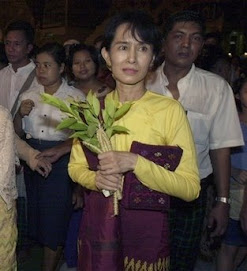


 Posts


