Junta into diversionary tactics
News - Shan Herald Agency for News
Tuesday, 08 September 2009 13:04
In what seems to be tactics to divert attention, the Burmese Army has been deploying and redeploying troops and armour in Kachin State, Shan State North and Shan State East, but its next target after Kokang is so far anybody’s guess.
In northern Shan State, one tactical command of the Sagaing-based Light Infantry Division No. 33, deployed in Kokang last month, has been ordered to move to Kachin State further north, according to a border source. A tactical command from the Kalaw-based LID No. 55 is due to replace it. (One tactical command comprises three infantry battalions)
In eastern Shan State, more troops and heavy weapons are arriving in Mongkhark and Monyang, facing the United Wa State Army (UWSA) and its southeastern ally the National Democratic Alliance Army (NDAA).
However, a representative from Naypyitaw, Col Kyaw Kyaw, who used to be commander of the Infantry Battalion No. 279 based in Mongyang, told the local people on September 4, “There is no way the government is going to attack either the Wa or Mongla.” He therefore urged the people to recall their relatives who have fled the area.
“Which is contrary to exhortations by local TV channels in neighbouring Yunnan to all Chinese nationals working on the Burmese side of the border to return to their homeland for their safety and welfare,” said a source close to the Mongla authorities.
On the Thai-Burma border, a Lahu militia source claimed yesterday that his unit was instructed to do everything it could to provoke the Wa soldiers to shoot first. “My boss told me that the idea is for the Burmese Army to have an excuse to attack the Wa, as it did in Kokang,” he explained.
Areas of the Kokang, a ceasefire group north of Wa, were overrun three days after an advancing police column was fired upon by the defenders on August 27.
The Burmese Army has also reinforced its troops at Namzarm, the village east of Monghsat, where the road branches off to the Wa strongholds in Mongyawn, opposite Thailand’s Mae Ai district. “There used to be only the LIB (Light Infantry Battalion) 333,” said a local. “But now we are seeing at least 200 more troops, with 10 armoured cars.”
West of the Salween in southern Shan State, all units have been ordered to requisition both civilian trucks and porters and be ready to move in 24 hours. “Even in Taunggyi and Kalaw, where requisition of trucks and porters were unheard of in the past, are not being spared,” a local source said “Each unit has to have at least 10 trucks and 100 porters at its disposal.”
Bewildered, many people are consulting local spirits through known mediums, he added.
Shan State Army leader Sao Yawdserk has predicted that Naypyitaw’s next target would be Mongla, followed by Kachin, Wa and then the SSA.
“The Burmese Army is in a high state of readiness,” commented a Thai security official. “What it needs is a good excuse (to attack the ceasefire groups).” http://www.bnionlin e.net/news/ shan/6993- junta-into- diversionary- tactics.html
Wednesday, September 9, 2009
Junta into diversionary tactics


An 'Election' Burma's People Don't Need
An 'Election' Burma's People Don't Need
By U Win Tin
Wednesday, September 9, 2009
Much attention has been focused on Sen. James Webb's recent visit to my country and his meetings with Senior Gen. Than Shwe and incarcerated Nobel Peace Prize recipient Aung San Suu Kyi. I understand Webb's desire to seek a meaningful dialogue with the Burmese ruling authorities. Unfortunately, his efforts have been damaging to our democracy movement and focus on the wrong issue -- the potential for an "election" that Webb wants us to consider participating in next year as part of a long-term political strategy. But the showcase election planned by the military regime makes a mockery of the freedom sought by our people and would make military dictatorship permanent.
In our last free election, the Burmese people rejected military rule in a landslide, awarding our National League for Democracy party more than 80 percent of the seats in parliament. Yet the military has refused to allow the NLD to form a government. In the 19 years since that election, Burmese democracy activists have faced imprisonment, intimidation, torture and death as they have peacefully voiced demands for justice, individual and ethnic rights, and a democratic form of government that is representative of all Burma's people.
While never ending our struggle for democracy, the NLD has continually sought to engage the regime and open a dialogue -- based on peace and mutual respect -- that could address Burma's critical political as well as social problems. Make no mistake -- these two issues are linked. Burma was once the rice bowl of Asia. Today, because of the regime's destructive economic policies and its use of oppression to maintain military rule, Burma is a shattered, poverty-stricken country.
ad_icon
The regime is seeking to place a veneer of legitimacy on itself through showcase "elections" and claiming that "disciplined democracy" will be instituted next year. Yet in May 2008, just days after a massive cyclone devastated Burma and killed more than 100,000 people, the regime used a farcical process to claim that 93 percent of voters chose to adopt a constitution that permanently enshrines military rule and prevents those with undefined "foreign ties" from holding public office -- catch-all provisions that would bar Suu Kyi and democracy activists from seeking office.
Some international observers view next year's planned elections as an opportunity. But under the circumstances imposed by the military's constitution, the election will be a sham. We will not sacrifice the democratic principles for which many millions of Burmese have marched, been arrested, been tortured and died to participate in a process that holds no hope whatsoever for bringing freedom to our country.
The demands of the NLD are reasonable. In April we issued another declaration to encourage engagement with the military that called for the release of all political prisoners, a full review of the constitution, reopening of all NLD offices and the right to freely organize. The regime's answer is the continued jailing of Suu Kyi and 2,000 other activists, massive military offensives against ethnic groups and the enforcement of rules to gag democracy.
How can the international community play a meaningful role? First, officials such as Webb should stop fear-mongering about China. His language about containing China, and working with Burma's regime to do so, is based on an outdated and unrealistic thesis. Suu Kyi rejected such notions by informing Webb that "we will not deal with anyone with fear and insecurity. We will deal with anyone, China, America, India, equally and friendly. As we can't choose our neighbors, we understand that we need to have a good relationship with China." Second, the NLD encourages other countries and international organizations to engage with Burma's military leaders to persuade them to engage with us and Burma's ethnic groups. The United States and many other nations have imposed sanctions on Burma. That is their decision and in keeping with their justified solidarity with the democratic values that we all hold so dear. If the regime genuinely engages with the NLD and ethnic representatives, releases political prisoners, ceases attacks against ethnic minorities and takes additional steps to build a true democratic state, these sanctions will be repealed at the right time.
In the meantime, let no one doubt our resolve. The NLD is a reflection of Burmese society. We will not be cowed or coerced into participating in a fatally flawed political process that robs the Burmese people of the freedom for which we struggle. We stand ready to engage, but we are more than willing to continue our struggle for the democratic values that so many have given their lives and their freedom to achieve.
U Win Tin is a member of the Central Executive Committee and a founder of Burma's National League for Democracy party. He was a political prisoner from 1989 to 2008.
http://www.washingt onpost.com/ wp-dyn/content/ article/2009/ 09/08/AR20090908 02959.html
============ ========= ======
Win Tin Speaks Out
Win Tin Speaks Out
Wednesday, September 9, 2009
In an article published in the Washington Post on Wednesday, Win Tin hit out at the Burmese regime’s planned election in 2010.
Win Tin has spent 19 years in prison for his political beliefs and is considered to be the country’s most prominent contemporary politicians.
The senior leader of the opposition National League for Democracy (NLD) wrote: “Some international observers view next year's planned elections as an opportunity. But under the circumstances imposed by the military's constitution, the election will be a sham.”
He stated in his article that his party will not sacrifice the democratic principles for which many millions of Burmese have marched, been arrested, been tortured and died to participate in a process that holds no hope whatsoever for bringing freedom to Burma.
And he reinforced the NLD’s demands that all political prisoners are released, a full review of the constitution is granted and that the opposition be allowed to reopen its offices and have the right to associate and organize.
The former journalist and editor of the well-known Hanthawaddy newspaper wrote: “The regime's answer is the continued jailing of [Aung San] Suu Kyi and 2,000 other activists, massive military offensives against ethnic groups and the enforcement of rules to gag democracy.”
He also criticized US Sen James Webb’s recent and controversial visit to Burma.
Win Tin said that he understands Webb's desire to seek a meaningful dialogue with the Burmese ruling authorities. But, he said, “Unfortunately, his efforts have been damaging to our democracy movement and focus on the wrong issue—the potential for an "election" that Webb wants us to consider participating in next year as part of a long-term political strategy. But the showcase election planned by the military regime makes a mockery of the freedom sought by our people and would make military dictatorship permanent.”
Webb’s visit received mixed reviews among Burmese and international observers. Burma’s military leaders, including junta chief Snr-Gen Than Shwe, received Webb during his visit and allowed the US senator to meet detained democracy leader Suu Kyi.
Many ordinary Burmese in Burma mistakenly thought Webb represented the US government. Therefore, they assumed the US had dramatically shifting its policy on Burma by embracing the repressive regime.
The US government’s policy on Burma is under review and it is believed that the new policy will be a mixture of carrots and sticks.
During a recent visit to Asia, US Secretary of State Hillary Clinton said that neither sanctions nor engagement work with Burma’s military dictatorship.
Copyright © 2008 Irrawaddy Publishing Group | www.irrawaddy. org
http://www.irrawadd y.org/article. php?art_id= 16751
[info_ngo_hrn] HRNより新政権への総合的政策提言発表・国連人権理事会にむけて
ヒューマンライツ・ナウ メールマガジン購読者のみなさまへ
いつも大変お世話になります。
ヒューマンライツ・ナウでは、新しく民主党を中心とする政権が発足するのを前に、
人権を中心とする外交への転換および国内の人権課題の改善に関する総合的な
提言をとりまとめ、公表いたしました。以下をご確認ください。
http://hrn.or.jp/activity/advocacy.jpgobt2009.pdf
(これをクリックしてください)
提言では、今後の国際貢献・外交の中心として、人権促進を位置づけ、
アジア地域での人権機構の設立へのイニシアティブや、援助政策に
おける人権・ジェンダーの主流化などを進めることを求めています。
また、国内人権政策については、政府から独立した人権擁護機関の設置、
冤罪を生まない刑事司法の改革、人権条約の選択議定書の批准により
個人が人権条約機関に救済申し立てをできるようにすること、従軍慰安婦
など戦後補償の解決などを求め、今後も政策提言や人権政策の前進にHRN
として貢献していく姿勢を述べています。
これまでも、折にふれてHRNとしての政策提言をしてまいりましたが、
今回これまでの提言をとりまとめ、HRNとしての総合的な提案として公表した
ものです。今後その実現にむけて鋭意取り組む予定です。
HRNでは、国際的な人権課題に多く取り組んできましたが、日本における
人権政策の大きな転換の実現に貢献するため、今後、提言書に重要課題として
あげた日本の人権課題について、活動を強化する予定ですので、
皆様からのこの点でのご支援・ご協力もぜひよろしくお願いいたします。
なお、ヒューマンライツ・ナウでは、9月14日の人権理事会の12会期開催にあたり、
1 カンボジアの人権特別報告者の再任
2 パレスチナ、ガザ攻撃に関する真相究明
3 ビルマにおける人権状況の改善
を求めて現地でロビー活動を展開する予定でおります。
カンボジアに関連して以下の要請書を日本政府におくり申し入れを行いました。
http://hrn.or.jp/activity/topic/surya-prasad-subedi/
ビルマに関しては、以下の声明を発表しています。
http://hrn.or.jp/activity/product/statement/post-38/
パレスチナに関しては、国連の独立調査団の報告発表を受けて意見表明をする
予定でいます。ガザの国連施設に対する国連調査団の報告書を入手し
和訳して公表いたしましたので、ご活用いただければ幸いです。
http://hrn.or.jp/activity/area/cat69/200812272009119/
ヒューマンライツ・ナウでは、ガザ地区に対する攻撃が国際人権・人道法に対する
重大な違反がある可能性が極めて高いと考え、今後も国連調査の動向を
フォローアップしていく予定です。
今期、HRNは国内外の課題についていっそうの役割を果たしていきたいと考えていますので、
今後ともなにとぞよろしくお願いいたします。
ヒューマンライツ・ナウ事務局長 伊藤和子
Tuesday, September 8, 2009
War Is Not Answer: Wa Leader
War Is Not Answer: Wa Leader
--------------------------------------------------------------------------------
By WAI MOE Monday, September 7, 2009
--------------------------------------------------------------------------------
Speaking in an interview on China’s Phoenix TV broadcast on Monday, Bao You-Xiang, the leader of the United Wa State Army (UWSA), said, “We absolutely do not want fighting to break out in Wa State [Wa Special Region]. Only peaceful negotiations can defuse the tension.
“The Wa State hopes to become a democratic self-ruled autonomous region within a Burmese federal republic. Only peaceful means can solve the problem, not the use of force,” he said.
United Wa State Army leader Bao You-Xiang appears on China's Phoenix TV.
Phoenix TV pictures clearly showed pictures of Gen Aung San, the founder of the Burmese army, and Snr-Gen Than Shwe, the leader of the Burmese junta on the wall of the Wa leader’s office.
Tension has risen dramatically on the Sino-Burmese border after the UWSA, the Kachin Independence Army, the Kokang armed group known as the Myanmar National Democratic Alliance Army (MNDDA) and the Mongla-based National Democratic Alliance Army(NDAA) refused to transform their militias into border guard forces as ordered by the Burmese junta in April.
The armed ethnic groups rejected the plan saying it ignores ethnic minority rights. By transforming their troops into border guard forces, the armed ethnic ceasefire groups would effectively put their troops under control of the Burmese army. The junta has set October as the deadline to begin training and forming the border guard force.
Lt-Gen Ye Myint, the head of Military Affairs Security [Burmese military intelligence] and the secretary of the Transformation Committee for the Border Guard Force repeatedly said in a letter to the UWSA that the Tatmadaw [Burmese armed forces] would not attack Wa troops.
With an estimated 25,000 soldiers, the UWSA is the biggest ethnic ceasefire group in military-ruled Burma. It signed a ceasefire agreement with the Burmese junta in 1989 after the MNDDA agreed to a ceasefire with the Burmese army.
The US Congressional Research Service describes the UWSA as “the largest of the organized criminal groups in the region,” due to its involvement in the drug trade.
The status of the Burmese military junta’s ceasefire agreements with 17 ethnic armed groups has been uncertain after Burmese government troops seized the Kokang capital, Laogai, on August 24.
After the fall of Laogai, there were skirmishes between government forces and MNDDA troops. At least 30 people, including Chinese citizens, were killed and more than 30,000 people fled to China.
The Kokang’s resistance to the junta’s troops ended abruptly after more than 1,500 Kokang fighters crossed the Sino-Burmese border and surrendered their arms to Chinese officials on August 29.
After the collapse of the MNDAA, observers have been openly wondering who the next target for the Burmese army will be. Many say the UWSA is the Burma army’s main target among the ceasefire groups because it is the leading group resisting junta plans to neutralize the armed militias.
Observers on the ongoing ethnic conflict in Shan State said Beijing would play an important role in maintaining stability along the Sino-Burmese border through negotiations with both sides as the Sino-Burmese overland oil and gas pipelines are scheduled to start this month.
The Chinese government is a close ally of the Burmese regime and is influential with the ethnic armed groups along the border.
During a meeting with Vice Snr-Gen Maung Aye in June, Chinese Premier Wen Jiabao made it clear that the Chinese favor pushing forward the democratic process in Burma to achieve national reconciliation, safeguard national stability and promote economic development.
“What the Chinese do is paramount,” said Aung Kyaw Zaw, a former Communist fighter who is monitoring the situation from the Chinese border town of Ruili.
“However, the junta’s No1 Snr-Gen Than Shwe, No 2 Maung Aye and Secretary 1 Gen Tin Aung Myint Oo have paranoia over Beijing’s relationship with the ethnic groups along the Sino-Burmese border,” he said. “They fought against communist troops backed by the Chinese People’s Liberation Army. These troops became the militias of the UWSA, MNDAA and NDAA.”
On Sunday, a report about Burmese politics in a popular Chinese language news website, news.qq.com, said: “The Burmese people have been promised an improvement in their lives after the elections [in 2010]. However, analysts believe that if the new government fails to meet peoples’ needs, then this could lead to popular discontent.”
Copyright © 2008 Irrawaddy Publishing Group | www.irrawaddy.org
Prelude to a Civil War?
CONTRIBUTOR
Prelude to a Civil War?
--------------------------------------------------------------------------------
By HARN YAWNGHWE Monday, September 7, 2009
--------------------------------------------------------------------------------
Many were surprised by the State Peace and Development Council (SPDC) attack against the Kokang forces.
Some had been so preoccupied with the trial of Aung San Suu Kyi that they were not even aware of the impending crisis. Others could not understand why the Burmese military would turn against their allies who have had a cease-fire agreement for more than 20 years.
Yet others thought that the Burma Army would never dare to incur the wrath of China. After all, had the Chinese not, in June, requested Vice-Snr-Gen Maung Aye to maintain stability on the border? This development was especially surprising to those who were convinced that Burma is a client state of China.
This failure to anticipate events underscores the weakness of the Burmese democracy movement, in particular, and the international community, in general.
We have often failed to understand the strategy and plans of the ruling military government. We have looked at their actions through our own prisms and misinterpreted their intentions. We have tended to see SPDC pronouncements as propaganda and have not paid enough attention to what it is planning to do.
Nobody is happy with military rule in Burma so we dismiss the SPDC “road map” to democracy and its constitution. But how many of us have actually studied the constitution in detail, not to criticize it, but to see how the military actually plans to implement its “road map” policies and how we can use its plans to our advantage?
In 2004, the SPDC announced the “road map,” and last year it announced plans for an election in 2010. We were outraged when the referendum was held two weeks after Cyclone Nargis had devastated the delta and Rangoon. We would not have been surprised had we realized that Snr-Gen Than Shwe takes the “road map” seriously.
He will not allow anything to stand in its way. A series of recent events has also taken some of us unaware—he release of U Win Tin; the first ever post-1990 congress of the National League for Democracy (NLD); Aung San Suu Kyi’s trial, the unseasonable attack on the Karen National Union; the attack on Kokang and now possibly an attack on the Wa.
These seem to be the random acts of a paranoid and unpredictable leader—he image we like to portray of Snr-Gen Than Shwe. But in reality, all these events have a common goal: the success of the 2010 elections. They are the rational outworking of a well-calculated and orchestrated operation plan of the SPDC.
The proposal to the ethnic cease-fire groups to transform themselves into Border Guard Forces (BGF) under the control of the Burma army is also an attempt to clear the decks before the 2010 elections. It was meant to either provoke the cease-fire groups to reject the proposal and be destroyed or frighten them into submission and acceptance of the SPDC road map.
It is clear that the BGF proposal was a provocation. This is because during the past 20 years, nothing of this matter was ever discussed with the cease-fire groups. They were told they could keep their arms and could negotiate with the newly elected government on the political terms they wanted.
Suddenly, in April they were told they had until October 2009 to decide. Analyzing the ceasefires, it is clear that the SPDC never meant to negotiate. The plan was to stop hostile action, provide incentives to entice individual commanders to split from the main groups and slowly weaken the ethnic groups to the point where they could be easily eliminated.
The cease-fire groups cannot accept the BGF because it is actually a plan to destroy the groups by attrition. But if they refuse to accept the proposal, they will be destroyed now, before the elections. The Kokang (MNDAA), the Wa (UWSA) and the Mongla (NDAA) groups rejected the BGF proposal and also refused to accept the SPDC’s road map and constitution. They do not want any changes. Therefore, if nothing changes, the SPDC will move against the UWSA and the NDAA. Which group will be attacked first will depend on the tactical advantage.
What about China? Is the SPDC not beholden to China? The short answer is—no. Whatever we may think about the SPDC, the Burma Army is very proud of the fact that it is “patriotic.” The SPDC has never danced to the tune of a foreign power. It has, rather, made foreign powers big and small dance to its tune. Since the SPDC has been largely ostracized internationally, it has had to depend on China.
But it was never happy about it. When Burma was discussed at the UN Security Council and it had to depend even more on China, the SPDC began to cultivate Russia, so that it would not be at China’s mercy. But Snr-Gen Than Shwe’s problem was solved when John Yettaw decided to take a swim. He enabled the SPDC to ensure that Aung San Suu Kyi would have no role in the election, and he also enabled Than Shwe to raise the stakes and create a direct link with the Obama administration.
This in turn gave Than Shwe the card he needed to ignore China’s wishes and move against the Kokang and Wa.
If Snr-Gen Than Shwe’s calculations are correct, the SPDC will be able to wipe out the Wa and Mongla groups, and the 2010 elections can be held on a less contentious playing field according to schedule.
The unpredictable factor, of course, is how much resistance the Wa army will offer. And what the reaction of the other cease-fire groups will be. Some like the Kachin Independence Organization (KIO) and the New Mon State Party (NMSP) are in the process of negotiating with the SPDC over the BGF issue.
Other groups like the KNU and the Shan State Army (South) are watching closely to see how the battle develops. If Than Shwe’s calculations are wrong, Burma could face a period of serious instability and the 2010 elections will be jeopardized.
But on the other hand, the SPDC may have decided that the elections could actually lead to democratization, and it is trying to create a pretext to postpone the elections indefinitely.
Harn Yawnghwe is executive director of the Brussels-based Euro-Burma Office.
Copyright © 2008 Irrawaddy Publishing Group | www.irrawaddy.org
Danger of border skirmishes escalating
Danger of border skirmishes escalating
Editorial Desk
The Nation (Thailand)
Publication Date: 08-09-2009
It has always been said that China is Burma's closest ally. Given the fact that the junta doesn't have many friends, one like China will always stand out. But the not-so-honorific label of "closest ally" should be understood in its proper context. For the Burmese, Chinese friendship doesn't mean the world.
Nonetheless, such a friend could very well come in handy, especially when the international community and the United Nations are constantly looking to clobber the generals with sanctions and criticism.
For the Burmese regime, survival is everything. Where it positions its troops and weapons, and the type of legislation and reconciliation process that it proposes, reinforce the very idea that it is here to stay whether the world likes it or not.
For as long as anybody can remember, China has been a factor whenever a Burma policy and strategy is drafted by the international community. Over a decade ago, when Rangoon's membership of Asean was on the table, members of the regional grouping whispered among themselves about the Chinese factor. Keeping the Burmese out of the regional loop would push the junta further into the arms of the Chinese, they said.
But for the Burmese, Asean membership was not seen as a privilege but a right - simply because the country happens to be in the same geographical region. There was no "thank you" to Asean for letting the country become a member.
A handful of Thai diplomats thought a free ride for Burma in Asean would deny the regional grouping the only card it had to play against the junta. Their concerns were largely ignored by most of the other Asean members, who really didn't give a hoot about the atrocities committed by the junta, or the political baggage that comes with Burma's membership. And when Asean came under an unwanted spotlight or was at loggerheads with the international community, such as the European Union, over Burma's participation, all the Burmese generals could do was shrug their shoulders. They just couldn't care less.
And so when the Burmese unleashed their troops against one of the minority cease-fire groups within the country, namely the Kokang, forcing tens of thousands people - including Yunnanese Chinese who have more or less seized northern Burma over the last few years - to flee for China, Beijing was jolted.
Thai military officials with direct experience of the Chinese often called them "masters of two-track diplomacy". They pointed to China's relations with the bloody Khmer Rouge in Cambodia, up until that regime's dying days, and its historical ties with the ethnic armies that operate independently along Burma's northern border.
Attacking the Kokang and turning their guns towards the 20,000-strong United Wa State Army (UWSA) afterwards was a rude awakening for the Chinese. If anything, the junta was telling its so-called "closest ally" that it is charting its own course. One could say that the Chinese finally got a taste of their own medicine.
For decades, Burma has given China access to its ample natural resources, and the Indian Ocean, in exchange for political support. Moreover, Chinese companies are set to start construction on a US$2.5 billion oil-and-natural- gas pipeline project that will run from the Indian Ocean to Yunnan's capital of Kunming. But if one thinks that Burma is a Chinese lackey, think again.
It is clear that the two-decade-old ceasefire with the ethnic armies no longer serves Burmese purposes. From the generals' perspective, a normal country shouldn't have small armies operating independently on its soil, especially if those armies are proxies of a powerful neighbour.
Beijing expressed its concern back in June, and the ruling Burmese State Peace and Development Council (SPDC) said that it did not want to see disturbances along the Sino-Burmese border. But in the end, for the junta, domestic matters overtook any diplomatic concerns.
For too long Beijing turned a blind eye to the atrocities committed inside Burma, telling the world to stay out of Burma's domestic matters. Self-serving interest has always been China's political attitude towards Burma.
It's different now, however, as China is directly affected by this so-called domestic matter.
If Beijing thinks it has a big headache with the 30,000 refugees fleeing the Burmese attack against the Kokang, then wait until the junta turns its guns on the UWSA. It could very well have a ripple effect, turning Burma's entire northern border into a full-blown war zone if other cease-fire groups like the Chin, Kachin and Shan join the fight to keep their patches of real estate given to them two decades ago.
http://www.asianews net.net/news. php?id=7678&sec=3
The Politics of Building a Gas Pipeline
The Politics of Building a Gas Pipeline
By J J KIM Tuesday, September 8, 2009
While the Western world continues to debate whether economic sanctions can make change in Burma, the sale of gas to China from the offshore Shwe gas fields in Arakan State threatens to raise the junta’s revenue from foreign investment to new heights and strengthen business ties throughout Asia.
Furthermore, the parallel gas and oil pipelines, which are reportedly starting construction this month from Arakan State to Yunnan Province, China, via Magwe Division, Mandalay Division and Shan State, have been criticised by human rights groups as a major contributing factor to the recent conflict in northern Shan State.
According to a report titled “Corridor of Power” released by the Shwe Gas Movement (SGM), the pipeline will make the junta at least US $29 billion over the next 30 years. Much of this is expected to be spent on military expansion, despite the current famine in Arakan State and poverty across the country.
Source: Shwe Gas Movement
Moreover, the report claims, construction of the pipelines, which are being built primarily by the China National Petroleum Company (CNPC), is likely to lead to human rights abuse across the country and a “re-ignition of fighting between the regime and ceasefire armies stationed along the pipeline.”
According to Khur Hseng from Shan Sapawa, who has been researching the impact of the pipeline in Shan State since 2007, these fears were confirmed during the armed confrontation between the military government and the ethnic Kokang Myanmar National Democratic Alliance Army (MNDAA) in late August. The fighting took place just 50 km from the proposed pipeline route, killing 200 people and leading to a mass exodus of up to 30,000 civilians to China.
“The main objective of the SPDC is to clear all opposing forces from the area for development projects, including the Shwe Gas pipeline,” said Khur Hseng. “They are trying to clear the people who will be against the plans and control the area so the true information about the project can’t get out. China needs this as well because they limit their media too.”
According to Wong Aung, the international coordinator of SGM, despite reports from the Chinese media about the project’s commencement, in fact the risk of local opposition and conflict is too great for the project to make much progress this year.
“It is impossible to start now; maybe just some foundations in Arakan State or Magwe. Before they start they will have to clear out all political, ethnic and conflict issues on the border. They will have to deploy propagation in so many places along the pipeline first, to ensure security.”
The sale of gas and oil is currently the junta’s biggest earner, bringing in almost US $3.5 billion annually. According to the report, from 2013 onwards the Shwe Gas Project, which is headed by the South Korean company Daewoo International, will bring in close to another US $1 billion.
This has raised concerns among pro-democracy campaigners and analysts, who say the deal will entrench military rule in the country by financing the regime and strengthening their political clout in the region.
Wong Aung said “It will harm the democratic process if the regime continues to receive the revenue from this sector… . The regime is receiving that money and creating conflicts in the ethnic areas. Basically, institutional investors and companies who are supporting the regime's projects are damaging the stability of the region.”
According to Larry Jagan, a long-term observer of Sino-Burmese relations, “One of China's main concerns is natural resources, so any major project is important to them from an economic point of view.”
This is of particular significance with the pipeline agreement as it offers China an alternative trade route for oil and gas from Africa and the Middle East too. Until now, such imports have had to pass through the US-Navy controlled Malacca Strait taking seven days longer than they would through Burma.
“One thing that is apparent [from the recent conflict in northern Shan State] is that Burma holds the cards. The opposition thinks that China could influence Burma if they want to, but these projects give Burma the upper hand”
“Although economically important to China, Burma is also strategically crucial to China as it is its staunchest ally in Southeast Asia [and] opposed to US interests in the region.”
“There is no doubt that Chinese investment and Burma’s trade with the rest of Asia reduces the impact of Western sanctions,” Larry said.
Experience from past gas and oil developments in Burma have led SGM to believe that the pipelines will cause “forced labour, forced relocation, land confiscation and a host of abuses by soldiers deployed in the area.” According to SGM's report, there are currently an estimated 13,200 soldiers stationed along the pipeline route, mostly in areas that haven’t seen significant armed conflict for decades.
According to Naing Win of Kyauk Phyu Township in Arakan State, where the pipeline will begin, “Most people depend on fishing for survival, but they are prohibited by the navy to fish within 10km of the gas fields. The Navy often steal their fish and gas and oil and [harass] them outrageously.” Because of this, local people find it difficult to survive and provide an education for their children.
Another major concern is the threat of forced relocation of civilian families to make way for the pipeline and other related infrastructure. Stretching around 1,000 km in Burma, the pipeline will cut through many densely populated areas. According to Khur Hseng, “Thousands of people will be forced to leave their homes in Shan State alone.” Recent projects in the region, such as the Tasang Dam, have forced hundreds of thousand of men, women and children into the jungle and to other countries to start a new life.
As the report highlights, while the regime’s profits from the export of electricity and fossil fuels become increasingly lucrative, civilian energy needs are persistently neglected. The national per capita energy consumption currently amounts to less than 5 percent of that in Thailand or China. Arakan State, the source of the gas, is not connected to the national grid and over 90 percent of the population still use candles for light and firewood for cooking.
While the junta continues to make war in ethnic regions and display no regard for civilian needs, many campaigners feel that change can only come when all foreign companies and financial institutions halt investment in such projects. Despite sanctions and Western rhetoric, both CNPC and Petrochina, who will distribute the gas in China, have received significant financial backing from the West in recent years, from banks such as Morgan Stanley, Deutsche Bank and Goldman Sachs.
According to Wong Aung “The USA and EU need to re-impose stronger sanctions and consider a practical way to get a positive outcome because the regime has so many channels to oppose the sanctions compared with 10 years ago. While locally registered companies continue to gain financial backing from the USA and EU, sanctions are becoming just a notion for these governments.”
“I would like to raise this issue among foreign governments, companies and the various institutional investors involved in this project: they should support the democratic process for Burma,” he said.
JJ Kim is a freelance writer based in Thailand.
Copyright © 2008 Irrawaddy Publishing Group | www.irrawaddy. org
http://www.irrawadd y.org/article. php?art_id= 16740
China's troubles: A vast nation faces unrest in many directions
China's troubles: A vast nation faces unrest in many directions
Tuesday, September 08, 2009
Pittsburgh Post-Gazette
Strife between Uighurs and Han Chinese in Xinjiang province, refugees pouring into China from Myanmar and heightening tensions with India are examples of problems that face China on its edges.
Sprawled across Asia from its borders with India, Pakistan and Afghanistan on the east to the sea on the west, and from Russia in the north to Southeast Asia, including Myanmar, to the south, China not only has difficult neighbors but also contains a complicated quilt of ethnicities.
By comparison, the United States -- with the Atlantic and Pacific oceans, the Canadian and Mexican borders, and regional and ethnic politics -- seem blessedly simple, even counting Texas and Alaska.
In Urumqi, in the Xinjiang region, Han Chinese, brought there by Beijing to water down the Muslim, independent- thinking Uighurs, claim that Uighurs are attacking them in the streets with hypodermic needles filled with HIV virus, and complain that the government isn't doing enough to protect them. Street disturbances have lasted for days.
The government of Myanmar, allegedly in advance of elections scheduled for next year, clamped down militarily on separatists in Kokang region, which borders China. The result was a flood of refugees into China, to the great displeasure of Beijing, which has to deal with them. China is otherwise the Myanmar government's best friend and greatest protector.
The third problem is a heating of tensions between China and the other Asian giant, India, in the Tawang region, part of long-standing wrangling between the two giants over their 2,521-mile border zone. Both sides have added to the danger of an outbreak of fighting by building up their military forces in the area.
Two points emerge from this prickly situation. The first is that it is difficult being China. The second is a hope that China and India, both of which will be at the G-20 summit in Pittsburgh, will take that opportunity to soothe relations.
First published on September 8, 2009 at 12:00 am
Read more: http://www.post- gazette.com/ pg/09251/ 996249-192. stm#ixzz0QW9d2UJ X
[info_ngo_hrn] 9/13「NGOまつりin上野2009」を丸幸ビルにて開催!
ヒューマンライツ・ナウ メールマガジン購読者のみなさま
今年もこの季節がやってまいりました。
9月13日、東上野の丸幸ビル(通称NGOビル)に事務所を構える10団体が集結し、
「NGOまつりin上野2009」を開催します!!
http://ngomatsuri2009.blog88.fc2.com/
今年のテーマは『アナタが気付けば セカイが動く~』
ヒューマンライツ・ナウも、団体企画、全体企画と多数のイベントを
皆様にお届けいたします。
【ヒューマンライツ・ナウ企画】
(丸幸ビル3F、HRN事務所内にて行います)
11:00-12:00 在日ビルマ難民の方のお話
スピーカー:チョチョアイさん(ビルマ女性連盟)
軍事政権化のビルマの実情を、ご自身の体験から語っていただきます。
14:00-15:00 「若手弁護士とボランティアが語るHRN」
団体立ち上げから関わる鈴木麻子弁護士と、活動に積極的に関わる
インターン・ボランティアスタッフがヒューマンライツ・ナウの活動や、
自分たちの想いを語ります。
16:00-17:00 在日ビルマ難民の方のお話
スピーカー:チョチョアイさん(ビルマ女性連盟)
軍事政権化のビルマの実情を、ご自身の体験から語っていただきます。
17:10-18:00 みらいの法律家学校「ピースローアカデミー」を尋ねて
HRNが支援をしている、タイ・ビルマ国境にある法律学校訪問の
報告会を行います。
ビルマ国内では学べない「人権」「国際法」を、国の未来のために学ぶ
若者達のことをぜひ聞きにきてください。
※当日HRNでは、ビルマのお茶と揚げ春巻きの販売をします!
【NGO祭り全体企画】
15:30-17:00 アナタが気付けばセカイが動く~セカイを動かす小さなヒント~
様々なバックグラウンドを持つ3人のNGO職員が、
私たちの身近にある国際協力について語ります。(丸幸ビル5階)
日本国際ボランティアセンター(JVC) ラオス事務所スタッフ グレンハント
アフリカ日本協議会(AJF) 斉藤龍一郎事務局長
ヒューマン・ライツナウ(HRN) 鈴木麻子弁護士
18:00~19:30 キャンドルナイト(丸幸ビル屋上)
・NGOに聞きたいこんなこと!(展示)
他にも各フロアーでいろんなイベントが目白押しです。
ぜひ、足をお運びください。
**********************************************
特定非営利活動法人ヒューマンライツ・ナウ
〒110-8605 東京都台東区東上野1-20-6 丸幸ビル3F
電話 03-3835-2110 Fax 03-3834-2406
連絡先 info@ngo-hrn.org
ウェブサイト http://hrn.or.jp/
**********************************************
[info_ngo_hrn] 【ご案内】9月12日(土)HRNこどもの権利プロジェクト学習会
ヒューマンライツ・ナウメルマガご講読のみなさま
・・・・・ご案内・・・・・
HRN子どもの権利プロジェクト学習会
「アジアにおける人身売買の現状と私たちにできること」
HRN子どもの権利プロジェクトでは、
アジアにおける人身売買をなくすための
取り組みをはじめていますが、
アジアにおける人身売買の現状と、
日本における人身売買の防止に向けた取り組みについて
理解を深めるため
下記の学習会を企画いたしました。
ぜひ、みなさまにも一緒に学んでいただけましたら幸いです。
【日時】 2009年9月12日(土) 15:30~18:00
【主催】 (特活)ヒューマンライツ・ナウ
【会場】 青山学院大学 総研ビル3階10会議室
JR山手線、東急線、京王井の頭線「渋谷駅」宮益坂方面の出口より徒歩約10分
地下鉄「表参道駅」B1出口より徒歩約5分
http://www.aoyama.ac.jp/other/access/aoyama.html
一階には「青山学院大学人権研究会」の表示が出ます。
【講師】
森田明彦さん 「人身売買法の制定への課題」
橋本直子さん 「日本とアジア地域における人身売買の現状と防止に向けた取
り組み」
【資料代】 500円
【講師紹介】
□森田明彦(もりたあきひこ)さん
外務省、国際連合開発計画、財団法人日本ユニセフ協会広報室長等を経て、2006
年4月より東京工業大学特任教授。そのかたわら、国際的な子どもの権利NGOであ
るセーブザチルドレン・ジャパンのシニア・アドバイザー、フリーザチルドレン
・ジャパン理事等を務める。
□橋本直子(はしもとなおこ)さん
日本政府外務省在ニューヨーク国連代表部・人権人道問題専門調査員、
国連難民高等弁務官事務所(UNHCR)北部スリランカ(ワウニヤ)事務
所・准法務官などを経て、07年8月より、国際移住機関(IOM)駐日事務所にて
プログラム・マネージャー
として勤務。日本における人身取引被害者など脆弱な立場にある移民の保護・支
援を行う傍ら、日本の移民政策に関するアドバイス等を行なう。
**********************************************
特定非営利活動法人ヒューマンライツ・ナウ
〒110-8605 東京都台東区東上野1-20-6 丸幸ビル3F
電話 03-3835-2110 Fax 03-3834-2406
連絡先 info@ngo-hrn.org
ウェブサイト http://hrn.or.jp/
**********************************************
Monday, September 7, 2009
Ethnic challenge for Myanmar
========= =====
Sep 6, 2009
Ethnic challenge for Myanmar
BANGKOK - MYANMAR'S military junta may have taken Aung San Suu Kyi out of the picture ahead of elections next year, but it could face an even greater challenge from rising ethnic unrest, analysts said.
The regime has recently stepped up its decades-long campaign against minority groups, with offensives against ethnic Chinese rebels in the northeast in August and Christian Karen insurgents near the Thai border in June.
Civil war has wracked the country since independence in 1948, and while most rebel groups have reached ceasefire deals with the junta, analysts say the army is determined to crush the rest before the 2010 polls.
The offensives have mirrored the ruling generals' efforts to take Ms Suu Kyi off the political stage by sentencing her to another 18 months' house arrest after a bizarre incident in which an American man swam to her lakeside home.
The Nobel Laureate's lawyers launched an appeal against her conviction last week, but with the country's pliant courts likely to do the junta's bidding, the ethnic problem is the next real hurdle for the regime, analysts said.
'This is a very complicated issue. After Aung San Suu Kyi's case, the next big issue is the issue of ethnic minorities,' Aung Naing Oo, an independent Myanmar analyst based in Thailand, told AFP.
Military ruler Than Shwe has long made the struggle for the 'stability of the state' the main justification for the army's continued dominance over the Southeast Asian nation.
In recent years the regime has been able to reach peace pacts with key ethnic groups, co-opting some to become junta-backed border forces that have taken on their former rebel brothers-in- arms.
But August's outbreak of fighting in Kokang, a mainly ethnic Chinese region of Myanmar's Shan state, showed the tensions near the surface and earned a rare rebuke from Beijing, usually Myanmar's closest ally.
The offensive was a warning to other minority groups thinking of causing disruption before the polls, said Win Min, a Myanmar expert at Payap University in the northern Thai city of Chaing Mai. -- AFP
Critics have denounced the elections as a sham aimed at legitimising the junta's grip on power, but the influential International Crisis Group (ICG) think-tank said recently that the polls could be an opportunity for change.
'These things are happening in the context of the 2010 elections. The Burmese military are showing ceasefire groups that if they don't agree with their plans they are going to fight,' Win Min said, using the country's former name.
The new constitution - pushed through in a referendum in 2008 just days after a cyclone ravaged southern Myanmar - does not provide the autonomy many groups had hoped for, Mr Win Min added.
'The groups signed ceasefires but in the hope that they would get greater autonomy. But they have been mostly rejected. They would like to wait until after there is a new government to negotiate greater autonomy,' he said.
Compounding the problem is the fact that many of the groups, especially the powerful Wa in northern Myanmar, are heavily involved in the drugs trade, often with the tacit assent of the government, analysts said.
'But now the government is using it (the narcotics issue) as a pretext to put pressure on the ethnic groups who don't want to join Burmese security forces,' Mr Win Min said.
The ethnic problems could end up with the effective 'Balkanisation' of Myanmar, a European diplomat in the region said on condition of anonymity.
'We've never been closer to this than we are now,' the diplomat said. 'If no political solution is found for these ethnic groups the whole situation is going to implode.' The diplomat said it was 'not at all the case' that Myanmar's political problems are just about the situation between Ms Suu Kyi and the regime.
'There are so many questions before 2010, so much that's to be done. I'm sure Than Shwe has no clue how to tie up loose ends.' But the Brussels-based ICG said in a report last month that some ethnic groups which had made ceasefire deals were endorsing political parties that would take part in the polls.
'These groups take a negative view of the constitution but feel that there may be some limited opening of political space, particularly at the regional level, and that they should position themselves to take advantage of this,' it said.
'There are increased tensions, however, as the regime is pushing these groups to transform into border guard forces partially under the command of the national army.' -- AFP http://www.straitst imes.com/ Breaking% 2BNews/SE% 2BAsia/Story/ STIStory_ 426174.html
============ ========= ========
Saturday, September 5, 2009
Shwe Ohn and ‘Third Force’ to ally
Shwe Ohn and ‘Third Force’ to ally
by Nem Davies
Friday, 04 September 2009 22:25
New Delhi (Mizzima) – The veteran ethnic Shan politician Shwe Ohn, who will contest the forthcoming 2010 general elections, said that he would forge an alliance with a group of persons known as the Third Force.
His group the ‘Union Democracy Alliance’ formed in 2008 will have an alliance with the five-member group popularly known in Burma as the ‘Third Force’, which has adopted a policy of equidistance from both the military regime and the main opposition party the ‘National League for Democracy’. The new alliance group is now drafting and formulating its electoral policy.
“Yes, we will form it when the election law is enacted and announced. In future, it will be very difficult for us to work separately. We must amalgamate with the broad minded and cooperate,” Shwe Ohn who attended the historic Panlong Conference told Mizzima.
Those who join this new alliance are members of independent candidates’ network Nay Myo Wei, Htay Oo, Thein Tin Aung, Than Min Soe and Thaung Win.
“Now it’s 99 per cent sure. It’s difficult to contest as a lone party. There are only few people who dare speak and stand alone. So we decided to form an alliance,” Nay Myo Wei said.
“We do not have much difference with them in terms of policy. Anyone can join this alliance if the basic policy is the same as it allows a broad policy window. We have no plans to seize the top position as the founder. We are ready to follow any powerful leader who will join us,” Shwe Ohn said. Despite joining the alliance, he will maintain his own organization, he added.
The so-called Third Force accepts the junta’s 2008 constitution and believes that only a peaceful and smooth transition from military rule to civilian rule is viable and practical.
“We do not hope to get executive power. It’s impossible. But we hope to get into the legislative. We will get into the Parliament as Member of Parliament,” Thein Tin Aung from the five-member group said.
“Some parties have idealistic hopes of having the Prime Minister’s post. This is just an ideal. It’s impossible,” he added.
Their position is not to be stooges of the army and they will not oppose the regime either. They will also not follow the NLD. Neither will they slander it, they said.
The NLD won a landslide victory in the 1990 general elections but the ruling junta, which grabbed power in a coup, is still refusing to transfer power to the party.
Shwe Ohn (86) wrote a book titled ‘Let’s build unbreakable Union’ which has 17 chapters with 311 pages. He wrote on the migration route of ethnic nationalities in Burma, emergence of Bagan Kingdom, the landmark Panlong agreement and his views on the constitutions of Burma in the book.
The book was widely circulated among political activists in 2008 but the censor board has not yet given permission for publication of the book.
He also wrote a book titled ‘How about the Third Union’ in 1993. In the same year he was arrested and sentenced to one year in prison for submitting the ‘8-States Union’ paper at the National Convention.
Former air force officer sentenced to two years
Former air force officer sentenced to two years
by Phanida
Friday, 04 September 2009 22:35
Chaing Mai (Mizzima) – A retired air force Captain Zaw Nyunt, who demonstrated alone demanding the release of Aung San Suu Kyi, while she was on trial, was sentenced to two years in prison by the Insein township court.
Zaw Nyunt (56) held aloft a poster saying "Saving Suu is Saving Burma" in front of Insein prison on May 28. He was sentenced today under Act No. 505 (B) of for agitating to destablise the country.
"The reading of the final verdict took about 20 minutes. It concluded at 11:45 a.m., said defence lawyer Maung Maung Latt.
In the trial, four police lieutenants from Insein Township and two ordinary civilians were produced as witnesses by the prosecutor.
"They said he frightened the public. They arrested him in two minutes flat. After arresting him at the back of the bazaar he shouted "Free Aung San Suu Kyi" only once. Many even didn’t realise what was happening. So, how did he destablise the country?" asked Maung Maung Latt.
A close associate who met Zaw Nyunt during the trial told Mizzima that two of his teeth were broken because of the beating he received from the police.
Zaw Nyunt, an English language teacher following retirement participated in the 1988 people’s movement and founded the Worker’s Solidarity Organization but the organization later was banned by the military junta.
Similarly, Htwe Thein, a member of NLD living in Shwepyithar Township, who was arrested while DASSK was facing tria, was sentenced to two years by the court on August 10.
The Thailand based Association of Assistance for Political Prisoners (AAPP) released a statement today saying that there are 2,211 political prisoners in Burma's prisons.
Friday, September 4, 2009
The Irrawaddy - A Child of Rubbish
The Irrawaddy - A Child of Rubbish
By SOE LWIN, Thursday, September 3, 2009
RANGOON—Twelve-year- old Maung Chan Thar has only known poverty despite having a name that means “master of wealth.”
His parents gave him the name in the belief that it would bring good fortune to their eldest son.
With a meager household income, Maung Chan Thar's family of eight has to struggle to put enough food on the table each day, let alone buy clothes or things needed for school by his three younger brothers and two younger sisters.
Four years ago, when Maung Chan Thar was just eight, his parents sent him onto the streets to earn money because they could no longer afford to keep him at school.
Carrying a sack on his back, he has been working in the streets ever since, looking through the piles of rubbish on the streets, roaming the railway tracks, collecting empty water bottles, plastic bags—whatever he can resell.
The piles of rubbish at the markets and railway stations are his sources of income. On a good day, he can make the equivalent of more than US $1, but normally Maung Chan Thar only earns about 70 or 80 cents.
“I am so happy to see my mother smile when I put cash in her hands,” he said.
Maung Chan Thar is the second income earner in his family after his father, who makes about $1.50 a day pedaling a trishaw.
Though he is an important source of income for his family, his parents cannot take care of him.
Like tens of thousands of other street children in big cities such as Rangoon and Mandalay, Maung Chan Thar’s clothes are filthy and in tatters. His hair has not been washed for months, and his nails are long and dirty.
Maung Chan Thar thinks things are alright, however. He knows that in his job what matters is collecting as much recyclable material as possible.
"I hate seeing my younger brothers and sisters crying in hunger, so I work hard," he said, sifting through a pile of garbage near Kyimyindaing Railway Station. “I don’t want them to ever do work like this. I want them to keep going to school.”
When he started on the street, he was often bullied by stronger street children, who would sometimes steal what he made.
"I will never forget when three larger boys beat me up and took all my money,” Maung Chan Thar said. “When I got back home, my father beat me up again for being so weak."
Maung Chan Thar has learned how to avoid such incidents, and he has many friends who will come to his help him if someone picks on him.
His worries are far from over, however. The municipal police and staff from the Yangon [Rangoon] City Development Committee are constantly making arrests.
The risk of arrest is higher when he sleeps at railway stations or bus stops in the downtown area, he said. Since his home is located in Shwepyithar in the outskirts of Rangoon, he often sleeps downtown with his friends if it is too late to go back.
“I’ve never been arrested,” he said. “I’m good at avoiding the police.
“People look down on street children like us, thinking we are thieves,” he said. “When we go around below large buildings picking up plastic bags, residents sometimes threaten us. We have to switch collecting sites quickly when that happens.
“I don’t understand why they look down on us like that,” Maung Chan Thar said, adding that he always followed his mother’s advice.
“My mother always told me never to steal or beg, but to work hard and be honest,” he said.
Though Maung Chan Thar seems destined to keep doing his lowly job, he firmly believes he will be rich one day.
“Every night my mother has this dream in which I am a rich man,” he said, squatting on the rubbish.
“Perhaps I will find something very precious in this rubbish one
The Japan Times - Sanctions don't impoverish Burma
The Japan Times - Sanctions don't impoverish Burma
By DONALD M. SEEKINS
Motobu, Okinawa
In his Aug. 29 article, "U.S. should engage Burma," Brahma Chellaney makes some good points concerning U.S. sanctions against the military regime in Burma: that these sanctions have failed in their stated purpose to promote democracy and human rights; that they have increased China's already large influence inside the country; and that they reflect a double standard — why trade with China, but not with Burma?
But he is mistaken to assume that it is "U.S.-led sanctions" that have made Burma's people among the poorest in Asia. Responsibility for that rests squarely with Than Shwe and his fellow generals, who have squandered funds on new weapons purchased abroad and on the costly new capital city at Naypyidaw, rather than investing in health, education and other improvements in the people's standard of living. Their management of the economy has been grossly incompetent, including a complex and counterproductive system of multiple currency exchange rates and a complete lack of the rule of law in business as well as in other spheres of life.
By contrast, after it adopted liberalization policies in 1986, communist Vietnam did very well for itself despite a U.S. embargo that wasn't lifted until 1994. Washington should take modest first steps in opening up to the regime: perhaps appointing an ambassador to its embassy, still in Rangoon — there hasn't been one since the early 1990s — cutting back on often hypocritical rhetoric about human rights, and continuing to pursue dialogue with Burma's leaders.
Humanitarian aid should be dramatically increased. Washington should adopt a "wait and see" attitude concerning the general election next year. But it is premature to drop all economic sanctions as long as the junta persecutes ethnic minorities like the Karens and Shans and holds more than 2,000 political prisoners, including Aung San Suu Kyi.
The opinions expressed in this letter to the editor are the writer's own and do not necessarily reflect the policies of The Japan Times.
Bangkok Post - Opinion: Junta's war on ethnic rebels alarms China
Bangkok Post - Opinion: Junta's war on ethnic rebels alarms China
Writer: LARRY JAGAN
Published: 2/09/2009 at 12:00 AM
Newspaper section: News
Military operations by the Burmese junta along its border with China in the past few weeks have sent tensions soaring, after thousands of ethnic minorities from Burma fled for their lives.
The Burmese army's recent offensive against the ethnic rebel group Kokang, who call themselves the Myanmar National Democratic Alliance Army (or MNDAA), has also shocked Beijing and rocked their normally very close relations.
Fears that the fighting could spread and explode into renewed civil war has led to a flurry of urgent diplomatic actvity by Beijing, as the Chinese government tries to stabilise the situation before it gets out of hand.
Senior Chinese security officials, including Meng Jian, the powerful minister for public security, have just toured the border area to assess the situation and plot the Chinese reaction.
But the whole affair casts a long shadow over what has been taken by many to be a rock-hard relationsip. It is now increasingly evident that a significant rift exits between the two countries that could have crucial implications for other countries in the region, and for any approach which the international community may take to encourage the Burmese military regime to introduce real political change.
The implications of this growing divergence could have a significant effect on the border region, as the most powerful of the ethnic groups - especially the Kachin, Kokang and Wa - in this area have ceasefire agreements with the Burmese junta, but also have traditionally close ties with the Chinese authorities.
Economically and culturally the area is closer to China than to the Burmese regime. Thousands of Chinese businessmen and workers have migrated into northern Shan State over the last decade, seeking employment and economic opportunities. Many of these ethnic leaders go to Chinese hospital across the border for medical treatent and send their children to school in China. The Chinese language and even the Chinese currency, the renminbi, are used throughout the Kokang and Wa areas in Burma's northern Shan State.
Anything which forces Beijing to choose between their ethnic brothers inside Burma - the Kokang and Wa are ethnically Chinese - and the central government in Naypidaw will cause the superpower immense problems. And in the end will bring into sharp focus the real nature of the Burma-China axis.
Alarmed and surprised by the Burmese military offensive, Beijing has already sent hundreds of extra troops and armed policemen to the area to quell any potential violence. The Chinese central authorities are very upset by the effect of the Burmese military action along the border, and are furious that they were not informed before-hand, according to a senior Chinese government official who requested anonymity.
A senior diplomat flew last week to Naypidaw, the Burmese junta's headquarters and the country's new capital, to convey Beijing's displeasure. Burma has apologised for the instability caused across the Chinese border region, according to Burmese foreign ministry officials. But the Chinese authorities remain anxious about further fallout from the offensive against the Kokang.
The operations were aimed at capturing a Kokang arms factory, the Burmese leaders told their Chinese envoys. But analysts remain sceptical and believe this was, at best, a pretext.
"The junta knows it must move to disarm these ethnic rebel groups, and the Kokang are the weakest militarily," said Win Min, the Burmese academic and military specialist at Chiang Mai University in Thailand.
The Kokang are ethnically Chinese and speak a Mandarin dialect, but have lived for many decades inside Burma. They have their own armed militia and had been fighting the Burmese army for several decades demanding autonomy until they agreed to a truce with the Burmese military regime in 1989.
Tensions have been rising in Burma's border areas for months, as the military junta pressurred the ethnic cease-fire groups - particularly the Kachin, Kokang and Wa - to surrender their arms before the planned elections next year. The Burmese government wants to integrate them into a Border Police guard but these key ethnic groups along the Chinese border have been resisting the move.
At the weekend, international NGOs reported more than 30,000 refugees had fled to China in the part week to escape the fighting. Since then the fighting seems to have subsided and refugees have begun to trickle back to the Kokang capital of Lougai which is on the border and which is firmly under the control of the Burmese army. Once a bustling border town full of bars, discos, karaoke clubs, massage parlours and gambling dens, the town centre is still virtually deserted and many buildings have been damaged.
"More confrontation and military encounters are expected in the following days and thousands of villagers are fleeing across the border [into China] to avoid the war, and subsequent human rights abuses," said a statement from the Kokang group, sent to the Bangkok Post. The 23-year-old cease-fire agreement between the Burmese junta and the Kokang seems to be effectively ended, according to Burmese dissidents based in the Chinese town of Ruili not far from where the Kokang refugees crossed the border.
"This does not augur well for the other ceasefire groups like the Kachin and Wa," said Mr Win Min. "This may be a preview of what is to come."
If the Burmese try the same tactics against the Wa, they will inevitably fight back, Mr Win Min believes. There is a very strong risk of a return to armed conflict along the Chinese-Burmese border, according to a Chinese government official who closely follows events in Burma. "The problem is that the Wa are very close to the Chinese government, and it would be very hard for Beijing to desert them at this crucial point in time," he added.
Beijing now has a major quandry to deal with. They want to stabilise the border area as soon as possible and restore peace to the region. They have advised the Burmese to stop the fighting, or risk a rift between the two governments. They have suggested that the only option is to negotiate a new peace settlement with the Kokang, and offered their support as intermediaries, according to Chinese government sources.
Beijing wants the refugees to return to Burma as soon as possible, but have no intention of pushing them back, said the government official. For the time being they are taking care of them, but are making sure they do not travel further inland.
The latest move by the Burmese only strengthens suggestions that there has been a growing disenchanment within the Burmese regime towards China. Over these past few months the Burmese junta has become disillusioned with Beijing, largely because of the latter's failure to enthusiastically back the Burmese authorities' attempts to disarm the rebel groups, especially those which enjoy a special relationship with China.
The enthusiastic reception for the US senator Jim Webb last week - usually only reserved for heads of state, and only the most important at that - was a clear sign of the winds of change in Naypidaw.
In another indication of the Burmese rift with Beijing, this week's Myanmar Times ran a short agency news story on Tibet's spiritual leader, the Dalai Lama visiting Taiwan, after it was approved by the censors, according to diplomats in Rangoon. This is the first time the media in Burma has mentioned the Dalai Lama's name in more than 20 years: anything to do with the Tibetan leader makes Beijing bristle.
So China is currently wondering to what to do. Diplomats in both countries are running round like headless chickens, according to Western diplomats in both capitals. In the meantime the fear is that the situation on the border could explode into renewed civil war at any moment.
"The majority of the Kokang troops have surrendered to China," said US-based Burmese activist Aung Din.
Once the situation calms, the Burmese junta is expected to turn its attention to other ethnic minorities along the border, Aung Din said.
"There will be more fighting, more tension and more conflict because the regime will continue to try to force these groups to surrender their arms ahead of the elections."
Much now depends on how much infleuence Beijing still has with its ally and whether China will try to pressure the Kokang and Wa to come to some accommodation with the Burmese government.
The Nation - The false and dangerous Allure of Nuclear Weapons
The Nation - The false and dangerous Allure of Nuclear Weapons
By Bernard F. W. Loo
Published on September 3, 2009
If Burma intends to acquire nuclear weapons, as reports suggest, this reflects a widely-held and terrible attraction that nuclear weapons maintain over military planners. This fascination stems from a misunderstanding about what nuclear weapons can do for a country's national security.
The recent allegations that Burma has started to develop a nuclear weapons programme appear to have surprised no one; in a similar vein, no one was surprised when the first news of a nuclear weapons programme in North Korea emerged. If a country is led by a paranoid government eternally suspicious of just about every other state in the international system, then nuclear weapons must surely be the ultimate guarantor of that country's national security.
Two arguments have traditionally been made in favour of nuclear weapons. First, the eminent nuclear strategist Bernard Brodie in 1946 called them the "ultimate weapon". There is something viscerally certain, even iconic, about the nuclear mushroom cloud. More recently, there was the 21st century re-imagining of the classic 1970s television series "Battlestar Galactica", which revolved around a simple premise: Two civilisations, both capable of faster-than- light travel (which Einsteinian physics maintains is impossible) seeking to destroy the other with nuclear weapons. This premise reflects the emotive power that nuclear weapons exercise over the human imagination.
Second, nuclear weapons offer an apparent cost-effective alternative to the otherwise expensive business of acquiring and maintaining armed forces. Defence budgets typically go mostly to manpower costs. A nuclear weapons programme offers the prospect of significant downsizing of the armed forces and, consequently, significant cuts in defence spending; it can also have civilian energy spin-offs. For states with nuclear ambitions - the so-called nuclear wannabes - these arguments appear to be very persuasive.
There are two key arguments that relate nuclear weapons to national security. The first posits a scenario in which a nuclear state faces potential aggression from a non-nuclear state. In this scenario, it is possible to argue that the mere possession of a nuclear weapon should be sufficient to act as a deterrent against external aggression. It would be tempting to ascribe this state of affairs to the case of Israel - long suspected of having an opaque nuclear weapons programme - in its relations with its Arab neighbours.
This scenario is, however, problematic. Any nuclear retaliation against a conventional military offensive crosses a threshold that has remained intact since 1945. This renders the nuclear state as a pariah, likely to then face a variety of very severe sanctions imposed by the international community.
The second argument involves threats to the nuclear wannabe's existence from an existing nuclear state. The argument is that for the nuclear wannabe, the possession of nuclear weapons will deter any aggression from other nuclear states, and therefore provide the country with a measure of national security. After all, as one Indian general was alleged to have remarked, the signal lesson of Operation Iraqi Freedom is that if one wishes to go up against the United States, make sure you already have a nuclear weapon.
What deters aggression between two nuclear powers, what keeps the nuclear peace, in other words, is not the fact that both are nuclear powers. If that were the case, all nuclear powers should only need to maintain only one nuclear weapon in each arsenal. The fact that this is not the case suggests that nuclear deterrence and nuclear peace may be rather more complicated.
If a nuclear wannabe genuinely believes that nuclear weapons will enhance its security, it needs to keep in mind two considerations. One is retaliation. What maintains the peace between two adversarial nuclear states is the fear that one may attack first. But the victim will still have nuclear weapons that survive this first attack. The nuclear weapons that have survived will then be sufficient for the victim to launch a retaliatory attack against the aggressor, and inflict on the aggressor levels of damage that are politically unacceptable.
This means the nuclear wannabe will need either a very extensive nuclear arsenal, or it will need to ensure that its nuclear arsenal is survivable, either by hardening nuclear silos or by deploying their nuclear weapons on mobile, difficult-to- detect platforms such as missile submarines. Neither option is cheap; both subvert the myth of nuclear weapons as a low-cost solution to national security challenges.
The second critical element in nuclear deterrence is that of sufficient warning. This typically - but not exclusively - applies in the case of states with very small nuclear arsenals that are not likely to survive a nuclear first strike. In this instance, one state has the capacity to react quickly enough in the event of a nuclear attack, to launch its own nuclear weapons against the aggressor before its arsenal is destroyed. In this instance, because both adversaries know the other has sufficient early warning of impending nuclear attack, any nuclear aggression by one will almost certainly be counter-productive, inasmuch as it will lead to the state's own nuclear demise.
The nuclear wannabe will have to undertake serious investments in geo-stationary satellites that can monitor the nuclear weapons facilities of its putative adversaries, and advanced command and control facilities that allow for quick launch of its nuclear weapons. Again, this is not a cheap option, and it demands of such states very high levels of technological expertise that most will in fact lack.
It therefore means that if any state, genuinely worried about its survival and security, seeks to acquire nuclear weapons, the mere possession of even a handful of nuclear weapons - assuming the country then has the systems that can deliver these weapons against its putative adversary - is not enough. Secondly, nuclear weapons will not constitute a cheap, cost-effective security for the country. The great irony is that if any state genuinely desires to acquire nuclear weapons, it has made itself more vulnerable to external attack than ever before.
Bernard F. W. Loo, educated at the University of Wales in Aberystwyth, is associate professor of war and military strategy at the Institute of Defence and Strategic Studies, S. Rajaratnam School of International Studies, Nanyang Technological University.
BURMA: Junta Targets Ethnic Rebels to Forge Unity Ahead of Polls
By Marwaan Macan-Markar
BANGKOK, Sep 3 (IPS) - Burma’s military regime is turning to a familiar strategy – sending in troops – to impose its will on the north-eastern corner of the country that shares a border with China’s Yunnan province in the east. The move shatters a 20-year peace deal with an armed ethnic rebel group that controls part of that mountainous terrain.
This eruption of hostilities has much to do with a promised general election next year that the oppressive rulers of Burma, also known as Myanmar, are marching towards. The junta wants a "discipline- flourishing democracy" to take root with the 2010 polls, the first such election after the results of the last one, in 1990, were annulled.
Clashes between Burmese troops and the Kokang, one of four ethnic rebel groups that signed a ceasefire deal in the 1988-89 period, began in early August and escalated by the end of the month in an area close to the Chinese border. Casualty figures are still uncertain.
"About 7,000 troops with tanks, armoured vehicles and heavy cannons are trying to control the region," says the U.S. Campaign for Burma, a Washington D.C.-based group of Burmese political exiles. "The junta is sending 3,000 more troops from other parts of Burma to the region."
By Thursday, an uneasy calm had returned to Laogai, the Kokang capital, now in the hands of the Burmese troops, according to an aid worker in Burma, who spoke on condition of anonymity. "Some of the 37,000 people who fled across the border to China after the fight broke out have begun to return," she says.
Sporadic sounds of gunfire were heard, she reveals, adding that the locals were not sure if the defeated Kokang rebels will resort to "guerrilla attacks" on the Burmese troops who have poured into Laogai. This capital has a substantial presence of Chinese businessmen, involved in the border economy of logging, mining and casinos for gambling.
The fighting resulted in an abrupt halt of the agriculture programmes being run by the World Food Programme (WFP), the only United Nations (UN) agency that has a permanent presence in a region known for being a poppy-growing area and having a booming narcotics trade.
"Our operations have been suspended," Chris Kaye, the head of the WFP’s operations in Burma, confirmed during a telephone interview from Rangoon, the former capital. "The people in that area are inherently poor and depend on our programmes as an alternative to growing poppy."
The U.N. agency’s work involves assisting the ethnic Kokang to grow tea, paddy and maize as an alternative source of income and to help the locals overcome food insecurity. It followed an announcement by leaders of the ethnic groups to end poppy cultivation by 2005 in the terrain that had been part of this region’s infamous ‘Golden Triangle,’ one of Asia’s largest opium-producing areas.
There are concerns, however, that the attack on the Kokang may not be a limited strike, but part of the junta’s broader plan to go after other armed ethnic groups along the country’s north-eastern border. Among those are the Wa, the most armed of the ethnic rebels, with a force of some 25,000, and the smaller Kachin.
They are concerns shaped by the political developments in the ethnic areas of Burma, which has never been able to control all of its borders since gaining independence from the British over six decades ago. The country has 135 registered ethnic groups, of which the Burmans are the largest. Scores of ethnic rebels began separatist battles with the Burmese army to create independent countries.
Peace returned to Burma’s north-eastern border in the late 1980s after the Wa, Kachin and Kokang joined 14 other ethnic rebel movements to sign ceasefire agreements in exchange for greater political autonomy, freedom for their ethnic communities and more economic independence.
"The attack against the Kokang is an attempt to intimidate the other ceasefire groups to fall in line with the regime’s plans for the elections next year," says Win Min, a Burmese national security expert at Payap University in Chiang Mai, located in northern Thailand. "They are going to deal with them one by one to impose what the junta thinks will be unity in the country. But this is only a military-imposed unity."
"It will not be easy for the Burmese army," Win Min added during a telephone interview. "Going after the Wa will result in many casualties because it is the strongest armed ethnic group in the country."
It is a view echoed by others familiar with this region of Burma, which is part of the Shan state and home to the large Shan ethnic community. "If the Burmese regime thinks they will be able to subdue the ethnic rebel groups before next year’s election, they are dreaming," Khuensai Jaiyen, editor of the Shan Herald Agency for News, told IPS. "The fighting on the border is bound to escalate."
Already the attacks against the Kokang have left the ethnic Kachin worried that they may be next in the firing line. "The attacks are a violation of the ceasefire and we are worried about who will be targeted next," says Col James Lum Dau, deputy chief of foreign affairs for the Kachin Independence Organisation. "They want us to change militarily and be under complete Burmese control before the elections. We are against this kind of thing."
"It may be good for them but not for us. This is a military solution and not a political solution," he said in a telephone interview. "We are ready to support the elections that will ensure freedom for us."
Under Burma’s new constitution, approved in a May 2008 referendum plagued with fraud, the country can only have one armed group – the military. And to bring the country’s many armed ethnic groups in line with this provision, the military regime has ordered all rebel groups to become part of a border guard force ahead of the 2010 poll.
The border guard force, which was announced in April, will strip the ethnic rebels of their troop strength and their military independence, since each of these border battalions will come under the wing of a Burmese officer. It was a disarmament plan that the Kokang rejected as did the Wa and Kachin fighters, among others.
"It is unthinkable to expect the Wa to conform to the border guard plan," says a European diplomat who regularly visits Burma. "They have a hatred towards the Burmese; it is deeply rooted."
"There is also opposition to this new force because none of these ethnic groups know what political concessions they will get after the elections," the diplomat, who requested anonymity, told IPS. "The next weeks will reveal if the attacks on the Kokang will force the Wa and others back to the negotiating table about the border guard force."
Burmese Army might be targeting UWSA: Observer
Burmese Army might be targeting UWSA: Observer
by Mungpi
Thursday, 03 September 2009 23:03
New Delhi (Mizzima) - After having overrun and occupied the Kokang area in north-eastern Shan State and driving away its leader, the Burmese military junta might have initiated its move against one of the largest ceasefire groups, the United Wa State Army, an observer said..
Khuensai Jaiyen, editor of the Thailand-based Shan Herald Agency for News (SHAN), who is close to UWSA, said Wa leaders in Panghsang in eastern Shan state have received a letter from the Burmese Army demanding the extradition of Kokang leader Peng Jiasheng and three others. The junta had issued arrest warrants against them.
“Nobody is sure where Peng and his group are staying right now. It is absurd that the Burmese Army has demanded that the Wa hand over Peng. It seems to me that the junta is starting to pick on the Wa,” Khuensai said.
The letter dated September 1, 2009 was received by Wa leaders in Panghsang on September 2. Worried over the issue, the Wa leaders sat at a meeting on Thursday morning and decided not to respond to the letter, he added.
“The Wa leaders believe that the demand could be a point to pick by the junta and so decided to remain silent without replying to it,” said Khuensai.
He said, whichever way the Wa replies, the junta could find fault. Even by remaining silent, the junta could still find fault and find reasons to launch an attack.
Peng Jiasheng, the once supreme leader of the Myanmar Nationalities Democratic Alliance Army (MNDAA), also known as the Kokang Army, was forced to flee Loa Kai, capital of Kokang region, after the Burmese junta issued an arrest warrant for him along with three others including his brother on charges of running an arms and ammunition factory and trafficking.
Peng’s flight left his deputy Bai Suoqing and a few other MNDAA soldiers, who support the junta. The MNDAA was later reformed with the help of the Burmese Army and Bai was appointed the new leader.
“When I asked Wa leaders about the whereabouts of Peng, they told me that he would most probably be with his son-in-law but did not deny or agree that Peng might be in Wa controlled area,” Khuensai said.
According to the Wa leader’s response, Peng and his troops are most likely to be with the Nationalities Democratic Alliance Army (NDAA) or Mongla, whose leader Sai Leun is Peng’s son-in-law.
While the information on the junta’s demand to the Wa to extradite Peng cannot be independently verified, a Sino-Burma border based military analyst Aung Kyaw Zaw said, he does not believe any such demand has been made..
“I have not heard of the demand but I think it is unlikely and Brig Gen Win Maung commander of the Regional Operations Command (ROC) in Lao Kai has no such power to make the demand as the case is to be handled by the Ministry of Home Affairs,” he added.
But he said, in connection with the conflicts last week in Kokang region, Burmese Deputy Home Minister Phone Shwe and a team of delegates, earlier this week, visited Kun Ming, capital of China’s North-western province of Yunnan, and met regional Chinese officials.
Aung Kyaw Zaw said, while the junta is determined to neutralise ethnic armed groups, particularly the ceasefire groups, in eastern Shan State, the UWSA might not be the first target to choose.
Observers agreed that the junta is unlikely to declare war on the UWSA, which is believed to have up to 20,000 soldiers, but use different tactics including ‘divide and conquer’ by exploiting the differences between the leaders, Wei Hsueh-kang and Bao You-Xiang.
Junta Continues its Campaign against Burmese Diversity
ANALYSIS
Junta Continues its Campaign against Burmese Diversity
--------------------------------------------------------------------------------
By SIMON ROUGHNEEN Thursday, September 3, 2009
--------------------------------------------------------------------------------
Recent fighting in northern Shan state, between the junta’s army and the ethnic Kokang militia known as the Myanmar National Democratic Alliance Army, has fuelled speculation that the regime intends to coerce Burma’s 17 ceasefire groups into accepting a plan to incorporate them into the state security apparatus as border guards.
The ceasefire groups are ethnic militias—most notably the United Wa State Army (UWSA), the Kachin Independence Army and the Democratic Karen Buddhist Army—that have fought on and off, in various guises, against central rule since Burma became independent in 1948. They are part of Burma’s remarkably diverse ethnic, religious and cultural demography—40 percent of the country’s population is comprised of non-Burman minorities. In total, the state recognizes 135 different ethnicities.
However, the Burmese regime’s army has fought brutal campaigns against these groups, with long-documented human rights abuses, including mass displacement, forced labor and conscription, as well as countless cases of rape and murder targeting civilians. Some analysts believe that the level of abuses ranks alongside or even exceeds that of Darfur in western Sudan.
In some cases, the junta has successfully co-opted proxy or splinter movements from ethnic insurgent groups as part of its ongoing strategy of “divide and rule” to weaken ethnically based opposition. But far from bringing peace to the country, this approach has served only to perpetuate ethnic tensions.
Indeed, some observers believe that the regime has little interest in resolving a problem that has long been its raison d’etre. “Burma’s ethnic diversity has been one of the main justifications for continued military rule,” said Win Min, an analyst of Burmese affairs based in Chiang Mai, Thailand, adding that the army has long seen civilian government as too weak to prevent potential secession by ethnic minorities.
Going back to the 1947 constitution, the military has always believed that civilian solutions to the problems posed by Burma’s ethnic divisions, such as local autonomy or federalism, with the option of secession in some cases, threaten national unity and foment instability.
The army goes by the maxim that diversity equals disunity, something seen in military-civilian political vehicles such as the National Unity Party, the junta-backed party that ran against the National League for Democracy in the 1990 elections, and the Union Solidarity and Development Association, a mass organization established in 1993 that is expected to be transformed into a pro-junta political party in time for elections in 2010.
The regime’s efforts to undermine ethnically based expressions of identity in Burma are also evident in the 2008 constitution, which circumscribes ethnic autonomy and is a digression away from the establishment of anything resembling a federal union—a demand of many ethnic groups.
“The constitution/election process is driving this policy to marginalize the ethnic groups,” said Sean Turnell, an economist at Australia’s Macquarie University whose research focuses on Burma. “This may come back to haunt the junta, as it has with previous governments,” he added.
If the junta proceeds with its military build-up in Shan State, close to the well-armed UWSA, it may be revisited by the ghosts of insurgencies past very soon. The prospect of renewed ethnic civil war in Burma’s borderlands has caused concern in neighboring countries, particularly China, which remains a key ally of the regime.
The Burmese generals issued an apology to Beijing after being reprimanded over the fighting in Kokang, which saw an estimated 30,000 refugees from this ethnically Chinese region cross into China’s Yunnan Province. The junta risks undermining its relationship with Beijing, as instability is perceived to be contrary to China’s interests.
As K. Yhome, an analyst at the Observer Research Foundation in India, put it: “Political stability in Myanmar [Burma] is a major concern for Beijing, particularly in the border regions.”
China’s port and pipeline plan linking the Burmese coast with Yunnan is due to get underway this month, and Beijing doubtless does not want the timeframe jeopardized by the junta’s domestic concerns. The pipeline will extend 1,200 km and allow Beijing to bypass the Strait of Malacca and the South China Sea when bringing oil imports from Africa and the Middle East into China.
Given that China has “run interference for the junta at the UN Security Council”—in the words of Walter Lohman, an Asia expert at the Heritage Foundation—sending refugees streaming into China seems a bitter payback. Only three weeks ago, Beijing told critics that the August 11 decision to return Aung San Suu Kyi to house arrest was an internal Burmese matter.
Ironically, the junta’s offensive along the Sino-Burmese border may have been intended to send the same message—that the regime manages its internal affairs autonomously—to Beijing. It could also be a hint that there are other options available, should the junta want to diversify its networks of foreign partners.
The regime certainly has reason to believe that Beijing is not its only friend. While China’s tally of oil blocks in Burma is 16, India has seven and Thailand five. Meanwhile, India, South Korea and half of Burma’s fellow members in the Association of Southeast Nations are investing in the country’s vast natural resources and competing with China for trade links with the generals.
According to Turnell, the regime may even be paying China back for entering into a series of gas contracts with Bangladesh over offshore fields in disputed seas between Burma and Bangladesh.
However, it remains to be seen how far the junta could push this attempt to needle China, or to diversify its foreign trade and investment relations. “Myanmar needs to remain focused on Chinese concerns,” said Jian Junbo, an assistant professor of international studies at Fudan University in Shanghai.
If the regime seeks to pick a fight with the UWSA or any of the other larger ethnic militias, it could be stirring a hornet’s nest. This type of political instability could threaten Chinese investments in Burma, and Beijing’s growing economy cannot afford that.
Just as it does not want an unstable Burma, Beijing is almost certainly on the alert for any rapprochement between the US and the junta. It is not clear whether the Kokang offensive is linked to the recent visit by Senator Jim Webb to Burma, but the growing military presence in Shan State has taken place while international attention has been focused on Webb’s visit, and the Suu Kyi trial circus that preceded it.
“In the long term, if the US improves its ties with Myanmar, it will have strategic implications for Beijing, which wants to reach the Indian Ocean through Myanmar and the oil and gas pipeline projects that it plans through Myanmar,” said K. Yhome.
Copyright © 2008 Irrawaddy Publishing Group | www.irrawaddy.org
Kokang Conflict Highlights Tatmadaw Xenophobia
Kokang Conflict Highlights Tatmadaw Xenophobia
--------------------------------------------------------------------------------
By WAI MOE Thursday, September 3, 2009
--------------------------------------------------------------------------------
The Tatmadaw of Burma, one of the most nationalistic armies in the world, demonstrated its xenophobia during the past two weeks following its capture of Kokang-Chinese territory.
According to reports from the region on the northeastern frontier of Burma, following the seizure of Laogai, the Kokang capital, on August 24, government soldiers questioned civilians about whether they were Burma-born Chinese or immigrants from China.
“After answering, Chinese from mainland China were beaten by soldiers,” said a source in Laogai.
Refugees who fled to China told reporters that shops, stores and other properties owned by Chinese had been looted in various towns in the Kokang region where an estimate 90 percent of businesses are owned by Chinese businessmen.
Anti-Chinese elements among government soldiers are not new. In 1967, an anti-Chinese riot in Rangoon and other cities led to dozens of deaths. Observers said late dictator Ne Win’s Burmese Socialist Programme Party used the Chinese as a scapegoat to deflect public anger at the government over a rice shortage in the country.
Anti-Chinese sentiment among Burmese has increased after the Chinese and Burmese governments signed border trading agreements in 1988, and the military junta signed ceasefire agreements with ethnic militias on the Sino-Burmese border in 1989.
After the opening of border trade and the ceasefire agreements, Chinese business interests and immigrants moved into Burma in large numbers, observers said. From the northern Shan State capital of Lashio to Madalay, the second largest city, to Rangoon, Chinese migrants and businesses along with the ethnic ceasefire groups, such as the Kokang and Wa, have taken on a higher profile among Burmese.
“They say they are Wa or Kokang, but we know they are actually Chinese,” said a businessman in Mandalay, citing his experience.
During two decades, Chinese have taken over businesses owned by Burmese in northern Shan State and Mandalay. Signs on many department stores, restaurants and shops in Mandalay and Lashio are printed in the Chinese language.
Intentionally or unintentionally, the special favors granted ethnic groups by Gen Khin Nyunt, the former Burma spy chief, produced a backlash against Kokang-Chinese and other ceasefire groups among the Tatmadaw’s soldiers.
From 1989 to 2004— before Khin Nyunt’s downfall—the Kokang and Wa were allowed to take their weapons to Rangoon and Mandalay. Kokang and Wa soldiers were untouchable under Khin Nyunt’s instructions even though they committed crimes.
When vehicles from Wa and Kokang groups passed army and police checkpoints, they were not searched.
In one incident in 1999, a member of the Wa army killed a businessman in downtown Rangoon after a business conflict. The police arrested the man but he was not charged, and later Wa officials took the man from police custody.
According to Mandalay residents, members of ceasefire groups such as the Wa and Kokang were known to use pistols in personal conflicts with local people in the early 2000s.
Chan Tun, a former Burmese ambassador to China, said that after ceasefire agreements were signed, the Wa and Kokang caused many problems in cities such as Rangoon and Mandalay, and many officers and soldiers in the regime’s army have developed a negative image of the two groups as a result.
The recent military conflict between the government and ethnic groups has divided public opinion in Rangoon and Mandalay, according to journalists.
“Some people here say it is the government bullying the Kokang-Chinese. But most people support the government,” said an editor of a Rangoon-based private journal.
Naypyitaw’s negotiator postpones meeting with KIO leaders
Naypyitaw’s negotiator postpones meeting with KIO leaders
Written by KNG
Thursday, 03 September 2009 21:40
Naypyitaw’s chief negotiator and Chief of Military Affairs Security (MAS) Lt-Gen Ye Myint today postponed a meeting with the leaders of the Kachin Independence Organization (KIO). The meeting was meant to be held in the group's Laiza headquarters in northern Burma, said KIO sources.
The meeting was originally slated for September 5 but it was rescheduled for September 6 (Sunday). This was because on September 5 a meeting was scheduled between KIO leaders and invited regional Kachin community leaders, according to KIO officials in Laiza.
KIO officials added, the urgent meeting was initiated by Lt-Gen Ye Myint, the ruling junta's chief Naypyitaw negotiator to all ethnic ceasefire groups in the country but it was again postponed for several days by Lt-Gen Ye Myint himself. A fresh date for the meeting is yet to be announced.
Lt-Gen Ye Myint (center with green uniform) visited to KIO's HQ Laiza in last year.
If Lt-Gen Ye Myint meets KIO leaders, he will be the first senior military officer to meet them in the midst of escalating military tension between the Kachin Independence Army (KIA), the armed-wing of KIO and the Burmese Army, according to KIO sources.
Regarding the visit of Lt-Gen Ye Myint to Laiza, the KIO leaders do not expect a positive outcome. However, the KIO will welcome the junta's negotiator from Naypyitaw, said a KIO officer in Laiza.
Col. Thet Pung, a special messenger of Naypyitaw and Commander Maj-Gen Soe Win of Northern Regional Command (Ma-Pa-Kha) based in Myitkyina, the capital of Kachin State, met KIO leaders in Laiza headquarters on August 29 over the clashes with Kokang ceasefire group in northeast Shan State.
KIO officers in Laiza said, the KIO was informed by Col. Thet Pung not to get involved in the Kokang conflict and that it was not the concern of the KIO. He also suggested to KIO leaders not to pay heed to Burmese media in exile.
The junta keeps pressurizing the KIO to convert its armed-wing the KIA to a battalion of the Border Guard Force (BGF) controlled by the Burmese Army ignoring the KIO's demands for changing KIA to a brigade level Kachin Regional Guard Force (KRGF) and direct participation of the KIO in the new Kachin State government formed after next year’s elections, said KIO officials.
The KIO had twice sent a group of civilian peace negotiators led by Rev. Dr. Lahtaw Saboi Jum, former general secretary of Kachin Baptist Convention (KBC) and current director of Shalom Foundation (also called Nyein Foundation) to Naypyitaw to meet the junta supremo Snr-Gen Than Shwe to explain the KIO's demands but the peace group could not meet Snr-Gen Than Shwe, according to KIO officials.
At the moment, ethnic Kachin people inside and outside Burma are increasingly demanding that the KIO breaks the 15-year-old ceasefire agreement with the junta and resumes civil war, according to Kachin media in exile.
From early this week, Kachin civilians in Lweje (Loie in Kachin), Laja Yang village in the controlled areas of the junta and the two KIO controlled areas of Laiza and Mai Ja Yang have sent their important family belongings to Chinese territories by crossing the border in fear of hostilities between the KIO and the junta, said civilians in those areas.
http://www.kachinne ws.com/index. php/news/ 1075-naypyitaws- negotiator- postpones- meeting-with- kio-leaders. html


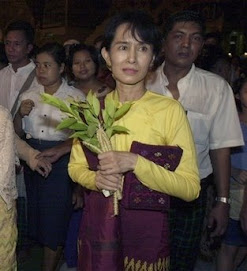


 Posts


