News & Articles on Burma Saturday, 15 October, 2011 --------------------------------------- Political prisoner release should prompt continued pressure on Myanmar Burma rides the winds of rapid change India offers loan to Myanmar amid tentative reforms India promises assistance to Myanmar in agri sector Indo-Myanmar pact to tackle insurgency in north-east: Gogoi Burma workers win right to strike All eyes on change in Burma India scents opportunity in Burma leader visit A shift in Myanmar Myanmar Relaxes Media Grip ------------------------------------------ October 14, 2011 Political prisoner release should prompt continued pressure on Myanmar Prisoners of conscience Zarganar, Su Su Nway and Zaw Htet Ko Ko have been released in Myanmar’s latest mass prisoner amnesty, after sustained campaigning by human rights organisations including Amnesty International. Amnesty International’s membership across the world has been campaigning for the release of the three political prisoners by writing letters, signing petitions and lobbying governments. “We are celebrating the freedom of people for whom we have campaigned for years,” said Sam Zarifi, Amnesty International’s Asia-Pacific Director. “The now confirmed release of more than 200 political prisoners this month shows that all those letters and petitions can have a real impact in individual cases.” “But the work is far from over while many more political prisoners remain behind bars. This amnesty should inspire the international community to keep pressuring Myanmar to release all political prisoners immediately.” The Myanmar government announced that the latest prisoner amnesty was on humanitarian grounds for the elderly, sick and disabled. “This is ironic, considering that political prisoners are routinely placed in remote jails far from hospitals and support networks, and intentionally mistreated and denied medical treatment in order to ruin their health and break their spirits,” said Sam Zarifi. Zarganar, Su Su Nway and Zaw Htet Ko Ko were no exceptions. Zarganar, Myanmar’s best-known comedian, had been serving a 35-year prison sentence in a prison in Kachin state at the time of his release. Aged 50, he had reportedly been suffering health problems in prison. He was jailed in 2007 for leading a private donor movement in response to the government’s blocking of foreign aid in the aftermath of Cyclone Nargis. He gave regular interviews to foreign media criticising the government and exposing the unfolding humanitarian crisis, marshalling over 400 volunteers to deliver emergency aid. In the 2010 documentary ‘This Prison Where I Live’, he described the mistreatment he suffered during a previous detention: “They beat and they kick and sometimes they use some rubber pipe. They use a rubber pipe to beat my back and my belly…Some of my friends in that jail tried to kill themselves…” Labour rights activist Su Su Nway, 39, had been serving a seven and a half-year sentence for treason and other vaguely defined security offences at the time of her release this October. Her acts of political protest even while in prison saw her despatched to a jail near the border with India’s Nagaland, far from her family and medical treatment, despite her heart problem. There was later a reported tuberculosis outbreak in that prison. She had been arrested in November 2007 in the wake of the ‘Saffron Revolution’, after putting up an anti-government banner near a hotel where the UN Special Rapporteur on the situation of human rights in Myanmar was staying. Su Su Nway was the first person in Myanmar to sue the government successfully for subjecting her and her village to forced labour. The government imprisoned her for eight months in retaliation. Upon being released in 2006 from that first imprisonment, she said to the Democratic Voice of Burma, a dissident media outlet based outside the country: “I take my prison uniform with me because I know that I will have to come back to jail until Burma gets democracy." Despite being 30 years old at the time of his release, Zaw Htet Ko Ko was also known to be suffering health problems while in prison in Rakhine state, over 660km away from his family in Yangon. Shortly after his arrest in October 2007, his father told Amnesty International that he feared his son was being tortured in detention. At the time of his release, Zaw Htet Ko Ko had been serving a 10 year sentence for ‘inciting offences against public tranquility’ due to his involvement in the ‘Saffron Revolution’ protests of 2007. As a young member and official photographer of the 88 Generation Students Group, Zaw Htet Ko Ko was of the internet-savvy generation who had embraced new technology to circumvent censorship and communicate with the world outside Myanmar. During August and September 2007, the authorities reportedly raided his home up to five times and repeatedly threatened and harassed his family in Yangon. His father U Aung Myint, a political exile living in the Netherlands, told Amnesty International that he had asked his son in the past if he understood the risks of political activism. His son replied: “Yes, I've considered everything, about dangers. If I don't do what I'm doing, who will do it for the Burmese people?" http://www.amnestyusa.org/our-work/latest-victories/political-prisoner-release-should-prompt-continued-pressure-on-myanmar -------------------------------------- Burma rides the winds of rapid change Myo Thein, Dean Nelson October 16, 2011 FROM a shelf on a roadside news-stand, the gentle, smiling face of Burma's long-suffering freedom movement leader, Aung San Suu Kyi, beams down from a magazine, flanked by her son and the family dog. A few magazines along, there she is again, the West's poster girl of democratic defiance. Yet this is not London or New York, but Rangoon. Today, for the first time in more than 20 years, Ms Suu Kyi is the cover story in her own country. This would have been unthinkable just a few weeks ago, said one Western diplomat, amazed at the speed of change in one of the world's hitherto most repressive states. Then, no publisher would have dared print her picture, let along distribute it to vendors. Advertisement: Story continues below But since the Nobel peace prize winner met President Thein Sein, a former general, in August, a series of symbolic and tangible reforms has been rolled out with such speed that a nation resigned to repression is daring to talk freely about politics for the first time in decades. The past eight weeks have witnessed the government cancel the China-backed Myitsone Dam on the Irrawaddy River, apparently after public protest, end restrictions on the internet, allow opposition voices in the media and, on Friday, lift a ban on free trade unions. Last week, more than 200 political prisoners were released, including the country's most celebrated film star and comedian, Zarganar, who had been sentenced to 59 years in jail for criticising the government's response to cyclone Nargis; Zaw Htet Ko Ko, one of the leaders of the 1988 student uprising; and Sai Say Htan, who was serving a 104-year sentence for rejecting the country's new constitution. On the streets of Rangoon on Friday, normally cautious middle-class youths gathered in tea shops and internet cafes to take advantage of their new-found freedom. ''My family now talks more openly about politics,'' said one young man. At the Cafe Parisian on Sule Pyay Road, a civil servant spoke of how he believed that the former military ruler General Than Shwe continued to wield influence, before stopping to marvel at being able to make such a comment. Another said the government's dash for democracy had won over relations who were fierce opponents. ''My mother did not like [President] U Thein Sein but she is now saying that yes, she thinks he is doing good things. She likes now U Thein Sein and also Aung San Suu Kyi,'' he added. Other government moves to build confidence have included appointing a former liaison officer to Ms Suu Kyi to run the Ministry of Social Welfare, Relief and Resettlement. U Myint, a close friend of the Nobel laureate, has become the President's economic adviser. Mr Myint's appointment offered a clue not only to the direction in which the new civilian government was heading, but also to the cause. Mr Thein Sein wants foreign investment to develop the economy, but knows its growth potential will always be restricted by United States and European Union sanctions until Burma returns to democracy. The country has much to offer: vast unexploited oil and gas reserves, great expanses of coveted farmland for food production and an unused gateway to China, until now its only meaningful friend and patron. On Friday the President met India's Prime Minister, Dr Manmohan Singh, in New Delhi as part of a campaign to boost external trade and persuade the West to drop its sanctions. India announced a $US500 million loan and one of Dr Singh's most influential advisers suggested that New Delhi could play a key role in ''encouraging the US and Europe to begin dismantling their long-standing policy of isolating and sanctioning Burma''. Hillary Clinton, the US Secretary of State, and William Hague, Britain's Foreign Secretary, welcomed the recent reforms and the release of political prisoners but stressed that they would ''wait and see'' how far Mr Thein Sein goes in his talks with Ms Suu Kyi before weighing their response. The Nobel laureate, they indicated, holds the key to Burma's return to polite society. On the streets of the former capital, the euphoria is checked by a concern that it may not last. Plainclothes security agents and youth apparatchiks remain fixtures at events and in areas deemed politically sensitive. Zarganar, the actor-comedian, is unhappy that more than 1000 political prisoners remain in detention. ''They are releasing political prisoners little by little; so we are like the victims in the hands of Somali pirates. What are their ransom demands? The situation is like that,'' he said. Hours earlier he had been in his cell in Myitkyina Prison, where he had spent every day in solitary confinement since he was jailed in June 2008. When he first emerged from jail, he voiced resentment that Ms Suu Kyi's dialogue with the government had yielded so few prisoner releases, but on Friday he told the Burmese free news website Mizzama that he supported the talks. ''Some people worry Suu Kyi is being used by the government … I don't think this is the case. If you give gold to a monkey, how will it be used properly? But if you give gold to a goldsmith, it is different. Aung San Suu Kyi is a goldsmith. I think these meetings will not hamper our drive for true democracy. We can look at it as something positive.'' The Telegraph Read more: http://www.smh.com.au/world/burma-rides-the-winds-of-rapid-change-20111015-1lqe7.html#ixzz1afFNTigf ------------------------------------------- Saturday, October 15, 2011 India offers loan to Myanmar amid tentative reforms NEW DELHI: India promised Myanmar a $500 million credit line to improve infrastructure on Friday and praised steps towards democracy by its reclusive neighbour, which is tentatively opening up after half a century of harsh military rule. The money and warm words came as Myanmar campaigns to shed its pariah status. It freed about 200 political prisoners this week, the latest sign of reforms in the poor and tightly controlled Southeast Asian country of 50 million people. The former British colony also known as Burma has large undeveloped gas reserves and straddles busy Bay of Bengal shipping lanes, making it strategically important for energy-hungry emerging power neighbours India and China. Myanmar President Thein Sein met Indian Prime Minister Manmohan Singh in New Delhi during a four-day state trip, spending two days visiting religious sites. About 100,000 refugees and migrants from Myanmar live in India. A few dozen protested during Sein’s visit to call for a faster pace of reform and the release of prisoners. “Kick-start genuine political dialogue,” read one placard held by a supporter of Myanmar pro-democracy leader Aung San Suu Kyi, who was freed from seven years of house arrest last November. “We all have come here to support Aung San Suu Kyi and to demand a democracy,” said a 16-year-old protester. Hours after the prisoners’ release, Myanmar’s first civilian president in nearly 50 years flew to India’s Bihar state to pay homage at the site where the Buddha is said to have reached enlightenment. “The prime minister of India congratulated the president of Myanmar on the transition towards democratic government and offered all necessary assistance in further strengthening this democratic transition,” they said in a joint statement. India has long weathered criticism from international partners for its accommodating stance to Myanmar’s junta, which was dissolved in April. New Delhi feels the signs of reform vindicate its policy of engagement. Reuters http://www.dailytimes.com.pk/default.asp?page=2011\10\15\story_15-10-2011_pg5_28 --------------------------------------- India promises assistance to Myanmar in agri sector New Delhi, Oct 15, (PTI): India today assured technical assistance to Myanmar in the field of agriculture particularly for key crops like rice and pulses. The assurance was given by Minister of State for Agriculture Harish Rawat to a visiting Myanmar team led by its president U Thein Sein here. The team comprised Agriculture minister U Myint Maung and entrepreneurs, who interacted with scientists at the Indian Agricultural Research Institute (IARI). Myanmar sought Indian help in increasing yield of its key crops of rice and pulses to which Rawat reacted positively, IARI sources said. The team also sought India's technical assistance in the livestock sector to boost milk productivity. India is the world's largest milk producer. The sources said the Myanmar President appreciated the fact that IARI has signed an MOU with a group of private seed producing companies, and sought details to repeat the experiment of sectoral convergence in the important area of seed production in his country, the sources added. He requested New Delhi to send a team of scientists to train his men at Advanced Centre for Agriculture Research and Education set up there with the help of India. Mayanmar evinced interest in buying Tractors from India. Later, the team visited IARI's biotechnology centre and an exhibition in genetics division. http://www.deccanherald.com/content/198066/india-promises-assistance-myanmar-agri.html ---------------------------------------- Indo-Myanmar pact to tackle insurgency in north-east: Gogoi Published on Sat, Oct 15, 2011 at 17:35 | Source : PTI Guwahati, Oct 15 (PTI) Assam Chief Minister Tarun Gogoi today said the Indo-Myanmar agreement would benefit the security of the north-eastern region by tackling the menace of insurgency in the area. "The accord between visiting Myanmar president Thein Sein and Indian Prime Minister Manmohan Singh is good news for the north-east region from the security point of view", Gogoi told reporters here. "Insurgent outfits like ULFA, NSCN and other groups from the region have set up camps in Myanmar. Like Bangladesh did, we are now hopeful after the accord that Myanmar will also oust them from their territory for peace, security and stability in the region", Gogoi said. "Assam's uppermost tip Sadiya, adjacent Arunachal Pradesh and Myanmar are the bastion of the militants. This will be tackled by the agreement to enhance effective cooperation and coordination between the security forces of the two countries," he added. The opening of the Stilwell Road, built during World War II in 1942 and passing through Burma would benefit Centre's Look East Policy by intensifying trading activities with South Asia to bring about overall socio-economic betterment in the area, the CM said. http://www.moneycontrol.com/news/wire-news/indo-myanmar-pact-to-tackle-insurgencynorth-east-gogoi_599989.html ------------------------------------------ Burma workers win right to strike BANGKOK POST: Published: 15/10/2011 at 12:58 AM Workers in military-dominated Burma will be allowed to unionise and go on strike for the first time in decades, officials said Friday, under landmark new legislation welcomed by the United Nations. Workers in military-dominated Myanmar will be allowed to unionise and go on strike for the first time in decades, officials said Friday, under landmark new legislation welcomed by the United Nations. The law was signed into effect by President Thein Sein on Tuesday, government sources said, and replaces the repressive 1962 Trade Unions Act, in the latest sign of tentative reform by the authoritarian regime. "Workers will have the right to form unions and to strike under the law," a government official told AFP on condition of anonymity. The legislation stipulates that workers, with the exception of military and police personnel, may set up a union with a minimum of 30 members and come up with their own name and logo. Employers must be given up to 14 days notice of industrial action and unions must specify in advance how many people will take part in the strike, it said. Providers of essential services, such as healthcare, firefighting, telecommunications, the supply of water and electricity, do not have the right to strike. The text also states that employers in breach of the new rules risk a 100,000 kyat fine ($125) or one year in prison, while employees face a fine of 30,000 kyat ($38). "Although we can't say that everything about the new labour law is good, we have to welcome it," Nyan Win, a lawyer and spokesman for Aung San Suu Kyi's opposition National League for Democracy party, told AFP. The International Labour Organisation also cheered the new measure, although Steve Marshall, the UN agency's liaison officer in Burma, cautioned that he had not yet read the full text of the legislation. "But in principle there is no question that the law is a major step for the government of Burma," he told AFP. "It is a very important factor in terms of the development both socially and economically of the country." A well-respected Rangoon businessman who did not wish to be named said he applauded the new law because he believed workers had a right to organise. "Trade unions must exist in a democratic nation," he told AFP. But the ILO's Marshall said that in a country where labour activists have frequently ended up behind bars, it would take a while before workers felt brave enough to take action under the newly-passed law. "It is a new approach and a new culture," he said. "It will take some time. We will not see immediate change overnight." The labour law is the latest evidence of a modest wind of change blowing through Burma in recent months, as the new nominally-civilian government tries to show it is serious about embracing change after decades of repression. On Wednesday, the regime pardoned about 200 political prisoners in a much-anticipated amnesty though critics said the gesture did not go far enough as most of the country's roughly 2,000 political detainees are still locked up -- including many labour rights advocates. "There remain quite a number of labour activists still in prison," Marshall said. Burma expert Sean Turnell from Australia's Macquarie University said the authorities would have to reassure a sceptical public that they would let the unions operate in peace. "The real test will come with implementation -- will people really be able to strike?" he asked, adding that it would take "a huge leap" of faith for workers to suddenly start protesting. "People have to feel that they can trust those laws, so it is going to take some time I think before people are convinced." http://www.bangkokpost.com/news/asia/261413/burma-workers-win-right-to-strike ------------------------------------------ All eyes on change in Burma By Andrew Buncombe 10:03 AM Saturday Oct 15, 2011 Residents await the arrival of prisoners being released from Insein Prison in Yangon. Photo / AP Expand Residents await the arrival of prisoners being released from Insein Prison in Yangon. Photo / AP It had long turned dark by the time Thein Sein reached the Mahabodhi temple complex in northeast India, the silhouettes of his security guards mingling with those of robed Buddhist monks standing among the scented grounds as the Burmese President knelt to pray. It would be tempting, if a little presumptuous, to assume the Burmese leader was seeking insight and wisdom as he prostrated himself beneath the sprawling tree where Prince Siddhartha Gautama the Buddha achieved enlightenment in 623BC. But whether or not he was successful remains unclear. The world is watching every move the President makes. It wants to know whether he represents a genuinely new chapter in Burma's history, a step on the path to real democracy and plurality, or whether his strategy is simply more of what has gone before, albeit packaged with slicker PR. On the face of it, supporters of the President, appointed earlier this year after a supposedly civilian government took over from the junta which had run the country for decades, could argue there is already sufficient evidence to suggest he represents real change. The former general and his entourage of 69, including his chef, arrived for a three-day official visit in India on the morning it emerged that the first of what is expected to be several thousand prisoners were set free from Burma's jails. Among them were up to 200 political prisoners, including a popular comedian and activist, Zarganar, who was jailed in 2008 after criticising the government's response to the devastating Cyclone Nargis. The comedian and actor was certainly pleased to be out of Myitkyina prison in northern Kachin state, released along with a sick rebel commander, but he did not mince his words: "I will be happy and I will thank the Government only when all of my friends are freed." His sentiments matched those of the democracy leader Aung San Suu Kyi, who herself was released after seven years of house arrest late last year. "The freedom of each individual is invaluable, but I wish that all political prisoners would be released," she said, even as, across the country, relatives and inmates enjoyed emotional reunions outside the jails where they had been held. While thousands of prisoners may eventually be released, it is clear that those political prisoners considered the most dangerous will not receive an amnesty from Thein Sein. Among the notable figures not released were Min Ko Naing, the "conqueror of kings", a leader of the 88 Generation Students' group who is serving a 65-year sentence, and Shin Gambira, a young monk who was among the leaders of the September 2007 Saffron Revolution, when hundreds of thousands of monks and ordinary citizens took to the streets to protest over price hikes and in support of Suu Kyi's democracy campaign. "Everybody is happy," claimed Ashin Watnawa, a monk from Burma who has lived in India for 20 years and who was visiting Mahabodhi yesterday with a colleague. "[Thein Sein] is listening to people. He is different to what went before." Asked about the brutal crackdown by the Burmese authorities in 2007, when a number of monks were among those killed and injured, he added: "You have to let some things stay in the past." It would certainly have been insightful to hear Thein Sein's views on the prisoner releases he ordered and what they represented, as well as about his plans for the months ahead in Burma. Later, as Thein Sein left Mahabodhi, strolling with his entourage past the 19 footsteps that Buddha had taken after that moment of enlightenment and now marked by a stone plinth topped with lotus flowers, his security guards stepped in to block an attempted question. "This is not the place," said one. However - in a move that highlighted the wilier, PR-savvy side of Thein Sein - it was certainly the place for media coverage that the Burmese approved of. Among the President's entourage were three cameramen from state-controlled Myanmar International Television, as well as an Indian Government photographer. They were joined later by several Indian cameramen from private channels. It certainly created a more positive image of the President than that given four years ago when monks in Burma turned their alms bowls upside down and "excommunicated" the military government of which he was part, just weeks before the Saffron Revolution. Thein Sein is going to Delhi for talks with India's Prime Minister, Manmohan Singh, and other officials. Despite Burma's record on human rights, India considers its eastern neighbour increasingly important as a source of natural gas and oil and is trying to cement a relationship which matches the one Burma enjoys with China. An Indian official said recently, ahead of this visit, that the Government in Delhi believed Thein Sein was genuine in his purported desire for change. For most, the jury is still out. - INDEPENDENT http://www.nzherald.co.nz/world/news/article.cfm?c_id=2&objectid=10759235 ------------------------------------------ BANGKOK POST India scents opportunity in Burma leader visit Published: 14/10/2011 at 01:32 PM Online news: Asia India rolled out the red carpet for visiting Burma President Thein Sein on Friday, sensing a chance to deepen relations with a neighbour traditionally allied to New Delhi's regional rival Beijing. President of the Republic of Myanmar U Thein Sein (C) and first lady Daw Khin Khin Win (R) visit the Mahabodhi Temple Complex in Gaya district, Indian state of Bihar on October 13, 2011. The Mahabodhi temple is famous for being the place where the founder of Buddhism Gautama Buddha allegedly obtained enlightenment. The former general, who arrived in India on Wednesday and spent two days touring Buddhist pilgrimage sites, was given a full state welcome in New Delhi for the official leg of his three-day visit. He was scheduled to hold extensive talks later in the day with Prime Minister Manmohan Singh. The visit follows Burma's decision late last month to suspend construction of a $3.6-billion Chinese-backed dam project, triggering a rare public rebuke from Beijing. Some saw the move as signalling a desire by Thein Sein's new nominally civilian government to shed Burma's image as a client state of China and open other doors, including to Western nations who maintain sanctions imposed on the former military regime. For energy-hungry India, resource-rich Burma with its large oil and natural gas reserves is an inviting prospect. India began engaging the Burma junta in the mid-1990s on security and energy issues and as a counter to China's growing strategic influence in the Southeast Asian nation, formerly called Burma. The policy drew international criticism, with US President Barack Obama chiding New Delhi during a visit to India last year for not speaking out over human rights abuses in Burma. India however feels its approach has been vindicated by a series of reformist moves initiated by Thein Sein since he took power last year. He held direct talks with opposition leader Aung San Suu Kyi and, on the eve of his India visit, Burma announced a mass prisoner amnesty, including a number of of political detainees. Indian trade with Burma stood at $1.2 billion last year, far short of the $4.4 billion between Burma and China. New Delhi clearly scents new opportunities under Thein Sein's leadership, and G. Parthasarathy, a former Indian ambassador to Burma, said the new government appeared to be seeking greater "diplomatic elbow room" that would leave more space for India. "What remains to be seen is whether these recent signs of opening signal a greater degree of economic liberalisation," he said. But Parthasarathy also stressed that Burma would always look to maintain a close relationship with an emerging superpower such as China. An Indian foreign ministry official insisted there was room for both China and India to play a role in Burma's future development. "Relationships between countries are not a zero-sum-game," the official argued. Beijing has long helped shield Burma from international opprobrium and the impact of western sanctions with trade ties, arms sales and through its position as a veto-wielding permanent member of the UN Security Council. http://www.bangkokpost.com/news/asia/261346/india-fetes-burma-leader-on-state-visit ------------------------------------------ THE JAPAN TIMES: Saturday, Oct. 15, 2011 A shift in Myanmar Something is happening in Myanmar. The government in that reclusive country has recently taken a number of steps that suggest change may be afoot. It is too soon to tell how substantial and enduring the changes will be, but they must be acknowledged and encouraged. It is time to engage the government in Naypyidaw and test its commitment to real reform. Military governments have ruled Myanmar since 1962. Their systemic violation of the people's will earned them international censure and isolation. (To be fair, the rulers of Myanmar have never been inclined to engage the world, either.) The first suggestions that change might be afoot came a few years ago when the government wrote a new constitution that would pave the way to civilian rule. Most observers considered that a sham, especially when most of the country's new leaders had only recently donned mufti. Elections were held last November and, as predicted, military-backed parties and individuals dominated the new parliament. Yet since taking office in March, the government of President Thein Sein has taken steps that suggest that the change is more than just cosmetic. In August, Nobel Peace Prize winner and head of the National League for Democracy Aung San Suu Kyi was invited to the capital to talk to the president; this followed her release from seven years of house arrest 11 months ago. Exiles have been invited home to rejoin the political process; the NLD, which refused to contest last year's elections because it believed they were rigged — and was subsequently delisted as a legal political party — was invited to reregister. A new national human rights commission, made up of retired bureaucrats and academics, has been set up. This was followed by the visit of the United Nations special rapporteur on human rights in Myanmar, the first time he has been allowed to visit in over a year. Censorship of some foreign media has stopped. Earlier this month, the state-run New Light of Myanmar newspaper reprinted an open letter from the Myanmar National Human Rights Commission that called for the release of "prisoners of conscience" who pose no threat to "public tranquility." The government followed that with the start on Wednesday of the release of nearly 6,400 prisoners. In the first batch of released prisoners were 198 of the country's estimated 2,000 political prisoners. Even Ms. Suu Kyi has conceded that "We are beginning to see the beginning of change." Finally, and among the most surprising developments, is the decision in September by the Myanmar government to suspend construction of a $3.6 billion dam being built with China. The dam was a controversial project because its location on the Irrawaddy River was seen as defacing the birthplace of the Burmese nation and because it signaled China's growing influence in the country. The rest of the world should reciprocate the signs of change in Myanmar. Much of the West has kept its distance from the new government, believing that it is just the redressing of the old order in new clothes. Sanctions remain in place and the prevailing tone is one of skepticism. But the door is open. The West is talking to senior Myanmar officials — who were left off the list of individuals subject to sanctions in Europe. The United States has created a new special envoy for Myanmar and Myanmar's foreign minister visited Washington last month. Speaking in Bangkok days ago, Mr. Kurt Campbell, assistant U.S. secretary of state for Asia, said that Myanmar is witnessing "dramatic developments" and the U.S. is ready to revamp ties — "match their steps" — with the country. But real progress, said Mr. Campbell, depends on the release of political prisoners, the end of human rights abuses, dialogue with democracy supporters and ethnic groups, and answering questions about the country's nuclear program. The West has leverage. Sanctions have taken a bite and while it is too early to lift them, those governments could take a neutral stand on (or even encourage) international lending institutions resuming their aid to Myanmar. (This would also have the benefit of reducing the country's dependence on China.) The U.N. human rights representative has called for the establishment of an international commission of inquiry into suspected crimes against humanity and war crimes in the country. That vote will come before the United Nations this year and while the West should not be seen as being cynical about such issues, if the NLD supports abstention in the name of domestic political dialogue, then Western governments can heed its wishes. Of course, the most important question is whether there is real change in Myanmar or this is mere window dressing to exploit a moment of opportunity. It is difficult, if not impossible, to tell. Decision making in Naypyidaw remains opaque and it is hard to tell who is in charge. But the signs are promising and friends of Myanmar's long-suffering 60 million people, the poorest in Asia, deserve the benefit of the doubt. The key is a step-by-step process that matches Myanmar's moves with those of its critics. This moment must not be wasted. http://search.japantimes.co.jp/cgi-bin/ed20111015a1.html ------------------------------------------ ASIA NEWS: OCTOBER 15, 2011 Myanmar Relaxes Media Grip By a WSJ Staff Reporter YANGON—Myanmar residents knew something unusual was afoot this August when state-run newspapers suddenly dropped their regular slogans denouncing the BBC and the Voice of America for "sowing hatred among the people," followed by moves to unblock their websites in the country. Pictures and articles about famed dissident Aung San Suu Kyi began showing up in the press for the first time in years. Journalists have started posting articles online without the approval of government censors—previously a no-no—and even dared to criticize government policies in print. While still tightly controlled, Myanmar's media landscape is cracking open in significant ways, local journalists and residents say, as authorities loosen restrictions in a country long seen as one of the most repressive in the world. In recent years, Myanmar residents have been able to use the Internet and have had access to some foreign media, including CNN in hotels and some foreign news publications online. But the websites for many foreign news sources deemed overly critical of the government, including the BBC and Reuters, were customarily blocked, along with YouTube as well as dissident publications that reported closely on Myanmar affairs from outside the country. With the latest steps to unblock sites, Myanmar residents now have access to a wide array of foreign news sources, as well as dissident publications such as the Irrawaddy, which is based in Thailand and regularly publishes scathing criticisms of Myanmar's government. Myanmar's Political History Myanmar, the Southeast-Asian country formerly known as Burma, has faced political turbulence since its oppressive military regime gained power in 1962. See some key events in the country's history. Myanmar ranked next-to-last out of 196 countries in press freedom last year, ahead only of North Korea, according to U.S.-based advocacy group Freedom House—which put China in 181st place—and journalists are routinely imprisoned there, human-rights groups say. Daily coverage is dominated by a small handful of government mouthpieces, while articles in most of the country's 350 or so independent news publications—typically weeklies and monthly journals—must be approved in advance by a censorship board. For years that left essentially all critical reporting to be done by exile publications working with undercover reporters inside the country. But in recent weeks, reporters inside the country are openly writing about controversial topics—including a mass amnesty of an estimated 200 political prisoners that occurred earlier this week. The changes are among a host of recent developments that have boosted hopes Myanmar's government is looking to turn the page on decades of harsh rule since the military took over there in 1962. Soldiers handed over power to a civilian government this year after an election that was widely decried by Western observers as a fraud. But since then, authorities have rolled out a slew of conciliatory gestures, including the prisoner release and numerous economic reforms, that have caught many Western diplomats off-guard. A more robust press is already helping shape public debate in unforeseen ways in the resource-rich country between China and India. Last month, the government suspended construction of a $3.6 billion China-backed hydroelectric dam in a rare concession to environmental activists after weeks of unexpectedly critical coverage in Yangon papers, which galvanized local opposition and added pressure on the authorities to act, people familiar with the government's thinking said. The dam suspension "reflects that the government pays attention to the voice of the people and the media" now, said Than Htut Aung, chairman of the Eleven Media Group, which publishes the Weekly Eleven news journal and several other publications in Myanmar. Six months ago, he said, he wouldn't have agreed to be interviewed by a foreign reporter—saying there might have been "a lot of complications and repercussions." But "now the situation is good," he said. There are crucial limits to the media opening, which highlights why some residents remain wary of the government's recent changes. Many topics—including criticism of the military or former strongman Senior Gen. Than Shwe, who stepped down earlier this year—remain off limits, and Western-style investigative journalism into issues such as corruption is out of the question, local reporters say. Many fear the latest easing could be rolled back at any time, putting today's more outspoken journalists at risk. Even with the loosened restrictions, journalists fear they remain subject to punishments, including prison terms, if they publish something deemed later to be detrimental to the state. "Compared to what we had a few years ago, we are much freer," said Thiha Saw, editor of Myanma Dana, a monthly business magazine. But "it's not a full opening," he said. "They may be opening up, but we know they are still afraid of many things." Government officials and advisors have said authorities are serious about creating a more open media, and are contemplating a new media law that would potentially eliminate Myanmar's censorship board entirely. "What the government would like to see is a free and responsible media, not a restricted media," said Ko Ko Hlaing, an adviser to Myanmar President Thein Sein. For now, editors and journalists are trying to see how far the boundaries can be pushed. Numerous publications have splashed pictures of Ms. Suu Kyi, a Nobel laureate who was released from seven years of house arrest last year, on their front pages—an act that was unheard-of until recently. The Weekly Eleven newspaper this month published an interview with Aung Zaw, a known critic of the Myanmar government who edits the Irrawaddy news journal. "I had to pinch myself" to believe it was all happening, Mr. Aung Zaw said. Even so, "the openness is very limited—it's a baby step.""I don't know exactly why they are doing it," he said. Perhaps "they want to show a good face to the international community," he said, adding, "we cannot see behind the curtain." Myint Kyaw, a local freelance journalist, said several reporters have even started posting news stories online via Facebook and some newspaper websites in real time rather than waiting for censors' approval—and no one has complained, he said. He described covering a recent small protest rally to mark the four-year anniversary of the so-called "Saffron Revolution" in 2007, when thousands of monks marched on Yangon streets before the rallies were stopped in a bloody crackdown by government soldiers, killing at least 30 people. Not only were people allowed to gather on the anniversary—an unlikely occurrence in past years—but he and the other journalists were allowed to interview rally leaders and even take pictures of riot police nearby, which wouldn't have been possible before, he said. "Clearly they were instructed not to arrest" people, he said. Daily news in Myanmar is still dominated by state media, whose coverage in a handful of papers and TV news programs continues to focus on topics such as state meetings or government tours of infrastructure projects, while downplaying or ignoring controversial topics. Editions of the government mouthpiece New Light of Myanmar published Thursday, for instance, focused on a presidential visit to India and a "Full Moon Day" holiday, with scant reference to the massive prisoner amnesty a day earlier that also included thousands of everyday criminals. Gone, though, are the paper's well-known rants against the Western media, such as one bold-faced warning published last year calling on citizens to "not allow ourselves to be swayed by killer broadcasts designed to cause troubles," such as those by BBC or the Voice of America. Absent, too, are once-common front-page headlines such as "Myanmar citizens must be for Myanmar and not be a stooge of any alien." —Celine Fernandez in Kuala Lumpur contributed to this article. http://online.wsj.com/article/SB10001424052970204774604576628721876661248.html __._,_.___
Sunday, October 16, 2011


Saturday, October 15, 2011
News & Articles on Burma-Friday, 14 October, 2011-uzl
News & Articles on Burma
Friday, 14 October, 2011
-----------------------------------
Marty Natalegawa to Visit Burma to Assess Democracy
Burma to up Thailand migrant assistance
Surprises in Burma's guided democracy
India and Burma expand trade ties and sign gas deals
India offers large loan and praise for Burma reforms
A small amnesty is no proof that the Burmese regime has changed
Burmese amnesty does not yet represent break with past
Burma's 'air of hopeful expectation'
Burma pressured to release all political prisoners
Myanmar's President in India to improve relations, business
"The Lady" Opens Rome Film Festival
---------------------------------------
The Jakarta Globe
Marty Natalegawa to Visit Burma to Assess Democracy
October 14, 2011
Myanmar female prisoners walk out of the Insein central prison in Yangon on Wednesday. Myanmar started to free roughly 2,000 political detainees including pro-democracy campaigners, journalists, monks and lawyers that is a key demand of Western powers that have imposed sanctions on the country also known as Burma. (AFP Photo) Myanmar female prisoners walk out of the Insein central prison in Yangon on Wednesday. Myanmar started to free roughly 2,000 political detainees including pro-democracy campaigners, journalists, monks and lawyers that is a key demand of Western powers that have imposed sanctions on the country also known as Burma. (AFP Photo)
Indonesian Foreign Minister Marty Natalegawa said Friday he would visit Burma at the end of the month to assess the country's reform efforts.
Burma is seeking to be the chair of the 10--member Association of South--East Asian Nations (ASEAN) in 2014, but a decision on the proposal has been deferred pending an assessment of its progress towards democratization.
"In line with the mandate given to me by ASEAN, I will visit Myanmar at the end of this month to assess developments in Burma," Natalegawa said "It looks like there have been positive developments in Burma," he said. "There's a momentum for democratization and it is in our interest to maintain the momentum." Indonesia is the current chair of ASEAN.
Laos has offered to allow Burma to take its scheduled place as ASEAN chair in 2014, since the country missed the opportunity in 2005, due to widespread condemnation of the regime's poor human rights record and refusal to implement political reforms.
Western countries have imposed economic sanctions on Burma since 1988 when an army crackdown on pro--democracy demonstrators killed an estimated 3,000 people.
Last year, Burma held its first elections in 20 years, bringing in a government led by former generals, and released opposition leader Aung San Suu Kyi after years of house arrest.
The government said this week it had released 6,359 prisoners on humanitarian grounds.
DPA http://www.thejakartaglobe.com/home/marty-natalegawa-to-visit-burma-to-assess-democracy/471650
------------------------------------
Imagining a Censorship-free Burma
By THE IRRAWADDY Friday, October 14, 2011
Last week, Tint Swe, the director of the Press Scrutiny and Registration Division (PSRD), surprised Burma watchers by telling the Washington-based Radio Free Asia that the notorious censorship board he heads should be abolished as part of the country's moves toward reform.
“Press censorship is non-existent in most other countries as well as among our neighbors, and as it is not in harmony with democratic practices, press censorship should be abolished in the near future,” he said.
Tint Swe's remarks have raised hopes that a new era of press freedom could be coming to Burma in the near future. Below is a sampling of responses to his comments from some leading members of the country's media community.
Ko Ko, CEO of the Rangoon Media Group
I welcome U Tint Swe's comment that there shouldn’t be a censorship board. Without censorship, we can work freely, as long as we stay within the bounds of ethics and journalistic integrity. We will have to take responsibility for what we write, but we won’t have to worry if we respect the law and the principles of journalism.
If there’s a new media law, more daily newspapers will be published. Actually, daily newspapers are necessary for the country to achieve democracy. Without a strong fourth pillar, the other three pillars of society will lack support. Burma needs more privately owned media, because unlike the state-run media, it is free.
Thiha Saw, chief editor of Open News Journal and Myanma Dana Economic Magazine
I think getting rid of censorship is a very good idea. There will be a lot more freedom, but we will still have our responsibilities. We've also heard that the government has started working on a new media law, but we don’t know yet what it will entail.
Maung Wun Tha, editorial adviser to Pyithu Khit Journal
Maung Wun Tha
I think it's very good news for journalists and people in the media community. Of course, there will definitely be some challenges and difficulties if we change from the current system to a new one. But we will never achieve anything if we just worry about this and cling to the old system. The main thing is to prepare for and face the challenges.
The more daily newspapers there are, the better it will be for the people. The newspapers will be able to convey information to the public much more quickly, and it will be easier for the people to offer their criticism than it is now. It is good not to have censorship.
The government will still exercise control over some matters, to prevent publication of anything that violates religious or cultural values, for example. The government will still need to warn or take action against them those who violate these things.
Thaung Htike, CEO of True News Journal
It is good to hear that U Tint Swe has said the PSRD should be abolished. We welcome his words. We also hope that they will come true.
Aunt Min Khaung, assistant editor of the Hot News Journal
It is a very good sign that the head of the PSRD has admitted that there should be no censorship. Everyone wants freedom of press and expression. I think that there will be no censorship in near future. http://www.irrawaddy.org/article.php?art_id=22262
----------------------------------------
Burma to up Thailand migrant assistance
By JOSEPH ALLCHIN
Published: 14 October 2011
Burma will greatly increase its assistance to migrants working in Thailand, following three days of talks in Bangkok between a delegation of Burmese officials and Thailand’s labour minister, Phadoemchai Sasomsap.
Speaking to DVB at the close of play yesterday, Burmese Deputy Labour Minister Myint Thein, who led the delegation, said that the two sides discussed a raft of issues related to the rights of up to three million Burmese migrants living in the Kingdom, many of whom struggle with healthcare and legal assistance.
“We are here [in Thailand] to coordinate with [Thai authorities] to go through procedures such as migrants’ national identification and issuing temporary passports inside Thailand, as well as on issues such as their visa fees and job finding.
“For the latest, we have requested the Thai government to provide assistance to our migrants being affected by recent flooding and they’ve pledged to do so.”
Andy Hall, from the Thailand-based Human Rights and Development Foundation (HRDF), said that the meeting also resulted in the addition of a labour attaché at the Burmese embassy in Bangkok, whilst regional centres would be set up to make it easier for migrants to complete the registration process.
Chin Sein, part of the Burmese delegation, said: “We were negotiating to set up five more offices on top of already existing ones in areas including Mahachai-Samut Sakorn, Bangkok metropolitan area, and in north and south Thailand.”
The move was “cautiously welcomed” by HRDF, with Hall adding that many migrants feel that the embassy under the previous junta “didn’t care”.
The meeting also established that Burma would “also send five teams of … delegates to install online shared data system between Myanmar [Burma] and Thailand in order to reduce working procedures and time,” according to a Thai government press statement.
There are between two and three million Burmese migrant workers in Thailand, whose total migrant population accounts for some five percent of the Thai work force, and seven percent of GDP. They invariably occupy the most undesirable and dangerous professions.
The Thai government press statement further noted that the Burmese delegation “also asked the Thai government to permit those accompanying Myanmar workers to legally be in Thailand”, likely referring to the family members who join their relatives working in Thailand. “And after they are nationality verified and legally employed, Thai employers should be responsible for Social Security contribution of Myanmar workers.”
Thailand’s former Democrat government had sought to exclude foreign workers from a national workers’ compensation fund, which would see migrant workers rely on their employers for insurance in the result of injury in the workplace. But the Abhisit administration’s refusal was deemed by critics to be a contravention ofThailand’s treaty obligations in lieu of discriminating on the basis of nationality.
The Thai government has also been desperately attempting to regularise the large numbers of workers who travel with little or no documentation. http://www.dvb.no/news/burma-to-up-thailand-migrant-assistance/18199
------------------------------------
THE NATIONAL TIMES
Surprises in Burma's guided democracy
October 15, 2011
When generals take off their uniforms, put on civilian suits and then get themselves voted into a new government with the most proven popular alternatives disqualified from running, there is bound to be scepticism that it means any real change.
The elections held last November by the Burmese military, which has been the power running the country since 1962, struck many analysts as an anachronistic effort to copy Indonesia's late General Suharto in camouflaging army rule with civilian clothes and manipulated elections - an advance certainly, but still 40 years behind the current Jakarta model.
Yet the new Burmese President, Thein Sein, a former general and prime minister in the old junta, has delivered some stunning surprises in the past month, half a year after being sworn in to office.
Advertisement: Story continues below
They amount to a studied rebalancing of Burma's relationships in its region and with the rest of the world, including Australia.
The most discomfited is China, which until now seemed able to use Burma as an extension of its own territory, preparing to pipe its natural gas into its southern Yunnan province, damming its rivers for electricity feeding into Chinese grids, using its land to grow food, and developing ports on its coastline as alternatives to the tenuous raw material supply line around Malaysia, Singapore and Vietnam, all potentially hostile nations.
Thein Sein's boldest step was his announced suspension two weeks ago of the massive Myitsone dam project on the upper reaches of the Irrawaddy River, a $US3.6 billion construction headed by a state-owned Chinese company. The dam was displacing about 15,000 people and had reopened an armed insurgency by an ethnic Kachin army previously in a truce with the government.
Sein instructed his parliament to act ''according to the desire of the people'' - itself a novel concept in a country where the government has tended to tell the population what it should want.
His Foreign Minister was sent off to Beijing, getting very high-level attention in the form of a meeting with the Vice-President, Xi Jinping, who is expected to take over from Hu Jintao as state President and Communist Party head a year from now. Official statements said the two governments had agreed they would ''properly settle'' the issue. A Burmese adviser to Thein Sein said other resource deals would be forthcoming to replace Myitsone's electricity that was to be transmitted to China as repayment for loans.
Any view this might have been just a hasty step to avoid the Kachins joining in the increasingly co-ordinated campaigns by Wa, Shan, Karen and other ethnic minorities against the Burmese government is dispelled by comments from the adviser, Nay Zin Latt.
''It is not good for Burma or any other nation to rely too much on relations with just one country,'' he told the Thai website The Irrawaddy this week, describing the Myitsone decision as a bold step taken in the national and public interest. ''We must forge friendly ties with all nations.''
The Burmese President has now followed this up with a visit to his country's other big neighbour, India, this week, his second foreign trip as President after going to Beijing in May. He started at Bodh Gaya, where Siddartha Gautama found enlightenment about 2500 years ago, and yesterday was due to meet Indian leaders for some decidedly more earthly concerns such as trade, investment, cross-border links and security.
In New Delhi, he comes on the heels of President Truong Tan San, of Vietnam, whose growing closeness with other powers is being watched with concern by China. In late July, a Chinese warship challenged an Indian Navy ship travelling between Vietnamese ports in the South China Sea, warning it was ''entering Chinese waters''.
The President's moves in domestic politics also have important ramifications for Burma's international relations. The freeing of the opposition leader Aung San Suu Kyi from house arrest soon after the elections, and Thein Sein's recent opening of direct talks with her, have been followed by the inclusion of about 100 political prisoners in a mass release of 6359 prisoners on Wednesday, the same auspicious day in the Buddhist calendar that the President was visiting Bodh Gaya.
The gesture has met a guarded response from dissident groups and human rights organisations, who point out Burma has about 2000 political prisoners and many younger figures likely to present a strong popular challenge to the government, such as the leaders of the 1988 student uprising, do not so far appear to be included in the release.
Still, it has led to Washington's most senior diplomatic official for Asia, Kurt Campbell, promising the US will ''match their steps with comparable steps", suggesting the releases will be followed by the easing or lifting of some of the sanctions targeted against senior Burmese army commanders and their civilian business partners.
Campbell, an assistant secretary of state, told an audience in Bangkok on Monday the Myitsone Dam suspension was one of several developments that "demand closer attention", and the US was "looking forward in the course of the next several weeks to continuing a dialogue that has really stepped up in recent months''. He described Thein Sein as ''a serious interlocutor'' and said his discussions with Suu Kyi were "very consequential".
The new Burmese government is also reaching out to the country's often embarrassed fellow members of the Association of Southeast Asian Nations, whose annual summit it hopes to hold in three years. Cleaning up its act in human rights will make this more likely.
Nay Zin Latt, the presidential adviser, has been in Jakarta recently, saying Burma could learn from Indonesia's peace deal in Aceh province for its minorities and from the lessons of the transition from Suharto's rule - and even putting the best spin on the realities of Burmese power. ''Burma's style is a top-down change,'' he told a Radio Free Asia interviewer. ''We may go faster [in adopting changes] than Indonesia.'' http://www.nationaltimes.com.au/opinion/society-and-culture/surprises-in-burmas-guided-democracy-20111014-1lp1s.html
-------------------------------------
14 October 2011 Last updated at 14:01 GMT
India and Burma expand trade ties and sign gas deals
India and Burma have agreed a series of measures to boost trade and co-operation during Burmese Prime Minister Thein Sein's state visit to Delhi.
India has promised Burma $500m (£316m) credit for infrastructure projects and they will expand co-operation in oil and gas exploration and border trade.
The visit came as Burma released about 200 political prisoners, the latest in a series of steps towards reform.
But India has been sharply rebuked in the past for hosting Burmese leaders.
Human rights groups and activists condemned last year's five-day visit to Delhi by former military ruler General Than Shwe, aimed at deepening trade links.
Correspondents say that with a rapidly growing economy India is desperate to access any major source of energy and will also be keen to offset China's influence in the region.
Burma has huge natural gas reserves in its western province of Arakan and the adjoining seaboard, estimated at more than 30 trillion cubic feet or more.
Indian Prime Minister Manmohan Singh and his Burmese counterpart issued a joint statement which emphasised the need for energy security.
The deal between India and Burma agreed on Friday also includes speeding up the construction of natural gas pipelines. The infrastructure projects for which India has extended credit include roads, inland waterways and ports.
In a further sign that Burma's new leadership may be considering wider public opinion, the president recently suspended construction of the controversial Chinese-backed Myitsone hydroelectric dam.
But Indian officials played down any economic rivalry with its Chinese neighbour.
"We have an important relationship with Myanmar [Burma]. And we have an important relationship with China. There is no competition," external affairs ministry spokesman Vishnu Prakash said.
There are already substantial trade links between Burma and India. Indian energy companies are already investing in Burma's energy sector. The $500m of credit comes on top of $300m (£190m) of credit extended last year. http://www.bbc.co.uk/news/world-south-asia-15304791
----------------------------------
India offers large loan and praise for Burma reforms
FRANK JACK DANIEL NEW DELHI, INDIA - Oct 14 2011 16:16
India promised Burma a $500-million credit line to improve infrastructure on Friday and praised steps towards democracy by its reclusive neighbour, which is tentatively opening up after half a century of harsh military rule.
The money and warm words came as Burma campaigns to shed its pariah status. It began releasing 6 300 convicts on Wednesday in its latest liberalising move, but kept some political detainees behind bars, dampening hopes for a broader amnesty.
It was not clear how many of the country's estimated 2 000 political detainees were included in the amnesty -- one estimate said only 206 of them were freed. But the released included ailing Shan Army commander Hso Hten and comedian Zarganar, who was imprisoned after criticising the government's response to Cyclone Nargis in 2008.
The former British colony has large undeveloped gas reserves and straddles busy Bay of Bengal shipping lanes, making it strategically important for energy-hungry emerging power neighbours India and China.
Burma President Thein Sein met Indian Prime Minister Manmohan Singh in New Delhi during a four-day state trip, spending two days visiting religious sites.
Hours after the prisoners' release, Burma's first civilian president in nearly 50 years flew to India's Bihar state to pay homage at the site where the Buddha is said to have reached enlightenment.
"The prime minister of India congratulated the president of Burma on the transition towards democratic government and offered all necessary assistance in further strengthening this democratic transition," they said in a joint statement.
India has long weathered criticism from international partners for its accommodating stance to Burma's junta, which was dissolved in April. New Delhi feels the signs of reform vindicate its policy of engagement.
The United States, Europe and Australia are unlikely to soften sanctions on Burma unless nearly 2 000 more political prisoners are released. Other Asian countries, however, are keen to access resources in the mainly Buddhist nation.
New Delhi put aside concerns about human rights in the early 1990s for fear of losing access to oil and gas as China stepped in with military assistance and loans to help the regime withstand sanctions.
India's efforts have only been partially successful, with planned roads and ports behind schedule. India part-owns two natural gas projects off Burma's coast in the Bay of Bengal but the gas is sold to China.
The $500-million credit line follows a similar $300 million scheme last year. The money will be used on infrastructure projects, particularly irrigation, the statement said.
India buys most of Burma's agricultural exports and wants its neighbour to raise output further by planting on idle land. – Reuters http://mg.co.za/article/2011-10-14-india-offers-large-loan-and-praise-for-burma-reforms/
-----------------------------------
OCTOBER 14, 2011.Burma's Prisoner Shell Game
A small amnesty is no proof that the Burmese regime has changed
By DAVID SCOTT MATHIESON
Chiang Mai, Thailand
The Burmese government freed more than 200 political prisoners this week, a move many in the West are hailing as a sign it's time to repeal economic sanctions. Their argument is that the regime needs encouragement to continue the embryonic and fragile reforms put forward this year.
But the release is not as significant as it first appears. First of all, an estimated 1,900 political prisoners remain. And the political showmanship is consistent with the regime's ongoing strategy of using thousands of dissidents, Buddhist monks and nuns, artists, labor activists, writers, and hip hop stars as human bargaining chips to repress Burmese society and negotiate with the international community.
The use of mass amnesties of prisoners, in which thousands of common criminals and only a handful of dissidents are freed, is a longstanding practice. In the 10 amnesties since 2004, 60,000 people have been freed, but only 600 were political prisoners. After they are released, many dissidents are soon back in prison.
Burma's most famous comedian, Zarganar, is a case in point. Released this week, he has been in and out of prison since the 1980s, banned from public performances. In 2009, he was sentenced to an astonishing 59 years, later reduced to 35, after he criticized the government's incompetent response to 2008's Cyclone Nargis.
Mr. Zarganar's pugnacious attitude hasn't been dulled by prison, though. In one of his first interviews after his release he called for all political prisoners to be released and said "art and politics are interrelated, I will continue to do both of them."
Critic Zarganar, freed this week, has been in and out of prison for decades.
.Likewise, labor rights advocate Su Su Nway has been amnestied before. She was imprisoned in 2005 for lodging a formal complaint against an official who had made her perform forced labor. She was released but participated in peaceful protests in Rangoon in 2007, and raised a banner critical of the government at the hotel where then U.N. Special Envoy on Human Rights in Burma Paulo Pinhiero was staying. For these acts, a Burmese court sentenced her to 12.5 years in prison, later reduced to 8.5 years.
But we should not forget the prisoners who weren't released. For example, Min Ko Naing and other leaders of the 88 Generation Students Group, student activists from the 1988 uprising, have spent much of the past two decades in prison, using their fleeting freedoms to call for dialogue with the government. All have been sentenced to 65 years in prison, and there have no signals so far that any of this group will be released.
As the experience of many political prisoners makes clear, and as I have seen in the 15 years I have studied the human rights situation in Burma, the Burmese judicial system is used for control, not justice. The evidence is starkly apparent in the astonishing sentences handed down in recent years—65 years for marching peacefully in a call for lower commodity prices, 20 years for blogging about protests, and other long terms for writing poems or sending information to exile Burmese news organizations.
The release of this group of political prisoners as part of an amnesty of 6,300 can be seen as a gesture, perhaps encouraging but very limited, on the part Burma's new nominally civilian government of President Thein Sein. It comes after years of international pressure to free dissidents. More releases are expected, but nothing short of the total and unconditional release of all political prisoners should be acceptable.
The new government, largely led by senior figures of the previous military dictatorship, has promised bold economic, political and legislative reforms, softened their Stalinist rhetoric with references to human rights and democracy, and loosened censorship. The official mantra is "good governance, clean government, flourishing of democratic practices, ensuring rule of law [and] making economic reform." Officials have invited exiled dissidents to return.
Outside observers are both bewildered and encouraged by the prisoner releases. But even if Burma's leaders release every unjustly jailed prisoner—which would be wonderful—that would still not be a "reform." Reform requires changes in laws and institutions. The government needs to repeal the repressive and vague laws used to stifle dissent. Bills in the national parliament that guarantee freedom of assembly and the ability to form unions, and the formation of a national human rights commission sound promising, but fall short of international standards.
One test of whether releasing even this small group of dissidents means anything will be the quality of their freedom. Will they be subjected to the same vicious cycle of freedom, activism, repression and arrest they have endured for decades?
The onus is on the government to prove it is serious by allowing the freed dissidents the basic freedoms of speech, assembly and participation in public affairs they have long called for, and sacrificed so much to realize. This amnesty should be viewed as an opportunity for the government to bring about genuine national reconciliation. Mr. Zarganar and his contemporaries will continue to risk their new-found freedom to press for real change, and the international community should back them up.
Mr. Mathieson is a senior researcher in the Asia Division of Human Rights Watch.
---------------------------------------
The Financial Times : October 14, 2011 2:32 am
Burmese amnesty does not yet represent break with past
From Mr Ron Brewer.
Sir, Your editorial “Change in Burma” (October 13) suggests that the new Burmese leadership contains reformist elements, whose gaining influence was most recently dramatised by the announcement of a prisoner amnesty, and that the west has the responsibility to encourage them. However, assessments of the trajectory of the current regime may benefit from consideration of the following issues.
You contend that the government’s plan for the mass release of more than 6,000 inmates is a sign of change. However, the Assistance Association of Political Prisoners Burma, a non-governmental organisation based in Thailand, confirms that to date only 206 of the estimated 2,000-plus political prisoners have been released. A closer reading of contemporary Burmese political history reveals that the well-timed release of political prisoners was a routine practice of the military regime to alleviate international pressure. The recent amnesty does not yet represent a departure from past behaviour, but appears to be more of the same. It is also noteworthy that the new government continues to deny the existence of political prisoners, but instead justifies the recent release in humanitarian terms for inmates who are old, disabled, sick or who had shown good “moral behaviour”.
Your editorial echoes a recent, important turn in Burmese policy debate positing that it is incumbent on the west to bolster the newly “elected” reformers through some form of accommodation. Clearly, time-tested, ineffective policies of sweeping financial sanctions imposed by the west need to be swept into the dustbin of history and more forward-thinking policies require consideration. However, although you contend that while “the west could be taken for a ride ... doing nothing would be riskier”, this does not justify carte blanche accommodation with the allegedly ascendant reformist clique. Effective policy requires thoughtful consideration of the bona fides of the leadership, such as meeting benchmarks for reform. The release of all political prisoners and the revocation of the authoritarian legal framework justifying their detention are important steps in that direction. http://www.ft.com/cms/s/0/f7f393da-f4fb-11e0-9023-00144feab49a.html#axzz1adTk6Y7i
---------------------------------
THE TELEGRAPH: 14 Oct 2011
Burma's 'air of hopeful expectation'
Teresa Machan found Burma and Aung San Suu Kyi, the country's most famous dissident, filled with optimism.
It’s the oldest trick in the book. Find the address, knock on the door and hope they’ll talk. Number 54 University Avenue is one of the most famous addresses in the world – this is where Aung San Suu Kyi, the Burmese dissident and Nobel Peace Prize laureate, spent almost two decades under house arrest. Located on a busy thoroughfare in the Kamayat district of Rangoon and flanked by National League for Democracy (NLD) banners, it’s not difficult to find – but it’s by no means a tourist attraction.
Most Burmese won’t loiter here – the road was closed off for the duration of Suu Kyi’s house arrest and one taxi driver who dropped a Westerner off in its vicinity was allegedly hauled off for questioning.
But the guide who met us at the airport had welcomed us to the “new Burma”, and I couldn’t leave Rangoon without paying a visit. Next morning we bought flowers from the Hledan market, including her favourite, fragrant champaca, and nine (auspicious number) pieces of fruit in a presentation crate and turned up in the spirit of Harvest Festival to pay homage at the bright yellow gate of Daw Suu (Auntie Suu, as she is affectionately known). Surmounted above is a black-and-white photo honouring Suu Kyi’s father, the revered independence hero, General Aung Sang.
“She’s not here,” said the boys who opened the gate just wide enough for them to clock our gifts, and for us to register their startled expressions. Just leaving flowers would have been enough, but after a brief exchange it transpired that Daw Suu was at her office, a mere 10-minute drive away.
Reclaiming our offerings, including an increasingly comedic pomelo (citrus maximus), we scooted off to the National League for Democracy offices, leaving two pairs of eyes peering through the letterbox. Inside what was essentially a large wooden lean-to with a corrugated iron roof, it was clammy, and crowded with devoted NLD workers. Heroic pictures lined the walls. According to an elderly gentleman who spoke excellent English (as many Burmese do), Daw Suu was upstairs. We did our Harvest Festival routine, and waited.
We were in luck. Daw Suu was on her way out and within minutes she was descending the stairs in a turquoise silk top and traditional lyongi – dignified, demure and even slighter than she appears on television. There was little time for dialogue, but no matter.
I had come to Burma on her say-so – lifting a self-imposed travel ban after seeing an interview in May with a British journalist in which she gave her blessing to intelligent tourism to the country on a small scale: “Come, but visit Burma with your eyes open.”
It’s very early days, but there’s at least an air of hopeful expectation in Burma. The day before we arrived a law had been passed permitting peaceful demonstrations. Bigger news still was the halting of a hugely unpopular $3.6 billion Chinese-backed hydroelectric dam project, a rare snub by the government to its northern neighbour. The day we left, the New Light of Myanmar newspaper announced an amnesty for more than 6,000 prisoners. I had found a genuine spirit of optimism during my short stay, but what, honestly, were her own hopes for the future?
“It’s the beginning of the beginning,” she said. “We’ve got a long way to go and we will have to work very hard, but I really believe the government is prepared to listen.”
Polite but firm, Daw Suu told us she had to go. As we posed for a photo, one of our group absent-mindedly put a protective hand on her back, and found it quickly shoved away by a supporter.
As we made our way out, cameras flashed from the tea-shop opposite. Government spies, according to an expatriate who accompanied us and who recognised the photographers’ motorbikes. But I was too busy watching the lady in blue inch herself gracefully into the back of a white Toyota Carbriolet with her small bunch of wilting flowers and, somewhere in there, three oranges, a couple of pears, three apples and a citrus maximus. http://www.telegraph.co.uk/travel/destinations/asia/burma/8826438/Burmas-air-of-hopeful-expectation.html
----------------------------------------
RADIO AUSTRALIA NEWS:
Burma pressured to release all political prisoners
Burma's President Thein Sein have arrived in India's capital New Delhi amid criticism by exile groups that his government doesn't genuinely represent the nation's people.
Hundreds of pro-democracy activists from Burma held a protest march ahead of the president's arrival in the Indian capital on Thursday.
His visit comes a day after authorities freed 200 political detainees on Wednesday, under a general amnesty for over 6,000 prisoners.
However 2,000 political prisoners are still in prison.
Thein Sein's visit is his first to India after assuming the presidency earlier this year.
He's expected to hold talks with top Indian leaders, including the prime minister today to consolidate the growing economic and political ties between the two countries.
Opposition
Burma's opposition has called on the government to free all political prisoners.
The release of about 200 political detainees on Wednesday, under a general amnesty for over six-thousand prisoners, follows more dialogue with pro-democracy leader Aung San Suu Kyi.
They include journalists, pro-democracy activists, government critics, monks involved in anti-government protests and members of Burma's ethnic groups fighting for greater autonomy.
"Each one of them has priceless value," she said. "Freedom of a person is priceless."
However 2,000 political protesters are still in prison.
Foreign support
The United States, Europe and Australia say the freeing of political prisoners is essential to considering lifting sanctions.
The European Union welcomed the release, but says it will judge the move based on how many are eventually freed.
US Secretary of State Hillary Clinton says she is encouraged by promising signals of reform, but that it is too early to announce steps Washington might take in response.
Prominent satirist and vocal government critic Zarganar was among those released on Wednesday.
Geeral Hso Ten, a prominent ethnic Shan leader sentenced to 106 years for charges including high treason, has also reportedly been released.
The UN has called on the military-backed government to hold by-elections by the end of the year.
"Our disappointment is not only about the number... We are not satisfied because the government never recognises the existence of political prisoners," Thailand-based Assistance Association for Political Prisoners' Khaing Min said. http://www.radioaustralianews.net.au/stories/201110/3339651.htm
------------------------------------------
International Relations | 14.10.2011
Myanmar's President in India to improve relations, business
Myanmar's President Thein Sein is on a visit to India. The Indian government is looking forward to furthering ties with the country, which has been traditionally a close ally of China.
A former general in Myanmar's junta and the country's new president, Thein Sein, has been touring Buddhist pilgrimage sites in India since Wednesday. The President is accompanied by 13 senior colleagues from Myanmar and will hold a series of talks with the Indian Prime Minister Manmohan Singh on Friday.
The discussions are expected to be focused on bilateral, regional and international issues. The countries also expect to sign agreements on science and technology with New Delhi likely to extend a line of credit and assistance to projects in Myanmar.
Thein Sein's visit follows his government's decision to suspend construction of a Chinese-backed 3.6 billion-dollar dam after protests from people living in the area affected by the project. Beijing has expressed its displeasure at the Myanmar government's decision.
Leader of Myanmar's military junta, Than Shwe, visited India in 2010Leader of Myanmar's military junta, Than Shwe, visited India in 2010
However, the Indian Ministry of External Affairs said in a statement that India was not in competition with China. There was room for both India and China to grow and "relationships between countries are not a zero-sum game," according to the ministry.
Security and energy issues
India began engaging the Myanmar junta in the mid-1990s on security and energy issues and as a counter to China's growing strategic influence in the Southeast Asian nation, formerly called Burma.
Both countries have placed emphasis on upgrading border roads and maritime transport along the Kaladan River in western Myanmar's Rakhine state. The project involves the Indian Inland Waterways Authority and the ESSAR Projects (India) Company. It is expected to be completed in June 2013, according to the Indian foreign ministry.
India's policy towards Myanmar has invited criticism from the international community. US President Barack Obama, who visited India last year in November, expressed his disapproval with New Delhi for collaborating with the Myanmar junta, which had been accused of severe human rights abuses.
Agencies: AFP, PTI (mg)/ Editor: Grahame Lucas http://www.dw-world.de/dw/article/0,,6637941,00.html?maca=en-rss-en-asia-5133-rdf
---------------------------------
"The Lady" Opens Rome Film Festival
By THE ASSOCIATED PRESS Friday, October 14, 2011
ROME — French director Luc Besson's "The Lady," about Burmese pro-democracy leader Aung San Suu Kyi, will open this year's Rome Film Festival, organizers said Thursday.
The Oct. 27-Nov. 4 festival will feature 15 in-competition films and conclude with a screening of a restored "Breakfast at Tiffany's" to mark the classic's 50th anniversary.
"The Lady," which stars Michelle Yeoh and Daniel Thewelis, is being shown out of competition.
Films vying for the Marc'Aurelio prizes include US director Tanya Wexler's "Hysteria," about the invention of the vibrator in Victorian England; "Hotel Lux" by German director Leander Haussmann and Norwegian director Pal Sletaune's "Babycall."
Richard Gere is to receive a special actor's prize, while directors Wim Wenders and Michael Mann are expected to be on hand for audience talks.
The jury of the sixth annual Rome Festival is headed by Oscar-winning composer Ennio Morricone and features Roberto Bolle, a principal dancer with American Ballet Theatre, and actresses Debra Winger and Carmen Chaplin.
http://www.irrawaddy.org/article.php?art_id=22256
Friday, October 14, 2011
News & Articles on Burma-Thursday, October 13, 2011-uzl
Burma needs releasing all political detainees for genuine change
By Zin Linn Oct 13, 2011 10:44PM UTC
The President Thein Sein government announced on Tuesday that it would release 6,359 prisoners under an amnesty based on a condition for old-aged, ailing and obedient. As of Wednesday, the first batch of prisoners was released. But, in the end of the day about two hundred political prisoners appeared to have been freed, according to friends and families of detainees through the media.
A well-known freed prisoner of conscience was Zarganar (alias) Ko Thura who was arrested in June 2008. He had been sentenced to 35 years in a remote prison after criticizing the then-ruling junta for its sluggish response to Cyclone Nargis, which killed more than 140,000 lives when it smashed the Irrawaddy delta in May 2008.
The well-known comedian Zarganar, who was released yesterday morning, commented on the current situation, “If we talk about change in Burma, what I dare say is no change at all and I still don’t accept as true that Burma is really on the reform path. According to my experience, the president is too stingy. What I mean is that only a few political prisoners released.”
According to the Assistance Association for Political Prisoners (Burma) based in Thai-Burma border, the regime freed only 206 political detainees, but kept most of its almost 2,000 political prisoners – including democracy campaigners, journalists, students, monks and lawyers – incarcerated.
Even though prominent political prisoners Gen. Hso Ten and Zarganar were released, many other prominent student leaders such as Min Ko Naing, Ko Ko Gyi, Min Zeya, Htay Kywe and ethnic leaders such as U Khun Tun Oo are still languishing in tarnished jails in Burma.
Another well-known female labor activist, Su Su Nway, was also released on Wednesday from remote Hkam-ti prison. She was arrested in 2007 and sentenced to 12 years in prison, later reduced to 8 years and six months for protesting with a poster not far away from a hotel where Mr. Paulo Sergio Pinhero, United Nations Special Raporteur for Human Rights in Burma, was then staying.
Bo Kyi, joint-secretary of the Assistance Association for Political Prisoners, said that he was very disappointed with the Wednesday amnesty that allowed a small number of political detainees.
“What this Thein Sein government’s prisoner-release stance is the same as the previous military regime,” he said, referring to the releases of a few political prisoners on Wednesday as a sign of starting change to deceive or persuade Western democracies and international community.
Although Government said it released 6,359 prisoners, most of them were ordinary criminals. In addition, the government constantly refuses to recognize that there are nearly 2,000 political prisoners in its notorious prisons.
But human rights organization Amnesty International said authorities must immediately and unconditionally release all remaining prisoners of conscience.
Many political prisoners were sentenced to decades in jail and have endured “torture and other forms of cruel, inhuman or degrading treatment”, according to Amnesty International, which urged the new nominally civilian government to go further. AI Spokesman Benjamin Zawacki said he was disappointed more political prisoners have not been released.
Ojea Quintana, the United Nations special rapporteur on human rights in Myanmar (Burma), said some of the most significant dissidents had not been released and more than 1,000 prisoners of conscience remained behind bars. The U.N. rights investigator for the isolated country wants many more freed before the end of the year.
Mr. Quintana said he expected country’s military rulers to hold by-elections by year’s end, and he would like to see the release of remaining political prisoners by then.
“It’s very important that the government finish with this process of release before the elections,” he told Reuters News Agency in an interview.
in fact, many more important politicians are still languishing in Burma’s remote prisons where daily food and medical care are so poor.
In handling the question of political prisoners, the new President Thein Sein government must get rid of the policy of previous junta headed by Senior General Than Shwe. If the present government has a policy of good governance, it should allow the participation of good oppositions in the nation’s political process as a sign of democratic change.
Keeping the political dissidents in prison and shouting democracy slogans will not win over political supports domestically or internationally. So, it is time for Burmese government to free all political detainees in an attempt to build true national reconciliation plus peaceful and prosperous country in the ASEAN society. http://asiancorrespondent.com/67183/burma-needs-releasing-all-political-detainees-for-genuine-change/
-------------------------------------------
After latest release, UN expert urges Myanmar to free all political prisoners
13 October 2011 –
An independent United Nations human rights expert today welcomed the decision by Myanmar’s President to grant amnesty and release a significant number of detainees and urged the Government to free the remaining political prisoners.
The exact number of political prisoners included in the release that began yesterday has yet to be confirmed, according to a news release issued in Geneva. However, it is believed to be more than 200, including a number of prominent figures. Human rights groups estimate that there are some 2,000 political prisoners still behind bars.
The Special Rapporteur on the human rights situation in Myanmar, Tomás Ojea Quintana, said the release is an “important further step” by the country’s authorities to respond to international concern and advance political reconciliation.
“I am pleased that these prisoners who have suffered so long can be reunited with their families and again play a part in national life,” said the expert.
Among those released are some prisoners whose cases have been previously addressed by the Special Rapporteur as well as some individuals he had visited in jail during his visits to the Asian nation.
Mr. Quintana also voiced concern at the ongoing detention of a large number of political prisoners, many of whom are suffering serious health problems from the harsh conditions of their detention.
“These are individuals who have been imprisoned for exercising their fundamental human rights or whose fair trial or due process rights have been denied,” he said.
“Their release would be an important step for the democratic transition, and would be welcomed by people both inside and outside the country. It is imperative that the Government completes the liberation of all such prisoners.”
Mr. Quintana called on the Government to immediately improve the conditions of detention and the treatment of prisoners in compliance with international standards.
“This is a key moment in Myanmar’s history and there are real opportunities for positive and meaningful developments to improve the human rights situation and deepen the transition to democracy,” said the expert, who reports to the UN Human Rights Council in an independent and unpaid capacity.
“The new Government should intensify its efforts to address the many long-standing human rights concerns and advance national reconciliation.”
A new Government was established in Myanmar seven months ago, and more recently the country has received a series of high-level bilateral visits. In addition, President Thein Sein has made a pledge for Myanmar to “catch up with the changing world.”
At a meeting last month in New York of the Group of Friends on Myanmar, Secretary-General Ban Ki-moon said recent developments bode well for progress in the country, while calling on the new Government to do more to ensure to bring about an inclusive transition.
“Real opportunities for progress exist, but the Government must step up its efforts for reform if it is to bring about an inclusive – and irreversible – transition,” Mr. Ban said in a press statement, adding that the authorities must, in particular, cultivate improved dialogue with all political actors and release all remaining political prisoners. http://www.un.org/apps/news/story.asp?NewsID=40037&Cr=myanmar&Cr1=
-------------------------------------------
Shan Leaders Question Prisoner Release
By KO HTWE Thursday, October 13, 2011
While the release of political prisoners by the Burmese government on Wednesday included Maj-Gen Sao Hso Ten, a leader of the Shan State Peace Council who was serving a 106-year sentence, it did not include other ethnic leaders such as Khun Tun Oo, the chairman of the Shan Nationalities League for Democracy (SNLD), causing some ethnic leaders to join other critics in saying that President Thein Sein’s prisoner release was insufficient.
“Shan State Army-South leader Sao Yawdserk said that the Thein Sein government is like the previous military regime—they give special consideration to members of armed groups. This is the reason that Hso Ten and Khun Tun Oo were not released together although they were arrested at the same time. The government takes those with arms more seriously than those without,” said Khuensai Jaiyen, the editor of the Thailand-based Shan Herald Agency for News.
Other observers have pointed out that Hso Ten’s release may be an attempt by the government to gain an advantage in negotiations with the Shan State Army-North (SSA-North), which is engaged in ongoing clashes with government troops, because Hso Ten and Maj Gen Pang Fa, the leader of the SSA-North, are relatives by marriage.
Hso Ten and Khun Htun Oo were among several Shan leaders arrested and accused of high treason after attending a meeting of opposition and ethnic groups in Shan State on Feb. 7, 2005.
Three leaders of the SNLD—which won a landslide victory across Shan State in the 1990 election that was subsequently overturned by the previous junta—were among those sentenced to long prison terms at the time: Khun Tun Oo was sentenced to 93 years and is currently in Putao Prison in Kachin State; Sai Nyunt Lwin was sentenced to 85 years and is being held in Kalay Prison; and Sai Hla Aung was sentenced to 75 years and is being held in Kyaukpyu Prison in Arakan State.
Saw Than Myint, a Central Executive Committee member of the Shan Nationalities Democratic Party (SNDP), welcomed the release of Hso Ten and said that five ethnic politic parties will hold a meeting and urge the government to free Khun Tun Oo, the 88 Generation Students group leaders and other political prisoners.
“Khun Tun Oo must be free. We were hoping for his release as part of the amnesty. We feel that all political prisoners should be released. We are also reviewing why General Hso Ten was released but not other leaders,” said Saw Than Myint.
He added that if Hso Ten was released due to his age and deteriorating health, then Khun Tun Oo and other prisoners who are elderly and suffering deteriorating health should be set free as well.
Maj Sai Hla, the SSA-North spokesman, said there are many possible explanations for the release of Hso Ten, but they don’t know the exact reason the government released him and they don't wish to provide further comment.
Hso Ten was set free as part of an amnesty for over 6,000 prisoners granted by Burma’s President Thein Sein. The prisoners released on Wednesday including dissident and popular comedian Zarganar, but did not include prominent activists such as the leaders of the 88 Generation Students group.
There is still some speculation that prisoners will be released in three batches, and many family members of political prisoners remain hopeful that their loved-ones will be set free.
Arakanese leader Aye Thar Aung said he expects that all ethnic leaders and 88 Generation Students group leaders will be released, and that Khun Tun Oo will be set free in one of the next batches of prisoners released.
“We had hoped that Khun Tun Oo would be in the first batch because of his health and age. But I'm also hoping he will be set free in the next batch,” said Aye Thar Aung.
However, after being released from prison on Wednesday, Zarganar said the government does not have a true desire to release all political prisoners.
In addition, Mai Bhone Kyaw, the general secretary of the Palaung State Liberation Front, said, “They [the government] just want to draw international attention and get support by releasing some people. Nothing has changed from the former military leader's strategy. They still keep Khun Tun Oo, Min Ko Naing and other prominent leaders in jail.”
Mai Bhone Kyaw added that because ethnic leader Khun Tun Oo was not released, ethnic people have one more reason why they cannot work with or trust the Burmese government.
“How can we build a peaceful union by jailing ethnic leaders and creating heavy military operations against ethnic people?” he asked. http://www.irrawaddy.org/article.php?art_id=22252
------------------------------------------
Burma’s Prisoner Release Concluded
By THE IRRAWADDY Thursday, October 13, 2011
The Burmese Ministry of Home Affairs said that all of the 6,359 prisoners subject to the amnesty program announced this week by President Thein Sein were released on Wednesday.
The prisoners released included 220 political prisoners, which activists say is a small number compared to the around 2,000 political prisoners being held in Burmese prisons at the time of the release.
An official from the Ministry of Home Affairs, who spoke on condition of anonymity, said that the released political prisoners were not given any special instructions and the ministry can’t say when there will be another amnesty in the future.
Toe Kyaw Hlaing, one of the leaders of a Rangoon-based group that is organizing a signature campaign for the release of political prisoners, said that many of the political prisoners that were released on Wednesday were close to finishing their sentence.
He also said that many prominent pro-democracy activists and ethnic leaders are still behind bars, and his group will make a survey of the political prisoners who remain incarcerated and will submit their results to pro-democracy leader Aung San Suu Kyi.
“The remaining political prisoners could be a barricade to the government reforming and bringing democracy to the country, so we will start the signature campaign and submit the petition to President Thein Sein,” said Toe Kyaw Hlaing.
Four members of the 88 Generation Students group were included in the release on Wednesday: Ko Ko Gyi (aka) Thein Than Tun, Zaw Htet Ko Ko, Lay Lay Mon and Myint Lwin Oo (aka) Thar Gyi.
The Thailand-based Assistance Association of Political Prisoners (AAPP) released a statement on Thursday stating that the Thein Sein administration attempted to appease the international community by offering its second so-called amnesty. The statement said that although on the 11th of October the announcement was made that 6,359 prisoners would be released, no public information about the actual numbers released has been made accessible.
“AAPP has been monitoring the October 12 prisoner release and we have learned that 220 political prisoners have been freed so far. Many other prominent political prisoners such as Min Ko Naing, U Khun Tun Oo, U Gambira and so on were not included among those released,” the statement said.
The AAPP also said that the prisoner release was not satisfactory and that “we would like to urge the international community to persuade U Thein Sein’s government for the recognition of the existence of political prisoners, and for the unconditional release of all political prisoners under a dignified way.”
Meanwhile, Mr. Tomas Ojea Quintana, the UN special envoy on human rights in Burma, told Reuters that some of the most important dissidents had not been released, more than 1,000 prisoners of conscience remained behind bars and many more prisoners need to free before the end of the year.
“What I have seen in my last mission in August is that there are real opportunities for change and there are new institutions being built,” Quintana said, adding that he will submit a report to the UN General Assembly next Wednesday. http://www.irrawaddy.org/article.php?art_id=22254
-------------------------------------------
Myanmar assures not to use its territory for insurgent activities against India: MEA
By ANI | ANI –
New Delhi, Oct 13 (ANI): The Ministry of External Affairs (MEA) on Thursday said New Delhi has received assurances from Myanmar that its territory will not be allowed to be used for insurgent activities against India.
"With respect to security we have ongoing cooperation with Myanmar. We have also received assurances that Myanmar territory will not be allowed to be used for insurgent activities against India. Both sides remained in close and regular contact in this regard," said MEA spokesperson Vishnu Prakash, while briefing media persons on the state visit to India of the President of Myanmar Thein Sein.
Myanmar President U Thein Sein arrived in Bodh Gaya on Wednesday on a State visit to India.
The visiting President assumed office on March 30 this year after general elections and this is the first high-level visit from Myanmar to India, of the new civilian government.
"The President is accompanied by his spouse and is leading a high-level delegation that includes a number of his Cabinet colleagues such as the Minister for Border Affairs and Myanmar's Industrial Development, the Minister for Foreign Affairs, the Minister for Agriculture and Irrigation, the Minister for Religious Affairs, the Minister of Industry, the Minister of Electric Power, the Minister of National Planning and Economic Development as well as the Minister for Livestock and Fisheries, the Union Minister for Transport, the Union Minister for Energy, the Minister of Science and Technology, the Union Minister of Commerce, the Chief of General Staff in the Ministry of Defence, the Deputy Minister of Health, a number of senior officials, and other members of the delegation," said Vishnu Prakash.
"He arrived yesterday at Gaya and is presently undertaking a pilgrimage of the holy Buddhist sites at Gaya, Khushinagar and Sarnath. He will be arriving later in the evening at New Delhi," he added.
There will be a ceremonial reception and welcome at the Rashtrapati Bhavan tomorrow in honour of the visiting Myanmar President.
"Tomorrow there will be a ceremonial reception and welcome at Rashtrapati Bhavan. There will be a call on him by the External Affairs Minister followed by delegation-level talks at noon with the Prime Minister of India, signing of some agreements. He would be paying a visit to Akshardham Temple. In the evening he meets the President who also hosts a banquet in the honour of the visiting dignitary," said Vishnu Prakash.
He said the visiting President would also be visiting the Indian Agricultural Research Institute on Saturday before emplaning for Myanmar, as agriculture is an important area of cooperation between the two countries
Vishnu Prakash further said this is the third visit of Myanmar President U Thein Sein to India.
"This is his third visit to India. He first visited India in 2004 during the state visit of Sr. General Than Shwe as Secretary-1 as he was called then. He next visited in November 2008 as the Prime Minister of Myanmar to participate in the BIMSTEC Summit in New Delhi," he said.
Vishnu Prakash said India and Myanmar have enjoyed a longstanding relationship underpinned by ethnic, cultural and linguistic proximities, affinities.
"A large section of the Myanmar population is Buddhist and naturally sees India as their spiritual home. By various counts, something like a million people in Myanmar are of Indian origin," said Vishnu Prakash.
"Four of India's Northeastern States - Arunachal Pradesh, Nagaland, Manipur and Mizoram - share a land border with Myanmar, which is more than 1600 kilometres. In fact, Myanmar is the only Southeast Asian State with which we have a land boundary, and as such it is a bridge between South Asia and Southeast Asia, and also a gateway to the ASEAN region. Naturally connectivity through Myanmar can play a valuable role in spurring economic development in our northeastern region," he added.
Stating that Myanmar is also an integral part in our Look East Policy, Vishnu Prakash said: "India and Myanmar are members of a number of regional fora including BIMSTEC, the East Asia Summit, ASEAN Plus Six, as well as other international fora. In 2008, Myanmar became an Observer at the SAARC."
" Our relations with Myanmar encompass a number of important areas like security, trade and investments, energy, capacity-building, health and education, science and technology, as well as infrastructure development," he added.
The MEA spokesperson further said India attaches the highest importance to the state visit of the President of Myanmar and is confident that this would place the relationship on an even stronger footing. (ANI) http://in.news.yahoo.com/myanmar-assures-not-territory-insurgent-activities-against-india-155937914.html
---------------------------------------
Myanmar: UN assists in disaster mitigation plans
New York, Oct 13 : A senior United Nations official arrived in Myanmar today to help the Government devise measures to reduce the impact of natural disasters through early warning systems and other steps in a country where an estimated 140,000 people were killed and 2.4 million others affected by Cyclone Nargis in 2008.
“Myanmar is one of the most disaster-affected countries in Asia,” Secretary-General Ban Ki-moon’s Special Representative for Disaster Risk Reduction Margareta Wahlström said in a statement issued ahead of her visit.
“It has been hit by six major cyclones in the last 40 years and is also vulnerable to multiple hazards such as floods, earthquakes, tsunamis, landslides and forest fires.
“UNISDR is willing to assist in whatever way we can to help the country reduce its risk which is fundamental to inclusive economic growth and poverty alleviation, which are part of the new government’s reform agenda,” she added, referring to UN International Strategy for Disaster Reduction, which she heads.
“UNISDR is supporting Myanmar in making disaster risk reduction a national and local priority for all citizens through engagement with the new National Disaster Preparedness Committee on developing law and regulations for disaster management and disaster risk reduction,” Ms. Wahlström added.
“I am looking forward to hearing how the responses to Cyclone Giri last year and the Shan State earthquake in March this year benefitted from the many lessons learned from Cyclone Nargis especially in early warning, preparedness and response.”
Giri, a category four cyclone, killed at least 45 people and affected 260,000 others when it struck Myanmar last October, and three months later UN humanitarian agencies reported that key challenges remained, including inadequate shelter, food insecurity and lack of livelihoods.
Ms. Wahlström is due to visit areas that were affected by Nargis.
--IBNS http://www.newkerala.com/news/2011/worldnews-86784.html
-----------------------------------------
OCTOBER 13, 2011, 12:16 P.M. ET
Myanmar Responds to Critics, Asks for Patience
By CELINE FERNANDEZ
Myanmar's government responded to activists who said its latest prison amnesty didn't include enough political dissidents, asking critics to be patient—and look for ways to encourage the government to do more.
Myanmar said it would release more than 6,000 inmates this week as part of a humanitarian amnesty watched closely by activists and Western diplomats amid signs the country's government may be turning the page on decades of harsh military rule.
By Thursday, though, human rights groups had counted about 200 political dissidents included in the release, leading many to express disappointment that more hadn't been set free. Myanmar held an estimated 600 to 2,100 political prisoners before the amnesty began, human rights groups have said.
In response to the complaints, a government official suggested in an emailed response to questions that critics shouldn't jump to conclusions, and that more changes could follow.
"We understand some people may not be satisfied with recent reforms and asked for more. But we are just starting the democratization process," wrote the official, Ye Htut, director general of the Information and Public Relations Department of the Ministry of Information in Myanmar.
Myanmar's popular comedian and social activist Zarganar was serving a 35-year sentence in Myitkyina prison in northernmost Kachin State. Myanmar freed Zarganar as it began releasing 6,300 convicts in a liberalizing move Wednesday.
"Recent actions like releasing the prisoners and relaxing press censorship are not the end of the process, but part of the process," he said. "The pace for the process not only depends on the government but also on the cooperation from the other stakeholders and the international community. So they should appreciate, encourage and support all government actions which move to the right direction."
The release appeared insufficient to appease Western nations, which maintain tough economic sanctions on Myanmar, including restrictions on U.S. investment in the resource-rich country. Myanmar's government is accused of widespread human-rights abuses, though analysts have said they are hopeful the country is evolving since a nominally civilian government took power this year after the country's first election in 20 years in 2010.
The U.S. State Department welcomed the prisoner releases, but said its initial reports indicated a majority of political prisoners in the country remain in detention, including protest leader Min Ko Naing, the Associated Press reported. The U.S. reiterated its call for the immediate release of all remaining prisoners of conscience.
Myanmar's Political History
Myanmar, the Southeast-Asian country formerly known as Burma, has faced political turbulence since its oppressive military regime gained power in 1962. See some key events in the country's history.
One of the recently released detainees, the outspoken comedian Zarganar, told The Wall Street Journal in an interview the government needed to go further and "free all prisoners, including political prisoners and military intelligence officers." He said there were 18 political prisoners in the jail where he had been held—and that only three were released on Wednesday.
Western diplomats have repeatedly said they wouldn't judge the latest prisoner release by any specific number, and that it simply needed to be large enough to signal a serious move toward a more-open environment in Myanmar, which has also passed numerous economic overhauls and eased restrictions on the Internet in recent months.
But analysts have said it's unlikely the U.S. or other Western countries would contemplate easing sanctions on Myanmar without more evidence the country is solidly on the path to reform.
Other steps the U.S. and other nations could take include helping bring the World Bank and other multilateral institutions back into the country, or endorsing Myanmar's bid to serve as chairman of the regional Association of Southeast Asian nations grouping in 2014. http://online.wsj.com/article/SB10001424052970204774604576628782578195912.html
---------------------------------------
Myanmar: India rejects China rivalry, Sittwe port by 2013
New Delhi, Oct 13 (IANS)
A day before holding talks with Myanmar, India Thursday rejected competition with China and opposed sanctions targeting Yangon. New Delhi also set 2013 deadline for completing Sittwe port, a landmark project that will act as a trade gateway for India's northeastern states to southeast Asia.
Prime Minister Manmohan Singh will hold wide-ranging talks with Myanmar President U Thein Sein Friday that are expected to expand economic, energy and security cooperation between the two countries.
Thein Sein began his four-day visit to India from Bodh Gaya Wednesday and visited neighbouring Buddhist pilgrimage destinations, including Kushinagar, before touching down in Delhi in the evening.
Signalling Yangon's keenness to expand ties with India across the spectrum, 13 senior ministers handling key portfolios are accompanying Thein Sein to India. Several pacts in areas related to economy and infrastructure development are expected to be signed after the talks.
Ways to expand security cooperation, specially in the context of insurgents of India's northeastern states suspected to be sheltering in the Myanmarese territory, will figure in the discussions.
"We have received assurances that the Myanmarese territory will not be allowed for insurgent activities directed against India," Vishnu Prakash, the spokesperson of the external affairs ministry, told reporters here. Seeking to add greater economic heft to bilateral ties, India said it was confident of making the $120-million Sittwe deep water port functional by June 2013 and described Myanmar as "an important partner in India's quest for energy security."
The port will allow cargo vessels from India’s landlocked Mizoram state to navigate the Kaladan River and connect them to Myanmar and Southeast Asia. “We expect the highway to be completed by 2014,” Harshvardhan Shringla, joint secretary in charge of Myanmar in the external affairs ministry, told reporters while referring to the multi-modal Kaladan project.
The two countries have set a target of nearly doubling their bilateral trade to $3 billion by 2015. Leading energy companies like ONGC Videsh, GAIL and the Eassar group plan to up their stakes in the oil and gas sector in Myanmar.
Ahead of the talks, New Delhi rejected competition with Beijing amid Yangon's fraying ties with Beijing over a mammoth dam. "The relations between nations is not a zero sum game. There is room for everyone," Prakash said here when asked whether India was seeking to counter China's growing influence in the southeast Asian country.
"We have an important relationship with Myanmar. And we have an important relationship with China. There is no competition," said Prakash.
Prakash also underlined New Delhi's opposition to sanctions that have been slapped by some Western countries against Myanmar on account of its perceived human rights violations.
"We have a distaste for sanctions. They do not serve the desired purpose and affect the people who are vulnerable," said Prakash when asked whether New Delhi will use its leverage with Western countries to lift sanctions in the wake of reforms undertaken by the civilian government.
Taking note of significant economic and political reforms, including launching dialogue with pro-democracy leader Aung San Suu Kyi, initiated by the civilian regime, New Delhi also underlined the need for broadbased and inclusive political process in that country.
India has also offered to share parliamentary practices with Myanmar. Significantly, Myanmar's minister for border affairs is also part of the president's delegation. The upgradation of border trade infrastructure will also figure in the discussions.
The two sides will aslo explore greater cooperation in agriculture with India planning to set up an advanced agricultural research centre in Myanmar. Thein Sein will visit the Indian Agriculture Research Institute Saturday morning before heading back to Yangon. Thein Shein, a former general in Myanmar's Army, touched down on a day when the government in Yangon released several political prisoners as part of a general amnesty, bolstering the new regime's reformist credentials. http://www.deccanherald.com/content/197654/myanmar-india-rejects-china-rivalry.html
---------------------------------------
Myanmar prisoner amnesty prompts call for all political detainees to be freed, not just 10 pct
Article by: Associated Press
Updated: October 13, 2011 - 8:39 AM
YANGON, Myanmar - A human rights group and prominent activist on Thursday called for Myanmar to free all of its political prisoners after only about 10 percent of an estimated 2,000 were released under a presidential amnesty.
The Thailand-based Assistance Association for Political Prisoners (Burma) said the amnesty for 6,359 convicts was insincere and primarily an effort to appease the international community. It estimated that at least 207 political prisoners had been freed.
"The use of amnesties by past regimes has come at times of mounting international pressure and been used as tokens of change, rather than substance of change," it said in a statement. "This week's prisoner release does not suggest anything different from earlier amnesties."
A major release of political detainees has been eagerly awaited by Myanmar's opposition, as well as foreign governments and the U.N., as a gesture toward liberalization by the elected government after decades of harsh military rule.
A failure to release a significant number could hamper the country's efforts to burnish its human rights record and win a lifting of Western economic and political sanctions.
Zarganar, the most prominent dissident freed Wednesday under the amnesty, issued a plea for all the country's political prisoners to be released.
"Free everyone, free them all, including the former military intelligence chief and his men," the popular comedian and social activist told The Associated Press. He said the former intelligence officers — who once were responsible for persecuting dissidents such as himself and ended up in jail for being on the losing side of a power struggle — should be freed because they were also convicted by the previous military government. http://www.startribune.com/world/131781323.html
---------------------------------------
Politics | 13.10.2011
Commentary: Is Myanmar changing for the better?
Myanmar's decision this week to release more than 6,300 prisoners including more than 200 political detainees under the terms of an amnesty has raised hopes in the West. But what is behind the government's actions?
Myanmar's decision this week to release more than 6,300 prisoners including more than 200 political detainees under the terms of an amnesty has raised hopes in the West that the country's political elite may be serious about fostering a democratic system after years of repression. The move was hailed by EU foreign policy chief Catherine Ashton as a sign of the new government's pledge to reform. US Senator John Kerry, a senior Democrat who ran for presidency in 2004, hit a similar note when he spoke of "cautious hopes that maybe there's a transition taking place."
The West will get an opportunity to test the waters during Myanmar President Thein Sein's current visit to India, a country which has long argued that the West would be the big loser if it did nothing to counter Myanmar's significant dependence on China. India has the opportunity to encourage Sein to distance himself further from Beijing and to release more political prisoners in return for Indian expertise to help exploiting Myanmar's substantial raw material reserves and help alleviate poverty at home.
Biting the hand that feeds it
There are some signs that such efforts may fall on fertile ground. The prisoner amnesty is the latest in a series of developments which suggest that Myanmar's new president and former senior military junta member, Thein Sein, is willing to make concessions to long-standing demands from Western governments. Since he was sworn in as the country's leader in March 2011 Sein has eased restrictions on 1991 Nobel peace prize winner Aung San Suu Kyi, the de facto leader of the opposition, allowing her to enter the political arena for the first time in 20 years. Indeed in August Sein met Suu Kyi for the first time and was photographed with a picture of her father and independence hero Aung San hanging on his office wall. A gesture like this would have been unthinkable just a year ago. Since that meeting bilateral relations between Myanmar and the US have been enjoying a low-key and modest revival.
Grahame Lucas, head of Deutsche Welle's South Asia DepartmentGrahame Lucas, head of Deutsche Welle's South Asia Department
When on September 30 the Myanmar government suspended a controversial dam building project backed by the country's Chinese neighbors, some observers were quick to point out that this was the first time the government had responded to public opinion in many, many years. And more significantly, it had bitten the Chinese hand that feeds it very hard. A week later an official revealed that the government was reviewing a relaxation of the stringent press freedom laws.
A 'Burmese spring' or tactical considerations?
Against the background of these developments it is possible to argue that a new trend towards democracy and away from political repression is emerging. This week's amnesty can be viewed as evidence of a new course.
But doubts remain. Has the ruling elite - a group of military men who ruled Myanmar with an iron fist for a generation and who demonstrated in the process scant regard for human rights and basic democratic principles - suddenly changed its convictions? This is highly improbable not least because the new constitution, written by the military to ensure their hold on power, is still in place. Neither are there any signs that it will be rewritten any time soon.
A more likely explanation for the new course is that Western sanctions have been taking their toll on the country. Myanmar urgently needs them to be lifted. The sanctions have also dramatically increased the country's dependence upon China – something that observers say is becoming increasing unpopular in Myanmar. For this reason, the signs of a political "spring" in the country are more likely to be a concerted effort by the ruling elite to see how the West will react to small steps toward political liberalization. The fact that the amnesty left most of the country's estimated 2,100 political prisoners behind bars suggests that Thein Sein and his allies are still willing to hold them hostage to see what concessions the West is prepared to make and when. If things do not go according to plan, the government could revert to its old habit of repressing the opposition.
Point of no return
For this reason, Europe, the United States, Germany and Australia are absolutely right to make the release of all political detainees a prerequisite to lifting economic sanctions. It is now up to India to press the issue. After all, the opposition in Myanmar has already expressed its disappointment about the amnesty. At the same time the West should encourage Myanmar to go further. Encouragement is needed because such processes nearly always have a "tipping point" after which they cannot be reversed, as the "Arab spring" shows. The West needs to get Myanmar to that point of no return.
Author: Grahame Lucas
Editor: Sarah Berning http://www.dw-world.de/dw/article/0,,6637319,00.html?maca=en-rss-en-asia-5133-rdf
------------------------------------------
Myanmar amnesty of some 200 political prisoners disappoints
Oct 13, 2011, 10:28 GMT
Yangon - Myanmar's release of an estimated 200 political prisoners this week left hundreds more still in detention, falling far short of the mass release observers were anticipating, sources said Thursday.
'The amnesty included at least 199 political prisoners,' said Nyan Win, spokesman for the National League for Democracy opposition party, led by Nobel Peace Prize laureate Aung San Suu Kyi.
'We expected they would run into problems with a general amnesty for political prisoners,' Nyan Win said. 'For instance, what about former military intelligence chief Khin Nyunt? He is a political prisoner along with about 40-50 military intelligence guys.'
Khin Nyunt and his military intelligence unit fell from grace in 2004, and most have been in detention since.
The only military intelligence officer to be released on Wednesday was Hla Min, a former spokesman for the junta that ruled Myanmar between 1988 and 2010, sources confirmed.
The government said it released 6,359 prisoners Wednesday on humanitarian grounds and 'for the sake of the nation' in a move watched closely by the international community for signs of an improvement in Myanmar's human rights record under its new government, which took office six months ago.
Although several well-known political activists were released Wednesday, including the comedian U Maung Thura, better known as Zargaran, many more remained in jail.
'Many other prominent political prisoners such as Min Ko Naing, U Khun Tun Oo, U Gambira and so on were not included among those released,' said the Thailand-based Assistance Association for Political Prisoners Burma (AAPPB), which has estimated that there are 2,100 political prisoners.
The association said 207 political prisoners were released in Wednesday's amnesty.
Myanmar has never acknowledged there are political prisoners in its jails.
'Unless they are recognized as political prisoners and their records erased, they will continue to be persecuted in a form of ongoing repression,' AAPPB said in a statement. 'While AAPP welcomes the release of political prisoners, it is much too soon for euphoria.'
A comprehensive release of political prisoners is seen as crucial for the normalization of ties between Myanmar and Western democracies, which have imposed sanctions on the country since 1988 after the army cracked down on pro-democracy demonstrators, leaving about 3,000 dead.
The United States welcomed this week's releases but called for further steps from the government, which took office from a military junta after the country's first elections in 20 years.
'I am glad a number of innocent civilians being held as political prisoners have been released, but I am disappointed that this step does not include the release of all individuals that are being wrongfully held,' US Congressman Joseph Crowley said.
'Bold and significant actions, not just words, are needed for true democratic reform in Burma,' he said of Myanmar's government, which is led by former military men. 'I hope Burma's military regime will do the right thing and release all remaining political prisoners, and I urge them to do so immediately and unconditionally.'
http://www.monstersandcritics.com/news/asiapacific/news/article_1668582.php/Myanmar-amnesty-of-some-200-political-prisoners-disappoints
__._,_.___


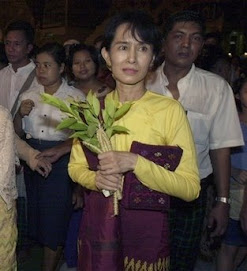


 Posts


